Article

Diagnostic Performance of Hematological Blood Ratios in Revision Surgery for Periprosthetic Joint Infections: A Retrospective Cohort Analysis of CRP/Hb Ratio, NLR, and MLR

1
Faculty of Medicine, The “Carol Davila” University of Medicine and Pharmacy, 050474 Bucharest, Romania
2
Department of Orthopaedics, “Foisor” Clinical Hospital of Orthopaedics, Traumatology and Osteoarticular TB, 021382 Bucharest, Romania
3
Faculty of Medicine, Lucian Blaga University of Sibiu, 550169 Sibiu, Romania
4
County Clinical Emergency Hospital, 550245 Sibiu, Romania
5
Panait Sirbu Obstetrics and Gynaecology Hospital, 060251 Bucharest, Romania
6
Department of Radiology and Medical Imaging, “Foisor” Clinical Hospital of Orthopaedics, Traumatology and Osteoarticular TB, 021382 Bucharest, Romania
7
International Joint Center, Acibadem Maslak Hospital, 34303 Istanbul, Turkey
8
National Institute for Infectious Diseases “Prof. Dr. Matei Bals”, 021105 Bucharest, Romania
9
Society for Research and Innovation in Infectious Diseases, Bucharest, Romania
10
Infection Science Forum, Bucharest, Romania
*
Authors to whom correspondence should be addressed.
Prosthesis 2026, 8(6), 57; https://doi.org/10.3390/prosthesis8060057
Submission received: 15 April 2026 / Revised: 1 June 2026 / Accepted: 6 June 2026 / Published: 11 June 2026
(This article belongs to the Special Issue Managing the Challenge of Periprosthetic Joint Infection)

Abstract

Objectives: Periprosthetic joint infections represent a serious complication following joint arthroplasty, often leading to significant morbidity, with an economic and social impact on the health system. Timely diagnosis of periprosthetic joint infections remains a major challenge. Our study aimed to investigate the diagnostic value and accuracy of several markers, including the neutrophil-to-lymphocyte ratio, monocyte-to-lymphocyte ratio, and C-reactive protein-to-serum-hemoglobin ratio in revision surgery for periprosthetic joint infections. Methods: A total of 251 revision arthroplasty cases, including 137 cases of periprosthetic joint infections and 114 cases of aseptic revision arthroplasty, were included from the time span January 2016 to May 2025. The diagnostic value and accuracy of the C-reactive protein-to-hemoglobin ratio, neutrophil-to-lymphocyte ratio, and monocyte-to-lymphocyte ratio were evaluated using sensitivity, specificity, and receiver operating characteristic (ROC) analysis with area under the curve analysis. Results: The highest diagnostic performance was obtained by the C-reactive protein-to-hemoglobin ratio, yielding an AUC of 0.859 (SE = 0.0263, 95% CI: 0.809–0.899). This ratio also demonstrated a strong discriminative capacity, with a threshold of >0.0667, sensitivity of 80.45%, and specificity of 85.96%. For the neutrophil-to-lymphocyte count ratio and monocyte-to-lymphocyte count ratio, we obtained an AUC of 0.615 (95% CI: 0.551–0.676) and 0.620 (95% CI: 0.556–0.680), respectively, demonstrating lower sensitivity and specificity than the C-reactive protein-to-hemoglobin ratio. Conclusions: The C-reactive protein-to-hemoglobin ratio demonstrated better diagnostic strength in detecting periprosthetic joint infections, with superior sensitivity and specificity compared to the neutrophil-to-lymphocyte count ratio and monocyte-to-lymphocyte count ratio. Our findings offer new insights into the accurate and early diagnosis of periprosthetic joint infections in cases requiring revision surgery and suggest incorporating these new biomarkers and ratios into the diagnostic algorithm. Future large-scale studies are further needed to validate these results and facilitate their clinical use.

1. Introduction

Periprosthetic joint infection (PJI) represents one of the most challenging complications after total joint replacement (TJR), with a significant impact on the patient’s life, family, and socio-economic environment and the healthcare system. After primary intervention, PJI is the most difficult and disabling complication, and current research aims at reducing the risk of associated PJI [1]. With the increase in life expectancy in most developed countries and constant requirements for mobility from active elderly patients, the number of total joint replacements, especially total hip arthroplasties (THAs) and total knee arthroplasties (TKAs), has markedly risen.
According to the latest annual report from the American Joint Replacement Registry (AJRR), the number of cumulative arthroplasty procedures has experienced a parabolic rise from 2012 to 2024 [2]. Among these, the prevalence of PJI is reported between 0.3% and 1.9%, but can reach higher values of up to 10% in revision cases [3]. Currently, the European Centre for Disease Prevention and Control (ECDC) in the surgical site infection (SSI) surveillance network has reported an infection rate of 0.7% for patients undergoing TKA and a rate of 1.2% for patients undergoing THA, but with wide variations depending on the country [4].
The “gold standard” diagnostic of PJIs is still difficult and represents a debatable subject due to the numerous definitions, with the Musculoskeletal Infection Society (MSIS), the Infectious Disease Society of North America (IDSA), the European Bone and Joint Infection Society (EBJIS), and the International Consensus Meeting (ICM 2018) being some of the entities that have proposed several different diagnostic criteria [5,6,7,8].
The PJI diagnosis implies combined clinical and physical examination, an imaging examination, and serum and synovial biomarkers. The advantage of using serum biomarkers in the diagnostic criteria of PJIs is their availability and cost-efficiency, which allow for periodic assessment. However, using serum biomarkers has some disadvantages, the most important being the lack of specificity, with patients with other chronic diseases often exhibiting elevated inflammatory markers [9]. Several serum biomarkers have been studied and described in the literature, with different specificity and sensitivity rates, with C-reactive protein (CRP), fibrinogen (FIB), erythrocyte sedimentation rate (ESR), interleukin-6 (IL-6), and procalcitonin (PCT) being the most frequently used [10,11,12].
Newer studies suggest the use of various serum biomarker relationships and analyses in order to further enhance the diagnostic accuracy for PJI. Serum CRP-to-hemoglobin (HGB) ratio and neutrophil-to-lymphocyte count ratio are among these [13,14]. However, the literature is scarce, and there are numerous gaps in the pathway to an early and accurate diagnosis of PJI, which is essential for improving patient outcomes, as well as lowering the burden on the family and healthcare and decreasing the very significant costs associated with such complications.
The aim of the present study is to evaluate the diagnostic accuracy of selected serum biomarker ratios—including the neutrophil-to-lymphocyte ratio, monocyte-to-lymphocyte ratio, and C-reactive protein-to-hemoglobin ratio—in patients with suspected PJI undergoing revision surgery. We hypothesized that these biomarker ratios would demonstrate significantly higher diagnostic accuracy than individual serum markers in distinguishing periprosthetic joint infection from aseptic failure in revision arthroplasty.

2. Materials and Methods

2.1. Study Design

After the Institutional Review Board approval for this study was obtained, we retrospectively identified all consecutive patients having undergone revision total hip arthroplasty (rTHA) and revision total knee arthroplasty (rTKA) in a single tertiary orthopedic center and teaching hospital (“Foisor” Clinical Hospital of Orthopedics, Traumatology, and Osteoarticular TB) in Bucharest, Romania, between January 2016 and May 2025. A total of 251 revision arthroplasty procedures were identified and screened for eligibility. Patients were included if they underwent revision arthroplasty during the study period and had sufficient clinical, laboratory, microbiological, and operative data available to allow classification according to the European Bone and Joint Infection Society (EBJIS) criteria. Patients with periprosthetic fractures, active malignant disease, ongoing chemotherapy, or immunosuppressive treatment were excluded. All variables required for patient classification and biomarker analysis were available in the medical records of the included patients. Therefore, no patients were excluded due to missing data, and no data imputation procedures were performed.
Patient demographic data, such as age, sex, body mass index (BMI), history of smoking, presence of diabetes mellitus or other chronic comorbidities, preoperative diagnosis, time interval since primary joint intervention, preoperative laboratory investigations obtained within 24 h before surgery (complete blood count, CRP, FIB, ESR), intraoperative samples, and microbiological analysis, were recorded.
Patients were divided into two groups: those with and those without PJI. Diagnosis of PJI was based on the European Bone and Joint Infection Society (EBJIS) criteria, which require the presence of a sinus tract or two positive cultures as clear evidence of infection. Also, a leukocyte count of >3000 cells/μL, more than 80% polymorphonuclear neutrophils in synovial fluid cytological analysis, more than 50 CFU from any microorganism in aspiration fluid from the infected site, intraoperative fluid or tissue, sonication, or histologic examination positive for infection counted toward an infectious disease diagnosis [7]. In our study, the first group consisted of 137 patients with PJIs (septic revision group—SR group), and the second group consisted of the remaining 114 patients (aseptic revision group—AR group). Within the PJI cohort, infections were further classified as acute (31 cases), defined as symptom onset within 30 days of the index procedure, or chronic (106 cases), defined as symptom onset more than 30 days after the initial surgery. All patients consented to the use of their data for future medical research at the moment of the initial hospitalization. The research was conducted in line with the ethical principles for medical research and in accordance with the 1964 Declaration of Helsinki and its later amendments. This study was approved by the “Foisor” Clinical Hospital of Orthopedics, Traumatology, and Osteoarticular TB Ethical Council with registration number 4795/23 June 2025.

2.2. Laboratory Studies

During hospital admission, blood tests were routinely performed one day before surgery, with complete serum blood count, CRP, fibrinogen, ESR, biochemistry, and coagulation tests, to prepare the patients for surgery. All patients in this study underwent surgery, with either septic or aseptic revision of the hip or knee, depending on the needs of each patient. Laboratory studies were performed in the hospital and analyzed on various machines as needed. For the complete blood count (CBC), vacutainers containing K3 EDTA were analyzed on Siemens ADVIA® 2120i (Siemens Healthineers, Erlangen, Germany). The ESR was drawn on sodium citrate 0.4 mL and assessed with the Westergren technique. Fibrinogen was drawn on vacutainers with sodium citrate 2.7 mL, centrifuged on Hettich ROTINA® (Andreas Hettich GmbH & Co. KG, Tuttlingen, Germany), and examined on the Siemens Sysmex® CA 600 analyzer (Siemens Healthineers, Erlangen, Germany). CRP was analyzed on the Siemens Dimension® (Siemens Healthineers, Erlangen, Germany).
All patients underwent surgery. Intraoperatively, at least 4 to 6 samples (including synovial fluid and tissue samples) were obtained and labeled for each patient and were sent to the laboratory for analysis. In the hospital laboratory, cell count and polymorphonuclear differentiation were performed, along with cultures from the intraoperative samples, which were observed for at least 14 days on different culture media. In the microbiological laboratory, samples are split into three: the first one is used for microscopic identification, after Gram staining; the second one is used for culture and isolation on four different culture media (Columbia Blood Agar, Cled—Cystine Lactose Electrolyte Deficient Agar, Chapman Mannitol Salt Agar and Sabourand Dextrose Agar), and the third one is used for enrichment to up to 14 days. Microscopic identification is performed by using the Siemens Walk-Away 40 Plus® (Siemens Healthineers, Erlangen, Germany), followed by an antibiogram using the Mueller-Hinton Agar using the disk diffusion method, and semi-automatic identification using the ErbaScan® (Erba Lachema s.r.o., Brno, Czech Republic) using the Minimum Inhibitory Concentration (MIC) [15]. All antibiograms performed are according to the latest recommendations by the European Committee on Antimicrobial Susceptibility Testing (EUCAST) [16].
Preoperative antibiotics were not routinely used to enhance the likelihood of a positive microbiological examination for every patient included. Antibiotic prophylaxis was performed during surgery, immediately after the samples for microbiological analysis were taken, as part of the hospital’s protocol for improving diagnosis of infection and elevating microbiological analysis If a patient was first considered aseptic according to the EBJIS criteria, but had a positive microorganism culture from the intraoperative samples, the patient was classified as septic and was introduced into the septic revision group for the purpose of the current analysis. After intraoperative sampling and evaluation, only 15 patients out of the 137 patients in the septic group were reclassified. We acknowledge that the inclusion of these cases may introduce a degree of incorporation bias, which is an inherent limitation of retrospective diagnostic studies using established consensus criteria as the reference standard.
After revision surgery, patients benefit from broad-spectrum antibiotic treatment for 3 days after surgery. If the microbiological analysis is negative, the antibiotic treatment is ceased, but as mentioned above, the samples are kept under observation in the laboratory section up to 14 days, for the final result. If this final result remains negative, the case is classified as aseptic revision. On the other hand, if at 14 days, the microbiological analysis is positive, then antibiotic treatment according to the sensitivity of the microorganism is started and adjusted for every particular case, and the case is classified as a septic revision.

2.3. Statistical Analysis

Data were tested for normality using the Shapiro–Wilk test. Values were reported as average ± standard deviation or as median (interquartile range), depending on data distribution. Continuous variables were compared using the independent samples t test or the Mann–Whitney test, accordingly. Categorical data were compared with the Chi-squared test. Effect size was measured using Cohen’s d. The cut-off values for the ROC curves were selected as corresponding to the highest Youden index j. Statistical significance was considered when p-values were <0.05. Multivariate statistical analysis was performed in order to determine whether the CRP/hemoglobin ratio is an independent predictor of periprosthetic joint infection after accounting for potential confounding variables such as diabetes, anemia, and chronic inflammatory conditions.

3. Results

A total of 251 cases that had undergone rTHA and rTKA were analyzed. According to the EBJIS diagnostic criteria, 137 cases were included in the septic group (73 THAs and 64 TKAs), and 114 cases in the aseptic group (55 THAs and 59 TKAs). The two groups were largely comparable across baseline characteristics. There were no significant differences in mean age (67.5 years old in the septic group vs. 68.0 years old in the aseptic group; p = 0.522) or body mass index with mean (BMI of 29.7 kg/m2 in the septic group vs. 29.3 kg/m2 in the aseptic group; p = 0.282). Gender distribution (70/67 vs. 49/65 male/female; p = 0.418), living environment (urban/rural 90/47 vs. 61/53; p = 0.067), and joint type (hip/knee 73/64 vs. 55/59; p = 0.504) also showed no significant variation. The only statistically significant difference between the groups was the time from primary implantation to revision surgery: patients with septic failure underwent revision considerably earlier, 19.0 months (3.0–55.25), than those with aseptic loosening, 80 months (26.0–153.75), p < 0.001. The demographic characteristics of the included patients are presented in Table 1.
Inflammatory and hematologic markers were compared between septic (n = 137) and aseptic (n = 114) revisions. Patients with septic revisions had significantly higher inflammatory response markers, with elevated CRP levels (2.72 vs. 0.30 mg/dL; p < 0.0001), fibrinogen (470 vs. 357.5 mg/dL; p < 0.0001), ESR (40 vs. 13 mm/h; p < 0.0001), white blood count (7560 vs. 7125 × 109/L; p = 0.023), neutrophil count (4990 vs. 4600 × 109/L; p = 0.003), monocyte count (430 vs. 405 × 109/L; p = 0.03), serum hemoglobin level (12.4 vs. 13.4 g/dL; p < 0.0001), CRP/hemoglobin ratio (0.2302 vs. 0.0227; p < 0.0001), neutrophil-to-lymphocyte ratio (3.19 vs. 2.69; p = 0.0013), and monocyte-to-lymphocyte ratio (0.280 vs. 0.2363; p = 0.0009). A complete comparison of inflammatory and hematologic markers between the septic and aseptic groups is presented in Table 2.
Among the 137 septic revision cases, inflammatory and hematologic markers were compared between acute (n = 31) and chronic infections (n = 106). Patients with acute PJI exhibited significantly higher inflammatory responses, including elevated CRP levels (3.66 vs. 2.5 mg/dL; p = 0.022) and ESR (54 vs. 36.5 mm/h; p = 0.012). The CRP-to-hemoglobin ratio (0.302 vs. 0.203; p = 0.0256) was also significantly elevated in acute cases. Hemoglobin levels were lower in acute cases (11.5 vs. 12.6 g/dL; p = 0.0046). Other parameters such as fibrinogen (p = 0.2208), white blood cells (p = 0.9426), neutrophils (p = 0.5909), lymphocytes (p = 0.1108), monocytes (p = 0.6977), neutrophil-to-lymphocyte ratio (p = 0.1068), and monocyte-to-lymphocyte ratio (p = 0.1425) showed no significant differences. A complete comparison of inflammatory and hematologic markers between acute and chronic septic revisions is presented in Table 3.
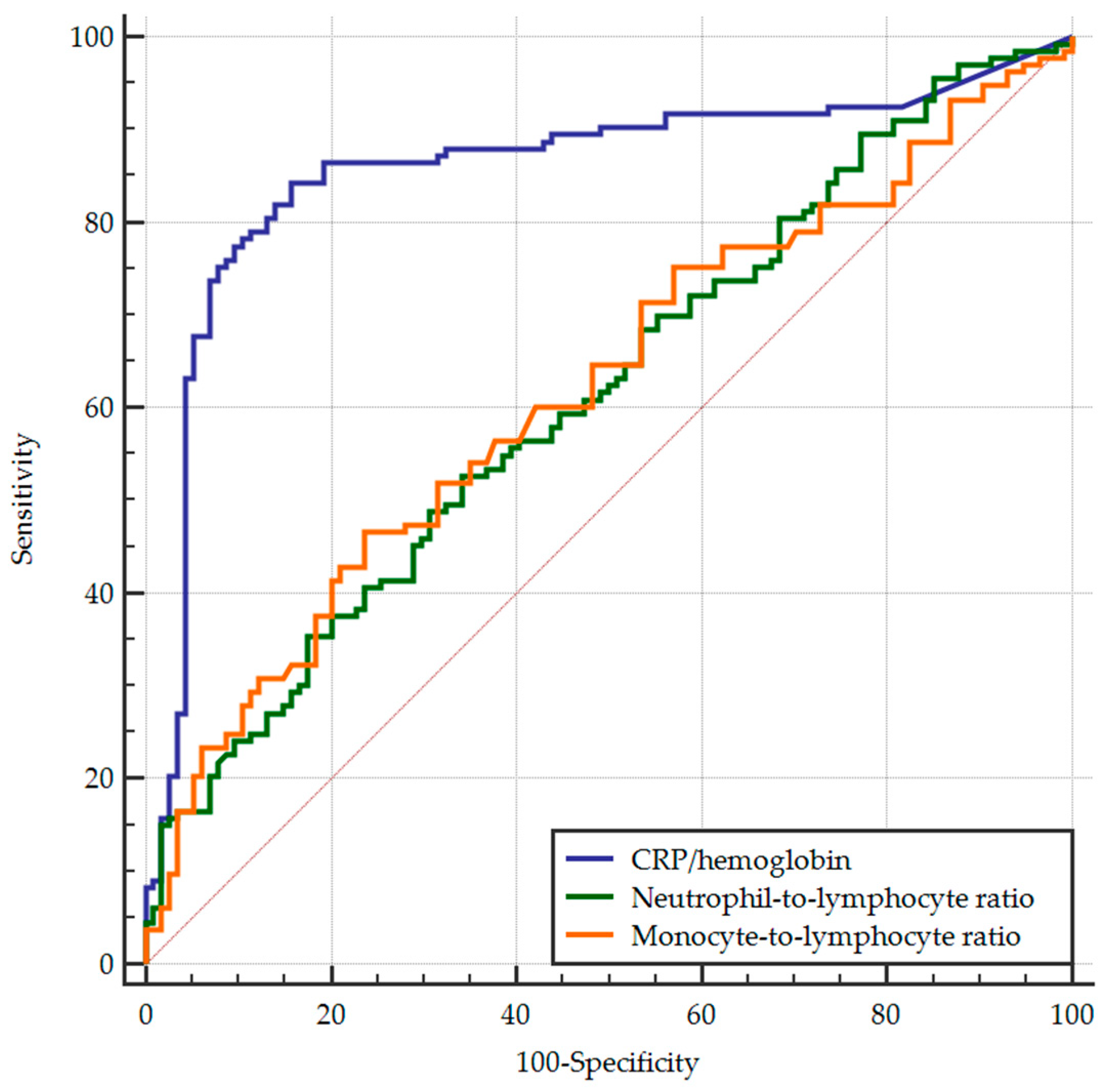
We have also evaluated the diagnostic performance of the neutrophil-to-lymphocyte ratio (NLR) and monocyte-to-lymphocyte ratio (MLR) in differentiating PJIs from aseptic failures. We observed an AUC of 0.615 (95% CI: 0.551–0.676) for NLR and 0.620 (95% CI: 0.556–0.680) for MLR. For a proposed cut-off of >3.0918, the NLR yielded a sensitivity of 52.55% (95% CI: 43.9–61.1) and a specificity of 65.79% (95% CI: 56.3–74.4), with a positive likelihood ratio (LR+) of 1.54 and a negative likelihood ratio (LR−) of 0.72. For MLR, using a threshold of >0.29, the sensitivity was 47.45% (95% CI: 38.9–56.1), and specificity was 71.93% (95% CI: 62.7–79.9), with a corresponding LR+ of 1.69 and LR− of 0.73.
This study also evaluated the diagnostic performance of the CRP/hemoglobin ratio, yielding an AUC of 0.859 (SE = 0.0263, 95% CI: 0.809–0.899). CRP/hemoglobin also demonstrated strong discriminative capacity, with a threshold of >0.0667, sensitivity of 80.45%, specificity of 85.96%, LR+ of 5.73, and LR− of 0.23 (Figure 1).
In multivariable logistic regression, the CRP/hemoglobin ratio remained independently associated with PJI after adjustment for age, gender, BMI, joint type, time since implantation, and anemia status. Each increase in the CRP/hemoglobin ratio by 0.1 units was associated with an approximately 1.80-fold increase in the odds of PJI (adjusted OR: 1.80; 95% CI: 1.38–2.36; p < 0.0001). The overall model was statistically significant (χ2 = 88.638, df = 7, p < 0.0001) and showed good discriminative performance, with an AUC of 0.883 (95% CI: 0.832–0.922).
In direct comparison with the other investigated parameters, CRP/hemoglobin demonstrated stronger diagnostic performance than fibrinogen, NLR, and MLR and was comparable to standard inflammatory markers. The AUC was 0.857 (95% CI: 0.807–0.898) for CRP, 0.842 (95% CI: 0.790–0.885) for ESR, 0.790 (95% CI: 0.734–0.839) for fibrinogen, and 0.589 (95% CI: 0.525–0.651) for WBC.

4. Discussion

In this retrospective analysis, we compared serum biomarkers to assess their potential value in the diagnosis of periprosthetic joint infections. The study results demonstrated significant differences in terms of C-reactive protein, fibrinogen, erythrocyte sedimentation rate, neutrophils, hemoglobin, CRP/hemoglobin, neutrophil-to-lymphocyte ratio, and monocyte-to-lymphocyte ratio between PJI and aseptic revision cases in diagnosing a PJI when applying the EBJIS criteria. The most important finding of this study is that the CRP/hemoglobin (CRP/Hb) ratio demonstrated substantially better diagnostic discrimination for PJI than the NLR and MLR in patients undergoing revision total hip or knee arthroplasty classified using EBJIS criteria [7]. Specifically, CRP/Hb achieved a high area under the ROC curve (AUC 0.859), with good sensitivity and specificity at the optimal threshold, whereas NLR and MLR showed only modest discrimination (AUCs ~0.62), limiting their value as stand-alone diagnostic tools in this revision setting. Collectively, these findings support CRP/Hb as a pragmatic, low-cost adjunct to established diagnostic pathways, particularly when interpreted alongside conventional serum markers and intraoperative assessments.
Mean serum C-reactive protein concentrations were substantially elevated in the septic revision group (2.72 mg/dL) compared with the aseptic revision group (0.30 mg/dL; p < 0.0001). Similarly, fibrinogen levels were higher in the septic revision group (470 mg/dL vs. 357.5 mg/dL; p < 0.0001). In terms of absolute white blood cell count and neutrophil count, they were significantly higher in septic cases (p = 0.0231 and p < 0.0035, respectively). The results are similar to the reported data in the literature [17].
The role of erythrocyte sedimentation rate has long been evaluated in the diagnosis of periprosthetic joint infection (PJI), although its diagnostic performance is not optimal when used in isolation. According to Peel et al., the ESR values in patients with aseptic failure were significantly lower (mean = 24.2 mm/h; SD = 22.9) compared to those with confirmed PJI (mean = 70.0 mm/h; SD = 33.5) [18]. Consistent with these findings, our cohort analysis revealed significantly elevated ESR values in patients undergoing septic revisions, 40 mm/h (24–64.5 mm/h), compared to those with aseptic revisions, 13 mm/h (8–23 mm/h), with a p-value < 0.0001.
In a rheumatoid arthritis primary arthroplasty cohort reported by Lai et al., preoperative inflammatory markers showed only limited ability to predict 90-day acute infection (overall event rate 2.8%): NLR was the best performer but remained only acceptable (AUC 0.704, cut-off 2.528), MLR was lower (AUC 0.608), and conventional markers were essentially non-discriminatory (CRP AUC 0.516, ESR AUC 0.533, fibrinogen AUC 0.552) [19]. In contrast, in our revision cohort focused on diagnosing established PJI, systemic inflammation was clearly higher in PJI versus aseptic failure (e.g., CRP 2.72 vs. 0.30 mg/dL and ESR 40 vs. 13 mm/h, both p < 0.0001).
The monocyte-to-lymphocyte ratio and neutrophil-to-lymphocyte ratio were first reported in the literature to be useful for diagnosing community-acquired pneumonia in 2017 [20]. An elevation in the serum MLR and NLR has been reported to be associated with the fact that monocyte and neutrophil counts are usually increased during bacterial infection [20]. In the present study, the mean neutrophil-to-lymphocyte ratio (NLR) and monocyte-to-lymphocyte ratio (MLR) were elevated in the PJI group of patients (NLR: 3.19 vs. 2.69; p = 0.0013; MLR: 0.280 vs. 0.2363; p = 0.0009), reflecting a shift toward an immune-inflammatory response. Similar mean NLRs have been reported in the literature, also by [21,22,23,24,25,26]. Regarding serum mean MLR, similar results to those reported in this study have also been reported in the literature [26,27,28]. Routine leukocyte-derived ratios have been repeatedly linked to clinically meaningful outcomes, supporting their interpretation as non-specific markers of systemic inflammation/immune dysregulation rather than disease-specific tests. In a large retrospective study, published in December 2025, evaluating hospitalized patients prior to death, NLR and MLR showed high discriminatory performance for mortality and rose markedly in the terminal phase, with significant increases noted within the last 48 h (and upward trends from 4 weeks and 1 week before death), highlighting their sensitivity to acute physiological deterioration and inflammatory burden [29].
The present study also evaluated the diagnostic performance of the NLR and MLR in differentiating PJIs from aseptic failures. When comparing our results with those from the published literature, the diagnostic performance of both ratios in our cohort is modest. We observed an AUC of 0.615 (95% CI: 0.551–0.676) for NLR and 0.620 (95% CI: 0.556–0.680) for MLR, indicating limited discriminative power to distinguish prosthetic joint infection (PJI) from aseptic failure. Our results are at the lower end of the spectrum when compared to several studies that reported notably higher diagnostic accuracy for NLR and MLR. For example, Klemt C et al. [30] and Tirumala V et al. [31] reported AUCs of 0.80 for NLR and 0.78–0.79 for MLR. Similarly, Zhao G [32] observed a remarkably high AUC of 0.93 for NLR, while other authors such as Zhao MY [33] and Seetharam A [34] reported AUCs for NLR in the range of 0.78–0.803. Our results are, however, comparable to those in the study by Sigmund et al. [17], who found an NLR AUC of 0.677. For MLR, our AUC of 0.620 was similarly lower than values observed in other studies, such as Maimaiti Z et al. [35], who reported an MLR AUC of 0.733 (95% CI: 0.671–0.796), and Klemt C et al. [30] with an MLR AUC of 0.78. For a proposed cut-off of >3.0918, the NLR yielded a sensitivity of 52.55% (95% CI: 43.9–61.1) and a specificity of 65.79% (95% CI: 56.3–74.4), with a positive likelihood ratio (LR+) of 1.54 and a negative likelihood ratio (LR−) of 0.72. For MLR, using a threshold of >0.29, the sensitivity was 47.45% (95% CI: 38.9–56.1), and specificity was 71.93% (95% CI: 62.7–79.9), with a corresponding LR+ of 1.69 and LR− of 0.73. In contrast to our results, most of the published literature reports higher sensitivity and specificity values for both NLR and MLR. For example, Zhao G et al. [32] demonstrated an NLR sensitivity of 84.6% and specificity of 89.7% at a threshold of 2.77. Similarly, Klemt C et al. [30] reported NLR and MLR sensitivities of 75.9% and 75.4%, respectively, with corresponding specificities of 79.8% and 80.5%. These results suggest inflammatory ratios have higher diagnostic accuracy in their cohort than in ours. In comparison, Sigmund et al. [17] reported higher diagnostic values for NLR with a sensitivity of 63% and specificity of 73%, suggesting superior discriminatory capacity in their cohort. Even in studies with lower diagnostic accuracy, such as Burchette DT et al. [21], the reported NLR sensitivity (58.4%) and specificity (81.2%) still surpass our observations. These results further highlight the relatively limited stand-alone value of NLR in differentiating septic from aseptic prosthetic failures. Other studies further support the utility of NLR in the diagnostic algorithm of PJI. Seetharam A et al. [34] found that NLR had a high sensitivity of 94.7% and specificity of 58.8% at a cut-off of 2.6, while Yu BZ et al. [36] reported 85.0% sensitivity and 68.3% specificity at a cut-off of 2.13. In our study, the lower NLR performance may also be attributed to differences in population characteristics, comorbidities (e.g., diabetes, anemia), sample sizes, or microbial profiles.
These inter-study differences are not unexpected and likely reflect heterogeneity in case definitions, patient case-mix, comorbidity burden (including conditions affecting leukocyte profiles and systemic inflammation), timing of blood sampling, and institutional diagnostic pathways. In revision arthroplasty, where inflammatory background and chronicity are common and clinical phenotypes overlap, leukocyte ratios may be particularly vulnerable to non-specific variation, thereby reducing their diagnostic utility. Taken together, our findings reinforce that NLR and MLR may provide supportive information within a broader multimodal diagnostic framework, but their stand-alone value for distinguishing septic from aseptic prosthetic failure appears limited in our setting [17,30,31,32,33,34,35,36].
Regarding MLR, our findings (sensitivity 47.45%, specificity 71.93% at a cut-off of 0.29) are lower than those reported in other studies. For instance, Klemt C et al. [30] reported MLR values with sensitivity and specificity both exceeding 75%, and Tirumala V et al. [31] found values of 81.6% and 78.3%, respectively, at a cut-off of 0.44.
A broader overview of cut-off thresholds reported in the literature shows considerable variability. NLR cut-offs generally ranged from 2.1 to 4.77, while MLR cut-offs varied from 0.21 to 0.57. In our study, the selected thresholds of 3.09 for NLR and 0.29 for MLR fell within this reported range but still yielded comparatively lower diagnostic performance. Despite the lower diagnostic accuracy observed in our cohort, NLR and MLR remain attractive tools due to their low cost, accessibility, and non-invasiveness.
Lymphocytes are primarily involved in the immune response, being activated when different pathogens enter the human body [37]. The absolute count of lymphocytes in patients with sepsis also decreases significantly, due to the mechanisms of lymphocyte marginalization, increased apoptosis, and redistribution of cells [37]. Similar results are also being reported in the literature [25].
In a comparative meta-analytic review of 29 studies including 14,040 patients (3418 PJI and 10,622 aseptic cases), both serum neutrophil-to-lymphocyte ratio (NLR) and monocyte-to-lymphocyte ratio (MLR) were significantly higher in PJI. Serum NLR showed slightly better diagnostic performance than serum MLR, with a mean AUC of 0.719 versus 0.700; mean sensitivity and specificity were 69.9% and 69.8% for NLR, compared with 68.2% and 70.4% for MLR. The average diagnostic cut-offs were 2.88 for NLR and 0.34 for MLR, while HSROC analysis showed pooled AUCs of approximately 0.750 and 0.755, respectively, confirming overall moderate accuracy. NLR performed better in acute infections, whereas MLR showed less consistent subgroup effects [38]. The 2025 ICM concluded that antibody testing for microorganisms and serum NLR/MLR may both serve as adjunctive tools in the diagnosis of PJI, but neither should be used in isolation. Antibody-based multiplex assays showed variable but promising performance, with reported sensitivity/specificity ranging from 72.3%/80.7% to 86.7%/96.2%, and up to 91–100% sensitivity with 100% specificity in selected experimental models. For hematological ratios, pooled values were 68.4% sensitivity and 69.8% specificity for NLR, and 67.4% sensitivity and 70.6% specificity for MLR. Thus, the ICM recommendation supports these markers only as part of a broader multimodal diagnostic approach [39].
Recently published data on CRP/hemoglobin demonstrated greater diagnostic strength than other classical markers for detecting PJI [13]. In this recent study by Abudousaimi Aimaiti et al., a total of 841 revision arthroplasty cases, including 435 PJI and 406 aseptic failures, were retrospectively analyzed to assess the diagnostic utility of CRP/hemoglobin. The CRP/hemoglobin demonstrated an AUC of 0.87 (95% CI: 0.85–0.90) and a sensitivity of 0.81 (95% CI: 0.77–0.85). In line with their findings, our own analysis confirmed the diagnostic performance of CRP/hemoglobin, yielding an AUC of 0.859 (SE = 0.0263, 95% CI: 0.809–0.899), further supporting its clinical utility as a reliable adjunct in the diagnostic workup of suspected PJIs. For a threshold of 0.078, Abudousaimi Aimaiti et al. report a sensitivity of 81.3%, specificity of 83.9%, positive predictive value (PPV) of 84.5%, and negative predictive value (NPV) of 80.8%. In our dataset, CRP/hemoglobin also demonstrated strong discriminative capacity, with a threshold of >0.0667, sensitivity of 80.45%, specificity of 85.96%, PPV of 5.73, and NPV of 0.23, further validating its clinical applicability. These results support the use of CRP/hemoglobin as a rapid, cost-effective adjunct biomarker in the diagnostic algorithm for PJI, particularly in settings where more advanced molecular or imaging techniques may be unavailable or delayed [13].
Strengths of this study include the evaluation of readily available, low-cost hematological indices in a clinically relevant cohort of revision total hip and knee arthroplasties and the use of the EBJIS criteria as the diagnostic reference standard. The analysis reflects routine clinical practice, with preoperative blood sampling performed at a standardized time point (one day before surgery) and inclusion of both hip and knee revisions, thereby improving clinical applicability. In addition, diagnostic performance was quantified using ROC analysis with threshold-based estimates, facilitating pragmatic interpretation for bedside decision-making.
Several limitations should be acknowledged. First, the retrospective, single-center design introduces the potential for selection bias and limits generalizability to other settings with different patient case-mix, relatively limited sample size, microbiological epidemiology, and diagnostic workflows. Given the sample size and retrospective nature of the study, detailed subgroup analyses were not feasible. Future studies with larger cohorts should evaluate biomarker performance within more homogeneous patient subgroups to better define their diagnostic utility across different clinical scenarios. Second, because hemoglobin is incorporated into the CRP/Hb ratio, the observed association may be influenced by confounding related to anemia and comorbidity. Third, laboratory values were derived from routine care and may be affected by unmeasured factors such as timing of symptom onset, perioperative physiological stress, or pre-referral antimicrobial exposure, which could attenuate inflammatory responses and culture yield.

5. Conclusions

In conclusion, in this study, we compared different serum biomarkers and ratios to explore their potential value in diagnosing periprosthetic joint infections. The study results demonstrated significant differences in C-reactive protein, fibrinogen, erythrocyte sedimentation rate, neutrophils, hemoglobin, CRP/hemoglobin, NLR, and MLR between PJI and aseptic revision cases when diagnosing PJI using EBJIS criteria. Moreover, the C-reactive protein-to-hemoglobin ratio demonstrated better diagnostic strength in detecting periprosthetic joint infections, with superior sensitivity and specificity compared to the NLR and MLR. Our findings offer new insights into the accurate and early diagnosis of periprosthetic joint infections and suggest incorporating these new biomarkers into the diagnostic algorithm. However, these findings should be considered exploratory and hypothesis-generating, and prospective multicentre studies with multivariable adjustment are needed to further validate the observed associations. Future large-scale studies are further needed to validate these results and facilitate their clinical use.

Author Contributions

Conceptualization, D.-E.V., R.-M.B., O.S. and C.S.; methodology, V.B., R.J., J.P. and S.D.; formal analysis, D.-E.V., R.-M.B., A.L. and S.D.; investigation, O.S. and C.S.; writing—original draft preparation, D.-E.V., S.D., R.-M.B., V.B., R.J., A.L., C.M., C.S., J.P. and O.S.; writing—review and editing, S.D., J.P., O.S. and C.S.; visualization, D.-E.V., R.-M.B., R.J., C.M. and C.S.; supervision, V.B., O.S. and C.S. All authors have read and agreed to the published version of the manuscript.

Funding

This research received no external funding.

Institutional Review Board Statement

The study was conducted in accordance with the Declaration of Helsinki and approved by the “Foisor” Clinical Hospital of Orthopedics, Traumatology, and Osteoarticular TB Ethical Council (protocol code 4795 and date of approval 23 June 2025).

Informed Consent Statement

All patients who were admitted to the hospital for the first time have signed written informed consent forms, agreeing to have their clinical, laboratory and surgical data anonymized and used for subsequent medical research related to orthopedics. This study is strictly limited within the scope of this consent, and has been approved by the hospital’s ethics committee (approval number: 4795/23 June 2025).

Data Availability Statement

The raw data supporting the conclusions of this article will be made available by the corresponding authors upon reasonable request.

Conflicts of Interest

The authors declare no conflicts of interest.

Abbreviations

AJRRAmerican Joint Replacement Registry
BMIBody mass index
CBCComplete blood count
CFUColony-forming unit
CRPC-reactive protein
CRP/Hb ratioC-reactive protein-to-serum-hemoglobin ratio
EBJISEuropean Bone and Joint Infection Society
ECDCEuropean Centre for Disease Prevention and Control
ESRErythrocyte sedimentation rate
EUCASTEuropean Committee on Antimicrobial Susceptibility Testing
FIBFibrinogen
HGBSerum hemoglobin
ICM International Consensus Meeting
IDSAInfectious Disease Society of North America
IL-6Interleukin-6
MICMinimum Inhibitory Concentration
MLRMonocyte-to-lymphocyte ratio
MSISMusculoskeletal Infection Society
NLRNeutrophil-to-lymphocyte ratio
PCTProcalcitonin
PJIPeriprosthetic joint infection
rTHARevision total hip arthroplasty
rTKARevision total knee arthroplasty
SSISurgical site infection
THATotal hip arthroplasty
TJRTotal joint replacement
TKATotal knee arthroplasty

References

  1. Bove, A.; Braile, A.; Matino, G.; Del Regno, N.; Sirico, S.; Orabona, N.; Braile, M. The Efficacy of Defensive Antibacterial Coating (DAC™) Periprosthetic Joint Infection Prevention in the Hip: A Systematic Review. J. Clin. Med. 2025, 14, 270. [Google Scholar] [CrossRef]
  2. American Joint Replacement Registry (AJRR). American Joint Replacement Registry (AJRR): 2024 Annual Report; American Academy of Orthopaedic Surgeons (AAOS): Rosemont, IL, USA, 2024. [Google Scholar]
  3. Jonathan, S.Y.; Bornes, T.D.; Youssef, M.P.; Tam, K.W.; Nocon, A.A.; Sculco, P.K.; Carli, A.V. Which combination is the best? A comparison of the predictive potential of serum biomarker combinations to diagnose periprosthetic joint infection. J. Arthroplast. 2023, 38, S381–S388. [Google Scholar] [CrossRef]
  4. European Centre for Disease Prevention and Control. Point Prevalence Survey of Healthcare-Associated Infections and Antimicrobial Use in European Acute Care Hospitals; European Centre for Disease Prevention and Control (ECDC): Stockholm, Sweden, 2024. [Google Scholar]
  5. Fillingham, Y.A.; Della Valle, C.J.; Suleiman, L.I.; Springer, B.D.; Gehrke, T.; Bini, S.A.; Segreti, J.; Chen, A.F.; Goswami, K.; Tan, T.L. Definition of successful infection management and guidelines for reporting of outcomes after surgical treatment of periprosthetic joint infection: From the Workgroup of the Musculoskeletal Infection Society (MSIS). J. Bone Jt. Surg. 2019, 101, e69. [Google Scholar]
  6. Kim, S.-J.; Cho, Y.J. Current guideline for diagnosis of periprosthetic joint infection: A review article. Hip Pelvis 2021, 33, 11. [Google Scholar] [CrossRef] [PubMed]
  7. McNally, M.; Sousa, R.; Wouthuyzen-Bakker, M.; Chen, A.F.; Soriano, A.; Vogely, H.C.; Clauss, M.; Higuera, C.A.; Trebše, R. The EBJIS definition of periprosthetic joint infection: A practical guide for clinicians. Bone Jt. J. 2021, 103, 18–25. [Google Scholar]
  8. Parvizi, J.; Tan, T.L.; Goswami, K.; Higuera, C.; Della Valle, C.; Chen, A.F.; Shohat, N. The 2018 definition of periprosthetic hip and knee infection: An evidence-based and validated criteria. J. Arthroplast. 2018, 33, 1309–1314.e2. [Google Scholar] [CrossRef]
  9. Klim, S.; Amerstorfer, F.; Glehr, G.; Hauer, G.; Smolle, M.; Leitner, L.; Leithner, A.; Glehr, M. Combined serum biomarker analysis shows no benefit in the diagnosis of periprosthetic joint infection. Int. Orthop. 2020, 44, 2515–2520. [Google Scholar] [CrossRef]
  10. Saleh, A.; George, J.; Faour, M.; Klika, A.; Higuera, C. Serum biomarkers in periprosthetic joint infections. Bone Jt. Res. 2018, 7, 85–93. [Google Scholar] [CrossRef] [PubMed]
  11. Shahi, A.; Parvizi, J. The role of biomarkers in the diagnosis of periprosthetic joint infection. EFORT Open Rev. 2016, 1, 275–278. [Google Scholar] [CrossRef]
  12. Vicenti, G.; Bizzoca, D.; Nappi, V.; Pesce, V.; Solarino, G.; Carrozzo, M.; Moretti, F.; Dicuonzo, F.; Moretti, B. Serum biomarkers in the diagnosis of periprosthetic joint infection: Consolidated evidence and recent developments. Eur. Rev. Med. Pharmacol. Sci. 2019, 23, 43–50. [Google Scholar] [PubMed]
  13. Aimaiti, A.; Guo, W.; Xu, B.; Mu, W.; Wahafu, T.; Zou, C.; Hua, L.; Cao, L. Serum C-Reactive Protein to Hemoglobin Ratio: Novel Biomarkers for the Diagnosis of Chronic Periprosthetic Joint Infection. J. Arthroplast. 2025, 40, 2381–2386.e3. [Google Scholar] [CrossRef]
  14. Salimi, M.; Karam, J.A.; Willman, M.; Willman, J.; Lucke-Wold, B.; Khanzadeh, S.; Mirghaderi, P.; Parvizi, J. Neutrophil to lymphocyte ratio and periprosthetic joint infection: A systematic review and meta-analysis. J. Arthroplast. 2024, 39, 831–838. [Google Scholar] [CrossRef]
  15. Vulpe, D.E.; Nedelea, D.-G.; Dragosloveanu, S.; Sandulescu, O.; Scheau, C. Etiological insights and the role of individual factors in infectious spondylodiscitis. Infect. Dis. Rep. 2025, 17, 6. [Google Scholar] [CrossRef] [PubMed]
  16. The European Committee on Antimicrobial Susceptibility Testing. Breakpoint Tables for Interpretation of MICs and Zone Diameters, Version 14.0; The European Committee on Antimicrobial Susceptibility Testing: Växjö, Sweden, 2024. [Google Scholar]
  17. Sigmund, I.K.; Holinka, J.; Staats, K.; Sevelda, F.; Lass, R.; Kubista, B.; Giurea, A.; Windhager, R. Inferior performance of established and novel serum inflammatory markers in diagnosing periprosthetic joint infections. Int. Orthop. 2021, 45, 837–846. [Google Scholar] [CrossRef]
  18. Peel, T.N.; Buising, K.L.; Choong, P.F. Prosthetic joint infection: Challenges of diagnosis and treatment. ANZ J. Surg. 2011, 81, 32–39. [Google Scholar] [CrossRef]
  19. Lai, Y.; Fan, J.; Lv, N.; Li, X.; Zhao, W.; Luo, Z.; Zhou, Z. Neutrophil-Lymphocyte Ratio as Predictor for Acute Infection After Primary Total Joint Arthroplasty in Rheumatoid Arthritis Patients. Orthop. Surg. 2025, 17, 1314–1321. [Google Scholar] [PubMed]
  20. Xie, K.; Dai, K.; Qu, X.; Yan, M. Serum and synovial fluid interleukin-6 for the diagnosis of periprosthetic joint infection. Sci. Rep. 2017, 7, 1496. [Google Scholar] [CrossRef]
  21. Burchette, D.T.; Dasci, M.F.; Fernandez Maza, B.; Linke, P.; Gehrke, T.; Citak, M. Neutrophil–Lymphocyte Ratio and Lymphocyte–Monocyte Ratio correlate with Chronic Prosthetic Joint Infection but are not useful markers for diagnosis. Arch. Orthop. Trauma Surg. 2024, 144, 297–305. [Google Scholar] [CrossRef]
  22. Chen, C.-C.; Chen, Y.-P.; Kuo, Y.-J.; Liu, Y.-C.; Huang, S.-W. Diagnostic value of neutrophil-to-lymphocyte ratio and albumin-to-globulin ratio for periprosthetic joint infections: A systematic review and meta-analysis. EFORT Open Rev. 2024, 9, 1134–1143. [Google Scholar] [CrossRef]
  23. Karlidag, T.; Dasci, M.F.; Steinhoff, J.; Gehrke, T.; Citak, M. What is the diagnostic accuracy of neutrophil to lymphocyte ratio and monocyte to lymphocyte ratio in detecting acute periprosthetic joint infections? A gender-specific analysis. Arch. Orthop. Trauma Surg. 2024, 144, 5071–5078. [Google Scholar] [CrossRef] [PubMed]
  24. Qian, B.; Zheng, Y.; Jia, H.; Zheng, X.; Gao, R.; Li, W. Neutrophil-lymphocyte ratio as a predictive marker for postoperative infectious complications: A systematic review and meta-analysis. Heliyon 2023, 9, e15586. [Google Scholar] [CrossRef]
  25. Shi, W.; Jiang, Y.; Tian, H.; Wang, Y.; Zhang, Y.; Yu, T.; Li, T. C-reactive protein-to-albumin ratio (CAR) and C-reactive protein-to-lymphocyte ratio (CLR) are valuable inflammatory biomarker combination for the accurate prediction of periprosthetic joint infection. Infect. Drug Resist. 2023, 16, 477–486. [Google Scholar] [CrossRef]
  26. Telang, S.; Mayfield, C.K.; Palmer, R.; Liu, K.C.; Wier, J.; Hong, K.; Lieberman, J.R.; Heckmann, N.D. Preoperative laboratory values predicting periprosthetic joint infection in morbidly obese patients undergoing total hip or knee arthroplasty. J. Bone Jt. Surg. 2024, 106, 1317–1327. [Google Scholar] [CrossRef] [PubMed]
  27. Xu, H.; Xie, J.; Wan, X.; Liu, L.; Wang, D.; Zhou, Z. Combination of C-reactive protein and fibrinogen is useful for diagnosing periprosthetic joint infection in patients with inflammatory diseases. Chin. Med. J. 2022, 135, 1986–1992. [Google Scholar] [CrossRef] [PubMed]
  28. Xu, H.; Xie, J.; Zhang, S.; Wang, D.; Huang, Z.; Zhou, Z. Potential blood biomarkers for diagnosing periprosthetic joint infection: A single-center, retrospective study. Antibiotics 2022, 11, 505. [Google Scholar] [CrossRef]
  29. Fang, G.; Mo, Y.; Bao, Y.; Gao, C.; Pan, Q.; Lu, T. The clinical value of PLR, NLR, and MLR in predicting mortality risk in hospitalized patients. Front. Pharmacol. 2025, 16, 1736947. [Google Scholar] [CrossRef]
  30. Klemt, C.; Tirumala, V.; Smith, E.J.; Xiong, L.; Kwon, Y.-M. Complete blood platelet and lymphocyte ratios increase diagnostic accuracy of periprosthetic joint infection following total hip arthroplasty. Arch. Orthop. Trauma Surg. 2023, 143, 1441–1449. [Google Scholar] [CrossRef]
  31. Tirumala, V.; Klemt, C.; Xiong, L.; Chen, W.; van den Kieboom, J.; Kwon, Y.-M. Diagnostic utility of platelet count/lymphocyte count ratio and platelet count/mean platelet volume ratio in periprosthetic joint infection following total knee arthroplasty. J. Arthroplast. 2021, 36, 291–297. [Google Scholar]
  32. Zhao, G.; Chen, J.; Wang, J.; Wang, S.; Xia, J.; Wei, Y.; Wu, J.; Huang, G.; Chen, F.; Shi, J. Predictive values of the postoperative neutrophil-to-lymphocyte ratio, platelet-to-lymphocyte ratio, and lymphocyte-to-monocyte ratio for the diagnosis of early periprosthetic joint infections: A preliminary study. J. Orthop. Surg. Res. 2020, 15, 517. [Google Scholar] [CrossRef] [PubMed]
  33. Zhao, M.Y.; Girgis, S.; Goldade, T.; Parchomchuk, E.; Nickol, M.; van der Merwe, J.M. Comparative Diagnostic Value of Serological and Synovial Tests for Periprosthetic Joint Infections: A Comprehensive Analysis. JBJS Open Access 2025, 10, e24. [Google Scholar] [CrossRef]
  34. Seetharam, A.; Dilley, J.E.; Meneghini, R.M.; Kheir, M.M. Diagnostic utility and thresholds for commonly obtained serum and synovial markers prior to reimplantation in periprosthetic joint infection. J. Arthroplast. 2023, 38, 1356–1362. [Google Scholar] [CrossRef]
  35. Maimaiti, Z.; Xu, C.; Fu, J.; Chai, W.; Zhou, Y.; Chen, J. The potential value of monocyte to lymphocyte ratio, platelet to mean platelet volume ratio in the diagnosis of periprosthetic joint infections. Orthop. Surg. 2022, 14, 306–314. [Google Scholar] [CrossRef]
  36. Yu, B.-Z.; Fu, J.; Chai, W.; Hao, L.-B.; Chen, J.-Y. Neutrophil to lymphocyte ratio as a predictor for diagnosis of early Periprosthetic joint infection. BMC Musculoskelet. Disord. 2020, 21, 706. [Google Scholar] [CrossRef] [PubMed]
  37. Hong, C.S.; Ryan, S.P.; Gabor, J.A.; Bergen, M.A.; Schwarzkopf, R.; Seyler, T.M. Predicting success of two-stage exchange for prosthetic joint infection using C-reactive protein/albumin ratio. Adv. Orthop. 2019, 2019, 6521941. [Google Scholar] [CrossRef] [PubMed]
  38. Birlutiu, R.-M.; Salimi, M.; Dragosloveanu, S.; Scheau, C.; Vorovenci, A.E.; Larie, A.; Anea, E.-C.; Neamtu, B.; Birlutiu, V. Diagnostic Performance of Serum Neutrophil–Lymphocyte and Serum Monocyte–Lymphocyte Ratios in Periprosthetic Joint Infection: A Comparative Meta-Analytic Review of 29 Studies. J. Clin. Med. 2025, 14, 7645. [Google Scholar] [CrossRef]
  39. Grzelecki, D.; Raafat, D.; Birlutiu, R.-M.; Belden, K.A.; Balato, G.; Bellotti, V.; Cismasiu, R.-S.; de Sandes Kimura, O.; Gancher, E.; Homma, Y.; et al. 2025 ICM: Diagnostic Techniques—Serological and Point-of-Care. J. Arthroplast. 2025, 41, S412–S422. [Google Scholar] [CrossRef] [PubMed]
Figure 1. ROC and AUC analysis of CRP/hemoglobin ratio, monocyte-to-lymphocyte ratio, and neutrophil-to-lymphocyte ratio in predicting periprosthetic joint infections.
Prosthesis 08 00057 g001
Table 1. Demographic characteristics of the included patients.
ParameterSeptic RevisionsAseptic Revisionsp-Value
Age (years)67.5 (62.0–73.0)68.0 (62.0–73.0)0.5220
BMI (body mass index)29.7 (27.5–32.6)29.3 (26.3–32.8)0.2817
Gender (Male/Female)70/6749/650.4180
Living environment (urban/rural)90/4761/530.0667
Joint (Hip/Knee)73/6455/590.5039
Time since implantation (months)19.0 (3.0–55.25)80 (26.0–153.75)<0.0001
Table 2. Comparison of inflammatory and hematologic markers between the septic and aseptic groups. M-W U = Mann–Whitney U.
ParameterSeptic RevisionsAseptic Revisionsp-ValueM-W UTest Statistic ZEffect Size
C-reactive protein (mg/dL)2.72 (1.277–5.725)0.30 (0.100–0.650)<0.00012178.59.8430.739
Fibrinogen (mg/dL)470 (389.0–577.0)357.5 (324.0–403.0)<0.00013238.07.9820.942
Erythrocyte sedimentation rate (mm/h)40.0 (24.0–64.5)13.0 (8.0–23.0)<0.00012412.09.4291.276
White blood cells (×109/L)7560 (6262.5–8820.0)7125.0 (5780.0–8300.0)0.02316508.02.2720.398
Neutrophils (×109/L)4990.0 (3892.5–6330.0)4600 (3600.0–5640.0)0.00356134.52.9240.493
Lymphocytes (×109/L)1620.0 (1230.0–2040.0)1655.0 (1320.0–2120.0)0.16487013.51.389−0.030
Monocytes (×109/L)430.0 (330.0–582.5)405.0 (320.0–480.0)0.03016567.52.1680.374
Hemoglobin (g/dL)12.4 (10.87–13.30)13.4 (12.5–14.3)<0.00014531.05.450−0.766
CRP/hemoglobin0.2302 (0.1020–0.4929)0.0227 (0.007–0.047)<0.00012145.09.7200.720
Neutrophil-to-lymphocyte ratio3.19 (2.23–4.47)2.69 (1.97–3.65)0.00135961.53.2260.460
Monocyte-to-lymphocyte ratio0.2800 (0.2175–0.3800)0.2363 (0.1875–0.2950)0.00095902.53.3290.430
Table 3. Comparison of inflammatory and hematologic markers between acute and chronic septic revisions.
ParameterSeptic Revisions (Acute)Septic Revisions (Chronic)p-ValueM-W UTest Statistic ZEffect Size
C-reactive protein (mg/dL)3.66 (2.40–9.75)2.50 (1.13–5.28)0.02191197.52.292−0.724
Fibrinogen (mg/dL)491.00 (411.25–592.75)466.00 (373.00–558.00)0.22081405.01.2240.417
Erythrocyte sedimentation rate (mm/h)54.00 (37.00–80.75)36.50 (24.00–61.00)0.01181153.52.5180.047
White blood cells (×109/L)6680.00 (5855.00–11,635.00)7680.00 (6310.00–8700.00)0.94261629.00.07200.245
Neutrophils (×109/L)4780.00 (3807.50–9752.50)5020.00 (4110.00–6050.00)0.59091538.50.5380.483
Lymphocytes (×109/L)1490.00 (1015.00–1915.00)1620.00 (1280.00–2070.00)0.11081333.01.595−0.633
Monocytes (×109/L)410.00 (322.50–572.50)435.00 (340.00–590.00)0.69771567.50.38880.392
Hemoglobin (g/dL)11.50 (10.33–12.63)12.60 (11.30–13.40)0.0046987.52.837−0.203
CRP/hemoglobin0.3020 (0.1949–1.2070)0.2030 (0.0786–0.4395)0.02561098.52.2320.528
Neutrophil-to-lymphocyte ratio3.67 (2.13–6.65)3.16 (2.32–4.20)0.10681329.51.6130.464
Monocyte-to-lymphocyte ratio0.3000 (0.2300–0.4575)0.2800 (0.2100–0.3700)0.14251358.01.4670.328
Disclaimer/Publisher’s Note: The statements, opinions and data contained in all publications are solely those of the individual author(s) and contributor(s) and not of MDPI and/or the editor(s). MDPI and/or the editor(s) disclaim responsibility for any injury to people or property resulting from any ideas, methods, instructions or products referred to in the content.