1. Introduction
The prevalence of obstructive sleep apnea syndrome (OSA) is increasing by the year [
1]. In some cases, a continuous positive airway pressure (CPAP) device is useful for keeping the airways open and preventing breathing interruptions during sleep [
2]. However, alternative treatment options are sometimes required for OSA patients who refuse, cannot endure, or have contraindications to the treatment using the CPAP machines.
Oral appliance (OA) use is a treatment method that is well-tolerated by most patients [
2]. CPAP has a stronger effect than OA in ameliorating sleep-disordered breathing [
3], and OA use alone may not completely alleviate severe OSA symptoms. According to previous reports, 75% of the moderate OSA patients and 50% of the severe OSA patients achieved a good response to treatment with OA [
4]. However, most patients generally prefer OA treatment over surgery or CPAP because of its simplicity and convenience of use.
The two most common designs of OA are tongue-retaining devices and mandibular advancing (MA); however, the preferred OA is a customized and tooth-borne appliance developed to make advancing movements of a mandible [
5]. The MAOA can alleviate the condition of the upper airways by changing the positions of the tongue and the connected upper airway structure.
MAOA can be prefabricated or customized; however, the latter is recommended in clinical practice because it is comfortable to wear. Generally, both appliances for the maxilla and mandible are tailored to a specific patient’s dentition in a dental laboratory. There are two techniques for connecting appliances to maintain a MA position: fixed (where the maxilla and mandible are integrated) and semi-fixed (movable, where a connector allows a certain range of motion). In general, semi-fixed MAOAs pose fewer risks of temporomandibular joint symptoms and discomfort compared to fixed ones [
6]. However, semi-fixed movable devices are subject to greater loads during mandibular movement, which predisposes them to breakage. To overcome this drawback, several connection methods have been elaborated [
7,
8]. The Silencor design [
9] is a well-known connection system for movable MAOAs. Ihara et al. [
10] reported the effectiveness of the Co-Cr wire used as an MAOA connector. However, with long-term connection design advancements and adhesive treatment of MAOA, we have developed a simple connector (NK connector; Morita Corp., Suita, Japan) using high-density polyethylene (HDPE) material [
11]. The development and commercialization of this connector have been shown to have significant clinical benefits for many patients [
6]. However, concerns remain that increasing the range of motion in MAOAs may compromise their long-term durability. No matter how comfortable the MAOA is, if it is destroyed within a short period of time, OSA symptoms will recur. The durability of the MAOA device is an important issue and warrants evaluation through clinical studies with long-term follow-up involving a large cohort of patients with MAOA.
Evaluating the clinical outcomes of MAOA treatment and identifying the determinants of success can provide meaningful information for OSA treatment strategies with MAOA. This retrospective cohort research was carried out to explore the variables associated with OA longevity by performing a survival analysis of MAOAs used for treatment.
2. Materials and Methods
2.1. Study Design and Population
This retrospective cohort study received the approval from the Clinical Research Ethics Committee of Nagasaki University Hospital (approval no. 19111813) and was carried out according to the principles outlined in the Helsinki Declaration II.
In this study, we used the electronic patient medical records of patients who had been diagnosed with OSA and treated with MAOAs at Nagasaki University Hospital over a ten-year period from 1 June 2008, to 31 May 2018. All patients were diagnosed with OSA at the Respiratory Medicine Department and were found to be appropriate for treatment using MAOA after being referred to the Oral Surgery department for oral examination. An oral surgeon examined the oral condition (the presence of caries, periodontal disease, occlusion, temporomandibular joint movement, etc.) and checked a given patient’s suitability for MAOA treatment. Patients with severe periodontal disease or temporomandibular joint disorder and those with few (<12) remaining teeth were referred back to the Respiratory Medicine Department.
Patients considered suitable for MAOA treatment underwent maxillary and mandibular impressions and maxillomandibular registrations. Impressions were obtained using an alginate impression material. During the maxillomandibular registration, a patient’s mandible was guided so that the amount of forward movement of the mandible composed approximately 60–80% of maximum protrusion, and that of vertical opening was approximately 2–5 mm wider than a normal occlusion position. The patient was asked to maintain this position, and maxillomandibular registration was performed using a silicone registration material. For special occlusal conditions, such as open bite, mandibular retrusion (retrognathia), and deep overbite, the optimal position had been explored separately for each case.
Based on the information obtained from the Oral Surgery department, the OA was fabricated in a dental laboratory (Nagasaki University Hospital Dental Laboratory). The MAOA was basically constructed as a mobile device. The upper and lower appliance components were fabricated separately using the clear transparent polyethylenterephthalat-glycol (PETG) thermoplastic material (DURAN, Scheu Dental GmbH, Iserlohn, Germany) and attached using HDPE connectors (NK connector II, Morita Corp), one on each side. The surface of the connection part was roughened and treated with dichloromethane, and the connector was attached with the self-curing resin (Unifast III Clear; Morita Corp). Its end was covered with a self-curing resin to ensure sufficient strength. A connector was positioned between a maxillary canine and a mandibular first molar. A single connector was used on each side; however, when instructed by an oral surgeon or after damage, reinforcement by fixing the prosthesis was sometimes performed using two connectors on each side.
The MAOA was fitted in the mouth by an oral surgeon and adjusted as necessary. Then, the patient was instructed on its proper use. After several weeks of use, symptom alleviation was checked, and if any problems arose, the relevant adjustments or repairs were made accordingly. Subsequently, patients were recommended to undergo regular check-ups (at least once every six months).
2.2. Variables
Details regarding variables likely associated with MAOA survival were gathered from medical records.
The collected participant information covered sex, age at the time of placement, preoperative apnea–hypopnea index (AHI), and oxygen saturation (SpO2). As the information related to MAOA, the data reflected the initial situation, whether the device was repaired or newly produced, and the type of connection (single connector, two connectors, and fixed). Ultimately, relevant data on the six variables were obtained.
2.3. Data Collection
Data on patients treated with MAOA were retrieved from medical records until 11 December 2019. Patients who visited only on the day of the placement were excluded. Microsoft Excel for Mac version 16.101.1 (Microsoft Corp., Redmond, WA, USA) was used for data management. The collected data file was reviewed twice to prevent duplication and input/extraction errors.
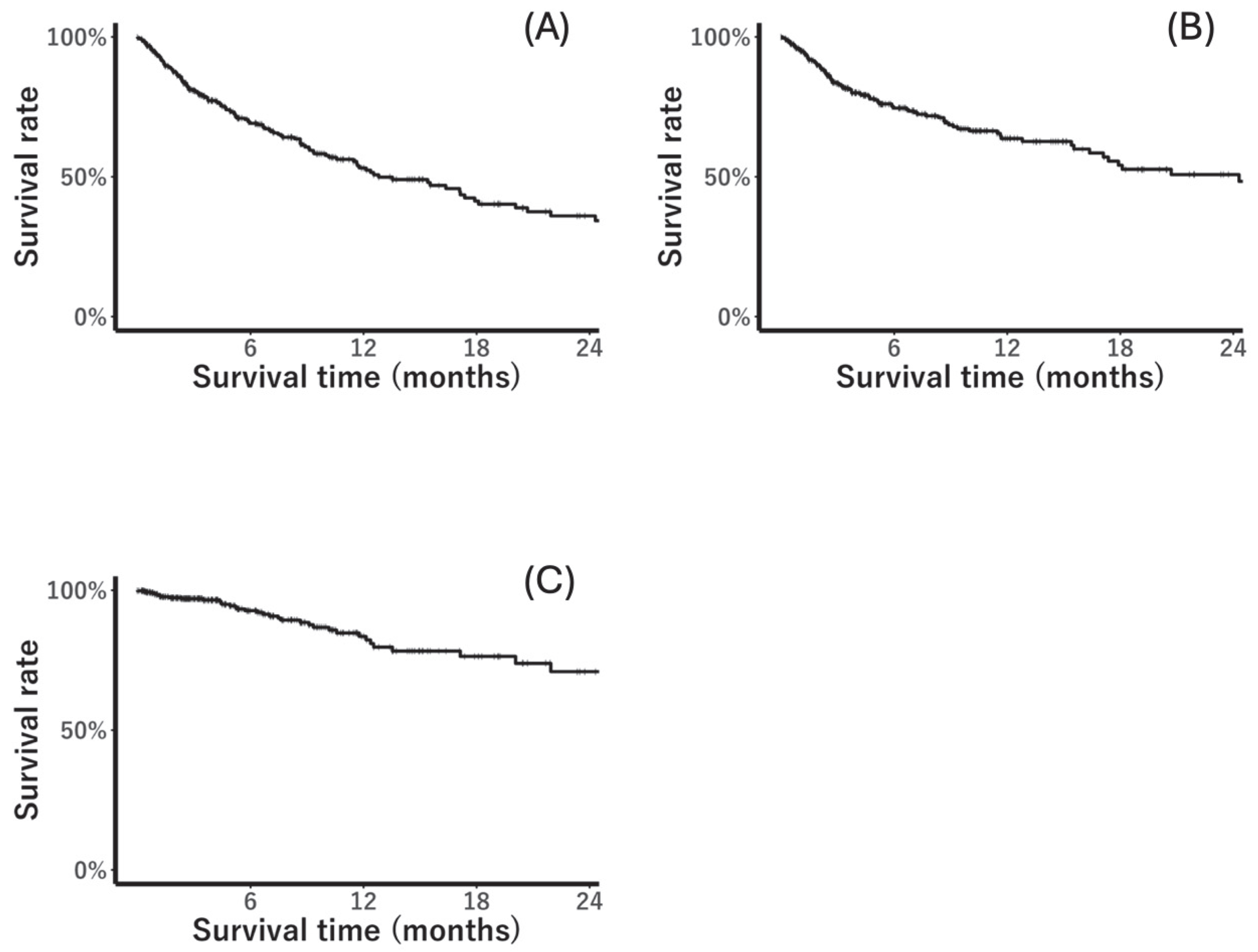
The failures were classified into three patterns: (A) destruction anywhere in MAOA, (B) connector failure, and (C) thermoplastic component breakage. All three of the above patterns were defined as three types of events, with the time until the occurrence of each was outlined as the survival time. In the absence of any event, the survival time was censored at the date of the last observation. Survival time was determined using the date of the set as the baseline for survival. Both repaired and remanufactured MAOAs were considered as devices distinct from the original one.
2.4. Statistical Analysis
Missing data were adjusted using multiple imputations. Survival rates and times were estimated using Kaplan–Meier method, and survival curves were constructed. Many participants were treated with multiple MAOAs, and it was speculated that personal factors such as the occlusal force might have affected the outcomes. The cluster-specific random effect standing for undetected common risk of cluster members, namely frailty. Therefore, the shared frailty analysis involving a mixed-effects model that suggested the same frailty in patients was done for each of the three failure types. Shared frailty models account for hidden variables that may influence the risk of dental issues, allowing for more accurate predictions of outcomes [
12].
Hazard ratios (HRs) and their 95% confidence intervals (CIs) were calculated for variables presumably affecting each failure type. After evaluating the chosen variables with the stepwise method, HRs and CIs were re-estimated. The significance level was set at 5%.
RStudio Desktop Pro for Windows 10+ (2022.02.4+500.pro1, Posit Software, PBC, Boston, MA, USA) was employed for the Kaplan–Meier survival and shared frailty analyses.
3. Results
A total of 230 patients with 466 MAOAs were enrolled. The MAOA distribution is reflected in
Table 1 (categorical data) and
Table 2 (continuous data).
The Kaplan–Meier survival curve for all types of failure is shown in
Figure 1. The survival rate at one year (12 months) was 52.4% for Type A failure, 63.7% for Type B, and 82.2% for Type C. The survival curve for the latter had a smoother shape; that is, the survival rate was always higher than that for Type B. There were 103 Type B failure events (connector failure); however, only three of them involved adhesive failure between a connector and the thermoplastic component, and the remaining 100 cases involved the breakage of the connector itself.
Table 3 presents the shared frailty for Type A failure. Sex, age, and connection method were significantly (
p < 0.05) associated with the outcome.
Table 4 shows the shared frailty for Type A failure after careful variable selection. The HR value of male patients was more than twice as high as that of female patients. In terms of connection method, the HR for a single connector connection was approximately four times higher than that for a fixed connection.
Table 5 displays the shared frailty for Type B failures. The analysis did not converge for the fixation method variables, presumably because the intra-cluster correlations were excessively strong. Therefore, only sex and age were selected as variables for the frailty analysis for Type B failure, and both showed strong correlations (
Table 6). The HRs showed trends similar to those of Type A failures.
Table 7 shows the results of the analysis for Type C failures. Although only AHI values were selected after valuable selection, potential confounding factors such as sex and age were included in the final model. Three variables were analyzed (
Table 8); however, none were found to be significantly associated with Type C failure.
4. Discussion
When comparing MAOA and CPAP, both enhance endothelial function and heart rate variability, but CPAP has higher efficacy in decreasing the severity of OSA [
13]. However, MAOA therapy has high compliance and contributes to positive effects on cardiovascular function. It is generally recommended that treatment with MAOA be selected for OSA. Needless to say, it may be appropriate to use CPAP for patients with severe OSA.
MAOA is a device and inevitably has different durability than CPAP machines. MAOA is subjected to significant stress during sleep, increasing the risk of breakage or destruction. If the mechanical strength of MAOA appears to be extremely low, physical and material improvements may be necessary. Breakage or destruction can lead to airway obstruction and have adverse effects on the body.
In this study, approximately half of the MAOAs broke within one year. The results of this study demonstrate that the HR for a mobile MAOA was higher than that for a fixed one, suggesting that the mechanical strength of mobile devices is lower than that of fixed ones. However, mobile structures have the advantage of being comfortable to wear. In accordance with a pilot study comparing fixed and semi-fixed OAs [
6], the latter type was found to be superior in terms of the lower incidence of temporomandibular joint pain and higher patient comfort. Overall, this type also showed more promising results in terms of more comfort and a lower incidence of side effects, while the improvements in AHI were similar for both.
Therefore, dentists should strive to preserve movable structures while prolonging their survival, and it is essential to identify the associated factors for this purpose.
As shown in
Figure 1, the survival curve for thermoplastic component failure (Type C failure) had a gentler slope than that for connector failure (Type B failure), indicating that connector failure is the most likely cause of OA failure. This may be explained by the fact that the PETG material had a higher mechanical strength than the connector material, HDPE. PETG is a resin material obtained by adding glycol to PET to render it amorphous and improve its impact resistance. It has the characteristics of being slightly soft, tough, and resistant to impact (Young’s modulus of approximately 5.9 GPa, a tensile strength of 55–75 MPa, an impact strength of 5–20 kJ/m
2, and a flexural strength of 70–90 MPa) [
14].
Most grades of PE materials have excellent chemical resistance, meaning that they are not attacked by strong acids or strong bases and are resistant to gentle oxidants and reducing agents. The PE material is chemically inert and does not provoke significant inflammatory or immune responses. It remains stable within the body over long periods without releasing harmful degradation products. However, PE has relatively low tensile strength and modulus of elasticity. It is prone to deformation under load and is unsuitable for applications requiring high structural strength.
The mechanical properties of PE depend strongly on type, and HDPE has higher tensile strength than LDPE. However, the results of this study showed that HDPE also had insufficient strength as a connector for MAOA. This suggests that the material of the connector should be considered rather than the structure of MAOA.
Most Type B failures were due to damage to the connector itself and not poor adhesive treatment. To elevate the survival rates of OA, it is desirable to enhance connector strength. In this study, the difference in survival status between the one-connector and fixed types was significant; however, none was detected between the two-connector and fixed types. However, owing to the material properties of HDPE, the range of motion should be smaller in the case of two connectors, which reduces the mobile structure’s significance. Even considering that new and repaired appliances did not differ significantly from each other, there was an issue with connector strength. Therefore, the material and shape of the connector should be examined further.
It is evident that connectors used in MAOAs should be stronger than those made of HDPE while remaining soft enough to synchronize with muscle movement. Although polymeric materials are not strictly necessary, if metal connectors are used, the risk of allergic reactions must be considered. Additionally, the adhesion between the connector and appliance components should be carefully evaluated. Further in vitro and in vivo studies are essential to validate these findings.
Sex and age were found to be associated with the OA survival rate. It is well-known that there is a difference in bite force between male and female patients. Through bite force measurements, sex was found to be a factor significantly associated with maximal bite force, and the mean of male patients was approximately 30% greater than that of female patients [
15]. In addition, sex-related bite force differences most probably develop post-puberty concomitantly with more pronounced muscle mass growth in males [
16]. Most of the participants of this study were postpubertal (their mean age was 59 years), and the effect of sex was observed. The low prevalence of OSA before puberty [
17] might explain these results.
Apnea severity was not found to correlate with the survival rates. In general, the effectiveness of MAOA is not affected by OSA severity [
18]. It is said that MAOAs should be considered as the initial treatment option for patients with OSA of all severity levels, including severe, moderate, and mild. The force attempting mandibular retraction might be related to oral muscle strength, but not apnea severity.
The primary limitation of this research is that the only data collected were those retrieved from medical records. No factors associated with thermoplastic component breakage were found among the study variables. Type C failures might have been associated with other aspects, for example, the number, shape, and condition of the remaining teeth and the occlusion pattern, which could not be determined from the medical records. In particular, occlusion patterns and parafunctional habits likely have a significant impact on appliance durability. If these could be specifically and objectively examined and evaluated, many more related factors could have been estimated. The inability to evaluate these factors accurately is an inherent limitation of the retrospective study design. However, connector breakage occurred more frequently than that of the components. Identifying variables associated with connector damage (age and sex) is considered useful for future OSA treatment.
This study focused on individuals diagnosed with OSA by a respiratory medicine department. However, many people experience milder symptoms, such as snoring, that do not meet diagnostic criteria for OSA. The efficacy of MAOA for treating patients with mild OSA or simple snoring had been demonstrated in a prospective study [
19]. The fact that MAOAs, which offer therapeutic benefits, can be easily fabricated in dental clinics should be more widely publicized.
Although OAs including MAOAs are highly effective for patients with OSA, the lack of sufficient collaboration between medical and dental professionals, as well as limited public awareness, remain significant barriers to their widespread use. Strengthening interprofessional cooperation and promoting greater recognition of this treatment option are essential steps toward improving patient outcomes. There is no doubt that close collaboration between medicine and dentistry will bring great benefits, especially to those who suffer from airway obstruction while sleeping.