1. Introduction
The rapid advancement of a fire can create problems for fire suppression tactics and can even cause fire safety concerns [
1,
2,
3].
Efficient maintenance management ensures operational efficiency and acceptable conditions for infrastructure [
4]. Thus, maintenance is responsible for ensuring the safety of people and goods in companies, as well as the quality of goods, considering the mandatory requirements for the safety of people, goods, and the environment [
5].
Aerial means are very important in firefighting activities. However, they are strongly affected by thermal radiation, the temperature, and the air density. Updraft in forest fires and the wind speed are the key factors affecting the safety of firefighting aircraft, as the safe flight altitude is limited by the forest fire environment. Firefighting through aerial means often involves flying a few hundred meters above the terrain, sometimes in reduced-visibility conditions. Because of this, pilots must coordinate with ground crews, monitor fire behavior, manage multiple radiofrequencies, and avoid interference with operational staff on the ground, while avoiding risks to other aircraft.
Aerial firefighting appeared before the Second World War, particularly in the USA, and gradually increased in the 1950 and 1960s, using the significant amount of surplus military aircraft. In the 1970s, amphibian water bombers were designed. In the 1970s and 1980s, helicopters started being widely used in aerial firefighting operations, but their role increased significantly as heavy helicopters became strategic aerial firefighting resources, and they also became available for private contracting, particularly in the 1990s [
6].
Rotary-wing aircraft (helicopters) are widely used in combat today due to their versatility and agility, especially in the initial attack. Rotary-wing aircraft are aircraft that can be fitted with a tank or carry a bucket with water or a fire retardant [
7]. The tanks or buckets can be filled on the ground by drawing water from lakes, rivers, or other water sources. They can also quickly send a firefighting team (with the size depending on the helicopter model and operational configuration) wherever they are needed, as well as fighting fires with water/foam droplets.
Despite these many important advantages, it is well known that, when many simultaneous fires are present and escape the initial attack, the number of air resources often proves to be inadequate, because they are often not used in an integrated way with ground teams but as substitutes for these teams.
Increasing attention is being paid to improving helicopter firefighting efficiency [
7]. At present, accuracy and effectiveness are studied, seeking means of improving efficiency when combating forest fires, as well as improving the management of these resources [
8,
9,
10], including their reliability and safety. At present, the main factors affecting efficiency are the cost of water per liter and the water cover zone [
8].
Regarding factors that can be decisive, fire flame fronts and convection columns contain superheated gases that can significantly reduce aircraft performance (and the safety margin) while supporting fire suppression operations. Normal performance planning does not account for the drastic increase in density altitude associated with increased temperatures [
9]. Another issue is the use of either shortlines or longlines: for launches, longlines are generally safer and more versatile, while shortlines are used in specific situations where precision is the most important factor [
10]. Moreover, the presence of a second operator in the air to observe and give combat and safety indications to the pilot improves the accuracy of the launch and its safety. Additionally, the use of pilot support elements that are not properly adjusted, such as tablets, GPS, and cameras with poor placement, can lead to accidents.
As maintenance is a factor that can be decisive in avoiding accidents involving the assets under study, maintenance and its management are concepts that should be discussed in depth.
According to NP EN 13306:2021 [
11], maintenance is the “combination of all technical, administrative and management actions, during the life cycle of an asset, intended to maintain or restore it to a state in which it can perform the required function”.
The term “maintenance” has its origins in military vocabulary, meaning “keeping, in combat units, personnel and material at a constant level”.
According to [
12], unplanned maintenance refers to maintenance interventions performed after a failure has occurred, with the objective of restoring the equipment to its normal operating condition.
Condition-based maintenance emerged in the 1970s and 1980s to designate a new approach to preventive maintenance based on knowledge of the actual condition of machines; it is performed through the implementation of a condition control system.
Predictive maintenance is often referred to as condition monitoring or condition-based maintenance; it assesses the actual condition of equipment using specific tools, with the aim of adjusting preventive maintenance planning, detecting possible failures early, preventing the emergence of complex problems, and enabling decision-making based on real data.
The NP EN 13306:2021 standard [
11] defines predictive maintenance as “conditional maintenance carried out in accordance with predictions extrapolated from the analysis and evaluation of significant equipment degradation parameters”.
Recent studies have applied predictive maintenance, digital twins, and machine learning techniques to improve aircraft and helicopter maintenance performance and aviation safety [
13,
14,
15,
16,
17,
18]. Studies on reserve fleet dimensioning and maintenance policies are also relevant to this research [
19,
20,
21,
22]. Other studies and tools have also contributed to this line of research, such as [
23,
24,
25,
26,
27]. Previous studies generally investigate aerial firefighting operations, helicopter accident analysis, maintenance performance indicators, or reserve fleet sizing independently. The present work proposes an integrated framework that combines accident investigation using HFACS and BowTie concepts with maintenance performance indicators and reserve fleet planning. This integrated perspective provides decision-makers with a comprehensive methodology for improving both operational safety and fleet availability.
This article has been completely reformulated and extended in relation to what was presented and published in the
Proceedings of the UNIFIed Conference of DAMAS, IncoME VIII and TEPEN Conferences [
24].
Contributions of This Work
This article provides the following novel contributions:
The structured integration of real accident case studies with maintenance performance indicators to support safety analysis;
The application of a quantitative approach linking maintenance key performance indicators (KPIs) to the dimensioning of reserve helicopter fleets;
The use of real operational data from the Portuguese civil protection system to validate the proposed approach;
A set of operational and maintenance recommendations derived from a systematic analysis of incidents, moving beyond descriptive case studies.
Although previous works have extensively analyzed wildfire suppression operations and helicopter performance, limited research has integrated operational accident analysis with maintenance management and reserve fleet dimensioning. Consequently, there remains a gap in understanding how operational safety events influence helicopter availability and reserve fleet requirements. This work addresses this gap by combining these perspectives into a unified framework.
2. Methodology
In this work, we present and discuss a set of case studies. In this way, we apply a scientific methodology based on an inductive method, taking it as the starting point for the observation of particular facts so that, through their association, we can establish generalizations that make it possible to formulate a law or theory [
28]. The work therefore consists of observations and analyses of actual accidents. The observed data are then coded and classified to identify consistent characteristics. Finally, based on the previously classified elements, general statements can be inferred from the initial observations, and these statements represent theories to be developed. Additionally, a list of best indicators is presented. These can be used to generate recommendations aimed at improving the safety and efficiency of the use of the studied means.
An analysis of the availability time of the firefighting helicopters and the management of maintenance in the fleet is conducted to anticipate the needs for maintenance services, allowing a reduction in serious breakdowns in service. This is carried out using concepts such as the fleet of helicopters (m), mean time to repair (MTTR), mean time between failures (MTBF), availability (A), and reserve fleet (RF).
2.1. Maintenance Versus Key Performance Indicators (KPIs)
In its introduction, the NP EN 15341:2019 standard [
29], titled “Maintenance—Maintenance Performance Indicators (KPI)”, establishes maintenance performance indicators to support management so as to achieve excellence in the maintenance and use of fixed assets in a competitive manner. Most of these indicators apply to all industrial installations and services (helicopters, vehicles, equipment, buildings, infrastructure, and transport, among others).
In this article, the main technical indicators used are the MTBF, MTTR, mean waiting time (MWT), and A, as shown in
Table 1.
2.2. Fleet and Size of Reserve Fleet
The total number of helicopters required for firefighting services is designated by the fleet size (m) and corresponds to the sum of the helicopters required for the operation itself, normally determined by the needs during the period in question (depending on the time of year, i.e., summer, spring, autumn, or winter, as well as the temperatures predicted by the meteorology for each month), considering the reserve helicopters and those subject to maintenance operations.
Raposo et al. [
20] consider that the reserve fleet (RF) is the number of vehicles ready to perform the service for which they are intended—that is, the vehicles would not be immobilized due to breakdown or undergoing preventive maintenance, thus providing the possibility of carrying out preventive maintenance on the remaining vehicles, increasing the availability and reliability of the operational fleet.
Civil protection requires the booking of emergency vehicles at a consistent rate. A low reserve ratio is indicative of high reliability, essentially based on the implementation of an efficient maintenance plan, which results in the application of new maintenance methodologies and techniques that lead to the assessment of the condition of the equipment and the decision to replace or renew the equipment.
Calculating and monitoring the reserve fleet continues to be an important management tool, especially in emergency services.
When making decisions regarding equipment management, the maintenance costs, operating costs, overall cost of ownership, and accumulated costs must be considered [
5,
30].
These indicators are essential factors to consider when sizing the reserve fleet. It can be stated that the availability value is dependent on the MTBF and MTTR and that these are clearly dependent on the maintenance policies used in companies and, consequently, have an influence on the sizing of the reserve fleet of helicopters. The formulas presented in
Table 2 represent this relationship.
2.3. Case Selection and Analysis Procedure
The analyzed case studies were selected according to four criteria:
Occurrence during real helicopter wildfire suppression operations;
Availability of sufficient technical documentation;
Operational relevance for aerial firefighting safety;
Representation of different accident mechanisms.
Information was collected from official accident investigation reports, governmental reports, scientific publications, and operational technical documentation. Each case was independently analyzed by two authors using the Human Factors Analysis and Classification System (HFACS). Differences in interpretation were discussed until a consensus was achieved. Subsequently, the BowTie methodology was used to identify threats, top events, preventive barriers, recovery barriers, consequences, and corresponding safety recommendations.
2.4. Analytical Framework for Case Studies
Although the following case studies are based on real operational events, their purpose is not merely descriptive. To ensure a systematic and scientific analysis, each case is examined using structured human factors and risk analysis frameworks.
In complex sociotechnical systems such as aerial firefighting, accidents rarely result from a single cause. Instead, they emerge from the interaction of multiple factors across different system levels, including human performance, environmental conditions, operational decisions, and organizational influences. Therefore, a structured analytical approach is required to move beyond narrative descriptions and identify underlying causal mechanisms.
In this work, the analysis is primarily based on the Human Factors Analysis and Classification System (HFACS), which allows the identification and classification of contributing factors across four levels: unsafe acts, preconditions for unsafe acts, unsafe supervision, and organizational influences. This framework enables a comprehensive understanding of how latent conditions and active failures combine to produce adverse events.
Additionally, selected aspects of the BowTie model are used to complement the analysis by identifying key threats, critical events, and failed or missing safety barriers. This dual approach supports the clearer visualization of risk pathways and system vulnerabilities.
By applying these frameworks consistently across all case studies, it was possible to transform individual events into structured knowledge, supporting the identification of recurring patterns, systemic weaknesses, and opportunities for improving operational safety in aerial firefighting.
3. Case Studies
The following analyses are structured according to the HFACS framework. HFACS was applied by identifying unsafe acts, preconditions for unsafe acts, unsafe supervision, and organizational influences associated with each occurrence. The classification followed the standard HFACS taxonomy to ensure consistency among all analyzed cases.
3.1. Trevim Fire
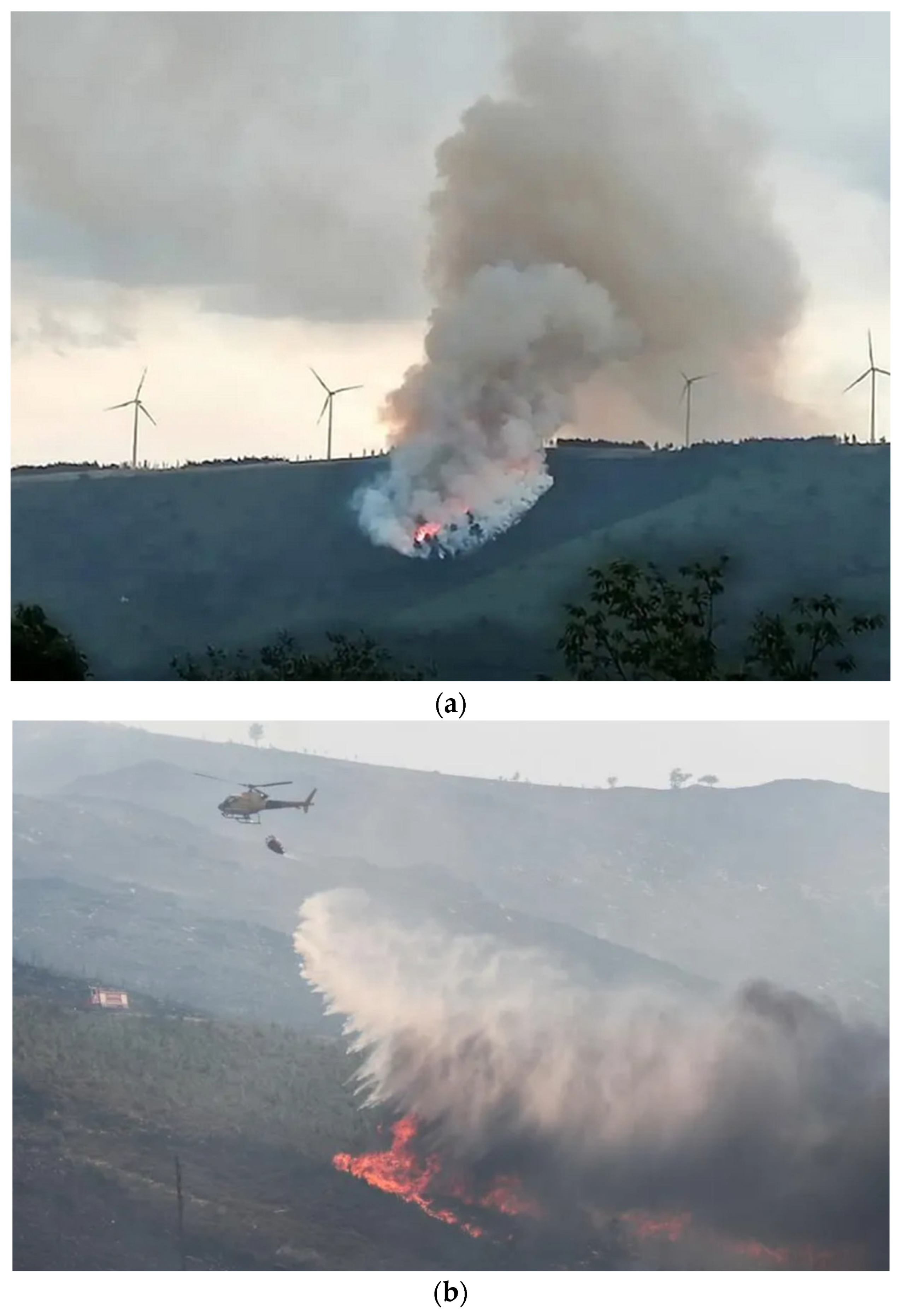
On 11 July 2020, at 6:26 p.m., a team was sent to fight a forest fire at the Serra da Lousã, Coimbra, Portugal. On this day, three helicopters attempted to contain the flames before nightfall. Around 250 operational vehicles and 64 vehicles from various fire departments in the districts of Coimbra and Leiria were in the area. Among them was a team from Miranda do Corvo, extinguishing a small part of the fire on the right flank (with the team leader, José Augusto). This team began to move down the slope with hoses and water from the vehicles. Suddenly, a low drop with a strong discharge from the helicopter filled the area with smoke, and the fire increased in intensity (
Figure 1). This caused confusion among the team. At 7:19 p.m., the first distress calls began to be heard. At this time, the helicopter’s discharge was too low, and its downwash created projections below the firefighters’ work zone. Therefore, it is presumed that there was a link between the discharge, the projections, and the accident. On this day, the team leader, Chief José Augusto, died during the firefighting operation [
30].
From an analytical perspective, this case highlights the critical interaction between aerial operations and fire behavior. The low-altitude water drop generated a strong downwash effect, which contributed to the projection of burning materials and the sudden intensification of the fire, directly impacting the ground crews.
This situation reflects a combination of operational and environmental factors. On one hand, the complex mountainous terrain and unstable fire dynamics increased its unpredictability. The proximity between aerial and ground operations suggests limitations in coordination and situational awareness.
Overall, this case demonstrates that helicopter deployment near ground teams must be carefully managed, particularly regarding the drop altitude and airflow effects, to prevent changes in fire behavior and ensure operational safety.
HFACS Classification
Unsafe Acts:
The helicopter performed a water drop at an unsafe low altitude, constituting a decision error. This action did not adequately consider the downwash effect, which contributed to fire intensification and directly affected ground crews.
Preconditions for Unsafe Acts:
The operation occurred in a complex mountainous environment with unstable fire behavior. Smoke and sudden fire intensification reduced visibility and situational awareness. Additionally, there were limitations in communication and coordination between the aerial and ground teams.
Unsafe Supervision:
There was inadequate supervision regarding the control of aerial operations, particularly the drop altitude and proximity to ground crews. The operation suggests insufficient coordination procedures between air and ground resources.
Organizational Influences:
The case indicates a lack of clear operational guidelines for the ground teams and helicopter. Operational pressure to control the fire before nightfall may also have influenced decision-making and risk tolerance.
BowTie Trevim case
| Threat | Top Event | Failed Barrier | Consequence | Preventive Measure |
| Low-altitude water drop | Rotor downwash interacted with fire | Insufficient separation distance | Fire intensification affecting ground crews | Minimum safe drop altitude and improved air–ground coordination |
3.2. Serra da Estrela Fire
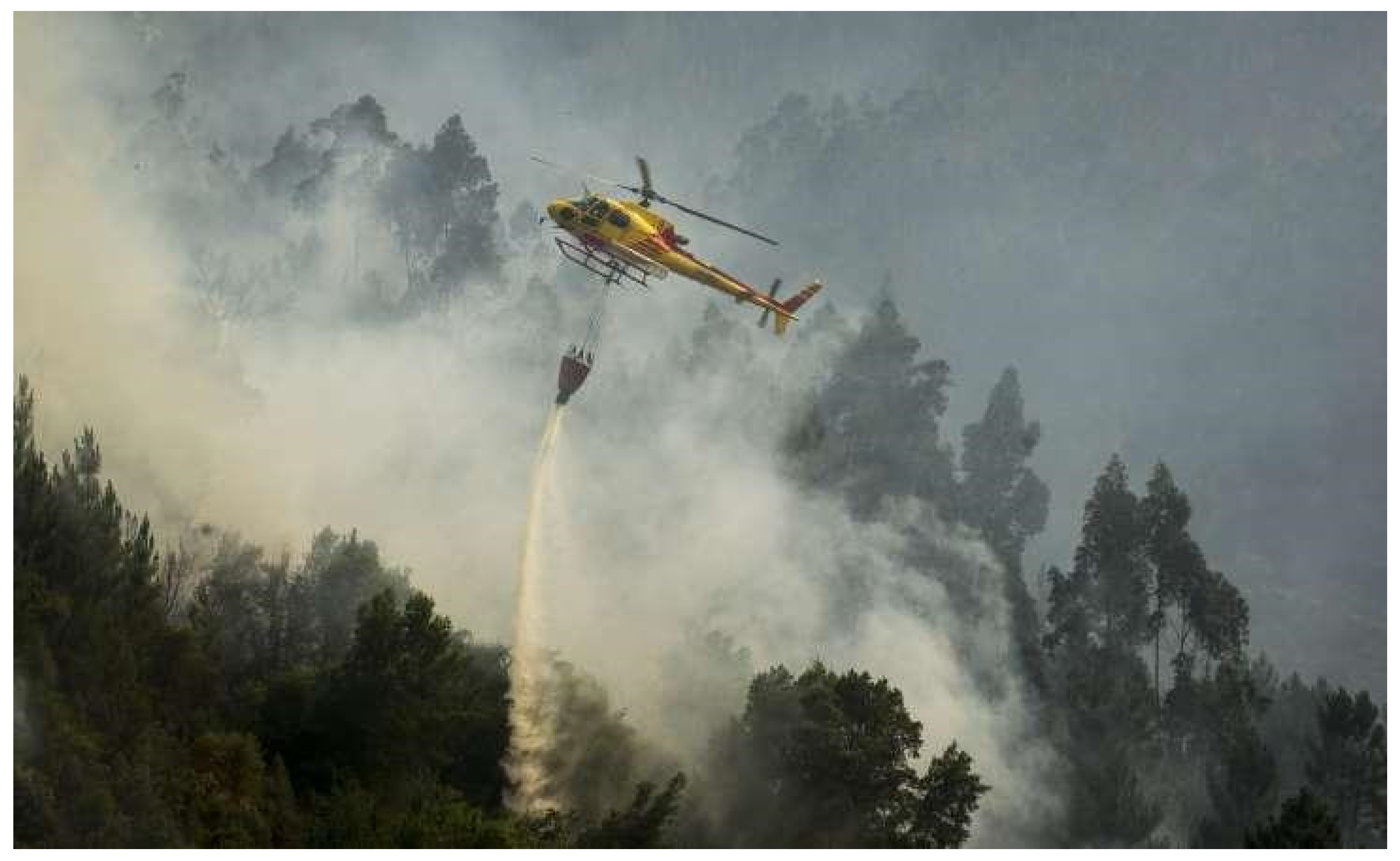
In Central Portugal, during the summer of 2022, a fire occurred between 6 and 23 August; this was the sixth-largest fire in Portugal since records began. The fire occurred under challenging conditions due to low humidity, mountainous terrain, and strong winds (
Figure 2). The fire was close to being resolved when the maneuvering of a helicopter to pick up its crew caused the fire to reactivate, carrying the flames to the opposite slope, causing an episode of eruptive behavior that resulted in a loss of control over the situation, as stated in a report produced by the group of experts invited by the government to assess the major rural fires of 2022. This document concludes that it is possible that this maneuver, in addition to reviving the fire, caused secondary outbreaks on the opposite side of the slope [
31].
The document, published on the website of the Agency for the Integrated Management of Rural Fires (AGIF), states that the helicopter’s maneuver should have taken place in a different area, further away from the perimeter of the fire, which was poorly consolidated and with a water line nearby. On the other hand, assuming that it was not possible to prevent the perimeter of the fire from being close to the waterline, the whole area should have been subjected to increased consolidation efforts, since it was to be expected that the fire crossing the waterline would lead to its violent spread. Operators should always avoid operating low in the air near such a critical area.
This case illustrates how helicopter maneuvers can directly influence fire behavior under critical environmental conditions. The airflow generated during the crew recovery operation likely contributed to the reactivation and spread of the fire, particularly in an area that was not fully consolidated.
The combination of strong winds, low humidity, and complex terrain created a highly sensitive environment, where small disturbances could trigger significant changes in fire dynamics. In this context, the decision to operate close to the fire perimeter increased the operational risk.
This analysis highlights the importance of defining safe operational distances and selecting appropriate locations for crew deployment and recovery, particularly in scenarios where environmental conditions favour rapid fire escalation.
HFACS Classification
Unsafe Acts:
The helicopter maneuvered too close to the fire perimeter during crew recovery, representing a decision error. This action failed to account for aerodynamic effects, which contributed to the fire’s reactivation and spread.
Preconditions for Unsafe Acts:
The operation took place under critical environmental conditions. The fire perimeter was poorly consolidated, and the presence of a waterline increased the potential for rapid fire spread. These factors heightened the sensitivity to disturbances and reduced operational safety.
Unsafe Supervision:
The operation suggests the insufficient anticipation of fire behavior and a lack of enforcement of safe distances from critical areas.
Organizational Influences:
The case indicates limitations in operational procedures related to aerial operations near unstable fire perimeters. It also suggests an insufficient emphasis on risk assessment and planning in environments prone to extreme fire behavior.
BowTie Serra da Estrela case
| Threat | Top Event | Failed Barrier | Consequence | Preventive Measure |
| Crew recovery close to fire perimeter | Rotor airflow reactivated fire | Inadequate operational planning | Fire spread | Recovery zones away from unstable fire fronts |
3.3. Semide Fire, 2017
The fire started on the afternoon of Friday 23 June 2017. On the second day of the fire, in the morning, efforts began with mop-up operations using heavy aerial means, namely Kamov helicopters. In this type of helicopter, two counter-rotating rotors eliminate the need for an anti-torque vertical rotor, allowing all power to be used for lift and thrust to discharge the water. However, dangerous effects on fires have been identified, such as the vertical downwash that is generated, which contributes directly to forest fires.
In this case, the fire received additional oxygen, and the entire area, which was initially merely smoldering, was burning and covered with flames. The available evidence suggests that the rotor downwash may have contributed to the reignition of residual hotspots, worsening the situation and forcing the ground crew to once again take action to restore control of the situation.
This case illustrates the potential limitations associated with helicopter use during mop-up operations. The rotor-induced airflow increased the oxygen supply to residual hotspots, leading to reignition and the deterioration of fire control.
The observed effect was primarily technical in nature, resulting from the aerodynamic characteristics of rotary-wing aircraft, but it was also influenced by the operational context, namely the presence of partially extinguished fire zones.
This suggests that the use of helicopters in mop-up phases should be carefully evaluated, as their intervention may counteract suppression efforts. Priority should instead be given to ground-based operations, reserving aerial resources for phases where their impact is more effective and controlled.
HFACS Classification
Unsafe Acts:
The use of helicopters during mop-up operations represents a decision error, as the downwash effect was not adequately considered, contributing to fire reignition and spread.
Preconditions for Unsafe Acts:
The presence of partially extinguished hotspots created a sensitive environment prone to reignition. The aerodynamic characteristics of the Kamov helicopters, particularly the strong vertical downwash, increased the oxygen supply to the fire. These factors, combined with the operational context, heightened the risk of fire reactivation.
Unsafe Supervision:
There was inadequate operational planning regarding the use of aerial resources during the mop-up phase. The decision to deploy helicopters in such conditions suggests insufficient consideration of their negative effects on residual fire areas.
Organizational Influences:
The case indicates limitations in procedures governing the use of aerial means in different firefighting phases. It also suggests a lack of specific guidelines or training regarding the risks of helicopter downwash during mop-up operations.
BowTie Semide case| Threat | Top Event | Failed Barrier | Consequence | Preventive Measure |
| Helicopter operating during mop-up | Rotor downwash oxygenated hotspots | Lack
of operational restriction | Fire reignition | Restrict helicopter use during mop-up operations |
3.4. Boeing CH-47 Chinook with Poorly Fixed Element
A helicopter that was on a firefighting mission crashed due to the fall of a poorly fixed element. The accident occurred in a Boeing CH-47 Chinook aircraft that was fighting fires in the state of Idaho, USA, in 2022.
The aircraft was refilling its water bucket when it entered a tailspin and crashed into the Salmon River, seriously injuring the two pilots, who later died in hospital.
An iPad was found among the wreckage. A detailed analysis showed that the equipment was stuck between the aircraft’s pedals.
Tablets are often used in aviation today; they are used with apps that support multi-function navigation, with charts, maps, GPS, performance calculation features, and other useful functionalities.
In larger aircraft, the device is fixed to the cabin structure or to a suction cup attached to the windshield; meanwhile, in a helicopter, with a smaller cabin, space is limited. In this case, according to investigators, one of the pilots involved in the accident attached the device to their leg.
However, the belt that held the device caused it to come loose, and it fell between the pedals on the copilot’s side. The aviator may have attempted to reach the tablet, but, due to the depth, as well as the panel and helmet, which prevented him from lowering himself any further, he was unable to reach it [
32].
This case highlights the risks associated with the integration of auxiliary devices within the cockpit environment. The improper positioning and fixation of a portable electronic device was associated with interference with the flight control system, which may have contributed to the accident.
The available investigation indicates that the primary issue was associated with the inadequate fixation of the portable electronic device, related to a lack of secure mounting solutions, but it also reflects procedural limitations in how such devices are incorporated into flight operations.
This analysis emphasizes the need for standardized guidelines regarding the installation and use of auxiliary equipment, ensuring that all devices are properly secured and do not compromise flight safety.
HFACS Classification
Unsafe Acts:
The improper placement of a portable electronic device (iPad) in the cockpit was observed, leading to interference with flight controls. This reflects a decision error and the inappropriate use of equipment during flight.
Preconditions for Unsafe Acts:
Limited cockpit space in the helicopter contributed to inadequate device positioning. The absence of a secure mounting solution allowed the device to become dislodged. Physical constraints prevented the pilot from recovering the device once it obstructed the pedals.
Unsafe Supervision:
There was insufficient oversight regarding the safe use and positioning of auxiliary electronic devices in the cockpit. The lack of clear procedures or enforcement contributed to unsafe practices.
Organizational Influences:
The case indicates a lack of standardized guidelines for the integration and secure installation of portable electronic devices in flight operations. It also suggests gaps in training and procedural definition regarding cockpit resource management and equipment use.
BowTie Chinook case
| Threat | Top Event | Failed Barrier | Consequence | Preventive Measure |
| Loose equipment (tablet) | Flight control interference | Inadequate equipment fixation | Loss of aircraft control | Standardized mounting procedures |
3.5. FireHawk Helicopter Crash in Florida
In 2021, the crash of a FireHawk helicopter occurred on 25 May in Leesburg, Florida. The helicopter was conducting fire water drop exercises and lost control of the bucket, causing the rotor section to separate; it then crashed in a wooded area and caught fire. The report of the incident states that the violent swinging of a snorkel hose attached to a newly installed water tank was identified as a contributing factor during the accident. All four people onboard were killed. The operator affirmed that a new water tank and snorkel had been installed on the helicopter to facilitate firefighting operations. After ground testing and calibration, they proceeded to the first flight after the new system had been installed. Witnesses reported that the helicopter made six uneventful passes in front of the operator’s hangar and dropped water that was picked up from a lake adjacent to the airport. On the seventh pass, an employee of the operator noticed the snorkel swinging, followed by the violent swing that caused the accident [
33].
This case demonstrates the risks associated with modifications to aircraft systems without sufficient validation. The instability caused by the snorkel system led to a loss of control, highlighting the impact of technical alterations on flight safety.
Although the equipment had undergone initial testing, the available investigation suggests that the validation process may not have fully captured the dynamic behavior of the modified system to identify instabilities under operational conditions.
This analysis reinforces the importance of rigorous testing protocols following maintenance or upgrades, ensuring that all modifications are fully validated before operational deployment.
HFACS Classification
Unsafe Acts:
The operation of the helicopter with a newly installed system that exhibited instability during flight led to a loss of control. This reflects a decision error in proceeding with operational flights without fully validated system behavior.
Preconditions for Unsafe Acts:
The presence of a newly installed water tank and snorkel system introduced aerodynamic instability, particularly due to the swinging hose. Operational testing conditions did not fully replicate real flight dynamics, allowing the hazard to remain undetected.
Unsafe Supervision:
There was inadequate supervision in the validation and approval process of the modified system. The transition from ground testing to operational flight suggests the insufficient assessment of risks under real conditions.
Organizational Influences:
The case indicates weaknesses in maintenance and testing procedures, particularly regarding post-modification validation. It also suggests insufficient safety protocols to ensure that new systems are fully tested before being introduced into operational use.
BowTie FireHawk case
| Threat | Top Event | Failed Barrier | Consequence | Preventive Action |
| Newly installed snorkel | Dynamic oscillation | Insufficient flight validation | Rotor impact | Expanded post-maintenance flight testing |
3.6. Helicopter Crash in Douro, 2024
On August 30, 2024, the Armamar aerial resources center received a mission order to fight a fire in the Baião area, in the district of Porto. At 11:20 a.m., the pilot and a team of five members of the Emergency Protection and Rescue Unit (UEPS) of the GNR took off aboard an AS350B3+ helicopter. At 11:30, they returned the aircraft to its base [
32].
On the return flight, the aircraft began a steady descent, where it flew over the left bank (south) of the Douro River towards the city of Peso da Régua. During the descent, the pilot decided to change the helicopter’s trajectory and increased the speed. At 11:32, while descending towards the river in a left-hand turn, the helicopter collided with the surface of the water at a speed of around 100 knots (185 km/h), resulting in a violent collision with the water. The collision resulted in fatal injuries to the five members of the UEPS and serious injuries to the pilot, who managed to surface and was rescued by bystanders.
The final report issued by the Portuguese Accident Investigation Authority (GPIAAF) [
34] concluded that contributing factors included the pilot’s decision in choosing the trajectory to return to base, with the overflight of the river at a high speed and low altitude, which appeared to have considerably increased the operational risk of the flight. It also noted the pilot’s possible loss of situational awareness due to the visual conditions (glassy/mirrored water).
The aircraft was operating below the minimum recommended altitude during the return flight. Furthermore, the investigation identified that such low-altitude operations, without clear operational necessity, were not isolated occurrences but part of a recurrent operational pattern.
At the operational level, low-altitude flight significantly constrains the safety envelope of rotary-wing aircraft. In environments such as river valleys, characterized by terrain confinement, reduced visual references, and potential aerodynamic disturbances, flying at a reduced altitude drastically limits the available time and space for corrective actions. The descending flight path further amplifies this risk by reducing energy margins and increasing the consequences of any deviation in trajectory or control. Such operational conditions impose high cognitive and perceptual demands on the pilot. Decision-making under routine return-flight conditions may be influenced by habituation and reduced risk perception, particularly when similar behaviors have not previously resulted in adverse outcomes. This may create a context in which deviations from standard procedures may be executed without immediate perception of increased risks. Over time, these deviations lose their perceived abnormality, especially in the absence of negative consequences, leading to the erosion of safety margins across the system.
This process is often reinforced in high-time operational environments such as aerial firefighting, where mission urgency, operational pressure, and repeated exposure to hazardous conditions can lead to adaptive behaviors that prioritize efficiency over strict compliance. While such adaptations may offer short-term operational benefits, they increase systemic vulnerability by embedding risk within everyday practices.
Importantly, the absence of a technical failure in this accident reinforces the understanding that safety in complex sociotechnical systems is not solely dependent on equipment reliability but rather on the interaction between human actions, operational practices, and the organizational context. In this case, the accident can be interpreted as the result of accumulated operational deviations interacting with a high-risk environment, ultimately exceeding the system’s capacity to maintain safe operation.
This case highlights the importance of reinforcing operational discipline, particularly regarding adherence to minimum altitude constraints, as well as the implementation of effective monitoring and feedback mechanisms capable of identifying and correcting unsafe practices before they become normalized. Additionally, training programs should emphasize risk awareness, decision-making under routine conditions, and the recognition of gradual deviations from safe operating procedures.
Ultimately, the Douro accident illustrates how latent organizational conditions, combined with operational behaviors and environmental constraints, may result in catastrophic outcomes, even in the absence of identifiable technical failures.
The official investigation indicates that multiple interacting factors contributed to the accident, including operational decision-making, the environmental conditions, and organizational influences. It can be inferred that training should be offered to the pilots and crew of these aircraft, covering both firefighting operations and safety issues. For example, in this case, emergency and evacuation training must be mandatory (e.g., helicopter underwater escape training (HUET)), with practical simulations of evacuation in different scenarios. Additionally, maintenance and fault diagnosis training is required to identify and correct technical failures before they occur. Crew resource management (CRM) provides the crew with resource management tools to improve communication and decision-making under pressure, and aerial firefighting training with specific simulations can enable pilots and crew to maintain standard procedures and handling of unexpected situations during firefighting operations. Therefore, a detailed training program covering human factors and CRM for personnel is necessary for pilots involved in firefighting activities, with a particular emphasis on human factors.
HFACS Classification
Unsafe Acts:
The pilot conducted a low-altitude, high-speed flight over the river, representing a violation of the recommended safety margins. There was also a likely perceptual error associated with reduced visual perception due to the “glassy water” effect, contributing to the loss of situational awareness.
Preconditions for Unsafe Acts:
The return took place in a confined river valley with limited visual references and challenging environmental conditions. The descending flight path increased the risk, while cognitive factors such as habituation and reduced risk perception influenced decision-making.
Unsafe Supervision:
There was a failure to correct recurrent unsafe practices, particularly low-altitude operations without operational necessity. This suggests the insufficient monitoring and enforcement of standard procedures and, more importantly, inadequate training.
Organizational Influences:
The case reflects the process of the normalization of deviations, where unsafe behaviors became routine over time. It also indicates gaps in training, risk awareness, and organizational control, allowing deviations from safety standards to persist.
BowTie Douro case
| Threat | Top Event | Failed Barrier | Consequence | Preventive Action |
| Low-altitude flight | Loss of situational awareness | Inadequate operational discipline | Water impact | Compliance monitoring + CRM |
3.7. Comparative Analysis of Case Studies
Although the analyzed occurrences involve different technical and operational scenarios, common patterns can be identified. Human decision-making, organizational influences, operational supervision, and maintenance-related factors repeatedly interact to reduce safety margins. The HFACS classification demonstrates that unsafe acts alone rarely explain accidents. Instead, latent organizational conditions and deficiencies in operational planning frequently create environments where technical hazards become critical events. This comparative analysis reinforces the need to integrate operational safety management with maintenance planning and fleet availability assessment.
4. Analysis of the Availability Time of Helicopters for Firefighting and Maintenance Fleet Management
This section presents a case study of a helicopter fleet operated by the Portuguese civil protection authority [
35].
4.1. Helicopter Operational Fleet Management
To calculate the availability, effectiveness, and cost of light helicopters (HEBL) supplied to the Portuguese state, we took into account the needs presented in
Table 3 for the year 2024 [
36].
An analysis of
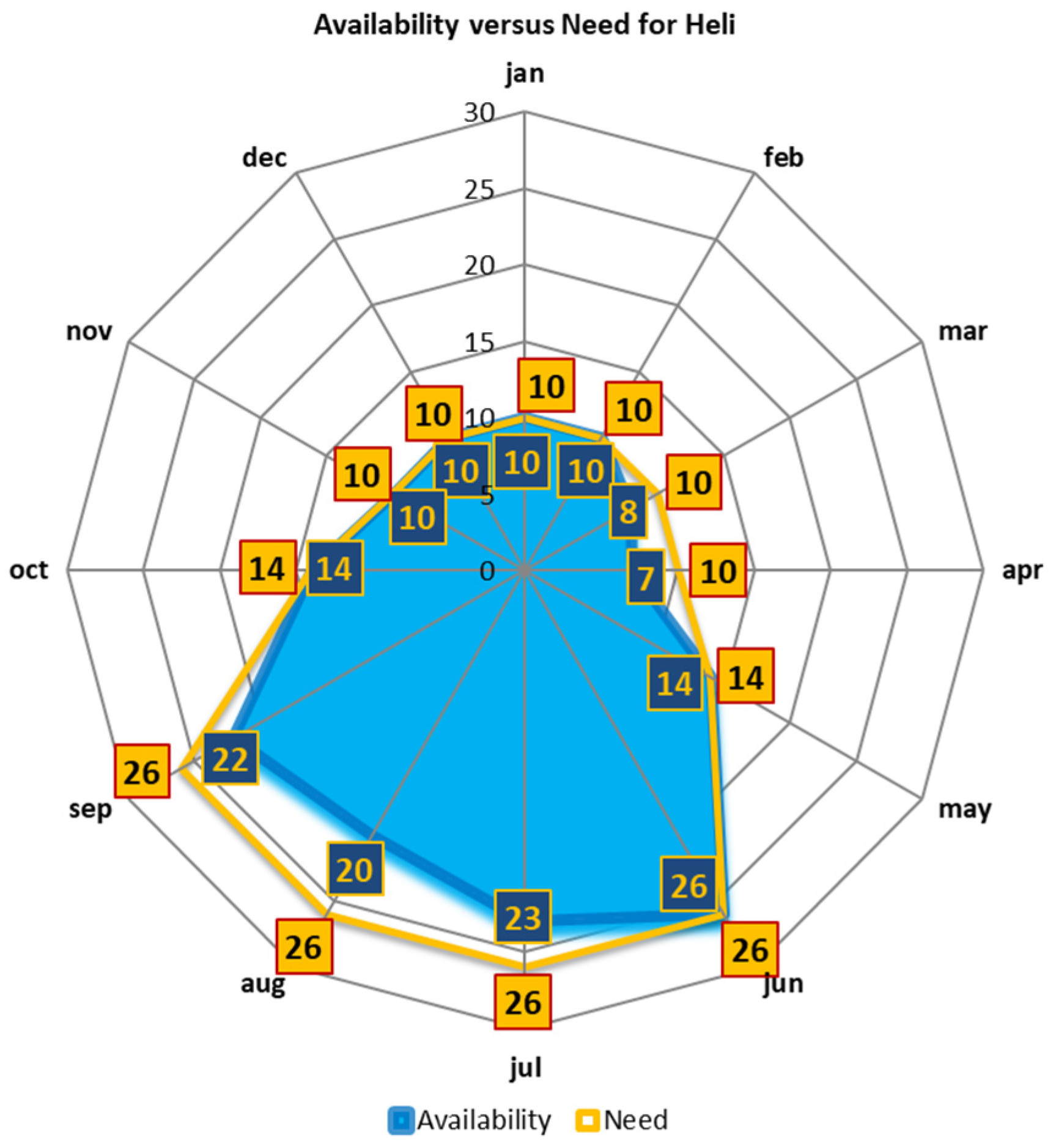
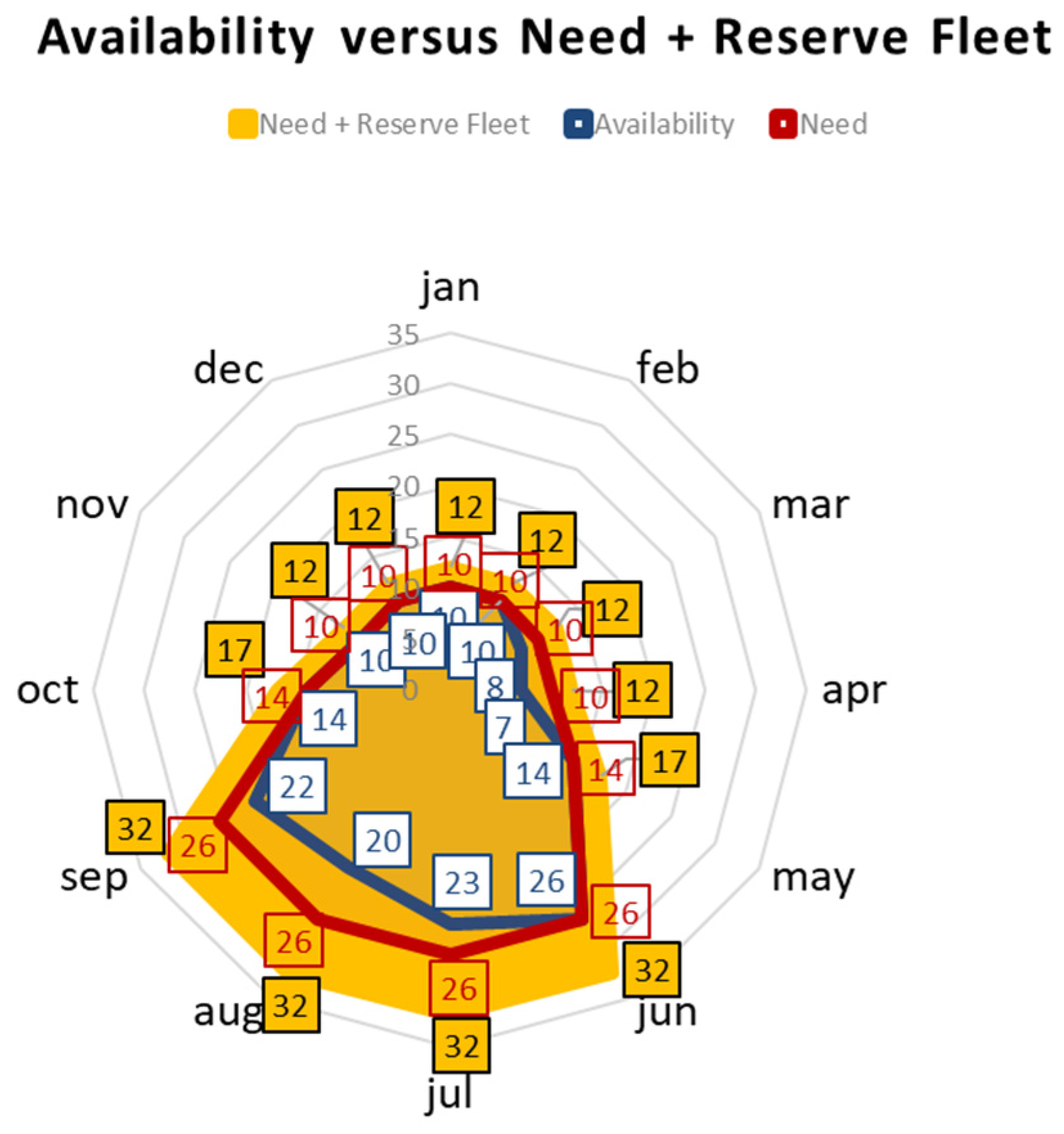
Table 3 shows that the helicopter fleet varies according to specific periods; in particular, it can be seen that the critical period, highlighted in red, is the period between 1 June and 15 October, with an operational fleet of 26 helicopters.
In this sequence,
Table 4 shows the radar map (
Figure 3) illustrating the availability versus production need (i.e., helicopters needed to perform the service) of the organization under study throughout the year.
4.2. Maintenance Versus Reserve Fleet Helicopters
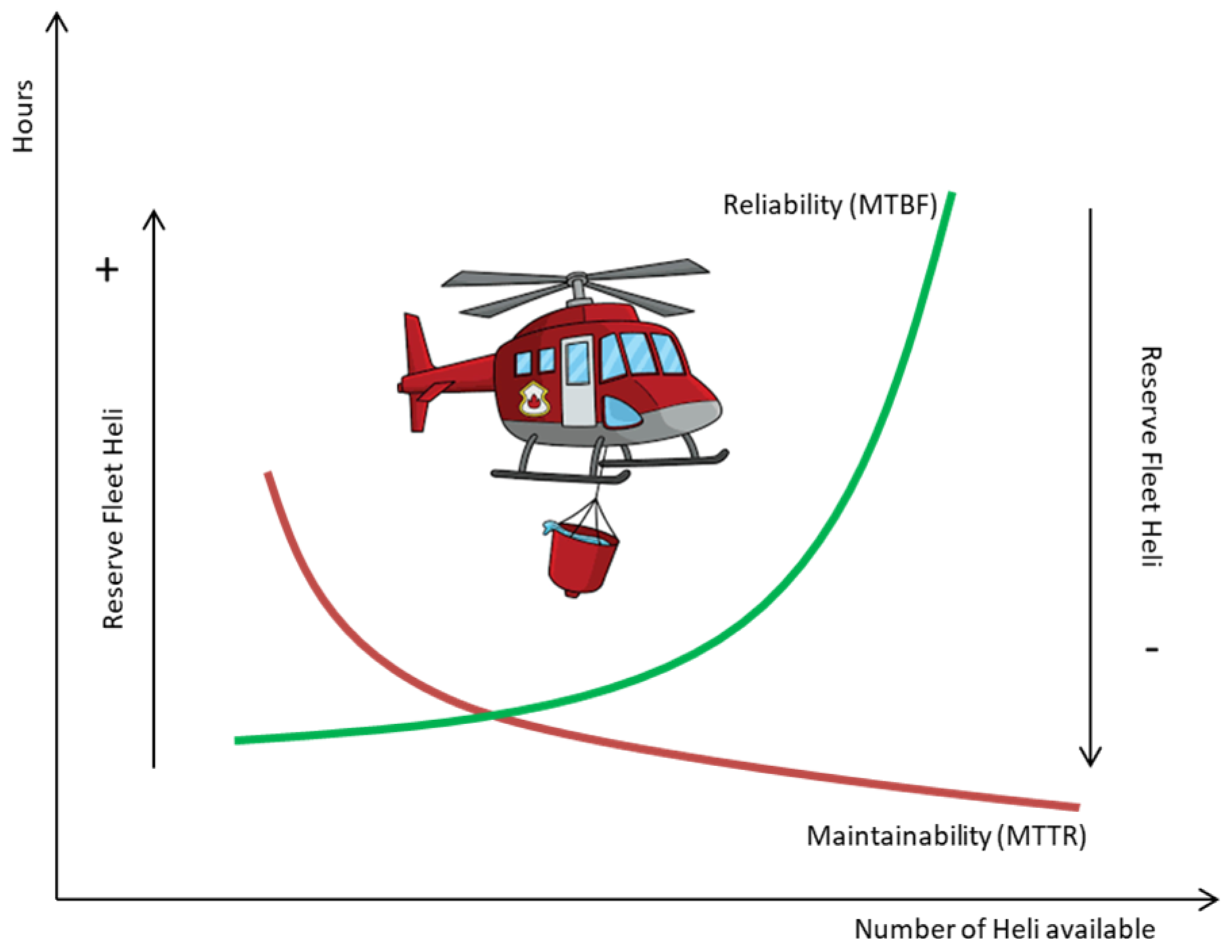
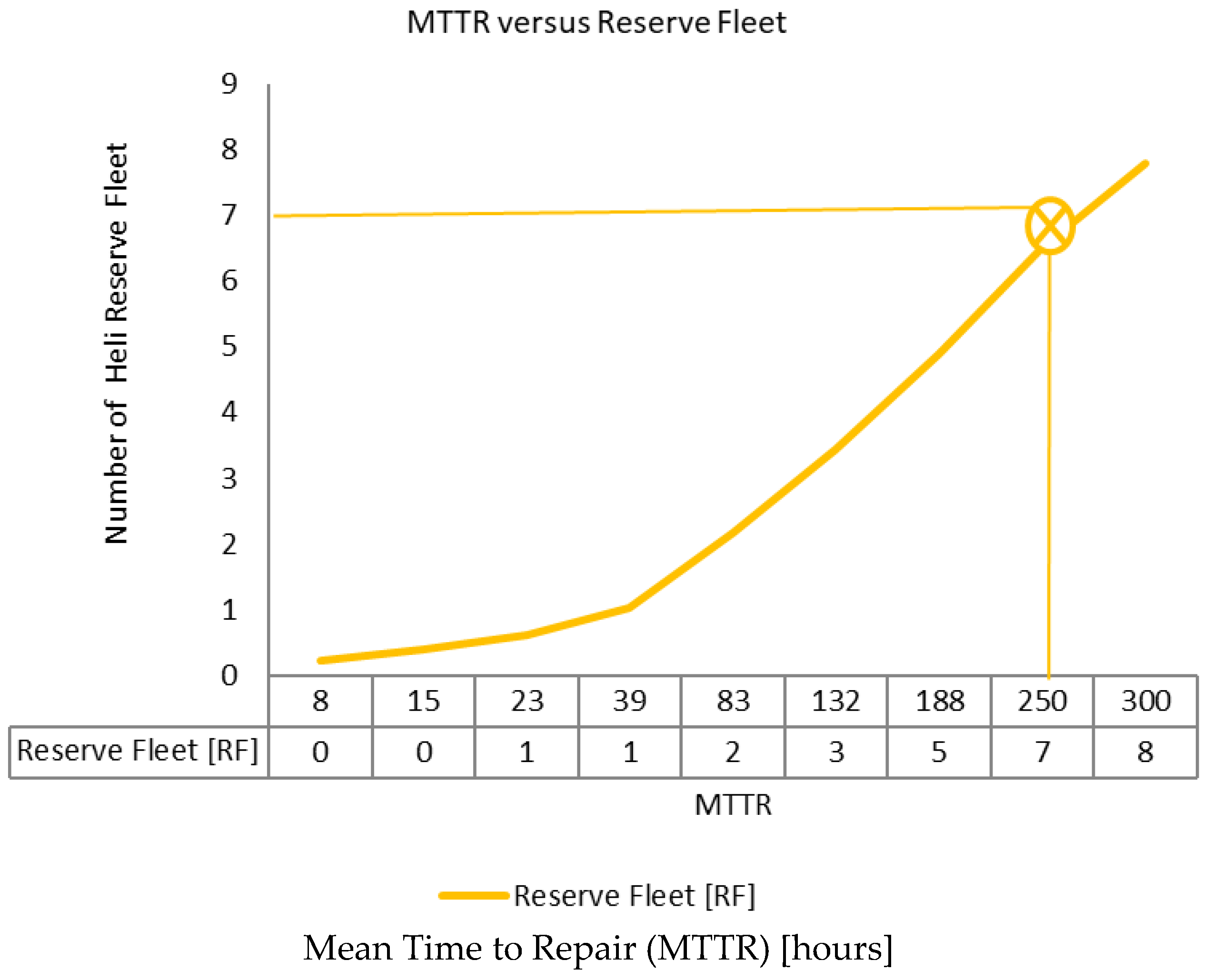
Figure 4 demonstrates the sensitivity of the reserve fleet size to maintenance performance. As the MTTR increases, helicopter downtime becomes longer, reducing operational availability and requiring additional reserve helicopters to maintain the desired operational capability. Conversely, improvements in maintenance efficiency increase aircraft availability and reduce reserve fleet requirements. The curves presented in
Figure 4 are based on hypothetical scenarios using the MTBF and MTTR values defined in
Table 5.
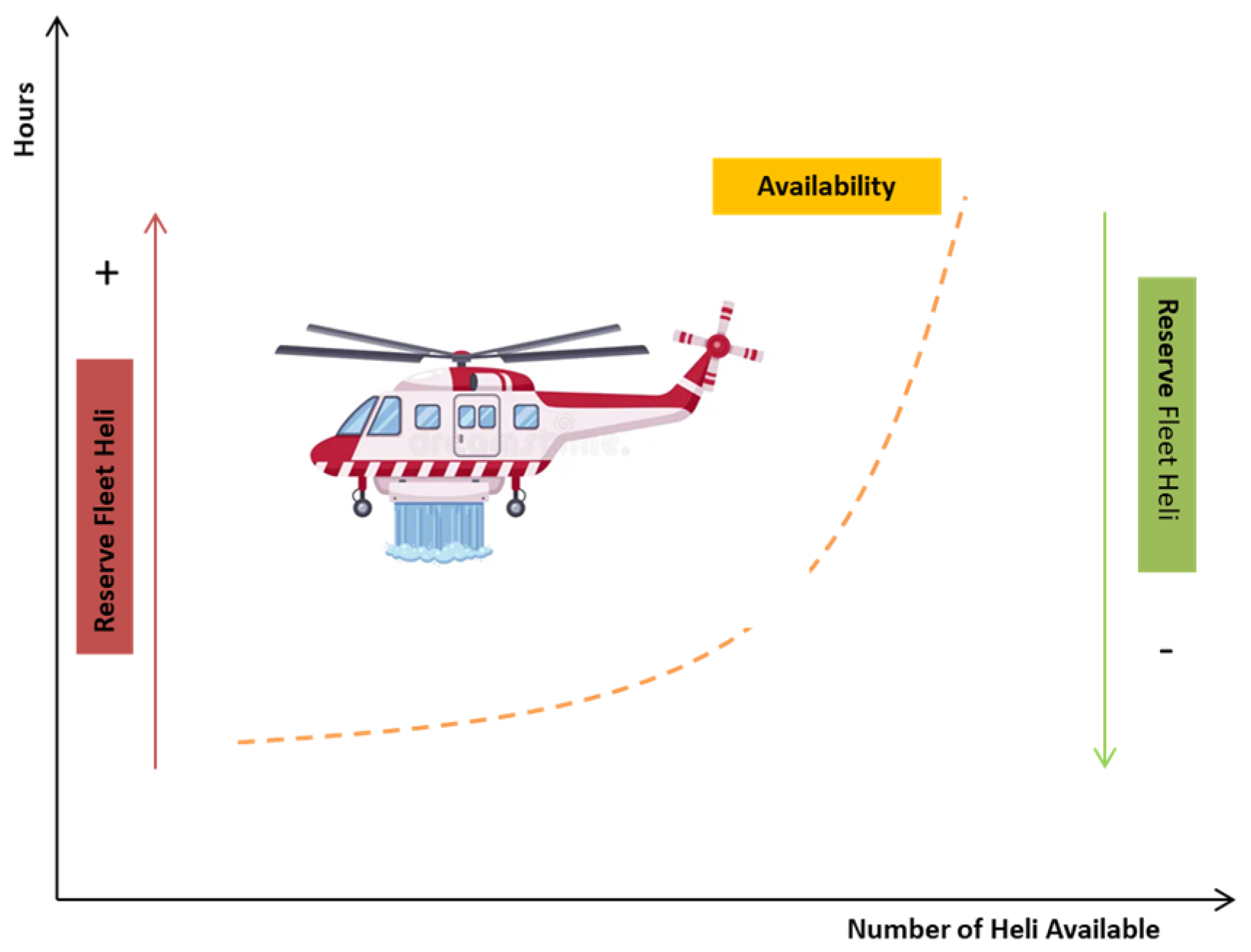
Figure 5 illustrates the relationship between availability and the reserve fleet size, highlighting the increase in required reserve units as the availability decreases.
Figure 4 illustrates how an increase in MTBF and a decrease in MTTR increase helicopter availability, namely through a maintenance policy.
Figure 5 illustrates the inverse relationship between helicopter availability and the reserve fleet size. Small reductions in availability produce a disproportionate increase in the reserve fleet demand, particularly when the operational fleet must remain fully available during peak wildfire seasons.
Several assumptions were considered. Firstly, the operational availability of helicopters generally varies between 70% and 80%, depending on the efficiency of maintenance and logistics, implying different MTTR values [
36]. The fleet reserve refers to helicopters available for operational use, excluding aircraft that are temporarily unavailable due to maintenance, repairs, or other operational reasons. In this sequence, it is possible to calculate the reserve fleet indexed to the MTTR value. The following assumptions were considered in the reserve fleet size evaluation:
- -
Failures occur randomly and are statistically represented by the MTBF;
- -
Repair times are represented by the MTTR and assumed to be constant within each scenario;
- -
The system operates under steady-state conditions;
- -
Maintenance resources are sufficient to avoid excessive waiting times;
- -
The reserve fleet compensates for unavailability caused by maintenance and failures.
In our approach, the reserve fleet (RF) is determined by analyzing the relationship between the availability (A), MTBF, and MTTR. As the MTTR increases, the downtime of the helicopters increases, directly impacting operational availability and the size of the reserve fleet [
19,
20,
21,
22]. To maintain the required operational fleet size (m), additional reserve helicopters must be allocated.
To simplify the analysis and ensure mathematical consistency, the reserve fleet model assumes homogeneous helicopter utilization across the operational fleet, statistically independent failures represented by the MTBF, constant repair times (MTTR) within each scenario, sufficient maintenance resources to avoid repair queues, and steady-state operating conditions. Environmental factors, mission complexity, and aircraft-specific ageing effects are not explicitly modeled.
The values presented in
Table 5 were obtained by simulating different MTTR scenarios and calculating the corresponding number of helicopters required to ensure operational continuity.
The following table and graph show the variation in the size of the reserve fleet according to this indicator.
Thus, by calculating the repair time for the helicopters, based on the MTTR data in
Table 5, the value of the reserve fleet for an MTTR of 250 h can be calculated, as shown in
Figure 6.
The data used in the tables, namely the MTTR, MTBF, and helicopter availability, were obtained from the history of maintenance interventions and work orders. Dimensional consistency was maintained throughout the calculations. The MTBF and MTTR were expressed in hours, while the operational period (k) was converted into equivalent operating hours before applying the reserve fleet equations. Consequently, all variables were expressed using compatible units before determining the helicopter availability and reserve fleet size. Below, we present examples of the calculation for determining the reserve fleet:
For an MTTR of 250 h, in a fleet of 26 helicopters, a value of seven units is obtained for the size of the reserve fleet.
A summary and some considerations are as follows:
The number of available helicopters will change from 10 to 26 depending on the period of the year, as well as on maintenance and on the fire risk (
Figure 7).
Firefighting helicopter repair times can vary depending on the type of maintenance required. One example is line/baseline inspections: these inspections are typically quick and can be completed in a few hours to a day.
Preventative maintenance includes regular checks and the replacement of worn parts, which can range from a few days to a week.
Regarding component repairs, when major components such as engines or hydraulic systems need to be replaced or repaired, repair times can range from one to several weeks.
For biennial inspections, full inspections can take approximately 10 weeks to complete.
How quickly replacement parts can be obtained can significantly impact the repair time.
More complex problems or extensive damage may require more time to resolve.
The capacity and efficiency of the maintenance workshop also influence the time required to complete repairs.
These times are estimates and may vary depending on the specific circumstances of each repair.
Operating costs may vary but, based on previous contracts, an estimate can be obtained. For example, HeliBravo [
36] supplied four light helicopters for 350,000 euros for 25 flight hours per aircraft. If we apply this cost to the 26 helicopters, the following values are obtained:
- ○
350 thousand euros/4 helicopters = 87.5 thousand euros per helicopter;
- ○
87.5 thousand euros × 7 helicopters = 612.5 thousand euros for 25 flight hours for each of the helicopters;
- ○
87.5 thousand euros × 11 helicopters = 962.5 thousand euros for 25 flight hours for each of the 10 helicopters;
- ○
87.5 thousand euros × 26 helicopters = 2.275 million euros for 25 flight hours for each of the 26 helicopters.
These values are estimates and may vary depending on the specific operating and maintenance conditions.
4.3. Linking Operational Risk to Fleet Availability
The operational case studies and the reserve fleet model should not be interpreted as independent analyses but as complementary components of helicopter fleet management.
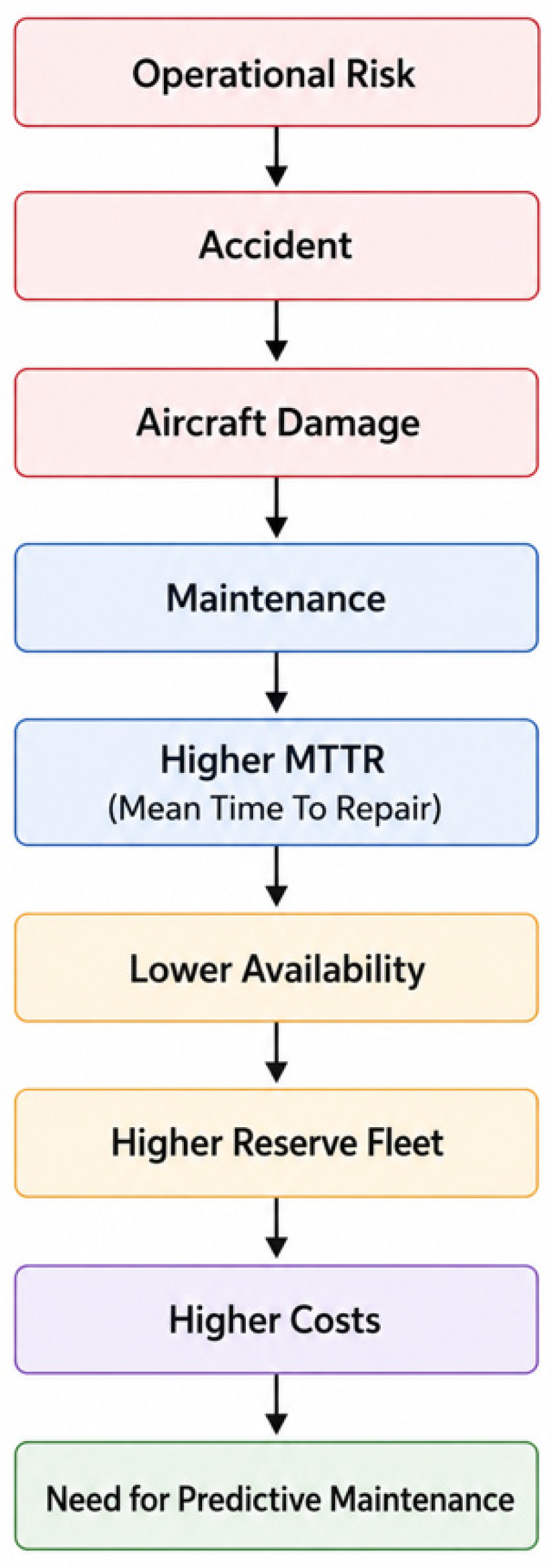
Operational accidents increase helicopter downtime due to accident investigation, repairs, component replacement, and mandatory inspections. Consequently, the mean time to repair (MTTR) increases while operational availability decreases.
Likewise, inadequate maintenance practices or insufficient post-maintenance validation may increase the probability of operational failures, generating additional maintenance demands and further reducing fleet availability.
The human factors identified through HFACS, including unsafe supervision, organizational influences, and operational decision-making, also indirectly affect maintenance performance by increasing the probability of incidents requiring corrective maintenance.
Therefore, operational safety management contributes directly to maintenance efficiency and reserve fleet optimization. Investments in pilot training, maintenance quality, crew resource management (CRM), predictive maintenance, and operational discipline simultaneously improve safety performance while reducing reserve fleet requirements.
Figure 8 conceptually illustrates this interaction.
The proposed integrated framework demonstrates that helicopter safety and maintenance management cannot be analyzed independently. Operational events influence maintenance demands, whereas maintenance performance determines operational availability. Consequently, reserve fleet sizing becomes not only a maintenance planning problem but also a direct consequence of operational safety performance.
6. Conclusions
This work proposes an integrated framework combining operational accident analysis, human factor assessment, maintenance performance indicators, and reserve fleet dimensioning for civil protection helicopters operating in wildfire suppression. The analyzed case studies demonstrate that operational safety, maintenance management, and fleet availability are closely interconnected rather than independent activities. Human factors, maintenance quality, and operational decision-making jointly influence helicopter availability and consequently the number of reserve helicopters required to maintain operational readiness. The reserve fleet model demonstrates that maintenance performance directly influences operational availability. Increasing the mean time to repair (MTTR) significantly increases the reserve fleet requirements, whereas improvements in maintenance efficiency reduce the number of reserve helicopters required and consequently reduce operational costs. The set of cases analyzed allows us to draw several conclusions, which are summarized in
Table 6, regarding how firefighting maneuvers with helicopters should be managed when there are teams on the ground working nearby, such as taking appropriate precautions when the fire’s behavior can suddenly change due to internal or external factors, e.g., the air inflow generated by a helicopter.
In terms of operational management, it was possible to define conditions for the deployment and recovery of helicopter-transported teams, avoiding interactions between the fire and the aerial means. Thus, it is recommended that the team be recovered in an area that is sufficiently far from the fire front.
An additional finding concerns the use of rotary-wing aircraft in mop-up activities, reinforcing the idea that these operations are not the most suitable for this type of physical asset.
Another issue is related to the training offered to the pilots and crew regarding the specific requirements of firefighting operations and safety issues. More comprehensive and standard training must be provided to these teams.
Regarding the equipment installed on helicopters, such as auxiliary devices for the main extinguishers, it is recommended that operators and management discuss the use of these devices with maintenance teams and mechanics and consider the most appropriate methods and locations at which to attach them safely, as well as the best ways to perform corrective, preventive, or maintenance upgrades. Test procedures and test flights must be thoroughly analyzed and validated at every step to reduce the possibility of an incident or accident.
Table 6 presents a summary of the conclusions.
Future work should validate the proposed methodology using larger operational datasets, predictive maintenance information, and probabilistic safety models to further strengthen integrated helicopter fleet management for wildfire suppression. Overall, the proposed methodology demonstrates that wildfire helicopter operations, maintenance management, and reserve fleet planning should be considered as an integrated engineering system rather than as independent disciplines. This integrated perspective will contribute to safer operations, improved fleet availability, and the more efficient allocation of civil protection aerial resources.




 ,
,