1. Introduction
1.1. Background: Safety-Critical Scenarios in Autonomous Driving
The rapid advancement of deep learning and vehicle-infrastructure integration has expedited the shift from assisted to conditionally autonomous driving. However, this progress conflicts with society’s near-zero tolerance for safety failures and the high cost of real-world validation. A RAND Corporation report [
1] showed that proving the statistical safety of autonomous vehicles via real-world mileage alone requires 880 million kilometers of testing, equivalent to centuries of continuous driving. This impracticality has driven academia and industry to adopt scenario-based testing (SBT), which uses a limited set of representative critical and edge scenarios to replace exhaustive road testing.
Traditional validation methods each have inherent limitations. Open-road tests are costly, non-repeatable, and dominated by long-tail events (<0.1% critical scenarios), and scripted track tests lack complex multi-agent interactions, while virtual simulation enables scalable, controllable execution at low cost. Platforms like CARLA provide high-fidelity environments and flexible scenario customization, making them ideal for safety-critical evaluation [
2].
Despite these benefits, conventional simulation-based pipelines rely heavily on manual scripting or random perturbations, failing to cover emerging long-tail risks in open-world settings. Real-world traffic is inherently dynamic; road geometry, agent behaviors, and driving patterns evolve constantly, leading to unknown risk scenarios unrecorded in existing catalogs. Existing rule-based or fixed-label recognition methods depend on predefined scenario categories, often resulting in overconfident misclassifications when facing novel high-risk patterns [
3]. While open-set recognition (OSR) has been explored in computer vision [
4], its direct application to multi-agent spatiotemporal trajectories faces major challenges due to high dimensionality, strong temporal coupling, and long-tail imbalance. These issues underscore the need for an open-world scenario recognition framework that extracts robust motion semantics and statistically models extreme events.
1.2. Gaps in Current Scenario Recognition and Generation
Even when critical scenarios are identified, their scarcity remains a bottleneck for system robustness validation. Existing scenario generation methods often rely on manual rules, trajectory perturbations, or random parameter sampling, failing to capture the semantic structure of driving behavior and potentially generating physically implausible trajectories. Early optimization-based methods (e.g., genetic algorithms [
5] or Bayesian optimization [
6] targeting a low time to collision (TTC)) struggle with high-dimensional trajectory-level decision variables and tend to converge to suboptimal solutions. Recent work [
7] shows that driving behaviors can be decomposed into atomic maneuver units (e.g., acceleration, braking, and lane changing), enabling low-dimensional maneuver parameterization. Yet, current methods have two key unresolved limitations: (1) recognition, as most methods assume closed-set scenario types and lack the ability to detect open-world “unknown” safety-critical cases, and (2) generation, as rule- or perturbation-based methods cannot effectively model nonlinear parameter dependencies, resulting in limited diversity and low realism. These limitations call for an integrated framework combining open-world recognition with data-driven maneuver-level generation, enabling automated catalog expansion and edge case synthesis in a unified pipeline.
1.3. Our Approach
To tackle these challenges, this study proposes a full recognition-generation-validation framework for open-world autonomous driving scenario testing. The main contributions are as follows:
We design TRFE, a trajectory representation and feature extraction framework that uses transformers for spatiotemporal encoding, fuses random forests with extreme value theory for novelty detection, filters outliers and invalid samples, and performs online clustering to adaptively expand the scenario catalog.
We introduce MCSG, a reinforcement learning (RL)-based scenario generator that decomposes trajectories into maneuver units, models a multimodal low-dimensional parameter space, and employs a dual-layer LSTM agent with a composite reward to search for physically feasible, high-risk edge scenarios.
We build a CARLA-based scenario-driven simulation system forming a closed testing loop; recognized and generated scenarios run on high-risk road segments, and failure modes of the CAS obstacle avoidance system provide real-time feedback to optimize policies.
Together, these components form a unified “recognition-generation-simulation” workflow enabling systematic testing and automated expansion of critical scenario databases.
1.4. Paper Structure
The remainder is organized as follows.
Section 2 reviews related work.
Section 3 presents the methodology.
Section 4 reports experimental results.
Section 5 discusses limitations and future directions.
Section 6 concludes the paper. This paper is an extended version of our conference paper [
8].
2. Related Work
2.1. Critical Scenario Mining and Identification
Critical scenario identification discovers accident-correlated driving trajectories from real-world data. Existing methods fall into two categories: rule-based and data-driven.
Rule-based approaches rely on expert-defined catalogs or handcrafted features. They are simple to implement yet lack coverage and generalization, as expert knowledge cannot fully capture high-dimensional real traffic dynamics. Early studies used distance-based metrics and hierarchical clustering [
9,
10] but focused on ego-centric interactions, ignoring multi-agent dynamics.
Deep learning has shifted focus to automated representation learning. Autoencoders, CNN-RNN hybrids [
11], and self-supervised embedding models [
12] map multi-vehicle trajectories to low-dimensional spaces for clustering and retrieval, reducing manual feature engineering. However, most assume a closed set (all classes known during training), forcing unseen patterns into existing categories and failing to address open-world uncertainty.
Open-set recognition (OSR) frameworks (OpenMax [
2], EVT calibration [
13], reconstruction-based detection [
14], prototype learning [
15], and GAN-based synthesis [
16]) detect out-of-distribution samples. However, most target image classification; direct extension to spatiotemporal trajectories remains challenging, leaving open-world critical scenario discovery unsolved.
2.2. Scenario Generation and Simulation
Generating high-quality critical scenarios is key for evaluating autonomous driving robustness under rare events. Real driving data’s long-tail distribution drives research on scenario generation.
Early methods used rule-based or stochastic sampling (Monte Carlo [
17] or KDE-based estimation [
18]) to generate realistic normal scenes but failed to bias sampling toward boundary or failure cases.
Optimization and RL-based methods now dominate for targeting corner cases. Optimization frameworks use Bayesian optimization [
19], evolutionary algorithms [
20], or genetic operators [
21] to search high-risk parameter regions. RL-based approaches control scenario evolution via policy learning [
22], with recent extensions [
23] integrating generative model constraints to balance realism and adversariality, though they are constrained by training data coverage. Many methods ignore maneuver semantic correlations, reducing physical plausibility of extreme trajectories. Key unresolved issues include insufficient edge case bias, poor realism-adversariality balance, and inadequate parameter dependency modeling. A recent comprehensive review [
24] further highlights that existing scenario libraries rarely cover the full autonomous-level spectrum of the transportation system, calling for unified CAV testing frameworks that integrate diverse scenario types.
2.3. Simulation Platforms for Autonomous Driving Testing
Simulation platforms enable scalable, safe autonomous driving evaluation, accelerating safety validation by orders of magnitude [
25]. Simulators include open-source platforms (CARLA [
2] and LGSVL [
26]) with flexible APIs; industrial tools (PreScan [
27] and CarSim [
28]) with hardware-in-the-loop support; and specialized environments (MATLAB R2025a and Simulink [
29]) for algorithm verification. Beyond vehicle-level testing, simulation is also used to study human-factor risks in mixed-autonomy settings. For instance, Shao et al. [
30] showed that mental workload, driving style, and ramp geometry jointly determine driver takeover time, underscoring the need for scenario libraries that cover safety-critical human–vehicle interaction events.
3. Methodology
3.1. Overall Framework
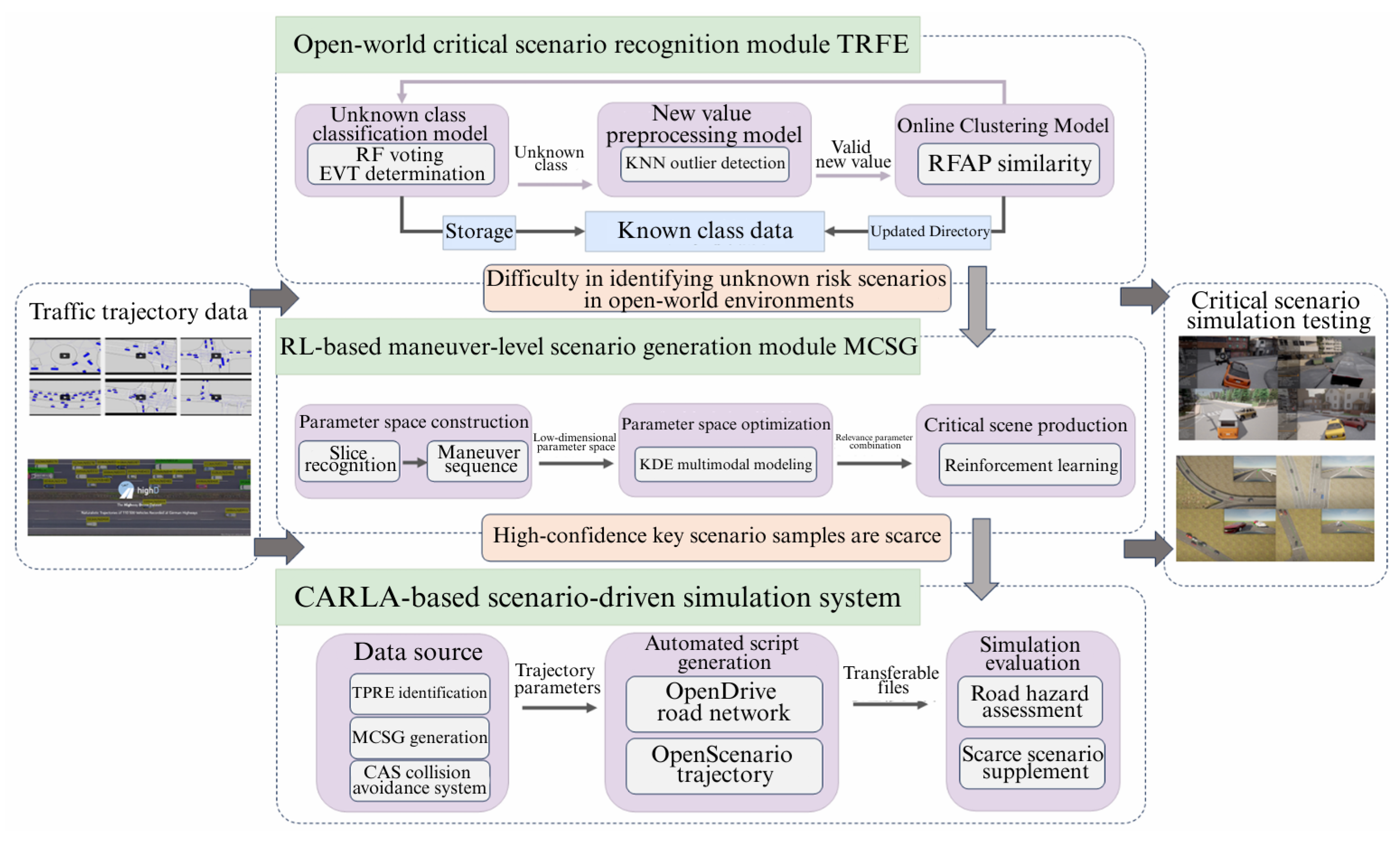
A “recognition–generation–simulation” pipeline for autonomous driving SBT is proposed, integrating TRFE (open-world recognition), MCSG (maneuver-level generation), and CARLA closed-loop simulation (
Figure 1).
Multi-source driving data is processed by TRFE to identify known and unknown high-risk scenarios (expanding scenario catalogs). MCSG decomposes trajectories into maneuver units (solving high-dimensional search inefficiency), models multimodal parameters, and uses RL to search high-risk configurations. Both scenarios are converted to OpenSCENARIO for CARLA simulation, with feedback iteratively optimizing modules (ensuring library diversity and criticality).
3.2. Open-World Critical Scenario Recognition (TRFE)
3.3. Model Components
3.3.1. Unknown-Screening (RF-EVT)
The Unknown Class Screening (UCS) module determines whether an input scene belongs to a known category or should be flagged as unknown. Given the transformer feature
h, a random forest of
T trees independently predicts a class label for each tree:
Rather than using only the majority-vote result, the full vote distribution is retained. The vote count for class
k is
This vote vector
provides a non-probabilistic measure of how well the input matches each known class. For known-class samples, votes concentrate on the correct class; for unknown samples, votes scatter across classes or cluster in low-count regions. To statistically model this tail behavior, extreme value theory (EVT) is applied. For each class
k, a threshold
(95th percentile of training vote counts) is selected, and the excess values
are fitted with a generalized Pareto distribution (GPD):
At inference, the tail-survival score for class
k is computed as follows:
where
for the test sample. If the maximum score across all classes falls below a threshold
(i.e.,
), then the scene is declared unknown. Otherwise, it is assigned to the best-matching known class:
This three-stage pipeline—transformer feature extraction, RF vote counting, and EVT tail modeling—enables statistically principled detection of out-of-distribution scenarios without requiring explicit negative samples.
The RF is fitted on the frozen encoder features after supervised fine-tuning and is not updated during joint clustering optimization; the RF vote vector enters only as a fixed similarity signal, introducing no gradient discontinuity into the joint loss.
3.3.2. New-Value Preprocessing
Not every sample flagged as unknown by the UCS module is suitable for clustering. Some may be outliers, misclassified samples, or low-quality features that would degrade clustering performance. The New-Value Preprocessing (NVP) module addresses this by managing an FIFO buffer B of a capacity W and applying two sequential filtering steps before passing samples to the clustering stage.
When the buffer reaches capacity, outlier detection is first applied. For each unknown sample feature
, a k-nearest neighbor score measures its isolation in feature space:
Samples whose scores exceed a threshold are discarded as outliers, yielding a cleaned set .
A second validity filter then checks whether each remaining sample is sufficiently distant from all known class centers
, ensuring it carries genuinely novel information rather than being a borderline known sample:
Only samples exceeding a minimum margin are retained, forming the final set , which is forwarded to the online clustering model. This layered filtering ensures that the clustering stage receives high-quality candidates with genuine potential to form new scenario classes.
3.3.3. Online Clustering (RFAPs)
The Online Clustering (OC) module takes the filtered set and groups unknown samples into new scenario classes, which are then incorporated into the existing catalog. Unlike static clustering algorithms, the OC module operates in an online fashion, continuously updating class assignments as new data arrive.
The key innovation is using random forest activation patterns (RFAPs) to measure inter-sample similarity. When a feature vector
h traverses a decision tree, it follows a unique path through internal nodes to a leaf. This path is encoded as a sequence of node indices
for tree
b. Two samples that share longer common paths in more trees are considered more similar. The pairwise similarity is
This path-based similarity captures structural relationships in the feature space that are not accessible from Euclidean distances alone, providing richer guidance for clustering unknown scenarios. The transformer encoder is jointly optimized with two heads—a clustering head for unknown samples and a classification head for known classes—using three complementary loss terms.
The clustering loss uses the RFAP similarity matrix
S to pull together similar unknown samples and push apart dissimilar ones:
The classification loss preserves recognition accuracy on known classes using labeled data:
The consistency loss enforces stable feature representations under data augmentation, improving generalization:
The three terms are combined with a time-varying weight
on the consistency term:
Once training converges, high-confidence clusters are promoted to new scenario classes. Specifically, a cluster is promoted if its mean intra-cluster RFAP similarity exceeds 0.85 and its minimum distance to all existing class centers exceeds the validity margin used in NVP. The number of new clusters Q is not fixed in advance; it is determined automatically by the online clustering head , which outputs a soft assignment over a maximum of candidate clusters per round, and clusters with fewer than 20 samples after convergence are discarded. Promoted clusters receive new class labels and are appended to the labeled training set . The expanded class set is fed back into the UCS module, which is retrained from the current checkpoint (not from scratch) on the augmented , closing the “recognition–discovery–update” loop and enabling continuous adaptive expansion of the scenario catalog.
Gradient competition is managed by (1) initializing joint optimization from the converged supervised checkpoint and (2) gradually ramping up to stabilize the shared representation during early joint training.
3.4. Maneuver-Level Multimodal Parameter Space
To avoid the high dimensionality and lack of semantic abstraction inherent in trajectory-level parameterization, MCSG first decomposes continuous driving trajectories into discrete maneuver units (e.g., braking, lane change, and cut in). For the representative lane change scenario, each maneuver is compactly described by a seven-dimensional parameter vector:
The seven parameters and their physical meanings are listed in
Table 1. Each parameter is extracted directly from real trajectory data and maps to a corresponding OpenScenario action; longitudinal maneuvers (acceleration/deceleration) are encoded as
LongitudinalAction with the target speed and dynamics, and the lateral lane change is encoded as
LaneChangeAction with a duration
. This one-to-one mapping ensures that any parameter vector sampled by MCSG can be directly executed in CARLA without additional post-processing.
Naïve approaches model parameters either independently or as a single Gaussian, both of which fail to capture the nonlinear correlations among maneuver variables. An independent model factorizes the joint distribution:
while a unimodal Gaussian assumes a single mode:
Real driving data exhibit multiple behavioral modes (e.g., aggressive versus cautious lane changes), and thus a multivariate multimodal distribution is needed. MCSG fits this via kernel density estimation (KDE), which places a Gaussian kernel at each observed data point and sums them:
where the multivariate Gaussian kernel is
For example, the joint distribution of the trigger distance
d and relative speed
in a highway lane change scenario is modeled as follows:
The bandwidth matrix is determined by first constructing an initial estimate via Scott’s rule and then selecting the optimal H through cross-validation on the log-likelihood. This multimodal distribution preserves the complex correlations among maneuver parameters and serves as a realism prior in the RL reward, preventing the agent from generating physically implausible trajectories.
3.5. RL-Based Edge Case Generation (MCSG)
3.5.1. MDP Formulation
The scenario generation problem is formulated as a Markov decision process (MDP). At each step, the agent observes the current maneuver parameter configuration and edits it to push the scenario toward higher-risk regions. The state
is the current parameter vector:
The action
is a parameter edit, and the state transition follows
The reward function balances three objectives: maximizing the proportion of high-risk time steps (measured via RSS safe distance violations), encouraging collisions, and penalizing low-likelihood parameter combinations to preserve physical realism. The RSS-based high-risk proportion is
The composite reward is
where
,
, and
balance risk, collision, and realism terms, respectively. The negative log-likelihood penalty
acts as a realism prior, preventing the agent from converging to physically implausible parameter combinations.
Physical feasibility is enforced by (1) constraining parameters to ranges derived from real highD trajectories and (2) CARLA’s physics engine, which clips actuator commands to the vehicle model’s feasible range at execution time.
3.5.2. Policy Learning
The policy
is implemented as a two-layer LSTM network, which is well suited for capturing sequential dependencies in the parameter editing process. The policy is optimized via the REINFORCE policy gradient algorithm. The gradient of the expected return is
where
b is a baseline to reduce variance. Parameters are updated via
To improve search efficiency, a coarse-to-fine sampling strategy is adopted. The agent first explores broadly across the parameter space to identify high-risk regions and then refines its search within those regions. This hierarchical strategy accelerates convergence toward optimal high-risk edge case parameter combinations while avoiding premature local optima.
4. Experiments and Results
This section introduces the experimental set-up and then reports the results for TRFE-based open-world critical scenario recognition, MCSG-based maneuver-level generation, and CARLA closed-loop validation.
4.1. Experimental Set-Up
4.1.1. Datasets and Scenario Taxonomy
Experiments were conducted on the public highD [
31] and INTERACTION [
32] trajectory datasets (highway and urban scenes). The highD dataset has 6 German highway segments (16.5 h, 25 Hz, 110,000+ trajectories, car following and lane change), and the INTERACTION dataset has 3 subsets (roundabouts, ramp merging, and unsignalized intersections) from the US, China, and Germany (vehicles, cyclists, and pedestrians, 10 Hz) (
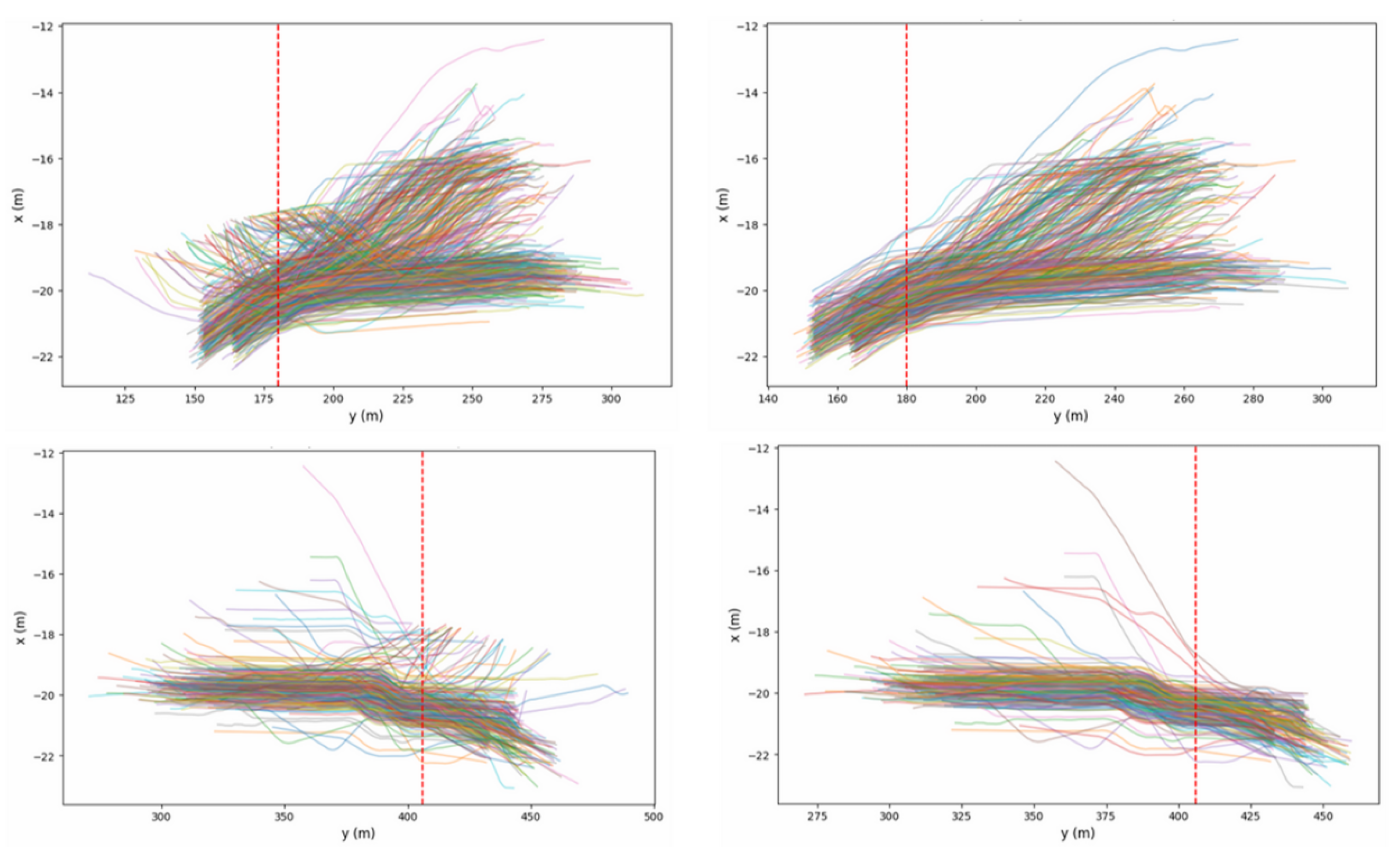
Figure 2).
Raw trajectories were categorized into 17 critical scenario classes based on an expert-defined catalog, as detailed in
Table 2. The 17 classes defined the initial known set for the open-world protocol; the RFAP clustering module could discover and incorporate additional classes beyond this taxonomy as unknown samples accumulated. Uneven distributions were mitigated via resampling and outlier removal, yielding 43,800 balanced labeled samples. Each scenario was represented by 4 occupancy grids sampled uniformly within a 1.5-s window, regardless of the native frame rate of the source dataset (25 Hz for highD and 10 Hz for INTERACTION); no interpolation between frames was performed, and thus no interpolation artifacts were introduced into the grid values. The sample splits were 70%, 15%, and 15% (training, validation, and testing, respectively).
4.1.2. Evaluation Metrics and Baselines
TRFE used the open-set ACC and macro-averaged F1 (known and unknown samples) with a clustering accuracy
. The baselines were CAC [
33], ARPL [
34], FCPN [
35], CEVT [
36], and MDENet [
37] (open set), with STAE+K-Means, STAE+HC [
38], iterative Euclidean, and iterative AutoNovel [
39] (clustering).
MCSG used the trajectory fidelity (
/
) to validate trajectory realism; closed-loop stability and controller failure were assessed separately in the CARLA simulation experiments (
Section 4.1.2), with criticality metrics (
, CR). The baselines were GACS [
21], IBO [
19], ConScenD [
40], CCSF [
41], RLTester [
23], and RLBE [
42].
For the CARLA closed-loop tests, the focus was on triggering near-misses or collisions in CAS across road geometries (no SUT comparison). Evaluating the generated scenarios against multiple SUT implementations to contextualize failure modes across different controller designs remains for future work.
4.2. Open-World Critical Scenario Recognition TRFE
4.2.1. Open-Set Recognition Protocol
An incremental protocol emulated open-world deployment. Initially, two classes were treated as known; in each subsequent round, three additional classes were introduced as unknown samples. TRFE had to reject them as unknown, cluster them via RFAPs, and incorporate the resulting clusters into the known set before the next round begins, repeating the process until all 17 classes were covered (five rounds of three new classes after the initial two). New classes were added in order of increasing visual similarity to the existing known set, following the ordering in
Table 2, to create a progressively harder recognition task. To avoid data leakage, the test split for each round contained only samples from classes already incorporated into the known set plus the current round’s unknown samples; samples from future rounds were withheld entirely. Each round was repeated five times with different random seeds, and the results were averaged. The reported ACC and F1_macro are macro-averages across all test rounds.
4.2.2. Open-Set Recognition Performance
Table 3 reports the open-set ACC and F1_macro for TRFE and the baselines.
TRFE achieved the best F1_macro score (0.906) despite having a slightly lower ACC than MDENet (0.972 vs. 0.976), reflecting enhanced rare and scenario recognition (critical for safety testing).
4.2.3. Unknown-Class Clustering
Table 4 compares the clustering accuracy with the baselines.
TRFE’s (0.964) outperformed the iterative AutoNovel by 6.2 percentage points (RFAP provides more discriminative similarity than feature-space distances).
4.2.4. Ablation and Parameter Sensitivity
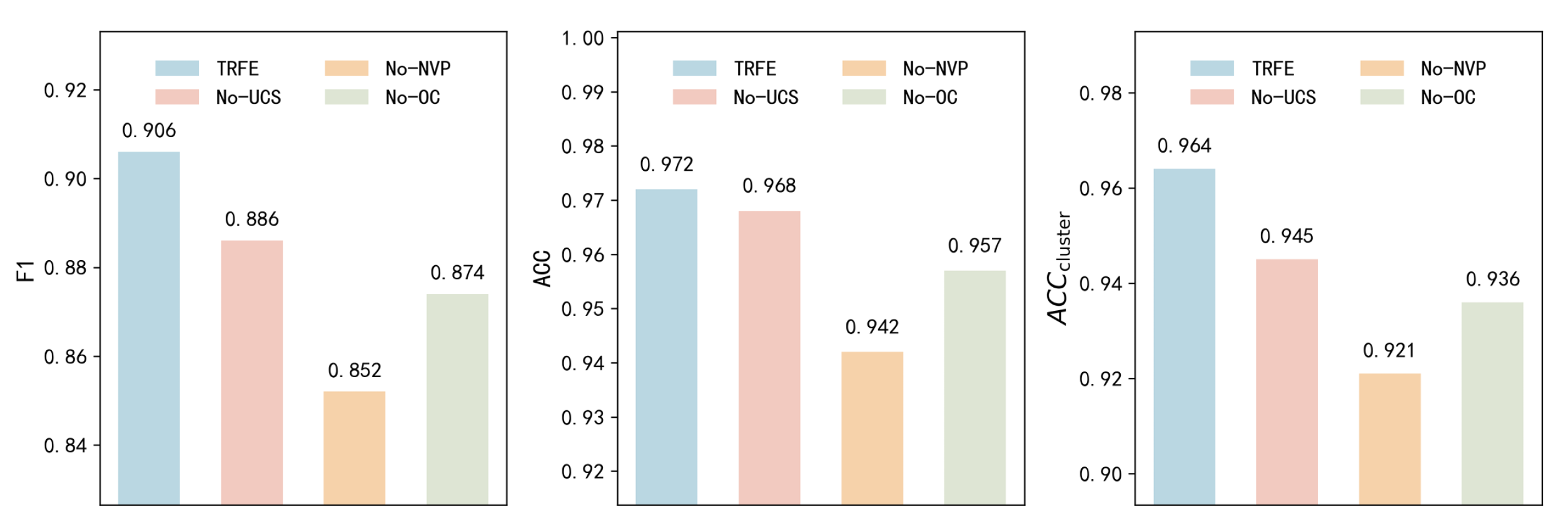
Figure 3 confirms that the UCS, NVP, and RFAPs are critical; No-UCS degraded unknown detection, No-NVP caused unstable clusters, and No-OC weakened cluster alignment.
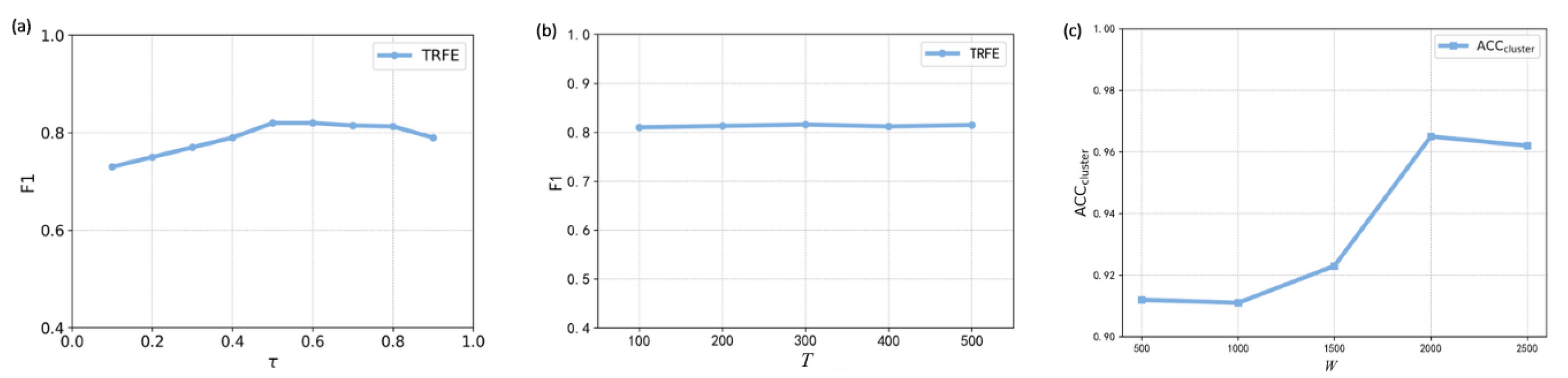
Figure 4 shows the optimal parameters:
(EVT threshold),
(RF trees), and
(buffer size).
4.3. Maneuver-Based Critical Scenario Generation MCSG
MCSG decomposes TRFE-labeled trajectories into seven-dimensional maneuver parameter vectors and uses RL to search high-risk configurations (two-layer LSTM policy, Adam optimizer).
Regarding the training details, MCSG trained for 3000 episodes; policy parameters were updated in batches of 50 episodes using the REINFORCE gradient estimator. The two-layer LSTM policy network had 32 hidden units per layer, Dropout 0.2, an Adam optimizer (learning rate of ), and gradient clipping at 1.0. For the reward weights, the composite reward was (normalized high-risk time step ratio, non-collision) or (collision), where the collision bonus of 0.25 was selected via grid search to maximally promote edge-case generation without destabilizing training. All CARLA closed-loop tests used the same CAS configuration: a depth camera and LiDAR with a 10-m detection range, RSS-based safe distance computation, and maximum-braking response on high-risk detection. The sensor and controller settings were held constant across all road geometries and scenario types.
4.3.1. Trajectory Fidelity
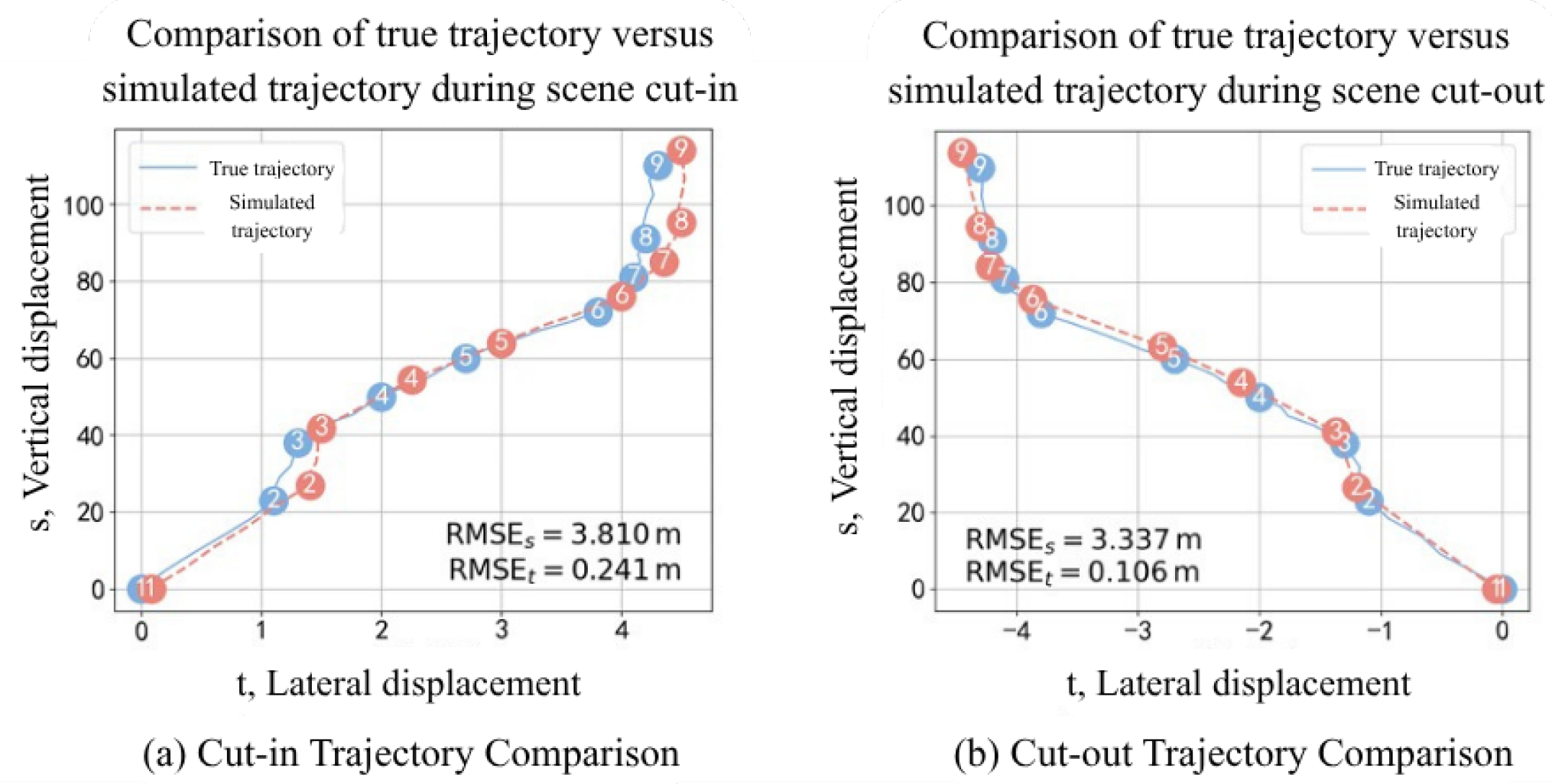
Figure 5 shows that the generated trajectories aligned closely with the real ones (longitudinal and lateral directions), verifying maneuver-based parameterization realism.
4.3.2. Comparison with Baseline Scenario Generators
Table 5 shows that MCSG outperformed all the baselines (best fidelity and criticality):
4.3.3. Multivariate Multimodal Parameter Modeling
Multimodal KDE (MCSG) achieved log-likelihood
(versus independent univariate
, unimodal Gaussian
), better capturing maneuver correlations.
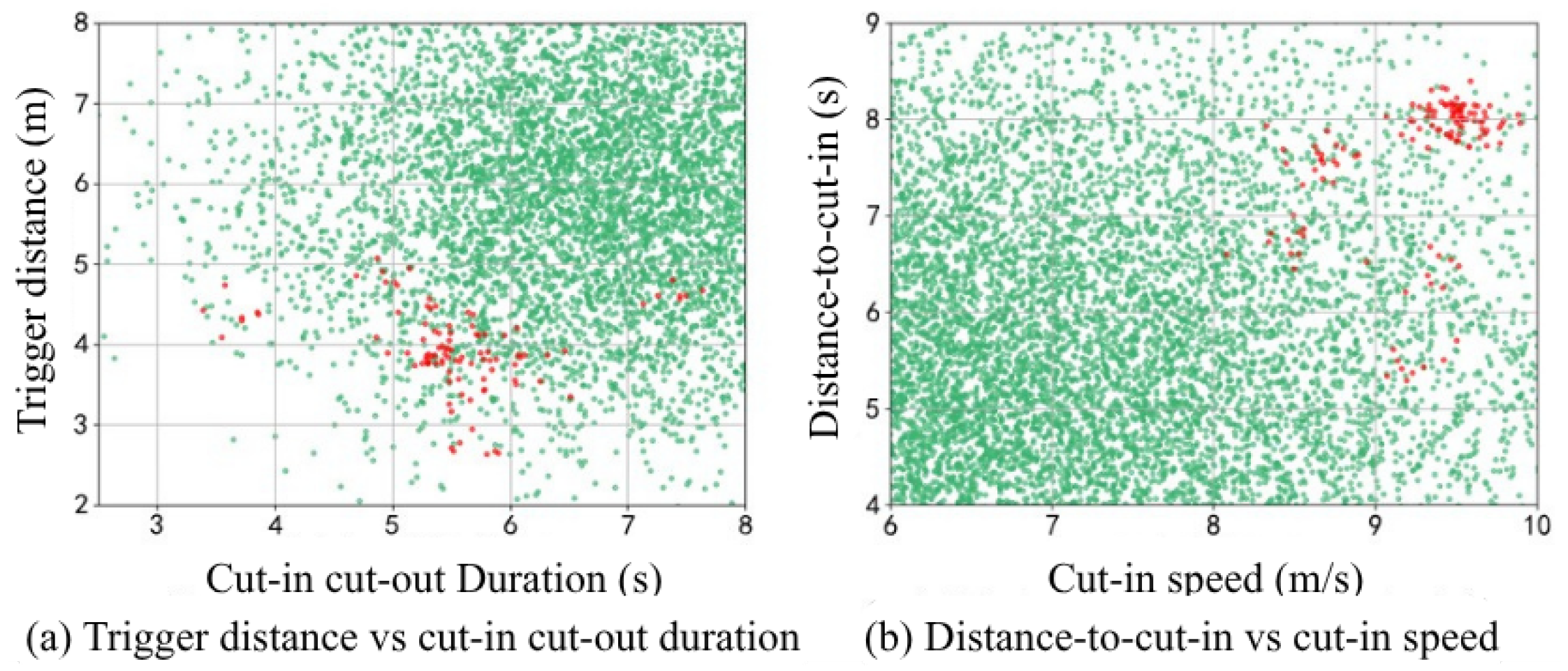
Figure 6 shows the generated collision samples’ (red) cluster within real safe regions (green).
4.3.4. Ablation Studies
Figure 7 confirms that maneuver parameterization, multimodal modeling, and RL search are necessary for realism/criticality balance.
4.4. CARLA-Based Closed-Loop Evaluation
The CARLA-based simulation system integrates the outputs of TRFE and MCSG into a closed-loop testing pipeline. Recognized and generated scenario trajectories are standardized into OpenDRIVE road network files and OpenScenario action scripts and then executed in CARLA against the built-in collision avoidance system (CAS) as a black box system under test (SUT).
TRFE and MCSG trajectories are converted to OpenDRIVE and OpenScenario scripts and tested on CARLA’s CAS (black box SUT).
4.4.1. Scene Conversion and CAS Under Test
Road fragments extracted from the highD and INTERACTION datasets were converted to OpenDRIVE files using Osm2lanelet. Maneuver parameters output by MCSG were mapped to OpenScenario action sequences that controlled adversarial vehicle behavior. Road fragments were converted to OpenDRIVE files, and maneuver parameters were mapped to OpenScenario actions. The CAS used a depth camera and LiDAR (10-m range) to compute RSS safe distances (high-risk and collision feedback for MCSG RL).
4.4.2. Simulation Results on Typical and Rare Critical Scenarios
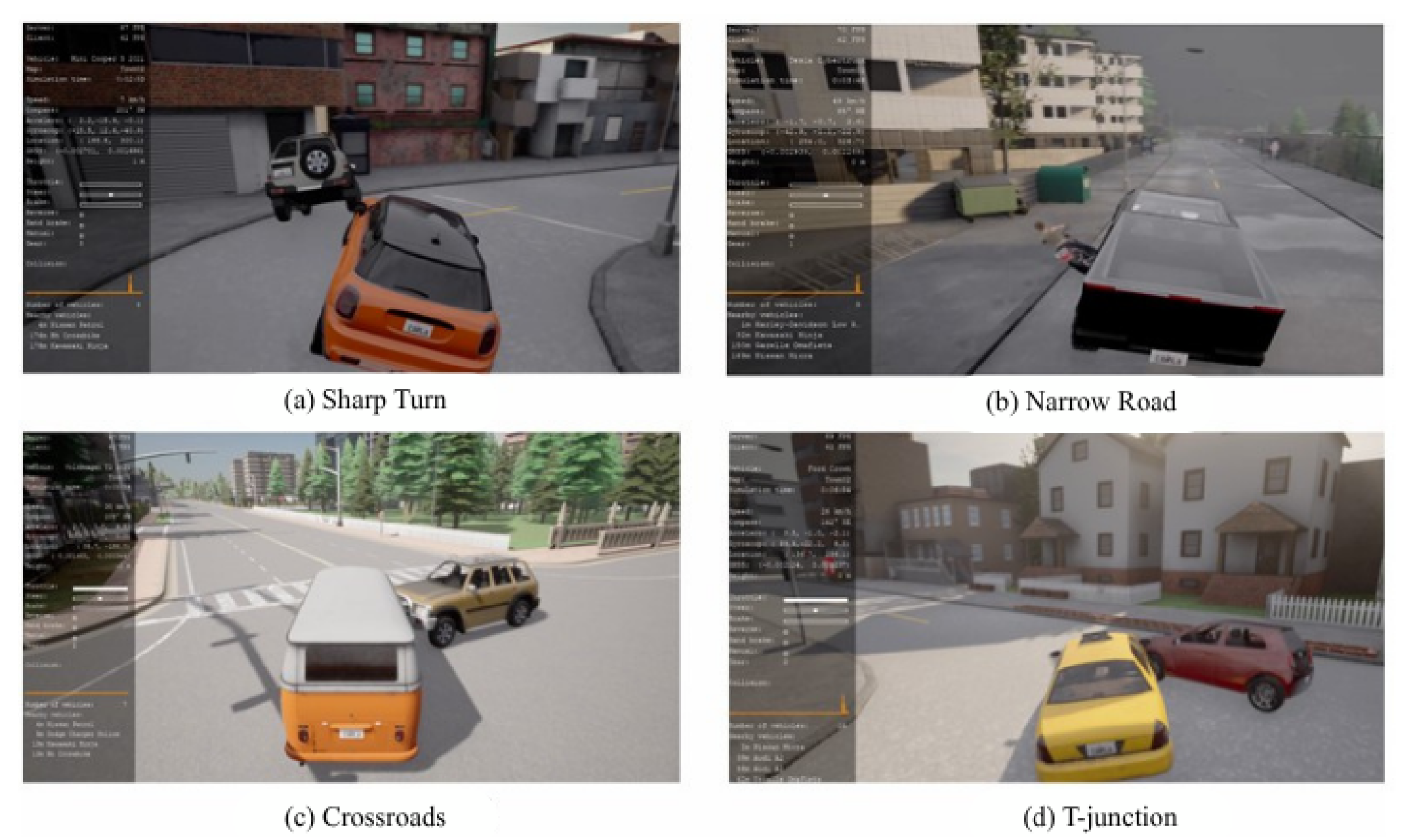
Two categories of scenarios were tested. First, TRFE extracted real critical scenarios from the datasets (e.g., highway cut ins and ramp merging) and converted them to CARLA scripts to verify that the simulation system faithfully reproduced real-world risk patterns. Second, MCSG generated optimized edge-case scenarios by searching for parameter combinations that maximized the RSS violations and collision probability. TRFE extracted real safe critical scenarios, and MCSG optimized the parameters to generate near-miss and collision cases. Tests on four geometries (sharp curve, narrow road, four-way intersection, and T junction) show that the MCSG scenarios triggered collisions consistently (
Figure 8).
MCSG generated rare scenarios (diverging, merging, and congestion) on custom CARLA maps, enriching the test library.
Overall, the experiments demonstrate that (1) TRFE effectively identified and clustered unknown critical scenarios (high macro-F1 and clustering accuracy); (2) MCSG generated realistic and highly critical trajectories; and (3) the pipeline reliably triggered collisions across road geometries, enabling effective scenario-based testing.
5. Discussion
This work addresses autonomous driving safety evaluation via a “recognition–generation–simulation” pipeline. The open-world TRFE framework discovers unknown high-risk scenes and expands the scenario catalogue incrementally; via self-supervised pretraining, RF-EVT screening, and RFAP-based clustering, TRFE achieved a 0.906 macro-F1 score (open set) and 0.964 clustering accuracy on the HighD and INTERACTION datasets, outperforming MDENet (+2.3 percentage points for macro-F1 score) and iterative AutoNovel (+6.2 percentage points for clustering accuracy). This enhances robustness to distribution shifted and enriched data-driven scenario cataloguing.
Building on TRFE, MCSG addresses the scarcity of high-risk samples and realism-criticality balance in generation. By decomposing trajectories into maneuver units, modeling multivariate multimodal parameter spaces (KDE), and using a two-layer LSTM RL agent (RSS and collision reward), MCSG outperformed the variants (no maneuver abstraction, unimodal modeling, and non-RL search) with a lower trajectory RMSE and higher high-risk and collision rates, validating the necessity of the joint maneuver space, risk-aware reward, and RL policy design.
CARLA-based closed-loop validation confirmed the pipeline effectively stress-tested the SUT by reconstructing risky configurations across diverse geometries via OpenDRIVE and OpenScenario scripts, systematically pushing scenarios to safety boundaries while preserving physical consistency.
Several limitations point to future directions. For the recognition module (TRFE), a CNN-transformer hybrid front-end could provide stronger spatial inductive bias than row-major flattening; representation probing is recommended to verify the encoder learns structural rather than velocity features; the GPD tail model may degrade under severe domain shift or sensor dropout, motivating online threshold recalibration; replacing the Euclidean distance in NVP with cosine similarity or a learned metric and replacing single-center class boundaries with nearest-prototype or density-based margins would improve robustness to complex class distributions; and the 17-class taxonomy defines the initial known set and can be expanded by the RFAP clustering module as unknown samples accumulate. For the generation module (MCSG), the seven-dimensional parameter vector captures maneuver semantics but not sub-second micro-behaviors such as jerk profiles; the single-adversary design can be extended to coordinated multi-agent scenarios with scalable density estimators (e.g., normalizing flows); replacing the deterministic RSS reward with a probabilistic risk field model and adding explicit jerk constraints would improve physical fidelity; a Fuzzy–TD3 hybrid that adapts reward weights to the instantaneous safety margin [
43] is a promising direction; and true within-episode closed-loop adversarial control remains future work. For evaluation, extended multi-stage interactions may require longer temporal windows or hierarchical representations, and an ablation of coarse-to-fine parameter boundary settings and comparison across multiple SUT implementations are recommended future experiments.
6. Conclusions
This paper proposed a unified framework for autonomous driving safety-critical scenario mining and testing, comprising TRFE (open-world recognition), MCSG (RL-based generation), and a CARLA-based simulation system. TRFE identifies and clusters unknown risky scenes, outperforming SOTA baselines in open-set recognition (0.906 macro-F1 score) and clustering (0.964 accuracy score) on highway and urban datasets. MCSG leverages maneuver abstraction, multivariate multimodal modeling, and deep RL to generate realistic trajectories with higher high-risk exposure and collision rates than baselines.
Integrated into CARLA via OpenDRIVE and OpenScenario, these scenarios enable closed-loop CAS testing across diverse road geometries, stably triggering near-misses and collisions and supplementing real data with rare critical scenes. The unified pipeline enhances scenario-based testing efficiency and coverage, providing a practical foundation for systematic autonomous driving safety validation.
Author Contributions
Conceptualization, H.W. and S.Z.; methodology, H.W. and S.P.; software, S.P. and W.D.; validation, H.W., C.L. and B.L.; formal analysis, H.W. and S.P.; investigation, H.W. and J.Z.; resources, L.T. and S.Z.; data curation, H.W.; writing—original draft preparation, H.W. and S.P.; writing—review and editing, L.T. and S.Z.; visualization, S.P. and W.D.; supervision, S.Z.; project administration, S.Z. All authors have read and agreed to the published version of the manuscript.
Funding
This work was supported by the National Natural Science Foundation of China (NSFC) under Grants 62232008 and 62032010 and the NSFC Youth Program under Grant 62402367.
Institutional Review Board Statement
Not applicable. This article does not contain any studies with human participants or animals.
Informed Consent Statement
Not applicable.
Data Availability Statement
This study used publicly available data from the highD dataset and INTERACTION dataset, as described by Krajewski et al. [
31] and Zhan et al. [
32]. The datasets can be accessed from their corresponding public repositories as cited in the References section.
Acknowledgments
The authors would like to thank Zijiang Yang from Synkrotron Inc. for his valuable discussions and support related to this work.
Conflicts of Interest
Authors Weijun Dai, Changhui Liu, Bo Li, Jie Zhang, Hongbin Wang, and Lihui Tang were employed by the company Qingdao Port International Co., Ltd. The remaining authors declare that the research was conducted in the absence of any commercial or financial relationships that could be construed as a potential conflict of interest.
References
- Kalra, N.; Paddock, S.M. Driving to safety: How many miles of driving would it take to demonstrate autonomous vehicle reliability? Transp. Res. Part A Policy Pract. 2016, 94, 182–193. [Google Scholar] [CrossRef]
- Dosovitskiy, A.; Ros, G.; Codevilla, F.; Lopez, A.; Koltun, V. CARLA: An open urban driving simulator. In Proceedings of the Conference on Robot Learning, Mountain View, CA, USA, 13–15 November 2017; PMLR: Cambridge, MA, USA, 2017; pp. 1–16. [Google Scholar]
- Bendale, A.; Boult, T.E. Towards open set deep networks. In Proceedings of the IEEE Conference on Computer Vision and Pattern Recognition, Las Vegas, NV, USA, 27–30 June 2016; IEEE Press: Piscataway, NJ, USA, 2016; pp. 1563–1572. [Google Scholar] [CrossRef]
- Neal, L.; Olson, M.; Fern, X.; Wong, W.K.; Li, F. Open-set learning with counterfactual images. In Proceedings of the European Conference on Computer Vision (ECCV), Munich, Germany, 8–14 September 2018; Springer: Berlin/Heidelberg, Germany, 2018; pp. 613–628. [Google Scholar] [CrossRef]
- Klück, F.; Zimmermann, M.; Wotawa, F.; Nica, M. Genetic algorithm-based test parameter optimization for ADAS system testing. In Proceedings of the 2019 IEEE 19th International Conference on Software Quality, Reliability and Security (QRS), Sofia, Bulgaria, 22–26 July 2019; IEEE Press: Piscataway, NJ, USA, 2019; pp. 418–425. [Google Scholar] [CrossRef]
- Essa, M.; Sayed, T. Full Bayesian conflict-based models for real-time safety evaluation of signalized intersections. Accid. Anal. Prev. 2019, 129, 367–381. [Google Scholar] [CrossRef] [PubMed]
- Mersch, B.; Höllen, T.; Zhao, K.; Stachniss, C.; Roscher, R. Maneuver-based trajectory prediction for self-driving cars using spatio-temporal convolutional networks. In Proceedings of the 2021 IEEE/RSJ International Conference on Intelligent Robots and Systems (IROS), Prague, Czech Republic, 27 September–1 October 2021; IEEE Press: Piscataway, NJ, USA, 2021; pp. 4888–4895. [Google Scholar] [CrossRef]
- Wang, H.; Peng, S.; Zhu, S. Reinforcement Learning-Based Critical Scenario Generation for Safety Verification of Autonomous Cyber-Physical Systems. In Proceedings of the 2025 International Conference on Cyber Resilience and Endogenous Safety & Security; IEEE Press: Piscataway, NJ, USA, 2025. [Google Scholar]
- Kerber, J.; Wagner, S.; Groh, K.; Notz, D.; Kühbeck, T.; Watzenig, D.; Knoll, A. Clustering of the scenario space for the assessment of automated driving. In Proceedings of the 2020 IEEE Intelligent Vehicles Symposium (IV), Las Vegas, NV, USA, 19 October–13 November 2020; IEEE Press: Piscataway, NJ, USA, 2020; pp. 578–583. [Google Scholar] [CrossRef]
- Kruber, F.; Wurst, J.; Morales, E.S.; Chakraborty, S.; Botsch, M. Unsupervised and supervised learning with the random forest algorithm for traffic scenario clustering and classification. In Proceedings of the 2019 IEEE Intelligent Vehicles Symposium (IV), Paris, France, 9–12 June 2019; IEEE Press: Piscataway, NJ, USA, 2019; pp. 2463–2470. [Google Scholar] [CrossRef]
- Harmening, N.; Biloš, M.; Günnemann, S. Deep representation learning and clustering of traffic scenarios. arXiv 2020, arXiv:2007.07740. [Google Scholar]
- Zhao, J.; Fang, J.; Ye, Z.; Zhang, L. Large scale autonomous driving scenarios clustering with self-supervised feature extraction. In Proceedings of the 2021 IEEE Intelligent Vehicles Symposium (IV), Nagoya, Japan, 11–17 July 2021; IEEE Press: Piscataway, NJ, USA, 2021; pp. 473–480. [Google Scholar] [CrossRef]
- Ge, Z.; Demyanov, S.; Chen, Z.; Garnavi, R. Generative openmax for multi-class open set classification. arXiv 2017, arXiv:1707.07418. [Google Scholar] [CrossRef]
- Oza, P.; Patel, V.M. C2AE: Class conditioned auto-encoder for open-set recognition. In Proceedings of the IEEE/CVF Conference on Computer Vision and Pattern Recognition, Long Beach, CA, USA, 15–20 June 2019; IEEE Press: Piscataway, NJ, USA, 2019; pp. 2307–2316. [Google Scholar] [CrossRef]
- Chen, G.; Qiao, L.; Shi, Y.; Peng, P.; Li, J.; Huang, T.; Pu, S.; Tian, Y. Learning open-set network with discriminative reciprocal points. In Proceedings of the European Conference on Computer Vision (ECCV), Glasgow, UK, 23–28 August 2020; Springer: Cham, Switzerland, 2020; pp. 507–522. [Google Scholar] [CrossRef]
- Kong, S.; Ramanan, D. OpenGAN: Open-set recognition via open data generation. In Proceedings of the IEEE/CVF International Conference on Computer Vision, Montreal, QC, Canada, 10–17 October 2021; IEEE Press: Piscataway, NJ, USA, 2021; pp. 813–822. [Google Scholar] [CrossRef]
- De Gelder, E.; Paardekooper, J.P. Assessment of Automated Driving Systems using real-life scenarios. In Proceedings of the 2017 IEEE Intelligent Vehicles Symposium (IV), Redondo Beach, CA, USA, 11–14 June 2017; IEEE Press: Piscataway, NJ, USA, 2017; pp. 589–594. [Google Scholar] [CrossRef]
- De Gelder, E.; Hof, J.; Cator, E.; Paardekooper, J.P.; Op den Camp, O.; Ploeg, J.; de Schutter, B. Scenario parameter generation method and scenario representativeness metric for scenario-based assessment of automated vehicles. IEEE Trans. Intell. Transp. Syst. 2022, 23, 18794–18807. [Google Scholar] [CrossRef]
- Gangopadhyay, B.; Khastgir, S.; Dey, S.; Dasgupta, P.; Montana, G.; Jennings, P.A. Identification of Test Cases for Automated Driving Systems Using Bayesian Optimization. In Proceedings of the 2019 IEEE Intelligent Transportation Systems Conference (ITSC), Auckland, New Zealand, 27–30 October 2019; IEEE Press: Piscataway, NJ, USA, 2019; pp. 1961–1967. [Google Scholar] [CrossRef]
- Althoff, M.; Lutz, S. Automatic generation of safety-critical test scenarios for collision avoidance of road vehicles. In Proceedings of the 2018 IEEE Intelligent Vehicles Symposium (IV), Changshu, China, 26–30 June 2018; IEEE Press: Piscataway, NJ, USA, 2018; pp. 1326–1333. [Google Scholar] [CrossRef]
- Zhou, R.; Liu, Y.; Zhang, K.; Yang, O. Genetic algorithm-based challenging scenarios generation for autonomous vehicle testing. IEEE J. Radio Freq. Identif. 2022, 6, 928–933. [Google Scholar] [CrossRef]
- Liu, Y.; Zhang, Q.; Zhao, D. A reinforcement learning benchmark for autonomous driving in intersection scenarios. In Proceedings of the 2021 IEEE Symposium Series on Computational Intelligence (SSCI), Orlando, FL, USA, 5–7 December 2021; IEEE Press: Piscataway, NJ, USA, 2021; pp. 1–8. [Google Scholar] [CrossRef]
- Lu, C. Test scenario generation for autonomous driving systems with reinforcement learning. In Proceedings of the 2023 IEEE/ACM 45th International Conference on Software Engineering: Companion Proceedings (ICSE-Companion), Melbourne, Australia, 14–20 May 2023; IEEE Press: Piscataway, NJ, USA, 2023; pp. 317–319. [Google Scholar] [CrossRef]
- Zhang, Y.; Shi, X.; Shao, Y.; Shiwakoti, N.; Zhang, J.; Pu, Z.; Ye, Z. A review of scenario cases for autonomous transportation system: Insights from CAV safety testing and scenario generation. Accid. Anal. Prev. 2025, 215, 107994. [Google Scholar] [CrossRef] [PubMed]
- Feng, S.; Sun, H.; Yan, X.; Zhu, H.; Zou, Z.; Shen, S.; Liu, H.X. Dense reinforcement learning for safety validation of autonomous vehicles. Nature 2023, 615, 620–627. [Google Scholar] [CrossRef] [PubMed]
- Rong, G.; Shin, B.H.; Tabatabaee, H.; Lu, Q.; Lemke, S.; Možeiko, M.; Boise, E.; Uhm, G.; Gerow, M.; Mehta, S.; et al. LGSVL Simulator: A High Fidelity Simulator for Autonomous Driving. In Proceedings of the 2020 IEEE 23rd International Conference on Intelligent Transportation Systems (ITSC), Rhodes, Greece, 20–23 September 2020; IEEE Press: Piscataway, NJ, USA, 2020; pp. 1–6. [Google Scholar] [CrossRef]
- Wang, C.S.; Liu, D.Y.; Hsu, K.S. Simulation and application of cooperative driving sense systems using Prescan software. Microsyst. Technol. 2021, 27, 1201–1210. [Google Scholar] [CrossRef]
- Benekohal, R.F.; Treiterer, J. CARSIM: Car-following model for simulation of traffic in normal and stop-and-go conditions. Transp. Res. Rec. 1988, 1194, 99–111. [Google Scholar]
- Salmi, T.; Bouzguenda, M.; Gastli, A.; Masmoudi, A. Matlab/Simulink based modeling of photovoltaic cell. Int. J. Renew. Energy Res. 2012, 2, 213–218. [Google Scholar]
- Shao, Y.; Xu, Y.; Zhang, Y.; Ye, Z. From prediction to prevention: Safety modeling of driver takeover time with mental workload, risk perception, and driving style in ramp scenarios. Accid. Anal. Prev. 2026, 233, 108565. [Google Scholar] [CrossRef] [PubMed]
- Krajewski, R.; Bock, J.; Kloeker, L.; Eckstein, L. The highD Dataset: A drone dataset of naturalistic vehicle trajectories on German highways for validation of highly automated driving systems. In Proceedings of the 2018 21st International Conference on Intelligent Transportation Systems (ITSC), Maui, HI, USA, 4–7 November 2018; IEEE: Piscataway, NJ, USA, 2018; pp. 2118–2125. [Google Scholar] [CrossRef]
- Zhan, W.; Sun, L.; Wang, D.; Shi, H.; Clausse, A.; Naumann, M.; Kümmerle, J.; Königshof, H.; Stiller, C.; Tomizuka, M.; et al. INTERACTION Dataset: An international, adversarial and cooperative motion dataset in interactive driving scenarios with semantic maps. arXiv 2019, arXiv:1910.03088. [Google Scholar]
- Miller, D.; Sünderhauf, N.; Milford, M.; Dayoub, F. Class anchor clustering: A loss for distance-based open set recognition. In Proceedings of the IEEE/CVF Winter Conference on Applications of Computer Vision, Waikoloa, HI, USA, 3–8 January 2021; IEEE: Piscataway, NJ, USA, 2021; pp. 3570–3578. [Google Scholar] [CrossRef]
- Chen, G.; Peng, P.; Wang, X.; Tian, Y. Adversarial reciprocal points learning for open set recognition. IEEE Trans. Pattern Anal. Mach. Intell. 2022, 44, 8065–8081. [Google Scholar] [CrossRef] [PubMed]
- Xie, Z.; Duan, P.; Liu, W.; Kang, X.; Wei, X.; Li, S. Feature consistency-based prototype network for open-set hyperspectral image classification. IEEE Trans. Neural Netw. Learn. Syst. 2023, 35, 9286–9296. [Google Scholar] [CrossRef] [PubMed]
- Pan, W.; Shen, J.; Wang, B.; Wang, S.; Sun, Z. Open-set recognition based on the combination of deep learning and hypothesis testing for detecting unknown nuclear faults. Nucl. Eng. Des. 2024, 429, 113654. [Google Scholar] [CrossRef]
- Guo, J.; Wang, H.; Xu, Y.; Xu, W.; Zhan, Y.; Sun, Y.; Guo, S. Multimodal dual-embedding networks for malware open-set recognition. IEEE Trans. Neural Netw. Learn. Syst. 2025, 36, 4545–4559. [Google Scholar] [CrossRef] [PubMed]
- Balasubramanian, L.; Wurst, J.; Botsch, M.; Deng, K. Traffic scenario clustering by iterative optimisation of self-supervised networks using a random forest activation pattern similarity. In Proceedings of the 2021 IEEE Intelligent Vehicles Symposium (IV), Nagoya, Japan, 11–17 July 2021; IEEE: Piscataway, NJ, USA, 2021; pp. 682–689. [Google Scholar] [CrossRef]
- Han, K.; Rebuffi, S.A.; Ehrhardt, S.; Vedaldi, A.; Zisserman, A. Automatically discovering and learning new visual categories with ranking statistics. In Proceedings of the International Conference on Learning Representations (ICLR), Addis Ababa, Ethiopia, 26–30 April 2020. [Google Scholar]
- Tenbrock, A.; König, A.; Keutgens, T.; Bock, J.; Weber, H.; Krajewski, R.; Zlocki, A. The ConScenD Dataset: Concrete scenarios from the highD Dataset according to ALKS Regulation UNECE R157 in OpenX. In Proceedings of the 2021 IEEE Intelligent Vehicles Symposium Workshops (IV Workshops), Nagoya, Japan, 11 July 2021; IEEE: Piscataway, NJ, USA, 2021; pp. 174–181. [Google Scholar] [CrossRef]
- Karunakaran, D.; Berrio, J.S.; Worrall, S.; Nebot, E. Critical concrete scenario generation using scenario-based falsification. In Proceedings of the 2022 IEEE International Conference on Recent Advances in Systems Science and Engineering (RASSE), Tainan, Taiwan, 7–9 December 2022; IEEE: Piscataway, NJ, USA, 2022; pp. 1–8. [Google Scholar] [CrossRef]
- Liu, H.; Zhang, L.; Hari, S.K.S.; Zhao, J. Safety-critical scenario generation via reinforcement learning based editing. In Proceedings of the 2024 IEEE International Conference on Robotics and Automation (ICRA), Yokohama, Japan, 13–17 May 2024; IEEE: Piscataway, NJ, USA, 2024; pp. 14405–14412. [Google Scholar] [CrossRef]
- Hazem, Z.B. A fuzzy-TD3 hybrid reinforcement learning framework for robust trajectory tracking of the Mitsubishi RV-2AJ robotic arm. Sci. Rep. 2026, 16, 12269. [Google Scholar] [CrossRef] [PubMed]
Figure 1.
Overall pipeline of the proposed critical scenario generation framework.
Figure 1.
Overall pipeline of the proposed critical scenario generation framework.
Figure 2.
Examples of trajectories in two representative critical-scenario classes (“highway lane change” and “ramp entering and exiting”) after preprocessing, illustrating the typical maneuvers used for TRFE training.
Figure 2.
Examples of trajectories in two representative critical-scenario classes (“highway lane change” and “ramp entering and exiting”) after preprocessing, illustrating the typical maneuvers used for TRFE training.
Figure 3.
Ablation study on TRFE: open-set F1_macro and clustering accuracy under three variants—No-UCS (replacing RF-EVT screening with MDENet), No-NVP (removing the new-value preprocessing stage), and No-OC (replacing RFAP similarity with AutoNovel rank statistics)—compared with the full TRFE pipeline.
Figure 3.
Ablation study on TRFE: open-set F1_macro and clustering accuracy under three variants—No-UCS (replacing RF-EVT screening with MDENet), No-NVP (removing the new-value preprocessing stage), and No-OC (replacing RFAP similarity with AutoNovel rank statistics)—compared with the full TRFE pipeline.
Figure 4.
Parameter sensitivity of TRFE with respect to (a) EVT threshold , (b) number of trees T, and (c) buffer size W, measured by open-set F1_macro and clustering accuracy.
Figure 4.
Parameter sensitivity of TRFE with respect to (a) EVT threshold , (b) number of trees T, and (c) buffer size W, measured by open-set F1_macro and clustering accuracy.
Figure 5.
Comparison between real and generated trajectories in (a) cut-in and (b) cut-out scenarios. Blue = real trajectory; red = generated trajectory.
Figure 5.
Comparison between real and generated trajectories in (a) cut-in and (b) cut-out scenarios. Blue = real trajectory; red = generated trajectory.
Figure 6.
2D projections of the maneuver parameter space (e.g., trigger distance vs. maneuver duration; start distance vs. cut-in speed). Green points = sampled safe real scenarios; red points = MCSG-generated collision scenarios.
Figure 6.
2D projections of the maneuver parameter space (e.g., trigger distance vs. maneuver duration; start distance vs. cut-in speed). Green points = sampled safe real scenarios; red points = MCSG-generated collision scenarios.
Figure 7.
Ablation study on MCSG: (a) longitudinal RMSE, (b) lateral RMSE, (c) high-risk time step ratio , and (d) collision rate CR under three variants—No-Maneuver (trajectory-level parameterization), No-KDE (independent univariate distributions), and No-RL (genetic algorithm search)—compared with the full MCSG method.
Figure 7.
Ablation study on MCSG: (a) longitudinal RMSE, (b) lateral RMSE, (c) high-risk time step ratio , and (d) collision rate CR under three variants—No-Maneuver (trajectory-level parameterization), No-KDE (independent univariate distributions), and No-RL (genetic algorithm search)—compared with the full MCSG method.
Figure 8.
CARLA closed-loop CAS stress test snapshots on four representative road geometries: (a) sharp curve, (b) narrow road, (c) four-way intersection, and (d) T junction. Red bounding boxes highlight the ego vehicle; blue bounding boxes indicate adversarial vehicles executing MCSG-generated maneuvers. Collisions or near-misses triggered by the generated scenarios are marked.
Figure 8.
CARLA closed-loop CAS stress test snapshots on four representative road geometries: (a) sharp curve, (b) narrow road, (c) four-way intersection, and (d) T junction. Red bounding boxes highlight the ego vehicle; blue bounding boxes indicate adversarial vehicles executing MCSG-generated maneuvers. Collisions or near-misses triggered by the generated scenarios are marked.
Table 1.
The 7-dimensional maneuver parameter vector, with units, value ranges from highD, and OpenScenario mapping.
Table 1.
The 7-dimensional maneuver parameter vector, with units, value ranges from highD, and OpenScenario mapping.
| Param. | Description | Unit | Range | OpenScenario Field |
|---|
| Gap to lead vehicle at trigger | m | [5, 80] | EntityCondition/relativeDistance |
| Speed at maneuver start | m/s | [10, 40] | LongitudinalAction/targetSpeed |
| Scene start to maneuver start | s | [0, 10] | StartTrigger/delay |
| Speed at lane change end | m/s | [10, 40] | LongitudinalAction/targetSpeed |
| Lane change duration | s | [1, 8] | LaneChangeAction/dynamicsDuration |
| Speed after maneuver | m/s | [10, 40] | LongitudinalAction/targetSpeed |
| Maneuver end to scene end | s | [0, 10] | StopTrigger/delay |
Table 2.
The 17 critical scenario classes used in TRFE experiments.
Table 2.
The 17 critical scenario classes used in TRFE experiments.
| ID | Scenario Class | Dataset | Samples | Labeling Criterion |
|---|
| 1 | Highway free cruise | highD | ∼2600 | Constant speed, no lane change, large headway |
| 2 | Highway car following | highD | ∼2600 | Follows lead vehicle, TTC < 4 s |
| 3 | Highway cut in | highD | ∼2600 | Adjacent vehicle merges into ego lane, lateral gap < 2 m |
| 4 | Highway cut out | highD | ∼2600 | Ego-lane vehicle departs, sudden deceleration |
| 5 | Highway left lane change | highD | ∼2600 | Ego changes to left lane, displacement > 3.5 m |
| 6 | Highway right lane change | highD | ∼2600 | Ego changes to right lane, displacement > 3.5 m |
| 7 | Ramp entering | INTERACTION | ∼2600 | Merges from on-ramp, lateral shift > 50 m |
| 8 | Ramp exiting | INTERACTION | ∼2600 | Diverges to off-ramp, lateral shift > 50 m |
| 9 | Urban cut in | INTERACTION | ∼2600 | Cut-in on urban road, TTC < 3 s |
| 10 | Urban cut out | INTERACTION | ∼2600 | Sudden departure from urban lane |
| 11 | Roundabout entering | INTERACTION | ∼2600 | Enters roundabout, yields to circulating traffic |
| 12 | Roundabout exiting | INTERACTION | ∼2600 | Exits roundabout, crosses conflict zone |
| 13 | Roundabout circulating | INTERACTION | ∼2600 | Navigates inside roundabout |
| 14 | Unsignalized left turn | INTERACTION | ∼2600 | Unprotected left turn, gap acceptance |
| 15 | Unsignalized right turn | INTERACTION | ∼2600 | Right turn, pedestrian and cyclist conflict |
| 16 | Unsignalized straight cross | INTERACTION | ∼2600 | Straight crossing at unsignalized intersection |
| 17 | Unsignalized merging | INTERACTION | ∼2600 | Two streams merge at unsignalized junction |
Table 3.
Open-set critical-scenario recognition performance (higher numbers are better).
Table 3.
Open-set critical-scenario recognition performance (higher numbers are better).
| Method | ACC | F1_macro |
|---|
| CAC | 0.985 | 0.817 |
| ARPL | 0.971 | 0.822 |
| FCPN | 0.958 | 0.858 |
| CEVT | 0.978 | 0.875 |
| MDENet | 0.976 | 0.883 |
| TRFE (ours)
| 0.972 | 0.906 |
Table 4.
Unknown-class clustering accuracy (ACC_cluster).
Table 4.
Unknown-class clustering accuracy (ACC_cluster).
| Method | ACC_cluster |
|---|
| STAE + K-Means | 0.427 |
| STAE + HC | 0.516 |
| Iterative Euclidean | 0.612 |
| Iterative AutoNovel | 0.902 |
| TRFE (ours) | 0.964 |
Table 5.
Comparison of scenario generation methods.
Table 5.
Comparison of scenario generation methods.
| Method | RMSE_t ↓ | RMSE_s ↓ | ↑ | CR ↑ |
|---|
| GACS | 0.763 | 4.379 | 0.683 | 0.530 |
| IBO | 0.931 | 5.181 | 0.631 | 0.425 |
| ConScenD | 0.327 | 3.764 | 0.311 | 0.262 |
| CCSF | 0.816 | 4.771 | 0.726 | 0.627 |
| RLTester | 0.463 | 3.950 | 0.724 | 0.621 |
| RLBE | 0.352 | 3.968 | 0.747 | 0.631 |
| MCSG (ours) | 0.237 | 3.362 | 0.779 | 0.663 |
| Disclaimer/Publisher’s Note: The statements, opinions and data contained in all publications are solely those of the individual author(s) and contributor(s) and not of MDPI and/or the editor(s). MDPI and/or the editor(s) disclaim responsibility for any injury to people or property resulting from any ideas, methods, instructions or products referred to in the content. |



 and
and