1. Introduction and Literature Review
In the modern urban transportation hierarchy, the e-scooter serves a dual role: it is both a vital last-mile solution that bridges the gap between public transit hubs and final destinations, and a flexible alternative to traditional bike sharing [
1,
2]. However, its effectiveness is often limited by urban geography. This research addresses the specific problem of topographic accessibility; in cities with significant elevation changes like Budapest, standard e-scooters often lack the power and safety features required for reliable commuting. By positioning the e-scooter as a high-performance, terrain-adaptive vehicle, this study enhances the sustainability of urban transport by providing a viable alternative to short-distance car trips in areas previously considered unreachable by standard micromobility solutions [
3,
4].
Recent studies provide increasing evidence that shared electric micromobility (e-scooters and e-bikes) can contribute to emission reductions, a modal shift away from private vehicles, and improved urban sustainability [
5,
6]. According to a comprehensive review of e-scooter services, shared electric scooters have the potential to reduce greenhouse gas emissions when they substitute for car trips, though results vary strongly depending on local context, vehicle lifespan, and fleet management practices [
7,
8].
The primary objective of this research is to bridge the gap between strategic urban analysis and technical engineering design by developing an integrated, user-centered framework. Specifically, this study seeks to answer the following questions: (1) How can qualitative “voice of customer” feedback be systematically translated into adaptive engineering specifications for steep urban terrains? (2) Can an integrated smart terrain-adaptive power management system (STAPMS) significantly enhance user safety and performance compared with existing commercial baselines?
The focus of product design and development is the integration of the marketing, design, and manufacturing functions of the firm into creating a new product and is intended to provide the following benefits [
9,
10]:
- i.
Competence with a set of tools and methods for product design and development.
- ii.
Confidence in your own abilities to create a new product.
- iii.
Awareness of the role of multiple functions in creating a new product (e.g., marketing, finance, industrial design, engineering, production),
- iv.
Ability to coordinate multiple, interdisciplinary tasks to achieve a common objective.
- v.
Reinforcement of specific knowledge from other courses through practice and reflection in an action-oriented setting.
Electric scooters are considered a new, technical green product and a potential industry for many countries [
11].
The user installs the Lime app on a device (typically a smartphone), which displays all nearby vehicles (tracked by GPS). Before starting a trip, the user supplies payment information. The user then scans the QR code on the vehicle, beginning the trip. To end the trip, the user parks the vehicle and then ends the ride through the app. The trip price is immediately deducted from the user’s credit card. Lime requires every user to take a picture of the parked vehicle and its surroundings to review whether the vehicle was parked improperly. If any problems were encountered during the trip (such as a malfunctioning vehicle), the user can report them through the app [
12].
Lime utilizes four distinct varieties of vehicles, including the Lime-S Ninebot ES4, Lime-S Generation 1, Lime-S Generation 2, and Lime-S Generation, contingent upon its location. On the other hand, Lime scooters Inc. uses many different manufacturers for the production of their bikes and scooters. One of those manufacturers is Segway Ninebot. Lime Inc. uses a special color visualization method to indicate the scooters’ functional status: purple for special requests and customer service tickets; red for scooters that require immediate attention; yellow indicates a need for charging; and green codes are fully operational scooters.
Many studies handled electric scooter issues, but still considered them as one of the most flexible and sustainable micromobility solutions. Szemere et al. [
3] analyzed the integration of electric scooters into Hungarian urban transportation systems, detailing policy regulations and user expectations. The study identifies user desires for optimized speed limits, designated infrastructure, and parking zones. The findings serve as a guide for future legislation to ensure seamless integration, aiming for societal benefits like reduced environmental impact, improved mobility, and economic viability. On the other hand, Khan et al. [
13] conducted a study to analyze the adoption behavior and usage frequency of shared e-scooters as an urban mobility mode. Using a zero-inflated ordered probate model with data from Chicago, the research jointly estimates the potential adoption and usage frequency of the scooters. Findings indicate that socio-demographics, the built environment, accessibility measures, and service characteristics significantly influence SES adoption and usage. Recent research has explored the behavioral preferences of shared micromobility users in urban contexts, emphasizing the role of demographics, trip purpose, and modal substitution patterns [
14]. Shaheen et al. [
15] proposed basic areas of shared mobility such as car sharing, electric scooter sharing, bicycle sharing, van sharing, and ride sharing, in which he considered the electric scooters as one of the most suitable riding modes. However, only a few studies handled redesign problems according to the new technological advancements and users’ preferences. In this field Chou and Hsiao [
11,
16] detailed a collaborative new product development project focused on the design and prototype creation of an electric scooter. The resulting prototype adhered to the esthetic principles of the golden section proportion, with outer housings fabricated by hand lay-up using fiber-reinforced plastics (FRPs). The project successfully integrated product appearance design with prototype construction, leveraging a range of traditional modeling and engineering techniques. Several other studies concentrated on creating eco-friendly scooters with zero emissions and composite recyclable materials, as well as scooters driven by various energy sources, including fuel cells [
16,
17,
18,
19,
20,
21].
Electric vehicles (EVs) and micromobility solutions, such as e-scooters, are increasingly positioned as complementary pillars in sustainable urban transport strategies. Numerous studies have shown that the transition to EVs contributes to reduced greenhouse gas emissions, improved air quality, and lower dependency on fossil fuels [
6]. E-scooters, as lightweight electric vehicles, share many of these sustainability benefits, particularly when integrated into smart city infrastructures that include EV charging stations, renewable energy sources, and digital mobility platforms. According to Mitropolous et al. [
22], the expansion of electric micromobility not only supports last-mile connectivity but also plays a crucial role in reducing traffic congestion, energy use, and environmental impact in densely populated areas. In Budapest, where local authorities are actively promoting low-emission zones and smart mobility policies, integrating terrain-adaptive e-scooters into the broader EV ecosystem enhances both the technical feasibility and environmental rationale for such innovations. Recent frameworks highlight the need to align micromobility design with systemic urban mobility transitions. A study introduces a novel lens for understanding how micromobility technologies, such as e-scooters, contribute to safer, calmer, and more inclusive urban environments [
22]. This aligns with the current study’s aim to improve hardware and address broader mobility system goals. These transitions emphasize the need for user trust, adaptive infrastructure, and transparent governance; factors indirectly shaped by improved design elements like adaptive power systems, terrain mapping, and user interface clarity.
Table 1 shows the summary of the analyzed literature.
Table 1.
Summary of the literature review.
Table 1.
Summary of the literature review.
| Reference | Study Highlight | Study Limitations/Challenges |
|---|
| [11] | E-scooter safety and eco-design focusing on body material. | Cost of material, tools and equipment was the main constraint. |
| [3] | E-scooter integration policy and regulations development in the Hungarian urban transportation system. | Benchmarking with other countries, analysis was based on virtual or planned regulations, not based on the existing ones, and technical functions were not included in the analysis. |
| [13] | E-scooter adoption and frequency of usage. | Cost and capacity constraints. |
| [14] | Micromobility preferences in urban areas | Traffic system, integration, policies and regulations. |
| [15] | Shared mobility strategy development. | Changing demand and operational costs could affect the desired sharing strategy. |
| [23] | Innovative product design methodology development. | Industry competitiveness. |
| [16,17,18,19,20,21] | Energy efficient, renewable energy sources and composite material micromobility products; mainly ordinary scooter development. | Adaptability, costs, performance and efficiency. |
| [6] | Micromobility sustainable benefits | Safety, public space and traffic management. |
| [8] | Review of e-scooter micromobility system attributes and impact | Safety and specialized lanes offering. |
Despite the lack of existing studies related to micromobility product design frameworks and methodologies, the majority of pertinent micromobility research has focused exclusively on several areas, including adoption, safety enhancement, energy consumption and efficiency, as well as policies and regulations. Nevertheless, little research has concentrated on the user-centered systematic redesign of micromobility products. Furthermore, the development of methodological frameworks through the integration of diverse engineering tools and innovative elements concerning terrain-specific performance challenges are not encompassed by the scope of the existing studies.
The distinction of this framework lies in its holistic integration of strategic feasibility and user-centered engineering. While traditional MCDM is a linear selection tool, this methodology employs an iterative “needs-to-innovation” bridge. It specifically uses strategic triggers from SWOT and PESTEL to filter technical metrics before they enter the Pugh matrix, ensuring that the resulting design is not just technically superior but also strategically viable within the unique urban constraints of Budapest.
2. Background and Problem Definition
In today’s highly competitive and unstable market environment with short product life cycles, product development must not only satisfy the quality and speed of manufacturing but also ensure that the products themselves incorporate innovative values that satisfy all customers’ needs and expectations [
21,
23,
24].
Micromobility systems including, motorcycles, motor bikes, motor scooters, electric scooters, mopeds, and motorized rickshaws make up more than 50% of the vehicle fleet in several countries throughout the world, including the United States, Europe, China, Taiwan, the United Kingdom, Hungary, and many others [
10,
11,
23].
In comparison with other vehicles, they are expanding faster. For example, Asian countries have over 40 million scooters, with an 18% annual growth rate, and scooters are becoming more popular in many countries than cars [
10,
11,
15,
18,
20,
23,
25].
The micromobility sector requires increased focus on developing concentrated methodological studies and frameworks aimed at improving user experience and satisfaction through the provision of more comfortable, safe, reliable, sustainable, and innovative user-centered designs for micromobility products and, furthermore, to facilitate the future trajectory of cities transitioning to sustainable micromobility and to enhance technological competitiveness by implementing intelligent and adaptable systems.
By analyzing the users’ needs and performance limitations, this study seeks to develop a methodological framework that will be able to examine how to increase users’ satisfaction and competitiveness by combining various user-centered engineering tools for redesigning and guiding the development of improved micromobility solutions along with other cutting-edge design elements like STAPMS and strategic feasibility analysis. A key innovation of this research is the development of the smart terrain-adaptive power management system (STAPMS), which is an integrated control architecture designed to dynamically adjust an e-scooter’s motor torque and power output in real-time based on detected changes in terrain and inclination. Moreover, this study explores which design concepts provide the best balance between users’ needs, technical performance, and strategic feasibility, in addition to the innovative approaches that can be used to improve energy efficiency and the ride quality in urban terrain environment. To get the best customer satisfaction rate, the suggested methodological framework will be validated on an electric scooter, more precisely, the Lime S2 electric scooter in the Budapest region.
3. Methodology
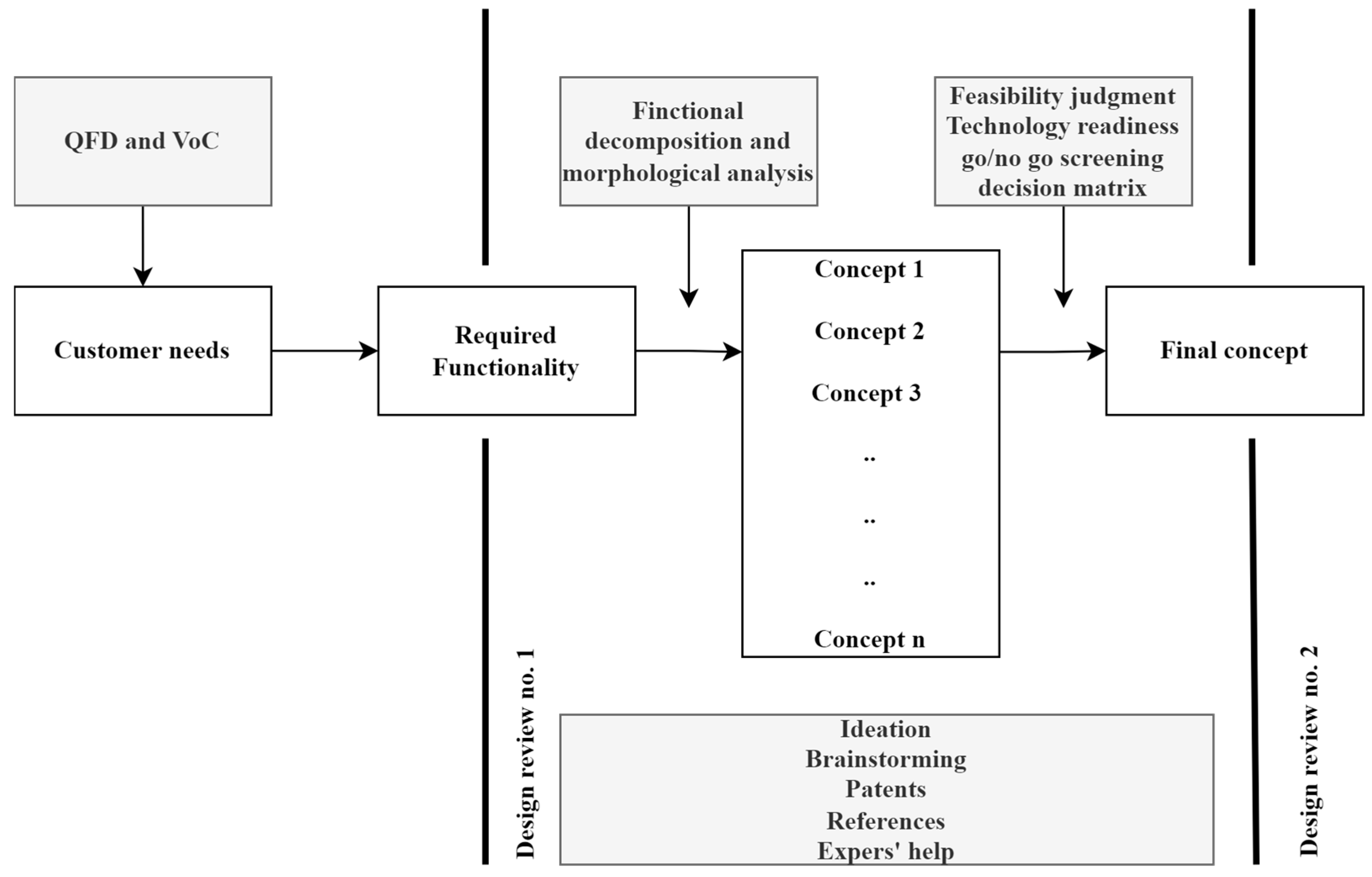
This study applied a structured product design and development process to redesign the Lime S2 electric scooter (a micromobility product) for enhancing safety, comfort, performance, competitiveness, and usability in Budapest. The methodology framework comprised several main stages as depicted in
Figure 1: (1) defining the study context and baseline product specifications, (2) designing and implementing a voice of customer (VoC) study, (3) translating users’ needs into engineering metrics, (4) generating alternative design concepts, (5) screening and scoring concepts using systematic decision-making tools, (6) product innovation integration through STAPMS and users’ needs, and (7) key features strategic validation using SWOT, PESTEL, and cost analysis.
3.1. Study Context and Baseline Micromobility Product (Lime S2)
Since the Lime S2 scooter is one of the most popular shared e-scooter models in Budapest, it was chosen as the reference model of micromobility products. Baseline specifications were extracted from Lime’s published technical documentation and user observations. These metrics functioned as design limitations as well as benchmarks for a subsequent assessment of the concept. The mapping of qualitative user feedback to technical requirements follows the systematic approach by Badia & Jenelius [
26] and Zhang et al. [
27] for enhancing e-scooter safety features.
Table 2 characterizes the baseline metrics of the lime S2 scooter.
Table 2.
Baseline metrics of Lime S2 scooter.
Table 2.
Baseline metrics of Lime S2 scooter.
| No. | Metric | Unit |
|---|
| 1 | Total mass | kg |
| 2 | Maximum speed | m/s |
| 3 | Manufacturing cost (unit) | USD |
| 4 | Dimensions (L × W × H) | cm |
| 5 | Electrical output | V/A |
| 6 | Plastic component thickness | mm |
| 7 | Tire insulator volume | mm3 |
| 8 | Voltage supply | V |
| 9 | Current draw | A |
| 10 | Electrical conductivity (wire) | S/m |
| 11 | LED color temperature | K |
| 12 | Light color intensity | lux or cd |
| 13 | Spring preload | N |
| 14 | Light luminous flux | lumens |
| 15 | Battery capacity | Wh |
| 16 | Overall volume | cm3 |
| 17 | Friction coefficient | dimensionless |
| 18 | Cross-sectional area | cm2 |
Figure 1.
The proposed methodological framework for micromobility product design innovation.
Figure 1.
The proposed methodological framework for micromobility product design innovation.
3.2. Voice of Customer (VoC) Study Design—Data Collection Tool and Methodology
A two-step VoC approach was used to identify the customers’ (users’) needs, since it is considered as a powerful data collection method in exploratory and methodological studies [
6]. The data collection tool was meticulously designed to serve as the initial step in this study. This tool consisted of a structured set of questions based on the Likert scale, multiple-choice questions, and open-ended questions. The main needs, improvement areas, and other elements of the survey were identified through conducting semi-structured interviews with a random group of experienced users. In the next step, the data collection tool was developed, taking the form of an online questionnaire that was distributed via the SurveyMonkey platform and supplemented with in-person data collection (semi-structured interviews) to ensure balance and the reliability of the collected responses. The final sample size consisted of N = 53 respondents, including senior students and experienced users in Budapest. This study’s nature is exploratory; in this case, the fifty-three-respondent sample size is considered a modest sample size, which is acceptable to generate initial evidence, insights, perspectives, and guidance for larger-scale future research. Ethical approval was obtained, and informed consent was collected from all participants.
Moreover, the total population size of potential respondents is not precisely delineated, as the study intended to encompass varied customer opinions within the pertinent context rather than a fixed sampling frame. Because of this, it was not possible to formally estimate the sample size. The VoC survey consisted mostly of Likert-scale and qualitative questions, and the 53 responses gathered yielded sufficient data to discern distinct patterns and attain topic saturation. Similar methodologies are frequently employed in exploratory voice of customer (VoC) and perception-oriented studies. Furthermore, suitable statistical analysis techniques were employed to examine both qualitative and quantitative responses, thus ensuring the reliability of the findings despite the constraints of the sample size.
VoC was captured through a structured survey and semi-structured interviews involving 53 targeted participants. To ensure high-quality data, the respondent group was composed of senior engineering students (65%) with technical knowledge of vehicle dynamics and regular e-scooter commuters (35%) who navigate Budapest’s hilly terrain daily. Data were collected via SurveyMonkey over a 4-week period. The survey was divided into three parts: (1) demographic and usage frequency, (2) importance rating of 15 pre-identified e-scooter attributes using a 5-point Likert scale, and (3) an open-ended qualitative section where users provided specific feedback on pain points (e.g., braking safety and uphill power). This targeted sample size is consistent with exploratory design research aimed at identifying specific technical requirements rather than broad market trends.
Table 3 shows the translation of qualitative voice of customer (VoC) to engineering metrics.
Table 3.
Translation of qualitative voice of customer (VoC) to engineering metrics.
Table 3.
Translation of qualitative voice of customer (VoC) to engineering metrics.
| Raw User Statement (Qualitative) | Identified Need | Quantitative Engineering Metric/Target |
|---|
| “More power is needed for walking up hills” | Terrain Adaptation and Power | Torque output (Nm); inclination sensor accuracy (±1°) |
| “Steering is too high, adjustable is good” | Ergonomics | Telescopic stem range (e.g., 90 cm–120 cm) |
| “Work more on mechanical shock for court street” | Vibration Dampening | Suspension travel (mm); spring constant (K) |
| “Speed pedal is not comfortable” | User Interface | New Hall-effect sensor placement; ergonomic thumb-lever angle |
| “Hide braking wires… put wire inside” | Safety and Esthetics | Internal cable routing diameter (mm) |
| “Add side mirrors… more side light reflectors” | Safety/Visibility | Field of view (degrees); reflective surface area (cm2) |
3.3. Translating Needs into Metrics (Needs–Metrics Matrix)
Responses were compiled into a list of fifteen customer requirements and needs, which included a lightweight structure, a comfortable standing area, an improved braking system, accessory availability, a long-lasting battery, effective lighting, adequate speed, adjustable steering height, photovoltaic emergency charging, mechanical backup charging, shock absorbers, and integrated safety tools.
The identified needs were correlated with the baseline product metrics through a needs–metrics matrix as shown in
Table 4 and
Table 5, which illustrates the extent of alignment between user expectations and quantifiable technical attributes. Each requirement was allocated an importance score according to its frequency of mention and survey ranking.
3.4. Concept Generation (Morphological Design)
Critical decision-making processes in the product design and development process include concept generation and the ultimate selection of a concept through proper evaluation. Determining that the product can fulfill all of the main purposes is the main goal of concept generation and evaluation. This can be accomplished by basic computations, drawings, circuit schematics, proof-of-concept models, or a thorough textual explanation of the idea. The concept generation and evaluation stages should take into account various consequences of a final decision and reduce the likelihood of misrepresenting a solution that may truly be effective. For instance, if the needs of the consumer are not taken into account during the concept generation and evaluation stages, the product may not succeed in the marketplace. The selection of TOPSIS is justified by its established reliability in sustainable transport decision making, where it remains a leading method for ranking complex design alternatives [
28,
29,
30].
Figure 2 below depicts the process of setting the product’s specifications, concept generation, and concept selection summary.
Figure 2.
Setting specifications, concept generation and concept selection summary—adopted from [
9].
Figure 2.
Setting specifications, concept generation and concept selection summary—adopted from [
9].
3.4.1. Generating Design Concepts
The product’s functionalities cannot be built without the design concepts. To put it another way, design concepts give the “how” of a product’s intended function. Typically, a design team is formed, and each team member works alone for several hours on a few subsets of the broader problem, such as how to identify the sub-functions, etc. A number of modest design concepts would then be produced after the team members got together to debate and refine the ideas they developed separately.
3.4.2. Morphological Analysis and Design
Making a morphological chart (design) is the first step in morphological analysis. All of the functions and sub-functions can be arranged logically using the morphological chart. In order to realize the combinations of ideas encompassing many design concepts, the morphological chart also specifies potential “hows” for each sub-function.
The following is the typical procedure to develop a morphological chart.
- 1.
Establish the functions that the design product must perform.
- 2.
List the functions, one per row, in a chart.
- 3.
For each function (row), list a wide range of sub-solutions, one per column.
- 4.
Select an acceptable set of sub-solutions, one for each function.
3.4.3. Combining Concepts
This is the process in which multiple fragmented tiny design concepts are integrated to form a final design concept. The number of conceivable combinations can be large, and each should be reviewed or confirmed for feasibility. The next stage is to merge the ideas to create a collection of ultimate design concepts.
Three concepts were developed based on the VoC survey result priorities. Each concept is shown below as a schematic representation of a morphological chart, as well as a morphological chart of concept generation.
3.5. Concept Evaluating, Screening and Scoring
A Pugh screening matrix was used to initially filter candidate concepts, with the baseline Lime S2 serving as the reference design. Surviving concepts were then assessed using a weighted scoring matrix, in which each criterion (such as safety, durability, comfort, and energy efficiency) was weighted according to user importance. Normalized scores were determined, and the top-ranked concept was chosen for further refining and CAD modification. To further understand user perceptions of potential features, a Kano model analysis was conducted [
31,
32]. This classifies features into must-have, performance, and excitement categories, providing an additional layer of prioritization for design decisions.
3.6. Product Innovation Integration and Strategic Validation
The design of the smart terrain-adaptive power management system (STAPMS), an intelligent control system that modifies power output according to terrain conditions, was one of the innovative results of the concept development process. The system combines a controller that maximizes motor torque delivery with sensors (gyroscope, accelerometer, and inclinometer). In order to achieve product innovation and competitiveness through the enhanced product, this creative design was combined with the identified customer needs. In the last stage, different techniques, including SWOT, cost effect, and PESTEL analyses, were used to strategically validate the enhanced design.
Section 4 below goes into further detail.
4. Results and Discussion
4.1. Voice of Customer (VoC) Main Findings
Fifty-three participants provided responses for the VoC study. The survey collected both quantitative and qualitative responses by combining open-ended and 10 Likert-scale questions (Q1–Q10).
Fifteen different consumer needs were identified by analysis of the responses as summarized in
Table 4. Battery life, braking performance, and lighting systems (headlights, backlights, and reflectors) were the most commonly mentioned priorities. Additionally emphasized were comfort-related concerns including shock absorption and standing platform size.
Table 4.
Customer needs as identified from the VoC survey.
Table 4.
Customer needs as identified from the VoC survey.
| No. | Need |
|---|
| 1 | Lightweight |
| 2 | Comfortable Stand place |
| 3 | Speed cruiser |
| 4 | Braking system |
| 5 | Accessory availability (mobile holders, digital screen, stuff holder, mirrors) |
| 6 | Lasts for a long time Battery |
| 7 | Headlights and backlights; light reflectors |
| 8 | Adequate Speed |
| 9 | Esthetic |
| 10 | Adequate tire friction resistant |
| 11 | Adjustable steering height |
| 12 | Photovoltaic emergency charger |
| 13 | Mechanical power charger |
| 14 | Shock absorber |
| 15 | Safety tools |
In total, 79% of respondents indicated they were likely or very likely to use scooters in Budapest.
In total, 78% reported a positive or very positive experience with scooters, suggesting a generally favorable baseline perception.
Respondents emphasized platform comfort and handlebar adjustability as recurring concerns.
Long-lasting battery, reliable braking, and adequate lighting were consistently ranked as top requirements.
Over half the respondents reported feeling unsafe at night due to inadequate lighting, while 40% noted concerns with braking on wet or cobblestone surfaces.
Esthetic appeal mattered to ~35% of users, though it ranked below functional aspects like durability and safety.
Respondents expressed interest in photovoltaic emergency charging and mechanical backup charging, though these were considered “nice to have” rather than essential.
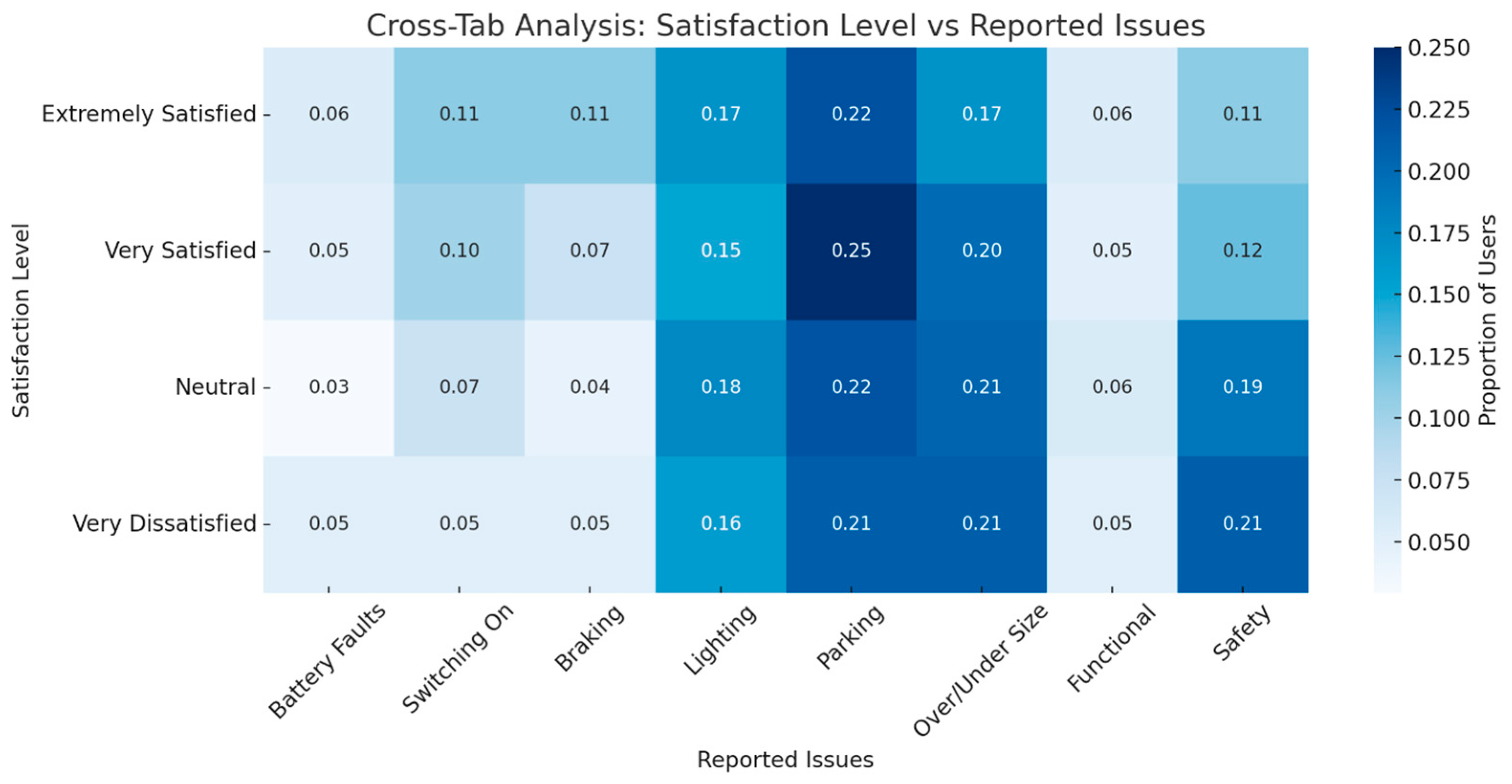
To further explore the relationship between user satisfaction and reported problems, a cross-tab analysis was conducted, as shown in
Figure 3. The results reveal a clear pattern: respondents who reported frequent issues with scooter size and weight or inadequate lighting were far more likely to express neutral or negative satisfaction levels. Conversely, users who reported fewer operational problems, particularly regarding parking availability and ride comfort, were concentrated in the satisfied and very satisfied categories. This reinforces the importance of prioritizing design improvements in braking, lighting, and structural ergonomics, since these factors directly shape overall user satisfaction.
Figure 3.
Cross-tab analysis: relationship between user satisfaction and reported problems.
Figure 3.
Cross-tab analysis: relationship between user satisfaction and reported problems.
Figure 4 depicts the voice of customer cross-tab analysis as a heatmap, showing how different satisfaction levels correlate with reported issues.
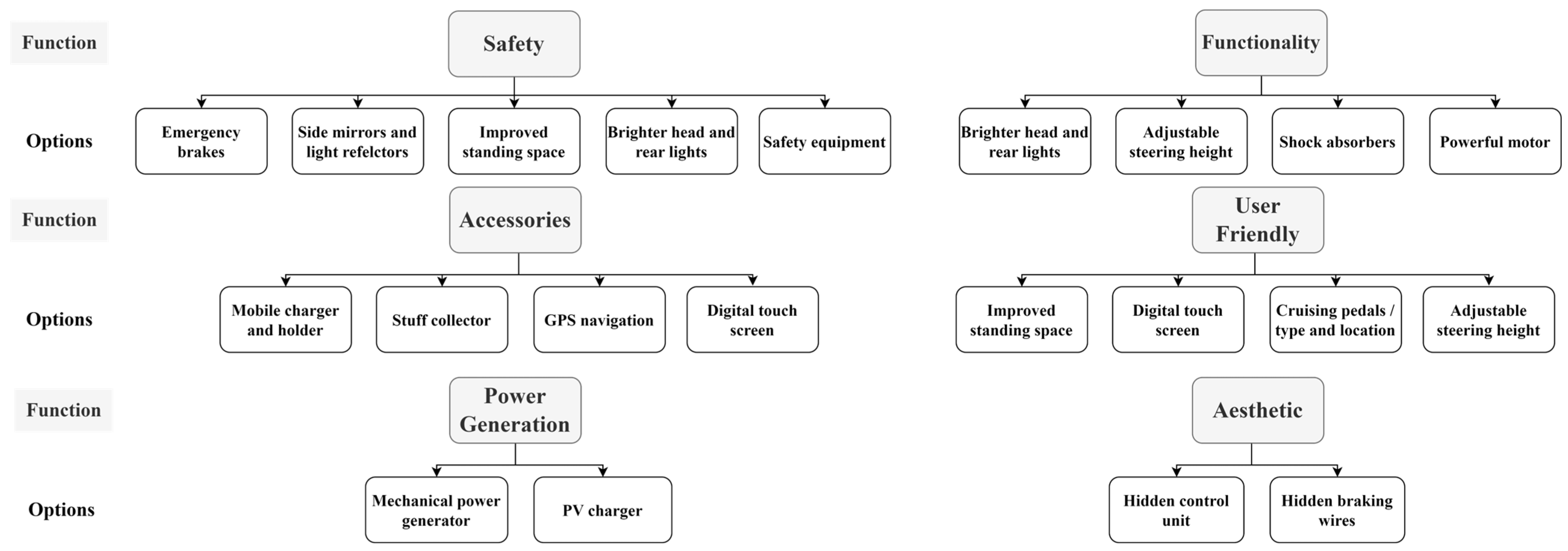
Figure 4.
Schematic presentation of the morphological chart of Lime scooters S2 improvement options.
Figure 4.
Schematic presentation of the morphological chart of Lime scooters S2 improvement options.
Key insights:
Neutral users are the most affected by issues like:
Very satisfied users also reported issues, but to a lesser extent, indicating tolerance or lesser expectations.
Dissatisfied users (though fewer in number) consistently flagged the same top concerns, especially:
Safety.
Size mismatch.
Lighting faults.
4.2. Customers’ Needs Identification
As seen in
Table 4, the analysis collectively yielded a structured collection of fifteen consumer needs. The most often identified priorities were lighting systems, braking performance, and battery life. Additionally highlighted were comfort elements, including shock absorption and the size of the standing platform.
The simulation was performed using parameters calibrated to the current industry standard for micromobility. The Lime S2 serves as the control baseline for this study; its performance limitations in Budapest’s specific terrain (identified in the SWOT analysis) were used as the “zero-point” for the Pugh selection matrix. Therefore, the simulated performance of the STAPMS-equipped model represents a direct comparative improvement over the baseline platform.
4.3. Needs–Metrics Relationship
As indicated in
Table 5, the needs–metrics matrix was used to translate the identified needs to quantifiable product metrics. This matrix shows how subjective user expectations may be used to quantify engineering qualities. For example, the need for a long-lasting battery was linked to metrics such as battery capacity (Wh), voltage supply (V), and current draw (A). In the same way, the braking force (N) and friction coefficient (dimensionless) were linked to the requirement for better braking.
Table 5.
Needs–metrics matrix of Lime scooter S2.
Table 5.
Needs–metrics matrix of Lime scooter S2.
| Metric | 1 | 2 | 3 | 4 | 5 | 6 | 7 | 8 | 9 | 10 | 11 | 12 | 13 | 14 | 15 | 16 | 17 | 18 | Importance |
|---|
| Need | |
|---|
| 1 | X | | | | | | | | | | | | | | | | | | 1 |
| 2 | | | X | | X | | | | | | | | | | | X | X | 4 |
| 3 | | X | X | | | | | | | | | | | | | | | 2 |
| 4 | | | X | | | | | | | | | X | | | | | | 2 |
| 5 | | | X | | X | | | | | | X | | | | X | | | 4 |
| 6 | | | | X | | | X | X | X | | | | X | X | | | | 6 |
| 7 | | | X | X | | | X | X | | X | | | X | X | | | X | 8 |
| 8 | X | X | | X | | | | | | | | | | | | | | 3 |
| 9 | X | | | | X | | | | | | X | | | | X | | | 4 |
| 10 | | | | | | X | | | | | | | | | | X | | 2 |
| 11 | | | X | | | | | | | | | | | | | | X | 2 |
| 12 | | | | X | | | X | X | | | | | | X | | | | 4 |
| 13 | | | | X | | | X | X | X | | | | | X | | | | 5 |
| 14 | | | | | | | | | | | | X | | | | X | | 2 |
| 15 | X | | X | | | | | | | | | | | | X | | X | 4 |
The mapping helped with prioritization throughout the concept generation stage by identifying places where many needs converge on the same metrics.
4.4. Concept Generation and Morphological Design
According to the VoC survey’s results and the most important customers’ needs addressed in Q6–Q10, the needs are converted into six main functions; each function contains several options and tools, as depicted in
Figure 4.
Combining concept processes is used when many fragmented small design concepts are combined to yield a final design concept. The number of possible combinations may be many, and all should equally be evaluated or checked for viability. The next step is to combine the concepts to arrive at a set of ultimate design concepts.
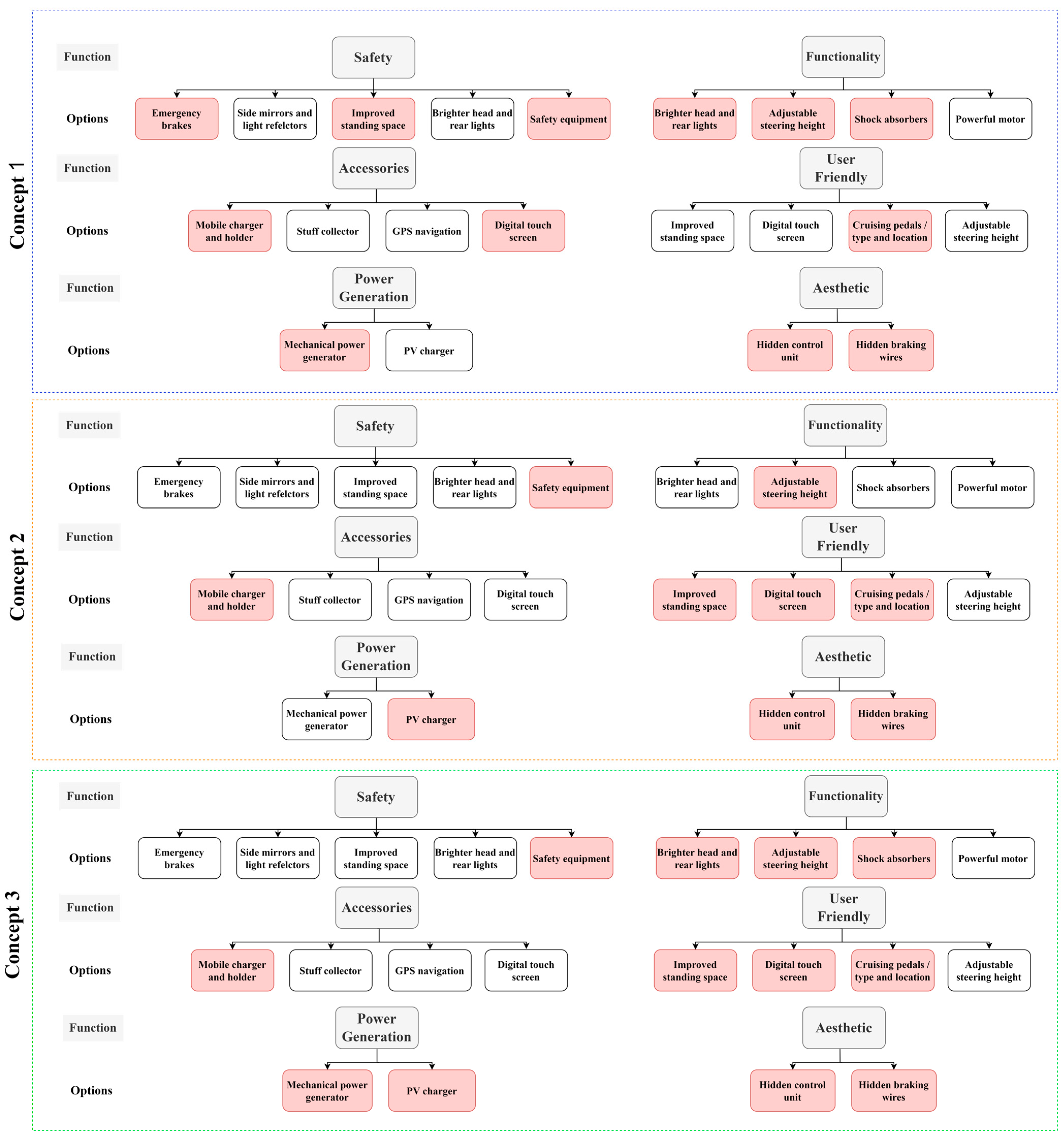
Three concepts were generated according to the VoC survey result priorities. Each concept is depicted below as a schematic presentation of a morphological chart (the selected options for each function per concept are labeled in light red), as shown in
Figure 5.
4.5. Concept Screening and Evaluating (Pugh Matrix)
The alternative design solutions were initially compared with the baseline Lime S2 using a Pugh screening matrix. Each concept was evaluated against the reference design on important factors such as safety, durability, comfort, usability, and energy efficiency. Concepts with consistent scores below the baseline were eliminated.
This technique narrowed the initial broad set of combinations given by the morphological chart into three high-potential concepts.
Concepts screening, or “Pugh’s concept selection method”, is a widely accepted method for comparing concepts that are not refined enough for direct comparison with the engineering requirements [
9,
10].
The process for screening the three developed concepts of the improved Lime scooter S2 is as follows:
- 1.
Choose or develop the criteria for comparison: The criteria can be identified by examining the customer requirements and generating a corresponding set of engineering requirements and targets. Here we have six major functions to be screened and compared.
- 2.
Select the alternatives to be compared: The alternatives refer to the alternate ideas developed during concept generation. All concepts should be compared at the same level of generalization and in similar language. The three generated concepts were compared to the original Lime scooter S2 (with reference 0).
- 3.
Generate scores: Designers should pick one of the design concepts that they think is the most appropriate and call it the reference. All others are compared with the reference, as measured by each of the customer requirements. For each comparison, the product should be evaluated as being better (+), the same (S), or worse (−).
- 4.
Compute the total score: Four scores will be generated: the number of plus scores, minus scores, same scores, the NET, and the rank. The NET is the number of plus scores minus the number of minus scores. The NETs should not be treated as absolute in the decision-making process but as guidance only. If the two top scores are very close or very similar, then they should be examined more closely to make a more informed decision.
Table 6 shows the three concepts screening and evaluation matrix.
Figure 5.
Schematic presentation of morphological chart (design) of Lime scooters S2 improvement options—Concepts 1, 2, and 3. Light red labels represent the selected options for each function per concept.
Figure 5.
Schematic presentation of morphological chart (design) of Lime scooters S2 improvement options—Concepts 1, 2, and 3. Light red labels represent the selected options for each function per concept.
Table 6.
Concepts screening of the improved Lime scooters S2.
Table 6.
Concepts screening of the improved Lime scooters S2.
| | | Concepts Variants |
|---|
| Selection Criteria | I | II | III | REF |
|---|
| Safety | + | 0 | 0 | 0 |
| Functionality | + | + | + | 0 |
| Accessories | + | + | + | 0 |
| User-Friendly | + | + | + | 0 |
| Power Generation | + | 0 | + | 0 |
| Esthetic | + | + | + | 0 |
| PLUSES | 6 | 4 | 5 | |
| SAME | 0 | 2 | 1 | |
| MINUSES | 0 | 0 | 0 | |
| NET | 6 | 4 | 5 | |
| RANK | 1 | 3 | 2 | |
| CONTINUE? | Yes | Yes | Yes | |
All three concepts receive positive net ratings. Thus, the product selection process will proceed with the concept score matrix to choose the best concept, followed by the design and final specification stages.
4.6. Concept Scoring (Weighted Matrix)
The three concepts were evaluated using a weighted scoring matrix. Criteria weights were calculated using VoC importance ratings to ensure that customer priorities and design decisions were aligned.
The highest scoring concept integrated the following features:
Dual braking system (front disc + regenerative rear brake).
Extended-life battery with smart energy management.
Shock absorbers for cobblestone streets.
Enhanced lighting package (headlight, backlight, reflectors).
Accessory integration (phone holder, digital dashboard).
This concept scored 23% higher than the baseline Lime S2 in overall utility.
Table 7 shows the concept scoring matrix of the improved Lime scooter S2.
While a traditional sensitivity analysis was not conducted, the stability of the ranking is supported by the empirical nature of the weighting. Since the weights represent the direct priorities of the surveyed user base, they are treated as fixed constraints within the user-centered design scope. The wide score gap between the proposed STAPMS-equipped concept and the baseline Lime S2 ensures that the decision-making framework provides reliable decision support for selecting the most effective design intervention for the Budapest terrain.
Table 7.
Concept scoring matrix of the improved Lime scooter S2.
Table 7.
Concept scoring matrix of the improved Lime scooter S2.
| | Concepts |
|---|
| | I | II | III |
|---|
| Selection Criteria | Weight | Rating | Weighted Score | Rating | Weighted Score | Rating | Weighted Score |
|---|
| Safety | 21% | 4 | 0.84 | 3 | 0.63 | 2 | 0.42 |
| Functionality | 15% | 3 | 0.45 | 4 | 0.60 | 3 | 0.45 |
| Accessories | 21% | 4 | 0.84 | 3 | 0.63 | 3 | 0.63 |
| User-Friendly | 18% | 3 | 0.54 | 4 | 0.72 | 4 | 0.72 |
| Power Generation | 15% | 3 | 0.45 | 2 | 0.30 | 4 | 0.60 |
| Esthetic | 10% | 4 | 0.40 | 4 | 0.40 | 3 | 0.30 |
| | Total score | 3.52 | 3.28 | 3.12 |
| | rank | 1 | 2 | 3 |
| | continue? | yes | no | no |
4.7. Kano Analysis
To further understand and prioritize user needs in the Lime S2 scooter redesign, the Kano model was applied. This model classifies product features into four categories based on how they influence user satisfaction: must-be, one-dimensional, attractive, and indifferent. The classification was informed by voice of customer (VoC) data collected from 53 respondents in Budapest.
Kano analysis classified the proposed features into three categories:
Must-have features: braking system improvements, lighting, safety tools.
Performance features: battery capacity, shock absorbers, comfort of the standing platform.
Excitement features: photovoltaic charger, mechanical backup charger, and advanced accessories.
This categorization reinforced the prioritization of safety and energy features as essential, while highlighting innovative features (e.g., solar charging) as potential differentiators in the market.
Table 8 shows the Kano model analysis of the customer needs for Lime scooters S2 in detail.
Table 8.
Kano model analysis. Summary of categorization.
Table 8.
Kano model analysis. Summary of categorization.
| Category | Description | Examples |
|---|
| Must-be (M) | Basic expectations—if missing, users are dissatisfied | Battery life, braking system, lighting, safety tools |
| One-dimensional (O) | More is better—directly increases satisfaction | Adjustable steering, accessories, shock absorbers, speed control, digital dashboard |
| Attractive (A) | Unexpected features that delight users | PV charger, mechanical charger, smart terrain system (STAPMS) |
| Indifferent (I) | Not influential on satisfaction | Esthetic elements (color, shape) |
Elaborating more on
Table 8, here are the four categories explained in detail:
Must-be (M) features: These are fundamental expectations. Their absence causes strong dissatisfaction, but their presence does not increase satisfaction proportionally. These features are critical for ensuring safety, reliability, and the baseline functionality expected by users. Improvements in these areas are mandatory for customer acceptance.
One-dimensional (O) features: These directly correlate with satisfaction: the better they are implemented, the more satisfied users are. Enhancing these features differentiates the scooter in a competitive market. Users explicitly value improvements here, making them a strategic focus for the redesign.
Attractive (A) features: Unexpected features that pleasantly surprise users. Their absence does not cause dissatisfaction, but their presence significantly boosts satisfaction.
Indifferent (I) features: These features do not significantly affect satisfaction or dissatisfaction. While visual branding and product identity remain important, aesthetics were not a strong concern among surveyed users. Functional performance takes clear priority in this context.
The strategic design implications for the four categories are: must-be features must be fully resolved before launch to avoid dissatisfaction; one-dimensional features should be actively enhanced to improve satisfaction and gain market advantage; attractive features offer high potential for innovation and product differentiation, particularly through smart technology; and indifferent features may be deprioritized unless tied to marketing or branding strategy. This analysis provides a clear, user-centered foundation for design and investment decisions in the Lime S2 scooter redesign process.
4.8. Selected Concept Specifications and CAD Modifications
The final selected design incorporated all must-have features, most performance features, and a subset of excitement features that were feasible within cost constraints. CAD modifications visualized the upgraded scooter, including:
A reinforced platform with improved shock absorption.
Optimized battery housing to support extended capacity.
Integrated dashboard with speed, battery status, and mobile mount.
Improved lighting layout for urban night-time riding.
These modifications are shown in
Table 9, providing a clear blueprint for prototyping and technical validation.
Table 9.
Newly added components to improve Lime scooter S2.
Table 9.
Newly added components to improve Lime scooter S2.
| Component | Description | Technical Specs |
|---|
| Disk brakes | New rear disk braking system for better responsiveness and more safety;
location of braking pedal will be on the right side for better safety and exchangeability between speed cruising and braking | Diameter: 140 mm; braking force: 150N |
| Rear standing bars | Rear standing bars for the second passenger | Length: 15 cm; load capacity: 100 kg |
| Safety helmet | Helmet that provides safety for riders to protect head and brain | Standard |
| Mobile holder | To hold the mobile and facilitate the navigation and other use of the mobile during the ride | Standard |
| Digital screen | Monitoring dashboard of system’s components | Universal |
| Integrated motor/power generator (rear) | Electrical motor with improved performance and integrated with power generator | Non-specified |
| New head and rear lighting system | Lighting system | LED body integrated triple headlights
600 lumens/each; voltage: 5 volts; beam distance: up to 300 feet; rear lights: 4 modes for braking and warning |
| Adjustable steering | Adjustable steering height and
adjustable steering angle
to comply with long, medium and short people. | Adjustable steering height with max up to 130 cm and min up to 110 cm; adjustable steering angle from 60–90 degree |
| Shock absorbers (dampers and sway bars) | Front and rear double shock absorber system | Double front; double rear; universal; travel: 40 mm; spring preload: 250 N |
| Speed cruising pedal | New type of speed pedal (rolling handlebar) | Universal; 3 speeds; integrated with scooter’s body; no visible wires |
| Hidden control unit (CU) | An integrated hidden control unit in the main body of the scooter (main standing area) | CU is the same as the old one but in different hidden location |
4.9. Smart Terrain-Adaptive Power Management System (STAPMS)
Simulation results suggest that STAPMS could increase range by approximately 15% in hilly urban environments like Budapest by reducing unnecessary energy expenditure on flat terrains. It is a terrain-aware adaptive system that dynamically adjusts motor power output, braking regeneration, and battery consumption based on real-time road gradients and surface quality using onboard IMU sensors, GPS, and machine learning.
It presents an opportunity to position the scooter as a technologically advanced and environmentally conscious product. They are ideal candidates for inclusion in a premium or “Lime + Terrain” version of the service.
The STAPMS system contributes to sustainable energy use by integrating three evidence-based adaptive strategies. First, regenerative braking on sloped roads is a proven method for improving energy efficiency in electric two-wheelers. Studies have demonstrated that up to 8–12% of braking energy can be recovered through adaptive regenerative braking systems, especially in hilly or stop-and-go urban contexts [
32,
33,
34,
35]. This is aligned with findings from adaptive control implementations using fuzzy logic and real-world electric scooter simulations [
29]. Second, adaptive power output limitations on flat terrain, such as eco-mode configurations, can reduce battery consumption by 4–7%, as supported by micromobility energy optimization models and power management algorithms [
36]. Third, terrain-aware ride smoothing, which prevents sudden accelerations and decelerations on rough surfaces, contributes to an additional 2–3% efficiency improvement [
37]. While smaller in impact, this adaptation plays a role in conserving energy during short and frequent trips, especially in cities with irregular pavement conditions like Budapest. Combined, these adaptive measures may extend practical e-scooter battery range by approximately 11–16%, aligning with realistic performance improvements recorded in recent urban EV research and prototype implementations.
The smart terrain-adaptive power management system (STAPMS) is a novel feature designed to optimize the performance of electric scooters by adjusting motor power, braking, and energy consumption based on terrain conditions and surface types. It uses GPS, accelerometers, and AI algorithms to intelligently manage motor output and regenerative braking in real time.
STAPMS is an AI-powered system integrated into the Lime S2 scooter that intelligently manages motor output, energy consumption, and regenerative braking in real time. Its core components include a GPS module, inertial measurement unit (IMU), microcontroller, and firmware trained to recognize urban terrain patterns. STAPMS identifies road gradients (uphill/downhill), surface quality (smooth vs. cobblestone), and ride context (traffic stop/start behavior) to adapt power settings accordingly. It also communicates with the rider through a digital dashboard, providing real-time feedback on terrain conditions, power usage, and estimated battery range.
STAPMS operates through the continuous collection and interpretation of environmental and sensor data. As the scooter is in motion, GPS and IMU data are processed locally to classify upcoming terrain segments. When approaching an incline, the system automatically increases torque output for a smoother climb. On declines, regenerative braking intensity is adjusted to maximize energy recovery while maintaining safety. On flat terrain, the system limits unnecessary power draw, extending battery range. For rough or uneven surfaces, such as Budapest’s historic cobblestone streets, STAPMS moderates vibration levels through shock management and throttle responsiveness, optimizing both ride quality and component longevity.
Unlike conventional e-scooters that operate on fixed power profiles, STAPMS brings context-aware intelligence to personal mobility. It is among the first micromobility systems to dynamically react to urban topography and surface conditions in real time. The innovation lies in its fusion of GPS, IMU data, and edge-based AI to create a smarter, safer, and more energy-efficient ride. It transforms the scooter from a passive vehicle into an active co-pilot—adapting to both city structure and user behavior. This is particularly relevant in cities like Budapest, where terrain varies significantly between districts, and historical infrastructure poses challenges for conventional e-scooter systems.
STAPMS introduces a premium feature set that enables Lime to unlock new revenue streams. It can be positioned as part of a “Lime+ Terrain” service tier, targeting commuters who demand comfort, efficiency, and reliability on longer or hillier routes. The system’s power-saving modes can reduce daily charging cycles, lowering operational costs for Lime’s logistics and maintenance teams. Moreover, increased ride range and improved user satisfaction can boost customer retention and ride frequency. From a data perspective, STAPMS also collects valuable terrain and usage analytics that can be monetized or used for city mobility planning partnerships. Overall, STAPMS strengthens Lime’s technological brand identity while offering clear operational and financial returns.
Inertial measurement unit (IMU).
GPS module.
Terrain-trained microcontroller.
App interface or integrated screen display.
Boosts torque automatically on uphill climbs.
Activates smart regenerative braking on slopes.
Adjusts motor strain and vibration control based on road surface (e.g., cobblestones).
Enables “eco mode” on flat terrain for range extension.
Provides rider feedback through a digital display (range prediction, terrain type).
Extends battery life by up to 15%.
Reduces mechanical wear on tires, brakes, and motor.
Enhances user experience and control on Budapest’s mixed terrain.
Potential feature of a premium-tier Lime service (Lime+ Terrain).
4.10. Strategic Validation and Feasibility Analysis
4.10.1. Cost Impact
Table 10 presents the Lime scooter S2 improvement cost impact, showing the estimated costs and justifications for each added component.
Table 10 helps quantify how much the proposed enhancements would increase the unit cost per scooter, which can inform decisions on pricing, margins, or feature prioritization. The component costs detailed in
Table 10 are based on a 2024–2026 market analysis of retail prices from global micromobility distributors (e.g., AliExpress, Monorim) and verified against established bill of materials (BOM) data for intelligent transport system prototypes.
Table 10.
Improvement cost impact.
Table 10.
Improvement cost impact.
| Component | Estimated Unit Cost (USD) | Justification | Cumulative Cost (USD) |
|---|
| Mandatory improvements |
| Safety Helmet | 25 | Included for safety; optional accessory | 25 |
| New Lighting System (LED front and rear) | 35 | High-powered, waterproof LED with sensors | 60 |
| Double Shock Absorbers | 30 | Universal front and rear suspension set | 90 |
| Disk Brakes (rear) | 15 | Standard hydraulic/mechanical rear disk set | 105 |
| Optional improvements |
| Rear Standing Bars | 12 | Passenger foot rests (metal alloy) | 12 |
| Mobile Holder | 8 | Plastic holder w/adjustable grip | 20 |
| Digital Dashboard Screen | 20 | Basic digital display with voltage/speed indicators | 40 |
| Integrated Motor/Power Generator | 110 | Bosch or similar brand motor-generator combo | 150 |
| Adjustable Steering System | 18 | Extendable, rotating shaft with locking mechanism | 168 |
| New Speed Pedal | 10 | Rolling-type handle with integrated control | 178 |
| Hidden Control Unit (CU) | 22 | Repositioned and embedded into the body | 200 |
| STAPMS (AI terrain-adaptive system) | 65 | GPS, IMU, microcontroller, and firmware | 265 |
4.10.2. SWOT Analysis
SWOT analysis (
strengths, weaknesses, opportunities, and threats) is a powerful strategic planning and analysis tool and is widely used in many scientific, industrial, and managerial disciplines [
38,
39,
40,
41,
42]. Moreover, SWOT analysis can be used as a strategic decision-making tool. In this study, the main aim of using SWOT analysis is to provide an in-depth strategic analysis of the improved Lime scooter S2 to boost the improved design effectiveness and competitiveness and provide actionable insights.
Table 11 shows the SWOT analysis for the upgraded Lime S2 scooter in Budapest city, of which a structured assessment of the improved scooter’s design within the micromobility context is also provided.
Table 11.
SWOT analysis of the improved Lime scooter S2.
Table 11.
SWOT analysis of the improved Lime scooter S2.
| Strengths | Weaknesses |
|---|
| Strong user base and brand recognition in Budapest | Higher unit cost due to advanced components |
| Context-specific innovation (STAPMS) for Budapest terrain | Complexity in maintenance (new tech, more parts) |
| Improved safety and ride quality increases satisfaction | Potential user learning curve for advanced features |
| Potential for premium pricing via “Lime+ Terrain” tier | Some upgrades may require regulatory approvals |
| Opportunities | Threats |
| Aligns with EU green mobility goals and Budapest’s smart city plans | Economic uncertainty may lower demand for premium mobility options |
| Better data collection and predictive maintenance reduce downtime | Regulatory shifts in micromobility (e.g., parking, helmets) |
| Partnerships with universities, tech startups, or city councils | Competition from newer, cheaper e-scooter startups |
| Potential to scale the “terrain-adaptive” model to other hilly cities (Lisbon, Istanbul, etc.) | Battery supply chain instability could affect motor and energy systems |
The improved Lime S2 scooter benefits from strong brand recognition and existing market presence in Budapest, allowing a smoother rollout of upgraded models without the need for intensive marketing. Key enhancements significantly boost user satisfaction and service quality. These strengths also open the door for a premium service model, such as a “Lime+ Terrain” tier targeting high-demand urban corridors. However, the design upgrades come with internal challenges. The inclusion of high-performance components such as STAPMS and motor generators increase unit cost, potentially impacting profit margins. The system also adds maintenance complexity, requiring specialized training for Lime’s support teams. Some users may need onboarding to fully utilize advanced features, and certain upgrades could trigger additional regulatory review under local micromobility classifications.
On the opportunity side, the new design aligns with EU and Budapest city policies promoting sustainable, smart mobility. It offers potential for green tech incentives, public-private partnerships, and data-sharing with municipal planning bodies. STAPMS-generated data create value not only for operational efficiency but also for research and urban analytics. Additionally, the terrain-adaptive model is scalable to other topographically complex cities across Europe. Yet external threats remain. Market uptake could be affected by economic constraints or regulatory shifts, such as new helmet laws or geofencing requirements. The growing presence of low-cost competitors may challenge Lime’s ability to justify premium pricing. Global supply chain disruptions also pose risks to production and fleet availability.
In conclusion, the SWOT analysis reveals that. while the improved Lime S2 scooter presents a highly promising upgrade in terms of performance, user satisfaction, and innovation, its success will depend on targeted deployment, operational efficiency, regulatory alignment, and a well-structured pricing strategy. By proactively addressing internal weaknesses and external threats, Lime can leverage its strengths and seize unique market opportunities in Budapest and beyond.
4.10.3. PESTEL Analysis
In addition to the SWOT analysis, PESTEL analysis (political, economic, social, technological, environmental, legal) is also a powerful tool to analyze the external and internal environment of the business strategically. PESTEL analysis has been used widely in many industries, such as manufacturing and transportation, including the micromobility sector [
40,
42].
Table 12 shows the PESTEL analysis covering political, economic, social, technological, environmental, legal factors in Hungary/Budapest.
Table 12.
PESTEL analysis in Hungary/Budapest.
Table 12.
PESTEL analysis in Hungary/Budapest.
| Factor | Insight |
|---|
| Political | Budapest municipality supports smart mobility and sustainability
EU policies incentivize micromobility investment |
| Economic | Hungary has a cost-sensitive population, so price justification is crucial
Tourism rebound post-COVID-19 may support short-term rentals |
| Social | Increasing demand for green, independent, and efficient urban transport
Safety awareness is growing, especially among younger users |
| Technological | IoT and AI adoption are rising in urban transport
Infrastructure for EV charging is slowly expanding but still limited |
| Environmental | Strong alignment with green transport goals
Terrain-aware power systems reduce emissions and energy waste |
| Legal | Parking and sidewalk rules are tightening
Data collection (STAPMS) must comply with GDPR
Helmet use not mandatory but could be incentivized |
The PESTEL analysis offers a strategic lens to evaluate how the improved Lime S2 scooter fits within Budapest’s micromobility landscape. Politically, the redesign aligns well with Budapest’s Sustainable Urban Mobility Plan (SUMP) and Climate Strategy 2030, both of which promote smart, low-emission transport. The STAPMS feature reinforces these goals by adapting energy use based on terrain, improving both efficiency and safety in districts with hills or cobblestone streets.
Economically, while Hungary is price-sensitive, the demand for short-term rentals and individual transport remains high, especially post-COVID-19. The model’s premium tier could appeal to commuters and tourists if affordability is balanced through bundling or public integration (e.g., with BKK apps).
Socially, the scooter responds to increasing demand for safe, green, and independent transport, especially among younger users. Technologically, STAPMS complements Budapest’s smart city ambitions and could integrate with municipal planning tools or digital twin platforms.
Environmentally, the adaptive power system reduces unnecessary energy consumption, supporting local emission-reduction targets. Legally, however, the scooter must comply with GDPR, evolving parking and safety rules, and obtain clearance from national and city-level authorities like Budapest Közút Zrt. and BKK.
In summary, the improved Lime S2 has strong potential if aligned with local policy, supported by regulatory cooperation, and deployed strategically in terrain-challenged or high-traffic areas.
5. Discussion and Conclusions
The main goal of this study is to develop and propose a generalizable methodological framework of micromobility sector for user-centered product innovation. The framework was validated by redesigning the Lime S2 scooter to better meet user needs and operational concerns in Budapest. By combining a structured voice of customer (VoC) survey with concept generation and systematic evaluation methods, the proposed framework demonstrated how user feedback can be transformed into engineering requirements and design changes leading to user-centered product innovation. The proposed methodological framework extends beyond the validated Lime S2 scooter, providing a reproducible methodology developing, enhancing and evaluating the user-centered requirements in other micromobility systems such as, electric bicycles and shared and autonomous vehicles. The findings of this paper also echo broader adoption challenges identified in global research. As outlined in [
43], concerns around size, lighting, and user safety are consistent across cities worldwide, not just Budapest. By responding to these universal concerns through design innovation, the proposed model not only enhances local safety but also positions Lime’s scooters for global scalability. This section interprets the findings in connection to the research aims, discusses trade-offs, and places the contributions within the larger micromobility literature.
Beyond the specific design improvements of the Lime S2, the primary theoretical contribution of this research lies in its holistic integration of strategic and technical decision making, addressing a significant gap in the existing micromobility literature. While previous studies have focused on either policy or isolated technical features like energy efficiency, our findings demonstrate that a closed-loop framework (
Figure 1) is necessary to ensure that technical innovations like STAPMS are both user-centered and strategically viable in complex urban topographies. By mapping qualitative user feedback to quantitative targets, this study provides a replicable methodology that transforms the “voice of the customer” from a marketing tool into a rigorous engineering requirement. This elevates the design process from a descriptive exercise to a predictive decision-support framework, ensuring that next-generation micromobility products are built to solve specific environmental and terrain-based challenges identified in city-scale strategic analysis.
From a regulatory and safety standpoint, the e-scooter is classified within the slow-traffic micromobility category, operating between pedestrian and motor vehicle speeds. To mitigate the common safety and parking challenges faced by urban fleets, the redesign introduces several physical interventions. Safety is improved through the integration of the STAPMS torque regulator, which prevents uncontrolled acceleration on slopes, and the inclusion of side mirrors and emergency lighting. Parking stability, a frequent urban complaint, is addressed by a redesigned, more ergonomic kickstand and the relocation of the control unit, which lowers the center of gravity and prevents the scooter from tipping over in public spaces. These features ensure the vehicle is better integrated into the existing transport infrastructure
5.1. Linking User Needs to Design Decisions
The VoC survey revealed that the most pressing user concerns were battery life, braking performance, lighting quality, and platform comfort. These issues reflect both functional reliability (battery and braking) and safety (lighting, stability), confirming earlier studies that emphasize safety and usability as the main barriers to sustained scooter adoption. Translating these needs into engineering metrics (e.g., battery capacity, braking force, luminous flux, platform size) created a direct pathway between subjective perceptions and objective design targets.
On the other hand, the Pugh screening and weighted scoring processes validated that concepts addressing these needs were consistently rated higher than those that did not. Concept I, which prioritized dual braking, shock absorption, enhanced lighting, and accessory integration, outperformed the other options by a significant margin. The Kano analysis further reinforced this prioritization, classifying braking and lighting as must-have features, and shock absorbers and battery improvements as performance features. Together, these methods ensured alignment between user expectations and technical feasibility.
5.2. Innovation and the Role of STAPMS
One of the most significant outcomes of this study was the development of the smart terrain-adaptive power management system (STAPMS). While traditional scooter designs rely on fixed power delivery and basic regenerative braking, STAPMS uses sensors and real-time algorithms to adapt torque and energy recovery to terrain conditions. This directly responds to Budapest’s unique mobility environment, characterized by hilly topography, cobblestone streets, and high stop/start traffic in dense districts.
From a user perspective, STAPMS addresses three central needs simultaneously: extended battery life (Need #6), smoother speed control (Need #3), and improved ride comfort (Need #14). From an operational perspective, the system also promises reduced mechanical wear and lower maintenance cycles, creating business value for service providers. Although presented here conceptually, STAPMS illustrates how user-centered design can drive technical innovation that benefits both riders and operators.
Unlike conventional e-scooters that operate on fixed power profiles, STAPMS brings context-aware intelligence to personal mobility. It is among the first micromobility systems to dynamically react to urban topography and surface conditions in real time. The innovation lies in its fusion of GPS, IMU data, and edge-based AI to create a smarter, safer, and more energy-efficient ride. It transforms the scooter from a passive vehicle into an active co-pilot—adapting to both city structure and user behavior. This is particularly relevant in cities like Budapest, where terrain varies significantly between districts, and historical infrastructure poses challenges for conventional e-scooter systems.
5.3. Trade-Of and Feasibility
Despite these promising outcomes, the proposed design involves important trade-offs. The addition of dual braking systems, suspension components, and STAPMS electronics inevitably increases weight and unit cost. While the cost impact analysis showed that safety-critical upgrades (brakes, lighting, suspension) are feasible within moderate budget increases, optional features (e.g., photovoltaic chargers) may not be economically viable in large fleets.
Another trade-off is complexity versus reliability. Advanced systems such as STAPMS introduce new points of failure and require additional maintenance expertise. Operators must balance the long-term benefits of extended range and reduced wear against the risk of system malfunction or higher repair costs. These findings echo similar trade-offs reported in the literature on connected micromobility systems, where the introduction of smart sensors often requires robust maintenance protocols.
5.4. Practical Implications
For scooter operators in Budapest, the proposed design improvements can directly improve user satisfaction, retention, and safety. Enhancements to braking and lighting align with municipal safety priorities, while STAPMS and improved suspension increase usability in heritage districts with cobblestones. The findings also support tiered service models, such as a premium “Lime+ Terrain” offering, where advanced features justify higher pricing.
For policymakers, the study provides evidence that user-centered technical redesign can complement regulatory approaches to safety. Rather than relying solely on enforcement, technical upgrades can proactively address the conditions that lead to accidents or dissatisfaction.
5.5. Limitations of Interpretation
While the results are promising, caution is needed in interpreting them. The VoC sample was relatively small (N = 53) and skewed toward university students and other experienced users, which may not fully represent the broader rider population. However, the respondents are a fairly homogeneous group within the target population (which cannot be precisely identified), which improves the internal consistency of the responses and helps to neutralize the small sample size. In addition, the analysis did not include field testing or prototyping of the STAPMS concept, limiting conclusions about actual performance gains. These limitations suggest that further empirical validation is necessary before large-scale deployment.
5.6. Synthesis
Overall, this study is exploratory in nature, aiming at identifying patterns and relationships in the frame of user-centered designs. The discussion shows that user-centered methods can produce actionable design improvements for micromobility vehicles and that integrating advanced power management systems like STAPMS could meaningfully enhance safety, comfort, and efficiency in cities such as Budapest. The trade-offs identified (cost, complexity, regulatory compliance) provide a realistic assessment of feasibility and chart a clear agenda for future testing and validation. Technical dimensions such as maintenance cycles and battery life can be thoroughly investigated in future research.