Article

An Adaptive Full-Order Sliding-Mode Observer Based-Sensorless Control for Permanent Magnet Synchronous Propulsion Motors Drives


Shanghai Marine Equipment Research Institute, Shanghai 200031, China
*
Author to whom correspondence should be addressed.
Vehicles 2026, 8(2), 34; https://doi.org/10.3390/vehicles8020034 (registering DOI)
Submission received: 22 November 2025 / Revised: 6 January 2026 / Accepted: 2 February 2026 / Published: 7 February 2026

Abstract

In electric vehicle and marine propulsion applications, the stable operation of permanent-magnet synchronous motor (PMSM) drive systems relies on accurate rotor position information. Such information is typically obtained from position sensors, which are prone to high temperature, humidity, vibration, and electromagnetic interference, leading to elevated failure rates; moreover, sensor installation introduces additional interfaces and wiring, thereby reducing system reliability. To address these issues, this paper proposes a sensorless control method based on an adaptive full-order sliding-mode observer (SMO). The proposed method employs the SMO output as the observer feedback correction term rather than the estimated back EMF, thereby avoiding substantial high-frequency noise. Furthermore, an S-shaped nonlinear function is designed to replace the conventional switching function, mitigating high-frequency chattering when the system operates in sliding mode; an adaptive sliding-mode gain function is designed, the sliding-mode gain and the boundary-layer thickness are adaptively tuned as a function of motor speed, which effectively enhances the back EMF estimation accuracy over a wide operating-speed range. The effectiveness of the proposed method is validated on a 2.3-kW PMSM experimental platform.

1. Introduction

Permanent magnet synchronous motors (PMSMs) have emerged as the dominant traction motors for electric vehicles because of their high torque density, high efficiency, and compact structure [1]. Their high torque-to-inertia ratio and smooth torque output enable accurate speed and torque control during stop-and-go traffic and low-speed maneuvers, while providing a fast transient response. In low-speed, high-torque operation, PMSMs are well suited for direct-drive architectures—such as in-wheel hub motors or axle-integrated e-axles—thereby minimizing the need for multi-stage reduction gearing. This simplifies the drivetrain, reduces mechanical losses, and improves noise, vibration, and harshness (NVH) performance [2].
PMSM drive systems commonly employ vector control strategies that utilize rotor position information to perform coordinate transformations [3]. These strategies decompose the stator current into two components: a magnetizing current aligned with the rotor flux linkage and a torque-producing current orthogonal to the flux linkage, thereby enabling independent control of flux and torque. Rotor position information is typically obtained from position sensors such as optical encoders or resolvers. These sensors must be mounted coaxially with the rotor and require additional power supply and signal wiring for data acquisition and transmission [4]. However, in harsh operating environments characterized by high temperature, humidity, dust, and strong electromagnetic interference, position sensors are susceptible to failure. High-resolution sensors are also expensive, reducing overall cost-effectiveness. Moreover, the installation process introduces extra hardware interfaces and connection points, which compromise system reliability and increase structural complexity [5]. Inaccurate installation can further degrade control performance and operational stability. In contrast, sensorless control strategies estimate the motor speed and rotor position in real time from measured voltage and current signals. Such strategies effectively reduce system cost and improve reliability by eliminating mechanical sensors [6].
The rotor position estimation method based on back EMF observers has been the most widely developed method [7]. Currently, the mainstream back EMF-based rotor position estimation methods include the open-loop back EMF calculation method [8], the Leuenberger observer [9], the Model Reference Adaptive System [10], the Extended Kalman Filter [11], and the Sliding-Mode Observer (SMO). The open-loop back-EMF calculation method is the simplest, but it exhibits poor parameter robustness and low estimation accuracy, making it difficult to apply in high-performance sensorless PMSM control systems. In contrast, the other methods are closed-loop observers, which can achieve better back EMF estimation performance than the open-loop calculation method [12]. Compared with other types of back EMF observers, the SMO offers the advantages of a simple structure, insensitivity to system parameters, strong robustness, and convergence within a finite time. The SMO utilizes the principle of sliding-mode control, applying a sliding-mode control law to drive the system to rapidly converge to the sliding surface, thereby ensuring system stability and enabling the observation of back EMF [13]. The common control law is a nonlinear switching function with discontinuous switching characteristics, which makes sliding-mode control insensitive to system disturbances and provides strong robustness. However, due to the inherent discontinuity in the structure of SMO, it also suffers from the problem of chattering. Suppressing chattering in SMO is currently a mainstream research direction in the field [14]. The inherent chattering problem of the SMO introduces a large amount of high-frequency noise into the estimated back EMF. In practical applications, the estimated back EMF needs to be filtered to reduce the impact of chattering. Adding a low-pass filter can effectively remove high-frequency noise; however, it also causes phase lag in the estimated back EMF, resulting in the estimated rotor position lagging behind the actual rotor position, thereby reducing the observation accuracy [15]. Ref. [16] designed a back EMF observer using a super-twisting SMO. By introducing an integral operation, the method effectively suppressed the chattering caused by the nonlinear switching function, thereby improving the accuracy of rotor position estimation. Ref. [17] proposed a phase-lag compensation method to correct the rotor position estimation error, reducing the error to 10% of its original value. Ref. [18] proposed a back EMF filtering method based on a frequency-adaptive complex-coefficient filter, which eliminates high-frequency noise in the back-EMF while ensuring no phase lag, thereby effectively improving the observation accuracy of the rotor position. Additional filter architectures are also introduced in [19,20,21]. The prevailing state-of-the-art methodology often follows a two-step process: first, a conventional SMO estimates the back-EMF, and second, a dedicated filter is designed to attend the high-frequency chattering inherent in the SMO’s output. While this is effective in smoothing the signal, it introduces a fundamental trade-off: Adding a filter introduces an additional component into the control loop, requiring its own design, parameter tuning, and computational resources. In contrast to the common trend of adding complexity to mitigate the SMO’s shortcomings, our proposed adaptive full-order SMO offers a more elegant and integrated solution. The key differentiator is that our method achieves high-fidelity back-EMF estimation through a more streamlined and fundamentally robust observer architecture, thereby avoiding the complexity and phase-related challenges associated with adding a separate filtering stage.
Considering the above issues, this paper proposes an adaptive full-order SMO. In this method, the stator current and EMF are jointly treated as system state variables, enabling EMF estimation without introducing phase lag. To mitigate the chattering typically encountered in sliding-mode control, a novel switching function with adaptive sliding-mode gain is developed to replace the conventional design. This effectively reduces system chattering and high-frequency noise, while ensuring that the PMSM sensorless control system maintains high rotor position estimation accuracy across a wide speed range.

2. Conventional-SMO-Based Sensorless Control Method

2.1. PMSM Mathematical Model

Within the stationary two-phase reference frame, the mathematical model of PMSM is expressed as follows:
u α = R s i α + L s d i α d t + e α u β = R s i β + L s d i β d t + e β
where Rs and Ls denote the stator resistance and inductance. uα and uβ signify the α- and β-stator voltage components; iα and iβ signify the α- and β-stator current components; eα and eβ signify the α- and β-back EMF components, which can be formulated as
e α = ω e ψ f sin θ e e β = ω e ψ f cos θ e
where ωe signifies the rotor electrical angular speed; θe signifies the rotor electrical position; ψf signifies the flux linkage. By performing a coordinate transformation using the rotor position information θe, the mathematical model of the PMSM in the synchronous rotating reference frame can be further derived,
d i d d t = 1 L s ( u d R s i d + L s ω e i q ) d i q d t = 1 L s ( u q R s i q L s ω e i d ω e ψ f )
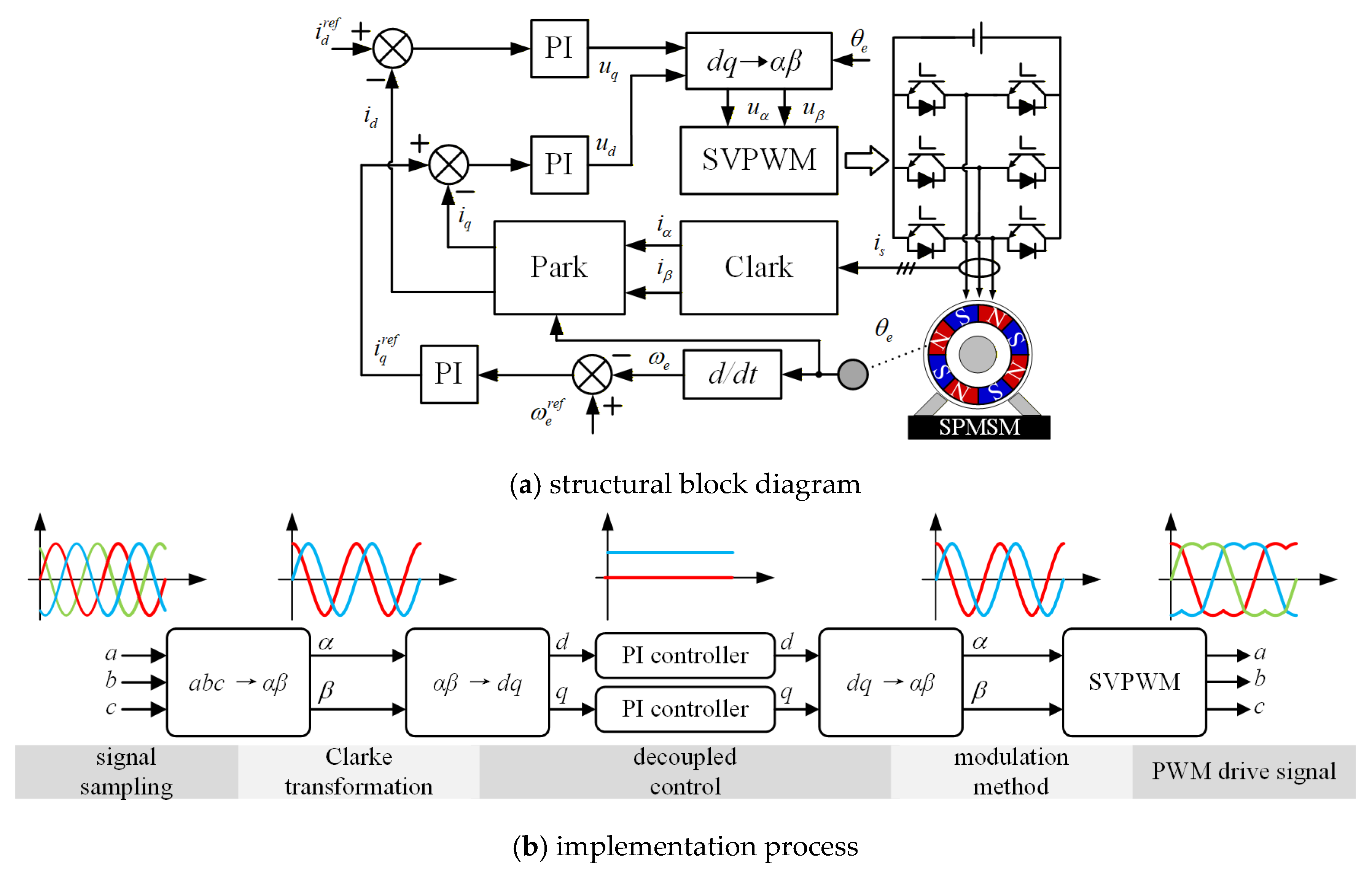
where ud and uq signify the d- and q-stator voltage components; id and iq signify the d- and q-stator current components. Field-Oriented Control (FOC) is implemented based on the mathematical model in the synchronous rotating reference frame, and its control block diagram is shown in Figure 1. The core principle of FOC is to decouple the motor’s torque and flux-producing currents. This decoupling is achieved by aligning the coordinate system with the rotor’s magnetic field. The alignment is defined by the rotor position. As can be seen from Figure 1, rotor position information is essential for FOC. From (2), the rotor position information is contained in the back EMF. Therefore, by observing the back EMF, the rotor position information can be extracted.

2.2. Conventional SMO

When designing an SMO to observe the back EMF, the voltage equations in the stationary two-phase reference frame are typically used as the basic model, taking the stator currents as the state variables. A sliding-mode reaching law is designed based on the observation error between the observed currents and the actual currents, driving this error to zero, thereby achieving EMF observation. According to (1), the PMSM state equations with the stator currents as the state variables can be obtained as
p i α i β = 1 L s R s 0 0 R s i α i β + 1 L s u α u β 1 L s e α e β
According to (4), the SMO can be designed as follows:
p i ^ α i ^ β = 1 L s R s 0 0 R s i ^ α i ^ β + 1 L s u α u β 1 L s z α z β
where “^” denotes estimated values, and zα and zβ are the sliding-mode control outputs. In the conventional SMO, the stator current observation error is used as the sliding surface, so the sliding-mode control outputs zα and zβ can be expressed as
z α z β = k s m o sgn ( Δ i α ) k s m o sgn ( Δ i β )
where Δiα and Δiβ denote the current observation errors, and ksmo denotes the SMO gain. By subtracting (5) from (6), the relationship between the sliding-mode control outputs and the actual EMF can be obtained as
p Δ i α Δ i β = 1 L s R s 0 0 R s Δ i α Δ i β + 1 L s e α z α e β z β
From the above expression, it can be seen that when the SMO state variables reach the sliding surface, the actual EMF equals the control output; therefore,
e ^ α e ^ β = z α z β
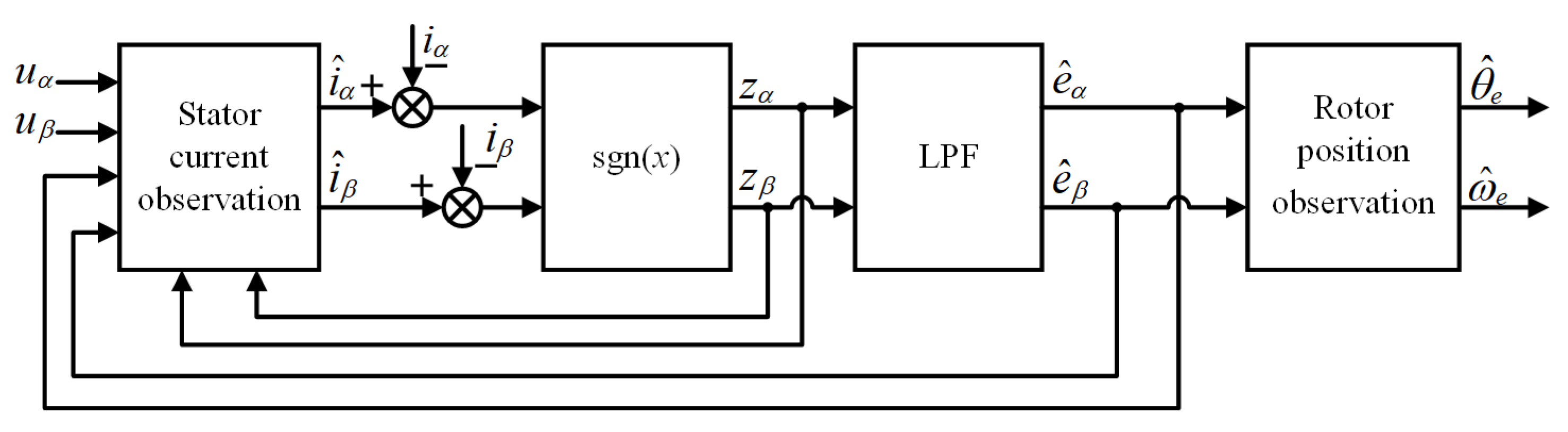
where e ^ α , e ^ β denotes the EMF estimate. The block diagram of the conventional SMO structure is shown in Figure 2.

2.3. Analysis of the Chattering Problem in the Conventional SMO

The EMF observer based on the SMO is developed from the mathematical model of the PMSM and formulated according to sliding-mode variable-structure control theory. By employing a nonlinear control law, the observer converges to the sliding surface within finite time and ultimately synchronizes its output with that of the PMSM, thereby achieving accurate back-EMF estimation. The sliding surface can be designed manually as required for specific control objectives. Sliding-mode control exhibits rapid dynamic response and requires only a few tunable parameters. Owing to its nonlinear control structure, the system’s sliding motion is insensitive to parameter variations and external disturbances, thus providing strong robustness.
However, practical systems are subject to control delays, sampling delays, and inertial effects. When the sliding motion approaches the switching surface, system nonidealities cause the trajectory to cross the sliding surface repeatedly. This phenomenon results in a triangular-wave-like trajectory superimposed on the ideal sliding surface. Consequently, the discontinuous control action in sliding-mode control deviates from the theoretical ideal, giving rise to chattering. Although chattering cannot be completely eliminated, it can be mitigated to a certain degree.
In the conventional SMO, an LPF is commonly applied to the EMF estimate to obtain a smoother signal and suppress the chattering induced by the sign function. The corresponding transfer function is given by
G c l L P F ( s ) = e α , β L P F e α , β e s t = ω c s + ω c
From (9), it can be inferred that the fundamental component of the back EMF obtained through low-pass filtering exhibits the phase delay described by (10),
Δ θ L P F = arctan ( ω e ω c )
Hence, PF introduces phase delay and amplitude attenuation. To achieve a more accurate rotor position estimation, the phase delay caused by the filter must be compensated. Since the rotor electrical angular speed is also estimated and contains observation error, precise phase compensation is unattainable, ultimately leading to reduced estimation accuracy of both rotor position and electrical angular speed.

3. Improved Full-Order-SMO-Based Sensorless Control Method

3.1. Mathematical Model of the Full-Order SMO

In the conventional SMO, only the stator currents are taken as the observer system’s state variables, and the dynamic characteristics of the EMF are not considered. To address this, this paper proposes a sensorless control method based on an improved full-order SMO. The full-order SMO is designed by treating both the stator currents and the EMF as the observer system’s state variables, fully accounting for the EMF’s dynamic characteristics and thereby achieving improved estimation performance.
First, the dynamic characteristics of the EMF are analyzed. In general, the mechanical time constant of a PMSM drive control system is much larger than its electromagnetic time constant. Therefore, within a single control cycle, the PMSM speed can be regarded as constant; i.e., the motor speed remains unchanged within a single control cycle. Under this condition, the dynamic equation of the EMF can be expressed as
p e ^ α e ^ β = 0 ω ^ e ω ^ e 0 e ^ α e ^ β
Consequently, the full-order state-space equations of the PMSM can be derived by taking the stator currents and the EMF as the state variables,
p i e = A 11 A 12 0 A 22 i e + B 1 0 u
In the equation, i = i α i β T denotes the stator current vector, e = e α e β T denotes the EMF vector, and u = u α u β T denotes the stator voltage vector. A 11 = R s / L s I , A 12 = 1 / L s I   , A 22 = ω e J , and B 1 = 1 / L s I .
I = 1 0 0 1 ,   J = 0 1 1 0
From (11), the state equations of the full-order SMO can be established. For analysis, the observed rotor electrical angular speed is assumed equal to the actual value; hence, the electrical angular speed in the equations is expressed by the observed value, yielding:
p i ^ e ^ = A ^ 11 A 12 0 A ^ 22 i ^ e ^ + B 1 0 u 1 L s K sgn ( Δ i )
In the equation, i ^ = i ^ α i ^ β T denotes the observed stator current vector, e ^ = e ^ α e ^ β T denotes the observed EMF vector. A ^ 11 = R s / L s × I , and A ^ 22 = ω ^ e J .
K = k 0 m 0 0 k 0 m
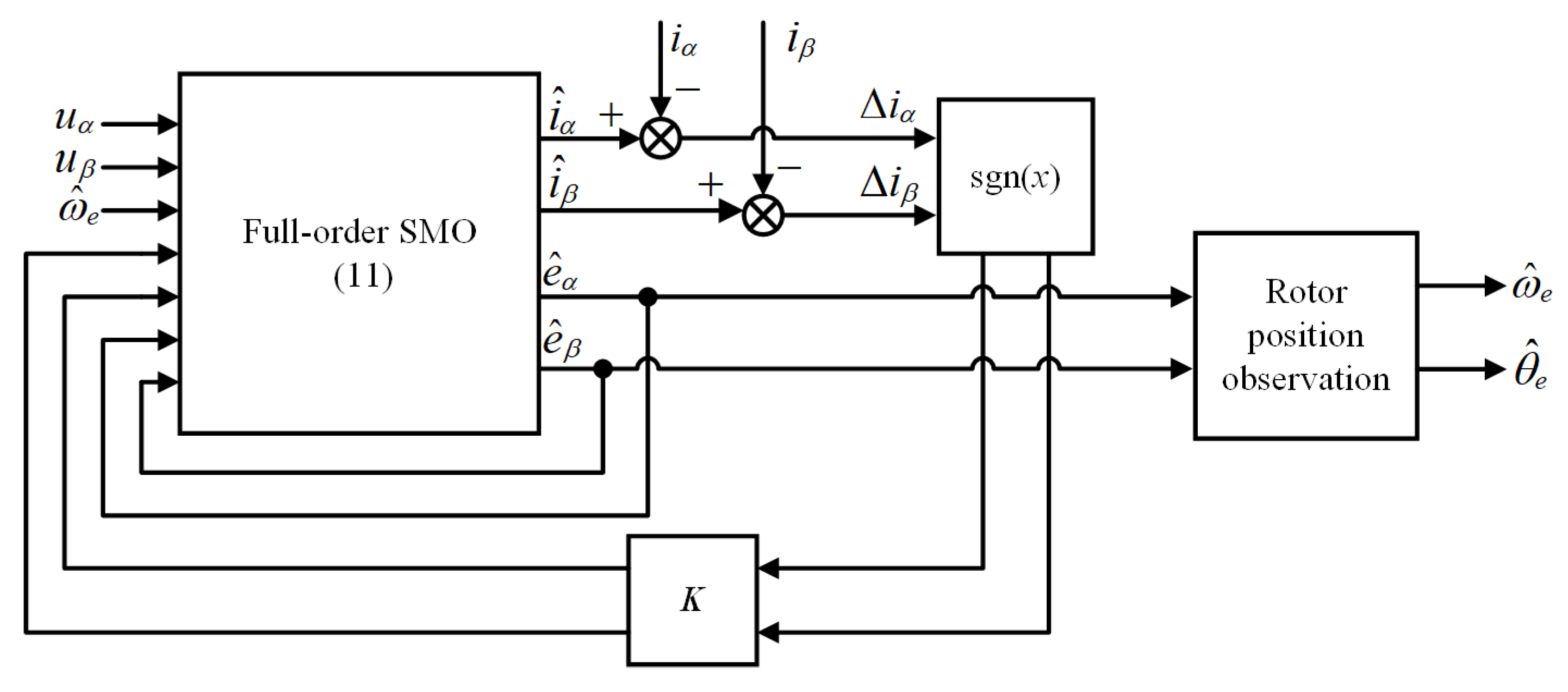
K denotes the feedback gain matrix, and k and m are the gains of the full-order SMO. The stability region can be derived using Lyapunov’s second method. Figure 3 shows the structure of the full-order SMO, which mainly consists of three parts: a current observer, a sliding-mode control law, and the feedback gain matrix. The EMF estimate obtained from the full-order SMO can be processed to obtain the rotor position and speed information of the PMSM. One of the main differences between the full-order SMO and the conventional SMO is that the full-order SMO does not require a low-pass filter to process the EMF estimate and therefore does not suffer from phase lag or amplitude attenuation.

3.2. Stability Analysis of the Full-Order SMO

Due to the presence of the nonlinear control law, analyzing the SMO is quite complex. For stability analysis, the equivalent control approach can be adopted to reasonably simplify the nonlinear factors to facilitate analysis. First, by taking the difference between (12) and (14), the error equation of the full-order SMO is obtained as:
p Δ i α = R s L s Δ i α 1 L s Δ e α k L s sgn ( Δ i α ) p Δ i β = R s L s Δ i β 1 L s Δ e β k L s sgn ( Δ i β )
p Δ e α = ω ^ e Δ e β + m L s sgn ( Δ i α ) p Δ e β = ω ^ e Δ e α + m L s sgn ( Δ i β )
In the equation, Δ e α ,   Δ e β denote the EMF observation errors. Considering the following positive definite Lyapunov function candidate:
V = 1 2 Δ i α 2 + Δ i β 2 + 1 L s Δ e α 2 + Δ e β 2
Taking the derivative of V and substituting the error dynamics from Equations (14) and (15):
V ˙ = Δ i α p Δ i α + Δ i β p Δ i β + 1 L s Δ e α p Δ e α + Δ e β p Δ e β = Δ i α R s L s Δ i α 1 L s Δ e α k L s sgn ( Δ i α ) + Δ i β R s L s Δ i β 1 L s Δ e β k L s sgn ( Δ i β ) + 1 L s Δ e α ω e Δ e β + m L s sgn ( Δ i α ) + Δ e β ω e Δ e α + m L s sgn ( Δ i β )
Simplifying the expression:
V ˙ = R s L s Δ i α 2 + Δ i β 2 k L s | Δ i α | + | Δ i β | + m L s 2 Δ e α sgn ( Δ i α ) + Δ e β sgn ( Δ i β )
With properly designed gains k > 0 and m > 0, the terms involving k nd m ensure that:
V ˙ 0
Thus, the system is asymptotically stable per Lyapunov theory, guaranteeing that the estimation errors Δiα, Δiβ, Δeα, Δeβ converge to zero asymptotically. We have incorporated this proof into the revised manuscript to enhance the theoretical rigor and address your concern comprehensively.
When the full-order SMO system reaches the sliding surface, the estimated stator current converges to the actual stator current; at this time the system satisfies
p Δ i α = p Δ i β = 0
Therefore, the current error Equation (16) can be expressed as:
Δ e α = k sgn ( Δ i α ) Δ e β = k sgn ( Δ i β )
By substituting (23) into the EMF observation error (17), the EMF error dynamic equation can be obtained as:
p Δ e α = ω ^ e Δ e β 1 L s m k Δ e α p Δ e β = ω ^ e Δ e α 1 L s m k Δ e β
From (24), it can be seen that the EMF error dynamic equation consists of two fundamental terms: a prediction term and a feedback correction term. The EMF observation equation serves as the EMF prediction term, while the feedback correction composed of gain coefficient ( m / k ) / L s acts as the correction term. In the conventional SMO, there is only a single feedback correction term, which is the main cause of its severe chattering. Therefore, the full-order SMO can dispense with the low-pass filter used in conventional SMOs to mitigate chattering, thereby avoiding the phase lag and amplitude attenuation of the EMF.
By using (24) and solving the differential equation, the characteristic equation of the EMF observer can be obtained,
s 2 + 2 L s m k s + ω ^ e 2 + 1 L s 2 ( m k ) 2 = 0
By solving Equation (23), the system eigenvalues are obtained as
s 1 , 2 = m / k ± j ω ^ e L s L s
From the above expression, it follows that the EMF observer has a pair of complex conjugate roots. The parameters m and k are feedback gains and should satisfy m > 0 and k > 0. Consequently, their real parts are negative, lying in the left half-plane of the s-plane, and the system meets the condition for asymptotic stability.

3.3. Improved Sliding-Mode Control Law

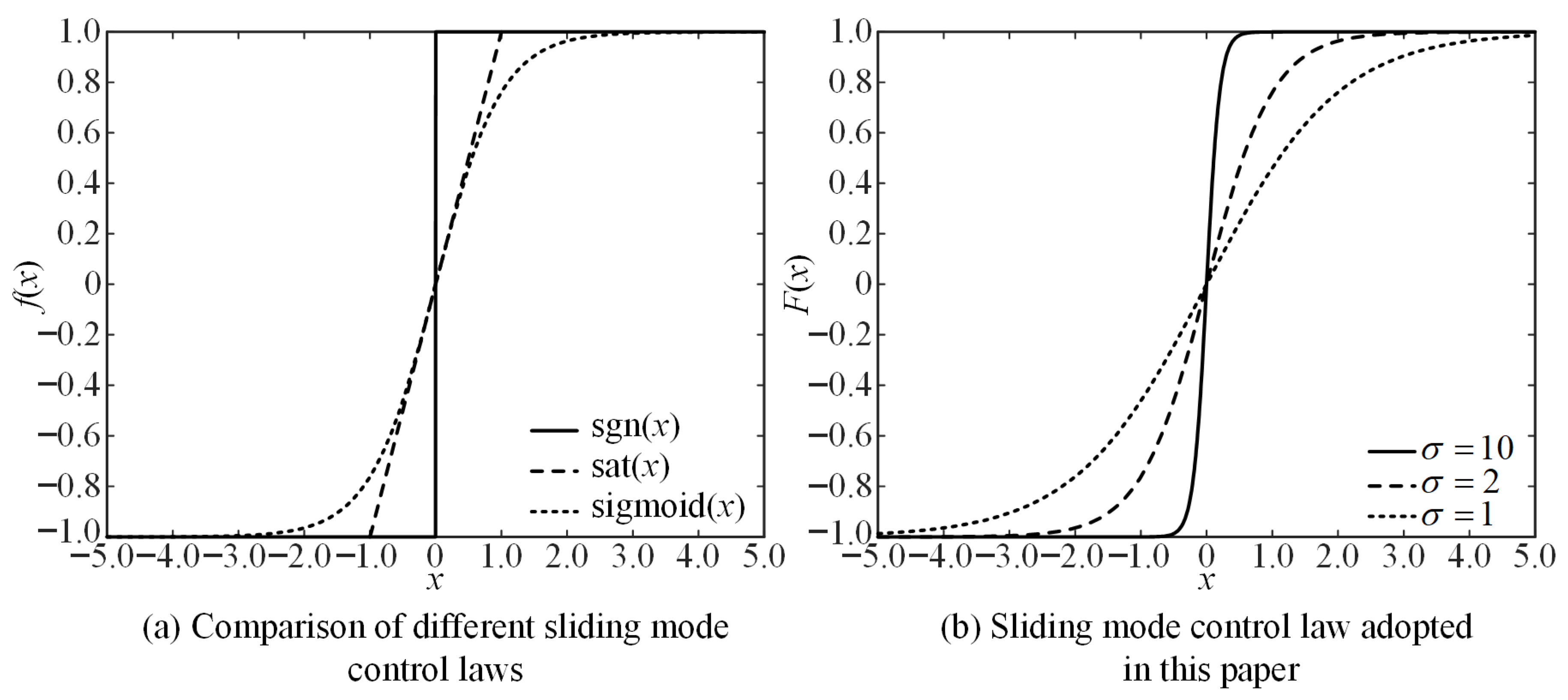
When using a conventional SMO to estimate the EMF, the discontinuity of the sliding-mode control law causes severe chattering. This introduces substantial high-frequency noise into the observed EMF signal, resulting in large errors in the estimated rotor position and electrical angular speed. Consequently, the observed EMF signal must be filtered, which in turn leads to phase shift and amplitude attenuation. Therefore, to alleviate the inherent chattering phenomenon of the sliding-mode observer, various continuous functions have been applied in sliding-mode control, such as the saturation function and S-shaped function. To mitigate the inherent chattering of the SMO, this paper proposes a smooth, continuous S-shaped function F(x) based on the hyperbolic tangent as the sliding-mode control law, its expression is given as follows:
F ( x ) = 2 1 + e σ x 1
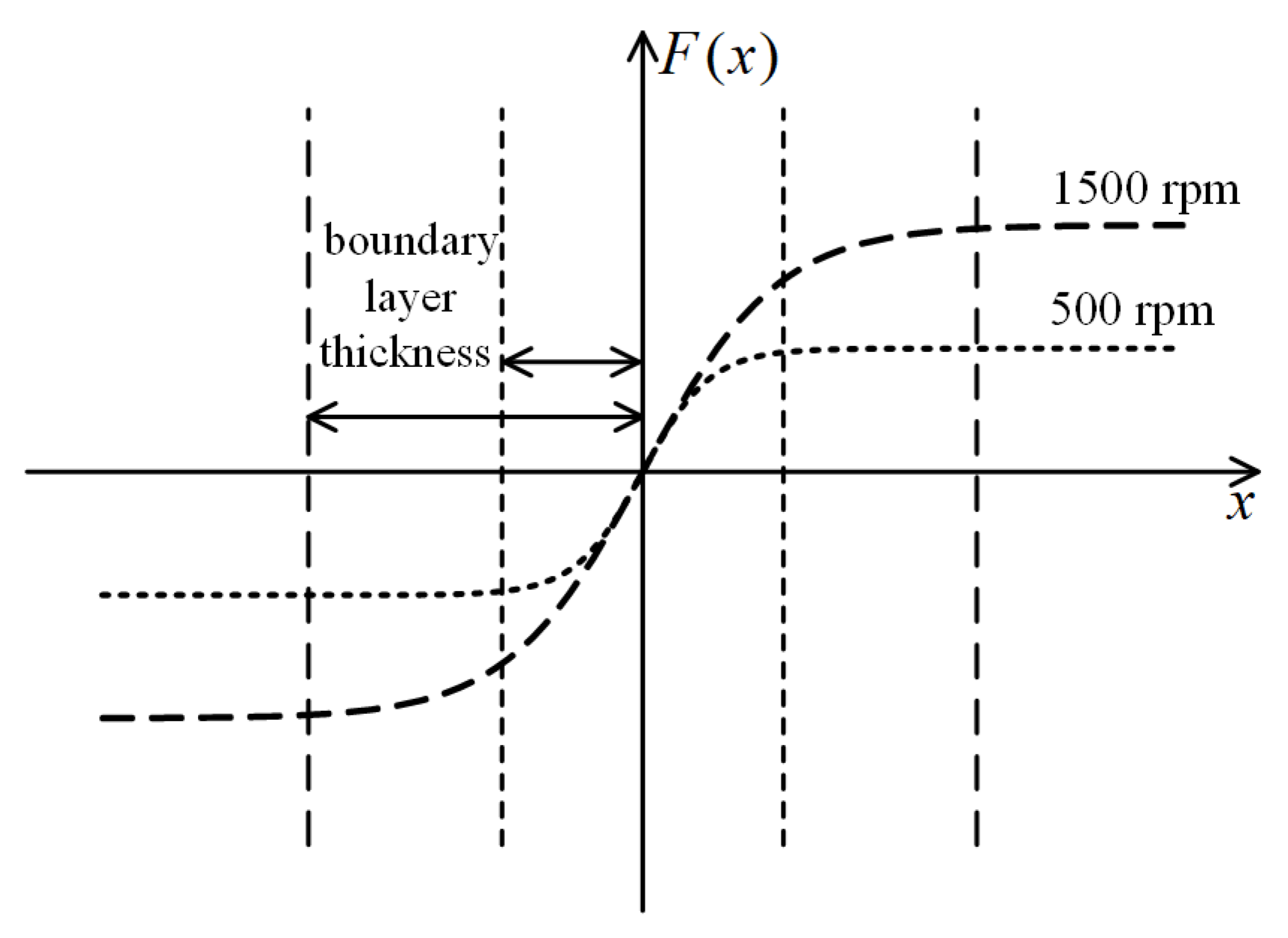
where the parameter σ is a positive real constant used to adjust the boundary-layer thickness, and x denotes the independent variable. The function curve of F(x) is shown in Figure 4 and has the following properties: F(x) is an odd function and strictly increasing; it is continuous and differentiable over the range x ( , + ) ; when x , F(x) = −1; when x + , F(x) = 1. When F(x) is used as the sliding-mode control law, the full-order SMO can be expressed as
p i ^ e ^ = A ^ 11 A 12 0 A ^ 22 i ^ e ^ + B 1 0 u 1 L s K F ( Δ i )
Within the boundary layer, the discontinuous control function is approximated by a linear feedback gain in the sliding-mode control function; therefore, once the system reaches the sliding surface, the full-order SMO can be regarded as equivalent to a linear feedback control system, and no chattering occurs.

3.4. Adaptive Adjusted Control Gain

To ensure that the sliding-mode observer can achieve satisfactory estimation of the EMF of the PMSM under various operating conditions, this paper proposes a gain-adaptive full-order SMO. The adaptive adjustment of the sliding-mode control gain is performed to maintain desirable observer performance in different scenarios.
Based on the analysis in the previous section, the two key parameters that affect the observation performance of the full-order sliding-mode observer—implemented with the proposed sliding-mode control function—are the boundary layer thickness σ and the sliding-mode control gain. The basic design concept for the gain-adaptive SMO is as follows: first, to ensure sufficient robustness, the boundary layer should be made sufficiently thin, which corresponds to setting a large σ . Then, as the system operates under different conditions, the sliding-mode control gain should be adjusted appropriately. This adaptive scheme enables the full-order SMO to maintain accurate EMF estimation across a wide range of operating conditions.
When the switching frequency is kept constant at 10 kHz, an increase in rotor speed leads to a lower carrier ratio, which means fewer switching actions are required to rotate through the same electrical angle. As a result, the control delay becomes more pronounced at higher speeds. Consequently, if the boundary layer thickness remains unchanged, the chattering phenomenon becomes more severe under high-speed conditions. In the design of the sliding-mode gain, a fixed gain is typically selected according to its maximum value to ensure the global asymptotic stability of the full-order sliding-mode observer. However, at low speeds, this fixed high gain magnifies the control error, which in turn increases the overall system error in the low-speed region.
To achieve satisfactory back-EMF estimation across all speed ranges, both the boundary layer thickness and the sliding-mode gain should be adaptively adjusted. Figure 5 illustrates the variation in these parameters with PMSM operating conditions: the boundary layer thickness increases with rotor speed to provide sufficient switching response time, while the sliding-mode control gain also increases with speed to maintain global asymptotic stability of the full-order SMO.
Denote the boundary layer thickness as δ, then
δ = k σ ω e r e f
The value of the boundary layer thickness σ can be determined from δ, and is obtained by solving the sliding-mode control law inversely.
σ = 5.2933 δ = 5.2933 k σ ω e r e f
The sliding-mode gain is determined according to the following expression:
m = k 1 ω e r e f
k = k 2 ω e r e f
The final selection of these specific numerical values k σ = 0.01 , k 1 = 0.4 , k 2 = 0.2 are indeed determined empirically through an iterative process of simulation studies. This process involves testing the adaptive observer performance under various speed and load conditions on our high-fidelity PMSM model. The coefficients were adjusted until an optimal compromise was achieved, minimizing the rotor position estimation error across the entire operating envelope.

4. Simulation and Experimental Validation

4.1. Simulation Validation

To compare the observation performance of the conventional SMO and the full-order SMO, this section builds simulation models for the two observer algorithms, with a unified control frequency of 10 kHz. Based on the established models, simulation analyses are conducted on the observers’ performance under various conditions: 30% rated speed, 50% rated speed, and rated speed; and no load, 50% rated load, and 100% rated load. The motor parameters are shown in the table below.

4.1.1. Simulation Results of the Conventional SMO

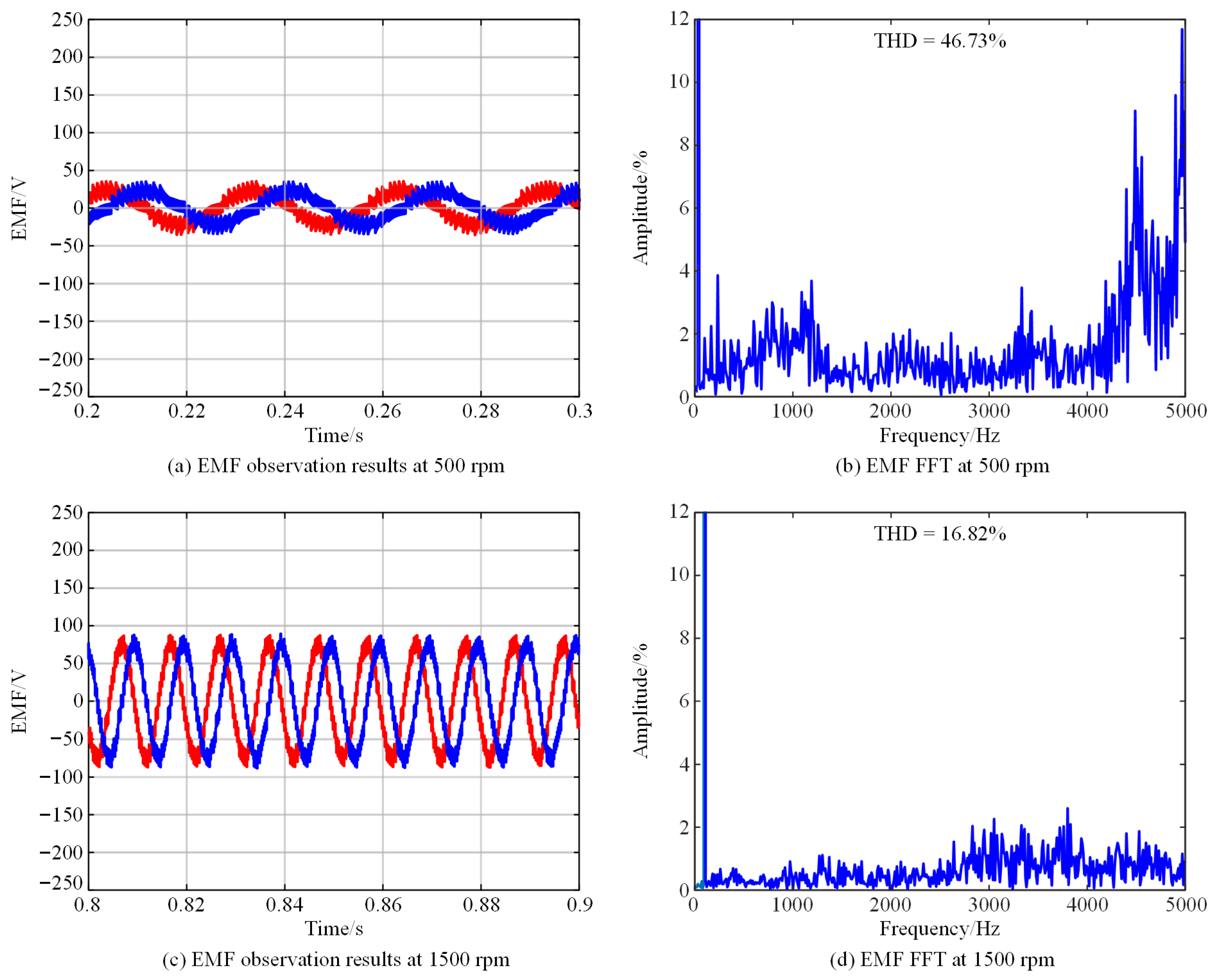
Firstly, the back EMF observation results under different conditions are analyzed, and the simulation results are shown in Figure 6. By comparison, it is found that the lower the speed, the higher the THD of the back EMF. When the speed is 500 rpm, the THD reaches 46.73%, whereas at the rated speed, the THD is 16.82%. At lower speeds, the back EMF amplitude is relatively small, resulting in a low signal-to-noise ratio. In this case, the preset sliding-mode gain is relatively large, and the regulation effect of sliding-mode control becomes excessively strong, leading to a high content of high-frequency noise in the observed back EMF. As the speed increases, the back EMF amplitude becomes larger, the SNR improves, the sliding-mode gain approaches a reasonable value, and the high-frequency noise content in the observed back EMF decreases.
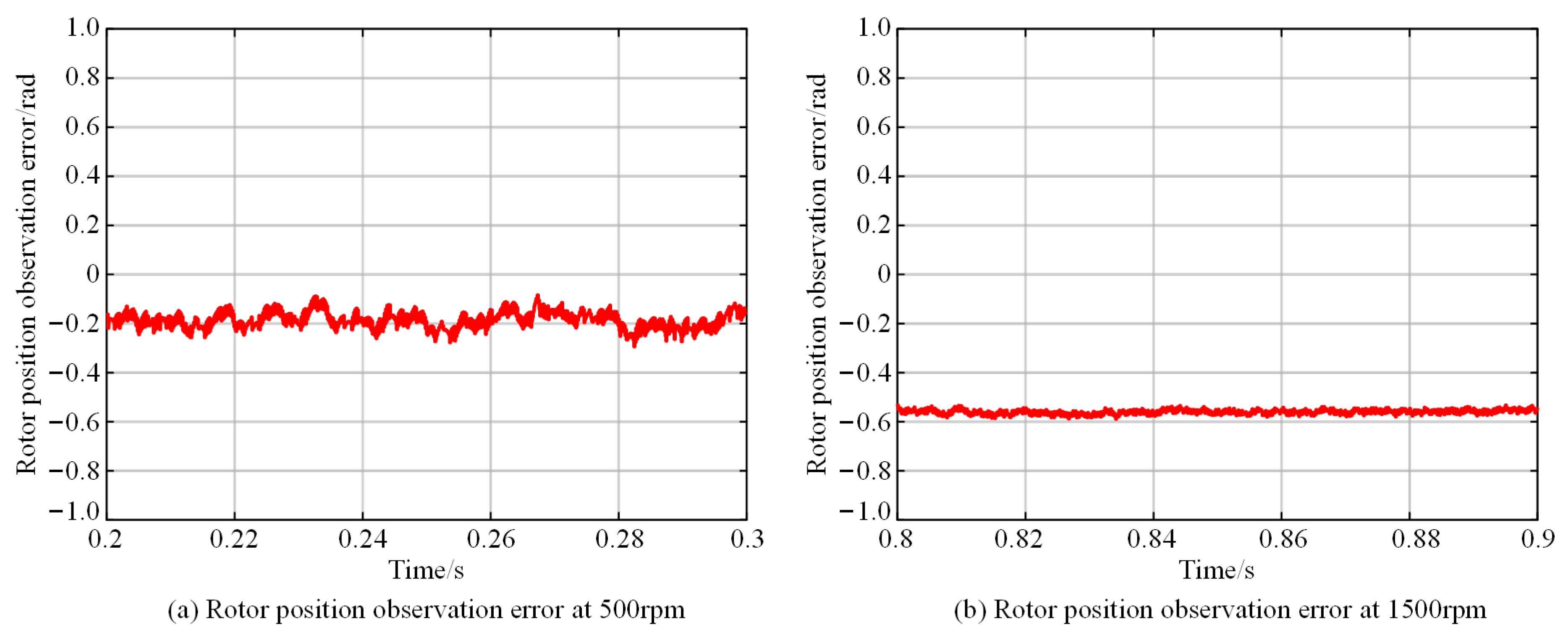
Figure 7 presents the simulated rotor position observation error of the conventional SMO. As illustrated, the increase in PMSM speed leads to a higher back-EMF frequency, which in turn results in a growing rotor position observation error. At the rated speed, the error reaches 0.59 rad, significantly degrading the performance of the sensorless control system. The accuracy of rotor position estimation is the key determinant of overall system performance, and this accuracy is directly dependent on the precision of back-EMF estimation. Therefore, enhancing rotor position estimation requires first ensuring highly accurate back-EMF observation.

4.1.2. Simulation Results of the Full-Order SMO

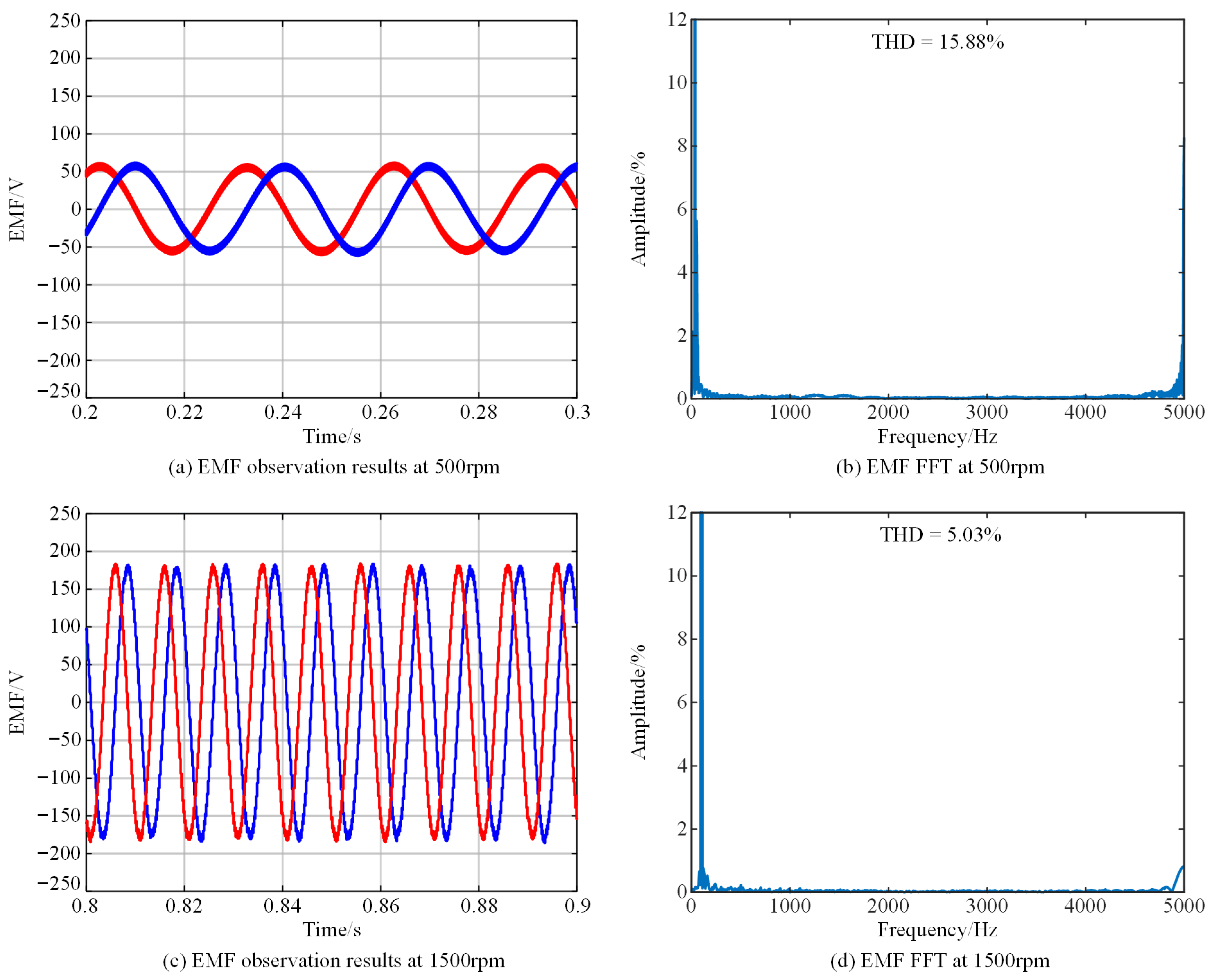
The observed back EMF and its corresponding THD are illustrated in Figure 8. The performance of the proposed full-order SMO is evaluated and compared with that of the conventional sliding-mode observer under various rotor speeds. At 500 rpm, the simulation results presented in Figure 8 indicate that the observed back-EMF amplitude is approximately 50 V, which represents an increase of about 40% relative to the conventional observer. Additionally, the THD of the observed back-EMF is 15.88%, corresponding to a reduction of 66.02% compared to the conventional SMO. These results demonstrate that the full-order observer exhibits improved estimation accuracy and better noise suppression capability at low speed. As the rotor speed increases, the THD of the observed back-EMF shows a continuous decrease, implying improved estimation fidelity at higher operating speeds. When the rotor speed reaches 1500 rpm, as shown in Figure 8, the THD decreases to 5.03%, which is 70.10% lower than that obtained using the conventional SMO. This indicates that the proposed full-order SMO effectively mitigates the high-frequency chattering inherent in conventional structures and enhances the purity of the estimated back-EMF. Overall, the comparative simulation results clearly demonstrate that the full-order sliding-mode observer achieves superior back-EMF estimation accuracy and dynamic consistency over the conventional design, thereby providing a more reliable foundation for sensorless PMSM control.
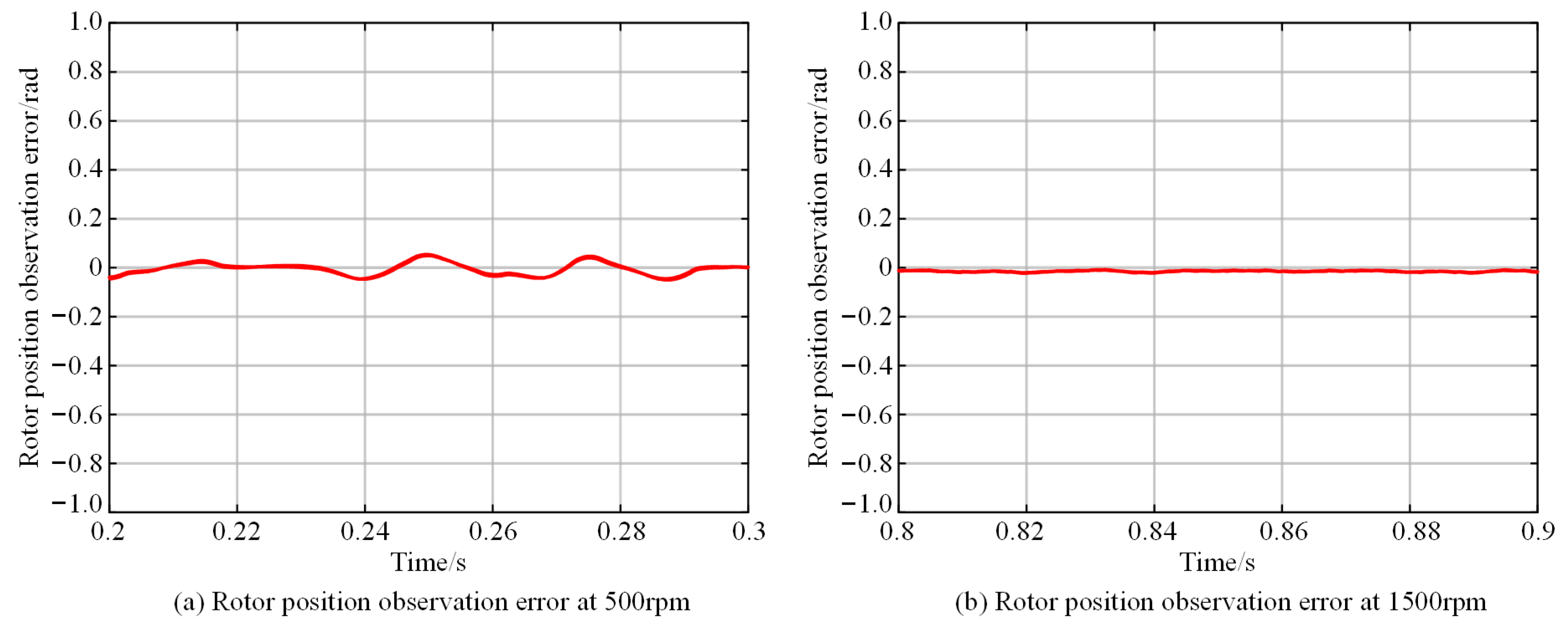
The simulation results for rotor position estimation error using the proposed full-order SMO are shown in Figure 9. A clear trend is observed: the estimation error decreases with increasing rotor speed. This improvement addresses the persistent phase lag found in conventional SMO. At 500 rpm, the rotor position estimation error reaches its maximum value; however, the error consistently remains within ± Δ θ e = ± 0.1   rad . In comparison, the conventional observer maintains a fixed phase lag between the estimated and actual rotor positions, regardless of speed.
As the rotor speed increases, the conventional observer’s position error grows steadily, whereas the full-order observer’s error diminishes, remaining close to ± Δ θ e = 0   rad over the speed range. At the rated speed, Figure 9 shows that the rotor position estimation error is reduced to only Δ θ e = 0.05   rad , which represents a substantial improvement over the conventional method.
The presented analysis demonstrates that the full-order sliding-mode observer significantly enhances back-EMF estimation accuracy and mitigates rotor position estimation error. Nonetheless, its performance exhibits notable dependence on operating speed. At low speeds, the elevated total harmonic distortion of the back-EMF leads to increased estimation error, thereby limiting the observer’s capability to maintain high accuracy over a broad speed range.

4.1.3. Simulation Results of the Adaptive Full-Order SMO

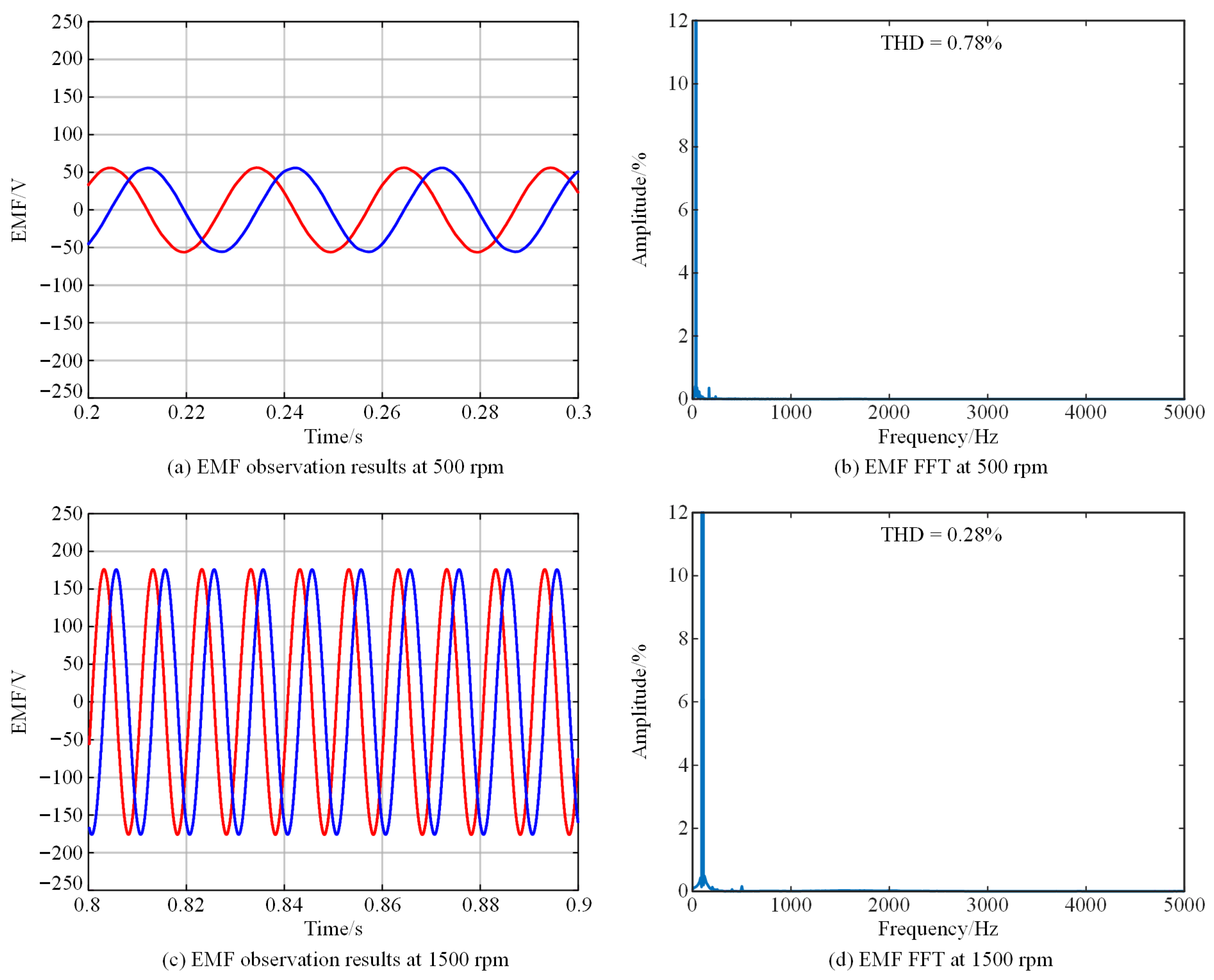
The waveforms and THD of the back-EMF are shown in Figure 10. Figure 10a,b present the simulated back-EMF and THD under the 500 rpm condition. In this case, the THD is only 0.78%, representing a 95.08% reduction compared with the full-order SMO. Figure 10c,d show the simulated back-EMF and its THD at 1500 rpm. Compared with the full-order SMO, the adaptive full-order SMO achieves a 94.43% reduction in THD. These simulation results demonstrate that the use of an adaptive full-order SMO can significantly improve the estimation accuracy of the back-EMF, thereby providing a solid foundation for subsequent rotor position estimation.
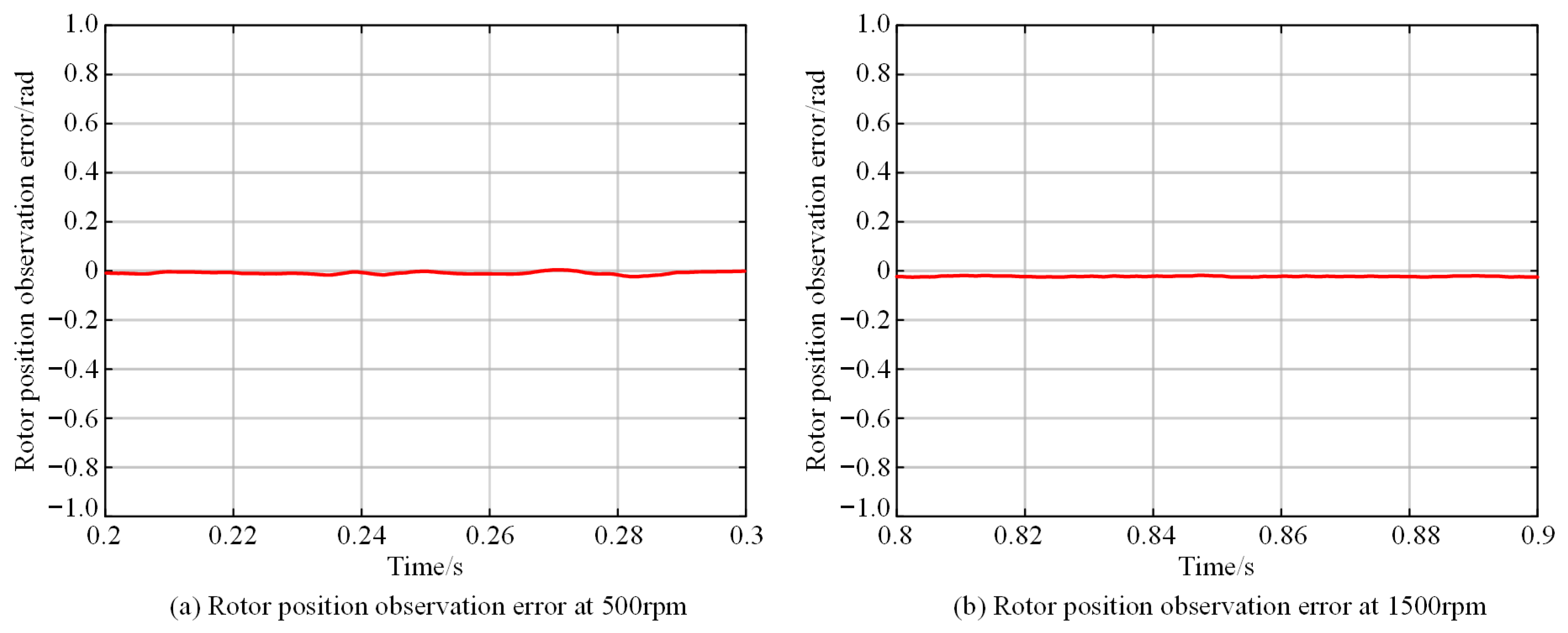
Figure 11 presents the simulation results of the rotor position estimation error. Figure 11a shows the estimation error under the 500 rpm condition, where the maximum rotor position estimation error is only 0.02 rad, representing an 80% reduction compared with the full-order sliding-mode observer. When the speed reaches the rated value, as shown in Figure 11b, the estimation error remains within 0.02 rad. In this case, the steady-state rotor position estimation error is reduced by 60% compared with the full-order SMO, indicating a significant improvement in performance.
The analysis confirms that the proposed adaptive full-order SMO enhances back-EMF estimation accuracy and decreases rotor position estimation error. Compared with its conventional counterpart, the proposed approach achieves improved estimation performance over a wide speed range, enabling precise back-EMF observation under diverse operating conditions. Furthermore, the rotor position estimation is significantly more accurate, providing a solid foundation for implementing high-performance sensorless control strategies for PMSMs.

4.1.4. Simulation Results of the Conventional SMO and Adaptive Full-Order SMO During Dynamic Motor Operation

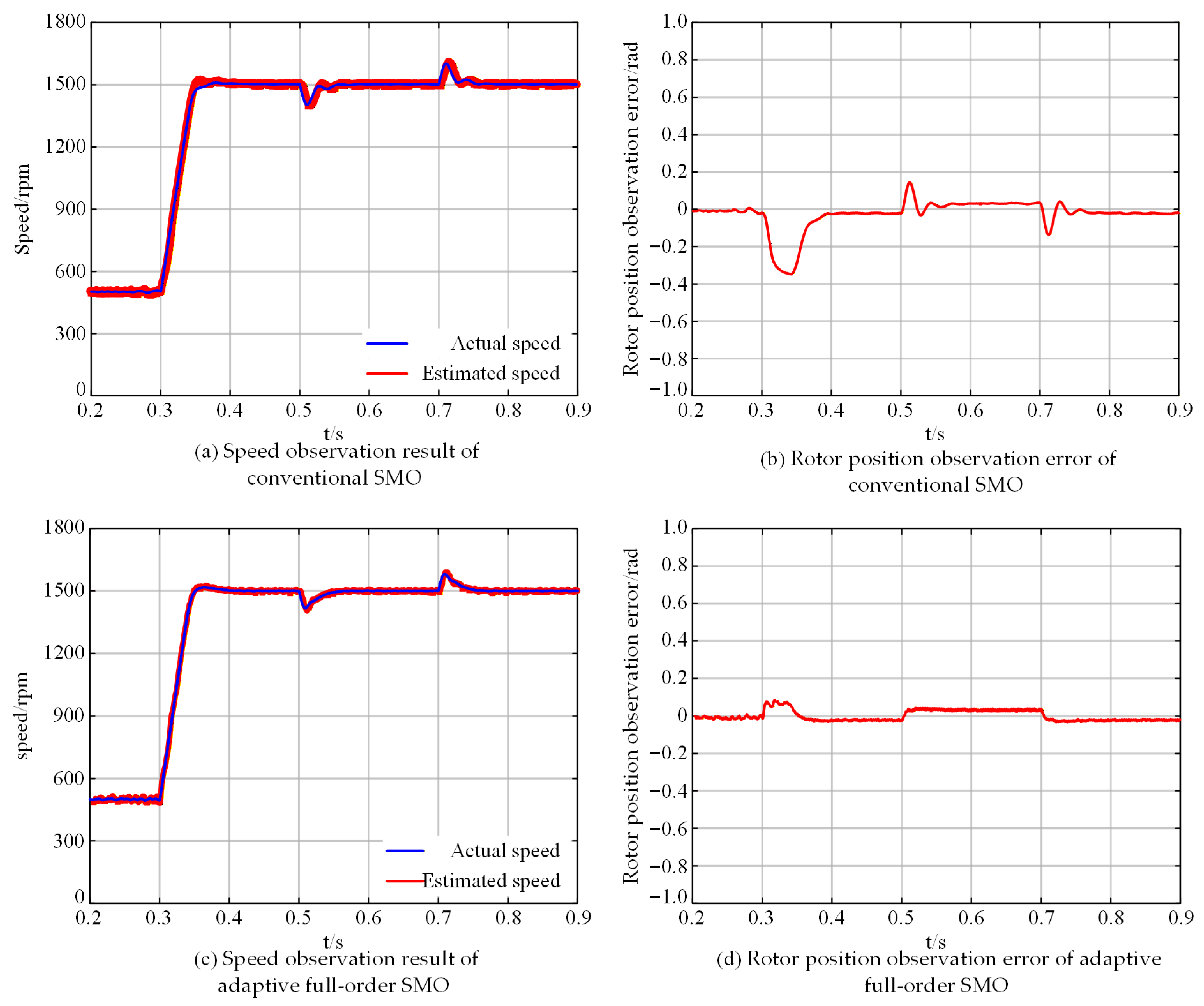
Figure 12a,b show the speed and position observation results based on the conventional SMO. It can be observed that during the acceleration process, it is evident that at the initial stage of acceleration, the rotor position observed by the conventional SMO exhibits a noticeable lag. Figure 12c,d shows the simulation results of the actual and observed rotor positions during the acceleration process of proposed adaptive full-order SMO. The waveforms indicate that the observed rotor position can accurately track the actual value. From Figure 12d, it can be concluded that the maximum observation error for the rotor position during acceleration is 0.08 rad, which is only 27.59% of the rotor position observation error obtained using the conventional SMO.

4.2. Experimental Validation

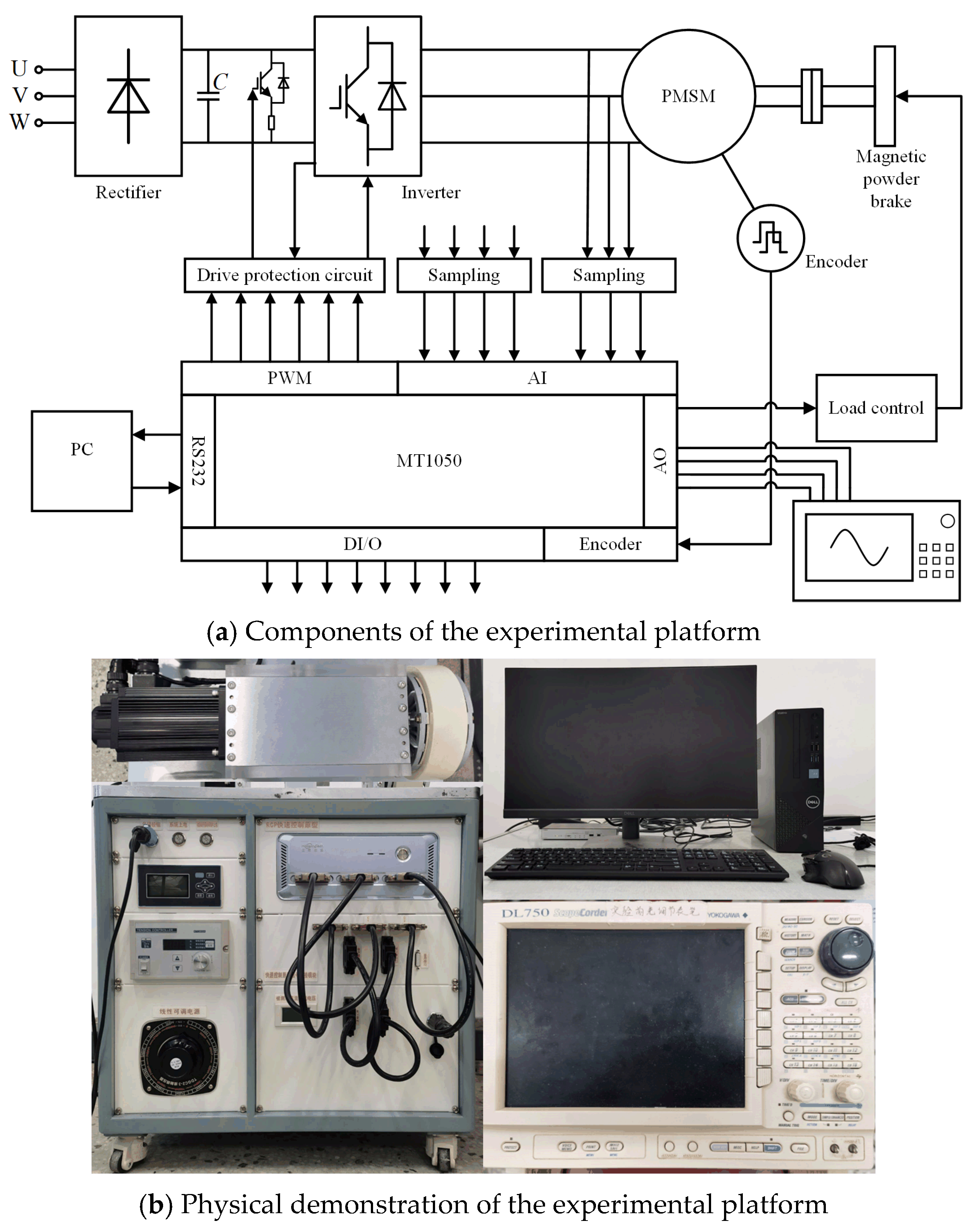
Experimental analysis was carried out using a Rapid Control Prototyping (RCP) platform based on the MT1050. The structure of the PMSM drive control system experimental platform is shown in Figure 13. It includes the PMSM under test, the MT1050 RCP unit, drive protection circuitry, voltage and current measurement circuits, the main power stage, and a magnetic powder brake with its control circuitry. The parameters of the PMSM under test are given in Table 1. A host computer oversees system operation, and the StarSim RCP (version MT1050)software is used to monitor and control the system’s operating status.
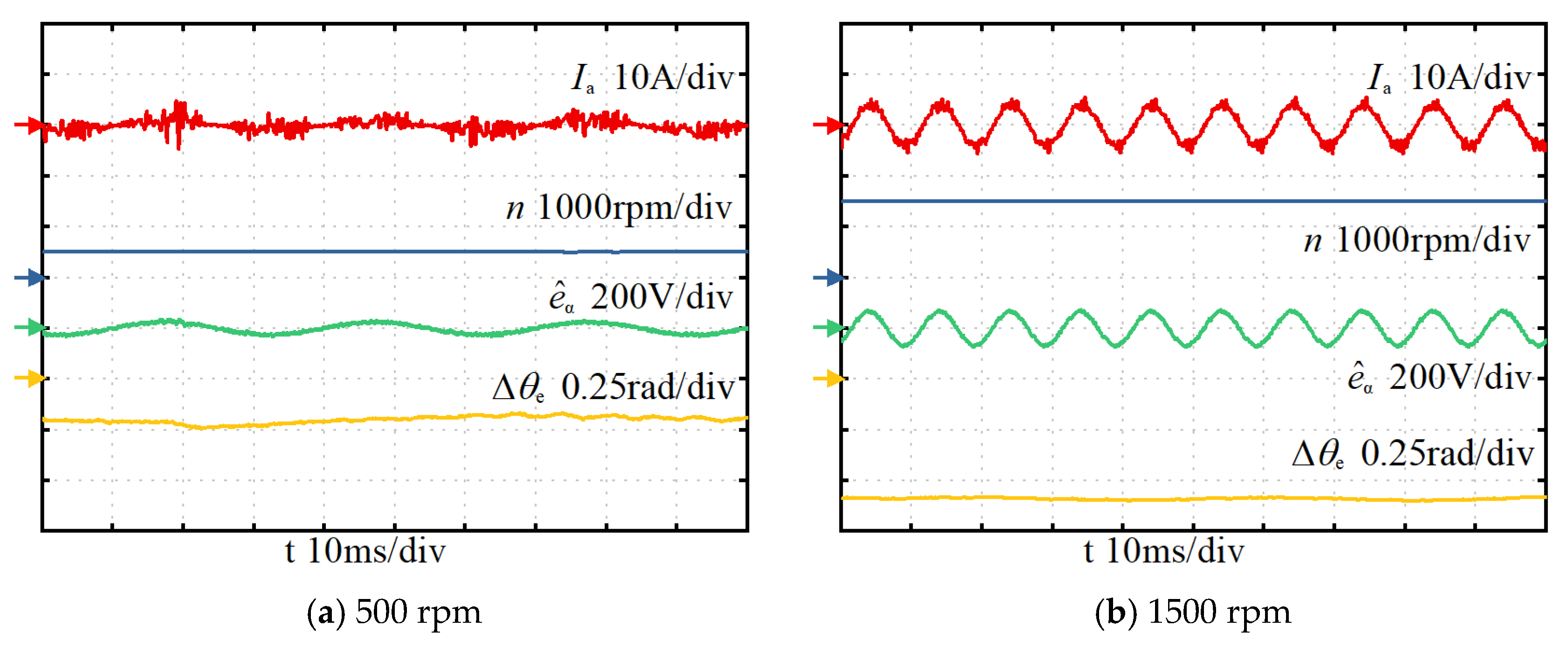
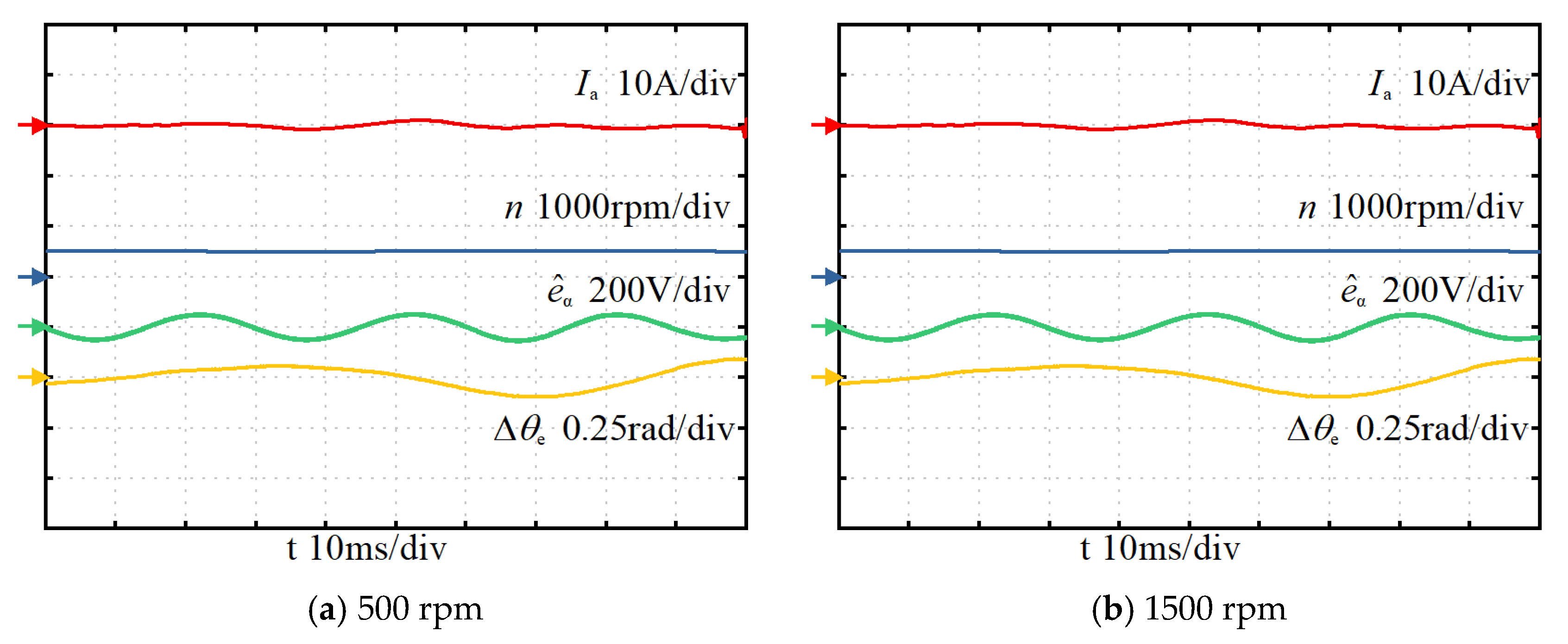
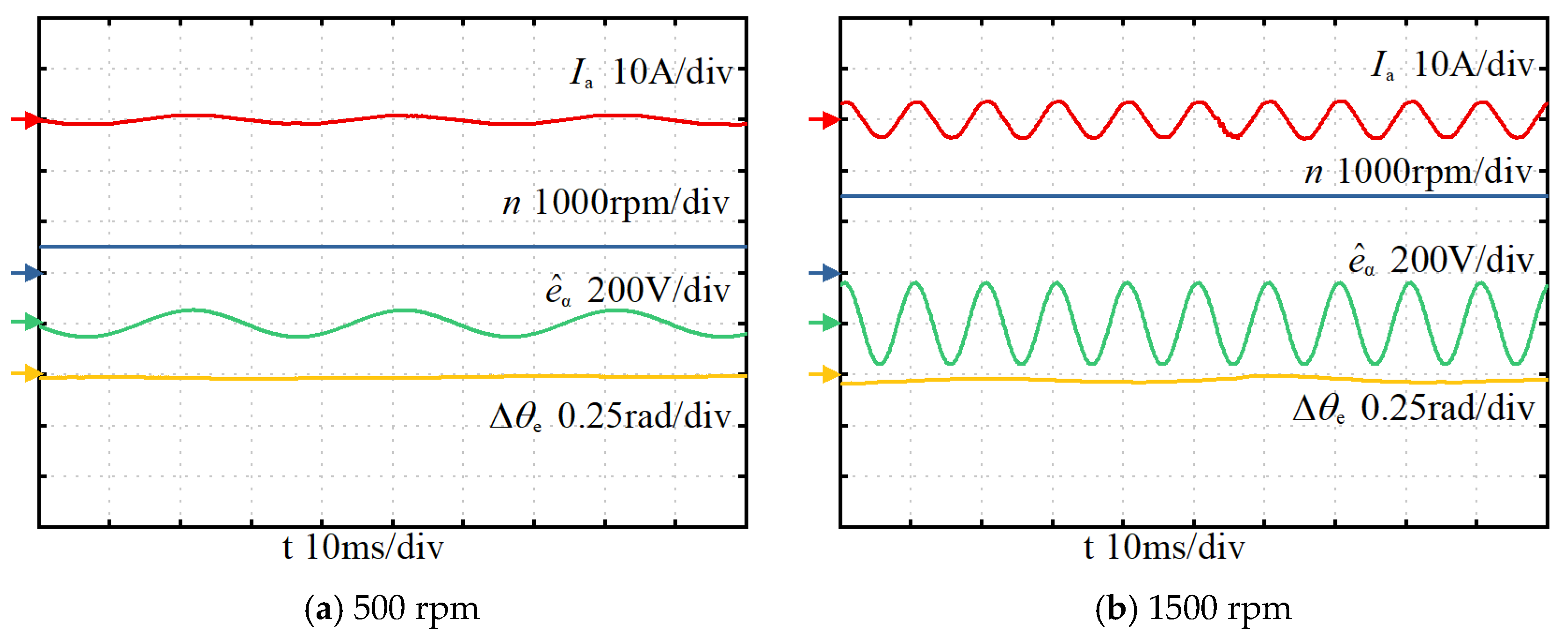
First, the EMF observation results obtained under different speed conditions using the conventional SMO, the full-order SMO, and the adaptive full-order SMO are analyzed. The experimental speeds are set to 500 rpm and 1500 rpm. The phase currents, speed, rotor position estimation error, and EMF are observed using an oscilloscope.

4.2.1. Experimental Results of the Conventional SMO

The experimental EMF observation waveforms based on the conventional SMO are shown in Figure 14. Figure 14a presents the EMF observation results at 500 rpm. At this speed, the EMF amplitude is relatively small, only about 25 V, but the stator current exhibits noticeable distortion. The rotor position error is 0.23 rad, meaning the estimated rotor position lags the actual rotor position by 0.23 rad. When the speed reaches 1500 rpm, the EMF amplitude increases to about 68 V, the rotor position error increases to 0.65 rad, and the stator current distortion weakens; however, the stator current amplitude increases significantly due to the increase in d-axis current caused by the rotor position lag.
From the above analysis, at lower speeds the EMF amplitude is small, but the selected sliding-mode gain is relatively large compared to the EMF amplitude, resulting in a stronger sliding-mode control action. Consequently, the observed EMF contains more high-frequency noise. Applying an LPF can reduce the harmonic content in the EMF, but it also introduces a phase lag. When the speed increases to 1500 rpm, the EMF amplitude grows, the effective sliding-mode gain becomes relatively smaller, and the high-frequency noise content in the observed EMF is reduced. According to the characteristics of LPF, the higher the input frequency, the larger the phase delay angle, which is consistent with the experimental results. At higher speeds, since the EMF’s high-frequency noise content is relatively low, the cutoff frequency of the LPF should be increased to reduce the phase lag issue. However, at lower speeds, where the EMF harmonic content is higher, the cutoff frequency should be reduced to enhance high-frequency noise suppression. Therefore, in design, one must consider the filtering performance across the entire speed range and system stability and choose the LPF cutoff frequency carefully.

4.2.2. Experimental Results of the Full-Order SMO

The EMF observation results obtained using the full-order SMO are shown in Figure 15. Compared with the conventional SMO, the EMF observation shows a clear improvement: at 500 rpm, the EMF THD decreases by 30%, and at 1500 rpm, the THD decreases by 39%. This comparison indicates that the full-order SMO can effectively enhance EMF observation accuracy. In Figure 15a, the maximum rotor position estimation error is 0.1 rad, which is a 56.52% reduction relative to the conventional SMO, and the phase current waveform distortion is effectively mitigated. In Figure 15b, at 1500 rpm, the experimental results show that the rotor position estimation error is only 0.02 rad; the resulting d-axis current amplitude due to this position error is just 1.99% of the q-axis reference current, and can be essentially neglected. Compared with the conventional SMO, the EMF estimates obtained by the full-order SMO resolve the phase lag issue, thereby significantly improving rotor position estimation accuracy.

4.2.3. Experimental Results of the Adaptive Full-Order SMO

Figure 16 presents the experimental results of back-EMF observation using the adaptive full-order SMO. Figure 15 show the back-EMF observation results under the 500 rpm condition. In this case, the THD of the back-EMF is only 0.85%, and the rotor position estimation error is merely 0.02 rad. Compared with the conventional full-order SMO, the harmonic content of the back-EMF is reduced by 94.62%, and the rotor position estimation error decreases by 80%.
The experimental results under the 1500 rpm condition are shown in Figure 16. The harmonic content of the back-EMF is 0.85%, corresponding to a 53.10% reduction compared with the conventional full-order SMO, while the rotor position estimation error remains at 0.02 rad. These experimental results demonstrate that adjusting the sliding-mode gain through an adaptive gain function effectively improves the accuracy of back-EMF observation and reduces the rotor position estimation error. Consequently, the proposed method ensures satisfactory back-EMF estimation performance across a wide speed range, from low to high speeds.
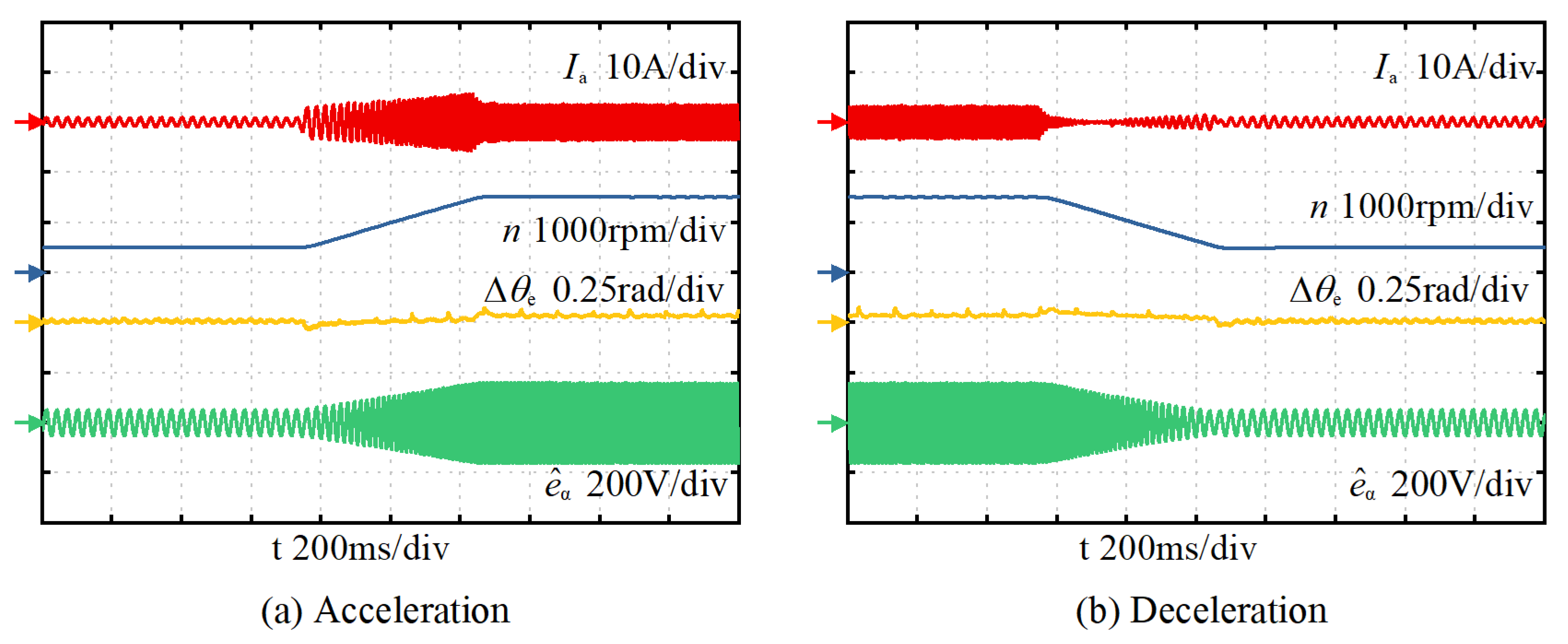
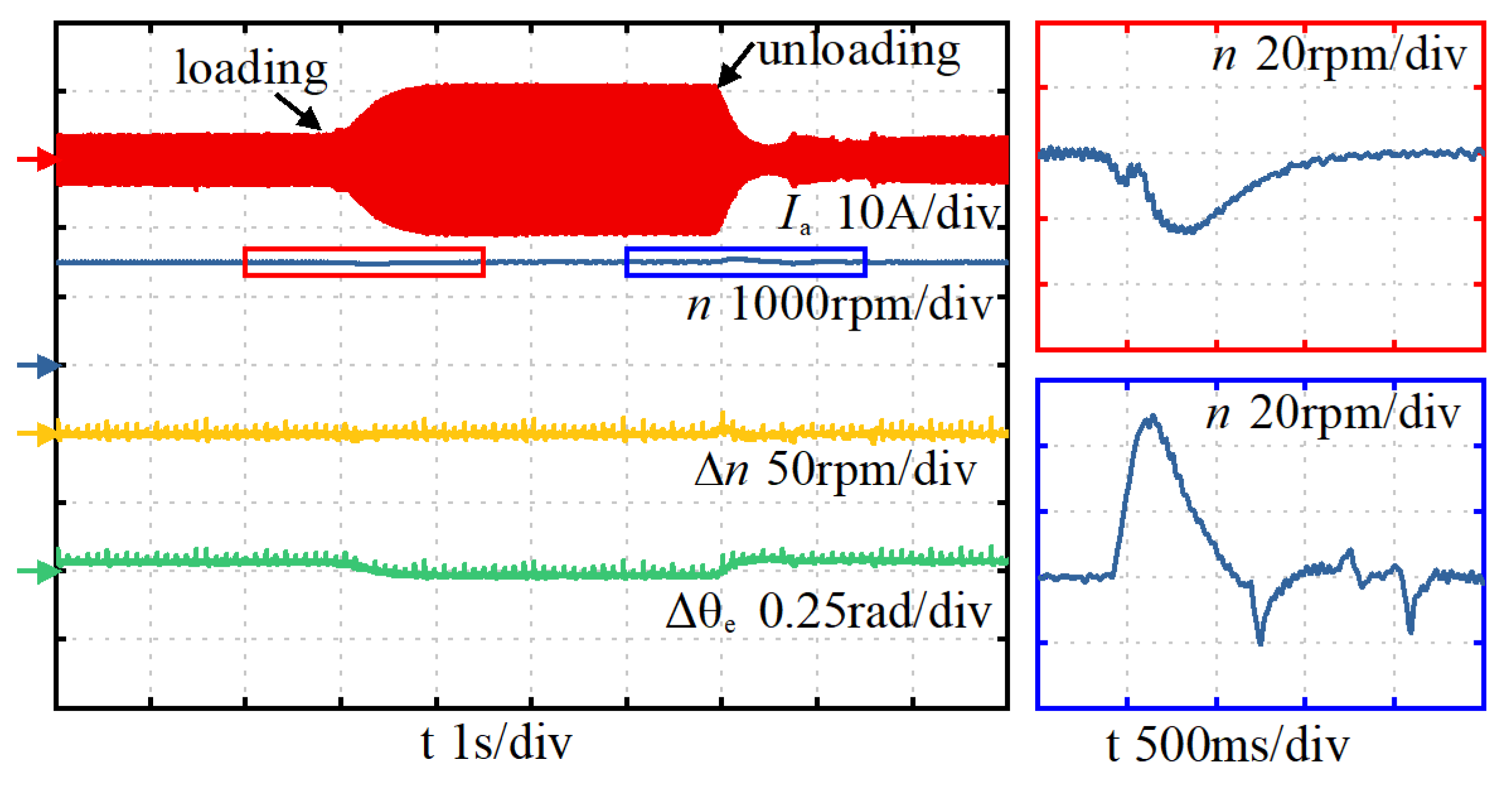
The experimental results of the proposed SMO under dynamic motor speed variations are shown in Figure 17. During acceleration from 500 rpm to 1500 rpm and deceleration from 1500 rpm back to 500 rpm, the rotor position observation error remains only 0.02 rad. This error level is essentially consistent with the observation errors when the speed is maintained steady at 500 rpm and 1500 rpm, indicating that the observed rotor position accurately tracks the actual value during both steady-state and dynamic processes. Figure 18 presents experimental results based on the proposed SMO under variable load conditions. During load increase, the speed drops by 23 rpm, which corresponds to 1.53% of the rated speed. During load decrease, the speed rises by 3.00%. The maximum rotor position observation error occurs during the load transients, with a peak value of 0.05 rad. Based on the above analysis, it is demonstrated that using the proposed SMO for speed and rotor position observation achieves high estimation accuracy, effectively ensuring the control performance of the PMSM sensorless control system.

5. Conclusions

When using a conventional SMO to observe the EMF, severe chattering and phase lag occur, leading to a large discrepancy between the observed EMF and its actual value. This severely compromises rotor position estimation accuracy and causes a significant deterioration in the control performance of the sensorless PMSM drive. To address these issues, this paper designs an adaptive full-order SMO to improve EMF estimation accuracy. The adaptive full-order SMO treats the EMF and stator currents jointly as system state variables and constructs a fourth-order state-space model. In this framework, the EMF is not obtained directly from the sliding-mode control function; instead, it is incorporated as a compensation term for the EMF estimation error to correct the EMF estimate. Meanwhile, an S-shaped function based on the hyperbolic tangent is used to replace the switching function in conventional sliding-mode control. This approach effectively reduces the high-frequency noise content in the EMF estimate, eliminating the need for a low-pass filter and thereby avoiding EMF phase lag.

Author Contributions

Conceptualization, J.Z. and S.H.; methodology, S.H.; software, L.S.; validation, S.H., Y.H. and L.S.; formal analysis, L.W.; investigation, S.H.; resources, S.H.; data curation, S.H.; writing—original draft preparation, S.H.; writing—review and editing, S.H. and Y.H.; visualization, S.H.; supervision, Y.H.; project administration, S.H.; funding acquisition, S.H. All authors have read and agreed to the published version of the manuscript.

Funding

This research received no external funding.

Data Availability Statement

Data are contained within the article.

Acknowledgments

The authors have reviewed and edited the output and take full responsibility for the content of this publication.

Conflicts of Interest

The authors declare no conflicts of interest.

References

  1. Tang, Z.C.; Ma, C.W.; Song, W.S.; Li, J.Y.; Yue, H. A Robustness-Improved Data-Driven Predictive Current Control for SPMSM Drives Through Iteratively Reweighted Least Square Solution. IEEE Trans. Transp. Electrif. 2025, 11, 12393–12404. [Google Scholar] [CrossRef]
  2. Ma, C.W.; Wu, Y.Q.; Song, W.S.; Li, J.Y.; Hu, X.L. Pulse Pattern Optimization-Assisted MPC for SiC-Based PMSM Drives to Reduce Both Common-Mode and Differential-Model Voltages. IEEE Trans. Power Electron. 2025, 40, 9107–9120. [Google Scholar] [CrossRef]
  3. Song, W.S.; Li, J.Y.; Ma, C.W.; Xia, Y.B.; Yu, B. A Simple Tuning Method of PI Regulators in FOC for PMSM Drives Based on Deadbeat Predictive Conception. IEEE Trans. Transp. Electrif. 2024, 10, 9852–9863. [Google Scholar] [CrossRef]
  4. Wang, S.Q.; Ding, D.W.; Zhang, G.Q. Flux observer based on enhanced second-order generalized integrator with limit cycle oscillator for sensorless PMSM drives. IEEE Trans. Power Electron. 2023, 38, 15982–15995. [Google Scholar] [CrossRef]
  5. Khajueezadeh, M.S.; Emadaleslami, M.; Tootoonchian, F. Comprehensive investigation of the resolver’s eccentricity effect on the field-oriented control of PMSM. IEEE Sens. J. 2023, 23, 19145–19152. [Google Scholar] [CrossRef]
  6. Yao, X.L.; Huang, S.Q.; Wang, J.F. Improved ROGI-FLL-based sensorless model predictive current control with MRAS parameter identification for SPMSM drives. IEEE J. Emerg. Sel. Top. Power Electron. 2023, 11, 1684–1695. [Google Scholar] [CrossRef]
  7. Wang, G.L.; Valla, M.; Solsona, J. Position sensorless permanent magnet synchronous machine drives—A review. IEEE Trans. Ind. Electron. 2020, 67, 5830–5842. [Google Scholar] [CrossRef]
  8. Luo, X.; Shen, A.W.; Tang, Q.P. Two-step continuous-control set model predictive current control strategy for SPMSM sensorless drives. IEEE Trans. Energy Convers. 2021, 36, 1110–1120. [Google Scholar] [CrossRef]
  9. Bernard, P.; Praly, L. Estimation of Position and Resistance of a Sensorless PMSM: A Nonlinear Luenberger Approach for a Nonobservable System. IEEE Trans. Autom. Control. 2021, 66, 481–496. [Google Scholar] [CrossRef]
  10. Kivanc, O.C.; Ozturk, S.B. Sensorless PMSM Drive Based on Stator Feedforward Voltage Estimation Improved with MRAS Multiparameter Estimation. IEEE/ASME Trans. Mech. 2018, 23, 1326–1337. [Google Scholar] [CrossRef]
  11. Wang, Z.; Zhang, Y.; Zou, Z. Position Sensorless Control of Interleaved CSI Fed PMSM Drive with Extended Kalman Filter. IEEE Trans. Magnet. 2012, 48, 3688–3691. [Google Scholar] [CrossRef]
  12. Filho, C.J.V.; Xiao, D.; Vieira, R.P. Observers for High-Speed Sensorless PMSM Drives: Design Methods, Tuning Challenges and Future Trends. IEEE Access 2021, 9, 56397–56415. [Google Scholar] [CrossRef]
  13. Sreejith, R.; Singh, B. Sensorless predictive current control of PMSM EV drive using DSOGI-FLL based sliding mode observer. IEEE Trans. Ind. Electron. 2021, 68, 5537–5547. [Google Scholar] [CrossRef]
  14. Wang, Y.R.; Xu, Y.X.; Zou, J.B. Sliding-mode sensorless control of PMSM with inverter nonlinearity compensation. IEEE Trans. Power Electron. 2019, 34, 10206–10220. [Google Scholar] [CrossRef]
  15. Gong, C.; Hu, Y.H.; Gao, J.Q. An improved delay-suppressed sliding-mode observer for sensorless vector-controlled PMSM. IEEE Trans. Ind. Electron. 2020, 67, 5913–5923. [Google Scholar] [CrossRef]
  16. Sreejith, R.; Singh, B. Sensorless predictive control of SPMSM-driven light EV drive using modified speed adaptive super twisting sliding mode observer with MAF-PLL. IEEE J. Emerg. Sel. Top. Power Electron. 2021, 2, 42–52. [Google Scholar]
  17. Cheng, H.; Sun, S.L.; Zhou, X.Q. Sensorless DPCC of PMLSM using SOGI-PLL-based high-order SMO with cogging force feedforward compensation. IEEE Trans. Transp. Electrif. 2022, 8, 1094–1104. [Google Scholar] [CrossRef]
  18. Song, X.D.; Fang, J.C.; Han, B.C. Adaptive Compensation Method for High-Speed Surface PMSM Sensorless Drives of EMF-Based Position Estimation Error. IEEE Trans. Power Electron. 2016, 31, 1438–1449. [Google Scholar] [CrossRef]
  19. Yao, X.L.; Huang, S.Q. Improved AVF-PLL-Based Position Estimation Scheme for SPMSM Sensorless Drives. IEEE Trans. Energy Convers. 2022, 37, 2428–2437. [Google Scholar] [CrossRef]
  20. Tao, L.Y.; Wang, J.; Chen, D.D.; Zhou, L.L. A Robust Hybrid Complex Coefficient Filter Without Frequency Coupling for Position Estimation Accuracy Improvement of PMSM. IEEE J. Emerg. Sel. Top. Power Electron. 2024, 12, 2799–2808. [Google Scholar] [CrossRef]
  21. Kumar, S.; Singh, B. Sensorless Super-Twisting SMO Based PMSM Drive With Improved DANF-PLL for Hybrid Three-Wheeler EV Application. IEEE Trans. Ind. Electron. 2025, 61, 7362–7371. [Google Scholar] [CrossRef]
Figure 1. Block diagram of FOC.
Vehicles 08 00034 g001
Figure 2. Block diagram of the conventional SMO.
Vehicles 08 00034 g002
Figure 3. Block diagram of the full-order SMO.
Vehicles 08 00034 g003
Figure 4. Sliding-mode control function curve.
Vehicles 08 00034 g004
Figure 5. Root locus of the back-EMF observer.
Vehicles 08 00034 g005
Figure 6. EMF observation results of the traditional SMO.
Vehicles 08 00034 g006
Figure 7. Rotor position observation results of the traditional SMO.
Vehicles 08 00034 g007
Figure 8. EMF observation simulation results of the full-order SMO.
Vehicles 08 00034 g008
Figure 9. Rotor position observation simulation results of the full-order SMO.
Vehicles 08 00034 g009
Figure 10. EMF observation simulation results of the adaptive full-order SMO.
Vehicles 08 00034 g010
Figure 11. Rotor position observation results of the full-order SMO.
Vehicles 08 00034 g011
Figure 12. Simulation comparison of different control methods for motor dynamic operation.
Vehicles 08 00034 g012
Figure 13. The RCP platform.
Vehicles 08 00034 g013
Figure 14. Experimental results of the conventional SMO.
Vehicles 08 00034 g014
Figure 15. EMF observation results of the full-order SMO.
Vehicles 08 00034 g015
Figure 16. EMF observation results of the adaptive full-order SMO.
Vehicles 08 00034 g016
Figure 17. The experimental results of the proposed SMO under dynamic motor speed variations.
Vehicles 08 00034 g017
Figure 18. The experimental results of the proposed SMO under dynamic motor load variations.
Vehicles 08 00034 g018
Table 1. Parameters of surface-mounted permanent-magnet synchronous motor.
ParameterVariableValue
PkW2.3
np/4
RsΩ0.7
LsmH4.62
ψfWb0.267
Tsμs100
UdcV311
TNNm15
Disclaimer/Publisher’s Note: The statements, opinions and data contained in all publications are solely those of the individual author(s) and contributor(s) and not of MDPI and/or the editor(s). MDPI and/or the editor(s) disclaim responsibility for any injury to people or property resulting from any ideas, methods, instructions or products referred to in the content.