1. Introduction
Distributed Drive Electric Vehicles (DDEVs), characterized by their inherent advantages of independently controllable four-wheel drive forces and precisely measurable torque and rotational speed signals [
1], have become a significant focus of research in vehicle engineering in recent years. Studies related to their active safety performance and handling stability are increasingly drawing academic attention [
2,
3,
4]. Among these factors, road type and its adhesion conditions are key influences on vehicle dynamic behavior, making the real-time and accurate estimation of the road adhesion coefficient a crucial step in enhancing vehicle driving safety [
5,
6,
7,
8]. By dynamically identifying the road adhesion state and promptly adjusting control strategies, the handling stability of vehicles under complex operating conditions can be greatly improved. This approach has strong practical applications and is of utmost importance for developing highly reliable active safety systems [
9].
Currently, road identification methods fall into two categories [
10]: Cause-Based and Effect-Based methods. While Cause-Based methods have a specific predictive ability, allowing for road identification before tire-road contact, they require extra sensors, which increase costs and reduce robustness. These methods depend heavily on image quality. Conditions such as strong lighting, overcast or rainy weather, water on the road, or dirt can lower image clarity, negatively impacting the estimation of the road adhesion coefficient [
11,
12,
13].
Effect-based identification methods estimate the road adhesion coefficient by analyzing vehicle state response parameters induced by changes in road conditions. These methods typically require no additional sensors and exhibit strong adaptability to operational environments, thus garnering widespread attention. Xu et al. [
14] proposed a dimensionless tire model that establishes an analogy between the Burckhardt model’s adhesion coefficient and the peak adhesion coefficient, thereby constructing a relationship between tire mechanical characteristics and the peak adhesion coefficient, and employing the UKF for estimation. Huang et al. [
15] proposed a low-cost multi-source fusion method for estimating road surface friction coefficients. This approach first divides input images into sky and road regions via semantic segmentation, then dynamically fuses multi-source features to enhance the robustness of the estimation effectively. However, its performance relies heavily on the accuracy of image semantic segmentation. Under extreme weather conditions, the estimation accuracy of multi-source fusion is susceptible to environmental degradation. Furthermore, the approach fails to incorporate real-time feedback from vehicle dynamics, limiting adaptability in complex scenarios. Deng et al. [
16] proposed an Interactive Multiple Model Adaptive UKF (IMM-AUKF) for four-wheel-drive vehicles, enhancing estimation accuracy and convergence speed by switching observers for different conditions. Nevertheless, the multi-model switching mechanism increases algorithmic complexity and fails to effectively address the numerical singularity in the covariance matrix, thereby affecting numerical stability. Ge et al. [
17] proposed a square-root volume Kalman filtering algorithm incorporating a maximum correlation entropy criterion, establishing a seven-degree-of-freedom nonlinear distributed-drive vehicle dynamics model. This algorithm enables precise estimation of vehicle longitudinal velocity, lateral velocity, yaw rate, and wheel rotational angular velocity based on low-cost sensor signals. However, the method incurs a significant computational burden and exhibits noticeable estimation delays under dynamic operating conditions. Wang et al. [
18], addressing the insufficient time-varying road-tracking capability of traditional UKF, proposed a Fuzzy Forgetting Factor UKF that achieves rapid response to sudden road condition changes, albeit potentially at the cost of steady-state estimation accuracy. Yang et al. [
19] classified road types and designed a State-Constrained Square-Root Cubature Kalman Filter (SR-CKF) for estimation. While this improved identification robustness, SR-CKF has limited capability in characterizing probability distributions for highly nonlinear systems, leaving room for improvement in estimation accuracy and flexibility. Liu et al. [
20] addressed the insufficient estimation accuracy and adaptive capability of traditional UKF on complex roads by proposing an Adaptive Attenuation UKF (AAUKF) algorithm. However, its mechanism for enhancing tracking capability might introduce additional estimation fluctuations in high-noise environments. Zhang et al. [
21] proposed a High-Order Strong Tracking Cubature Kalman Filter (HSTCKF) algorithm that integrates high-order CKF with strong tracking theory. However, the introduced strong tracking mechanism may increase the algorithm’s computational complexity. Chen et al. [
22] proposed a joint estimation algorithm for the driving state and the road surface adhesion coefficient of four-wheel independent-drive electric vehicles, based on federated Kalman filtering and an intelligent bionic antlion optimization algorithm. However, its complex architecture, which integrates multiple algorithms, increases the computational burden, leaving room for optimization to improve real-time adaptability in vehicle-embedded systems and dynamic response speed under complex road conditions. The specific comparison of the above literature is shown in
Table 1.
Furthermore, Miguel Meléndez Useros et al. [
23] proposed a static output feedback path-tracking fault-tolerant controller (SOF-FT-PTC), which addresses system nonlinearities through linear parameter transformation. In another study, Guo Jianhua et al. [
24] introduced a cooperative control framework that enhances vehicle maneuvering stability by optimizing torque distribution and integrating steering-drive coordination. Both studies highlight the crucial reliance of advanced vehicle control systems on accurate, real-time state information, with the road surface adhesion coefficient serving as a key parameter that directly impacts control effectiveness. However, existing road surface adhesion estimation methods remain limited, particularly regarding the numerical stability of filtering algorithms and their ability to adapt to various transient road conditions.
To estimate the road adhesion coefficient, this paper develops an algorithm using the Square-Root Unscented Kalman Filter (SR-UKF) [
25,
26,
27]. The estimation framework is based on a 7-degree-of-freedom vehicle dynamics model that includes the Dugoff tire model. The CarSim vehicle model is employed for simulation validation, creating a test environment that closely resembles real-world conditions. Additionally, a distributed drive electric vehicle model is implemented on a CarSim-Simulink co-simulation platform to verify the effectiveness and performance of the proposed SR-UKF method.
2. Vehicle Dynamics Model Development
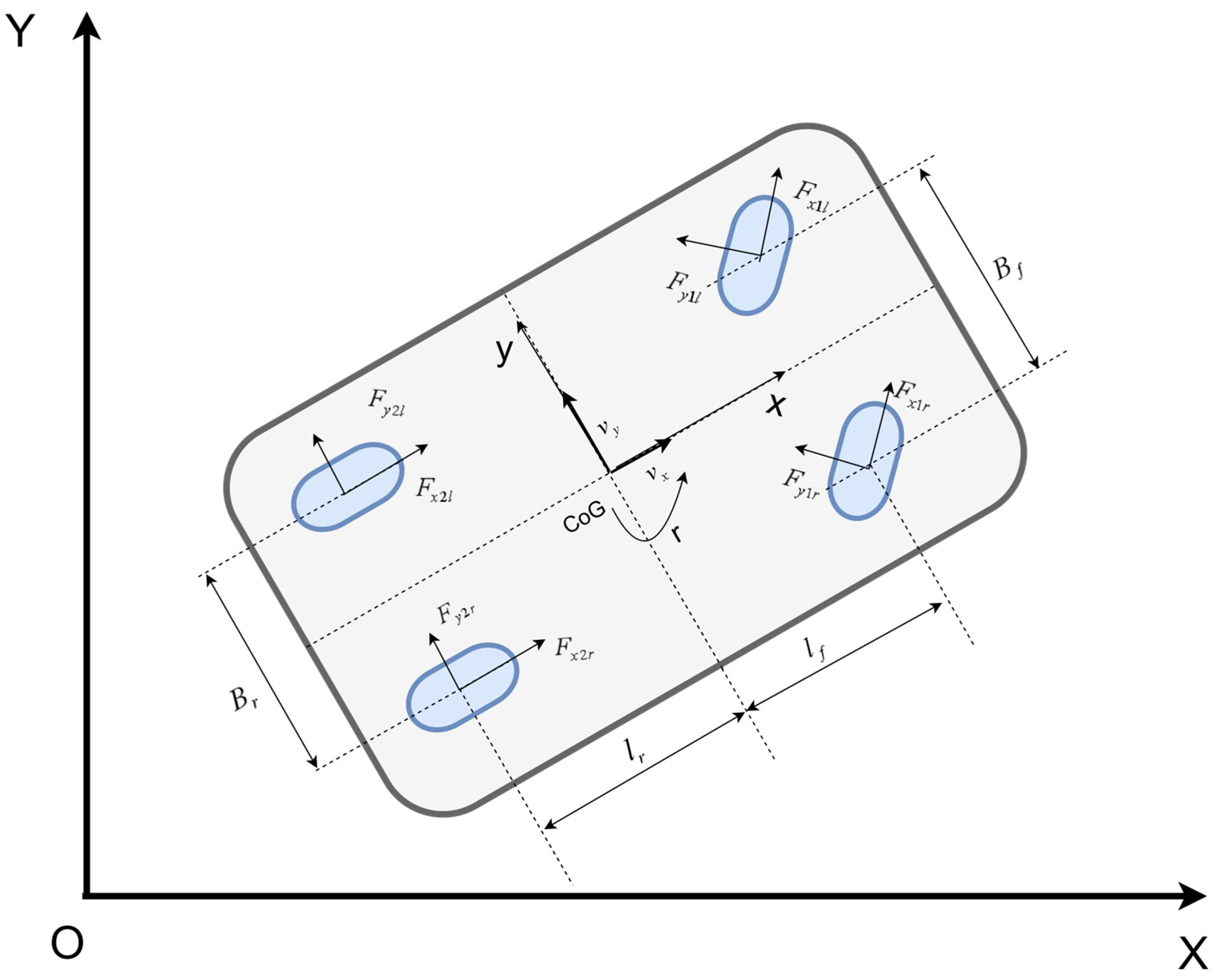
Figure 1 shows the seven-degree-of-freedom vehicle dynamics model established herein demonstrates the relationship between the ground inertial coordinate system O−XY and the vehicle coordinate system O−XY. The origin O of the ground inertial coordinate system is fixed to the ground and independent of vehicle motion. The origin CoG of the vehicle coordinate system is rigidly fixed to the vehicle’s center of mass and moves with the vehicle body. The positive directions of the longitudinal velocity
and lateral velocity
correspond to the positive directions of the x-axis and y-axis, respectively. The yaw angular velocity r is positive when rotated around the positive z-axis (in accordance with the right-hand rule). The longitudinal force
acting on the tires is positive when directed towards the vehicle’s forward motion; the lateral force
is positive when directed towards the vehicle’s left side. The front wheel steering angle
is positive when turning counterclockwise (left). The model’s seven degrees of freedom encompass the vehicle’s lateral, yaw, and roll motions, as well as the rotational motion of all four wheels.
The modeling is based on the following assumptions:
Assuming the vehicle has a rigid body, and the origin O of the vehicle dynamics model coincides with the position of the center of mass.
Neglecting the effects of air resistance.
Neglecting vehicle pitch and roll motions caused by the suspension system.
All tires share identical characteristics.
Neglecting the influence of the suspension system on vehicle dynamics.
Furthermore, based on the aforementioned rigid-body assumption, the dynamic vertical load on each tire is calculated using a quasi-static formula. This method directly computes load transfer from the vehicle’s geometric parameters and inertial forces, without relying on the suspension’s dynamic characteristics. This approach ensures computational efficiency while maintaining adequate accuracy under typical driving conditions. The specific formula for vertical load is given in Equation (9).
The dynamic equations for the 7-degree-of-freedom vehicle model are as follows:
The longitudinal dynamic equation is as follows:
The lateral dynamic equation is as follows:
The yaw dynamics equation is as follows:
The rotational equation of the wheel is as follows:
In the formula, is the moment of inertia of the vehicle about the z-axis; is the longitudinal acceleration; is the lateral acceleration; r is the yaw angular velocity; , represent the distances from the vehicle’s center of gravity to the front and rear axles, respectively; , represent the wheelbase of the front and rear axles, respectively; is the front wheel steering angle input; subscript 1l, 1r, 2l, 2r represent the left front wheel, right front wheel, left rear wheel, and right rear wheel, respectively; m represents the curb weight of the vehicle; is the longitudinal force on the wheel; represents the lateral force on the wheel; is the wheel speed; is the rotational inertia of the wheel about its axis; the subscript i denotes the i-th wheel (i = 1l, 1r, 2l, 2r); denotes wheel torque, positive for drive, negative for braking; R is the rolling radius of the wheel. The paper establishes a geometric relationship between hub velocity and wheel speed using rolling radius, without explicitly modeling tire vertical deformation.
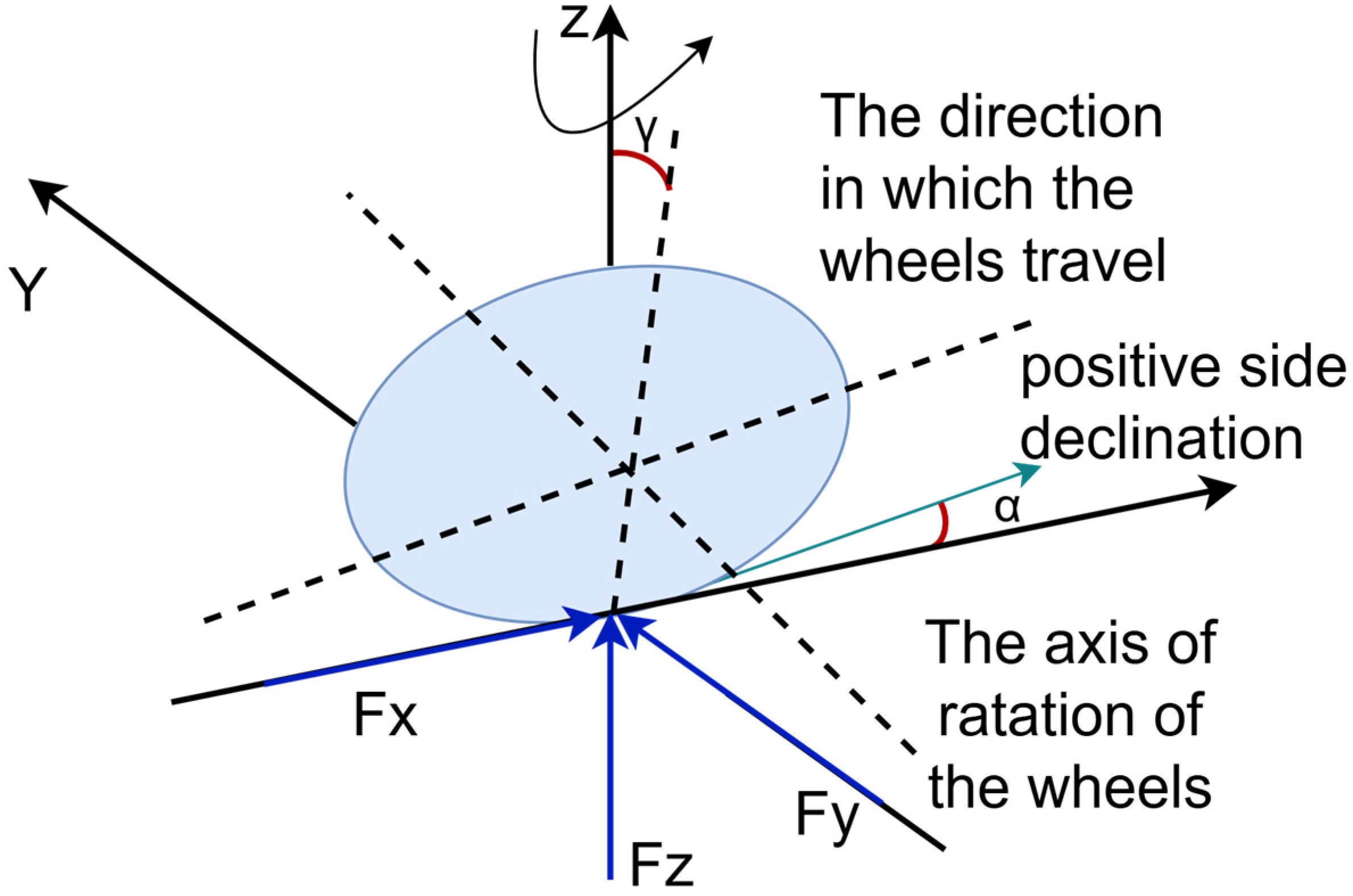
This study uses the Dugoff tire model due to its algorithmic compatibility and computational benefits. The model explicitly includes the road adhesion coefficient as a key parameter, providing a clear structure suitable for state estimation with filters like the SR-UKF. Compared to the more computationally demanding Magic Formula model, which requires many parameters, the Dugoff model offers a simpler approach with lower computational cost. This efficiency is essential for meeting the real-time control needs of distributed-drive electric vehicles. The mechanical relationships within the model are shown in
Figure 2.
The following formula gives the actual longitudinal and lateral forces on a tire:
In particular, the function
f(
L) determines the saturation characteristics of the tire force:
The formula for calculating the key parameter
L is as follows:
This model precisely controls the nonlinear transition of tire forces from linear to saturated states via the parameter L. When L ≥ 1, the system operates within the linear range, where tire force and the tire force ratio exhibit only linear or quasi-linear relationships with slip ratio, yaw angle, and stiffness, remaining consistently below the road surface adhesion limit. Upon entering the nonlinear saturation regime where L < 1, the force saturation function f(L) takes effect, constraining tire forces within the physical upper limit determined by μ·Fz. As slip intensifies and L decreases further, f(L) exhibits nonlinear decay, thereby accurately simulating the saturation and decay characteristics of tire forces.
In the formula,
is the road surface adhesion coefficient for each wheel,
represent the normalized longitudinal and lateral tire forces for each wheel (where i = 1, 2 denotes front and rear wheels, respectively, and j = l, r denotes left and right wheels, respectively);
indicate the force per unit slip and cornering stiffness of the tire, respectively, with these parameters being specified by concrete numerical values [
28], respectively;
is the tire model correction coefficient. When L < 1, the tire is in the nonlinear region; when L ≥ 1, it is in the linear region.
is the velocity influence factor;
represents the tire slip ratio and lateral slip angle;
represents the vertical load on each tire.
Then, the vertical load on the wheel is as follows:
In the formula, , , represent the distances from the vehicle’s center of gravity to the front and rear axles, respectively; is the height of the center of mass.
Wheel center speed is as follows:
In the formula, represent the speeds at the centers of the left front wheel, right front wheel, left rear wheel, and right rear wheel, respectively; represent the angular velocities of the left front wheel, right front wheel, left rear wheel, and right rear wheel, respectively.
The formula for calculating the slip rate is as follows:
The tire slip angles are as follows:
3. Estimation of Pavement Skid Resistance Using an SR-UKF
Standard methods for estimating road surface friction coefficients include the Extended Kalman Filter (EKF) and the Unscented Kalman Filter (UKF). The EKF depends on a local linearization approximation, which makes it difficult to apply to highly nonlinear systems. Additionally, calculating the Jacobian matrix is computationally demanding and can be error-prone. UKF computations are also intensive, offer limited real-time performance in high-dimensional systems, require complex parameter tuning, and can encounter numerical singularities in the covariance matrix under high-dimensional conditions [
29]. Building on the UKF framework, this paper introduces the SR-UKF method for estimating road surface friction coefficients. It does so by directly propagating and updating the square root of the covariance matrix, using numerically stable techniques like SVD. This method keeps the covariance matrix positive definite, effectively preventing numerical singularities common in high-dimensional scenarios with traditional UKFs, while also reducing computational load.
3.1. UKF Pavement Skid Resistance Estimation Method
The estimation of UKF road surface adhesion coefficients can be described as a nonlinear state-space model incorporating Gaussian white noise:
Among them is the state vector; is the input vector; represents process noise; is the noise measurement; is the nonlinear state function of the system; is the nonlinear measurement function of the system.
During the estimation process, the target is the road adhesion coefficient of the four wheels of the distributed-drive electric vehicle. The state variables are defined as follows: . Select motion signals directly obtainable from onboard sensors as the observation vector, defining the observation vector as , where represent longitudinal and lateral acceleration, respectively, and represents yaw angular velocity.
Let the sampling time be
. After discretizing the continuous-system model, we obtain the discrete state equations and observation equations under distributed input conditions:
In the formula,
respectively:
Additionally, the UKF algorithm generates sigma points through the U-T transformation to represent the probability distribution of state variables. These sigma points are processed through a nonlinear transformation and weighted reconstruction to perform state estimation. By incorporating the vehicle’s distributed drive characteristics with the Dugoff tire model, the state estimation process includes the following steps:
- 2.
Sigma Point Generation and Weight Calculation
For a 4-dimensional state vector (
n = 4), generate 2n + 1 Sigma points based on the current state mean
and covariance matrix
, covering the probability distribution of the state:
In the formula,
is the scaling parameter,
is the scaling factor,
is the distribution factor, and
is the secondary distribution factor.
In the formula, and represent the system mean weight and covariance weight, respectively.
- 3.
Time Updated
- 4.
Measurement Update
Observation of Sigma Point Transmission:
Calculation of Observed Covariance:
Mutual covariance calculation:
Posterior Covariance Update:
In the equation, represents the state sigma point, represents the estimated mean of the state vector, represents the measurement sigma point, and represents the predicted measurement mean.
3.2. SR-UKF Road Surface Friction Coefficient Estimation
To further improve the accuracy and robustness of the UKF, enhancements were made, resulting in the development of the Square Root Unscented Kalman Filter (SR-UKF) [
30,
31]. The process is shown in
Figure 3, with the following key improvements applied to the estimator:
- 1.
Simplification of Low-Dimensional Matrix Operations
When generating Sigma points and updating the covariance matrix in UKF, frequent matrix square root operations are required on the full-rank covariance matrix
. If the state dimension n is large, the computational complexity of Cholesky decomposition is
, and it is prone to failure when
is close to singular. The SR-UKF leverages the low-rank structure of the covariance square root matrix
, transforming high-dimensional matrix operations on
into low-dimensional column vector-level operations on
:
- 2.
Ensuring Positive Definiteness of the Covariance Matrix
Traditional UKF filtering directly stores and updates the covariance matrix . This covariance matrix may become non-positive definite due to rounding, truncation, or modeling errors, compromising the filter’s convergence and potentially leading to divergent estimation results. To this end, the SR-UKF algorithm replaces the original covariance matrix with its square root form, i.e., by using to consistently maintain as positive definite. The specific algorithm is as follows:
Calculate the square root of the initial covariance matrix:
Perform singular value decomposition (SVD) on the covariance matrix:
Calculation of the Square Root of the Observed Covariance:
Square root of posterior covariance update:
To avoid numerical ill-posedness, we enforce non-negativity of singular values by setting , where are orthogonal matrices, and is the singular value diagonal matrix. The improved approach directly replaces operations on the matrix with the square root matrix , mechanically ensuring the semi-positive definiteness of the covariance matrix. This fundamentally resolves the filtering instability and divergence issues caused by non-positive-definiteness in UKFs, thereby enhancing the algorithm’s reliability during prolonged iterations and in high-noise scenarios.
- 3.
Calculation of Kalman Gain Based on SVD
When calculating the Kalman gain
in the UKF, if the measurement covariance
approaches the singularity, numerical instability may occur during matrix inversion. The SR-UKF similarly employs SVD on the measurement covariance
to generate the square root
, and rewrites the gain calculation as follows:
The parameters for the SR-UKF algorithm employed in this study were determined through a systematic approach, with the following specific settings: the process noise covariance matrix Q was configured based on the time-varying characteristics of the state variables. Considering the slow variation in the road surface friction coefficient μ over the sampling period, a slight noise variance was assigned, balancing state tracking capability with noise suppression requirements. The measurement noise covariance matrix R was set to based on the typical measurement accuracy of reference sensors, reasonably reflecting the uncertainty of different observations. Due to inherent uncertainty in the initial state, the initial error covariance matrix was set to , enabling the filter to correct estimates during the initial phase rapidly. The parameter values for the unscented transform follow standard recommendations, with scaling parameters set to = 0.001, = 0, and . This configuration ensures the Sigma point set effectively characterizes the probabilistic distribution properties of the state.
4. Simulation Analysis and Verification
4.1. Matlab/Simulink and CarSim Joint Simulation Modeling
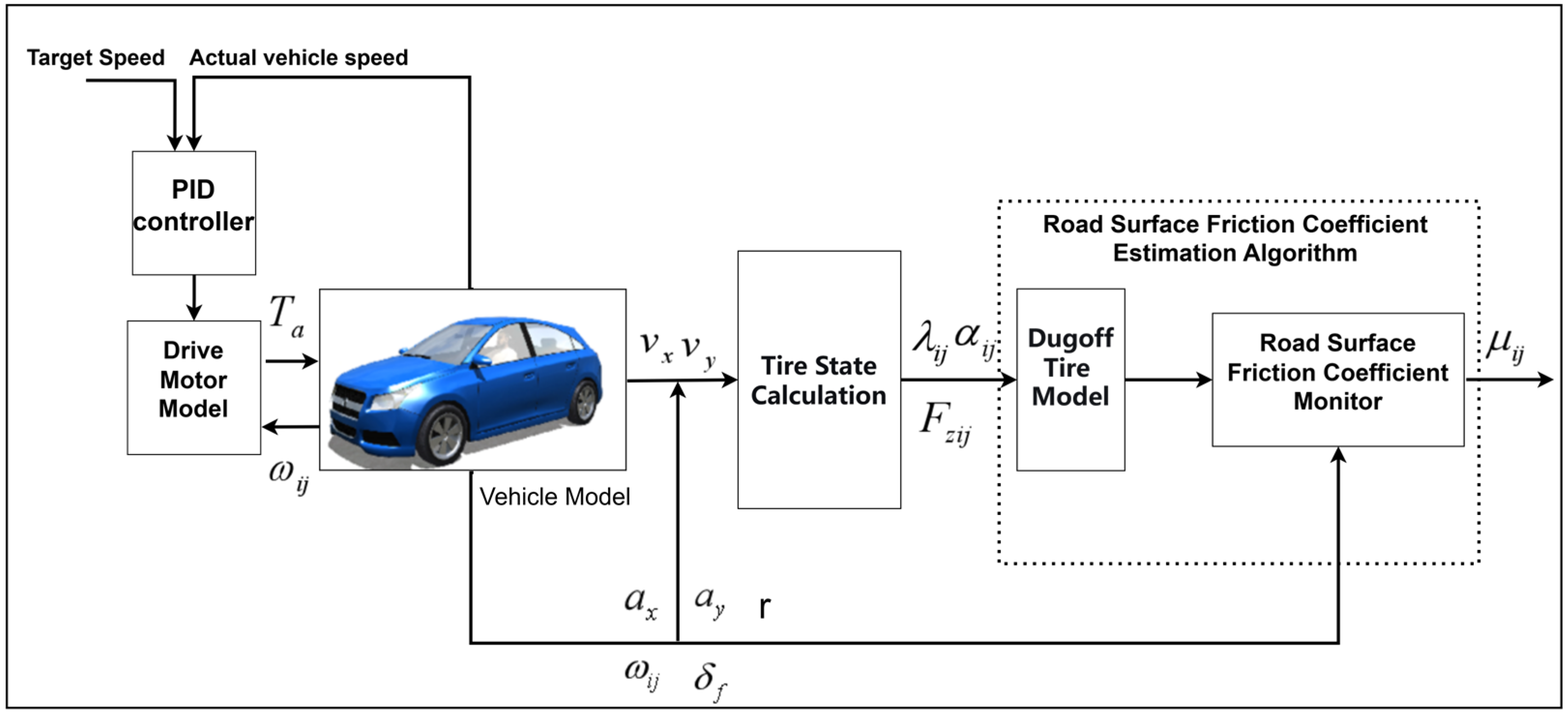
To validate the efficacy and performance enhancement of the SR-UKF algorithm, this paper selects the standard UKF as the core comparative benchmark. This choice is based on the following considerations: as a numerically stable variant of the UKF, the SR-UKF shares the same algorithmic framework as the standard UKF. Direct comparison can effectively isolate and highlight the contributions of both the square-root covariance treatment and SVD to improving numerical stability, accelerating convergence, and enhancing accuracy. The primary focus of this paper is on strengthening the numerical robustness of the state estimator rather than designing adaptive noise or complex multi-model structures. Therefore, comparison with the UKF, which shares the same fixed noise assumption, is most appropriate. Based on this, a joint simulation platform integrating CarSim and Simulink was established. The overall architecture is shown in
Figure 4, and the vehicle parameters are detailed in
Table 2.
Model mismatch in simulation is achieved through the following configuration: the CarSim high-fidelity vehicle model employs a magic formula tire model, whilst the observer is based on a simplified Dugoff model. This structural and parametric inherent discrepancy effectively replicates the model uncertainty present in real-world systems. The final results demonstrate that the SR-UKF algorithm maintains high estimation accuracy under these mismatched conditions, proving its exceptional robustness and potential for practical deployment.
In
Figure 4, the drive motor model is a permanent-magnet synchronous motor, a nonlinear, time-varying, strongly coupled complex system. Before modeling, the following assumptions are made:
Neglecting motor core saturation, eddy current, and hysteresis losses;
The stator’s three-phase windings are connected in a Y configuration and symmetrically distributed, with their axes offset by 120°;
The induced electromotive force generated by the three-phase stator armature windings of the motor is a sine wave.
To simplify the nonlinear characteristics of three-phase AC motors, the Park transformation is employed to convert the three-phase stationary coordinate system (abc) into a two-phase rotating coordinate system (d-q), thereby establishing a linearized model. The core equations are as follows:
The voltage equation is as follows:
In the equation, represent the d-axis and q-axis stator voltages, respectively; represent the d-axis and q-axis stator voltages, respectively; denote the d-axis and q-axis inductances; denote the d-axis and q-axis stator currents, respectively; denotes the stator resistance; denotes the electrical angular velocity; and denotes the permanent magnet flux linkage.
The electromagnetic torque equation is as follows:
In the formula, represents the electromagnetic torque (N·m), and denotes the number of pole pairs in the motor.
The stator flux linkage equation is as follows:
In the equation, represent the stator flux components along the d-axis and q-axis, respectively.
The equation of mechanical motion is as follows:
In the equation, represents the motor load torque (N·m), denotes the motor rotational inertia (kg·m2), indicates the motor mechanical angular velocity (rad/s), and signifies the viscous friction coefficient (N·m·s/rad); where .
In
Figure 4, the PID controller is used for vehicle speed tracking. To directly investigate the cooperative control law between speed tracking and torque distribution in distributed drive systems, the human–machine interface between driver and pedal is simplified. A hierarchical control architecture is adopted to allocate speed-following and distributed torque rationally. The upper layer controls vehicle speed via PID, generating a total desired driving torque based on the deviation between the target
and actual speed
as input. The middle layer directly generates the total driving torque through a PID controller. This torque is transmitted to each hub motor via the middle-layer distribution strategy, ultimately driving the vehicle to track the target speed.
In the equation, denote the proportional, integral, and derivative coefficients, respectively; represents the vehicle speed deviation; denotes the target speed; and represents the actual speed.
4.2. Simulation Verification Analysis Under Typical Operating Conditions
To evaluate the algorithm’s performance, the SR-UKF algorithm’s estimation results were compared with those of the traditional UKF algorithm. Four typical driving scenarios were selected for simulation: straight-line acceleration on high-friction surfaces, turning on low-friction surfaces, constant-speed straight-line driving on opposing lanes, and straight-line acceleration on opposing lanes.
Secondly, to evaluate the estimation accuracy and performance of the square root Unscented Kalman filter, this paper employs the mean absolute error as one of the evaluation metrics. The formula for calculating the mean absolute error is as follows:
In the formula, denotes the total number of data samples, represents the actual value of the i-th sample, and denotes the predicted value of the i-th sample.
4.2.1. Simulation of High-Adhesion Coefficient Pavement Linear Acceleration Conditions
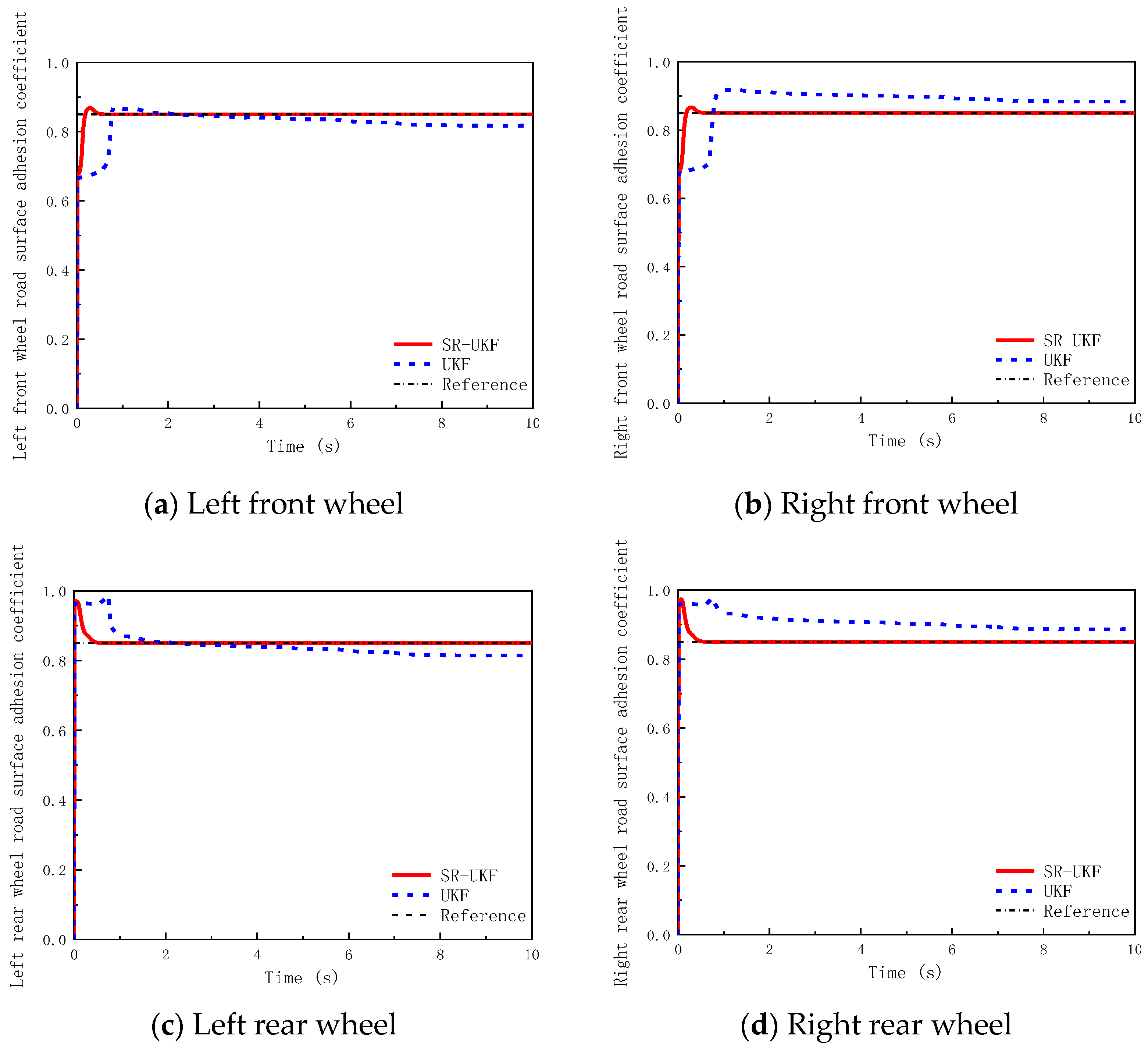
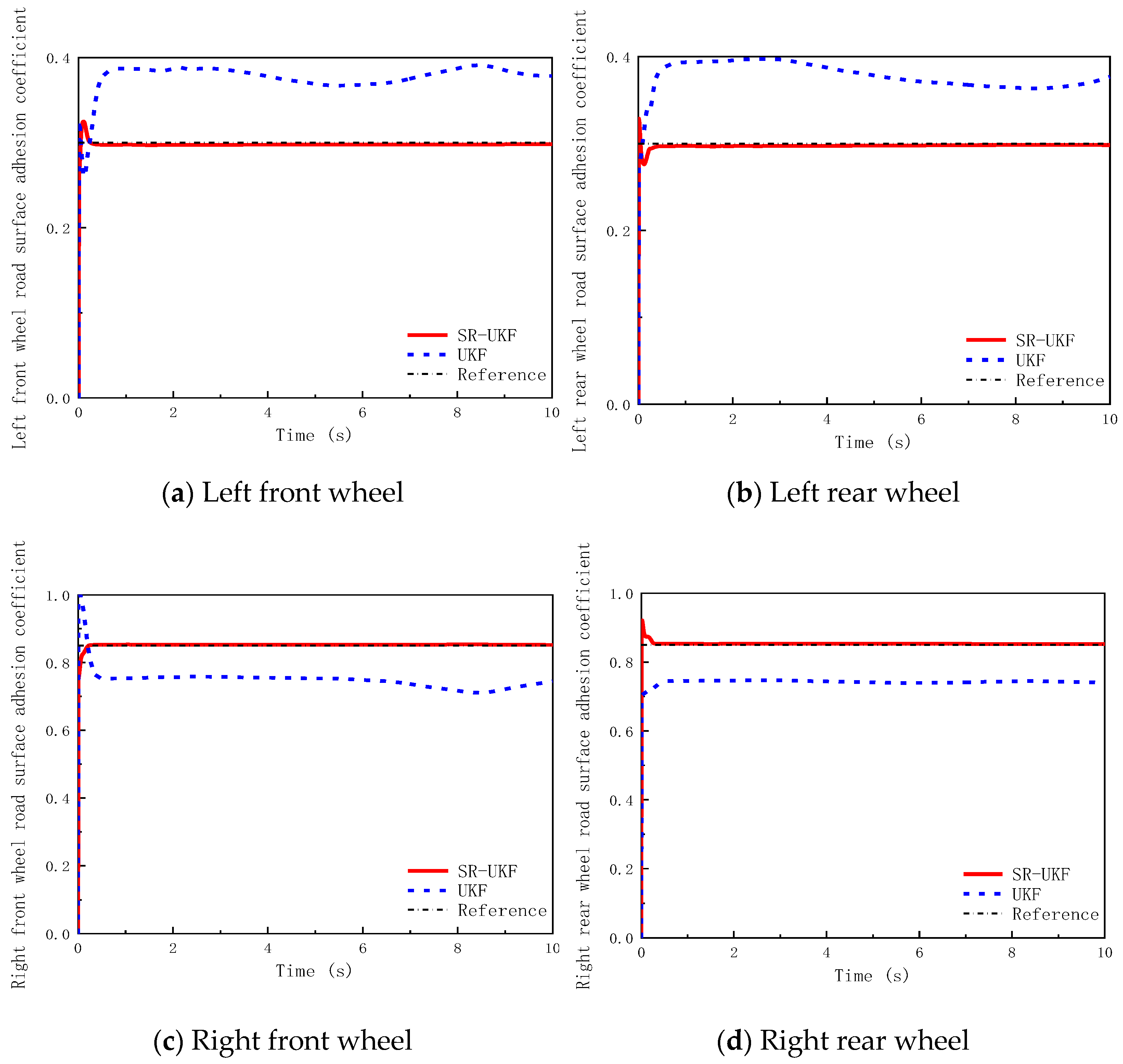
During simulation, the road surface adhesion coefficient was set to 0.85, with an initial vehicle speed of 20 km/h, a steering wheel angle of 0°, and a throttle opening of 0.3. The simulation results are shown in
Figure 5. The SR-UKF algorithm’s estimated curve rapidly and accurately converges to the actual value of 0.85 within approximately 0.4 s, demonstrating a fast convergence rate. In contrast, the traditional UKF algorithm exhibits unstable estimation and fails to converge effectively throughout the simulation. In terms of estimation accuracy and robustness, as shown in
Table 3, the SR-UKF exhibits a mean absolute error of merely 0.0031. Compared to the UKF’s mean absolute error of 0.0430, this represents a reduction in estimation error of approximately 92.8%. This demonstrates that the SR-UKF outperforms the traditional UKF algorithm in both steady-state estimation accuracy and numerical stability.
4.2.2. Simulation Validation of Low-Low-Adhesion Coefficient Road Surface Constant-Speed Rotation Conditions
During simulation, the road surface adhesion coefficient is set to 0.35. The vehicle performs a uniform-speed turning maneuver on the road surface at 40 km/h. The steering wheel angle changes from 0° to 60° within 0–0.3 s, and remains fixed at 60° after 0.4 s. The simulation results are shown in
Figure 6. After the vehicle begins turning, the SR-UKF algorithm converges rapidly, within approximately 0.3 s via SVD, yielding estimates that are highly consistent with the actual values. In contrast, the traditional UKF algorithm takes about 1.2 s to converge, exhibiting a slow convergence rate and significant deviation from the actual values after convergence. As shown in
Table 4, the SR-UKF estimation results exhibit minimal inter-iteration error variations with an average absolute error of 0.0011—significantly lower than the UKF’s 0.0061, representing an 82% reduction in estimation error and further validating the algorithm’s stability and reliability under low-adhesion conditions. This further validates the SR-UKF algorithm’s stability and reliability under low-attachment conditions.
4.2.3. Simulation and Validation of the Straight-Line Driving at Constant Speed on a Split-μ Road Scenario
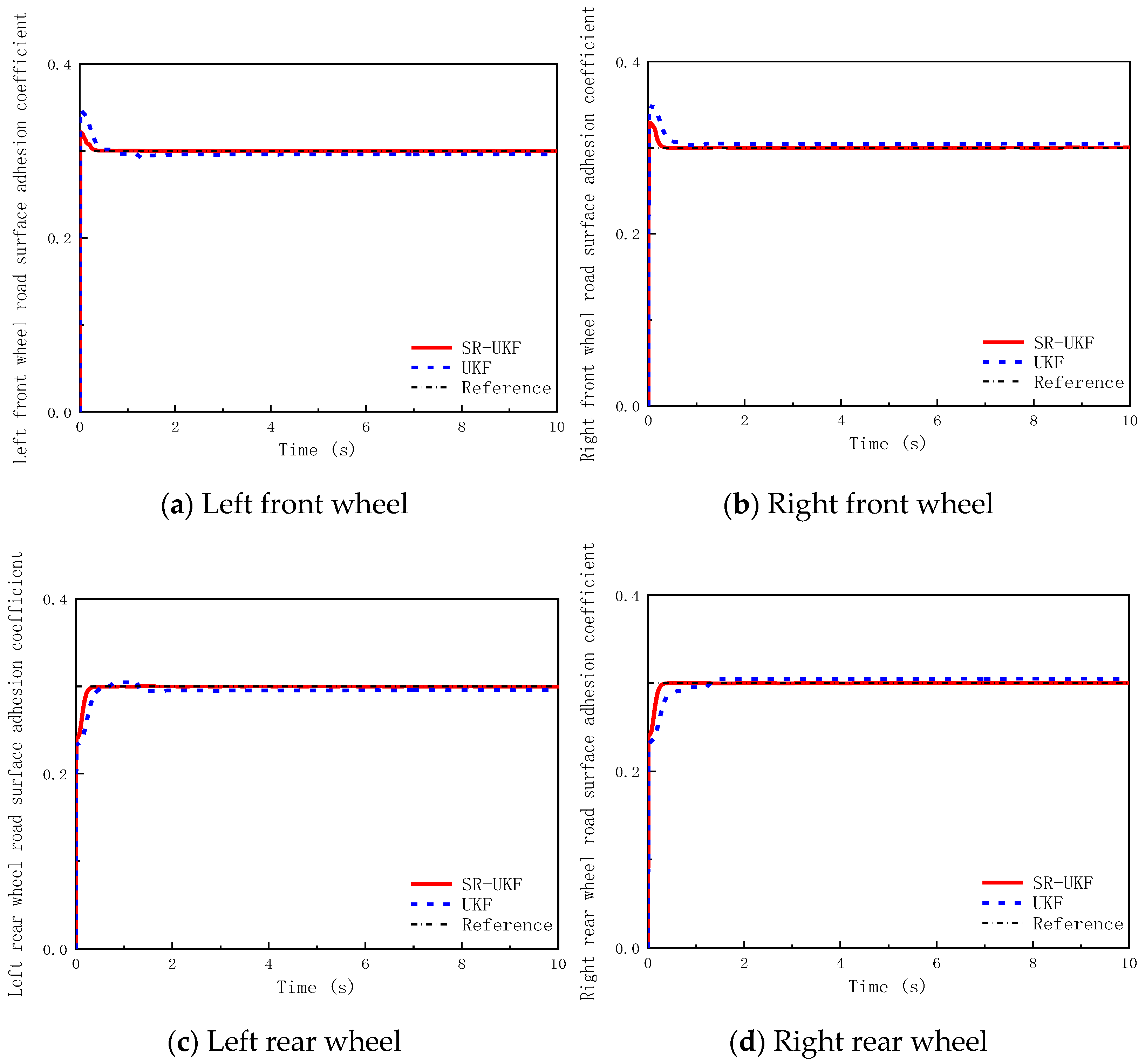
During the simulation, the left road surface adhesion coefficient was set to 0.3 and the right to 0.85. The vehicle traveled in a straight line at 40 km/h with the steering wheel at a 0° angle. The simulation results are shown in
Figure 7. The SR-UKF algorithm quickly converged the estimated values of the left and right wheels to their actual values with high accuracy. In contrast, the UKF algorithm showed significant fluctuations in its estimated curves and failed to maintain stable tracking of the actual values over time. As shown in
Table 5, the mean absolute error of the SR-UKF (0.0037) is much lower than that of the UKF (0.0924), indicating an estimated reduction in error of about 96%. This clearly demonstrates its superior adaptability under open-road conditions.
4.2.4. Simulation Verification of Straight-Line Acceleration on Opposing-μ Road Surfaces
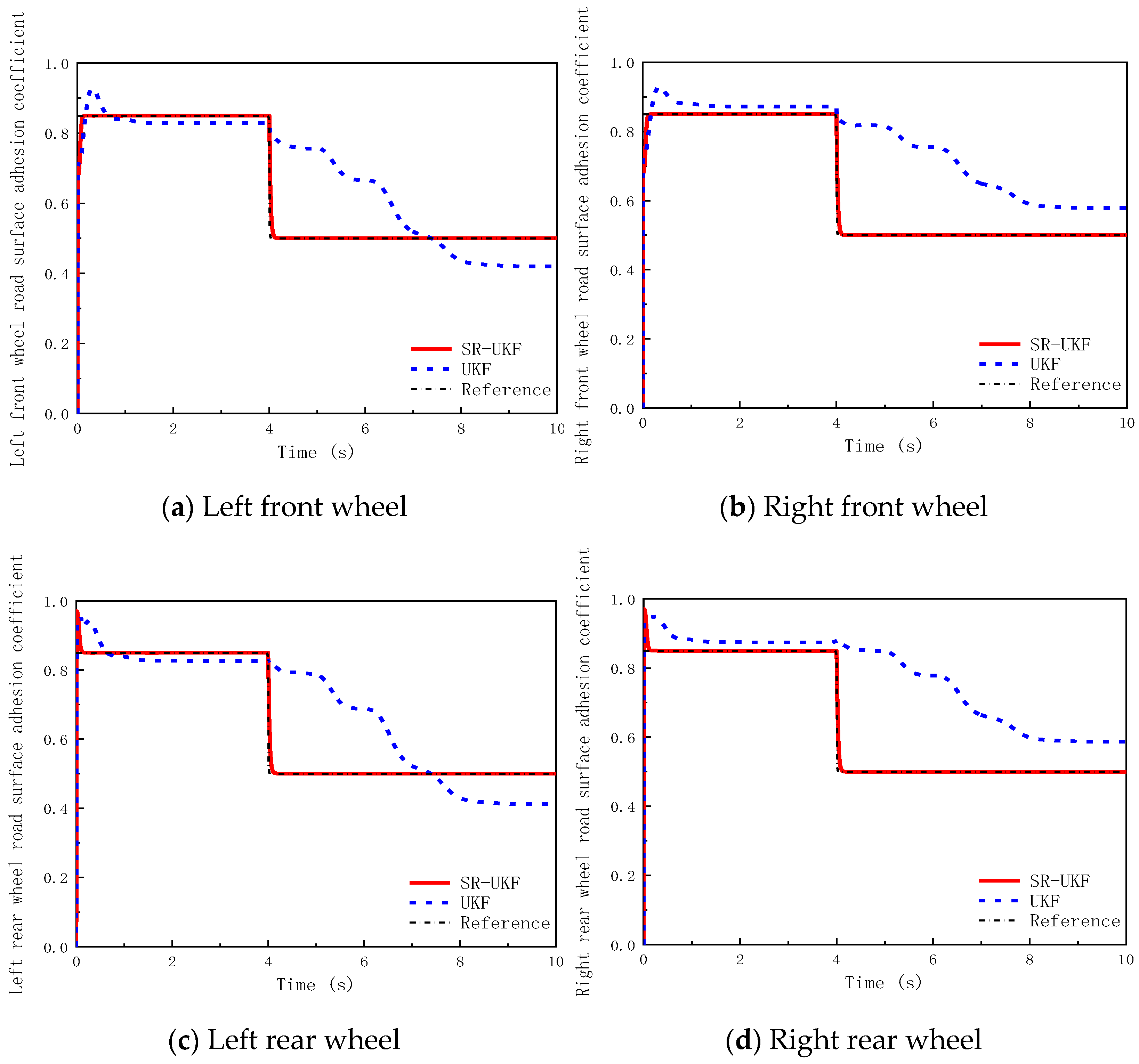
During simulation, set the road surface adhesion coefficient to 0.85 for the first 4 s and 0.5 for the following 6 s. The vehicle’s initial speed is 20 km/h, the throttle opening is 0.3, and the steering wheel angle is 0°. As shown in
Figure 8, after two switches in operating conditions, the SR-UKF quickly converged to the new actual value within approximately 0.2 s. In contrast, the UKF not only converged more slowly but also showed severe oscillations at the switching points, failing to maintain stable tracking. This demonstrates that the SR-UKF provides better suppression of system disturbances and improved robustness. As shown in
Table 6, the SR-UKF achieves an average absolute error of only 0.0059, a reduction of roughly 97% compared to the UKF’s 0.1922. This performance greatly surpasses that of traditional methods.
4.3. Analysis of the Mean Absolute Error Data for Each Wheel Under Multiple Low Road Surface Adhesion Coefficients
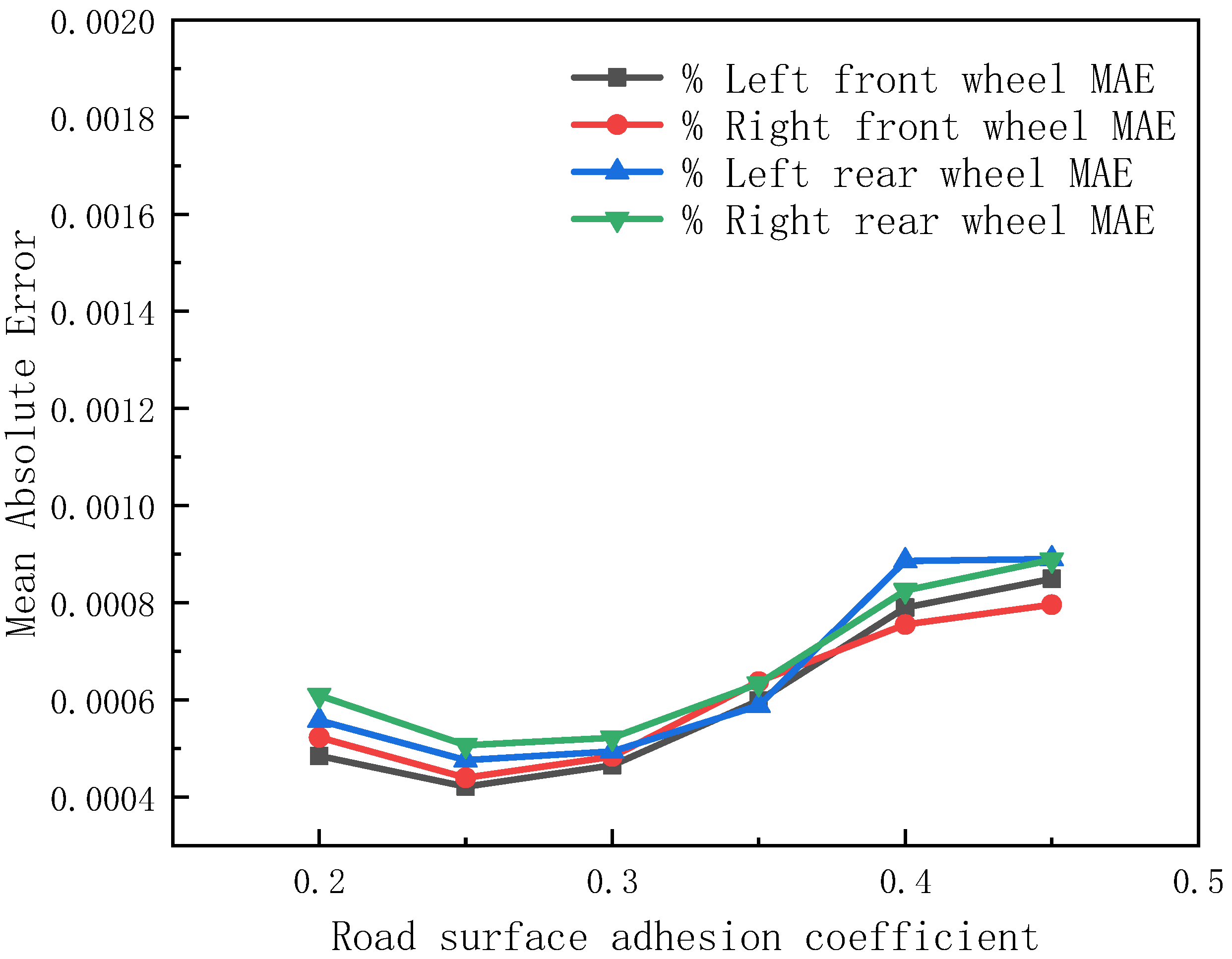
Low-coefficient-of-adhesion road surfaces are typical conditions that cause vehicle dynamic instability, with tire–road interactions showing clear nonlinearity. To systematically explore these effects, this study simulated multiple low-adhesion surfaces with coefficients of 0.2, 0.25, 0.3, 0.35, 0.4, and 0.45. During the simulation, the vehicle traveled at a steady 40 km/h in a straight line, with the steering wheel fixed at 0°. As shown in
Figure 9, the mean absolute error (MAE) for the left front wheel, right front wheel, left rear wheel, and right rear wheel stays low under these low-adhesion conditions. The parameters in
Table 7 show small error fluctuations for each wheel, indicating that this algorithm provides high accuracy and robustness in estimating the four-wheel system on low-adhesion road surfaces.