
Article

Lyapunov-Based Pitch Control for Electric Vehicles Using In-Wheel Motors
by
Andrew Valdivieso-Soto
1,
Renato Galluzzi
1,*,
Eugenio Tramacere
2,
Riccardo Cespi
3 and
Luis M. Castellanos Molina
2
1
School of Engineering and Sciences, Tecnologico de Monterrey, Mexico City 14380, Mexico
2
Department of Mechanical and Aerospace Engineering, Politecnico di Torino, 10129 Turin, Italy
3
School of Engineering and Sciences, Tecnologico de Monterrey, Monterrey 64849, Mexico
*
Author to whom correspondence should be addressed.
Vehicles 2025, 7(2), 37; https://doi.org/10.3390/vehicles7020037

Submission received: 12 March 2025 / Revised: 24 April 2025 / Accepted: 25 April 2025 / Published: 26 April 2025

Abstract

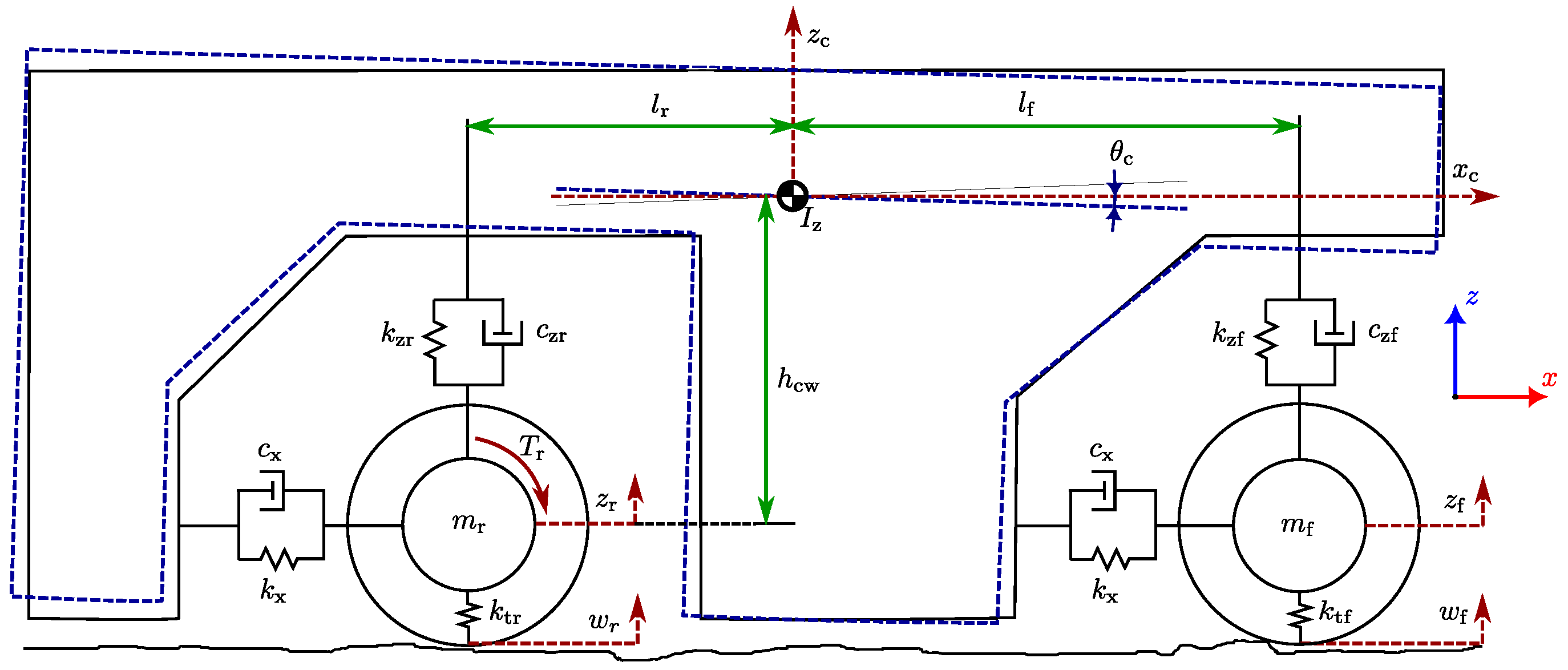
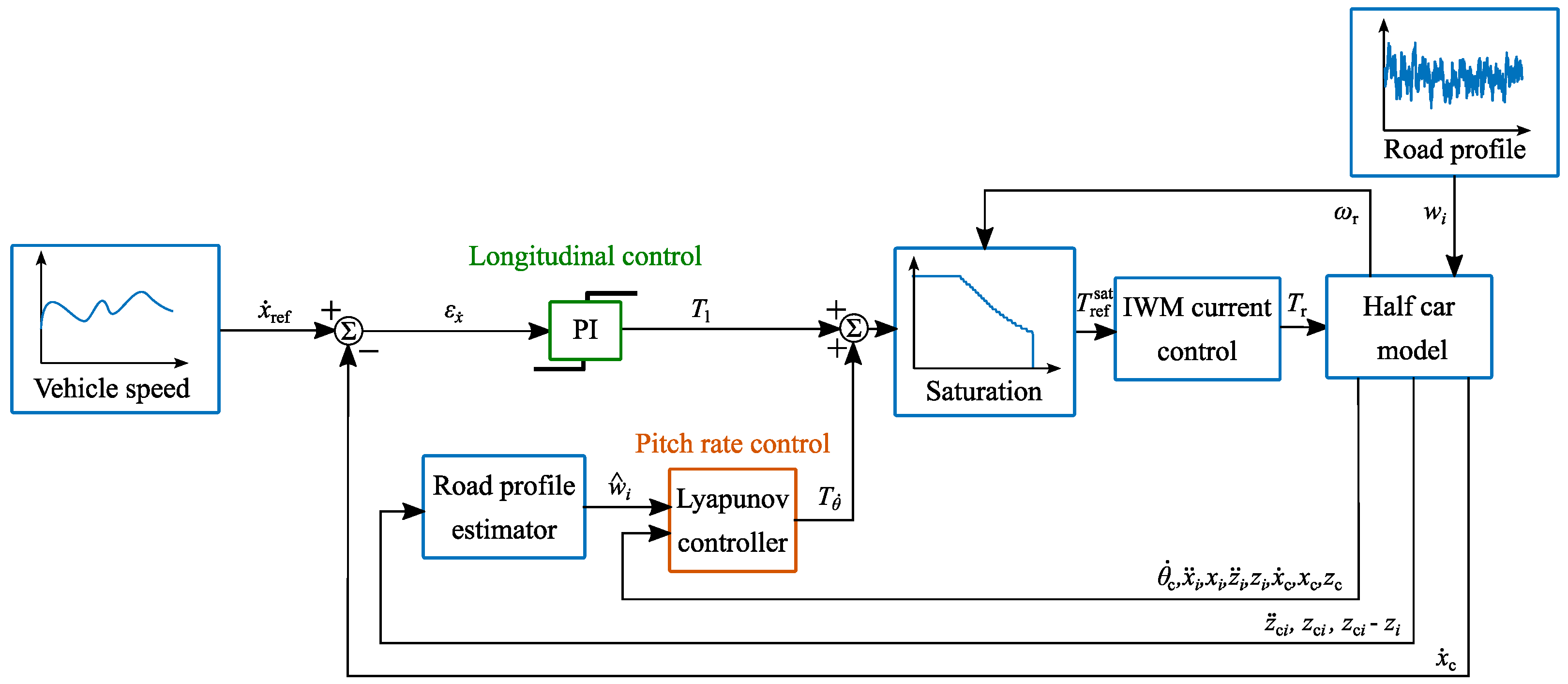
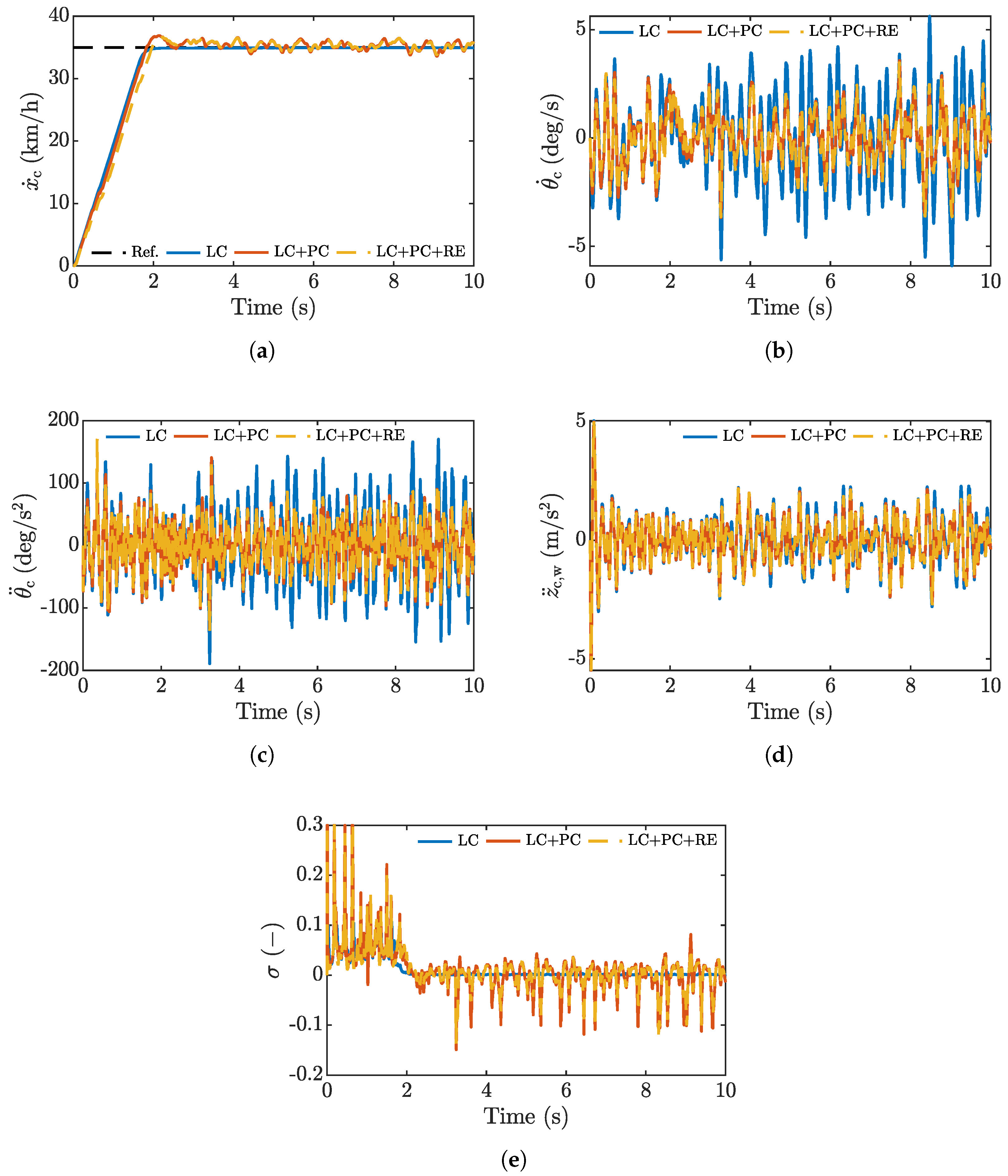
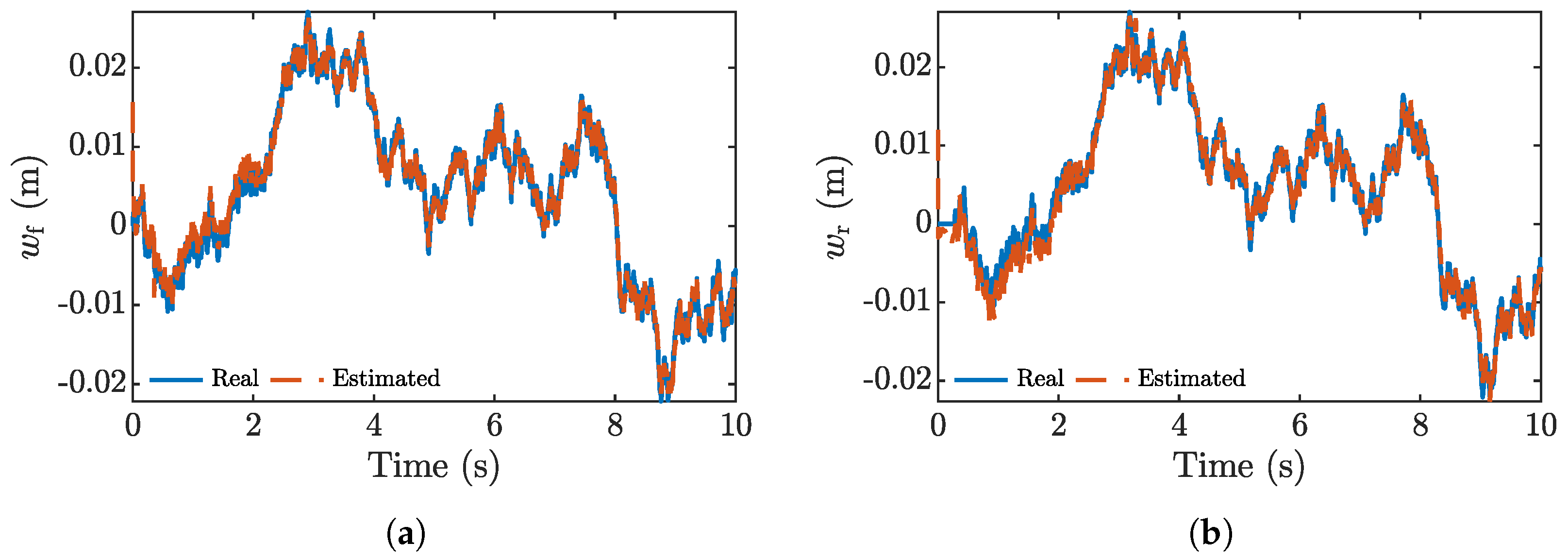
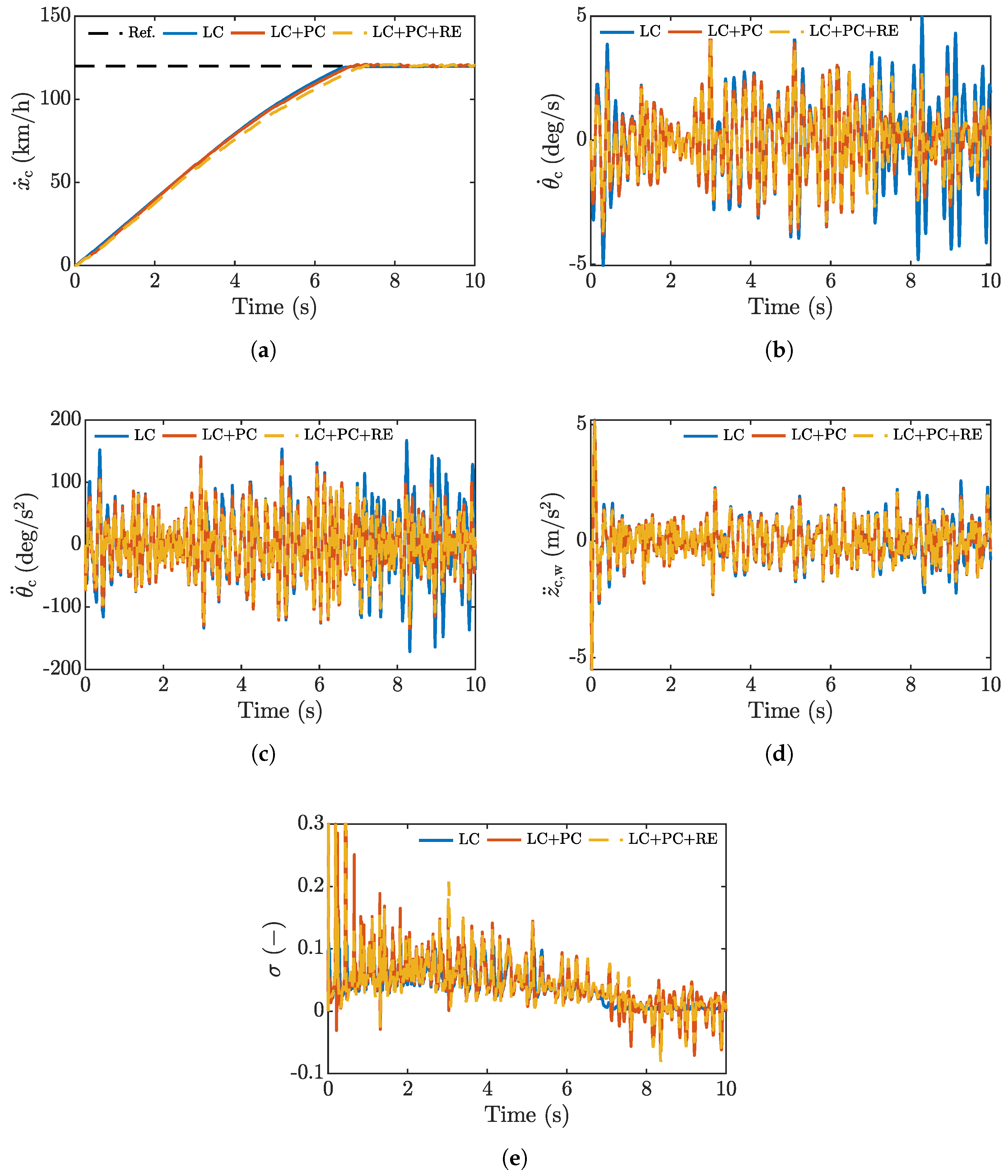
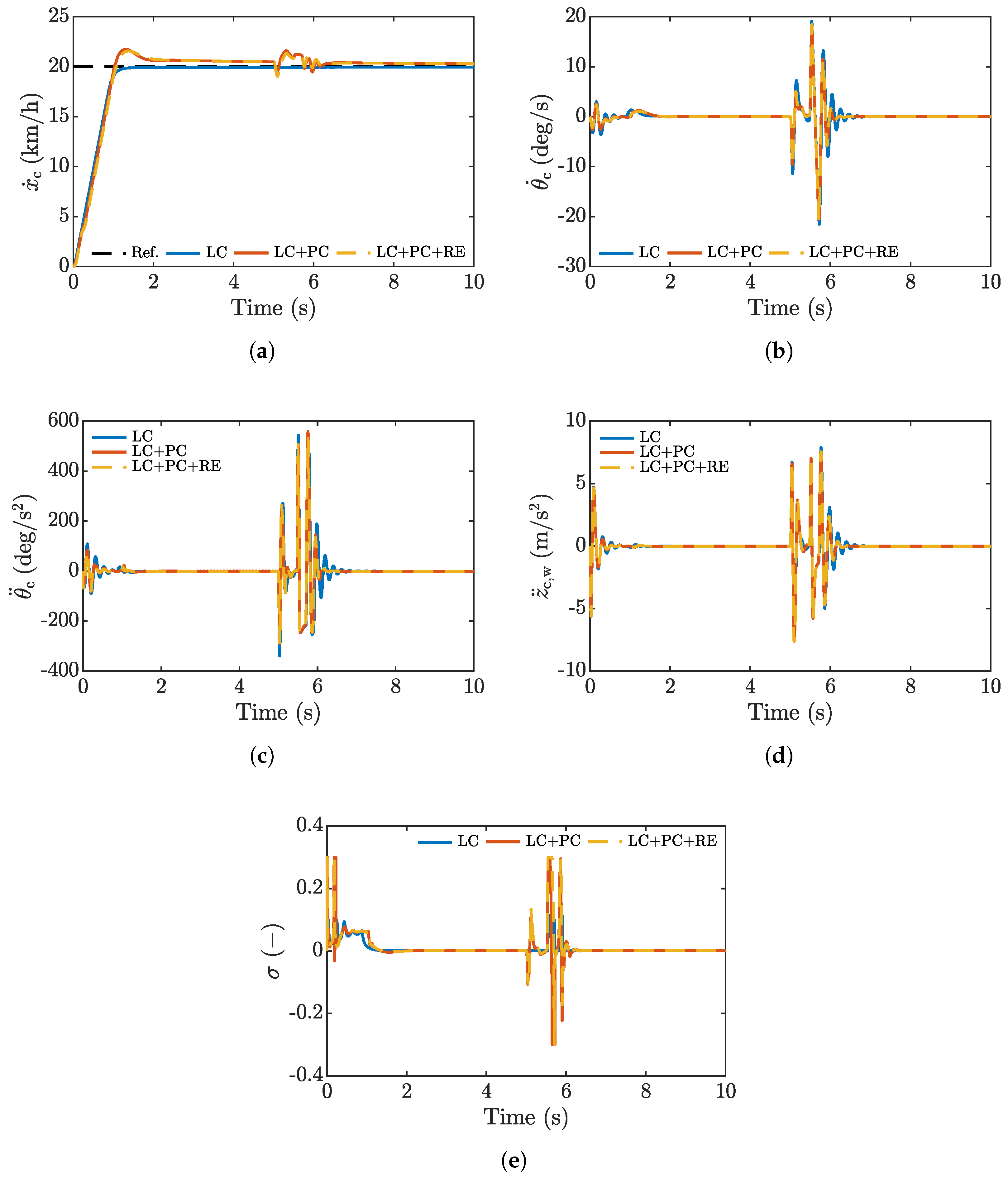
Modern powertrain configurations for electric vehicles introduce the possibility to actuate the wheel directly by means of in-wheel motors. These machines enable stiffer and more efficient traction, with the possibility of introducing pitch motion control due to the intrinsic coupling between longitudinal, vertical, and pitch dynamics. This paper proposes a pitch rate attenuation control exploiting a Lyapunov function that attempts to cancel the pitch rate dynamics from the model. Unlike previous works, this pitch control is performed exclusively with the traction machine; it does not rely on controllable suspension systems. The controller formulation guarantees global stability of the vehicle. Furthermore, it considers the nonlinearity of the plant introduced by the dependency on the pitch angle. To facilitate the feedback of the road profile needed by the Lyapunov controller, two Kalman filters are included in the control law. This work implements the described strategy on a half car model. Simulations examine different speed and road conditions. It is demonstrated that the control strategy can blend longitudinal and pitch rate attenuation torque commands using a rear in-wheel motor, attaining a reduction of up to 41% for chassis pitch rate and 36% for pitch acceleration.
Keywords: chassis control; coupled dynamics; in-wheel motor; Lyapunov control; vehicle dynamics chassis control; coupled dynamics; in-wheel motor; Lyapunov control; vehicle dynamics