1. Introduction
Buffaloes (
Bubalus bubalis) represent a livestock species of major zootechnical interest worldwide, with an estimated global population of approximately 205 million [
1]. However, their distribution is uneven: 0.2% in Europe, 0.7% in Africa (mainly in Egypt), and 1% in South America, while over 98% of the total population is found in Asia [
1]. The increasing significance of buffalo in South Asia is reflected in their population growth rate, which has surpassed that of cattle. Despite notable declines in certain East and Southeast Asian countries, buffalo continue to play a pivotal role in the region, serving primarily as a source of milk, secondarily for meat production, and additionally as draught power [
2]. In Europe, buffalo production is expanding in Italy, driven by technological and genetic improvements and strong dairy and meat markets, whereas most other countries have seen a decline due to mechanization and a lack of dairy breed selection [
3]. In Romania, buffaloes are traditionally reared for milk and meat production, as well as for traction purposes. Buffalo farming in Romania faces economic difficulties linked to low productivity and declining herd numbers; of the total milk production, 58% is marketed, 28% is used for household consumption, and 14% is processed on-farm [
4]. The Romanian buffalo belongs to the Mediterranean river buffalo group and originates from domesticated Asian buffalo populations. Two main ecological and morphological types are recognized within the breed, namely the Transylvanian and the Danube plains types, which differ in body size, thoracic development, limb conformation, and udder characteristics [
5].
The dairy buffalo has become an increasingly important livestock species in various regions of the world, owing to its high adaptability [
6], long productive lifespan [
7], and the nutritional value of its milk [
8]. Buffalo milk is highly appreciated for its elevated fat and protein content, being widely used in the production of cheese and traditional dairy products [
9]. However, the productive and reproductive performance (rusticity [
10], long postpartum anestrus period [
11], calving interval [
12]) of buffalo is influenced by a range of biological and management factors, which ultimately determine the economic efficiency of buffalo farming systems [
13].
Among these factors, age at first calving plays a crucial role in determining the animal’s productive potential throughout its lifetime [
14]. In addition, offspring viability and sex may subsequently influence female buffaloes’ biological performance and milk yield, as calf sex has been reported to significantly affect daily milk production, while having limited or no effect on milk composition in some studies [
15,
16]. Likewise, the number and duration of lactations are important indicators for assessing the functional longevity of buffaloes and for estimating the economic profitability of specialized farms [
17,
18].
In the literature, there are few studies that simultaneously correlate reproductive parameters (such as age at first calving, sex, and viability of offspring) with productive performance (milk yield and composition) [
19]. Moreover, a recent book chapter has further explored methodological approaches for integrating reproductive and productive datasets, providing practical guidelines for long-term herd management [
20]. Aspects such as the influence of fetal sex on milk production and the relationship between lactation length and the sex of the subsequent calf are less well documented, and long-term datasets integrating reproductive longevity and milk production in European buffalo populations remain limited, despite their potential practical implications for reproductive management and genetic selection.
Considering these aspects, the aim of the present study was to analyze the relationships between reproductive and productive traits in buffaloes using descriptive and inferential statistical approaches. This study provides an integrated overview of the factors influencing buffalo productivity and identifies potential directions for improving reproductive management and milk production efficiency.
2. Materials and Methods
The data used in this study covered a 30-year period (1990–2020) and analyzed the productive and reproductive performance of buffaloes reared at the Research and Development Station for Buffalo Breeding in Șercaia, Brașov County, in central Romania. The study was conducted exclusively on a single research herd and does not include data from other farms. The area is characterized by intramontane valley relief, with average altitudes of 400–500 m above sea level. The region has a temperate-continental climate, with moderate summers (average temperatures of 19–21 °C) and cold winters (average temperatures of −2 to −4 °C), which influences animal management and housing systems [
21].
Animals were managed under a mixed production system, with free grazing from May to October and tethered housing from November to April, according to local climatic conditions. During the indoor period, animals received a constant ration based on silage and concentrated feeds. The Romanian buffalo is a dual-purpose breed (milk and meat), well adapted to variable climatic conditions and semi-intensive rearing systems. All animals included in the study belonged to the Transylvanian type of Romanian buffalo [
22].
This study is a retrospective observational analysis based on historical farm records routinely maintained at the station, in which reproductive and productive data were recorded at the individual-animal level using official herd registers. The initial herd records covered a larger number of females monitored during the 30-year period; however, only buffalo cows with complete lifetime reproductive and productive records were retained for analysis. The inclusion criteria required that animals experienced their first gestation and calving within the research herd and were followed from first calving until the end of their productive life, regardless of the reason for exit (culling, slaughter, or mortality). Animals with incomplete, missing, or inconsistent records were excluded. After applying the screening procedure, 310 buffalo cows met the eligibility criteria and were included in the final statistical analysis.
All animals were assigned unique identification numbers, enabling accurate tracking of individual buffalo cows across successive lactations and ensuring correct attribution of reproductive and production data. The analyzed parameters included age at first calving, total number of lactations during the productive lifetime, total milk yield per complete lactation, milk fat content, and calf sex.
Breeding was performed using both natural mating and artificial insemination, depending on year and availability of semen, following routine herd reproductive management practices.
Pregnancy was routinely diagnosed by rectal palpation and, when available in later years, confirmed by transrectal ultrasonography between 35 and 60 days after breeding, according to the standard reproductive management protocols applied at the station. Pregnancy status was recorded in the official herd registers based on clinical reproductive examinations performed by trained veterinarians.
After calving, a voluntary waiting period of approximately 60 days was applied before breeding was initiated, allowing uterine involution and recovery of body condition prior to mating or artificial insemination.
Animals were followed from first calving until removal from the herd due to culling, slaughter, or mortality, and this age was recorded in the herd registers as the end of productive life.
Milk production data were obtained through the official milk recording system conducted monthly by the Transylvanian Cattle Breeders’ Association, in accordance with national standards. Milk fat content was determined by laboratory analyses conducted by the official veterinary authority, using standardized analytical procedures consistently applied during routine milk recording. Milk fat percentage was the only compositional trait consistently available across the entire 30-year study period and was therefore retained for analysis. Other parameters, such as milk protein content and somatic cell count, were not consistently recorded throughout the study period and were excluded to maintain data homogeneity and avoid temporal bias. Milk production variables were derived from standardized lactation totals recorded in the official herd registers; therefore, the analysis was conducted using aggregated lactation-level and lifetime production data rather than repeated test-day measurements within lactation.
A separate analysis of lactation duration was not performed because lifetime productivity indicators already captured the cumulative biological effect of successive lactations, while individual lactation length in this retrospective dataset was strongly influenced by management decisions such as drying-off practices, health status, and culling time.
This study represents a long-term retrospective analysis conducted on a single research farm. Therefore, the findings should be interpreted primarily at the herd level and considered as a case study rather than fully representative of the national buffalo population or of all temperate production systems.
Statistical analyses were performed using JASP 0.95.4 software. Descriptive statistics are reported as mean ± standard deviation (SD) for normally distributed variables and as median with interquartile range (IQR, 25th–75th percentiles) for non-normally distributed variables. Data distribution was assessed using the Shapiro–Wilk test and visual inspection of Q–Q plots. The statistical unit of analysis was the individual buffalo cow. Reproductive and productive variables were evaluated as aggregated indicators at the animal or lactation level, rather than repeated test-day measurements across time; therefore, observations were considered independent for the applied comparative tests. Comparative analyses between groups were conducted using parametric or nonparametric tests, as appropriate (independent-samples t-test or one-way ANOVA for normally distributed data; Mann–Whitney U test or Kruskal–Wallis test for nonnormally distributed data). Simple linear regression analyses were performed to assess linear associations between variables. Statistical significance was set at p < 0.05.
Lactations were considered complete when animals were milked continuously from calving until drying-off. The dry period generally ranged between 60 and 90 days prior to the subsequent calving, in accordance with standard buffalo management practices at the station. Although information on lactation length and dry period was available in herd records, these variables were not included as primary outcomes due to inter-individual variability and the study’s primary focus on lifetime reproductive longevity and total milk yield per complete lactation.
3. Results
3.1. Age at First Calving
The results are based on data collected from 310 individual buffalo cows, each identified by a unique identification number and followed longitudinally across successive lactations from first calving until removal from the herd. Each animal contributed multiple lactation records, resulting in a dataset comprising several cow-lactation observations per individual, reflecting the long productive lifespan characteristic of the studied population.
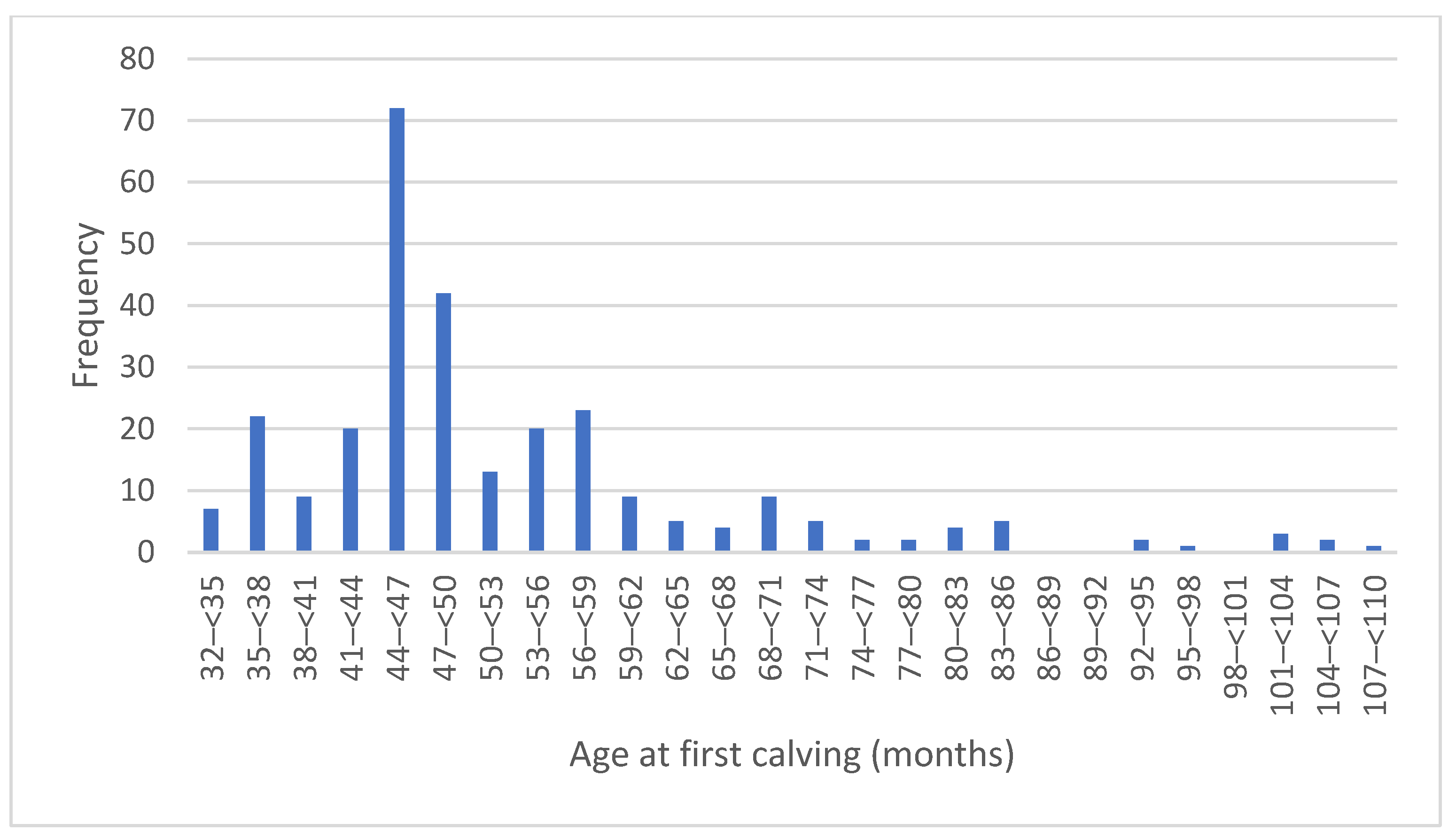
Age at first calving is a key indicator of reproductive performance, influencing both productive longevity and the economic efficiency of the herd (
Figure 1). In the analyzed population (n = 310 buffaloes), age at first calving was described as mean ± standard deviation, with a mean of 51.6 ± 14.0 months and a median of 48 months. The distribution exhibited positive skewness (skewness = 1.746, Z-skewness = 12.04), indicating a significant departure from normality. This suggests that while most females calved at approximately 4 years of age, a substantial proportion experienced delayed first calving, with values extending beyond 60–80 months. Such a pattern may reflect fertility issues, failure of the first mating, or inconsistent reproductive management practices [
12].
3.1.1. Age at First Calving in Relation to Offspring Viability
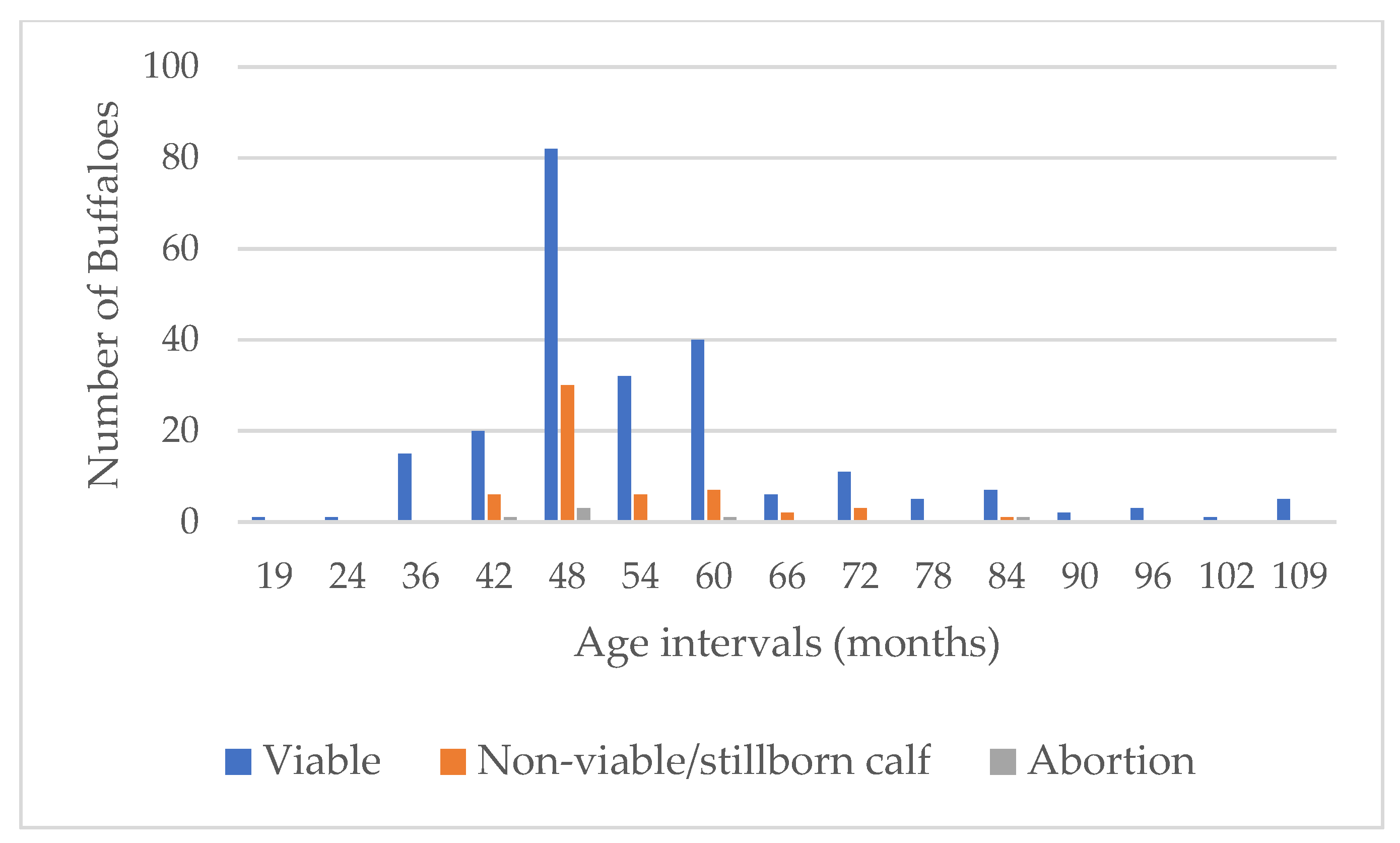
The analysis of age at first calving according to the calving outcome revealed similar mean values across groups: 52.9 months for females with viable offspring, 49.9 months for those with non-viable or stillborn calves, and 52.2 months for abortion cases (
Table 1). Although the overall dataset comprised 310 females, only a small subset (n = 10) experienced abortion during their first gestation, which restricts the robustness and generalizability of conclusions regarding this category at first calving. The greatest dispersion was observed in the abortion group, suggesting additional variability related to individual factors, while the lowest variability occurred in the group with non-viable offspring.
From a statistical perspective, the ANOVA test (
p = 0.375) and the Kruskal–Wallis test (
p = 0.708) did not reveal any significant differences among the three groups. Pairwise
t-tests indicated only a marginally significant difference between viable and non-viable/stillborn offspring (
p = 0.049), while the comparisons between viable–aborted (
p = 0.915) and non-viable–aborted (
p = 0.74) were not significant. Additionally, the chi-square test (
p = 0.291) showed that mating type (natural vs. artificial insemination) did not have a significant effect on offspring status at first calving. Age at first calving was not significantly associated with calving outcome, as no consistent statistical differences were observed among females producing viable, non-viable, or aborted offspring. Although a marginal difference was detected between viable and non-viable/stillborn calves (
p = 0.049), overall results indicate that age at first calving does not represent a major determinant of offspring viability at first calving.
Figure 2 illustrates the distribution of age at first calving by calving outcome, allowing a visual comparison of variability and central tendency among females producing viable, non-viable/stillborn, or aborted offspring.
3.1.2. Age at First Calving in Relation to the Total Number of Lactations During the Female’s Reproductive Lifetime
The intercalving interval was calculated as the time (in days) between two consecutive calvings for each individual buffalo and averaged approximately 463 days across the study population.
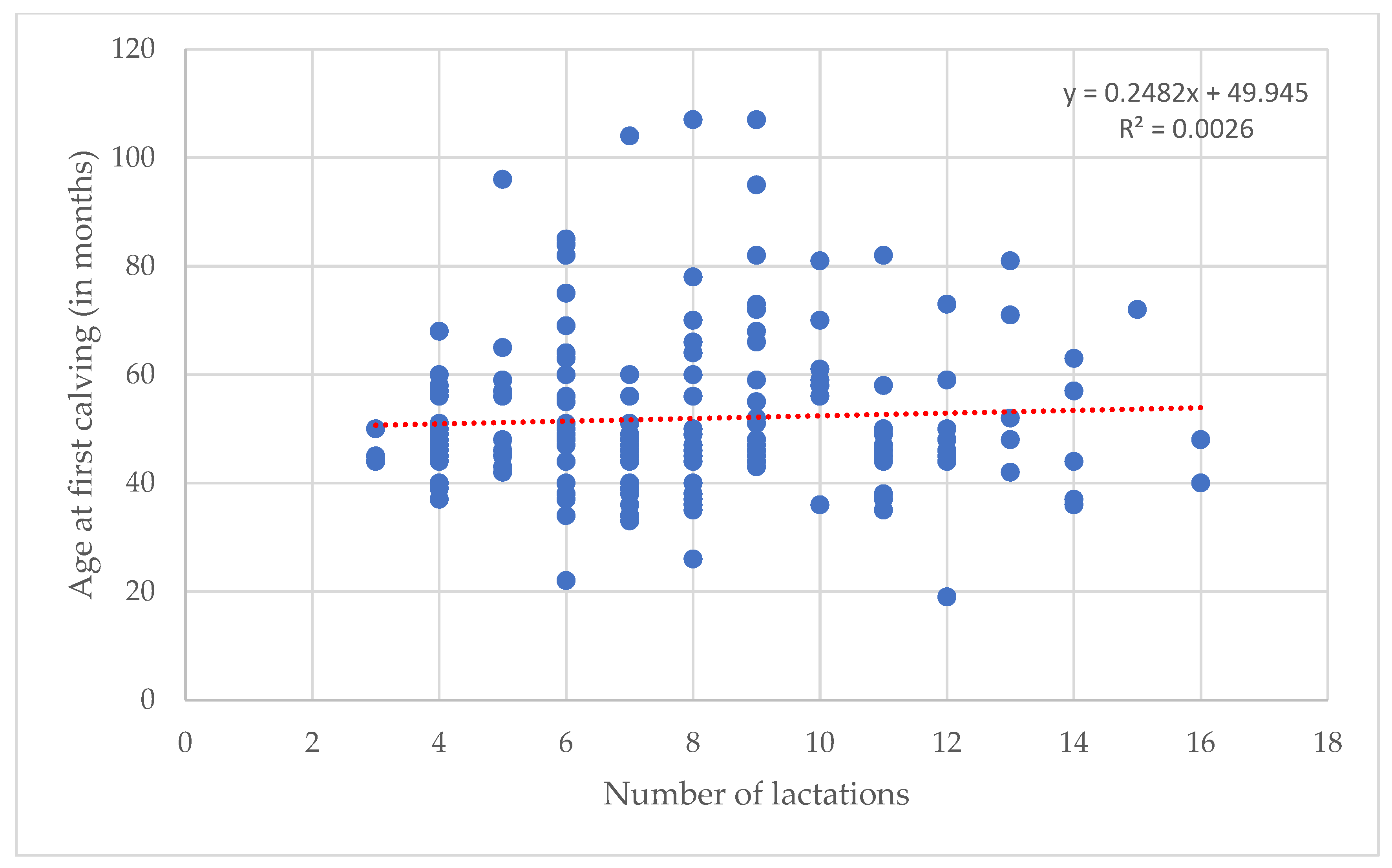
The simple linear regression analysis between age at first calving and the total number of lactations revealed a very weak positive correlation, with a coefficient of determination (R
2) = 0.0026 (
Figure 3). This value indicates that only 0.26% of the variation in age at first calving can be explained by the number of lactations. Although the regression slope was positive, it was not statistically significant (
p > 0.05), confirming the absence of a meaningful linear relationship between the two variables [
23].
Overall, the results suggest that the age at first calving in the analyzed herd falls within biologically acceptable ranges, and the observed variations among groups are not statistically significant. The only noted tendency was a marginal association between younger calving ages and the occurrence of non-viable offspring; however, this finding requires further confirmation in larger studies (p = 0.064).
3.2. Total Number of Lactations During the Reproductive Lifetime
The analysis of the total number of lactations per buffalo showed that, in the studied population, the mean was 7.82, the median was 8, and the SD was 2.96. These values suggest that most buffaloes completed approximately 8 lactations during their productive lifetimes, with moderate variation among individuals. However, the observed extremes (a minimum of 3 and a maximum of 16 lactations) reflect both early culling cases and animals with high reproductive longevity, highlighting differences in functional longevity within the herd.
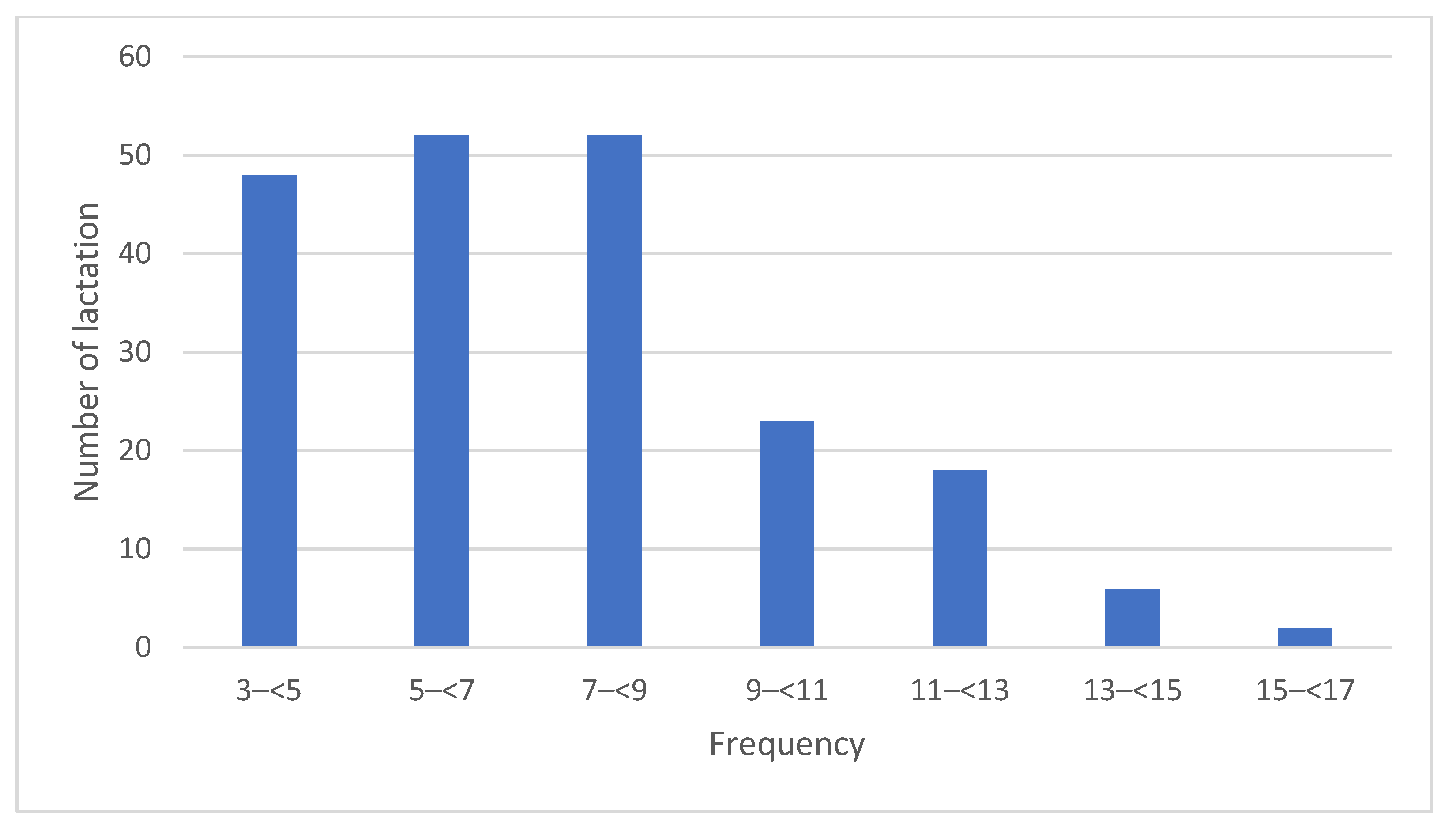
The distribution of values was relatively symmetrical, although the histogram revealed a concentration of frequencies in the 5–7 and 7–9 lactation intervals, each comprising approximately 50 animals (
Figure 4). At the opposite end, the extreme intervals (13–17 lactations) were much less represented, indicating that very high reproductive longevity was rather exceptional but achievable under favorable biological and management conditions.
The Shapiro–Wilk test (W = 0.00656, p < 0.01) indicated a significant departure from normality, while the Q–Q plot, along with the skewness (0.52) and kurtosis (−0.34) coefficients, confirmed a slightly positive, platykurtic distribution. These results show that, although most buffaloes clustered around the mean, a few individuals with a high number of lactations skewed the distribution toward higher values. The 95% confidence interval for the population mean was estimated between 7.41 and 8.23 lactations, confirming the strength of the calculated values.
3.3. Milk Yield and Fat Content in Relation to Calf Sex
Considering each lactation as an independent observation, the analysis revealed a clear difference in milk yield by calf sex. Buffalo cows that calved male offspring produced a significantly higher average milk yield per lactation (1272 ± 267 L) compared with those that calved female offspring (1099 ± 244 L). Median values followed the same pattern (1217 L for male calves vs. 1062 L for female calves), and the difference was confirmed by the Mann–Whitney U test (p = 0.0038). Variability was slightly higher among buffaloes calving male offspring, suggesting a broader dispersion of production values.
In contrast, the analysis of milk fat content showed no significant differences between groups. The mean fat percentage was 7.06% in buffaloes with female calves and 6.97% in those with male calves, and the independent-samples t-test (p = 0.797) confirmed that these differences were not statistically significant. The distributions for this variable were similar and relatively compact, suggesting that the sex of the calf does not influence milk composition in terms of fat content.
Overall, the results indicate that calf sex affects milk yield but not the fat percentage. These findings are consistent with observations from other studies on cattle, which have reported that calf sex is associated with variations in milk production but not necessarily with changes in composition. However, a more robust interpretation would require further research on larger samples, incorporating additional factors such as management conditions.
Lactation number and parity effects were not included as covariates in the present analysis, which represents a limitation of the study. Future analyses using mixed models that account for repeated measures within individuals would allow a more detailed evaluation of the interaction between parity, calf sex, and milk production.
The results regarding milk yield and milk fat content by calf sex are summarized in
Table 2, providing a clearer comparative overview of production differences between the two groups.
4. Discussion
Our results regarding the mean age at first calving (51.6 months) are very close to those reported in a study conducted in South Asia (52.5 months) [
17], suggesting that, regardless of climatic conditions (temperate-continental or tropical/subtropical/humid), local reproductive management practices and genetic characteristics can lead to similar performance. However, compared with the reported mean age at first calving for the Murrah breed (46–47 months), the age at first calving in the studied Romanian buffalo population was slightly higher. This difference (approximately 4–6 months) can be attributed to breed-specific characteristics and differences in heifer management, such as weight at first mating, selection strategy, and nutrition [
14]. Furthermore, the literature emphasizes that lower ages at first calving, achieved through proper nutrition and targeted selection, can reduce rearing and maintenance costs, while extreme values (too low or too high) are associated with reproductive problems, such as an increased number of services per conception or extended calving intervals [
13]. In this context, the value obtained in our study (51.6 months) is slightly above the range considered optimal in many production systems, indicating potential for improvement through nutritional and management interventions during the juvenile phase. A notable difference is also observed compared with a study conducted in Italy [
24], where buffaloes that calved earlier tended to have lower initial milk production but later compensated, suggesting that a moderate age at first calving can balance body maturity and productive performance. Consequently, the values observed in our population fall within biologically acceptable limits but could be optimized through heifer nutrition and reproductive management strategies.
Sexed semen was not used in the studied herd; therefore, calf sex could not be actively manipulated. The analysis of calf sex was included to explore its natural biological association with milk yield rather than as a management intervention.
Our results regarding the influence of calf sex on milk production show that females that calved male offspring produced significantly more milk. However, Kul et al. observed that calf sex had no significant effect on colostrum weight or its composition (fat, protein, solids-not-fat, lactose) within the first 72 h postpartum in the Anatolian buffalo population. This suggests that calf sex may influence the total milk yield or volume, but does not substantially affect the compositional parameters of milk or colostrum [
15]. In the present study, male and female calves were managed under identical separation and rearing conditions, thereby excluding differential neuro-endocrine stimulation or unequal milk utilization as potential confounding factors. From an evolutionary and physiological perspective, research in dairy cattle has suggested that gestation of female fetuses may program greater milk synthesis through favorable hormonal signaling and lower fetal metabolic demand [
25], whereas evidence in buffalo remains limited and often strongly influenced by environmental and management conditions [
26]. Consequently, the current findings may reflect species-specific physiological responses or population-level variability rather than a universal sex-biased lactational strategy. Although calf sex cannot currently be manipulated under the studied management system due to the absence of sexed semen, its inclusion in the analysis provides insight into natural biological sources of variation in milk yield and contributes to a more comprehensive interpretation of production variability in buffalo herds. Additionally, the potential association between the sex of the first calf and lifetime productive performance was beyond the scope of the present analysis and warrants further investigation in future studies.
The temporal differences reported by Kul et al. between the first milkings (at calving and at 24, 48, and 72 h postpartum) highlight the importance of sampling time, as colostrum composition undergoes rapid changes during the first hours after parturition [
15]. Although our study did not explicitly investigate this dynamic, these findings suggest that both milk yield and compositional values may be influenced by the exact timing of sample collection, which could partly explain the variability observed in our data. Furthermore, results obtained for the Jaffrabadi breed indicate that the fat, protein, and total solids percentages increase significantly as lactation progresses, while season exerts a notable influence on protein and lactose content [
27]. Thus, intensifying milking during the later stages of lactation may be associated with an increase in fat percentage, potentially compensating for decreases in milk volume. In this context, adjustments to nutritional management and seasonal feeding regimes could help reduce compositional variations and stabilize lactational performance within the analyzed population [
27].
In this study, milk yield values (1272 L for females with male calves and 1099 L for those with female calves), interpreted as total production per lactation, are comparable to the averages reported for the Murrah breed (1350–1430 L/lactation) [
14]. This suggests that, under the farming conditions at Șercaia, the Romanian Buffalo population can achieve productive performances close to those of breeds intensively selected for milk yield. Similarly, the mean values obtained in our study are close to those reported for Egyptian buffaloes (1176.5 L/lactation) in the study by El-Hedainy et al., confirming that the productive performance of our herd is comparable to other well-studied populations, with differences likely explained by lactation length, nutritional management, and milking frequency [
28]. The present results are also consistent with those reported by Catillo et al., 2002, who found that younger buffaloes exhibit lower milk yields during the first 20 weeks after calving, while the fat and protein percentages remain relatively constant, regardless of age at calving [
24]. This compositional stability is also confirmed in our population, where the milk fat percentage did not differ significantly between females with male or female calves, suggesting a stable milk composition during the early lactation phase. Moreover, the Italian study also highlighted the influence of calving season on milk yield, with lower values for summer calvings, but without significant effects on fat and protein content [
24].
Another important aspect is reproductive longevity: the average of 7.8 lactations per female observed in our herd indicates good productive longevity, likely reflecting genetic selection, favorable health status, and appropriate management practices. The literature on the Murrah breed provides consistent data on milk yield per lactation and reproductive parameters (such as lactation length and calving interval); however, information regarding the average number of lifetime lactations is relatively scarce. Therefore, this finding represents a valuable contribution of our study to the understanding of long-term performance in buffaloes [
14].
The average calving interval observed in the present study (approximately 463 days) was higher than that reported in other studies (around 400 days; Ref. [
13]). However, the relatively high average number of lactations (7.8) and the observed reproductive longevity suggest that the buffaloes in this herd are not culled prematurely and exhibit good functional durability. According to Nava-Trujillo et al., non-genetic factors such as body condition score, energy balance, and season play a determining role in the duration of anestrus periods and the timing of first service. These findings are consistent with our observations of substantial variability in age at first calving (ranging from approximately 48 to 60–80 months). This variability highlights the need for stricter nutritional management and systematic monitoring of body condition to optimize the timing of the first service and improve overall reproductive efficiency. Moreover, the authors emphasize the interdependence between milk production and reproductive performance, noting that high production levels may induce metabolic stress, thereby delaying conception and extending the calving interval [
13].
The relatively advanced age at first calving observed in the present study reflects species-specific biological characteristics of buffaloes, slower growth rates, and traditional management systems rather than reproductive inefficiency. Importantly, this trait is compensated by long productive lifespans, as evidenced by the high average number of lifetime lactations (7.8 per female), which contributes to herd sustainability by reducing replacement rates and spreading rearing costs over multiple lactations.
A more detailed seasonal or monthly analysis of conception rate would provide valuable insight into the interaction between environmental conditions and reproductive performance in water buffalo, particularly given this species’ strong seasonality. However, the historical farm records used in this retrospective study did not consistently include precise mating timing, breeding type (natural mating vs. artificial insemination), or complete monthly reproductive indicators across the entire 30-year period.
Therefore, a robust seasonal conception-rate analysis was not feasible within the constraints of the available dataset. Future studies incorporating detailed timing of reproductive events, along with environmental parameters such as the temperature–humidity index, would be highly valuable for understanding seasonal fertility dynamics in this population.
An important limitation of the present study is that the dataset originates from a single research farm. Although the long observational period and the completeness of lifetime records provide valuable insight into buffalo reproductive and productive performance, the results cannot be considered fully representative of the entire national population or of all temperate-climate production conditions. Consequently, the present work should be interpreted as a detailed herd-level case study, while broader generalizations require multi-farm or national-scale investigations.





 ,
,