Communication

Ultrasound-Assisted Cavitation Effect on the Biofilm-Forming Ability of Common Dairy Sporeformers


Midwest Dairy Foods Research Center, Dairy and Food Science Department, South Dakota State University, Brookings, SD 57007, USA
*
Author to whom correspondence should be addressed.
Dairy 2023, 4(1), 100-107; https://doi.org/10.3390/dairy4010007
Submission received: 5 December 2022 / Revised: 17 January 2023 / Accepted: 23 January 2023 / Published: 28 January 2023
(This article belongs to the Section Metabolomics and Foodomics)

Abstract

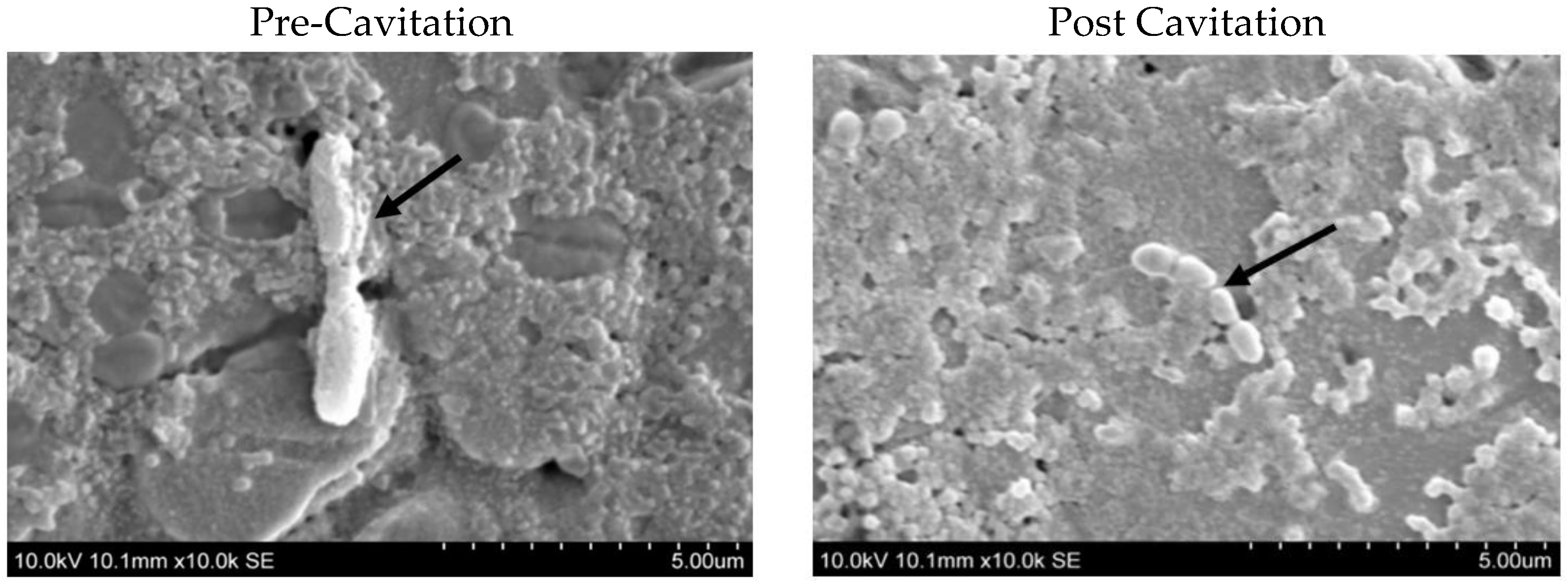
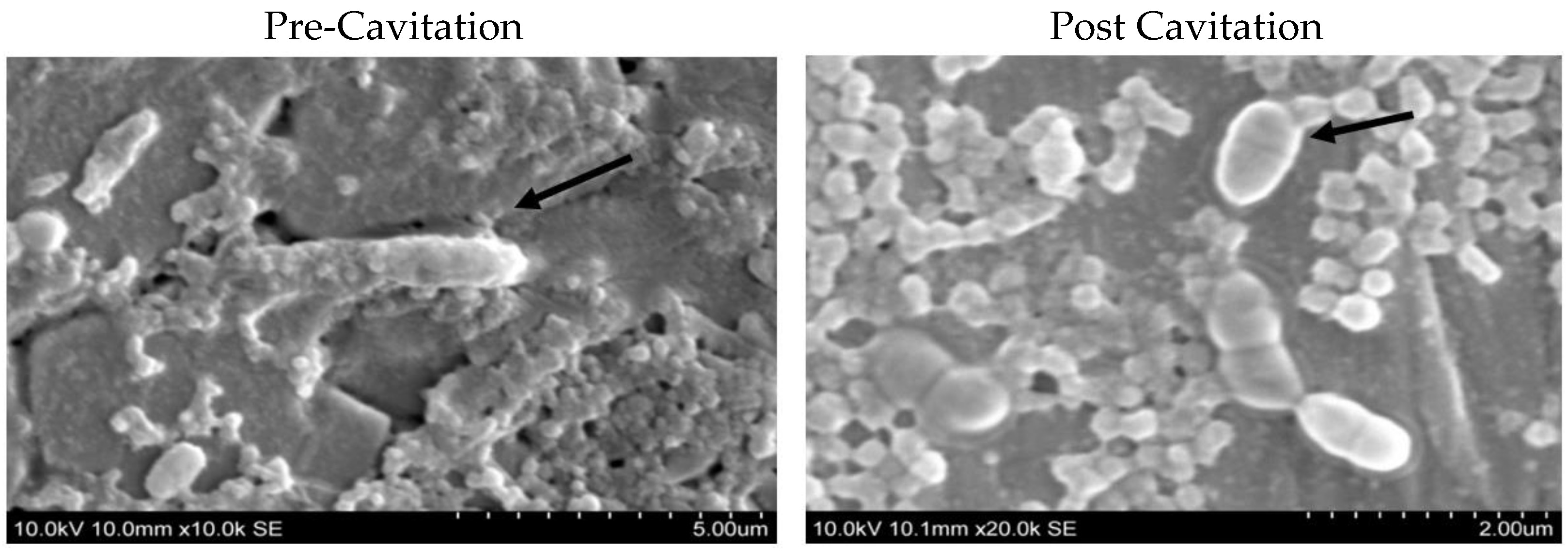
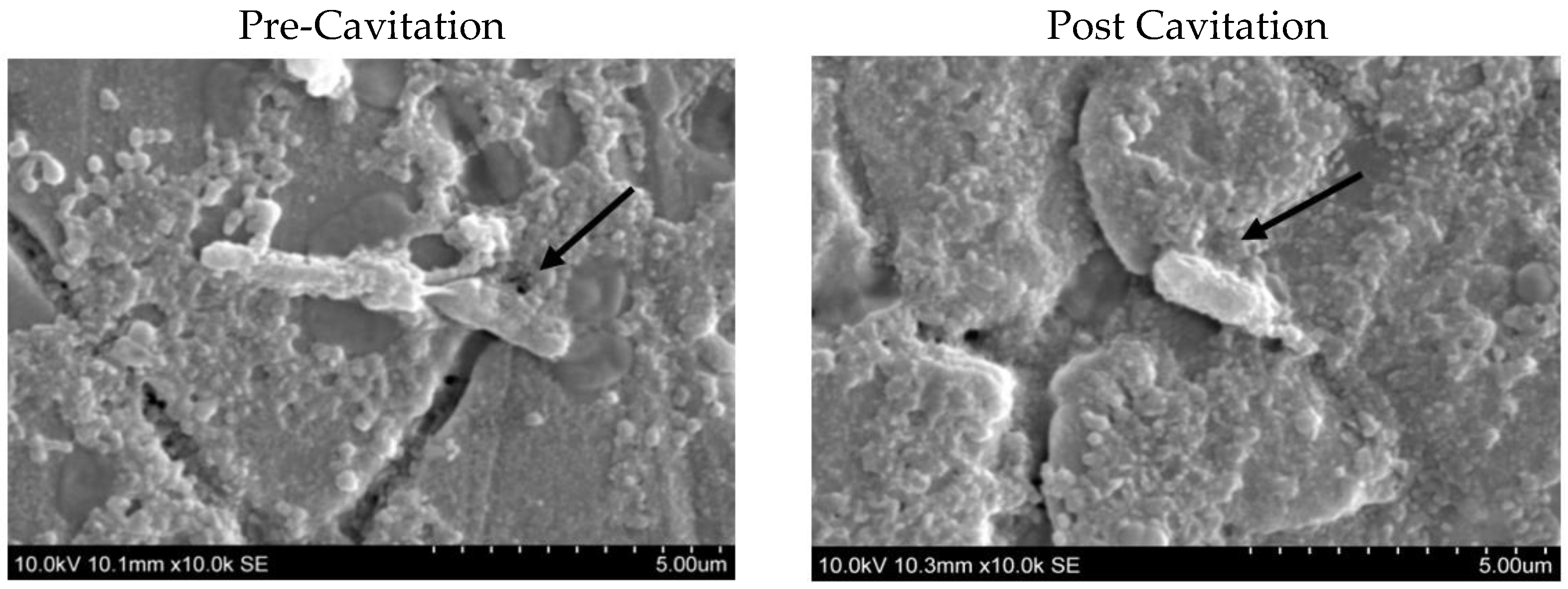
Thermoduric sporeformers survive heat treatment and can form biofilm on contact food surfaces that is difficult to clean and may cause cross contamination to milk products. It was hypothesized that cavitation would influence sporeformers’ ability to attach to contact surfaces and form biofilm. Common dairy sporeformers of Geobacillus stearothermophilus, Bacillus licheniformis, and Bacillus sporothermodurans were individually inoculated in sterile skim milk at the levels of 6.0 log CFU/mL. Inoculated samples were treated by cavitation at 80% amplitudes for 10 min each. Pre and post samples were used to develop biofilms on stainless steel coupons under static conditions. Scanning electron micrograph was used to observe the developed biofilms. All the experiments were conducted in triplicate and were statistically analyzed using a t test. The average counts of spiked milk samples were 7.2, 8.0, and 7.7 logs CFU/mL, respectively, for the three sporeformers. Post-cavitation counts were reduced significantly to 3.4, 4.2, and 3.7 logs CFU/mL, respectively. Pre-cavitation biofilm counts of the three sporeformers were 5.35, 6.42, and 6.5 logs CFU/ cm2, respectively in 72 h. The three sporeformers’ biofilm showed significantly (p < 0.05) lower counts after cavitation of 4.39, 5.44, and lower counts of 4.39 logs CFU/cm2, respectively, for the three organisms. The result showed that G. stearothermophilus formed the least biofilms among others after cavitation. Although the ultrasonication treatment reduced the number of sporeformer bacteria, the survivors still retained the ability to attach to the stainless-steel food contact surfaces.
Keywords: biofilm; cavitation; sporeformers; ultrasonication biofilm; cavitation; sporeformers; ultrasonication