
Next Article in Journal
The Relationship between Gratitude, Wellbeing, Spirituality, and Experiencing Meaningful Work
Next Article in Special Issue
Homelessness and Research: Methodological Obstacles and Lessons Learned from a Psychological Study in Parisian Homeless Services
Previous Article in Journal
Online Peer Counseling for Suicidal Ideation: Participant Characteristics and Reasons for Using or Refusing This Service
Previous Article in Special Issue
Social Support Is Related to the Use of Adaptive Emotional Regulation Strategies in Ecuadorian Adolescents in Foster Care
 
 
Psych concluded publication with Volume 6, Issue 1. It has been succeeded by Psychology International, which has a revised scope and a new editorial direction and is now published here. To preserve historical data integrity, the information on this webpage is retained but will no longer be updated.
Article

Theory of Mind Ability and Socioeconomic Status, a Study of Street-Connected Children and Adolescents in Ecuador


1
Faculty of Psychology, Chulalongkorn University, Bangkok 10330, Thailand
2
Institute of Neurosciences, Universidad San Francisco de Quito, Quito 170901, Ecuador
Psych 2021, 3(2), 72-84; https://doi.org/10.3390/psych3020008
Submission received: 28 February 2021 / Revised: 20 April 2021 / Accepted: 20 April 2021 / Published: 13 May 2021
(This article belongs to the Special Issue Psychology of Socioeconomic and Psychosocial Deprivation)

Abstract

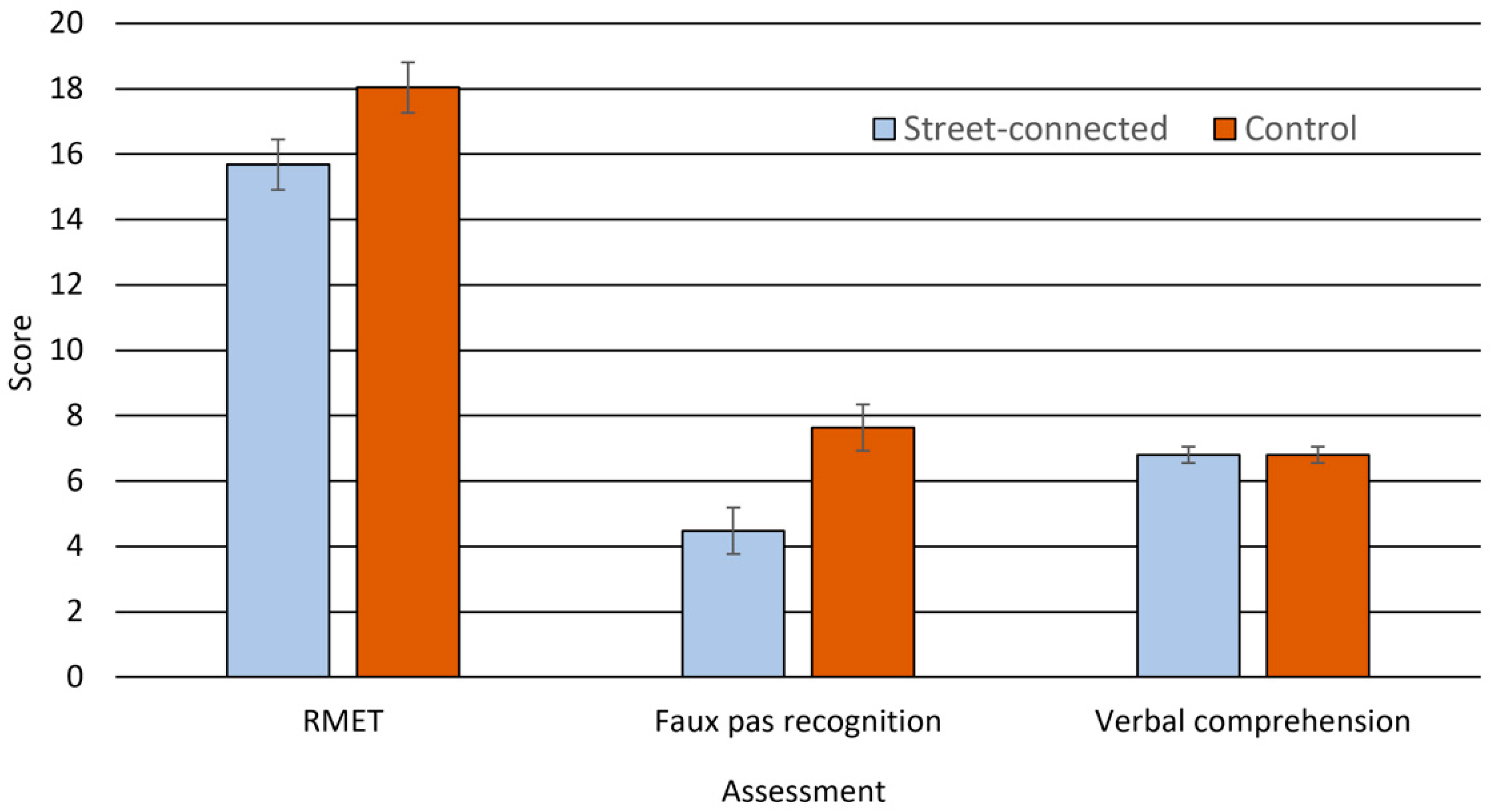
Family socioeconomic status (SES) is closely associated with cognitive ability in children and adolescents. However, most of the research has come from high-income countries. There is only limited research on ‘street children’, who represent an aspect of low-SES particularly associated with low- and middle-income counties. The current research in Quito, Ecuador, compared a group of street-connected youth with a not street-connected control group on two different measures of theory of mind ability and verbal comprehension. Initial analysis revealed that the street-connected sample scored significantly below the level of the control sample for verbal comprehension. For the main analysis, street-connected youth were matched to control participants for age, sex, and verbal comprehension scores. The street-connected sample was found to perform significantly below the control sample on both measures of theory of mind. Furthermore, worse performance appeared to be linked to severity of symptoms of post-traumatic stress disorder (PTSD) within the street-connected sample. In conclusion, the association of relatively poor verbal comprehension with street-connectedness is consistent with existing research from high-income countries on SES gradients and cognitive development. In contrast, theory of mind ability, a core aspect of social cognition, may be particularly linked to the street-connectedness form of low SES that exists in many low- and middle-income countries.
Keywords: street children; homeless youth; street connected youth; socioeconomic status; mentalizing; theory of mind; social cognition; verbal ability; language comprehension; post-traumatic stress disorder street children; homeless youth; street connected youth; socioeconomic status; mentalizing; theory of mind; social cognition; verbal ability; language comprehension; post-traumatic stress disorder