Systematic Review

Research Progress on Preparation Technology and Applications of Bis(hydroxymethyl)tricyclodecane

SINOPEC (Beijing) Research Institute of Chemical Industry Co., Ltd., Beijing 100013, China
*
Authors to whom correspondence should be addressed.
Chemistry 2026, 8(7), 100; https://doi.org/10.3390/chemistry8070100
Submission received: 29 June 2026 / Revised: 16 July 2026 / Accepted: 19 July 2026 / Published: 21 July 2026
(This article belongs to the Section Chemistry of Materials)

Abstract

Polymers based on tricyclic decane skeleton in the role of high-performance polycarbon, polyester, polyacrylate, etc., are used in optical equipment, dental restoration, photoresist, and other fields because of their rigid ring structure and corresponding excellent heat/weather/impact/scratch resistance. The preparation process of monomer tricyclodidecane dimethanol is complex and has engineering safety problems. Also, it has been monopolized by a few enterprises for a long time, and the price is expensive. There is a lack of systematic reviews on the synthesis of tricyclodecane dimethanol. In this paper, focusing on the preparation process of tricyclic decane dimethanol, the preparation process of bicyclic decane dimethanol to be prepared by dicyclopentadiene is summarized, including the reaction path, catalytic system and separation method, and the homogeneous catalysis, aqueous/organic two-phase catalysis and heterogeneous catalysis in the hydroformylation of high-carbon olefins are discussed, as well as the difference between stripping, extraction, membrane separation and other methods in the separation methods of catalyst and product. Then, the current research status at home and abroad is summarized, and the advantages and disadvantages of the above reaction methods are analyzed according to the reaction system, catalyst used, solvent, reaction conditions, and final reaction level. Finally, the downstream application and market of tricyclic decane dimethanol are analyzed. It provides a reference for the design and optimization of the preparation process of tricyclodecane dimethanol.

1. Introduction

Bis(hydroxymethyl)tricyclodecane (TCD) is a diol with a rigid bridge-ring structure, mainly used to synthesize heat-resistant, corrosion-resistant, highly transparent, low-density, high-refractive polyacrylates as optical lenses; to synthesize high-hardness, impact-resistant, heat-resistant polycarbonate as light guide plates and other front panels of displays; to synthesize photosensitive carboxylic acid polyesters as semiconductor packaging substrates; and to synthesize high-performance polyesters such as epoxy resin and polyurethane. TCD is mainly obtained by hydroformylation of dicyclopentadiene (DCPD) hydroformylation and hydrogenation. Among these, DCPD mainly comes from the C5 fraction by-product of ethylene and the light benzene fraction from coal coking, with a C5 fraction content of 15%~22%. Its 2023 capacity is about 736,000 tons/year, with a price of 8500~8900 CNY/ton [1] (30 April 2026). Currently, it is mostly used as a petroleum resin product with limited utilization value. Polymers based on TCD structures are expensive (over 100,000 CNY/ton [2]), and TCD prices are 90,000~140,000 CNY/ton. Therefore, developing technology for high-value-added synthesis of TCD from affordable DCPD is of great significance. A systematic review of TCD preparation processes helps promote the development of TCD preparation processes and solve TCD production challenges.

2. Materials and Methods

To analyze TCD preparation process, a rigorous methodology based on the PRISMA framework was employed, which included the stages of identification, screening, eligibility, and inclusion. A comprehensive PRISMA 2020 Checklist has been included in the Supplementary Materials, created based on a methodology that follows the PRISMA framework for systematic reviews. The PRISMA (Preferred Reporting Items for Systematic Reviews and Meta-Analyses) methodology is designed to ensure a thorough and transparent process for conducting systematic reviews. Figure 1 shows the flow diagram for the systematic reviews conducted in this study. These searches were limited to studies published since 2026. The data from selected papers were involved factors such as catalyst active metals, catalyst ligands, and catalyst support. The evaluated factors included reaction pathways, catalytic systems, separation method, catalyst loss, catalyst cyclicity, reaction condition, and selectivity. In the identification phase, the search queries used were (“hydroformylation” AND “dicyclopentadien”), (“preparation” AND “tricyclodecane”), and (“application” AND “tricyclodecane”) The search was then refined by adding the term “high-carbon olefins” to identify studies with similar reaction conditions that included the incorporation of high-carbon olefins as a reaction substrate factor. These search experiments are under identical conditions, so comprehensive statistical comparisons are conducted, and the results are robust enough to perform statistical analysis. These reports can be found in databases such as ScienceDirect, ACSPublications, Springer, RSC, and CNKI. Given the importance of hydroformylation catalyst separation and recovery for industrialization, the incoPat database was used to identify patent holders and countries related to hydroformylation. This search aims to deepen the discussion of the results to be analyzed in this study. In the screening phase, articles and patents were carefully reviewed to eliminate irrelevant studies based on predefined standards. This step ensured that only those papers and patents most closely aligned with the research objectives were retained for further review. The eligibility stage involved assessing the remaining studies for their methodological quality and relevance to the specific reaction systems under investigation. In the inclusion stage, the studies that met all the standards were selected for in-depth analysis, contributing to a vigorous dataset for exploring the progress on preparation technology and applications of TCD. This systematic approach allowed for a comprehensive understanding of the topic, ensuring that the findings were grounded in high-quality, relevant literature. Although this study is closely related to the TCD preparation process, the low-carbon olefins differ significantly from DCPD hydroformylation and cannot be directly included in this study. Nevertheless, these studies remain highly valuable and enrich the discussion, as detailed in the following chapters.
This review was performed in accordance with the PRISMA (Preferred Reporting Items for Systematic Reviews and Meta-Analyses) guidelines.
Optional for registration:
Before the start of this search, a review protocol was entered into the PROSPERO (or other) database (registry number provided).

3. The Preparation Process of DCPD to TCD

3.1. Reaction Pathway

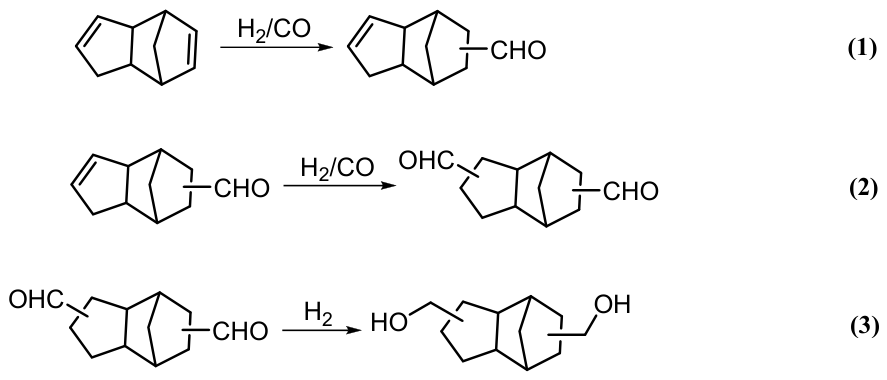
Figure 2 displays three stages of the conversion from DCPD to TCD. In the first stage, DCPD reacts with syngas through a hydroformylation reaction to produce tricyclodecanemonoformaldehyde (MFTD) [Equation (1)]. In the second stage, MFTD undergoes further hydroformylation with syngas to form tricyclodecanediformaldehyde (DFTD) [Equation (2)]. Finally, in the third stage, DFTD reacts with hydrogen through a hydrogenation reaction to produce the final product, TCD [Equation (3)]. The second step of hydroformylation to produce DFTD is the rate-limiting step.
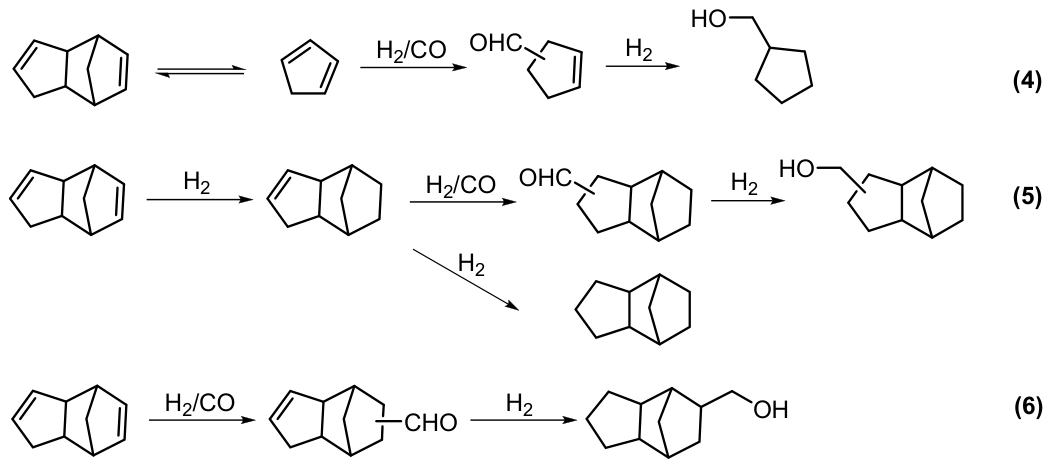
Figure 3 illustrates three possible side reactions that may occur during the conversion of DCPD to TCD. Table 1 provides information regarding the properties of the raw materials, products, and by-products involved in this conversion process.
[Equation (4)]: The depolymerization reaction, which involves the polymerization of cyclopentadiene (CPD) and the depolymerization of DCPD, is reversible. At temperatures between 110 and 130 °C, the rates of depolymerization and polymerization are approximately equal. Above 180 °C, depolymerization predominates; below 110 °C, polymerization is more significant. The dimerization conversion rate is highest around 100 °C [4]. Cyclopentadiene can also undergo hydroformylation and hydrogenation to form hydroxymethylcyclopentane. To prevent the depolymerization of DCPD back into CPD, the reaction temperature can be adjusted below 150 °C to eliminate this process.
[Equation (5)]: The hydrogenation of C=C double bonds: The hydrogenation of DCPD to form alkanes is an irreversible reaction. The double bonds on the six-membered ring of DCPD are more reactive and thus more easily hydrogenated. The resulting 5,6-dihydrodicyclopentadiene can further undergo hydroformylation to produce MFTD, or it can be further hydrogenated to form tricyclodecanemonium methoxide (TCM; in Equation (5), this is represented as octahydro-4,7-methano-1H-indene-1-methanol or octahydro-4,7-methano-1H-indene-2-methanol). Alternatively, 5,6-dihydrodicyclopentadiene can also be further hydrogenated to form tetrahydrodicyclopentadiene, all of which can affect the yield of TCD.
[Equation (6)]: The hydrogenation of the C=C double bond occurs because the reaction converting MFTD to DFTD is more difficult to carry out and requires higher temperatures and pressures. As a result, during the hydroformylation of DCPD to DFTD, a side hydrogeneration reaction also takes place, producing tricyclodecane monomethanol (referred to as octahydro-4,7-methano bridged-1H-indene-5-methanol in Equation (6)), which affects the yield of TCD.

3.2. Catalytic System

Hydroformylation of DCPD and the separation of precious metals after hydroformylation are the most important parts of the TCD preparation process. The industrial development of hydroformylation catalytic systems can be divided into four stages. Table 2 summarizes the process conditions and performance of first-generation cobalt carbonyl, second-generation tertiary phosphine modified cobalt carbonyl, third-generation oil-soluble rhodium–phosphine complexes, and fourth-generation water-soluble rhodium–phosphine complexes [5].
The active centers of third-generation oil-soluble rhodium–phosphine homogeneous catalysts are highly dispersed and uniform, exhibiting high selectivity and activity, gradually becoming mainstream in the hydroformylation industry. However, since the boiling points of hydroformylation products of high-carbon olefins are mostly above 200 °C, and phosphine ligands decompose easily at around 150 °C, oil-soluble rhodium–phosphine homogeneous catalysis poses challenges in separating and recycling precious metal catalysts for high-carbon olefins. Using water-soluble phosphine ligands and dynamically “loading” homogeneous catalysts onto the aqueous phase that is immiscible with the product can effectively solve the abovementioned problems. However, due to low water solubility, high-carbon olefins are controlled by mass transfer, resulting in low contact efficiency between aqueous catalysts and organic phase reactants, and low activity in hydroformylation reactions. To solve the problems of separating precious metal catalysts from homogeneous catalysis and mass transfer in aqueous/organic two-phase catalysis, loaded-type heterogeneous catalysts have been developed, where active components such as rhodium are loaded onto inorganic metal oxides, activated carbon, etc., and catalysts are separated from products through simple phase separation. Temperature-sensitive heterogeneous catalysts have also been developed, where rhodium and other active components are distributed to phosphine ligands with temperature-controlled phase transfer functions. These are oil-soluble at reaction temperatures, can contact low-polarity olefin reactants well, and are water-soluble at room temperature. Therefore, after the reaction, catalysts can also separate from products through simple phase separation. However, heterogeneous catalysts such as supported and temperature-sensitive types tend to agglomerate easily when heated and dissolve easily after repeated use, affecting catalyst activity and causing recovery losses, thereby making industrialization difficult.
Table 3 summarizes the catalysts, processes, and corresponding TCD capacity used in DCPD hydroformylation and the corresponding hydrogenation process. Currently, DCPD hydroformylation reactions mainly use precious metals such as Rh as the active center, and hydrogenation reactions use conventional metals such as Ni, Ru, Au, and Pd, as the active center. Mitsubishi Chemical Corporation (Mitsubishi), Basf Se (BASF), and Sk Chemicals Co. Ltd. (Sk) use the third-generation rhodophinium phosphine complexation homogeneous hydroformylation processes. Oq Chemicals Gmbh (Oq) and Sichuan University used the fourth-generation rhodophinium phosphine complexation hydroformylation process for water–oil hydroformylation. Mitsui Chemicals Inc. (Mitsui); Xinjiang Technical Institute of Physics and Chemistry, CAS (XTIPC, CAS); Lanzhou Institute of Chemical Physics, CAS (LICP, CAS); and Wanhua chemical group Co. Ltd. (Wanhua) used a heterogeneous loading hydroformylation catalytic process. Guangdong Huajinda New Material Tech Co. Ltd. (Huajinda), Evonik Oxeno Gmbh & Co. Kg (Evonik), and Hitachi Chemical Co. Ltd. (Hitachi) use non-rhodium catalysts.
Among these companies, only Oq, Mitsubishi, and Huajinda have achieved TCD industrialization. Oq has a capacity of ten-thousand-ton class production capacity per year. Mitsubishi produces it in-house and does not sell it externally, and is used as a copolymer monomer for downstream products such as polycarbon and polyacrylate. Huajinda has a thousand-ton-class production line per year.

3.3. Separation Method

In the field of rhodium-containing catalyzed hydroformylation, catalyst cost determines the majority of R&D investment, so the separation issues and rhodium loss of high-carbon olefin hydroformylation catalysts require special attention. Taking the process conditions of butyl and octyl alcohol as an example, the average price of rhodium in 2025 is about 18 billion CNY per ton. If the rhodium mass fraction in the reactor is calculated at 300 ppm, the value of rhodium contained per ton of material in the reactor would be 540,000 CNY. To meet economic requirements, the cost of rhodium should be limited to within 1%. A product price of 10,000 CNY per ton means a loss of 10,000 CNY per ton of rhodium in the reaction material. Assuming no other rhodium-loss pathways exist and calculating the product mass fraction in the reactor as 30 wt.%, this means that the physical loss of rhodium in the product is 0.08 ppm. Table 4 compares low value-added products represented by butyl and octyl alcohol (product price about 10,000 CNY/ton), and high-value-added products represented by TCD (product price about 100,000 CNY/ton). When rhodium loss accounts for 1% of total cost, the allowable rhodium loss is 0.013 wt.% of low-value-added butyl and octyl alcohol, and 0.111~0.185 wt.% of high-value-added TCD.
For hydroformylation of high-carbon olefins, due to the high boiling point of the product (the boiling points of the hydroformylation products of DCPD are over 250 °C), it is difficult to separate catalysts and ligands from catalysts and ligands by distillation or other methods at lower temperatures. Therefore, industrially, the separation and recovery of hydroformylation catalysts and ligands for high-carbon olefins usually employ three methods: extraction, stripping, and membrane separation.

3.3.1. Extraction

The second step of hydroformylation to produce DFTD is the rate-limiting step. The extraction process involves the completion of the hydroformylation reaction, where extractant is added to the reaction solution for catalyst extraction. After extraction, the product phase is divided into two phases: the catalyst phase and the product phase. Table 5 summarizes the specific extraction separation process for hydroformylation of high-carbon olefins, divided into the following four types based on the catalytic system and extractant selection.
(1) Using organometal-phosphine as the catalyst and adding higher-polarity solvents such as water, alcohol, or amine, the product and extractant exist in the high-polarity phase and the catalyst in the low-polarity phase, returning the low-polarity catalyst phase to the hydroformylation system. From 1976 to 1990, Kuraray Co. (Kuraray) [6,7,8,9,10] studied extraction separation processes such as alkene hydroformylation to produce dialdehyde, followed by hydrogenation to produce diol. They used highly polar water or polyols as extractants, with the product in the aqueous or alcohol phase and the catalyst in the low-polarity hydrocarbon phase, thereby reducing rhodium content and phosphine content to 10−2 ppm and phosphine to ppm. Mitsubishi used polyols in 2000 [11] and water-soluble amines in 2009 [12]. Shell Usa, Inc. (Shell) [13], used water in 2003. ExxonMobil Chemical Patents Inc. (ExxonMobil) [14] used acidic aqueous solutions in 2008; Dow Global Technologies Inc. (Dow) used ether/ester/water mixed solutions in 2008 [15] and water-soluble amines in 2015 [16]. Dairen Chemical Co. and Chang Chun Plastics Co. Ltd. [17] used alcohols in 2019. In 2022, Petrochina Co. Ltd. [18] used an aqueous solution containing hydrogen/halogen/trihalomethyl/hydroxy/nitro/sulfonic acid/cyanogroup as the extractant for similar extraction operations, achieving an extraction rate of about 90%.
(2) Using organometallic-phosphine as a catalyst and adding highly polar solvents such as water, alcohols, or amines as extractants, the product and the extractant are present in the highly polar phase, while the catalyst remains in the less polar phase. The less polar catalyst phase is then returned to the hydroformylation system. In Japan, organometallic-phosphine is used as the catalyst, and an aqueous solution containing substances that can coordinate with the organometallic compound is used as the extractant; the product is in the less polar phase, and the coordination or complexed catalyst is in the aqueous phase. Under certain temperature and pressure conditions, in the presence of syngas and olefins, the mixture undergoes pre-tanning reactions. The pre-tanned products are separated into an organic phase containing the catalyst and an aqueous phase containing the complexing agent. The organic phase is returned to the hydroformylation reaction step, while the aqueous phase is reused. For example, BASF used an aqueous solution of a sulfonate-free, water-soluble polymer that could coordinate with rhodium to extract the homogeneous rhodium catalyst from the hydroformylation reaction products in 1997 [19], and the company used an acidic aqueous solution for extracting the homogeneous cobalt catalyst in 2001 [20]. In 1988, Dow [21] used a water-soluble ionic organic phosphine solution that could coordinate with rhodium to extract the homogeneous rhodium–phosphine catalyst. In 2001, Wanhua [22] used an aqueous solution comprising a strong oxidant, a water-resistant Lewis acid, and a complexing agent as the extractant to extract organic Co- and Rh-based catalyst systems coordinated with N- and P-based ligands. The catalyst was recovered ten times, with no loss exceeding 1 ppm.
(3) Using water-soluble rhodium–phosphine as the catalyst and adding low-polarity extractants such as hydrocarbons, the product and extractant exist in the low-polarity phase, while the catalyst exists in the high-polarity phase (usually water), returning the high-polarity catalyst phase to the hydroformylation system. Kuraray, in 1986 [23]; Shell, in 1998 [24]; Evonik, in 2003 [25] and 2008 [26]; and China Tianchen Eng. Co. Ltd. (Tianchen), in 2023 [27], conducted similar extraction operations, achieving high extraction efficiency and a precious metal recovery rate of >95%.
(4) Using water-soluble rhodium–phosphine as the catalyst, with water or aqueous solution added as the extractant, the product exists in the low-polarity phase, the catalyst in the aqueous phase, and the aqueous catalyst returns to the hydroformylation reaction step. In 2000, Celanese Chemicals Europe Gmbh (Celanese) [28] used phosphoric acid solution to extract water-soluble cobalt–rhodium–phosphine catalysts. In 2021, Qingdao Sanli Bennuo New Mat. Co. Ltd. (Sanli Bennuo) [29] used water as an extractant to extract water-soluble rhodium–phosphine catalysts, which can further extract the catalyst from the product into the aqueous phase, reducing precious metal losses. This method also has high extraction efficiency, with a precious metal recovery rate > 95%.
In summary, the extraction efficiency of the homogeneous catalytic system is about 90%. In contrast, aqueous/organic two-phase catalytic systems, due to their inherent phase separation capability, achieve extraction efficiency > 95% after increased extraction operations, which is higher than homogeneous catalytic systems. However, extractants carry risks such as contaminating the product. For example, using alcohol-based extractants can form acetals or ketones with product aldehydes [11], with boiling points similar to those of the products, making distillation and separation difficult, and affecting subsequent hydrogenation. Using amine extractants can form corresponding amines with the product alcohols [12]. Moreover, the introduction of extractants causes changes in the proportion of reaction systems in continuous processes, requiring additional extractant separation operations. For example, in 2022, Wanhua [30] coupled distillation and reaction, allowing the product (tower top), catalyst (column kettle), and extractant (upper side line) to be separated through the product refining tower.
Table 5. Summary of patents for the separation of products and catalysts by the extraction after the hydroformylation of olefins.
Technology HoldersYearRaw Material or ProductsHydroformylation CatalystsExtractantsSeparation Efficiency
Before SeparationAfter Separation
Kuraray1976 [6]Allyl alcohol →
butanediols
Oil-soluble Rh and PAqueous solution of polyoln/a3 times’ extraction
Extraction efficiency: 95.5%
1982 [7]7-Octene-1-aldehyde → 1, 9-nonanedialOil-soluble Rh and PAqueous solution of 1,4-butanediol or 1,6-hexanedioln/aExtraction efficiency: 85~90%
1982 [8]Vinyl acetate → propylene glycol monoacetateOil-soluble Rh and Pwatern/aExtraction efficiency: 92%
Rh: 0.05 ppm
P: 10 ppm
1983 [9]3-Methyl-3-buten-1-ol → 2-hydroxy-4-methyltetrahydropyraneOil-soluble Rh and Pwatern/aRh loss: 0.05~0.15 wt.%
1986 [23]Diene of C6~C10 → α, ω-dialdehyde of C8~C12Water-soluble Rh and P40~110 °C
cyclohexane
n/aRh: 0.04 ppm
P: 2 ppm
1990 [10]Allyl alcohol compound →
dihydrofuran
Oil-soluble Rh and PWater-soluble substancesn/an/a
Shell1998 [24]C4~C24Water-soluble 8th–10th subgroup compounds and PSulphones and nitrilesPd: 300~400 ppmOperated continuously for 732 h
Pd: 0.2 ppm
P: 10 ppm
2003 [13]Oxirane →
aliphatic 1, 3-diols
Oil-soluble Co and RuWaterCo: 2145 ppm, Ru: 1650 ppm, P: 1950 ppm6 times’ loop
Co: 71 ppm, Ru: 6.4 ppm, P: 65 ppm
BASF1997 [19]>C3Oil-soluble RhAn aqueous solution of a water-soluble polymer, without any sulphonic acid groups, capable of forming a complex with rhodium① Rh: 71 ppm
② Rh: 100 ppm
③ Rh: 20 ppm
① Rh: 4 ppm
② Rh: 6 ppm
③ Rh: 0.4 ppm
2001 [20]C20~C400Cobalt carbonylAn aqueous acidic solution in the presence of oxygenCo: 1.3 wt.%Co: <1 ppm
Dow1988 [21]C6~C30Oil-soluble Rh and P (tertiary organic phosphine)An aqueous solution containing an ionic organophosphine ligandRh: 50~300 ppmRecycling rate of Rh: 38%~84%
2008 [15]Triglyceride esters of fatty acids of C12~C24Oil-soluble transition metals and PLow solubility solvents with a solubility of 0.1~1.8 g/100 g in water
50~130 °C, 1~800 psia
10~800 ppm<2 ppm
2015 [16]n/aOil-soluble transition metals and -PA water-soluble amine
(triethanolamine)
n/aMinimizing ligand degradation and reducing poisoning phosphite levels without the fouling observed with metal salt buffers.
Celanese2000 [28]n/aWater-soluble Rh, Co and PAn aqueous solution of a water-soluble arylphosphineRh: 10~10,000 ppmRecycling rate of Rh: 98.4%
Co: below the detection limit
Mitsubishi2000 [11]
2009 [12]
DCPDOil-soluble Rh and P2001: Polyols of C2~C6
2009: Water-soluble amines
Rh: 0.140 mmol
P: 0.701 mmol
Rh: <0.003 mmol
P: <0.01 mmol
Evonik2003 [25]C6~C16A catalyst which comprises cobaltAn aqueous solution or a mixture of water with a mineral acid, a carboxylic acid and/or an organic solvent.Co: ≥1~5 ppm
The catalyst lifetime was 2 to 3 years
Co: <0.5 ppm
The catalyst life was doubled.
2008 [26]>C5Unmodified cobalt catalystsStarting olefin
20~200 °C, 1~400 bar
n/an/a
ExxonMobil2008 [14]>C5A water-soluble salt of a carbonyl of cobaltH2SO4: acidifying the cobalt carbonyl
Na2CO3: extracting the hydrocobalt carbonyl
Co: 20,000~30,000 ppm Recycling rate of Co: >99.7%
Co: <10 ppm
Dairen Chemical Co. and Chang Chun Plastics Co. Ltd.2019 [17]DCPD →
DFTD
Oil-soluble Co, Rh and PPolyols or monohydrols
25~75 °C
Rh: 61 ppmExtraction efficiency: 98%
Rh loss: 200 ppb
Sanli Bennuo2021 [29]High-chain alkenesWater-soluble Rh and Pwatern/an/a
Wanhua2021 [22]C2~C20Oil-soluble Co, Rh and P, NAqueous solutions of strong oxidizers, water-resistant Lewis acid, and complexing agentsn/a10 times’ loop
Co or Rh: <1 ppm
2022 [30]C4~C12Ionic liquidDimethyl terephthalaten/aPd: 99%
Petrochina Co. Ltd.2022 [18]n/aOil-soluble Rh and PAqueous solutions containing hydrogen, halogens, trihalomethyl, hydroxyl, nitro, sulfonic acid, cyano, and pyridineRh: 400 ppm
P: 2.4%
Catalyst activity does not decrease after 7 consecutive days of recovery
Tianchen2023 [27]C6~C12Water-soluble Rh, Pd and PSaturated aliphatic hydrocarbons or saturated alicyclic hydrocarbonsn/aRecycling rate:
Pd: 97.2~98.9%; Rh: 97.1~99.3%; P: 96.1~98.6%

3.3.2. Stripping

The stripping process involves the hydroformylation reaction after the reaction, where the reaction fluid evaporates the aldehyde products into a gas phase in an atmosphere containing CO for condensation recovery, and the liquid-phase catalyst returns to the hydroformylation system. Table 6 summarizes the specific process for hydroformylation of high-carbon olefins using stripping separation.
In 2013, BASF [31] disclosed a method for purifying the circulating material flow of 1,3-butadiene treatment units. The reaction system is copolymerized with styrene or acrylonitrile under the presence of toluene or hexane as solvents. High-boiling-point compounds are separated from catalysts via a stripping tower, with lower specific energy consumption compared to conventional extraction distillation (conventional extraction distillation uses 4268 kJ/kg of 1,3-butadiene, compared to about 1000 kJ/kg of 1,3-butadiene in this invention).
In 2015, Dow [32] improved catalytic metal loss when using hydroformylation catalysts containing organophosphite ligands by adding CO to stripping gas evaporators. By introducing CO into the circulating gas of the evaporator in the reaction product-catalyst separation system and controlling the average partial pressure of CO in the evaporator to above 16 psia (110 kPa), high-boiling-point aldehydes can be separated from the rhodium–phosphite hydroformylation catalyst while reducing rhodium loss. When using CO as the stripping gas, rhodium loss is minimal. However, this method requires continuous passage of additional CO, which will ultimately be discharged as exhaust gas from the device and is difficult to utilize at high value. At the same time, the refraction was not effectively recovered after the hydroformylation reaction by this method, causing unnecessary losses.
In 2020, China Nat. Offshore Oil Co. [33] proposed a device that uses the tail gas from the hydroformylation reaction as the extraction gas and/or circulating gas to participate in the separation of hydroformylation reaction products and catalysts, and this device can effectively improve the separation efficiency of the separation system and reduce the loss of the hydroformylation catalyst and aldehyde during the separation process. It can recover components such as aldehydes, olefins, and alkanes from the reaction flue gas without adding additional cooling or separation devices. At the same time, it fully utilizes exhaust heat to reduce energy consumption of separation devices.
In summary, stripping can reduce precious metal losses to ppm or below, can have high recovery rates, and is more conducive to continuous operation. However, the energy consumption of steam pulling is high, so the process focuses on reducing energy losses. Moreover, for hydroformylation products with boiling points above 150 °C, overheating easily causes catalyst decomposition, making stripping and separation operations unsuitable.
Table 6. Summary of patents for the separation of products and catalysts by steam stripping after the hydroformylation of olefins.
Technology HoldersYearRaw Material or ProductsHydroformylation CatalystsStripping GasStripping ConditionsSeparation Efficiency
Before SeparationBefore Separation
Celanese1988 [34]C2~C10,
especially propylene
Oil-soluble Rh and PN2
15~200 lb/h
1~5 atm,
100~400 pound/h
Rh: 500~1400 ppmRh: 70 ppm
2013 [31]C2~C6Oil-soluble Rh and PSyngasn/an/a<2 g unreacted olefins/kg aldehyde products
ExxonMobil1993 [35]C4~C14CoAcid and air<20.26 bar
60~100 °C
n/an/a
BASF2000 [36]C2~C8n/an/aSeparation of olefins and saturated hydrocarbons
2013 [31]1,3-Butadienen/an/an/an/aEnergy consumption 75% lower than extraction
Dow and BASF2009 [37]Butene/butadieneOil-soluble Rh and phosphite phosphorus ligandsGases containing unreacted alkenes and alkanes80~130 °C, 14~100 psiaRh: 80~108 ppmRh: 90%
25 consecutive days of recovery
Dow2015 [32]≥C5Oil-soluble Rh and phosphite phosphorus ligandsCO-containing gases, preferably those without H2CO: >110 kPa
H2: 0.7 kPa~half the partial pressure of CO
Rh: 300 ppm
Rh:P = 1:10
Rh loss: 0 ppm/d
2019 [38]C8 or C9Oil-soluble Rh and phosphite phosphorus ligandsn/an/an/aTailstock flow:
over 1.2 wt.% C8 or over1.3 wt.% C9
2021 [39]C7~C20Oil-soluble Rh and phosphite phosphorus ligandsSyngas or N2>100 kg/hRh: 253~283 ppmRh accountability: 93~125%
Johnson Matthey Davy Tec. Ltd.2001 [40]C2~C20Oil-soluble Rh and triphenylphosphineSolid acid absorbents recover Rh, desorption separates Rh, and recycles Rh
2019 [41]C2~C16Oil-soluble Rh and P>95% CO60~160 °C
0.1~2000 KPa
n/an/a
Perstorp Ab.2020 [42]1-butene
cis/trans-2-butene
Oil-soluble Rh and diphosphite phosphine ligandsn/a130~170 °C
0.1~3 mbar
n/an/a
China Nat. Offshore Oil Co.2019 [43]buteneOil-soluble Rh and PSyngas≤90 °C
0.1~0.5 MPa
n/aRecovery rate of pentanal: >81%
Recovery rate of C4: >95%
2020 [33]n/an/aReaction exhaust gas0.1~0.2 MPa
90~110 °C
n/aSeparation efficiency improved by 22%
Catalyst loss reduced by 15%

3.3.3. Membrane Separation

Membrane separation is achieved by using different concentration differences in components to selectively pass through the membrane under the pressure or potential difference between the membranes, achieving separation between components. The hydroformylation reaction uses nanofiltration membranes resistant to organic solvents, which concentrate and separate the catalyst solution at room temperature. Table 7 summarizes the specific membrane separation process for hydroformylation of high-carbon olefins.
In 2009, the University of Kansas [44] used nanofiltration membranes to reduce the precious metal concentration in aldehyde products to below 30 ppb. In 2011, Fang et al. at the University of Kansas [13] explored the use of nanofiltration membranes to separate octene hydroformylation reaction systems. After passing the membrane, the rhodium content in the product dropped below 100 ppb, with rhodium loss of $0.013 per pound of aldehyde, showing broad prospects. In 2016, Zedel et al. [14] used nanofiltration membranes to separate C8–C12 olefins through continuous hydroformylation reactions, achieving Rh, P, and Si losses in the catalytic system at the ppm level, showing promising prospects for industrialization.
Other companies using membrane separation for hydroformylation products/catalysts include Evonik, Dow, and Otkrytoe. Evonik has conducted extensive research and sells various commercial nanofiltration membranes. According to the patent, the retention rate of rhodium separated from the membrane is about 90%.
In summary, the precious metal loss in membrane separation meets industrial requirements, is suitable for continuous operation, and does not pose a catalyst thermal decomposition problem. However, the drawback of membrane separation methods is that specialized membrane materials suitable for separating catalyst complexes are not yet available in large quantities, and the separation of large logistics requires very large membrane areas, resulting in higher costs.

4. The Context of Technological Development

4.1. Hydroformylation Process

In the process of converting DCPD into TCD, hydroformylation represents a key technical challenge. The catalytic systems used for hydroformylation are categorized into four types: homogeneous systems, water-in-oil systems, supported catalyst systems, and temperature-sensitive catalyst systems. A summary of these systems is provided, along with an overview of the technological developments in the preparation of TCD.

4.1.1. Homogeneous Hydroformylation Catalysis

Table 8 lists the complete process using a homogeneous hydroformylation catalytic system during the conversion of DCPD to TCD.
This reaction can be traced back to 1979 when Mitsubishi [50] used organic rhodium and phosphine ligands as homogeneous catalysts and toluene and other low-polarity liquid-phase media as solvents to convert DCPD hydroformylation into DFTD. The disadvantages of this process are relatively high reaction pressures of 10~30 MPa, and homogeneous catalysis makes it difficult to separate and recover expensive rhodium catalysts. Subsequently, Mitsubishi in Japan used polyols and amines in 2000 [11] and 2009 [12] to extract and separate rhodium catalysts, reducing reaction pressures to 1~15 MPa. However, as mentioned in the previous extraction-and-separation section, the polyols used in the extractant easily condense with DFTD to produce acetals, whose boiling points are close to those of the final product TCD, making distillation difficult to separate and affecting the hydrogenation conversion rate of DFTD to TCD. The introduction of amines into the reaction system contaminates the TCD product and produces the by-product tricyclodecane dimethylamine. Therefore, in 2022, Mitsubishi [51] proposed an improved solution, still using homogeneous catalysis and alcohol extraction separation catalysts, but switching to ruthenium catalysts and adding a small amount of water in the DFTD hydrogenation-to-TCD reaction to promote the conversion of the by-product acetal into DFTD, thereby solving the subsequent separation of acetal components.
In 2004, BASF [52] used organic rhodium homogeneous catalytic for this reaction. Unlike Mitsubishi’s hydroformylation process in Japan, although BASF still uses organic rhodium as a catalyst, it does not add phosphine ligands and clearly divides the hydroformylation of DCPD to produce DFTD in two steps: (1) conversion of DCPD to MFTD at 80~120 °C; and (2) MFTD to DFTD at 120~150 °C. Finally, under a loaded catalyst, DFTD is hydrogenated or ammonia added to produce TCD or tricyclocenedimethylamine. However, this process still faces the problem of excessive pressure required for the reaction (20~35 MPa) due to the lack of phosphine bands.
In 2007, Hitachi [53] used DCPD as the raw material and carried out an esterification reaction with carboxylic acids to obtain an intermediate product. This intermediate was then subjected to an ester exchange reaction with alcohols to produce tricyclodecanediol. This process is relatively simple and does not require the high-pressure conditions necessary for hydroformylation, thereby reducing production costs. Furthermore, in 2010 [54], tricyclodecane monomethanol monocarboxylic acid derivatives were synthesized. It is worth noting that tricyclodecanediol, being a secondary alcohol, exhibits significant steric hindrance as a diol monomer, which makes its polymerization difficult. In contrast, TCD, being a primary alcohol, has lower steric hindrance; therefore, despite its larger molecular size, it is capable of achieving high degrees of polymerization. As a result, tricyclodecanediol is unlikely to serve as a substitute for TCD.
In 2014, Luo et al. from Sichuan University [55] studied eight different mono- and bi-phosphate ligands catalyzed by hydroformylation of DCPD in organic rhodium homogeneous catalytic processes, ultimately achieving optimal conversion rate and selectivity under the action of a mixture of mono-phosphine ligands.
In 2018, Mitsui [56] prepared tricyclodecane dimethylamine with a three-step process. The first step is a homogeneous catalytic process using the organic transition metal of the eighth subgroup compounds and organophospholiphin ligands as catalysts to convert DCPD hydroformyl into DFTD; the second step is to convert DFTD amine into tricyclodecane diamide using Pd/C as the supported catalyst; and the third step continues to convert tricyclocene diamide into tricyclocene dimethylamine.
In 2021, Sk published three consecutive patents [57,58,59], showing no innovation in the DCPD (Hydroformylation Synthesis) (DFTD) step and still using homogeneous catalysis of organic rhodium–phosphine. In the DFTD hydrogenation-to-TCD step, Ru (or Pd, Pt, Cu, etc.) is loaded onto a C (or Al2O3, CaCO3, etc.) carrier as the catalyst.
In 2023, Evonik [60] developed a process using PtI2 as the catalyst and Xantphos as the phosphine ligand to homogeneously catalyze the formation of DFTD by DCPD homogeneous hydroformylation, followed by homogeneous catalytic hydrogenation of DFTD using Shov’s catalysts. The hydroformylation catalytic effect of PtI2 is better than that of organic rhodium (such as acetylacetone diacarbonylrhodium), enabling higher DFTD yields.
In 2023, Huajinda proposed a method for continuous production of TCD synthesis using DCPD [61], using non-precious nickel- or cobalt-based catalysts, with reaction temperature and pressure lower than in batch reactions.
Table 8. The process using a homogeneous hydroformylation catalytic system during the conversion of DCPD to TCD.
Technology HoldersYearRaw Material and ProductsCatalystsReaction ConditionsSelectivity/%
Temperature/°CPressure/MPa
Mitsubishi1979 [50]DCPD → DFTDOil-soluble Rh120~14010~3092.2
2000 [11]① DCPD → DFTD
② DFTD → TCD
Oil-soluble Rh and P40~1601~15① 97.6
② 99.6
2009 [12]DCPD → DFTDOil-soluble Rh and Pn/an/an/a
2022 [51]① DCPD → DFTD
② DFTD → TCD
① Oil-soluble Rh and P ② Supported Ru40~1601~15① 98
② 96
BASF2004 [52]① DCPD → MFTD
② MFTD → DFTD
③ DFTD → TCD-NH2
①② Oil-soluble Rh
③ Supported Ni
① 80~120
② 120~150
20~35② 93.4
③ 96 (TCD)
86 (TCD-NH2)
Hitachi2010 [54]DCPD → TCD-COOHOil-soluble Ru, Co80~2001~2092.3
Sichuan University2014 [55]DCPD → DFTDOil-soluble Rh and P100595
Mitsui2018 [56]① DCPD → DFTD
② DFTD → TCD-NH2
① Oil-soluble 8th group metals
② Supported Pd
≥80n/a80.4
LICP, CAS2018 [62]DCPD → DFTDRh(acac)(CO)2 and
phosphite ester ligand
120698.7
Sk2021 [57,58]① DCPD → DFTD
② DFTD → TCD
① Oil-soluble Rh and P ② Supported Ru① 50~100
② 80~250
① 2~15
② 2~20
① >90
② 99.99
2021 [59]DFTD → TCDSupported Ru, Pd, Pt, Cu/Al2O3, CaCO380~2502~20n/a
Evonik2023 [60]① DCPD → DFTD
② DFTD → TCD
① PtI2 and Xantphos
② Shvo
① 25~150① 1~6② 89.5
Xinhuayue2022 [63]① DCPD → TCD
② TCD → TCD-NH2
① Oil-soluble Ru and Co
② Supported Ni
① 75~130① 2~1086.4
Huajinda2023 [61]① DCPD → MFTD
② MFTD → DFTD
③ DFTD → TCD
Ni or Co compounds① 87~95
② 114~125
① 6.5~7.8
② 6.5~7.8
97

4.1.2. Aqueous/Organic Two-Phase Hydroformylation Catalysis

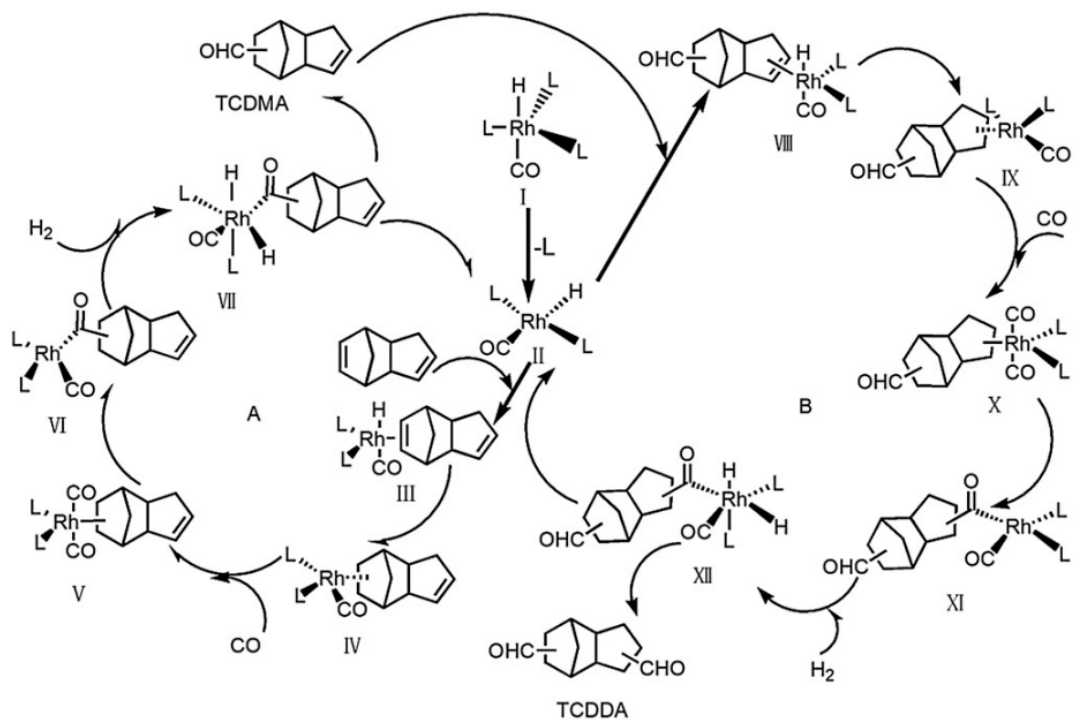
Figure 4 shows the proposed reaction mechanism for two-step hydroformylation of DCPD catalyzed by Rh-P [55]. It can be seen that the aldehyde group is an electron-absorbing group, while metal catalysts like Rh tend to bind to electron-rich sites. Electron-deficient substrates are difficult to coordinate and activate with metals, making it difficult to initiate a second carbonyl insertion in the catalytic cycle. Moreover, after the aldehyde group occupies one side of the alkene molecule, the spatial block blocks CO molecules, phosphine ligands, and metal catalysts from approaching the active site on the other side of the molecule, further inhibiting the second carbonyl insertion. For Co-based catalysts with weak reactivity or hydroformylation catalytic systems with weak mass transfer in water–oil, only the first step of hydroformylation can be completed to obtain tricyclodecane monoformaldehyde.
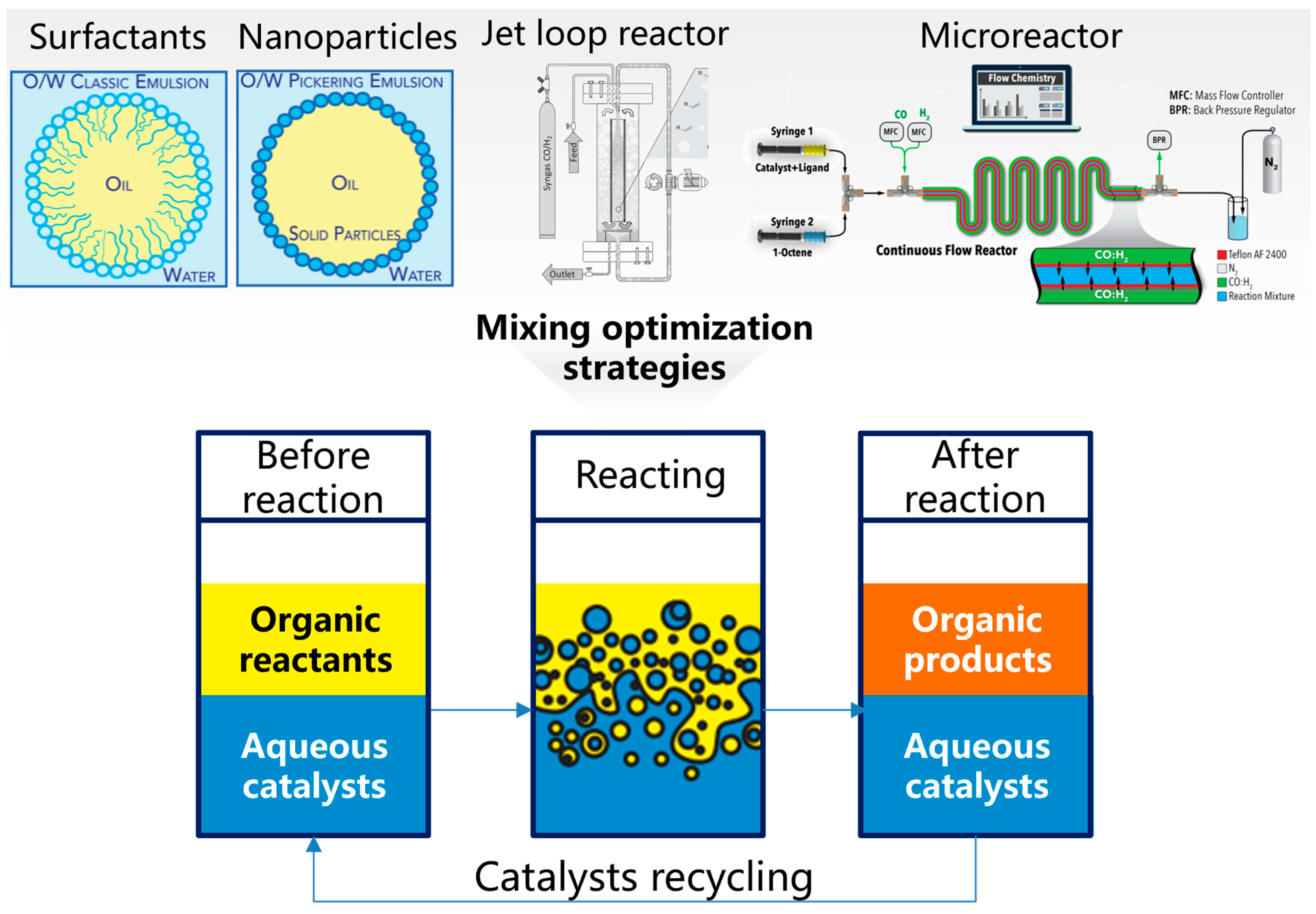
Figure 5 illustrates the scheme of aqueous/organic two-phase hydroformylation catalysis and mixing optimization strategies. Surfactants such as cetylammonium bromide(CTAB) were usually used [64] to promote water–oil mass transfer. In the 1-dodecene hydro-oil hydroformylation reaction, porous nano silica [65] was added to form Pickering emulsions and enhance water–oil mass transfer, increasing the reaction conversion rate from 47% to 93%, and TOF from 45 h−1 to 413 h−1. Its reactivity was higher than CTAB, and it also had the advantage of easier demulsification than CTAB. Although this method of adding mass transfer substances can speed up the reaction rate, improve selectivity, and maintain a high positive and specific ratio, its cycling performance still needs to be verified. A more suitable strategy for catalyst recycling and industrialized continuous operation is to use equipment that enhances the process, such as jet circulation reactors and microchannel reactors. Esteban and colleagues [66] compared the reaction performance of 1-octene, 1-decene, and 1-dodecene in water–oil hydroformylation using traditional stirred kettles and jet circulation reactors. The results show that despite the need for a higher specific power input, the injection circulation flow reactor has higher catalytic activity and productivity, and the longer the olefin carbon chain, the more pronounced the facilitating effect.
Table 9 lists the complete process using an aqueous/organic two-phase hydroformylation catalytic system during the conversion of DCPD to TCD.
In 1996, SINOPEC (Beijing) Research Institute of Chemical Industry Co., Ltd. (BRICI) [70] used a water-soluble rhodium–phosphine catalytic system to carry out hydroformylation of water and oil. At relatively low temperatures (80~100 °C) and pressure (3 MPa), the main product was MFTD.
In 2002, Chen et al. from Sichuan University [71] synthesized the water-soluble rhodium–phosphine compound RhCl(CO)(TPPTS) (TPPTS stands for triphenylphosphine-3,3′,3″-trisulfonic acid trisodium salt). To address the mass transfer problem of the hydroformylation reaction of high-carbon olefin water–oil two-phase hydroformylation, the addition of water-soluble solvents, surfactants, and other phase transfer agents was used to improve the two-phase mass transfer between water and oil. In 2011, Pi et al. from Sichuan University [64] used the aforementioned water-soluble rhodium–phosphine compound as a catalyst. During the water/toluene phase reaction, they added cationic surfactants (such as CTAB) to promote the solubility of the aqueous catalyst in the organic phase. After five repeated uses, the catalytic activity of the water-soluble catalyst did not significantly decrease, but after the reaction, an emulsion layer easily formed between the product and the catalyst, making separation difficult, circulating, and causing precious metal loss, necessitating the addition of additional demulsifiers. In 2021, Sichuan University [72] disclosed a method for preparing aldehyde compounds by hydroformylation of two alkenes using highly polar organic solvents such as formamide, N-methylformamide, or N,N-dimethylformamide as solvents, greatly increasing the solubility of high-carbon olefins. After the reaction, the water-soluble catalyst dissolves in the high-polarity solvent phase and can naturally separate from the high-carbon aldehyde product. However, after thorough hydroformylation of diolefins such as DCPD, dialdehyde is obtained, which has higher polarity and still has some solubility in solvents like formamide, making it difficult to properly separate the aldehyde products from water-soluble catalysts. Moreover, the residue of solvents such as formamide in the aldehyde products can affect subsequent hydrogenation.
Celanese published four patents in a row between 2004 and 2021: (1) In 2004 [73], the process for converting DCPD to MFTD was disclosed, using water-soluble rhodium and water-soluble phosphine ligands as catalysts to react in the aqueous/organic phase. The product MFTD is in the organic phase, and the water-soluble rhodium and water-soluble phosphine ligand can be easily separated and recycled in the aqueous phase. (2) Also in 2004 [74], a process was disclosed to convert the previously generated MFTD immediately into DFTD, using organic rhodium as the catalyst, preferably without phosphine ligands, and catalyzing the organic phase uniformly. (3) In 2005 [75], the process of converting the DFTD generated in the second step into TCD was disclosed, i.e., hydrogenation using a loaded nickel catalyst, where a small amount of water can improve yield. (4) In 2007, Celanese and Degussa (now Evonik) spun off their carbonyl chemicals business to establish Oxea. In 2013, it was renamed Oq. In 2021, Oq disclosed improvements to the aforementioned patent [76], simplifying the two-step conversion of DCPD to MFTD and then to DFTD into one. The improvement was to change the solvent to a mixture of water and isopropanol, while reacted over a metal catalyst system modified with organophosphorus ligands with a transition metal of the 8th-10th subgroup. Since at reaction temperature, water–isopropanol–reactant DCPD can form a homogeneous single phase, the catalyst’s solubility in homogeneous solvents in this process is much higher than that of the water/organic two-phase solvent described in the patented process CN1636956A publication number, greatly increasing the reaction rate and directly converting DCPD to DFTD. Moreover, this process also solves the disadvantage of homogeneous catalysis in difficult catalyst separation: after cooling from reaction temperature to room temperature, the water–isopropanol–product DFTD mixture can separate isopropanol at lower temperatures, and the remaining water and DFTD are not miscible, allowing direct separation. Oq is the world’s largest TCD supplier [77]. In recent years, the demand for TCD has been steadily increasing, with domestic demand reaching the thousand-ton level per year. Therefore, in 2022, Oq completed TCD capacity expansion at its plant in Oberhausen, Germany [78].
Table 9. The process using an aqueous/organic hydroformylation catalytic system during the conversion of DCPD to TCD.
Technology HoldersYearRaw Material and ProductsCatalystsSolventsReaction ConditionsSelectivity/%
Temperature/°CPressure/MPa
BRICI1996 [70]DCPD → MFTDWater-soluble Rh and P (TPPTS)Water and deoxidation buffer solution80~1003n/a
Celanese
Oq
① 2004 [73]
② 2004 [74]
① DCPD → MFTD
② MFTD → DFTD
① Water-soluble Rh and P
② Oil-soluble Rh and P
① Water
② Toluene
① 70~150
② 70~140
① 0.5~10
② 5~35
① 91.6
② 95.1
2005 [75]DFTD → TCDSupported NiToluene and a trace amount of water70~1701~3080.3
2021 [76]DCPD → DFTDWater-soluble Rh and PIsopropanol and water70~1500.5~1090
Sichuan University2011 [64]DCPD → MFTDWater-soluble Rh, P (TPPTS) and CTABWater/toluene1002>94

4.1.3. Supported Hydroformylation Catalysis

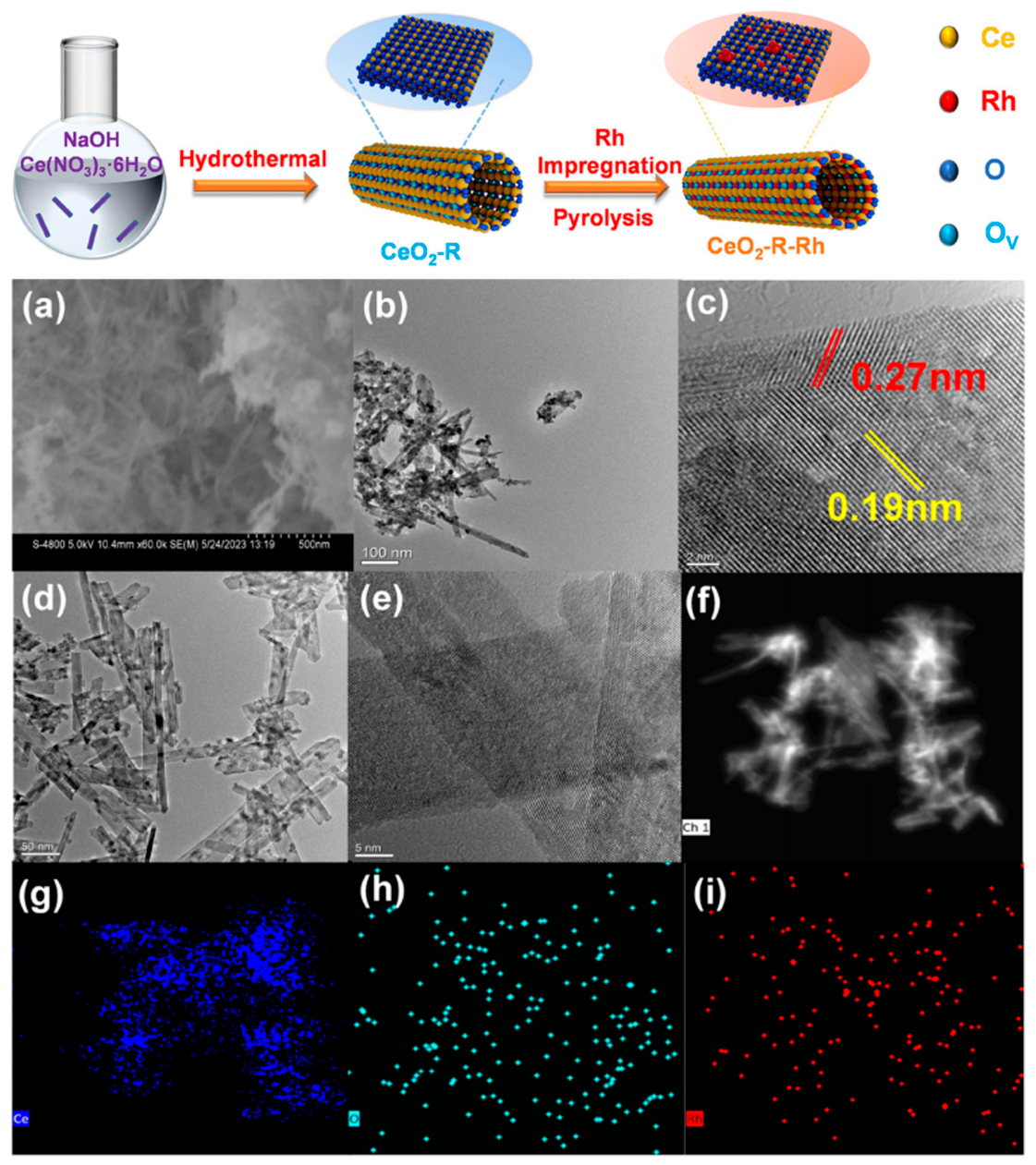
It is well known that supported catalysts can easily separate catalysts from products, but they have the drawback of poor mass transfer. To avoid the difficulty of the second step of dihydroformylation caused by poor mass transfer, supported Rh-containing hydroformylation catalysts typically use the impregnation reduction method, which evenly disperses Rh active sites on the catalyst carrier surface, as shown in Figure 6 [79]. Different catalyst carriers often optimize overall performance due to their own characteristics. For example, oxygen vacancies exist in the CeO2 catalyst carrier, generating unsaturated sites, thereby optimizing the adsorption energy of CO on the catalyst surfaces and reducing the reaction energy barrier [79]. The Fe3O4 catalyst carrier [80] can further assist catalyst and product separation through its magnetic properties. SiO2 catalyst carriers (such as MCM-41 [81]) have a high specific surface area, allowing for more uniform dispersion of Rh active sites.
Table 10 lists the complete process using a supported hydroformylation catalytic system during the conversion of DCPD to TCD.
Since 2013, the Fine Chemical Engineering Center of XTIPC, CAS, has been developing TCDs to prepare supported hydroformylation and hydrogenation catalysts. Specific studies were conducted on different catalyst supports, such as Fe3O4, SiO2, ZnO, CeO2, and MCM-41 [80,81]; solvents with different polarities, such as n-hexane, toluene, tetrahydrofuran (THF), acetone, and methanol [82]; triphenylphosphine (PPh3) and its derivatives (PPh3-CF3 and PPh3-OCH3) and other ligands [83]; and Co-, Rh-, Au-based catalyst systems. Refs. [84,85], proposed that cobalt–rhodium synergistic catalysis is superior to pure rhodium catalysis. Similarly, Luigi Gadaschelli et al. [86] used rhodium carbonyl and cobalt carbonyl as homogeneous hydroformylation catalysts, triphenylphosphine as the ligand, and toluene as solvent (toluene to DCPD volume ratio 10:1). Under the reaction temperature of 70~110 °C and pressure of 2.03~4.05 MPa, they studied the hydroformylation reaction of DCPD. There is a similar conclusion. XTIPC, CAS, has publicly disclosed a series of independently developed high-efficiency catalysts and processes [87,88,89,90,91,92,93,94,95,96,97], enabling the highly selective synthesis of MFTD, DFTD, and TCD under relatively low-temperature and low-pressure conditions. The optimal hydroformylation catalyst is CoRh bimetallic, with SiO2 as the catalyst support. The optimal hydrogenation catalysts are Au, Cu, Mo, Ni, and Ru, with Co3O4 as the catalyst support. Introducing ferromagnetic oxide Fe3O4 as a catalyst carrier can simplify the catalyst separation steps and reduce the residual TCD product in the catalyst. By controlling the amount of reactant DCPD added, the reaction proceeds under pressure variation conditions, preventing temperature spikes. The final DCPD conversion rate can reach over 99%, and TCD selectivity exceeds 90%. Because the catalyst used is a supported heterogeneous catalyst, it enables easy separation, recovery, and multiple reuses. In 2014, XTIPC, CAS, designed and built a ton-scale scale device for the synthesis of high value-added fine chemicals in DCPD, but the project was unable to cooperate with enterprises for large-scale TCD production.
In 2022, Wanhua [98] noted that current existing technologies lack sufficient capability to regulate the product ratio, with issues such as low selectivity for orthomeric products and poor product performance, indicating significant room for improvement. Therefore, a supported rhodium–phosphine catalyst was prepared to achieve the formation of normal DFTD with 87.6% high selectivity in DCPD.
In 2023, Huajinda proposed a method for continuous production of TCD synthesis using DCPD [61], using non-precious nickel or cobalt-based catalysts, with reaction temperature and pressure lower than batch reactions.
Table 10. The process using an supported hydroformylation catalytic system during the conversion of DCPD to TCD.
Technology HoldersYearRaw Material and ProductsCatalystsSolventsReaction ConditionsReaction Effects
Temperature/°CPressure/MPaTime/hConversion Rate/%Selectivity/%
XTIPC, CAS2012 [87]① DCPD → MFTD
② MFTD → DFTD
Co-Rh/Fe3O4 + PPh3Oil-soluble solvents① 90~110
② 130~160
① 4~6
② 7~9
① 1~6
② 5~20
DCPD
>99
DFTD
>90
2012 [88]DCPD → MFTDCo-Rh/Fe3O4 + PPh3Oil-soluble solvents70~1002~62~4>99>98
2012 [89]DCPD → DFTDFeCoRh/MOx (M = Al/Si/Ti/Zr/Sn) + PPh3Oil-soluble solvents90~1403~64~10100>60
2014 [90]DCPD → DFTDCoRh/SiO2 + PPh3Acetone1206610096
2014 [91]DFTD → TCDCu/SiO2 or Al2O3Toluene/THF120~1506~83~8100>99
2014 [92]DFTD → TCDNi-Ru/Fe3O4Toluene/acetone/THF120~1506~83~8100>99
2014 [93]DCPD → TCDCoRhCu/SiO2 + PPh3Toluene/n-hexane/THF150~1707~93~8>99>90
2013 [94]DCPD → TCDAu/Co3O4 + PPh3Toluene150~1707~93~8>99>80
2014 [95]DCPD → TCDAu/Co3O4/FeOx + PPh3Acetone1508610084
2014 [96]MFTD → TCMCu-Mo/MOx (M = Al/Si) THF100~1305~76~12>99>90
2013 [97]DCPD → TCDRh/SiO2, Co-Rh/Fe3O4
Au/Co3O4 + PPh3
Toluene95~1402~72~8n/an/a
Wanhua2022 [98]DCPD → ortho-structural DFTDRh/phosphide, phosphine ligands + PPh3Toluene90~1506~144~89987.6
From Table 10, it can be seen that the traditional supported hydroformylation process has higher reaction temperature, pressure, time, and catalyst usage than homogeneous catalysis. To address these issues, single-atom catalysis has flourished in recent years. Single-atom catalysts refer to catalysts in which metal is dispersed in isolated single-atom states on a carrier. Compared to traditional supported catalysts, they have more uniform and defined active sites, greatly improving the utilization of precious metal atoms. Therefore, single-atom catalysts combine the advantages of homogeneous and supported catalysts. At the same time, single-atom catalysis also offers the following advantages:
(1) Precise and controllable switching between aldehydes and alcohol products: Traditional HRh(CO)(PPh3)3 homogeneous hydroformylation catalysts mainly generate aldehyde products, with the core bottleneck being the difficulty of uniformly active sites independently regulating the hydrogenation activity and desorption barrier of aldehyde intermediates. Qiu [99] from LICP, CAS, prepared a single-atom Rh catalyst supported by ligand-modified CeO2, using PPh3 as a molecular switch to precisely regulate the electronic structure of active sites, enabling selective switching between aldehyde and alcohol in alkene hydroformylation. Using styrene as the model substrate, hydroformylation reaction tests were conducted. Rh1/CeO2 efficiently directed styrene into alcohols, with 99% selectivity and 93% yield. After introducing triphenylphosphine to obtain PPh3-Rh1/CeO2, the product was completely converted to aldehydes, with 99% selectivity and a yield of 91%. The two catalysts are cycled six times, with no significant loss of activity and no leaching of Rh or P metals, demonstrating excellent stability. Moreover, this catalytic system has a very broad substrate applicability. Branched/branched-chain olefins, cyclic olefins, styrene derivatives, and fused cyclic aromatic olefins have over 90% selectivity and product yield of 71%~95% under the catalytic action of Rh1/CeO2 and PPh3-Rh1/CeO2, showing potential for large-scale application.
(2) Higher catalytic activity than homogeneous catalysts: Fu [100] loaded single-atom Rh onto a P-doped graphite carbon nitride (PCN) carrier to prepare a Rh1/PCN catalyst. P atoms facilitate the charge transfer of Rh to the PCN carrier, significantly enhancing electron–metal–carrier interactions and forming electron-deficient Rh species. The reaction kinetics of traditional HRh(CO)(PPh3)3 homogeneous catalysts for CO are −1.41, reflecting the inhibitory effect generated by CO partial pressure. The Rh1/PCN catalyst weakens CO adsorption by reducing the π reverse electron supply, adjusting the CO reaction order to +1.93. Conversely, the π electrons contained in alkenes (such as styrene) interact more easily with electron-deficient Rh sites. Therefore, Rh1/PCN catalysts not only address the inhibitory effect of CO partial pressure but also promote olefin adsorption, exhibiting higher catalytic activity than homogeneous catalysts. However, the catalyst still has rhodium leaching issues. After five cycles, the olefin conversion rate drops significantly from 80% to 40%, making it temporarily unsuitable for industrial application.
(3) Superior proportional adjustment: Zhao [101] copolymerized Xantphos-based phosphine ligands with triphenylphosphine derivatives to prepare porous organic ligand copolymers (CPOLs) with different monomer ratios, loaded monoatomic Rh into the carrier, and prepared Rh1/CPOL–Xantphos&PPh3 catalysts. This catalyst demonstrates excellent thermal stability and long-term durability, achieving a >90% substrate conversion rate and higher orthoaldehyde selectivity than traditional HRh(CO)(PPh3)3 homogeneous catalysts during hydrogen methylation of high-carbon olefins (such as 1-octene). Rh and phosphorus atoms from Xantphos and PPh3 groups within the CPOL support frame structure exhibit stronger coordination effects than HRh(CO)(PPh3)3 homogeneous catalysts. This enhanced phosphorus coordination ability significantly improves spatial control accuracy during olefin insertion into Rh-H bonds, thereby greatly improving the catalyst’s linear product selectivity and solving the core limitations of traditional rhodium catalytic systems. CPOL supports also have the advantage of suppressing rhodium leaching, giving the catalyst high stability. In batch hydroformylation reactions using 1-hexene as the substrate, continuous cycling at least six times maintains aldehyde yield at about 70%, linear aldehyde selectivity exceeds 90%, and rhodium loss is 0.14 wt.% per six cycles, meeting industrial requirements. In a continuous-flow fixed-bed reactor using propylene as the substrate, this catalyst underwent stability testing lasting up to 1000 h, promising to bridge the gap between academic catalyst design and actual industrial processes. As for the preparation of TCD, it is expected that DCPD can be directly converted to TCD using a phosphine band-free Rh1-CeO2 catalyst, without the need to address phosphine ligand recovery. The catalyst inhibition effect caused by CO partial pressure is addressed using the Rh1/PCN catalyst, making the reaction conditions gentler. Adjust the ratio of different isomers using the Rh1-CPOL catalyst and solve the Rh leaching problem.

4.1.4. Thermosensitive Hydroformylation Catalysis

Dalian University of Technology, together with China Petrochemical Corporation, prepared phosphine ligands with temperature-controlled phase transfer functions in 1998 [102] and 2001 [103], respectively, and applied them to hydroformylation to produce high-carbon aldehyde. Based on this technical platform, in 2016, Cheng [104] from Dalian University of Technology synthesized thermosensitive organic phosphine with the structural formula CH3(OCH2CH2)nPPh2 (n ≈ 16) using triphenylphosphine and polyethylene glycol monomethyl ether as raw materials. Using this as a phosphorus ligand, he studied the preparation of MFTD and DFTD by hydroformylation of DCPD in water/organic (organic phase as reactant DCPD) using rhodium dicarbonyl as a catalyst. The prepared temperature-sensitive phosphine ligand has a cloud point of 82 °C. Therefore, below this temperature, the rhodium bound to the phosphine ligand remains in a precipitated state in the reaction system and can be easily separated. Therefore, the precious metal rhodium catalyst can be reused. After four consecutive uses, the selectivity of DFTD was over 79%, a decrease from the initial 97.1%, and the rhodium loss is 1.4 wt.% per cycle, which still does not meet industrial requirements.

4.1.5. Discussion

Since 1979, homogeneous catalysis of DCPD hydroformylation has been relatively mature, using organic Rh-P as the homogeneous catalyst, resulting in fast reaction rates, high conversion rates, and high selectivity. The leading company in homogeneous catalysis is Mitsubishi, which mainly solves the problem of catalyst separation. The representative company for aqueous/organic two-phase catalysis is Oq. Sichuan University has developed similar process to Oq. Relying on this process, Inner Mongolia Yinuo New Mat. Co. Ltd., a subsidiary of Sanli Benno, has achieved industrial production of coal-based fitropine olefins producing high carbonaldehyde/alcohol at the 10,000-ton level. In TCD preparation, hydroformylation extraction processes have been established, which is expected to achieve industrial-scale TCD production. Guangdong Huajinda used the first-generation homogeneous cobalt hydroformylation process, which has expired patent protection, becoming the only domestic manufacturer to achieve TCD industrialization. Companies that started later find it difficult to obtain intellectual property rights for reaction paths and homogeneous catalysts, so research mainly focuses on the pain points of difficulty in separating and recovering homogeneous catalysts, such as developing loaded, and temperature-sensitive catalytic systems to achieve catalyst separation from organic systems. For example, XTIPC, CAS, has developed a supported Co/Rh phosphine hydroformylation catalyst, studying various types of phosphine ligands, catalyst co-catalysts, catalyst carriers, solvents, etc., aiming to overcome the low reactivity of supported catalysts and achieve higher DFTD conversion rates. However, supported catalysts pose risks of rhodium leaching and have not been able to achieve large-scale production. Dalian University of Technology developed temperature-sensitive phosphine ligands to separate catalysts and products under non-reactive conditions, but rhodium loss is too high and unstable, so it has not yet met industrial standards.
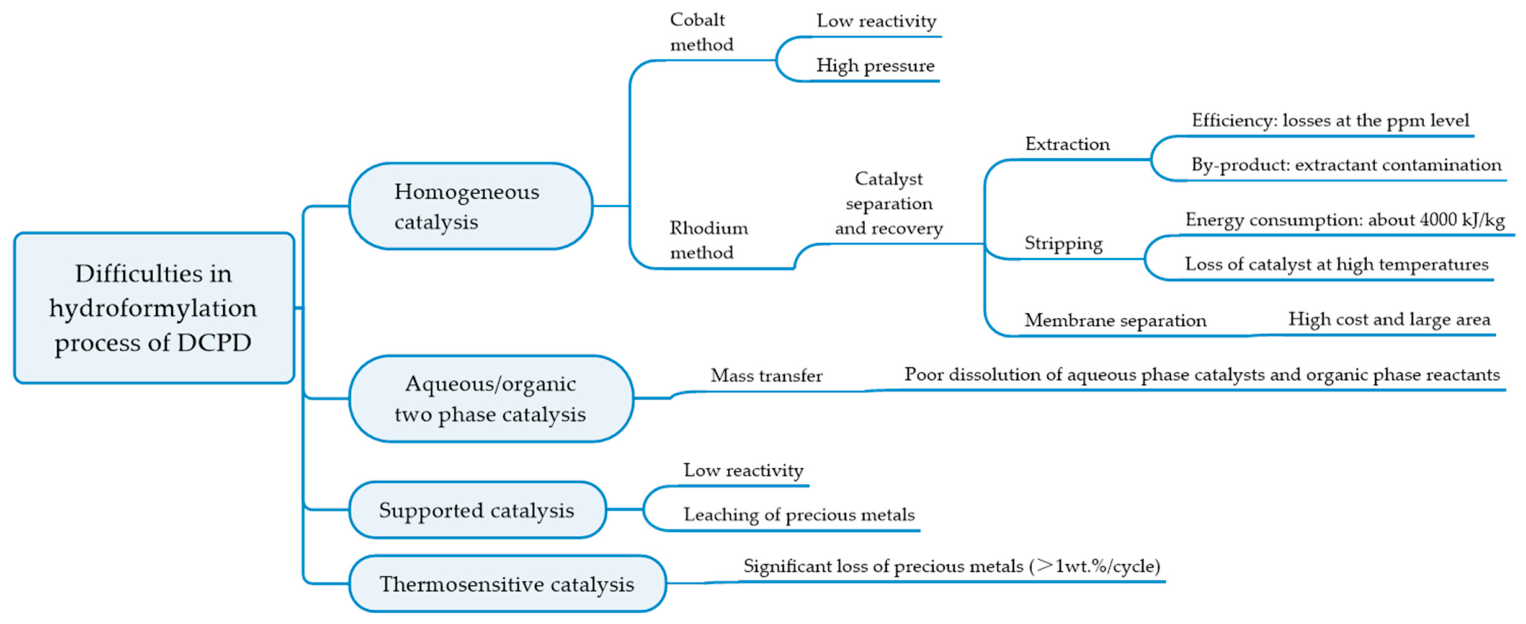
In TCD preparation processes, the hydroformylation catalytic system complements the separation method, determining cost and industrialization feasibility. Due to the high boiling point of the product aldehydes, it is difficult to separate catalyst and product from stripping, and membrane separation is used less industrially, so extraction is mainly used. Figure 7 summarizes the difficulties in the hydroformylation process during TCD preparation, and Table 11 categorizes and summarizes them.
(1) From the perspective of catalyst activity, homogeneous Co- or Ni-based hydroformylation represented by Huajinda, and supported Rh-P catalysis represented by XTIPC, CAS, require catalyst amounts in the thousand ppm level due to low reactivity. Homogeneous Rh-P hydroformylation represented by Mitsubishi, and temperature-sensitive Rh-P hydrogen formylation represented by Dalian University of Technology, due to homogeneous reaction conditions and high reactivity, require rhodium content at the level of ten ppm. The aqueous/organic two-phase Rh-P hydroformylation represented by Oq, even when alcohol solubilizers are added to promote mass transfer in water- and oil-soluble reactants, still struggles to achieve strict uniform single-phase results throughout the reaction. Therefore, the required rhodium dosage is slightly higher than in homogeneous systems, at the level of hundred ppm. Moreover, the concentration of reactants in the aqueous/organic two-phase Rh-P hydroformylation is limited to 10 wt.%, otherwise it affects phase equilibrium and reduces the solubility of aqueous catalysts in organic phase reactants. Subsequently, process enhancement devices such as microbubbles, Venturi tubes, jet circulation, and supergravity rotating beds can be considered to promote mass transfer between water- and oil-soluble reactants.
(2) From the perspective of catalyst loss, homogeneous Co or Ni-based hydroformylation uses non-precious metals and mature processes, with active metal costs accounting for 0.04% of total costs, so catalyst loss is not overly concerned. The rhodium loss in aqueous/organic two-phase Rh-P hydroformylation is the lowest; even when adding ten times the amount of rhodium in homogeneous catalysis, the loss remains one-twentieth that of homogeneous catalysis. According to the calculation method in Table 4, rhodium loss for homogeneous catalysis accounts for 0.6% of total cost, while rhodium loss for aqueous/organic two-phase Rh-P catalysis accounts for 0.03% of total cost, both meeting industrial requirements. Homogeneous Rh-P hydroformylation separation process can be followed by attempts such as coupling membrane separation to further reduce rhodium loss. Supported Rh-P catalysts typically require high reaction temperature (>120 °C), pressure (>4 MPa), time (>5 h), and rhodium concentration (>1000 ppm) due to mass transfer issues, to achieve high aldehyde conversion rates. This further accelerates rhodium leaching. Therefore, although supported catalysts have good laboratory results, they lack long-term stability data, so there are still hidden risks in industrial applications. Thermal-sensitive phase transfer rhodium–phosphine catalysts Since the direct substance with thermosensitive phase separation characteristics is the phosphine ligand, once the phosphine ligand oxidizes, its coordination with rhodium is severely affected, so rhodium loss cannot meet industrial requirements.
(3) From the perspective of patent barriers, the first-generation homogeneous cobalt hydroformylation process has passed its protection period and does not introduce phosphine ligands, so it is not restricted by the patent of Dow [16]. However, this also leads to more by-products. Future development of separation processes can be attempted to reduce product refining costs. Both homogeneous and aqueous/organic two-phase Rh-P hydroformylation processes have undergone technological iteration and obtained authorization in recent years, making it difficult for companies to innovate based on these two traditional processes. Supported and temperature-sensitive rhodium–phosphine hydroformylation processes are highly innovative, but catalyst cycle performance still needs improvement.
(4) From the perspective of process safety and environment, reaction pressure and the pH of reaction fluid are very important for equipment safety. Above 5 MPa, it means a higher level of equipment cost. Additionally, water-soluble rhodium–phosphine catalysts are usually RhCl3-TPPTS compositions. Reactants containing chlorides and low-pH sulfonates require higher corrosion resistance of equipment materials under high temperature and pressure, typically requiring high-cost materials, such as Hastelloy alloys and duplex steel to meet safety requirements. Therefore, the demand for high-voltage equipment in homogeneous cobalt, supported and temperature-sensitive hydroformylation catalytic systems, and corrosion resistance requirements for equipment in aqueous/organic two-phase hydroformylation catalytic systems are all important considerations in industrialization.

4.2. Downstream Applications of TCD

Table 12 summarizes materials based on tricyclodecane frameworks and their applications in optical materials, photoresists, 3D printing materials, and coatings. Among them, Mitsubishi’s TCD is mainly used in optical materials: methacrylate is mainly used in optical lenses with high transparency, high Abbe-number, and high mechanical strength; sulfur-containing resins are used in optical lenses due to their high refractive index; polycarbonate is used in front panels of displays (such as light guide plates) due to its excellent transparency, heat resistance, and impact resistance; and polyimide is used in monitors due to its high transparency and heat resistance. Hitachi Chemical’s TCD downstream is mainly used in PCB photoresist. Specifically, carbamate esters and carboxymethyl ether polyesters in the tricyclodecane framework are used as photoresists in photoresists. TCD can also be used in the synthesis of polymers such as polyacrylate, heat-resistant and corrosion-resistant polyester, epoxy resin, and polyurethane. These resins are used in varnishes and coatings, offering excellent adhesion, high tensile strength, heat resistance, weather resistance, and impact resistance. It is also used in low-viscosity adhesives, sealants, solvent-free paints with excellent strength, intermediates for resin hardeners, molding compositions, and more. TCD-based polyurethane features high adhesion, strength, modulus, and a high glass transition temperature. This specialty diol can also be used to synthesize photosensitive materials with high photosensitivity, high transparency, light resistance, and dry-etching resistance, as well as to produce acrylic with high refractive index and dental materials with high transparency and strength. TCD-based diacrylate UV-cured fiber resin features excellent heat resistance, moisture resistance, and rapid curing performance. TCD-based epoxy resins have high bending and peel strength, hardness, and very low water absorption, and can also be used as fixatives in the fragrance industry. Halogen-free microscope dipping oils with excellent optical properties and TCD-based polyesters can also be used as aircraft turbine lubricants, as coating compositions with strong adhesion under extremely harsh conditions, and as an important component of high-performance water-soluble dispersions.

5. Conclusions

With the rapid development of high-end plastics in optical and electronic grades, research on rigid cyclic glycol monomers like TCD is becoming increasingly important. This article introduces the reaction pathways, catalytic systems, and catalyst separation methods involved in TCD preparation. It summarizes the development history of TCD preparation technology and compares the most important among them, the hydroformylation process. Finally, a market analysis was conducted on downstream TCD applications. For high-carbon olefin hydroformylation processes such as DCPD, heterogeneous catalytic processes such as loaded, temperature-sensitive, and single-atom catalytic processes still suffer from significant precious metal loss, making industrial production difficult. Therefore, TCD production technology is monopolized by foreign companies such as Oq and Mitsubishi, which use traditional water-soluble rhodium–phosphine water–oil two-phase hydroformylation and oil-soluble rhodium–phosphine homogeneous hydroformylation, respectively. Improving the efficiency of DCPD hydroformylation and solving issues such as precious metal catalyst separation and continuous cycling reuse remain to be addressed.

Supplementary Materials

The following supporting information can be downloaded at https://www.mdpi.com/article/10.3390/chemistry8070100/s1, The PRISMA 2020 Checklist information [135].

Author Contributions

Conceptualization, Y.X.; methodology, Y.X.; software, Y.X.; validation, Y.X., X.L. and Z.Y.; formal analysis, Y.X., R.F., and X.Y.; investigation, Y.X. and D.S.; resources, Y.X. and R.F.; data curation, Y.X. and D.S.; writing—original draft preparation, Y.X.; writing—review and editing, Y.X. and X.L.; visualization, Y.X.; supervision, Y.X.; project administration, Y.X., X.L. and Z.Y.; funding acquisition, Z.Y. All authors have read and agreed to the published version of the manuscript.

Funding

This research received no external funding.

Data Availability Statement

Data are available upon request.

Conflicts of Interest

Author Yi Xia, Rong Fan, Dansen Shang, Xinrong Yao, Xi Liu and Zhuo Yi were employed by the company SINOPEC (Beijing) Research Institute of Chemical Industry Co. Ltd. The funding sponsors had no role in the design of the study; in the collection, analyses, or interpretation of data; in the writing of the manuscript; or in the decision to publish the results. The remaining authors declare no conflicts of interest.

Abbreviations

The following abbreviations are used in this manuscript:
TCDBis(hydroxymethyl)tricyclodecane
DCPDDicyclopentadiene
TCMTricyclodecanemonium methoxide
CPDCyclopentadiene
MFTDTricyclodecanemonoformaldehyde
DFTDTricyclodecanediformaldehyde
OqOq Chemicals Gmbh
MitsubishiMitsubishi Chemical Co.
BASFBasf Se
SkSk Chemicals Co. Ltd.
MitsuiMitsui Chemicals Inc
WanhuaWanhua chemical group Co. Ltd.
HuajindaGuangdong Huajinda New Material Tech Co. Ltd.
EvonikEvonik Oxeno Gmbh & Co. Kg.
HitachiHitachi Chemical Co. Ltd.
LICP, CASLanzhou Institute of Chemical Physics Cas
XTIPC, CASXinjiang Technical Institute of Physics and Chemistry Cas
KurarayKuraray Co.
ShellShell Usa, Inc.
ExxonMobilExxonMobil Chemical Patents Inc.
DowDow Global Technologies Inc.
TianchenChina Tianchen Eng. Co. Ltd.
CelaneseCelanese Chemicals Europe Gmbh
Sanli BennuoQingdao Sanli Bennuo New Mat. Co. Ltd.
BRICISINOPEC (Beijing) Research Institute of Chemical Industry Co., Ltd.
PPh3Triphenylphosphine
TPPTSTriphenylphosphine-3,3′,3″-trisulfonic acid trisodium salt
CTABCetylammonium bromide
PCNP-doped graphite carbon nitride
CPOLsPorous organic ligand copolymers

References

  1. Domestic Market Bicyclopentadiene Price Trends on 30 April 2026. [Z/OL]. Available online: https://www.oilchem.net/26-0430-16-be3746e49f537a4f.html (accessed on 30 April 2026).
  2. Hao, T.; Ma, Y.B. Study on the hydroformylation reaction of bicyclopentadiene on rhodium catalysts supported by cobalt-modified ferromagnetic oxides. Low-Carbon Chem. Chem. Eng. 2016, 41, 4. [Google Scholar] [CrossRef] [Scilit]
  3. Haddaway, N.R.; Page, M.J.; Pritchard, C.C.; McGuinness, L.A. PRISMA2020: An R package and Shiny app for producing PRISMA 2020-compliant flow diagrams, with interactivity for optimised digital transparency and Open Synthesis. Campbell Syst. Rev. 2022, 18, e1230. [Google Scholar] [CrossRef] [Scilit] [PubMed]
  4. Ji, G.Z.; Chen, J.; Zhang, Q.; Lv, W.Q.; Liang, Q.S.; Hu, X.Y.; Feng, Y.H. A Method for Pyrolysis of Bicyclopentadiene to Produce Cyclopentadiene. CN101613248, 16 July 2009. [Google Scholar]
  5. Han, T.T. Study on the Performance of Hydrotalc-Like Layered Co-Ni Catalysts in n-Hexene Hydroformylation Reactions. Master’s Thesis, Ningxia University, Ningxia, China, 2022. [Google Scholar]
  6. Shimizu, T.; Moriya, S.; Tsurumaru, T.; Tamura, M. 1,4-Butanediol. JP53068709, 19 June 1978. [Google Scholar]
  7. Matsumoto, M.; Yoshimura, N.; Tamura, M. 1,9-Nonanedial. JP58201743, 24 November 1983. [Google Scholar]
  8. Kitamura, T.; Tamura, M. Propylene Glycol Monoacetate. EP77974, 4 May 1983. [Google Scholar]
  9. Matsumoto, M.; Yoshimura, N. 2-Hydroxy-4-Methyltetrahydropyran. JP60019781, 31 January 1985. [Google Scholar]
  10. Matsumoto, M. Preparation of Dihydrofurans. JP03261776, 21 November 1991. [Google Scholar]
  11. Nakamura, K.; Yamada, K.; Fujii, T.; Motoi, T. Production of Tricyclodecane Dicarbaldehyde, Pentacyclopentadecane Dicarbaldehyde and Corresponding Dimethanols. EP1065194, 3 January 2001. [Google Scholar]
  12. Nakamura, K.; Fujii, T.; Motoi, T. Preparation of Tricyclodecanedimethanols or Pentacyclodecanedimethanols as Monomers for Polycarbonates. JP2001172214, 26 June 2001. [Google Scholar]
  13. Allen, K.D.; Arhancet, J.P.; Knifton, J.F.; Powell, J.B.; Slaugh, L.H.; Weider, P.R. Manufacture of Aliphatic 1,3-diols via the Hydroformylation and Hydrogenation of Epoxides. WO2003068720, 21 August 2003. [Google Scholar]
  14. Van Driessche, E.; Van Vliet, A.; Caers, R.F.; Beckers, H.; Garton, R.; Da Cruz, B.; Lepagnol, M.; Kooke, E. Cobalt Recovery from Cobalt Catalyzed Hydroformylation Reactions. WO2008122526, 16 October 2008. [Google Scholar]
  15. Peng, W.J. Extraction Process for Formyl-Substituted Fatty Acid Triglyceride Ester Separation and Catalyst Recovery. WO2008156993, 24 December 2008. [Google Scholar]
  16. Miller, G.A.; Eisenschmid, T.C.; Brammer, M.A.; Becker, M.C.; Watson, R.B. Hydroformylation Process for Water-Soluble Amines. WO2015153070, 18 October 2015. [Google Scholar]
  17. Chiu, S.F.; Huang, C.J.; Wang, H.Y.; Chou, J.Y. Tricyclodecane Dimethanol Compositions and Uses Thereof as Transparent Optical Materials. WO2020164598, 20 August 2020. [Google Scholar]
  18. Gao, M.; Yang, C.; Ma, K.; Zhao, G.; Liu, J.; Zhou, Y.; Li, C.; Zeng, Q.; Chen, Q.; Li, W. Method for Online Regeneration of Rhodium Phosphine Complex Catalyst, Olefin Hydroformylation Reaction System. CN116920958, 24 October 2023. [Google Scholar]
  19. Geissler, B.; Kneuper, H.J.; Roper, M.; Paciello, R.; Oppenlander, K.; Gunther, W. Manufacture of Aldehydes by Hydroformylation of Olefins with a Rhodium Catalyst and Recovery of the Catalyst by Extraction. WO9730016, 21 August 1997. [Google Scholar]
  20. Schwahn, H.; Borchert, G.; Diehl, K.; Grenacher, A.V.; Sauer, F. Hydroformylation of Olefins Having 20 to 400 Carbon Atoms. WO2001055068, 2 August 2001. [Google Scholar]
  21. Miller, D.J.; Bryant, D.R.; Billig, E.; Shaw, B.L. Treatment of Rhodium Catalysts. WO9003841, 19 April 1990. [Google Scholar]
  22. Huang, S.F.; Ma, Y.L.; Ren, Y.P.; Xu, Z.C.; Li, Y. A Recovery Method for Hydroformylation Catalysts. CN113289695, 21 June 2021. [Google Scholar]
  23. Tokito, Y.; Yoshimura, N. Preparation of α,ω-Dialdehydes. JP62030734, 9 February 1987. [Google Scholar]
  24. Arnoldy, P.; Bolinger, C.M.; Moene, R.; Drent, E.; Van Gogh, J.; Van der Hulst, C.H.M. Hydroformylation Process for Recovery of Solvents and Catalysts. EP922691, 16 June 1999. [Google Scholar]
  25. Toetsch, W.; Arnoldi, D.; Kaizik, A.; Trocha, M. Method for the Hydroformylation of Olefins in the Manufacture of C7-17 Aliphatic Alcohols Using Phase Separation. WO2003078365, 25 September 2003. [Google Scholar]
  26. Lueken, H.-G.; Drees, S.; Kaizik, A.; Bueschken, W. One-Stage Continuous Process for Hydroformylating Higher Olefins or Olefin Mixtures. U.S. Patent 8,138,379, 20 March 2012. [Google Scholar]
  27. Wang, C.; Wu, H.; Liu, X.; Feng, C.; Shi, W.; Yang, K.; Wang, Y.; Huo, Y. Preparation of Dialdehyde. CN117466722, 30 January 2024. [Google Scholar]
  28. Bohnen, H.W.; Fischer, R.; Hewlett, M.; Zgorzelski, W.; Schoepper, N. Method for Recovering Rhodium from Reaction Products of Oxosynthesis. WO2001056932, 9 August 2001. [Google Scholar]
  29. Dai, Y.; Xu, Q.; Feng, J.; Zhao, Q.; Chen, K.; Wang, X. Cost-Effective Method for Preparing High-Carbon Aldehyde by Using High-Carbon Olefin, and Its Production Device. CN113735695, 3 December 2021. [Google Scholar]
  30. Liu, J.; Li, J.; Sun, X.; Yang, P.; Qiao, X. Integrated Reaction-Extraction-Distillation Column for Olefin Hydroformylation with High Conversion and Yield. CN117482548, 2 February 2024. [Google Scholar]
  31. Heida, B.; Hugo, R. Process for Purifying a Recycle Stream from an Installation Processing 1,3-Butadiene. WO2013102625, 11 July 2013. [Google Scholar]
  32. Brammer, M.A.; Phillips, G.R.; Eisenschmid, T.C.; Cox, I.B.; Hetterley, R.; Bainbridge, M.J. Hydroformylation Process in Presence of a Metal Catalyst Comprising an Organophosphite Ligand. WO2016089602, 19 June 2016. [Google Scholar]
  33. Wu, Q.; Guo, L.; Qu, S.; Yang, L.; Lu, X.; Qiu, D.; Wang, J.; Xu, G.; He, T. Device and Method for Separating Aldehyde and Catalyst In Aldehyde Preparation Through Olefin Hydroformylation. CN112403401, 26 February 2021. [Google Scholar]
  34. Laird, K.A. Rhodium Recovery from Hydroformylation Reaction Product. EP314434, 3 May 1989. [Google Scholar]
  35. Summerlin, W.H. Method for Removing Hydroformylation Catalyst. US5237105, 9 December 1993. [Google Scholar]
  36. Richter, W.; Krokoszinski, R.; Mueller, R.; Geissler, B. Method for the Hydroformylation of C2-8 Olefins. WO2002002496, 10 January 2002. [Google Scholar]
  37. Cox, I.B.; Eisenschmid, T.C.; Peterson, R.R.; Papp, R.; Heck, L.; Abatjoglou, A.G. Process of Controlling Heavies in a Recycle Catalyst Stream in a Continuous Hydroformylation Process. WO2010003073, 7 January 2010. [Google Scholar]
  38. Brammer, M.A.; Giles, J.F.; Miller, G.A. Processes to Improve Rhodium Accountability in Continuous Liquid Recycle Hydroformylation Process. WO2020112373, 4 June 2020. [Google Scholar]
  39. Brammer, M.A.; Giles, J.F.; Miller, G.A. Processes to Improve Catalytic Metal Accountability in Hydroformylation Processes. WO2022132372, 23 June 2022. [Google Scholar]
  40. Banister, J.A.; Harrison, G.E. Rhodium-catalyzed Hydroformylation Process with Rhodium Catalyst Recovery. WO2002096848, 5 December 2002. [Google Scholar]
  41. Archibald, F.R.; Jolly, R.A.; Lopez, M.D.A.; Welch, D.K. A Process for the Hydroformylation of Olefins to Aldehydes. WO2020240194, 3 December 2020. [Google Scholar]
  42. Kangas, M.; Nilsson, S. Use of a Method for Reduction of Heavy End Formation and Catalyst Loss in a Hydroformylation Process Comprising a Bidentate Phosphite Ligand. WO2021010878, 21 January 2021. [Google Scholar]
  43. Fu, S.; Chen, H.; Hou, Z.; Zhao, F.; Wang, K.; Wang, X.; Chai, W. Separation Method of Butene Hydroformylation Reaction Liquid Effluent. CN111320533, 23 June 2020. [Google Scholar]
  44. Tunge, J.; Subramaniam, B.; Fang, J.; Jana, R. Polymer-Supported Transition Metal Catalyst Complexes and Methods of Use. WO2010057099, 20 May 2010. [Google Scholar]
  45. Hamers, B.; Fridag, D.; Franke, R.; Becker, M.; Priske, M. Jet Loop Reactor Having Nanofiltration. WO2013034690, 14 March 2013. [Google Scholar]
  46. Baumgarten, G.; Grass, M.; Kaizik, A.; Winterberg, M.; Lueken, H.G.; Hamers, B.; Priske, M.; Fridag, D.; Franke, R.; Hess, D. Method and Membrane used in Hydroformylation of Isobutene and for Separation of Product Mixture. WO2013124176, 29 August 2013. [Google Scholar]
  47. Hamers, B.; Priske, M.; Franke, R.; Hess, D.; Becker, M.; Lueken, H.G.; Rudek, M.; Fridag, D. Optimised Separation Technique for Work-Up of Homogeneously Catalyzed Hydroformylation Mixtures. DE102013203117, 28 August 2014. [Google Scholar]
  48. Korolev, Y.A.; Noskov, Y.G.; Kron, T.E.; Rush, S.N.; Kostin, A.M.; Korneeva, G.A. Method for Continuous Hydroformylation of Olefins C2–C8. RU2585285, 27 May 2016. [Google Scholar]
  49. Brammer, M.A.; Liu, Y.; Singh, A.; Miller, G.A.; Backes, A.F.; Betham, M. Processes for Recovering Rhodium from Hydroformylation Processes. WO2023086718, 19 May 2023. [Google Scholar]
  50. Shibatani, H.; Ookago, Y.; Kameda, T. Tricyclodecanedicarboxaldehyde. JP56030938, 28 March 1981. [Google Scholar]
  51. Tanaka, Y.; Kidoba, K.; Tajima, N. Method for Producing Tricyclodecanedimethanol by Hydroformylation of Dicyclopentadiene to Tricyclodecanedicarboxaldehyde and Hydrogenation of Tricyclodecanedicarboxaldehyde. JP2022147136, 6 October 2022. [Google Scholar]
  52. Papp, R.; Paciello, R.; Benisch, C. Method for Producing Tricyclodecanedialdehydes via the Catalytic Hydroformylation of Dicyclopentadiene. WO2005058786, 30 June 2005. [Google Scholar]
  53. Hayashi, K. Preparation of Tricyclo [5.2.1.02,6]dec-3-en-8(or 9)-ol in the Presence of Solid Acid Catalysts. JP2008208062, 11 September 2008. [Google Scholar]
  54. Kawakami, H.; Tominaga, K.; Sato, K. Method for Manufacturing a Tricyclodecane Mono-Methanol Monocarboxylic Acid Derivative. WO2011048851, 28 April 2011. [Google Scholar]
  55. Luo, R.; Liang, H.R.; Zheng, X.L.; Fu, H.Y.; Yuan, M.L.; Li, R.X.; Chen, H. Highly efficient catalytic system for the formation of dialdehydes from dicyclopentadiene hydroformylation. Catal. Commun. 2014, 50, 29–33. [Google Scholar] [CrossRef] [Scilit]
  56. Watanabe, A. Method for Producing Tricyclo [5.2.1.02,6]Decanedimethanamine (TCD Diamine). JP2020063207, 23 April 2020. [Google Scholar]
  57. Chae, H.I.; Kang, J.S.; Park, J.H.; Lee, S.; Chang, Y.M. Tricyclodecane Dimethanol Composition and Method for Preparing the Same. WO2023277347, 5 January 2023. [Google Scholar]
  58. Chae, H.I.; Kang, J.S.; Park, J.H.; Lee, S.; Chang, Y.M. Tricyclodecane Dimethanol Composition and Preparation Method Therefor. WO2022255695, 8 December 2022. [Google Scholar]
  59. Chae, H.I.; Kang, J.S.; Park, J.H.; Lee, S.; Chang, Y.M. Method for Preparation of Tricyclodecanedimethanol Compositions. WO2022255696, 8 December 2022. [Google Scholar]
  60. Franke, R.; Schneider, C.; Jackstell, R.; Beller, M.; Reusch, D.; Hager, H. Process for the Preparation of Dicidal. CA3205234, 6 January 2024. [Google Scholar]
  61. Liang, B.; Zhang, R.; Liu, S.; Chen, C.; Wu, J.; Yang, B.; Zhong, J. Method for Continuous Production of Tricyclodecane Dimethanol Synthesized from Dicyclopentadiene. CN116102401, 12 May 2023. [Google Scholar]
  62. Tian, M.; Li, H.F.; Wang, L.L. Highly efficient Rh(I)/tris-H8-binaphthyl monophosphite catalysts for hydroformylation of dicyclopentadiene to dialdehydes. Chin. J. Catal. 2018, 39, 1646–1652. [Google Scholar] [CrossRef] [Scilit]
  63. Zhang, X.; Zuo, H.; Liu, Y.; Li, Y.; Li, H.; Zeng, Q.; Huang, J. Preparation of (Octahydro-1H-4,7-methanoindene-2,5-diyl)dimethanamine by Dicyclopentadiene. CN114685281, 1 July 2022. [Google Scholar]
  64. Pi, X.D.; Zhou, Y.F.; Zhou, L.M.; Yuan, M.L.; Li, R.X.; Fu, H.Y.; Chen, H. Dicyclopentadiene hydroformylation in an aqueous/organic two phase system in the presence of a cationic surfactant. Chin. J. Catal. 2011, 32, 566–571. [Google Scholar] [CrossRef] [Scilit]
  65. Tao, L.; Zhong, M.; Chen, J.; Jayakumar, S.; Liu, L.; Li, H.; Yang, Q. Heterogeneous hydroformylation of long-chain alkenes in IL-in-oil Pickering emulsion. Green Chem. 2018, 20, 188–196. [Google Scholar] [CrossRef] [Scilit]
  66. Esteban, J.; Warmeling, H.; Vorholt, A.J. An approach to chemical reaction engineering and process intensification for the lean aqueous hydroformylation using a jet loop reactor. Chem. Ing. Tech. 2019, 91, 560–566. [Google Scholar] [CrossRef] [Scilit]
  67. Stehl, D.; Milojević, N.; Stock, S.; Schomäcker, R.; Von Klitzing, R. Synergistic effects of a rhodium catalyst on particle-stabilized Pickering emulsions for the hydroformylation of a long-chain olefin. Ind. Eng. Chem. Res. 2019, 58, 2524–2536. [Google Scholar]
  68. Yang, H.; Chen, F.; Hu, Y.; Lu, Q.; Xiao, L.; Wang, Y.; Zhao, F.; Jiang, W.; Hao, G. A review on surface coating strategies for anti-hygroscopic of high energy oxidizer ammonium dinitramide. Def. Technol. 2024, 33, 237–269. [Google Scholar] [CrossRef] [Scilit]
  69. Raghuvanshi, K.; Zhu, C.; Ramezani, M.; Menegatti, S.; Santiso, E.E.; Mason, D.; Rodgers, J.; Janka, M.E.; Abolhasani, M. Highly efficient 1-octene hydroformylation at low syngas pressure: From single-droplet screening to continuous flow synthesis. ACS Catal. 2020, 10, 7535–7542. [Google Scholar] [CrossRef] [Scilit]
  70. Zhao, M.; Yuan, G. Hydroformylation reaction of bicyclopentadiene in a water-soluble rhodium-phosphine complexation catalytic system. Fine Chem. 1996, 13, 3. [Google Scholar]
  71. Chen, H.; Li, Y.; Chen, J.; Cheng, P.; Li, X. Synergistic effect of TPPTS and TPPDS on the regioselectivity of olefin hydroformylation in two-phase catalytic system. Catal. Today 2002, 74, 131–135. [Google Scholar] [CrossRef] [Scilit]
  72. Zheng, X.; Chen, H.; Yi, J.; Fu, H.; Yuan, M.; Li, R. Method for Preparing Aldehyde Compound by Two-Phase Hydroformylation of Olefin. CN112679327, 20 April 2021. [Google Scholar]
  73. Lappe, P.; Springer, H.; Lukas, R. Manufacture of TCD-Monenal by Hydroformylation of Dicyclopentadiene. EP1529771, 11 May 2005. [Google Scholar]
  74. Lappe, P.; Springer, H.; Lukas, R. Preparation of Tricyclodecanedialdehyde. EP1529769, 11 May 2005. [Google Scholar]
  75. Dukat, W.; Storm, E.; Schmid, K. Process for Preparing 3(4),8(9)-Dihydroxymethyltricyclo [5.2.1.02,6]Decane by the Hydroformylation and Hydrogenation of Dicyclopentadiene. US20050272960, 8 December 2005. [Google Scholar]
  76. Vogelsang, D.; Huettermann, L.; Wilmsen, T. Process for Hydroformylation of Olefins in the Homogeneous Phase. EP4008710, 8 June 2022. [Google Scholar]
  77. OQ Chemicals [Z/OL]. 2024. Available online: https://chemicals.oq.com/industry-segments/printing/3d-printing (accessed on 1 June 2026).
  78. Compiled and Translated by the China Chamber of Commerce for Import and Export of Minmetals and Chemicals. International Chemical Business News. April 2022. [Z/OL]. Available online: https://www.cccmc.org.cn/hyzx/syhg/ff8080817ffc9cca0180179b14350499.html (accessed on 11 April 2022).
  79. Zeng, G.; Zheng, Y.F.; He, G.Q.; Zhang, C.; Chen, H.N.; Liang, L.X.; Liu, P.; Ma, J.T.; Dong, Z.P. Efficient catalytic hydroformylation of alkenes on Rh/CeO2 catalysts modulated by CeO2 morphology. Ind. Eng. Chem. Res. 2024, 63, 2958–2968. [Google Scholar] [CrossRef] [Scilit]
  80. Ma, Y.B.; Gao, Z.X.; Wumanjiang, E. Hydroformylation of dicyclopentadiene on Fe3O4 based catalysts. Ind. Catal. 2013, 21, 5. [Google Scholar]
  81. Yin, D.; Ma, Y.B.; Gao, Z.X.; Li, N.N.; Wumanjiang, E. Comparative study of Rh catalysts supported on various supports for hydroformylation of dicyclopentadiene. Low-Carbon Chem. Chem. Eng. 2014, 39, 4. [Google Scholar]
  82. Li, N.N.; Ma, Y.B.; Gao, Z.X.; Wumanjiang, E. Hydroformylation of dicyclopentadiene based on the solvent polarity. Appl. Chem. Ind. 2014, 43, 610–612. [Google Scholar]
  83. Li, N.N.; Ma, Y.B.; Gao, Z.X.; Wumanjiang, E. Ligand effects of triphenylphosphine and its derivatives on hydroformylation of dicyclopentadiene. Low-Carbon Chem. Chem. Eng. 2022, 6, 34–37. [Google Scholar]
  84. Yin, D.; Ma, Y.B.; Gao, Z.X.; Wumanjiang, E. Effect of cobalt on properties of Rh based catalysts for the hydroformylation of DCPD. Sci. Technol. Chem. Ind. 2014, 22, 5. [Google Scholar]
  85. Ma, Y.B.; Qing, S.; Gao, Z.X.; Mamat, X.; Zhang, J.; Li, H.Y.; Wumanjiang, E.; Wang, T.F. Tandem hydroformylation and hydrogenation of dicyclopentadiene by Co3O4 supported gold nanoparticles. Catal. Sci. Technol. 2015, 5, 3649–3657. [Google Scholar] [CrossRef] [Scilit]
  86. Garlaschelli, L.; Marchionna, M.; Iapalucci, M.C.; Longoni, G. Hydroformylation and hydrocarbonylation of dicyclopentadiene with cobalt-rhodium catalytic systems promoted by triphenylphosphine: Synthesis of monoformyltricyclodecenes, diformyltricyclodecanes and bis(tricyclodecenyl) ketones. J. Mol. Catal. 1991, 68, 7–21. [Google Scholar] [CrossRef] [Scilit]
  87. Wumanjiang, E.; Ma, Y.B.; Gao, Z.X. Method for Synthesizing Tricyclodecane Dicarboxaldehyde. CN102603502, 25 July 2012. [Google Scholar]
  88. Wumanjiang, E.; Ma, Y.B.; Gao, Z.X. Synthesis of Tricyclodecane Unsaturated Monoaldehyde. CN102617311, 1 August 2012. [Google Scholar]
  89. Wumanjiang, E.; Ma, Y.B.; Gao, Z.X. Method for Synthesis of Tricyclodecanedicarbaldehyde. CN102795978, 28 November 2012. [Google Scholar]
  90. Wumanjiang, E.; Ma, Y.B.; Gao, Z.X. Catalytic Synthesis Method of Tricyclodecane Dimethanol with High Selectivity and Conversion Rate via One-Step Hydroformylation of Dicyclopentadiene. CN103396293, 20 November 2013. [Google Scholar]
  91. Wumanjiang, E.; Ma, Y.B.; Gao, Z.X. Preparation Method for catalyst for Synthesizing Tricyclodecane Dimethanol. CN103586087, 19 February 2014. [Google Scholar]
  92. Wumanjiang, E.; Ma, Y.B.; Gao, Z.X. Process for Maximized Hydroformylation of Dicyclopentadiene by Controlling Adding Speed of Dicyclopentadiene and Gradually Reducing Pressure. CN103588627, 19 February 2014. [Google Scholar]
  93. Wumanjiang, E.; Ma, Y.B.; Gao, Z.X. Method for Synthesizing Tricyclodecane Dimethanol. CN103626635, 12 March 2014. [Google Scholar]
  94. Gao, Z.X.; Ma, Y.B.; Qing, S.J.; Yin, D. Method for Synthesis of Tricyclodecanedimethanol. CN104387233, 4 March 2015. [Google Scholar]
  95. Ma, Y.B.; Yin, D.; Gao, Z.X. A Method for Preparation of Catalysts for Synthesis of Tricyclodecane Dicarboxaldehyde. CN104437619, 25 March 2015. [Google Scholar]
  96. Gao, Z.X.; Ma, Y.B.; Qing, S.J. Method for Synthesis of 4,8-bis(hydroxymethyl)tricyclo [5.2.1.0(2,6)]decane by Hydrogenation of 4,8-bis(aldehyde)tricyclo [5.2.1.0(2,6)]Decane. CN104447212, 25 March 2015. [Google Scholar]
  97. Gao, Z.X.; Ma, Y.B.; Qing, S.J. A Synthesis Method for Tricyclodecane Unsaturated Monoalcohol. CN104447207, 25 March 2015. [Google Scholar]
  98. Sun, S.; Xu, Z.; Lu, Y.; Liu, C.; Dong, L. Hydroformylation Catalyst Containing Rhodium for Catalytic Synthesis of Tricyclodecanedicarbaldehyde. CN114931961, 23 August 2022. [Google Scholar]
  99. Qiu, B.; Liu, S.; Zhao, K.; Wang, B.; Ye, W.; He, D.; Ni, H.; Huang, X.; Yang, X.; Cui, X.; et al. Switchable synthesis of aldehydes and alcohols by hydroformylation with ligand-modified Rh single-atom catalyst. Nat. Commun. 2026. [Google Scholar] [CrossRef] [Scilit] [PubMed]
  100. Fu, B.; Ma, P.; Ding, X.; Cai, K.; Sun, L.; Zhu, Y.; Yin, Q.; Sun, Y.; Liu, T.; Li, Y.; et al. Strong electronic metal–support interactions for enhanced hydroformylation activity and stability over Rh single-atom catalysts through phosphorus doping. JUSTC 2025, 55, 0301. [Google Scholar] [CrossRef] [Scilit]
  101. Zhao, Y.; Dong, J.; Qian, L.; Li, C.; Cheng, F. Boosted hydroformylation of high-carbon olefins with optimized n/i ratio via monodisperse rhodium catalysts supported on copolymerized porous organic ligands. Catal. Sci. Technol. 2026, 16, 4181–4189. [Google Scholar] [CrossRef] [Scilit]
  102. Jin, Z.; Jiang, J.; Liu, X.; Han, F. Application of Phosphine Ligand with Temperature Controlled Phase Transfer Function. CN1184710, 17 June 1998. [Google Scholar]
  103. Jin, Z.; Jiang, J.; Wang, Y.; Liu, C.; Cheng, F. Synthesis of Water-Soluble P-N Ligand for Rh Hydrofomylation Catalyst Used in High-Molecular Weight Aldehyde Production. CN1283626, 14 February 2001. [Google Scholar]
  104. Cheng, J. Hydroformylation of Dicyclopentadiene Catalyzed by Thermoregulated Phosphine Rhodium Complex. Master’s Thesis, Dalian University of Technology, Dalian, China, 2016. [Google Scholar]
  105. Yasuda, Y.; Kiriyama, T.; Ishihara, M. Photocurable Polymer Compositions with Excellent Adhesion. JP01101380, 19 April 1989. [Google Scholar]
  106. Aoki, O.; Shintani, N.; Kobayashi, M.; Kawaki, T. High-Abbe-Number Lens. JP02141702, 31 May 1990. [Google Scholar]
  107. Nakajima, M.; Kutsukake, Y.; Fukushima, H.; Motonaga, A. Urethane Acrylate Polymer Compositions for Plastic Lenses. JP04080213, 13 March 1992. [Google Scholar]
  108. Yabe, M.; Hayakawa, S.; Isaka, T. Polymerizable Compositions Containing Organic Sulfur Compounds. JP08041126, 13 February 1996. [Google Scholar]
  109. Esaki, S.; Hayakawa, S. Acrylate Polymer Compositions, Optical Materials with Low Birefringence, and Their Manufacture. JP11222508, 17 August 1999. [Google Scholar]
  110. Kondo, O.; Fujimori, T.; Isahaya, S.; Konishi, T. Polycarbonates Having Good Optical Properties and Heat and Impact Resistance and Their Preparation. JP11228683, 24 August 1999. [Google Scholar]
  111. Kita, S.; Ogiwara, M.; Kitamura, M.; Oguro, D.; Higashihara, G. Modified Naphthalene Formaldehyde Resin, Tricyclodecane Skeleton-Containing Naphthol Compound and Ester Compound. WO2009072534, 11 June 2009. [Google Scholar]
  112. Furuhashi, A.; Ono, S. Color Polymer Compositions Containing Succinic Anhydride-Added Binders and High-Melting Solvents, Color Filters Using Them, and Liquid Crystal Displays and Organic Electroluminescent Displays. JP2013195973, 30 September 2013. [Google Scholar]
  113. Nozawa, D.; Matsui, J.; Taniguchi, K. Laminate Having Excellent Surface Hardness, Impact Resistance, Interlayer Adhesiveness and Heat Resistance, Front Plate for Display Using the Same. JP2017071152, 13 April 2017. [Google Scholar]
  114. Abiko, Y.; Sekiguchi, S.; Takada, T. Polyimide Resin, Polyimide Varnish and Polyimide film. WO2019116940, 20 June 2019. [Google Scholar]
  115. Fujiwara, K.; Fukushima, T.; Takeshita, M.; Takada, N. Preparation of Cyclopentanedicarboxylic Acid. JP07101898, 18 April 1995. [Google Scholar]
  116. Aoki, T.; Kajiwara, T.; Ajioka, Y. Light-Sensitive Resin Composition for Dry-Film Photoresist for Manufacturing Printed Circuit Boards and Method for Pattern Formation Using the Same. JP2004294553, 21 October 2004. [Google Scholar]
  117. Kamei, J.; Hayashi, K.; Kobayashi, A. Tricyclodecanediol Di(meth)acrylates and Their Manufacture. JP2006315960, 24 November 2006. [Google Scholar]
  118. Nakoshi, T.; Tanaka, S.; Kurafuchi, K. Solder Photoresist Containing Tricyclodecane-Based Monomer and Dry-Film Photoresist. JP2011048313, 10 March 2011. [Google Scholar]
  119. Nakoshi, T.; Tanaka, S.; Kurafuchi, K. Photosensitive Resin Composition Containing Silica Filler, Photosensitive Film, and Permanent Resist. JP2011248188, 8 December 2011. [Google Scholar]
  120. Tanaka, S.; Nakoshi, T.; Kurafuchi, K. Photosensitive Resin Composition and Photosensitive Element. JP2012103537, 31 May 2012. [Google Scholar]
  121. Terawaki, T.; Hirao, K. Transfer Type Photosensitive Film Using Metal Oxide, Forming Method of Cured Film Pattern, and Electronic Component. JP2019035801, 7 March 2019. [Google Scholar]
  122. Huang, C.J.; Tu, A.P. Polyester Composition and the Molded Product Thereof. TWI850121, 21 July 2024. [Google Scholar]
  123. Fu, Y.; Fu, J.; Wang, L.; Hua, Y. Optical Adhesive Composition, Optical Adhesive Film and Optical Adhesive Layer and Preparation Method Thereof. CN114456719, 10 May 2022. [Google Scholar]
  124. Guan, L.; Kuang, C.; Qiu, Y.; Cao, C.; Shen, X.; Xia, X.; Lai, H.; Li, J.; Ma, P.; Fu, H.; et al. Femtosecond Laser Direct Writing Photoresist Composition and Preparation Method Thereof. CN115793395, 14 March 2023. [Google Scholar]
  125. Chen, L. Thermoplastic Polyester for Catering Containers, Kitchen Appliances, Optical Base Films or Electronic Cigarette Oil Storage Devices and Preparation Method Thereof. CN117624567, 1 March 2024. [Google Scholar]
  126. Pu, D. High Temperature Resistant Aqueous Micro-Crosslinking Transfer Coating and Preparation Method Thereof. CN117106353, 24 November 2023. [Google Scholar]
  127. Tan, X.; Ouyang, J.; Chen, H. Aqueous Polycarbodiimide for Coatings and Preparation Method Thereof. CN114920896, 19 August 2022. [Google Scholar]
  128. Han, Y. Resin for Automobile Spraying Vehicle Coating and Preparation Method Thereof. CN117624609, 1 March 2024. [Google Scholar]
  129. Fan, X.; Dai, X.; Du, S.; Zhu, H.; Lu, Q.; Shen, W.; He, T.; Zhu, Q.; Fan, B. High Refractive Index Two-Photon Photoresist Composition and Preparation Method and Application Thereof. CN117590693, 23 February 2024. [Google Scholar]
  130. Liu, J.; Fan, X. Preparation Method of PMMA Composite Microsphere for Battery Separators. CN120059236, 13 May 2025. [Google Scholar]
  131. Wan, Y.; Qiu, X.; Lin, J.; Li, Y.; Meng, L.; Zhang, N. Preparation Method of Polyurethane Acrylate Oligomer for Photosensitive Resin Composition in Light-Curing 3D Printing. CN117683202, 12 March 2024. [Google Scholar]
  132. Guo, J.; Han, Y.; Zhang, L.; Zhang, X.; Zhang, Y. High-Performance Photopolymer Film Doped with Vanadium Dioxide Nanoparticles for Infrared Thermal Imaging Anti-Counterfeiting Material and Preparation Method Thereof. CN116589716, 15 August 2023. [Google Scholar]
  133. Guo, H.; Sun, L.; Gong, T.; Cheng, Z. Method for Preparing Special Initiator Polyether Polyol. CN116178695, 30 May 2023. [Google Scholar]
  134. Lan, Z.; He, J. Preparation of Insulating Oil Used for Electronic Masks. CN117801582, 2 April 2024. [Google Scholar]
  135. Page, M.J.; McKenzie, J.E.; Bossuyt, P.M.; Boutron, I.; Hoffmann, T.C.; Mulrow, C.D.; Shamseer, L.; Tetzlaff, J.M.; Akl, E.A.; Brennan, S.E. The PRISMA 2020 statement: An updated guideline for reporting systematic reviews. BMJ 2021, 372, n71. [Google Scholar] [CrossRef] [Scilit] [PubMed]
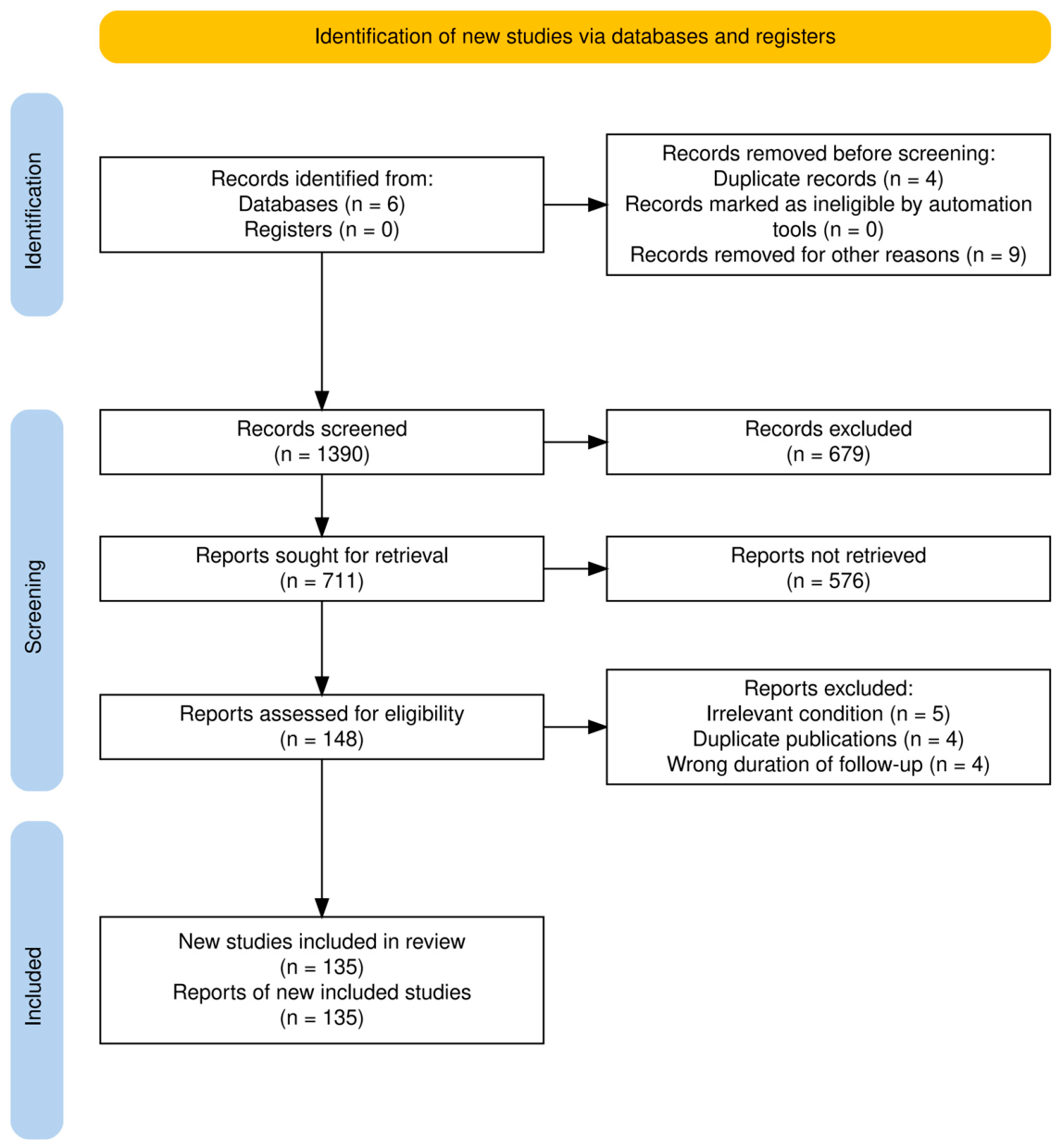
Figure 1. PRISMA 2020 flow diagram for new systematic reviews which included searches of databases and registers only [3].
Chemistry 08 00100 g001
Figure 2. Reaction path of the conversion of DCPD to TCD.
Chemistry 08 00100 g002
Figure 3. Side reactions of the conversion of DCPD to TCD.
Chemistry 08 00100 g003
Figure 4. Proposed reaction mechanism for DCPD hydroformylation [55].
Chemistry 08 00100 g004
Figure 5. Scheme of aqueous/organic two-phase hydroformylation catalysis and mixing optimization strategies such as adding surfactants [64] and nanoparticles [65,67] to form Pickering emulsions [68], as well as using the jet loop reactor [66] and microreactor [69].
Chemistry 08 00100 g005
Figure 6. Scheme of preparation process of CeO2 nanorods and Rh/CeO2 nanorods. (a) Representative SEM image of CeO2 nanorods; (b) low-magnification TEM image of CeO2 nanorods; and (c) HR-TEM image of CeO2 nanorods. The lattice fringes of 0.19/0.27 nm correspond to the spacing of CeO2(110)/CeO2(100); (d) low-magnification TEM image of Rh/CeO2 nanorods; (e) HRTEM image of Rh/CeO2 nanorods; and (f–i) EDX mapping of composition elements Ce, O, and Rh, respectively [79].
Chemistry 08 00100 g006
Figure 7. Difficulties in hydroformylation process of DCPD.
Chemistry 08 00100 g007
Table 1. Properties of raw materials, products, and by-products in the conversion of DCPD to TCD.
MaterialCASMolecular FormulaMolecular Weight
(g/mol)
Boiling Point (°C at 1013 hPa)Water Solubility
(g/L at 20 °C)
DCPD77-73-6C10H12132.21700
CPD542-92-7C5H666.141.5~420.68
Cyclopentanemethanol3637-61-4C5H11OH100.16162~163slightly soluble
MFTDn/aC10H13-CHO162.2240.9 (estimated value)n/a
DFTDn/aOHC-C10H14-CHO192.2308.6 (estimated value)n/a
5,6-Dihydrodicyclopentadiene4488-57-7C10H14134.21800
Tetrahydrodicyclopentadiene6004-38-2C10H16136.2185.550
TCM57526-50-8C10H13-CH2OH166.32660.4
TCD26896-48-0HOH2C-C10H14-CH2OH196.3334.511
Table 2. Reaction conditions and properties of fourth generation hydroformylation catalysts [5].
CatalystsHomogeneous CatalysisAqueous/Organic Two-Phase Catalysis
1st-Generation Catalysts2nd-Generation
Catalysts
3rd-Generation
Catalysts
4th-Generation
Catalysts
PointCobalt carbonylTerphosphine-modified cobalt carbonylOil-soluble rhodium–phosphine complexWater-soluble rhodium–phosphine complex
Active speciesHCo(CO)4HCo(CO)4PR3 *HRh(CO)(PO)3 *HRh(CO)(PW)3 *
Development time1940s1950s1970s1984
Temperature (°C)110–180160–200100–12050–130
Pressure (MPa)20–305–101.6–3.51–10
Catalyst/olefin0.1–10.60.01–0.10.001–1
ProductAldehydeAlcoholAldehydeAldehyde
Aldehyde selectivityLowLowHighHigh
Hydrogenation productMediumHighLowLow
ActivityLowLowRelatively highRelatively high
* R refers to alkyl, PO refers to oil-soluble phosphine ligands, PW refers to water-soluble phosphine ligands.
Table 3. DCPD hydroformylation catalytic process and corresponding TCD production capacity.
Technology HoldersHydroformylationHydrogenationProduction Capacity
CatalystsProcessCatalystsProcess
MitsubishiRh-PHomogeneous catalysisRuSupported catalysisNot for Sale
HuajindaCo or NiRu or NiSupported catalysisThousand-ton class
BASFRh-PNiSupported catalysisn/a
EvonikPt-PRuSupported catalysisn/a
HitachiRu/Co-PPdSupported catalysisn/a
SkRh-PRuSupported catalysisn/a
MitsuiRh-PPdSupported catalysisn/a
LICP, CASRh-P n/an/an/a
OqRh-PAqueous/organic
two-phase
catalysis
NiFixed-bed Raney nickel processTen-thousand-ton class
Sichuan UniversityRh-Pn/an/an/a
XTIPC, CASCo/Rh-PSupported
catalysis
AuSupported catalysisn/a
WanhuaCo/Rh-Pn/an/an/a
Dalian University of TechnologyRh-PThermosensitive ligandsn/an/an/a
Table 4. Rhodium losses required for different value-added hydroformylated products.
Rhodium and CostsButyl and Octyl AlcoholTCD
The mass fraction of rhodium (ppm)300300~500
The mass fraction of reactants (wt.%)3010~60
The price of rhodium (ten thousand CNY/ton)1.8 × 1051.8 × 105
The price of products (ten thousand CNY/ton)110
The proportion of rhodium costs to total costs (%)11
The mass fraction of rhodium in products (ppm)0.080.926~5.556
The mass fraction of rhodium loss (wt.%)0.0130.111~0.185
Table 7. Summary of patents for the separation of products and catalysts by membrane separation after the hydroformylation of olefins.
Technology HoldersYearRaw Material or ProductsHydroformylation CatalystsSeparation ConditionsSeparation Efficiency
Before SeparationBefore Separation
University of Kansas2009 [44]≥C5Oil-soluble Rh (or Co, Ru, Ni, Pd, Pt), P and polymerAperture: <50 Å
Interception molecular weight: 200~500 g/mol
Rh: 68~109 ppm
P: 95~266 ppm
Retention rate: 90%
Rh: <30 ppb
2011 [13]1-olefinOil-soluble Rh, bidentate phosphine ligands and polymer3 MPa
$0.004/lb aldehyde
(The economic viability criterion is $0.013/lb aldehyde)
Rh: 70~110 ppm
P: 90~300 ppm
P/Rh = 4~8
Runs for 22 h
Rh: <100 ppb
Evonik2012 [45]n/aOil-soluble Rh and PInterception molecular weight: 150~1000 g/mol, 4.4 m/s, 102 °C, 40 barRh: 10 mg/kg
P: 1170 mg/kg
Retention rate:
Rh: 88~92%
P: 83%
2013 [46]isobuteneOil-soluble Rh (or Co) and PInterception molecular weight: 150~2000 g/mol
−10~150 °C, 0.5~6 MPA
Rh (or Co):
10~100 ppm
P/Rh (or Co) = 1~50
Retention: −8%~−1%
Runs for 500 h
2014 [47]C8Oil-soluble Rh and phosphite phosphorus ligandsMetal: 0.026 kg/h/m2
Ligand: 0.099 kg/h/m2
Transmembrane pressure: 3.5 MPa
0.145 g Rh/ton aldehyde
(0.145 ppm)
Rh consumption: 0.145 g Rh/metric ton of nonanal
Otkrytoe2015 [48]C2~C8Oil-soluble Rh and P30~80 °C, <10 MPaRh: 50 ppm
P/Rh = 20
Retention rate:
Rh: 88~95%
Dow2022 [49]C6~C22Oil-soluble Rh and P2~5.8 L/m2/hRh: 78.2~104.2 ppmRetention rate:
Rh: 79.3~86.0%
P: 32.5~66.0%
Table 11. Comparison of hydroformylation processes during TCD preparation.
ProcessesHomogeneous Rh-P CatalysisHomogeneous Co or Ni CatalysisAqueous/Organic Two-Phase CatalysisSupported Rh-P CatalysisThermosensitive Rh-P Catalysis
Representing enterprisesMitsubishiHuajindaOqXTIPC, CASDalian University of Technology
Septation methodExtractionExtractionExtraction-assisted phase separation Solid–liquid separationSolid–liquid separation
Catalyst dosageRh: 30 ppmCo or Ni: 4100 ppmRh: 350 ppmRh: 5300 ppmRh: 90 ppm
Catalyst lossRh: 2 wt.%Co: 5 wt.%Rh: 0.01 wt.%n/a>1.4 wt.%/cycle, and the losses increase step by step
Catalyst cost/total cost0.6%0.04%0.03%n/a>4.2%/cycle
Temperature70~100 °C87~120 °C130 °C95~140 °C110 °C
Pressure3 MPa6.5 MPa5 MPa4~7 MPa6 MPa
Time6 h11~13 h3 h5.5 h4 h
Reactant concentration56 wt.%18 wt.%10 wt.%24 wt.%11 wt.%
Advantages① High reactivity
② Low usage of Rh
Low catalyst costs① Low loss of Rh
② Separability of catalysts and products
Separability of catalysts and products① High reactivity
② Separability of catalysts and products
DisadvantagesMedium loss of RhHigh reaction pressure, time and by-products① Poor mass transfer in water and oil-soluble reactants
② Low concentration of reactants
① High reaction pressure and time
② High usage of Rh
③ Hidden danger of Rh dissolution
High loss of Rh
Improvement measuresUse membrane separation and other methods to reduce Rh lossFocus on by-product separation processes① Adjust the solubilizer ratio to increase the concentration of reactants
② Add process intensification equipment to promote mass transfer between water and oil
① Use single-atom catalyst
② Reduce Rh loss
Reduce Rh loss and improves the stability of temperature-sensitive phosphine ligands
Table 12. The downstream applications of TCD.
Technology HoldersYearDerivatives of TCDApplication
Mitsubishi1989 [105]MethacrylateFiber-reinforced composites with high transparency, high elastic modulus, low linear thermal expansion coefficient, high heat resistance, high flatness, and high smoothness
1990 [106]MethacrylateOptical lenses with high Abbe numbers, especially eyeglass lenses
1992 [107]Sulfur-containing resinsEyeglass lenses, camera lenses, or discs
1996 [108]Sulfur-containing resinsSulfur-containing resins with high refractive index, low specific gravity, excellent transparency, toughness, heat resistance, and weather resistance that were used for optical lenses, prisms, optical disc substrates, and optical fibers
1998 [109]AcrylateLightweight, low birefringence, transparency, heat resistance, mechanical strength, especially excellent impact resistance, low water absorption, and low-refractive optical components
1999 [110]PolycarbonateOptical materials with good transparency, impact resistance, and heat resistance
2008 [111]Modified naphthalene-formaldehyde resinCoatings and binders for electrical insulation, corrosion resists, semiconductors, printed circuit boards, electrical laminates, fiber-reinforced plastics, and liquid crystal displays
2013 [112]MethacrylateColoring resin for color filters in LCD devices and organic electroluminescent displays
2015 [113]PolycarbonateLaminated boards with high surface hardness, excellent impact resistance, heat resistance, and interlayer adhesion are used for front panels in displays
2018 [114]PolyimideSulfur-containing resins that are heat-resistant, colorless, transparent, thermally stable in size, laser peeling, and resistant to organic solvents; used in LCD and OLED displays
Mitsui1993 [115]Thermosetting polyesterThermosetting polyester with moldable, low volume, and good surface flatness that was used for decorative materials such as washbasins, bathtubs, kitchen countertops, and marble for interior and exterior building materials
2004 [116]AcrylateWater resistance, flexibility, hardening, and alkali-resistant acrylate was used in electronics, coatings, civil engineering, medical materials, optical fibers, optical lenses, semiconductor materials, and liquid crystal materials
2006 [117]PolycarbonateWell-balanced heat resistance and flexibility
2010 [118]Monomethanol monocarboxylic acidPhotosensitive resin, cast-off as a solder mask for flexible circuit boards, that is used in printed circuit boards and semiconductor packaging substrates
2010 [119]Monomethanol monocarboxylic acidHeat resistance and high transparency, used in optical electronic components, LCD displays, optical fibers, and medical devices
2012 [120]DiisocyanatePhotosensitive resin is the outermost photosensitive solder resist applied to semiconductor packaging substrates
2018 [121]Photosensitive resinTransfer-type photosensitive film, used in LCD display components and touch panels
Changchun Plastics Co. Ltd.2021 [122]PolyesterLaser welding, translucent resin, and radar sensors
Suzhou Tongli Optoelectronics Co. Ltd.2022 [123]DiacrylatePhotopolymerized monomers, used in full lamination processes for flexible screens such as OLED
Zhejiang Lab and Zhejiang University2022 [124]DiacrylateFemtosecond laser direct-writing photoresist composition
Shenzhen Smoore Technology Ltd.2022 [125]Thermoplastic polyesterFemtosecond laser direct-writing photoresist composition
Hunan Huihua New Mat. Co. Ltd.2022 [126]DiacrylateHigh-temperature water-resistant micro-crosslinking transfer coating
Guangzhou Guanzhi New Material Tech. Co. Ltd.2022 [127]TCDCrosslinking agents for preparing water-based coatings
Guangzhou Boli New Material Tech. Co. Ltd.2023 [128]Diethylene dicarboxylateResin for preparing coatings for spraying automotive clothing
Zhejiang Yangfan New Mat. Co. Ltd.2023 [129]DiacrylateHigh-refractive-index two-photon photoresist and photoresist composition
Changyuan New Energy Material Res Institute Guangdong Co. Ltd.2023 [130]DiacrylateA water-resistant, soap-free emulsion used as an adhesive for preparing ceramic separators for lithium batteries
Shanghai Xinsi Dike New Mat. Co. Ltd.2023 [131]Polyurethane acrylatePhotopolymerization 3D printing for mold manufacturing, dental care, and toy handicrafts
Beijing University of Technology2023 [132]DiacrylateSmart windows and infrared thermal-imaging anti-counterfeiting materials
Shandong Inov New Mat. Co. Ltd.2023 [133]Diethylene dicarboxylatePolyether polyol
Guangdong Lvzhan Tech. Co. Ltd.2023 [134]DiacrylateInsulating oil used for electronic masks
Disclaimer/Publisher’s Note: The statements, opinions and data contained in all publications are solely those of the individual author(s) and contributor(s) and not of MDPI and/or the editor(s). MDPI and/or the editor(s) disclaim responsibility for any injury to people or property resulting from any ideas, methods, instructions or products referred to in the content.