Communication

Covalent Organic Cage Directs EDA Complex Reactivity in Tetralone Synthesis

Engineering Research Center of Green Energy Chemical Engineering, Shanghai Normal University, Shanghai 200234, China
*
Author to whom correspondence should be addressed.
Chemistry 2026, 8(6), 74; https://doi.org/10.3390/chemistry8060074
Submission received: 9 March 2026 / Revised: 13 May 2026 / Accepted: 14 May 2026 / Published: 1 June 2026
(This article belongs to the Section Supramolecular Chemistry)

Abstract

Photocycloaddition reactions provide an efficient strategy for converting alkenes into structurally complex and high-value molecules that are often difficult to access under conventional thermal conditions. Herein, two readily accessible triarylamine-based imine molecular cages possessing distinct cavity environments were investigated as supramolecular photocatalysts for reactions of pyridinium-masked enol (PME) substrates with unactivated alkenes. Spectroscopic studies are consistent with the formation of electron donor–acceptor (EDA) interactions between the electron-rich cage frameworks and electron-deficient PME substrates. Upon blue-light irradiation (450 nm), these charge-transfer assemblies undergo photoinduced activation, likely involving single-electron transfer, N–O bond cleavage, and subsequent radical generation. The resulting radical intermediates participate in formal [4 + 2] cycloaddition reactions to afford tetralone derivatives under metal-free conditions. Comparative studies revealed that the two cages produce distinct product distributions and selectivities, suggesting that subtle variations in cage architecture and confined supramolecular environments influence the fate of reactive radical intermediates and the balance between productive cyclization and competing side pathways. While the detailed mechanistic origin of these effects remains unresolved, this work demonstrates the potential of covalent organic cages as structurally tunable platforms for modulating EDA-mediated photochemical reactivity and radical selectivity.

1. Introduction

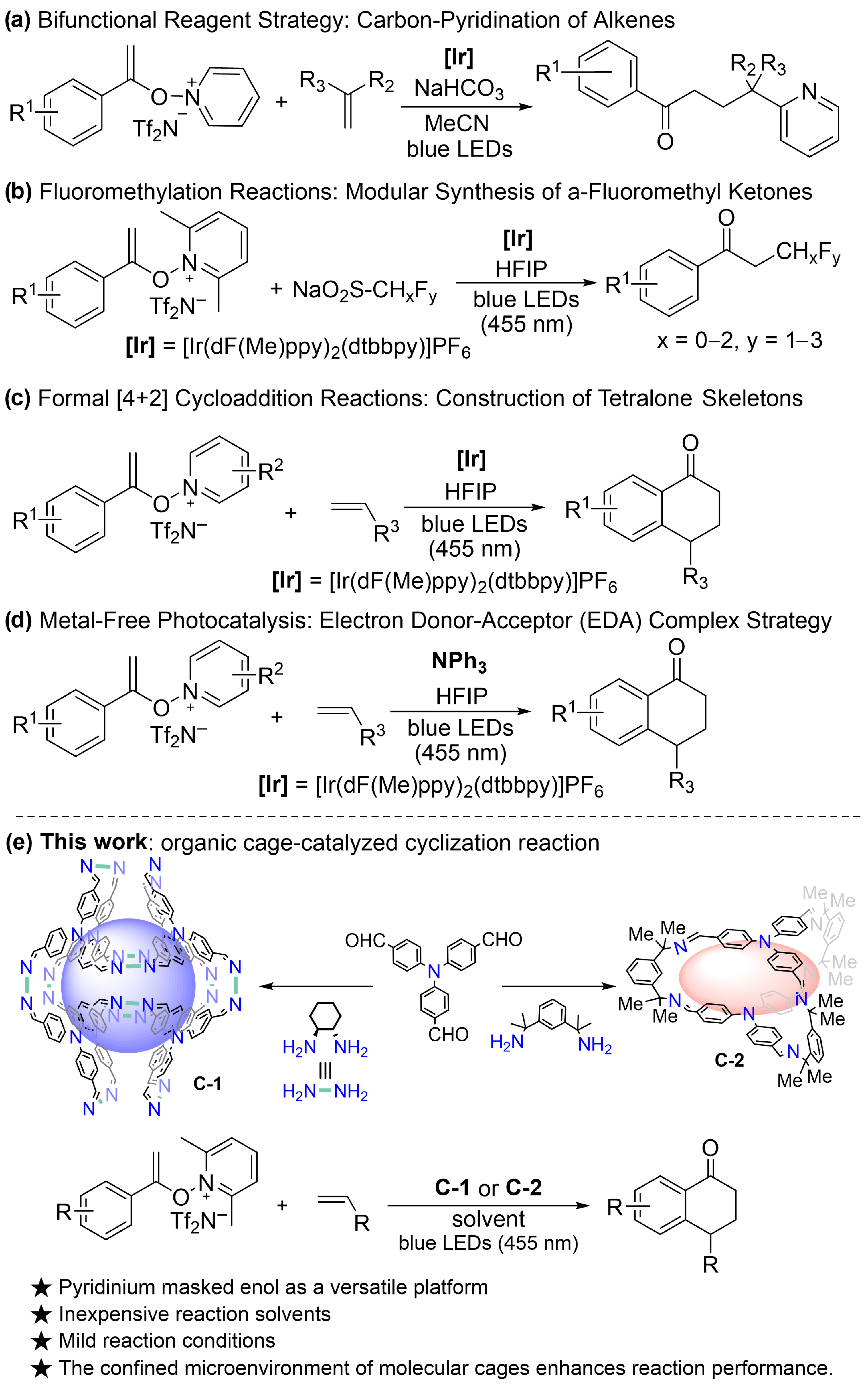
Pyridinium-masked enols (PMEs), which are readily accessible from terminal alkynes and heteroarene N-oxides, have emerged as versatile carbonyl synthons for the preparation of functionalized ketones [1]. Traditionally, PMEs undergo SN2-type substitution reactions with nucleophiles such as amines, thiols, and alcohols [2,3]. However, these transformations often require base activation, which can limit their compatibility with weakly nucleophilic or neutral reaction partners [4,5,6,7]. (Scheme 1a) To overcome these limitations, photoactivation strategies have recently been developed to access alternative reactivity pathways under mild conditions (Scheme 1b–d). For example, visible-light-induced single-electron transfer (SET) processes can generate α-carbonyl radical intermediates from pyridinium salts, enabling transformations such as carbopyridylation [6], fluoromethylation [7], and formal [4 + 2] cycloadditions [8,9]. Despite these advances, many reported systems still rely on precious-metal photocatalysts.
Electron donor–acceptor (EDA) complex-mediated photocatalysis has emerged as an attractive metal-free strategy for radical generation [10]. Owing to the electron-deficient nature of the pyridinium moiety, PMEs can potentially engage in charge-transfer interactions with electron-rich donors [11]. Although a variety of nitrogen-based donors have been investigated, most reported systems rely on relatively simple small-molecule architectures with limited structural tunability [12,13]. The development of alternative donor platforms capable of modulating donor–acceptor interactions therefore remains of interest. Porous organic cages (POCs), which possess discrete cavities and permanent porosity, have attracted increasing attention in supramolecular catalysis and molecular recognition [14,15,16]. Their modular structures and tunable internal environments provide opportunities to influence substrate interactions and reactivity [17,18,19,20,21,22,23]. Nevertheless, the use of molecular cages as electron donors in EDA-mediated photocatalytic transformations remains relatively unexplored.
Herein, we investigated whether electron-rich molecular cages could participate in charge-transfer interactions with PMEs under visible-light irradiation. To examine this possibility, two triarylamine-based imine-linked cages (C-1 and C-2) were synthesized according to reported procedures [24,25]. These cages were subsequently evaluated in the visible-light-induced formal [4 + 2] cycloaddition of PMEs with unactivated olefins. Under the optimized conditions, C-1 exhibited higher catalytic activity than C-2, suggesting that cage architecture and cavity dimensions may influence substrate interaction and photocatalytic behavior. Overall, this work introduces porous organic cages as structurally tunable donor platforms for EDA-mediated photocatalysis and provides a metal-free approach for PME activation.

2. Results and Discussion

The triphenylamine (TPA)-based covalent organic cage C-1, consisting of twelve chiral (1R,2R)-cyclohexane-1,2-diamine units and eight tris(4-formylphenyl)amine linkers, was synthesized via dynamic imine condensation under dilute conditions according to a reported procedure [24]. Cage C-2 was prepared analogously using 2,2′-(1,3-phenylene)bis(propan-2-amine) as the diamine component while retaining the same TPA aldehyde linker [25]. The formation of C-1 and C-2 was supported by HRMS and NMR spectroscopic analyses (Figure S4). With these structurally defined cages in hand, their photocatalytic behavior was evaluated in the visible-light-induced formal [4 + 2] cycloaddition between pyridinium-masked enol substrates (e.g., 1aa) and unactivated olefins (e.g., 2aa). As summarized in Table 1 (entry 1), irradiation of the model reaction mixture with blue LEDs (λmax = 450 nm) in trifluoroethanol (TFE) in the presence of C-1 (0.078 mol%) afforded tetralinone 3aa in 87% yield after 12 h. Under otherwise identical conditions, molecular triphenylamine (TPA) afforded 3aa in 61% yield together with increased formation of byproduct 4aa (31%, Table 1, entry 2). Although the combined photoproduct yields are comparable in both systems, the different product distributions suggest that the cage framework may primarily influence the selectivity of downstream radical processes rather than substantially altering the efficiency of the initial photochemical activation step. Increasing the catalyst loading led to decreased formation of 3aa together with increased production of byproduct 4aa (Table 1, entries 3–4). In the absence of alkene coupling partners, 4aa was also observed as a major product under catalyst-free conditions (entry 14), indicating that its formation likely arises from a competing photochemical pathway intrinsic to the pyridinium substrate system. Although the precise origin of this concentration-dependent behavior remains unclear, higher catalyst concentrations may alter the balance between productive intramolecular cyclization and competing intermolecular radical pathways. It is also conceivable that reactive radical intermediates or radical-anion species undergo nonproductive quenching by the imine-rich cage framework under these conditions, although further mechanistic studies are required to evaluate this possibility. The time-dependent progression of the cycloaddition reactions catalyzed by C-1 and C-2 was subsequently investigated (Table 1, entries 5–8; Table S2, entries 5–8). Under identical conditions, reactions catalyzed by C-1 consistently afforded higher selectivity toward 3aa.
Meanwhile, C-2 produced larger amounts of byproduct 4aa. These observations suggest that structural differences between the cages may influence the partitioning of reactive radical intermediates between productive cyclization and competing side reactions. However, the currently available data do not allow definitive conclusions regarding whether these effects originate from differences in substrate organization, cavity confinement, donor strength, or host–guest interactions. The effect of solvent volume was also examined. A solvent volume of 0.5 mL provided optimal reactivity, whereas both lower and higher concentrations resulted in diminished yields (Table 1, entries 9–10). Under dilute conditions, reduced encounter frequencies between transient radical intermediates and alkene coupling partners may contribute to lower cycloaddition efficiency. Conversely, under more concentrated conditions, nonproductive radical recombination, aggregation effects, or competitive quenching processes may become increasingly significant. Control experiments established that visible-light irradiation, an inert atmosphere, and the presence of the cage catalyst are all necessary for productive reactivity (Table 1, entries 11–13). Furthermore, the addition of TEMPO significantly suppressed the formation of both 3aa and 4aa, supporting the involvement of radical intermediates in the reaction pathway (Table 1, entry 14). Finally, C-2 was further evaluated under the optimized conditions and consistently produced lower selectivity for 3aa together with increased formation of 4aa relative to C-1 (Table 1, entry 15). While these results indicate that subtle structural variations within the cage framework influence the overall reaction outcome, the present data more strongly support differences in radical selectivity control than definitive differences in intrinsic photocatalytic efficiency.
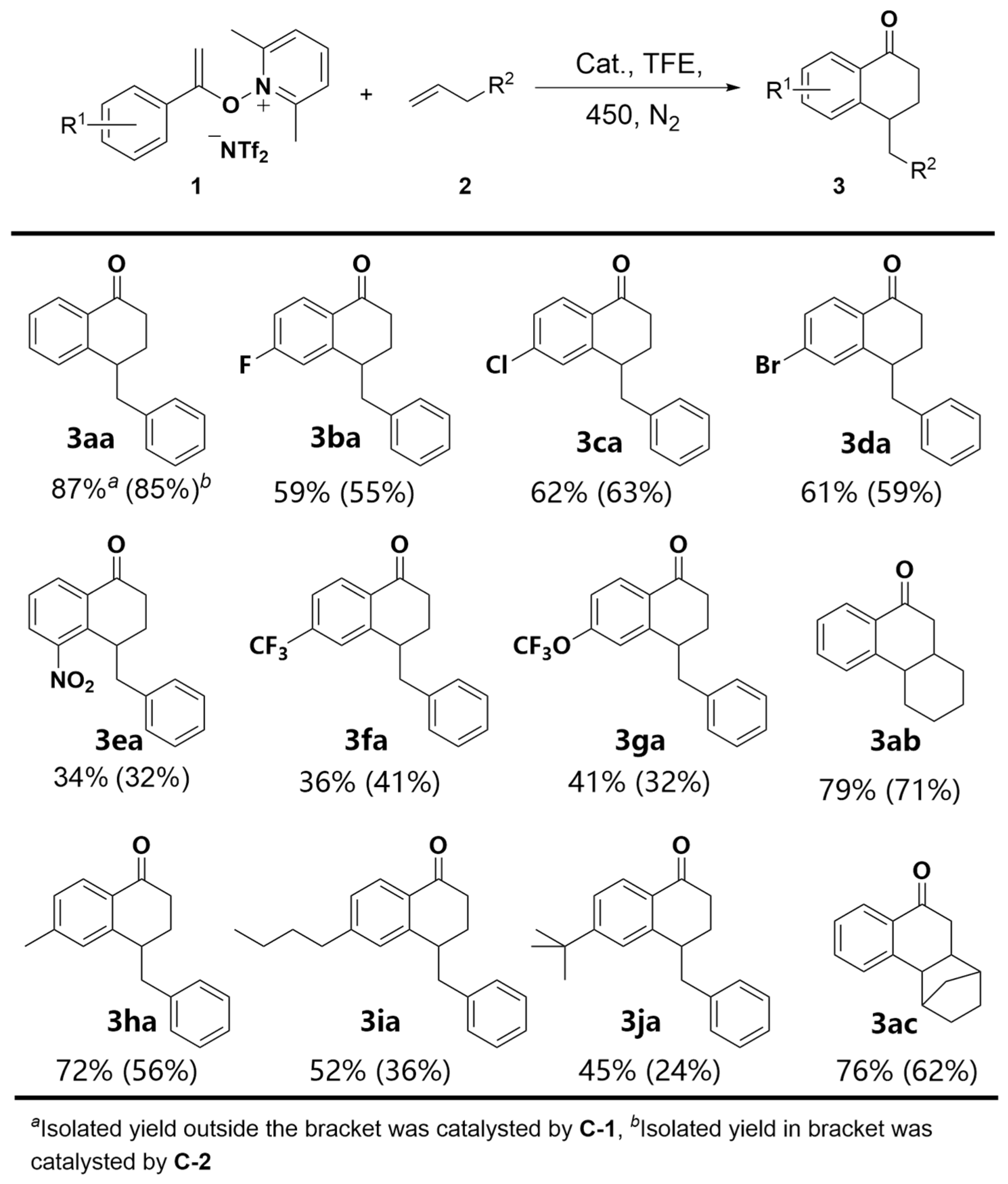
Having established the optimized conditions for the photocyclization reaction between pyridinium-masked enols (PMEs) and alkenes, we next examined the substrate scope of the transformation (Scheme 2). PMEs bearing a variety of substituents reacted smoothly with 2a to afford the corresponding tetralone products 3aa3ja in moderate to good yields (36–87%). In general, substrates containing strongly electron-withdrawing substituents (e.g., 3fa) showed lower reactivity than those bearing electron-donating groups (e.g., 3ha). This trend may reflect differences in the stability and reactivity of the radical intermediates generated during the photocyclization process. In addition, alkenes with varying steric profiles (2b and 2c) were also compatible with the reaction conditions, furnishing products 3ab and 3ac in 79% and 76% yield, respectively. Under otherwise identical conditions, C-2 consistently exhibited lower catalytic efficiency than C-1 across several substrate combinations. To further examine this difference, the structural parameters of C-1 and C-2 were compared based on their reported crystal structures [25,26]. The window dimensions of C-1 were estimated to be 23.1 Å × 6.6 Å, whereas those of C-2 were smaller (13.7 Å × 5.3 Å). For comparison, the calculated molecular dimensions of representative substrates were approximately 12.5 Å for 1aa and 9.9 Å for 2aa (Figure S1). Although these observations do not establish that the reaction occurs within the cage cavities, the differences in cage geometry and aperture dimensions may influence substrate association and/or donor–acceptor interactions, which could contribute to the distinct catalytic behaviors observed for C-1 and C-2.
UV–vis titration experiments were performed to investigate the interactions between the molecular cages (C-1 and C-2) and substrate 1aa (Figure S5). Upon gradual addition of 1aa to solutions of C-1 and C-2 (1 × 10⁻⁵ mol/L in trifluoroethanol), changes in the absorption profiles of both cages were observed. In particular, C-1 displayed a gradual decrease in absorption intensity near 375 nm upon addition of 1aa, consistent with the formation of cage–substrate charge-transfer interactions. The apparent association constants (Ka) were estimated using the Benesi–Hildebrand method. The binding constant for the C-1/1aa system was determined to be 4.74 × 10³ M−1, whereas a larger apparent binding constant of 3.43 × 10⁴ M−1 was obtained for the C-2/1aa system. In addition, the Benesi–Hildebrand plot for C-2/1aa exhibited improved linearity relative to that of C-1. Interestingly, despite its stronger apparent substrate binding, C-2 showed lower catalytic activity than C-1 under the optimized reaction conditions. At present, the origin of this difference remains unclear. One possible explanation is that variations in cage geometry and substrate association may influence the balance between substrate binding and productive photochemical reactivity. However, the current data do not allow definitive conclusions regarding the precise role of cavity size, substrate organization, or host–guest interactions in the catalytic process.
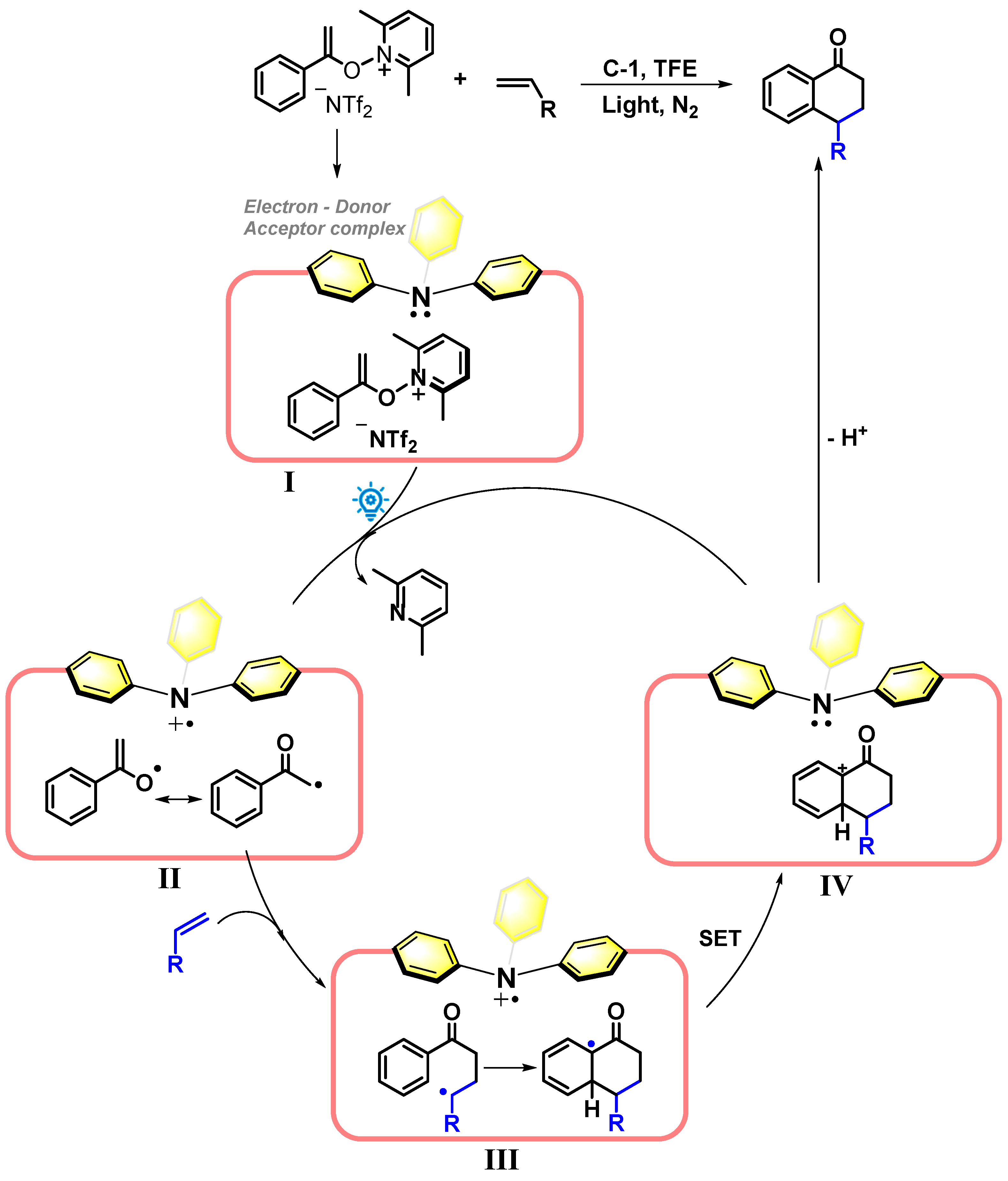
Based on the experimental observations, a tentative mechanistic scenario involving several sequential stages is proposed, as illustrated in Figure 1. In the initial stage, the molecular cage is proposed to associate with substrate 1aa through host–guest interactions, thereby promoting close spatial contact between the electron-rich triphenylamine (TPA) cage wall and the electron-deficient pyridinium-masked enol substrate. Such preorganization may facilitate the formation of a weak electron donor–acceptor (EDA) complex (I). Consistent with this possibility, UV–vis absorption studies reveal that the maximum absorption band of C-1 at 340 nm gradually red-shifts to approximately 360 nm upon addition of 1aa, suggesting the emergence of a ground-state charge-transfer interaction between the cage and substrate (Figure S5). Upon blue LED irradiation, photoinduced single-electron transfer from the electron-rich cage framework to the pyridinium substrate is proposed to generate a radical ion pair, followed by N–O bond cleavage to furnish an enol-type radical intermediate (II). Subsequent tautomerization may produce a carbon-centered radical species that undergoes intramolecular radical addition to the alkene, delivering the γ-carbonyl radical intermediate (III). At this stage, productive cyclization competes with possible intermolecular radical pathways, which may account for the formation of side products under certain conditions. Subsequent rearomatization and electron-transfer events are proposed to afford the desired tetralone product (IV) while regenerating the catalytically active cage species. Importantly, alternative mechanistic possibilities cannot presently be excluded. In particular, deprotonation of dearomatized intermediate IV by pyridine generated in situ could potentially furnish a strongly reducing radical-anion species capable of transferring an electron to the pyridinium substrate, thereby initiating an electron-catalytic chain process through electron upconversion pathways [26]. Such a mechanism may also contribute to the observed catalyst-concentration-dependent decrease in selectivity, possibly owing to competitive quenching of reactive radical-anion intermediates by the imine functionalities within the cage framework itself. At present, the available data do not allow definitive distinction between these mechanistic scenarios, and further studies are ongoing to clarify the detailed origin of the observed reactivity and selectivity.

3. Conclusions

In conclusion, we have developed a supramolecular, metal-free photochemical system in which covalent organic cages (POCs) are proposed to participate in the activation of pyridinium-masked enols (PMEs) through cage–substrate charge-transfer interactions. Two triarylamine-based imine-linked cages (C-1 and C-2) were synthesized and evaluated in visible-light-driven formal [4 + 2] cycloaddition reactions with olefins. Comparative studies revealed that the two cages produce distinct reaction outcomes and product selectivities, suggesting that subtle variations in cage architecture and confined supramolecular environments influence the behavior and partitioning of reactive radical intermediates during the transformation. Mechanistic studies, including UV–vis absorption experiments, radical trapping experiments, and control reactions, are consistent with the involvement of photoinduced electron donor–acceptor (EDA) interactions between the electron-rich cage framework and PME substrates. Upon visible-light irradiation, these assemblies are proposed to undergo photoinduced activation leading to radical generation and subsequent cyclization processes. At present, however, the detailed mechanistic origin of the observed selectivity effects remains unresolved. In particular, the precise roles of cavity confinement, substrate organization, electron-transfer efficiency, and possible competing radical-chain pathways require further investigation. Although the extent of host–guest organization and the nature of the reactive intermediates remain to be fully established, the present results demonstrate that covalent organic cages can serve as structurally tunable supramolecular platforms for modulating EDA-mediated photochemical reactivity and radical selectivity under mild conditions. More broadly, this work highlights the potential of confined organic cage environments as controllable reaction spaces for directing photoinduced radical transformations and provides a foundation for future mechanistic and supramolecular studies in photocatalysis.

Supplementary Materials

The following supporting information can be downloaded at: https://www.mdpi.com/article/10.3390/chemistry8060074/s1, 1. Materials and general procedures; 2. Synthesis; Figure S1: The pictures for C-1 and C-2; Figure S2: PXRD patterns; Figure S3: SEM and Crystal physical image; Figure S4: MS; Figure S5: UV-Vis spectra; Figure S6: NMR spectra; Tables S1 and S2: Additional catalytic results.

Author Contributions

Conceptualization, C.W.; methodology, C.W.; software, C.W.; validation, C.W.; formal analysis, C.W.; investigation, C.W.; resources, C.W.; data curation, C.W.; writing—original draft preparation, C.W.; writing—review and editing, C.T.; visualization, C.T.; supervision, C.T.; project administration, C.T. and G.L.; funding acquisition, C.T. and G.L. All authors have read and agreed to the published version of the manuscript.

Funding

This research was funded by the China National Natural Science Foundation (22001171), the Shanghai Rising-Star Program (23QA1407200), the Sailing Program (2020YF1435200), and the Shanghai Frontiers Science Center of Biomimetic Catalysis for financial support.

Institutional Review Board Statement

Not applicable.

Informed Consent Statement

Not applicable.

Data Availability Statement

The original contributions presented in this study are included in the article/Supplementary Materials. Further inquiries can be directed to the corresponding authors.

Conflicts of Interest

The authors declare no conflicts of interest.

References

  1. Tang, X.; Wu, N.; Zhai, R.; Wu, Z.; Mi, J.; Luo, R.; Xu, Z. Silver(I)-Catalyzed Addition of Pyridine-N-Oxides to Alkynes: A Practical Approach for N-Alkenoxypyridinium Salts. Org. Biomol. Chem. 2019, 17, 966–972. [Google Scholar] [CrossRef]
  2. Xia, X.; Chen, B.; Zeng, X.; Xu, B. Synthesis of α-Trifluoromethylthiolated and α-Thiocyanated Ketones Using Umpoled Enolates. Adv. Synth. Catal. 2018, 360, 4429–4434. [Google Scholar] [CrossRef]
  3. Zhai, R.L.; Xue, Y.S.; Liang, T.; Mi, J.J.; Xu, Z. Regioselective Arene and Heteroarene Functionalization: N-Alkenoxypyridinium Salts as Electrophilic Alkylating Agents for the Synthesis of α-Aryl/α- Heteroaryl Ketones. J. Org. Chem. 2018, 83, 10051–10059. [Google Scholar] [CrossRef]
  4. Sheng, H.; Liu, Q.; Su, X.-D.; Lu, Y.; Wang, Z.-X.; Chen, X.-Y. Visible-Light-Triggered Iodinations Facilitated by Weak Electrostatic Interaction of N-Heterocyclic Carbenes. Org. Lett. 2020, 22, 7187–7192. [Google Scholar] [CrossRef]
  5. Sheng, H.; Liu, Q.; Chen, F.; Wang, Z.; Chen, X. Visible-light-induced N-heterocyclic carbene mediated cascade transformation of N-alkenoxypyridinium salts. Chin. Chem. Lett. 2022, 33, 4298–4302. [Google Scholar] [CrossRef]
  6. Mathi, G.R.; Jeong, Y.; Moon, Y.; Hong, S. Photochemical Carbopyridylation of Alkenes Using N-Alkenoxypyridinium Salts as Bifunctional Reagents. Angew. Chem. Int. Ed. 2020, 59, 2049–2054. [Google Scholar] [CrossRef] [PubMed]
  7. Xu, J.; Li, Y.; Zhu, X.; Lv, S.; Xu, Y.; Cheng, T.; Liu, G.; Liu, R. Pyridinium-Masked Enol as a Precursor for Constructing AlphaFluoromethyl Ketones. Org. Lett. 2023, 25, 6211–6216. [Google Scholar] [CrossRef]
  8. Lv, S.; Li, J.; Hua, Y.; Wu, J.; Wang, J.; Liu, G.; Li, L.; Liu, R. Photoredox-Catalyzed Formal [4 + 2] Cycloaddition of Pyridinium Masked Enols with Unactivated Olefins. Org. Lett. 2025, 27, 7349–7354. [Google Scholar] [CrossRef]
  9. Li, J.; Ji, Z.; Wang, H.; Hu, X.; Lu, X.; Cheng, T.; Liu, G.; Liu, R. Ph3N as an Organocatalytic Donor for Photoactivation of Pyridinium-Masked Enols in the Formal [4 + 2] Cycloaddition with Unactivated Olefins. Org. Lett. 2025, 28, 553–559. [Google Scholar] [CrossRef]
  10. Wu, H.-Y.; Tang, X.; Guo, R.; Ang, H.T.; Nie, J.; Wu, J.; Ma, J.-A.; Zhang, F.-G. Catalytic Photoactivation of a Triarylamine Electron Donor-Acceptor Complex for Difunctionalization of Alkenes. Cell Rep. Phys. Sci. 2024, 5, 102135. [Google Scholar] [CrossRef]
  11. Lasso, J.D.; Castillo-Pazos, D.J.; Salgado, J.M.; Ruchlin, C.; Lefebvre, L.; Farajat, D.; Perepichka, D.F.; Li, C.-J. A General Platform for Visible Light Sulfonylation Reactions Enabled by Catalytic Triarylamine EDA Complexes. J. Am. Chem. Soc. 2024, 146, 2583–2592. [Google Scholar] [CrossRef]
  12. Fu, M.-C.; Shang, R.; Zhao, B.; Wang, B.; Fu, Y. Photocatalytic Decarboxylative Alkylations Mediated by Triphenylphosphine and Sodium Iodide. Science 2019, 363, 1429–1434. [Google Scholar] [CrossRef]
  13. Dewanji, A.; Van Dalsen, L.; Rossi-Ashton, J.A.; Gasson, E.; Crisenza, G.E.M.; Procter, D.J. A General Arene C–H Function-alization Strategy via Electron Donor–Acceptor Complex Photoactivation. Nat. Chem. 2023, 15, 43–52. [Google Scholar] [CrossRef] [PubMed]
  14. Ning, R.; Wang, Q.-Q. Supramolecular Catalysis with Emerging, Functional Organic Macrocycles and Cages. Chem. Soc. Rev. 2025, 54, 11105–11140. [Google Scholar] [CrossRef]
  15. Yang, J.; Li, Z.; Wu, X.; Chen, J.; Huang, S.; Lu, Y.-L.; Jiao, Z.; Su, C.-Y. Enantioselective Dearomative Ortho-Cycloaddition Transformation of Unactivated Arenes by Cage-Confined Visible-Light Photocatalysis. Nat. Commun. 2025, 16, 3980. [Google Scholar] [CrossRef]
  16. Ruan, J.; Li, Z.; Yin, C.; Lu, Y.-L.; Wei, Z.-W.; Hu, P.; Su, C.-Y. Enantioselective [2 + 2] Cross-Photocycloaddition Enabled by a Chiral Cage Reactor via Multilevel-Selectivity Control. ACS Catal. 2024, 14, 7321–7331. [Google Scholar] [CrossRef]
  17. Wang, K.; Tang, X.; Anjali, B.A.; Dong, J.; Jiang, J.; Liu, Y.; Cui, Y. Chiral Covalent Organic Cages: Structural Isomerism and Enantioselective Catalysis. J. Am. Chem. Soc. 2024, 146, 6638–6651. [Google Scholar] [CrossRef]
  18. Lu, Y.-L.; Qin, Y.-H.; Zheng, S.-P.; Ruan, J.; Huang, Y.-H.; Zhang, X.-D.; Liu, C.-H.; Hu, P.; Xu, H.-S.; Su, C.-Y. Anion-Mediated Allosteric Catalysis of [2 + 2] Photocycloaddition Based on a Flexible Metallo-Amine Cage for High Diastereoselectivity. ACS Catal. 2024, 14, 94–103. [Google Scholar] [CrossRef]
  19. Tanaka, R.; Takezawa, H.; Fujita, M. A Visible-Light-Responsive Octahedral Cage for Efficient and Selective Cross-[2 + 2] Cycloadditions. J. Am. Chem. Soc. 2025, 147, 25142–25147. [Google Scholar] [CrossRef]
  20. Kuijpers, P.F.; Otte, M.; Dürr, M.; Ivanović-Burmazović, I.; Reek, J.N.H.; De Bruin, B. A Self-Assembled Molecular Cage for Substrate-Selective Epoxidation Reactions in Aqueous Media. ACS Catal. 2016, 6, 3106–3112. [Google Scholar] [CrossRef]
  21. Peng, Y.; Su, Z.; Jin, M.; Zhu, L.; Guan, Z.-J.; Fang, Y. Recent Advances in Porous Molecular Cages for Photocatalytic Organic Conversions. Dalton Trans. 2023, 52, 15216–15232. [Google Scholar] [CrossRef] [PubMed]
  22. Bhandari, P.; Mukherjee, P.S. Covalent Organic Cages in Catalysis. ACS Catal. 2023, 13, 6126–6143. [Google Scholar] [CrossRef]
  23. Yang, X.; Ullah, Z.; Stoddart, J.F.; Yavuz, C.T. Porous Organic Cages. Chem. Rev. 2023, 123, 4602–4634. [Google Scholar] [CrossRef]
  24. Jelfs, K.E.; Wu, X.; Schmidtmann, M.; Jones, J.T.A.; Warren, J.E.; Adams, D.J.; Cooper, A.I. Large Self-Assembled Chiral Organic Cages: Synthesis, Structure, and Shape Persistence. Angew. Chem. Int. Ed. 2011, 123, 10841–10844. [Google Scholar] [CrossRef]
  25. Madhu, S.; Rashmi, E.V.; Gonnade, R.G.; Sanjayan, G.J. Exploring the Gem-Dimethyl Effect in the Formation of Imine-Based Macrocycles and Cages. New J. Chem. 2017, 41, 8721–8724. [Google Scholar] [CrossRef]
  26. Alabugin, I.V.; Eckhardt, P.; Christopher, K.M.; Opatz, T. The Photoredox Paradox: Electron and Hole Upconversion as the Hidden Secrets of Photoredox Catalysis. J. Am. Chem. Soc. 2024, 146, 27233–27254. [Google Scholar] [CrossRef] [PubMed]
Scheme 1. Representative Reactions of Pyridinium-Masked Enols.
Chemistry 08 00074 sch001
Scheme 2. Scope Investigation.
Chemistry 08 00074 sch002
Figure 1. Speculation on possible mechanism diagram.
Chemistry 08 00074 g001
Table 1. Screening of reaction conditions a.
Chemistry 08 00074 i001
EntryCatalystLoading (mol%) bTime (h)SolventYield (%) c
3aa4aa
1C-10.07812TFE (0.5 mL)879
2TPA0.62512TFE (0.5 mL)6131
3C-10.15612TFE (0.5 mL)6329
4C-10.31312TFE (0.5 mL)5534
5C-10.0782TFE (0.5 mL)12Trace
6C-10.0784TFE (0.5 mL)266
7C-10.0786TFE (0.5 mL)447
8C-10.07818TFE (0.5 mL)869
9C-10.07812TFE (0.25 mL)7916
10C-10.07812TFE (1.0 mL)2066
11C-1 (no light)0.07812TFE (0.5 mL)TraceTrace
12C-1 (Air)0.07812TFE (0.5 mL)TraceTrace
13C-1 (Tempo)0.07812TFE (0.5 mL)TraceTrace
14--12TFE (0.5 mL)Trace72
15C-20.31312TFE (0.5 mL)5734
a Reaction conditions: 1aa (0.30 mmol), 2aa (0.20 mmol), blue light (wavelength: 450 nm), b the loading was calculated based on the content of cage, c Isolated yield.
Disclaimer/Publisher’s Note: The statements, opinions and data contained in all publications are solely those of the individual author(s) and contributor(s) and not of MDPI and/or the editor(s). MDPI and/or the editor(s) disclaim responsibility for any injury to people or property resulting from any ideas, methods, instructions or products referred to in the content.