Article

A Solvent-Dependent Fluorescent Probe for the Simultaneous Detection of Al3+ and Mg2+ Based on Carboxymethyl Chitosan-Modified Naphthalimide Derivative

1
NHC Key Laboratory of Control of Tropical Diseases, School of Life Sciences and Medical Technology, Hainan Medical University, Haikou 571199, China
2
School of Stomatology, Hainan Medical University, Haikou 571199, China
*
Author to whom correspondence should be addressed.
Chemistry 2026, 8(4), 52; https://doi.org/10.3390/chemistry8040052
Submission received: 11 March 2026 / Revised: 7 April 2026 / Accepted: 9 April 2026 / Published: 13 April 2026

Abstract

Chitosan is non-toxic, harmless, biocompatible, and antimicrobial, and can be readily modified. These properties have made it widely used in carrier research. Based on this, a fluorescent probe P was synthesized in high yield from naphthalimide derivatives and carboxymethyl chitosan (CMCS). The probe exhibited enhanced fluorescence in the presence of Al3+ and quenched fluorescence in the presence of Mg2+ in different media. Among common metal ions and anions, the probe demonstrated good selectivity and sensitivity toward Al3+ and Mg2+. Under optimal conditions (ethanol–water solution, 1:9, v:v, pH 6.0, 20 mM HEPES), a significant linear relationship was observed for Al3+ in the concentration range of 0–90 µM. In ethanol, the fluorescence intensity of the probe at 427 nm decreased regularly with increasing Mg2+ concentration, also showing a clear linear relationship within the 5–90 µM range.

1. Introduction

Aluminum is an environmental pollutant and a non-essential element for the human body. Excessive intake of Al3+ can lead to neurodegeneration, memory decline, and even symptoms such as Alzheimer’s disease, amyotrophic lateral sclerosis, and anemia. It also adversely affects physiological activities in plants, including cellular processes, enzyme activity, and photosynthesis [1,2]. Magnesium, as a cofactor for numerous enzymes, participates in energy metabolism and neuromuscular function. Its deficiency may cause health issues such as muscle cramps and cardiovascular diseases [3,4]. Therefore, accurate detection of these ions has become a focus for researchers.
Fluorescence-based detection strategies have garnered considerable attention. Fluorescent probes, particularly organic small-molecular probes, are favored for their low cost, fast response, and high sensitivity. Combined with confocal fluorescence technology, they have become an important tool in biological research and biomedical applications [5,6,7]. Their advantages, such as simple synthesis, easy structural modification, and diverse detection methods, make them prominent in metal ion detection. However, most fluorescent probes can only recognize a single metal ion, limiting their use in studying the correlations and synergistic mechanisms among multiple active species [8,9]. Consequently, developing novel fluorescent probes capable of simultaneous detection of multiple analytes, breaking the “one probe, one analyte” limit, holds significant importance for both human health and the environment.
In recent years, to achieve “atom economy” and high integration density for organic small-molecular fluorescent probes, researchers have been dedicated to developing novel probes for simultaneous multi-analyte detection. For example, Chen et al. synthesized and characterized a coumarin-thiazolidine derivative as a dual-functional fluorescence/circular dichroism probe for the detection, differentiation, and detoxification of Ag+, Hg2+, and Cu2+ [10]. Yu et al. synthesized a turn-on fluorescent probe via the condensation of pyrene carboxaldehyde and thiosemicarbazide. By adjusting the test system, it could detect Cu2+, Fe3+, and Co2+ and was applicable for in vivo imaging [11]. These studies typically relied on one or multiple binding sites interacting with different receptors to alter UV or fluorescence signals, achieving the detection of two or more analytes. This “one-to-many” detection mode, compared to single-analyte probes, improved detection efficiency and reduced analysis costs, thus attracting widespread interest. Although numerous advanced strategies have been established for simultaneous detection of multiple metal ions, including Fe3+/Fe2+ [12], Fe3+/Cu2+ [13], and Cu2+/Co2+ [14], fluorescent probes capable of recognizing Al3+ and Mg2+ remain relatively scarce. This limitation mainly arises from the inert spectral features and weak coordination properties of these two ions [15]. Furthermore, the close similarity in ionic radius and charge between Al3+ and Mg2+ enables Al3+ to act as a competitive inhibitor toward Mg2+ in biological processes. Therefore, the development of stable, selective, and sensitive dual-response fluorescent probes for Al3+ and Mg2+ is of great significance and urgent demand.
Chitosan has broad application prospects in the field of fluorescent probes, mainly reflected in the following aspects: (1) it possesses non-toxicity, hydrophilicity, biodegradability, and renewability; (2) its abundant hydroxyl and amino groups exhibit high reactivity, facilitating chemical grafting and modification, while the intramolecular and intermolecular hydrogen bonds can form a three-dimensional network structure that effectively chelates heavy metal ions; (3) a single chitosan molecule can load multiple dye molecules, significantly enhancing detection sensitivity and reducing the amount of probe required. These characteristics enable chitosan to be widely applied in fluorescent probes, allowing for the detection of analytes in combination with different dyes, such as rhodamine derivative [16], benzoyl hydrazide derivative [17], BODIPY derivative [18], etc.
Schiff base-based fluorescent probes, with their customizable structure, strong coordination ability, high sensitivity, diverse response mechanisms, and good biocompatibility, have become an important tool for the recognition of metal ions and bioactive molecules [19,20,21]. Furthermore, naphthalimide derivatives stand out as promising fluorophores for fluorescent probe design. They exhibit outstanding photostability, strong fluorescence emission, and flexible structural tunability, enabling them to act efficiently as either electron donors or acceptors in sensing systems [22,23,24].
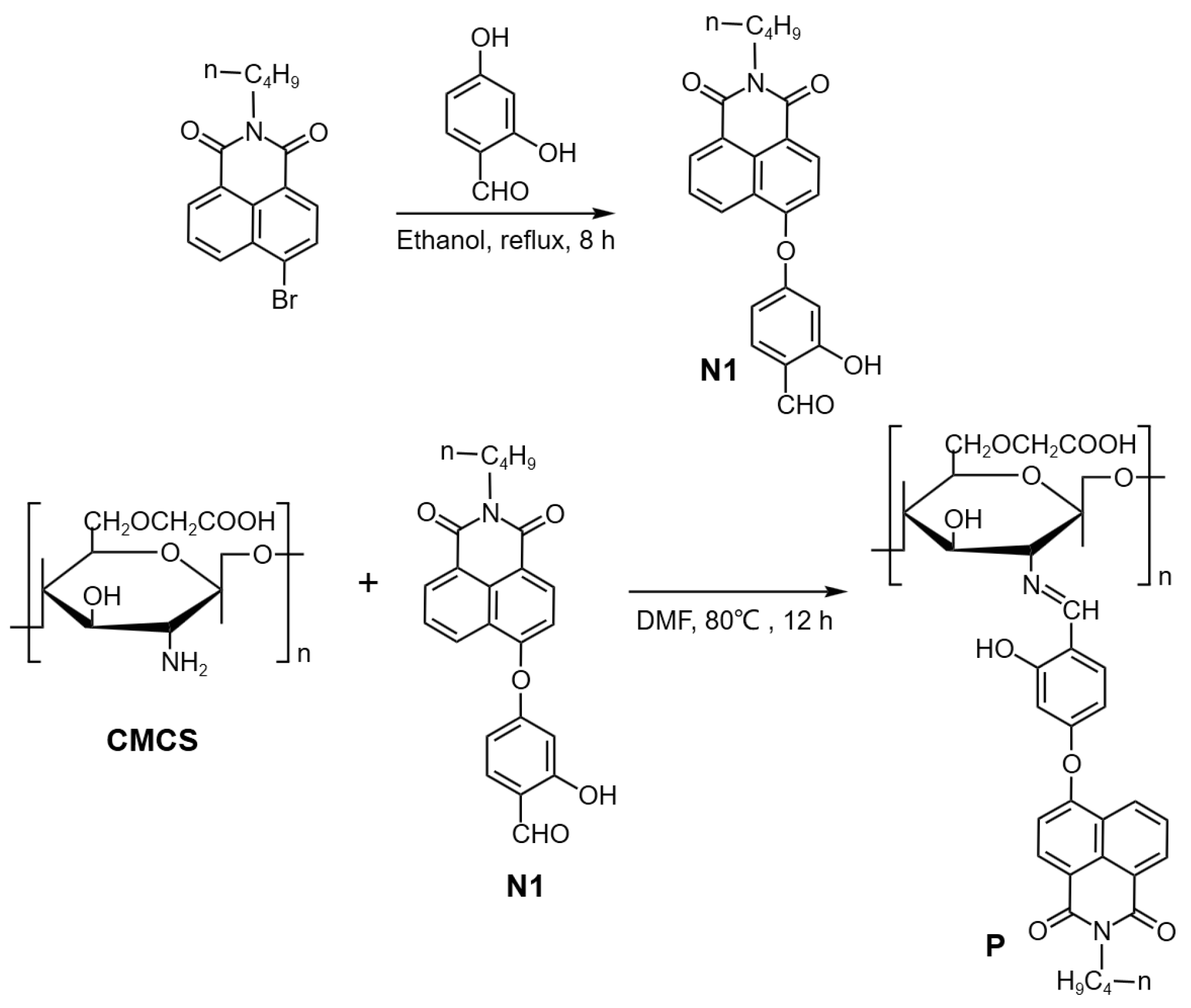
Herein, we report a novel fluorescent probe fabricated by grafting a naphthalimide-based fluorophore onto carboxymethyl chitosan. This probe is designed for the simultaneous detection of Al3+ and Mg2+. The synthetic procedure of the resulting chitosan-derived fluorescent material is depicted in Scheme 1.

2. Materials and Methods

2.1. Instruments and Reagents

Fluorescence spectra were measured using a Hitachi F-4600 fluorescence spectrometer (Tokyo, Japan). FT-IR spectra were recorded on a Nicolet Magna-IR 750 spectrometer (Thermo Fisher Scientific, Waltham, MA, USA), which is equipped with a Nic-Plan Microscope. pH measurements were conducted with a Model PHS-3C meter (Labo-Hub, Shanghai, China). 1H NMR spectra were performed using a Brucker AV 400 NMR apparatus (Birrica, Ma, USA).
All reagents were obtained from Sigma-Aldrich Co. (St. Louis, MO, USA)and used as received without further purification. Carboxymethyl chitosan (CMCS) has a degree of substitution of 80%, and all other reagents were of analytical grade.

2.2. Synthesis of Compound P

In a 150 mL round-bottom flask, 36.5 mg (0.143 mmol) of carboxymethyl chitosan (CMCS) was added, and water was added dropwise to dissolve it. Then, 166.4 mg (0.428 mmol, 3 equiv.) of compound N1 (The synthesis of compound N1 was referenced in [25]) and 20 mL of anhydrous ethanol were added. The mixture was heated under reflux for 8 h, then cooled to room temperature. After suction filtration, a yellow solid was obtained. The solid was extracted using ethanol as the solvent in a Soxhlet extractor for 8 h, and the product P was obtained after drying (yield: 78.4%). IR (KBr): 3433 cm−1, 2954 cm−1, 2919 cm−1, 2850 cm−1, 1696 cm−1, 1655 cm−1, 1595 cm−1, 1493 cm−1, 1415 cm−1, 1352 cm−1, 1322 cm−1, 1252 cm−1, 1113 cm−1, 1066 cm−1, 778 cm−1, 717 cm−1 (Figure S1). 1H NMR (d6-DMSO, 400 Hz, δ ppm): 10.090 (s, 1H), 8.523 (dd, 1H, J = 6.4), 8.8.489 (dd, 1H, J = 8.4), 8.425 (d, 1H, J = 8.4), 7.958 (t, 1H J = 7.8), 7.585 (d, 1H, J = 9.2), 7.287 (d, 1H, J = 8.4), 6.416 (b, 2H), 4.010 (t, 2H, J = 7.2), 3.303 (b, O-C-H) 1.578 (m, 2H, J = 7.4), 1.315 (m, 2H, J = 7.4), 1.187 (s, 4H), 0.887 (t, 3H, J = 7.2), 0.819 (d, 1H, J = 8.4), 0.779 (d, 1H, J = 9.6) (Figure S2).

2.3. Testing Conditions and Method of P for the Detection of Al3+/Mg2+

A probe stock solution (500 ppm) was prepared using a mixed reagent of dimethyl sulfoxide and N, N-dimethylformamide in a 1:1 (v:v) ratio. The excitation wavelength for measuring the fluorescence spectrum was set at 350 nm, with both the excitation and emission slits set to 10 nm. In subsequent experiments, the probe solution used was diluted 100 times from the probe stock solution, resulting in a concentration of 5 ppm.
The testing medium for Al3+/Mg2+ was ethanol–water solution (1:9, v:v, pH 6.0, 20 mM HEPES and ethanol, respectively. The limit of detection (LOD) was calculated as LOD = 3σ/k, where σ is the standard deviation of the fluorescence intensity of the blank probe solution from five replicate measurements, and k is the slope of the linear regression curve of fluorescence intensity versus metal ion concentration.
The binding constants of probe P with Al3+ and Mg2+ were calculated by nonlinear least-squares regression using OriginPro 2017 software, based on a 1:1 binding model. For Al3+: Titration was carried out in ethanol–water solution (1:9, v:v, pH 6.0, 20 mM HEPES). The fluorescence enhancement data were fitted using the equation:
F = F 0 + F F 0 K M 1 + K M
For Mg2+: Titration was carried out in pure ethanol. The fluorescence quenching data were fitted using the equation:
F = F 0 F F 0 K M 1 + K M
where F0, F, and F represent the fluorescence intensity of P in the absence of metal ions, at a certain concentration of metal ions, and at saturation, respectively. K is the binding constant, and [M] is the concentration of the corresponding metal ion.

3. Results and Discussion

3.1. Characterization of the CMCS, N1 and P

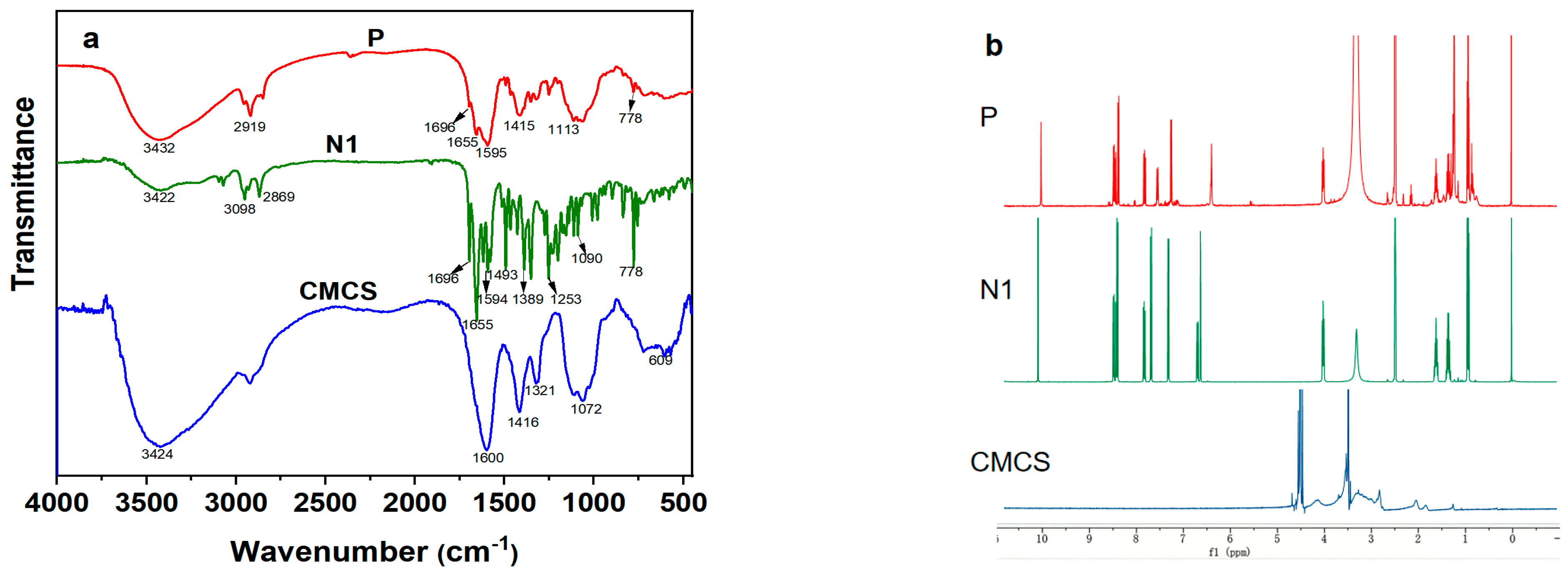
The successful synthesis of probe P via the grafting of N1 onto CMCS was verified by FT-IR and 1H NMR spectra. As shown in Figure 1a, compared with the spectrum of pure CMCS, the spectrum of P retained the characteristic C=O stretching peak at 1696 cm−1 assigned to the naphthalimide moiety of N1, confirming the successful introduction of the fluorescent group. Critically, the characteristic aldehyde C-H stretching peak at ~2869 cm−1 in N1 was significantly weakened and almost undetectable in the spectrum of P, directly demonstrating the consumption of the aldehyde group during the grafting reaction. Meanwhile, the absorption band at 1595 cm−1 in P was significantly enhanced and assigned to the C=N stretching vibration of the newly formed Schiff base linkage between the aldehyde group of N1 and the amino group of CMCS. The retention of CMCS’s characteristic peaks (e.g., 3432 cm−1 for O-H/N-H stretching, 1415 cm−1 for carboxymethyl group vibrations) confirmed the maintenance of the CMCS backbone structure, collectively proving the successful synthesis of probe P. In the 1H NMR spectra, the signal of -HC=O disappeared along with a new signal of -HC=N at 10.090, proving the formation of P. In high fields, the appearance of new signals of C-H, which were from the CMSC, also confirmed the successful synthesis of P.

3.2. Fluorescence Sensing Behavior of P

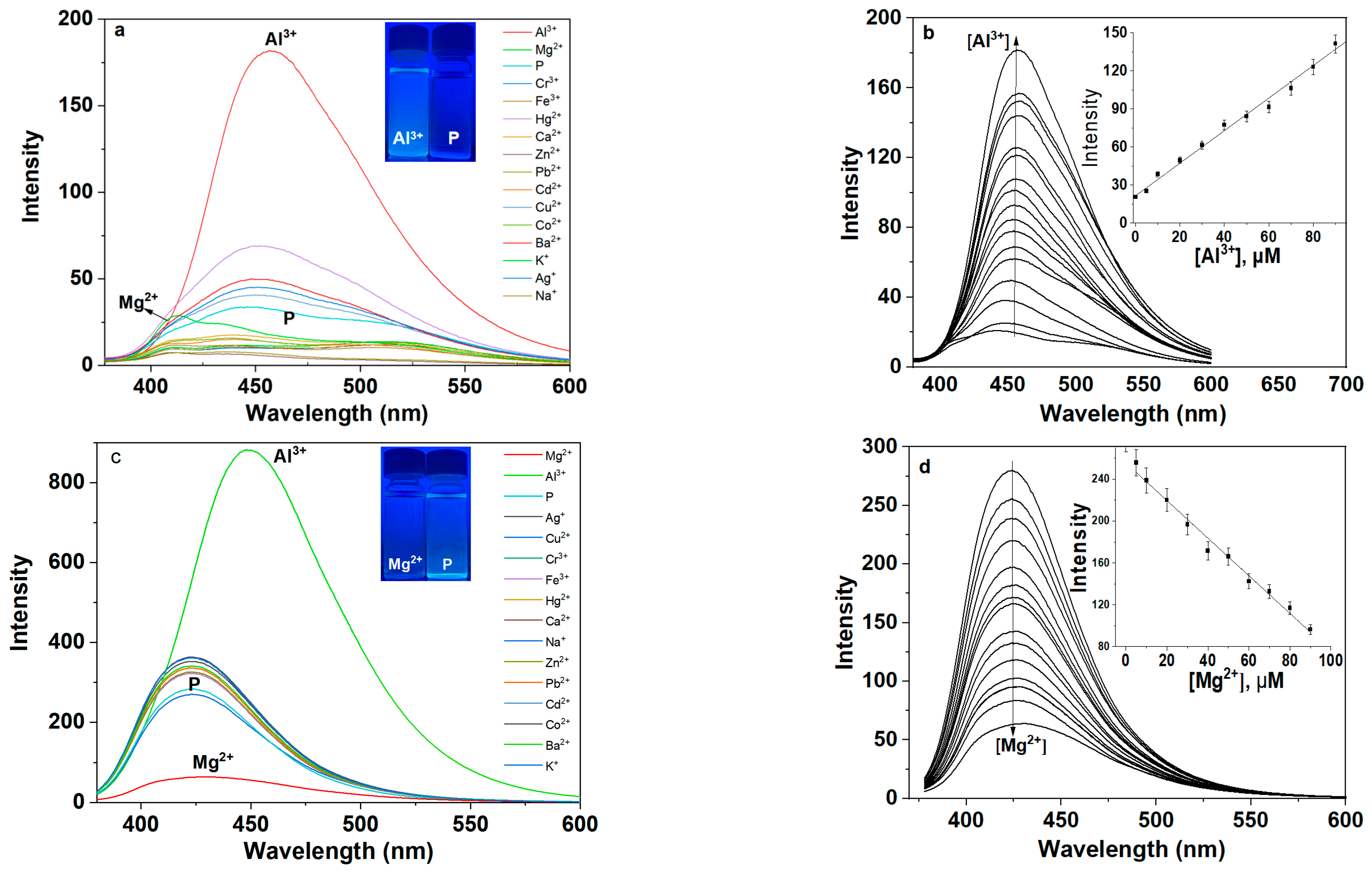
The selectivity of probe P for various metal ions was investigated in an ethanol–water solution (1:9, v:v, pH 6.0, 20 mM HEPES), and the results are shown in Figure 2a. P displayed an extremely weak fluorescence emission profile across the entire tested wavelength range of 400–700 nm, with no discernible emission peak observable at 460 nm. Upon the addition of various metal ions (Al3+, Cr3+, Fe3+, Hg2+, Ca2+, Zn2+, Pb2+, Cd2+, Mg2+, Cu2+, Co2+, Ba2+, K+, Ag+, Na+), only the P+Al3+ system yielded a prominent fluorescence peak at this 460 nm wavelength, while all other metal ions failed to elicit any obvious fluorescence response at this or other tested wavelengths. This distinct fluorescence activation exclusively induced by Al3+ directly demonstrates the high selectivity of probe P for Al3+ in an ethanol–water solution (1:9, v:v, pH 6.0, 20 mM HEPES). In pure ethanol, by contrast, probe P exhibited a distinct intrinsic fluorescence emission peak at 427 nm. As shown in Figure 2c, the introduction of Mg2+ into this pure ethanol system induced a significant fluorescence quenching effect of P at this characteristic 427 nm wavelength. These solvent-dependent divergent fluorescence responses to Mg2+ and Al3+ clearly demonstrate that P is capable of the selective discrimination of Al3+ and Mg2+ simply by modulating the testing medium.
Under physiological conditions, probe P (5 ppm) exhibited very weak fluorescence at around 460 nm, together with a distinct emission band at 427 nm. Upon incremental addition of Al3+ or Mg2+ (0–100 µM), the fluorescence at 460 nm was significantly enhanced for Al3+, while that at 427 nm was gradually quenched for Mg2+ (Figure 2b,d). The corresponding fluorescence intensity changes as a function of metal ion concentration are shown in the insets of Figure 2b,d, respectively. Based on the titration data, the detection limits (LOD) of P toward Al3+ and Mg2+ were calculated to be 0.33 µM and 1.67 µM, values low enough to allow micromolar detection of these ions in various chemical and biological systems.

3.3. Practical Applicability of P

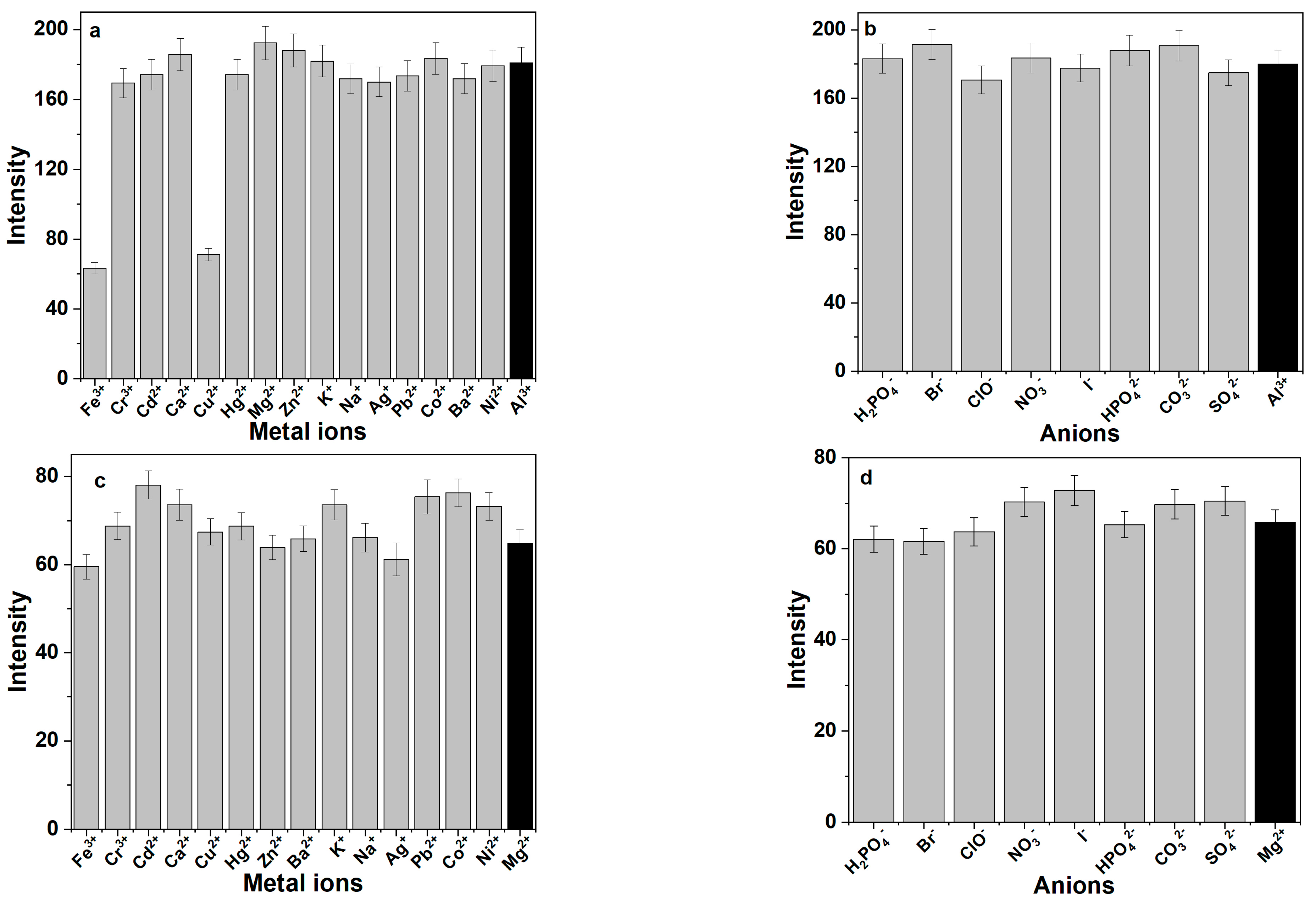
In ethanol–water (1:9, v:v, pH 6.0, 20 µM HEPES) solution or ethanol containing 100 µM metal ions (Cr3+, Fe3+, Hg2+, Ca2+, Zn2+, Pb2+, Cd2+, Mg2+, Cu2+, Co2+, Ni2+, Ba2+, K+, Ag+, Na+) and 100 µM anions (H2PO4; Br; ClO4; NO3; I; HPO42−; CO32−; SO42−), the results obtained after adding 100 µM Al3+/Mg2+ to probe P (5 ppm) were shown in Figure 3. From the figures, it can be observed that only the presence of Fe3+ and Cu2+ interfered with the fluorescence intensity of the probe P+Al3+ system, which may be related to their paramagnetic properties. All tested anions had no obvious interference with the fluorescence response of probe P to Al3+ and Mg2+, and did not cause a detectable significant change in the corresponding fluorescence signal. The result indicates that the probe can still effectively recognize Al3+/Mg2+ in the presence of other ions.
Additionally, the reversible fluorescence response of probe P to Al3+ was investigated via EDTA titration in ethanol–water solution (1:9, v:v, pH 6.0, 20 mM HEPES) (Figure S3). The fluorescence enhancement of P at the characteristic wavelength of 460 nm induced by 80 μM Al3+ was significantly diminished with the addition of 120 μM EDTA, while the fluorescence intensity at this wavelength was restored upon the subsequent introduction of excess Al3+. The result directly demonstrated the excellent reversibility of P toward Al3+ and its potential for recyclable detection applications. In contrast, for the P+Mg2+ system in ethanol (Figure S4), the distinct fluorescence quenching of P at the characteristic wavelength of 427 nm caused by 80 μM Mg2+ was eliminated after adding 120 μM EDTA, and the subsequent supplementation of excess Mg2+ failed to reinduce an obvious quenching effect. This result confirmed that the binding affinity of probe P for Mg2+ was weaker than that of EDTA. Another notable performance feature of P was its rapid response kinetics toward Al3+ and Mg2+ (Figures S5 and S6). The fluorescence signal of P at its respective characteristic detection wavelengths (460 nm for Al3+, 427 nm for Mg2+) reached a stable plateau within 10 min of mixing with Al3+ or Mg2+, and the stable fluorescence intensity was maintained for the subsequent 60 min without any obvious fluctuation, indicating a fast equilibration rate and good signal stability of the probe upon interaction with the target metal ions.
A comparison of reported probes for Al3+/Mg2+ detection was summarized in Table 1. As shown, various probes, such as those based on chitosan or naphthalimide scaffolds, have been developed. They exhibited certain advantages, including rapid response [26,27], good sensitivity [27], and potential application value [26,27,28,29,30,31,32,33]. However, these systems were often accompanied by significant limitations. Many suffer from drawbacks such as the requirement for organic co-solvents, narrow detection ranges, and in some cases, insufficient sensitivity [27,34,35]. Crucially, most reported probes were limited to the single-ion detection of either Al3+ or Mg2+ [26,27,28,29,30,31,32,33,34,35]. From an atom economy perspective, such single-target probes are less cost-effective compared to multi-analyte responsive systems. Furthermore, the small-molecule probe capable of discriminatively detecting both these metal ions exhibited overlapping emission wavelengths, narrow linear ranges, and limited sensitivity [31]. In comparison, our probe P presented several distinct advantages. It featured a wide detection range. Most notably, P can simultaneously and discriminatively sense both Al3+ and Mg2+ with good differentiation, demonstrating a “one-to-many” sensing capability. This combination of properties made P a valuable addition to the existing toolkit. Nevertheless, further structural optimization, particularly to enhance its water solubility, is required to broaden its practical applications. Overall, probe P demonstrates clear and superior performance relative to many of the previously reported Al3+/Mg2+ probes.

3.4. Reaction Mechanism Research

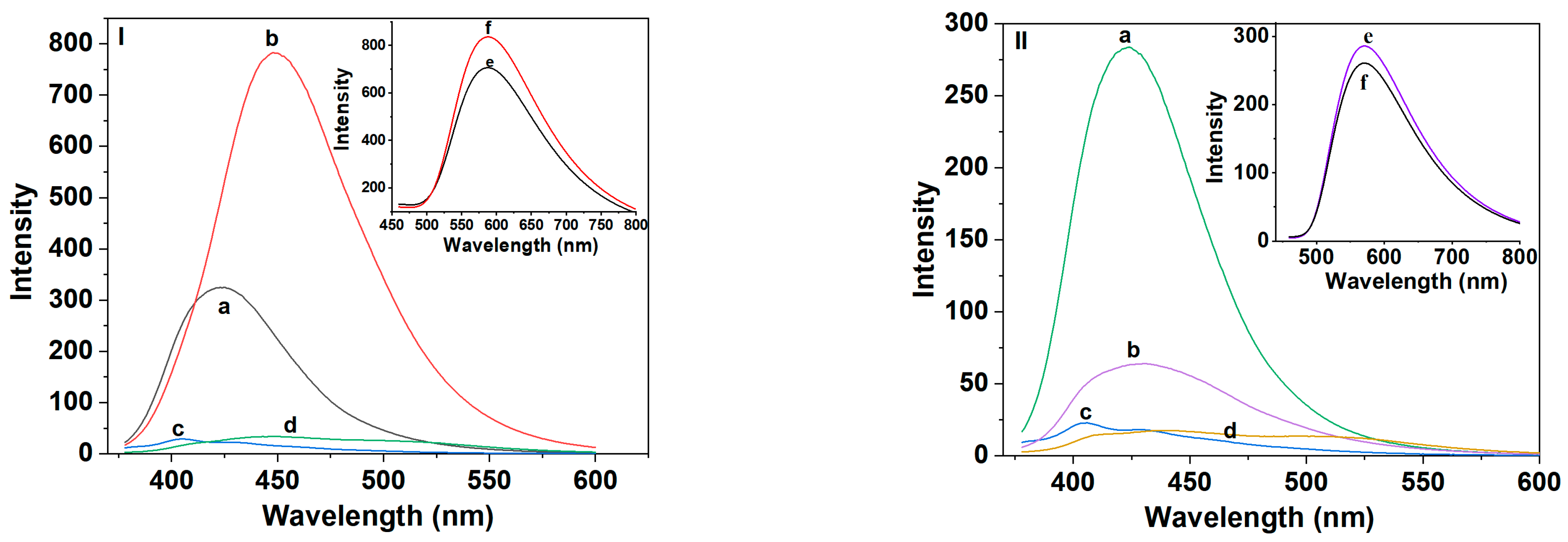
The possible coordination interactions between probe P and Al3+/Mg2+ were further validated by selectivity experiments using a set of control compounds, as presented in Figure 4. The corresponding results clearly revealed the binding behavior of each control species toward Al3+ and Mg2+. Negligible fluorescence variations were observed upon the addition of Al3+ or Mg2+ to the solution of N1 (Figure 4I(d,e),II(d,e)). In sharp contrast, the mixing of P with Al3+/Mg2+ led to distinct fluorescence enhancement at 460 nm and quenching at 427 nm, respectively (Figure 4I(a,b),II(a,b)), explaining selectivity of P in Al3+/Mg2+ detection and recognition. These results indicated that carboxymethyl chitosan played a role in providing coordination sites in the binding of probe P with Al3+/Mg2+, realizing our goal of grafting naphthalimide derivatives onto chitosan. The binding constants of probe P with Al3+ and Mg2+ were calculated by nonlinear least-squares fitting based on a 1:1 binding model. As shown in Figure S7a, the binding constant for P with Al3+ in ethanol–water solution (1:9, v:v, pH 6.0, 20 mM HEPES) was determined to be 1.14 × 10⁴ M−1. For Mg2+ in pure ethanol, the binding constant was calculated to be 2.46 × 10⁴ M−1 (Figure S7b), indicating that within the chitosan-based polymer P, one effective structural unit bound to Al3+/Mg2+ in a 1:1 mode.

4. Conclusions

This study successfully developed a chitosan–naphthalimide-based fluorescent probe. This chitosan-based fluorescent probe exhibited high selectivity and sensitivity for Al3+/Mg2+ and remained unaffected by interference from common metal ions, thereby validating the feasibility of the design concept. We believe this design strategy can serve as a reference for expanding the application of chitosan as a carrier for small-molecule dyes, offering valuable insights for the development of novel chitosan-based metal ion probes.

Supplementary Materials

The following supporting information can be downloaded at: https://www.mdpi.com/article/10.3390/chemistry8040052/s1, Figure S1: FT-IR spectra of P; Figure S2: 1H NMR spectra of P; Figure S3: Fluorescence spectra in ethanol-water solution (1:9, v:v, pH 6.0, 20 mM HEPES): a. P (5 ppm); b. P (5 ppm) plus Al3+ (80 μM); c. P (5 ppm) plus Al3+ (80 μM) plus EDTA (120 μM); d. P (5 ppm) plus Al3+ (80 μM) plus EDTA (120 μM) plus Al3+ (120 μM); e. P (5 ppm) plus Al3+ (80 μM) plus EDTA (120 μM) plus Al3+ (200 μM); Figure S4: Fluorescence spectra in ethanol: a. P (5 ppm); b. P (5 ppm) plus Mg2+ (80 μM); c. P (5 ppm) plus Mg2+ (80 μM) plus EDTA (120 μM); d. P (5 ppm) plus Mg2+ (80 μM) plus EDTA (120 μM) plus Mg2+ (120 μM); e. P (5 ppm) plus Mg2+ (80 μM) plus EDTA (120 μM) plus Mg2+ (200 μM); Figure S5: Influences of time on the fluorescence spectra of P (5 ppm) and P (5 ppm) plus Al3+ (100 μM) in in ethanol-water solution (1:9, v:v, pH 6.0, 20 mM HEPES); Figure S6: Influences of time on the fluorescence spectra of P (5 ppm) and P (5 ppm) plus Mg2+ (100 μM) in ethanol; Figure S7: Nonlinear least-squares fitting curves of fluorescence titration data for P with Al3+ and Mg2+ under their respective optimal detection conditions. (a) Fitting curve for P with Al3+ in ethanol-water solution (1:9, v:v, pH 6.0, 20 mM HEPES) based on a 1:1 binding model (fluorescence enhancement). (b) Fitting curve for P with Mg2+ in pure ethanol based on a 1:1 binding model (fluorescence quenching).

Author Contributions

Conceptualization and validation, Y.Y.; Resources and writing—original draft, Y.Y.; Conceptualization and data curation, M.Y.; software, M.Y. All authors have read and agreed to the published version of the manuscript.

Funding

This work was financially supported by National Natural Science Foundation of China (22264013). Colleges and Universities Scientific Research Projects of the Education Department of Hainan Province (NO. Hnky2023-26).

Data Availability Statement

The data presented in this study are available upon request from the corresponding author.

Conflicts of Interest

The authors declare no conflicts of interest.

References

  1. Yang, L.T.; Hu, N.J.; Fu, Q.X.; Chen, X.Y.; Ren, Y.M.; Ye, X.; Lai, N.W.; Chen, L.S. Effects of aluminum (Al) stress on nitrogen (N) metabolism of leaves and roots in two Citrus species with different Al tolerance. Sci. Hortic. 2024, 334, 113331. [Google Scholar] [CrossRef]
  2. Meder, D.; Siebner, H.R. Spectral signatures of neurodegenerative diseases: How to decipher them? Brain 2018, 141, 2241–2244. [Google Scholar] [CrossRef] [PubMed]
  3. Stepura, O.B.; Martynow, A.I. Magnesium orotate in severe congestive heart failure (MACH). Int. J. Cardiol. 2009, 131, 293–295. [Google Scholar] [CrossRef]
  4. Wolf, F.I.; Torsello, A.; Fasanella, S.; Cittadini, A. Cell physiology of magnesium. Mol. Asp. Med. 2003, 24, 11–26. [Google Scholar] [CrossRef]
  5. Li, X.R.; Ma, H.; Qian, J.; Cao, T.; Teng, Z.D.; Iqbal, K.; Qin, W.W.; Guo, H.C. Ratiometric fluorescent probe based on ESIPT for the highly selective detection of cysteine in living cells. Talanta 2019, 194, 717–722. [Google Scholar] [CrossRef]
  6. Zhang, W.T.; Yu, C.W.; Yang, M.; Wen, S.B.; Zhang, J. Characterization of a Hg2+-selective fluorescent probe based on rhodamine B and its imaging in living cells. Molecules 2021, 26, 3385. [Google Scholar] [CrossRef]
  7. Yang, G.; Li, Y.W.; He, L.H.; Fu, H.Q.; Wang, B. Continuous and precise recognition of N2H4 and Cu2+ has been achieved using chalcone derivatives as a D-A-D’-type fluorescent chemical sensor. Microchem. J. 2024, 198, 110044. [Google Scholar] [CrossRef]
  8. Li, Y.X.; Lu, H.Z.; Xu, S.F. The construction of dual-emissive ratiometric fluorescent probes based on fluorescent nanoparticles for the detection of metal ions and small molecules. Analyst 2024, 149, 304–349. [Google Scholar] [CrossRef]
  9. Wang, Y.; Zhang, L.; Han, X.Y.; Zhang, L.W.; Wang, X.Y.; Chen, L.X. Fluorescent probe for mercury ion imaging analysis: Strategies and applications. Chem. Eng. J. 2021, 406, 127166. [Google Scholar] [CrossRef]
  10. Chen, J.W.; Wang, N.; Tong, H.J.; Song, C.; Ma, H.J.; Zhang, Y.J.; Gao, F.; Xu, H.; Wang, W.; Lou, K.Y. A compact fluorescence/circular dichroism dual-modality probe for detection, differentiation, and detoxification of multiple heavy metal ions via bond-cleavage cascade reactions. Chin. Chem. Lett. 2021, 32, 3876–3881. [Google Scholar] [CrossRef]
  11. Yu, C.W.; Yang, M.; Zhang, H.R.; Li, X.X.; Zhang, J. A multifunctional Cu2+, Fe3+ and Co2+ selective fluorescent probe and its application in cell/marine medaka (Oryzias melastigma) imaging. J. Mol. Struct. 2026, 1358, 145430. [Google Scholar] [CrossRef]
  12. Duan, N.; Ding, L.Y.; Yang, S.X.; Tian, H.Y.; Sun, B.G. A benzimidazole-based ‘turn-on’ fluorescent probe for highly sensitive detection of Fe3+/2+: Synthesis, performance, DFT calculations and applications. J. Mater. Chem. C 2024, 12, 7359–7365. [Google Scholar] [CrossRef]
  13. Raturi, A.; Singh, M.M.; Meena, Y.S.; Rana, A.; Yadav, M.; Kumar, R.; Khan, T.S.; Tripathi, D.; Kumar, R.; Naik, G. A quinazolinone based optical probe for the simultaneous determination of Fe3+ and Cu2+ content in aqueous samples; An experimental and theoretical investigations. J. Mol. Struct. 2024, 1317, 139140. [Google Scholar] [CrossRef]
  14. Wang, Z.G.; Wang, Y.; Ding, X.J.; Sun, Y.X.; Liu, H.B.; Xie, C.Z.; Qian, J.; Li, Q.Z.; Xu, J.Y. A highly selective colorimetric and fluorescent probe for quantitative detection of Cu2+/Co2+: The unique on-off-on fluorimetric detection strategy and applications in living cells/zebrafish. Spectrochim. Acta A 2020, 228, 117763. [Google Scholar] [CrossRef] [PubMed]
  15. Dev, K.; Singh, S.; Bhardwaj, S.; Kukreti, P.; Ramakanth, D.; Kumar, P.; Saini, S.; Roy, P.; Srivastava, V.C.; Ghosh, K.; et al. Solvent-selective fluorescence sensing of Mg2+ and Al3+ ions by pincer-type NNO Schiff base ligand: An experimental and DFT optimized approach. Chem. Eur. J. 2024, 30, e202403256. [Google Scholar] [CrossRef]
  16. Alavifar, S.M.; Golshan, M.; Hosseini, M.S.; Salami-Kalajahi, M. Rhodamine B-and coumarin-modified chitosan as fluorescent probe for detection of Fe3+ using quenching effect. Cellulose 2024, 31, 3015–3027. [Google Scholar] [CrossRef]
  17. Zhou, G.C.; Zhang, Z.L.; Meng, Z.Y.; Qian, C.; Li, M.X.; Wang, Z.L.; Yang, Y.Q. A highly specific chalcone derivative grafted ethylcellulose fluorescent probe for rapid and sensitive detection of Al3+ in actual environmental and food samples. Int. J. Biol. Macromol 2023, 252, 126475. [Google Scholar] [CrossRef]
  18. Li, C.W.; Marin, L.; Cheng, X.J. Chitosan based macromolecular probes for the selective detection and removal of Fe3+ ion. Int. J. Biol. Macromol 2021, 186, 303–313. [Google Scholar] [CrossRef] [PubMed]
  19. Fallah-Mehrjardi, M.; Kargar, H.; Ashfaq, M.; Munawar, K.S. A review of bidentate NN and NO Schiff base ligands and metal complexes. Inorganica Chim. Acta 2025, 587, 122822. [Google Scholar] [CrossRef]
  20. Afrin, A.; Swamy, P.C.A.; Rose, A. Glowing discoveries: Schiff base-cyanostilbene probes illuminating metal ions and biological entities. Anal. Methods 2024, 16, 6323–6336. [Google Scholar] [CrossRef]
  21. Nazir, F.; Musawar, S.S.; Khan, A.A.; Akram, B.; Ahmed, F. Chromogenic and fluorogenic Schiff base sensors. Chin. J. Struct. Chem. 2025, 44, 100751. [Google Scholar] [CrossRef]
  22. Ye, F.; Liang, X.M.; Xu, K.X.; Pang, X.X.; Chai, Q.; Fu, Y. A novel dithiourea-appended naphthalimide “on-off” fluorescent probe for detecting Hg2+ and Ag+ and its application in cell imaging. Talanta 2019, 200, 494–502. [Google Scholar] [CrossRef]
  23. Yu, C.Y.; Li, X.X.; Yang, M.; Xie, Y.H.; Zhang, J. Detection of silver and mercury ions using naphthalimide based fluorescent probe. Molecules 2024, 29, 5196. [Google Scholar] [CrossRef]
  24. Zhang, X.C.; Shi, W.; Chen, X.; Xie, Z.F. Isocyano-functionalized, 1, 8-naphthalimide-based chromophore as efficient ratiometric fluorescence probe for Hg2+ in aqueous medium. Sens. Actuators B Chem. 2018, 255, 3074–3084. [Google Scholar] [CrossRef]
  25. Yu, C.Y.; Zhang, J.; Ding, M.Y.; Chen, L.X. Silver(I) ion detection in aqueous media based on “off-on” fluorescent probe. Anal. Methods 2012, 4, 342. [Google Scholar] [CrossRef]
  26. Zhang, Q.; Zhang, D.; Shi, Z.Y.; Jin, C.; Jiang, Y.L. Construction of naphthalimide-based fluorescent probe for sequential detection of Al3+ and NOR and its application in tea and honey. Spectrochim. Acta A 2025, 330, 125685. [Google Scholar] [CrossRef]
  27. Zhang, H.F.; Yin, C.X.; Liu, T.; Chao, J.B.; Zhang, Y.B.; Huo, F.J. Selective “off-on” detection of magnesium (II) ions using a naphthalimide-derived fluorescent probe. Dye. Pigment. 2017, 146, 344–351. [Google Scholar] [CrossRef]
  28. Xu, H.Y.; Zhang, S.Z.; Gu, Y.L.; Lu, H.F. Naphthalimide appended isoquinoline fluorescent probe for specific detection of Al3+ ions and its application in living cell imaging. Spectrochim. Acta A 2022, 265, 120364. [Google Scholar] [CrossRef] [PubMed]
  29. Zhang, S.Z.; Wang, Y.; Xu, H.Y. A new naphthalimide-picolinohydrazide derived fluorescent “turn-on” probe for hypersensitive detection of Al3+ ions and applications of real water analysis and bio-imaging. Spectrochim. Acta A 2022, 275, 121193. [Google Scholar] [CrossRef]
  30. Li, Z.; Chen, W.H.; Dong, L.Y.; Song, Y.; Li, R.H.; Li, Q.; Qu, D.H.; Zhang, H.; Yang, Q.B.; Li, Y.X. A novel ratiometric and reversible fluorescent probe based on naphthalimide for the detection of Al3+ and pH with excellent selectivity. New J. Chem. 2020, 44, 3261–3267. [Google Scholar] [CrossRef]
  31. Yu, C.W.; Cui, S.H.; Ji, Y.X.; Wen, S.B.; Jian, L.; Zhang, J. A pH tuning single fluorescent probe based on naphthalene for dual-analytes (Mg2+ and Al3+) and its application in cell imaging. RSC Adv. 2020, 10, 21399–21405. [Google Scholar] [CrossRef] [PubMed]
  32. Yang, M.; Wen, S.B.; Zhang, J.; Li, X.X.; Yu, C.W. Construction of an internal standard ratiometric Al3+ selective fluorescent probe based on rhodamine B-modified naphthalimide-grafted chitosan polymer. Chemistry 2025, 7, 193. [Google Scholar] [CrossRef]
  33. Gupta, H.; Mohiuddin, I.; Kaur, K.; Singh, R.; Kaur, V. Fluorescent Co/Al-layered double hydroxide intercalated Schiff base chitosan composite for sensing multiple e-waste metals. Mater. Today Commun. 2023, 37, 106986. [Google Scholar] [CrossRef]
  34. Yan, H.; Zhong, K.L.; Lu, Y. New Schiff base chromophores composed of salicylaldehyde and naphthalimide derivatives for ion sensor applications. Anal. Methods 2019, 11, 3597–3607. [Google Scholar] [CrossRef]
  35. Hassine, K.; Gharbi, S.; Zrida, H.; Gassoumi, B.; Hriz, K.; Ghalla, H.; Majdoub, H. Chitosan-based fluorescent biomaterial with triazole units for selective detection of aluminum ions in aqueous media: A combined experimental and theoretical approach. Int. J. Biol. Macromol. 2025, 323, 147070. [Google Scholar] [CrossRef]
Scheme 1. Synthetic route of P.
Chemistry 08 00052 sch001
Figure 1. FT−IR (a) and 1H NMR (b) spectra of CMCS, N1 and P.
Chemistry 08 00052 g001
Figure 2. (a) Fluorescence spectra of P (5 ppm) with Al3+, Cr3+, Fe3+, Hg2+, Ca2+, Zn2+, Pb2+, Cd2+, Mg2+, Cu2+, Co2+, Ba2+, K+, Ag+, Na+ (100 µM each) in ethanol–water solution (1:9, v:v, pH 6.0, 20 mM HEPES); (b) Fluorescence spectra of P (5 ppm) with Al3+ at gradient concentrations (0–100 µM) in ethanol–water solution (1:9, v:v, pH 6.0, 20 mM HEPES); (c) Fluorescence spectra of P (5 ppm) with Al3+, Cr3+, Fe3+, Hg2+, Ca2+, Zn2+, Pb2+, Cd2+, Mg2+, Cu2+, Co2+, Ba2+, K+, Ag+, Na+ (100 µM each) in pure ethanol; (d) Fluorescence spectra of P (5 ppm) with Mg2+ at gradient concentrations (0–100 µM) in pure ethanol. λex = 350 nm.
Chemistry 08 00052 g002
Figure 3. (a) Fluorescence spectra of P (5 ppm) at 460 nm with Al3+ alone and Al3+ plus individual metal ions (100 µM each) in ethanol–water (1:9, v:v, pH 6.0, 20 mM HEPES); (b) fluorescence spectra of P (5 ppm) at 460 nm with Al3+ alone and Al3+ plus individual anions (100 µM each) in the same ethanol–water system; (c) fluorescence spectra of P (5 ppm) at 427 nm with Mg2+ alone and Mg2+ plus individual metal ions (100 µM each) in ethanol; (d) fluorescence spectra of P (5 ppm) at 427 nm with Mg2+ alone and Mg2+ plus individual anions (100 µM each) in ethanol.
Chemistry 08 00052 g003
Figure 4. Fluorescence spectra in ethanol: (I) a. P (5 ppm); b. P (5 ppm) plus Al3+ (100 μM); c. CMCS (5 ppm); d. CMCS (5 ppm) plus Al3+ (100 μM); e. N1 (5 ppm); f. N1 (5 ppm) plus Al3+ (100 μM). (II) a. P (5 ppm), b. P (5 ppm) plus Mg2+ (100 μM), c. CMCS (5 ppm); d. CMCS (5 ppm) plus Mg2+ (100 μM), e. N1 (5 ppm), f. N1 (5 ppm) plus Mg2+ (100 μM).
Chemistry 08 00052 g004
Table 1. Performance comparison of reported fluorescent probes for Al3+/Mg2+.
Fluorescent ProbesFluorescence ModesRespond Time
(min)
ReversibilityLinear Range
(μM)
LOD
(μM)
Testing MediaApplicationsRef.
Naphthalimide derivative (Al3+)Enhancement ex/em = 365/540 nm0.17NA150–4500.79pH = 6.0T24 cells and tea[26]
Naphthalimide derivative (Mg2+)Enhancement ex/em = 397/523 nm0.75NA0–20.005EtOHA549 cells[27]
Naphthalimide derivative (Al3+)Enhancement ex/em = 394/510 nmNAreversible0–200.052DMSO-H2O (9:1, v/v, pH 7.4)HeLa cells[28]
Naphthalimide derivative (Al3+)Enhancement ex/em = 414/500 nm1NA2–200.039DMSO-H2O (9:1, v/v, pH 7.0)HeLa cells and water[29]
Naphthalimide derivative (Al3+)Ratiometric ex/em = 365/(F475/F518) nmNANA0–4750.29DMSO-Tris solution (2:8, v/v)Zebrafish and HeLa cells[30]
Naphthalene derivative(Al3+/Mg2+)Enhancement ex/em = 425/475 nm; Enhancement ex/em = 425/460 nmNAreversible0.5–5
1.0–8
0.3
0.2
EtOH-H2O (1:9, v/v, pH 6.3);
EtOH-H2O (1:9, v/v, pH 9.4)
HepG2[31]
chitosan-based naphthalimide (Al3+)Ratiometric ex/em = 430/(F603/F538) nmNAreversible1–350.33EtOH-H2O (9:1, v/v, pH 6.0)Water[32]
chitosan-based (Al3+)Quench ex/em = 370/501 nm10NA10–2000.47DMSO-H2O (1:1, v/v)Water[33]
Naphthalimide derivative (Mg2+)Enhancement ex/em = 365/475 nmNANA4–130.109DMFNA[34]
chitosan-based (Al3+)Enhancement ex/em = 300/325 nmNANA0–3356.31DMSONA[35]
chitosan-based naphthalimide
(Al3+/Mg2+)
Enhancement ex/em = 350/460 nm
Quench ex/em = 350/427 nm
10reversible/irreversible0–90
5–90
0.33
1.67
EtOH-H2O (1:9, v/v, pH 6.0)
EtOH
NAThis work
Note: NA = Not Available, which means the corresponding data was not provided in the original reference.
Disclaimer/Publisher’s Note: The statements, opinions and data contained in all publications are solely those of the individual author(s) and contributor(s) and not of MDPI and/or the editor(s). MDPI and/or the editor(s) disclaim responsibility for any injury to people or property resulting from any ideas, methods, instructions or products referred to in the content.