
Advances in Photodynamic Therapy: Photosensitizers, Biological Mechanisms, and Artificial Intelligence-Driven Innovation


 , and
, and 
Abstract
1. Introduction
2. Cornerstones of PDT
2.1. Photosensitizers
2.1.1. Advanced Delivery Mechanisms: Nanocarriers and Activatable Photosensitizers
2.1.2. Structural Determinants of Photophysical Performance
- Heavy-Atom Effect: Introduction of heavy atoms (e.g., Br, I, and Pt) into the PS framework enhances spin-orbit coupling, promoting intersystem crossing (ISC) and thereby increasing the triplet-state population and singlet oxygen quantum yield (ΦΔ). For instance, iodinated or brominated porphyrins and phthalocyanines often exhibit ΦΔ values 2–5 times higher than their non-halogenated analogues [26].
- Macrocycle Symmetry and π-Conjugation: Modulation in macrocycle symmetry and extension of π-conjugation shift absorption spectra toward longer wavelengths (bathochromic shift) improves tissue penetration. Asymmetrical structures (e.g., chlorins and bacteriochlorins) and fused-ring systems exhibit stronger absorption in the near-infrared (650–800 nm) with high molar extinction coefficients (ε > 105 M−1 cm−1), which is crucial for efficient light harvesting [26].
- Targeting Ligand Conjugation: Conjugation with antibodies, peptides, or carbohydrates can alter PS hydrophilicity, cellular uptake, and subcellular localization. While targeting often improves specificity, it may also affect photophysical parameters due to aggregation or changes in the local dielectric environment. Careful linker design is required to maintain high ΦΔ and fluorescence quantum yield [27].
- Solubilizing and Steric Groups: Addition of sulfonate, carboxylate, or polyethylene glycol (PEG) chains improves aqueous solubility and can suppress aggregation, which often leads to triplet-state quenching. Reduced aggregation typically leads to higher observed ΦΔ and more predictable pharmacokinetics [28].
2.1.3. Chlorin e6 and Chlorin-Based Photosensitizers
2.2. Light
2.3. Molecular Oxygen
3. Biological Effects of PDT
4. Applications of PDT

| PS (Brand) | Class | Key Indication | λ (nm) | Notable Property | References |
|---|---|---|---|---|---|
| Photofrin® | Porphyrin (porfimer sodium) | Esophageal cancer, lung cancer, Barrett’s dysplasia and other cancers | 630 | Prolonged skin photosensitivity due to slow clearance; widely approved first-generation PS | [74,75] |
| 5-ALA | Prodrug (5-aminolevulinic acid) | Actinic keratosis; converted to PpIX (Protoporphyrin IX) in vivo | 635 | Topical use; rapid clearance and lower systemic photosensitivity compared to Photofrin | [74,75] |
| Methyl aminolevulinate | ALA ester (methyl aminolevulinate) | Actinic keratosis, superficial basal cell carcinoma | 635 (570–670) | Enhanced skin penetration; effective PDT for dermatologic lesion | [74,76] |
| Foscan® | Chlorin (temoporfin/mTHPC) | Advanced head and neck cancer | 652 | Higher singlet oxygen yield with shorter photosensitivity than Photofrin | [74,76] |
| Visudyne® | Benzoporphyrin derivative (verteporfin) | Age-related macular degeneration (vascular targeting) | 689 | Vascular targeting with rapid systemic clearance; approved for AMD | [74,75] |
| Laserphyrin® | Chlorin (talaporfin/mono-L-aspartyl Ce6) | Early lung cancer (Japan); esophageal cancer trials | 664 | Lower skin photosensitivity and deeper wavelength activation | [74,76] |
5. Learning Algorithms: Techniques and Advances
5.1. Machine Learning
- Optical property recovery:
- Photosensitizer quantification and photobleaching monitoring:
- Dosimetry prediction and fluence mapping:
- Treatment outcome forecasting:
- Cellular response analysis:
- (1)
- Synthetic benchmarking: using simulations to test algorithm performance under controlled, noise-free conditions;
- (2)
- Multi-center phantom and ex vivo studies to evaluate generalizability across different instrumentation and tissue types;
- (3)
- Prospective clinical pilots with predefined endpoints (e.g., treatment response correlation, and dosimetric accuracy) to establish real-world efficacy and safety. [96].
5.2. Deep Learning
- (1)
- (2)
- Outcome prediction models (e.g., DeepPDT-Net for CSC) are typically retrospective, single-center studies with promising but not yet prospectively confirmed accuracy [85].
- (3)
- (4)
- (1)
- Speed and throughput: manual assays are much slower than segmentation-based cell counting or morphology analysis, which facilitates high-throughput drug or photosensitizer screening. Usage of YOLO-style detectors yields reliable results even on large image sets due to the live/dead segmentation method [89].
- (2)
- Robustness to noise and heterogeneity: DL- and ML-based inversion can handle variations in tissue optical properties or measure noise more stably than deterministic inversion or when it is performed manually—this enables more reproducible dosimetry [78].
- (3)
- Predictive capability: DL modes can aid patient stratification, therapy planning, and personalized dosing (as has been demonstrated in ophthalmic PDT) by forecasting treatment response due to its ability to learn patterns from clinical or experimental data [85].
- (4)
- Reduction in observer bias and labor: Thanks to automated image analysis, operator-dependent variability is reduced, objectivity is improved, and the amount of workload—especially important in preclinical studies—and high-throughput screening is decreased.
- (1)
- (2)
- Lack of external validation and prospective data: Few studies validate DL models on independent cohorts or in real-time clinical environments [85].
- (3)
- Integration with physics and biophysics: Many DL approaches operate as “black boxes”, lacking integration with established photophysical models, limiting interpretability and trust in clinical settings [34].
- (4)
- Regulatory and workflow barriers: The path to regulatory approval for AI-assisted PDT systems remains unclear, with challenges in validation, standardization and clinician acceptance [100].
Input–Output Mapping for Deep Learning in PDT
- Optical property mapping:
- Photosensitizer localization and quantification:
- Dosimetry estimation:
- Treatment outcome prediction:
- Cellular and histological analysis:
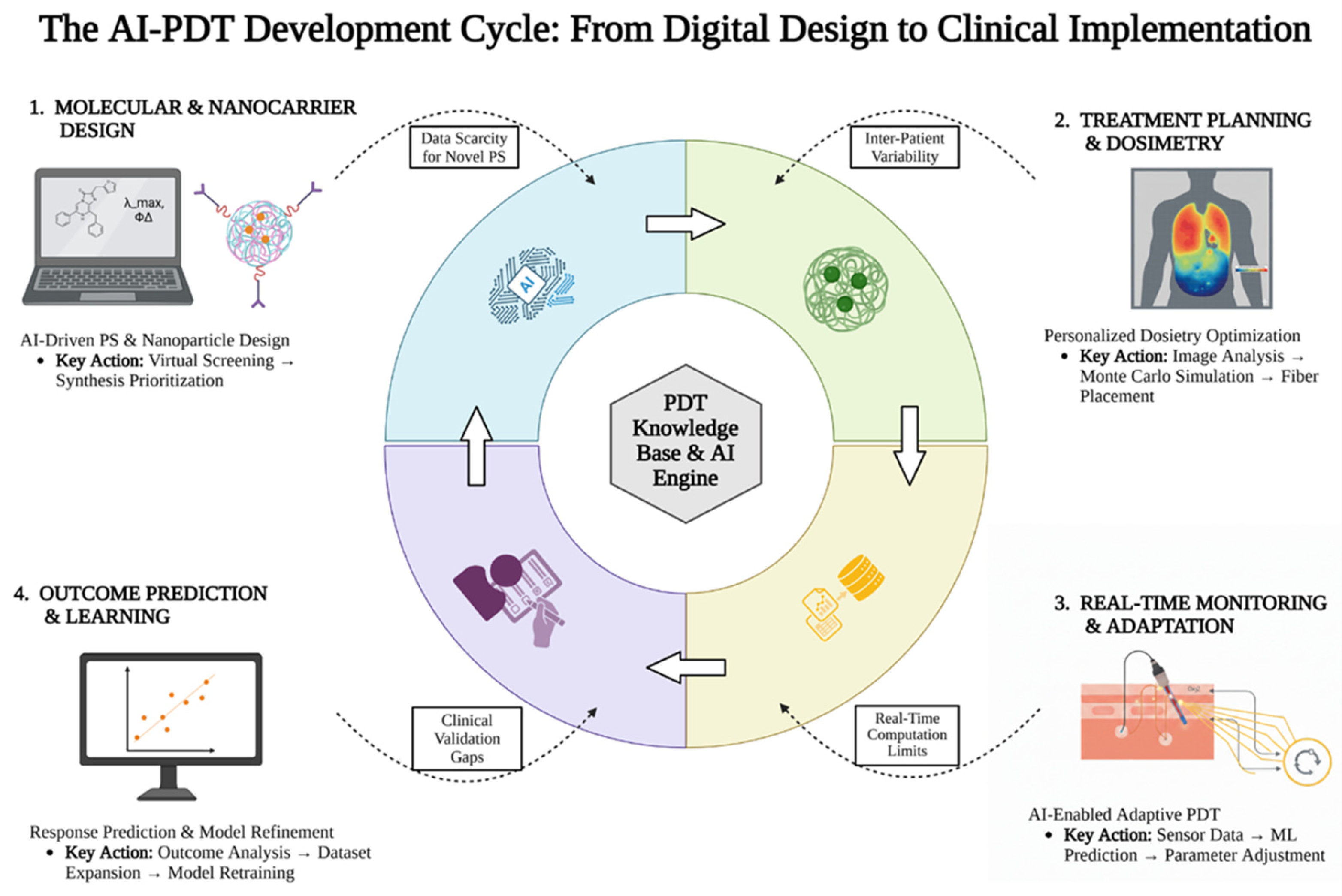
6. Applications of Learning Algorithms in PDT (Figure 4)

6.1. Enhancing Probes, Optimizing Tissue Optics and Treatment Planning
- (1)
- Synthetic/Monte Carlo benchmarking to verify model fidelity, sensitivity, and failure modes under controlled conditions;
- (2)
- Multi-center phantom and ex vivo validation using held-out external test sets to assess generalizability across instruments, operators, and protocols, with explicit cross-device evaluation to capture device-to-device variability [119];
- (3)
- Prospective clinical pilot studies with pre-specified endpoints, monitoring plans, and predefined success criteria, incorporating transparent reporting of calibration procedures and uncertainty metrics [120].
- (1)
- (2)
- Generalizability across clinical settings: When applied to different hardware, photosensitizer or patient demographics models developed in one institution often fail [116].
- (3)
- Lack of prospective validation: Few AI-driven PDT planning systems have been tested in prospective trials, leaving their real-world efficacy uncertain [117].
6.2. AI-Driven Photosensitizer Development and Design
6.3. AI in Nanoparticle Design and Drug Delivery Systems
- (1)
- Nevertheless, several challenges remain: nano–bio interaction unpredictability: The behavior of nanoparticles in biological systems is influenced by dynamic processes such as protein corona formation, opsonization, immune recognition, and organ-specific accumulation, which are difficult to predict in silico and can alter therapeutic efficacy and safety [143]. For example, surface modifications intended to improve targeting may inadvertently enhance immune clearance or induce unintended toxicities [25].
- (2)
- Long-term biocompatibility and toxicity: While many formulations show promising preclinical results, their long-term biodistribution, potential for organ accumulation, and chronic toxicity remain poorly characterized, especially in human models [140]. Metal-based nanoparticles (e.g., gold and silica) raise concerns about persistent tissue retention and potential inflammatory responses [141].
- (3)
- Immunogenicity and immune activation: Nanoparticles can provoke adaptive immune responses or activate the complementary system, leading to reduced efficacy upon repeated administration or hypersensitivity reactions—a critical consideration for PDT regimens requiring multiple treatments.
- (4)
- Regulatory and standardization hurdles: The path to clinical approval for nanomedicine is fraught with regulatory complexity due to:
- (1)
- Insufficient training data on nanoparticle toxicity, human pharmacokinetics, and immune interactions [143];
- (2)
- Context-dependent variability in patient physiology, immune status, and tumor microenvironment [130];
- (3)
- Validation gaps between computational predictions and in vivo experimental outcomes [145].
- (1)
- Optimization of NP–PS systems: AI models can be used to identify optimal photosensitizer loading densities, nanoparticle optical cross-sections, and light-nanoparticle interaction efficiencies to maximize singlet-oxygen yield while minimizing self-quenching [143].
- (2)
- Design of upconverting nanoparticles (UCNPs): Machine-learning approaches can tailor UCNP emission spectra to match photosensitizer absorption profiles, facilitating deeper-tissue activation via near-infrared excitation [151].
- (3)
- Modeling NP distribution in tissue: AI-driven simulations of nanoparticle biodistribution and tissue penetration can support patient-specific light dosimetry planning, enhancing target coverage and reducing off-target exposure [143].
6.3.1. Translational and Safety Considerations for AI-Designed Nanomedicines in PDT
Immunotoxicity and Immune Recognition
Protein Corona Formation and Biodistribution Unpredictability
Good Manufacturing Practice (GMP) and Scalability Challenges
- (1)
- Batch-to-batch variability in nanoparticle size, drug loading, and surface functionalization can affect therapeutic consistency and safety [154].
- (2)
- Lack of standardized analytical methods for characterizing complex nanomedicines such as protein corona composition or in vivo stability complicates quality control.
- (3)
Clinical Failures and Setbacks in Nanomedicine
Regulatory Considerations for Combination Products and AI/ML as a Medical Device
- (1)
- Combination Product Regulations (FDA/EMA): When an AI platform designs a nanoparticle PS and also controls light delivery, it may be classified as a drug–device combination. This necessitates demonstrating the safety and efficacy of both components not only individually but also in combination, which is a costly and complex process [160];
- (2)
- AI/ML as a Medical Device: Regulatory agencies (the FDA and EMA) emphasize explainability, validation, and continuous monitoring of AI/ML-based devices. Key requirements include:
- -
- Explainability/Interpretability: to ensure clinician trust and regulatory approval, models must provide insight into decision-making.
- -
- Robust Validation: to ensure generalizability, algorithms require validation on independent, multi-center datasets representing diverse patient populations.
- -
- Post-Market Surveillance: AI models must be monitored for performance drift and updated with real-world data under regulatory oversight [99].
Practical Recommendations for Translational Researchers
- (1)
- Incorporate immunotoxicity screening early: Integrate in vivo immunophenotyping and in vitro immunocompatibility assays into AI training pipelines.
- (2)
- Adopt standardized characterization protocols: To improve data consistency and regulatory readiness they should follow emerging standards for nanoparticle characterization.
- (3)
- Engage regulators early: Seek regulatory advice (e.g., FDA’s Q-Submission program) during the design phase to align AI model development with clinical and manufacturing requirements.
- (4)
- Develop failure-aware AI models: Curate and share datasets of nanomedicine failures in order to train AI on negative outcomes and improve safety prediction.
- (5)
- Plan for real-world validation: To validate AI predictions in human populations they should design prospective, multi-center clinical trials that include biomarker-driven safety endpoints [158].
Validation Pipeline for AI-Designed Nanocarriers
- (1)
- High-throughput in vitro screening: Assessing drug loading, release kinetics, and colloidal stability across formulation variants [162];
- (2)
- Serum stability and protein corona characterization: Quantifying changes in size, surface charge, and corona composition in biological fluids [163];
- (3)
- Organ-on-chip and 3D spheroid models: Evaluating penetration, distribution, and efficacy in tissue-mimetic environments;
- (4)
- Small-animal biodistribution studies: Using imaging (e.g., fluorescence and PET (Positron Emission Tomography)) to track accumulation, clearance, and off-target exposure [164];
- (5)
- Active-learning iteration: Feeding experimental results back into AI models to refine design rules and prioritize next-generation candidates [143].
6.4. Monitoring Treatment Responses
6.5. Predicting Treatment Outcomes
7. Future Research Directions
7.1. Integration of Multimodal Imaging and Data Fusion
- Optical fluorescence: high sensitivity but millimeter-scale penetration.
- Diffuse reflectance spectroscopy (DRS): quantifies tissue optics and hemoglobin oxygenation but remains superficial (∼1–2 mm).
- Photoacoustic imaging (PAI): bridges optical contrast and ultrasound resolution to ∼1–3 cm depth.
- MRI/PET: provide whole-organ/tumor anatomical, perfusion, and metabolic context but lack direct photochemical readouts.
7.2. Real-Time Adaptive PDT Systems
8. Translational and Practical Barriers to Advanced PTD
8.1. Cost and Reimbursement Barriers
8.2. Logistical and Infrastructure Challenges
8.3. Accessibility and Equity Considerations
8.4. Pathways to Improved Accessibility
9. Conclusions
Author Contributions
Funding
Institutional Review Board Statement
Data Availability Statement
Conflicts of Interest
References
- Issa, M.C.; Manela-Azulay, M. Photodynamic therapy: A review of the literature and image documentation. An. Bras. Dermatol. 2010, 85, 501–511. [Google Scholar] [CrossRef] [PubMed]
- Aebisher, D.; Czech, S.; Dynarowicz, K.; Misiołek, M.; Komosińska-Vassev, K.; Kawczyk-Krupka, A.; Bartusik-Aebisher, D. Photodynamic Therapy: Past, Current, and Future. Int. J. Mol. Sci. 2024, 25, 11325. [Google Scholar] [CrossRef] [PubMed] [PubMed Central]
- Li, B.; Lin, L.; Lin, H.; Wilson, B.C. Photosensitized singlet oxygen generation and detection: Recent advances and future perspectives in cancer photodynamic therapy. J. Biophotonics 2016, 9, 1314–1325. [Google Scholar] [CrossRef] [PubMed]
- Wong, T.H.; Morton, C.A.; Collier, N.; Haylett, A.; Ibbotson, S.; McKenna, K.E.; Mallipeddi, R.; Moseley, H.; Seukeran, D.C.; Rhodes, L.E.; et al. British Association of Dermatologists and British Photodermatology Group guidelines for topical photodynamic therapy 2018. Br. J. Dermatol. 2019, 180, 730–739. [Google Scholar] [CrossRef] [PubMed]
- Agostinis, P.; Berg, K.; Cengel, K.A.; Foster, T.H.; Girotti, A.W.; Gollnick, S.O.; Hahn, S.M.; Hamblin, M.R.; Juzeniene, A.; Kessel, D.; et al. Photodynamic therapy of cancer: An update. CA Cancer J. Clin. 2011, 61, 250–281. [Google Scholar] [CrossRef] [PubMed] [PubMed Central]
- Hopper, C. Photodynamic therapy: A clinical reality in the treatment of cancer. Lancet Oncol. 2000, 1, 212–219. [Google Scholar] [CrossRef] [PubMed]
- Lan, M.; Zhao, S.; Liu, W.; Lee, C.S.; Zhang, W.; Wang, P. Photosensitizers for Photodynamic Therapy. Adv. Healthc. Mater. 2019, 8, e1900132. [Google Scholar] [CrossRef] [PubMed]
- Simões, J.C.S.; Sarpaki, S.; Papadimitroulas, P.; Therrien, B.; Loudos, G. Conjugated Photosensitizers for Imaging and PDT in Cancer Research. J. Med. Chem. 2020, 63, 14119–14150. [Google Scholar] [CrossRef] [PubMed]
- Abrahamse, H.; Hamblin, M.R. New photosensitizers for photodynamic therapy. Biochem. J. 2016, 473, 347–364. [Google Scholar] [CrossRef] [PubMed] [PubMed Central]
- Kwiatkowski, S.; Knap, B.; Przystupski, D.; Saczko, J.; Kędzierska, E.; Knap-Czop, K.; Kotlińska, J.; Michel, O.; Kotowski, K.; Kulbacka, J. Photodynamic therapy—Mechanisms, photosensitizers and combinations. Biomed. Pharmacother. 2018, 106, 1098–1107. [Google Scholar] [CrossRef] [PubMed]
- Aebisher, D.; Serafin, I.; Batóg-Szczęch, K.; Dynarowicz, K.; Chodurek, E.; Kawczyk-Krupka, A.; Bartusik-Aebisher, D. Photodynamic Therapy in the Treatment of Cancer—The Selection of Synthetic Photosensitizers. Pharmaceuticals 2024, 17, 932. [Google Scholar] [CrossRef] [PubMed]
- Allison, R.R.; Mota, H.C.; Sibata, C.H. Clinical PD/PDT in North America: An historical review. Photodiagnosis Photodyn. Ther. 2004, 1, 263–277. [Google Scholar] [CrossRef] [PubMed]
- Morton, C.A.; Szeimies, R.M.; Basset-Seguin, N.; Calzavara-Pinton, P.; Gilaberte, Y.; Haedersdal, M.; Hofbauer, G.F.L.; Hunger, R.E.; Karrer, S.; Piaserico, S.; et al. European Dermatology Forum guidelines on topical photodynamic therapy 2019 Part 1: Treatment delivery and established indications—Actinic keratoses, Bowen’s disease and basal cell carcinomas. J. Eur. Acad. Dermatol. Venereol. 2019, 33, 2225–2238. [Google Scholar] [CrossRef] [PubMed]
- Chizenga, E.P.; Abrahamse, H. Nanotechnology in Modern Photodynamic Therapy of Cancer: A Review of Cellular Resistance Patterns Affecting the Therapeutic Response. Pharmaceutics 2020, 12, 632. [Google Scholar] [CrossRef] [PubMed] [PubMed Central]
- Li, T.; Yan, L. Functional Polymer Nanocarriers for Photodynamic Therapy. Pharmaceuticals 2018, 11, 133. [Google Scholar] [CrossRef] [PubMed] [PubMed Central]
- Montaseri, H.; Kruger, C.A.; Abrahamse, H. Inorganic Nanoparticles Applied for Active Targeted Photodynamic Therapy of Breast Cancer. Pharmaceutics 2021, 13, 296. [Google Scholar] [CrossRef] [PubMed] [PubMed Central]
- Samia, A.C.; Dayal, S.; Burda, C. Quantum dot-based energy transfer: Perspectives and potential for applications in photodynamic therapy. Photochem. Photobiol. 2006, 82, 617–625. [Google Scholar] [CrossRef] [PubMed]
- Marchal, S.; François, A.; Dumas, D.; Guillemin, F.; Bezdetnaya, L. Relationship between subcellular localisation of Foscan and caspase activation in photosensitised MCF-7 cells. Br. J. Cancer 2007, 96, 944–951. [Google Scholar] [CrossRef] [PubMed] [PubMed Central]
- Swarts, J.C.; Cook, M.J.; Baker, E.N. Metal-containing proteins, macrocycles, and coordination complexes in therapeutic applications and disease. Met. Based Drugs 2008, 2008, 286363. [Google Scholar] [CrossRef] [PubMed] [PubMed Central]
- Donnelly, R.F.; McCarron, P.A.; Woolfson, D. Drug delivery systems for photodynamic therapy. Recent. Pat. Drug Deliv. Formul. 2009, 3, 1–7. [Google Scholar] [CrossRef] [PubMed]
- Juzeniene, A.; Peng, Q.; Moan, J. Milestones in the development of photodynamic therapy and fluorescence diagnosis. Photochem. Photobiol. Sci. 2007, 6, 1234–1245. [Google Scholar] [CrossRef] [PubMed]
- Kotulska, M.; Kulbacka, J.; Saczko, J. Advances in photodynamic therapy assisted by electroporation. Curr. Drug Metab. 2013, 14, 309–318. [Google Scholar] [CrossRef] [PubMed]
- Wezgowiec, J.; Derylo, M.B.; Teissie, J.; Orio, J.; Rols, M.P.; Kulbacka, J.; Saczko, J.; Kotulska, M. Electric field-assisted delivery of photofrin to human breast carcinoma cells. J. Membr. Biol. 2013, 246, 725–735. [Google Scholar] [CrossRef] [PubMed] [PubMed Central]
- Zhou, Z.; Song, J.; Nie, L.; Chen, X. Reactive oxygen species generating systems meeting challenges of photodynamic cancer therapy. Chem. Soc. Rev. 2016, 45, 6597–6626. [Google Scholar] [CrossRef] [PubMed] [PubMed Central]
- Calixto, G.M.; Bernegossi, J.; de Freitas, L.M.; Fontana, C.R.; Chorilli, M. Nanotechnology-Based Drug Delivery Systems for Photodynamic Therapy of Cancer: A Review. Molecules 2016, 21, 342. [Google Scholar] [CrossRef] [PubMed] [PubMed Central]
- Ömeroğlu, İ.; Durmuş, M. Water-soluble phthalocyanine photosensitizers for photodynamic therapy. Turk. J. Chem. 2023, 47, 837–863. [Google Scholar] [CrossRef] [PubMed] [PubMed Central]
- Gierlich, P.; Mata, A.I.; Donohoe, C.; Brito, R.M.M.; Senge, M.O.; Gomes-da-Silva, L.C. Ligand-Targeted Delivery of Photosensitizers for Cancer Treatment. Molecules 2020, 25, 5317. [Google Scholar] [CrossRef] [PubMed] [PubMed Central]
- Zhang, S.; Wang, Y.; Kong, Z.; Zhang, X.; Sun, B.; Yu, H.; Chen, Q.; Luo, C.; Sun, J.; He, Z. Pure photosensitizer-driven nanoassembly with core-matched PEGylation for imaging-guided photodynamic therapy. Acta Pharm. Sin. B 2021, 11, 3636–3647. [Google Scholar] [CrossRef] [PubMed] [PubMed Central]
- Hak, A.; Ali, M.S.; Sankaranarayanan, S.A.; Shinde, V.R.; Rengan, A.K. Chlorin e6: A Promising Photosensitizer in Photo-Based Cancer Nanomedicine. ACS Appl. Bio Mater. 2023, 6, 349–364. [Google Scholar] [CrossRef] [PubMed]
- Yu, H.; Huang, Z.; Wu, J.; Zhao, Z.; Hua, Y.; Yang, Y. Chlorin e6: A promising photosensitizer of anti-tumor and anti-inflammatory effects in PDT. Nanomedicine 2025, 20, 389–400. [Google Scholar] [CrossRef] [PubMed] [PubMed Central]
- Kim, T.E.; Chang, J.E. Recent Studies in Photodynamic Therapy for Cancer Treatment: From Basic Research to Clinical Trials. Pharmaceutics 2023, 15, 2257. [Google Scholar] [CrossRef] [PubMed] [PubMed Central]
- Bharathiraja, S.; Moorthy, M.S.; Manivasagan, P.; Seo, H.; Lee, K.D.; Oh, J. Chlorin e6 conjugated silica nanoparticles for targeted and effective photodynamic therapy. Photodiagnosis Photodyn. Ther. 2017, 19, 212–220. [Google Scholar] [CrossRef] [PubMed]
- Paul, M.; Ghosh, B.; Biswas, S. F127/chlorin e6-nanomicelles to enhance Ce6 solubility and PDT-efficacy mitigating lung metastasis in melanoma. Drug Deliv. Transl. Res. 2025, 15, 621–637. [Google Scholar] [CrossRef] [PubMed]
- Wilson, B.C.; Patterson, M.S. The physics, biophysics and technology of photodynamic therapy. Phys. Med. Biol. 2008, 53, R61–R109. [Google Scholar] [CrossRef] [PubMed]
- Zhu, T.C.; Finlay, J.C. The role of photodynamic therapy (PDT) physics. Med. Phys. 2008, 35, 3127–3136. [Google Scholar] [CrossRef] [PubMed] [PubMed Central]
- Allison, R.R.; Sibata, C.H. Oncologic photodynamic therapy photosensitizers: A clinical review. Photodiagnosis Photodyn. Ther. 2010, 7, 61–75. [Google Scholar] [CrossRef] [PubMed]
- Yoon, I.; Li, J.Z.; Shim, Y.K. Advance in photosensitizers and light delivery for photodynamic therapy. Clin. Endosc. 2013, 46, 7–23. [Google Scholar] [CrossRef] [PubMed] [PubMed Central]
- Correia, J.H.; Rodrigues, J.A.; Pimenta, S.; Dong, T.; Yang, Z. Photodynamic Therapy Review: Principles, Photosensitizers, Applications, and Future Directions. Pharmaceutics 2021, 13, 1332. [Google Scholar] [CrossRef] [PubMed] [PubMed Central]
- Nguyen, M.; Sandhu, S.S.; Sivamani, R.K. Clinical utility of daylight photodynamic therapy in the treatment of actinic keratosis—A review of the literature. Clin. Cosmet. Investig. Dermatol. 2019, 12, 427–435. [Google Scholar] [CrossRef] [PubMed] [PubMed Central]
- Morton, C.A.; Braathen, L.R. Daylight Photodynamic Therapy for Actinic Keratoses. Am. J. Clin. Dermatol. 2018, 19, 647–656. [Google Scholar] [CrossRef] [PubMed]
- Cui, S.; Guo, X.; Wang, S.; Wei, Z.; Huang, D.; Zhang, X.; Zhu, T.C.; Huang, Z. Singlet Oxygen in Photodynamic Therapy. Pharmaceuticals 2024, 17, 1274. [Google Scholar] [CrossRef] [PubMed] [PubMed Central]
- Lu, B.; Wang, L.; Tang, H.; Cao, D. Recent advances in type I organic photosensitizers for efficient photodynamic therapy for overcoming tumor hypoxia. J. Mater. Chem. B 2023, 11, 4600–4618. [Google Scholar] [CrossRef] [PubMed]
- Alvarez, N.; Sevilla, A. Current Advances in Photodynamic Therapy (PDT) and the Future Potential of PDT-Combinatorial Cancer Therapies. Int. J. Mol. Sci. 2024, 25, 1023. [Google Scholar] [CrossRef]
- Maier, A.; Anegg, U.; Fell, B.; Rehak, P.; Ratzenhofer, B.; Tomaselli, F.; Sankin, O.; Pinter, H.; Smolle-Jüttner, F.M.; Friehs, G.B. Hyperbaric oxygen and photodynamic therapy in the treatment of advanced carcinoma of the cardia and the esophagus. Lasers Surg. Med. 2000, 26, 308–315. [Google Scholar] [CrossRef] [PubMed]
- Bhandari, V.; Hoey, C.; Liu, L.Y.; Lalonde, E.; Ray, J.; Livingstone, J.; Lesurf, R.; Shiah, Y.J.; Vujcic, T.; Huang, X.; et al. Molecular landmarks of tumor hypoxia across cancer types. Nat. Genet. 2019, 51, 308–318. [Google Scholar] [CrossRef] [PubMed]
- Xu, X.; Saw, P.E.; Tao, W.; Li, Y.; Ji, X.; Bhasin, S.; Liu, Y.; Ayyash, D.; Rasmussen, J.; Huo, M.; et al. ROS-Responsive Polyprodrug Nanoparticles for Triggered Drug Delivery and Effective Cancer Therapy. Adv. Mater. 2017, 29, 1700141. [Google Scholar] [CrossRef] [PubMed] [PubMed Central]
- Wang, D.; Wang, X.; Si, M.; Yang, J.; Sun, S.; Wu, H.; Cui, S.; Qu, X.; Yu, X. Exosome-encapsulated miRNAs contribute to CXCL12/CXCR4-induced liver metastasis of colorectal cancer by enhancing M2 polarization of macrophages. Cancer Lett. 2020, 474, 36–52, Erratum in Cancer Lett. 2022, 525, 200–202. https://doi.org/10.1016/j.canlet.2021.11.010. PMID: 31931030.. [Google Scholar] [CrossRef]
- Sørensen, B.S.; Horsman, M.R. Tumor Hypoxia: Impact on Radiation Therapy and Molecular Pathways. Front. Oncol. 2020, 10, 562. [Google Scholar] [CrossRef] [PubMed] [PubMed Central]
- Foster, T.H.; Murant, R.S.; Bryant, R.G.; Knox, R.S.; Gibson, S.L.; Hilf, R. Oxygen consumption and diffusion effects in photodynamic therapy. Radiat. Res. 1991, 126, 296–303. [Google Scholar] [CrossRef] [PubMed]
- Dolmans, D.E.; Fukumura, D.; Jain, R.K. Photodynamic therapy for cancer. Nat. Rev. Cancer 2003, 3, 380–387. [Google Scholar] [CrossRef] [PubMed]
- Kessel, D. Apoptosis, Paraptosis and Autophagy: Death and Survival Pathways Associated with Photodynamic Therapy. Photochem. Photobiol. 2019, 95, 119–125. [Google Scholar] [CrossRef] [PubMed] [PubMed Central]
- Mroz, P.; Yaroslavsky, A.; Kharkwal, G.B.; Hamblin, M.R. Cell death pathways in photodynamic therapy of cancer. Cancers 2011, 3, 2516–2539. [Google Scholar] [CrossRef] [PubMed] [PubMed Central]
- Mishchenko, T.A.; Balalaeva, I.V.; Vedunova, M.V.; Krysko, D.V. Ferroptosis and Photodynamic Therapy Synergism: Enhancing Anticancer Treatment. Trends Cancer 2021, 7, 484–487. [Google Scholar] [CrossRef] [PubMed]
- Fingar, V.H. Vascular effects of photodynamic therapy. J. Clin. Laser Med. Surg. 1996, 14, 323–328. [Google Scholar] [CrossRef] [PubMed]
- Krammer, B. Vascular effects of photodynamic therapy. Anticancer Res. 2001, 21, 4271–4277. [Google Scholar] [PubMed]
- Chen, B.; Pogue, B.W.; Hoopes, P.J.; Hasan, T. Vascular and cellular targeting for photodynamic therapy. Crit. Rev. Eukaryot. Gene Expr. 2006, 16, 279–305. [Google Scholar] [CrossRef] [PubMed]
- Henderson, B.W.; Gollnick, S.O.; Snyder, J.W.; Busch, T.M.; Kousis, P.C.; Cheney, R.T.; Morgan, J. Choice of oxygen-conserving treatment regimen determines the inflammatory response and outcome of photodynamic therapy of tumors. Cancer Res. 2004, 64, 2120–2126. [Google Scholar] [CrossRef] [PubMed]
- Krysko, D.V.; Garg, A.D.; Kaczmarek, A.; Krysko, O.; Agostinis, P.; Vandenabeele, P. Immunogenic cell death and DAMPs in cancer therapy. Nat. Rev. Cancer 2012, 12, 860–875. [Google Scholar] [CrossRef] [PubMed]
- Dudzik, T.; Domański, I.; Makuch, S. The impact of photodynamic therapy on immune system in cancer—An update. Front. Immunol. 2024, 15, 1335920. [Google Scholar] [CrossRef] [PubMed] [PubMed Central]
- Garg, A.D.; Nowis, D.; Golab, J.; Agostinis, P. Photodynamic therapy: Illuminating the road from cell death towards anti-tumour immunity. Apoptosis 2010, 15, 1050–1071. [Google Scholar] [CrossRef] [PubMed]
- Castano, A.P.; Mroz, P.; Hamblin, M.R. Photodynamic therapy and anti-tumour immunity. Nat. Rev. Cancer 2006, 6, 535–545. [Google Scholar] [CrossRef] [PubMed] [PubMed Central]
- Meng, Z.; Zhou, X.; Xu, J.; Han, X.; Dong, Z.; Wang, H.; Zhang, Y.; She, J.; Xu, L.; Wang, C.; et al. Light-Triggered In Situ Gelation to Enable Robust Photodynamic-Immunotherapy by Repeated Stimulations. Adv. Mater. 2019, 31, e1900927. [Google Scholar] [CrossRef] [PubMed]
- Juzeniene, A.; Nielsen, K.P.; Moan, J. Biophysical aspects of photodynamic therapy. J. Environ. Pathol. Toxicol. Oncol. 2006, 25, 7–28. [Google Scholar] [CrossRef] [PubMed]
- Kubrak, T.; Karakuła, M.; Czop, M.; Kawczyk-Krupka, A.; Aebisher, D. Advances in Management of Bladder Cancer-The Role of Photodynamic Therapy. Molecules 2022, 27, 731. [Google Scholar] [CrossRef] [PubMed] [PubMed Central]
- Castano, A.P.; Demidova, T.N.; Hamblin, M.R. Mechanisms in photodynamic therapy: Part two-cellular signaling, cell metabolism and modes of cell death. Photodiagnosis Photodyn. Ther. 2005, 2, 1–23. [Google Scholar] [CrossRef] [PubMed] [PubMed Central]
- Turubanova, V.D.; Balalaeva, I.V.; Mishchenko, T.A.; Catanzaro, E.; Alzeibak, R.; Peskova, N.N.; Efimova, I.; Bachert, C.; Mitroshina, E.V.; Krysko, O.; et al. Immunogenic cell death induced by a new photodynamic therapy based on photosens and photodithazine. J. Immunother. Cancer 2019, 7, 350. [Google Scholar] [CrossRef] [PubMed] [PubMed Central]
- Moghissi, K.; Dixon, K. Photodynamic therapy (PDT) in esophageal cancer: A surgical view of its indications based on 14 years experience. Technol. Cancer Res. Treat. 2003, 2, 319–326. [Google Scholar] [CrossRef] [PubMed]
- Zeitouni, N.C.; Bhatia, N.; Ceilley, R.I.; Cohen, J.L.; Del Rosso, J.Q.; Moore, A.Y.; Munavalli, G.; Pariser, D.M.; Schlesinger, T.; Siegel, D.M.; et al. Photodynamic Therapy with 5-aminolevulinic Acid 10% Gel and Red Light for the Treatment of Actinic Keratosis, Nonmelanoma Skin Cancers, and Acne: Current Evidence and Best Practices. J. Clin. Aesthet. Dermatol. 2021, 14, E53–E65. [Google Scholar] [PubMed] [PubMed Central]
- Balakirski, G.; Lehmann, P.; Szeimies, R.M.; Hofmann, S.C. Photodynamic therapy in dermatology: Established and new indications. J. Dtsch. Dermatol. Ges. 2024, 22, 1651–1662. [Google Scholar] [CrossRef] [PubMed] [PubMed Central]
- Morton, C.A. The emerging role of 5-ALA-PDT in dermatology: Is PDT superior to standard treatments? J. Dermatolog. Treat. 2002, 13, S25–S29. [Google Scholar] [CrossRef] [PubMed]
- Schmidt-Erfurth, U.; Hasan, T. Mechanisms of action of photodynamic therapy with verteporfin for the treatment of age-related macular degeneration. Surv. Ophthalmol. 2000, 45, 195–214. [Google Scholar] [CrossRef] [PubMed]
- Vinagreiro, C.S.; Zangirolami, A.; Schaberle, F.A.; Nunes, S.C.C.; Blanco, K.C.; Inada, N.M.; da Silva, G.J.; Pais, A.A.C.C.; Bagnato, V.S.; Arnaut, L.G.; et al. Antibacterial Photodynamic Inactivation of Antibiotic-Resistant Bacteria and Biofilms with Nanomolar Photosensitizer Concentrations. ACS Infect. Dis. 2020, 6, 1517–1526. [Google Scholar] [CrossRef] [PubMed]
- Ogawara, K.I.; Higaki, K. Nanoparticle-Based Photodynamic Therapy: Current Status and Future Application to Improve Outcomes of Cancer Treatment. Chem. Pharm. Bull. 2017, 65, 637–641. [Google Scholar] [CrossRef] [PubMed]
- Van Straten, D.; Mashayekhi, V.; De Bruijn, H.S.; Oliveira, S.; Robinson, D.J. Oncologic Photodynamic Therapy: Basic Principles, Current Clinical Status and Future Directions. Cancers 2017, 9, 19. [Google Scholar] [CrossRef]
- Penetra, M.; Arnaut, L.G.; Gomes-da-Silva, L.C. Trial watch: An update of clinical advances in photodynamic therapy and its immunoadjuvant properties for cancer treatment. Oncoimmunology 2023, 12, 2226535. [Google Scholar] [CrossRef] [PubMed] [PubMed Central]
- Algorri, J.F.; López-Higuera, J.M.; Rodríguez-Cobo, L.; Cobo, A. Advanced Light Source Technologies for Photodynamic Therapy of Skin Cancer Lesions. Pharmaceutics 2023, 15, 2075. [Google Scholar] [CrossRef] [PubMed] [PubMed Central]
- Alekseeva, P.; Makarov, V.; Efendiev, K.; Shiryaev, A.; Reshetov, I.; Loschenov, V. Devices and Methods for Dosimetry of Personalized Photodynamic Therapy of Tumors: A Review on Recent Trends. Cancers 2024, 16, 2484. [Google Scholar] [CrossRef] [PubMed] [PubMed Central]
- Yassine, A.A.; Lilge, L.; Betz, V. Machine learning for real-time optical property recovery in interstitial photodynamic therapy: A stimulation-based study. Biomed. Opt. Express 2021, 12, 5401–5422. [Google Scholar] [CrossRef] [PubMed] [PubMed Central]
- de Souza, A.L.R.; LaRochelle, E.; Marra, K.; Gunn, J.; Davis, S.C.; Samkoe, K.S.; Chapman, M.S.; Maytin, E.V.; Hasan, T.; Pogue, B.W. Assessing daylight & low-dose rate photodynamic therapy efficacy, using biomarkers of photophysical, biochemical and biological damage metrics in situ. Photodiagnosis Photodyn. Ther. 2017, 20, 227–233. [Google Scholar] [CrossRef]
- Sunar, U.; Rohrbach, D.; Rigual, N.; Tracy, E.; Keymel, K.; Cooper, M.T.; Baumann, H.; Henderson, B.H. Monitoring photobleaching and hemodynamic responses to HPPH-mediated photodynamic therapy of head and neck cancer: A case report. Opt. Express 2010, 18, 14969–14978. [Google Scholar] [CrossRef] [PubMed] [PubMed Central]
- Sheng, C.; Hoopes, P.J.; Hasan, T.; Pogue, B.W. Photobleaching-based dosimetry predicts deposited dose in ALA-PpIX PDT of rodent esophagus. Photochem. Photobiol. 2007, 83, 738–748. [Google Scholar] [CrossRef] [PubMed]
- Sheng, T.; Ong, Y.; Busch, T.M.; Zhu, T.C. Reactive oxygen species explicit dosimetry to predict local tumor growth for Photofrin-mediated photodynamic therapy. Biomed. Opt. Express 2020, 11, 4586–4601. [Google Scholar] [CrossRef] [PubMed] [PubMed Central]
- Qiu, H.; Kim, M.M.; Penjweini, R.; Zhu, T.C. Macroscopic singlet oxygen modeling for dosimetry of Photofrin-mediated photodynamic therapy: An in-vivo study. J. Biomed. Opt. 2016, 21, 88002, Erratum in: J. Biomed. Opt. 2017, 22, 49801. https://doi.org/10.1117/1.JBO.22.4.049801. PMID: 27552311; PMCID: PMC5331118.. [Google Scholar] [CrossRef] [PubMed]
- Kim, M.M.; Penjweini, R.; Zhu, T.C. Evaluation of singlet oxygen explicit dosimetry for predicting treatment outcomes of benzoporphyrin derivative monoacid ring A-mediated photodynamic therapy. J. Biomed. Opt. 2017, 22, 28002. [Google Scholar] [CrossRef] [PubMed] [PubMed Central]
- Yoo, T.K.; Kim, S.H.; Kim, M.; Lee, C.S.; Byeon, S.H.; Kim, S.S.; Yeo, J.; Choi, E.Y. DeepPDT-Net: Predicting the outcome of photodynamic therapy for chronic central serous chorioretinopathy using two-stage multimodal transfer learning. Sci. Rep. 2022, 12, 18689. [Google Scholar] [CrossRef] [PubMed] [PubMed Central]
- Schreurs, T.J.L.; Jacobs, I.; Nicolay, K.; Prompers, J.J.; Strijkers, G.J. Detection of Treatment Success after Photodynamic Therapy Using Dynamic Contrast-Enhanced Magnetic Resonance Imaging. Theranostics 2017, 7, 4643–4657. [Google Scholar] [CrossRef] [PubMed] [PubMed Central][Green Version]
- Mastrangelopoulou, M.; Grigalavicius, M.; Raabe, T.H.; Skarpen, E.; Juzenas, P.; Peng, Q.; Berg, K.; Theodossiou, T.A. Predictive biomarkers for 5-ALA-PDT can lead to personalized treatments and overcome tumor-specific resistances. Cancer Rep. 2022, 5, e1278. [Google Scholar] [CrossRef] [PubMed] [PubMed Central]
- Rahman, M.A.; Yan, F.; Li, R.; Wang, Y.; Huang, L.; Han, R.; Jiang, Y. Deep Learning Insights into the Dynamic Effects of Photodynamic Therapy on Cancer Cells. Pharmaceutics 2024, 16, 673. [Google Scholar] [CrossRef] [PubMed] [PubMed Central]
- Lv, S.; Wang, X.; Wang, G.; Yang, W.; Cheng, K. Efficient evaluation of photodynamic therapy on tumor based on deep learning. Photodiagnosis Photodyn. Ther. 2023, 43, 103658. [Google Scholar] [CrossRef] [PubMed]
- Chen, M.T.; Mahmood, F.; Sweer, J.A.; Durr, N.J. GANPOP: Generative Adversarial Network Prediction of Optical Properties From Single Snapshot Wide-Field Images. IEEE Trans. Med. Imaging 2020, 39, 1988–1999. [Google Scholar] [CrossRef] [PubMed] [PubMed Central]
- Panigrahi, S.; Gioux, S. Machine learning approach for rapid and accurate estimation of optical properties using spatial frequency domain imaging. J. Biomed. Opt. 2018, 24, 1–6. [Google Scholar] [CrossRef] [PubMed] [PubMed Central]
- Johansson, A.; Axelsson, J.; Andersson-Engels, S.; Swartling, J. Realtime light dosimetry software tools for interstitial photodynamic therapy of the human prostate. Med. Phys. 2007, 34, 4309–4321. [Google Scholar] [CrossRef] [PubMed]
- Mousavi, M.; Moriyama, L.T.; Grecco, C.; Saito Nogueira, M.; Svanberg, K.; Kurachi, C.; Andersson-Engels, S. Photodynamic therapy dosimetry using multiexcitation multiemission wavelength: Toward real-time prediction of treatment outcome. J. Biomed. Opt. 2020, 25, 1–14. [Google Scholar] [CrossRef] [PubMed] [PubMed Central]
- Yassine, A.A.; Lilge, L.; Betz, V. Optimizing Interstitial Photodynamic Therapy Planning With Reinforcement Learning-Based Diffuser Placement. IEEE Trans. Biomed. Eng. 2021, 68, 1668–1679. [Google Scholar] [CrossRef] [PubMed]
- Wang, S.; Saeidi, T.; Lilge, L.; Betz, V. Integrating clinical access limitations into iPDT treatment planning with PDT-SPACE. Biomed. Opt. Express 2023, 14, 714–738. [Google Scholar] [CrossRef] [PubMed] [PubMed Central]
- Sujan, M.; Smith-Frazer, C.; Malamateniou, C.; Connor, J.; Gardner, A.; Unsworth, H.; Husain, H. Validation framework for the use of AI in healthcare: Overview of the new British standard BS30440. BMJ Health Care Inform. 2023, 30, e100749. [Google Scholar] [CrossRef] [PubMed] [PubMed Central]
- Zhao, Y.; Moritz, T.; Hinds, M.F.; Gunn, J.R.; Shell, J.R.; Pogue, B.W.; Davis, S.J. High optical-throughput spectroscopic singlet oxygen and photosensitizer luminescence dosimeter for monitoring of photodynamic therapy. J. Biophotonics 2021, 14, e202100088. [Google Scholar] [CrossRef] [PubMed]
- Kim, W.S.; Khot, M.I.; Woo, H.M.; Hong, S.; Baek, D.H.; Maisey, T.; Daniels, B.; Coletta, P.L.; Yoon, B.J.; Jayne, D.G.; et al. AI-enabled, implantable, multichannel wireless telemetry for photodynamic therapy. Nat. Commun. 2022, 13, 2178. [Google Scholar] [CrossRef] [PubMed] [PubMed Central]
- Wingert, T.; Lee, C.; Cannesson, M. Machine Learning, Deep Learning, and Closed Loop Devices-Anesthesia Delivery. Anesthesiol. Clin. 2021, 39, 565–581. [Google Scholar] [CrossRef] [PubMed] [PubMed Central]
- Algorri, J.F.; Ochoa, M.; Roldán-Varona, P.; Rodríguez-Cobo, L.; López-Higuera, J.M. Light Technology for Efficient and Effective Photodynamic Therapy: A Critical Review. Cancers 2021, 13, 3484. [Google Scholar] [CrossRef] [PubMed] [PubMed Central]
- Zhang, Y.; Bai, W.; Dong, Y.; Dan, M.; Liu, D.; Gao, F. Deep-learning approach to stratified reconstructions of tissue absorption and scattering in time-domain spatial frequency domain imaging. J. Biomed. Opt. 2024, 29, 036002. [Google Scholar] [CrossRef] [PubMed] [PubMed Central]
- Han, K.; Hua, X.; Qi, T.; Gao, Z.; Wang, X.; Jia, S. Volumetric localization microscopy with deep learning. Nat. Commun. 2025, 16, 10960. [Google Scholar] [CrossRef] [PubMed] [PubMed Central]
- Yang, W.; Lu, B.; Johnson, M.; Sourvanos, D.; Sun, H.; Dimofte, A.; Vikas, V.; Hadfield, R.H.; Wilson, B.C.; Zhu, T.C. Comparison of multispectral singlet oxygen luminescence dosimetry and singlet oxygen explicit dosimetry in artificial phantom. J. Biomed. Opt. 2025, 30, S34115. [Google Scholar] [CrossRef] [PubMed] [PubMed Central]
- Pourhajibagher, M.; Bahrami, R.; Bahador, A. Can Artificial Intelligence Enhance the Antimicrobial Effectiveness of Photodynamic Therapy? What We Know and What We Do Not Know? J. Lasers Med. Sci. 2025, 16, e33. [Google Scholar] [CrossRef] [PubMed] [PubMed Central]
- Dou, Y.; Tsai, Y.H.; Liu, C.C.; Hobson, B.A.; Lein, P.J. Co-localization of fluorescent signals using deep learning with Manders overlapping coefficient. Proc. SPIE Int. Soc. Opt. Eng. 2021, 11596, 115963C. [Google Scholar] [CrossRef] [PubMed] [PubMed Central]
- Liao, Y.; Lin, X.; He, Z.; Chen, J.; Tang, S.; Wang, W.; Chen, W. Construction of nucleus-targeted photosensitizer and highly effective photodynamic immunotherapy for cancer. Bioorg. Chem. 2025, 154, 108022. [Google Scholar] [CrossRef] [PubMed]
- Ma, W.; Xie, C.; Li, X.; Tam, L.K.B.; Wu, Y.; Wang, R.; Lam, P.L.; Chau, H.F.; Wong, K.L. Multifunctional Organelle-Targeting Probes for Intracellular Imaging and Enhanced Cancer Phototherapy. Chemistry 2025, 31, e202500831. [Google Scholar] [CrossRef] [PubMed] [PubMed Central]
- Zhu, J.; Peng, L.; Jehan, S.; Wang, H.; Chen, X.; Zhao, S.; Zhou, W. Activable Photodynamic DNA Probe with an “AND” Logic Gate for Precision Skin Cancer Therapy. Research 2024, 7, 0295. [Google Scholar] [CrossRef] [PubMed] [PubMed Central]
- Kwon, N.; Weng, H.; Rajora, M.A.; Zheng, G. Activatable Photosensitizers: From Fundamental Principles to Advanced Designs. Angew. Chem. Int. Ed. Engl. 2025, 64, e202423348. [Google Scholar] [CrossRef] [PubMed] [PubMed Central]
- Zhu, C.; Liu, Q. Review of Monte Carlo modeling of light transport in tissues. J. Biomed. Opt. 2013, 18, 50902. [Google Scholar] [CrossRef] [PubMed]
- Periyasamy, V.; Pramanik, M. Monte Carlo simulation of light transport in tissue for optimizing light delivery in photoacoustic imaging of the sentinel lymph node. J. Biomed. Opt. 2013, 18, 106008. [Google Scholar] [CrossRef] [PubMed]
- Parilov, E.; Beeson, K.; Potasek, M.; Zhu, T.; Sun, H.; Sourvanos, D. A Monte Carlo simulation for Moving Light Source in Intracavity PDT. Proc. SPIE Int. Soc. Opt. Eng. 2023, 12359, 1235903. [Google Scholar] [CrossRef] [PubMed] [PubMed Central]
- Doronin, A.; Yakovlev, V.V.; Bagnato, V.S. Photodynamic treatment of malignant melanoma with structured light: In silico Monte Carlo modeling. Biomed. Opt. Express 2024, 15, 1682–1693. [Google Scholar] [CrossRef] [PubMed] [PubMed Central]
- Swartling, J.; Axelsson, J.; Ahlgren, G.; Kälkner, K.M.; Nilsson, S.; Svanberg, S.; Svanberg, K.; Andersson-Engels, S. System for interstitial photodynamic therapy with online dosimetry: First clinical experiences of prostate cancer. J. Biomed. Opt. 2010, 15, 058003. [Google Scholar] [CrossRef] [PubMed]
- Davidson, S.R.; Weersink, R.A.; Haider, M.A.; Gertner, M.R.; Bogaards, A.; Giewercer, D.; Scherz, A.; Sherar, M.D.; Elhilali, M.; Chin, J.L.; et al. Treatment planning and dose analysis for interstitial photodynamic therapy of prostate cancer. Phys. Med. Biol. 2009, 54, 2293–2313. [Google Scholar] [CrossRef] [PubMed]
- Sandell, J.; Chang, C.; Finlay, J.C.; Zhu, T.C. A Treatment Planning System for Pleural PDT. Proc. SPIE Int. Soc. Opt. Eng. 2010, 7551, 75510C. [Google Scholar] [CrossRef] [PubMed] [PubMed Central][Green Version]
- Wang, X.; Jin, T.; Xiong, J.; Zhao, H.; Hu, X.; Li, Q.; Ren, J.; Zhao, Y. Three-dimensional image-guided topical photodynamic therapy system with light dosimetry dynamic planning and monitoring. Biomed. Opt. Express 2022, 14, 453–466. [Google Scholar] [CrossRef] [PubMed] [PubMed Central]
- Li, Z.; Hannan, M.N.; Sharma, A.K.; Baran, T.M. Treatment planning for photodynamic therapy of abscess cavities using patient-specific optical properties measured prior to illumination. Phys. Med. Biol. 2024, 69, 055031. [Google Scholar] [CrossRef] [PubMed] [PubMed Central]
- Siontis, G.C.M.; Sweda, R.; Noseworthy, P.A.; Friedman, P.A.; Siontis, K.C.; Patel, C.J. Development and validation pathways of artificial intelligence tools evaluated in randomised clinical trials. BMJ Health Care Inform. 2021, 28, e100466. [Google Scholar] [CrossRef] [PubMed] [PubMed Central]
- Chouvarda, I.; Colantonio, S.; Verde, A.S.C.; Jimenez-Pastor, A.; Cerdá-Alberich, L.; Metz, Y.; Zacharias, L.; Nabhani-Gebara, S.; Bobowicz, M.; Tsakou, G.; et al. Differences in technical and clinical perspectives on AI validation in cancer imaging: Mind the gap! Eur. Radiol. Exp. 2025, 9, 7. [Google Scholar] [CrossRef] [PubMed] [PubMed Central]
- Pogue, B.W.; Elliott, J.T.; Kanick, S.C.; Davis, S.C.; Samkoe, K.S.; Maytin, E.V.; Pereira, S.P.; Hasan, T. Revisiting photodynamic therapy dosimetry: Reductionist & surrogate approaches to facilitate clinical success. Phys. Med. Biol. 2016, 61, R57–R89. [Google Scholar] [CrossRef]
- Buglak, A.A.; Charisiadis, A.; Sheehan, A.; Kingsbury, C.J.; Senge, M.O.; Filatov, M.A. Quantitative Structure-Property Relationship Modelling for the Prediction of Singlet Oxygen Generation by Heavy-Atom-Free BODIPY Photosensitizers. Chemistry 2021, 27, 9934–9947. [Google Scholar] [CrossRef] [PubMed] [PubMed Central]
- Bi, H.; Jiang, J.; Chen, J.; Kuang, X.; Zhang, J. Machine Learning Prediction of Quantum Yields and Wavelengths of Aggregation-Induced Emission Molecules. Materials 2024, 17, 1664. [Google Scholar] [CrossRef] [PubMed]
- Gao, J.; Dong, Y.; Qiu, T.; Sun, W.; Du, J. DFT-ML-Based Property Prediction of Transition Metal Complex Photosensitizers for Photodynamic Therapy. ACS Omega 2025, 10, 53447–53459. [Google Scholar] [CrossRef] [PubMed] [PubMed Central]
- Chen, Y.; Verma, S.; Greenman, K.P.; Yin, H.; Wang, Z.; Wang, L.; Li, J.; Gómez-Bombarelli, R.; Walsh, A.; Wang, X. A unified active learning framework for photosensitizer design. Chem. Sci. 2025, 17, 916–926. [Google Scholar] [CrossRef] [PubMed] [PubMed Central]
- Okyay, T.M.; Yilmaz, I.; Koldas, M. Machine learning-based bioactivity prediction of porphyrin derivatives: Molecular descriptors, clustering, and model evaluation. Photochem. Photobiol. Sci. 2025, 24, 923–937. [Google Scholar] [CrossRef] [PubMed]
- Zhao, W.; Wang, L.; Zhang, M.; Liu, Z.; Wu, C.; Pan, X.; Huang, Z.; Lu, C.; Quan, G. Photodynamic therapy for cancer: Mechanisms, photosensitizers, nanocarriers, and clinical studies. MedComm 2024, 5, e603. [Google Scholar] [CrossRef] [PubMed] [PubMed Central]
- Chen, W.; Mao, X.Q.; Wang, X.Z.; Liao, Y.C.; Yin, X.Y.; Wu, H.L.; Chen, T.Y.; Liu, M.Q.; Wang, T.; Yu, R.Q. Data-driven discovery of near-infrared type I photosensitizers for RNA-targeted tumor photodynamic therapy. Chem. Sci. 2025, 16, 14455–14467. [Google Scholar] [CrossRef] [PubMed] [PubMed Central]
- Diao, B.; Shi, S.; Li, J.; Yang, L.; Zheng, L.; Guo, H.; Peng, X. Machine Learning-Assisted Design and Discovery of High-Performance Cyanine-Based Photosensitizers for Integrated Theranostic Applications. Adv. Mater. 2025, 38, e15813. [Google Scholar] [CrossRef] [PubMed]
- Huang, K.; Yang, Y.; Huang, H.; Tang, Y.; Han, W.; Huang, J.; An, Y.; Yin, J. Machine Learning Accelerates Discovery of High-Performance Corrole Photosensitizers for Optical Imaging Diagnosis and Photodynamic Therapeutics of Nasopharyngeal Carcinoma. J. Phys. Chem. Lett. 2025, 16, 12579–12588. [Google Scholar] [CrossRef] [PubMed]
- Noto, N.; Kunisada, R.; Rohlfs, T.; Hayashi, M.; Kojima, R.; García Mancheño, O.; Yanai, T.; Saito, S. Transfer learning across different photocatalytic organic reactions. Nat. Commun. 2025, 16, 3388. [Google Scholar] [CrossRef] [PubMed] [PubMed Central]
- Bian, Q.; Wang, X. Machine Learning-Driven Design of Fluorescent Materials: Principles, Methodologies, and Future Directions. Nanomaterials 2025, 15, 1495. [Google Scholar] [CrossRef] [PubMed]
- Chen, D.; Xu, Q.; Wang, W.; Shao, J.; Huang, W.; Dong, X. Type I Photosensitizers Revitalizing Photodynamic Oncotherapy. Small 2021, 17, e2006742. [Google Scholar] [CrossRef] [PubMed]
- Tian, J.; Li, B.; Zhang, F.; Yao, Z.; Song, W.; Tang, Y.; Ping, Y.; Liu, B. Activatable Type I Photosensitizer with Quenched Photosensitization Pre and Post Photodynamic Therapy. Angew. Chem. Int. Ed. Engl. 2023, 62, e202307288. [Google Scholar] [CrossRef] [PubMed]
- Wang, H.; Qiao, C.; Guan, Q.; Wei, M.; Li, Z. Nanoparticle-mediated synergistic anticancer effect of ferroptosis and photodynamic therapy: Novel insights and perspectives. Asian J. Pharm. Sci. 2023, 18, 100829. [Google Scholar] [CrossRef] [PubMed] [PubMed Central]
- Huang, Y.; Li, X.; Zhang, Z.; Xiong, L.; Wang, Y.; Wen, Y. Photodynamic Therapy Combined with Ferroptosis Is a Synergistic Antitumor Therapy Strategy. Cancers 2023, 15, 5043. [Google Scholar] [CrossRef] [PubMed] [PubMed Central]
- Ma, Y.; Xu, K.; Feng, J.; Zhao, X.; Tian, P.; Luo, J.; Xu, L.; Song, J.; Lu, C. GSH-Responsive Nano-Photosensitizer for Potentiating Photodynamic Therapy Through Multi-Pronged Synergistic Upregulation of Ferroptosis Sensitivity. Antioxidants 2025, 14, 407. [Google Scholar] [CrossRef] [PubMed] [PubMed Central]
- Li, Y.; Zhang, C.; Wu, Q.; Peng, Y.; Ding, Y.; Zhang, Z.; Xu, X.; Xie, H. Enzyme-Activatable Near-Infrared Photosensitizer with High Enrichment in Tumor Cells Based on a Multi-Effect Design. Angew. Chem. Int. Ed. Engl. 2024, 63, e202317773. [Google Scholar] [CrossRef] [PubMed]
- Lei, Z.; Zhang, X.; Zheng, X.; Liu, S.; Xie, Z. Porphyrin-ferrocene conjugates for photodynamic and chemodynamic therapy. Org. Biomol. Chem. 2018, 16, 8613–8619. [Google Scholar] [CrossRef] [PubMed]
- Rajagopal, N.; Das, I.; Kapur, A.; Nayak, S.; Reddy, Y.; Sundara, B.K. Photodynamic therapy meets nanotechnology: A synergistic approach for cancer treatment. Transl. Oncol. 2025, 62, 102571. [Google Scholar] [CrossRef] [PubMed] [PubMed Central]
- Abrahamse, H.; Kruger, C.A.; Kadanyo, S.; Mishra, A. Nanoparticles for Advanced Photodynamic Therapy of Cancer. Photomed. Laser Surg. 2017, 35, 581–588. [Google Scholar] [CrossRef] [PubMed]
- Liu, X.; Lu, Y.; Li, X.; Luo, L.; You, J. Nanoplatform-enhanced photodynamic therapy for the induction of immunogenic cell death. J. Control Release 2024, 365, 1058–1073. [Google Scholar] [CrossRef] [PubMed]
- Chou, W.C.; Canchola, A.; Zhang, F.; Lin, Z. Machine Learning and Artificial Intelligence in Nanomedicine. Wiley Interdiscip. Rev. Nanomed. Nanobiotechnol. 2025, 17, e70027. [Google Scholar] [CrossRef] [PubMed] [PubMed Central]
- Csóka, I.; Ismail, R.; Jójárt-Laczkovich, O.; Pallagi, E. Regulatory Considerations, Challenges and Risk-based Approach in Nanomedicine Development. Curr. Med. Chem. 2021, 28, 7461–7476. [Google Scholar] [CrossRef] [PubMed]
- Wang, Q.; Liu, Y.; Li, C.; Xu, B.; Xu, S.; Liu, B. Machine Learning-Enhanced Nanoparticle Design for Precision Cancer Drug Delivery. Adv. Sci. 2025, 12, e03138. [Google Scholar] [CrossRef] [PubMed] [PubMed Central]
- Zhang, Z.; Xiang, Y.; Laforet, J., Jr.; Spasojevic, I.; Fan, P.; Heffernan, A.; Eyler, C.E.; Wood, K.C.; Hartman, Z.C.; Reker, D. TuNa-AI: A Hybrid Kernel Machine To Design Tunable Nanoparticles for Drug Delivery. ACS Nano 2025, 19, 33288–33296. [Google Scholar] [CrossRef] [PubMed]
- Debnath, G.; Vasu, B.; Gorla, R.S.R. Current state-of-the-art in multi-scale modeling in nano-cancer drug delivery: Role of AI and machine learning. Cancer Nano 2025, 16, 45. [Google Scholar] [CrossRef]
- Bae, H.; Ji, H.; Konstantinov, K.; Sluyter, R.; Ariga, K.; Kim, Y.H.; Kim, J.H. Artificial Intelligence-Driven Nanoarchitectonics for Smart Targeted Drug Delivery. Adv. Mater. 2025, 37, e10239. [Google Scholar] [CrossRef] [PubMed] [PubMed Central]
- Nag, S.; Ong, Y.S.; Narayanan, K.; Subramaniyan, V.; Naidu, R. Mechanistic Insights into Nanomaterials and Advanced Drug Delivery Platforms for the Theranostic Management of Hepatic Cancer: A Comprehensive Update. BioNanoScience 2025, 15, 587. [Google Scholar] [CrossRef]
- Chota, A.; Abrahamse, H.; George, B.P. George, Nano-enhanced photodynamic therapy and machine learning: Advancements, challenges, and future directions. Biomed. Pharmacother. 2025, 193, 118710. [Google Scholar] [CrossRef]
- Kim, H.S.; Lee, D.Y. Nanomedicine in Clinical Photodynamic Therapy for the Treatment of Brain Tumors. Biomedicines 2022, 10, 96. [Google Scholar] [CrossRef] [PubMed]
- Dobrovolskaia, M.A. Charting new frontiers in nanoparticle immunotoxicity: A perspective on current, emerging, and future approaches. Biochem. Biophys. Res. Commun. 2025, 777, 152280. [Google Scholar] [CrossRef] [PubMed] [PubMed Central]
- Nguyen, V.H.; Lee, B.J. Protein corona: A new approach for nanomedicine design. Int. J. Nanomed. 2017, 12, 3137–3151. [Google Scholar] [CrossRef] [PubMed] [PubMed Central]
- Đorđević, S.; Gonzalez, M.M.; Conejos-Sánchez, I.; Carreira, B.; Pozzi, S.; Acúrcio, R.C.; Satchi-Fainaro, R.; Florindo, H.F.; Vicent, M.J. Current hurdles to the translation of nanomedicines from bench to the clinic. Drug Deliv. Transl. Res. 2022, 12, 500–525. [Google Scholar] [CrossRef] [PubMed] [PubMed Central]
- Souto, E.B.; Silva, G.F.; Dias-Ferreira, J.; Zielinska, A.; Ventura, F.; Durazzo, A.; Lucarini, M.; Novellino, E.; Santini, A. Nanopharmaceutics: Part II-Production Scales and Clinically Compliant Production Methods. Nanomaterials 2020, 10, 455. [Google Scholar] [CrossRef] [PubMed] [PubMed Central]
- Mühlebach, S.; Borchard, G.; Yildiz, S. Regulatory challenges and approaches to characterize nanomedicines and their follow-on similars. Nanomedicine 2015, 10, 659–674. [Google Scholar] [CrossRef] [PubMed]
- Souto, E.B.; Silva, G.F.; Dias-Ferreira, J.; Zielinska, A.; Ventura, F.; Durazzo, A.; Lucarini, M.; Novellino, E.; Santini, A. Nanopharmaceutics: Part I-Clinical Trials Legislation and Good Manufacturing Practices (GMP) of Nanotherapeutics in the EU. Pharmaceutics 2020, 12, 146. [Google Scholar] [CrossRef] [PubMed] [PubMed Central]
- Dri, D.A.; Rinaldi, F.; Carafa, M.; Marianecci, C. Nanomedicines and nanocarriers in clinical trials: Surfing through regulatory requirements and physico-chemical critical quality attributes. Drug Deliv. Transl. Res. 2023, 13, 757–769. [Google Scholar] [CrossRef] [PubMed] [PubMed Central]
- Hare, J.I.; Lammers, T.; Ashford, M.B.; Puri, S.; Storm, G.; Barry, S.T. Challenges and strategies in anti-cancer nanomedicine development: An industry perspective. Adv. Drug Deliv. Rev. 2017, 108, 25–38. [Google Scholar] [CrossRef] [PubMed]
- Mangla, B.; Kumar, P.; Javed, S.; Pathan, T.; Ahsan, W.; Aggarwal, G. Regulating nanomedicines: Challenges, opportunities, and the path forward. Nanomedicine 2025, 20, 1911–1927. [Google Scholar] [CrossRef] [PubMed] [PubMed Central]
- Vasey, B.; Ursprung, S.; Beddoe, B.; Taylor, E.H.; Marlow, N.; Bilbro, N.; Watkinson, P.; McCulloch, P. Association of Clinician Diagnostic Performance With Machine Learning-Based Decision Support Systems: A Systematic Review. JAMA Netw. Open. 2021, 4, e211276. [Google Scholar] [CrossRef] [PubMed] [PubMed Central]
- Tomé, I.; Francisco, V.; Fernandes, H.; Ferreira, L. High-throughput screening of nanoparticles in drug delivery. APL Bioeng. 2021, 5, 031511. [Google Scholar] [CrossRef] [PubMed] [PubMed Central]
- Li, H.; Wang, Y.; Tang, Q.; Yin, D.; Tang, C.; He, E.; Zou, L.; Peng, Q. The protein corona and its effects on nanoparticle-based drug delivery systems. Acta Biomater. 2021, 129, 57–72. [Google Scholar] [CrossRef] [PubMed]
- Chinen, A.B.; Guan, C.M.; Ko, C.H.; Mirkin, C.A. The Impact of Protein Corona Formation on the Macrophage Cellular Uptake and Biodistribution of Spherical Nucleic Acids. Small 2017, 13, 1603847. [Google Scholar] [CrossRef] [PubMed] [PubMed Central]
- Hou, W.; Zou, L.; Wang, D. Tumor Segmentation in Intraoperative Fluorescence Images Based on Transfer Learning and Convolutional Neural Networks. Surg. Innov. 2024, 31, 291–306. [Google Scholar] [CrossRef] [PubMed]
- Black, D.; Gill, J.; Xie, A.; Liquet, B.; Di Ieva, A.; Stummer, W.; Suero Molina, E. Deep learning-based hyperspectral image correction and unmixing for brain tumor surgery. iScience 2024, 27, 111273. [Google Scholar] [CrossRef] [PubMed] [PubMed Central]
- Finlay, J.C.; Sandell, J.L.; Zhu, T.C.; Lewis, R.; Cengel, K.A.; Hahn, S.M. Spectroscopic evaluation of photodynamic therapy of the intraperitoneal cavity. Proc. SPIE Int. Soc. Opt. Eng. 2010, 7551, 755109. [Google Scholar] [CrossRef] [PubMed] [PubMed Central]
- Zhu, R.; Yang, S.; Yu, N.; Zhang, R.; Wu, M. Raman spectroscopy assisted diagnosis and photodynamic therapy efficacy evaluation of actinic keratosis: Case report. Photodiagnosis Photodyn. Ther. 2025, 53, 104624. [Google Scholar] [CrossRef] [PubMed]
- Jaikumar, T.; George, S.; Saju, H.; Raj, R.; Nisarga, R.; Sontakke, S.; Sangshetti, J.; Prakash, J.; Arote, R.B. SERS-guided photodynamic therapy: Pioneering strategies in advanced cancer diagnosis and treatment. Discov. Nano 2025, 20, 171. [Google Scholar] [CrossRef] [PubMed] [PubMed Central]
- Celli, J.P.; Spring, B.Q.; Rizvi, I.; Evans, C.L.; Samkoe, K.S.; Verma, S.; Pogue, B.W.; Hasan, T. Imaging and photodynamic therapy: Mechanisms, monitoring, and optimization. Chem. Rev. 2010, 110, 2795–2838. [Google Scholar] [CrossRef] [PubMed] [PubMed Central]
- Mallidi, S.; Spring, B.Q.; Hasan, T. Optical Imaging, Photodynamic Therapy and Optically Triggered Combination Treatments. Cancer J. 2015, 21, 194–205. [Google Scholar] [CrossRef] [PubMed] [PubMed Central]
- Becker, T.L.; Paquette, A.D.; Keymel, K.R.; Henderson, B.W.; Sunar, U. Monitoring blood flow responses during topical ALA-PDT. Biomed. Opt. Express 2010, 2, 123–130. [Google Scholar] [CrossRef] [PubMed] [PubMed Central]
- Fu, Q. Harnessing Biomarker Activatable Probes for Early Stratification and Timely Assessment of Therapeutic Efficacy in Cancer. Exploration 2025, 5, 20240037. [Google Scholar] [CrossRef] [PubMed] [PubMed Central]
- Wang, K.K.; Finlay, J.C.; Busch, T.M.; Hahn, S.M.; Zhu, T.C. Explicit dosimetry for photodynamic therapy: Macroscopic singlet oxygen modeling. J. Biophotonics 2010, 3, 304–318. [Google Scholar] [CrossRef] [PubMed] [PubMed Central]
- Sheng, T.; Ong, Y.H.; Guo, W.; Zhu, T. Reactive oxygen species explicit dosimetry to predict tumor growth for benzoporphyrin derivative-mediated vascular photodynamic therapy. J. Biomed. Opt. 2020, 25, 1–13. [Google Scholar] [CrossRef] [PubMed] [PubMed Central]
- Penjweini, R.; Kim, M.M.; Ong, Y.H.; Zhu, T.C. 1O2 determined from the measured PDT dose and 3O2 predicts long-term response to Photofrin-mediated PDT. Phys. Med. Biol. 2020, 65, 03LT01. [Google Scholar] [CrossRef] [PubMed] [PubMed Central]
- Ascencio, M.; Collinet, P.; Farine, M.O.; Mordon, S. Protoporphyrin IX fluorescence photobleaching is a useful tool to predict the response of rat ovarian cancer following hexaminolevulinate photodynamic therapy. Lasers Surg. Med. 2008, 40, 332–341. [Google Scholar] [CrossRef] [PubMed]
- Amelink, A.; van der Ploeg van den Heuvel, A.; de Wolf, W.J.; Robinson, D.J.; Sterenborg, H.J. Monitoring PDT by means of superficial reflectance spectroscopy. J. Photochem. Photobiol. B 2005, 79, 243–251. [Google Scholar] [CrossRef] [PubMed]
- Naharro-Rodriguez, J.; Bacci, S.; Fernandez-Guarino, M. Molecular Biomarkers in Cutaneous Photodynamic Therapy: A Comprehensive Review. Diagnostics 2024, 14, 2724. [Google Scholar] [CrossRef] [PubMed] [PubMed Central]
- Sun, H.; Ong, Y.; Kim, M.M.; Dimofte, A.; Singhal, S.; Cengel, K.A.; Yodh, A.G.; Zhu, T.C. A Comprehensive Study of Reactive Oxygen Species Explicit Dosimetry for Pleural Photodynamic Therapy. Antioxidants 2024, 13, 1436. [Google Scholar] [CrossRef] [PubMed] [PubMed Central]
- Hester, S.C.; Kuriakose, M.; Nguyen, C.D.; Mallidi, S. Role of Ultrasound and Photoacoustic Imaging in Photodynamic Therapy for Cancer. Photochem. Photobiol. 2020, 96, 260–279. [Google Scholar] [CrossRef] [PubMed] [PubMed Central]
- Mallidi, S.; Watanabe, K.; Timerman, D.; Schoenfeld, D.; Hasan, T. Prediction of tumor recurrence and therapy monitoring using ultrasound-guided photoacoustic imaging. Theranostics 2015, 5, 289–301. [Google Scholar] [CrossRef] [PubMed] [PubMed Central]
- Shao, P.; Chapman, D.W.; Moore, R.B.; Zemp, R.J. Monitoring photodynamic therapy with photoacoustic microscopy. J. Biomed. Opt. 2015, 20, 106012. [Google Scholar] [CrossRef] [PubMed]
- Kim, C.; Chen, Z. Multimodal photoacoustic imaging: Systems, applications, and agents. Biomed. Eng. Lett. 2018, 8, 137–138. [Google Scholar] [CrossRef] [PubMed] [PubMed Central]
- Lin, Y.; Qiu, T.; Lan, Y.; Li, Z.; Wang, X.; Zhou, M.; Li, Q.; Li, Y.; Liang, J.; Zhang, J. Multi-Modal Optical Imaging and Combined Phototherapy of Nasopharyngeal Carcinoma Based on a Nanoplatform. Int. J. Nanomed. 2022, 17, 2435–2446. [Google Scholar] [CrossRef] [PubMed] [PubMed Central]
- Moore, C.; Chen, F.; Wang, J.; Jokerst, J.V. Listening for the therapeutic window: Advances in drug delivery utilizing photoacoustic imaging. Adv. Drug Deliv. Rev. 2019, 144, 78–89. [Google Scholar] [CrossRef] [PubMed] [PubMed Central]
- Yang, C.T.; Ghosh, K.K.; Padmanabhan, P.; Langer, O.; Liu, J.; Eng, D.N.C.; Halldin, C.; Gulyás, B. PET-MR and SPECT-MR multimodality probes: Development and challenges. Theranostics 2018, 8, 6210–6232. [Google Scholar] [CrossRef] [PubMed] [PubMed Central]
- Rich, L.J.; Damasco, J.A.; Bulmahn, J.C.; Kutscher, H.L.; Prasad, P.N.; Seshadri, M. Photoacoustic and Magnetic Resonance Imaging of Hybrid Manganese Dioxide-Coated Ultra-small NaGdF4 Nanoparticles for Spatiotemporal Modulation of Hypoxia in Head and Neck Cancer. Cancers 2020, 12, 3294. [Google Scholar] [CrossRef] [PubMed] [PubMed Central]
- Chen, Z.; Gezginer, I.; Zhou, Q.; Tang, L.; Deán-Ben, X.L.; Razansky, D. Multimodal optoacoustic imaging: Methods and contrast materials. Chem. Soc. Rev. 2024, 53, 6068–6099. [Google Scholar] [CrossRef] [PubMed] [PubMed Central]
- Sarbadhikary, P.; George, B.P.; Abrahamse, H. Recent Advances in Photosensitizers as Multifunctional Theranostic Agents for Imaging-Guided Photodynamic Therapy of Cancer. Theranostics 2021, 11, 9054–9088. [Google Scholar] [CrossRef] [PubMed] [PubMed Central]
- Zhang, D.; Wu, M.; Zeng, Y.; Liao, N.; Cai, Z.; Liu, G.; Liu, X.; Liu, J. Lipid micelles packaged with semiconducting polymer dots as simultaneous MRI/photoacoustic imaging photodynamic/photothermal dual-modal therapeutic agents for liver cancer. J. Mater Chem. B 2016, 4, 589–599. [Google Scholar] [CrossRef] [PubMed]
- Azam, K.S.F.; Ryabchykov, O.; Bocklitz, T. A Review on Data Fusion of Multidimensional Medical and Biomedical Data. Molecules 2022, 27, 7448. [Google Scholar] [CrossRef] [PubMed] [PubMed Central]
- James, J.; Murukeshan, V.M.; Woh, L.S. Integrated photoacoustic, ultrasound and fluorescence platform for diagnostic medical imaging-proof of concept study with a tissue mimicking phantom. Biomed. Opt. Express 2014, 5, 2135–2144. [Google Scholar] [CrossRef] [PubMed] [PubMed Central]
- Kareliotis, G.; Liossi, S.; Makropoulou, M. Assessment of singlet oxygen dosimetry concepts in photodynamic therapy through computational modeling. Photodiagnosis Photodyn. Ther. 2018, 21, 224–233. [Google Scholar] [CrossRef] [PubMed]
- Middelburg, T.A.; Hoy, C.L.; Neumann, H.A.; Amelink, A.; Robinson, D.J. Correction for tissue optical properties enables quantitative skin fluorescence measurements using multi-diameter single fiber reflectance spectroscopy. J. Dermatol. Sci. 2015, 79, 64–73. [Google Scholar] [CrossRef] [PubMed]
- Niedre, M.; Patterson, M.S.; Wilson, B.C. Direct near-infrared luminescence detection of singlet oxygen generated by photodynamic therapy in cells in vitro and tissues in vivo. Photochem. Photobiol. 2002, 75, 382–391. [Google Scholar] [CrossRef] [PubMed]
- Niedre, M.J.; Yu, C.S.; Patterson, M.S.; Wilson, B.C. Singlet oxygen luminescence as an in vivo photodynamic therapy dose metric: Validation in normal mouse skin with topical amino-levulinic acid. Br. J. Cancer. 2005, 92, 298–304. [Google Scholar] [CrossRef] [PubMed] [PubMed Central]
- Heydari, S.; Mahmoud, Q.H. Tiny Machine Learning and On-Device Inference: A Survey of Applications, Challenges, and Future Directions. Sensors 2025, 25, 3191. [Google Scholar] [CrossRef] [PubMed] [PubMed Central]
- Samala, R.K.; Drukker, K.; Shukla-Dave, A.; Chan, H.P.; Sahiner, B.; Petrick, N.; Greenspan, H.; Mahmood, U.; Summers, R.M.; Tourassi, G.; et al. AI and machine learning in medical imaging: Key points from development to translation. BJR Artif. Intell. 2024, 1, ubae006. [Google Scholar] [CrossRef] [PubMed] [PubMed Central]
- Sen, O.; Soni, R.; Virmani, D.; Parekh, A.; Lehman, P.; Jena, S.; Katikhaneni, A.; Khalifa, A.; Chatterjee, B. A low-latency neural inference framework for real-time handwriting recognition from EEG signals on an edge device. Sci. Rep. 2025, 15, 41040. [Google Scholar] [CrossRef] [PubMed] [PubMed Central]
- Sykes, A.; Saalbach, L.; Benson, S.; Nestoros, E.; Tobin, R.; Yi, X.; Tanner, M.G.; Vendrell, M.; Buller, G.S. Real-time detection of singlet-oxygen signatures using a single-photon avalanche diode detector. Biomed. Opt. Express 2025, 16, 3075–3083. [Google Scholar] [CrossRef] [PubMed] [PubMed Central]
- Jo, J.; Lee, C.H.; Kopelman, R.; Wang, X. Lifetime-resolved Photoacoustic (LPA) Spectroscopy for monitoring Oxygen change and Photodynamic Therapy (PDT). Proc. SPIE Int. Soc. Opt. Eng. 2016, 9708, 97081L. [Google Scholar] [CrossRef] [PubMed] [PubMed Central]
- Morton, C.A.; Szeimies, R.M.; Basset-Séguin, N.; Calzavara-Pinton, P.G.; Gilaberte, Y.; Haedersdal, M.; Hofbauer, G.F.L.; Hunger, R.E.; Karrer, S.; Piaserico, S.; et al. European Dermatology Forum guidelines on topical photodynamic therapy 2019 Part 2: Emerging indications—Field cancerization, photorejuvenation and inflammatory/infective dermatoses. J. Eur. Acad. Dermatol. Venereol. 2020, 34, 17–29. [Google Scholar] [CrossRef] [PubMed]
- Moseley, H.; Ibbotson, S.; Woods, J.; Brancaleon, L.; Lesar, A.; Goodman, C.; Ferguson, J. Clinical and research applications of photodynamic therapy in dermatology: Experience of the Scottish PDT Centre. Lasers Surg. Med. 2006, 38, 403–416. [Google Scholar] [CrossRef] [PubMed]
- Eisen, D.B.; Asgari, M.M.; Bennett, D.D.; Connolly, S.M.; Dellavalle, R.P.; Freeman, E.E.; Goldenberg, G.; Leffell, D.J.; Peschin, S.; Sligh, J.E.; et al. Guidelines of care for the management of actinic keratosis. J. Am. Acad. Dermatol. 2021, 85, e209–e233. [Google Scholar] [CrossRef] [PubMed] [PubMed Central]
- Hempstead, J.; Jones, D.P.; Ziouche, A.; Cramer, G.M.; Rizvi, I.; Arnason, S.; Hasan, T.; Celli, J.P. Low-cost photodynamic therapy devices for global health settings: Characterization of battery-powered LED performance and smartphone imaging in 3D tumor models. Sci. Rep. 2015, 5, 10093. [Google Scholar] [CrossRef] [PubMed] [PubMed Central]
- Huang, Z.; Xu, H.; Meyers, A.D.; Musani, A.I.; Wang, L.; Tagg, R.; Barqawi, A.B.; Chen, Y.K. Photodynamic therapy for treatment of solid tumors--potential and technical challenges. Technol. Cancer Res. Treat. 2008, 7, 309–320. [Google Scholar] [CrossRef] [PubMed] [PubMed Central]


| Generation | Key Characteristics | Advantages | Limitations | Examples | References |
|---|---|---|---|---|---|
| First generation | Porphyrin-based PSs, e.g., hematoporphyrin derivatives (HpD), Photofrin; limited absorption in the therapeutic window; simple molecular structure | Clinically validated; foundational for PDT development | Poor tumor selectivity; prolonged skin photosensitivity; low absorption in red/NIR region; slow clearance | Photofrin, HpD | [9,10,20,21] |
| Second generation | Chemically pure PSs; improved absorption in 650–800 nm range; more stable; includes chlorins, phthalocyanines, porphycenes | Higher ROS generation; better tumor selectivity; shorter photosensitivity; stronger photochemical stability | Still may have limited solubility and bioavailability; intracellular uptake can vary | Foscan, m-THPC, chlorins, phthalocyanines | [8,9,10,11,17,18] |
| Third generation | PSs conjugated with targeting moieties or encapsulated in nanocarriers; functionalized polymers, liposomes, inorganic nanoparticles; combination with electroporation or other delivery strategies | Enhanced tumor specificity; controlled release; improved pharmacokinetics; can overcome resistance mechanisms; allows imaging-guided PDT | Complex synthesis; higher cost; regulatory hurdles | Conjugated PSs, polymeric nanoparticles, gold/silica NPs, electroporation-assisted PSs | [8,11,14,15,16,19,22,23] |
| Laser/Light System | Wavelength/Range | Primary Application Category | Typical Fluence Rate (mW/cm2) | Total Fluence (J/cm2) | Key Applications in PDT | Advantages | Limitations | References |
|---|---|---|---|---|---|---|---|---|
| Diode lasers | 630–690 nm (commonly) | Interstitial/Endoscopic Oncology | 100–150 | 100–200 | Superficial and interstitial tumor PDT | Compact, efficient, tunable output; good tissue penetration (~5–8 mm) | Limited power for large-area treatment; spot-size control needed | [17,36,38] |
| Argon-Ion lasers | 488–514 nm | Early Clinical/Surface | 80–120 | 75–150 | Surface lesions, early clinical PDT | High beam quality; precise targeting | Limited tissue penetration (1–3 mm); bulky and expensive | [36,37] |
| Dye lasers | 580–700 nm (tunable) | Research/Specialized | 50–200 | 50–300 | Flexible wavelength for various PSs | Tunable wavelength; high precision for research and specialized treatments | Complex setup; high maintenance; expensive | [36,38] |
| LED arrays | 400–700 nm (broad spectrum) | Superficial Dermatology | 30–100 | 50–150 | Dermatologic PDT, superficial lesions | Affordable, safe, can treat large areas; uniform illumination | Lower intensity; shallow penetration (2–4 mm) compared to lasers | [37,39,40] |
| Fiber-Optic Delivery Systems | Variable depending on laser source | Internal/Interstitial Oncology | 50–200 | 50–300 | Internal or hard-to-reach tumors; endoscopic PDT | Allows internal illumination; flexible and precise | Requires specialized instrumentation; potential light loss | [5,36,37,38] |
| Daylight PDT | Natural sunlight, 400–700 nm | Dermatology (Field Treatment) | ~30–50 | ~50–75 | Actinic keratoses and superficial skin lesions | Non-invasive; patient-friendly; | Limited control over intensity and timing; weather-dependent | [39,40] |
| Modality | Complementary Roles/Key Capabilities | References |
|---|---|---|
| Optical fluorescence and diffuse reflectance | Real-time, high-sensitivity readout of PS uptake and photobleaching. Reflectance corrects for tissue optical properties for quantitative interpretation. Useful for surface lesions and intra-operative guidance. | [78,185] |
| Photoacoustic imaging (PAI) | Maps hemoglobin oxygen saturation (sO2), blood volume, and PS signal at depths (~1–5 cm depending on system), enables monitoring of oxygen dynamics and vascular responses crucial for PDT outcomes. Serves as a bridge between optical sensitivity and deeper tissue assessment. | [184,186] |
| Ultrasound (US) | Provides structural guidance, perfusion information, and can be integrated with PAI for anatomy-functional overlays. | [181] |
| Magnetic Resonance Imaging (MRI) | Offers high-resolution anatomy: DCE-MRI for perfusion and permeability metrics: diffusion MRI for cellularity changes. Critical for deeper or bulky tumors and longitudinal monitoring. | [187,188] |
| Positron Emission Tomography (PET) | Adds molecular/metabolic readouts (e.g., ^ 18F-FDG) and hypoxia tracers for microenvironment assessment. | [86] |
| Raman/SERS and OCT | Provides biochemical contrast and microstructural detail useful for margin assessment and detecting molecular signatures of response. | [189] |
| Future Directions | Description/Key Concepts | References |
| Real-time closed-loop PDT | Combine continuous optical and photoacoustic monitoring with rapid model-based analysis in order to dynamically adjust light fluence and timing during treatment (e.g., modulating irradiance to conserve oxygen or increase dose where PS remains). It relies on ultra-fast data integration and interpretable ML. | [78,183] |
| Multimodal theragnostic agents | Uses multimodal contrast (fluorescence/PA/MR/PET) to design photosensitizers and nanoplatforms as well as responsive behavior (e.g., oxygen release, activatable imaging) to co-localize imaging biomarkers and therapeutic action. | [190,191] |
| Federated standardized multimodal datasets | Establishes multi-institutional registries that integrate raw imaging, spectroscopic, dosimetry, and outcome data to develop robust ML model, while maintaining patient privacy. Ensures standardization of acquisition timing, calibration procedures, and phantoms, which is critical. | [192] |
| Physics-informed ML and uncertainty quantification | Mechanistic singlet-oxygen, light-transport models and data driven learning are combined to improve interpretability and reliability for clinical decisions. Support regulatory acceptance can be supported by explicit uncertainty estimates. | [189] |
| Clinical workflows and device integration | Building on proof-of-concept integrated photoacoustic, ultrasound, and fluorescence imaging systems, future efforts should advance compact, bedside platforms with robust image co-registration and streamlined workflows to support adoption in operating rooms and outpatient clinics. Early health-economic and clinical utility studies will help guide effective clinical translation. | [193] |
| Roadmap Area | Description | References |
|---|---|---|
| Sensor Improvement | Advance in high-sensitivity singlet-oxygen detectors (SPAD/time-time gated), multispectral PAI systems, and implantable sensors arrays to deliver spatially resolved, real-time measurements. | [201,202] |
| Hybrid control algorithms | Develop physics-informed ML and model-predictive control frameworks with uncertainty quantification to enable safe, interpretable adaptation. | [78,85] |
| Multimodal fusion and standardized datasets | Create multicenter datasets integrating fluorescence, PAI, oxygenation, dosimetry, and outcomes to train robust controllers; use federated learning to maintain patient privacy. | [88,186] |
| Prospective clinical trials | Conduct early-phase trials comparing adaptive versus standard PDT with standardized endpoints (local control, toxicity) and mechanistic biomarker validation (e.g., [1O2]rx) | [194] |
| Regulatory pathway and human factors | Involve regulators early, develop explainable controllers, and design clinician-friendly interfaces to ensure safe and effective clinical translation | [99] |
Disclaimer/Publisher’s Note: The statements, opinions and data contained in all publications are solely those of the individual author(s) and contributor(s) and not of MDPI and/or the editor(s). MDPI and/or the editor(s) disclaim responsibility for any injury to people or property resulting from any ideas, methods, instructions or products referred to in the content. |
© 2026 by the authors. Licensee MDPI, Basel, Switzerland. This article is an open access article distributed under the terms and conditions of the Creative Commons Attribution (CC BY) license.
Share and Cite
Inglot, J.; Bartusik-Aebisher, D.; Bania, K.; Dynarowicz, K.; Aebisher, D. Advances in Photodynamic Therapy: Photosensitizers, Biological Mechanisms, and Artificial Intelligence-Driven Innovation. Chemistry 2026, 8, 31. https://doi.org/10.3390/chemistry8030031
Inglot J, Bartusik-Aebisher D, Bania K, Dynarowicz K, Aebisher D. Advances in Photodynamic Therapy: Photosensitizers, Biological Mechanisms, and Artificial Intelligence-Driven Innovation. Chemistry. 2026; 8(3):31. https://doi.org/10.3390/chemistry8030031
Chicago/Turabian StyleInglot, Jadwiga, Dorota Bartusik-Aebisher, Katarzyna Bania, Klaudia Dynarowicz, and David Aebisher. 2026. "Advances in Photodynamic Therapy: Photosensitizers, Biological Mechanisms, and Artificial Intelligence-Driven Innovation" Chemistry 8, no. 3: 31. https://doi.org/10.3390/chemistry8030031
APA StyleInglot, J., Bartusik-Aebisher, D., Bania, K., Dynarowicz, K., & Aebisher, D. (2026). Advances in Photodynamic Therapy: Photosensitizers, Biological Mechanisms, and Artificial Intelligence-Driven Innovation. Chemistry, 8(3), 31. https://doi.org/10.3390/chemistry8030031