Article

Large Electrocaloric Effect in Stretched Relaxor Ferroelectric Polymers near Morphotropic Phase Boundary


1
State Key Laboratory of Material Processing and Die & Mould Technology, School of Materials Science and Engineering, Huazhong University of Science and Technology, Wuhan 430074, China
2
Guangdong HUST Industrial Technology Research Institute, Guangdong Provincial Key Laboratory of Manufacturing Equipment Digitization, Dongguan 523808, China
3
RICOTON Technology Co., Ltd., Xiangxiang 411400, China
*
Authors to whom correspondence should be addressed.
Chemistry 2026, 8(2), 27; https://doi.org/10.3390/chemistry8020027
Submission received: 7 November 2025 / Revised: 4 February 2026 / Accepted: 12 February 2026 / Published: 16 February 2026
(This article belongs to the Special Issue Phase Transition)

Abstract

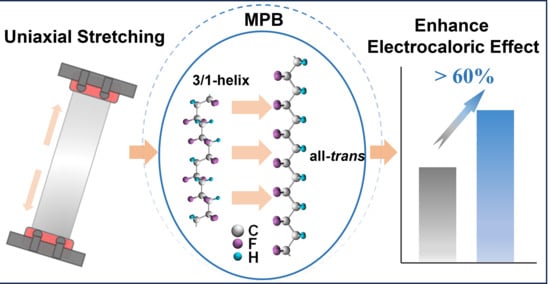
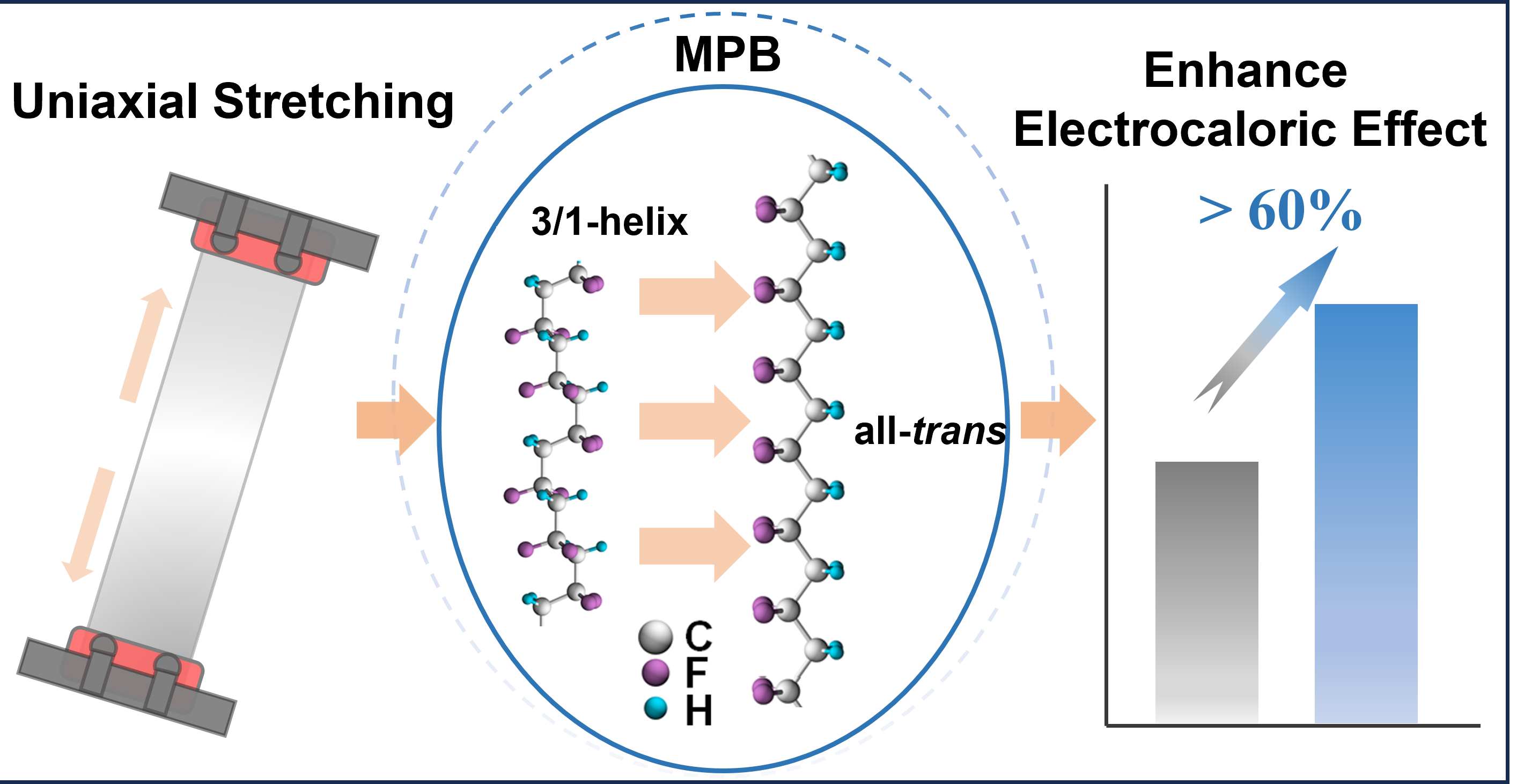
Use of the morphotropic phase boundary (MPB) is a promising approach to enhance the electrocaloric effect in ferroelectric polymers. This is usually achieved by a composition method, and polymer processing near the MPB to tune electrocaloric response has attracted little attention. Here, the relative stability between disordered 3/1-helix and ordered all-trans conformations is leveraged by uniaxial stretching to improve the electrocaloric effect in relaxor ferroelectric polymers under low electric fields. It is found that the stretching technique enables a considerably more enhanced electrocaloric response in polymer composition near the MPB at room temperature, compared with counterparts corresponding to the relaxor phase. The electrocaloric-induced temperature change is found to be 4.5 K under a low electric field of 50 MV m−1 in stretched relaxor ferroelectric polymers at room temperature, corresponding to a 60% enhancement over pristine counterparts. This result highlights the critical role of polymer processing in optimizing electrocaloric properties, especially near the MPB, and this can be extended to improve other functionalities, such as piezoelectric response, in relaxor ferroelectric polymers.

Graphical Abstract

1. Introduction

The electrocaloric effect (ECE), referring to the adiabatic temperature change ΔT or isothermal entropy change ΔS driven by a change in electric field ΔE, describes the reversible thermal properties of dielectric materials [1]. Refrigeration based on EC materials offers an environmentally friendly and potentially highly efficient alternative to current vapor compression technology, and these materials have gained increasing interest [2,3]. Among EC materials, lightweight and flexible relaxor ferroelectric polymers are suitable candidates for integration into flexible and wearable electronics [3,4,5,6,7,8,9,10]. Their cooling potential has been demonstrated in various EC prototype devices [11,12,13,14,15,16]. ECE has been revealed in the ferroelectric copolymer poly(vinylidene fluoride-co-trifluoroethylene) (P(VDF-TrFE)) and the relaxor ferroelectric terpolymer poly(vinylidene fluoride-co-trifluoroethylene-co-chlorofluoroethylene) (P(VDF-TrFE-CFE)) [3,4,5]. Initial works on EC materials mainly focused on the relaxor ferroelectric P(VDF-TrFE-CFE) due to its large ECE with a relatively broad temperature span near to room temperature. However, it typically requires a high electric field of 150 MV m−1 to induce a large ECE [4,5], corresponding to a low EC strength defined as ΔTE. To optimize EC response in relaxor ferroelectric polymers under low electric fields, previous studies have mainly incorporated alternative commoners or C=C double bonds to fabricate tetrapolymers which behave more electroactively, especially in a low-field regime [17,18,19,20]. Use of other methods to improve low-field EC properties in relaxor ferroelectric polymers has yet to be explored.
The functional properties of ferroelectric polymers are strongly sensitive to processing conditions [21,22,23]. For instance, in [22], a complex fabrication diagram was constructed to design a piezoelectric response in PVDF with a high fraction of all-trans chain conformation through different thermal and mechanical conditions [22]. Previous approaches to improve ECE have mainly used chemical modification methods [17,18,19,20]. Processing approaches using different fabrication methods and conditions have not been extensively addressed. Although mechanical stretching processing methods have been intensively used to enhance the dielectric, piezoelectric and electrostrictive properties of ferroelectric polymers [1,24,25], the use of this technique to optimize ECE has gained less attention. A previous work [5] used uniaxial stretching to modify P(VDF-TrFE-CFE) terpolymers with high CFE content (i.e., 7.2 mol%); however, structural changes induced by stretching and processing conditions were not analyzed in detail, and these are crucial in the design of scalable EC polymers for cooling applications. Moreover, only polymer composition with a high CFE content corresponding to the relaxor phase has been explored; composition near the morphotropic phase boundary (MPB) [26,27,28] has not been studied. MPB is defined as a composition region where two or more crystalline phases with comparable energetic stability coexist, leading to flattened free energy profiles and reduced phase transition barriers. Near the MPB, energetic barriers between different crystalline phases are markedly lowered. In addition, applying an electric field enables a more dramatical change in the polar state than that exhibited by counterparts in the pure relaxor phase, generating an enhanced EC response. This has recently been demonstrated in compositionally induced [29] and double-bond-induced MPB [18] in P(VDF-TrFE-CFE) terpolymers.
In this work, uniaxial stretching combined with thermal annealing is used to process P(VDF-TrFE-CFE) with various CFE content; this is then used to tune EC properties at room temperature. It is found that stretched terpolymers with moderate CFE content favor stabilization of induced all-trans conformation coexisting with 3/1-helix conformation. This may give rise to the formation of MPB [26,27,28] which is reminiscent of that obtained using the compositional approach. Such stretching-induced MPB behavior is absent in P(VDF-TrFE-CFE) terpolymers with high CFE content (i.e., 9.2 mol%). As a result, this stretching approach yields an EC response considerably higher than that achieved away from the MPB under the same conditions. Given that the use of MPB to enhance ECE in relaxor ferroelectric polymers has been demonstrated mainly through the compositional approach [18], our results presented here offer an alternative method to enhance ECE which paves the way towards scalable fabrication of high-EC relaxor ferroelectric polymers for flexible and wearable cooling applications.

2. Experimental Section

2.1. Materials

P(VDF-TrFE-CFE) 67.0/27.4/5.6 mol% (denoted as CFE-5.6) and 64.6/26.2/9.2 mol% (denoted as CFE-9.2) were obtained from Piezotech at Arkema (Paris, France). Cyclohexanone (≥99%) was purchased from Sigma-Aldrich (Saint Louis, MO, USA). All chemicals were used without further purification.

2.2. Preparation of Stretched P(VDF-TrFE-CFE) Films

Polymer powder was dissolved in cyclohexanone to achieve a concentration of 60 mg mL−1, followed by continuous stirring at room temperature overnight. Subsequently, the solution was cast onto a pre-cleaned glass substrate and subjected to drying in an oven at 60 °C for 8 h. Upon completion of drying, the film was peeled off in deionized water. Ultimately, the as-obtained film was annealed in a vacuum oven at 100 °C for 12 h. Following uniaxial stretching with a series of ratios, the resultant stretched films with different draw ratios were subjected to annealing at 100 °C for 3 h. Uniaxial stretching was achieved through the zone drawing method [4] and the stretching ratios corresponded to 1:2 and 1:3. Stretching ratios of 1:2 and 1:3 indicate films whose original lengths are uniaxially stretched by 2 and 3 times, respectively. The thickness of the stretched film was approximately 10 μm.

2.3. Characterization

The XRD data was obtained using an Empyrean (PANalytical B.V., Almelo, The Netherlands) at room temperature. The X-ray wavelength (λ) was 1.54 Å. Differential scanning calorimetry (DSC) was employed to characterize phase transitions and crystallinity under a nitrogen atmosphere, using a DSC2500 instrument (TA InstrumentsNew Castle, DE, USA). The measurements were carried out across a temperature range of −60 °C to 200 °C, with a heating rate of 10 °C min−1. For measurements of ECE and electrical properties, 50 nm thick gold electrodes were sputter-deposited onto both surfaces of the polymer films using a Quorum Q150RS plus system (Quorum Technologies Ltd., Lewes, East Sussex, UK). Polarization–electric field (P-E) loops were recorded at 100 Hz excitation via a modified Sawyer–Tower circuit which was powered by a Trek 610E high-voltage amplifier (Advanced Energy, Lockport, NY, USA). The electrodes used herein had an active area of 12.56 mm2. ECE measurements were obtained using a calorimeter equipped with a heat flux sensor which was the same as that reported in previous works. Cyclic stability was evaluated by subjecting the samples to extended testing (over 100,000 cycles) under ambient laboratory conditions at room temperature. The cyclic tests were conducted using an electric field with a frequency of 500 mHz and an amplitude of 50 MV m−1. In situ monitoring of the film’s thermal response was achieved using the output of a heat flux sensor. After 100,000 cycles, the ECE properties were characterized immediately, to assess both retention of refrigeration performance and the fatigue resistance of the system under prolonged cyclic loading.

3. Results and Discussion

3.1. Characterization of Stretched Terpolymers

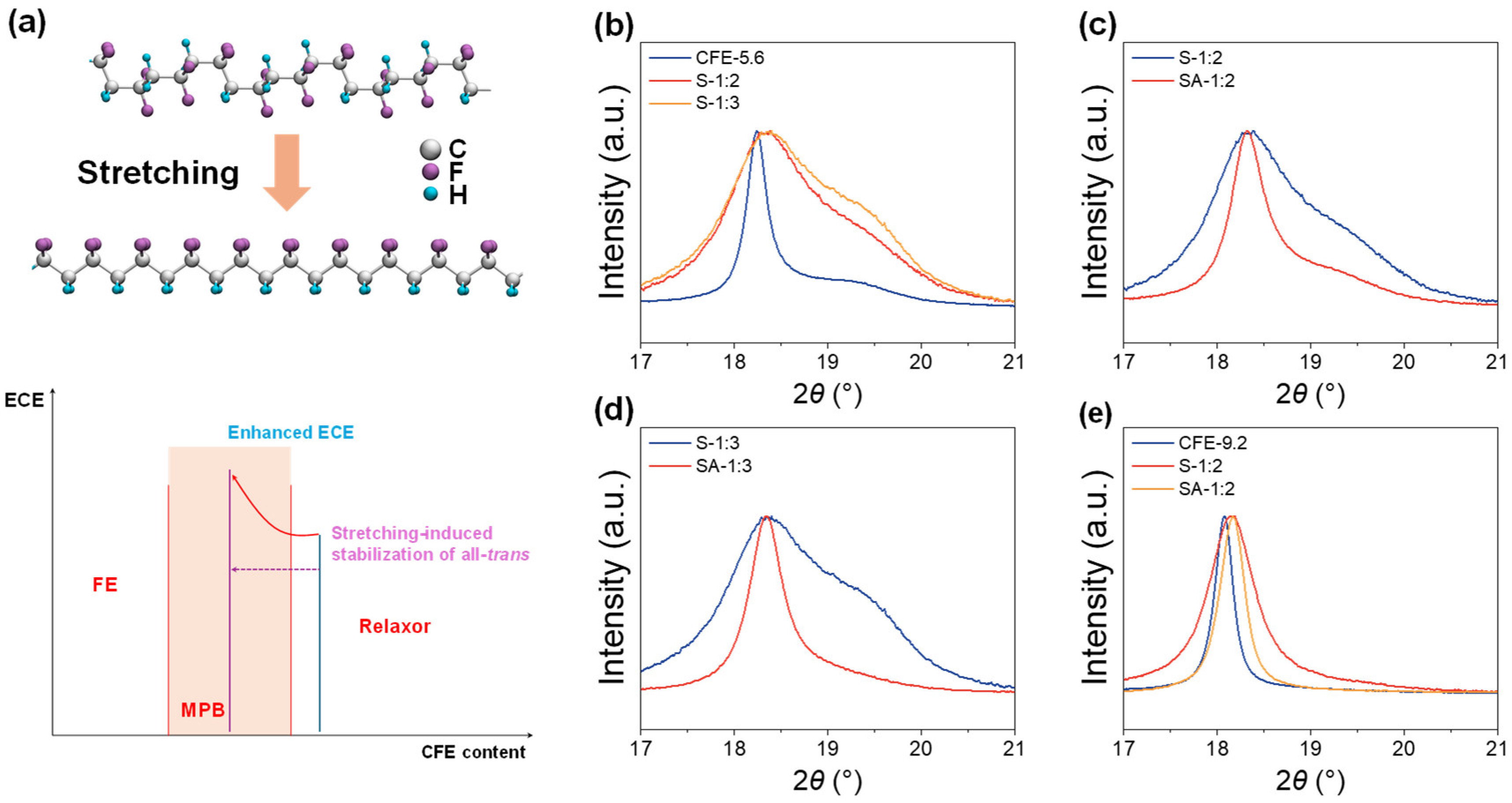
Mechanical stretching may orient molecular chains in a way which enables tuning of the relative stability between different crystalline chain conformations [24,25]. For instance, previous works indicate that stretching makes all-trans conformation energetically more favorable (Figure 1a, upper panel); this is essential if a high energy density and large electrostrictive strain is to be enabled [24,25]. In the case of ECE, regarding the enhanced ECE caused by stretching, a structural analysis remains elusive [5]. Here, in contrast to our previous work with high CFE content [29], our interest focuses on P(VDF-TrFE-CFE) with composition close to the MPB. Note that the conventional compositional MPB approach to enhance ECE is highly dependent on the desired polymer composition; this remains challenging to obtain, especially for massive synthesis of homogenous compositions [29]. In this regard, stretching acts as an alternative method to stabilize an ordered all-trans conformation, even for composition located on the relaxor side of the MPB which corresponds to the decrease in CFE content (Figure 1b, upper panel). In contrast with counterparts, this may facilitate the ease of stretching-induced phase transition from disordered-helix to ordered-trans conformation (Figure 1a), with the relaxor phase as the well-defined ground state. Optimizing stretching conditions is identical to tuning polymer composition [29] to access the desired MPB where ECE is greatly enhanced (Figure 1b, upper panel). Such stretching-driven phase transition is reminiscent of compositionally induced MPB behavior [26], and may offer an alternative degree of freedom to optimize EC response. Moreover, stretching is a critical processing method widely used in massive polymer processing which may offer a scalable option to massively fabricate high-EC polymers for cooling applications.
Our structural results on stretched CFE-5.6 are shown in Figure 1b,c. It can be seen that pristine CFE-5.6 exhibits a characteristic peak at near 18.2°, indicative of 3/1-helix conformation, while a weak and broad peak centering near 19.3° is also present, the latter corresponding to all-trans conformation [26,27,30]. The explanation for these results is that CFE-5.6 is very close to MPB in P(VDF-TrFE-CFE) terpolymers, with small energetic barriers between 3/1-helix and all-trans conformations [29]. Moreover, it can be seen that upon stretching with ratios of 1:2 and 1:3, the weak peak at higher 2θ develops dramatically, indicating substantial growth in all-trans conformation caused by mechanical stretching which confirms our proposed physical picture. Subsequent annealing results showed a considerable decline in the fraction of all-trans conformation, corresponding to a drop in the intensity of the peak at near 19.3°. Nevertheless, the results show that the intensity of the peak characteristic of all-trans conformation in terpolymer with a stretching ratio of 1:2 remains notably higher than its pristine counterpart, different from the terpolymer with a stretching ratio of 1:3. Differing from CFE-5.6, the stretching-induced structural change remains absent in CFE-9.2 under the same stretching and annealing conditions. It is only in Figure 1e that there can be seen a slight broadening of the characteristic peak at 18.2° assigned to 3/1-helix conformation. For CFE-5.6, the all-trans conformation peak (19.3° for pristine) shifts slightly to 19.4° (SA-1:2), according to Bragg’s law, confirming the formation of more ordered and tightly packed all-trans chains. The broadening of the peak for CFE-9.2 is slight rather than significant, and is related to stretching-induced mild chain orientation where the intrinsic interplanar structure is not changed, as evidenced by the lack of obvious all-trans peak growth in Figure 1e. Consequently, we may say that our structural results explicitly demonstrate the ease of stretching-induced phase transition in polymer composition close to the MPB at similar energy levels. This may offer an alternative way to tune EC response in relaxor ferroelectric polymers.

3.2. Polarization and DSC Results

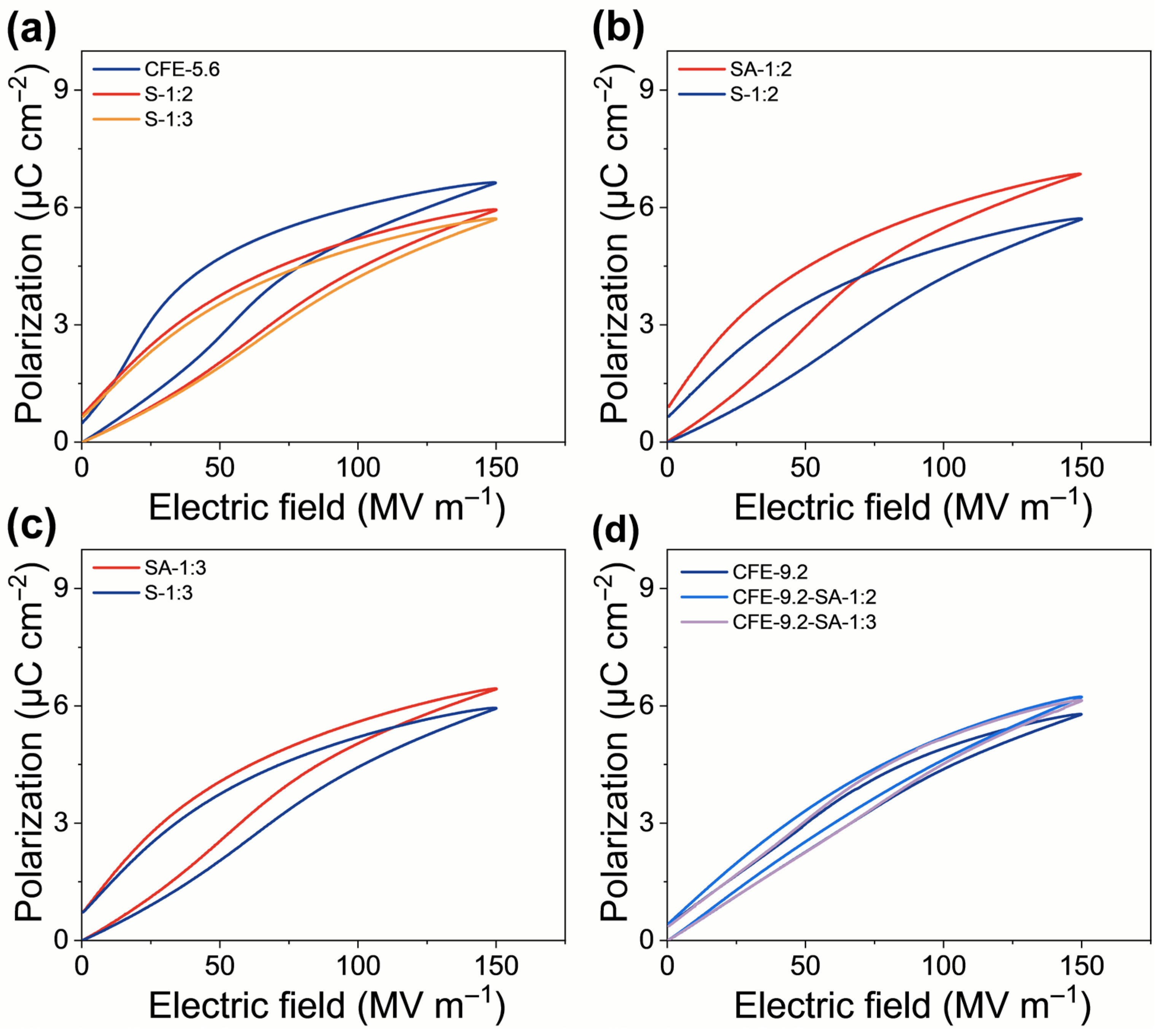
P-E loops were used to evaluate the change in polar state achieved by stretching and annealing. It was found that a considerable reduction in the maximum polarization Pm of CFE-5.6 was observed in the stretched terpolymers with stretching ratios of 1:2 and 1:3 while the remanent polarization remained nearly unchanged (Figure 2a). Stretched terpolymers were cured by thermal annealing, leading to an observed increase in Pm with stretching ratios of 1:2 (Figure 2b) and 1:3 (Figure 2c). Meanwhile, stretched CFE-9.2 displayed a similar behavior to that of CFE-5.6 (Figure 2d). In Figure 2d, it can be seen that the enhancement in Pm of CFE-9.2 induced by annealing is smaller than that of CFE-5.6. The Pm of stretched and annealed CFE-9.2 is smaller than that of its CFE-5.6 counterparts. The bipolar and unipolar P-E loops results we measured simultaneously exhibit a consistent trend (Figure S1).These results suggest that terpolymers with composition near the MPB exhibit a considerably higher polarization change induced by the same electric field, implying greater electroactivity and a higher EC response.
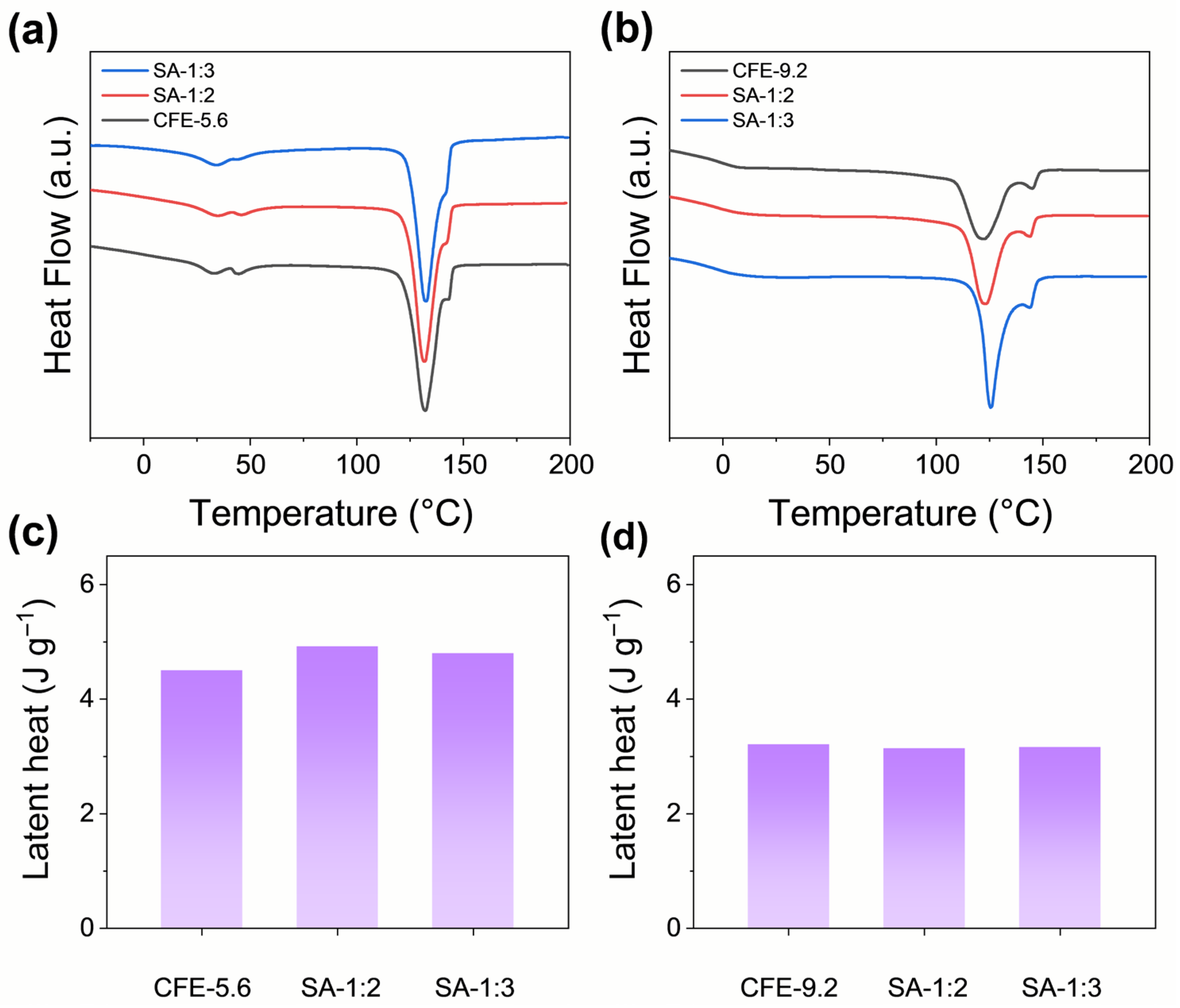
To further study the phase transition behavior, we applied the DSC technique which is commonly used in ferroelectric polymers [9,26]. As can be seen in Figure 3a,b, for both CFE-5.6 and CFE-9.2, stretching and annealing results in weak change in the melting point (Figure 3a,b). In the case of stretched and annealed CFE-5.6, an endothermic peak at near 40 °C (corresponding to melting of the all-trans conformation) develops, leading to a slight increase in latent heat (about 4.9 J g−1 for SA-1:2), as shown in Figure 3c. Dielectric spectra upon heating also reveal the trend in the melting point variation associated with conformational melting (Figure S2).The latent heat of CFE-5.6 SA-1:2 (4.9 J g−1) is higher than that of pristine (3.8 J g−1), indicating a larger fraction of all-trans conformation. This arises from the stabilization of all-trans conformation. By contrast, the endothermic peak at around 8 °C remains almost unchanged in CFE-9.2, corresponding to a nearly constant latent heat of 3.2 J g−1 (Figure 3d), confirming that stretching cannot induce significant all-trans conformation formation in CFE-9.2. Consequently, the DSC results provide further supporting evidence that CFE-5.6 with higher latent heat arising from stretching-induced stabilization of all-trans conformation may compete more favorably for driving a larger EC response, compared with CFE-9.2.

3.3. ECE Results

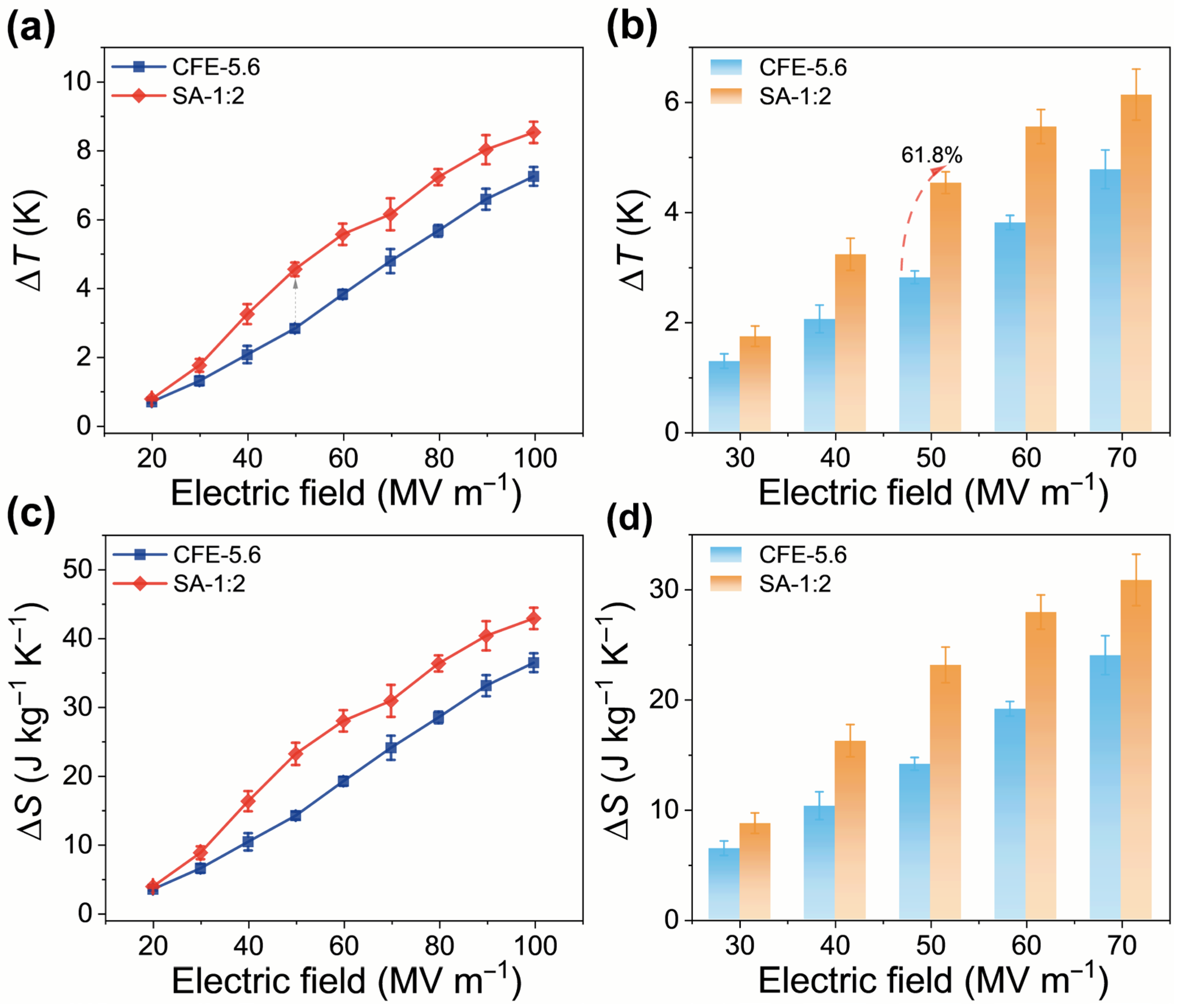
EC-induced results for CFE-5.6 with a stretching ratio of 1:2 are summarized in Figure 4a–d. It can be seen in Figure 4a,b that the EC-induced temperature change ΔT is substantially improved by stretching and annealing, compared with pristine CFE-5.6. It was also found that this method is useful in enhancing EC response in the low-field region. For instance, it may be observed that stretched CFE-5.6 exhibits a large ΔT of 4.5 K driven by a low electric field of 50 MV m−1, corresponding to a 60% enhancement over its pristine counterpart. Moreover, this value also exceeds previous results obtained under the same field at room temperature [6,7,12,14,18,31]. This yields an enhanced EC strength ΔTE as large as 0.09 K m MV−1, markedly larger than that of the unmodified pure terpolymers (Table S1). Moreover, an EC-induced entropy change ΔS of 23.1 J kg−1 K−1 was achieved in stretched CFE-5.6 (Figure 4c), substantially outperforming that (14.1 J kg−1 K−1) of pristine under the same conditions (Figure 4d). Consequently, we may say that the stretching method proposed in this work offers a useful tool to markedly enhance EC properties, especially in the low-field region which is highly desired for practical cooling applications.
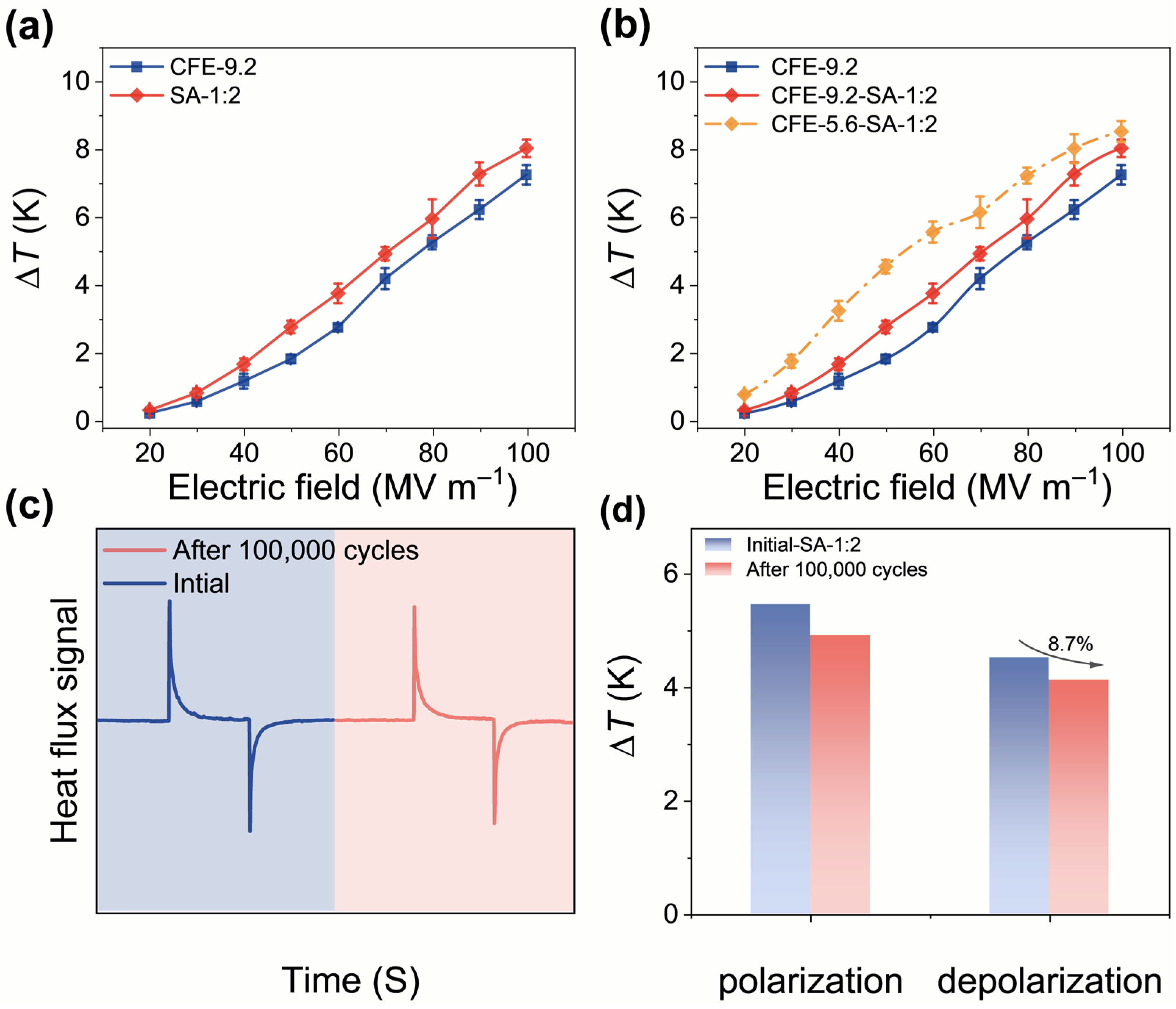
EC-induced response in CFE-9.2 was also evaluated under the same conditions used for the measurement in CFE-5.6 (Figure 5a). It can be seen in Figure 5a that a ΔT of 2.7 K was achieved in stretched CFE-9.2 under an electric field of 50 MV m−1, exceeding that (1.8 K) of pristine CFE-9.2 under the same conditions. However, this value only corresponds to 60% of that in CFE-5.6 near the MPB (Figure 5b), confirming that stretching-induced enhancement in EC response is most useful for composition near the MPB, with small energetic barriers between different crystalline conformations. In the case of CFE-5.6, the 3/1-helix (relaxor phase) and all-trans (ferroelectric phase) conformations are energetically degenerate. This near-degeneracy enables mechanical stretching to effectively regulate the relative stability of the two phases, driving the formation of ordered all-trans chains (evidenced by the enhanced XRD peak at 19.3° in Figure 1b–d). As a result, stretched and annealed CFE-5.6 forms a “helix-trans coexisting state”, with a higher fraction of all-trans conformation than pristine CFE-5.6. In this regard, electric-field-induced disorder-to-order phase transition for composition near the MPB enabled by mechanical stretching is mainly responsible for the markedly enhanced EC response. The mechanical stretching processing method has been widely used to improve the dielectric, piezoelectric and electrostrictive properties of ferroelectric polymers [1,24,25]. Here, our results demonstrate the presence of stretching-enhanced ECE, which widens the useful spectra of stretching processing in optimizing functional properties of ferroelectric polymers. Moreover, our results indicate that this method is especially useful in enhancing low-field EC response for polymer composition near the MPB, with stretching possibly acting as leverage to tune the nearly energetical degenerate phases, thus offering an alternative solution to regulate ECE in ferroelectric polymers.
For practical cooling applications, the EC response under cyclic electric fields is required to inspire confidence for long-term use. For stretched CFE-5.6 with a low latent heat associated with the diffused phase transition (Figure 3c), the EC response shows a slight reduction of about 8.7% even after 100,000 cycles, with a magnitude of electric field of 50 MV m−1 (Figure 5c,d). Taken together, the markedly improved EC-induced results obtained under low fields and the nearly fatigue-free EC response under cyclic field suggest that stretched terpolymers are competitive candidates for developing EC devices with high cooling performance.

4. Conclusions

In summary, in the present work the EC response in relaxor ferroelectric terpolymers P(VDF-TrFE-CFE) was tuned by mechanical stretching for compositions close to and away from the MPB. It was found that greatly enhanced EC-induced properties enabled by stretching were achieved for the composition near the MPB; this outperformed a counterpart obtained away from the MPB under the same conditions. In the case of the composition near the MPB (CFE-5.6), it was found that uniaxial stretching (1:2 ratio) combined with thermal annealing effectively regulated the relative stability between disordered 3/1-helix and ordered all-trans conformations. The stretched and annealed CFE-5.6 exhibited a remarkable adiabatic temperature change (ΔT) of 4.5 K at 50 MV m−1, corresponding to a 60% enhancement over the pristine sample. This can mainly be attributed to the stretching-induced stabilization of ordered all-trans chain conformation which makes electric-field-induced disorder-to-order phase transition easier. The markedly improved low-field EC properties and nearly fatigue-free EC response under cyclic conditions indicate the promise of mechanical processing in the scalable fabrication of EC relaxor ferroelectric polymers for future cooling applications.

Supplementary Materials

The references [32,33] are cited in Supplementary Materials. The following supporting information can be downloaded at: https://www.mdpi.com/article/10.3390/chemistry8020027/s1, See the supplementary material for comparison of electrocaloric parameters between different polymer materials (Table S1). Figure S1. (a) Bipolar P-E loops of CFE-5.6 under different stretching ratios. (b) and (c) Bipolar P-E loops of annealed CFE-5.6 under different stretching ratios measured at 100 Hz. (d) Comparison of Pr and Pm measured at 150 MV m-1. S in (a)-(d) is short for stretching while A is indicative of annealing. Figure S2. (a) Dielectric spectra in CFE-5.6 (c) CFE-9.2 upon heating. (b) and (d) Dielec-tric spectra of CFE-5.6 (stretching ratio 1:2) before and after annealing.

Author Contributions

Conceptualization, Y.L. (Yang Liu); methodology, L.X., Y.L. (Yuquan Liu), J.L., H.W., Y.W. and Z.Y.; validation, L.X., L.C. and Y.L. (Yang Li); formal analysis, L.X., L.C. and Y.L. (Yang Li); investigation, L.X., Y.L. (Yuquan Liu), J.L., H.W., Y.W. and Z.Y.; resources, Y.L. (Yang Liu); data curation, L.X., Y.L. (Yuquan Liu), J.L., H.W., Y.W. and Z.Y.; writing—original draft preparation, Y.L. (Yang Liu); writing—review and editing, Y.L. (Yang Liu), Y.L. (Yang Li), L.C. and H.Z.; visualization, L.X.; supervision, Y.L. (Yang Liu); project administration, Y.L. (Yang Liu); funding acquisition, Y.L. (Yang Liu). All authors have read and agreed to the published version of the manuscript.

Funding

This research was supported by the National Natural Science Foundation of China (Grant No. 12274152 and 92366302), the Guangdong Basic and Applied Basic Research Foundation (2024A1515010483), and initial financial support from HUST. This work was also supported by the Guangdong Provincial Key Laboratory of Manufacturing Equipment Digitization (2023B1212060012).

Data Availability Statement

The original contributions presented in this study are included in the article/Supplementary Material. Further inquiries can be directed to the corresponding authors.

Acknowledgments

The authors would thank the Analytical and Testing Center of Huazhong University of Science and Technology for technical assistance.

Conflicts of Interest

Author Ling Cheng was employed by the company RICOTON Technology Co., Ltd. The remaining authors declare that the research was conducted in the absence of any commercial or financial relationships that could be construed as a potential conflict of interest.

References

  1. Liu, Y.; Scott, J.F.; Dkhil, B. Direct and indirect measurements on electrocaloric effect: Recent developments and perspectives. Appl. Phys. Rev. 2016, 3, 031102. [Google Scholar] [CrossRef]
  2. Mischenko, A.S.; Zhang, Q.; Scott, J.F.; Whatmore, R.W.; Mathur, N.D. Giant Electrocaloric Effect in Thin-Film PbZr0.95Ti0.05O3. Science 2006, 311, 1270–1271. [Google Scholar] [CrossRef]
  3. Neese, B.; Chu, B.; Lu, S.-G.; Wang, Y.; Furman, E.; Zhang, Q.M. Large Electrocaloric Effect in Ferroelectric Polymers Near Room Temperature. Science 2008, 321, 821–823. [Google Scholar] [CrossRef]
  4. Lu, S.; Rožič, B.; Zhang, Q.; Kutnjak, Z.; Pirc, R.; Lin, M.; Li, X.; Gorny, L. Comparison of directly and indirectly measured electrocaloric effect in relaxor ferroelectric polymers. Appl. Phys. Lett. 2010, 97, 202901. [Google Scholar] [CrossRef]
  5. Li, X.; Qian, X.-S.; Lu, S.G.; Cheng, J.; Fang, Z.; Zhang, Q. Tunable temperature dependence of electrocaloric effect in ferroelectric relaxor poly(vinylidene fluoride-trifluoroethylene-chlorofluoroethylene terpolymer. Appl. Phys. Lett. 2011, 99, 052907. [Google Scholar] [CrossRef]
  6. Sebald, G.; Seveyrat, L.; Capsal, J.-F.; Cottinet, P.-J.; Guyomar, D. Differential scanning calorimeter and infrared imaging for electrocaloric characterization of poly(vinylidene fluoride-trifluoroethylene-chlorofluoroethylene) terpolymer. Appl. Phys. Lett. 2012, 101, 022907. [Google Scholar] [CrossRef]
  7. Guo, D.; Gao, J.; Yu, Y.-J.; Santhanam, S.; Fedder, G.K.; McGaughey, A.J.; Yao, S. Electrocaloric characterization of a poly(vinylidene fluoride-trifluoroethylene-chlorofluoroethylene) terpolymer by infrared imaging. Appl. Phys. Lett. 2014, 105, 031906. [Google Scholar] [CrossRef]
  8. Jia, Y.; Ju, Y.S. Direct characterization of the electrocaloric effects in thin films supported on substrates. Appl. Phys. Lett. 2013, 103, 042903. [Google Scholar] [CrossRef]
  9. Liu, Y.; Zhang, G.; Haibibu, A.; Han, Z.; Wang, Q. High cyclic stability of electrocaloric effect in relaxor poly(vinylidene fluoride-trifluoroethylene-chlorofluoroethylene) terpolymers in the absence of ferroelectric phase transition. J. Appl. Phys. 2019, 126, 234102. [Google Scholar] [CrossRef]
  10. Liu, Y.; Haibibu, A.; Xu, W.; Han, Z.; Wang, Q. Observation of a Negative Thermal Hysteresis in Relaxor Ferroelectric Polymers. Adv. Funct. Mater. 2020, 30, 2000648. [Google Scholar] [CrossRef]
  11. Zou, K.; Bai, P.; Li, K.; Luo, F.; Liang, J.; Lin, L.; Ma, R.; Li, Q.; Jiang, S.; Wang, Q.; et al. Electronic cooling and energy harvesting using ferroelectric polymer composites. Nat. Commun. 2024, 15, 1–10. [Google Scholar] [CrossRef]
  12. Ma, R.; Zhang, Z.; Tong, K.; Huber, D.; Kornbluh, R.; Ju, Y.S.; Pei, Q. Highly efficient electrocaloric cooling with electrostatic actuation. Science 2017, 357, 1130–1134. [Google Scholar] [CrossRef] [PubMed]
  13. Wang, Z.; Bo, Y.; Bai, P.; Zhang, S.; Li, G.; Wan, X.; Liu, Y.; Ma, R.; Chen, Y. Self-sustaining personal all-day thermoregulatory clothing using only sunlight. Science 2023, 382, 1291–1296. [Google Scholar] [CrossRef] [PubMed]
  14. Han, D.; Zhang, Y.; Huang, C.; Zheng, S.; Wu, D.; Li, Q.; Du, F.; Duan, H.; Chen, W.; Shi, J.; et al. Self-oscillating polymeric refrigerator with high energy efficiency. Nature 2024, 629, 1041–1046. [Google Scholar] [CrossRef] [PubMed]
  15. Wu, H.; Zhu, Y.; Yan, W.; Zhang, S.; Budiman, W.; Liu, K.; Wu, J.; Meng, Y.; Zhao, X.; Mehta, A.; et al. A self-regenerative heat pump based on a dual-functional relaxor ferroelectric polymer. Science 2024, 386, 546–551. [Google Scholar] [CrossRef]
  16. Chen, X.; Xu, W.; Lu, B.; Zhang, T.; Wang, Q.; Zhang, Q. Towards electrocaloric heat pump—A relaxor ferroelectric polymer exhibiting large electrocaloric response at low electric field. Appl. Phys. Lett. 2018, 113, 113902. [Google Scholar] [CrossRef]
  17. Le Goupil, F.; Kallitsis, K.; Tencé-Girault, S.; Pouriamanesh, N.; Brochon, C.; Cloutet, E.; Soulestin, T.; Dos Santos, F.D.; Stingelin, N.; Hadziioannou, G. Enhanced Electrocaloric Response of Vinylidene Fluoride–Based Polymers via One-Step Molecular Engineering. Adv. Funct. Mater. 2020, 31. [Google Scholar] [CrossRef]
  18. Le Goupil, F.; Kallitsis, K.; Tencé-Girault, S.; Brochon, C.; Cloutet, E.; Fleury, G.; Hadziioannou, G. Double-Bond-induced Morphotropic Phase Boundary Leads to Enhanced Electrocaloric Effect in VDF-Based Polymer Flexible Devices. ACS Appl. Energy Mater. 2023, 6, 12172–12179. [Google Scholar] [CrossRef]
  19. Qian, X.; Han, D.; Zheng, L.; Chen, J.; Tyagi, M.; Li, Q.; Du, F.; Zheng, S.; Huang, X.; Zhang, S.; et al. High-entropy polymer produces a giant electrocaloric effect at low fields. Nature 2021, 600, 664–669. [Google Scholar] [CrossRef]
  20. Rui, G.; Zhu, W.; Li, L.; Lee, J.; Guo, Y.; Zou, Q.; Wu, S.; Li, R.; Lannuzel, T.; Dos Santos, F.D.; et al. Dual-Functional High-Entropy Polymer Exhibiting Giant Cross-Energy Couplings at Low Fields. Small Sci. 2025, 5. [Google Scholar] [CrossRef]
  21. Lovinger, A.J. Ferroelectric Polymers. Science 1983, 220, 1115–1121. [Google Scholar] [CrossRef] [PubMed]
  22. Martín, J.; Zhao, D.; Lenz, T.; Katsouras, I.; de Leeuw, D.M.; Stingelin, N. Solid-state-processing of δ-PVDF. Mater. Horizons 2017, 4, 408–414. [Google Scholar] [CrossRef]
  23. Gadinski, M.R.; Li, Q.; Zhang, G.; Zhang, X.; Wang, Q. Understanding of Relaxor Ferroelectric Behavior of Poly(vinylidene fluoride–trifluoroethylene–chlorotrifluoroethylene) Terpolymers. Macromolecules 2015, 48, 2731–2739. [Google Scholar] [CrossRef]
  24. Chu, B.; Zhou, X.; Ren, K.; Neese, B.; Lin, M.; Wang, Q.; Bauer, F.; Zhang, Q.M. A Dielectric Polymer with High Electric Energy Density and Fast Discharge Speed. Science 2006, 313, 334–336. [Google Scholar] [CrossRef]
  25. Chen, X.; Qin, H.; Qian, X.; Zhu, W.; Li, B.; Zhang, B.; Lu, W.; Li, R.; Zhang, S.; Zhu, L.; et al. Relaxor ferroelectric polymer exhibits ultrahigh electromechanical coupling at low electric field. Science 2022, 375, 1418–1422. [Google Scholar] [CrossRef]
  26. Liu, Y.; Aziguli, H.; Zhang, B.; Xu, W.; Lu, W.; Bernholc, J.; Wang, Q. Ferroelectric polymers exhibiting behaviour reminiscent of a morphotropic phase boundary. Nature 2018, 562, 96–100. [Google Scholar] [CrossRef]
  27. Liu, Y.; Zhou, Y.; Qin, H.; Yang, T.; Chen, X.; Li, L.; Han, Z.; Wang, K.; Zhang, B.; Lu, W.; et al. Electro-thermal actuation in percolative ferroelectric polymer nanocomposites. Nat. Mater. 2023, 22, 873–879. [Google Scholar] [CrossRef]
  28. Bargain, F.; Thuau, D.; Hadziioannou, G.; Dos Santos, F.D.; Tencé-Girault, S. Phase diagram of poly(VDF-ter-TrFE-ter-CTFE) copolymers: Relationship between crystalline structure and material properties. Polymer 2021, 213. [Google Scholar] [CrossRef]
  29. Xu, L.; Gong, Y.; Tang, S.; Li, C.; Zhou, H.; Liu, Y. Enhanced Electrocaloric Effect in Relaxor Ferroelectric Terpolymers by Morphotropic Phase Boundary. Small 2025, 21, e2503125. [Google Scholar] [CrossRef]
  30. Li, C.; Liu, Y.; Li, B.; Yuan, Z.; Yang, T.; Liu, Y.; Gao, H.; Xu, L.; Yu, X.; Luo, Q.; et al. Enhanced energy storage in high-entropy ferroelectric polymers. Nat. Mater. 2025, 24, 1066–1073. [Google Scholar] [CrossRef]
  31. Qian, J.; Peng, R.; Shen, Z.; Jiang, J.; Xue, F.; Yang, T.; Chen, L.; Shen, Y. Interfacial Coupling Boosts Giant Electrocaloric Effects in Relaxor Polymer Nanocomposites: In Situ Characterization and Phase-Field Simulation. Adv. Mater. 2018, 31, e1801949. [Google Scholar] [CrossRef]
  32. Aravindhan, A.; Lheritier, P.; Torelló, A.; Prah, U.; Nouchokgwe, Y.; El Moul, A.; Chevalier, X.; Dos Santos, F.D.; Defay, E.; Kovacova, V. Direct measurement of electrocaloric effect in P(VDF-TrFE-CFE) film using infrared imaging. J. Materiomics 2023, 9, 256–260. [Google Scholar] [CrossRef]
  33. Basso, V.; Russo, F.; Gerard, J.-F.; Pruvost, S. Direct measurement of the electrocaloric effect in poly(vinylidene fluoride-trifluoroethylene-chlorotrifluoroethylene) terpolymer films. Appl. Phys. Lett. 2013, 103. [Google Scholar] [CrossRef]
Figure 1. (a) Sketch of stretching-induced phase transition from 3/1-helix to all-trans conformation (upper panel). Schematic for the ECE enhancement mechanism induced by stretching for polymer composition near the MPB (bottom panel). (a) Illustration of the mechanism proposed in this work. (b) XRD curves for CFE-5.6 under different stretching ratios. (c,d) XRD curves for annealed CFE-5.6 after stretching under different stretching ratios. (e) XRD curves for stretched and annealed CFE-9.2. In (be), S is short for stretching while A is indicative of annealing.
Chemistry 08 00027 g001
Figure 2. (a) Unipolar P-E loops for CFE-5.6 under different stretching ratios. (b,c) Unipolar P-E loops for annealed CFE-5.6 and (d) CFE-9.2 after stretching under different stretching ratios measured at 100 Hz. In (ad), S is short for stretching while A is indicative of annealing.
Chemistry 08 00027 g002
Figure 3. DSC curves obtained during heating scan of stretched and annealed (a) CFE-5.6 and (b) CFE-9.2. (c) Latent heat of diffused phase transition of stretched and annealed CFE-5.6 and (d) CFE-9.2. In (ad), S is short for stretching while A is indicative of annealing.
Chemistry 08 00027 g003
Figure 4. (a,b) Adiabatic temperature change ΔT under different electric fields for stretched and annealed CFE-5.6, the arrows indicate a significant enhancement in EC properties under an electric field of 50 MV m−1. (c,d) Isothermal entropy change ΔS under different electric fields for stretched and annealed CFE-5.6. In (ad), S is short for stretching while A is indicative of annealing.
Chemistry 08 00027 g004
Figure 5. (a,b) Adiabatic temperature change ΔT under different electric fields of stretched and annealed CFE-9.2 and CFE-5.6. (c) Comparison of the heat flux and (d) ΔT measured between the initial cycle and after 100,000 cycles of stretched and annealed CFE-5.6. In (ad), S is short for stretching while A is indicative of annealing.
Chemistry 08 00027 g005
Disclaimer/Publisher’s Note: The statements, opinions and data contained in all publications are solely those of the individual author(s) and contributor(s) and not of MDPI and/or the editor(s). MDPI and/or the editor(s) disclaim responsibility for any injury to people or property resulting from any ideas, methods, instructions or products referred to in the content.