Article

Pd/C–H2-Catalyzed One-Pot Aromatization–Deoxygenation of Dihydropyridinediones: A Green, Scalable Route to Alkyl Pyridines


by
Susanta Mandal
,
Tushar Sharma Banstola
,
Dhan Maya Chettri
,
Kimron Protim Phukan
and
Biswajit Gopal Roy
*
Department of Chemistry, Sikkim University, 6th Mile, Tadong, Gangtok 737102, Sikkim, India
*
Author to whom correspondence should be addressed.
Chemistry 2026, 8(2), 12; https://doi.org/10.3390/chemistry8020012

Submission received: 28 November 2025 / Revised: 12 January 2026 / Accepted: 15 January 2026 / Published: 26 January 2026
(This article belongs to the Section Molecular Organics)

Abstract

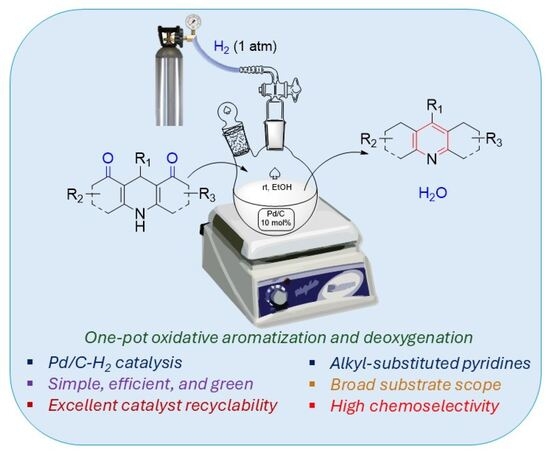
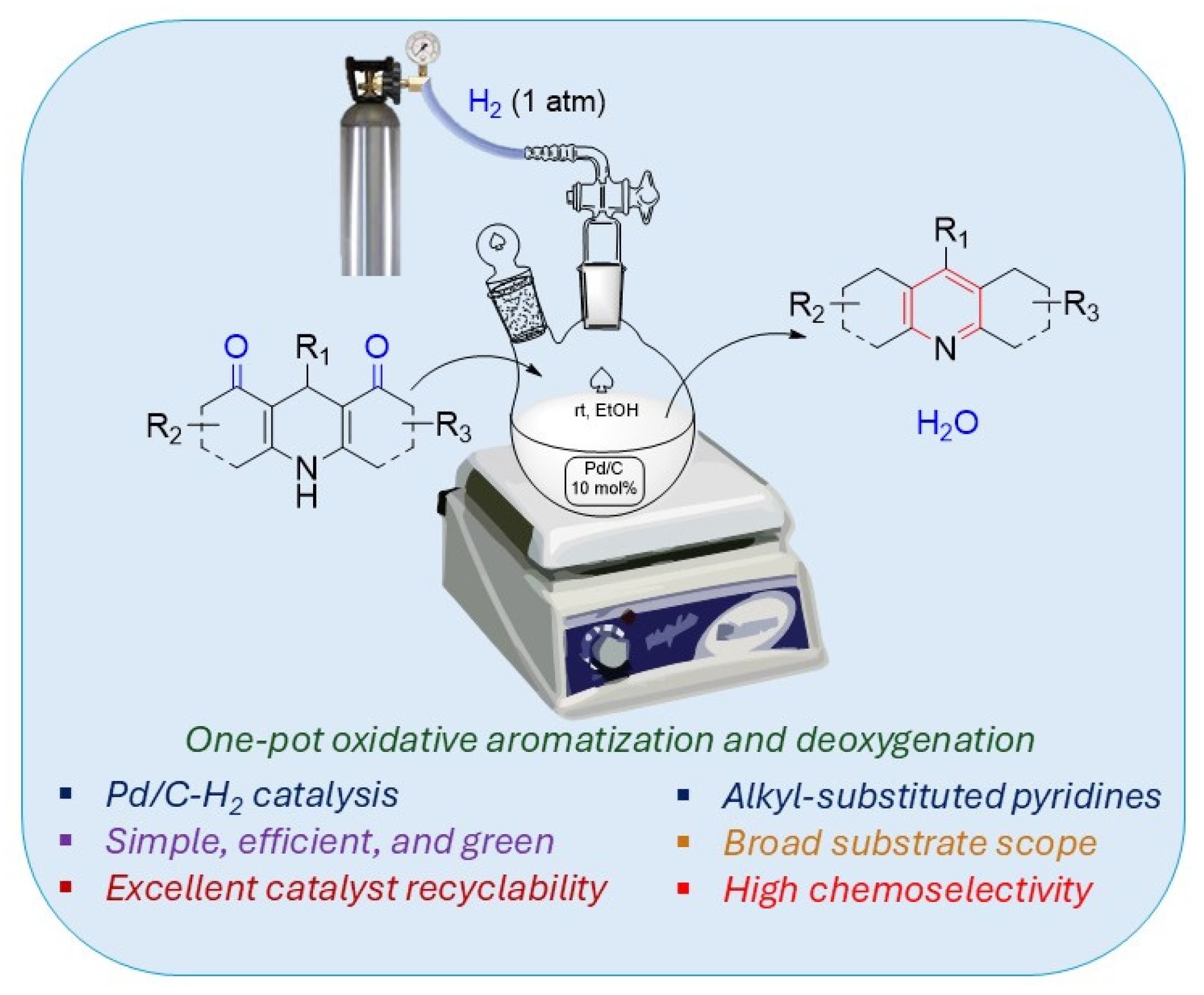
Alkyl-substituted pyridines are ubiquitous structural motifs found in natural products, pharmaceuticals, agrochemicals, and functional organic materials. However, their direct synthesis remains challenging because of the electron-deficient nature of the pyridine ring and the harsh conditions typically required for conventional carbonyl-to-alkane reduction. Herein, we report a mild and environmentally benign Pd/C–H2 catalytic system that enables one-pot oxidative aromatization–deoxygenation of dihydropyridinedione derivatives to afford alkyl-substituted pyridines. The transformation proceeds efficiently at room temperature under atmospheric hydrogen pressure using ethanol as a green solvent, delivering the desired products in up to 91% isolated yield. The protocol exhibits broad substrate scope, high chemoselectivity, operational simplicity, and excellent catalyst recyclability. Mechanistic studies, including hydrogen-free control experiments and intermediate isolation, support a sequential Pd-mediated pathway involving oxidative aromatization, stepwise hydrogen-transfer reduction, and final deoxygenation, with water as the sole stoichiometric by-product. This method provides a sustainable and scalable alternative to classical harsh or reagent-intensive deoxygenation strategies for the synthesis of alkyl-substituted pyridines.

Graphical Abstract

1. Introduction

Pyridine and its derivatives are fundamental scaffolds in organic and medicinal chemistry due to their widespread presence in natural products [1,2,3,4], pharmaceuticals [5,6,7,8,9], agrochemicals [10,11,12,13,14,15,16,17], and advanced functional materials. Among these, alkyl-substituted pyridines represent an especially valuable class of compounds that serve as key structural units and synthetic intermediates in drug design, heterocyclic synthesis, and fine chemical industries [18,19,20,21]. Despite their importance, the direct and efficient synthesis of alkyl-substituted pyridines remains a significant challenge. This difficulty arises because the electron-deficient nature of the pyridine ring disfavors electrophilic alkyl substitution [22], while nucleophilic alkyl substitution typically requires a preinstalled leaving group along with a strongly basic carbon nucleophile [23]. Moreover, achieving direct transition metal-catalyzed C–C bond-forming alkylation on pyridines is extremely difficult, often resulting in poor regioselectivity or requiring harsh reaction conditions [24,25].
Traditionally, alkyl-substituted pyridines are synthesized via multi-step sequences, such as the reduction of pyridyl ketones or the elaboration of pre-functionalized precursors. Classic transformations of carbonyl groups to alkanes, including the Clemmensen [26], Wolff–Kishner [27], Mozingo [28], or Barton–McCombie [29] reductions, are reliable but problematic. These protocols often rely on stoichiometric, toxic reagents and extreme pH environments, leading to poor functional group tolerance and significant chemical waste [20]. In pursuit of greener and more sustainable alternatives, catalytic hydrogenation using molecular hydrogen has attracted considerable attention due to its atom efficiency and environmental benignity. Yet the reduction of carbonyl groups to alkanes under mild and metal hydride-free conditions remains challenging, especially when combined with concurrent oxidative aromatization.
In recent years, palladium-catalyzed deoxygenation has surfaced as a potent alternative to classical reduction methods. For example, Volkov and co-workers reported mild Pd/C-catalyzed deoxygenation of aromatic ketones and aldehydes using polymethylhydrosiloxane as the hydride source [30]. Palladium on carbon (Pd/C) is particularly attractive due to its ability to mediate both oxidative and reductive transformations. However, most reported Pd-catalyzed deoxygenation or aromatization protocols still rely on sacrificial hydride donors or require high hydrogen pressures, elevated temperatures, or additional reductants such as silanes or Al2O3/H2O-based systems, limiting atom economy and sustainability [31,32].
Parallel progress in palladium-mediated dehydroaromatization has shown that Pd–H intermediates can drive aromatization under oxidant-free conditions [33]. Heterogeneous Pd/C systems have specifically been used to promote the dehydrogenative aromatization of cyclic substrates, suggesting that aromatization can function as an intrinsic hydrogen-release step within a catalytic cycle [34]. As one of the most industrially relevant catalysts, the performance of Pd/C is deeply influenced by surface characteristics, where oxygen-containing functional groups and Pd/oxide interfacial sites facilitate hydrogen activation and polar carbonyl reduction [35,36].
Inspired by these precedents, we envisioned a strategy in which oxidative aromatization of the dihydropyridinedione framework is coupled with Pd/C-mediated hydrogen transfer reduction and deoxygenation in a single operation. This approach enables the internal generation and consumption of hydrogen, either produced in situ or supplied directly from molecular hydrogen, thereby eliminating the need for external sacrificial hydride donors while maintaining high atom economy.
Herein, we report a facile, room-temperature Pd/C–H2 system that enables one-pot oxidative aromatization–deoxygenation of dihydropyridinedione derivatives to afford alkyl-substituted pyridines in excellent yields. This method employs ethanol as a green solvent and molecular hydrogen at atmospheric pressure as a clean and atom-economical reducing agent to generate water as the only by-product. The process exhibits broad substrate scope, high selectivity, and catalyst recyclability, providing a sustainable and operationally simple route to alkyl-substituted pyridines under mild, environmentally benign conditions.

2. Materials and Methods

2.1. General Methods

NMR spectra were recorded using a BRUKER AVANCE III 400 spectrometer (400 MHz for 1H; 101 MHz for 13C) (Billerica, MA, USA). The chemical shifts are given in parts per million (ppm) relative to Chloroform-d (7.26 ppm for 1H and 77.00 for 13C). High-resolution mass spectra were recorded on Agilent Technologies (Santa Clara, CA, USA), Accurate Mass Q-TOF LC/MS G65208. Normal column chromatography was performed on silica gel (60–120 mesh) purchased from SRL (Taloja, India) and eluted with petroleum ether and an ethyl acetate mixture.

2.2. Materials

All commercially available compounds were purchased from Sigma-Aldrich (St. Louis, MO, USA) and Alfa Aesar (Waltham, MA, USA). Methanol/ethanol were dried by using magnesium turning, and other solvents were used as received from the company.

2.3. General Procedure for Construction of Starting Material: Dihydropyridinediones

In a round-bottom flask, a 1,3-dione component (e.g., 1,3-cyclohexanedione, 4 mmol, 2 equiv.), an aldehyde component (e.g., formaldehyde, 2 mmol, 1 equiv.), and ammonium acetate (3 mmol, 1.5 equiv.) were dissolved in water (50 mL). The reaction mixture was refluxed with stirring for 6 h, during which the corresponding dihydropyridinedione precipitated from the reaction medium. The solid product was collected via filtering through Whatman filter paper and dried over P2O5 in a desiccator prior to use in the next step [37,38].

2.4. General Procedure A: Aromatization and Hydrogenation of Dihydropyridinedione

To an ethanolic solution (30 mL) of dihydropyridinedione (0.5 mmol, 1 equiv.), Pd on activated charcoal (0.05 mmol, 0.1 equiv.) was added and placed into a two-neck 100 mL round-bottom flask. We flushed the reaction mass with hydrogen gas under vacuum, stirring with a constant pressure of H2 (approx. 1 atm) for 10–15 h. The reaction mass was then filtered through filter paper, passed through anhydrous sodium sulphate, and finally concentrated under reduced pressure to obtain the solid crude product, which was purified using column chromatography with 5–20% ethyl acetate in petroleum ether as eluent.
Compounds 2a to 18 were synthesized using general procedure A.

2.5. Characterization

All the 1H & 13C NMR spectra can be found in the Supplementary Materials File (Figures S1–S38).
1,2,3,4,5,6,7,8-Octahydroacridine (2a): 1H NMR (400 MHz, Chloroform-d) δ ppm 7.04 (s, 1H), 2.85 (t, J = 6.4 Hz, 4H), 2.68 (t, J = 6.3 Hz, 4H), 1.86 (p, J = 6.5 Hz, 4H), 1.77 (p, J = 6.0 Hz, 4H). 13C NMR (101 MHz, Chloroform-d) δ ppm 153.88, 137.73, 129.38, 32.01, 28.35, 23.28, 22.85. HRMS: m/z (ESI): calculated for (C13H18N) [M + H]+: 188.1439 measured: 188.1443.
9-Phenyl-1,2,3,4,5,6,7,8-octahydroacridine (3): 1H NMR (400 MHz, Chloroform-d) δ ppm 7.43 (t, J = 7.5 Hz, 2H), 7.35 (t, J = 7.3 Hz, 1H), 7.06 (d, J = 7.4 Hz, 2H), 2.93 (t, J = 6.5 Hz, 4H), 2.28 (t, J = 6.5 Hz, 4H), 1.86–1.81 (m, 4H), 1.70–1.63 (m, 4H). 13C NMR (101 MHz, Chloroform-d) δ ppm 153.92, 138.55, 138.24, 128.67, 127.99, 127.39, 127.17, 32.81, 29.70, 27.31, 23.02. HRMS: m/z (ESI): calculated for (C19H22N) [M + H]+: 264.1752 measured: 264.1759.
9-(p-Tolyl)-1,2,3,4,5,6,7,8-octahydroacridine (4): 1H NMR (400 MHz, Chloroform-d) δ ppm 7.24 (d, J = 7.9 Hz, 2H), 6.95 (d, J = 7.8 Hz, 2H), 2.92 (t, J = 6.6 Hz, 4H), 2.40 (s, 3H), 2.29 (t, J = 6.4 Hz, 4H), 1.88–1.77 (m, 4H), 1.66–1.62 (m, 4H). 13C NMR (101 MHz, Chloroform-d) δ ppm 153.86, 149.81, 136.80, 135.47, 129.38, 127.87, 127.57, 32.85, 29.72, 27.35, 23.04, 21.29. HRMS: m/z (ESI): calculated for (C20H24N) [M + H]+: 278.1909 measured: 278.1912.
9-(3,5-Dimethoxyphenyl)-1,2,3,4,5,6,7,8-octahydroacridine (5): 1H NMR (400 MHz, Chloroform-d) δ ppm 6.45 (t, J = 2.3 Hz, 1H), 6.21 (d, J = 2.3 Hz, 2H), 3.79 (s, 6H), 2.92 (t, J = 6.5 Hz, 4H), 2.36 (t, J = 6.4 Hz, 4H), 1.87–1.77 (m, 4H), 1.72–1.62 (m, 4H). 13C NMR (101 MHz, Chloroform-d) δ ppm 161.15, 153.86, 149.73, 140.54, 127.29, 105.94, 98.91, 55.37, 32.74, 26.96, 23.02, 22.98. HRMS: m/z (ESI): calculated for (C21H26O2N) [M + H]+: 324.1964 measured: 324.1957.
9-(3,4,5-Trimethoxyphenyl)-1,2,3,4,5,6,7,8-octahydroacridine (6): 1H NMR (400 MHz, Chloroform-d) δ ppm 6.27 (s, 2H), 3.90 (s, 3H), 3.83 (s, 6H), 2.92 (t, J = 6.5 Hz, 4H), 2.36 (t, J = 6.3 Hz, 4H), 1.90–1.79 (m, 4H), 1.74–1.63 (m, 4H). 13C NMR (101 MHz, Chloroform-d) δ ppm 153.93, 153.60, 149.83, 136.82, 134.00, 127.52, 104.79, 61.00, 56.17, 32.76, 29.71, 27.09, 23.02. HRMS: m/z (ESI): calculated for (C22H28O3N) [M + H]+: 354.2069 measured: 354.2076.
9-(2-Fluorophenyl)-1,2,3,4,5,6,7,8-octahydroacridine (7): 1H NMR (400 MHz, Chloroform-d) δ ppm 7.41–7.33 (m, 1H), 7.22 (t, J = 7.5 Hz, 1H), 7.16 (t, J = 8.8 Hz, 1H), 7.05 (td, J = 7.5, 1.9 Hz, 1H), 2.93 (t, J = 6.5 Hz, 4H), 2.31 (t, J = 5.5 Hz, 4H), 1.89–1.78 (m, 4H), 1.72–1.66 (m, 4H). 13C NMR (101 MHz, Chloroform-d) δ ppm 154.13, 148.82, 147.61, 143.96, 141.43,141.24 130.47, 129.77, 129.69, 128.19, 124.62, 124.59, 116.20, 115.98, 32.83, 29.88, 27.03, 23.12. HRMS: m/z (ESI): calculated for (C19H21FN) [M + H]+: 282.1658 measured: 282.1663.
9-(4-Fluorophenyl)-1,2,3,4,5,6,7,8-octahydroacridine (8): 1H NMR (400 MHz, Chloroform-d) δ ppm 7.13 (t, J = 8.3 Hz, 2H), 7.03 (t, J = 6.7 Hz, 2H), 2.94 (t, J = 6.5 Hz, 4H), 2.27 (t, J = 6.4 Hz, 4H), 1.83 (p, J = 6.2 Hz, 4H), 1.69–1.66 (m, 4H). 13C NMR (101 MHz, Chloroform-d) δ ppm 163.27, 160.83, 153.92, 149.04, 147.24, 134.14, 129.70, 129.62, 127.71, 115.87, 115.66, 32.62, 27.31, 22.95, 22.91. HRMS: m/z (ESI): calculated for (C19H21FN) [M + H]+: 282.1658 measured: 282.1650.
9-(4-Methoxyphenyl)-3,6-dimethyl-1,2,3,4,5,6,7,8-octahydroacridine (9): 1H NMR (400 MHz, Chloroform-d) δ ppm 7.03–6.89 (m, 4H), 3.85 (s, 3H), 3.04 (dd, J = 17.0, 4.2 Hz, 2H), 2.53 (dd, J = 17.2, 10.6 Hz, 2H), 2.36–2.24 (m, 5H), 1.90–1.73 (m, 5H), 1.06 (d, J = 6.8 Hz, 6H). 13C NMR (101 MHz, Chloroform-d) δ ppm 158.90, 153.81, 130.80, 129.25, 129.04, 127.70, 114.33, 55.41, 41.22, 31.27, 29.14, 26.97, 21.82. HRMS: m/z (ESI): calculated for (C22H28ON) [M + H]+: 322.2171 measured: 322.2174.
3,9-Dimethyl-6-phenyl-1,2,3,4,5,6,7,8-octahydroacridine (10): 1H NMR (400 MHz, Chloroform-d) δ ppm 7.38–7.18 (m, 3H), 7.08–6.86 (m, 2H), 3.18–2.86 (m, 2H), 2.52 (dt, J = 17.0, 8.7 Hz, 2H), 2.42 (s, 3H), 2.30 (ddd, J = 22.8, 11.6, 5.4 Hz, 3H), 2.19–1.82 (m, 4H), 1.82–1.57 (m, 3H), 1.07 (d, J = 6.4 Hz, 3H). 13C NMR (101 MHz, Chloroform-d) δ ppm 153.79, 136.84, 135.62, 129.38, 128.49, 127.94, 127.84, 127.01, 126.82, 41.39, 31.14, 29.18, 29.06, 27.13, 26.82, 21.81, 21.73, 21.30, 14.16. HRMS: m/z (ESI): calculated for (C21H26N) [M + H]+: 292.2065 measured: 292.2064.
3,6-Diphenyl-9-(p-tolyl)-1,2,3,4,5,6,7,8-octahydroacridine (11): 1H NMR (400 MHz, Chloroform-d) δ ppm 7.44–7.28 (m, 12H), 7.05 (q, J = 7.0 Hz, 2H), 3.33 (q, J = 9.8 Hz, 2H), 3.22–3.07 (m, 4H), 2.69–2.47 (m, 4H), 2.47 (s, 3H), 2.09 (q, J = 6.9 Hz, 2H), 1.89 (d, J = 6.4 Hz, 2H). 13C NMR (101 MHz, Chloroform-d) δ ppm 153.86, 149.63, 145.88, 136.91, 135.30, 129.49, 128.50, 127.84, 127.64, 126.82, 126.24, 40.20, 29.72, 27.60, 21.29, 14.14. HRMS: m/z (ESI): calculated for (C32H32N) [M + H]+: 430.2535 measured: 430.2540.
9-(4-Fluorophenyl)-2,4,5,7-tetramethyl-1,2,3,4,5,6,7,8-octahydroacridine (12): 1H NMR (400 MHz, Chloroform-d) δ ppm 7.13 (t, J = 8.6 Hz, 2H), 7.04 (dd, J = 8.5, 5.7 Hz, 2H), 2.96 (dt, J = 12.5, 6.5 Hz, 2H), 2.37–2.15 (m, 2H), 1.99 (ddd, J = 12.7, 5.1, 2.4 Hz, 4H), 1.82–1.66 (m, 2H), 1.44 (d, J = 6.9 Hz, 6H), 1.21–1.08 (m, 2H), 0.93 (d, J = 6.5 Hz, 6H). 13C NMR (101 MHz, Chloroform-d) δ ppm 163.14, 160.70, 157.45, 147.35, 134.93, 129.84, 126.42, 115.74, 115.54, 41.59, 37.15, 37.07, 29.32, 22.35, 20.60. HRMS: m/z (ESI): calculated for (C23H29FN) [M + H]+: 338.2284 measured: 338.2280.
3,6-Dimethyl-1,2,3,4,5,6,7,8-octahydroacridine (13): 1H NMR (400 MHz, Chloroform-d) δ ppm 7.06 (s, 1H), 2.94 (dd, J = 17.2, 5.1 Hz, 2H), 2.72 (dd, J = 8.4, 4.5 Hz, 4H), 2.44 (dd, J = 17.1, 10.6 Hz, 2H), 1.94–1.86 (m, 4H), 1.43–1.33 (m, 2H), 1.07 (d, J = 6.6 Hz, 6H). 13C NMR (101 MHz, Chloroform-d) δ ppm 152.88, 135.96, 127.62, 39.73, 30.00, 28.43, 26.84, 20.77. HRMS: m/z (ESI): calculated for (C15H22N) [M + H]+: 216.1752 measured: 216.1746.
3-Ethyl-2-methyl-5,6,7,8-tetrahydroquinoline (14): 1H NMR (400 MHz, Chloroform-d) δ ppm 7.10 (s, 1H), 2.85 (t, J = 6.4 Hz, 2H), 2.70 (t, J = 6.3 Hz, 2H), 2.56 (q, J = 7.5 Hz, 2H), 2.46 (s, 3H), 1.91–1.82 (m, 2H), 1.81–1.74 (m, 2H), 1.19 (t, J = 7.6 Hz, 3H). 13C NMR (101 MHz, Chloroform-d) δ ppm 153.62, 153.25, 136.73, 134.40, 129.75, 32.09, 28.50, 25.42, 23.47, 23.03, 21.58, 14.32. HRMS: m/z (ESI): calculated for (C12H18N) [M + H]+: 176.1439 measured: 176.1435.
4-(3-Ethyl-2-methyl-5,6,7,8-tetrahydroquinolin-4-yl)-2-methoxyphenol (15): 1H NMR (400 MHz, Chloroform-d) δ ppm 6.97 (d, J = 8.4 Hz, 1H), 6.62–6.54 (m, 2H), 3.86 (s, 3H), 2.93 (t, J = 6.5 Hz, 2H), 2.56 (s, 3H), 2.37 (q, J = 7.5 Hz, 2H), 2.27 (q, J = 6.3 Hz, 2H), 1.85–1.76 (m, 2H), 1.72–1.61 (m, 2H), 0.95 (t, J = 7.5 Hz, 3H). 13C NMR (101 MHz, Chloroform-d) δ ppm 153.29, 153.14, 149.82, 146.67, 144.77, 133.06, 130.47, 128.45, 121.11, 114.54, 110.80, 55.99, 32.56, 27.47, 23.01, 22.89, 22.88, 21.96, 14.49. HRMS: m/z (ESI): calculated for (C19H24O2N) [M + H]+: 298.1807 measured: 298.1812.
3-Ethyl-4-(2-fluorophenyl)-2-methyl-5,6,7,8-tetrahydroquinoline (16): 1H NMR (400 MHz, Chloroform-d) δ ppm 7.39 (qd, J = 6.7, 3.9 Hz, 1H), 7.22 (t, J = 7.4 Hz, 1H), 7.16 (t, J = 8.9 Hz, 1H), 7.11–7.00 (m, 1H), 2.96 (q, J = 6.9 Hz, 2H), 2.58 (s, 3H), 2.31 (p, J = 7.3 Hz, 3H), 2.24 (t, J = 6.8 Hz, 1H), 1.89–1.78 (m, 2H), 1.74–1.63 (m, 2H), 1.03–0.81 (m, 3H). 13C NMR (101 MHz, Chloroform-d) δ ppm 160.36, 160.17, 157.94, 153.99, 153.65, 153.40, 143.95, 133.35, 130.68, 130.64, 130.39, 130.35, 129.83, 129.75, 128.74, 128.43, 126.06, 124.88, 124.48, 116.24, 116.14, 116.02, 115.92, 32.69, 27.14, 27.01, 23.29, 22.97, 22.16, 13.99. HRMS: m/z (ESI): calculated for (C18H21FN) [M + H]+: 270.1658 measured: 270.1669.
3,5-Diethyl-4-(4-fluorophenyl)-2,6-dimethylpyridine (17): 1H NMR (400 MHz, Chloroform-d) δ ppm 7.22–6.84 (m, 4H), 2.54 (s, 6H), 2.28 (q, J = 7.5 Hz, 4H), 0.90 (t, J = 7.4 Hz, 6H). 13C NMR (101 MHz, Chloroform-d) δ ppm 163.38, 160.93, 153.07, 148.50, 135.07, 135.03, 133.19, 130.38, 130.30, 115.40, 115.19, 23.23, 22.24, 14.25. HRMS: m/z (ESI): calculated for (C17H21FN) [M + H]+: 258.1658 measured: 258.1662.
Ethyl-2-methyl-5,6,7,8-tetrahydroquinoline-3-carboxylate (18): 1H NMR (400 MHz, Chloroform-d) δ ppm 7.84 (s, 1H), 4.32 (q, J = 7.2 Hz, 2H), 2.87 (t, J = 6.4 Hz, 2H), 2.73 (s, 5H), 1.92–1.81 (m, 2H), 1.83–1.72 (m, 2H), 1.36 (t, J = 7.2 Hz, 3H). 13C NMR (101 MHz, Chloroform-d) δ ppm 166.88, 160.22, 156.45, 139.11, 129.43, 122.77, 60.96, 32.63, 28.10, 24.40, 22.88, 22.57, 14.30. HRMS: m/z (ESI): calculated for (C13H18O2N) [M + H]+: 220.1338 measured: 220.1343.
3,4,6,7-Tetrahydroacridine-1,8(2H,5H)-dione (1b): 1H NMR (400 MHz, Chloroform-d) δ ppm 8.84 (s, 1H), 3.16 (t, J = 6.3 Hz, 4H), 2.72–2.67 (m, 4H), 2.21 (q, J = 6.4 Hz, 4H). 13C NMR (101 MHz, Chloroform-d) δ ppm 196.69, 167.29, 134.65, 127.33, 38.44, 32.98, 21.45.
1,2,3,4,5,6,7,8-Octahydroacridin-1-ol (1d): 1H NMR (400 MHz, Chloroform-d) δ ppm 7.42 (s, 1H), 4.74 (t, J = 5.1 Hz, 1H), 2.91–2.76 (m, 4H), 2.71 (t, J = 6.3 Hz, 2H), 2.57 (s, 1H), 2.01 (dt, J = 10.5, 4.4 Hz, 2H), 1.81 (ddt, J = 28.5, 11.0, 5.6 Hz, 6H). 13C NMR (101 MHz, Chloroform-d) δ ppm 156.13, 153.73, 137.18, 131.58, 130.08, 67.70, 32.33, 32.20, 31.80, 28.42, 23.16, 22.76, 18.82.

3. Results and Discussion

We initially investigated the deoxygenation of hexahydroacridine-1,8-dione 1a to corresponding alkyl pyridine with 5 mol% of a commercially available heterogeneous Pd/C catalyst in methanol at room temperature. Under this reaction condition, we found that the 5 mol% Pd catalyst afforded only 52% yield of the desired product at 1 atm. hydrogen pressure for over 24 h (Table 1, Entry 1). Moreover, the 10 mol% Pd/C catalyst enabled an increase in yield to 90% after 10 h (Table 1, Entry 2).
Solvent screening revealed that alcoholic solvents afforded significantly higher yields, whereas non-protic solvents such as DCM, CHCl3, and CH3CN resulted in low-to-moderate conversions (Table 1, Entry 4, 5, and 6). Among the alcohols, both MeOH and EtOH produced similar yields (Table 1, Entry 2 and 3). Therefore, we chose to use ethanol, as it is a greener and less volatile solvent, for all further experiments. After optimizing the solvent system, we evaluated additional catalysts such as Pd/Al2O3 (10 mol%) and Pd/CaCO3 (10 mol%), but none of these systems provided a greater yield of the desired product at room temperature (Table 1, Entry 7 and 8). Thus, Pd/C (10 mol%) remained the catalyst of choice for this transformation.
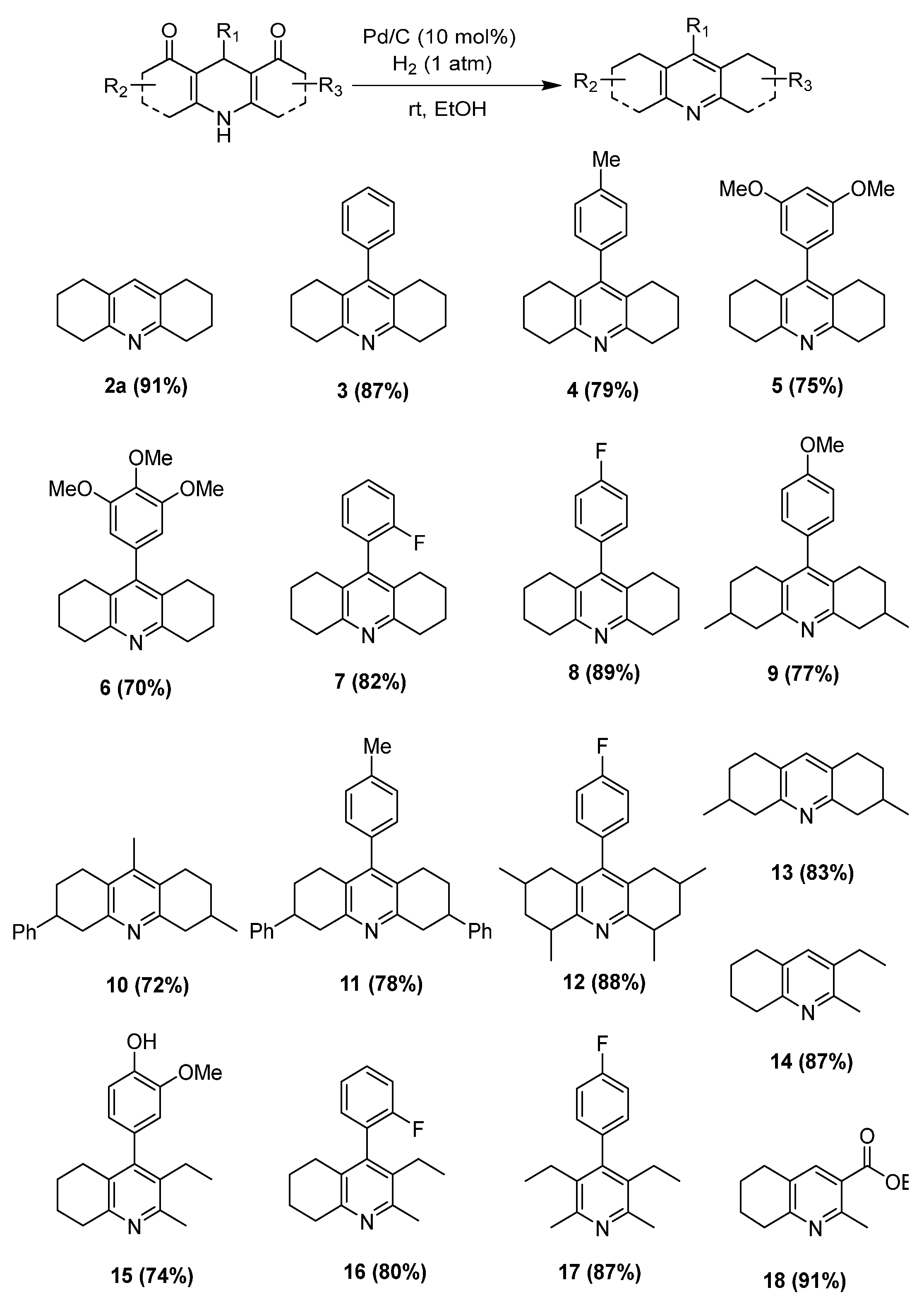
Having identified the optimized condition, we next explored the substrate scope of this methodology. A broad array of structurally diverse dihydropyridinediones were tested, and they all easily afforded the corresponding alkyl-substituted pyridines in up to 91% isolated yield under ambient conditions (Scheme 1), demonstrating excellent tolerance to steric and electronic variation at the 4-position of the 1,4-dihydropyridinedione scaffold.
Aromatic substituents at C-9 were first assessed to examine the influence of aryl substitution on reactivity. Aryl-substituted systems required slightly longer reaction times (15 h) relative to the parent substrate 1a. Electron-rich arenes (–Me, –OMe) (4, 9) consistently furnished slightly lower yields compared to electron-deficient analogues such as fluoro-substituted derivatives (7, 8). These modest yield differences were relatively small and remained within a narrow range, and therefore, any influence of aryl electronics on reaction efficiency appears to be subtle. Further increases in electron density on the 9-aryl group through methoxy or hydroxy substitution (5, 6) led to a gradual decrease in yield, although the transformation remained broadly efficient across all substrates examined.
Steric effects were also found to cause a notable decrease in yield, probably due to mild hinderance in productive catalyst–substrate interactions. Even an electronically activating and smaller-size ortho-fluoro substitution in the 9-aryl ring led to slightly diminished yields of 7 compared to its para-fluoro-substituted variant 8. This steric encumbrance likely impedes Pd coordination to the diketone motif. Due to the extra stability of hydroxy groups as a result of possible hydrogen bonding with the ortho-fluoro group, this slows down the hydrogen transfer steps.
The methodology also extended seamlessly to a range of methyl- and phenyl-substituted cyclic and acyclic ketones to generate corresponding cyclic 913 and acyclic alkyl pyridines 1417, highlighting the broad applicability of this protocol beyond acridine frameworks. When ethyl 2-methyl-5,6,7,8-tetrahydroquinoline-3-carboxylate was subjected to this methodology, the keto group was selectively reduced, keeping the ester group completely intact to generate 18 with 91% yield, illustrating the chemoselectivity and mildness of the catalytic system.
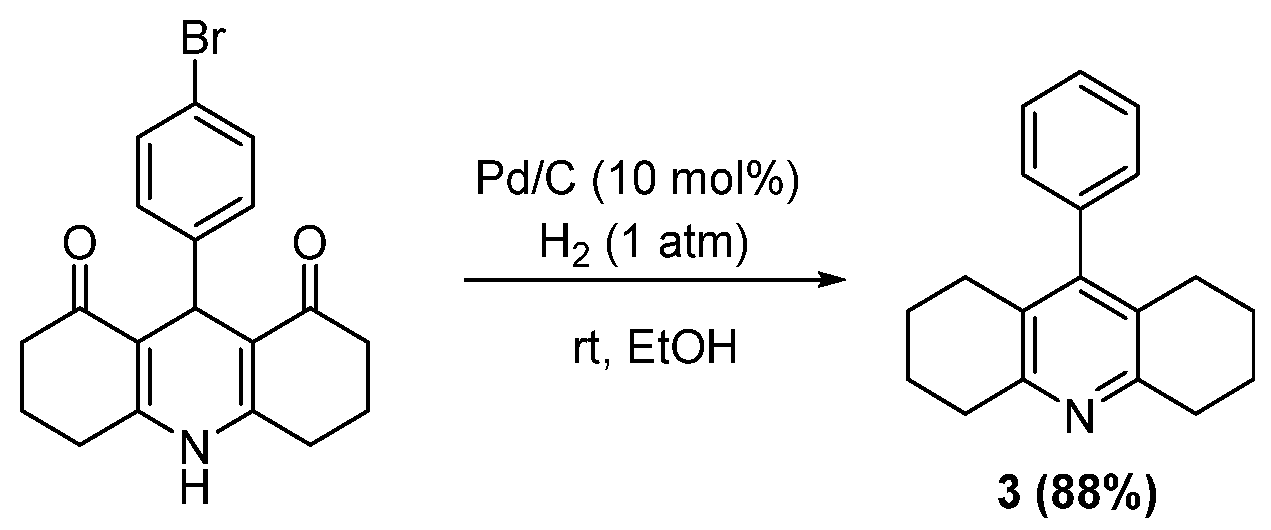
However, the 9-(4-bromophenyl)-3,4,6,7,9,10-hexahydroacridine-1,8(2H,5H)-dione substrate containing aryl bromides resulted in concurrent debromination and reduction under the reaction conditions, affording 9-phenyl-1,2,3,4,5,6,7,8-octahydroacridine 3 (Scheme 2). This outcome is consistent with the known propensity of Pd/C to mediate reductive debromination under a hydrogen atmosphere and further reinforces the highly reducing environment available at the catalyst surface [39].
Finally, the practicality of the transformation was demonstrated by gram-scale synthesis. Conducting the reaction on 2.5 g of substrate 1a afforded product 2a in 87% isolated yield using 1 atm H2 at room temperature, underscoring the operational simplicity and scalability of the process. Moreover, catalyst recyclability studies revealed that Pd/C could be recovered and reused across four consecutive cycles with negligible loss in activity (86% yield, Table 2), strengthening the sustainability metrics of the method.
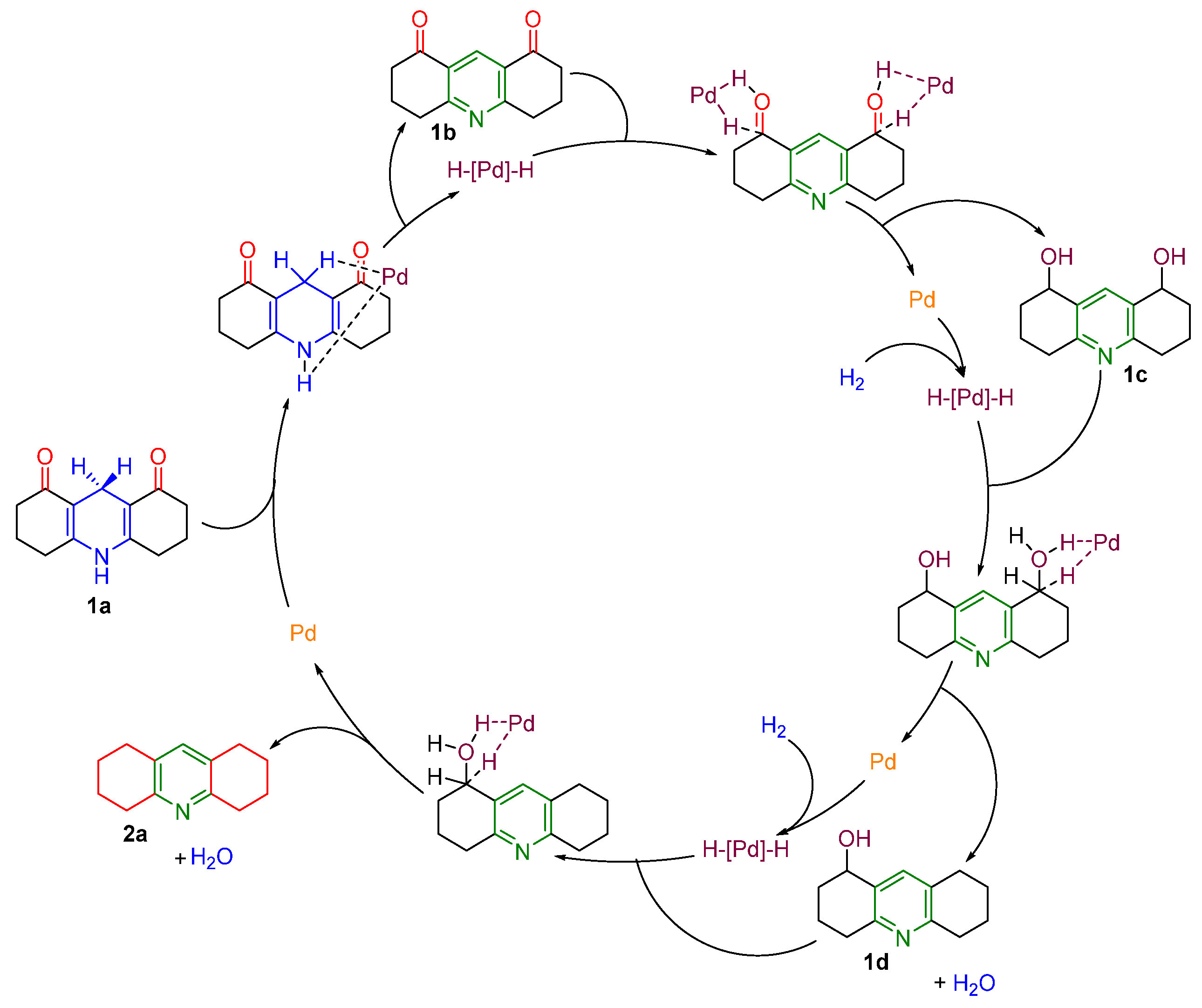
After establishing the substrate scope, we next sought to gain insight into the reaction pathway through a series of control experiments. When substrate 1a was subjected to the standard reaction conditions in the absence of external H2, intermediate 1b was isolated, indicating that aromatization of the 1,4-dihydropyridine core can proceed independent of molecular hydrogen. Such Pd-mediated oxidative dehydrogenation of partially saturated heterocycles is well precedented and is known to occur via surface-assisted hydrogen abstraction, with the released hydrogen remaining associated with the catalyst rather than being liberated as free H2 [40,41,42]. Similar Pd/C-mediated hydrogen transfer and dehydrogenation processes have been documented in catalytic transfer hydrogenolysis and aromatization reactions [43,44,45]. Notably, intermediates such as 1b are themselves synthetically relevant motifs and have been widely utilized as key intermediates in the construction of heterocycles and biologically active molecules.
Because oxidative aromatization under hydrogen-free conditions generates only a limited amount of surface-bound hydrogen, external H2 is required to drive the subsequent deoxygenation of the carbonyl functionality to the alkyl group. Upon introduction of hydrogen and quenching the reaction prior to full conversion, intermediate 1d was isolated, consistent with stepwise reduction of the ketone functionality. Such sequential hydrogen transfer reduction of carbonyl groups on Pd/C, proceeding through alcohol intermediates before C–O bond cleavage, is well established in Pd-catalyzed transfer hydrogenolysis and deoxygenation chemistry [45]. Although intermediate 1c formally contains a stereogenic center, no stereochemical induction or retention was observed, which is consistent with a heterogeneous Pd/C-catalyzed process involving rapid surface-mediated hydrogen transfer and reversible adsorption–desorption events.
Taken together, these observations are consistent with a plausible three-step sequence: (i) Pd-mediated oxidative aromatization of the dihydropyridinedione to form 1b; (ii) hydrogen transfer reduction of the carbonyl group to afford alcohol 1c; and (iii) final Pd-catalyzed deoxygenation of the hydroxyl group to furnish alkylated pyridine 2a, with water as the only stoichiometric by-product (Scheme 3). Although these experiments do not constitute definitive proof of the complete catalytic cycle, they are consistent with well-established Pd/C-mediated hydrogen transfer and deoxygenation mechanisms reported in the literature.

4. Conclusions

In summary, we have developed a simple, efficient, and environmentally benign Pd/C–H2-catalyzed method for the synthesis of alkyl-substituted pyridines under ambient conditions. The methodology enables one-pot oxidative aromatization–deoxygenation of carbonyl-substituted dihydropyridinediones using molecular hydrogen as a clean, atom-economical reductant and ethanol as a green solvent. The reaction proceeds smoothly at room temperature, delivering good-to-excellent yields across a broad substrate scope with high chemoselectivity. The heterogeneous Pd/C catalyst exhibits excellent recyclability, maintaining catalytic efficiency over multiple cycles without significant loss of activity. Control experiments and isolation of key intermediates support a plausible sequential pathway involving Pd-mediated oxidative aromatization followed by hydrogen transfer reduction and final deoxygenation mediated by surface-bound hydrogen. Overall, this operationally straightforward and scalable strategy provides a sustainable alternative to conventional harsh or metal hydride-based reduction protocols for the preparation of alkyl-substituted pyridines.

Supplementary Materials

The following supporting information can be downloaded at https://www.mdpi.com/article/10.3390/chemistry8020012/s1, Figures S1–S38: 1H and 13C NMR spectra of products.

Author Contributions

Conceptualization, S.M. and B.G.R.; methodology, S.M. and T.S.B.; validation, S.M., T.S.B. and D.M.C.; formal analysis, S.M. and B.G.R.; investigation, S.M., T.S.B., D.M.C. and K.P.P.; resources, B.G.R.; data curation, S.M. and T.S.B.; writing—original draft preparation, S.M. and B.G.R.; writing—review and editing, B.G.R., T.S.B. and K.P.P.; visualization, K.P.P.; supervision, B.G.R.; project administration, B.G.R.; funding acquisition, B.G.R. All authors have read and agreed to the published version of the manuscript.

Funding

The authors acknowledge financial support from the Anusandhan National Research Foundation (ANRF)—Science and Engineering Research Board (SERB), Department of Science and Technology (DST), Government of India (Grant No. CRG/2023/007728). Fellowship support for S.M., T.S.B., D.M.C., and K.P.P. was provided by DBT, DST-INSPIRE, Sikkim University and the Anusandhan National Research Foundation (ANRF–SERB), respectively.

Data Availability Statement

The data are available in the Supplementary Materials.

Acknowledgments

The authors gratefully acknowledge Sikkim University for providing essential research infrastructure and central instrumentation facilities. Several analytical instruments used in this study were procured through funding support from DST, India, and DBT, India, which greatly facilitated the experimental work.

Conflicts of Interest

The authors declare no conflicts of interest. The funders had no role in the design of the study; in the collection, analyses, or interpretation of data; in the writing of the manuscript; or in the decision to publish the results.

References

  1. Portero, C.E.; Han, Y.; Marchán-Rivadeneira, M.R. Advances on the Biosynthesis of Pyridine Rings. Eng. Microbiol. 2023, 3, 100064. [Google Scholar] [CrossRef] [PubMed]
  2. Islam, M.B.; Islam, M.I.; Nath, N.; Emran, T.B.; Rahman, M.R.; Sharma, R.; Matin, M.M. Recent Advances in Pyridine Scaffold: Focus on Chemistry, Synthesis, and Antibacterial Activities. BioMed Res. Int. 2023, 2023, 9967591. [Google Scholar] [CrossRef]
  3. Vaithegi, K.; Yi, S.; Lee, J.H.; Varun, B.V.; Park, S.B. Synthesis of Substituted Pyridines with Diverse Functional Groups via the Remodeling of (Aza)Indole/Benzofuran Skeletons. Commun. Chem. 2023, 6, 112. [Google Scholar] [CrossRef] [PubMed]
  4. De, S.; Kumar, A.; Shah, S.; Kazi, S.; Sarkar, N.; Banerjee, S.; Dey, S. Pyridine: The Scaffolds with Significant Clinical Diversity. RSC Adv. 2022, 12, 15385–15406. [Google Scholar] [CrossRef]
  5. Ling, Y.; Hao, Z.-Y.; Liang, D.; Zhang, C.-L.; Liu, Y.-F.; Wang, Y. The Expanding Role of Pyridine and Dihydropyridine Scaffolds in Drug Design. Drug Des. Devel. Ther. 2021, 15, 4289–4338. [Google Scholar] [CrossRef] [PubMed]
  6. Vitaku, E.; Smith, D.T.; Njardarson, J.T. Analysis of the Structural Diversity, Substitution Patterns, and Frequency of Nitrogen Heterocycles among U.S. FDA Approved Pharmaceuticals. J. Med. Chem. 2014, 57, 10257–10274. [Google Scholar] [CrossRef]
  7. Albratty, M.; Alhazmi, H.A. Novel Pyridine and Pyrimidine Derivatives as Promising Anticancer Agents: A Review. Arab. J. Chem. 2022, 15, 103846. [Google Scholar] [CrossRef]
  8. Shah, P. Synthesis and Molecular Docking Study of a Series of Novel Pyridine Derivatives and Evaluation of Their Anticancer Activity. J. Pharm. Res. Int. 2025, 37, 97–107. [Google Scholar] [CrossRef]
  9. Mohammad Abu-Taweel, G.; Ibrahim, M.M.; Khan, S.; Al-Saidi, H.M.; Alshamrani, M.; Alhumaydhi, F.A.; Alharthi, S.S. Medicinal Importance and Chemosensing Applications of Pyridine Derivatives: A Review. Crit. Rev. Anal. Chem. 2024, 54, 599–616. [Google Scholar] [CrossRef]
  10. Zakharychev, V.V.; Martsynkevich, A.M. Development of Novel Pyridine-Based Agrochemicals: A Review. Adv. Agrochem 2025, 4, 30–48. [Google Scholar] [CrossRef]
  11. Guan, A.-Y.; Liu, C.-L.; Sun, X.-F.; Xie, Y.; Wang, M.-A. Discovery of Pyridine-Based Agrochemicals by Using Intermediate Derivatization Methods. Bioorg. Med. Chem. 2016, 24, 342–353. [Google Scholar] [CrossRef] [PubMed]
  12. Zheng, Z.; Dai, A.; Jin, Z.; Chi, Y.R.; Wu, J. Trifluoromethylpyridine: An Important Active Fragment for the Discovery of New Pesticides. J. Agric. Food Chem. 2022, 70, 11019–11030. [Google Scholar] [CrossRef]
  13. Liu, Y.; Fu, B.; Xu, Y.; Ren, B.; Qin, Z. Advancement of Phenoxypyridine as an Active Scaffold for Pesticides. Molecules 2022, 27, 6803. [Google Scholar] [CrossRef]
  14. Zakharychev, V.V.; Kuzenkov, A.V.; Martsynkevich, A.M. Good Pyridine Hunting: A Biomimic Compound, a Modifier and a Unique Pharmacophore in Agrochemicals. Chem. Heterocycl. Compd. 2020, 56, 1491–1516. [Google Scholar] [CrossRef]
  15. Abd El-Lateef, H.M.; Khalaf, M.M.; Gouda, M.; Kandeel, M.; Amer, A.A.; Abdelhamid, A.A.; Drar, A.M.; Gad, M.A. Functionalized Pyridines: Synthesis and Toxicity Evaluation of Potential Insecticidal Agents against Aphis craccivora. ACS Omega 2023, 8, 29685–29692. [Google Scholar] [CrossRef] [PubMed]
  16. Bakhite, E.A.; Abd-Ella, A.A.; El-Sayed, M.E.A.; Abdel-Raheem, S.A.A. Pyridine Derivatives as Insecticides. Part 2: Synthesis of Some Piperidinium and Morpholinium Cyanopyridinethiolates and Their Insecticidal Activity. J. Saudi Chem. Soc. 2017, 21, 95–104. [Google Scholar] [CrossRef]
  17. Bakhite, E.A.; Abd-Ella, A.A.; El-Sayed, M.E.A.; Abdel-Raheem, S.A.A. Pyridine Derivatives as Insecticides. Part 1: Synthesis and Toxicity of Some Pyridine Derivatives Against Cowpea Aphid, Aphis Craccivora Koch (Homoptera: Aphididae). J. Agric. Food Chem. 2014, 62, 9982–9986. [Google Scholar] [CrossRef]
  18. Iglesias, B.; Alvarez, R.; de Lera, A.R. A General Synthesis of Alkylpyridines. Tetrahedron 2001, 57, 3125–3130. [Google Scholar] [CrossRef]
  19. Lin, S.X.; Curtis, M.A.; Sperry, J. Pyridine Alkaloids with Activity in the Central Nervous System. Bioorg. Med. Chem. 2020, 28, 115820. [Google Scholar] [CrossRef]
  20. Reza, A.I.; Iwai, K.; Nishiwaki, N. Recent Advances in Synthesis of Multiply Arylated/Alkylated Pyridines. Chem. Rec. 2022, 22, e202200099. [Google Scholar] [CrossRef] [PubMed]
  21. Lukin, O. Functionalized Pyridines as Valuable Building Blocks in Organic Synthesis and Medicinal Chemistry. Available online: https://lifechemicals.com/blog/building-blocks/401-functionalized-pyridines-as-valuable-building-blocks-in-organic-synthesis-and-medicinal-chemistry (accessed on 1 November 2025).
  22. Smith, M.B.; March, J. Aromatic Substitution, Electrophilic. In March’s Advanced Organic Chemistry; John Wiley & Sons: Hoboken, NJ, USA, 2006; pp. 657–751. [Google Scholar] [CrossRef]
  23. Smith, M.B.; March, J. Aromatic Substitution, Nucleophilic and Organometallic. In March’s Advanced Organic Chemistry; John Wiley & Sons: Hoboken, NJ, USA, 2006; pp. 853–933. [Google Scholar] [CrossRef]
  24. Nakao, Y. Transition-Metal-Catalyzed C-H Functionalization for the Synthesis of Substituted Pyridines. Synthesis 2011, 2011, 3209–3219. [Google Scholar] [CrossRef]
  25. Cao, Y.; Shih, W.-C.; Bhuvanesh, N.; Zhou, J.; Ozerov, O.V. Cooperative C–H Activation of Pyridine by PBP Complexes of Rh and Ir Can Lead to Bridging 2-Pyridyls with Different Connectivity to the B–M Unit. Chem. Sci. 2021, 12, 14167–14173. [Google Scholar] [CrossRef]
  26. Martin, E.L. The Clemmensen Reduction. In Organic Reactions; John Wiley & Sons: Hoboken, NJ, USA, 2011; pp. 155–209. [Google Scholar] [CrossRef]
  27. Todd, D. The Wolff-Kishner Reduction. In Organic Reactions; John Wiley & Sons: Hoboken, NJ, USA, 2011; pp. 378–422. [Google Scholar] [CrossRef]
  28. Clayden, J.; Greeves, N.; Warren, S.; Clayden, J.; Greeves, N.; Warren, S. Organic Chemistry, 2nd ed.; Oxford University Press: Oxford, UK, 2012. [Google Scholar]
  29. Barton, D.H.R.; McCombie, S.W. A New Method for the Deoxygenation of Secondary Alcohols. J. Chem. Soc. Perkin 1 1975, 16, 1574–1585. [Google Scholar] [CrossRef]
  30. Volkov, A.; Gustafson, K.P.J.; Tai, C.-W.; Verho, O.; Bäckvall, J.-E.; Adolfsson, H. Mild Deoxygenation of Aromatic Ketones and Aldehydes over Pd/C Using Polymethylhydrosiloxane as the Reducing Agent. Angew. Chem. Int. Ed. 2015, 54, 5122–5126. [Google Scholar] [CrossRef]
  31. Sunada, Y.; Kawakami, H.; Imaoka, T.; Motoyama, Y.; Nagashima, H. Hydrosilane Reduction of Tertiary Carboxamides by Iron Carbonyl Catalysts. Angew. Chem. Int. Ed. 2009, 48, 9511–9514. [Google Scholar] [CrossRef]
  32. Chen, H.; Xu, Z.; Wan, H.; Zheng, J.; Yin, D.; Zheng, S. Aqueous bromate reduction by catalytic hydrogenation over Pd/Al2O3 catalysts. Appl. Catal. B Environ. 2010, 96, 307–313. [Google Scholar] [CrossRef]
  33. Chen, W.; Chen, Y.; Gu, X.; Chen, Z.; Ho, C.-Y. (NHC)Pd(II) Hydride-Catalyzed Dehydroaromatization by Olefin Chain-Walking Isomerization and Transfer-Dehydrogenation. Nat. Commun. 2022, 13, 5507. [Google Scholar] [CrossRef] [PubMed]
  34. Iosub, A.V.; Stahl, S.S. Palladium-Catalyzed Aerobic Dehydrogenation of Cyclic Hydrocarbons for the Synthesis of Substituted Aromatics and Other Unsaturated Products. ACS Catal. 2016, 6, 8201–8213. [Google Scholar] [CrossRef]
  35. Mao, Z.; Gu, H.; Lin, X.; Mao, Z.; Gu, H.; Lin, X. Recent Advances of Pd/C-Catalyzed Reactions. Catalysts 2021, 11, 1078. [Google Scholar] [CrossRef]
  36. You, P.; Wu, L.; Zhou, L.; Xu, Y.; Qin, R.; You, P.; Wu, L.; Zhou, L.; Xu, Y.; Qin, R. Impact of Oxygen-Containing Groups on Pd/C in the Catalytic Hydrogenation of Acetophenone and Phenylacetylene. Catalysts 2024, 14, 545. [Google Scholar] [CrossRef]
  37. Mandal, S.; Chhetri, K.; Bhuyan, S.; Roy, B.G. Efficient iron catalyzed ligand-free access to acridines and acridinium ions. Green Chem. 2020, 22, 3178–3185. [Google Scholar] [CrossRef]
  38. Loev, B.; Goodman, M.M.; Snader, K.M.; Tedeschi, R.; Macko, E.J. Hantzsch-type dihydropyridine hypotensive agents. Med. Chem. 1974, 17, 956–965. [Google Scholar] [CrossRef]
  39. Marques, C.A.; Selva, M.; Tundo, P. Facile Hydrodehalogenation with H2 and Pd/C Catalyst under Multiphase Conditions. 3. Selective Removal of Halogen from Functionalized Aryl Ketones. 4. Aryl Halide-Promoted Reduction of Benzyl Alcohols to Alkanes. J. Org. Chem. 1995, 60, 2430–2435. [Google Scholar] [CrossRef]
  40. Nakamichi, N.; Kawashita, Y.; Hayashi, M. Oxidative Aromatization of 1,3,5-Trisubstituted Pyrazolines and Hantzsch 1,4-Dihydropyridines by Pd/C in Acetic Acid. Org. Lett. 2002, 4, 3955–3957. [Google Scholar] [CrossRef]
  41. Hayashi, M.; Yamada, K.; Nakayama, S.; Hayashi, H.; Yamazaki, S. Environmentally Benign Oxidation Using a Palladium Catalyst System. Green Chem. 2000, 2, 257–260. [Google Scholar] [CrossRef]
  42. Liu, X.-J.; Wang, W.-P.; Huo, C.; Wang, X.; Quan, Z.-J. Palladium-Catalyzed Dehydrogenation of Dihydro-Heterocycles Using Isoprene as the Hydrogen Acceptors without Oxidants. Catal. Sci. Technol. 2017, 7, 565–569. [Google Scholar] [CrossRef]
  43. Rajagopal, S.; Spatola, A.F. Mechanism of Palladium-Catalyzed Transfer Hydrogenolysis of Aryl Chlorides by Formate Salts. J. Org. Chem. 1995, 60, 1347–1355. [Google Scholar] [CrossRef]
  44. Mandal, P.K.; McMurray, J.S. Pd−C-Induced Catalytic Transfer Hydrogenation with Triethylsilane. J. Org. Chem. 2007, 72, 6599–6601. [Google Scholar] [CrossRef]
  45. Sawadjoon, S.; Lundstedt, A.; Samec, J.S.M. Pd-Catalyzed Transfer Hydrogenolysis of Primary, Secondary, and Tertiary Benzylic Alcohols by Formic Acid: A Mechanistic Study. ACS Catal. 2013, 3, 635–642. [Google Scholar] [CrossRef]
Scheme 1. Substrate scope of alkyl pyridines.
Chemistry 08 00012 sch001
Scheme 2. Concurrent debromination and reduction of 9-(4-bromophenyl)-3,4,6,7,9,10-hexahydroacridine-1,8(2H,5H)-dione.
Chemistry 08 00012 sch002
Scheme 3. Proposed Pd-mediated aromatization–reduction–deoxygenation pathway to produce pyridine 2a.
Chemistry 08 00012 sch003
Table 1. Optimization of catalytic conditions.
Chemistry 08 00012 i001
EntryPd (mol%)SolventTime (h)Yield (%)
1Pd/C (5) MeOH2452
2Pd/C (10)MeOH1090
3Pd/C (10)EtOH1091
4Pd/C (10)DCM2419
5Pd/C (10)CH3CN2421
6Pd/C (10)CHCl32418
7Pd/Al2O3 (10)EtOH24 25
8Pd/CaCO3 (10)EtOH2411
Table 2. Recycling of catalyst (without addition of fresh catalyst).
EntryPd/C Catalytic Cycles 1Yield (%)
1Fresh91
2First reuse90
3Second reuse88
4Third reuse86
1 The reaction was carried out under optimized conditions using the 10 mol% Pd/C catalyst, H2 (1 atm), and EtOH as the solvent at room temperature.
Disclaimer/Publisher’s Note: The statements, opinions and data contained in all publications are solely those of the individual author(s) and contributor(s) and not of MDPI and/or the editor(s). MDPI and/or the editor(s) disclaim responsibility for any injury to people or property resulting from any ideas, methods, instructions or products referred to in the content.