
Article

Ultraviolet Absorption Spectra of Benzene and Chlorobenzene in Water-Ice Solutions at Temperatures Between 78 K and 273 K

by
Suresh Sunuwar
and
Carlos E. Manzanares
*
Department of Chemistry and Biochemistry, Baylor University, 101 Bagby Avenue, Baylor Sciences Building, Waco, TX 76706, USA
*
Author to whom correspondence should be addressed.
Chemistry 2026, 8(1), 9; https://doi.org/10.3390/chemistry8010009
Submission received: 1 December 2025 / Revised: 4 January 2026 / Accepted: 6 January 2026 / Published: 9 January 2026
(This article belongs to the Section Physical Chemistry and Chemical Physics)

Abstract

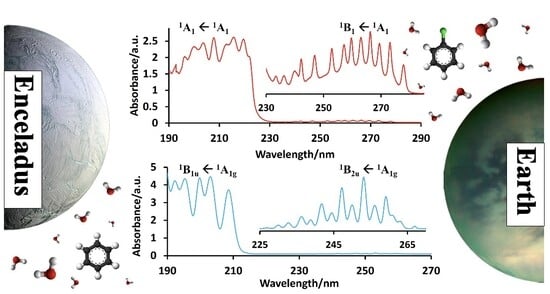
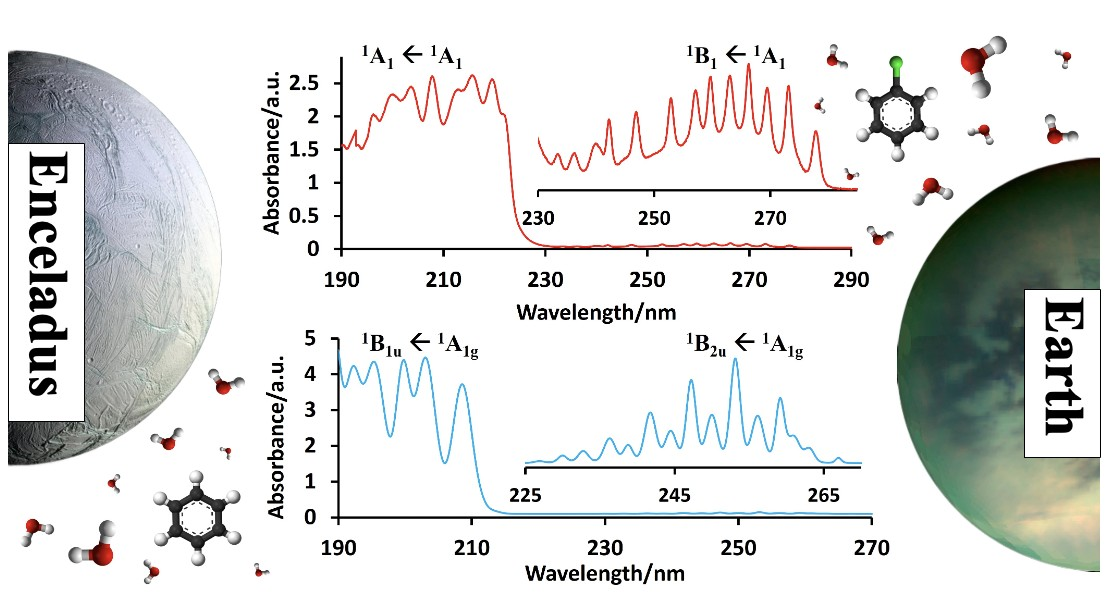
In this paper, characteristic ultraviolet absorption spectra are presented for benzene and chlorobenzene in transparent hexagonal water–ice solutions at temperatures between 273 K and 78 K. In addition, the liquid solution spectra at 292 K have also been included. The two lowest symmetry-forbidden transitions from the ground state (1A1g) to the first excited level of symmetry (B2u), denoted as 1B2u1A1g, and the transition from the ground state to the second excited level of symmetry (1B1u), denoted as 1B1u1A1g, of benzene are recorded. The two lowest transitions of chlorobenzene from the ground state (1A1) to the first excited level of symmetry (1B2), denoted as 1B21A1, and the transition from the ground state to the second excited level of symmetry (1A1) denoted as, 1A11A1, are also studied. The bands are obtained for slowly cooled transparent water–ice solutions. Such ice samples, that were frozen from liquid water and cooled, show gradual changes in the spectra. Our study shows the spectra at eight temperatures, separating the spectra in different regions based on the range for the bands from ground state to the first and second excited states of benzene and chlorobenzene, observing changes in the integrated absorbances as a function of the temperature. For the spectra recorded at 78 K, the peak absorbances as a function of the wavelength are presented and tentatively assigned. Peak assignments are based on the known literature of benzene and chlorobenzene. The temperature range of our study covers some of the average temperatures that have been found in the icy moons of Saturn and the polar regions of Earth.

Graphical Abstract

1. Introduction

Previous low temperature studies of solid [1], solid solutions [2,3], liquid solutions [4,5] and room temperature gas phase [6,7,8,9,10] of the vacuum UV and UV absorption bands of benzene, separate the spectra in three regions. A strong transition from the ground state of symmetry (1A1g) to the third singlet state (1E1u), denoted as 1E1u   1A1g. This symmetry allowed strong absorption band peaks around 180 nm [1,2]. Near the base of the strong band there is small shoulder from the ground state to the second excited singlet state (1 B 1 u ), denoted as 1 B 1 u  1 A 1 g . This transition is symmetry forbidden but appears because of Herzberg-Teller vibronic coupling and by resonance borrows intensity from the allowed band showing vibronic structure. Another transition, the weakest of the three, is from the ground state to the first excited singlet (1 B 2 u ) denoted as 1 B 2 u  1 A 1 g . It is also symmetry forbidden but appears due to vibronic coupling and intensity borrowing [1,2].
If one hydrogen atom of benzene is substituted by a chlorine atom, the symmetry is lowered from D6h, to C2v, and the degeneracy of the highest occupied π orbitals is lost. Due to the C2v symmetry, the 1B1u and 1B2u states of benzene are replaced by the 1A1 and 1B2 in chlorobenzene [11,12,13,14]. The ground state has symmetry 1 A 1 and the transitions then are the transition to the second excited state, denoted as 1 A 1  1 A 1 , and the transition to the first excited state, denoted as 1 B 2  1 A 1 . The ultraviolet (UV) spectra of benzene and chlorobenzene are distinct mainly in the location and strength of their absorption bands. The spectral variations occur because the chlorine atom in chlorobenzene can interact with the benzene ring via its lone-pair electrons. Although chlorine can participate in resonance, its inductive effect is more pronounced, resulting in the withdrawal of electron density from the ring. The interaction reduces the energy needed for excitation therefore chlorobenzene displays a red shift with respect to benzene.
Our study of benzene and chlorobenzene shows the spectra at eight temperatures and one concentration. The spectra are separated in different regions based on the range of the bands for the first excited and second excited transitions. Changes in the integrated absorbances as a function of the temperature are reported. The effects of the water–ice matrix on the magnitude of the integrated intensities are discussed. For the spectra recorded at 78 K, the peak absorbances as a function of the wavelength are presented and tentatively assigned. Peak assignments are based on the known literature of vibrational levels of benzene [15] and chlorobenzene [16,17,18,19,20].
The temperature range of our study covers some of the average temperatures that have been found in the icy moons of Saturn and the polar regions of Earth. Among the molecules that have been proposed as trapped or attached to water ice in the solar system, benzene has been mentioned on Saturn’s moon Enceladus. The temperature range of our study covers some of the average temperatures that have been reported [21]. Chlorobenzene has only been mentioned on the surface of Mars, but its presence has been questioned due to the pyrolysis conducted before the analysis of the sample [22].
It has been found that the photolysis of chlorobenzene in water ice with wavelengths greater than 254 nm, produces biphenyl and terphenyl as well as their chlorinated isomers [23] while the photochemistry in water produces mainly phenol derivatives [24]. On earth chlorobenzene is produced in industry and can find its way into the atmosphere and then precipitate at the poles. Combustion of chlorinated benzenes can generate polychlorinated biphenyls (PCBs) [25] and tetrachlorodibenzo-1,4-dioxin [26] that are very toxic for the environment. Measurements of Earth polar environments and mountains near the poles made in deeper snow layers and glacial ice cores, show chemicals that include PCBs and organochlorine (OC) pesticides [27].

2. Materials and Methods

2.1. Materials

The chemicals utilized in the experiment were employed without any additional purification. Benzene (99%, EMD Millipore, Darmstadt, Germany) and Chlorobenzene (99%, Alfa Aesar, Heysham, UK) were acquired from commercial sources. All chemicals were of ACS reagent grade. Stock solutions of benzene and chlorobenzene were created by diluting them in double distilled water, resulting in a concentration of 1 × 10⁻² M for each solution. Working solutions with the desired final concentrations (5 × 10⁻⁴ M) were prepared through serial dilution from the stock solutions before conducting measurements. All chemicals and stock solutions were stored in amber glass bottles and kept in a dark environment at room temperature to avoid degradation. The solutions were examined for potential contamination through absorption scans.

2.2. Methods

2.2.1. Ultraviolet Spectrometer

To conduct absorbance measurements, we utilize a Shimadzu UV-2450 spectrophotometer (Shimadzu, Kyoto, Japan). This device scans wavelengths ranging from 190 nm to 1100 nm, featuring a wavelength accuracy of 0.3 nm and a resolution of 0.1 nm. The instrument is equipped with a single monochromator and a high-performance holographic grating. It utilizes two light sources: a 50 W halogen lamp and a deuterium lamp, which together provide a complete scanning range of 910 nm. The selected detector is the Photomultiplier 928. The spectrometer offers adjustable slit widths of 0.1, 0.2, 0.5, 1, and 5 nm. In terms of dimensions, the overall size of the spectrometer is 57 × 66 × 27.5 cm, while the sample compartment measures 15 × 26 × 12 cm. To ensure the maintenance of optical and electrical components as well as the sample compartment, a nitrogen gas inlet is installed at the rear of the instrument for continuous purging.

2.2.2. Cryostat and Cell

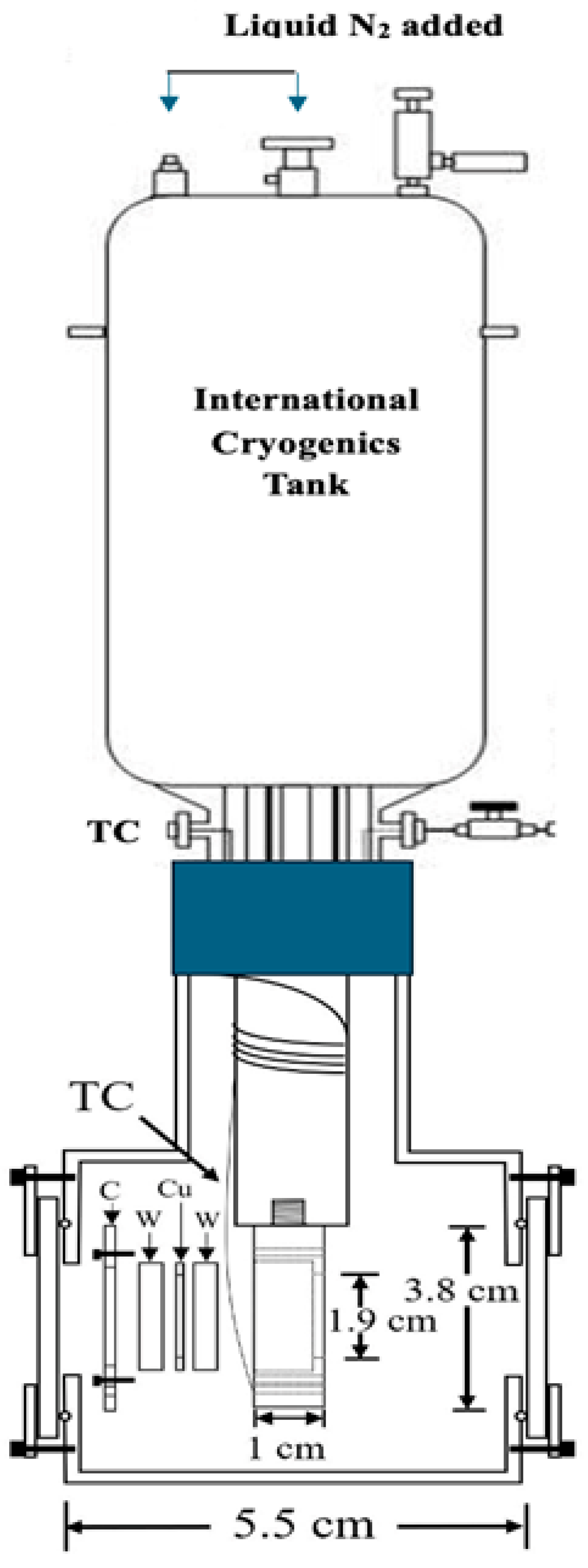
Figure 1 shows a schematic of the cell attached to the cold head of the cryostat. The cryostat was sourced from International Cryogenics Inc. USA (Indianapolis, IN, USA). The central dewar, which cools the cell, has a capacity of up to 12 L of liquid nitrogen. A copper block was utilized to connect the cell and the cold head, facilitating thermal contact and cooling of the cell. The entire cell was housed within a vacuum chamber that provides thermal insulation for both the cell and the cold head of the cryostat, protecting them from humidity condensation. The cryostat was equipped with four vacuum ports; one served as the connection from the cell to the sample system. Two of these ports were designated for measuring the vacuum pressure within the cryostat. The remaining port provided access to the electrical wires for temperature monitoring. Two thermocouples were linked to a temperature controller that gauged the temperatures of both the cold block and the cell. The heating resistor, responsible for adjusting the cell’s temperature, was situated on the cold block. The vacuum surrounding the cell, maintained at 10−6 Torr, was achieved through a combination of a mechanical and a diffusion pump.
Low-temperature UV absorption measurements were performed using sapphire optical windows of 2.5 cm diameter and 3 mm thickness. A high purity copper gasket (O-ring) of 2 cm outer diameter and 1 cm internal diameter was placed between the two windows as a spacer. The sample was loaded within the copper O-ring. The windows and spacer were housed together in an aluminum casing. The pathlength of the cell was 1 mm. A cell lid was then put on to fix everything inside the housing. The housing consisted of custom-made screw threading (¼″—28 drill tap size) for cold-stage attachment.

3. Results

3.1. Benzene

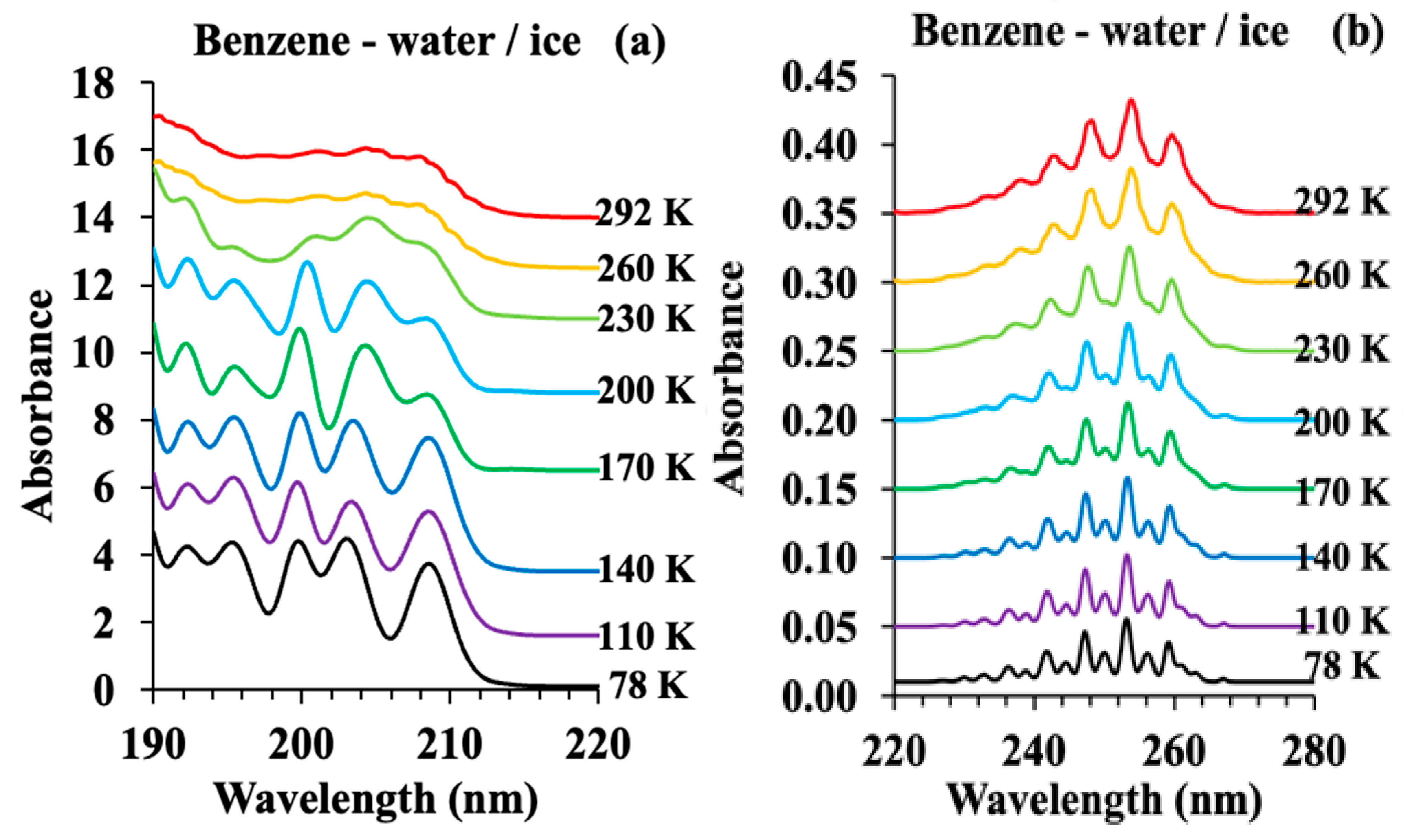
Our experimental results for the two transitions in the UV are shown in Figure 2. The concentration of benzene in water is 5 × 10⁻⁴ M. The pathlength of the cell is 1 mm.
The spectra are shown for temperatures at 292 K (liquid) and from 273 K to 78 K (solid solution). The high energy (Figure 2a) transition 1B1u   1A1g is shown between 190 nm and 210 nm. The low energy (Figure 2b) transition 1B2u   1A1g is shown between 220 and 270 nm. The high energy transition has a peak wavelength of 204 nm at 292 K. The liquid water spectrum shows a band feature with high overlap of the vibrational transitions. Upon lowering the temperature, a general trend of increase in relative intensity and band narrowing can be observed. This observation is plausible since benzene molecules isolated in water ice at cryogenic temperatures yield sharp vibronic bands. The band maximum shifts from 204.5 nm to 203.19 nm, showing a slight blue shift.
The low-energy electronic transition, 1B2u   1A1g appears significantly weaker than the high-energy transition. The peak maximum for this transition is seen at 259.83 nm. These vibronic bands are blue shifted as the temperature decreases.
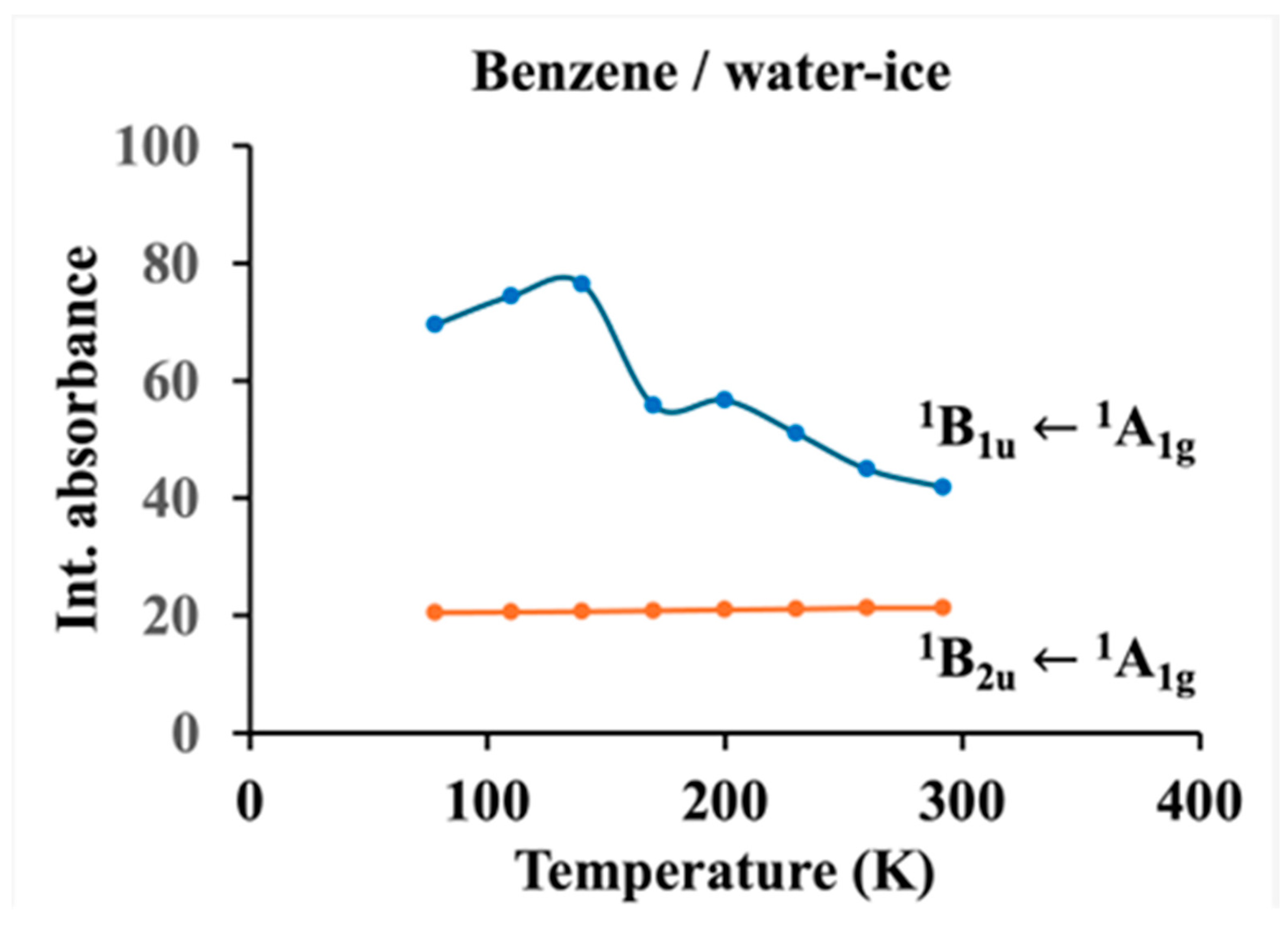
The temperature dependence of the integrated bands is shown in Figure 3, which shows a plot of the integrated band versus the absolute temperature. The band 1B1u   1A1g is integrated between 190 and 220 nm. The band 1B2u   1A1g is integrated between 225 and 270 nm. The overall 1B1u   1A1g band intensity increases when the temperature decreases until 200 K. It decreases slightly at 170 K and begins to increase again reaching a maximum at 140 K. Below 140 K there is a gradual decrease until we reach 78 K. The 1B2u   1A1g band shows almost constant integrated absorbance with a gradual decrease when the temperature decreases.
Table 1 shows the observed peak positions in wavelength (λ nm) and wavenumber (cm−1), the difference with respect to the origin (Diff.), the tentative assignments (assgs.), and the spectroscopic (Spectrosc.) notation for the transitions 1B1u   1A1g and 1B2u   1A1g. The assignments of the 1B2u   1A1g. transition are possible because all vibrational levels of the first excited electronic state (1B2u) of benzene are known [16,17]. The same vibrational levels are assumed to apply for the second excited electronic state (1B1u) because only the experimental values of ν 6 = 510   c m 1 and ν 1 = 910   c m 1 are known for the (1B1u) state. The two values are presented in a theoretical calculation of vibrational levels of the (1B1u) state [8]. Tentative assignments are shown with the magnitude of the individual vibrational frequencies of the excited states. The spectroscopic notation follows the mode assignment numbering [15] and the vibronic transition notation. In agreement with previous results [2], the intensity of band 1B1u   1A1g goes down to zero around 210 nm at 78 K and shows an overall blue shift when the temperature decreases. We assign the first peak (208.63 nm) to the 6 0 1 vibronic transition. Higher energy peak absorptions are identified as transitions of the type 6 0 1 1 0 n (n = 1–4) in combination with the transition 16 0 2 except for (n = 2) combined with the first overtone of a lattice vibration.
If the origin of the 1B2u   1A1g transition (Table 1) is selected at 262.96 nm, there is complete agreement with previous assignments [2] of the 6 0 1 and the progression 6 0 1 1 0 n (n = 1–4). The origin at 262.96 nm also produces new tentative assignments for our listed peaks that include the 6 1 0 for the peak at 266.96 nm, the first overtone of the lattice vibration (2 × 180 cm−1) at 260.89 nm, the 6 0 1 1 0 6 at 236.88 nm, and a progression of the symmetric ring stretch (1) of the type 1 0 n   (n = 1–4, and 6). The peak at 232.76 nm was tentatively assigned to 1 0 5 16 0 2 but it could also be the combination 6 0 1 1 0 5 .

3.2. Chlorobenzene

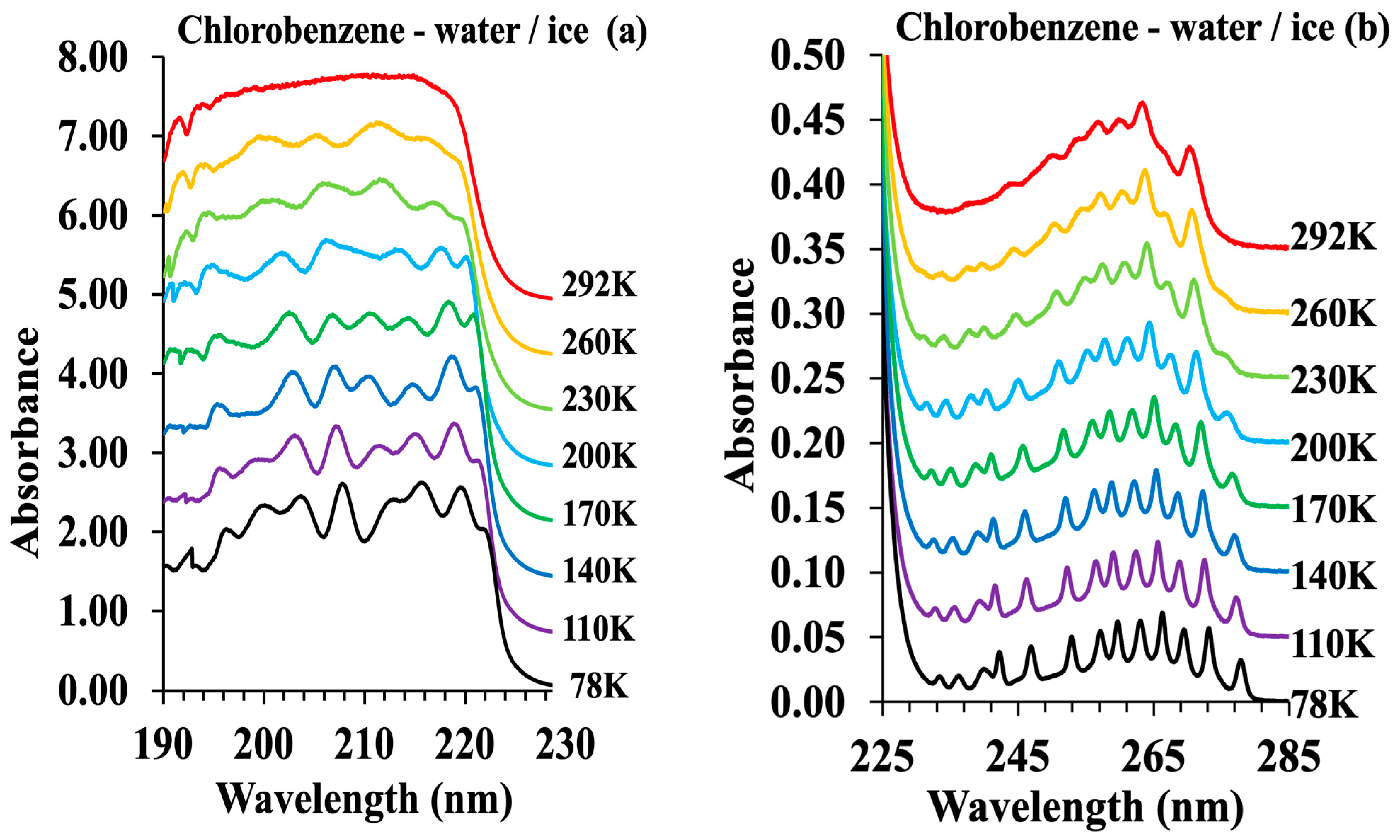
The absorption spectra of chlorobenzene in water–ice are shown in Figure 4a from 190 nm to 290 nm at temperatures ranging from 292 K to 78 K. Figure 4b shows an expanded view of the spectra between 225 nm and 285 nm.
The measurements were taken with the 1 mm pathlength cell and a solution of chlorobenzene in water of concentration 5 × 10⁻⁴ M. The spectra reveal two prominent bands: Figure 4a shows the strong 1A1   1A1 transition that appears in the region from 190 nm to 230 nm. The low-energy transition shown in Figure 4b appears in the range from 230 nm to 290 nm. It is less intense than the high-energy transition and corresponds to the 1B2   1A1 transition. At 292 K, the 1A1   1A1 transition (see Figure 4a) lacks distinct features, displaying a broad, sloping curve towards shorter wavelengths. However, as the temperature decreases, the matrix isolation of chlorobenzene molecules leads to well-defined band peaks. The bands become more prominent and achieve optimal resolution at 78 K, with a strong band feature appearing at 208 nm. This enhancement in spectral resolution can be attributed to the effect of low temperature.
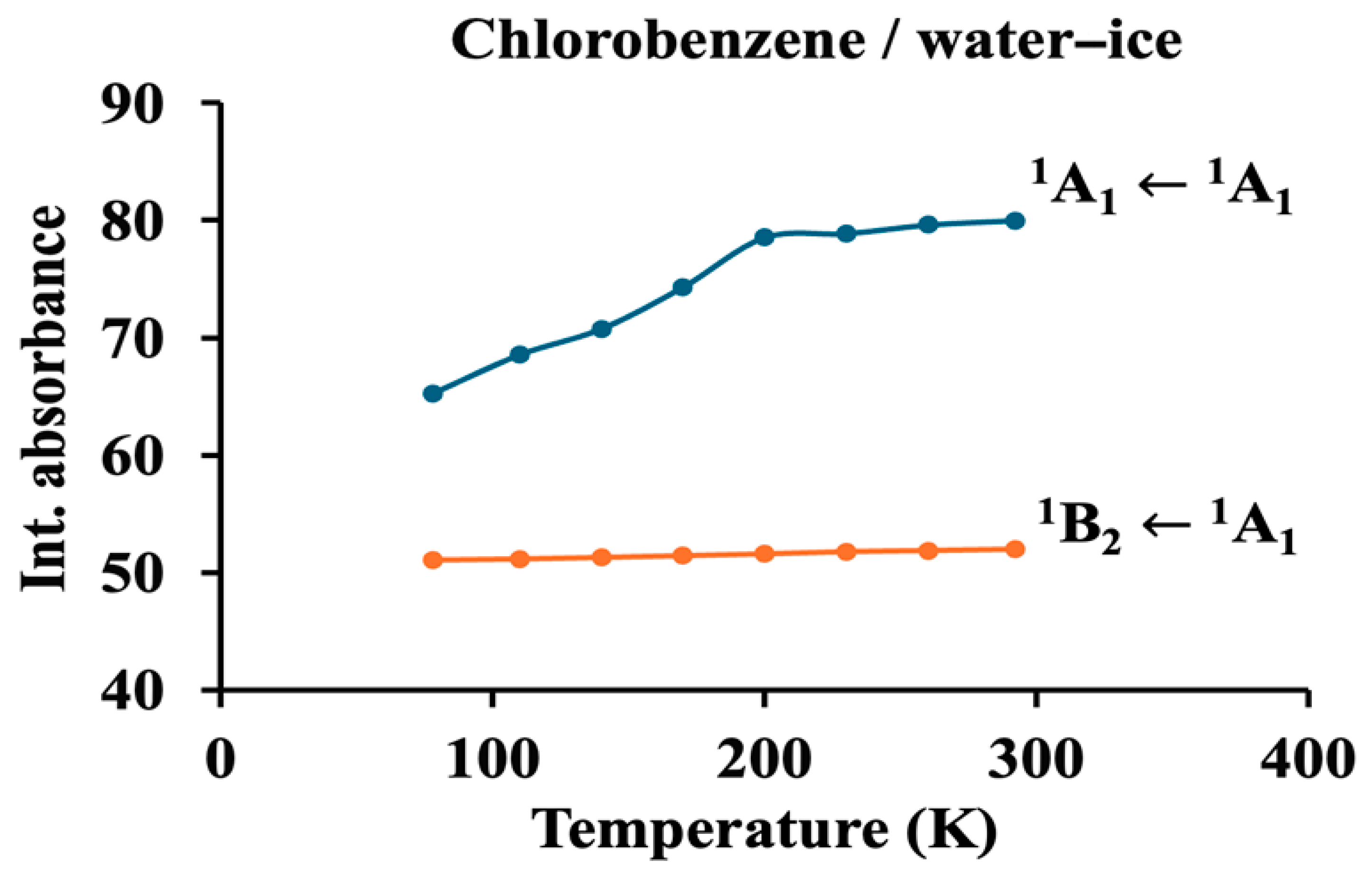
The temperature dependence of the integrated bands is shown in Figure 5, which shows a plot of the integrated band versus the absolute temperature. The band corresponding to the 1A1   1A1 transition is integrated between 190 and 230 nm. The band corresponding to the 1B2   1A1 transition is integrated between 230 and 280 nm. The overall 1A1   1A1 band intensity decreases when the temperature decreases slowly until 200 K, and then more rapidly between 200 K and 140 K. Below 140 K there is a gradual decrease until we reach 78 K. The main change occurs between 200 K and 140 K. The integrated 1B2   1A1 band decreases slowly but, similar to benzene, does not seem to be affected by the temperature change.
Table 2 shows the observed peak positions in wavelength (nm) and wavenumber (cm−1) at 78 K, the difference with respect to the lowest energy that we can measure in absorption, the tentative assignments, and spectroscopic notation for the 1A1   1A1 and 1B2   1A1 transitions. The origin of the 1B2   1A1 transition in the gas phase is around 37048 cm−1 [19,20]. The origin of our transitions is not known but the strong dipole–dipole interaction between chlorobenzene (1.73 D) and water (1.84 D) is expected to lower the potential energy curve with respect to the gas phase origin for both S2 and S1 levels. We use the lowest energy measured in each transition to achieve the progression. The assignments are possible because all vibrational levels of the first excited electronic state (1B2) of chlorobenzene are known. The same vibrational levels are assumed to apply for the second excited electronic state (1A1). The tentative assignments are shown with the magnitude of the individual vibrational frequencies of the excited states [13,16]. The spectroscopic notation for normal modes follows the mode assignment [14,16] and the vibronic transition notation. The analysis of the 1A1   1A1 transition begins with the assignment of the shoulder at (222.35 nm) as the origin. The first peak (219.55 nm) is assigned to the first overtone ( 18 b 0 2 ) of the non-symmetric vibronic transition (18b). It continues with the progression 6 a 0 1 1 0 n (n = 1–7) where (6a) is the symmetric Cl sensitive vibration and (1) is the symmetric ring vibration.
The origin of the 1B2   1A1 transition is assumed to be the lowest energy peak measured at 277.82 nm. The first measured vibration is the ring deformation (6b) at 521 cm−1. The second is the symmetric ring vibration (1) at 931 cm−1. The combination band ( 6 b 0 1 7 a 0 1 ) listed at 1555 cm−1 could also be the C-C stretch mode ( 8 b 0 1 ) at 1564 cm−1. Higher energy assignments involve the progression of the symmetric ring mode ( 1 0 n ) n = 1–7 in combination with ( 7 a 0 1 ), the Cl-sensitive modes ( 12 0 1 ), ( 6 a 0 1 ) and ( 6 a 0 2 ) , and the CC stretch ( 8 a 0 1 ).

4. Discussion

Our temperature dependence study (292 K to 78 K) of benzene/water ice was performed with one concentration (5.0 × 10⁻⁴ M) that corresponds to a composition around 4 × 10⁻⁵ g/g at 200 K. The most recent work on benzene shows three regions that are clearly shown in the study of benzene absorption bands in the vacuum UV and UV regions for gas phase, solid at 90 K, and 25 K [8] and for benzene in water ice with compositions: 1, 0.5, 0.1, and 0.01 solutions (benzene/water ice) at 24 K [2]. As was explained before, there is a strong transition from the ground state (1A1g) to the third singlet state (1E1u) denoted as the 1E1u  1A1g transition. It is symmetry allowed and peaks around 180 nm. The bands that we show in our experiment are symmetry forbidden but appear due to vibronic coupling and intensity borrowing. One is from the ground state to the second singlet state (1B1u), denoted as 1B1u   1A1g. It is at the base of the allowed band (1E1u  1A1g) and borrows intensity from it. Another band (weakest of the three) is from the ground state to the first excited singlet (1B2u) and is denoted as 1B2u   1A1g. The two bands in our study are like the published work at a higher composition and a lower temperature (24 K).
Other investigations refer only to the weakest band (1B2u   1A1g) of vapor phase benzene that were performed in the near ultraviolet region [6,7]. The same absorption was shown for the solid solution of benzene in cyclohexane at 77 K at concentration ≤ 0.01 M [3], reporting detailed analysis of site symmetry, lifetimes, and relative intensities of two different crystal forms of benzene molecules occluded in cyclohexane lattice. Another study shows the (1B2u   1A1g) band of benzene dissolved in various cryogenic liquids investigated intensity, position, and shape of transitions [4].
The chlorobenzene fundamental normal modes of the ground state are known following the measurement of a Fourier transform infrared (FT-IR) spectrum, which utilized synchrotron radiation [18]. As part of a study of Rydberg and ionic states of chlorobenzene, transitions of the valence states are presented showing the spectra and positions of the 1B2 and 1A1 states [11]. Some vibronic transitions of the 1B2   1A1 have been tentatively assigned up to 2000 cm−1, approximately [14]. We present tentative assignments up to 7000 cm−1. To our knowledge, there are no analyses of the transition 1A1   1A1. All the excited state frequencies and mode notations have been reported [14,16,28]. Older spectroscopic studies of chlorobenzene refer to Raman spectroscopy in the gas and liquid phases, providing interpretations of the stronger spectral lines in terms of the modes of vibration [19]. The ultraviolet spectra of chlorobenzene in carbon tetrachloride, chloroform, cyclohexane, n-hexane, ethanol, and water, were obtained in solutions with concentrations ranging between 0.005 and 0.0001 M. Qualitative agreement with the predicted solvent effect according to theory of Bayliss was shown [5]. Solid chlorobenzene spectra around 14 K were obtained and compared with the vapor spectra [29]. Additionally, the near ultraviolet absorption spectrum of gas phase chlorobenzene was observed in the range of pressures 0.1–720 Torr and analyzed finding several progressions involving various totally symmetrical vibrations. The observations resulted in identification of new “allowed” and “forbidden” bands when compared with the absorption spectrum of the solid at 14 K [30].
A comparison of peak shifts and integrated absorbances is shown in Table 3, where the peak maximum values at 292 K and at 78 K, and their shifts as well as integrated areas of the bands at all temperatures, are shown. The position of the maximum of each band is shifted to slightly higher energies for benzene and to lower energies for chlorobenzene at low temperatures.
The surrounding water ice molecules give extra stability to the chlorobenzene molecules lowering each potential energy curve but not as much as for the benzene molecules. The dipole–dipole interaction is responsible for the chlorobenzene–water interaction compared to the weak quadrupole–dipole interaction between benzene and water.
An analysis of plots of integrated area of absorbance versus temperature in water and water–ice solutions in Figure 3, the high energy 1B1u  1A1g and the low energy 1B2u  1A1g for benzene, and in Figure 5 the high energy 1A1   1A1 and the low energy 1B2   1A1 for chlorobenzene with actual values are shown in Table 3. The integrated areas of the benzene–water ice bands 1B1u   1A1g show an increase from 292 K to 200 K. This could be explained using the particle in a box argument. Due to resonance, the 1B1u   1A1g band borrows intensity from the allowed 1E1u  1A1g ring band. By decreasing the temperature the solvent cage volume around benzene decreases, changing the energy levels in a way that decreases the difference in energy between the two states (narrowing the resonance) and borrowing more intensity. Below 200 K the smaller volume of the cage continues, this time separating the levels more gradually, reducing the resonance and the intensity borrowing.
There is a strong band for chlorobenzene equivalent to the 1E1u  1A1g of benzene that has been observed [11,12]. Its assignment has been given [11] as the combination band of 1A1 + 1B2. The resonance between the levels involved in the combination band 1A1 + 1B2 and the A1   1A1 band is optimum at 292 K but the decrease in the solvent cage volume in water–ice at lower temperatures, separates more of the energy levels of the chlorobenzene equivalent to the ring (1E1u) level of benzene and the 1A1 level of chlorobenzene. The A1   1A1 band of chlorobenzene borrows less intensity from the 1A1 + 1B2 combination band. Table 3 also shows that the integrated intensity of chlorobenzene is larger than the integrated intensity of benzene above 170 K. Below that temperature, the trend is reversed.
There is very little change in the integrated intensity of the 1B2u   1A1g band of benzene and the 1B2   1A1 band of chlorobenzene. They both decrease slightly in intensity when the temperature decreases, and the chlorobenzene integrated intensity is always around 2.5 times larger than the integrated intensity of benzene between 292 K and 78 K. The larger integrated intensity of the chlorobenzene band could be the sharpening of the band due to the dipole–dipole interaction of chlorobenzene/water compared to the quadrupole–dipole interaction of benzene/water.
The polar solvent interactions of liquid water at 292 K causes strong solvation shell. Rapid fluctuations in the solvent shell (solvation dynamics) and solute-solvent interactions (like H-bonding) affect the vibrational modes responsible for the vibronic intensity, heavily broadening the 1B1u   1A1g band of benzene and the 1A1   1A1 of chlorobenzene, essentially eliminating the fine structure and preventing clear resolution, making it appear as a broad, featureless band. The 1B2u   1A1g of benzene and the 1B2   1A1 of chlorobenzene, although also vibronically allowed, are less affected, indicating that the vibrational modes couple differently to the water solvation, leading to better resolution of its vibrational features.
The temperatures and choice of crystalline water ice for the determination of the spectra are based on what is presently known about ocean worlds. There is promising information about molecules detected around Enceladus. The molar mass of benzene studied in our research is 78 g/mol. The Cassini spacecraft orbiting around Enceladus obtained data from the Cosmic Dust Analyzer (CDA) and the Ion and Neutral Mass Spectrometer (INMS) aboard. The instruments detected abundant cationic forms of a benzene ring, phenyl ( C 6 H 5 ) + , mass 77) and other aromatic structures [31]. These substances are in the ice grains that constitute the plumes of water erupting from the subsurface ocean of Enceladus rather than from surface contamination or other external sources. The existence of these complex molecules, in conjunction with previous discoveries of hydrothermal silica nanoparticles, strongly indicates the presence of active hydrothermal vents on the ocean floor. These vents facilitate the mixing of materials from the rocky core of Enceladus with the ocean water.
With respect to the selection of crystalline ice versus amorphous ice for our study, the known laboratory work indicates that water ice naturally forms a crystalline structure (hexagonal ice) below 273 K. However, amorphous ice forms when water vapor deposits on surfaces below about 130 K or when crystalline ice is bombarded with energetic protons at low temperatures causing it to lose its organized structure and become amorphous [32]. The same bombardment that produces amorphous surface ice is also responsible for the destruction of molecules that could be mixed with the ice. The molecules experience a brief lifespan because of intense particle bombardment, which gradually deteriorates them [33]. If intact molecules are going to be found, crystalline ice has the highest probability of encapsulating those molecules.
On earth, chlorobenzene is produced in industry that can find their way into the atmosphere and then precipitate in the North pole and the areas of Earth surrounding the North Pole. Chlorobenzene is a precursor of the polychlorinated biphenyls (PCB) [34]. The chlorine atom has lone pairs of electrons that can be delocalized into the ring via resonance (+R effect) [35]. However, the chlorine atom is also highly electronegative and withdraws electron density through its σ bonds (inductive effect, −I). Photolysis of chlorobenzene at >254 nm in liquid water produces almost exclusively phenol derivatives showing an inductive effect [24]. Biphenyl and terphenyl as well as their chlorinated isomers are formed in water ice [23] favoring a resonant effect. The behavior and fate of semi-volatile organic compounds in snow have been reported, summarizing PCB concentrations in the Canadian Arctic, the Agassiz (Canada) ice cap, the Amituk lake (Canada), and the European alps [27]. Our spectroscopic study of chlorobenzene in ice adds information about the levels involved in the absorption of UV radiation.

5. Conclusions

In this paper, the absorption spectra of the aromatic molecules benzene and chlorobenzene were obtained in transparent hexagonal water–ice solutions at temperatures between 273 K and 78 K. The molecules were studied at the same initial concentration (5 × 10⁻⁴ M) in water ice. In general, the larger integrated intensities and frequency shifts in the chlorobenzene bands compared to benzene, could be due to the dipole–dipole interaction of chlorobenzene/water compared to the quadrupole–dipole interaction of benzene/water.
The temperature range of our study covers some of the average temperatures that have been found on the icy moon of Saturn (Enceladus) and the northernmost part of Earth surrounding the North Pole. In Enceladus, intact aromatic molecules are found in crystalline ice. The radiation bombardment that produces amorphous surface ice is also responsible for the destruction of molecules that could be mixed with the ice. PCBs in the arctic zones of Earth could be produced by irradiation of chlorobenzene encapsulated in ice crystals.

Supplementary Materials

The following supporting information can be downloaded at: https://www.mdpi.com/article/10.3390/chemistry8010009/s1, Figure S1: Absorption spectrum of benzene in water-ice from 190 nm to 215 nm at 78 K; Figure S2: Absorption spectrum of benzene in water-ice from 225 nm to 270 nm at 78 K; Figure S3: Absorption spectrum of chlorobenzene in water-ice from 190 nm to 230 nm at 78 K; Figure S4: Absorption spectrum of chlorobenzene in water-ice from 230 nm to 290 nm at 78 K.

Author Contributions

Conceptualization, methodology, validation, formal analysis, review and editing, visualization, supervision, C.E.M. Investigation, data curation, original draft preparation, S.S. All authors have read and agreed to the published version of the manuscript.

Funding

This research received no external funding.

Data Availability Statement

The original contributions presented in this study are included in the article/Supplementary Material. Further inquiries can be directed to the corresponding author.

Acknowledgments

This work was supported by the Baylor University Research Committee and the Vice Provost for Research.

Conflicts of Interest

The authors declare no conflicts of interest.

References

  1. Dawes, A.; Pascual, N.; Hoffmann, S.V.; Jones, N.C.; Mason, N.J. Vacuum ultraviolet photo absorption spectroscopy of crystalline and amorphous benzene. Phys. Chem. Chem. Phys. 2017, 19, 27544–27555. [Google Scholar] [CrossRef] [PubMed]
  2. Dawes, A.; Pascual, N.; Mason, N.J.; Gärtner, S.; Hoffmann, S.V.; Jones, N.C. Probing the interaction between solid benzene and water using vacuum ultraviolet and infrared spectroscopy. Phys. Chem. Chem. Phys. 2018, 20, 15273–15287. [Google Scholar] [CrossRef]
  3. Spangler, J.D.; Kilmer, N.G. Electronic spectra of benzene in cyclohexane at 77°K. J. Chem. Phys. 1968, 48, 698–714. [Google Scholar] [CrossRef]
  4. Bernstein, E.R.; Lee, J. Absorption spectrum of the 2600 Å transition of benzene in cryogenic liquids. J. Chem. Phys. 1981, 74, 3159–3163. [Google Scholar] [CrossRef][Green Version]
  5. Bayliss, N.S.; Hulme, L. Solvent effects in the spectra of benzene, toluene, and chlorobenzene at 2600 and 2000 Å. Aust. J. Chem. 1953, 6, 257–277. [Google Scholar] [CrossRef]
  6. Sponer, H.; Nordheim, G.; Sklar, A.L.; Teller, E. Analysis of the near ultraviolet electronic transition of benzene. J. Chem. Phys. 1939, 7, 207–220. [Google Scholar] [CrossRef]
  7. Garforth, F.M.; Ingold, C.K.; Poole, H.G. Excited states of benzene. Part I. Introductory consideration of some spectral properties of vibrations accompanying electronic transitions of benzene and deuterated benzenes. J. Chem. Soc. 1948, 95, 406–417. [Google Scholar] [CrossRef]
  8. Bernhardsson, A.; Forsberg, N.; Malmqvist, P.A.; Roos, B.O.; Serrano-Andres, L. A theoretical study of the 1B2u and 1B1u vibronic bands in benzene. J. Chem. Phys. 2000, 112, 2798–2809. [Google Scholar] [CrossRef]
  9. Li, J.; Lin, C.K.; Li, X.Y.; Zhu, C.Y.; Lin, S.H. Symmetry forbidden vibronic spectra and internal conversion in benzene. Phys. Chem. Chem. Phys. 2010, 12, 14967–14976. [Google Scholar] [CrossRef]
  10. Pantos, E.; Philis, J.; Bolovinos, A. The extinction coefficient of benzene vapor in the region 4.6 to 36 eV. J. Mol. Spectrosc. 1978, 72, 36–43. [Google Scholar] [CrossRef]
  11. Palmer, M.H.; Ridley, T.; Hoffmann, S.V.; Jones, N.C.; Coreno, M.; de Simone, M.; Grazioli, C.; Zhang, T.; Biczysko, M.; Baiardi, A.; et al. Combined theoretical and experimental study of the valence, Rydberg, and ionic states of chlorobenzene. J. Chem. Phys. 2016, 144, 124302. [Google Scholar] [CrossRef]
  12. Scharping, H.; Zetzch, C. Substituent effects In the VUV absorption spectra of monochlorobenzene and o-, m-, and p-dichlorobenzene. J. Mol. Spectrosc. 1985, 112, 8–17. [Google Scholar] [CrossRef]
  13. Andrejeva, A.; Tuttle, W.D.; Harris, J.P.; Wright, T.G. Assignment of the vibrations of the S, S1, and D+ states of perhydrogenated and perdeuterated isotopologues of chlorobenzene. J. Chem. Phys. 2015, 143, 104312. [Google Scholar] [CrossRef]
  14. Wright, T.G.; Panov, S.E.; Miller, T.A. Vibrational spectroscopy of the chlorobenzene cation using zero kinetic energy photoelectron spectroscopy. J. Chem. Phys. 1995, 102, 4793–4803. [Google Scholar] [CrossRef]
  15. Wilson, E.B., Jr. The normal modes and frequencies of vibration of the regular plane hexagon model of the benzene molecule. Phys. Rev. 1934, 45, 706–714. [Google Scholar] [CrossRef]
  16. Bist, H.D.; Sarin, V.N.; Ojha, A.; Jain, Y.S. The 2699 A electronic band system of chlorobenzene. The in-plane vibrational modes in the excited state. Appl. Spectrosc. 1970, 24, 292–294. [Google Scholar] [CrossRef]
  17. Jain, J.S.; Bist, H.D. The out-of-plane vibrational modes of chlorobenzene in its ground and first singlet excited states. J. Mol. Spectrosc. 1973, 47, 126–133. [Google Scholar] [CrossRef]
  18. Albert, S.; Keppler, K.; Lerch, P.; Quack, M.; Wokaun, A. Synchrotron-based highest resolution FTIR spectroscopy of chlorobenzene. J. Mol. Spectrosc. 2015, 315, 92–101. [Google Scholar] [CrossRef]
  19. Sponer, H.; Kirby-Smith, J.S. The Raman spectra of mono- and dichlorobenzenes. J. Chem. Phys. 1941, 9, 667–672. [Google Scholar] [CrossRef]
  20. Cvitaš, T.; Hollas, J.M. Rotational band contour analysis in the 2700 Å system of chlorobenzene. Mol. Phys. 1970, 18, 101–111. [Google Scholar] [CrossRef]
  21. Spencer, J.R.; Pearl, J.C.; Segura, M.; Flasar, F.M.; Mamoutkine, A.; Romani, P.; Buratti, B.J.; Hendrix, A.R.; Spilker, L.J.; Lopes, R.M.C. Cassini Encounters Enceladus: Background and the Discovery of a South Polar Hot Spot. Science 2006, 311, 1401–1405. [Google Scholar] [CrossRef]
  22. Miller, K.E.; Eigenbrode, J.L.; Freissinet, C.; Glavin, D.P.; Kotrc, B.; Francois, P.; Summons, R.E. Potential precursor compounds for chlorohydrocarbons detected in Gale Crater, Mars, by the SAM instrument suite on the Curiosity Rover. J. Geophys. Res. Planets. 2016, 121, 296–308. [Google Scholar] [CrossRef]
  23. Klán, P.; Alena Ansorgová, A.; Del Favero, D.; Holoubek, I. Photochemistry of chlorobenzene in ice. Tetrahedron Lett. 2000, 41, 7785–7789. [Google Scholar] [CrossRef]
  24. Park, H.-R.; Yang, I.-J.; Kim, M.-S. Photolysis of chlorobenzene in aqueous solution. Bull. Korean Chem. Soc. 1998, 19, 1265–1268. [Google Scholar]
  25. Liu, P.-Y.; Zheng, M.-H.; Zhang, B.; Xu, X.-B. Mechanism of PCBs formation from the pyrolysis of chlorobenzenes. Chemosphere 2001, 43, 783–785. [Google Scholar] [CrossRef]
  26. Saudermann, W. Polychlorierte aromatische verbindungen als umweltgifte. Naturwissenschaften 1974, 61, 207–213. [Google Scholar] [CrossRef] [PubMed]
  27. Herbert, B.M.J.; Villa, S.; Halsall, C.J. Chemical interactions with snow: Understanding the behavior and fate of semi-volatile organic compounds in snow. Ecotoxicol. Environ. Saf. 2006, 63, 3–16. [Google Scholar] [CrossRef]
  28. Imhof, P.; Kleinermanns, K. Dispersed fluorescence spectra of chlorobenzene. Chem. Phys. 2001, 270, 227–236. [Google Scholar] [CrossRef]
  29. Kronenberger, A. Über die Absorption und Lumineszenz von Benzol und Benzolderivaten bei −259°. Z. Phys. 1930, 63, 494–532. [Google Scholar] [CrossRef]
  30. Sponer, H.; Wollman, S.H. Analysis of the near ultraviolet absorption spectrum of monochlorobenzene. J. Chem. Phys. 1941, 9, 816–825. [Google Scholar] [CrossRef]
  31. Postberg, F.; Khawaja, N.; Abel, B.; Choblet, G.; Glein, C.R.; Gudipati, M.S.; Henderson, B.L.; Hsu, H.W.; Kempf, S.; Klenner, F.; et al. Macromolecular organic compounds from the depths of Enceladus. Nature 2018, 558, 564–568. [Google Scholar] [CrossRef] [PubMed]
  32. Famá, M.; Loeffler, M.J.; Raut, U.; Baragiola, R.A. Radiation-induced amorphization of crystalline ice. Icarus 2010, 207, 314–319. [Google Scholar] [CrossRef]
  33. Varnes, E.S.; Jakosky, B.M. Lifetime of organic molecules at the surface of Europa. In Proceedings of the 30th Annual Lunar and Planetary Science Conference, Houston, TX, USA, 15–29 March 1999; Lunar and Planetary Institute: Houston, TX, USA, 1999; p. 1082. [Google Scholar]
  34. Johnke, B.; Menke, D.; Böske, J. WHO Revision of the toxic equivalency factors for dioxins and furans and its impact on the emission of waste incineration plants in Germany. In Newsletter of the WHO Collaborating Center for Air Quality Management and Air Pollution Control; German Environment Agency: Berlin, Germany, 2003; Volume 31, p. 5. [Google Scholar]
  35. Anders Borg, O.; Karlsson, D.; Isomaki-Krondal, M.; Davidsson, J.; Lunell, S. Predissociation of chlorobenzene, beyond the pseudo-diatomic model. Chem. Phys. Lett. 2008, 456, 123–126. [Google Scholar] [CrossRef]
Figure 1. Low temperature cryostat. Temperature thermocouple cable (TC). Schematic of the low temperature cell for absorption measurements. Window holder (C), optical window(W), copper O-ring (Cu).
Chemistry 08 00009 g001
Figure 2. Absorption spectra of benzene in water/ice (a) from 190 nm to 220 nm at temperatures ranging from 292 K to 78 K. (b) Expanded view of the spectra from 220 nm to 280 nm. The bands have been displaced to show individual details at each temperature.
Chemistry 08 00009 g002
Figure 3. Plot of integrated area of absorbance bands versus temperature (K) for a 5 × 10⁻⁴ M benzene in water solution. The band 1B1u   1A1g integrated between 190 and 220 nm. The band 1B2u   1A1g integrated between 225 and 270 nm.
Chemistry 08 00009 g003
Figure 4. Absorption spectra of Chlorobenzene in water–ice (a) from 190 nm to 230 nm at temperatures ranging from 292 K to 78 K. (b) Expanded view of the spectra between 225 nm and 285 nm. The bands have been displaced to show individual details at each temperature.
Chemistry 08 00009 g004
Figure 5. Plot of integrated area of absorbance bands versus temperature (K) for a 5 × 10⁻⁴ M chlorobenzene in water–ice solution. Lines are colored based on transition bands. The band 1A1   1A1 is integrated between 190 and 230 nm. The band 1B2   1A1 is integrated between 230 and 285 nm.
Chemistry 08 00009 g005
Table 1. Benzene in water ice absorption at 78 K. Peak position in wavelength (λ, nm) and wavenumber (σ, cm−1), difference (Diff.) with respect to the origin, tentative assignment (assgs.), and spectroscopic (Spectrosc.) notation.
Benzene Transition 1 B 1 u   1 A 1 g
λ
nm
σ
cm−1
Diff.
cm−1
Tentative assgs.
cm−1
Spectrosc.
notation
192.2552,0164591521 + 4 × 923 + 2 × 238 6 0 1 1 0 4 16 0 2
195.3151,2013776521 + 3 × 923 + 2 × 238 6 0 1 1 0 3 16 0 2
199.7550,0632638521 + 2 × 923 + 2 × 148 6 0 1 1 0 2 ( l a t t ) 0 2
203.0049,2611836521 + 923 + 2 × 238 6 0 1 1 0 1 16 0 2
208.5647,948523521 6 0 1
210.8647,42500origin
Benzene Transition 1 B 2 u   1 A 1 g
λ
nm
σ
cm−1
Diff.
cm−1
Tentative assgs.
cm−1
Spectrosc.
notation
226.8844,0766047521 + 6 × 923 6 0 1 1 0 6
230.0143,47754486 × 923 1 0 6
232.7642,96349345 × 923 + 2 × 238 1 0 5 16 0 2
236.3242,3154286521 + 4 × 923 6 0 1 1 0 4
238.7641,88338544 × 923 1 0 4
241.7641,3633334521 + 3 × 923 6 0 1 1 0 3
244.5140,89728683 × 923 1 0 3
247.2040,4532424521 + 2 × 923 6 0 1 1 0 2
250.0239,99719682 × 923 1 0 2
253.1439,5031474521 + 923 6 0 1 1 0 1
256.1439,0411012923 1 0 1
259.1438,589560521 6 0 1
260.8938,3303012 × 148 ( l a t t i c e ) ( l a t t i c e ) 0 2
262.9638,02900origin
266.9637,459−570−521 6 1 0
Table 2. Chlorobenzene in water–ice absorption at 78K. Peak position in wavelength (λ, nm) and wavenumber (σ, cm−1), difference (Diff.) with respect to the origin, tentative assignment (assgs.), and spectroscopic (Spectrosc.) notation.
λ
nm
σ
cm−1
Diff.
cm−1
Tentative assgs.
cm−1
Spectrosc.
notation
Chlorobenzene Transition 1A1   1A1
192.8551,8546880378 + 7 × 931 6 a 0 1 1 0 7
196.2550,9555981378 + 6 × 931 6 a 0 1 1 0 6
200.1049,9755001378 + 5 × 931 6 a 0 1 1 0 5
203.7049,0924118378 + 4 × 931 6 a 0 1 1 0 4
207.8048,1233149378 + 3 × 931 6 a 0 1 1 0 3
212.9046,9701996378 + 2 × 931 6 a 0 1 1 0 2
215.7546,3501376378 + 931 6 a 0 1 1 0 1
219.5545,5485742 × 287 18 b 0 2
222.3544,97400origin
Chlorobenzene Transition 1B2   1A1
λ
nm
σ
cm−1
Diff.
cm−1
Tentative assgs.
cm−1
Spectrosc.
notation
233.4042,8456848378 + 7 × 931 6 a 0 1 1 0 7
236.3542,31063132 × 378 + 6 × 931 6 a 0 2 1 0 6
239.9541,67556781065 + 5 × 931 7 a 0 1 1 0 5
242.2041,28852911564 + 4 × 931 8 a 0 1 1 0 4
252.9039,54135442 × 378 + 3 × 931 6 a 0 2 1 0 3
257.1538,88828911065 + 2 × 931 7 a 0 1 1 0 2
259.7538,4992502671 + 2 × 931 12 0 1 1 0 2
263.0538,01620191065 + 931 7 a 0 1 1 0 1
266.3037,5521555521 + 1065 6 b 0 1 7 a 0 1
270.8036,928931931 1 0 1
273.2136,603606521 6 b 0 1
277.8235,99700origin
Table 3. Observed band peak positions and peak shifts at 292 K (l) and 78 K (s) in water. Integrated absorbances of the bands at several temperatures (K).
Peak PositionShiftIntegrated Absorbance
CompoundBand292 K
nm
78 K
nm
Δλ
nm
292 (K)260 (K)230 (K)200 (K)170 (K)140 (K)110 (K)78 (K)
C6H61B2u   1A1g253.8253.10.741.8444.9151.0656.6755.7576.4274.3769.55
1B1u   1A1g206.1203.82.321.2621.2621.0120.9220.7820.6220.5020.42
C6H5-Cl1B2   1A1263.4266.3-2.979.9879.6178.8778.5474.3170.7568.5465.23
1A1   1A1199.7203.7-4.051.9851.8851.7751.5951.4451.3051.1851.08
Disclaimer/Publisher’s Note: The statements, opinions and data contained in all publications are solely those of the individual author(s) and contributor(s) and not of MDPI and/or the editor(s). MDPI and/or the editor(s) disclaim responsibility for any injury to people or property resulting from any ideas, methods, instructions or products referred to in the content.