Article

Microwave-Irradiated Eco-Friendly Multicomponent Synthesis of Substituted Pyrazole Derivatives and Evaluation of Their Antibacterial Potential


1
Department of Chemistry, Durban University of Technology, P.O. Box 1334, Durban 4000, South Africa
2
Department of Biotechnology and Food Science, Durban University of Technology, P.O. Box 1334, Durban 4000, South Africa
*
Author to whom correspondence should be addressed.
Chemistry 2025, 7(6), 191; https://doi.org/10.3390/chemistry7060191

Submission received: 3 June 2025 / Revised: 8 September 2025 / Accepted: 9 September 2025 / Published: 1 December 2025
(This article belongs to the Section Medicinal Chemistry)

Abstract

The synthesis of novel pyrazole derivatives (SPDs) and their evaluation for antibacterial potential against Escherichia coli (E. coli), Pseudomonas aeruginosa (P. aeruginosa), Staphylococcus aureus (S. aureus), and Streptococcus pneumoniae (S. pneumoniae) was developed herein. These compounds were obtained via a microwave-assisted eco-friendly multicomponent reaction (MCR) and were characterized for structural confirmation using 1H NMR, 13C NMR, 2D experiments, TOF-MS, and FTIR spectrometry. Antibacterial activity, as measured by minimum inhibitory concentrations (MICs) of SPDs, ranged between 0.212 and 2.50 mg/mL against S. aureus, S. pneumoniae, P. aeruginosa, and E. coli. Compound 4e was the most potent against S. pneumoniae, with an MIC value of 0.0156 mg/mL compared with Amoxicillin’s MIC value of 0.0306 mg/mL. Thus, compound 4e was observed as a potential lead candidate against S. pneumoniae. Further corroboration by molecular docking at the active site of the key penicillin-binding protein (PBP) revealed that the most potent compounds against each organism showed comparable docking scores to those of amoxicillin. In addition, a pharmacokinetics study showed that synthesized SPDs were predicted to be orally bioavailable and non-inhibitors of cytochrome 3A4 and belong to drug classes 4 and 6. Hence, they were suitable for drug development and warrant further studies such as in vitro assays, in silico modeling, DFT studies, and machine learning for drug design.

1. Introduction

Pyrazole compounds are among the most important natural and synthetic components in the pharmaceutical industry. The pyrazole nuclei have an amazing ability to function as structural analogs in biological systems [1] and active pharmacophores [2]. This moiety has enormously contributed to the field of medicinal chemistry and drug discovery because of its unique biological activities. Hence, they are attractive targets in synthetic chemistry [1] with diverse medicinal properties, including antibacterial, antifungal, anticancer, antiviral, anti-cyclooxygenase-2, antitumor, and anti-inflammatory activities [3]. Conventional methods for the preparation of pyrazoles include the reaction of α,β-unsaturated carbonyl compounds with hydrazine, which can then be oxidized to form pyrazoles [4], the condensation of 1,3-diketones with hydrazines [5], the reaction of malononitrile with hydrazines [6], and the [3+2]-cycloaddition reactions of 1,3-dipoles with alkynes all produce pyrazoles [7]. Classical synthesis provides reliable access to heterocyclic compounds in many circumstances; however, they suffer drawbacks, and they are no longer acceptable by modern environmental and safety regulations. Consequently, microwave technology is an alternate method due to its faster, high-yielding capability with better purity [1]. Microwave irradiation (MWI) is beneficial in biologically important N-heterocycle preparation, due to its robustness and low adverse environmental pollutants [8]. MWI paired with multicomponent reactions has made organic synthesis more dynamic and effective. Multicomponent reactions (MCR) are advantageous because they exhibit high atom economy, short reaction times, high yields, low costs, waste minimization [9], and avoidance of complex or tedious purification processes. It is not surprising that synthesis of heterocyclic compounds employing MCRs carried out under MW irradiation frequently benefits from greater yields and increased selectivity [9]. A recent publication by the authors of [10] describes MCRs as a one-operation reaction with three or more reagents in one pot; these are reactions that converge to form a product containing substantial elements from all or most of the atoms of the reagents, and this protocol is clean and does not involve workup and isolation of many intermediates [10].
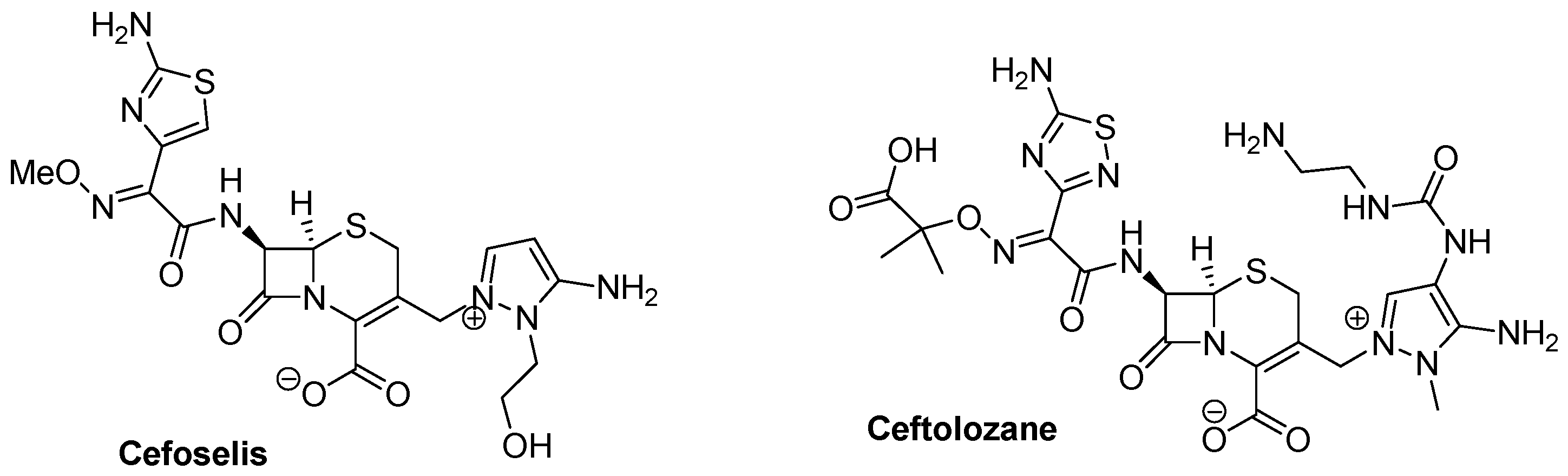
Antibiotics are medications mostly used for bacterial infections, and their excessive consumption has resulted in an alarmingly high level of antimicrobial resistance (AMR), posing a serious global public health threat [11]. As a result, there has been a growing interest in researching novel antibiotic alternatives [10]. Only a few species account for the vast majority of deaths: multi-drug resistant (MDR) E. coli, S. aureus, P. aeruginosa, Klebsiella pneumoniae, Acinetobacter spp., and Enterococcus spp. [12]. Beta-lactam drugs have been used to treat infections caused by these bacteria, and resistance involves multiple mechanisms, including β-lactamase production, which are enzymes that cleave the β-lactam ring and neutralize these antibiotics [13]. Beta-lactams are the most administered drugs, which is particularly concerning and requires urgent attention, given that there is a growing resistance to them now. Cefoselis and ceftolozane (Figure 1) are approved pyrazole-based beta-lactams that are used for treating several bacterial infections. Cefoselis and ceftolozane have a zwitterion structure (Figure 1), which helps them penetrate the outer membrane of Gram-negative bacteria [14]. Cefoselis is a fourth-generation cephalosporin that can cross the blood–brain barrier. Ceftolozane is a fifth-generation cephalosporin, given as a combination of ceftolozane plus tazobactam (beta-lactamase inhibitor) known as Zarbaxa [15], used to treat drug-resistant bacterial infections like methicillin-resistant S. aureus (MRSA), enterobacterales, and P. aeruginosa. Ceftolozane, when combined with tazobactam, is used for urinary tract infections (UTIs), pneumonia, and intra-abdominal infections [14]. Aside from the approved pyrazole-based beta-lactams, a study by the authors of [16] on synthesized pyrazole derivatives displayed promising antibacterial activity on both Gram-positive and Gram-negative organisms, with (E)-N-(4-nitrobenzylidene)-3-(1-oxo-1H-isochromen-3-yl)-5-phenyl-1H-pyrazole-1-carboxamide, in particular, showing salient activity across all bacterial strains. Beta-lactams target the penicillin-binding proteins (PBPs) responsible for cell wall synthesis in bacteria. Mutations in PBPs have limited the potential of several beta-lactams in clinical practice, with the type of PBP being altered in an organism having implications on the severity of resistance [17]. Over the years, the structure characterization of PBPs has identified key PBPs in several organisms, which when modulated, could hinder cell wall synthesis [17]. Among these are PBP2a, in S. aureus [18], PBP3 in P. aeruginosa and E. coli [19,20], and PBP2x in S. pneumoniae [21]. Hence, these targets are promising in identifying active therapeutic molecules that can disrupt cell wall synthesis and subsequent cell death.
Using molecular docking techniques that fit a ligand molecule into the binding pocket of a protein, studies have screened and identified lead molecules against several proteins, including PBPs [22,23]. This study reports a facile methodology through an eco-friendly approach to synthesize known and unknown SPDs and evaluate their antibacterial activities against selected Gram-positive (S. aureus and S. pneumoniae) and Gram-negative (E. coli and P. aeruginosa) bacteria strains. Moreover, the in silico studies will determine the ability of the synthesized SPDs to bind with the active site of the key PBPs of the investigated organisms. Advantages pertaining to water as a solvent are well reported, and they include being non-toxic, non-flammable, eco-friendly, and readily available at low costs, displaying unique reactivity and selectivity through hydrophobic effects [24], which have been well reported [25]. Catalyst-free methods are attractive because they eliminate the need for expensive or toxic catalysts [26], reducing the overall cost of the synthesis process, simplify the purification process, as there is no need to remove catalyst residues [27], and reduce the risk of side reactions that can occur due to catalyst interference, leading to higher selectivity and better yields [27].

2. Materials and Methods

All experiments under microwave irradiation were carried out in a MW Discover CEM 2.0 instrument using modes of operation with simultaneous cooling. The instrument has a maximum power output of 300 W, a maximum temperature of 300 °C, and a maximum pressure of 300 psi. Thin-layer chromatography (TLC) was performed using Merck pre-coated silica gel, and the components were visualized under a UV lamp or an iodine chamber. Isolated product solids were put in crushed ice (500 mL) to quench the reaction, filtered, washed with hexane and water, and recrystallized with ethanol. All the reagents were of analytical grade and obtained from Sigma-Aldrich. Time-of-flight low-resolution mass spectroscopy with electrospray ionization was used to determine masses of 4a4j. Characterization techniques: FTIR spectra were recorded on a Perkin-Elmer FTIR spectrophotometer 65 as KBr pellets, and the absorption was expressed in cm−1. 1H-NMR spectra were recorded in a DMSO 600 MHz, 13C-NMR spectrometer, at 25 °C, with tetramethylsilane (TMS) as the internal standard in 150 MHz, and resonances (δ) are given in ppm. Data are reported as follows: chemical shift, multiplicity (s = singlet, d = doublet, t = triplet, and m = multiplet), coupling constants (Hz), and integration. All pyrazole derivative characterization data are reported in the Supporting Information document, available under this article’s webpage’s “Supplement Content” section.

2.1. Minimum Inhibitory Concentration (MIC) and Antibacterial Sensitivity Assays

To assess the antibacterial properties of the synthesized compounds, the agar well diffusion method was employed [28]. Test organisms (S. aureus ATCC 12600, S. pneumoniae ATCC 49619, P. aeruginosa ATCC BAA-1744, and E. coli ATCC BAA-2452) were standardized to the 0.5 McFarland standard. Using a glass rod, 0.1 mL of the standardized test organisms was evenly inoculated on an already solidified Mueller Hinton agar plate. Thereafter, wells were made on the inoculated plate using a sterile cork borer (6 mm), and synthesized compounds were introduced, using 2% DMSO as a negative control, the dilution medium being deionized water, and amoxicillin as a positive control. After incubation at 37 °C for 24 h, the antibacterial effect was gauged by the appearance of zones of inhibition. Additionally, the minimum inhibitory concentration was determined using the microdilution method [29]; briefly, 0.2 mL of the standardized test organisms was added to a 96-well plate containing 2-fold serial diluted antibacterials (4a, 4b, 4c, 4d, 4e, 4f, 4g, 4h, 4i, and 4j). The MIC was identified as the lowest concentration, preventing bacterial growth after overnight incubation. Amoxicillin served as the positive control.

2.2. Ligand Acquisition, Protein Preparation, and Molecular Docking at Active Site of the Essential Penicillin-Binding Proteins (PBPs) of the Investigated Bacteria

The X-ray crystal structures of PBP2a (6H5O) of S. aureus [15], PBP2x (1QMF) of S. pneumoniae [18], and PBP3 of E. coli (6I1I) [30] and P. aeruginosa (6VJE) [19] were acquired from the Protein Data Bank “https://www.rcsb.org (accessed on 05 February 2024)” and optimized through the removal of non-standard amino acids and water molecules using UCSF chimera software v 1.14 [22]. The cleaned structures were then saved in PDB format for molecular docking. The x-y-z coordinates of the active sites of PBP2a (Center: x: 26.80 y: −4.50 z: 27.04 size: x: 26.41 y: 25.0 z: 28.58), PBP2x (Center: x: 110.48 y: 58.05 z: 79.69 size: x: 23.98 y: 26.01 z: 19.72), and PBP3 of E. coli (Center: x: 27.83 y: 17.07 z: −14.16 size: x: 20.92 y: 13.92 z: 18.94) and P. aeruginosa (Center: x: 5.40 y: 35.27 z: 19.27 size: x: 25.0 y: 20.65 z: 19.22) were defined using Discovery Studio v 21.1.0 [31] and afterward confirmed with respect to the literature [18,19,21,30]. There was no co-crystallized ligand. The synthesized compounds (4a, 4b, 4c, 4d, 4e, 4f, 4g, 4h, 4i, and 4j) were constructed and converted to a 3D format using the ChemDraw Ultra 8.0 and afterward optimized using the open babel program present in Python Prescription v 0.9.5 (PyRx) [32]. Subsequent docking at the active site of the proteins was ensured by dragging the grid box to fit the established, well-defined x-y-z coordinates. Thereafter, the optimized 3D structures of the ligands (4a, 4b, 4c, 4d, 4e, 4f, 4g, 4h, 4i, and 4j, reference amoxicillin) and cleaned proteins (PBP2a of S. aureus, PBP2x of S. pneumoniae, and PBP3 of E. coli and P. aeruginosa) were subjected to molecular docking using the Autodock vina package plug-in on PyRx [32], which allows for multiple docking of ligands [22]. Finally, ranking of the ligands was completed based on their binding affinity, and the docked complexes of the best pose with the highest affinity for the compounds were saved in PDB format. Validation of the docking conformation was carried out using the superimposition techniques and appropriate measurement of the root mean square deviation (RMSD) of the best docked and synthesized compound and amoxicillin from the position of the native inhibitors in each case of the investigated PBPs, and this was completed based on the literature [33,34].

2.3. In Silico Pharmacokinetics and Toxicity Prediction

The in silico predictions of the absorption, distribution, metabolism, excretion, and toxicity (ADMET) properties of the synthesized pyrazoles were studied using online tools SwissADME “http://swissadme.ch/index.php and Protox II https://tox-new.charite.de/protox_II/ (accessed 11 February 2024)”.

3. Results and Discussion

3.1. Chemistry

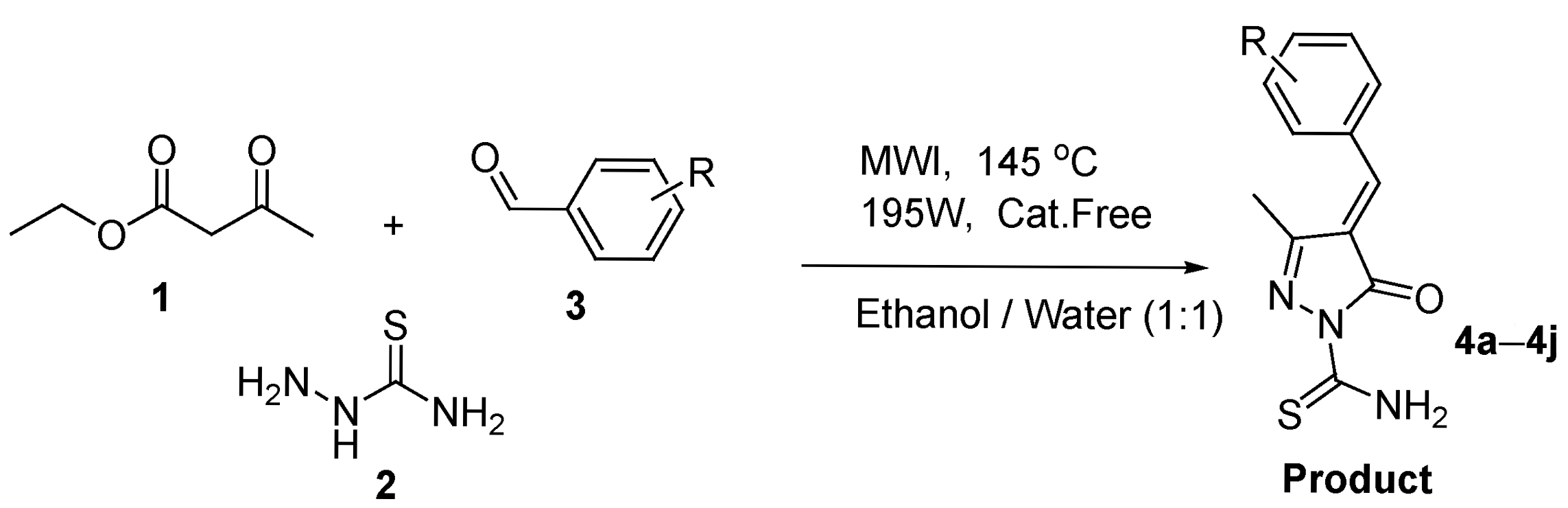
The three-component one-pot synthesis of (4E)-4-arylidene-4,5-dihydro-3-methyl-5-oxopyrazole-1-carbothioamide derivatives was initially investigated under conventional thermal synthesis. Equimolar amounts of ethyl acetoacetate (1), thiosemicarbazide (2), and benzaldehyde (3) were refluxed in ethanol. This approach was inefficient, resulting in low yields, prolonged reaction times, and impure products that required column chromatography for purification (see Table 1). Therefore, the reaction was repeated under microwave irradiation (MWI) by mixing equimolar amounts of 1, 2, and 3, yielding the target SPDs (4a4j), as illustrated in Scheme 1. Compound 4a was previously reported [35] and was a model compound used for optimization. The findings shown in Table 1 represent trial runs to ascertain optimum conditions, and multiple catalysts were tested during optimization, but the best results were achieved under catalyst-free conditions; the choice was judged to be greener than other entries. This choice has eliminated the costs of including a catalyst and the additional process of removing the catalyst in the final stage of the reaction.
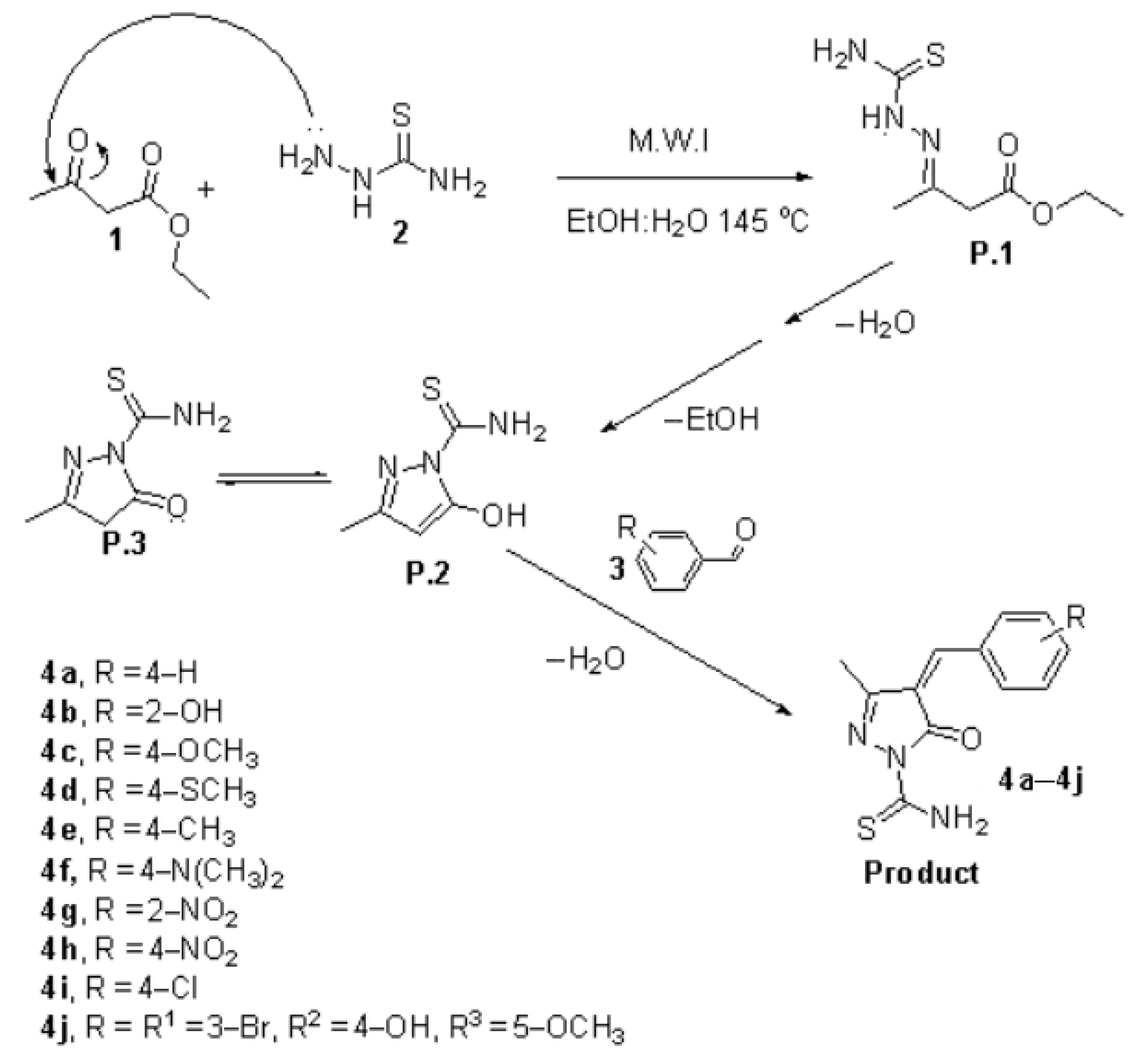
Scheme 1 depicts the plausible mechanism that furnished (4E)-4-arylidene-4,5-dihydro-3-methyl-5-oxopyrazole-1-carbothioamide derivatives. Under thermodynamically controlled conditions and employment of polar protic solvents, ethyl acetoacetate 1 has been envisaged to react with thiosemicarbazide 2 by a Knorr pyrazole synthesis, leading to an intramolecular proton transfer. The lone pair on the terminal amine of thiosemicarbazide 2 facilitates a nucleophilic attack on the carbonyl carbon of ethyl acetoacetate 1 to predominantly form a Schiff-Base P.1 by condensation. This reaction is spontaneous and can be initiated solely by irradiation and without a catalyst. As the reaction progresses, cyclo-condensation occurs, forming the precursor tautomers P.2 and P.3, which are thermodynamically controlled products. The precursor formed in situ reacts with benzaldehyde 3 derivatives and undergoes a Claisen–Schmidt condensation through a series of intramolecular deprotonation–protonation steps that penultimately result in the expulsion of a water molecule and finally forms (4E)-4-arylidene-4,5-dihydro-3-methyl-5-oxopyrazole-1-carbothioamide derivatives (4a4j). All synthesized compounds were characterized and confirmed by spectroscopic techniques, including 1H NMR, 13C NMR, 2D-NMR, FTIR, and TOF-MS, consistent with the proposed structures. The vinylic proton is deshielded by the adjacent phenyl group, causing a downfield shift to 8.0–8.3 ppm. We suggest an E-isomer configuration at the double bond with minimized steric hindrance between the phenyl and the methyl groups. Further experiments would be necessary to unambiguously identify the stereochemistry
The choice of solvent system in this study has proved to play a crucial role in aiding product formation. Table 1 and Scheme 1 for SPD formation illustrates that polar protic solvents play a pivotal role, whilst polar aprotic solvents like dimethyl formamide and dimethyl sulfoxide lack proton affinity. The latter require the presence of a catalyst to furnish SPDs and are regarded as non-green solvents. Entries 1–3 with dimethyl formamide (DMF) and dimethyl sulfoxide (DMSO) solvents have been inefficient, with low yields; entry 1 (32%), entry 2 (22%), and entry 3 turned out slimy, and after a prolonged reaction time, no changes were observed. This entry was discontinued because it did not produce the intended precipitates. On considering green solvents (e.g., water and ethanol) in our trial, entries 4–6 began to show improved results under amino-catalysts, i.e., entry 4 (glycine) and entries 5 and 6 (L-proline). These entries gave moderate-to-good yields in MWI with varying polar protic solvents. Water solvent at 130 °C (entry 4) gave an impressive yield of 63% in just 26 min. For the next trial, entry 5, we adjusted the temperature to 135 °C and changed the solvent to ethanol to ascertain the overall reaction time and yield with a similar catalyst, L-proline. The reaction time was slightly longer (40 min), and the yields were comparable (59%) to entry 4. This finding gave us the idea to combine water and ethanol, since they are miscible, in entry 6 to ascertain the outcome; the temperature was slightly increased for this entry, and the yields obtained were improved to 66%. The polarity of the solvents and the slight temperature increase were observed to influence product yield and make the reaction time short. Ethanol alone at 145 °C gave better yields of 79% in 17 min (entry 7), uncatalyzed. The results of entry 7 provided a basis for us to improve on entry 6,catalyst-free so the solvent combination in this trial (entry 8) was 2:1 ethanol/water, giving excellent yields of 83% in 10 min. When the ethanol of the solvent system was reduced, the yield obtained became 91% under the same conditions, in entry 9. Compound 4a was the candidate for optimization. This study reports the synthesis of known and unknown pyrazole derivatives using a new synthetic approach. Various benzaldehydes furnished our target pyrazole derivatives as depicted in Scheme 2, which resulted in the synthesis of ten novel compounds (4a4j). The presence of electron-withdrawing/electron-donating substitutions did not seem to have any significant limitation on the overall reactivity, providing the desired product in quantitative yields (Table 2).

3.2. Synthesis and Characterization of (4E)-4-Arylidene-4,5-dihydro-3-methyl-5-oxopyrazole-1-carbothioamide Derivatives

Ethyl acetoacetate 1 (130 µL, ~1 mmol) and thiosemicarbazide 2 (0.125 g, ~1 mmol) were added to a 30 mL Pyrex glass tube. The appropriate benzaldehyde (3) was added with a 65 µL volume pipette for liquids (~0.5 mmol) and 0.05 g for solids (~0.5 mmol). The mixture was dissolved in 10 mL of ethanol/deionized water (1:1); then, the tube was inserted into the cavity of the microwave organic synthesizer, where the reaction ran to completion under the conditions of 145 °C, 195 W, and catalyst-free for 10 min (Scheme 2). After the mixture has cooled, a solid precipitate forms, which is then filtered, washed with water and hexane, and dried at room temperature to obtain crystals of all the desired products. After the workup process, the lead compound 4a was isolated as cream-white solids by vacuum filtration with a 91% yield and a 192–194 °C melting point.

3.3. Sample Structural/Spectral Assignment of 4a

FT-IR (KBr, v, cm−1): 3297–3303 (N-H), 3048 (=C-H), 1643 (C=N), 995–1053 (C=S), and 489–554 (C–H aromatic bend) [36,37,38]. The 1H NMR (600 MHz, DMSO); at δ11.44 ppm (2H, s) H2N-C=S; δ2.08 ppm (3H, H5, s) methyl group; at δ8.05 ppm (1H, H4, s) sp2-CH; at δ7.39 ppm (2H, H1′ and H5′, d, J = 7.74 Hz), δ7.79 ppm (2H, H2′ and H4′, t, J = 7.74 Hz). 13C NMR (150 MHz, TMS) and APT; δ142.7 ppm (C4), δ127.7 ppm (C1′ and C5′), δ129.1 ppm (C2′ and C4′), δ130.3 ppm for (C3′) and δ31.13 ppm (C5). TOF-MS ES found [M+], 240.1940 m/z; TOF-MS ES calculated [M+], 245 m/z.
Three quaternary carbon signals had chemical shifts: at δ178.4 ppm for C6, δ206.9 ppm for C3 and C6, which is attributable to electron cloud movement due to mesomeric and resonance effect between C3 and C6, and at δ134.6 ppm for C3a and C5a, respectively. For further verification of compound 4a, a correlation study by 1H-1H coupling COSY and 1H quaternary carbon coupling HMBC (Figures S8 and S9) was performed. A COSY study (Figure S6) presented a strong coupling between protons of H1′ (δ7.39 ppm, 1H, d, J = 7.74 Hz), which correlates to H2′ (δ7.79 ppm, 1H, t, J = 5.2 Hz), and that of H5′ (δ7.39 ppm, 1H, d, J = 7.74 Hz), which correlates to H4′ (δ7.79 ppm, 1H, t, J = 5.2 Hz), respectively. The HMBC spectrum showed a correlation of protons H1′, H2′, H4′, and H5′ coupling with quaternary carbon C5a (δ134.6 ppm). Proton H4 was strongly correlated to the C3a and C5a combination, and other correlations are illustrated in the Supporting Information Data. Looking into all other derivatives, they divulged similar chemical shifts. The structures and characterization are available in the Supporting Information Data document. The mass spectrometry results are reported both as the molecular ion peak [M+] and the molecular ion peak plus sodium [Na + M+] for veracity in the Supporting Information Data document as well.

3.4. Spectral Assignment of 4b4j

  • (4E)-4-(2-hydroxybenzylidene)-4,5-dihydro-3-methyl-5-oxopyrazole-1-carbothioamide 4b
  • Yield is 89% pale lemon solids. M.p 198–201 °C. FT-IR (KBr, v, cm−1): 3302–3333 (NH), 3045 (=C-H), 1593 (C=N), 1003–1083 (C=S), 3423 (C-OH), and 1208 (C-O). The 1H NMR (600 MHz, DMSO); at δ11.34 ppm (2H, s) H2N-C=S; δ8.37 ppm (1H, H4, s) sp2-CH; at δ6.87 ppm (2H, H2′ and H5′, d, J = 8.16); δ7.22 ppm (1H, H3′, t, J = 7.26 Hz); at δ6.81 ppm (1H, H4′, t, J = 7.44 Hz); and -OH δ9.88 ppm (1H, s). 13C NMR (150 MHz, TMS); δ131.5 ppm, δ272.2 ppm, δ119.7 ppm, δ116.5 ppm, δ140.2 ppm, δ116.5 ppm and δ178.1 TOF-MS ES found [Na + M+] 287.0031 m/z; TOF-MS ES calculated [Na + M+] 283.3 m/z.
  • (4E)-4-(4-methoxynzylidene)-4,5-dihydro-3-methyl-5-oxopyrazole-1-carbothioamide 4c
  • Yield is 94% cream white solids. M.p 158–160 °C. FT-IR (KBr, v, cm−1): 3298–3331 (NH), 3049 (=C-H), 1605 (C=N), 1017–1085 (C=S), and 1150 (C-O-C). The 1H NMR (600 MHz, DMSO); at δ11.32 ppm (1H, s) H2N-C=S; δ7.74 ppm (2H, H2′ and H4′, d, J = 8.70 Hz); δ6.96 ppm (2H, H1′ and H5′, d, J = 8.76 Hz); δ3.85 ppm (3H, methoxy, s) and δ8.11 ppm sp2-CH (1H, H4, s). 13C NMR (150 MHz, TMS); δ132.1 ppm, δ129.3 ppm, δ161.2 ppm, δ127.1 ppm, δ115.1 ppm, δ178.1 ppm and δ142.8 ppm. TOF-MS ES found [Na + M+], 297.1531 m/z; TOF-MS ES calculated [Na + M+], 298 m/z.
  • (4E)-4-(4-(methylthio)benzylidene)-4,5-dihydro-3-methyl-5-oxopyrazole-1-carbothioamide 4d
  • Yield is 90% pale grey solids. M.p 210–216 °C. FT-IR (KBr, v, cm−1): 3300–3314 (NH), 3057 (=C-H), 1601 (C=N), 1012–1061 (C=S). The 1H NMR (600 MHz, DMSO); at δ11.40 ppm (1H, s) H2N-C=S; δ2.08 ppm (3H, methyl, s); δ7.73 ppm (2H, H2′ and H4′, d, J = 8.40 Hz); δ7.26 ppm (2H, H1′ and H5′, d, J = 8.26 Hz); δ8.00 ppm (1H, H4, s, sp2-CH). 13C NMR (150 MHz, TMS); δ178.3 ppm, δ206.9 ppm, δ161.3 ppm, δ191.5 ppm, δ129.1 ppm, δ125.9, δ130.4 ppm and δ142.3 ppm. TOF-MS ES found [M+] 290.0000 m/z; TOF-MS ES calculated 291.4 m/z.
  • (4E)-4-(4-methylbenzylidene)-4,5-dihydro-3-methyl-5-oxopyrazole-1-carbothioamide 4e
  • Yield is 91% cream-grey solids. M.p 166–170 °C. FT-IR (KBr, v, cm−1): 3346 (NH), 2916 (-C-H aromatic), 1065–1148 (C=S), 2328–2622 (methyl stretch). The 1H-NMR (600 MHz, DMSO); at δ11.37 ppm (1H, s) H2N-C=S; δ2.08 ppm (3H, methyl H5 and H3″, s); δ7.69 ppm (2H, H2′ and H4′, d, J = 8.10 Hz); δ7.22 ppm (2H, H1′ and H5′, d, J = 7.92 Hz); δ8.01 ppm (1H, H4, s, sp2-CH). 13C NMR (150 MHz, TMS); δ178.3 ppm, δ206.9 ppm, δ140.1 ppm, δ128.7 ppm, δ142.9 ppm, and δ129.9. TOF-MS ES found [M+] 261.1314 m/z; TOF-MS ES calculated 259.3 m/z.
  • (4E)-4-(4-(dimethyamino)benzylidene)-4,5-dihydro-3-methyl-5-oxopyrazole-1-carbothioamide 4f
  • Yield is 92% reddish brown solids. M.p 208–210 °C. FT-IR (KBr, v, cm−1): 3301–3314 (NH), 3046 (=C-H), 1590 (C=N), 995–1079 (C=S), and 1221 (C-O). The 1H NMR (600 MHz, DMSO); δ11.18 ppm (1H, s) H2N-C=S; δ2.96 ppm (3H, H6′, s, N-CH3); δ6.69 ppm (2H, H2′ and H4′, d, J = 8.82 Hz); δ7.59 ppm (2H, H1′ and H5′, d, J = 8.82 Hz) and δ7.92 ppm (1H, H4, s) sp2-CH. 13C NMR (150 MHz, TMS); δ177.5 ppm, δ190.3 ppm, δ143.8 ppm, δ129.1 ppm, δ151.9 ppm, and δ45.8 ppm. TOF-MS ES found [Na + M+], 311.1693 m/z; TOF-MS ES calculated [Na + M+], 312.39 m/z.
  • (4E)-4-(4-nitronzylidene)-4,5-dihydro-3-methyl-5-oxopyrazole-1-carbothioamide 4g
  • Yield is 95% bright yellow solids. M.p 239–241 °C. FT-IR (KBr, v, cm−1): 3302–3332 (NH), 3046 (=C-H), 1540 (C=N), 1015–1086 (C=S), and 1485 (NO-Stretch). The 1H NMR (600 MHz, DMSO); δ11.72 ppm (1H, s) H2N-C=S; δ8.22 ppm (2H, H2′ and H4′, d, J = 8.76 Hz); δ8.09 ppm (2H, H1′ and H5′, d, J = 8.76 Hz); δ8.12 ppm sp2-CH (1H, H4, s). 13C NMR (150 MHz, TMS); δ128.6 ppm, δ124.2 ppm, δ148.5 ppm, δ141.2 ppm, and δ178.9 ppm. TOF-MS ES found [M+] 295.0000 m/z; TOF-MS ES calculated 290.3 m/z.
  • (4E)-4-(2-nitrobenzylidene)-4,5-dihydro-3-methyl-5-oxopyrazole-1-carbothioamide 4h
  • Yield is 87% bright yellow solids. M.p 239–241 °C. FT-IR (KBr, v, cm−1): 3314–3341 (NH), 3055 (=C-H), 1630 (C=N), 1013–1086 (C=S), and 1304 and 1485 (C-NO). The 1H NMR (600 MHz, DMSO); at δ11.74 ppm (1H, s) H2N-C=S; δ8.02 ppm (1H, H2′, d, J = 8.16 Hz); δ8.43 ppm (1H, H3′, t, J = 5.28 Hz); and δ7.73 ppm (1H, H5′, d, J = 7.68 Hz). 13C NMR (150 MHz, TMS); δ130.7 ppm, δ133.7 ppm, δ128.8 ppm, δ137.7 ppm, δ128.7 ppm and δ124.9 ppm, δ148.7, and δ178.9 ppm TOF-MS ES found [M+] 292.1549 m/z; TOF-MS ES calculated 290.3 m/z.
  • (4E)-4-(4-chlorobenzylidene)-4,5-dihydro-3-methyl-5-oxopyrazole-1-carbothioamide 4i
  • Yield is 90% pale grey solids. M.p 190–194 °C. FT-IR (KBr, v, cm−1): 3308–3322 (NH), 3059 (=C-H), 1635 (C=N), 1033–1077 (C=S), and 791 (C-Cl). The 1H NMR (600 MHz, DMSO); at δ11.47 ppm (2H, s) H2N-C=S; δ7.83 ppm (2H, H1′ and H5′, d, J = 8.46 Hz); δ7.44 ppm (2H, H2′ and H4′, d, J = 8.46 Hz). 13C NMR (150 MHz, TMS); δ177.5 ppm, δ141.4 ppm, δ129.4 ppm, δ133.6 ppm, TOF-MS ES found [M+] 279.0753 m/z; TOF-MS ES calculated 279.0 m/z.
  • (4E)-4-(3-bromo-4-hydroxy-5-methoxybenzylidene)-4,5-dihydro-3-methyl-5-oxopyrazole-1-carbothioamide 4j
  • Yield is 96% pale brown solids. M.p 209–211 °C. FT-IR (KBr, v, cm−1): 3310–3333 (NH), 3057 (=C-H), 1624 (C=N), 1013–1088 (C=S), and 3413 and 3499 (C-OH). The 1H NMR (600 MHz, DMSO); at δ11.36 ppm (1H, s) H2N-C=S; δ7.49 ppm (1H, H1′, s); δ7.43 ppm (1H, H5′, s); δ7.91 ppm (1H, H4, s) sp2-CH and -OH δ9.92 ppm (1H, s). 13C NMR (150 MHz, TMS); δ124.8 ppm, δ146 ppm, δ150.3 ppm, δ56.8 ppm, δ110.1 ppm, δ141.8 and δ178.1 ppm, δ148.7, and δ178.9 ppm TOF-MS ES found [M+] 372.0000 m/z; TOF-MS ES calculated 370.2 m/z.

4. Antimicrobial Susceptibility Evaluation of Synthesized Pyrazoles

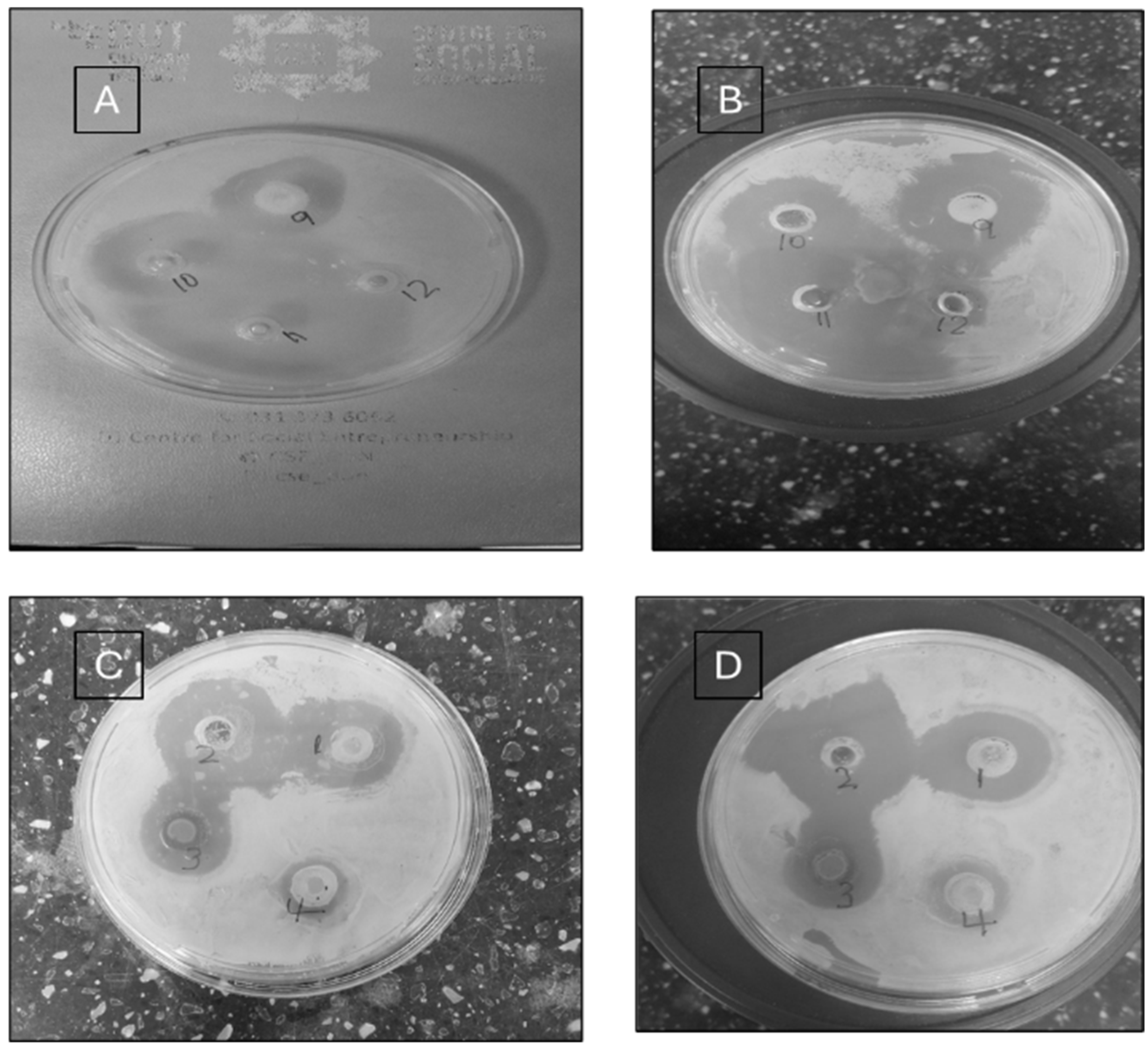
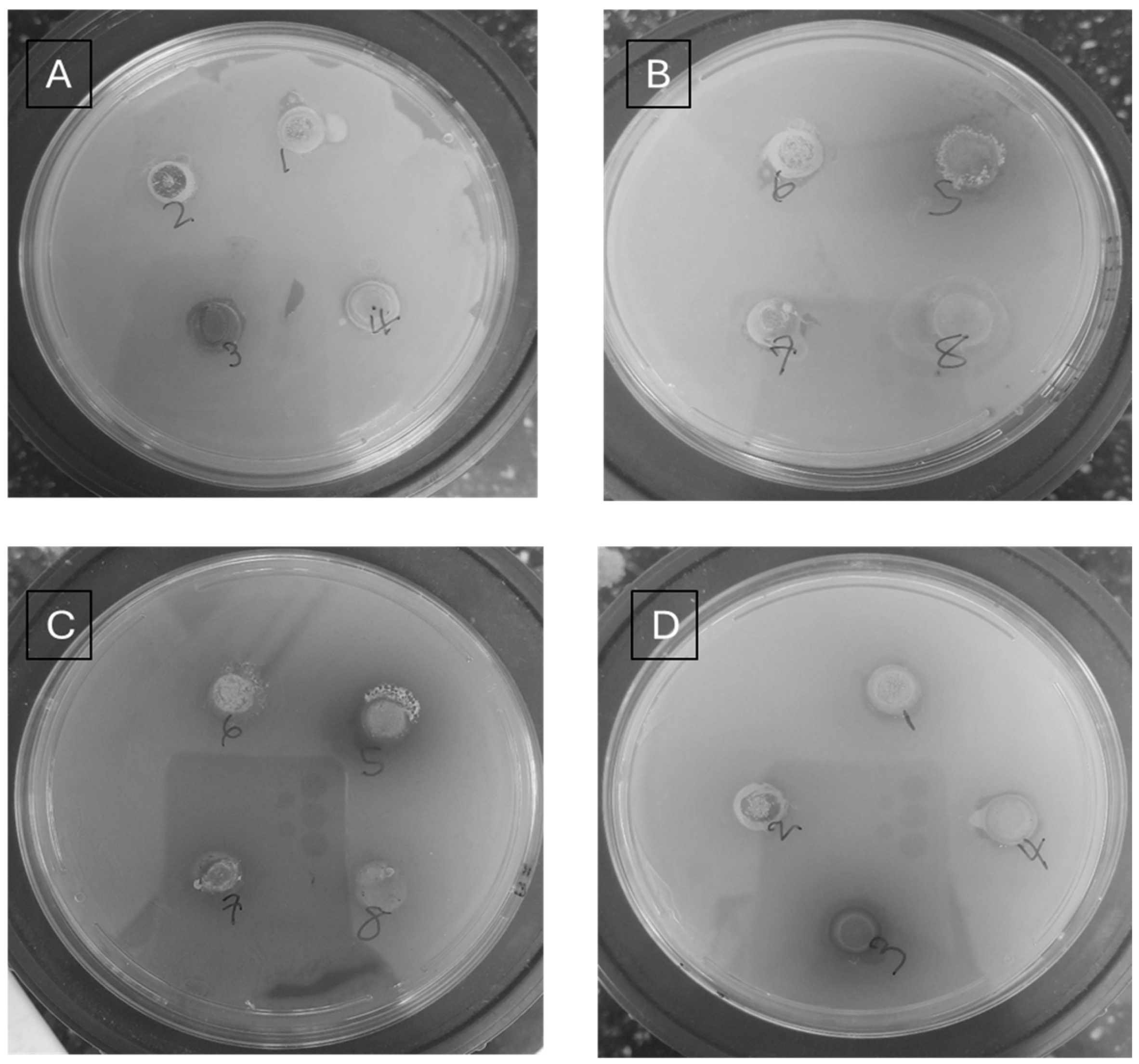
The antibacterial susceptibility testing was evaluated based on the zone of inhibition measured after incubation in Figure 2 and Figure 3. The compounds observed with a zone of inhibition diameter > 8 mm were regarded as active compounds [39]. Three of the synthesized compounds (4d, 4h, and 4g) had no inhibitory effect against the test Gram-negative organisms, suggesting that the organisms might be resistant to the three compounds. Compounds 4a, 4b, 4e, and 4j had higher zones of inhibition relative to amoxicillin (10 mm) against P. aeruginosa, showing 25, 20, 15, and 14 mm, respectively. This observation might suggest superior antibacterial potential of 4a, 4b, 4e, and 4j against P. aeruginosa (Table 3). Amoxicillin tested against S. aureus, S. pneumoniae, and E. coli had higher zones of inhibition of 50 mm, 51 mm, and 32 mm, respectively, compared to the synthesized pyrazoles. Generally, the synthesized pyrazoles had a better antibacterial activity against the Gram-positive organisms compared to the Gram-negative, with compounds 4b (30 and 28 mm) and 4e (25 and 25 mm) having the highest zones of inhibition against S. aureus and S. pneumoniae, respectively (Table 3).

5. Minimum Inhibitory Concentration of Synthesized Pyrazoles Against Test Organisms

The minimum inhibitory concentration (MIC) indicates that, while some compounds (like 4g and 4h, which are only active against Gram-positive bacteria) were strain specific, other compounds (4a, 4c, 4b, 4e, 4f, 4i, and 4j) exhibited a range of antibacterial activity against both Gram-positive and Gram-negative bacteria (Table 4), suggesting their broad-spectrum antimicrobial effects. The differences observed in antibacterial activities between the pyrazoles could be related to the type of substituents in the phenyl ring. A notable observation regards the isomers 4g and 4h, which both contain a nitro group (-NO2) as a substituent on the phenyl ring. The compounds differ in their nitro group placement around the phenyl ring; 4h has an ortho configuration, while 4g has a para configuration. This isomerism might have markedly impacted the antibacterial activity observed between 4g and 4h on the test bacteria. Compound 4h had an MIC of 0.438 mg/mL against both Gram-positive bacteria (S. aureus and S. pneumoniae). On the other hand, no inhibitory effect on Gram-negative bacteria was perceived. Compound 4g, in contrast, did not exhibit any inhibitory effect against both Gram-positive and Gram-negative organisms. These findings highlight the complexity of antibacterial activity within this group of pyrazole derivatives and underscore the need for further investigation to understand the influence of molecular structure on their efficacy. This observation has been noted in a previous study by the authors of [29], who described the nitro group’s behavior as enigmatic.
The MIC results recorded against E. coli for compounds 4e and 4f were 2.50 mg/mL and 1.38 mg/mL, respectively (Table 4); other pyrazole derivatives showed no activity. This observation indicates resistance and a need to incorporate structure–activity relationships (SARs) in our future study of these compounds, where 4e and 4f might be improved for infections caused by E. coli. Comparatively, amoxicillin had better MIC values against E. coli at 0.0306 mg/mL relative to 4e and 4f. Like E. coli, some pyrazole compounds, i.e., 4d, 4g, and 4h, are depicted to have no antibacterial activity against P. aeruginosa, while compounds 4a, 4b, 4c, 4e, 4f, 4i, and 4j had MIC values of 0.170 mg/mL, 0.224 mg/mL, 0.438 mg/mL, 1.25 mg/mL, 1.38 mg/mL, 0.223 mg/mL, and 0.189 mg/mL, respectively (Table 4), with 4a having the best value. Amoxicillin had an MIC value of 0.0765 mg/mL, which is superior to all the derivatives, proving that it has better antibacterial activity. The relatively less antibacterial activity of the pyrazoles against both Gram-negative organisms is due to the membrane structure of Gram-negative bacteria. The latter can function as a barrier that prevents the penetration of antimicrobials [40]. The MIC outcome pertaining to S. pneumoniae showed two compounds, 4c and 4h (Table 4), to exhibit no activity; compound 4e had a better MIC value of 0.0156 mg/mL than amoxicillin (0.0306 mg/mL). This observation highlights the potency of 4e, which is comparable to reference drugs against S. pneumoniae. Other pyrazoles showed poor activity or significantly high MIC values relative to amoxicillin against S. aureus, and only 4h had no activity. The MIC values ranged between 0.212 mg/mL and 0.625 mg/mL, with 4a having better activity against S. aureus.
According to the results obtained, 4e and 4f appeared to be active across all test bacteria, and 4a, 4b, and 4j performed better amongst all pyrazoles, even though their antibacterial activity, including 4e and 4f, can be deemed moderate against test bacteria. The unsubstituted phenyl ring of 4a, parallel to other derivatives like 4b, 4c, 4f, 4g, 4h, 4i, and 4j that contain electron-withdrawing groups on their benzene ring, appeared to have been a better pharmacophore against S. aureus, S. pneumoniae, and P. aeruginosa. Similarly, the presence of an electron-donating group (-CH3) on the benzene ring of 4e was a better pharmacophore against S. pneumoniae. Furthermore, the position of the substituents around the benzene ring might have influenced the activity of the pyrazoles (Table 2); this was perceived with compounds having ortho-phenyl substituents (4b), meta- and para-trisubstituted phenyl analogs (4j), and unsubstituted phenyl compounds (4a), and this structure–activity juxtaposition was assumed probable. These distinctive results structure and activity of 4a4j and may be attributable to the variations in atom size, electronegativity, and polarity of the substituents [40], which influence their interaction with bacterial targets and contribute to the pyrazole pharmacophore’s activity.

6. Docking Scores of Synthesized Pyrazoles Against Essential Penicillin Binding Proteins (PBPs) of Investigated Bacteria and Their Pharmacokinetic Evaluation

Protein-to-ligand interaction was studied by molecularly docking the synthesized pyrazoles at the active site of the essential PBPs of the test organisms [E. coli (PBP3), P. aeruginosa (PBP3), S. aureus (PBP2a), and S. pneumoniae (PBP2x)]. Subsequently, docking scores were recorded for each complex that signified a possible orientation of the ligand at the active site. The conformation with the lowest docking score (highest negative docking score) was considered as the best-docked complex, with a better potential of forming a stable complex. The docking score of all compounds against all the PBPs is shown in Table 5. Protein–ligand interaction performed on the PBP3 enzyme of E. coli considered only 4e and 4f since they were the derivatives that had shown activity against E. coli. Deductions from this observation meant that molecular docking was too preliminary in the identification of active molecules, as reported by earlier studies [41,42]. Thus, further advances in silico study, such as molecular dynamic (MD) simulation, might be required in understanding the dynamics of the interaction of the pyrazoles against PBP3 of E. coli. For the PBP3 enzyme of P. aeruginosa, the docking scores ranged between −6.8 kcal/mol and −7.7 kcal/mol, with compounds 4d and 4e having the highest negative docking scores of −7.7 kcal/mol, respectively, compared to amoxicillin (−7.5 kcal/mol), and 4b (−7.4 kcal/mol) with 4c (−7.5 kcal/mol) having comparable affinity to the reference drug. Although the docking results are only a prediction of the best pose of a ligand on a protein target, further advanced in silico studies, such as MD simulation, are also recommended against the target, PBP3 of P. aeruginosa, for compounds 4d and 4e as potential inhibitors.
The docking scores of PBP2x of S. pneumoniae ranged between −7.2 kcal/mol and −8.1 kcal/mol, with 4e having a better docked score of −8.1 kcal/mol, followed closely by 4h with −7.9 kcal/mol. The observation that compound 4e had the highest negative docking score was consistent with the in vitro results (MIC = 0.0156 mg/mL) of this study, suggesting that an agreement exists between the molecular docking and the in vitro result against S. pneumoniae. This observation further reinforces the potential of 4e as a potential inhibitor of PBP2x of S. pneumoniae. As earlier stated, further MD simulation of the complex (PBP2x-4e) might be necessary to understand the extent of the dynamics, stability, and flexibility over a period of time. For PBP2a of S. aureus, the synthesized pyrazoles had docking scores ranging between −5.5 kcal/mol and −6.6 kcal/mol, with 4e having the highest negative docking scores again. This observation indicates the better potential of 4e as an inhibitor of PBP2a. The docking scores of the pyrazoles were relatively lower than PBP2a, relative to other investigated PBP targets of test bacteria. Nonetheless, compounds 4b, 4d, 4g, 4i, and 4j had docking scores of −5.5 kcal/mol, comparable to amoxicillin. Compounds 4c and 4h, with a score of −6.0 kcal/mol, had better poses in the cavity of PBP2a than amoxicillin.
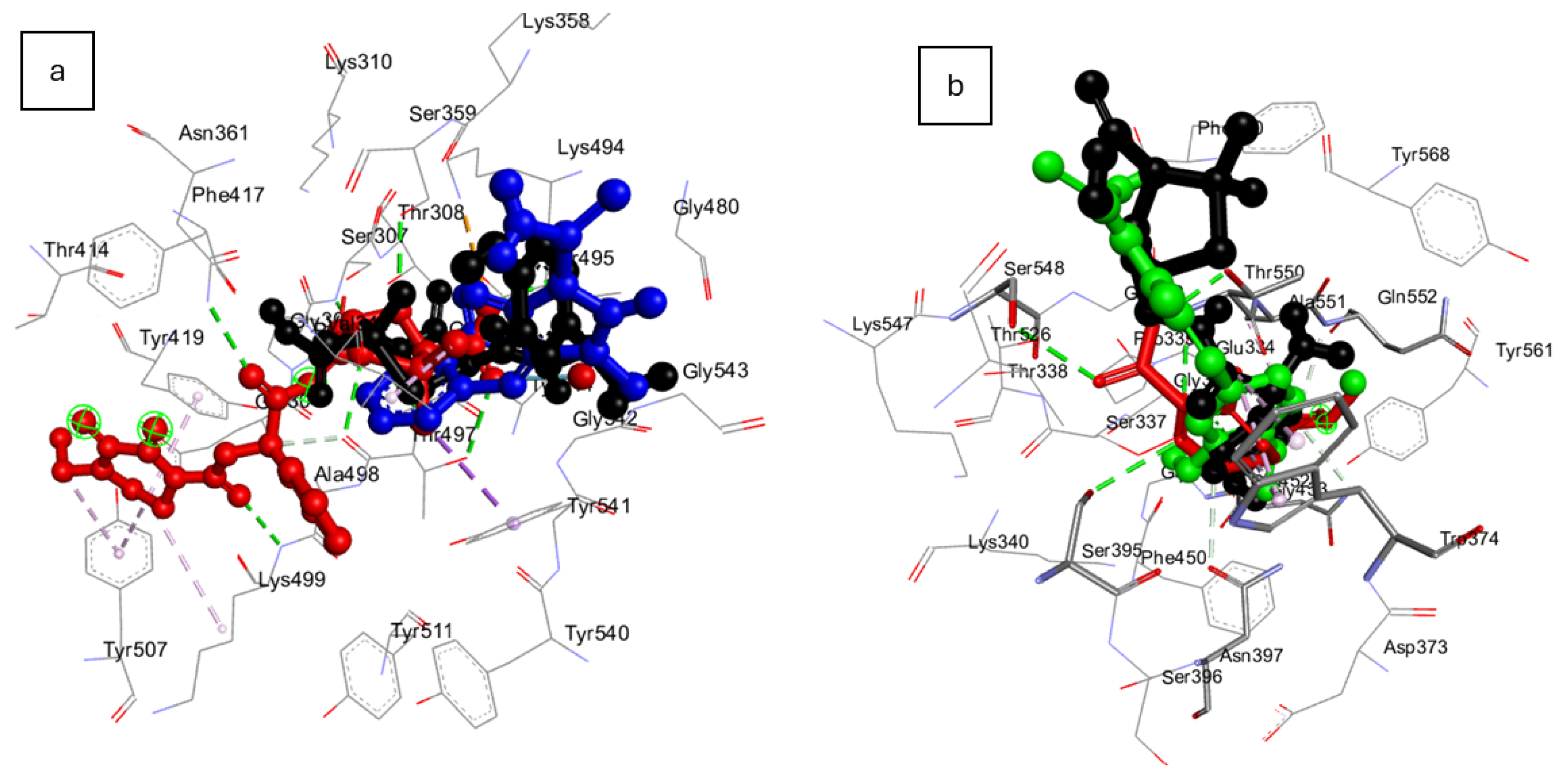
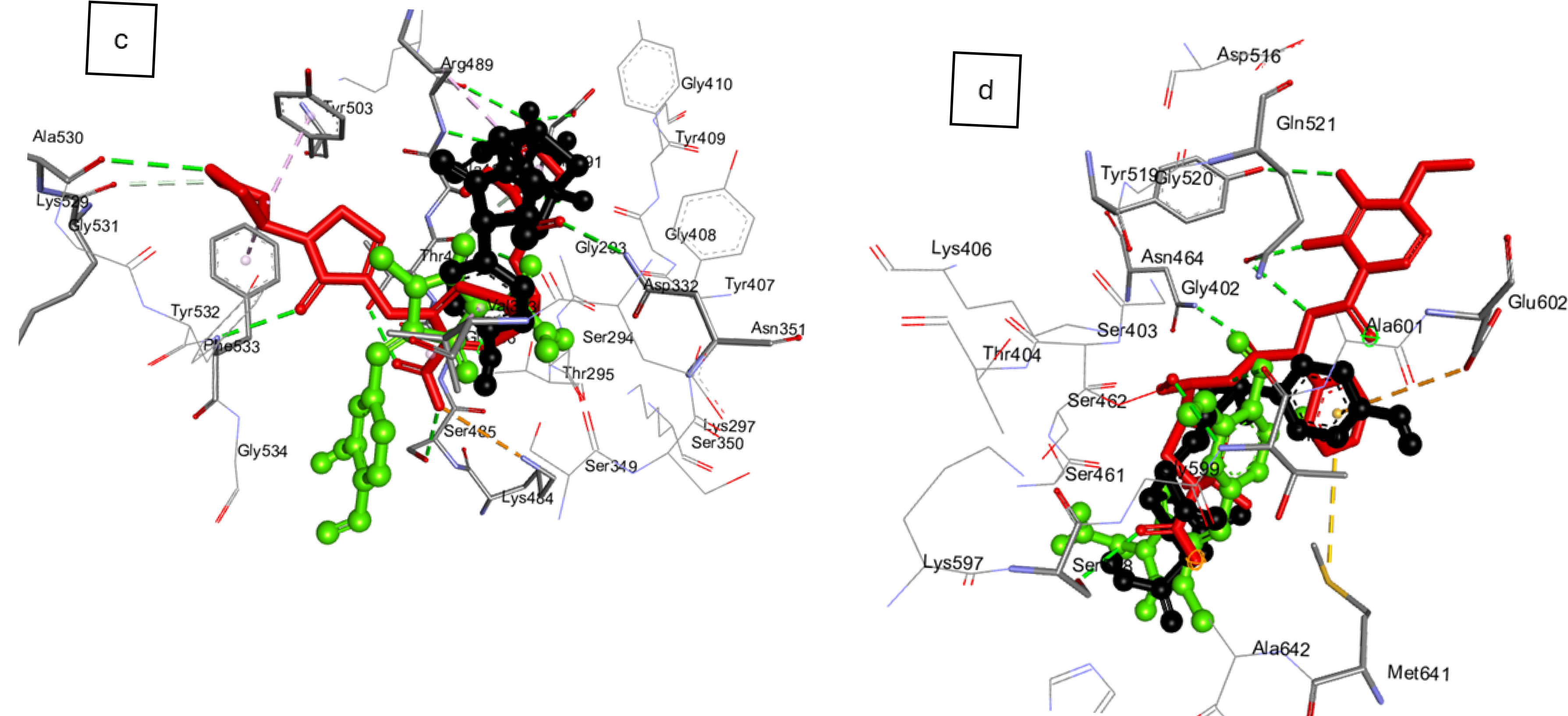
We investigated the validity of the docking protocol employed in the study. The superimposition techniques employed showed that relative partial binding positions (RMSD: 2 Å) exist for the best docked synthesized pyrazole (4f against PBP3 of E. coli and 4e against other investigated PBPs) and amoxicillin, at the native ligand position of all the investigated PBPs [PBP3 of E. coli, PBP3 of P. aeruginosa, PBP2x of S. pneumoniae, and PBP2a of S. aureus] (Figure 4). Despite the partial binding position, the best docked synthesized pyrazoles and amoxicillin were observed to interact with active site amino acid residues that have been reported in previous studies, such as Lys310, Asn361, Ser359, and Ser307, Thr308 in PBP3 of E. coli [20,22], Ser548, Ser337, Gln552, Ser396, Thr550, and Lys547 in PBP2x of S. pneumoniae [21], Ser294, Tyr503, Arg489, and Ser349 in PBP3 of P. aeruginosa [19], and Ser462, Thr404, Ser403, Gly402, and Asn464 in PBP2a S. aureus [18] (Figure 4). These observations are suggestive of the reliability of the docking score observed in this study. This study had drawbacks, however, in that, before attempting empirical results, a preliminary protocol computational investigation, such as by using density functional theory (DFT), the structure–activity relationship (SAR), and the quantity structure–activity relationship (QSAR), needed to be appraised. A variety of synthetic derivatives should have been completed as well. Bacterial strains provided for the study limited the comprehensive antibacterial results of pyrazole derivatives, so in the future, more microorganisms need to be evaluated.

7. Pharmacokinetics and Toxicology Evaluation of Synthesized Pyrazoles

It has become essential to develop lead compounds that can be orally absorbed and transported to the desired site of action and cannot be converted into toxic metabolites before reaching the target and excreted, preventing the accumulation of sufficient quantities to cause adverse side effects [43]. Thus, the pharmacokinetics of lead compounds, that is, their ADMET (absorption, distribution, metabolism, excretion, and toxicity), have to be appraised. The in silico prediction of the ADMET characteristics of a compound provides insights into the compound’s in vivo medicinal friendliness, oral bioavailability, and relative toxicity when used as a drug [42,44]. Lipinski’s rule of five (LRo5) was considered for the determination of drug-likeness of the studied pyrazoles because of its wide application and accuracy [45]. Lipinski’s rule describes an orally accessible molecule as having a MolWt ≤ 500, HBDs ≤ 5, HBAs ≤ 10, log P(o/w) ≤ 5, and RTBs ≤ 5, as seen in Table 6, which represents the molecular weight (MolWt), hydrogen donor (HBD), hydrogen acceptor (HBA), octanol/water partition coefficient (log P(o/w)), and rotatable bonds (RTBs) of a bioactive drug, respectively. The evaluated pyrazole compounds all adhered to the LRo5, revealing that they can be considered as orally bioavailable drug candidates (Table 6). This indicates that, after administration, these compounds can actively diffuse from the lumen of the gastrointestinal (GI) tract to the lumen of the vasculature, where they can circulate through the blood system at a high enough concentration to induce therapeutic effects [42]. In Table 7, the bioavailability score (BS) of 55% for all the pyrazole compounds was predicted, which may imply that 45% of the drug is lost due to the First Pass Effect, which is the liver metabolizing a drug before it enters the bloodstream and reaches its site of target [46]. The bioavailability predicted could be improved by other means of administration, like sublingual, intravenous, and intramuscular; all these avoid the drug passing through the liver. The bioavailability of drugs can be significantly affected by various biological processes occurring in the body, such as gastric acidity, organ blood flow, digestive enzyme activity, and intestinal microflora [46]. The high (GI) tract absorption of the pyrazoles was predicted to be the same as that of amoxicillin as well (Table 7).
The Log P ≤ 5 parameter of LRo5 is a crucial factor in determining the bioavailability of a compound. A Log P > 5 corresponds to a high lipophilic substance that will likely produce undesirable drug effects that promote nonspecific plasma protein binding, poor water solubility, and blood–brain barrier (BBB) penetration, reducing the chances of a drug reaching targeted sites [47]. The BBB is critical to the maintenance of brain homeostasis, as it regulates the entry of macromolecules, small lipophilic molecules, ions, and neurotransmitters from the blood to the brain [48]. Thus, crossing the BBB for non-CNS (Central Nervous System) disease may cause neurotoxicity and brain damage. Studies have indicated that compounds with moderate lipophilicity oscillating around 2 show optimal abilities to reach molecular targets [47,49]. In this regard, the pyrazoles showed better bioavailability (Table 6), as their Log P oscillated between 1 and 2.5 compared to amoxicillin, which is partitioning close to an aqueous phase, as observed in Table 6, given its negative value [50].
Amoxicillin was predicted to have an LD50 of 15 g/kg, signifying the safety of consumption. This was shown by the toxicity class (TC) level 6, characterized as best taken orally and non-toxic, with very negligible adverse effects (Table 7). Compound 4f was also predicted to have a toxicity class of 6, with an LD50 of 5.4 g/kg; this result underscores further safety profiling, like studying its side effects and performing in vivo screening. Other pyrazole compounds were all predicted to belong to a TC 4 [harmful if swallowed (300 < LD50 ≤ 2000)] with variable LD50 values, recommending that oral administration is infeasible. However, other routes of administration, like buccal, sublingual, intramuscular, or even intravenous, may be viable to curb many unnecessary adverse effects. Predicting toxicity classes (e.g., hepatotoxicity, cardiotoxicity, and nephrotoxicity) helps pharmaceutical companies eliminate high-risk drug candidates early, reducing costly late-stage failures. All studied pyrazoles were predicted not to have any affinity for BBB permeability and no P-glycoprotein binding, which indicates that they can travel through the system without being impeded by nonspecific enzymes and tissues, thus achieving their desired pharmacological effects.
In Table 8 is information highlighting the major enzyme cytochrome P450, usually found in the kidneys, the liver, and some intestines responsible for drug metabolism [23]. Metabolism is imperative in pharmacokinetics because it involves the biotransformation of an active drug to an inactive form. Biotransformation is aided by cytochrome P450 isoenzymes [51]. Compound 4g was predicted not to inhibit any of the cytochrome (CYP) isoenzymes like amoxicillin, suggesting its advantage over other pyrazole compounds, i.e., that it does not result in drug toxicity [42]. Only compound 4e had the ability to inhibit CYP 3A4, an isoenzyme implicated in more than 60% of drug metabolism [23]. CYP P450 enzymes metabolize many drugs through oxidation, reduction, or hydrolysis [52]. CYP450 enzymes can either be induced or inhibited by various drugs and substances, which results in drug interactions that lead to toxicity or a reduction in the therapeutic effect [53]. None of the pyrazole compounds seemed to inhibit CYP 6. Only two compounds, which were 4g and 4j, including amoxicillin, are non-inhibitors of CYP1A2 (Table 8). Further investigations are needed to optimize the synthesized pyrazoles for therapeutic use.
In drug discovery, mutagenicity is an issue that needs to be avoided [54]. Potentially mutagenic impurities are likely to be formed in any drug substance, since their synthesis requires reactive intermediates which may also react with DNA [55]. Evidence of mutagenic activity may indicate that a chemical substance has the potential to encourage carcinogenic effects [55]. In therapeutic agents, carcinogenicity is strongly correlated with mutagenicity. Mutagens are agents that cause an increase in the frequency of DNA modifications or mutations [56], and this may lead to tumors. In this study, 4h and 4g being isomers gave different probable adverse effects. 4h having a nitro-group attached at the ortho position was predicted to be potentially both carcinogenic and mutagenic. Whereas 4g with its nitro-group attachment is at the para position and was predicted to be potentially carcinogenic (Table 9). The nitrogen dioxide substituent has been reported to potentially be an active carcinogen and/or mutagen [57]. These recognized mutagenic groups/scaffolds can be detected by in silico studies in early drug design, by guiding medicinal chemists in modifying the core structures of mutagenic compounds to non-mutagenic compounds [55]. The rest of the pyrazole derivatives were undetected as active or threats as carcinogens or mutagens. Immunotoxicity is an adverse effect shown by foreign substances or drugs on the immune system [58]. Only compound 4j (Table 9) showed an active immunotoxicity outcome, and the rest of the pyrazole derivatives were inactive. The degree to which a substance can cause damage to a cell (cytotoxicity) was also predicted, and none of the studied pyrazoles are cytotoxic. None of the pyrazoles in this study were shown to be hepatotoxic as well. Hence, they are safe and have no affinity for damaging the liver, which was substantiated by the CYP 450 enzyme outcome in Table 8.

8. Conclusions

This study presented an efficient, eco-friendly method for synthesizing (4E)-4-arylidene-4,5-dihydro-3-methyl-5-oxopyrazole-1-carbothioamide derivatives (4a4j) using a one-pot, microwave-assisted approach, which drastically improved reaction times, increased product yields (87–96%), and minimized purification requirements. The method performed well in an ethanol–water (1:1) solvent system, without using a catalyst. The optimized approach offered a rapid, green pathway to high-purity pyrazole derivatives. Structural confirmation of pyrazoles was verified by 1H-NMR, 13C-NMR, 2D-NMR, TOF-MS, and FTIR spectrometry, with consistent results across all derivatives.
In summary, the synthesized pyrazoles were observed to have different antibacterial activities against bacteria. While some pyrazoles (4d and 4h active only against Gram-positive bacteria) were strain-specific, others (4a, 4c, 4b, 4e, 4f, 4i, and 4j) exhibited a range of antibacterial activity against bacteria. Notably, among the derivatives, compounds 4f and 4e showed poor-to-moderate activity against E. coli, and compounds 4a, 4b, and 4j were poor-to-moderately active as well against P. aeruginosa, S. pneumoniae, and S. aureus, respectively, indicating they are potentially broad-spectrum agents, including 4f and 4e. Amoxicillin generally exhibited superior activity across all tested bacterial strains and was comparable in activity to 4e against S. pneumoniae. Docking studies at the active sites of key PBPs of the investigated bacteria showed variable affinities of pyrazole scaffolds as potential PBP inhibitors. However, further MD simulation of the derivatives is recommended to study their stability and compactness over time.
Interestingly, all derivatives were observed to be orally bioavailable, as they all adhere to the LRo5. The pyrazoles had a BS and were predicted to have a high GI tract also. In terms of toxicity and safety profile, pyrazoles belong to TC 4, suggesting an alternative administration route to reduce toxicity; however, 4f shared the same safety of oral administration as amoxicillin (TC 6). Computational models can prioritize safer compounds before in vivo testing, minimizing harm to trial participants. These results underscore the promise of these pyrazoles in antibacterial treatment and the importance of continued research to optimize their effectiveness. Future studies are warranted to decipher the intricate mechanisms at play and to harness the full therapeutic potential of the pyrazole derivatives.

Supplementary Materials

The following supporting information can be downloaded at: https://www.mdpi.com/article/10.3390/chemistry7060191/s1. Figure S1: IR Spectrum of 4a; Figure S2: 1H NMR spectrum for compound 4a; Figure S3: Expanded 1H NMR spectrum for compound 4a; Figure S4: 13C NMR spectrum for compound 4a; Figure S5: APT of compound 4a; Figure S6: 1H–1H COSY of compound 4a; Figure S7: Expanded HSQC diagram of compound 4a; Figure S8: Expanded HMBC diagram of compound 4a; Figure S9: HMBC diagram of compound 4a; Figure S10: Time of Flight-Mass Spectrometry for compound 4a; Figure S11: IR spectrum of 4i; Figure S12: 1H NMR spectrum for compound 4i; Figure S13: 13C NMR spectrum for compound 4i; Figure S14: Time of Flight-Mass Spectrometry of compound 4i; Figure S15: IR spectrum of 4b; Figure S16: 1H NMR spectrum for compound 4b; Figure S17: 13C NMR spectrum for compound 4b; Figure S18: Time of Flight-Mass Spectrometry of compound 4b; Figure S19: IR Spectrum of 4f; Figure S20: 1H NMR spectrum for compound 4f; Figure S21: 13C NMR spectrum for compound 4f; Figure S22: Time of Flight-Mass Spectrometry of compound 4f; Figure S23: IR spectrum of 4h; Figure S24: 1H NMR spectrum for compound 4h; Figure S25: 13C NMR spectrum for compound 4h; Figure S26: Time of Flight-Mass Spectrometry for compound 4h; Figure S27: IR spectrum of 4j; Figure S28: 1H NMR spectrum for compound 4j; Figure S29: 13C NMR spectrum for compound 4j; Figure S30: Time of Flight-Mass Spectrometry for compound 4j; Figure S31: IR spectrum of 4c; Figure S32: 1H NMR spectrum for compound 4c; Figure S33: 13C NMR spectrum for compound 4c; Figure S34: Time of Flight-Mass Spectrometry for compound 4c; Figure S35: IR Spectrum of 4g; Figure S36: 1H NMR spectrum for compound 4g; Figure S37: 13C NMR spectrum for compound 4g; Figure S38: Time of Flight-Mass Spectrometry for compound 4g; Figure S39: IR Spectrum of 4d; Figure S40: Expanded 1H NMR spectrum for compound 4d; Figure S41: 1H NMR spectrum for compound 4d; Figure S42: 13C NMR spectrum for compound 4d; Figure S43: Time of Flight-Mass Spectrometry for compound 4d; Figure S44: IR Spectrum of 4e; Figure S45: Expanded 1H NMR spectrum for compound 4e; Figure S46: 1H NMR spectrum for compound 4e; Figure S47: 13C NMR spectrum for compound 4e; Figure S48: APT of compound 4e; Figure S49: Time of Flight-Mass Spectrometry for compound 4e.

Author Contributions

All authors contributed equally. All authors have read and agreed to the published version of the manuscript.

Funding

We acknowledge the financial assistance from the National Research Foundation (NRF) PMDS22051611215, South Africa, Grant number (129965), and the Durban University of Technology. We would also like to express that the views and opinions are those of the authors and not those of the funders.

Data Availability Statement

The original contributions presented in this study are included in the article/supplementary material. Further inquiries can be directed to the corresponding authors.

Conflicts of Interest

The authors declare no potential conflicts of interest. We would like to declare that only compound 4i has been found to have been reported before for synthesis only, but there is no data indicating that other derivative SPDs have been reported for both synthesis and biological activities.

References

  1. Kaur, N. Benign Approaches for the Microwave-assisted Synthesis of Five-membered 1,2-N,N-heterocycles. J. Heterocycl. Chem. 2015, 52, 953–973. [Google Scholar] [CrossRef]
  2. Karrouchi, K.; Radi, S.; Ramli, Y.; Taoufik, J.; Mabkhot, Y.N.; Al-Aizari, F.A.; Ansar, M. Synthesis and Pharmacological Activities of Pyrazole Derivatives: A Review. Molecules 2018, 23, 134. [Google Scholar] [CrossRef]
  3. Turkana, F.; Cetin, A.; Taslimic, P.; Karamand, M.; Gulçinc, I. Synthesis, biological evaluation and molecular docking of novel pyrazole derivatives as potent carbonic anhydrase and acetylcholinesterase inhibitors. Bioorg. Chem. 2019, 86, 420–427. [Google Scholar] [CrossRef] [PubMed]
  4. de la Hoz, A.; Alkorta, I.; Elguero, J. The mechanism of the reaction of hydrazines with α, β-unsaturated carbonyl compounds to afford hydrazones and 2-pyrazolines (4,5-dihydro-1H-pyrazoles): Experimental and theoretical results. Tetrahedron 2021, 97, 132413. [Google Scholar]
  5. Fustero, S.; Simón-Fuentes, A.; Sanz-Cervera, J.F. Recent Advances in the Synthesis of Pyrazoles. A Review. Org. Prep. Proced. Int. 2009, 41, 253–290. [Google Scholar] [CrossRef]
  6. Faisal, M.; Saeed, A.; Hussain, S.; Dar, P.; Larik, F.A. Recent developments in synthetic chemistry and biological activities of pyrazole derivatives. J. Chem. Sci. 2019, 131, 70. [Google Scholar] [CrossRef]
  7. Neto, J.S.S.; Zeni, G. Alkynes and Nitrogen Compounds: Useful Substrates for the Synthesis of Pyrazoles. Chem. A Eur. J. 2020, 26, 8175–8189. [Google Scholar] [CrossRef]
  8. Henary, M.; Kananda, C.; Rotolo, L.; Savino, B.; Owens, E.; Cravotto, G. Benefits and applications of microwave-assisted synthesis of nitrogen containing heterocycles in medicinal chemistry. RSC Adv. 2020, 10, 14170–14197. [Google Scholar] [CrossRef]
  9. Sapkal, A.; Kamble, S. Greener and Environmentally Benign Methodology for the Synthesis of Pyrazole Derivatives. ChemistrySelect 2020, 5, 12971–13026. [Google Scholar] [CrossRef]
  10. Marinho, E. One-Pot Reactions of Triethyl Orthoformate with Amines. Reactions 2023, 4, 779–800. [Google Scholar] [CrossRef]
  11. Tavares, T.D.; Antunes, J.C.; Padrão, J.; Ribeiro, A.I.; Zille, A.; Amorim, M.T.P.; Ferreira, F.; Felgueiras, H.P. Activity of Specialized Biomolecules against Gram-Positive and Gram-Negative Bacteria. Antibiotics 2020, 9, 314. [Google Scholar] [CrossRef]
  12. Kakoullis, L.; Papachristodoulou, E.; Chra, P.; Panos, G. Mechanisms of Antibiotic Resistance in Important Gram-Positive and Gram-Negative Pathogens and Novel Antibiotic Solutions. Antibiotics 2021, 10, 415. [Google Scholar] [CrossRef]
  13. Sargianou, M.; Stathopoulos, P.; Vrysis, C.; Tzvetanova, I.D.; Falagas, M.E. New β-Lactam/β-Lactamase Inhibitor Combination Antibiotics. Pathogens 2025, 14, 307. [Google Scholar] [CrossRef]
  14. A Alam, M. Antibacterial pyrazoles: Tackling resistant bacteria. Future Med. Chem. 2022, 14, 343–362. [Google Scholar] [CrossRef] [PubMed]
  15. Dillon, R.J.; Khankhel, Z.S.; De Anda, C.; Bruno, C.; Puzniak, L.A. 1596. Ceftolozane/tazobactam (Zerbaxa) for the Treatment of Pseudomonas aeruginosa (PSA) Bacteremia: A Systematic Literature Review (SLR). Open Forum Infect. Dis. 2020, 7, S794. [Google Scholar] [CrossRef]
  16. Reddy, G.M.; Garcia, J.R.; Yuvaraja, G.; Venkata Subbaiah, M.; Wen, J.-C. Design, synthesis of tri-substituted pyrazole derivatives as promising antimicrobial agents and investigation of structure activity relationships. J. Heterocycl. Chem. 2020, 57, 2288–2296. [Google Scholar] [CrossRef]
  17. Chowdhury, C.; Kar, D.; Dutta, M.; Kumar, A.; Ghosh, A.S. Moderate deacylation efficiency of DacD explains its ability to partially restore beta-lactam resistance in Escherichia coli PBP5 mutant, FEMS Microbiol. Lett. 2012, 337, 73–80. [Google Scholar]
  18. Janardhanan, J.; Meisel, J.E.; Ding, D.; Schroeder, V.A.; Wolter, W.R.; Mobashery, S.; Chang, M. In Vitro and In Vivo Synergy of the Oxadiazole Class of Antibacterials with β-Lactams. Antimicrob. Agents Chemother. 2016, 60, 5581–5588. [Google Scholar] [CrossRef]
  19. Kumar, V.; Tang, C.; Bethel, C.R.; Papp-Wallace, K.M.; Wyatt, J.; Desarbre, E.; Bonomo, R.A.; van den Akker, F. Structural insights into ceftobiprole inhibition of Pseudomonas aeruginosa penicillin-binding Protein 3. Antimicrob. Agents Chemother. 2020, 64, e00106-20. [Google Scholar] [CrossRef]
  20. Bellini, D.; Koekemoer, L.; Newman, H.; Dowson, C.G. Novel and Improved Crystal Structures of H. influenzae, E. coli and P. aeruginosa Penicillin-Binding Protein 3 (PBP3) and N. gonorrhoeae PBP2: Toward a Better Understanding of β-Lactam Target-Mediated Resistance. J. Mol. Biol. 2019, 431, 3501–3519. [Google Scholar] [CrossRef]
  21. Gordon, E.; Mouz, N.; Duee, E.; Dideberg, O. The crystal structure of the penicillin-binding protein 2x from Streptococcus pneumoniae and its acyl-enzyme form: Implication in drug resistance. J. Mol. Biol. 2000, 299, 477–485. [Google Scholar] [CrossRef] [PubMed]
  22. Aribisala, J.O.; Saheed, S. Cheminformatics Identification of Phenolics as Modulators of Penicillin-Binding Protein 2a of Staphylococcus aureus: A Structure–Activity-Relationship-Based Study. Pharmaceutics 2022, 14, 1818. [Google Scholar] [CrossRef] [PubMed]
  23. Verma, A.K.; Ahmed, S.F.; Hossain, M.S.; Bhojiya, A.A.; Mathur, A.; Upadhyay, S.K.; Srivastava, A.K.; Vishvakarma, N.K.; Barik, M.; Rahaman, M.M.; et al. Molecular docking and simulation studies of flavonoid compounds against PBP-2a of methicillin—Resistant Staphylococcus aureus. J. Biomol. Struct. Dyn. 2022, 40, 10561–10577. [Google Scholar] [CrossRef] [PubMed]
  24. Breslow, R. The Principles of and Reasons for Using Water as a Solvent for Green Chemistry. In Handbook of Green Chemistry; Wiley: Hoboken, NJ, USA, 2010; Volume 42, pp. 1–29. [Google Scholar]
  25. Dallinger, D.; Kappe, C.O. Microwave-assisted synthesis in water as solvent. Chem. Rev. 2007, 107, 2563–2591. [Google Scholar] [CrossRef]
  26. Sheldon, R. Fundamentals of Green Chemistry: Efficiency in Reaction Design. Chem. Soc. Rev. 2012, 41, 1437–1451. [Google Scholar] [CrossRef]
  27. Li, C.-J.; Trost, B.M. Green chemistry for chemical synthesis. Proc. Natl. Acad. Sci. USA 2008, 105, 13197–13202. [Google Scholar] [CrossRef]
  28. Ramakrishnan, G.; Ramalingam, K.; Jaykar, B.; Rathnakumar, T. In vitro antibacterial activity of different extracts of leaves of Coldenia procumbens. Int. J. PharmTech Res. 2011, 3, 1000–1004. [Google Scholar]
  29. Sharma, P.K.; Chandak, N.; Kumar, P.; Sharma, C.; Aneja, K.R. Synthesis and Biological Evaluation of Some 4-Functionalized-Pyrazoles as Antimicrobial Agents: Short Communication. Eur. J. Med. Chem. 2011, 46, 1425–1432. [Google Scholar] [CrossRef]
  30. Sainsbury, S.; Bird, L.; Rao, V.; Shepherd, S.M.; Stuart, D.I.; Hunter, W.N.; Owens, R.J.; Ren, J. Crystal structures of penicillin-binding protein 3 from Pseudomonas aeruginosa: Comparison of native and antibiotic-bound forms. J. Mol. Biol. 2011, 405, 173–184. [Google Scholar] [CrossRef]
  31. MubarakAli, D.; MohamedSaalis, J.; Sathya, R.; Irfan, N.; Kim, J.W. An evidence of microalgal peptides to target spike protein of COVID-19: In silico approach. Microb. Pathog. 2021, 160, 105189. [Google Scholar] [CrossRef]
  32. Dallakyan, S.; Olson, J.A. Small-molecule library screening by docking with PyRx. Methods Mol. Biol. 2015, 1263, 243–250. [Google Scholar]
  33. Al-Khodairy, F.M.; Khan, M.K.A.; Kunhi, M.; Pulicat, M.S.; Akhtar, S.; Arif, J.M. In Silico prediction of mechanism of erysolin induced apoptosis in human breast cancer cell lines. Am. J. Bioinform. Res. 2013, 3, 62–71. [Google Scholar]
  34. Bajorath, J. Rational drug discovery revisited: Interfacing experimental programs with bio- and chemo-informatics. Drug Discov. Today 2001, 6, 989–995. [Google Scholar] [CrossRef]
  35. Ibrahim, M.K.A.; Elghandour, A.H.H.; Abdel-Sayed, G.S.M.; Abdel Fattah, A.S.M. ChemInform Abstract: Synthesis of Pyrazoles and Fused Pyrazoles. Novel Synthesis of Pyrano[2,3-c]pyrazole, Thieno[2,3-c]pyrazole and Pyrazolo[3,4-b]pyridine Derivatives. ChemInform 2010, 29. [Google Scholar] [CrossRef]
  36. Salum, K.A.; Alidmat, M.M.; Khairulddean, M.; Kamal, N.N.S.N.M.; Muhammad, M. Design, Synthesis, Characterization, and Cytotoxicity Activity Evaluation of Mono-Chalcones and New Pyrazolines Derivatives Article Info. J. Appl. Pharm. Sci. 2020, 10, 20–36. [Google Scholar]
  37. Boudjellal, F.; Ouici, H.B.; Guendouzi, A.; Benali, O.; Sehmi, A. Experimental and Theoretical Approach to the Corrosion Inhibition of Mild Steel in Acid Medium by a Newly Synthesized Pyrazole Carbothioamide Heterocycle. J. Mol. Struct. 2020, 1199, 127051. [Google Scholar] [CrossRef]
  38. Khatab, T.K.; Kandil, E.; Elsefy, D.E.; El-Mekabaty, A. A one-pot multicomponent catalytic synthesis of new 1H-pyrazole-1-carbothioamide derivatives with molecular docking studies as cox-2 inhibitors. Biointerface Res. Appl. Chem. 2021, 11, 13779–13789. [Google Scholar]
  39. Makhanya, T.; Gengan, R.; Kasumbwe, K. Synthesis of Fused Indolo—Pyrazoles and Their Antimicrobial and Insecticidal Activities against Anopheles arabiensis Mosquito. ChemistrySelect 2020, 5, 2756–2762. [Google Scholar] [CrossRef]
  40. Mert, S.; Kasımoğulları, R.; İça, T.; Çolak, F.; Altun, A.; Ok, S. Synthesis, structure–activity relationships, and in vitro antibacterial and antifungal activity evaluations of novel pyrazole carboxylic and dicarboxylic acid derivatives. Eur. J. Med. Chem. 2014, 78, 86–96. [Google Scholar] [CrossRef]
  41. Cerón-Carrasco, J.P. When virtual screening yields inactive drugs: Dealing with false theoretical friends. ChemMedChem 2022, 17, e202200278. [Google Scholar] [CrossRef]
  42. Aribisala, J.O.; Abdulsalam, R.A.; Dweba, Y.; Madonsela, K.; Sabiu, S. Identification of secondary metabolites from Crescentia cujete as promising antibacterial therapeutics targeting type 2A topoisomerases through molecular dynamics simulation. Comput. Biol. Med. 2022, 145, 105432. [Google Scholar] [CrossRef] [PubMed]
  43. Ntie-Kang, F. An in silico evaluation of the ADMET profile of the StreptomeDB database. SpringerPlus 2013, 2, 353. [Google Scholar] [CrossRef] [PubMed]
  44. Segall, M.D.; Barber, C. Addressing toxicity risk when designing and selecting compounds in early drug discovery. Drug Discov. Today 2014, 19, 688–693. [Google Scholar] [CrossRef] [PubMed]
  45. Lipinski, C.A.; Lombardo, F.; Dominy, B.W.; Feeney, P.J. Experimental and computational approaches to estimate solubility and permeability in drug discovery and development settings. Adv. Drug Deliv. Rev. 1997, 23, 3–25. [Google Scholar] [CrossRef]
  46. Stielow, M.; Witczyńska, A.; Kubryń, N.; Fijałkowski, Ł.; Nowaczyk, J.; Nowaczyk, A. The Bioavailability of Drugs—The Current State of Knowledge. Molecules 2023, 28, 8038. [Google Scholar] [CrossRef]
  47. Morak-Młodawska, B.; Jeleń, M.; Martula, E.; Korlacki, R. Study of Lipophilicity and ADME Properties of 1,9-Diazaphenothiazines with Anticancer Action. Int. J. Mol. Sci. 2023, 24, 6970. [Google Scholar] [CrossRef]
  48. Pimentel, E.; Sivalingam, K.; Doke, M.; Samikkannu, T. Effects of Drugs of Abuse on the Blood-Brain Barrier: A Brief Overview. Front. Neurosci. 2020, 14, 513. [Google Scholar] [CrossRef]
  49. Kathuria, H.; Handral, H.K.; Cha, S.; Nguyen, D.T.P.; Cai, J.; Cao, T.; Wu, C.; Kang, L. Enhancement of Skin Delivery of Drugs Using Proposome Depends on Drug Lipophilicity. Pharmaceutics 2021, 13, 1457. [Google Scholar] [CrossRef]
  50. Rutkowska, E.; Pajak, K.; Jozwiak, K. Lipophilicity—Methods of determination and its role in medicinal chemistry. Acta Pol. Pharm. 2012, 70, 3–18. [Google Scholar]
  51. Ogu, C.C.; Maxa, J.L. Drug interactions due to cytochrome P450. Proc. Bayl. Univ. Med. Cent. 2000, 13, 421–423. [Google Scholar] [CrossRef]
  52. Durán-Iturbide, N.A.; Díaz-Eufracio, B.I.; Medina-Franco, J.L. In Silico ADME/Tox Profiling of Natural Products: A Focus on BIOFACQUIM. ACS Omega 2020, 5, 16076–16084. [Google Scholar] [CrossRef]
  53. Issa, T.N.; Wathieu, H.; Ojo, A.; Byers, W.S.; Dakshanamurthy, S. Drug Metabolism in Preclinical Drug Development: A Survey of the Discovery Process, Toxicology, and Computational Tools. Curr. Drug Metab. 2017, 18, 556–565. [Google Scholar] [CrossRef] [PubMed]
  54. Hsu, K.H.; Su, B.H.; Tu, Y.S.; Lin, O.A.; Tseng, Y.J. Mutagenicity in a Molecule: Identification of Core Structural Features of Mutagenicity Using a Scaffold Analysis. PLoS ONE 2016, 11, e0148900. [Google Scholar] [CrossRef] [PubMed]
  55. Waechter, F.; Falcao Oliveira, A.A.; Borges Shimada, A.L.; Bernes Junior, E.; de Souza Nascimento, E. Retrospective application of ICH M7 to anti-hypertensive drugs in Brazil: Risk assessment of potentially mutagenic impurities. Regul. Toxicol. Pharmacol. 2024, 151, 105669. [Google Scholar] [CrossRef] [PubMed]
  56. Basak, R.; Nair, N.K.; Mittra, I. Evidence for cell-free nucleic acids as continuously arising endogenous DNA mutagens. Mutat. Res. Fundam. Mol. Mech. Mutagen. 2016, 793–794, 15–21. [Google Scholar] [CrossRef]
  57. Kovacic, P.; Somanathan, R. Nitroaromatic compounds: Environmental toxicity, carcinogenicity, mutagenicity, therapy and mechanism. J. Appl. Toxicol. 2014, 34, 810–824. [Google Scholar] [CrossRef]
  58. Semwal, R.; Semwal, R.B.; Lehmann, J.; Semwal, D.K. Recent advances in immunotoxicity and its impact on human health: Causative agents, effects and existing treatments. Int. Immunopharmacol. 2022, 108, 108859. [Google Scholar] [CrossRef]
Figure 1. Approved pyrazole-containing antibiotics.
Chemistry 07 00191 g001
Scheme 1. Plausible synthetic pathway under microwave irradiation of compound 4a4j.
Chemistry 07 00191 sch001
Scheme 2. Multicomponent synthesis of compounds 4a4j using a microwave catalyst-free method.
Chemistry 07 00191 sch002
Figure 2. Zones of inhibition of selected pyrazoles [4a (1), 4b (2), 4c (3), 4d (4), 4i (9), 4j (10), and Amoxicillin (11)] against (A,C) S. pneumoniae and (B,D) S. aureus.
Chemistry 07 00191 g002
Figure 3. Zones of inhibition of selected pyrazoles [4a (1), 4b (2), 4c (3), 4d (4), 4e (5), 4f (6), 4g (7), and 4h (8)] against (A,B) Escherichia coli and (C,D) Pseudomonas aeruginosa.
Chemistry 07 00191 g003
Figure 4. Docking validation via superimposition of best docked synthesized pyrazole derivative [(a) 4f (blue) against PBP3 of E. coli (6I1I) and 4e (green) against (b) PBP2x (1QMF) of S. pneumoniae (c) PBP3 of P. aeruginosa (6VJE) and (d) PBP2a (6H5O) of S. aureus] and amoxicillin (black) against the native ligand (red) in each case of the investigated target PBPs.
Chemistry 07 00191 g004aChemistry 07 00191 g004b
Table 1. Optimization of microwave-assisted reaction conditions for the synthesis of pyrazole derivatives (SPDs).
EntrySolventTemperatureCatalystTimeYield (%)
1DMF120Piperidine180 min32
2DMSO120TEA>180 min22
3DMSO125NaOH>180 min-
4Water130Glycine26 min63
5Ethanol135L-Proline40 min59
6Ethanol/Water (3:1)140L-Proline33 min66
7Ethanol145-17 min79
8Ethanol/Water (2:1)145-10 min83
9Ethanol/Water (1:1)145-10 min91
Table 2. Synthesized pyrazole derivatives (4a4j) under optimized microwave conditions.
EntryR1R2R3Time (min)Synthesized PyrazolesYield
14-H--104a91
22-OH--104b89
34-OCH3--104c94
44-SCH3--104d90
54-CH3--104e91
64-N(CH3)2--104f92
74-NO2--104g95
82-NO2--104h87
94-Cl--104i90
103-Br4-OH5-OCH3104j96
Table 3. Antibacterial susceptibility effect (mm) of synthesized pyrazoles against test organisms.
Synthesized PyrazolesS. aureusS. pneumoniaeP. aeruginosaE. coli
4a20 ± 1.030 ± 0.025 ± 1.2-
4b30 ± 1.028 ± 0.5815 ± 0.58-
4c20 ± 1.2-10 ± 1.7-
4d20 ± 1.720 ± 1.2--
4e25 ± 1.525 ± 1.114 ± 1.28 ± 0.0
4f20 ± 1.020 ± 0.010 ± 0.588 ± 1.0
4g----
4h14 ± 0.5814 ± 1.0--
4i22 ± 0.5822 ± 0.5810 ± 1.2-
4j23 ± 1.522 ± 1.020 ± 1.5-
Amoxicillin50 ± 0.051 ± 0.5810 ± 0.5832 ± 1.0
2% DMSO----
-: no zone of inhibition. Tests performed in triplicate.
Table 4. Antibacterial minimum inhibitory concentration (mg/mL) of synthesized pyrazoles against test organisms.
Synthesized PyrazolesRS. aureusS. pneumoniaeP. aeruginosaE. coli
4a4-H0.2120.1490.170-
4b2-OH0.2800.1960.224-
4c4-OCH30.438-0.438-
4d4-SCH30.3120.625--
4e4-CH30.6250.01561.252.50
4f4-N(CH3)20.3441.381.381.38
4g4-NO2----
4h2-NO20.4380.438--
4i4-Cl0.4530.4600.223-
4j3-Br, 4-OH, 5-OCH30.2360.1650.189-
Amoxicillin 0.01530.03060.07650.0306
2% DMSO ----
-: no activity.
Table 5. Docking scores in kcal/mol of synthesized pyrazole derivative against essential PBPs of test bacteria.
Synthesized PyrazolesPBP3 of E. coliPBP3 of P. aeruginosaPBP2x of S. pneumoniaePBP2a of S. aureus
4a-−7.1−7.5−5.7
4b-−7.4−7.6−5.5
4c-−7.5−7.6−6.0
4d-−7.7−7.2−5.5
4e−7.9−7.7−8.1−6.6
4f−7.2−7.1−7.5−5.6
4g-−7.0−7.6−5.5
4h-−7.3−7.9−6.0
4i-−7.3−7.6−5.5
4j-−6.8−7.3−5.5
Amoxicillin−7.0−7.5−7.5−5.5
Table 6. Lipinski’s rule of 5 parameters for pyrazole derivatives.
Synthesized PyrazolesMolWt < 500 (g/mol)HB-A ≤ 10HB-D ≤ 5Log P o/w ≤ 5WSLV
4a245.3211.73SNo
4b261.3321.34SNo
4c275.3311.70SNo
4d291.4212.26MSNo
4e259.3212.05MSNo
4f288.4231.73SNo
4g290.3141.17MSNo
4h288.3311.59MSNo
4i279.7212.25SNo
4j368.2322.39MSNo
Amoxicillin365.464−0.29VSNo
MolWt: molecular weight; HB-D: hydrogen bond donor; HB-A: hydrogen bond acceptor; Log P o/w: partition coefficient; WS: water solubility; LV: Lipinski violation; S: soluble; MS: moderately soluble; VS: very soluble.
Table 7. Predicted ADMET parameters of synthesized pyrazoles.
Synthesized PyrazolesGI AbsorptionBSLD50 (mg/kg)TCBBB PermeabilityPgp
4aHigh0.559604NoNo
4bHigh0.559604NoNo
4cHigh0.554504NoNo
4dHigh0.5510004NoNo
4eHigh0.559604NoNo
4fHigh0.5554006NoNo
4gHigh0.557114NoNo
4hHigh0.5510404NoNo
4iHigh0.5510124NoNo
4jHigh0.5510004NoNo
AmoxicillinHigh0.5515,0006NoNo
GI absorption: gastrointestinal absorption; BS: bioavailability score; LD: lethal dose; TC: toxicity class; BBB permeant: blood–brain barrier permeation; Pgp substrate: permeability glycoprotein substrate.
Table 8. Predicted effects of synthesized pyrazoles on CYP 450 isoenzymes.
Synthesized PyrazolesCYP-1A2CYP-2C19CYP-2C9CYP-2D6CYP-3A4
4aYesYesNoNoNo
4bYesNoNoNoNo
4cYesYesNoNoNo
4dYesYesYesNoNo
4eYesYesNoNoYes
4fYesYesNoNoNo
4gNoNoNoNoNo
4hYesNoNoNoNo
4iYesYesYesNoNo
4jNoNoYesNoNo
AmoxicillinNoNoNoNoNo
Table 9. Predicted adverse effects of synthesized pyrazole derivatives.
Synthesized PyrazolesHepatotoxicityCarcinogenicityMutagenicityImmunotoxicityCytotoxicity
4a---II
4b---II
4c---II
4d---II
4e---II
4f---II
4g-AAII
4h-A-II
4i---II
4j---A-
AmoxicillinIIII-
A: active; I: inactive; “-”: not defined.
Disclaimer/Publisher’s Note: The statements, opinions and data contained in all publications are solely those of the individual author(s) and contributor(s) and not of MDPI and/or the editor(s). MDPI and/or the editor(s) disclaim responsibility for any injury to people or property resulting from any ideas, methods, instructions or products referred to in the content.