


Abstract
Hydrogen energy has been regarded as a promising alternative to fossil fuels due to its high energy density and zero-pollution combustion nature. Compared to other hydrogen generation technologies, water electrolysis provides a promising route for high-purity hydrogen production. Therefore, the development of efficient electrocatalysts is of great significance. Particularly, high-entropy engineering strategies supply a novel multi-principal element catalyst platform due to their unique structural and electronic properties. This work systematically summarizes recent advancements on high-entropy alloys (HEAs) catalysts on electrocatalytic water oxidation. Especially, it focuses on elucidating two competing fundamental mechanisms: the adsorbate evolution mechanism (AEM) and the lattice oxygen-mediated mechanism (LOM), via high-entropy engineering, which can efficiently modulate electronic configurations and adsorption/desorption behavior. This work aims to supply a theoretical foundation and rational design principles for developing next-generation OER catalysts with high activity and stability.
1. Introduction
The excessive consumption of fossil fuels has spurred the search for clean energy alternatives [1,2,3,4,5,6,7,8]. Among these, hydrogen energy, as an ideal clean energy carrier, has been deemed as a promising alternative for fossil fuels due to high energy density and zero-pollution combustion products [9,10,11,12,13,14,15,16,17,18]. Consequently, large-scale hydrogen production technology of low cost has become a major focus of research [19,20]. Recently, electrocatalytic water splitting into hydrogen evolution represents a prospective hydrogen generation technology, which is primarily governed by the hydrogen evolution reaction (HER) and the oxygen evolution reaction (OER) [21,22,23,24,25,26,27,28,29]. However, the efficiency of water splitting is mainly severely limited by OER progress due to sluggish kinetics [30,31,32,33,34]. Therefore, efficient OER electrocatalysts are important, as they could reduce the reaction energy barrier and accelerate reactive kinetics.
Currently, the superior OER catalysts are still noble metal-based catalysts, such as iridium-based (IrO2) and ruthenium-based (RuO2) catalysts, which exhibit relatively excellent catalytic activities. However, large-scale commercial applications are restricted by their high cost and scarcity [15,31,35,36,37]. Therefore, the development of non-noble metal electrocatalysts with high activity and robust stability has been considered key for achieving a hydrogen energy society [30,38,39,40]. Nevertheless, their performance cannot satisfy the industrial requirement due to inadequate active site exposure as well as challenges in precisely adjusting thermoneutral behavior of intermediated species.
In recent years, high-entropy alloys (HEAs) have emerged as a novel multi-principal element catalyst platform, offering a promising new paradigm to address this challenge due to their unique structural and electronic properties [19,41,42,43]. HEAs can be defined as alloys composed of five or more principal elements, and the corresponding element molar ratio is between 5% and 35% [44,45,46]. Compared to traditional alloys, the atomic ratios of the various elements in HEAs are close to equiatomic. “High entropy” represents the configurational entropy of the alloy in HEAs, relating to chemical disorder or topological disorder at the atomic scale [43]. As a result, such a novel configuration achieves the atomic arrangement with a high degree of chaos. A higher degree of disorder corresponds to a higher entropy value, and the magnitude of this entropy plays a decisive role in the stability of the alloy’s structure [47,48,49]. Benefiting from the complex elemental composition, tunable electronic structure, and unique physicochemical properties, HEAs have attracted widespread interest in electrocatalysis fields [50,51,52].
Specifically, owing to their multi-component nature and the ensuing cocktail effect, HEAs give rise to a nearly continuous distribution of local atomic environments and electronic structures on the material surface. High-performed active sites can be reorganized by high-entropy engineering. By virtue of the multi-element synergistic effect, the d-band center of active sites can be continuously tuned, enabling precise modulation of the adsorption energies of various intermediates to an optimal strength. This capability to fine-tune adsorption energetics positions the catalytic activity of HEAs near the peak of the volcano plot.
This review aims to systematically summarize and evaluate recent advances in HEAs for the electrocatalytic OER. More importantly, this work presents a novel framework by examining two competing reaction mechanisms: Reaction Pathway Control and Synergy Framework. HEAs intelligently balance the adsorbate evolution mechanism (AEM) and lattice oxygen-mediated mechanism (LOM) routes during oxygen-evolution catalysis. We will further discuss “four core effects” of HEAs on regulating their electronic structure (e.g., d-band center, oxygen p-band center) and chemical properties (e.g., metal–oxygen covalency). We seek to elucidate the intrinsic relationships between composition, structure, and OER performance in HEAs, thereby providing a theoretical foundation and rational design principles for developing next-generation OER catalysts with high activity and stability.
2. The Dual Mechanisms of the OER
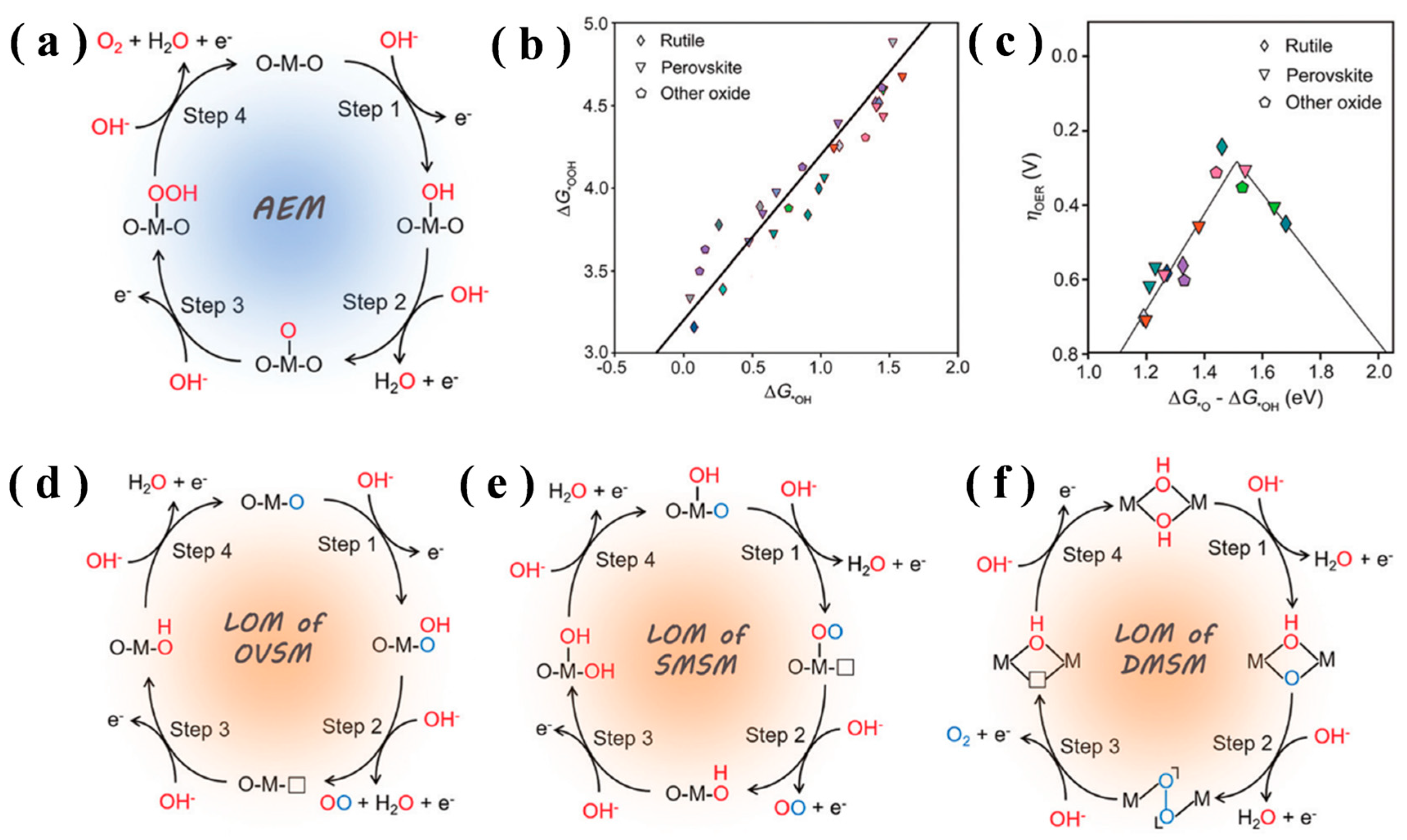
The OER proceeds primarily through two distinct pathways: the conventional adsorbate evolution mechanism (AEM) and the emerging lattice oxygen-mediated mechanism (LOM) [53,54,55,56]. Catalyst design has been dominated by the AEM paradigm, where molecular oxygen forms via intermediates adsorbed at metal sites [57,58]. However, AEM faces a fundamental limitation due to intrinsic scaling relation. As illustrated in Figure 1b, both theoretical and experimental evidence show a fixed linear relationship between the binding energies of key intermediates OOH and OH (ΔGOOH = ΔGOH + ~3.2 eV). This inherent constraint leads to a theoretical overpotential limit of approximately 370 mV for the OER [59,60,61]. The classic volcanic activity relationship (Figure 1c) further demonstrates that the catalytic activity cannot surpass the peak defined by this volcano plot, even that intrinsic oxygen binding energy (ΔGO − ΔGOH) is optimized [62]. In contrast, LOM represents a disruptive pathway that bypasses the scaling relations of AEM by directly involving lattice oxygen ions in the oxygen–oxygen bond formation [63]. In catalysts with high metal–oxygen covalency, lattice oxygen can be activated and serve as a reactive center, which couples directly with adsorbed species or adjacent lattice oxygen to form O2. This mechanism not only breaks the confinement of the volcanic relationship (Figure 1c) but also enables exceptionally high intrinsic activities [55,56,64,65]. Nevertheless, this high activity is often accompanied by significant stability challenges [66,67].
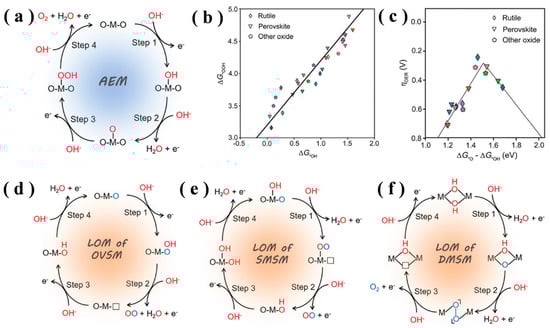
Figure 1.
Different reaction pathways for OER, (a) Schematic illustration of the proposed AEM pathway of OER in alkaline media on an active metal site. The lattice oxygen and oxygen from the electrolyte are marked in black and red colors, respectively. (b) The scaling relation between the binding energies of *OOH and *OH on various TMOs. (c) OER volcano plot for various TMOs against the oxygen binding strength (DG*O DG*OH). (d–f) Schematic illustrations of three alternative pathways of LOM in alkaline media with different catalytic centers. (d) Oxygen-vacancy-site mechanism (OVSM), (e) single-metal-site mechanism (SMSM) and (f) dual-metal-site mechanism (DMSM). The chemically inert lattice oxygen, active lattice oxygen involving OER and oxygen from the electrolyte are marked in black, blue and red colors, respectively, and □ represents lattice Ovac [61].
2.1. Adsorbate Evolution Mechanism (AEM)
AEM involves four consecutive proton-coupled electron transfer steps. Using an acidic electrolyte as an example (Figure 1a) [61]:
Dissociative water adsorption: H2O + * → *OH + H+ + e−
Dehydrogenation of hydroxyl: *OH → *O + H+ + e−
Oxygen–oxygen bond formation: *O + H2O → *OOH + H+ + e−
Desorption of the peroxy intermediate: *OOH → O2 + H+ + e− + *
In AEM, water oxidation progress occurs solely between the adsorbates and catalyst surface, involving the transfer of one electron/proton pair per step. Oxygen atoms originate exclusively from water molecules, and lattice oxygen does not participate [68]. The advantage of AEM is stability and minimal metal dissolution. However, due to the linear scaling relation between ΔG(*OH) and ΔG(*OOH) (with a constant difference of ≈ 3.2 eV), the theoretical overpotential is difficult to reduce below ~0.3 V, thus limiting the catalytic activity [60,69].
2.2. Lattice Oxygen-Mediated Mechanism (LOM)
In contrast to AEM, the core of the LOM involves the direct participation of oxygen atoms from the catalyst lattice in forming the oxygen molecule (Figure 1d–f) [61].
Lattice Oxygen Activation: under applied potential, metal–oxygen (M-O) covalency increases, which results in electron loss from oxygen ligands and the formation of electrophilic oxygen species.
Nucleophilic Attack: OH− or H2O molecules from the electrolyte attack the activated lattice oxygen, forming a superoxide-like (O2−) group.
Oxygen Vacancy Formation: the release of lattice oxygen creates a surface oxygen vacancy (Ov).
Vacancy Repair: an oxygen source from the solution (H2O/OH−) refills the oxygen vacancy, restoring the catalyst structure.
Compared to AEM, LOM could offer a theoretical overpotential potentially below 0.2 V [70,71]. However, a critical drawback is catalyst degradation caused by oxygen vacancy migration, leading to lattice collapse and metal ion leaching for a rapid deactivation. Most conventional catalysts predominantly follow one mechanism, but the emergence of high-entropy alloy catalysts is changing this paradigm [68].
3. Fundamental Effects of HEAs on OER Progress
HEAs exhibit four core effects, which are intrinsically correlated and function synergistically (Figure 2). The high-entropy effect serves as the thermodynamic driving force for stabilizing multi-component solid solutions. Chemical disorder and atomic size differences directly induce severe lattice distortion. This distortion significantly increases the energy barriers for atomic diffusion, giving rise to the sluggish diffusion effect, which in turn suppresses defect migration and elemental segregation. Under such a highly distorted local chemical environment, strong electronic interactions among the constituent elements—known as the cocktail effect—drive electronic restructuring and optimization. This provides the physical foundation for the simultaneous enhancement of activity, stability and resistance to coarsening in HEAs.

Figure 2.
Four core effects of high-entropy materials.
3.1. High-Entropy Effect
The high-entropy effect is one of the most fundamental characteristics of HEAs. For HEAs systems, multiple principal elements tend to form a single stable solid solution phase at the atomic scale rather than intermetallic compounds or other complex phases [41,72]. As a result, high configurational entropy significantly reduces the Gibbs free energy, thereby thermodynamically promoting the formation and stabilization of the solid solution. According to thermodynamic principles, the configurational entropy of HEAs should exceed 1.5R (where R is the gas constant), which is substantially higher than that of traditional alloys. A high-entropy value corresponds to a highly disordered atomic arrangement within the system, and this disordered state results in a more stable energy configuration. For HEA electrocatalysts, high configurational entropy is regarded as a key factor to inhibit the precipitation of ordered phases: it effectively hinders the formation of intermetallic compounds, which enables the maintenance of a single-phase solid solution structure even under high-temperature or extreme electrochemical conditions (such as high-potential environments during the oxygen evolution reaction). Therefore, the high-entropy effect not only provides a theoretical basis for the possibility of single-phase formation in multi-principal element alloys but also plays an important role on the microstructural stability and functional design of HEAs. By utilizing the high-entropy effect, phase stability and performance optimization of materials in harsh environments can be achieved, which could expand the design boundaries and application prospects of alloy materials.
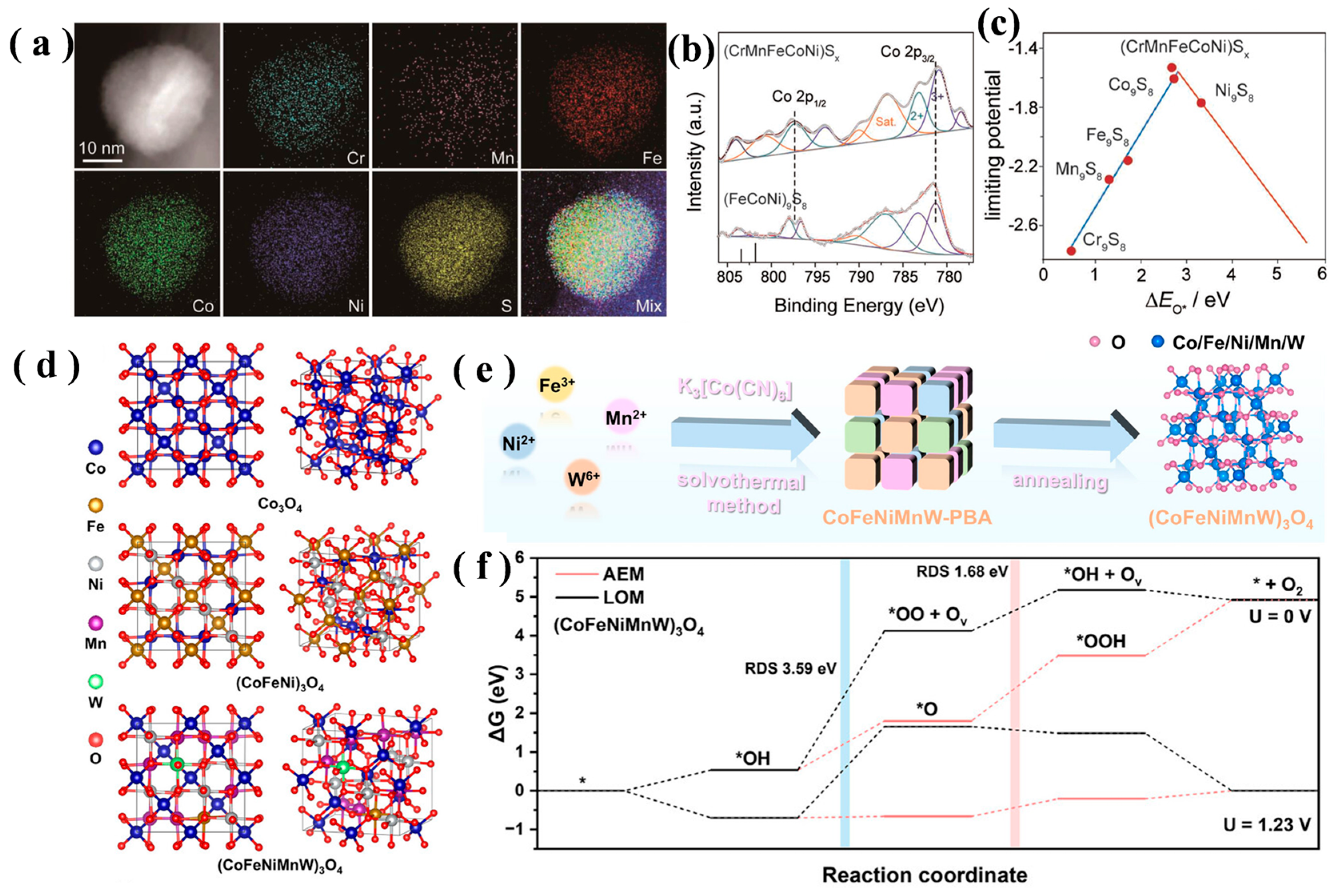
Cui et al. employed a 55 ms pulsed thermal shock technique to dissolve five thermodynamically immiscible elements (Cr, Mn, Fe, Co, Ni) into a single (CrMnFeCoNi)Sx; nanocrystal (11.9 nm, Fm-m), revealed in Figure 3a–c. As a result, they prepared a face-centered cubic high-entropy metal sulfide (HEMS) [73]. XPS and Bader charge analyses revealed that multi-metal synergy downshifted the d-band center of Co sites and enhanced charge transfer from Fe/Mn to Co, thereby precisely modulating the *O adsorption energy to the peak of the volcano curve. The overpotential at 100 mA cm−2 was only 295 mV, which is 20 mV lower than that of quaternary sulfides. The potential drift during a 10 h stability test was less than 35 mV. This work directly confirms that high configurational entropy can not only “lock” multiple elements into oxides, but also extends to sulfide lattices, which provides a universal paradigm for designing long-life OER catalysts utilizing the high-entropy effect.
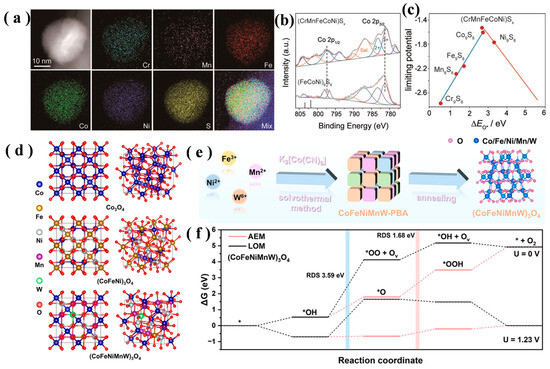
Figure 3.
(a) HAADF-STEM image of a (CrMnFeCoNi)Sx nanoparticle and the corresponding EDS elemental maps; (b) high-resolution XPS spectra of Co 2p of the (CrMnFeCoNi)Sx, binary (NiFe)9S8, and (FeCoNi)9S8; (c) calculated catalytic activity volcano plot of unary MxSy and HEMS(Cr2MnFe2Co2Ni2)S8 [73]; (d) the models of Co3O4, (CoFeNi)3O4, and (CoFeNiMnW)3O4, where the blue, brown, gray, purple, green and red balls represent Co, Fe, Ni, Mn, W and O atoms, respectively; (e) schematic illustration of the synthetic process for high-entropy spinel (CoFeNiMnW)3O4; (f) ΔG profiles for OER through the AEM and LOM pathways on (CoFeNiMnW)3O4 at U = 0 V and U = 1.23 V (vs. RHE), where the * represent empty active site. [74].
Rafique et al. successfully synthesized a five-component high-entropy spinel oxide, (CoFeNiMnW)3O4, via a high-entropy engineering approach employing an MOF-derived strategy [74]. This method involved coprecipitation and calcination to incorporate multiple principal elements (Co, Fe, Ni, Mn, W) into a single spinel lattice. Figure 3d–f demonstrate that this high-entropy engineering induced profound effects on its properties. This high-entropy strategy simultaneously induced significant lattice distortion and expansion, triggering electronic redistribution at the active sites. This resulted in generally elevated oxidation states of the metal sites by increasing the electron density of the oxygen ligands. Crucially, this electronic structure modulation altered the OER pathway. It moderately activated the LOM to enhance intrinsic activity, while simultaneously optimizing the metal–oxygen bond covalency to effectively suppress excessive LOM progression, thereby preventing structural collapse from massive lattice oxygen loss. Concurrently, the high-entropy environment favored the AEM by lowering the energy barrier of its rate-determining step. Consequently, the high-entropy effect promoted a synergistic interplay between a “restricted LOM” and an “optimized AEM.” This synergy achieved high activity, while the entropic stabilization effect and controlled surface reconstruction collectively ensured the material’s macro- and micro-structural stability under harsh OER conditions. This approach successfully overcame the traditional activity–stability trade-off.
3.2. Lattice Distortion Effect
The severe lattice distortion in HEAs originates from their multi-principal element nature [75]. Due to the different atomic radii of the constituent elements, strong repulsive forces occur when they collectively occupy lattice sites, causing atoms to deviate from ideal lattice positions and form significant lattice distortions. This distortion not only alters bond lengths and angles at the atomic scale but also causes local fluctuations in lattice constants, which could optimize the entire lattice in a high-energy and metastable state [76]. The complexity of this microstructure further influences the physical properties of HEAs. Lattice distortion significantly enhances the scattering of electrons and phonons, leading to generally lower electrical and thermal conductivity compared to traditional alloys. Meanwhile, the high strain energy stored in the distorted lattice affects the mechanical behavior, phase stability and diffusion kinetics of the material, endowing HEAs with a range of novel properties distinct from conventional materials [77,78].
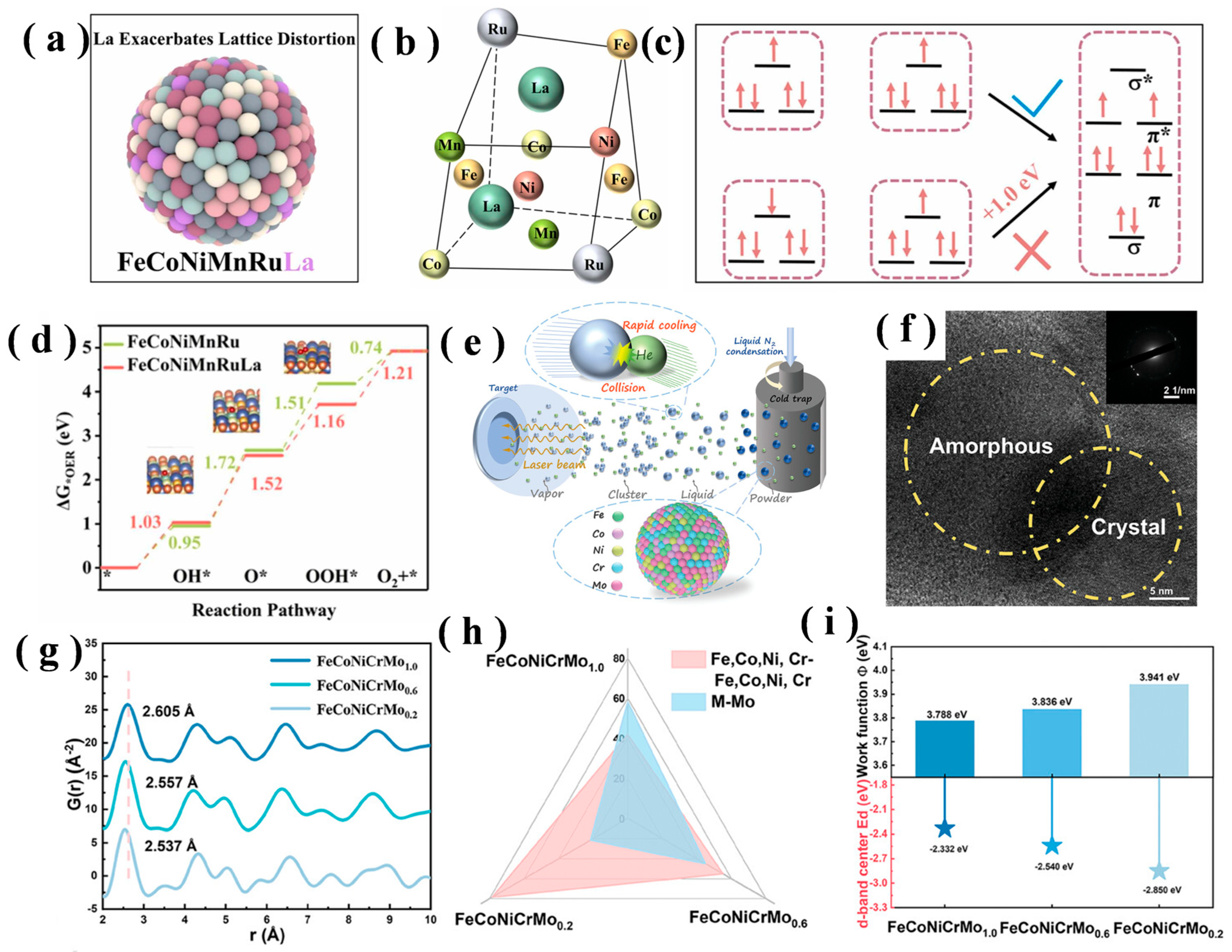
Wang et al. synthesized carbon nanotube-supported FeCoNiMnRuLa high-entropy alloy nanoparticle catalysts using the carbon thermal shock method (Figure 4a–d) [79]. The introduction of La significantly exacerbated lattice distortion in the FeCoNiMnRu system, leading to a decrease in crystallographic ordering, the disappearance of the (200) crystal plane and the formation of regions with coexisting crystalline and amorphous phases within the grains. The distortion effect not only enhanced the exposure of active sites but also modulated the d-orbital electron configuration of the metals. As a result, the number of unpaired electrons could be reduced, shifting the system from a high-spin to an intermediate-spin state. This transformation accelerated the conversion of singlet oxygen intermediates to triplet oxygen during OER. Experimental and DFT calculations collectively confirmed that lattice distortion optimized the adsorption of *OH on Fe and Ni sites and the desorption of oxygen-containing intermediates on Ru, Co and Mn sites. As a result, the OER and HER overpotentials at 10 mA cm−2 were reduced to 281 mV and 50 mV, respectively, and the catalyst demonstrated stability superior to that of commercial noble metal catalysts.
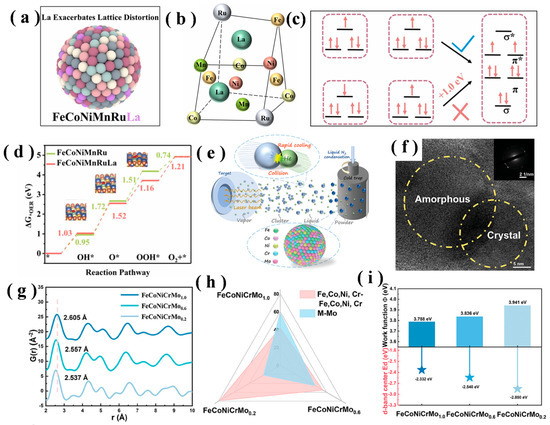
Figure 4.
(a) Schematic representation of how La exacerbates lattice distortion; (b) schematic representation of the lattice distortion of FeCoNiMnRuLa; (c) two processes of triplet O2 generation; (d) AEM free energy variation in OER on surface Ru in FeCoNiMnRu as well as in FeCoNiMnRuLa at U = 0 V, where the * represent empty active site. [79]; (e) schematic illustration of the preparation of HEMG-NPs via LE-IGC; (f) HRTEM and SAED images taken from the FeCoNiCrMo0.6 NPs; (g) the reduced pair distribution function G(r) patterns; (h) the corresponding proportion to the total integrated area of the first coordination shell; (i) the work functions and d-band centers of FeCoNiCrMo0.2, FeCoNiCrMo0.6 and FeCoNiCrMo1.0 [80].
Zhou et al. prepared FeCoNiCrMox high-entropy alloy nanoparticles via laser evaporation inert gas condensation [80]. As shown in Figure 4e–i, the high-entropy effect of the catalyst induces significant lattice distortion, which intensifies with the increasing content of high-valence Mo element. The severe lattice distortion directly leads to a transformation from a crystalline state into high-entropy metallic glass nanoparticles. This structural disorder triggered a reconstruction of the electronic structure and manifested specifically as an upward shift in the d-band center, which optimized the adsorption energy of reaction intermediates and enhanced the intrinsic catalytic activity. In addition, the amorphous structure possessed higher surface energy and a greater number of coordinatively unsaturated sites for OER. Synchrotron-based Pair Distribution Function (PDF) analysis further confirmed a strong correlation between this short-to-medium range disordered structure, driven by lattice distortion, and intrinsic OER activity. Therefore, lattice distortion through high-entropy engineering emerges as an effective strategy for simultaneously optimizing both the electronic structure and atomic arrangement of materials for enhanced OER activity and stability.
3.3. Diffusion Effect
The sluggish diffusion effect could increase atomic migration barriers due to pronounced differences in atomic size, electronegativity and mass among the constituent elements, leading to severe lattice distortion and complex interatomic interactions [81]. This effect reduces the diffusion coefficient of atoms in HEAs by 2–4 orders of magnitude compared to traditional alloys.
Extensive experimental studies have shown that the diffusion coefficient of elements in HEAs decreases when the component number increases. This phenomenon stems from two main factors: on the one hand, lattice distortion caused by varying atomic sizes increases the energy fluctuations along diffusion paths; on the other hand, differing chemical bonding interactions among the components further raise the energy barriers for atomic jumps. Consequently, HEAs exhibit extremely slow atomic diffusion, significantly inhibiting recrystallization, phase separation and grain growth. As a result, HEAs systems possess excellent structural stability. Even under high-temperature conditions, the microstructure remains within a stable robustness. At the atomic scale, the highly heterogeneous atomic arrangement and bonding environment around each lattice site in HEAs causes fluctuations in local energy distribution. Atoms in high-energy states may undergo jumps but are more likely to become trapped in lower-energy local states, making long-range diffusion difficult. Additionally, the inherent differences in diffusion capabilities among the components, combined with lattice distortion, further retard the overall diffusion kinetics. However, this effect also imposes higher requirements on the preparation processes of HEAs. Due to slow atomic migration, achieving equilibrium typically requires higher temperatures or longer processing times. Thus, thermal processes must be carefully designed during synthesis and sintering to promote compositional homogenization and suppress defect formation.
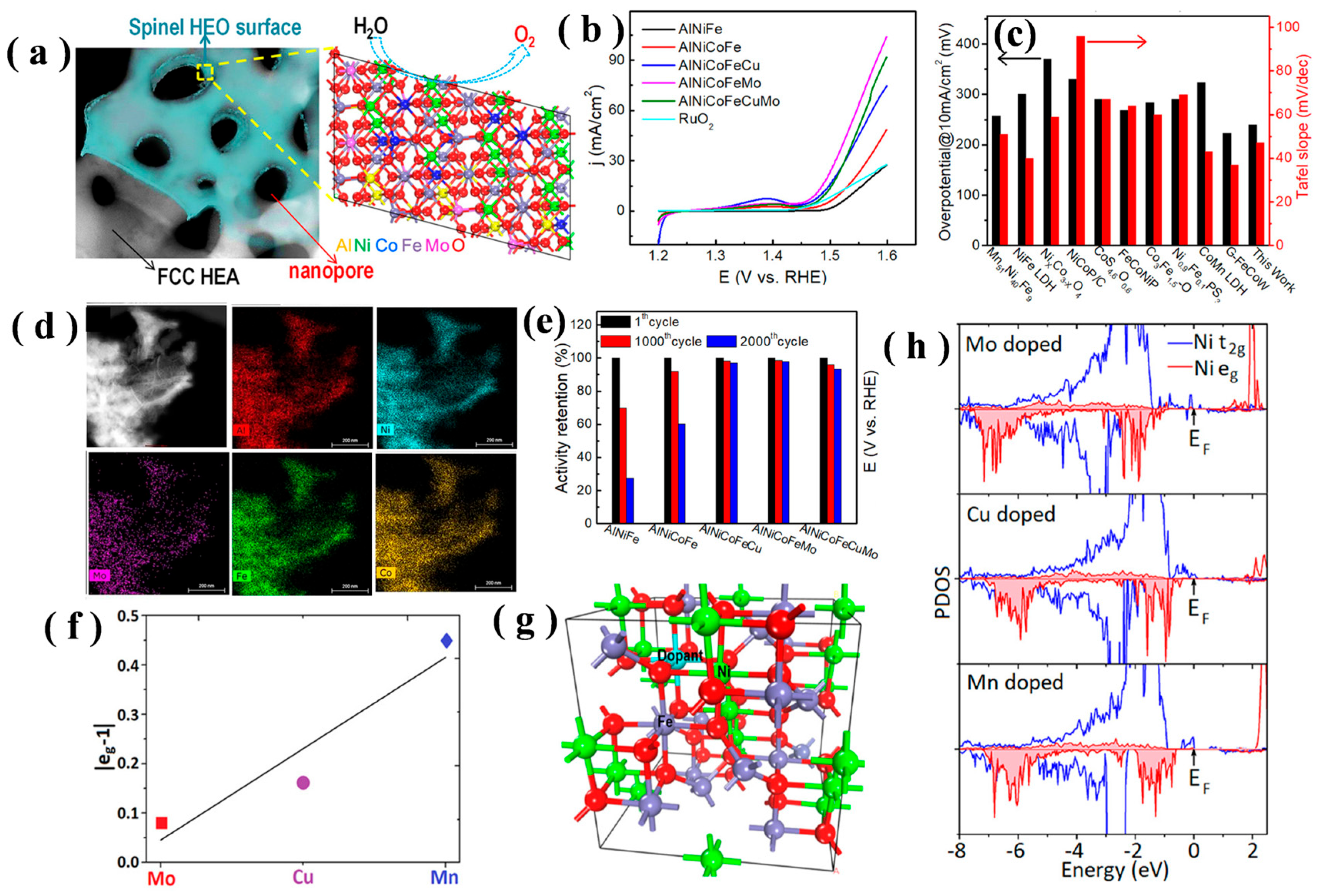
Qiu et al. successfully prepared a nanoporous HEA catalyst (np-AlNiCoFeMo) using melt rapid cooling combined with alkaline dealloying (Figure 5) [82]. In 1 M KOH electrolyte, the catalyst required an overpotential of only 240 mV to achieve a current density of 10 mA cm−2. Such an excellent performance could outperform those of traditional NiFe and NiCoFe catalysts. It also showed exceptional stability during a 50 h constant-current test with almost no activity decay. Structural characterization revealed that even after 2000 cycles of cyclic voltammetry (CV), STEM-EDS mapping still showed uniform distribution of Ni, Co, Fe, Mo and other components, with no signs of element segregation or phase separation. Moreover, the corrosion potential experiment is further performed, highlighting its high structural stability. Such an outstanding electrochemical cycling stability is attributed to the “high-entropy stabilization effect” arising from the cooperative incorporation of multiple elements. In high-entropy alloy systems, this stabilization mechanism is generally related to lattice distortion and the sluggish diffusion effect. The latter effectively suppresses element segregation, phase transformation and structural coarsening, thereby maintaining the structural integrity of the catalyst during prolonged electrochemical testing. Furthermore, electronic synergies among the multiple metal elements optimized the adsorption behavior of reaction intermediates (e.g., O*) at active sites (e.g., Ni sites), further enhancing intrinsic catalytic activity.
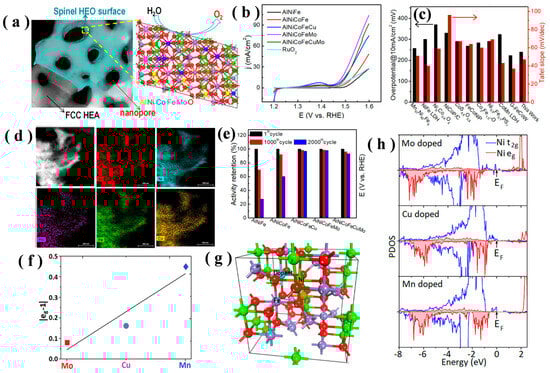
Figure 5.
(a) Illustration of the OER mechanism on the surface of nanoporous HEA/HEO catalysts; (b) LSV curves showing the oxygen evolutions on the np-HEAs, np-AlNiCoFe, np-AlNiFe and RuO2 electrodes; (c) comparing the Tafel slopes and overpotentials at 10 mA cm−2 with the literature data; (d) STEM-EDS mapping of the np-AlNiCoFeMo sample after 50 h testing. The results show no obvious morphology or crystal structure changes after the testing; (e) the current retentions at 1.55 V after 1000 and 2000 CV cycles; (f) the |eg − 1| for each case; (g) atomic structure of dopant in inverse spinel NiFe2O4; (h) the PDOSs onto the d states of a Ni atom in the octahedral site near the dopant for Mo, Cu and Mn, respectively, from top to bottom [82].
3.4. Cocktail Synergy Effect
The “cocktail effect” in HEAs was first proposed by Ranganathan to describe the synergistic interactions occurring when multiple metallic components are combined [83,84]. This effect arises from the mutual combination and interaction of constituent elements at the atomic scale, as well as synergistic effects at the microstructural level involving lattices and grain boundaries. The HEAs system possesses a more stable chemical state overall and exhibits more composite properties than single-component systems. Since different elements possess distinct characteristics, their interactions can significantly tune the macroscopic properties of the material, such as enhancing hardness, strength and oxidation resistance. They may even induce unique behaviors like superelasticity or superplasticity [43]. Therefore, a thorough understanding of the intrinsic properties of each element, coupled with deliberate control of composition and microstructure, is crucial for designing and developing high-entropy materials with tailored functionalities, particularly high-entropy electrocatalysts. In the field of electrocatalysis, the “cocktail effect” induced by multi-metal alloying offers a new approach to designing oxygen evolution reaction (OER) catalysts [85].
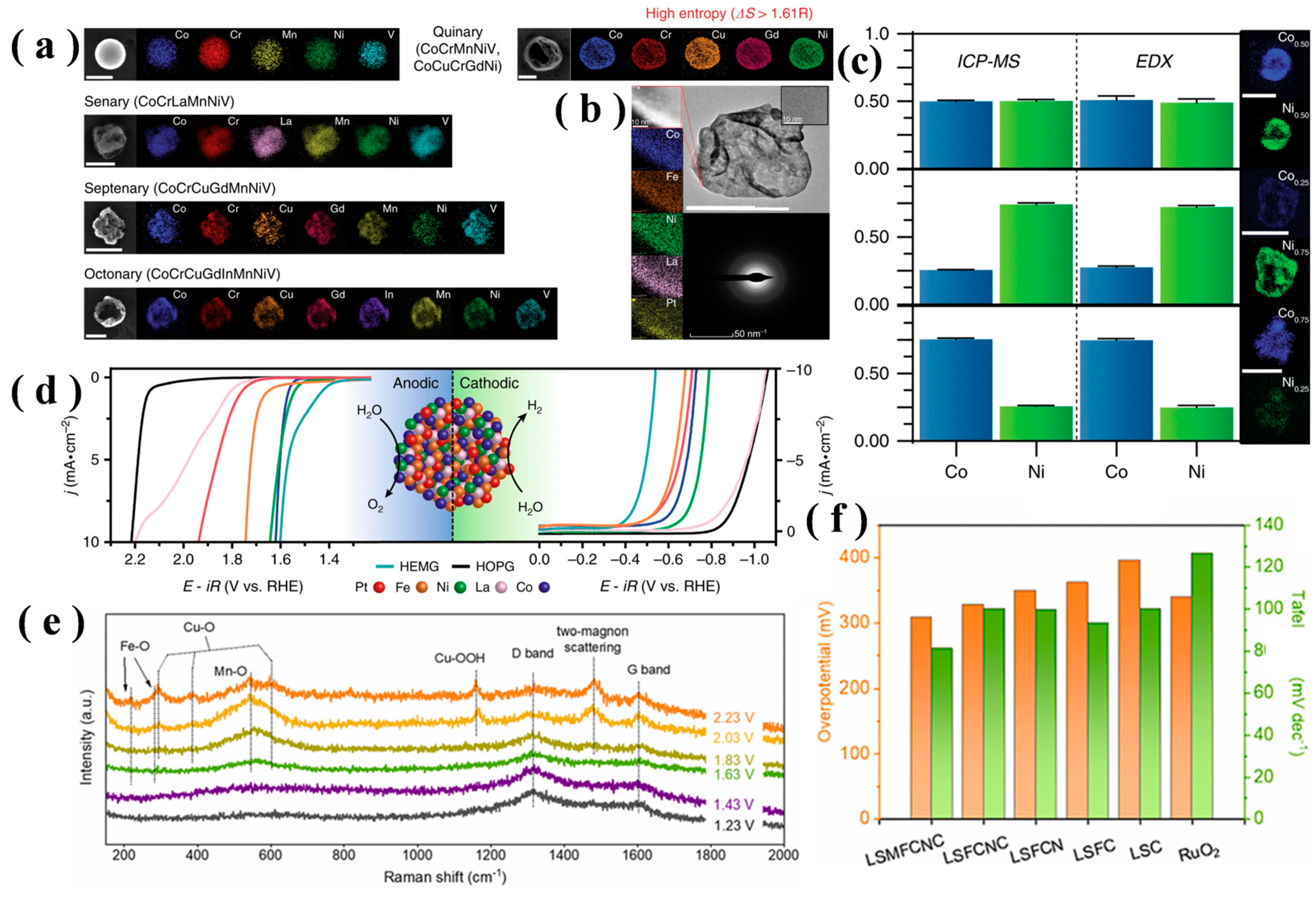
Glasscott et al. presented a nanodroplet-mediated electrodeposition method to construct a high-entropy metallic glass nanoparticles CoFeLaNiPt alloy with an amorphous structure [86]. The obtained CoFeLaNiPt alloy exhibited a low OER overpotential of 377 mV (@10 mA cm−2), outperforming single-metal components (e.g., Fe and Ni) by 139 mV and 36 mV, respectively, demonstrating a significant multi-metal synergistic enhancement effect (Figure 6a–d). The authors further explored the electronic structure modulation and interfacial synergy induced by the close packing of multi-metal atoms in the amorphous structure—a typical “cocktail effect.” The electronic interactions among different metals optimized the adsorption/desorption behavior of intermediates, thereby enhancing the overall catalytic activity.
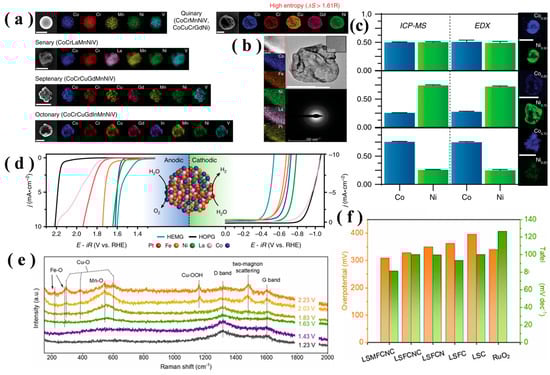
Figure 6.
(a) EDX images of HEMG-NPs (ΔS > 1.61 R) produced by adding up to eight metal salt precursors to the nanodroplets; (b) HAADF-STEM images of a CoFeNiLaPt HEMG-NP with accompanying high-resolution EDX images showing disordered elemental distribution at the atomic scale. The diffuse rings on the SAED pattern indicate an amorphous microstructure; (c) correlated ICP-MS and EDX results on Co0.5Ni0.5, Co0.25Ni0.75 and Co0.75Ni0.25 MG-NPs confirming precise control over NP stoichiometry; (d) cathodic polarization of the HEMG electrocatalyst and its individual components to drive HER starting from 0 V vs. RHE and anodic polarization of the HEMG electrocatalyst and its individual components starting from the equilibrium potential of OER, 1.23 V vs. RHE [86]; (e) operando electrochemical Raman spectra of the as-prepared LSMFCNC in 1.0 M KOH from 1.23 to 2.23 V; (f) histogram of the summarized overpotentials at 10 mA cm2 [87].
Hao et al. demonstrated La0.5Sr0.5Mn0.15Fe0.15Co0.4Ni0.15Cu0.15O3 hollow nanofibers with outstanding OER activity in alkaline media (Figure 6e–f) [87]. The superior catalytic kinetics originate from the characteristic “cocktail effect” of the high-entropy system. The synergistic effect not only optimizes the overall electronic structure of the multi-active sites but also enables specific sites to selectively adsorb key reaction intermediates. In situ electrochemical Raman spectroscopy confirmed that Fe, Cu and Mn sites preferentially adsorb OH species, while Cu sites significantly promote O–O bond formation, thereby efficiently driving the reaction process. This study unveils the structure–activity relationship of the multi-component catalyst at the atomic scale, providing crucial insights for the rational design of next-generation multi-site electrocatalysts.
4. Synthetic Control of Lattice Oxygen Activity
4.1. Stabilizing the AEM
The development of oxygen evolution reaction catalysts has long been constrained by a fundamental dilemma between the two prevalent reaction mechanisms. Under the LOM progress, OER electrocatalysts can achieve high activity but often suffer from structural degradation due to irreversible lattice oxygen loss. In contrast, catalysts with the AEM route exhibit excellent structural stability, yet they also suffer from higher thermodynamic energy barriers. Therefore, a central challenge and key goal in water oxidation progress is to precisely confine the AEM pathway, simultaneously endowing it with the superior intrinsic activity approaching that of LOM-based systems.
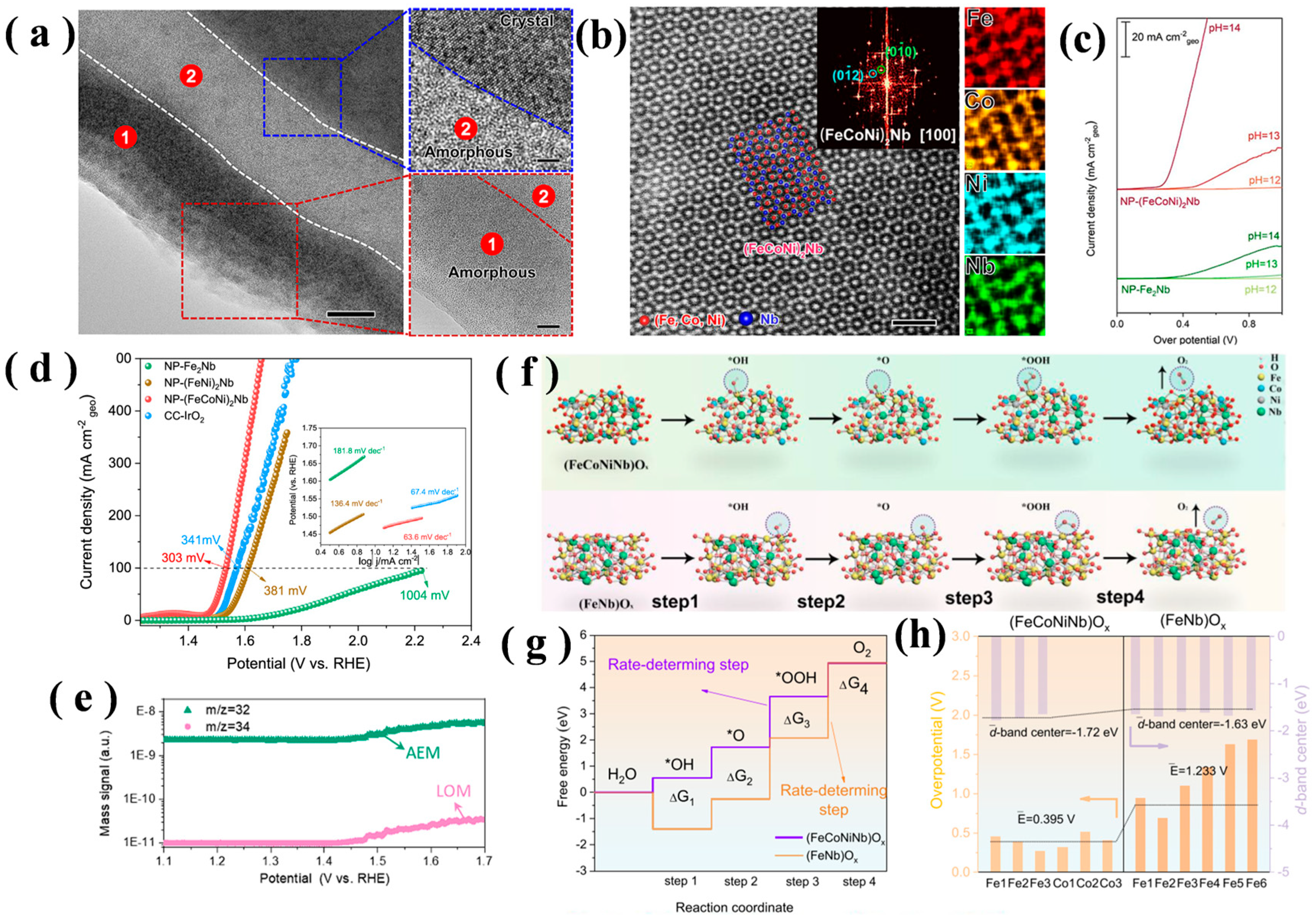
Li et al. designed a multicomponent alloy catalyst (NP-(FeCoNi)2Nb) with a unique bilayer nanostructure to overcome the OER activity–stability trade-off [88]. Figure 7 illustrates that the catalyst was prepared through an electrochemical dealloying process, resulting in a surface composed of a dual-layer amorphous oxide structure. The outer layer consists of a multi-component amorphous oxide (MCAO), which provides abundant active sites, while the inner layer is a Nb-enriched amorphous oxide layer (NbOx), serving as a dynamic reservoir for replenishing Nb elements. The high-entropy MCAO surface layer modulates the electronic structure of active sites. HAADF-STEM and XPS revealed stabilized Fe3+/Co3+/Ni3+ high-valent states in the outer layer, downshifting the d-band center by 0.07 eV and reducing the energy barrier for the AEM rate-determining step (RDS, *O→*OOH) to 0.395 V, enabling excellent activity (η100 = 305 mV). Isotope-labeled electrochemical mass spectrometry (DEMS) analysis (Figure 7e) revealed a very low signal intensity ratio of 34O2/32O2, indicating a negligible LOM(34O2) contribution of only approximately 0.5%. Furthermore, as the AEM exhibits a linear relationship between reaction potential and pH, the catalytic activity measured in electrolytes of different pH (Figure 7c) demonstrates behavior consistent with AEM characteristics, providing additional support for the DEMS conclusions.
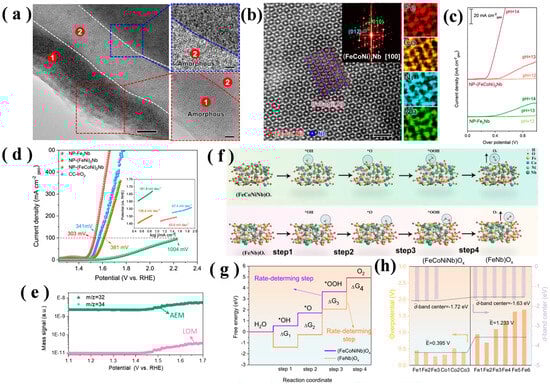
Figure 7.
(a) TEM characterization of NP-(FeCoNi)2Nb, showing its surface morphology and interfacial structure: the nanoporous surface layer, the interface of layer 2 with the matrix and the interface between layers 1 and 2; (b) STEM image taken from the <10-10> direction revealing the Fe2Nb-type ordered structure of the (FeCoNi)2Nb alloys. Scalebars, 5 nm. The inset shows the fast Fourier transform (FFT) patterns. And the corresponding atomic-resolution elemental maps (right). Scale bar, 0.25 nm; (c) OER kinetic currents (in mA cm−2 geo) of NP-Fe2Nb and NP-(FeCoNi)2Nb O2-saturated KOH electrolytes with varying pH; (d) OER polarization curves of NP-(FeCoNi)2Nb, in comparison with that of NP-Fe2Nb, NP-(FeNi)2Nb and the CC-IrO2 catalysts in 1 M KOH electrolyte, all LSV curves are iR-corrected. The inset shows the Tafel slope of the catalysts; (e) DEMS signals of 32O2 (16O + 16O, AEM) and 34O2 (16O + 18O, LOM) collected during the LSV curve; (f) schematic of the detailed OER pathways on the optimal Fe site of the (FeCoNiNb)Ox and (FeNb)Ox surfaces in the alkaline electrolyte; (g) the predicted free energy diagrams of the (FeCoNiNb)Ox and (FeNb)Ox; (h) the calculated overpotential of the rate-determining step and d-band center for different Fe and Co sites of the (FeCoNiNb)Ox and (FeNb)Ox catalysts [88].
This near-exclusive AEM pathway explains the exceptional stability, as it avoids the structurally destructive lattice oxygen loss and metal dissolution associated with LOM. This work demonstrates that ultrahigh intrinsic activity can be achieved by optimizing the AEM pathway through HEA-induced electronic tuning, creating an ideal local adsorption environment, without relying on the unstable LOM.
4.2. Bifunctional LOM/AEM Switching
Triggering LOM is the key to achieving the ultrahigh performance of electrocatalysts for water oxidation. Due to their intrinsic effects, high-entropy alloys (HEAs) can benefit the transformation from the thermodynamically unstable lattice oxygen oxidation mechanism (LOM) to a sustainable and highly active oxygen evolution pathway. Firstly, the high configurational entropy provides a thermodynamic driving force that suppresses the phase separation caused by oxygen vacancies and cation leaching, thereby preserving structural integrity. Meanwhile, the sluggish diffusion effect significantly inhibits the migration and aggregation of oxygen vacancies, preventing local structural collapse. Furthermore, through the cocktail effect, the metal–oxygen covalency can be precisely optimized, which ensures sufficient reactivity of lattice oxygen while preventing its excessive loss, thereby achieving a balance between activity and stability.
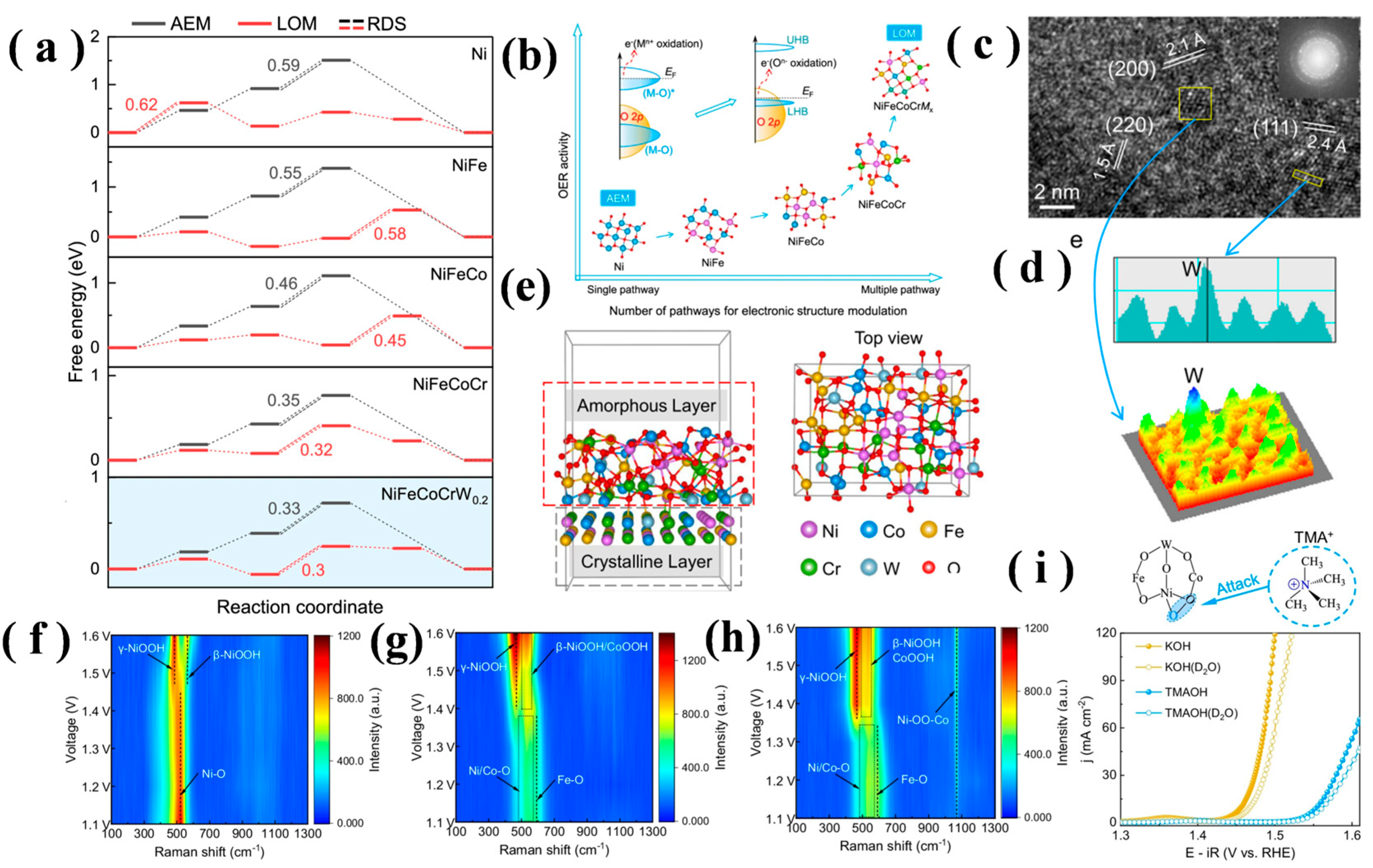
The Zhang group demonstrates that the multicomponent synergy in HEAs can shift the dominant OER pathway from the conventional AEM to LOM [89]. In detail, the Zhang group employed vacuum arc melting followed by quintuple remelting to prepare NiFeCoCrW0.2 HEA. As shown in Figure 8, subsequent activation via 500 CV cycles in 1 M KOH induced surface reconstruction into a coral-like nanoporous amorphous oxide layer. Synchrotron XANES/EXAFS revealed preferential Cr leaching, formation of high-valent Ni/Fe/Co and electron anchoring by W6+, accompanied by Ni–O bond contraction (0.04 Å) and Co–O bond weakening, priming the lattice for oxygen activation. The theoretical results unveil the OER progress primarily follows the AEM pathway duo to their unique electronic structure, resulting in an accelerating OER performance. The introduction of multi-components could efficiently optimize the mechanism towards LOM. DFT calculations indicated a significantly lower energy barrier for the LOM RDS compared to AEM, favoring LOM for water oxidation. Additionally, in situ Raman spectroscopy in Figure 8h detected a characteristic peak at 1069 cm−1, which is assigned to the Ni–OO–Co peroxo intermediate. This serves as a characteristic signature of the LOM pathway and was not observed in the simpler systems in Figure 8f–g, directly confirming the new reaction pathway induced by multiple elements. Through 18O isotope-labeled DEMS, the formation of 18O16O (m/z = 34) was detected, providing direct evidence that oxygen atoms (18O) from the catalyst lattice participate in O2 formation. The TMA+ inhibition test in Figure 8i shows that the OER activity of NiFeCoCrW0.2 decreased markedly upon addition of TMA+, while the simpler system was less affected. This is attributed to the attack and poisoning of negatively charged oxygen intermediates (O2−) in the LOM pathway by TMA+, which further corroborates the dominant role of the LOM.
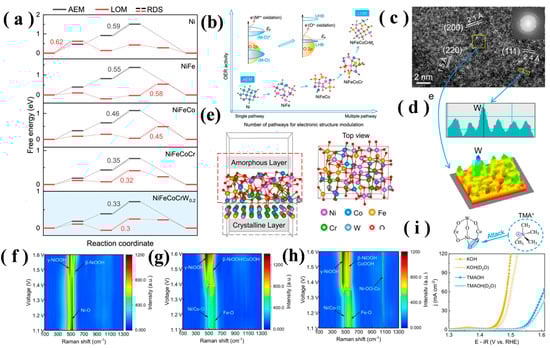
Figure 8.
(a) Free energies of OER steps via both AEM and LOM in different models, respectively; (b) OER mechanism shifts from AEM to LOM by increasing the number of group elements. EF: Fermi level; (c) HRTEM image of metal oxide on the surface. The inset is the corresponding FFT pattern; (d) the variation in pixel intensity along the area marked (yellow rectangular box) in (c); (e) views of the NiFeCoCrW0.2 oxide model with top amorphous layers for DFT calculations; (f–h) Raman spectra of Ni; (f) NiFeCo (g) and NiFeCoCrW0.2 (h) were collected at different applied voltages (1.1–1.6 V versus RHE) in 1 M KOH solution; (i) LSV polarization curves of NiFeCoCrW0.2 in 1 M KOH and TMAOH with H2O and D2O as solvent, respectively. The top diagram is a schematic of TAM+ hindering O–O coupling [89].
This strategy resulted in a low overpotential of 220 mV at 10 mA cm−2 and exceptional stability (<5% potential drift at 100 mA cm−2 over 90 days), exemplifying integrated synthesis-structure-mechanism design.
4.3. Coupled AEM-LOM Activation
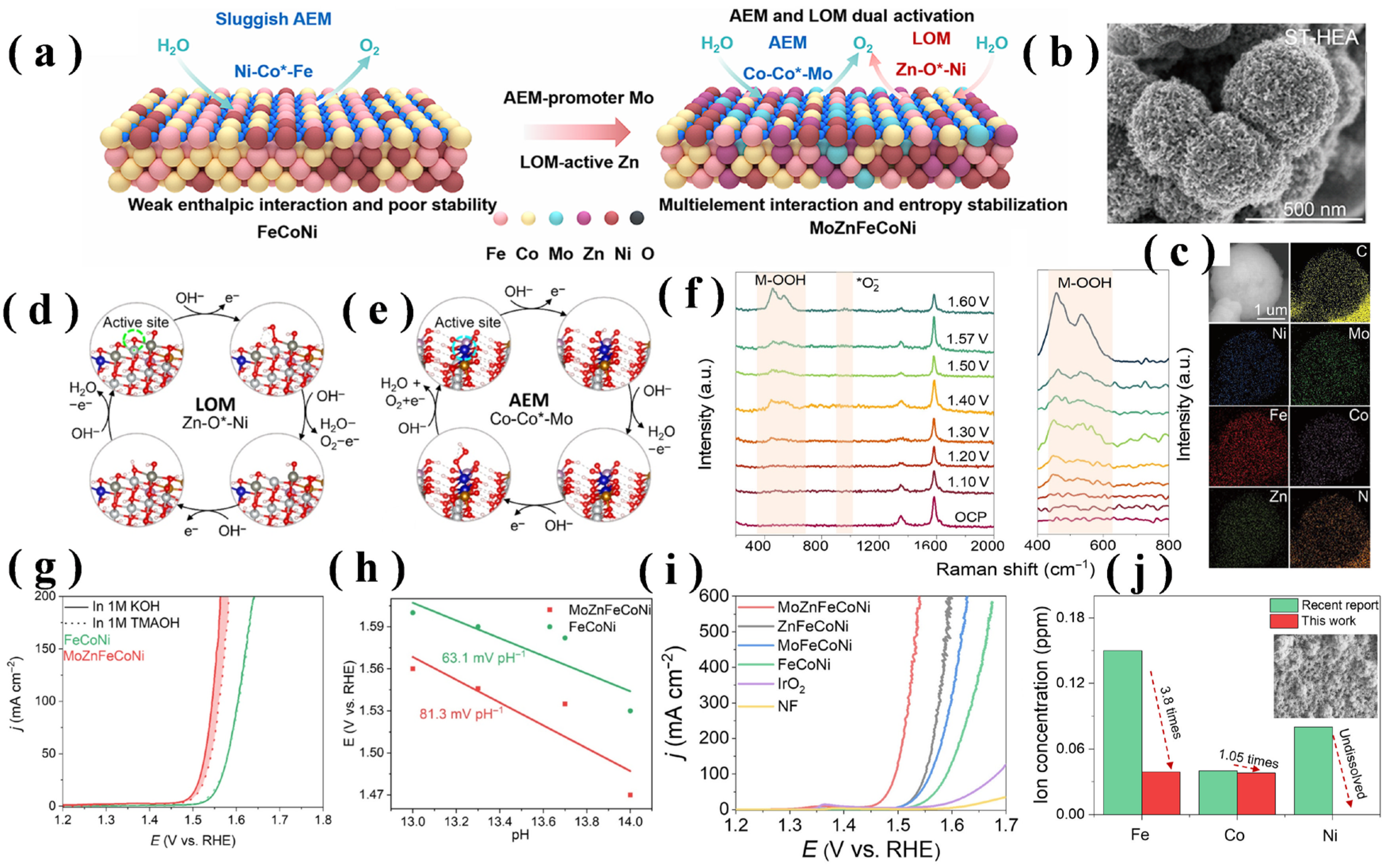
The compatibility of AEM and LOM represents a promising strategy in OER catalysts. The core challenge lies in precisely tailoring catalytic sites. The work by Mei et al. constitutes a successful exploration in this direction (Figure 9) [90]. Through the rational design of a high-entropy alloy composition, they proactively and synergistically activated both the AEM and LOM pathways, thereby achieving ultrahigh activity by breaking the linear scaling relations (LSR) while simultaneously realizing exceptional stability via the high-entropy effect. A spatiotemporally confined strategy, utilizing MOF precursors for spatial confinement and ultrafast thermal shock (~1200 °C, 0.1 s) for temporal limitation, overcame challenges like Mo carburization and Zn volatilization, yielding single-phase HEA nanoparticles embedded in a 3D carbon network.
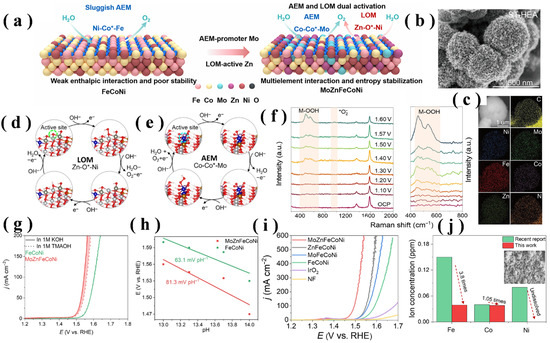
Figure 9.
(a) Schematic of FeCoNi showing sluggish AEM and MoZn-based HEA with dual activation of AEM and LOM; (b) SEM images of ST-HEA; (c) EDS mapping images of Fe, Co, Ni, Mo, Zn, C and N elements with uniform dispersions; (d) AEM pathway of OER steps of the Co-Co*-Mo site. The free energies are obtained at 1.23 V versus RHE. The free energy diagram of FeCoNiOOH is presented for comparison; (e) LOM pathway of OER steps of the Zn-O*-Ni site; (f) in situ Raman spectra collected on MoZnFeCoNi for the OER in 1 M KOH; (g) LSV curves of FeCoNi and MoZnFeCoNi in 1.0 M KOH and 1.0 M TMAOH, respectively; (h) relationship between the logarithm of the current density of MoZnFeCoNi and FeCoNi at the potential of 1.5 V versus RHE and pH; (i) IR-corrected polarization curves at 10 mA cm−2; (j) corresponding ion concentrations in electrolyte after stability test at a constant current density of 100 mA cm−2 (Inset SEM is the carbon network of the MoZnFeCoNi after strong acid etching) [90].
DFT calculations revealed that Co-Co′-Mo sites lowered the AEM overpotential to 0.438 V (PDS: *OH → *O), while Zn-O′-Ni sites reduced the LOM overpotential to 0.430 V (PDS: O-O coupling), creating a unique “dual-valley” energy landscape for both mechanisms in the HEA. As shown in Figure 9f, in situ Raman spectroscopy captured characteristic peaks assigned to AEM intermediates such as *OOH (~980 cm−1). Simultaneously, characteristic peaks attributed to *O2 species (~1063 cm−1) were observed, which are considered intermediate products of activated lattice oxygen in the LOM pathway. Chemical probe experiments (methanol oxidation and TMA+ inhibition tests) and pH-dependent measurements also provided solid experimental evidence for the coexistence of dual mechanisms. Methanol, acting as a nucleophile, competitively reacts with *OH in the AEM process, leading to a decrease in the OER current. The MoZnFeCoNi catalyst exhibited a significant current change in the presence of methanol, confirming the existence of the AEM pathway. The TMA+ cation strongly binds with the negatively charged peroxy/superoxy species in the LOM pathway, thereby blocking or severely inhibiting the LOM route and resulting in a marked decline in OER activity. As shown in Figure 9g, the OER activity of MoZnFeCoNi decreased sharply after the addition of TMA+, while that of the FeCoNi catalyst, which follows only the AEM pathway, remained almost unaffected. This strongly demonstrates the presence of an active LOM pathway in MoZnFeCoNi. Furthermore, the OER activity of MoZnFeCoNi exhibited a pronounced pH dependence in Figure 9h, whereas FeCoNi showed only weak dependence. This further supports the conclusion that the LOM pathway is activated in MoZnFeCoNi. The comparable reaction probabilities for AEM and LOM on MoZnFeCoNi contributed to an ultrahigh activity (η10 = 221 mV). Remarkably, despite the intentional activation of the typically destabilizing LOM pathway, the catalyst exhibited outstanding long-term stability (>1500 h at 100 mA cm−2), due to the stabilizing effects of the HEA structure and the carbon network.
Mei’s work represents a more radical and efficient design paradigm. It demonstrates that instead of choosing between AEM and LOM, precise electronic structure tuning via the HEA “cocktail effect” can simultaneously activate and stabilize both mechanisms. This cooperative approach overcomes both the activity limitation (breaking scaling relations) and the stability challenge (resisting LOM-induced degradation), paving the way for designing next-generation OER catalysts that achieve the best of both worlds by effectively “taming” the LOM pathway.
5. Conclusions and Perspectives
5.1. Conclusions
In summary, this review establishes a “Reaction Pathway Control and Synergy Framework” for guiding the design of HEA-based oxygen evolution reaction electrocatalysts. It provides a systematic analysis of the four unique core effects in HEA catalysts—the high-entropy effect, lattice distortion effect, sluggish diffusion effect and cocktail effect. This integration underpins their significant potential and design flexibility in regulating the oxygen evolution reaction pathways. As thoroughly discussed, the framework supports three distinct design strategies. A self-healing bilayer architecture that locks the AEM by optimizing electronic structure through high-entropy and dynamically replenishing active metals, which almost eliminates lattice oxygen loss and deliver ultrahigh AEM activity with exceptional durability. Conversely, selective incorporation of W or Zn modulates metal–oxygen covalency to trigger the LOM, while the intrinsically sluggish diffusion and structural robustness of HEAs suppress cation dissolution and framework collapse, reconciling high LOM activity with long-term stability. Furthermore, a MoZnFeCoNi HEA exemplifies dual-pathway synergy: the cocktail effect concurrently lowers the energy barriers of both AEM and LOM, transcending single-mechanism limitations and establishing HEAs as a versatile platform for rational OER design.
Overall, the mechanism route as well as OER performance of HEA electrocatalysts can be adjusted by elemental composition to fundamentally optimize the adsorption/desorption capacity of the reactants, as summarized in Table 1. As a result, the OER performance of HEA catalysts can be effectively improved due to the low energy consumption.

Table 1.
Electrochemical performances of high-entropy electrocatalysts.
5.2. Challenge and Perspective
Despite HEA electrocatalysts exhibiting enhanced OER performance, the reactive mechanism is still ambiguous, which hampers design of OER electrocatalysts for industrial conditions. Establishing robust composition–structure–activity descriptors will require integrating high-throughput computation, machine-learning acceleration and operando spectroscopy, with the critical first step being quantitative deconvolution of AEM versus LOM contributions. Present synthetic protocols—thermal shock, de-alloying, carbothermal shock—deliver high activities in dilute-alkali half-cells yet are difficult to scale into continuous, low-cost routes that yield monolithic electrodes with high electronic conductivity, mechanical integrity and rapid gas/liquid transport.
The industrial application of high-entropy alloy catalysts is of great importance. The synthesis routes should be scalable and suitable for monolithic electrodes. Therefore, hydrothermal/solvothermal methods and molten salt electrodeposition demonstrate significant potential for industrial application because HEA catalysts could be directly grown on porous conductive substrates, thereby forming monolithic electrodes in an integrated manner. Additionally, digital additive manufacturing (such as inkjet printing) and low-temperature reflux techniques allow for precise and low-waste customization of catalyst patterns, which will possess rapid composition screening and the development of scalable advanced manufacturing technologies [91,92,93,94].
HEAs should be stable under acidic or neutral conditions, which could be used in industrial applications, in proton exchange membrane or direct seawater electrolysis. Therefore, design strategies should be related to the inherent core effects of HEAs. This includes the intentional incorporation of elements known for forming passivating oxide layers (e.g., Cr, Mo, Ti) to create a protective surface. Moreover, the ‘cocktail effect’ should be strategically harnessed to tune the overall corrosion resistance of the surface, potentially by enriching it with stable, corrosion-resistant components in operando, thereby protecting more active but vulnerable elements from dissolution.
In addition, the reactive mechanism is still ambiguous, which hampers the design of OER electrocatalysts for industrial conditions. Establishing robust composition–structure–activity descriptors will require integrating high-throughput computation, machine-learning acceleration and operando spectroscopy, with the critical first step being quantitative deconvolution of AEM versus LOM contributions [95]. Operando tracking of oxygen-vacancy nucleation, migration and healing during LOM, together with time-resolved adsorption/desorption of *OH, *O and *OOH intermediates during AEM, will provide the intrinsic kinetic descriptors needed for deterministic catalyst programming. Therefore, to elucidate OER mechanism, it is essential to collaboratively employ advanced operando characterization techniques. The 18O isotope labeling with differential electrochemical mass spectrometry (DEMS) can be employed to quantitatively analyze the contributions of AEM and LOM by tracking the evolution of 16O2, 18O16O and 18O2 gases to quantify LOM participation. Operando X-ray absorption spectroscopy (XAS) enables the monitoring of dynamic changes in metal oxidation states, coordination environments and metal–oxygen bond lengths during the oxygen evolution reaction. These parameters are critical for identifying the formation of electrophilic oxygen species and revealing the stabilization of high-valent states indicative of LOM activation. Operando Raman and infrared spectroscopy (IR) can detect the formation and transformation of surface intermediates. The detection of characteristic signals, such as superoxide-like species or metal–oxygen groups, can serve as a fingerprint for the lattice oxygen mechanism, while the formation of OH and OOH species could be used to elucidate the reaction pathway of the adsorbate evolution mechanism. Correlating these operando experimental data with chemical probe methods (e.g., methanol oxidation probe, tetramethylammonium ion probe) or electrochemical kinetic analyses (e.g., Tafel slope, pH dependence), along with theoretical computational models, will establish the intrinsic kinetic descriptors necessary for deterministic catalyst programming.
In summary, the multi-component synergy and four core effects of HEAs provide a scalable design platform for the oxygen evolution reaction and beyond. By coupling high-throughput calculations with operando characterization, future efforts can establish quantitative composition–structure–property models that enable precise identification of active sites and on-demand regulation of reaction pathways, propelling HEAs from empirical trial-and-error to rational programming for applications such as proton exchange membrane electrolyzers and direct seawater electrolysis.
Author Contributions
Conceptualization, L.L. and L.X.; Visualization, L.X.; Investigation, S.T. and H.Q.; Writing, L.L. and X.D.; Project administration, F.S.; Funding acquisition, F.S. All authors have read and agreed to the published version of the manuscript.
Funding
This work was supported by the Postgraduate Research and Practice Innovation Program of Jiangsu Province (grant no. KYCX25_4198).
Data Availability Statement
No supporting data are available for this review. All data are contained in the article.
Conflicts of Interest
The authors declare no conflict of interest.
References
- Tian, H.C.; Li, W.; Lee, Y.L.; Zheng, H.K.; Li, Q.Y.; Ma, L.; Bhattacharyya, D.; Chen, X.J.; Zhang, D.W.; Li, G.S.; et al. Conformally coated scaffold design using water-tolerant PrBaNiO for protonic ceramic electrochemical cells with 5,000-h electrolysis stability. Nat. Energy 2025, 10, 890–903. [Google Scholar] [CrossRef]
- Aslam, M.K.; AlGarni, T.S.; Javed, M.S.; Shah, S.S.A.; Hussain, S.; Xu, M.W. 2D MXene Materials for Sodium Ion Batteries: A review on Energy Storage. J. Energy Storage 2021, 37, 102478. [Google Scholar] [CrossRef]
- Tang, S.Y.; Xu, L.L.; Ding, X.; Lv, Q.J.; Qin, H.T.; Li, A.S.; Yang, X.; Han, J.; Song, F. Electronic engineering induced ultrafine non-noble nanoparticles for high-performance hydrogen evolution from ammonia borane hydrolysis. Fuel 2025, 381, 133424. [Google Scholar] [CrossRef]
- Pan, S.Y.; Zabed, H.M.; Wei, Y.T.; Qi, X.H. Technoeconomic and environmental perspectives of biofuel production from sugarcane bagasse: Current status, challenges and future outlook. Ind. Crop Prod. 2022, 188, 115684. [Google Scholar] [CrossRef]
- Yang, H.; Zhang, B.; Jing, M.X.; Shen, X.Q.; Wang, L.; Xu, H.; Yan, X.H.; He, X.M. In Situ Catalytic Polymerization of a Highly Homogeneous PDOL Composite Electrolyte for Long-Cycle High-Voltage Solid-State Lithium Batteries. Adv. Energy Mater. 2022, 12, 2201762. [Google Scholar] [CrossRef]
- Prasad, C.; Tang, H.; Liu, Q.Q.; Bahadur, I.; Karlapudi, S.; Jiang, Y.J. A latest overview on photocatalytic application of g-CN based nanostructured materials for hydrogen production. Int. J. Hydrogen Energy 2020, 45, 337–379. [Google Scholar] [CrossRef]
- Wang, X.K.; Pan, Y.; Wang, X.H.; Guo, Y.N.; Ni, C.H.; Wu, J.B.; Hao, C. High performance hybrid supercapacitors assembled with multi-cavity nickel cobalt sulfide hollow microspheres as cathode and porous typha-derived carbon as anode. Ind. Crop Prod. 2022, 189, 115863. [Google Scholar] [CrossRef]
- Wu, Q.; Zhong, Y.; Chen, R.; Ling, G.; Wang, X.; Shen, Y.; Hao, C. Cu-Ag-C@Ni3S4 with core shell structure and rose derived carbon electrode materials: An environmentally friendly supercapacitor with high energy and power density. Ind. Crop Prod. 2024, 222, 119676. [Google Scholar] [CrossRef]
- Jacobson, M.Z.; Colella, W.G.; Golden, D.M. Cleaning the air and improving health with hydrogen fuel-cell vehicles. Science 2005, 308, 1901–1905. [Google Scholar] [CrossRef]
- Liu, L.Y.; Ding, X.; Xiang, J.; Qin, H.T.; Tang, S.Y.; Xu, L.L.; Dong, J.; Yin, Y.; Jiang, N.; Yang, X.; et al. Iron-induced charge density redistribution of medium entropy alloys for ampere-level seawater electrolysis. Fuel 2026, 406, 137084. [Google Scholar] [CrossRef]
- Wan, C.; Li, G.; Wang, J.P.; Xu, L.X.; Cheng, D.G.; Chen, F.Q.; Asakura, Y.; Kang, Y.Q.; Yamauchi, Y. Modulating Electronic Metal-Support Interactions to Boost Visible-Light-Driven Hydrolysis of Ammonia Borane: Nickel-Platinum Nanoparticles Supported on Phosphorus-Doped Titania. Angew. Chem. Int. Ed. 2023, 62, e202305371. [Google Scholar] [CrossRef]
- Meng, Y.L.; Sun, Q.H.; Zhang, T.J.; Zhang, J.C.; Dong, Z.Y.; Ma, Y.H.; Wu, Z.X.; Wang, H.F.; Bao, X.G.; Sun, Q.M.; et al. Cobalt-Promoted Noble-Metal Catalysts for Efficient Hydrogen Generation from Ammonia Borane Hydrolysis. J. Am. Chem. Soc. 2023, 145, 5486–5495. [Google Scholar] [CrossRef]
- Qin, H.T.; Tang, S.Y.; Xu, L.L.; Li, A.S.; Lv, Q.J.; Dong, J.L.; Liu, L.Y.; Ding, X.; Jiang, N.; Luo, R.; et al. Alkaline functional chromium carbide: Immobilization of ultrafine ruthenium copper nanoparticles for efficient hydrogen evolution from ammonia borane hydrolysis. J. Colloid Interface Sci. 2025, 697, 137897. [Google Scholar] [CrossRef]
- Wang, J.; Qin, H.T.; Liu, M.Q.; Tang, S.Y.; Xu, L.L.; Ding, X.; Song, F. Pd Nanoparticles Confined by Nitrogen-Doped Carbon Architecture Derived from Zeolitic Imidazolate Frameworks for Remarkable Hydrogen Evolution from Formic Acid Dehydrogenation. Catalysts 2025, 15, 852. [Google Scholar] [CrossRef]
- Sheng, P.; Zhang, S.L.; Yang, J.; Guan, C.; Li, J.P.; Liu, M.J.; Pan, W.W.; Wang, Y.Q. Investigation on the Al/low-melting-point metals/salt composites for hydrogen generation. Int. J. Energy Res. 2021, 45, 9627–9637. [Google Scholar] [CrossRef]
- Yang, X.C.; Xu, Q. Ru Nanoparticles Confined within a Coordination Cage. Chem 2018, 4, 403–404. [Google Scholar] [CrossRef]
- Jiang, E.H.; Song, N.; Hong, S.H.; She, C.; Li, C.M.; Fang, L.Y.; Dong, H.J. Zn, S, N self-doped carbon material derived from waste tires for electrocatalytic hydrogen evolution. Int. J. Hydrogen Energy 2022, 47, 16544–16551. [Google Scholar] [CrossRef]
- Qin, H.T.; Tang, S.Y.; Xu, L.L.; Li, A.S.; Lv, Q.J.; Dong, J.L.; Liu, L.; Ding, X.; Pan, X.; Yang, X.; et al. Alkaline titanium carbide (MXene) engineering ultrafine non-noble nanocatalysts toward remarkably boosting hydrogen evolution from ammonia borane hydrolysis. J. Alloys Compd. 2025, 1010, 177644. [Google Scholar] [CrossRef]
- Pan, X.Q.; Qiu, J.X.; Tang, S.Y.; Lv, Q.J.; Dong, J.L.; Jiang, N.; Liu, L.Y.; Wan, Y.Y.; Yang, X.C.; Han, J.; et al. Engineering cobalt coordination environment with dual heteroatom doping for boosting urea-assisted hydrogen evolution. Fuel 2025, 395, 135161. [Google Scholar] [CrossRef]
- Zhou, X.C.; Yang, S.S.; Yang, H.; Gao, S.; Yan, X.H. Mechanism of heteroatom-doped Cu catalysis for hydrogen evolution reaction. Int. J. Hydrogen Energy 2022, 47, 7802–7812. [Google Scholar] [CrossRef]
- Debe, M.K. Electrocatalyst approaches and challenges for automotive fuel cells. Nature 2012, 486, 43–51. [Google Scholar] [CrossRef] [PubMed]
- Stamenkovic, V.R.; Strmcnik, D.; Lopes, P.P.; Markovic, N.M. Energy and fuels from electrochemical interfaces. Nat. Mater. 2017, 16, 57–69. [Google Scholar] [CrossRef] [PubMed]
- Maity, M.L.; Mahato, S.; Bandyopadhyay, S. Visible-light-switchable Chalcone-Flavylium Photochromic Systems in Aqueous Media. Angew. Chem. Int. Ed. 2023, 62, e202311551. [Google Scholar] [CrossRef]
- Yang, S.S.; Rao, D.W.; Ye, J.J.; Yang, S.K.; Zhang, C.N.; Gao, C.; Zhou, X.C.; Yang, H.; Yan, X.H. Mechanism of transition metal cluster catalysts for hydrogen evolution reaction. Int. J. Hydrogen Energy 2021, 46, 3484–3492. [Google Scholar] [CrossRef]
- Shah, S.S.A.; El Jery, A.; Najam, T.; Nazir, M.A.; Wei, L.; Hussain, E.; Hussain, S.; Ben Rebah, F.; Javed, M.S. Surface engineering of MOF-derived FeCo/NC core-shell nanostructures to enhance alkaline water-splitting. Int. J. Hydrogen Energy 2022, 47, 5036–5043. [Google Scholar] [CrossRef]
- Wu, Y.L.; Li, X.F.; Wei, Y.S.; Fu, Z.M.; Wei, W.B.; Wu, X.T.; Zhu, Q.L.; Xu, Q. Ordered Macroporous Superstructure of Nitrogen-Doped Nanoporous Carbon Implanted with Ultrafine Ru Nanoclusters for Efficient pH-Universal Hydrogen Evolution Reaction. Adv. Mater. 2021, 33, 2006965. [Google Scholar] [CrossRef]
- Zhang, Z.P.; Tang, S.Y.; Xu, L.L.; Wang, J.; Li, A.S.; Jing, M.X.; Yang, X.C.; Song, F.Z. Encapsulation of ruthenium oxide nanoparticles in nitrogen-doped porous carbon polyhedral for pH-universal hydrogen evolution electrocatalysis. Int. J. Hydrogen Energy 2024, 74, 10–16. [Google Scholar] [CrossRef]
- Liang, J.K.; Li, H.X.; Chen, L.; Ren, M.N.; Fakayode, O.A.; Han, J.Y.; Zhou, C.S. Efficient hydrogen evolution reaction performance using lignin-assisted chestnut shell carbon-loaded molybdenum disulfide. Ind. Crop Prod. 2023, 193, 116214. [Google Scholar] [CrossRef]
- Zhang, M.Y.; Zhou, W.D.; Yan, X.H.; Huang, X.P.; Wu, S.T.; Pan, J.M.; Shahnavaz, Z.; Li, T.; Yu, X.Y. Sodium dodecyl sulfate intercalated two-dimensional nickel-cobalt layered double hydroxides to synthesize multifunctional nanomaterials for supercapacitors and electrocatalytic hydrogen evolution. Fuel 2023, 333, 126323. [Google Scholar] [CrossRef]
- Quan, L.; Jiang, H.; Mei, G.L.; Sun, Y.J.; You, B. Bifunctional Electrocatalysts for Overall and Hybrid Water Splitting. Chem. Rev. 2024, 124, 3694–3812. [Google Scholar] [CrossRef]
- Tang, S.Y.; Zhang, Z.P.; Lv, Q.J.; Pan, X.Q.; Dong, J.L.; Liu, L.Y.; Wan, Y.; Han, J.; Song, F. Heteroatom Engineering in Earth-Abundant Cobalt Electrocatalyst for Energy-Saving Hydrogen Evolution Coupling with Urea Oxidation. ACS Appl. Mater. Interfaces 2024, 16, 66008–660017. [Google Scholar] [CrossRef]
- Trotochaud, L.; Ranney, J.K.; Williams, K.N.; Boettcher, S.W. Solution-Cast Metal Oxide Thin Film Electrocatalysts for Oxygen Evolution. J. Am. Chem. Soc. 2012, 134, 17253–17261. [Google Scholar] [CrossRef] [PubMed]
- Ji, Q.H.; Yu, X.J.; Chen, L.; Yarley, O.P.N.; Zhou, C.S. Facile preparation of sugarcane bagasse-derived carbon supported MoS2 nanosheets for hydrogen evolution reaction. Ind. Crop Prod. 2021, 172, 114064. [Google Scholar] [CrossRef]
- Wen, J.F.; Tang, S.Y.; Wu, X.Y.; Xu, L.L.; Xie, Y.F.; Yin, Y.; Song, F.Z. Unraveling the mechanism of hydrogen evolution reactions in alkaline media: Recent advances in Raman spectroscopy. Chem. Commun. 2025, 61, 8778–8789. [Google Scholar] [CrossRef] [PubMed]
- Tao, J.N.; Wang, M.Y.; Zhang, X.Z.; Lu, L.; Tang, H.; Liu, Q.Q.; Lei, S.Y.; Qiao, G.J.; Liu, G.W. Construction of 0D/3D CdS/CoAl-LDH S-scheme heterojunction with boosted charge transfer and highly hydrophilic surface for enhanced photocatalytic hydrogen evolution and antibiotic degradation. Fuel 2023, 338, 127259. [Google Scholar] [CrossRef]
- Ke, L.F.; Pang, S.L.; Long, C.; Fang, T.; Yang, G.M.; Song, Y.F.; He, X.D.; Ma, S.; Qian, Y.Z.; Shen, X.Q.; et al. Quenching-induced surface reconstruction of perovskite oxide for rapid and durable oxygen catalysise. Chem. Eng. J. 2023, 463, 142509. [Google Scholar] [CrossRef]
- Yuan, C.Z.; Zhao, H.R.; Huang, S.Y.; Zhang, L.L.; Li, J.; Weng, Y.; Sun, Z.T.; Zhang, X.M.; Ye, S.F.; Chen, Y.F. Promoting the activation of HO via vacancy defects over metal-organic framework-derived cobalt oxide for enhanced oxygen evolution. Int. J. Hydrogen Energy 2023, 48, 32598–32606. [Google Scholar] [CrossRef]
- Song, F.Z.; Ding, X.; Wan, Y.Y.; Zhang, T.; Yin, G.G.; Brown, J.B.; Rao, Y. Interface Charge Transfer of Heteroatom Boron Doping Cobalt and Cobalt Nitride for Boosting Water Oxidation. J. Phys. Chem. Lett. 2025, 16, 3535–3543. [Google Scholar] [CrossRef]
- Shi, J.H.; Qiu, F.; Yuan, W.B.; Guo, M.M.; Lu, Z.H. Nitrogen-doped carbon-decorated yolk-shell CoP@FeCoP micro-polyhedra derived from MOF for efficient overall water splitting. Chem. Eng. J. 2021, 403, 126312. [Google Scholar] [CrossRef]
- Chen, H.C.; Liu, P.Y.; Li, W.B.; Xu, W.W.; Wen, Y.J.; Zhang, S.X.; Yi, L.; Dai, Y.Q.; Chen, X.; Dai, S.; et al. Stable Seawater Electrolysis Over 10 000 H via Chemical Fixation of Sulfate on NiFeBa-LDH. Adv. Mater. 2024, 36, 2411302. [Google Scholar] [CrossRef]
- Yeh, J.W.; Chen, S.K.; Lin, S.J.; Gan, J.Y.; Chin, T.S.; Shun, T.T.; Tsau, C.H.; Chang, S.Y. Nanostructured high-entropy alloys with multiple principal elements: Novel alloy design concepts and outcomes. Adv. Eng. Mater. 2004, 6, 299–303. [Google Scholar] [CrossRef]
- Cantor, B.; Chang, I.T.H.; Knight, P.; Vincent, A.J.B. Microstructural development in equiatomic multicomponent alloys. Mater. Sci. Eng. A 2004, 375, 213–218. [Google Scholar] [CrossRef]
- Miracle, D.B.; Senkov, O.N. A critical review of high entropy alloys and related concepts. Acta Mater. 2017, 122, 448–511. [Google Scholar] [CrossRef]
- Niu, B.; Zhang, F.; Ping, H.; Li, N.; Zhou, J.Y.; Lei, L.W.; Xie, J.J.; Zhang, J.Y.; Wang, W.M.; Fu, Z.Y. Sol-gel Autocombustion Synthesis of Nanocrystalline High-entropy Alloys. Sci. Rep. 2017, 7, 3421. [Google Scholar] [CrossRef]
- Tsai, C.F.; Wu, P.W.; Lin, P.; Chao, C.G.; Yeh, K.Y. Sputter deposition of multi-element nanoparticles as electrocatalysts for methanol oxidation. Jpn. J. Appl. Phys. 2008, 47, 5755–5761. [Google Scholar] [CrossRef]
- Gao, M.C.; Miracle, D.B.; Maurice, D.; Yan, X.H.; Zhang, Y.; Hawk, J.A. High-entropy functional materials. J. Mater. Res. 2018, 33, 3138–3155. [Google Scholar] [CrossRef]
- Zhang, Y.; Zuo, T.T.; Tang, Z.; Gao, M.C.; Dahmen, K.A.; Liaw, P.K.; Lu, Z.P. Microstructures and properties of high-entropy alloys. Prog. Mater. Sci. 2014, 61, 1–93. [Google Scholar] [CrossRef]
- Otto, F.; Yang, Y.; Bei, H.; George, E.P. Relative effects of enthalpy and entropy on the phase stability of equiatomic high-entropy alloys. Acta Mater. 2013, 61, 2628–2638. [Google Scholar] [CrossRef]
- Tsai, M.H.; Yeh, J.W. High-Entropy Alloys: A Critical Review. Mater. Res. Lett. 2014, 2, 107–123. [Google Scholar] [CrossRef]
- Qiu, H.J.; Fang, G.; Wen, Y.R.; Liu, P.; Xie, G.Q.; Liu, X.J.; Sun, S.H. Nanoporous high-entropy alloys for highly stable and efficient catalysts. J. Mater. Chem. A 2019, 7, 6499–6506. [Google Scholar] [CrossRef]
- Yao, Y.G.; Dong, Q.; Brozena, A.; Luo, J.; Miao, J.W.; Chi, M.F.; Wang, C.; Kevrekidis, I.G.; Ren, Z.J.; Greeley, J.; et al. High-entropy nanoparticles: Synthesis-structure-property relationships and data-driven discovery. Science 2022, 376, eabn3103. [Google Scholar] [CrossRef]
- Batchelor, T.A.A.; Pedersen, J.K.; Winther, S.H.; Castelli, I.E.; Jacobsen, K.W.; Rossmeisl, J. High-Entropy Alloys as a Discovery Platform for Electrocatalysis. Joule 2019, 3, 834–845. [Google Scholar] [CrossRef]
- Hunter, B.M.; Gray, H.B.; Muller, A.M. Earth-Abundant Heterogeneous Water Oxidation Catalysts. Chem. Rev. 2016, 116, 14120–14136. [Google Scholar] [CrossRef] [PubMed]
- Wen, J.F.; Tang, S.Y.; Ding, X.; Yin, Y.; Song, F.Z.; Yang, X.C. In Situ Raman Study of Layered Double Hydroxide Catalysts for Water Oxidation to Hydrogen Evolution: Recent Progress and Future Perspectives. Energies 2024, 17, 5712. [Google Scholar] [CrossRef]
- Mefford, J.T.; Rong, X.; Abakumov, A.M.; Hardin, W.G.; Dai, S.; Kolpak, A.M.; Johnston, K.P.; Stevenson, K.J. Water electrolysis on LaSrCoO perovskite electrocatalysts. Nat. Commun. 2016, 7, 11053. [Google Scholar] [CrossRef] [PubMed]
- Grimaud, A.; Hong, W.T.; Shao-Horn, Y.; Tarascon, J.M. Anionic redox processes for electrochemical devices. Nat. Mater. 2016, 15, 121–126. [Google Scholar] [CrossRef]
- Jiang, H.L.; He, Q.; Zhang, Y.K.; Song, L. Structural Self-Reconstruction of Catalysts in Electrocatalysis. Acc. Chem. Res. 2018, 51, 2968–2977. [Google Scholar] [CrossRef]
- Selvam, N.C.S.; Du, L.J.; Xia, B.Y.; Yoo, P.J.; You, B. Reconstructed Water Oxidation Electrocatalysts: The Impact of Surface Dynamics on Intrinsic Activities. Adv. Funct. Mater. 2021, 31, 2008190. [Google Scholar] [CrossRef]
- Song, J.J.; Wei, C.; Huang, Z.F.; Liu, C.T.; Zeng, L.; Wang, X.; Xu, Z.C.J. A review on fundamentals for designing oxygen evolution electrocatalysts. Chem. Soc. Rev. 2020, 49, 2196–2214. [Google Scholar] [CrossRef]
- Montoya, J.H.; Seitz, L.C.; Chakthranont, P.; Vojvodic, A.; Jaramillo, T.F.; Norskov, J.K. Materials for solar fuels and chemicals. Nat. Mater. 2017, 16, 70–81. [Google Scholar] [CrossRef]
- Zhang, N.; Chai, Y. Lattice oxygen redox chemistry in solid-state electrocatalysts for water oxidation. Energy Environ. Sci. 2021, 14, 4647–4671. [Google Scholar] [CrossRef]
- Norskov, J.K.; Rossmeisl, J.; Logadottir, A.; Lindqvist, L.; Kitchin, J.R.; Bligaard, T.; Jónsson, H. Origin of the overpotential for oxygen reduction at a fuel-cell cathode. J. Phys. Chem. B 2004, 108, 17886–17892. [Google Scholar] [CrossRef] [PubMed]
- Lee, J.G.; Hwang, J.; Hwang, H.J.; Jeon, O.S.; Jang, J.; Kwon, O.; Lee, Y.; Han, B.; Shul, Y.G. A New Family of Perovskite Catalysts for Oxygen-Evolution Reaction in Alkaline Media: BaNiO and BaNiO. J. Am. Chem. Soc. 2016, 138, 3541–3547. [Google Scholar] [CrossRef] [PubMed]
- Grimaud, A.; Diaz-Morales, O.; Han, B.H.; Hong, W.T.; Lee, Y.L.; Giordano, L.; Stoerzinger, K.A.; Koper, M.T.M.; Shao-Horn, Y. Activating lattice oxygen redox reactions in metal oxides to catalyse oxygen evolution. Nat. Chem. 2017, 9, 457–465. [Google Scholar] [CrossRef]
- Zhang, N.; Feng, X.B.; Rao, D.W.; Deng, X.; Cai, L.J.; Qiu, B.C.; Long, R.; Xiong, Y.J.; Lu, Y.; Chai, Y. Lattice oxygen activation enabled by high-valence metal sites for enhanced water oxidation. Nat. Commun. 2020, 11, 4066. [Google Scholar] [CrossRef]
- Wang, F.Q.; Feng, L.; Zhang, M.W.; Cong, H.L. Engineering oxygen nonbonding states in high entropy hydroxides for scalable water oxidation. Nat. Commun. 2025, 16, 6624. [Google Scholar] [CrossRef]
- Li, L.; Zhang, G.W.; Zhou, C.H.; Lv, F.; Tan, Y.J.; Han, Y.; Luo, H.; Wang, D.W.; Liu, Y.X.; Shang, C.S.; et al. Lanthanide-regulating Ru-O covalency optimizes acidic oxygen evolution electrocatalysis. Nat. Commun. 2024, 15, 4974. [Google Scholar] [CrossRef]
- Seitz, L.C.; Dickens, C.F.; Nishio, K.; Hikita, Y.; Montoya, J.; Doyle, A.; Kirk, C.; Vojvodic, A.; Hwang, H.Y.; Norskov, J.K.; et al. A highly active and stable IrO/SrIrO catalyst for the oxygen evolution reaction. Science 2016, 353, 1011–1014. [Google Scholar] [CrossRef]
- Man, I.C.; Su, H.Y.; Calle-Vallejo, F.; Hansen, H.A.; Martínez, J.I.; Inoglu, N.G.; Kitchin, J.; Jaramillo, T.F.; Norskov, J.K.; Rossmeisl, J. Universality in Oxygen Evolution Electrocatalysis on Oxide Surfaces. ChemCatChem 2011, 3, 1159–1165. [Google Scholar] [CrossRef]
- Huang, Z.F.; Song, J.J.; Du, Y.H.; Xi, S.B.; Dou, S.; Nsanzimana, J.M.V.; Wang, C.; Xu, Z.C.J.; Wang, X. Chemical and structural origin of lattice oxygen oxidation in Co-Zn oxyhydroxide oxygen evolution electrocatalysts. Nat. Energy 2019, 4, 329–338. [Google Scholar] [CrossRef]
- Fabbri, E.; Schmidt, T.J. Oxygen Evolution Reaction-The Enigma in Water Electrolysis. ACS Catal. 2018, 8, 9765–9774. [Google Scholar] [CrossRef]
- Chang, X.J.; Zeng, M.Q.; Liu, K.L.; Fu, L. Phase Engineering of High-Entropy Alloys. Adv. Mater. 2020, 32, 1907226. [Google Scholar] [CrossRef] [PubMed]
- Cui, M.J.; Yang, C.P.; Li, B.Y.; Dong, Q.; Wu, M.L.; Hwang, S.; Xie, H.; Wang, X.Z.; Wang, G.F.; Hu, L.B. High-Entropy Metal Sulfide Nanoparticles Promise High-Performance Oxygen Evolution Reaction. Adv. Energy Mater. 2021, 11, 2002887. [Google Scholar] [CrossRef]
- Rafique, M.; Yao, T.T.; Ma, S.Y.; Xu, Y.F.; Li, L.Z.; Han, J.C.; Fu, Q.; Li, W.H.; Yuan, Z.P.; Wang, K.X.; et al. High-Entropy Engineering of Cobalt Spinel Oxide Breaks the Activity-Stability Trade-Off in Oxygen Evolution Reaction. Adv. Funct. Mater. 2025, e12495. [Google Scholar] [CrossRef]
- Santodonato, L.J.; Zhang, Y.; Feygenson, M.; Parish, C.M.; Gao, M.C.; Weber, R.J.K.; Neuefeind, J.C.; Tang, Z.; Liaw, P.K. Deviation from high-entropy configurations in the atomic distributions of a multi-principal-element alloy. Nat. Commun. 2015, 6, 5964. [Google Scholar] [CrossRef]
- Roy, A.; Sreeramagiri, P.; Babuska, T.; Krick, B.; Ray, P.K.; Balasubramanian, G. Lattice distortion as an estimator of solid solution strengthening in high-entropy alloys. Mater. Charact. 2021, 172, 110877. [Google Scholar] [CrossRef]
- Owen, L.R.; Pickering, E.J.; Playford, H.Y.; Stone, H.J.; Tucker, M.G.; Jones, N.G. An assessment of the lattice strain in the CrMnFeCoNi high-entropy alloy. Acta Mater. 2017, 122, 11–18. [Google Scholar] [CrossRef]
- Tsai, M.H. Physical Properties of High Entropy Alloys. Entropy 2013, 15, 5338–5345. [Google Scholar] [CrossRef]
- Wang, Z.L.; Huang, G.Y.; Zhu, G.R.; Hu, H.C.; Li, C.; Guan, X.H.; Zhu, H.B. La-exacerbated lattice distortion of high entropy alloys for enhanced electrocatalytic water splitting. Appl. Catal. B-Environ. 2025, 361, 124585. [Google Scholar] [CrossRef]
- Zhou, X.C.; Zhu, H.; Fu, S.; Lan, S.; Hahn, H.; Zeng, J.R.; Feng, T. Atomic Structure Amorphization and Electronic Structure Reconstruction of FeCoNiCrMo High-Entropy Alloy Nanoparticles for Highly Efficient Water Oxidation. Small 2024, 20, 2405596. [Google Scholar] [CrossRef]
- Schon, C.G.; Tunes, M.A.; Arroyave, R.; Agren, J. On the complexity of solid-state diffusion in highly concentrated alloys and the sluggish diffusion core-effect. Calphad 2020, 68, 101713. [Google Scholar] [CrossRef]
- Qiu, H.J.; Fang, G.; Gao, J.J.; Wen, Y.R.; Lv, J.; Li, H.L.; Xie, G.Q.; Liu, X.J.; Sun, S.H. Noble Metal-Free Nanoporous High-Entropy Alloys as Highly Efficient Electrocatalysts for Oxygen Evolution Reaction. Acs Mater. Lett. 2019, 1, 526–533. [Google Scholar] [CrossRef]
- Dabrowa, J.; Danielewski, M. State-of-the-Art Diffusion Studies in the High Entropy Alloys. Metals 2020, 10, 347. [Google Scholar] [CrossRef]
- Ranganathan, S. Alloyed pleasures: Multimetallic cocktails. Curr. Sci. 2003, 85, 1404–1406. [Google Scholar]
- Cheng, K.H.; Lai, C.H.; Lin, S.J.; Yeh, J.W. Recent progress in multi-element alloy and nitride coatings sputtered from high-entropy alloy targets. Ann. Chim.-Sci. Mat. 2006, 31, 723–736. [Google Scholar] [CrossRef]
- Glasscott, M.W.; Pendergast, A.D.; Goines, S.; Bishop, A.R.; Hoang, A.T.; Renault, C.; Dick, J.E. Electrosynthesis of high-entropy metallic glass nanoparticles for designer, multi-functional electrocatalysis. Nat. Commun. 2019, 10, 2650. [Google Scholar] [CrossRef]
- Hao, J.C.; Ma, F.J.; Chen, Y.; Lu, S.L.; Duan, F.; Du, M.L.; Wang, C.L.; Zhang, W.C.; Zhu, H. Cocktail effect in high-entropy perovskite oxide for boosting alkaline oxygen evolution. New J. Chem. 2024, 48, 511–514. [Google Scholar] [CrossRef]
- Li, Z.B.; Wu, R.Y.; Duan, D.B.; Liu, X.J.; Li, R.; Wang, J.; Chen, H.W.; Chen, S.W.; Wu, Y.; Wang, H.; et al. Empowering multicomponent alloys with unique nanostructure for exceptional oxygen evolution performance through self-replenishment. Joule 2024, 8, 2920–2937. [Google Scholar] [CrossRef]
- Zhang, T.; Zhao, H.F.; Chen, Z.J.; Yang, Q.; Gao, N.; Li, L.; Luo, N.; Zheng, J.; Bao, S.D.; Peng, J.; et al. High-entropy alloy enables multi-path electron synergism and lattice oxygen activation for enhanced oxygen evolution activity. Nat. Commun. 2025, 16, 3327. [Google Scholar] [CrossRef]
- Mei, Y.J.; Chen, J.L.; Wang, Q.; Guo, Y.Q.; Liu, H.W.; Shi, W.H.; Lin, C.; Yuan, Y.F.; Wang, Y.H.; Xia, B.Y.; et al. MoZn-based high entropy alloy catalysts enabled dual activation and stabilization in alkaline oxygen evolution. Sci. Adv. 2024, 10, eadq6758. [Google Scholar] [CrossRef]
- Guan, S.Q.; Xu, B.E.; Yu, X.B.; Ye, Y.H.; Liu, Y.T.; Guan, T.T.; Yang, Y.; Gao, J.L.; Li, K.X.; Wang, J.L. Activation of Lattice Oxygen in Nitrogen-Doped High-Entropy Oxide Nanosheets for Highly Efficient Oxygen Evolution Reaction. ACS Catal. 2024, 14, 17806–17817. [Google Scholar] [CrossRef]
- Remmel, A.L.; Ratso, S.; Liivand, K.; Danilson, M.; Kaare, K.; Mikli, V.; Kruusenberg, I. CO2 transformed into highly active catalysts for the oxygen reduction reaction via low-temperature molten salt electrolysis. Electrochem. Commun. 2024, 166, 107781. [Google Scholar] [CrossRef]
- Najafli, E.; Ratso, S.; Ivanov, Y.P.; Gatalo, M.; Pavko, L.; Yoruk, C.R.; Walke, P.; Divitini, G.; Hodnik, N.; Kruusenberg, I. Sustainable CO2-Derived Nanoscale Carbon Support to a Platinum Catalyst for Oxygen Reduction Reaction. ACS Appl. Nano Mater. 2023, 6, 5772–5780. [Google Scholar] [CrossRef]
- Chen, M.; Zhang, D.C.; Hsu, Y.C.; Dunand, D.C. Microstructure and properties of high-entropy-superalloy microlattices fabricated by direct ink writing. Acta Mater. 2024, 275, 120055. [Google Scholar] [CrossRef]
- Maulana, A.L.; Han, S.; Shan, Y.; Chen, P.C.; Lizandara-Pueyo, C.; De, S.; Schierle-Arndt, K.; Yang, P.D. Stabilizing Ru in Multicomponent Alloy as Acidic Oxygen Evolution Catalysts with Machine Learning-Enabled Structural Insights and Screening. J. Am. Chem. Soc. 2025, 147, 10268–10278. [Google Scholar] [CrossRef]

Disclaimer/Publisher’s Note: The statements, opinions and data contained in all publications are solely those of the individual author(s) and contributor(s) and not of MDPI and/or the editor(s). MDPI and/or the editor(s) disclaim responsibility for any injury to people or property resulting from any ideas, methods, instructions or products referred to in the content. |
© 2025 by the authors. Licensee MDPI, Basel, Switzerland. This article is an open access article distributed under the terms and conditions of the Creative Commons Attribution (CC BY) license (https://creativecommons.org/licenses/by/4.0/).