Review

Advancements in Nanotheranostic Approaches for Tuberculosis: Bridging Diagnosis, Prevention, and Therapy Through Smart Nanoparticles


Unidad de Investigación y Desarrollo en Tecnología Farmacéutica (UNITEFA)—CONICET, Departamento de Ciencias Farmacéuticas, Facultad de Ciencias Químicas, Universidad Nacional de Córdoba, Córdoba X5000, Argentina
*
Author to whom correspondence should be addressed.
J. Nanotheranostics 2025, 6(4), 33; https://doi.org/10.3390/jnt6040033
Submission received: 30 July 2025 / Revised: 12 November 2025 / Accepted: 28 November 2025 / Published: 1 December 2025

Abstract

Tuberculosis (TB), caused by Mycobacterium tuberculosis, continues to be a leading cause of death from a single infectious agent worldwide. Conventional antibiotic therapies face significant limitations, including multidrug resistance, poor treatment adherence, limited penetration into granulomas, and systemic toxicity. Recent advances in nanomedicine have paved the way for nanotheranostic approaches that integrate therapeutic, diagnostic, and preventive functions into a single platform. Nanotheranostic systems enable targeted drug delivery to infected macrophages and granulomatous lesions, real-time imaging for disease monitoring, and controlled, stimuli-responsive release of antitubercular agents. These platforms can be engineered to modulate host immune responses through host-directed therapies (HDTs), including the induction of autophagy, regulation of apoptosis, and macrophage polarization toward the bactericidal M1 phenotype. Additionally, nanocarriers can co-deliver antibiotics, immunomodulators, or photosensitizers to enhance intracellular bacterial clearance while minimizing off-target toxicity. The review also discusses the potential of nanotechnology to improve TB prevention by enhancing vaccine efficacy, stability, and targeted delivery of immunogens such as BCG and novel subunit vaccines. Key nanoplatforms, including polymeric, lipid-based, metallic, and hybrid nanoparticles, are highlighted, along with design principles for optimizing biocompatibility, multifunctionality, and clinical translatability. Collectively, nanotheranostic strategies represent a transformative approach to TB management, bridging diagnosis, therapy, and prevention in a single, adaptable platform to address the unmet needs of this global health challenge.

1. Introduction

1.1. General Characteristics of the Disease

Tuberculosis (TB) is an infectious disease caused by the bacterium Mycobacterium tuberculosis (M. tuberculosis). Tuberculosis is a preventable and generally curable disease when diagnosed and treated promptly. Despite these advances, it has emerged in recent years as one of the leading causes of mortality attributable to a single infectious agent worldwide, particularly affecting vulnerable populations and regions with limited access to healthcare. Furthermore, over 10 million people fall ill with TB each year, and this figure has increased since 2021 [1]. Individuals with compromised immune systems, however, respond differently to the disease. Active TB is more likely to develop in people with certain health conditions or risk factors. These include people with HIV, organ transplants, diabetes, and silicosis [2]. TB is also prevalent among individuals from low socioeconomic backgrounds and marginalized groups within the community [3].
TB is a highly contagious disease. The M. tuberculosis bacillus primarily causes it, and approximately one-third of the global population is infected with M. tuberculosis. The pathogen can remain dormant in the host for extended periods. Nevertheless, the infection can reactivate many years later, causing a disease that can spread to others [4]. Therefore, the WHO recently adopted the term “TB infection” to better reflect the natural progression of TB (Figure 1) [5].
Since 1991, when the WHO introduced the Directly Observed Treatment–Short Course (DOTS) strategy for global tuberculosis control, the standardized six-month treatment regimen has been successful from a public health perspective worldwide. The standard regimen for treating TB involves a combination of rifampicin, isoniazid, pyrazinamide, and ethambutol, but maintaining adherence to the regimen can often be challenging given the length of the treatment, which typically lasts six to nine months. However, little progress has been made in shortening TB treatment since then. Furthermore, the emergence of drug-resistant TB (DRTB) and extensively drug-resistant (XDR) TB threatens the eradication of TB [6].
The WHO has established a standard multidrug therapy for TB: rifampicin (RIF), isoniazid (INH), pyrazinamide (PZA), and ethambutol (EMB). The recommended treatment plan is to administer all first-line drugs (RIF, INH, PZA, and EMB) for two months, followed by INH and RIF for four months. However, this treatment plan often faces challenges, such as poor patient compliance due to lengthy multidrug therapy (4–6 months), an increased pill burden, and drug–drug interactions from co-morbidities, which lead to overlapping severe side effects. These issues often result in patients withdrawing from treatment before it is completed, leading to treatment failure and the subsequent development of drug-resistant TB. Drug-resistant TB poses a global threat to the fight against TB and significantly contributes to the inability of current anti-TB treatments. MDR-TB is defined as TB that is resistant to RIF and INH. XDR-TB is defined as MDR-TB that is resistant to at least one of the injectable second-line drugs (amikacin, kanamycin, and capreomycin) and any fluoroquinolone [7].
The Food and Drug Administration (FDA) recently approved a new oral regimen, BPaL (bedaquiline, pretomanid, and linezolid), for the treatment of XDR-TB and MDR-TB. This approval follows intensive clinical trials (the NIX-TB trial). This new treatment regimen has shown highly favorable and effective outcomes against drug-resistant TB. However, linezolid toxicity was frequently observed. Studies conducted in South Africa demonstrated favorable outcomes for the BPaL regimen after six months of treatment for many patients with MDR-TB and XDR-TB, though some experienced toxic effects from the treatment. Despite the positive results demonstrated by the BPaL regimen, the World Health Organization (WHO) guidelines on drug-resistant TB treatment recommend using it only if all other options are ineffective [8].
First-line anti-TB drugs are often associated with liver or neurological toxicity, which can reduce patient compliance. Therefore, strategies that increase local drug concentrations at the site of infection in the lungs, while avoiding adverse systemic effects, are required. Recent drugs with higher efficacy and improved pharmacokinetics, or advanced drug delivery strategies that can elevate drug concentrations at the site of infection, could form the basis of such strategies—for example, Rudolph et al. [6], proposed the inhalation of bedaquiline (BDQ) and 1,3-benzothiazines (BTZs) in the form of amorphous nanoparticles. These drugs are currently used to treat multidrug-resistant tuberculosis (MDR-TB). These nanoparticles have diameters of 60 ± 13 nm (BDQ) and 62 ± 44 nm (BTZ). The added benefit of amorphous drug nanoparticles is that they require low amounts of excipients and can be administered at high concentrations via nebulization. This strategy leverages the combined properties of an enhanced dissolution rate and increased supersaturation levels (resulting from a high surface area and an amorphous solid state) to achieve ideal lung dissolution kinetics. BDQ blocks the proton pump of the mycobacterial ATP synthase and was approved by the FDA in 2012. BTZs kill M. tuberculosis by inhibiting an enzyme, thereby preventing the formation of another. In vitro studies show BDQ and BTZ nanoparticles can cross biological barriers and reach mycobacteria within phagosomes. In vivo studies in a murine TB model using the susceptible C3HeB/FeJ mouse strain show that the nanoparticles are distributed across the lung, with accumulations around and within granulomas. BDQ and BTZ nanoparticles reduce the number of lung-associated M. tuberculosis CFU/mL by 50% compared to the positive controls. In contrast, BDQ nanoparticles exhibit CFU counts like those of the free drug after intranasal administration.
Inhalation-based drug delivery must consider the complexity of the respiratory tract. Particles should be micron-sized for lung deposition and nano-sized for cellular uptake [9]. Campos Pacheco et al. [10], developed a dual micro–nano inhalable system: clofazimine (CLZ) nanoparticles encapsulated in mesoporous silica particles (MSPs) as a dry powder with a high respirable fraction (F.P.F. < 5 µm, 50%), requiring no excipients. Upon lung deposition, MSPs dissolve and release clofazimine (CLZ) nanoparticles, thereby enhancing drug solubility (16× that of free CLZ), exceeding the minimum bactericidal concentration (MBC) levels, and improving both intracellular and extracellular killing of M. tuberculosis (p = 0.0262). CLZ is retained in lung epithelium, suggesting high local efficacy with minimal systemic exposure.
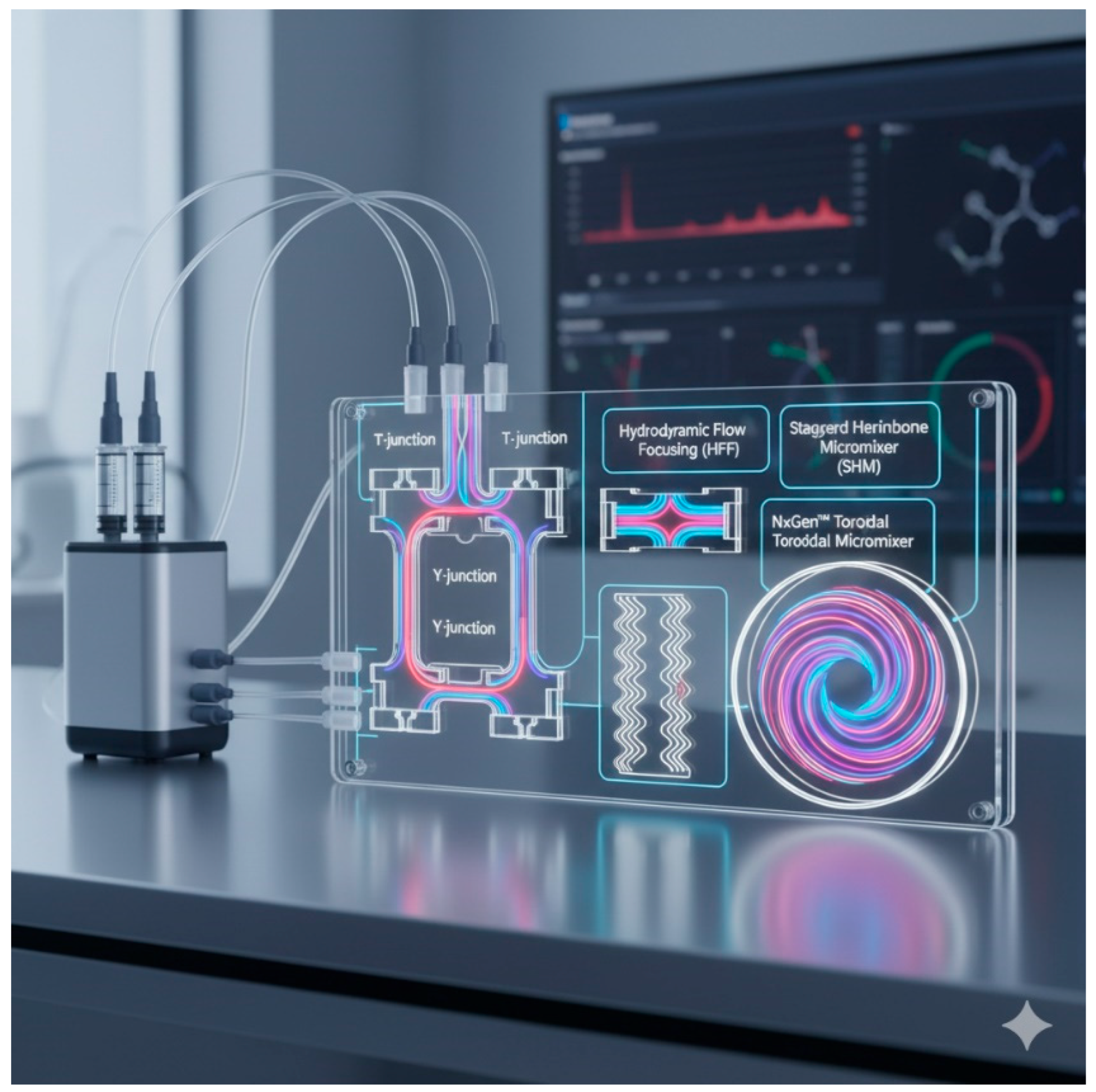
Bahlool et al. [11], designed an inhalable all-trans retinoic acid (ATRA)-loaded poly(lactic-co-glycolic acid) (PLGA) nanoparticle formulation that reduced bacterial load in infected alveolar cells in a dose-dependent manner while maintaining cell viability. The formulation shows suitable aerodynamic properties for alveolar targeting. On the other hand, scaling up nanoformulations remains challenging due to poor reproducibility and limited batch size in conventional nanoprecipitation or emulsion methods [12]. To address this, Bahlool et al. [11], used microfluidics for continuous, scalable nanoparticle production. This method ensures controlled mixing at the nanoliter scale, user-independent operation, and high reproducibility. Microfluidic systems typically include a pump and a chip with mixers, such as T-junctions, HFFs, SHMs, and newer NxGen™ toroidal micromixers (Figure 2).
Table 1 summarizes all the information provided in this section.

1.2. Pathophysiology of the Disease

The presence of necrotic granulomas in the affected organ, along with primary lung involvement, is a hallmark of TB infections in patients [13]. Critical issues to consider include how antituberculosis drugs cross barriers within granulomas, their effects on drug efficacy, and their impact on the patient’s immune response. These barriers include the granuloma’s physical structure, immune cell activity, and limitations on drug penetration. The efficacy of anti-TB drugs depends heavily on their ability to overcome these barriers; their penetration significantly impacts the patient’s immune response and treatment outcomes [14].
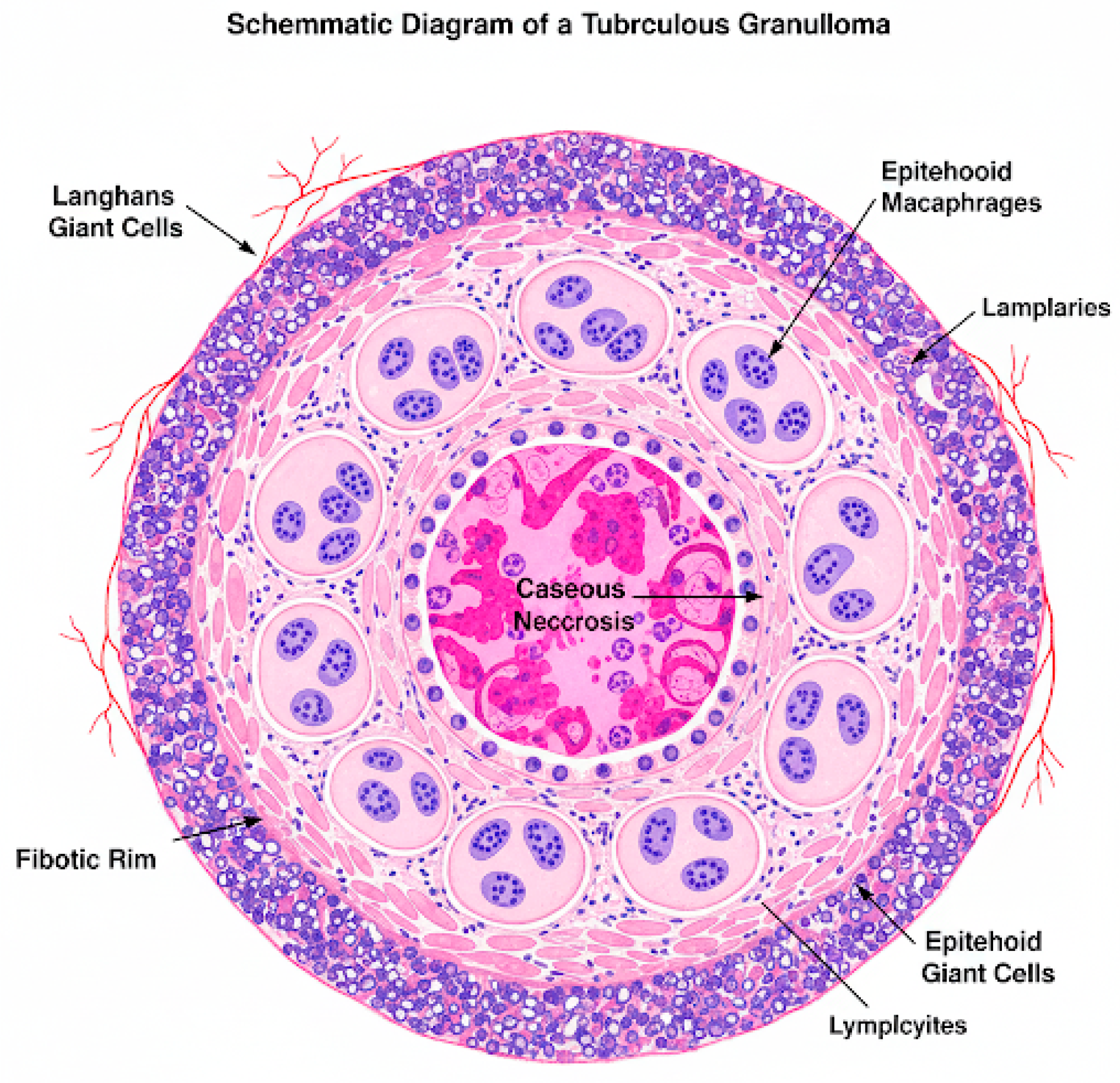
Granulomas are cellular aggregates formed in response to chronic inflammation and comprise various immune cells, including macrophages, foam cells, and multinucleated giant cells. These structures exhibit heterogeneous microenvironments with gradients of gases, metabolites, and nutrients. M. tuberculosis promotes granuloma formation to its advantage [15]. Necrotic granulomas have a layered architecture, consisting of a central caseous mass rich in extracellular bacteria, surrounded by macrophages and a fibrous collagen cuff. Effective TB treatment requires drugs that penetrate the caseous (Figure 3) [16], though not all anti-TB drugs achieve this [17].

1.3. Host Immune Response Triggered by Disease and Potential Therapeutic Strategies

The immune response within granulomas involves a balance of pro- and anti-inflammatory signals to control infection. While granulomas were once thought to limit the growth of M. tuberculosis, recent studies challenge this view. In the zebrafish—M. marinum model, monocyte migration into granulomas can promote bacterial growth. Conversely, limiting epithelioid macrophage formation—thus improving immune cell access—reduces mycobacterial proliferation [18]. Targeting epithelioid macrophage development may be a potential therapeutic strategy.
Some anti-TB drugs may indirectly disrupt the formation of epithelioid macrophages, which are crucial for granuloma structure and containment, particularly in the context of M. tuberculosis [19]. While specific therapies aim to enhance macrophage function, others may interfere with differentiation and granuloma development. For instance, β-glucan, present on the surfaces of M. tuberculosis and in culture supernatants, can induce ‘trained immunity’ through epigenetic changes, thereby boosting cytokine production and enhancing bacterial control [19]. Immunomodulatory strategies under investigation include histone deacetylase (HDAC) inhibitors (e.g., vorinostat, panobinostat) that reverse immune suppression, β-glucan for innate immune reprogramming, and promoting M1 macrophage polarization to enhance bactericidal activity [20].

1.4. Role of Macrophages in Tuberculosis and Potential Therapeutic Strategies

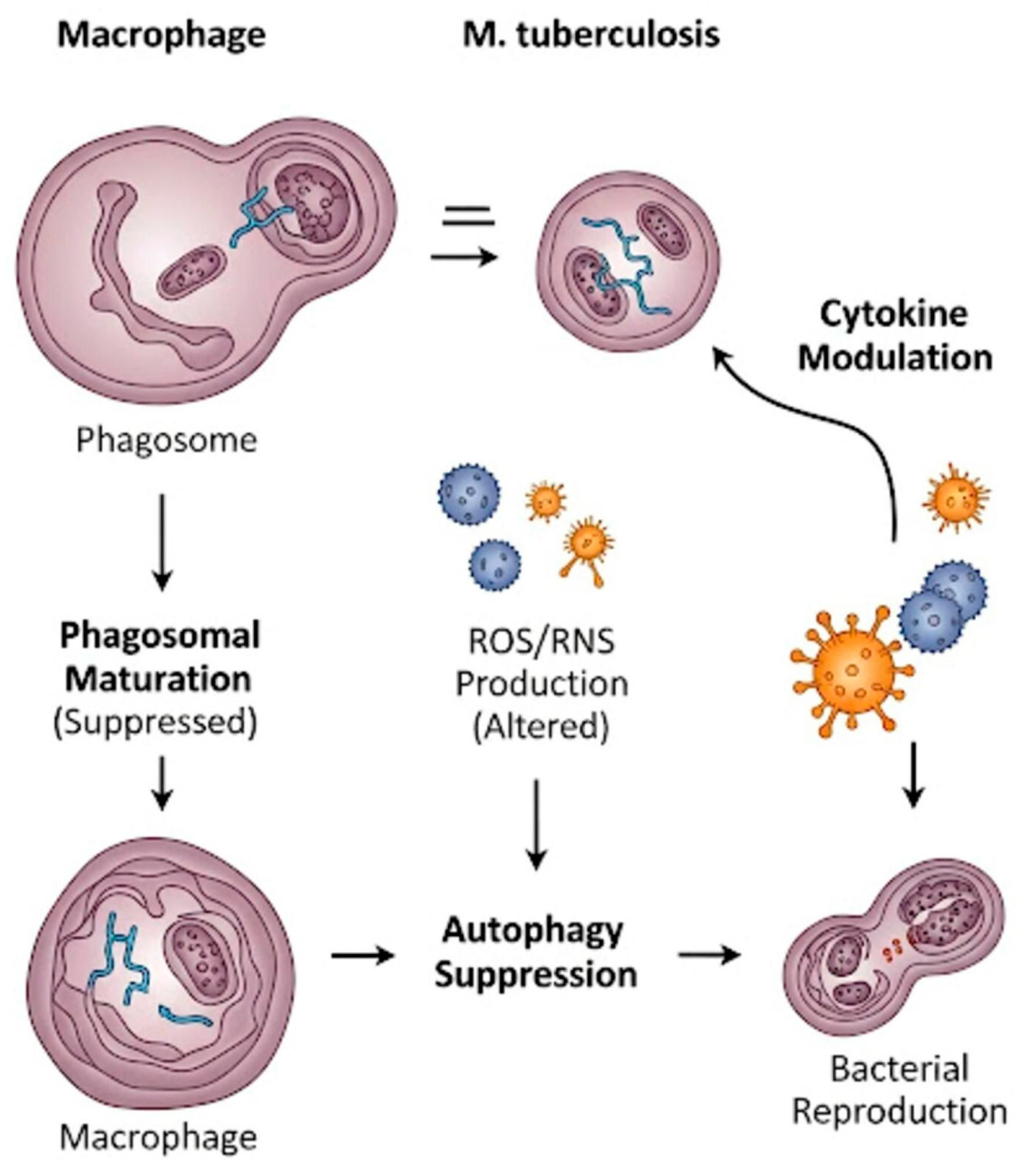
Macrophages represent the primary cells responsible for combating infection. The bacterium M. tuberculosis then takes over and starts growing in these cells. This process reduces the macrophages’ natural ability to fight off infections. This allows the bacterium to live within these cells and reproduce. Macrophages limit the growth of M. tuberculosis. They do this through mechanisms that include limiting phagosome maturation. Macrophages modulate cytokine and reactive nitrogen species (RNS/ROS) production. M. tuberculosis’s ability to block autophagy makes it more difficult to eradicate than other pathogens. The suppression of macrophage defense responses is necessary for the pathogen to survive and replicate within cells. Autophagy is a cellular process that degrades pathogens at the onset of an infection. Therefore, Autophagy-inhibiting factors and mechanisms could be exploited to identify autophagy-inducing chemotherapeutics for use in adjunctive therapy. The goal is to reduce the length of treatment and improve cure rates for multidrug-resistant (MDR) and extensively drug-resistant (XDR) tuberculosis using existing first-line anti-TB agents [21].

1.5. Nanotechnology’s Potential to Provide Effective Treatment Solutions for Tuberculosis and Challenges for Inhalable Anti-TB Drugs: Nanocarrier-Based Drug Delivery Systems

Nanotechnology offers promising opportunities to address the significant limitations of existing tuberculosis treatment and prevention strategies. One example is administering medications into the lungs to treat lung diseases. Drug delivery via the pulmonary route has two main advantages: there is no first-pass effect and high bioavailability. That provides an essential means of delivering therapeutics directly to lung lesions. Moreover, delivering medications directly to the lungs offers several additional benefits. It ensures precise drug delivery, enhances treatment effectiveness, and minimizes adverse reactions [22]. Additionally, drug delivery systems can improve the absorption of anti-tuberculosis medications into necrotic granulomas in patients with TB. This is because the formation of mycobacterial granulomas involves significant stromal remodeling, including the development of permeable, granuloma-associated vasculature. For example, nanoparticles (NPs) of various sizes can leak from blood vessels near granulomas and accumulate in substantial quantities near these infection sources [23]. Furthermore, the use of nanotechnology has led others to consider nanoparticles for encapsulating antitubercular drugs. This is because alveolar macrophages readily phagocytose nanoparticles, thereby delivering the drug directly to the site where M. tuberculosis replicates.
However, limitations of pulmonary nanoparticle administration for tuberculosis (TB) include a lack of sustained drug retention in the lungs and the mucociliary clearance that removes particles from the lungs. Other limitations include patient-specific factors, such as smoking and chronic obstructive pulmonary disease (COPD), which can alter lung physiology. Negatively charged mucus can hinder penetration due to surface charge. High costs, the need for specialized inhalation devices, and insufficient clinical data also present barriers to the widespread clinical translation of this method [24].
Although nanoencapsulation for inhaled drugs shows promise, its industrial application is limited, with only one FDA-approved product, ARIKAYCE®, currently on the market. Significant progress has been made in incorporating various drug types into nanoparticles, such as lipid nanoparticles for nucleic acids, and in developing advanced inhalation devices and particle engineering techniques, including spray-drying, to enhance delivery and effectiveness. However, ensuring particle stability, controlling physical characteristics such as size and aggregation, and mitigating potential lung-specific cytotoxicity remain key challenges for the widespread clinical use of these nanoparticles. Conversely, despite considerable efforts, regulatory authorities have not approved any dry powder inhalation formulations of nanoparticles, indicating a discrepancy between research and drug development. One significant obstacle to scaling up the manufacturing process is variability in the physicochemical properties of the nanoparticles (e.g., particle size) between batches. This issue often arises during laboratory formulation development, which is typically conducted in batches. Scale-up can exacerbate this variability due to variations in mass transfer and formulation momentum. These factors dictate nanoparticle formation [25].

1.6. From Nanomedicine to Nanotheranostics: Integrating Diagnosis and Therapy

Recent advances in nanotechnology have introduced a new generation of nanosystems capable of performing both diagnostic and therapeutic functions within a single platform, known as theranostic nanomedicine or nanotheranostics [26]. This approach combines the advantages of targeted nanocarriers—such as high drug-loading capacity, biocompatibility, and controlled release—with the inclusion of imaging or sensing functionalities that enable real-time tracking of disease progression and therapeutic response.
In tuberculosis (TB), nanotheranostic systems have the potential to transform disease management by combining diagnostic and therapeutic functions within a single nanoscale platform. These systems enable early detection of Mycobacterium tuberculosis through nanosensors or contrast-enhanced imaging, while simultaneously allowing targeted delivery of antitubercular agents directly to infected macrophages or granulomatous lesions. For instance, Akinnawo and Dube [27], comprehensively reviewed the theranostic potential of metallic nanoparticles—such as gold, silver, and iron oxide nanostructures—in TB. Their work demonstrated how these nanomaterials can act as diagnostic probes, owing to their optical and magnetic properties, and as therapeutic agents via photothermal and photodynamic mechanisms. These dual functionalities enable MRI- or photo-guided therapy and allow real-time monitoring of treatment efficacy through measurable imaging signals or local physicochemical changes at infection sites [27].
In parallel, Li et al. [28], reported a pioneering example of a multifunctional nanotheranostic platform employing macrophage-membrane-coated nanoparticles loaded with photothermal agents. This bioinspired system specifically targets M. tuberculosis-infected macrophages, enabling selective accumulation within granulomas and subsequent near-infrared (NIR) imaging to visualize infected tissues. Upon NIR irradiation, the nanoparticles induce localized photothermal ablation of intracellular bacteria, effectively integrating image-guided therapy and diagnostic feedback into a single construct. This work exemplifies how nanotheranostic technologies can achieve spatially precise treatment, minimize systemic toxicity, and permit in situ evaluation of therapeutic response, representing a significant step toward personalized TB management [28].
Several additional nanoplatforms have demonstrated theranostic potential for TB. Magnetic nanoparticles such as Fe3O4 and MnFe2O4 have been functionalized with antitubercular drugs for Magnetic Resonance imaging–guided delivery (MRI-guided delivery), enabling visualization of pulmonary accumulation and controlled release kinetics. For example, an Fe-based metal–organic framework (Fe-MIL-101-NH2) loaded with isoniazid exhibited both magnetic resonance contrast enhancement and local drug delivery capacity in infected tissues, highlighting the dual diagnostic therapeutic functionality of such systems [29]. Similarly, superparamagnetic iron oxide nanoparticles (SPIONs) incorporated into inhalable microparticles have been used to direct antitubercular agents to lung lesions under an external magnetic field, improving localization and reducing systemic exposure [30].
Other optical nanoplatforms, such as fluorescent quantum dots and up conversion nanoparticles, have been engineered for the optical detection of M. tuberculosis biomarkers and in vitro diagnostic applications. For instance, quantum-dot-based nanosensors functionalized with TB-specific oligonucleotides have achieved rapid, ultrasensitive detection of bacterial DNA or protein antigens, demonstrating potential for point-of-care diagnosis [31].
In addition, polymeric and lipid-based nanocarriers can co-encapsulate antibiotics with fluorophores or radionuclides to enable therapeutic tracking in vivo. A recent study by Tian et al. [32], employed macrophage-targeted metal–organic-framework nanocomposites carrying photosensitizers and CpG oligonucleotides to achieve combined photodynamic therapy and immunotherapy against TB-infected macrophages, enabling concurrent imaging and bacterial clearance [32]. Similarly, polymeric micellar nanoparticles loaded with bedaquiline improved drug bioavailability and survival outcomes in M. marinum-infected zebrafish while enabling fluorescent tracking of drug distribution [33].
Together, these emerging examples underscore how nanotheranostic approaches bridge the gap between diagnosis and therapy, enabling in situ visualization of infection sites, precise delivery of therapeutic agents into infected macrophages or granulomas, and real-time monitoring of treatment responses. Collectively, they represent a new frontier in tuberculosis management—offering levels of precision, adaptability, and personalized intervention unattainable with conventional drug formulations. Table 2. summarizes all the information provided in this section.

1.7. Theranostic Design Principles and Engineering Considerations

Despite substantial advances in nanomedicine, theranostic strategies specifically for tuberculosis (TB) remain in their early stages, and the limited number of studies underscores the need for standardized design frameworks tailored to the unique pathophysiology of TB. The following design principles can guide the rational engineering of multifunctional nanoplatforms for TB management:
(i) Biocompatible and stimuli-responsive materials.
Nanoparticles should be fabricated from biodegradable materials—such as PLGA, lipids, chitosan, or mesoporous silica—and engineered to respond to TB-specific microenvironmental cues (e.g., acidic pH in phagosomes/granulomas, elevated reactive oxygen species (ROS), or specific enzyme activity). For example, a recent study used mannosamine-engineered PLGA-PEG nanoparticles loaded with rifapentine to enhance macrophage targeting in M. tuberculosis-infected cells; the particles had a mean size of ~108 nm, high encapsulation efficiency, and sustained drug release for ~60 h [34].
This type of design aligns with the requirement for stimulus-responsive release within infected macrophages and granulomatous sites.
(ii) Dual functionality (diagnosis + therapy).
A proper theranostic system incorporates both imaging/sensing moieties (magnetic, fluorescent, radionuclide) and therapeutic cargo (antitubercular drugs, photothermal or photodynamic agents). For instance, an aggregation-induced emission (AIE) carrier loaded with rifampicin was shown to localize in granulomas, emit fluorescence signals for early diagnosis, and subsequently generate ROS and release rifampicin to eradicate persistent M. tuberculosis [35].
Such systems illustrate how diagnostics and therapy are integrated into a single nanosystem.
(iii) Targeted delivery to macrophages and granulomas.
Since M. tuberculosis resides intracellularly in macrophages and within granulomas, designing nanoparticles with surface ligands (e.g., mannose, transferrin, antibodies) can enhance uptake by infected cells and improve localization at the disease site. For example, a study of mannose-decorated solid-lipid nanoparticles for alveolar macrophage targeting of rifampicin showed significantly higher macrophage uptake than unmodified particles (~170 nm) and improved intracellular delivery [36].
This design principle maximizes drug concentration at the infection locus while minimizing systemic exposure.
(iv) Scalable and reproducible synthesis.
Clinical translation of theranostic nanomedicines requires manufacturing processes that ensure consistent particle size, surface chemistry, and batch reproducibility. Techniques such as microfluidic-assisted nanoprecipitation and continuous flow synthesis have been highlighted in recent reviews of nanocarrier manufacturing, though specific examples in TB theranostics are still rare [37]. Ensuring scale-up and reproducibility is essential for moving from the bench to the clinic.
(v) Real-time therapeutic monitoring.
Incorporating imaging modalities (MRI, fluorescence, PET/SPECT) into nanosystems enables non-invasive visualization of biodistribution and accumulation at infected sites, and real-time assessment of therapeutic efficacy. For example, a biomimetic nanoparticle coated with pre-activated macrophage membrane enabled near-infrared imaging of pulmonary granulomas and photothermal therapy of TB in mice, illustrating how image-guided treatment and monitoring can be achieved [28]. Such feedback capability supports precision medicine approaches for TB.
By combining these design principles—stimuli responsiveness, dual modality, targeting, scalable fabrication, and imaging feedback—researchers can develop next-generation nanotheranostic platforms tailored for TB. Such platforms hold promises for improving diagnosis, enhancing therapeutic efficacy, reducing toxicity, and enabling personalized treatment strategies for drug-resistant and hard-to-treat TB.

1.8. Future Perspectives and the Need for Integrated Theranostic Strategies

Although the number of studies specifically focused on nanotheranostic applications in tuberculosis remains limited, this field holds great promise for advancing toward personalized TB therapy. By integrating diagnostic and therapeutic capabilities, nanotheranostic platforms could facilitate early disease detection, improve drug targeting, reduce treatment duration, and minimize the development of resistance.

1.9. Current Prevention of Tuberculosis

The Bacillus Calmette–Guérin (BCG) vaccine is the only licensed vaccine for preventing TB. It is predominantly used for pediatric populations. That creates a significant gap in the availability of approved vaccines for adults [38]. Therefore, the search for an effective TB immunization strategy is a global health priority, and researchers have been encouraged to explore progressive approaches to ending the TB pandemic. On the other hand, the BCG vaccine may interfere with the tuberculosis diagnostic test. A false-positive TB skin test reaction is a possible side effect of the BCG vaccine [39].

1.10. New Vaccination Strategies for Disease Prevention and Potential Solutions Offered by Nanotechnology

In TB prevention, the weak immunogenicity of traditional subunit vaccines is a challenge because the interaction between M. tuberculosis and its host is exceedingly intricate [40]. On the other hand, nanocarriers have been shown to possess inherent adjuvant properties, acting as stimulators of immune cells. Thus, nanovaccines have the potential to promote rapid and long-lasting humoral and cellular immunity. Nanovaccines offer several potential benefits, including site-specific antigen delivery, increased antigen bioavailability, and reduced adverse effects [41].
This review provides an overview of the latest research on the challenges of treating TB, current treatment options, and the benefits of nano-sized formulations for improving treatment and prevention.

2. Host-Directed Therapy (HDT) as an Alternative Tuberculosis Treatment Strategy and the Potential of Nanocarriers

2.1. General Considerations on the Concept of Host-Directed Therapies (HDT)

Daily administration of multiple anti-tuberculosis drugs is the standard treatment for tuberculosis; however, it often poses challenges to patient compliance [42]. Furthermore, the extended treatment duration of 6–9 months frequently not only reduces the treatment’s effectiveness but also leads to the emergence of multidrug-resistant TB (MDR-TB) and extensively drug-resistant TB (XDR-TB) [43]. TB treatments based on nanomedicine have shown significant progress in the last five years, according to recent research.
On the other hand, M. tuberculosis, the causative agent of tuberculosis disease, makes macrophages the primary immune responders and host cells. After macrophages take up M. tuberculosis, their natural ability to fight off microbes is suppressed, allowing the bacterium to live and reproduce within them. The mechanisms by which M. tuberculosis suppresses the antimicrobial response of the macrophage include limiting phagosomal maturation and modulating cytokine, reactive oxygen, and nitrogen species (ROS/RNS) production, and suppressing autophagy (Figure 4) [43]. This suppression of macrophage defense responses is essential for the pathogen to survive and replicate within cells. However, blocking some of the mechanisms that M. tuberculosis uses to survive in macrophages could lead to the development of therapeutic strategies for treating TB. That is the field addressed by host-directed therapies (HDTs).
M. tuberculosis manipulates host intracellular signaling to evade immune defenses, supporting host-directed therapy (HDT) as a potential approach against drug-resistant strains. Unlike antibiotics, HDTs modulate host responses and may be effective against both drug-susceptible and MDR M. tuberculosis [44]. Currently, no HDTs are approved for the treatment of pulmonary TB.
One promising HDT strategy involves targeting TB granulomas, which can act as drug barriers while also serving as a refuge for M. tuberculosis [45]. Moreover, abnormal granuloma microenvironments (GMEs) feature dysfunctional vasculature and excessive extracellular matrix (ECM), which impair drug delivery and promote chronic inflammation. Datta et al. [46], proposed an HDT approach targeting these abnormalities using losartan (an AT1 receptor blocker) and bevacizumab (an anti-VEGF antibody). This combination improves vascular normalization and ECM remodeling, potentially enhancing drug penetration and reducing inflammation.
Nanocarriers targeting the GME in TB can improve drug delivery by overcoming barriers like excessive ECM, abnormal vasculature, and poor tissue penetration. This strategy, adapted from oncology, utilizes either passive targeting (macrophage uptake) or active targeting (ligand-functionalized nanocarriers) to enhance local drug concentration and minimize systemic toxicity. Wang et al. [47], developed RBC-O2/TQ@PB nanoparticles combining photodynamic and photothermal therapy with oxygen delivery to kill M. tuberculosis in hypoxic granulomas. These nanoparticles, coated with erythrocyte membranes, extended their circulation time (half-life: 18.85 h) and improved lung accumulation, raising granuloma temperature to 44 °C and significantly reducing bacterial proliferation in a mouse model.
Fibrotic processes in TB granulomas are influenced by matrix metalloproteinases (MMPs), zinc-dependent enzymes that remodel the ECM [48]. Doxycycline, the only approved MMP inhibitor, reduces MMP secretion and collagen degradation induced by M. tuberculosis. Preclinical studies have shown that doxycycline enhances the efficacy of TB treatment and reduces pulmonary cavity volume [49]. Miow et al. [50] also found that doxycycline accelerates immune recovery and suppresses the expression of MMP-1, -8, and -9 in TB patients.
To further modulate MMP activity, Wang et al. [51] developed mannose-coated bovine serum albumin nanoparticles (MBNPs) delivering siKLK12, which downregulates KLK12 and its regulation of MMP-1 and -9 in M2 macrophages. These pH-responsive MBNPs target mannose receptors, achieve efficient lysosomal escape, and accumulate in the lungs within 1 h post injection, thereby limiting fibrosis and TB progression.
Table 3 summarizes all the information provided in this section.

2.2. Therapies Targeting Autophagy in Tuberculosis

Autophagy is a cellular process responsible for the lysosomal degradation of intracellular components, including invading pathogens such as M. tuberculosis. Mechanisms that induce autophagy to decrease and eliminate bacterial loads within infected host cells have been identified in macrophages infected with M. tuberculosis. A new approach to treating TB has attracted significant attention: inducing autophagy in infected host cells. This approach uses compounds that induce autophagy [7].
Xenophagy is a type of autophagy that destroys invading pathogens by directing them from the autophagosome to the lysosome. Autophagy targets antigens for lysosomal degradation, breaking macromolecules down into smaller components. It also transports microbial peptides for presentation to the major histocompatibility complex (MHC) [52].
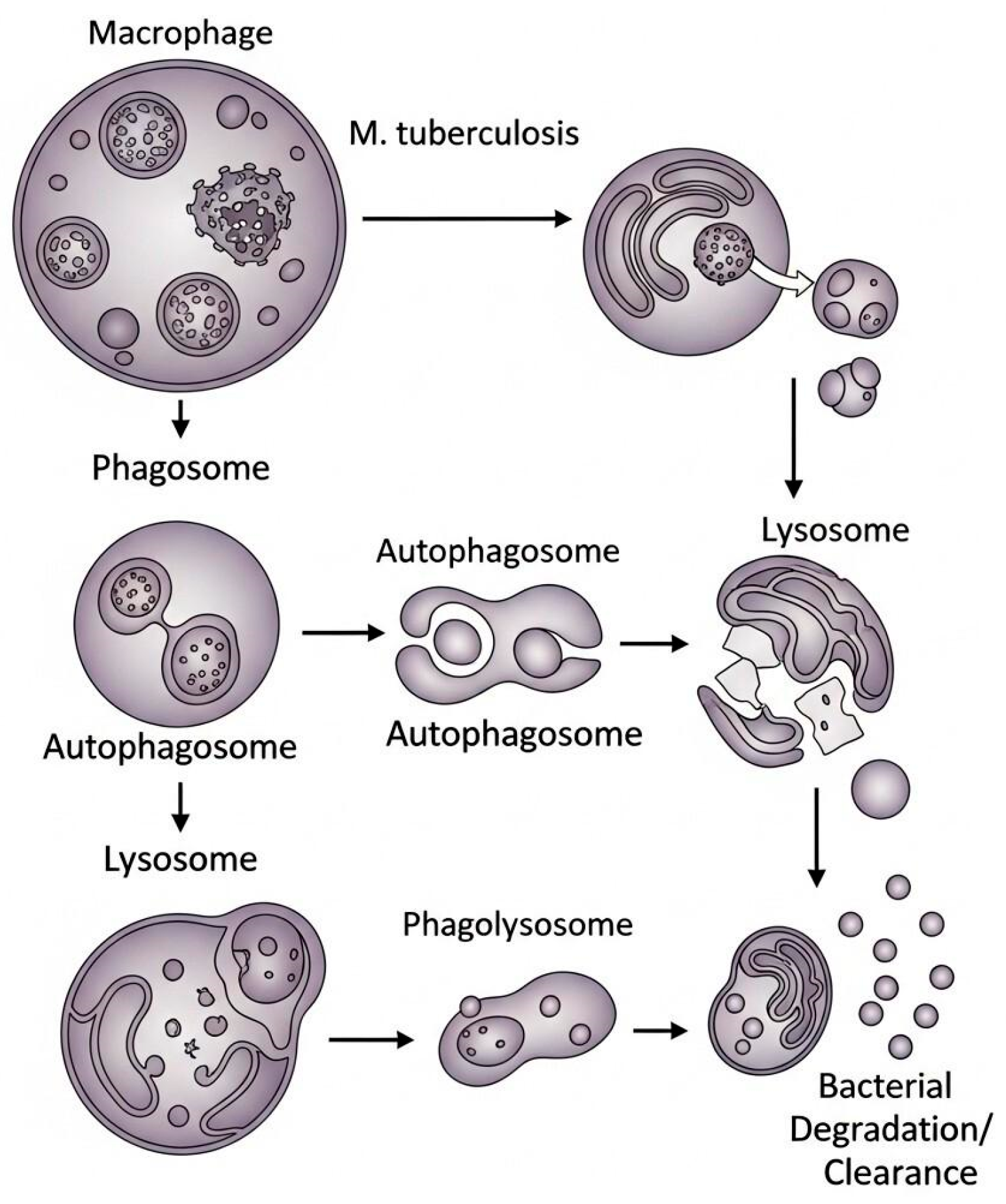
The process of xenophagy in M. tuberculosis-infected macrophages begins with the formation of an isolation membrane that elongates to form a phagophore. The phagophore captures the M. tuberculosis bacterial cargo. The phagophore then grows and matures into an autophagosome, which completely engulfs an M. tuberculosis cell. The autophagosome then fuses with a lysosome, forming an autolysosome. The lysosome provides the necessary enzymes to degrade and kill the trapped cell. However, M. tuberculosis has developed a strategy for replicating within infected cells. It does so by arresting phagosome maturation, which targets pathogens for elimination. This arrest occurs when the bacterium invades host cells via phagocytosis [53].
It is believed that M. tuberculosis manipulates cell autophagy through different actions. For example, M. tuberculosis-secreted tyrosine phosphatase (PtpA) hinders the fusion of phagosomes and lysosomes by dephosphorylating vacuolar protein sorting 33B (VPS33B), the regulator of membrane fusion. M. tuberculosis’s PtpA is also essential for bacterial pathogenesis. This inhibition means that M. tuberculosis is not exposed to a strongly acidic environment in vivo. This enables it to propagate successfully in host cells [54]. PtpA also affects the V-ATPase machinery on the phagosome, preventing its maturation and acidification [55,56]. M. tuberculosis is known to express two protein tyrosine phosphatases: MptpA (Mr 17.5 kDa) and MptpB (Mr 30.2 kDa), and MptpA is secreted into the cytosol of host cells by growing M. tuberculosis. There, it dephosphorylates the host VPS33B protein (vacuolar protein sorting 33B), thereby inactivating it. This inactivation prevents the fusion of the phagosome and lysosome, conferring virulence to M. tuberculosis [54]. Researchers have proposed a theory regarding the development of inhibitors against the tyrosine phosphatases of M. tuberculosis. These inhibitors would target the proteins in question, and the result would be twofold. On the one hand, it would restore host kinase signaling. On the other hand, it would recover the host’s immune system [57]. However, despite extensive research, no significant advances have been made in developing inhibitors against mPtpA.
Furthermore, other studies have shown that the enhanced intracellular survival (EIS) protein of M. tuberculosis inhibits autophagy by regulating the AKT/mTOR pathway via IL-10 activation [58]. Berton et al. [59], proposed that targeting metal-dependent protein phosphatases (PPMs) with drugs could trigger autophagy, thereby inhibiting M. tuberculosis survival in macrophages. But to date, researchers have not developed pharmacological inhibitors of PPM1A with clinical potential.
Conversely, Zhang et al. [60], proposed that berbamine promotes macrophage autophagy to clear M. tuberculosis by regulating the ROS/Ca2+ pathway. Berbamine is a natural bisbenzylisoquinoline alkaloid and an FDA-approved drug isolated from the shrub Berberis amurensis, used in traditional Chinese medicine. Additionally, it was reported that vitamin D3 promotes autophagy in the THP-1 human leukemia monocyte cell line [61]. The study revealed that vitamin D3 treatment led to a notable upregulation of p62, LC3, Beclin-1, and ATG-5, while concurrently decreasing AKT protein expression. The p62 protein is in the phagosome. This formation site binds two proteins: the autophagy-localization protein LC3 and a family of ubiquitin-like proteins. On the other hand, the formation of the critical autophagosome stage in autophagy, and this process is dependent on ATG5, an autophagy protein. Moreover, Beclin-1 is a mammalian autophagy protein involved in diverse biological processes, including tumor suppression and cell death. The AKT protein is also known as protein kinase B. It is an oncogenic protein that regulates cell survival, proliferation, growth, and autophagy, a process in which cells are broken down for energy. The AKT/mTOR signaling pathway is essential because it serves as a negative regulator of autophagy and apoptosis, other processes in which cells are broken down for energy.

Role of Nanocarriers in Autophagy in Tuberculosis-Infected Macrophages

Autophagy is increasingly seen as a vital part of the immune system’s response to TB. This view is supported by accumulating findings. Autophagy directly kills intracellular M. tuberculosis and modulates the secretion of proinflammatory cytokines [62].
The process of autophagy is responsible for the lysosomal degradation of intracellular components, including invading pathogens such as M. tuberculosis [7]. In macrophages infected with M. tuberculosis, the induction of autophagy causes the maturation of phagosomes containing M. tuberculosis, which subsequently fuse with lysosomes to clear the bacteria (Figure 5) [63].
On the other hand, the host-directed therapy (HDT) for TB focuses on modulating the host’s immune response to enhance the body’s ability to fight off the infection. One promising HDT strategy involves manipulating autophagy, a cellular process that eliminates intracellular pathogens, to improve the effectiveness of TB treatment [64].
Researchers are investigating the use of nanomaterials to induce autophagy and treat TB by activating the host cell’s natural clearance mechanisms, particularly in macrophages, where the bacteria reside. These HDT utilize functional nanomaterials, such as poly (lactic-co-glycolic acid) (PLGA) and curcumin nanoparticles, to stimulate autophagy, which helps clear M. tuberculosis from infected cells and reduces the bacterial burden. This approach offers a potential alternative to or supplement for traditional antibiotics, which are facing increasing resistance [65]. Curcumin (CMN), the primary curcuminoid found in Curcuma longa, exhibits anti-TB activity against multidrug-resistant (MDR) strains of M. tuberculosis in macrophages and is known to induce autophagy by promoting phagosome-lysosome fusion in macrophages. CMN triggered autophagy in both uninfected and M. tuberculosis-infected macrophages. This was apparent through the conversion of LC3-I to LC3-II and the degradation of p62. This study examined the encapsulation of CMN in PLGA NPs to enhance its oral bioavailability. Treatment of BALB/c mice infected with M. tuberculosis with an oral dose of PLGA NPs carrying CMN was found to significantly decrease the survival of the intracellular M. tuberculosis H37Rv strain by inducing autophagy. Moreover, combining these NPs with free CMN and isoniazid (INH) resulted in a greater than 99% decrease in M. tuberculosis survival in macrophages, due to the adjuvant action of the NPs.
The HDT strategy is also exemplified by the nanocarriers proposed by Bekale et al. [66] They developed poly (lactic-co-glycolic acid) (PLGA) nanoparticles that transport Curdlan (1,3-β-glucan) to their surfaces. Curdlan enables interaction between the NPs and the pattern recognition receptor Dectin-1, which is found on macrophages and dendritic cells. The binding of Curdlan to Dectin-1 has been shown to trigger signal transduction pathways within the cell. These pathways lead to the expression of proinflammatory genes, such as IL-12 and TNF-α, as well as the production of reactive oxygen and nitrogen species (ROS/RNS) within the cell. PLGA NPs can also trigger autophagy in macrophages. This resulted in increased cytokine production and reduced M. tuberculosis in lung-infected mice after six weeks of oropharyngeal administration in a mouse model.
Metal nanoparticles play an essential role in macrophage autophagy. For instance, the number of bacteria engulfed by macrophages in BCG-infected mice decreased in a dose-dependent manner after administration of zinc oxide nanoparticles (ZnO NPs). Additionally, low doses of ZnO NPs triggered autophagy by increasing levels of proinflammatory factors. ZnO NPs also enhanced BCG-induced ferroptosis of macrophages at high doses. In a mouse model, the anti-Mycobacterium activity of ZnO NPs increased with the co-administration of a ferroptosis inhibitor. This combination also mitigated ZnO NPs-induced acute lung injury [67].
Pi et al. [68], designed a graphene oxide (GO) nanocarrier system [34]. This system targets macrophages. It is based on mannose functionalization and polyetherimide (PEI) decoration. The goal is to achieve the targeted delivery of an anti-TB antibiotic and an autophagy activator to macrophages. In this study, the drugs were released from lysosomes more rapidly due to mannose surface functionalization, thereby increasing cellular uptake. Rifampicin (RIF) and carbamazepine (CAR) were loaded into the functionalized GO NPs. RIF is necessary for higher intracellular killing efficiency of M. tuberculosis, and CAR may promote autophagy and apoptosis in M. tuberculosis-infected cells. It increases mitochondrial membrane potential and antibacterial action by enhancing intracellular ROS production. M1 polarization initiates the polarization of Mtb-infected macrophages, leading to increased IFN- and antibacterial NO production.

2.3. Nanocarriers for Macrophage Targeting Delivery

Luan et al. [34], proposed the hypothesis that functionalizing PLGA and PEG NPs with the ligand mannosamine would bind to the phagocytic mannose receptors [69]. The proposed functionalized NPs carry rifapentine (RPT), a first-line TB treatment approved by the US Food and Drug Administration (FDA). Macrophages take up NPs via endocytosis. The enhanced macrophage-targeting capacity of the functionalized NPs, which transport RPT, significantly increased the intracellular concentration of the drug.
Shen et al. [69] introduced a new approach for targeting macrophages and enhancing the body’s natural defenses against M. tuberculosis, as well as the effectiveness of drugs used to treat the disease. In this study, iron oxide nanoparticles (IO NPs) coated with polyacrylic acid (PAA) and PEG, and functionalized with mannoses, were delivered to macrophages. The goal was to investigate the “iron-tropic” property, as iron is necessary for M. tuberculosis growth and is toxic at high concentrations. The proposed functionalized polymeric-coated IONPs were also capable of targeting RIF, a first-line anti-TB drug. This carrier was found intracellularly, primarily in the acidic lysosomes of macrophages. Due to the acidic environment, RIF is released from the carrier. These NPs promote the increased entry and accumulation of antibiotics in macrophages. They also polarize macrophages infected with M. tuberculosis toward an anti-mycobacterial M1 phenotype, thereby increasing TNF-α levels.
A targeted drug delivery system was proposed by Peng et al. [70] This system uses mannose-modified PLGA–PEG NPs. These NPs are loaded with RPT and INH. The goal is to enhance macrophage-directed therapy and bacterial elimination. In this study, the phagocytic activity of macrophages was enhanced by mannose-modified NPs via mannose receptor-mediated endocytosis. This improvement in drug-delivery efficiency significantly enhanced the antibacterial efficacy of the NPs within macrophages.
Jiménez-Carretero et al. [71], proposed a nanoformulation (AS-48_BMNP) consisting of an antimicrobial peptide (AS-48) loaded on biomimetic magnetic nanoparticles (BMNPs) that could be used to magnetically drive the compound to the infection site and integrate it with other therapies, such as magnetic hyperthermia. In this study, the developed nanocarrier can be directed and/or concentrated in the lungs to minimize drug dissemination and side effects. It was found that AS-48_BMNP nanocomposites used against M. tuberculosis in vitro exhibit a synergistic effect with magnetic hyperthermia, enabling elimination of the bacteria from infected macrophages within 4 days.

2.4. Nanocarriers Inhibit Apoptosis and Induce Macrophage Polarization in Tuberculosis-Infected Macrophages

Apoptosis, a type of programmed cell death, is a deadly fate for host cells infected with pathogens. Host cells sacrifice themselves to kill intracellular M. tuberculosis bacteria. That prevents the bacteria from replicating and spreading to infect other cells. For instance, Lin et al. developed zinc oxide hybrid selenium nanoparticles (ZnOSe NPs) that significantly increased apoptosis in BCG-infected macrophages by promoting apoptosis in infected THP-1 macrophages [72]. In this study, the authors reported a connection between the inhibition of ZnOSe NPs and the PI3K/Akt/mTOR signaling pathway.
On the other hand, mitochondria are an essential source of reactive oxygen species (ROS). Excessive ROS production contributes to mitochondrial damage in TB and plays a key role in redox signaling from the organelle to the rest of the cell. The study by Lin et al. [72], revealed that ZnOSe NPs led to a significant decrease in mitochondrial membrane potential in BCG-infected macrophages, thereby promoting apoptosis and autophagy. Moreover, treatment with ZnOSe NPs significantly increased TNF-α production in BCG-infected THP-1 macrophages. This finding further supports the conclusion that ZnOSe NPs promote M1 polarization in infected macrophages. M. tuberculosis itself can inhibit M1 polarization to escape host cell immunological killing. M1 macrophages release proinflammatory cytokines and nitric oxide (NO), exhibiting high anti-mycobacterial activity. M2 macrophages produce inhibitory cytokines, weakening the antibacterial and anti-TB defenses.

3. Summary of Nanomaterials as an Alternative Strategy for Tuberculosis Treatment

The integration of nanomaterials into TB treatment opens the field of nanotheranostics, combining targeted therapy and diagnostic capabilities. Functionalized nanocarriers can selectively target infected macrophages, regulate apoptosis, autophagy, and macrophage polarization, and overcome biological barriers such as granulomas [73].
Granulomas, with their compact cellular structure and abnormal vascularization, limit drug penetration and harbor non-replicating, drug-tolerant bacteria [18,35]. Nanocarriers—including polymeric, lipid, metallic, and hybrid nanoparticles—can enhance drug delivery, provide sustained release, and improve intracellular accumulation of anti-TB drugs [74].
For example, polymeric NPs offer high drug loading and controlled release, lipid-based NPs provide biocompatibility and enhanced lung retention, and metallic NPs, like silver, possess intrinsic antimicrobial activity. By overcoming granuloma barriers and targeting host immune cells, nanotheranostics improve treatment outcomes, reduce drug resistance, and potentially shorten therapy duration.
Autophagy plays a central role in this process by promoting lysosomal degradation of intracellular M. tuberculosis, enhancing the efficacy of nanotheranostic-based therapies (Figure 5) [7,63].

4. Nanocarriers for Tuberculosis Prevention

The lack of an effective vaccine hampers the global fight against TB. BCG remains the only licensed option, offering strong protection in children but limited and waning efficacy against adult pulmonary TB. The immune response to M. tuberculosis is complex and not yet fully understood. Both M. tuberculosis and M. bovis are highly evolved pathogens with thick, waxy cell walls that form clumped clusters. These structural features act as physical barriers, impairing macrophage recognition, antigen processing, and T cell activation. Their ability to evade host immunity may be partly due to size- or steric-based mechanisms, consistent with biofilm theory, which suggests that large bacterial clusters resist immune detection and environmental stress [68].

4.1. Host Immunological Response to Mycobacterium Tuberculosis Infection

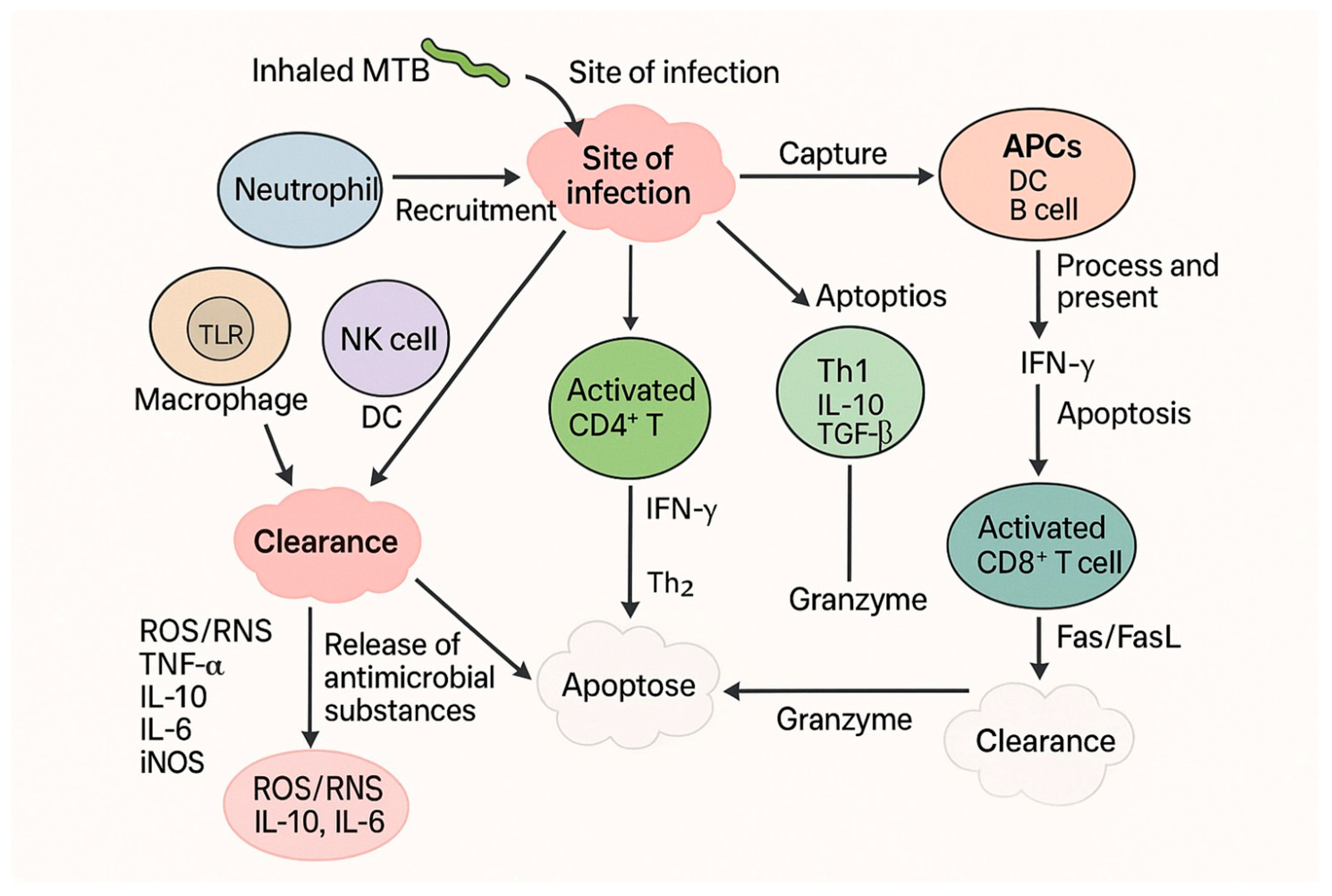
Evidence suggests TB is both an infectious and immune-mediated disease, emphasizing the role of M. tuberculosis and host interaction in outcomes. Entry of innate immune cells (e.g., neutrophils, macrophages, natural killer [NK] cells, and dendritic cells [DCs]) initiates immune response mechanisms, working with adaptive immune cells (e.g., CD4+ T cells, CD8+ T cells, and B cells) to mount an immune defense (Figure 6) [75]. Figure 6 briefly describes this process: M. tuberculosis is cleared by phagocytic cells and antigen-presenting cells (APCs), which process and present antigens to T cells, causing T cell activation. Activated T cells can differentiate into various subsets that target and kill infected cells. M. tuberculosis is also cleared by pathways involving granule enzymes and the Fas/FasL pathway.
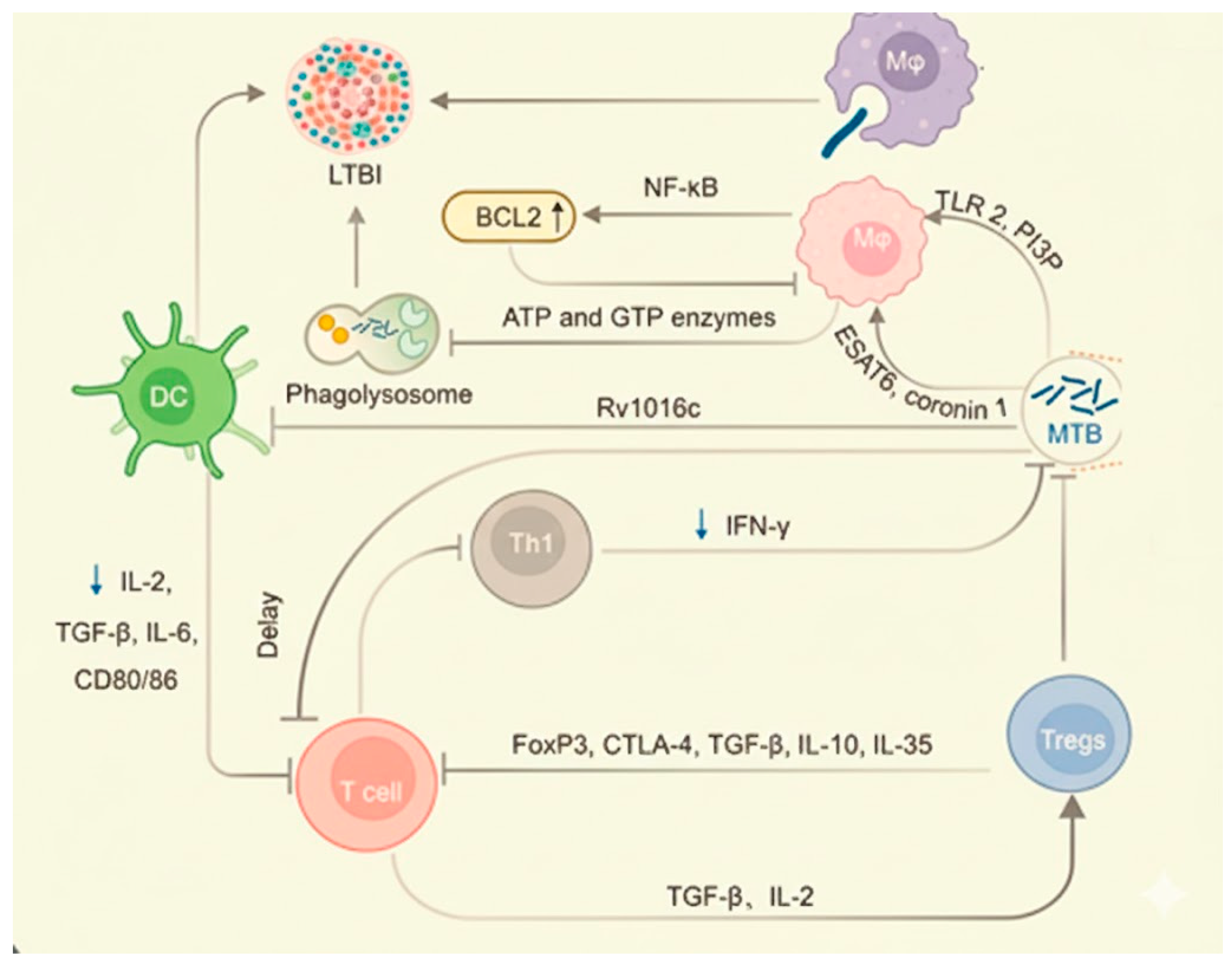
M. tuberculosis evades the immune system, resulting in latent (LTBI) or active TB (ATB), through three main strategies: intrinsic virulence factors, evasion of innate immunity, and evasion of adaptive immunity (Figure 7) [75]. It inhibits macrophage apoptosis via anti-apoptotic proteins (NouG, PKnE, SecA2) and NF-κB activation through TLR2, increasing BCL2 expression. It also blocks autophagy via PI3P manipulation and LprE and impairs antigen presentation using Rv1016c. In adaptive immunity, prolonged stimulation promotes the differentiation of CD4+ T cells into regulatory T cells (Tregs), which express inhibitory receptors that lead to T cell exhaustion.
Several TB vaccine candidates are currently undergoing clinical trials. These candidates employ various delivery platforms, including protein subunit, live-attenuated, and viral vector vaccines. However, the only proven candidate to provide clinical protection is the protein subunit vaccine M72/AS01E. This vaccine is an investigational subunit vaccine for TB that combines the M72 fusion protein antigen from M. tuberculosis with the GSK AS01E adjuvant system, which boosts immune responses.
In a Phase 2 trial, M72/AS01E demonstrated 49.7% efficacy in preventing progression to active disease in adults latently infected with M. tuberculosis [76]. The World Health Organization (WHO) has established preferred product characteristics for a new TB vaccine, including providing at least 50% protection against TB in subjects with and without evidence of latent M. tuberculosis infection across different geographical regions. An ongoing Phase 3 trial will determine if this vaccine meets these characteristics [77]. The vaccine’s development has been supported by non-profit organizations, including the Bill & Melinda Gates Medical Research Institute, due to the limited commercial potential of a TB vaccine.

4.2. Nanovaccines for Tuberculosis

There have been significant recent advances in subunit vaccines, including proteins, carbohydrates, and peptides [78]. However, despite being safer and more tolerable than older vaccines, new-generation vaccines often elicit a weaker immune response because pathogenic elements are removed from the source organism. In contrast, nucleic acid-based (DNA and RNA) or vector-based (e.g., adenovirus) vaccines can mimic a live infection. These vaccines induce antigen expression in situ after immunization. This process primes both B- and T-cell responses [79].
On the other hand, nanoparticulate vaccines are particularly well-suited for delivering antigens, including proteins, peptides, and nucleic acids. They also enhance lymph node targeting. Compared with conventional vaccines, these nanoparticulate vaccines offer distinct advantages. Precision Nanovaccines [80], nanoparticulate vaccines have two main benefits. First, they improve pharmacokinetics and safety. Second, they help antigens and molecular adjuvants cross biological barriers. They also target the immune system and antigen-presenting cells (APCs). In addition, they facilitate controlled release and cross-presentation [80].
In the case of TB, nanovaccines offer a promising new approach to prevention and treatment by using NPs to deliver antigens and adjuvants to the immune system. These nanovaccines aim to overcome the limitations of traditional TB vaccines, such as the BCG vaccine, by enhancing immune responses, improving antigen delivery, and potentially reducing adverse effects.

4.3. Nucleic Acid-Based (DNA and RNA) Vaccines for Tuberculosis

Next-generation therapeutic TB vaccines are being developed using nucleic acid (NA) technologies—mainly DNA and mRNA platforms—which encode M. tuberculosis antigens without containing infectious agents [81]. These vaccines offer a targeted and safer approach, suitable even for immunocompromised individuals. mRNA vaccines are particularly promising, as they do not integrate into the genome, can encode multiple antigens, and elicit strong immune responses.
Duan et al. [58] developed an mRNA-LNP TB vaccine encoding the L3 fusion protein (GlnA1, LysB, and a peptide), which showed both prophylactic and therapeutic efficacy in a zebrafish model. The vaccine enhanced autophagy and stimulated B and T cell responses, outperforming rifampicin in post-infection bacterial killing. Despite transient mRNA expression, results support further development using self-amplifying RNA technologies.
While the role of mRNA in chronic bacterial infections remains under investigation, multifunctional CD4+ T cells are likely key to long-term control. Currently, only two LNP-mRNA TB vaccines are in early-phase clinical trials, such as those by BioNTech (NCT05537038). Lukeman et al. [66] designed mRNACV2, an LNP-mRNA vaccine encoding the CysVac2 fusion protein (Ag85B + CysD), which is immunogenic and protective in mice. It induces strong Th1-type CD4+ T cell responses and IgG production, offering protection both as a standalone vaccine and as a BCG booster. These findings provide new insights into mRNA-based TB vaccines and potential correlates of protection.

4.4. Protein-Based Nanovaccines for Tuberculosis

Protein-based nanovaccines for TB target antigens recognized by the immune system during TB infection. Most of the TB vaccines currently under development consist of recombinant proteins mixed with adjuvants [82]. The widely used adjuvant DMT is a liposome. It contains dimethyldioctadecylammonium (DDA), monophosphoryl lipid A (MPLA), and trehalose-6,6′-dibehenate (TDB). DMT has been found to increase the number of antigen-specific CD8+ T cells while eliciting limited humoral responses. For example, Mao and his colleagues used this formulation to emulsify the recombinant protein Rv0572c. The study found that DMT-adjuvanted rRv0572c increased the number of CD4+ and CD8+ T cells producing IFN-γ or IL-4. In summary, this study explores strategies to enhance the effectiveness of the Bacille Calmette-Guérin (BCG) vaccine, particularly in preventing latent TB infection and reactivation. The latency antigen Rv0572c was identified based on its interaction with M. tuberculosis and recognized by T cells, especially in individuals with latent TB. In mice, the rRv0572c protein combined with the DMT liposome adjuvant (DDA, MPLA, and TDB) induced strong immune responses, including antigen-specific CD4+ and CD8+ T cells. It also generated limited Th2-type humoral responses. These findings suggest that the rRv0572c/DMT formulation is a promising subunit vaccine candidate for boosting BCG-induced immunity.
A nanoadjuvant system was recently proposed by Blanco et al. [83], which consisted of chitosan/alginate nanocapsules delivering either full-length M72 or a truncated M72 fused to a streptococcal albumin-binding domain (ABDsM72) antigen. The investigation revealed that the M72 nanocapsule formulation, when primed in the BCG mouse model, provided marked enhancement of splenic protection compared with BCG alone. However, no such enhancement was observed in the context of pulmonary protection. The proportion of CD4+ KLRG1-CXCR3+ T cells in the lungs of M. bovis-challenged mice increased with the ABDsM72 nanocapsule formulation, a key indicator of protective immunity.
A liposomal formulation (NanoSTING) of the cyclic dinucleotide 2′–3′ cyclic GMP–AMP (cGAMP) has been proposed as a mucosal adjuvant for the H1 antigen, a fusion protein consisting of Ag85b and ESAT-6 [56]. Protection against virulent M. tuberculosis was conferred by a fusion protein (H1 antigen) adjuvanted with NanoSTING. The protection provided by the vaccine was comparable to subcutaneous BCG vaccination. This study also observed a surge in T-cell response induced by the adjuvant in the lungs and spleens of immunized animals. Monitoring the animals’ body weights post-vaccination for 6 weeks indicated that the vaccine was well-tolerated in mice.
Conversely, mycolic acid (also known as trehalose 6,6′-dimycolate, or TDM) is a lipid that comprises a significant portion of the cell wall of M. tuberculosis. It has vigorous immunostimulatory activity. However, it is highly toxic and poorly soluble in water. Sarkar et al. proposed encapsulating TDM within a monoolein (MO)-based cationic cubosomes lipid nanocarrier for use as a potential nanovaccine against TB [84]. The study revealed that the proposed vaccine strategy achieved two main objectives: increasing the solubility of TDM and reducing its toxicity. Additionally, it prompted a protective immune response, effectively controlling the growth of M. tuberculosis in macrophages.
Traditional subunit antigens and self-assembling, ferritin-based nanovaccines were constructed using three antigens from different regions of M. tuberculosis: the early secreted antigenic target of 6 kDa (ESAT-6), the culture filtrate protein of 10 kDa (CFP-10), and the ESAT-6-CFP-10 (EC) fusion epitopes. The study found that nanovaccines enhanced the IFN-γ recall response and stimulated cytokine secretion related to TB, particularly Th1-type cytokines. This immune memory involved IFN-γ+, TCM/TEM, CD4+ IL-2+ TEM, and CD8+ IL-2+ TCM [85].

5. Conclusions

Tuberculosis (TB), caused by Mycobacterium tuberculosis, remains a major global health challenge, with approximately 25% of the world’s population infected and 5–10% at risk of developing active disease during their lifetime. The emergence of multidrug-resistant TB (MDR-TB) and extensively drug-resistant TB (XDR-TB) underscores the urgent need for novel therapeutic approaches. Traditional treatments and the century-old Bacillus Calmette–Guérin (BCG) vaccine are insufficient, particularly against adult pulmonary TB, highlighting the necessity for innovative solutions in both therapy and prevention [86].
Recent advances in nanomedicine and host-directed therapy (HDT) offer a promising integrated strategy. Nanotheranostic platforms combine targeted drug delivery with diagnostic imaging, enabling real-time monitoring of infection sites, precise delivery of therapeutics to infected macrophages or granulomas, and reduced systemic toxicity. Functionalized nanocarriers, including polymeric, lipid-based, and metallic nanoparticles, can stimulate autophagy, modulate macrophage polarization toward an antimicrobial M1 phenotype, and enhance intracellular clearance of M. tuberculosis. These strategies complement conventional antibiotics, potentially overcoming drug resistance and improving treatment efficacy.
Moreover, nanotechnology can play a critical role in TB prevention. Nanoparticle-based vaccine delivery systems enhance immunogenicity, improve antigen stability, and allow controlled release of adjuvants, offering the potential to increase the efficacy of next-generation TB vaccines, such as MTBVAC and M72/AS01E. Additionally, nanocarriers may facilitate targeted prophylactic interventions in high-risk populations, including localized delivery to the lungs, where infection is initially established.
In conclusion, the convergence of nanotheranostics, host-directed therapy, and advanced vaccine delivery platforms represents a transformative approach to TB management. By integrating precise therapeutics, immune modulation, and innovative prevention strategies, these technologies have the potential to reduce bacterial burden, prevent disease progression, and limit transmission, offering a comprehensive framework to address one of the world’s most persistent infectious threats.

Author Contributions

Conceptualization, G.E.G.; formal analysis, G.E.G. and R.O.; resources, G.E.G.; data curation, G.E.G. and R.O.; writing—original draft preparation, G.E.G.; writing—review and editing, R.O.; visualization, G.E.G.; supervision, G.E.G.; project administration, G.E.G.; funding acquisition, G.E.G. All authors have read and agreed to the published version of the manuscript.

Funding

This research received no external funding.

Conflicts of Interest

The authors declare that they have no conflicts of interest.

References

  1. World Health Organization (WHO). 2024 Global Tuberculosis Report; World Health Organization (WHO): Geneva, Switzerland, 2024. [Google Scholar]
  2. Maison, D.P. Tuberculosis pathophysiology and anti-VEGF intervention. J. Clin. Tuberc. Other Mycobact. Dis. 2022, 27, 100300. [Google Scholar] [CrossRef]
  3. Memariani, H.; Memariani, M.; Eskandari, S.E.; Ghasemian, A.; Neamatollahi, A.N. The potential role of probiotics and their bioactive compounds in the management of pulmonary tuberculosis. J. Infect. Public Health 2025, 18, 102840. [Google Scholar] [CrossRef] [PubMed]
  4. Hunter, R.L. The Pathogenesis of Tuberculosis—The Koch Phenomenon Reinstated. Pathogens 2020, 9, 813. [Google Scholar] [CrossRef]
  5. World Health Organization. Global Tuberculosis Report 2021; World Health Organization: Geneva, Switzerland, 2021. [Google Scholar]
  6. Rudolph, D.; Redinger, N.; Schwarz, K.; Li, F.; Hädrich, G.; Cohrs, M.; Dailey, L.A.; Schaible, U.E.; Feldmann, C. Amorphous Drug Nanoparticles for Inhalation Therapy of Multidrug-Resistant Tuberculosis. ACS Nano 2023, 17, 9478–9486. [Google Scholar] [CrossRef]
  7. Khoza, L.J.; Kumar, P.; Dube, A.; Demana, P.H.; Choonara, Y.E. Insights into innovative therapeutics for drug-resistant tuberculosis: Host-directed therapy and autophagy inducing modified nanoparticles. Int. J. Pharm. 2022, 622, 121893. [Google Scholar] [CrossRef]
  8. Oelofse, S.; Esmail, A.; Diacon, A.H.; Conradie, F.; Olayanju, O.; Ngubane, N.; Howell, P.; Everitt, D.; Crook, A.M.; Mendel, C.M.; et al. Pretomanid with bedaquiline and linezolid for drug-resistant TB: A comparison of prospective cohorts. Int. J. Tuberc. Lung Dis. 2021, 25, 453–460. [Google Scholar] [CrossRef]
  9. Shen, A.M.; Minko, T. Pharmacokinetics of inhaled nanotherapeutics for pulmonary delivery. J. Control. Release 2020, 326, 222–244. [Google Scholar] [CrossRef]
  10. Pacheco, J.E.C.; Yalovenko, T.; Riaz, A.; Kotov, N.; Davids, C.; Persson, A.; Falkman, P.; Feiler, A.; Godaly, G.; Johnson, C.M.; et al. Inhalable porous particles as dual micro-nano carriers demonstrating efficient lung drug delivery for treatment of tuberculosis. J. Control. Release 2024, 369, 231–250. [Google Scholar] [CrossRef]
  11. Bahlool, A.Z.; Cavanagh, B.; Sullivan, A.O.; MacLoughlin, R.; Keane, J.; Sullivan, M.P.O.; Cryan, S.-A. Microfluidics produced ATRA-loaded PLGA NPs reduced tuberculosis burden in alveolar epithelial cells and enabled high delivered dose under simulated human breathing pattern in 3D printed head models. Eur. J. Pharm. Sci. 2024, 196, 106734. [Google Scholar] [CrossRef] [PubMed]
  12. Bi, Y.; Xie, S.; Li, Z.; Dong, S.; Teng, L. Precise nanoscale fabrication technologies, the “last mile” of medicinal development. Acta Pharm. Sin. B 2025, 15, 2372–2401. [Google Scholar] [CrossRef] [PubMed]
  13. Kokesch-Himmelreich, J.; Treu, A.; Race, A.M.; Walter, K.; Hölscher, C.; Römpp, A. Do Anti-tuberculosis Drugs Reach Their Target?─High-Resolution Matrix-Assisted Laser Desorption/Ionization Mass Spectrometry Imaging Provides Information on Drug Penetration into Necrotic Granulomas. Anal. Chem. 2022, 94, 5483–5492. [Google Scholar] [CrossRef] [PubMed]
  14. Cronan, M.R. In the Thick of It: Formation of the Tuberculous Granuloma and Its Effects on Host and Therapeutic Responses. Front. Immunol. 2022, 13, 820134. [Google Scholar] [CrossRef] [PubMed]
  15. Canales, C.S.C.; Cazorla, J.I.M.; Cazorla, R.M.M.; Roque-Borda, C.A.; Polinário, G.; Banda, R.A.F.; Sábio, R.M.; Chorilli, M.; Santos, H.A.; Pavan, F.R. Breaking barriers: The potential of nanosystems in antituberculosis therapy. Bioact. Mater. 2024, 39, 106–134. [Google Scholar] [CrossRef]
  16. Krueger, G.; Faisal, S.; Dorhoi, A. Microenvironments of tuberculous granuloma: Advances and opportunities for therapy. Front. Immunol. 2025, 16, 1575133. [Google Scholar] [CrossRef]
  17. Walter, K.; Kokesch-Himmelreich, J.; Treu, A.; Waldow, F.; Hillemann, D.; Jakobs, N.; Lemm, A.-K.; Schwudke, D.; Römpp, A.; Hölscher, C. Interleukin-13-Overexpressing Mice Represent an Advanced Preclinical Model for Detecting the Distribution of Antimycobacterial Drugs within Centrally Necrotizing Granulomas. Antimicrob. Agents Chemother. 2022, 66, e0158821. [Google Scholar] [CrossRef]
  18. Elkington, P.; Polak, M.E.; Reichmann, M.T.; Leslie, A. Understanding the tuberculosis granuloma: The matrix revolutions. Trends Mol. Med. 2022, 28, 143–154. [Google Scholar] [CrossRef]
  19. Prevel, R.; Pernet, E.; Tran, K.A.; Sadek, A.; Sadeghi, M.; Lapshina, E.; Jurado, L.F.; Kristof, A.S.; Moumni, M.; Poschmann, J.; et al. β-Glucan reprograms alveolar macrophages via neutrophil/IFNγ axis in a murine model of lung injury. eLife 2025, 13, RP102068. [Google Scholar] [CrossRef]
  20. Moreira, J.D.; Koch, B.E.V.; van Veen, S.; Walburg, K.V.; Vrieling, F.; Guimarães, T.M.P.D.; Meijer, A.H.; Spaink, H.P.; Ottenhoff, T.H.M.; Haks, M.C.; et al. Functional Inhibition of Host Histone Deacetylases (HDACs) Enhances in vitro and in vivo Anti-mycobacterial Activity in Human Macrophages and in Zebrafish. Front. Immunol. 2020, 11, 36. [Google Scholar] [CrossRef]
  21. Nagdev, P.K.; Agnivesh, P.K.; Roy, A.; Sau, S.; Kalia, N.P. Exploring and exploiting the host cell autophagy during Mycobacterium tuberculosis infection. Eur. J. Clin. Microbiol. Infect. Dis. 2023, 42, 1297–1315. [Google Scholar] [CrossRef] [PubMed]
  22. Wang, B.; Wang, L.; Yang, Q.; Zhang, Y.; Qinglai, T.; Yang, X.; Xiao, Z.; Lei, L.; Li, S. Pulmonary inhalation for disease treatment: Basic research and clinical translations. Mater. Today Bio 2024, 25, 100966. [Google Scholar] [CrossRef] [PubMed]
  23. Kam, J.Y.; Cheng, T.; Garland, D.C.; Britton, W.J.; Tobin, D.M.; Oehlers, S.H. Inhibition of infection-induced vascular permeability modulates host leukocyte recruitment to Mycobacterium marinum granulomas in zebrafish. Pathog. Dis. 2022, 80, ftac009. [Google Scholar] [CrossRef]
  24. Omoteso, O.A.; Fadaka, A.O.; Walker, R.B.; Khamanga, S.M. Innovative Strategies for Combating Multidrug-Resistant Tuberculosis: Advances in Drug Delivery Systems and Treatment. Microorganisms 2025, 13, 722. [Google Scholar] [CrossRef]
  25. Ahmed, R.; Tewes, F.; Aucamp, M.; Dube, A. Formulation and clinical translation of inhalable nanomedicines for the treatment and prevention of pulmonary infectious diseases. Drug Deliv. Transl. Res. 2025, 15, 2967–2993. [Google Scholar] [CrossRef] [PubMed]
  26. Jiang, L.; Ding, L.; Liu, G. Nanoparticle formulations for therapeutic delivery, pathogen imaging and theranostic applications in bacterial infections. Theranostics 2023, 13, 1545–1570. [Google Scholar] [CrossRef]
  27. Akinnawo, C.A.; Dube, A. Clinically Relevant Metallic Nanoparticles in Tuberculosis Diagnosis and Therapy. Adv. Ther. 2025, 8, 2400189. [Google Scholar] [CrossRef] [PubMed]
  28. Li, B.; Wang, W.; Zhao, L.; Wu, Y.; Li, X.; Yan, D.; Gao, Q.; Yan, Y.; Zhang, J.; Feng, Y.; et al. Photothermal therapy of tuberculosis using targeting pre-activated macrophage membrane-coated nanoparticles. Nat. Nanotechnol. 2024, 19, 834–845. [Google Scholar] [CrossRef]
  29. Wyszogrodzka, G.; Dorożyński, P.; Gil, B.; Roth, W.J.; Strzempek, M.; Marszałek, B.; Węglarz, W.P.; Menaszek, E.; Strzempek, W.; Kulinowski, P. Iron-Based Metal-Organic Frameworks as a Theranostic Carrier for Local Tuberculosis Therapy. Pharm. Res. 2018, 35, 144. [Google Scholar] [CrossRef] [PubMed]
  30. Voss, G.T.; Gularte, M.S.; Vogt, A.G.; Giongo, J.L.; Vaucher, R.A.; Echenique, J.V.; Soares, M.P.; Luchese, C.; Wilhelm, E.A.; Fajardo, A.R. Polysaccharide-based film loaded with vitamin C and propolis: A promising device to accelerate diabetic wound healing. Int. J. Pharm. 2018, 552, 340–351. [Google Scholar] [CrossRef]
  31. Nikolaev, V.V.; Lepekhina, T.B.; Alliluev, A.S.; Bidram, E.; Sokolov, P.M.; Nabiev, I.R.; Kistenev, Y.V. Quantum Dot-Based Nanosensors for In Vitro Detection of Mycobacterium tuberculosis. Nanomaterials 2024, 14, 1553. [Google Scholar] [CrossRef]
  32. Tian, N.; Duan, H.; Cao, T.; Dai, G.; Sheng, G.; Chu, H.; Sun, Z. Macrophage-targeted nanoparticles mediate synergistic photodynamic therapy and immunotherapy of tuberculosis. RSC Adv. 2023, 13, 1727–1737. [Google Scholar] [CrossRef]
  33. Bhandari, M.; Soria-Carrera, H.; Wohlmann, J.; Dal, N.-J.K.; de la Fuente, J.M.; Martín-Rapún, R.; Griffiths, G.; Fenaroli, F. Subcellular localization and therapeutic efficacy of polymeric micellar nanoparticles encapsulating bedaquiline for tuberculosis treatment in zebrafish. Biomater. Sci. 2023, 11, 2103–2114. [Google Scholar] [CrossRef] [PubMed]
  34. Luan, H.; Peng, C.; Yasin, P.; Shang, Q.; Xiang, W.; Song, X. Mannosamine-Engineered Nanoparticles for Precision Rifapentine Delivery to Macrophages: Advancing Targeted Therapy Against Mycobacterium Tuberculosis. Drug Des. Dev. Ther. 2025, 19, 2081–2102. [Google Scholar] [CrossRef] [PubMed]
  35. Liao, Y.; Li, B.; Zhao, Z.; Fu, Y.; Tan, Q.; Li, X.; Wang, W.; Yin, J.; Shan, H.; Tang, B.Z.; et al. Targeted Theranostics for Tuberculosis: A Rifampicin-Loaded Aggregation-Induced Emission Carrier for Granulomas Tracking and Anti-Infection. ACS Nano 2020, 14, 8046–8058. [Google Scholar] [CrossRef] [PubMed]
  36. Bera, H.; Zhao, C.; Tian, X.; Cun, D.; Yang, M. Mannose-Decorated Solid-Lipid Nanoparticles for Alveolar Macrophage Targeted Delivery of Rifampicin. Pharmaceutics 2024, 16, 429. [Google Scholar] [CrossRef]
  37. Tuguntaev, R.G.; Hussain, A.; Fu, C.; Chen, H.; Tao, Y.; Huang, Y.; Liu, L.; Liang, X.-J.; Guo, W. Bioimaging guided pharmaceutical evaluations of nanomedicines for clinical translations. J. Nanobiotechnology 2022, 20, 236. [Google Scholar] [CrossRef]
  38. Negi, K.; Bhaskar, A.; Dwivedi, V.P. Progressive Host-Directed Strategies to Potentiate BCG Vaccination Against Tuberculosis. Front. Immunol. 2022, 13, 944183. [Google Scholar] [CrossRef]
  39. Arya, S.; Kumar, S.K.; Nath, A.; Kapoor, P.; Aggarwal, A.; Misra, R.; Sinha, S. Synergy between tuberculin skin test and proliferative T cell responses to PPD or cell-membrane antigens of Mycobacterium tuberculosis for detection of latent TB infection in a high disease-burden setting. PLoS ONE 2018, 13, e0204429. [Google Scholar] [CrossRef]
  40. Gong, W.; Pan, C.; Cheng, P.; Wang, J.; Zhao, G.; Wu, X. Peptide-Based Vaccines for Tuberculosis. Front. Immunol. 2022, 13, 830497. [Google Scholar] [CrossRef]
  41. Priyanka; Abusalah, M.A.H.; Chopra, H.; Sharma, A.; Mustafa, S.A.; Choudhary, O.P.; Sharma, M.; Dhawan, M.; Khosla, R.; Loshali, A.; et al. Nanovaccines: A game changing approach in the fight against infectious diseases. Biomed. Pharmacother. 2023, 167, 115597. [Google Scholar] [CrossRef]
  42. Biswas, B.; Misra, T.K.; Ray, D.; Majumder, T.; Bandyopadhyay, T.K.; Bhowmick, T.K. Current therapeutic delivery approaches using nanocarriers for the treatment of tuberculosis disease. Int. J. Pharm. 2023, 640, 123018. [Google Scholar] [CrossRef]
  43. Kim, J.; Enkhtaivan, K.; Yang, J.; Niepa, T.H.R.; Choi, J. How could emerging nanomedicine-based tuberculosis treatments outperform conventional approaches? Nanomedicine 2025, 20, 645–647. [Google Scholar] [CrossRef]
  44. Muvva, J.R.; Ahmed, S.; Rekha, R.S.; Kalsum, S.; Groenheit, R.; Schön, T.; Agerberth, B.; Bergman, P.; Brighenti, S. Immunomodulatory Agents Combat Multidrug-Resistant Tuberculosis by Improving Antimicrobial Immunity. J. Infect. Dis. 2021, 224, 332–344. [Google Scholar] [CrossRef]
  45. Song, H.-Y.; Yoo, B.-G.; Lee, Y.; Lim, J.Y.; Gu, E.J.; Jeon, J.; Byun, E.-B. Isoniazid and nicotinic hydrazide hybrids mitigate trehalose-6,6′-dimycolate-induced inflammatory responses and pulmonary granulomas via Syk/PI3K pathways: A promising host-directed therapy for tuberculosis. Biomed. Pharmacother. 2025, 183, 117798. [Google Scholar] [CrossRef]
  46. Datta, M.; Via, L.E.; Dartois, V.; Weiner, D.M.; Zimmerman, M.; Kaya, F.; Walker, A.M.; Fleegle, J.D.; Raplee, I.D.; McNinch, C.; et al. Normalizing granuloma vasculature and matrix improves drug delivery and reduces bacterial burden in tuberculosis-infected rabbits. Proc. Natl. Acad. Sci. USA 2024, 121, e2321336121. [Google Scholar] [CrossRef]
  47. Wang, H.; Li, B.; Sun, Y.; Ma, Q.; Feng, Y.; Jia, Y.; Wang, W.; Su, M.; Liu, X.; Shu, B.; et al. NIR-II AIE Luminogen-Based Erythrocyte-Like Nanoparticles with Granuloma-Targeting and Self-Oxygenation Characteristics for Combined Phototherapy of Tuberculosis. Adv. Mater. 2024, 36, e2406143. [Google Scholar] [CrossRef] [PubMed]
  48. Jhilta, A.; Jadhav, K.; Singh, R.; Ray, E.; Kumar, A.; Singh, A.K.; Verma, R.K. Breaking the Cycle: Matrix Metalloproteinase Inhibitors as an Alternative Approach in Managing Tuberculosis Pathogenesis and Progression. ACS Infect. Dis. 2024, 10, 2567–2583. [Google Scholar] [CrossRef]
  49. de Vries, E.; Tscherne, D.M.; Wienholts, M.J.; Cobos-Jiménez, V.; Scholte, F.; García-Sastre, A.; Rottier, P.J.M.; de Haan, C.A.M. Dissection of the influenza a virus endocytic routes reveals macropinocytosis as an alternative entry pathway. PLoS Pathog. 2011, 7, e1001329. [Google Scholar] [CrossRef] [PubMed]
  50. Miow, Q.H.; Vallejo, A.F.; Wang, Y.; Hong, J.M.; Bai, C.; Teo, F.S.; Wang, A.D.; Loh, H.R.; Tan, T.Z.; Ding, Y.; et al. Doxycycline host-directed therapy in human pulmonary tuberculosis. J. Clin. Investig. 2021, 131, e141895. [Google Scholar] [CrossRef] [PubMed]
  51. Wang, Y.; Liu, Y.; Long, M.; Dong, Y.; Li, L.; Zhou, X. Nanoparticles target M2 macrophages to silence kallikrein-related peptidase 12 for the treatment of tuberculosis and drug-resistant tuberculosis. Acta Biomater. 2024, 188, 358–373. [Google Scholar] [CrossRef]
  52. Shariq, M.; Quadir, N.; Alam, A.; Zarin, S.; Sheikh, J.A.; Sharma, N.; Samal, J.; Ahmad, U.; Kumari, I.; Hasnain, S.E.; et al. The exploitation of host autophagy and ubiquitin machinery by Mycobacterium tuberculosis in shaping immune responses and host defense during infection. Autophagy 2023, 19, 3–23. [Google Scholar] [CrossRef]
  53. Zhao, Y.G.; Codogno, P.; Zhang, H. Machinery, regulation and pathophysiological implications of autophagosome maturation. Nat. Rev. Mol. Cell Biol. 2021, 22, 733–750. [Google Scholar] [CrossRef] [PubMed]
  54. Kovermann, M.; Stefan, A.; Palazzetti, C.; Immler, F.; Piaz, F.D.; Bernardi, L.; Cimone, V.; Bellone, M.L.; Hochkoeppler, A. The Mycobacterium tuberculosis protein tyrosine phosphatase MptpA features a pH dependent activity overlapping the bacterium sensitivity to acidic conditions. Biochimie 2023, 213, 66–81. [Google Scholar] [CrossRef] [PubMed]
  55. Bach, H.; Papavinasasundaram, K.G.; Wong, D.; Hmama, Z.; Av-Gay, Y. Mycobacterium tuberculosis Virulence Is Mediated by PtpA Dephosphorylation of Human Vacuolar Protein Sorting 33B. Cell Host Microbe 2008, 3, 316–322. [Google Scholar] [CrossRef] [PubMed]
  56. Wong, D.; Bach, H.; Sun, J.; Hmama, Z.; Av-Gay, Y. Mycobacterium tuberculosis protein tyrosine phosphatase (PtpA) excludes host vacuolar-H+–ATPase to inhibit phagosome acidification. Proc. Natl. Acad. Sci. USA 2011, 108, 19371–19376. [Google Scholar] [CrossRef]
  57. Chatterjee, A. Mycobacterium tuberculosis and its secreted tyrosine phosphatases. Biochimie 2023, 212, 41–47. [Google Scholar] [CrossRef]
  58. Duan, L.; Yi, M.; Chen, J.; Li, S.; Chen, W. Mycobacterium tuberculosis EIS gene inhibits macrophage autophagy through up-regulation of IL-10 by increasing the acetylation of histone H3. Biochem. Biophys. Res. Commun. 2016, 473, 1229–1234. [Google Scholar] [CrossRef]
  59. Berton, S.; Chen, L.; Liang, Y.C.; Xu, Z.; Afriyie-Asante, A.; Rajabalee, N.; Yang, W.; Sun, J. A selective PPM1A inhibitor activates autophagy to restrict the survival of Mycobacterium tuberculosis. Cell Chem. Biol. 2022, 29, 1126–1139.e12. [Google Scholar] [CrossRef]
  60. Zhang, S.; Zhou, X.; Ou, M.; Fu, X.; Lin, Q.; Tao, X.; Wang, Z.; Liu, A.; Li, G.; Xu, Y.; et al. Berbamine promotes macrophage autophagy to clear Mycobacterium tuberculosis by regulating the ROS/Ca2+ axis. mBio 2023, 14, e0027223. [Google Scholar] [CrossRef]
  61. Wu, Y.; Lin, X.; Song, F.; Xue, D.; Wang, Y. Vitamin D3 promotes autophagy in THP-1 cells infected with Mycobacterium tuberculosis. Exp. Ther. Med. 2022, 23, 240. [Google Scholar] [CrossRef]
  62. Cheallaigh, C.N.; Keane, J.; Lavelle, E.C.; Hope, J.C.; Harris, J. Autophagy in the immune response to tuberculosis: Clinical perspectives. Clin. Exp. Immunol. 2011, 164, 291–300. [Google Scholar] [CrossRef]
  63. Gutierrez, M.G.; Master, S.S.; Singh, S.B.; Taylor, G.A.; Colombo, M.I.; Deretic, V. Autophagy Is a Defense Mechanism Inhibiting BCG and Mycobacterium tuberculosis Survival in Infected Macrophages. Cell 2004, 119, 753–766. [Google Scholar] [CrossRef] [PubMed]
  64. Yang, J.; Zhang, L.; Qiao, W.; Luo, Y. Mycobacterium tuberculosis: Pathogenesis and therapeutic targets. Medcomm 2023, 4, e353. [Google Scholar] [CrossRef]
  65. Gupta, P.K.; Jahagirdar, P.; Tripathi, D.; Devarajan, P.V.; Kulkarni, S. Macrophage targeted polymeric curcumin nanoparticles limit intracellular survival of Mycobacterium tuberculosis through induction of autophagy and augment anti-TB activity of isoniazid in RAW 264.7 macrophages. Front. Immunol. 2023, 14, 1233630. [Google Scholar] [CrossRef] [PubMed]
  66. Bekale, R.B.; Maphasa, R.E.; D’sOuza, S.; Hsu, N.J.; Walters, A.; Okugbeni, N.; Kinnear, C.; Jacobs, M.; Sampson, S.L.; Meyer, M.; et al. Immunomodulatory Nanoparticles Induce Autophagy in Macrophages and Reduce Mycobacterium tuberculosis Burden in the Lungs of Mice. ACS Infect. Dis. 2025, 11, 610–625. [Google Scholar] [CrossRef] [PubMed]
  67. Geng, S.; Hao, P.; Wang, D.; Zhong, P.; Tian, F.; Zhang, R.; Qiao, J.; Qiu, X.; Bao, P. Zinc oxide nanoparticles have biphasic roles on Mycobacterium-induced inflammation by activating autophagy and ferroptosis mechanisms in infected macrophages. Microb. Pathog. 2023, 180, 106132. [Google Scholar] [CrossRef]
  68. Pi, J.; Shen, L.; Yang, E.; Shen, H.; Huang, D.; Wang, R.; Hu, C.; Jin, H.; Cai, H.; Cai, J.; et al. Macrophage-Targeted Isoniazid–Selenium Nanoparticles Promote Antimicrobial Immunity and Synergize Bactericidal Destruction of Tuberculosis Bacilli. Angew. Chem. 2020, 132, 3252–3260. [Google Scholar] [CrossRef]
  69. Shen, L.; Liao, K.; Yang, E.; Yang, F.; Lin, W.; Wang, J.; Fan, S.; Huang, X.; Chen, L.; Shen, H.; et al. Macrophage targeted iron oxide nanodecoys augment innate immunological and drug killings for more effective Mycobacterium Tuberculosis clearance. J. Nanobiotechnol. 2023, 21, 369. [Google Scholar] [CrossRef]
  70. Peng, C.; Luan, H.; Shang, Q.; Xiang, W.; Yasin, P.; Song, X. Mannosamine-Modified Poly(lactic-co-glycolic acid)-Polyethylene Glycol Nanoparticles for the Targeted Delivery of Rifapentine and Isoniazid in Tuberculosis Therapy. Bioconjugate Chem. 2025, 36, 1021–1033. [Google Scholar] [CrossRef]
  71. Jimenez-Carretero, M.; Gómez, A.B.; Lázaro, M.; Millán-Placer, A.C.; Gaglio, S.C.; Anoz-Carbonell, E.; Picó, A.; Baranyai, Z.; Jabalera, Y.; Maqueda, M.; et al. Magnetic hyperthermia drastically enhances killing of Mycobacterium tuberculosis by bacteriocin AS-48 grafted on biomimetic nanoparticles. Int. J. Biol. Macromol. 2025, 319, 145441. [Google Scholar] [CrossRef]
  72. Lin, W.; Fan, S.; Liao, K.; Huang, Y.; Cong, Y.; Zhang, J.; Jin, H.; Zhao, Y.; Ruan, Y.; Lu, H.; et al. Engineering zinc oxide hybrid selenium nanoparticles for synergetic anti-tuberculosis treatment by combining Mycobacterium tuberculosis killings and host cell immunological inhibition. Front. Cell Infect. Microbiol. 2023, 12, 1074533. [Google Scholar] [CrossRef]
  73. Liu, Y.; Wang, J.; Yang, J.; Xia, J.; Yu, J.; Chen, D.; Huang, Y.; Yang, F.; Ruan, Y.; Xu, J.-F.; et al. Nanomaterial-mediated host directed therapy of tuberculosis by manipulating macrophage autophagy. J. Nanobiotechnol. 2024, 22, 608. [Google Scholar] [CrossRef] [PubMed]
  74. Grobler, A.; Sierra, Z.P.; Viljoen, H. Modeling nanoparticle delivery of TB drugs to granulomas. J. Theor. Biol. 2016, 388, 85–95. [Google Scholar] [CrossRef] [PubMed]
  75. Zhuang, L.; Yang, L.; Li, L.; Ye, Z.; Gong, W. Mycobacterium tuberculosis: Immune response, biomarkers, and therapeutic intervention. Medcomm 2024, 5, e419. [Google Scholar] [CrossRef] [PubMed]
  76. Tait, D.R.; Hatherill, M.; Van Der Meeren, O.; Ginsberg, A.M.; Van Brakel, E.; Salaun, B.; Scriba, T.J.; Akite, E.J.; Ayles, H.M.; Bollaerts, A.; et al. Final Analysis of a Trial of M72/AS01E Vaccine to Prevent Tuberculosis. N. Engl. J. Med. 2019, 381, 2429–2439. [Google Scholar] [CrossRef]
  77. Lukeman, H.; Al-Wassiti, H.; Fabb, S.A.; Lim, L.; Wang, T.; Britton, W.J.; Steain, M.; Pouton, C.W.; Triccas, J.A.; Counoupas, C. An LNP-mRNA vaccine modulates innate cell trafficking and promotes polyfunctional Th1 CD4+ T cell responses to enhance BCG-induced protective immunity against Mycobacterium tuberculosis. eBioMedicine 2025, 113, 105599. [Google Scholar] [CrossRef]
  78. Zhang, Y.; Xu, J.-C.; Hu, Z.-D.; Fan, X.-Y. Advances in protein subunit vaccines against tuberculosis. Front. Immunol. 2023, 14, 1238586. [Google Scholar] [CrossRef]
  79. Chatzikleanthous, D.; O’hagan, D.T.; Adamo, R. Lipid-Based Nanoparticles for Delivery of Vaccine Adjuvants and Antigens: Toward Multicomponent Vaccines. Mol. Pharm. 2021, 18, 2867–2888. [Google Scholar] [CrossRef]
  80. Liu, H.; Chen, H.; Yang, Z.; Wen, Z.; Gao, Z.; Liu, Z.; Liu, L.; Chen, Y. Precision Nanovaccines for Potent Vaccination. JACS Au 2024, 4, 2792–2810. [Google Scholar] [CrossRef]
  81. Kazakova, A.; Zhelnov, P.; Sidorov, R.; Rogova, A.; Vasileva, O.; Ivanov, R.; Reshetnikov, V.; Muslimov, A. DNA and RNA vaccines against tuberculosis: A scoping review of human and animal studies. Front. Immunol. 2024, 15, 1457327. [Google Scholar] [CrossRef]
  82. Mao, L.; Xu, L.; Wang, X.; Xing, Y.; Wang, J.; Zhang, Y.; Yuan, W.; Du, J.; Shi, Z.; Ma, J.; et al. Enhanced immunogenicity of the tuberculosis subunit Rv0572c vaccine delivered in DMT liposome adjuvant as a BCG-booster. Tuberculosis 2022, 134, 102186. [Google Scholar] [CrossRef]
  83. Blanco, F.C.; Onnainty, R.; Marini, M.R.; Klepp, L.I.; García, E.A.; Vazquez, C.L.; Canal, A.; Granero, G.; Bigi, F. M72 Fusion Proteins in Nanocapsules Enhance BCG Efficacy Against Bovine Tuberculosis in a Mouse Model. Pathogens 2025, 14, 592. [Google Scholar] [CrossRef]
  84. Sarkar, S.; Mishra, A.; Periasamy, S.; Dyett, B.; Dogra, P.; Ball, A.S.; Yeo, L.Y.; White, J.F.; Wang, Z.; Cristini, V.; et al. Prospective Subunit Nanovaccine against Mycobacterium tuberculosis Infection─Cubosome Lipid Nanocarriers of Cord Factor, Trehalose 6,6′ Dimycolate. ACS Appl. Mater. Interfaces 2023, 15, 27670–27686. [Google Scholar] [CrossRef] [PubMed]
  85. Guo, F.; Dong, S.; Song, Y.; Qian, Y.; Jiang, H.; Zhang, W.; Li, B.; Qian, Z.; Wang, X.; Xu, G.; et al. Self-assembled ferritin tuberculosis nanovaccines targeting ESAT-6 and CFP-10 elicit potent immunogenicity in mice. Int. J. Biol. Macromol. 2025, 320, 146101. [Google Scholar] [CrossRef] [PubMed]
  86. Lacámara, S.; Martin, C. MTBVAC: A Tuberculosis Vaccine Candidate Advancing Towards Clinical Efficacy Trials in TB Prevention. Arch. De Bronconeumol. 2023, 59, 821–828. [Google Scholar] [CrossRef] [PubMed]
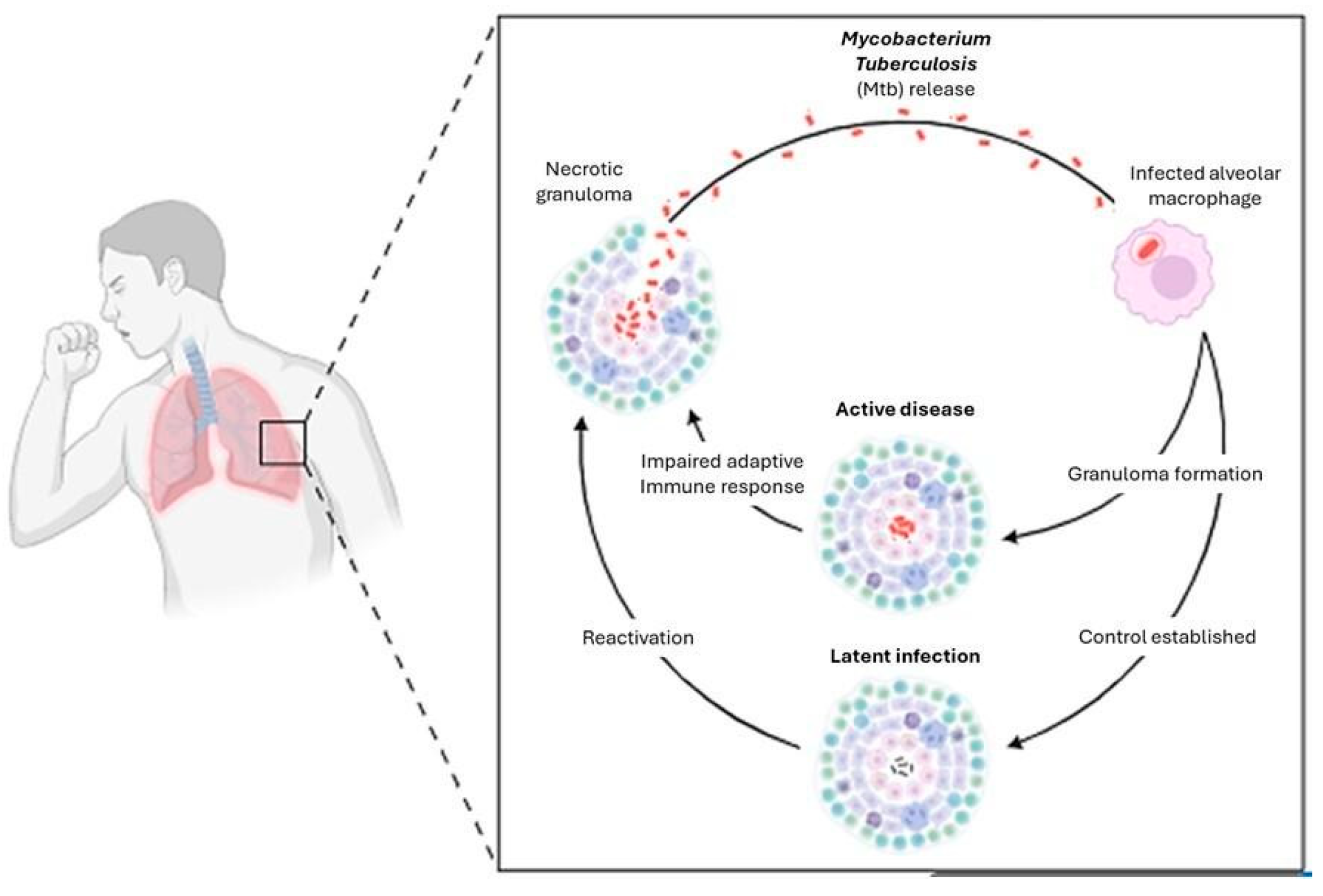
Figure 1. Schema of different states of tuberculosis infection: active or latent in the host.
Jnt 06 00033 g001
Figure 2. This image shows a microfluidic device in which controlled, rapid fluid mixing occurs in micro-sized channels. The system, composed of a pump and microfluidic chips, utilizes various micromixer designs (such as T-junction, Y-junction, HFF, SHM, and NxGen™ toroidal micromixers) to precisely control the synthesis of nanoparticles for continuous manufacturing and reliable scale-up of nanomedicines.
Jnt 06 00033 g002
Figure 3. The schematic representation of a tuberculous granuloma is shown here.
Jnt 06 00033 g003
Figure 4. Schematic representation of the mechanisms by which M. tuberculosis suppresses the antimicrobial response of the macrophage: limiting phagosomal maturation and modulating cytokine, reactive oxygen and nitrogen species (ROS/RNS) production, and suppressing autophagy.
Jnt 06 00033 g004
Figure 5. Schematic representation of the autophagy process responsible for the lysosomal degradation of intracellular components, including invading pathogens such as M. tuberculosis.
Jnt 06 00033 g005
Figure 6. Schematic representation of the immune response against M. tuberculosis. TB is both an infectious and immune-mediated disease. Upon infection, innate immune cells (e.g., neutrophils, macrophages, NK cells, and dendritic cells) initiate the immune response. These cells phagocytose the bacteria and present antigens to adaptive immune cells. Antigen-presenting cells (APCs) activate CD4+ and CD8+ T cells, which differentiate into effector subsets that help eliminate infected cells through cytotoxic mechanisms, including the release of granule enzymes and the Fas/FasL pathway. B cells also play a crucial role in immune defense.
Jnt 06 00033 g006
Figure 7. Schematic representation of the immune evasion mechanism of M. tuberculosis. Mycobacterium tuberculosis evades the immune system through three key strategies: intrinsic virulence and evasion of both innate and adaptive immunity. It prevents macrophage death by producing anti-apoptotic proteins (e.g., NouG, PKnE, SecA2) and activating the NF-κB pathway via TLR2 to upregulate BCL2. It also blocks autophagy through PI3P and LprE. To evade adaptive immunity, it reduces antigen presentation via Rv1016c and promotes the expansion of regulatory T cells (Tregs), which cause T cell exhaustion.
Jnt 06 00033 g007
Table 1. Comparison of Tuberculosis Treatment Strategies: Standard, Drug-Resistant Therapies, and Nanomedicine Approaches.
AspectWHO Standard Treatment (DOTS)BPaL Treatment (FDA Approved)Inhalation Therapies and NanomedicinesScalability and Nanomedicine Production
Start and UsageSince 1991, standard six-month therapyRecently approved after NIX-TB clinical trialsUnder development, focusing on local delivery strategiesEssential for transition to clinical trial production
Main DrugsRifampicin (RIF), Isoniazid (INH), Pyrazinamide (PZA), Ethambutol (EMB)Bedaquiline, Pretomanid, LinezolidBedaquiline, 1,3-Benzothiazines, Clofazimine, ATRA-PLGA NPsMicrofluidics enabling continuous, scalable production.
Treatment Duration6 months (2 months with four drugs, then 4 months with two drugs)6 monthsVariable, focused on high local efficacyNot applicable, but improves production for in vivo testing
Main Challenges
-
Poor adherence due to duration and side effects
-
Emerging MDR and XDR resistance
Frequent linezolid toxicityMaintaining aerodynamic and nanoscale size for deliveryScalability, reproducibility, and size control
Advantages
-
Globally recognized standard
-
Wide coverage
High efficacy against resistant TBHigher local drug concentrations, fewer systemic effectsContinuous, efficient, and controlled production
Disadvantages
-
Long duration
-
Hepatic and neurological toxicity
-
Emerging resistance
Toxicity and limited use (only if others fail)Experimental technology is still undergoing validationConventional methods are not scalable or reproducible
Key Mechanism of ActionMulti-drug combination to eliminate TBBedaquiline blocks ATP synthase; others have different mechanismsNanoparticles enhance dissolution and pulmonary penetrationMicrochannels control nanoparticle formation and size
Examples and StudiesWorldwide use since 1991Positive outcomes in South African studiesMurine models, inhalable nanoparticles (BDQ, BTZ, CLZ, ATRA)Microfluidics for ATRA-PLGA NPs
Side EffectsHepatotoxicity, neurotoxicityFrequent linezolid toxicityExpected reduction in systemic side effects via local deliveryNot directly applicable, but ensures safe production
WHO RecommendationsStandard treatment unless resistance is presentBPaL is recommended only if other treatments failExperimental approaches pending clinical validationTechnological advances for large-scale manufacturing
Table 2. Nanotheranostic platforms for tuberculosis: examples of integrated imaging, targeted therapy, and treatment monitoring.
Nanotheranostic PlatformDiagnostic FunctionTherapeutic FunctionExample/StudyKey Features/Mechanism
Metallic nanoparticles (Au, Ag, Fe3O4)Optical and magnetic imaging (MRI, contrast agents)Photothermal and photodynamic therapyAkinnawo et al. [27]Dual-functionality: imaging-guided therapy, real-time monitoring of treatment efficacy at infection sites.
Macrophage-membrane-coated nanoparticlesNIR imaging of granulomasPhotothermal ablation of M. tuberculosisLi et al. [28]Bioinspired targeting of infected macrophages; integrates diagnosis and therapy in situ; minimizes systemic toxicity.
Magnetic nanoparticles (Fe3O4, MnFe2O4, SPIONs)MRI-guided localization of infectionControlled release of antitubercular drugsWyszogrodzka, et al. [29]
Voss et al. [30]
Pulmonary accumulation visualization; external magnetic field–guided targeting; reduced systemic exposure
Quantum dots/upconversion nanoparticlesOptical detection of TB biomarkersN/A (primarily diagnostic)Nokolaev et al. [31]Rapid and ultrasensitive detection of bacterial DNA/proteins; potential for point-of-care diagnosis
Polymeric/lipid-based nanocarriersFluorescent or radiolabeled tracking of drug distributionAntibiotic delivery; photodynamic & immunotherapyTian et al. [32]
Bhandari et al. [33]
Co-encapsulation of drugs and imaging agents; targeted delivery to infected macrophages; in vivo treatment monitoring
Metal–organic framework (MOF) nanoparticlesMRI contrast enhancementLocal drug delivery (e.g., isoniazid)Wyszogrodzka, et al. [29]Dual diagnostic-therapeutic functionality; magnetic guidance enables site-specific treatment
Table 3. Host-Directed Therapy (HDT) Strategies Targeting Tuberculosis Granulomas.
StrategyTarget/MechanismDrugs/Nanocarriers UsedOutcomes/Effects
Granuloma Microenvironment (GME) ModulationTargets abnormal vasculature and excessive extracellular matrix (ECM) within granulomas
-
Losartan (AT1 receptor blocker)
-
Bevacizumab (anti-VEGF monoclonal antibody)
-
Reduces inflammation
-
Improves drug delivery
-
Regulates blood vessels and ECM
Nanocarriers for GME-TargetingDirect drug delivery to granulomas
Overcome ECM and vascular barriers
Use of phototherapy and oxygenation
-
RBC-O2/TQ@PB nanoparticles

(Contains photosensitizer, Prussian blue, and perfluorocarbon; coated with erythrocyte membrane)
-
Generates ROS and heat to kill M. tuberculosis
-
Enhances oxygenation and blood flow
-
Extended circulation time (18.85 h)
-
Synergistic effects with light therapy
-
Reduced M.m. proliferation
Matrix Metalloproteinase (MMP) InhibitionControls ECM degradation and fibrosis by targeting MMPs (MMP-1, MMP-8, MMP-9)
-
Doxycycline (broad-spectrum tetracycline and MMP inhibitor)
-
Reduces lung mycobacterial burden
-
Inhibits collagen destruction
-
Suppresses systemic/respiratory MMPs
-
Enhances immune cell activity
-
Reduces pulmonary cavity volume
RNA-based MMP Gene SilencingSilences MMP regulatory genes (e.g., KLK12) in M2 macrophages
-
MBNPs (Mannose-modified BSA nanoparticles carrying siKLK12)
-
Targeted uptake by M2 macrophages
-
Effective siRNA delivery in low pH
-
Reduces KLK12/MMP expression
-
Increases collagen fiber content
-
Limits TB progression
Disclaimer/Publisher’s Note: The statements, opinions and data contained in all publications are solely those of the individual author(s) and contributor(s) and not of MDPI and/or the editor(s). MDPI and/or the editor(s) disclaim responsibility for any injury to people or property resulting from any ideas, methods, instructions or products referred to in the content.