Article

Phase-First Gaussian Modulation for Resilient Continuous-Variable Quantum Communication Under Adversarial Disturbances


by
José R. Rosas-Bustos
1,2,3,4,*,
Jesse Van Griensven Thé
1,2,3,4,
Roydon Andrew Fraser
1,3,4,
Nadeem Said
1,2,3,
Sebastian Ratto Valderrama
3,4,5,
Mark Pecen
3,4,
Alexander Truskovsky
4 and
Andy Thanos
6
1
Department of MME, University of Waterloo, Waterloo, ON N2L 3G1, Canada
2
LAKES Environmental Research Inc., Waterloo, ON N2L 3L3, Canada
3
Applied Quantum Technologies (AQT) Initiative, Columbia, MD 21046, USA
4
EigenQ, Inc., Austin, TX 78701, USA
5
Department of ECE, University of Waterloo, Waterloo, ON N2L 3G1, Canada
6
Cisco Systems, Inc., San Jose, CA 95134, USA
*
Author to whom correspondence should be addressed.
J. Cybersecur. Priv. 2026, 6(3), 87; https://doi.org/10.3390/jcp6030087
Submission received: 25 February 2026 / Revised: 20 April 2026 / Accepted: 9 May 2026 / Published: 13 May 2026
(This article belongs to the Section Cryptography and Cryptology)

Abstract

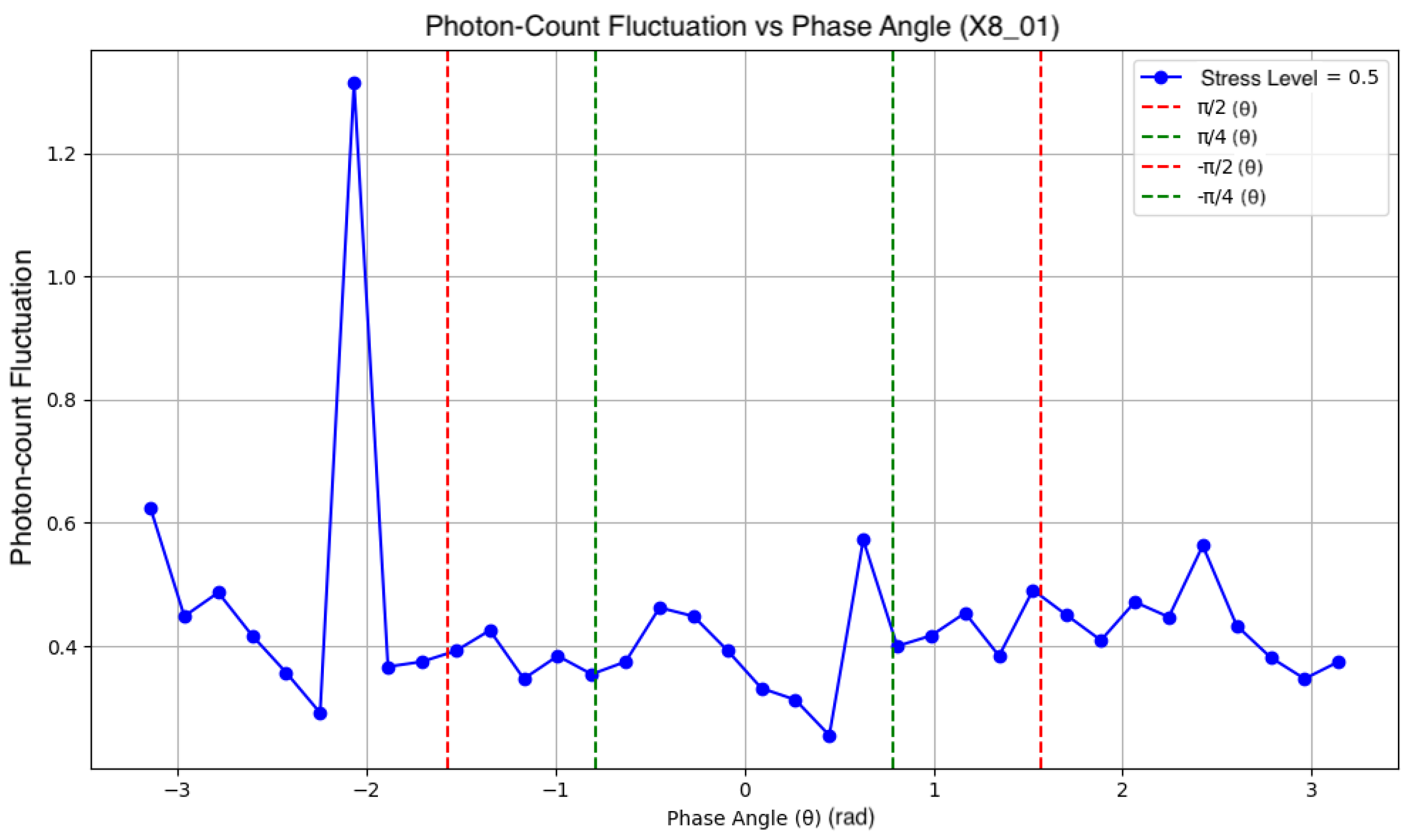
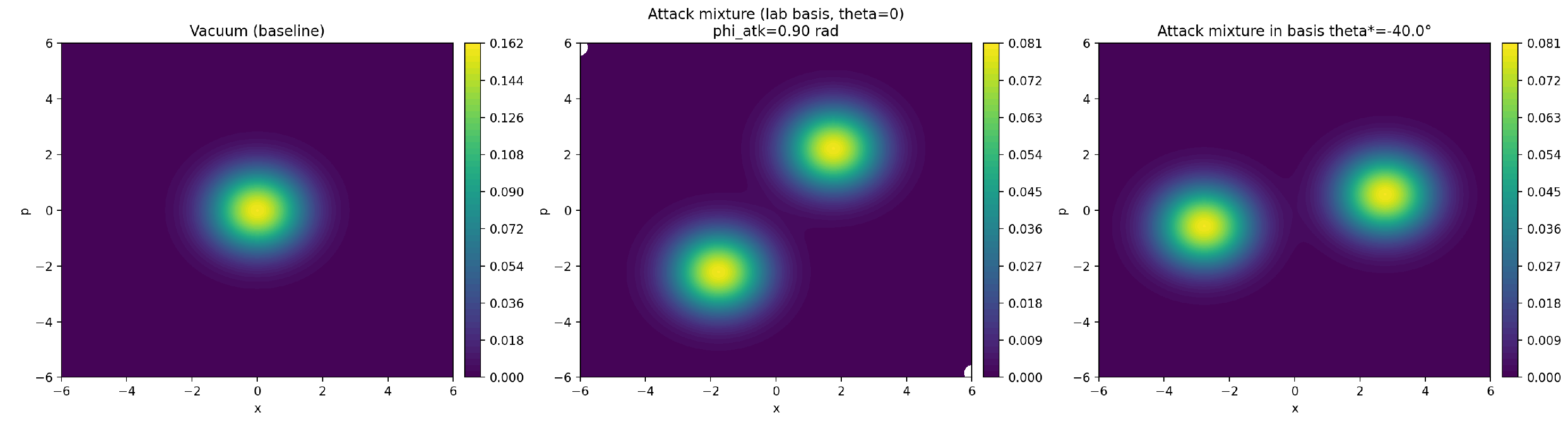
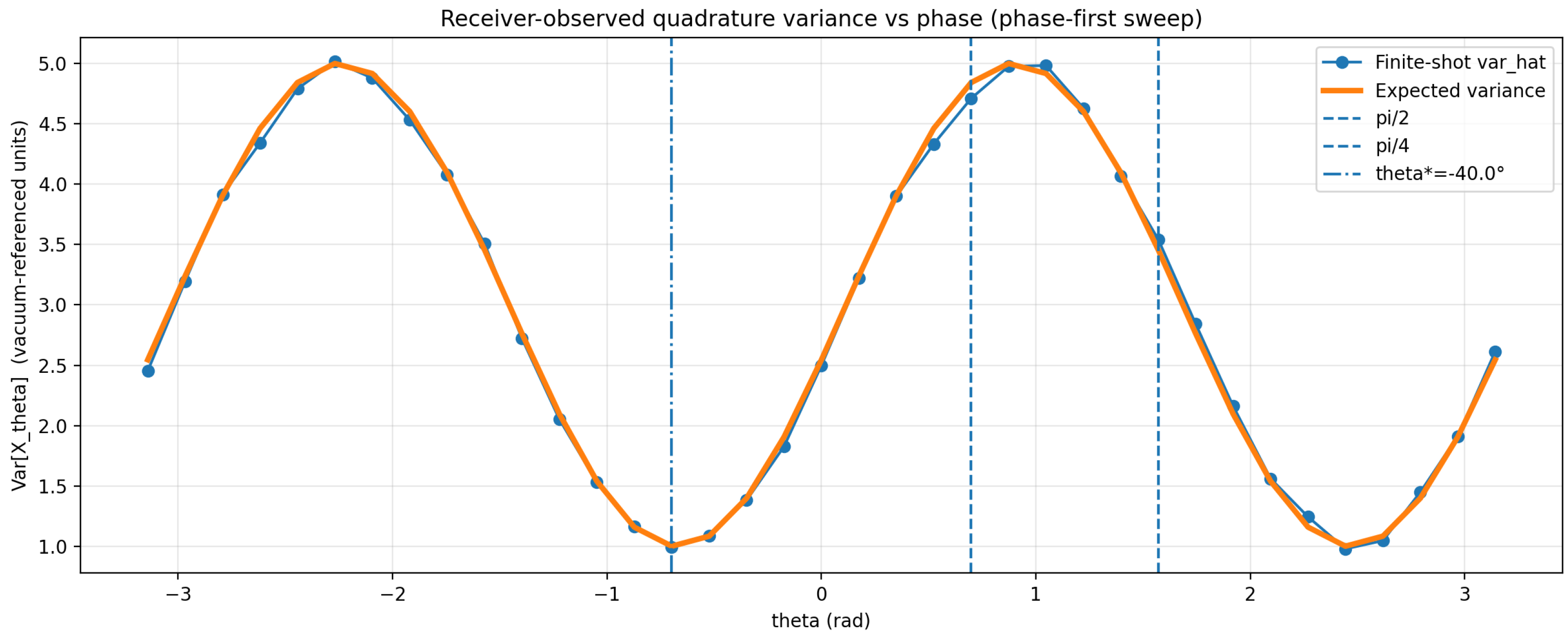
Continuous-variable quantum communication (CVQC) operates under finite-resolution inference (finite data windows, calibration uncertainty, and estimator tolerances) and hardware control/readout limits that can be exploited by structured and adversarial disturbances. We study a feedback-inspired phase-space modulation strategy for implementation-layer resilience under DoS-like receiver-observable stress (e.g., fluctuation inflation, phase reference destabilization, or interface non-idealities), rather than proposing a protocol-level security proof. We propose a phase-first framework in which the defender selects a phase-space rotation angle θ (and, in principle, a squeezing parameter r) to minimize a receiver-observable centered second-moment degradation proxy, emphasizing containment rather than disturbance inversion. Because platforms expose different native observables, we evaluate phase-first modulation using two complementary tracks: (i) in theory/simulation, we monitor basis-dependent quadrature variance and covariance-derived summaries formed from mean-subtracted second moments so that ΔEcov reflects covariance inflation rather than coherent displacement; (ii) in the X8_01 hardware workflow, the readout is Fock sampling; thus, we use the shot-to-shot standard deviation σN(θ):=Var^(N(θ)), where N(θ) denotes the shot-level detected count random variable at fixed θ. In the reported hardware workflow, this shot-level count is formed by aggregating the returned Fock counts prior to postprocessing. We emphasize that σN(θ) is not claimed to estimate Tr(V); it is an implementation-layer variability proxy aligned with the available readout. Our experimental validation is restricted to phase-only control instantiated as offline phase selection via one-dimensional grid search over θ. Across numerical simulations and hardware phase-angle scans on Xanadu’s X8_01 photonic quantum processor, we find that static operating points can be brittle under strong DoS-like stress, whereas optimized phase selection can materially reduce a receiver-observed degradation proxy even without real-time feedback. Since Tr(V) is invariant under pure rotations for phase-independent additive noise and ideal photon-number probabilities are invariant under a terminal Fock-basis phase gate, any observed θ-dependence is interpreted operationally as evidence of a phase-dependent effective disturbance/measurement channel at the receiver interface. Simulation-only analyses indicate additional upside when squeezing is available, motivating future extensions incorporating higher-rate re-optimization, feedback-assisted architectures, and extended Gaussian control when available.
Keywords: continuous-variable quantum communication; Gaussian control; receiver-observable metrics; implementation-layer resilience; adversarial disturbances; denial-of-service-like stress; phase-space rotation; offline phase selection; Fock sampling; count standard deviation proxy continuous-variable quantum communication; Gaussian control; receiver-observable metrics; implementation-layer resilience; adversarial disturbances; denial-of-service-like stress; phase-space rotation; offline phase selection; Fock sampling; count standard deviation proxy