

Empirical Evaluation of Android Browser Forensics and Artifact Persistence




Abstract
1. Introduction
- H1: A substantial portion of user activity can be reconstructed from browser artifacts, even following deletion attempts.
- H2: The deployment of custom scripts for RAM extraction significantly enhances forensic recovery by providing reliable, complementary data that is absent from persistent storage.
- H3: Private browsing and history clearing diminish, but do not entirely preclude, artifact recovery.
- H4: Different browsers exhibit differential levels of forensic resilience.
- RQ1: To what extent can browser artifacts be recovered from authentic Android devices?
- RQ2: How does the utilization of Incognito/private browsing affect artifact recovery?
- RQ3: What is the efficacy of RAM dumps in reconstructing user activity?
- RQ4: How do different browsers compare in terms of recoverable artifacts?
- RQ5: How does explicit user-driven data deletion (e.g., “Clear History”) influence artifact availability across persistent storage and volatile memory?
- RQ6: To what extent are user-initiated anti-forensic actions (clearing browsing history or using private browsing mode) effective in eliminating traces?
- RQ7: How do different browser configurations influence artifact recoverability?
2. Related Work
3. Background
3.1. Core Concepts and Forensic Artifacts
- Persistent storage: Data written to the flash-based file system, typically stored within SQLite databases (e.g., History, Cookies) or structured XML and JSON files.
- Volatile memory (RAM): Ephemeral data, including active session tokens, decrypted credentials, and memory-resident browser artifacts, which are typically lost upon process termination or device power loss.
3.2. The Acquisition Paradox: Accessibility vs. Admissibility
3.3. Web Browser Architectures on Android
3.3.1. Storage and Directory Structures
- Chromium-based (Chrome, Brave): Utilize a Default/ directory containing SQLite databases. Notably, while these browsers store autofill metadata (e.g., cardholder name and expiration date), they typically do not store CVV/CVC codes locally. This practice ensures compliance with the Payment Card Industry Data Security Standard (PCI DSS), an internationally recognized security framework that prohibits the persistent storage of sensitive authentication data following authorization in order to mitigate fraud risks arising from local system compromise.
- Gecko-based (Firefox, Tor): Employ a profile-based structure (e.g., ∗.default-release/). They store history in places.sqlite and session state in JSONLZ4 compressed files, which require specialized parsing for reconstruction.
- Privacy-focused (DuckDuckGo): Prioritize data minimization, where many session artifacts remain strictly volatile and are never committed to persistent storage.
3.3.2. Security and Encryption
3.4. Normal vs. Private Browsing Modes
4. Methodology
4.1. Testbed
4.2. Data Acquisition
4.2.1. Persistent Artifact Acquisition
4.2.2. Volatile Memory Acquisition and Custom Parsing
| Algorithm 1 Volatile memory acquisition routine for Android applications. |
| Require: Application package name APP_PACKAGE Ensure: Per-segment binary dumps for all readable virtual memory regions of each process
|
4.3. Experimental Scenarios
- Simple use: Standard browsing with persistent data retention. Disk acquisition was performed exactly 60 s after the final user activity to analyze filesystem-level artifacts.
- Memory dump: Acquisition of volatile RAM during an active session. Dumping was performed 30 s after the final interaction (e.g., field autofill) to capture transient cleartext credentials and session-specific data.
- Delete data: Analysis of the physical disk following the explicit deletion of browsing history, passwords, and cache via the browser’s settings menu.
- Delete & memory dump: A hybrid analysis cross-correlating persistent and volatile remnants. RAM acquisition occurred immediately following the “Clear History” command to evaluate immediate memory residency.
- Incognito Mode: Evaluation of artifact persistence and correlation during private sessions, where data is theoretically restricted to volatile storage.
4.4. Methodological Challenges and Constraints
- Hardware-backed encryption: Credentials protected by the Android Keystore remained largely inaccessible without user-level authentication.
- Network protocol obfuscation: The use of TLS (RFC 8446) hindered the correlation of device-side artifacts with network-level traffic.
- Memory ephemerality: The effectiveness of Algorithm 1 is highly dependent on the timing of capture, as Android’s Low Memory Killer (LMK) may terminate background browser processes.
5. Results
5.1. Quantitative Baseline: Residual Data Footprint
- Volatile memory dominance: Scenario 2 (Memory dump) accounted for the majority of recovered data for four of the five browsers, validating Hypothesis H2 that RAM acquisition significantly enhances data yield. For instance, Chrome’s data volume surged from 363 MB in Scenario 1 to 4.6 GB in Scenario 2. Tor was the outlier, with a negligible 12 KB memory dump, suggesting active memory zeroing.
- Persistence after deletion: DuckDuckGo and Tor retained significantly larger persistent footprints (1.2 GB and 600 MB, respectively) following history clearing (Scenarios 3 & 4) compared to Chromium-based browsers (≈52 MB). This suggests high-volume persistent caching that bypasses standard “clear history” routines.
- Private browsing residue: Chrome, Brave, and Firefox yielded between 1.1 GB and 1.2 GB of data during private sessions (Scenario 5), confirming that Incognito modes did not preclude forensic recovery within the tested acquisition workflow and browser configurations from temporary filesystem areas or RAM.
5.2. Qualitative Artifact Analysis by Scenario
5.2.1. Scenario 1: Simple Use
5.2.2. Scenario 2: Memory Dump
5.2.3. Scenarios 3 & 4: Data Deletion and Combined Acquisition
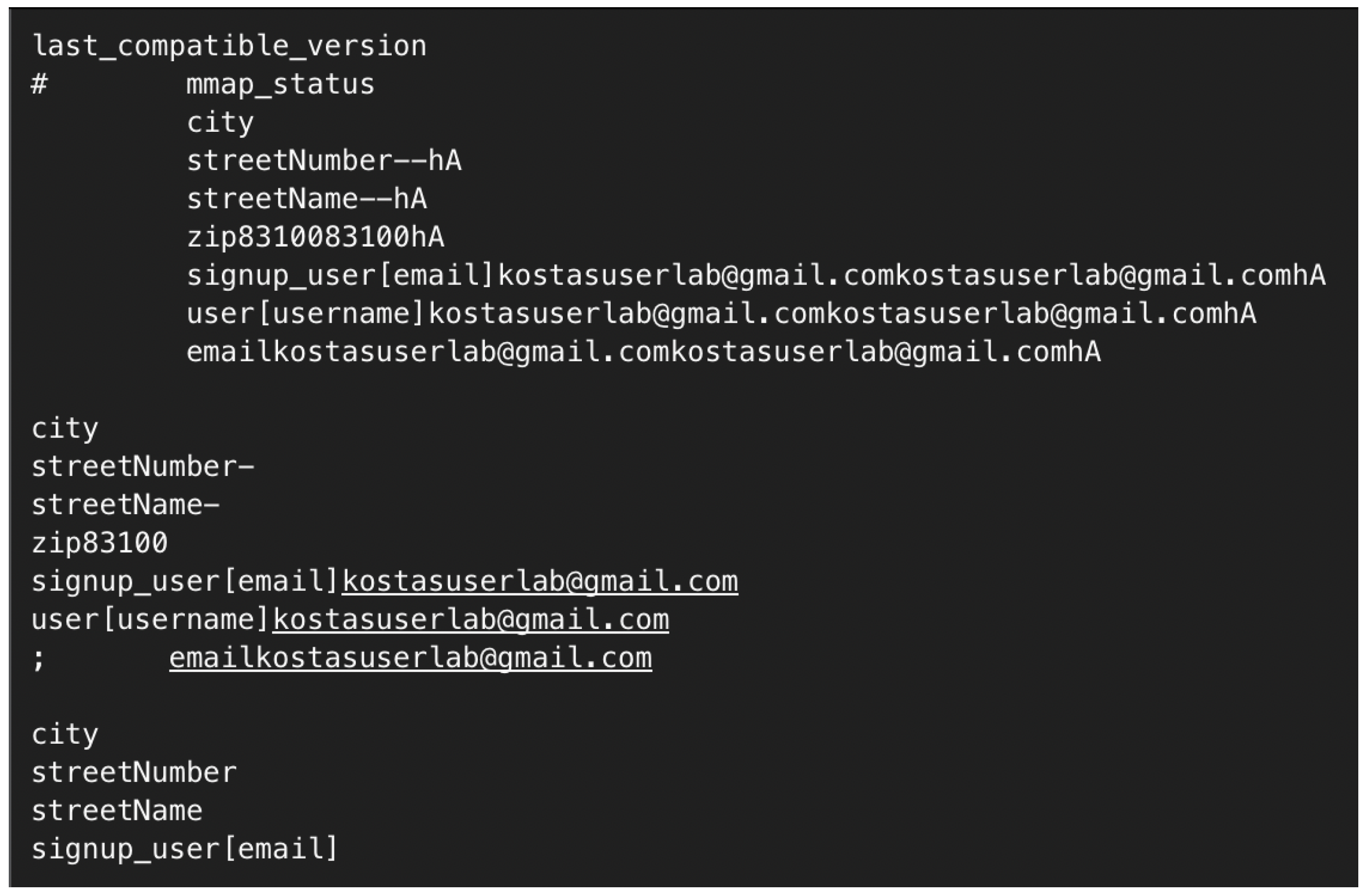
- Chrome resilience: Despite deletion, autofill and session information survived in memory, as seen in Figure 2. Chrome’s reliance on MD5 hashing for payment data provides minimal protection. Interestingly, Table 9 shows that saved passwords were effectively cleared during combined acquisition, yet autofill and card data remained persistent.
- Firefox metadata: While primary records were cleared, structural metadata regarding closed tabs and deleted entries persisted in the SQLite databases, allowing for partial activity reconstruction.
- DuckDuckGo efficacy: In contrast to its large quantitative footprint, DuckDuckGo was highly resistant to qualitative recovery in Scenario 4, yielding no session tokens, cache, or credentials.
5.2.4. Scenario 5: Incognito
5.3. Recoverability Score
- b: The evaluated browser, e.g., Chrome, Firefox, Tor, etc.
- : The usage scenario, e.g., Simple use, Memory dump, Incognito, etc.
- : Scenario Weight (a scalar value), representing the inherent forensic importance or frequency of the scenario, e.g., a memory dump might be weighted higher than simple use.
- : The Artifact Category, e.g., cookies, saved passwords, Web cache, representing the specific type of evidence recovered.
- : Artifact Weight, reflecting the forensic sensitivity and criticality of the artifact: Credentials [3], Tokens/Cards [2], History/Cookies [1].
- : Artifact Recovery Factor, quantifying the quality of the recovered data for browser b in scenario : Full [1.0], Partial [0.5], None [0]
- : Privacy Penalty (a scalar penalty term), applied to browsers that operate under a default or dedicated private/incognito mode, reflecting the expected and often advertised reduction in traceability: Tor/DuckDuckGo [2.0], Firefox [0.7], Brave [0.5], Chrome [0.0].
- Weight 3 (high impact): Credentials (passwords/logins) are assigned the highest weight as their recovery facilitates immediate account compromise and identity takeover.
- Weight 2 (medium impact): Session tokens and payment card data are weighted accordingly due to their critical role in maintaining authenticated sessions or exposing sensitive financial metadata.
- Weight 1 (contextual impact): Browsing history and cookies are assigned the lowest weight, as they primarily provide contextual behavioral evidence rather than direct access to protected services.
5.4. Results Summary
6. Discussion
6.1. Artifact Recovery Extent and Browser Comparisons (RQ1, RQ4)
6.2. Impact of Private Browsing and Anti-Forensic Actions (RQ2, RQ5)
- Volatility resilience: Chrome and Brave continued to host session tokens in RAM immediately following the termination of a private session. This suggests that “Incognito” refers more to storage exclusion than memory sanitization.
- Form completion as an exposure vector: Activities involving form completion and autofill—even within private modes—dramatically increased the recovery of sensitive data. In Chrome, address and payment fragments persisted in memory despite the session’s private status.
- Imperfection of manual deletion: User-initiated data clearing successfully removed primary SQLite records but failed to purge volatile remnants. This confirms for RQ5 that user (manual anti-forensic) actions like Clear History are asynchronous with memory-resident data, leaving a significant window for live response recovery.
6.3. Efficacy of Volatile Memory Acquisition (RQ3, RQ7)
6.4. Comparative Analysis with Prior Mobile Browser Forensics Literature
6.5. Methodological Implications for Investigators
7. Conclusions and Future Directions
Author Contributions
Funding
Institutional Review Board Statement
Informed Consent Statement
Data Availability Statement
Acknowledgments
Conflicts of Interest
Abbreviations
| ADAET | Automated Data Acquisition and Extraction Tool |
| ADB | Android Debug Bridge |
| APK | Android Package |
| APKTool | Android Application Package Tool |
| APT | Advanced Persistent Threat |
| C2 | Command and Control (server) |
| CORR | Correlation Successful |
| CPU | Central Processing Unit |
| CSV | Comma-Separated Values |
| DB | Database |
| DDG | DuckDuckGo Privacy Browser |
| DEC | Decrypted Data |
| DNS | Domain Name System |
| ESR | Extended Support Release |
| FDE | Full Disk Encryption |
| FSTAB | File System Table |
| GUI | Graphical User Interface |
| H | High (artifact recoverability) |
| HTTP | Hypertext Transfer Protocol |
| HTTPS | Hypertext Transfer Protocol Secure |
| ID | Identifier |
| IDs | Identifiers |
| iFF | iPhone Forensic Framework |
| IMEI | International Mobile Equipment Identity |
| IP | Internet Protocol |
| JSON | JavaScript Object Notation |
| JTAG-Based | Joint Test Action Group-Based Debugging Interface |
| JWT | JSON Web Token |
| L | Low (artifact recoverability) |
| LE | Linux Edition |
| Linux | Open-Source Operating System |
| M | Medium (artifact recoverability) |
| MAC | Media Access Control Address |
| Magisk | Android Rooting Tool |
| MD5 | Message Digest 5 |
| MF | Mobile Forensics |
| MFDA | Mobile Forensic Data Analysis |
| N | None (artifact recoverability) |
| OS | Operating System |
| OSINT | Open-Source Intelligence |
| PA | Persistent Artifacts |
| PCAP | Packet Capture |
| PID | Process Identifier |
| PoC | Proof of Concept |
| RAM | Random Access Memory |
| RAMDump | Random Access Memory Dump |
| ROM | Read-Only Memory |
| SHA | Secure Hash Algorithm |
| SHA-256 | Secure Hash Algorithm 256-bit |
| SQL | Structured Query Language |
| SQLite | Structured Query Language Lite |
| SSID | Service Set Identifier |
| TCP | Transmission Control Protocol |
| TLS | Transport Layer Security |
| Tor | Tor Browser |
| UDP | User Datagram Protocol |
| UI | User Interface |
| URL | Uniform Resource Locator |
| URLS | Uniform Resource Locators |
| USB | Universal Serial Bus |
| VA | Volatile Artifacts |
| VM | Virtual Machine |
| VPN | Virtual Private Network |
| WFP | Windows Filtering Platform |
| XRY | Mobile Forensics Tool (Cellebrite) |
References
- Anjani, D.; Fitria, I. Analysis of Perceived Ease of Use and Perceived of Usefulness to Enchance Customer Interest in Using BCA Mobile Banking. J. Manag. Anal. Solut. (JoMAS) 2023, 106–110. [Google Scholar] [CrossRef]
- Barmpatsalou, K.; Damopoulos, D.; Kambourakis, G.; Katos, V. A critical review of 7 years of Mobile Device Forensics. Digit. Investig. 2013, 10, 323–349. [Google Scholar] [CrossRef]
- Barmpatsalou, K.; Cruz, T.; Monteiro, E.; Simoes, P. Mobile Forensic Data Analysis: Suspicious Pattern Detection in Mobile Evidence. IEEE Access 2018, 6, 59705–59727. [Google Scholar] [CrossRef]
- Anglano, C.; Canonico, M.; Guazzone, M. The Android Forensics Automator (AnForA) A tool for the Automated Forensic Analysis of Android Applications. Digit. Investig. 2023, 45, 101876. [Google Scholar] [CrossRef]
- Capone, D.; Caturano, F.; Delicato, A.; Perrone, G.; Romano, S.P. Dockerized Android: A container-based platform to build mobile Android scenarios for Cyber Ranges. In Proceedings of the 2022 International Conference on Electrical, Computer and Energy Technologies (ICECET), Prague, Czech Republic, 20–22 July 2022; pp. 1–9. [Google Scholar] [CrossRef]
- Rasool, A.; Jalil, Z.A. A Review of Web Browser Forensic Analysis Tools and Techniques. 2020. Available online: https://www.researchgate.net/publication/358975880 (accessed on 1 April 2026).
- Thing, V.L.; Ng, K.Y.; Chang, E.C. Live memory forensics of mobile phones. Digit. Investig. 2010, 7, S74–S82. [Google Scholar] [CrossRef]
- Mahajan, A.; Dahiya, M.S.; Sanghvi, H.P. Forensic analysis of instant messenger applications on Android devices. Int. J. Comput. Appl. 2013, 65, 1–5. [Google Scholar] [CrossRef]
- Alghafli, K.A.; Jones, A.; Martin, T.A. Forensics data acquisition methods for mobile phones. In Proceedings of the 2012 International Conference for Internet Technology and Secured Transactions, London, UK, 10–12 December 2012; pp. 265–269. [Google Scholar]
- Fernández-Fuentes, X.; Pena, T.F.; Cabaleiro, J.C. Digital forensic analysis of the private mode of browsers on Android. Comput. Secur. 2023, 134, 103425. [Google Scholar] [CrossRef]
- Fernández-Fuentes, X.; Pena, T.F.; Cabaleiro, J.C. Digital forensic analysis methodology for private browsing Firefox and Chrome on Linux as a case study. Comput. Secur. 2022, 115, 102626. [Google Scholar] [CrossRef]
- Chatzoglou, E.; Kampourakis, V.; Tsiatsikas, Z.; Karopoulos, G.; Kambourakis, G. Keep Your Memory Dump Shut: Unveiling Data Leaks in Password Managers. In Proceedings of the ICT Systems Security and Privacy Protection; Springer Nature: Cham, Switzerland, 2024; pp. 61–75. [Google Scholar]
- Husain, M.I.; Baggili, I.; Sridhar, R. A simple cost-effective framework for iPhone forensic analysis. In Proceedings of the Digital Forensics and Cyber Crime: First International ICST Conference, ICDF2C 2010, Abu Dhabi, United Arab Emirates, 4–6 October 2010; Revised Selected Papers; Springer: Berlin/Heidelberg, Germany, 2010; pp. 27–37. [Google Scholar]
- Joshi, N.N.; Bajeja, S.L. Enhanced web browser forensics: Innovative methodologies for evidence collection and analysis. In Proceedings of the International Conference on Advancements in Smart Computing and Information Security; Springer: Cham, Switzerland, 2024; pp. 139–164. [Google Scholar]
- Choi, G.; Bang, J.; Lee, S.; Park, J. Chracer: Memory analysis of Chromium-based browsers. Forensic Sci. Int. Digit. Investig. 2023, 46, 301613. [Google Scholar] [CrossRef]
- Sheth, R.; Kaushik, K.; Parekha, C.; Chayal, N. Mobile Browser Forensics. In Android and IOS Mobile Forensics: Leveraging Blockchain, Machine Learning, and Deep Learning for Digital Investigations; Apress: Berkeley, CA, USA, 2026; pp. 233–261. [Google Scholar]
- Khubrani, M.M. Mobile Device Forensics, challenges and Blockchain-based Solution. In Proceedings of the 2023 Second International Conference On Smart Technologies For Smart Nation (SmartTechCon), Singapore, 18–19 August 2023; pp. 1504–1509. [Google Scholar] [CrossRef]
- Moreb, M.; Salah, S.; Amro, B. A novel framework for mobile forensics investigation process. Int. J. Comput. Digit. Syst. 2024, 16, 125–136. [Google Scholar] [CrossRef] [PubMed]
- Rawtani, D.; Hussain, C.M. Modern Forensic Tools and Devices: Trends in Criminal Investigation; John Wiley & Sons: Hoboken, NJ, USA, 2023. [Google Scholar]
- Mehta, J.; Bhadania, Y.; Shah, P.; Prajapati, P. Comparative Study of Mobile Forensics Tools: Autopsy, Belkasoft X and Magnet Axiom. In Proceedings of the 2024 5th International Conference on Electronics and Sustainable Communication Systems (ICESC), Coimbatore, India, 7–9 August 2024; pp. 1257–1263. [Google Scholar] [CrossRef]
- Casino, F.; Dasaklis, T.K.; Spathoulas, G.P.; Anagnostopoulos, M.; Ghosal, A.; Böröcz, I.; Solanas, A.; Conti, M.; Patsakis, C. Research Trends, Challenges, and Emerging Topics in Digital Forensics: A Review of Reviews. IEEE Access 2022, 10, 25464–25493. [Google Scholar] [CrossRef]
- Wu, J. Magisk Installation Guide. 2025. Available online: https://topjohnwu.github.io/Magisk/install.html (accessed on 1 April 2026).
- Android Debug Bridge (ADB) Documentation. 2025. Available online: https://developer.android.com/studio/command-line/adb (accessed on 15 September 2025).
- unode. firefox_decrypt: Tool to Extract Passwords from Mozilla Firefox Profiles. 2025. Available online: https://github.com/unode/firefox_decrypt/ (accessed on 1 April 2026).
- The Linux Kernel Documentation. The /proc Filesystem. 2024. Available online: https://docs.kernel.org/filesystems/proc.html (accessed on 5 October 2025).



| Study | Platform | Methodology | Tools Used | Key Findings | Limitations |
|---|---|---|---|---|---|
| Thing et al. [7] | Android | Live memory acquisition framework targeting RAM remnants | Custom RAM capture tools | Achieved near-complete recovery of outgoing messages from volatile memory | Not specifically focused on browser activity |
| Husain et al. [13] | iPhone | Logical acquisition via iTunes backup analysis avoiding firmware modification. | iFF framework | Demonstrated cost-effective and forensically sound data extraction | No browser or volatile memory analysis |
| Barmpatsalou et al. [2] | Mobile datasets | Systematic survey of methodological evolution and emerging challenges in MFs | Literature survey methodology | Highlighted evolution toward hybrid and memory-aware mobile forensic approaches | Not focused on browser forensics |
| Mahajan et al. [8] | Android | Logical acquisition and SQLite database analysis on physical devices. | Cellebrite UFED | Recovery of chats, contacts, and multimedia artifacts from persistent storage. | No volatile memory or browser-focused analysis |
| Alghafli et al. [9] | Mobile | Comparative taxonomy of acquisition methods into manual, logical, physical, and chip-off | Oxygen, Paraben, JTAG | Physical acquisition provides deeper evidentiary visibility than logical methods | No experimental evaluation of browser artifacts |
| Barmpatsalou et al. [3] | Mobile datasets | Intelligent classification using NN and ANFIS applied to communication datasets. | ADAET | Effective detection of suspicious communication patterns | Not browser-focused |
| Fernández-Fuentes et al. [10] | Linux | Five-stage forensic workflow for evaluating private browsing effectiveness | LiME, Volatility, inotifywait, wxHexEditor | Sensitive artifacts remained recoverable from memory | Limited to desktop environments |
| Fernández-Fuentes et al. [11] | Linux | Evaluation of evidence persistence at different post-session time intervals. | LiME, Volatility, wxHexEditor | Volatile memory retained sensitive browsing evidence even after browser closure | Focused on desktop systems; mobile browsers not evaluated |
| Casino et al. [21] | Multi-domain | Systematic literature meta-review | Scopus, Web of Science | Identified major research gaps in cross-device forensic investigations | No experimental validation |
| Choi et al. [15] | Chromium-based | Systematic discovery of browsing-related C++ objects in virtual memory | Chracer (PoC Tool) | Successfully extracted URLs, titles, and timestamps even in private mode | Requires specialized knowledge of Chromium internal structures |
| Joshi et al. [14] | Web Browsers | Multi-stage analysis of installation, execution, and anomalous behavior (crashes) | Windows 11 components | Innovative framework for artifact collection during browser life-cycle stages | Focused primarily on Windows 11 environment |
| Sheth et al. [16] | Android & iOS | Advanced acquisition leveraging ML, Deep Learning, and Blockchain for integrity | ML/DL Frameworks | Addressed modern encryption challenges and anti-forensics in mobile browsers | High computational overhead for real-time analysis |
| Rawtani & Hussain [19] | General Forensic | Overview of modern forensic devices and emerging trends | Literature Review | Categorized modern tools for criminal investigation | High-level overview; lacks specific mobile browser experiments |
| Khubrani [17] | Mobile | Analysis of challenges and proposal of blockchain-based solution | Theoretical framework | Blockchain can enhance integrity and chain of custody in mobile forensics | Conceptual; lacks experimental validation of browser data |
| Mehta et al. [20] | Mobile | Comparative study of forensic tools: Autopsy, Belkasoft X and Magnet Axiom | Autopsy, Belkasoft X, Magnet Axiom | Evaluated tool efficiency in data recovery and complexity | Comparison of tools rather than browser-specific artifacts |
| Moreb et al. [18] | Mobile | Novel framework for the forensic investigation process focusing on methodology | Process Model | Standardized steps for mobile evidence acquisition and preservation | Focuses on process flow rather than browser memory analysis |
| This work | Android 13 | Hybrid persistent/volatile analysis—Artifact acquisition— metric | Autopsy, ADB, Custom RAM Scripts | Multiple mobile browsers including privacy-focused ones | Limited to rooted environments |
| Data Category | Normal Browsing | Private Browsing |
|---|---|---|
| History | Stored in persistent SQLite DB | Volatile; resides in RAM only |
| Cookies | Persistent (Cookies.db) | Session-only; cleared upon exit |
| Cache | Written to disk storage | Ideally volatile; fragments may leak to storage |
| Credentials | Encrypted in persistent DB | Not committed to disk |
| DNS/Network | OS-level cache | Visible in OS and network logs |
| Machine | OS | Memory | Processors | Disk | CPU | Tools |
|---|---|---|---|---|---|---|
| Redmi Note 4 | Android 13 | 4 GB | Octa-core 2.0 GHz | 64 GB | ARM64/mido | Magisk root/ADB |
| Kali VM | Kali Linux 2024.4 amd64 | 24 GB | 4 cores | 40 GB | ARM64 | Host VM/ADB bridge |
| Browser | Version | Notes/Features |
|---|---|---|
| Chrome | 140.0.7339.52 | Default configuration |
| Brave | 1.82.165 (Chromium 140.0.7339.80) | Privacy-focused, ad-blocking browser |
| Firefox | 142.0.1 | Default search engine: Bing; open-source privacy features |
| DuckDuckGo | 5.247.0 | Tracking and threat protection enabled by default |
| Tor | 14.5.6 (128.14.0 ESR) | Uses the Tor network for anonymous browsing |
| Browser | Scenario 1 | Scenario 2 | Scenario 3 | Scenario 4 | Scenario 5 | Total |
|---|---|---|---|---|---|---|
| Chrome | 363 MB | 4.6 GB | 52 MB | 52 MB | 1.1 GB | 6.17 GB |
| Brave | 308 MB | 3.6 GB | 51 MB | 51 MB | 1.2 GB | 5.21 GB |
| DuckDuckGo | 344 MB | 3.8 GB | 1.2 GB | 1.2 GB | – | 6.54 GB |
| Tor | 73.8 MB | 12 KB | 600 MB | 600 MB | – | 1.27 GB |
| Firefox | 12.9 MB | 3.5 GB | 554 MB | 554 MB | 1.1 GB | 5.72 GB |
| Artifact | Chrome | Brave | Firefox | Tor | DuckDuckGo |
|---|---|---|---|---|---|
| Cookies | ✓ | ✓ | ✓ | ✓ | ✓ |
| Browsing history | ✓ | ✓ | ✓ | × | ✓ |
| Saved passwords | ✓ | ⊙ | ✓ | × | × |
| Session tokens | × | ✓ | ✓ | × | ✓ |
| Cards | ⊙ | × | × | × | × |
| Autofill | ✓ | × | × | × | × |
| Web cache | ✓ | ✓ | ✓ | × | ✓ |
| Artifact | Chrome | Brave | Firefox | Tor | DuckDuckGo |
|---|---|---|---|---|---|
| Cookies | ✓ | ✓ | ✓ | × | ✓ |
| Browsing history | ✓ | ✓ | ✓ | ✓ | ✓ |
| Saved Passwords | ✓ | ⊙ | × | × | × |
| Session tokens | ✓ | ✓ | × | ✓ | ✓ |
| Cards | ⊙ | × | × | × | × |
| Web cache | ✓ | ✓ | ✓ | × | ✓ |
| Autofill | ✓ | × | ✓ | × | ✓ |
| Timezone/Data info | × | × | × | ✓ | × |
| Artifact | Chrome | Brave | Firefox | Tor | DuckDuckGo |
|---|---|---|---|---|---|
| Cookies | ✓ | ✓ | ✓ | ✓ | ✓ |
| Browsing history | ✓ | ✓ | ✓ | ✓ | ✓ |
| Saved passwords | ✓ | × | × | × | × |
| Session tokens | × | ✓ | ✓ | ✓ | × |
| Web cache | ✓ | ✓ | ✓ | × | × |
| Cards | ✓ | × | × | × | × |
| Autofill | ✓ | × | ✓ | × | × |
| Artifact | Chrome | Brave | Firefox | Tor | DuckDuckGo |
|---|---|---|---|---|---|
| Cookies | ✓ | ✓ | ✓ | ✓ | ✓ |
| Browsing history | ✓ | ✓ | ✓ | ✓ | ✓ |
| Saved passwords | × | × | × | × | × |
| Session tokens | ✓ | ✓ | ✓ | ✓ | × |
| Web cache | ✓ | ✓ | ✓ | × | × |
| Autofill | ✓ | × | × | × | × |
| Cards | ✓ | × | × | × | × |
| Artifact | Chrome | Brave | Firefox |
|---|---|---|---|
| Cookies | ✓ | ✓ | ✓ |
| Browsing history | ✓ | ✓ | × |
| Login | ⊙ | ⊙ | × |
| Session tokens | ✓ | ✓ | × |
| Web cache | ✓ | × | × |
| Autofill | ✓ | × | × |
| Browser | Forensic Profile | |
|---|---|---|
| Chrome | 120.0 | High Exposure/Maximal retention |
| Brave | 82.5 | Moderate exposure |
| Firefox | 74.3 | Moderate exposure |
| Tor | 34.0 | Low Exposure/High privacy |
| DuckDuckGo | 32.0 | Low Exposure/High privacy |
| Browser | Cookies | History | Passwords | Session Tokens | Autofill | Cache |
|---|---|---|---|---|---|---|
| Chrome | H | H | H | M | H | H |
| Brave | H | H | H | M | M | H |
| Firefox | M | M | L | L | M | M |
| Tor | L | L | N | N | N | L |
| DuckDuckGo | M | M | N | N | N | L |
Disclaimer/Publisher’s Note: The statements, opinions and data contained in all publications are solely those of the individual author(s) and contributor(s) and not of MDPI and/or the editor(s). MDPI and/or the editor(s) disclaim responsibility for any injury to people or property resulting from any ideas, methods, instructions or products referred to in the content. |
© 2026 by the authors. Licensee MDPI, Basel, Switzerland. This article is an open access article distributed under the terms and conditions of the Creative Commons Attribution (CC BY) license.
Share and Cite
Giannakopoulos, P.; Smiliotopoulos, C.; Kambourakis, G. Empirical Evaluation of Android Browser Forensics and Artifact Persistence. J. Cybersecur. Priv. 2026, 6, 78. https://doi.org/10.3390/jcp6030078
Giannakopoulos P, Smiliotopoulos C, Kambourakis G. Empirical Evaluation of Android Browser Forensics and Artifact Persistence. Journal of Cybersecurity and Privacy. 2026; 6(3):78. https://doi.org/10.3390/jcp6030078
Chicago/Turabian StyleGiannakopoulos, Paraskevas, Christos Smiliotopoulos, and Georgios Kambourakis. 2026. "Empirical Evaluation of Android Browser Forensics and Artifact Persistence" Journal of Cybersecurity and Privacy 6, no. 3: 78. https://doi.org/10.3390/jcp6030078
APA StyleGiannakopoulos, P., Smiliotopoulos, C., & Kambourakis, G. (2026). Empirical Evaluation of Android Browser Forensics and Artifact Persistence. Journal of Cybersecurity and Privacy, 6(3), 78. https://doi.org/10.3390/jcp6030078