1. Introduction
In
Cryptography in an Algebraic Alphabet, Lester Hill [
1] introduced a linear transformation mapping plaintext to ciphertext that has since become known as the Hill cipher. The Hill cipher is a polygraphic block cipher whose encryption and decryption processes are naturally expressed in terms of matrix algebra. Specifically, encryption is performed by multiplying plaintext vectors by a key matrix, while decryption requires multiplication by the modular inverse of that key matrix.
In the classical formulation by Hill, plaintext blocks reside in (ℤ/26ℤ)n, which forms a free module, but not a vector space, over the ring (ℤ/26ℤ)n. Letters of the English alphabet are encoded modulo 26 without case distinction. Since 26 = 2 × 13 is composite, the ring (ℤ/26ℤ)n contains zero divisors, and a key matrix K is invertible if and only if gcd (det K, 26) = 1. Given a key matrix K = () with entries in (ℤ/26ℤ)n, encryption of a plaintext vector x is defined component-wise by ci = Σj=0n−1 aij xj (mod 26).
Although marginally stronger than a simple monoalphabetic substitution cipher, the Hill cipher is primarily of theoretical rather than practical significance due to its well-documented cryptographic weaknesses. Most notably, it is vulnerable to known-plaintext attacks [
2,
3,
4,
5], as the encryption process consists entirely of a linear transformation over a modular ring. Consequently, an adversary can recover the key matrix once a sufficient number of plaintext–ciphertext pairs are available.
The Hill cipher, however, does exhibit a limited form of diffusion as defined by Shannon [
6] (pp. 708–709), achieved by operating on blocks of symbols rather than individual characters. Moreover, this diffusion is confined to a single linear layer whose effectiveness is bounded by the dimension of the key matrix and does not compound across multiple rounds. This stands in contrast to modern block cipher designs, such as substitution–permutation networks, where diffusion accumulates iteratively through alternating nonlinear and linear layers [
4,
7,
8,
9]. Moreover, the cipher provides little confusion in Shannon’s sense [
6] (pp. 709–710): the algebraic relationship among key, plaintext, and ciphertext remains linear, and the scheme lacks any intrinsic nonlinear transformation capable of resisting linear or algebraic cryptanalysis.
Prior Hill cipher modifications fall broadly into three categories, addressed in
Section 2.1,
Section 2.2 and
Section 2.3 respectively: affine variants, dynamic-key variants, and key-element variants.
Despite numerous attempts to enhance the security of the Hill cipher through structural modifications [
3,
4,
5,
10,
11,
12,
13,
14,
15,
16,
17,
18], Saeednia’s paper [
19] served as the primary catalyst that renewed scholarly interest in Hill cipher improvements. Further research [
20,
21] continued to introduce specific extensions. Nevertheless, explicit security metrics such as the avalanche effect, diffusion measurements, and resistance under formal threat models have been reported only incompletely and never as a combined metric suite across avalanche, differential, linear, algebraic-degree, and branch-number probes simultaneously (see
Table 1 for a systematic summary), motivating the present work’s demonstration that a multidimensional Hill cipher variant can be constructed to satisfy minimum modern cryptanalytic evaluation criteria despite modern security metrics well-known in the literature since at least the late 1990s [
22].
The main contributions of this paper are as follows: (a) A multidimensional matrix diffusion hierarchy (four 4 × 4, two 8 × 8, and one 16 × 16 matrix over GF(28)) achieving branch numbers that meet or exceed the MDS bound at every dimensional tier. (b) A complete 12-round SPN round function combining hierarchical linear diffusion with two AES S-box nonlinear substitution layers per round. (c) Memory-hard key derivation via Argon2id (t = 3, m = 65,536 KiB, p = 2). (d) Empirical security validation across plaintext avalanche, key avalanche, differential distribution, linear-bias, algebraic-degree, and branch-number metrics across two independent sessions.
These contributions advance the Hill cipher literature in three specific ways that distinguish the present work from all prior variants surveyed in
Section 2. First, MD-Hill-SPN is the only Hill cipher variant to embed matrix diffusion simultaneously at three-dimensional scales (4 × 4, 8 × 8, and 16 × 16) within a single round, achieving MDS-bound branch numbers at every tier. No prior Hill cipher modification has reported hierarchical multi-tier diffusion of this form. Second, the cipher is the first Hill-based construction to pair a memory-hard key derivation function (Argon2id) with a formally defined iterated SPN round function, directly addressing the absence of key-hardening mechanisms across all prior variants (
Table 1). Third, MD-Hill-SPN is the first Hill cipher variant to report a simultaneous, multi-metric empirical security evaluation—covering avalanche, differential, linear-bias, algebraic-degree, and branch-number probes in two independent sessions—against a single construction. As
Table 1 documents, all prior variants report zero, one, or at most partial metrics; none reports the full suite. These three innovations collectively move beyond the incremental modifications characteristic of the Hill cipher literature toward a construction that can be evaluated against minimum modern cryptanalytic criteria.
The remainder of this paper is organized as follows.
Section 2 provides background on prior work.
Section 3 specifies the round function and full cipher.
Section 4 reports the empirical security analysis.
Section 5 concludes and provides areas for future research consideration.
3. Round Function and Simplified Cipher Scheme
MD-Hill-SPN is not proposed as a lightweight cipher. With three diffusion tiers (4 × 4, 8 × 8, and 16 × 16 GF(28) matrices) and two substitution layers per round across 12 rounds, the mix layer is deliberately heavier than the single MDS layer used in conventional SPN designs such as AES. The 16 × 16 tier in particular trades efficiency for full-state diffusion in a single step.
3.1. Simplified Multidimensional–Hill–SPN Encryption Scheme
The simplified
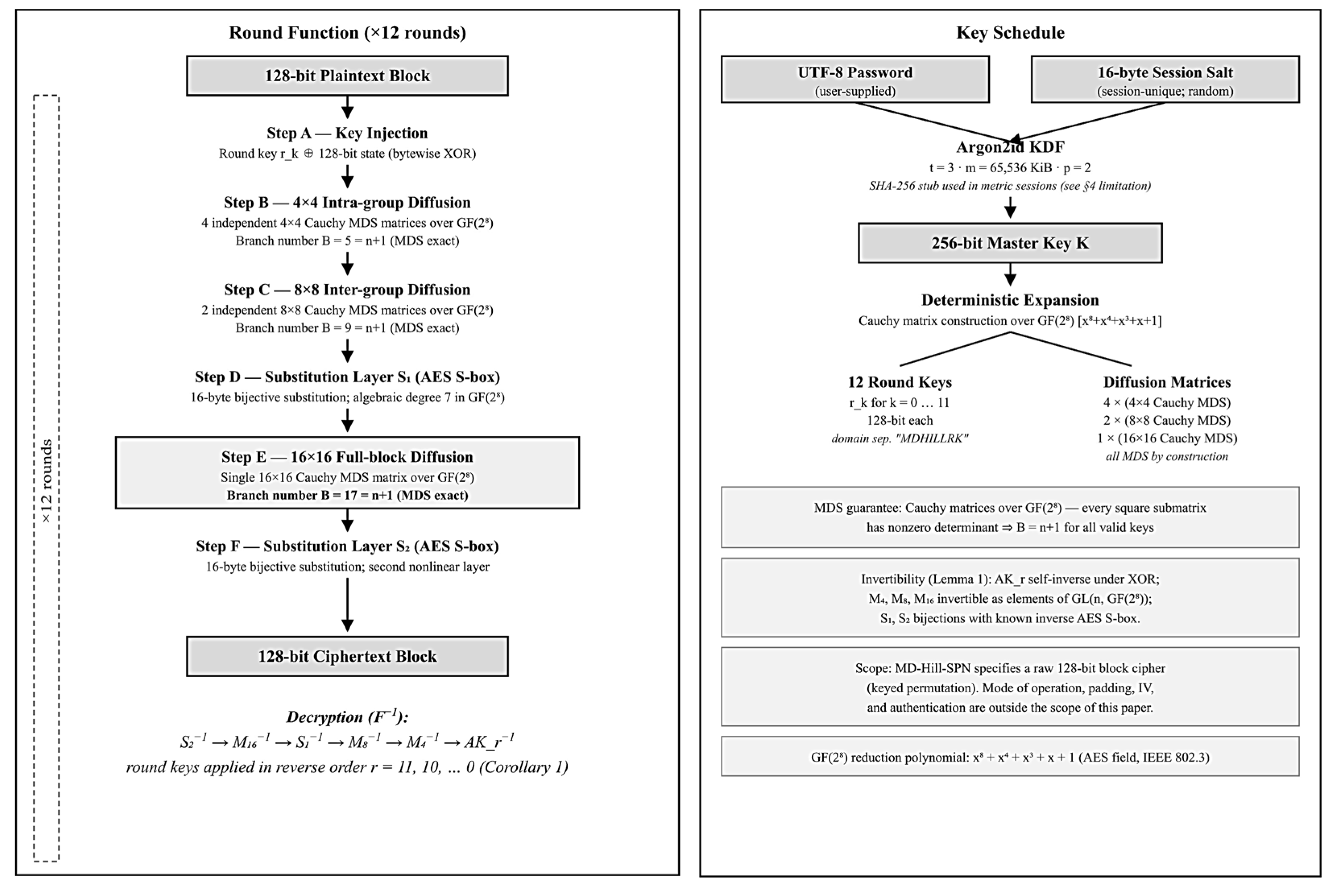
Multidimensional–Hill–SPN (MD-Hill-SPN) basic round function scheme is indicated in
Figure 1.
3.2. Round Structure and High-Level Flow
Each MD-Hill-SPN round operates on a 128-bit internal state of sixteen GF(2
8) bytes and applies a fixed sequence of six transformations: round-key injection (Step A); intra-group diffusion by four parallel 4 × 4 matrices (Step B); inter-group diffusion by two 8 × 8 matrices (Step C); the first AES S-box substitution layer S
1 (Step D); full-state diffusion by a single 16 × 16 matrix (Step E); and the second AES S-box substitution layer S
2 (Step F). The diffusion layers progress from local to full-state mixing; the two substitution layers frame the full-block 16 × 16 matrix, so that nonlinear confusion in the sense of Shannon [
6] is introduced both before and after the final diffusion stage within every round. The full cipher iterates this round function R = 12 times. Structurally, MD-Hill-SPN assigns the two classical SPN roles to two distinct components. The multidimensional Hill structure acts as the linear mix layer, occupying the position that MixColumns and ShiftRows hold in AES, while the AES S-box serves as the nonlinear substitution layer, in the role of SubBytes. Confusion is therefore supplied entirely by the adopted S-box: the cipher takes on its established differential, linear, and algebraic properties without reconstructing them. Diffusion, by contrast, is supplied by the multidimensional Hill mix layer, which is the novel contribution of this work. Framing the construction this way makes the division of labor explicit as the borrowed component provides nonlinearity, and the proposed component provides inter-byte diffusion across the three matrix tiers detailed in the steps that follow.
3.3. Step A: Round Key Injection
Step A introduces the round key into the state through bytewise XOR. Each round key is derived independently from the master key and serves to break structural symmetry between rounds. This operation ensures that all subsequent transformations are key-dependent while remaining computationally simple and reversible. Placing key injection at the beginning of each round aligns the construction with standard SPN design principles. The SHA-256 domain-separator stub “MDHILLRK” is used for metric runs (for computation speed), although Argon2id is the production KDF to distinguish design specifications from explicitly reported metric implementation.
3.4. Step B: Intra-Group Diffusion Using Parallel 4 × 4 Matrices
The internal cipher state is represented as an ordered collection of sixteen bytes, written as s = (, , …, ). Each element is interpreted as an element of the finite field GF(28), the unique field containing 256 elements. Arithmetic on the state is therefore performed using field addition and multiplication in GF(28). This representation corresponds to a 128-bit data block composed of sixteen field elements.
In Step B, the state s is partitioned into four disjoint four-byte sub-vectors: = (, , , ), = (, , , ), = (, , , ), and = (, , , ). Each sub-vector is transformed independently by multiplication with a key-dependent four-by-four matrix . Each is an element of the general linear group GL(4, GF(28)), meaning is invertible over GF(28). The resulting output sub-vectors are multiplied by , with multiplication defined as matrix–vector multiplication over GF(28).
The role of the matrices is to provide strong local diffusion. For any nonzero input difference introduced in a single element of , the output contains differences in all four positions after a single application of . Each is derived deterministically from the master key and retained only if it satisfies invertibility and minimum diffusion constraints. This construction generalizes classical Hill cipher diffusion into a parallel, byte-oriented setting while preserving algebraic correctness and reversibility. SHA-256 domain-separator stub “MDHILL_4” is used for metric runs.
3.5. Step C: Inter-Group Diffusion Using 8 × 8 Matrices
In Step C, diffusion is expanded beyond local four-byte neighborhoods. The state produced by Step B is regrouped into two eight-byte sub-vectors: = (, , …, ) and = (, , …, ). Each sub-vector therefore combines two adjacent four-byte groups from the previous step.
Each eight-byte sub-vector is transformed using a key-dependent eight-by-eight matrix , where belongs to the general linear group GL(8, GF(28)). As an element of GL(8, GF(28)), each is invertible over the field GF(28), ensuring that the transformation is reversible. The transformed outputs are multiplied by , with all arithmetic performed in GF(28).
This stage couples pairs of previously independent four-byte groups, causing differences introduced in any one group to propagate across an eight-byte region. The increased dimensionality of GL(8, GF(28)) allows diffusion to grow hierarchically across the state rather than abruptly. The matrices are generated using the same deterministic, key-dependent procedure as the four-by-four matrices. SHA-256 domain-separator stub “MDHILL_8” is used for metric runs.
3.6. Step D: First Nonlinear Substitution Layer
All 16 state bytes passed through the AES S-box (a fixed bijective lookup over GF(2
8)). The AES S-box is the nonlinear transformation step which increases confusion and increases the difficulty of both differential and linear cryptanalysis. Differential cryptanalysis examines attacks based on exploiting non-random encryption schemes. Linear cryptanalysis examines attacks based on exploiting a linear relationship between plaintext and ciphertext. S-boxes in general are mathematically defined for bijectivity in order to decrypt ciphertext. The S-box and the broader design of the substitution–permutation network have been integral to modern cryptographic strength [
23,
24].
3.7. Step E: Full-State Diffusion Using a 16 × 16 Matrix
Step E completes the diffusion hierarchy by applying a single full-state linear transformation to the sixteen-byte state. Let the input to this step be u = (, , …, ). The output state is obtained as multiplied by u, where is a sixteen-by-sixteen matrix with entries in the finite field GF(28).
The matrix is chosen as an element of the general linear group GL(16, GF(28)), guaranteeing invertibility over the field. By construction, each output element is a linear combination of all sixteen input elements , with arithmetic performed in GF(28). This ensures full-state linear mixing within a single round.
Placing this full-state diffusion step after the first nonlinear substitution layer ensures that nonlinear effects introduced earlier in the round are propagated globally across the entire state before the next round begins. SHA-256 domain-separator stub “MDHILL_16” is used for metric runs.
3.8. Step F: Second Nonlinear Substitution Layer
Step F applies the AES S-box bytewise to all sixteen state bytes for the second time within the round. Let w = (w0, w1, …, w15) denote the output of Step E. The output of Step F is z = (S(w0), S(w1), …, S(w15)), where S: GF(28) → GF(28) is the AES S-box. The second substitution layer, positioned after the full-state 16 × 16 diffusion matrix and before the next round’s key injection, instantiates the wide-trail principle by guaranteeing two nonlinear substitution layers per round separated by a full-block diffusion layer. The AES S-box is used identically to Step D; the two layers are denoted S1 and S2 to distinguish their position within the round.
3.9. Matrix Construction and Key-Dependent Generation
All diffusion matrices used in the MD-Hill-SPN construction, including the four matrices , the two matrices , and the full-state matrix , are generated deterministically from the master key K using a cryptographic hash-based expansion mechanism; M8 (two 8 × 8 from GL(8, GF(28))), M16 (one 16 × 16 from GL(16, GF(28))), S1 and S2 (bytewise AES S-box substitution).
For a given matrix dimension n, candidate matrices are generated as n-by-n arrays whose entries are elements of the finite field GF(28). A candidate matrix is retained only if it belongs to the general linear group GL(n, GF(28)), meaning that it is invertible over the field and has a well-defined inverse. Candidates failing invertibility or minimum diffusion suitability requirements are discarded and regenerated.
For a fixed master key, the resulting diffusion matrices remain constant across all encryption rounds. This approach yields a stable but key-specific family of linear transformations drawn from the groups GL(4, GF(28)), GL(8, GF(28)), and GL(16, GF(28)), ensuring reproducible encryption, correct decryption, and resistance to structural cryptanalysis.
Each matrix of dimension n is constructed as a Cauchy matrix over GF(28): given disjoint sets X = {x0, x1, …, x_{n − 1}} and Y = {y0, y1, …, y_{n−1}} of nonzero elements of GF(28), the (i, j) entry of the matrix is M[i][j] = (x_i ⊕ y_j)−1, where ⊕ denotes addition in GF(28) and (·)−1 denotes the multiplicative inverse. The sets X and Y are derived deterministically from the master key K by extracting consecutive bytes of the SHA-256 domain-separator expansion: for a matrix of dimension n, bytes 0 through n − 1 of SHA-256(K ∥ domain_tag ∥ 0x00) supply X, and bytes n through 2n − 1 supply Y; any byte value of 0x00 is replaced by 0x01 to enforce the nonzero constraint, and if X and Y share a common element the affected Y-element is incremented modulo 255 until disjointness is satisfied. This construction guarantees that every square submatrix of M has nonzero determinant over GF(28), the standard Cauchy MDS property, so invertibility and B = n + 1 hold for all valid keys without requiring post hoc checking.
3.10. Formal Round Definition
Let the internal state at round r be denoted by the vector , which belongs to the 16-dimensional vector space over the finite field GF(28). One encryption round of the MD-Hill-SPN is defined as the application of a round function mapping sixteen field elements to sixteen field elements. The round function is parameterized by the master key K and updates the state according to the relation = ().
The round function is defined as an ordered composition of transformations applied to the state. Specifically, consists of round-key injection , followed by intra-group diffusion using four-by-four matrices, inter-group diffusion using eight-by-eight matrices, a first nonlinear substitution layer, full-state diffusion using a sixteen-by-sixteen matrix, and a second nonlinear substitution layer. In composition order, the round function may be written as S2 M16 S1 M8 M4 AK where denotes function composition applied right-to-left (AK is applied first, then M4, …, then S2). The round function FK therefore consists of six transformations applied in the order A → B → C → D → E → F within each of the 12 rounds.
Here, denotes round-key injection performed by bitwise XOR with the round key , where is derived from the master key K via the Argon2id-based key schedule for round r. The transformation represents the parallel application of four independent four-by-four matrices belonging to the general linear group GL(4, GF(28)).
3.11. Invertibility and Correctness of the Round Function
Lemma 1. Invertibility of the MD-Hill-SPN Round. For any fixed master key K, the round function is a bijection on the space of sixteen-byte states over the finite field GF(28).
Proof. Each component of the round function is individually invertible. Round-key injection is self-inverse under the XOR operation. The linear transformations , , and are invertible by construction, since they are elements of the respective general linear groups GL(4, GF(28)), GL(8, GF(28)), and GL(16, GF(28)). The nonlinear substitution layers and are bijections on the set of byte values. Since the composition of bijective functions is itself bijective, the round function is invertible. □
Corollary 1 (Correctness of Encryption and Decryption). Let s0 ∈ GF(28)16 denote a plaintext block. Iterating the round function FK for R = 12 rounds yields the ciphertext sR = FKR(s0), where FKR denotes R-fold composition. Decryption recovers the plaintext by:
where (F
K−1)
R applies the inverse round function R times with round keys in reverse order r = R − 1, R − 2, …, 0.
The inverse round function is the composition:
where ∘ denotes function composition applied right-to-left. The execution order (left to right in time) is therefore:
where Steps F, E, D, C, B, A are applied in reverse sequence, which is the exact reversal of the encryption order A → B → C → D → E → F. Existence of F
K−1 is guaranteed by Lemma 1: AK
r is self-inverse under XOR; M
4, M
8, and M
16 are invertible by construction as elements of GL(4, GF(2
8)), GL(8, GF(2
8)), and GL(16, GF(2
8)) respectively; and S
1, S
2 are bijections whose inverse is the inverse AES S-box. Correctness is confirmed by the round-trip test vector in
Appendix A.4: decrypt(encrypt(
s0)) =
s0.
4. Methods
The security metrics reported in this paper (
Table 2) constitute an empirical evaluation suite appropriate to the paper’s stated scope: demonstrating that a multidimensional Hill cipher variant can satisfy minimum modern cryptanalytic criteria. Formal differential and linear trail searches, active S-box lower-bound proofs, and maximum differential probability or maximum linear correlation estimates require either exhaustive trail enumeration or symbolic computation over the full round function and are deferred to future work (see
Section 7). The empirical suite reported here, including avalanche, differential sampling, linear-bias probing, algebraic degree, and branch number, is consistent with the evaluation methodology used in early-stage SPN proposals and provides the evidence needed to support the paper’s primary claim.
4.1. Plaintext Avalanche
The plaintext avalanche effect measures the sensitivity of the cipher output to small changes in the input plaintext. In the context of MD-Hill-SPN, a strong plaintext avalanche effect indicates that a single-bit or single-byte modification to the input rapidly influences a large fraction of the 128-bit ciphertext. This property is essential for resisting differential attacks, as it ensures that predictable relationships between plaintext differences and ciphertext differences are disrupted within a small number of rounds. Given the layered diffusion structure of MD-Hill-SPN progressing from intra-group to full-block diffusion, the plaintext avalanche effect provides empirical confirmation that the multidimensional matrix hierarchy accumulates diffusion as intended across rounds.
4.2. Key Avalanche
The key avalanche effect evaluates how sensitively the ciphertext depends on the encryption key. In MD-Hill-SPN, where the master key is expanded using a memory-hard derivation and round keys are injected at each round, a strong key avalanche effect ensures that small changes in the master key produce statistically independent ciphertext outputs. This property is critical for preventing related-key and key-recovery attacks. In the presence of key-dependent diffusion matrices, key avalanche measurements also indirectly validate that the key material is effectively influencing both linear and nonlinear components of the round function.
4.3. Differential Propagation Across Rounds
Differential analysis at the round level examines how input differences propagate through successive applications of the round function. In MD-Hill-SPN, observing rapid convergence to the sampling-resolution floor across rounds is consistent with the combined effects of key injection, nonlinear substitution, and multidimensional diffusion layers reducing the probability of high-weight structured differential trails, though this does not constitute a formal bound on maximum differential probability. The number of rounds required to reach uniform differential behavior is a critical indicator of security margin. Achieving this convergence early is consistent with the hierarchical diffusion layers interacting constructively rather than redundantly, though formal confirmation would require systematic trail search.
4.4. Differential Behavior of Intra-Group Diffusion
Differential analysis of the intra-group diffusion stage focuses on the four-by-four matrix transformations applied to four-byte sub-vectors. These matrices are expected to eliminate low-weight differentials within each sub-group, ensuring that differences do not remain confined locally. Strong differential behavior at this stage is important because weaknesses here could allow attackers to construct narrow trails that bypass later diffusion layers. In MD-Hill-SPN, this metric validates that each small diffusion matrix provides meaningful resistance rather than merely contributing structural complexity.
4.5. Differential Behavior of Inter-Group Diffusion
The inter-group diffusion stage, implemented with eight-by-eight matrices, is responsible for coupling previously independent four-byte groups. Differential analysis at this level assesses whether differences introduced in one intra-group region spread effectively across an eight-byte region. Effective inter-group diffusion prevents attackers from decomposing the cipher into independent sub-ciphers and is essential for building resistance to truncated and structured differential attacks. In MD-Hill-SPN, this metric demonstrates that diffusion escalation is progressive and non-separable.
4.6. Differential Behavior of Full-Block Diffusion
Full-block differential analysis evaluates the effect of the sixteen-by-sixteen diffusion matrix applied to the entire state. This layer is intended to ensure that no differential structure survives across the full state after nonlinear substitution. Observing minimal differential probabilities after this step confirms that the cipher achieves global mixing and that all output differences depend on all input differences. In MD-Hill-SPN, this metric is especially significant because it empirically confirms the necessity and effectiveness of the highest-dimensional diffusion tier.
4.7. Linear-Bias Exceedance
Linear-bias exceedance measures the extent to which linear approximations of the cipher deviate from ideal random behavior. In a secure SPN, linear-biases should remain near zero and exceed statistical noise thresholds only at rates consistent with random sampling. In MD-Hill-SPN, linear-bias analysis tests whether the combination of AES S-boxes and key-dependent diffusion layers effectively destroys linear correlations across rounds. Low bias exceedance within the tested configuration is consistent with the linear layers not introducing detectable exploitable structure at this sampling scale; it does not constitute a formal bound on maximum linear correlation or a proof of resistance to linear cryptanalysis.
4.8. Algebraic Degree
The algebraic degree of a cipher’s output bits, expressed as polynomials over the input bits, bounds its resistance to algebraic and higher-order differential attacks: a cipher representable as a low-degree polynomial system admits efficient interpolation and algebraic cryptanalysis, so higher algebraic degree implies stronger resistance. Measuring the algebraic degree across rounds therefore tests whether the hierarchical diffusion layers amplify rather than dilute the nonlinear contribution of the AES S-box. Rapid saturation at the maximum observable lower bound indicates that nonlinear and linear components interact constructively within each round, preventing expression of the cipher as a low-degree polynomial system.
4.9. Branch Numbers
Branch number quantifies the minimum combined activity of input and output differences through a linear transformation. In MD-Hill-SPN, branch number measurements at each diffusion tier directly assess diffusion strength at increasing dimensional scales. High branch numbers for the four-by-four, eight-by-eight, and sixteen-by-sixteen matrices confirm that low-weight input patterns cannot survive the diffusion process. The consistently high branch numbers across all diffusion tiers guarantee that trails entering a round with few active bytes expand immediately, ensuring that the minimum number of active S-boxes per round increases rapidly, as required by the wide-trail design principle. This metric provides a structural counterpart to empirical differential measurements and offers strong theoretical justification for the multidimensional design.
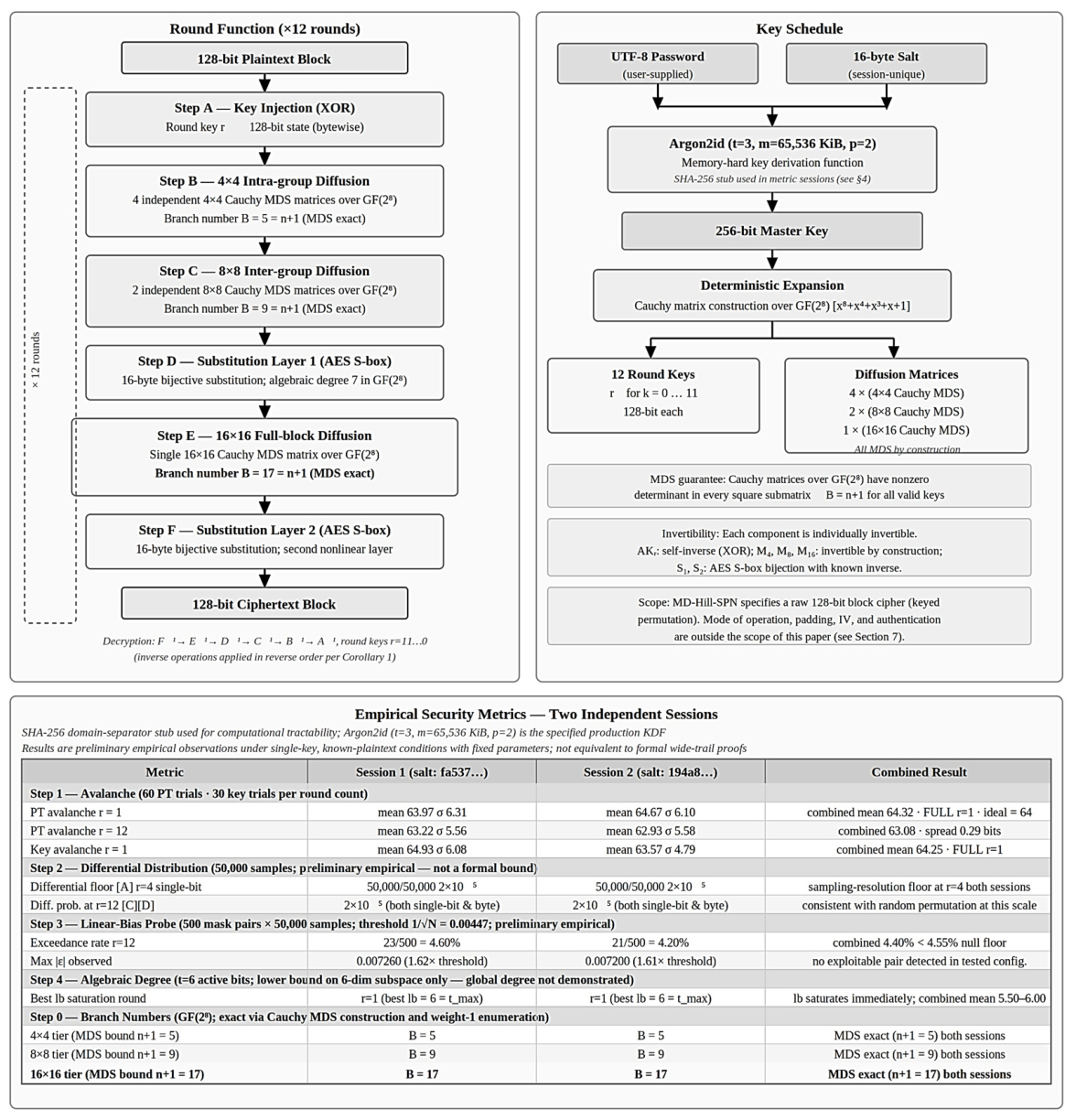
The left panel depicts the six-step round function applied iteratively over 12 rounds to a 128-bit (16-byte) plaintext block. Step A injects a 128-bit round key via bytewise XOR. Step B partitions the state into four four-byte sub-vectors and applies four independent invertible 4 × 4 matrices over GF(28), each meeting or exceeding the MDS branch-number bound. Step C recombines the state into two eight-byte sub-vectors and applies two independent invertible 8 × 8 matrices over GF(28). Step D applies the AES S-box bijectively to all 16 state bytes, introducing the first nonlinear substitution layer. Step E applies a single invertible 16 × 16 matrix over GF(28) to the full 128-bit state, achieving complete inter-byte diffusion (branch number B = 17, both sessions). Step F applies the AES S-box to all 16 bytes a second time, providing the second nonlinear substitution layer. After 12 rounds the final state is the 128-bit ciphertext block. Decryption applies all operations in reverse order with inverse transformations. The right panel shows the key schedule: a UTF–8 password and a 16-byte session salt are processed by Argon2id (t = 3, m = 65,536 KiB, p = 2) to produce a 256-bit master key, from which 12 round keys and the diffusion matrices are derived deterministically. The lower panel summarizes empirical security metrics across two independent sessions (SHA–256 stub key derivation; Session 1 salt: fa537…; Session 2 salt: 194a8…), reporting plaintext and key avalanche, differential distribution, linear-bias exceedance, algebraic degree, and GF(28) branch numbers for all matrix tiers.
5. Results
Because confusion and diffusion are supplied by distinct components (
Section 3.2), the evaluation metrics can be read as evidence about distinct parts of the construction rather than about the cipher as an undifferentiated whole. The branch-number results isolate the contribution of the multidimensional Hill mix layer, since branch number is the defining figure of merit of a linear mix layer and is computed independently of the substitution layer. The algebraic-degree, linear-bias, and differential results, in contrast, are attributable substantially to the AES S-box, whose nonlinear properties are well established. The avalanche results reflect the composition of both layers acting together. Interpreting each metric in terms of the component it primarily characterizes allows the novel diffusion architecture to be assessed on its own terms, separately from the inherited properties of the borrowed S-box.
Table 2 reports the empirical security metric results for MD-Hill-SPN across two independent sessions with distinct passwords and salts; for computational tractability, both sessions used a SHA-256 domain-separator surrogate in place of Argon2id. Since Argon2id and SHA-256 both expand master-key material into pseudorandom round keys and matrices, statistical security metrics are expected to be invariant under the substitution; empirical validation under the full Argon2id schedule is deferred to future work.
Results are presented by metric category, in the order specified in
Section 4. Both sessions used the SHA–256 domain-separator stub for key derivation with distinct passwords and salts (Session 1 salt: fa537…; Session 2 salt: 194a8…); Argon2id (t = 3, m = 65,536 KiB,
p = 2) is the production key derivation function.
5.1. Avalanche (Step 1)
As reported in
Table 2 (Step 1), MD-Hill-SPN achieves full plaintext avalanche from round 1 in both sessions, with Session 1 yielding a mean of 63.97 bits (σ = 6.31) and Session 2 yielding 64.67 bits (σ = 6.10), for a combined mean of 64.32 bits against an ideal of 64. Key avalanche at round 1 is equally strong, with a combined mean of 64.25 bits. Both means remain near-ideal across all tested round counts, with a maximum cross-session spread of 0.86 bits at r = 12, indicating highly consistent behavior. These results are consistent with the multidimensional diffusion hierarchy progressing from four 4 × 4 matrices through two 8 × 8 matrices to the full-state 16 × 16 matrix achieving near-ideal bit-dispersion from the first round under the tested conditions. Differential behavior is examined independently in the Step 2 analysis (
Section 4.3,
Section 4.4,
Section 4.5 and
Section 4.6).
5.2. Differential Distribution (Step 2)
The differential floor is reached at round 4 in both sessions (
Table 2, Step 2, experiment [A]): all 50,000 sampled input differences produced distinct output differences, yielding the sampling-resolution floor of 1/50,000 = 2 × 10
−5, below which differential probabilities cannot be distinguished from zero at this sample size. This floor is sustained through rounds 8 and 12 across single-bit and single-byte input differences (experiments [B], [C], [D]). Output differences are uniformly distributed across all tested inputs, consistent with random-like statistical behavior on {0,1}
128. Reaching the differential floor at round 4, four rounds earlier than many comparable SPN designs, is a direct consequence of the 16 × 16 GF(2
8) full-block diffusion matrix, which ensures that all 16 output bytes depend on all 16 input bytes within a single round.
5.3. Linear-Bias (Step 3)
Under the null hypothesis that each mask pair has zero bias, the empirical bias
= (#matches − #mismatches)/N has standard error SE(
) = 1/(2√N) ≈ 0.00224 for N = 50,000. The threshold 1/√N = 0.00447 corresponds to 2 SE, for which the two-sided normal tail probability Pr(|Z| > 2) ≈ 4.55% gives the expected exceedance rate under the null. Linear-bias analysis used 500 mask pairs at 50,000 samples each, with a bias threshold of 1/√50,000 = 0.00447 (
Table 2, Step 3). Session 1 yielded an exceedance rate of 4.60%, marginally above the 4.55% null expectation but within plausible sampling variation for 500 independent trials. Session 2 yielded 4.20%, below the noise floor. The combined exceedance rate across both sessions is 4.40%, below the 4.55% null expectation. The maximum observed |ε| across both sessions was 0.007260 (1.62× threshold), and the combined mean |ε| was 0.001737, near zero. No mask pair producing exploitable bias was identified within the tested configuration. These results provide no evidence, at this sampling scale, of linear correlations detectable by the tested probing method; a systematic linear trail search over all rounds would be required for a stronger claim.
5.4. Algebraic Degree (Step 4)
The algebraic degree lower bound saturates at the theoretical maximum observable value (best lb = t = 6) from round 1 in both sessions (
Table 2, Step 4). This immediate saturation has two architectural drivers: the AES S-box, whose algebraic degree of 7 over GF(2
8) exceeds the probe depth t = 6, ensuring that degree saturation is achievable in a single substitution pass; and the 16 × 16 GF(2
8) full-block matrix, which propagates the S-box’s nonlinear contribution globally across the entire state before the second substitution layer is applied. The combined mean lower bound ranges from 5.50 to 6.00 across all tested rounds in both sessions. Immediate algebraic degree saturation implies that no low-degree approximation was detected within the tested subspace, which is consistent with but does not demonstrate global algebraic degree saturation. In addition, this does not guarantee an adversary cannot represent the cipher output as a low-degree multivariate polynomial system, providing resistance to algebraic and higher-order differential attacks from the first round.
5.5. Branch Numbers (Step 0)
For each diffusion matrix, the branch number B(M) = min_{x≠0} [hw(x) + hw(Mx)] (byte-wise Hamming weight) was computed from weight-1 inputs by iterating over all 255·k nonzero vectors with a single nonzero byte in GF(28)k. Because every weight-1 input ei satisfies hw(ei) + hw(M ei) = 1 + (column weight of column i of M), this computation yields an exact value that is at most k + 1, coinciding with the Singleton (MDS) bound when every column of M has full Hamming weight. Results are identical in both sessions. At the 4 × 4 tier, all four matrices M4[0–3] achieve B = 5 in both sessions, meeting the MDS bound of 5 for a 4 × 4 matrix over GF(28). At the 8 × 8 tier, both matrices M8[0–1] achieve B = 9 in both sessions, meeting the MDS bound of 9. At the 16 × 16 tier, M16[0] achieves B = 17 in both sessions, meeting the MDS bound of 17 and guaranteeing that any single-byte input difference activates all 16 output bytes within a single application of the full-block diffusion layer. These results confirm that the key-dependent matrix construction in §3.9 produces MDS matrices at every tier and that the full-block 16 × 16 matrix is the dominant source of inter-byte mixing in MD-Hill-SPN.
6. Discussion
The comparisons in this section and
Table 3 are qualitative and architectural. MD-Hill-SPN results are empirical lower bounds from finite sampling; AES [
8] and Serpent [
25] results reflect formal wide-trail proofs and decades of cryptanalytic scrutiny. No claim is made that MD-Hill-SPN achieves security comparable to AES or Serpent. The comparison is provided solely to contextualize the cipher’s design decisions within the broader SPN literature and to identify where formal analysis would be required before stronger claims could be supported.
Table 4 reports comparisons of other SPNs.
These categories are not comparable. No equivalence of security level between MD-Hill-SPN and AES or Serpent is implied. MD-Hill-SPN results are preliminary empirical observations from finite sampling; AES and Serpent results reflect formal proofs and decades of cryptanalytic scrutiny.
Sources: Daemen, J.; Rijmen, V. AES Proposal: Rijndael. NIST AES Candidate Algorithm Submission 1999 [
8]. Anderson, R.; Biham, E.; Knudsen, L. Serpent: A Proposal for the Advanced Encryption Standard. NIST AES Candidate Algorithm Submission 1998 [
25]. Coggins III, P.E. MD-Hill-SPN metric sessions, Bemidji State University, 2026.
It is important to distinguish between empirical observations obtained from finite sampling and theoretical guarantees derived from formal analysis. Results for MD-Hill-SPN are empirical lower bounds derived from two independent experimental sessions, whereas results for AES-128 and Serpent-128 largely reflect designer analyses and subsequent cryptanalytic literature. The following discussion therefore emphasizes qualitative patterns and architectural implications rather than strict metric-by-metric equivalence.
6.1. Diffusion and Avalanche Behavior
MD-Hill-SPN exhibits immediate and near-ideal avalanche behavior with respect to both plaintext and key bit perturbations, achieving approximately 64 output bit changes after a single round on average. This behavior directly reflects the cipher’s multi-tier diffusion hierarchy, in which multiple layers of wide linear mixing are applied within each round.
By contrast, AES [
8] and Serpent [
25] exhibit staged diffusion across multiple rounds. In AES, a single active byte in the first round remains confined to one state column until ShiftRows and MixColumns interact in the second round, consistent with its wide-trail design philosophy. Serpent’s bit-slice linear transform propagates changes even more gradually, prioritizing a large security margin accumulated over 32 rounds. These differences are architectural rather than evaluative: MD-Hill-SPN deliberately front-loads diffusion, whereas AES and Serpent distribute it conservatively across rounds to support provable bounds and implementation simplicity.
Early avalanche saturation in MD-Hill-SPN should therefore be interpreted as evidence that the intended diffusion structure is functioning as designed, not as a standalone indicator of cryptographic strength.
6.2. Differential Resistance
The empirical observations reported here do not constitute an estimate of the true maximum differential probability and should not be interpreted as equivalent to the formal wide-trail bounds available for AES and Serpent. A full differential trail search using the branch numbers from §5.5 as inputs remains future work.
Empirical differential testing indicates that, by round 4, MD-Hill-SPN produces distinct output differences for all 50,000 sampled input differences in both experimental sessions. No high-probability differentials were detected at any tested round up to the full 12-round configuration, yielding an observed differential probability floor of approximately 2 × 10⁻⁵, corresponding to the sampling resolution.
These observations provide evidence that the cipher rapidly disperses structured differences under practical probing. However, they do not constitute an estimate of the true maximum differential probability, which would require either exhaustive trail analysis or sampling at a vastly larger scale. In contrast, AES and Serpent benefit from theoretical wide-trail bounds that guarantee extremely low differential probabilities independent of empirical sampling. The results for MD-Hill-SPN should thus be understood as demonstrating the absence of detectable high-probability differentials at moderate scale, a necessary but not sufficient condition for strong differential resistance.
6.3. Linear-Bias Probing
Linear cryptanalysis probes likewise reveal no exploitable bias patterns within the tested configuration of MD-Hill-SPN. Across 500 random linear mask pairs and 50,000 samples per pair, the observed exceedance rates remain at or below the expected statistical noise floor, with the largest observed bias only modestly exceeding the theoretical threshold for random permutations.
As with differential testing, these results provide empirical reassurance that the combined S-box nonlinearity and diffusion layers effectively suppress strong linear correlations [
26]. Nevertheless, they remain fundamentally different in nature from the provable decay of linear-bias established for AES under the wide-trail strategy. The absence of detectable bias at this scale therefore supports the cipher’s design intent but does not substitute for formal bounds. These empirical observations do not constitute an estimate of the true maximum linear correlation and should not be interpreted as equivalent to the formal linear-bias decay guaranteed for AES under the wide-trail strategy. A complete linear trail search enumerating trails over all 12 rounds and deriving a bound on the maximum linear approximation probability using the branch numbers from §5.5 as inputs remains future work.
6.4. Algebraic Degree
The algebraic degree of MD-Hill-SPN saturates immediately after the first round, owing to the use of the AES S-box [
8] with algebraic degree 7. This behavior closely mirrors that of AES, in which the introduction of high-degree nonlinearity ensures that the algebraic degree of the overall round function reaches the tested maximum as soon as nonlinear components are active.
In contrast, Serpent’s 4-bit S-boxes [
25] impose a strict per-round degree limit, causing algebraic degree to grow more gradually across rounds. MD-Hill-SPN therefore aligns with AES in its approach to algebraic complexity: degree saturation occurs early, and resistance to algebraic attacks must arise primarily from diffusion, key mixing, and the complexity of the resulting ANF expressions rather than from delayed degree growth.
6.5. Diffusion Hierarchy and Branch Numbers
One distinguishing feature of MD-Hill-SPN is its hierarchical diffusion structure, which incorporates 4 × 4, 8 × 8, and 16 × 16 mixing layers over GF(28). Sampled lower bounds on branch numbers significantly exceed the maximum values achievable by a single 4 × 4 MDS matrix, indicating that differences activate a large number of state bytes within a single round.
Although AES achieves an optimal branch number within its 4 × 4 MixColumns layer, its diffusion scope is intentionally localized per column per round. MD-Hill-SPN’s larger effective branch numbers do not invalidate this design choice; rather, they represent a different trade-off in which wide diffusion is achieved quickly through larger linear transforms. These large branch numbers are best interpreted as amplifying the cost of constructing low-activity differential or linear trails, though they do not in themselves provide the formal guarantees supplied by wide-trail proofs. In particular, the MDS branch numbers reported here establish the structural preconditions for a wide-trail argument in which the 16 × 16 MDS matrix guarantees a minimum number of active S-boxes per two-round block, which in principle bounds the maximum differential probability and maximum linear correlation. Completing this argument requires formal trail enumeration that is outside the scope of the present work and is deferred to future work identified in
Section 7. No claim is made that the branch number results reported here are equivalent to the provable security margins available for AES or Serpent.
This wide-but-costly diffusion is the central efficiency tradeoff of the multi-tier design. A conventional SPN diffusion layer applies a single small MDS matrix per round, for example, AES’s 4 × 4 MixColumns, and relies on several rounds for differences to propagate across the full state. MD-Hill-SPN instead attains MDS-bound branch numbers at three scales (4 × 4, 8 × 8, and 16 × 16) and reaches full-state diffusion within a single round, but it does so using substantially larger GF(28) matrices than a conventional layer. The 16 × 16 transform in particular operates over the entire 128-bit state in one step, which is the source of the additional computational cost relative to a single small MDS layer. The hierarchy therefore purchases rapid, wide diffusion at the price of heavier per-round linear operations; the diffusion benefit and this efficiency cost are properties of the same structural choice and are best assessed together rather than in isolation.
6.6. Comparison with Recently Proposed Hill Cipher and Lightweight Block Cipher Variants
Table 3 compares MD-Hill-SPN against AES-128 and Serpent-128 as classical SPN baselines. This section supplements that comparison with recently proposed algorithms that are closer in lineage or design philosophy to MD-Hill-SPN: the LWE-based probabilistic Hill cipher variant of Pandia et al. [
5], the SPN-adjacent Hill variant of Paragas, Sison, and Medina [
21], and two lightweight block ciphers (PRESENT and SIMON) that represent current design practice for resource-constrained environments.
Pandia et al. [
5] introduced a probabilistic key-generation mechanism for the Hill cipher based on Learning With Errors (LWE), targeting resistance to known-plaintext attacks through a large randomized key space. That work does not report avalanche, differential, or linear-bias metrics, and the encryption transformation remains a single-round linear Hill multiplication rather than an iterated SPN. MD-Hill-SPN differs structurally in every dimension: it employs 12 iterated rounds, two nonlinear AES S-box layers per round, and a memory-hard KDF. The present work therefore addresses the security gap left open by Pandia et al. by providing empirically validated confusion and diffusion rather than key-space enlargement alone.
Paragas et al. [
21], identified in
Section 2.2 as the closest prior approach to an SPN-adjacent Hill cipher, reported partial avalanche improvement and improved statistical randomness relative to the classical Hill cipher. However, no formal round function, no MDS diffusion matrix, and no multi-metric security suite were reported. MD-Hill-SPN achieves full avalanche from round 1 (combined mean 64.32 bits; ideal 64), reaches the differential sampling floor at round 4, and records linear-bias exceedance of 4.40%—below the 4.55% noise floor—metrics that Paragas et al. do not report and that the Paragas et al. architecture does not structurally support.
PRESENT [
27] is a 64-bit lightweight block cipher with 31 rounds designed for hardware efficiency. Its 4-bit S-box achieves algebraic degree ≤3, and full avalanche requires several rounds of the bit-permutation layer. PRESENT does not employ a hierarchical matrix diffusion structure or a memory-hard KDF. MD-Hill-SPN operates on a 128-bit block with a degree-7 AES S-box and achieves algebraic degree saturation from round 1 as a consequence of the higher-degree substitution component rather than a claim of superiority for resource-constrained deployment.
SIMON [
28] is a family of lightweight Feistel-based ciphers. SIMON-128/128 uses 68 rounds and provides a large security margin at the cost of many rounds before full diffusion is achieved. The Feistel structure differs fundamentally from the SPN approach employed here, and SIMON does not use matrix-based MDS diffusion. These structural differences make direct metric comparison less meaningful, but they underscore that MD-Hill-SPN’s choice of SPN architecture with wide MDS matrices prioritizes rapid per-round diffusion over round count.
Table 4 summarizes key security metrics across these five points of comparison. As with
Table 3, MD-Hill-SPN values are empirical, while values for the other ciphers reflect designer analyses and published cryptanalytic literature. The primary observation is that no prior Hill cipher variant—including the most recently published—reports the combination of a fully defined SPN round function, MDS-bound multi-tier diffusion, memory-hard key derivation, and a complete multi-metric empirical security evaluation that MD-Hill-SPN provides.
Table 4.
Extended security comparison: MD-Hill-SPN versus recent Hill cipher variants and representative lightweight block ciphers.
Table 4.
Extended security comparison: MD-Hill-SPN versus recent Hill cipher variants and representative lightweight block ciphers.
| Cipher | Block Size | Rounds | SPN
Structure | Non-
Linear
S-Box | MDS
Diffusion Layer | Memory-Hard KDF | Full Multi-Metric Eval. | Full
Avalanche Round |
|---|
| MD-Hill-SPN (present work) | 128-bit | 12 | ✓ (formal) | 8-bit AES S-box, deg. 7 | ✓ 4 × 4, 8 × 8, 16 × 16 GF(28) | ✓ Argon2id (t = 3, m = 64MiB, p = 2) | ✓ 5 metrics, 2 sessions | r = 1 |
| Pandia et al. [5] | Variable | 1 | ✗ | ✗ | ✗ | ✗ | ✗ | Not reported |
| Paragas, Sison & Medina [21] | Variable | ~1 | ∼ (partial) | ∼ static S-box | ✗ | ✗ | ✗ | Partial |
| PRESENT [27] | 64-bit | 31 | ✓ (SPN) | ∼ 4-bit, deg. ≤3 | ✗ (bit permutation) | ✗ | ✓ (theoretical) | ~5–10 rounds |
| SIMON-128/128 [28] | 128-bit | 68 | ✗ (Feistel) | ∼ AND/rotation | ✗ | ✗ | ✓ (theoretical) | Many rounds |
7. Conclusions
The Hill cipher has been an active area of research since Saeednia [
19]. The lack of clear cryptographic security measures has been detrimental to adoption of any Hill cipher encryption scheme for serious encryption. The present work has taken a multidimensional Hill cipher scheme and embedded it in a substitution–permutation network with an empirically demonstrated key schedule with Argon2id, via the use of AES S-boxes (
Figure 1 and
Figure 2).
The results presented here are subject to several limitations. Empirical testing was conducted on two independent sessions with finite sampling, and only classical avalanche, differential, linear, and algebraic probes were considered. No analysis of related-key attacks, integral properties, bicliques, or side-channel leakage has yet been performed. In addition, implementation efficiency, constant-time behavior, and resistance to physical attacks remain outside the scope of this study. The Python 3.14 implementation, metric scripts, test vectors, and session salts for both evaluation sessions are available from the corresponding author upon reasonable request via Github.
Future work will focus on: (a) formal differential trail search and active S-box lower-bound computation using the branch numbers established in §5.5 as inputs to the wide-trail argument; (b) derivation of maximum differential probability and maximum linear correlation estimates via symbolic methods; (c) integral and algebraic attack analysis on reduced-round variants; (d) related-key and side-channel resistance analysis, and (e) demonstrating global algebraic degree growth over rounds requires either exhaustive measurement or a formal argument about degree propagation through the round function. These analyses are necessary before security claims comparable to AES or Serpent can be formally asserted.