
Deciding on Cybersecurity Awareness Initiatives: Insights from the Public Sector


Abstract
1. Introduction
2. Materials and Methods
2.1. Data Collection
- Junior—less than 2 years of experience
- Associate—between 2 and 5 years of experience
- Mid-level—between 5 and 10 years of experience
- Senior—more than 10 years of experience

| Respondent | Role | Experience |
|---|---|---|
| R1 | IT manager | Senior |
| R2 | CIO and IT manager | Mid-level |
| R3 | CIO and IT manager | Associate |
| R4 | IT manager | Senior |
| R5 | IT strategist | Associate |
| R6 | IT manager | Senior |
| R7 | Information security coordinator | Mid-level |
| R8 | Information security manager | Senior |
| R9 | Team leader for information security team | Associate |
| R10 | Unit manager at the IT department | Mid-level |
| R11 | Cybersecurity specialist and coordinator | Junior |
| R12 | Operations manager | Associate |
- Introduction—Explanation of the study purpose and procedure;
- Background—Questions about the participants professional background;
- General CSA—Questions about how the participant is currently working with CSA;
- Implementation of CSA—Questions about how the participants work with the implementation of CSA activities;
- Selection of CSA—Questions about how the participants decide on what CSA activities to implement.
2.2. Data Analysis
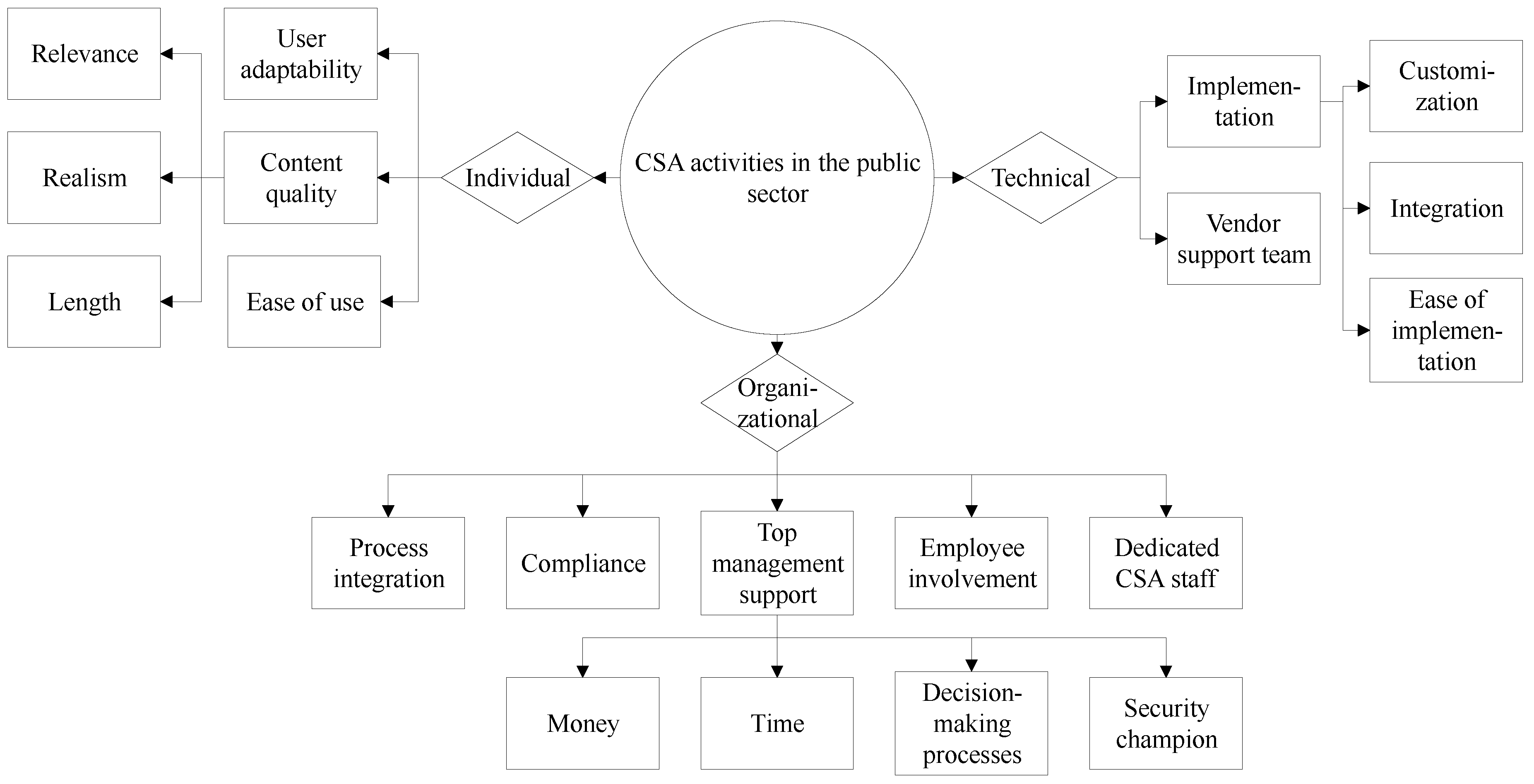
- Individual factors that consider CSA from the viewpoint of the end users.
- Technical factors that refer to the technical conditions of deploying and using CSA within the existing technical ecosystem.
- Organisational factors that refer to the organisational readiness and conditions for using CSA.
2.3. Formative Validation with Practitioners
- What is your impression of the taxonomy?
- What would you like to change?
- How can the taxonomy be useful?
3. Results
3.1. Taxonomy Development
3.1.1. Individual Factors
- Relevance is somewhat similar to user adaptability but is rather concerned with how realistic the content in a CSA activity is to the user’s role and environment. One aspect is to ensure that the provided information aligns with internal security controls, such as suggesting password rules that can be applied within the internal systems. A second aspect is to ensure relevance to the user’s work environment by, for instance, not informing users who are only working on-site about remote working routines.
- Realism is about making the content in CSA seem realistic. Respondent 9 exemplified the following: “I’ve made customisations in the scenarios so that it feels relevant. We were partially affected by the [removed to preserve respondent anonymity] ransomware, so I used that as an example because it… it worked well”.
- Length was described in the interviews as the last content quality factor and refers to how much time users need to spend to complete a CSA activity. The general notion was that it is important to enable users to complete CSA activities within short timeframes to ensure they have time to engage with them.
3.1.2. Technical Factors
- Customisation was described as an enabler of content quality. While several respondents stated that it was hard for them to spend time customising tools, they also emphasised that tailoring the content of CSA activities to their own organisation is crucial to user engagement. As one example, respondent 1 stated “It’s about the way you construct the education, i.e., the content and how you write it. To be able to reach out and build an understanding when they sit in their everyday life and visit users or take care of students or what it could be… […] It’s an important factor to adapt the language”.
- Integration was found to be a factor several participants desired, but nevertheless one that is not currently used to any large extent by the participants. Participants noted that some CSA activities could be integrated into the technical environment, but others were unnecessary. In essence, integration was described as something the participants wanted, but it was not among the most important factors in deciding which CSA activity to adopt. Respondent 9 expressed the following: “We would wish for it, as we have an LMS, and if there were education that could integrate with it, then we wouldn’t need a new product. It would be better. When we set requirements, we usually have integration as one of the requirements”.
- The factor ease of implementation is derived from many participants’ statements about the importance of it being easy for them to use a CSA activity in their organisation. The participants frequently mentioned a lack of time and staff for CSA and expressed a willingness for easy implementation. Respondent 9 said, “That, however, we are prepared to pay for,” which shows a willingness to pay more if that means less work. However, other respondents suggested a lack of monetary resources.
3.1.3. Organisational Factors
- Money allocated for CSA activities to enable procurement of appropriate tools and support functions, as described in previous factors.
- Time refers both to having enough time for IT staff to implement and follow up CSA activities and for time for all staff to engage with the activities. The respondent 9 argued that the allocation of time was a major problem: “I would say the greatest difficulty is to get the organisation to agree to dedicate time to it, and to get management to actually make sure that the employees carry through and spend the necessary time”.
- Several respondents also discussed how the organisation’s decision-making processes could be a success factor for CSA activities. The interview consensus was that having processes that enable swift descriptions is important. However, some respondents cited a lack of such processes as a complicating factor, which sometimes led them to make decisions on their own. Respondent 2 said, “Regarding cybersecurity initiatives in general, it’s me driving the question forward in the management groups. Sometimes I’m under the impression that I have the authority to make my own decisions, […] if I perceive that this needs to be done, I think I can decide that we’ll do it”.
- Security champion means that managers at all levels actively support CSA activities both by allocating the above-described resources and by encouraging the CSA activities in the organisation. Several participants describe that a large part of their job is to convince managers about the importance of security, or as expressed by Respondent 1, “[…] convincing the management group or people in a leading position to be in on the idea and speak warmly about the solution, and get employees engaged, I would say.”
3.2. Validation
- Completeness of the taxonomy—The workshop participants agreed that the taxonomy covered the important success factors and had nothing to add. Several participants, especially, highlighted the importance of the organisational aspects and stated that it was good that the taxonomy covered them.
- Usefulness of the taxonomy—The workshop participants described the taxonomy as useful for practitioners in two ways. First, it shows the challenges to be expected when executing CSA activities. Understanding the challenges ahead of an activity can help prioritise which challenges to focus on in one’s own organisation. Second, participants noted that presenting factors as a map was useful, as this makes the taxonomy a tool that helps practitioners understand CSA. As such, the taxonomy can be used as an educational tool for teaching and learning about CSA in practice.
4. Discussion
5. Conclusions
Author Contributions
Funding
Institutional Review Board Statement
Informed Consent Statement
Data Availability Statement
Conflicts of Interest
Abbreviations
| CSA | Cybersecurity awareness |
| KAB | Knowledge–attitude–behavior |
| TPB | Theory of planned behavior |
Appendix A. Interview Guide
Appendix A.1. Introduction
- Explained the purpose and scope of the research project to the respondent.
- Informed the participants that the interview was recorded and that they may stop at any time.
- Informed the participants that names and organisational names would remain anonymous.
- Only the paper authors would see the complete data collection, which will be removed after publication.
Appendix A.2. Background
- What is your title/role?
- How long have you worked in this role?
- Do you have any formal education?
Appendix A.3. General Cybersecurity Awareness
- How is cybersecurity prioritised within your organisation?
- Do you consider cybersecurity as an important part of your operations?
- How do you currently work to increase cybersecurity awareness?
- -
- What do you use today (e.g., newsletters, emails, nano-learning, lectures, …)?
- -
- If training or lectures are used, what types of training do you offer?
- -
- Which factors influence your choice of method?
- -
- If no specific measures are used, why not?
Appendix A.4. Implementation of Cybersecurity Awareness Measures
- Do you follow any recommendations/frameworks for CSA measures (e.g., NIST, MSB)?
- -
- If yes—Which ones?
- -
- If no—Where do you obtain information about risks and countermeasures?
- Do you find it difficult to access current recommendations?
- -
- If yes—Why?
- Do you feel that the CSA measures you use are effective?
- -
- If yes—How can you tell?
- -
- If no—Why not?
- -
- Is the issue employee engagement, or do you use underperforming measures?
- Describe an awareness-raising initiative that worked very well.
- -
- What factors contributed to its success?
- -
- Did you take any lessons from it for future projects? What? Describe.
- Describe an awareness-raising initiative that worked poorly.
- -
- What factors contributed to its failure?
- -
- Did you take any lessons from it for future projects?
- Do you have specific training aimed at managers and leaders?
- -
- If yes—What type of measures?
- -
- Do they receive training on developing a better security culture?
- -
- If no—Why not?
- Who is involved in the decision-making process for awareness measures?
- -
- Are employees involved? Why/why not?
- -
- Can employees give feedback afterward?
- -
- Do you have an example where feedback has been implemented?
- How often do you evaluate existing measures to determine if they need changes or updates?
- What does your process look like when analysing which measures to implement?
- Do you have a fixed budget for awareness-raising measures?
- -
- How is this determined?
- Is it more difficult to obtain funding for training compared to hardware/software measures?
- What are the major challenges when implementing a new awareness-raising initiative?
- Is there a measure you wish you could implement but have not been able to?
- -
- What specific difficulties prevent this?
Appendix A.5. Selection of Cybersecurity Awareness Measures
- Which factors influence your choice of specific awareness-raising measures?
- Follow-up factors (if not mentioned by the respondent):
- -
- Ease of use for the organisation or users.
- -
- Availability of help or guidance after implementation.
- -
- How employees receive support in using new measures.
- -
- Ease of implementation.
- -
- User adaptation or customisation.
- -
- Availability of support if problems arise.
- -
- Importance of integration with existing workplace software.
- -
- Importance of encouraging employees to help and talk to each other about cybersecurity.
References
- Paigude, S.D.; Pangarkar, S.C.; Dari, S.S.; Patil, M.; Gujar, S.N. A review of cybersecurity policies in the public sector: Challenges and solutions. Comput. Fraud Secur. 2024, 2024, 7–12. [Google Scholar] [CrossRef]
- Szczepaniuk, E.K.; Szczepaniuk, H.; Rokicki, T.; Klepacki, B. Information security assessment in public administration. Comput. Secur. 2020, 90, 101709. [Google Scholar] [CrossRef]
- Wirtz, B.W.; Weyerer, J.C. Cyberterrorism and cyber attacks in the public sector: How public administration copes with digital threats. Int. J. Public Adm. 2017, 40, 1085–1100. [Google Scholar] [CrossRef]
- Malatji, M.; Marnewick, A.; von Solms, S. Validation of a socio-technical management process for optimising cybersecurity practices. Comput. Secur. 2020, 95, 101846. [Google Scholar] [CrossRef]
- Frandell, A.; Feeney, M. Cybersecurity threats in local government: A sociotechnical perspective. Am. Rev. Public Adm. 2022, 52, 558–572. [Google Scholar] [CrossRef]
- Kävrestad, J.; Nohlberg, M.; Furnell, S. A taxonomy of SETA methods and linkage to delivery preferences. ACM SIGMIS Database DATABASE Adv. Inf. Syst. 2023, 54, 107–133. [Google Scholar] [CrossRef]
- Chaudhary, S.; Gkioulos, V.; Katsikas, S. Developing metrics to assess the effectiveness of cybersecurity awareness program. J. Cybersecur. 2022, 8, tyac006. [Google Scholar] [CrossRef]
- Zwilling, M.; Klien, G.; Lesjak, D.; Wiechetek, Ł.; Cetin, F.; Basim, H.N. Cyber security awareness, knowledge and behavior: A comparative study. J. Comput. Inf. Syst. 2022, 62, 82–97. [Google Scholar] [CrossRef]
- Dontu, S.; Addula, S.R.; Pareek, P.K.; Vallabhaneni, R.; Adnan, M.M. Attack detection from Internet of Things using TPE based self-attention based bidirectional long-short term memory. In Proceedings of the 2024 International Conference on Intelligent Algorithms for Computational Intelligence Systems (IACIS), Hassan, India, 23–24 August 2024; IEEE: Piscataway, NJ, USA, 2024; pp. 1–6. [Google Scholar]
- Khando, K.; Gao, S.; Islam, S.M.; Salman, A. Enhancing employees information security awareness in private and public organisations: A systematic literature review. Comput. Secur. 2021, 106, 102267. [Google Scholar] [CrossRef]
- Prümmer, J.; van Steen, T.; van den Berg, B. A systematic review of current cybersecurity training methods. Comput. Secur. 2024, 136, 103585. [Google Scholar] [CrossRef]
- Khan, B.; Alghathbar, K.S.; Nabi, S.I.; Khan, M.K. Effectiveness of information security awareness methods based on psychological theories. Afr. J. Bus. Manag. 2011, 5, 10862. [Google Scholar] [CrossRef]
- Parsons, K.; Calic, D.; Pattinson, M.; Butavicius, M.; McCormac, A.; Zwaans, T. The human aspects of information security questionnaire (HAIS-Q): Two further validation studies. Comput. Secur. 2017, 66, 40–51. [Google Scholar] [CrossRef]
- Sommestad, T.; Hallberg, J. A review of the theory of planned behaviour in the context of information security policy compliance. In Proceedings of the Security and Privacy Protection in Information Processing Systems: 28th IFIP TC 11 International Conference, SEC 2013, Auckland, New Zealand, 8–10 July 2013; Proceedings 28. Springer: Berlin/Heidelberg, Germany, 2013; pp. 257–271. [Google Scholar]
- Reinheimer, B.; Aldag, L.; Mayer, P.; Mossano, M.; Duezguen, R.; Lofthouse, B.; von Landesberger, T.; Volkamer, M. An investigation of phishing awareness and education over time: When and how to best remind users. In Proceedings of the Sixteenth Symposium on Usable Privacy and Security (SOUPS 2020), Boston, MA, USA, 10–11 August 2020; pp. 259–284. [Google Scholar]
- Lastdrager, E.; Gallardo, I.C.; Hartel, P.; Junger, M. How effective is anti-phishing training for children? In Proceedings of the SOUPS’17: Proceedings of the Thirteenth USENIX Conference on Usable Privacy and Security, Santa Clara, CA, USA, 12–14 July 2017; pp. 229–239. [Google Scholar]
- Junglemap. Nanolearning. Available online: https://junglemap.com/nanolearning (accessed on 31 January 2026).
- Gokul, C.J.; Pandit, S.; Vaddepalli, S.; Tupsamudre, H.; Banahatti, V.; Lodha, S. PHISHY—A Serious Game to Train Enterprise Users on Phishing Awareness. In Proceedings of the 2018 Annual Symposium on Computer-Human Interaction in Play Companion Extended Abstracts; Association for Computing Machinery: New York, NY, USA, 2018; pp. 169–181. [Google Scholar] [CrossRef]
- Lim, I.K.; Park, Y.G.; Lee, J.K. Design of Security Training System for Individual Users. Wirel. Pers. Commun. 2016, 90, 1105–1120. [Google Scholar] [CrossRef]
- Tempestini, G.; Merà, S.; Palange, M.P.; Bucciarelli, A.; Di Nocera, F. Improving the Cybersecurity Awareness of Young Adults through a Game-Based Informal Learning Strategy. Information 2024, 15, 607. [Google Scholar] [CrossRef]
- Hatfield, J.M. Social engineering in cybersecurity: The evolution of a concept. Comput. Secur. 2018, 73, 102–113. [Google Scholar] [CrossRef]
- Renaud, K.; Zimmermann, V. Ethical guidelines for nudging in information security & privacy. Int. J. Hum.-Comput. Stud. 2018, 120, 22–35. [Google Scholar]
- Bada, M.; Sasse, A.M.; Nurse, J.R. Cyber security awareness campaigns: Why do they fail to change behaviour? arXiv 2019, arXiv:1901.02672. [Google Scholar] [CrossRef]
- Gjertsen, E.G.B.; Gjaere, E.A.; Bartnes, M.; Flores, W.R. Gamification of Information Security Awareness and Training. In Proceedings of the Icissp 2017, Porto, Portugal, 19–21 February 2017; pp. 59–70. [Google Scholar] [CrossRef]
- Abawajy, J. User preference of cyber security awareness delivery methods. Behav. Inf. Technol. 2014, 33, 237–248. [Google Scholar] [CrossRef]
- Vestad, A.; Yang, B. Municipal Cybersecurity—A Neglected Research Area? A Survey of Current Research. In Proceedings of the International Conference on Cybersecurity, Situational Awareness and Social Media; Springer: Berlin/Heidelberg, Germany, 2023; pp. 151–165. [Google Scholar]
- Busetto, L.; Wick, W.; Gumbinger, C. How to use and assess qualitative research methods. Neurol. Res. Pract. 2020, 2, 14. [Google Scholar] [CrossRef]
- Etikan, I.; Bala, K. Sampling and sampling methods. Biom. Biostat. Int. J. 2017, 5, 00149. [Google Scholar] [CrossRef]
- Campbell, S.; Greenwood, M.; Prior, S.; Shearer, T.; Walkem, K.; Young, S.; Bywaters, D.; Walker, K. Purposive sampling: Complex or simple? Research case examples. J. Res. Nurs. 2020, 25, 652–661. [Google Scholar] [CrossRef]
- Clarke, V.; Braun, V.; Hayfield, N. Thematic analysis. Qual. Psychol. Pract. Guide Res. Methods 2015, 3, 222–248. [Google Scholar]
- Mumford, E. The story of socio-technical design: Reflections on its successes, failures and potential. Inf. Syst. J. 2006, 16, 317–342. [Google Scholar] [CrossRef]
- Bergström, E.; Karlsson, F.; Åhlfeldt, R.M. Developing an information classification method. Inf. Comput. Secur. 2020, 29, 209–239. [Google Scholar] [CrossRef]
- Di Nocera, F.; Tempestini, G.; Orsini, M. Usable Security: A Systematic Literature Review. Information 2023, 14, 641. [Google Scholar] [CrossRef]
- Dahabiyeh, L. Factors affecting organizational adoption and acceptance of computer-based security awareness training tools. Inf. Comput. Secur. 2021, 29, 836–849. [Google Scholar] [CrossRef]
- Renaud, K. How smaller businesses struggle with security advice. Comput. Fraud Secur. 2016, 2016, 10–18. [Google Scholar] [CrossRef]
- Magnusson, L.; Iqbal, S.; Elm, P.; Dalipi, F. Information security governance in the public sector: Investigations, approaches, measures, and trends. Int. J. Inf. Secur. 2025, 24, 177. [Google Scholar] [CrossRef]


Disclaimer/Publisher’s Note: The statements, opinions and data contained in all publications are solely those of the individual author(s) and contributor(s) and not of MDPI and/or the editor(s). MDPI and/or the editor(s) disclaim responsibility for any injury to people or property resulting from any ideas, methods, instructions or products referred to in the content. |
© 2026 by the authors. Licensee MDPI, Basel, Switzerland. This article is an open access article distributed under the terms and conditions of the Creative Commons Attribution (CC BY) license.
Share and Cite
Kävrestad, J.; Bergström, E.; Gunnarsson, R.; Mazeh, A.; Stenlund, L. Deciding on Cybersecurity Awareness Initiatives: Insights from the Public Sector. J. Cybersecur. Priv. 2026, 6, 66. https://doi.org/10.3390/jcp6020066
Kävrestad J, Bergström E, Gunnarsson R, Mazeh A, Stenlund L. Deciding on Cybersecurity Awareness Initiatives: Insights from the Public Sector. Journal of Cybersecurity and Privacy. 2026; 6(2):66. https://doi.org/10.3390/jcp6020066
Chicago/Turabian StyleKävrestad, Joakim, Erik Bergström, Rebecca Gunnarsson, Ali Mazeh, and Linus Stenlund. 2026. "Deciding on Cybersecurity Awareness Initiatives: Insights from the Public Sector" Journal of Cybersecurity and Privacy 6, no. 2: 66. https://doi.org/10.3390/jcp6020066
APA StyleKävrestad, J., Bergström, E., Gunnarsson, R., Mazeh, A., & Stenlund, L. (2026). Deciding on Cybersecurity Awareness Initiatives: Insights from the Public Sector. Journal of Cybersecurity and Privacy, 6(2), 66. https://doi.org/10.3390/jcp6020066