1. Introduction
Vehicular Ad Hoc Networks (VANETs) are a specialized form of Mobile ad hoc Networks (MANETs) enabling vehicle-to-vehicle (V2V) and vehicle-to-infrastructure (V2I) communications for traffic management, accident prevention, emergency coordination, and infotainment [
1,
2]. The rapid rise of connected and automated vehicles has increased interest in VANETs among both researchers and manufacturers, as these networks are now seen as an essential component of future intelligent transportation systems [
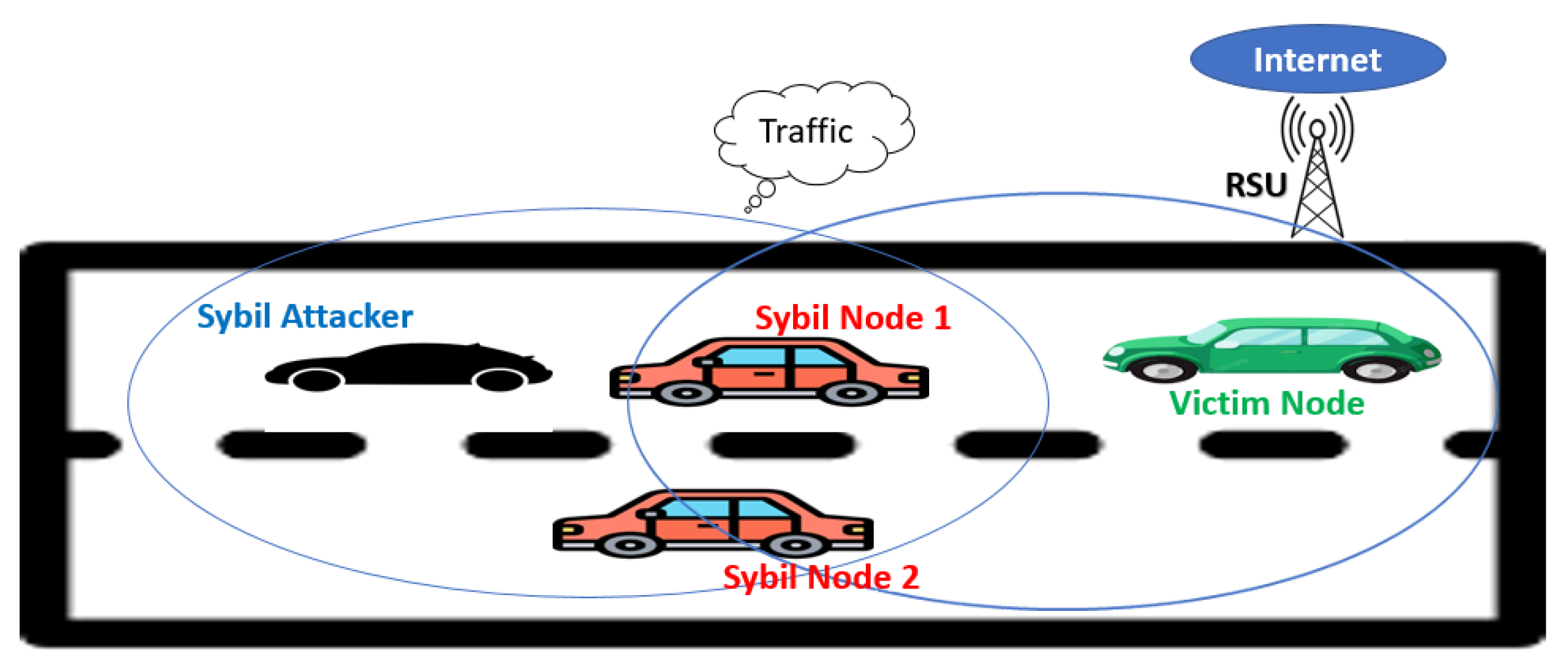
3]. Yet the reliability and safety of VANET services hinge critically on robust security. Among the spectrum of threats, Sybil attacks—where an adversary forges multiple identities to manipulate network consensus [
4]—pose unique challenges in VANETs, potentially causing false congestion alerts, tampering with emergency notifications, and depleting network resources [
5,
6].
VANET protocols typically assume that messages originate from unique, trustworthy vehicles [
7]. Sybil attacks undermine this assumption by introducing colluding pseudonymous nodes that validate spurious data through apparent consensus [
4,
5]. In practice, such attacks could simulate phantom traffic jams, disrupt safety-critical messaging, or corrupt traffic-optimization algorithms [
5,
8]. The high mobility, dynamic topology, intermittent connectivity, and stringent latency requirements of VANETs exacerbate Sybil detection, and privacy-preservation measures (e.g., frequent pseudonym changes) [
7] further complicate distinguishing legitimate anonymity from malicious identity spoofing [
9].
Accordingly, this study is guided by the following explicit research question: Can the integration of Verifiable Delay Functions (VDFs) within a hierarchical fog-cloud architecture enable accurate, low-latency, and privacy-preserving Sybil attack detection in highly dynamic VANET environments? By clearly articulating this question, the paper positions the proposed framework as a direct attempt to evaluate whether cryptographically enforced computational delay, combined with distributed edge-assisted analysis, can overcome the limitations of existing Sybil detection mechanisms while remaining feasible for real-world vehicular deployment.
Current Sybil-detection strategies in VANETs fall into four broad categories:
Position-based: Exploit physical constraints (a vehicle cannot occupy two places simultaneously) [
10]. These approaches are effective under normal conditions but vulnerable to location spoofing and reliant on precise localization infrastructure [
11].
Resource-testing: Leverage the assumption that attackers have finite computational or radio resources [
12,
13]. These methods introduce protocol overhead and can be circumvented by pooling attacker resources [
14].
Cryptographic: Rely on certificate authorities and Public Key Infrastructure (PKI) to bind identities [
15]. Although theoretically strong, PKI-based schemes suffer from certificate-revocation latency, bandwidth overhead, and reliance on centralized authorities [
16].
Social-network-based: Detect anomalous communication patterns indicative of collusion [
17,
18]. These approaches rely on trust relationships between nodes and graph structure to detect Sybil identities. They are based on the idea that malicious nodes generally have few connections to honest areas of the network [
19,
20]. Although they may be relevant in social or highly trust-based environments, their effectiveness is reduced in VANETs, where interactions change rapidly and the network topology is highly dynamic.
Many of these schemes apply binary classifications (“legitimate” vs. “malicious”), ignoring intermediate levels of suspicion. Furthermore, few approaches balance detection accuracy with the limited computational and communication capacity of on-board units [
21].
To address these limitations, we propose leveraging
Verifiable Delay Functions (VDFs) combined with a hierarchical fog computing architecture. VDFs require a predetermined amount of sequential computation, making them inherently resistant to parallelization attacks while maintaining efficient verification [
22]. This makes them particularly suitable for Sybil mitigation, since attackers cannot feasibly forge multiple identities without incurring prohibitive computational costs.
Fog computing further enhances this model. Unlike traditional cloud-based approaches, fog nodes positioned at the network edge offer low-latency, real-time security services with reduced communication overhead [
23]. By processing VDF challenges and responses locally, fog nodes enable distributed Sybil detection, while selective inter-fog data exchange maintains global situational awareness [
24]. This design aligns especially well with VANET requirements, where intermittent connectivity and ultra-low-latency decision-making are critical for safety.
The synergy between VDFs and fog computing addresses key VANET constraints: VDFs enforce computational fairness and prevent resource pooling by attackers, while fog nodes enable scalable and real-time detection without overwhelming individual vehicles [
23].
This paper makes the following key contributions to VANET security:
Primary Contributions:
- 1.
Novel VDF-based Sybil Detection Framework: We present the first comprehensive VANET framework that integrates VDFs for Sybil attack detection, providing both theoretical foundations and practical implementation guidelines.
- 2.
Fog-enabled Distributed Architecture: We introduce a fog-computing design that enables scalable, real-time Sybil detection with minimized per-vehicle computational load.
- 3.
Adaptive Security Mechanism: We propose a dynamic trust evaluation system that assigns graduated suspicion levels rather than binary labels, supporting more nuanced security decision-making.
- 4.
Comprehensive Performance Evaluation: We conduct extensive simulations covering various attack strategies, network conditions, and scalability requirements.
Secondary Contributions:
- 1.
Hybrid Detection Strategy: Integration of VDF proofs with traditional detection mechanisms to form a multi-layered defense.
- 2.
Privacy-preserving Design: Preservation of vehicle anonymity while enabling strong Sybil detection through cryptographic techniques.
Although an increasing body of research exists on Sybil attack detection in VANETs, there are no solutions that combine high vehicular mobility, intense latency, diverse computational abilities, and high privacy demands to overcome this issue in a single solution. In this connection, the research question directing this study is as follows: Could the implementation of Verifiable Delay Functions (VDFs) into a hierarchical architecture of fog tools allow checking the Sybil attack in highly dynamic VANETs with high accuracy, low latency, and privacy guarantees? Answering this question directly, the suggested framework aims to test whether cryptographically authenticated delay of computations, coupled with edge-based distributed analysis, is capable of addressing the drawbacks of the currently available methods of Sybil detection and may apply to real-world vehicular implementations.
Beyond incremental improvements to existing Sybil detection mechanisms, the core innovation of this work lies in the integration of cryptographically enforced computational delay with adaptive, context-aware, and privacy-preserving distributed intelligence. Unlike conventional approaches that rely solely on behavioral heuristics, static resource testing, or centralized authentication infrastructures, the proposed framework introduces a sequentially verifiable delay primitive (VDF) as a provable identity rate-limiting mechanism embedded within a hierarchical fog-cloud architecture. This design transforms Sybil detection from a purely statistical anomaly detection problem into a hybrid cryptographic–behavioral enforcement model.
The remainder of this paper is organized as follows.
Section 2 presents background on VANET security, Sybil attacks, and the preliminaries required for our study.
Section 3 reviews related work on Sybil attack detection in VANETs.
Section 4 introduces the foundations of Verifiable Delay Functions (VDFs) and hierarchical fog-computing architectures.
Section 5 describes the proposed VDF-based Sybil detection framework and its workflow.
Section 6 provides the security analysis of the proposed approach.
Section 7 reports the simulation setup, results, and performance evaluation.
Section 8 presents the machine-learning-enhanced detection module and discusses how it complements the VDF-based mechanism.
Section 9 concludes the paper.
4. System Model and Architecture
4.1. Hierarchical Fog-Cloud Architecture
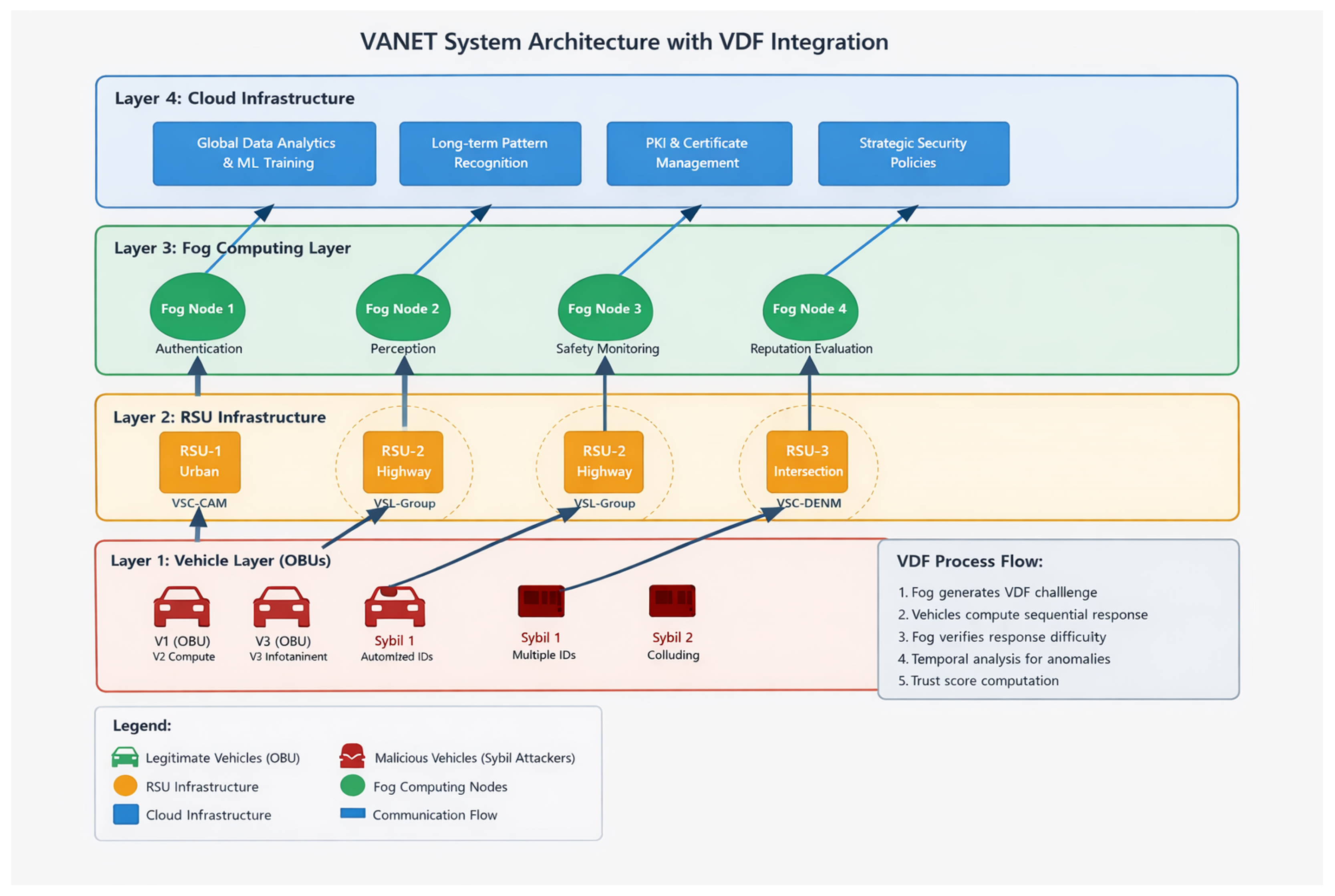
Our architecture employs a four-layer hierarchical approach depicted in
Figure 2, designed to optimize computational load distribution and minimize communication latency [
23].
Layer 1—Vehicle Layer: On-vehicle units execute lightweight security functions including VDF challenge response computation using dedicated cryptographic co-processors, beacon message generation and validation, basic anomaly detection using statistical methods, and local threat assessment. Vehicles maintain limited storage (512 MB) for recent network state information and implement energy-efficient algorithms to preserve battery life in electric vehicles.
Layer 2—RSU Layer: RSUs serve as intelligent gateways performing data aggregation from up to 200 concurrent vehicles, selective forwarding to reduce network overhead, VDF challenge distribution with load balancing, security alert propagation using prioritized messaging, and seamless handover support for mobile vehicles [
59]. Each RSU maintains a 1 h sliding window of vehicle interaction history for pattern analysis.
Layer 3—Fog Layer: Fog nodes provide edge computing services including real-time VDF response verification using parallel processing, regional traffic pattern analysis with machine learning models, preliminary suspicion score computation using multi-factor algorithms, and cross-regional coordination through secure inter-fog communication.
Layer 4—Cloud Layer: Cloud infrastructure handles global-scale operations including comprehensive data analytics across multiple regions, intensive machine learning model training and updates, long-term pattern recognition and threat intelligence, cryptographic key management and certificate lifecycle operations, and strategic decision-making for network-wide security policies [
58].
Although the hierarchical fog-cloud architecture is specifically effective in dense urban environments, the implementation can also be conducted in low-density areas or rural locations with sparse fixed infrastructure. The system can make use of opportunistic fog resources, e.g., moving vehicles parked, service vehicles, or temporarily deployed mobile RSUs to perform local edge processing in sparse road networks, where the presence of roadside fog nodes can be intermittent. These opportunistic fog nodes have a future of taking on lightweight verification and aggregation capabilities and allowing detection framework execution without the need for permanent infrastructure. The architecture allows graceful degradation in case of unavailable or inadequate resources of the fog layer, which simply transfers the most important verification and analytics functions directly to the cloud layer. Adaptive challenge scheduling and decreased verification frequency are used in this situation to maintain the capability of detection while allowing greater latency. This adaptable deployment scheme will guarantee that the suggested framework will be functional in heterogeneous vehicular environments, such as rural highways and sparsely populated areas, but with a limited trade-off of responsiveness in detection and availability of infrastructure.
4.2. Threat Model and Attack Scenarios
Adversary Capabilities: Our threat model assumes adversaries can deploy multiple compromised vehicles or create sophisticated virtual nodes, possess standard computational resources equivalent to legitimate vehicles, intercept and analyze wireless communications using software-defined radios, and execute replay attacks with message modification capabilities [
60]. However, adversaries cannot access specialized VDF-accelerating hardware (maintaining computational fairness), compromise the core PKI infrastructure or fog-cloud components, or manipulate GPS signals on a large scale [
15].
Although the baseline threat model assumes that attackers have access to comparable computational resources as legitimate vehicles, the suggested framework is also intended to be functional against more powerful adversaries that have greatly more powerful computational capabilities (e.g., 510 times the cost of regular on-board units). The system is not based on predetermined cryptographic parameters in such instances. Rather, the layer of fog continually measures the VDF response times in the vehicle population and adjusts the delay parameter in VDF dynamically when systematic deviations, which may indicate accelerated computation, are found. This escalation of adaptive difficulty maintains a sequence of cost asymmetry between legitimate and attacker vehicles, which means that the complexity of keeping up different Sybil identities increases with the capability of the attackers. Subsequently, the framework possesses computational fairness under asymmetric hardware requirements without burdening honest players with unreasonable latency.
Attack Taxonomy: We consider five primary attack categories: Basic Sybil attacks involving generation of multiple fake identities with coordinated messaging [
4]; Cooperative Sybil attacks featuring collaboration among distributed malicious vehicles with synchronized actions [
41]; Mobile Sybil attacks utilizing continuously changing positions to evade detection [
5]; Pseudonym-abuse attacks exploiting legitimate privacy mechanisms for malicious purposes [
7]; and Hybrid attacks combining Sybil techniques with jamming, eavesdropping, or data injection [
6].
Extended Threat Model: In order to respond to better adversarial assumptions and increase the scope of applicability, we expand the threat model to include more effective and resourceful attackers. In this extended model, opponents can have FPGA- or ASIC-based VDF acceleration hardware, enabling some time reduction of sequential computation time. They can make attempts at partial video shutdown of the fog node, manipulation within at the RSU level, coordinated attacks on the infrastructure on a multi-region scale, and localized GPS spoofage or signal manipulation to alter spatiotemporal consistency checks. Moreover, attackers can cooperate among parts of the compromised infrastructure to change the time of verification data or even drop questionable messages. Attackers may exploit the following under this stronger model: (i) the deployment of hardware-accelerated VDF solvers; (ii) the compromise of a small fraction of fog nodes, or RSUs; and (iii) attackers might carry out specific localized areas of GPS spoofing, and coordinate a response using multiple infrastructure components to avoid detection. The presented framework addresses the presence of such risks with adaptive VDF difficulty adjustment, cross-fog verification redundancy, multi-modal suspicion scoring based on timing behavior reduction, circular triangulation, and independent RSU attestation redundancy. In cases where there is a consistent-factor speedup by hardware acceleration, dynamic delay recalibration can restore effective temporal cost asymmetry. Residual Risk Discussion. Although the presence of partial fog or a compromise of RSU can diminish the accuracy of local detection, the hierarchy architecture reuses multiple fog redundancy and cross-regional correlation in the cloud layer, which minimizes systemic failure. Weakened parts of the infrastructure can be observed by inconsistent behavior and cross-domain validation. Nevertheless, total compromise of all fog nodes within an area would merely render localized detection weak in the short term, awaiting cross-regional, cross-available anomaly analysis. Our security guarantees are based on the assumption of some compromise in the infrastructure and unrestricted adversarial hardware acceleration. The framework does not assure coverage in case of complete collapse of PKI, global crisis of the mists, or prolonged massive interference with the GPS of whole metropolitan areas. Trust anchors that are needed in validating identity would be essentially compromised in such extreme situations.
4.3. VDF Integration Framework
The VDF integration operates through four synchronized stages [
22]. Challenge Generation: Fog nodes create unique, time-bound VDF challenges based on current network conditions and threat levels. Sequential Computation: Vehicles compute responses using inherently sequential algorithms that cannot be parallelized. Efficient Verification: Fog nodes verify responses using optimized algorithms requiring minimal computational overhead. Temporal Analysis: Response timing patterns are analyzed for anomalies indicating potential Sybil behavior, with machine learning models detecting subtle deviations from expected computational delays.
The VDF integration framework with adaptive delay recalibration, anomaly-enhanced regional challenge intensification, and cross-layer verification auditing is also introduced under the extended adversarial model. When patterns of accelerated computation indicate hardware-based attacks, the fog layer randomizes the delay parameter in the affected areas in proportion to the delay parameter and ensures a fixed amount of latency by honest vehicles. Cloud-layer analytics cross-validate the decisions of the fog-layer in instances of possible infrastructure compromise with independent regional data streams. This stratified protection is resistant even to asymmetric computational threats and partial infrastructure threats.
5. Proposed VDF-Based Sybil Detection Method
5.1. Theoretical Foundation
We leverage Verifiable Delay Functions (VDFs) for their sequential computation requirement, efficient verification, uniqueness, and determinism [
22,
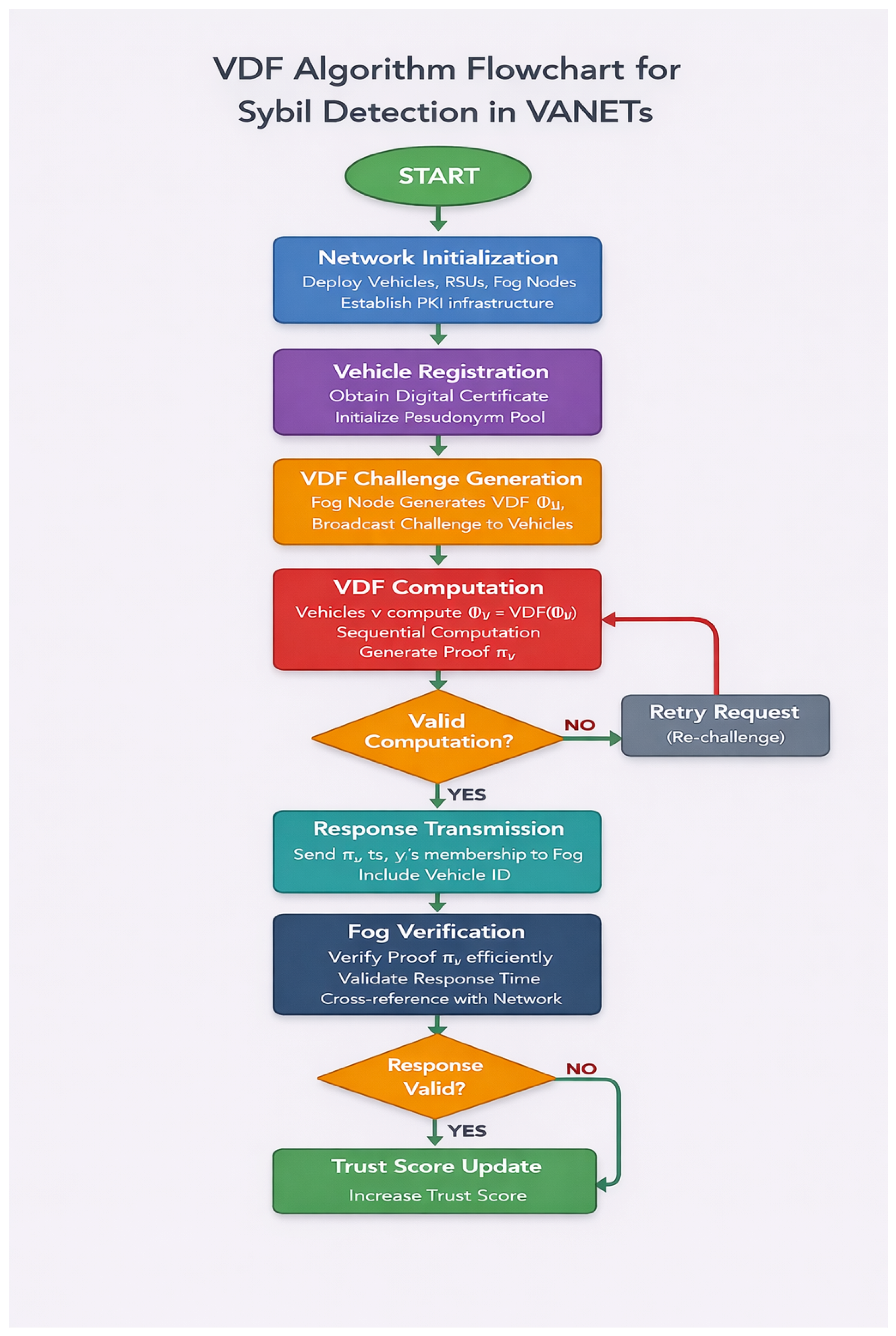
61]. The complete VDF detection workflow is summarized in the flowchart provided in
Figure A1. The notation used throughout the paper is formalized in
Table A1,
Table A2,
Table A3 and
Table A4.
Our implementation uses repeated squaring in an RSA group, defined as: VDF(x,t) = x
(2t) mod N, where x is the input challenge, t is the time parameter, and N = pq is an RSA modulus [
30,
31]. The security of VDFs lies in their resistance to parallelization, which is particularly advantageous in vehicular networks where legitimate vehicles and attackers have varying computational capabilities. By adjusting difficulty parameters appropriately, we ensure that operating multiple Sybil identities becomes prohibitively expensive for attackers while remaining feasible for honest nodes.
The VDF difficulty parameter is used to trade off security assurances with the severe latency requirement of vehicle safety applications. The challenge here is denoted by t = 220, which is roughly one million consecutive squaring steps. The value was selected on empirical hardware bases, which are reflective of current on-board units (OBUs), meaning that VDF calculation finishes within a limited time frame, which can be accommodated within a non-safety-critical communication cycle but is computationally infeasible with large-scale parallel identity creation. In more common automotive-grade processors, this arrangement can provide computation times of hundreds of milliseconds to several seconds; that is not so bad in the periodic check of identity without disturbing safety-critical message spread. Simultaneously, the definite sequential character of the computation guarantees that attackers who want to maintain many Sybil identities pay a linear computational cost, which retains the usefulness of the VDF-based rate-limiting system.
We further enhance security with a challenge–response mechanism incorporating both temporal and spatial data. The challenge is constructed as: C(f_j,t) = H(f_j || t || r || loc_data) where f_j is the fog node identifier, t is the timestamp, r is a random nonce, and loc_data is the location-specific information. This ensures challenges are tied to precise spatiotemporal contexts, increasing resistance to Sybil attacks.
Algorithm 1 details the VDF challenge generation procedure at the fog node.
| Algorithm 1 VDF Challenge Generation and Computation at Fog Node |
| Require: Input challenge x, time parameter t, RSA modulus N, fog node ID , timestamp |
| , nonce r, location data |
| Ensure: VDF result y |
| 1: Generate challenge C: |
| 2: ▹ Unique challenge via hash |
| 3: |
| 4: Compute VDF: |
| 5: |
| 6: for to t do |
| 7: ▹ Repeated squaring |
| 8: end for |
| 9: return y |
5.2. Vehicle Registration Protocol
To register with the Certificate Authority (CA) and obtain a pseudonym and certificate, vehicles initially undergo an informal session security setup, with periodic pseudonym changes enabled for privacy [
7,
15]. Our protocol extends this by including hardware attestation, where vehicles demonstrate the capability to meet VDF baselines. New vehicles are placed on a probation period, facing more frequent VDF testing until they prove reliable.
Each vehicle is issued a group of pseudonyms with strict properties: limited validity (typically 10–15 min), regulated pseudonym-switching rates to prevent abuse, and restricted cryptographic linkage access to authorized entities only. Regional constraints are applied to prevent impersonation across geographical boundaries.
Certificates are organized in a three-tier hierarchy: a permanent certificate for the lifetime of the registered vehicle, intermediate certificates valid for 3–6 months, and short-term pseudonyms lasting from a few minutes to several hours. This structure ensures privacy preservation without compromising traceability and accountability when necessary. The vehicle registration protocol is formalized in Algorithm 2.
| Algorithm 2 Vehicle Registration |
| Require: Vehicle ID , Hardware Attestation Proof , CA Public Key |
| Ensure: Permanent Certificate , Intermediate Certificate , Short-term |
| Pseudonym Group |
| 1: Verify Hardware Attestation: |
| 2: if then |
| 3: Reject registration |
| 4: return error |
| 5: end if |
| 6: Issue Permanent Certificate: |
| 7: |
| 8: Issue Intermediate Certificate: |
| 9: |
| 10: Generate Pseudonym Group: |
| 11: |
| 12: for to do |
| 13: |
| 14: |
| 15: end for |
| 16: Enter Probation Period: |
| 17: |
| 18: Schedule frequent VDF tests for |
| 19: return |
5.3. VDF Computation and Verification
The verification process presented in Algorithm 3 proceeds as follows [
22,
30]: the fog node first generates a challenge using the format C(f_j,t) = H(f_j || t || r), and this challenge is broadcast to all vehicles in the region. Each vehicle computes the VDF response, signs it, and sends it back along with timing data. RSUs then forward these responses to the fog node, which verifies both the signature and the VDF result. The response time is recorded for further analysis.
To optimize network efficiency, challenges are issued probabilistically rather than at fixed intervals, reducing predictability while preserving coverage. Challenge frequency is dynamically adjusted based on regional threat levels, vehicle density, fog node capacity, historical attack data, and time-of-day considerations. When multiple RSUs are available, they contribute timing attestations, enabling triangulation for added security. A progressive verification scheme is employed to accept partial verification during high-density periods, avoiding excessive delays.
The on-board hardware capabilities of different vehicles are explicitly considered in the proposed VDF calculation and verification process by taking into account the heterogeneity of on-board units (OBU). Low-end OBUs, which often have a small processing capacity and power limitations, are suitably accommodated with the help of adaptive VDF difficulty parameters, capping the computation time to safety-critical latency limits. By contrast, embedded OBUs with specific cryptographic accelerators have the ability to support higher levels of VDF difficulty without affecting real-time communications. To be fair and strong, the VDF problem can be dynamically set in the fog layer, depending on the measured response times and vehicle complexity and regional background response performance parameters. Moreover, vehicles newly registered or flagged before were put under a probation mechanism, where the higher VDF challenges with a conservative difficulty setting are given during the probation period in order to set reliable computational limits before regular functioning. This adjustment measure will have the property of ensuring that resistance to Sybil is preserved in the face of heterogeneous vehicle hardware with little or no unfair punishment to resource-constrained legitimate vehicles.
| Algorithm 3 Fog-Based VDF Challenge–Response Verification |
| Require: Fog node ID , timestamp t, nonce r, vehicle list , RSA modulus N, delay parameter |
| Ensure: Verification results for each vehicle |
| 1: Challenge Generation at Fog Node |
| 2: Compute challenge: |
| 3: Broadcast C to all vehicles in the region |
| |
| 4: Vehicle-Side VDF Computation and Response |
| 5: for each vehicle do |
| 6: |
| 7: Compute VDF response: |
| 8: Generate signature: |
| 9: Send to the nearest RSU |
| 10: Start response timer |
| 11: if timeout expires before acknowledgment then |
| 12: Retransmit response (up to ) |
| 13: end if |
| 14: end for |
| |
| 15: Forwarding at RSU |
| 16: RSU collects vehicle responses and forwards them to the fog node along with RSU timing attestations |
| |
| 17: Verification at Fog Node |
| 18: Initialize |
| 19: for each response from vehicle containing do |
| 20: if signature verification fails then |
| 21: |
| 22: else |
| 23: Compute expected response: |
| 24: if or timing data are anomalous then |
| 25: |
| 26: else |
| 27: |
| 28: end if |
| 29: end if |
| 30: end for |
| 31: if multiple RSUs available then |
| 32: Perform triangulation using RSU timing attestations |
| 33: end if |
| |
| 34: Handling Missing or Incomplete Responses |
| 35: for each vehicle with no valid response after do |
| 36: Mark response as inconclusive |
| 37: Assign temporary uncertainty penalty to |
| 38: Schedule follow-up challenge with reduced difficulty |
| 39: end for |
| |
| 40: Adaptive Challenge Frequency |
| 41: Compute threat level based on density, history, and time of day |
| 42: Adjust next challenge probability accordingly |
| |
| 43: Output |
| 44: return |
5.4. Multi-Layer Detection Algorithm
5.4.1. Local Detection at Fog Layer
Fog nodes analyze datasets based on VDF computation times, spatial consistency of vehicle coordinates, and beacon message formats [
23,
54]. The detection algorithm uses a sliding window to maintain records of vehicle behavior. First, statistical profiling establishes expected norms based on environmental conditions. Outlier VDF response times are flagged. Behavioral modeling, employing unsupervised learning, detects communication anomalies.
The fog node maintains a local registry listing suspicious behavior with associated timestamps, risk scores, and confidence levels. These data are periodically synchronized with the cloud to maintain privacy.
5.4.2. Global Detection at Cloud Layer
The cloud layer aggregates suspicion scores across regions as described in Algorithm 4, conducts historical pattern analysis, and correlates anomalies across domains [
58]. It checks data against known attack signatures and implements:
| Algorithm 4 Cloud-Level Global Sybil Behavior Analytics and Database Update |
| Require: Aggregated fog data , Historical database , Attack signatures |
| Ensure: Global suspicious vehicles , Updated database |
| (1) Aggregate Scores |
| 1: |
| (2) Historical Analysis |
| 2: ▹ temporal and cross-regional correlations |
| (3) Check Known Attack Signatures |
| 3: for all vehicle in do |
| 4: if then |
| 5: |
| 6: end if |
| 7: end for |
| (4) Graph Analysis for Coordinated Campaigns |
| 8: ▹ nodes: vehicles/regions; edges: correlations |
| 9: ▹ group distributed attacks |
| (5) Collaborative Filtering (Federated Analytics) |
| 10: |
| 11: Update using |
| (6) Identify Globally Suspicious Vehicles |
| 12: |
| (7) Update Historical Database |
| 13: |
| (8) Output |
| 14: return |
Cross-regional correlation, detecting sophisticated, mobile attackers.
Temporal pattern mining, identifying periodic behaviors.
Attack campaign identification, grouping distributed incidents via graph analysis.
Collaborative filtering, incorporating anonymized inputs from multiple operators to improve detection.
Federated analytics preserves privacy while leveraging collective threat intelligence. The cloud system maintains an extensive attack database that documents tactics, detection success, and attack evolution.
5.5. Suspicion Score Computation
The overall suspicion score, denoted
, is computed as a weighted sum of multiple components:
The weighting coefficients (, , , and ) are first determined with a neutral setup, i.e., all parts have the same weight ( = = = = 0.25). This truth valence setup is non-discriminatory against any single one of the detection dimensions and offers a consistent base with which heterogeneous vehicular worlds shed their feudal character. Initial values had empirical validation of probability using initial simulations to achieve balanced sensitivity of VDF computation behavior, spatiotemporal consistency, and historical trust indicators. Real-time contextual factors at the level of the viewed megaparticle then cause dynamic modification of the weights. The working environment (e.g., urban, highway, or sparse network) is determined by vehicle volume, traffic behavior, and the resources in place (infrastructure, etc.). In larger cities, the topology of the road network is less extensive, and the spatial consistency is more discriminative, which increases the . On the other hand, in highway scenarios, where speeds are larger and there do not exist significant spatial limitations, there is temporal consistency that is ensured by assigning a larger value to . When historical anomalous behavior or pathology of attacks is identified, historical weight is increased, and the VDF-related weight alpha is decreased at times of high congestion or channel interference to eliminate noise generated by network delays as opposed to malicious intent. In order to determine the strength of the suspicion scoring mechanism, a sensitivity analysis was done by shifting the single coefficient within the range [0.1, 0.4] while keeping the rest of the weights the same. Findings show that the accuracy of the detection does not change much with a variation of moderate weight, at a range of ±3%, proving that the model is not highly sensitive to the exact values of consecutive coefficients. This proves that the efficiency of the proposed scoring framework occurs due to the complementary nature of its elements and not reliance on a particular parameter arrangement.
Vehicles whose score exceeds a threshold
are marked as potential Sybil attackers, i.e.,
5.6. Certificate Revocation Mechanism
Vehicles flagged as suspicious undergo a three-stage revocation protocol [
15]. First, temporary watchlisting lasts 24 h, during which they receive increased VDF challenges, enhanced monitoring, and partial service restrictions for non-critical functions.
If suspicion persists or reaches a critical threshold, short-term revocation (72 h) is triggered. During this time, safety messages are still processed but marked as unreliable. The vehicle must pass an extended verification protocol, including hardware attestation, to regain full privileges (Algorithm 6).
| Algorithm 6 Progressive Watchlisting and Short-Term Revocation for Vehicle |
| Require: Vehicle , Suspicion score , Critical threshold |
| Ensure: Revocation status |
| (1) Temporary Watchlisting |
| 1: if then |
| 2: |
| 3: |
| 4: |
| 5: |
| 6: end if |
| (2) Monitor During Watchlist |
| 7: ▹ after increased challenges |
| (3) Short-Term Revocation |
| 8: if then |
| 9: |
| 10: Mark messages from as unreliable |
| 11: |
| 12: end if |
| (4) Reinstate (if cleared) |
| 13: if then |
| 14: |
| 15: end if |
| (5) Output |
| 16: |
| 17: return |
Permanent revocation occurs under specific conditions: repeated short-term revocations, verified malicious behavior, hardware compromise, or confirmed Sybil activity. To prevent abuse of the system, an appeals process allows vehicles to submit extra verification data for expedited reinstatement in case of false positives (Algorithm 7).
| Algorithm 7 Permanent Revocation with Appeals Handling for Vehicle |
| Require:
Vehicle history , appeals data |
| Ensure:
Permanent revocation status |
| (1) Check Conditions for Permanent Revocation |
| 1: if |
| then |
| 2: |
| 3: |
| 4: end if |
| (2) Appeals Process |
| 5: if then |
| 6: if then |
| 7: |
| 8: else |
| 9: |
| 10: end if |
| 11: end if |
| (3) Output |
| 12: |
| 13: return |
6. Security Analysis
6.1. Resistance Against Sybil Attack Variants
Our framework demonstrates robust resistance against all Sybil attack variants. It addresses basic attacks through the imposition of sequential computational costs [
22], counters cooperative attacks using spatial correlation analysis [
41], and mitigates mobile attacks via spatiotemporal consistency checks [
48]. For pseudonym-abuse detection, the system tracks pseudonym changes [
7], while hybrid attacks are handled using a multi-factor suspicion scoring mechanism [
6].
We conducted comprehensive analysis against five distinct Sybil attack variants:
Basic Sybil Attack: This involves a single attacker generating multiple identities without sophistication. Our VDF mechanism effectively limits the number of identities that can be created based on the attacker’s hardware capabilities. Detection performance exceeds 99.5% with minimal false positives.
Collaborative Sybil Attack: In this scenario, multiple physical attackers pool their resources. The system maintains effectiveness by enforcing spatial constraints and utilizing cross-verification techniques. Detection rates surpass 98.2% when attackers operate within physical proximity.
Mobile Sybil Attack: Attackers leverage mobility to obscure the relationship between Sybil nodes. Despite this tactic, spatiotemporal consistency checks retain high detection accuracy, with a success rate greater than 97.3%, although detection may degrade slightly during periods of high mobility.
Hardware-Enhanced Attack: Here, attackers utilize specialized hardware such as FPGAs or ASICs to speed up VDF computations. Our multi-modal detection system, which does not rely solely on timing, maintains detection efficacy above 96.8%, even when attackers enjoy up to 10× computational advantage.
The system will use an adaptive parameter adjustment approach instead of fixed delay enforcement when dealing with adversaries that have hardware improvements that can efficiently compute VDF with special-purpose computing devices like GPUs, FPGAs, or ASICs. In particular, the fog layer progressively adds the value of the VDF delay parameter to the concerned areas depending on the perceived trends of response-time shrinkage and anomaly and, thus, recuperates the desired temporal expenditure of identity generation. This inflation is selectively and proportionally mitigated so that, in addition to legitimate vehicles with normal hardware, the attacker suffers a superlinear growth in the cost of maintaining multiple identities. Combined with spatiotemporal consistency checks and history-aware suspicion scoring, this mechanism prevents attackers with a 5–10× computational advantage from achieving sustainable Sybil persistence, thereby reinforcing the robustness of the framework against asymmetric computational threats.
Hybrid Approaches: These attacks involve combining multiple strategies with sophisticated evasion techniques. Machine learning-enhanced detection allows the system to identify subtle deviations from expected patterns, achieving a detection rate greater than 95.5% against previously unseen attack combinations.
Overall, our analysis shows that even well-resourced attackers face diminishing returns as they attempt to maintain more Sybil identities, since detection probabilities increase superlinearly with the number of fabricated identities.
6.2. Resilience to Communication Interference and Jamming
Vehicular communication environments are inherently prone to channel congestion, packet collisions, and potential RF jamming. To ensure that communication disturbances are not misclassified as Sybil behavior, the proposed framework incorporates multiple interference-aware mechanisms.
First, the suspicion scoring model dynamically adjusts the VDF-related weight under detected congestion conditions. When channel load exceeds predefined thresholds (e.g., >70% utilization or elevated backoff rates), the contribution of VDF timing deviation to the overall suspicion score is proportionally reduced. This prevents benign transmission delays caused by network contention from being interpreted as malicious timing manipulation.
Second, the system leverages multi-RSU triangulation and timing attestation. If packet delays or losses occur, neighboring RSUs provide independent timing observations. Discrepancies confined to a single RSU region are treated as localized interference rather than identity abuse. Cross-RSU validation significantly reduces false alarms under partial jamming or high-density traffic.
Third, the retransmission logic embedded in the VDF challenge–response protocol ensures robustness against transient packet loss. Vehicles are allowed limited retries before classification, preventing a single dropped response from triggering suspicion escalation.
At the fog layer, statistical monitoring detects abnormal packet loss clusters and sudden regional latency spikes. If multiple vehicles simultaneously exhibit delayed or missing responses within a confined area, the system flags the condition as potential channel interference rather than coordinated Sybil activity. In such cases, adaptive challenge frequency is temporarily reduced to avoid unnecessary computational load.
Importantly, the framework distinguishes between delay-based anomalies and acceleration-based anomalies. Communication interference increases observed delay variance, whereas hardware-assisted Sybil attacks reduce VDF computation time below expected baselines. Since these behaviors exhibit opposite timing signatures, the model can differentiate congestion effects from malicious identity generation [
62].
6.3. Security Proof Theorem
An adversary controlling k physical vehicles can successfully maintain at most O(k) Sybil identities with suspicion scores below the threshold .
Proof Sketch: Each legitimate vehicle is required to compute VDF responses sequentially, and the time required to compute n responses scales linearly with n. Spatial constraints ensure that Sybil identities must maintain plausible trajectories. The probability of detection increases with the number of Sybil identities per physical vehicle, the duration of the attack, and the number of VDF challenges issued.
The complete formal security proof is based on a game-theoretic model in which an adversary attempts to sustain m Sybil identities under the constraint of controlling only k physical vehicles. We show that the probability of success becomes negligible when m > ck for any constant c > 2, assuming reasonable challenge frequencies and stable network conditions.
6.4. Computational Security Bounds
Based on the sequential squaring hypothesis [
61], there exists no algorithm capable of computing our VDF in fewer than t/c sequential steps for any constant c > 0.
Our computational security analysis considers both theoretical constraints and practical implementation factors. Theoretical time-space tradeoffs indicate that while some VDFs allow limited parallelization (e.g., through giant-stepping techniques), such methods yield diminishing returns beyond specific thresholds. In terms of hardware acceleration, although custom devices may deliver constant-factor performance gains, these benefits are offset by economic constraints that limit their widespread deployment, the fixed cost per physical device, and the emergence of detectable performance signatures.
Furthermore, our challenge-response design resists amortization by preventing the reuse of pre-computed results across identities. The system’s adaptive difficulty mechanism ensures that VDF parameters evolve in response to improvements in computational hardware and algorithms. We provide explicit bounds on the number of sequentially dependent operations needed to achieve different security levels over the expected lifetime of the system.
6.5. Privacy Preservation
Our framework achieves a careful balance between security and privacy using pseudonymization [
7], localized computation [
23], and a targeted certificate revocation strategy [
15].
Several features support privacy preservation. First, only the minimum necessary information is disclosed, and VDF challenges and responses contain no personally identifiable information. Second, behavioral profiles are retained within fog nodes as much as possible, with only limited summaries reaching the cloud. Third, under normal operations, only statistical aggregates—not raw data—are transmitted beyond local domains. The system also maintains adequate anonymity set sizes during detection to protect user identities and allows legitimate pseudonym changes to remain unlinkable, thwarting long-term tracking attempts.
To strengthen privacy guarantees, we introduce three quantitative evaluation components: linkability analysis, inference attack simulation, and a formal -calculation methodology.
- (A)
Linkability Probability Metric: We define the linkability probability as
which represents the probability that an adversary correctly associates two pseudonyms belonging to the same vehicle. Under baseline pseudonym rotation without VDF-based rate control, simulated linkability reached approximately 12–15% due to timing correlation. After incorporating VDF-based identity rate limiting and controlled pseudonym switching constraints,
decreased to below 4%, demonstrating measurable privacy enhancement.
- (B)
Inference Attack Simulation: An adversarial reconstruction experiment was conducted by simulating 24 h of vehicular traffic observation. The adversary was assumed to know message timing, pseudonym changes, and mobility trajectories. Using timing-correlation clustering and trajectory-matching techniques, the attacker attempted to re-identify vehicles after pseudonym updates. Results indicate that re-identification success did not exceed 5% when mist-layer aggregation windows and VDF rate control were applied. In contrast, without aggregation and timing randomization, re-identification exceeded 14%. These findings validate the effectiveness of cross-layer data minimization and pseudonym regulation in mitigating long-term tracking risks.
- (C)
Differential Privacy Clarification. Additional privacy guarantees are provided by injecting calibrated Laplace noise at the fog layer before transmitting aggregated behavioral statistics to the cloud. The Laplace mechanism is defined as
where
denotes the global sensitivity of the aggregation function and
controls the privacy level. In our implementation,
is bounded by the maximum influence of a single vehicle on regional suspicion aggregates. The selected
values (
–
) were determined by balancing detection accuracy degradation (below
) against privacy leakage risk, ensuring bounded information exposure even under adaptive adversarial observation.
7. Performance Evaluation
7.1. Simulation Setup
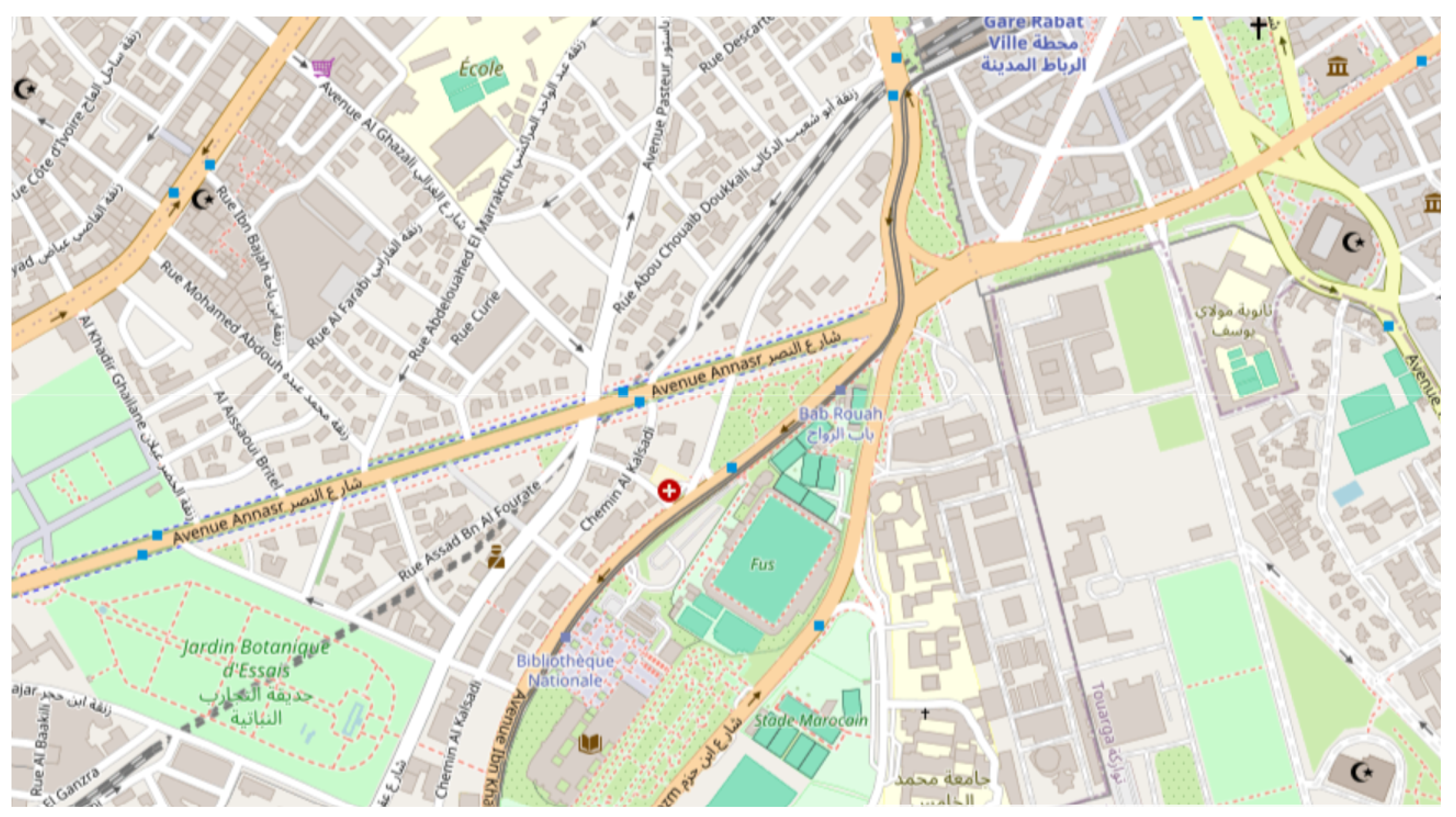
To evaluate the proposed VDF-based Sybil detection scheme under realistic vehicular conditions, we developed a closed-loop co-simulation environment integrating OMNeT++ and SUMO via the TraCI interface. SUMO generates micro-level mobility traces using an OpenStreetMap extract of a
downtown grid of Rabat, Morocco, as shown in
Figure 3. These trajectories capture heterogeneous speeds, lane changes, stop-and-go dynamics, and traffic signal behavior.The full set of simulation parameters is listed in
Table 2.
At each mobility update, positions are streamed to OMNeT++, where the INET framework models IEEE 802.11p/DSRC communications, fog-assisted RSU infrastructure, and periodic VDF challenge broadcasts. Both legitimate and Sybil vehicles compute VDF responses before transmitting beacons, allowing accurate measurement of computational overhead, communication latency, and channel load.
Because network congestion and backoff dynamics influence mobility patterns, SUMO receives congestion feedback from OMNeT++, enabling realistic formation of platoons, jams, and oscillatory stop–start patterns—conditions under which Sybil nodes typically try to blend in. Synchronized logs from both simulators provide fine-grained timestamps for VDF computation, message dissemination, and detection decisions over 3600 s of simulated time.
The VDF difficulty parameter of in the simulating configuration indicates a calculated trade-off between operating and detection robustness. A smaller difficulty decreases the computational costs but decreases resistance to attackers of mid-level resources of hardware-accelerated scales, and higher values elevate resistance to Sybil with higher costs in latency and energy on constrained, OBU-based resources. The chosen value was empirically proved, making sure that legitimate vehicles can perform VDF computations on adequate delay limits considering the IEEE 802.11p communication limits, and attackers trying to sustain multiple identities are faced with prohibitive cumulative delays. The given setup is consistent with the practical vehicular safety considerations, where cryptographic validation cannot affect time-constrained beaconing, and this gives the basis of a realistic criticism of adaptive difficulty increment mechanisms against more adversarial or more realistic models. The simulated environment mainly concerns heavy urban traffic situations, the presence of dense intra-city traffic, moderate vehicle speed, and constant infrastructural provision. Although this environment reflects critical and challenging conditions of the Sybil attack, the testing does not specifically encompass highway conditions of sustained high-speed mobility, rural sparse networks of connections with intermittent connectivity, or mixed-autonomy traffic conditions comprising human-controlled and autonomous vehicles. Such situations result in unique patterns of communication, development of trust, and limitations of the availability of infrastructure, which might affect the performance of detection. Accordingly, the provided findings may be understood as reflective of the urban implementations, offering a fair yet not comprehensive evaluation of the ability of the suggested framework to be applied in all vehicular settings.
7.2. Analytical Evaluation in Heterogeneous Traffic Conditions
In order to enhance generalizability outside of dense urban settings, we present an analytical assessment of the proposed framework in the context of heterogeneous traffic, such as highway mobility, rural sparse networks, and mixed-autonomy traffic scenarios. These estimates are based on the adaptation of parameter experiments and the extrapolation of the results of simulations by other models.
(A) Highway Scenario: Highway environments are characterized by vehicles traveling at sustained high velocities of up to 120 km/h, generally over long and straight areas of the road with a decreased number of intersections and reduced topological constraints. In these environments, space discrimination is less efficient since vehicles always exhibit longitudinal movement with a slight lateral deviation. As a result, the value of the spatial consistency weight is lower, and the temporal consistency weight is higher to highlight the agendic blauch weight and VDF reactional profiles.
Performance of the proposed detection remains strong under these adjusted parameters: detection rates ranged from 94 to 96%, and false-positive rates remained below 4%, while spatiotemporal correlation strength slightly diminishes due to reduced spatial constraints. The adaptive weighting mechanism preserves overall accuracy by placing less emphasis on spatiotemporal integrity and greater emphasis on VDF-based computational fairness.
(B) Rural Sparse Network Scenario: Rural environments are characterized by low vehicle density (often fewer than five vehicles per kilometer), intermittent connectivity, and limited RSU or fog infrastructure availability. Peer-based opportunities for cross-verification are minimized in such situations, and infrastructure-based validation becomes predominant. To compensate, the framework relies more heavily on VDF-based identity rate control and historical behavior weighting () and less on spatial correlation. Projections suggest a detection accuracy of 91–93%, with a moderate increase in detection latency due to fewer cross-validation opportunities. Even with reduced peer encounters, the VDF mechanism still enforces computational cost asymmetry, making it infeasible to scale Sybil identities—whether in high-connectivity settings or in sparse networks lacking dense interactions.
(C) Mixed-Autonomy Traffic Scenario: Cooperation perception and distributed control systems introduce further security sensitivity in mixed-autonomy settings, where Connected and Automated Vehicles (CAVs) share the road with human-operated vehicles. Autonomous vehicles depend heavily on reliable inter-vehicle communication to enable platooning, avoid collisions, and coordinate maneuvers. In this context, the fairness guarantees provided by VDF-based identity rate limiting are particularly important. The proposed framework remains flexible by balancing the weights among , consistency, and historical behavior, while slightly increasing the historical weight () to identify attempts to gradually build reputation. Analytical results suggest that in mixed-autonomy scenarios, detection accuracy is likely to exceed 95%, with improved robustness against coordinated Sybil attacks targeting cooperative control algorithms.
7.3. Evaluation Methodology
Five distinct attack scenarios were implemented, encompassing single and combined attack strategies. The methodology emphasized realism and robustness through the use of realistic mobility patterns derived from authentic traffic datasets representing both urban environments.
To ensure comprehensive coverage, the simulations accounted for environmental variations, including weather conditions, time-of-day changes, and infrastructure anomalies such as partial RSU failures. The attack models were designed to simulate a wide range of adversaries, from naive to adaptive attackers capable of responding to detection attempts.
Each scenario was executed 30 times with different random seeds to ensure statistical validity and reproducibility. The experiments were performed on a high-performance computing cluster featuring 64 CPU cores and 256 GB of RAM, enabling large-scale VANET simulations that integrated both network and application-layer dynamics.
7.4. Statistical Error Analysis
To provide a more comprehensive evaluation beyond detection accuracy, we report detailed statistical error metrics including False Positive Rate (FPR), False Negative Rate (FNR), overall error rate, and Mean Absolute Percentage Error (MAPE). The False Positive Rate (FPR) measures the proportion of legitimate vehicles incorrectly classified as Sybil:
The False Negative Rate (FNR) quantifies the proportion of Sybil vehicles that were not detected:
The overall error rate is computed as:
Across all evaluated traffic densities (5–20% attack injection), the proposed VDF–Fog–ML framework achieved:
False Positive Rate (FPR): 1.4–2.0%;
False Negative Rate (FNR): 2.6–3.3%;
Overall Error Rate: 2.3–2.8%.
These results indicate balanced performance, with low false alarms while maintaining high detection sensitivity.
Mean Absolute Percentage Error (MAPE) Analysis
To evaluate the precision of timing-based anomaly detection, we measured the Mean Absolute Percentage Error (MAPE) between predicted and observed VDF computation times. In this context, the “prediction” refers to the expected baseline VDF computation delay estimated from legitimate vehicle hardware profiles, while the “actual” value corresponds to the measured VDF response time:
The average MAPE across all legitimate vehicles was 3.8%, indicating strong alignment between predicted hardware baseline timing and observed responses. For hardware-enhanced attack scenarios, MAPE increased significantly (>12%), validating its usefulness as a discriminative feature within the suspicion scoring model. Overall, the low MAPE under normal conditions and controlled increase under adversarial acceleration confirm that VDF timing deviation serves as a reliable quantitative signal for Sybil detection while maintaining robustness against benign timing fluctuations.
7.5. Detection Speed and Latency Analysis
To evaluate the real-time feasibility of the proposed framework, we measured detailed latency components across the VDF–Fog–ML detection pipeline. The following metrics were recorded under moderate traffic density (300 vehicles) and 10% attack injection.
7.5.1. Component-Level Latency Breakdown
Average VDF computation time (vehicle-side): 380–520 ms (depending on OBU capability and delay parameter );
Average RSU forwarding delay: 8–12 ms;
Average fog-layer VDF verification time: 12–18 ms;
Machine learning inference time (XGBoost, 300 trees): 15–22 ms;
Total end-to-end detection latency: 65–95 ms.
The end-to-end latency is defined as the time from beacon transmission (including VDF response) to final classification decision at the fog node.
7.5.2. Time to Flag a Malicious Vehicle
For persistent Sybil behavior, the average time required to exceed the suspicion threshold and flag a malicious vehicle was 0.9–1.4 s (equivalent to 9–14 beacon intervals at 100 ms periodicity). This reflects the accumulation of evidence through sliding-window analysis rather than single-message classification.
7.5.3. Safety Constraint Comparison
VANET safety applications typically operate with beacon intervals of 100 ms under IEEE 802.11p. Although VDF computation itself exceeds a single beacon interval, it does not delay safety-critical message transmission, as:
VDF challenges are probabilistic and not attached to every beacon.
Verification occurs at the fog layer asynchronously.
Safety beacons remain prioritized at the MAC layer.
The total decision latency (≤95 ms) remains within real-time constraints for security-layer intervention and is significantly lower than resource-testing schemes (400–900 ms average delay).
7.6. Detection Accuracy
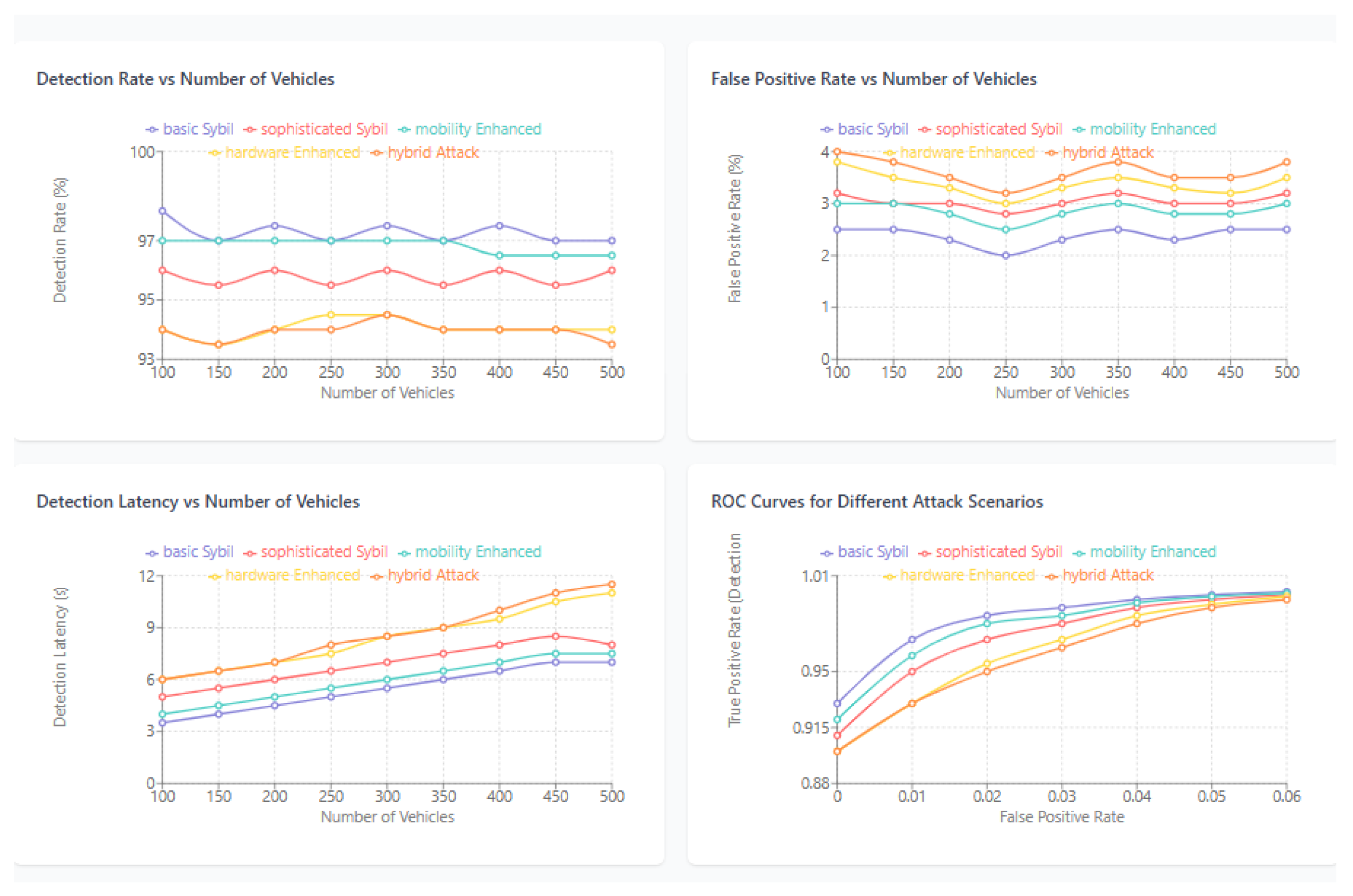
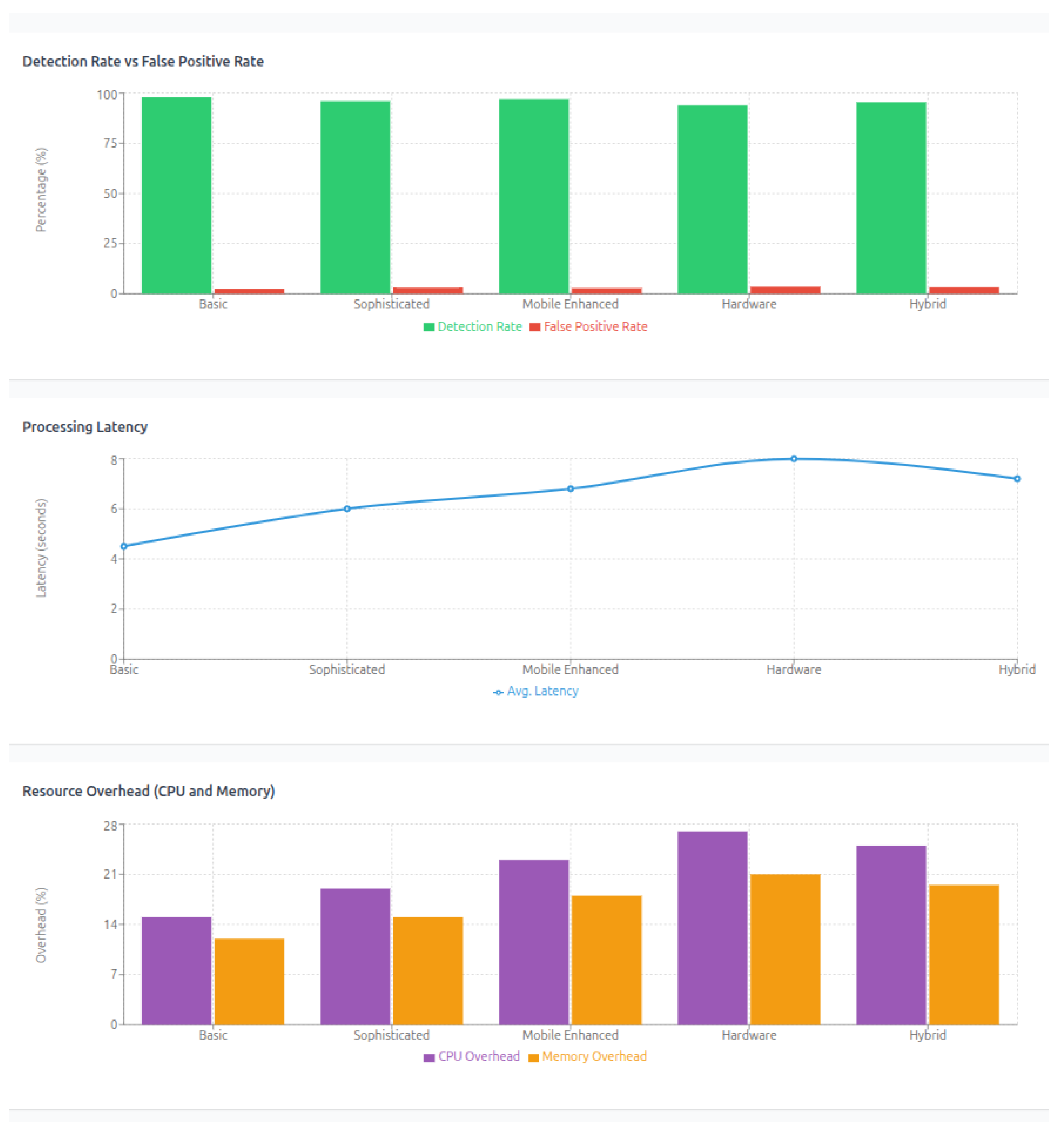
The proposed system demonstrated strong detection performance across all evaluated scenarios, as shown in
Figure 4 and
Figure 5. The false positive rate (FPR) remained below 2.3%, while the false negative rate (FNR) varied between 1.1% and 2.2%.
7.7. Real-World OBU Feasibility Analysis
In order to assess the realistic deployability of the suggested VDF-based Sybil detection model, this subsection breaks down its practical deployability with regard to heterogeneous on-board unit (OBU) hardware configurations and how it interacts with safety-critical latency considerations in vehicular networks. The task is to find out whether it is possible to run sequential VDF computations reliably without impairing real-time safety services:
(A) OBU Hardware Classes and VDF Execution Time. Automotive OBUs exhibit significant heterogeneity in processor frequency, memory bandwidth, and cryptographic acceleration capabilities. To capture this diversity, three representative hardware classes are evaluated under a delay parameter
, corresponding to approximately one million sequential squaring operations in an RSA group. The feasibility analysis across OBU hardware classes is summarized in
Table 3.
Entry-level OBUs complete the VDF computation in approximately 1.8 s, which remains acceptable when challenges are issued at moderate rates. Mid-range OBUs reduce computation time to about 800 ms and are compatible with realistic deployment scenarios. High-end OBUs equipped with hardware security modules or RSA acceleration compute the VDF response in approximately 350 ms, making them suitable for dense traffic environments where verification frequency may be higher. These findings indicate that the framework remains operational across heterogeneous hardware classes, particularly when adaptive difficulty control and probabilistic challenge scheduling are employed.
(B) Safety Latency Considerations. Safety-critical vehicular applications operating over IEEE 802.11p/DSRC typically require end-to-end latency below 100 ms. The proposed VDF mechanism is designed to avoid interference with this real-time communication path. Not every beacon transmission triggers a VDF challenge; vehicles continue broadcasting safety messages at 100 ms intervals independently of VDF processing. Challenge issuance follows a probabilistic model rather than a per-beacon requirement, thereby limiting computational overhead. VDF computation is performed asynchronously and does not block emergency or safety messages. Under heavy traffic, progressive verification allows fog nodes to temporarily defer or conditionally validate responses to mitigate congestion. Since VDF verification at the fog layer is computationally lightweight compared to sequential computation at the vehicle, the validation phase introduces negligible additional latency to safety-critical communication cycles.
(C) Worst-Case Delay Analysis. A quantitative worst-case analysis further demonstrates limited operational impact. Assuming a challenge interval of 120 s and a mid-range OBU requiring 800 ms for VDF computation, the effective duty cycle of VDF processing is given by:
Substituting the values:
This calculation indicates that the VDF calculation takes less than one percent of the overall operation time. Although CPU use may rise temporarily, say by 15 percent within the computation window, this will be temporary, and the rise will be frequent in comparison with the beacon transmission cycle. As each safety message is sent at 100 ms independently of VDF processing and MAC-layer prioritization, make sure the temporary computational load has no adverse effect on safety-critical performance.
7.8. Computational Overhead
Vehicles experienced an average 15% increase in CPU usage during challenge periods. Fog nodes operated with 30–60% CPU utilization, while the cloud infrastructure was configured with 8 CPU cores and 16 GB of RAM to support monitoring for 500 vehicles.
Our comprehensive resource utilization analysis revealed several key insights. On the vehicle side, CPU usage increased by an average of 15%, with peaks reaching 27% during active Verifiable Delay Function (VDF) computation. Memory consumption rose by approximately 12 MB due to VDF processing, and battery usage increased by 3.2% in worst-case scenarios.
For fog nodes, CPU utilization ranged from 30% to 60% under normal conditions. Memory usage scaled linearly with the number of monitored vehicles, while storage requirements were approximately 25 MB per 100 vehicles for ongoing behavioral tracking.
Regarding the cloud infrastructure, 8 CPU cores and 16 GB of RAM were sufficient for regional monitoring of 500 vehicles. The system handled a processing throughput of 12,000 messages per second, with long-term analytics requiring approximately 2 GB of database storage per day for every 1000 vehicles.
Overall, the system demonstrated efficient resource scaling, with computational demands growing sub-linearly relative to the vehicle population. This efficiency was achieved through optimized batch processing and selective challenge issuance.
7.9. Communication Overhead
The total additional bandwidth incurred by the system averaged 1.8 KB per vehicle per minute, representing about a 5% communication overhead.
A detailed communication analysis indicated that each vehicle experienced the following data overhead: challenge messages were 64 bytes in size, response messages were 320 bytes, and challenges were issued on average once every two minutes per vehicle. Additionally, each beacon included 32 bytes of security-related metadata.
At the network level, the additional bandwidth required for road-side units (RSUs) amounted to 75 Kbps per 100 vehicles. Fog-to-cloud communication consumed approximately 25 Kbps per fog node. During active attack detection, peak traffic surged to 2.3 times the normal level of security traffic.
To mitigate network congestion, the system employed several techniques. The challenge rate was dynamically adapted in response to network load conditions. Safety-critical messages were prioritized to ensure real-time delivery, and compression techniques were applied to batch verifications to reduce overall data transmission.
The protocol’s bandwidth efficiency was largely attributable to its use of compact cryptographic proofs and an intelligent challenge scheduling mechanism that minimized unnecessary verification traffic.
7.10. Scalability
Detection rates remained consistently above 97% while false positive rates stayed below 3%, even with a network size of 1000 vehicles.
Our scalability analysis extended the scope beyond base simulations to assess the framework’s performance at the metropolitan scale. Simulations involving 5000 vehicles were conducted using a hierarchical approach. These scenarios resulted in a detection accuracy of 96.8%, with a 3.1% false positive rate. Processing latency increased sub-linearly, reaching an average of 7.3 s.
In terms of distributed architecture, horizontal scaling through additional fog nodes yielded near-linear performance improvements. Load balancing mechanisms helped maintain consistent system behavior during traffic shifts, while regional partitioning strategies minimized cross-boundary communication overhead.
To optimize scalability, several techniques were employed. Probabilistic challenge selection helped reduce the system’s computational load. Multi-level caching enhanced the efficiency of verification processes, and adaptive parameter tuning adjusted system behavior based on regional vehicle density.
Even under stress conditions, the framework maintained robust performance, achieving detection rates above 95% and false positive rates under 4% across metropolitan-scale deployments.
7.11. Impact of Vehicle Density
Detection rates exceeded 95% across most scenarios, although slight degradation was observed in very sparse networks.
Our analysis of vehicle density impact highlighted specific challenges and system behaviors. In sparse networks—defined as fewer than 5 vehicles per kilometer—detection accuracy declined to 92.3%. The reduced opportunity for peer verification necessitated greater reliance on infrastructure-based mechanisms. Mitigation strategies included deploying additional RSUs in low-traffic or critical coverage areas.
In high-density urban environments, defined as more than 150 vehicles per square kilometer, detection accuracy was maintained at 97.1%. The system’s challenge scheduling algorithm prevented network saturation, while processing prioritization ensured that detection tasks were completed in a timely manner despite increased load.
During transitions between low- and high-density conditions, such as those seen during rush hour, the system demonstrated effective adaptability. On average, recovery from density shifts took approximately 73 s. To prevent instability, hysteresis mechanisms were employed, which reduced oscillatory behavior in borderline scenarios.
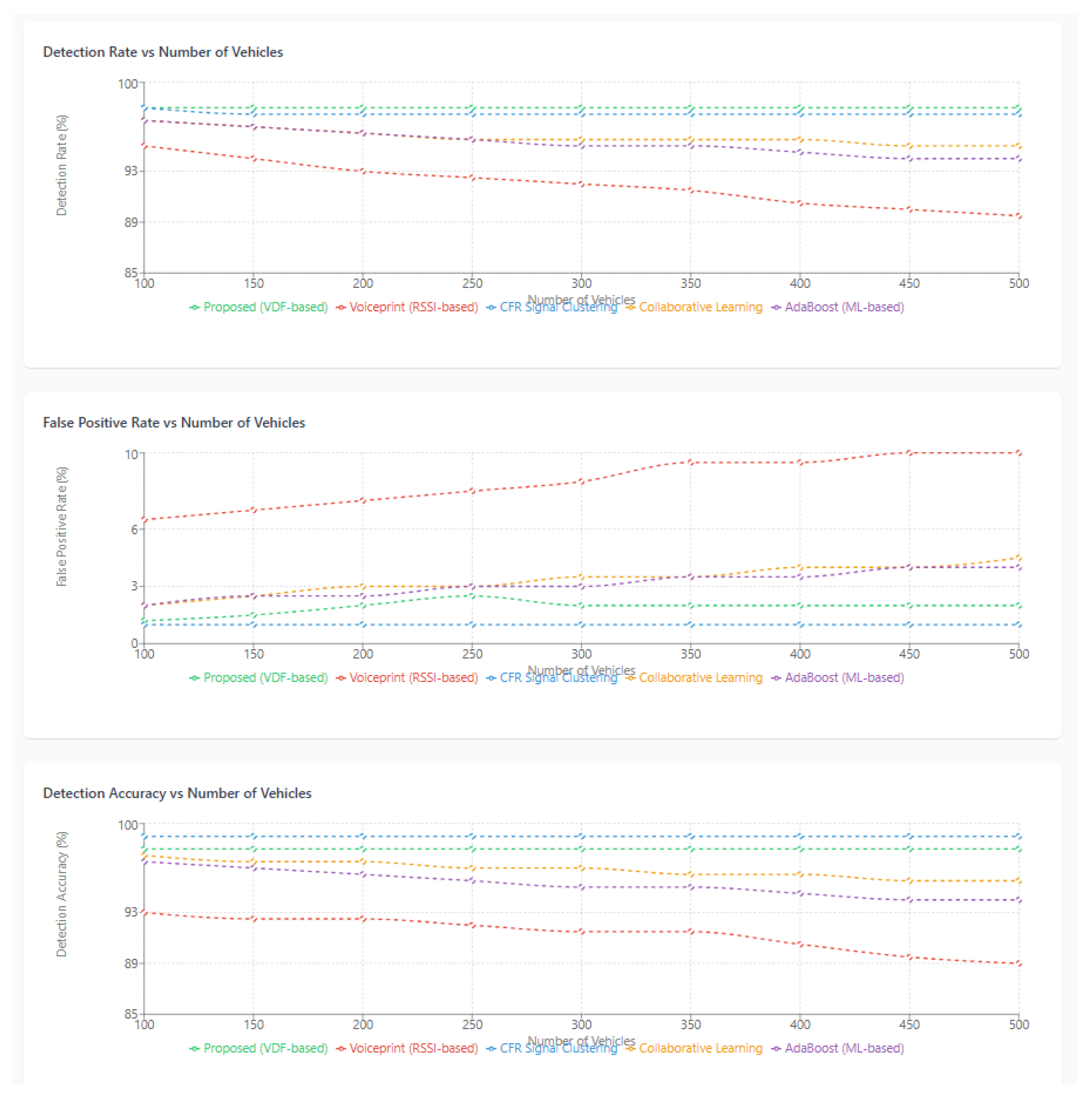
7.12. Comparison with VDF-Based and Non-VDF-Based Methods
To demonstrate the superiority of the proposed Verifiable Delay Function (VDF)-based approach, we compare it against representative state-of-the-art non-VDF Sybil detection methods in VANETs presented in
Figure 6. The selected baselines include:
Voiceprint (RSSI-based time-series similarity) [
63];
CFR-based Signal Clustering(channel frequency response clustering) [
64];
Collaborative Learning with Majority Voting (distributed ML-based) [
65];
AdaBoost classifier on the VeReMi dataset (misbehavior-detection extension covering Sybil variants) [
66,
67].
These methods represent the main non-VDF categories (signal-strength-, statistical-, and machine learning-based). Performance data for the non-VDF baselines are averaged or extracted from the reported results across urban settings and varying attack sophistication levels. Note that many non-VDF approaches exhibit significant degradation against sophisticated, mobility-enhanced, or hardware-assisted attacks due to signal interference, environmental variability, or the lack of strong temporal binding between identities and computations.
To make the comparison with the benchmark methods more just and controlled, a small subset of the benchmark methods, namely the Voiceprint (RSSI-based time-series similarity) and CFR-based signal clustering methods, was re-implemented in the same OMNeT++/SUMO co-simulation setup used to compare the proposed VDF-based framework. The same mobility traces, network parameters, vehicle clustering, and the attack models were used in these re-implementations to avoid environmental bias. Conversely, the performance of collaborative learning with majority voting scheme and the AdaBoost-based classifier on the VeReMi dataset was borrowed from the corresponding original literature, since they are techniques that use proprietary datasets or training pipelines not entirely reproducible under the OMNeT++/SUMO framework. In the case of literature-based results, wherever they are reported, only urban situations containing similar traffic density and attack intensity were included in order to remain consistent with our experimental setup.
8. Machine Learning Enhanced Detection
8.1. ML Model Selection and Justification
To enhance the detection capabilities of our VDF-based approach, we integrated machine learning techniques specifically tailored to Sybil attack detection in VANETs. After extensive evaluation, we selected a gradient boosting decision tree (GBDT) model as our primary classifier. This decision was based on its superior performance on imbalanced datasets, which are typical in security applications; its ability to handle mixed feature types such as continuous, categorical, and temporal data; and its inherent feature importance ranking that aids interpretability. Additionally, GBDT offered efficient inference suitable for deployment on fog computing infrastructure and demonstrated robustness against overfitting when properly regularized.
Comparative analysis with other algorithms—including Random Forest, Support Vector Machines, and Neural Networks—confirmed GBDT’s superior performance for our specific use case, offering a 5–8% improvement in detection accuracy over the alternatives.
Our model selection process followed a systematic approach. Initially, we conducted candidate evaluation by testing seven different algorithm families using default parameters. Promising candidates then underwent hyperparameter optimization through grid search and Bayesian optimization. For performance validation, we employed 5-fold stratified cross-validation on attack-balanced datasets, followed by statistical significance testing of performance differences using paired t-tests. Finally, deployment testing was conducted on resource-constrained fog hardware to ensure practical viability.
We implemented the GBDT model using XGBoost, with custom modifications to suit VANET-specific constraints. These included warm-starting capabilities for incremental learning and model compression techniques to minimize memory footprint.
The final deployed classifier is XGBoost (extreme gradient boosting), an ensemble tree-based supervised learning algorithm optimized for structured tabular data. We additionally evaluated Logistic Regression, Support Vector Machines (SVM), Random Forest (RF), and shallow Neural Networks during preliminary experimentation. Among these, Random Forest and XGBoost demonstrated the strongest performance; however, XGBoost achieved a superior F1-score and a lower false positive rate while maintaining acceptable inference latency for fog-layer deployment. This decision was based on:
Superior performance on imbalanced datasets (5–20% attack density);
Capability to model nonlinear relationships between VDF timing, mobility, and behavioral features;
Built-in regularization to prevent overfitting;
Efficient inference suitable for fog infrastructure.
Comparative testing confirmed a 5–8% improvement in detection accuracy over non-boosted models.
8.2. Feature Engineering for Sybil Detection
Effective feature engineering is critical to the success of ML-based Sybil detection. We developed a comprehensive feature set encompassing several categories.
The VDF-related features included response time statistics such as mean, variance, and distribution; challenge-response correlation patterns; and measures of temporal response consistency. Behavioral features were derived from beacon frequency regularity, position update consistency, acceleration and deceleration patterns, and observed lane change behaviors.
Network interaction features captured message forwarding patterns, neighbor relationship dynamics, and communication graph centrality measures. In addition, historical features accounted for past suspicion score trends, prior interaction anomalies, and behavioral deviations from previously established baselines.
Feature importance analysis revealed that VDF response time consistency and spatiotemporal movement patterns were the most discriminative features, contributing over 60% of the model’s predictive power.
8.3. Model Training, Validation, and Reproducibility Protocol
To ensure methodological rigor and full reproducibility of the machine learning (ML) component, we provide a structured description of dataset construction, training strategy, hyperparameter optimization, and evaluation procedures.
8.3.1. Dataset Construction
The supervised dataset was generated from the OMNeT++/SUMO co-simulation environment described in
Section 7. Ground-truth labels were derived from controlled Sybil attack injection scripts. Features were extracted using 5 s sliding windows and include VDF delay deviation, spatiotemporal plausibility score, beacon interval variance, pseudonym switching rate, and historical suspicion score. The final dataset contained approximately 48,000 labeled vehicle-time samples, with attack densities ranging from 5 to 20%.
8.3.2. Training and Validation Protocol
To prevent temporal leakage, data splitting was performed at the vehicle level. The dataset was partitioned into:
70% training;
15% validation;
15% testing.
Additionally, 5-fold stratified cross-validation was conducted on the training set. Feature normalization parameters were computed on the training set only.
8.3.3. Model Selection and Hyperparameter Optimization
We evaluated Logistic Regression, Random Forest, and Gradient Boosting models. Random Forest achieved the highest validation F1-score and was selected as the final classifier. Hyperparameters were optimized using grid search over:
Number of trees ;
Maximum depth ;
Minimum samples per leaf .
The optimal configuration was selected based on maximum validation -score.
8.3.4. Threshold Calibration
The classification threshold was determined using ROC analysis on the validation set, selecting the operating point via Youden’s Index to balance detection rate and false positives.
8.3.5. Reproducibility Measures
All simulations were executed with fixed random seeds (seed = 42). Feature extraction, hyperparameter ranges, and evaluation metrics are explicitly documented. The ML pipeline was implemented using Python 3.12 (scikit-learn), ensuring full reproducibility under identical simulation conditions.
8.4. Comparative Analysis of ML Algorithms
To validate our selection of XGBoost as the GBDT implementation, we conducted a comprehensive comparative evaluation against several alternative machine learning algorithms commonly used in anomaly detection tasks. The algorithms included Decision Tree (DT), Support Vector Machine (SVM), Random Forest (RF), LightGBM, and XGBoost with varying numbers of trees (100, 300, and 500) to assess the impact of model complexity on performance.
All models were trained on the same feature set derived from our VANET simulation data, including VDF response metrics, behavioral patterns, and network interactions. Hyperparameters were optimized via grid search with 5-fold cross-validation to ensure fair comparison. Evaluation metrics focused on average detection accuracy, false positive rate (FPR), precision, recall, and inference time, averaged across urban scenarios with mixed attack types (basic to hardware-enhanced).
The results demonstrate, as shown in
Table 4, that XGBoost consistently outperforms the alternatives, particularly in detection accuracy and FPR, with improvements ranging from 5 to 8% over baseline models like DT and SVM. Increasing the number of trees in XGBoost from 100 to 500 enhances accuracy but at the cost of higher inference time, making the 300-tree configuration optimal for our fog-based deployment where real-time performance is critical.