Article

Casual-Nuevo Alausí Landslide (Ecuador, March 2023): A Case Study on the Influence of the Anthropogenic Factors


by
Luis Pilatasig
1,2,
Francisco Javier Torrijo
3,*,
Elias Ibadango
1,2,
Liliana Troncoso
1,2,
Olegario Alonso-Pandavenes
1,2,
Alex Mateus
1,2,
Stalin Solano
1,2,
Francisco Viteri
1,2 and
Rafael Alulema
1
1
Geology, Mining, Petroleum, and Ambiental Engineering Faculty (FIGEMPA), Central University of Ecuador, Quito 170129, Ecuador
2
Grupo de Investigadores en Movimientos en Masa (G.I.M.M.A.), Geology Faculty, Central University of Ecuador, Gilberto Gatto Sobral s/n, Quito 170129, Ecuador
3
Architecture, Heritage and Management for Sustainable Development Research Centre (PEGASO), Department of Transportation and Geotechnical Engineering, Universitat Politècnica de València, 46022 Valencia, Spain
*
Author to whom correspondence should be addressed.
GeoHazards 2025, 6(2), 28; https://doi.org/10.3390/geohazards6020028

Submission received: 22 April 2025 / Revised: 31 May 2025 / Accepted: 1 June 2025 / Published: 4 June 2025

Abstract

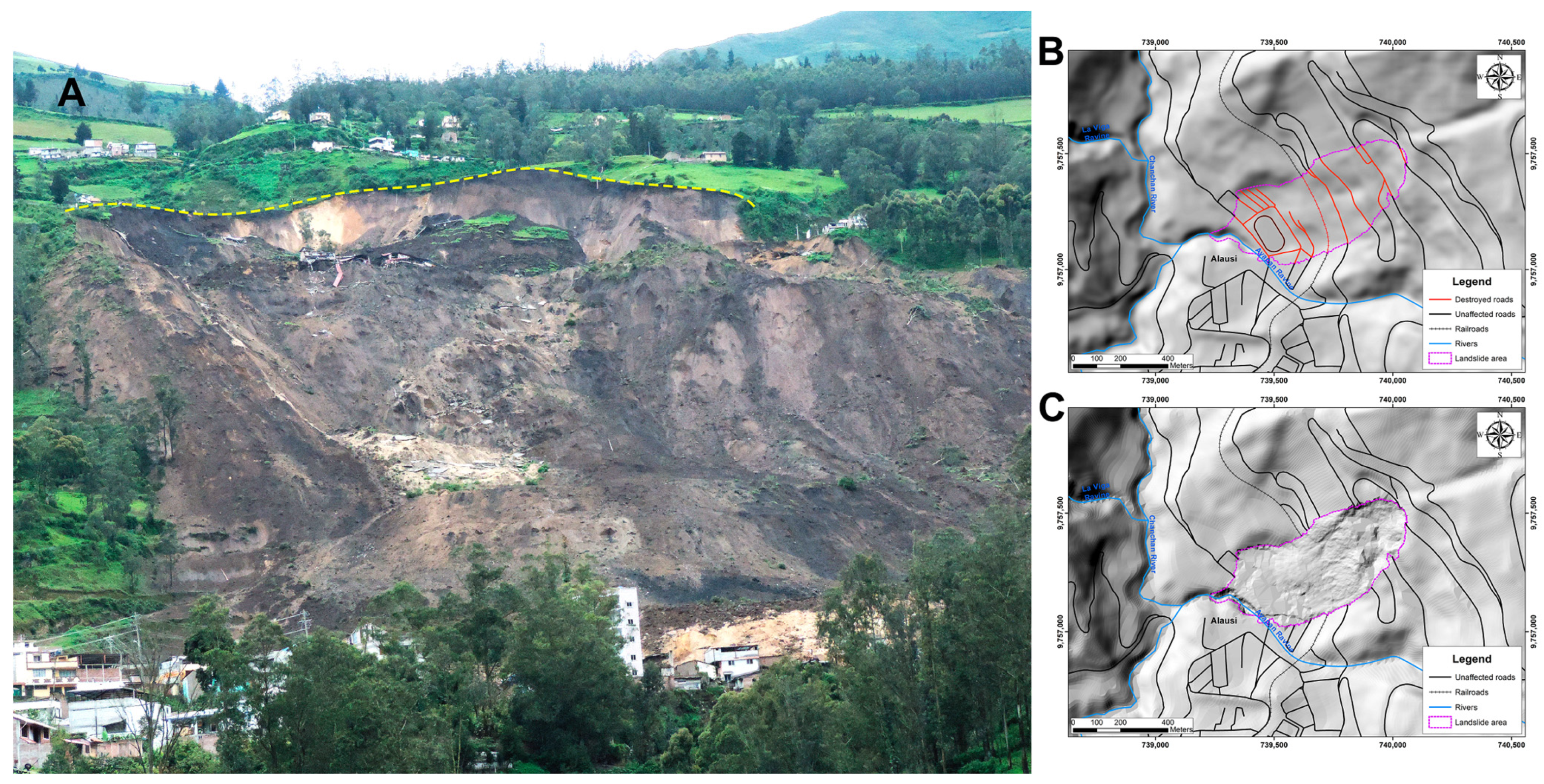
Landslides in Ecuador are one of the most common deadly events in natural hazards, such as the one on 26 March 2023. A large-scale landslide occurred in Alausí, Chimborazo province, causing 65 fatalities and 10 people to disappear, significant infrastructural damage, and the destruction of six neighborhoods. This study presents a detailed case analysis of the anthropogenic factors that could have contributed to the instability of the affected area. Field investigations and a review of historical, geological, and social information are the basis for analyzing the complex interactions between natural and human-induced conditions. Key anthropogenic contributors identified include unplanned urban expansion, ineffective drainage systems, deforestation, road construction without adequate geotechnical support, and changes in land use, particularly agricultural irrigation and wastewater disposal. These factors increased the area’s susceptibility to slope failure, which, combined with intense rainfall and past seismic activity, could have caused the rupture process’s acceleration. The study also emphasizes integrating geological, hydrological, and urban planning assessments to mitigate landslide risks in geologically sensitive regions such as Alausí canton. The findings conclude that human activity could be an acceleration factor in natural processes, and the pressure of urbanization amplifies the consequences. This research underscores the importance of sustainable land management, improved drainage infrastructure, and land-use planning in hazard-prone areas. The lessons learned from Alausí can inform risk reduction strategies across other mountainous and densely populated regions worldwide, like the Andean countries, which have similar social and environmental conditions to Ecuador.
Keywords: anthropogenic factors; landslide; Alausí; hazards mitigation; urban planning anthropogenic factors; landslide; Alausí; hazards mitigation; urban planning