
Automatic Sentiment Analysis of Citizen Comments: The Case of the Albania Earthquake


 ,
,
Abstract
1. Introduction
2. Materials and Methods
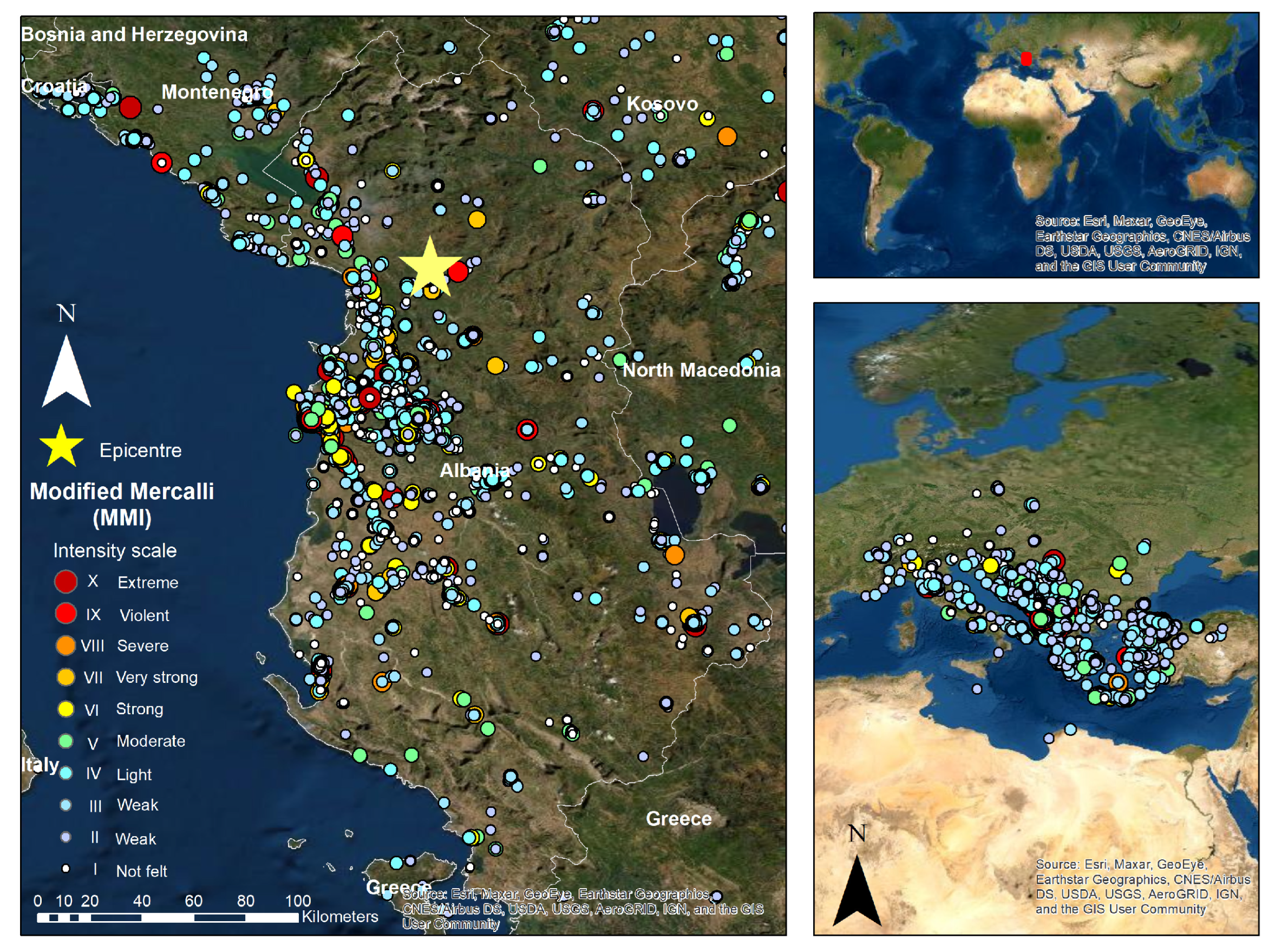
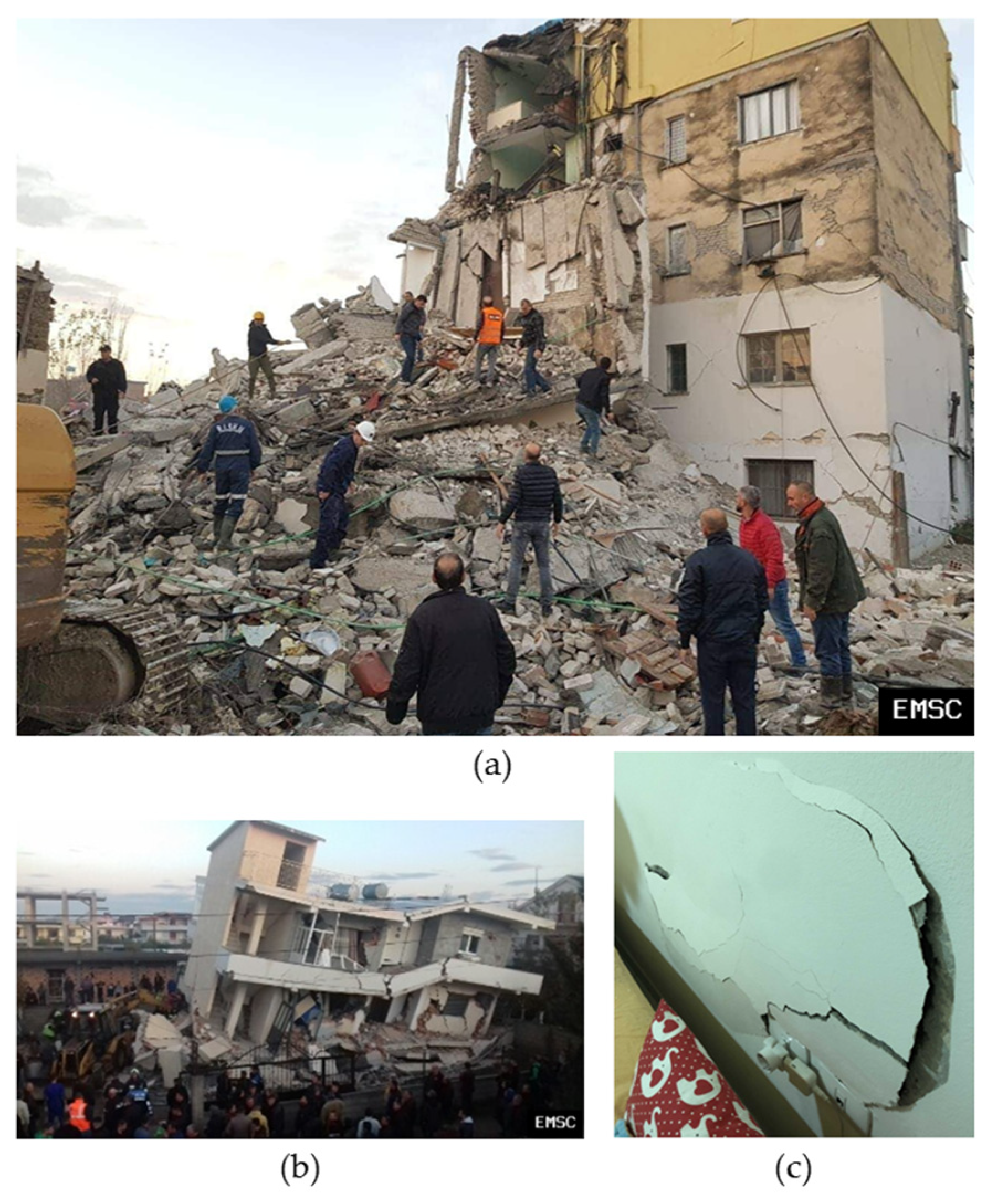
2.1. Case Study Area
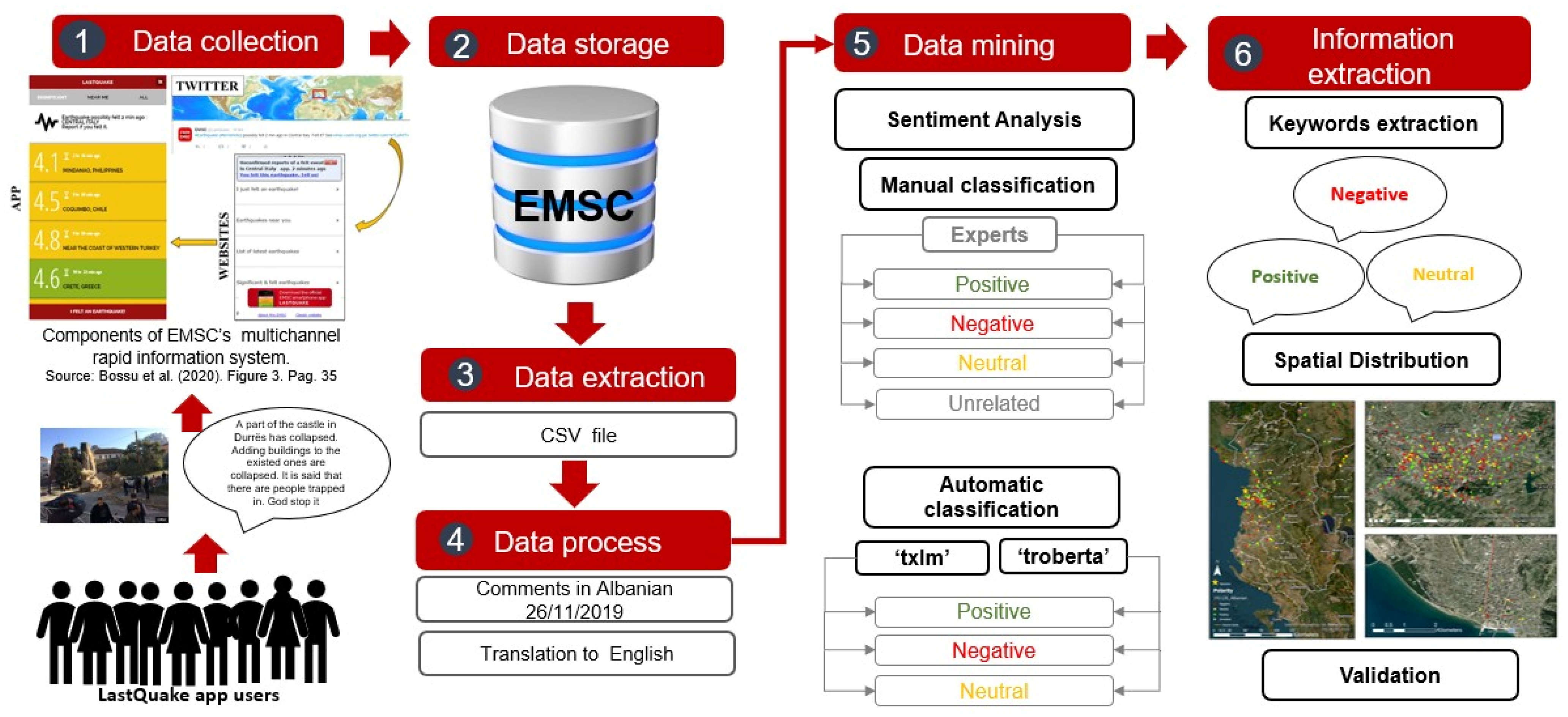
2.2. Data Collection
2.3. Data Processing and Analysis
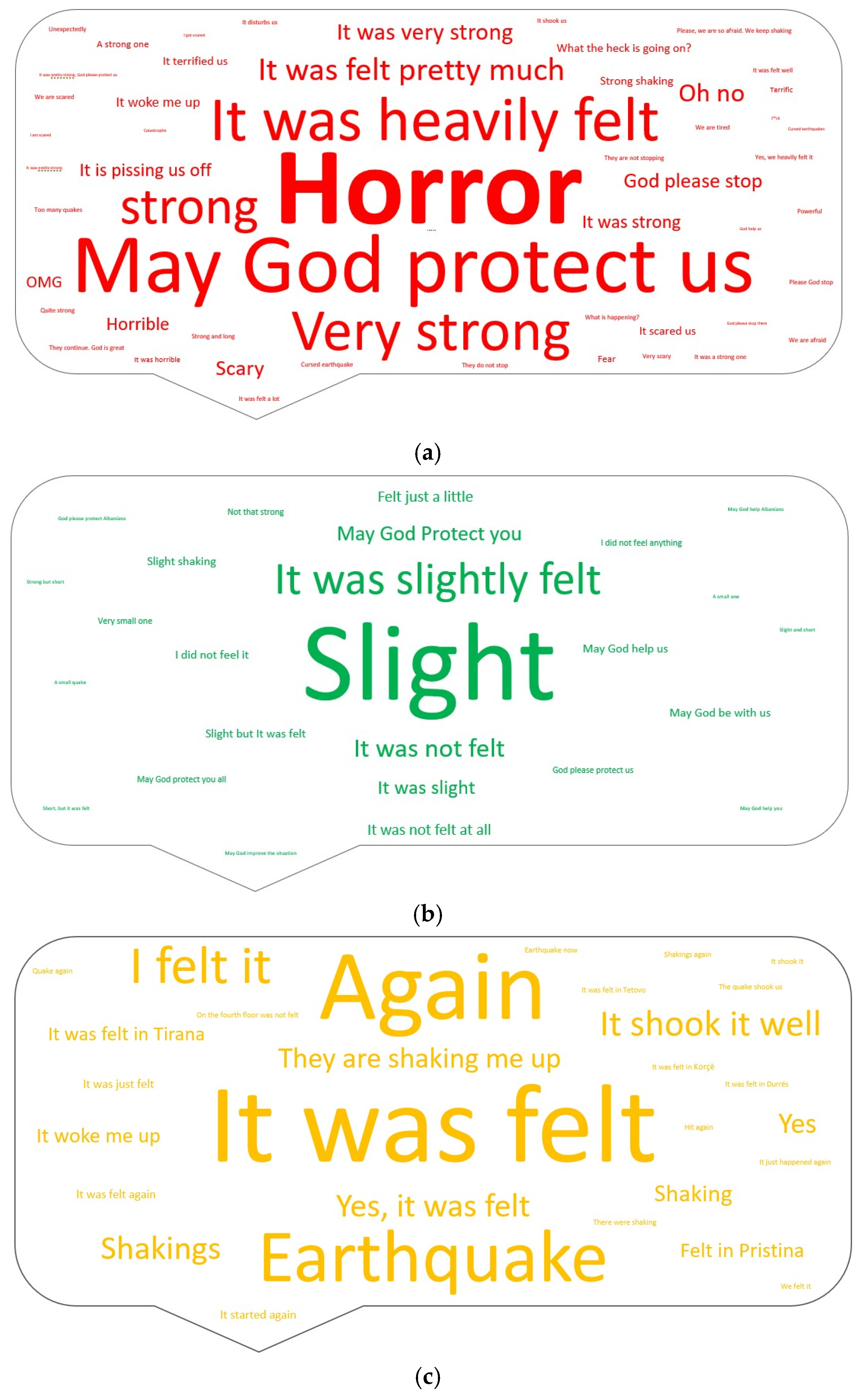
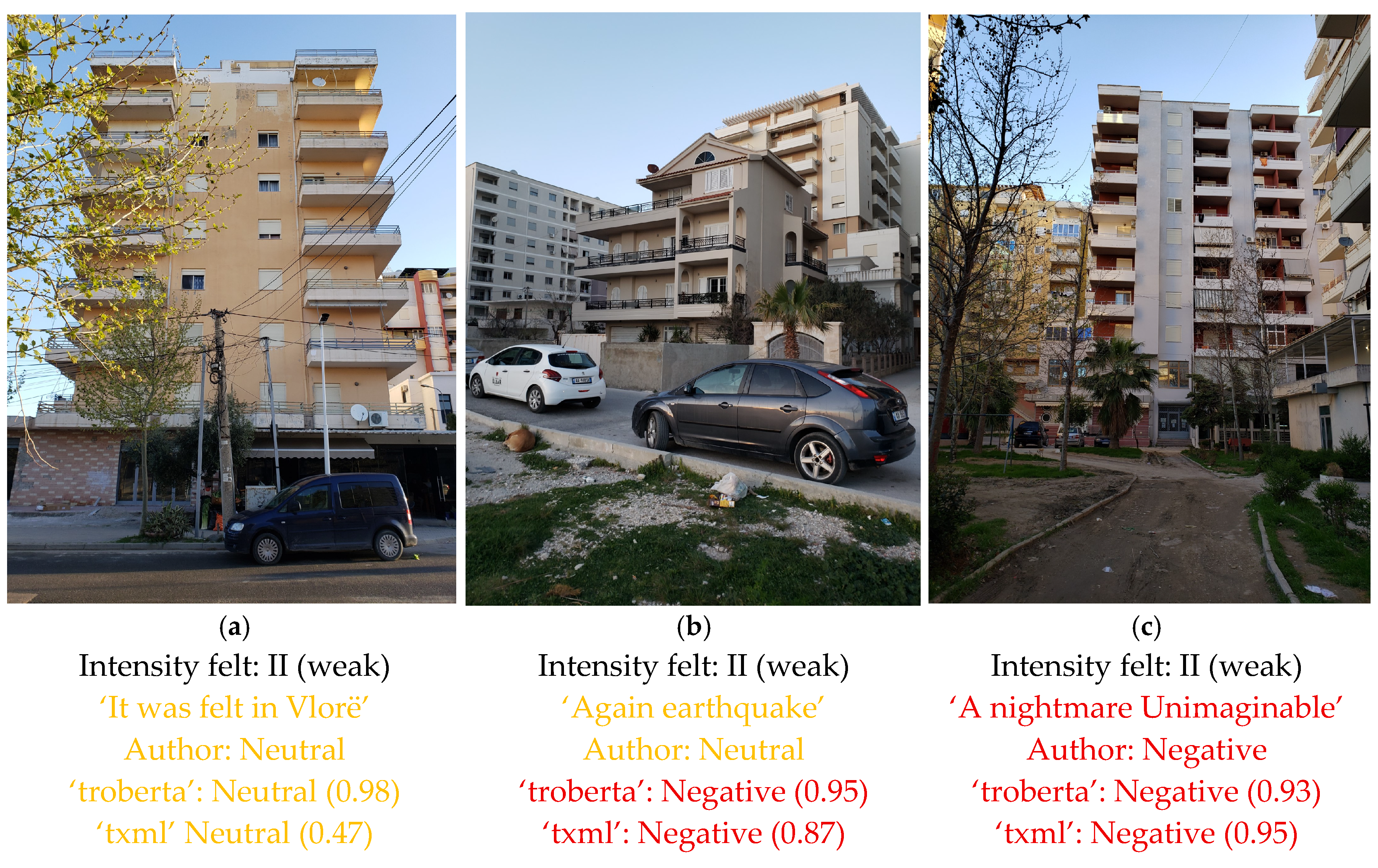
- Positive
- Slight
- Felt nothing
- The only thing is to pray that it doesn’t happen again. I hope you are well and there are no more victims. May they rest in pace…
- Negative
- Fear
- Horrible, May God protect us
- They are not stopping; there are a lot of shakings. We do not know what to do, to stay inside or outside
- Neutral
- Shaking
- Yes, it was felt
- This was the second earthquake and scientifically it is stronger and longer than the first. Now there shouldn’t be much going on. Perhaps this was the last
2.4. Information Extraction
2.4.1. Keyword Extraction
2.4.2. Spatial Distribution
2.4.3. Validation
3. Results
3.1. Data Collected
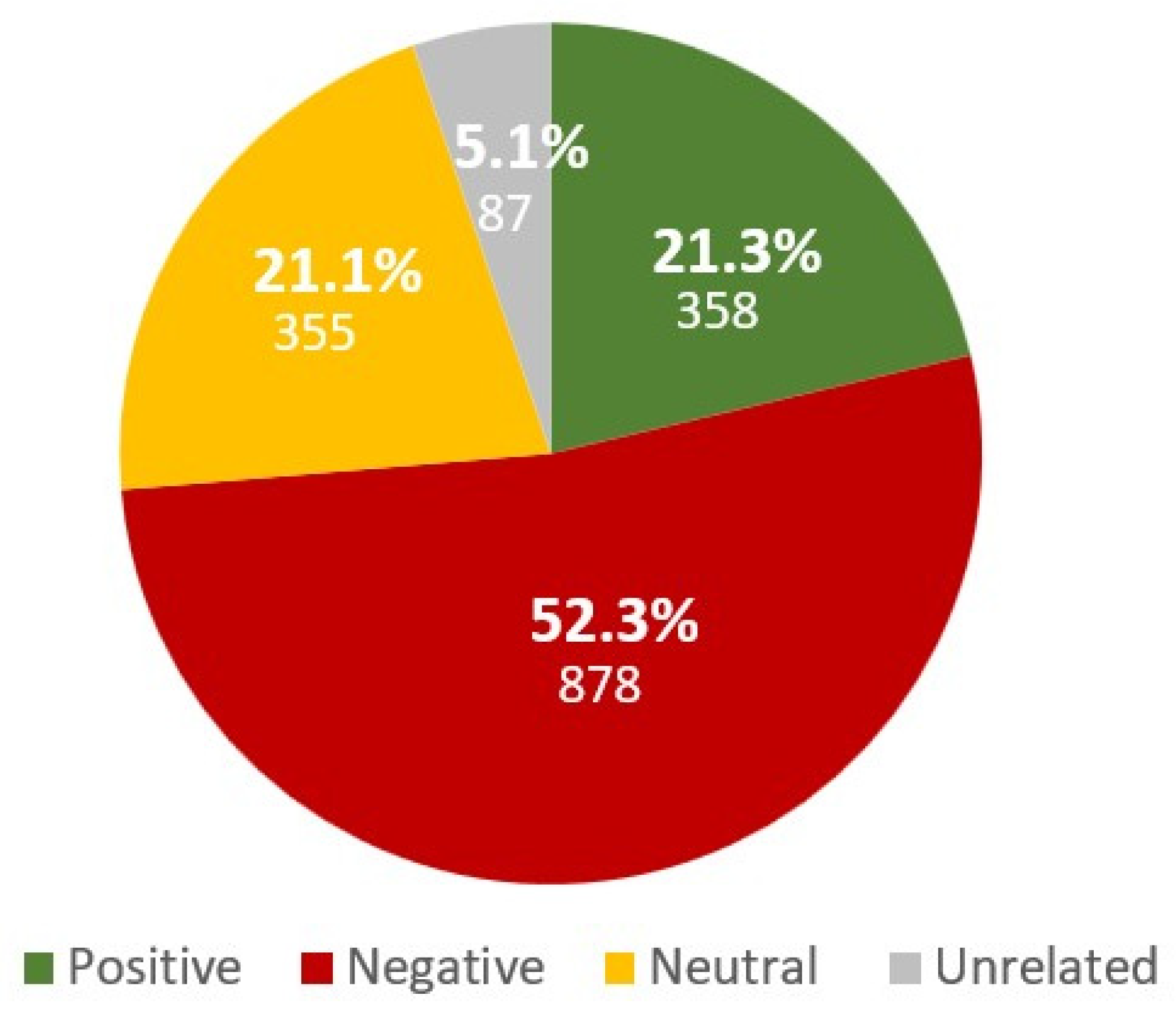
3.2. Data Process and Analysis
3.3. Validation
4. Discussion
5. Conclusions
Author Contributions
Funding
Data Availability Statement
Acknowledgments
Conflicts of Interest
Abbreviations
| ABSA | Aspect-based sentiment analysis |
| ACC | Accuracy |
| AAEE | Albanian Association of Earthquake Engineering |
| CET | Central European Time |
| EMPRO | Empowerment Project Foundation |
| EMSC | European Mediterranean Seismological Centre |
| IGEO | Institute of Geosciences |
| ISDE | The International Scientific Symposium on the theme “Earthquake of 26 November 2019 with a magnitude of 6.4 in Durrës, Albania: Regional Seismicity, Regional Geodynamics and Seismic Risk” |
| LLM | Large Language Model |
| MMI | Modified Mercalli Intensity Scale |
| NLP | Natural Language Processing |
| TSER | Taiwan Scientific Earthquake Reporting |
References
- Guo, C.; He, W.; Huang, Y.; Huang, L. Temporal and Spatial Analysis of Public Emotion on Social Media During Earthquake Disaster—A Case Study of Jishishan Earthquake in 2023. Risk Anal. 2026, 46, e70202. [Google Scholar] [CrossRef]
- Contreras, D.; Wilkinson, S.; Alterman, E.; Hervás, J. Accuracy of a pre-trained sentiment analysis (SA) classification model on tweets related to emergency response and early recovery assessment: The case of 2019 Albanian earthquake. Nat. Hazards 2022, 113, 403–421. [Google Scholar] [CrossRef]
- Bossu, R.; Fallou, L.; Landès, M.; Roussel, F.; Julien-Laferrière, S.; Roch, J.; Steed, R. Rapid Public Information and Situational Awareness After the November 26, 2019, Albania Earthquake: Lessons Learned From the LastQuake System. Front. Earth Sci. 2020, 8, 235. [Google Scholar] [CrossRef]
- Simon, T.; Goldberg, A.; Adini, B. Socializing in emergencies—A review of the use of social media in emergency situations. Int. J. Inf. Manag. 2015, 35, 609–619. [Google Scholar] [CrossRef]
- Ragini, J.R.; Anand, P.M.R.; Bhaskar, V. Big data analytics for disaster response and recovery through sentiment analysis. Int. J. Inf. Manag. 2018, 42, 13–24. [Google Scholar] [CrossRef]
- Wilkinson, S.; Stone, H.; D’Ayala, D.; Verrucci, E.; James, P.; Rossetto, T.; So, E.; Ellul, C. How can new technologies help us with earthquake reconnaissance? In 11th National Conference in Earthquake Engineering; Earthquake Engineering Research Institute: Los Angeles, CA, USA, 2018. [Google Scholar]
- Contreras, D.; Wilkinson, S.; Fallou, L.; Landès, M.; Tomljenovich, I.; Bossu, R.; Balan, N.; James, P. Assessing Emergency Response and Early Recovery using Sentiment Analysis (SA). The case of Zagreb, Croatia. In Proceedings of the 1st Croatian Conference on Earthquake Engineering (1CroCEE 2021), Zagreb, Croatia, 9 March 2021; pp. 743–752. [Google Scholar]
- Contreras, D.; Wilkinson, S.; James, P. Earthquake Reconnaissance Data Sources, a Literature Review. Earth 2021, 2, 1006–1037. [Google Scholar] [CrossRef]
- Aktas, Y.D.; Ioannou, I.; Malcioglu, F.S.; Kontoe, M.; Parammal Vatteri, A.; Baiguera, M.; Black, J.; Kosker, A.; Dermanis, P.; Esabalioglou, M.; et al. Hybrid Reconnaissance Mission to the 30 October 2020 Aegean Sea Earthquake and Tsunami (Izmir, Turkey & Samos, Greece): Description of Data Collection Methods and Damage. Front. Built Environ. 2022, 8, 840192. [Google Scholar] [CrossRef]
- Neppalli, V.K.; Caragea, C.; Squicciarini, A.; Tapia, A.; Stehle, S. Sentiment analysis during Hurricane Sandy in emergency response. Int. J. Disaster Risk Reduct. 2017, 21, 213–222. [Google Scholar] [CrossRef]
- Bossu, R.; Roussel, F.; Fallou, L.; Landès, M.; Steed, R.; Mazet-Roux, G.; Dupont, A.; Frobert, L.; Petersen, L. LastQuake: From rapid information to global seismic risk reduction. Int. J. Disaster Risk Reduct. 2018, 28, 32–42. [Google Scholar] [CrossRef]
- Quitoriano, V.; Wald, D.J. USGS “Did You Feel It?”—Science and Lessons From 20 Years of Citizen Science-Based Macroseismology. Front. Earth Sci. 2020, 8, 120. [Google Scholar] [CrossRef]
- Finazzi, F. The Earthquake Network Project: A Platform for Earthquake Early Warning, Rapid Impact Assessment, and Search and Rescue. Front. Earth Sci. 2020, 8, 243. [Google Scholar] [CrossRef]
- Kong, Q.K.; Martin-Short, R.; Allen, R.M. Toward Global Earthquake Early Warning with the MyShake Smartphone Seismic Network, Part 2: Understanding MyShake Performance around the World. Seismol. Res. Lett. 2020, 91, 2218–2233. [Google Scholar] [CrossRef]
- Subedi, S.; Hetényi, G.; Denton, P.; Sauron, A. Seismology at School in Nepal: A Program for Educational and Citizen Seismology Through a Low-Cost Seismic Network. Front. Earth Sci. 2020, 8, 73. [Google Scholar] [CrossRef]
- Zhao, R.; Liu, X.T.; Xu, W.B. Integration of coseismic deformation into WebGIS for near real-time disaster evaluation and emergency response. Environ. Earth Sci. 2020, 79, 414. [Google Scholar] [CrossRef]
- Liang, W.T.; Lee, J.C.; Hsiao, N.C. Crowdsourcing Platform Toward Seismic Disaster Reduction: The Taiwan Scientific Earthquake Reporting (TSER) System. Front. Earth Sci. 2019, 7, 79. [Google Scholar] [CrossRef]
- Hossain, A.; Karimuzzaman, M.; Hossain, M.M.; Rahman, A. Text Mining and Sentiment Analysis of Newspaper Headlines. Information 2021, 12, 414. [Google Scholar] [CrossRef]
- Radianti, J.; Hiltz, S.R.; Labaka, L. An Overview of Public Concerns During the Recovery Period after a Major Earthquake: Nepal Twitter Analysis. In Proceedings of the 2016 49th Hawaii International Conference on System Sciences (HICSS), Koloa, HI, USA, 5–8 January 2016; IEEE: Piscataway, NJ, USA, 2016; pp. 136–145. [Google Scholar]
- Berger, J.; Packard, G. Using Natural Language Processing to Understand People and Culture. Am. Psychol. 2022, 77, 525. [Google Scholar] [CrossRef]
- Erickson, J. What Is Natural Language Processing (NLP)? Available online: https://www.oracle.com/asean/artificial-intelligence/natural-language-processing/ (accessed on 22 December 2025).
- Eligüzel, N.; Çetinkaya, C.; Dereli, T. Comparison of different machine learning techniques on location extraction by utilizing geo-tagged tweets: A case study. Adv. Eng. Inform. 2020, 46, 101151. [Google Scholar] [CrossRef]
- Medhat, W.; Hassan, A.; Korashy, H. Sentiment analysis algorithms and applications: A survey. Ain Shams Eng. J. 2014, 5, 1093–1113. [Google Scholar] [CrossRef]
- Pirnau, M. Sentiment analysis for the tweets that contain the word “earthquake”. In Proceedings of the 2018 10th International Conference on Electronics, Computers and Artificial Intelligence (ECAI), Iasi, Romania, 28–30 June 2018; IEEE: Piscataway, NJ, USA, 2018; pp. 1–6. [Google Scholar]
- Barbieri, F.; Camacho-Collados, J.; Anke, L.E.; Neves, L. TweetEval: Unified Benchmark and Comparative Evaluation for Tweet Classification. In Proceedings of the Findings of the Association for Computational Linguistics: EMNLP 2020, Online, 16–20 November 2020; Association for Computational Linguistics: Stroudsburg, PA, USA, 2020; pp. 1644–1650. [Google Scholar]
- Parimala, M.; Swarna Priya, R.M.; Praveen Kumar Reddy, M.; Lal Chowdhary, C.; Kumar Poluru, R.; Khan, S. Spatiotemporal-based sentiment analysis on tweets for risk assessment of event using deep learning approach. Softw. Pract. Exp. 2021, 51, 550–570. [Google Scholar] [CrossRef]
- Liu, B. Introduction. In Sentiment Analysis: Mining Opinions, Sentiments, and Emotions; Cambridge University Press: Cambridge, UK, 2015; pp. 1–15. [Google Scholar][Green Version]
- Su, J.; Chen, Q.; Wang, Y.; Zhang, L.; Pan, W.; Li, Z. Sentence-level sentiment analysis based on supervised gradual machine learning. Sci. Rep. 2023, 13, 14500. [Google Scholar] [CrossRef]
- Liu, B. Aspect Sentiment Classification. In Sentiment Analysis: Mining Opinions, Sentiments, and Emotions; Liu, B., Ed.; Cambridge University Press: Cambridge, UK, 2015; pp. 90–136. [Google Scholar]
- Hua, Y.C.; Denny, P.; Wicker, J.; Taskova, K. A systematic review of aspect-based sentiment analysis: Domains, methods, and trends. Artif. Intell. Rev. 2024, 57, 296. [Google Scholar] [CrossRef]
- Wolf, T.; Debut, L.; Sanh, V.; Chaumond, J.; Delangue, C.; Moi, A.; Cistac, P.; Rault, T.; Louf, R.; Funtowicz, M.; et al. Transformers: State-of-the-Art Natural Language Processing. In Proceedings of the 2020 Conference on Empirical Methods in Natural Language Processing: System Demonstrations, Online, 16–20 November 2020; Association for Computational Linguistics: Stroudsburg, PA, USA, 2020; pp. 38–45. [Google Scholar]
- Nguyen, D.Q.; Vu, T.; Nguyen, A.T. BERTweet: A pre-trained language model for English Tweets. In Proceedings of the 2020 Conference on Empirical Methods in Natural Language Processing: System Demonstrations, Online, 16–20 November 2020; Association for Computational Linguistics: Stroudsburg, PA, USA, 2020; pp. 9–14. [Google Scholar]
- Liu, Y.; Ott, M.; Goyal, N.; Du, J.; Joshi, M.; Chen, D.; Levy, O.; Lewis, M.; Zettlemoyer, L.; Stoyanov, V. RoBERTa: A Robustly Optimized BERT Pretraining Approach. arXiv 2019, arXiv:1907.11692. [Google Scholar]
- Devlin, J.; Chang, M.W.; Lee, K.; Toutanova, K. BERT: Pre-training of Deep Bidirectional Transformers for Language Understanding. In Proceedings of the 2019 Conference of the North American Chapter of the Association for Computational Linguistics: Human Language Technologies, Minneapolis, MN, USA, 2–7 June 2019; Association for Computational Linguistics: Stroudsburg, PA, USA, 2019; pp. 4171–4186. [Google Scholar]
- DePaolo, C.A.; Wilkinson, K. Get Your Head into the Clouds: Using Word Clouds for Analyzing Qualitative Assessment Data. TechTrends 2014, 58, 38–44. [Google Scholar] [CrossRef]
- SmugMug. Flickr. Available online: https://www.flickr.com (accessed on 15 March 2026).
- Vijayabhanu, R.; Shenbagam, R. Twitter Data Sentiment Analysis and Word Cloud. J. Emerg. Technol. Innov. Res. (JETIR) 2018, 5, 316–322. [Google Scholar]
- Bao, C.; Wang, Y. A Survey of Word Cloud Visualization. J. Comput. Aided Des. Comput. Graph. 2021, 33, 532–544. [Google Scholar] [CrossRef]
- McNaught, C.; Lam, P. Using Wordle as a Supplementary Research Tool. Qual. Rep. 2010, 15, 630–643. [Google Scholar] [CrossRef]
- Contreras, D.; Wilkinson, S.; Aktas, Y.D.; Fallou, L.; Bossu, R.; Landès, M. Intensity-Based Sentiment and Topic Analysis. The Case of the 2020 Aegean Earthquake. Front. Built Environ. 2022, 8, 839770. [Google Scholar] [CrossRef]
- Liu, H.; Han, Z. Earthquake resilience and public engagement: A social media perspective. Risk Anal. 2025, 45, 2667–2684. [Google Scholar] [CrossRef] [PubMed]
- Andonov, A.; Andreev, S.; Freddi, F.; Greco, F.; Gentile, R.; Novelli, V.; Veliu, E. The Mw6.4 Albania Earthquake on the 26th November 2019; EEFIT: London, UK, 2020. [Google Scholar]
- Papadopoulos, G.A.; Agalos, A.; Carydis, P.; Lekkas, E.; Mavroulis, S.; Triantafyllou, I. The 26 November 2019 Mw 6.4 Albania Destructive Earthquake. Seismol. Res. Lett. 2020, 91, 3129–3138. [Google Scholar] [CrossRef]
- Stein, R.; Sevilgen, V. Albania Earthquake Strikes Highest-Hazard Zone in the Balkans, Devastating Nearby Towns. Available online: https://temblor.net/earthquake-insights/albania-earthquake-strikes-highest-hazard-zone-in-the-balkans-devastating-nearby-towns-10153/ (accessed on 9 May 2026).
- Freddi, F.; Novelli, V.; Gentile, R.; Veliu, E.; Andreev, S.; Andonov, A.; Greco, F.; Zhuleku, E. Observations from the 26th November 2019 Albania earthquake: The earthquake engineering field investigation team (EEFIT) mission. Bull. Earthq. Eng. 2021, 19, 2013–2044. [Google Scholar] [CrossRef]
- IFRC. Albania: Final Valuation of the 2019 Albania Earthquake Emergency Appeal; Gert Venghaus. Humanitarian Consulting 2021; IFRC: Geneva, Switzerland, 2021; p. 66. [Google Scholar]
- USGS. Modified Mercalli Intensity Scale. Available online: https://www.usgs.gov/media/images/modified-mercalli-intensity-scale (accessed on 29 March 2026).
- Reliefweb. Albania: Earthquake—Nov 2019; OCHA: New York, NY, USA, 2019. [Google Scholar]
- Contreras, D. Fuzzy Boundaries Between Post-Disaster Phases: The Case of L’Aquila, Italy. Int. J. Disaster Risk Sci. 2016, 7, 277–292. [Google Scholar] [CrossRef]
- FreeWordCloudGenerator.com. Free Word Cloud Generator. Available online: https://www.freewordcloudgenerator.com/generatewordcloud (accessed on 29 March 2026).
- Contreras, D. Citizen’s Reports Sentiment and Topic Analysis: 26th November, 2019, Albania Earthquake. 2023. [Video]. YouTube: Tirana, Albania. Available online: https://www.youtube.com/watch?v=61Bpogosa_A&t=845s (accessed on 24 April 2026).
- Contreras, D.; Wilkinson, S.; Alterman, E. Supervised & Unsupervised Polarity Classification of Twitter Data Related to the Albania 2019 Earthquake; New Castle University: Newcastle upon Tyne, UK, 2021. [Google Scholar] [CrossRef]
- Veliu, E.; Contreras, D.; Fallou, L.; Bossu, R.; Landès, M. Sentiment and Topic Analysis of LastQuake App’ Users Comments—26th November 2019 Albania Earthquake; New Castle University: Newcastle upon Tyne, UK, 2023. [Google Scholar] [CrossRef]
- Contreras, D.; Wilkinson, S.; Fallou, L.; Landès, M.; Tomljenovich, I.; Bossu, R.; Balan, N.; James, P. Supervised Polarity and Topic Classification of LastQuake App User’s Pictures with Comments—Zagreb 2020 Earthquake; New Castle University: Newcastle upon Tyne, UK, 2021. [Google Scholar] [CrossRef]
- Anderson, J.W.; Nunnelley, P.A. Private prayer associations with depression, anxiety and other health conditions: An analytical review of clinical studies. Postgrad. Med. 2016, 128, 635–641. [Google Scholar] [CrossRef]
- Maksimava, M. Sentiment Analysis: What Is It and How Does It Work? Awario 2020, 2021. Available online: https://awario.com/blog/sentiment-analysis/ (accessed on 24 April 2026).
- Medallia. Available online: https://www.medallia.com/es/ (accessed on 26 December 2025).
- Zhou, X.; Zhou, J.; Wang, C.; Xie, Q.; Ding, K.; Mao, C.; Liu, Y.; Cao, Z.; Chu, H.; Chen, X.; et al. PH-LLM: Public Health Large Language Models for Infoveillance. medRxiv 2025. [Google Scholar] [CrossRef]



| Shaking [47] | Intensity | Comments | Percentage |
|---|---|---|---|
| MMI | Nr | % | |
| Not Felt | I | 270 | 16 |
| Weak | II | 308 | 18 |
| Weak | III | 424 | 25 |
| Light | IV | 247 | 15 |
| Moderate | V | 166 | 10 |
| Strong | VI | 132 | 8 |
| Very strong | VII | 70 | 4 |
| Severe | VIII | 36 | 2 |
| Violent | IX | 17 | 1 |
| Extreme | X | 8 | 0 |
| Polarity | Rules |
|---|---|
| Positive |
|
| Negative |
|
| Neutral |
|
| Shake [47] | Intensity | Comments | Percentage |
|---|---|---|---|
| MMI | Nr | % | |
| Weak | III | 424 | 25 |
| Weak | II | 308 | 18 |
| Not felt | I | 270 | 16 |
| Light | IV | 247 | 15 |
| Moderate | V | 166 | 10 |
| Strong | VI | 132 | 8 |
| Very strong | VII | 70 | 4 |
| Severe | VIII | 36 | 2 |
| Violent | IX | 17 | 1 |
| Extreme | X | 8 | 0 |
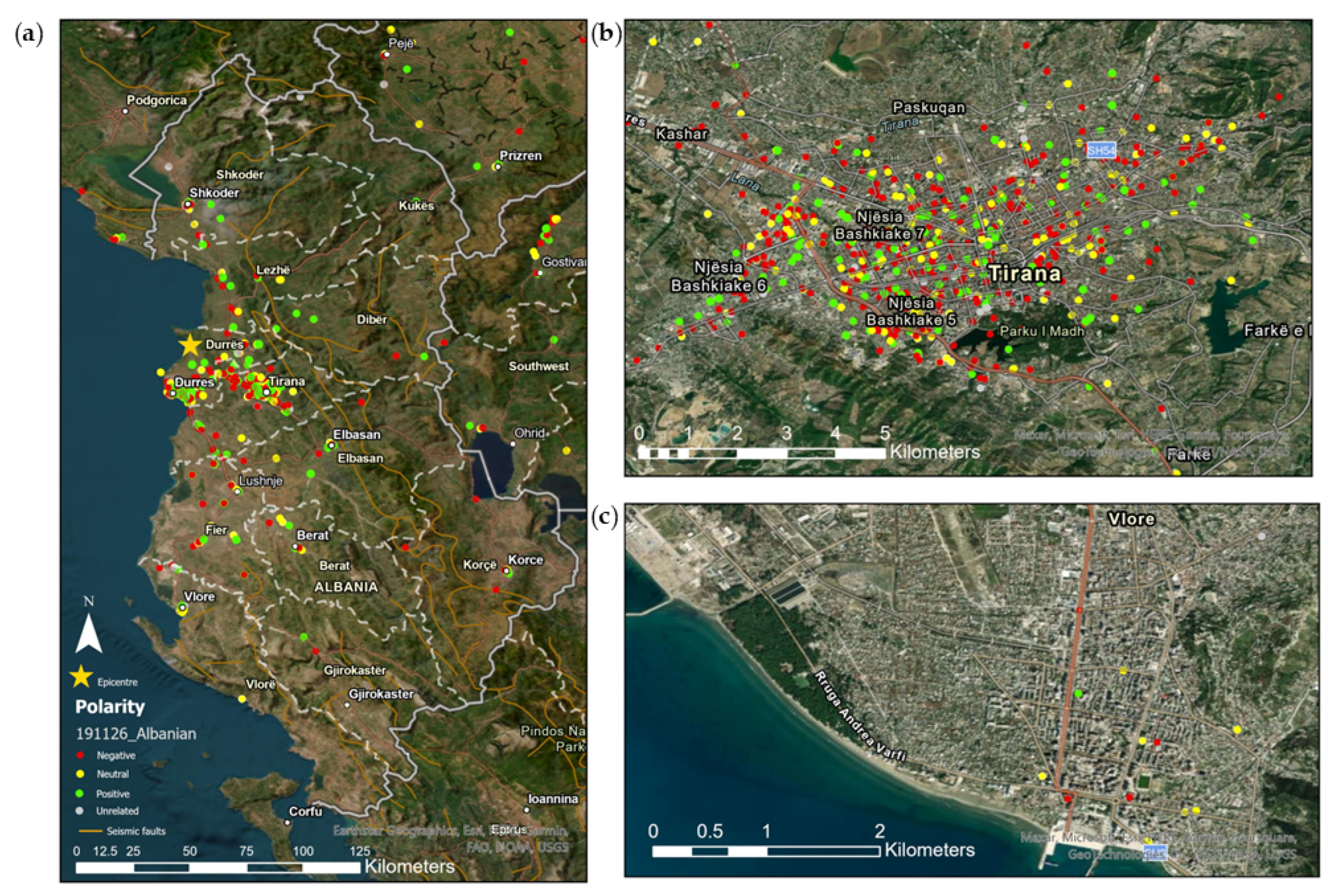
| Polarity | Reports | Percentage |
|---|---|---|
| Category | Number | % |
| Negative | 878 | 52 |
| Positive | 358 | 21 |
| Neutral | 355 | 21 |
| Unrelated | 87 | 5 |
| Total | 1678 | 100 |
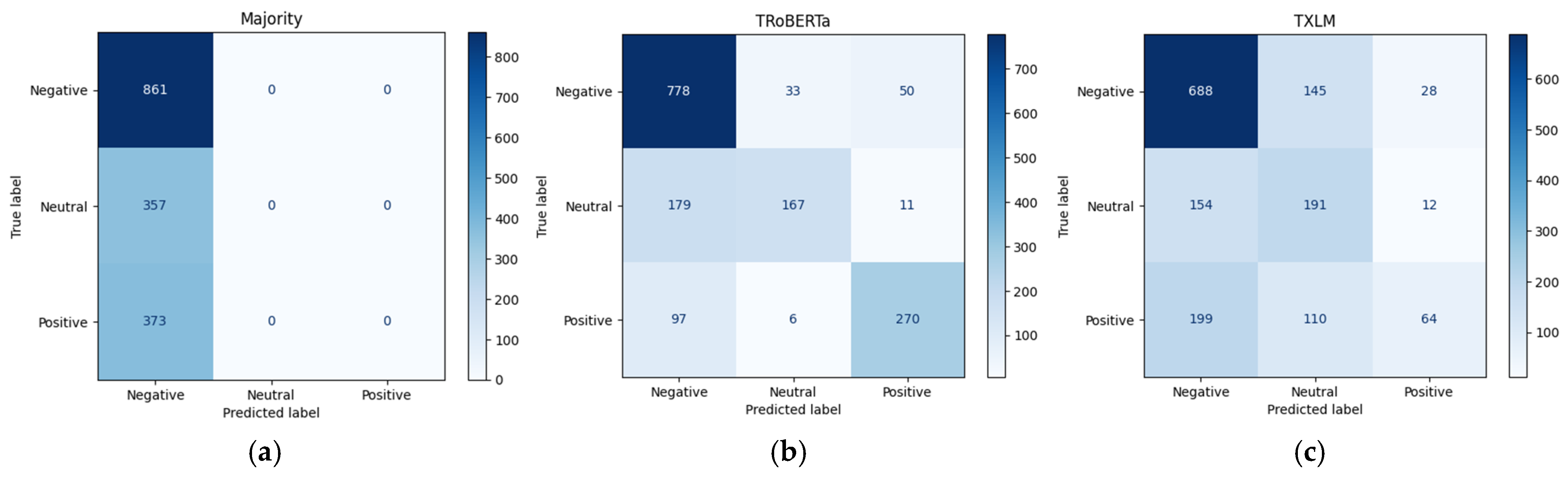
| Transformer-Based NLP Classification Models | Average Confidence | ACC |
|---|---|---|
| troberta | 0.88 | 71% |
| txlm | 0.78 | 56% |
Disclaimer/Publisher’s Note: The statements, opinions and data contained in all publications are solely those of the individual author(s) and contributor(s) and not of MDPI and/or the editor(s). MDPI and/or the editor(s) disclaim responsibility for any injury to people or property resulting from any ideas, methods, instructions or products referred to in the content. |
© 2026 by the authors. Licensee MDPI, Basel, Switzerland. This article is an open access article distributed under the terms and conditions of the Creative Commons Attribution (CC BY) license.
Share and Cite
Contreras, D.; Veliu, E.; Antypas, D.; Hervas, J.; Landès, M.; Fallou, L.; Koxhaj, D.; Bossu, R.; Wilkinson, S.; Camacho-Collados, J.; et al. Automatic Sentiment Analysis of Citizen Comments: The Case of the Albania Earthquake. GeoHazards 2026, 7, 62. https://doi.org/10.3390/geohazards7020062
Contreras D, Veliu E, Antypas D, Hervas J, Landès M, Fallou L, Koxhaj D, Bossu R, Wilkinson S, Camacho-Collados J, et al. Automatic Sentiment Analysis of Citizen Comments: The Case of the Albania Earthquake. GeoHazards. 2026; 7(2):62. https://doi.org/10.3390/geohazards7020062
Chicago/Turabian StyleContreras, Diana, Enes Veliu, Dimosthenis Antypas, Javier Hervas, Matthieu Landès, Laure Fallou, Damiano Koxhaj, Rémy Bossu, Sean Wilkinson, Jose Camacho-Collados, and et al. 2026. "Automatic Sentiment Analysis of Citizen Comments: The Case of the Albania Earthquake" GeoHazards 7, no. 2: 62. https://doi.org/10.3390/geohazards7020062
APA StyleContreras, D., Veliu, E., Antypas, D., Hervas, J., Landès, M., Fallou, L., Koxhaj, D., Bossu, R., Wilkinson, S., Camacho-Collados, J., & Dushi, E. (2026). Automatic Sentiment Analysis of Citizen Comments: The Case of the Albania Earthquake. GeoHazards, 7(2), 62. https://doi.org/10.3390/geohazards7020062