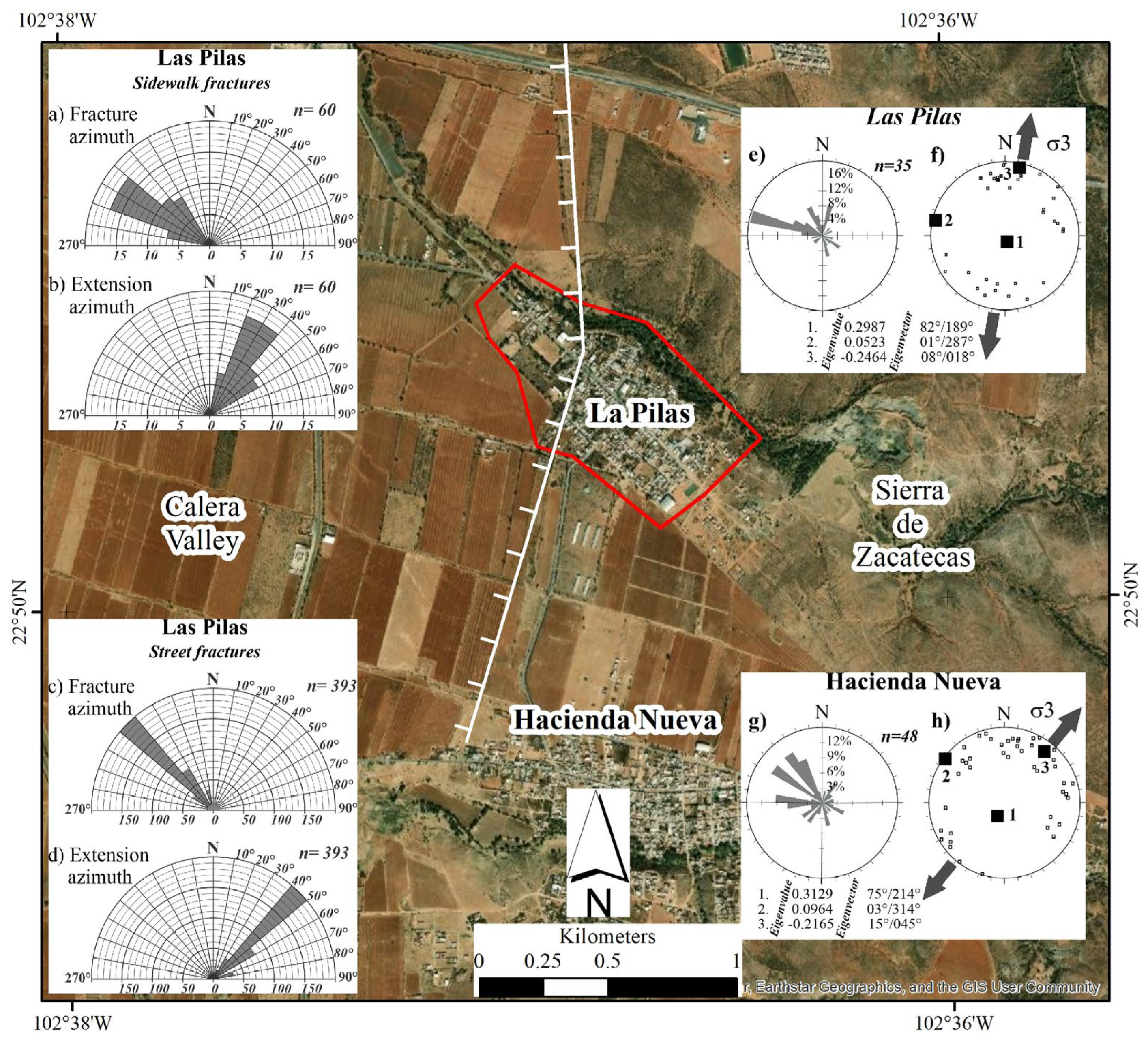

Basement-Controlled Urban Fracturing: Evidence from Las Pilas, Zacatecas, Mexico
 ,
,  ,
, Abstract
Share and Cite
Escalona-Alcázar, F.d.J.; García-Paniagua, E.; Pineda-Martínez, L.F.; Rodríguez-González, B.; Reveles-Flores, S.M.T.; Valle-Rodríguez, S.; Mandujano-García, C.D. Basement-Controlled Urban Fracturing: Evidence from Las Pilas, Zacatecas, Mexico. GeoHazards 2026, 7, 6. https://doi.org/10.3390/geohazards7010006
Escalona-Alcázar FdJ, García-Paniagua E, Pineda-Martínez LF, Rodríguez-González B, Reveles-Flores SMT, Valle-Rodríguez S, Mandujano-García CD. Basement-Controlled Urban Fracturing: Evidence from Las Pilas, Zacatecas, Mexico. GeoHazards. 2026; 7(1):6. https://doi.org/10.3390/geohazards7010006
Chicago/Turabian StyleEscalona-Alcázar, Felipe de Jesús, Estefanía García-Paniagua, Luis Felipe Pineda-Martínez, Baudelio Rodríguez-González, Sayde María Teresa Reveles-Flores, Santiago Valle-Rodríguez, and Cruz Daniel Mandujano-García. 2026. "Basement-Controlled Urban Fracturing: Evidence from Las Pilas, Zacatecas, Mexico" GeoHazards 7, no. 1: 6. https://doi.org/10.3390/geohazards7010006
APA StyleEscalona-Alcázar, F. d. J., García-Paniagua, E., Pineda-Martínez, L. F., Rodríguez-González, B., Reveles-Flores, S. M. T., Valle-Rodríguez, S., & Mandujano-García, C. D. (2026). Basement-Controlled Urban Fracturing: Evidence from Las Pilas, Zacatecas, Mexico. GeoHazards, 7(1), 6. https://doi.org/10.3390/geohazards7010006