


Abstract
This study investigates flooding and erosion impacts and human responses in Aoraki Mount Cook and Westland Tai Poutini national parks in Aotearoa New Zealand. These fast-eroding landscapes provide important test cases and insights for considering the public access dimensions of climate change. Our objectives were to explore and characterise the often-overlooked role of public access as a ubiquitous concern for protected areas and other area-based conservation approaches that facilitate connections between people and nature alongside their protective functions. We employed a mixed-methods approach including volunteered geographic information (VGI) from a park user survey (n = 273) and detailed case studies of change on two iconic mountaineering routes based on geospatial analyses of digital elevation models spanning 1986–2022. VGI data identified 36 adversely affected locations while 21% of respondents also identified beneficial aspects of recent landscape changes. Geophysical changes could be perceived differently by different stakeholders, illustrating the potential for competing demands on management responses. Impacts of rainfall-triggered erosion events were explored in case studies of damaged access infrastructure (e.g., roads, tracks, bridges). Adaptive responses resulted from formal or informal (park user-led) actions including re-routing, rebuilding, or abandonment of pre-existing infrastructure. Three widely transferable dimensions of public access management are identified: providing access that supports the core functions of protected areas; evaluating the impacts of both physical changes and human responses to them; and managing tensions between stakeholder preferences. Improved attention to the role of access is essential for effective climate change adaptation in parks and reserves.
1. Introduction
Public access is a fundamental consideration for the design and management of all conservation areas [1,2]. Alongside situations where it may be necessary to limit public use to prevent disturbance to sensitive environments or species, there are many benefits of public interaction with conservation areas [3,4,5]. Relationships between parks and people have been embraced in the IUCN’s Protected Area Management Categories [6] and more recently in the concept of ‘other effective area-based conservation measures’ (OECMs), which recognises an even wider range of guardianship and stewardship functions that are often provided by Indigenous peoples and local communities [7,8,9]. Human interactions with natural environments have also been linked to wellbeing in a variety of other contexts including aquatic blue-space [10,11] and urban green-space design and planning [12,13]. However, relatively few studies have addressed the potential for the benefits of access to nature to be diminished by environmental changes that are not directly preventable, such as the impacts of natural hazards and disaster events. Furthermore, an understanding of these risks, and potential responses to them, is becoming increasingly important to the day-to-day management and long-term effectiveness of protected areas and OECMs given the accelerating pace of climate change where destructive events such as hydrometeorological extremes are becoming more commonplace [14].
In many instances, studies of natural disasters have highlighted the role of human responses in shaping the resulting outcomes [15]. This illustrates the human dimensions of resilience to natural hazards and invites a full consideration of the manageable dimensions and longer-term implications of post-disaster responses. As is the subject of this study, effects on public access are an often-overlooked dimension of post-disaster recovery, especially in more rural areas where they may escape immediate attention or even recognition in natural resource management. Although access to impacted areas may be highlighted in the context of site access for emergency services or critical infrastructure repair [16] these considerations are also relevant to environmental management where public access may be lost, or inadvertently improved, leading to fundamental alterations in relationships with natural areas and resources. While some such changes are man-made and ultimately temporary (e.g., the use of ‘lockdowns’ as an emergency management setting to restrict the transmission of COVID-19 [17]), others may be long-lasting or effectively permanent as is the case with eroding landscapes that may never return to their previous configurations [18,19]. In the current era of climate change, these human geography dimensions deserve greater attention due to the potential for both cumulative effects and periodic step-changes.
In this study we assessed the impacts of landscape erosion on public access, resource use and adaptive responses in two national parks that are experiencing high rates of change in Aotearoa New Zealand (NZ). These fast-eroding landscapes provide unique insights and important test cases for protected areas management in a changing climate where adaptive responses will be increasingly needed. In this context we refer to ‘access’ as a means of approaching or entering a place such as the location of a natural resource, while ‘accessibility’ refers to the characteristics or qualities of access in a particular situation and context. Accessibility is therefore a qualitative concept that embodies social and cultural aspects associated with varying beliefs, capabilities and preferred modes of access to a given location [18].
The two parks, Aoraki Mount Cook National Park (AMCNP) and Westland Tai Poutini National Park (WTPNP), contain the highest peaks and most extensive glaciers in the country and are regionally and nationally important recreation and tourism destinations [20,21,22,23,24,25,26,27,28]. They also exemplify many of the landscape changes and downstream consequences that are associated with the evolution of snow and ice free landscapes [29,30,31,32]. This includes the prominent role of paraglacial processes (non-glacial processes conditioned by glaciation) as a driver of landscape erosion in combination with hydrometeorological phenomena such as extreme rainfall events and flooding [33]. Although our focus is restricted to the impacts of landscape erosion within the boundaries of protected areas and their associated jurisdictions, it is notable that many additional effects will transcend these boundaries to shape downstream catchments and coastal environments due to the connectivity of aquatic systems [31,32].
Our key objectives were to provide a contribution to the small but growing literature on changing relationships between landscape erosion and natural resource use by (i) identifying and characterising the prevalence of recent landscape changes with implications for access to iconic natural features such as alpine passes, snowfields and glaciers, (ii) evaluating the significance of those changes for recreational activities and user groups, and (iii) discussing implications and potential responses in the context of national park management and the overarching challenge of climate change adaptation.
2. Materials and Methods
2.1. Study Area
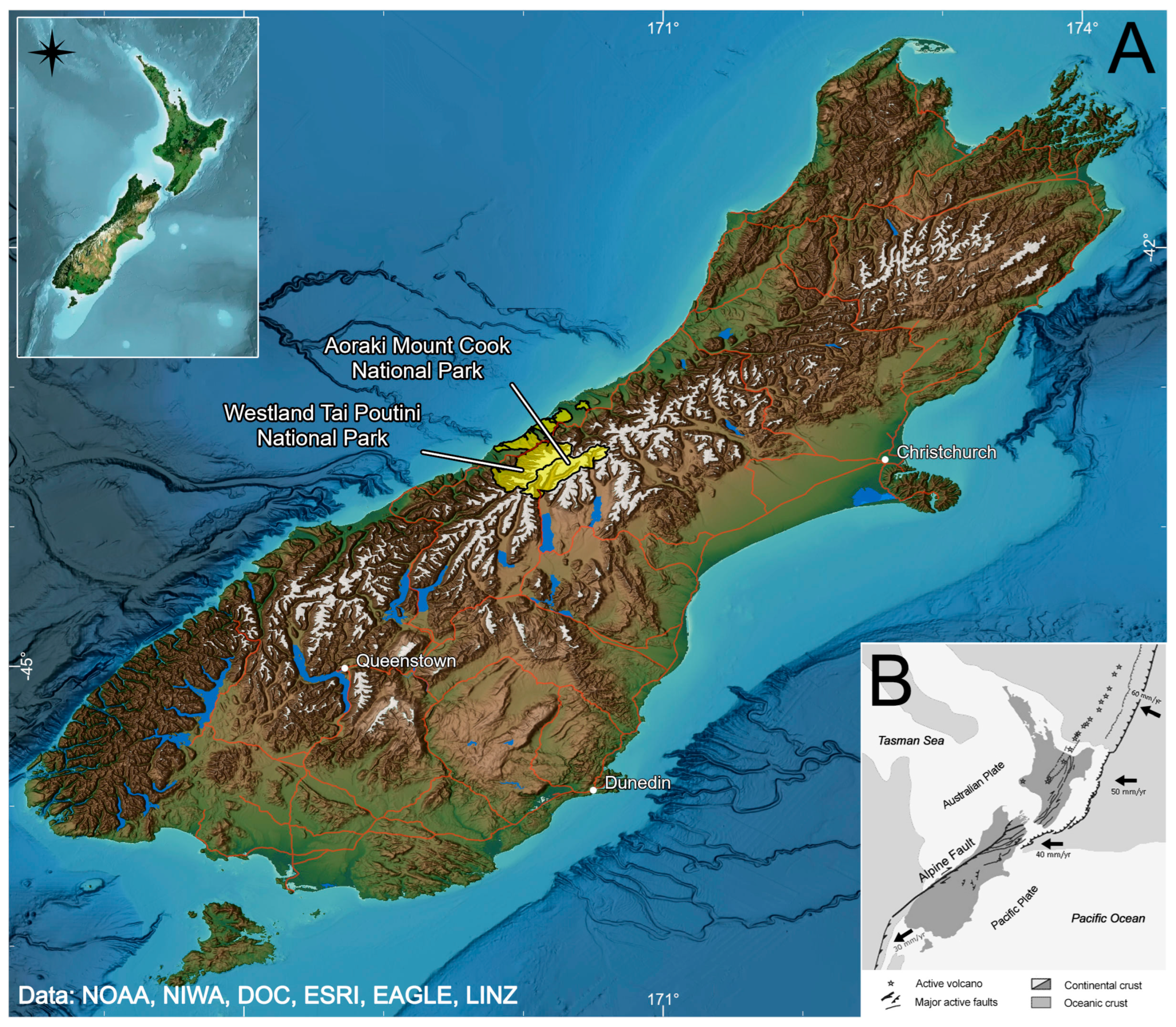
Aoraki Mount Cook National Park (AMCNP) and Westland Tai Poutini National Park (WTPNP) are situated back-to-back on the Main Divide of Kā Tiritiri o te Moana, the Southern Alps of NZ (Figure 1). They contribute to the Te Wāhipounamu World Heritage Area which comprises 2.6 million hectares and includes these and two other national parks (Mount Aspiring and Fiordland) and is recognised as one of the world’s most outstanding natural areas [34]. These parks and their surrounding landscapes are also highly significant to Māori people [35]. Aoraki is an ancestral maunga (mountain) for the Ngāi Tahu iwi (tribe) and the area around Aoraki is the subject of a tōpuni (referring to a protective cloak) that was overlaid on the land under the Ngāi Tahu Claims Settlement Act 1998 [36]. Note that in southern Māori dialect the ‘Ng’ is replaced with a ‘K’ and thus mauka is a mountain, and the iwi is Kāi Tahu. The deep relationships of Kāi Tahu whānui with their tīpuna (ancestors) and whakapapa (genealogy) includes unbroken ties with Aoraki and many other natural features in the landscape (Box 1).
The geography of these national parks reflects a unique combination of tectonic and glacial processes that continue to shape the landscape. The Alpine Fault generates upthrust and mountain-building on the boundary of the Indo-Australian and Pacific continental plates, creating the Southern Alps/Kā Tiritiri o te Moana. At the same time, glaciation and weathering processes have shaped the uplifting mountains with relatively high rates of erosion [37]. All but one of Aotearoa’s 3000 m peaks lie within these parks, with Aoraki (3724 m) being the highest. The Tasman Sea lies just 30 km west of the high peaks of Kā Tiritiri o te Moana, and the unique relationship between the mountains, rivers and sea includes a wide range of erosion and deposition landforms and dynamic processes that contribute to World Heritage status [34].
Access to the parks is primarily from road ends at Aoraki Mount Cook village and the West Coast glacier valleys assisted by a network of public tracks, mountaineering routes and huts maintained by the Department of Conservation and other organisations. Park use and access settings are regulated by zoning instruments and concessions (permits) established under the National Parks Act 1980 and amendments [38]. The process for developing these management settings primarily involves the preparation of National Park Management Plans (NPMPs) following a statutory review cycle. However, the plan review process has been paused since 2019 following a Supreme Court decision that affects the legal framework for the permitting of commercial activities on public conservation lands and waters under The Treaty of Waitangi—a founding document between Māori people and the Crown [39,40].
Box 1. Aoraki Huanui Rau
“Aoraki Huanui Rau” refers to the many paths-or
opportunities-that Aoraki and his whānau provide to people who visit the
Park. Traditionally, the melt waters from Aoraki and his whānau would flow
into Te Manahuna/Mackenzie Basin and sustain populations of waterfowl and
tuna (eels) for Kāi Tahu whānui to harvest during the summer months,
providing sustenance to the iwi. In more modern times, Aoraki and his whānau
provide a multitude of recreation and commercial opportunities for those who
visit, including those who climb up or ski down their slopes, walk the tracks
in their foothills, or take photos of the glaciers, skies, peaks, and lakes
within the Park.”
Source: Department of Conservation [28].
Figure 1.
Overview of key locations mentioned in this study. (A) Aoraki Mount Cook National Park and Westland Tai Poutini National Park, situated back-to-back on the Main Divide of Kā Tiritiri o te Moana, the Southern Alps of Aotearoa New Zealand. (B) Tectonic setting characterised by the Alpine Fault and mountain building at the plate boundary.
2.2. Research Approach
We applied a mixed-method case study approach [41] based on a combination of GIS analyses and recreational data to identify and characterise locations of landscape change that have led to new interactions between people and the park environment. In many cases, these effects involve changes to the accessibility of valued environmental features for recreational opportunities and experiences. We were also interested in the impacts of any management responses to such landscape changes, both positive and negative. In keeping with the relevant legislation and settings typical of national parks as a distinct category of protected areas many recreational activities and non-extractive human uses are permitted and supported [6], particularly where they have low or minimal environmental impacts [38]. Our key data sources were (a) the existing NPMPs including draft proposed NPMPs prepared in 2018 [28,42], (b) a survey of recreationalists with first-hand knowledge of the parks completed by the NZ Alpine Club (NZAC) [43], (c) aerial and site photographs available from personal collections, newsletters and club journals, and (d) geospatial analyses key locations of change identified in the above sources. Two such locations are presented as short case studies that demonstrate the nature and implications of access changes caused by flooding and erosion. These are (1) the Ball Pass route in AMCNP that links two alpine valleys in close proximity to Aoraki, and (2) Fox Glacier/Te Moeka o Tuawe access in WTPNP (see below for details).
2.3. Park User Survey
In this study we drew upon data from an anonymised electronic survey designed by NZAC to identify local knowledge of the parks from within the club membership (n = 3924 people) [43]. NZAC was established in 1891 and is one of the world’s oldest alpine clubs. Club members hold a vast depth of first-hand experience in many aspects of the natural environment and recreational activities in these parks and elsewhere in the NZ mountains. At the time of the survey the average age of club members was 45 yr and the gender split was 72% male and 28% female. The survey ran from 5 to 26 April 2017 and was promoted through a combination of email invitations, social media and club newsletters. Survey responses were collected following the principles of Free and Prior Informed Consent [44] using an information sheet and consent step that was displayed prior to the survey questions. The survey followed a semi-structured format that asked for information on locations of change and their implications for accessibility and recreational use from the perspective of park users. The results presented here summarise the volunteered geographic information (VGI) on locations of change, and thematic analysis of open-ended responses related to erosion and glacial recession following Kitchin and Tate [45] and Boyatzis [46]. The information is specific to respondents who have first-hand knowledge of these national parks (n = 273) and included views from commercial (e.g., guiding) and non-commercial (self-guided) participants in a wide range of summer and winter activities.
2.4. Geospatial Analyses and Case Studies
Multiple digital elevation models (DEMs) were leveraged to illustrate the extent of landscape change in areas identified in the case studies. First, to capture the historic access routes, a 15 m DEM [47] derived from 20 m contours created from aerial imagery captured in 1986 was used alongside the NZMS260 topographic map containing the same 20 m contours. Second, a high-resolution 2 m digital surface model (DSM), where above-ground objects like trees and buildings are included in the model, was generated from an aerial survey of the AMCNP in November 2008 using modern photogrammetry methods [48,49]. Third, a high-resolution 2 m DSM was generated from Pléiades stereo-pair satellite images captured in January 2022 for WTPNP, and February 2022 for AMCNP under the Pléiades Glacier Observatory programme [50], using a combination of manual and automated satellite photogrammetric mapping approach [51,52]. Taken together, we have a 36-year period of analysis of landscape and recreation access changes using the digital elevation data, but with high-resolution change only available over a shorter 14-yr period in AMCNP. The historic access routes were manually digitised from a combination of the NZMS260 maps, historic aerial and oblique photos and local knowledge. The modern-day variants of these routes were digitized from high-resolution satellite and aerial images, and local knowledge. Once the routes were created, the lines were exported to points with 4 m spacing, the elevation values from the 1986 and 2022 DEMs were appended. Geomorphic measures such as total length, total height gain, mean and max slope angles were then calculated using the 4 m interpoint distance to account for the difference in native resolution of the DEMs (15 m vs. 2 m).
The geospatial analyses mostly consider a 36-year period (1986–2022) for which comparable datasets are available. This time frame is generally much less than the longer periods of observation that are represented in the local knowledge data sources but provides a useful assessment of the recent landscape evolution in key locations for recreational activities and public access.
3. Results
3.1. Hotspots of Landscape Change
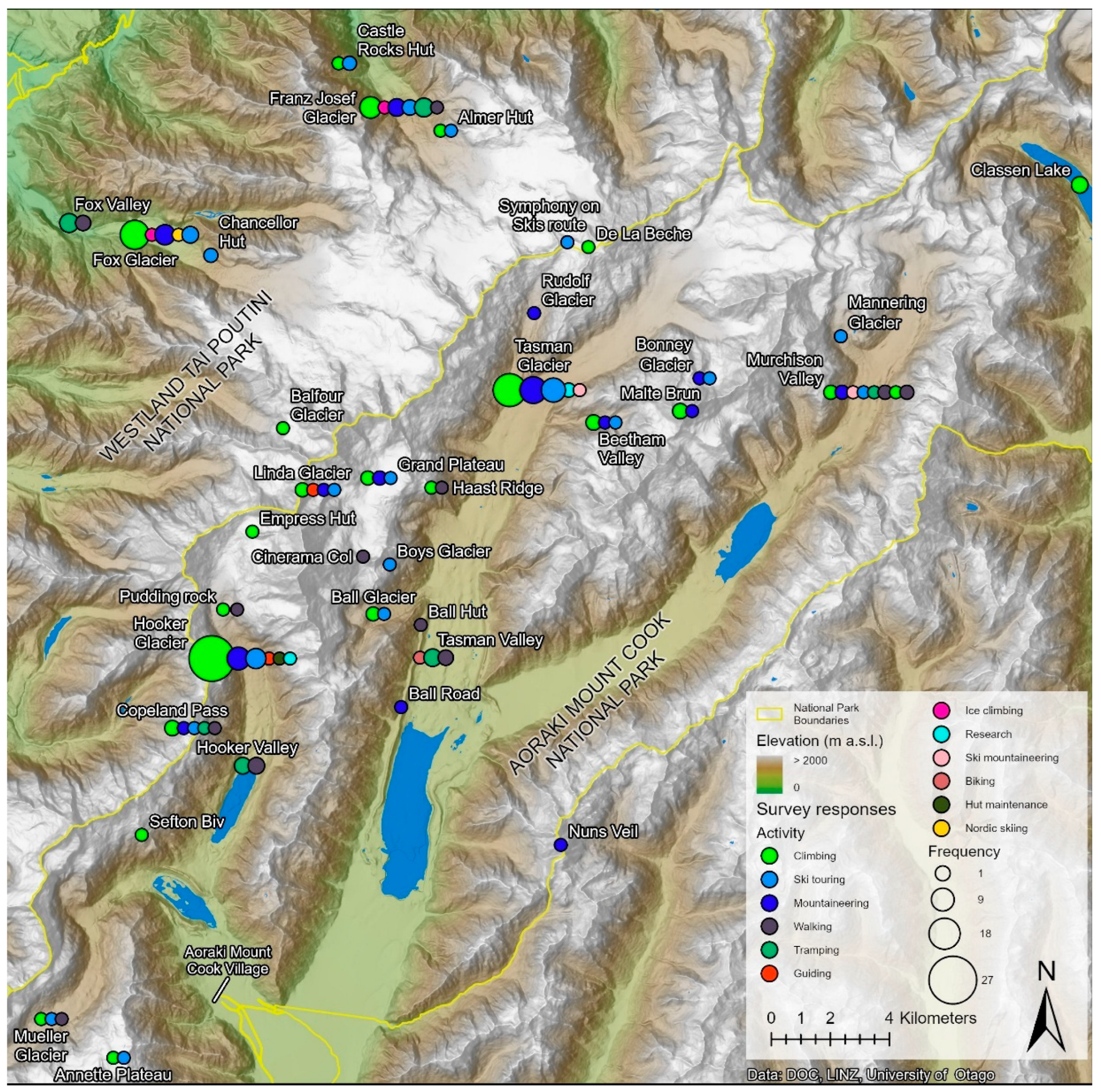
Landscape changes associated with erosion and glacial recession were recorded in 125 (46%) of the NZAC survey responses and involved 36 specific locations across the two national parks. The locations most frequently identified were the Fox, Franz Josef, Tasman and Hooker valleys, Mueller and Murchison glaciers, Annette Plateau, Mannering Glacier and Classen Saddle (Figure 2, Supplementary Material Table S1). Climbing in its various forms was the most frequently identified recreational activity that is affected, followed by walking and tramping, skiing, and general mountaineering (Figure 3, Supplementary Material Table S2). Nearly all respondents identified negative effects associated with these changes. However, 21% also identified at least some positive aspects (Table 1). Thematic analysis of the perspectives on negative impacts identified 93 unique ideas. Those with the highest frequencies involved access becoming ‘more difficult’ (n = 70), or ‘more dangerous’ (n = 37), followed by the degradation of aesthetic qualities of the park landscapes (n = 16). Responses to the complementary question on the potential for positive effects identified 27 unique ideas, with the highest frequencies being ‘more rock climbing’ (n = 8), ‘improved climate change awareness’ (n = 7), and ‘improved understanding of natural change’ (n = 6). In many cases both negative and positive perspectives were reported for the same locations and landscape changes illustrating the likelihood of trade-offs between stakeholder preferences when considering potential management responses (Table 1).
Table 1.
Contrasts between negative and positive effects of erosion and glacial recession in Aoraki Mount Cook and Westland Tai Poutini national parks in Aotearoa New Zealand.
Figure 2.
Hotpots of landscape change in Aoraki Mount Cook and Westland Tai Poutini national parks in Aotearoa New Zealand.
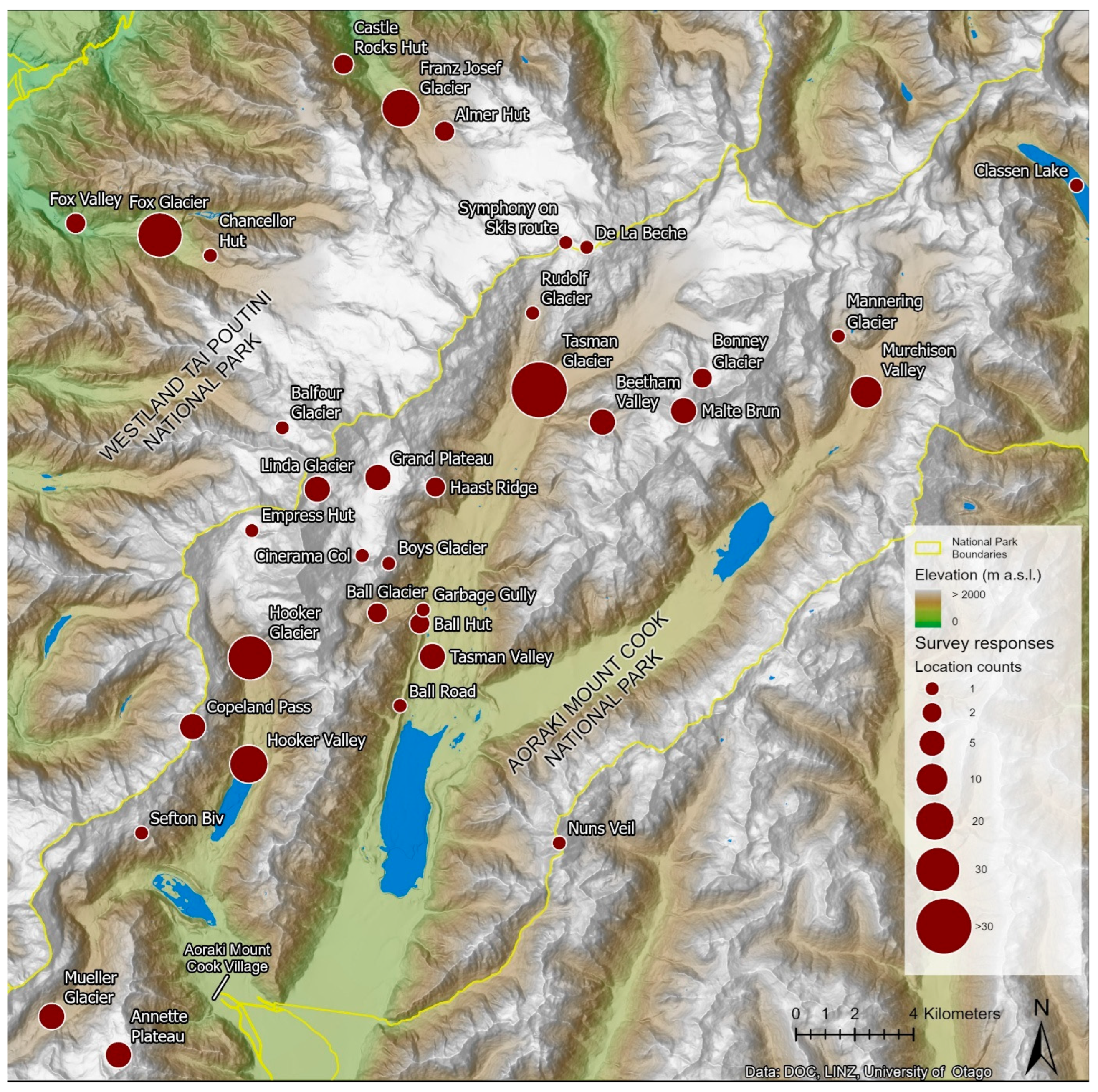
Figure 3.
Activities and locations affected by erosion and glacial recession in Aoraki Mount Cook and Westland Tai Poutini national parks in Aotearoa New Zealand.
3.2. Ball Pass Route and Glacier Access in Aoraki Mount Cook National Park
The iconic Ball Pass route is an alpine crossing which links the Tasman and Hooker valleys via a traverse of Kirikirikatata (Mount Cook Range) (Figure 4). The route along Ball Ridge lies very close to the impressive Caroline Face of Aoraki Mount Cook offering a unique perspective on NZ’s highest mountain. Although the route is often completed as an overnight trip there have been several notable landscape changes that affect its accessibility and character.
3.2.1. Tasman Valley
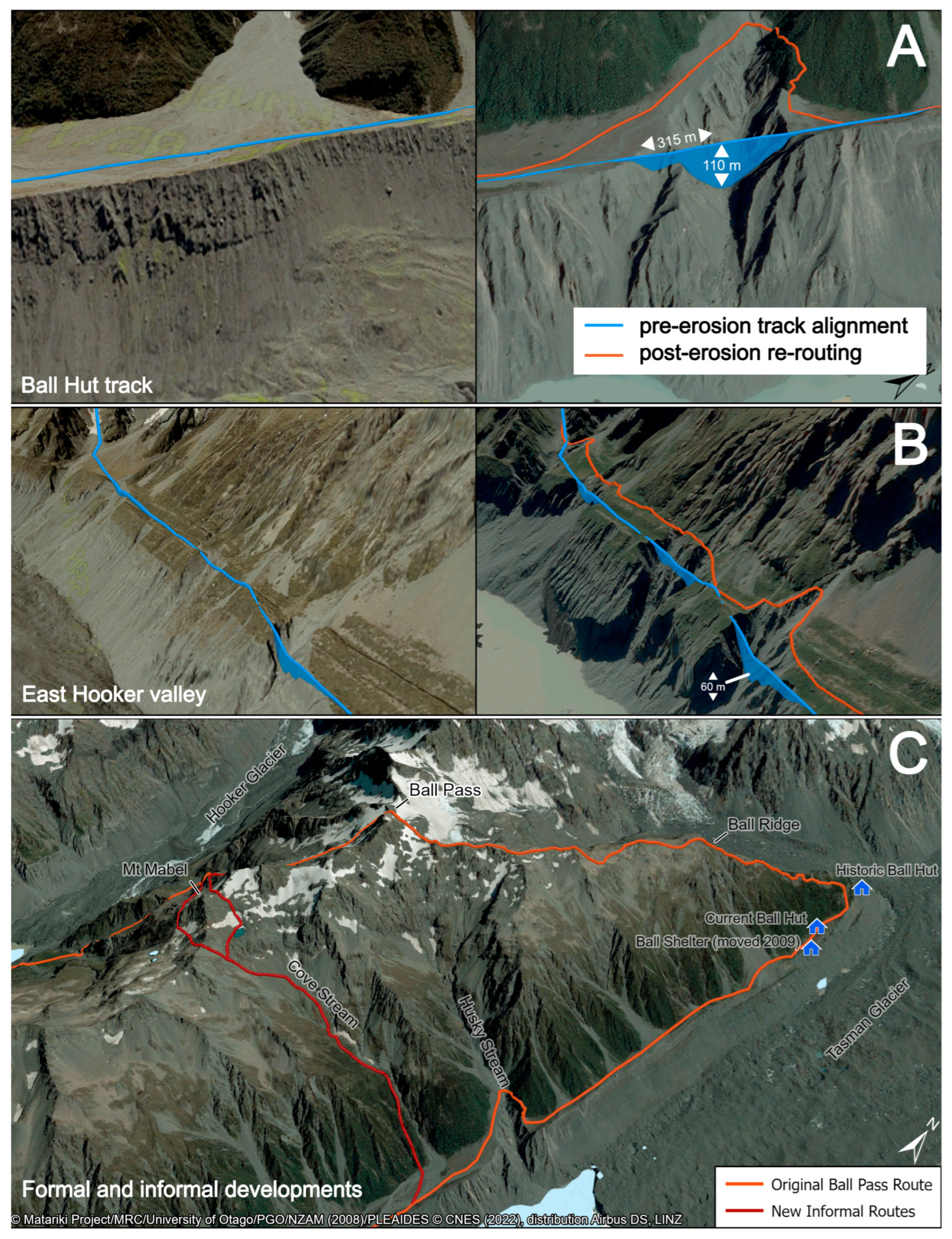
One of the best-known examples of landscape erosion from an extreme event occurred at Husky Flat in the Tasman valley in 2019 and was induced by heavy rainfall. It cut a deep trench across Ball Road, the primary foot access route to the upper Tasman valley. A diversion of over 1300 m is now necessary to avoid the >300 m wide washout (Figure 5A). This was formerly a vehicle access road that extended up valley to the Ball Glacier confluence, which was once a popular skiing destination. This is also the standard access route to Haupapa/Tasman Glacier via ‘Garbage Gully’ near Ball Hut and is thus significant as access to the east-facing terrain of the Main Divide from Aoraki to Elie de Beaumont and other major peaks such in the Malte Brun Range on the opposite side of the valley (Figure 2). From a historical perspective, the Ball Road access has considerable significance as the route used by many early expeditions [22,53].
In addition to the Husky Flat washout, this section of Haupapa/Tasman Glacier moraine wall has retreated markedly in recent years with progressive lowering of the glacier surface and steady growth of the proglacial lake in the depression formerly occupied by the glacier. The terrace that supports Ball Road has progressively narrowed with sections having fallen into the valley in several places. The development of new walking tracks upslope of these eroding sections has been the primary adaptive response to maintain access to Ball Hut. Ongoing erosion of the moraine wall also forced the removal of the original Ball Hut and relocation of its modern-day replacement in 2009/2010 to a new site at the back of the terrace. The combination of changes is already increasing the difficulty and travel time needed to reach Ball Hut and it is likely that further erosion will create more severe challenges in the future.
3.2.2. Hooker Valley
Similar dynamics have also affected the Ball Pass route in the Hooker valley. For example, the same 2019 extreme rain event was associated with a major flood in the Hooker River that started eroding the western buttress of a swing bridge on the Hooker Valley Track, necessitating the replacement of the iconic bridge with a new, multi-million-dollar structure. Other recent physical changes on the Ball Pass route are mostly associated with lateral moraine wall spreading and numerous gully erosion locations that have created problematic crossing points. The primary responses have been the development of bypass routes climbing ever higher on the slope to find new paths of least resistance (Figure 4B). The growth of moraine walls in the vicinity of Hooker Lake has also profoundly affected the traditional access routes to the upper valley and glacier which originates on the western aspects of Aoraki (Figure 2). In the recent past, foot tracks located on vegetated terraces provided relatively straightforward routes around Hooker Lake on both sides of the valley. As in the Tasman Valley, the lowering of the glacier surface and withdrawal of toe support for adjacent hillsides has contributed to the erosion of these terraces and the development of deep ravines at side streams (Supplementary Material Figure S1). The most common response has involved traversing the moraine wall face to bypass Hooker Lake close to water level. However, this solution does not avoid exposure to rockfall hazard from the slopes above that include several sections of highly unstable moraine wall. Other solutions include the use of packrafts or kayaks to negotiate Hooker Lake by water (Supplementary Material Figure S1).
The combination of changes in the Hooker and Tasman Valleys has increased the difficulty of travel and exposure to objective danger along the historic Ball Pass route (Table 2). Landscape changes have increased the total route length by over 1 km (5%), as well as creating more total height gain compared with the historic route (245 m or 13%). The mean slope angle is slightly less steep on the modern variant in comparison to the historic route, though that will in part be due to the derivation of the elevation data and the use of a high-resolution DEM for the modern route variant (Table 2).
Table 2.
Geomorphic metrics associated with changes on the historic Ball Pass route between 1986 and 2022. Data shown are from the route alignments visualised in Figure 5.
Another notable response has been the establishment of new ‘informal’ routes to reach the east Hooker Valley via a spur adjacent to Cove Stream in the Tasman valley (Figure 5C). This option avoids the lower Hooker valley altogether but offers an alternative approach to the upper slopes of the east Hooker where it joins the original route ~1 km to the south of Ball Pass. It also offers a slightly shorter loop-style journey in comparison to the historic Ball Pass traverse and is now commonly used for commercially guided trips.
Figure 4.
Overview of the historic Ball Pass route in Aoraki Mount Cook National Park. (A) Location of Ball Pass and Kirikirikatata (Mount Cook Range) at the foot of Aoraki Mount Cook as viewed from the Ben Ohau Range to the south. (B). As viewed from the lower Tasman valley. (C) Alignment of the original route on the NZMS260 Topographic Map (1999). The location of recent landscape changes at Husky Flat and the east Hooker Valley are also shown, as featured in Figure 5.
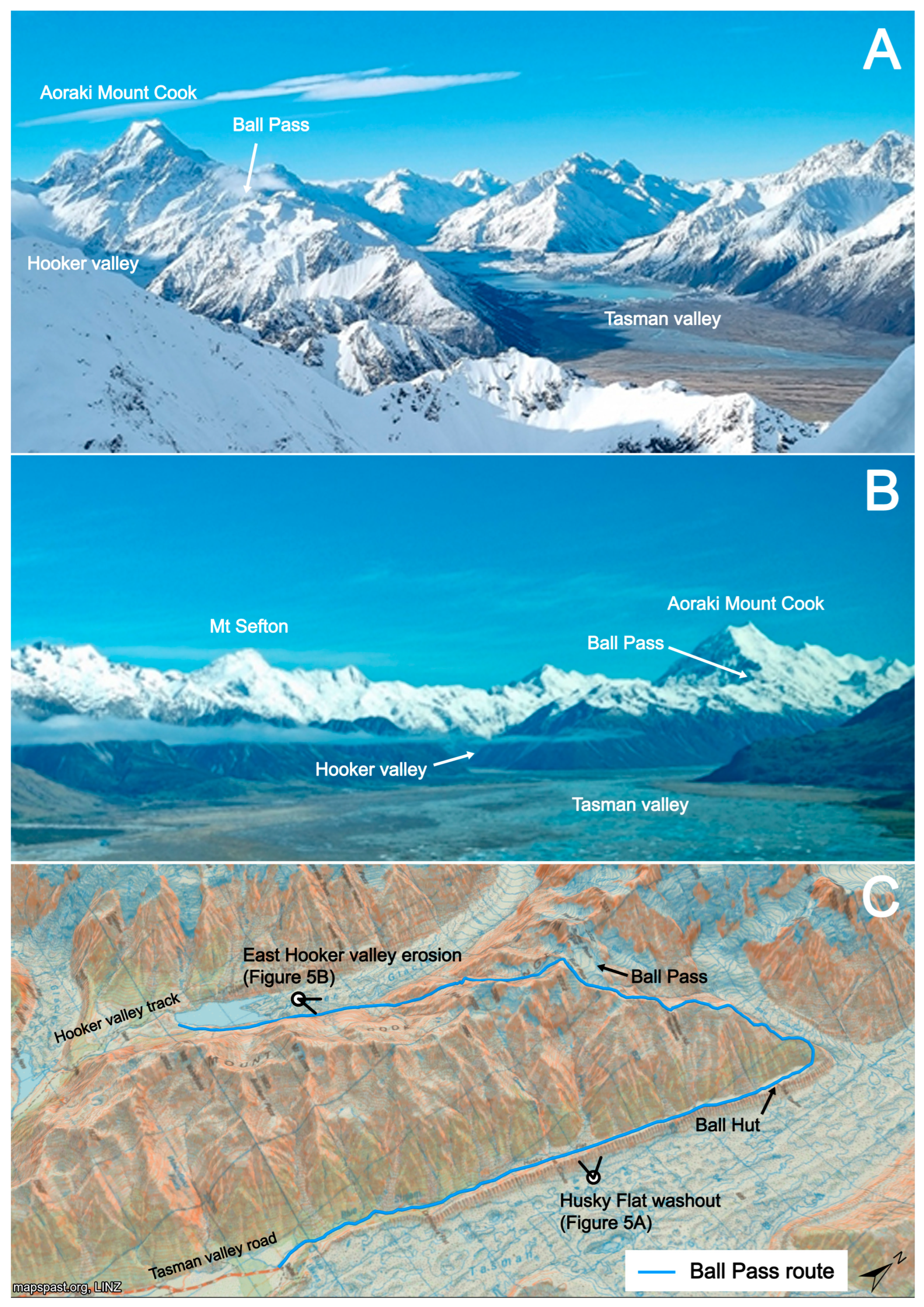
Figure 5.
Impacts of recent erosion on the historic Ball Pass route in Aoraki Mount Cook National Park. (A). Erosion effects associated with major stream erosion at Husky Flat in the Haupapa/Tasman Glacier valley in 2019. The imagery shows the route in 2008 (left) and 2022 (right). (B) Erosion effects in the Hooker valley between 2008 (left) and 2022 (right) including the development of multiple gullies and valley widening with retreat of the moraine wall. (C) Access-related responses to the evolving landscape have included removal of the original Ball Hut, relocation of the modern-day Ball Hut and development of new informal routes to Ball Pass via Cove Stream in addition to the historical route variants.
3.3. Fox Glacier/Te Moeka o Tuawe Access in Westland Tai Poutini National Park
Fox Glacier/Te Moeka o Tuawe and Franz Josef Glacier/Kā Roimata o Hine Hukatere are defining features of Westland Tai Poutini National Park (WTPNP) on the South Island’s West Coast. They are relatively large valley glaciers that extend to low elevations in temperate rainforest (Figure 2). Access issues at these glaciers are particularly notable for their intersection with public infrastructure and commercial operations that contribute to established tourism industries at both glaciers [20]. The core infrastructure includes glacier access roads, car parks and road-head facilities catering for large numbers of visitors both domestic and international.
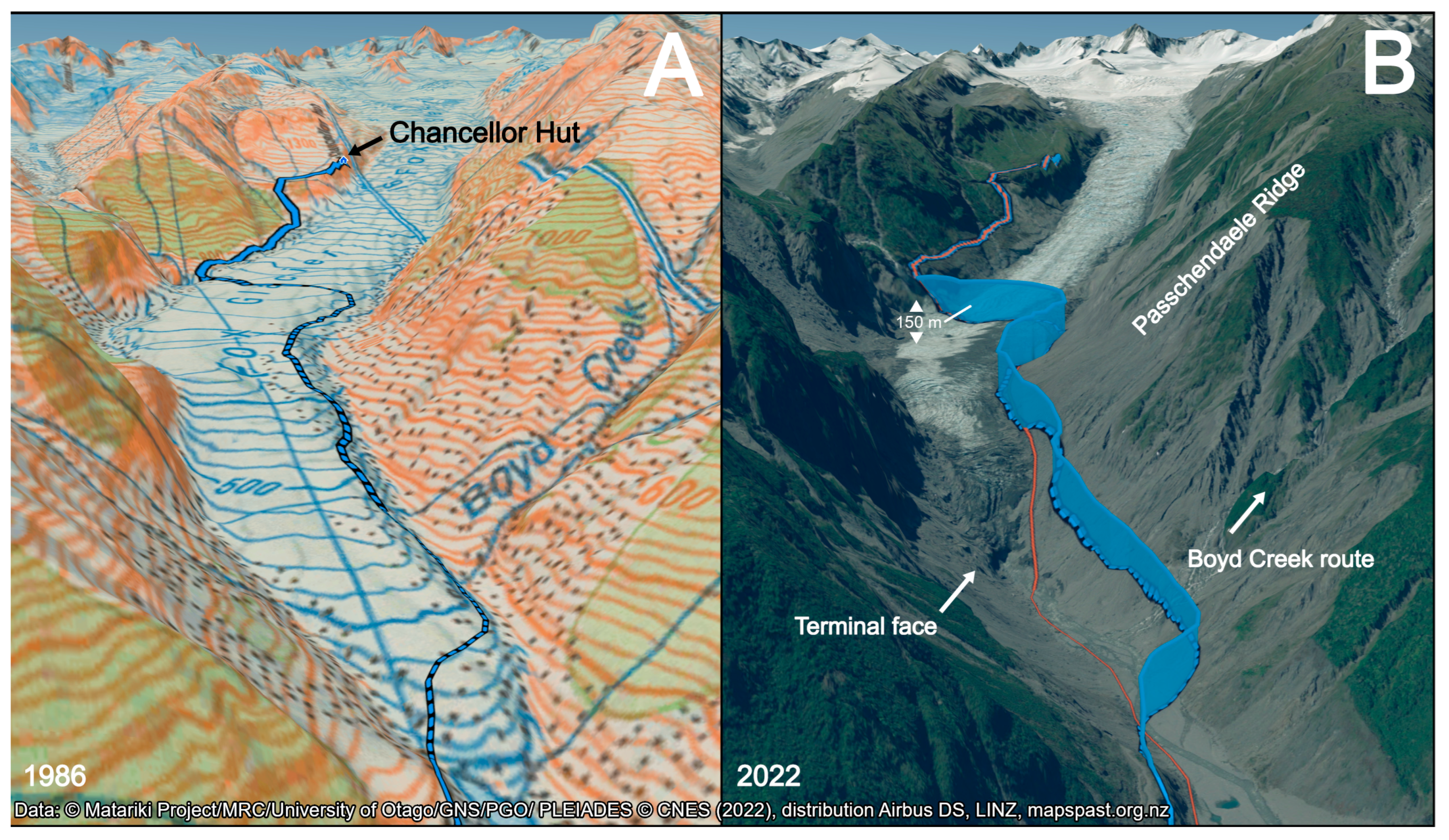
In recent years, the terminal faces of both glaciers have experienced rapid retreat that is particularly notable at Fox Glacier/Te Moeka o Tuawe (Figure 6). Associated changes in the public access landscape include the rapid evolution of terminal face instabilities and rockfall hazard zones that affect public trails and mountaineering access routes [21,54]. The sheer magnitude of glacial ice loss is a notable influence as illustrated by the dramatic changes to the Chancellor Hut route that is the primary access and egress route from the upper névé (Figure 7). Influences on accessibility include the interface between rock and ice which has become increasingly difficult to negotiate at Victoria Flat, the technical crux of the route, and new requirements for riverbed travel in the lower valley where the glacier is no longer present (Table 3). Similarly, the adjacent Boyd Creek route to and from the upper névé via Passchendaele Ridge no longer requires travel on the lower glacier and may instead require a river crossing (Figure 7).
Table 3.
Geomorphic metrics associated with changes on the historic Chancellor Hut route at Fox Glacier/Te Moeka o Tuawe between 1986 and 2022. Data shown are from the route alignments visualised in Figure 6.
In contrast to the Ball Pass case study, a long history of management actions have been implemented to address the changing landscape at the West Coast glaciers. As with the Husky Flat event, however, major damage to the Fox Glacier/Te Moeka o Tuawe access road (including the erosion of over 150 m of road) has resulted from recent extreme events including a major landslide on 22 February 2019 and riverbank erosion from flooding on 26–27 March [55,56]. The severity of the damage and ongoing exposure to the Alpine Gardens landslide (NZ’s largest active landslide) led to the abandonment of previous road-head facilities and permanent closure of the access road [55]. Since then, new foot access routes have been developed on the other side of the valley to support recreational access and guided tourism operations [54] and other notable effects related to tourism activities include a steady increase in aircraft movements in the valley [42]. Alongside the financial and strategic challenges for park management agencies, the combination of physical changes and responses illustrates some of the many implications for commercial and non-commercial park users.
Figure 6.
Satellite imagery over four decades reveals the massive extent of ice loss and development of new paraglacial surfaces at Fox Glacier/Te Moeka o Tuawe in Westland Tai Poutini National Park (WTPNP). Source data: Google, Landsat, Copernicus, Maxar Technologies, CNES, Airbus, Planet.com.
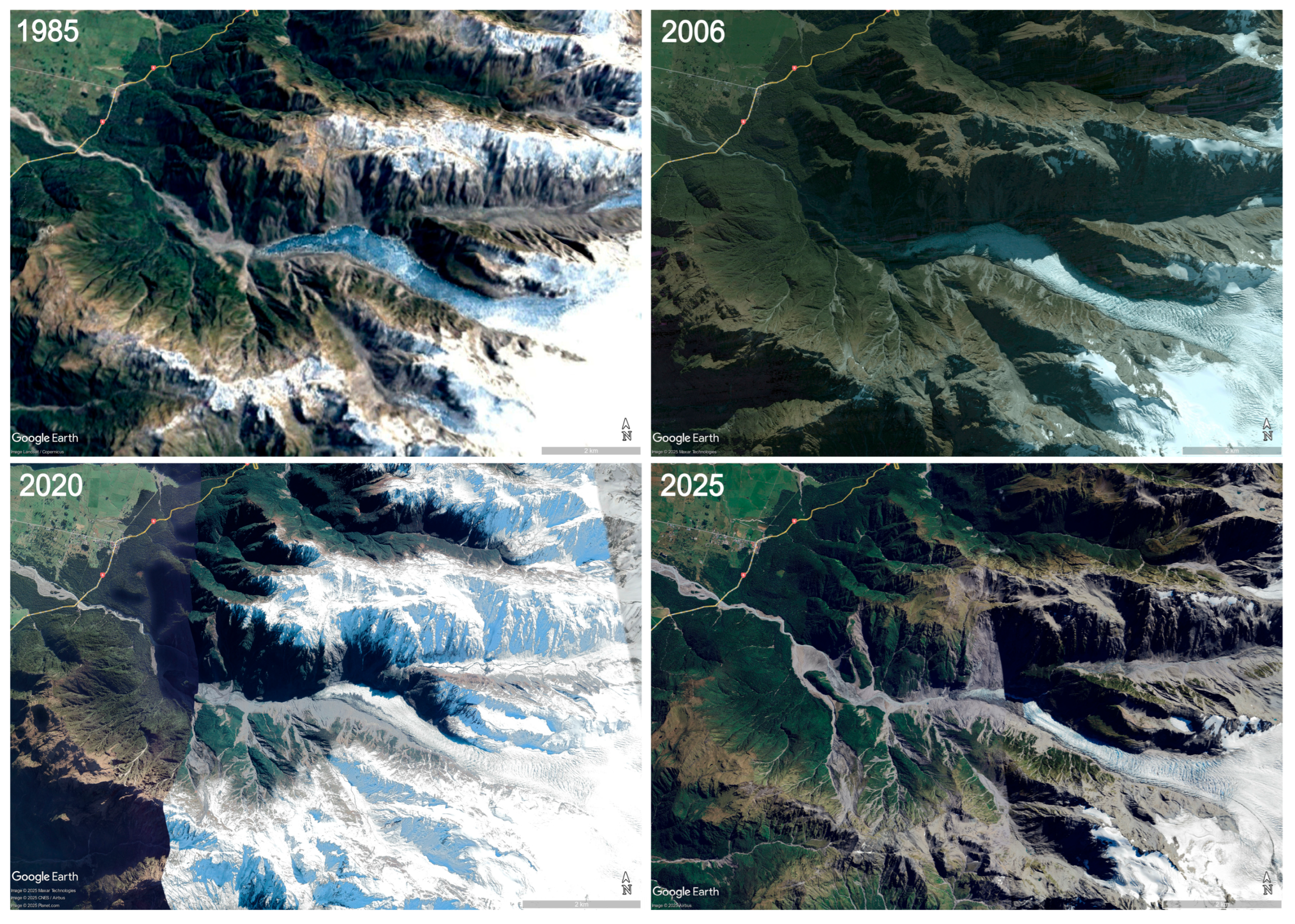
Figure 7.
Visualisation of key landscape changes affected the historic Chancellor Hut route at Fox Glacier/Te Moeka o Tuawe showing original route (blue) and modern variant (orange) in a vastly altered landscape. (A) NZMS260 (1995) draped on 1986 DEM. (B) 2022 ortho image draped on 2022 DEM.
4. Discussion
4.1. Public Access as a Focus for Environmental Management
Protected areas and OECMs are a cornerstone of nature conservation efforts and include many traditional management approaches that significantly pre-date the establishment of modern day protected area networks [57,58,59,60]. National parks are contemporary and globally important examples that provide protection for iconic environments and ecosystems [6,61]. Their management generally strives to protect these values while enabling activities that are consistent with them (e.g., outdoor recreation) [62,63]. Nature-based activities in national parks also represent opportunities for the public to experience relatively unmodified areas and geographically rare natural features [64]. In turn, these experiential and educational opportunities can help to maintain human–environment connections, promote environmental understanding and instil a conservation ethic [4,65].
The accelerating pace of climate change presents significant challenges for protected areas management [66,67,68,69,70]. Changing relationships between public access and patterns of human use are just one set of management considerations alongside many others such as the shifting distribution of species and ecosystems [70,71]. However, we contend that the shifting landscape of public access is a ubiquitous consideration due to the many people-centric functions of parks and reserves which contribute to their key functions as conservation approaches. Although exceptions may be found in strict nature reserves where people are largely excluded (sensu. IUCN Category Ia)—this protected area management category is a relatively small proportion of the protected area estate globally [6].
This study highlights the implications of landscape change for the management of public access in national parks as an important category of protected areas. The institutional frameworks for establishing and managing such parks have mostly evolved in an era where attention to a changing climate was not an overt consideration. In contrast, there is now an urgent need for the development and implementation of adaptation strategies to tackle the effects of environmental changes that are linked with global warming [14,72]. The islands of NZ exemplify these challenges as dynamic and fast-evolving landscapes [37,73]. Physical landscape changes are prominent in the Southern Alps/Kā Tiritiri-o-te-Moana where a combination of geology, tectonic displacement and climate drives ongoing and episodic erosion that is often triggered by hydrological hazards such as flooding, debris flows and snow avalanches [49,73,74,75,76,77]. As is occurring elsewhere globally, climate change is increasing the rate and magnitude of landscape evolution processes in comparison to recent history [14,31].
4.2. Human Dimensions
The case studies featured in this paper provide insights into the potential impacts of access changes and management alternatives. Extreme events often act as a trigger for the development of anthropogenic responses (e.g., to address loss or damage to infrastructure) or more strategic adaptive planning that may consider future risks and scenarios. Importantly, human responses may occur through formal management systems or much more informally, such as through the re-shaping of recreational practices and preferences within various stakeholder groups (Table 4). Examples of the latter include the establishment of new routes by park users to Ball Pass (Figure 5C) and new approaches for circumventing Hooker Lake (Supplementary Material, Figure S1).
Table 4.
Contrasts between informal and formal management adaptive responses to address the effects of landscape change on public access to natural areas such as national parks †.
In the following sections we discuss three critical dimensions of public access management that are widely transferable to other conservation and environmental management contexts.
These are
- Providing access that supports the core functions of protected areas;
- Evaluating the impacts of both physical changes and human responses to them;
- Managing tensions between stakeholder preferences.
4.3. Providing Access That Supports the Core Functions of Protected Areas
In recent years the prevailing Western conceptualisation of protected areas has, arguably, expanded to include a greater range of roles associated with livelihoods and economic development [78,79]. However, clarity around the core functions of protected areas remains a fundamental necessity in any given context. Moreover, there is significant potential for the development of shifting baselines where a progression of environmental impacts leads to a new norm in the level of modification that is considered acceptable [80]. These aspects are among the key considerations when developing appropriate management settings for access in protected areas, especially where they are associated with infrastructure or disturbance activities. These same considerations are vitally important in post-disaster recovery contexts where existing management settings may be challenged.
Post-disaster contexts would be ideally addressed through adaptive planning that seeks alternative options for maintaining access whilst ensuring consistency with the policy setting. In some cases, however, there may be a lack of alternatives that are suitable and feasible within the bounds of budgetary constraints and competing priorities. An unfortunate consequence may be the loss of previous infrastructure (e.g., bridges) or natural features that act as an aid to access (e.g., river terraces and beaches), resulting in a more difficult or dangerous access landscape. Examples of human responses in this study include the relocation/rebuilding of Ball Hut and abandonment of the Fox Glacier/Te Moeka o Tuawe access road and road-end facilities. It is also important to recognise the potential for similar processes to increase the accessibility of previously difficult or dangerous locations through the removal of objective hazards or impassable barriers. Examples include the effects of tectonic uplift in the 2016 Kaikōura earthquake that resulted in coastal beaches becoming more accessible to off-road vehicle leading to a new pattern of human interactions and impacts [81].
Overarching and transferable principles include the need for management responses to hazards such as flooding and erosion to remain consistent with the core functions and purposes of the management unit or area. This will inevitably require a specific focus on the underlying statutory setting but may be challenged by norms and expectations that have built up in relatively stable times, such as where the public are accustomed to the presence of access infrastructure that may ultimately be impermanent.
As is generally the case, the role and rationale for NZ national parks is conferred by legislation developed specifically for that purpose [38]. In the context of the case studies featured here it forms the central touchstone and evaluation framework for gauging the suitability of management alternatives. Statutes such as this represent a significant investment and strategic direction that has been set down through previous societal processes for the benefit of future generations. While new strategic directions may also be contemplated through appropriate processes, it is vitally important that post-disaster responses do not usurp previous commitments under the guise of emergency management.
4.4. Impacts of Both Physical Changes and Human Responses to Them
This study highlights the central role of human responses in shaping the social and ecological impacts of hazard events in natural environments. Similarly, other studies have noted that management responses to environmental change are themselves a source of impacts [15]. This can be clearly seen at Fox Glacier/Te Moeka o Tuawe and other NZ glaciers where increased aircraft traffic has been permitted as a response to a succession of glacier access difficulties faced by tourism operators [21,26]. As in many countries, the increasing demand for tourism in national parks presents challenges for the continued achievement of nature conservation objectives [78]. This situation is further complicated by the effects of landscape change on existing tourism operations which are often reliant on pre-existing conditions and may have limited adaptive capacity.
This sequence of events is becoming common in the glacier tourism sector where studies have highlighted recent departures from business-as-usual operations towards more transformative responses that were triggered by environmental changes affecting access [82,83]. Such adaptations include the irony of carbon-intensive access modes being increasingly relied upon to address environmental changes caused by global warming [20,26,84]. As with decisions on investments in access infrastructure (e.g., walking tracks, bridges or huts), the key questions often concern the limits of acceptable change in relation to the policy setting [85]. It is becoming increasingly important that proposals which would alter the characteristics of public access to protected areas are informed by robust assessments of their potential impacts on existing values and established objectives [86,87].
4.5. Managing Tensions Between Stakeholder Preferences
Addressing the varying interests of stakeholder groups adds a further human dimension that can markedly influence responses to environmental change and longer-term climate change adaptation. In addition to tensions between commercial and non-commercial uses of the same destinations and resources, these considerations include competing preferences among non-commercial user groups on issues such as motorised access. Resolving these tensions is particularly crucial for the management of relatively unmodified areas that support opportunities to experience wild nature and are often dependent on their remoteness setting [88,89]. The maintenance of such areas is influenced by both their physical proximity to access points (e.g., road-ends) and the difficulty of travel for accepted and permitted access modes. As such they are directly threatened by proposals that would ‘open up’ access in relation to previous settings.
Globally, there are many examples of natural resources having become overexploited due to this sequence of events which, for the most part, are irreversible [85,86,87]. While changes to the accessibility of wild areas are only one of the relevant considerations for their management (alongside others such as environmental controls for extractive uses), the characteristics of access to place-based natural resources often plays a central role in mediating the human–environment relationships that take place in those locations [18]. For example, areas free of motorised access are often small in comparison to those supporting other recreational opportunities [90,91], and in many cases, their extent has already been progressively reduced by the cumulative impacts of progressive developments [64,92,93,94].
In relation to protected areas management (and elsewhere) these aspects are substantially influenced by the availability of access infrastructure (e.g., bridges) or permitted equipment (e.g., mechanised transport), both of which are directed by formal management settings and often contested by stakeholders. There is a further notable intersection with the development and popularisation of backcountry access equipment and technologies (e.g., e-bikes and packrafts). Additionally, new activity trends may develop in response to new opportunities that are afforded by changing landscapes and features as documented in this study (e.g., aquatic recreation on newly formed glacial lakes). These same changes may be identified as beneficial aspects of climate change from the perspective of some user groups illustrating the plurality of perspectives (e.g., Table 1). From a management standpoint, these human dimensions are the key point of focus when evaluating situations such as loss or damage to access infrastructure, and similarly for assessing the impacts of new activities that may be proposed as responses to environmental changes. Competing stakeholder preferences should be expected given that the overall context is one of change.
5. Conclusions
This study identifies and characterises the need for an improved focus on public access in relation to natural resource management and climate change adaptation. Many of the specific effects identified in our national park case studies are transferable to other forms of protected areas and OECMs. Our results highlight the existence of both positive and negative aspects of changing landscapes that include examples of where the same geophysical change is perceived differently by different stakeholders. Moreover, significant adverse impacts can be generated by park management changes in response to these events, creating a need to guard against maladaptation. These considerations are perhaps most apparent in connection with proposals for new forms of access that would require a change in the protective components of existing management settings.
Addressing the public access dimensions that are illustrated in this paper requires specific evaluation against park management objectives; yet such evaluations are relatively scarce in practice. In contrast, there are numerous examples of visitor perception studies that purport to be relevant to protected areas management on the grounds of characteristics such as visitor motivations, willingness to pay, or perceived risks to desired activities. Far fewer studies have a focus on the impact of changes to park management that may be proposed in response to such studies, despite their greater relevance to the needs of protected area managers and the wider community of stakeholders. Future studies might indeed compare findings from perception studies with the findings of landscape change studies to help determine how access arrangements can best adapt to changing circumstances while remaining consistent with the overarching policy setting and core goals of protected areas. There is also a need for further research on the specific effects of environmental changes on existing human activities, many of which are mediated by access changes. In combination, these suggestions provide a comprehensive basis for incorporating public access in climate change adaptation and post-disaster recovery decisions for protected areas management.
Supplementary Materials
The following supporting information can be downloaded at: https://www.mdpi.com/article/10.3390/geohazards7010012/s1, Figure S1 Examples of landscape erosion and recreational access responses in the Hooker Valley in Aoraki Mount Cook National Park (ACMNP). (A) View across Hooker Lake to the east Hooker Valley where the historic Ball Pass route sidles across the vegetated terraces visible in the right of the image. (B) View of the same area taken from across the valley opposite Mt Mabel. The arrow points to Ball Pass. Note eroding sections of the former terraces that are associated with the growth of moraine walls. (C) Packrafts provide an alternative access for mountaineering that avoids the objective hazards posed by unstable moraine walls. Table S1: Location of landscape changes associated with glacial recession in Aoraki Mount Cook and Westland Tai Poutini national parks as identified by New Zealand Alpine Club members [43]. These locations are mapped in Figure 2. Table S2: Recreational activities affected by glacial recession in Aoraki Mount Cook and Westland Tai Poutini national parks as identified by New Zealand Alpine Club members [43]. The locations involved are mapped in Figure 3.
Author Contributions
Conceptualization, S.O. and A.M.; methodology, S.O., A.M. and P.S.; formal analysis, S.O. and A.M.; investigation, S.O. and A.M.; resources, S.O., A.M. and P.S.; data curation, S.O., A.M. and P.S.; writing—original draft preparation, S.O.; writing—review and editing, S.O., A.M. and P.S.; visualization, S.O. and A.M. All authors have read and agreed to the published version of the manuscript.
Funding
This project used methodological approaches developed with funding and support from the University of Otago research grant “Glaciers in the picture”, grant number ORG-0118-0319, GNS research grant “Topographic mapping of Franz Josef glacier”, grant number GNS-DCF00043, and the Ministry of Business, Innovation & Employment (MBIE) Endeavour Smart Idea research project “Quantifying environmental resources through high-resolution, automated, satellite mapping of landscape change”, Matariki project, grant number UOOX1914, www.otago.ac.nz/surveying/potree/pub/mrc/projects/matariki.
Data Availability Statement
The original contributions presented in this study are included in the article/Supplementary Material. Further inquiries can be directed to the corresponding author.
Acknowledgments
We thank members of the NZAC Recreational Access Committee who developed the park user survey and are particularly grateful to the survey respondents for sharing their local knowledge and perspectives. We also acknowledge the use of New Zealand eScience Infrastructure (NeSI) high performance computing facilities and support services as part of this research. New Zealand’s national facilities are provided by NeSI and funded jointly by NeSI’s collaborator institutions and through MBIE’s Research Infrastructure programme (www.nesi.org.nz). Pléiades satellite imagery used for this project was made available through the Pléiades Glacier Observatory (PGO) initiative [50].
Conflicts of Interest
Author Shane Orchard is Director of the company Waterlink Ltd. The remaining authors declare that the research was conducted in the absence of any commercial or financial relationships that could be construed as a potential conflict of interest.
References
- Brackhane, S.; Schoof, N.; Reif, A.; Schmitt, C.B. A new wilderness for Central Europe?—The potential for large strictly protected forest reserves in Germany. Biol. Conserv. 2019, 237, 373–382. [Google Scholar] [CrossRef] [Scilit]
- Locke, H.; Dearden, P. Rethinking protected area categories and the new paradigm. Environ. Conserv. 2005, 32, 1–10. [Google Scholar] [CrossRef] [Scilit]
- Wilkie, D.S.; Morelli, G.A.; Demmer, J.; Starkey, M.; Telfer, P.; Steil, M. Parks and people: Assessing the human welfare effects of establishing protected areas for biodiversity conservation. Conserv. Biol. 2006, 20, 247–249. [Google Scholar] [CrossRef] [Scilit] [PubMed]
- West, P.; Igoe, J.; Brockington, D. Parks and peoples: The social impact of protected areas. Annu. Rev. Anthropol. 2006, 35, 251–277. [Google Scholar] [CrossRef] [Scilit]
- Zube, E.H.; Busch, M.L. Park-people relationships: An international review. Landsc. Urban Plan. 1990, 19, 117–131. [Google Scholar] [CrossRef] [Scilit]
- Dudley, N. Guidelines for Applying Protected Area Management Categories; IUCN: Gland, Switzerland, 2008. [Google Scholar]
- Tran, T.C.; Ban, N.C.; Bhattacharyya, J. A review of successes, challenges, and lessons from Indigenous protected and conserved areas. Biol. Conserv. 2020, 241, 108271. [Google Scholar] [CrossRef] [Scilit]
- Stevens, S.E. Indigenous Peoples, National Parks, and Protected Areas: A New Paradigm Linking Conservation, Culture, and Rights; University of Arizona Press: Tucson, AZ, USA, 2014. [Google Scholar]
- IUCN-WCPA Task Force on OECMs. Recognising and Reporting Other Effective Area-Based Conservation Measures; IUCN: Gland, Switzerland, 2019. [Google Scholar]
- Olive, R.; Wheaton, B. Understanding blue spaces: Sport, bodies, wellbeing, and the sea. J. Sport Soc. Iss. 2021, 45, 3–19. [Google Scholar] [CrossRef] [Scilit]
- Wheeler, B.W.; White, M.; Stahl-Timmins, W.; Depledge, M.H. Does living by the coast improve health and wellbeing? Health Place 2012, 18, 1198–1201. [Google Scholar] [CrossRef] [Scilit]
- Kabisch, N.; van den Bosch, M.; Lafortezza, R. The health benefits of nature-based solutions to urbanization challenges for children and the elderly—A systematic review. Environ. Res. 2017, 159, 362–373. [Google Scholar] [CrossRef] [Scilit]
- Nordh, H.; Østby, K. Pocket parks for people—A study of park design and use. Urban For. Urban Green. 2013, 12, 12–17. [Google Scholar] [CrossRef] [Scilit]
- IPCC. Climate Change 2023: Synthesis Report. Contribution of Working Groups I, II and III to the Sixth Assessment Report of the Intergovernmental Panel on Climate Change; IPCC: Geneva, Switzerland, 2023. [Google Scholar]
- Turner, B.A.; Pidgeon, N.F. Man-Made Disasters, 2nd ed.; Butterworth-Heinemann: Boston, MA, USA, 1997. [Google Scholar]
- Davis, S.; McAlear, Z.; Plovnick, A.; Wilkerson, A. Trails and Resilience: Review of the Role of Trails in Climate Resilience and Emergency Response; U.S. Department of Transportation: Cambridge, MA, USA, 2023.
- Jellard, S.; Bell, S.L. A fragmented sense of home: Reconfiguring therapeutic coastal encounters in COVID-19 times. Emot. Space Soc. 2021, 40, 100818. [Google Scholar] [CrossRef] [Scilit]
- Orchard, S.; Reiblich, J.; dos Santos, M.D. Public coastal access: Emerging issues and potential solutions. Mar. Policy 2025, 179, 106759. [Google Scholar] [CrossRef] [Scilit]
- Thom, B. Future challenges in beach management as contested spaces. In Sandy Beach Morphodynamics; Jackson, D.W.T., Short, A.D., Eds.; Elsevier: Amsterdam, The Netherlands, 2020; pp. 711–731. [Google Scholar]
- Stewart, E.J.; Wilson, J.; Espiner, S.; Purdie, H.; Lemieux, C.; Dawson, J. Implications of climate change for glacier tourism. Tour. Geogr. 2016, 18, 377–398. [Google Scholar] [CrossRef] [Scilit]
- Purdie, H. Glacier retreat and tourism: Insights from New Zealand. Mt. Res. Dev. 2013, 33, 463–472, 410. [Google Scholar] [CrossRef] [Scilit]
- Frost, R. Aoraki Tai Poutini. A Guide for Mountaineers; New Zealand Alpine Club: Christchurch, New Zealand, 2018. [Google Scholar]
- Orchard, S. Backcountry Ski-Touring in New Zealand: A Guide to New Zealand’s Best Backcountry Terrain; New Zealand Alpine Club: Christchurch, New Zealand, 2018. [Google Scholar]
- Department of Conservation. Westland Tai Poutini National Park Management Plan—Amended 4 April 2014; Department of Conservation: Wellington, New Zealand, 2014.
- Department of Conservation. Aoraki/Mount Cook National Park Management Plan; Department of Conservation: Wellington, New Zealand, 2004.
- Purdie, H.; Hutton, J.H.; Stewart, E.; Espiner, S. Implications of a changing alpine environment for geotourism: A case study from Aoraki/Mount Cook, New Zealand. J. Outdoor Recreat. Tour. 2020, 29, 100235. [Google Scholar] [CrossRef] [Scilit]
- Wilson, L.; Purdie, H.; Stewart, E.; Espiner, S. Environmental Change and Tourism at Aoraki/Mt Cook National Park; Leap Report No. 41; Lincoln University: Lincoln, New Zealand, 2015. [Google Scholar]
- Department of Conservation. Draft Aoraki/Mount Cook National Park Management Plan; Department of Conservation: Wellington, New Zealand, 2018.
- Sommer, C.; Malz, P.; Seehaus, T.C.; Lippl, S.; Zemp, M.; Braun, M.H. Rapid glacier retreat and downwasting throughout the European Alps in the early 21st century. Nat. Commun. 2020, 11, 3209. [Google Scholar] [CrossRef] [Scilit] [PubMed]
- Hugonnet, R.; McNabb, R.; Berthier, E.; Menounos, B.; Nuth, C.; Girod, L.; Farinotti, D.; Huss, M.; Dussaillant, I.; Brun, F.; et al. Accelerated global glacier mass loss in the early twenty-first century. Nature 2021, 592, 726–731. [Google Scholar] [CrossRef] [Scilit]
- Huss, M.; Bookhagen, B.; Huggel, C.; Jacobsen, D.; Bradley, R.S.; Clague, J.J.; Vuille, M.; Buytaert, W.; Cayan, D.R.; Greenwood, G.; et al. Toward mountains without permanent snow and ice. Earth’s Future 2017, 5, 418–435. [Google Scholar] [CrossRef] [Scilit]
- IPCC. IPCC Special Report on the Ocean and Cryosphere in a Changing Climate. Summary for Policymakers; IPCC: Geneva, Switzerland, 2019. [Google Scholar] [CrossRef] [Scilit]
- Slaymaker, O. Proglacial, periglacial or paraglacial? Geol. Soc. Lond. Spec. Publ. 2009, 320, 71–84. [Google Scholar] [CrossRef] [Scilit]
- IUCN. World Heritage Area Nomination—IUCN Summary. South West New Zealand World Heritage Area (Te Wahipounamu); IUCN: Gland, Switzerland, 1990. [Google Scholar]
- Te Whaiti, K. Understanding Aoraki. Te Karaka 2012, 54, 13. [Google Scholar]
- New Zealand Government. Ngāi Tahu Claims Settlement Act 1998; Reprint as at 1 August 2020; New Zealand Government: Wellington, New Zealand, 1998.
- Williams, P.W. Tectonic geomorphology, uplift rates and geomorphic response in New Zealand. Catena 1991, 18, 439–452. [Google Scholar] [CrossRef] [Scilit]
- New Zealand Government. National Parks Act 1980; Version as at 5 April 2025; New Zealand Government: Wellington, New Zealand, 2025.
- New Zealand Government. Responding to the Ngāi Tai ki Tāmaki Supreme Court Decision and Giving Effect to Treaty Principles in Conservation; New Zealand Government: Wellington, New Zealand, 2018.
- Supreme Court of New Zealand. Ngāi Tai ki Tāmaki Tribal Trust v Minister of Conservation; Supreme Court of New Zealand: Wellington, New Zealand, 2018.
- Yin, R.K. Case Study Research and Applications: Design and Methods, 6th ed.; SAGE Publications, Inc.: Thousand Oaks, CA, USA, 2017. [Google Scholar]
- Department of Conservation. Draft Westland Tai Poutinit National Park Management Plan; Department of Conservation: Wellington, New Zealand, 2018.
- Orchard, S.; Cocks, J.; Tanner, C.; Finlayson, J.; Nepia, E.; Dave Vass, D.; Mackenzie, E.; Miller, A. Recreational Access in Aoraki Mount Cook and Westland National Parks. A Survey of Stakeholder Perspectives; New Zealand Alpine Club: Christchurch, New Zealand, 2017. [Google Scholar]
- FAO. Free Prior and Informed Consent. An Indigenous Peoples’ Right and a Good Practice for Local Communities; FAO: Rome, Italy, 2016. [Google Scholar]
- Kitchin, R.; Tate, N.J. Conducting Research in Human Geography: Theory, Methodology and Practice; Prentice Hall: New York, NY, USA; Harlow, UK, 2000. [Google Scholar]
- Boyatzis, R.E. Transforming Qualitative Information: Thematic Analysis and Code Development; SAGE Publications, Inc.: Thousand Oaks, CA, USA, 1998. [Google Scholar]
- Columbus, J.; Sirguey, P.; Tenzer, R. A free, fully assessed 15-m DEM for New Zealand. Surv. Q. 2011, 66, 16–19. [Google Scholar]
- Sirguey, P.; Cullen, N.J.; Hager, T.; Vivero, S. The contribution of photogrammetry, GIS, and geovisualisation to the determination of the height of Aoraki/Mt Cook. In Proceedings of the GeoCart’2014 and ICA Symposium on Cartography, Auckland, New Zealand, 3–5 September 2014. [Google Scholar]
- Miller, A.D.; Redpath, T.A.N.; Sirguey, P.; Cox, S.C.; Bartelt, P.; Bogie, D.; Conway, J.P.; Cullen, N.J.; Bühler, Y. Unprecedented winter rainfall initiates large snow avalanche and mass movement cycle in New Zealand’s Southern Alps/Kā Tiritiri o te Moana. Geophys. Res. Lett. 2023, 50, e2022GL102105. [Google Scholar] [CrossRef] [Scilit]
- Berthier, E.; Lebreton, J.; Fontannaz, D.; Hosford, S.; Belart, J.M.C.; Brun, F.; Andreassen, L.M.; Menounos, B.; Blondel, C. The Pléiades Glacier Observatory: High-resolution digital elevation models and ortho-imagery to monitor glacier change. Cryosphere 2024, 18, 5551–5571. [Google Scholar] [CrossRef] [Scilit]
- Eberhard, L.A.; Sirguey, P.; Miller, A.; Marty, M.; Schindler, K.; Stoffel, A.; Bühler, Y. Intercomparison of photogrammetric platforms for spatially continuous snow depth mapping. Cryosphere 2021, 15, 69–94. [Google Scholar] [CrossRef] [Scilit]
- Zareei, S.; Kelbe, D.; Sirguey, P.; Mills, S.; Eyers, D.M. Virtual ground control for survey-grade terrain modelling from satellite imagery. Paper presented at the 36th International Conference on Image and Vision. Computing New Zealand (IVCNZ), Tauranga, New Zealand, 9–10 December 2021; Volume 2021, pp. 1–6. [Google Scholar] [CrossRef] [Scilit]
- Langton, G. A History of Mountain Climbing in New Zealand to 1953. Ph.D. Thesis, University of Canterbury, Christchurch, New Zealand, 1996. [Google Scholar]
- Purdie, H.; Gomez, C.; Espiner, S. Glacier recession and the changing rockfall hazard: Implications for glacier tourism. N. Z. Geogr. 2015, 71, 189–202. [Google Scholar] [CrossRef] [Scilit]
- Department of Conservation. Fox Glacier/Te Moeka o Tuawe Road Access; Department of Conservation: Wellington, New Zealand, 2019.
- Massey, C.I.; De Vilder, S.; Taig, T.; Lukovic, B.; Archibald, G.C.; Morgenstern, R. Landslide Hazard and Risk Assessment for the Fox and Franz Josef Glacier Valleys; GNS Science Report 2022/29; Institute of Geological and Nuclear Sciences Limited: Lower Hutt, New Zealand, 2022; 79p. [Google Scholar]
- Hockings, M. Systems for assessing the effectiveness of management in protected areas. Bioscience 2003, 53, 823–832. [Google Scholar] [CrossRef] [Scilit]
- Watson, J.E.M.; Dudley, N.; Segan, D.B.; Hockings, M. The performance and potential of protected areas. Nature 2014, 515, 67–73. [Google Scholar] [CrossRef] [Scilit]
- Adams, W.M.; Hutton, J. People, parks and poverty: Political ecology and biodiversity conservation. Conserv. Soc. 2007, 5, 147–183. [Google Scholar]
- Mason, C.W.; Carr, A.; Vandermale, E.; Snow, B.; Philipp, L. Rethinking the role of Indigenous knowledge in sustainable mountain development and Protected Area management in Canada and Aotearoa/New Zealand. Mt. Res. Dev. 2022, 42, A1–A9. [Google Scholar] [CrossRef] [Scilit]
- Stolton, S.; Shadie, P.; Dudley, N. IUCN WCPA Best Practice Guidance on Recognising Protected Areas and Assigning Management Categories and Governance Types; IUCN: Gland, Switzerland, 2013. [Google Scholar]
- Coad, L.; Leverington, F.; Knights, K.; Geldmann, J.; Eassom, A.; Kapos, V.; Kingston, N.; de Lima, M.; Zamora, C.; Cuardros, I.; et al. Measuring impact of protected area management interventions: Current and future use of the Global Database of Protected Area Management Effectiveness. Philos. Trans. R. Soc. B Biol. Sci. 2015, 370, 20140281. [Google Scholar] [CrossRef] [Scilit]
- Leverington, F.; Costa, K.L.; Pavese, H.; Lisle, A.; Hockings, M. A global analysis of protected area management effectiveness. Environ. Manag. 2010, 46, 685–698. [Google Scholar] [CrossRef] [Scilit]
- Wuerthner, G.; Crist, E.; Butler, T. Protecting the Wild: Parks and Wilderness, the Foundation for Conservation; Island Press/Center for Resource Economics: Washington, DC, USA, 2015. [Google Scholar]
- Wright, P.A.; Matthews, C. Building a culture of conservation: Research findings and research priorities on connecting people to nature in parks. Parks 2015, 12, 11–21. [Google Scholar] [CrossRef] [Scilit]
- Wenzel, L.; Cannizzo, Z.; Stephenson, F.; Orchard, S.; Clarkson, S.; Weather, E.; Howe, S.; Kirkland, A.; Becker, D. Establishing Marine Protected Areas in a Changing Climate; IUCN: Gland, Switzerland, 2025. [Google Scholar]
- Magness, D.R.; Wagener, E.; Yurcich, E.; Mollnow, R.; Granfors, D.; Wilkening, J.L. A multi-scale blueprint for building the decision context to implement climate change adaptation on National Wildlife Refuges in the United States. Earth 2022, 3, 136–156. [Google Scholar] [CrossRef] [Scilit]
- Leopold, C.R.; Berio Fortini, L.; Sprague, J.; Sprague, R.S.; Hess, S.C. Using systematic conservation planning to identify climate resilient habitat for endangered species recovery while retaining areas of cultural importance. Conservation 2024, 4, 435–451. [Google Scholar] [CrossRef] [Scilit]
- Hoffmann, S.; Irl, S.D.H.; Beierkuhnlein, C. Predicted climate shifts within terrestrial protected areas worldwide. Nat. Commun. 2019, 10, 4787. [Google Scholar] [CrossRef] [Scilit] [PubMed]
- Lawler, J.J.; Rinnan, D.S.; Michalak, J.L.; Withey, J.C.; Randels, C.R.; Possingham, H.P. Planning for climate change through additions to a national protected area network: Implications for cost and configuration. Philos. Trans. R. Soc. B Biol. Sci. 2020, 375, 20190117. [Google Scholar] [CrossRef] [Scilit]
- Roberts, C.M.; O’Leary, B.C.; Hawkins, J.P. Climate change mitigation and nature conservation both require higher protected area targets. Philos. Trans. R. Soc. B Biol. Sci. 2020, 375, 20190121. [Google Scholar] [CrossRef] [Scilit]
- Baron, J.S.; Gunderson, L.; Allen, C.D.; Fleishman, E.; McKenzie, D.; Meyerson, L.A.; Oropeza, J.; Stephenson, N. Options for national parks and reserves for adapting to climate change. Environ. Manag. 2009, 44, 1033–1042. [Google Scholar] [CrossRef] [Scilit]
- Batt, G.E.; Braun, J. The tectonic evolution of the Southern Alps, New Zealand: Insights from fully thermally coupled dynamical modelling. Geophys. J. Int. 1999, 136, 403–420. [Google Scholar] [CrossRef] [Scilit]
- Allen, S.K.; Cox, S.C.; Owens, I.F. Rock avalanches and other landslides in the central Southern Alps of New Zealand: A regional study considering possible climate change impacts. Landslides 2011, 8, 33–48. [Google Scholar] [CrossRef] [Scilit]
- Sirguey, P.; Cox, S. Hazard at Murchison Hut, Aoraki/Mount Cook National Park; GNS Sciences: Lower Hutt, New Zealand, 2017. [Google Scholar]
- Allen, S.K.; Schneider, D.; Owens, I.F. First approaches towards modelling glacial hazards in the Mount Cook region of New Zealand’s Southern Alps. Nat. Hazards Earth Syst. Sci. 2009, 9, 481–499. [Google Scholar] [CrossRef] [Scilit]
- Cody, E.; Draebing, D.; McColl, S.; Cook, S.; Brideau, M.-A. Geomorphology and geological controls of an active paraglacial rockslide in the New Zealand Southern Alps. Landslides 2020, 17, 755–776. [Google Scholar] [CrossRef] [Scilit]
- López, I.; Pardo, M. Tourism versus nature conservation: Reconciliation of common interests and objectives—An analysis through Picos de Europa National Park. J. Mt. Sci. 2018, 15, 2505–2516. [Google Scholar] [CrossRef] [Scilit]
- Naughton-Treves, L.; Holland, M.B.; Brandon, K. The role of protected areas in conserving biodiversity and sustaining local livelihoods. Annu. Rev. Environ. Resour. 2005, 30, 219–252. [Google Scholar] [CrossRef] [Scilit]
- Papworth, S.K.; Rist, J.; Coad, L.; Milner-Gulland, E.J. Evidence for shifting baseline syndrome in conservation. Conserv. Lett. 2009, 2, 93–100. [Google Scholar] [CrossRef]
- Orchard, S.; Fischman, H.S.; Schiel, D.R. Managing beach access and vehicle impacts following reconfiguration of the landscape by a natural hazard event. Ocean Coast. Manag. 2022, 220, 106101. [Google Scholar] [CrossRef] [Scilit]
- Espiner, S.; Becken, S. Tourist towns on the edge: Conceptualising vulnerability and resilience in a protected area tourism system. J. Sustain. Tour. 2014, 22, 646–665. [Google Scholar] [CrossRef] [Scilit]
- Salim, E.; Ravanel, L.; Bourdeau, P.; Deline, P. Glacier tourism and climate change: Effects, adaptations, and perspectives in the Alps. Reg. Environ. Change 2021, 21, 120. [Google Scholar] [CrossRef] [Scilit]
- Buckley, R. Sustainable tourism: Research and reality. Ann. Tour. Res. 2012, 39, 528–546. [Google Scholar] [CrossRef] [Scilit]
- Stankey, G.H.; McCool, S.F. Carrying capacity in recreational settings: Evolution, appraisal, and application. Leis. Sci. 1984, 6, 453–473. [Google Scholar] [CrossRef] [Scilit]
- Mellon, V.; Bramwell, B. Protected area policies and sustainable tourism: Influences, relationships and co-evolution. J. Sustain. Tour. 2016, 24, 1369–1386. [Google Scholar] [CrossRef] [Scilit]
- Budowski, G. Tourism and environmental conservation: Conflict, coexistence, or symbiosis? Environ. Conserv. 1976, 3, 27–31. [Google Scholar] [CrossRef] [Scilit]
- Carver, S.; Comber, A.; McMorran, R.; Nutter, S. A GIS model for mapping spatial patterns and distribution of wild land in Scotland. Landsc. Urban Plan. 2012, 104, 395–409. [Google Scholar] [CrossRef] [Scilit]
- Hawes, M.; Dixon, G. A remoteness-oriented approach to defining, protecting and restoring wilderness. Parks 2020, 26, 23–36. [Google Scholar] [CrossRef] [Scilit]
- Allan, J.R.; Venter, O.; Watson, J.E.M. Temporally inter-comparable maps of terrestrial wilderness and the Last of the Wild. Sci. Data 2017, 4, 170187. [Google Scholar] [CrossRef] [Scilit]
- Belote, R.T.; Dietz, M.S.; Jenkins, C.N.; McKinley, P.S.; Irwin, G.H.; Fullman, T.J.; Leppi, J.C.; Aplet, G.H. Wild, connected, and diverse: Building a more resilient system of protected areas. Ecol. Appl. 2017, 27, 1050–1056. [Google Scholar] [CrossRef] [Scilit]
- Watson, J.E.M.; Shanahan, D.F.; Di Marco, M.; Allan, J.D.; Laurance, W.F.; Sanderson, E.W.; Mackey, B.; Venter, O. Catastrophic declines in wilderness areas undermine global environment targets. Curr. Biol. 2016, 26, 2929–2934. [Google Scholar] [CrossRef] [Scilit]
- Cole, D.N.; Yung, L. Beyond Naturalness: Rethinking Park and Wilderness Stewardship in an Era of Rapid Change; Island Press: Washington, DC, USA, 2010. [Google Scholar]
- Aycrigg, J.L.; McCarley, T.R.; Belote, R.T.; Martinuzzi, S. Wilderness areas in a changing landscape: Changes in land use, land cover, and climate. Ecol. Appl. 2021, 32, e02471. [Google Scholar] [CrossRef] [Scilit] [PubMed]

Disclaimer/Publisher’s Note: The statements, opinions and data contained in all publications are solely those of the individual author(s) and contributor(s) and not of MDPI and/or the editor(s). MDPI and/or the editor(s) disclaim responsibility for any injury to people or property resulting from any ideas, methods, instructions or products referred to in the content. |
© 2026 by the authors. Licensee MDPI, Basel, Switzerland. This article is an open access article distributed under the terms and conditions of the Creative Commons Attribution (CC BY) license.