


Abstract
Landslides are a major natural hazard capable of causing severe damage to infrastructure, ecosystems, and human life. They result from complex interactions of geological, hydrological, and environmental factors, with soil properties playing a crucial role by influencing the mechanical behavior and moisture dynamics of slope materials that drive initiation and progression. In South Africa, few studies have examined soil influences on landslide susceptibility, and none have been conducted in the Eastern Cape Province. This study investigated the role of soil physical and chemical properties in landslide susceptibility by comparing profiles from landslide scars and stable sites in the Port St. Johns and Lusikisiki region. Samples from topsoil and subsoil horizons were analyzed for soil organic matter (SOM), cation exchange capacity (CEC), saturated hydraulic conductivity (Ksat), exchangeable sodium adsorption ratio (SARexc), and texture. Statistical analyses included the Shapiro–Wilk test to evaluate data normality. For inter-profile comparisons, Welch’s t-test was applied to normally distributed data, while the Mann–Whitney U test was used for non-normal distributions. Intra-profile differences across more than two groups were assessed using the Kruskal–Wallis test for the non-normally distributed data. Results showed that landslide-prone soils had higher SOM, CEC, and Ksat in topsoil, promoting moisture retention and rapid infiltration, which favor pore pressure build-up and slope failure. Non-landslide soils displayed higher sodium-related indices and finer textures, suggesting more uniform water retention and resilience. Vertical variation in landslide soils indicated hydraulic discontinuities, fostering perched saturation zones. Findings highlight landslide initiation as a product of interactions between hydromechanical gradients and chemical dynamics.
1. Introduction
Landslides represent a significant natural hazard that can cause extensive damage to infrastructure, ecosystems, and human life. These slope failures result from a complex interplay of geological, hydrological, and environmental factors that affect the balance between driving and resisting forces acting on a slope [1,2]. Among these factors, soil properties play a pivotal role in controlling the mechanical behavior and hydrological dynamics of slope materials, thereby influencing landslide initiation and progression [3,4,5,6].
Soil properties influencing slope stability can be broadly classified into physical and chemical categories. Physical properties include soil texture, bulk density (BD), permeability, and structure, which together determine the soil’s ability to retain and transmit water, its strength, and its deformation characteristics under stress. Soil texture, defined by the relative proportions of it affect silt, and clay, affects pore size distribution and water retention capacity. BD reflects the compaction and porosity of the soil, influencing water storage and root penetration. Permeability controls the movement of water through the soil, directly impacting pore-water pressure development and drainage efficiency [3,4,6,7]. Topsoil shear strength, a key mechanical property governing failure thresholds, is also closely related to soil texture, porosity, and water content, which vary significantly across landscapes and land use types [8,9]. Repeated wetting and drying cycles can degrade soil structure, reduce cohesion, and alter internal friction angles, that critically affect the physical resilience of soils against slope failure [9,10]. Additionally, factors such as soil organic carbon, aggregate stability, and soil detachment rate have been shown to influence erodibility and thus affect the mechanical integrity and susceptibility of soils in landslide-prone areas [11,12]. Anis et al. [5] emphasized the critical role of clay mineralogy and plasticity in the sliding zones of landslides, demonstrating how variations in clay properties can significantly influence soil cohesion and shear strength in flysch terrains. Zhan et al. [6] further illustrated how soil-engineering properties, including shear strength and deformation behavior of soft-rock derived soils, fundamentally control shallow landslide mechanisms. Tofani et al. [7] highlighted the importance of detailed soil characterization, by integrating hydrological and geotechnical properties to improve the accuracy of shallow landslide models and understanding failure processes in complex terrains.
Chemical properties involve aspects such as cation exchange capacity (CEC), exchangeable sodium percentage (ESP), and soil pH. These parameters influence soil aggregation and particle interactions, which in turn affect soil stability and susceptibility to processes such as dispersion or flocculation [11]. The chemical environment can also impact microbial activity and organic matter decomposition, further modifying soil physical properties [3]. CEC and specific surface area (SSA) contribute to the reactivity of clay minerals and their role in processes like microbial-induced calcite precipitation, which can alter soil structure and cohesion in subtle but important ways [13]. Additionally, high ESP can increase soil dispersion, lower consistency limits, and reduce water retention stability, weakening aggregate structure and hydromechanical performance [11,14].
The initiation of landslides is linked to changes in soil moisture conditions and the resulting fluctuations in pore-water pressures. Increased infiltration during rainfall events or snowmelt can raise pore pressures, reduce effective stress, and diminish soil shear strength, thereby triggering slope failure [3,4,15]. Physical soil properties regulate the rate and pattern of water infiltration and redistribution within the soil profile, affecting the spatial variability of saturation and hydraulic conductivity. Bittelli et al. [16] showed that monitoring soil-water and displacement provides critical insights into the hydrological precursors of slope movement, while Katsura et al. [17] highlighted the role of bedrock groundwater in shaping temporal stability patterns. Soil porosity, as a function of texture and structure, strongly influences both infiltration rates and the formation of saturated zones, which are critical for pore pressure generation and slope instability [4,18]. Variations in topsoil porosity and water retention influence resistance to shear stress, particularly under varying moisture conditions [8,19]. Cyclic wetting and drying exacerbate these effects by progressively weakening soil mechanical integrity, especially through cumulative reductions in cohesion and increases in deformability [9,20]. Batumalai et al. [12] additionally noted that soil detachment rates under rainfall-induced conditions contribute to weakening soil cohesion, promoting surface erosion and slope degradation, which can accelerate landslide initiation. Residual soils in rainfall-triggered landslides exhibit significant variability in geotechnical properties linked to soil moisture conditions, affecting slope stability dynamics [10,21,22].
Chemical properties, particularly those related to sodium content and exchangeable cations, have a strong influence on soil structural stability. High sodium levels can induce dispersion of clay particles, leading to the breakdown of soil aggregates, reduced permeability, and increased susceptibility to erosion and instability [11,14]. Conversely, well-aggregated soils with balanced CEC are more resistant to failure due to enhanced cohesion and stable pore networks [13]. Therefore, both physical and chemical soil properties interact to shape the hydromechanical environment of slopes, controlling their vulnerability to landslides [3,4,9].
Over the years, multiple studies have sought to characterize soil properties at landslide sites to elucidate their role in slope failure mechanisms. These investigations have utilized a variety of soil sampling techniques, laboratory analyses, and statistical methodologies to compare soil profiles from landslide-affected and stable areas. Emphasis has been placed on understanding vertical variations within soil profiles, particularly across topsoil and subsoil horizons, to identify critical layers that contribute to slope instability. The insights gained have been instrumental in advancing slope stability research and informing soil and water conservation practices in landslide-prone regions.
While several South African studies and technical reports address landslide occurrence, no published investigations have specifically characterized the soil-property contrasts at landslide versus nearby stable locations. Most published work focusses on susceptibility mapping and inventories and therefore overlooks the soil properties at landslide locations, including studies in Limpopo Province [23,24,25,26], KwaZulu-Natal Province [27,28], and the Western Cape Province [29].
Studies that examined soil properties were limited by small sample sizes or focused on geological formations rather than detailed soil characterisation. Diko et al. [30] reported that soils on volcanic rock in Dzanani (Limpopo) are not intrinsically more landslide-prone than comparable volcanic-cone soils, but local anthropogenic disturbance can deepen weathering and alter soil properties thereby increasing slope susceptibility. They mainly focused on soil colour, particle-size distribution and Atterberg limits, and their findings are, however, restricted to a single slope. Bell and Maud [1,31] linked severe mudflow-type landslides in greater Durban (KwaZulu-Natal) to thin colluvial soils over Natal Group sandstones that rapidly saturate during intense rainfall, but their work emphasised the controlling geology and did not provide detailed soil-property analyses.
Due to the Eastern Cape Province being under-represented in landslide research, this study aims to assess which soil properties drive landslide occurrence in the area. The specific objectives were (1) to conduct statistical analyses on soil properties to identify significant differences between landslide and stable soil profiles across different horizons, and (2) to assess the statistical variation in soil properties within each categorical profile (landslide and stable) across the topsoil and subsoil horizons.
2. Materials and Methods
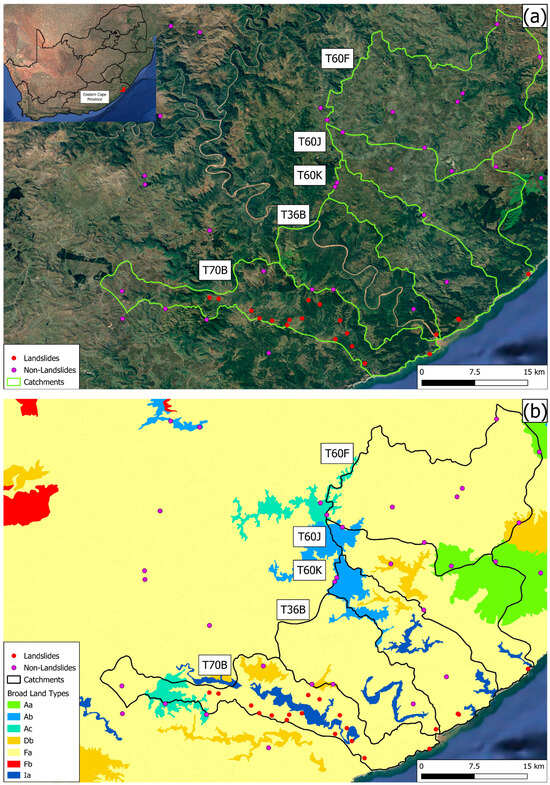
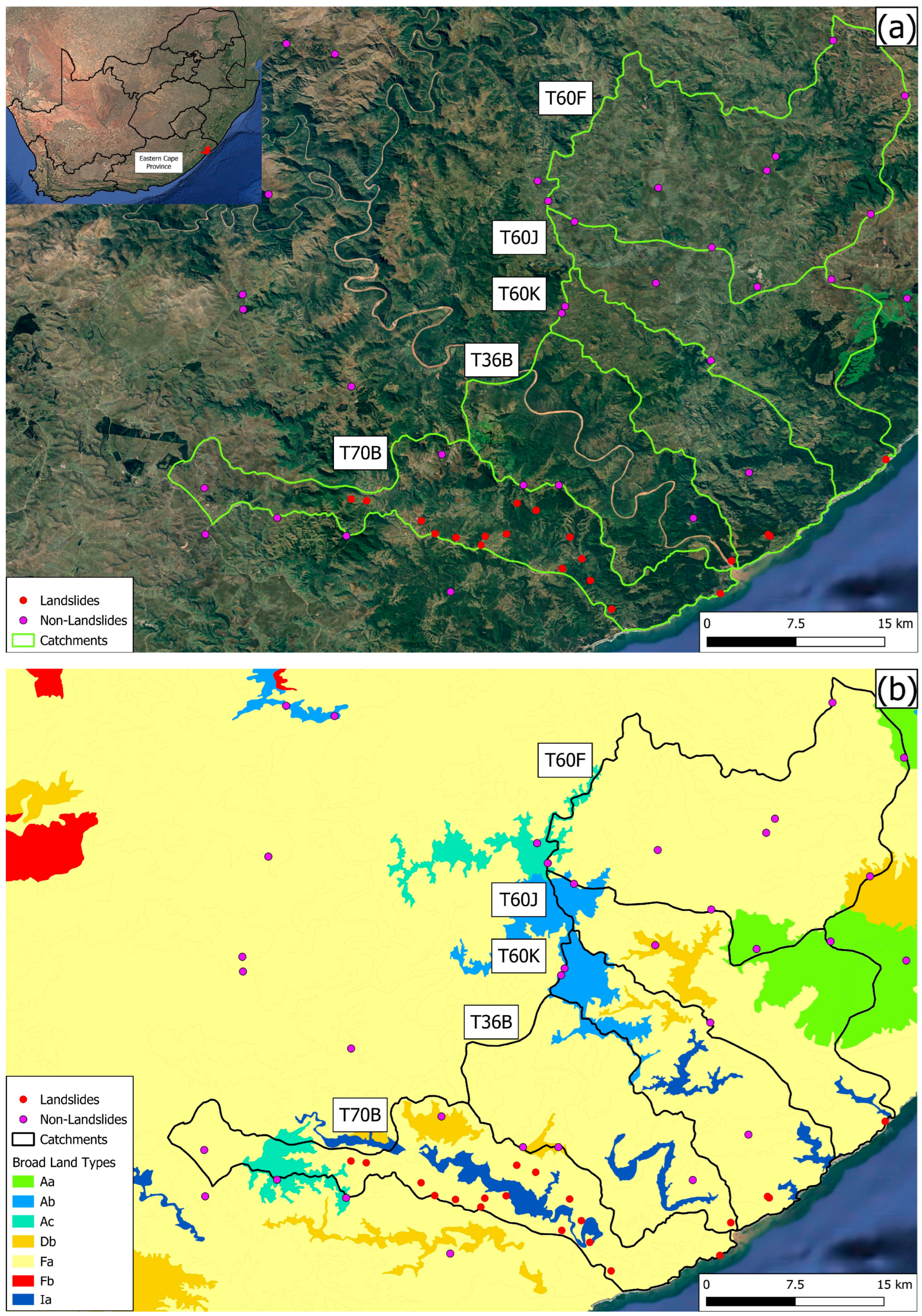
Sampling locations for landslide and non-landslide profiles were obtained from two sources. Landslide locations were derived from the results of [32], while non-landslide profiles were sourced from the Agricultural Research Council—Institute for Soil, Climate and Water (ARC-ISCW) of South Africa. Non-landslide control profiles were selected within or immediately adjacent to the study area where lithology and slope closely matched the landslide sites and where no evidence of mass-wasting was present. Figure 1 shows the spatial distribution of all sampled profiles, with landslide sites represented by blue points and non-landslide sites by yellow points. It also includes land type data from the South African Land Type Survey [33]. Broad land types Aa–Ac are deep, freely drained landscapes underlain by Natal Group sandstone; Dwyka Formation tillite (Karoo Sequence); dark-grey shale (Ecca Group); Adelaide Subgroup (Beaufort Group) mudstone and sandstone; and Drakensberg dolerite and gabbro. Db comprises landscapes with duplex soils and contains alluvium; light-grey shale, mudstone and sandstone (Ecca Group); dolerite; and Dwyka tillite. Ia comprises pedologically young landscapes of deep, unconsolidated deposits dominated by alluvium. Fa and Fb are pedologically young, rock-dominated landscapes containing dark- and light-grey shale, mudstone and sandstone (Ecca Group); Dwyka tillite; Natal Group sandstone; Adelaide Subgroup/Beaufort Group mudstone and sandstone including the Elliot Formation; Drakensberg dolerite and gabbro; and alluvium.
Figure 1.
A map of the study area: (a) illustrates the locations of samples gathered at landslide scars and the modal profiles from the ARC-ISCW dataset (non-landslides) in the Eastern Cape Province and (b) shows the broad land types in the region retrieved from the South African Land Type Survey (Land Type Survey Staff, 1972–2006).
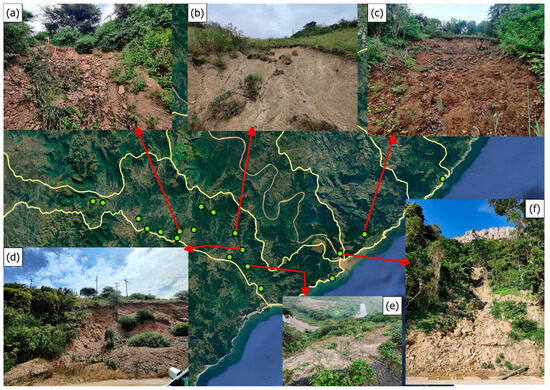
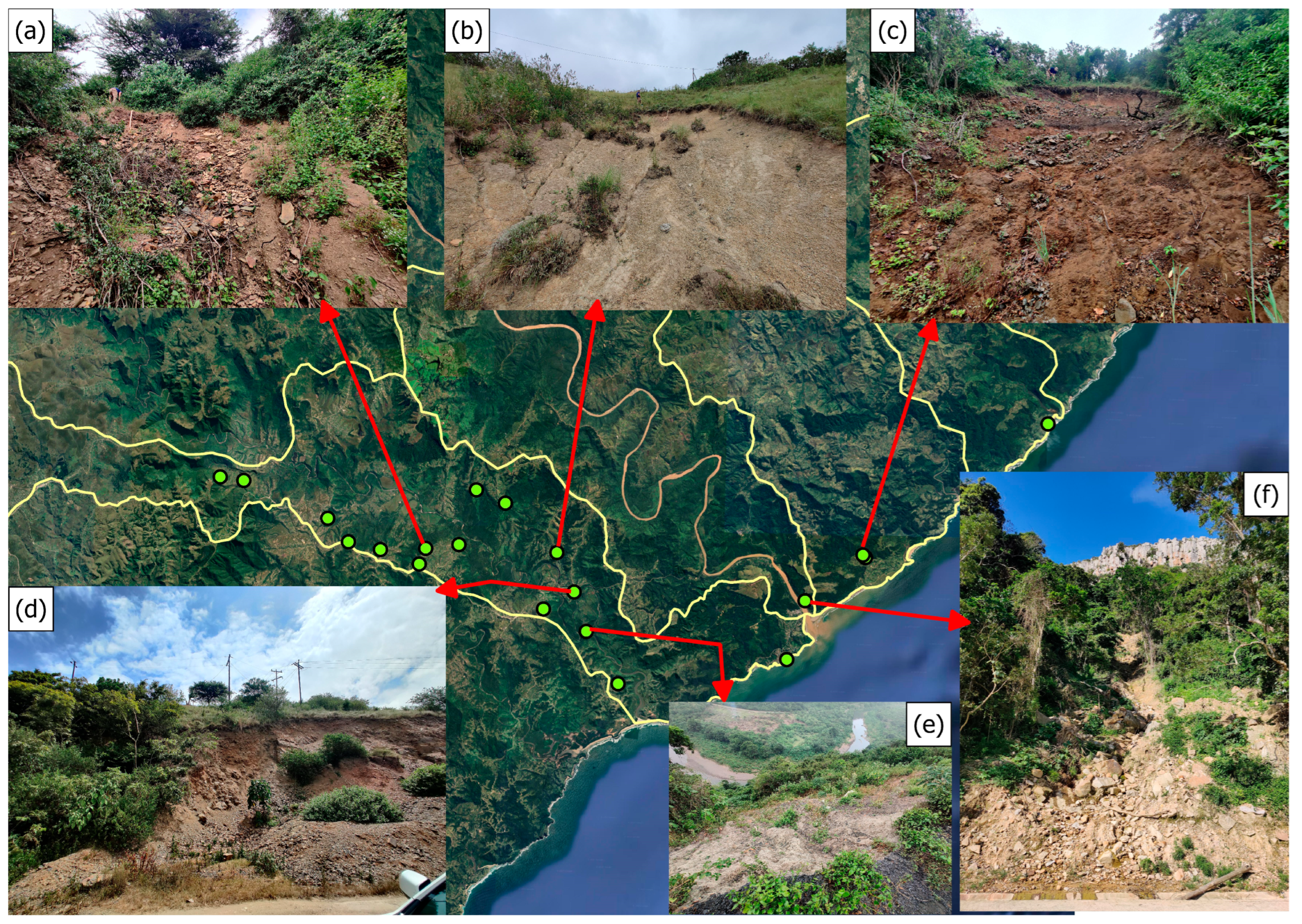
The 20 landslide locations were selected based on accessibility. Many mapped landslides were situated several kilometers from roads and located on steep slopes with dense vegetation, making sampling logistically challenging. The chosen sites represented those that were most accessible and posed the least disturbance to indigenous vegetation and surrounding communities. Figure 2 presents photographs taken during the field visit, illustrating the dense vegetation and steep slopes characteristic of the landslide sites.
Figure 2.
A series of photographs taken during the site visit of landslides ranging from small to large and their location within the study area, where (a–c) depict small and short landslides; (d) shows medium-sized and wide ones; and (e,f) illustrate large and elongated landslides. Green dots indicate landslide locations, while the yellow lines represent the borders of the Quaternary catchments.
2.1. Soil Sampling
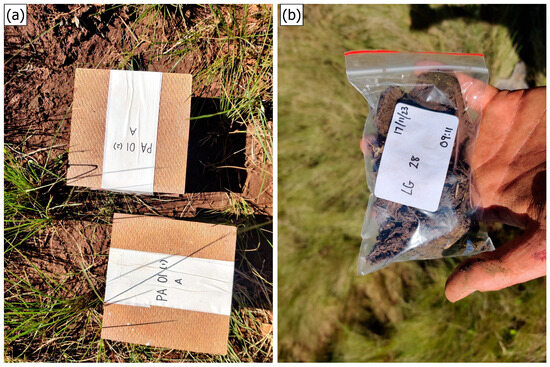
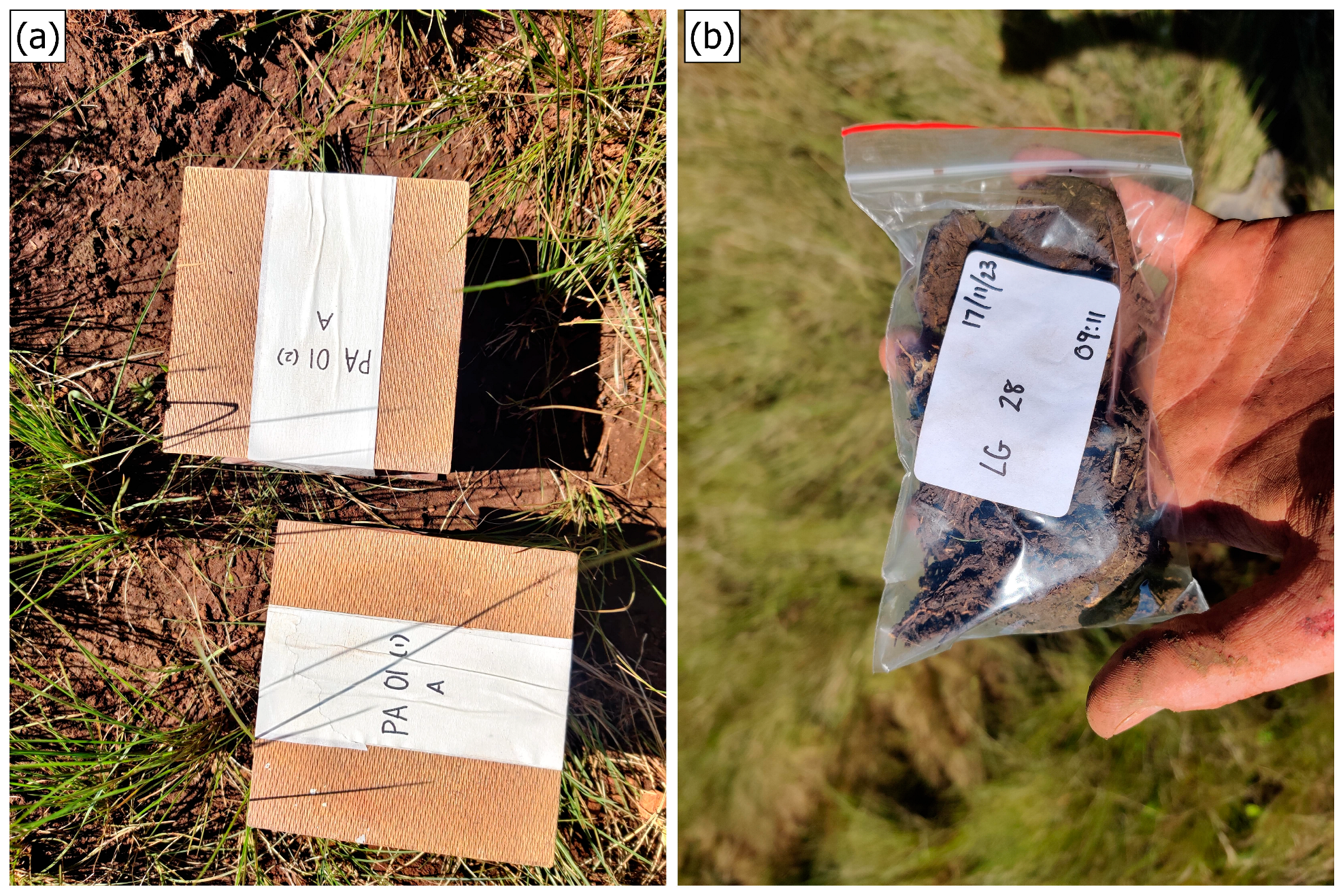
A total of 39 undisturbed core samples were collected from 20 landslide scars visited during fieldwork (Figure 3). Samples from each landslide were taken from the top part of the scar where the soil remained intact and in its natural order, at 1 m from the top edge of the landslide. The top edge was selected because side locations are often disturbed and mixed, the toe is a depositional zone with altered moisture and material, and the slide mass is mechanically disrupted and does not reflect pre-failure soil structure. These included 20 topsoil samples, 15 from the first subsoil horizon (subsoil 1), and 4 from the second subsoil horizon (subsoil 2). For the modal profiles representing non-landslide conditions, 77 samples were obtained from locations close to the study area. These comprised 33 topsoil samples and 44 subsoil samples (subsoil 1 = 32; subsoil 2 = 12). The topsoil corresponds to the A-horizon, subsoil 1 is the first diagnostic horizon immediately below the A-horizon, and subsoil 2, where present, is the diagnostic horizon beneath subsoil 1 that is distinctly different in morphology or in physical or chemical characteristics; according to the South African classification [34], topsoil horizons include vertic, humic, melanic, orthic, organic and peat, while subsoil horizons include lithic, pedocutanic, red apedal, albic, and soft plinthic, among others.
Figure 3.
Photographs of samples taken during one of the field visits, where (a) is an example of the undisturbed core samples, and (b) is an example of the grab samples.
2.2. Soil Properties
Soil analyses at landslide scars included key physical and chemical properties: soil organic matter (SOM), saturated hydraulic conductivity (Ksat), bulk density (BD), particle size distribution (texture), exchangeable sodium absorption ratio (SARexc), cation exchange capacity (CEC), exchangeable sodium percentage (ESP), and soil acidity (pH).
For the modal (non-landslide) profiles, data on BD, SOM, and Ksat were not available. As a result, statistical comparisons involving these properties for both between horizons within the non-landslide profiles and between landslide and non-landslide profiles were excluded from the analysis.
2.2.1. Soil Organic Matter
SOM has a significant influence on many soils physical, chemical, and biological properties [35]. SOM significantly contributes to the soil’s CEC and water-holding capacity, with specific components primarily accountable for the creation and stabilization of soil aggregates [35,36]. SOM content was tested on all the samples through the loss on ignition (LOI) method, by following recommended procedure from [36]. The soil samples were air-dried to remove moisture, then ground with a mortar and pestle to pass through a 2 mm sieve. The SOM content was determined by using the following Equation (1):
where LOI is the soil organic matter content (%), m105 °C is the mass of the soil sample after drying at 105 °C for 2 h, m360 °C is the mass of the sample after being burnt at 360 °C for 2 h and left to cool to 150 °C.
The Clay/SOM ratio was used to compare the relative influence of the fine mineral fraction and organic matter on soil structure and hydrological response. Higher clay-to-SOM indicates greater potential for plasticity, low permeability and pore-pressure buildup when saturated, while higher SOM relative to clay promotes aggregation, infiltration and biological binding of particles.
2.2.2. Physical Properties
Soil permeability is commonly evaluated through saturated hydraulic conductivity (Ksat), a characteristic that measures the soil’s ability to allow water flow through its saturated pores. Measurements were made with undisturbed core samples taken directly from the field. The core samples were saturated with water to enable testing their conductivity under saturated conditions using a modified version of the double-ring falling-head method from [37]. It employs pressure heads to measure the rate of infiltration in a saturated state, where the hydraulic conductivity was determined by the following Equation (2):
where Ksat is the hydraulic conductivity (mm·h−1), L is the height of the soil column (mm), t2 is the time that is required for water level to drop (hour) from h1 (initial height of the pressure head in mm) to h2 (final height of the pressure head in mm).
The Clay/Ksat ratio was used to compare the fine mineral fraction to saturated hydraulic conductivity, providing a compact indicator of how texture-driven storage and flow interact on slopes. A high Clay/Ksat ratio (much clay for a given Ksat) suggests soils that retain water, develop excess pore pressure and have slow drainage, increasing the likelihood of strength loss and slope failure. A low ratio indicates better drainage and lower propensity for pore-pressure buildup.
Soil BD is defined as the mass of a unit volume of dry soil including both solids and pores, where soil density accounts for the mass of solids, thus excluding any water present from consideration [35]. BD of the soil was determined by the core method. The undisturbed core samples collected from the field were placed in an oven at 105 °C for 48 h and afterwards were weighed to determine the dry mass. The BD was then calculated by the following Equation (3):
where ρb is the BD (g·cm−3), ms is the dry mass (g) of the soil sample, and vt is the volume of core (cm3).
Soil texture indicates the relative content of particles of various sizes, such as sand, silt, and clay, which is analysed through the particle size analysis. The hydrometer method from [38] was used for particle size analysis on all the samples, where the samples were treated with 5% sodium hexametaphosphate, Na6(PO3)6 to act as dispersing agent in the sedimentation suspension. Necessary adjustments were made for the density and temperature of the dispersing solution. The soil samples were air-dried to remove moisture, then ground with a mortar and pestle to pass through a 2 mm (#10) sieve. The percentage clay, silt, and sand were determined as follow Equations (4)–(6):
where ρs(40sec;20) and ρs(7h;20) are the densities (g·L−1) of sample suspensions adjusted to 20 °C at 40 s and 7 h, respectively, ρb(40sec;20) and ρb(7h;20) are the densities (g·L−1) of the blank samples adjusted to 20 °C at 40 s and 7 h, respectively, and ms is the mass of soil (g) used for the hydrometer analysis.
% Sand = 100 − (% clay + % silt)
2.2.3. Chemical Properties
Several key chemical properties were analyzed to better understand the role of soil chemistry in slope stability and landslide susceptibility. These properties include base saturation (Bsat), the exchangeable sodium absorption ratio (SARexc), cation exchange capacity (CEC), exchangeable sodium percentage (ESP), and soil acidity (pH). These indicators influence soil structure, dispersion, and permeability, all of which directly affect the soil’s ability to resist failure under saturated or unstable conditions.
Bsat refers to the fraction or percentage of CEC occupied by Ca2+, Mg2+, K+ and Na+, indicating the chemical makeup of the exchange sites and the soil’s capacity to resist pH change [39]. Low Bsat often signals higher acidity, poorer flocculation and weaker aggregate stability, increasing susceptibility to dispersion and loss of cohesion when saturated [40]. CEC represents the soil’s ability to retain and exchange cations such as calcium, magnesium, potassium, and sodium. Soils with low CEC may be more prone to nutrient leaching and poor aggregation, reducing resistance to shear forces [41,42]. CEC was measured using the ammonium acetate method at pH 7.0. Exchangeable cations (Na+, Ca2+, Mg2+, and K+) were extracted by the ammonium acetate method and quantified by inductively coupled plasma–optical emission spectrometry (ICP-OES) at Van’s Lab, Bloemfontein, South Africa.
SAR and ESP provide insight into sodium-induced dispersion, which can weaken soil aggregates, reduce infiltration, and increase susceptibility to erosion and landslides [6,11]. The pH, a measure of soil acidity using a potassium chloride solution, affects nutrient availability, microbial activity, and the solubility of various ions. High pH levels can affect aggregate stability and clay behavior, and when combined with a high SAR, can cause soil dispersion, leading to topsoil sealing and increased runoff [11].
Traditionally, SAR is calculated using water-extractable (soluble) concentrations of Na+, Ca2+, and Mg2+. However, for this study, exchangeable concentrations (in cmol(+)/kg) were used instead. The SAR provides an indication of the soil’s structural stability and dispersive potential of the clay particles [11], which are key factors influencing landslide susceptibility. The SARexc was calculated using the following Equation (7):
This formulation reflects the sodicity of the soil exchange complex rather than the soil solution, making it more relevant for assessing how sodium affects aggregate breakdown and slope failure risk. ESP was derived as the percentage of exchangeable Na+ relative to the total CEC. Soil pH was measured in a 1 M KCl solution using a calibrated pH meter. The ESP was determined by the following Equation (8):
2.3. Statistical Tests
After collecting all necessary data and observations, the study employed various statistical analyses to assess differences in soil properties between landslide and non-landslide profiles, as well as between soil horizons within the same category. The analyses were performed in RStudio (version 4.5.0), and results were exported to Excel for documentation.
2.3.1. Between-Group Comparisons Within Horizons
To evaluate whether soil properties significantly differ between landslide and non-landslide profiles, comparisons were performed separately for each major horizon category (Topsoil, Subsoil1, Subsoil2). For each soil property and horizon, the Shapiro–Wilk test was conducted to assess normality for both groups. If both distributions were normal (p > 0.05), Welch’s t-test was applied to test for differences in means, as it is robust to unequal variances [43]. If normality was not evident in either group, the Mann–Whitney U test was used as a non-parametric alternative to compare medians. These comparisons were repeated for each continuous variable, and summary statistics (mean, median) were recorded for both groups. Only variables with sufficient observations in both landslide status groups (≥3) were tested.
2.3.2. Within-Profile Comparisons Across Horizons
To assess how soil properties varied within soil profiles (i.e., across Topsoil, Subsoil1, Subsoil2), the Kruskal–Wallis test was used. This non-parametric test compares distributions across > 2 groups and is suitable for repeated measures or non-normally distributed data [44,45]. The test was conducted separately for landslide and non-landslide profiles. For variables with significant Kruskal–Wallis results (p < 0.05), post hoc pairwise comparisons were performed using the Wilcoxon rank-sum test with Bonferroni correction to control for multiple testing [46,47]. Only profiles containing at least two distinct horizons were included in the test for each variable. Additionally, BD, Ksat, and associated combinations were only available for landslide profiles and included accordingly.
3. Results
The analyses of soil properties between landslide and non-landslide profiles, across horizons within the same category, and among categorical variables between groups revealed clear distinctions between landslide and non-landslide sites. At landslide sites, the thickness of the topsoil horizons ranged from 10 to 30 cm, with an average of approximately 20 cm. Subsoil 1 exhibited thicknesses between 20 and 70 cm (mean ±35 cm), while subsoil 2 ranged from 30 to 60 cm (mean ±50 cm). In contrast, non-landslide profiles showed greater variability where topsoil thickness ranged from 15 to 70 cm (mean ±35 cm), subsoil 1 from 15 to 90 cm (mean ±45 cm), and subsoil 2 from 10 to 65 cm (mean ±35 cm).
All variables were screened for extreme values using histograms, boxplots and Shapiro–Wilk tests. Standardized z-scores fell within acceptable range for all observations and no values met objective criteria for exclusion, so all collected data were retained for analysis.
3.1. Comparison of Landslide and Non-Landslide Profiles by Horizon
The Shapiro–Wilk tests indicated that some soil properties were normally distributed across both landslide and non-landslide groups. For these variables, Welch’s t-test was used to compare group means, given its robustness to unequal variances. For variables that were not normally distributed, the non-parametric Mann–Whitney U test was applied to compare group medians. The statistical tests conducted for each soil property and their respective results are presented in Table 1.
Table 1.
Statistical comparison of soil properties between landslide and non-landslide profiles across topsoil and subsoil horizons.
In the topsoil, landslide profiles exhibited notably higher values for several soil properties, including CEC, SOM, and Bsat (all p < 0.01). Conversely, non-landslide topsoils showed significantly higher silt content and SARexc, while sand content was significantly greater in landslide topsoils (p < 0.01). Similar patterns continued in subsoil 1 and subsoil 2, with landslide profiles maintaining higher CEC, SOM, and Bsat, particularly in subsoil 2 where the differences were statistically significant for most variables. The Clay/SOM ratio was consistently lower in landslide profiles across all horizons (p < 0.01). Additionally, SARexc and ESP values were significantly lower in landslide profiles at the topsoil and subsoil levels.
3.2. Intra-Profile Differences Between Soil Horizons
Differences in soil properties across horizons within individual profiles were assessed to explore vertical variation in both landslide and non-landslide settings. Results reflect only those profiles with at least two horizons, allowing for meaningful comparisons between topsoil and subsoil layers. Statistically significant variation was observed in several properties, particularly within landslide profiles. Where applicable, additional pairwise comparisons highlighted specific differences between horizon levels. Table 2 presents summary statistics and test for each soil property, including only those soil properties that showed statistically significant differences in landslide areas, non-landslide areas, or both. CEC, pH, silt, sand, and Bsat showed no statistically significant differences between horizons in either landslide or non-landslide profiles.
Table 2.
Separate statistical comparisons of soil properties between horizons for landslide and non-landslide profiles.
In landslide profiles, SARexc, SOC, ESP, Clay content, BD, Ksat, Clay/SOC, and Clay/Ksat exhibited significant differences across horizons. Notably, SARexc, SOC, and ESP showed highly significant differences (p < 0.01) between topsoil and subsoil 1, with further distinctions between subsoil layers and between topsoil and subsoil 2 in most cases. BD and Ksat also varied significantly between topsoil and subsoil 1 (p < 0.01), with similar trends extending to deeper layers.
In non-landslide profiles, similar trends were evident for SARexc, SOC, ESP, and Clay/SOC, with consistently significant variation across all horizons (p < 0.01). However, fewer differences were observed for textural fractions, and no significant differences were detected for CEC, pH, Silt, Sand, or Bsat. Properties such as BD and Ksat were not available in non-landslide profiles and were therefore excluded from statistical tests.
4. Discussion
This study investigated soil property differences between landslide and non-landslide profiles and explored vertical variation within soil profiles to identify patterns associated with landslide susceptibility. The results support the notion that several chemical and physical soil properties may influence or reflect conditions conducive to slope instability. Below, each results subsection is addressed with interpretative commentary, supported by relevant literature in soil science and landslide research.
4.1. Differences Between Landslide and Non-Landslide Profiles
The comparison between landslide and non-landslide profiles revealed that no single soil property alone dictates slope failure. Instead, a combination of chemical and physical characteristics creates conditions favorable or unfavorable for shallow landslides to occur. Across all horizons, landslide scars exhibited higher CEC, SOM, and Bsat, while non-landslide sites showed greater silt content and higher sodium-related metrics (SARexc and ESP). Increased SOM and Bsat in landslide topsoils enhance water storage and pore-pressure buildup during rainfall, reducing shear strength when saturation is reached [3,8]. Similar mechanisms have been documented elsewhere where transient pore-pressure increases during rainfall [15] and catchment-scale variability in rainfall-triggered failures [19] were shown to strongly influence slope instability. In contrast, the finer, silt-rich stable soils may retain water near the surface due to high capillary tension in small pores, slowing deeper wetting and maintaining cohesion at depth [48].
The consistently lower SARexc and ESP values in landslide profiles contradict the expectation that sodium-induced dispersion drives instability. Non-landslide sites underlain by alluvium, weathered dolerite, Ecca shales, feldspathic sandstones, and duplex-soil landscapes exhibited higher sodium indicators yet remained stable, indicating that dispersion is not the dominant failure mechanism in this area and that lithology, drainage and landscape hydrology exert stronger control on slope behaviour. Soil sodium indicators were measured because local parent materials, notably weathered dolerite, feldspathic sandstones, Ecca shales and alluvial deposits can supply exchangeable and soluble Na+ to soils under restricted drainage, potentially promoting dispersion under favourable conditions. Given the region’s high rainfall, widespread sodicity is unlikely on well-drained slopes. Sodium-affected soils are most likely to occur in low-lying alluvial basins, closed depressions, clay-rich shale hollows, duplex-soil drainage breaks and weathered dolerite saprolite where groundwater discharge or evaporation concentrates salts. In this study, however, the combination of high water-holding capacity and rapid subsurface infiltration in landslide soils appears more critical. Mukhlisin et al. [4] reported that higher ESP in surface soils can delay subsurface infiltration during small storms by retaining water near the surface, while also increasing the water content and mobility of displaced material, thereby producing faster, farther-traveling debris flows and greater downstream damage.
Despite significant differences in CEC between landslide and stable profiles, CEC itself did not vary with depth within either group. Likewise, soil acidity (pH) remained uniform across horizons. These null findings imply that while overall nutrient-holding capacity and acidity set baseline soil behavior, they do not alone dictate failure thresholds. Instead, their influence is indirect, modulating how soils respond to hydrological stresses imposed by other, more dynamic properties [4].
4.2. Intra-Profile Variations in Soil Horizons
Soils with high clay content exhibit significantly different strength characteristics compared to those with coarser grains. High clay content results in soil resistance to detachment owing to its higher shear strength [49,50]. Vertical contrasts in hydraulic and mechanical properties were more pronounced in landslide profiles. Topsoils were both more porous and had higher Ksat than subsoils, whereas deeper horizons were denser and less permeable. For example, Ksat dropped by approximately 40% from topsoil to subsoil 1, while bulk density increased by nearly 20%. The hydraulic break observed between topsoil and subsoil is best interpreted as the product of coupled processes rather than compaction alone. Our results show a systematic decline in SOM with depth in landslide profiles that coincides with the reported ~40% decrease in Ksat and ~20% increase in BD, indicating that reduced organic matter, loss of macroporosity and increased particle packing act together to create a restrictive layer and near-surface accumulation zone that promotes perched saturation and elevated pore pressures [51]. Bell and Maud [31] describe an analogous process for Natal Group soils, noting that rapid infiltration can overwhelm drainage and produce rapid saturation of illuvial layers, causing high excess pore pressures and resulting in slope failure. Empirical support in this dataset comes from the significant horizon-scale differences in SOM, BD and Ksat within landslide profiles and the pronounced Clay/Ksat and Clay/SOM contrasts across horizons, which point to concurrent changes in texture-driven matrix permeability and structure-driven macropore continuity. Therefore, the formation of a near-surface hydraulic barrier is attributed to the vertical redistribution of SOM interacting with textural and compaction effects, producing perched saturation and elevated pore pressures that promote shallow failure [1,52,53]. Liang [18] and Greco et al. [21] further demonstrate how perched water above restrictive layers or epikarst features influences slope stability, enhancing the likelihood of localized failure. This configuration, with water accumulating above stratified low-permeability layers, has also been highlighted as a critical factor in shallow landslide initiation by Paronuzzi et al. [22].
During intense rainfall events the zone becomes saturated, especially if the soil profile has limited storage capacity, leading to runoff. Increased water runoff gain energy and erodes the topsoil, which will lead to particle detachment [12]. The contrast in soil texture between horizons can create hydraulic barriers within the soil profile influencing the movement of water and pore pressure dynamics [51].
In non-landslide profiles, the absence of such pronounced conductivity and density contrasts suggests more uniform drainage and lower likelihood of perched saturation. Consistently, Katsura et al. [17] demonstrated that stable slopes are often associated with effective drainage and the regulating influence of bedrock groundwater on temporal stability patterns. Although bulk density and Ksat were not measured for stable sites, the smoother textural transitions observed imply fewer hydraulic barriers and steadier percolation with depth.
SOM stabilizes aggregates and sustains macroporosity, thereby promoting infiltration and preferential flow rather than matrix saturation [44,45]. In this study, SOM declined steadily with depth in landslide profiles, which likely contributed to loss of macroporosity and the observed increase in BD and reduction in Ksat. The resulting coupled trend, with high SOM but low BD at the surface, shifting to low SOM and high density at depth creates a near-surface storage zone feeding into an impermeable layer [54,55]. This arrangement is theoretically more prone to shallow slides by affecting the tensile strength of the soil through affecting the micro and macro porosity [55]. If non-landslide soils had followed a similar SOM–density gradient, they too would be expected to fail, however their more muted gradients help explain their stability.
Overall, the critical factor in this study appears to be the interplay between a highly conductive, water-retaining topsoil and a restrictive subsoil. Neither organic enrichment nor fine-textured dispersion alone accounts for failure; rather, the vertical juxtaposition of hydraulic pathways and barriers shapes the pore-pressure dynamics that govern slope stability [56]. Bittelli et al. [16] provided supporting field evidence by showing how continuous monitoring of soil-water conditions and slope displacements reveals the critical role of hydrological contrasts in initiating shallow landslides.
5. Conclusions
The results provided robust evidence that landslide-prone soils exhibit distinct hydromechanical and chemical profiles compared to stable soils. Landslide sites consistently showed higher CEC, SOM, and Ksat, indicating enhanced water retention and conductivity. These properties favor pore-pressure buildup during heavy rainfall and may reduce shear strength. By contrast, non-landslide profiles exhibited higher sodium-related metrics (SARexc and ESP) and finer textures, suggesting a different failure mechanism where dispersion is less influential than internal hydraulic contrasts.
Vertical profiling revealed that landslide soils are characterized by a stark contrast in permeability and BD between topsoil and subsoil layers. These contrasts promote perched saturation zones and localized water accumulation, which can trigger shallow slope failures. The decline of SOM with depth in landslide soils exacerbates this effect, reducing cohesion and increasing deformability.
In conclusion, the interplay between high surface porosity, rapid water conduction, and deeper restrictive layers in landslide soils creates hydrological conditions conducive to slope instability. No single soil property defined slope failure potential; however, it was likely a combination of chemical and physical soil properties. These findings reinforce the importance of integrated soil profiling in landslide risk assessments and provide valuable input for refining coupled hydrological-slope stability models in complex terrains. For greater generalisability, future research should expand sampling to include a substantially larger and more geographically diverse set of profiles.
Author Contributions
Conceptualization, J.K.; methodology, J.K. and J.v.T.; validation, J.K.; formal analysis, J.K.; resources, J.v.T.; writing—original draft preparation, J.K.; writing—review and editing, J.v.T. and J.L.R.; visualization, J.K.; supervision, J.v.T. and J.L.R. All authors have read and agreed to the published version of the manuscript.
Funding
This research was funded by Water Research Commission (WRC; C2023/2024-01184) and the National Research Foundation (NRF) in collaboration with the German Academic Exchange Service (DAAD) under the grant ID: PMDS23041493065.
Data Availability Statement
The data presented in this study are available on request from the corresponding author, subject to any restrictions imposed by the funding agencies.
Conflicts of Interest
The authors declare no conflicts of interest.
References
- Bell, F.G.; Maud, R.R. Landslides associated with the colluvial soils overlying the Natal Group in the greater Durban region of Natal, South Africa. Environ. Geol. 2000, 39, 1029–1038. [Google Scholar] [CrossRef] [Scilit]
- Highland, L.; Bobrowsky, P.T. The Landslide Handbook: A Guide to Understanding Landslides; U.S. Geological Survey Circular 1325: Reston, VA, USA, 2008; 129p. [Google Scholar]
- Bogaard, T.A.; Greco, R. Landslide hydrology: From hydrology to pore pressure. Wiley Interdiscip. Rev. Water 2016, 3, 439–459. [Google Scholar] [CrossRef] [Scilit]
- Mukhlisin, M.; Kosugi, K.I.; Satofuka, Y.; Mizuyama, T. Effects of soil porosity on slope stability and debris flow runout at a weathered granitic hillslope. Vadose Zone J. 2006, 5, 283–295. [Google Scholar] [CrossRef] [Scilit]
- Anis, Z.; Wissem, G.; Riheb, H.; Biswajeet, P.; Essghaier, G.M. Effects of clay properties in the landslide’s genesis in flysch massif: Case study of Aïn Draham, Northwestern Tunisia. J. Afr. Earth Sci. 2019, 151, 146–152. [Google Scholar] [CrossRef] [Scilit]
- Zhan, J.; Wang, Q.; Zhang, W.; Shangguan, Y.; Song, S.; Chen, J. Soil-engineering properties and failure mechanisms of shallow landslides in soft-rock materials. Catena 2019, 181, 104093. [Google Scholar] [CrossRef] [Scilit]
- Tofani, V.; Bicocchi, G.; Rossi, G.; Segoni, S.; D’Ambrosio, M.; Casagli, N.; Catani, F. Soil characterization for shallow landslides modeling: A case study in the Northern Apennines (Central Italy). Landslides 2017, 14, 755–770. [Google Scholar] [CrossRef] [Scilit]
- Schjønning, P. Topsoil shear strength–measurements and predictions. Soil Till. Res. 2021, 212, 105049. [Google Scholar] [CrossRef] [Scilit]
- Shah, S.S.A.; Turrakheil, K.S.; Naveed, M. Impact of wetting and drying cycles on the hydromechanical properties of soil and implications on slope stability. Atmosphere 2024, 15, 1368. [Google Scholar] [CrossRef] [Scilit]
- Uyeturk, C.E.; Huvaj, N.; Bayraktaroglu, H.; Huseyinpasaoglu, M. Geotechnical characteristics of residual soils in rainfall-triggered landslides in Rize, Turkey. Eng. Geol. 2020, 264, 105318. [Google Scholar] [CrossRef] [Scilit]
- Parwada, C.; Van Tol, J. Soil properties influencing erodibility of soils in the Ntabelanga area, Eastern Cape Province, South Africa. Acta Agric. Scand. B Soil Plant Sci. 2016, 67, 67–76. [Google Scholar] [CrossRef] [Scilit]
- Batumalai, P.; Mohd Nazer, N.S.; Simon, N.; Sulaiman, N.; Umor, M.R.; Ghazali, M.A. Soil detachment rate of a rainfall-induced landslide soil. Water 2023, 15, 2149. [Google Scholar] [CrossRef] [Scilit]
- Asghari, S.; Chittoori, B.C.; Pierce, J. Role of cation exchange and specific surface area in microbial calcite precipitation in clayey soils. Discov. Soil 2025, 2, 55. [Google Scholar] [CrossRef] [Scilit]
- Klopp, H.; Arriaga, F.J.; Bleam, W. Assessment of soil response to exchangeable sodium percentage by consistence and water retention properties. Geoderma 2020, 376, 114532. [Google Scholar] [CrossRef] [Scilit]
- Godt, J.W.; Baum, R.L.; Lu, N. Landsliding in partially saturated materials. Geophys. Res. Lett. 2009, 36, L02403. [Google Scholar] [CrossRef] [Scilit]
- Bittelli, M.; Valentino, R.; Salvatorelli, F.; Pisa, P.R. Monitoring soil-water and displacement conditions leading to landslide occurrence in partially saturated clays. Geomorphology 2012, 173, 161–173. [Google Scholar] [CrossRef] [Scilit]
- Katsura, S.Y.; Kosugi, K.I.; Mizutani, T.; Okunaka, S.; Mizuyama, T. Effects of bedrock groundwater on spatial and temporal variations in soil mantle groundwater in a steep granitic headwater catchment. Water Resour. Res. 2008, 44, W09430. [Google Scholar] [CrossRef] [Scilit]
- Liang, W.L. Dynamics of pore water pressure at the soil–bedrock interface recorded during a rainfall-induced shallow landslide in a steep natural forested headwater catchment, Taiwan. J. Hydrol. 2020, 587, 125003. [Google Scholar] [CrossRef] [Scilit]
- von Ruette, J.; Lehmann, P.; Or, D. Rainfall-triggered shallow landslides at catchment scale: Threshold mechanics-based modeling for abruptness and localization. Water Resour. Res. 2013, 49, 6266–6285. [Google Scholar] [CrossRef] [Scilit]
- Djukem, W.D.L.; Braun, A.; Wouatong, A.S.L.; Guedjeo, C.; Dohmen, K.; Wotchoko, P.; Fernandez-Steeger, T.M.; Havenith, H.B. Effect of soil geomechanical properties and geo-environmental factors on landslide predisposition at Mount Oku, Cameroon. Int. J. Environ. Res. Public Health 2020, 17, 6795. [Google Scholar] [CrossRef] [Scilit] [PubMed]
- Greco, R.; Marino, P.; Santonastaso, G.F.; Damiano, E. Interaction between perched epikarst aquifer and unsaturated soil cover in the initiation of shallow landslides in pyroclastic soils. Water 2018, 10, 948. [Google Scholar] [CrossRef] [Scilit]
- Paronuzzi, P.; Fedrigo, D.; Bolla, A. Rainfall infiltration through stratified colluvial deposits: Analytical approach vs. numerical modelling. Geosciences 2024, 14, 53. [Google Scholar] [CrossRef] [Scilit]
- Chiliza, S.G.; Richardson, S. Landslide incidence in the Limpopo province, South Africa. In Proceedings of the First World Landslide Forum, United Nations University, Tokyo, Japan, 18–21 November 2008; pp. 100–103. [Google Scholar]
- Odhiambo, B.D.O.; Kataka, M.O.; Mashudu, M. The Use of Remote Sensing to Map Landslide Prone Areas in Makhado Municipality of Limpopo Province, South Africa. Contributing Paper to Global Assessment Report on Disaster Risk Reduction (GAR). 2019. Available online: https://www.undrr.org/publication/global-assessment-report-disaster-risk-reduction-2019 (accessed on 13 October 2025).
- Sengani, F.; Zvarivadza, T. Evaluation of factors influencing slope instability: Case study of the R523 road between Thathe, Vondo and Khalvha area in South Africa. In Proceedings of the 18th Symposium on Environmental Issues and Waste Management in Energy and Mineral Production, Santiago, Chile, 19–23 November 2018. [Google Scholar]
- Sengani, F.; Mulenga, F. Influence of rainfall intensity on the stability of unsaturated soil slope: Case Study of R523 road in Thulamela Municipality, Limpopo Province, South Africa. Appl. Sci. 2020, 10, 8824. [Google Scholar] [CrossRef] [Scilit]
- Singh, R.G. Landslide Classification, Characterization and Susceptibility Modeling in KwaZulu-Natal. Master’s Thesis, University of the Witwatersrand, Braamfontein, Johannesburg, 2009. [Google Scholar]
- Romer, C.; Ferentinou, M. Shallow landslide susceptibility assessment in a semiarid environment—A Quaternary catchment of KwaZulu-Natal, South Africa. Eng. Geol. 2016, 201, 29–44. [Google Scholar] [CrossRef] [Scilit]
- Tyoda, Z.; Kemp, J.; Engelbrecht, J. First results from landslide susceptibility modeling in the Western Cape Province, South Africa. In Proceedings of GISSA Ukubazana; EE Publishers: Muldersdrift, South Africa, 2012. [Google Scholar]
- Diko, M.L.; Banyini, S.C.; Monareng, B.F. Landslide susceptibility on selected slopes in Dzanani, Limpopo Province, South Africa. Jamba J. Disaster Risk Stud. 2014, 6, 7. [Google Scholar] [CrossRef] [Scilit]
- Bell, F.G.; Maud, R.R. Examples of landslides associated with the Natal Group and Pietermaritzburg Formation in the Greater Durban area of Natal, South Africa. Bull. Int. Assoc. Eng. Geol. 1996, 53, 11–20. [Google Scholar] [CrossRef] [Scilit]
- Kotzé, J.; Le Roux, J.; van Tol, J. Creating a landslide inventory in the Eastern Cape Province, South Africa: A pixel-based change detection method using fuzzy membership functions. Nat. Hazards 2025, 121, 18249–18274. [Google Scholar] [CrossRef] [Scilit]
- Land Type Survey Staff. Land Type Survey Database; ARC–Institute for Soil, Climate and Water: Pretoria, South Africa, 2002. [Google Scholar]
- Soil Classification Working Group. Soil Classification: A Natural and Anthropogenic System for South Africa; ARC-Institute for Soil, Climate and Water: Pretoria, South Africa, 2018. [Google Scholar]
- Weil, R.R.; Brady, N.C. The Nature and Properties of Soils, 15th ed.; Pearson Education Limited: Essex, UK, 2016; pp. 130–186+526–640. [Google Scholar]
- Schulte, E.E.; Hoskins, B. Recommended soil organic matter tests. In Recommended Soil Testing Procedures for the Northeastern USA, 3rd ed.; Sims, J.T., Wolf, A.M., Eds.; Northeastern Regional Publication: Newark, DE, USA, 2009; Volume 493, pp. 52–60. [Google Scholar]
- Bouwer, H.; Rice, R.C. A slug test for determining hydraulic conductivity of unconfined aquifers with completely or partially penetrating wells. Water Resour. Res. 1976, 12, 423–428. [Google Scholar] [CrossRef] [Scilit]
- Bouyoucos, G.J. Hydrometer method improved for making particle size analyses of soils. Agron. J. 1962, 54, 464–465. [Google Scholar] [CrossRef] [Scilit]
- Kabała, C.; Łabaz, B. Relationships between soil pH and base saturation–conclusions for Polish and international soil classifications. Soil Sci. Ann. 2018, 69, 206. [Google Scholar] [CrossRef] [Scilit]
- Rengasamy, P. Soil processes affecting crop production in salt-affected soils. Func. Plant Biol. 2010, 37, 613–620. [Google Scholar] [CrossRef] [Scilit]
- Van Eynde, E.; Dondeyne, S.; Isabirye, M.; Deckers, J.; Poesen, J. Impact of landslides on soil characteristics: Implications for estimating their age. Catena 2017, 157, 173–179. [Google Scholar] [CrossRef] [Scilit]
- Su, X.; Wu, W.; Tang, H.; Huang, L.; Xia, D.; Lu, S. Physicochemical effect on soil in sliding zone of reservoir landslides. Eng. Geol. 2023, 324, 107249. [Google Scholar] [CrossRef] [Scilit]
- Sulaeman, Y.; Maftuáh, E.; Sukarman, S.; Neswati, R.; Nurdin, N.; Basuki, T.; Suriadi, A.; Vasenev, I. Influence of Land-Use Type on Black Soil Features in Indonesia Based on Soil Survey Data. Land 2025, 14, 599. [Google Scholar] [CrossRef] [Scilit]
- Kiani, M.; Hernandez-Ramirez, G.; Quideau, S.A. Spatial variation of soil quality indicators as a function of land use and topography. Can. J. Soil Sci. 2020, 100, 463–478. [Google Scholar] [CrossRef] [Scilit]
- Pittman, R.; Hu, B.; Pittman, T.; Webster, K.L.; Shang, J.; Nelson, S.A. Inferential Approach for Evaluating the Association Between Land Cover and Soil Carbon in Northern Ontario. Earth 2025, 6, 1. [Google Scholar] [CrossRef] [Scilit]
- Edwin, N.R.; Fitzpatrick, A.H.; Brennan, F.; Abram, F.; O’Sullivan, O. An in-depth evaluation of metagenomic classifiers for soil microbiomes. Environ. Microbiome 2024, 19, 19. [Google Scholar] [CrossRef] [Scilit]
- Benalcazar, P.; Seuradge, B.; Diochon, A.C.; Kolka, R.K.; Phillips, L.A. Conversion of boreal forests to agricultural systems: Soil microbial responses along a land-conversion chronosequence. Environ. Microbiome 2024, 19, 32. [Google Scholar] [CrossRef] [Scilit]
- Pelascini, L.; Steer, P.; Mouyen, M.; Longuevergne, L. Finite-hillslope analysis of landslides triggered by excess pore water pressure: The roles of atmospheric pressure and rainfall infiltration during typhoons. Nat. Hazards Earth Syst. Sci. 2022, 22, 3125–3141. [Google Scholar] [CrossRef] [Scilit]
- Singh, R.G.; Forbes, C.; Chiliza, G.; Diop, S.; Musekiwa, C.; Claassen, D. Landslide Geohazards in South Africa: Landslide Susceptibility Mapping, Socio-Economic Impacts, Mitigation and Remediation Measures; Council for Geoscience: Pretoria, South Africa, 2011. [Google Scholar]
- Mekonnen, A.A.; Raghuvanshi, T.K.; Suryabhagavan, K.V.; Kassawmar, T. GIS-based landslide susceptibility zonation and risk assessment in complex landscape: A case of Beshilo watershed, northern Ethiopia. Environ. Chall. 2022, 8, 100586. [Google Scholar] [CrossRef] [Scilit]
- Guzzetti, F.; Gariano, S.L.; Peruccacci, S.; Brunetti, M.T.; Marchesini, I.; Rossi, M.; Melillo, M. Geographical landslide early warning systems. Earth-Sci. Rev. 2020, 200, 102973. [Google Scholar] [CrossRef] [Scilit]
- Mancarella, D.; Doglioni, A.; Simeone, V. On capillary barrier effects and debris slide triggering in unsaturated layered covers. Eng. Geol. 2012, 147, 14–27. [Google Scholar] [CrossRef] [Scilit]
- Prakasam, C.; Aravinth, R.; Kanwar, V.S.; Nagarajan, B. Design and Development of Real-time landslide early warning system through low cost soil and rainfall sensors. Mat. Today Proc. 2021, 45, 5649–5654. [Google Scholar]
- Igwe, C.A. Soil physical properties under different management systems and organic matter effects on soil moisture along soil catena in southeastern Nigeria. Trop. Subtrop. Agroecosyst. 2005, 5, 57–66. [Google Scholar]
- Li, S.; Wang, B.; Zhang, X.; Wang, H.; Yi, Y.; Huang, X.; Gao, X.; Zhu, P.; Han, W. Soil particle aggregation and aggregate stability associated with ion specificity and organic matter content. Geoderma 2023, 429, 116285. [Google Scholar] [CrossRef] [Scilit]
- Perrone, J.; Madramootoo, C.A. Characterizing bulk density and hydraulic conductivity changes in a potato cropped field. Soil Technol. 1994, 7, 261–268. [Google Scholar] [CrossRef] [Scilit]

Disclaimer/Publisher’s Note: The statements, opinions and data contained in all publications are solely those of the individual author(s) and contributor(s) and not of MDPI and/or the editor(s). MDPI and/or the editor(s) disclaim responsibility for any injury to people or property resulting from any ideas, methods, instructions or products referred to in the content. |
© 2025 by the authors. Licensee MDPI, Basel, Switzerland. This article is an open access article distributed under the terms and conditions of the Creative Commons Attribution (CC BY) license (https://creativecommons.org/licenses/by/4.0/).