Seismo-Stratigraphic Data of the Gulf of Pozzuoli (Southern Tyrrhenian Sea, Italy): A Review and Their Relationships with the New Bradyseismic Crisis


Abstract
1. Introduction
2. Earthquakes and Bradyseism
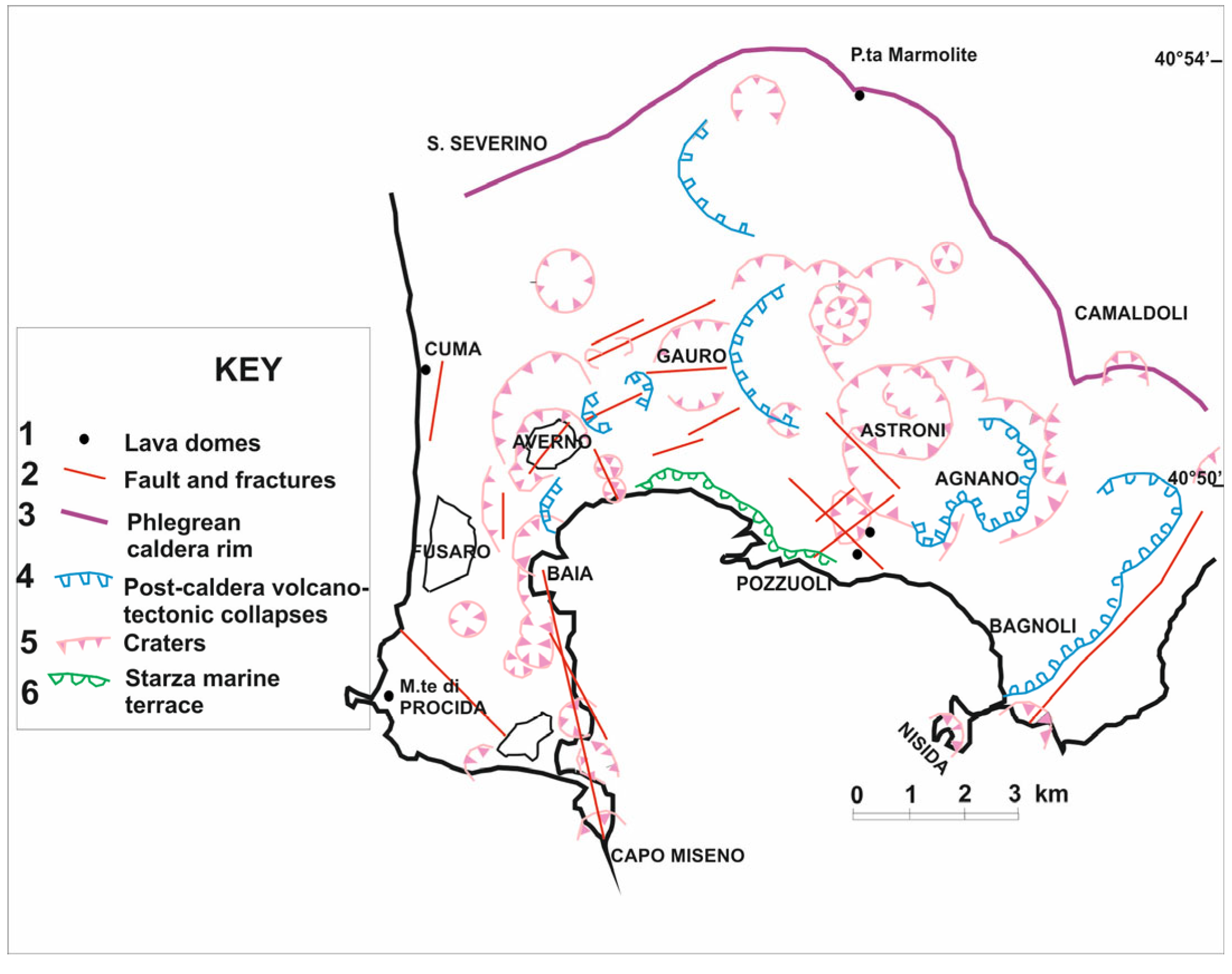
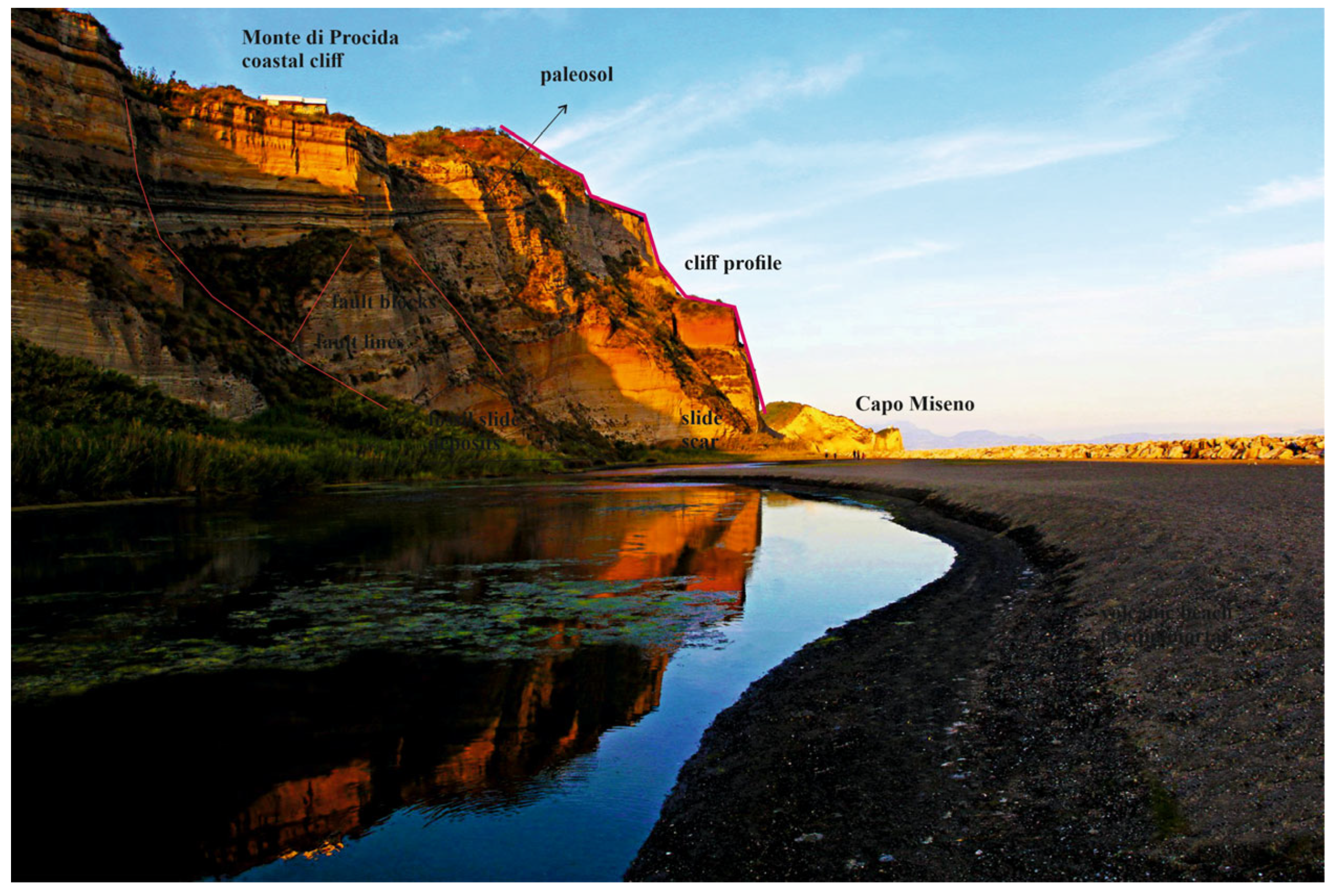
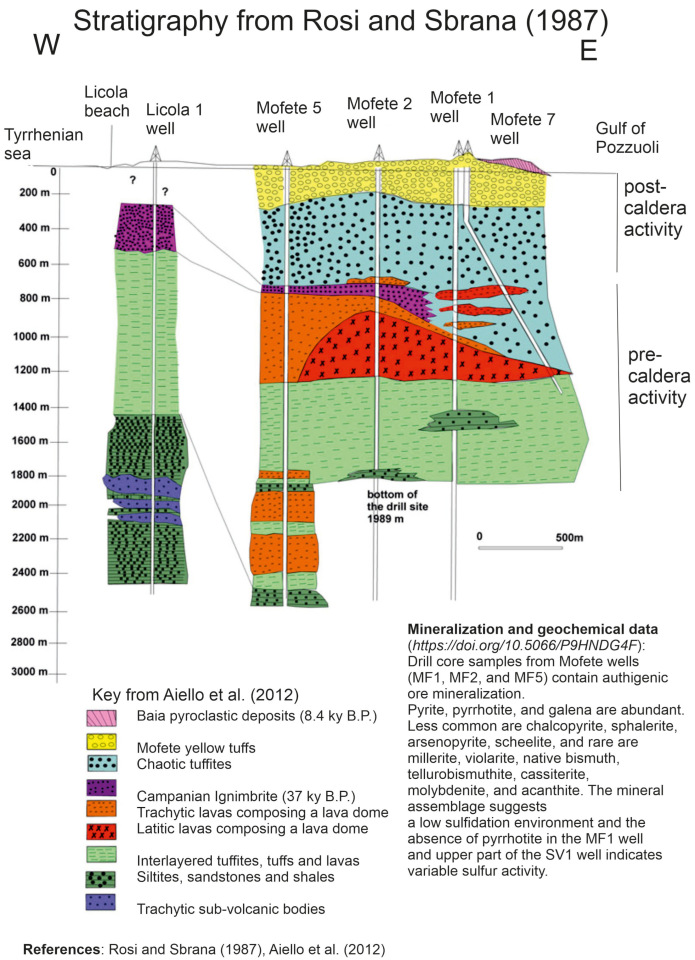
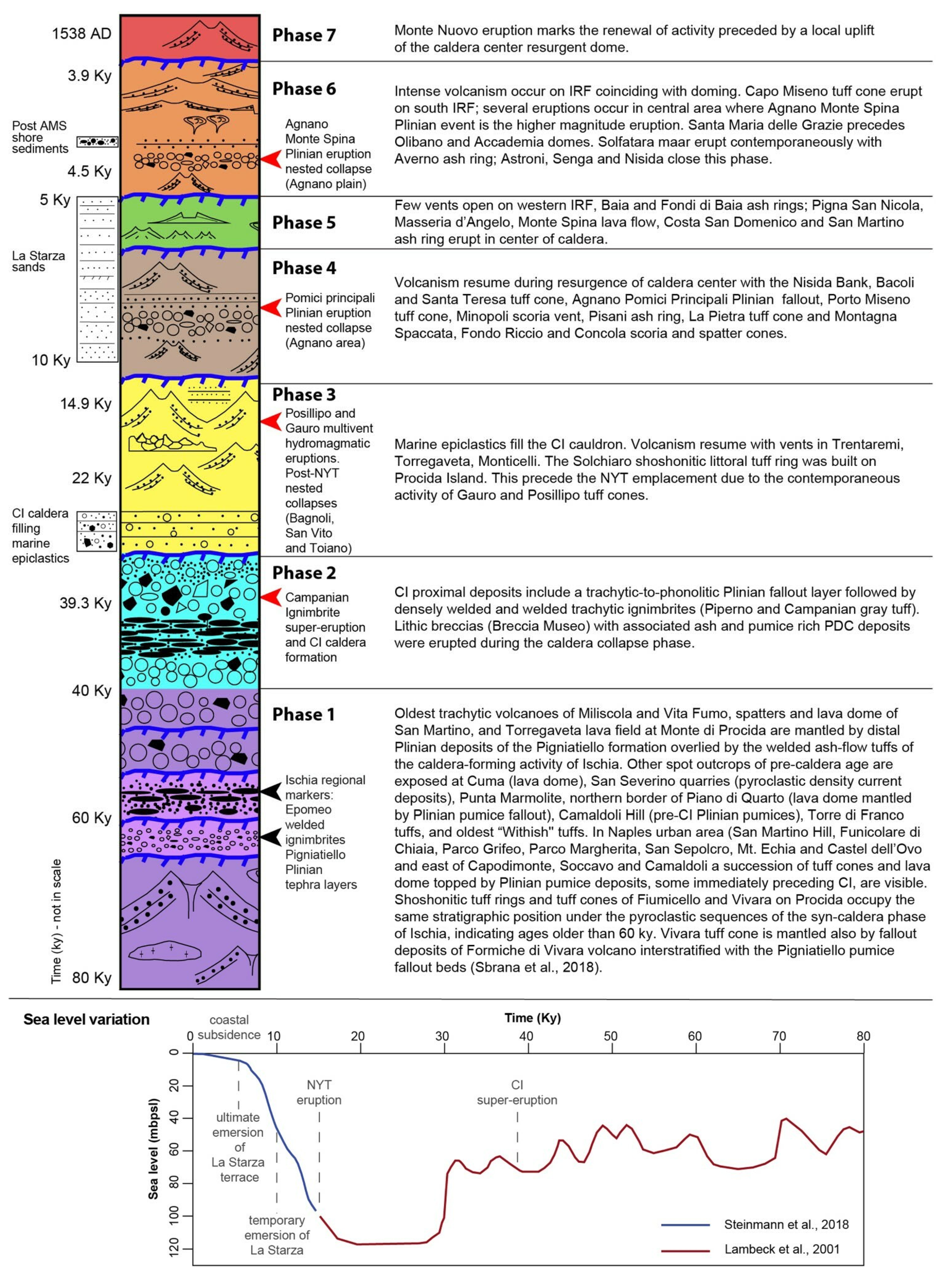
3. Geo-Volcanological Setting
4. Seismo-Stratigraphic Framework
5. Discussion
6. Conclusions
- -
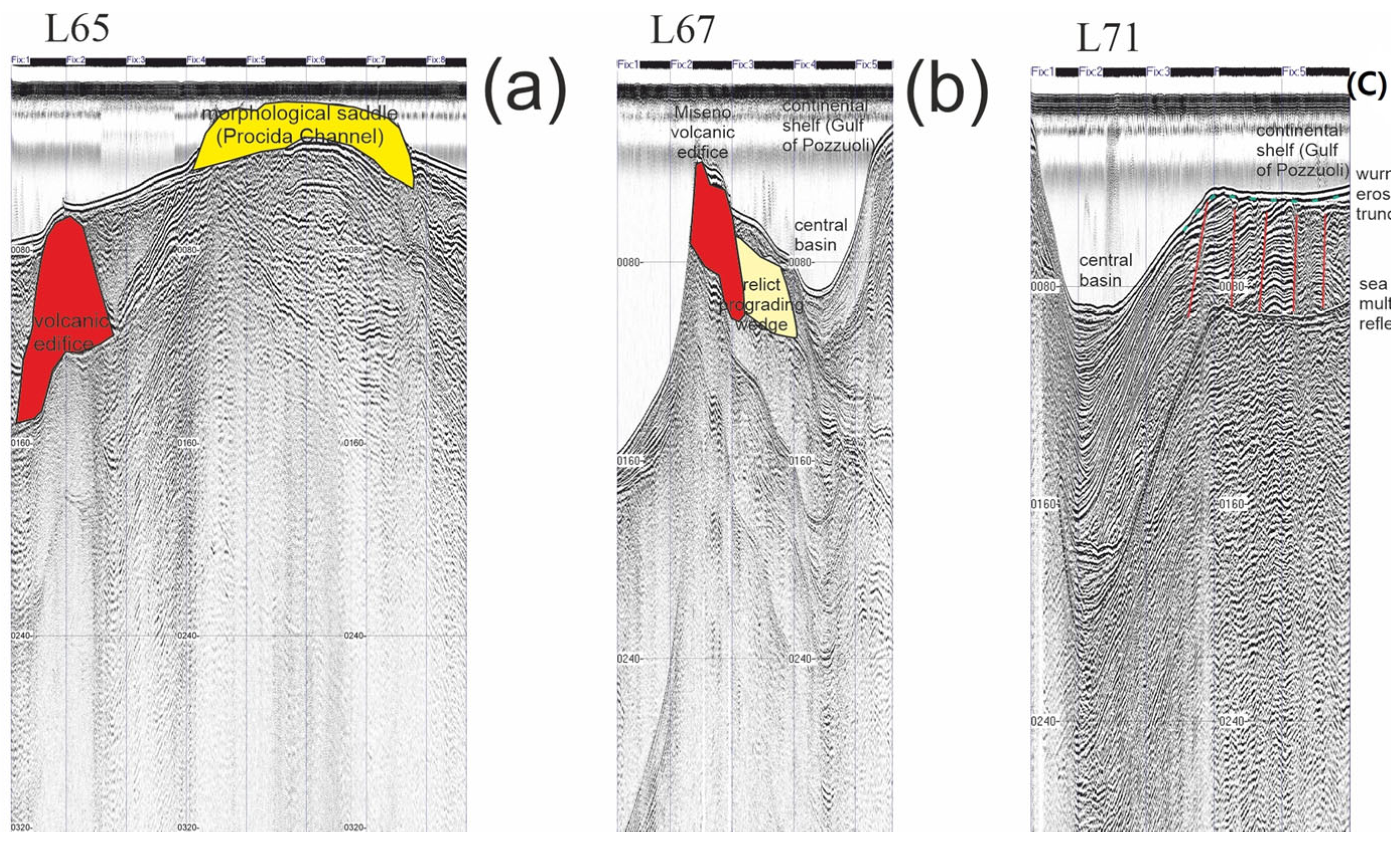
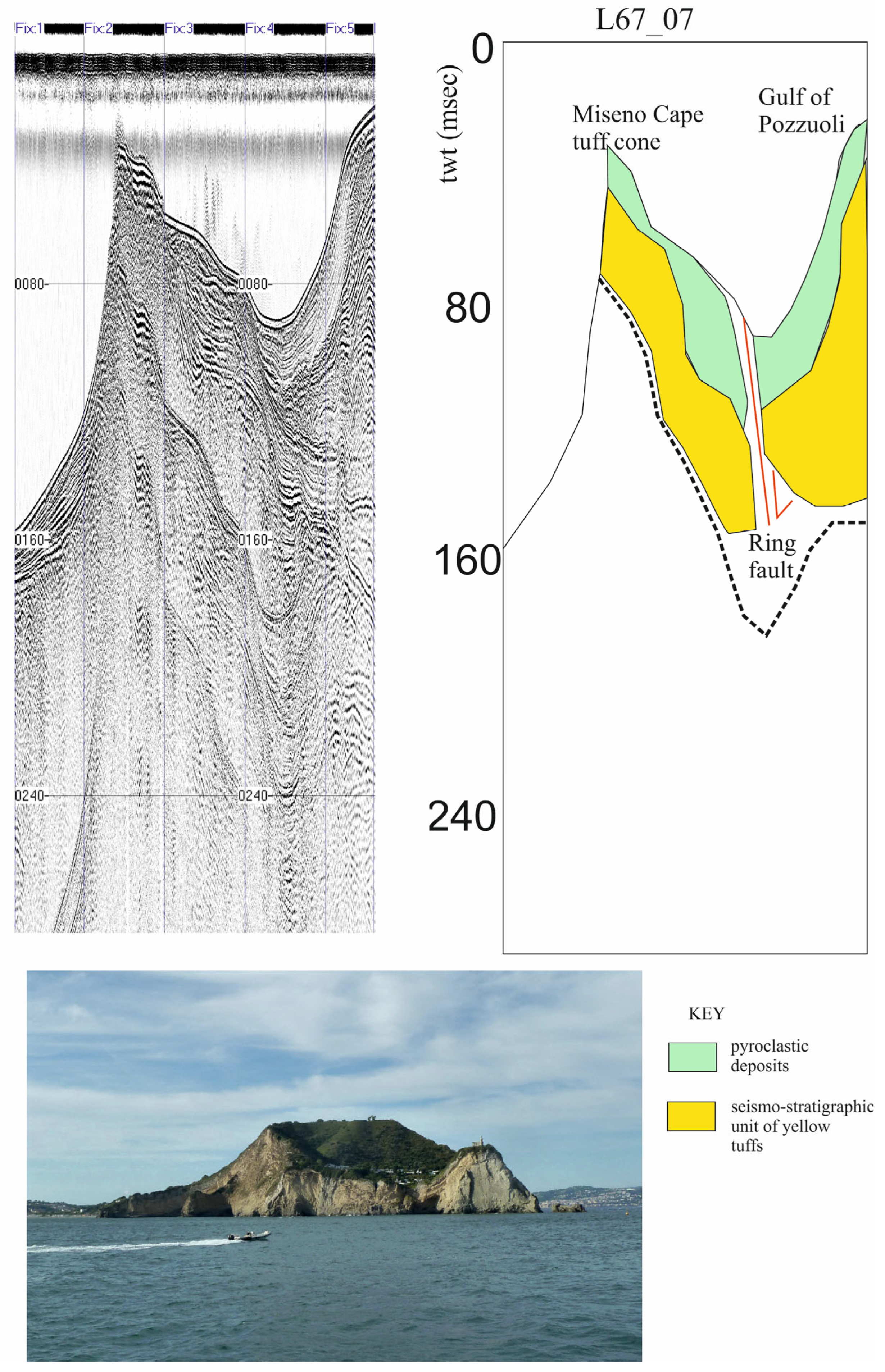
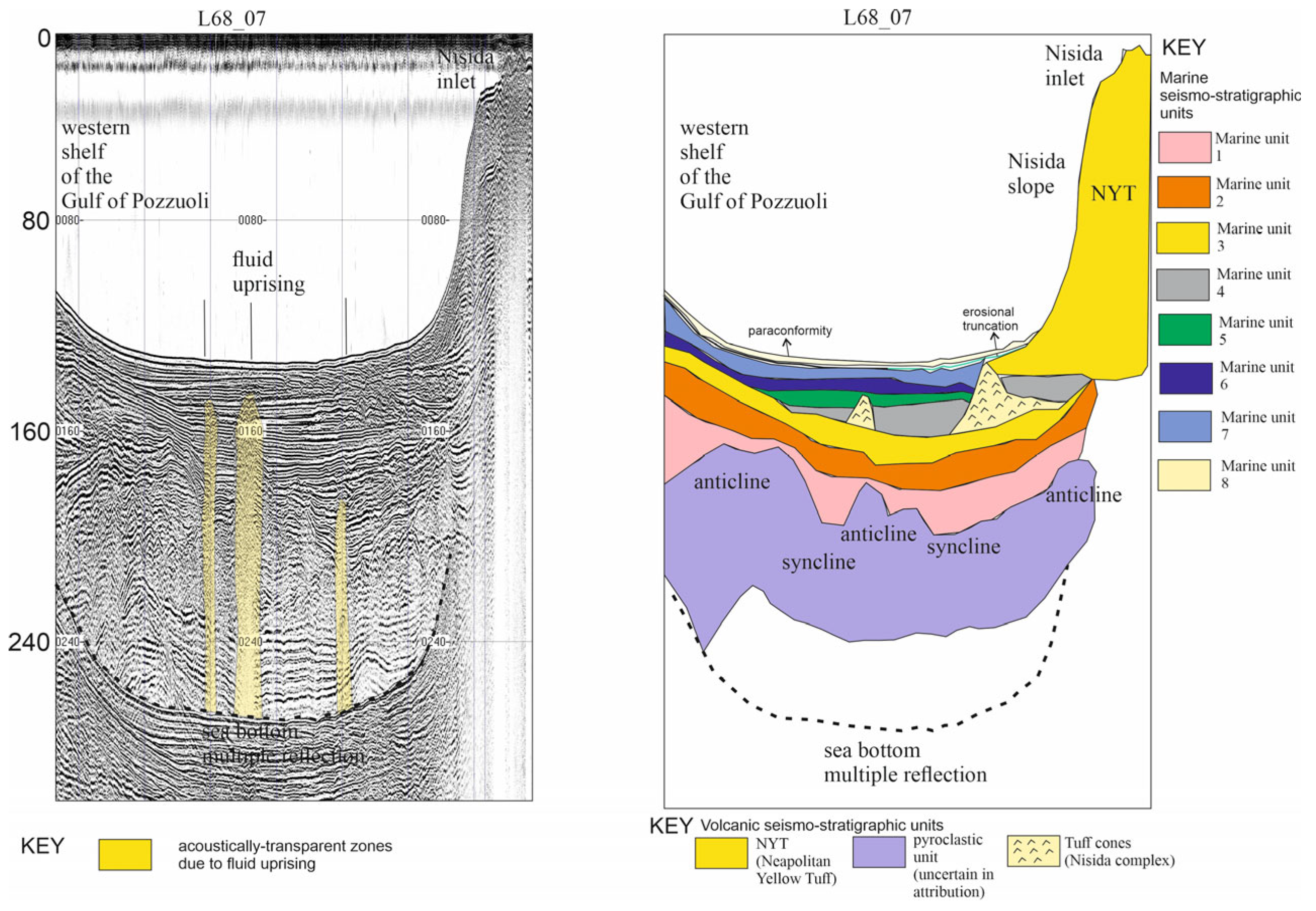
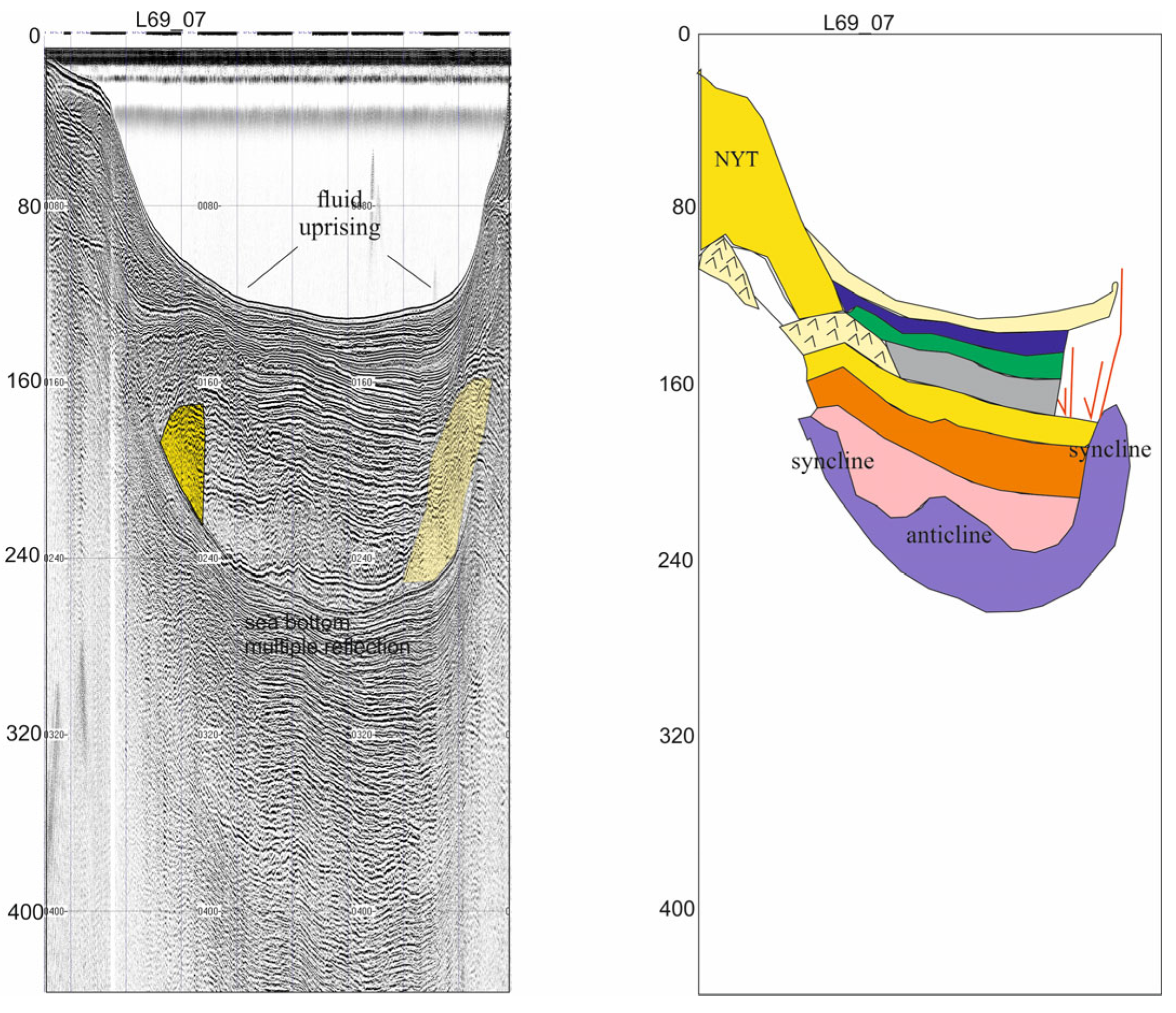
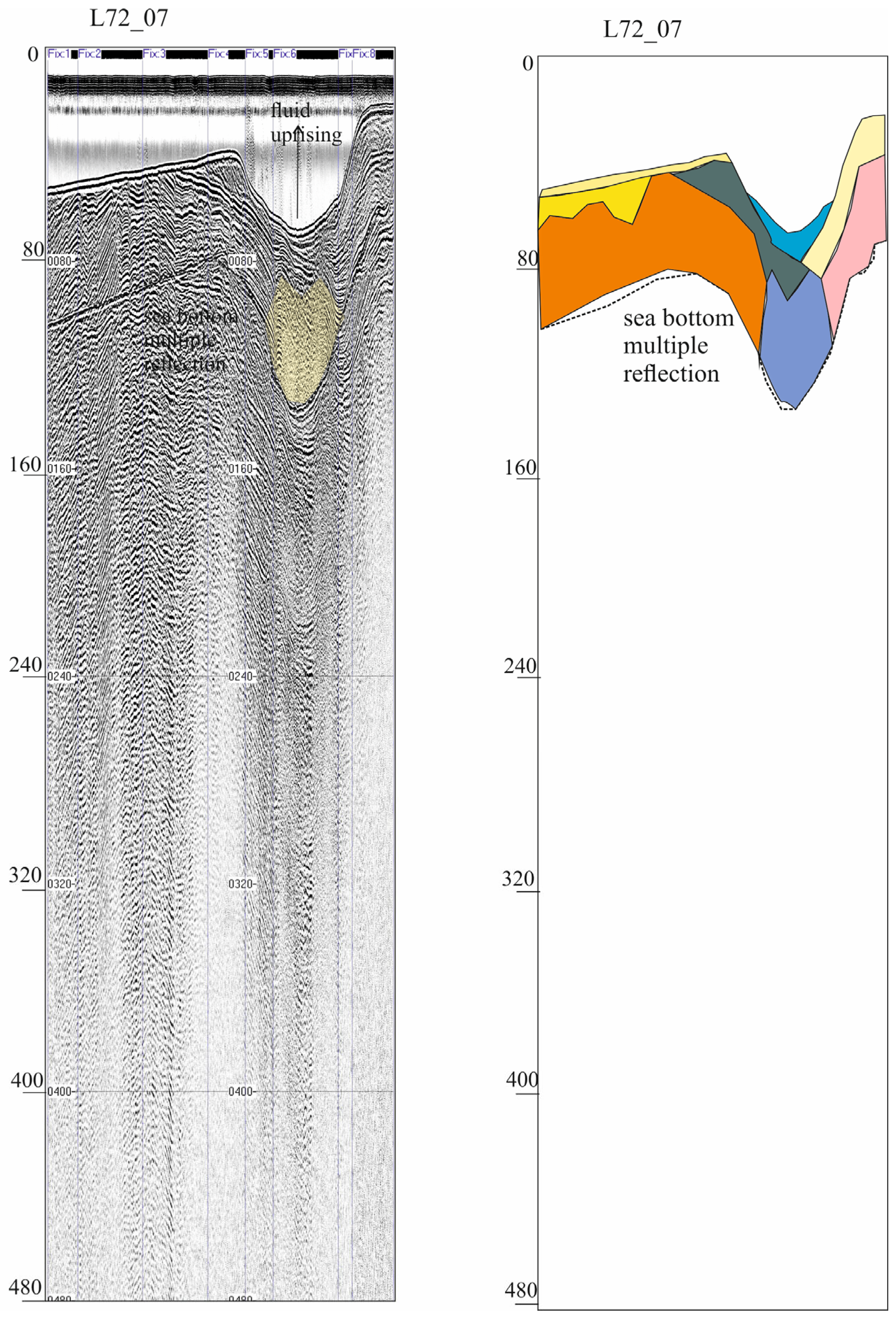
- Fluid uprising is shown by acoustically transparent zones, previously interpreted as volcanic sequences.
- -
- Fluid uprising is concentrated in anticlinalic and synclinalic structures. This finding is in agreement with previous studies on reservoir characterization, showing that these structures represent structural and stratigraphic traps [80]. In particular, roll-over anticlines represent valuable stratigraphic traps in hydrocarbon exploration.
- -
- Seismo-stratigraphic data suggest that the fluid uprising could be genetically related to the new bradyseismic crisis in the Gulf of Pozzuoli, still in course, as suggested by earthquakes and bradyseism occurring in this area, both onshore and offshore.
- -
- This phenomenon can be compared with similar processes on the fluid uprising controlling the individuation of seabed domes in the Naples Bay, namely the Banco della Montagna feature [11]. Active degassing has also been singled out.
- -
- In this volcanic–tectonic framework, the suggested mechanism is controlled by the occurrence of a heat source (magma reservoir) in the continental crust and/or the mantle, genetically related to the occurrence of submerged hydrothermal discharges in the Campania coastal regions.
- -
- Identifying (a) morphologies associated with active seabed deformation and (b) gas emissions close to heavily populated coastal regions, such as Italy’s Neapolitan volcanic area (home to approximately 1 million people), is crucial for assessing the likelihood of shallow-depth volcanic eruptions.
Funding
Data Availability Statement
Conflicts of Interest
References
- Carlson, P.R.; Golan-Bac, M.; Karl, H.A.; Kvenvolden, K.A. Seismic and geochemical evidence for shallow gas in sediment of Navarin continental margin, Bering Sea. AAPG Bull. 1985, 69, 422–436. [Google Scholar] [CrossRef] [Scilit]
- Judd, A.G.; Hovland, M. The evidence of shallow gas in marine sediments. Cont. Shelf Res. 1992, 12, 1081–1095. [Google Scholar] [CrossRef] [Scilit]
- Lee, S.H.; Chough, S.K. Distribution and origin of shallow gas in deep-sea sediments of the Ulleung Basin, East Sea (Sea of Japan). Geo-Mar. Lett. 2003, 22, 204–209. [Google Scholar] [CrossRef] [Scilit]
- Todesco, M.; Chiodini, G.; Macedonio, G. Monitoring and modelling hydrothermal fluid emission at La Solfatara (Phlegrean Fields, Italy). An interdisciplinary approach to the study of diffuse degassing. J. Volcanol. Geoth. Res. 2003, 125, 57–79. [Google Scholar] [CrossRef] [Scilit]
- Chiodini, G.; Avino, R.; Brombach, T.; Caliro, S.; Cardellini, C.; De Vita, S.; Frondini, F.; Granirei, D.; Marotta, E.; Ventura, G. Fumarolic and diffuse soil degassing west of Mount Epomeo, Ischia, Italy. J. Volcanol. Geoth. Res. 2004, 133, 291–309. [Google Scholar] [CrossRef] [Scilit]
- Castellarin, A.; Rabbi, E.; Cremonini, S.; Martelli, L.; Piattoni, F. New insights into the underground hydrology of the eastern Po Plain (northern Italy). Boll. Geof. Teor. Appl. 2006, 47, 271–298. [Google Scholar]
- Bruno, P.P.G.; Ricciardi, G.P.; Petrillo, Z.; Di Fiore, V.; Troiano, A.; Chiodini, G. Geophysical and hydrogeological experiments from a shallow hydrothermal system at Solfatara Volcano, Campi Flegrei, Italy: Response to caldera unrest. J. Geophys. Res. 2007, 112, B06201. [Google Scholar] [CrossRef] [Scilit]
- Hovland, M. The Geomorphology and Nature of Seabed Seepage Processes. In Bathymetry and Its Applications; Blondel, P., Ed.; IntechOpen: Rjeka, Croatia, 2012; Chapter 4; pp. 79–104. [Google Scholar]
- Italiano, F.; Liotta, M.; Martelli, M.; Martinelli, G.; Petrini, R.; Riggio, A.; Rizzo, A.L.; Slejko, F.; Stenni, B. Geochemical features and effects on deep-seated fluids during the May-June 2012 southern Po Valley seismic sequence. Ann. Geophys. 2012, 55, 815–821. [Google Scholar] [CrossRef] [Scilit]
- Piochi, M.; Kilburn, C.R.J.; Di Vito, M.A.; Mormone, A.; Tramelli, A.; Troise, C.; De Natale, G. The volcanic and geothermally active Campi Flegrei caldera:an integrated multidisciplinary image of its buried structure. Int. J. Earth Sci. 2014, 103, 401–421. [Google Scholar] [CrossRef] [Scilit]
- Passaro, S.; Tamburrino, S.; Vallefuoco, M.; Tassi, F.; Vaselli, O.; Giannini, L.; Chiodini, G.; Caliro, S.; Sacchi, M.; Rizzo, A.L.; et al. Seafloor doming driven by degassing processes unveils sprouting volcanism in coastal areas. Sci. Rep. 2016, 6, 22448. [Google Scholar] [CrossRef] [Scilit]
- Aiello, G.; Insinga, D.D.; Iorio, M.; Meo, A.; Senatore, M.R. On the occurrence of the Neapolitan Yellow Tuff tephra in the Northern Phlegraean Fields offshore (Eastern Tyrrhenian margin; Italy). Ital. J. Geosci. 2017, 136, 263–274. [Google Scholar] [CrossRef] [Scilit]
- Siniscalchi, A.; Tripaldi, S.; Romano, G.; Chiodini, G.; Improta, L.; Petrillo, Z.; D’Auria, L.; Caliro, S.; Avino, R. Reservoir structure and hydraulic properties of the Campi Flegrei geothermal system inferred by audiomagnetotelluric, geochemical, and seismicity study. J. Geophys. Res. Solid Earth 2019, 124, 5336–5356. [Google Scholar] [CrossRef] [Scilit]
- Ismail, A.; Ewida, H.F.; Al-Ibiary, M.G.; Gammaldi, S.; Zollo, A. Identification of gas zones and chimneys using seismic attributes analysis at the Scarab field, offshore, Nile Delta, Egypt. Pet. Res. 2020, 5, 59–69. [Google Scholar] [CrossRef] [Scilit]
- Isaia, R.; Di Giuseppe, M.G.; Natale, J.; Tramparulo, F.D.A.; Troiano, A.; Vitale, S. Volcano-tectonic setting of the Pisciarelli fumarole field, Campi Flegrei caldera, southern Italy: Insights into fluid circulation patterns and hazard scenarios. Tectonics 2021, 40, e2020TC006227. [Google Scholar] [CrossRef] [Scilit]
- Aiello, G.; Caccavale, M. New Seismoacoustic Data on Shallow Gas in Holocene Marine Shelf Sediments Offshore from the Cilento Promontory (Southern Tyrrhenian Sea, Italy). J. Mar. Sci. Eng. 2022, 10, 1992. [Google Scholar] [CrossRef] [Scilit]
- Torrese, P. ERT investigation of mud volcanoes: Detection of mud fluid migration pathways from 2D and 3D synthetic modeling. Acta Geod. et Geophys. 2023, 58, 601–629. [Google Scholar] [CrossRef] [Scilit]
- Vitale, S.; Natale, J. Combined volcano-tectonic processes for the drowning of the Roman western coastal settlements at Campi Flegrei (southern Italy). Earth Planets Space 2023, 75, 38. [Google Scholar] [CrossRef] [Scilit]
- Carfagna, N.; Brindisi, A.; Paolucci, E.; Albarello, D. Seismic monitoring of gas emissions at mud volcanoes: The case of Nirano (northern Italy). J. Volcanol. Geoth. Res. 2024, 446, 107993. [Google Scholar] [CrossRef] [Scilit]
- Brindisi, A.; Paolucci, E.; Carfagna, N.; Albarello, D. Passive seismic measurements to characterize gas reservoirs in a mud volcano field in Northern Italy. Mar. Petrol. Geol. 2025, 173, 107275. [Google Scholar] [CrossRef] [Scilit]
- Spatola, D.; Dahal, A.; Lombardo, L.; Casalbore, D.; Chiocci, F.L. First Pockmark susceptibility map of the Italian continental margins. Mar. Petrol. Geol. 2025, 176, 107337. [Google Scholar] [CrossRef] [Scilit]
- Gammaldi, S.; Ismail, A.; Zollo, A. Fluid Accumulation Zone by Seismic Attributes and Amplitude Versus Offset Analysis at Solfatara Volcano, Campi Flegrei, Italy. Front. Earth Sci. 2022, 10, 866534. [Google Scholar] [CrossRef] [Scilit]
- Iorio, M.; Meo, A.; Aiello, G.; Senatore, M.R. The Neapolitan Yellow Tuff record in the Gaeta Gulf (Eastern Tyrrhenian margin, Southern Italy). Adv. Geosci. 2024, 63, 15–27. [Google Scholar] [CrossRef] [Scilit]
- Aiello, G. Submarine Instability Processes on the Continental Slope Offshore of Campania (Southern Italy). GeoHazards 2025, 6, 20. [Google Scholar] [CrossRef] [Scilit]
- Hovland, M.; Judd, A. Seabed Pockmarks and Seepages: Impact on Geology, Biology and the Marine Environment; Graham and Trotman Editor: London, UK, 1988. [Google Scholar] [CrossRef] [Scilit]
- Aiello, G.; Marsella, E.; Di Fiore, V. New seismo-stratigraphic and marine magnetic data of the Gulf of Pozzuoli (Naples Bay, Tyrrhenian Sea, Italy): Inferences for the tectonic and the magmatic events of the Phlegrean Fields volcanic complex (Campania). Mar. Geophys. Res. 2012, 33, 97–125. [Google Scholar] [CrossRef] [Scilit]
- Aiello, G.; Giordano, L.; Giordano, F. High-resolution seismic stratigraphy of the Gulf of Pozzuoli (Naples Bay) and relationships with submarine volcanic setting of the Phlegrean Fields volcanic complex. Rend. Lincei Sci. Fis. E Nat. 2016, 27, 775–801. [Google Scholar] [CrossRef] [Scilit]
- Kopp, H.; Chiocci, F.L.; Berndt, C.; Çağatay, M.N.; Ferreira, T.; Fortes, C.J.E.M.; Gràcia, E.; González Vega, A.; Kopf, A.J.; Sørensen, M.B.; et al. Marine Geohazards: Safeguarding Society and the Blue Economy from a Hidden Threat; Muñiz Piniella, A., Kellett, P., van den Brand, R., Alexander, B., Rodríguez Perez, A., Van Elslander, J., Heymans, J.J., Eds.; Position Paper 26 of the European Marine Board; European Marine Board IVZW: Ostend, Belgium, 2021; p. 100. ISSN 2593-5232. ISBN 9789464206111. [Google Scholar] [CrossRef]
- Isaia, R.; Vitale, S.; Di Giuseppe, M.G.; Iannuzzi, E.; D’Assisi Tramparulo, F.; Troiano, A. Stratigraphy, structure, and volcano-tectonic evolution of Solfatara maar-diatreme (Campi Flegrei, Italy). Geol. Soc. Am. Bull. 2015, 127, 1–20. [Google Scholar] [CrossRef] [Scilit]
- Bernardinetti, S.; Bruno, P.P.G. The Hydrothermal System of Solfatara Crater (Campi Flegrei, Italy) Inferred From Machine Learning Algorithms. Front. Earth Sci. 2019, 7, 286. [Google Scholar] [CrossRef] [Scilit]
- Mayer, K.; Scheu, B.; Montanaro, C.; Yilmaz, T.I.; Isaia, R.; Aßbichler, D.; Dingwell, D.B. Hydrothermal alteration of surficial rocks at Solfatara (Campi Flegrei): Petrophysical properties and implications for phreatic eruption processes. J. Volcanol. Geotherm. Res. 2016, 320, 128–143. [Google Scholar] [CrossRef] [Scilit]
- de’Gennaro, M.; Cappelletti, P.; Langella, A.; Perrotta, A.; Scarpati, C. Genesis of zeolites in the Neapolitan Yellow Tuff: Geological, volcanological and mineralogical evidence. Contrib. Mineral. Petrol. 2000, 139, 17–35. [Google Scholar] [CrossRef] [Scilit]
- Isaia, R.; Vitale, S.; Marturano, A.; Aiello, G.; Barra, D.; Ciarcia, S.; Iannuzzi, E.; D’Assisi Tramparulo, F. High-resolution geological investigations to reconstruct the long-term ground movements in the last 15 kyr at Campi Flegrei caldera (southern Italy). J. Volcanol. Geoth. Res. 2019, 385, 143–158. [Google Scholar] [CrossRef] [Scilit]
- Tornero, V.; Ribera d’Alcalà, M. Contamination by hazardous substances in the Gulf of Naples and nearby coastal areas: A review of sources, environmental levels and potential impacts in the MSFD perspective. Sci. Total Environ. 2014, 466–467, 820–840. [Google Scholar] [CrossRef] [Scilit] [PubMed]
- Grezio, A.; Cinti, F.R.; Costa, A.; Faenza, L.; Perfetti, P.; Pierdominici, S.; Pondrelli, S.; Sandri, L.; Tierz, P.; Tonini, R.; et al. Multisource Bayesian probabilistic tsunami hazard analysis for the Gulf of Naples (Italy). J. Geophys. Res. Oceans 2020, 125, e2019JC015373. [Google Scholar] [CrossRef] [Scilit]
- Polonia, A.; Bonatti, E.; Camerlenghi, A.; Lucchi, R.; Panieri, G.; Gasperini, L. Mediterranean megaturbidite triggered by the AD 365 Crete earthquake and tsunami. Sci. Rep. 2013, 3, 1285. [Google Scholar] [CrossRef] [Scilit]
- Mattei, G.; Di Luccio, D.; Benassai, G.; Anfuso, G.; Budillon, G.; Aucelli, P. Characteristics and coastal effects of a destructive marine storm in the Gulf of Naples (southern Italy). Nat. Hazards Earth Syst. Sci. 2021, 21, 3809–3825. [Google Scholar] [CrossRef] [Scilit]
- Aiello, G.; Sacchi, M. New morpho-bathymetric data on marine hazard in the offshore of Gulf of Naples (Southern Italy). Nat. Hazards 2022, 111, 2881–2908. [Google Scholar] [CrossRef] [Scilit]
- Budillon, F.; Martorelli, E.; Conforti, A.; De Falco, G.; Bosman, A.; Di Martino, G.; Firetto Carlino, M.; Misuraca, M.; Innangi, S.; Pierdomenico, M.; et al. Geohazard features of the Gulf of Naples and Pontine Islands (Eastern Tyrrhenian Sea). J. Maps 2024, 20, 2378935. [Google Scholar] [CrossRef] [Scilit]
- Kilburn, C.R.J.; Carlino, S.; Danesi, S.; Pino, N.A. Potential for rupture before eruption at Campi Flegrei caldera, Southern Italy. Commun. Earth Environ. 2023, 4, 190. [Google Scholar] [CrossRef] [Scilit]
- Giudicepietro, F.; Avino, R.; Bellucci Sessa, E.; Bevilacqua, A.; Bonano, M.; Caliro, S.; Casu, F.; De Cesare, W.; De Luca, C.; De Martino, P.; et al. Burst-like swarms in the Campi Flegrei caldera accelerating unrest from 2021 to 2024. Nat. Commun. 2025, 16, 1548. [Google Scholar] [CrossRef] [Scilit] [PubMed]
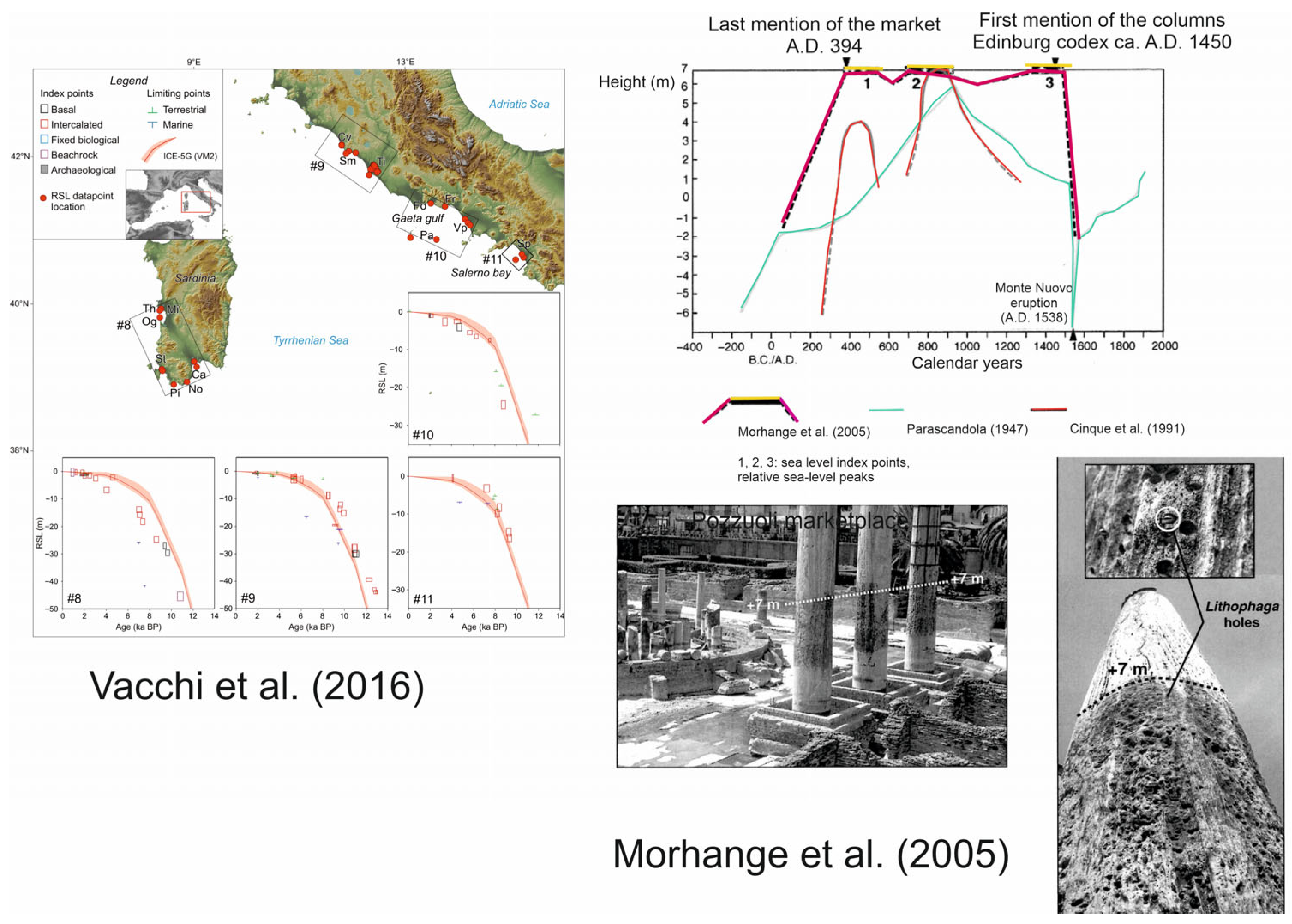
- Parascandola, A. I Fenomeni Bradisismici del Serapeo di Pozzuoli; Guida Editori: Napoli, Italy, 1947; pp. 1–117. [Google Scholar]
- Cinque, A.; Russo, M.; Pagano, M. La successione di terreni di età post-romana delle terme di Miseno (Napoli): Nuovi dati per la storia e la stratigrafia del bradisisma puteolano. Boll. Soc. Geol. Ital. 1991, 110, 231–244. [Google Scholar]
- Dvorak, J.J.; Mastrolorenzo, G. The Mechanisms of Recent Vertical Crustal Movements in Campi Flegrei Caldera, Southern Italy; Gological Society of America: Boulder, CO, USA, 1991; Volume 263, pp. 1–47. [Google Scholar]
- Morhange, C.; Marriner, R.; Laborel, J.; Todesco, M.; Oberlin, C. Rapid sea-level movements and noneruptive crustal deformations in the Phlegrean Fields caldera, Italy. Geology 2005, 34, 93–96. [Google Scholar] [CrossRef] [Scilit]
- Berrino, G.; Corrado, G.; Luongo, G.; Toro, B. Ground deformation and gravity changes accompanying the 1982 Pozzuoli uplift. Bull. Volcanol. 1984, 44, 187–200. [Google Scholar] [CrossRef] [Scilit]
- Vacchi, M.; Marriner, N.; Morhange, C.; Spada, G.; Fontana, A.; Rovere, A. Multiproxy assessment of Holocene relative sea-level changes in the western Mediterranean: Sea-level variability and improvements in the definition of the isostatic signal. Earth-Sci. Rev. 2016, 155, 172–197. [Google Scholar] [CrossRef] [Scilit]
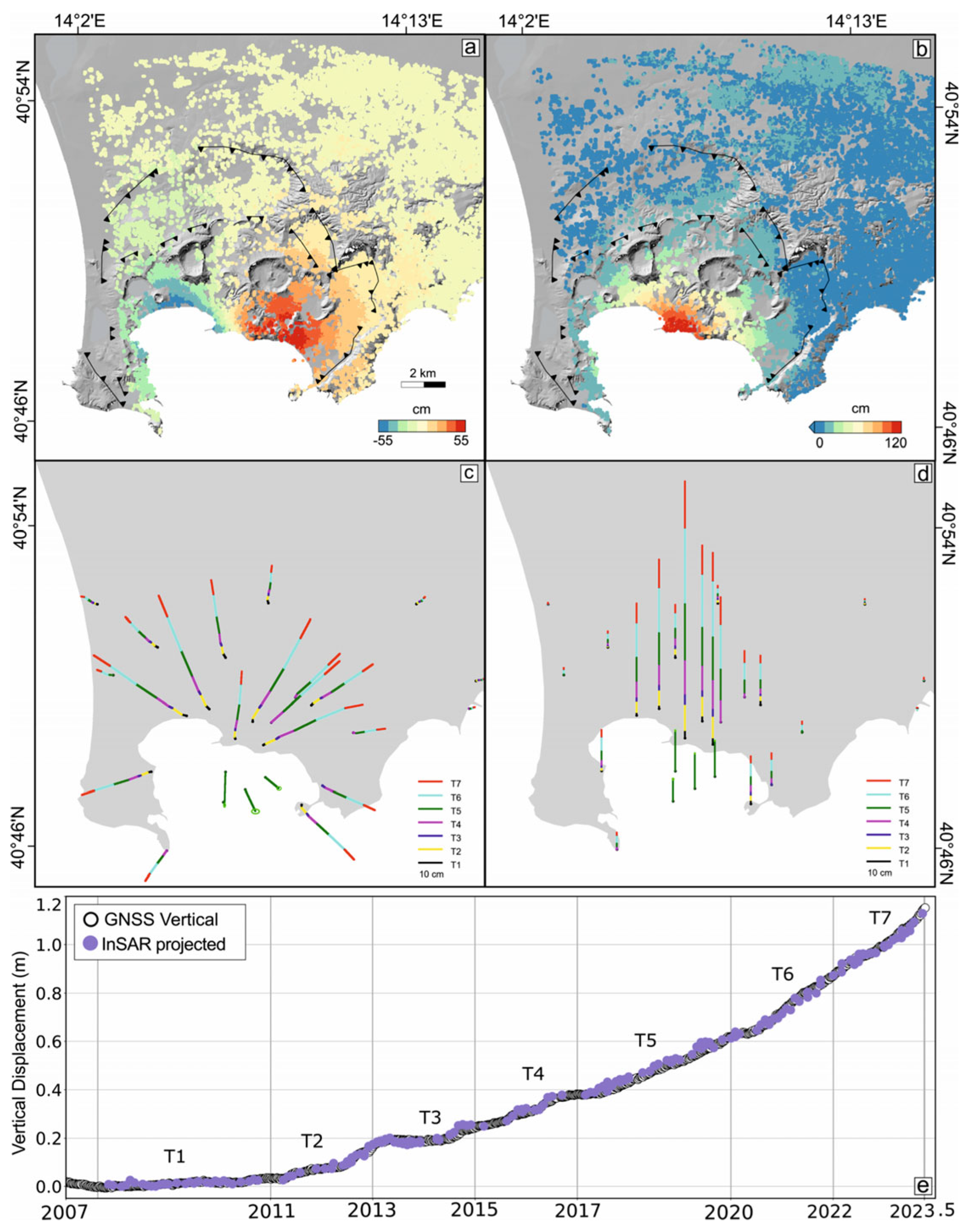
- Astort, A.; Trasatti, E.; Caricchi, L.; De Martino, P.; Acocella, V.; Di Vito, M.A. Tracking the 2007–2023 magma-driven unrest at Campi Flegrei caldera (Italy). Commun. Earth Environ. 2024, 5, 506. [Google Scholar] [CrossRef] [Scilit]
- Patanè, D.; Barberi, G.; Martino, C. Seismic Images of Pressurized Sources and Fluid Migration Driving Uplift at the Campi Flegrei Caldera During 2020–2024. GeoHazards 2025, 6, 19. [Google Scholar] [CrossRef] [Scilit]
- Rosi, M.; Sbrana, A. Phlegrean Fields; Quaderni De La Ricerca Scientifica; Consiglio Nazionale Delle Ricerche (CNR) Italiano: Roma, Italy, 1987; Volume 114, pp. 1–175.
- Di Vito, M.A.; Isaia, R.; Orsi, G.; Southon, J.; De Vita, S.; D’Antonio, M.; Pappalardo, L.; Piochi, M. Volcanism and deformation since 12,000 years at the Campi Flegrei caldera (Italy). J. Volcanol. Geoth. Res. 1999, 91, 221–246. [Google Scholar] [CrossRef] [Scilit]
- Nunziata, C.; Mele, R. Natale, M Shear wave velocities and primary influencing factors of Campi Flegrei—Neapolitan deposits. Engineer. Geol. 1999, 54, 299–312. [Google Scholar] [CrossRef] [Scilit]
- Orsi, G.; De Vita, S.; Di Vito, M.A.; Isaia, R.; Nave, R.; Heiken, G. Facing volcanic and related hazard in the Neapolitain area. In Earth Sciences in the City; Heiken, G., Fakundiny, R., Sutter, J., Eds.; American Geophysical Union Special Publication: Washington, DC, USA, 2002; pp. 121–170. [Google Scholar]
- Orsi, G.; Di Vito, M.A.; Selva, J.; Marzocchi, W. Long-term forecast of eruption style and size at Campi Flegrei caldera (Italy). Earth Planet. Sci. Lett. 2009, 287, 265–276. [Google Scholar] [CrossRef] [Scilit]
- D’Argenio, B.; Aiello, G.; de Alteriis, G.; Milia, A.; Sacchi, M.; Tonielli, R.; Budillon, F.; Chiocci, F.L.; Conforti, A.; De Lauro, M.; et al. Digital Elevation Model of the Naples Bay and Adjacent Areas, Eastern Tyrrhenian Sea; Atlante di Cartografia Geologica scala 1:50,000 (progetto CARG); 32° International Congress “Firenze 2004”; Servizio Geologico d’Italia (APAT): Firenze, Italy; Editore De Agostini: Novara, Italy, 2004.
- Deino, A.L.; Orsi, G.; Piochi, M.; de Vita, S. The age of the Neapolitan Yellow Tuff caldera-forming eruption (Campi Flegrei caldera—Italy) assessed by 40Ar/39Ar dating method. J. Volcanol. Geoth. Res. 2004, 133, 157–170. [Google Scholar] [CrossRef] [Scilit]
- Milia, A.; Torrente, M.M. The influence of paleogeographic setting and crustal subsidence on the architecture of ignimbrites in the Bay of Naples (Italy). Earth Plan. Sci. Lett. 2007, 263, 192–206. [Google Scholar] [CrossRef] [Scilit]
- Blockley, S.P.E.; Ramsey, C.B.; Pyle, D.M. Improved age modeling and high-precision age estimates of late Quaternary tephras, for accurate paleoclimate reconstruction. J. Volcanol. Geoth. Res. 2008, 177, 251–262. [Google Scholar] [CrossRef] [Scilit]
- Sacchi, M.; Pepe, F.; Corradino, M.; Insinga, D.D.; Molisso, F.; Lubritto, C. The Neapolitan Yellow Tuff caldera offshore the Campi Flegrei: Stratal architecture and kinematic reconstruction during the last 15 ky. Mar. Geol. 2014, 354, 15–33. [Google Scholar] [CrossRef] [Scilit]
- Steinmann, L.; Spiess, V.; Sacchi, M. The Campi Flegrei caldera (Italy): Formation and evolution in interplay with sea-level variations since the Campanian Ignimbrite eruption at 39 ka. J. Volcanol. Geoth. Res. 2016, 327, 361–374. [Google Scholar] [CrossRef] [Scilit]
- Steinmann, L.; Spiess, V.; Sacchi, M. Post-collapse evolution of a coastal caldera system: Insights from a 3D multichannel seismic survey from the Campi Flegrei caldera (Italy). J. Volcanol. Geoth. Res. 2018, 349, 83–98. [Google Scholar] [CrossRef] [Scilit]
- Barberi, F.; Innocenti, F.; Lirer, L.; Munno, R.; Pescatore, T.S.; Santacroce, R. The Campanian Ignimbrite: A major prehistoric eruption in the Neapolitan area (Italy). Bull. Volcanol. 1978, 41, 10–27. [Google Scholar] [CrossRef] [Scilit]
- Rolandi, G.; Bellucci, F.; Heizler, M.T.; Belkin, H.E.; De Vivo, B. Tectonic controls on the genesis of ignimbrites from the Campanian Volcanic Zone, southern Italy. Mineral. Petrol. 2003, 79, 3–31. [Google Scholar] [CrossRef] [Scilit]
- Marianelli, P.; Sbrana, A.; Proto, M. Magma chamber of the Campi Flegrei supervolcano at the time of eruption of the Campanian Ignimbrite. Geology 2006, 34, 937–940. [Google Scholar] [CrossRef] [Scilit]
- Pyle, D.M.; Ricketts, G.D.; Margari, V.; van Andel, T.H.; Sinitsyn, A.A.; Praslov, N.D.; Lisitsyn, S. Wide dispersal and deposition of distal tephra during the Pleistocene ‘Campanian Ignimbrite/Y5’ eruption, Italy. Quat. Sci. Rev. 2006, 25, 2713–2728. [Google Scholar] [CrossRef] [Scilit]
- Fitzsimmons, K.E.; Hambach, U.; Veres, D.; Iovita, R. The Campanian Ignimbrite Eruption: New Data on Volcanic Ash Dispersal and Its Potential Impact on Human Evolution. PLoS ONE 2013, 8, e65839. [Google Scholar] [CrossRef] [Scilit]
- Forni, F.; Bachmann, O.; Mollo, S.; De Astis, G.; Gelman, S.E.; Ellis, B.S. The origin of a zoned ignimbrite: Insights into the Campanian Ignimbrite magma chamber (Campi Flegrei, Italy). Earth Plan. Sci. Lett. 2016, 449, 259–271. [Google Scholar] [CrossRef] [Scilit]
- Marti, A.; Folch, A.; Costa, A.; Engwell, S. Reconstructing the plinian and co-ignimbrite sources of large volcanic eruptions: A novel approach for the Campanian Ignimbrite. Sci. Rep. 2016, 6, 21220. [Google Scholar] [CrossRef] [Scilit]
- Scarpati, C.; Sparice, D.; Perrotta, A. Comparative proximal features of the main Plinian deposits (Campanian Ignimbrite and Pomici di Base) of Campi Flegrei and Vesuvius. J. Volcanol. Geotherm. Res. 2016, 321, 149–157. [Google Scholar] [CrossRef] [Scilit]
- Giaccio, B.; Hajdas, I.; Isaia, R.; Deino, A.; Nomade, S. High-precision 14C and 40Ar/39Ar dating of the Campanian Ignimbrite (Y-5) reconciles the timescales of climatic-cultural processes at 40 ka. Sci. Rep. 2017, 7, 45940. [Google Scholar] [CrossRef] [Scilit]
- Silleni, A.; Giordano, G.; Isaia, R.; Ort, M.H. The Magnitude of the 39.8 ka Campanian Ignimbrite Eruption, Italy: Method, Uncertainties and Errors. Front. Earth Sci. 2020, 8, 543399. [Google Scholar] [CrossRef] [Scilit]
- Rolandi, G.; Di Lascio, M.; Rolandi, R. 11—The Neapolitan Yellow Tuff eruption as the source of the Campi Flegrei caldera. In Vesuvius, Campi Flegrei and Campanian Volcanism; De Vivo, B., Harvey, E., Belkin, H.E., Rolandi, G., Eds.; Elsevier: Amsterdam, The Netherlands, 2020; pp. 273–296. [Google Scholar] [CrossRef] [Scilit]
- Vineberg, S.O.; Isaia, R.; Albert, P.G.; Brown, R.J.; Smith, V.C. Insights into the explosive eruption history of the Campanian volcanoes prior to the Campanian Ignimbrite eruption. J. Volcanol. Geoth. Res. 2023, 443, 107915. [Google Scholar] [CrossRef] [Scilit]
- Sbrana, A.; Marianelli, P.; Pasquini, G. The Phlegrean Fields volcanological evolution. J. Maps 2021, 17, 557–570. [Google Scholar] [CrossRef] [Scilit]
- Natale, J.; Ferranti, L.; Marino, C.; Sacchi, M. Resurgent dome faults in the offshore of the Campi Flegrei caldera (Pozzuoli Bay, Campania): Preliminary results from high-resolution seismic reflection profiles. Boll. Di Geofis. Teor. Appl. 2020, 61, 333–342. [Google Scholar] [CrossRef] [Scilit]
- Vitale, S.; Isaia, R. Fractures and faults in volcanic rocks (Campi Flegrei, southern Italy): Insight into volcano-tectonic processes. Int. J. Earth Sci. (Geol. Rundsch.) 2014, 103, 801–819. [Google Scholar] [CrossRef] [Scilit]
- Vitale, S.; Isaia, R.; Ciarcia, S.; Di Giuseppe, M.G.; Iannuzzi, E.; Prinzi, E.P.; Tramparulo, F.D.A.; Troiano, A. Seismically induced soft-sediment deformation phenomena during the volcano-tectonic activity of Campi Flegrei caldera (southern Italy) in the last 15 kyr. Tectonics 2019, 38, 1999–2018. [Google Scholar] [CrossRef] [Scilit]
- Natale, J.; Camanni, G.; Ferranti, L.; Isaia, R.; Sacchi, M.; Spiess, V.; Steinmann, L.; Vitale, S. Fault systems in the offshore sector of the Campi Flegrei caldera (southern Italy): Implications for nested caldera structure, resurgent dome, and volcano-tectonic evolution. J. Struct. Geol. 2022, 163, 104723. [Google Scholar] [CrossRef] [Scilit]
- Orsi, G.; De Vita, S.; Di Vito, M. The restless, resurgent Campi Flegrei nested caldera (Italy): Constraints on its evolution and configuration. J. Volcanol. Geotherm. Res. 1996, 74, 179–214. [Google Scholar] [CrossRef] [Scilit]
- Turner, R.; Ahmed, M.; Bissell, R.; Prothro, L.O.; Shehata, A.A.; Coffin, R. Structural and stratigraphic controls on reservoir architecture: A case study from the lower Oligocene Vicksburg Formation, Brooks County, Texas. Mar. Pet. Geol. 2024, 160, 106627. [Google Scholar] [CrossRef] [Scilit]



| Time | Magnitude (MW) | Location | Depth | Latitude | Longitude |
|---|---|---|---|---|---|
| 27 September 2023 | 4.2 | Campi Flegrei | 3 km | 40°82′ | 14°16′ |
| 2 October 2023 | 4.0 | Campi Flegrei | 3 km | 40°83′ | 14°15′ |
| 7 September 2023 | 3.8 | Campi Flegrei | 3 km | 40°83′ | 14°15′ |
| 16 October 2023 | 3.6 | Campi Flegrei | 2 km | 40°8′ | 14°14′ |
| 11 June 2023 | 3.6 | Campi Flegrei | 3 km | 40° 83′ | 14°11′ |
| 18 August 2023 | 3.6 | Campi Flegrei | 2 km | 40°83′ | 14°14′ |
| 23 November 2023 | 3.1 | Campi Flegrei | 3 km | 40°83′ | 14°14′ |
| 17 February 2024 | 3.0 | Campi Flegrei | 3 km | 40°84′ | 14°12′ |
| 3 March 2024 | 3.4 | Campi Flegrei | 3 km | 40°82′ | 14°16′ |
| 11 March 2024 | 3.0 | Vesuvius | 3 km | 40°85′ | 14°.40′ |
| 14 April 2024 | 3.7 | Campi Flegrei | 2 km | 40°83′ | 14°14′ |
| 14 April 2024 | 2.1 | Vesuvius | 8 km | 40°81′ | 14°35′ |
| 27 April 2024 | 3.9 | Campi Flegrei | 3 km | 40°81′ | 14°09′ |
| 28 April 2024 | 3.1 | Vesuvius | 0 km | 40°82′ | 14°83′ |
| 10 May 2025 | 3.7 | Campi Flegrei | 3 km | 40°80′ | 14°11′ |
| 20 May 2024 | 3.9 | Campi Flegrei | 3 km | 40°83′ | 14°14′ |
| 8 June 2024 | 3.7 | Campi Flegrei | 3 km | 40°83′ | 14°15′ |
| 2 July 2024 | 3.9 | Campi Flegrei | 3 km | 40°81′ | 14°16′ |
| 18 July 2024 | 3.6 | Campi Flegrei | 2 km | 40°83′ | 14°15′ |
| 30 August 2024 | 3.7 | Campi Flegrei | 2 km | 40°83′ | 14°15′ |
| 22 September 2024 | 2.2 | Vesuvius | 2 km | 40°82′ | 14°83′ |
| 13 October 2024 | 2.6 | Campi Flegrei | 2 km | 40°83’ | 14°15′ |
| 9 November 2024 | 2.8 | Vesuvius | 1 km | 40°81′ | 14°82′ |
| 6 December 2024 | 2.7 | Campi Flegrei | 0 km | 40°82′ | 14°14′ |
| 17 January 2025 | 3.0 | Campi Flegrei | 2 km | 40°83′ | 14°13′ |
| 28 January 2025 | 2.6 | Vesuvius | 1 km | 40°82′ | 14°43′ |
| 5 February 2025 | 3.1 | Campi Flegrei | 3 km | 40°83′ | 14°15′ |
| 9 February 2025 | 2.5 | Vesuvius | 1 km | 40°82′ | 14°43′ |
| 17 February 2025 | 3.9 | Campi Flegrei | 2 km | 40°83′ | 14°15′ |
| 17 February 2025 (among others) | 2.7 | Campi Flegrei | 2 km | 40°83′ | 14°15′ |
| 18 February 2025 | 3.1 | Campi Flegrei | 1 km | 40°83′ | 14°14′ |
| 7 March 2025 | 3.2 | Campi Flegrei | 1 km | 40°82′ | 14°13′ |
| 13 March 2025 | 4.6 | Campi Flegrei | 2 km | 40°82′ | 14°16′ |
| Phase 1: Pre-caldera activity | Oldest trachytic volcanoes of Miliscola and Vita Fumo. Spatters and lava domes of S. Martino. Torregaveta lava field (Monte di Procida). Pignatiello Formation. Ischia regional markers. Lava dome of Cuma. San Severino quarries (PDCs). Punta Marmolite deposits. Northern border of Quarto plain. Volcanic deposits of the Camaldoli hill. Torre di Franco tuffs. White tuffs. Volcanic deposits of the Naples town: San Martino hill, Funicolare di Chiaia, Parco Grifeo, Parco Margherita, San Sepolcro, M.te Echia, Castel dell’Ovo, Capodimonte, Soccavo, Camaldoli. Volcanic tuff rings and tuff cones at Fiumicello and Vivara. |
| Phase 2: Campanian Ignimbrite eruption and genetically related caldera formation | Campanian Ignimbrite proximal deposits, including a trachytic to phonolitic Plinian fallout layer, followed by densely welded and welded trachytic ignimbrites. Piperno. Campanian Grey Tuffs. Breccia Museo (lithic breccias) is composed of ash and pumice-rich PDC deposits, which were erupted during the phase of caldera collapse. |
| Phase 3: Neapolitan Yellow Tuff eruption (NYT) | Posillipo and Gauro multivent hydromagmatic eruptions. Post-NYT nested collapses. CI caldera fills with marine deposits during the first stages. Trentaremi, Torregaveta and Monticelli volcanic vents. |
| Phase 4: Resurgence of the caldera center and volcanism in correspondence with numerous volcanic edifices | Deposition of coastal and marine sands on the La Starza marine terrace (Gulf of Pozzuoli). Emplacement of minor tuff cones, including the Nisida Bank, Bacoli tuff cone, S. Teresa tuff cone, Porto Miseno tuff cone, Minopoli scoria vent, Pisani ash ring, La Pietra tuff cone, Montagna Spaccata scoria and spatter cone, Fondo Riccio scoria and spatter cone, Concola scoria and spatter cone. Pomici Principali Plinian eruption (PDCs). |
| Phase 5: Eruption in correspondence with a few volcanic edifices | Deposition of coastal and marine sands on the La Starza marine terrace (Gulf of Pozzuoli). Eruption of the Baia and Fondi di Baia tuff rings (including the Procida Island). Lava flow of Monte Spina. Spattered eruptions in the caldera center, including the Costa S. Domenico and S. Martino tuff rings. |
| Phase 6: Collapse of the nested caldera, deposition of marine sediments, Plinian eruptions and volcanic eruptions | Deposition of the post-AMS shore sediments. The volcanic eruption corresponded with the Capo Miseno tuff cone. Plinian eruption of Agnano-Monte Spina. Emplacement of the Olibano and Accademia volcanic domes. Volcanic activity of the Solfatara maar. Astroni, Senga and Nisida volcanoes. |
| Phase 7: Renewal of volcanic activity and caldera uplift | Eruption of the Monte Nuovo volcanic edifice. Volcanic–tectonic uplift of the caldera center in correspondence with a volcanic dome. |
| Seismo-Stratigraphic Unit | Seismic Facies | Geological Interpretation | Location |
|---|---|---|---|
| HST | Progradational to parallel seismic reflectors | Highstand system tract | Eastern sector of the Gulf of Pozzuoli |
| TST | Retrogradational seismic reflectors | Transgressive system tract | Eastern sector of the Gulf of Pozzuoli |
| Lsl | Wedge-shaped, chaotic to discontinuous seismic unit | Landslide deposits intercalated in the upper part of the Lowstand System Tract; local occurrence of paleo-channels | Gulf of Pozzuoli (southwards of the Miseno Cape) |
| LST | Progradational seismic reflectors, erosionally truncated at their top | Lowstand System Tract | Inner continental shelf (Gulf of Pozzuoli) |
| G1 | Parallel and continuous seismic reflectors | Upper sedimentary unit of the basin fill, attaining maximum thickness in the depocenter of the central basin | Gulf of Pozzuoli |
| lsl2 | Wedge-shaped, chaotic to discontinuous seismic unit | Fossil landslide overlying the G2 marine unit and underlying the LST deposits | Eastern sector of the Gulf of Pozzuoli |
| NYT/PC | NYT: wedge-shaped acoustically transparent volcanic seismic unit | NYT: pyroclastic deposits of the Neapolitan Yellow Tuff (15 ky B.P.) PC: Tuff cones of the Nisida volcanic complex in facies with the Neapolitan Yellow Tuffs and interstratified with the G3 marine deposits. | Gulf of Naples Gulf of Pozzuoli |
| G2 | Parallel and continuous seismic reflectors | Intermediate seismic unit of the basin fill; deformed in correspondence with growth anticlines (Punta Pennata anticline, Pozzuoli anticline, Nisida anticline) and synclines (central syncline of the Gulf of Pozzuoli, Epitaffio syncline). | Gulf of Pozzuoli |
| Lsl1 | Wedge-shaped, chaotic to discontinuous seismic unit | Wide paleo-landslide, overlying the V3 volcaniclastic unit and coeval with the basal part of the G2 marine unit | Eastern sector of the Gulf of Pozzuoli |
| Pyr 2 | Continuous progradational to parallel seismic reflectors | Pyroclastic unit deposited from Capo Miseno to the Miseno Bank; deformed by wedging and growth in correspondence with normal faults. | Eastern sector of the Gulf of Pozzuoli |
| Dk | Sub-vertical volcanic bodies, acoustically transparent, locally bounded by normal faults | Volcanic dykes controlled by the magma uprising in correspondence with normal faults | Eastern and central sectors of the Gulf of Pozzuoli |
| Pyr1 | Discontinuous to sub-parallel seismic reflectors | Pyroclastic unit filling a structural depression under the Miseno Cape volcanic edifice | Eastern sector of the Gulf of Pozzuoli |
| G3 | Discontinuous to parallel seismic reflectors | Lower seismo-stratigraphic unit; deformed in correspondence to anticlines and synclines | Gulf of Pozzuoli |
| V3 | Acoustically transparent to discontinuous seismic unit; strongly eroded at its top | Volcaniclastic unit deposited at the northern margin of the Pentapalummo Bank | Gulf of Pozzuoli |
| Seismo-Stratigraphic Units and Other Significant Features | Seismic Facies | Geological Interpretation | Location |
|---|---|---|---|
| Lower seismo-stratigraphic unit | Spaced plane parallel reflections | Marine epiclastic (fossil reworked tuffs) drilled at the Mofete and San Vito geothermal areas under yellow tuffs of Phase 3 (post Campanian Ignimbrite?) | Seismic sections L68, L69, L71, L74 |
| Seismo-stratigraphic unit, overlying the lower one | Irregular surface at its top, with hummocks and V-shaped surfaces, variable lateral thickness, discontinuous internal reflectors. | Landslide deposits older than the NYT deposits | Seismic sections L68, L69; L71; L74 |
| Seismo-stratigraphic unit of phase 3 of Sbrana et al. [74] | Well-stratified seismic unit | NYT (Neapolitan Yellow Tuff), Posillipo vent alignment, Gauro hydromagmatic tuff cone deposits. Involved in the dome-shaped resurgence of the central collapsed portion of the caldera. | All the seismic sections of the available grid |
| Outer and Inner Ring Faults allowing for the caldera collapse. | |||
| Three orders of marine abrasion surfaces (90–110 m, 60 m, 40 m, 20–30 m) |
Disclaimer/Publisher’s Note: The statements, opinions and data contained in all publications are solely those of the individual author(s) and contributor(s) and not of MDPI and/or the editor(s). MDPI and/or the editor(s) disclaim responsibility for any injury to people or property resulting from any ideas, methods, instructions or products referred to in the content. |
© 2025 by the author. Licensee MDPI, Basel, Switzerland. This article is an open access article distributed under the terms and conditions of the Creative Commons Attribution (CC BY) license (https://creativecommons.org/licenses/by/4.0/).
Share and Cite
Aiello, G. Seismo-Stratigraphic Data of the Gulf of Pozzuoli (Southern Tyrrhenian Sea, Italy): A Review and Their Relationships with the New Bradyseismic Crisis. GeoHazards 2025, 6, 46. https://doi.org/10.3390/geohazards6030046
Aiello G. Seismo-Stratigraphic Data of the Gulf of Pozzuoli (Southern Tyrrhenian Sea, Italy): A Review and Their Relationships with the New Bradyseismic Crisis. GeoHazards. 2025; 6(3):46. https://doi.org/10.3390/geohazards6030046
Chicago/Turabian StyleAiello, Gemma. 2025. "Seismo-Stratigraphic Data of the Gulf of Pozzuoli (Southern Tyrrhenian Sea, Italy): A Review and Their Relationships with the New Bradyseismic Crisis" GeoHazards 6, no. 3: 46. https://doi.org/10.3390/geohazards6030046
APA StyleAiello, G. (2025). Seismo-Stratigraphic Data of the Gulf of Pozzuoli (Southern Tyrrhenian Sea, Italy): A Review and Their Relationships with the New Bradyseismic Crisis. GeoHazards, 6(3), 46. https://doi.org/10.3390/geohazards6030046