Article

Simultaneously Improving the Selectivity and Stability of HZSM-5 Zeolite by NaOH Treatment in Aqueous Ethanol-to-Propylene Reactions


Faculty of Chemical Engineering and Energy Technology, Shanghai Institute of Technology, Shanghai 201418, China
*
Author to whom correspondence should be addressed.
Reactions 2026, 7(3), 48; https://doi.org/10.3390/reactions7030048
Submission received: 1 July 2026 / Revised: 6 August 2026 / Accepted: 10 August 2026 / Published: 14 August 2026

Abstract

Mesoporous nanoscale HZSM-5 zeolites were prepared by alkali treatment and characterized by XRD, SEM, NMR, ICP-OES, N2 adsorption/desorption, NH3-TPD, Py-IR, and TG techniques. The effects of NaOH concentration on pore structure, acidity, and catalytic performance of nanoscale HZSM-5 zeolites were systematically investigated for selective conversion of aqueous ethanol to propylene. The results showed that the newly developed mesopores on HZSM-5 zeolite were enhanced with increasing NaOH concentrations. By treating nanoscale HZSM-5 zeolite using NaOH solutions with appropriate concentrations (0.2 mol/L), AZ-0.2 showed simultaneously higher propylene selectivity and better stability because of its larger mesopore volume, higher B/L ratios, and suitable acidity. However, excessive treatment by a high-concentration NaOH (0.4 mol/L) solution led to serious desilication, which remarkably increased the strength and amount of strong acid sites on AZ-0.4, resulting in a remarkable decrease in propylene selectivity and catalyst stability.

1. Introduction

Propylene is an essential chemical stock primarily used in the production of various polypropylene plastics, acrylonitrile, and propylene oxide. Propylene is mainly produced as an industrial byproduct of ethylene through catalytic cracking of crude oil. However, this process is highly energy intensive, low output, and accounts for huge carbon dioxide emissions. In addition, the demand for propylene is expected to increase rapidly due to the growing demand for propylene derivatives, such as polypropylene and propylene oxide. Therefore, there has been increasing research attention on alternative routes for propylene production, with one of the important alternative technologies being the dehydration of ethanol over suitable catalysts [1,2,3,4].
Among the numerous catalysts reported for ethanol dehydration, HZSM-5 zeolite is widely used due to its unique properties, such as intrinsic acidity, high surface area, shape selectivity, superior thermal and hydrothermal stability, and well-defined pore size and topology [5,6]. However, the purely microporous nature of zeolites frequently poses transport limitations and facilitates coke formation, which usually deactivates the zeolite catalyst [7,8]. To improve the catalyst’s effectiveness, introducing additional mesopores into microporous zeolite particles can enhance the diffusion rates of reactants and products [9,10]. Generally, two methodologies have proven to be highly effective for creating mesopores in high silica zeolites such as ZSM-5, i.e., templating and framework desilication [11]. The templating method involves organic or hard templates. However, the high-cost templates, complicated synthesis steps, and control of the mesopores size make it non-feasible for large-scale industrial applications [11]. The desilication method, which involves alkaline solutions, has been widely used in recent years for the creation of mesopores in ZSM-5 [12,13]. This method is particularly simple, cost efficient, and of superior reproducibility, making it a preferable modification method [14].
Up to now, several studies have reported the use of mesoporous HZSM-5 for the conversion of ethanol to hydrocarbons [15,16,17]. For instance, Sheng et al. [16] reported that HZSM-5 treated with 0.4 mol/L NaOH showed high activity and good stability for ethanol dehydration to ethylene, primarily attributed to the created mesopores and the decreased number of strong acid sites. Gayubo et al. [18] reported NaOH-etched microscale HZSM-5 for aqueous bioethanol-to-olefin conversion, where only a single short-time alkali treatment condition was adopted to moderate acid strength for light olefin production. Recently, it was reported that the alkali-treated HZSM-5 zeolites showed better conversion and higher selectivity to C4–C9 hydrocarbons compared to the parent microporous zeolites [15]. Our group [19] previously investigated alkali–phosphorus dual-modified HZSM-5 to enhance propylene selectivity, relying on additional phosphorus doping to tune acid sites. Nevertheless, to the best of our knowledge, systematic research focusing on gradient NaOH concentration regulation of specific nanoscale HZSM-5 under high-water/high-temperature conditions remains insufficient.
In this work, we report the selective conversion of aqueous ethanol into propylene over the mesoporous nanoscale HZSM-5 prepared from desilication. Particularly, the effects of concentration of NaOH solution on the structure, acidic properties, and catalytic performance of the treated nanoscale HZSM-5 were systematically studied, and the roles of mesopores, as well as the acidity in catalytic behaviors, were discussed in detail.

2. Materials and Methods

2.1. Catalyst Preparation

The nano-HZSM-5 zeolite (produced by Zibo Tengjin Energy Saving Technology Co., Ltd., Zibo, Shandong, China, with a SiO2/Al2O3 molar ratio of 69 and an average crystal size of 80 nm) and a NaOH (Shanghai Titan Scientific Co., Ltd., Shanghai, China) solution with various concentrations of 0.1, 0.2, and 0.4 mol/L at a mass ratio of 1:20 were heated in a Teflon-lined stainless-steel autoclave at 60 °C for 2 h under stirring. After processing, the reactor was cooled rapidly in cold water. Then, the zeolite was collected through multiple cycles of centrifugation and washing with deionized water, dried overnight at 110 °C, and calcined in air at 550 °C for 6 h. The obtained ZSM-5 was turned into the H-form by three consecutive ion exchanges in a large excess of aqueous 1 mol/L solution of NH4NO3 (Shanghai Titan Scientific Co., Ltd., Shanghai, China) at 85 °C and calcined again at 550 °C for 6 h. The alkali-treated samples were named as AZ-0.1, AZ-0.2, and AZ-0.4. The parent nano-HZSM-5 zeolite was named as HZ.

2.2. Catalyst Characterization

X-ray diffraction (XRD) measurements were carried out using Cu Kα radiation (λ = 1.54056 Å) on a Rigaku C/max-2500 diffractometer (Rigaku, Tokyo, Japan) at 40 kV and 40 mA. The patterns were recorded in the 2θ range from 5° to 50° at a scanning rate of 4 °/min. The relative crystallinity of the ZSM-5 zeolite samples was calculated based on the sum of the peak areas of the diffraction peaks in the 2θ = 22–25° range from the XRD patterns, and the experimental uncertainties were estimated to be ~5%.
Scanning electron microscopy (SEM) analysis was carried out in a Hitachi S-5500 microscope (Hitachi, Tokyo, Japan) operated at an accelerating voltage of 1.0 kV.
27Al MAS NMR measurements were performed on a Bruker AVANCE III 600 spectrometer (Bruker, Karlsruhe, Germany) at a resonance frequency of 156.4 MHZ, using a 4 mm HX double-resonance MAS probe at a sample spinning rate of 15 kHz. The chemical shift of 27Al was referenced to 1 mol/L aqueous Al(NO3)3. 27Al MAS NMR spectra were recorded by the small-flip angle technique, with a pulse length of 0.5 μs (<π/12), a 1s recycle delay, and 3000 scans. 29Si MAS NMR spectra, with high-power proton decoupling, were recorded on a 4 mm probe with a spinning rate of 12 kHz, a π/4 pulse length of 2.6 μs, and a recycle delay of 80 s. The chemical shifts of 29Si were referenced to trimethylsilane (TMS). All detected peaks for 27Al-MAS and 29Si-MAS spectra were deconvoluted at different positions using the Origin 8.5 program, with a Gaussian–Lorentzian function for peak fitting, from which the peak area was calculated.
The average bulk Si/Al molar ratios of the samples were determined by ICP-OES (Optima 7000DV, PerkinElmer, Waltham, MA, USA) via three replicate tests, and the relative error of each measurement was below 5%.
Nitrogen adsorption/desorption isotherms at −196 °C were measured following sample outgassing under vacuum at 200 °C for 12 h, using a Micromeritics ASAP 2020 M+C adsorption apparatus (Micromeritics, Norcross, GA, USA). The total surface areas were determined by the BET method. The micropore volumes and micropore surface areas were obtained by the t-plot method. The pore size distributions were calculated using the BJH model from the adsorption branch of the N2 adsorption isotherms in order to minimize artifacts arising from the tensile strength effect associated with the desorption branch.
Temperature-programmed desorption of ammonia (NH3-TPD) was carried out on a conventional flow apparatus equipped with a thermal conductivity detector (TCD). The sample (0.1 g) was pretreated at 500 °C in N2 flow rate of 60 mL/min for 60 min and then cooled to 30 °C. Afterwards, NH3 (10 vol.% in N2, 25 mL/min) was adsorbed at 30 °C for 30 min. Subsequently, the physically adsorbed NH3 was removed using a flow of pure N2 at 100 °C for 1 h. Desorption of ammonia was monitored between 100 °C and 550 °C at a heating rate of 10 °C/min.
The Py-IR spectra were obtained on a Nicolet 6700 infrared spectrometer (Thermo Fisher Scientific, Waltham, MA, USA) with a resolution of 4 cm−1. A self-supported 12 mm diameter circular wafer was placed in an infrared cell with CaF2 windows and connected to a vacuum system. The wafer was dehydrated at 400 °C and at 10−2 mbar for 150 min. After cooling to 25 °C, pyridine vapors were adsorbed for 30 min. Finally, excess pyridine was removed by evacuating the sample at the desired temperature for 30 min, and the IR spectra of adsorbed pyridine were recorded.
The coke amount was determined by a thermogravimetric analyzer (DTG-60H, Shimadzu, Kyoto, Japan), using spent samples in air from 30 °C to 850 °C at a heating rate of 10 °C/min.

2.3. Activity Measurements

Catalytic reaction tests were conducted at 500 °C under atmospheric pressure in a conventional continuous flow fixed-bed reactor. The reactor was made of stainless steel with inner diameter of 6 mm and 20 cm total effective length. The fresh catalyst (0.3 g) was loaded into in the center zone of the reactor. Prior to the catalytic measurements, the fresh catalyst was pretreated at 500 °C for 1 h in nitrogen flow. Ethanol–water mixture (90 wt.% ethanol) was fed into the reactor using a piston pump (WHSV of ethanol was 1.58 h−1). An Agilent 6820 gas chromatograph (Agilent Technologies, Santa Clara, CA, USA) equipped with a flame ionization detector (FID) was used to analyze the effluent products. The analysis process was carried out in a HP-Plot-Q capillary column, with N2 as a carrier gas. To avoid possible condensation of heavier hydrocarbons, the temperature of the effluent line was maintained at a constant temperature of 180 °C. The selectivity for each product was defined as (the number of C atoms in the product)/(the total number of C atoms in all products) × 100 (%). The selectivity result is the average of three parallel chromatographic measurements, with a relative measurement error less than 5%.

3. Results and Discussion

3.1. Characterization of Catalysts

3.1.1. Structural and Textural Properties

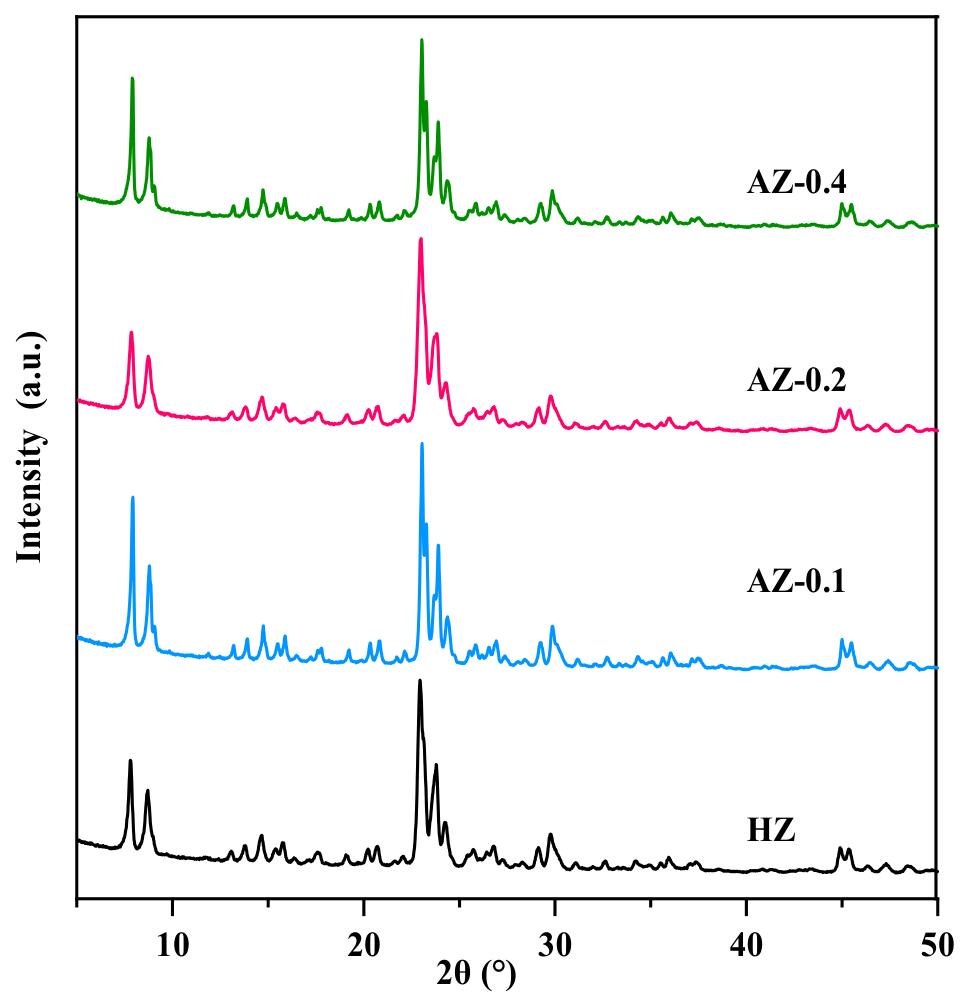
The XRD patterns for the parent and modified HZSM-5 catalysts (Figure 1) confirmed that the MFI structure of HZSM-5 was well-preserved for all the modified catalysts. This indicates that modification by NaOH solution under the current conditions had no noticeable effect on the basic phase structure of HZSM-5. However, AZ-0.4 exhibited the lowest relative crystallinity (Table 1). This was mainly attributed to the removal of silicon species from framework by alkali treatment with high NaOH concentration (0.4 mol/L) [20,21].
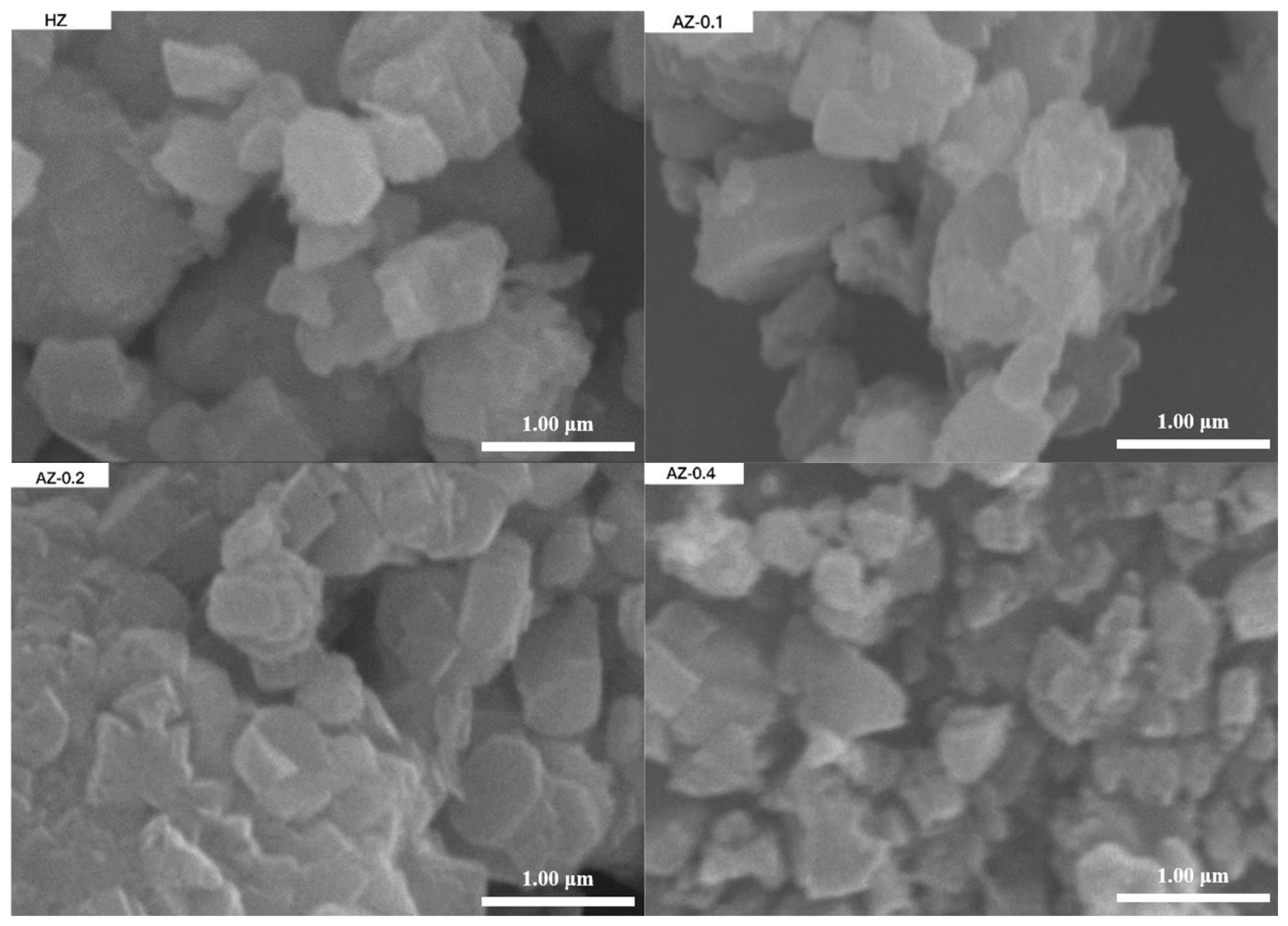
SEM images of the HZSM-5 catalysts before and after treatment were recorded to investigate the morphological changes (Figure 2). HZ appeared as aggregated blocks; however, its morphology was gradually destroyed as the NaOH concentration increased from 0.1 mol/L to 0.4 mol/L. When the NaOH concentration was 0.4 mol/L, the bulk catalyst particles fragmented into smaller and irregular shapes, which might be attributed to mesoporosity-inducing processes involving exfoliation, fissuration, deaggregation, and perforation [22]. This indicates that the desilication induced by alkali treatment can partially destroy the catalysts’ structure, with the extent of damage being dependent on the NaOH concentration. These SEM results are in good agreement with XRD characterization results described above.
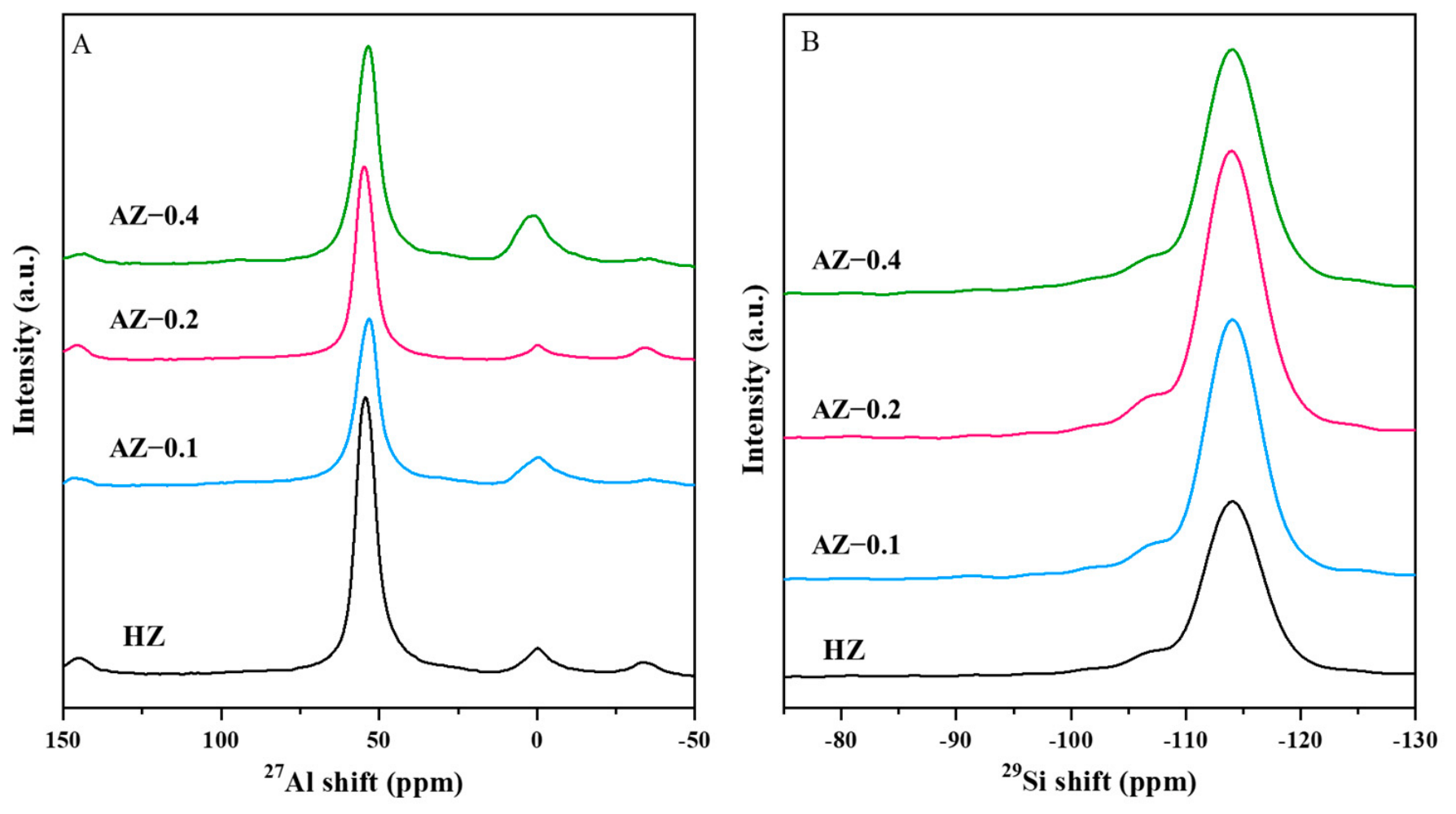
To investigate the effect of alkali treatment on the aluminum environment in the zeolite framework, 27Al MAS NMR spectra were collected for these samples (Figure 3A). The spectra of untreated HZSM-5 exhibited a pronounced peak at 54 ppm, corresponding to tetrahedrally coordinated aluminum in the zeolite framework. Additionally, a weak and broad peak was observed at 0 ppm, indicating the presence of minor extra-framework octahedral coordination aluminum species. For the alkali-modified HZSM-5 samples, the peak intensity at 54 ppm decreased, while the 0 ppm peak intensity became more pronounced. This suggests that alkali treatment induces the extraction of framework aluminum, leading to the formation of extra-framework aluminum species. These findings indicate that the desilication process is accompanied by dealumination, which alters the zeolite framework and potentially affects its acidity and catalytic properties [23,24].
The 29Si MAS NMR spectra of these samples were also recorded (Figure 3B). The spectra exhibit a strong peak at −114 ppm assigned to Si(0Al), with a weak peak at −107 ppm corresponding to Si(1Al) with one aluminum. Upon comparison, the intensity of the Si(1Al) peak increased after alkali treatment, confirming the removal of silicon from the zeolite framework [25]. The framework Si/Al ratios were calculated using the formula (Si/Al)NMR = (I4 + I3 + I2 + I1 + I0)/(I4 + 0.75I3 + 0.5I2 + 0.25I1), where In represented the area of the NMR peak corresponding to the Si(nAl) building unit. The calculated framework Si/Al ratios were 39.4, 33.0, 32.9, and 32.7 for HZ, AZ-0.1, AZ-0.2, and AZ-0.4, respectively. Thus, the framework Si/Al ratios decreased after alkali treatment. However, the NaOH solution concentration had minimal impact on the extent of this change, indicating zeolite desilication was accompanied by dealumination [26]. This result is consistent with that obtained by 27Al MAS NMR.
The bulk Si/Al ratios of the parent and modified zeolites were determined by ICP-OES measurements (Table 1). As a result of selective silicon extraction, the bulk Si/Al ratio decreased from 23.4 (HZ) to 13.2 (AZ-0.4) with the increasing NaOH solution concentration. Notably, the framework Si/Al ratios were consistently higher than the corresponding bulk values, which is in agreement with the presence of extra-framework aluminum species, as identified by 27Al MAS NMR. This observation is consistent with findings reported by Paixão et al. [27]. The parent nano-HZSM-5 is a commercial product with a manufacturer-provided nominal SiO2/Al2O3 ratio of 69, which cannot equal the actual elemental ratio of the final zeolite. The bulk Si/Al of 23.4, determined by ICP-OES, covers all silicon and aluminum elements, including large amounts of extra-framework aluminum, while the framework Si/Al of 39.4, obtained from 29Si MAS NMR, only accounts for lattice tetrahedral Al without extra-framework Al, resulting in the obvious numerical gap between the two measured Si/Al data. In addition, three repeated ion exchanges with excess NH4NO3 solution were carried out to remove residual sodium after alkali treatment, and the residual Na was too low to be detected by ICP-OES.
Table 1. Specific surface areas, pore volumes, pore diameters, Si/Al molar ratios, and relative crystallinity of the parent and modified HZSM-5 catalysts.
SampleBET Surface Area (m2·g−1)Pore Volume (cm3·g−1)Average Pore Radius (nm)Si/Al Molar Ratios aRC b
(%)
TotalMicroporeExternalTotalMesoporeMicropore
HZ3752051700.220.090.131.1423.4100
AZ-0.13931672260.250.100.151.3022.099
AZ-0.24001742260.290.160.131.3421.299
AZ-0.44071842230.460.330.132.0613.291
a Determined by ICP-OES; b relative crystallinity calculated from XRD patterns.
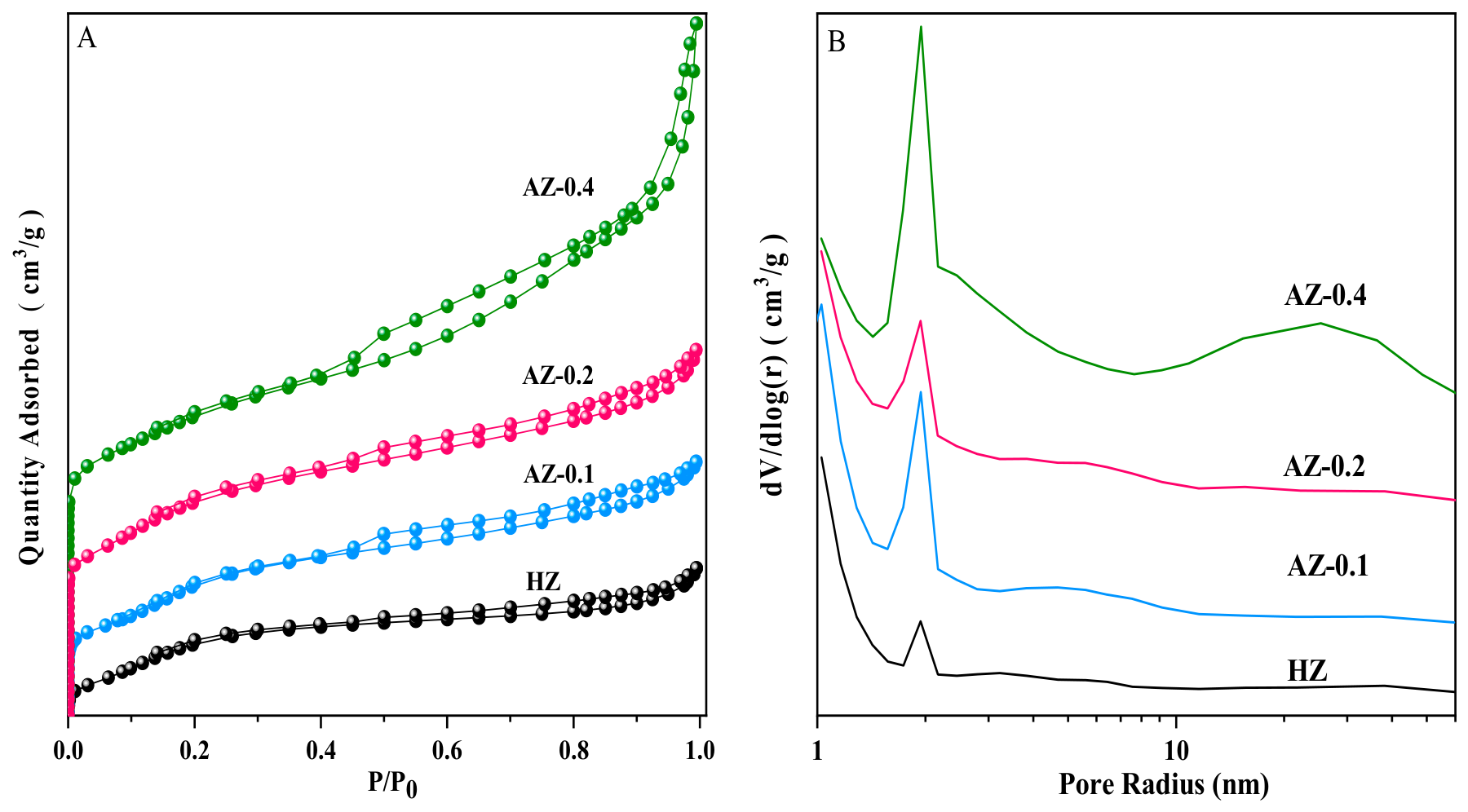
The porosity properties of the N2 adsorption isotherms for the parent and modified HZSM-5 catalysts are summarized in Table 1. The porosity properties of HZSM-5 varied to different extents depending on the NaOH concentration used during the treatment. The micropore volume remained nearly unchanged, indicating that the alkali treatment had a minimal impact on the microporosity of HZSM-5. Additionally, with increasing NaOH concentration, the mesopore volume increased from 0.09 to 0.33 cm3·g−1, confirming the formation of new mesopores. The BET external surface area of all modified zeolites increased approximately 56 m2·g−1 by alkali treatment. The increase in BET surface area after NaOH treatment mainly originates from the formation of additional mesopores through framework desilication. During alkaline treatment, OH ions preferentially dissolve silicon species from the ZSM-5 framework, generating new mesoporous channels while largely preserving the intrinsic microporous structure. As a result, the external surface area increases markedly owing to the exposure of newly created pore walls, whereas the micropore volume remains nearly unchanged [18,19]. Therefore, the increase in the total specific surface area is primarily attributed to the development of hierarchical porosity rather than the creation of additional micropores. It is worth mentioning that the average pore radius of the AZ-0.4 (2.06 nm) was significantly larger than that of other samples, suggesting that the severe conditions (high alkaline concentration) led to the partial degradation of the zeolite framework. The enlargement of the mesopores was likely attributed to the dissolution of the framework’s walls between smaller pores [28]. In general, alkali treatment was advantageous for the formation of mesopores, while they had little influence on the micropores (Table 1).
The N2 adsorption and desorption isotherms at −196 °C for the parent and alkali-treated zeolites are presented in Figure 4A. The parent HZSM-5 exhibited a combined type I/IV adsorption isotherm with a small H4-type hysteresis loop, indicating that the catalyst was predominantly microporous while containing a limited amount of slit-like intracrystalline mesopores generated by the aggregation of nanosized crystals. After NaOH treatment, the hysteresis loop became progressively more pronounced, reflecting the development of additional mesoporosity through desilication. [29]. AZ-0.2 exhibited an increased N2 uptake in the relative pressure range of 0.5–1.0, indicating new mesopores had formed. Furthermore, the curve of AZ-0.4 presented a pronounced increase in the relative pressure range of 0.4–1.0, reflecting its highest abundance of mesopores. This can be explained by the fact that a considerable number of silicon species were removed as the NaOH concentration increased, resulting in the formation of a multitude of mesopores [30]. These findings were in good agreement with ICP-OES and NMR results, confirming that the formation of new mesopores was indeed caused by desilication. Similar effects of alkali concentration had been reported for zeolites Y [31], Beta [32], and ZSM-11 [33].
Figure 4B shows the pore size distributions calculated by the BJH model. The BJH pore size distributions presented herein are primarily intended for the comparative evaluation of pore structure evolution after NaOH treatment rather than for the determination of absolute pore sizes. AZ-0.1 exhibited mesopores of relatively narrow radius distribution centered at ~2 nm. In contrast, a higher NaOH concentration (AZ-0.4) resulted in the formation of intergranular mesopores with radius between 10 and 60 nm and a maximum at ~30 nm. These findings suggest that higher NaOH concentrations promote the generation of larger mesopores volume and diameter, primarily due to silicon extraction from the surface or bulk of ZSM-5. Excessive desilication also led to partial structural collapse. Although the parent HZSM-5 already possessed a small amount of intracrystalline mesoporosity, this initial mesoporous structure mainly originated from the packing of nanosized crystals and provided only limited diffusion pathways. During alkali treatment, these pre-existing intracrystalline voids likely facilitated the penetration of the alkaline solution into the zeolite particles, whereas the substantial increase in mesopore volume and external surface area primarily resulted from the generation of new mesopores through framework desilication, as evidenced by the nearly unchanged micropore volume together with the significant increase in mesopore volume after NaOH treatment. Under excessively severe alkaline conditions, continued silicon dissolution further enlarged the mesopores and partially degraded the zeolite framework.

3.1.2. Acidic Properties

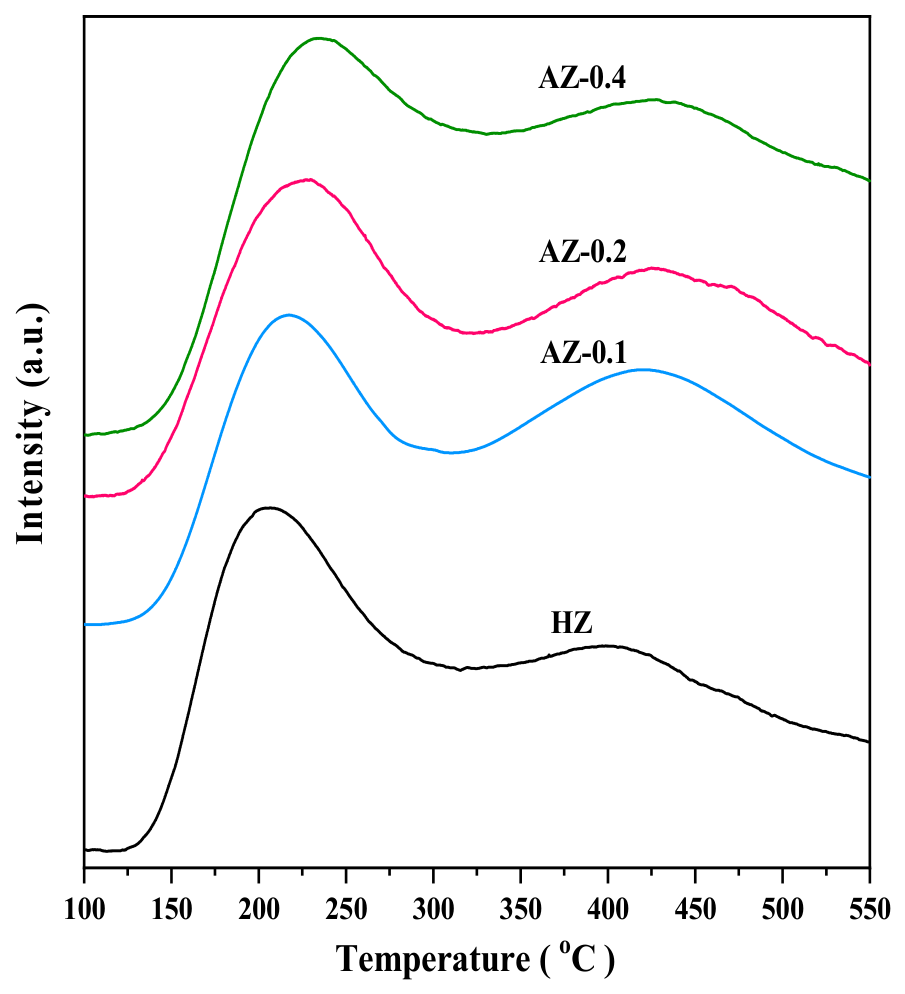
The NH3-TPD profiles of different HZSM-5 catalysts are shown in Figure 5. All samples exhibited a typical NH3-TPD spectrum, with two desorption peaks below and above 300 °C, indicating the existence of two types of acidic sites. Generally, the peak at lower temperature was attributed to weak acid sites, whereas the peak at higher temperature corresponded to strong acid sites. The two desorption peaks of the alkali-treated HZSM-5 shifted toward higher temperatures, indicating an increase in the acid strength of both weak and strong acid sites. From Table 2, both the total and strong acid sites amount of the alkali-treated HZSM-5 were greater than the parent HZSM-5 due to the relatively higher Al content derived from desilication [26]. Therefore, the proportion of weak acid sites had been decreased by the alkali treatment compared to that of the strong acid sites [34].
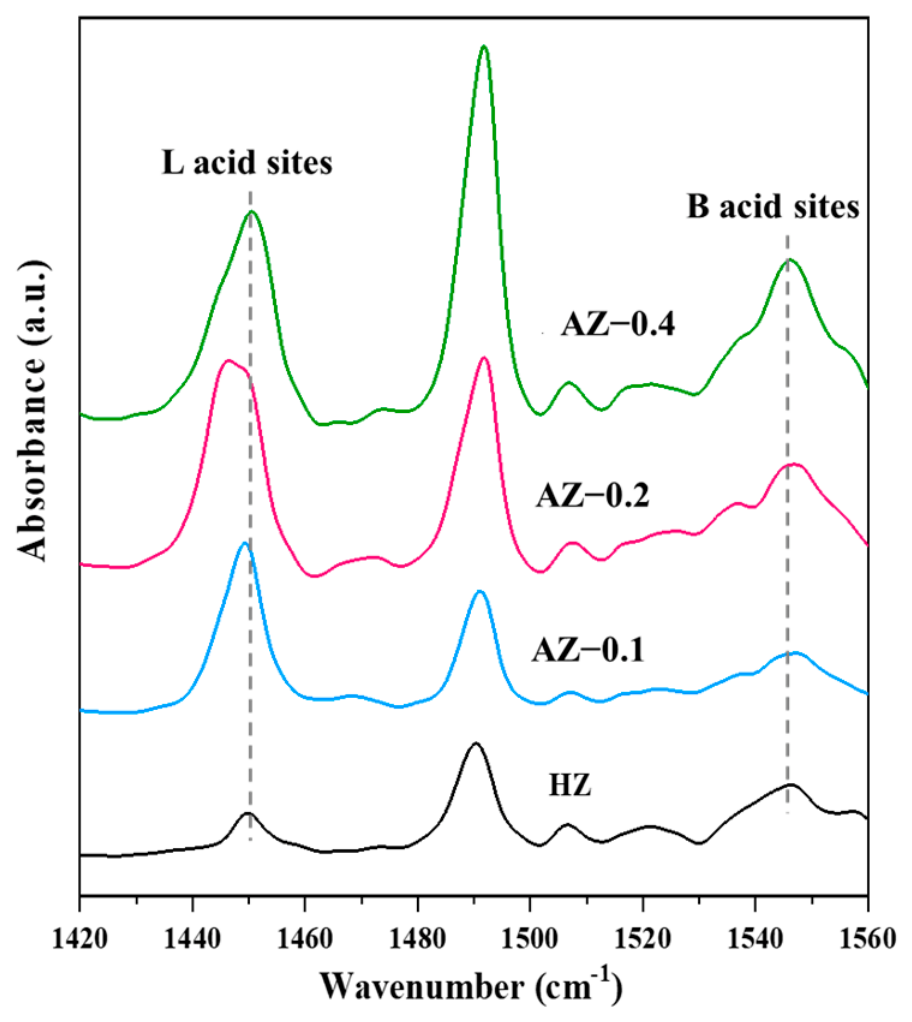
The IR spectra of pyridine adsorbed on different HZSM-5 catalysts are shown in Figure 6. The spectrum of pyridine on HZSM-5 exhibited the characteristic signals at 1545 and 1450 cm−1, assigned to pyridinium ions (pyridine chemisorbed on Brønsted (B) acid sites) and coordinatively bound pyridine (pyridine interacting with Lewis (L) acid sites), respectively. The band at 1490 cm−1 is attributed to pyridine on both B and L acid sites [35]. With the increasing NaOH concentration, the intensities of the bands at 1545, 1490, and 1450 cm−1 increased, indicating an enhancement of both B and L acid sites. This can be attributed to the removal of random silica, thus increasing the B acid sites [36]. Meanwhile, desilication caused some Al sites in the interior crystal to transform into Al sites at the edge of the crystal, leading to an increase in L acid sites [24].
Table 3 shows the integrated peak area (A) of B acid and L acid sites of the parent and alkali-treated HZSM-5 catalysts. The IR spectra collected after pyridine desorption at 300 °C share analogous peak profiles with those at 100 °C, hence only 100 °C spectra are presented in Figure 6, while the calculated acid amounts at 300 °C are tabulated in Table 3. The integrated molar extinction coefficients of 1.67 cm/μmol for the 1545 cm−1 Brønsted band and 2.22 cm/μmol for the 1450 cm−1 Lewis band, while the values of B/L site ratios were calculated by the formula of 1.67AB/2.22AL [35]. The data show that both B and L acid sites increased upon alkali treatment, and the increase became more pronounced with higher NaOH concentrations. This indicated that desilication enhanced acidity, which agreed well with the NH3-TPD analysis. This observation was aligned well with the result of Nandiwale et al. [37].
The B/L ratio obtained from the pyridine IR spectra after desorption at 300 °C better reflects the amount of strong acid sites that control ethylene oligomerization and cracking. The 300 °C B/L value of AZ-0.2 was 2.76, which is markedly higher than those of the other catalysts (1.50–2.18). This favorable proportion of Brønsted acid sites contributed to superior propylene selectivity and catalytic stability.

3.2. Catalytic Performance

The catalytic performance of the parent and modified HZSM-5 catalysts for ethanol conversion to propylene was evaluated. For all samples, the conversion of ethanol was 100% throughout the entire operation period; however, the product selectivity and catalytic stability were remarkably different for different HZSM-5 samples.
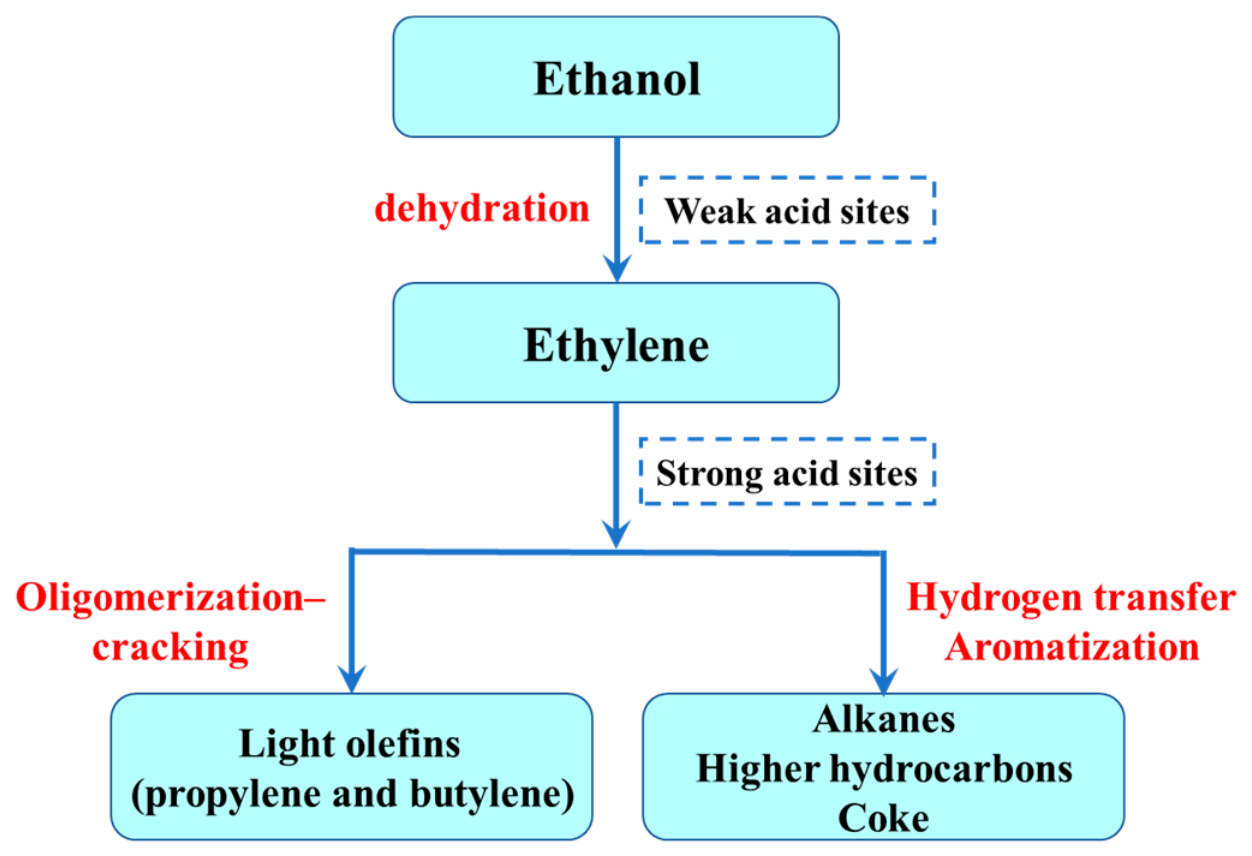
Based on the reaction mechanism of ethanol to propylene over HZSM-5 [38], ethanol is initially dehydrated to ethylene on weak acid sites. Then ethylene undergoes further transformations on stronger acid sites, including oligomerization–cracking to produce light olefins, such as propylene and butylene, or hydrogen transfer and aromatization reactions to form alkanes, higher hydrocarbons, and coke (Figure 7). Therefore, the product selectivity in ethanol conversion is closely related to the acidity of HZSM-5 [19,39].
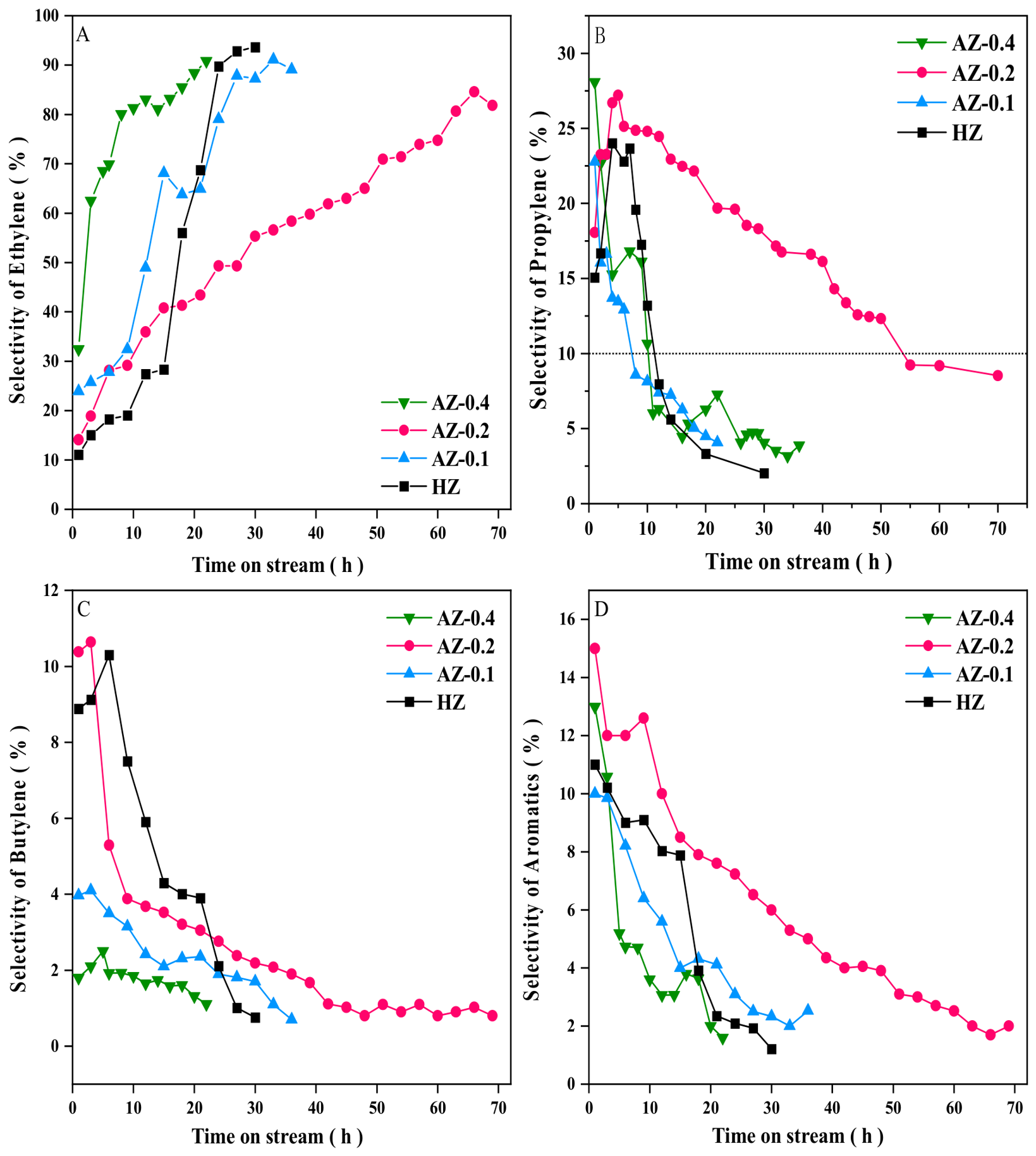
The effects of the time on stream (TOS) on the selectivities to light olefins (C2–C4) and aromatics are shown in Figure 8. For the parent HZ catalyst, the propylene selectivity initially increased with TOS, reaching a maximum value (24.0%) at 4 h before falling below 10% after 11 h. A similar trend was observed for AZ-0.2, where the highest propylene selectivity was 27.2% at 5 h, and the propylene selectivity remained above 10% for 53 h—approximately five times longer than that of HZ. In contrast, the propylene selectivities of AZ-0.1 and AZ-0.4 both rapidly declined below 10% within 10 h.
Thus, both the propylene selectivity and catalytic stability of HZSM-5 were remarkably improved by treatment with the optimal NaOH solution concentration (0.2 mol/L). Compared with HZ and AZ-0.1, AZ-0.2 exhibited a larger mesopore volume (Table 1). These newly formed mesopores on AZ-0.2 facilitated the diffusion of reactants and products, effectively shortening their residence time on active sites and suppressing secondary reactions, thereby promoting the rapid desorption of light olefins [40]. However, despite possessing the highest mesopore volume, the catalytic performance of AZ-0.4 was significantly reduced, which due to the enhanced acidity caused by extensive desilication. The strength and amount of strong acid sites on AZ-0.4 were remarkably higher than other catalysts (Figure 5, Table 2), which favored the polymerization of ethylene to form heavy carbonaceous species that cover acid sites and resulting in rapid catalyst deactivation [41]. Furthermore, the B/L ratios of AZ-0.2 were much higher than that of the other catalysts at both 100 °C and 300 °C. Brønsted acid sites facilitated both ethanol dehydration and ethylene oligomerization–cracking steps, favoring light olefin production [42]. This may be another reason for the superior catalytic performance of AZ-0.2. In brief, the superior catalytic performance of AZ-0.2 was mainly attributed to the synergistic effects of newly created mesopores and suitable acidity.
The variation in butylene selectivity for each catalyst followed a similar trend to that of propylene, suggesting that both propylene and butylene might be generated via parallel pathways from a common intermediate on the catalyst [43].
As the reaction proceeds, the ethylene selectivity of all HZSM-5 catalysts gradually increased, while the aromatics selectivity decreased. This could be attributed to the coke formed and the preferentially covered strong acid sites during ethanol conversion. As a result, ethanol dehydration to ethylene could continue over the remaining weak acid sites, while subsequent reactions, such as oligomerization–cracking and aromatization, were suppressed due to the loss of strong acidity [44]. Consequently, the evolution of ethylene and aromatic selectivity with TOS can be ascribed to the progressive deactivation of strong acid sites [45].
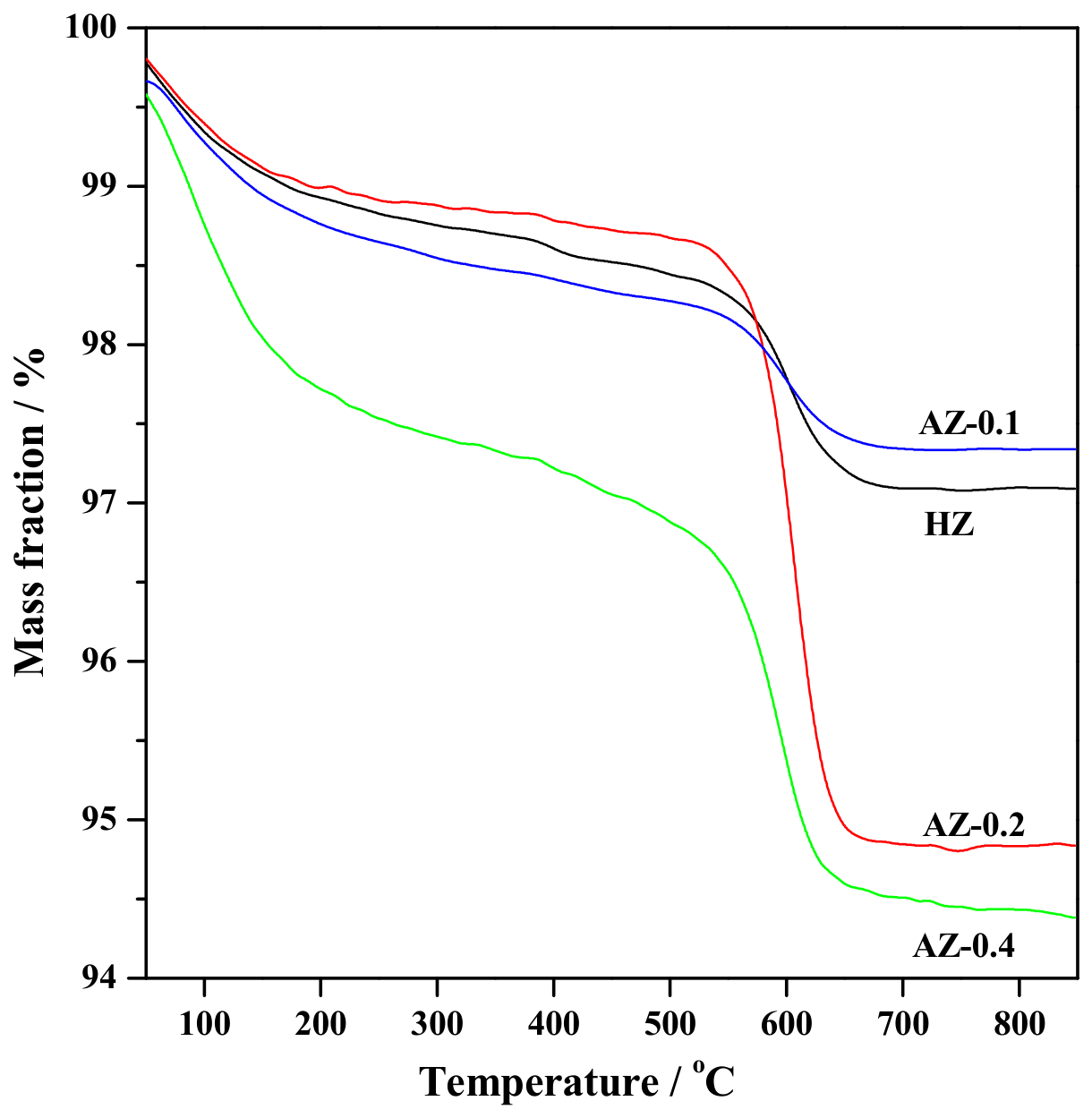
Based on the above discussion, the catalytic performance of HZSM-5 is significantly influenced by coke deposition. Moreover, the catalysts are black in color after the reaction, indicating that coke deposition might be the primary reason for catalyst deactivation [46]. In Figure 9, an abrupt and large weight loss between 400 and 700 °C clearly indicated the vigorous combustion of coke of all the used HZSM-5 catalysts [39]. Coke formation can be mainly attributed to two factors: (1) diffusion limitations in the zeolite pores, promoting secondary reactions of primary products to produce bulky aromatic molecules, which were the precursor of coke [28]; and (2) the polymerization of ethylene to form carbonaceous species on strong acid sites.
It has been reported that coke is mainly deposited within mesopores of hierarchical zeolites [47,48]. Therefore, the introduced mesoporosity may have provided extra space for coke deposition. The relative amounts of carbonaceous deposits for the used AZ-0.2 and AZ-0.4 were apparently higher than HZ and AZ-0.1 (Table 4), indicating that AZ-0.2 and AZ-0.4 has better ability to tolerate the coke deposits because of their newly formed mesopores. In addition, the average coke formation rate of AZ-0.2 was slower than AZ-0.4, which probably due to its suitable acidity. In short, the reduced diffusion resistance, well-balanced acidity, and low formation rate of coke enabled AZ-0.2 to maintain higher propylene selectivity for a longer duration.
A comparison of our results with the existing literature was conducted by collecting the available results from other authors and presenting them in Table 5. It is worth noting that the experimental conditions employed in the various studies referenced in the literature may differ, particularly given that ethanol and N2 were used as feedstocks in these studies, while ethanol–water mixtures were employed in this work. Compared with the previously reported modified HZSM-5 catalysts under comparable laboratory reaction conditions, the NaOH-treated HZSM-5 catalyst developed in this work exhibits competitive propylene selectivity and catalytic stability. These results demonstrate the effectiveness of the proposed NaOH modification strategy for improving the catalytic performance of nanoscale HZSM-5. Nevertheless, the present study is limited to its laboratory-scale evaluation. Further investigations involving long-term operation under industrially relevant conditions, process optimization, and techno-economic assessment are required before any conclusions regarding industrial applicability can be drawn.

4. Conclusions

NaOH-modified HZSM-5 catalysts with larger mesopore volume, higher B/L ratios, and suitable acidity exhibited simultaneously high activity and stability in selective conversion of bioethanol to propylene. Compared to the micropores, the newly formed mesopores might provide more space in favor of the diffusion of reactants and products, accommodating part of the coke deposition. High B/L ratios facilitate both ethanol dehydration and ethylene oligomerization–cracking. The suitable acidity of the modified HZSM-5 catalysts suppressed the polymerization of ethylene to form heavy carbonaceous species. As a result, the superior catalytic performance of alkali-treated HZSM-5 was mainly attributed to the synergistic effects of their newly created mesopores and suitable acidity.

Author Contributions

Investigation, T.M., J.H. and Y.R.; writing—original draft preparation, T.M., Y.R. and J.H.; writing—review and editing, T.M., Z.X. and D.M.; supervision, D.M. All authors have read and agreed to the published version of the manuscript.

Funding

This research was funded by the Shanghai Natural Science Foundation, China, 20ZR1455500.

Data Availability Statement

Data are contained within the article.

Conflicts of Interest

The authors declare no conflicts of interest.

References

  1. Morad, M.H. Current status and future perspectives of efficient catalytic conversion of bioethanol to value-added chemicals and fuels. Arab. J. Chem. 2024, 17, 105560. [Google Scholar] [CrossRef] [Scilit]
  2. Phung, T.K.; Pham, T.L.M.; Vu, K.B.; Busca, G. (Bio) Propylene production processes: A critical review. J. Environ. Chem. Eng. 2021, 9, 105673. [Google Scholar] [CrossRef] [Scilit]
  3. Li, X.; Kant, A.; He, Y.X.; Thakkar, H.V.; Atanga, M.A.; Rezaei, F.; Ludlow, D.K.; Rownaghi, A.A. Light olefins from renewable resources: Selective catalytic dehydration of bioethanol to propylene over zeolite and transition metal oxide catalysts. Catal. Today 2016, 276, 62–77. [Google Scholar] [CrossRef] [Scilit]
  4. Ru, Y.; Xue, Z.T.; Meng, T.; Zhang, M.X.; Yu, J.; Mao, D.S. The synergistic effect of aluminum distribution and acid properties in HZSM-5 for improving the catalytic performance of bioethanol-to-propylene conversion. Renew. Energy 2026, 271, 126014. [Google Scholar] [CrossRef] [Scilit]
  5. Zeng, S.; Li, J.J.; Wang, N.; Zhang, W.N.; Wei, Y.X.; Liu, Z.M.; Xu, S.T. Investigation of ethanol conversion on H-ZSM-5 zeolite by in situ solid-state NMR. Energy Fuels 2021, 35, 12319–12328. [Google Scholar] [CrossRef] [Scilit]
  6. Yin, J.B.; Guo, X.X.; Sun, Y.X.; Han, S.; Li, Q.G. Understanding the nanoconfinement effect on the ethanol-to-propene mechanism catalyzed by acidic ZSM-5 and FAU zeolites. J. Phys. Chem. C 2021, 125, 310–334. [Google Scholar] [CrossRef] [Scilit]
  7. Iadrat, P.; Wattanakit, C. Bioethanol upgrading to renewable monomers using hierarchical zeolites: Catalyst preparation, characterization, and catalytic studies. Catalysts 2021, 11, 1162. [Google Scholar] [CrossRef] [Scilit]
  8. Xia, W.; Wang, J.G.; Wang, L.X.; Qian, C.; Ma, C.; Huang, Y.X.; Fan, Y.; Hou, M.D.; Chen, K. Ethylene and propylene production from ethanol over Sr/ZSM-5 catalysts: A combined experimental and computational study. Appl. Catal. B 2021, 294, 120242. [Google Scholar] [CrossRef] [Scilit]
  9. Khamkeaw, A.; Jongsomjit, B.; Yip, A.C.K.; Phisalaphong, M. Application of activated carbon derived from bacterial cellulose for mesoporous HZSM-5 catalyst synthesis and performances of catalyst in bioethanol dehydration. Biomass Bioenergy 2022, 160, 106440. [Google Scholar] [CrossRef] [Scilit]
  10. Zhao, T.T.; Li, F.W.; Yu, H.C.; Ding, S.L.; Li, Z.X.; Huang, X.Y.; Li, X.; Wei, X.H.; Wang, Z.L.; Lin, H.F. Synthesis of mesoporous ZSM-5 zeolites and catalytic cracking of ethanol and oleic acid into light olefins. Appl. Catal. A 2019, 575, 101–110. [Google Scholar] [CrossRef] [Scilit]
  11. Saxena, S.K.; Viswanadham, N.; Sharma, T. Breakthrough mesopore creation in BEA and its enhanced catalytic performance in solvent-free liquid phase tert-butylation of phenol. J. Mater. Chem. A 2014, 2, 2487–2490. [Google Scholar] [CrossRef] [Scilit]
  12. Vu, X.H.; Nguyen, S.; Dang, T.T.; Armbruster, U. Improved biofuel quality in catalytic cracking of triglyceride-rich biomass over nanocrystalline and hierarchical ZSM-5 catalysts. Biomass Convers. Biorefin. 2020, 11, 755–766. [Google Scholar] [CrossRef] [Scilit]
  13. Hernando, H.; Moreno, I.; Fermoso, J.; Ochoa-Hernández, C.; Pizarro, P.; Coronado, J.M.; Čejka, J.; Serrano, D.P. Biomass catalytic fast pyrolysis over hierarchical ZSM-5 and Beta zeolites modified with Mg and Zn oxides. Biomass Convers. Biorefin. 2017, 7, 289–304. [Google Scholar] [CrossRef] [Scilit]
  14. Li, L.H.; Wang, W.; Huang, J.; Dun, R.M.; Yu, R.; Liu, Y.W.; Hua, Z.L. Synthesis of hydrophobic nanosized hierarchical titanosilicate-1 zeolites by an alkali-etching protocol and their enhanced performance in catalytic oxidative desulphurization of fuels. Appl. Catal. A 2022, 630, 118466. [Google Scholar] [CrossRef] [Scilit]
  15. Souza de Carvalho Filho, J.F.; Maciel Pereira, M.; Gomes Aranda, D.A.; Monnerat Araujo Ribeiro de Almeida, J.; Falabella Sousa-Aguiar, E.; Nothaft Romano, P. Application of response surface methodology for ethanol conversion into hydrocarbons using ZSM-5 zeolites. Catalysts 2019, 9, 617. [Google Scholar] [CrossRef] [Scilit]
  16. Sheng, Q.T.; Guo, S.Q.; Ling, K.C.; Zhao, L.F. Catalytic dehydration of ethanol to ethylene over alkali-treated HZSM-5 zeolites. J. Braz. Chem. Soc. 2014, 25, 1365–1371. [Google Scholar] [CrossRef] [Scilit]
  17. Xin, H.C.; Li, X.P.; Fang, Y.; Yi, X.F.; Hu, W.H.; Chu, Y.Y.; Zhang, F.; Zheng, A.M.; Zhang, H.P.; Li, X.B. Catalytic dehydration of ethanol over post-treated ZSM-5 zeolites. J. Catal. 2014, 312, 204–215. [Google Scholar] [CrossRef] [Scilit]
  18. Gayubo, A.G.; Alonso, A.; Valle, B.; Aguayo, A.T.; Bilbao, J. Selective production of olefins from bioethanol on HZSM-5 zeolite catalysts treated with NaOH. Appl. Catal. B 2010, 97, 299–306. [Google Scholar] [CrossRef] [Scilit]
  19. Huangfu, J.J.; Mao, D.S.; Zhai, X.L.; Guo, Q.S. Remarkably enhanced stability of HZSM-5 zeolite co-modified with alkaline and phosphorous for the selective conversion of bio-ethanol to propylene. Appl. Catal. A 2016, 520, 99–104. [Google Scholar] [CrossRef] [Scilit]
  20. Nishu; Liu, R.H.; Rahman, M.M.; Li, C.; Chai, M.Y.; Sarker, M.; Wang, Y.C.; Cai, J.M. Catalytic pyrolysis of microcrystalline cellulose extracted from rice straw for high yield of hydrocarbon over alkali modified ZSM-5. Fuel 2021, 285, 119038. [Google Scholar] [CrossRef] [Scilit]
  21. Tang, S.S.; Zhang, C.S.; Xue, X.F.; Pan, Z.Y.; Wang, D.T.; Zhang, R.Q. Catalytic pyrolysis of lignin over hierarchical HZSM-5 zeolites prepared by post-treatment with alkaline solutions. J. Anal. Appl. Pyrolysis 2019, 137, 86–95. [Google Scholar] [CrossRef] [Scilit]
  22. Li, J.H.; Xie, J.Y.; Zhang, D.; Liu, L.; Xing, J.J. Effect of alkali modification to ZSM-5 zeolite on the aromatization of methanol. J. Fuel Chem. Technol. 2021, 49, 339–346. [Google Scholar] [CrossRef] [Scilit]
  23. Baranowski, C.J.; Bahmanpour, A.M.; Héroguel, F.; Luterbacher, J.S.; Kröcher, O. Prominent role of mesopore surface area and external acid sites for the synthesis of polyoxymethylene dimethyl ethers (OME) on a hierarchical H-ZSM-5 zeolite. Catal. Sci. Technol. 2019, 9, 366–376. [Google Scholar] [CrossRef] [Scilit]
  24. Mochizuki, H.; Yokoi, T.; Imai, H.; Namba, S.; Kondo, J.N.; Tatsumi, T. Effect of desilication of H-ZSM-5 by alkali treatment on catalytic performance in hexane cracking. Appl. Catal. A 2012, 449, 188–197. [Google Scholar] [CrossRef] [Scilit]
  25. You, S.J.; Park, E.D. Effects of dealumination and desilication of H-ZSM-5 on xylose dehydration. Microporous Mesoporous Mater. 2014, 186, 121–129. [Google Scholar] [CrossRef] [Scilit]
  26. Sun, Y.; Ma, T.; Cao, S.W.; Wang, J.; Meng, X.L.; Gong, Y.J.; Zhang, Z.D.; Ma, A.; Liu, P. Defective sites in ZSM-5 zeolite synthesized by n-butylamine template facilitating uniform meso-microporosity by alkali-treatment. Microporous Mesoporous Mater. 2021, 326, 111360. [Google Scholar] [CrossRef] [Scilit]
  27. Paixão, V.; Monteiro, R.; Andrade, M.; Fernandes, A.; Rocha, J.; Carvalho, A.P.; Martins, A. Desilication of MOR zeolite: Conventional versus microwave assisted heating. Appl. Catal. A 2011, 402, 59–68. [Google Scholar] [CrossRef] [Scilit]
  28. Pan, M.; Liu, T.J.; Pang, Y.H.; Zheng, Y.X.; Zhang, D.D.; Yang, R.C.; Li, X.Y. High-silica hierarchical ZSM-5 prepared by conventional alkali treatment: A highly stable MTP catalyst. Fuel 2024, 365, 131245. [Google Scholar] [CrossRef] [Scilit]
  29. Lima, R.B.; Neto, M.M.S.; Oliveira, D.S.; Santos, A.G.D.; Souza, L.D.; Caldeira, V.P.S. Obtainment of hierarchical ZSM-5 zeolites by alkaline treatment for the polyethylene catalytic cracking. Adv. Powder Technol. 2021, 32, 515–523. [Google Scholar] [CrossRef] [Scilit]
  30. Nishu; Li, C.; Chai, M.Y.; Rahman, M.M.; Li, Y.K.; Sarker, M.; Liu, R.H. Performance of alkali and Ni-modified ZSM-5 during catalytic pyrolysis of extracted hemicellulose from rice straw for the production of aromatic hydrocarbons. Renew. Energy 2021, 175, 936–951. [Google Scholar] [CrossRef] [Scilit]
  31. Gackowski, M.; Datka, J. Acid properties of hierarchical zeolites Y. Molecules 2020, 25, 1044. [Google Scholar] [CrossRef] [Scilit] [PubMed]
  32. dos Santos, L.R.M.; da Silva, M.A.P.; de Menezes, S.C.; Chinelatto, L.S.; Lam, Y.L. Creation of mesopores and structural re-organization in Beta zeolite during alkaline treatment. Microporous Mesoporous Mater. 2016, 226, 260–266. [Google Scholar] [CrossRef] [Scilit]
  33. Liu, H.; Liu, S.L.; Xie, S.J.; Song, C.; Xin, W.J.; Xu, L.Y. Effect of desilication on the performance of hierarchical ZSM-11 catalysts for alkylation of benzene with dimethyl ether. Catal. Lett. 2015, 145, 1972–1983. [Google Scholar] [CrossRef] [Scilit]
  34. Jin, W.Y.; Qiao, J.R.; Yu, J.P.; Wang, Y.L.; Cao, J.P. Influence of hollow ZSM-5 zeolites prepared by treatment with different alkalis on the catalytic conversion of methanol to aromatics. Energy Fuels 2020, 34, 14633–14646. [Google Scholar] [CrossRef] [Scilit]
  35. Emeis, C.A. Determination of integrated molar extinction coefficients for infrared absorption bands of pyridine adsorbed on solid acid catalysts. J. Catal. 1993, 141, 347–354. [Google Scholar] [CrossRef] [Scilit]
  36. Peron, D.V.; Zholobenko, V.L.; de Melo, J.H.S.; Capron, M.; Nuns, N.; de Souza, M.O.; Feris, L.A.; Marcilio, N.R.; Ordomsky, V.V.; Khodakov, A.Y. External surface phenomena in dealumination and desilication of large single crystals of ZSM-5 zeolite synthesized from a sustainable source. Microporous Mesoporous Mater. 2019, 286, 57–64. [Google Scholar] [CrossRef] [Scilit]
  37. Nandiwale, K.Y.; Sonar, S.K.; Niphadkar, P.S.; Joshi, P.N.; Deshpande, S.S.; Patil, V.S.; Bokade, V.V. Catalytic upgrading of renewable levulinic acid to ethyl levulinate biodiesel using dodecatungstophosphoric acid supported on desilicated H-ZSM-5 as catalyst. Appl. Catal. A 2013, 460–461, 90–98. [Google Scholar] [CrossRef] [Scilit]
  38. Galadima, A.; Muraza, O. Zeolite catalysts in upgrading of bioethanol to fuels range hydrocarbons: A review. J. Ind. Eng. Chem. 2015, 31, 1–14. [Google Scholar] [CrossRef] [Scilit]
  39. Meng, T.; Mao, D.S.; Guo, Q.S.; Ma, Z. Effect of the Si/Al ratios of nanocrystalline HZSM-5 zeolite on the performance in catalytic conversion of ethanol to propylene. J. Nanosci. Nanotechnol. 2017, 17, 3779–3785. [Google Scholar] [CrossRef] [Scilit]
  40. Zhang, N.; Mao, D.S.; Zhai, X.L. Selective conversion of bio-ethanol to propene over nano-HZSM-5 zeolite: Remarkably enhanced catalytic performance by fluorine modification. Fuel Process. Technol. 2017, 167, 50–60. [Google Scholar] [CrossRef] [Scilit]
  41. Bi, J.D.; Liu, M.; Song, C.S.; Wang, X.S.; Guo, X.W. C2–C4 light olefins from bioethanol catalyzed by Ce-modified nanocrystalline HZSM-5 zeolite catalysts. Appl. Catal. B 2011, 107, 68–76. [Google Scholar] [CrossRef] [Scilit]
  42. Zhang, Y.M.; Ren, Y.L.; Zu, Y.; Yan, K.; Luo, Y.B.; Xing, E.H.; Qin, Y.C.; Mei, Y.; Shu, X.T. Disassembly-reassembly-phosphating strategy to fabricate hydrothermally-stable hierarchical P@ZSM-5 zeolite for efficient methanol-to-propylene. Chem. Eng. J. 2024, 497, 154755. [Google Scholar] [CrossRef] [Scilit]
  43. Aguayo, A.T.; Gayubo, A.G.; Tarrío, A.M.; Atutxa, A.; Bilbao, J. Study of operating variables in the transformation of aqueous ethanol into hydrocarbons on an HZSM-5 zeolite. J. Chem. Technol. Biotechnol. 2002, 77, 211–216. [Google Scholar] [CrossRef]
  44. Zhou, J.; Zhang, N.; Meng, T.; Guo, Q.S.; Xue, Z.T.; Mao, D.S. Fluoride-treated nano-HZSM-5 zeolite as a highly stable catalyst for the conversion of bioethanol to propylene. Nanomaterials 2024, 14, 1558. [Google Scholar] [CrossRef] [Scilit] [PubMed]
  45. Inoue, K.; Okabe, K.; Inaba, M.; Takahara, I.; Murata, K. Metal modification effects on ethanol conversion to propylene by H-ZSM-5 with Si/Al2 ratio of 150. React. Kinet. Mech. Catal. 2010, 101, 477–489. [Google Scholar] [CrossRef] [Scilit]
  46. Javaid, R.; Urata, K.; Furukawa, S.; Komatsu, T. Factors affecting coke formation on H-ZSM-5 in naphtha cracking. Appl. Catal. A 2015, 491, 100–105. [Google Scholar] [CrossRef] [Scilit]
  47. Meng, T.; Mao, D.S.; Guo, Q.S.; Lu, G.Z. The effect of crystal sizes of HZSM-5 zeolites in ethanol conversion to propylene. Catal. Commun. 2012, 21, 52–57. [Google Scholar] [CrossRef] [Scilit]
  48. Sheng, Q.; Ling, K.; Li, Z.; Zhao, L. Effect of steam treatment on catalytic performance of HZSM-5 catalyst for ethanol dehydration to ethylene. Fuel Process. Technol. 2013, 110, 73–78. [Google Scholar] [CrossRef] [Scilit]
  49. Wang, F.F.; Xia, W.; Mu, X.C.; Chen, K.; Wang, L.X. Experimental and molecular simulation studies on ethanol conversion to propylene over different zeolite catalyst. Catal. Lett. 2018, 148, 1768–1774. [Google Scholar] [CrossRef] [Scilit]
  50. Xia, W.; Wang, X.; Li, S.S.; Jiang, Z.H.; Chen, K.; Liu, D. Multiple synergistic roles of Zr modification on ZSM-5 in performant and stable catalyst for ethanol conversion to propene. Energy 2024, 288, 129910. [Google Scholar] [CrossRef] [Scilit]
  51. Xia, W.; Huang, Y.X.; Ma, C.; Li, S.S.; Wang, X.; Chen, K.; Liu, D. Multiple important roles of phosphorus modification on the ZSM-5 in ethanol to olefin reaction: Acidity adjustment, hydrothermal stability and anti-coking. Fuel 2023, 341, 127675. [Google Scholar] [CrossRef] [Scilit]
Figure 1. X-ray diffraction patterns of the parent and modified HZSM-5 catalysts.
Reactions 07 00048 g001
Figure 2. SEM images of the parent and modified HZSM-5 catalysts.
Reactions 07 00048 g002
Figure 3. 27Al MAS NMR spectra (A) and 29Si MAS NMR spectra (B) for the parent and modified HZSM-5 catalysts.
Reactions 07 00048 g003
Figure 4. N2 adsorption/desorption isotherms (A) and pore size distributions (B) of the parent and modified HZSM-5 catalysts.
Reactions 07 00048 g004
Figure 5. NH3-TPD results of the parent and modified HZSM-5 catalysts.
Reactions 07 00048 g005
Figure 6. IR spectra of pyridine adsorbed on the parent and modified HZSM-5 catalysts after desorption at 100 °C.
Reactions 07 00048 g006
Figure 7. Simplified reaction pathway of ethanol to propylene over HZSM-5 catalysts.
Reactions 07 00048 g007
Figure 8. Effect of time on stream on selectivity of different products over the parent and modified HZSM-5 zeolites: (A) ethylene; (B) propylene; (C) butylene; (D) aromatics. Reaction conditions: atmospheric pressure; T = 500 °C; 90 wt.% ethanol solution; WHSV = 1.58 h−1.
Reactions 07 00048 g008
Figure 9. TG curves of the parent and modified HZSM-5 zeolites after the duration test of ethanol-to-propylene catalytic reaction.
Reactions 07 00048 g009
Table 2. Acidity data of different samples.
SampleWASSASTotal Peak Area
(a.u.)
WAS/Tol.
Temperature (°C)Peak Area
(a.u.)
Temperature (°C)Peak Area (a.u.)
HZ206.6122.2398.9106.3228.50.53
AZ-0.1215.0102.6408.5129.3231.90.44
AZ-0.2229.7113.9424.9130.9244.80.47
AZ-0.4235.4160.3427.5197.1357.40.45
Table 3. Absorbance (A) of B acid and L acid sites, as well as B/L of different nanoscale HZSM-5 samples.
Sample100 °C300 °CB/L b
AB (a.u.) aAL (a.u.) aAB (a.u.) aAL (a.u.) a100 °C300 °C
HZ0.440.310.040.021.071.50
AZ-0.10.510.520.090.050.741.35
AZ-0.20.950.660.220.061.082.76
AZ-0.41.061.360.290.100.592.18
Note: a AB and AL are the integrated peak areas of pyridine characteristic bands; b B/L ratios, as calculated via Emeis extinction coefficients (1.67 cm/μmol for 1545 cm−1, 2.22 cm/μmol for 1450 cm−1).
Table 4. Amount of coke deposits and average carbon deposition rates of the HZSM-5 zeolites.
SampleAmount of Coke Deposit (%) aReaction Time (h)Average Carbon Deposition Rate (g/gcath) b
HZ1.51300.50 × 10−3
AZ-0.11.07360.30 × 10−3
AZ-0.23.94720.55 × 10−3
AZ-0.42.71221.23 × 10−3
Note: a Calculated by the weight loss between 400 and 700 °C; b calculated by the formula of (amount of coke deposit)/(reaction time).
Table 5. Comparison of performance of different modified HZSM-5 catalysts.
CatalystReaction ConditionsCatalytic PerformanceRef.
HZSM-5
(Si/Al molar ratio = 40)
99.5 vol% ethanol (50% in N2)
T = 300–450 °C, W/F = 0.05 g·min·mL−1
The selectivity of propylene was constant at 20% for 8 h.[49]
Sr-modified HZSM-5
(Si/Al molar ratio = 80)
99.5 vol% ethanol (20% in N2)
T = 550 °C, W/F = 0.0125 g·min·mL−1
The initial selectivity of propylene was 29.8% and decreased to 1% at TOS = 25 h.[8]
Zr-modified HZSM-5
(Si/Al molar ratio = 80)
99.5 vol% ethanol (20% in N2)
T = 500 °C, W/F = 0.005 g·min·mL−1
The initial selectivity of propylene was 32.5% and maintained above 20% within 20 h.[50]
P-modified HZSM-5
(Si/Al molar ratio = 40)
99.5 vol% ethanol (50% in N2)
T = 550 °C, W/F = 0.01 g·min·mL−1
The highest selectivity of propylene was 35% and remained above 22.5% after 100 h.[51]
NaOH-modified HZSM-5
(Si/Al molar ratio = 69)
90 wt.% ethanol aqueous solution
T = 500 °C, WHSV = 1.58 h−1
The highest selectivity of propylene was 27.2% and maintained above 10% within 53 h.This work
Disclaimer/Publisher’s Note: The statements, opinions and data contained in all publications are solely those of the individual author(s) and contributor(s) and not of MDPI and/or the editor(s). MDPI and/or the editor(s) disclaim responsibility for any injury to people or property resulting from any ideas, methods, instructions or products referred to in the content.