Review

Toward Deployable AI Systems in Smart Pig Farming: Vision-Based Detection, Precision Feeding, and Thermal-Health Monitoring


1
Wuhan Academy of Agricultural Sciences, Wuhan 430208, China
2
College of Engineering, Huazhong Agricultural University, Wuhan 430070, China
3
Hubei Academy of Scientific and Technical Information, Wuhan 430071, China
*
Author to whom correspondence should be addressed.
AgriEngineering 2026, 8(9), 390; https://doi.org/10.3390/agriengineering8090390
Submission received: 11 August 2026 / Revised: 5 September 2026 / Accepted: 8 September 2026 / Published: 17 September 2026

Abstract

AI-enabled smart pig farming has evolved from isolated sensing applications to integrated systems for health monitoring, precision feeding, welfare assessment, and environmental control. However, evidence remains fragmented across computer vision, sensor engineering, nutritional management, and thermal monitoring, obscuring mature and commercially viable technological pathways. This review evaluates deployment-relevant AI technologies for commercial pig production through structured evidence mapping and critical thematic synthesis. We analyzed 707 publications from the Web of Science Core Collection (WoSCC; 1991–2025) and evaluated candidate themes based on publication activity, citation patterns, temporal persistence, and thematic convergence. Three technical streams were examined in depth: vision-based pig detection, precision feeding, and AI-assisted infrared body-temperature monitoring. Across these areas, research has progressed from proof-of-concept algorithms to integrated sensing-to-decision systems. Vision-based detection is advancing toward robust, lightweight models; precision feeding toward individualized closed-loop control; and thermal monitoring toward automated region-of-interest (ROI) localization and AI-assisted temperature interpretation. Major gaps remain in dataset representativeness, cross-farm generalizability, methodological consistency, field-scale validation, system reliability, economic feasibility, thermal calibration, surface-to-core temperature inference, ROI localization, and false-alarm control. This review is limited by its reliance on a single bibliographic database, predefined search terms, and potential publication and citation biases. Future progress requires cross-site validation, multimodal sensing, interpretable decision models, cost-effective deployment, adaptive thermal calibration, and reliable alert strategies. Overall, AI-enabled smart pig farming is not only an algorithmic challenge but also a systems-integration task that must translate sensing and prediction into actionable farm management.

1. Introduction

Over the next decade, global meat consumption is projected to increase further; however, the structure and geographic distribution of this growth are expected to change. According to the OECD–FAO Agricultural Outlook 2025–2034, total meat consumption is projected to increase by 47.9 million tons, while per capita annual consumption is expected to rise by 0.9 kg by 2034 [1]. Within this overall expansion, pork demand is projected to grow more slowly than that for poultry and beef. In contrast, global per capita pork consumption is expected to decline slightly. This trend reflects stagnant demand in high-income regions, alongside continued population growth in areas where pork consumption is relatively low. Consequently, most of the future net increase in pork consumption is expected to originate from upper-middle- and middle-income economies, particularly in Asia and Latin America.
In Asia, recovery from African swine fever and ongoing industry restructuring, particularly in China and Vietnam, are expected to support a moderate rebound in pork production and consumption [1,2]. In Latin America, pork consumption is also projected to increase, as pork remains more price-competitive than beef in many markets [1]. At the same time, as China strengthens domestic supply and reduces its dependence on imports, the growth of global meat trade is expected to slow relative to the previous decade. Real pork prices are also likely to remain under downward pressure after adjustment for inflation [1]. Taken together, these trends suggest that the future competitiveness of pig production will depend increasingly on productivity gains, resilience, and management quality, rather than on output expansion alone. The broader dynamics of consumption, trade, and prices that define this industry context are summarized in Figure 1 [1].
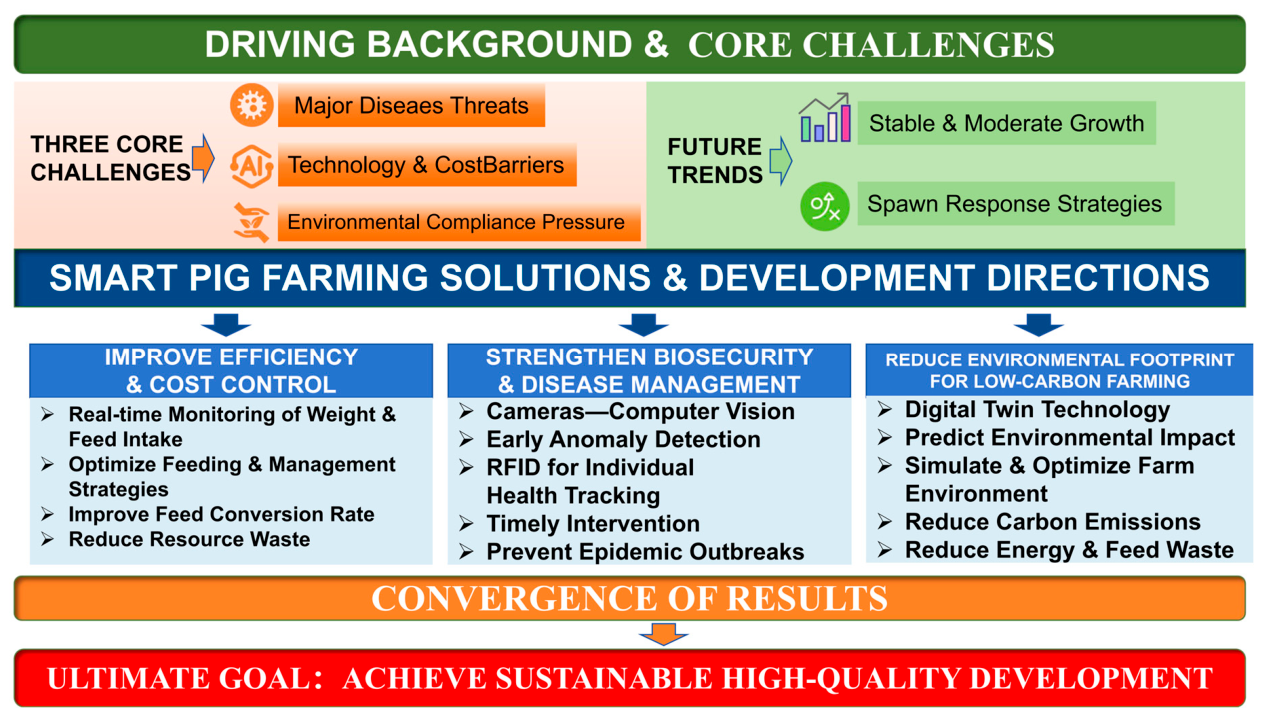
Despite these medium-term opportunities, pig production continues to face substantial systemic risks and uncertainties. First, transboundary animal diseases remain a persistent and significant threat. African swine fever (ASF) has evolved from a regional outbreak into a global challenge affecting Africa, Europe, Asia, and parts of the Americas. The recent resurgence in Vietnam, sporadic outbreaks and recombinant variants in China, and continuing cases in Europe illustrate the difficulty of achieving sustained control [2,3]. Inadequate containment can rapidly lead to production losses, large-scale culling, trade restrictions, and reduced market confidence. Second, even when feed prices decline, labor, energy, depreciation, and compliance costs remain high, thereby compressing profit margins, particularly for farms with high capital intensity or limited managerial capacity [1]. Third, more frequent heat waves, droughts, and floods, together with increasingly stringent requirements for manure management, ammonia control, and low-carbon production, are intensifying environmental and regulatory pressure on the sector. Under these combined pressures, conventional management approaches based on periodic inspection and subsequent intervention are becoming increasingly inadequate. In response, AI-enabled smart pig farming has emerged as a promising approach for improving the resilience and competitiveness of pig production. Supported by IoT-based sensing, computer vision, data analytics, automation, and robotics, smart pig farming enables continuous, fine-grained monitoring of animals and their environments. Cameras, thermal imaging systems, RFID, and multimodal sensors can detect changes in body temperature, feed intake, activity, posture, and environmental conditions, thereby enabling earlier disease detection and more rapid management responses (Figure 2 [4,5]). The integration of RFID with computer vision can further support individual identification in group housing systems and improve the continuity of health and behavioral data collection [6]. For highly lethal and rapidly spreading diseases such as ASF, this shift from reactive inspection to early detection, isolation, and intervention is particularly important [7]. These developments indicate that intelligent sensing is becoming a practical tool for enhancing health surveillance, biosecurity, and response efficiency in commercial pig production systems.
Beyond disease control, smart pig farming is increasingly transforming routine production management. Precision livestock farming technologies support the continuous monitoring of body weight and feed and water intake, environmental conditions, and reproductive status, thereby enabling more precise feeding strategies, targeted ventilation and thermal regulation, and automated reproductive management [8,9,10,11,12,13,14]. Recent evidence further indicates that these approaches can improve production efficiency, enhance animal welfare, and reduce environmental impacts [15,16,17,18,19,20,21]. These benefits are particularly relevant in the context of decarbonization, as improvements in feed conversion, manure management, and environmental control can reduce waste, lower emissions per unit of output, and improve overall resource-use efficiency. Related studies have also emphasized the growing role of smart agricultural technologies in supporting both economic and environmental performance within the framework of sustainability targets [22].
At the broader system level, smart pig farming is evolving from single-sensor monitoring toward integrated cyber–physical systems. For example, digital twins integrate AI, IoT, and data analytics to create virtual representations of production systems for real-time monitoring, scenario simulation, and management optimization [23,24]. In pig production, such systems can be used to predict process changes, estimate the effects of environmental variation on animal health and productivity, and evaluate interventions before implementation [25,26]. At the same time, AI-based computer vision is beginning to support emissions monitoring and prediction, thereby extending the scope of intelligent sensing beyond direct animal observation [27]. Smart technologies are therefore becoming increasingly relevant not only for disease detection and welfare assessment, but also for precision feeding, environmental control, emissions reduction, and decision support. The main solution pathways and development directions discussed above are summarized in Figure 2.
Despite this rapid expansion, the literature on AI-enabled smart pig farming remains fragmented across multiple technical domains and application scenarios. Existing reviews have typically focused on specific technologies or application areas, such as precision livestock farming, welfare assessment, digital twins, sensors, or camera-based monitoring. Although these reviews provide important domain-specific insights, they do not fully clarify how the field has evolved over time, which studies constitute its intellectual foundation, how the major research themes are structured, or which directions are emerging as stable application priorities. This issue is particularly important because smart pig farming lies at the intersection of animal science, agricultural engineering, computer science, sensing technology, and data analytics. As a result, its overall knowledge structure is difficult to capture through narrative review alone. This review addresses which AI-enabled technologies have developed into persistent and deployment-relevant research directions in smart pig farming, and which barriers limit their reliable on-farm implementation. Based on the WoSCC literature spanning 1991–2025, without restricting the analysis to a specific country or region, we first characterize the broader knowledge structure of the field and then focus on three complementary technical streams: vision-based object detection, precision feeding, and infrared/AI-enabled body-temperature monitoring. This review aims to identify both scientific research gaps and practical requirements for translating these technologies into reliable and decision-ready systems for commercial pig production.
This study aims to (1) summarize the historical evolution of the smart pig farming literature; (2) identify publications that have made substantial contributions to the field; (3) map active research themes; (4) further analyze core themes by assessing key challenges and proposed solutions; and (5) identify emerging trends that may shape future research.

2. Methods

2.1. Data Collection and Statistics

Data were retrieved from the Web of Science Core Collection (WoSCC), which indexes over 12,000 high-impact academic journals. The data-retrieval period extended from 1 January 1990 to 1 December 2025. The search strategy combined terms related to precision technologies, application areas, and the target species (pigs), using the following query: TS = (“precise livestock farming*” OR “IoT” OR “Internet of Things*” OR “sensors” OR “digital twin” OR “thermal imaging*” OR “cameras and computer vision*”) AND TS = (“monitoring” OR “feed*” OR “welfare assessment*” OR “automation” OR “digitalization” OR “Reproduction” OR “breed” OR “farrowing” OR “health” OR “Body measurement estimation”) AND TS = (pig).
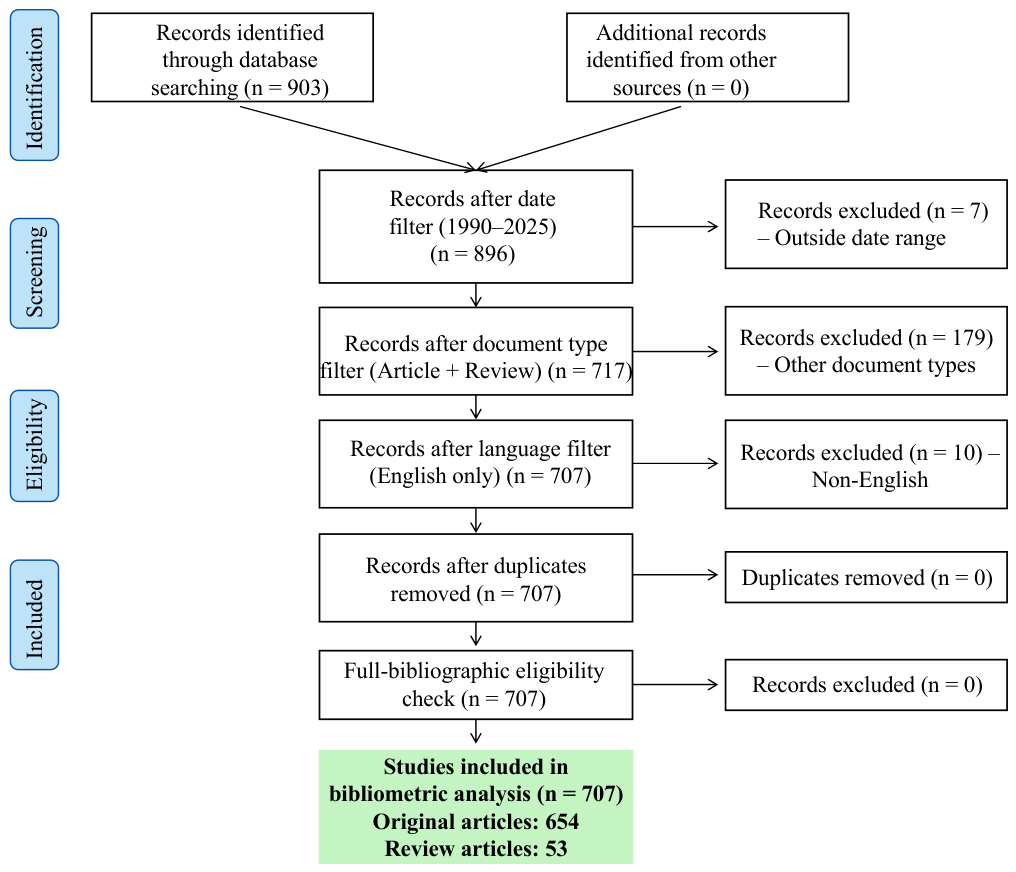
Data processing and analysis: Retrieved records were exported as plain text files in “Full Record and Cited References” format. During data preprocessing, duplicate records were identified and removed, while records with incomplete bibliographic information required for analysis or those outside the predefined research scope were excluded. After screening and data cleaning, the final dataset, designated as “DATA,” comprised 707 bibliographic records. The final dataset, designated as “DATA,” comprised 707 bibliographic records (Table S8; Figure 3). Key metadata—including country/region, institution, journal, author, and document type—were extracted and statistically analyzed using Office (2019).
Although the bibliometric dataset was fixed at the retrieval cut-off date of December 1, 2025, a small number of early-2026 publications were incorporated into the narrative thematic synthesis to reflect the latest developments. These studies were not included in the bibliometric counting, burst detection, or candidate-theme prioritization.

2.2. Bibliometric Analysis Tools

2.2.1. CiteSpace

In the present study, CiteSpace (Version 6.2.R4) was employed to construct co-occurrence networks representing scientific partnerships among authors, institutions, and countries/regions. Collaborative relationships, defined as the co-occurrence of multiple entities in a single publication, were visualized through color-coded nodes and links. Time-slicing algorithms were applied to color-code edges based on the year of initial connection. Nodes are depicted as “tree rings,” where ring thickness corresponds to the frequency of co-occurrence in a specific year [28,29,30].
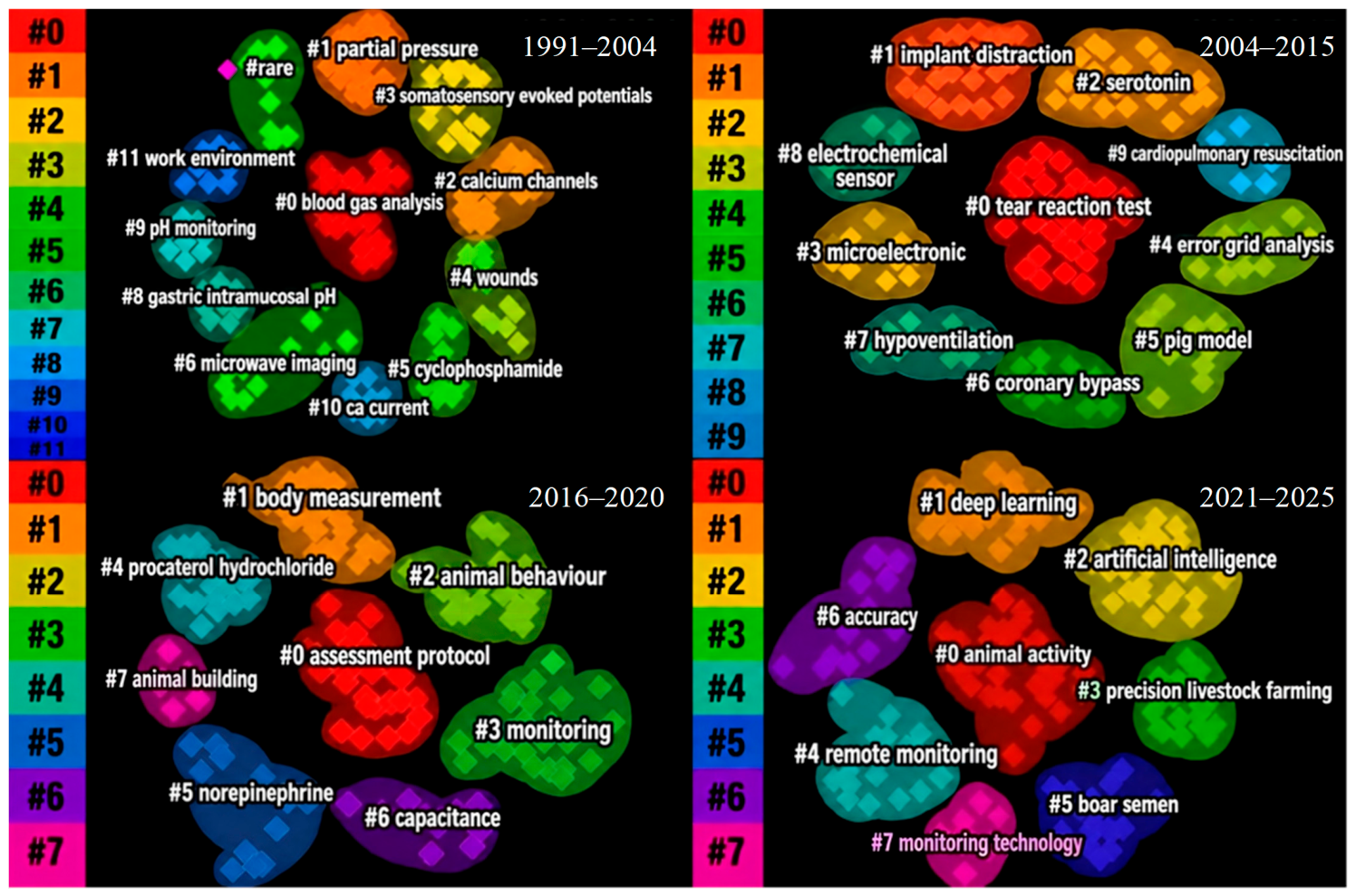
Time-slicing parameters were configured for 1991–2025 using one-year intervals. Term sources included “Title,” “Abstract,” “Author Keywords (DE),” and “Keywords Plus.” Collaboration networks for countries/regions, institutions, and authors were generated by selecting the corresponding node types, with all other parameters kept at their default settings. The resulting visualizations were manually pruned to improve clarity. For keyword cluster analysis, the timespan was divided into four periods: 1991–2003, 2004–2015, 2016–2020, and 2021–2025. In addition, citation dynamics were visualized using the “Timeline View” function, and burst detection was used to identify notable surges in keywords, subject categories, and cited references.

2.2.2. HistCite

We imported the 707 records from DATA into HistCite Pro 2.1, set the “Limit” to 30, retained all other settings at their default values, and selected “Make graph” to generate a citation network for the smart pig-farming field and identify influential publications efficiently [30].

2.2.3. The Alluvial Generator

Alluvial diagrams were employed to elucidate temporal patterns within evolving networks. Specifically, a series of keyword co-occurrence networks were generated in CiteSpace and exported to the Alluvial Generator (http://www.mapequation.org/apps/AlluvialGenerator.html, accessed on 16 December 2025.). Within this framework, keywords functioned as nodes clustered into modules for each time slice. The diagrams visualize structural evolution by tracking how nodes split and merge to form intersecting modules across sequential time periods. Additionally, the distribution of these modules was visualized via donut charts using the ggplot2 package (version 3.4.4) in R (version 4.2.2) [30,31].

2.3. Candidate-Theme Comparison and Prioritization

Candidate themes were identified by integrating multiple bibliometric indicators. Thematic terms were extracted from HistCite records and CiteSpace burst-detection outputs in titles, author keywords, Keywords Plus, and abstracts. These terms were then cross-referenced with keyword clusters, cluster summaries, and burst trajectories. Synonymous or conceptually overlapping terms were merged to form a preliminary set of candidate themes, including vision-based object detection, precision feeding, welfare and behavior monitoring, body-temperature and thermal-state monitoring, environmental and heat-stress monitoring, cough and acoustic disease recognition, and digital twin-based decision support [32,33,34].
Each candidate theme was evaluated using six evidence dimensions: total matched publications, publications published between 2021 and 2025, total citation frequency, temporal coverage, matched burst labels, and cumulative burst strength. Matched publications were identified by matching standardized thematic terms in titles, abstracts, author keywords, and Keywords Plus, followed by manual verification. Temporal coverage was defined as the number of publication years represented by each theme, and cumulative burst strength as the sum of the burst strengths of all burst labels assigned to that theme.
Differences in thematic support across the six dimensions were assessed using the Friedman test, followed by pairwise Wilcoxon signed-rank tests with Holm [35] correction. Kendall’s W was used to assess ranking consistency. For integrated comparison, each dimension was normalized across themes and averaged with equal weights to obtain a composite support score. The resulting scores were visualized using support score-average rank plots and heatmaps [35,36]. Statistical analyses and visualizations were performed in R (version 4.2.2).
To refine prioritized themes, burst references, clustering results, and theme-merging outputs were integrated. Related clusters were merged based on semantic similarity, and the resulting thematic streams were synthesized according to knowledge convergence and practical relevance. Structural relationships among the resulting thematic streams were visualized using a Sankey diagram [32,33].

2.4. Qualitative Evidence Appraisal

For the in-depth thematic synthesis, the methodological reliability and practical relevance of individual studies were qualitatively appraised according to study design, sample or dataset scale, validation setting, reporting completeness, and relevance to commercial pig production. Greater interpretive weight was given to studies with clearly reported methods and performance metrics, independent or field-based validation, and evaluation under realistic farm conditions. Small-scale, single-site, simulation-based, or proof-of-concept studies were considered informative for technological development but were interpreted cautiously when assessing generalizability and deployment readiness. Given the substantial methodological heterogeneity across the three technical streams, no single numerical quality score was applied.

3. Results

3.1. Historical Characteristics of the Literature

3.1.1. Literature Distribution Characteristics

Temporal variations in scientific literature output provide a quantitative basis for assessing knowledge accumulation and the developmental dynamics of a research domain. This study analyzed 707 publications related to smart pig farming, consisting of 654 primary research articles and 53 review articles. These documents were authored by 3604 researchers affiliated with 1104 institutions and were published in 350 journals, spanning 114 scientific categories (Table 1).
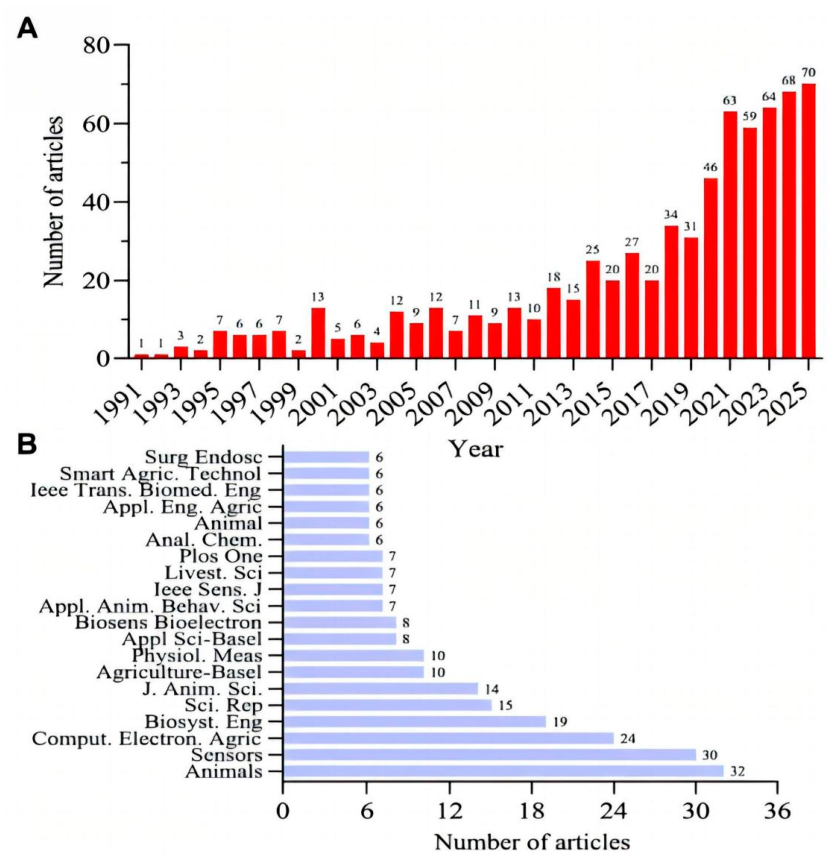
The annual research output is illustrated in Figure 4A. Between 1991 and 1999, only sporadic publications were recorded in the field of smart pig farming. However, from 2000 to 2019, the annual publication volume exhibited a rapid growth trend, which further accelerated after 2019, culminating in a peak in 2025. Figure 4B outlines the top 20 most productive journals in this domain, providing a reference for journal selection. Animals ranked first, with 32 publications, followed by Sensors (30 papers), Computers and Electronics in Agriculture (24 papers), and Biosystems Engineering (19 papers).

3.1.2. Research Trajectory

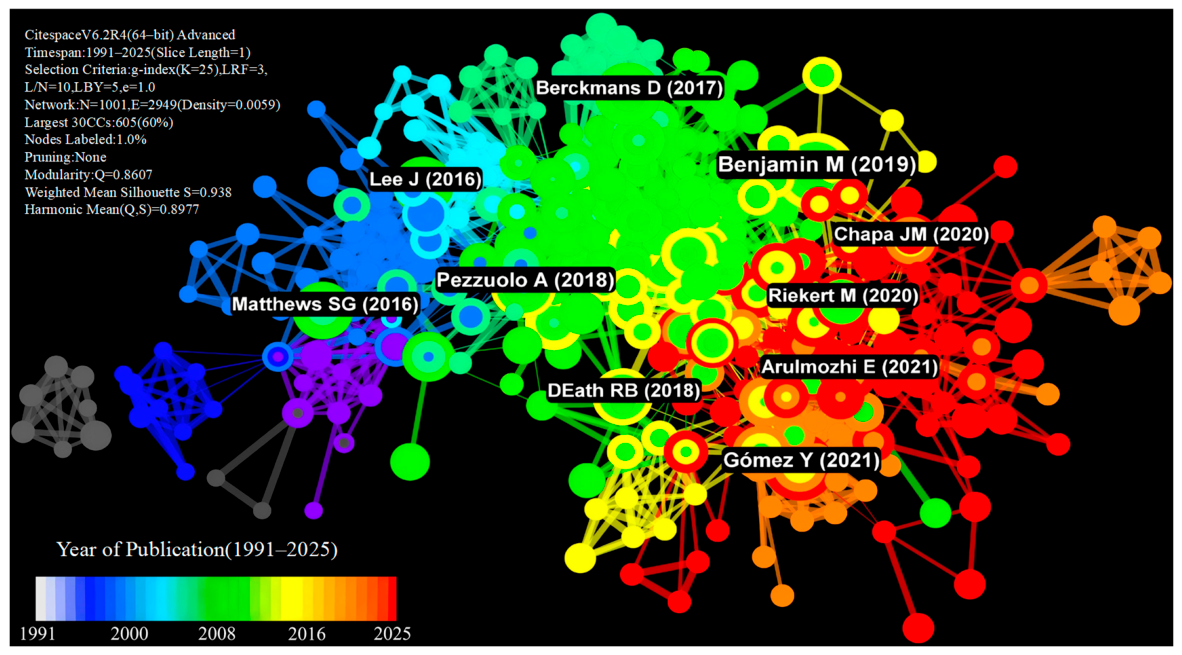
The document co-citation network (Figure 5), comprising 1001 nodes and 2949 links, elucidates the intellectual structure and connectivity within the field of smart pig farming over the past three decades. The network topology shows a clear temporal progression. The early phase (1991–2005) is characterized by dense foundational nodes, representing the core literature of the field. The intermediate phase (2006–2019) reflects the expansion of major research directions, whereas the recent phase (2020–2025) shows increasing thematic concentration and diversification. Key publications central to this network include the top ten most co-cited references: Benjamin and Yik [15] (22 citations), Pezzuolo et al. [37] (18 citations), and Gómez et al. [38] (16 citations), followed by Berckmans [39], Arulmozhi et al. [40], Lee et al. [41], Riekert et al. [42], Chapa et al. [43], D’Eath et al. [44], and Matthews et al. [45], all with comparable citation frequencies. These seminal works underpin the research clusters that are further detailed in the subsequent timeline analysis.
Additionally, citation metrics derived via HistCite Pro 2.1 identified landmark articles based on Local Citation Score (LCS) (Table S1). The three most significant publications were “Early detection of health and welfare compromises through automated detection of behavioral changes in pigs” (LCS:35, GCS:194, Matthews et al. [45]); “On-barn pig weight estimation based on body measurements by a Kinect v1 depth camera” (LCS:19, GCS:150, [37]); and “Implementation of machine vision for detecting behaviour of cattle and pigs” (LCS:16, GCS:149, [46]).

3.1.3. Scientific Cooperation

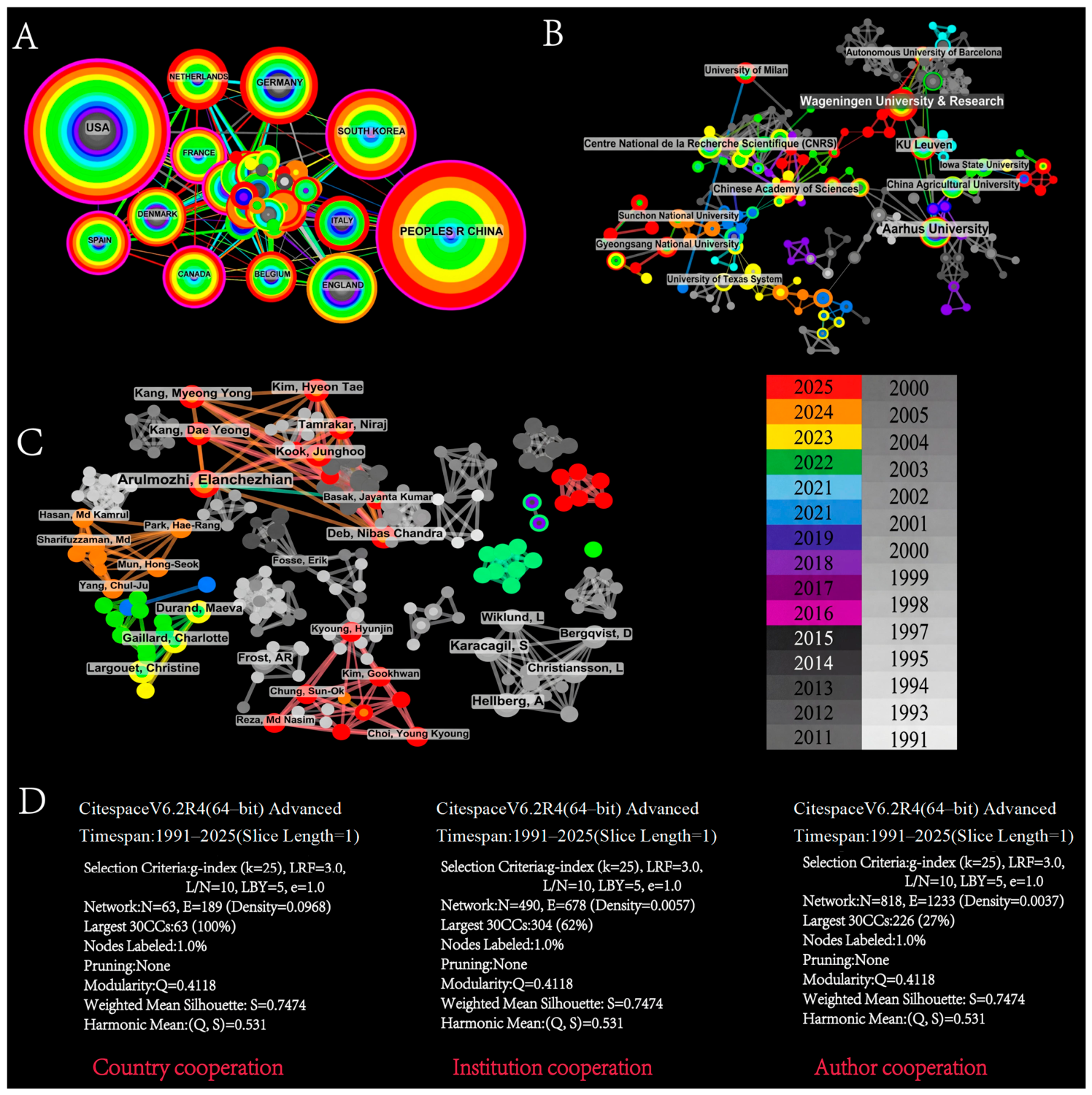
As shown in Figure 6, dense nodes and their interconnections indicate strong collaboration at the country, institutional, and author levels. The national collaboration network comprises 63 nodes and 189 edges; the United States, China, South Korea, and Germany are the largest nodes (Figure 6A,D; Table S2). The institutional collaboration network comprises 490 nodes and 678 edges; Aarhus University, Wageningen University and Research, KU Leuven, and the Centre National de la Recherche Scientifique (CNRS) are the largest nodes (Figure 6B,D; Table S2). The author collaboration network is presented in Figure 6C. Arulmozhi, Elanchezhian; Karacagil, S.; Hellberg, A., and Bokkers; and Eddie, A. M., have the highest publication output in this field. Dense edges further indicate frequent collaborations among researchers (Table S2).

3.2. Variation in the Most Active Topics

3.2.1. Subject Category Burst

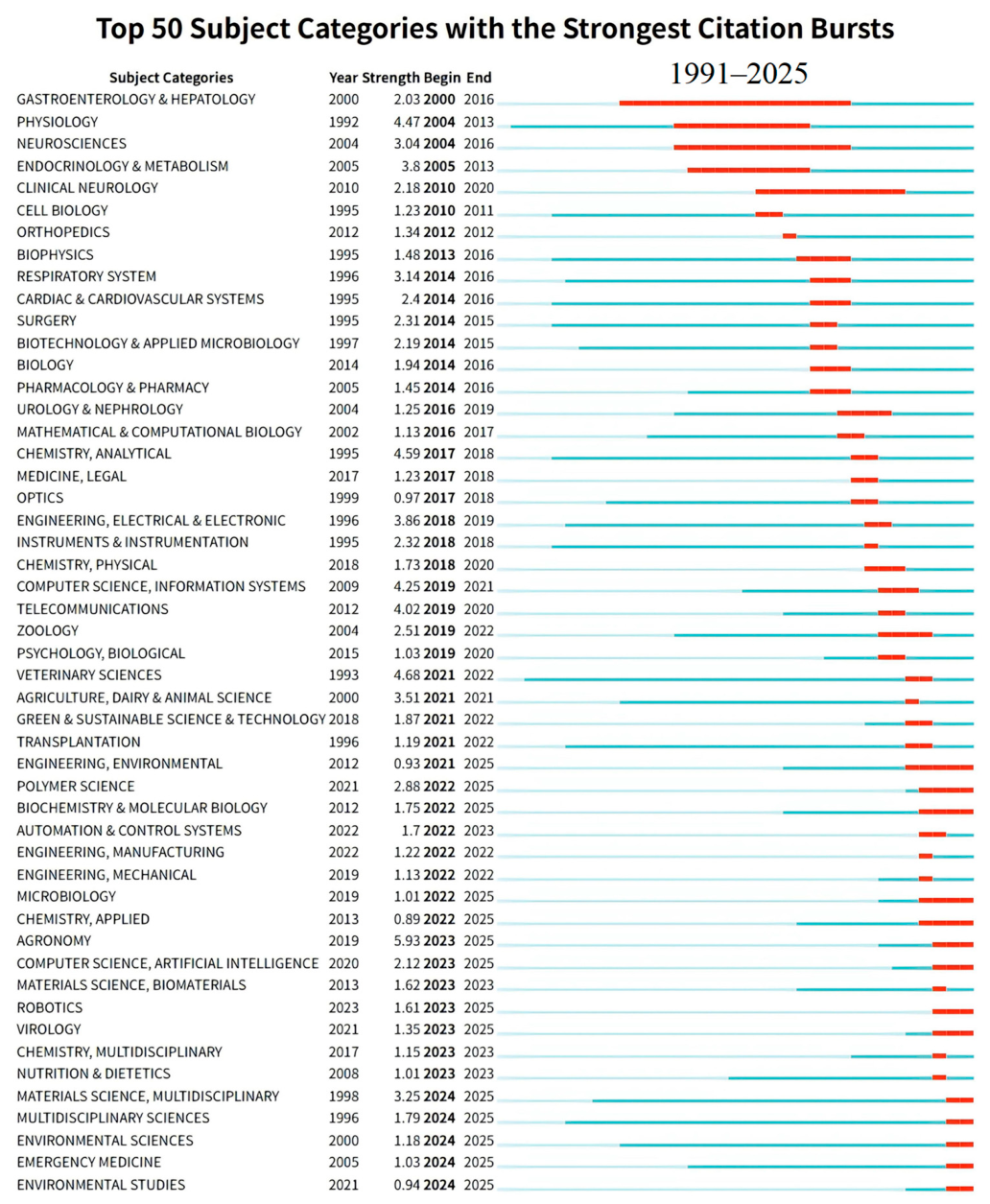
From 1991 to 2025, 112 of the 114 analyzed subject categories exhibited citation bursts, indicating recurrent hotspots and evolving knowledge frontiers over the study period. The blue timeline indicates the full study period, whereas red segments mark the start and end years of citation bursts for each subject category. Figure 7 summarizes the 50 subject categories with the highest burst intensities across periods, highlighting shifts in research focus over time. AGRONOMY showed the strongest burst during 2023–2025 (burst intensity = 5.93), indicating a recent shift toward agricultural production and application-oriented research. Over time, burst categories shifted from a relatively concentrated pattern to a more diversified profile. For example, GASTROENTEROLOGY and HEPATOLOGY exhibited a prolonged burst (2000–2016), suggesting sustained influence on the field’s knowledge base. The episodic bursts of BIOLOGY (2014–2016) and MATHEMATICAL and COMPUTATIONAL BIOLOGY (2016–2017) indicate expanding paradigms toward life-science mechanisms and computational analysis. The ROBOTICS burst (2023–2025) points to a recent move toward automation and intelligent systems. Overall, the temporal evolution of burst categories underscores the field’s interdisciplinarity and the shifting location of research hotspots with changing technologies and paradigms.

3.2.2. Keywords Burst

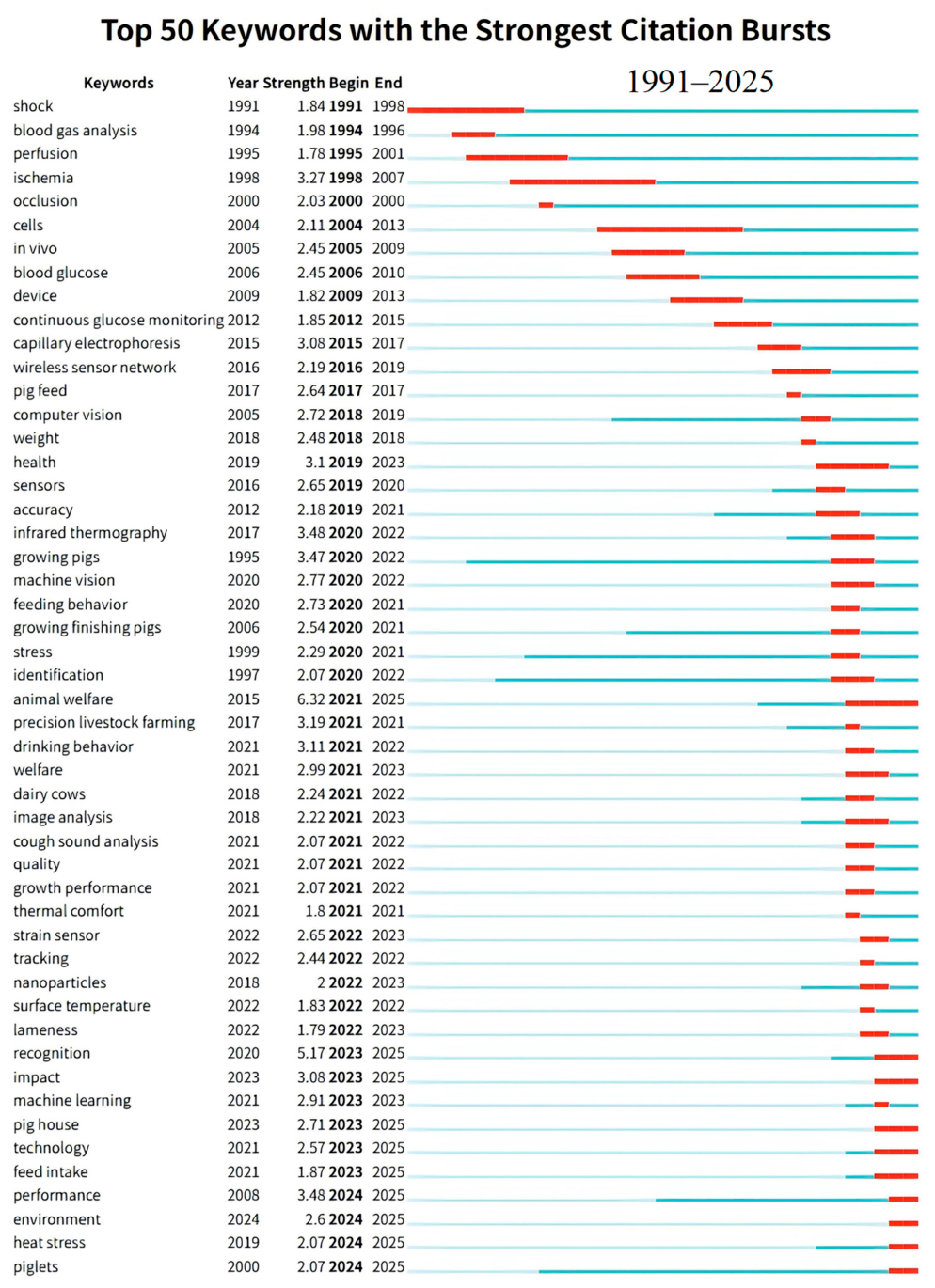
At a finer granularity, this study examines keyword citation bursts to characterize time-varying active themes in the smart pig-farming literature from 1991 to 2025. In total, 720 keywords exhibited bursts across different time windows, and the 50 keywords with the highest burst intensities are shown in Figure 8. Over the study period, research hotspots progressively shifted from method- and detection-oriented topics to intelligent sensing and algorithmic applications, and more recently toward integrative issues such as animal welfare. For example, during 2015–2020, wireless sensor networks (2.19), pig feed (2.64), computer vision (2.72), weight (2.48), and sensors (2.65) showed pronounced bursts. In comparison, animal welfare exhibited the strongest burst during 2021–2025 (6.32), indicating sustained and intensified attention in recent years.
To highlight potential future directions, we further identified 20 keywords whose burst periods persisted through 2025, because sustained bursts often signal continued relevance and frontier development. Among these, animal welfare had a burst intensity of 6.32 (2021–2025), recognition 5.17 (2023–2025), performance 3.48 (2024–2025), and impact 3.08 (2023–2025) (Table S3).

3.2.3. Reference Burst

A total of 955 burst articles were identified. Table S4 lists the 30 most frequently cited references from 1991 to 2025. After excluding irrelevant records, the 2019 article by Benjamin and Yik showed the strongest citation burst (strength = 7.97). Grounded in the Common Swine Industry Audit (CSIA) standards, this review systematically describes how precision livestock farming (PLF) can be applied to swine welfare management. It also summarizes sensor and algorithm-based approaches for noninvasive, real-time monitoring of lameness, body condition, and behavior, and discusses their potential to improve assessment objectivity and support early disease warning [15]. Gómez et al. [38] showed a burst intensity of 5.58 during 2022–2025. Their study systematically reviewed the use of precision livestock farming (PLF) technologies for swine welfare assessment. An analysis of 83 commercial products and 111 studies showed that, despite the potential for real-time monitoring, only 7% of the technologies had independent external validation. The authors highlighted the need for stronger validation under commercial conditions and for methods to assess animals’ affective states [38].
Berckmans [39] exhibited a burst intensity of 5.38 during 2020–2022. The paper describes how precision livestock farming (PLF) can address rising global demand for animal products amid a shrinking agricultural workforce. PLF leverages real-time monitoring to manage individual animals’ health and productivity. Drawing on process-control theory, the abovementioned article frames animals as complex, individually variable, dynamic systems (CITD). It advocates transforming on-farm data into decision-relevant information in real time through algorithms, rather than relying solely on large-scale data transfer.
A total of 59 high-impact papers with burst activity extending into 2025 were identified; the top 10, ranked by burst strength, are presented in Table 2. These comprised seven review papers and three research articles. Notably, all listed publications exhibited citation bursts within the first year of publication. A synthesis of these 10 core documents reveals five primary thematic areas. (1) Smart precision pig farming framework: Anchored in precision livestock farming (PLF), this framework integrates sensors, artificial intelligence (AI), and the Internet of Things (IoT). It establishes a closed-loop system for real-time data acquisition, analysis, and decision-making concerning key health and production indicators (e.g., body weight, body condition, and disease signals). The objective is to optimize management efficiency and production performance while simultaneously upholding animal welfare [47,48,49,50]. (2) Behavior recognition: Research emphasizes “behavior as a welfare cue,” utilizing multimodal monitoring (via infrared/visible light video and audio) to track movement, feeding, vocalizations, and abnormal behaviors (e.g., tail biting and lameness). This approach facilitates automated identification with minimal or no reliance on individual physical markers. Furthermore, the application of RGB/depth imagery and deep learning distinguishes nutritive feeding events from Non-Nutritive Visits (NNVs), thereby enhancing the resolution of group behavior analysis [38,51,52]. (3) Intelligent environmental monitoring and heat-stress management: Indoor environmental factors, such as temperature, humidity, and ammonia levels, critically influence swine health. Consequently, IoT environmental sensing and control systems are deployed to mitigate heat-stress risks. Given that heat stress reduces feed intake and shifts feeding schedules (e.g., toward early morning or evening), integrating RFID technology with AI-driven video monitoring provides early warning systems for stress-induced or health-related anomalies [49,50,53]. (4) Early disease warning and decision support: Leveraging big data and machine learning, this domain utilizes behavioral and physiological changes (e.g., altered feeding or activity patterns) as prodromal indicators. This enables real-time prediction and alerting to minimize disease transmission and economic loss. Moreover, integrating these models with environmental and feeding controls forms a unified intelligent system designed to reduce resource waste [47,48,52].

3.3. Emerging Trends and New Developments

3.3.1. The Temporal Variation in Keyword Clusters

Keywords exhibit close intrinsic correlations and form clusters based on co-occurrence. These clusters delineate the research hotspots and temporal evolution of smart pig farming. This study divides research spanning 30 years into four stages, generating keyword clustering snapshots for each (Figure 9). The first phase (1991–2003) yielded 12 clusters (n = 63 papers), followed by the second phase (2004–2015), with 10 clusters (n = 162). The third (2016–2020) and fourth (2021–2025) phases each produced eight clusters, based on 158 and 324 papers, respectively. Overall, themes directly related to swine production systems have become significantly more prominent since 2016. The third stage (2016–2020) was characterized by the emergence of phenotype and behavior monitoring, represented by terms such as “body measurement” and “animal behavior.” The fourth stage (2021–2025) focused on data-driven sensing and remote monitoring themes—specifically “animal activity,” “deep learning,” “artificial intelligence,” “remote monitoring,” and “monitoring technology.” This concentration indicates that smart pig farming has entered a rapid development phase centered on “intelligent sensing and decision support” (Figure 9). Notably, minor clusters in early stages related to physiological measurements or interdisciplinary topics showed low relevance to production applications. Consequently, these are excluded from the analysis of core evolutionary hotspots. Detailed cluster information and representative keywords for the fourth stage (2021–2025) are provided in Table S5 (Supplementary Materials) for verification and reuse.

3.3.2. The Keyword Alluvial Flow Visualization

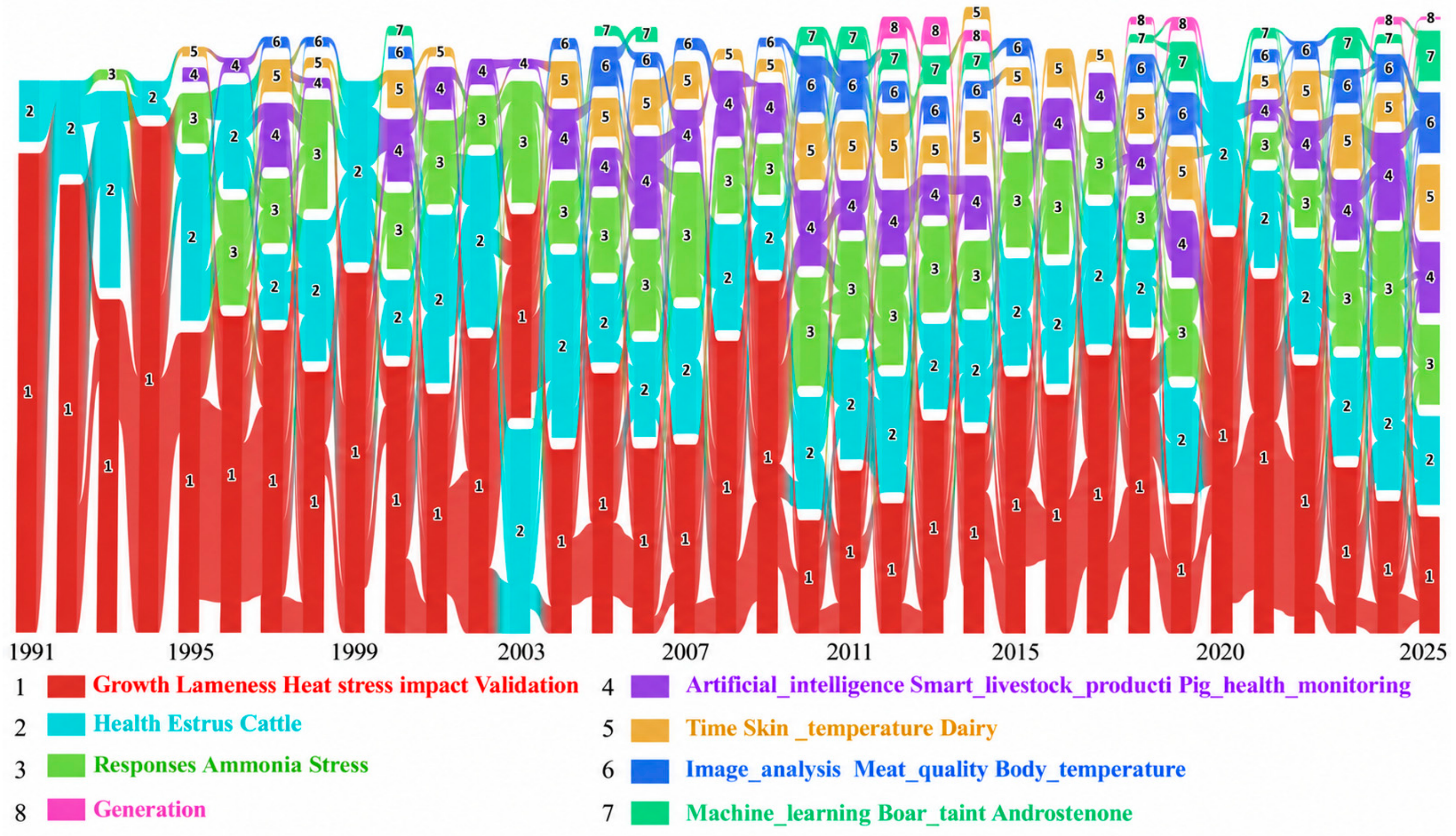
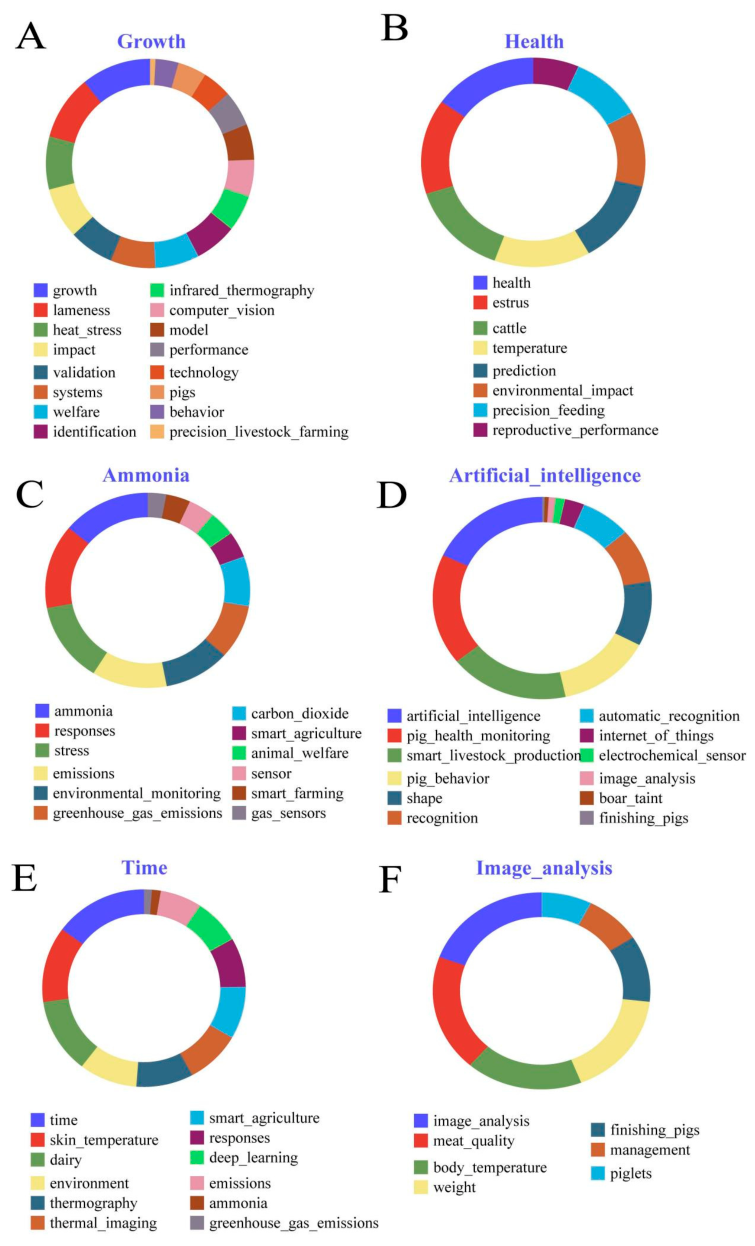
As shown in Figure 10, associated keywords combine to form specific research modules. Over time, the recombination of keywords leads to module differentiation or aggregation, resulting in the emergence of new research configurations. Throughout this 30-year evolution, certain modules have remained stable and expanded, whereas others demonstrate distinct frontier growth trends or have become marginalized. By 2025, the keywords in Module 1 had converged into the largest thematic stream, indicating the sustained vitality of this module. Figure 11 details the composition of the top six modules in 2025. These include Module 1 (growth, 16 keywords, e.g., lameness and heat stress; Figure 11A); Module 2 (health, eight keywords, e.g., estrus and temperature; Figure 11B); Module 3 (responses, 12 keywords, e.g., ammonia, stress, and emissions; Figure 11C); Module 4 (artificial intelligence, 12 keywords, e.g., smart livestock production, pig-health monitoring, and pig behavior; Figure 11D); Module 5 (time, 12 keywords, e.g., skin_temperature and smart_agriculture Figure 11E); and Module 6 (image_analysis, seven keywords, e.g., meat quality, body temperature, and weight; Figure 11F). Collectively, these modules highlight potential future growth directions in smart pig farming, particularly in AI-supported health and behavior monitoring, as well as production-related thermal environment and growth phenotypes. Additionally, the presence of limited cross-species or cross-scenario keywords suggests technology transfer or interdisciplinary noise within the search scope. To maintain a focus on swine production systems, the main text prioritizes modules directly relevant to pig farming; complete details are provided in Figure 11 and Supplementary Table S6.

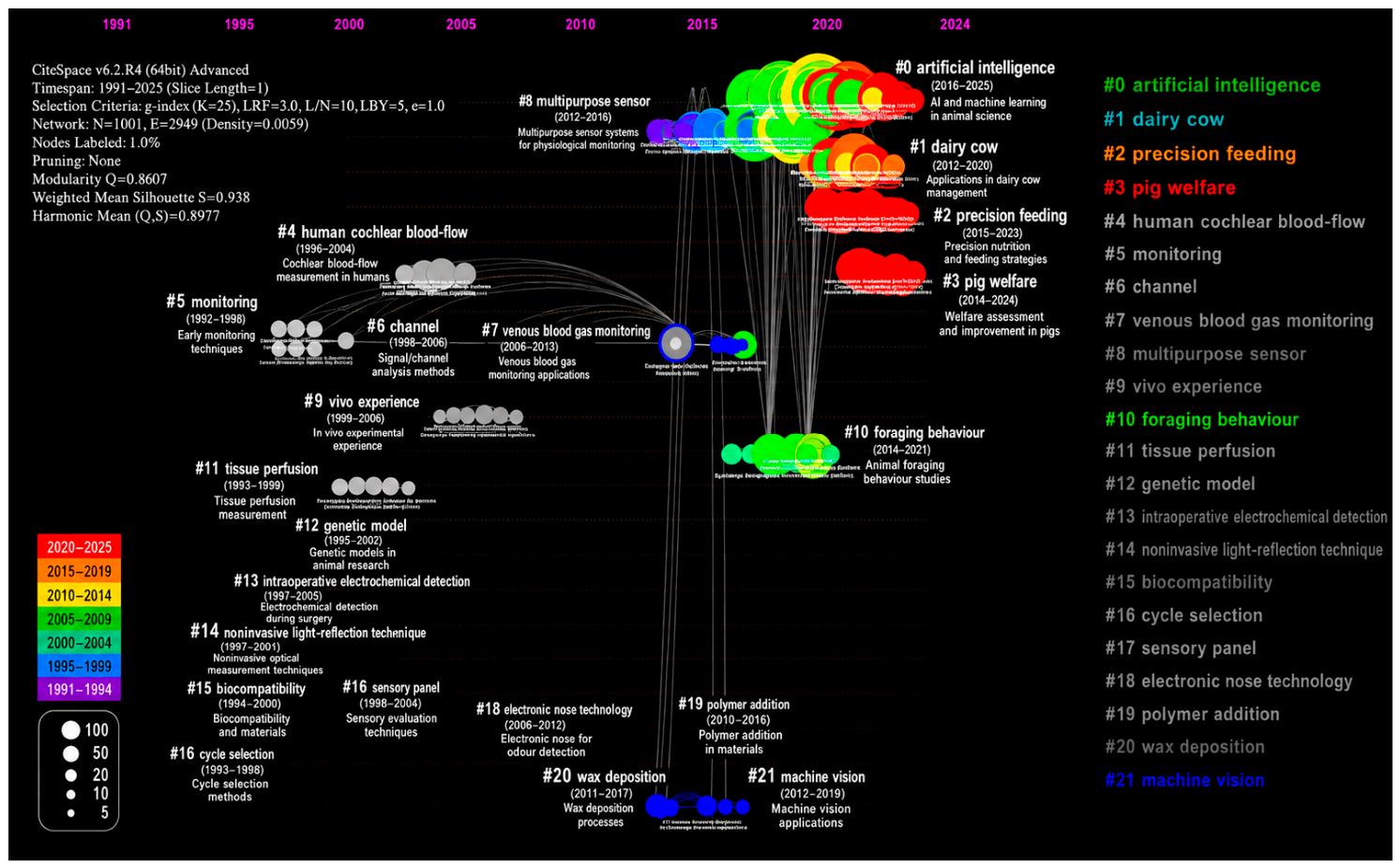
3.3.3. The Timeline Visualization of References

The co-citation timeline view delineates the intellectual base and persistently active themes within the research domain (Figure 12). A total of 22 clusters were identified and arranged in descending order of size (Figure 12). To elucidate the research trajectory of smart pig farming, this study focuses on clusters directly relevant to production applications that exhibit sustained temporal activity and strong inter-cluster associations. Key examples include machine vision, precision feeding, pig welfare, foraging behavior, and artificial intelligence. These clusters indicate that visual sensing and intelligent analysis are not “recently emerged,” isolated trends. Instead, they represent the intellectual backbone and frontier growth points long integrated with application scenarios involving welfare, behavior, feeding, and growth. Clusters with lower relevance to production scenarios or significant interdisciplinary characteristics are excluded from the main analysis. The complete list of clusters and core references is available in Table S7. Furthermore, pivotal papers have significantly driven sub-field development (Figure 12). An analysis of the recent citation distribution for five of these articles (Figure S1) suggests their continued influence in future research.

3.4. Comparison and Prioritization of Candidate Themes

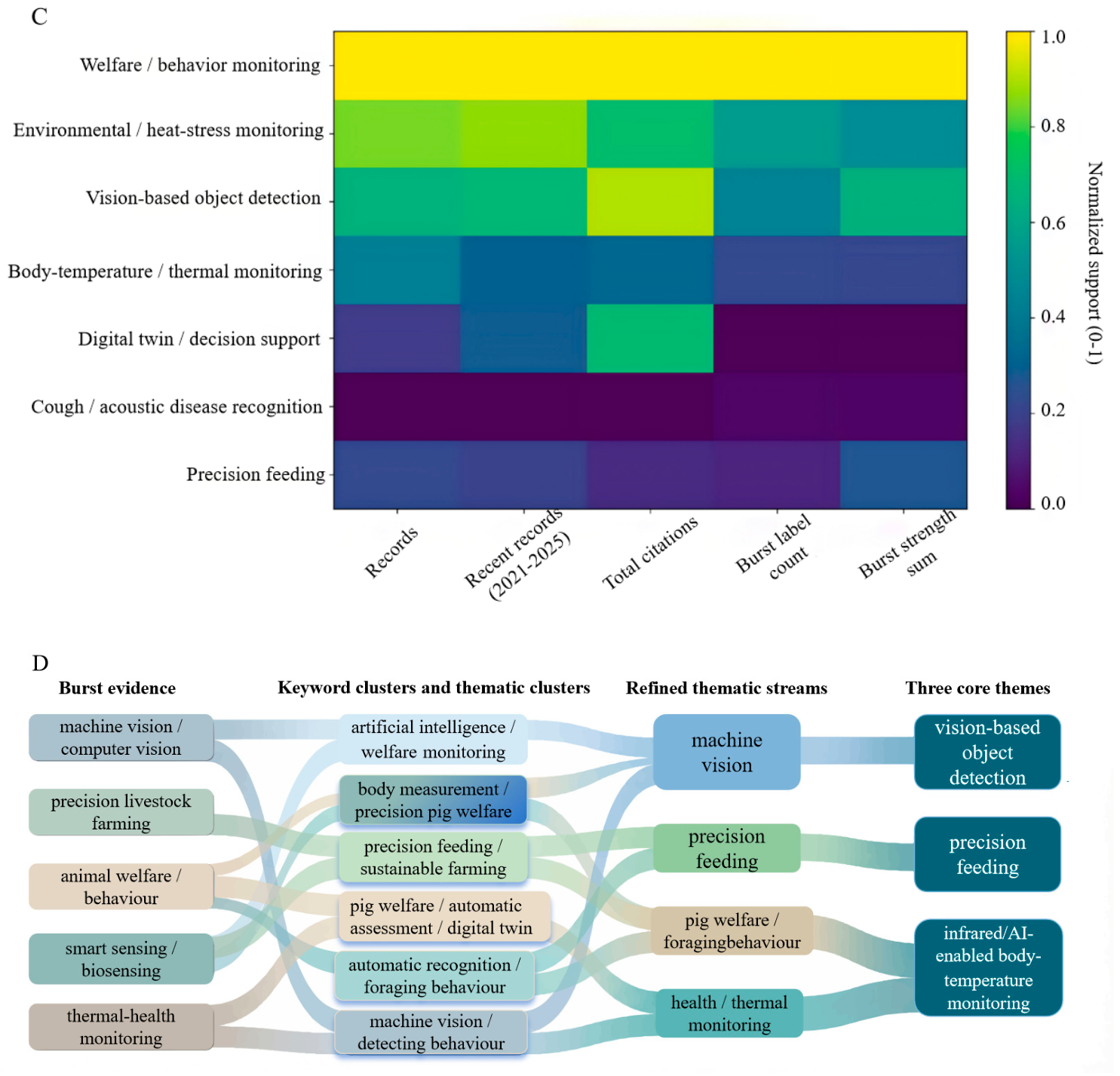
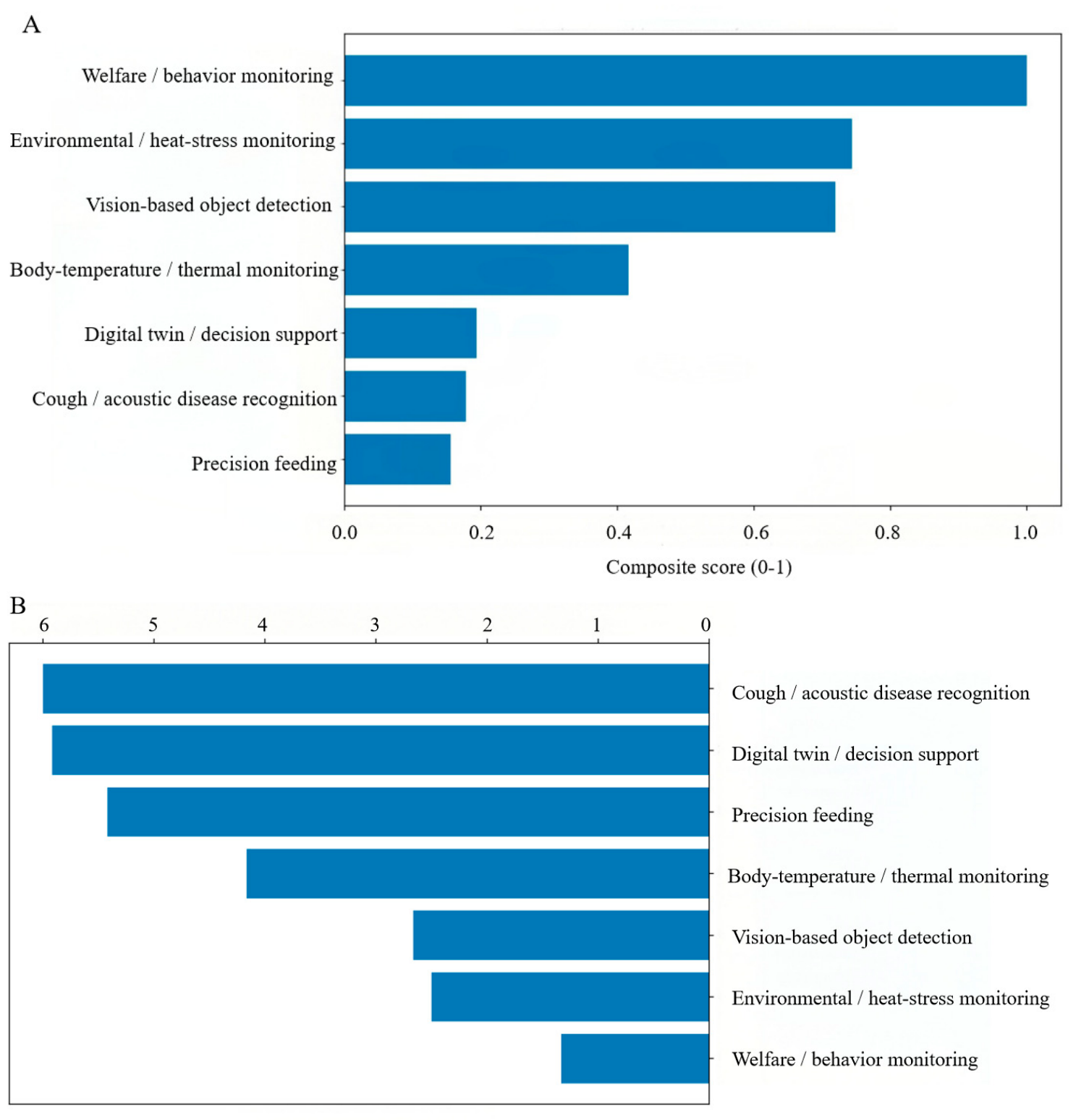
Candidate themes showed distinct evidence profiles across the six evidence dimensions, rather than a uniform ranking. Composite support scores (Figure 13A) identified welfare/behavior monitoring as the strongest-supported theme, followed by environmental/heat-stress monitoring and vision-based object detection. Body-temperature/thermal-state monitoring occupied an intermediate position, whereas precision feeding, digital twin/decision support, and cough/acoustic disease recognition received weaker overall support. The average-rank plot and evidence heatmap (Figure 13B,C) further showed that support was evidence-type-specific. Welfare/behavior monitoring was driven mainly by burst-related indicators and broad temporal coverage. Vision-based object detection was associated primarily with recognition- and machine-vision-related evidence, whereas body-temperature/thermal-state monitoring was linked to thermography- and thermal-health-related signals.
The Friedman test detected an overall difference among candidate themes (χ2 = 28.59, p = 7.27 × 10⁻⁵). However, no pairwise comparison remained significant after Holm [35] correction, despite nominal differences before adjustment. Kendall’s W was 0.794, indicating weak concordance across the six evidence dimensions. We therefore treated the quantitative comparison as a prioritization framework rather than a hard statistical filter. Final theme selection integrated bibliometric support with thematic distinctiveness, recent persistence, complementarity, and relevance to on-farm AI deployment.
Within this framework, welfare/behavior monitoring and environmental/heat-stress monitoring were treated as cross-cutting contexts rather than as standalone review sections. Although both were strongly supported, much of their evidence overlapped with the retained technical directions, particularly vision-based behavioral phenotyping, feeding-related behavior analysis, and thermal-health monitoring. Precision feeding, by contrast, was retained despite lower composite support because it represented a stable, application-specific research line with clearer independence and direct relevance to on-farm decision-making and sustainability. We therefore prioritized vision-based object detection, precision feeding, and infrared/AI-enabled body-temperature monitoring as three complementary and methodologically distinct themes for in-depth review.
Burst evidence, keyword clusters, and thematic convergence pathways were then integrated to construct the Sankey diagram of the three prioritized themes (Figure 13D). Vision-related burst signals converged through artificial-intelligence- and machine-vision-related clusters on machine vision, which was retained as vision-based object detection. Evidence from precision livestock farming and feeding management converged through the precision feeding/sustainable farming cluster on precision feeding. A third stream integrated animal welfare/behavior, smart sensing, and thermal health. These signals passed through intermediate nodes such as pig welfare/automatic assessment/digital twin, automatic recognition/foraging behavior, and body measurement/precision pig welfare, ultimately supporting infrared/AI-enabled body-temperature monitoring as the retained thermal-health theme. Section 4, therefore, focuses on these three prioritized themes.

4. Bibliometrics-Driven Thematic Review

To improve consistency and readability, each prioritized technical stream is discussed from the perspectives of methodological approach, operating conditions and applications, performance and limitations, and deployment maturity.

4.1. Vision-Based Object Detection

Object detection is a key task in vision-based perception for smart pig farming. It aims to localize individual pigs or specific body parts in images or videos acquired in complex farm environments. Early approaches mainly relied on traditional computer-vision methods, including background subtraction, morphological analysis, and template matching [54].

4.1.1. Operating Challenges and Deployment Conditions

Compared with general-purpose object detection, pig-house environments present distinct challenges that hinder object detection and behavior recognition. High stocking density causes frequent interactions and severe occlusion, so pigs often remain only partially visible or heavily overlapped for extended periods, weakening appearance cues and complicating localization and segmentation [42,55,56,57,58]. Detection is further complicated by large variation in body size, coat color, soiling patterns, and posture, all of which increase visual heterogeneity and reduce robustness [42,55,59,60,61,62].
Image quality is also unstable across sensing conditions. Illumination changes with time and season, while infrared and night-vision cameras introduce image characteristics that differ markedly from daytime RGB imagery, limiting cross-condition generalization [63,64,65]. In addition, farm structures such as fences, feeders, heat lamps, and floor drains may resemble pigs in shape or texture, increasing false detections, whereas geometric distortion and calibration errors further reduce localization accuracy and scale estimation [64,66,67,68,69,70].
Beyond visual complexity, practical deployment imposes an additional constraint. Systems must operate continuously on low-power devices while maintaining low-latency inference for timely detection of acute risk behaviors such as crushing, trampling, and aggression [71,72,73,74,75,76]. Taken together, these factors create a substantial domain gap between pig-house detection tasks and benchmarks based on general-purpose datasets such as COCO, thereby necessitating scenario-specific architectures, training strategies, and evaluation metrics [65,72,77,78,79].

4.1.2. Methodological Approaches and Performance Trade-Offs

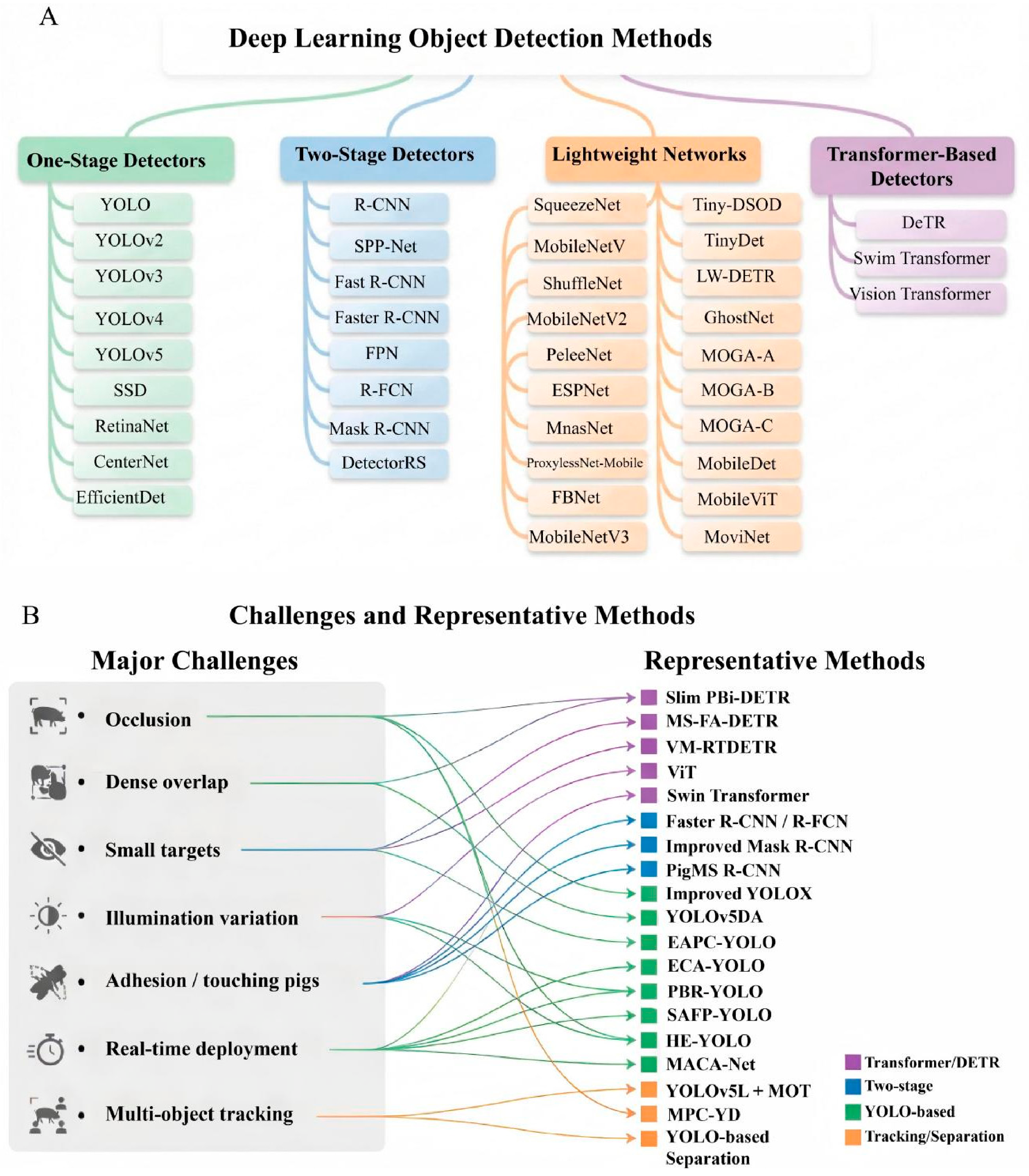
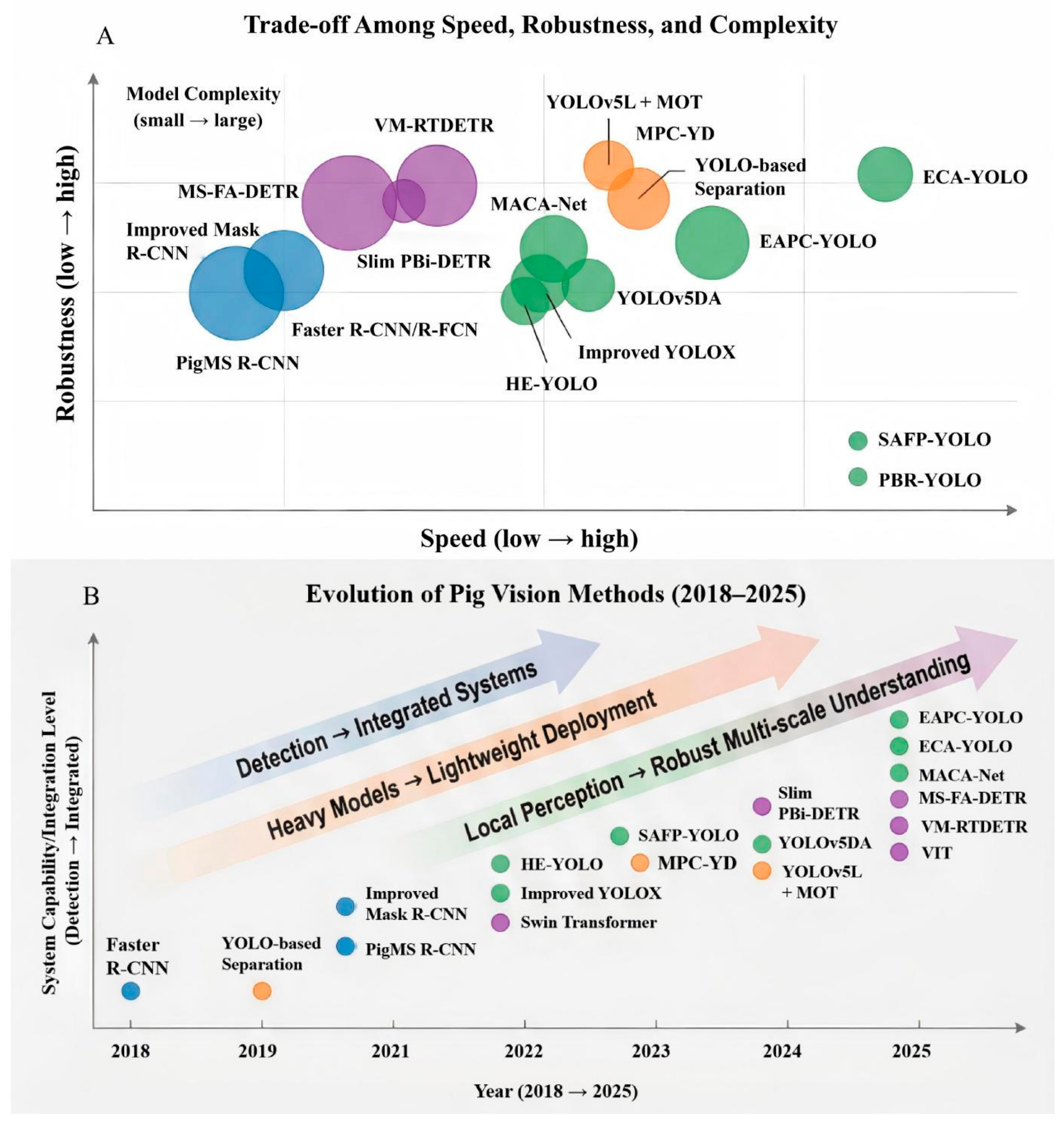
Deep-learning approaches to pig object detection can be broadly grouped into four categories: two-stage detectors, single-stage detectors, lightweight detectors, and Transformer-based spatiotemporal paradigms (Figure 14A).
Early work mainly used two-stage detectors, especially Faster R-CNN and its variants, for posture recognition and sexual-behavior detection [42,68,80,81,82,83,84,85,86]. Depth-image-based sow posture recognition achieved accuracies above 93% [83,85,86], and Faster R-CNN was also used for mounting detection, although performance declined under severe occlusion and overlap [84]. Mask R-CNN and Mask Scoring R-CNN further enabled finer-grained analysis, including early warning of tail biting, by extracting individuals from pixel-level masks [80,87]. Despite strong localization performance, the high computational cost of two-stage models limited routine on-farm deployment (Figure 14A).
Subsequent research increasingly shifted toward single-stage detectors, particularly the YOLO family, which became widely adopted for multi-object detection, behavior recognition, and embedded deployment [88,89,90,91,92,93]. At this stage, progress was driven less by detector replacement alone than by challenge-oriented refinement. Feature-pyramid enhancement improved multiscale perception, especially for small targets such as pig eyes, ears, snouts, and piglets, using FPN, PAFPN, BiFPN, or cross-layer feature fusion (Figure 14B [90,94]). Attention and context-modeling modules, including SE, ECA, CBAM, MHSA, DAB, FEM, and TS attention, were introduced to suppress background clutter and improve the separation of closely interacting or occluded pigs (Figure 14B [7,88,95]). IoU-based losses and oriented bounding boxes further improved localization under overlap and elongated body geometry [57,61,90]. Multitask learning and multimodal fusion, including combinations of RGB with accelerometer, infrared, depth, or audio signals, were also explored to improve robustness under low-light conditions [59,64,94,96]. Although these refinements generally improved robustness, they also increased computational cost (Figure 15A).
To support real-time deployment, substantial effort has also focused on lightweight model design (Figure 14B). Representative strategies include lightweight backbones such as MobileNet and GhostNet, pruning at the network and channel levels, region-of-interest-based detection for small targets, and combinations of automated pruning with neural architecture search [88,92,95,97,98]. Although these approaches support scalable deployment, they often reduce accuracy, highlighting the persistent trade-off between efficiency and robustness (Figure 15A).
More recently, Transformer-based models have strengthened global-context modeling and spatiotemporal representation in pig vision. RT-DETR variants improved real-time behavior recognition, including MS-FA-DETR, enhanced RT-DETR, and Slim PBi-DETR [99,100,101]. Transformer architectures have also supported segmentation, phenotype measurement, thermal analysis, body-weight estimation, interaction recognition, and body-temperature detection, including Swin Transformer, Vision Transformers, VM-RTDETR, PB-STR, and dual-backbone RT-DETR variants [96,102,103,104,105,106,107]. Overall, these models often generalize better than CNN baselines across varying farm conditions and reflect a broader shift toward more integrated pig vision systems (Figure 15B), although computational cost, limited dataset diversity, and reduced cross-farm transferability remain major barriers.
Taken together, the field has progressed from accuracy-oriented two-stage pipelines to faster YOLO-based detectors and, more recently, to context-aware Transformer-based frameworks. Across these stages, the central challenge has remained the same: balancing robustness to farm-specific visual complexity with real-time, resource-constrained deployment (Figure 15A). At the same time, pig vision is evolving from standalone detection models toward integrated systems that combine detection with segmentation, behavior understanding, and multimodal sensing (Figure 15B). Future work should therefore prioritize lightweight hybrid architectures, multimodal fusion, and larger annotated datasets for cross-farm validation.
Direct comparison of reported detection performance across studies should be made cautiously because datasets, target definitions, imaging modalities, stocking densities, illumination conditions, and evaluation protocols differ substantially. Two-stage detectors generally provide strong localization capability but at higher computational cost, whereas single-stage and lightweight models favor real-time deployment with varying compromises in accuracy and robustness. Transformer-based approaches improve contextual and spatiotemporal modeling but typically require greater computational resources and diverse training data. Therefore, differences in reported accuracy or mAP may reflect not only model architecture but also dataset complexity, operating conditions, and validation design.

4.2. Precision Feeding

Conventional pig feeding is typically organized into three or four phases based on average herd body weight (BW) and predefined growth curves, with one diet assigned to each phase. This herd-average strategy does not adequately capture substantial inter-individual variation in growth, feed intake (FI), and nutrient utilization, even under similar genetic and environmental conditions [108]. As a result, nutrient supply often diverges from actual requirements. Pigs with high growth potential may be undersupplied when FI is constrained or dietary nutrient density is insufficient, whereas pigs with lower nutrient requirements or higher FI may be oversupplied. Such mismatches reduce feed and nutrient-use efficiency, increase production costs, and intensify nutrient losses. Excess nitrogen (N) and phosphorus (P) not retained in lean tissue are excreted in feces and urine, thereby increasing the risk of nonpoint-source pollution [109].
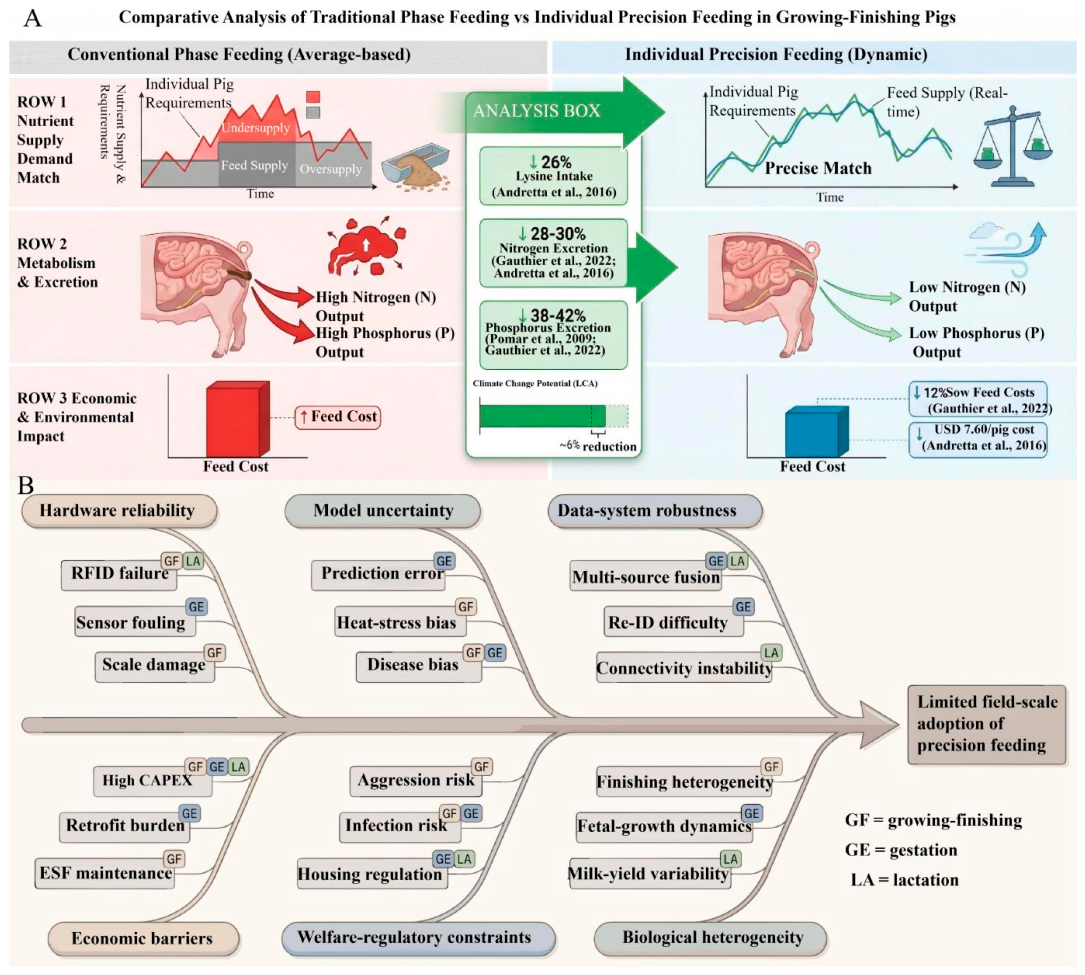
PF was developed to overcome these limitations by matching nutrient supply to the requirements of each animal in real time. Pomar et al. [110] defined PF as supplying the right feed to the right animal at the right time, in the right amount, and with the right composition. In smart pig production, PF is increasingly implemented as a data-driven closed-loop cyber–physical system that integrates sensing, requirement estimation, and automated feed delivery. By reducing nutrient oversupply, PF improves nutrient-use efficiency and lowers environmental burdens. Life-cycle assessment showed that PF reduced the global-warming potential of feed production in soybean-based systems [111], while large-scale trials reported a 12% reduction in sow feed cost and reductions of 28% and 42% in N and P excretion, respectively [112].
Overall, PF should be viewed not only as a nutritional strategy but also as a key enabling technology for improving the economic and environmental sustainability of pig production.

4.2.1. System Framework and Methodological Approaches

PF systems generally operate as closed loops integrating data acquisition, requirement estimation, feed formulation, feed delivery, and feedback control. Core inputs include individual FI, water intake, BW, growth rate, and behavioral and health indicators. Recent advances have shifted livestock monitoring from contact-based devices toward non-contact, high-throughput sensing technologies, particularly machine vision, infrared sensing, and acoustic monitoring [113]. This transition is central to PF, because scalable individualized feeding depends on continuous phenotyping under commercial farm conditions rather than occasional manual measurements.
Real-time BW is a key input for requirement estimation. Compared with conventional weighing, computer vision provides a low-stress and scalable approach for BW estimation using image-derived traits such as dorsal area and body width. Chen et al. [114] developed a BW-estimation pipeline combining BiRefNet, YOLOv11-seg, and XGBoost, achieving a mean absolute error of 3.935 kg and an R2 of 0.981. Comparable performance has also been reported using Mask R-CNN with random forest regression [115], suggesting that low-cost RGB imaging can support practical BW monitoring in PF systems. However, most current studies remain model-centric and have been evaluated under relatively controlled conditions. Their practical value for PF will depend less on benchmark accuracy alone than on robustness to occlusion, variable illumination, contamination, and large-scale farm deployment.
Accurate FI estimation also depends on reliable individual identification and behavioral tracking. Although radio-frequency identification (RFID) is widely used, its field performance may be limited. For example, a low-frequency RFID framework for finishing pigs identified only 55.7% of caretaker-confirmed cases and generated many false alarms [116]. In group-housed systems, visual re-identification offers greater flexibility and scalability, but remains challenged by similar appearance, crowding, occlusion, and soiling. Nevertheless, recent studies have substantially improved performance. Compte et al. [117] reported 90.44% accuracy on still images and 76.80% online accuracy in pig tracking. Luo et al. [74] improved pig-head detection by integrating a Transformer module into YOLOv5, while Chen et al. [118] and Alameer et al. [47] achieved high accuracy in feeding-event recognition and in distinguishing true feeding from non-nutritive visits. Together, these studies indicate that the sensing layer of PF is moving beyond simple identification toward behavioral phenotyping. Even so, the key challenge is not merely detecting feeding events, but extracting decision-relevant variables with sufficient temporal continuity and reliability for downstream nutritional control.
Dynamic requirement estimation is the analytical core of PF. Conventional feeding systems estimate population-level requirements using factorial equations and formulate phase diets accordingly [119], whereas PF estimates requirements at the individual level. Hauschild et al. [120] proposed a foundational PF model that combined empirical prediction of next-day FI and BW with mechanistic estimation of lysine requirements. Remus et al. [108] further showed that a linear-quadratic model captured short-term individual variation in protein deposition better than the Gompertz function. More recent studies have improved prediction by incorporating BW, growth rate, backfat thickness, and historical intake and weight-gain data [121]. These developments reflect a clear shift from static population-based feeding toward dynamic individualized nutrient prediction. However, model performance remains constrained by the quality, frequency, and biological relevance of input data. In practice, the main bottleneck increasingly lies in integrating noisy sensor streams with biologically meaningful requirement models, rather than in the lack of mathematical formulations.
Based on these predictions, PF systems determine ration size and nutrient composition and deliver feed through automated feeders. A common strategy is to blend two or more basal diets with different nutrient densities under computer control to formulate a daily ration for each pig [119]. This approach reduces excess dietary protein and nutrient surpluses and has been shown to operate reliably under commercial conditions using dual- or multi-hopper feeder configurations [112,122]. From a systems perspective, the maturity of PF no longer depends solely on feeder automation, but on the stability of the entire sensing-modeling-control pipeline. Future progress will therefore rely on tighter integration of multimodal sensing, biologically informed prediction, and adaptive control under real farm variability (Figure 16).

4.2.2. Application Scenarios and Deployment Maturity

Precision Feeding in the Growing–Finishing Stage
The growing–finishing stage is the most mature application context for PF because it accounts for the largest share of feed use and environmental burden. The primary objective is to reduce nutrient supply-demand mismatches arising from population heterogeneity. Individual-level data are typically obtained from RFID-based recording of FI and feeding frequency and from computer-vision-based monitoring of BW and body size [113,114,116]. These inputs support estimation of 24 h requirements for lysine, energy, and other limiting amino acids, including threonine, based on recent intake and weight-gain trajectories [120,121], after which automated feeders deliver individualized rations.
Evidence from experiments, simulations, and commercial farms consistently supports the effectiveness of PF at this stage. Andretta et al. [123] reported reductions of 26% in standardized ileal digestible lysine intake, 30% in N excretion, and about 10% in feed cost without compromising growth performance or feed efficiency. Simulation studies predicted a 38% reduction in N excretion when individual amino acid requirements were estimated from real-time BW and FI data [120], and commercial-farm studies showed that daily diet adjustment reduced protein intake by 25% and N excretion by 40% relative to three-phase feeding [124]. PF also reduced feed cost by 4.6% and P excretion by 38% in Spain [109], while later work highlighted marked inter-individual variation in threonine requirements, reinforcing the value of individualized nutrient supply [125]. Commercial results further suggest that simplified precision blend feeding can improve profitability without reducing production performance [126]. At the system level, life-cycle assessment showed that PF reduced climate-change potential by about 6% and lowered N and P excretion by 28% and at least 42%, respectively [111].
Taken together, these results indicate that growing–finishing pigs remain the most technically mature and economically validated context for PF implementation. At the same time, this maturity should not obscure a key limitation: most gains have been achieved in settings where BW and FI can be measured relatively consistently and where biological objectives are comparatively stable. Thus, the growing–finishing stage currently represents the benchmark application of PF, but not necessarily the upper limit of its technical complexity.
Precision Feeding in Gestating Sows
During gestation, PF aims to prevent excess nutrient supply from being diverted to maternal BW gain rather than fetal development. Chen et al. [127] developed a rule-based expert system integrating Internet of Things (IoT) environmental data with parity, backfat thickness, and related traits to estimate daily feed allowance, and field trials reported a correlation of 0.99 between predicted intake and estimated requirements. Under ecological farming conditions, inclusion of about 20% corn silage may further reduce feed cost and improve satiety, thereby helping maintain appropriate body condition [128].
PF during gestation mainly relies on electronic sow feeding (ESF) systems, which remain the principal hardware for individualized feeding. Automated delivery of total mixed rations has reduced feed waste by 10–15% and improved welfare through sensor-based monitoring of feeding behavior [122]. Simulation studies also suggested a 25% reduction in protein intake and a 40% reduction in N excretion when factorial equations were used to estimate individual energy requirements [110], while simplified two-diet blending strategies reduced feed cost without impairing production performance [126]. Wireless sensor networks have further enabled real-time monitoring of group FI, health alerts, and feeding adjustment [129].
Despite these advantages, PF during gestation remains constrained by biological, technical, and managerial factors. Nutrient requirements increase rapidly in late gestation and vary with parity, requiring better integration of fetal growth into requirement models [13]. Sensor limitations may still introduce a 5–10% bias in energy supply, while ESF maintenance costs, retrofit expenses, and unstable connectivity restrict broader adoption [122,129]. In group-housed sows, insufficient behavioral monitoring may also increase aggression and related production losses [130]. Compared with growing–finishing pigs, the challenge of gestation PF lies less in feeder actuation than in balancing nutritional precision, reproductive physiology, welfare constraints, and group-management complexity. This helps explain why gestation PF, despite clear conceptual benefits, remains less widely adopted and is still concentrated in modern large-scale farms.
Precision Feeding During Lactation
During lactation, PF seeks to match the sow’s high nutrient demand for milk production while sustaining piglet growth. In practice, lactation PF usually relies on ESF systems or automatic feeding systems (AFSs) to establish individualized feeding curves and adjust them in real time according to sow BW loss, milk yield, and piglet demand.
Available studies indicate clear benefits. ESF-based PF increased piglet weaning weight, reduced feed use per kilogram of piglet gain, and improved economic returns relative to conventional feeding systems [131]. PF also reduced sow BW loss and improved piglet survival [110], while model-based real-time nutrient estimation was associated with an approximately 40% reduction in N excretion during lactation [13]. In Italy, an AFS reduced energy waste and supported welfare monitoring through behavior-based assessment [122]. Smart troughs further enabled real-time monitoring of feeding behavior and daily adjustment of lysine and P supply based on piglet growth, reducing lysine intake by 23% and P intake by 14% without affecting litter weight or the weaning-to-estrus interval [112]. However, PF sows lost more BW than controls, suggesting that model-based amino acid requirement estimates may underestimate the needs of some high-producing sows at peak lactation.
Lactation remains one of the most challenging contexts for PF because nutrient demand changes rapidly and is closely linked to milk production. Since milk yield varies substantially among individuals, requirement models should incorporate additional indicators, such as serum phosphorus and protein-related status markers. Yet limited sensor accuracy still raises the risk of nutrient undersupply [131]. Feeding detection can also be impaired by piglet interference and occlusion [77], while inadequate disease monitoring, environmental fluctuations, and excessive automation may further compromise system precision and welfare outcomes [14,124,132]. Relative to other stages, lactation PF most clearly illustrates the gap between control ambition and biological observability: nutrient demand is highly dynamic, but the most decision-relevant outputs, especially milk production, remain difficult to quantify in real time. As a result, lactation PF is both one of the most promising and one of the most technically uncertain application domains.
Overall, the three application scenarios reflect a gradient in PF maturity. Growing–finishing pigs represent the most validated implementation setting, gestating sows highlight the interaction between nutritional control and reproductive management, and lactation exposes the current limits of real-time sensing and requirement estimation. From a review perspective, the next frontier of PF is not simply finer ration adjustment, but the development of robust, interpretable, and transferable systems capable of maintaining decision quality under biological variability and commercial-farm uncertainty.
Although most studies support the benefits of precision feeding, the magnitude of reported improvements varies across experiments. Direct numerical comparison is difficult because studies differ in production stage; feeding strategy; input data; experimental duration; and whether outcomes were derived from simulations, controlled experiments, or commercial farms. These methodological differences partly explain variation in reported reductions in feed cost and nutrient excretion. Nevertheless, the overall evidence consistently indicates that individualized nutrient supply can reduce nutrient oversupply without compromising production performance when sensing, requirement estimation, and feed delivery operate reliably.

4.3. Infrared/AI-Enabled Body-Temperature Monitoring

Body temperature is a sensitive indicator of health status, reproductive status, and thermal stress in pigs. It often rises before overt clinical signs of infectious disease appear [133,134], changes dynamically during estrus, and thereby supports insemination timing in sows [135], and is widely used to assess heat stress [136]. Accurate temperature monitoring is therefore a key component of precision livestock farming (PLF) for disease surveillance, reproductive management, and environmental control [65,133,135,137].

4.3.1. Non-Contact Infrared Thermography (IRT)

IRT is a non-contact method for real-time measurement of surface temperature and is widely used in pig temperature monitoring [138]. Early studies mainly relied on handheld devices to measure temperature at selected anatomical sites, such as the ear base, feet, flank, and anus [139]. With advances in sensor resolution, frame rate, and system integration, modern thermal cameras now enable automated multipoint monitoring.
A major limitation of IRT is that it measures surface rather than core temperature. Consequently, the relationship between thermal images and physiological state is influenced by both biological and environmental factors. Surface temperature is sensitive to ambient temperature, humidity, and wind speed [139]. During influenza screening, the surface-core difference ranged from 0.19 to 0.83 °C, which limited the use of a fixed diagnostic threshold across conditions [140]. The skin-core temperature relationship also varies with ambient temperature [141]. In addition, although pig skin emissivity is approximately 0.95, dirt, moisture, and hair density can introduce substantial bias into thermal measurements [142].
These limitations have driven the integration of IRT with computer vision and deep learning. Recent studies increasingly employ learning-based methods to localize thermometric regions of interest (ROIs), suppress measurement noise, and improve the robustness of temperature estimation under practical farm conditions [65].

4.3.2. Methodological Approaches and Performance

ROI Localization
Pig detection and ROI localization are the first steps in automated thermal monitoring. In farm environments, these tasks are complicated by occlusion, crowding, background clutter, and illumination variation. Conventional image-processing methods are often sensitive to these factors, whereas deep learning provides more robust localization.
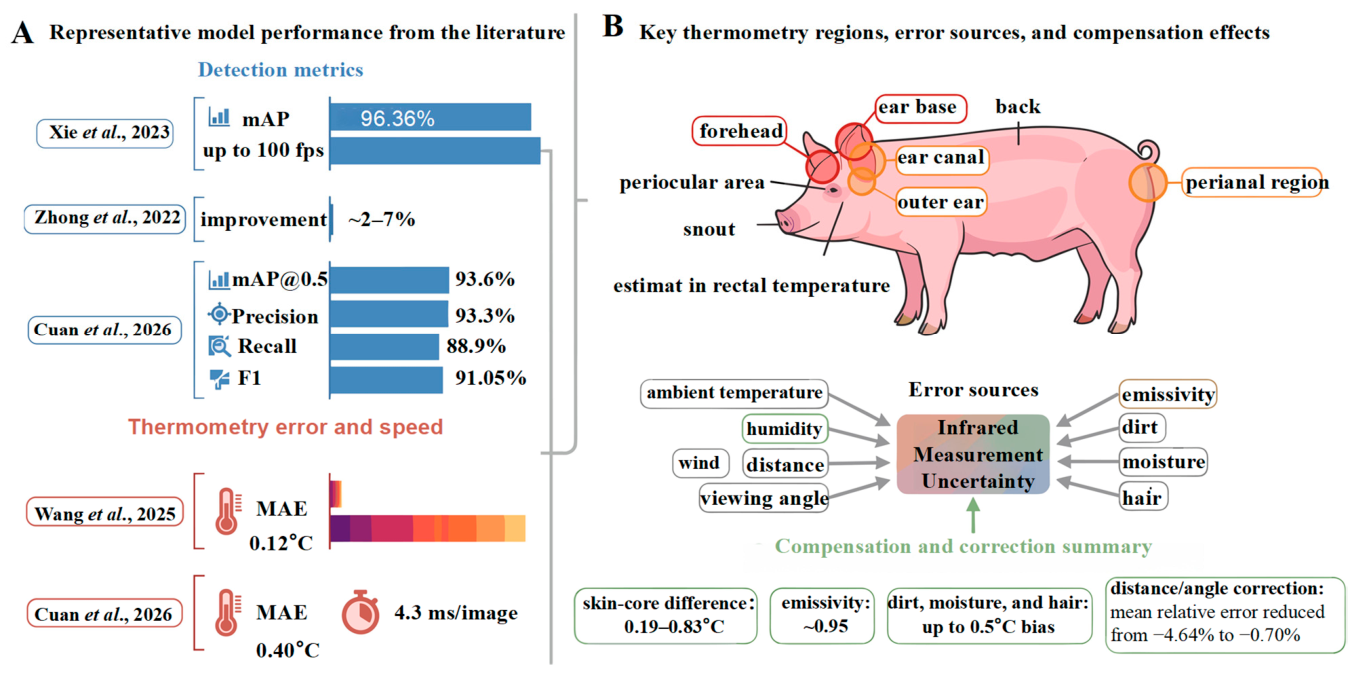
Representative studies demonstrated the value of deep detection models for infrared images. Xie et al. developed a YOLOv5s-BiFPN model to detect multiple thermometric ROIs, including the forehead, periocular area, snout, ear base, back, and anus, and reported 96.36% mAP at up to 100 frames/s [5]. In that framework, BiFPN improved multiscale feature fusion and stabilized localization across targets of different sizes. Site-specific segmentation has also been explored. For example, the S-EAR model was developed for ear-region extraction, and temperature-inversion methods were introduced for large non-point-source infrared targets [143,144]. Overall, deep learning has improved the reliability and scalability of ROI localization for non-contact thermometry (Figure 17A).
Thermometry and Compensation
After ROI localization, temperature features are extracted for physiological interpretation, with the main thermometric regions and major sources of measurement variability summarized in Figure 17B. In pigs, the suitability of a thermometric site depends on local hair coverage, blood perfusion, and exposure conditions. Less-haired regions usually show better agreement with rectal temperature and are therefore preferred for IRT-based thermometry. In healthy pigs, temperatures measured at the ear canal, outer ear, and perianal region were strongly correlated with rectal temperature [145], and representative thermometric regions are summarized in Figure 17B.
The most commonly used ROI-level features are maximum and mean temperature. The maximum temperature is typically used to represent the warmest exposed area within the ROI, whereas mean temperature is less sensitive to local extremes but more affected by cooler surrounding pixels. In infrared monitoring, maximum temperature at the forehead and ear base showed the closest agreement with rectal temperature [5]. These findings support the use of ROI-based thermal features for core-temperature estimation and abnormal-state screening.
Compensation is necessary because raw thermal measurements are strongly affected by imaging and environmental conditions. Camera angle, imaging distance, emissivity, and ambient conditions can all shift apparent surface temperature. Wang et al. combined ear-ROI segmentation with multifactor correction for environmental conditions and imaging geometry and reduced the mean absolute error to 0.12 °C [143]. Zhang et al. further improved large-area thermometry by applying temperature inversion to non-point-source infrared images [144]. Robust IRT-based thermometry, therefore, depends on both accurate ROI definition and effective calibration and compensation (Figure 17B).
Multimodal Fusion
Multimodal fusion improves temperature monitoring in complex scenes, and representative workflow performance is summarized in Figure 17A. Infrared images provide thermal information, whereas RGB images provide clearer structural and boundary information. Combining these modalities improves pig identification, ROI localization, and temperature extraction, particularly in crowded or occluded environments.
Several studies have demonstrated the value of visible–infrared fusion (Figure 17A). MCNNFuse enhanced image contours and thermal details and improved detection and temperature-extraction accuracy by approximately 2–7% compared with single thermograms [146]. In another study, YOLOv8-PT, ORB-based registration, and U2Fusion were integrated into a pipeline for pig detection, ear localization, cross-modal alignment, and core body-temperature estimation. This system achieved real-time performance and reported a mean absolute error of 0.40 °C relative to rectal temperature in group-housed piglets [147].
Image enhancement is also important for stable thermometry. High-resolution, low-noise thermal imaging improves temperature prediction [145]. Accordingly, performance can be improved through either better thermal hardware or algorithmic-enhancement methods, such as super-resolution reconstruction. In practice, multimodal fusion and image enhancement both improve the robustness of IRT-based monitoring under occlusion, clutter, and variable illumination (Figure 17).
Time-Series Analysis
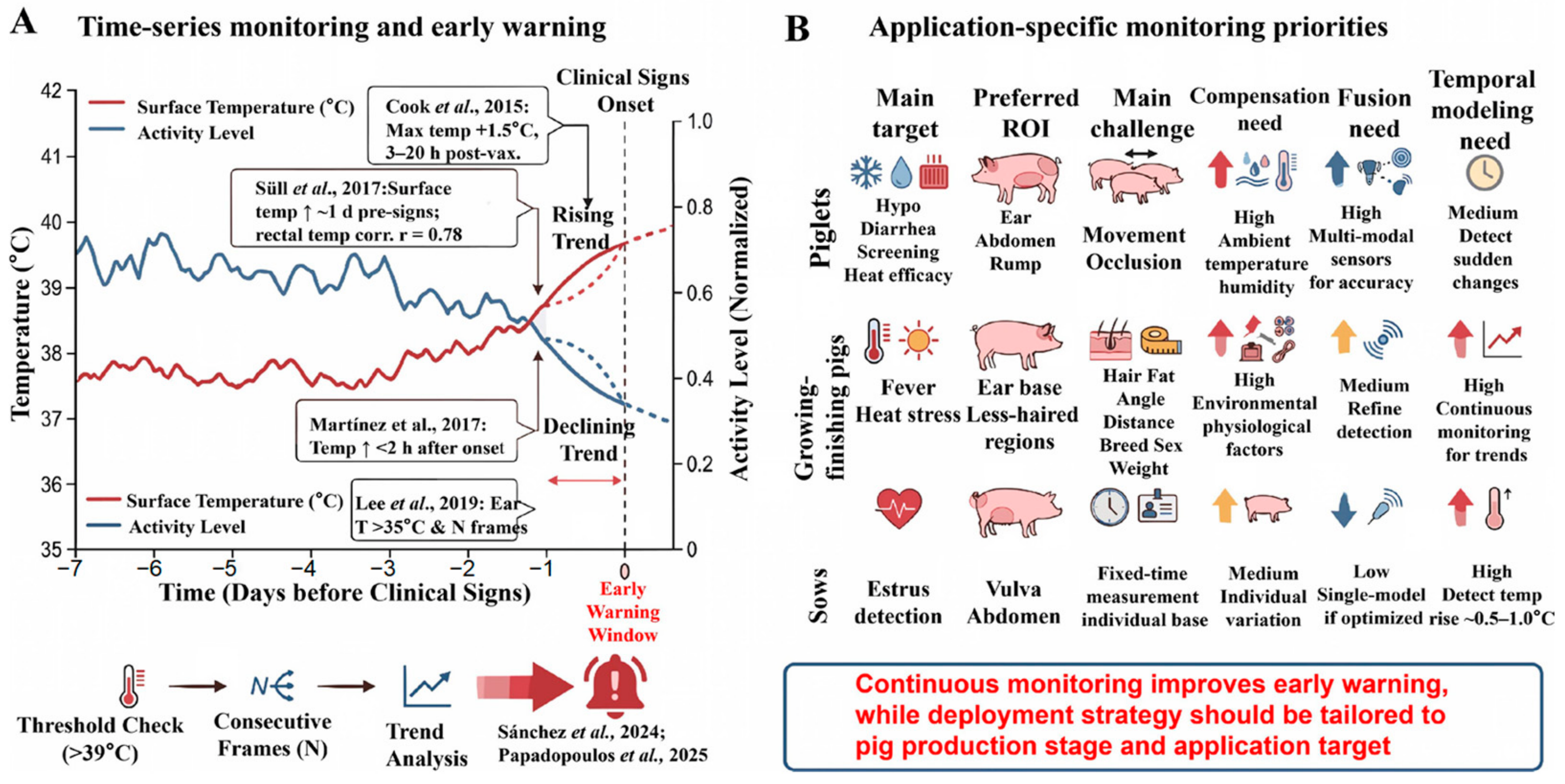
Time-series analysis extends IRT from single-frame measurement to dynamic monitoring (Figure 18A). Many disease processes are characterized by evolving temperature trajectories rather than isolated temperature elevations. Continuous monitoring, therefore, provides more informative signals than single-frame thermometry.
Experimental studies demonstrated the value of temporal analysis for early warning (Figure 18A). In piglets, infrared monitoring detected a group-level increase of more than 1.5 °C for 3–20 h after vaccination, together with increased huddling behavior [148]. In a PRRSV challenge study, surface temperature increased about one day before clinical signs appeared, and the thermal response was correlated with rectal temperature, while activity declined markedly [134]. During African swine fever infection, a real-time monitoring system detected thermal elevation within 2 h of disease onset and generated early alerts when thermal information was combined with accelerometer-derived activity data [133]. These results indicate that temperature trajectories are informative for early disease detection.
Temporal modeling can be implemented using either rule-based or learning-based methods. In deployed systems, thresholding across N consecutive frames is often used to suppress false alarms caused by transient outliers. Smoothing filters are commonly applied to denoise thermal sequences [149], whereas LSTMs and Transformers provide a framework for learning temporal disease patterns directly from continuous measurements. Such systems can output continuous temperature estimates and discrete state labels, such as fever, heat stress, and estrus, and can be linked to farm control systems ([22,150]; Figure 18A).

4.3.3. Application Scenarios and Deployment Considerations

The design priorities of IRT-based temperature monitoring differ across pig categories and management scenarios. Body size, housing conditions, hair coverage, and management objectives all affect the choice of thermometric site, model design, and deployment strategy (Figure 18B).
Piglets
Piglets require close thermal monitoring because they are highly vulnerable to thermal imbalance. Their small body size and high metabolic rate make them especially susceptible to hypothermia. Accordingly, IRT in piglets is mainly used to prevent hypothermia, assess heating effectiveness, and detect abnormal temperature decline [151].
The main challenge in piglet monitoring is group-level interference. In group housing, crowding, movement, and mutual occlusion make individual localization and stable ROI extraction difficult. The tympanic region has been reported as a useful site for tracking rectal temperature and respiratory rate [136], but practical deployment requires automated identification of visible and stable body regions. Recent studies therefore combined object detection, ear or body-part localization, and visible–infrared fusion to support individual-level temperature readout and core temperature estimation in group-housed piglets [147,151]. These approaches improve the feasibility of continuous, low-disturbance monitoring in nursery environments (Figure 18B).
Growing–Finishing Pigs
In growing–finishing pigs, IRT is mainly used for rapid screening of fever and abnormal temperature elevation. Compared with piglets, animals at this stage are larger, more active, and more variable in body composition. Greater body mass, thicker subcutaneous fat, and more variable skin and hair-coat conditions all increase inter-individual variation in surface temperature [152].
The main challenge at this stage is measurement variability. Thermographic accuracy is strongly affected by emissivity, hair coverage, imaging distance, and viewing angle. Regional variation in emissivity and the effect of clipping can bias thermal readings [153], and hair may reduce accuracy unless it is considered during calibration or image processing [154]. Distance- and angle-based correction has been shown to substantially reduce measurement error in practical settings [155]. In addition, biological variation related to breed, sex, and body weight also affects temperature interpretation [147,152]. Monitoring systems for growing–finishing pigs should therefore combine engineering calibration with stratified or feature-aware modeling to reduce false alarms and missed detections ([156]; Figure 18B).
Sows
In sows, temperature monitoring is particularly important for estrus detection. Conventional estrus assessment still relies heavily on manual observation and is therefore subjective and labor-intensive. By contrast, IRT provides an objective indicator because vulvar temperature typically rises by about 0.5–1.0 °C during estrus.
The key task in sow monitoring is to identify thermal patterns associated with reproductive state. Mean and maximum temperatures in the vulvar or abdominal region are higher on the day of estrus than during the pre-estrus period [143,144], and recent reviews have identified IRT combined with deep learning as a promising direction for automated estrus monitoring [137]. A typical workflow uses object detection or instance segmentation to localize the vulvar ROI, followed by temperature extraction and comparison with the individual baseline [157,158]. Alerts can then be generated on the basis of sustained temperature elevation measured at a fixed daily observation time [150,159]. Thermal features can also be fused with behavioral variables, such as activity, standing, and feeding, to improve estrus classification and system robustness [160,161]. Overall, IRT combined with deep learning and machine learning supports more objective and automated estrus monitoring within PLF systems ([162]; Figure 18B).
Differences in thermographic performance among studies are also strongly dependent on operating conditions rather than on algorithms alone. Reported temperature errors and correlations vary with the selected ROI, ambient conditions, imaging distance and angle, emissivity, hair coverage, animal category, and the reference temperature used for validation. Consequently, fixed thresholds or performance values obtained under one experimental setting may not transfer directly to another farm or production stage. Despite these differences, studies generally agree that stable ROI localization, environmental and geometric compensation, and multimodal or temporal information improve measurement robustness.

5. Summary and Outlook

5.1. Summary of Bibliometric Findings

Based on bibliometric analysis, this study reviews the structural and temporal characteristics of publications related to smart pig farming from 1991 to 2025. The field of smart pig farming remains in a phase of rapid expansion, characterized by a sharp increase in publications, extensive scientific collaboration, and a highly active citation network. While the active topics in this field have evolved over time, the analysis of recent subjects, keywords, keyword clustering, and reference clustering indicates that intelligent visual perception (e.g., “deep learning, machine vision, image processing” in Keywords; #21 machine vision, #0 artificial intelligence in reference clustering), precision nutritional management (e.g., precision livestock farming in terms; #2 precision feeding in reference clustering), and welfare-oriented behavioral monitoring (e.g., animal welfare, behavior in Keywords; #3 pig welfare, #10 foraging behavior in reference clustering) have the potential to become future research hotspots. Recent bibliometric signals converged around three prioritized review directions: vision-based object detection, precision feeding, and infrared/AI-enabled body-temperature monitoring. Welfare-oriented behavioral assessment and environmental/heat-stress monitoring should be understood as important cross-cutting contexts that intersect substantially with these three retained themes rather than as separate review sections.

5.2. Ongoing Challenges and Technical Bottlenecks

Despite substantial progress, large-scale AI deployment in commercial pig production remains limited by robustness, cost, and system reliability. Across object detection, precision feeding, and body-temperature monitoring, major gaps include limited data representativeness, insufficient external and field-scale validation, economic barriers, and unresolved technical challenges.
  • Vision-based object detection: The main challenge is limited cross-farm generalizability. High stocking density, occlusion, postural variation, illumination changes, and complex backgrounds reduce detection stability, while differences in housing, breed, and management intensify domain shifts. Limited dataset diversity and reliance on single-site or internally partitioned validation further restrict model transfer. Although advanced models may improve robustness, their computational demands often conflict with real-time, low-power edge deployment. The key challenge is therefore to balance accuracy, generalizability, efficiency, and deployment stability.
  • Precision feeding: The major bottleneck is system reliability rather than feeder automation itself. Precision feeding integrates sensing, identification, intake estimation, requirement modeling, and feed delivery, making the system vulnerable to errors or missing data at any stage. Biological variability, heat stress, disease, and changing growth conditions further affect performance. Key gaps include noisy sensor data; inconsistent requirement-estimation methods; limited long-term validation; and high costs related to equipment, retrofitting, maintenance, connectivity, and training. The priority is therefore to achieve reliable and economically viable operation under commercial conditions.
  • Infrared/AI-enabled body-temperature monitoring: The primary limitation is that infrared imaging measures surface rather than core temperature. Measurements are affected by environmental conditions, emissivity, dirt, moisture, viewing angle, and occlusion, limiting the transferability of fixed fever thresholds. Inconsistent thermometric regions, imaging geometry, calibration, and reference measurements further hinder cross-study comparison. Field deployment is also constrained by unstable ROI localization, harsh barn conditions, and thermal-imaging costs. Key challenges include adaptive calibration, surface-to-core-temperature inference, robust ROI localization, and false-alarm control.
Overall, the field has progressed beyond proof of concept, but routine farm-scale adoption still requires greater robustness, lower costs, and stronger commercial-scale validation. Remaining barriers arise from distinct data, methodological, validation, economic, and technical gaps.

5.3. Future Research Directions

Future research should shift from isolated algorithmic improvements toward integrated, deployable, and scalable system development.
  • Vision-based object detection: Priority should be given to cross-site datasets, standardized benchmarks, and models with stronger domain adaptation to improve cross-farm generalization. Multimodal fusion, spatiotemporal modeling, and lightweight architectures are particularly promising because they can enhance robustness under occlusion and variable lighting while remaining suitable for edge deployment. More emphasis should also be placed on long-term, cross-farm validation.
  • Precision feeding: Future work should focus on robust decision pipelines that integrate intake, body weight, behavior, health, and environmental information. Requirement models should remain biologically interpretable while adapting to heat stress, disease, and stage-specific variation. At the application level, simpler hardware, modular retrofits, and long-term field trials will be essential to demonstrate economic feasibility, operational practicality, and welfare compatibility.
  • Infrared/AI-enabled body-temperature monitoring: Future work should move beyond single-point thermometry toward multi-signal health prediction. Adaptive calibration, multimodal fusion, and time-series modeling may improve early warning by separating disease-related thermal changes from environmental effects. Research should also prioritize lower-cost imaging solutions, cross-farm validation, and alarm strategies that are actionable for farm staff.
In summary, the next stage of AI-enabled smart pig farming should be defined by integrated, validated, and scalable systems rather than by standalone algorithmic advances. The most meaningful progress will come from translating perception, feeding, and thermal-health monitoring into decision-ready tools that can operate reliably under commercial farm conditions.

5.4. Current Research Deficiencies

This study has several limitations. First, the bibliometric dataset was derived exclusively from WoSCC, potentially underrepresenting studies indexed elsewhere or published in languages other than English. Second, although the search strategy covered major terms related to smart pig farming, studies using alternative or emerging terminology may have been missed. Third, publication and citation biases may affect the results, as the indexed literature can underrepresent unpublished or less visible research, while citation metrics tend to favor older studies. Finally, the 1 December 2025 retrieval cut-off may have excluded studies indexed later that year. These limitations should be considered when interpreting the identified bibliometric patterns and thematic priorities.

Supplementary Materials

The following supporting information can be downloaded at https://www.mdpi.com/article/10.3390/agriengineering8090390/s1, Figure S1: Citation frequency distribution of the top burst references; Table S1: Information on the top 30 literature sorted by LCS score; Table S2: The top 10 countries, institutions and authors for frequency of co-occurrence; Table S3: The top 20 subject categories and keywords with burst periods from the beginning of the analysis period to 2025; Table S4: The references with citation bursts at different period; Table S5: Summary of keyword clusters for the most recent stage (2021–2025); Table S6: The most trafficked keyword for the top five modules each year; Table S7: Summary of emerging topics; Table S8: Search strategy and data retrieval parameters.

Author Contributions

P.Z., writing—original draft, methodology, investigation, formal analysis, data curation, funding acquisition, and conceptualization; X.L., methodology and data curation; Z.-H.L., supervision and data curation; Z.-Z.L., data curation; L.Y., data curation; J.C., data curation; Y.-F.L., data curation; Z.-B.S., data curation; Z.Y., data curation; Z.-Y.P., data curation and funding acquisition; B.D., writing—review and editing, supervision, funding acquisition, project administration, methodology, and conceptualization. All authors have read and agreed to the published version of the manuscript.

Funding

This research was supported by the Wuhan Academy of Agricultural Sciences 2026 Science and Technology Foundation Strengthening Special Project under the Innovation System (Grant No. QNCX202604); the Wuhan Academy of Agricultural Sciences 2026 Special Project for Strengthening the Innovation System and Industrial Chain (Grant No. CYL202603); and the Hubei Provincial Science and Technology Plan Project (Grant No. 2025EBA003).We have carefully checked the funding data and other information.

Data Availability Statement

Data will be made available upon request.

Acknowledgments

This research was supported by the Wuhan Academy of Agricultural Sciences 2026 Science and Technology Foundation Strengthening Special Project under the Innovation System (QNCX202604); Wuhan Academy of Agricultural Sciences 2026 Special Project for Strengthening the Innovation System and Industrial Chain (CYL202603); and Hubei Provincial Science and Technology Plan Project (2025EBA003). We thank Qian Fang and Siyu Cheng for their contributions to the literature organization in this study. During the preparation of this manuscript, generative artificial intelligence tools were used to assist in the design and refinement of some figures to improve their clarity, visualization quality, and informativeness. The authors have reviewed and revised all AI-assisted outputs and take full responsibility for the accuracy, integrity, and scientific content of the manuscript.

Conflicts of Interest

The authors declare no conflicts of interest. methods, instructions or products referred to in the content.

References

  1. OECD/FAO. OECD-FAO Agricultural Outlook 2025–2034; OECD Publishing: Paris, France; FAO: Rome, Italy, 2025. [Google Scholar]
  2. Chuong, V.D.; Schambow, R.A.; Diep, N.T.; Minh, P.Q.; Long, N.V.; To Nga, B.T.; Perez, A.M. Epidemiology and control of African swine fever in Vietnam: A scoping review. Pathogens 2025, 14, 329. [Google Scholar] [CrossRef] [Scilit] [PubMed]
  3. Zhao, D.; Sun, E.; Huang, L.; Ding, L.; Zhu, Y.; Zhang, J.; Shen, D.; Zhang, X.; Zhang, Z.; Ren, T.; et al. Highly lethal genotype I and II recombinant African swine fever viruses detected in pigs. Nat. Commun. 2023, 14, 3096. [Google Scholar] [CrossRef] [Scilit] [PubMed]
  4. Azarpajouh, S.; Díaz, J.A.C.; Taheri, H. Precision livestock farming: Automatic lameness detection in intensive livestock systems. CABI Rev. 2020, 15031. [Google Scholar] [CrossRef] [Scilit]
  5. Xie, Q.; Wu, M.; Bao, J.; Zheng, P.; Liu, W.; Liu, X.; Yu, H. A deep learning-based detection method for pig body temperature using infrared thermography. Comput. Electron. Agric. 2023, 213, 108200. [Google Scholar] [CrossRef] [Scilit]
  6. Yin, J.; Xie, X.; Mao, H.; Guo, S. Efficient missing key tag identification in large-scale RFID systems: An iterative verification and selection method. IEEE Trans. Mob. Comput. 2025, 24, 2253–2269. [Google Scholar] [CrossRef] [Scilit]
  7. Li, J.; Hu, X.; Lucic, A.; Wu, Y.; Condotta, I.C.F.S.; Dilger, R.N.; Ahuja, N.; Green-Miller, A.R. Promote computer vision applications in pig farming scenarios: High-quality dataset, fundamental models, and comparable performance. J. Integr. Agric. 2026, 25, 2534–2544. [Google Scholar] [CrossRef] [Scilit]
  8. Alexy, M.; Horvath, T.; Reich, C.; Felfoldi, J.; Tarcsi, A. Adaption of data-intensive monitoring and tracking systems in outdoor pig production for better decision-making, literature review, and project idea. In Precision Livestock Farming—Papers. Proceedings of the 9th European Conference on Precision Livestock Farming, Cork, Ireland; ECPLF: Cork, Ireland, 2019; p. 2019. [Google Scholar]
  9. Alexy, M.; Pai, R.R.; Ferenci, T.; Haidegger, T. The potential of RFID technology for tracking Mangalica pigs in the extensive farming system–a research from Hungary. Pastor. Res. Policy Pract. 2024, 14, 12854. [Google Scholar] [CrossRef] [Scilit]
  10. Angarita, B.K.; Han, J.; Cantet, R.J.C.; Chewning, S.K.; Wurtz, K.E.; Siegford, J.M.; Ernst, C.W.; Steibel, J.P. Estimation of direct and social effects of feeding duration in growing pigs using records from automatic feeding stations. J. Anim. Sci. 2021, 99, skab042. [Google Scholar] [CrossRef] [Scilit] [PubMed]
  11. Chung, T.H.; Jung, W.S.; Nam, E.H.; Kim, J.H.; Park, S.H.; Hwang, C.Y. Comparison of rectal and infrared thermometry for obtaining body temperature of gnotobiotic piglets in conventional portable germ free facility. Asian-Australas. J. Anim. Sci. 2010, 23, 1364–1368. [Google Scholar] [CrossRef] [Scilit]
  12. Franchi, G.A.; Bus, J.D.; Boumans, I.J.M.M.; Bokkers, E.A.M.; Jensen, M.B.; Pedersen, L.J. Estimating body weight in conventional growing pigs using a depth camera. Agric. Technol. 2023, 3, 100117. [Google Scholar] [CrossRef] [Scilit]
  13. Gaillard, C.; Brossard, L.; Dourmad, J.Y. Improvement of feed and nutrient efficiency in pig production through precision feeding. Anim. Feed Sci. Technol. 2020, 268, 114611. [Google Scholar] [CrossRef] [Scilit]
  14. Perez Garcia, C.A.; Bovo, M.; Torreggiani, D.; Tassinari, P.; Benni, S. Indoor temperature forecasting in livestock buildings: A data-driven approach. Agriculture 2024, 14, 316. [Google Scholar] [CrossRef] [Scilit]
  15. Benjamin, M.; Yik, S. Precision livestock farming in swine welfare: A review for swine practitioners. Animals 2019, 9, 133. [Google Scholar] [CrossRef] [Scilit] [PubMed]
  16. Hasan, M.K.; Mun, H.S.; Ampode, K.M.B.; Lagua, E.B.; Park, H.R.; Kim, Y.H.; Sharifuzzaman, M.; Yang, C.J. Transformation toward precision large-scale operations for sustainable farming: A review based on China’s pig industry. J. Adv. Vet. Anim. Res. 2024, 11, 1076–1092. [Google Scholar] [CrossRef] [Scilit] [PubMed]
  17. Larsen, M.L.V.; Pedersen, L.J.; Norton, T. Precision livestock farming. In Tail Biting in Pigs; O’Driscoll, K., Valros, A., Eds.; Brill: Wageningen, The Netherlands, 2024; pp. 330–347. [Google Scholar] [CrossRef] [Scilit] [PubMed]
  18. Marić, K.; Gvozdanović, K.; Djurkin Kušec, I.; Kušec, G.; Margeta, V. Smart pig farms: Integration and application of digital technologies in pig production. Agriculture 2025, 15, 937. [Google Scholar] [CrossRef] [Scilit]
  19. Schillings, J.; Bennett, R.; Rose, D.C. Exploring the potential of precision livestock farming technologies to help address farm animal welfare. Front. Anim. Sci. 2021, 2, 639678. [Google Scholar] [CrossRef] [Scilit]
  20. Schillings, J.; Bennett, R.; Wemelsfelder, F.; Rose, D.C. Digital livestock technologies as boundary objects: Investigating impacts on farm management and animal welfare. Anim. Welf. 2023, 32, e17. [Google Scholar] [CrossRef] [Scilit] [PubMed]
  21. Wang, S.; Jiang, H.; Qiao, Y.; Jiang, S.; Lin, H.; Sun, Q. The research progress of vision-based artificial intelligence in smart pig farming. Sensors 2022, 22, 6541. [Google Scholar] [CrossRef] [Scilit] [PubMed]
  22. Papadopoulos, G.; Papantonatou, M.Z.; Uyar, H.; Kriezi, O.; Mavrommatis, A.; Psiroukis, V.; Kasimati, A.; Tsiplakou, E.; Fountas, S. Economic and environmental benefits of digital agricultural technological solutions in livestock farming: A review. Agric. Technol. 2025, 10, 100783. [Google Scholar] [CrossRef] [Scilit]
  23. Mora, M.; Piles, M.; David, I.; Rosa, G.J.M. Integrating computer vision algorithms and RFID system for identification and tracking of group-housed animals: An example with pigs. J. Anim. Sci. 2024, 102, skae174. [Google Scholar] [CrossRef] [Scilit] [PubMed]
  24. Neethirajan, S.; Kemp, B. Digital twins in livestock farming. Animals 2021, 11, 1008. [Google Scholar] [CrossRef] [Scilit] [PubMed]
  25. Purcell, W.; Neubauer, T. Digital twins in agriculture: A state-of-the-art review. Agric. Technol. 2023, 3, 100094. [Google Scholar] [CrossRef] [Scilit]
  26. Pylianidis, C.; Osinga, S.; Athanasiadis, I.N. Introducing digital twins to agriculture. Comput. Electron. Agric. 2021, 184, 105942. [Google Scholar] [CrossRef] [Scilit]
  27. Mielke, S.; Stein, A. Excretion detection in pigsties using convolutional and transformer-based deep neural networks. arXiv 2024, arXiv:2412.00256. [Google Scholar] [CrossRef] [Scilit]
  28. Chen, X.; Tian, W.; Fang, H. Bibliometric analysis of natural language processing using CiteSpace and VOSviewer. Nat. Lang. Process. J. 2025, 10, 100123. [Google Scholar] [CrossRef] [Scilit]
  29. Islam, M.A.; Khatun, M.B.; Rahman, M.H. Visualization of Scopus and WoS data (2000–2024) on forced, child, and contract marriage: A bibliometric analysis. SN Soc. Sci. 2025, 5, 146. [Google Scholar] [CrossRef] [Scilit]
  30. Yuan, K.S.; Deng, C.C.; Wang, X.X.; Li, Y.C.; Zhou, C.; Zhao, C.R.; Dai, X.Z.; Khan, A.R.; Zhang, Z.; Guidoin, R.; et al. Research advances and future perspectives of zinc-based biomaterials for additive manufacturing. Rare Met. 2025, 44, 4376–4410. [Google Scholar] [CrossRef] [Scilit]
  31. Yuan, K.; Deng, C.; Tan, L.; Wang, X.; Yan, W.; Dai, X.; Du, R.; Zheng, Y.; Zhang, H.; Wang, G. Structural and temporal dynamics analysis of zinc-based biomaterials: History, research hotspots and emerging trends. Bioact. Mater. 2024, 35, 306–329. [Google Scholar] [CrossRef] [Scilit] [PubMed]
  32. Donthu, N.; Kumar, S.; Mukherjee, D.; Pandey, N.; Lim, W.M. How to conduct a bibliometric analysis: An overview and guidelines. J. Bus. Res. 2021, 133, 285–296. [Google Scholar] [CrossRef] [Scilit]
  33. Öztürk, O.; Kocaman, R.; Kanbach, D.K. How to design bibliometric research: An overview and a framework proposal. Rev. Manag. Sci. 2024, 18, 3333–3361. [Google Scholar] [CrossRef] [Scilit]
  34. Zupic, I.; Čater, T. Bibliometric methods in management and organization. Organ. Res. Methods 2015, 18, 429–472. [Google Scholar] [CrossRef] [Scilit]
  35. Holm, S. A simple sequentially rejective multiple test procedure. Scand. J. Stat. 1979, 6, 65–70. [Google Scholar]
  36. Friedman, M. The use of ranks to avoid the assumption of normality implicit in the analysis of variance. J. Am. Stat. Assoc. 1937, 32, 675–701. [Google Scholar] [CrossRef]
  37. Pezzuolo, A.; Guarino, M.; Sartori, L.; González, L.A.; Marinello, F. On-barn pig weight estimation based on body measurements by a Kinect v1 depth camera. Comput. Electron. Agric. 2018, 148, 29–36. [Google Scholar] [CrossRef] [Scilit]
  38. Gómez, Y.; Stygar, A.H.; Boumans, I.J.M.M.; Bokkers, E.A.M.; Pedersen, L.J.; Niemi, J.K.; Pastell, M.; Manteca, X.; Llonch, P. A systematic review on validated precision livestock farming technologies for pig production and its potential to assess animal welfare. Front. Vet. Sci. 2021, 8, 660565. [Google Scholar] [CrossRef] [Scilit] [PubMed]
  39. Berckmans, D. General introduction to precision livestock farming. Anim. Front. 2017, 7, 6–11. [Google Scholar] [CrossRef] [Scilit]
  40. Arulmozhi, E.; Bhujel, A.; Moon, B.E.; Kim, H.T. The application of cameras in precision pig farming: An overview for swine-keeping professionals. Animals 2021, 11, 2343. [Google Scholar] [CrossRef] [Scilit] [PubMed]
  41. Lee, J.; Jin, L.; Park, D.; Chung, Y. Automatic recognition of aggressive behavior in pigs using a kinect depth sensor. Sensors 2016, 16, 631. [Google Scholar] [CrossRef] [Scilit] [PubMed]
  42. Riekert, M.; Klein, A.; Adrion, F.; Hoffmann, C.; Gallmann, E. Automatically detecting pig position and posture by 2D camera imaging and deep learning. Comput. Electron. Agric. 2020, 174, 105391. [Google Scholar] [CrossRef] [Scilit]
  43. Chapa, J.M.; Maschat, K.; Iwersen, M.; Baumgartner, J.; Drillich, M. Accelerometer systems as tools for health and welfare assessment in cattle and pigs—A review. Behav. Process. 2020, 181, 104262. [Google Scholar] [CrossRef] [Scilit] [PubMed]
  44. D’Eath, R.B.; Jack, M.; Futro, A.; Talbot, D.; Zhu, Q.; Barclay, D.; Baxter, E.M. Automatic early warning of tail biting in pigs: 3D cameras can detect lowered tail posture before an outbreak. PLoS ONE 2018, 13, e0194524. [Google Scholar] [CrossRef] [Scilit] [PubMed]
  45. Matthews, S.G.; Miller, A.L.; Clapp, J.; Plötz, T.; Kyriazakis, I. Early detection of health and welfare compromises through automated detection of behavioural changes in pigs. Vet. J. 2016, 217, 43–51. [Google Scholar] [CrossRef] [Scilit] [PubMed]
  46. Nasirahmadi, A.; Edwards, S.A.; Sturm, B. Implementation of machine vision for detecting behaviour of cattle and pigs. Livest. Sci. 2017, 202, 25–38. [Google Scholar] [CrossRef] [Scilit]
  47. Alameer, A.; Kyriazakis, I.; Dalton, H.A.; Miller, A.L.; Bacardit, J. Automatic recognition of feeding and foraging behaviour in pigs using deep learning. Biosyst. Eng. 2020, 197, 91–104. [Google Scholar] [CrossRef] [Scilit]
  48. Collins, L.M.; Smith, L.M. Review: Smart Agri Systems for the pig industry. Animal 2022, 16, 100518. [Google Scholar] [CrossRef] [Scilit] [PubMed]
  49. Cross, A.J.; Brown-Brandl, T.M.; Keel, B.N.; Cassady, J.P.; Rohrer, G.A. Feeding behavior of grow-finish swine and the impacts of heat stress. Transl. Anim. Sci. 2020, 4, txaa023. [Google Scholar] [CrossRef] [Scilit] [PubMed]
  50. Mahfuz, S.; Mun, H.S.; Dilawar, M.A.; Yang, C.J. Applications of smart technology as a sustainable strategy in modern swine farming. Sustainability 2022, 14, 2607. [Google Scholar] [CrossRef] [Scilit]
  51. Neethirajan, S. The role of sensors, big data and machine learning in modern animal farming. Sens. Bio-Sens. Res. 2020, 29, 100367. [Google Scholar] [CrossRef] [Scilit]
  52. Yin, Y.; Tu, D.; Shen, W.; Bao, J. Recognition of sick pig cough sounds based on convolutional neural network in field situations. Inf. Process. Agric. 2021, 8, 369–379. [Google Scholar] [CrossRef] [Scilit]
  53. Wang, M. Development of Automatic Physiological and Behavioural Monitoring Systems for Pigs. Ph.D. Thesis, KU Leuven, Leuven, Belgium, 2022. [Google Scholar]
  54. Kashiha, M.; Bahr, C.; Ott, S.; Moons, C.P.H.; Niewold, T.A.; Ödberg, F.O.; Berckmans, D. Automatic identification of marked pigs in a pen using image pattern recognition. Comput. Electron. Agric. 2013, 93, 111–120. [Google Scholar] [CrossRef] [Scilit]
  55. Chen, J.; Liu, L.; Li, P.; Yao, W.; Shen, M.; Liu, L. Resting posture recognition method for suckling piglets based on piglet posture recognition (PPR)-You Only Look Once. Agriculture 2025, 15, 230. [Google Scholar] [CrossRef] [Scilit]
  56. Huang, E.; Mao, A.; Gan, H.; Camila Ceballos, M.; Parsons, T.D.; Xue, Y.; Liu, K. Center clustering network improves piglet counting under occlusion. Comput. Electron. Agric. 2021, 189, 106417. [Google Scholar] [CrossRef] [Scilit]
  57. Huang, E.; Mao, A.; Hou, J.; Wu, Y.; Xu, W.; Camila Ceballos, M.; Parsons, T.D.; Liu, K. Occlusion-resistant instance segmentation of piglets in farrowing pens using center clustering network. Comput. Electron. Agric. 2023, 210, 107950. [Google Scholar] [CrossRef] [Scilit]
  58. Mattina, M.; Benzinou, A.; Nasreddine, K.; Richard, F. An efficient center-based method for real-time pig posture recognition and tracking. Appl. Intell. 2024, 54, 5183–5196. [Google Scholar] [CrossRef] [Scilit]
  59. Bhujel, A.; Arulmozhi, E.; Moon, B.E.; Kim, H.T. Deep-learning-based automatic monitoring of pigs’ physico-temporal activities at different greenhouse gas concentrations. Animals 2021, 11, 3089. [Google Scholar] [CrossRef] [Scilit] [PubMed]
  60. Brünger, J.; Gentz, M.; Traulsen, I.; Koch, R. Panoptic segmentation of individual pigs for posture recognition. Sensors 2020, 20, 3710. [Google Scholar] [CrossRef] [Scilit] [PubMed]
  61. Liu, D.; Parmiggiani, A.; Psota, E.; Fitzgerald, R.; Norton, T. Where’s your head at? Detecting the orientation and position of pigs with rotated bounding boxes. Comput. Electron. Agric. 2023, 212, 108099. [Google Scholar] [CrossRef] [Scilit]
  62. Wang, Z.; Zhou, S.; Yin, P.; Xu, A.; Ye, J. GANPose: Pose estimation of grouped pigs using a generative adversarial network. Comput. Electron. Agric. 2023, 212, 108119. [Google Scholar] [CrossRef] [Scilit]
  63. Gan, H.; Wu, X.; Menegon, F.; Scollo, A.; Sun, A.; Norton, T.; Xue, Y. Occlusion-robust detection of sow-induced piglet crushing incidents using spatial and motion reasoning. Comput. Electron. Agric. 2025, 231, 109961. [Google Scholar] [CrossRef] [Scilit]
  64. Oczak, M.; Bayer, F.; Vetter, S.; Maschat, K.; Baumgartner, J. Comparison of the automated monitoring of the sow activity in farrowing pens using video and accelerometer data. Comput. Electron. Agric. 2022, 192, 106517. [Google Scholar] [CrossRef] [Scilit]
  65. Reza, M.N.; Ali, M.R.; Samsuzzaman, M.S.N.; Kabir, M.S.N.; Karim, M.R.; Ahmed, S.; Kyoung, H.; Kim, G.; Chung, S.O. Thermal imaging and computer vision technologies for the enhancement of pig husbandry: A review. J. Anim. Sci. Technol. 2024, 66, 31–56. [Google Scholar] [CrossRef] [Scilit] [PubMed]
  66. Ju, M.; Choi, Y.; Seo, J.; Sa, J.; Lee, S.; Chung, Y.; Park, D. A Kinect-based segmentation of touching-pigs for real-time monitoring. Sensors 2018, 18, 1746. [Google Scholar] [CrossRef] [Scilit] [PubMed]
  67. Li, B.; Liu, L.; Shen, M.; Sun, Y.; Lu, M. Group-housed pig detection in video surveillance of overhead views using multi-feature template matching. Biosyst. Eng. 2019, 181, 28–39. [Google Scholar] [CrossRef] [Scilit]
  68. Li, D.; Chen, Y.; Zhang, K.; Li, Z. Mounting behaviour recognition for pigs based on deep learning. Sensors 2019, 19, 4924. [Google Scholar] [CrossRef] [Scilit] [PubMed]
  69. Wurtz, K.; Camerlink, I.; D’Eath, R.B.; Fernández, A.P.; Norton, T.; Steibel, J.; Siegford, J. Recording behaviour of indoor-housed farm animals automatically using machine vision technology: A systematic review. PLoS ONE 2019, 14, e0226669. [Google Scholar] [CrossRef] [Scilit] [PubMed]
  70. Xu, J.; Zhou, S.; Xu, A.; Ye, J.; Zhao, A. Automatic scoring of postures in grouped pigs using depth image and CNN-SVM. Comput. Electron. Agric. 2022, 194, 106746. [Google Scholar] [CrossRef] [Scilit]
  71. Kim, J.; Suh, Y.; Lee, J.; Chae, H.; Ahn, H.; Chung, Y.; Park, D. EmbeddedPigCount: Pig counting with video object detection and tracking on an embedded board. Sensors 2022, 22, 2689. [Google Scholar] [CrossRef] [Scilit] [PubMed]
  72. Lee, S.; Ahn, H.; Seo, J.; Chung, Y.; Park, D.; Pan, S. Practical monitoring of undergrown pigs for IoT-based large-scale smart farm. IEEE Access 2019, 7, 173796–173810. [Google Scholar] [CrossRef] [Scilit]
  73. Lee, J.; Chae, H.; Son, S.; Seo, J.; Suh, Y.; Lee, J.; Chung, Y.; Park, D. Sustainable self-training pig detection system with augmented single labeled target data for solving domain shift problem. Sensors 2025, 25, 3406. [Google Scholar] [CrossRef] [Scilit] [PubMed]
  74. Luo, Y.; Xia, J.; Lu, H.; Luo, H.; Lv, E.; Zeng, Z.; Li, B.; Meng, F.; Yang, A. Automatic recognition and quantification feeding behaviors of nursery pigs using improved YOLOV5 and feeding functional area proposals. Animals 2024, 14, 569. [Google Scholar] [CrossRef] [Scilit] [PubMed]
  75. Seo, J.; Ahn, H.; Kim, D.; Lee, S.; Chung, Y.; Park, D. EmbeddedPigDet—Fast and accurate pig detection for embedded board implementations. Appl. Sci. 2020, 10, 2878. [Google Scholar] [CrossRef] [Scilit]
  76. Tian, M.; Guo, H.; Chen, H.; Wang, Q.; Long, C.; Ma, Y. Automated pig counting using deep learning. Comput. Electron. Agric. 2019, 163, 104840. [Google Scholar] [CrossRef] [Scilit]
  77. Chen, C.; Zhu, W.; Norton, T. Behaviour recognition of pigs and cattle: Journey from computer vision to deep learning. Comput. Electron. Agric. 2021, 187, 106255. [Google Scholar] [CrossRef] [Scilit]
  78. Lei, L.; Yang, Q.; Yang, L.; Shen, T.; Wang, R.; Fu, C. Deep learning implementation of image segmentation in agricultural applications: A comprehensive review. Artif. Intell. Rev. 2024, 57, 149. [Google Scholar] [CrossRef] [Scilit]
  79. Rohan, A.; Rafaq, M.S.; Hasan, M.J.; Asghar, F.; Bashir, A.K.; Dottorini, T. Application of deep learning for livestock behaviour recognition: A systematic literature review. Comput. Electron. Agric. 2024, 224, 109115. [Google Scholar] [CrossRef] [Scilit]
  80. Li, D.; Zhang, K.; Li, X.; Chen, Y.; Li, Z.; Pu, D. Mounting behavior recognition for pigs based on Mask. Chin. Soc. Agric. Mach. R-CNN (Trans.) 2019, 50, 261–266, 275. [Google Scholar]
  81. Nasirahmadi, A.; Sturm, B.; Edwards, S.; Jeppsson, K.H.; Olsson, A.C.; Müller, S.; Hensel, O. Deep learning and machine vision approaches for posture detection of individual pigs. Sensors 2019, 19, 3738. [Google Scholar] [CrossRef] [Scilit] [PubMed]
  82. Riekert, M.; Opderbeck, S.; Wild, A.; Gallmann, E. Model selection for 24/7 pig position and posture detection by 2D camera imaging and deep learning. Comput. Electron. Agric. 2021, 187, 106213. [Google Scholar] [CrossRef] [Scilit]
  83. Xue, Y.; Zhu, X.; Zheng, C.; Mao, L.; Yang, A.; Tu, S.; Huang, N.; Yang, X.; Chen, P.; Zhang, N. Lactating sow postures recognition from depth image of videos based on improved. Chin. Soc. Agric. Eng. Faster R-CNN Trans. 2018, 34, 189–196. [Google Scholar]
  84. Yang, Q.; Xiao, D.; Cai, J. Pig mounting behaviour recognition based on video spatial-temporal features. Biosyst. Eng. 2021, 206, 55–66. [Google Scholar] [CrossRef] [Scilit]
  85. Zheng, C.; Zhu, X.; Yang, X.; Wang, L.; Tu, S.; Xue, Y. Automatic recognition of lactating sow postures from depth images by deep learning detector. Comput. Electron. Agric. 2018, 147, 51–63. [Google Scholar] [CrossRef] [Scilit]
  86. Zhu, X.; Chen, C.; Zheng, B.; Yang, X.; Gan, H.; Zheng, C.; Yang, A.; Mao, L.; Xue, Y. Automatic recognition of lactating sow postures by refined two-stream RGB-D faster R-CNN. Biosyst. Eng. 2020, 189, 116–132. [Google Scholar] [CrossRef] [Scilit]
  87. Witte, J.H.; Gerberding, J.; Melching, C.; Marx Gómez, J.M. Evaluation of deep learning instance segmentation models for pig precision livestock farming. Bus. Inf. Sys. 2021, 1, 209–220. [Google Scholar] [CrossRef] [Scilit]
  88. Ahn, H.; Son, S.; Roh, J.; Baek, H.; Lee, S.; Chung, Y.; Park, D. SAFP-YOLO: Enhanced object detection speed using spatial attention-based filter pruning. Appl. Sci. 2023, 13, 11237. [Google Scholar] [CrossRef] [Scilit]
  89. Huang, Y.; Xiao, D.; Liu, J.; Tan, Z.; Liu, K.; Chen, M. An improved pig counting algorithm based on YOLOv5 and DeepSORT model. Sensors 2023, 23, 6309. [Google Scholar] [CrossRef] [Scilit] [PubMed]
  90. Li, J.; Ma, W.; Wei, Y.; Wang, T. Enhanced YOLOv8 for robust pig detection and counting in complex agricultural environments. Animals 2025, 15, 2149. [Google Scholar] [CrossRef] [Scilit] [PubMed]
  91. Luo, Y.; Lin, K.; Xiao, Z.; Lv, E.; Wei, X.; Li, B.; Lu, H.; Zeng, Z. PBR-YOLO: A lightweight piglet multi-behavior recognition algorithm based on improved YOLOv8. Smart Agric. Technol. 2025, 10, 100785. [Google Scholar] [CrossRef] [Scilit]
  92. Luo, Y.; Yang, C.; Lv, E.; Yang, A.; Meng, F.; Luo, H. A lightweight model for automatic pig counting in intensive piggeries using a green inspection robot and image segmentation method. Smart Agric. Technol. 2025, 12, 101115. [Google Scholar] [CrossRef] [Scilit]
  93. Shi, W.; Wang, X.; Li, X.; Fu, Y.; Liu, X.; Wang, H. YOLOv5DA: An improved YOLOv5 model for posture detection of grouped pigs. Appl. Sci. 2024, 14, 10104. [Google Scholar] [CrossRef] [Scilit]
  94. Zhao, M.; Duan, Y.; Gao, T.; Gao, X.; Hu, G.; Cao, R.; Liu, Z. A lightweight model for small-target pig eye detection in automated estrus recognition. Animals 2025, 15, 1127. [Google Scholar] [CrossRef] [Scilit] [PubMed]
  95. Xu, S.; Yi, W.; Shen, J.; Tao, S.; Wang, H.; Chai, Y.; Chen, H. A Noval Channel pruning lightweight pig face detection method based on augment group diverse attention mechanism. IEEE Trans. Instrum. Meas. 2025, 74, 5016315. [Google Scholar] [CrossRef] [Scilit]
  96. Ma, W.; Wang, X.; Yang, S.X.; Song, L.; Li, Q. Leveraging thermal infrared imaging for pig ear detection research: The TIRPigEar dataset and performances of deep learning models. Animals 2024, 15, 41. [Google Scholar] [CrossRef] [Scilit] [PubMed]
  97. Wutke, M.; Lensches, C.; Hartmann, U.; Traulsen, I. Towards automatic farrowing monitoring—A Noisy Student approach for improving detection performance of newborn piglets. PLoS ONE 2024, 19, e0310818. [Google Scholar] [CrossRef] [Scilit] [PubMed]
  98. Xu, S.; Zheng, H.; Tao, S.; Chai, Y.; He, Q.; Chen, H. A lightweight pig face recognition method based on efficient mobile network and horizontal vertical attention mechanism. IEEE Trans. Instrum. Meas. 2024, 73, 1–14. [Google Scholar] [CrossRef] [Scilit]
  99. Guo, Y.; Wang, X.; Liu, J.; Peng, B.; Ran, X.; Mao, R. Enhancing abnormal behavior recognition in group-housed pigs through the MS-FA-DETR: A multi-scale and frequency-aware fusion method. In Proceedings of the 6th International Conference on Computer Vision, Image and Deep Learning (CVIDL), Ningbo, China, 23-25 May 2025; IEEE: New York, NY, USA, 2025; pp. 1052–1059. [Google Scholar] [CrossRef] [Scilit]
  100. Shi, L.; Ying, H.; Yang, P.; Yang, C. Pig behavior detection model based on improved RT-DETR. In Proceedings of the 6th International Conference on Electronic Engineering and Informatics (EEI), Chongqing, China, 28–30 June 2024; pp. 541–545. [Google Scholar] [CrossRef] [Scilit]
  101. Zhang, Z.; Xu, S.; Lu, S.; Chen, L. Advancing precision pig behavior recognition through real-time detection transformer. In Proceedings of the 4th International Conference on Neural Networks, Information and Communication Engineering (NNICE), Guangzhou, China, 19–21 January 2024; pp. 707–710. [Google Scholar] [CrossRef] [Scilit]
  102. Bi, Y.; Huang, Y.; Xuan, J.; Morota, G. Industry-scale prediction of video-derived pig body weight using efficient convolutional neural networks and vision transformers. Biosyst. Eng. 2025, 257, 104243. [Google Scholar] [CrossRef] [Scilit]
  103. Hao, W.; Xu, S.A.; Shu, H.; Li, H.; Han, M.; Li, F.; Liu, Y. VM-RTDETR: Advancing DETR with vision state-space duality and multi-scale fusion for robust pig detection. Animals 2025, 15, 3328. [Google Scholar] [CrossRef] [Scilit] [PubMed]
  104. He, J.; Zhou, H.; Xie, Q.; Wang, W.; Liu, X.; Liu, W.; Guo, Y.; Liu, H. A lightweight model of dual—Backbone real-time detection transformer for pig body temperature detection and its onsite validation. Comput. Electron. Agric. 2026, 241, 111234. [Google Scholar] [CrossRef] [Scilit]
  105. Hu, Y.; Wang, X.; Mao, R.; Guo, Y.; Zhu, X.; Wang, M. PB-STR: A spatiotemporal transformer network for multi-behavior recognition of pigs. Smart Agric. Technol. 2025, 12, 101131. [Google Scholar] [CrossRef] [Scilit]
  106. Lu, J.; Wang, W.; Zhao, K.; Wang, H. Recognition and segmentation of individual pigs based on Swin Transformer. Anim. Genet. 2022, 53, 794–802. [Google Scholar] [CrossRef] [Scilit] [PubMed]
  107. Taiwo, G.; Vadera, S.; Alameer, A. Vision transformers for automated detection of pig interactions in groups. Smart Agric. Technol. 2025, 10, 100774. [Google Scholar] [CrossRef] [Scilit]
  108. Remus, A.; Hauschild, L.; Methot, S.; Pomar, C. Precision livestock farming: Real-time estimation of daily protein deposition in growing-finishing pigs. Animal 2020, 14, s360–s370. [Google Scholar] [CrossRef] [Scilit] [PubMed]
  109. Pomar, C.; Hauschild, L.; Zhang, G.H.; Pomar, J.; Lovatto, P.A. Applying precision feeding techniques in growing-finishing pig operations. R. Bras. Zootec. 2009, 38, 226–237. [Google Scholar] [CrossRef] [Scilit]
  110. Pomar, C.; Van Milgen, J.; Remus, A. 18: Precision livestock feeding, principle and practice. In Poultry and Pig Nutrition; Hendriks, W.H., Verstegen, M.W.A., Babinszky, L., Eds.; Brill/Wageningen Academic: Leiden, The Netherlands, 2019; pp. 397–418. [Google Scholar] [CrossRef] [Scilit] [PubMed]
  111. Andretta, I.; Hauschild, L.; Kipper, M.; Pires, P.G.S.; Pomar, C. Environmental impacts of precision feeding programs applied in pig production. Animal 2018, 12, 1990–1998. [Google Scholar] [CrossRef] [Scilit] [PubMed]
  112. Gauthier, R.; Largouët, C.; Bussières, D.; Martineau, J.P.; Dourmad, J.Y. Precision feeding of lactating sows: Implementation and evaluation of a decision support system in farm conditions. J. Anim. Sci. 2022, 100, skac222. [Google Scholar] [CrossRef] [Scilit] [PubMed]
  113. Yin, M.; Ma, R.; Luo, H.; Li, J.; Zhao, Q.; Zhang, M. Non-contact sensing technology enables precision livestock farming in smart farms. Comput. Electron. Agric. 2023, 212, 108171. [Google Scholar] [CrossRef] [Scilit]
  114. Chen, Y.; Li, Z.; Yin, L.; Kuang, Y. A novel approach of pig weight estimation using high-precision segmentation and 2D image feature extraction. Animals 2025, 15, 2975. [Google Scholar] [CrossRef] [Scilit] [PubMed]
  115. Jiang, S.; Zhang, G.; Shen, Z.; Zhong, P.; Tan, J.; Liu, J. Pig weight estimation method based on a framework combining Mask R-CNN and ensemble regression model. Animals 2024, 14, 2122. [Google Scholar] [CrossRef] [Scilit] [PubMed]
  116. Funk, T.H.; Rohrer, G.A.; Brown-Brandl, T.M.; Keel, B.N. Online feeding behavior monitoring of individual group-housed grow-finish pigs using a low-frequency RFID electronic feeding system. Transl. Anim. Sci. 2024, 8, txae051. [Google Scholar] [CrossRef] [Scilit] [PubMed]
  117. Compte, A.; Yan, Y.; Cortés, X.; Escalera, S.; Jacques-Junior, J.C.S. Housed pig identification and tracking for precision livestock farming. Expert Syst. Appl. 2025, 293, 128466. [Google Scholar] [CrossRef] [Scilit]
  118. Chen, C.; Zhu, W.; Steibel, J.; Siegford, J.; Han, J.; Norton, T. Recognition of feeding behaviour of pigs and determination of feeding time of each pig by a video-based deep learning method. Comput. Electron. Agric. 2020, 176, 105642. [Google Scholar] [CrossRef] [Scilit]
  119. Pomar, C.; Remus, A. Precision pig feeding: A breakthrough toward sustainability. Anim. Front. 2019, 9, 52–59. [Google Scholar] [CrossRef] [Scilit] [PubMed]
  120. Hauschild, L.; Lovatto, P.A.; Pomar, J.; Pomar, C. Development of sustainable precision farming systems for swine: Estimating real-time individual amino acid requirements in growing-finishing pigs. J. Anim. Sci. 2012, 90, 2255–2263. [Google Scholar] [CrossRef] [Scilit] [PubMed]
  121. Llorens, B.; Pomar, C.; Goyette, B.; Rajagopal, R.; Andretta, I.; Latorre, M.A.; Remus, A. Precision feeding as a tool to reduce the environmental footprint of pig production systems: A life-cycle assessment. J. Anim. Sci. 2024, 102, skae225. [Google Scholar] [CrossRef] [Scilit] [PubMed]
  122. Romano, E.; Brambilla, M.; Cutini, M.; Giovinazzo, S.; Lazzari, A.; Calcante, A.; Tangorra, F.M.; Rossi, P.; Motta, A.; Bisaglia, C.; et al. Increased cattle feeding precision from automatic feeding systems: Considerations on technology spread and farm level perceived advantages in Italy. Animals 2023, 13, 3382. [Google Scholar] [CrossRef] [Scilit] [PubMed]
  123. Andretta, I.; Pomar, C.; Rivest, J.; Pomar, J.; Radünz, J. Precision feeding can significantly reduce lysine intake and nitrogen excretion without compromising the performance of growing pigs. Animal 2016, 10, 1137–1147. [Google Scholar] [CrossRef] [Scilit] [PubMed]
  124. Monteiro, A.N.T.R.; Bertol, T.M.; Kessler, A.M. Applying precision feeding to improve the nitrogen efficiency of swine production: A review of possible practices and obstacles. Cienc. Rural 2017, 47, e20160596. [Google Scholar] [CrossRef] [Scilit][Green Version]
  125. Remus, A.; Hauschild, L.; Corrent, E.; Létourneau-Montminy, M.P.; Pomar, C. Pigs receiving daily tailored diets using precision-feeding techniques have different threonine requirements than pigs fed in conventional phase-feeding systems. J. Anim. Sci. Biotechnol. 2019, 10, 16. [Google Scholar] [CrossRef] [Scilit] [PubMed]
  126. Montalvo, G.; Rodríguez, M.; Piñeiro, C.; Calvet, S.; Sanz, M.J.; Garcia-Rebollar, P. Precision feeding on pig fattening farms: Can simplified implementation enhance productivity and reduce pollutant emissions? Agriculture 2025, 15, 1935. [Google Scholar] [CrossRef] [Scilit]
  127. Chen, C.; Liu, X.; Liu, C.; Pan, Q. Development of the precision feeding system for sows via a rule-based expert system. Int. J. Agric. Biol. Eng. 2023, 16, 187–198. [Google Scholar] [CrossRef] [Scilit]
  128. Lyu, Y.; Li, J.; Hou, R.; Zhang, Y.; Hang, S.; Zhu, W.; Zhu, H.; Ouyang, Z. Precision feeding in ecological pig-raising systems with maize silage. Animals 2022, 12, 1446. [Google Scholar] [CrossRef] [Scilit] [PubMed]
  129. Wang, S.; Gao, Y.; Li, X.; Chen, K.; Yang, T.; Tian, S.; Guo, Y. The pig food intake measurement system based on TinyOS and WSN. In Proceedings of the 4th International Conference on Mechatronics, Materials, Chemistry and Computer Engineering, Xi’an, China, 12–13 December 2015; pp. 308–313. [Google Scholar] [CrossRef] [Scilit][Green Version]
  130. Monteiro, A.N.T.R.; Brossard, L.; Gilbert, H.; Dourmad, J.Y. Environmental impacts and their association with performance and excretion traits in growing pigs. Front. Vet. Sci. 2021, 8, 677857. [Google Scholar] [CrossRef] [Scilit] [PubMed]
  131. Aparicio, M.; Yeste-Vizcaíno, N.; Morales, J.; Soria, N.; Isabel, B.; Piñeiro, C.; González-Bulnes, A. Use of precision feeding during lactation improves the productive yields of sows and their piglets under commercial farm conditions. Animals 2024, 14, 2863. [Google Scholar] [CrossRef] [Scilit] [PubMed]
  132. Rauw, W.M.; Rydhmer, L.; Kyriazakis, I.; Øverland, M.; Gilbert, H.; Dekkers, J.C.; Hermesch, S.; Bouquet, A.; Gómez Izquierdo, E.; Louveau, I.; et al. Prospects for sustainability of pig production in relation to climate change and novel feed resources. J. Sci. Food Agric. 2020, 100, 3575–3586. [Google Scholar] [CrossRef] [Scilit] [PubMed]
  133. Martínez-Avilés, M.; Fernández-Carrión, E.; López García-Baones, J.M.; Sánchez-Vizcaíno, J.M. Early detection of infection in pigs through an online monitoring system. Transbound. Emerg. Dis. 2017, 64, 364–373. [Google Scholar] [CrossRef] [Scilit] [PubMed]
  134. Süli, T.; Halas, M.; Benyeda, Z.; Boda, R.; Belák, S.; Martínez-Avilés, M.; Fernández-Carrión, E.; Sánchez-Vizcaíno, J.M. Body temperature and motion: Evaluation of an online monitoring system in pigs challenged with porcine reproductive and respiratory syndrome virus. Res. Vet. Sci. 2017, 114, 482–488. [Google Scholar] [CrossRef] [Scilit] [PubMed]
  135. Chem, V.; Mun, H.S.; Ampode, K.M.B.; Mahfuz, S.; Chung, I.B.; Ammar Dilawar, M.A.; Yang, C.J. Heat detection of gilts using digital infrared thermal imaging camera. Adv. Anim. Vet. Sci. 2022, 10, 2142–2147. [Google Scholar] [CrossRef] [Scilit]
  136. Mostaço, G.M.; Miranda, K.O.S.; Condotta, I.C.F.S.; Salgado, D.D. Determination of piglets’ rectal temperature and respiratory rate through skin surface temperature under climatic chamber conditions. Eng. Agric. 2015, 35, 979–989. [Google Scholar] [CrossRef] [Scilit]
  137. Sharifuzzaman, M.; Mun, H.S.; Ampode, K.M.B.; Lagua, E.B.; Park, H.R.; Kim, Y.H.; Hasan, M.K.; Yang, C.J. Technological tools and artificial intelligence in estrus detection of sows—A comprehensive review. Animals 2024, 14, 471. [Google Scholar] [CrossRef] [Scilit] [PubMed]
  138. Zhang, Z.; Zhang, H.; Liu, T. Study on body temperature detection of pig based on infrared technology: A review. Artif. Intell. Agric. 2019, 1, 14–26. [Google Scholar] [CrossRef] [Scilit]
  139. Dewulf, J.; Koenen, F.; Laevens, H.; de Kruif, A. The use of infra-red thermometry for the detection of fever in pigs. In Proceedings of the 10th Conference of the International Society of Veterinary Epidemiology and Economics, Santiago, Chile, 11–21 November 2003; pp. 9–11. [Google Scholar]
  140. Bowman, A.S.; Nolting, J.M.; Workman, J.D.; Cooper, M.; Fisher, A.E.; Marsh, B.; Forshey, T. The inability to screen exhibition swine for influenza A virus using body temperature. Zoonoses Public Health 2016, 63, 34–39. [Google Scholar] [CrossRef] [Scilit] [PubMed]
  141. Wendt, M.; Eickhoff, K.; Koch, R. Die Messung der Hauttemperatur als Methode zur Erkennung fieberhaft erkrankter Schweine [Measurement of skin temperature as a method of detecting febrile diseases in swine]. Dtsch. Tierarztl. Wochenschr. 1997, 104, 29–33. [Google Scholar] [PubMed]
  142. Schmidt, M.; Lahrmann, K.H.; Ammon, C.; Berg, W.; Schon, P.; Hoffmann, G. Assessment of body temperature in sows by two infrared thermography methods at various body surface locations. J. Swine Health Prod. 2013, 21, 203–209. [Google Scholar] [CrossRef] [Scilit] [PubMed]
  143. Wang, G.; Ma, Y.; Huang, J.; Fan, F.; Wang, Z. Measurement of pig body temperature based on ear segmentation and multifactor infrared temperature compensation. IEEE Trans. Instrum. Meas. 2025, 74, 1–15. [Google Scholar] [CrossRef] [Scilit]
  144. Zhang, Z.; Wang, H.; Liu, T.; Wang, Y.; Zhang, H.; Yuan, F.; Yang, X.; Xu, S.; Meng, Y. Accurate detection method of pig’s temperature based on non-point source thermal infrared image. CAAI Trans. Intell. Technol. 2021, 6, 312–323. [Google Scholar] [CrossRef] [Scilit]
  145. Štukelj, M.; Hajdinjak, M.; Pusnik, I. Stress-free measurement of body temperature of pigs by using thermal imaging—Useful fact or wishful thinking. Comput. Electron. Agric. 2022, 193, 106656. [Google Scholar] [CrossRef] [Scilit]
  146. Zhong, Z. A novel visible and infrared image fusion method based on convolutional neural network for pig-body feature detection. Multimed. Tools Appl. 2022, 81, 2757–2775. [Google Scholar] [CrossRef] [Scilit]
  147. Cuan, K.; Hu, F.; Wang, X.; Yan, X.; Wang, Y.; Wang, K. Automatic body temperature detection of group-housed piglets based on infrared and visible image fusion. Artif. Intell. Agric. 2026, 16, 1–11. [Google Scholar] [CrossRef] [Scilit]
  148. Cook, N.J.; Chabot, B.; Lui, T.; Bench, C.J.; Schaefer, A.L. Infrared thermography detects febrile and behavioural responses to vaccination of weaned piglets. Animal 2015, 9, 339–346. [Google Scholar] [CrossRef] [Scilit] [PubMed]
  149. Sánchez-Giménez, P.; Martínez-Nicolas, A.; Madrid, J.A.; Fernández, R.; Martínez-Alarcón, L.; Murciano, F.; Muñoz, A.; Ramis, G. Circadian temperature rhythm in breeding sows: Differences between days in oestrus and anoestrus after weaning. Porc. Health Manag. 2024, 10, 20. [Google Scholar] [CrossRef] [Scilit] [PubMed]
  150. Lee, J.H.; Lee, D.H.; Yun, W.; Oh, H.J.; An, J.S.; Kim, Y.G.; Kim, G.M.; Cho, J.H. Quantifiable and feasible estrus detection using the ultrasonic sensor array and digital infrared thermography. J. Anim. Sci. Technol. 2019, 61, 163–169. [Google Scholar] [CrossRef] [Scilit] [PubMed]
  151. Gómez-Prado, J.; Pereira, A.M.F.; Wang, D.; Villanueva-García, D.; Domínguez-Oliva, A.; Mora-Medina, P.; Hernández-Avalos, I.; Martínez-Burnes, J.; Casas-Alvarado, A.; Olmos-Hernández, A.; et al. Thermoregulation mechanisms and perspectives for validating thermal windows in pigs with hypothermia and hyperthermia: An overview. Front. Vet. Sci. 2022, 9, 1023294. [Google Scholar] [CrossRef] [Scilit] [PubMed]
  152. Mayorga, E.J.; Renaudeau, D.; Ramirez, B.C.; Ross, J.W.; Baumgard, L.H. Heat stress adaptations in pigs. Anim. Front. 2019, 9, 54–61. [Google Scholar] [CrossRef] [Scilit] [PubMed]
  153. Soerensen, D.D.; Clausen, S.; Mercer, J.B.; Pedersen, L.J. Determining the emissivity of pig skin for accurate infrared thermography. Comput. Electron. Agric. 2014, 109, 52–58. [Google Scholar] [CrossRef] [Scilit]
  154. Jia, G.; Meng, J.; Wu, D.; Wang, Y.; Gao, Y.; Feng, Y. Effect of hair on thermometry of skin by infrared thermography and noise reduction method for live pigs. Trans. Chin. Soc. Agric. Eng. 2019, 35, 162–167. [Google Scholar]
  155. Wang, X.; Hu, F.; Yang, R.; Wang, K. An infrared temperature correction method for the skin temperature of pigs in infrared images. Agriculture 2023, 13, 520. [Google Scholar] [CrossRef] [Scilit]
  156. Feng, Y.Z.; Zhao, H.T.; Jia, G.F.; Ojukwu, C.; Tan, H.Q. Establishment of validated models for non-invasive prediction of rectal temperature of sows using infrared thermography and chemometrics. Int. J. Biometeorol. 2019, 63, 1405–1415. [Google Scholar] [CrossRef] [Scilit] [PubMed]
  157. Xue, H.; Shen, M.; Sun, Y.; Tian, H.; Liu, Z.; Chen, J.; Xu, P. Instance segmentation and ensemble learning for automatic temperature detection in multiparous sows. Sensors 2023, 23, 9128. [Google Scholar] [CrossRef] [Scilit] [PubMed]
  158. Zheng, H.; Zhang, H.; Song, S.; Wang, Y.; Liu, T. Automatic detection of sow estrus using a lightweight real-time detector and thermal images. Int. J. Agric. Biol. Eng. 2023, 16, 194–207. [Google Scholar] [CrossRef] [Scilit]
  159. Scolari, S.C.; Clark, S.G.; Knox, R.V.; Tamassia, M. Vulvar skin temperature changes significantly during estrus in swine as determined by digital infrared thermography. J. Swine Health Prod. 2011, 19, 151–155. [Google Scholar] [CrossRef] [Scilit] [PubMed]
  160. Moura, L.C.S.; Mendes, J.P.; Ferreira, Y.M.; Amaral, R.S.V.; Oliveira, D.A.; Caldara, F.R.; Baumann, B.T.; Genova, J.L.; Kiefer, C.; Hauschild, L.; et al. Combined infrared thermography and agitated behavior in sows improve estrus detection when applied to supervised machine learning algorithms. Animals 2025, 15, 2798. [Google Scholar] [CrossRef] [Scilit] [PubMed]
  161. Verhoeven, S.; Chantziaras, I.; Bernaerdt, E.; Loicq, M.; Verhoeven, L.; Maes, D. The evaluation of an artificial intelligence system for estrus detection in sows. Porc. Health Manag. 2023, 9, 9. [Google Scholar] [CrossRef] [Scilit] [PubMed]
  162. Redaelli, V.; Zaninelli, M.; Martino, P.; Luzi, F.; Costa, L.N. A precision livestock farming technique from breeding to slaughter: Infrared thermography in pig farming. Appl. Sci. 2024, 14, 5780. [Google Scholar] [CrossRef] [Scilit]
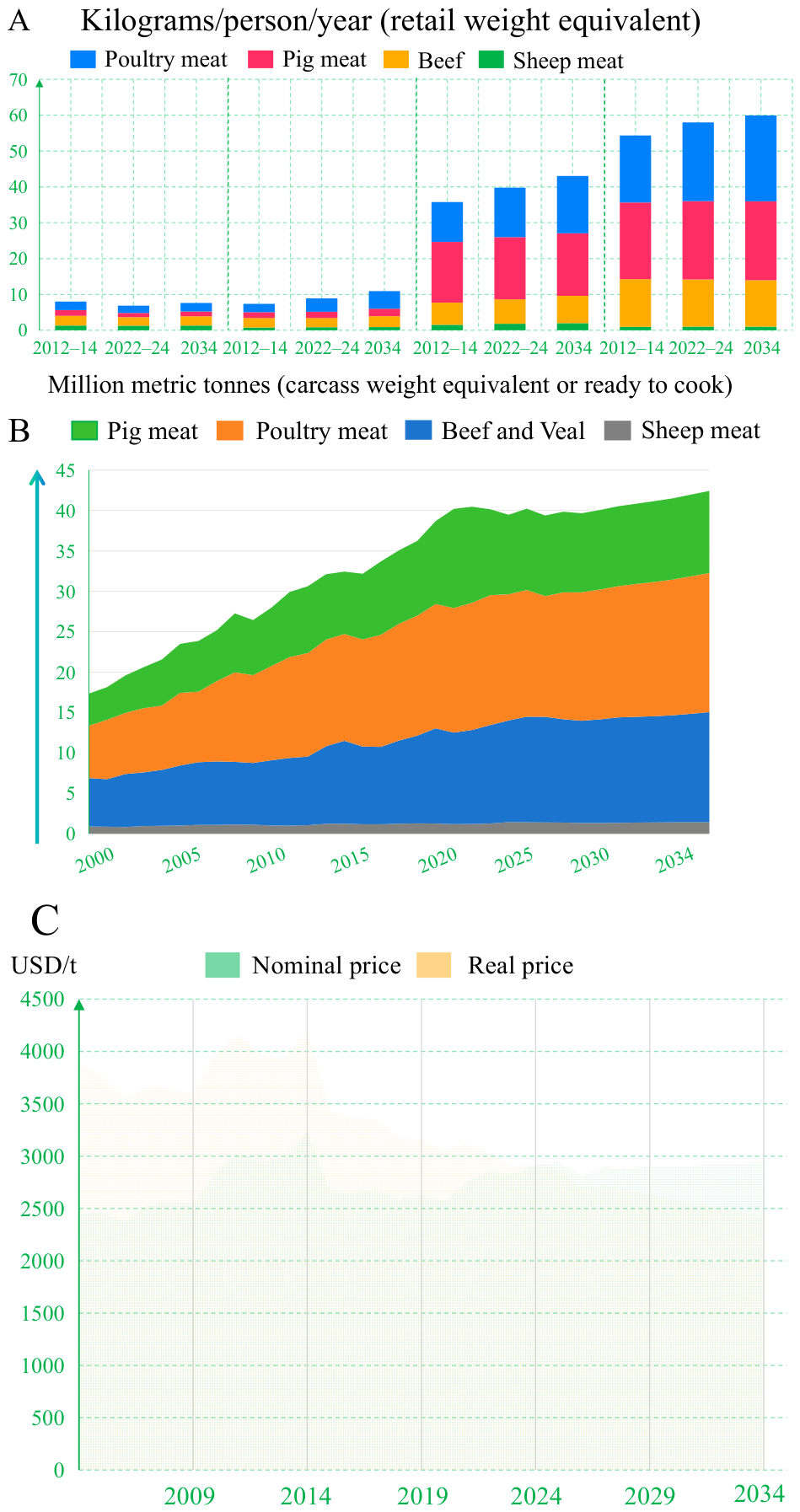
Figure 1. Global meat dynamics: Trends in consumption, trade, and prices ((A) per capita meat consumption by income group and meat type; (B) growth in meat trade expected to slow over the next decade; and (C) world reference prices for pig meat—rising in nominal, but falling in real terms).
Agriengineering 08 00390 g001
Figure 2. Smart pig farming: Solutions and development directions.
Agriengineering 08 00390 g002
Figure 3. Flow diagram of the literature screening and selection process.
Agriengineering 08 00390 g003
Figure 4. (A) The annual distribution of publications (red columns). (B) The top 20 most fruitful journals (purple columns). Numbers on the bar graphs indicate the number of articles published.
Agriengineering 08 00390 g004
Figure 5. The citation co-occurrence network.
Agriengineering 08 00390 g005
Figure 6. The scientific cooperation network. (A) Country cooperation. (B) Institution cooperation. (C) Author cooperation. (D) Parameter description.
Agriengineering 08 00390 g006
Figure 7. The top 50 subject categories with the strongest citation bursts. Year, year of first occurrence; Strength, burst strength; Begin, burst beginning year; End, Burst’s ending year.
Agriengineering 08 00390 g007
Figure 8. The top 50 keywords with the strongest citation bursts.
Agriengineering 08 00390 g008
Figure 9. Keyword cluster snapshots.
Agriengineering 08 00390 g009
Figure 10. Keyword alluvial map, 1991–2025. X-axis: Time slice. Y-axis: Number of modules. Number: Order of modules in each time slice, sorted by the number of nodes.
Agriengineering 08 00390 g010
Figure 11. The keywords of the top 6 modules in 2025. (A) Module 1. (B) Module 2. (C) Module 3. (D) Module 4. (E) Module 5. (F) Module 6.
Agriengineering 08 00390 g011
Figure 12. Timeline visualization of the evolution of reference co-citation clusters.
Agriengineering 08 00390 g012
Figure 13. Comparison and prioritization of candidate themes based on bibliometric evidence: (A) Composite support scores of candidate themes; (B) mean ranks of candidate themes; (C) evidence profile heatmap of candidate themes; and (D) Sankey diagram of the three prioritized themes.
Agriengineering 08 00390 g013aAgriengineering 08 00390 g013b
Figure 14. Methodological taxonomy of deep learning-based pig object detection and its mapping to major farm-specific challenges ((A) deep-learning object-detection methods; and (B) challenges and representative methods).
Agriengineering 08 00390 g014
Figure 15. Performance trade-offs and evolutionary trends in pig vision methods ((A) trade-off among speed, robustness, and complexity; and (B) evolution of pig vision methods (2018–2025)). The identical legends are intentional, as the same colors represent the same detection methods: sin-gle-stage detection (green), two-stage detection (blue), Transformer (purple), and lightweight detec-tion (orange).
Agriengineering 08 00390 g015
Figure 16. Schematic comparison of conventional and precision feeding in pigs, with major barriers to adoption ((A) conventional phase feeding versus individual PF; and (B) major barriers to field-scale adoption of PF).
Agriengineering 08 00390 g016
Figure 17. Overview of deep learning-based infrared body-temperature monitoring in pigs. (A) Reported model performance. (B) Thermometric regions, error sources, and compensation.
Agriengineering 08 00390 g017
Figure 18. Temporal monitoring and stage-specific priorities in pig infrared thermography. (A) Early warning from time-series data. (B) Monitoring priorities by production stage.
Agriengineering 08 00390 g018
Table 1. Basic information on the distribution of the publications.
Categories PublicationArticlesReviewAuthorsInstitutionsJournalsSubject Categories
Amount7076545336041104350114
Table 2. The references with citation bursts from beginning to 2025.
BeginEndStrengthYearTypeTitle
202220255.582021Review“A Systematic Review on Validated Precision Livestock Farming Technologies for Pig Production and Its Potential to Assess Animal Welfare” [38]
202220254.912020Review“The role of sensors, big data, and machine learning in modern animal farming” [51]
202220254.522021Review“The Application of Cameras in Precision Pig Farming: An Overview for Swine-Keeping Professionals” [40]
202220254.522020Review“Accelerometer systems as tools for health and welfare assessment in cattle and pigs—A review” [43]
202420254.282022Review“Applications of Smart Technology as a Sustainable Strategy in Modern Swine Farming” [50]
202420254.282022Review“The Research Progress of Vision-Based Artificial Intelligence in Smart Pig Farming” [21]
202220254.012020Article“Automatic recognition of feeding and foraging behaviour in pigs using deep learning” [47]
202420253.212021Article“Recognition of sick pig cough sounds based on convolutional neural network in field situations” [52]
202320253.192022Review“Review: Smart agri-systems for the pig industry” [48]
202420252.142020Article“Feeding behavior of grow-finish swine and the impacts of heat stress” [49]
Disclaimer/Publisher’s Note: The statements, opinions and data contained in all publications are solely those of the individual author(s) and contributor(s) and not of MDPI and/or the editor(s). MDPI and/or the editor(s) disclaim responsibility for any injury to people or property resulting from any ideas, methods, instructions or products referred to in the content.