
Article

Spectral Signatures and Indices of Cassava Leaves by Multiregional Spectral Analysis (UV-VIS-NIR) and Functionally Enhanced Derivative Spectroscopy (FEDS): Leaf Ontogeny and Induced Senescence

by
Diego F. Restrepo
1,2,
Enrique M. Combatt
3 and
Manuel Palencia
1,*
1
Research Group in Science with Technological Application (GI-CAT), Department of Chemistry, Faculty of Natural and Exact Sciences, Universidad del Valle, Cali 760032, Colombia
2
Mindtech Research Group (Mindtech-RG), Mindtech S.A.S., Montería 230002, Colombia
3
Department of Agricultural Engineering and Rural Development, Faculty of Agricultural Sciences, Universidad de Córdoba, Montería 230002, Colombia
*
Author to whom correspondence should be addressed.
AgriEngineering 2026, 8(6), 243; https://doi.org/10.3390/agriengineering8060243 (registering DOI)
Submission received: 21 April 2026 / Revised: 10 June 2026 / Accepted: 11 June 2026 / Published: 13 June 2026
(This article belongs to the Topic Digital Agriculture, Smart Farming and Crop Monitoring)

Abstract

A comprehensive multiregional characterization of the spectral response of cassava leaves across different ontogenetic stages was performed. For this, ultraviolet (UV), visible (VIS) and shortwave near-infrared (UV-VIS-NIR; 200–900 nm) regions were used to identify spectral signatures and indices for their potential use as biomarkers of leaf development and physiological status of plants under induced senescence conditions. Manihot esculenta Crantz (HMC-1 variety) was used as a model. Spectral signatures were obtained from leaves at two phenological stages (4 and 6 months after planting) using UV-VIS-NIR spectroscopy by the diffuse reflectance technique. Classical and experimental spectral indices were evaluated, and their discriminatory power through different ontogenies was assessed using ANOVA/Kruskal–Wallis and post hoc tests. Senescence effects were further examined by postharvest monitoring (1–20 days), with temporal, ontogenetic, and interaction effects validated using linear mixed models (LMMs), while multivariate structure and spectral convergence were explored via principal component analysis and hierarchical clustering (PCA-HCA). Functionally Enhanced Derivative Spectroscopy (FEDS), comparative analysis, and spectral correlation mapping allowed signal’s selective enhancement and the identification of phenolic compounds, photosynthetic pigments, and structural molecular components. Results showed high ontogenetic stability of UV-associated phenolic signals (~210–220 nm), whereas the VIS region (420–600 nm) clearly differentiated young leaves. The NIR region was stable across ontogeny but highly sensitive to temporal degradation, reflecting changes in water status and internal structure. UV-VIS-NIR indices effectively differentiated young leaves and changes by stress. It is concluded that multiregional characterization of the spectral response supported by FEDS allows the extraction of robust indices with strong potential as biomarkers of leaf maturation and senescence in cassava.

1. Introduction

Cassava (Manihot esculenta Crantz) is one of the most important agricultural crops in tropical and subtropical regions because it is a source of food for more than 800 million people, particularly in Africa, Asia and Latin America. Due to its adaptability, it plays an important role in the rural economy, both small- and large-scale, but also in the agro-industrial sectors related to raw materials and food production [1,2,3,4,5]. Colombia is the third largest producer of cassava in Latin America, with cassava production used both for direct consumption and for obtaining starch and producing bioethanol [6,7,8,9,10]. From a geographical perspective, within the Colombian context, the Caribbean region and, particularly, the departments of Córdoba and Sucre are one of the most important areas for cassava cultivation, both in traditional and agro-industrial systems [11].
Despite its importance, cassava productivity faces several limitations due to factors that significantly affect both yield and quality. These include environmental variability, genetic heterogeneity, and genotype × environment interactions [12,13,14]. In this context, the development of descriptive and predictive technological tools for chemical and agronomic analysis, based on data science and artificial intelligence, is becoming increasingly relevant. These analytical approaches are characterized by enabling, in many cases, rapid, non-destructive, and real-time monitoring of plant physiological status and crop yield. From a practical standpoint, having analytical methods with these characteristics is particularly important for crops geared towards food security, sustainability, small-scale farming, and efficiency in production systems based on the circular economy and precision agriculture [15,16,17,18,19,20].
Since the late 20th century, and more recently with advances in miniaturization, cost reduction, and greater accessibility to information technologies, the capacity to acquire and analyze large datasets has steadily increased. Specifically, in agriculture, multispectral and hyperspectral analyses have emerged as powerful tools for the crop’s physiological and biochemical characterization [21,22]. In this context, a spectral biomarker is defined as a quantitative and/or qualitative descriptor of one or more responses resulting from the interaction between electromagnetic radiation and plant tissues. These biomarkers provide information that can be used from both technological and practical perspectives, as they reflect structural, biochemical, and functional properties of plants of interest in agronomic, chemical, and agro-industrial applications [23,24,25,26]. Biomarkers are commonly of two types: those based on a specific spectral signature and those consisting of an index derived from mathematical combinations of two or more wavelengths through which different physiological variables are inferred (e.g., chlorophyll content, hydration status, and presence of phenolic compounds, among others) [27,28,29,30,31].
Among the most widely used examples of spectral biomarkers in agriculture are the Normalized Difference Vegetation Index (NDVI) and the Green Normalized Difference Vegetation Index (GNDVI). NDVI is based on the absorption and reflectance characteristics of chlorophyll in healthy plants, which exhibit strong absorption of red light in the visible region and high reflectance in the near-infrared region. In contrast, GNDVI replaces the red band with a green band, making it more sensitive to chlorophyll concentration and, consequently, more suitable for assessing nitrogen status and water conditions in plants [32,33,34]. Other spectral indices have been derived from combinations of visible and near-infrared bands and used for crop classification, weed detection, and discrimination of vegetation cover types, among others [35,36].
From a physiological perspective, spectral analysis of leaves has proven particularly useful because the leaf is the primary photosynthetic organ. Due to the presence of chlorophylls and other pigments, leaves exhibit well-defined chromatic characteristics. Therefore, photosynthetic efficiency can be assessed through parameters such as the maximum carboxylation rate and the maximum electron transport rate, which vary under stress conditions or because of normal plant development [37]. A brief description of commonly used spectral indices is presented in Table 1 [38,39,40].
Despite advances in the development of spectral biomarkers, including spectral signatures and indices, significant limitations remain and restrict their applicability and generalizability. First, numerous spectral indices exhibit redundancy and saturation effects, particularly in high-biomass ecosystems, which severely constrains their discriminatory power. Second, because these analyses are generally performed in situ, spectral responses remain highly susceptible to environmental fluctuations and confounding external factors, including climate, soil type, water stress, and agronomic practices. This environmental dependence introduces high variability, thereby hindering the extrapolation of predictive models across different contexts [41,42]. Furthermore, at the data level, a pronounced spectral overlap commonly occurs regarding both the signal profiles and the inherently dynamic characteristics of the samples. For example, diverse vegetation covers, intrinsic heterogeneity and varying physiological states often yield overlapping spectral responses, compounding the difficulty of accurate classification when relying on a single index [42,43]. To mitigate these limitations, reduce spectral ambiguity, and enhance classification performance, several methodology-driven approaches have been proposed. These include the formulation of novel or combined indices [41,42], data transformation techniques (e.g., decorrelation stretching and contrast enhancement) [43], the implementation of spectral reconstruction algorithms based on machine learning and artificial intelligence [44], multivariate and chemometric analyses [45], and spectral transformations for optimal feature selection (e.g., derived spectroscopy) [46].
Another critical constraint is the reliance of spectral indices on the measurement scale and the spatial resolution of the sensor. While satellite sensors allow for large-scale monitoring, their resolution is often insufficient to capture variability at the level of individual leaves or plants. Conversely, laboratory-based spectroscopy conducted under controlled conditions, alongside proximal sensing approaches, offers superior resolution; however, this comes at the expense of restricted spatial coverage and elevated operational costs [47,48].
Nevertheless, the development of approaches that integrate multiregional and multiscale information remains imperative to enhance the sensitivity, specificity, robustness, and generalizability of spectral biomarkers. To address this challenge, this study proposes the use of a spectral deconvolution technique known as Functionally Enhanced Derivative Spectroscopy (FEDS), which involves transforming the spectral response using a wavelet-like function to generate a modified spectrum [49,50]. Through FEDS, two types of signals can be identified: legacy signals, which correlate with the relative maxima of the spectral function, and “pure” FEDS signals, which arise from the transformation itself. The advantages of this technique include the elimination of irrelevant information (i.e., data points unassociated with relative extrema), improved spectral resolution of overlapping signals, the extraction of hidden or low-intensity spectral features, and ease of data processing, programming, and automation. However, its limitations include sensitivity to noise and dependence on measurement reproducibility, requiring the implementation of appropriate methodological strategies to minimize these effects. Such strategies should be applied both during data acquisition (e.g., managing replications, establishing minimum standard conditions, avoiding stray radiation) and during data processing (e.g., smoothing, normalization, and spectral window selection). Despite these limitations, FEDS has proven effective in the spectral analysis by Fourier-Transform Mid-Infrared Spectroscopy of complex systems such as animal tissues, food products, agricultural materials, soils, and microbial biofilms [47,48,49,50,51,52]; however, its application to UV-VIS-NIR spectra of foliar tissue remains entirely unexplored to date.
Based on these considerations, we hypothesized that the application of Functionally Enhanced Derivative Spectroscopy (FEDS) to UV-VIS-NIR spectra would enhance the resolution of overlapping spectral features and facilitate the identification of spectral biomarkers associated with leaf ontogeny and induced senescence in cassava. Therefore, the objective of this study was to characterize the UV-VIS-NIR spectral response of cassava leaves at different ontogenetic stages, implementing the FEDS data transformation technique to construct spectral signatures and indices with potential application as biomarkers of leaf development and plant physiological status under induced senescence conditions.

2. Materials and Methods

2.1. Experimental Location

The experimental setup and sampling were conducted at the experimental agriculture facilities of Mindtech s.a.s., in a peri-urban area of the California sector, Montería, Córdoba (Colombia), located at the following geographic coordinates: 8°47′18.8″ N, 75°50′33.5″ W. This region is characterized by a warm tropical climate, with a mean annual temperature of approximately 28 °C and an average annual precipitation ranging between 1200 and 1500 mm, according to reports from the Institute of Hydrology, Meteorology and Environmental Studies of Colombia [53].
In this study, leaf samples were obtained from cassava (Manihot esculenta Crantz) plants of the HMC-1 variety (ICA-Armenia, Colombia), which is a genetically improved clone developed by the International Center for Tropical Agriculture (CIAT, Cali—Colombia). This variety has been widely used in breeding programs in Colombia due to its disease resistance and high productive potential [54,55].

2.2. Leaf Tissue Sampling

Since spectral characterization of leaf tissue aims to identify physiological and biochemical patterns across developmental stages, only apparently healthy leaves were selected from each biological replicate. Leaf selection was based on morphological and visual criteria, prioritizing those with uniform green coloration and no visible signs of spots, deformation, necrosis, chlorosis, or any symptoms associated with nutritional deficiencies, abiotic stress, or disease.
Sampling was performed during the morning (08:00–11:00 h) to minimize variability associated with water stress due to transpiration. Leaves were classified into three groups according to their ontogenetic stage: (i) young leaves, fully expanded and located in the upper part of the stem (first third of the canopy); (ii) intermediate leaves, located in the middle section of the plant (upper portion of the second canopy third); and (iii) mature leaves, located in the lower section of the second canopy third.
On the other hand, two phenological stages were considered for sampling: the first sampling was conducted at 4 months after planting (advanced vegetative growth stage), and the second at 6 months (starch accumulation stage).

2.3. Pretreatment and Storage of Leaf Tissue Samples

Immediately after harvesting, leaves were stored in hermetically sealed zip-lock bags containing a moist cloth to maintain relative humidity and reduce water loss by evaporation. Samples were transported to the laboratory within 4 h of collection. Prior to spectral acquisition, leaves were carefully cleaned with absorbent paper to remove dust particles and surface moisture, avoiding excessive rubbing to prevent alteration of the cuticle.
Additionally, to differentiate the effect of leaf microstructure from the chemical contribution to the spectral response, powdered tissue samples were prepared. A fraction of mature leaves was dried in a forced-air oven (Digitheat-TFT, J.P. Selecta, Spain) at 40 °C until constant weight and subsequently ground using a knife mill (Mikro® UMP, NJ, USA) to obtain a homogeneous powder with particle size <0.5 mm. These powdered samples were stored in airtight polypropylene containers under dry conditions and used to acquire reflectance and pseudo-absorbance spectra under the same instrumental conditions.

2.4. Experimental Design and Dataset Structure

The experiment was conducted under an open field mesocosm approach using cassava plants propagated from vegetative cuttings provided by CIAT (Palmira, Colombia). Plant development was monitored from planting to harvest over an 8-month period. Plants were cultivated in polyethylene pots (~40 dm3, approximately 30 kg of soil) containing homogenized and physicochemically characterized alluvial soil while preserving natural environmental conditions during plant development.
The dataset was structured based on a factorial design including three biological replicates (independent plants), three leaf ontogenetic stages (young, intermediate, and mature), and two sampling times (4 and 6 months after planting). Within each sampling time, three leaves per ontogenetic stage were collected from each biological replicate. For each leaf (experimental unit), spectra were acquired on both leaf surfaces: adaxial (upper side) and abaxial (lower side).
To minimize pseudoreplication effects, biological replication was defined at the plant level, while multiple leaves collected within each ontogenetic stage were treated as subsamples associated with each biological replicate. Instrumental spectral replicates acquired from the same leaf region were averaged prior to statistical analysis and were not treated as independent observations. A schematic representation of the experimental design, sampling hierarchy, and treatment of spectral replicates is provided in Figure S1 (Supplementary Material).
Preliminary exploratory analyses were performed to reduce sources of spectral variability. PCA showed substantial spectral overlap between spectra acquired at 4 and 6 months within each ontogenetic stage, with no clear multivariate separation between sampling times (Figure S2). This observation was further supported by MANOVA performed on the PCA scores, which indicated no significant multivariate effect associated with sampling time (Table S1). Based on these exploratory results, both sampling times were combined into a single dataset. Therefore, the final dataset structure for each ontogenetic stage was as follows:
N o n t = p c × r l × s × z
where N o n t is the number of spectra describing ontogeny (36), p c is the number of plants (3), r l   is the number of leaves analyzed per ontogenetic stage (3), s is the number of analyzed surfaces (2), and z is the number of sampling times (2). Thus, 108 spectra per instrumental technique were obtained (not counting spectral replicates). Details of spectral acquisition are provided below.

2.5. UV–VIS–NIR Measurements

Diffuse reflectance measurements were performed using a Jasco V-750 spectrophotometer (Jasco, Japan) equipped with an integrating sphere (ISV-922, S/N B017361889; Jasco, Japan). The system was configured in photometric reflectance mode (%R), employing a beam trap to correct for specular reflection and an 8/d measurement geometry suitable for heterogeneous materials such as leaf tissue. Whereas reflectance signals were recorded as absolute reflectance (%R) using a Spectralon® reference standard (99%; Labsphere, NH, USA). Spectra were exported in .txt format for further processing and analysis.
For each selected leaf (young, intermediate, and mature), independent spectra were acquired from both the adaxial (upper) and abaxial (lower) surfaces, with three replicates per position. A solid sample holder with frame and clip (Jasco, Japan) was used to ensure stable positioning of the leaf against the integrating sphere. A circular quartz holder adapted to the integrating sphere (ISV-922) was used for powder-solid samples. All spectra were recorded using the same instrumental parameters: spectral range (200–900 nm), spectral resolution (0.5 nm), spectral bandwidth (1.0 nm), response time (0.06 s), sampling rate (400 nm/min), light source (deuterium and tungsten-halogen with automatic switching to 340 nm), and number of acquired points (1401 at 900–200 nm).

2.6. Spectral Data Processing

Spectral data processing included pretreatment, visualization, and information extraction strategies for subsequent analysis. All procedures were performed using MATLAB® R2024b (MathWorks Inc., Natick, MA, USA) under an institutional license provided by Universidad del Valle (Cali, Colombia). The primary objective of this processing was to ensure data quality, minimize instrumental noise, and enhance physiologically and biochemically relevant spectral features across the evaluated spectral ranges.

2.6.1. Data Pretreatment

Data pretreatment was conducted to ensure consistent analysis of the intrinsic spectral features by reducing instrumental noise and standardizing measurement scales for comparative purposes. This was achieved through smoothing and normalization procedures, as described below.
  • Smoothing: Prior to normalization, spectra were subjected to a smoothing process to reduce instrumental noise without compromising spectral resolution. Three smoothing methods were evaluated: Savitzky–Golay filtering (or polynomial derivative filters) [56,57,58], moving average [59,60,61], and Gaussian filtering [62,63]. Based on comparative performance in terms of peak preservation and noise reduction, the Savitzky–Golay filter was selected, using a 9-point window. The Savitzky–Golay smoothing method is based on fitting a polynomial of degree p d to a moving window of 2 m + 1 consecutive data points using a least-squares approach. For each central point x , the smoothed value y i * is calculated as follows:
    y i * = J = m m C j y j + j
    where y i + j are the original data of the signal in the window analysis, and C i are the deconvolution coefficients calculated as a function of the polynomial order and the window size [56,57,58]. The moving average method involves replacing each point in the spectrum with the average of its neighbors within a defined window by
    y i * = 1 2 m + 1 J = m m y i + j
    where parameters in Equation (3) are equivalent to those described for Equation (2) [59,60,61]. On the other hand, the Gaussian filter consists of applying weighted smoothing where points near the center have greater weight, following a normal distribution, such that:
    y i * = J = m m w j y i + j
    where w j are Gaussian weights defined by
    w j = 1 2 π σ 2 e x p j 2 2 σ 2
    with σ denotes the standard deviation of the Gaussian function controlling the smoothing level, m is the window half-size, e x p denotes the exponential function and π = 3.1416 [62,63].
  • Normalization: For the normalization and elimination of negative values from the spectra, a min-max rescaling function was applied to obtain values in the range from 0 to 1; for this, the maximum and minimum reflectance values ( R m a x and R m i n , respectively) were first selected, and then, point by point, the following equation was applied:
    R N = R λ R m i n R m a x R m i n
    where R n is the normalized and scaled reflectance, and R λ is the reflectance at one wavelength λ [64,65].
  • Conversion between reflectance and pseudo-absorbance measurements in leaf tissues: To facilitate qualitative interpretation and comparison with spectra obtained by transmission, reflectance measurements ( R ) were transformed to pseudo-absorbance values ( A * ), which is defined according to the equation described below:
    A * = l o g ( R )
Although A * does not strictly represent the physical absorbance, it preserves the logarithmic proportionality between the amount of radiation absorbed and reflected. This transformation allows for clearer distinction of spectrum minimum values without altering the intrinsic resolution of the spectrometer or the original data structure [66].

2.6.2. Spectral Segmentation

To focus the analysis on regions with physiological and biochemical relevance and prevent the strongest signals from masking smaller variations, the spectra were segmented into specific analysis windows (see Table 2).
The delimitation of these regions allowed for the more precise identification of characteristic bands associated with phenolic compounds, photosynthetic pigments, and structural compounds of the leaf, serving as a basis for mathematical transformations of the signal and comparative and statistical analyses [67,68,69].

2.7. Use of FEDS for the Identification of Characteristic Signals

The FEDS transformation was applied to each reflectance and pseudo-absorbance spectrum to highlight hidden or strongly overlapping spectral gradients that are masked by the dominant signals [49,70]. The working equation for the FEDS transform is given by
P n = 1 + R n   d d λ 1 R n α 1
where P n is the FEDS intensity being related to specific λ , d / d λ denotes the first-order derivative of R n with respect to λ , 1 + R n is an amplification factor that assigns a weight consistent with the original intensity, and α is an adjustable parameter indicating the degree of the root operating in P n . Thus, for α = 2 , the classic form of the FEDS transform is obtained [70]; however, modifications of this exponent allow adjusting the sensitivity of the transformation. Varying α makes it possible to attenuate high-frequency noise or, conversely, amplify latent signals that were previously undetectable. Therefore, for each transformation, different values of α were evaluated (i.e., 0.5, 1, 2, 3), whereas the optimal value was defined by comparing the reproducibility of the bands in different replicates and their physiological coherence.

2.8. Spectral Indices

Classical indices were used to describe physiological characteristics related to the spectral response (see Table 1) [39,40]; in addition, new indices were defined from the relationship of bands selected by FEDS. For this purpose, signals with contrasting intensity were selected and constructed as the FEDS signal ratio ( F S R ) or FEDS-based normalized differences index ( F N D I ). These were:
F S R = R n F R m F
F N D I = R n F R m F R n F + R m F
where R n F and R m F are the values of reflectance at the wavelength selected by FEDS.

2.9. Analysis of Data

The identification and assignment of signals in the spectra was performed on both the original spectra and those modified using FEDS. Assignment was carried out by comparing the experimental spectra with reference spectra reported for phenolic compounds, carbohydrates, photosynthetic pigments, lignin, and leaf tissue structures using the PhotochemCAD-2 database [71,72].

2.9.1. Descriptive Statistical Analysis

A descriptive statistical analysis was performed on the set of intensity values determined for each wavelength ( λ ) to characterize the intragroup variability of the spectral signals. For each band, the minimum and maximum values, mean, standard deviation, and coefficient of variation were calculated. Additionally, compliance with the assumption of data normality was verified using the Shapiro–Wilk test, considering a p -value > 0.05 as the acceptance criterion. This test was selected because it is widely recommended in spectral analysis due to its greater sensitivity in small samples compared to other normality tests [73,74].

2.9.2. Analysis of Spectral Data Correlations

To elucidate potential relationships and common patterns between the different spectral regions, correlation matrices were obtained based on Pearson’s correlation coefficient ( r 1,2 ) as the base metric (the subscripts 1 and 2 denote the wavelengths that define the analysis window). This approach enabled the exploration of the degree of linear associations between the signals at different wavelengths ( λ ) and identify dependencies between spectral bands [75]. The coefficients obtained were represented in a correlation map for the two-dimensional identification of the pairs of bands with the greatest and least codependence. For the construction of the correlation maps, only spectra acquired from the adaxial leaf surface were considered. Subsequently, the difference in the r 1,2 values of the characteristic signals ( Δ r 1,2 ) was used as the base metric for evaluating the magnitude of change in codependence in the selected band pairs, described as follows:
Δ r 1,2 = r 1,2 B r 1,2 A  
where r 1,2 A is the r 1,2 between wavelengths λ 1 and λ 2 in group A (e.g., young leaves) and r 1,2 B is the r 1,2 between the same wavelengths in group B (e.g., mature leaves).
The statistical significance of this measure was assessed by applying 1000 random permutations of the spectral replicates, generating relabeled matrices with samples of different classifications ( λ 1 , λ 2 , …). This approach allowed the construction of a null distribution of correlation differences under the hypothesis of no effect between groups. Probability values ( p ) were estimated as the proportion of permutations in which the absolute value of Δ r 1,2 k exceeded the absolute value of the observed Δ r 1,2 ( Δ r o b s ). Differences were considered statistically significant when p -value < 0.05.

2.9.3. Analysis of Variance

To determine whether the observed spectral differences at the ontogenetic level were statistically significant, mean comparison tests were applied to the spectral indices. In cases where the assumptions of normality and homoscedasticity were met, a one-way ANOVA was performed [76,77]. Conversely, when these assumptions were not observed, equivalent non-parametric tests were used, such as the Kruskal–Wallis test for multiple comparisons [76,78]. Subsequently, Tukey’s HSD test (Honestly Significant Difference test) was performed to identify which groups exhibited these differences [76]. In cases where the assumption of homogeneity of variances was not observed, a Dunn–Sidak post hoc test was used as an alternative [79].

2.10. Induced Senescence Experiments

To evaluate the robustness and sensitivity of spectral signatures to physiological deterioration processes, a postharvest-induced senescence protocol was established on previously characterized leaves. This approach was developed to decouple the ontogenetic effects of leaf development from changes associated with tissue degradation. For this, once the initial spectra were acquired, corresponding to the fresh physiological state (i.e., initial time or t 0 ), the leaves were pretreated and individually identified. Initial spectral measurements were performed continuously for the first four days ( t 1 , t 2 , t 3 , t 4 ) to evaluate early stages of dehydration and initial structural changes in the tissue. Subsequently, to evaluate more advanced degradation states, measurements were taken at increasingly longer intervals; specifically, measurements t 6 , t 8 , t 10 , t 15 , and t 20 were taken on days 6, 8, 10, 15, and 20 after collection, respectively. Spectral measurements, the number of replicates, and spectrum processing were performed according to the previously described methodology, always maintaining a constant measurement zone (center of the leaf blade) and the opposite leaf surface (adaxial surface).
The statistical analysis of the induced senescence results was performed using linear mixed models (LMMs) [80]. Models were implemented in MATLAB® R2024b using the fitlme function. For each spectral index, a separate LMM was fitted according to the formula:
I n d e x ~ D a y × O n t o g e n y + ( 1 | S a m p l e )
where D a y (8 levels: 1, 2, 3, 4, 8, 10, 15, 20) and O n t o g e n y (3 levels: Young, Intermediate, Mature) were treated as fixed categorical effects, and their interaction term ( D a y   ×   O n t o g e n y ) was included to evaluate whether temporal dynamics differed across ontogenetic stages. A random intercept per sample ( 1   |   S a m p l e ) was incorporated to account for variability associated with repeated spectral observations on the same leaf. Degrees of freedom ( d f ) for fixed-effect tests were estimated using the residual method ( d f = 48 for all models). Statistical significance was assessed at α = 0.05. Full model outputs—including fixed-effect coefficients, 95% confidence intervals, F-statistics, and model fit criteria (AIC, BIC, log-likelihood, R 2 )—for all spectral indices are reported in Supplementary Tables S2 and S3.
Meanwhile, the combined dynamics of ontogenetic and temporal effects were analyzed using multivariate analysis techniques, specifically principal component analysis (PCA) [81] and hierarchical cluster analysis (HCA) [82].

3. Results and Discussion

3.1. Characterization of the UV-VIS-NIR Spectral Signature of Cassava Leaf Tissue

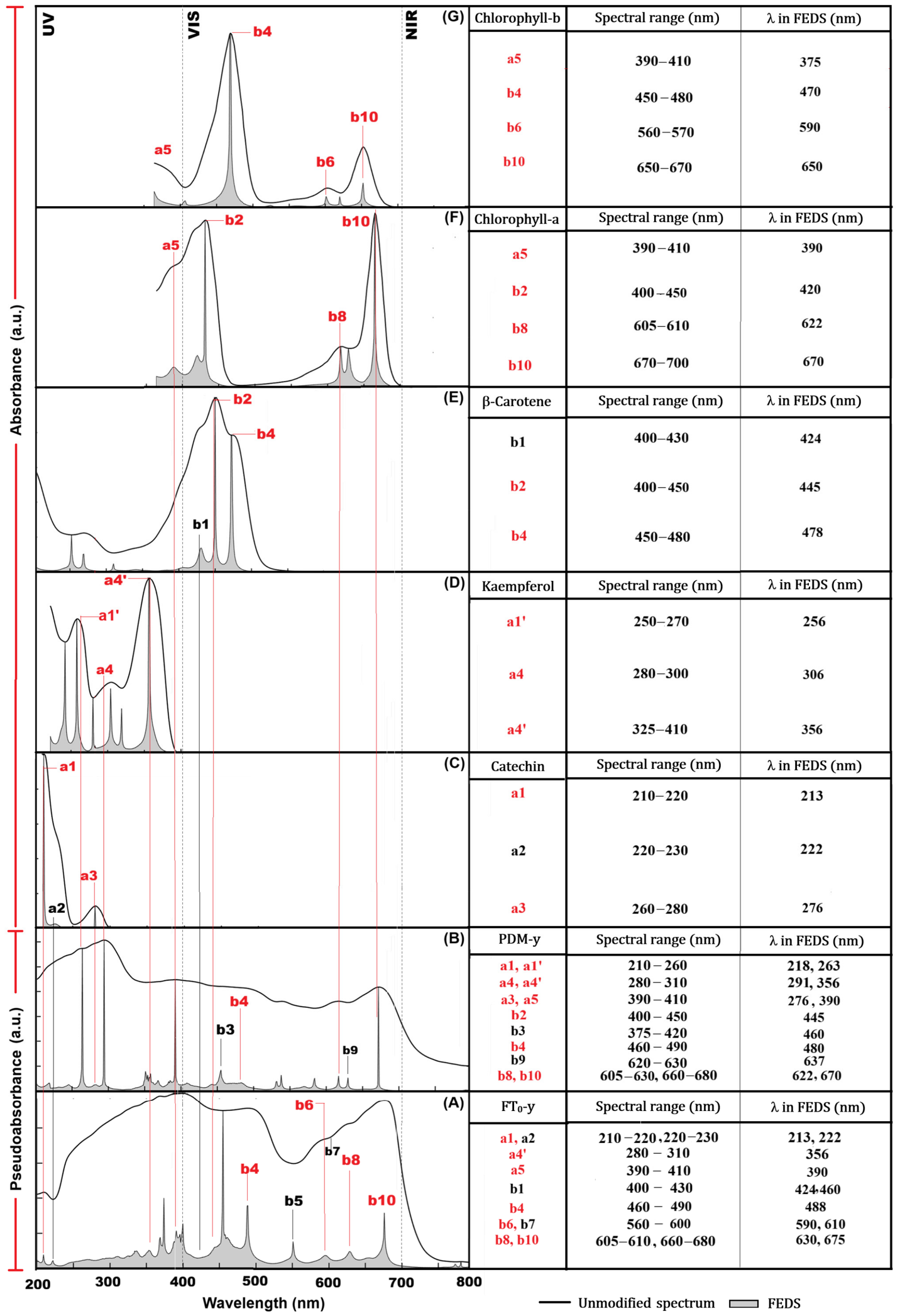
In Figure 1A,B, the average and unmodified UV-VIS spectra of intact leaf tissue (FT0-y) and powdered dry leaf tissue (PDM-y) are shown. The FEDS spectra for each case are also shown (this corresponds to a shaded spectrum with sharp peaks). The first observation is that the UV-VIS spectra, as expected, can be described as multiple contributions from broad bands that strongly overlap; however, using FEDS, spectra are transformed to be the result of multiple contributions of sharp signals. The respective identification and location in the spectrum of both the UV-VIS bands and the inherited FEDS signals are shown to the right of the respective spectra. Inherited signals are main signals since they are associated with local maxima of the original spectral function; consequently, FEDS signals associated with local minima were not considered because they provide morphological information of the spectral function, which is not directly related to the interaction of the electromagnetic spectrum with the sample. The signals are described below: In the ultraviolet range (200–400 nm), the absorption bands a1, a1′, a3, a4, a4′, and a5 were recorded, of which (a1a4′) correspond to the characteristic absorption of phenolic aromatic compounds [83,84,85].
The a1 band, observed particularly consistently at 213 nm in both the FEDS transformations of FT0-y (Figure 2A) and the UV-VIS spectrum of catechins (Figure 2C), is associated with π π * electronic transitions which are characteristic of phenolic aromatic rings with limited conjugation. These are present in some phenolic compounds with isolated aromatic rings such as catechin or other flavonols, although they could also be found in simple phenolic acids, condensed tannins and aromatic units of lignin [86]. Conversely, the absence or attenuation of this band in PDM-y could be due to structural and chemical changes induced by the tissue drying and pulverization process (Figure 2B), since changes in spectral response are expected due to oxidation of phenolic groups and reorganization of the lignocellulosic matrix during dehydration [87].
The a1′ band (250–270 nm) showed a remarkable spectral correspondence between the PDM-y signal at 256 nm and the signal at 263 nm associated with the π π * transitions of partially conjugated benzene systems in kaempferol (Figure 1D). Furthermore, the a3 (276 nm) and a4 (291 nm) bands, identified by FEDS in the PDM-y spectrum, were related to the band identified at 276 nm in the catechin spectrum, which exhibits π π * electronic transitions of the isolated aromatic systems, and were also associated with the 300 nm band of intermediate conjugation systems in kaempferol. Meanwhile, the a4′ band, identified at 356 nm, showed a high spectral correspondence ( Δ λ = 0 ) with the band attributed to the π π * transitions of highly conjugated aromatic rings, possibly due to the presence of adjacent double bonds and carbonyl groups. In contrast, these regions remained without noticeable signals in the FT0-y spectra. The above is possibly the result of the increased spectral overlap resulting from internal scattering effects and strong hydration, since these samples maintain their cellular structure intact.
The a5 band, detected in both FT0-y and PDM-y, showed a high degree of correspondence with the spectra of chlorophylls-a and chlorophylls-b (Figure 1F,G), identified by FEDS at 390 and 385 nm, respectively. This band is associated with peripheral rings of the chlorophyll porphyrin system. Furthermore, the same type of electronic transition was observed with a bathochromic shift in chlorophyll-b, identified as b4, at 470 nm in both FT0-y and PDM-y. This shift is explained by greater delocalization induced by the carbonyl substituent present in chlorophyll-b, which results in a smaller energy difference between the high- and low-energy molecular orbitals in the porphyrin system transitions. In this same region, the β-carotene spectrum could contribute slightly due to vibronic couplings of C=C bonds and π π * transitions.
It is noteworthy that, although these signals show a high degree of overlap in both FT0-y and PDM-y, they can be clearly distinguished using the FEDS transformation. In contrast, the b6 band (590 nm), although weak, coincided with the secondary signal of chlorophyll-b, associated with the vibronic coupling of the isocyclic ring. The b8 band (622 nm) showed a complete match with the band positioned at 622 nm in chlorophyll-a, associated with the coupling between the π orbitals of the ring and the central magnesium ion. Finally, the b10 band observed at 675 nm in FT0-y and at 670 nm in PDM-y showed a high correspondence with the red band of chlorophyll-a, which confirms the greater relative contribution of the extended porphyrin system and the maximum conjugation of chlorophyll-a with respect to chlorophyll-b.
On the other hand, in the NIR spectrum, the regions delimited between 700 nm and 800 nm correspond to the characteristic slope present at the VIS-NIR threshold (see Figure 2C in Section 3.2). This slope arises because of the progressive decrease in absorption by photosynthetic pigments in the visible range (i.e., chlorophylls, carotenoids, and anthocyanins). Conversely, the plateau that begins at 750 nm and extends beyond 900 nm is primarily determined by properties at the level of the internal structure of the leaf (cellular organization and intercellular spaces) that generate multiple scattering phenomena [88]. Although this region may appear relatively unchanging and of little descriptive interest, studies have shown that changes in the NIR slope are sensitive indicators of the plant’s physiological state, particularly the degree of leaf senescence. These changes in slope, combined with the analysis of the NIR plateau, can reflect modifications associated with water stress and tissue damage [89,90]. In this regard, the regions corresponding to the NIR slope and the NIR plateau exhibited a distinct variation in the total spectral signature between FT0-y and PDM-y; however, they did not show characteristic bands in specific positions. Specifically, the slope of the intact leaf tissue was substantially steeper than that of samples subjected to drying and grinding (i.e., dehydration and destruction of the leaf tissue structure).

3.2. Influence of Physiological Development on the UV-VIS-NIR Optical Response of Leaf Tissue

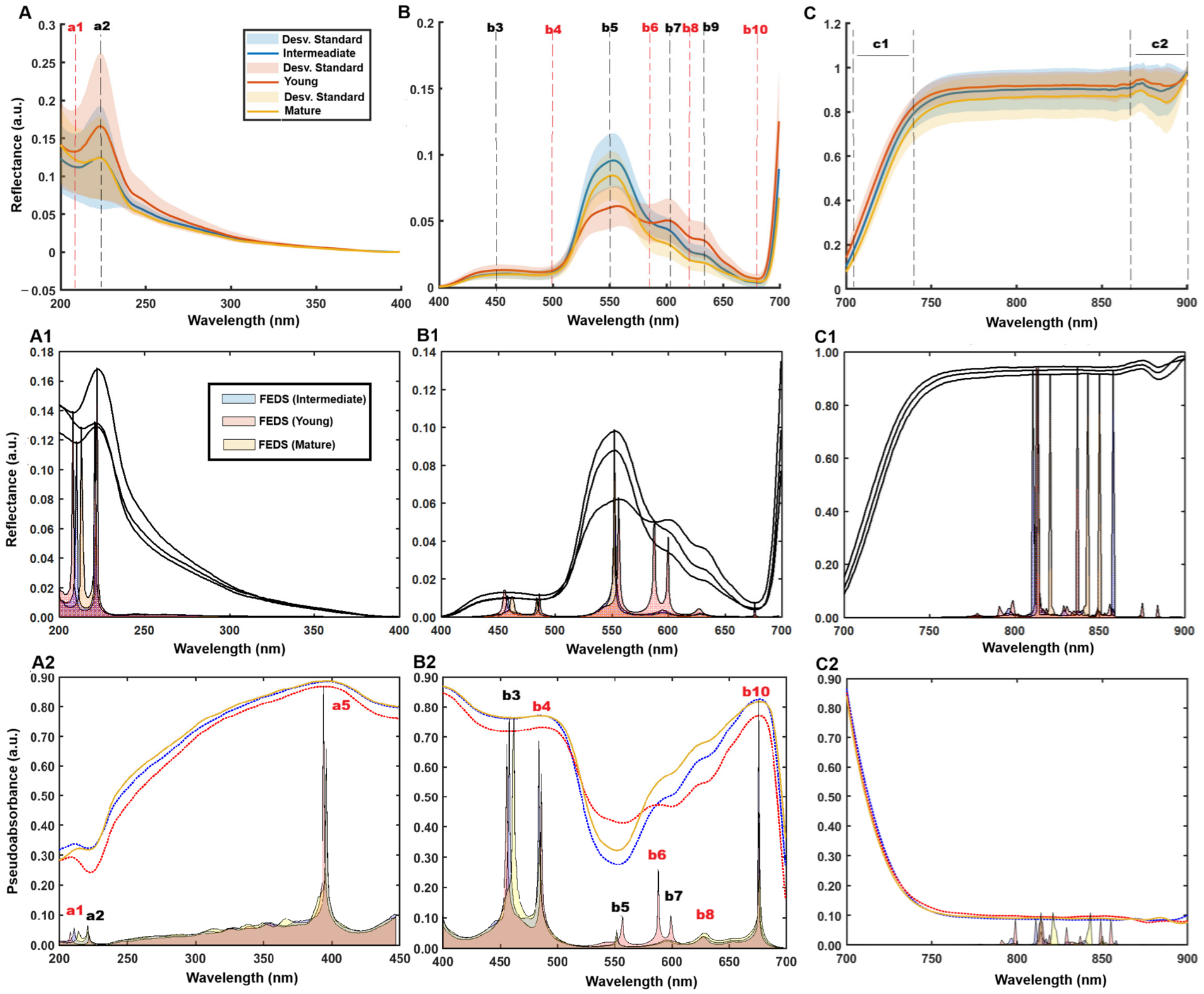
To examine the influence of physiological development on the optical response of leaf tissue, the average reflectance spectra of young, intermediate, and mature leaves were compared. Figure 2 compares the reflectance spectra of the analyzed development stages: young leaves (red), intermediate leaves (blue), and mature leaves (orange). Similarly, for a more precise description, the analysis was structured in three spectral segments: UV (Figure 2(A,A1,A2)), VIS (Figure 2 (B,B1,B2)) and NIR (Figure 2 (C,C1,C2)).
According to the above, in region A, the minimum reflectance (a1) is observed near 210 nm, followed by a maximum reflectance around 225 nm (a2). This pattern was consistent across all foliar development stages, indicating the presence of conjugated flavonoid-type structures and phenolic acid derivatives (see Figure 2A–C). Details of the spectral characteristics identified in the complete dataset of the analyzed spectra, compared by the adaxial and abaxial leaf surfaces, are presented in Table 3.
Similarly, the analysis of the standard deviation associated with reflectance at each wavelength shows a high degree of overlap between developmental stages in both a1 and a2. The above indicates that the differences in the observed spectral responses are perceived as evident. Consequently, it can be inferred that the intragroup variability is sufficiently broad to mask the potential differences between young, intermediate, and mature leaves observed regardless of whether the analyzed surface is abaxial or adaxial.
Between 440 and 470 nm, signals associated with the reflectance and absorption of xanthophylls and β-carotenes were found and identified as b3 and b4. These bands were present in all development stages with low dispersion (standard deviation between 0.0033 and 0.0050) and relatively low variability. The spectral position of these signals was also defined with high consistency on both sides by FEDS (457 ± 3 nm and 483 ± 2 nm, respectively), indicating high stability of spectral response.
Around 500–560 nm (b5), the most representative and intense reflectance peak is observed in intermediate and mature leaves. This region corresponds to the zone of minimum absorption of pigments such as chlorophyll-a and chlorophyll-b, which are responsible for the characteristic green coloration of the foliage. In intermediate and mature leaves, the peak showed high reproducibility in intensity and spectral position, which was determined by FEDS at 550 ± 2 nm, while in young leaves the signal shifted towards longer wavelengths (568 ± 8 nm), with comparatively lower intensities. In fact, the pattern formed by the signals at b5, b6, and b7 is highly distinguishable in young leaves, showing an overall maximum at b7 (602 nm) instead of b5. This maximum is accompanied by a minimum around 570 nm (b6), reflecting greater absorption in the green-yellow region and a relative increase in reflectance in the red-orange region. This behavior is associated with the accumulation of anthocyanins in epidermal tissues. In contrast, mature and intermediate leaves maintain the overall maximum reflectance at b5, demonstrating the predominance of green associated with higher concentrations of chlorophyll and carotenoids. Consequently, the minimum reflectance between 670 and 680 nm, identified by FEDS at 676 ± 2 nm, at all developmental stages confirms the predominance of chlorophyll’s absorbance in the red.
Based on the above, it can be concluded that one of the challenges of spectral analysis of leaf matrices is the adequate resolution of the wavelengths of maximum absorption (minimum reflectance) of leaf pigments, especially the responses associated with carotenoids, anthocyanins, and secondary pigments that coexist with chlorophylls, whose spectral responses overlap these bands due to the strong absorption of radiation in similar regions. This effect has been partially overcome by signal deconvolution using FEDS. Thus, among the advantages of using FEDS identified in this work are: (i) it allows for more precise discrimination of the contributions of each pigment, (ii) in the blue region it makes it possible to highlight the characteristic absorptions of carotenoids, and similarly, to differentiate the spectral positions dominated by chlorophylls, (iii) the ambiguity associated with spectral overlap is reduced and (iv) the sensitivity to detect pigmentary variations that have a direct implication in the physiological processes of the leaves is improved.

3.3. Influence of Leaf Anatomy on Differences in Spectral Response

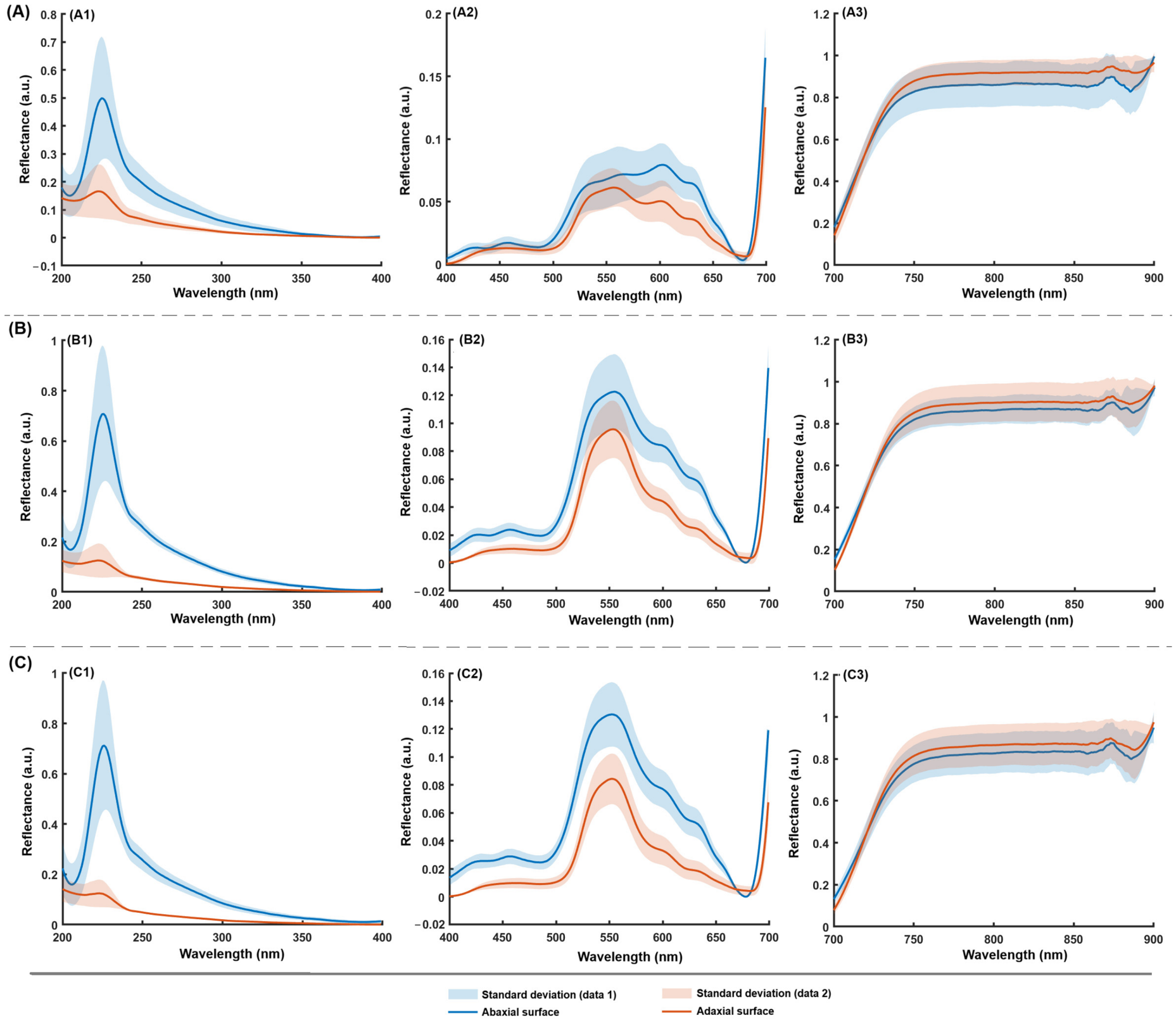
Since the foliar structure presents anatomical and compositional gradients between its surfaces, the possible influence of tissue orientation on the optical response was examined. This analysis made it possible to distinguish characteristic optical patterns of each leaf face and their relationship with structural changes in the tissue. Figure 3 shows the average reflectance spectra in the segmented UV, VIS, and NIR regions for the two leaf surfaces (adaxial in red vs. abaxial in blue) across the three ontogenies: young (A), intermediate (B), and mature (C). The shaded areas represent dispersion of the results for each spectral position, indicating intrasample variability.
In general, it was observed that in the UV range, the abaxial surface showed higher reflectance values in a2 compared to the adaxial surface, suggesting greater internal scattering of radiation in the lower tissue layers. This pattern persisted throughout the three stages of development, even overcoming intrasample variability. This consistent behavior across the three ontogenetic stages suggests that the optical differences between surfaces are not a temporary effect, but rather a stable structural characteristic of the leaf tissue. In the VIS region, these differences in reflectance values were maintained across developmental stages, although with subtle variations in the amplitude and shape of the bands. The b1 reflectance and b2 absorption bands associated with carotenoids and chlorophylls were more easily identified on the abaxial surface. This is possibly the result of less optical interference from the cuticular layer and a greater contribution from internal scattering in the spongy mesophyll. These differences in both spectral regions (UV and VIS) reflect the influence of structural and biochemical factors. The presence of a thicker adaxial cuticle, along with a higher density of chloroplasts in the parenchyma, favors greater absorption on the upper surface, while the lower surface, being less pigmented and having a higher stomatal density, exhibits higher reflectance. In particular, the signal behavior on the abaxial surface of the leaf may be due to the fact that, with a lower content of cutin-associated compounds, the absorptive effects in the UV and VIS regions of the spectrum are reduced, and consequently, radiation penetrates more easily into the inner layers of the leaf, allowing scattering phenomena in the stomatal zone to be dominant [91,92,93,94].
Finally, in the NIR region, the increase in reflectance at 700 nm was associated with multiple scattering in internal tissues, which explains the very few variations observed between the surfaces. This indicates that the spectral response is dominated by anatomical properties and internal scattering, rather than by variations in surface chemical composition [95].
In conclusion, the findings demonstrate that the spectral discrepancies between the adaxial and abaxial foliar surfaces are attributable to permanent anatomical gradients, which are modulated by both internal tissue architecture and the chemical composition of the leaf boundary layers. The most pronounced variations within the UV-Vis spectrum suggest that the adaxial surface functions as a protective optical filter, whereas the abaxial surface reflects radiation interactions with internal cellular layers, as evidenced by a prominent diffuse scattering component.

3.4. Multiregional Correlational Analysis Based on Pearson Coefficients

3.4.1. Correlative Dynamics for the UV-VIS-NIR Spectrum

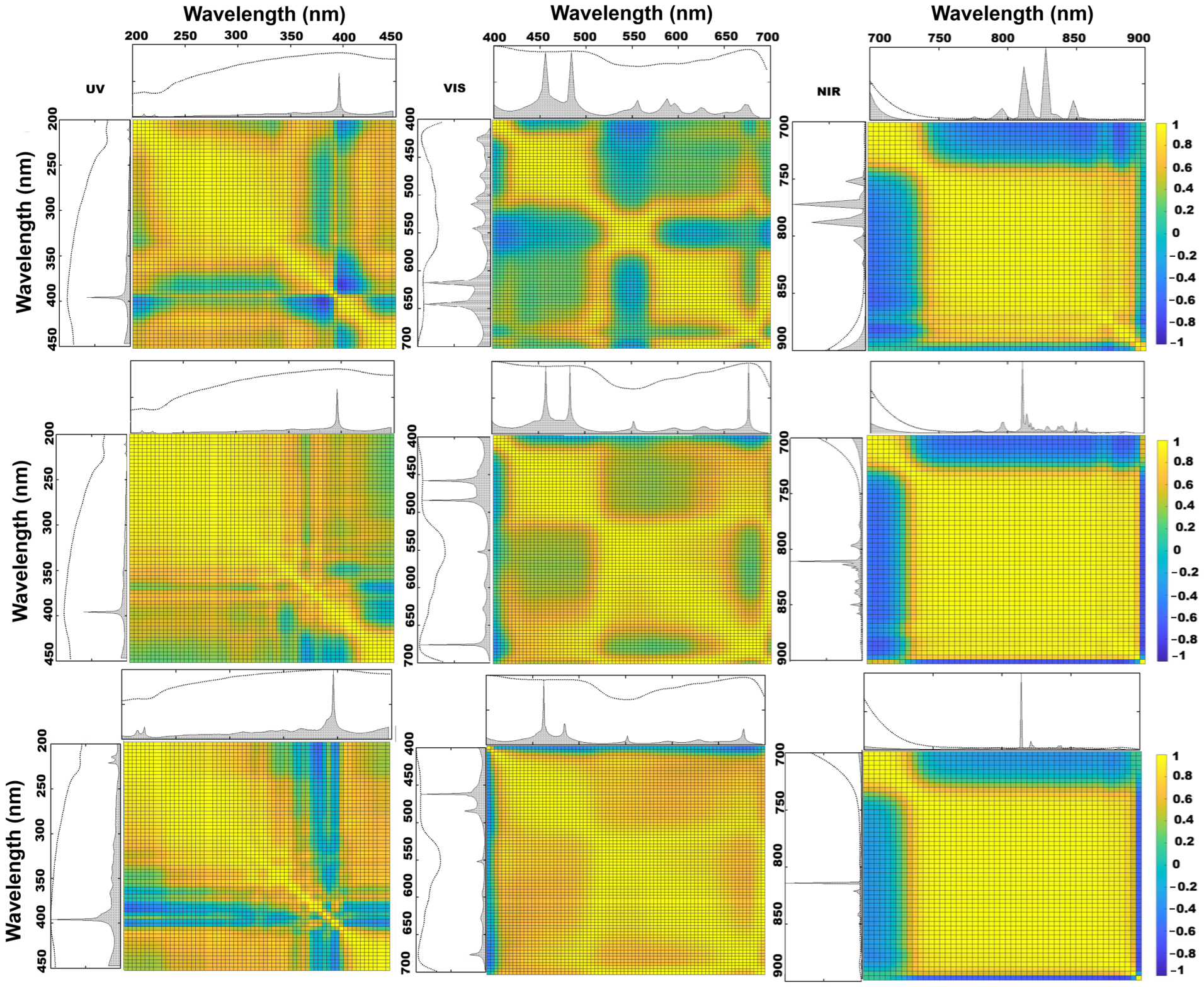
Figure 4 shows the correlation maps for young, intermediate, and mature leaves in the segmented spectral regions (UV, VIS, and NIR). Generally, a high correlation is observed between adjacent bands in all leaf stages, showing the typical spectral continuity of plant tissues. However, there is a spatial distribution of low correlation zones coinciding with characteristic regions of maximum absorption and reflectance in each spectral segment.
  • UV Region: A moderate correlation was identified between 350–370 nm (flavonoids; a4′) and 200–230 nm (simple phenols; a1), with r   0.5–0.6. The variability in these bands coincides with the increase in phenolic compounds, which is consistent with lignification pathways and secondary metabolite synthesis [96]. With ontogenetic development, the correlation increased in intermediate leaves and reversed in mature leaves ( r     0.3 ), which is consistent with the structural consolidation and optical coupling described in mature leaves [97]. Finally, a strong and negative correlation was observed between 380–395 nm (a5) and 200–230 nm (a1) in young leaves ( r   =   0.8   t o   1.0 ). This decoupling gradually disappeared towards intermediate and mature stages, indicating a process of optical homogenization possibly associated with the integration of pigments and cellular structures [97].
  • VIS Region: This region exhibits marked negative correlations between 550 nm (minimum photosynthetic absorption; b5) and 590 nm (weak absorption of chlorophyll b, b6) ( r     0.8 ), as well as with 420 nm (blue absorption of carotenes and chlorophyll a) ( r = 0.9 ). This behavior reflects a relatively low concentration of chlorophylls in early stages, and a greater influence of carotenoids and phenolic compounds. The above is consistent with the inversion of the correlation as a sign of increased codependence and optical homogeneity during maturation, which is a behavior consistent with the transition to states of greater photosynthetic activity [98].
  • NIR Region: The correlation patterns observed in this region were very similar between the maturation stages, with greater spectral decoupling in young leaves, especially between 700–740 nm (VIS-NIR transition region) and 740–900 nm (region of high structural dispersion), suggesting less structural integration and greater anatomical heterogeneity.

3.4.2. Comparison Between Ontogenetic Groups, Differential Correlation ( r ) and Statistical Significance Using Permutations in UV-VIS-NIR

The observed correlation variation values ( Δ r o b s ) showed differences in the different spectral regions analyzed. The areas of greatest divergence between age groups are shown in Table 4. As Δ r o b s and the maximum difference obtained by permutation ( Δ r p e r m m a x ) are compared, it is seen that several pairs of bands present statistically significant spectral reorganizations ( p < 0.05 or p < 0.01 ), indicating that the Δ r o b s values are significantly greater than the Δ r values obtained from 1000 random permutations of the samples between the compared groups. Therefore, it was confirmed that Δ r obs between ontogenetic groups are not attributable to random events.
In the UV region, the comparison between young and mature leaves shows the most marked differences between band pairs such as 212–360 nm and 212–396 nm, with significant decreases in Δ r o b s values (−0.89 and −1.01, respectively). This reduced optical codependence between band pairs is related to chromophore groups associated with flavonoids and phenolic compounds, which clearly aligns with the structural organization at maturity. This suggests that, in mature leaves, certain UV-absorbing compounds acquire less interdependent functions, consistent with their stable role in photoprotection. Conversely, other band pairs exhibit increased correlation, for example, 360–396 nm ( Δ r o b s = 0.85 ), indicating that these spectral responses, associated with flavonoids and more highly conjugated aromatic derivatives, may converge functionally at maturity.
On the other hand, the VIS region shows a very consistent pattern of spectral codependence, as all calculated Δ r values are positive, particularly among the bands associated with photosynthetic pigments (b2, b5, b6, and b10). The marked increases between 550–590 nm and 420–550 nm ( 0.70     Δ r     1.19 ) indicate that, as leaf development progresses, the bands related to absorption by chlorophylls (a and b) and carotenoids become progressively and coherently coupled with greater stability and homogeneity of the pigment composition.
Finally, in the NIR region, two clearly differentiated patterns are observed: a decrease in correlation at 700–730 nm (Young vs. Intermediate: Δ r   =   0.82 , Young vs. Mature: Δ r   =   0.30 ), and an increase in correlation at 732–860 nm and 876–896 nm (Young vs. Intermediate: Δ r   =   0.77 and 0.97 , Young vs. Mature: Δ r   =   0.70 and 0.79 ). This indicates that the electronic transition phenomena explained by the NIR slope tend to decouple from the rest as leaf development occurs. Furthermore, this behavior is consistent with the initial structural adjustments of the tissue, including those related to cell thickness, parenchyma compaction, and mesophyll reorganization. Therefore, the increase in collinearity between 732 and 900 nm reflects the transition from a disaggregated and heterogeneous cellular structure to a more compact and stable leaf architecture.

3.5. Evaluation of the Variability Associated with the Ontogeny of Leaf Tissue Spectral Indices Derived from UV-VIS-NIR (ANOVA and Kruskal–Wallis)

FEDS-Based UV-VIS-NIR Spectral Indices

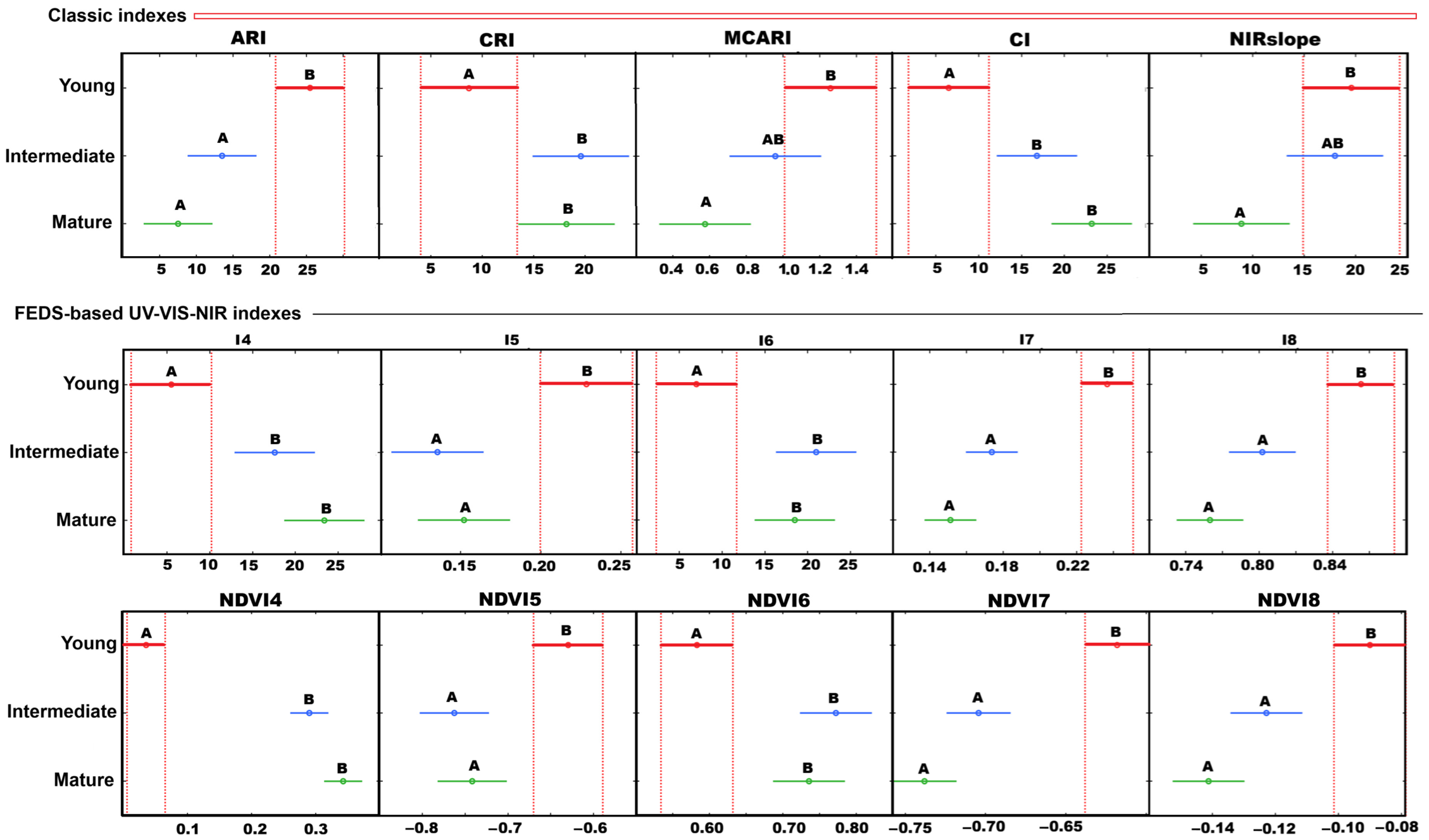
Table 5 shows the results for the ANOVA and Kruskal–Wallis statistical evaluation of all indices included in the study. For each index, the table shows compliance with the normality test (Shapiro–Wilk test), homogeneity of variance (Levene’s test), and the type of analysis of variance used. It also shows the overall p-value obtained and its interpretation in terms of the statistical difference between the types of ontogenies. Overall, the findings indicate that, among the classical indices evaluated, only ARI, CRI, MCARI, CI, and the NIR slope exhibited genuine sensitivity to ontogeny within the examined dataset.
These indices share the common feature of employing relationships between visible and near-infrared (NIR) bands that emphasize specific pigmentary variations during leaf development. Consistent with this, the FEDS-based UV-VIS-NIR indices that showed real sensitivity to ontogenetic change were the I4–I8 and NDVI4-NDVI8, which correspond to the ratio between the maximum reflectance and their respective normalized differences. The indices that showed sensitivity to ontogenetic gradients are clearly related to the absorption and reflection of photosynthetic pigments (b1b10), while the NDVI, SIPI, SR, and NDWI indices, as well as those defined in the UV region (I1–I3 and NDVI1-NDVI3), showed low sensitivity to ontogenetic changes, suggesting a reduced capacity to capture gradual physiological transitions characteristic of leaf development within analyzed dataset.
In particular, the classic ARI, CRI, and CI indexes allow for the statistical differentiation of the means associated with young leaves (see Figure 5). Physiologically, this behavior is consistent in the case of cassava, which is characterized by high concentrations of anthocyanins and low concentrations of carotenoids and chlorophylls in early stages of leaf development [99,100].
Regarding MCARI, a progressive decrease in the index is observed in mature leaves, with young (B) and mature (A) ontogenies being clearly differentiated, while the spectral response of intermediate leaves overlaps with both groups (AB). This behavior reflects the simultaneous interaction of multiple photosynthetic pigments. In young leaves, the high anthocyanin content and lower effective absorption in the red region intensify the spectral contrast between the b5 band (~550 nm) and the red edge (~700 nm), which explains the higher magnitude of the index in young leaves. As the leaf matures and the chlorophyll content stabilizes, this contrast attenuates, resulting in a decrease in the index. In contrast, the NIR slope exhibits a distinct clustering pattern, wherein mature leaves display spectral responses that are distinguishable from those of intermediate and young leaves. This behavior reflects the structural evolution of cassava foliar tissue, particularly the increase in leaf thickness and multiple dispersal driven by the structural reorganization associated with maturity.
Regarding the experimental indexes obtained for the UV-VIS-NIR region (I4-I8), clustering patterns are observed that confirm the high spectral sensitivity to pigmentary changes in young leaves, while intermediate and mature leaves tend to cluster together. In terms of magnitude, it is observed that for I4-I8, young leaves exhibit extreme values (maximum or minimum), suggesting a strong dependence on bands dominated by pigment absorption in the visible spectrum.
The normalized difference indices (NDVI4-NDVI8) exhibit the same general pattern as their ratio-based equivalents, but with greater separations between the means, resulting in more robust discrimination of young leaves. This is mathematically consistent with the enhancing effect of normalization on the relative contrast between the bands. From a chemical and physiological perspective, this indicates that the UV-VIS-NIR indexes derived from FEDS are dominated by bands sensitive to pigment composition, primarily anthocyanins, carotenoids, and chlorophylls, which is consistent with the results shown for the classical indexes. Similarly, the high sensitivity of these indexes for the discrimination of young leaves indicates that the spectral signature in early stages of leaf tissue is dominated by high absorbance in the visible and signals in the NIR limited by a leaf structure that is not fully developed; however, as ontogeny progresses, the pigment balance stabilizes (reflected in a low sensitivity for the discrimination of intermediate and mature leaves) and the VIS-NIR spectral contrast captured by these indexes decreases.

3.6. Analysis of the Temporal Dynamics of Spectral Indices Through Induced Leaf Degradation Experiments

In this study, temporal analysis was employed as an experimental strategy to identify spectral indices with a high capacity for detecting senescence processes, evaluating their relevance as spectral indicators of tissue degradation. Given that the measurements were performed under highly controlled lighting, interaction, and noise conditions, they provide a controlled experimental framework for evaluating the sensitivity of spectral indices to progressive tissue degradation.
Therefore, the identified spectral responses should be interpreted as indicators of changes in leaf optical properties associated with senescence processes rather than direct proxies of whole-plant physiological status. Future studies should evaluate the transferability of these spectral markers to in situ monitoring applications using attached leaves and canopy-level observations.
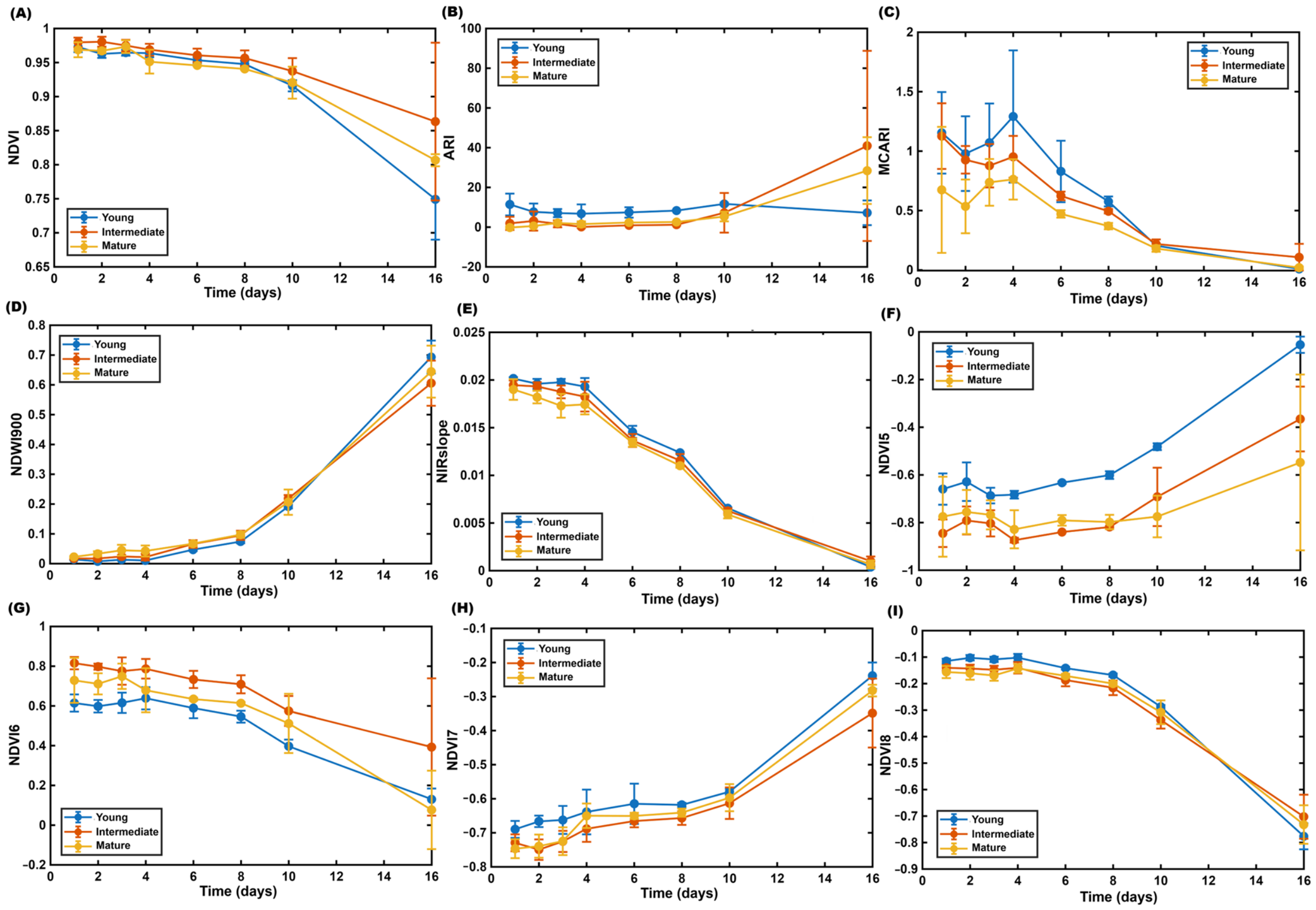
Figure 6 shows the temporal evolution of the UV-VIS-NIR indices, respectively, which exhibited the most significant changes over the observation period. In this context, representative indices are those that showed clear temporal trends and/or that displayed visible ontogenetic differences between young, intermediate, and mature leaves during storage. This allowed for the observation of defined temporal trajectories with distinct ontogenetic patterns, which are detailed below:

3.6.1. Structural and General Vigor Indices (NDVI and MCARI)

The NDVI showed a progressively decreasing trend in all three ontogenies, with values ranging between 0.95 and 1.0 during the first 10 days of observation, indicating high absorption in the red region and high reflectance in the NIR. It demonstrated persistent optical properties related both to the absence of pigment degradation and the maintenance of mesophyll structural integrity. Between days 15 and 20, the decreasing trend became more pronounced, resulting in less spectral contrast between the absorption band in the red and the reflectance in the NIR. This is explained by chlorophyll degradation, structural collapse, and alterations in water-related optical properties (38).
Although the overall trend was similar for all three developmental stages, young leaves exhibited greater susceptibility to tissue degradation. This can be explained by their initial morphostructural characteristics, since, possessing thinner cell walls and less accumulation of structural and protective components, such as cuticle, waxes, and less lignification, young leaves are more susceptible to dehydration, pigment oxidation, and structural alterations.
In the case of MCARI, compared to NDVI, a similar temporal dynamic was observed, but with greater sensitivity to early stages of degradation, making it possible to detect noticeable changes in spectral contrast after day 4. Therefore, it is concluded that MCARI responds more efficiently to pigmentary or structural changes. In particular, MCARI incorporates red-centered bands like NDVI, but it also extracts information from the green region (≈550 nm) and the red edge (≈700 nm), encompassing not only the region of maximum chlorophyll absorption, but also the region of minimum absorption (maximum reflectance) and the transition region between the chemical absorption domain and the structural scattering domain of the tissue (NIR edge).

3.6.2. Water and Structural Integrity Indices (NDWI900, NWI, NIRslope)

The NDWI900 and NWI exhibited very similar trends. These were expressed as a gradual and consistent increase across all three ontogenies, consistent with spectral changes commonly associated with progressive water loss and alterations in the absorption–scattering balance within the NIR region (38). Such spectral behavior is commonly attributed to reduced absorption by O–H bond overtones associated with water molecules, particularly around 970 nm. This results in slight increases in reflectance near 900 nm compared to other shorter wavelength regions in the NIR (700–800 nm). The equivalent temporal trend across the three ontogenic states suggests that the dehydration process is transversal and similarly affects the spectral response of these indexes (low ontogenic sensitivity).
Similarly, the NIRslope showed a consistent decrease across all three ontogenetic stages, demonstrating its high sensitivity to structural changes in the mesophyll. Its behavior clearly indicates that some structural degradation effects, invisible in other spectral bands or indexes, can be detected in early postharvest stages. The sample shows a drop in slope starting on the third and fourth day, followed by a sustained decrease until the end of the monitoring period, indicating the continuous deterioration of the leaf tissue microstructure. This behavior confirms that the NIRslope is a particularly sensitive indicator for the early detection of subtle structural alterations with low dependence on leaf ontogeny.

3.6.3. FEDS-Based UV-VIS-NIR Indices (NDVI5, NDVI6, NDVI7, NDVI8)

The indices derived from the UV-VIS-NIR regions through FEDS signal selection showed defined ontogenetic patterns and heterogeneous temporal trends, especially the normalized indexes.
NDVI5 showed a progressive increase starting on day 4, which was particularly marked and distinguishable for young leaves, demonstrating sensitivity to early changes in leaf tissue. This sensitivity can be understood by considering that the index uses the normalized mathematical relationship between b2 (maximum carotenoid absorption ≈ 440 nm) and the b5 band (minimum photosynthetic pigment absorption ≈ 550 nm). For short time periods, the high concentration of carotenoids and chlorophylls in the leaves favors intense absorption in b2 (low reflectance), thus maintaining relatively low values for the index. However, as senescence progresses, carotenoids tend to degrade prematurely in response to oxidative stress due to their highly unsaturated chemical nature and antioxidant role, whereas chlorophylls remain relatively stable for a longer period. Consequently, absorption efficiency in the carotenoid-associated region decreases, while reflectance in the reference band remains stable, which is reflected in a progressive increase in the index. This phenomenon further elucidates the discrepancies observed among young, intermediate, and mature leaves. Since the concentration of carotenoids is typically low in young leaves, the index value shifts towards higher relative values.
In all three ontogenies, the NDVI6, NDVI7, and NDVI8 indexes showed moderate changes in the first few days of monitoring and a decreasing trend between days 10 and 20. This dynamic suggests that these descriptors capture information about degradation processes related to chlorophyll degradation. Spectrally, NDVI6 is calculated from the normalized difference between the band of minimum pigment absorption (b5) and the red band centered at ~680 nm (b10), which corresponds to the maximum absorption of chlorophylls. Chlorophylls are characterized by high susceptibility to degradation in advanced postharvest stages; consequently, NDVI6 is reduced. On the other hand, the NDVI7 and NDVI8 indexes focus on extracting features associated with the red border and near-infrared (NIR) regions, respectively. The red rim is a region highly sensitive to combined changes in chlorophyll concentration and mesophyll structure. However, the late, nonlinear response of NDVI7 suggests that the progressive alteration of the reflectance gradient at the red edge becomes dominant only when the optical organization of the tissue is significantly compromised. In contrast, NIRslope responds earlier and more continuously to subtle structural changes in the mesophyll. This may be because NIRslope quantifies the absolute rate of change (slope at the red edge), thus extracting continuous variations in this region. Finally, since NDVI8 relates a red edge band to the NIR, it integrates pigmentary and structural information. The abrupt variations observed in later stages reflect a simultaneous reduction in pigment absorption and multiple scattering in the NIR during the advanced stages of monitoring.

3.7. Analysis of Spectral Variability in the Face of Ontogenetic and Temporal Factors Using Linear Mixed Models (LMMs) and Principal Component Analysis (PCA)

In this stage of the study, the objective was to identify which spectral indexes have the actual capacity to act as biomarkers of leaf degradation. To achieve this, the importance of each index was analyzed in isolation, and how its sensitivity is affected by its stage of maturity (ontogeny) and the passage of time was explored. Given the nature of the data, a sequential approach was chosen that integrates the accuracy of the LMMs with the overall view of the PCA.

3.7.1. Statistical Validation of Fixed Effects and Interactions Using LMMs

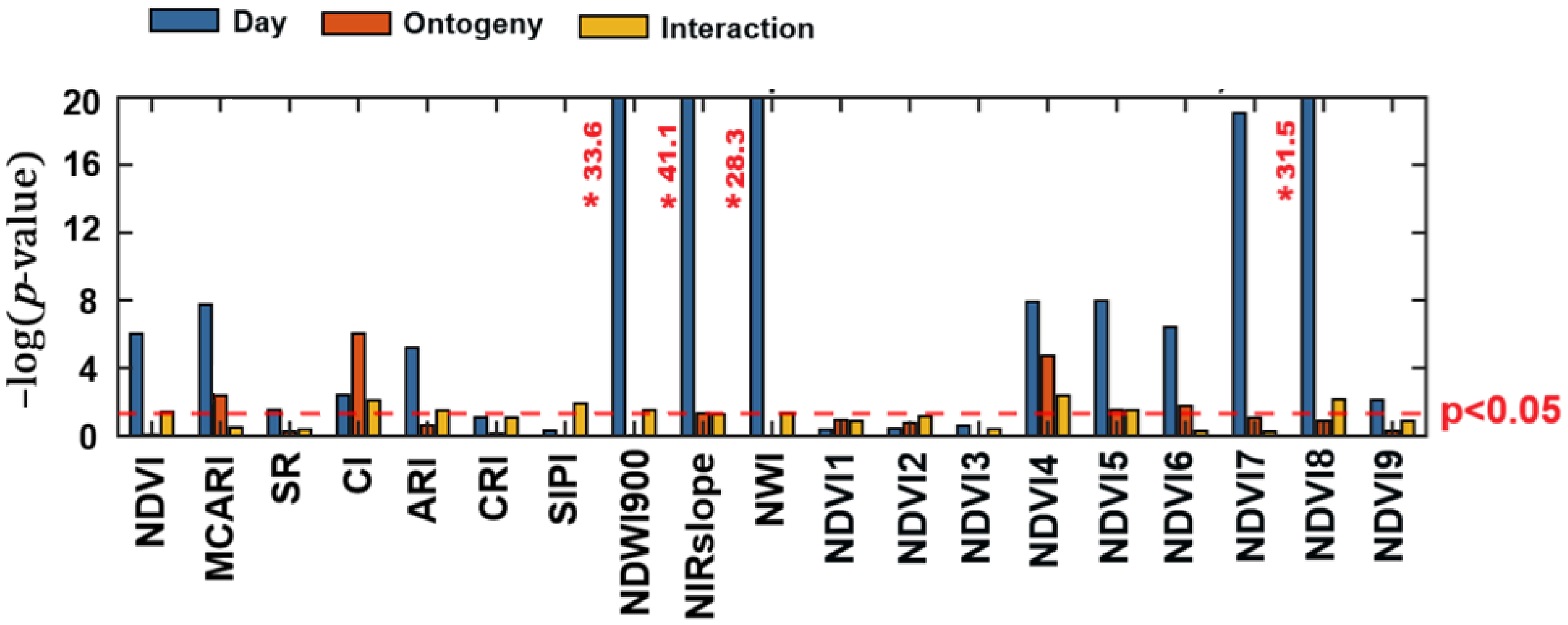
Figure 7 summarizes the statistical evaluation of the fixed effects “Day”, “Ontogeny”, and their interaction “Day × Ontogeny” on the entire set of spectral indexes, differentiated for each spectral region: UV-VIS-NIR.
In the UV-VIS-NIR region, a clear dominance of the temporal factor (Day) is observed over most of the indexes. NDWI900, NIRslope, NWI, NDVI7, and NDVI8 show values of l o g 10 ( p ) significantly exceed the p < 0.05 threshold, while the ontogenetic effect does not reach the significance threshold, and the “Day x Ontogeny” interaction generally shows low significance. This demonstrates that the sample exhibits a high sensitivity to temporal changes, with very little influence from its ripening state. This result confirms that the variability associated with these indexes is largely explained by the effect of time.
The chemical and spectral basis of this behavior is clearly defined by the nature of the NIR bands in these indexes. Specifically, the contrast between the red border (pigment-dispersive transition zone ≈ 700–740 nm) and wavelengths between 800 and 900 nm is dominated by multiple scattering and water absorption processes. This suggests that these indices are highly sensitive to spectral variations associated with mesophyll organization and water-related optical properties in leaf tissue. This behavior is similar in leaves of different ages, which is crucial because it allows for the capture of signals dominated by tissue changes primarily associated with degradative effects rather than compositional differences related to ontogeny. This suggests a potential applicability of these indices for detecting spectral alterations associated with tissue deterioration and possibly other stress-related processes, although further validation under field conditions is required.

3.7.2. Multivariate Structure and Convergence Trajectories (PCA)

Thus, due to the nature of the bands and indices, the PCA has been discriminated against according to the UV-VIS-NIR spectral region:
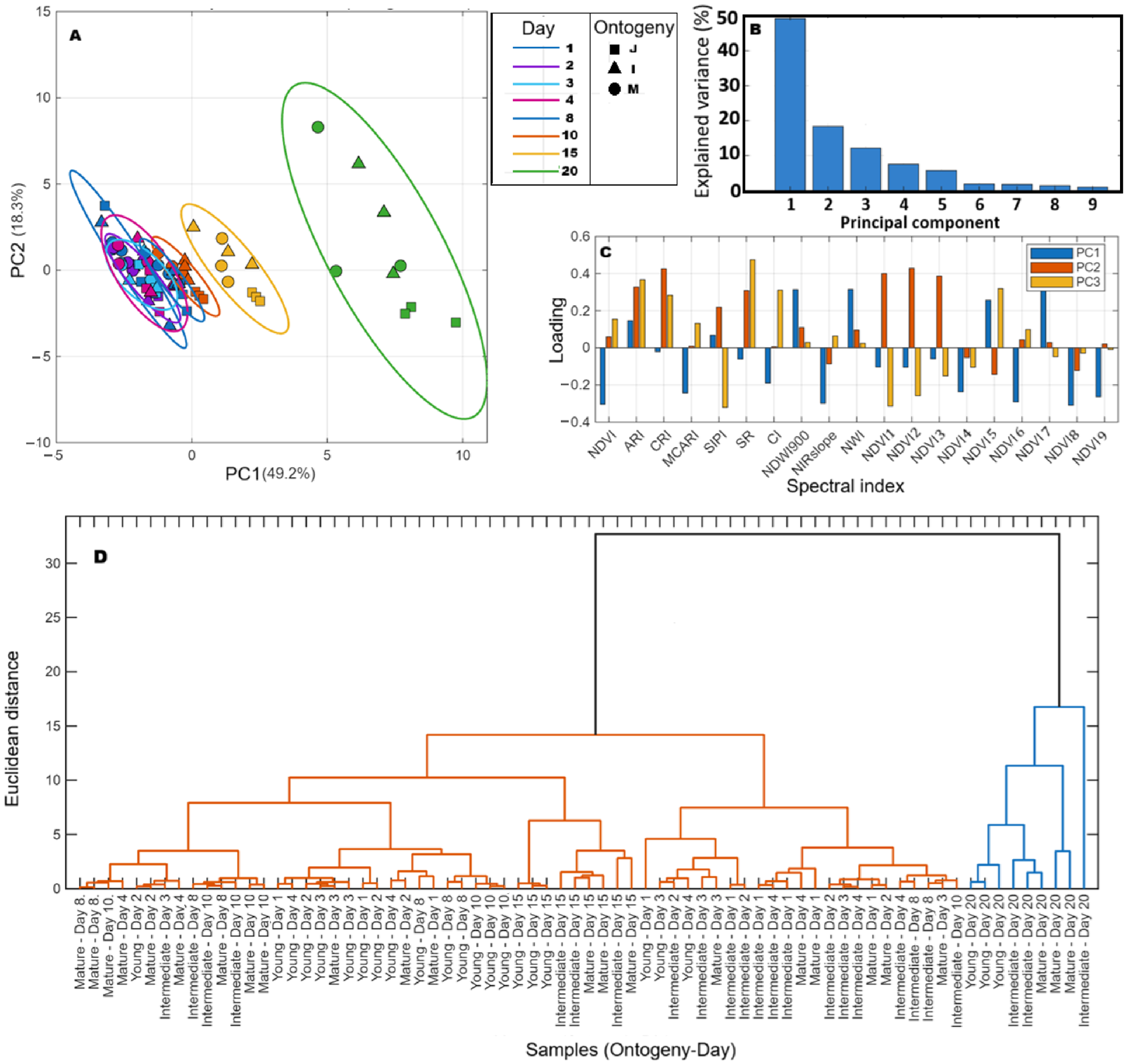
  • UV-VIS-NIR: Figure 8 shows the results obtained by PCA of the set of spectral indices using different representative graphs: Figure 8A shows the projections of the scores obtained between principal component 1 (PC1) and principal component 2 (PC2), Figure 8B shows the graph of variance explained (%) by each principal component, and Figure 8C shows the representation of the loadings, that is, the coefficients of the linear combination, whose magnitude and sign represent both the contribution and the direction of each of the variables in the multivariate space. Finally, Figure 8D shows the hierarchical clustering dendrogram obtained from the Euclidean distance between the centroids of the projections in the PC1-PC2 plane.
The results show that PC1 explains almost half of the total variance (49%), indicating a dominant axis that extracts most of the spectral information governing the system’s variability. This axis is interpreted consistently with the LMM results as a post-harvest temporal degradation gradient, as it clearly separates samples from later days from those from the first few days. In the PC1-PC2 projection of Figure 8A, the ordered progression of points along PC1 reflects that time acts as the main spectral change effect, reinforcing the dominance of the Day factor, which was previously observed for indexes such as NDWI900, NIRslope, NWI, NDVI7, and NDVI8. For its part, PC2, which explains 18% of the variance and introduces an additional differentiation; therefore, PC2 is not exclusively dominated by the temporal effect, but probably has contributions from the ontogenetic effect, showing partial groupings within the temporal groupings, mainly of young leaves.
The loading plot (Figure 8C) confirms that the spectral information associated with PC1 is primarily based on the variability of the NDWI900, NIRslope, NWI, NDVI7, and NDVI8 indices. According to the LMM, these indices are dominated by the temporal degradation effect and are particularly associated with the NIR region. PC2, on the other hand, shows contributions mainly from the ARI, CRI, SIPI, and SR indices, which are associated with reflectance bands sensitive to photosynthetic pigments and, therefore, with the biochemical composition and physiological state of the leaf tissue. Additionally, relevant contributions are observed from the UV-related indexes NDVI1, NDVI2, and NDVI3, whose spectral signal is strongly influenced by the presence of phenolic compounds and other secondary metabolites. While these latter indices do not show statistically significant effects according to the LMM, they exhibit substantial variability that contributes to PC2 within the multivariate space. This contribution suggests that, although their individual responses are not robust enough to discriminate against the Day or Ontogeny factors in isolation, they enhance the overall differentiation when evaluated in tandem with the other indices.
The hierarchical dendrogram in Figure 8D identifies a well-defined cluster, corresponding to the samples from day 20. These samples exhibit similar Euclidean distances among themselves and considerably large distances from the other groups. This behavior confirms that, in advanced stages of degradation, the spectral change is intense enough to generate a signature clearly distinguishable from the other samples, reinforcing the interpretation of PC1 as a dominant temporal degradation axis.
Additionally, within the large clusters dominated by the temporal factor, a partial sub-structuring associated with ontogeny is observed, particularly in the intermediate days, where young, intermediate, and mature leaves tend to form subgroups closer to each other. This reinforces the idea that ontogeny acts as a secondary effect that modulates the spectral response but does not replace the dominant role of degradation time.
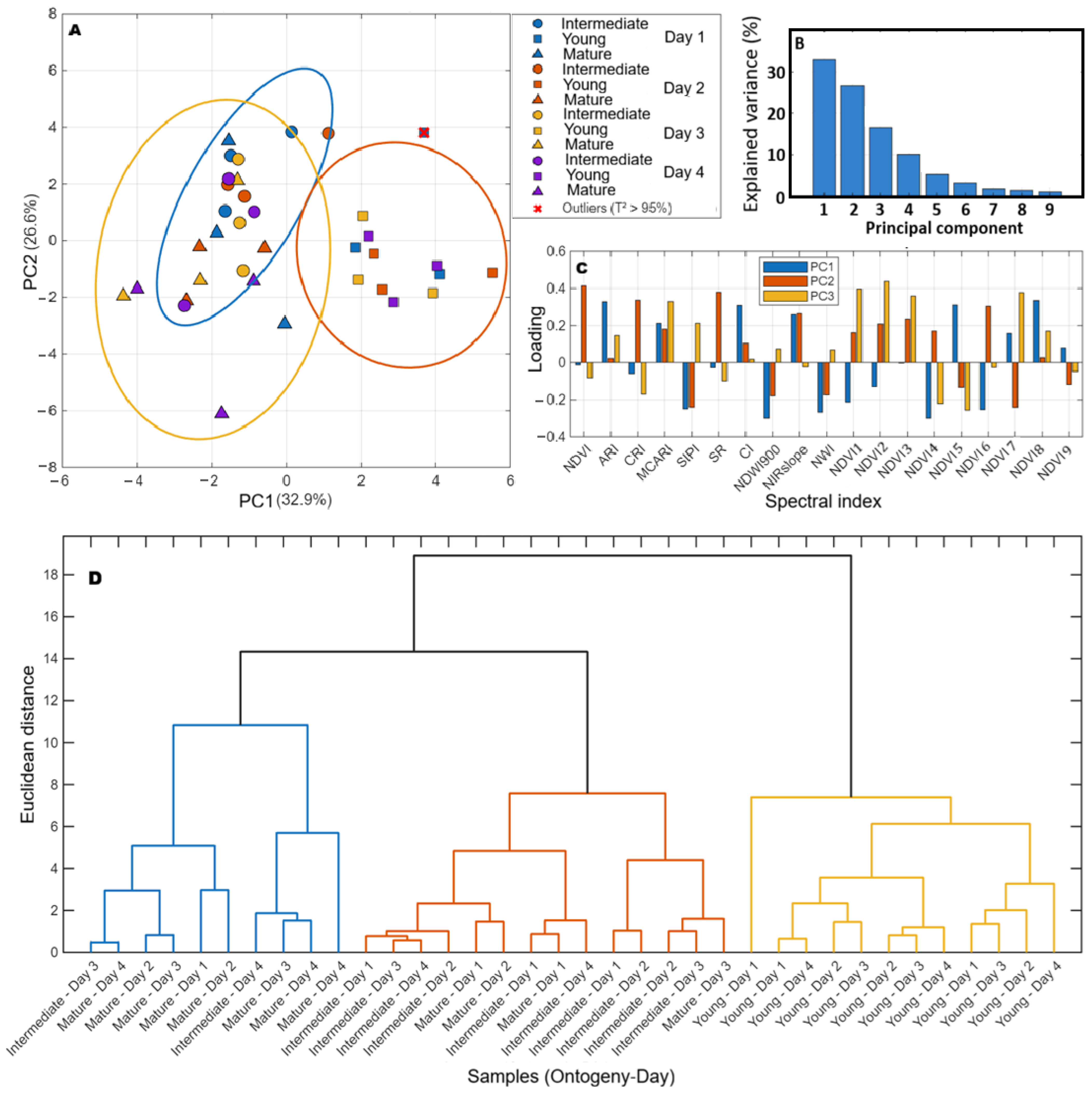
Figure 9 allows for a clearer identification of the convergent behavior of temporal degradation effects in multivariate space. In the PC1-PC2 projection (Figure 9A), corresponding only to the first four days post-harvest, a clear separation of the young leaves is observed. This arrangement indicates that, in the initial stages of degradation, spectral differences between leaves at different stages of development retain a greater influence than the temporal effect, and that the post-sampling deterioration process does not yet completely dominate the spectral variability.
Comparing both timescales reveals a shift in the hierarchy of variability. In the first 4 days, PC1 (32.9%) and PC2 (26.6%) reflect a balance of forces where the leaf’s biological identity still resists the advance of degradation (Figure 9B). This is particularly clear in the dendrogram (Figure 9D), where young leaves form a compact and isolated cluster, demonstrating a biochemical robustness that preserves their distinctive spectral signature against initial deterioration. However, the complete 20-day series reveals a clear spectral convergence. The passage of time acts as a “funnel” that dilutes the original ontogenetic differences; that is, no matter how young or mature the leaf was at the beginning, all samples end up sharing a unified senescence signature by day 20 (Figure 9D). Ultimately, structural collapse and spectral changes commonly associated with water loss (captured by indices such as NDWI900 and NIRslope) end up prevailing, unifying the optical response of the tissue in advanced stages of degradation.

4. Conclusions

Spectral characterization supported by FEDS deconvolution and comparative UV-VIS-NIR analysis enabled selective signal enhancement, leading to the robust identification of characteristic bands associated with both specific biochemical compounds and structural changes in leaf tissue. In particular, the absorption bands of phenolic compounds in the UV region were identified with high consistency, highlighting the consistent presence of signals a1 ≈ 210 nm and a2 ≈ 220 nm across all developmental stages. In the VIS region, the application of FEDS resolved the typical spectral overlap between chlorophylls, carotenoids, and accessory pigments, revealing clear differential patterns in the spectral signature of young leaves compared to intermediate and mature leaves, specifically in the b5, b6, and b7 bands between 550 and 610 nm.
Distinct spectral differences were observed between the adaxial and abaxial foliar surfaces in cassava. These variations showed no ontogenetic dependence, remaining reproducible across all developmental stages. The abaxial surface exhibited greater relative reflectance in UV-VIS-NIR due to greater internal scattering and a lower surface absorptive effect, while the adaxial surface showed a greater absorption, primarily due to the cuticular layer. Additionally, the comparison between intact leaf tissue and dry, powdered leaf material showed that the spectral response of leaf tissue is dominated by cellular microstructure and internal scattering. This distinction was most pronounced in the Vis-NIR transition zone, where powdered leaf material exhibited a substantial decrease in both transition slope and reflectance.
Results demonstrate that combining FEDS with multiregional UV-VIS-NIR analysis not only improves the resolution of overlapping bands but also allows for the conceptual separation of three levels of spectral information: (i) stable chemical signals associated with the phenolic and protein matrix, (ii) pigmentary rearrangements directly linked to ontogenetic development, and (iii) structural changes related to water-associated optical properties, internal microstructure, and cuticle maturation.
Multiregional correlational analysis based on Pearson coefficients confirmed that, in addition to modifying the intensity of some characteristic signals, leaf ontogeny influences the codependence between spectral domains in UV-VIS-NIR. In the VIS, the bands corresponding to chlorophylls and carotenoids showed a progressive increase in correlation between bands as the phenological development stages advanced, demonstrating optical homogeneity that may be associated with the increasingly complete establishment of the photosynthetic apparatus (while young leaves undergo transitional stages in pigment composition, mature leaves undergo stabilization processes). Similarly, an increase in correlation was identified in the NIR, primarily between 732 and 800 nm, revealing coherent stabilization effects on the internal microstructure of the leaf.
ANOVA/Kruskal–Wallis and post hoc tests allowed us to conclude that the FEDS-UV-VIS-NIR spectral indices such as ARI, CRI, CI, NDVI4, NDVI5, NDVI6, NDVI7, and NDVI8 have a greater discriminatory capacity for identifying young leaves, mainly due to the specific extraction of spectral information related to pigment composition. Meanwhile, the MCARI and NIRslope indexes, which, unlike the previous indexes, integrate red-edge bands (700–730 nm), showed discriminatory capacity for both young and mature leaves, with intermediate leaves overlapping in both groups. This is possibly related to the ability of these indexes to integrate spectral information linked to tissue structural properties.
The LMM and PCA models agree that indexes such as NDWI900, NIRslope, NWI, NDVI7, and NDVI8 are dominated by the temporal degradation effect, with minimal influence from ontogeny. This demonstrates that the NIR region is highly sensitive to progressive spectral changes associated with mesophyll organization and water-related optical properties, making it a robust marker of tissue degradation and, therefore, a key spectral region for detecting tissue deterioration and structural alterations associated with induced senescence processes. Multivariate analyses further revealed progressive convergence trajectories, indicating that prolonged storage gradually overrides the initial spectral differences associated with leaf developmental stage.

Supplementary Materials

The following supporting information can be downloaded at: https://www.mdpi.com/article/10.3390/agriengineering8060243/s1. Figure S1. Hierarchical structure of the experimental design and spectral sampling strategy. Figure S2. Multivariate analysis of UV–VIS spectra from 4- and 6-month sampling times (MDS). Table S1. Mannova results for PCA scores (PC1-PC4) comparing 4- and 6-months sampling times (MDS). Table S2. LMM: Global model fit and ANOVA summary for all spectral indices. Table S3. LMM: ANOVA marginal tests (Type III, residual df) for each spectral index.

Author Contributions

Conceptualization, M.P.; methodology, M.P., D.F.R. and EMC; investigation, data curation, writing—review and editing, M.P., D.F.R. and E.M.C.; supervision, M.P. and E.M.C.; and project administration, M.P.; funding acquisition, M.P. and D.F.R. All authors have read and agreed to the published version of the manuscript.

Funding

This research was funded by GENERAL ROYALTIES’ SYSTEM OF COLOMBIA (SGR/DNP/Mindtech), grant number BPIN 2020000100261, MINISTRY OF SCIENCE, TECHNOLOGY AND INNOVATION OF COLOMBIA (Minciencias), UNIVERSIDAD DEL VALLE and MINDTECH S.A.S., grant number MT-012025, C.I. 71408 (agreement MT-AFICAT-202501).

Institutional Review Board Statement

Not applicable.

Informed Consent Statement

Not applicable.

Data Availability Statement

Main data have been provided in this paper.

Acknowledgments

Authors thank the Ministry of Science, Technology and Innovation of Colombia, Universidad del Valle, and Mindtech s.a.s for the funds received.

Conflicts of Interest

Author Diego F. Restrepo was employed by the company Mindtech S.A.S. The authors declare that this study received funding from Mindtech S.A.S. The commercial funder was not involved in the study design, data collection, analysis, interpretation of data, the writing of this article, or the decision to submit it for publication. The remaining authors declare that the research was conducted in the absence of any other commercial or financial relationships that could be construed as a potential conflict of interest.

Abbreviations

The following abbreviations are used in this manuscript:
Acronyms
ARIanthocyanin reflectance index
ATRattenuated total reflectance
CIchlorophyll index
CRIcarotenoid reflectance index
FEDSfunctionally enhanced derivative spectroscopy
FNDIFEDS-based normalized differences index
FSRFEDS signal ratio
FT0-yunmodified UV-VIS spectra of intact leaf tissue
GNDVIgreen normalized difference vegetation index
HCAhierarchical cluster analysis
HSDhonestly significant difference
LMMslinear mixed models
MCARImodified chlorophyll absorption in reflectance index
NIRnear infrared
NIRslopespectral slope in the near-infrared region
NISDInear-infrared slope difference index
NDVInormalized difference vegetation index
NWInormalized water index
NDWI900normalized difference water index ~900 nm
PCAprincipal component analysis
PDM-ypowdered dry leaf tissue
SIPIstructure-insensitive pigment index
SRsimple ratio
UVultraviolet
VISvisible
Latin symbols
A * values of pseudo-absorbance
C i deconvolution coefficients
m number of points on each side of x
N o n t number of spectra describing ontogeny
p c number of plants
p d polynomial of degree
r Correlation coefficient
r 1,2 comparison of Pearson’s correlation coefficients for two datasets
P n FEDS intensity related to specific λ
R λ reflectance (with λ = wavelength)
R i F values of reflectance at wavelength selected by FEDS ( i = n   o r   m )
R m a x maximum reflectance
R m i n minimum reflectance
R N normalized reflectance
s number of analyzed surfaces
t 0 initial time
t k time ( k indicates the sampling days)
w j Gaussian weight
x central point in smoothing operations
y i * smoothed value
z number of phenological stages
Greek symbols
α degree of the root operating in P n
σ standard deviation of the Gaussian function
λ wavelength
Δ r 1,2 difference in the r 1,2 values
r differential correlation
Δ r o b s observed differential correlation
Δ r p e r m m a x maximum difference obtained by permutations of r

References

  1. Borku, A.W.; Tora, T.T.; Masha, M. Cassava in focus: A comprehensive literature review, its production, processing landscape, and multi-dimensional benefits to society. Food Chem. Adv. 2025, 7, 100945. [Google Scholar] [CrossRef]
  2. Adejumo, O.; Okoruwa, V.; Abass, A.; Salman, K. Post-harvest technology change in cassava processing: A choice paradigm. Sci. Afr. 2020, 7, e00276. [Google Scholar] [CrossRef]
  3. Dankwa, K.O.; Gimode, W.; Olasanmi, B. A review of global cassava (Manihot esculenta Crantz) production trends, post-harvest physiological deterioration (PPD) challenge, and control strategies. Discov. Food 2025, 5, 307. [Google Scholar] [CrossRef]
  4. Otálora, A.; Garces-Villegas, V.; Chamorro, A.; Palencia, M.; Combatt, E.M.; Mendoza, J.S. ‘Cassava, manioc or yuca’ (Manihot esculenta): An overview about its crop, economic aspects and nutritional relevance. J. Sci. Technol. Appl. 2024, 16, 1–10. [Google Scholar] [CrossRef]
  5. Otálora, A.; Garces-Villegas, V.; Chamorro, A.; Palencia, M.; Combatt, E.M.; Solorzano, A.C. ‘Cassava, manioc or yuca’ (Manihot esculenta): Agronomic aspects. J. Sci. Technol. Appl. 2024, 16, 1–10. [Google Scholar] [CrossRef]
  6. Canales, N.; Trujillo, M. The cassava value web and its potential for Colombia’s bioeconomy. In Stockholm Environment Institute; SEI: Oaks, PA, USA, 2023; pp. 1–16. [Google Scholar] [CrossRef]
  7. Chamorro, A.F.; Palencia, M.; Lerma, T.A. Physicochemical Characterization and Properties of Cassava Starch: A Review. Polymers 2025, 17, 1663. [Google Scholar] [CrossRef]
  8. Rosero, A.; Lenis, J.I.; León, R.; Araujo, H.; García, J.; Orozco, A.; Martínez, R.; Montes, M.; De la Ossa, V.; Cordero, C.; et al. Enhancing Year-Round Cassava Production and Processing in Colombia Through Varieties with Stable Root Dry Matter Content. Plants 2026, 15, 489. [Google Scholar] [CrossRef]
  9. Martines, D.G.; Feiden, A.; Bariccatti, R.; De Freitas Zara, K.R. Ethanol Production from Waste of Cassava Processing. Appl. Sci. 2018, 8, 2158. [Google Scholar] [CrossRef]
  10. García-Vallejo, M.C.; Cardona Alzate, C.A. Life cycle assessment of the cassava simplified value chain in Colombia and the use of cassava residues as energy carriers. Ind. Crops Prod. 2024, 210, 118135. [Google Scholar] [CrossRef]
  11. Martínez-Reina, A.M.; Araujo, H.; Regino, S.M.; Espitia, A.; Tordecilla, L.; Grandett, L.; Pérez, S.; Martínez, R.; Rosero, A. Farmers’ Typologies for the Construction of a Technological and Socioeconomic Baseline of Industrial Cassava Organizations to Guide Research, Production, and Policy Design in Colombian Caribbean Region. Agriculture 2025, 15, 488. [Google Scholar] [CrossRef]
  12. Phoncharoen, P.; Banterng, P.; Vorasoot, N.; Jogloy, S.; Theerakulpisut, P.; Hoogenboom, G. Identifying Suitable Genotypes for Different Cassava Production Environments-A Modeling Approach. Agronomy 2021, 11, 1372. [Google Scholar] [CrossRef]
  13. Yuanjit, P.; Vuttipongchaikij, S.; Wonnapinij, P.; Ceballos, H.; Kraichak, E.; Jompuk, C.; Kittipadakul, P. Evaluation of Yield Potential and Combining Ability in Thai Elite Cassava Varieties for Breeding Selection. Agronomy 2023, 13, 1546. [Google Scholar] [CrossRef]
  14. Anyaegbu, C.N.; Okpara, K.E.; Taweepreda, W.; Akeju, D.; Techato, K.; Onyeneke, R.U.; Poshyachinda, S.; Pongpiachan, S. Impact of Climate Change on Cassava Yield in Nigeria: An Autoregressive Distributed Lag Bound Approach. Agriculture 2023, 13, 80. [Google Scholar] [CrossRef]
  15. Weraikat, D.; Šorič, K.; Žagar, M.; Sokač, M. Data Analytics in Agriculture: Enhancing Decision-Making for Crop Yield Optimization and Sustainable Practices. Sustainability 2024, 16, 7331. [Google Scholar] [CrossRef]
  16. Chergui, N.; Kechadi, M. Data analytics for crop management: A big data view. J. Big Data 2022, 9, 123. [Google Scholar] [CrossRef]
  17. Cao, H.; Zhao, R.; Xia, L.; Wu, S.; Yang, P. Trends in crop yield estimation via data assimilation based on multi-interdisciplinary analysis. Field Crops Res. 2025, 322, 109745. [Google Scholar] [CrossRef]
  18. Bist, D.R.; Chapagaee, P.; Kunwar, A.; Khatri, L. The role of big data in sustainable agriculture: Advancing environmental sustainability in precision farming systems. Cogent Food Agric. 2026, 12, 2620180. [Google Scholar] [CrossRef]
  19. Cravero, A.; Sepúlveda, S.; Gutiérrez, F.; Muñoz, L. From Precision Agriculture to Intelligent Agricultural Ecosystems: A Systematic Review of Machine Learning and Big Data Applications. Agronomy 2026, 16, 516. [Google Scholar] [CrossRef]
  20. Ahmed, N.; Shakoor, N. Advancing agriculture through IoT, Big Data, and AI: A review of smart technologies enabling sustainability. Smart Agric. Technol. 2025, 10, 100848. [Google Scholar] [CrossRef]
  21. Ram, B.G.; Oduor, P.; Igathinathane, C.; Howatt, K.; Sun, X. A systematic review of hyperspectral imaging in precision agriculture: Analysis of its current state and future prospects. Comput. Electron. Agric. 2024, 222, 109037. [Google Scholar] [CrossRef]
  22. Faizan Ali, F.; Razzaq, A.; Tariq, W.; Hameed, A.; Rehman, A.; Razzaq, K.; Sarfraz, S.; Rajput, N.A.; Zaki, H.E.M.; Ondrasek, G. Spectral Intelligence: AI-Driven Hyperspectral Imaging for Agricultural and Ecosystem Applications. Agronomy 2024, 14, 2260. [Google Scholar] [CrossRef]
  23. Bhargava, A.; Sachdeva, A.; Sharma, K.; Alsharif, M.H.; Uthansakul, P.; Uthansakul, M. Hyperspectral imaging and its applications: A review. Heliyon 2024, 10, e33208. [Google Scholar] [CrossRef]
  24. Hadiwijaya, Y.; Putri, I.I. Spectroscopy in food and agriculture: A critical review of applications and adoption challenges. Food Humanit. 2025, 5, 100800. [Google Scholar] [CrossRef]
  25. Zhang, Q.; Luan, R.; Wang, M.; Zhang, J.; Yu, F.; Ping, Y.; Qiu, L. Research Progress of Spectral Imaging Techniques in Plant Phenotype Studies. Plants 2024, 13, 3088. [Google Scholar] [CrossRef]
  26. Shoaib, M.; Khan, S.U.; AbdelHameed, H.; Qahmash, A. Plant stress detection using multimodal imaging and machine learning: From leaf spectra to smartphone applications. Front. Plant Sci. 2026, 16, 1670593. [Google Scholar] [CrossRef]
  27. Dai, T.; Chen, J.; Liu, H.; Liu, L.; Fan, S.; Bai, X.; Qian, L.; Liu, H.; Ba, Y. Qiongda Research on the potential of reconstructing spectral indices and dividing crop growth stages based on satellite remote sensing for monitoring soil moisture in farmland. Comput. Electron. Agric. 2025, 239, 110943. [Google Scholar] [CrossRef]
  28. Anderegg, J.; Yu, K.; Aasen, H.; Walter, A.; Liebisch, F.; Hund, A. Spectral Vegetation Indices to Track Senescence Dynamics in Diverse Wheat Germplasm. Front. Plant Sci. 2020, 10, 749. [Google Scholar] [CrossRef]
  29. Lata, K.; Arora, M.; Kaur, N. Spectral Discrimination of Crop Types Based on Hyperspectral Sensor. Eng. Proc. 2024, 82, 107. [Google Scholar] [CrossRef]
  30. Estrada, F.; Flezas, J.; Araus, J.L.; Mora-Poblete, F.; Gonzalez-Talice, J.; Castillo, D.; Matus, I.A.; Méndez-Expinoza, A.M.; Garriga, M.; Araya-Riquelme, C.; et al. Exploring plant responses to abiotic stress by contrasting spectral signature changes. Front. Plant Sci. 2023, 13, 1026323. [Google Scholar] [CrossRef] [PubMed]
  31. El Azizi, S.; Taia, H.; Bernoussi, A.S.; Amharref, M.; Wozniak, E. A spectral signature-based algorithm for the identifiability of crops and their cultivation conditions. Res. Agric. Eng. 2026, 72, 56–59. [Google Scholar] [CrossRef]
  32. Revelo Luna, D.; Mejía Manzano, J.; Montoya-Bonilla, B.P.; Hoyos García, J. Analysis of the Vegetation Indices NDVI, GNDVI, and NDRE for the Characterization of Coffee Crops (Coffea arabica). Ing. Desarro. 2020, 38, 298–312. [Google Scholar] [CrossRef]
  33. Nitu, A.; Florea, C.; Ivanovici, M.; Racoviteanu, A. NDVI and Beyond: Vegetation Indices as Features for Crop Recognition and Segmentation in Hyperspectral Data. Sensors 2025, 25, 3817. [Google Scholar] [CrossRef]
  34. Vera-Esmeraldas, A.; Pizarro-Oteíza, S.; Labbé, M.; Rojo, F.; Salazar, F. UAV-Based Spectral and Thermal Indices in Precision Viticulture: A Review of NDVI, NDRE, SAVI, GNDVI, and CWSI. Agronomy 2025, 15, 2569. [Google Scholar] [CrossRef]
  35. Marek Bednář, M.; Šarapatka, B.; Netopil, P.; Zeidler, M.; Hanousek, T.; Homolová, L. The Use of Spectral Indices to Recognize Waterlogged Agricultural Land in South Moravia. Czech Republic. Agriculture 2023, 13, 287. [Google Scholar] [CrossRef]
  36. Kokhan, S.; Vostokov, A. Using Vegetative Indices to Quantify Agricultural Crop Characteristics. J. Ecol. Eng. 2020, 21, 120–127. [Google Scholar] [CrossRef]
  37. Song, G.; Wang, Q.; Jin, J. Estimation of leaf photosynthetic capacity parameters using spectral indices developed from fractional-order derivatives. Comput. Electron. Agric. 2023, 212, 108068. [Google Scholar] [CrossRef]
  38. Ji, J.; Lu, X.; Ma, H.; Jin, X.; Jiang, S.; Cui, H.; Lu, X.; Yang, Y. Estimation of plant leaf water content based on spectroscopy. Front. Plant Sci. 2025, 16, 1609650. [Google Scholar] [CrossRef]
  39. Gamon, J.A.; Surfus, J.S. Assessing leaf pigment content and activity with a reflectometer. New Phytol. 1999, 143, 105–117. [Google Scholar] [CrossRef]
  40. Gitelson, A.A.; Zur, Y.; Chivkunova, O.B.; Merzlyak, M.N. Assessing carotenoid content in plant leaves with reflectance spectroscopy. Photochem. Photobiol. 2007, 75, 272–281. [Google Scholar] [CrossRef]
  41. Khanal, S.; Kushal, K.C.; Fulton, J.P.; Shearer, S.; Ozkan, E. Remote Sensing in Agriculture-Accomplishments, Limitations, and Opportunities. Remote Sens. 2020, 12, 3783. [Google Scholar] [CrossRef]
  42. Paz Pellat, F.; Romero Sanchez, M.E.; Palacios Velez, E.; Bolaños Gonzalez, M.; Valdez Lazalde, J.R.; Aldrete, A. Scopes and limitations of spectral vegetation indexes: Analysis of broad band indexes. Rev. Terra Latinoam. 2015, 33, 27–49. [Google Scholar]
  43. Rana, S.; Gerbino, S.; Carillo, P. Study of spectral overlap and heterogeneity in agriculture based on soft classification techniques. MethodsX 2024, 14, 103114. [Google Scholar] [CrossRef]
  44. Mingrone, M.; Seracini, M.; Cevoli, C. Spectral Reconstruction Applied in Precision Agriculture: On-Field Solutions. Appl. Sci. 2025, 15, 10985. [Google Scholar] [CrossRef]
  45. Steidle Neto, A.J.; Lopes, D.C.; Pinto, F.A.C.; Zolnier, S. Vis/NIR spectroscopy and chemometrics for non-destructive estimation of water and chlorophyll status in sunflower leaves. Biosyst. Eng. 2017, 155, 124–133. [Google Scholar] [CrossRef]
  46. Zhang, Y.; Han, X.; Yang, J. Selection of optimal spectral features for leaf chlorophyll content estimation. Sci. Rep. 2024, 14, 25598. [Google Scholar] [CrossRef] [PubMed]
  47. Ramírez-Rincón, J.A.; Palencia, M.; Combatt, E. Prediction of pH, organic carbon content and effective cation exchange capacity through optical characterization of agricultural soils by near infrared multispectral images. J. Sci. Technol. Appl. 2021, 11, 4–12. [Google Scholar] [CrossRef]
  48. Ramírez-Rincón, J.A.; Palencia, M.; Combatt, E. Separation of optical properties for multicomponent samples and determination of spectral similarity indices on FEDS0 algorithm. Mat. Today Commun. 2022, 33, 104528. [Google Scholar] [CrossRef]
  49. Palencia, M. Functional transformation of Fourier-transform mid-infrared spectrum for improving spectral specificity by simple algorithm based on wavelet-like functions. J. Adv. Res. 2018, 14, 53–62. [Google Scholar] [CrossRef] [PubMed]
  50. Palencia, M. Deconvolution of IR Spectra by Functionally-Enhanced Derivative Spectroscopy (FEDS): Why Does It Work? J. Sci. Technol. Appl. 2020, 9, 18–28. [Google Scholar] [CrossRef]
  51. Anaya-Tatis, L.A.; Libreros, K.H.; Palencia, V.J.; Atencio, V.J.; Palencia, M. Mid-infrared spectral characterization of fish scales: “Bocachico” (Prochilodus magdalenae) by functionally-enhanced derivative spectroscopy (FEDS)—A methodological approach. J. Sci. Technol. Appl. 2019, 6, 28–39. [Google Scholar] [CrossRef]
  52. Gomez-Heredia, C.L.; Lerma-Henao, T.A.; Palencia, M. Building of mid-infrared spectral signature of pesticides using functionally-enhanced derivative spectroscopy (FEDS). Infrared Phys. Technol. 2023, 131, 104631. [Google Scholar] [CrossRef]
  53. Institute of Hydrology, Meteorology and Environmental Studies (IDEAM). Available online: http://dhime.ideam.gov.co/webgis/home/ (accessed on 10 January 2026).
  54. Luna, J.; Dufou, D.; Tran, T.; Pizarro, M.; Calle, F.; García Domínguez, M.; Hurtado, I.M.; Sánchez, T.; Ceballos, H. Post-harvest physiological deterioration in several cassava genotypes over sequential harvests and effect of pruning prior to harvest. Int. J. Food Sci. Technol. 2020, 56, 1322–1332. [Google Scholar] [CrossRef]
  55. Ipaz Cuastumal, C.M.; Madero Morales, E.; Ramírez Náder, M.; Gómez Carabalí, A. Cassava Forage Production (HMC-1) in an Entic Haplustol whit different moisture. Acta Agronómica 2010, 59, 170–179. [Google Scholar]
  56. Raju, M.H.; Friedman, L.; Bouman, T.M.; Komogortsev, O.V. Filtering Eye-Tracking Data From an EyeLink 1000: Comparing Heuristic, Savitzky-Golay, IIR and FIR Digital Filters. J. Eye Mov. Res. 2021, 14, 17. [Google Scholar] [CrossRef] [PubMed]
  57. Schmid, M.; Rath, D.; Diebold, U. Why and How Savitzky–Golay Filters Should Be Replaced. ACS Meas. Sci. Au 2022, 2, 185–196. [Google Scholar] [CrossRef]
  58. Rinnan, A.; van den Berg, F.; Balling Engelsen, S. Review of the most common pre-processing techniques for near-infrared spectra. Trends Anal. Chem. 2009, 28, 1201–1222. [Google Scholar] [CrossRef]
  59. Retzlaff, B.J.; Craig, A.R.; Owen, T.M.; Greer, B.D.; Donnell, A.O.; Fisher, W.W. Identifying Cyclical Patterns of Behavior Using a Moving-Average, Data-Smoothing Manipulation. Behav. Sci. 2024, 14, 1120. [Google Scholar] [CrossRef]
  60. Vestergaard, R.J.; Bhogilal Vasava, H.; Aspinall, D.; Chen, S.; Gillespie, A.; Adamchuck, V.; Biswas, A. Evaluation of Optimized Preprocessing and Modeling Algorithms for Prediction of Soil Properties Using VIS-NIR Spectroscopy. Sensors 2021, 21, 6745. [Google Scholar] [CrossRef]
  61. Gao, B.-C.; Liu, M. A Fast Smoothing Algorithm for Post-Processing of Surface Reflectance Spectra Retrieved from Airborne Imaging Spectrometer Data. Sensors 2013, 13, 13879–13891. [Google Scholar] [CrossRef]
  62. Mewada, H.; Al-Asad, J.F.; Almalki, F.A.; Khan, A.H.; Abdullah Almujally, N.; El-Nakla, S.; Naith, Q. Gaussian-Filtered High-Frequency-Feature Trained Optimized BiLSTM Network for Spoofed-Speech Classification. Sensors 2023, 23, 6637. [Google Scholar] [CrossRef]
  63. Rybakova, E.O.; Limonova, E.E.; Nikolaev, D.P. Fast Gaussian Filter Approximations Comparison on SIMD Computing Platforms. Appl. Sci. 2024, 14, 4664. [Google Scholar] [CrossRef]
  64. Mazdeyasna, S.; Shahriar Arefin, M.; Fales, A.; Leavesley, S.J.; Pfefer, T.J.; Wang, Q. Evaluating Normalization Methods for Robust Spectral Performance Assessments of Hyperspectral Imaging Cameras. Biosensors 2025, 15, 20. [Google Scholar] [CrossRef] [PubMed]
  65. Martinez-Vega, B.; Tkachenko, M.; Matkabi, M.; Ortega, S.; Fabelo, H.; Balea-Fernandez, F.; La Salvia, M.; Torti, E.; Leporati, F.; Callico, G.M.; et al. Evaluation of Preprocessing Methods on Independent Medical Hyperspectral Databases to Improve Analysis. Sensors 2022, 22, 8917. [Google Scholar] [CrossRef]
  66. Jacq, K.; Debret, M.; Fanget, B.; Coquin, D.; Sabatier, P.; Pignol, C.; Arnaud, F.; Perrette, Y. Theoretical Principles and Perspectives of Hyperspectral Imaging Applied to Sediment Core Analysis. Quaternary 2022, 5, 28. [Google Scholar] [CrossRef]
  67. Pandey, K.K.; Pitman, A.J. FTIR studies of the changes in wood chemistry following decay by brown-rot and white-rot fungi. Inter. Biodeterior. Biodegrad. 2003, 52, 151–160. [Google Scholar] [CrossRef]
  68. Barth, A. Infrared spectroscopy of proteins. Biochim. Biophys. Acta (BBA)-Bioenerg. 2007, 1767, 1073–1101. [Google Scholar] [CrossRef]
  69. Zhang, Y.; Wang, C.; Huang, J.; Wang, F.; Huang, R.; Lin, H.; Chen, F.; Wu, K. Exploring the Optical Properties of Leaf Photosynthetic and Photo-Protective Pigments In Vivo Based on the Separation of Spectral Overlapping. Remote Sens. 2020, 12, 3615. [Google Scholar] [CrossRef]
  70. Palencia, M. Functionally-Enhanced Derivative Spectroscopy (FEDS): A methodological approach. J. Sci. Technol. Appl. 2020, 9, 29–34. [Google Scholar] [CrossRef]
  71. Lindsey, J.S.; Taniguchi, M.; Du, H. PhotochemCAD TM. 1998–2026. Available online: https://photochemcad.com/ (accessed on 10 December 2025).
  72. Dixon, J.M.; Taniguchi, M.; Lindsey, J.S. PhotochemCAD 2: A refined program with accompanying spectral databases for photochemical calculations. Photochem. Photobiol. 2005, 81, 212–213. [Google Scholar] [CrossRef]
  73. Rahman, M.M.; Govindarajulu, Z. A modification of the test of Shapiro and Wilk for normality. J. Appl. Stat. 1997, 24, 219–236. [Google Scholar] [CrossRef]
  74. Arnastauskaite, J.; Ruzgas, T.; Brazenas, M. An Exhaustive Power Comparison of Normality Tests. Mathematics 2021, 9, 788. [Google Scholar] [CrossRef]
  75. Miller, J.N.; Miller, J.C.; Miller, R.D. Statistics and Chemometrics for Analytical Chemistry—Seventh Edition; Pearson: London, UK, 2018; p. 268. [Google Scholar]
  76. Hsu, J.C. Multiple Comparisons: Theory and Methods; Chapman & Hall/CRC: Boca Raton, FL, USA, 1996; p. 292. [Google Scholar]
  77. Kim, T.K. Understanding one-way ANOVA using conceptual figures. Korean J. Anesthesiol. 2017, 70, 22–26. [Google Scholar] [CrossRef] [PubMed]
  78. Bewick, V.; Cheek, L.; Ball, J. Statistics review 10: Further nonparametric methods. Crit. Care 2004, 8, 196–199. [Google Scholar] [CrossRef]
  79. Agbangba, C.E.; Aide, E.S.; Honfo, H.; Kakai, R.G. On the use of post-hoc tests in environmental and biological sciences: A critical review. Heliyon 2024, 10, e25131. [Google Scholar] [CrossRef]
  80. Liu, X. Chapter 3—Linear mixed-effects models. In Methods and Applications of Longitudinal Data Analysis; Academic Press: Cambridge, MA, USA, 2016; pp. 61–94. [Google Scholar] [CrossRef]
  81. Jolliffe, I.T.; Cadima, J. Principal component analysis: A review and recent developments. Philos. Trans. A. Math. Phys. Eng. Sci. 2016, 374, 20150202. [Google Scholar] [CrossRef]
  82. Tullis, T.; Albert, B. Chapter 9—Special topics. In Measuring the User Experience (Second Edition); Elsevier: Amsterdam, The Netherlands, 2013; pp. 209–236. [Google Scholar] [CrossRef]
  83. Aluker, N.L.; Lavrentieva, A.L.; Suzdaltseva, Y.M. Direct optical research methods in the analytics of phenol. Opt. Spectrosc. 2020, 128, 422–428. [Google Scholar] [CrossRef]
  84. Kaeswurm, J.A.H.; Scharinger, A.; Teipel, J.; Buchweitz, M. Absorption coefficients of phenolic structures in different solvents routinely used for experiments. Molecules 2021, 26, 4656. [Google Scholar] [CrossRef]
  85. Antosiewicz, J.M.; Shugar, D. UV–Vis spectroscopy of tyrosine side-groups in studies of protein structure. Part 1: Basic principles and properties of tyrosine chromophore. Biophys. Rev. 2016, 8, 151–161. [Google Scholar] [CrossRef]
  86. Boerjan, W.; Ralph, J.; Baucher, M. Lignin biosynthesis. Annu. Rev. Plant Biol. 2003, 54, 519–546. [Google Scholar] [CrossRef]
  87. Sánchez-Rangel, J.C.; Benavides, J.; Heredia, J.B.; Cisneros-Zevallos, L.; Jacobo-Velázquez, D.A. The Folin–Ciocalteu assay revisited: Improvement of its specificity for total phenolic content determination. Anal. Methods 2013, 5, 5990–5999. [Google Scholar] [CrossRef]
  88. Ustin, S.L.; Jacquemoud, S. How the Optical Properties of Leaves Modify the Absorption and Scattering of Energy and Enhance Leaf Functionality. In Remote Sensing of Plant Biodiversity; Cavender-Bares, J., Gamon, J.A., Townsend, P.A., Eds.; Springer: Cham, Switzerland, 2020. [Google Scholar] [CrossRef]
  89. Carter, G.A.; Knapp, A.K. Leaf optical properties in higher plants: Linking spectral characteristics to stress and chlorophyll concentration. Am. J. Bot. 2021, 88, 677–684. [Google Scholar] [CrossRef]
  90. Gitelson, A.A.; Verma, S.B.; Viña, A.; Rundquist, D.C.; Keydan, G.; Leavitt, B.; Arkebauer, T.J.; Burba, G.G.; Suyker, A.E. Novel technique for remote estimation of CO2 flux in maize. Geophys. Res. Let. 2003, 30, 1486. [Google Scholar] [CrossRef]
  91. Chen, M. The Tea Plant Leaf Cuticle: From Plant Protection to Tea Quality. Front. Plant Sci. 2021, 12, 655547. [Google Scholar] [CrossRef]
  92. Lichtenthaler, H.K.; Buschmann, C. Chlorophylls and Carotenoids: Measurement and Characterization by UV-VIS Spectroscopy. Plant Physiol. Biochem. 2001, 45, 577–588. [Google Scholar] [CrossRef]
  93. Porcar-Castell, A.; Tyystjärvi, E.; Atherton, J.; van der Tol, C.; Flexas, J.; Pfündel, E.E.; Moreno, J.; Frankenberg, C.; Berry, J.A. Linking chlorophyll fluorescence to photosynthesis for remote sensing applications: Mechanisms and challenges. J. Exp. Bot. 2014, 65, 4065–4095. [Google Scholar] [CrossRef] [PubMed]
  94. Heredia, A.; Benítez, J.J.; Gonzalez Moreno, A.; Domínguez, E. Revisiting plant cuticle biophysics. New Phytol. 2024, 244, 65–73. [Google Scholar] [CrossRef] [PubMed]
  95. Cordón, G.B.; Lagorio, M.G. Optical properties of the adaxial and abaxial faces of leaves. Chlorophyll fluorescence, absorption and scattering coefficients. Photochem. Photobiol. Sci. 2007, 6, 873–882. [Google Scholar] [CrossRef]
  96. Cerovic, Z.G.; Samson, G.; Morales, F.; Tremblay, N.; Moya, I. Ultraviolet-induced fluorescence for plant monitoring: Spectral signatures of leaf phenolics and chlorophylls. Agronomie 2002, 19, 543–578. [Google Scholar] [CrossRef]
  97. Jacquemoud, S.; Ustin, S.L. Variation Due to Leaf Structural, Chemical, and Physiological Traits. In Leaf Optical Properties; Cambridge University Press: Cambridge, UK, 2019; pp. 170–194. [Google Scholar] [CrossRef]
  98. Gitelson, A.A.; Chivkunova, O.B.; Merzlyak, M.N. Nondestructive estimation of anthocyanins and chlorophylls in anthocyanic leaves. Am. J. Bot. 2009, 96, 1861–1868. [Google Scholar] [CrossRef]
  99. Luo, X.; An, F.; Xue, J.; Zhu, W.; Wei, Z.; Ou, W.; Li, K.; Chen, S.; Cai, J. Integrative analysis of metabolome and transcriptome reveals the mechanism of color formation in cassava (Manihot esculenta Crantz) leaves. Front. Plant Sci. 2023, 14, 1181257. [Google Scholar] [CrossRef]
  100. Fachriyah, A.; Haryanto, I.B.; Kusrini, D.; Ria Sarjono, P.; Ngadiwiyana, N. Antioxidant activity of flavonoids from cassava leaves (Manihot esculenta Crantz). J. Kim. Sains Dan Apl. 2023, 26, 10–18. [Google Scholar] [CrossRef]
Figure 1. Results of the UV-VIS spectral characterization of intact leaf tissue (FT0-y) and powdered dry material (PDM-y) ((A) and (B), respectively). The identification of signals in the spectra associated with catechins (C), kaempferol (D), β-carotene (E), chlorophyll-a (F), and chlorophyll-b (G) is also shown. The bands observed in the UV-VIS-NIR spectra and the corresponding FEDS signals are shown to the right of the spectra.
Agriengineering 08 00243 g001
Figure 2. Segmented reflectance spectra: UV (A), VIS (B), and NIR (C) of young, intermediate, and mature leaves from the adaxial surface of the leaf blade (shaded areas correspond to the standard deviations of the within-group replicates). FEDS transformation of the spectra of the adaxial surface of young, intermediate, and mature leaves: UV (A1), VIS (B1), and NIR (C1). Spectra and FEDS transformation in pseudo-absorbance units: UV (A2), VIS (B2), and NIR (C2). The different line colors refer to replicas of the experiments, while the letter colors only serve an aesthetic and visual differentiation function.
Agriengineering 08 00243 g002
Figure 3. Segmented reflectance spectra for the two leaf surfaces: abaxial (in blue) and adaxial (in red) for young leaves (A), intermediate leaves (B), and mature leaves (C). The segmentation is as follows: UV (A1C1), VIS (A2C2) and NIR (A3C3). The shaded areas correspond to the standard deviation value of the within-group replicates.
Agriengineering 08 00243 g003
Figure 4. Spectral band correlation maps for UV-VIS-NIR at different ontogenies using 18 spectra corresponding to each developmental stage on the adaxial leaf surface. The maps feature superimposed average spectra to illustrate spectral correlation zones. Similarly, the FEDS transformation incorporated at the bottom of each spectrum allows visualization of how low correlation zones overlap with the maxima and minima of the spectral signal, indicating that FEDS intrinsically highlights spectral regions of greater variability and lower redundancy, acting as an information compression tool that emphasizes the bands with the greatest discriminatory capacity between physiological states. The maximum spectral correlation is observed for values other than zero (color scale on the right).
Agriengineering 08 00243 g004
Figure 5. Distribution of mean values ± standard error of classical and experimental spectral indices (post hoc plots), FEDS-based UV–VIS–NIR indices in young, intermediate, and mature leaves. Letters indicate significant differences between ontogenetic stages according to the post hoc test (p < 0.05). The red dotted vertical lines indicate the ranges of variation for each index. Mature (A), intermediate (AB) and young (B) ontogenies.
Agriengineering 08 00243 g005
Figure 6. Temporal evolution of different UV-VIS-NIR spectral indices throughout the observation cycle (days): NDVI (A), ARI (B), MCARI (C), NDWI 900 (D), NIRslope (E), NDVI5 (F), NDVI6 (G), NDVI7 (H), and NDVI8 (I). Mean values ± standard deviation are shown for three phenological stages: young, intermediate, and mature. Error bars represent intra-group variability at each sampling date.
Agriengineering 08 00243 g006
Figure 7. Evaluation of the statistical significance of the factors in the Linear Mixed Model (LMM) for the spectral indexes grouped by region: UV-VIS-NIR. The graph shows the significance levels expressed as −log(p-value) for the fixed effects of “Day” (blue), “Ontogeny” (orange), and “Day ✕ Ontogeny Interaction” (yellow). The red dashed horizontal line indicates the critical significance threshold α   =   0.05 . Red asterisks (*) accompanied by a numerical value indicate indices whose significance exceeds the limit of the plotted scale (>20), indicating an extremely low probability of error ( p < 10 20 ).
Agriengineering 08 00243 g007
Figure 8. PCA of UV-VIS-NIR spectral indexes over 20 days of monitoring after the start of sampling. (A) Projection of samples onto the PC1-PC2 plane. (B) Variance explained by each principal component. (C) Loadings of spectral indices onto the first three components. (D) Hierarchical clustering dendrogram based on the PC1-PC2 projections.
Agriengineering 08 00243 g008
Figure 9. PCA of UV-VIS-NIR spectral indices in four days of post-harvest monitoring. (A) Projection of samples onto the PC1-PC2 plane. (B) Variance explained by each principal component. (C) Loadings of spectral indexes onto the first three components. (D) Hierarchical clustering dendrogram based on the PC1-PC2 projections.
Agriengineering 08 00243 g009
Table 1. Common indices used in the study of foliar tissue of plants and crops [38,39,40].
IndexExplanationMathematical DefinitionSpectral Region
AcronymMeaningDescriptionTypical Use
N D V I Normalized Difference Vegetation Index.It is based on reflectance in the near-infrared (NIR) and red (Red) regions. It provides information about plant vigor, biomass and photosynthetic activity.General assessment of the state of the vegetation. R 800 R 676 R 800 + R 676 VIS-NIR
A R I Anthocyanin Reflectance Index.It is based on visible bands (green and near red). It is related to anthocyanin content.Stress detection, senescence and responses to environmental factors. 1 R 550 1 R 700 VIS
C R I Carotenoid Reflectance Index.It is sensitive to wavelengths of carotenoids. It is related to carotenoid content.Assessment of photoprotective status and oxidative stress. 1 R 510 1 R 550 VIS
M C A R I Modified Chlorophyll Absorption in Reflectance Index.It minimizes the effect of the background. It is related to chlorophyll content.Accurate estimation of photosynthetic pigments. a = R 700 R 676
b = R 700 R 550
a 0.2 b R 700 R 676
VIS
S I P I Structure-Insensitive Pigment Index.It reduces the effect of leaf structure on the spectral signal.
It is related to carotenoid/chlorophyll ratio.
Physiological stress assessment. R 800 R 445 R 800 R 680 VIS-NIR
S R Simple RatioIt is a direct relationship between NIR and red (NIR/Red). It is related to biomass and plant vigor.A simple alternative to NDVI, with greater sensitivity in certain ranges. R 860 R 676 VIS-NIR
C I Chlorophyll Index.It is based on red-edge or NIR bands. It is related to total chlorophyll content.Monitoring of nutritional status (especially nitrogen). R 730 R 550 1 VIS-NIR
N D W I 900 Normalized Difference Water Index ~900 nm.It is based on the relationship between NIR and water-sensitive bands (~900 nm). It is related to leaf water content.Water stress assessment. R 860 R 760 R 860 + R 760 NIR
N I R s l o p e Spectral slope in the near-infrared region.It is related to changes in the internal structure of the leaf and water content.Monitoring of senescence and structural degradation. R 730 R 700 30 NIR
N W I Normalized Water Index.It is a normalized index based on water-sensitive bands. It is related to the water status of plant tissue.Hydration and water stress monitoring. R 860 R 808 R 860 + R 808 NIR
Table 2. Details about spectral segmentation.
TechniqueSpectral RegionDescription
UV-VIS-NIR spectrophotometryUV (200–400 nm)Bands associated with absorption from phenolic compounds and other aromatic derivatives.
VIS (400–700 nm)Bands associated with absorption and reflectance regions characteristic of photosynthetic pigments, such as chlorophylls, carotenoids, and anthocyanins, are located.
NIR (700–900 nm)It is a region where multiple scattering effects predominate, which are related to the internal structure of the leaf.
Table 3. Description of leaf’s spectral bands identified by FEDS in different development stages (Y: young, I: intermediate and M: mature) and surfaces (abaxial and adaxial).
Signal CodeRange of λ   ( n m ) DescriptionStageAbaxial Adaxial
F E D S λ ± S D (nm) F E D S λ ± S D (nm)
a1200–220Aromatic compound absorption bandY203 ± 0.094208 ± 0.071
I205 ± 0.096213 ± 0.053
M205 ± 0.102210 ± 0.053
a2220–280Reflectance band/internal structural scatteringY225 ± 0.231222 ± 0.097
I225 ± 0.289221 ± 0.075
M225 ± 0.275222 ± 0.062
b1400–430Minimum absorption of chlorophylls-a and b in the blueY428 ± 0.004Absent
I428 ± 0.004Absent
MAbsentAbsent
b2430–440Maximum absorption of carotene and chlorophyll-a in the blue Y435 ± 0.003Absent
I435 ± 0.004Absent
M435 ± 0.005Absent
b3445–450Backscattering by microstructure (mesophyll)Y457 ± 0.004456 ± 0.004
I457 ± 0.005459 ± 0.004
M457 ± 0.005461 ± 0.004
b4460–470Absorption of carotenoids and chlorophyll-b in the blueY483 ± 0.004486 ± 0.004
I483 ± 0.005484 ± 0.004
M483 ± 0.005484 ± 0.004
b5500–560Minimum absorption of pigments (green)Y568 ± 0.019557 ± 0.014
I551 ± 0.026552 ± 0.020
M553 ± 0.024552 ± 0.017
b6560–580Chlorophyll b absorption (weak)Y574 ± 0.017588 ± 0.015
I595 ± 0.013Absent
M595 ± 0.013Absent
b7600–610Onset of chlorophyll a absorptionY602 ± 0.015599 ± 0.017
IAbsent595 ± 0.011
MAbsent595 ± 0.011
b8625–635Weak absorption of chlorophyll a in the redY626 ± 0.017626 ± 0.014
I626 ± 0.009626 ± 0.007
M626 ± 0.018626 ± 0.008
b9645–660Transition shoulder to the red edge (chlorophyll-a)YAbsentAbsent
IAbsentAbsent
MAbsentAbsent
b10670–680Maximum absorption of chlorophyll a in the red and weak absorption of chlorophyll-bY676 ± 0.004676 ± 0.003
I676 ± 0.002676 ± 0.004
M676 ± 0.000676 ± 0.004
c1700–740Increasing slope (red edge—NIR)YAbsentAbsent
IAbsentAbsent
MAbsentAbsent
c2850–900NIR reflectance plateauYAbsentAbsent
IAbsentAbsent
MAbsentAbsent
Table 4. Correlational comparison and permutation test in UV-VIS-NIR for the different stages of development.
Spectral Region Ontogeny Comparison λ 1 (nm) λ 2 (nm)Compared Signals ( λ 1 , λ 2 ) Δ r o b s Trend Δ r p e r m m a x p-Value (a)
UV (200–400 nm)Young vs. Intermediate212360a1, a4′−0.400.20*
212396a1, a50.70−0.30**
360396a4′, a50.95−0.15**
Young vs. Mature212360a1, a4′−0.890.08**
212396a1, a5−1.010.09**
360396a4′, a50.85−0.19**
VIS (400–700 nm)Young vs. Intermediate550590b5, b61.01−0.03**
420550b2, b50.70−0.01**
550675b5, b100.35−0.12*
Young vs. Mature550590b5, b61.17−0.01**
420550b2, b51.19−0.21*
550675b5, b100.60−0.23**
NIR (700–900 nm)Young vs. Intermediate700730c1 (range)−0.820.14**
732860c1, c2 (range)0.77−0.17**
876896c2 (range)0.97−0.18**
Young vs. Mature700730c1 (range)−0.300.12**
732860c1, c2 (range)0.70−0.13**
876896c2 (range)0.79−0.11**
(a) p-value of the null distribution obtained from 1000 random permutations of the evaluated matrices: * p     0.05 , ** p     0.01 . In addition, ↑ and ↓ indicate the increase and decrease of trend.
Table 5. Results of the normality, homogeneity and ANOVA statistical analysis tests for the classical and experimental spectral indices (FEDS-based UV-VIS-NIR indices) (The mathematical description for each of the indices is shown in Table 1).
Classic Indices (See Table 1)
IndexShapiro’s
Normality Test
Levene’s
Homogeneity Test
Applied
Test
(a) Global
p-Value
Statistical
Difference
Post Hoc
NDVIANOVA0.18Tukey
ARIKruskal–Wallis**D-S
CRIKruskal–Wallis0.011D-S
MCARIANOVA**Tukey
SIPIKruskal–Wallis0.82D-S
SRANOVA0.22Tukey
CIKruskal–Wallis**D-S
NWIANOVA0.08Tukey
NDWI900ANOVA0.068Tukey
NIRslopeKruskal–Wallis*D-S
Experimental Indexes: FEDS-Based UV-VIS-NIR
IndexShapiro’s
Normality Test
Levene’s
Homogeneity Test
Applied
Test
(a) Global
p-Value
Statistical
Difference
Post Hoc
I1Kruskal–Wallis 0.98D-S
I2Kruskal–Wallis 0.97D-S
I3Kruskal–Wallis 0.89D-S
I4Kruskal–Wallis **D-S
I5ANOVA**Tukey
I6K-W**D-S
I7ANOVA**Tukey
I8ANOVA**Tukey
I9ANOVA0.36Tukey
NDVI1ANOVA0.98Tukey
NDVI2ANOVA0.96Tukey
NDVI3ANOVA0.57Tukey
NDVI4ANOVA**Tukey
NDVI5ANOVA**Tukey
NDVI6ANOVA**Tukey
NDVI7ANOVA**Tukey
NDVI8ANOVA**Tukey
NDVI9ANOVA0.37Tukey
(a) p-value of the null distribution obtained from 1000 random permutations of the evaluated matrices: * p     0.05 , ** p     0.01 . D-S: Dunn–Sidak post hoc test.
Disclaimer/Publisher’s Note: The statements, opinions and data contained in all publications are solely those of the individual author(s) and contributor(s) and not of MDPI and/or the editor(s). MDPI and/or the editor(s) disclaim responsibility for any injury to people or property resulting from any ideas, methods, instructions or products referred to in the content.