
A Hybrid Multi-Agent Control Architecture for Interoperable and Deterministic IoT-Based Swine Precision Feeding


Abstract
1. Introduction
- The design of a hybrid Multi-Agent Controlling Module for precision feeding systems that links DSS functions with edge-level farm devices.
- The implementation of a dual-layer communication strategy that separates lightweight device communication from semantically structured internal agent communication.
- The development of a custom serialization/deserialization routine in LabVIEW to process XML-structured agent messages with reduced overhead relative to generic parsing approaches.
- The validation of the proposed architecture through a 120 h laboratory study combining a Digital Twin (DT) simulation of 50 virtual feeders with Hardware-in-the-Loop (HIL) testing of key physical sensing components.
2. Related Work

| Study Line | Main Focus | Methods/Architecture | Main Strength | Main Limitation | Position Relative to This Work |
|---|---|---|---|---|---|
| Precision pig feeding studies [28,29,30] | Nutritional precision feeding and sustainability | Nutritional modelling, individualized feeding strategies, biological evaluation | Strong evidence for economic and environmental relevance of precision feeding | Limited detail on interoperable control architecture at device level | Provides the production rationale for the proposed control architecture |
| MAS for livestock monitoring [22] | Distributed monitoring in livestock systems | MAS with wireless sensors and embedded agents | Shows MAS suitability for heterogeneous and constrained livestock environments | Focused on monitoring rather than deterministic feeding control | Supports the agent-based design rationale of the present study |
| MAS/IoT agriculture approaches [31] | Intelligent multi-agent agricultural control | IoT plus multi-agent coordination | Demonstrate the value of distributed intelligence in agriculture | Not specific to precision feeding or FIPA-aligned internal communication | Conceptually related, but different application and control requirements |
| Agricultural intelligent agent [34] | Methodological frameworks for agricultural AI | Three-dimensional integrated agent framework | Up-to-date, holistic taxonomy of agent technologies across full agricultural value-chain scenarios | Conceptual focus; lacks low-level edge-device control or real-time determinism | Conceptual background on intelligent agents, but not a concrete architecture for precision livestock feeding |
| Agricultural interoperability frameworks [32] | Semantic interoperability across agri-food systems | Ontologies, reference models, data exchange frameworks | Strong interoperability foundation across heterogeneous platforms | Do not by themselves solve real-time constraints in low-resource controllers | Motivates the semantic layer of the proposed architecture |
3. Materials and Methods
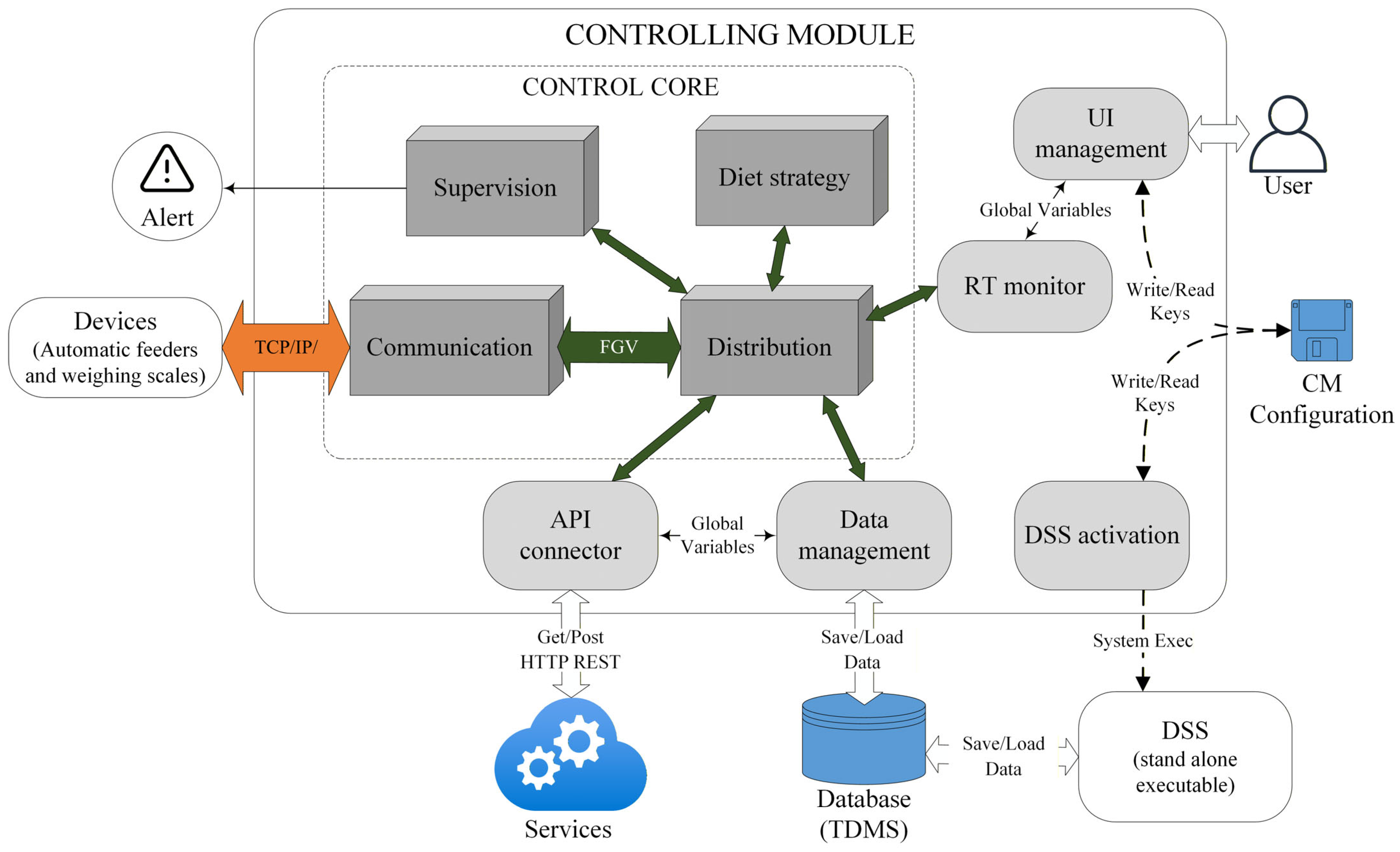
3.1. System Overview and Role of the Controlling Module
3.2. Multi-Agent Design and Internal Coordination
| Algorithm 1. Simplified message-processing sequence in the CM. |
|
3.3. Communication Architecture
3.3.1. External Device–CM Communication
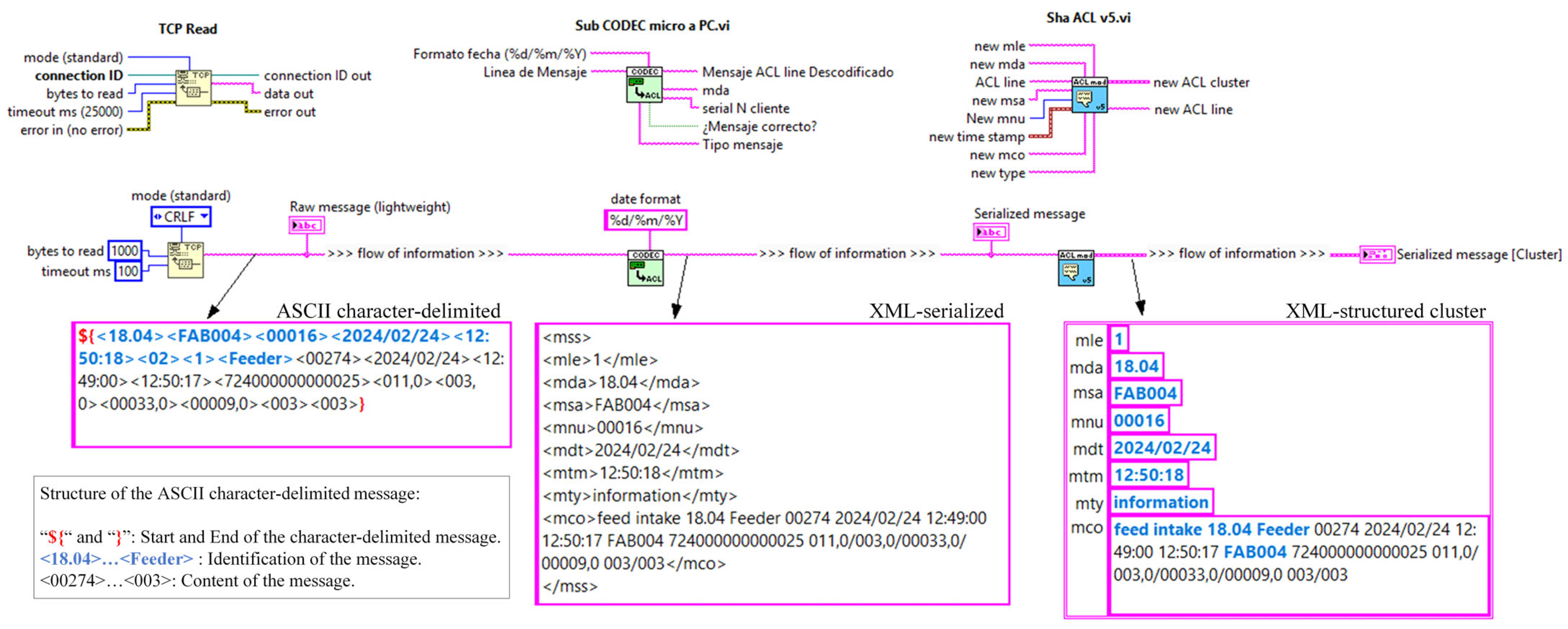
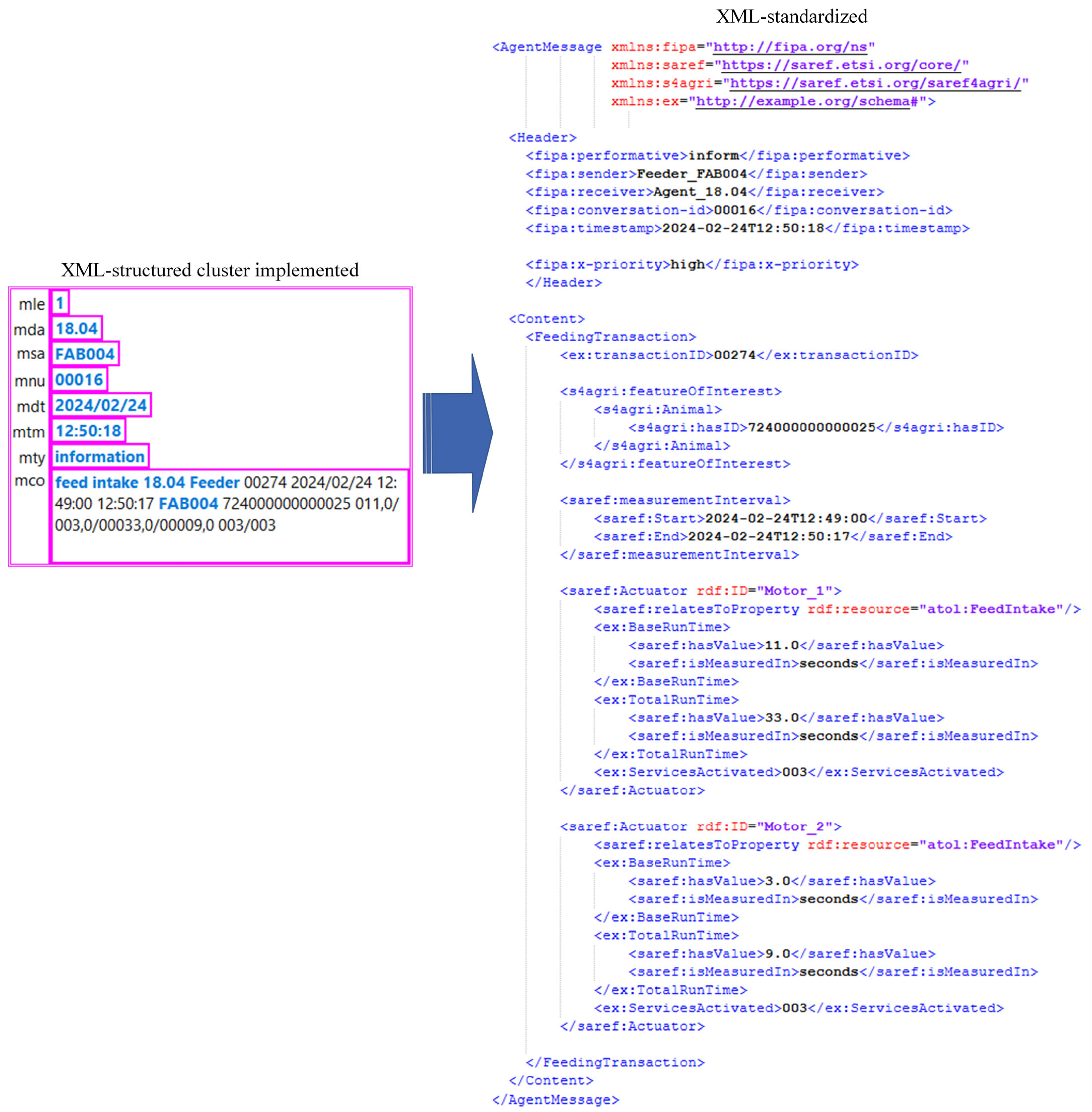
3.3.2. Internal Agent–Agent Communication
3.4. Development Environment and Implementation
3.5. Validation Procedure
4. Results
4.1. Communication and Operational Tests
4.2. HIL Sensing Tests
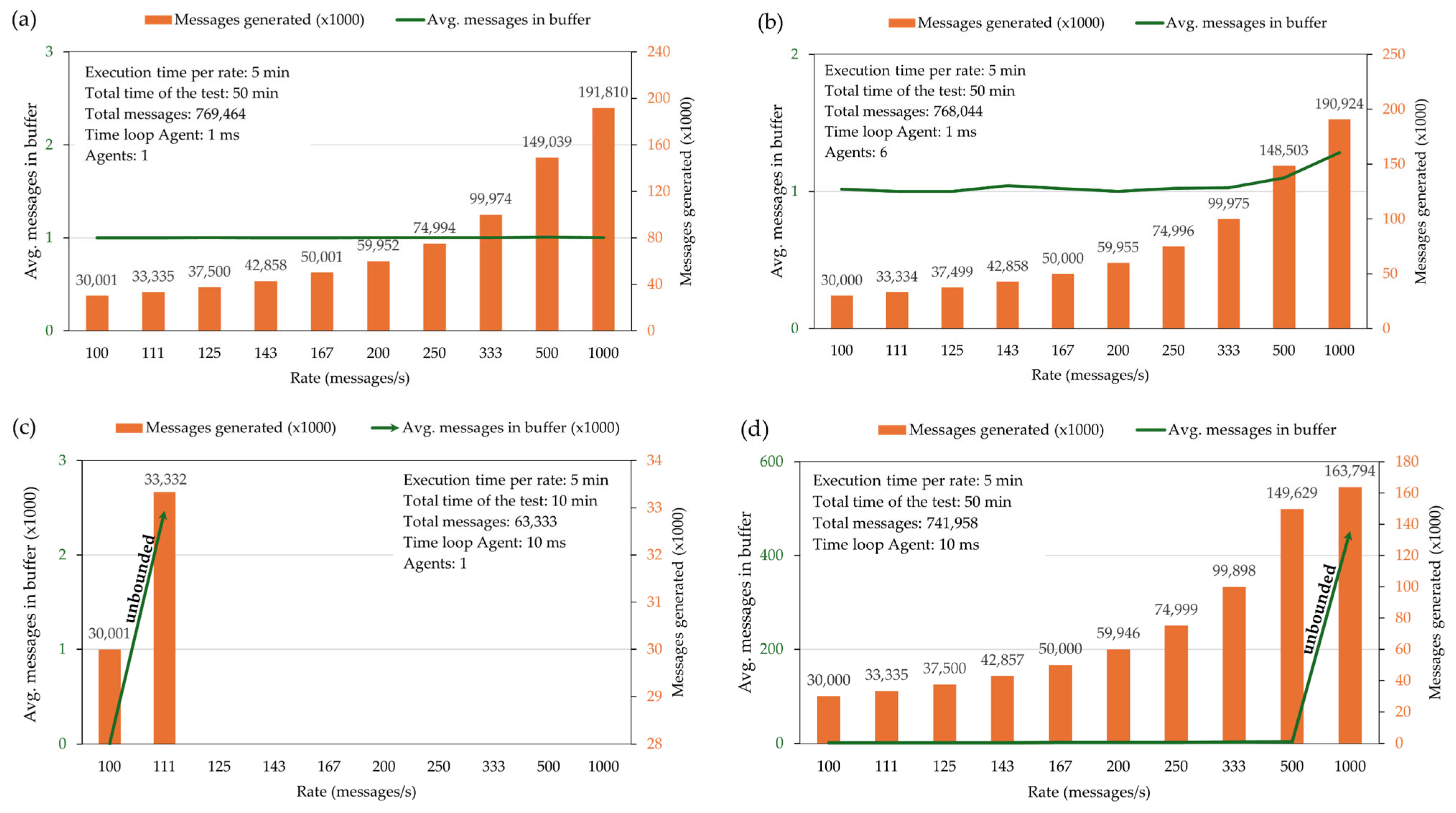
4.3. Computational Performance
5. Discussion
5.1. Architectural Soundness Through Multi-Agent System Design
5.2. Interoperability and Constrained Devices
5.3. Relevance for Automatic Feeding Systems
5.4. Scope and Limitations
5.5. Future Work
6. Conclusions
Supplementary Materials
Author Contributions
Funding
Data Availability Statement
Acknowledgments
Conflicts of Interest
Abbreviations
| ACL | Agent Communication Language |
| CM | Controlling Module |
| DSS | Decision Support System |
| DT | Digital Twin |
| FIPA | Foundation for Intelligent Physical Agents |
| FGV | Functional Global Variable |
| HIL | Hardware-in-the-Loop |
| IoT | Internet of Things |
| KIF | Knowledge Interchange Format |
| KQML | Knowledge Query and Manipulation Language |
| MAS | Multi-Agent System |
| PF | Precision Feeding |
| PLF | Precision Livestock Farming |
| RFID | Radio Frequency Identification |
| TCP/IP | Transmission Control Protocol/Internet Protocol |
| XML | Extensible Markup Language |
References
- Morrone, S.; Dimauro, C.; Gambella, F.; Cappai, M.G. Industry 4.0 and Precision Livestock Farming (PLF): An up to Date Overview across Animal Productions. Sensors 2022, 22, 4319. [Google Scholar] [CrossRef]
- Neethirajan, S.; Kemp, B. Digital Livestock Farming. Sens. Bio-Sens. Res. 2021, 32, 100408. [Google Scholar] [CrossRef]
- Tuyttens, F.A.M.; Molento, C.F.M.; Benaissa, S. Twelve Threats of Precision Livestock Farming (PLF) for Animal Welfare. Front. Vet. Sci. 2022, 9, 889623. [Google Scholar] [CrossRef]
- Gómez, Y.; Stygar, A.H.; M M Boumans, I.J.; M Bokkers, E.A.; Pedersen, L.J.; Niemi, J.K.; Pastell, M.; Manteca, X.; Llonch, P. A Systematic Review on Validated Precision Livestock Farming Technologies for Pig Production and Its Potential to Assess Animal Welfare a Systematic Review on Validated Precision Livestock Farming Technologies for Pig Production and Its Potential to Assess Animal Welfare. Front. Vet. Sci. 2021, 1, 660565. [Google Scholar] [CrossRef]
- Cadéro, A.; Aubry, A.; Brossard, L.; Dourmad, J.Y.; Salaün, Y.; Garcia-Launay, F. Modelling Interactions between Farmer Practices and Fattening Pig Performances with an Individual-Based Model. Animal 2018, 12, 1277–1286. [Google Scholar] [CrossRef]
- Andretta, I.; Pomar, C.; Kipper, M.; Hauschild, L.; Rivest, J. Feeding Behavior of Growing–Finishing Pigs Reared under Precision Feeding Strategies1. J. Anim. Sci. 2016, 94, 3042–3050. [Google Scholar] [CrossRef]
- Andretta, I.; Hauschild, L.; Kipper, M.; Pires, P.G.S.; Pomar, C. Environmental Impacts of Precision Feeding Programs Applied in Pig Production. Animal 2018, 12, 1990–1998. [Google Scholar] [CrossRef]
- Gaillard, C.; Dourmad, J.-Y. Application of a Precision Feeding Strategy for Gestating Sows. Anim. Feed Sci. Technol. 2022, 287, 115280. [Google Scholar] [CrossRef]
- Pomar, C.; Milgen, J.v.; Remus, A. 18: Precision Livestock Feeding, Principle and Practice. In Poultry and Pig Nutrition; Wageningen Academic: Wageningen, The Netherlands, 2019; pp. 397–418. [Google Scholar] [CrossRef]
- Su, J.; Tan, B.; Jiang, Z.; Wu, D.; Nyachoti, C.M.; Kim, S.W.; Yin, Y.; Wang, J. Accelerating Precision Feeding with the Internet of Things for Livestock: From Concept to Implementation. Sci. Bull. 2024, 69, 2156–2160. [Google Scholar] [CrossRef]
- Bao, Y.; Llagostera, P.; Plà-Aragonès, L.M. Is Deep Learning Useful for Decision Making in Pig Production? Internet Things 2024, 26, 101229. [Google Scholar] [CrossRef]
- Riahi Sfar, A.; Natalizio, E.; Challal, Y.; Chtourou, Z. A Roadmap for Security Challenges in the Internet of Things. Digit. Commun. Netw. 2018, 4, 118–137. [Google Scholar] [CrossRef]
- Arulmozhi, E.; Bhujel, A.; Moon, B.-E.; Kim, H.-T. The Application of Cameras in Precision Pig Farming: An Overview for Swine-Keeping Professionals. Animals 2021, 11, 2343. [Google Scholar] [CrossRef]
- Kaur, U.; Malacco, V.M.R.; Bai, H.; Price, T.P.; Datta, A.; Xin, L.; Sen, S.; Nawrocki, R.A.; Chiu, G.; Sundaram, S.; et al. Invited Review: Integration of Technologies and Systems for Precision Animal Agriculture—A Case Study on Precision Dairy Farming. J. Anim. Sci. 2023, 101, skad206. [Google Scholar] [CrossRef]
- Friha, O.; Ferrag, M.A.; Shu, L.; Maglaras, L.; Wang, X. Internet of Things for the Future of Smart Agriculture: A Comprehensive Survey of Emerging Technologies. IEEE/CAA J. Autom. Sin. 2021, 8, 718–752. [Google Scholar] [CrossRef]
- Miller, T.; Mikiciuk, G.; Durlik, I.; Mikiciuk, M.; Łobodzińska, A.; Śnieg, M. The IoT and AI in Agriculture: The Time Is Now—A Systematic Review of Smart Sensing Technologies. Sensors 2025, 25, 3583. [Google Scholar] [CrossRef]
- Rustemi, A.; Dalipi, F. Synergizing IoT, AI, and Blockchain for Smart Agriculture: Challenges, Opportunities, and Future Directions. Internet Things 2025, 34, 101778. [Google Scholar] [CrossRef]
- Yu, P.; Teng, F.; Zhu, W.; Shen, C.; Chen, Z.; Song, J. Cloud–Edge–Device Collaborative Computing in Smart Agriculture: Architectures, Applications, and Future Perspectives. Front. Plant Sci. 2025, 16, 1668545. [Google Scholar] [CrossRef]
- Singh, R.; Gill, S.S. Edge AI: A Survey. Internet Things Cyber-Phys. Syst. 2023, 3, 71–92. [Google Scholar] [CrossRef]
- Savaglio, C.; Mazzei, P.; Fortino, G. Edge Intelligence for Industrial IoT: Opportunities and Limitations. Procedia Comput. Sci. 2024, 232, 397–405. [Google Scholar] [CrossRef]
- Altin, N.; Eyimaya, S.E.; Nasiri, A. Multi-Agent-Based Controller for Microgrids: An Overview and Case Study. Energies 2023, 16, 2445. [Google Scholar] [CrossRef]
- Barriuso, A.; Villarrubia González, G.; De Paz, J.; Lozano, Á.; Bajo, J. Combination of Multi-Agent Systems and Wireless Sensor Networks for the Monitoring of Cattle. Sensors 2018, 18, 108. [Google Scholar] [CrossRef]
- SC00061G; FIPA ACL Message Structure Specification. FIPA TC Communication. FIPA: Geneva, Switzerland, 2002; p. 11. Available online: https://web.archive.org/web/20250130105414/http://www.fipa.org/specs/fipa00061/SC00061G.pdf (accessed on 10 February 2026).
- Collins, L.M.; Smith, L.M. Review: Smart Agri-Systems for the Pig Industry. Animal 2022, 16, 100518. [Google Scholar] [CrossRef]
- Marić, K.; Gvozdanović, K.; Djurkin Kušec, I.; Kušec, G.; Margeta, V. Smart Pig Farms: Integration and Application of Digital Technologies in Pig Production. Agriculture 2025, 15, 937. [Google Scholar] [CrossRef]
- Savaglio, C.; Barbuto, V.; Mangione, F.; Fortino, G. Generative Digital Twins: A Novel Approach in the IoT Edge-Cloud Continuum. IEEE Internet Things Mag. 2025, 8, 42–48. [Google Scholar] [CrossRef]
- Pomar, C.; Pomar, J.; Rivest, J.; Cloutier, L.; Letourneau-Montminy, M.P.; Andretta, I.; Hauschild, L. Estimating Real-Time Individual Amino Acid Requirements in Growing-Finishing Pigs: Towards a New Definition of Nutrient Requirements in Growing-Finishing Pigs? Nutr. Model Pigs Poult. 2015, 157–174. [Google Scholar] [CrossRef]
- Pomar, C.; Remus, A. Precision pig feeding: A breakthrough toward sustainability. Anim. Front. 2019, 9, 52–59. [Google Scholar] [CrossRef] [PubMed]
- Andretta, I.; Pomar, C.; Rivest, J.; Pomar, J.; Lovatto, P.A.; Radünz Neto, J. The impact of feeding growing-finishing pigs with daily tailored diets using precision feeding techniques on animal performance, nutrient utilization, and body and carcass composition. J. Anim. Sci. 2014, 92, 3925–3936. [Google Scholar] [CrossRef]
- Llorens, B.; Pomar, C.; Goyette, B.; Rajagopal, R.; Andretta, I.; Latorre, M.A.; Remus, A. Precision feeding as a tool to reduce the environmental footprint of pig production systems: A life-cycle assessment. J. Anim. Sci. 2024, 102, skae225. [Google Scholar] [CrossRef]
- Castillejo, P.; Cürüklü, B.; Fresco, R.; Johansen, G.; Bilbao-Arechabala, S.; Martinez-Rodriguez, B.; Pomante, L.; Martinez-Ortega, J.-F.; Santic, M. The AFarCloud ECSEL Project. In Proceedings of the 2019 22nd Euromicro Conference on Digital System Design (DSD), Kallithea, Greece; IEEE: New York, NY, USA, 2019; pp. 414–419. [Google Scholar] [CrossRef]
- ETSI. SmartM2M; Extension to SAREF; Part 6: Smart Agriculture and Food Chain Domain (SAREF4AGRI), ETSI TS 103 410-6 V2.1.1, 2024. Available online: https://www.etsi.org/deliver/etsi_ts/103400_103499/10341006/02.01.01_60/ts_10341006v020101p.pdf (accessed on 10 February 2026).
- García, R.; López-Gil, J.-M.; Gil, R. Rhizomer: Interactive semantic knowledge graphs exploration. SoftwareX 2022, 20, 101235. [Google Scholar] [CrossRef]
- Li, Y.; Jiayuan, W.; Zhouli, Y.; Haiyu, Z. Agent Technology for Agricultural Intelligence: Methodological Framework and Applications. Electronics 2026, 15, 1547. [Google Scholar] [CrossRef]
- Pomar, J.; López, V.; Pomar, C. Agent-Based Simulation Framework for Virtual Prototyping of Advanced Livestock Precision Feeding Systems. Comput. Electron. Agric. 2011, 78, 88–97. [Google Scholar] [CrossRef]
- Polaków, G.; Metzger, M. Agent–Based Approach for LabVIEW Developed Distributed Control Systems. In Agent and Multi-Agent Systems: Technologies and Applications; Nguyen, N.T., Grzech, A., Howlett, R.J., Jain, L.C., Eds.; Lecture Notes in Computer Science; Springer: Berlin/Heidelberg, Germany, 2007; Volume 4496, pp. 21–30. [Google Scholar] [CrossRef]
- Zimmermann, O. Comprendre la FGV et Ses Extensions Dans LabVIEW, 2018. Available online: https://lpsc-indico.in2p3.fr/event/1125/attachments/274/359/180323_ZIMMERMANN_Olivier.pdf (accessed on 10 February 2026).
- National Instruments. Functional Global Variable (FGV). Available online: https://learn-cf.ni.com/teach/riodevguide/code/rt_functional-global-variable.html (accessed on 10 February 2026).
- Kodosky, J. LabVIEW. Proc. ACM Program. Lang. 2020, 4, 1–54. [Google Scholar] [CrossRef]
- Maturana, F.; Staron, R.; Discenzo, F.; Hall, K.; Tichý, P.; Šlechta, P.; Mařík, V.; Scheidt, D.; Pekala, M.; Bracy, J. Integrating Multi-Agent Systems: A Case Study. In Emerging Solutions for Future Manufacturing Systems; Camarinha-Matos, L.M., Ed.; IFIP International Federation for Information Processing; Kluwer Academic Publishers: Boston, MA, USA, 2005; Volume 159, pp. 99–108. [Google Scholar] [CrossRef][Green Version]
- Reddy, K.V.; Reddy, B.S.K.; Goutham, V.; Mahesh, M.; Nisha, J.S.; Palanisamy, G.; Golla, M.; Purushothaman, S.; Reddy, K.R.; Ramkumar, V. Edge AI in Sustainable Farming: Deep Learning-Driven IoT Framework to Safeguard Crops from Wildlife Threats. IEEE Access 2024, 12, 77707–77723. [Google Scholar] [CrossRef]
- Wolfert, S.; Ge, L.; Verdouw, C.; Bogaardt, M.-J. Big Data in Smart Farming—A Review. Agric. Syst. 2017, 153, 69–80. [Google Scholar] [CrossRef]
- Vedantham, A.K. Cloud and IoT Technologies Revolutionizing Precision Agriculture. Int. J. Sci. Res. Comput. Sci. Eng. Inf. Technol. 2024, 10, 860–867. [Google Scholar] [CrossRef]
- Leitão, P. Agent-Based Distributed Manufacturing Control: A State-of-the-Art Survey. Eng. Appl. Artif. Intell. 2009, 22, 979–991. [Google Scholar] [CrossRef]
- Villafranca, A.; Cano, M.-D. A Lightweight Edge-DL Intrusion Detection System for IoT Sustainable Smart-Agriculture. Internet Things 2025, 34, 101818. [Google Scholar] [CrossRef]
- Loaiza, M.; Savaglio, C.; Arijo, N.H.; Aloi, G.; Fortino, G.; Gravina, R. Agents in Software Development Architectures. In Proceedings of the WOA 2023: 24th Workshop from Objects to Agents, Rome, Italy, 6–8 November 2023. CEUR Workshop Proceedings. [Google Scholar]
- Genesereth, M.R.; Fikes, R.E. Knowledge Interchange Format Version 3.0 Reference Manual, 1992. Available online: http://logic.stanford.edu/publications/genesereth/kif.pdf (accessed on 10 February 2026).
- Pěchouček, M.; Mařík, V. Industrial Deployment of Multi-Agent Technologies: Review and Selected Case Studies. Auton. Agent. Multi-Agent. Syst. 2008, 17, 397–431. [Google Scholar] [CrossRef]
- Genesereth, M.R.; Ketchpel, S.P. Software Agents. Commun. ACM 1994, 37, 48–53. [Google Scholar] [CrossRef]
- Tomic, D.; Drenjanac, D.; Hoermann, S.; Auer, W. Experiences with Creating a Precision Dairy Farming Ontology (DFO) and a Knowledge Graph for the Data Integration Platform in agriOpenLink. J. Agric. Inform. 2015, 6. [Google Scholar] [CrossRef][Green Version]
- Cantera, J.M.; Issa, J.S.; van der Vlugt, P.; Klaeser, S.; Bartram, T.; Kassahun, A.; Neira, I.; Milin, T. D3.3 Opportunities and Barriers in the Present Regulatory Situation for System Development; Internet of Food and Farm 2020; Deliverable D3.3; 2018; p. 93. Available online: https://ec.europa.eu/research/participants/documents/downloadPublic?documentIds=080166e5bb2a8e03&appId=PPGMS (accessed on 10 February 2026).
- Kakamoukas, G.; Sarigiannidis, P.; Maropoulos, A.; Lagkas, T.; Zaralis, K.; Karaiskou, C. Towards Climate Smart Farming—A Reference Architecture for Integrated Farming Systems. Telecom 2021, 2, 52–74. [Google Scholar] [CrossRef]
- Li, Q.; Chen, W. Lightweight Vision Transformer Model for Pine Wilt Disease Detection Using Aerial RGB Image and Adversarial Data Augmentation. Smart Agric. Technol. 2025, 12, 101167. [Google Scholar] [CrossRef]


| Agent Name | Agent Type | Functionalities |
|---|---|---|
| Communication | Model-Based Reflex | Manages device connections and encodes/decodes external messages |
| Distribution | Simple Reflex | Validates and routes incoming and outgoing messages |
| Supervision | Model-Based Reflex | Monitors system status, watching events and abnormal conditions |
| Diet strategy | Simple Reflex | Converts DSS outputs into operational feed parameters |
| Data management | Model-Based Reflex | Stores raw data and metadata and provides internal data support |
| UI management | Simple Reflex | Displays diet configuration and system status to the user |
| RT monitor | Simple Reflex | Collects real-time device information for monitoring |
| DSS activation | Model-Based Reflex | Determines when DSS execution should be triggered |
| API connector | Simple Reflex | Exchanges system data configuration with the external REST API. |
| Communication | Physical Transport Layer | Software Agency Layer | Main Purpose |
|---|---|---|---|
| AFS device ⇔ CM | TCP/IP | Character-delimited ASCII stream | Deterministic and lightweight external communication |
| Agent ⇔ Agent | Functional Global Variables (FGVs) in LabVIEW | XML-based structured internal message | Internal coordination, traceability and semantic organization |
| Section | Item | Description |
|---|---|---|
| Start | ${ | Beginning of the message. “$” indicates that the direction of the message goes from the device to CM. |
| Identification | <18.04> | Receiver (destination address) of the message (18: type of agent; 04: number of agent of that type) |
| <FAB004> | Sender of the message (F: Feeder; AB004: feeder identification) | |
| <00016> | Number of the message | |
| <2024/02/24> | Date of the message | |
| <12:50:18> | Local time of the message | |
| <02> | Class level of the message (02: animal consumption) | |
| <1> | Level of priority (1: normal) | |
| <Feeder> | Type of device involved in the conversation with the CM | |
| Content | <00274> | Tracking number of the consumption message |
| <2024/02/24> | Date of the consumption | |
| <12:49:00> | Local time IN of the message | |
| <12:50:17> | Local time OUT of the message | |
| <724000000000025> | Animal identification | |
| <011,0> | Motor 1 base run time, in seconds | |
| <003,0> | Motor 2 base run time, in seconds | |
| <00033,0> | Motor 1 total run time, in seconds | |
| <00009,0> | Motor 2 total run time, in seconds | |
| <003> | Services activated for motor 1 | |
| <003> | Services activated for motor 2 | |
| End | } \CRLF | End of the message |
| Item | Description |
|---|---|
| <mss> | Start message markup |
| <mle>1</mle> | Message level (1: low priority) |
| <mda>18.04</mda> | Message destination agent (receiver) address (18: Communication agent; 04: # device connection) |
| <msa>FAB004</msa> | Message sender agent address (FAB004: Serial number of the device) |
| <mnu>00274</mnu> | Number of the message |
| <mdt>2024/02/24</mdt> | Local date of the message |
| <mtm>12:50:18</mtm> | Local time of the message |
| <mty>information</mty> | Message type |
| <mco> feed intake 18.04 Feeder 00274 2024/02/24 12:49:00 12:50:17 FAB004 724000000000025 011,0/003,0/00033,0/00009,0 003/003 </mco> | Content of the message |
| </mss> | End message markup |
| Test | Condition | Outcome | Repetition (Success/Failure) |
|---|---|---|---|
| Communication Reliability (50 virtual feeders) | CM connected with feeder via Wi-Fi. | Yes | 1200/0 |
| Automatic reconnection when Access Point is switched off and back on. | Yes | 1200/0 | |
| Automatic reconnection when Feeder is switched off and back on. | Yes | 1200/0 | |
| Automatic reconnection when Ethernet cable is disconnected and reconnected. | Yes | 1200/0 | |
| Watchdog messages successfully sent. | Yes | 120 messages in 1 h (0 lost) | |
| Feeder’s system clock synchronized with CM’s clock. | Yes | 2000 | |
| Feed Formulation Management (50 virtual feeders) | Formula request message sent by Feeder upon animal detection. | Yes | 560/0 |
| CM sends the animal’s formula (composition). | Yes | 560/0 | |
| All formulas are deleted when the “ghost animal” (NNN) formula is sent to the feeder. | Yes | N/A | |
| Feeder reconnection with CM triggers an NNN formula request. | Yes | N/A | |
| Feeder retains formulas in memory after a restart. | Yes | N/A | |
| Consumption Data Handling (50 virtual feeders) | Consumption data for an identified animal transmitted when tag is no longer detected. | Yes | 2590/0 |
| Consumption data lines are stored in feeder memory when communication is lost. | Yes | N/A | |
| Restricted formula erased upon successful transmission of consumption data. | Yes | N/A | |
| Consumption data is sent when the animal’s identification changes. | Yes | N/A | |
| Fault & Disconnection Events (50 virtual feeders | Event message sent upon detection of an electric overload fault. | Yes | N/A |
| Event message sent upon detection of a short circuit fault. | Yes | N/A | |
| Event message generated by disconnection of feeders or devices. | Yes | N/A | |
| Computer performance (50 virtual feeders) | Average CPU usage | 15% (max: 17%; min: 14%) | N/A |
| Average Memory usage | 214 MB (max: 350 MB; min: 166 MB) | N/A | |
| Internal buffer | 0% (max: 4%) | N/A | |
| Identification & Sensing (4 RFID antennas + 4 inductive sensors) | Identification message sent by Feeder. | Yes | N/A |
| Latency timer activated upon animal detection. | Yes | N/A | |
| Demand sensor disabled while latency time is active. | Yes | N/A | |
| Event messages are sent when demand sensor is triggered. | Yes | N/A | |
| Event message sent when motors are running. | Yes | N/A | |
| New latency time activated when motors stop. | Yes | N/A | |
| Event message sent when animal identification changes. | Yes | N/A |
| Feature |
KQML/KIF (Foundational Academic) |
FIPA ACL (Interoperability Standard) | CM Implementation
(Industrial Optimization) |
|---|---|---|---|
| Syntax/Encoding | LISP-like S-expressions. Nested parentheses difficult to parse in real-time. | LISP-like S-expressions. Text-based strings requiring significant parsing overhead. | XML-Serialized. Managed by a custom serialization algorithm to minimize parsing overhead while ensuring strict typing. |
| Physical Transport | KIF (Knowledge Interchange Format). Based on First-Order Logic (symbolic reasoning). | Flexible (e.g., FIPA-SL). Allows various formats but often defaults to semantic languages. | Structured Data Types. Operational values (Integers, Floats) optimized for control loops. |
| Message Performative | Open Set. Extensible but often ambiguous (e.g., advertise, broker). | Standardized Set. Fixed set of communicative acts (e.g., INFORM). | Mapped Attribute Codes. Internal codes mapped to FIPA acts for efficiency (e.g., <02> → INFORM). |
| Primary goal | Knowledge Sharing. Enabling agents to exchange complex logical theorems. | Open Interoperability. Allowing heterogeneous software systems to interact. | Real-Time Determinism. Ensuring type safety and low latency for hardware control. |
Disclaimer/Publisher’s Note: The statements, opinions and data contained in all publications are solely those of the individual author(s) and contributor(s) and not of MDPI and/or the editor(s). MDPI and/or the editor(s) disclaim responsibility for any injury to people or property resulting from any ideas, methods, instructions or products referred to in the content. |
© 2026 by the authors. Licensee MDPI, Basel, Switzerland. This article is an open access article distributed under the terms and conditions of the Creative Commons Attribution (CC BY) license.
Share and Cite
López-Sacanell, V.; Plà-Aragonés, L.M. A Hybrid Multi-Agent Control Architecture for Interoperable and Deterministic IoT-Based Swine Precision Feeding. AgriEngineering 2026, 8, 242. https://doi.org/10.3390/agriengineering8060242
López-Sacanell V, Plà-Aragonés LM. A Hybrid Multi-Agent Control Architecture for Interoperable and Deterministic IoT-Based Swine Precision Feeding. AgriEngineering. 2026; 8(6):242. https://doi.org/10.3390/agriengineering8060242
Chicago/Turabian StyleLópez-Sacanell, Vicente, and Lluís Miquel Plà-Aragonés. 2026. "A Hybrid Multi-Agent Control Architecture for Interoperable and Deterministic IoT-Based Swine Precision Feeding" AgriEngineering 8, no. 6: 242. https://doi.org/10.3390/agriengineering8060242
APA StyleLópez-Sacanell, V., & Plà-Aragonés, L. M. (2026). A Hybrid Multi-Agent Control Architecture for Interoperable and Deterministic IoT-Based Swine Precision Feeding. AgriEngineering, 8(6), 242. https://doi.org/10.3390/agriengineering8060242