
Systematic Review

Measurement, Reporting, and Verification of Agricultural and Livestock Emissions: A Combined Systematic and Bibliometric Review

by
Nikolaos Tsigkas
1,
Vasileios Anestis
1,
Anna Vatsanidou
2 and
Chrysanthos Maraveas
1,*
1
Farm Structures Laboratory, Department of Natural Resources and Agricultural Engineering, Agricultural University of Athens, Iera Odos 75, 11855 Athen, Greece
2
Department of Agricultural Development, Agrofood and Management of Natural Resources, School of Agricultural Development, Nutrition & Sustainability, National and Kapodistrian University of Athens, Evripos Campus, 34400 Psachna, Greece
*
Author to whom correspondence should be addressed.
AgriEngineering 2026, 8(3), 110; https://doi.org/10.3390/agriengineering8030110
Submission received: 27 January 2026 / Revised: 26 February 2026 / Accepted: 28 February 2026 / Published: 13 March 2026

Abstract

The current research undertook a comprehensive examination of global research related to the use of measurement, reporting, and verification (MRV) techniques for quantifying and tracking greenhouse gas (GHG) emissions from agriculture and livestock farming. Data were collected using a bibliometric analysis of 5340 studies published in the period (1990–2025) and a systematic literature review of 100 studies published in the period (2020–2025). The insights from the findings showed that four MRV techniques were broadly adopted across different regions: (1) inventory techniques (IPCC Tiers, national systems), (2) accounting at the project/product level (LCA, carbon footprint protocols), (3) MRV based on measurement and models (chambers, remote sensing, farm models, AI/ML), and (4) frameworks for governance and standardization (UNFCCC, Paris ETF, PAS 2050, etc.). The findings further revealed the impact of the MRV techniques on agriculture and livestock farming, showing that they facilitated the uptake of low-carbon practices. In agriculture, the MRV techniques showed that lower emissions emerged from mixed cropping, while in livestock farming, the emissions varied based on the feeding stage and type of diet used. However, various challenges arose in the adoption of MRV techniques where there was limited data related to GHG emissions, thereby reducing generalizability. In future work, there is a need for scholars to consider integrating the different MRV techniques to develop an understanding of the problem area.

1. Introduction

Agriculture and livestock farming are significant contributors to greenhouse gases (GHGs) in the atmosphere. Across different continents, livestock farming contributes to anthropogenic GHGs through enteric fermentation and manure emissions [1]. Further, as Ref. [2] observes, livestock farming contributes high GHGs, including methane (CH4), nitrous oxide (N2O), and carbon dioxide (CO2), which range from 3.41 to 7.33 kg CO2-eq/kg of meat and from 0.90 to 1.10 kg CO2-eq/kg of energy-corrected milk (ECM). The GHGs of dairy sheep live weight are also reported as 7.94 kg CO2-eq/kg in Italy [3], while chicken contributed 5.4 kg CO2-eq/kg for meat and 3.7 kg CO2-eq/kg for eggs [4]. Agriculture also accounts for 80% of the N2O emissions and 70% of the anthropogenic NH3 emissions caused by the application of livestock manure and inorganic fertilizer, and 40% of the anthropogenic CH4 linked to enteric fermentation [5]. Additionally, land-use changes, such as deforestation to support agricultural expansion and to disrupt natural carbon sinks and release stored carbon, contribute to high GHG emissions [6].
The direct impact of high GHG emissions from agriculture and livestock farming on the atmosphere is global warming and climate change. As Ref. [7] reports, high global temperatures cause glaciers and polar ice caps to melt, leading to the rise in sea levels and the release of trapped methane. Climate change also introduces extreme weather patterns, such as heavier rainfall and flooding in some areas and intense storms from warmer oceans [8]. Similarly, human-caused climate change is also leading to the increased odds of climate-driven fires within various forested areas [9]. Subsequently, climate change leads to social and economic impacts through the disruption of agriculture, threatening global food security.
To mitigate climate change, international agencies and organizations are implementing stricter monitoring approaches. For instance, the United Nations Framework Convention on Climate Change (UNFCCC) oversees the global mechanisms for the reduction of emissions, outlining actions to reduce GHGs and to improve sinks, such as forests, to stabilize the concentration of the emissions [10]. The UNFCCC also requires countries to update their nationally determined contributions (NDCs) to lower the emissions gap as they commit to specific and measurable cuts to reach a 42% reduction by 2030 [11]. Financial institutions, such as the International Monetary Fund (IMF), are also supporting climate change mitigation through promoting green finance instruments, leveraging carbon pricing, and supporting climate-related projects [12]. Through frameworks, financial incentives, and strategic alliances, countries are increasing their commitment to reducing GHG emissions.
As climate agreements progressively increase the requirements for the mitigation commitments, carbon market integrity, and national inventories, diverse methods to track and measure GHG emissions are also being widely adopted. Advanced technologies, such as Artificial Intelligence (AI) and the Internet of Things (IoT), are being adopted for environmental management and monitoring, where sensors paired with AI detect real-time changes [13]. Other technologies, such as satellite remote sensing, are also becoming increasingly important to detect spikes and methane leaks from oil pipelines and landfills with high precision [14]. Economic levers, such as carbon pricing mechanisms (CPM), are also being utilized, where companies are charged for their high GHG emissions [15]. As a result, companies are forced to reduce their emissions to avoid the high costs from carbon taxes.
However, one of the limitations of using carbon tracking methods, such as AI, IoT, satellites, and carbon taxes, is their voluntary nature. As Ref. [16] observes, voluntary compliance leads to greenwashing, where companies buy carbon credits rather than participate in reducing their GHG emissions. To overcome such issues, a more serious and standardized framework for tracking emissions, the measurement, verification, and reporting (MRV) framework, has emerged [17]. The MRV framework outlines the rules and procedures adopted for the quantification, tracking, and verification of GHG emissions reduction and removal [17]. The adoption of MRV ensures transparency and comparability in efforts related to climate change mitigation, guaranteeing that projects and policies aimed at reducing environmental impact can be assessed accurately [18]. In the framework, the monitoring phase evaluates the amount of CO2 removed by projects, while the reporting phase compiles the data according to protocols. The verification phase involves the evaluation of project data and methodology, ensuring it meets the requirements of the MRV protocol [18].
The core focus of this review article is to undertake a comprehensive review of global research on the measurement, reporting, and verification (MRV) of greenhouse gas emissions from agriculture and livestock farming. This research is exploratory and no hypotheses are formulated. The novelty of this research is that it is the first study, to the best of the author’s knowledge, that combines a bibliometric analysis and a systematic literature review to examine the MRV methods of greenhouse gas emissions from livestock farming and agriculture from 2020 to date. A brief search on the Scopus database did not generate studies combining a systematic literature review and a bibliometric analysis related to the use of MRV methods for GHG emissions. The exclusion of studies published before 2020 ensures that only current information is reported in the review article. The authors observe that measurement, verification, and reporting for agriculture and livestock, while playing an important role and having strong literature participation, is underrepresented regarding bibliometric analyses.
These reasons accentuate the significance of crafting such a study. By examining publication trends, geographical and institutional distribution, keyword relevance, and author–country collaboration, this study aims to clarify the structure of the research field while assessing underexplored dimensions regarding MRV for agriculture and livestock. As mentioned, these insights will consolidate the current literature in an effort to guide the development of novel research directions and developing trends within the sector. The objectives of the review article are as follows:
  • To investigate the MRV techniques adopted for the management and tracking of greenhouse emissions from livestock farming and agriculture.
  • To examine the impact of adopting MRV techniques for agriculture and livestock.
  • To identify the challenges and potential future directions of adopting MRV techniques for agriculture and livestock farming.
In summary, the introduction provides the background of the research and justifies the adoption of MRV techniques for GHG measurement. Thereafter, it outlines an existing gap where minimal studies have considered combining a systematic literature review and a bibliometric analysis when examining the MRV methods of GHG emissions from livestock farming and agriculture.
The rest of the article is structured into four parts. Section 2 details the materials and methods adopted to identify the relevant sources. Thereafter, the results from the bibliometric analysis and the systematic literature review are presented. In Section 3, the findings are discussed to address the research objectives. Finally, the conclusion highlights key insights, implications, and future research directions.

2. Materials and Methods

2.1. Mixed Method

The current article employed a mixed-method approach, combining quantitative and qualitative methods to enhance the depth of the obtained research insights [19]. The quantitative method used in the research involved a bibliometric analysis, while a systematic literature review (SLR) was adopted as the qualitative method. The choice of mixed methods arose from the need to cross-validate the results from multiple sources, increasing the credibility of the findings and broadening the scope of inquiry [20]. The quantitative and qualitative methods were integrated by comparisons examining how the different MRV techniques were used across the different regions where the publications were reported.

2.2. Literature Search

The first step in conducting the SLR and the bibliometric analysis was to undertake a literature search. The Scopus database was selected to identify the necessary bibliometric articles related to MRV for agriculture and livestock farming, and was queried in 2026. The Scopus database was justified due to the broad coverage of research related to agricultural and environmental sciences [21]. Additionally, scientific databases such as Springer Nature, MDPI, and Elsevier were considered.
Thereafter, relevant keywords were identified from the research objectives and included the following: “greenhouse gases”, “agriculture”, “livestock”, “dairy”, “beef”, “manure”, “soil carbon”, “cropland”, “rice”, “carbon dioxide”, “methane”, “nitrous oxide”, “measurement reporting verification”, “GHG inventory”, “emission inventory”, “emission reporting”, “quantification protocol”, “carbon accounting”, “carbon footprint”, and “carbon audit”, Boolean operators AND/OR were introduced to generate search phrases and to expand the scope of the search across diverse databases [22]. The generated search phrases included the following:
TITLE-ABS-KEY
(agriculture* OR livestock OR dairy OR beef OR manure OR “soil carbon” OR cropland OR rice)
AND (“greenhouse gas*” OR GHG OR methane OR CH4 OR “nitrous oxide” OR N2O OR “carbon dioxide” OR CO2)
AND (“measurement reporting verification” OR MRV OR “GHG inventory” OR “emission inventory”
OR “emission reporting” OR “verification” OR “quantification protocol”
OR “carbon accounting” OR “carbon footprint” OR “carbon audit”)

2.3. Bibliometric Analysis

A bibliometric analysis is a rigorous method used in the exploration and evaluation of large volumes of data [23]. The method is a systematic means of reviewing an entire body of literature, offering scholars a structured overview of the intellectual, social, and conceptual foundations of a field. To conduct the bibliometric analysis, various quantitative techniques were used, including a collaboration analysis, geographical mapping, a research production analysis, and science mapping. The rationale for employing the bibliometric analysis was its effectiveness in identifying gaps in the literature that would be missed in meta-analysis and narrative reviews [24]. A bibliometric analysis facilitated the development of a transparent and replicable framework that informs scholars about the current state of a discipline, while simultaneously outlining potential avenues for future inquiry. In the current research, the bibliometric analysis served two functions: consolidating and categorizing the existing knowledge, and guiding the development of novel research directions by revealing underexplored areas and emerging trends within the field [24]. In this context, the bibliometric analysis facilitated understanding the applications of MRV in measuring GHGs from agriculture and livestock farming.
To obtain the studies examined in the bibliometric analysis, the search phrases combined with Boolean operators were applied to the title, abstract, and keywords of the articles from the Scopus databases.
The first Boolean clause (agriculture* OR livestock OR dairy OR beef OR manure OR “soil carbon” OR cropland OR rice) was used to delineate the agricultural and livestock field, whereas specific keywords were implemented to target studies regarding key emission activities, such as soil carbon, manure, and beef production. Thus, no relevant papers were omitted.
The second Boolean clause (“greenhouse gas*” OR GHG OR methane OR CH4 OR “nitrous oxide” OR N2O OR “carbon dioxide” OR CO2) was employed to target the emissions sector and to expand the keyword set, thereby broadening the database coverage while maintaining semantic integrity.
The third Boolean clause (“measurement reporting verification” OR MRV OR “GHG inventory” OR “emission inventory” OR “emission reporting” OR “verification” OR “quantification protocol” OR “carbon accounting” OR “carbon footprint” OR “carbon audit”) served as a filter to target explicitly MRV-related studies, while using synonyms and semantically equivalent terms to minimize exclusion and to ensure comprehensive retrieval of peer-reviewed literature.
The search yielded 3111 studies from the Scopus database, 1005 from Springer Nature, 1029 from MDPI, and 1004 from Elsevier, leading to a total of 6149 studies. For consistency, tool compatibility, and reproducibility, the literature was filtered to only articles and reviews in English from 1990 to 2025, resulting in a final dataset of 5340 studies.

2.4. Systematic Literature Review

The obtained 5340 articles were further scrutinized to identify relevant studies for the systematic literature review. The inclusion and exclusion criteria are defined in Table 1 to narrow the studies further.
As detailed in Table 1, the inclusion criteria specified only those studies that focused on the measurement, verification, and reporting (MRV) of greenhouse gas emissions from agriculture and livestock farming. Only studies published within the last five years (2020–2025) were reviewed to ensure that current and updated insights were reported in the article. Furthermore, only full-length articles were selected while abstract-only studies were eliminated, ensuring that images and illustrations would be obtained. Only peer-reviewed and primary studies were selected, while secondary reviews were eliminated.
The exclusion criteria removed all articles not focused on the MRV of greenhouse gas emissions from agriculture and livestock farming. All non-English studies were also not considered due to the extra translation requirements. Low-quality grey sources were further removed to ensure the validity and reliability of the obtained findings.
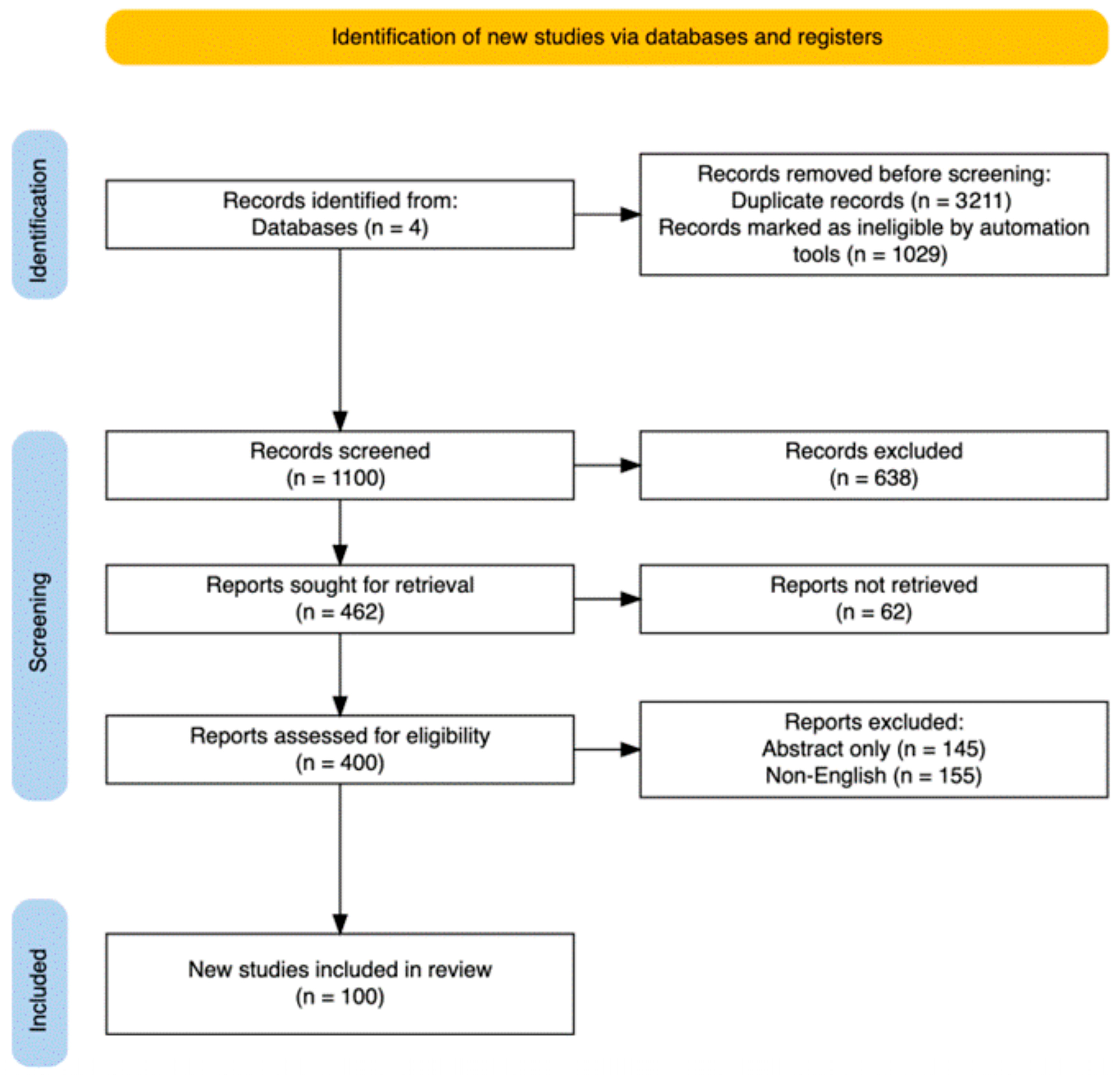
The adoption of the inclusion and exclusion criteria narrowed the studies as detailed in the Preferred Reporting Items for Systematic Reviews and Meta-Analyses (PRISMA) flowchart (Figure 1) and in the Supplementary Materials.
Initially, 5340 studies were identified after applying the Boolean operators. The studies were used for the bibliometric analysis. However, the inclusion and exclusion criteria were applied, as showcased in the PRISMA flowchart. About 3211 articles were removed due to duplicates, while 1029 were marked ineligible by automation. Automation tools such as Covidence and Rayyan were used to detect and remove duplicates and irrelevant studies. The remaining 1100 articles were assessed, where a further 638 were removed as they were published before 2020. The remaining 462 articles were then reviewed, where 62 were not retrieved as they were secondary reviews. A total of 400 articles were then assessed, where 145 were removed because they were abstract-only, and an extra 155 were eliminated as they were non-English sources. Subsequently, only 100 studies were included in the final review.

2.5. Reporting the Findings

The findings from the bibliometric analysis of 5340 articles were exported as CSV, analyzed using Bibliometrix (https://www.bibliometrix.org/, accessed on 15 January 2026) and its graphical user interface Biblioshiny (https://bibliometrix.org/biblioshiny/, accessed on 15 January 2026) in R [25] (https://www.r-project.org/, accessed on 15 January 2026), while the geographical map was visualized using Plotly [26] (https://plotly.com/r/, accessed on 15 January 2026). Additionally, VOSviewer 1.6.20 [27] served as a network mapping tool. Two reviewers conducted the bibliometric analysis. The operational indicators analyzed included annual growth rate, total publication count, and geographical distribution. In Bibliometrix and Biblioshiny, the setting parameters included the top 50 most frequent nodes, specific keyword tags, and time slices from 1990 to 2024.
The findings of the systematic literature review involving 100 articles were synthesized and reported using narrative analysis, where various themes in the articles were identified. The scanning of the specialized literature was performed independently. A narrative analysis further involved categorization of the studies based on the key MRV method adopted when measuring GHG emissions.
In summary, the methodology presented the key methods used for the collection and analysis of the research articles collected in this study. The approaches used to conduct the bibliometric analysis and the systematic literature review were also discussed.

3. Results

3.1. Bibliometric Analysis Results

3.1.1. Publication Trends

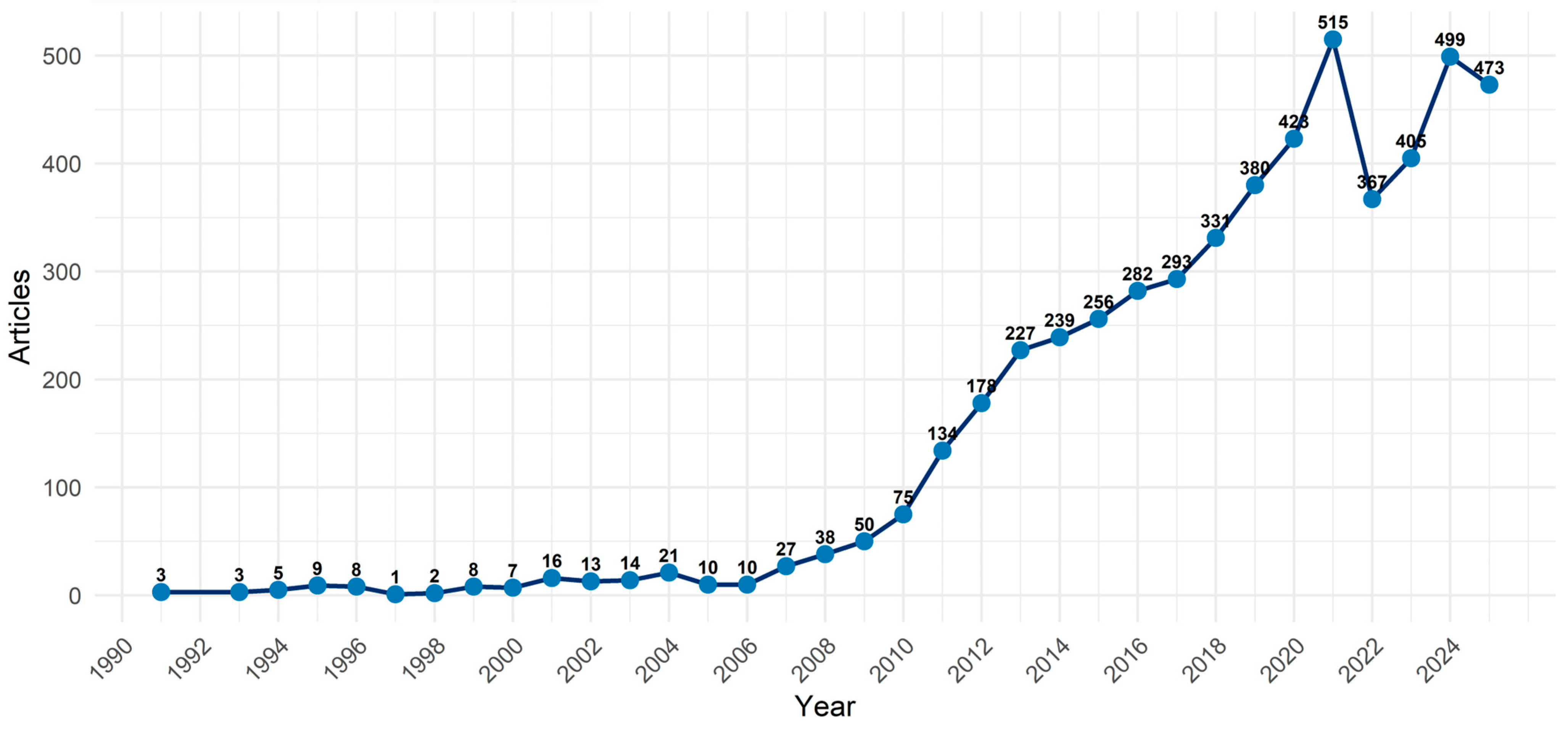
From 1990 to 1997, the field exhibited nearly absent scientific production with an average of 5.6 articles per year, reflecting a limited institutional focus [28]. After 1997, simultaneously with the Kyoto Protocol (1997), for the first time, there is a measurable positive rate of change to the curve, indicating the incubation of MRV for agriculture and livestock farming. In 2004, the curve showed a small peak followed by a period of uncertainty acting as a consolidation season until the time of the IPCC Guidelines (2006) and AR4 (2007), which, by its focus on emission factors, inventory mechanisms, and uncertainty assessments, acted as a catalyst for research, as shown in Figure 2.
Peeking in 2021, at the time of the IPCC Sixth Assessment Report, six years after the Paris Agreement (2015), with a total of 515 articles that year, the minimal academic drawdown in 2022 was immediately fueled by the IPCC AR6 Synthesis Report (2023) and the first Global Stocktake (2023) emphasizing the centrality of MRV for climate change and carbon markets [28,29,30,31,32,33,34,35].

3.1.2. Geographical Distribution

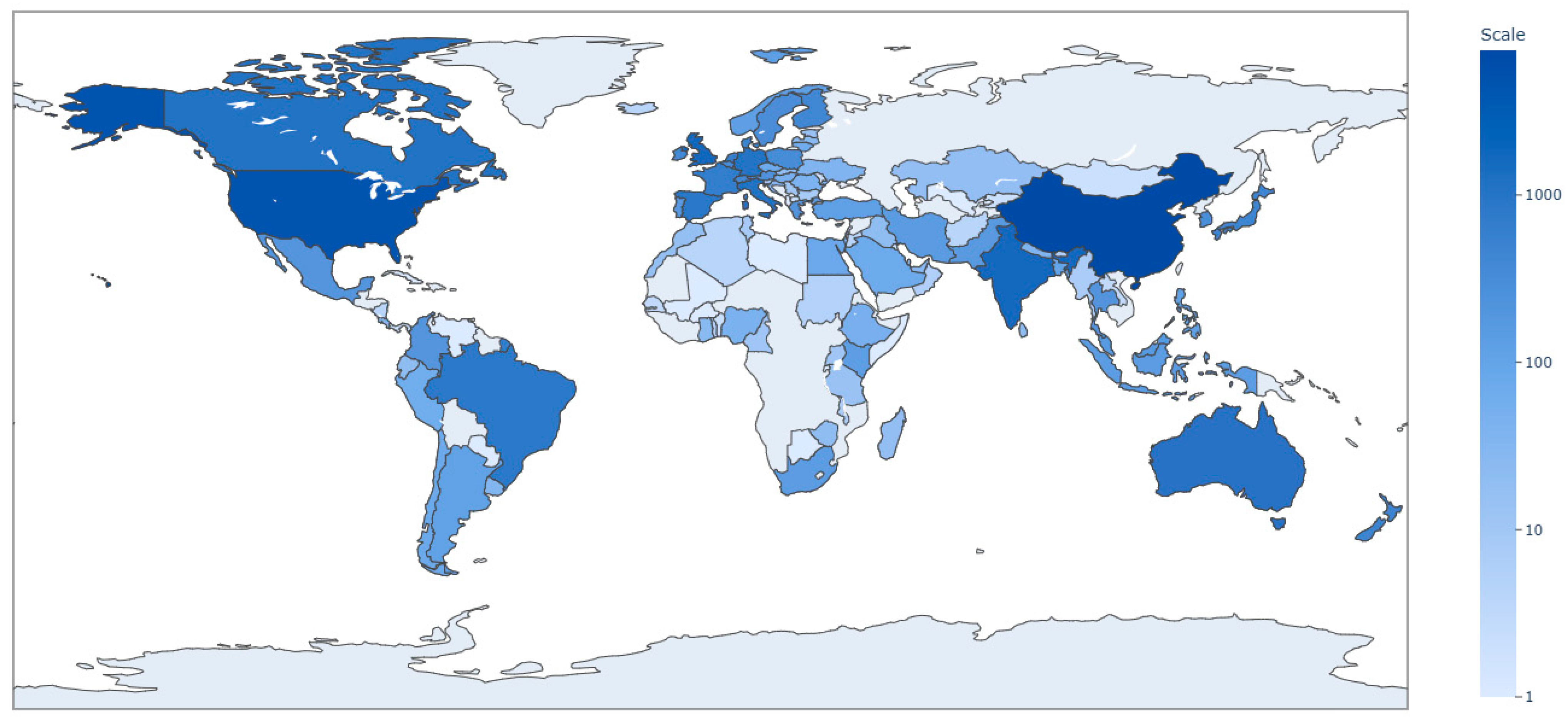
The geographical scientific production map was exported using the full counting method, dividing credit amongst co-authors’ countries for each publication. As shown in Figure 3, MRV-related research in agriculture and livestock farming is distributed in the leading major economies, reflecting the importance of GHG accounting and transparency. The darkest blue regions on the map correspond to countries/regions with the highest publication output, led by China (7319) and the United States (4450). Other prominent contributors include the United Kingdom (1782), India (1665), Canada (1108), Australia (1072), Germany (1061), Brazil (830), and the Netherlands (631). On the other hand, developing countries, located mostly in Asia, Africa, and South America, are facing persistent problems with the MRV of livestock farming and agricultural GHG emissions due to weak institutional and policy drivers, technical and data gaps, and resource and capacity constraints [36,37,38].

3.1.3. Most Relevant Affiliations

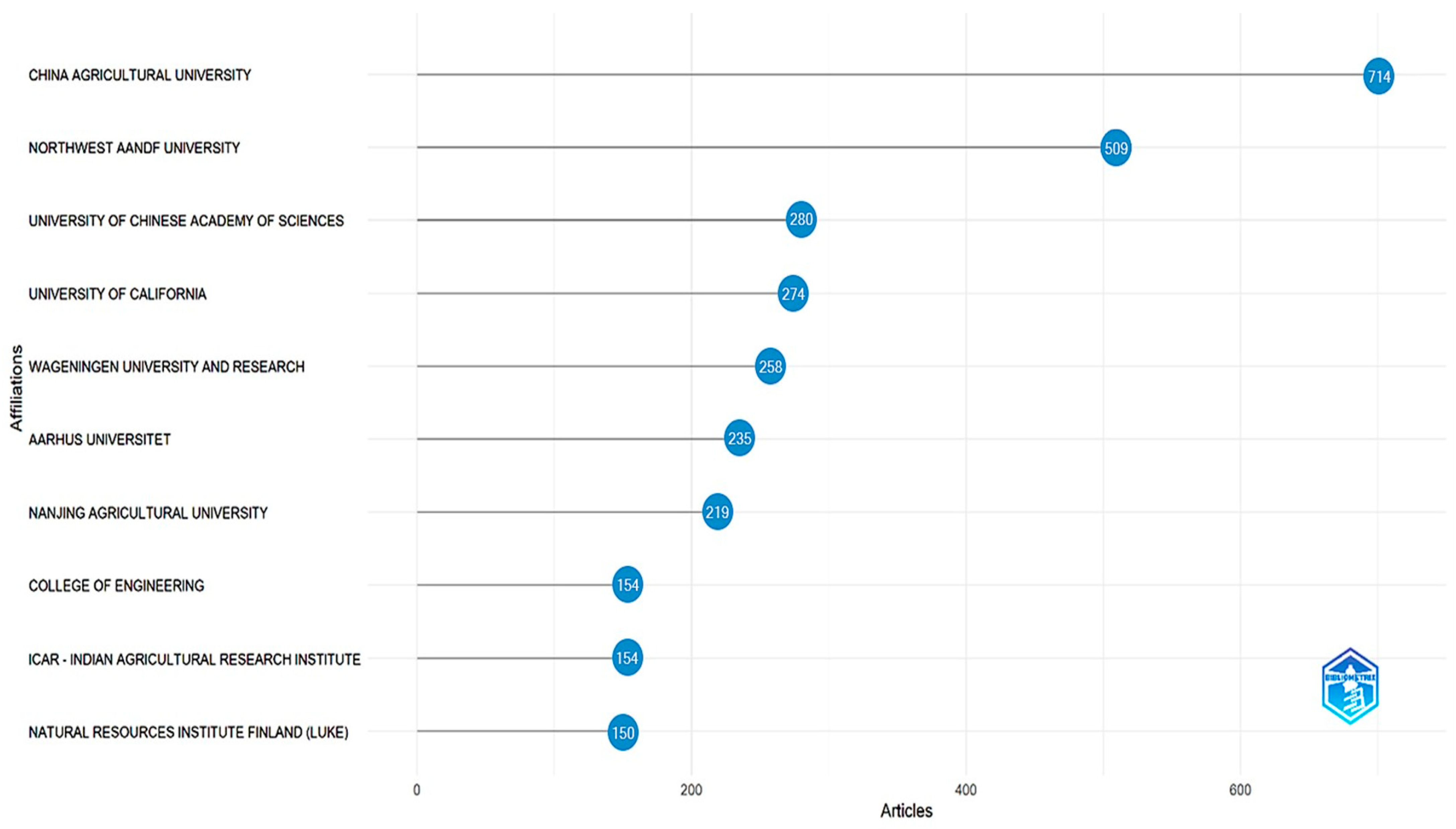
For the examination of the most relevant affiliations, the full counting method was used (Figure 4). To avoid overestimating institutional influence, the proportion of the literature from the top ten institutions was calculated as the number of the full-counted publications linked to these research centers (2947) divided by the total number of documents (5340) multiplied by the mean of affiliations per document (3.04), which was extracted from Bibliometrix using the following command line:
2947 5340 × 3.04   = 0.1815
Among the 3916 institutions, the top 10 (0.255% of the population) accounted for 18.15% of the total output as calculated, implying a roughly 70–90-fold higher per-institution contribution than the institution-wide average, and indicating a highly concentrated institutional performance. This pattern reinforces the geographical trends identified in the previous section, confirming that MRV-related studies in agriculture and livestock farming are a field of study highly centralized in the major economies. China Agricultural University leads by a considerable margin, with 714 publications, followed by Northwest A&F University (509), Nanjing Agricultural University (219), and the University of the Chinese Academy of Sciences (280). These numbers reaffirm China’s dominant academic output based on its academic infrastructure and sustained policy focus on agricultural emissions and data systems.
The Wageningen University (258) and Aarhus University (235) stand out as leading Western contributors, reflecting Europe’s continued influence in methodological development and cross-sectoral applications of the MRV framework [36]. Additionally, ICAR–Indian Agricultural Research Institute (154) and University of California (274) are strong representatives for India and North America.
As showcased, the most relevant affiliations are linked to China Agricultural University (Figure 4), aligning with the graphical chart in Figure 3 illustrating that more authors are located in China.

3.1.4. Most Relevant Keywords

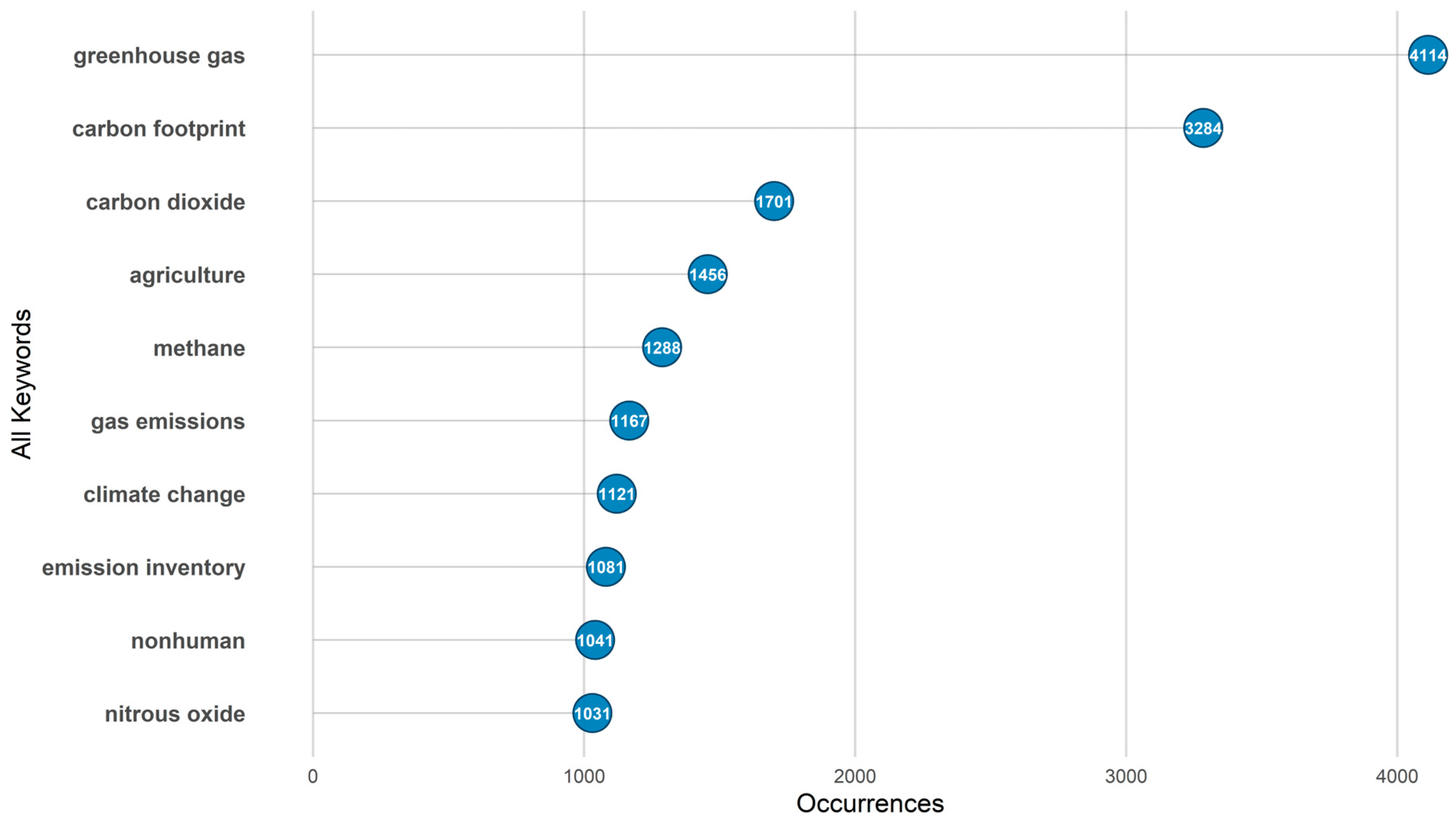
The Relevant Keywords diagram (Figure 5) was exported while excluding the keyword “article” and merging the keywords “greenhouse gas” and “greenhouse gases” due to their semantic equality. As such, there is strong evidence on the GHG account and estimation research maturity with leading keywords such as greenhouse gas (4114), carbon footprint (3284), carbon dioxide (1701), methane (1288), gas emissions (1167), and nitrous oxide (1031).
By contrast, concepts linked to governance, policy, and verification remain considerably underrepresented. Notably, environmental policy, being the first keyword matching the concepts mentioned above, appears only 157 times across the dataset, falling below the threshold for inclusion in the visualization.
That specific phenomenon reflects an immaturity in the verification mechanisms and policy frameworks governing the existing national emissions inventories, carbon markets, and climate transparency regimes [39].

3.1.5. Authors, Countries, Collaborations

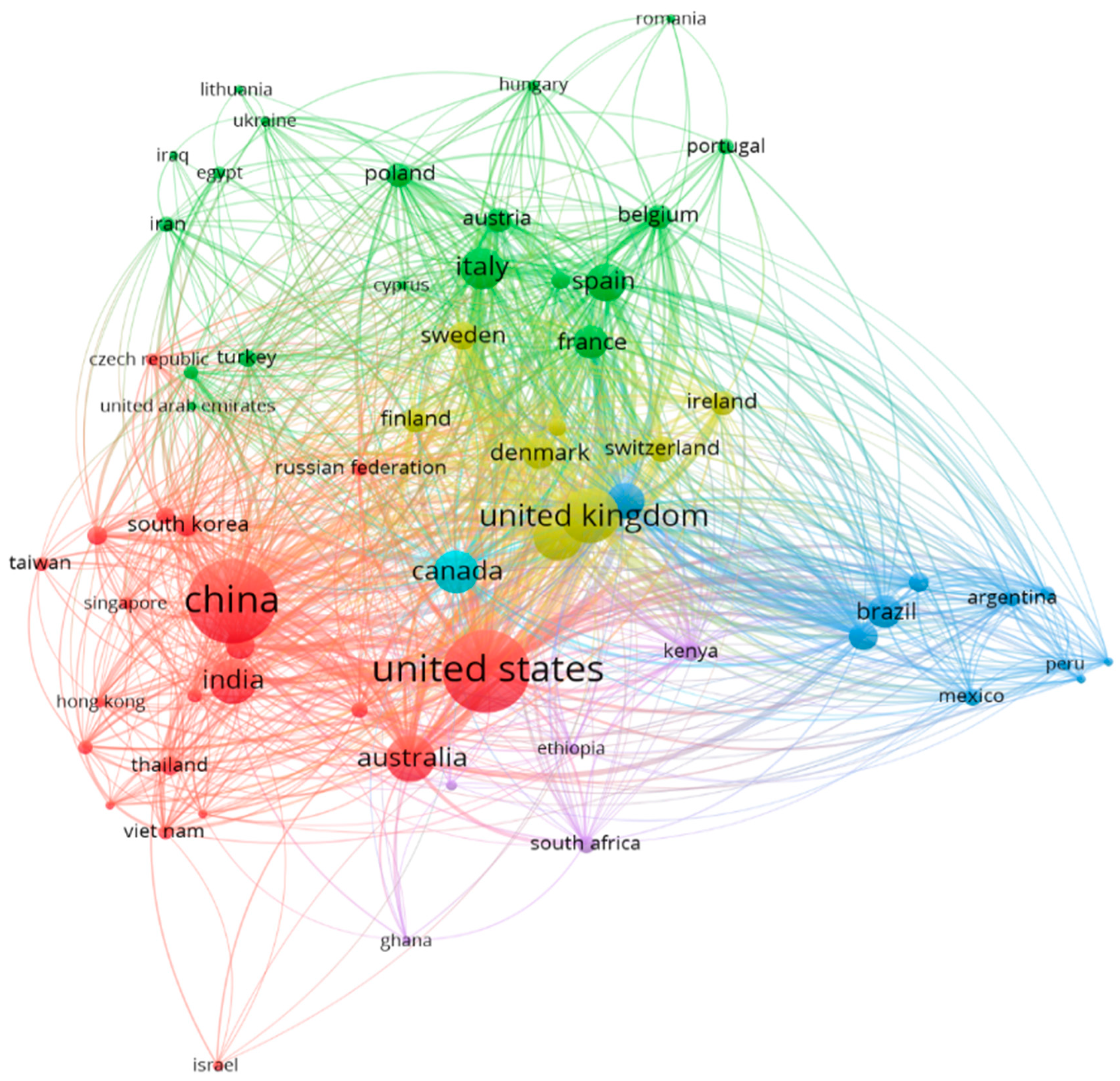
Figure 6 represents a network visualization based on a co-authorship analysis by country or region, highlighting international collaborations in the MRV of agriculture and livestock farming. This map was generated using the fractional counting method, and the “Minimum number of documents per country” was set to 10, with 64 of the total 128 documents meeting the threshold. Each node represents a country, and the color-coded cluster indicates groups of countries with regional research communities or thematic synergies. The connecting lines represent co-authorship links, with thicker lines denoting stronger collaborations. There is a tight, strong, and leading partnership between American and Chinese scientists, while European scientists present links with other regions.

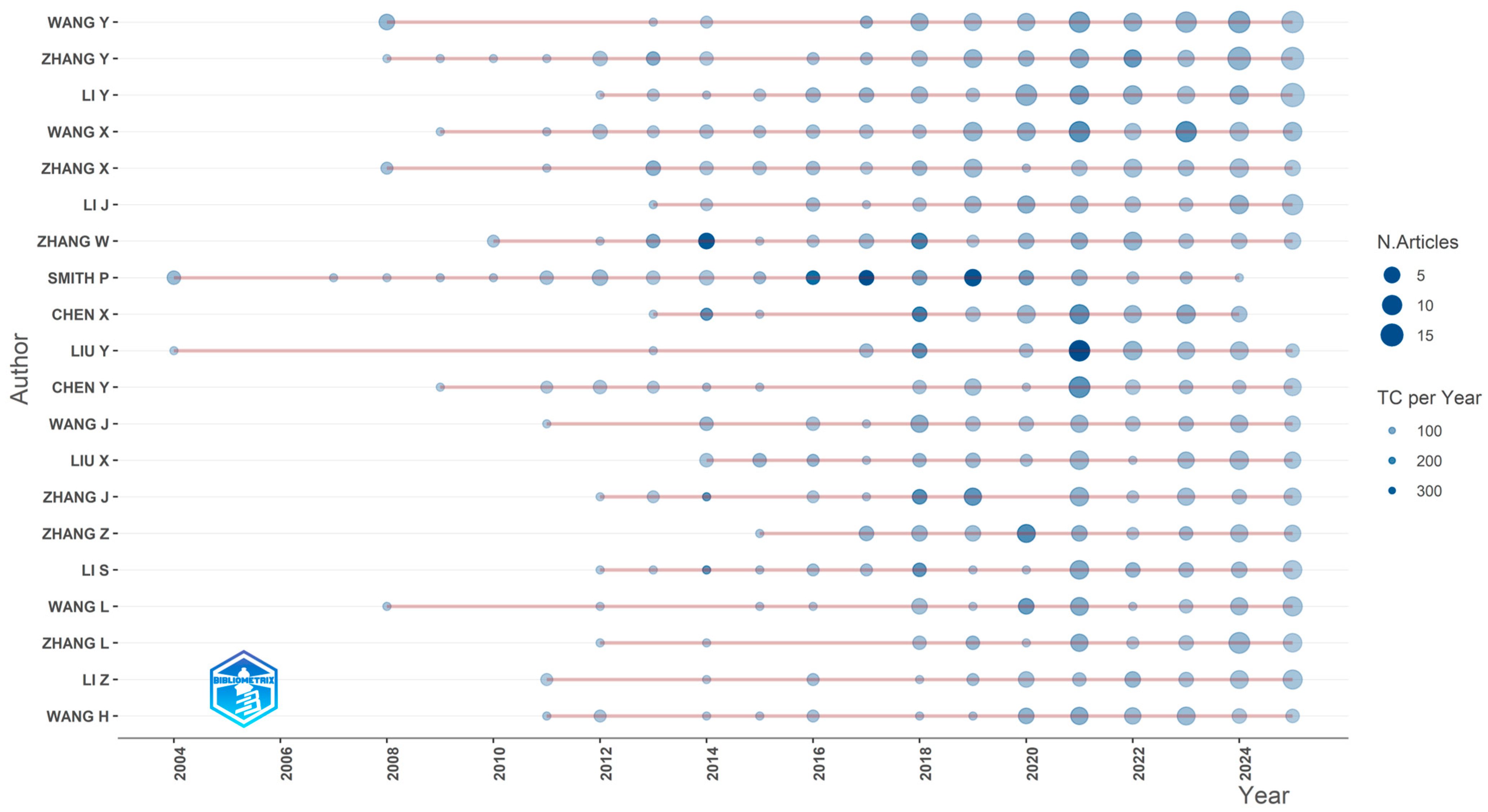
3.1.6. Author’s Production over Time

The combination of the top authors’ production over time with their publication output and citation impact is a crucial indicator of literature distribution. Initially, the publication output revealed a considerably high concentration of research between a small group of authors, with Wang Y., Zhang Y., Wang X., and Li Y. producing the largest volume of publications (≥85 documents each). This pattern aligns with the findings of Section 3.1.2, Section 3.1.3, Section 3.1.4 and Section 3.1.5 and justifies China’s strong academic footprint.
Conversely, a citation-based ranking shifts leadership towards authors like Smith P. and Zhang W., indicating the coexistence of high output and high impact contributors. Figure 7 also supports the pattern described in Section 3.1 by visualizing that the emergence of the most prolific authors occurred at the time of the first major increase in annual scientific production, while aligning with the release of the IPCC Guidelines for National Greenhouse Gas Inventories [30]. Notably, Smith P., being the highest impact author, appears to have contributions prior to 2006, indicating the early recognition of the importance of the MRV systems for agriculture and livestock farming.

3.2. Narrative Review Results

3.2.1. MRV Methods Used for Tracking GHG Emissions

An evaluation of the findings identified the various MRV methods adopted to track GHG emissions from agriculture. A summary of the selected studies in the systematic literature review is presented in Table 2, with a more thorough synthesis detailed in Appendix A, Table A1.
The reported methods included the following: (1) inventory techniques (IPCC Tiers, national systems), (2) accounting at the project/product level (LCA, carbon footprint protocols), (3) MRV based on measurement and models (chambers, remote sensing, farm models, AI/ML), and (4) frameworks for governance and standardization (UNFCCC, Paris ETF, PAS 2050, etc.).
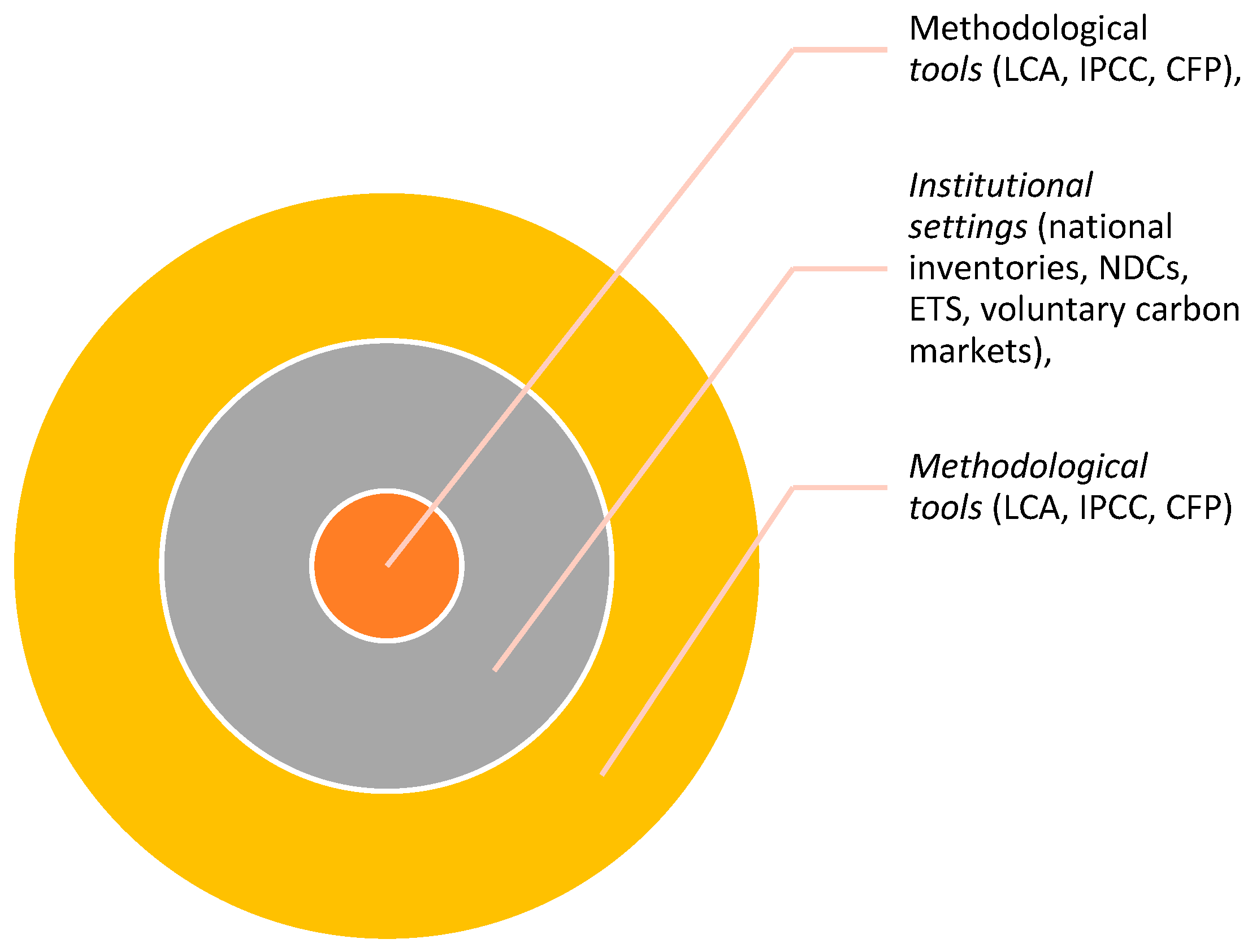
Based on the typological classification of the studies presented in Table 2, a conceptual framework decomposing the MRV methods into its component dimensions was further generated, as showcased in Figure 8 below.
As illustrated in Figure 8, the MRV techniques were classified according to institutional settings, and methodological tools. The application of these methods is detailed further in the subsequent sections.
Accounting at the Product/Project Level
An analysis of the diverse studies indicated the application of accounting methods at the product/project level where LCA methods and GHG computing techniques were discussed. An LCA encompasses tracking of GHG emissions throughout the lifecycle of a product or service [40]. As such, in agriculture, LCA tracks GHG emissions from food production and animal rearing to their conversion to packaged food products as they are transported for consumption, and at the end-of-life phase where they are disposed. The synthesis of the results revealed the application of LCA in both crop production and livestock production.
LCA in Livestock Farming
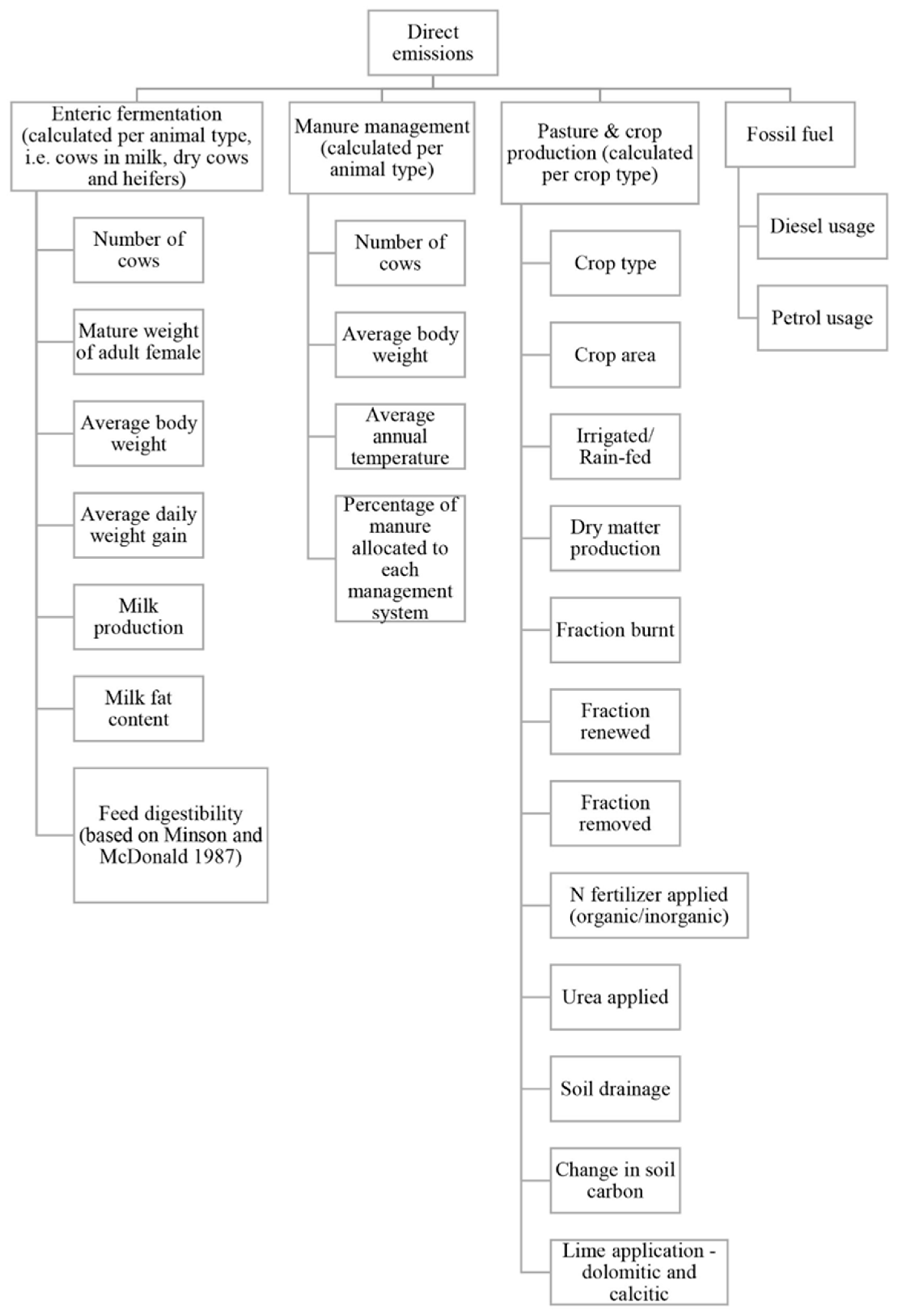
Several studies have revealed how LCA was adopted in the evaluation of the carbon footprint across livestock farming. In [40], the LCA farmgate method was adopted to assess the carbon footprint of pasture-based dairy farming in South Africa. The study collected GHG emissions from four distinct stages; enteric fermentation from the dairy cows, manure management, pasture and crop production, and the fossil fuels used in the transportation of products and animals within the dairy farms. Figure 9, illustrates the LCA inventory diagram of the obtained GHG emissions.
Following the assessment of 82 pasture-based dairy farms in South Africa, the obtained results revealed that 1.36 ± 0.21 kg CO2-eq per kg−1 of fat- and protein-corrected milk produced (FPCM) GHG emissions were produced [40]. The results further showed that enteric fermentation had the largest impact on the carbon footprint and indicated that methane dominated the GHG emissions from the dairy farms. Another similar study, Ref. [41], employed LCA to characterize the environmental profile of milk production across family agro-industries in Brazil. Similar to Ref. [40], the study showed that the highest contributions of GHG emissions arose from enteric fermentation (60%). However, Ref. [41] reported that the average carbon footprints in the farms were 2408 and 2189 kg CO2-eq per 1000 kg FCPM with and without the biophysical allocation of inputs and emissions between milk and cattle, respectively. A further insight was that the carbon captured during photosynthesis processes during feed production was 1677 kg CO2-eq per 1000 kg FCPM for milk and 15,003 kg CO2-eq per 1000 kg live weight of animals, representing 76% and 99% of the carbon footprint [41]. Another study, by [42], also used the LCA method to compare the environmental impacts of a high-input feeding regime against a grassland and low-input feeding regime for milk production in Central Germany. The study quantified five different environmental impacts, including global warming (GW), non-renewable energy use (NREU), land use (LU), terrestrial acidification (TA), and freshwater eutrophication (FE) [42]. The results indicated that the low-input grassland regime resulted in higher environmental impact compared to the high-input feeding regime across the five different impacts. Further insights showed that, when concentrates were reduced by 50% and maize silage was excluded from the feed ration, the milk production was reduced by 20%. Therefore, the insights from [41,42] indicated a similarity, where it was essential to balance the natural and additional feed yields used for the animals by balancing the energy content in the low-input food production systems with longer periods of grazing and higher amounts of grass silage, hay, and alfalfa.
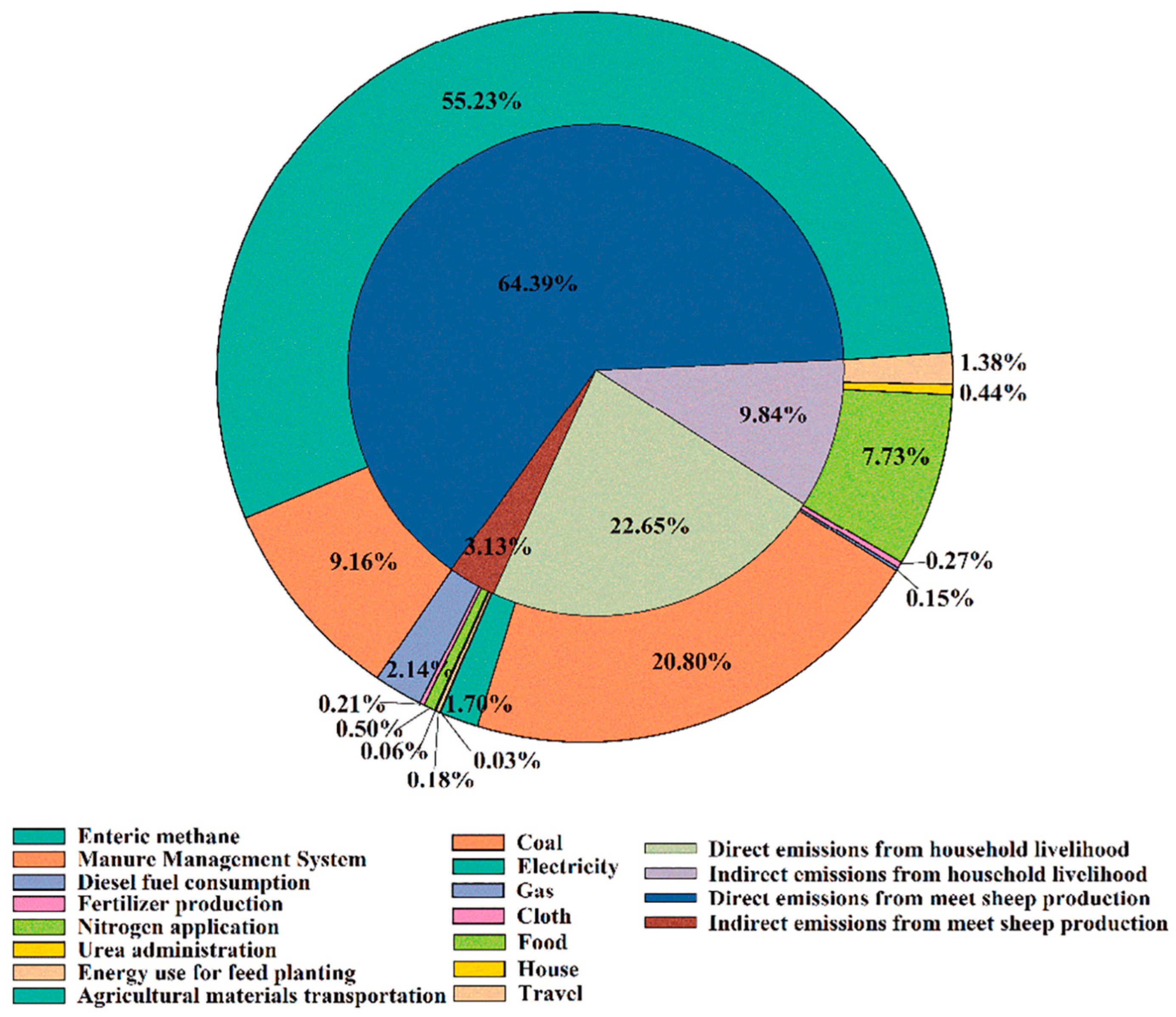
The results also indicated the use of LCA in quantifying GHG emissions from livestock farming aimed at meat production. In their study, Ref. [43], the authors used the LCA method to assess the carbon and nitrogen footprints of goats and sheep across different farming modes in North China. The GHG emissions were quantified across feed production, enteric fermentation, manure management, and energy consumption. The obtained results revealed that the average carbon footprint of sheep was 19.10 kg CO2-eq/kg of carcass weight (CW), slightly higher than the 18.9 kg CO2-eq/kg of CW for goats [43]. However, sheep had an average nitrogen footprint of 127 g N-eq/kg of CW, lower than the 191 g N-eq/kg of CW for goats. An explanation advanced was that the lower environmental impact in sheep production arose from the adoption of higher feed conversion efficiency within mixed systems, improved manure management approaches, and better cultivation processes, which relied less on fertilizer application [43]. Another study, Ref. [44], also considered the LCA method and structural equation modelling to quantify GHG emissions from live sheep across different household ranches in a Eurasian meadow steppe. The results revealed that the GHG emissions of meat sheep live weight were 23.54 kg CO2-eq/kg [44]. Enteric fermentation was the leading source of the emissions (55.23%), followed by the uptake of coal (20.80%) and manure management (9.16%). The results also indicated that the GHG emissions within households were attributed to the economic level and a positive linear correlation between the number of meat sheep and household emissions [44]. The composition of the GHG emissions in the households, as computed by [44], is showcased in Figure 10.
A different study, Ref. [45], also quantified the amount and variability of greenhouse gas (GHG) emissions from four distinct production categories that typify US sheep production, including intensive, intensive grazing, extensive grazing, and range. The results revealed that there were lower GHG emissions from the intensive operations, which involved less time on pasture and more reliance on purchased feed. Further, enteric fermentation contributed to the highest CH4 emissions from the extensive (79%) and intensive (46%) categories. However, ewe production contributed to the highest CH4 emissions within the sheep production systems [45]. A similar study, by [42], also examined ewe farming and used the LCA method to quantify the carbon footprint of 1 kg of live weight of ewe, ram, and lamb at the farm gate, considering the regional typological features of agricultural production in agroecosystems. The results indicated that, in modern sheep breeding, 21.41 kg CO2-eq was emitted on average per kg of body weight of ewe, 19.13 kg CO2-eq was emitted on average per kg of body weight of ram, and 3.2 kg CO2-eq was emitted on average per kg of body weight of lamb [46]. As such, the insights indicated that the continued application of fertilizers and inefficient manure management contributed to high N2O emissions [46]. Therefore, the uptake of precise farming technologies and efficient manure handling would reduce GHG emissions from ewe and sheep farming.
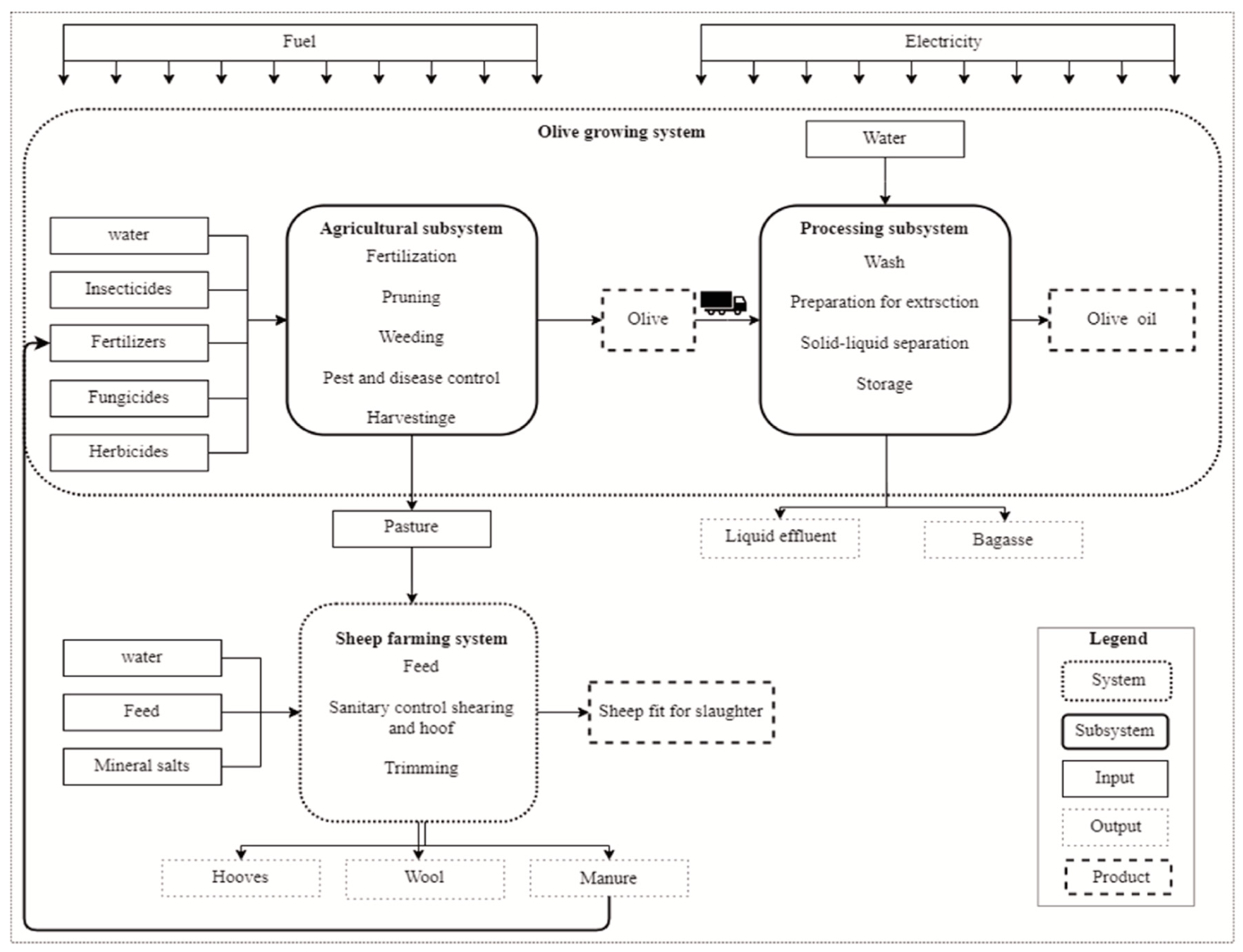
Another study, Ref. [47], used LCA for GHG quantification, and reported that integrating sheep with olive oil farming contributed to a significant mitigation potential of 27.7%, resulting in a reduced global warming impact of 4.92 kg CO2-eq. As such, synergy was obtained between olive oil and sheep farming, where they shared agricultural inputs and optimized nutrient recycling, leading to lower GHG emissions. Despite such findings, Ref. [47] reported that the largest contributors of GHG emissions were enteric CH4 from sheep and the application of limestone in the olive oil farms. Figure 11 illustrates the system boundary integrating olive and sheep farming.
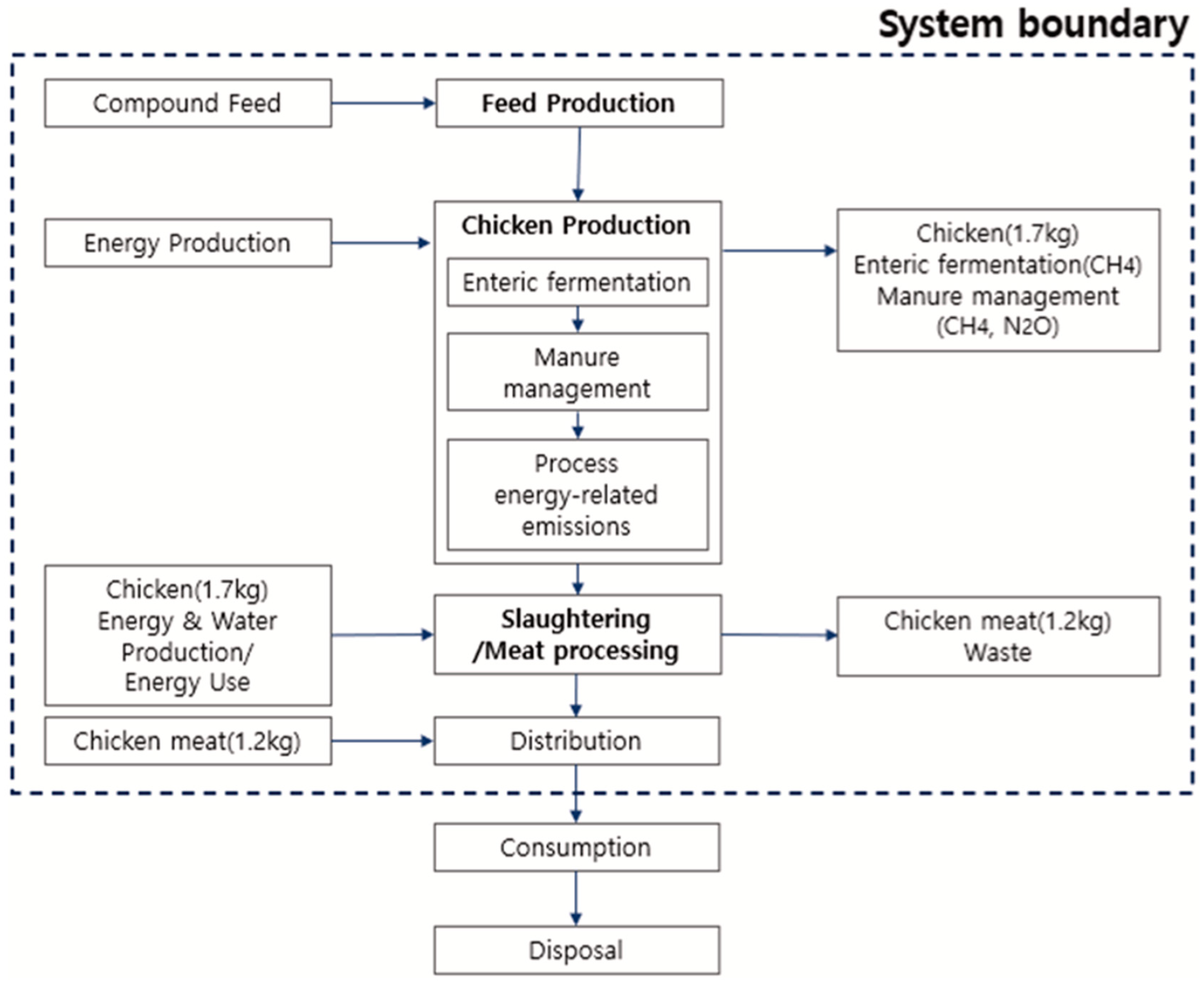
In other studies, such as [49,50], LCA was adopted to quantify the GHG emissions from pig farms. The results in [49] indicated that the average CF of the unit mass alive pigs in the backyard, specialized, medium-scale, and large-scale farms in China were 1.78 kg CO2-eq/kg, 1.55 kg CO2-eq/kg, 1.65 kg CO2-eq/kg, and 1.65 kg CO2-eq/kg, respectively. An LCA was also used by [50] to estimate the daily feed intake of sows and the amount of feed consumed during their non-productive days, correlating these results to greenhouse gas emissions. The obtained results indicated that the pig farms were inefficient, where those in the Midwest region contributed 2.80 kg of CO2-eq/kg per piglet, while those from other regions emitted 3.89 kg of CO2-eq/kg per piglet [50]. As such, LCA identified the inefficient pig farming methods that contributed to high GHG emissions. In [51], the cradle-to-gate LCA method was used to estimate the product carbon footprint (CF) and total emissions of the Western Australian (WA) beef industry, establishing a baseline for emission reduction planning. The results revealed that the mean CF for WA was estimated at 15.3 kg CO2-eq per kg liveweight (LW) and the implementation of herd management strategies and anti-methanogenic supplements contributed to a reduction in GHG emissions by 25% [51]. The insights across the studies emphasized the role of herd management strategies, the use of anti-methanogenic supplements, and the use of carbon sequestration and soil management techniques to reduce GHG emissions. Finally, Ref. [52] used an LCA to quantify GHG emissions from different stages of producing chicken meat, including feed production, slaughtering, processing, and transport. The results showed that 1 kg of domestically produced chicken emitted approximately 4.08 kg CO2-eq, with the highest emissions originating from the feed production stage, which accounted for 56.80% of the total emissions. Figure 12 showcases the system boundary of chicken meat production in South Korea.
LCA in Agriculture
The LCA method was also adopted to quantify GHG emissions across crop production farms. In [53], Hai Van et al. employed the LCA method to quantify the GHG emissions from rice production in consolidated land in the Red River Delta region. The results indicated that the GHG emissions were higher in the summer crops than in the spring crops [53]. Similar to Ref. [40], the findings from [53] showed that methane was the most dominant GHG at 84% in the summer crop and 73% in the spring crop. Further emissions arose from the use of fertilizers and N2O in the summer crop (9%) and spring crop (16%), while use of machinery and irrigation contributed to 4% and 8% of GHG emissions [53]. The application of the LCA method in [53] indicated that strategies to mitigate GHG emissions ought to focus on reducing methane emissions through the application of better irrigation and fertilization practices. Other studies, such as [54], also considered LCA to assess the carbon footprint and mitigation strategies across heterogeneous farms in Brazil and indicated that there were lower GHG emissions from larger farms with access to technology at a mean of 1.75 kg CO2-eq (kg FPCM) compared to smaller personalized farms, which had a mean of 0.27 kg CO2-eq (kg FPCM). The insights underlined the need to introduce sustainable intensification strategies in large farms, such as using technology to mitigate GHG emissions.
Further studies have considered the adoption of LCA in quantifying GHG emissions from rice farms [55,56,57,58]. In [56], an LCA was used to identify the carbon footprint and GHG emissions of different rice-based cropping systems in Bangladesh, including rice–rice–rice, rice–fallow–rice, maize–fallow–rice, wheat–mung bean–rice, and potato–rice–fallow. The obtained results indicated that rice systems with dryland crops had higher nitrous oxide (N2O) emissions than sole rice systems [56]. However, CH4 dominated in the GHG emissions where Boro rice-based systems (R-R-R and R-F-R) had the highest carbon footprint (ca. 25.8 and 19.2 Mg CO2-eq ha−1) while the P-F-R (12.3 Mg CO2-eq ha−1) and M-F-R (12.6 Mg CO2-eq ha−1) had the lowest carbon footprint [56]. Such insights underscored the need for different cropping systems to mitigate GHG emissions. The study by [58] used an LCA to determine the spatiotemporal dynamics of the carbon footprint for major crops in China, including rice, wheat, and maize in the period from 1990 to 2019. The results indicated that rice, wheat, and maize had the highest carbon footprint and GHG emissions due to larger cultivation areas and fertilizer use [58]. Additional insights revealed that, while CH4 contributed to a high carbon footprint in rice production, at 66% CF per unit area and 48% CF per yield area, the dryland crops had GHG emissions arising from fertilizer applications. As such, similar to Ref. [56], the study by [58] underscored the need for different cropping systems to mitigate GHG emissions. A similar finding was reported in [55], where the carbon footprint for every 1 ton of polished rice in Hubei ranged between 4.19 and 6.81 t CO2-eq/t and was 5.39 t CO2-eq/t on average, especially during the growth stage. The results from [57] also resonated with [55,58], showing that CH4 was the highest contributor to GHG emissions at 84.48% of all Scope 3 GHG emissions. In other studies, LCA has revealed that, among bioethanol crops, such as sugarcane in Brazil, sugarcane showed an average N2O EF of 0.65%, with higher emissions from the combined use of mineral and organic N fertilizers (0.79%) compared to mineral (0.55%) or organic fertilizers alone (0.77%) [59]. The insights indicated that crop management practices were essential to understand the long-term dynamics of reducing the climate impact from farming. A similar insight was identified by [48], where an LCA was used to assess the environmental impact of mixed nature-based solutions (NBSs) in peach orchards and olive groves in Greece. The results showed that, when crop management strategies were used, such as combining olive and peach, GHG emissions reduced by 16.4% in peach cultivation and 51.1% per hectare in the olive grove [48]. As such, mixed cropping facilitated the mitigation of GHG emissions within different agricultural farms.
GHG Computation Protocols
The third methodology identified for tracking GHG emissions from agriculture and livestock farming involved GHG computational protocols. Such methods entailed activity-based estimations, direct measurements, and advanced modelling [60,61]. The protocols were adopted both in agriculture and livestock farming, as detailed in the following subsections.
GHG Computation Protocols for Agriculture
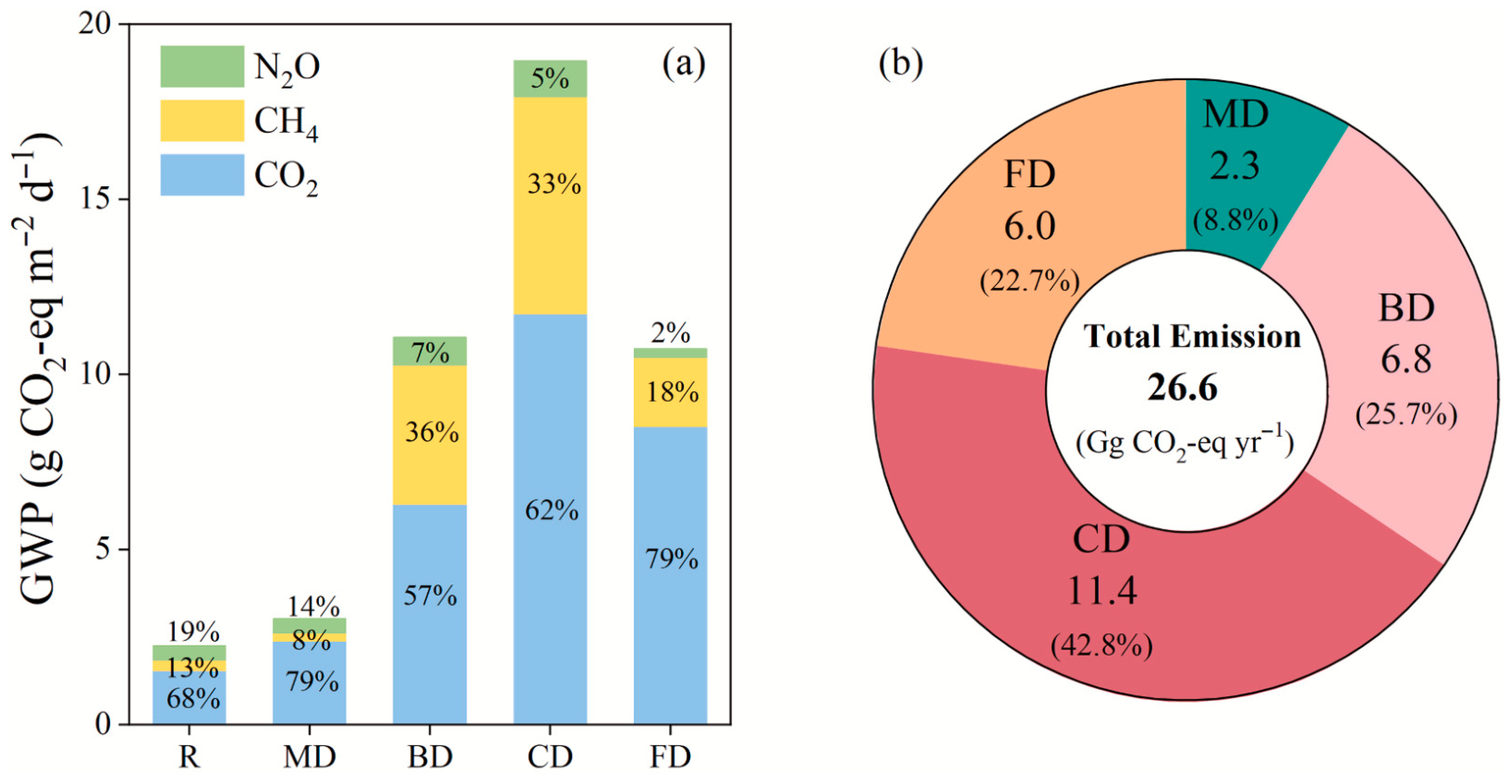
Several studies have demonstrated the use of GHG protocols for agriculture, involving different types of crops. In [60], guidelines on carbon footprint calculation were adopted to undertake a comprehensive examination of China’s anthropogenic CH4 emissions from available datasets (13 inventories). The results showed that the anthropogenic CH4 emissions varied widely from 44.4 to 57.5 Tg CH4 yr−1 in 2010, with the discrepancy arising from energy, agricultural, and waste treatment sectors. Such insights were essential to understanding how bottom-up inventories contributed significant anthropogenic emissions across diverse sectors. In agriculture, Ref. [62] assessed the GHG concentrations and fluxes from typical agricultural ditch systems in an irrigation district in the Northern China Plain using GHG quantification models. The results indicated that all ditches were large GHG sources and the mean fluxes were 333 μmol m−2 h−1 for CH4, 7.1 mmol m−2 h−1 for CO2, and 2.4 μmol m−2 h−1 for N2O, which were approximately 12, 5, and 2 times higher than the river connecting the ditch systems [62]. Figure 13 showcases the global warming potential (GWP) from the river and ditches and the total GHG contributions from different types of ditches.
Similarly, Ref. [63] examined the magnitude of CH4 fluxes across different agricultural sites in the British Isles using 53,976 manual static chamber measurements and showed that an estimated annual emission of 0.16 and 0.09 Mt of CO2-eq was expected from arable and grassland agricultural soils in the UK and Ireland. The insights showed that the variability in soil moisture content also impacted the generation of CH4 emissions. Another study, by [64], used the carbon footprint methods to assess whether farm-level carbon intensities of feedstock reduced corn ethanol GHG emissions. The results revealed that large CI variations—from 119 to 407 g CO2-eq per kg−1 of corn arose from the farm-level inventory, while the production-weighted average CI for all surveyed farms was 210 g CO2-eq per kg−1, comparable to the national average CI of 204 g CO2-eq per kg−1. As such, low-carbon feedstock could be incentivized for biofuel production. In [65], the static closed-chamber technique was adopted to assess total GHG emissions and sequestration for maize grown in Bangladesh. The results showed that the GHG emission intensities were 0.53–2.21 and 0.37–1.70 kg CO2-eq per kg−1 grain in the wet and dry seasons, respectively. The insights indicated the need to manage fertilizer and water use efficiencies to mitigate GHG emissions under changing climatic conditions. Further work by [66] revealed that the amount of N in non-removable residue was approximately 20, 25, and 31 kg N per 1 Mg average annual dry matter yield in grass, red clover-grass, and red clover, and 70–83% of it was below ground and that N2O emissions from frozen soil accounted for 30% or more of the total emissions. Another study, by [67], used GHG protocols and revealed that cumulative CH4 emissions during the growing season across two rice irrigation fields and 5 years ranged from 41 to 123 kg CH4-C ha−1 for the CF and 1 to 73 kg CH4-C ha−1 for AWD (alternate wetting and drying). In [64], the carbon footprint methods showed large CI variations due to the farm-level inventory, while the production-weighted average CI for all surveyed farms was 210 g CO2-eq per kg−1, comparable to the national average CI of 204 g CO2-eq per kg−1. The insights across the studies revealed that GHG quantification protocols identified CH4 as the most dominant GHG emissions compared to CO2 and N2O.
GHG Computation Protocols for Livestock Farming
The GHG computation protocols were also adopted to assess GHG emissions from livestock farming. In [61], simplified GHG calculation models used in Bavarian dairy farms showed that the median farm carbon footprint was 441.7 tCO2-eq/a and the total GHG mitigation potential per farm was 6.51 tCO2-eq/a to 112.29 tCO2-eq/a. The insights revealed high accuracy similar to detailed computation models. Another study, Ref. [68], also employed the GHG protocols to undertake a comprehensive satellite-based fingerprinting analysis of methane emissions from Canada’s dairy sector. The results showed higher CH4 concentrations in dairy regions at 17.4 ppb. However, the concentration gap between dairy and non-dairy regions notably narrowed by 57.23% (from 24.42 ppb in 2019 to 10.44 ppb in 2024), driven primarily by accelerated methane increases in non-dairy landscapes. In their study, Ref. [69] combined emission accounting methods with biophysical models to assess the spatiotemporal greenhouse gas profiles of Australia’s national beef cattle and sheep production, and revealed that the emissions had reduced from 158 Mt. CO2-eq in 2011 to 50 Mt. CO2-eq in 2020. The work by [70] estimated GHG emissions from crops and livestock farming in Indian villages impacted by both green (crop) and white (milk) revolutions, showing that the main drivers of emissions at the plot level were irrigation, mineralization, and methane. As such, Refs. [69,70] indicated that intensive farming practices were key drivers of GHG emissions at territorial levels. In [71], GHG protocols revealed that net N2O emissions from irrigated pasture grazed by dairy cows could be reduced by planting more diverse species (0.14 g N m−2 yr−1 (mean of two years)), compared with conventional ryegrass–clover pasture (0.23 g N m−2 yr−1). The results highlighted the consequences of the intensification of livestock farming. Other studies, such as [72,73,74], have considered GHG protocols to assess emissions from pig and cattle manure. In [74], the results showed that emissions from fattening pig farms with biogasification (P3) and acidification (P4–P5) facilities were 55% and 91–93% lower, respectively, than from farms with no manure treatment (P2). Similarly, Ref. [73] revealed that manure management approaches contributed to 4.34% of N2O to the total emissions, while this source also produced 3.45% of CH4 emissions. Various studies [72,73,74] have demonstrated the need for appropriate manure management approaches to mitigate GHG emissions across different livestock farms.
Techniques for Inventory
The findings also indicated the use of techniques for inventory, such as the IPCC Tiers and national systems. The IPCC guidelines—Tier I, II, and III—were used in tracking carbon emissions from agriculture and livestock farming. A synthesis of the findings also identified the application of the IPCC guidelines in measuring and tracking GHG emissions from livestock farming and agriculture. The IPCC guidelines (2006, 2013, 2019) outline methodologies for the estimation and removal of GHG emissions that are internationally-agreed upon in three tiers (I, II, III) [75]. IPCC Tier I involves default IPCC emissions data and factors, while Tier II considers national data for emission factors, leading to higher accuracy [76]. Tier III entails using detailed models or facility-level measurements [77]. Various IPCC guidelines adopted in tracking and removing GHG emissions are detailed in the subsequent sections below.
IPCC in Agriculture
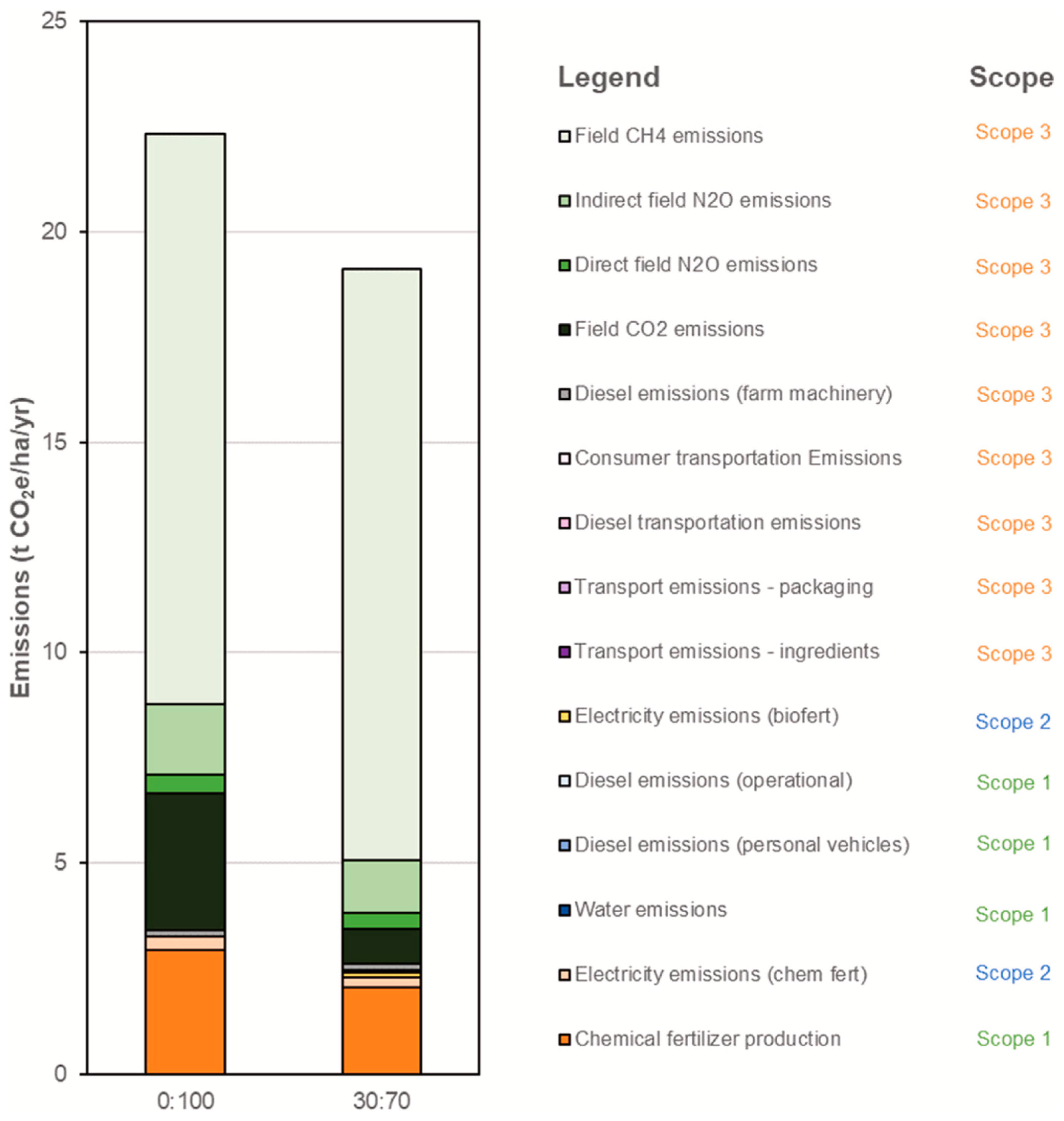
A close inspection of the results showed that a few studies considered the IPCC guidelines in measuring GHG emissions from agriculture. In [75], a model-based approach to estimate N2O emissions through NO3- leaching and runoff from agricultural soils for use in Germany’s national GHG inventory was adopted. A high-resolution spatial data and comprehensive model system (RAUMIS-mGROWA-DENUZ) was adopted to derive regionally differentiated and temporally dynamic FracLEACH values from N surplus and hydrogeological conditions, and the IPCC guidelines were used to estimate N2O emissions. The results showed that the N2O estimate was 10.4 Gg in 1990 and 5.7 Gg in 2019, figures that were 27% and 52% less than the values computed using the IPCC 2006 Tier I methodology [75]. As such, the improved methodology led to a more accurate estimation by accounting for different factors influencing NO3- leaching and runoff from agricultural soils. A similar finding was reported by [78], where they used the Tier I IPCC guidelines to determine the possibility of defining the effect of soil management factors on modelling soil organic carbon (SOC) sequestration and reducing soil CO2 emissions across different agricultural systems in Villavicencio. The results showed that, in zone 1 involving agroforestry systems, a 7-year coffee-based agroforestry stored more SOC, neutralizing −10.83 t CO2-eq per ha−1 year−1 than a 25-year soybean/corn crop rotation in zone 3 involving intensive croplands, with emissions of 2.56 t CO2-eq per ha−1 year−1 [78]. As such, using the IPCC guidelines in [75,78] revealed high accuracy in estimating GHG emissions and the impact of soil management methods in reducing emissions. Further work in [76] applied the IPCC Tier 3 methodology to calculate the CH4 and N2O emissions from rice systems in Vietnam, and reported that CH4 and N2O fluxes from Vietnam rice systems were highly seasonal at 2600 Gg CH4 y−1 and 42 Gg N2O y−1, respectively. Such insights indicated the applicability of the IPCC Tier III guidelines at the national scale to estimate GHG emissions. In another study, Ref. [57], the IPCC guidelines were combined with the LCA and GHG protocols to quantify the life cycle greenhouse gases of a paddy biofertilizer product from Malaysia. The results showed that most GHG emissions were derived from Scope 3 emissions, contributing to 16.69 t CO2-eq/ha/yr or 87.33% of the life cycle GHG emissions. Further, methane alone contributed 84.48% of all Scope 3 GHG emissions [57]. The insights across these studies indicated that the IPCC methodology was effective in estimating GHG emissions from soil, rice systems, and paddy biofertilizer products with high accuracy and for supporting the development of low-carbon national policies. Figure 14 illustrates the various categories of GHG emissions identified from the biofertilizer.
IPCC in Livestock Farming
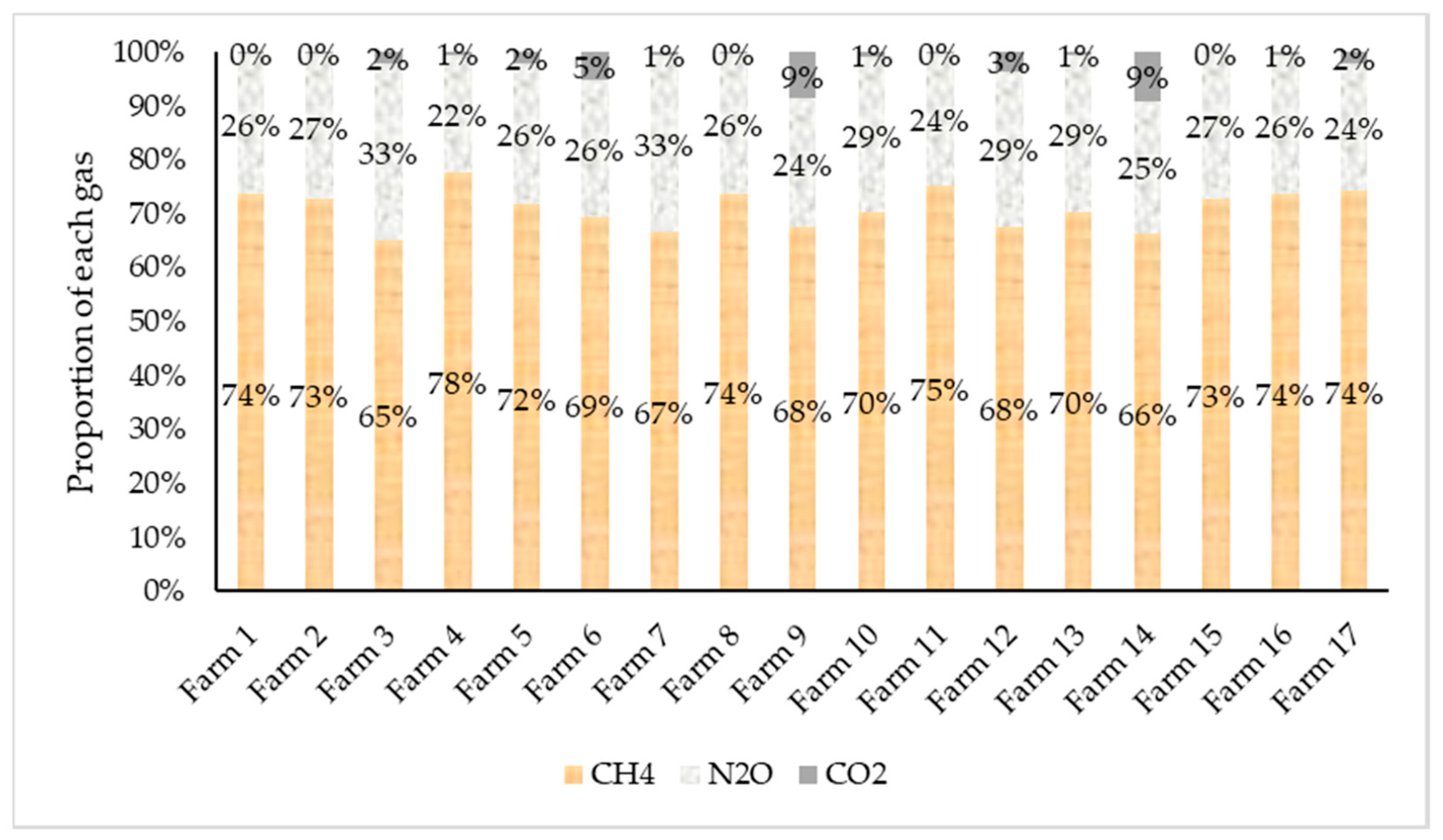
A synthesis of the studies further indicated the application of the IPCC guidelines in measuring GHG emissions from livestock farming. A majority of the studies considered the application of the IPCC methodologies in dairy and beef farming. In [79], the IPCC Tier I and II guidelines were used to evaluate the carbon footprint of livestock farms in the Orellana province in Ecuador. The results indicated that the average CF ranged from 14.5 to 18.3 kg CO2-eq per kg of live weight, with enteric fermentation accounting for 60.2% of emissions, followed by manure management (25.4%) and energy use (14.4%) [79]. A similar study by [80] also used the IPCC Tier I and II methodologies to assess the carbon footprint of livestock farms using conventional management and silvo-pastoral systems in Mexico. The obtained results indicated that SPS farms had lower GHG emissions, higher carbon fixation rates, and a better CF than CONF [80]. Another study, Ref. [81], the authors adopted the IPCC Tier II guidelines to develop a comprehensive CH4 emissions inventory for livestock in Xinjiang spanning the period 2000–2020. The results showed that the CH4 emissions increased from ~0.7 Tg in 2000 to ~0.9 Tg in 2020, a 28.5% increase over the past twenty years. Beef cattle contributed the most to the emission increase (59.6% of the total increase), followed by dairy cattle (35.7%), sheep (13.9%), and pigs (4.3%) [81]. Similarly, Ref. [82] used the IPCC 2019 methodology to assess the carbon footprint resulting from livestock in Izmir, Turkey, and showed that the total emissions were calculated as 1492 t CO2-eq (53%) from enteric fermentation, 1120.5 t CO2-eq (39%) from CH4 in manure management, and 214 t CO2-eq (8%) from N2O in manure management [82]. The confluence across [80,81,82] was the emphasis on using sustainable manure management strategies to lower GHG emissions from livestock farming. Further work, by [83], used the IPCC 2006 guidelines to quantify the carbon footprint (CF) from Fleckvieh cattle production systems in the Amazon region of Peru. The results showed that enteric methane (82.6%) and nitrous oxide from manure management (17.2%) were the main contributors to greenhouse gas emissions. Similar results were reported in [84], where the IPCC guidelines were adopted to assess the carbon footprint in dairy farming, showing that CH4 ebullition was the dominant pathway of GHG emissions from ditches in dairy farms, and accounted for 58% of the total annual emissions, followed by CO2 (39%) and N2O (3%). Another study, Ref. [85], showed that using maize-based diets led to a reduction in N2O emissions, which ranged between 0.11 and 0.29 kg CO2-eq per kilogram of energy-corrected milk, with on average 60% resulting from fertilization and less than 30% from fertilizer storage and field applications. In beef farming, Ref. [77] used the IPCC guidelines and showed that the GHG yield ranged from 8.63 to 50.88 CO2-eq per kg of carcass−1. In the study, recommendations highlighted accurate animal management, such as reducing the slaughtering age and daily weight gain to lower GHG emissions when producing beef [77]. Figure 15 illustrates the contribution of each GHG to the carbon intensity of the farms.
The work, by [86], also integrated the LASAM model developed in Latvia with the IPCC guidelines to estimate the future manure production in Latvia to determine the potential for reducing GHG emissions by 2050. The obtained results indicated that, by 2050, total emissions from manure management will decrease by approximately 5%, primarily due to a decline in the number of farm animals and, consequently, a reduction in the amount of manure.
Other studies have applied the IPCC guidelines in estimating GHG emissions from sheep and goat farming. In [87], the IPCC Tier I and II guidelines were adopted to estimate the GHG emissions and carbon footprint in mountainous semi-extensive dairy sheep and goat farms in Greece. The obtained results showed that the average CF values estimated via Tier I for goat and sheep farms were 2.12 and 2.87 kg CO2-eq/kg FPCM, respectively, but when Tier II was used, these values increased to 2.73 and 3.99 kg CO2-eq/kg FPCM [87]. The higher accuracy in GHG estimation underscored the relevance of herd management and feeding strategies in mitigating emissions from sheep and goat farming. A similar study by [88] combined the IPCC Tier I guidelines with the LCA methodology to estimate the GHG emissions from and carbon sequestration in dairy goat farming systems in Spain. The results revealed that CH4 was the main source of GHG emissions, and was higher in the more extensive farms fat- and protein-corrected milk (FPCM) compared to the more intensive farms [88]. The insights from [87,88] revealed that using the Tier II IPCC guidelines led to higher accuracy in estimating GHG emissions from goat and sheep farming, while CH4 was the main source of GHG emissions.
Further studies have considered the application of the IPCC methodology in tracking GHG emissions from pig farming. In [89], the Life Cycle Inventory (LCI), carbon footprint (CF), and IPCC methodologies were used to assess carbon emissions from smallholder pig production in China. The results showed that the CF of pig production in the study area varied from 4.74 to 9.48 kg CO2-eq/kg−1, with an average of 6.75 kg CO2-eq/kg−1 [90]. Additionally, there were high CF emissions from manure (42.87%), fodder (27.77%), and vaccine application in the pigs (15.33%). The insights suggested that applying vaccines was a potential strategy to mitigate GHG emissions and there was a need to also integrate mixed crop–livestock farming to increase the use of organic fertilizers. In [91], an IPCC methodology-based model was adopted to reflect the effects of the progress in genetics and management in pork production on the GHG emissions per kg carcass weight (CW). The results showed that the estimated net GHG emissions intensity decreased from on average 2.49 to 2.34 kg CO2-eq per kg−1 CW over the selected study period. Another study, Ref. [92], adopted the IPCC Tier II methodology to examine enteric and excreta emissions from cattle and pigs with a focus on the effects of changed feeding practices for cattle and pig farming. The results revealed a reduction in enteric CH4 over the entire time series and increased Nitrogen (Nex) and volatile solid excretion (VSex), especially for the period from 1990 to 2005 [92]. The findings emphasized the adoption of feed additives for the ruminants to mitigate GHG emissions. The insights across the studies [89,91,92] showed that breeding and management measures in pig farming had an impact on reducing GHG emissions, thereby contributing to sustainable farming.
MRV Based on Measurement and Models
A synthesis of the studies identified other alternative methods adopted for the measurement and quantification of GHG emissions across agriculture and livestock farming (chambers, remote sensing, farm models, AI/ML). The analysis revealed that models and tools were widely adopted in measuring, reporting, and verifying GHG emissions. In [93], a new divergence method for the quantification of methane (CH4) emissions from observations of the Sentinel-5P Tropospheric Monitoring Instrument (TROPOMI; European Space Agency, Paris, France) satellite observations was adopted. The results showed that the total yearly CH4 emissions calculated over the Permian Basin were 3.06 (2.82, 3.78) Tg a−1 for 2019 and were consistent with past studies and double those of the EDGAR v4.3.2 for 2012. Other models included online tool for monitoring barn climate and air pollutant emissions (OTICE) in naturally-ventilated barns [93], the AgriCarbon-EO v1.0.1 model [94], the ASGHG-INV econometric model [95], optical techniques including remote sensing by solar occultation flux (SOF) and mobile extractive FTIR (MeFTIR) [96], the inverse dispersion method (IDM) with deposition correction [97], dispersion modelling [98], the economic allocation approach and C-sequestration approach [3], the dynamic linear analysis model [99], floating chamber method or diffusion model method [100], the AP-42 method [101], Canada’s whole farm assessment model [102], a fat- and protein-corrected milk (FPCM) model [103], the DairyCant model [104], the CAP2’er program [105], the NOAA HYSPLIT atmospheric trajectory modelling application [106], the emission factor method [43], the floating gas chamber method [106], spatial analysis techniques [107], the SECTOR tool based on Excel [108], the empirical emission factor method [109], GreenFeed [110,111], the anthropogenic emissions model (FRES) and a forest growth and carbon balance model (PREBAS) [112], the CO2 balance method [113], the DNDC model [114], a combination of models (SOC estimation, AMG model, IPCC SSM) [115], and the static chamber and gas chromatography methods [116]. An analysis of the results from the different tools and models revealed their high accuracy in tracking atmospheric emissions, which compared well to the literature values. For instance, in [97], the results showed that the total emissions reported were 1.19 ± 0.48 and 2.27 ± 1.53 kg NH3 d−1 for the dairy housing and WWTP, which compared well to the literature values. The results in [117] also revealed that the IFAA samples collected from 250 to 350 m a.g.l. altitude, the best-fit δ13CCH4 (s) signatures compared well with the ground observations. The GreenFeed system was also accurate in detecting CH4 emissions [111].
The analysis also showed that algorithms and experiments involving data observations could be adopted to measure, report, and verify GHG emissions. Some of the algorithms included the Bare Land Referenced Algorithm (BRAH) and Otsu thresholding, which were applied to multi-temporal Sentinel-2 and THEOS imagery [118], a combination of multiple linear regression (MLR), random forest regression (RFR), support vector regression (SVR) and artificial neural network (ANN) algorithms [119], applying AI to aerial imagery to estimate dairy methane emissions from California farms [120], the Bayesian optimal estimation algorithm [121], low-cost tin-oxide sensors combined with machine learning [122], and the DNDC-RF (DeNitrification–DeComposition–Random Forest) model [123]. The results revealed that using the AI algorithms led to high accuracy in predicting GHG emissions, which were comparable to the literature. For instance, Ref. [119] showed that RFR, SVR, and ANN under high input (HI) were able to capture 64% (66%), 59% (63%) and 94% (43%) of the variability of emissions within the training (testing) datasets. Data observations and experiments were also adopted in other studies. In [124], data from the National GHG inventory, observations, and the scientific literature were examined to assess the GHG budget (CH4, CO2, N2O) of Mexico over two decades (2000–2019). Similarly, Ref. [125] conducted a long-term positioning experiment to assess the greenhouse gas emissions from the on-farmland consumption of returned straw, revealing that straw treatments (MS and HS) increased the cumulative annual emissions of CH4 (98.44% and 261.23%), CO2 (30.85% and 122.29%), and N2O (7.37% and 52.50%). Other techniques considered terrestrial laser scanning (TLS) and drone-mounted RGB sensors (Drone_RGB) to estimate biomass in apple and citrus trees in South Korea [126] and in situ-controlled experiments at the point scale [127]. The experiments and data observations also revealed high accuracy in the estimation of the GHG emissions.
Frameworks for Governance and Standardization
Finally, the analysis showed that frameworks for governance and standardization were also adopted to measure GHG emissions. In [39], guidelines from the UK’s Publicly Available Specification (PAS) 2050:2011 and the Korea Environmental Industry & Technology Institute carbon footprint calculation showed that 16.55 kg CO2 equivalent (eq) was emitted from live cattle and, when the retail yields and packing processes were considered, the CO2-eq per 1 kg of packaged Hanwoo beef was 27.86 kg. In another study, Ref. [128], the UN Paris Agreement Enhanced Transparency Framework was adopted to identify the largest sources of LULUF NGHGI uncertainty and to prioritize methodological improvements, revealing that the largest sources of LULUF NGHGI uncertainty were distributed across different categories, such as forestry, cropland, and grassland, with settlement contributing 90% uncertainty. The work by [129] also conducted an inverse analysis of the 2019 TROPOMI satellite observations based on the UNFCCC framework and reported contributions of 16.6 Tg a−1 for coal, 2.3 for oil, 0.29 for gas, 17.8 for livestock, 9.3 for waste, 11.9 for rice paddies, and 6.7 (5.8–7.1) for other sources. The insights across the studies showed that other frameworks developed in the UK [130] and Paris [128] were also accurate in quantifying GHG emissions.
In summary, the results were detailed in alignment with the various MRV methods: (1) inventory techniques (IPCC Tiers, national systems), (2) accounting at the project/product level (LCA, carbon footprint protocols), (3) MRV based on measurement and models (chambers, remote sensing, farm models, AI/ML), and (4) frameworks for governance and standardization (UNFCCC, Paris ETF, PAS 2050, etc.).

3.2.2. Impact of the MRV Techniques on Agriculture and Livestock Farming

A synthesis of the results revealed the impact of the MRV methods for agriculture and livestock farming. First, the analysis indicated the significance of the various techniques in identifying which crop farming practices generated the most emissions and informed policy on low-carbon farming. A case example was the work by [116], which showed that, when rice crops were mixed with wheat, rapeseed, milkvetch, and fallow, the CO2 emissions reduced while the grain yield increased. The carbon footprint reported across the mixed crops included rice–wheat > rice–rapeseed > rice–milkvetch > rice–fallow [116]. A similar insight emerged in [48], where the results showed that, when peach trees were mixed with olive groves in Greece, the GHG emissions reduced by 16.4% in peach cultivation and 51.1% per hectare in the olive grove. The work by [56] resonated with [11], showing that when rice was mixed with dryland crops, such as maize and mung bean, higher N2O emissions emerged compared to where the rice was grown alone. In another study, Ref. [53] showed that using land consolidation methods was effective in lowering GHG emissions from rice production areas. Such findings informed the policy on low-carbon sustainable farming, revealing the impact of mixed cropping and using land consolidation techniques to mitigate GHG emissions. A similar insight also emerged where crops were mixed with livestock farming, such as [47], where integrating sheep and olive farming contributed to a significant mitigation potential of 27.7%, resulting in a reduced global warming impact of 4.92 kg CO2-eq. Based on the analysis, sustainable policies would consider the mixed farming of crops to lower GHG emissions while increasing yields and combining crop and animal farming to reduce emissions.
A further key finding was the impact of the MRV techniques for improving livestock farming. The analysis indicated that the MRV techniques provided insights into the GHG emissions generated at different stages of livestock farming, informing policies to reduce the carbon footprint. In [50], the results showed that more emissions were generated in pig farms from the Midwest region at 2.80 kg of CO2-eq/kg per piglet, compared to those from other regions, which emitted 3.89 kg of CO2-eq/kg per piglet during non-productive days. As a result, farmers could modify their feeding plans to reduce the carbon footprint generated. The work by [52] aligned with [50], indicating that GHG emissions varied based on the stages of meat production for chicken, where the feed production stage accounted for 56.80% of the emissions at 4.08 kg CO2-eq. Other studies, such as [71], revealed that net N2O emissions from irrigated pasture grazed by dairy cows could be reduced by planting more diverse species, as compared with conventional ryegrass–clover pasture. In [111], the findings emphasized the importance of varying the diets fed to dairy cattle during different seasons to reduce GHG emissions. The work by [41] supported [111], showing that a grassland-based low-input system had a higher environmental impact compared to a high-input system for dairy cattle farming when using fat and protein-corrected milk (FPCM) as the functional unit. The implication is that better strategies to lower the GHG emissions from livestock farming can be developed based on the reported insights.
The MRV techniques also generated a further impact on manure management techniques, revealing the methods that exerted a strong influence on reducing emissions. In [73], the results showed that, although enteric fermentation from livestock farming contributed 64.54% of the GHG emissions, manure management also generated 4.34% of the N2O emissions and 3.45% of the CH4 emissions. As such, strategies to lower the emissions through appropriate manure management were recommended to mitigate them further. The work by [74] aligned with [73], and also showed that, when pig farms incorporated techniques, such as acidification and biogasification, the total emissions were lower compared to scenarios where manure was not treated. The work by [85] also showed that, when fertilizers were used in farming, they contributed to an average of 60% N2O emissions, ranging between 0.11 and 0.29 kg CO2-eq per kilogram of energy-corrected milk. A similar work, by [44], showed that, although households generated a high carbon footprint through enteric methane (55.23%) and the use of coal (20.80%), manure management systems also generated 9.16% of the emissions. The insights underscored the significance of manure management methods, such as biogasification, within livestock farming to lower GHG emissions.
The results of the MRV techniques were also significant as they showcased the accuracy of modern technologies, including AI algorithms and satellite imagery, in monitoring and tracking GHG emissions. The work by [129] conducted an inverse analysis of 2019 TROPOMI satellite observations based on the UNFCCC framework and accurately showed the contributions of different sectors, such as coal, oil, gas, and waste, to GHG emissions. In [123], the DNDC-RF (DeNitrification–DeComposition–Random Forest) model accurately predicted SOC, yield, and N2O with high R2 and LCCC, and with lower RMSE and MAE. Another study [126] showed that using terrestrial laser scanning (TLS) and drone-mounted RGB sensors (Drone_RGB) revealed a strong predictive power for biomass (R2 = 0.704 for apple, 0.865 for citrus) in South Korea. The work by [99], and reiterated [126], revealing the high accuracy of the dynamic linear analysis model in separating emissions from energy and agriculture using North Colorado data in the period 2021 and 2022. The synthesis of these results indicated the advancement of MRV techniques, where AI algorithms and satellite data are analyzed at high accuracy to inform policies in sustainable agriculture.
In summary, the results aligned with the impact of MRV techniques for livestock farming and agriculture. The impact on the advancement of the field, manure management techniques, and improvements in agriculture and livestock farming were also observed.

3.2.3. Challenges and Potential Future Directions in Using MRV Techniques

Several challenges related to the application of MRV techniques were identified from the analyzed studies. Regarding the limited information available on GHG emissions from livestock and crop farming, in their study, Ref. [42] argued that there was a lack of research on consolidated emission factors for different GHG sources in organic livestock and crop farming to facilitate robust carbon footprint calculations that aligned with the IPCC Tier III guidelines. The implication was that the reduced generalizability of the GHG emission shows results at the larger regional and national scale. A similar challenge was reported in [102], where insights into N2O emissions from aquaculture systems were reduced due to the lack of data across more diverse geographical regions. Directly, the insights imply that future research directions ought to focus on conducting direct comparisons with a larger number of organic farms that represent both high- and low-inputs.
Further limitations emerged from the fact that some studies, such as [78,98,99], among others, focused on a highly specific location when estimating GHG emissions. The study by [78] was conducted only in Villavicencio, Colombia, Ref. [98] was conducted only in California, and Ref. [99] collected data only from Colorado. The limitation was the lack of comparability across other states and regions to obtain more robust findings. In future work, there is a need to consider more elaborate studies that also combine different methods for GHG estimation, including IPCC, LCA, modern tools like AI, and GHG protocols. The studies should also consider broader datasets and different types of crops and livestock farming when estimating the GHG emissions.
In summary, the results specified the challenges faced in the adoption of the MRV techniques and potential future research areas where more work was still required.

4. Discussion

4.1. MRV Techniques for Agriculture and Livestock Farming

The first research objective investigated the types of MRV techniques adopted for agriculture and livestock farming. Based on the analysis of the results, four main techniques emerged, as follows: (1) inventory techniques (IPCC Tiers, national systems), (2) accounting at the project/product level (LCA, carbon footprint protocols), (3) MRV based on measurement and models (chambers, remote sensing, farm models, AI/ML), and (4) frameworks for governance and standardization (UNFCCC, Paris ETF, PAS 2050, etc.). The models under category (3) included the AgriCarbon-EO v1.0.1 model [94], the ASGHG-INV econometric model [95], Canada’s whole farm assessment model [102], a fat- and protein-corrected milk (FPCM) model [103], and the DairyCant model [104]. Applications used included the CAP2’er program [87], the NOAA HYSPLIT atmospheric trajectory modelling application [117], the SECTOR tool based on Excel [108], and the empirical emission factor method [109]. Diverse algorithms were also used, including the Bayesian optimal estimation algorithm [121], a combination of multiple linear regression (MLR), random forest regression (RFR), support vector regression (SVR) and artificial neural network (ANN) algorithms [118], low-cost tin-oxide sensors combined with machine learning [122], and the DNDC-RF (DeNitrification–DeComposition–Random Forest) model [123]. The frameworks used included guidelines from the UK’s Publicly Available Specification (PAS) 2050:2011 and the Korea Environmental Industry & Technology Institute [130] and the UN Paris Agreement Enhanced Transparency Framework [128]. As such, researchers were actively adopting the different MRV techniques when quantifying the carbon footprint in crop and livestock farming.
Linking the systematic analysis results to a bibliometric analysis also revealed key insights, such as the distribution of LCA and IPCC Tier I and II studies mainly in Europe. In such cases, institutional mechanisms, including frameworks of verification and compliance, required the application of the methods in GHG measurements. Further insights showed that there was an increase in publications on MRV techniques, beginning in 2006, after the IPCC base guidelines. The bibliometric analysis also indicated that the peak of publications occurred in 2021, at the time of the IPCC sixth Assessment report, six years after the Paris Agreement (2015), with a total of 515 articles that year. Further similarities also emerged in the geographical distribution of studies from the bibliometric analysis, which showed that MRV-related research in agriculture and livestock was distributed in leading major economies, reflecting the importance of GHG accounting and transparency. However, it is noteworthy to highlight that these were observational correlations. The insights showed that more publications were distributed across China (7319), the United States (4450), the United Kingdom (1782), India (1665), Canada (1108), Australia (1072), Germany (1061), Brazil (830), and the Netherlands (631). The bibliometric analysis insights resonated with the systematic review findings which revealed the adoption of the MRV techniques in assessing and quantifying GHG emissions from both livestock farming and agriculture in different regions, such as China [60,62,90,100], the UK [63], the Netherlands [85], Brazil [54], South Africa [40], and the US [99,120]. The bibliometric analysis results showing the increase in MRV-related publications after important frameworks were published, such as the IPCC, and a similar trend observed in the systematic review resonated with past work, where Ref. [10] showed that international agencies and frameworks, such as the UNFCCC, were strict in enforcing the reduction of emissions globally. The finding also aligned with the past literature, such as [11,12], which demonstrated that frameworks, financial incentives, and strategic alliances were enabling countries to increase their commitment to reduce GHG emissions. As such, MRV frameworks and methods were integral to promoting low-carbon agriculture and livestock farming. However, the findings contradicted the past literature, where the bibliometric analysis showed that less developed countries in Africa and South America had yet to embrace the MRV methods to quantify and lower GHG emissions. The insights from the systematic literature showed that countries such as South Africa, Brazil, Vietnam, and Colombia were also adopting the techniques to reduce emissions.

4.2. Impact of Adopting MRV Techniques for Agriculture and Livestock Farming

The second objective investigated the impact of adopting MRV techniques for agriculture and livestock farming. The analysis revealed that the techniques were influential in informing sustainability policies related to low-carbon crop farming. The systematic analysis results indicated that mixed crop farming reduced GHG emissions, for instance, rice with wheat or rapeseed [116], peach with olive [48], and sheep and olive farming [47]. The results also indicated that MRV methods contributed to improved livestock farming by showing the various growth stages of chicken when emissions were highly generated and when fewer emissions emerged [52]. The MRV techniques also contributed to enhanced sustainable livestock farming by revealing the type of diets that reduced GHG emissions, for example, irrigated pasture mixed with diverse species [71]. Practices related to manure management were also improved by adopting MRV techniques to quantify GHG emissions, where insights showed that introducing gasification and acidification would reduce them [74]. As a result, farmers were able to reduce GHG emissions from manure by adopting these practices. Further synthesis indicated the appropriateness of each MRV technique in GHG measurement where an LCA was considered most appropriate for comparative assessments but weaker for policy reporting. The IPCC Tier II and III guidelines offer high accuracy but are data- and capacity-intensive, while the GHG carbon footprint approaches are practical but often weak in formal verification. Such insights are impactful on current agricultural practices that promote low-carbon farming. A comparative matrix of these techniques is illustrated in Table 3 below.
Based on such insights, MRV can facilitate low-carbon farming practices where mandatory compliance mechanisms are implemented at the farm, firm, and national levels. The policy compliance is poised to improve the management of GHG emissions. NDC implementation is also essential to facilitate low-carbon sustainable farming while also empowering the capacity of developing countries to embrace MRV methods.
A further impact emerged in the highlight of the advancement of MRV techniques, where AI technologies were also being adopted to quantify and track emissions [123]. The results from the bibliometric analysis aligned with the systematic literature findings, where the insights showed that most publications used popular keywords such as greenhouse gas (4114), carbon footprint (3284), carbon dioxide (1701), methane (1288), gas emissions (1167), and nitrous oxide (1031). The synthesis indicated that the impact of adopting MRV techniques was the uptake of better and low-carbon farming practices that subsequently reduced GHG emissions. Such insights aligned with the past literature, which emphasized the role of MRV in lowering GHG emissions through quantification, tracking, and verification approaches [17]. The findings also resonated with the past literature, which indicated that using MRV techniques improved the transparency and comparability in efforts of climate change mitigation, guaranteeing that projects and policies aimed at reducing environmental impact can be assessed accurately [18]. Therefore, the adoption of MRV techniques was integral to promoting low-carbon agriculture and livestock farming in a transparent and comparable process. However, a contradiction emerged between the findings and the past literature, especially where the bibliometric analysis results showed that keywords such as governance, policy, and verification were considerably underrepresented. The contradiction arose because the literature in [17,18] showed that MRV techniques were important in influencing policies related to sustainable agriculture to ensure GHG emissions could be quantified, tracked, and removed to lower the associated environmental impact. The implication was that the immaturity of the verification mechanisms and policy frameworks govern the existing national emission inventories, carbon markets, and climate transparency regimes [39]. Therefore, further work is necessary to advance the applications of MRV techniques within agriculture and livestock farming practices. However, it is noteworthy to highlight that a threshold of visualization was included in the bibliometric analysis.
The discussion of the governance frameworks, such as UNFCCC, PAS 2050, and Paris ETF, was also performed. The insights revealed that each framework applied a different verification mechanism, such as the PAS 2050 [128], which relied on a market-driven approach where independent third-party auditors clarified the accuracy of the carbon footprint. However, with the UNFCCC [129], the verification mechanism considered a legacy approach, splitting the rigorous review (Annex I) from the non-intrusive analysis (Annex II). The Paris ETF was more advanced and integrated technical expert reviews (TER) where experts reviewed the biennial transparency reports from individual countries. Further, the governance and verification mechanisms also faced different institutional implementation challenges, such as the lack of human capital (consultants) for the Paris ETF to undertake a rigorous review [128]. Another challenge regarded the fragmentation of sensitive data maintained in silos by the Ministries of Agriculture in different countries. The institutions were also likely to face challenges in storing the data within its institutional memories. The direct implication is that some developing countries in Asia and Africa may find it difficult to implement the governance frameworks due to the lack of capacity to handle them and the high costs incurred. However, a further perspective regards the flexible provisions within the frameworks, such as IPCC Tier I, which can be adopted as a low-cost alternative where capacity is lacking within developing countries.

4.3. Challenges and Potential Future Directions of Adopting MRV Techniques

The third objective investigated the challenges and potential future directions of the adoption of MRV techniques for agriculture and livestock farming. The synthesis of the results showed that there was limited information available on GHG emissions from livestock and crop farming. Studies such as [42] identified a lack of research on consolidated emission factors for different GHG sources in organic livestock and crop farming to facilitate robust carbon footprint calculations that aligned with the IPCC Tier III guidelines. Similarly, Ref. [102] showed that insights into N2O emissions from aquaculture systems were reduced due to the lack of data across more diverse geographical regions. Further analysis also identified challenges related to the lack of generalizability, especially due to the narrow focus of the studies on specific regions. Insights showed that Ref. [78] was only conducted in Villavicencio in Colombia, Ref. [98] was conducted only in California, and Ref. [99] collected data only from Colorado, among others. The limitation was the lack of comparability across other states and regions to obtain more robust findings. Similar findings emerged in the bibliometric analysis, where keywords such as environmental policy appeared only 157 times across the dataset, falling below the threshold for inclusion in the visualization. As such, a limitation arose in the immaturity of the verification mechanisms and policy frameworks governing the existing national emission inventories, carbon markets, and climate transparency regimes. The inferences were that MRV research in agriculture is measurement-heavy but verification-light, implying that a future research avenue is to broaden the scope of the studies to consider more datasets and different types of crop and livestock farming when estimating GHG emissions.
Additionally, further work ought to integrate current MRV techniques, including IPCC, LCA, and GHG protocols, to measure and track GHG emissions to generate more robust findings. Based on the discussion, there is a need for future work to also shift towards institutionally embedded MRV systems, examining how MRV techniques are being integrated with advanced machine learning and AI tools to increase the accuracy and transparency of the reported findings and how they are used within organizations. Such insights resonate with the past literature, where Refs. [17,18] emphasize the significance of MRV techniques in ensuring the transparency and comparability in efforts of climate change mitigation, guaranteeing that projects and policies aimed at reducing environmental impact can be assessed accurately. As a result, more countries will report their GHG emissions and support low-carbon farming.
In summary, the discussion analyzed the key results and addressed the formulated objectives in the research. Potential areas where further work is required were further specified.

4.4. Comparison of the MRV Techniques

The four MRV techniques were further compared to identify their strengths and limitations. A comparison of the MRV techniques based on accuracy vs. data requirements showed that, at one end, were methods such as ML/AI [119,124], remote sensing [94,96], and IPCC Tier III [76,82] that were highly accurate and required hyper-local data variables such as soil moisture and satellite telemetry. However, other methods, such as IPCC Tier I and II [80,81] and carbon footprint measurement techniques [64,113], were less accurate and also had lower data requirements. A close inspection of these results indicates that the more complex methods that were highly accurate had a high data requirement. As such, a trade-off would be made between high accuracy and the available data when measuring GHGs.
Further synthesis of the MRV techniques was performed based on their applicability at the farm and national levels. The discussion revealed that, at the farm level, LCA [40,60] and GHG computation techniques [68,72] were more appropriate, allowing farmers to identify exact spots where enteric fermentation occurred in crop and livestock farming. However, at the national scale, standard techniques, such as IPCC Tiers (I to III) [81,82], were appropriate in enabling governments to create nationally determined contributions (NDCs). In this context, the trade-off was in determining which technique was more appropriate for the scale of the required reporting.
Finally, the MRV techniques were compared based on their suitability for policy reporting versus research analysis. The discussion identified that MRV methods such as PAS [128] and UNFCCC [129] were appropriate for policy reporting based on comparability, transparency, and technical depth. However, with research analysis, using models and AI/ML algorithms [119,124] allowed the researchers to modify variables when testing for mitigation potential. Table 4 summarizes the differences between the various MRV methods.
In Table 4, the comparison of the four MRV techniques indicates that, while inventory techniques such as IPCC T3 are suitable in national GHG inventories, LCA methods are appropriate for the farm-level, and AI/ML techniques are suitable for research work. Further, frameworks such as PAS 2050 and Paris ETF are appropriate in international compliance efforts.

5. Conclusions

Based on the bibliometric analysis of 5340 studies between 1990 and 2025 and the systematic review of 100 studies published between 2020 and 2025, the current research has conducted a comprehensive review of global research on the measurement, reporting, and verification (MRV) of greenhouse gas emissions from agriculture and livestock farming. The insights aligned with the first objective indicated that MRV methods can be classified into four typologies, including (1) inventory techniques (IPCC Tiers, national systems), (2) accounting at the project/product level (LCA, carbon footprint protocols), (3) MRV based on measurement and models (chambers, remote sensing, farm models, AI/ML), and (4) frameworks for governance and standardization (UNFCCC, Paris ETF, PAS 2050, etc.). The research also indicated the impact of MRV techniques on livestock farming and agriculture, where they advanced current practices and supported the adoption of low-carbon sustainable policies. Such policies emphasized mixed cropping, manure management through acidification and gasification, and appropriate diets to feed livestock to reduce GHG emissions.
Therefore, the recommendations from this study encourage more countries to adopt MRV techniques based on their positive impact on low-carbon sustainable farming practices. Additionally, the research recommends that farmers engage in practices such as mixed cropping, the use of organic manure, and manure treatment to reduce GHG emissions. The implication is that adoption of MRV techniques will contribute to improved sustainable farming practices and lower the negative impact on the environment. However, insights aligned with the third objective outlined challenges, such as limited information and a lack of generalizability, were still unaddressed in the research problem area. Current MRV research in agriculture is measurement-heavy but verification-light, indicating the need for more work in verification to advance the topic and to contribute to the adoption of more MRV techniques in sustainable agriculture. Future work should also examine how the various MRV techniques are being enhanced through the integration of advanced AI/ML techniques to identify hidden patterns within datasets.

Supplementary Materials

The following supporting information can be downloaded at: https://www.mdpi.com/article/10.3390/agriengineering8030110/s1, Table S1: PRISMA 2020 Checklist [131].

Author Contributions

Conceptualization, C.M.; methodology, C.M.; investigation, N.T.; writing—original draft preparation, N.T., V.A. and A.V.; writing—review and editing, C.M.; visualization, N.T.; supervision, C.M.; project administration, C.M. All authors have read and agreed to the published version of the manuscript.

Funding

This research received no external funding.

Institutional Review Board Statement

Not applicable.

Informed Consent Statement

Not applicable.

Data Availability Statement

No new data were created or analyzed in this study.

Conflicts of Interest

The authors declare no conflicts of interest.

Abbreviations

The following abbreviations are used in this manuscript:
ARAssessment Report (e.g., AR6)
CO2Carbon dioxide
CH4Methane
GHG/GHGsGreenhouse gas(es)
IPCC Intergovernmental Panel on Climate Change
MRVMeasurement, Reporting, and Verification
N2ONitrous oxide

Appendix A. Literature Matrix

Table A1. Summary of selected studies.
Author FocusMRV MethodMain Findings Relevance
Lunesu
et al. [3]
To adopt an indirect method for estimating the net carbon footprint
(Net-CFP) of dairy sheep farms with a special focus on the suckling lamb footprint.
Economic allocation approach and C-sequestration approach.The results showed that the carbon footprint (CFP) was 2.64 kg CO2-eq/kg fat and
protein corrected milk for milk,
7.94 kg CO2-eq/kg live weight sold and 13.24 kg CO2-eq/kg carcass for suckling lamb, 0.45 kg CO2-eq/kg greasy wool for greasy wool, and 1.29 kg CO2-eq/kg live weight sold for culled sheep. Enteric CH4 accounted for an average of 54% of the emissions.
Showed the relevance of using an indirect method to quantify C sequestration and to improve CFP estimation.
Galloway
et al. [40]
To assess the carbon footprint of pasture-based dairy farming in South Africa.Life cycle assessment method (LCA).Average carbon footprint was 1.36 ± 0.21 kg CO2-eq kg−1 fat- and protein-corrected milk produced (FPCM).Revealed the application of the LCA in carbon footprint assessment.
Silva
et al. [41]
To assess the environmental profile of milk production from family agro-industries
in the State of São Paulo, Brazil, and identify opportunities to reduce their environmental footprint.
LCA.The average carbon footprints of the 14 farms were 2408 and 2189 kg CO2-eq per 1000 kg FPCM without and with the biophysical allocation of inputs and emissions between milk and cattle. Enteric fermentation contributed 60% of the GHG emissions.Contributed to policies supporting low-carbon sustainable livestock farming.
Eisert
et al. [42]
To compare the environmental impact of
a high-input feeding regime with a grassland-based, low-input feeding regime scenario within an organic milk production system
system in Gladbacherhof, Germany.
LCA method.The results showed that the grassland-based low-input system had a higher environmental impact when compared to a high-input system for each of the five impact categories when using fat- and
protein-corrected milk (FPCM) as the functional unit.
Indicated that introducing longer grazing periods and supplements, such as grass silage and hay, would reduce GHG emissions.
Wang
et al. [43]
To determine carbon absorption
and emission characteristics of agricultural production systems in arid oasis areas in Northwestern China.
Emission factor method.The results showed that the highest percentage (47.9%) of total carbon emissions arose from fertilizers in agricultural planting. Animal enteric fermentation also generated high emissions (86%).Revealed that reducing emissions from livestock would lead to higher reductions compared to agriculture.
Wang
et al. [44]
To quantify and determine GHG emissions from
household ranches in a Eurasian meadow steppe.
LCA and structural equation modelling (SEM).The results indicated that the GHG emissions of meat sheep live weight were 23.54 kg CO2-eq/kg. Household GHG emissions were linked to enteric methane (55.23%), followed by coal use (20.80%),
and manure management systems (9.16%).
Emphasized the need to establish low-carbon households to reduce emissions.
Recktenwald
et al. [45]
To quantify the amount and variability of greenhouse gas
(GHG) emissions from four distinct production categories that typify US sheep production.
LCA.The results showed that the more intensive operations kept ewes for less time on pasture, purchased more
feeds, and produced more weaned lambs/ewe/year (p < 0.01). Emissions intensity was lower (p < 0.05) in more
intensive operations and ranged from 12.8 to 20.1 kg carbon dioxide equivalents (CO2-eq)/kg lamb liveweight
(LW) or 10.5–13.3 kg CO2-eq/kg sheep LW.
Contributed to policies supporting low-carbon, sustainable ewe farming.
Zhang
et al. [55]
To examine the carbon footprint of rice production and consumption in China.LCA.The results showed that the carbon footprint for every 1 ton of
polished rice in Hubei ranged between 4.19 and 6.81 t CO2-eq/t and was 5.39 t CO2-eq/t on average. GHG emissions were produced mainly in the growth stage of rice.
Indicated the importance of policies for low-carbon agricultural inputs used for rice production.
Miljan
et al. [46]
To estimate the carbon footprint of 1 kg of live weight of ewe, ram, and lamb at the farm gate, considering the regional typological features of agricultural production in agroecosystems.LCA.The results showed that, in modern sheep breeding, 21.41 kg CO2-eq was emitted on
average per kg of body weight of ewe, 19.13 kg CO2-eq was emitted; average per kg of body weight of ram, 3.2 kg CO2-eq was emitted on average per kg of body weight of lamb.
Emphasized the use of strategies such as precision farming and manure handling to reduce GHG emissions.
da Silva
et al. [47]
To investigate the impact of integrating sheep and olive farming on GHG mitigation potential to facilitate building an inventory based on primary data collected on olive and sheep farms in Brazil. LCA.The results showed that, while the conventional system was associated with a global warming impact of 6.8 kg CO2-eq
per liter of olive oil and kg live weight, the integrated system demonstrated a significant mitigation
potential of 27.7%, resulting in a reduced global warming impact of 4.92 kg CO2-eq.
Contributed to policies supporting low-carbon, sustainable sheep farming.
Kitsou
et al. [48]
To assess the environmental impact
of implementing nature-based solutions (NBSs) in peach orchards and olive groves
in Greece.
LCA.The results indicated that, while carbon stocks
Increased by −179.2 kg CO2-eq in the peach orchard and by −186.3 kg CO2-eq in the olive
Grove, GHG emissions reduced by 16.4% in peach cultivation and 51.1% per hectare
in an olive grove.
Emphasized the value of integrating SOC dynamics into LCA for more reliable carbon assessments.
Chen
et al. [49]
To analyze
greenhouse gas (GHG) emissions derived from the pig production system in China from data between 2010 and 2016.
LCA.The results showed a reducing trend in the carbon footprint of pig production. The average CF of a unit mass alive pig in the backyard, specialized, medium-
scale, and large-scale farms in China were 1.78 kg CO2-eq/kg, 1.55 kg CO2-eq/kg, 1.65 kg CO2-eq/kg, and
1.65 kg CO2-eq/kg, respectively, during 2000–2016.
Contributed to policies supporting low-carbon, sustainable pig farming.
Therezinha
et al. [50]
To estimate the daily feed intake of sows and the amount of feed consumed during their non-productive days,
correlating these results to greenhouse gas emissions.
LCA.The results showed that producing piglets with 6.0 to 10.0 kg required much time and feed intake, and feed
processing depended on natural resources. Daily feed intakes during non-productive days corresponded to
16,315.30 tons of total feed intake/year. Each scenario showed different results. For instance, Scenario 1 emitted 2.80 kg of CO2-eq/kg per piglet, and Scenario 4 emitted 3.89 kg of CO2-eq/kg per piglet.
Contributed to policies supporting low-carbon, sustainable pig farming.
Wiedemann
et al. [51]
To determine the
product carbon footprint (CF) and total emissions of the Western Australian (WA) beef industry, to establish a baseline for emission reduction planning.
LCA.The results indicated that the modelled livestock numbers were 36% higher than reported in the
Australian Bureau of Statistics (ABS), resulting in an emission profile of 4.7 million tonnes (Mt) of
carbon dioxide equivalent (CO2-eq) (excluding land use (LU) and direct LU change (dLUC)).
Contributed to strategies to reduce the CF in livestock farming in WA.
Kang
et al. [52]
To quantify GHG emissions in the various stages of chicken meat production.LCA.The results showed that 1 kg of domestically produced chicken
emits approximately 4.08 kg CO2-eq, with the highest emissions originating from the feed production stage,
which accounts for 56.80% of the total.
Contributed to the development of future emission reduction initiatives and promoted sustainability within the poultry industry.
Hai Van
et al. [53]
To quantify GHG emissions from rice production on consolidated land in the Red River Delta (RRD). LCA method.GHG emissions were higher in the summer crop (average 11.4 t CO2-eq/ha or 2.2 t CO2-eq/t of grain) compared to the spring crop (6.8 t CO2-eq/ha
or 1.2 t CO2-eq/t of grain). CH4 was the most dominant GHG at 84% in summer and 73% in spring crops.
Revealed the importance of using land consolidation to improve water management and lower GHG emissions.
Vogel
and Beber [54]
To examine carbon footprint and mitigation strategies across heterogeneous farms in Brazil.Cluster analysis and the LCA method.The results showed that the mean CF results ranged from 1.75 kg CO2-eq (kg FPCM)−1 in Group 1 (G1) to 3.27 kg CO2-eq (kg FPCM)−1 in Group 4
(G4).
Indicated the relevance of the LCA method in CF assessment. Emphasized adoption of sustainable intensification practices to reduce CF in dairy farming.
Jahangir
et al. [56]
To determine the carbon footprint and GHG emissions of different rice-based cropping systems in Bangladesh.LCAThe results showed that the rice system with dryland crops had higher nitrous oxide (N2O) emissions.
(3.8 in maize, 4.5 in potato, and 0.92 kg N2O–N ha−1 in mung bean) than sole rice (0.73 in Boro, 0.57 inaus and 1.94 kg N2O–N ha−1 in aman) systems, but methane (CH4) emissions exhibited the opposite.
Methane dominated, accounting for 50–80% of total emissions from rice systems.
The results showed that the CH4 and N2O data aligned with the IPCC guideline estimates.
Mulya
et al. [57]
To quantify the life
cycle greenhouse gases of a paddy biofertilizer product from Malaysia.
LCA method, IPCC guideline, GHG protocol.The results indicated that most GHG emissions were derived from Scope 3 emissions, contributing to 16.69 t CO2-eq/ha/yr or 87.33% of the life cycle GHG emissions. Further, methane alone contributed 84.48% of all Scope 3 GHG emissions. Scope 1 emissions contributed to 2.08 t CO2-eq/ha/yr or 10.84%, and Scope 2 emissions amount to 0.35 t CO2-eq/ha/yr or 1.83% of the life cycle GHG emissions.Indicated that the biofertilizer life cycle had an impact on reducing GHG emissions.
Fan
et al. [58]
To determine the spatiotemporal dynamics of the carbon footprint
for major crops in China in the period 1990 to 2019.
LCA.The results showed that rice (4871 ± 418 kg CO2-eq/ha−1), wheat
(2766 ± 552 kg CO2-eq/ha−1), and maize (2439 ± 530 kg CO2-eq/ha−1) had the highest carbon footprint and GHG emissions due to larger cultivation areas and fertilizer use. CH4 was the major GHG emitted by the farms.
Revealed best practices for low-carbon crop farming in China to reduce GHG emissions.
Angnes
et al. [59]
To assess regional N2O emission factors from bioethanol crops in Brazil.LCA. The results showed that the average N2O EF for these crops is 0.72%, lower than the value
reported for the tropics and subtropics (1.6%). When analyzed separately, sugarcane showed an average N2O EF of 0.65%, with
higher emissions from the combined use of mineral and organic N fertilizers (0.79%) compared to mineral (0.55%) or organic fertilizers alone (0.77%).
Contributed to refining methods for estimating N2O emissions from bioethanol crops.
Lin
et al. [60]
To undertake a comprehensive examination of China’s anthropogenic CH4 emissions from available datasets.Guidelines on
The carbon footprint calculation from available datasets.
The anthropogenic
CH4 emissions varied widely from 44.4 to 57.5 Tg CH4 yr−1 in 2010, with the discrepancy arising from energy, agricultural, and waste treatment sectors.
Revealed that anthropogenic CH4 emissions varied across different hotspot areas and revealed the impact of region-specific emission factors in understanding source contributions and reducing the uncertainty in bottom-up inventories.
Siegl
et al. [61]
To describe a procedure for the development
of a simplified GHG calculation model for dairy farms based on GHG calculations.
Simplified GHG calculation models.The median farm carbon footprint was 441.7 t CO2-eq/a. The total GHG mitigation potential per farm was 6.51 t CO2-eq/a to112.29 t CO2-eq/a. Showed the relevance of using a simplified calculation model to quantify GHG mitigation measures.
Wu
et al. [62]
To investigate the GHG concentrations and
fluxes from typical agricultural ditch systems in an irrigation district in the Northern China Plain.
GHG quantification models.The findings showed that all ditches were large GHG sources. The mean fluxes were 333 μmol m−2 h−1 for CH4, 7.1 mmol m−2 h−1 for CO2, and 2.4 μmol m−2 h−1 for N2O, which
were approximately 12, 5, and 2 times higher than the river connecting the ditch systems.
Demonstrated the high accuracy of GHG quantification models in estimating GHG emissions.
Cowan
et al. [63]
To investigate the magnitude of CH4 fluxes across different agricultural sites in the British Isles. GHG quantification methods.The results showed that an estimated annual emission of 0.16 and
0.09 Mt of CO2-eq was expected from arable and grassland agricultural soils in the
UK and Ireland.
The insights showed that moisture content was impactful on the levels of CH4 generated across different agricultural sites.
Liu
et al. [64]
To determine whether farm-level carbon intensities of feedstock reduced corn ethanol GHG emissions.Carbon footprint methods.The results revealed large CI variations—from 119 to 407 g
CO2-eq kg−1 of corn—due to the farm-level inventory, while the production-weighted average CI for all surveyed farms was
210 g CO2-eq kg−1, comparable to the national average CI of
204 g CO2-eq kg−1. Nitrogen fertilizers were identified as the main sources of GHG emissions.
Showed that the feedstock-specific and farm-level CI evaluation had the potential to be adopted in incentivizing low-carbon feedstock used in biofuel production.
Biswas
et al. [65]
To determine net carbon emissions and sequestration for maize grown in Bangladesh. Closed-chamber GHG protocol.The results showed that grain yields varied from 1590 to 9300 kg ha−1 in the wet season and from 680 to 11,820 kg ha−1 in the dry season. GHG emission intensities were 0.53–2.21 and 0.37–1.70 kg CO2-eq/kg−1 grain in the wet and dry seasons, respectively.Revealed the importance of increasing inter-cropping of maize with other crops to increase carbon sequestration.
Bleken
et al. [66]
To assess the amount and quality of roots
and stubble and their effect on emission factor (EFN2O) following the ploughing of three-year-old swards.
GHG protocols.The results showed that the amount of N in non-removable residues was approximately 20, 25, and 31 kg N per 1 Mg average annual
dry matter yield in grass, red clover–grass, and red clover, and 70–83% of it was below ground. However, the EFN2O of
non-removable residues measured over 252 days was lower (0.24%, SE = 14% for grass and red clover–grass) than the
IPCC default value (0.6%, CV: 50%) for wet regions.
Contributed to methods of quantifying N2O emissions.
Karki
et al. [67]
To assess CH4 and N2O emissions across different irrigation management approaches in long-term continuous rice rotation in Arkansas.GHG protocols.The results showed that the cumulative CH4 emissions during the growing season across two fields and 5 years ranged from 41 to 123 kg CH4-C ha−1 for CF and from 1 to 73 kg
CH4-C ha−1 for AWD. On average, AWD reduced CH4 emissions by 73% relative to
CH4 emissions in the CF of fields. Compared to N2O emissions, CH4 emissions dominated
the GWP with an average contribution of 91% in both irrigation treatments.
Indicated that using multi-year data led to improved capturing of the variability of GHG emissions from rice production.
Prajesh
et al. [68]
To undertake a comprehensive satellite
based on a fingerprinting analysis of methane emissions from Canada’s dairy sector.
GHG protocols.The results showed that there were higher CH4 concentrations in dairy regions at 17.4 ppb. However, the concentration gap between dairy
and non-dairy regions notably narrowed by 57.23% (from 24.42 ppb in 2019 to 10.44 ppb in
2024), driven primarily by accelerated methane increases in non-dairy landscapes and a
pronounced one-year contraction during 2022–2023 (−39.29%).
The results indicated challenges facing sector-specific methane emissions from satellite observations.
Bowen Butchart
et al. [69]
To examine the spatiotemporal greenhouse gas profiles of Australia’s national beef cattle and
sheep production, including the primary categories allocated by the Australian red meat industry.
The combination of emission accounting methods with biophysical models.The findings showed that the emissions had reduced from 158 Mt. CO2-eq in 2011 to
50 Mt. CO2-eq in 2020.
The adopted methods were accurate in tracking carbon emissions from the beef cattle and sheep industries.
Hemingway
et al. [70]
To estimate GHG emissions from crops and livestock in Indian villages impacted by both green (crop) and white (milk) revolutions.Different GHG estimations, including territorial assessment.The results showed that the main drivers of emissions at the plot level were irrigation, mineralization, and methane. Livestock farming contributed high emissions ranging from 4.7 t CO2-eq/female to 8.6 t CO2-eq/female. At the village
level, emissions yielded 37 t CO2-eq/ha, and livestock contributed to 60% of GHG emissions.
The findings showed that intensive livestock farming contributed to high GHG emissions at the territorial level.
Laubach
et al. [71]
To investigate whether the net N2O emissions from irrigated pasture grazed by dairy cows could be reduced by planting more diverse species, compared with conventional ryegrass–clover pasture, and whether there are co-benefits for greenhouse gas reduction by net C gains in the ecosystem, or trade-offs through net C losses.GHG protocols.The results showed that annual N2O emissions from the MIX pasture were 0.14 g N m−2 yr−1 (mean of two years), compared with 0.23 g N m−2 yr−1 from the RyWC pasture. Contributed to policies supporting low-carbon sustainable livestock farming.
Parodi
et al. [72]
To quantify and compare the nutrient balances, nutrient levels in residual materials, and emissions of greenhouse gases and ammonia between manure incubated with black soldier fly larvae (BSFL) and manure without BSFL, during a 9-day experimental period. GHG computation methods.The results showed that, with the pig manure, 12.5% of dry matter (DM), 13% of carbon, 25% of nitrogen, 14%
of energy, 8.5% of phosphorus, and 9% of potassium were stored in the BSFL body mass. When BSFL were present, more carbon dioxide (247 vs. 148 g/kg of DM manure) and ammonia-nitrogen (7 vs. 4.5 g/kg
of DM manure) were emitted than when the larvae were absent.
Revealed the environmental impact of using BFSL in future life cycle assessments.
Tongwane
and Moeletsi [73]
To determine provincial CH4 emission factors and factors needed for N2O emissions from cattle manure management.GHG protocols.The results indicated that the South African cattle produced 35.37 million tonnes (Mt) of carbon dioxide equivalent (CO2-eq) emissions in 2019, inclusive of emissions from pasture, range, and paddock. Methane
from enteric fermentation accounted for 64.54% of the total emissions, followed by emissions from pasture, range, and paddock (27.66%). Manure management contributed to 4.34% of N2O to the total emissions, while this source also produced 3.45% of CH4 emissions.
Enhanced policies on emission mitigation.
Vechi
et al. [74]
To assess CH4
emissions from Danish pig farms and to identify mitigation strategies and inventory estimated emissions.
GHG protocols.The results showed that emissions from
fattening pig farms with biogasification (P3) and acidification (P4–P5) facilities were 55% and 91–93% lower,
respectively, than from a farm with no manure treatment (P2).
Revealed the potential of the applied measuring method to identify the mitigation strategy
efficiencies and highlighted the necessity to investigate inventory model accuracy.
Eysholdt
et al. [75]
To apply a
model-based approach
to estimate NO2 emissions through
NO3- leaching and runoff from agricultural soils for use in Germany’s national GHG inventory.
IPCC methodology and a
comprehensive RAUMIS-mGROWA-DENUZ model.
The obtained indirect N2O estimate was 10.4 Gg in 1990 and 5.7 Gg in 2019, figures that were 27% and 52% less than the values computed using the IPCC 2006 Tier I methodology. Revealed the relevance of the adopted approach in estimating NO2 emissions from leaching and runoff.
Butterbach-Bahl
et al. [76]
To calculate the CH4 and N2O emissions
from rice systems in Vietnam.
Tier III IPCC methodology.The results showed that CH4 and N2O fluxes from Vietnam rice systems were highly seasonal at 2600 Gg CH4 y−1 and 42 Gg N2O y−1, respectively.Revealed the relevance of process-based methods (Tier III) and approaches to estimate national GHG emissions at a national scale.
D’aurea
et al. [77]
To determine GHG emissions from beef
cattle farms in Brazil and to determine possible improvements in the production chain.
IPCC guidelines.The results showed that the GHG yield ranged from 8.63 to 50.88 CO2-eq kg of carcass−1. The productive indices of average daily gain (p < 0.0001), area productivity (p = 0.058), and slaughtering
age (p < 0.0001) was positively correlated with GHG yield.
Contributed to policies supporting low-carbon sustainable beef cattle production.
Parra
et al. [78]
To investigate the possibility of defining the effect of soil management factors on modelling soil organic carbon (SOC) sequestration and reducing soil CO2 emissions across different agricultural systems in Villavicencio. Tier I IPCC model.The results showed that, in zone 1, 7-year coffee-based agroforestry stored higher SOC, neutralizing −10.83 t CO2-eq/ha−1 year−1 than a 25-year soybean/corn crop rotation in zone 3, with emissions of 2.56 t CO2-eq/ha−1 year−1. However, zones 3 and 4 were greater emitters.Demonstrated the accuracy of the IPCC model in the measurement of CO2 emissions.
Guamán-Rivera
et al. [79]
To assess the carbon footprint of livestock farms in the Orellana province in Ecuador.Tier I and II methodologies
of the IPCC.
The results showed that the average CF ranged from 14.5 to 18.3 kg CO2-eq per kg of live weight, with enteric fermentation accounting for 60.2% of emissions, followed by manure management (25.4%) and energy use (14.4%). Emphasized the need for sustainable interventions to reduce GHG emissions while enhancing productivity.
Andrade
et al. [80]
To determine the carbon footprint of livestock farms using
conventional management and silvo-pastoral systems in Mexico.
IPCC Tier I and II.The results indicated that SPS farms had lower GHG emissions, higher carbon fixation
Rates, and a better CF than CONF (5.7 vs. 8.0 t CO2-eq/ha/year; 6.9 vs. 5.5 t C/ha/
year and −5.0 vs. −2.9 t CO2-eq/ha/year, respectively). The CF of milk production
and calf LWG were −68.6 to −4.6 kg CO2-eq/kg and −3.2 to −0.1 t CO2-eq/kg,
respectively.
Indicated the importance of introducing SPS to address climate change.
Xu
et al. [81]
To develop a comprehensive CH4 emissions inventory for livestock in Xinjiang
spanning the period 2000–2020.
IPCC Tier II.The results showed that the CH4 emissions increased from ~0.7 Tg in 2000 to ~0.9 Tg in 2020, a 28.5% increase over the past twenty years. Beef cattle contributed the most to the emission increase (59.6% of the total increase), followed
by dairy cattle (35.7%), sheep (13.9%), and pigs (4.3%).
The insights informed mitigation strategies to improve sustainable livestock management.
Dağlıoğlu
et al. [82]
To determine the carbon footprint resulting from
livestock in Izmir, Turkey.
IPCC 2019 guidelines.The results indicated that the total carbon footprint of livestock in Izmir was determined as 2826.5 thousand tons CO2-eq (ttonCO2eq). These total emissions were calculated as 1492 t CO2-eq (53%) from
enteric fermentation, 1120.5 t CO2-eq (39%) from CH4 in manure management, and 214 t CO2-eq
(8%) from N2O in manure management.
Contributed to policies to make livestock farming sustainable in Turkey.
Ruiz-Llontop
et al. [83]
To quantify the carbon footprint (CF) from Fleckvieh cattle production systems in the Amazon region of
Peru.
IPCC 2006 guidelines.The results showed a CF of 2.50, 2.70, and 2.65 kg CO2-eq/kg FPCM by biophysical
allocation, according to Global Warming Potential 2007, 2014, and 2021, respectively. Enteric methane (82.6%) and nitrous
oxide from manure management (17.2%) were the main contributors to greenhouse gas emissions.
Contributes to agricultural mitigation strategies of CO2 emissions.
Paranaíba
et al. [84]
To determine GHG emissions from dairy farms in the Netherlands.IPCC.The results showed that CH4 ebullition was the dominant pathway of GHG emissions from ditches in dairy farms and accounted for 58% of the total annual emissions, followed by CO2 (39%) and N2O (3%). Further, 80% of the total CH4 emissions occurred through ebullition
during spring and summer.
Indicated the importance of CH4 ebullition and capturing diel cycles of diffusive emissions.
Menardo
et al. [85]
To assess the effect of diet and farm management on N2O emissions from dairy farms in Germany.IPCC.The results showed that N2O emissions ranged between 0.11 and 0.29 kg CO2-eq per kilogram of energy-corrected milk, with an average 60% resulting from fertilization and less than 30% from fertilizer
storage and field applications.
Indicated that feeding cows maize-based diets would reduce the total GHG emissions.
Pilvere
et al. [86]
To estimate the future manure production in Latvia, and to determine the potential for reducing
GHG emissions by 2050.
LASAM model
based on IPCC guidelines.
The results showed that, by 2050, total
emissions from manure management will decrease by approximately 5%, primarily due to
a decline in the number of farm animals and, consequently, a reduction in the amount of manure.
Emphasized the increase of measures to reduce methane emissions and to improve projection approaches.
Laliotis
et al. [87]
To assess GHG emissions and carbon footprint in mountainous semi-extensive dairy sheep and goat farms in Greece.Tier I and II methodologies.The results showed that the average CF values estimated via Tier I for goat and sheep farms were 2.12 and 2.87 kg CO2-eq/kg FPCM, respectively. Using Tier II, these values
increased to 2.73 and 3.99 kg CO2-eq/kg FPCM.
The relevance of Tier I and II methodologies for GHG estimation was emphasized. Improving herd management and feeding strategies also led to a reduced carbon footprint.
Horrillo
et al. [88]
To evaluate GHG emissions and carbon sequestration in dairy goat farming systems in Spain.LCA framework and IPCC 2006 guidelines.The results indicated that the main source of emissions was CH4 and was higher in the more extensive farms (3.51 kg CO2-eq/kg for fat- and protein-corrected milk
(FPCM) compared to the more intensive
farms (1.74 kg CO2-eq/kg FPCM).
Emphasized the need to promote sustainable livestock models to implement practices that reduce GHG emissions and increase carbon sequestration.
Li
et al. [89]
To determine carbon emissions from smallholder pig production in China.Carbon footprint (CF), Life Cycle Inventory (LCI), and IPCC methods.The results showed that the CF of pig production in the study area varied from 4.74 to 9.48 kg CO2-eq/kg−1, with an average of 6.75 kg CO2-eq/kg−1. High CF emissions also emerged from manure (42.87%) and fodder (27.77%).Revealed that introducing mixed-crop farming would reduce GHG emissions from the farms.
Jiao
et al. [90]
To assess the carbon and nitrogen footprints of goats and sheep across different farming modes in North China.LCA method.The results showed that the average carbon footprint of sheep
was 19.10 kg CO2-eq/kg of carcass weight (CW), slightly higher than the 18.9 kg CO2-eq/kg of CW for goats. However, sheep had an average nitrogen footprint of 127 g N-eq/kg of CW, lower than the 191 g N-eq/kg of CW for goats.
Relevant in informing strategies to reduce emissions from livestock farming.
Bonesmo
and Enger [91]
To investigate whether an IPCC methodology-based model was able to reflect the effects of the
progress in genetics and management in pork production on the GHG emissions per kg of carcass weight (CW).
IPCC.The results showed that the estimated net GHG emissions intensity decreased from an average of 2.49 to 2.34 kg CO2-eq/kg−1 of CW over the selected study period. In 2019, the net GHG emissions for the one-third lower performing farms
were estimated at 2.56 kg CO2-eq/kg−1 CW, whereas for the one-third medium and one-third best performing
farms, the estimates were 2.36 and 2.16 kg CO2-eq/kg−1 CW, respectively.
Revealed the impact of pork farming on the generation of GHG emissions.
Hörtenhuber
et al. [92]
To examine enteric and excreta emissions from cattle and pigs with a focus on
the effects of changed feeding practices.
IPCC Tier II guidelines.The results showed that, after implementing the Tier II guidelines, there was a reduction in enteric CH4 over the entire time series and increased Nex and VSex, especially for the period from 1990 to 2005.Contributed to policies supporting low-carbon, sustainable pig farming.
Janke
et al. [93]
To investigate a developed low-cost online tool for monitoring barn
climate and air
pollutant emissions (OTICE) in naturally-ventilated barns.
Online tool for monitoring barn climate and air pollutant emissions.Results showed a huge potential for using the system to monitor NH3 emissions and the measurement of air exchange rates within naturally-ventilated barns. The low-cost sensors agreed with the reference system, and low deviations below 7% were reported for the three gases. Maximum peak deviations were 32% for CO2, 67% for NH3, and 65% for CH4.The results revealed that technology-based tools could be used to monitor and track emissions accurately.
Wijmer
et al. [94]
To demonstrate the effectiveness of AgriCarbon-EO v1.0.1 in estimating carbon budget components at intra-field scales by assimilating remote sensing data.The AgriCarbon-EO v1.0.1 model.The findings showed that scalability and uncertainty estimates did not hinder the accuracy of the estimates (net ecosystem ex-
change, NEE: RMSE = 1.68–2.38 gC m−2,
R2 = 0.87–0.77;
biomass: RMSE = 11.34 g m−2,
R2 = 0.94).
The model demonstrated high accuracy and confirmed the choices of building the AgriCarbon-EO as a hybrid solution for an MRV scheme to diagnose ecosystem carbon fluxes.
Zou
et al. [95]
To investigate the long-term changes in agricultural net GHG emissions by county, product group, process,
and gas, and to quantify the future reduction potential based on the Agricultural System-induced Greenhouse Gases Inventory (ASGHG-INV) econometric model.
ASGHG-INV econometric model.The results showed that there were rising trends in carbon emissions (CE),
carbon sequestration (CS), carbon footprint (CF), crop carbon footprint per unit area (CFCF), and crop carbon
footprint per unit product (CPCF) in various regions from 1991 to 2019, while there was a decreasing trend in the
livestock carbon footprint per unit product (LPCF).
Revealed that optimizing forage composition was the most effective strategy to reduce livestock GHG emissions.
Vechi
et al. [96]
To measure NH3 air column and ground
air concentrations of NH3 and CH4 in dairy concentrated animal feeding operations (CAFOs).
Optical techniques, including remote sensing by solar
occultation flux (SOF) and mobile extractive FTIR (MeFTIR).
The NH3 and CH4 emission rates from a single
CAFO averaged 101.9 ± 40.6 kgNH3/h and 437.7 ± 202.0 kgCH4/h, respectively, corresponding to emission
factors (EFs) per livestock unit of 9.1 ± 2.7 gNH3/LU/h and 40.1 ± 17.8 gCH4/LU/h.
Demonstrated how air measurement methods could be used for quantifying emissions over large areas with high spatial resolutions.
Valach
et al. [97]
To determine the total emissions from a representative dairy
housing and waste water treatment plant (WWTP) during several months in autumn and winter in Switzerland.
Inverse dispersion method (IDM) with deposition correction.The total emissions reported were 1.19 ± 0.48 and 2.27 ± 1.53 kg NH3 d−1 for the dairy housing and WWTP
and compared well to the literature values.
Using micrometeorological methods demonstrated high accuracy in measuring ammonia from dairy housing and WWTPs.
Rodriguez
et al. [98]
To determine the effectiveness of anaerobic digesters in reducing CH4 emissions
in California.
Dispersion
modelling to
estimate emissions.
The anaerobic digesters reduced CH4 emissions by an average of 82% ± 16% compared to prior pre-digester valuesDemonstrated the effectiveness of anaerobic digesters in reducing CH4 emissions.
Mead
et al. [99]
To separate emissions from energy and agriculture using the North Colorado data in the period 2021 and 2022.Dynamic linear analysis model.The findings showed that the optimized agriculture flux in
the study area was
3.5× larger than inventory estimates.
Revealed the effectiveness of the linear analysis model in detecting emissions from complex multi-sector environments.
Zhang
et al. [100]
To estimate the magnitude of estimated N2O in China.The floating chamber method or diffusion model method.The results showed that China’s aquaculture systems emitted
9.68 Gg N/yr−1 (4.12 Tg CO2-eq/yr−1). The inland pond systems also had a higher N2O flux (268.38 ±75.96 mg N m−2/yr−1) and indirect N2O emission factor (4.4 ± 0.9‰) than the other system types.
Revealed the need to monitor aquaculture systems to detect carbon emissions.
Thirunagari
et al. [101]
To develop an updated emissions inventory (EI) for crop residue burning (CRB), tillage, and
livestock across multiple pollutants at 0.1° × 0.1° spatial and monthly temporal resolution for 2018–2019.
AP-42 method.The results showed that tillage emissions contributed 583 Gg of PM10 and 278 Gg of PM2.5, with 87%
from 10 states. CRB emissions showed that 73–89% of total emissions were attributed to rice, wheat, sugarcane, and maize.
Revealed that reducing emissions from CRB and dietary interventions was effective.
Christopherson
et al. [102]
To evaluate Saskatchewan forage production with regard to carbon and nitrogen emissions.Canada’s whole farm assessment model to identify emissions.The results revealed a decline in gross emissions, and the net emission results for the forage production
facet of the Saskatchewan cow calf sector were −0.123 Mg CO2-eq/ha/yr in 2016–2019.
Revealed that renewal of forage rejuvenation programs could improve forage yields and carbon sequestration potential.
Mech
et al. [103]
To evaluate the carbon footprint of milk production and to identify its major determinants across smallholder farms
in India.
Allocation of N2O, CO2, and CH4 emissions to a fat- and protein-
corrected milk (FPCM) model
based on mass balance, price (crop byproducts and residues), and feed digestibility.
The results showed that the average total GHG
emissions (kg CO2-eq/yr−1 farm−1) attributable to milk
production based on mass, economic, and digestibility allocations were 8936, 8641, and 8759, respectively.
The contributions of CH4, N2O, and CO2 to the total farm GHG emission were 70.6%, 20.5%, and 7.69%,
respectively.
Revealed that the carbon footprint could be reduced by maintaining high-yielding dairy animals and better feeding strategies for improved feed utilization.
Salcedo Díaz
et al. [104]
To evaluate the carbon footprint in dairy farms in the northern temperate region of Spain.DairyCant model to estimate emissions.The variable herd N-use efficiency (NUECR) for (PCF) showed the lowest root mean
square error of prediction at 0.39% and the corresponding lowest root mean.
Revealed the feasibility of using the carbon estimation model to detect emissions
García-Souto
et al. [105]
To assess GHG emissions from dairy
cows fed with five forage systems.
CAP2’er program to estimate carbon footprint.The results showed that, after 287 days of trials, the grams of CO2 equivalent per kilogram of fat and protein corrected milk (FPCM),
were 724 (S1), 701 (S2), 764 (S3), 507 (S4), and 528 (S5).
Indicated that emissions differed based on soil usage patterns. Pasture-based systems emitted lower GHGs per kilogram of FPCM.
Kelly
et al. [117]
To use the CH4(a) isotopic composition (δ13CCH4(a)) of in-flight atmospheric air (IFAA) samples to
assess where the bottom-up (BU) inventory developed specifically for the region was well characterized and to identify gaps in the BU inventory.
NOAA
HYSPLIT atmospheric trajectory
modelling application.
The results showed that, for the IFAA samples collected from 250–350 m a.g.l. altitude, the best-fit δ13CCH4(s) signatures compared well with the ground observation: CSG δ13CCH4(s) of −55.4‰ (confidence interval (CI) 95% ± 13.7‰) versus δ13CCH4(s) of −56.7‰ to −45.6‰; grazing cattle δ13CCH4(s) of −60.5‰ (CI 95% ± 15.6‰) versus −61.7‰ to −57.5‰.Revealed the effectiveness and accuracy of in-flight atmospheric measurements in conjunction with endmember mixing modelling of CH4 were powerful for BU verification.
Bera
et al. [106]
To investigate GHG emissions (CH4 and CO2) from the freshwater aquaculture and non-aquaculture ponds of tropical India.Floating gas
chamber method.
The results showed that the average emissions of CH4 and CO2 were 281.43 and 88.41 μmol m−2 h−1 for aquaculture ponds and 12.44 and 5.22 μmol m−2 h−1 for non-aquaculture ponds, respectively.Indicated that aquaculture ponds were generating high GHG emissions and influencing the natural carbon cycles.
Liu
et al. [107]
To determine the agricultural
greenhouse gas emission inventories of China between 2000 and 2019.
Spatial analysis techniques.The results indicated that China’s agricultural production emissions peaked in 2015 (1.03 × 10⁹ tCO2 equivalent), followed by a valley in 2019 (0.94 tCO2 equivalent),
largely linked to shifts in livestock-related activities.
Indicated that tailored mitigation strategies were essential to achieve sustainable progress in lowering emissions.
Zhang
et al. [108]
To investigate the methane reduction potential of water management and Chinese milkvetch in paddy rice fields.SECTOR tool, based on Excel and released by the International Rice Research
Institute.
The results showed that, compared to flooding (1275.75 Gg),
optimized water management measures (mid-drainage and AWD irrigation) reduced methane emissions by 29~45%
(905.79 and 701.66 Gg, respectively)
Contributed to policies supporting low-carbon agriculture.
Liang
et al. [109]
To assess full-scale N2O emissions in China over four decades.Empirical emission factor method.The results showed that N2O emissions peaked at 2287.4 (1774.8–2799.9) GgN2Oyr−1 in 2018. The East, Northeast, and Central were the top in N2O emissions.Relevant in informing policies to reduce N2O emissions.
Santos-Silva
et al. [110]
To examine the effects of a forage-based diet as an alternative to a high-concentrate diet for finishing young bulls for meat quality, GHG emissions, and growth performance.GreenFeed for the Large Animal unit to assess carbon emissions. The results showed that the HFS diet could
be an alternative to
conventional diets despite leading to increased CH4 emissions through digestion.
Demonstrated the accuracy of GreenFeed for a Large Animal model in estimating GHG emissions.
Coppa
et al. [111]
To assess the reliability and ranking of long-term enteric methane emissions on dairy cows across diets and time.GreenFeed system.The results showed that there were no
significant differences for daily CH4
emissions (g/day) among diets, because
of the lower DMI of CH4 + cows. When CH4 emissions were referred to units of DMI or milk, the differences
among diets emerged as significant and persistent over the observed period of lactation.
Emphasized the need to phenotype animals across environments where they were expected to perform.
Holmberg
et al. [112]
To conduct spatially explicit estimates of fluxes of GHGs (carbon dioxide, methane, and nitrous oxide) for main land use sectors
in the landscape to aggregate, and to calculate the net emissions of an entire region in Finland.
Anthropogenic emissions model (FRES) and a forest growth and carbon balance model (PREBAS).The results showed that the net emissions in the region were 4.37 ± 1.43 Tg CO2-eq/yr−1. The forests were also the most dominant cover (66%), and the C sink of the forests decreased the total emissions of the region by 72%.Contributed to policies on reducing GHG emissions.
Bobrowski
et al. [113]
To investigate the seasonal mitigation effect of a urease inhibitor under
practical conditions and provide information relating to two theoretical application scenarios in order to estimate an annual application scenario.
CO2 balance method.The results showed that ammonia emissions on Farm A and Farm B were reduced by 40% and 53% in summer, 65% and 68% in winter, and 64% and 54% in the transition period, respectively. Contributed to policies to reduce GHG emissions from farms.
Pandey
et al. [114]
To simulate the impact of organically fertilized flooded rice systems and their influence on grain yield and CH4 emissions in the long-term.DNDC model.The results showed that the calibrated model simulations of the greenhouse study correlated with the observed daily CH4 emissions (conventional r2 = 0.87; organic r2 = 0.91) and SOC (r2 = 0.83).Contributed to policies supporting low-carbon sustainable agriculture.
Amabile
et al. [115]
To evaluate soil carbon models and to identify
their contribution to net-zero carbon in agricultural systems.
SOC estimation, AMG model, IPCC SSM model. The results showed that the adopted models were consistent in predicting how tillage and long-term trends in changes in SOC stocks were impacted by different management practices. The models showed acceptable Nash–Sutcliffe Efficiency (NSE) values, and the root mean square error (RMSE) was also
acceptable between 3% and 7%, within a range of 4–5 Mg C/ha−1.
Revealed the accuracy of measurement models in detecting carbon emissions from agricultural systems.
Hu
et al. [116]
To assess and evaluate the influence of rice-based cropping systems
on methane (CH4) and nitrous oxide (N2O) emissions, the carbon footprint (CF), grain yields, and net economic returns in eastern China.
Static chamber and gas chromatography methods.The results showed that multiple cropping systems significantly increased the annual grain yield by 1.2–6.4 t ha−1 and the annual CH4 and N2O emissions by 38–101 kg CH4-C ha−1 and 0.58–1.06 kg N2O-N ha−1, respectively.Emphasized the potential to optimize rice-based cropping systems for environmental sustainability and grain security.
Suthiluk
et al. [118]
To propose an integrated framework for sustainable tropical agriculture by
combining biochemical waste valorization with spatial carbon footprint estimation in ‘Phulae’
pineapple production
The Bare Land Referenced Algorithm (BRAH)
and Otsu thresholding
were applied to multi-temporal Sentinel-2 and THEOS imagery.
The results showed an average footprint of 0.2304 kg
CO2-eq per kilogram
of fresh pineapple at
the plantation gate.
Demonstrated the effectiveness of the framework in supporting waste transparency and climate accountability based on data-driven tools.
Ghimire
et al. [119]
To investigate whether machine learning algorithms could be employed in agricultural
landscapes to estimate N2O emissions from an agricultural site in Canada.
Multiple linear regression (MLR), random forest
regression (RFR), support vector regression (SVR)
and an artificial neural network (ANN)
algorithms.
The results showed that RFR, SVR, and ANN under high input (HI) were able to capture 64% (66%), 59% (63%), and 94% (43%) of the variability of emissions within the training (testing) datasets.Demonstrated the effectiveness of machine learning algorithms in estimating N2O emissions from agricultural sites.
Jeong
et al. [120]
To apply AI to estimate dairy methane
emissions from California farms.
Applying AI to aerial imagery.The results showed 162 large (90th percentile) farms and estimated a CH4 reduction potential of 83 Gg CH4/yr for
these large facilities from anaerobic digester adoption.
Demonstrated that an AI approach could be used to characterize manure systems and to estimate GHG emissions.
Worden
et al. [121]
To verify methane inventories and trends with atmospheric methane data.Bayesian optimal estimation
algorithm.
The results revealed significant satellite and EDGAR for total livestock, rice, and coal emissions: 14 ± 9,
12 ± 8, −11 ± 6 Tg CH4/yr, respectively.
Emphasized the accuracy of satellite data in determining the levels of GHG emissions from livestock farming and agriculture.
Martinez
et al. [122]
To investigate the potential of low-cost
tin oxide sensors combined with machine learning to estimate atmospheric CH4 variations around background concentrations.
Machine learning
and tin oxide
sensors.
The results showed that the machine-learning model using 30% of the data for training reconstructs CH4 within the target accuracy of 0.1 ppm only if training variables are used, which
are representative of conditions during the testing period.
Demonstrated the effectiveness of machine learning in detecting CH4 emissions with high accuracy.
Chang
et al. [123]
To estimate crop yield, carbon sequestration, and GHG emission mitigation through organic matter input in the Bohai Rim.DNDC-
RF (DeNitrification–DeComposition–Random Forest) model.
The results showed that the DNDC-RF framework accurately predicted SOC, yield, and N2O with high R2 and LCCC, lower RMSE,
and MAE. Best performance was reported where additional manure input and straw were returned
under RCP4.5 and RCP8.5, respectively.
Showed the effectiveness of the DNDC-RF in estimating GHG emissions and promoting sustainable agriculture.
Murray-Tortarolo
et al. [124]
To evaluate the GHG budget (CH4, CO2, N2O) of Mexico over two decades (2000–2019) using multiple products.Examination of data from the national GHG inventory, observations, and the scientific literature.The findings showed that the total mean annual GHG emissions were estimated at 695–910 TgCO2-eq/year−1 over the two decades. 70% of the emissions were linked to CO2, 23% to CH4,
and 5% to N2O.
Revealed an agreement in estimates from multiple sources on GHG emissions. However, there was limited information available on CH4 emissions from wetlands and soil CH4 consumption.
Zhang
et al. [125]
To measure greenhouse gas emissions from
on-farmland consumption of returned straw.
Long-term positioning experiment.The results showed that the straw treatments (MS and HS) increased the cumulative
annual emissions of CH4 (98.44% and 261.23%), CO2 (30.85% and 122.29%), and N2O (7.37% and 52.50%), the
cumulative annual global warming potential (74.15% and 206.12%), average GHG intensity (43.26% and 138.07%), and the annual cumulative net ecosystem carbon budget (52.96% and 100.97%) in the early and late
rice growing seasons, respectively.
The experiment method was accurate in detecting GHG emissions.
Lee
et al. [126]
To investigate the potential of using terrestrial laser scanning (TLS) and drone-mounted RGB sensors (Drone_RGB) to estimate biomass in apple and citrus in South Korea.Terrestrial laser scanning (TLS) and drone-mounted RGB sensors (Drone_RGB).The TLS-derived volume showed strong predictive power for biomass (R2 = 0.704 for apple, 0.865 for citrus), while the crown area obtained using both sensors showed a poor fit (R2 ≤ 0.7).Demonstrated the feasibility of remote sensing-based biomass estimation methods to improve GHG inventories through refining emission factors for perennial fruit crops.
Wu
et al. [127]
To analyze carbon footprint and energy balance analysis in rice–wheat rotation systems in China.In situ controlled experiments at the point scale.The results revealed
that the CF of rice
and wheat increased by 4172.27 kg CO2-eq/ha−1 and 2729.18 kg CO2-eq/ha−1, respectively. The CF of rice was further affected by factors such as CH4 emissions, nitrogen fertilizers, and irrigation.
Promotes the development of sustainable agricultural systems.
McGlynn
et al. [128]
To propose an analytical framework for the implementation of uncertainty provisions for the UN Paris Agreement Enhanced Transparency Framework to identify the largest sources of LULUF NGHGI uncertainty and to prioritize methodological improvements. The UN Paris Agreement Enhanced Transparency Framework.The findings showed that the largest sources of LULUF NGHGI uncertainty were distributed across different categories, such as forestry, cropland and grassland, and settlement contributing to 90% uncertainty. Net emissions of 123 MMT CO2-eq could be omitted from the US NGHGI.The findings showed the relevance of the framework in facilitating LULUCF monitoring and transparency.
Chen
et al. [129]
To quantify methane emissions in China and the contributions from different sectors to atmospheric methane.Inverse analysis of 2019 TROPOMI satellite observations based on the UNFCCC framework.The results showed the contributions of 16.6 (15.6–17.6) Tg a−1 for coal, 2.3 (1.8–2.5) for oil, 0.29 (0.23–0.32) for gas, 17.8 (15.1–21.0) for livestock, 9.3 (8.2–9.9) for waste, 11.9 (10.7–12.7) for rice paddies, and 6.7 (5.8–7.1) for other sources.Contributed to policies on environmental sustainability in China.
Jeong
et al. [130]
To evaluate the carbon dioxide emissions from beef and pork
production and distribution chains in South Korea.
Guidelines from the UK’s Publicly Available Specification (PAS) 2050:2011 and the Korea Environmental
Industry & Technology Institute carbon footprint calculation.
16.55 kg CO2 equivalent (eq) was emitted from live cattle. When the
retail yields and packing processes were considered, the CO2-eq per 1 kg of packaged Hanwoo beef was 27.86 kg. Emissions from 1 kg of live pigs and pork meat were 2.62 and 12.75 kg CO2-eq, respectively. Manure waste was the most significant factor influencing the CO2 emissions from packaged meats.
Revealed the impact of live pigs and cattle, as well as packaged beef and pork, on CO2 emissions.
Liu
et al. [132]
To examine a new
divergence
method for the quantification of methane (CH4) emissions from observations of the Sentinel-5P TROPOMI satellite.
Assessment of Tropospheric Monitoring Instrument (TROPOMI) observations.The results showed
that the total yearly
CH4 emissions calculated over the Permian Basin were 3.06 (2.82, 3.78) Tg a−1 for 2019, which were consistent with past studies and double those of the EDGAR v4.3.2 for 2012.
Revealed the relevance of satellite measurement tools to estimate CH4 emissions globally.
Zhang
et al. [133]
To develop a unified emission inventory for NH3, N2O,
and CH4 from the agricultural sector in China for 2021, based on crop and livestock types, as well as the activity level data.
Synergistic method
to calculate GHG emission inventory.
The results showed that the agricultural emissions in 2021 amounted to 7566.17 Gg of NH3, 486.14 Gg of N2O, and 14,979.71 Gg of CH4. Rice, cattle, and pigs were the main sources of GHG emissions.The adopted method informed sustainable agricultural development in China.
Macdonald
et al. [134]
To evaluate the effectiveness of carbon sequestration in maintaining net zero
emissions on a grazing enterprise.
IPCC guidelines,
SB-GAFv2.3, and
FullCAM methods
to compute GHG emissions.
The results showed that trees, on average, provided 89% of the sequestration and soils provided 11%. Emissions in 2021 were 10,870 t carbon dioxide equivalents (CO2-eq),
while vegetation sequestered 6704 t CO2-eq.
The expansion of forests by planting more seedlings, using faster-growing species, and staging planting over time improved carbon sequestration in forests.
Brummitt
et al. [135]
To quantify the impact while accounting for the variability and uncertainty of soil carbon credits produced at a large scale.MRV pipeline.The results showed that the implementation of a carbon project (CAR1459) from 2018 to 2022 on 553,743 ha of U.S. cropland utilizing the pipeline is estimated to have
reduced emissions by 398,408.5 tCO2-eq, amounting to 296,662 tCO2-eq of soil carbon credits after uncertainty
deductions.
Demonstrated the effectiveness of agricultural carbon programs that incentivized outcomes of practices.
Gianetti
and de Souza Ferreira Filho [136]
To investigate the socioeconomic, land
use change, and greenhouse gas emissions impacts of degraded
pasture recovery (DPR) in Brazil.
GHG protocols involving both SOC fixation and without SOC fixation.The results indicated an increase by 7.83% in
the original accounting method without SOC resulted from herd and economic growth.
In the alternative method with SOC, 0.23% mitigation would occur, showing that SOC fixation can more than offset the
economic activity growth.
Contributed to pasture restoration incentives in Brazil.
Jiang
et al. [137]
To assess the carbon emission efficiency of provincial sheep production in ChinaSuper-efficiency Slacks-based
Measure Data Envelopment Analysis (SE-SBM-DEA), Malmquist index (ML) and Life Cycle Assessment (LCA) models.
The results showed that the optimization method could reduce carbon emissions per sheep by 7.27 kg CO2-eq and increase system efficiency by 11.38%. Contributes to policies improving sustainable animal husbandry.
Liu
et al. [138]
To estimate cropland N2O emissions in
China, based on data
between 2000 and 2022.
Machine Learning.The results showed that China’s cropland N2O emissions averaged 390 Gg year−1 during 2000 and 2022, exhibiting sustained growth until 2016, followed by a 13% reduction driven by the nationwide Fertilizer
Reduction Policy implementation. The main sources of emissions were maize, wheat, and rice farming.
Contributes to agricultural mitigation strategies of N2O emissions.

References

  1. Leitner, S.M.; Carbonell, V.; Mhindu, R.L.; Zhu, Y.; Mutuo, P.; Butterbach-Bahl, K.; Merbold, L. Greenhouse gas emissions from cattle enclosures in semi-arid sub-Saharan Africa: The case of a rangeland in South-Central Kenya. Agric. Ecosyst. Environ. 2024, 367, 108980. [Google Scholar] [CrossRef]
  2. Jiménez, L.; Capa-Mora, D.; Fierro, N.; Lasso, J.; Roa, J.; Bermeo, J.; Merino, J.; Carrera, R. Livestock and Climate Change: How Do Livestock Practices Impact Greenhouse Gas Emissions in Holders Fields in Zamora Chinchipe? Environments 2025, 12, 443. [Google Scholar] [CrossRef]
  3. Lunesu, M.F.; Caratzu, M.F.; Correddu, F.; Sechi, S.; Battacone, G.; Nudda, A.; Pulina, G. Applying an indirect method to assess the net carbon footprint of dairy sheep farms with a special focus on suckling lamb. Ital. J. Anim. Sci. 2025, 24, 689–710. [Google Scholar] [CrossRef]
  4. MacLeod, M.; Gerber, P.; Mottet, A.; Tempio, G.; Falcucci, A.; Opio, C.; Vellinga, T.; Henderson, B.; Steinfeld, H. Greenhouse Gas Emissions from Pig and Chicken Supply Chains; Food and Agriculture Organization of the United Nations (FAO): Rome, Italy, 2013. [Google Scholar]
  5. Chataut, G.; Bhatta, B.; Joshi, D.; Subedi, K.; Kafle, K. Greenhouse gases emission from agricultural soil: A review. J. Agric. Food Res. 2023, 11, 100533. [Google Scholar] [CrossRef]
  6. Huang, S.; Ghazali, S.; Azadi, H.; Movahhed Moghaddam, S.; Viira, A.-H.; Janečková, K.; Sklenička, P.; Lopez-Carr, D.; Köhl, M.; Kurban, A. Contribution of agricultural land conversion to global GHG emissions: A meta-analysis. Sci. Total Environ. 2023, 876, 162269. [Google Scholar] [CrossRef]
  7. Dannevig, H.; Rusdal, T. Caring for melting glaciers. Tour. Geogr. 2023, 25, 1679–1695. [Google Scholar] [CrossRef]
  8. Nhamo, G.; Chapungu, L.; Mutanda, G.W. Trends and Impacts of Climate-induced Extreme Weather Events in South Africa (1920–2023). Environ. Dev. 2025, 55, 101183. [Google Scholar] [CrossRef]
  9. Abatzoglou, J.T.; Kolden, C.A.; Cullen, A.C.; Sadegh, M.; Williams, E.L.; Turco, M.; Jones, M.W. Climate change has increased the odds of extreme regional forest fire years globally. Nat. Commun. 2025, 16, 6390. [Google Scholar] [CrossRef]
  10. UNFCCC. Introduction to Mitigation. Unfccc.int. 2022. Available online: https://unfccc.int/topics/introduction-to-mitigation (accessed on 2 February 2026).
  11. International Monetary Fund. The IMF and Climate Change; IMF: Washington, DC, USA, 2024; Available online: https://www.imf.org/en/Topics/climate-change (accessed on 2 February 2026).
  12. Miller, T.; Durlik, I.; Kostecka, E.; Kozlovska, P.; Łobodzińska, A.; Sokołowska, S.; Nowy, A. Integrating Artificial Intelligence Agents with the Internet of Things for Enhanced Environmental Monitoring: Applications in Water Quality and Climate Data. Electronics 2025, 14, 696. [Google Scholar] [CrossRef]
  13. Mehrdad, S.M.; Du, K. Satellite-Based Methane Emission Monitoring: A Review Across Industries. Remote Sens. 2025, 17, 3674. [Google Scholar] [CrossRef]
  14. Azizi, M.I.; Xu, X.; Duan, X.; Qin, H.; Xu, B. Carbon Pricing Strategies and Policies for a Unified Global Carbon Market. Atmosphere 2025, 16, 836. [Google Scholar] [CrossRef]
  15. Sneideriene, A.; Legenzova, R. A Framework for Mitigating Greenwashing in Sustainability Reporting. Sustainability 2026, 18, 524. [Google Scholar] [CrossRef]
  16. Thornbush, M.; Govind, A. Monitoring, Reporting, and Verification (MRV) Protocols Used in Carbon Trading Applied to Dryland Nations in the Global South for Climate Change Mitigation. Sustainability 2025, 17, 11001. [Google Scholar] [CrossRef]
  17. Perosa, B.; Newton, P.; da Silva, R.F.B. A monitoring, reporting and verification system for low carbon agriculture: A case study from Brazil. Environ. Sci. Policy 2023, 140, 286–296. [Google Scholar] [CrossRef]
  18. Batjes, N.H.; Ceschia, E.; Heuvelink, G.B.M.; Demenois, J.; le Maire, G.; Cardinael, R.; Arias-Navarro, C.; van Egmond, F. Towards a modular, multi-ecosystem monitoring, reporting and verification (MRV) framework for soil organic carbon stock change assessment. Carbon Manag. 2024, 15, 2410812. [Google Scholar] [CrossRef]
  19. Hongling, C.; Yishu, L.; Yang, W.; Maoyi, T.; Zhenhua, Y.; Lin, Z.; Nan, L.; Yangfeng, W.; Yiming, Z.; Chunhua, C.; et al. Mixed methods research in general practice: Key points of design and implementation and case analysis. Chin. Gen. Pract. J. 2025, 2, 100070. [Google Scholar] [CrossRef]
  20. Skamagki, G.; King, A.; Carpenter, C.; Wåhlin, C. The concept of integration in mixed methods research: A step-by-step guide using an example study in physiotherapy. Physiother. Theory Pract. 2022, 40, 197–204. [Google Scholar] [CrossRef]
  21. MacFarlane, A.; Russell-Rose, T.; Shokraneh, F. Search Strategy Formulation for Systematic Reviews: Issues, Challenges and Opportunities. Intell. Syst. Appl. 2022, 15, 200091. [Google Scholar] [CrossRef]
  22. Donthu, N.; Kumar, S.; Mukherjee, D.; Pandey, N.; Lim, W.M. How to conduct a bibliometric analysis: An overview and guidelines. J. Bus. Res. 2021, 133, 285–296. [Google Scholar] [CrossRef]
  23. Saraiva, F.; Cristóvão, M. A bibliometric review and content analysis of research trends in sensory marketing. Cogent Bus. Manag. 2024, 11, 2338879. [Google Scholar] [CrossRef]
  24. Öztürk, O.; Kocaman, R.; Kanbach, D.K. How to Design Bibliometric Research: An Overview and a Framework Proposal. Rev. Manag. Sci. 2024, 18, 3333–3361. [Google Scholar] [CrossRef]
  25. Aria, M.; Cuccurullo, C. Bibliometrix: An R-Tool for Comprehensive Science Mapping Analysis. J. Informetr. 2017, 11, 959–975. [Google Scholar] [CrossRef]
  26. Inc, P.T. Collaborative Data Science; Plotly Technologies Inc.: Montreal, QC, Canada, 2015. [Google Scholar]
  27. Van Eck, N.J.; Waltman, L. Software Survey: VOSviewer, a Computer Program for Bibliometric Mapping. Scientometrics 2010, 84, 523–538. [Google Scholar] [CrossRef]
  28. Li, C.; Yao, H.; Li, Z.; Wu, F.; Liu, B.; Wu, Y.; Chun, K.P.; Octavianti, T.; Cui, X.; Xu, Y. A Bibliometric Analysis of Global Research on Climate Change and Agriculture from 1985 to 2023. Agronomy 2024, 14, 2729. [Google Scholar] [CrossRef]
  29. IPCC. Climate Change 2023: Synthesis Report. Contribution of Working Groups I, II and III to the Sixth Assessment Report of the Intergovernmental Panel on Climate Change; IPCC: Geneva, Switzerland, 2023.
  30. UNFCCC. Technical Dialogue of the First Global Stocktake: Synthesis Report; United Nations Framework Convention on Climate Change: Bonn, Germany, 2023. [Google Scholar]
  31. IPCC. Climate Change 2007: The Fourth Assessment Report (AR4); Intergovernmental Panel on Climate Change: Geneva, Switzerland, 2007.
  32. IPCC. 2006 IPCC Guidelines for National Greenhouse Gas Inventories, Volume 4: Agriculture, Forestry and Other Land Use; Intergovernmental Panel on Climate Change: Geneva, Switzerland, 2006.
  33. IPCC. Climate Change 2021: The Physical Science Basis. Contribution of Working Group I to the Sixth Assessment Report of the Intergovernmental Panel on Climate Change; Intergovernmental Panel on Climate Change: Geneva, Switzerland, 2021.
  34. United Nations. Kyoto Protocol to the United Nations Framework Convention on Climate Change; UNFCCC: Bonn, Germany, 1997.
  35. United Nations. The Paris Agreement; UNFCCC: Bonn, Germany, 2015.
  36. Yang, H.; Song, M.; Son, H.; Kim, R.; Choi, E. Evaluating REDD+ Readiness: High-Potential Countries Based on MRV Capacity. Forests 2025, 16, 67. [Google Scholar] [CrossRef]
  37. Global Research Alliance on Agricultural Greenhouse Gases. In Impact of Climate Change on Water Resources in Agriculture; Zolin, C.A., Rodrigues, R.D.A.R., Eds.; CRC Press: Boca Raton, FL, USA, 2015; pp. 47–68. ISBN 978-0-429-06784-6. [Google Scholar]
  38. Corfee-Morlot, J.; Guay, B.; Larsen, K. Financing Climate Change Mitigation: Towards a Framework for Measurement, Reporting and Verification. In OECD/IEA Climate Change Expert Group Papers; OECD iLibrary: Paris, France, 2009; Volume 2009/06. [Google Scholar]
  39. Manarte, B.M.C. Regulatory Frameworks and Blockchain Technology Enhance Transparency and Credibility in The Market. Master’s Thesis, Nova School of Business and Economics, Carcavelos, Portugal, 2022. Volume 4. [Google Scholar]
  40. Galloway, C.; Swanepoel, P.A.; Haarhoff, S.J. A carbon footprint assessment for pasture-based dairy farming systems in South Africa. Front. Sustain. Food Syst. 2024, 8, 1333981. [Google Scholar] [CrossRef]
  41. Silva, M.C.; Mourad, A.L.; Alves, A.T.S. Milk production from family agro-industries in São Paulo state: Carbon balance accounting. Int. J. Life Cycle Assess. 2023, 29, 2213–2225. [Google Scholar] [CrossRef]
  42. Eisert, J.; Sahraei, A.; Knob, D.A.; Lambertz, C.; Zollitsch, W.; Hörtenhuber, S.; Kral, I.; Breuer, L.; Gattinger, A. Transforming the feeding regime towards low-input increases the environmental impact of organic milk production on a case study farm in central Germany. Int. J. Life Cycle Assess. 2024, 30, 79–92. [Google Scholar] [CrossRef]
  43. Wang, J.; Chang, G.; Liu, H.; Yin, Z.; Liu, P.; Zhao, Y.; Li, K.; Gao, T. Carbon balance analysis of agricultural production systems in oasis areas. Sci. Rep. 2024, 14, 16698. [Google Scholar] [CrossRef]
  44. Wang, L.; Liu, X.; Xin, X.; Wu, S.; Legesse, T.G.; Zhang, Y.; Liu, Y.; Zhao, Z.; Cao, K.; Zhu, X.; et al. The greenhouse gas emissions from meat sheep production contribute double of household consumption in a Eurasian meadow steppe. Sci. Total Environ. 2024, 920, 171014. [Google Scholar] [CrossRef]
  45. Recktenwald, E.B.; Ehrhardt, R.A. Greenhouse gas emissions from a diversity of sheep production systems in the United States. Agric. Syst. 2024, 217, 103915. [Google Scholar] [CrossRef]
  46. Miljan, S.M.; Zoran, G.A.; Igor, J.M.; Dragana, L.S.; Jovica, V.R.; Irina, A.V.; Ivan, V.I. Environmental Assessment of Greenhouse Gases Emission from Sheep Breeding in Vojvodina Region of Serbia. Acta Veter. 2020, 70, 484–496. [Google Scholar] [CrossRef]
  47. Da Silva, M.G.; Soares, L.R.; Marques, G.R.; da Costa, T.P. Integration between olive cultivation and sheep farming in Brazil: Carbon footprint mitigation potential. J. Clean. Prod. 2024, 450, 141776. [Google Scholar] [CrossRef]
  48. Kitsou, D.; Chantzi, P.; Galanis, G.; Gkoutzikostas, D.; Roussonikolos, V.; Karyotis, K.; Giortsou, M.; Tiliopoulou, N.; Papastergiou, A.; Zalidis, G. Life cycle assessment of soil carbon dynamics in peach and olive cultivation in Greece: Implementing nature-based solutions. PLoS ONE 2025, 20, e0325757. [Google Scholar] [CrossRef] [PubMed]
  49. Chen, X.; Chen, Y.; Liu, X.; Li, Y.; Wang, X. Investigating historical dynamics and mitigation scenarios of anthropogenic greenhouse gas emissions from pig production system in China. J. Clean. Prod. 2021, 296, 126572. [Google Scholar] [CrossRef]
  50. Therezinha, R.; Caldara, F.R.; Barbosa, D.K.; Obregão, C.; Vanzela, M.; Pádua, A.B.; Ruviaro, C.F. How much the reproductive losses of sows can be impacting the carbon footprint in swine production? Livest. Sci. 2021, 250, 104594. [Google Scholar] [CrossRef]
  51. Wiedemann, S.; Longworth, E.; O’Shannessy, R. Net greenhouse-gas emissions and reduction opportunities in the Western Australian beef industry. Anim. Prod. Sci. 2023, 64, AN23111. [Google Scholar] [CrossRef]
  52. Kang, H.Y.; Hwang, Y.W.; Lee, J.H.; Cho, S.J.; Jeon, Y.S.; Kim, N.S.; Kim, J. Evaluating the greenhouse gas emissions footprint of chicken meat production in South Korea: A life cycle perspective. Food Bioprod. Process. 2025, 150, 230–239. [Google Scholar] [CrossRef]
  53. Hai, T.; Kim, T.; Bich, T. A Survey-Based Emission Inventory of Greenhouse Gases Released from Rice Production on Consolidated Land in the Red River Delta of Vietnam. Atmosphere 2025, 16, 794. [Google Scholar] [CrossRef]
  54. Vogel, E.; Beber, C.L. Carbon footprint and mitigation strategies among heterogeneous dairy farms in Paraná, Brazil. J. Clean. Prod. 2022, 349, 131404. [Google Scholar] [CrossRef]
  55. Zhang, L.; Ruiz-Menjivar, J.; Tong, Q.; Zhang, J.; Yue, M. Examining the carbon footprint of rice production and consumption in Hubei, China: A life cycle assessment and uncertainty analysis approach. J. Environ. Manag. 2021, 300, 113698. [Google Scholar] [CrossRef]
  56. Jahangir, M.M.R.; Aguilera, E.; Ferdous, J.; Mahjabin, F.; Al Asif, A.; Hossan, M.; Ahmad, H.; Bauer, M.; Cobeña, A.S.; Müller, C.; et al. Carbon footprint and greenhouse gas emissions of different rice-based cropping systems using LCA. Sci. Rep. 2025, 15, 10214. [Google Scholar] [CrossRef] [PubMed]
  57. Mulya, K.S.; Tan, J.P.; Yeat, S.P.; Ning, C.; Farooque, A.A.; Zhou, S.; Woon, K.S. Toward carbon mitigation resiliency in the agriculture sector: An integrated LCA-GHG protocol-IPCC guidelines framework for biofertilizer application in paddy field. J. Environ. Manag. 2025, 389, 126005. [Google Scholar] [CrossRef] [PubMed]
  58. Fan, J.; Guo, D.; Han, L.; Liu, C.; Zhang, C.; Xie, J.; Niu, J.; Yin, L. Spatiotemporal Dynamics of Carbon Footprint of Main Crop Production in China. Int. J. Environ. Res. Public Health 2022, 19, 13896. [Google Scholar] [CrossRef]
  59. Angnes, G.; Nunes, L.; Eduardo, C.; Cherubin, M.R. Regional N2O Emission Factors From Bioethanol Crops in Brazil: Advances and Data Gaps. GCB Bioenergy 2025, 17, e70071. [Google Scholar] [CrossRef]
  60. Lin, X.; Zhang, W.; Crippa, M.; Peng, S.; Han, P.; Zeng, N.; Yu, L.; Wang, G. A comparative study of anthropogenic CH4 emissions over China based on the ensembles of bottom-up inventories. Earth Syst. Sci. Data 2021, 13, 1073–1088. [Google Scholar] [CrossRef]
  61. Siegl, S.; Hagenbucher, S.; Niggli, U.; Riedel, J. Addressing dairy industry’s scope 3 greenhouse gas emissions by efficiently managing farm carbon footprints. Environ. Chall. 2023, 11, 100719. [Google Scholar] [CrossRef]
  62. Wu, W.; Niu, X.; Yan, Z.; Li, S.; Comer-Warner, S.A.; Tian, H.; Li, S.-L.; Zou, J.; Yu, G.; Liu, C.-Q. Agricultural ditches are hotspots of greenhouse gas emissions controlled by nutrient input. Water Res. 2023, 242, 120271. [Google Scholar] [CrossRef]
  63. Cowan, N.; Maire, J.; Krol, D.; Cloy, J.M.; Hargreaves, P.; Murphy, R.; Carswell, A.; Jones, S.K.; Hinton, N.; Anderson, M.; et al. Agricultural soils: A sink or source of methane across the British Isles ? Eur. J. Soil Sci. 2020, 72, 1842–1862. [Google Scholar] [CrossRef]
  64. Liu, X.; Kwon, H.; Wang, M. Varied farm-level carbon intensities of corn feedstock help reduce corn ethanol greenhouse gas emissions. Environ. Res. Lett. 2021, 16, 064055. [Google Scholar] [CrossRef]
  65. Biswas, J.C.; Haque, M.M.; Hossain, M.B.; Maniruzzaman, M.; Zahan, T.; Rahman, M.M.; Sen, R.; Ishtiaque, S.; Chaki, A.K.; Ahmed, I.M.; et al. Seasonal Variations in Grain Yield, Greenhouse Gas Emissions and Carbon Sequestration for Maize Cultivation in Bangladesh. Sustainability 2022, 14, 9144. [Google Scholar] [CrossRef]
  66. Bleken, M.A.; Rittl, T.F.; Nadeem, S.; Hansen, S. Roots and other residues from leys with or without red clover: Quality and effects on N2O emission factors in a partly frozen soil following autumn ploughing. Sci. Total Environ. 2022, 831, 154582. [Google Scholar] [CrossRef]
  67. Karki, S.; Adviento-Borbe, M.A.A.; Runkle, B.R.K.; Moreno-García, B.; Anders, M.; Reba, M.L. Multiyear methane and nitrous oxide emissions in different irrigation management under long-term continuous rice rotation in Arkansas. J. Environ. Qual. 2023, 52, 558–572. [Google Scholar] [CrossRef]
  68. Prajesh, P.J.; Ragunath, K.; Gordon, M.; Neethirajan, S. Satellite-Based Seasonal Fingerprinting of Methane Emissions from Canadian Dairy Farms Using Sentinel-5P. Climate 2025, 13, 135. [Google Scholar] [CrossRef]
  69. Bowen Butchart, D.; Christie-Whitehead, K.M.; Roberts, G.; Eisner, R.; Reinke, H.; Munidasa, S.; Macdonald, A.; Higgins, V.; Doran-Browne, N.; Harrison, M.T. Advancing quantification of Australia’s beef cattle and sheep emissions accounts—Carbon sinks and emissions hot spots battle it out en route to net zero. Agric. Syst. 2025, 222, 104168. [Google Scholar] [CrossRef]
  70. Hemingway, C.; Vigne, M.; Aubron, C. Agricultural greenhouse gas emissions of an Indian village—Who’s to blame: Crops or livestock? Sci. Total Environ. 2023, 856, 159145. [Google Scholar] [CrossRef] [PubMed]
  71. Laubach, J.; Hunt, J.E.; Graham, S.L.; Buxton, R.P.; Rogers, G.N.D.; Mudge, P.L.; Goodrich, J.P.; Whitehead, D. Mitigation potential and trade-offs for nitrous oxide emissions and carbon balances of irrigated mixed-species and ryegrass-clover pastures. Agric. For. Meteorol. 2023, 330, 109310. [Google Scholar] [CrossRef]
  72. Parodi, A.; Gerrits, W.J.J.; Van Loon, J.J.A.; De Boer, I.J.M.; Aarnink, A.J.A.; Van Zanten, H.H.E. Black soldier fly reared on pig manure: Bioconversion efficiencies, nutrients in the residual material, greenhouse gas and ammonia emissions. Waste Manag. 2021, 126, 674–683. [Google Scholar] [CrossRef]
  73. Tongwane, M.I.; Moeletsi, M.E. Provincial cattle carbon emissions from enteric fermentation and manure management in South Africa. Environ. Res. 2021, 195, 110833. [Google Scholar] [CrossRef]
  74. Vechi, N.T.; Mellqvist, J.; Samuelsson, J.; Offerle, B.; Scheutz, C. Ammonia and methane emissions from dairy concentrated animal feeding operations in California, using mobile optical remote sensing. Atmos. Environ. 2023, 293, 119448. [Google Scholar] [CrossRef]
  75. Eysholdt, M.; Kunkel, R.; Rösemann, C.; Wendland, F.; Wolters, T.; Zinnbauer, M.; Fuß, R. A model-based estimate of nitrate leaching in Germany for GHG reporting. J. Plant Nutr. Soil Sci. 2022, 185, 850–863. [Google Scholar] [CrossRef]
  76. Butterbach-Bahl, K.; Kraus, D.; Kiese, R.; Mai, V.T.; Nguyen, T.; Sander, B.O.; Wassmann, R.; Werner, C. Activity data on crop management define uncertainty of CH4 and N2O emission estimates from rice: A case study of Vietnam. J. Plant Nutr. Soil Sci. 2022, 185, 793–806. [Google Scholar] [CrossRef]
  77. D’Aurea, A.P.; da Silva Cardoso, A.; Guimarães, Y.S.R.; Fernandes, L.B.; Ferreira, L.E.; Reis, R.A. Mitigating Greenhouse Gas Emissions from Beef Cattle Production in Brazil through Animal Management. Sustainability 2021, 13, 7207. [Google Scholar] [CrossRef]
  78. Parra, A.S.; Ramirez, G.; López, C.L. An Initial Approximation to the Simulation of Soil CO2 Emissions Using the IPCC Methodology in Agricultural Systems of Villavicencio. Ing. E Investig. 2023, 43, e94777. [Google Scholar] [CrossRef]
  79. Guamán-Rivera, S.A.; Carrillo, M.; Jativa-Brito, M.E.; Chuqui-Puma, L.E.; Soldado, G.M.S.; Cabezas, D.; Sanchez, R.; Cardenas, C.; Naranjo, M.; Aguirre, S.; et al. Carbon footprint assessment of livestock farms under tropical conditions: First approximation. Braz. J. Biol. 2025, 85, e293349. [Google Scholar] [CrossRef]
  80. Andrade, H.J.; Vega, A.; Martínez-Salinas, A.; Villanueva, C.; Jiménez-Trujillo, J.A.; Betanzos-Simon, J.E.; Pérez, E.; Ibrahim, M.; Sepúlveda, L.C.J. The carbon footprint of livestock farms under conventional management and silvopastoral systems in Jalisco, Chiapas, and Campeche (Mexico). Front. Sustain. Food Syst. 2024, 8, 1363994. [Google Scholar] [CrossRef]
  81. Xu, Q.; Li, Y.; You, Y.; Zhang, L.; Zhang, H.; Zhang, Z.; Yao, Y.; Huang, Y. Spatial–Temporal Patterns of Methane Emissions from Livestock in Xinjiang During 2000–2020. Sustainability 2025, 17, 9021. [Google Scholar] [CrossRef]
  82. Dağlıoğlu, S.T.; Taşkın, R.; Özteke, N.İ.; Kandemir, Ç.; Taşkın, T. Reducing Strategies for Carbon Footprint of Livestock in Izmir/Turkiye. Water Air Soil Pollut. 2024, 235, 243. [Google Scholar] [CrossRef]
  83. Ruiz-Llontop, D.; Portocarrero-Villegas, S.M.; Frias, H.; Murga, L.; Mantilla-Oliva, J.; Pizarro, D.M.; Velarde-Guillén, J.; Saucedo-Uriarte, J.A. Greenhouse gas emissions from Fleckvieh cattle production systems in the Amazon region, Peru. Trop. Anim. Health Prod. 2025, 57, 83. [Google Scholar] [CrossRef]
  84. Paranaíba, J.R.; Struik, Q.; Shendurnikar, S.; Ma, Y.; Quadra, G.R.; Kosten, S. Summer CH4 ebullition strongly determines year-round greenhouse gas emissions from agricultural ditches despite frequent dredging. J. Environ. Manag. 2024, 373, 123813. [Google Scholar] [CrossRef]
  85. Menardo, S.; Lanza, G.; Berg, W. The Effect of Diet and Farm Management on N2O Emissions from Dairy Farms Estimated from Farm Data. Agriculture 2021, 11, 654. [Google Scholar] [CrossRef]
  86. Pilvere, I.; Krievina, A.; Upite, I.; Nipers, A. Manure Production Projections for Latvia: Challenges and Potential for Reducing Greenhouse Gas Emissions. Agriculture 2025, 15, 2080. [Google Scholar] [CrossRef]
  87. Laliotis, G.P.; Bizelis, I. Assessment of Greenhouse Gas Emissions and Carbon Footprint in Mountainous Semi-Extensive Dairy Sheep and Goat Farms in Greece. Environments 2025, 12, 232. [Google Scholar] [CrossRef]
  88. Horrillo, A.; Gaspar, P.; Rodríguez-Ledesma, A.; Escribano, M. Assessment of Greenhouse Gas Emissions and Carbon Sequestration in Dairy Goat Farming Systems in Northern Extremadura, Spain. Animals 2024, 14, 3501. [Google Scholar] [CrossRef]
  89. Li, J.; Li, Q.; Liu, L. Carbon emissions from smallholder pig production in China: A precise account based on farmers’ survey. Environ. Sci. Pollut. Res. 2021, 29, 25651–25664. [Google Scholar] [CrossRef] [PubMed]
  90. Jiao, F.; Liu, Z.; Li, H. Carbon and nitrogen footprints of Northern Chinese sheep and goat in the context of “Carbon Neutrality”. Livest. Sci. 2025, 301, 105818. [Google Scholar] [CrossRef]
  91. Bonesmo, H.; Enger, E.G. The effects of progress in genetics and management on intensities of greenhouse gas emissions from Norwegian pork production. Livest. Sci. 2021, 254, 104746. [Google Scholar] [CrossRef]
  92. Hörtenhuber, S.J.; Größbacher, V.; Schanz, L.; Zollitsch, W.J. Implementing IPCC 2019 Guidelines into a National Inventory: Impacts of Key Changes in Austrian Cattle and Pig Farming. Sustainability 2023, 15, 4814. [Google Scholar] [CrossRef]
  93. Janke, D.; Bornwin, M.; Coorevits, K.; Hempel, S.; van Overbeke, P.; Demeyer, P.; Rawat, A.; Declerck, A.; Amon, T.; Amon, B. A Low-Cost Wireless Sensor Network for Barn Climate and Emission Monitoring—Intermediate Results. Atmosphere 2023, 14, 1643. [Google Scholar] [CrossRef]
  94. Wijmer, T.; Al Bitar, A.; Arnaud, L.; Fieuzal, R.; Ceschia, E. AgriCarbon-EO v1.0.1: Large-scale and high-resolution simulation of carbon fluxes by assimilation of Sentinel-2 and Landsat-8 reflectances using a Bayesian approach. Geosci. Model Dev. 2024, 17, 997–1021. [Google Scholar] [CrossRef]
  95. Zou, M.; Deng, Y.; Du, T.; Kang, S. Agricultural transformation towards delivering deep carbon cuts in China’s arid inland areas. Environ. Int. 2023, 180, 108245. [Google Scholar] [CrossRef] [PubMed]
  96. Vechi, N.T.; Jensen, N.S.; Scheutz, C. Methane emissions from five Danish pig farms: Mitigation strategies and inventory estimated emissions. J. Environ. Manag. 2022, 317, 115319. [Google Scholar] [CrossRef] [PubMed]
  97. Valach, A.C.; Häni, C.; Bühler, M.; Mohn, J.; Schrade, S.; Kupper, T. Ammonia emissions from a dairy housing and wastewater treatment plant quantified with an inverse dispersion method accounting for deposition loss. J. Air Waste Manag. Assoc. 2023, 73, 930–950. [Google Scholar] [CrossRef]
  98. Rodriguez, M.V.; Robles, N.R.; Carranza, V.; Thiruvenkatachari, R.; Reyes, M.; Preble, C.V.; Pexton, J.; Meyer, D.; Anderson, R.G.; Venkatram, A.; et al. Anaerobic Digester Installation Significantly Reduces Liquid Manure Management CH4 Emissions at a California Dairy Farm. GCB Bioenergy 2025, 17, e70047. [Google Scholar] [CrossRef]
  99. Mead, G.J.; Herman, D.I.; Giorgetta, F.R.; Malarich, N.A.; Baumann, E.; Washburn, B.R.; Newbury, N.R.; Coddington, I.; Cossel, K.C. Apportionment and Inventory Optimization of Agriculture and Energy Sector Methane Emissions Using Multi-Month Trace Gas Measurements in Northern Colorado. Geophys. Res. Lett. 2024, 51, e2023GL105973. [Google Scholar] [CrossRef]
  100. Zhang, Y.; Zhao, G.; Yang, P.; Song, C.; Wang, Y.; Zhang, Y.; Zou, Y.; Zheng, Z.; Tang, K.W.; Li, S. Aquaculture source of atmospheric N2O in China: Comparison of system types, management practices and measurement methods. Environ. Res. 2024, 267, 120685. [Google Scholar] [CrossRef]
  101. Thirunagari, B.K.; Kumar, R.; Kota, S.H. Assessing and mitigating India’s agricultural emissions: A regional and temporal perspective on crop residue, tillage, and livestock contributions. J. Hazard. Mater. 2025, 488, 137407. [Google Scholar] [CrossRef]
  102. Christopherson, J.; Smyth, S.J. Assessing Saskatchewan forage production with regard to carbon and nitrogen emissions. Agric. Syst. 2025, 228, 104391. [Google Scholar] [CrossRef]
  103. Mech, A.; Devi, G.; Sivaram, M.; Sirohi, S.; Dhali, A.; Kolte, A.Y.; Pk, M.; Veeranna, R.K.; Niketha, L.; Bhatta, R. Assessment of carbon footprint of milk production and identification of its major determinants in smallholder dairy farms in Karnataka, India. J. Dairy Sci. 2023, 106, 8847–8860. [Google Scholar] [CrossRef]
  104. Salcedo Díaz, G.; Merino Pereda, P.; Salcedo-Rodríguez, D. Assessing the carbon footprint in dairy cattle farms in the northern temperate region of Spain. Farming Syst. 2024, 2, 100058. [Google Scholar] [CrossRef]
  105. García-Souto, V.; Foray, S.; Lorenzana, R.; Veiga-López, M.; Pereira-Crespo, S.; González-González, L.; Flores-Calvete, G.; Báez, D.; Botana, A.; Resch-Zafra, C. Assessment of greenhouse gas emissions in dairy cows fed with five forage systems. Ital. J. Anim. Sci. 2022, 21, 378–389. [Google Scholar] [CrossRef]
  106. Bera, P.; Senapati, T.; Modak, P.; Ruhidas, P.; Mandi, S.; Mukherjee, A.; Dhak, D.; Sahu, S.K.; Modak, B.K.; Mandal, M. Unveiling the role of the freshwater aquaculture industry in the contribution of greenhouse gas (CO2 and CH4) emissions of tropical India. Environ. Pollut. 2025, 384, 126988. [Google Scholar] [CrossRef] [PubMed]
  107. Liu, G.; Deng, X.; Zhang, F. The spatial and source heterogeneity of agricultural emissions highlight necessity of tailored regional mitigation strategies. Sci. Total Environ. 2024, 914, 169917. [Google Scholar] [CrossRef]
  108. Zhang, Z.; Fan, J.; Wan, Y.; Wang, J.; Liao, Y.; Lu, Y.; Qin, X. Evaluation of Methane Emission Reduction Potential of Water Management and Chinese Milk Vetch Planting in Hunan Paddy Rice Fields. Agronomy 2023, 13, 1799. [Google Scholar] [CrossRef]
  109. Liang, M.; Zhou, Z.; Ren, P.; Xiao, H.; Ri, X.; Hu, Z.; Piao, S.; Tian, H.; Tong, Q.; Zhou, F.; et al. Four decades of full-scale nitrous oxide emission inventory in China. Natl. Sci. Rev. 2023, 11, nwad285. [Google Scholar] [CrossRef]
  110. Santos-Silva, J.; Alves, S.P.; Francisco, A.; Portugal, A.P.; Dentinho, M.T.; Almeida, J.; da Silva, J.L.R.; Fialho, L.; Cachucho, L.; Jerónimo, E.; et al. Forage based diet as an alternative to a high concentrate diet for finishing young bulls—Effects on growth performance, greenhouse gas emissions and meat quality. Meat Sci. 2023, 198, 109098. [Google Scholar] [CrossRef]
  111. Coppa, M.; Jurquet, J.; Eugène, M.; Dechaux, T.; Rochette, Y.; Lamy, J.-M.; Ferlay, A.; Martin, C. Repeatability and ranking of long-term enteric methane emissions measurement on dairy cows across diets and time using GreenFeed system in farm-conditions. Methods 2021, 186, 59–67. [Google Scholar] [CrossRef]
  112. Holmberg, M.; Akujärvi, A.; Anttila, S.; Autio, I.; Haakana, M.; Junttila, V.; Karvosenoja, N.; Kortelainen, P.; Mäkelä, A.; Minkkinen, K.; et al. Sources and sinks of greenhouse gases in the landscape: Approach for spatially explicit estimates. Sci. Total Environ. 2021, 781, 146668. [Google Scholar] [CrossRef]
  113. Bobrowski, A.B.; Willink, D.; Janke, D.; Amon, T.; Hagenkamp-Korth, F.; Hasler, M.; Hartung, E. Reduction of ammonia emissions by applying a urease inhibitor in naturally ventilated dairy barns. Biosyst. Eng. 2021, 204, 104–114. [Google Scholar] [CrossRef]
  114. Pandey, A.; Dou, F.; Morgan, C.L.S.; Guo, J.; Deng, J.; Schwab, P. Modeling organically fertilized flooded rice systems and its long-term effects on grain yield and methane emissions. Sci. Total Environ. 2020, 755, 142578. [Google Scholar] [CrossRef] [PubMed]
  115. Amabile, G.V.; Studdert, G.; Ogle, S.M.; Beltrán, M.; Said, A.D.; Galbusera, S.; Montiel, F.; Moreno, R.; Ricard, M.F. An evaluation of soil carbon models and their role on finding ways to net-zero carbon in agricultural systems. Soil Tillage Res. 2024, 246, 106342. [Google Scholar] [CrossRef]
  116. Hu, Z.; Liu, H.; Zhang, Y.; Chen, J.; Wang, X.; Yang, D.; Sheng, J.; Chen, L.; Zheng, J. Greenhouse Gas Emissions, Carbon Footprint, and Grain Yields of Rice-Based Cropping Systems in Eastern China. Agronomy 2024, 14, 395. [Google Scholar] [CrossRef]
  117. Kelly, B.F.J.; Lu, X.; Harris, S.J.; Neininger, B.G.; Hacker, J.M.; Schwietzke, S.; Fisher, R.E.; France, J.L.; Nisbet, E.G.; Lowry, D.; et al. Atmospheric methane isotopes identify inventory knowledge gaps in the Surat Basin, Australia, coal seam gas and agricultural regions. Atmos. Chem. Phys. 2022, 22, 15527–15558. [Google Scholar] [CrossRef]
  118. Suthiluk, P.; Khantachawana, A.; Phattarapattamawong, S.; Srilaong, V.; Setha, S.; Pongprasert, N.; Konsue, N.; Boonprong, S. An Integrated Framework for Zero-Waste Processing and Carbon Footprint Estimation in “Phulae” Pineapple Systems. Agriculture 2025, 15, 1623. [Google Scholar] [CrossRef]
  119. Ghimire, U.; Ashiq, W.; Biswas, A.; Yang, W.; Daggupati, P. Application of Machine Learning Algorithms in Nitrous Oxide (N2O) Emission Estimation in Data-Sparse Agricultural Landscapes. Atmosphere 2025, 16, 703. [Google Scholar] [CrossRef]
  120. Jeong, S.; Fischer, M.L.; Breunig, H.; Marklein, A.R.; Hopkins, F.M.; Biraud, S.C. Artificial Intelligence Approach for Estimating Dairy Methane Emissions. Environ. Sci. Technol. 2022, 56, 4849–4858. [Google Scholar] [CrossRef] [PubMed]
  121. Worden, J.; Pandey, S.; Zhang, Y.; Cusworth, D.H.; Qu, Z.; Bloom, A.A.; Ma, S.; Maasakkers, J.D.; Byrne, B.; Duren, R.; et al. Verifying Methane Inventories and Trends With Atmospheric Methane Data. AGU Adv. 2023, 4, e2023AV000871. [Google Scholar] [CrossRef]
  122. Martinez, R.R.; Santaren, D.; Laurent, O.; Cropley, F.; Mallet, C.; Ramonet, M.; Caldow, C.; Rivier, L.; Broquet, G.; Bouchet, C.; et al. The Potential of Low-Cost Tin-Oxide Sensors Combined with Machine Learning for Estimating Atmospheric CH4 Variations around Background Concentration. Atmosphere 2021, 12, 107. [Google Scholar] [CrossRef]
  123. Chang, N.; Chen, D.; Cai, Y.; Li, J.; Zhang, M.; Li, H.; Wang, L. Enhancing crop yield and carbon sequestration and greenhouse gas emission mitigation through different organic matter input in the Bohai Rim region: An estimation based on the DNDC-RF framework. Field Crop. Res. 2024, 319, 109624. [Google Scholar] [CrossRef]
  124. Murray-Tortarolo, G.; Perea, K.; Mendoza-Ponce, A.; Martínez-Arroyo, A.; Murguía-Flores, F.; Jaramillo, V.J.; Serrano-Medrano, M.; García-García, M.; Vargas, R.; Chatterjee, A.; et al. A Greenhouse Gas Budget for Mexico During 2000–2019. J. Geophys. Res. Biogeosci. 2024, 129, e2023JG007667. [Google Scholar] [CrossRef]
  125. Zhang, L.; Jiang, G.; Xiao, R.; Hou, K.; Liu, X.; Liu, X.; Yuan, P.; Tian, F.; Yin, L.; Zhu, H.; et al. An appropriate amount of straw replaced chemical fertilizers returning reduced net greenhouse gas emissions and improved net ecological economic benefits. J. Clean. Prod. 2024, 434, 140236. [Google Scholar] [CrossRef]
  126. Lee, M.-K.; Lee, Y.-J.; Lee, D.-Y.; Park, J.-S.; Lee, C.-B. Biomass Estimation of Apple and Citrus Trees Using Terrestrial Laser Scanning and Drone-Mounted RGB Sensor. Remote Sens. 2025, 17, 2554. [Google Scholar] [CrossRef]
  127. Wu, D.; Shen, Y.; Zhang, Y.; Zhang, T.; Zhang, L. Carbon Footprint and Energy Balance Analysis of Rice-Wheat Rotation System in East China. Agronomy 2025, 15, 1778. [Google Scholar] [CrossRef]
  128. McGlynn, E.; Li, S.F.; Berger, M.; Amend, M.L.; Harper, K. Addressing uncertainty and bias in land use, land use change, and forestry greenhouse gas inventories. Clim. Change 2022, 170, 5. [Google Scholar] [CrossRef]
  129. Chen, Z.; Jacob, D.J.; Nesser, H.; Sulprizio, M.P.; Lorente, A.; Varon, D.J.; Lu, X.; Shen, L.; Qu, Z.; Penn, E.; et al. Methane emissions from China: A high-resolution inversion of TROPOMI satellite observations. Atmos. Chem. Phys. 2022, 22, 10809–10826. [Google Scholar] [CrossRef]
  130. Jeong, D.W.; Kim, Y.S.; Cho, S.; Hwang, I. A case study of CO2 emissions from beef and pork production in South Korea. J. Anim. Sci. Technol. 2022, 65, 427–440. [Google Scholar] [CrossRef]
  131. Page, M.J.; McKenzie, J.E.; Bossuyt, P.M.; Boutron, I.; Hoffmann, T.C.; Mulrow, C.D.; Shamseer, L.; Tetzlaff, J.M.; Akl, E.A.; Brennan, S.E.; et al. The PRISMA 2020 Statement: An Updated Guideline for Reporting Systematic Reviews. BMJ 2021, 372, 71. [Google Scholar] [CrossRef]
  132. Liu, M.; van der A, R.; van Weele, M.; Eskes, H.; Lu, X.; Veefkind, P.; de Laat, J.; Kong, H.; Wang, J.; Sun, J.; et al. A New Divergence Method to Quantify Methane Emissions Using Observations of Sentinel-5P TROPOMI. Geophys. Res. Lett. 2021, 48, e2021GL094151. [Google Scholar] [CrossRef]
  133. Zhang, X.; Sha, Q.; Liao, S.; Wang, J.; Wu, Z.; Chen, H.; Jiang, S.; Liu, L.; Zhang, C. Agricultural Sector Homologous Emission Inventory of Air Pollutants and Greenhouse Gases for China. Sustainability 2025, 17, 2966. [Google Scholar] [CrossRef]
  134. Macdonald, A.; Court, J.; Meyer, R.; Wootton, M.; Kantor, E.; Keenan, R.; Stewart, H.; Eckard, R. Can soil and tree carbon sequestration maintain zero net emissions grazing? Anim. Prod. Sci. 2025, 65, AN24346. [Google Scholar] [CrossRef]
  135. Brummitt, C.D.; Mathers, C.A.; Keating, R.A.; O’Leary, K.; Easter, M.; Friedl, M.A.; DuBuisson, M.; Campbell, E.E.; Pape, R.; Peters, S.J.W.; et al. Solutions and insights for agricultural monitoring, reporting, and verification (MRV) from three consecutive issuances of soil carbon credits. J. Environ. Manag. 2024, 369, 122284. [Google Scholar] [CrossRef] [PubMed]
  136. Gianetti, G.W.; de Souza Ferreira Filho, J.B. Pasture recovery, emissions, and the Brazilian Paris agreement commitments. Water Air Soil Pollut. 2024, 141, 107118. [Google Scholar] [CrossRef]
  137. Jiang, D.; Zhang, M.; Li, J.; Ma, R.; Chen, K.; Stankovski, S. Multi-model fusion for evaluating carbon emissions in China’s provincial sheep production and developing precise reduction strategies. J. Clean. Prod. 2025, 525, 146542. [Google Scholar] [CrossRef]
  138. Liu, C.; Wen, Z.; Wang, J.; Liu, X. High-Resolution Estimation of Cropland N2O Emissions in China Based on Machine Learning Algorithms. Atmosphere 2025, 16, 1092. [Google Scholar] [CrossRef]
Figure 1. PRISMA Flowchart. An illustration of the screening process adopted to identify the relevant 100 studies examined in the systematic literature review.
Agriengineering 08 00110 g001
Figure 2. Annual Scientific Production. Distribution of the scientific productions based on the year of publication. Over time, more publications were released as researchers gave more attention to the research area.
Agriengineering 08 00110 g002
Figure 3. Authors Countries/Regions Production. As illustrated, China and USA have the highest production by authors, as showcased by the darkest shade with more than 1000 authors. This is followed by production in Australia, India, Brazil, and Canada, where a lighter shade of blue is observed (below 1000). Finally, countries/regions such as Russia, and Algeria have the fewest contributions by authors (below 10).
Agriengineering 08 00110 g003
Figure 4. Most Relevant Affiliations.
Agriengineering 08 00110 g004
Figure 5. Most Relevant Keywords. The illustration shows that greenhouse gas is the most indexed keyword, followed by carbon footprint and carbon dioxide. Nitrous oxide and methane are less indexed across the publications.
Agriengineering 08 00110 g005
Figure 6. Authors Countries/Regions Collaborations. As illustrated, China, the United States, the United Kingdom, India, Canada, and Australia have the highest author collaborations. The thicker lines reflect documentation count and citation-weighted links.
Agriengineering 08 00110 g006
Figure 7. Authors’ Production over Time. As showcased, the production of articles by authors varied based on the year. The authors Liu Y., Wang, and Zhang, have the highest contributions per year.
Agriengineering 08 00110 g007
Figure 8. Conceptual framework decomposing the MRV techniques.
Agriengineering 08 00110 g008
Figure 9. The LCA method to capture direct GHG emissions [40]. The LCA method for accounting at the product/project level is illustrated, indicating its application in measuring GHG emissions from enteric fermentation, manure management, pasture and crop production, and fossil fuels.
Agriengineering 08 00110 g009
Figure 10. Greenhouse gas emissions in households [44]. The GHG emissions across the households illustrate that diesel fuel consumption contributed the highest amounts, followed by enteric methane and energy use in feed planting and manure management systems.
Agriengineering 08 00110 g010
Figure 11. System boundary integrating sheep and olive farming [48]. The illustration of the system boundary showcases how emissions were reduced in growing olives both in the agricultural and pasture subsystems.
Agriengineering 08 00110 g011
Figure 12. System boundary of chicken meat production in South Korea [52]. The illustration shows that chicken meat production generates emissions based on enteric fermentation, manure management, energy production, and chicken waste.
Agriengineering 08 00110 g012
Figure 13. (a) Global Warming Potential (GWP) from the river and ditches and (b) total GHG contributions from different types of ditches [62]. As illustrated, the majority of the emissions were obtained from branch ditches (BD), followed by field ditches (FD), collector ditches (CD), and main ditches (MD). CO2 and CH4 also contributed more emissions compared to CH4 within the ditches.
Agriengineering 08 00110 g013
Figure 14. GHG emission contributors in the biofertilizer [57]. As showcased, the analysis indicated that most of the emissions were Scope 3, including field CH4 and direct and indirect N2O. Scope 1 emissions from chemical fertilizer production and electricity were also recorded. Lower values of field CO2 emissions were also recorded.
Agriengineering 08 00110 g014
Figure 15. Contribution of each GHG to the carbon intensity of the farms [57]. The synthesis indicated that CH4 was the main contributor to the carbon intensity of the farms, followed by N2O, and CO2 had the least contribution.
Agriengineering 08 00110 g015
Table 1. Inclusion and exclusion criteria.
FocusInclusionExclusion
ScopeStudies focused on the measurement,
verification, and reporting (MRV) of
greenhouse gas emissions from agriculture
and livestock.
Studies not focused on the MRV of greenhouse gas emissions from agriculture and livestock.
Period2020–2025Before 2020
LanguageEnglishAll non-English languages
DesignPrimary studiesSecondary reviews
TypePeer-reviewed journal articlesGrey literature
LengthFull-size articlesAbstract only
Table 2. Categorization of selected studies.
MRV MethodNo. of Studies
Inventory techniques—IPCC and national systems17
Accounting at the product/
project level (LCA, carbon footprint)
35
MRV based on measurement and models (chambers, remote sensing, farm models, AI/ML)44
Frameworks for governance (UNFCCC, Paris ETF, PAS 2050)4
Table 3. Comparative matrix of MRV techniques.
MethodAccuracyData
Demand
CostPolicy
Relevance
Farm
Applicability
LCAMedium–HighMediumMediumModerateHigh
IPCC Tier IIIHighHighHighVery HighLow
CFP/ProtocolsMediumLowLowModerateVery High
Table 4. Summary comparison of the MRV techniques.
MRV MethodAccuracyData DemandScalabilityBest Use Case
Inventory techniques—IPCC and national systemsIPCC Tier III—High
IPCC Tier I—Low
High to LowNationalNational GHG inventories;
Creating NDCs
Accounting at the product/
project level (LCA, carbon footprint)
Medium–HighMediumFarmFarm-level logistics and understanding supply chain logistics
MRV based on measurement and models (chambers, remote sensing, farm models AI/ML)Very HighVery HighLocal/
Regional
Research work, real-time prediction
Frameworks for governance (UNFCCC, Paris ETF, PAS 2050)MediumLow–MediumLow–MediumInternational compliance, standardization of carbon markets
Disclaimer/Publisher’s Note: The statements, opinions and data contained in all publications are solely those of the individual author(s) and contributor(s) and not of MDPI and/or the editor(s). MDPI and/or the editor(s) disclaim responsibility for any injury to people or property resulting from any ideas, methods, instructions or products referred to in the content.