
Systematic Review

Drone-Based Data Acquisition for Digital Agriculture: A Survey of Wireless Network Applications
by
Rogerio Ballestrin
1,2,3,*,
Jean Schmith
1,2,4,
Felipe Arnhold
1,
Ivan Müller
2,3 and
Carlos Eduardo Pereira
2,3
1
SENAI Innovation Institute for Sensing Systems (ISI-SIM), São Leopoldo 93025-753, Brazil
2
Center for Embedded Devices and Research in Digital Agriculture (CEDRA) (EMBRAPII/SENAI-RS), São Leopoldo 93025-753, Brazil
3
Graduate Program in Electrical Engineering, Universidade Federal do Rio Grande do Sul, Porto Alegre 90035-190, Brazil
4
Polytechnic School, Unisinos University, São Leopoldo 93022-750, Brazil
*
Author to whom correspondence should be addressed.
AgriEngineering 2026, 8(2), 41; https://doi.org/10.3390/agriengineering8020041
Submission received: 6 November 2025 / Revised: 8 January 2026 / Accepted: 12 January 2026 / Published: 26 January 2026

Abstract

The increasing deployment of Internet of Things (IoT) sensors in precision agriculture has created critical challenges related to wireless communication range, energy efficiency, and data transmission latency, particularly in large-scale rural operations. This systematic survey, conducted following the PRISMA 2020 guidelines, investigates how drones, acting as mobile data collectors and communication gateways, can enhance the performance of agricultural wireless sensor networks (WSNs). The literature search was carried out in the Scopus and IEEE Xplore databases, considering peer-reviewed studies published in English between 2014 and 2025. After duplicate removal, 985 unique articles were screened based on predefined inclusion and exclusion criteria related to relevance, agricultural application, and communication technologies. Following full-text evaluation, 64 studies were included in this review. The survey analyzes how drones can be efficiently integrated with WSNs to improve data collection, addressing technical and operational challenges such as energy constraints, communication range limitations, propagation losses, and data latency. It further examines the primary applications of drone-based data acquisition supporting efficiency and sustainability in agriculture, identifies the most relevant wireless communication protocols and Technologies and discusses their trade-offs and suitability. Finally, it considers how drone-assisted data collection contributes to improved prediction models and real-time analytics in digital agriculture. The findings reveal persistent challenges in energy management, coverage optimization, and system scalability, but also highlight opportunities for hybrid architectures and the use of intelligent reflecting surfaces (IRSs) to improve connectivity. This work provides a structured overview of current research and future directions in drone-assisted agricultural communication systems.

1. Introduction

Agriculture faces unprecedented challenges in the 21st century, including the need to feed a growing global population while dealing with diminishing natural resources, labor shortages, and the increasing impacts of climate change [1]. Precision Agriculture (PA) has emerged as a key strategy to address these issues by leveraging advanced technologies to optimize resource use, reduce environmental impact, and maximize productivity [2]. PA relies on tailoring inputs, such as water, fertilizers, and pesticides, to the specific needs of crops, improving both efficiency and sustainability.
Agricultural digitalization increasingly depends on IoT-enabled sensing and connectivity layers to move data from distributed nodes to cloud services. Recent IoT studies conducted in smart environments, although outside the agricultural domain, reinforce the value of cloud-integrated sensor supervision, closed-loop control, low-power designs, and secure real-time data exchange for systems with constrained edge electronics [3,4,5]. These works highlight common IoT benefits, such as remote monitoring, low-cost sensing, battery endurance validation, and secure TLS-protected communication, that inform general design considerations when UAVs are used as mobile data sinks for wireless sensor offloading.
Building on this IoT foundation, technologies such as remote sensing, IoT-enabled sensors, and Variable Rate Technology (VRT) provide farmers with critical information to support data-driven decision-making [6]. In this context, drones, or unmanned aerial vehicles (UAVs), have gained significant traction as a versatile tool due to their ability to rapidly collect high-resolution data over large areas. Their flexibility in payload capacity and autonomous operation makes them highly valuable in agricultural monitoring tasks.
Although drones are widely used for applications such as crop monitoring, irrigation management, field mapping, and pest detection [7], a growing body of research highlights their broader potential when integrated with wireless sensor networks (WSNs). Acting as mobile gateways, drones can collect data from ground-based IoT devices and transmit it to central servers, overcoming common limitations such as poor communication infrastructure, restricted coverage, and energy constraints in remote agricultural areas [8]. This mobile data acquisition not only increases the efficiency and scalability of sensor networks but also enables more timely responses to field conditions.
To guide this investigation, the survey is structured around five central research questions: (1) how can drones be effectively integrated with WSNs for reliable data acquisition; (2) what are the main technical and operational challenges in this integration; (3) what are the primary applications where drone-assisted data collection improves efficiency and sustainability; (4) which wireless communication protocols and technologies are most relevant for this context; and (5) how can drone-based data collection support better prediction models and real-time analytics in digital agriculture. These questions form the basis for examining current approaches, identifying critical gaps, and mapping technological trends in the field.
Although several surveys have examined UAV-assisted data collection and collaborative WSN–UAV architectures from a broad IoT perspective, including channel modeling, clustering, energy constraints, and trajectory planning, their treatment is largely horizontal across multiple domains and applications [9,10,11]. While these works provide invaluable foundations in UAV–IoT system design and data collection taxonomies, few studies isolate UAVs as mobile sink nodes specifically for wireless sensor offloading in agriculture, particularly under the compounded constraints of vegetation-obstructed links and infrastructure-limited rural farms.
This survey positions itself in this narrower communication-assistance layer by evaluating how UAV-enabled mobility can enhance WSN/IoT data retrieval performance in agricultural environments, emphasizing coverage, energy-aware offloading, and responsiveness. In doing so, we explicitly structure our analysis around targeted research questions, distinguishing foundational insights already covered in prior surveys from gaps that remain open in agricultural WSN data collection, especially regarding communication-ready architectures and their implications for ML-ready analytics pipelines, regulatory compliance, and scalability for small- and mid-sized farms.

2. Background

Precision Agriculture refers to the use of spatially-aware instrumentation and input-prescription strategies to optimize farming by tailoring resources such as water, fertilizers, and pesticides to localized crop needs [2]. In the digitalization continuum, however, Digital Agriculture (DA) encompasses a broader technological scope, including distributed IoT sensing, cloud connectivity, AI-driven analytics, and large-scale data management to modernize agricultural operations beyond per-plant prescription alone. Smart Agriculture (SA) emerges at the convergence of DA and real-time, interconnected sensing-to-actuation feedback loops, enabling automation, remote supervision, and continuous closed-loop decision cycles [12].
Within these layered definitions, UAVs contribute not only to the core PA sensing stack, but also to the communication-assistance ambitions of DA and SA. The integration of drones into PA represents an evolution of these technologies, allowing faster data collection, real-time insights, and the ability to monitor large areas efficiently [13]. Drones are versatile tools due to their ability to carry various payloads, from lightweight sensors to heavier equipment [14]. Their payload capacity directly influences the scope of their applications, providing flexibility to adapt to specific farming needs. For example, heavier payloads support the use of sprayers in high-intensity tasks, enabling efficient application of pesticides and fertilizers in extensive fields.
Drones also vary in their levels of autonomy, ranging from manually piloted systems that require direct operator control to fully autonomous drones capable of executing pre-programmed flights with minimal human intervention beyond the visual line of sight [15]. This autonomy enables efficient operations on large-scale farms, while reducing labor costs and human error. Furthermore, drones can integrate a wide array of sensors, including RGB cameras for high-resolution imagery, multispectral and hyperspectral sensors for vegetation analysis, LiDAR for 3D mapping, and thermal imaging for detecting water stress and temperature variations [16].
One of the most impactful applications of drones is soil and crop monitoring, where they deliver granular data that guide critical decisions such as irrigation planning, nutrient application, and pest control. Equipped with sensors capable of capturing multispectral and thermal data, drones can identify variations in soil moisture [17], nutrient deficiencies [18], and early signs of pest infestations or disease [19]. These insights allow farmers to intervene with precision, targeting specific areas of the field rather than applying treatments uniformly, thereby reducing resource waste and minimizing environmental impact. For example, in vineyards, multispectral sensors have been used to detect early vine stress, allowing targeted irrigation and ensuring optimal grape quality [20].
In addition to monitoring, drones are extensively used for field mapping, enabling high-resolution mapping of farm areas to support planning and yield estimation [21]. These maps provide detailed information on the characteristics of the terrain, crop distribution, and health, allowing farmers to optimize planting patterns and field layouts. Yield estimation is further enhanced by combining aerial imagery with advanced analytics, helping farmers predict harvest outcomes and plan logistics efficiently [22]. Field mapping also helps in detecting problematic areas, such as sections that have waterlogged or eroded, ensuring timely corrective measures [23].
Beyond crop management, livestock health monitoring represents a promising area for drones. Current applications for monitoring animal health typically involve wearable sensors that track metrics such as location, activity, and physiological signals directly on the animals [24]. Imaging technologies, such as thermal and high-resolution cameras, are also used to assess animal health by detecting signs of stress, illness, or injury [25]. Drones have the potential to enhance these practices by acting as aerial platforms for noninvasive monitoring. Equipped with imaging sensors, drones could survey herds in large areas, identifying health anomalies and tracking movement patterns with minimal human intervention. Additionally, they could gather environmental data around grazing areas, such as vegetation health or water quality.
The use of drone-mounted sensors has significantly advanced data collection methodologies in PA, enabling a wide range of applications. For example, optical sensors facilitate detailed monitoring of crop health by calculating vegetation indices, such as the Normalized Difference Vegetation Index (NDVI) [26]. Similarly, thermal sensors can detect water stress and temperature anomalies within fields, identifying over- or underirrigated zones, and supporting targeted irrigation practices that conserve water [27]. For more precise terrain analysis, Light Detection and Ranging (LiDAR) technology provides high-resolution 3D terrain maps, helping to estimate biomass, slope analysis, and identify drainage patterns [28].
In addition to environmental detection, drones equipped with communication sensors act as mobile data relays, seamlessly interacting with ground-based IoT systems [29]. These sensors gather data from distributed ground nodes, such as soil moisture and nutrient content monitors, and relay this information in real time to central analytics platforms. This integration reduces data latency and ensures up-to-date information, which is essential for data-driven decision-making in precision agriculture.

3. Methodology and Selected Articles

This systematic survey was conducted in accordance with the main principles of the PRISMA 2020 statement [30,31], aiming to ensure transparency and reproducibility in the review process. Although not all checklist items are fully applicable to the present study, the methodology followed the PRISMA framework (in the Supplementary Materials) for literature identification, screening, eligibility assessment, and inclusion. The review protocol was not registered in any public repository.

3.1. Research Questions

The contribution of this work was to find the studies already published on the use of drones for data collection through wireless networks in agriculture, where it is clear to identify how these technologies have been incorporated and what were some setbacks in their implementation. Therefore, we constructed the questions in such a context as follows:
RQ1
How can drones be efficiently integrated with wireless sensor networks to enhance data collection in agricultural environments?
RQ2
What are the main technical and operational challenges related to the use of drones in the acquisition of large-scale agricultural data?
RQ3
What are the primary UAV-enabled sensing applications in PA and how have these technologies contributed to improving efficiency and sustainability?
RQ4
What are the most important wireless protocols and technologies in integrating drones with agricultural networks?
RQ5
How can drone-based data collection help to better prediction models and real-time analytics in digital agriculture?
The integration of drones into WSNs represents a critical opportunity to enhance data acquisition in agriculture. An UAV can play the role of a mobile node that would complement a stationary sensor network with dynamic and on-demand monitoring. The first question (RQ1) explores how UAVs can be effectively integrated into WSN-based systems, optimizing data retrieval from dispersed sensors, and overcoming the spatial limitations of traditional networks. The goal is to find relevant studies that analyze synchronization, energy efficiency, and communication protocols that enable seamless collaboration between UAVs and WSNs.
Although drones hold immense promise and possibilities to improve data collection in agriculture, their wide-scale deployment also introduces a variety of technical and operational challenges. RQ2 refers to issues such as limited battery life, which constrains flight time; challenges related to real-time data transmission; and/or requirements for robust communication infrastructures in rural areas. It will also take into account the influence of environmental factors on drone performance, such as weather conditions.
Drones have become the ultimate implement in PA, from monitoring crops to detecting pests and irrigation management. The third question, RQ3, investigates the contribution drones have made to bring efficiency, productivity, and sustainability to farm operations.
Another aspect of drone integration into agricultural systems is the choice of wireless communication technologies. Basically, RQ4 focuses on the identification of key protocols suitable for use in agricultural settings. Each technology offers different advantages depending on factors such as range, power consumption, and data transmission rates.
Finally, the use of drone-collected data to improve prediction models and real-time analysis in digital agriculture is a new research focus. The question RQ5 examines how the integration of UAVs can further enable data-driven decision-making through machine learning models that predict crop yield, detect diseases, and optimize farming operations.

3.2. String Search

The process of constructing a robust search string for identifying relevant research begins with a simplified version to perform the search in SCOPUS. SCOPUS is a widely used academic database that indexes thousands of scholarly journals, books, and conference proceedings. This initial string focuses on the core concepts, providing a broad foundation for exploration. In this case, the initial search string included at least one key term related to unmanned aerial vehicles, wireless networks, and agriculture: (“unmanned aerial vehicle” OR UAV OR drone OR “aerial vehicle”) AND (“data collection” OR “data acquisition”) AND (“wireless networks” OR WSN) AND (agriculture OR “precision farming”). Using this string in a preliminary search allowed us to gather articles from which additional keywords could be identified.
To further refine the search, we expanded the string by analyzing keyword relationships, using a word cloud (see Figure 1). In this image, the size of each node is proportional to the frequency of a keyword, while the strength of the connections between nodes reflects how often the terms co-occur. Larger nodes such as the “Internet of Things” and “crops” reveal important concepts in the literature. This insight informed the final, comprehensive search string: (“unmanned aerial vehicle” OR uav OR drone OR “aerial vehicle”) AND (“wireless sensor networks” OR wsn OR “wireless networks” OR “sensor networks” OR “communication systems” OR “internet of things” OR iot) AND (agriculture OR “digital agriculture” OR “precision agriculture” OR “precision farming” OR crops).
The search was restricted to articles published in English that focus on the fields of computing, engineering, agriculture, and mathematics. When the search string was applied to the Scopus database, it yielded 419 results from 2014 to 2025. The same search was conducted in the IEEE Xplore database, yielding 721 results. After filtering out duplicate entries between the two databases, a total of 985 unique articles remained for further analysis.

3.3. Articles Selection

Studies were included if they addressed the use of drones or UAVs for data acquisition in agriculture and explicitly described wireless communication or network integration aspects. Exclusion criteria were established to ensure that only the most relevant and impactful studies were included in the final analysis. After collecting articles from Scopus and IEEE Xplore, each article was reviewed to determine its suitability based on its content, citations, and relevance to the research focus. The following exclusion criteria were applied:
  • Survey: Broad surveys or reviews, since the focus was on original research or new technological developments.
  • Unrelated: Papers that were not directly related to the integration of UAVs, data collection, wireless networks, and agriculture.
  • Outdated: Articles that were no longer relevant as a newer advance in the field.
  • Without Citations: Articles recent without citations.
  • Irrelevant Application: Studies focused on UAV applications in industries outside of agriculture or environmental monitoring.
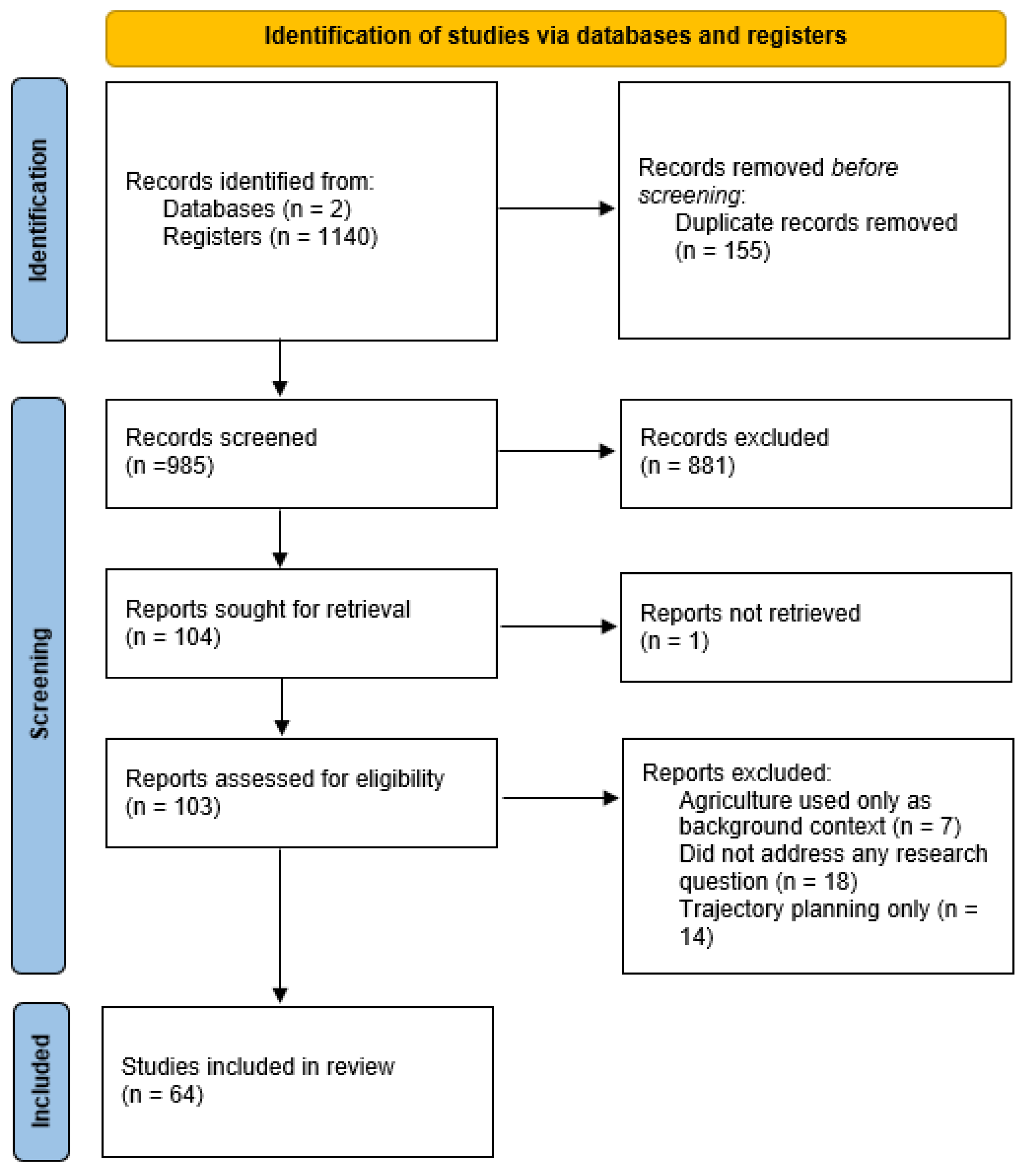
The inclusion of the article in this review was guided by a systematic methodology to help ensure that relevant and high-quality studies are included. After removing duplicates, a total of 985 articles were found according to the established search string. Subsequently, these were classified as title and abstract with respect to the inclusion and exclusion criteria described above. This step reduced the items to 103 articles that were sufficient to encourage further examination. Two independent reviewers performed the screening of titles and abstracts, and disagreements were resolved through consensus.
In the second step, 103 articles were fully evaluated for their relevance to the research questions that guide this review. During this full-text assessment, each study was analyzed in terms of its objectives, methodology, and the extent to which it addressed at least one of the predefined research questions. Thirty-nine articles were excluded at this stage for one or more of the following reasons: (i) agriculture was used only as a motivating example rather than the main research focus, (ii) the study concentrated exclusively on trajectory planning without addressing communication or data acquisition aspects, or (iii) the article did not provide information relevant to any of the defined research questions. The remaining 64 studies were included in the final analysis.
Figure 2 illustrates the selection process as a funnel, showing the progressive narrowing of the articles at each stage of evaluation. For each included study, information was extracted to determine which of the five research questions it addressed. No formal risk of bias or heterogeneity assessment was conducted, as the objective of this work was to perform a qualitative synthesis rather than a quantitative meta-analysis. Consequently, no statistical aggregation or effect measures were applied. Instead, the results were analyzed narratively and organized thematically according to the research questions. These 64 studies constitute the foundation of this survey and are further discussed in the following sections.

4. Discussion

4.1. RQ1: How Can Drones Be Efficiently Integrated with Wireless Sensor Networks to Enhance Data Collection in Agricultural Environments?

The integration of UAVs with WSNs presents a transformative opportunity to improve data collection in agricultural environments. Traditional methods of monitoring agricultural fields often rely on stationary sensor nodes that can face limitations in spatial coverage and adaptability. UAVs, which serve as mobile gateways, overcome these challenges by enabling dynamic real-time data collection from dispersed ground sensors. For example, a drone-mounted gateway can efficiently retrieve data from ground sensor nodes, significantly extending the spatial range and responsiveness of WSN-based systems [32]. Moreover, UAVs not only collect data but can also act as intermediaries, parsing and converting data formats and transmitting preprocessed information from the field to cloud-based database servers for advanced processing [33]. Similar gateway-based architectures have also been proposed for remote smart farming, where ground LoRa sensor nodes opportunistically offload data to a fixed-wing UAV, which then relays the collected information to the Internet via satellite backhaul [34].
From a systems and connectivity viewpoint, this UAV–WSN collaboration extends existing IoT sensing pipelines by introducing aerial gateways and opportunistic data sinks that mitigate infrastructure scarcity in rural farms. The growing adoption of IoT, WSNs, and drones contributes significantly to the development of PA, which aims to improve productivity and sustainability [35]. PA employs advanced technologies to optimize farming practices, such as minimizing excessive fertilizer use and water consumption through intelligent monitoring systems [29]. UAV-based sensing systems, when combined with automated path planning strategies, enable a transition from static and manual agricultural operations to dynamic and intelligent data collection processes, reducing the need for specialized human intervention while improving operational efficiency [36].
Data collection in UAV-assisted WSNs can be organized according to different architectural patterns, depending on the spatial distribution of nodes and the constraints of the agricultural environment. In some configurations, sensor nodes transmit data directly to the UAV, while in others clustered topologies are implemented, where one node aggregates data from neighboring nodes before forwarding it to the UAV. Clustered topologies have been shown to outperform flat topologies in terms of energy consumption and network lifetime, highlighting the importance of topology design in maximizing network efficiency [37]. In smart irrigation scenarios [38], for instance, energy-aware clustering combined with a UAV acting as a mobile sink enables the drone to visit only cluster heads, reducing both flight time and radio overhead while simultaneously supporting wireless power transfer to critical nodes. In rural LoRa-based deployments, fixed-wing UAVs equipped with LoRa gateways can follow trajectories derived from the spatial distribution of nodes and coordinate scheduled transmissions during short visibility windows [39], ensuring reliable offloading from battery-constrained ground sensors. At the physical layer, antenna designs featuring multi-lobe radiation patterns allow a single UAV to communicate in parallel with several sensor towers, further improving the efficiency of drone-assisted data collection in dense vertical farming layouts [40].
UAVs can serve multiple roles in these systems, including acting as temporary storage units or even processing data on-site before relaying it to a central controller. For example, a UAV collects sensor data during an initial phase and sends it to a base station, which then determines the most efficient processing location based on response time and resource availability [41]. In advanced implementations, multiple UAVs collaborate to extend WSN coverage to large areas, enabling real-time data transfer and ensuring reliable communication between UAVs and sensor nodes through open standards such as O-RAN [42]. Multi-UAV architectures have also been explored for large-scale farming operations [43], where fleets of drones coordinate with agricultural machines over Wi-Fi-based local networks to support precise positioning and data exchange. Beyond local and multi-UAV coordination, UAV-assisted relaying based on MISO-NOMA and SWIPT has been shown to effectively connect cell-edge agricultural sensor nodes to terrestrial base stations while improving outage performance and energy efficiency [44].
In agricultural WSNs, UAVs contribute not only to data collection but also to improving the energy efficiency of ground sensor nodes. One approach involves drones equipped with directive radio wave transmitters that wake up sensor nodes only when data collection is required, significantly reducing idle energy consumption. This method ensures efficient operation, with a maximum activation range of approximately 20 m [45]. In addition, UAVs can serve as charging platforms for sensor nodes, extending their operational lifetime. By following optimized flight paths, drones can maximize the efficiency of recharging ground sensors while simultaneously collecting data, creating a dual-purpose system that improves the overall sustainability of the network [46].
Beyond network-level integration, some agricultural systems combine UAV multispectral imagery with environmental measurements from IoT nodes only at the data and model layers. In these cases, both sources act as complementary inputs to hybrid learning architectures for crop disease classification, without explicitly optimizing the underlying WSN–UAV data collection and communication stack [47]. This type of model-centric integration further illustrates that UAV-assisted data acquisition may occur across multiple IoT abstraction layers, from physical and network mobility to downstream data fusion and ML-ready analytics pipelines, as explored in greater depth in RQ5.
The integration of drones and WSNs offers a wide range of possibilities, some of which do not even require additional hardware on the UAV. For example, existing drone cameras, originally intended for navigation, can be repurposed to read LED signals from ground sensors, eliminating the need for additional equipment [48]. Pre-deployment testing is essential to ensure the feasibility and effectiveness of these integration methods. This can be achieved through simulated environments or testbeds. For example, some studies have developed simulators with software-defined radios (SDR) to emulate various wireless networks, allowing researchers to evaluate UAV-assisted WSN systems prior to real-world implementation [49].
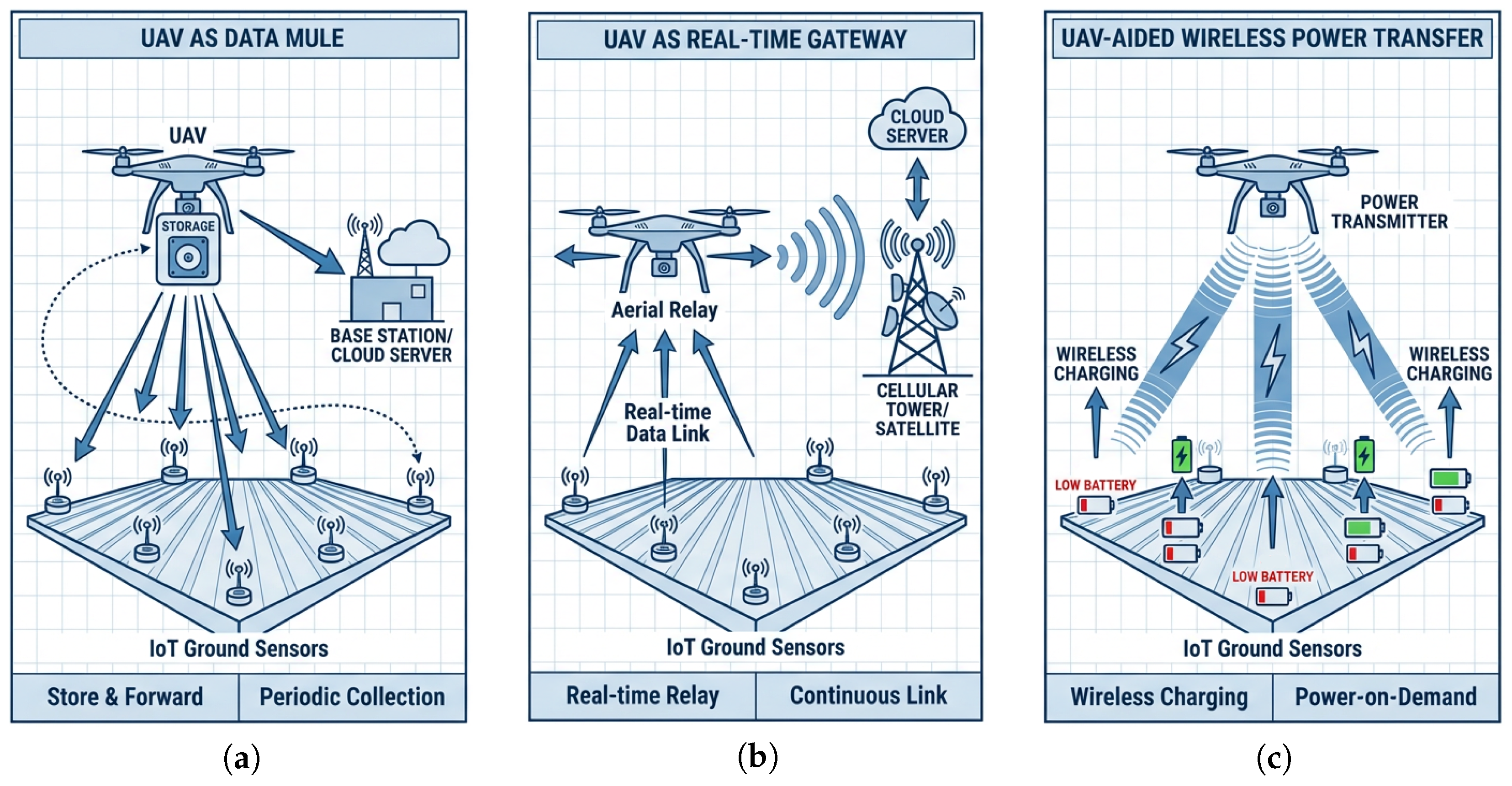
Overall, the literature analyzed in RQ1 indicates that, despite the diversity of wireless protocols, network topologies, and system-level optimizations proposed for UAV-WSN integration, most solutions converge toward one of three fundamental architectural paradigms. These paradigms are summarized in Figure 3, which synthesizes how UAVs can be efficiently integrated into agricultural wireless sensor networks to enhance data collection under different operational constraints.
In the first architecture, UAVs operate as data mules, periodically visiting ground sensor nodes to collect data through a store-and-forward mechanism. This approach prioritizes energy efficiency at the sensor level and is particularly suitable for delay-tolerant applications. The second paradigm treats the UAV as a real-time gateway, where the drone acts as an aerial relay that maintains continuous or near-real-time communication between ground sensors and terrestrial or satellite infrastructure, enabling low-latency data delivery. The third architecture extends UAV functionality beyond communication by enabling UAV-aided wireless power transfer, where drones not only collect data but also recharge energy-constrained sensor nodes during flight operations.

4.2. RQ2: What Are the Main Technical and Operational Challenges Related to the Use of Drones in the Acquisition of Large-Scale Agricultural Data?

One of the most significant challenges in large-scale agricultural data collection using drones is energy consumption, which impacts both ground sensor nodes (SNs) and the UAV itself. Sensor nodes in wireless networks face severe battery limitations, especially when deployed in large farm areas. Continuous data collection can be particularly challenging due to the high energy demands of nodes, compounded by the need for numerous intermediate nodes in vast fields, increasing installation and operational costs [50,51]. To address this, cluster-based data collection schemes have been proposed, in which a single node aggregates data from surrounding sensors, reducing overall energy consumption and extending the operating lifetime of the network [51]. However, the adoption of advanced technologies such as 5G introduces additional challenges, as the sustainability of these systems becomes increasingly dependent on efficient energy management and lifetime optimization of sensor nodes, rather than on raw data throughput alone [46].
UAV battery endurance is also a fundamental operational constraint. Agricultural missions require long trajectories for sensing and data offloading, while propulsion, onboard processing, radios, and GNSS modules compete for a limited energy budget. Battery performance is additionally influenced by outdoor agricultural conditions, as temperature and humidity, leading to nonlinear discharge behavior that reduces effective flight time and sensing radius over very large fields. These environmental sensitivities compound inefficiencies in mission computation and resource utilization [32,42].
One potential approach to address the energy limitations of SNs in drone-assisted agricultural monitoring is the wireless transmission of power directly from the UAV to the ground sensors. This strategy can significantly extend the operational lifespan of sensor networks by enabling nodes to recharge without requiring physical maintenance or battery replacement. UAVs equipped with energy transfer capabilities can transmit power while flying or hovering and simultaneously collect data from sensors [52]. However, the use of UAVs for energy transmission introduces new challenges. Energy transfer is typically effective only for sensors within close proximity to the UAV, which limits range and requires strategic flight planning to ensure that all nodes receive sufficient power [52]. Furthermore, the efficiency of energy transfer can be affected by environmental factors, energy dissipation, and interference, which can reduce the overall reliability of the system [53].
As UAV missions expand to cover larger agricultural areas, communication reliability becomes increasingly constrained by scale-sensitive propagation effects. One major factor is the UAV’s altitude, which must be carefully balanced to optimize signal strength and coverage. For example, studies have shown that the effective transmission range of IEEE 802.15.4 devices is greatly reduced by aerial mobility, limiting it to approximately one-third of its nominal range [54]. An optimal flight altitude for data collection has been identified between 150 and 250 feet, as lower altitudes may exacerbate signal attenuation due to obstacles such as vegetation, while higher altitudes increase the likelihood of signal dispersion [55].
The propagation of signals is further complicated by the dynamic nature of agricultural landscapes. Growing crops can alter attenuation characteristics over time, while obstacles such as trees and farm structures may completely block communication [56,57]. Even when data are collected from buried sensors, the optimal distance between the UAV and the sensors may not always correspond to the lowest possible altitude. Other factors, such as soil properties and vegetation density, can influence signal quality [58]. Complementary evidence from LPWAN agricultural studies also shows that fading in rural environments, driven by dense vegetation, irregular topography, and unpredictable weather, remains a primary bottleneck for large-scale IoT deployments, where packet loss rates increase sharply under Rician fading. Such works demonstrate that even long-range links suffer unreliability in real farms unless improved with physical-layer techniques, such as Reed–Solomon coding and rotating polarization waves, designed specifically to counter agricultural fading [59].
Radio propagation reliability itself degrades as farms grow in size, due to outdoor channel effects that are unique to real agricultural environments. Large-area drone missions experience dynamic fading induced by irregular terrain elevation and vegetation profiles, which are often statistically Rician in open fields. Even moderate crop segments (20 m) can impose more than 9 dB of additional attenuation, and individual vertical scatters such as trunks may introduce losses approaching 5.05 dB [54,60]. Classical free-space or urban-derived path loss models systematically fail to estimate these effects, motivating UAV-assisted agricultural channel modeling frameworks that explicitly capture terrain non-planarity and time-evolving vegetation fading behavior, improving reliability predictions for large-scale flights [61].
The same 3D spatial effects that degrade sensing coverage also increase mission latency and energy draw at the UAV side. Antenna orientation misalignment between the UAV and ground SNs causes severe link degradation, requiring tight 3D attitude and position control during long, high-coverage routes [55]. When sensing must be acquired from multiple distributed towers or dense sensor fixtures at scale, sequential directional beam steering further increases link latency, spectrum contention, and battery drain.
Physical-layer antenna solutions such as quad-lobe dielectric resonator antennas alleviate part of this burden by enabling simultaneous multi-tower access without replicating RF chains, reducing payload energy overhead in ultra-dense agricultural sensing missions. These methods also provide improved humidity and rain robustness, which is critical as missions scale to very large agricultural regions with seasonal variations [40]. For distant or shadow-prone sensors at the cell or farm edge, UAVs operating as radio relays still face strict spectrum and harvested-energy coexistence constraints, requiring advanced PHY strategies such as MISO-NOMA, SWIPT, and TAS (Transmit Antenna Selection) for maintaining reliability in intermittent coverage regions during large-scale data offloading [44,56].
Beyond physical-layer limitations, large-scale deployments are also influenced by operational and infrastructural factors intrinsic to rural environments. Navigation reliability and communication backhaul quality directly affect flight repeatability and data consistency. In extensive agricultural fields, GNSS precision drift, sensor activation scheduling, and unstable terrestrial backhaul links are common challenges, motivating the use of UAV-assisted architectures with optimized path planning and coordinated data collection to improve positioning accuracy, data freshness, and operational robustness [43,62].
The timeliness of information collected by drones can be another challenge in PA. Synchronizing the drone’s route and passage time with the activation period of ground SNs is essential to optimize operations. For example, an optimization algorithm proposed in one study successfully reduces flight time while maximizing the life span of the sensor node, validated through a custom drone simulator [41]. Despite various approaches to data gathering, there is often a trade-off between focusing on collection speed or energy efficiency, without a balanced solution. A proposed method addresses this gap, ensuring a balance between these challenges [63]. Although direct line-of-sight data collection by drones is generally advantageous, ensuring reliable data delivery to the infrastructure remains challenging in large-scale agricultural scenarios. To address this issue, UAV-mounted intelligent reflecting surfaces have been proposed to enhance the wireless channel and improve transmission reliability between drones and base stations [64]. In addition, reducing the interval between collections is crucial to prevent the processing of outdated data [65].
Large-scale UAV data acquisition in agriculture is therefore limited by a compound set of physical and operational constraints. While drones bring mobility and reach, real farms impose harsh energy budgets, time-variant fading, 3D antenna alignment penalties, rural GNSS inaccuracy, and fragile backhaul, all of which directly restrict coverage consistency, payload complexity, channel robustness, and the timeliness of sensed information.

4.3. RQ3: What Are the Primary UAV-Enabled Sensing Applications in PA and How Have These Technologies Contributed to Improving Efficiency and Sustainability?

Drones have become assets in PA, driving gains in efficiency and environmental sustainability. Their applications extend beyond crop monitoring to include environmental pollution assessment and control [66]. In practical PA deployments, UAV-enabled sensing allows continuous monitoring of soil and environmental conditions across extensive crop areas, supporting more efficient resource use and reducing maintenance and energy demands compared to fully ground-based sensing infrastructures [67]. Careful UAV flight path planning further ensures data timeliness, which is especially critical for applications such as pest and disease detection, where outdated information could lead to the misapplication of pesticides, further stressing the environment [47,65].
Drones can also support sustainable practices by optimizing the application of pesticides, fertilizers, and seeds. This capability extends to taking soil samples, which reduces the need for more invasive and resource-intensive methods [68]. Through such targeted interventions, drones help reduce chemical usage, conserve water, and reduce the carbon footprint of farming activities.
To further enhance productivity, drones support soil diagnostics and irrigation planning with a strong emphasis on spatial soil moisture awareness. Modern irrigation strategies rely on precise soil moisture data, and UAVs can efficiently harvest these measurements through coordination with in-field ground sensor nodes [69]. For instance, UAV-assisted data collection has been employed in sugarcane fields to infer fine-grained irrigation demand and avoid water waste through precise moisture-based control [70]. Building on these diagnostics, UAV-enabled clustering combined with wireless power transfer further improves irrigation efficiency and significantly reduces excessive water use, with recent findings reporting approximately 20% reduction in water consumption in large-scale irrigation networks [38].
The ability of drones to collect data from buried soil sensors also addresses the challenge of limited communication ranges, making them a practical solution for accessing hard-to-reach sensors [29]. Beyond moisture, drones are also used to measure soil temperature, further improving understanding of field conditions and supporting informed decision-making in irrigation and crop management [71].
The reach of UAV-assisted sensing has expanded beyond conventional field cultivation to include ultra-dense vertical farming sensor towers [40], livestock sensor data acquisition, and remote wildlife monitoring [72]. In dense vertical farming environments, clusters of environmental sensor towers monitor parameters including temperature, humidity, light, pH, nutrients, and CO2, and UAV-mounted multi-lobe dielectric resonator antennas enable parallel short-range tower interrogation, preserving flight time and sensor coverage while supporting precise irrigation, lighting, and nutrient control [40]. For livestock operations, drones support water quality monitoring and health diagnostics by synchronizing data from animal-mounted wearable sensors, many equipped with embedded positioning and physiological measurements for efficient digital herd monitoring [73,74].
The trajectory of UAV-enabled sensing in precision agriculture shows a maturation from environmental and soil diagnostics toward increasingly integrated, energy-aware, and communication-efficient sensing architectures. Sustainability benefits, including reductions in intensive agrochemical spraying and irrigation water dissipation, are now demonstrably measurable outcomes of UAV collaboration with distributed ground nodes. This reframes UAVs from auxiliary observation instruments to active components of scalable agricultural sensing systems that directly support efficient deployment, timely decision-making, and measurable environmental stewardship.

4.4. RQ4: What Are the Most Important Wireless Protocols and Technologies in Integrating Drones with Agricultural Networks?

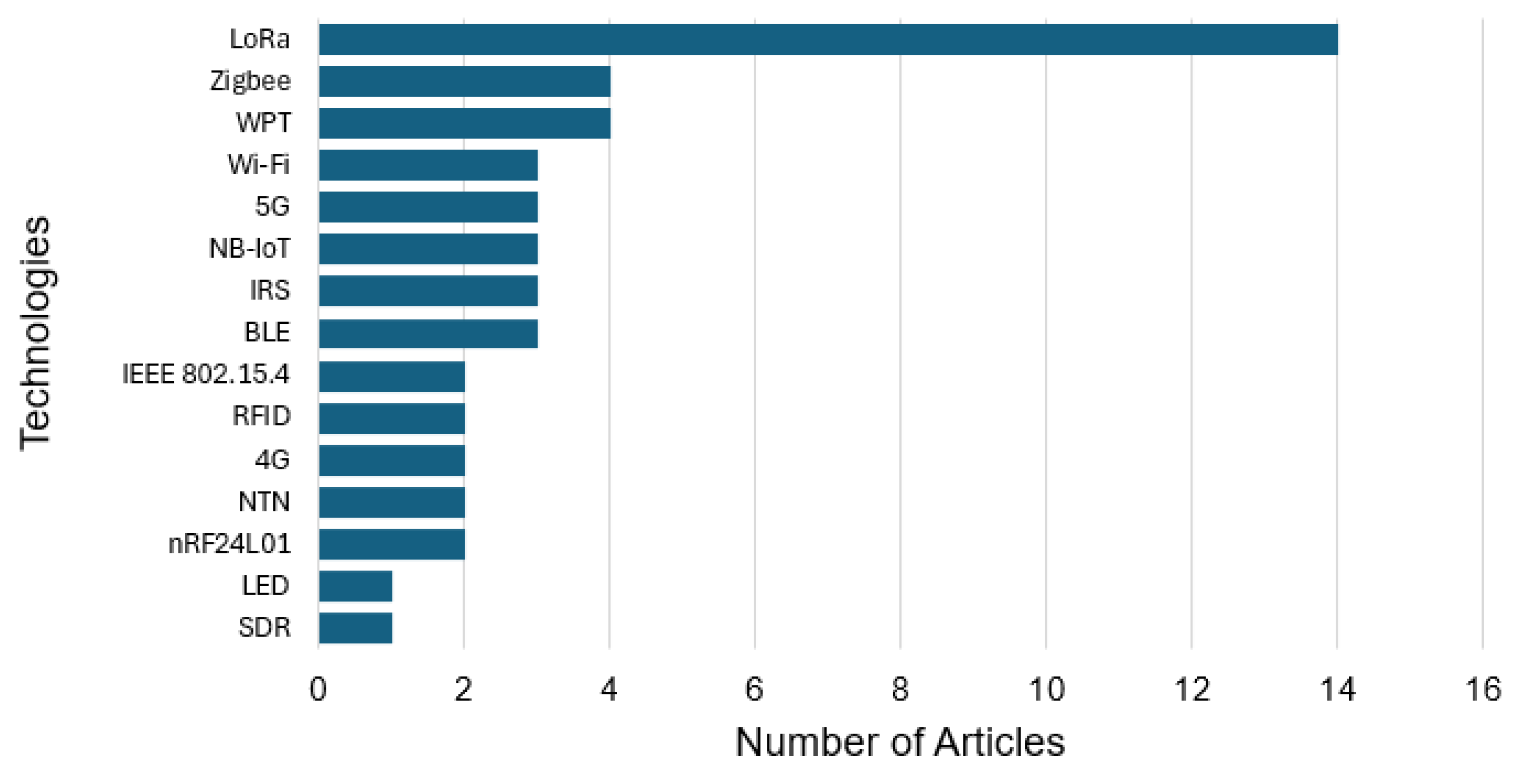
LoRa (Long Range) is the most widely used wireless protocol in drone-based agricultural networks, primarily due to its exceptional range, low power consumption, and cost-effectiveness. LoRa operates in unlicensed spectrum bands, making it particularly suitable for rural and remote agricultural areas where traditional communication infrastructure is lacking. Its ability to support communication for several kilometers enables efficient data collection from dispersed ground sensors, even in expansive fields. The survey of existing studies, as presented in Figure 4, highlights LoRa as the technology most implemented in drone-enabled precision agriculture, significantly outpacing other protocols.
However, the LoRa communication model poses challenges as data transmission is often initiated by sensor nodes rather than being continuous. To address this limitation, protocols have been developed to optimize transmission timing, ensuring drones can efficiently collect data without overburdening sensor nodes or compromising communication consistency [75]. Furthermore, the performance of LoRa in agricultural settings is heavily dependent on the proximity between drones and sensors. Analytical studies highlight the importance of flight path and altitude optimization to ensure successful data collection while maintaining energy efficiency [76].
In some implementations, LoRa is used alongside other communication technologies, such as 2.4 GHz links between drones and base stations. This hybrid approach leverages LoRa’s long-range capability for sensor communication and the higher bandwidth of 2.4 GHz for rapid data transfer to central systems [69]. Low-power NTN–UAV architectures can leverage LoRa-based opportunistic access schemes, where beacon-coordinated UAV passes enable intermittent uplink transmissions under rural duty-cycle and collision constraints, demonstrating LoRa’s practicality for infrastructure-sparse agricultural monitoring and telemetry applications [34].
Although technologies like LoRa and ZigBee are commonly used in agricultural networks, integrating them effectively with drones presents unique challenges. For example, buried sensors face significant signal attenuation due to soil properties, making it essential to design systems that ensure reliable data retrieval even in challenging environments. A common approach combines ZigBee for short-range communication with LoRa to transmit data from drones to a central gateway, which then uploads the data to the cloud for further analysis [68]. This layered architecture effectively bridges the gap between localized sensor data and large-scale analytics.
Drone-assisted RSS sensing and trilateration architectures also address the challenge of retrieving data from buried or position-unknown sensing deployments under log-normal path-loss constraints [77]. To optimize communication with these sensors, experimental studies have analyzed the impact of sensor depth and drone altitude on signal strength. The results indicate that shallower sensor placements improve connectivity, while lower drone altitudes reduce signal loss but may limit the drone’s operational coverage. These trade-offs highlight the need to carefully balance depth and altitude to ensure reliable data collection without compromising system efficiency [29,78].
Cellular technologies, including 4G, 5G, and NB-IoT, are also used in drone-enabled agricultural networks, although they are less frequently utilized than LoRa. These cellular networks offer advantages such as broad coverage and high data rates, making them suitable for connecting drones and ground sensors in large-scale or remote agricultural areas. NB-IoT, in particular, has been explored for communication between drones and ground sensors, while LTE and 5G are often used to relay data from drones to base stations or the cloud. For example, one approach integrates NB-IoT for sensor-to-drone communication and LTE to transmit data from drones to centralized systems, combining the strengths of both technologies to ensure reliable and efficient data transfer [67].
Some systems adopt hybrid architectures that leverage multiple communication protocols to maximize efficiency. In one example, LoRa is used to transfer data from small drones to larger drones, which then forward the aggregated data to the network using NB-IoT [72]. Similarly, NB-IoT has been paired with Bluetooth Low Energy (BLE), where BLE collects data from ground sensors, and NB-IoT transmits the information to the cloud [45]. Although these setups are effective in bridging connectivity gaps, the coexistence of multiple communication technologies introduces additional coordination and scheduling overheads that can increase the system-level energy demand if not carefully managed.
The potential of 5G in drone-assisted agricultural networks has also been explored, particularly for scenarios involving high data throughput and low latency requirements. Recent research has developed optimization problems for multi-UAV systems, in order to improve trajectory planning and resource allocation in 5G-enabled data collection networks [79].
Although cell technologies such as 4G, 5G and NB-IoT provide effective solutions for drone-enabled agricultural networks, they face challenges such as infrastructure costs, energy consumption, and signal reliability in complex environments. To address these limitations, innovative technologies like Intelligent Reflecting Surfaces (IRSs) have gained attention in recent years. IRS offers a unique approach to enhancing communication by leveraging passive, programmable surfaces that improve signal strength and coverage without the need for active power consumption.
One of the earliest IRS-assisted approaches in drone-enabled agricultural networks introduced the concept of a fixed passive surface to facilitate communication between sensor nodes and drones. By strategically positioning the IRS, this setup improves signal reliability and enhances link quality under blockage conditions, providing an energy-efficient complement to traditional drone-based networks. This work also integrates trajectory optimization to further maximize the benefits of IRS-enhanced communication [57]. Building on this concept, subsequent studies have explored IRS-enabled architectures in which reflective surfaces are used to support communication between sensor nodes and terrestrial base stations. In these configurations, the number of reflecting elements is treated as a design parameter to be optimized in order to achieve reliable data transmission while controlling system complexity and operational overhead [64,80].
Table 1 provides a consolidated overview of the main wireless communication protocols and technologies employed in drone-enabled agricultural networks. It highlights their advantages and lists the studies in which each technology was implemented.

4.5. RQ5: How Can Drone-Based Data Collection Help to Better Prediction Models and Real-Time Analytics in Digital Agriculture?

Despite the growing adoption of drones in digital agriculture, there is a noticeable gap in research directly linking drone-based data collection to the development of improved prediction models and real-time analytics. Most existing studies focus on specific applications of drones or AI in agriculture, such as trajectory optimization or resource management, rather than exploring their combined potential for data-driven decision-making systems. This lack of research highlights a significant opportunity for future work to bridge the gap between drone technologies and advanced analytical frameworks, enabling more robust and scalable agricultural solutions.
However, related research provides valuable information on how drones can indirectly contribute to enhancing prediction models, although the performance of such models remains strongly influenced by data sparsity, noise, and heterogeneity inherent to UAV-based sensing. For instance, federated reinforcement learning schemes leverage UAV imagery and IoT sensor streams to optimize energy usage and resource allocation in near real time, showing measurable reductions in carbon-aware deployments [91]. Similarly, hybrid CNN–SVM architectures trained on UAV multispectral inputs and IoT boundary data have pushed disease prediction accuracy to industrially relevant levels, supporting low-latency analytics for crop management [47]. Particle swarm optimization (PSO) has been used to optimize the layout of wireless sensor networks based on data signal strength collected by drones, improving communication efficiency and data reliability [56]. Newer federated learning frameworks further reinforce this view, treating UAV imagery and IoT measurements as complementary heterogeneous data streams for distributed model training while preserving privacy and regional bias adaptation [92].
In addition, drones have demonstrated their ability to enhance agricultural processes through real-time data collection and analytics. In one case, drones collected soil moisture data to guide irrigation systems in sugarcane fields, achieving a reduction of 75% in water consumption [70]. Edge-integrated UAV-IoT architectures now also incorporate temporal convolutional models for predictive agronomic analytics in quasi-real-time, offering decision support directly to farmers [93]. RSSI-based joint communication and sensing models, where a BLE module may be mounted on UAVs, further demonstrate how existing wireless infrastructure can support dynamic soil moisture estimation and real-time flood analytics without extra ground sensors [87].
Machine learning models have also been used to address challenges like signal propagation in agricultural environments. For example, Wi-Fi signal loss was modeled using AI to improve the accuracy of UAV–ground sensor channel characterization, supporting more reliable drone-based communication planning [86]. Similarly, Long Short-Term Memory (LSTM) networks have been applied to infer soil moisture levels from RSSI data collected by drones, improving prediction accuracy and allowing more informed irrigation strategies [78]. Genetic algorithm-enhanced LSTM models have also been proposed for adaptive UAV channel prediction based on terrain, vegetation, and weather features, which also supports AI-driven agronomic assessments even though agronomic ML pipelines are not deeply detailed [61].
Finally, AI contributes to the optimization of the data collection trajectory, a critical factor in efficient data collection and real-time analytics. By integrating AI for intelligent flight path planning, drones can adapt to varying transmission requirements and ensure consistent data quality. Research has proposed models for full coverage and adaptive trajectories, addressing both communication challenges and service quality optimization [94].
While the literature still shows limited work explicitly detailing end-to-end pipelines from UAV sensing to predictive models, recent studies indicate that the necessary building blocks already exist in distributed learning, joint communication-sensing, and hybrid inference architectures. The remaining gap is therefore better interpreted as an architecture and integration question rather than an algorithmic absence. In this survey, this gap is viewed through a functional lens: (i) UAVs supply spatial and spectral observations, (ii) edge or in situ communication anchors provide localized sensing and temporal samples, and (iii) predictive analytics emerge when these heterogeneous data streams are aligned and combined at the learning or inference stage.

5. Open Challenges and Opportunities

5.1. Challenges in Experimental Evaluation and Performance Reporting

Despite the growing body of literature on UAV-assisted data acquisition for digital agriculture, several open challenges remain, particularly regarding experimental validation and performance assessment. Table 2 summarizes representative experimental studies and highlights a fundamental limitation of the current state of the art: the lack of a consistent and standardized set of quantitative performance metrics.
As evidenced by the reported results, experimental evaluations span highly heterogeneous contexts, including different crop types, sensing objectives, communication technologies, and UAV roles. Consequently, the reported metrics vary widely, ranging from communication-centric indicators such as RSSI, transmission range, and path loss error, to application-level outcomes such as water consumption reduction or coverage efficiency. In many cases, studies report only qualitative feasibility results or partial measurements, while omitting key parameters such as latency, packet delivery ratio, energy consumption, or long-term system reliability.
Another critical challenge is the limited reproducibility and comparability of experimental results. Even when quantitative values are provided, they are typically derived under specific environmental conditions, flight configurations, and deployment scales, making direct cross-study comparison impractical. This fragmentation is clearly reflected in Table 2, where several entries report non-overlapping metrics or lack consolidated numerical results altogether. As a result, the literature does not yet converge toward a common experimental baseline that would enable benchmarking of UAV-assisted agricultural IoT systems.
Beyond metric heterogeneity, the surveyed studies also illustrate a broader tendency in experimental validation. A significant portion of the reported experiments focuses on demonstrating communication feasibility, validating propagation models, or assessing specific architectural components, often under controlled or short-term conditions. While such studies are essential for understanding fundamental system behavior, they frequently stop short of evaluating integrated, end-to-end performance in realistic agricultural operations. As a consequence, aspects such as long-term sensing accuracy, sustained network reliability, cumulative energy consumption, and operational robustness across different crop growth stages remain insufficiently explored.
These limitations open several directions for future research. Comprehensive experimental campaigns that jointly assess communication performance, sensing accuracy, energy efficiency, and operational constraints are still needed. In parallel, the adoption of minimal and clearly defined reporting practices for experimental studies would significantly improve the interpretability and reuse of published results. Establishing shared datasets, open testbeds, and reproducible evaluation frameworks would further support the systematic advancement of UAV-assisted data acquisition systems and facilitate their transition from experimental prototypes to dependable tools for digital agriculture.

5.2. Integration of Drone Data with IoT and Big Data Systems

One of the main challenges in using drones for agricultural applications is integrating their data collection capabilities with larger IoT ecosystems and big data platforms. As discussed in RQ1, drones are already being used to collect diverse datasets, including soil moisture, crop health, and environmental conditions, often coordinating with ground-based sensor networks through architectures that leverage open standards such as O-RAN to ensure reliable communication [42]. However, as highlighted in RQ5, there remains a noticeable gap in research directly linking drone-based data collection to the development of improved prediction models and real-time analytics. This gap is partly attributed to challenges in achieving seamless data transfer and interoperability across heterogeneous IoT devices, such as ground sensors and aerial gateways, which can create bottlenecks in the achievement of a unified agricultural management system.
Opportunities in this area include developing standardized communication protocols and open frameworks that enable real-time data aggregation and analysis across multiple devices, fostering more cohesive decision-making processes. As noted in RQ5, leveraging big data analytics to process and correlate the vast amount of drone data collected with other datasets, such as weather patterns and market trends, could significantly enhance predictive modeling and resource optimization. Furthermore, integrating federated learning frameworks and edge-integrated UAV-IoT architectures, as explored in the surveyed literature [47,91,92,93], may provide a practical pathway toward bridging the current integration gap and enabling scalable, data-driven agricultural decision systems.

5.3. Energy Efficiency and Battery Technology Advancements

As extensively discussed in RQ2, energy efficiency remains one of the most significant challenges in drone-based agricultural operations. Limited battery life restricts the duration of data collection missions and increases the frequency of recharging cycles, thereby limiting the scalability of drone applications in large-scale farming. Ground sensor nodes also face severe battery limitations, particularly when deployed across large farm areas, where continuous data collection imposes high energy demands. Moreover, UAV battery endurance is further constrained by the energy demands of onboard sensors, communication modules, and data processing, compounded by environmental factors such as temperature and humidity that lead to nonlinear discharge behavior and reduce effective flight time.
To address these limitations, the surveyed literature highlights several promising directions. Cluster-based data collection schemes, which aggregate data from neighboring sensors at a single node, have been shown to reduce overall energy consumption and extend network lifetime. Additionally, wireless energy transfer technologies, where UAVs transmit power to ground sensors during flight or hovering, have been explored as a strategy to significantly extend sensor operational lifespan, though challenges remain regarding effective transfer range and environmental interference [51,52,53]. Physical-layer antenna solutions, such as quad-lobe dielectric resonator antennas, have also been proposed to reduce payload energy overhead in ultra-dense agricultural sensing missions [40].
Building on these insights, opportunities lie in the continued development of lightweight, high-capacity batteries tailored specifically for agricultural drone missions, as well as further advances in wireless energy transfer technologies. Additionally, optimizing flight paths and reducing energy consumption through AI-powered algorithms, such as those discussed in RQ5 for trajectory planning and resource allocation, could prolong operational time and reduce the ecological footprint of drone activities.

5.4. Scalability and Cost-Effectiveness

Scaling drone technologies for use across various farm sizes, crop types, and geographic contexts remains a challenge. As noted in RQ2, system scalability is constrained by energy management, coverage optimization, and operational complexities that emerge in large-scale deployments. For instance, multi-UAV architectures have been explored to extend coverage across large farming operations, yet issues such as positioning uncertainty, synchronization, and consistent georeferencing of sensed data continue to limit scalable data acquisition.
While the surveyed literature primarily addresses technical and operational scalability challenges related to energy, communication, and coordination, the practical implications of these limitations extend to economic and accessibility dimensions. High system complexity, infrastructure requirements, and operational demands may pose barriers to adoption, particularly for smaller farms or resource-constrained settings in developing regions. This represents a gap in the current literature and an opportunity for future research to explore modular, affordable drone solutions, cooperative usage systems, and accessible analytics platforms that could democratize access to drone technologies across diverse agricultural contexts. Open-source software and low-cost sensor designs, briefly referenced in the broader IoT literature, may also contribute to reducing barriers to entry, though these approaches were not a primary focus of the surveyed drone-WSN studies.

5.5. Regulatory and Ethical Considerations

While the surveyed literature focuses primarily on technical and communication-layer challenges associated with drone-assisted agricultural data collection, it is important to acknowledge that the real-world deployment of these systems also involves regulatory, ethical, and operational considerations that were not extensively covered in the reviewed studies. For example, airspace regulations, which vary significantly between countries, and privacy concerns related to data capture in rural and neighboring properties, represent practical challenges that must be addressed for widespread adoption. These issues, though outside the scope of most technical and wireless communication research, are critical for translating laboratory and field trial results into scalable, commercially viable agricultural systems.
Future research directions should therefore include interdisciplinary efforts to develop region-specific operational guidelines, ethical standards for agricultural data collection, and frameworks that balance innovation, safety, and privacy. Collaboration between governments, private entities, and research institutions will be essential to establish drone-friendly regulatory environments that support both technological advancement and responsible deployment.

6. Conclusions

This survey examined the role of drones in enabling wireless data acquisition for precision agriculture, with a particular focus on their integration with IoT-based sensor networks. A total of 64 research articles were reviewed, covering technologies, applications, and strategies to improve agricultural wireless communication. The survey contributes by consolidating the findings in multiple communication protocols, identifying operational challenges, and highlighting opportunities for future research.
Regarding RQ1, the integration of drones with WSNs has been explored through different strategies, including direct collection from individual nodes, cluster-based aggregation, and the use of drones as temporary gateways. These approaches demonstrate the flexibility of UAVs in complementing static networks, although large-scale deployments and synchronization strategies remain underexplored.
In relation to RQ2, the most critical challenges include the limited battery capacity of drones and ground sensor nodes, signal attenuation caused by vegetation and soil, and the difficulty of ensuring timely data delivery. While some solutions focus on trajectory optimization, wake-up radio techniques, or hybrid communication models, most of them are evaluated in simulations or small-scale testbeds, leaving questions of scalability and robustness open.
For RQ3 and RQ4, current applications emphasize soil and crop monitoring, irrigation management, and livestock tracking, where drones provide timely and spatially rich information. Communication protocols such as LoRa dominate the literature due to their long-range and energy-efficient characteristics, followed by ZigBee, Wi-Fi, NB-IoT, and 5G. Each technology presents specific trade-offs in terms of range, bandwidth, and energy consumption, suggesting that protocol selection should be closely aligned with the requirements of each agricultural scenario rather than relying on a single standard.
Concerning RQ5, the potential of drone-based data collection to improve prediction models and enable real-time analytics remains largely untapped. Only a few works connect UAV-assisted sensing to predictive modeling through machine learning. This represents a significant opportunity for the advancement of digital agriculture, particularly in developing data-driven systems that adapt to dynamic field conditions and support timely decision-making.
Looking ahead, several research directions emerge. These include large-scale experimental validation of drone-assisted WSNs, the development of hybrid communication architectures that combine multiple protocols, the adoption of IRS to improve connectivity, and the tighter integration of drones with AI-based decision support systems.

Supplementary Materials

The following supporting information can be downloaded at: https://www.mdpi.com/article/10.3390/agriengineering8020041/s1, Table S1: PRISMA 2020 Checklist.

Author Contributions

Conceptualization, R.B.; methodology, R.B. and F.A.; formal analysis, R.B., J.S., F.A., I.M. and C.E.P.; investigation, R.B.; data curation, R.B., J.S. and I.M.; writing—original draft preparation, R.B. and J.S.; writing—review and editing, R.B., J.S., F.A., I.M. and C.E.P.; visualization, R.B.; supervision, I.M. and C.E.P.; project administration, I.M.; funding acquisition, C.E.P. All authors have read and agreed to the published version of the manuscript.

Funding

This work has been fully funded by the project AgroBot supported by the Center for Embedded Devices and Research in Digital Agriculture (CEDRA) of SENAI-RS, with financial resources from the PPI IoT/Manufatura 4.0/PPI HardwareBR of the MCTI, grant number 056/2023, signed with EMBRAPII.

Institutional Review Board Statement

Not applicable.

Informed Consent Statement

Not applicable.

Data Availability Statement

The raw data supporting the conclusions of this article will be made available by the authors on request.

Conflicts of Interest

The authors declare no known competing financial interests or personal relationships that could have influenced the work reported in this paper.

References

  1. Saikanth, D.R.K.; Supriya; Singh, B.V.; Rai, A.K.; Bana, S.R.; Sachan, D.S.; Singh, B. Advancing Sustainable Agriculture: A Comprehensive Review for Optimizing Food Production and Environmental Conservation. Int. J. Plant Soil Sci. 2023, 35, 417–425. [Google Scholar] [CrossRef]
  2. Karunathilake, E.M.B.M.; Le, A.T.; Heo, S.; Chung, Y.S.; Mansoor, S. The Path to Smart Farming: Innovations and Opportunities in Precision Agriculture. Agriculture 2023, 13, 1593. [Google Scholar] [CrossRef]
  3. Kok, C.L.; Dai, Y.; Lee, T.K.; Koh, Y.Y.; Teo, T.H.; Chai, J.P. A Novel Low-Cost Capacitance Sensor Solution for Real-Time Bubble Monitoring in Medical Infusion Devices. Electronics 2024, 13, 1111. [Google Scholar] [CrossRef]
  4. Kok, C.L.; Ho, C.K.; Lee, T.K.; Loo, Z.Y.; Koh, Y.Y.; Chai, J.P. A Novel and Low-Cost Cloud-Enabled IoT Integration for Sustainable Remote Intravenous Therapy Management. Electronics 2024, 13, 1801. [Google Scholar] [CrossRef]
  5. Kok, C.L.; Heng, J.B.; Koh, Y.Y.; Teo, T.H. Energy-, Cost-, and Resource-Efficient IoT Hazard Detection System with Adaptive Monitoring. Sensors 2025, 25, 1761. [Google Scholar] [CrossRef] [PubMed]
  6. Hundal, G.S.; Laux, C.M.; Buckmaster, D.; Sutton, M.J.; Langemeier, M. Exploring Barriers to the Adoption of Internet of Things-Based Precision Agriculture Practices. Agriculture 2023, 13, 163. [Google Scholar] [CrossRef]
  7. Mohsan, S.A.H.; Othman, N.Q.H.; Li, Y.; Alsharif, M.H.; Khan, M.A. Unmanned aerial vehicles (UAVs): Practical aspects, applications, open challenges, security issues, and future trends. Intell. Serv. Robot. 2023, 16, 109–137. [Google Scholar] [CrossRef] [PubMed]
  8. Alsamhi, S.H.; Almalki, F.A.; Ma, O.; Ansari, M.S.; Lee, B. Predictive Estimation of Optimal Signal Strength from Drones Over IoT Frameworks in Smart Cities. IEEE Trans. Mob. Comput. 2023, 22, 402–416. [Google Scholar] [CrossRef]
  9. Wei, Z.; Zhu, M.; Zhang, N.; Wang, L.; Zou, Y.; Meng, Z.; Wu, H.; Feng, Z. UAV-Assisted Data Collection for Internet of Things: A Survey. IEEE Internet Things J. 2022, 9, 15460–15483. [Google Scholar] [CrossRef]
  10. Messaoudi, K.; Oubbati, O.S.; Rachedi, A.; Lakas, A.; Bendouma, T.; Chaib, N. A survey of UAV-based data collection: Challenges, solutions and future perspectives. J. Netw. Comput. Appl. 2023, 216, 103670. [Google Scholar] [CrossRef]
  11. Popescu, D.; Stoican, F.; Stamatescu, G.; Chenaru, O.; Ichim, L. A Survey of Collaborative UAV–WSN Systems for Efficient Monitoring. Sensors 2019, 19, 4690. [Google Scholar] [CrossRef]
  12. Avila, F.R.d.; Barbosa, J.L.V. Smart environments in digital agriculture: A systematic review and taxonomy. Comput. Electron. Agric. 2025, 236, 110393. [Google Scholar] [CrossRef]
  13. Guebsi, R.; Mami, S.; Chokmani, K. Drones in Precision Agriculture: A Comprehensive Review of Applications, Technologies, and Challenges. Drones 2024, 8, 686. [Google Scholar] [CrossRef]
  14. Jasim, A.N.; Fourati, L.C.; Albahri, O.S. Evaluation of Unmanned Aerial Vehicles for Precision Agriculture Based on Integrated Fuzzy Decision-Making Approach. IEEE Access 2023, 11, 75037–75062. [Google Scholar] [CrossRef]
  15. Gugan, G.; Haque, A. Path Planning for Autonomous Drones: Challenges and Future Directions. Drones 2023, 7, 169. [Google Scholar] [CrossRef]
  16. Savinelli, B.; Tagliabue, G.; Vignali, L.; Garzonio, R.; Gentili, R.; Panigada, C.; Rossini, M. Integrating Drone-Based LiDAR and Multispectral Data for Tree Monitoring. Drones 2024, 8, 744. [Google Scholar] [CrossRef]
  17. Rasheed, M.W.; Tang, J.; Sarwar, A.; Shah, S.; Saddique, N.; Khan, M.U.; Imran Khan, M.; Nawaz, S.; Shamshiri, R.R.; Aziz, M.; et al. Soil Moisture Measuring Techniques and Factors Affecting the Moisture Dynamics: A Comprehensive Review. Sustainability 2022, 14, 11538. [Google Scholar] [CrossRef]
  18. Gul, Z.; Bora, S. Exploiting Pre-Trained Convolutional Neural Networks for the Detection of Nutrient Deficiencies in Hydroponic Basil. Sensors 2023, 23, 5407. [Google Scholar] [CrossRef]
  19. Chin, R.; Catal, C.; Kassahun, A. Plant disease detection using drones in precision agriculture. Precis. Agric. 2023, 24, 1663–1682. [Google Scholar] [CrossRef]
  20. Romero, M.; Luo, Y.; Su, B.; Fuentes, S. Vineyard water status estimation using multispectral imagery from an UAV platform and machine learning algorithms for irrigation scheduling management. Comput. Electron. Agric. 2018, 147, 109–117. [Google Scholar] [CrossRef]
  21. Nduku, L.; Munghemezulu, C.; Mashaba-Munghemezulu, Z.; Kalumba, A.M.; Chirima, G.J.; Masiza, W.; De Villiers, C. Global Research Trends for Unmanned Aerial Vehicle Remote Sensing Application in Wheat Crop Monitoring. Geomatics 2023, 3, 115–136. [Google Scholar] [CrossRef]
  22. Darwin, B.; Dharmaraj, P.; Prince, S.; Popescu, D.E.; Hemanth, D.J. Recognition of Bloom/Yield in Crop Images Using Deep Learning Models for Smart Agriculture: A Review. Agronomy 2021, 11, 646. [Google Scholar] [CrossRef]
  23. Abdulraheem, M.I.; Zhang, W.; Li, S.; Moshayedi, A.J.; Farooque, A.A.; Hu, J. Advancement of Remote Sensing for Soil Measurements and Applications: A Comprehensive Review. Sustainability 2023, 15, 15444. [Google Scholar] [CrossRef]
  24. Aleluia, V.M.T.; Soares, V.N.G.J.; Caldeira, J.M.L.P.; Gaspar, P.D. Livestock Monitoring Prototype Implementation and Validation. Rev. Inform. Teór. Apl. 2023, 30, 53–65. [Google Scholar] [CrossRef]
  25. Curti, P.d.F.; Selli, A.; Pinto, D.L.; Merlos-Ruiz, A.; Balieiro, J.C.d.C.; Ventura, R.V. Applications of livestock monitoring devices and machine learning algorithms in animal production and reproduction: An overview. Anim. Reprod. 2023, 20, e20230077. [Google Scholar] [CrossRef]
  26. Moreno, L.; Ramos, V.; Pohl, M.; Huguet, F. Comparative study of multispectral satellite images and RGB images taken from drones for vegetation cover estimation. In Proceedings of the 2018 IEEE 38th Central America and Panama Convention (CONCAPAN XXXVIII), San Salvador, El Salvador, 7–9 November 2018. [Google Scholar]
  27. Awais, M.; Li, W.; Cheema, M.J.M.; Zaman, Q.U.; Shaheen, A.; Aslam, B.; Zhu, W.; Ajmal, M.; Faheem, M.; Hussain, S.; et al. UAV-based remote sensing in plant stress imagine using high-resolution thermal sensor for digital agriculture practices: A meta-review. Int. J. Environ. Sci. Technol. 2022, 20, 1135–1152. [Google Scholar] [CrossRef]
  28. Tian, L.; Wu, X.; Tao, Y.; Li, M.; Qian, C.; Liao, L.; Fu, W. Review of remote sensing-based methods for forest aboveground biomass estimation: Progress, challenges, and prospects. Forests 2023, 14, 1086. [Google Scholar] [CrossRef]
  29. Holtorf, L.; Titov, I.; Daschner, F.; Gerken, M. UAV-Based Wireless Data Collection from Underground Sensor Nodes for Precision Agriculture. AgriEngineering 2023, 5, 338–354. [Google Scholar] [CrossRef]
  30. Page, M.J.; Moher, D.; Bossuyt, P.M.; Boutron, I.; Hoffmann, T.C.; Mulrow, C.D.; Shamseer, L.; Tetzlaff, J.M.; Akl, E.A.; Brennan, S.E.; et al. PRISMA 2020 explanation and elaboration: Updated guidance and exemplars for reporting systematic reviews. BMJ 2021, 372, n160. [Google Scholar] [CrossRef] [PubMed]
  31. Page, M.J.; McKenzie, J.E.; Bossuyt, P.M.; Boutron, I.; Hoffmann, T.C.; Mulrow, C.D.; Shamseer, L.; Tetzlaff, J.M.; Akl, E.A.; Brennan, S.E.; et al. The PRISMA 2020 statement: An updated guideline for reporting systematic reviews. BMJ 2021, 372, n71. [Google Scholar] [CrossRef]
  32. Park, S.; Yun, S.; Kim, H.; Kwon, R.; Ganser, J.; Anthony, S. Forestry Monitoring System using LoRa and Drone. In Proceedings of the 8th International Conference on Web Intelligence, Mining and Semantics, Novi Sad, Serbia, 25–27 June 2018; pp. 1–8. [Google Scholar]
  33. Rao, A.; Shao, H.; Yang, X. The Design and Implementation of Smart Agricultural Management Platform Based on UAV and Wireless Sensor Network. In Proceedings of the 2019 IEEE 2nd International Conference on Electronics Technology (ICET), Chengdu, China, 10–13 May 2019; pp. 248–252. [Google Scholar]
  34. Giambene, G.; Addo, E.O.; Chen, Q.; Kota, S. Design and Analysis of Low-Power IoT in Remote Areas with NTN Opportunistic Connectivity. IEEE Trans. Aerosp. Electron. Syst. 2025, 61, 2309–2328. [Google Scholar] [CrossRef]
  35. Singh, P.K.; Sharma, A. An intelligent WSN-UAV-based IoT framework for precision agriculture application. Comput. Electr. Eng. 2022, 100, 107912. [Google Scholar] [CrossRef]
  36. Singh, H.; Singh, M.B.; Pratik, H.; Pratap, A. UAV and UGV Assisted Path Planning for Sensor Data Collection in Precision Agriculture. In Proceedings of the 2023 11th International Symposium on Electronic Systems Devices and Computing (ESDC), Sri City, India, 4–6 May 2023; pp. 1–6. [Google Scholar]
  37. Smruthi, S.; Krishna, R.S.; Panda, M. Low Energy Sensor Data Collection using Unmanned Aerial Vehicles. In Proceedings of the 2019 3rd International Conference on Trends in Electronics and Informatics (ICOEI), Tirunelveli, India, 23–25 April 2019; pp. 740–745. [Google Scholar]
  38. Hassan, E.S.; Jabbari, A.; Alharbi, A.A. Smart Irrigation Enhancement Through UAV-Based Clustering and Wireless Charging in Wireless Sensor Networks. Drones 2025, 9, 253. [Google Scholar] [CrossRef]
  39. Andreadis, A.; Giambene, G.; Zambon, R. Design and analysis of a LoRa-based system with scheduled transmissions from IoT nodes to UAV in rural areas. Ad. Hoc. Netw. 2025, 175, 103868. [Google Scholar] [CrossRef]
  40. Konch, R.; Sarmah, K.; Sarma, K.K.; Kshetrimayum, R.S. A Cross Microstrip Excited Quad DRA with Four-Lobe Radiation Pattern for Drone-to-Sensor Node Tower Communication. IEEE Sens. Lett. 2025, 9, 3505904. [Google Scholar] [CrossRef]
  41. Qayyum, T.; Trabelsi, Z.; Malik, A.; Hayawi, K. Trajectory Design for UAV-Based Data Collection Using Clustering Model in Smart Farming. Sensors 2021, 22, 37. [Google Scholar] [CrossRef] [PubMed]
  42. Betalo, M.L.; Leng, S.; Abishu, H.N.; Dharejo, F.A.; Seid, A.M.; Erbad, A.; Naqvi, R.A.; Zhou, L.; Guizani, M. Multi-Agent Deep Reinforcement Learning-Based Task Scheduling and Resource Sharing for O-RAN-Empowered Multi-UAV-Assisted Wireless Sensor Networks. IEEE Trans. Veh. Technol. 2024, 73, 9247–9261. [Google Scholar] [CrossRef]
  43. Zhang, J.; Chen, H.; Dai, F.; Wang, Y.; Li, H.; Zhang, Y. A Fast Multi-UAV Assistance Positioning Architecture for Large-Scale Farming Operations. IEEE Internet Things J. 2025, 12, 37645–37658. [Google Scholar] [CrossRef]
  44. He, Y.; Huang, F.; Wang, D.; Zhang, R. Outage Probability Analysis of MISO-NOMA Downlink Communications in UAV-Assisted Agri-IoT with SWIPT and TAS Enhancement. IEEE Trans. Netw. Sci. Eng. 2025, 12, 2151–2164. [Google Scholar] [CrossRef]
  45. Idbella, M.; Iadaresta, M.; Gagliarde, G.; Mennella, A.; Mazzoleni, S.; Bonanomi, G. AgriLogger: A New Wireless Sensor for Monitoring Agrometeorological Data in Areas Lacking Communication Networks. Sensors 2020, 20, 1589. [Google Scholar] [CrossRef]
  46. Chien, W.C.; Hassan, M.M.; Alsanad, A.; Fortino, G. UAV–Assisted Joint Wireless Power Transfer and Data Collection Mechanism for Sustainable Precision Agriculture in 5G. IEEE Micro 2022, 42, 25–32. [Google Scholar] [CrossRef]
  47. Linero-Ramos, R.; Parra-Rodríguez, C.; Gongora, M. SVMobileNetV2: A Hybrid and Hierarchical CNN-SVM Network Architecture Utilising UAV-Based Multispectral Images and IoT Nodes for the Precise Classification of Crop Diseases. AgriEngineering 2025, 7, 341. [Google Scholar] [CrossRef]
  48. Rangappa, N.; Prasad, Y.R.V.; Dubey, S.R. LEDNet: Deep Learning-Based Ground Sensor Data Monitoring System. IEEE Sensors J. 2022, 22, 842–850. [Google Scholar] [CrossRef]
  49. Baumgärtner, L.; Bauer, M.; Bloessl, B. SUN: A Simulated UAV Network Testbed with Hardware-in-the-Loop SDR Support. In Proceedings of the 2023 IEEE Wireless Communications and Networking Conference (WCNC), Glasgow, UK, 26–29 March 2023; pp. 1–6. [Google Scholar]
  50. Yamamoto, H.; Nishiura, S.; Higashiura, Y. Wide-Area and Long-Term Agricultural Sensing System Utilizing UAV and Wireless Technologies. IEICE Trans. Inf. Syst. 2023, E106.D, 2022NTI0001. [Google Scholar] [CrossRef]
  51. Nguyen, K.V.; Nguyen, C.H.; Do, T.V.; Rotter, C. Efficient Multi-UAV Assisted Data Gathering Schemes for Maximizing the Operation Time of Wireless Sensor Networks in Precision Farming. IEEE Trans. Ind. Inform. 2023, 19, 11664–11674. [Google Scholar] [CrossRef]
  52. Ye, H.T.; Kang, X.; Joung, J.; Liang, Y.C. Optimal Time Allocation for Full-Duplex Wireless-Powered IoT Networks with Unmanned Aerial Vehicle. In Proceedings of the ICC 2019–2019 IEEE International Conference on Communications (ICC), Shanghai, China, 20–24 May 2019; pp. 1–6. [Google Scholar]
  53. Suman, S.; Kumar, S.; De, S. Path Loss Model for UAV-Assisted RFET. IEEE Commun. Lett. 2018, 22, 2048–2051. [Google Scholar] [CrossRef]
  54. Bacco, M.; Berton, A.; Gotta, A.; Caviglione, L. IEEE 802.15.4 Air-Ground UAV Communications in Smart Farming Scenarios. IEEE Commun. Lett. 2018, 22, 1910–1913. [Google Scholar] [CrossRef]
  55. Nekrasov, M.; Allen, R.; Belding, E. Performance Analysis of Aerial Data Collection from Outdoor IoT Sensor Networks using 2.4GHz 802.15.4. In Proceedings of the 5th Workshop on Micro Aerial Vehicle Networks, Systems, and Applications, Seoul, Republic of Korea, 21 June 2019; pp. 33–38. [Google Scholar]
  56. Jawad, H.M.; Jawad, A.M.; Nordin, R.; Gharghan, S.K.; Abdullah, N.F.; Ismail, M.; Abu-AlShaeer, M.J. Accurate Empirical Path-Loss Model Based on Particle Swarm Optimization for Wireless Sensor Networks in Smart Agriculture. IEEE Sens. J. 2020, 20, 552–561. [Google Scholar] [CrossRef]
  57. Dong, L.; Liu, Z.; Jiang, F.; Wang, K. Joint Optimization of Deployment and Trajectory in UAV and IRS-Assisted IoT Data Collection System. IEEE Internet Things J. 2022, 9, 21583–21593. [Google Scholar] [CrossRef]
  58. Hashir, S.M.; Vuran, M.C.; Camp, J. ECHO: Empirical Characterization and Height Optimization of UAV-to-Underground Channels. In Proceedings of the 2023 IEEE 34th Annual International Symposium on Personal, Indoor and Mobile Radio Communications (PIMRC), Toronto, ON, Canada, 5–8 September 2023; pp. 1–7. [Google Scholar]
  59. Ali, M.M.; Hashim, S.J.; Chaudhary, M.A.; Ferré, G.; Rokhani, F.Z.; Ahmad, Z. Augmenting agricultural IoT networks: Implementing Reed-Solomon codes for rotating polarization waves over LPWAN in Rician fading environments. Results Eng. 2025, 28, 107406. [Google Scholar] [CrossRef]
  60. Drăgulinescu, A.M.; Zamfirescu, C.; Halunga, S.; Marcu, I.; Li, F.Y.; Dobre, O.A. Understanding LoRaWAN Transmissions in Harsh Environments: A Measurement-Based Campaign Through Unmanned Aerial/Surface Vehicles. IEEE Trans. Instrum. Meas. 2024, 73, 5501514. [Google Scholar] [CrossRef]
  61. Ahmad, W.; Ali, F.; Ullah, Y.; Asghar Khan, M.; Khan, M.; Khan, S.; Attique Khan, M.; Ali, A.; Almansour, S. IoUT and Collaborative Cloud Computing-Based UAV Channel Modeling for Agriculture Communication. IEEE Trans. Consum. Electron. 2025, 71, 8067–8081. [Google Scholar] [CrossRef]
  62. Just, G.E.; Pellenz, M.E.; de Paula Lima, L.A.; Chang, B.S.; Souza, R.D.; Montejo-Sánchez, S. UAV Path Optimization for Precision Agriculture Wireless Sensor Networks. Sensors 2020, 20, 6098. [Google Scholar] [CrossRef]
  63. Ma, X.; Huang, M.; Ni, W.; Yin, M.; Min, J.; Jamalipour, A. Balancing Time and Energy Efficiency by Sizing Clusters: A New Data Collection Scheme in UAV-Aided Large-Scale Internet of Things. IEEE Internet Things J. 2024, 11, 9355–9367. [Google Scholar] [CrossRef]
  64. Zhao, H.; Chen, H.; Tan, F.; Zhan, L. Optimum Number of Reflecting Elements for UAV-Mounted Intelligent Reflecting Surface-Assisted Data Collection in Wireless Sensor Network. IEEE Sens. J. 2024, 24, 23062–23074. [Google Scholar] [CrossRef]
  65. Nobrega, L.; Termehchi, A.; Bao, T.; Syed, A.; Kennedy, W.S.; Erol-Kantarci, M. AoI-Aware Trajectory Planning for Smart Agriculture Using Proximal Policy Optimization. In Proceedings of the 2024 IEEE International Conference on Machine Learning for Communication and Networking (ICMLCN), Stockholm, Sweden, 5–8 May 2024; pp. 113–118. [Google Scholar]
  66. Pirmagomedov, R.; Kirichek, R.; Blinnikov, M.; Koucheryavy, A. UAV-based gateways for wireless nanosensor networks deployed over large areas. Comput. Commun. 2019, 146, 55–62. [Google Scholar] [CrossRef]
  67. Castellanos, G.; Deruyck, M.; Martens, L.; Joseph, W. System Assessment of WUSN Using NB-IoT UAV-Aided Networks in Potato Crops. IEEE Access 2020, 8, 56823–56836. [Google Scholar] [CrossRef]
  68. Al-Shareeda, M.A.; Manickam, S.; Saare, M.A. Intelligent Drone-based IoT Technology for Smart Agriculture System. In Proceedings of the 2022 International Conference on Data Science and Intelligent Computing (ICDSIC), Karbala, Iraq, 1–2 November 2022; pp. 41–45. [Google Scholar]
  69. Vlasceanu, E.; Dima, M.; Popescu, D.; Ichim, L. Sensor and Communication Considerations in UAV-WSN Based System for Precision Agriculture. In Proceedings of the 2019 IEEE International Conference on Cybernetics and Intelligent Systems (CIS) and IEEE Conference on Robotics, Automation and Mechatronics (RAM), Bangkok, Thailand, 18–20 November 2019; pp. 281–286. [Google Scholar]
  70. Karunanithy, K.; Velusamy, B. Energy efficient cluster and travelling salesman problem based data collection using WSNs for Intelligent water irrigation and fertigation. Measurement 2020, 161, 107835. [Google Scholar] [CrossRef]
  71. Joshi, K.; Singh, R.; Kumar, N. Cloud Based Real Time Soil Moisture Content Monitoring Using IoT and Unmanned Aerial Vehicles. In Proceedings of the 2023 Sixth International Conference of Women in Data Science at Prince Sultan University (WiDS PSU), Riyadh, Saudi Arabia, 14–15 March 2023; pp. 206–210. [Google Scholar]
  72. Sobot, S.; Lukic, M.; Bortnik, D.; Nikic, V.; Lima, B.; Beko, M.; Vukobratovic, D. Two-Tier UAV-based Low Power Wide Area Networks: A Testbed and Experimentation Study. In Proceedings of the 2023 6th Conference on Cloud and Internet of Things (CIoT), Lisbon, Portugal, 20–22 March 2023; pp. 85–90. [Google Scholar]
  73. Behjati, M.; Noh, A.B.M.; Alobaidy, H.A.H.; Zulkifley, M.A.; Nordin, R.; Abdullah, N.F. LoRa Communications as an Enabler for Internet of Drones towards Large-Scale Livestock Monitoring in Rural Farms. Sensors 2021, 21, 5044. [Google Scholar] [CrossRef] [PubMed]
  74. Salehi, S.; Hassan, J.; Bokani, A. An Optimal Multi-UAV Deployment Model for UAV-assisted Smart Farming. In Proceedings of the 2022 IEEE Region 10 Symposium (TENSYMP), Mumbai, India, 1–3 July 2022; pp. 1–6. [Google Scholar]
  75. Andreadis, A.; Giambene, G.; Zambon, R. Low-Power IoT Environmental Monitoring and Smart Agriculture for Unconnected Rural Areas. In Proceedings of the 2022 20th Mediterranean Communication and Computer Networking Conference (MedComNet), Pafos, Cyprus, 1–3 June 2022. [Google Scholar]
  76. Caruso, A.; Chessa, S.; Escolar, S.; Barba, J.; Lopez, J.C. Collection of Data with Drones in Precision Agriculture: Analytical Model and LoRa Case Study. IEEE Internet Things J. 2021, 8, 16692–16704. [Google Scholar] [CrossRef]
  77. Cheng, Y.; Dong, Y. Multi-UAV assisted air-to-ground data collection for ground sensors with unknown positions. Nonlinear Eng. 2025, 14, 20250094. [Google Scholar] [CrossRef]
  78. Zhang, J.; Yang, J.; Yang, Y.; Wan, X.; Jiang, X. Soil Volumetric Water Content Measurement Based on LoRa RSSI and UAV. In Proceedings of the 2023 IEEE 13th International Conference on CYBER Technology in Automation, Control, and Intelligent Systems (CYBER), Qinhuangdao, China, 11–14 July 2023; pp. 1386–1390. [Google Scholar]
  79. Pham, C.; Nguyen, K.K.; Cheriet, M. Joint Optimization of UAV Trajectory and Task Allocation for Wireless Sensor Network Based on O-RAN Architecture. In Proceedings of the ICC 2022—IEEE International Conference on Communications, Seoul, Republic of Korea, 16–20 May 2022. [Google Scholar]
  80. Xiao, K.; Yu, Z.; Wang, J.; Gao, F. Proximal Policy Optimization Algorithm for Enhancing Energy Harvesting in UAV-Assisted Communications with RIS. In Proceedings of the 2024 IEEE Wireless Communications and Networking Conference (WCNC), Dubai, United Arab Emirates, 21–24 April 2024; pp. 1–6. [Google Scholar]
  81. De Rango, F.; Stumpo, D. Supporting Path Planning in LoRa-based UAVs for dynamic Coverage for IoT devices. In Proceedings of the 2023 IEEE 20th Consumer Communications & Networking Conference (CCNC), Las Vegas, NV, USA, 8–11 January 2023; pp. 337–340. [Google Scholar]
  82. Sanguesa, J.A.; Torres-Sanz, V.; Serna, F.; Martinez, F.J.; Garrido, P.; Calafate, C.T. Improving LoRaWAN Connectivity in Smart Agriculture Contexts Using Aerial IoT. In Proceedings of the 2023 IEEE Globecom Workshops (GC Wkshps), Kuala Lumpur, Malaysia, 4–8 December 2023; pp. 1027–1032. [Google Scholar]
  83. Jiang, R.; Xiong, K.; Yang, H.C.; Cao, J.; Zhong, Z.; Ai, B. Coverage Performance of UAV-Assisted SWIPT Networks with Directional Antennas. IEEE Internet Things J. 2022, 9, 10600–10609. [Google Scholar] [CrossRef]
  84. Supramongkonset, J.; Duangsuwan, S.; Promwong, S. A WiFi Link Budget Analysis of Drone-based Communication and IoT Ground Sensors. In Proceedings of the 2021 7th International Conference on Engineering, Applied Sciences and Technology (ICEAST), Bangkok, Thailand, 1–3 April 2021; pp. 234–237. [Google Scholar]
  85. Karar, M.E.; Alotaibi, F.; Rasheed, A.A.; Reyad, O. A pilot study of smart agricultural irrigation using unmanned aerial vehicles and IoT-based cloud system. Inf. Sci. Lett. 2021, 10, 131–140. [Google Scholar]
  86. Duangsuwan, S.; Maw, M.M. Comparison of Path Loss Prediction Models for UAV and IoT Air-to-Ground Communication System in Rural Precision Farming Environment. J. Commun. 2021, 16, 60–66. [Google Scholar] [CrossRef]
  87. Keshavarz, R.; Okudaira, T.; Shariati, N. Dynamic Soil Moisture Estimation Using BLE RSSI Signals: A Machine Learning-Based Framework for Real-Time Monitoring and Flood Detection. IEEE Trans. Geosci. Remote Sens. 2025, 63, 1001613. [Google Scholar] [CrossRef]
  88. Cavalcanti, M.; Endler, M.; Lamenza, T. Livestock Management from the Air with RFID and Cooperating Drones. In Proceedings of the 2023 Symposium on Internet of Things (SIoT), Sao Paulo, Brazil, 25–27 October 2023; pp. 1–5. [Google Scholar]
  89. Gao, J.; Wang, Z.; Jin, Z.; Li, Z.; Wang, Q. Low-Power Modular UAV Data Acquisition and Transmission System Based on Advanced Compression and 4G Communication. IEEE J. Miniaturization Air Space Syst. 2025, 6, 329–337. [Google Scholar] [CrossRef]
  90. Pervez, F.; Zhao, L.; Yang, C. Joint User Association, Power Optimization and Trajectory Control in an Integrated Satellite-Aerial-Terrestrial Network. IEEE Trans. Wirel. Commun. 2022, 21, 3279–3290. [Google Scholar] [CrossRef]
  91. Alasbali, N.; Masood, F.; Alnazzawi, N.; Ghaban, W.; Alazeb, A.; Basurra, S.; Saeed, F. IoT-UAV-Enabled Intelligent Resource Management in Low-Carbon Smart Agriculture Using Federated Reinforcement Learning. IEEE Trans. Consum. Electron. 2025, 71, 6933–6941. [Google Scholar] [CrossRef]
  92. Aldossary, M.; Almutairi, J.; Alzamil, I. Federated LeViT-ResUNet for Scalable and Privacy-Preserving Agricultural Monitoring Using Drone and Internet of Things Data. Agronomy 2025, 15, 928. [Google Scholar] [CrossRef]
  93. Sangaiah, A.K.; Anandakrishnan, J.; Meenakshisundaram, V.; Rahman, M.A.A.; Arumugam, P.; Das, M. Edge-IoT-UAV Adaptation Toward Precision Agriculture Using 3D-LiDAR Point Clouds. IEEE Internet Things Mag. 2025, 8, 19–25. [Google Scholar] [CrossRef]
  94. Li, X.; Tao, M.; Yang, S.; Jan, M.A.; Du, J.; Liu, L.; Wu, C. AI Empowered Intelligent Search for Path Planning in UAV-Assisted Data Collection Networks. IEEE Internet Things J. 2024, 11, 34492–34503. [Google Scholar] [CrossRef]
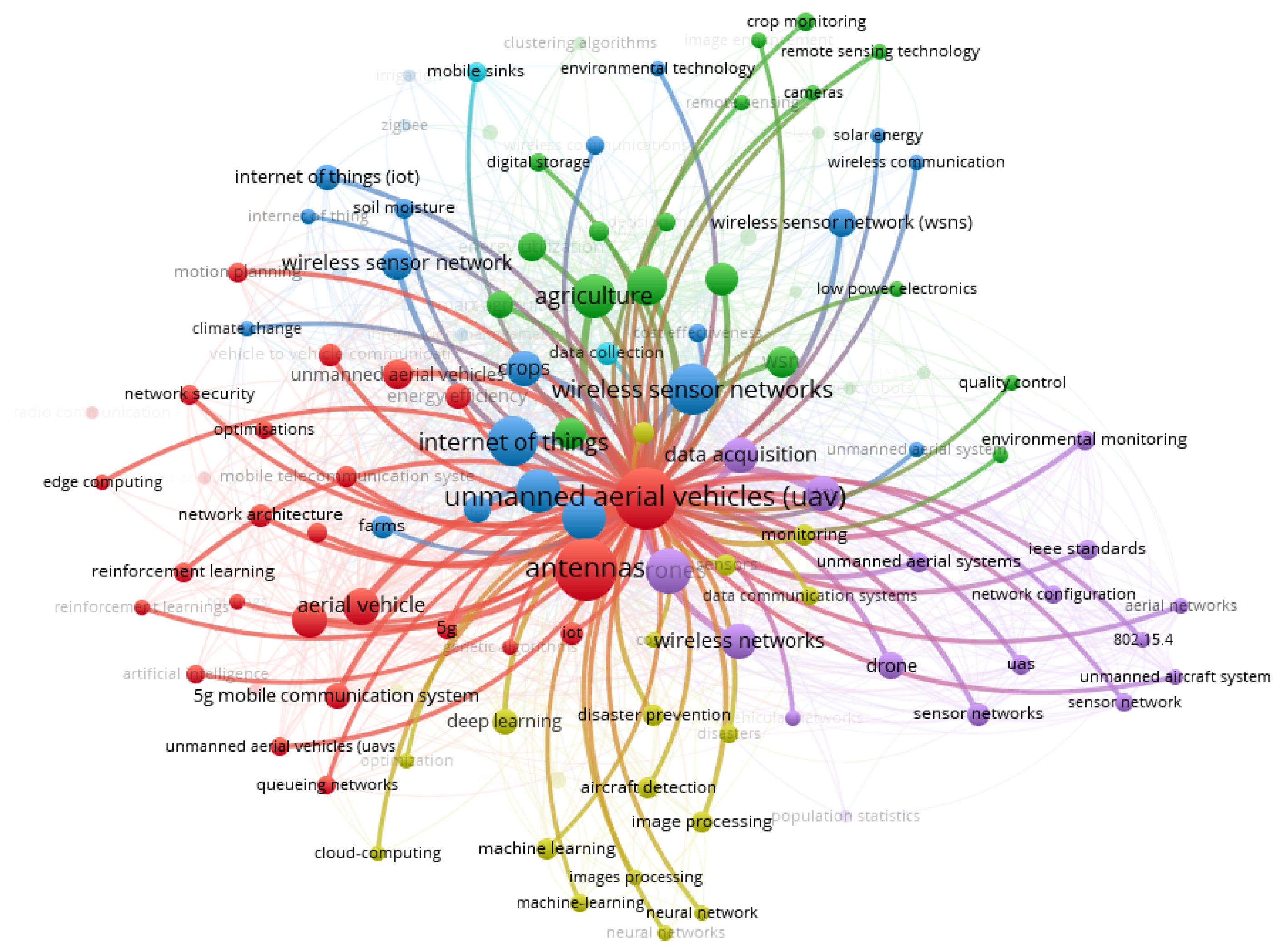
Figure 1. Word cloud of keywords.
Agriengineering 08 00041 g001
Figure 2. PRISMA 2020 flow diagram illustrating the study selection process.
Agriengineering 08 00041 g002
Figure 3. Schematic representation of three main UAV-WSN integration architectures in digital agriculture: (a) UAV as Data Mule using a store-and-forward mechanism for periodic data collection, (b) UAV as Real-time Gateway providing continuous connectivity between ground sensors and network infrastructure, and (c) UAV-aided Wireless Power Transfer enabling simultaneous wireless charging and data collection from energy-constrained sensor nodes.
Agriengineering 08 00041 g003
Figure 4. The most wireless protocol technologies used in drone-based agricultural research.
Agriengineering 08 00041 g004
Table 1. Wireless protocols and technologies used in drone-enabled agricultural networks.
TechnologyAdvantagesReference
LoRaLong range, low power, cost-effective[29,32,34,39,60,68,69,72,73,75,76,78,81,82]
ZigBeeEnergy-efficient, supports mesh networking[33,56,68,70]
WPTTargeted communication, minimizes interference[38,44,50,83]
Wi-FiHigh data rate, suitable for local communication[84,85,86]
5GUltra-fast speeds, low latency, supports dense networks[42,46,79]
NB-IoTOperates on licensed spectrum, offers wide coverage[45,67,72]
IRSIntelligent signal reflection, extends network coverage[57,64,80]
BLEEnergy-efficient, ideal for short-range communication[45,50,87]
IEEE 802.15.4Standard for low-power wireless networks[54,55]
RFIDAsset tracking, passive communication[66,88]
4GWide coverage, high data rate[71,89]
NTNGlobal coverage, enables remote monitoring[34,90]
nRF24L01Low power, support for multi-device networks,[69,71]
LEDVisual signaling, uses drone camera[48]
SDRFlexibility and faster development[58]
Table 2. Summary of reported experimental results in UAV-assisted agricultural IoT studies.
ReferenceExperimental ContextApplicationRole of UAVReported Metric(s)Reported Value(s)
[29]Maize fieldSoil moisture and temperatureRepeaterReadout distance550 m
[32]Forestry environmentSunlight, soil moisture, temperature, and humidityGatewayFlying altitude20 m
[33]Lawn areaHumidity and temperatureGatewayN/AN/A
[35]Crop fieldN/AData muleCoverage efficiency96.3%
[45]VineyardAir temperature and relative humidityData muleSensor battery lifetimeUp to 10 years
[47]Banana cropEnvironmental and soil temperature and humidityData muleN/AN/A
[54]Rural fieldN/AData muleTransmission rangeApproximately one third of the nominal range
[56]Alfalfa fieldN/AData muleRSSI prediction error (MAE)1.6 dBm and 2.7 dBm
[60]Lake environmentN/AData muleCoverage predictionN/A
[70]Sugarcane fieldSoil moistureGatewayWater consumption reduction75% reduction
[71]N/ASoil moistureGatewayN/AN/A
[73]Farm environmentWater quality parametersGatewayLoRa coverage, flight altitude, drone speedUp to 10 km; 100–150 m; 95 km/h
[72]Rural fieldN/AGatewayN/AN/A
[78]Tree-covered areaSoil moistureData muleN/AN/A
[82]Agricultural landN/AN/AUAV height50 m and 120 m
[84]Grass farmSoil moistureN/ADrone altitudeMust not exceed 8 m
[86]Grass farmSoil moistureGatewayPath loss prediction (RMSE)RMSE = 2.367 (Random Forest)
Disclaimer/Publisher’s Note: The statements, opinions and data contained in all publications are solely those of the individual author(s) and contributor(s) and not of MDPI and/or the editor(s). MDPI and/or the editor(s) disclaim responsibility for any injury to people or property resulting from any ideas, methods, instructions or products referred to in the content.