Abstract
Given the demand for sustainable and cost-effective manure management in livestock systems, this study evaluated the economic feasibility of cattle manure treatment via composting and anaerobic digestion (AD) under different configurations. Five scenarios were compared: composting without solid–liquid separation, AD without separation at 20- and 30-day hydraulic retention times (HRTs), and combined systems with separation, composting the solid fraction and digesting the liquid. The analysis was based on a 200-cow herd and experimental data, with 15-year projected cash flows. Economic indicators included net present value (NPV), internal rate of return (IRR), discounted payback period (DPP), benefit–cost ratio (B/C), modified internal rate of return (MIRR), uniform annual equivalent (UAE), and profitability index (PI), supported by sensitivity analysis and Monte Carlo simulation. All scenarios were viable and posed low risk. Energy and fertilizer value were key drivers. The scenario 30-day HRT without separation had the best financial performance (NPV = 53,407.15 USD; IRR = 15.54%; DPP = 7.33 years; B/C = 1.57; MIRR = 9.28%; UAE = 5654.48 USD; PI = 1.66) and is recommended for capitalized farms seeking higher returns. Composting had lower returns (NPV = 9832.06 USD) but required the lowest investment, remaining a cost-effective alternative for smallholders.
Keywords:
biomass; waste management; renewable energy; economics assessment; biogas; bovine; monensin; dairy cow 1. Introduction
Livestock production faces ongoing challenges in balancing productivity, sustainability, and profitability. According to the Greenhouse Gas Emissions Estimation System [1], manure management accounted for approximately 6% of the direct emissions from Brazilian agriculture in 2022, highlighting the need to integrate mitigation strategies into production practices [2,3,4,5,6]. In addition to nutrition-related challenges, the proper handling and treatment of animal waste are essential to minimize environmental impacts while adding value to these residues. Among the available strategies, manure fractionation stands out, as it enables the targeted use of nutrients by directing specific fractions to appropriate treatment processes, such as anaerobic digestion and composting [7]. These treatment technologies allow for the valorization of animal waste through the production of biofertilizers and renewable energy [8].
The separation of manure fractions also affects the distribution of compounds present in the waste, such as monensin. This antibiotic exhibits a strong affinity for particulate organic matter, resulting in its predominant concentration in the solid fraction after separation [7], while its presence in the liquid fraction is significantly reduced. Nevertheless, even at lower concentrations, monensin continues to influence the microbial community by promoting selective pressure. This effect may lead to a reduction in methanogenic bacterial populations, thereby compromising the efficiency of anaerobic digestion and ultimately decreasing biogas production.
The adoption of waste management strategies is particularly relevant in the context of dairy farming, as this sector represents a major component of agricultural production with significant economic importance. In Brazil, the dairy sector produces approximately 34.8 billion liters of milk annually and maintains a herd of 16.6 million lactating cows, involving a wide range of farms with varying scales and production profiles [9]. In recent years, dairy production has intensified, notably through the expansion of confinement and semi-confinement systems, especially among larger and more technologically advanced operations [9]. As a result, there has been an increase in the generation of organic waste. It is estimated that each dairy cow can produce between 40 and 70 kg of manure (feces and urine) per day, posing significant challenges for proper waste management at the farm level [10,11].
In this context, composting and anaerobic digestion stand out as promising alternatives for manure treatment, contributing not only to a reduction in environmental impacts but also to the generation of additional income for producers, either through the sale of biofertilizers or the production of electricity from biogas [12,13]. However, the economic feasibility of these technologies remains a limiting factor for their widespread adoption, as it depends on several variables, including implementation costs, the operational efficiency of the systems, and the potential financial return, which vary according to the specific characteristics of each farming operation [14,15].
Therefore, it is essential to assess the economic impacts associated with different manure management strategies, considering both the fractionation of waste and the hydraulic retention time (HRT) in anaerobic digestion. These factors can significantly influence the efficiency of the processes and the economic viability of the treatment methods. The analysis should account for both the implementation costs and the potential financial return for producers, providing technical support for more informed decision-making in dairy manure management.
The objective of the present study was to identify and recommend economically viable alternatives for the treatment of dairy cattle manure, considering different scenarios regarding fraction separation, type of treatment (composting or anaerobic digestion), and hydraulic retention time.
2. Materials and Methods
This study adopted a scenario-based economic modeling approach at farm scale, grounded in bench-scale experimental data previously obtained by [7]. The experiment involved the treatment of dairy cattle manure under dietary inclusion of sodium monensin, evaluating systems with and without solid–liquid separation through composting and anaerobic digestion processes. The technical data generated in that experiment served as the basis for defining the parameters used in the economic simulations conducted in the present study.
2.1. Animals and Production System
Regarding the dairy cattle production system, a herd of 200 animals was considered, raised under intensive management and housed in a conventional barn equipped with individual stalls, feeders, and waterers. Manure removal from the facility was modeled in two ways: by scraping, in the scenario where the waste was directed exclusively to composting, and by floor washing, in the scenarios where the waste was sent to anaerobic digestion. After collection, the manure was either subjected to fractionation or kept unseparated (unfractionated manure). In the condition with fractionation, the raw manure was screened, generating two distinct fractions: a solid fraction (retained on the screen), which was directed to composting, and a liquid fraction, which was sent to anaerobic digestion.
The animals were fed a balanced diet composed of forage and concentrate, with the inclusion of sodium monensin at a dose of 1.8 mg/kg of dry matter intake, resulting in an annual demand of 33.05 kg of sodium monensin for the entire herd. The adopted dosage was based on the findings of [7], who reported maximum efficiency in the conversion of manure organic matter into biogas and methane at this level during anaerobic digestion.
2.2. Evaluated Scenarios
Five manure management and treatment scenarios were simulated, combining composting and/or anaerobic digestion technologies, with or without solid–liquid separation, and adopting hydraulic retention times (HRT) of 20 or 30 days (Table 1). HRTs of 20 and 30 days were selected because they are typical mesophilic design values for dairy manure digesters, balancing volumetric productivity and process stability. The 30-day HRT commonly yields higher vs. reduction and methane potential, while 20 days reduces reactor volume and investment cost, providing a realistic techno-economic contrast in line with sectoral practice [7,16,17,18,19,20,21].
Table 1.
Description of the evaluated scenarios considering different treatment strategies for dairy cattle manure.
2.3. Monensin Concentration in Manure
Considering that fractionation may influence the distribution of sodium monensin between the solid and liquid fractions of dairy manure, the concentration of the additive was quantified in samples of screened and unscreened manure. The determination of sodium monensin was carried out according to the [22].
A reduction in monensin load was observed in the sample after screening, with a concentration of 0.92 mg of sodium monensin per kg of manure total solids (TS) in the liquid fraction. In contrast, the unscreened manure showed a concentration of 1.53 mg kg−1 TS. These results indicate that the unscreened fraction led to substrates with higher initial concentrations of sodium monensin at the onset of anaerobic digestion.
2.4. Estimation of Fertilizer and Bioenergy Production
To assess treatment efficiency, the analysis considered aspects related to manure production and composition, as well as the potential for producing organic fertilizers (compost and biofertilizer) and the energy yield from biogas. In all scenarios, the daily manure production per animal and its respective TS content were used, based on the zootechnical and productive parameters presented in Table 2 and reported by [7]. These values were then extrapolated to the entire herd.
Table 2.
Cattle manure production parameters used in the economic calculations.
The main operational indicators of the treatment systems are detailed in Table 3, obtained in prior experiment [7] and used here as inputs for scenario modeling. Values obtained are consistent with the literature [16,17,23].
Table 3.
Operational parameters obtained under different cattle manure treatment scenarios.
Based on the nutrient contents (nitrogen, phosphorus, and potassium) identified in each organic fertilizer (Table 4), the respective annual outputs (kg year−1) of these nutrients were calculated. For this estimation, the amount of TS remaining at the end of the composting process was also considered for Scenarios C, C+AD20, and C+AD30. Additionally, methane generation from anaerobic digestion was estimated from the daily TS load fed to the digester and the methane-specific yield, yielding a daily methane volume (L CH4 d−1). Annual electricity generation (kWh yr−1) was then obtained by multiplying the annual methane volume by the methane’s lower heating value (9.94 kWh m−3 at standard temperature and pressure) and by the electrical conversion efficiency (ηₑ = 0.335, i.e., 33.5%), consistent with values reported for dairy manure anaerobic digestion plants [24] and in agreement with typical farm-scale systems [12,25].
Table 4.
Nutrient concentrations in the biofertilizers for each scenario, according to the treatment applied to dairy cattle manure.
2.5. Economic Feasibility Assessment
The economic feasibility of the five manure treatment scenarios was assessed using an incremental cash flow analysis over a 15-year time horizon to reflect the economic lifetime commonly used for on-farm energy and waste-treatment assets. For each scenario, annual revenues, operating costs, and fixed investments were estimated to evaluate the economic viability of the proposed alternatives. All cash flows were modeled in constant currency (no inflation) and discounted at the producer’s real cost of capital of 6.43%·yr−1 (project hurdle rate). Revenue sources included the valuation of nutrients (N, P, and K) contained in the generated organic fertilizers—based on their equivalence to commercial fertilizers—and the generation of electricity through biogas conversion, considering the methane content in the gas composition.
Fixed costs included the initial investment required for the installation of composting and anaerobic digestion systems (Table 5), while variable costs comprised expenses related to labor for manure management, the purchase of sodium monensin, insurance on fixed capital, equipment maintenance, and energy consumption for the screening process. Investment cost estimates were based on quotations obtained from specialized companies in the sector, covering all necessary inputs and equipment. The investment required for the acquisition of the biodigesters was based on commercial rural equipment of the continuous horizontal type, made of plastic membrane (“bag” type), manufactured by BGS Equipamentos. The estimated costs reflect market conditions at the time of the study.
Table 5.
Fixed investments (USD) required for the implementation and installation of composting and anaerobic digestion systems in each production scenario.
Based on the data reported by [7] and the estimated manure production per animal, the required area for waste treatment and the necessary infrastructure were calculated, taking into account both the resources already available on the farm and those that would need to be acquired. For the composting system, the following requirements were considered: (i) a masonry-floored yard with a roof to protect against weather conditions, with a total area of 1145.34 m2 in Scenario C and 547.24 m2 in Scenarios C+AD20 and C+AD30; and (ii) a fertilizer spreader for distributing the composted product (Table 5).
In the anaerobic digestion, the planned infrastructure included: (i) a biodigester with capacity compatible with the daily manure volume and the adopted hydraulic retention time (HRT); (ii) a lagoon for biofertilizer storage; (iii) a biogas flaring system; (iv) a generator for converting biogas into electricity; and (v) a pump for biofertilizer application (Table 5). For scenarios involving fractionation, the cost of the screening equipment was also included (Table 5). The design also considered the use of a tractor to transport manure from the animal housing area to the treatment sites. However, this cost was not included in the analysis, as tractors are typically already available on livestock farms.
The investment costs of biodigesters were estimated based on the required volumes for each scenario: AD20–88 m3; AD30–131 m3; C+AD20–137 m3; and C+AD30–175 m3. To convert all costs into U.S. dollars (USD), the exchange rate of BRL 5.7489 per USD was applied, according to the official quotation from the Central Bank of Brazil on 6 March 2025.
Labor and associated costs included the necessary activities for transporting manure from the barn to the treatment systems, as well as screening (when applicable), daily feeding of the biodigester and composting system, equipment maintenance, and application of the biofertilizer and compost. The monthly wage considered was BRL 1864.15, with labor charges calculated at 45.59% [26], resulting in an estimated labor cost of BRL 11.39 per hour. Annual labor hours were assumed as follows: 1346.85 h·yr−1 for the composting-only scenario (C); 751.6 h·yr−1 for scenarios AD20 and AD30; and 1664.4 h·yr−1 for the solid–liquid separation scenarios (C+AD20 and C+AD30).
Annual maintenance was set at 2.5% of fixed capital in all scenarios that include anaerobic digestion, and 1.0% yr−1 in the composting-only scenario (C), based on the methodology proposed by [27]. Diesel costs were calculated based on the daily use of the tractor for manure transport, assuming one hour of operation per day.
Electricity costs were estimated based on the annual consumption (kWh) required for the operation of the biogas generator and the screening equipment. Insurance on fixed capital was included as a provision for potential partial or total losses of equipment, using an annual rate of 0.75% yr−1 of fixed capital, as recommended by [26]. The Brazilian Rural Land Tax (ITR) was included annually as a property tax on land (not an operating income tax). Income tax was computed only in scenarios that generated taxable income; otherwise, the producer remained exempt.
Equipment depreciation was calculated using the straight-line method, considering the residual value of equipment whose useful life exceeds the project horizon, allowing for potential reuse or resale at the end of the analysis period. Disposal proceeds (salvage value) were treated as a cash inflow: (i) in year 15 for assets still operating at the end of the horizon; and (ii) in the replacement year for assets whose useful life ends before 15 years. For each asset, annual depreciation equals the asset’s acquisition cost minus its salvage value, divided by its useful life in years. The salvage value is given by the salvage ratio (0.2) multiplied by the acquisition cost provided in Table 5. The useful lives adopted were yard and composting area—40 years; screener—25 years; digesters (scenarios II–V)—20 years; biofertilizer spreader—15 years; and power generator, biogas burner, and effluent storage ponds—10 years.
Economic benefits were based on the production of biogas and biofertilizers. For biofertilizers, the nutrient contents of nitrogen (N), phosphorus (P), and potassium (K) were used along with the market prices of the equivalent chemical fertilizers: urea (N source), single superphosphate—SSP (P source), and potassium chloride—KCl (K source). Fertilizer prices were obtained from the ACERTO Weekly Fertilizer Report Brazil on 10 February 2025, and quoted in USD per ton: USD 305 (KCl), USD 390 (urea), and USD 210 (SSP). The economic value was calculated by multiplying the price per kilogram of each nutrient (USD kg−1) by the respective annual quantity produced (kg year−1). The total estimated revenue from the biofertilizer was the sum of revenues associated with all three nutrients.
In the case of biogas, revenue was estimated from the annual electricity generation capacity (kWh), using the national electricity tariff according to the Sistema de Bandeiras Tarifárias (Brazilian Tariff Flag System). Prices were modeled in real terms (constant USD) and discounted using a real discount rate; no deterministic escalation was applied in the base case. Electricity was valued at 0.20 USD kWh−1 (baseline). To reflect the operational capacity of the generator (125 kVA) in each scenario, the daily operating time of the equipment was estimated based on the ratio between the daily available biogas volume (m3 day−1) and the generator’s specific consumption (60 m3 h−1).
To assess the economic viability of the proposed scenarios, the following financial indicators were applied: Net Present Value (NPV), Internal Rate of Return (IRR), Discounted Payback Period (DPP), Profitability Index (PI), Benefit–Cost Ratio (B/C), and Equivalent Uniform Annual Value (EUAV), in addition to a risk analysis based on Monte Carlo simulation.
Sensitivity analysis and Monte Carlo simulation were used to assess the risks associated with the proposed economic model. The objective of the sensitivity analysis was to identify which input variables most influence investment feasibility, whether positively or negatively. This approach makes it possible to assess the robustness of the project under different market conditions, such as variations in costs, revenues, inflation, and demand. Identifying critical variables is essential for guiding decision-making under uncertainty [28,29]. Sensitivity analysis enabled the evaluation of how changes in key parameters, such as operating costs, interest rates, and product prices could impact financial indicators like NPV and IRR [30].
Monte Carlo simulation is a probabilistic computational technique that allows the incorporation of uncertainties by generating multiple iterations based on probability distributions assigned to input variables [31]. In the context of this study, Monte Carlo simulation (100,000 iterations) enabled the evaluation of the robustness of manure treatment scenarios by accounting for uncertainties such as variations in operating costs and anaerobic digestion efficiency, thereby enhancing the reliability of the conclusions. Initially, input variables such as costs, interest rates, and revenues were defined, and triangular distributions (pessimistic /most likely/optimistic) were assigned to each, calibrated with market data from the collection period. The modeled variables were: electricity value (USD/kWh), fertilizer revenue (USD/year), biofertilizer revenue (USD/year), monensin cost (USD/kg), labor cost (USD/year), and investment (USD). Random values for these variables were then generated repeatedly (thousands or even millions of times) [32]. For each sampled set, performance indicators, such as Net Present Value (NPV) and Internal Rate of Return (IRR) were calculated, allowing for the construction of probabilistic distributions for each output variable. No explicit cross-variable correlations were imposed; independence was assumed due to (i) the lack of consistent historical series to estimate robust coefficients over the project horizon and (ii) the use of conservative triangular ranges that already capture meaningful uncertainty for each driver without artificially inflating joint variance.
3. Results and Discussion
3.1. Cash Flow
For this study, the incremental cash flow method was adopted, as it considers the partial or total replacement of electricity consumed on the farm by energy generated from biogas, in addition to revenue generated from the commercialization of organic fertilizers. In this way, the investment tends to be recovered through savings on the electricity bill as well as financial returns from the use of the produced fertilizers, which reduce the need to purchase commercial chemical inputs.
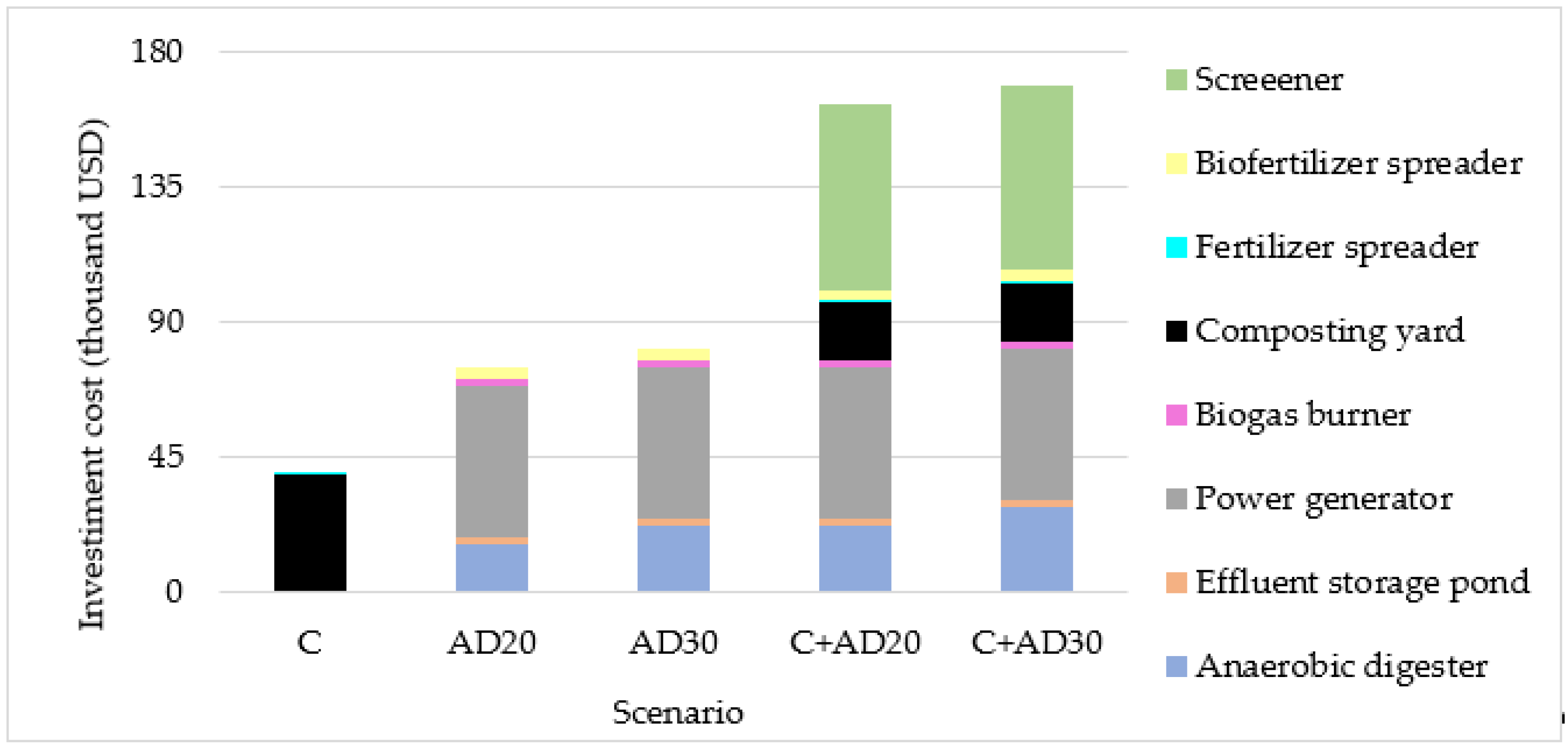
The cash flow analysis revealed differences among the scenarios, particularly in terms of revenues, operational costs, and initial investments (Figure 1, Table 6). Initial investment ranged from USD 39,846.87 in Scenario C—based exclusively on composting—to USD 168,484.92 in Scenario C+AD30, which includes solid–liquid separation and the treatment of the solid fraction by composting and the liquid fraction by anaerobic digestion with a 30-day hydraulic retention time (Figure 1).
Figure 1.
Initial fixed investment per scenario, in Year 0, considering composting (C), anaerobic digestion with hydraulic retention times of 20 days (AD20) and 30 days (AD30), and the combination of both technologies with solid–liquid separation (C+AD20 and C+AD30). Investment values are expressed in US dollars (USD) and were derived from actual market quotations.
Table 6.
Annual cash flow composition (USD), from the 1st to the 15th year after the initial investment, for each scenario.
In Scenario C, the annual cash flow for the producer was limited to USD 5259.76 per year (Table 6), reflecting a low capacity for investment return. On the other hand, this scenario required the lowest initial investment among all evaluated options (Figure 1). In contrast, the scenarios that incorporated anaerobic digestion yielded more favorable outcomes, with annual cash flows ranging from USD 9958.62 to USD 20,774.14 (Table 6), indicating greater profitability despite higher initial investment requirements (Figure 1).
The composition of the annual cash flow throughout the 15-year period following the initial investment is summarized in Table 6, enabling a comprehensive analysis of the financial dynamics associated with each treatment alternative over time. Annual revenue was higher in integrated scenarios, which combined electricity generation, biofertilizer production, and composting, resulting in annual cash flows of USD 18,743.28 in Scenario C+AD20 and USD 20,774.14 in Scenario C+AD30. However, these scenarios also presented the highest operational costs (Table 6). In all scenarios that incorporated anaerobic digestion, electricity sales represented the main source of revenue (Table 6).
From the perspective of solid–liquid separation, an increase in total revenue was observed in scenarios that adopted this strategy. When comparing scenarios without and with separation, revenue gains were 41% (C+AD30 vs. AD30) and 49% (C+AD20 vs. AD20). This improvement in economic performance reflects gains in technical efficiency, which are likely associated with the concentration of the antibiotic in the liquid fraction. Fractionation promoted a reduction in the concentration of the antibiotic in the liquid fraction, which likely enhanced methanogenic activity, resulting in greater efficiency of the anaerobic digestion process and, consequently, improved energy performance [7,17,33].
3.2. Return and Economic Efficiency Indicators
In Scenario C+AD20, where composting is combined with anaerobic digestion of manure using a 20-day HRT, the lowest internal rate of return (IRR) was observed (7.82%), indicating lower attractiveness for investors (Table 7). The profitability index (PI) being close to the break-even point and the highest discounted payback period (DPP) further reinforce this scenario as the least favorable, with a very limited profit margin, representing a higher investment risk and delayed return. In addition to the lower energy yield from biogas associated with the reduced HRT, the investment required for implementing solid–liquid separation may have negatively influenced the economic performance due to the additional costs incurred. As reported by [34], although solid–liquid separation may enhance digestion performance and improve biofertilizer quality, the additional costs associated with this process can significantly reduce the overall economic attractiveness of the system.
Table 7.
Return and economic efficiency indicators of the evaluated scenarios.
Scenarios C, AD20, and C+AD30 showed intermediate performance, with internal rates of return (IRR) ranging from 8.9% to 10.19% (Table 7). Scenario AD20 presented the lowest benefit–cost (B/C) ratio (1.1), indicating a relatively low return for each monetary unit invested. In contrast, B/C ratios were 1.95 (Scenario C) and 2.58 (Scenario C+AD30). The discounted payback period (DPP) ranged from 7.33 to 11.83 years. These findings partially differ from those reported by [24], who observed IRRs between 6.0% and 15% and payback periods ranging from 6 to 15 years across various manure treatment scenarios involving mono- and co-digestion. Ref. [12], in turn, reported IRRs of up to 11% in small-scale Irish farms, with payback periods ranging from 3.88 to 11.03 years, even when financial incentives were available. These differences reflect context and modeling scope. Compared with [12,24], our study and those works differ in substrates/configurations (mono- vs. co-digestion), scale and capacity factor, policy environment (incentives), CHP efficiencies, and system boundaries.
Scenario C, based exclusively on composting, exhibited the weakest economic performance, with an IRR of 10.07% and a NPV of USD 9832.06. Although composting is a reliable and recommended technique for manure recycling and treatment, its limited potential for revenue generation, as highlighted by [24], constrains its economic performance. On the other hand, it is characterized by low-capital investment, with substantially lower initial costs compared to anaerobic digestion systems, particularly those including energy generation components. Despite the relatively long DPP (10.7 years), the scenario may still be considered acceptable in low-risk contexts with reduced operational expenditures. These conditions can offset the lower profitability index, especially for producers with limited financial resources, restricted access to long-term investment capital, or dependence on public funding and incentive programs. Furthermore, according to [35], the economic feasibility of anaerobic digestion compared to composting is highly dependent on plant scale and the market value of resulting products. In this context, further studies are recommended to evaluate system performance across herd sizes and manure volumes, to appropriately scale treatment systems and assess their economic attractiveness under diverse production settings thereby enabling proper system sizing and more accurate assessment of economic feasibility under different production contexts.
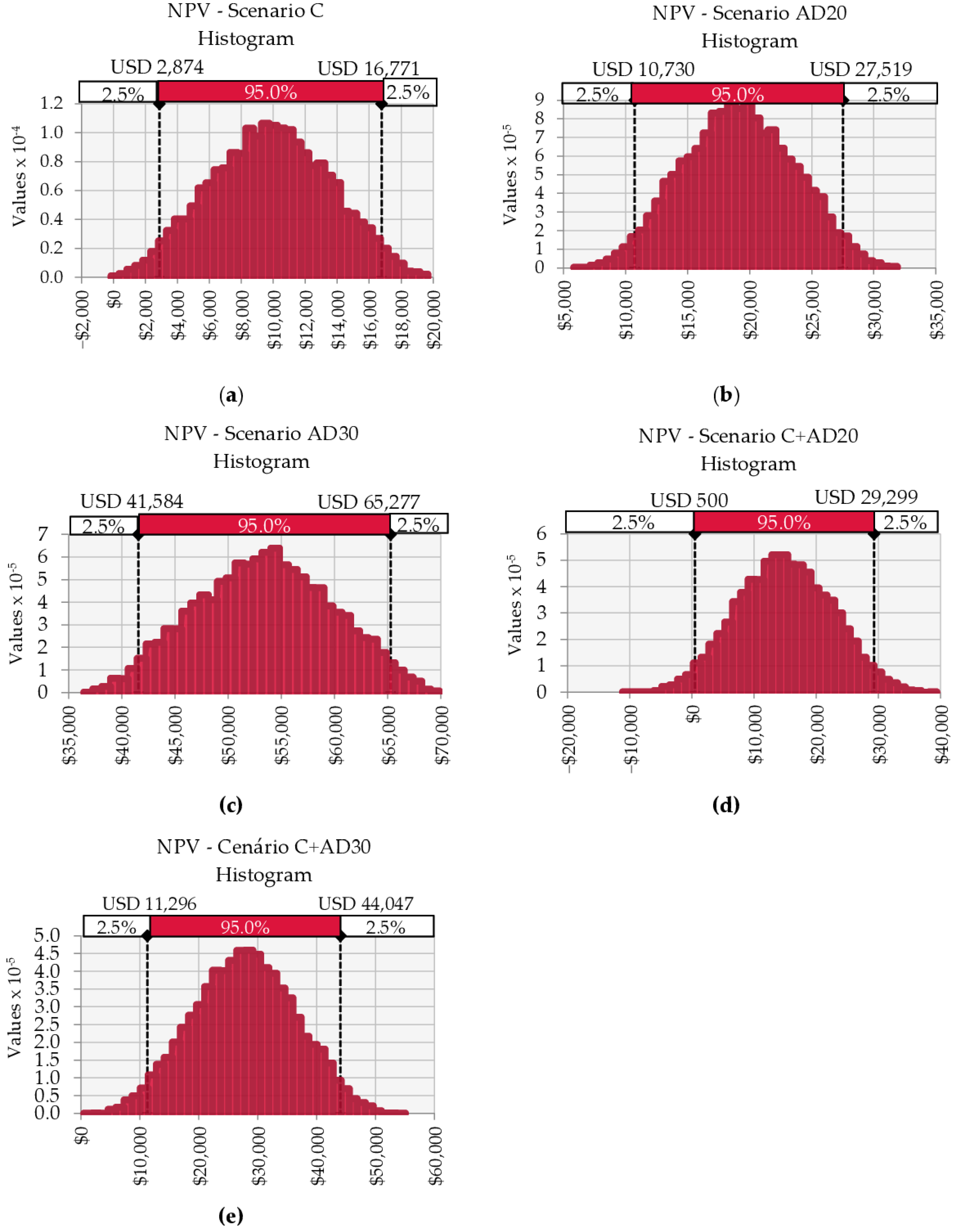
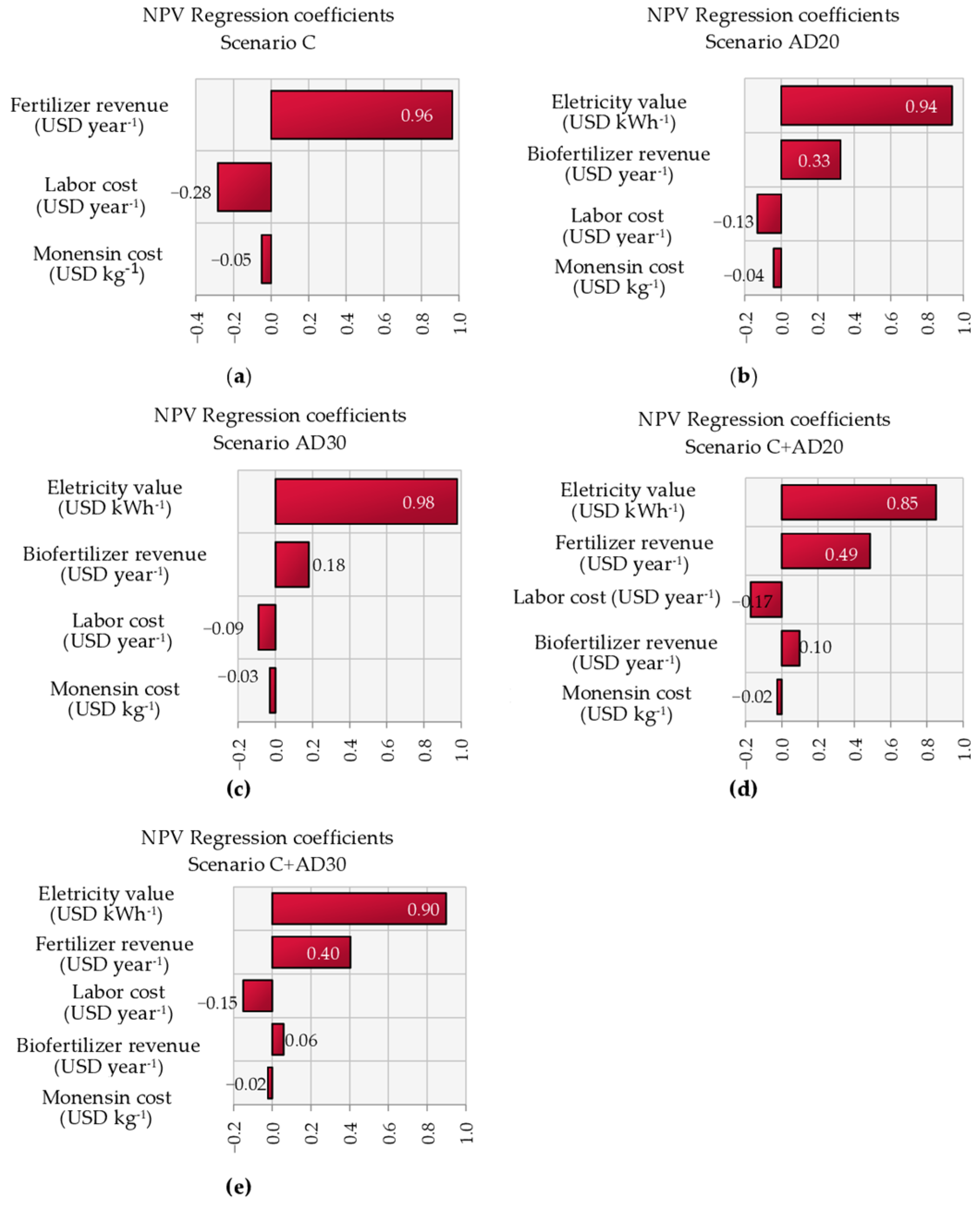
Uncertainty in cash flows was incorporated using Monte Carlo simulation, a method recommended by [36] for economic analyses under uncertain conditions. Across all scenarios, the simulated NPV distributions were strictly positive (100% of iterations yielded NPV > 0). This outcome follows from the independent triangular input assumptions and is consistent with the tornado charts (Figure 2), which—for each scenario—rank NPV sensitivity with respect to the same inputs, highlighting the most influential drivers and the direction of marginal effects.
Figure 2.
Monte Carlo simulation of the Net Present Value (NPV) for the treatment scenarios of cattle manure: (a) C: composting; (b) AD20: anaerobic digestion with a hydraulic retention time (HRT) of 20 days; (c) AD30: anaerobic digestion with HRT of 30 days; (d) C+AD20: composting and anaerobic digestion with HRT of 20 days; (e) C+AD30: composting and anaerobic digestion with HRT of 30 days.
In Scenario AD30, results demonstrated strong reliability in project feasibility, even when accounting for fluctuations in costs and revenues (Figure 2c). The 95% confidence interval for NPV ranged from USD 41,584 to USD 65,277, with a symmetric distribution and nearly all simulations resulting in positive returns (Figure 2c). Sensitivity analysis revealed that electricity revenue was the most influential factor, accounting for 98% of the variance in NPV (Figure 3c), indicating that energy sales are the primary economic driver of the project.
Figure 3.
Sensitivity analysis of the Net Present Value (NPV) based on regression coefficients, by cattle manure treatment scenario: (a) C: composting; (b) AD20: anaerobic digestion with a hydraulic retention time (HRT) of 20 days; (c) AD30: anaerobic digestion with HRT of 30 days; (d) C+AD20: composting and anaerobic digestion with HRT of 20 days; (e) C+AD30: composting and anaerobic digestion with HRT of 30 days.
In Scenario C, the Monte Carlo simulation indicated a 95% confidence interval for NPV ranging from USD 2874 to USD 16,771 (Figure 2a), also with a symmetrical distribution. Despite the stability under uncertainty, the financial return was modest and highly dependent on compost sales, requiring greater operational efficiency and close monitoring of fluctuations in the fertilizer market. Sensitivity analysis confirmed this dependence, showing that 96% of the variance in NPV was attributed to fertilizer production, while operating costs and monensin had minimal influence (Figure 3a).
The economic performance of Scenario C can be largely attributed to the low implementation and operational costs of traditional composting—a technology highly adaptable to the realities of small- and medium-scale farms. Reference [37] demonstrated the economic feasibility of composting livestock manure (cattle, swine, and poultry) in small rural units by reducing the need for external investment and enhancing the value of local resources. The sale of compost and the replacement of mineral fertilizers offer important economic advantages in rural contexts, particularly in developing countries [38].
Scenarios AD20, C+AD20, and C+AD30 exhibited intermediate levels of economic robustness, with Monte Carlo simulations revealing 95% confidence intervals for NPV ranging from USD 10,730 to USD 27,519 (Figure 2b), USD 500 to USD 29,299 (Figure 2d), and USD 11,296 to USD 44,047 (Figure 2e), respectively. Although Scenario C+AD20 had the lowest lower bound among them, most simulations still resulted in positive returns, suggesting moderate financial feasibility. In AD20 and C+AD30, broader NPV ranges were observed, but the high frequency of positive outcomes and the enhanced waste valorization due to combined treatment approaches supported their economic viability. Across all three scenarios, sensitivity analyses (Figure 3b,d,e) showed that electricity revenue was the most influential factor, accounting for 84% to 95% of the variance in NPV. Although C+AD20 exhibited broader confidence intervals and comparatively modest financial returns, their economic feasibility may still be viable under favorable conditions. In contexts where critical infrastructure is already established and producers benefit from energy compensation mechanisms (such as net metering or feed-in tariffs), both the capital requirements and operational risks can be substantially reduced. These conditions enhance the financial attractiveness of scenarios that might otherwise present marginal outcomes [12,24,39]. These findings confirm that energy generation is the primary economic driver in systems incorporating anaerobic digestion, and that integrating treatment strategies can improve overall financial performance and resilience [12,40].
In summary, the results confirm the economic superiority of Scenario AD30, not only due to its higher profitability but also its resilience to market uncertainties, making it the most secure and attractive option among those evaluated. However, Scenario C may still represent a viable and strategic alternative, depending on the producer’s resource constraints and risk profile. It is important to note that the outcomes of the economic and risk analyses reflect current market conditions, input prices, and operational scale. The observed financial feasibility is directly influenced by the size of the production unit (i.e., number of animals), the volume of manure available for treatment, and the potential for on-farm use or commercialization of the compost. In farms with low waste generation or limited logistical and market infrastructure, the economic attractiveness may be reduced. Similarly, although anaerobic digestion is technically feasible in certain contexts, it requires higher initial investment and the availability of infrastructure to utilize the biogas or the electricity produced. Therefore, periodic reassessment of the scenarios is recommended in response to changes in prices, subsidies, and environmental policies.
4. Conclusions
Anaerobic digestion without solid–liquid separation and with a hydraulic retention time (HRT) of 30 days (Scenario AD30) proved to be the most economically viable and attractive alternative, yielding the most favorable financial indicators. Although economically feasible, Scenarios C, AD20, and C+AD30 demonstrated lower financial performance and may be considered secondary options, particularly when the implementation of Scenario AD30 is constrained by financial or operational limitations. Scenario C+AD20, in which solid–liquid separation is applied with the solid fraction treated via composting and the liquid fraction via anaerobic digestion with a 20-day HRT, emerged as the least attractive alternative.
Under the following assumptions (no inflation; real discount rate 6.43% yr−1; CH4 volume ≈ 106 L kg−1 manure and calorific value of methane = 9.94 kWh m−3; generator efficiency 33.5%; electricity price USD 0.20 kWh−1; simulation with 100,000 iterations and triangular distributions), Monte Carlo simulation indicated a low investment risk across all scenarios, with 100% of iterations resulting in a positive net present value (NPV). The main sources of variability were electricity revenue in Scenario AD30 and fertilizer sales in Scenario C. These findings reinforce the robustness of Scenario AD30 while also highlighting that technology selection should account for financial constraints related to initial investment capacity.
Author Contributions
Conceptualization, M.A.P.O.J.; methodology, M.A.P.O.J. and E.d.C.O.; software, R.M.T.G.; formal analysis, R.M.T.G. and V.S.; investigation, I.A.M. and B.K.V.L.; resources, A.C.A.O.; data curation, F.M.d.V.J.; writing—original draft preparation, I.A.M. and E.d.C.O.; writing—review and editing, A.C.A.O.; visualization, F.M.d.V.J.; supervision, A.C.A.O.; project administration, A.C.A.O.; funding acquisition, A.C.A.O. All authors have read and agreed to the published version of the manuscript.
Funding
This research was funded by Fundect (Process number: 71/002.371/2022, Fundect number: 18/2021), CNPq (Process number: 310292/2020–4), and CAPES (Process numbers: 88887.829954/2023–00 and 88887.994531/2024–00).
Data Availability Statement
The original contributions presented in the study are included in the article; further inquiries can be directed to the corresponding author.
Acknowledgments
The authors are grateful to National Council for Scientific and Technological Development (CNPq) for granting a scholarship to the first author; the Foundation for the Support of the Development of Education, Science and Technology of the State of Mato Grosso do Sul (FUNDECT) for the financial support provided for the development of the research; and the Federal University of Grande Dourados for their technical and institutional support during the execution of the study. The authors thank the SISPEC network (Network of Smart and Sustainable Livestock Systems, funded by CYTED ref. 125RT0167).
Conflicts of Interest
The authors declare that they have no competing financial interests or personal relationships that may have influenced the work reported in this study.
Abbreviations
The following abbreviations are used in this manuscript:
| AD | Anaerobic digestion |
| AD20 | Anaerobic digestion with 20-day hydraulic retention time |
| AD30 | Anaerobic digestion with 30-day hydraulic retention time |
| B/C | Benefit–Cost ratio |
| C | Composting as sole treatment |
| C+AD20 | Combined treatment: solid–liquid separation with composting of the solid fraction and anaerobic digestion of the liquid fraction (20-day HRT) |
| C+AD30 | Combined treatment: solid–liquid separation with composting of the solid fraction and anaerobic digestion of the liquid fraction (30-day HRT) |
| DPP | Discounted Payback Period |
| HRT | Hydraulic Retention Time |
| IRR | Internal Rate of Return |
| K | Potassium |
| MIRR | Modified Internal Rate of Return |
| N | Nitrogen |
| NPV | Net Present Value |
| P | Phosphorus |
| PI | Profitability Index |
| TS | Total solids |
| UAE | Uniform Annual Equivalent |
| VS | Volatile solids |
References
- SEEG (Sistema de Estimativas de Emissões de Gases de Efeito Estufa). Emissões do Brasil têm Maior Queda em 15 Anos. Available online: https://oc.eco.br/emissoes-do-brasil-tem-maior-queda-em-15-anos/ (accessed on 1 July 2025).
- Geng, Y.; Bashir, M.A.; Wang, H.; Li, J.; Raza, Q.U.A.; Kan, W.; Tian, S.; Rehim, A.; Yang, L.; Liu, H. Introducing Ferrous Sulfate to Cattle Manure and Corn Straw Composting Reduces Greenhouse Gas Emissions and Ammonia Volatilization. Agronomy 2024, 14, 2867. [Google Scholar] [CrossRef]
- Greene, J.M.; Wallace, J.; Williams, R.B.; Leytem, A.B.; Bock, B.R.; McCully, M.; Kaffka, S.R.; Rotz, C.A.; Quinn, J.C. National Greenhouse Gas Emission Reduction Potential from Adopting Anaerobic Digestion on Large-Scale Dairy Farms in the United States. Environ. Sci. Technol. 2024, 58, 12409–12419. [Google Scholar] [CrossRef] [PubMed]
- Nleya, Y.; Young, B.; Nooraee, E.; Baroutian, S. Anaerobic Digestion of Dairy Cow and Goat Manure: Comparative Assessment of Biodegradability and Greenhouse Gas Mitigation. Fuel 2025, 381, 133458. [Google Scholar] [CrossRef]
- Symeon, G.K.; Akamati, K.; Dotas, V.; Karatosidi, D.; Bizelis, I.; Laliotis, G.P. Manure Management as a Potential Mitigation Tool to Eliminate Greenhouse Gas Emissions in Livestock Systems. Sustainability 2025, 17, 586. [Google Scholar] [CrossRef]
- Wang, C.; Zhang, W.; Qiu, X.; Xu, C. Hydrothermal Treatment of Lignocellulosic Biomass towards Low-Carbon Development: Production of High-Value-Added Bioproducts. EnergyChem 2024, 6, 100133. [Google Scholar] [CrossRef]
- Leite, B.K.V.; Orrico, A.C.A.; Orrico Junior, M.A.P.; Aspilcueta Borquis, R.R.; da Costa, É.C.P.; Menezes, I.d.S.; de Oliveira, J.D.; Macena, I.A. Effect of Monensin Supplementation in the Bovine Diet on the Composition and Anaerobic Digestion of Manure with and without Screening. Fermentation 2024, 10, 474. [Google Scholar] [CrossRef]
- Grell, T.; Harris, P.W.; Marchuk, S.; Jenkins, S.; McCabe, B.K.; Tait, S. Biochemical Methane Potential of Dairy Manure Residues and Separated Fractions: An Australia-Wide Study of the Impact of Production and Cleaning Systems. Bioresour. Technol. 2024, 391, 129903. [Google Scholar] [CrossRef]
- Embrapa. Anuário Leite 2025: Produção de Leite e as Mudanças Climáticas; Embrapa Gado de Leite: Juiz de Fora, Brazil, 2025. [Google Scholar]
- ASAE D384.2 MAR2005 (R2010); Manure Production and Characteristics. American Society of Agricultural and Biological Engineers (ASABE): St. Joseph, MI, USA, 2010.
- Damasceno, F.A.; Monge, J.L.; Nascimento, J.A.C.; Andrade, R.R.; Barbari, M.; Saraz, J.A.O.; Ferraz, G.A.S. Estimate of Manure Present in Compost Dairy Barn Systems for Sizing of Manure Storage. Agron. Res. 2020, 18, 1213–1219. [Google Scholar] [CrossRef]
- O’Connor, S.; Ehimen, E.; Pillai, S.C.; Lyons, G.; Bartlett, J. Economic and Environmental Analysis of Small-Scale Anaerobic Digestion Plants on Irish Dairy Farms. Energies 2020, 13, 637. [Google Scholar] [CrossRef]
- Pergola, M.; Persiani, A.; Palese, A.M.; Di Meo, V.; Pastore, V.; D’Adamo, C.; Celano, G. Composting: The Way for a Sustainable Agriculture. Appl. Soil Ecol. 2018, 123, 744–750. [Google Scholar] [CrossRef]
- Li, Y.; Han, Y.; Zhang, Y.; Luo, W.; Li, G. Anaerobic Digestion of Different Agricultural Wastes: A Techno-Economic Assessment. Bioresour. Technol. 2020, 315, 123836. [Google Scholar] [CrossRef]
- Sharara, M.A.; Owusu-Twum, M.Y.; Runge, T.M.; Larson, R. Planning Methodology for Anaerobic Digestion Systems on Animal Production Facilities under Uncertainty. Waste Manag. 2020, 104, 262–269. [Google Scholar] [CrossRef]
- do Amaral, C.M.C.; do Amaral, L.A.; de Lucas Júnior, J.; do Nascimento, A.A.; Ferreira, D.d.S.; Machado, M.R.F. Biodigestão Anaeróbia de Dejetos de Bovinos Leiteiros Submetidos a Diferentes Tempos de Retenção Hidráulica. Ciência Rural 2004, 34, 1897–1902. [Google Scholar] [CrossRef]
- Arikan, O.A.; Mulbry, W.; Rice, C.; Lansing, S. The Fate and Effect of Monensin during Anaerobic Digestion of Dairy Manure under Mesophilic Conditions. PLoS ONE 2018, 13, e0192080. [Google Scholar] [CrossRef] [PubMed]
- Andriamanohiarisoamanana, F.J.; Saikawa, A.; Kan, T.; Qi, G.; Pan, Z.; Yamashiro, T.; Iwasaki, M.; Ihara, I.; Nishida, T.; Umetsu, K. Semi-Continuous Anaerobic Co-Digestion of Dairy Manure, Meat and Bone Meal and Crude Glycerol: Process Performance and Digestate Valorization. Renew. Energy 2018, 128, 1–8. [Google Scholar] [CrossRef]
- Bułkowska, K.; Mikucka, W.; Pokój, T. Enhancement of Biogas Production from Cattle Manure Using Glycerine Phase as a Co-Substrate in Anaerobic Digestion. Fuel 2022, 317, 123456. [Google Scholar] [CrossRef]
- Nag, R.; Auer, A.; Markey, B.K.; Whyte, P.; Nolan, S.; O’Flaherty, V.; Russell, L.; Bolton, D.; Fenton, O.; Richards, K.; et al. Anaerobic Digestion of Agricultural Manure and Biomass—Critical Indicators of Risk and Knowledge Gaps. Sci. Total Environ. 2019, 690, 460–479. [Google Scholar] [CrossRef]
- Orrico, A.C.A.; Schwingel, A.W.; Gimenes, R.M.T.; Souza, S.V.; Orrico, M.A.P.; Maciel, T.T.B.A.F.R.A.A.L.P.; Borquis, R.R.A.; de Vargas, F.M. Can Adding Liquid Hatchery Waste to Sheep Manure Potentialize Methane Production and Add Value to Sheep Farming? Environ. Technol. Innov. 2021, 24, 101866. [Google Scholar] [CrossRef]
- AOAC. Official Methods of Analysis, 18th ed.; AOAC International: Arlington, VA, USA, 2005. [Google Scholar]
- Orrico Júnior, M.A.P.; Orrico, A.C.A.; Lucas Júnior, J. Influência da Relação Volumoso: Concentrado e do Tempo de Retenção Hidráulica sob a Biodigestão Anaeróbia de Dejetos de Bovinos. Eng. Agrícola 2010, 30, 386–394. [Google Scholar] [CrossRef][Green Version]
- Tan, W.E.; Liew, P.Y.; Tan, L.S.; Woon, K.S.; Mohammad Rozali, N.E.; Ho, W.S.; NorRuwaida, J. Life Cycle Assessment and Techno-Economic Analysis for Anaerobic Digestion as Cow Manure Management System. Energies 2022, 15, 9586. [Google Scholar] [CrossRef]
- Ciuła, J.; Kowalski, S.; Generowicz, A.; Barbusiński, K.; Matuszak, Z.; Gaska, K. Analysis of Energy Generation Efficiency and Reliability of a Cogeneration Unit Powered by Biogas. Energies 2023, 16, 2180. [Google Scholar] [CrossRef]
- Conab (Companhia Nacional de Abastecimento). Norma Metodologia Do Custo de Produção. 2020. Available online: https://www.conab.gov.br/images/arquivos/normativos/30000_sistema_de_operacoes/30.302_Norma_Metodologia_de_Custo_de_Producao.pdf (accessed on 5 August 2025).
- Martins, F.M.; De Oliveira, P.A.V. Análise Econômica da Geração de Energia Elétrica A Partir do Biogás Na Suinocultura. 2011. Available online: www.bcb.gov.br (accessed on 15 July 2025).
- Borgonovo, E.; Plischke, E. Sensitivity Analysis: A Review of Recent Advances. Eur. J. Oper. Res. 2016, 248, 869–887. [Google Scholar] [CrossRef]
- Brealey, R.A.; Myers, S.C.; Allen, F. Princípios de Finanças Corporativas, 12th ed.; McGraw Hill: New York, NY, USA, 2020. [Google Scholar]
- Pindyck, R.S.; Rubinfeld, D.L. Microeconomia, 8th ed.; Pearson Education do Brasil: São Paulo, Brazil, 2018. [Google Scholar]
- Fishman, G.S. Monte Carlo: Concepts, Algorithms, and Applications; Springer International Publishing: New York, NY, USA, 2013. [Google Scholar]
- Glasserman, P. Monte Carlo Methods in Financial Engineering; Springer: New York, NY, USA, 2004. [Google Scholar]
- Spirito, C.M.; Daly, S.E.; Werner, J.J.; Angenent, L.T. Redundancy in Anaerobic Digestion Microbiomes during Disturbances by the Antibiotic Monensin. Appl. Environ. Microbiol. 2018, 84, 3674375. [Google Scholar] [CrossRef] [PubMed]
- Nolan, T.; Troy, S.M.; Gilkinson, S.; Frost, P.; Xie, S.; Zhan, X.; Harrington, C.; Healy, M.G.; Lawlor, P.G. Economic Analyses of Pig Manure Treatment Options in Ireland. Bioresour. Technol. 2012, 105, 15–23. [Google Scholar] [CrossRef] [PubMed]
- Lin, L.; Xu, F.; Ge, X.; Li, Y. Improving the Sustainability of Organic Waste Management Practices in the Food-Energy-Water Nexus: A Comparative Review of Anaerobic Digestion and Composting. Renew. Sustain. Energy Rev. 2018, 89, 151–167. [Google Scholar] [CrossRef]
- Saltelli, A.; Ratto, M.; Andres, T.; Campolongo, F.; Cariboni, J.; Gatelli, D.; Saisana, M.; Tarantola, S. Global Sensitivity Analysis: The Primer; John Wiley & Sons, Ltd.: New York, NY, USA, 2007. [Google Scholar] [CrossRef]
- Palese, A.M.; Persiani, A.; D’Adamo, C.; Pergola, M.; Pastore, V.; Sileo, R.; Ippolito, G.; Lombardi, M.A.; Celano, G. Composting as Manure Disposal Strategy in Small/Medium-Size Livestock Farms: Some Demonstrations with Operative Indications. Sustainability 2020, 12, 3315. [Google Scholar] [CrossRef]
- Van Fan, Y.; Lee, C.T.; Klemeš, J.J.; Bong, C.P.C.; Ho, W.S. Economic Assessment System towards Sustainable Composting Quality in the Developing Countries. Clean Technol. Environ. Policy 2016, 18, 2479–2491. [Google Scholar] [CrossRef]
- Varma, V.S.; Parajuli, R.; Scott, E.; Canter, T.; Lim, T.T.; Popp, J.; Thoma, G. Dairy and Swine Manure Management—Challenges and Perspectives for Sustainable Treatment Technology. Sci. Total Environ. 2021, 778, 146319. [Google Scholar] [CrossRef]
- Dach, J.; Mazurkiewicz, J.; Janczak, D.; Pulka, J.; Pochwatka, P.; Kowalczyk-Jusko, A. Cow Manure Anaerobic Digestion or Composting—Energetic and Economic Analysis. In Proceedings of the 4th International Conference on Green Energy and Applications (ICGEA 2020), Singapore, 7–9 March 2020; pp. 143–147. [Google Scholar] [CrossRef]
Disclaimer/Publisher’s Note: The statements, opinions and data contained in all publications are solely those of the individual author(s) and contributor(s) and not of MDPI and/or the editor(s). MDPI and/or the editor(s) disclaim responsibility for any injury to people or property resulting from any ideas, methods, instructions or products referred to in the content. |
© 2025 by the authors. Licensee MDPI, Basel, Switzerland. This article is an open access article distributed under the terms and conditions of the Creative Commons Attribution (CC BY) license (https://creativecommons.org/licenses/by/4.0/).