


Abstract
Precision agriculture, including sensors and artificial intelligence, is transforming agricultural monitoring. This study developed predictive models for fresh and dry forage mass, canopy height, forage density, dry matter (%DM), and crude protein (%CP) concentrations in signalgrass [Urochloa decumbens (Stapf) R.D. Webster] pastures using machine learning and UAV-based multispectral imagery. The experiment was conducted at the Federal University of Viçosa (2019–2020), applying nitrogen doses after each harvest to promote variability. Multiple Linear Regression (MLR), Support Vector Regressor (SVR), and Random Forest Regressor (RFR) models were trained with multispectral and meteorological data. The best results were obtained for fresh forage mass with RFR (R2 = 0.82, RMSE = 2894.10 kg ha−1), dry forage mass with SVR (R2 = 0.68, RMSE = 719.87 kg ha−1), and dry matter concentration with MLR (R2 = 0.64, RMSE = 3.83%). Forage density showed moderate performance (R2 = 0.56), while canopy height demonstrated limited accuracy (R2 = 0.44). Crude protein was not adequately predicted by any model, highlighting multispectral sensor limitations and suggesting hyperspectral sensors usage. Results demonstrate the applicability of remote sensing combined with machine learning in forage management, but indicate the need to expand temporal and spatial data variability and integrate different sensor types to increase model robustness.
1. Introduction
Brazil has the largest commercial cattle herd in the world, with more than 238 million head of cattle [1]. Most of these animals are raised on pastures, which constitute the primary feed source due to their lower production costs compared to other agronomic crops [2]. The grassland ecosystem covers approximately 15% to 26% of the planet’s land surface [3] and contains about 20% of the world’s soil organic carbon (SOC) stocks [4]. In addition to providing feed for animals, pastures play a crucial role in delivering ecosystem services such as carbon sequestration and soil conservation [2,5].
Livestock performance in grazing systems is directly linked to forage allowance, nutritive value, and voluntary intake. Thus, soil fertility is a key factor in determining pasture carrying capacity and quality to optimize livestock production [6,7]. Additionally, climatic variations such as precipitation and temperature affect evapotranspiration, soil moisture retention, and pasture productivity over time [8,9,10]. Among the most widely used tropical forage grasses is the genus Urochloa (syn. Brachiaria), which accounts for approximately 85% of cultivated pastures in Brazil [11]. This predominance is due to its greater tolerance to acidic and low-fertility soils, compared to other species, and its high productivity potential during the rainy season [11,12,13].
Thus, accurately estimating forage mass, canopy height, and nutritive value in Urochloa pastures is crucial to guide management and enhance production efficiency in grazing systems. However, the heterogeneity of pasture areas in terms of soil, topography, and species often poses challenges for large-scale monitoring [14]. Traditional methods for measuring mass and protein concentration, such as harvesting, drying, and laboratory analyses, are labor-intensive, costly, and destructive, resulting in the loss of potentially consumable forage material [15].
In this context, remote sensing and machine learning emerge as promising solutions for forage monitoring to guide pasture management, offering efficient and accurate approaches. Using images obtained by sensors mounted on unmanned aerial vehicles (UAVs) can aid real-time monitoring, providing data with high temporal and spatial resolution, thus enabling detailed pasture monitoring [16,17,18]. According to Morota et al. [19], advancements in artificial intelligence and ML techniques enable accurate predictions of key agricultural variables. Similarly, integrating ML algorithms with RS imagery enhances the accuracy of pasture characteristic predictions, aiding decision-making processes [20].
In order to address the high dimensionality and redundancy present in spectral data obtained from remote sensors, principal component analysis (PCA) is a widely used statistical tool, as it reduces data complexity by transforming the original variables into components that retain most of the total variance [21]. This technique facilitates the selection of the most relevant predictor variables, contributing to the development of more accurate and efficient predictive models.
Several studies have already demonstrated the potential of high-resolution imagery associated with ML algorithms for pasture monitoring [22,23]. For instance, the Random Forest Regressor (RFR) algorithm can assist in predicting herbage mass and crop yield based on images captured by multispectral or hyperspectral sensors on UAVs [16]. Other models, such as Support Vector Regression (SVR) [24] and Multiple Linear Regression (MLR) [16], can also be applied for this purpose. Additionally, various validation techniques, such as “leave-one-out” (LOOCV) or “K-fold” cross-validation, can be applied to minimize overfitting [23]. Particularly, LOOCV is an effective approach in scenarios with a small number of observations, as it uses the entire dataset to assess the model’s accuracy exhaustively and robustly [25].
Despite the scope of recent literature on this topic, the practical implementation of prediction models for grassland management remains limited. This is likely due to the site-specific nature of most developed models and their relatively low accuracy, particularly for canopy height and crude protein (CP) concentration predictions. These limitations highlight the need for further research to refine models for forage mass, canopy height, and CP concentration predictions, seeking to enhance their applicability in field conditions. Developing robust models to optimize signal grass management in Brazil is especially crucial to improve livestock sustainability.
We hypothesized that ML techniques applied to multispectral data collected by UAVs could result in accurate models for predicting the structural characteristics and chemical composition of signalgrass pastures. The objective was to develop predictive models using ML and multispectral aerial images to estimate fresh and dry forage mass, canopy height, forage density, dry matter (DM) concentration, and CP concentration of signalgrass pastures.
2. Materials and Methods
2.1. Site Description and Experimental Design
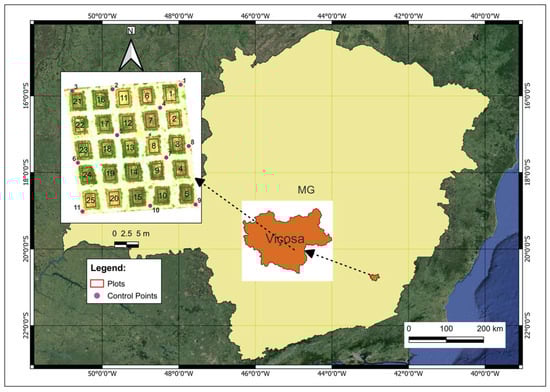
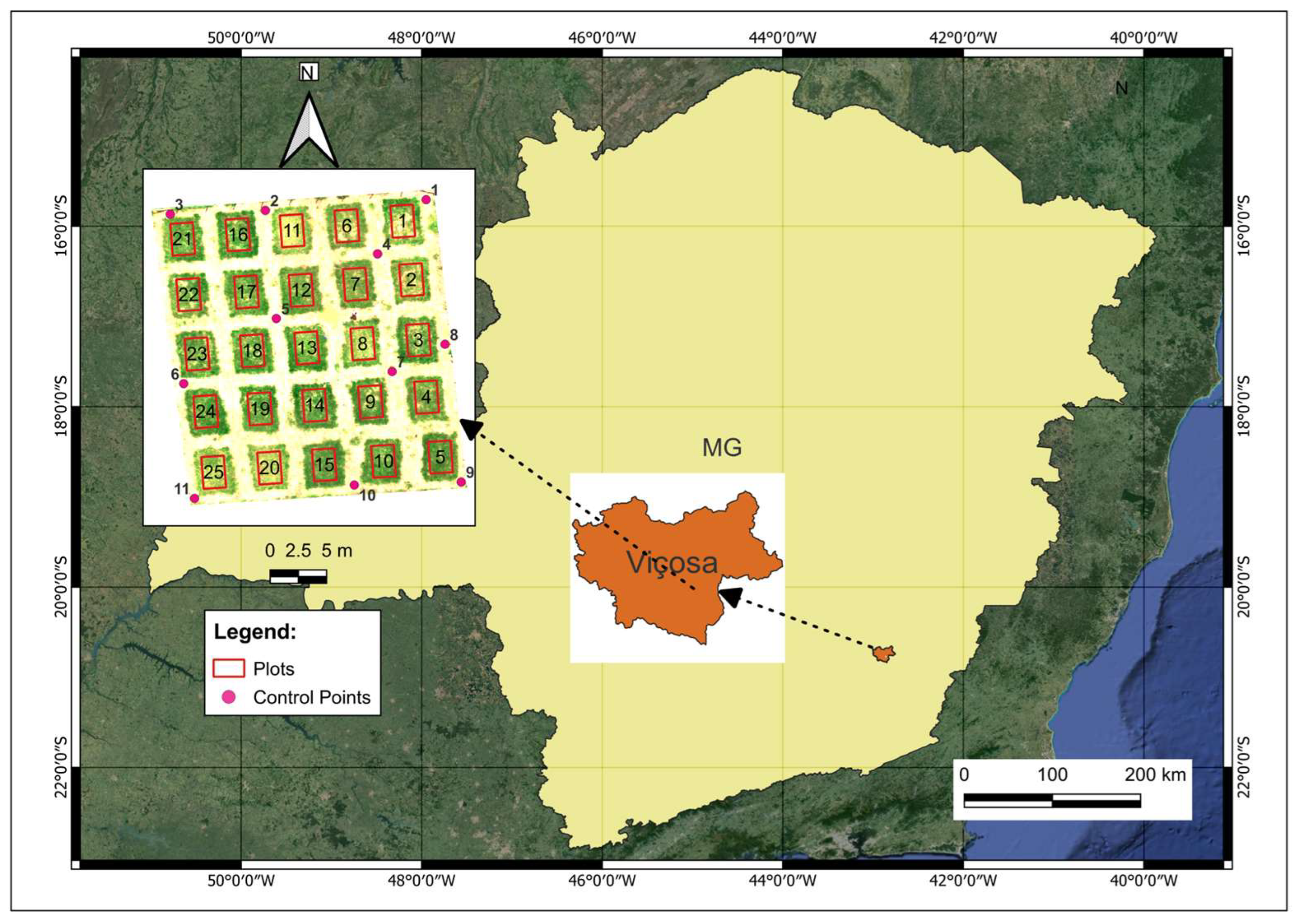
The experiment was conducted at the Department of Animal Science of the Federal University of Viçosa, in Viçosa, MG, Brazil (Figure 1). The soil in the experimental area is a Red-Yellow Latosol with a clayey texture. Soil sampling at a depth of 0–20 cm was conducted by blocks to determine whether liming and fertilization were necessary. The average physicochemical soil properties were: pH (H2O) = 5.3; available P = 3.38 mg dm−3; K = 100.8 mg dm−3; Ca2+ = 2.09 cmolc dm−3; Mg2+ = 0.83 cmolc dm−3; Al3+ = 0.15 cmolc dm−3; H + Al = 3.98 cmolc dm−3; sum of bases (SB) = 3.18 cmolc dm−3; effective cation exchange capacity (t) = 3.27 cmolc dm−3; total cation exchange capacity (T) = 7.16 cmolc dm−3; base saturation (V) = 44.34%; aluminum saturation (m) = 4.87%; and remaining phosphorus = 25.4 mg L−1. No liming was carried out; however, phosphorus fertilization was applied to all blocks, and potassium fertilization was applied only to block 5.
Figure 1.
Geographic location of the experimental area in Viçosa, Minas Gerais, Brazil. The experimental site covers 0.7 ha and was divided into 25 plots of 12 m2 each, cultivated with Urochloa decumbens. The inset map illustrates the spatial layout of the plots and ground control points used for image georeferencing, with plots shown in red and control points in purple.
The region’s climate is classified as Cwa according to the Köppen system, with an average annual precipitation of 1340 mm and an average relative humidity of 80% [26].
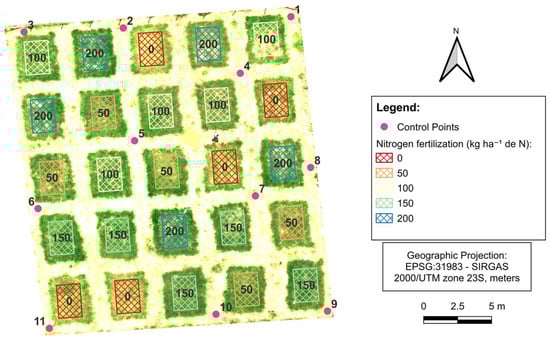
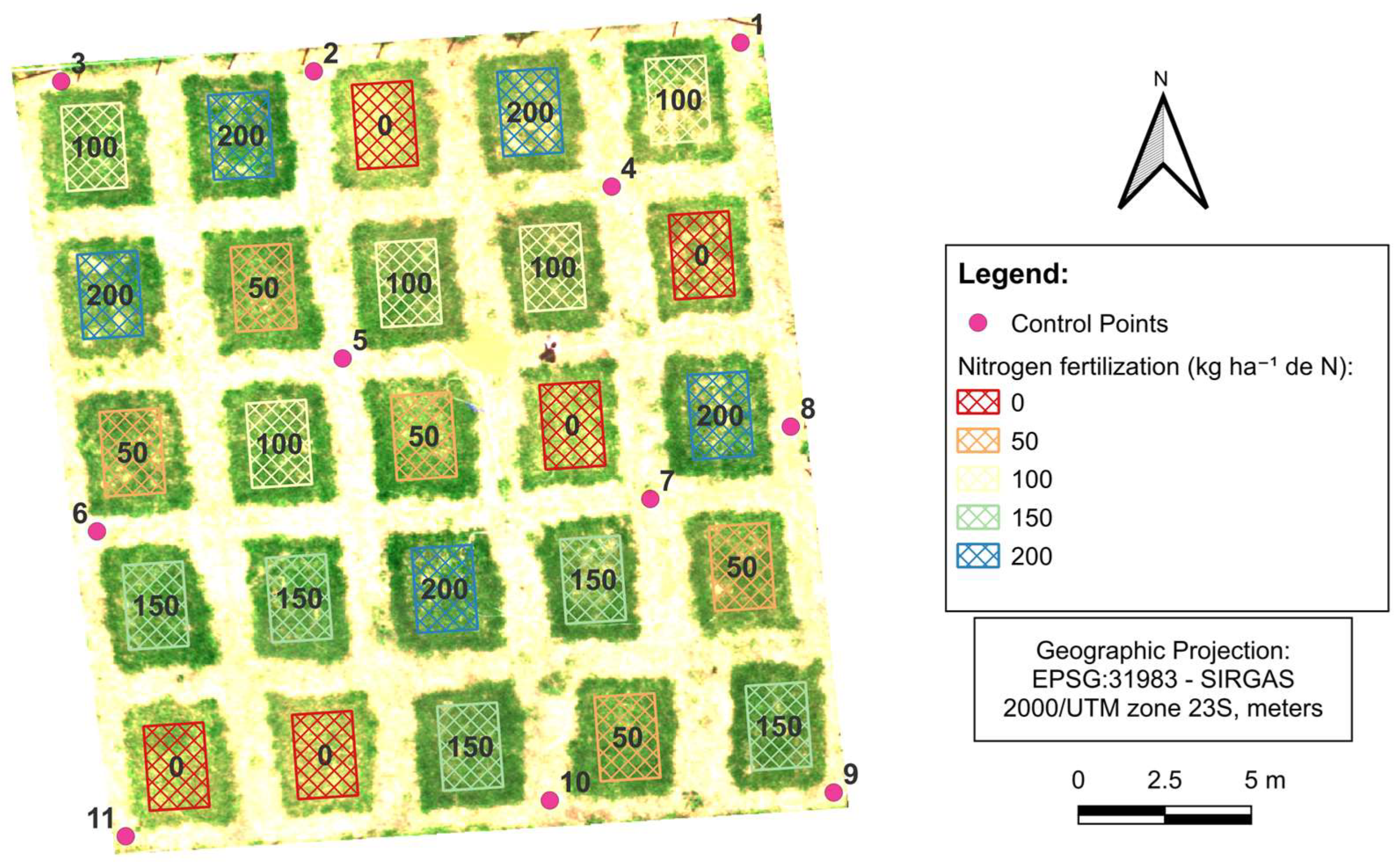
The experimental area consisted of 0.7 ha of signalgrass [Urochloa decumbens (Stapf) R.D. Webster], established in 2011. This area was divided into 25 plots of 12 m2 each (3 × 4 m) with a 2 m spacing between plots (Figure 2). Five treatments were distributed across five homogeneous blocks, totaling 25 experimental units. Treatments consisted of 5 doses of N fertilizer (0, 50, 100, 150, and 200 kg N ha−1) applied after harvesting using urea as a source (Figure 2).
Figure 2.
Gradient of nitrogen fertilization in the experimental area. The different colors indicate the nitrogen application rates (0, 50, 100, 150, and 200 kg ha−1 of N), while the purple points represent the control points used for image georeferencing. The cartographic projection adopted was EPSG:31983—SIRGAS 2000/UTM zone 23S.
The treatments were applied to promote forage variability in terms of herbage mass, canopy height, and CP concentration, ensuring the model’s robustness. The fertilizer application was divided into doses of 50 kg ha−1, with three-day intervals, and was completed one week before the next harvest. Each plot received 12 mm of irrigation after fertilization. Further details about the experiment’s setup are described in Lisboa [27].
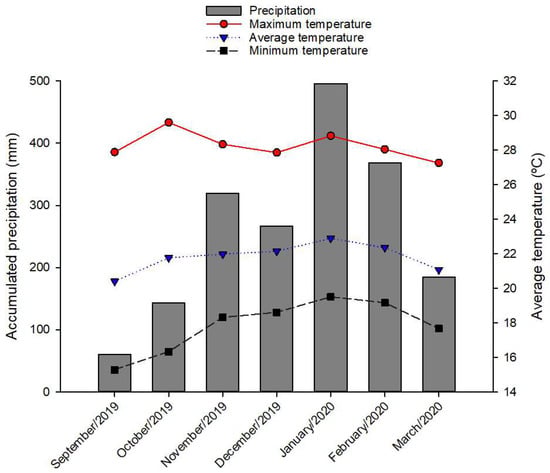
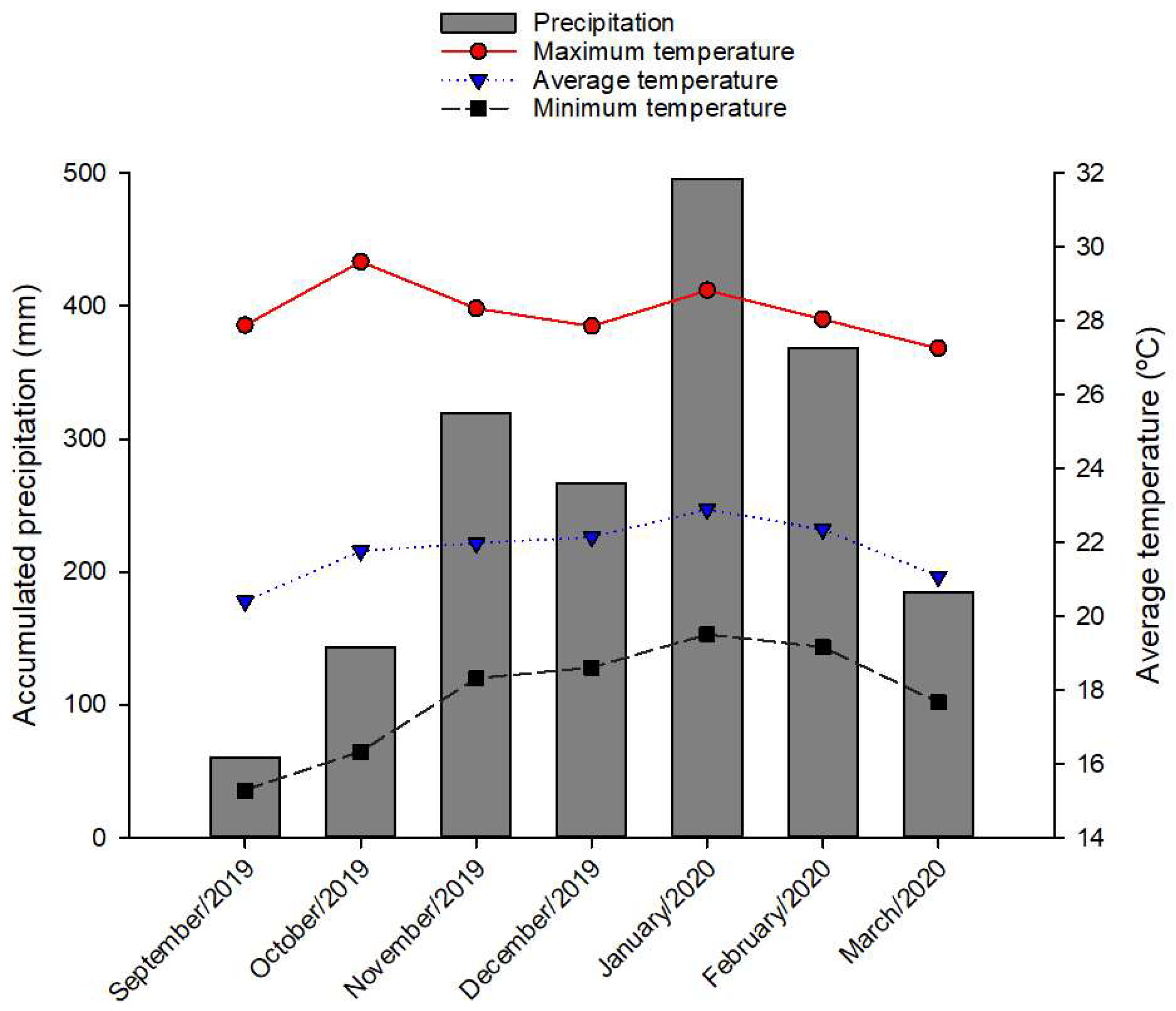
Meteorological data during the experiment were obtained from the Viçosa Weather Station, available in the Meteorological Database for Teaching and Research (BDMEP) of the National Institute of Meteorology (INMET) [28]. Monthly accumulated precipitation and average monthly temperatures (Figure 3) were calculated to evaluate the relationship between meteorological conditions and the structural and nutritional characteristics of the grass.
Figure 3.
Monthly accumulated precipitation (mm) and maximum, average, and minimum temperatures (°C) in Viçosa, Minas Gerais, Brazil, between September 2019 and March 2020. Data were obtained from the Viçosa Weather Station. Bars represent monthly accumulated precipitation, and lines indicate temperatures.
2.2. Acquisition of Multispectral Images and Forage Evaluations
To acquire the images, seven flights were conducted using a DJI Matrice 100 UAV (DJI, Shenzhen, China) equipped with a Micasense RED-EDGE multispectral camera (MicaSense Inc., Seattle, WA, USA). This camera can capture five spectral bands simultaneously: RED (668 nm with a bandwidth of 10 nm), GREEN (560 nm with a bandwidth of 20 nm), BLUE (475 nm with a bandwidth of 20 nm), RED-EDGE (717 nm with a bandwidth of 10 nm) and NIR (840 nm with a bandwidth of 40 nm) [29]. The flights were conducted at an altitude of 40 m, resulting in a spatial resolution of 9 cm2/pixel. An interval of two seconds between shots was used, with a longitudinal overlap of 75% and a lateral overlap of 80% to generate mosaics of the area.
The experimental area was previously georeferenced using a Trimble Pro XR GPS (Trimble Inc., Sunnyvale, CA, USA), which determined the coordinates (latitude, longitude, and altitude) of 11 control points previously installed in the experimental area (Figure 2). This device has an average accuracy of approximately 50 cm to 1 m. Before each flight, an image of the camera’s calibration panel was captured for subsequent radiometric adjustment of the images. The flights were conducted between 11:00 a.m. and 12:00 p.m. to ensure the most suitable solar angle to capture vegetation reflectance.
The canopy height was measured immediately before each flight and forage harvest using a graduated ruler, with measurements taken at ten random points per experimental unit (plots), excluding the borders. Forage samples were harvested every 21 days immediately after the flight, totaling seven harvests. Two one-square-meter frames were used for sampling and placed in representative points of the mean canopy height in each plot. The samples were harvested using a hedge trimmer (Husqvarna, model 325 HE 4, Husqvarna AB, Huskvarna, Sweden).
After harvesting, the samples were separated and weighed. A 100 g subsample was then dried in an oven at 55 °C for 72 h to determine the air-dried matter. Subsequently, the samples were ground (1 mm sieve) for definitive DM analysis (INCT-CA G-003/1) and CP concentration analysis (INCT-CA N-001/1), as described by [30]. Forage density was calculated as the ratio between the dry mass and the plant height at the sampling point. Descriptive statistics of the variables are presented in Table 1.
Table 1.
Descriptive statistics of forage variables (fresh and dry forage mass, canopy height, forage density, dry matter concentration, and crude protein concentration) measured across experimental units.
2.3. Image Pre-Processing
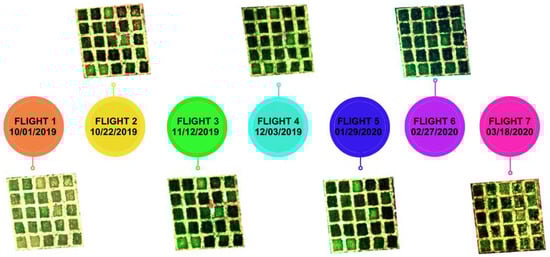
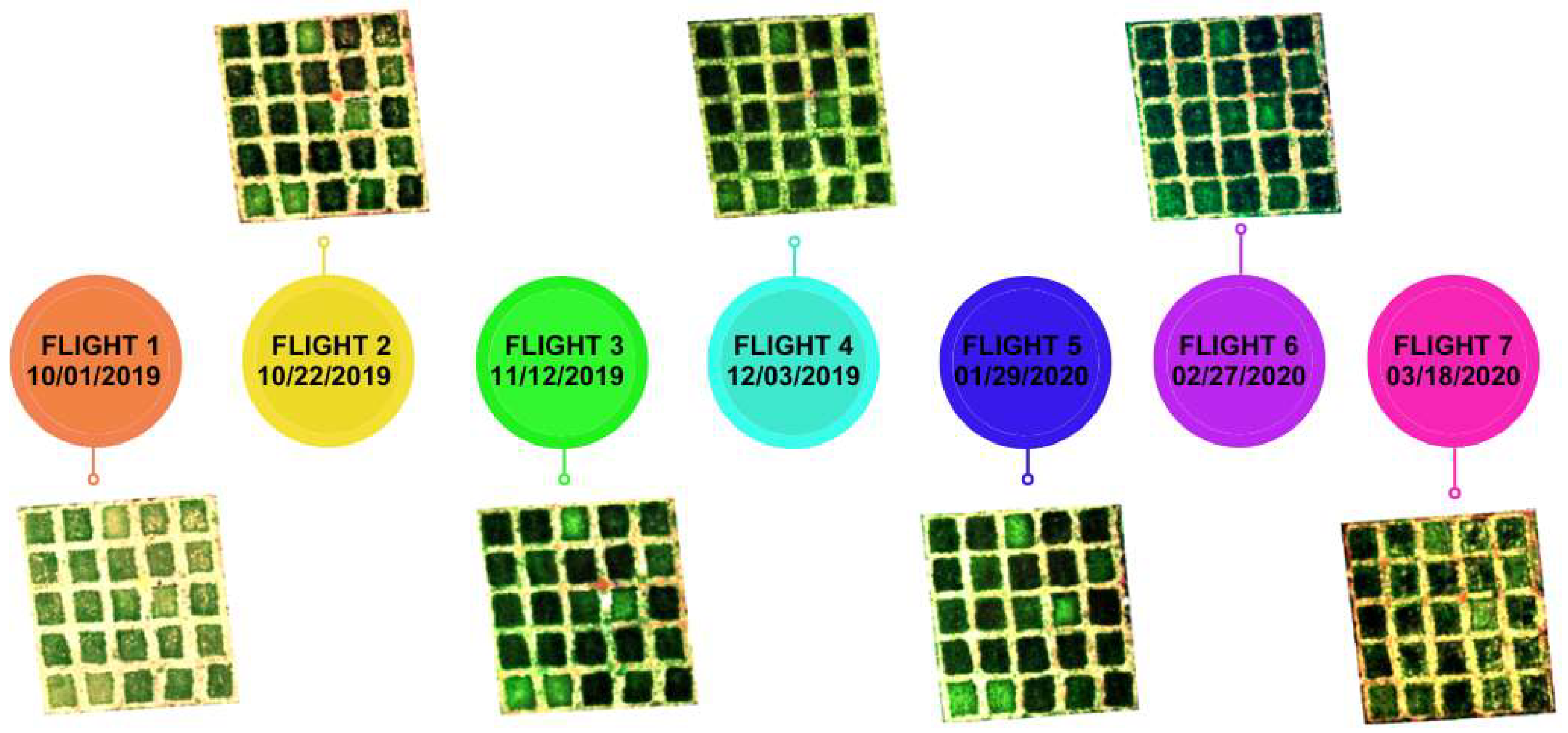
The field-captured images were processed using Agisoft Metashape Professional® software, version 1.5.1, Agisoft LLC, St. Petersburg, Russia), including steps such as reflectance calibration, photo alignment, construction of a three-dimensional point cloud, model, and texture generation, densification of the three-dimensional point cloud, construction of a digital surface model, and generation of the orthomosaic. The orthomosaics from the seven flights (Figure 4) were exported in .tiff format to QGIS® software version 3.28.4 (QGIS Development Team, Open Source Geospatial Foundation, Beaverton, OR, USA). Then, 6 m2 sections were cropped in each plot to extract the values of the five spectral bands using the zonal statistics tool in QGIS. These digital data were normalized following the technical guidelines of the Agisoft Technical Support Portal [31], in which the values were divided by 32,768 to adjust the reflectance to a range between zero and one. Based on these bands, 12 vegetation indices (VIs) were calculated (Table 2).
Figure 4.
Temporal sequence of orthomosaics of the experimental plots generated from UAV images captured in seven flights conducted between October 2019 and March 2020. The orthomosaics illustrate the spatial variability and changes in vegetation condition across the experimental area throughout the growing season.
Table 2.
Vegetation indices used in the study, their equations, and references.
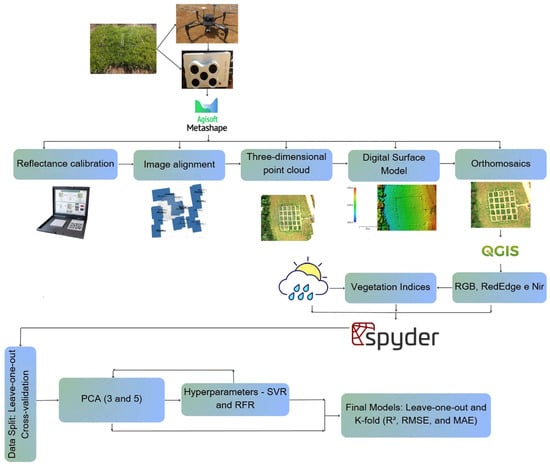
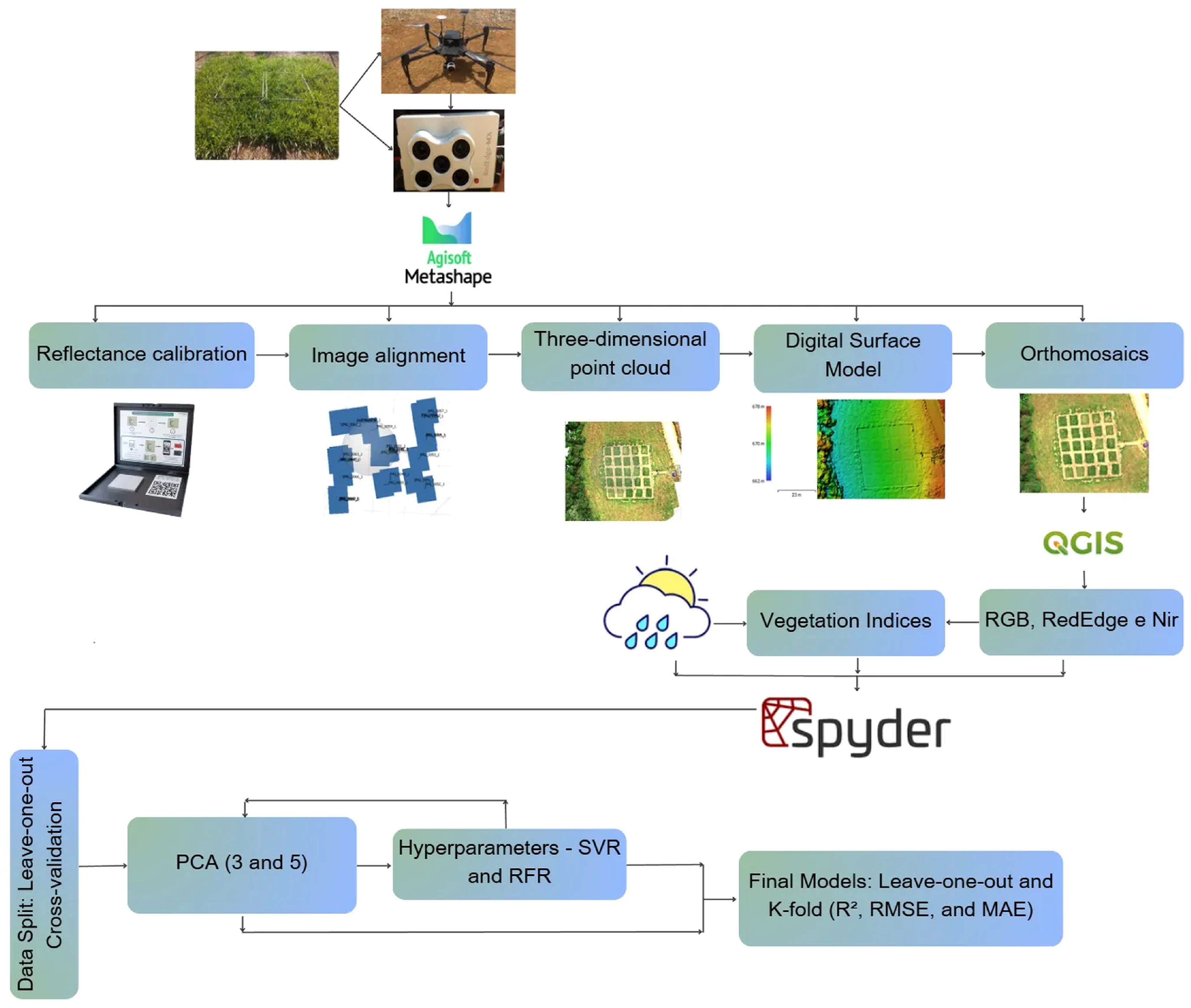
Meteorological data (cumulative precipitation, minimum, mean, and maximum temperatures) from the 21 days prior to the first flight and between flights were also used as predictor variables. These data, along with the spectral bands and VIs, were input into the SLR, MLR, and RFR models, capturing both spectral variability and environmental effects on the estimates of the variables of interest (fresh and dry forage mass, canopy height, density, DM concentration, and CP). The flowchart in Figure 5 illustrates the process from field data collection, through the image preprocessing stages in Agisoft® and QGIS®, to data processing and modeling in Spyder 5.4.3 (Anaconda, Inc., Austin, TX, USA) using Python 3.11.3.
Figure 5.
Workflow diagram illustrating the process from image collection in the field, through image preprocessing in Agisoft® and QGIS® software, to data processing and modeling in Spyder.
2.4. Modeling
Three predictive models were developed using machine learning techniques: Multiple Linear Regression (MLR), Support Vector Regressor (SVR), and Random Forest Regressor (RFR). The algorithms were implemented in the Python 3.11.3 programming language (Python Software Foundation, 2024), using the Spyder IDE 5.4.3 (Anaconda, Inc., 2024) included in the Anaconda Navigator distribution. Based on the spectral bands (RGB, Red Edge, and NIR), 12 VIs were created, as presented in Table 2, and these were used as predictor variables. Additionally, the individual spectral bands and meteorological data (cumulative precipitation, and averages of the minimum, maximum, and mean temperatures) collected 21 days before the first flight and between subsequent flights were considered, totaling 21 potential predictor variables.
To reduce dimensionality and minimize redundancies among the variables, PCA was applied separately for two scenarios: three principal components (PC3) and five principal components (PC5). Before applying PCA, a correlation matrix was generated using the original predictor variables and the variables of interest. Pearson’s correlation coefficient was used to measure the strength and direction of the linear relationship between two continuous variables, ranging from −1 to 1. Values close to 1 indicate a strong positive correlation, values close to −1 indicate a strong negative correlation, and values close to zero indicate a weak or no correlation. Additionally, Student’s t-test was used to assess the statistical significance of the correlations (p < 0.05), highlighting statistically significant relationships. The strength of correlations was classified based on the absolute value of Pearson’s correlation coefficient as weak (<0.3), moderate (0.3–0.7), and strong (≥0.7), following the criteria adapted from [40], who proposed similar thresholds for evaluating correlations between vegetation indices and grassland quality parameters. To assess the models’ performance and generalization ability, a Leave-One-Group-Out Cross-Validation (LOGOCV) strategy was employed. In this approach, each flight was treated as a distinct group. The total dataset, comprising 175 observations (25 plots × 7 flights), was iteratively partitioned. In each iteration, data from one entire flight (25 observations, ~15%) were held out as the validation set, while the data from the remaining six flights (150 observations, ~85%) were used for model training. This process was repeated seven times, ensuring that each flight was used exactly once as the validation set. This strategy was crucial to ensure temporal independence between the training and validation sets. By validating the model on data from a date entirely unseen during training, we could more realistically assess its ability to predict pasture characteristics at future time points. This approach prevents overly optimistic performance estimates that can arise from temporal autocorrelation within the data.
In addition, the data used in the MLR and SVR models were standardized using the StandardScaler function, ensuring zero mean and unit variance, an essential practice for machine learning algorithms that are sensitive to variable scales. For the RFR model, hyperparameter optimization was performed using the gp_minimize function, which implements a Bayesian Optimization method to efficiently search for the optimal combination of parameters to minimize the error. This process iterated over parameters such as the number of trees (n_estimators), maximum depth (max_depth), minimum number of samples required to split a node (min_samples_split), and minimum number of samples required at a leaf node (min_samples_leaf), selecting the configuration that resulted in the best model performance, evaluated by the lowest RMSE.
In the case of the SVR model, the hyperparameters C, epsilon, and gamma were tuned. The parameter C acts as a penalty factor, controlling the trade-off between model complexity and prediction error magnitude. The epsilon parameter defines the width of the tolerance zone, within which deviations between predicted and observed values are not penalized. The gamma parameter regulates the influence range of each data point in the transformed space, determining the degree of curvature of the model and its sensitivity to local variations. As with the RFR model, parameter selection was also guided by the lowest average RMSE obtained. The equations used to calculate RMSE and MAE are presented below:
Root Mean Square Error (RMSE):
Mean Absolute Error (MAE):
where is the observed value, is the model prediction, and is the number of observed values.
The model performances were then evaluated using the coefficient of determination (R2), RMSE, and MAE, ensuring a precise and robust analysis of the predictive performance of the models. The equation used to calculate the R2 is as follows:
Coefficient of Determination (R2):
where is the observed value, is the model prediction, and is the average of the observed values.
The flowchart in Figure 5 illustrates the process from the field data collection and image preprocessing stages in Agisoft® and QGIS® to data processing and modeling in Spyder®.
3. Results
3.1. Correlation Between Variables
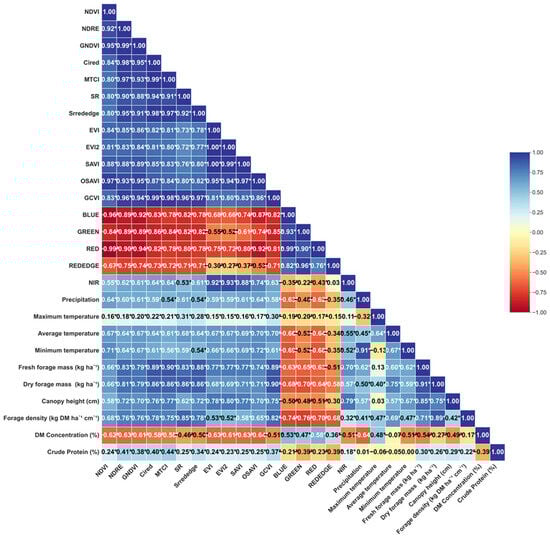
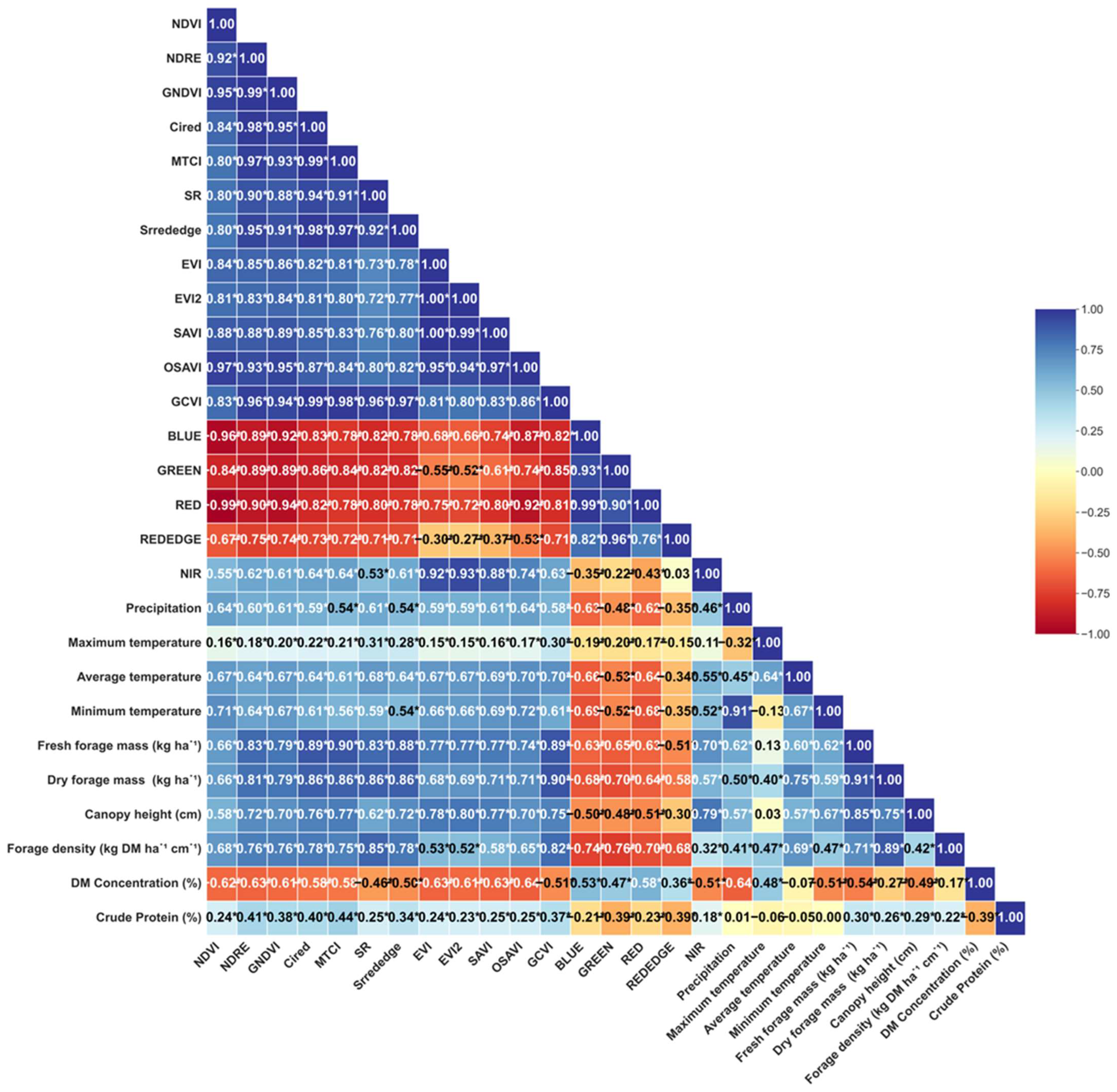
The VIs showed predominantly strong correlations with each other. Their relationships with the NIR band and meteorological data ranged from moderate to strong, except for maximum temperature, which showed a weak correlation. Correlations with the other spectral bands were mostly negative, varying from weak to strong. Variables of interest, such as fresh forage mass, dry forage mass, canopy height, and forage density, exhibited moderate to strong correlations among themselves and with the VIs. However, their correlations with the spectral bands were generally negative, except for the NIR band, which showed positive associations (Figure 6).
Figure 6.
Pearson correlation matrix between predictor variables and variables of interest, with significant correlations indicated by (p < 0.05, t-Student test). DM (dry matter); Cired (REDEDGE Chlorophyll Index); EVI (Enhanced Vegetation Index); EVI2 (Enhanced Vegetation Index 2); GCVI (GREEN Chlorophyll Vegetation Index); GNDVI (GREEN Normalized Difference Vegetation Index); NDRE (Normalized Difference REDEDGE); NDVI (Normalized Difference Vegetation Index); MTCI (MERIS Terrestrial Chlorophyll Index); OSAVI (Optimized Soil Adjusted Vegetation Index); SAVI (Soil Adjusted Vegetation Index); SR (Simple Ratio); Srrededge (Simple Ratio REDEDGE). The color scale represents the Pearson correlation coefficients, ranging from −1 (strong negative correlation, in blue) to +1 (strong positive correlation, in red).
DM concentration, in turn, showed a moderate negative correlation with the VIs and the NIR band, and a moderate positive correlation with the other spectral bands. Meanwhile, CP concentration presented weak to moderate positive correlations with the VIs and the NIR band, and weak negative correlations with the other spectral bands. Finally, the variables of interest showed both positive and negative correlations with meteorological data, ranging from none to strong (Figure 6).
Among the variables of interest, strong correlations were observed between fresh forage mass and dry forage mass (0.91), density and dry forage mass (0.89), and canopy height and fresh forage mass (0.85) (Figure 6). The strongest correlations between the variables of interest and the VIs were: fresh forage mass with MTCI (0.90), dry forage mass with GCVI (0.90), density with SR (0.85), and canopy height with EVI2 (0.80). Among the moderate correlations, the most notable were DM concentration with OSAVI (−0.64) and crude protein concentration with MTCI (0.44).
Regarding meteorological data, strong correlations included dry forage mass and density with average temperature (0.75 and 0.69, respectively), and canopy height with minimum temperature (0.67). Among the moderate correlations, notable cases were DM concentration with precipitation (−0.64) and fresh forage mass with precipitation and minimum temperature (0.62) (Figure 6). For the spectral bands, strong correlations were observed between canopy height and fresh forage mass with NIR (0.79 and 0.70, respectively), and density and dry forage mass with the GREEN band (−0.76 and −0.70, respectively). Among the moderate correlations, highlights included DM concentration with RED (0.58) and crude protein concentration with GREEN and REDEDGE (−0.39) (Figure 6).
3.2. Principal Component Analysis
The application of PCA revealed that the first three principal components (PC1 to PC3) explained 74.18%, 9.94%, and 7.62% of the variance, totaling 91.74%. When five principal components (PC1 to PC5) were considered, the cumulative variance reached 98.97%, with an additional 4.42% and 2.81% explained by PC4 and PC5, respectively. The loading analysis (Table 3) revealed that PC1 was strongly associated with VIs such as GNDVI (−0.250), NDRE (−0.249), CIRE, OSAVI, and SREDEDGE (−0.244), as well as GCVI (−0.242) and NDVI (−0.240), reflecting canopy vigor and photosynthetic activity. PC2 exhibited higher loadings for the REDEDGE (0.494), NIR (0.473), and GREEN (0.351) bands, indicating relationships with chlorophyll content and forage mass.
Table 3.
Contribution of variables to the principal components (PC1–PC5) in PCA.
PC3 incorporated variability from meteorological factors, particularly maximum temperature (0.715) and precipitation (−0.452). PC4 was associated with mean (0.529) and minimum (0.443) temperatures, while PC5 was more influenced by precipitation (0.351), the RED band (0.351), and the SR index (0.322). Thus, the first three components robustly synthesized spectral information directly related to vegetation condition, whereas the last two captured additional variability linked to climatic factors and specific spectral variables, such as the RED band and the SR index.
Consequently, the two arrangements considering three and five principal components complementarily synthesized spectral and environmental information, serving as the basis for calibrating the MLR, RFR, and SVR models with high agronomic interpretability. Finally, the average values of the hyperparameters selected for the RFR and SVR models, based on RMSE minimization, are presented in Table 4 and Table 5, respectively.
Table 4.
Hyperparameters of the Random Forest Regressor model for predictions based on PC3 and PC5.
Table 5.
Hyperparameters of the Support Vector Regressor model for predictions based on PC3 and PC5.
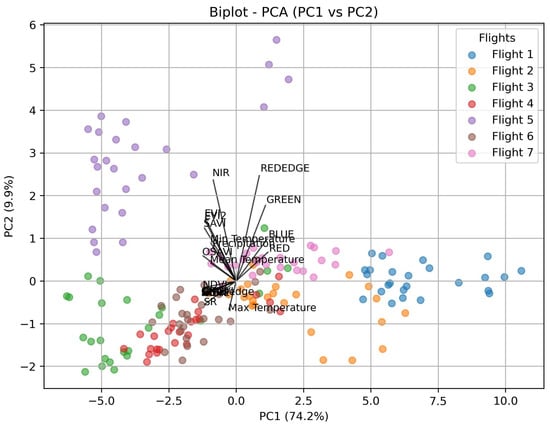
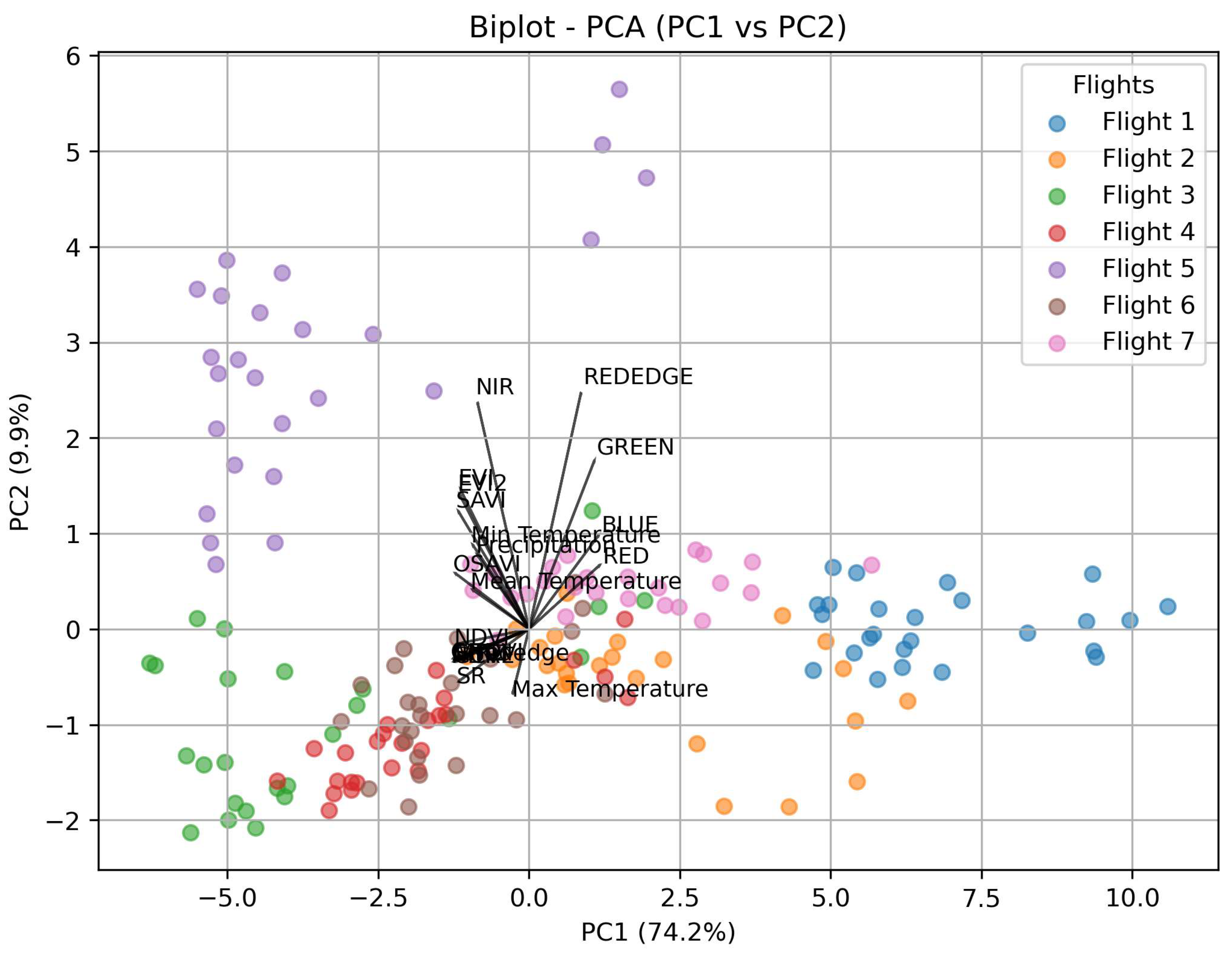
The analysis of the biplot (Figure 7) shows that most of the variance is concentrated in the first principal component (PC1, 74.2%), which mainly represents a gradient between VIs based on NIR (NDVI, SAVI, EVI, OSAVI, SR) and spectral variables in the visible domain (RED, GREEN, BLUE, REDEDGE), together with environmental variables such as temperatures. The second principal component (PC2, 9.9%) captures additional variation, mainly associated with the NIR, REDEDGE, and GREEN bands, thus complementing the structure revealed by PC1. Together, PC1 and PC2 explain 84.1% of the total variability in the dataset, confirming the robustness of the dimensionality reduction. These findings reinforce the previous interpretation that the principal components integrate both spectral information related to vegetation condition and environmental factors.
Figure 7.
Biplot of the PCA, showing the first two components (PC1 = 74.2% and PC2 = 9.9% of the explained variance). The colored points indicate the different flights, while the arrows represent the contribution of the original variables to each principal component.
3.3. Final Models
The best results obtained for each variable are summarized in Table 6, considering the different models and PCA configurations. Overall, the RFR model combined with PC3 showed the best performance in predicting fresh forage mass, while the SVR associated with PC5 excelled in predicting dry forage mass and density. The SVR combined with PC3 was more efficient in estimating canopy height, and dry matter concentration was best predicted by the MLR model with PC5. None of the evaluated models were able to satisfactorily predict crude protein concentration.
Table 6.
Best-performing regression models and their performance metrics for each forage variable.
4. Discussion
Images acquired by UAVs have gained prominence in precision agriculture and animal science, particularly for the generation of VIs, which are useful tools for assessing productivity and aboveground biomass [41,42]. In this study, spectral and meteorological data were used to predict pasture characteristics, such as fresh and dry forage mass, showing satisfactory performance. The RFR model presented R2 values above 0.60 (Figures S1b and S2h; see Supplementary Materials), while the SVR with PC5 also achieved a good fit for dry forage mass (Figure S2l; see Supplementary Materials). These results confirm the relevance of spectral information for estimating forage mass.
Among the evaluated VIs, NDVI stands out due to its widespread use in agricultural monitoring. In this study, it showed moderate associations with almost all variables of interest, including crude protein (Figure 6). However, its sensitivity decreases in areas with high biomass or exposed soil [14], which increases data dispersion as forage mass grows (Figures S1 and S2; see Supplementary Materials). This behavior highlights the challenges of estimating fresh forage mass under high canopy coverage, even when using multiple spectral indices [32,36,37,38,39]. Thus, the integration of spectral data, VIs, and meteorological variables has been highlighted as a factor for improved prediction accuracy [14,43,44,45].
However, the strong correlation among vegetation indices must be interpreted with caution, as one index may provide redundant information or even mask the effect of another. In the present study, this situation was identified, and therefore, PCA was applied to reduce collinearity and increase the robustness of the models. The principal component analysis revealed a clear pattern of separation between vegetation indices related to canopy vigor and photosynthetic activity (NDVI, EVI, SAVI, NDRE) and spectral bands associated with chlorophyll content and leaf mass (REDEDGE, NIR, GREEN), suggesting a functional dichotomy between foliar traits and indicators of vegetative growth.
The distinct groupings observed across different flights indicate that the phenological and environmental conditions during each data collection period significantly influenced the spectral signature of the pasture. This multidimensional organization provided by PCA not only simplifies biological interpretation, highlighting contrasts between foliar traits and vegetative vigor, but also offers practical advantages for predictive modeling. Algorithms sensitive to multicollinearity, such as MLR and SVR, benefit from dimensionality reduction, while models like RFR benefit from a more organized data structure, facilitating the understanding of relationships between spectral variables and growth indicators.
In summary, PCA functions simultaneously as an interpretation tool and as support for modeling, allowing a robust exploration of spectral and environmental variability in the crops. Nevertheless, the results indicate that the incorporation of additional information, such as volumetric data, could reduce dispersion and increase the accuracy of estimates in dense and heterogeneous pastures. Théau et al. [46], for example, showed that the combination of spectral and structural information, including volumetric reconstruction and GNDVI, resulted in R2 values above 0.90 for fresh forage mass and dry forage mass in temperate pastures. Although this study employed only MLR, RFR, and SVR, such evidence reinforces the importance of integrating multiple data sources.
It is also noteworthy that, despite recent advances, the number of studies conducted under tropical conditions is still lower than in temperate regions, highlighting the relevance of the approach employed here. The best prediction of fresh forage mass was obtained with RFR (PC3, Table 6), whereas dry forage mass was more accurately estimated by SVR (PC5, Table 6). This difference indicates that distinct forage attributes require specific modeling strategies: fresh forage mass primarily reflects structural accumulation, while dry forage mass is strongly influenced by the water content in plant tissues.
The existing variability in forage mass (Table 1) favored model fitting, as it increased the spectral contrast between plots, which explains the superior performance of these variables compared to others. However, Schucknecht et al. [47] reported R2 = 0.67 and RMSE = 419 kg ha−1 for dry forage mass using RFR, values higher than those obtained in the present study (R2 = 0.65; RMSE = 749.99 kg ha−1; (Figure S2h; see Supplementary Materials). This difference may be related to the experimental design, as our study only encompassed spring and summer, periods of greater phenological homogeneity and high water content. In contrast, Schucknecht et al. [47] included data collection from three distinct sites, increasing environmental and phenological variability, which contributed to better predictive performance.
From a practical perspective, reliable estimation of fresh and dry forage mass is essential for determining stocking rate, cutting periods, and forage conservation strategies, such as ensiling and haymaking. The difficulty in predicting dry forage mass under high moisture conditions highlights the importance of increasing the temporal and spatial representativeness of sampling, incorporating periods of water deficit that enhance spectral contrast and support more robust estimates.
Despite satisfactory performance in predicting fresh and dry forage mass, canopy height estimation showed greater limitations. The SVR model associated with PC3 (Figure S3; see Supplementary Materials) provided the best fit, with an error of 10.80 cm—lower than the 16.12 cm obtained with the MLR model (Figure S3m; see Supplementary Materials)—yet still substantial when compared with the recommended management heights for signalgrass under continuous stocking (15–30 cm) and rotational stocking (pre-grazing: 20–25 cm; post-grazing: 10–15 cm). Deviations of approximately 10 cm can significantly affect the timing of animal entry and removal from paddocks, thereby disturbing the balance between forage supply and consumption.
Canopy height exhibited a coefficient of variation of 47% (Table 1), a value that would, in principle, favor model calibration. However, unlike forage mass, this variability did not translate into higher predictive accuracy—possibly due to the absence of a direct linear relationship with spectral indices and the influence of structural canopy attributes, such as the proportion of leaves and stems. Moreover, sensor limitations, terrain slope, and within-plot heterogeneity may have introduced noise, reducing predictive accuracy.
These difficulties are also reported in the literature. Murphy et al. [44] and Tiscornia et al. [48] highlighted that the structural variability of pastures limits the accuracy of canopy height estimated by RS. As an alternative, Bretas et al. [49] suggest classification models based on canopy height ranges, an approach also supported by Théau et al. [46] as practical and generalizable. Other methods have been tested, such as photogrammetry based on digital surface models (DSM) and digital terrain models (DTM) [18], as well as portable LiDAR combined with Structure from Motion [50], all of which emphasize the importance of selecting appropriate models and equipment to enhance the reliability of estimates.
Although LOGOCV was applied to reduce the risk of overfitting, the limited number of samples may still have influenced the models’ ability to generalize to new conditions. The use of LOGOCV does not replace the need for validation with external datasets. In this regard, Schucknecht et al. [47] emphasize that external validation is essential to increase model robustness and ensure its applicability under different management conditions, allowing assessment of whether the results are consistent and reliable beyond the original calibration dataset.
Based on the limitations observed in predicting canopy height, it is relevant to analyze other pasture attributes that also affect forage accumulation and pasture management, such as forage density and DM concentration. These attributes are related to canopy structure and the composition of plant tissues, directly influencing the interception of radiation by sensors and the accuracy of estimates obtained through RS.
Most studies using RS in pastures focus on estimating forage mass or canopy height; however, predicting forage density represents a relevant methodological advance. This attribute is directly associated with the carrying capacity of the area, reflecting not only the herbage allowance but also its spatial distribution and the proportion of leaves to stems. Being closely related to canopy architecture, density influences the interception of electromagnetic radiation recorded by sensors, which may explain the moderately satisfactory performance observed in the present study with SVR and PC5 (Figure S4x; see Supplementary Materials). Additionally, the coefficient of variation for density was relatively high (61%; Table 1).
However, in tropical systems, pasture heterogeneity tends to increase the variability of estimates due to factors such as tillering, internal shading, and variations in the proportion of live and dead tissue, which alter the spectral signal. In this context, the limited number of samples may have restricted the models’ generalization capacity. Including longer time series covering different seasonal conditions could improve prediction robustness and broaden model applicability under contrasting environmental scenarios, as highlighted by Schucknecht et al. [47].
In the case of DM concentration, the best performance was achieved with the MLR model combined with PC5 (Table 6). The lower performance of the other models is likely related to spectral signal saturation during wet periods, when signalgrass had high water content and lower spectral contrast between plots. Indeed, the coefficient of variation was low (28%; Table 1). Under these conditions, the relationship between spectral indices and water content tends to be more linear, favoring simpler models over more complex approaches, such as RFR and SVR, which require a greater diversity of scenarios to capture nonlinear relationships.
In contrast, studies such as Bretas et al. [14], which included dry periods, reported higher spectral variability and better predictive performance for DM concentration, albeit with higher aggregated error. It is worth noting, however, that these studies used satellite images rather than UAV-acquired data, which may limit direct comparability. Thus, the results obtained for forage density and DM concentration reinforce that different pasture attributes require specific modeling strategies, and that the temporal and spatial representativeness of samples is crucial to improve the reliability of predictions, especially under heterogeneous tropical conditions.
Finally, we have the predictions of CP, which, regardless of the model applied, showed the poorest predictive performance in this study (Figure S6; see Supplementary Materials), likely due to low variation throughout the experiment, as reflected by the low coefficient of variation (24%; Table 1). Crude protein concentration is a crucial variable in pasture management [51]. However, the multispectral cameras used have limitations in detecting the subtle spectral signatures required for accurate nitrogen estimates, especially in the shortwave infrared (SWIR) region [47]. Hyperspectral cameras may be more suitable, as much of the nitrogen in leaves is associated with pigments such as chlorophyll and proteins involved in photosynthesis [52].
Wijesingha et al. [53] used UAVs equipped with hyperspectral cameras to determine protein in forage in Germany, obtaining R2 = 0.74 for the RFR model with 194 samples, with protein variation between 5% and 23%, a range similar to that observed in the present study. This indicates that the low predictive capacity observed here cannot be attributed solely to the low coefficient of variation. Furthermore, algorithms based on radiative transfer models or growth/biogeochemical models integrated with sensing data [54] may improve CP prediction, although the required equipment is often inaccessible and expensive [55].
In the study by Schucknecht et al. [47], the prediction of nitrogen in pastures using the RFR model showed R2 values of 0.47 and 0.43 for Parrot Sequoia and MicaSense REDEDGE-M sensors, respectively. Although these values are higher than those obtained in the present study, external data validation reduced R2 to 0.02. This highlights the need for modeling approaches that avoid overfitting, emphasizing the importance of cross-validation techniques and independent validations to ensure model robustness.
To improve CP estimates, future studies should explore hyperspectral sensors and integrate structural data, such as DSMs, DTMs, and LiDAR information, which, although not directly measuring chemical composition, provide details of canopy architecture that can complement spectral information and enhance prediction accuracy. In addition, using larger datasets may contribute to improving estimates. Therefore, the approach proposed in this study should be tested under different environmental conditions, as the spatial and temporal variability of pastures can enable the development of more robust and applicable models.
5. Conclusions
The use of UAV-acquired multispectral imagery combined with machine learning algorithms proved to be a promising strategy for estimating the structural characteristics of Urochloa decumbens pastures. The Random Forest Regressor and Support Vector Regressor models achieved the best performances for predicting fresh and dry forage mass, with coefficients of determination of 0.82 and 0.68, respectively, highlighting the relevance of spectral data for applications in grazing systems.
Dry matter concentration was reasonably predicted by a linear model, whereas forage density showed moderate performance and canopy height exhibited limited accuracy, suggesting that structural attributes require integration with additional data sources such as photogrammetry and LiDAR. Crude protein, in turn, was not adequately predicted, revealing the limitations of multispectral sensors and indicating that hyperspectral sensors may be more appropriate for biochemical variables.
From a practical perspective, accurate forage mass estimates represent a significant advancement for tropical livestock systems, enabling greater precision in determining carrying capacity, defining stocking rates, and planning forage conservation strategies. To enhance the robustness and generalization capability of the models, it is recommended to include sampling across different seasons and to integrate multiple data sources, combining both spectral and structural variables, aiming at the development of scalable and efficient tools for pasture monitoring and the sustainable management of tropical livestock systems.
Supplementary Materials
The following supporting information can be downloaded at: https://www.mdpi.com/article/10.3390/agriengineering7120406/s1, Figure S1: Predictions of fresh forage mass using Multiple Linear Regression with PC3 (a) and PC5 (d), Random Forest Regressor with PC3 (b) and PC5 (e), and Support Vector Regressor with PC3 (c) and PC5 (f), based on multispectral and meteorological data. R2—Coefficient of Determination, RMSE—Root Mean Square Error, and MAE—Mean Absolute Error; Figure S2: Predictions of dry forage mass using Multiple Linear Regression with PC3 (g) and PC5 (j), Random Forest Regressor with PC3 (h) and PC5 (k), and Support Vector Regressor with PC3 (i) and PC5 (l), based on multispectral and meteorological data. R2—Coefficient of Determination, RMSE—Root Mean Square Error, and MAE - Mean Absolute Error; Figure S3: Predictions of canopy height using Multiple Linear Regression with PC3 (m) and PC5 (p), Random Forest Regressor with PC3 (n) and PC5 (q), and Support Vector Regressor with PC3 (o) and PC5 (r), based on multispectral and meteorological data. R2—Coefficient of Determination, RMSE - Root Mean Square Error, and MAE—Mean Absolute Error; Figure S4: Predictions of forage density using Multiple Linear Regression with PC3 (s) and PC5 (v), Random Forest Regressor with PC3 (t) and PC5 (w), and Support Vector Regressor with PC3 (u) and PC5 (x), based on multispectral and meteorological data. R2—Coefficient of Determination, RMSE - Root Mean Square Error, and MAE—Mean Absolute Error; Figure S5: Predictions of DM concentration using Multiple Linear Regression with PC3 (y) and PC5 (ab), Random Forest Regressor with PC3 (z) and PC5 (ac), and Support Vector Regressor with PC3 (aa) and PC5 (ad), based on multispectral and meteorological data. DM—Dry Matter, R2—Coefficient of Determination, RMSE—Root Mean Square Error, and MAE—Mean Absolute Error; Figure S6: Predictions of CP using Multiple Linear Regression with PC3 (ae) and PC5 (ah), Random Forest Regressor with PC3 (af) and PC5 (ai), and Support Vector Regressor with PC3 (ag) and PC5 (aj), based on multispectral and meteorological data. R2—Coefficient of Determination, RMSE—Root Mean Square Error, and MAE—Mean Absolute Error.
Author Contributions
Conceptualization, F.H.M.C. and D.S.M.V.; methodology, I.F.R.d.S., I.L.B., D.S.M.V., F.d.A.d.C.P. and A.M.L.; software, I.F.R.d.S. and D.S.M.V.; validation, I.F.R.d.S., D.S.M.V. and I.L.B.; formal analysis, I.F.R.d.S., D.S.M.V. and F.d.A.d.C.P.; investigation, A.M.L., L.G.S.M., I.L.B., F.B.P.d.C. and P.D.V.; resources, F.H.M.C.; data curation, I.F.R.d.S., D.S.M.V., I.L.B. and F.H.M.C.; writing—original draft preparation, I.F.R.d.S.; writing—review and editing, I.F.R.d.S., I.L.B., D.S.M.V., F.d.A.d.C.P., A.M.L. and F.H.M.C.; visualization, I.F.R.d.S., I.L.B., D.S.M.V., F.d.A.d.C.P., A.M.L. and F.H.M.C.; supervision, F.H.M.C.; project administration, F.H.M.C.; funding acquisition, F.H.M.C. All authors have read and agreed to the published version of the manuscript.
Funding
This research was funded by Fundação de Amparo à Pesquisa do Estado de Minas Gerais (FAPEMIG, APQ-02670-21), Conselho Nacional de Desenvolvimento Científico e Tecnológico (CNPq, 314777/2023-7), Instituto Nacional de Ciência e Tecnologia—Ciência Animal (INCT—CA, 425168/2025-5 ) and Coordenação de Aperfeiçoamento de Pessoal de Nível Superior (CAPES, 001).
Data Availability Statement
Dataset available on request from the authors.
Acknowledgments
The authors are grateful to the GEFOR students for their support in field collections.
Conflicts of Interest
The authors declare no conflicts of interest.
Abbreviations
The following abbreviations are used in this manuscript:
| MLR | Multiple Linear Regression |
| SVR | Support Vector Regression |
| RFR | Random Forest Regression |
| UAVs | Unmanned Aerial Vehicles |
| LOOCV | Leave-one-out cross-validation |
| LOGOCV | Leave-One-Group-Out Cross-Validation |
| CP | Crude Protein |
| VIs | Vegetation Indices |
| DM | Dry matter |
| RS | Remote sensing |
References
- IBGE. Rebanho Bovino (Touros e Vacas). Available online: https://www.ibge.gov.br/explica/producao-agropecuaria/bovinos/br (accessed on 13 January 2025).
- Pereira, O.J.R.; Ferreira, L.G.; Pinto, F.; Baumgarten, L. Assessing pasture degradation in the Brazilian Cerrado based on the analysis of MODIS NDVI time-series. Remote Sens. 2018, 10, 1761. [Google Scholar] [CrossRef] [Scilit]
- Netsianda, A.; Mhangara, P. Aboveground biomass estimation in a grassland ecosystem using Sentinel-2 satellite imagery and machine learning algorithms. Environ. Monit. Assess. 2025, 197, 138. [Google Scholar] [CrossRef] [Scilit]
- Puche, N.; Senapati, N.; Flechard, C.R.; Klumpp, K.; Kirschbaum, M.U.F.; Chabbi, A. Modeling carbon and water fluxes of managed grasslands: Comparing flux variability and net carbon budgets between grazed and mowed systems. Agronomy 2019, 9, 183. [Google Scholar] [CrossRef] [Scilit]
- Teixeira, R.F.M.; Barão, L.; Morais, T.G.; Domingos, T. “BalSim”: A carbon, nitrogen and greenhouse gas mass balance model for pastures. Sustainability 2019, 11, 53. [Google Scholar] [CrossRef] [Scilit]
- Bagheri, N.; Rahimi Jahangirlou, M.; Jaberi Aghdam, M. Determining Variable Rate Fertilizer Dosage in Forage Maize Farm Using Multispectral UAV Imagery. J. Indian Soc. Remote Sens. 2024, 53, 59–66. [Google Scholar] [CrossRef] [Scilit]
- Pereira, F.R.d.S.; de Lima, J.P.; Freitas, R.G.; Dos Reis, A.A.; Amaral, L.R.; Figueiredo, G.K.D.A.; Lamparelli, R.A.C.; Magalhães, P.S.G. Nitrogen variability assessment of pasture fields under an integrated crop-livestock system using UAV, PlanetScope, and Sentinel-2 data. Comput. Electron. Agric. 2022, 193, 106645. [Google Scholar] [CrossRef] [Scilit]
- Keller, E.; Lieffering, M.; Guo, J.; Baisden, W.T.; Ausseil, A.-G. Climatic factors influencing New Zealand pasture resilience under scenarios of future climate change. NZGA Res. Pract. Ser. 2021, 17, 105–122. [Google Scholar] [CrossRef] [Scilit]
- Ojima, D.S.; Chuluun, T.; Galvin, K.A. Social-Ecological Vulnerability of Grassland Ecosystems. Clim. Vulnerability Underst. Addressing Threat. Essent. Resour. 2013, 4, 151–162. [Google Scholar] [CrossRef] [Scilit]
- Polley, H.W.; Briske, D.D.; Morgan, J.A.; Wolter, K.; Bailey, D.W.; Brown, J.R. Climate change and North American rangelands: Trends, projections, and implications. Rangel. Ecol. Manag. 2013, 66, 493–511. [Google Scholar] [CrossRef] [Scilit]
- Jank, L.; Barrios, S.C.; Do Valle, C.B.; Simeão, R.M.; Alves, G.F. The value of improved pastures to Brazilian beef production. Crop Pasture Sci. 2014, 65, 1132–1137. [Google Scholar] [CrossRef] [Scilit]
- Corrêa, C.T.R.; Bonetti, N.G.Z.; Barrios, S.C.L.; do Valle, C.B.; Torres, G.A.; Techio, V.H. GISH-based comparative genomic analysis in Urochloa P. Beauv. Mol. Biol. Rep. 2020, 47, 887–896. [Google Scholar] [CrossRef] [Scilit]
- Machado, V.D.; da Fonseca, D.M.; Lima, M.A.; Martuscello, A.; Paciullo Domingos, S.C.; Chizzotti, F.H.M. Grazing management strategies for Urochloa decumbens (Stapf) R. Webster in a silvopastoral system under rotational stocking. Grass Forage Sci. 2020, 75, 266–278. [Google Scholar] [CrossRef] [Scilit]
- Bretas, I.L.; Valente, D.S.M.; Silva, F.F.; Chizzotti, M.L.; Paulino, M.F.; D’Áurea, A.P.; Paciullo, D.S.C.; Pedreira, B.C.; Chizzotti, F.H.M. Prediction of aboveground biomass and dry-matter concentration in brachiaria pastures by combining meteorological data and satellite imagery. Grass Forage Sci. 2021, 76, 340–352. [Google Scholar] [CrossRef] [Scilit]
- Delevatti, L.M.; Cardoso, A.S.; Barbero, R.P.; Leite, R.G.; Romanzini, E.P.; Ruggieri, A.C.; Reis, R.A. Effect of nitrogen application rate on yield, forage quality, and animal performance in a tropical pasture. Sci. Rep. 2019, 9, 7596. [Google Scholar] [CrossRef] [Scilit]
- Alvarez-Mendoza, C.I.; Guzman, D.; Casas, J.; Bastidas, M.; Polanco, J.; Valencia-Ortiz, M.; Montenegro, F.; Arango, J.; Ishitani, M.; Selvaraj, M.G. Predictive Modeling of Above-Ground Biomass in Brachiaria Pastures from Satellite and UAV Imagery Using Machine Learning Approaches. Remote Sens. 2022, 14, 5870. [Google Scholar] [CrossRef] [Scilit]
- Sangjan, W.; Carpenter-Boggs, L.A.; Hudson, T.D.; Sankaran, S. Pasture Productivity Assessment under Mob Grazing and Fertility Management Using Satellite and UAS Imagery. Drones 2022, 6, 232. [Google Scholar] [CrossRef] [Scilit]
- Batistoti, J.; Marcato, J.; Ítavo, L.; Matsubara, E.; Gomes, E.; Oliveira, B.; Souza, M.; Siqueira, H.; Filho, G.S.; Akiyama, T.; et al. Estimating pasture biomass and canopy height in Brazilian Savanna using UAV photogrammetry. Remote Sens. 2019, 11, 2447. [Google Scholar] [CrossRef] [Scilit]
- Morota, G.; Ventura, R.V.; Silva, F.F.; Koyama, M.; Fernando, S.C. Big data analytics and precision animal agriculture symposium: Machine learning and data mining advance predictive big data analysis in precision animal agriculture. J. Anim. Sci. 2018, 96, 1540–1550. [Google Scholar] [CrossRef] [Scilit]
- D’Oliveira, P.S.; Hott, M.C.; Andrade, R.G.; Magalhães Junior, W.C.P. Aplicações da Agricultura de Precisão em Pastagens [Precision Agriculture Applications in Pastures] (Circular Técnica, n. 127); Embrapa: Juiz de Fora, MG, Brazil, 2023; Available online: https://www.infoteca.cnptia.embrapa.br/infoteca/bitstream/doc/1151612/1/Aplicacoes-da-agricultura-de-precisao-em-pastagens.pdf (accessed on 23 February 2023).
- Urquizo, J.; Ccopi, D.; Ortega, K.; Castañeda, I.; Patricio, S.; Passuni, J.; Figueroa, D.; Enriquez, L.; Ore, Z.; Pizarro, S. Estimation of Forage Biomass in Oat (Avena sativa) Using Agronomic Variables through UAV Multispectral Imaging. Remote Sens. 2024, 16, 3720. [Google Scholar] [CrossRef] [Scilit]
- Wang, Y.; Wu, G.; Deng, L.; Tang, Z.; Wang, K.; Sun, W.; Shangguan, Z. Prediction of aboveground grassland biomass on the Loess Plateau, China, using a random forest algorithm. Sci. Rep. 2017, 7, 6940. [Google Scholar] [CrossRef] [Scilit]
- Viljanen, N.; Honkavaara, E.; Näsi, R.; Hakala, T.; Niemeläinen, O.; Kaivosoja, J. A novel machine learning method for estimating biomass of grass swards using a photogrammetric canopy height model, images and vegetation indices captured by a drone. Agriculture 2018, 8, 70. [Google Scholar] [CrossRef] [Scilit]
- Defalque, G.; Santos, R.; Bungenstab, D.; Echeverria, D.; Dias, A.; Defalque, C. Machine learning models for dry matter and biomass estimates on cattle grazing systems. Comput. Electron. Agric. 2024, 216, 108520. [Google Scholar] [CrossRef] [Scilit]
- Brovelli, M.A.; Crespi, M.; Fratarcangeli, F.; Giannone, F.; Realini, E. Accuracy assessment of high resolution satellite imagery orientation by leave-one-out method. ISPRS J. Photogramm. Remote Sens. 2008, 63, 427–440. [Google Scholar] [CrossRef] [Scilit]
- Martins, F.B.; Gonzaga, G.; Santos, D.F.; Reboita, M.S. Classificação climática de Köppen e de Thornthwaite para Minas Gerais: Cenário atual e projeções futuras. Rev. Bras. Climatol. 2018, 14, 129–156. [Google Scholar] [CrossRef] [Scilit]
- Lisboa, A.M. Sensoriamento Remoto na Avaliação de Pastagem de Brachiaria Decumbens [Remote Sensing in the Evaluation of Brachiaria Decumbens Pasture]. Master’s Thesis, Universidade Federal de Viçosa, Viçosa, Brazil, 2020. [Google Scholar]
- Instituto Nacional de Metereologia. Available online: https://portal.inmet.gov.br/ (accessed on 7 September 2025).
- IATEC. Micasense Rededge-MX Multiespectral 5-Bandas (Versão Nova). Available online: https://www.iatecps.com/product-page/micasense-rededge-mx-multiespectral-5-bandas-vers%C3%A3o-nova (accessed on 13 January 2025).
- Detmann, E.; Silva, L.F.C.; Rocha, G.C.; Palma, M.N.N.; Rodrigues, J.P.P.L. Métodos para Análise de Alimentos; INCT, Universidade Federal de Viçosa, Departamento de Zootecnia: Viçosa, Brazil, 2012; 214p. [Google Scholar]
- Agisoft Helpdesk Portal. Available online: https://agisoft.freshdesk.com/support/solutions/articles/31000148780-micasense-rededge-mx-processing-workflow-including-reflectance-calibration-in-agisoft-metashape-pro (accessed on 13 January 2025).
- Gitelson, A.A.; Viña, A.; Ciganda, V.; Rundquist, D.C.; Arkebauer, T.J. Remote estimation of canopy chlorophyll content in crops. Geophys. Res. Lett. 2005, 32, L08403. [Google Scholar] [CrossRef] [Scilit]
- Jiang, Z.; Huete, A.R.; Didan, K.; Miura, T. Development of a two-band enhanced vegetation index without a blue band. Remote Sens. Environ. 2008, 112, 3833–3845. [Google Scholar] [CrossRef] [Scilit]
- Gitelson, A.A.; Kaufman, Y.J.; Merzlyak, M.N.; Blaustein, J. Use of a Green Channel in Remote Sensing of Global Vegetation from EOS-MODIS. Remote Sens. Environ. 1996, 58, 289–298. [Google Scholar] [CrossRef] [Scilit]
- Fitzgerald, G.J.; Rodriguez, D.; Christensen, L.K.; Belford, R.; Sadras, V.O.; Clarke, T.R. Spectral and thermal sensing for nitrogen and water status in rainfed and irrigated wheat environments. Precis. Agric. 2006, 7, 233–248. [Google Scholar] [CrossRef] [Scilit]
- Rondeaux, G.; Steven, M.; Baret, F. Optimization of Soil-Adjusted Vegetation Indices. Remote Sens. Environ. 1996, 55, 95–107. [Google Scholar] [CrossRef] [Scilit]
- Dash, J.; Curran, P.J. Evaluation of the MERIS terrestrial chlorophyll index (MTCI). Adv. Space Res. 2007, 39, 100–104. [Google Scholar] [CrossRef] [Scilit]
- Huete, A.R. A Soil-Adjusted Vegetation Index (SAVI) 295. Remote Sens. Environ. 1988, 25, 295–309. [Google Scholar] [CrossRef] [Scilit]
- Fraser, R.H.; Latifovic, R. Mapping insect-induced tree defoliation and mortality using coarse spatial resolution satellite imagery. Int. J. Remote Sens. 2005, 26, 193–200. [Google Scholar] [CrossRef] [Scilit]
- Chang, S.; Chen, H.; Wu, B.; Nasanbat, E.; Yan, N.; Davdai, B. A practical satellite-derived vegetation drought index for arid and semi-arid grassland drought monitoring. Remote Sens. 2021, 13, 414. [Google Scholar] [CrossRef] [Scilit]
- Maimaitijiang, M.; Sagan, V.; Sidike, P.; Daloye, A.M.; Erkbol, H.; Fritschi, F.B. Crop monitoring using satellite/UAV data fusion and machine learning. Remote Sens. 2020, 12, 1357. [Google Scholar] [CrossRef] [Scilit]
- Duan, B.; Fang, S.; Zhu, R.; Wu, X.; Wang, S.; Gong, Y.; Peng, Y. Remote estimation of rice yield with unmanned aerial vehicle (UAV) data and spectral mixture analysis. Front. Plant Sci. 2019, 10, 204. [Google Scholar] [CrossRef] [Scilit] [PubMed]
- Chen, Y.; Guerschman, J.; Shendryk, Y.; Henry, D.; Harrison, M.T. Estimating pasture biomass using sentinel-2 imagery and machine learning. Remote Sens. 2021, 13, 603. [Google Scholar] [CrossRef] [Scilit]
- Murphy, D.J.; Shine, P.; Brien, B.O.; Donovan, M.O.; Murphy, M.D. Utilising grassland management and climate data for more accurate prediction of herbage mass using the rising plate meter. Precis. Agric. 2021, 22, 1189–1216. [Google Scholar] [CrossRef] [Scilit]
- Xu, D.; Koper, N.; Guo, X. Quantifying the influences of grazing, climate and their interactions on grasslands using Landsat TM images. Grassl. Sci. 2018, 64, 118–127. [Google Scholar] [CrossRef] [Scilit]
- Théau, J.; Lauzier-Hudon, É.; Aubé, L.; Devillers, N. Estimation of forage biomass and vegetation cover in grasslands using UAV imagery. PLoS ONE 2021, 16, e0245784. [Google Scholar] [CrossRef] [Scilit]
- Schucknecht, A.; Seo, B.; Krämer, A.; Asam, S.; Atzberger, C.; Kiese, R. Estimating dry biomass and plant nitrogen concentration in pre-Alpine grasslands with low-cost UAS-borne multispectral data-a comparison of sensors, algorithms, and predictor sets. Biogeosciences 2022, 19, 2699–2727. [Google Scholar] [CrossRef] [Scilit]
- Tiscornia, G.; Baethgen, W.; Ruggia, A.; Do Carmo, M.; Ceccato, P. Can we monitor height of native grasslands in Uruguay with earth observation? Remote Sens. 2019, 11, 1801. [Google Scholar] [CrossRef] [Scilit]
- Bretas, I.L.; Valente, D.S.M.; de Oliveira, T.F.; Montagner, D.B.; Euclides, V.P.B.; Chizzotti, F.H.M. Canopy height and biomass prediction in Mombaça guinea grass pastures using satellite imagery and machine learning. Precis. Agric. 2023, 24, 1638–1662. [Google Scholar] [CrossRef] [Scilit]
- Obanawa, H.; Yoshitoshi, R.; Watanabe, N.; Sakanoue, S. Portable lidar-based method for improvement of grass height measurement accuracy: Comparison with SFM methods. Sensors 2020, 20, 4809. [Google Scholar] [CrossRef] [Scilit]
- Nishikawa, H.; Oenema, J.; Sijbrandij, F.; Jindo, K.; Noij, G.J.; Hollewand, F.; Meurs, B.; Hoving, I.; van der Vlugt, P.; Bouten, M.; et al. Dry Matter Yield and Nitrogen Content Estimation in Grassland Using Hyperspectral Sensor. Remote Sens. 2023, 15, 419. [Google Scholar] [CrossRef] [Scilit]
- Ollinger, S.V. Sources of variability in canopy reflectance and the convergent properties of plants. New Phytol. 2011, 189, 375–394. [Google Scholar] [CrossRef] [Scilit]
- Wijesingha, J.; Astor, T.; Schulze-Brüninghoff, D.; Wengert, M.; Wachendorf, M. Predicting Forage Quality of Grasslands Using UAV-Borne Imaging Spectroscopy. Remote Sens. 2020, 12, 126. [Google Scholar] [CrossRef] [Scilit]
- Berger, K.; Verrelst, J.; Féret, J.B.; Hank, T.; Wocher, M.; Mauser, W.; Camps-Valls, G. Retrieval of aboveground crop nitrogen content with a hybrid machine learning method. Int. J. Appl. Earth Obs. Geoinf. 2020, 92, 102174. [Google Scholar] [CrossRef] [Scilit]
- Franco, V.R.; Hott, M.C.; Andrade, R.G.; Goliatt, L. Hybrid machine learning methods combined with computer vision approaches to estimate biophysical parameters of pastures. Evol. Intell. 2023, 16, 1271–1284. [Google Scholar] [CrossRef] [Scilit]

Disclaimer/Publisher’s Note: The statements, opinions and data contained in all publications are solely those of the individual author(s) and contributor(s) and not of MDPI and/or the editor(s). MDPI and/or the editor(s) disclaim responsibility for any injury to people or property resulting from any ideas, methods, instructions or products referred to in the content. |
© 2025 by the authors. Licensee MDPI, Basel, Switzerland. This article is an open access article distributed under the terms and conditions of the Creative Commons Attribution (CC BY) license (https://creativecommons.org/licenses/by/4.0/).