1. Introduction
The construction industry is a major driver of economic activity, capital formation, and urban development, and it plays a central role in the delivery of buildings, infrastructure, and urban systems. However, despite its strategic importance, the sector continues to underperform relative to other industries in productivity improvement, digital maturity, and operational efficiency [
1]. Long-standing inefficiencies are commonly associated with fragmented information flows, weak coordination among stakeholders, repeated rework, and persistent misalignment between design intent and on-site execution [
2]. These limitations are increasingly problematic in the context of smart cities and sustainable buildings, where construction processes are expected not only to deliver assets efficiently, but also to support safer, smarter, and more resource-efficient urban development. In response, the sector has increasingly adopted digital and data-driven practices to improve decision-making, reduce operational waste, and modernize project delivery across the built environment [
3].
These challenges are especially visible at the construction site level, where smart and sustainable project delivery depends on the continuous coordination of people, materials, equipment, temporary facilities, storage zones, access routes, and safety areas. As Pham et al. [
4] observe, construction sites are dynamic and spatially constrained environments in which operational conditions change continuously and planned workflows are frequently disrupted. Site-level inefficiencies, including congestion, idle equipment, unnecessary material handling, blocked circulation paths, unsafe spatial overlaps, and poorly coordinated resource movements, directly affect productivity, cost, schedule performance, worker safety, and environmental outcomes [
5]. Nguyen and Sharmak [
6] further note that a sizable share of the environmental impact associated with construction is generated during the execution phase, where planning decisions materialize under actual site conditions. More broadly, global sustainability pressures, including those reflected in the United Nations Sustainable Development Goals, intensify the need for construction sites that are safer, leaner, more resource-efficient, and better aligned with sustainable urban development objectives [
7].
Within this context, site layout planning and Site Layout Optimization (SLO) have become critical components of smart construction site management. Salhab et al. [
5] describe SLO as encompassing the strategic arrangement of temporary facilities, storage areas, equipment locations, access roads, circulation paths, and safety or exclusion zones to support efficient and safe project execution. Its objectives typically include reducing travel distances, minimizing congestion, improving material flow, lowering hazard exposure, and supporting feasible construction sequencing. SLO is therefore not simply a technical layout exercise, but a multi-objective spatial decision-making problem that requires the simultaneous reconciliation of productivity, safety, cost, schedule, accessibility, and sustainability requirements under evolving site conditions [
8]. As construction projects become more digitally connected and embedded within broader smart city and smart building ecosystems, the need to manage site layouts dynamically, rather than as static preconstruction plans, becomes increasingly important.
Building Information Modeling (BIM) has emerged as a foundational digital infrastructure for addressing these challenges. As a collaborative process for generating and managing digital representations of built assets across their lifecycle, BIM provides structured geometric, temporal, cost, sustainability, and facility-management information that can support more coordinated and transparent planning [
9,
10]. Through its progressively layered dimensions, from 3D geometric modeling to 7D facility management, BIM enables visualization, simulation, and structured integration of project information to support more informed spatial decision-making [
11]. Its adoption has already improved coordination, reduced rework, and strengthened accountability in complex construction projects [
12]. However, while BIM provides the information backbone for smart construction planning, it does not independently resolve the predictive, adaptive, and real-time decision-making demands of continuously evolving site environments.
Concurrent with the maturation of BIM, advances in Artificial Intelligence (AI) have expanded the capacity for computational intelligence in construction and built-environment research. Through machine learning, deep learning, generative methods, computer vision, and other advanced algorithms, AI enables pattern recognition, forecasting, optimization, automation, and decision support from large and complex datasets. In the Architecture, Engineering, and Construction (AEC) sector, these capabilities are increasingly used to shift practice from reactive management toward predictive and adaptive control in areas such as safety monitoring, logistics coordination, resource allocation, and generative design [
13]. A critical bridging concept between BIM and AI is the digital twin, which transforms static digital models into continuously updated virtual representations synchronized through real-time data streams from sensors and Internet of Things (IoT) devices. In this arrangement, BIM supplies structured spatial and project information, AI provides computational intelligence, and digital twins enable continuous synchronization between physical and virtual site conditions. This combination is central to the development of smart construction sites and smart building delivery systems. Nevertheless, the practical realization of this integration remains constrained by interoperability limitations, inconsistent data structures, and uneven BIM maturity across projects and organizations [
14].
Despite growing interest in AI, BIM, and digital twins, the literature remains structurally fragmented. Borges et al. [
15] argue that research relevant to AI-BIM-enabled smart construction site management and SLO-related spatial decision-making is distributed across multiple streams, including project management, construction safety, digital twin development, facility and asset management, autonomous mobility, and logistics optimization. A large share of studies also contributes only indirectly to SLO by addressing enabling technologies or adjacent operational problems rather than explicitly framing site layout as the central object of analysis, as clarified by Awe et al. [
16]. This fragmentation makes it difficult to determine how AI and BIM are being combined to support smart construction site management, which spatial and operational objectives are being addressed most often, and where the major theoretical and practical gaps remain [
17]. The challenge is not merely the volume of studies, but their heterogeneity in focus, terminology, technological configuration, and level of connection to site-level spatial decision-making.
Accordingly, this review systematically examines how AI and BIM are being combined to support smart construction site management, SLO-related applications, and site-level spatial decision-making. Based on a Scopus-derived dataset of 63 publications, the review combines bibliometric analysis, thematic content analysis, and cross-functional technology mapping to synthesize how existing studies approach site-level decision-making, what operational domains they address, and which combinations of AI techniques, BIM dimensions, digital twins, and supporting technologies are used for different SLO-related and site-management objectives. Because explicit SLO studies remain limited, the review considers both directly relevant SLO studies and enabling studies that contribute technical or operational foundations for smart, sustainable, and spatially intelligent construction operations. Rather than treating AI-BIM workflows as a generic digital trend or presenting the corpus as evidence of explicit SLO practice alone, the review focuses on their relevance to construction site planning, coordination, safety, movement, logistics, adaptive decision support, and sustainable urban infrastructure delivery.
This paper makes four main contributions. First, it consolidates a fragmented body of literature into a coherent and methodologically structured review of AI-BIM-enabled smart construction site management and SLO-related spatial decision-making, using a two-tier relevance structure to distinguish between core SLO research and contextually relevant enabling studies, thereby providing a more accurate assessment of the field’s degree of consolidation. Second, it organizes the evidence into thematic operational domains to enable more meaningful comparison across heterogeneous studies and to clarify how AI-BIM integration supports monitoring, safety, logistics, spatial coordination, and autonomous mobility in smart construction environments. Third, it provides cross-functional mapping that links specific AI techniques and BIM dimensions with diverse site-management and SLO-related objectives, identifying dominant and emerging technological patterns, including the role of digital twins as integrative platforms for real-time spatial intelligence and predictive control. Fourth, it identifies critical gaps between diagnostic intelligence, involving monitoring and spatial representation, and executable operational intelligence, which continues to constrain practical implementation, particularly in interoperability, standardization, field validation, human oversight, and the deployment of adaptive and autonomous systems in dynamic site environments. In this way, the review provides both a research agenda and a decision-oriented synthesis for academics, practitioners, and project managers seeking safer, more sustainable, and more intelligent approaches to smart construction site planning and management. The findings should therefore be interpreted as evidence of explicit SLO applications as well as of the broader technological and operational ecosystem that currently enables AI-BIM-supported spatial decision-making for smart and sustainable building delivery.
The remainder of the paper is structured as follows.
Section 2 explains the review methodology, including retrieval, screening, bibliometric analysis, and content analysis.
Section 3 presents the bibliometric findings.
Section 4 reports the content and thematic analysis of the retained studies.
Section 5 discusses the main findings, structural gaps, and implications for research and practice.
Section 6 concludes the paper and outlines the study limitations and directions for future research.
2. Methodology
This study adopted a systematic literature review (SLR) design to synthesize how AI, BIM, digital twins, and related enabling technologies are being applied to smart construction site management, SLO-related applications, and site-level spatial decision-making. The review was designed and reported in accordance with the Preferred Reporting Items for Systematic Reviews and Meta-Analyses (PRISMA) 2020 guidelines. A completed PRISMA 2020 checklist is provided as a separate
Supplementary File to indicate where each reporting item is addressed in the manuscript. The review protocol was not prospectively registered, and no public protocol is available. Because this literature is interdisciplinary and often not explicitly labeled as SLO or smart construction site management, the review was structured in four stages: (i) literature retrieval, (ii) screening and eligibility assessment, (iii) bibliometric analysis, and (iv) content analysis.
2.1. Literature Retrieval
The literature search was conducted in Scopus in October 2025 using the advanced search function. Scopus was selected because of its broad multidisciplinary coverage and its strong suitability for retrieving peer-reviewed literature across engineering, construction management, digital technologies, safety, and sustainability domains. The search was performed in the Title, Abstract, and Keywords fields to capture studies at the intersection of BIM, AI, and site-level planning, as well as associated concepts related to safety, sustainability, digital twins, and construction digitalization.
Scopus was used as the sole bibliographic database for retrieval. No additional databases, gray literature repositories, or backward and forward citation searches were used in this review. This decision was made to maintain a clearly bounded and reproducible dataset across engineering, construction management, smart cities, digital technology, and sustainability-related publication venues. The use of a single database is therefore treated as a methodological boundary of the review rather than as evidence that the retrieved corpus exhausts the entire literature.
The search strategy was intentionally broad, as relevant studies are not always indexed under the explicit term “site layout optimization,” even when they contribute directly to site-level spatial decision-making. The query therefore combined keyword blocks representing BIM, AI, site planning and spatial arrangement, human and safety considerations, sustainability themes, and broader construction digitalization concepts.
The search was application-oriented rather than standards-oriented. It prioritized studies that connected AI, BIM, digital twins, and related digital technologies with construction site management, monitoring, safety, logistics, spatial coordination, sustainability, and site-level operational decision-making. The query did not include IFC, Industry Foundation Classes, openBIM, Uniclass, Omniclass, or ISO 19650 as dedicated search terms. This boundary was retained to preserve a reproducible application-focused corpus, but it also means that studies centered primarily on data schemas, openBIM standards, information-classification systems, or formal interoperability standards may be underrepresented unless they were also indexed through the application-oriented terms included in the query.
The full Scopus query was as follows:
TITLE-ABS-KEY((“BIM” OR “Building Information Modeling” OR “Building Information Modelling”) AND (“AI” OR “Artificial Intelligence” OR “machine learning” OR “deep learning” OR “neural network” OR “generative AI”) AND (“site” OR “site layout optimization” OR “site layout planning” OR “site design” OR “site planning” OR “spatial optimization” OR “spatial arrangement” OR “space planning” OR “site optimiz*” OR “facility management” OR “operation*” OR “maintenance” OR “safety zoning” OR “optimiz*”) AND (“human*” OR “job*” OR “ethic*” OR “worker*” OR “human-robot collaboration” OR “ethical AI” OR “ethical considerations”) AND (“sustainab*” OR “circular economy” OR “lean*” OR “waste*” OR “resource*” OR “efficiency*” OR “responsibility” OR “closed loop” OR “net zero” OR “management”) AND (“fault detection” OR “clash detection” OR “green*” OR “digital twin” OR “smart construction” OR “accident prevention” OR “object detection” OR “information modeling” OR “information management” OR “predictive maintenance” OR “construct*” OR “AEC” OR “digitalization” OR “architectur*” OR “smart*”)) AND (LIMIT-TO (LANGUAGE, “English”))
This search returned 169 records, spanning 2018 to 2026, including early-access publications. The dataset was limited to English-language publications and consisted primarily of journal articles and conference papers, with a smaller number of reviews and book chapters.
All retrieved records were exported from Scopus with their bibliographic metadata, including titles, abstracts, keywords, authors, source titles, publication years, document types, citation counts, and DOI information where available. These records formed the basis for duplicate removal, eligibility screening, bibliometric mapping, and thematic coding. No automated exclusion tool was used during screening.
2.2. Literature Screening and Eligibility Assessment
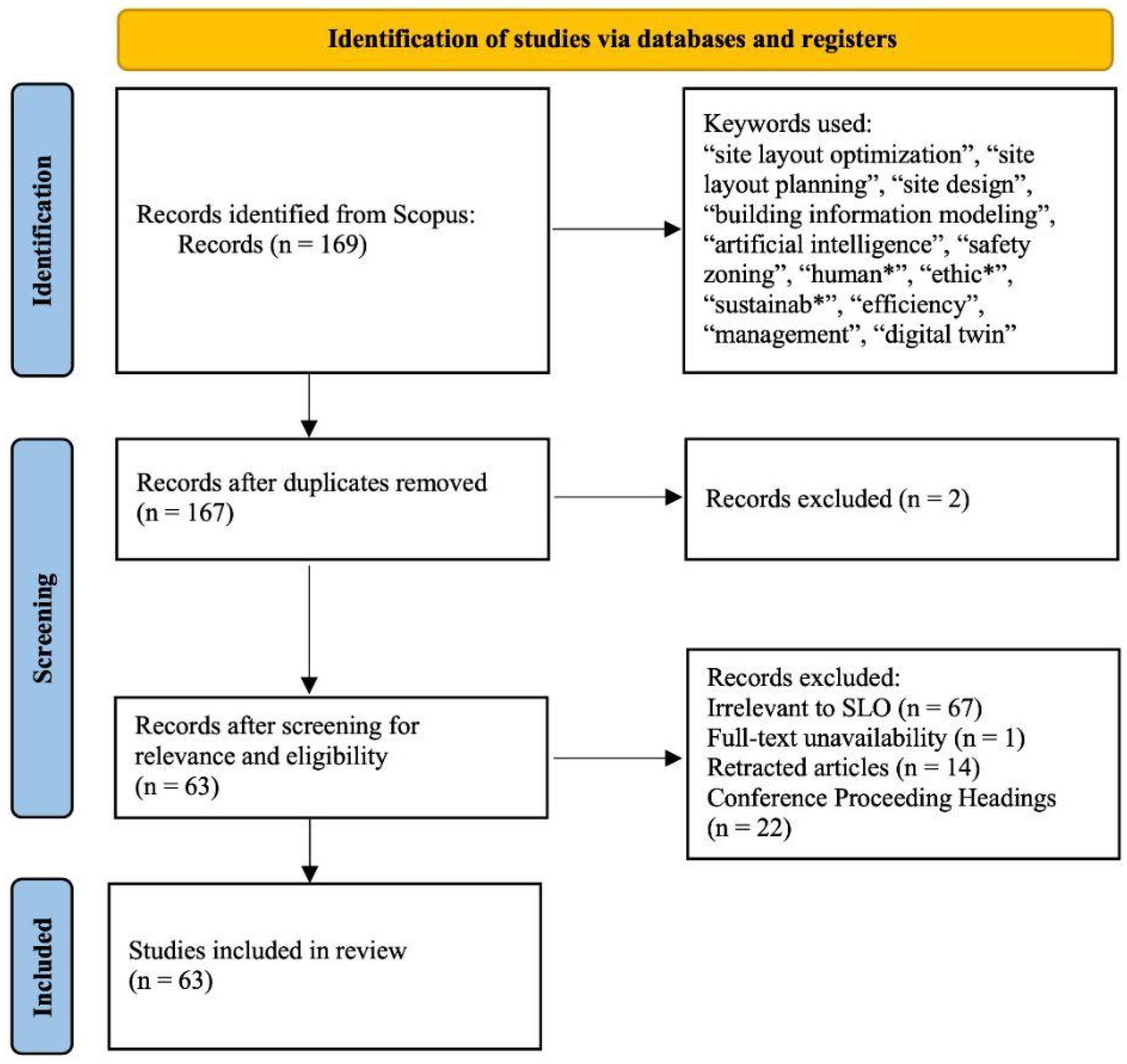
The retrieved records were screened in accordance with the PRISMA framework. As illustrated in
Figure 1 and
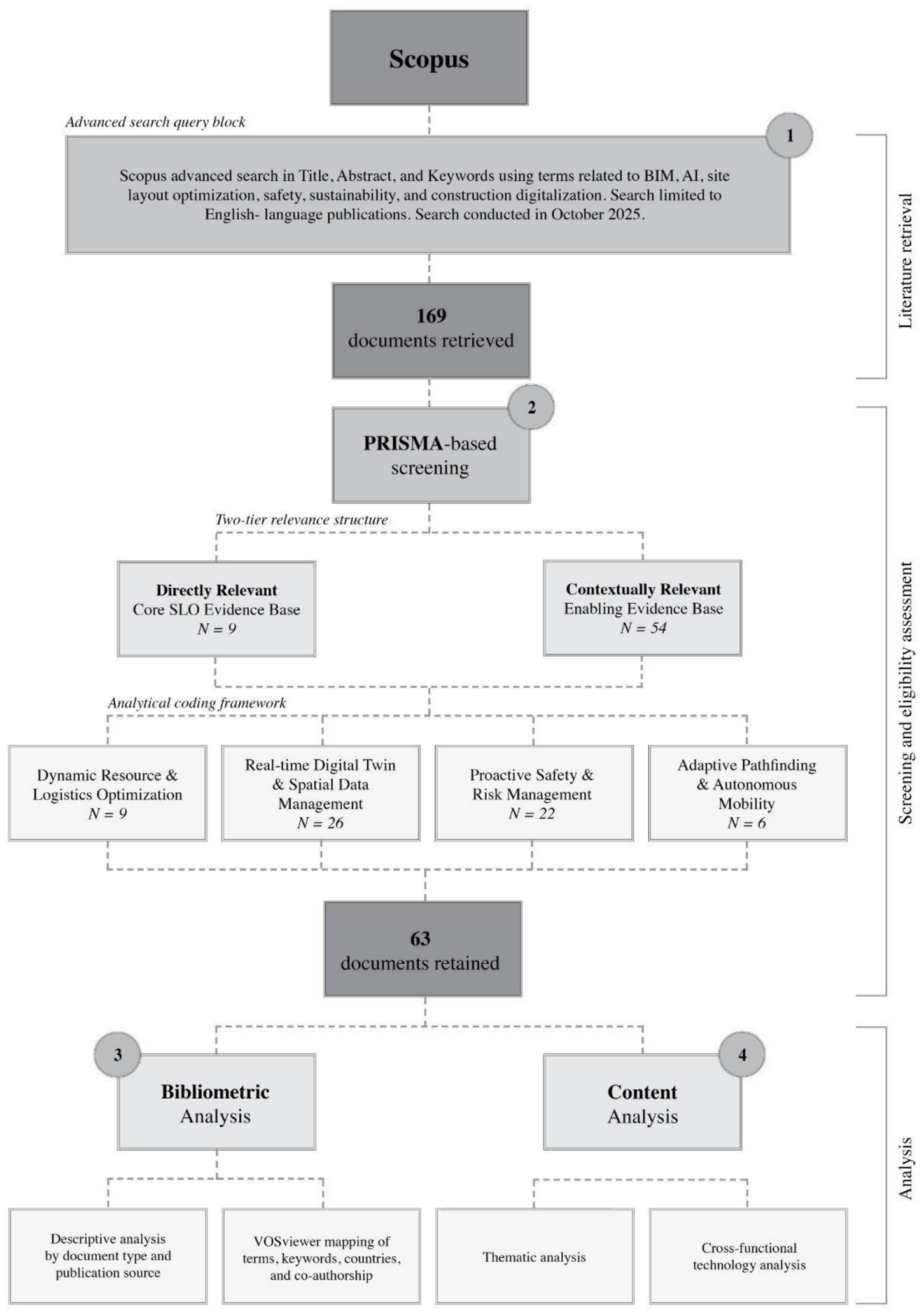
Figure 2 duplicate records were removed from the initial 169 results, leaving 167 unique records for screening. These records were then assessed at the title, abstract, and keyword levels, with full-text checking undertaken where needed, to determine whether they made a valid contribution to AI-BIM-enabled smart construction site management and SLO-related spatial decision-making.
Eligibility criteria were defined before screening. Studies were eligible for inclusion when they were written in English, retrieved from Scopus, and addressed AI, machine learning, deep learning, digital twins, BIM, sensing, robotics, simulation, GIS, or related digital technologies in connection with construction site management, site layout planning or optimization, safety zoning, logistics, spatial coordination, path planning, progress monitoring, or other site-level decision-making functions. Studies were excluded when they did not address construction or built-environment site operations, had no substantive connection to AI-BIM-enabled spatial or operational decision-making, were retracted, lacked accessible full text when full-text checking was required for eligibility confirmation, or represented non-substantive conference proceeding headings rather than complete scholarly contributions.
A review restricted exclusively to studies explicitly labeled as site layout optimization would have produced an artificially narrow dataset and would have overlooked a substantial portion of the enabling literature that supports site-level spatial decision-making. For this reason, the screening process adopted a two-tier relevance structure that balances rigor with transparency.
First, studies were classified as directly relevant when they explicitly addressed construction site layout planning or optimization. These included studies focused on the spatial arrangement of temporary facilities, equipment positioning, workspace planning, circulation planning, rerouting, or related layout decisions where the primary objective was to improve site outcomes such as travel time, safety, congestion, accessibility, productivity, or resource efficiency. Based on this criterion, 9 studies were retained as the core SLO evidence base.
Second, studies were classified as contextually relevant when they did not explicitly define themselves as SLO studies, but still provided technical, operational, or managerial foundations necessary for AI-BIM-enabled site layout decision-making. These included studies on project management, digital twins, spatial data systems, safety and risk management, collision detection, logistics coordination, autonomous navigation, lifecycle intelligence, and related domains with clear site-level spatial implications. Based on this criterion, 54 studies were retained as the enabling evidence base.
This distinction was deliberately maintained to avoid overstating the directness and practical maturity of the evidence base. The directly relevant studies formed the core evidence on explicit SLO applications, whereas the contextually relevant studies were used to capture the broader technological and operational ecosystem supporting AI-BIM-enabled smart construction site management and SLO-related spatial decision-making. Accordingly, the review does not treat all retained studies as equally direct evidence of SLO practice, but rather applies a layered synthesis strategy that reflects the actual structure of the field.
Following relevance screening, the retained studies were grouped under four analytical themes based on the principal site-level functions to which they contributed:
Dynamic Resource and Logistics Optimization, which addresses the movement, storage, positioning, and allocation of materials, equipment, and on-site labor.
Real-time Digital Twin and Spatial Data Management, which includes BIM, digital twins, Internet of Things (IoT), Geographic Information Systems (GIS), and related systems used to maintain updated site representations.
Proactive Safety and Risk Management, which encompasses safety zoning, hazard detection, collision prevention, and risk-based site organization to reduce worker exposure and incidents.
Adaptive Pathfinding and Autonomous Mobility, which consists of routing, navigation, obstacle avoidance, and autonomous movement of workers, machinery, or robots under changing site constraints.
These four themes were used as the analytical coding framework for the subsequent qualitative synthesis.
Figure 2 illustrates how these thematic coding categories are applied to the retained dataset. These themes should not be interpreted as equivalent to the direct versus contextual relevance distinction; rather, they represent the operational domains through which both direct and enabling studies were synthesized.
After screening, 104 records were excluded, and 63 studies were included in the final review corpus. As reported in
Figure 1, the exclusion reasons were irrelevance to SLO or site-level spatial decision-making, full-text unavailability when eligibility could not be confirmed from the abstract and metadata, retracted articles, and non-substantive conference proceeding headings. The screening and classification process was conducted manually using the predefined inclusion and exclusion logic described above. Titles, abstracts, and keywords were first screened, and full texts were consulted where relevance remained ambiguous. To strengthen reproducibility, the retained corpus was subjected to an author cross-checking stage in which the retained studies were reviewed against the two-tier relevance logic, the four operational themes, and the extracted technology and application fields. Ambiguous cases were discussed among the authors until a defensible consensus decision was reached, and final coding was retained only when it was consistent with the predefined eligibility and classification criteria. The two-tier relevance classification and the thematic coding were treated as separate coding decisions to avoid conflating direct SLO evidence with broader enabling evidence. No formal inter-rater reliability coefficient was calculated prospectively during the screening process; therefore, no retrospective Cohen’s kappa statistic is reported. This limitation is stated explicitly in
Section 6. Retained studies were then coded according to relevance type, thematic focus area, operational sub-theme, technological configuration, and intended SLO or site-management contribution. The extracted data items included publication year, document type, source title, relevance category, thematic focus area, AI technique, BIM or digital environment, supporting technologies, application focus, and the main contribution to site-level planning, monitoring, safety, logistics, or mobility. Cases that were not straightforwardly classifiable as explicit SLO studies were assessed based on whether they offered clear technical, operational, or managerial support for site-level spatial decision-making.
2.3. Methodological Positioning of the Review
As this review was designed to systematically map an emerging and terminologically fragmented field, its methodological structure was constructed to balance breadth with analytical transparency. The search strategy was intentionally broad to avoid missing relevant studies indexed under adjacent terminology, while the screening strategy was deliberately layered to distinguish between direct SLO evidence and enabling contextual evidence. This approach positions the review to assess the degree of consolidation of AI-BIM-enabled smart construction site management and SLO-related spatial decision-making while still synthesizing the broader technological ecosystem shaping its development. In this respect, the relatively small number of directly relevant studies should not be interpreted as a methodological weakness of the review, but rather as evidence that explicit AI-BIM-enabled site layout optimization remains an emerging and insufficiently consolidated research domain.
Figure 2 summarizes the analytical workflow of the review, from database retrieval and PRISMA-based screening to bibliometric mapping and qualitative content analysis. Accordingly, the review should not be interpreted as a synthesis of explicit SLO applications alone, but rather as a structured assessment of both direct SLO research and the broader enabling literature currently shaping this emerging domain.
2.4. Quality-Oriented Evidence Appraisal
To avoid equating the number of studies in a theme with evidence maturity, the retained studies were also interpreted through a quality-oriented evidence appraisal logic. This appraisal considered whether each study clearly defined a site-management or spatial-decision problem, specified the AI-BIM or digital-technology configuration used, reported a validation approach, provided field or real-project evidence, offered sufficient methodological transparency, and showed plausible transferability to construction-site decision-making. The appraisal was used to calibrate the interpretation of evidence strength, practical readiness, and implementation support across themes; it was not used as an additional exclusion filter because the objective of the review was to map an emerging and heterogeneous field rather than to restrict the corpus to a single empirical design.
3. Bibliometric Analysis
A bibliometric analysis was conducted on the final dataset of 63 retained studies using VOSviewer version 1.6.20 to diagnose how the literature on AI-BIM-enabled smart construction site management, SLO, and site-level spatial decision-making is currently structured, what it prioritizes, and where it remains conceptually or institutionally weak. This stage aimed to map the intellectual and thematic structure of the field and to identify major publication patterns, influential terms, collaboration trends, and source characteristics within the literature by summarizing publication counts and generating network visualization maps. Descriptive distributions by document type and publication source, as well as network-based relationships such as keyword co-occurrence, text-based term co-occurrence, country-level co-authorship, and author-level co-authorship were included in the analysis.
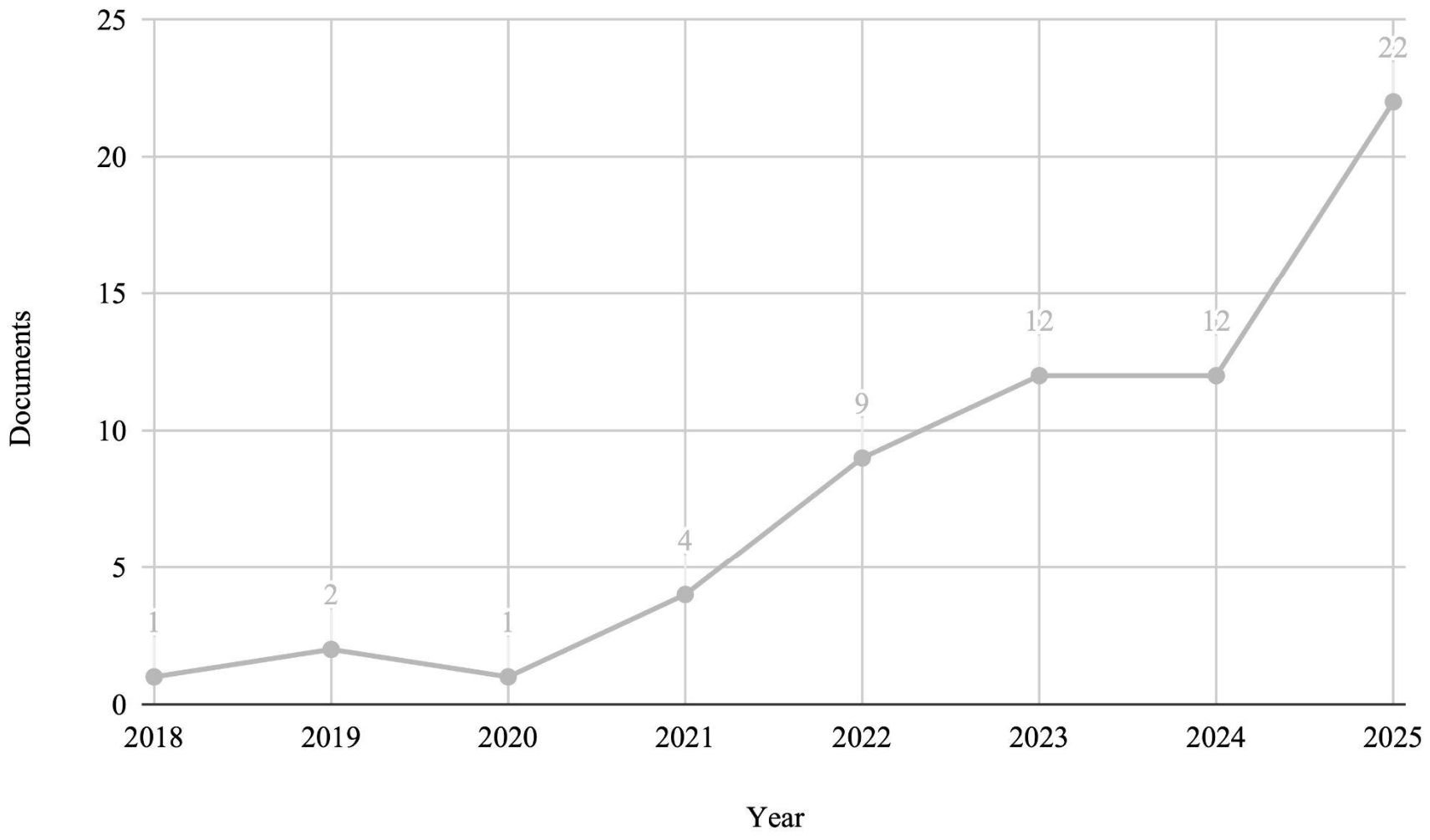
The publication trajectory of the retained studies in
Figure 3 shows a field that remained small until 2021 and then accelerated sharply, with the clear expansion occurring from 2022 onward and peaking in 2025. This pattern is important because it signals growth without full consolidation. Scholarly interest is rising rapidly, but the research to date is still young, terminologically fluid, and methodologically uneven. This emergent status accounts for the pronounced presence of conference-based outputs, the sparsity of collaboration networks, and the continued dominance of enabling technologies over fully consolidated, explicitly SLO-centered frameworks.
3.1. Co-Occurrence Map Based on Text Data
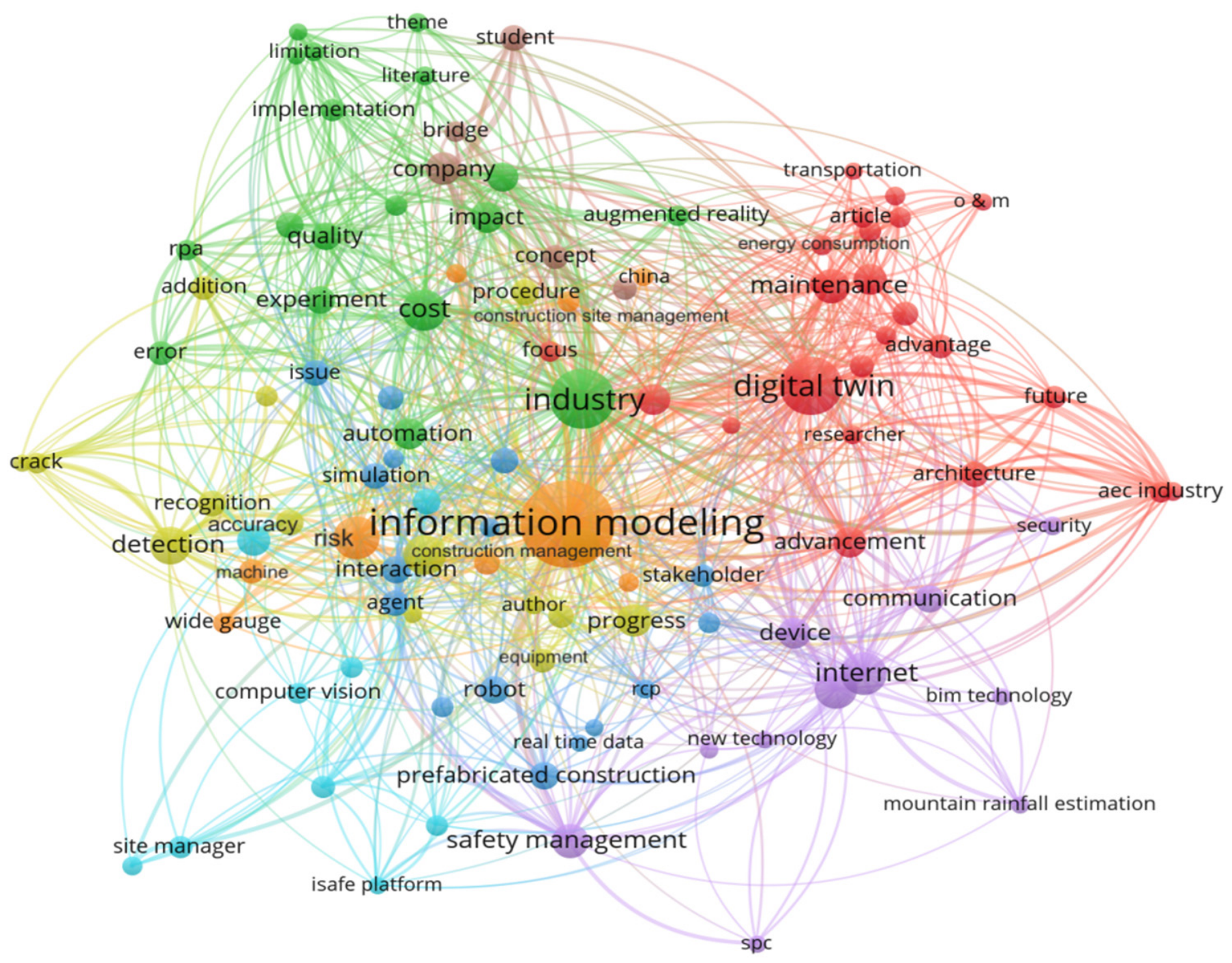
The text-based co-occurrence network in
Figure 4 shows that the field is organized primarily around digital infrastructure rather than around site layout optimization as an explicit decision problem. The centrality of terms such as information modeling, industry, digital twin, and internet indicates that the literature remains predominantly organized around the enabling technologies that make advanced site decision-making possible, not through a well-defined SLO research vocabulary of its own. This critical insight suggests how current literature approaches site layout indirectly, through broader Construction 4.0 and digitalization agendas, rather than treating layout optimization itself as the main analytical object.
A second important pattern is the distinction between frequent terms and distinctive terms. The most common expressions, such as information modeling, represent the shared background language of the field. However, the more revealing signals come from terms with stronger relevance, especially detection, risk, Internet-of-Things-related terminology, and maintenance. These terms point to the real frontier of the literature. Current work is becoming more specialized around sensing, recognition, monitoring, and risk-aware control, especially through computer vision, IoT-enabled data acquisition, and predictive maintenance logic. This signifies that the research base is progressing most clearly in visibility and control functions, while the decision logic of layout optimization, such as dynamic trade-offs among safety, logistics, space use, and productivity, remains less explicitly developed.
The cluster structure in
Figure 4 reinforces this interpretation. The network does not show isolated technology silos. Instead, it reveals a partially integrated ecosystem in which BIM acts as the information backbone, digital twins extend temporal and operational awareness, and AI-related detection and simulation capabilities are increasingly layered on top. What remains absent is a stronger bridge between technological capability and site-layout-specific optimization models. In practical terms, the field is increasingly proficient at monitoring and digitally representing the site, yet it is still comparatively underdeveloped in translating these capabilities into robust layout decisions under dynamic, operational site constraints.
Table 1 substantiates this observation. The gap between the very high occurrence of information modeling and the much higher relevance of detection indicates that the field’s BIM-oriented foundation is sufficiently established to function as a shared background, whereas its current novelty lies in operational intelligence. The bibliometric evidence therefore adds interpretive value by showing that the literature is moving beyond whether BIM matters and is increasingly concerned with how AI-enabled sensing and analytics can make BIM actionable in real site environments.
3.2. Co-Occurrence Map Based on Keywords
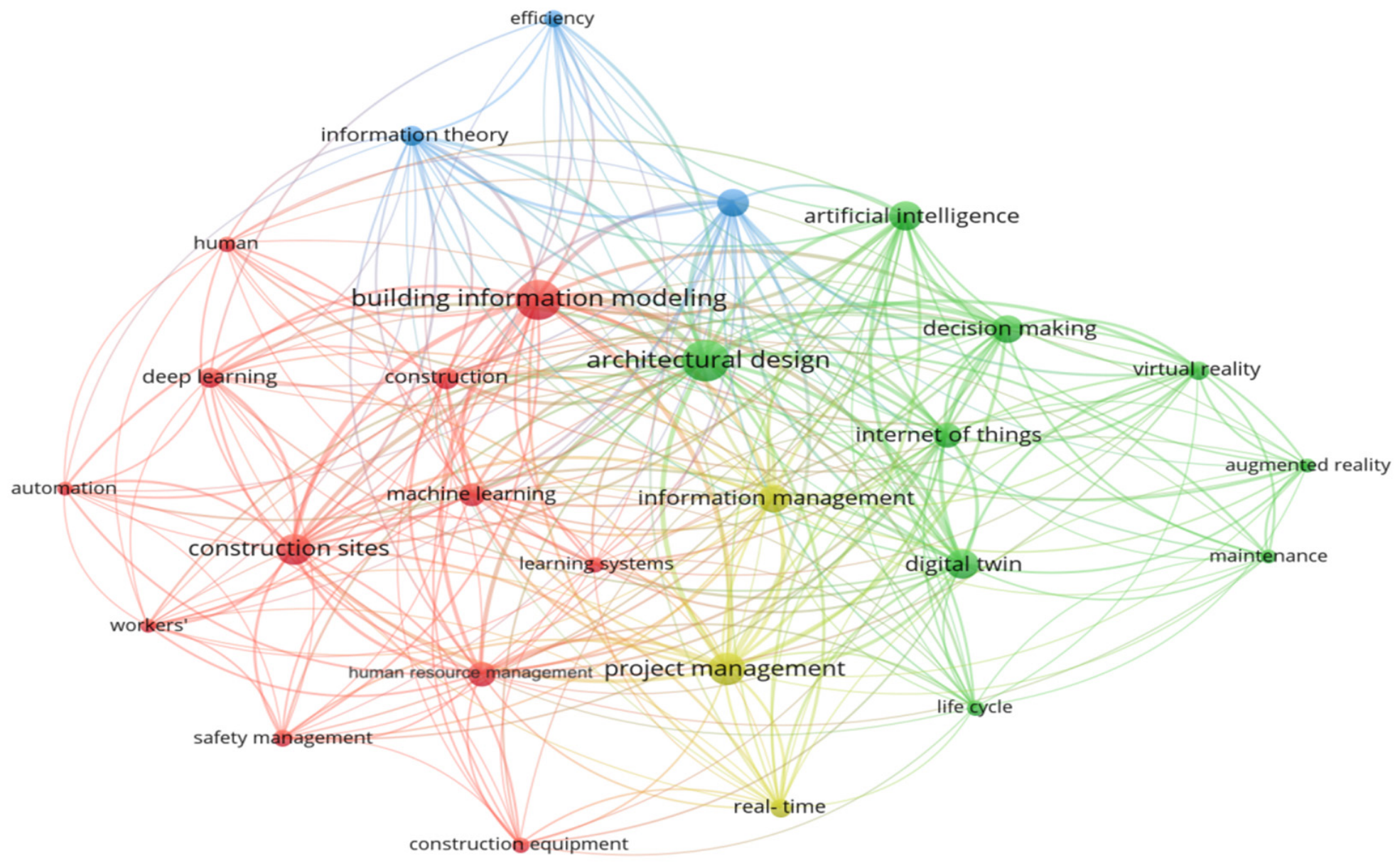
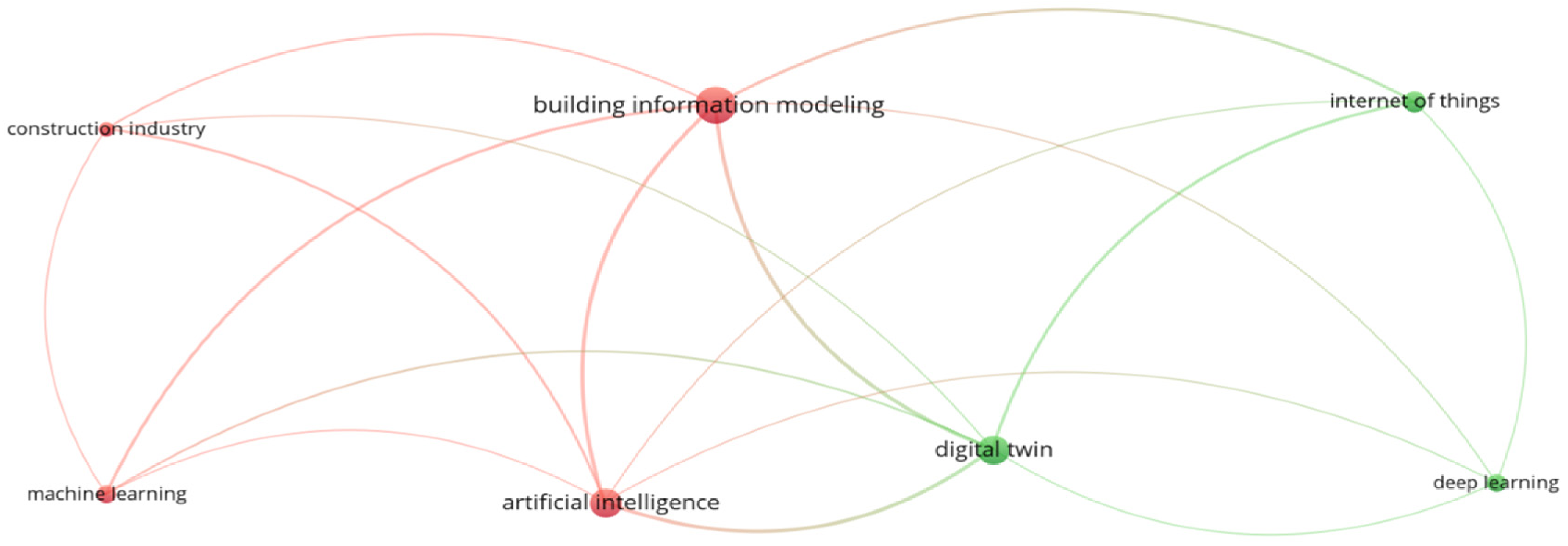
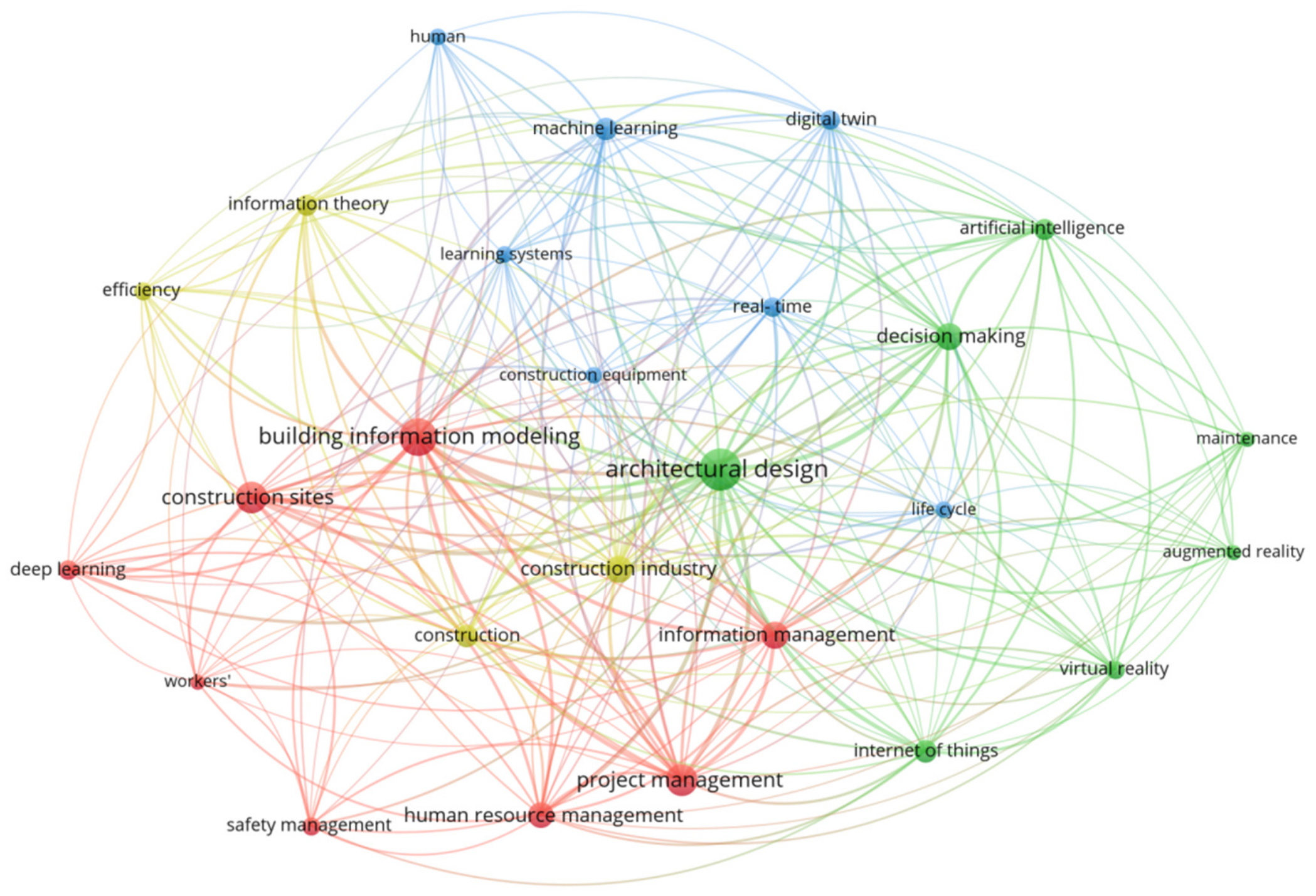
The keyword maps in
Figure 5,
Figure 6 and
Figure 7 confirm that the field is technologically convergent but conceptually broader than it first appears. Across all keywords, building information modeling and architectural design occupy the most central positions, with strong links to digital twin, artificial intelligence, internet of things, construction sites, decision-making, and project management. This configuration shows that AI-BIM-enabled smart construction site management and SLO-related research are currently framed less as a narrow optimization niche and more as a digitally enabled design-and-management problem. This is a valuable insight because it explains why the literature spans design, operations, safety, and equipment monitoring rather than concentrating exclusively on formal layout optimization models.
The author-keyword map is especially revealing because it reflects how scholars choose to position their own work. Here, the field presents a relatively tight core around BIM, digital twin, AI, IoT, machine learning, and deep learning. This indicates that researchers themselves increasingly see value in a recurring technological stack rather than in isolated tools. In contrast, the index-keyword map is broader and more managerial. Terms such as project management, information management, construction equipment, and human resource management appear more clearly there, which suggests that databases and indexers classify the field under more conventional construction management and systems coordination categories. This gap between author emphasis and index emphasis is crucial; it implies that the literature has yet to consolidate a stable disciplinary identity at the intersection of engineering informatics, construction management, and operational decision support.
Equally noteworthy is what the keyword network fails to foreground prominently. Despite the review being centered around SLO, the most central nodes are not explicit layout terms. Instead, the field clusters around BIM-centered information structures, digital twins, management functions, and enabling AI technologies. This confirms that site layout optimization remains partly embedded within adjacent conversations rather than standing as a fully consolidated research stream with its own stable vocabulary and dominant models.
Table 2 supports this reading. The high total link strengths of architectural design, building information modeling, project management, and decision-making show that the field’s most connected concepts are not purely algorithmic. The implication is clear: progress in this area depends not only on improved AI models, but equally on stronger integration with design workflows, information governance, and managerial coordination. The principal constraint is therefore not solely computational, but organizational as well.
3.3. Co-Occurrence Map Based on Country of Co-Authorship
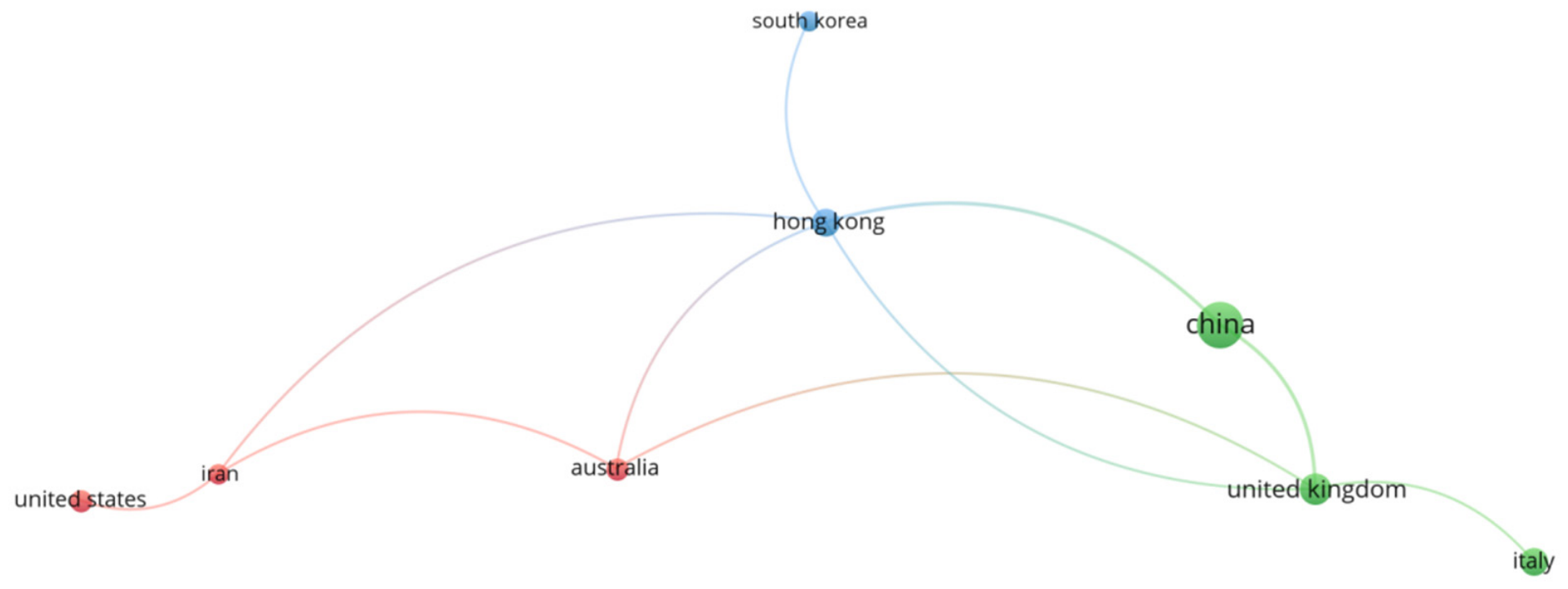
The country network in
Figure 8 and the country-level indicators in
Table 3 reveal a field that is internationally active, but far from globally integrated. China leads in publication volume, which confirms its strong investment in construction digitalization and smart built-environment research. More notably, Hong Kong emerges as the most connected and most influential collaborative hub in the network, despite producing fewer papers than China. The United Kingdom also plays a strong bridging role, while Australia achieves high citation performance from a relatively small number of publications. This pattern suggests that influence in the field is driven less by volume alone and more by the visibility and connectedness of specific collaborative hubs.
The weaker ties of Italy, South Korea, and the United States, and the complete isolation of Taiwan despite meeting the output threshold, indicate that a large portion of the literature is still produced within national or weakly internationalized research ecosystems. This has an important implication for interpretation. Site layout optimization is highly sensitive to regulatory practices, labor arrangements, digital readiness, and project delivery conditions. When collaboration remains fragmented, frameworks developed in one context may not transfer readily to other contexts. The country map therefore reveals not only the geographic distribution of scholarly outputs, but also a pattern consistent with limited cross-text transferability and standardization observed in this domain.
This uneven international structure also helps explain why the literature contains many promising approaches but relatively few broadly adopted frameworks. Cross-country collaboration remains underdeveloped to adequately support rigorous benchmarking, shared validation protocols, or stable consensus on the most effective AI-BIM-enabled smart construction site-management architectures.
3.4. Co-Occurrence Map Based on Authorship
The author network in
Figure 9, together with the productivity and citation patterns reported in
Table 4 and
Table 5, reinforces the same conclusion at the researcher level. The field is not yet shaped by large, stable, highly interconnected schools of thought. Instead, collaboration is concentrated in a few small clusters, with limited links between them.
Table 4 shows that the most productive authors contribute only two papers each, while
Table 5 shows that several of the most highly cited authors are associated with single influential papers rather than sustained publication programs. This pattern indicates an emerging field in which scholarly visibility exists, but cumulative intellectual consolidation remains limited.
The mismatch between productivity in
Table 4 and citation impact in
Table 5 is especially informative. It suggests that influence is currently driven by scattered landmark studies rather than by repeated comparative or programmatic work from a dominant research community. This slows theory building and makes it harder for the field to converge on common evaluation frameworks, comparable datasets, or widely accepted performance criteria for SLO applications.
In short, the authorship evidence suggests that the field remains exploratory rather than mature. Innovative ideas are appearing, but replication, cross-team integration, and methodological standardization remain limited. This justifies the need for thematic synthesis beyond bibliometric mapping, so that isolated contributions can be connected into a more coherent account of what the field has actually learned.
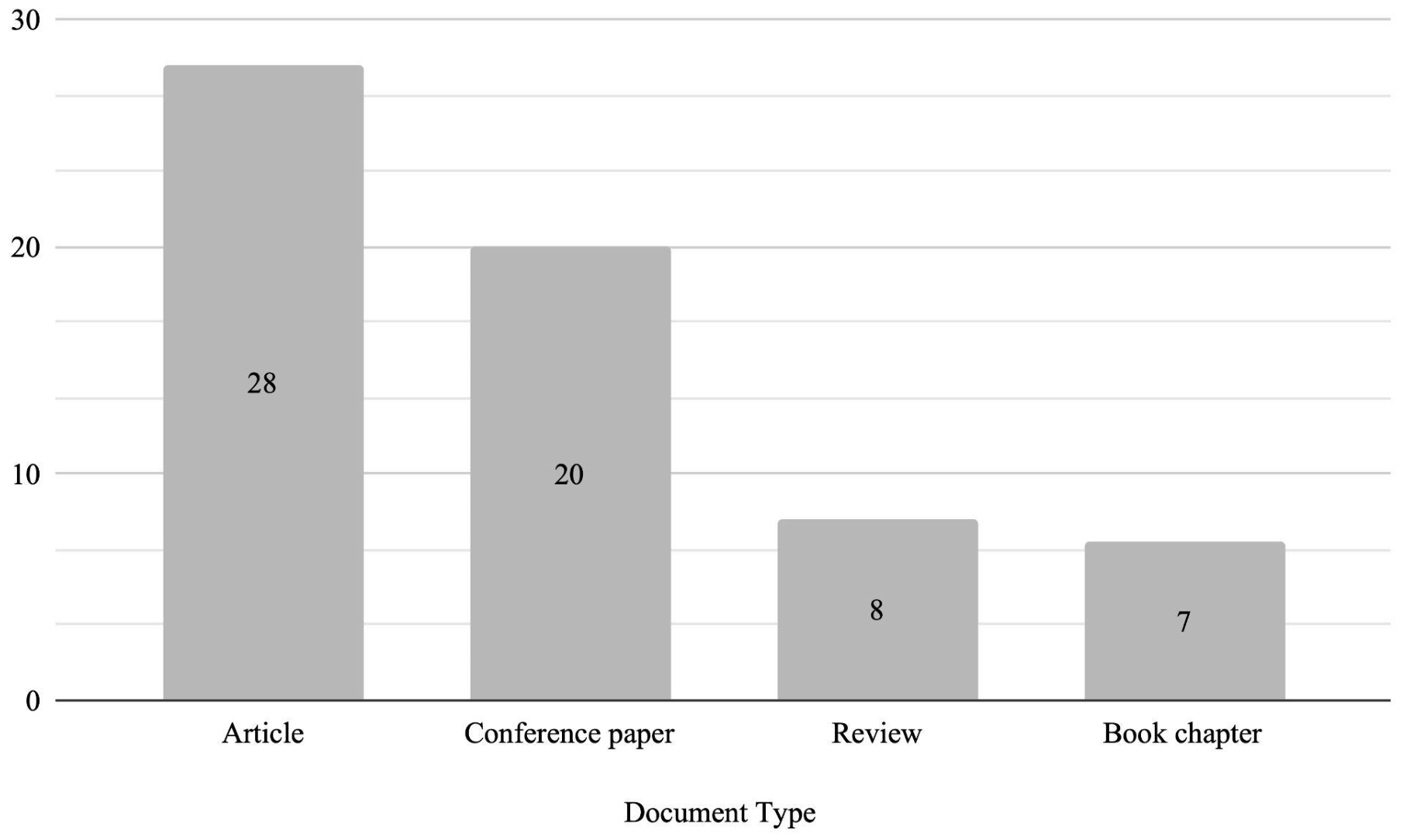
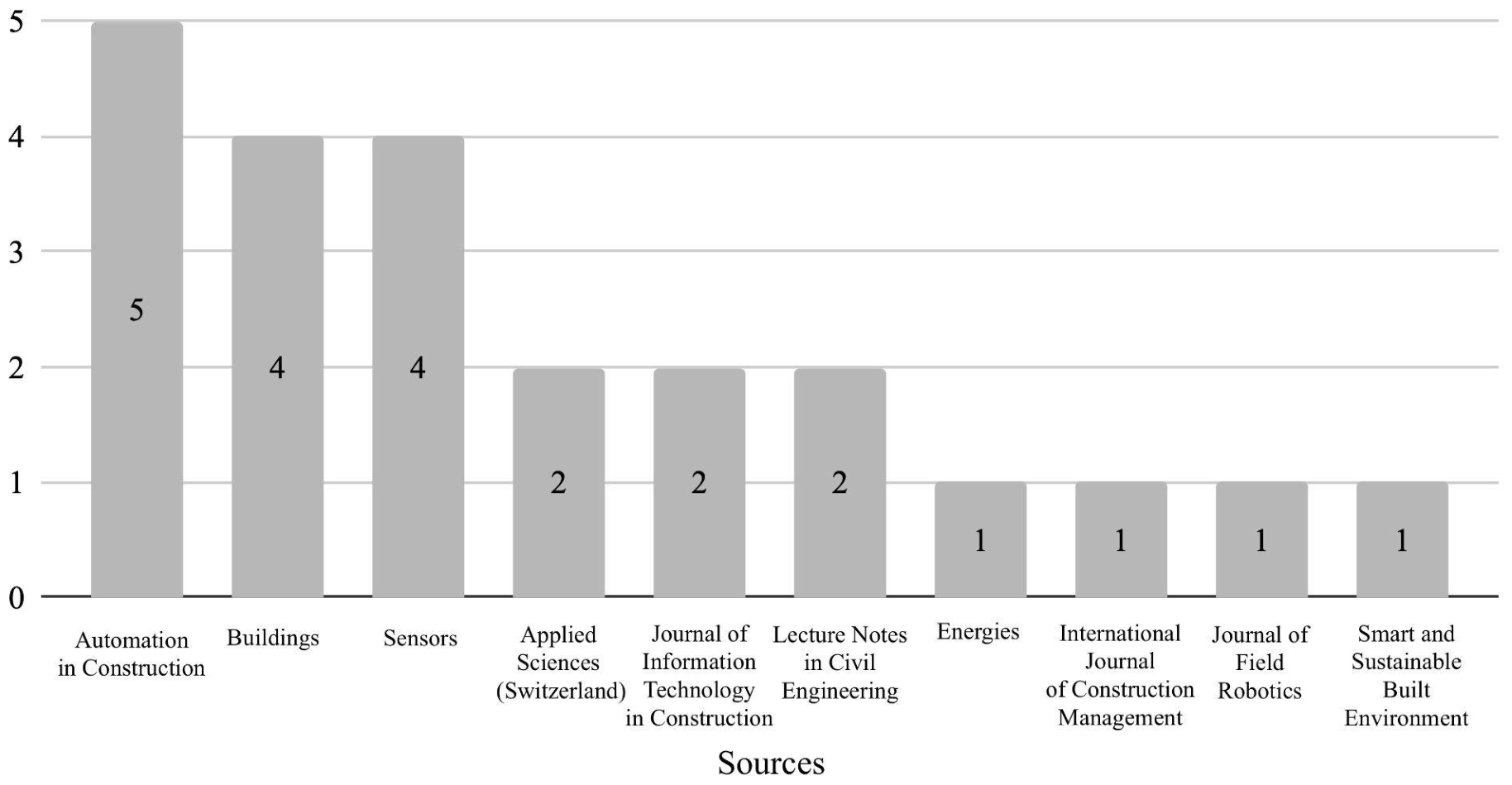
3.5. Analysis by Document Type and Source
Figure 10 and
Figure 11 show a field that is clearly advancing, but not yet institutionally settled. Journal articles represent the largest share of the dataset, indicating that AI-BIM-enabled smart construction site-management research has moved beyond preliminary discussion and is generating peer-reviewed outputs at a meaningful pace. However, the substantial share of conference papers shows that the field remains strongly driven by technical experimentation, prototype demonstration, and rapidly evolving methodological contributions. The relatively modest number of reviews also indicates that consolidation has lagged behind innovation. Overall, the field is producing technical solutions faster than it is integrating them into stable, comparable, and cumulative decision frameworks.
The distribution across sources supports the same reading. No single journal dominates the field. Even the most recurrent outlets account for only a small share of the corpus, while the rest of the literature is dispersed across construction informatics, sensing, civil engineering, and management-oriented venues. This dispersion confirms interdisciplinarity, but it also exposes fragmentation. Research communities working on logistics, digital twins, automation, sensing, and safety are contributing to the same broad problem from different angles, often without using the same conceptual language or evaluation logic.
This source pattern helps explain why the literature appears rich in enabling technologies but comparatively weak in unified decision frameworks. The issue is not a lack of technical concepts, but fragmentation across parallel publication ecosystems that emphasize different problems, metrics, and audiences. This dispersion provides a strong justification for an analytically driven synthesis.
3.6. Bibliometric Synthesis and Implications for the Review
Taken together, the bibliometric evidence points to four structural conclusions. First, AI-BIM-enabled smart construction site management and SLO-related spatial decision-making are expanding quickly, but remain emerging rather than fully consolidated research areas. Second, the intellectual structure is organized more strongly around BIM, digital twins, sensing, monitoring, and management functions than around explicit site layout optimization as a standalone decision problem. Third, collaboration remains fragmented across countries and author groups, limiting the development of shared benchmarks and validation protocols. Fourth, the literature shows considerable promise, but its practical readiness depends on stronger connections among digital representation, prediction, optimization, human oversight, and field deployment.
These findings directly justify the next stage of the review. The bibliometric mapping illustrates where the field is growing and how it clusters, but it cannot by itself explain how AI, BIM, and related technologies are actually being combined to solve specific site-level problems. The content analysis is, therefore, essential. It moves from visibility to function by examining which operational challenges are being addressed, which technology combinations dominate different application areas, and where the literature still lacks integration, implementation depth, and decision-oriented rigor.
4. Content and Thematic Analysis
To complement the bibliometric findings, a thematic content analysis was conducted to examine how AI-BIM integration is being applied functionally in smart construction site management, site layout optimization, and site-level spatial decision-making. Because the review includes both explicit SLO studies and enabling studies with site-level spatial relevance, the thematic synthesis should be interpreted as a mapping of both direct applications and broader technological support structures for smart and sustainable construction operations. Rather than classifying studies solely by technology type, this analysis grouped studies according to the principal operational problems they addressed in construction site planning and execution, yielding a synthesis that prioritizes operational feasibility, digital integration, safety, resource efficiency, and adaptive decision support. This provided a more practice-oriented understanding of how the literature is advancing from technological experimentation toward applied site intelligence and decision support. To this end, each study was systematically reviewed and coded according to its operational focus, technological configuration, and intended performance contribution. The analysis focused on clarifying what was being optimized, when it was being optimized, and how the optimization or decision-support process was enabled. Particular attention was given to the combinations of AI techniques, BIM dimensions, digital twins, IoT, GIS, sensing systems, and related tools used to support site-level planning, monitoring, logistics coordination, safety management, and adaptive mobility. This facilitated the identification of recurring application patterns, dominant technology stacks, implementation barriers, and areas where the literature remains fragmented or underdeveloped.
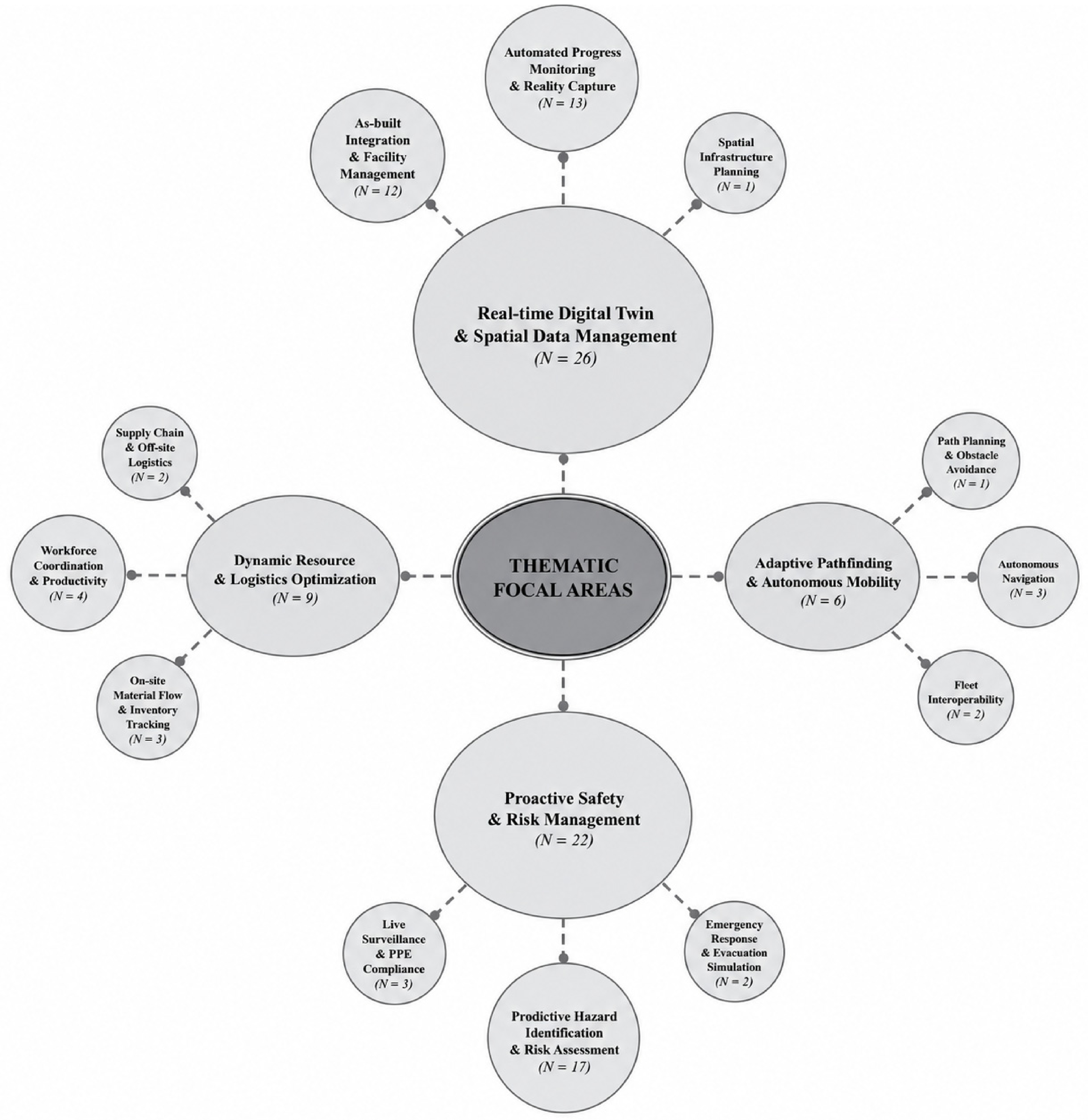
The reviewed studies are organized into four main focal areas, and their corresponding operational sub-themes, as summarized in
Table 6: dynamic resource and logistics optimization, real-time digital twin and spatial data management, proactive safety and risk management, and adaptive pathfinding and autonomous mobility. Together, these themes capture the main ways in which AI-BIM systems are being used to improve coordination, monitoring, safety, and movement within dynamic construction environments. They also reveal the broader shift in the field from static layout planning toward increasingly integrated, predictive, and adaptive site management.
4.1. Dynamic Resource and Logistics Optimization
This subsection captures one of the clearest shifts in the literature: the movement from static planning toward continuously updated, data-driven coordination of labor, materials, equipment, and off-site logistics. In this stream, site layout optimization is no longer treated only as a spatial arrangement problem. Instead, it is increasingly framed as an operational orchestration problem in which layout decisions must respond to changing resource availability, workflow dependencies, inventory status, and supply-chain conditions. The studies grouped in
Table 7 show that AI-BIM integration is being used not simply to improve visibility, but to support faster and more adaptive decisions across interconnected site functions. This positions dynamic resource and logistics optimization as among the most compelling indicators that SLO research is transitioning beyond static layout design toward responsive and execution-oriented site intelligence.
Three major insights emerge from this group of studies. First, the literature is increasingly framing layout optimization as a live coordination problem rather than a one-time planning task. The strongest contributions do not merely generate superior layouts at project inception, but instead create conditions under which layouts and associated operational decisions can be iteratively revised as workforce distribution, equipment availability, inventory levels, and delivery patterns evolve. This marks an important conceptual shift in SLO, because it aligns the literature more closely to the realities of active construction sites, where disruption, variability, and resource interdependence are the norm rather than the exception.
Second, the most promising value of AI-BIM integration in this area lies in linking prediction with action. Forecasting delays, congestion, or material shortages has limited practical value unless it is tied to mechanisms for reallocating crews, rerouting flows, adjusting schedules, or reconfiguring operational priorities. What
Table 7 collectively indicates is that the field is progressing toward this tighter coupling between sensing, forecasting, and operational response. This makes dynamic resource optimization one of the most practically relevant application areas within the broader AI-BIM-enabled smart construction site-management and SLO-related literature.
Third, the subsection shows that logistics optimization is expanding beyond the physical construction site itself. Several studies implicitly widen the boundary of SLO by connecting on-site layout decisions with upstream inventory control, off-site fabrication, and supply-chain coordination. This development reflects a more realistic understanding of site performance: congestion, delays, and inefficient movement patterns are rarely caused by layout alone, but often emerge from weak synchronization between site operations and external logistics systems. These studies therefore position SLO as part of a broader production and delivery ecosystem, rather than as an isolated layout-planning exercise.
Despite this progress, several weaknesses remain. A major challenge is that many of these approaches depend on high-quality, continuously updated, and interoperable data streams. In practice, this requirement is difficult to satisfy on active construction sites, where data are often incomplete, inconsistent, delayed, or fragmented across platforms. As a result, the technical promise of dynamic optimization often exceeds what current site environments can reliably support.
A second challenge is that many proposed systems appear stronger in architecture than in deployment. They describe how predictive models, dashboards, digital twins, or automated workflows could improve decision-making, but they offer less evidence of robust validation under real site conditions. This creates a familiar gap between computational feasibility and operational usability. The core question is not whether these tools can function in controlled conditions, but whether they remain reliable when exposed to uncertainty, disruption, and the complex coordination realities of live projects.
A third challenge concerns scalability and governance. Several approaches assume that stakeholder needs can be translated cleanly into technical rules or optimization targets. This assumption remains insufficiently supported because real projects often involve conflicting priorities across safety, cost, sequencing, access, productivity, and subcontractor coordination. Without stronger standardization, governance logic, and human oversight, dynamic systems may optimize locally while underperforming at the broader project level. Therefore, the challenge is no longer only technical integration. It is decision integration.
Future work should transcend the demonstration of predictive capability and orient more directly toward establishing decision effectiveness under real project settings. The field now needs stronger evidence on how dynamic AI-BIM systems perform when layouts, schedules, material flows, and labor allocations are adjusted in response to actual site variability rather than simulated scenarios alone. This would substantially strengthen the credibility of the evidence from both research and industry perspectives.
There is also a clear need for more explicit integration between site layout logic and logistics logic. Future studies should examine how on-site space allocation, movement corridors, staging strategies, delivery timing, and off-site fabrication planning can be optimized together rather than as partially connected subproblems. Such a broader systems perspective would more accurately reflect how operational performance is generated in contemporary construction environments.
Finally, future research should pay more attention to governance, human decision-making, and transferability. Dynamic optimization systems will have limited practical value if they remain dependent on highly controlled datasets, specialized infrastructures, or context-specific assumptions. The next generation of studies should therefore test how these approaches can remain useful under data uncertainty, organizational constraints, and diverse project conditions, while preserving transparency and managerial trust in AI-supported decisions.
4.2. Real-Time Digital Twin and Spatial Data Management
This subsection captures a second major transition in the literature: the shift from static digital representation toward continuously updated spatial intelligence. In this stream, AI-BIM integration is used not only to model the site, but to keep that model synchronized with evolving field conditions through real-time monitoring, reality capture, sensor feeds, and digital twin updating. As a result, site layout optimization is increasingly supported by live information on progress, geometry, equipment status, asset conditions, and spatial conflicts rather than by periodic manual observations alone.
Table 8 documents how this line of research is especially important; it strengthens the informational foundation on which responsive layout, logistics, safety, and maintenance decisions depend. More precisely, these studies are less concerned with directly optimizing layout configurations and more focused on establishing the informational conditions that make dynamic layout optimization feasible through reliable, timely, and spatially rich data.
Three major insights emerge from this subsection. First, digital twins are evolving from passive visualization tools into active spatial decision infrastructures. The strongest contribution of this stream is not simply that it digitizes site conditions, but that it creates a live feedback loop between as-planned models and as-built realities. This development is important for SLO because layout decisions become more defensible when they are informed by continuously updated spatial evidence rather than by delayed reporting or periodic site inspections.
Second, this stream implies that real-time layout intelligence depends heavily on progress visibility. Many of the studies do not optimize site layout directly, yet they provide the operational awareness needed to do so. Automated progress monitoring, defect mapping, location tracking, clash detection, and what-if simulation all strengthen the site’s informational backbone. The more fundamental observation is that spatial optimization is increasingly data-dependent: better layouts do not emerge only from better algorithms, they also require more accurate, timely, and operationally meaningful representations of what actually occurs on site.
Third, the literature reveals a broadening of BIM’s functional scope. Several studies move beyond traditional 3D and 4D planning into 6D and 7D use cases that incorporate sustainability, maintenance, asset performance, and lifecycle information. This development is important because it extends the meaning of site layout optimization beyond temporary construction efficiency. It suggests that spatial decisions are increasingly being linked to long-term operational continuity, maintenance readiness, and performance management. It positions layout as part of a wider digital asset ecosystem rather than as an isolated short-term design exercise.
The main challenge in this area is not lack of sensing technologies. It is the difficulty of converting heterogeneous data streams into usable and trustworthy spatial intelligence. Most of these systems rely on the smooth integration of UAV imagery, IoT sensors, LiDAR, cloud databases, BIM environments, and AI models. In practice, this creates major interoperability, synchronization, and data quality challenges. Should any component of this integrated ecosystem fail, the operational utility of the digital twin is rapidly compromised.
A second challenge is the persistent gap between visibility and decision support. Many studies show that sites can be monitored more effectively, but fewer demonstrate how that monitoring consistently leads to better layout decisions, lower congestion, safer circulation, or measurable gains in productivity under real project conditions. This means the literature is still stronger at generating real-time awareness than at proving that such awareness translates into robust operational improvement.
A third challenge concerns scalability and implementation realism. Real-time digital twin systems often require advanced hardware, dense sensing infrastructures, high computational capacity, and structured project data. These requirements may be feasible in controlled environments or high-value projects, but they are harder to sustain across diverse site types and varying levels of digital maturity. As a result, many proposed approaches remain technically promising but operationally demanding.
Future work should focus more explicitly on turning real-time spatial data into actionable layout and logistics decisions. The next step for the field is not simply improving detection accuracy or visualization quality. It is building stronger closed-loop systems in which progress recognition, spatial sensing, and digital twin updates trigger decision rules or optimization routines that can be tested against project outcomes.
There is also a need for stronger research on interoperability and standardization. If real-time digital twins are to support routine SLO practice, future studies must address how data from multiple sensing and modeling systems can be integrated in stable, repeatable, and transferable ways. This includes not only technical standards, but also governance protocols for validation, updating, and managerial use.
Finally, future studies should place greater emphasis on deployment in live site conditions. More empirical work is needed on latency, data loss, noise, uncertainty, and user adoption under real operational pressure. Without stronger evidence from live construction environments, real-time digital twin research risks remaining technically promising but limited in practical uptake.
4.3. Proactive Safety and Risk Management
This subsection represents one of the clearest areas of practical readiness within the human-safety dimension of AI-BIM-enabled smart construction site management and SLO-related spatial decision-making.
Table 9 summarizes this evidence by grouping the safety-related studies into predictive hazard identification and risk assessment, live surveillance and PPE compliance, and emergency response and evacuation simulation. Across these streams, safety is no longer treated as a downstream compliance check. It is increasingly embedded into layout, sequencing, and site-control decisions through predictive and spatially aware systems.
Three main insights emerge from this subsection. First, safety has become the most clearly predictive application area within the reviewed literature. Unlike some other SLO themes that remain focused on planning support or digital representation, this stream shows a stronger move toward anticipatory decision-making. The primary objective is no longer limited to detecting hazards after they emerge. It is to estimate when and where exposure is likely to occur, then adjust routing, scheduling, monitoring, or training accordingly. This indicates that the thematic stream has comparatively stronger implementation support than several other areas examined in the review.
Second, the literature indicates that safety-related SLO is increasingly becoming spatially intelligent rather than rule-based alone. The more advanced studies do not simply flag generic hazards. They connect risk to location, movement, equipment interaction, temporal sequencing, and worker presence. This is an important shift because it aligns safety management substantially more closely with site layout optimization itself. Safer layouts are being understood not only as compliant layouts, but as dynamic spatial systems that reduce exposure, congestion, blind spots, unsafe routing, and conflict zones before incidents occur.
Third, the subsection suggests that predictive safety is becoming one of the strongest justifications for combining AI with BIM in construction environments. Deep learning, sensor networks, and digital twins are repeatedly used to translate raw site signals into operationally meaningful warnings, visualizations, and intervention options. The principal value resides not merely in automation per se, but in the conversion of fragmented site data into decisions that site managers can act on in real time. This makes proactive safety and risk management one of the clearest examples of AI-BIM integration producing actionable site intelligence rather than static digital documentation.
Despite this progress, the literature still faces critical limitations. A major challenge is the risk of overconfidence in automated systems. Predictive models, surveillance tools, and simulation environments may create the impression of precise control, but construction sites remain behaviorally and operationally unstable. Worker responses, informal practices, environmental variability, and unexpected interactions often deviate from the assumptions embedded in the models. This is especially pivotal for evacuation, crowd movement, and behavior-based risk forecasting, where human actions may not follow rational or simplified simulation logic.
A second challenge concerns signal reliability and sensing conditions. Several approaches depend on wearable devices, continuous video capture, acoustic monitoring, or dense sensor deployment. In practice, these inputs are vulnerable to occlusion, noise, overlapping activities, unstable site conditions, and incomplete data streams. As a result, the performance of safety systems in controlled or semi-controlled settings may not translate cleanly to complex live environments.
A third challenge is the trade-off between technological intensity and practical scalability. Many of the proposed solutions require extensive sensing infrastructure, cloud connectivity, digital twin maintenance, or advanced model training. These requirements may be justifiable in high-risk or high-value projects, but they can limit broader adoption. The field therefore still needs stronger evidence that the safety gains achieved through these systems justify their implementation cost, complexity, and maintenance burden.
Future research should move beyond hazard prediction accuracy and focus more directly on intervention effectiveness. The next step is not only to identify risks earlier, but to show how predictive safety systems influence layout redesign, task sequencing, routing decisions, and actual incident reduction under real site conditions. Such a direction would substantially strengthen the applicability of the literature from an operational standpoint.
There is also a need to integrate predictive safety more explicitly into multi-objective site layout decision-making. Many studies already show how hazards can be detected, visualized, or forecast. The stronger next move is to examine how safety predictions can be balanced against productivity, access, logistics efficiency, equipment placement, and resource constraints within a unified SLO framework.
Finally, future studies should place greater emphasis on trust, governance, and human oversight. Safety is too critical to be treated as a fully automated function. Research should therefore examine how AI-based warnings, exposure maps, and compliance tools can support site managers and workers without creating blind reliance, alert fatigue, or reduced accountability. The field will attain greater applied value when it demonstrates not only that risks can be predicted, but that predictive systems can be embedded responsibly and reliably in real construction practice.
4.4. Adaptive Pathfinding and Autonomous Mobility
This subsection reflects a further step in the evolution of AI-BIM-enabled smart construction site management and SLO-related spatial decision-making: the shift from monitoring and prediction toward autonomous movement and machine-level decision execution.
Table 10 summarizes this emerging evidence by grouping the studies into autonomous navigation, fleet interoperability, and path planning and obstacle avoidance. Across these streams, the focus is no longer limited to understanding site conditions or identifying hazards. Instead, the literature begins to examine how machines, robots, and mobile systems can navigate, reposition, and execute tasks within changing spatial constraints.
Three main insights emerge from this subsection. First, this stream highlights how SLO-related spatial decision-making is beginning to move from decision support into direct operational execution. Earlier themes in the review focused mainly on visibility, prediction, coordination, and safety intelligence. By contrast, adaptive pathfinding and autonomous mobility examine whether site intelligence can guide movement and task execution in real or simulated operational environments.
Second, the literature indicates that mobility is becoming a central performance dimension of SLO. Pathfinding is not merely a routing issue. It affects travel time, collision exposure, machinery utilization, congestion, sequencing, and the safe coexistence of human and machine activity. What makes this stream valuable is that it treats movement as a spatial optimization problem embedded within changing site conditions rather than as a fixed geometric task. This is especially relevant for dense, equipment-intensive, or rapidly changing sites where static routing assumptions quickly become obsolete.
Third, the subsection points to the early emergence of robotic ecosystems rather than isolated autonomous tools. The use of UAVs, UGVs, autonomous cranes, and coordinated fleets suggests that the field is beginning to consider how multiple machines can operate within the same digital environment. This is a significant development as it extends the scope of SLO from the allocation of work zones and access routes toward the coordination of interactions across heterogeneous mobile agents. In other words, the literature begins to view the site as a shared autonomous workspace rather than a setting managed exclusively by human decision-makers.
The main challenge in this area is that autonomous mobility depends on stable digital feedback in environments that are inherently unstable. Construction sites change continuously due to sequencing shifts, temporary obstructions, equipment relocation, weather effects, and unplanned operational disruptions. As a result, a path that is safe and efficient one moment may become suboptimal or unsafe shortly afterward. This makes real-time updating essential, but also technically demanding.
A second challenge concerns interoperability across different machines, sensing platforms, and control systems. Autonomous fleets are valuable only when equipment can communicate, interpret shared spatial information, and respond consistently to changing site states. In practice, this is difficult because robotic platforms often operate with different data formats, sensing capabilities, and control logics. The problem is therefore not only path optimization. It is system coordination across heterogeneous equipment.
A third challenge is the gap between successful simulation and reliable field deployment. Many current approaches exhibit strong performance in virtual environments, but the transition to live sites introduces latency, signal loss, imperfect perception, and unpredictable interactions with workers, vehicles, and temporary structures. This means that the literature is still stronger in proving conceptual feasibility than in demonstrating robust autonomous operation under real construction conditions.
Future work should direct greater attention toward closed-loop adaptive mobility under live site conditions. The next step is not just to improve route generation algorithms, but to empirically test how autonomous systems respond when site layouts, task priorities, and obstacle conditions change continuously in practice. This would substantially strengthen the operational credibility of this research stream.
There is also a need for stronger research on interoperability and shared control architectures. If multiple machines are to operate safely and efficiently in the same environment, future studies must address how UAVs, UGVs, cranes, robotic arms, and fleet equipment can exchange data, negotiate movement, and coordinate tasks through a common BIM- or digital twin-based environment. This is essential if the field is to move from isolated robotic applications to integrated autonomous site systems.
Finally, future studies should pay greater attention to human–machine coexistence. Autonomous mobility on construction sites cannot be evaluated only in terms of travel efficiency or collision avoidance among machines. It must also consider worker safety, trust, override mechanisms, and decision responsibility in mixed human–robot environments. The field will become much more valuable when it shows how autonomous mobility can be integrated into site operations without reducing safety, flexibility, or managerial control.
4.5. Synthesis: Toward Smart and Adaptive Construction Site Management
Taken together, the thematic analysis shows how AI-BIM-enabled smart construction site management and SLO-related spatial decision-making are evolving into a broader capability for smart and adaptive construction site management. The reviewed literature suggests a clear progression from site visibility to predictive control, to adaptive execution. However, research attention is not evenly distributed across these stages. It is concentrated most strongly on the foundational layers that make dynamic site decision-making possible, particularly real-time digital representation, digital twin-enabled spatial data management, and safety-oriented intelligence. By contrast, more advanced forms of logistics automation, closed-loop resource coordination, and autonomous mobility remain less consolidated and less frequently validated under live site conditions. This uneven distribution is analytically important because it shows that the field is consolidating from the bottom up. Researchers have focused first on building the digital and sensing infrastructure needed to understand site conditions, then on using this intelligence to reduce risk and improve coordination, and only more recently on translating it into self-adjusting movement, adaptive logistics, and machine-level autonomy.
The strongest concentration of studies falls under Real-Time Digital Twin and Spatial Data Management. This indicates that the field currently views reliable, continuously updated spatial information as the essential foundation for higher-level smart construction functions. In effect, the literature suggests that better site layouts and more sustainable construction operations cannot be achieved consistently without accurate awareness of what is actually happening on site. This explains why progress monitoring, reality capture, as-built integration, digital twin updating, and multidimensional BIM have become dominant research concerns. The field has increasingly recognized that layout optimization is not only a planning challenge, but also an information management and decision-integration problem.
The second largest evidence concentration, Proactive Safety and Risk Management, suggests that informational capabilities are increasingly generating operational value. Among the identified themes, safety appears to be the area in which AI-BIM integration has progressed most visibly from passive modeling toward real-time intervention. This is important for smart construction and sustainable building delivery because safety is not simply a compliance outcome. It is a core dimension of intelligent site management and citizen-centered urban development. The literature increasingly treats site layout as a preventive safety instrument, where hazard anticipation, routing, exposure control, compliance monitoring, and emergency response can be strengthened through predictive and spatially aware systems. More precisely, the research landscape is broadening from the question of how sites can be arranged efficiently to how they can be configured intelligently to reduce evolving risks before incidents occur.
By comparison, Dynamic Resource and Logistics Optimization occupies a smaller but strategically important share of the literature. Its position in the thematic structure suggests that the field has begun to move beyond site awareness and hazard prevention toward more integrated operational coordination. These studies show growing recognition that labor deployment, material flow, delivery timing, equipment use, and off-site logistics are deeply interdependent with layout decisions. This is highly relevant to sustainable construction because inefficient logistics and poorly coordinated site flows contribute to congestion, wasted movement, rework, idle equipment, and unnecessary emissions. However, the smaller size of this theme also indicates that the field is still relatively early in converting digital visibility into full operational optimization. The literature increasingly understands the coordination problem, but it has not yet addressed it with the same depth or consistency seen in monitoring and safety applications.
The least represented theme, Adaptive Pathfinding and Autonomous Mobility, points to the current frontier of the field. Although the number of studies is limited, their significance is disproportionate to their volume. This stream suggests that the next phase of smart construction site management may extend beyond decision support into partially autonomous execution, where mobile equipment, robotic systems, and coordinated fleets respond directly to changing site layouts and constraints. Its current underrepresentation indicates that this frontier remains technically demanding and not yet well consolidated. At the same time, it highlights where the field may be heading as digital twins, reinforcement learning, robotic systems, and shared control architectures become more interoperable and responsive in live construction environments.
Viewed together, the four themes reveal a field that is technologically ambitious but still structurally imbalanced. Research is strongest in sensing, monitoring, digital representation, and risk visualization, but weaker in closed-loop decision execution, interoperability across systems, and real-world autonomous adaptation. This means that the literature currently excels more at understanding and representing dynamic site conditions than at reconfiguring them automatically and robustly in practice. That distinction is critical for Smart Cities and sustainable building research. It shows that the field has already developed many of the ingredients of smart construction site management, but it has not yet combined them into fully integrated, decision-oriented systems that consistently link data capture, prediction, optimization, human oversight, and adaptive execution.
Figure 12 synthesizes this structure visually. Rather than functioning as evidence of maturity by count alone, the thematic bubble chart highlights the hierarchy of current research attention and makes the developmental logic of the field more visible. The largest bubbles cluster around digital twin-enabled monitoring and safety-related applications, confirming that current scholarship is anchored in building situational awareness and reducing risk. In contrast, the smaller bubbles associated with logistics coordination and autonomous mobility indicate where research remains thinner and where future advances are likely to have high marginal value if supported by stronger validation. The diagram therefore does more than summarize categories. It highlights the field’s present center of gravity and its most pressing less-consolidated edges.
The thematic analysis suggests that AI-BIM-enabled smart construction site management and SLO-related spatial decision-making are no longer purely conceptual or isolated optimization domains. They are developing into applied, multi-layered capabilities for smart construction site management. This evolution matters for sustainable and smart building delivery because the performance of a smart building is shaped not only during operation, but also through the safety, efficiency, resource use, spatial coordination, and adaptability of its construction process. The next stage of practical readiness will depend less on adding isolated digital technologies and more on connecting existing capabilities into coherent, interoperable, human-centered systems that can sense, interpret, predict, optimize, and adapt under real construction conditions.
5. Discussion
The findings of this review suggest that AI-BIM-enabled smart construction site management and SLO-related spatial decision-making are evolving from a narrow preconstruction planning focus into a broader digital capability for smart construction site management. This transition is highly relevant to smart cities and sustainable building delivery because construction sites are not isolated production spaces. They are temporary but critical urban systems where decisions about spatial organization, resource flows, safety, logistics, waste, emissions, and mobility directly influence the efficiency and sustainability of the built environment. However, this transition remains uneven and should be interpreted in light of the structure of the reviewed evidence base, which includes both explicit SLO studies and a larger body of enabling studies with site-level spatial relevance. The bibliometric and thematic analyses therefore support a calibrated interpretation: the review captures the broader ecosystem enabling AI-BIM-supported spatial decision-making, not only a fully consolidated body of explicit site-execution layout optimization studies.
5.1. From Static Site Planning to Intelligent and Adaptive Site Management
A central insight from the thematic analysis is that the literature shows a gradual shift from static layout planning toward more adaptive forms of construction site management.
Figure 12 makes this progression visible by showing that the literature is concentrated most heavily in Real-Time Digital Twin and Spatial Data Management and Proactive Safety and Risk Management, while Dynamic Resource and Logistics Optimization and especially Adaptive Pathfinding and Autonomous Mobility remain comparatively smaller. This distribution is not accidental. It indicates that the field has prioritized the development of digital awareness and predictive control before moving toward more autonomous and execution-oriented functions.
This pattern suggests a clear implementation pathway for smart construction sites. The first stage is the ability to represent the site accurately and continuously through progress monitoring, reality capture, as-built integration, sensor feeds, and digital twin updating. The second stage is the use of this representation for prediction, diagnosis, and risk anticipation. The third stage is the translation of prediction into coordinated action, including logistics adjustments, route changes, safety interventions, and resource reallocation. The fourth stage, which remains the least consolidated, involves closed-loop and partially autonomous execution under live site conditions.
This pattern is practically relevant, but it also exposes the current limitations of the field. AI-BIM-enabled smart construction site-management and SLO-related research is much stronger at building situational awareness than at fully closing the loop between sensing, decision-making, and adaptive execution. As a result, many studies improve understanding of the site, but fewer demonstrate how digital intelligence can reliably reconfigure site operations in real time.
5.2. Dominant Technology Convergences and What They Reveal
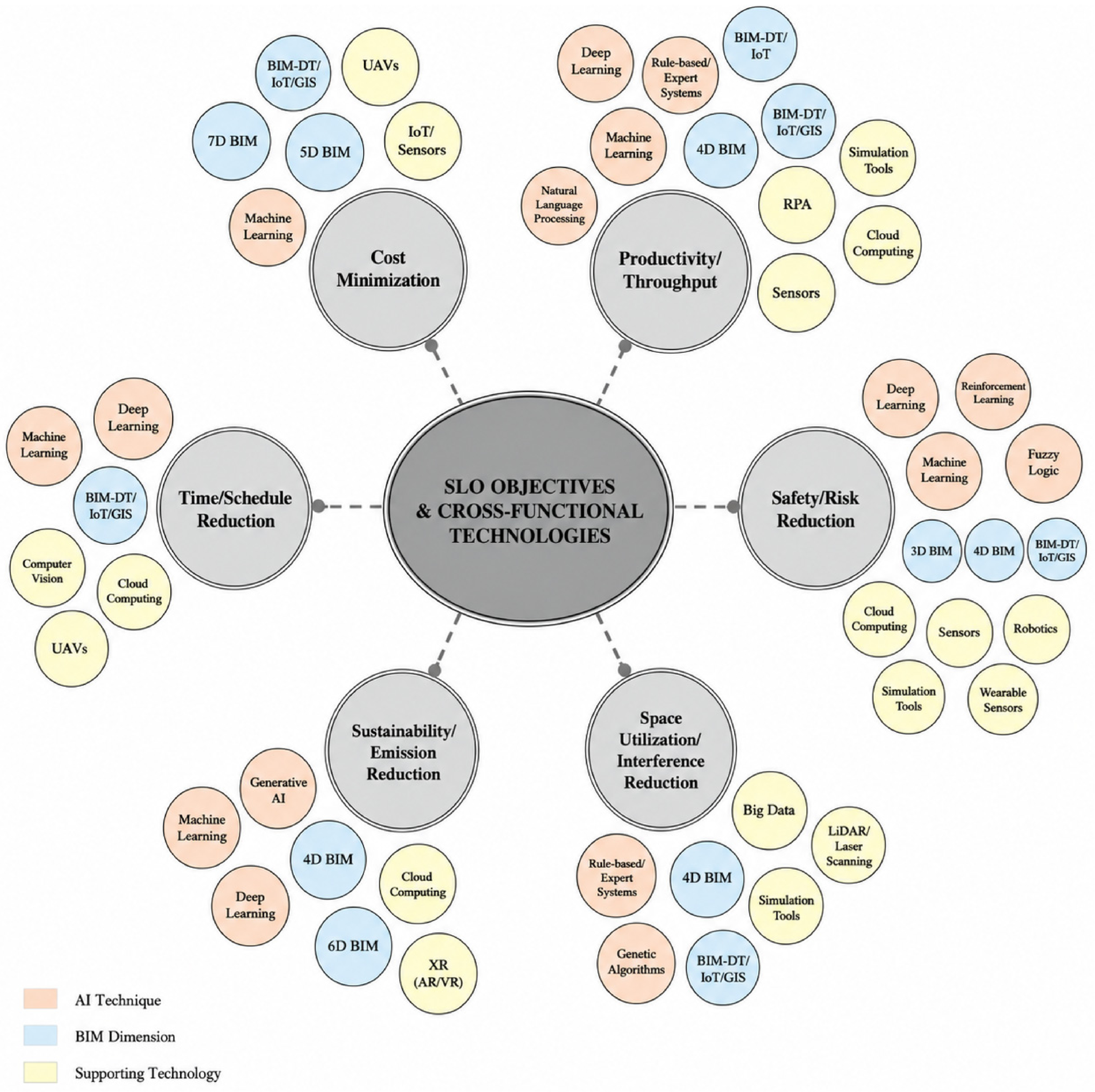
The cross-functional synthesis further clarifies how the field is consolidating by showing that AI-BIM-enabled site decision-making is increasingly supported by recurring technology convergences rather than isolated digital tools. As summarized in
Table 11, the dominant combinations are built around machine learning, deep learning, digital twins, multidimensional BIM, sensors, UAVs, GIS-related infrastructures, and simulation environments.
A key observation from
Table 11 is that the strongest technology stacks are not those centered exclusively on abstract optimization. Rather, they connect predictive intelligence with continuously updated site information. Deep learning, computer vision, UAVs, and sensing technologies are repeatedly associated with progress detection, live monitoring, and hazard recognition, while machine learning and digital twin-enabled BIM environments appear more often in coordination, scenario testing, and decision-support applications. This suggests that the field currently prioritizes technologies that reduce uncertainty, enhance situational awareness, and translate evolving site conditions into usable operational intelligence. This capability is particularly important for smart construction sites, where decisions must be made under spatial, temporal, safety, and resource constraints.
The synthesis also shows that different SLO objectives are associated with different technological profiles. Safety and risk reduction are supported by the broadest and most functionally diverse stack, combining deep learning, reinforcement learning, fuzzy logic, wearables, robotics, simulation tools, and BIM-linked digital infrastructures. Productivity and throughput also show a rich profile, but with stronger emphasis on administrative automation, workforce coordination, logistics handling, and information accessibility. By contrast, cost minimization and time or schedule reduction rely on narrower and more repetitive configurations, mostly centered on monitoring, forecasting, and progress-tracking mechanisms. This indicates that the field is currently more strongly developed and operationally supported in optimizing what can be sensed, tracked, and updated continuously than in supporting broader economic and sustainability decision-making through equally diverse technological pathways.
Another important insight is that BIM is expanding beyond model-based representation into a wider digital operating environment.
Table 11 emphasizes how BIM is not only a geometric or scheduling layer. It increasingly functions as the structured backbone through which digital twins, sensor feeds, UAV data, simulation outputs, and AI models can be connected into a usable decision context. This is particularly important for smart and sustainable building delivery because smart buildings should not be understood only as digitally operated assets after completion. Their sustainability and intelligence are also shaped during construction through decisions about resource flows, spatial efficiency, logistics, safety, emissions, and site disruption. In this sense, AI-BIM-enabled smart construction site management and SLO-related spatial decision-making contribute to smart building delivery by improving the construction-phase intelligence that precedes building operation.
Figure 13 reinforces this interpretation visually. The densest concentration of technology combinations appears around Safety and Risk Reduction and Productivity and Throughput, while Cost Minimization and Time and Schedule Reduction are supported by fewer distinct configurations. The figure also illustrates how Sustainability and Emissions Reduction and Space Utilization and Interference Reduction remain present but less saturated. This is important because it shows that sustainability is emerging in the field, but it is not yet as deeply developed as safety and productivity applications. For Smart Cities, this is both a strength and a limitation: the field has developed promising digital tools for safer and more efficient site operations, but it still needs stronger integration of environmental performance, resource efficiency, and emissions-aware decision-making into AI-BIM-enabled site optimization.
5.3. Structural Gaps in the Current Literature
Despite the progress identified above, the field remains structurally imbalanced.
Figure 12 shows that real-time digital twin and safety-focused applications dominate the literature, while dynamic logistics optimization and autonomous mobility remain underrepresented. This indicates that the field has invested heavily in monitoring, representation, and predictive control, but less in the actual reconfiguration of workflows, movement systems, and resource interactions in response to changing site conditions. In other words, the literature is rich in diagnostic intelligence, but thinner in executable operational intelligence.
For smart cities and sustainable building delivery, this gap matters because construction sites must increasingly function as connected, responsive, and resource-efficient systems. Smart urban development cannot depend only on digital models that visualize site conditions. It requires systems that can use those models to reduce congestion, avoid unsafe interactions, improve material flows, minimize rework, reduce emissions, and support more reliable delivery. The current literature has developed many of the sensing and representation capabilities needed for this transition, but it has not yet fully integrated them into closed-loop decision architectures.
A second major gap is the limited integration across objectives.
Table 11 makes clear that different technology stacks are being used for cost, productivity, safety, space, sustainability, and time-related goals. However, the field still lacks enough frameworks that treat these objectives simultaneously. This is an important limitation because construction site layout optimization is inherently multi-objective. A layout that improves productivity may increase interference risk. A configuration that reduces travel distance may complicate safety buffers or logistics sequencing. A plan that improves emissions performance may create new scheduling or equipment constraints. For smart construction systems to be practically useful, these trade-offs must be handled within unified decision environments rather than isolated technical applications.
A third gap concerns implementation realism. Many reviewed studies present strong conceptual models, prototype systems, or controlled simulations, but fewer demonstrate robust deployment under real site conditions. This remains one of the most serious limitations of the field. Real construction environments are noisy, variable, and organizationally fragmented. Data can be delayed, incomplete, or inconsistent. Sensing networks can fail. Site conditions can change suddenly. Human behavior can diverge from simulation assumptions. These realities mean that technical feasibility alone is not enough. The field must provide stronger evidence that AI-BIM-enabled smart construction systems remain reliable and useful under operational uncertainty.
A fourth gap lies in interoperability and governance. The dominant technology convergences shown in
Table 11 and
Figure 13 assume the smooth interaction of BIM models, digital twins, sensors, UAVs, cloud platforms, simulation tools, and AI models. In practice, this level of integration is difficult to achieve. The challenge is not only technical compatibility. It also involves semantic consistency, data governance, responsibility allocation, cybersecurity, user trust, and accountability for AI-supported decisions. Without these foundations, smart construction systems risk becoming technically impressive but operationally fragile.
Finally, adaptive pathfinding and autonomous mobility remain the weakest frontier.
Figure 12 shows clearly that this theme has the smallest footprint in the thematic structure. Yet strategically, it may be one of the most important directions for smart construction sites because it moves the field from intelligent representation to intelligent execution. The current scarcity of research in this area suggests that the literature has not yet solved the hardest problems of dynamic obstacle avoidance, heterogeneous fleet coordination, human–machine coexistence, low-latency communication, and safe autonomous operation in live construction environments. This gap is particularly relevant to smart cities because urban construction increasingly occurs in dense, constrained, and disruption-sensitive settings where movement, safety, and coordination must be continuously managed.
5.4. Implications for Research and Practice
With respect to research, the findings suggest that the next major advances are unlikely to emerge from the introduction of more isolated AI techniques. They are more likely to emerge from the systematic integration of existing capabilities into coherent, closed-loop smart construction systems. The field has begun to establish a meaningful foundation in monitoring, digital representation, predictive analytics, and safety intelligence. What remains persistently absent is a unified decision-oriented architecture capable of connecting sensing, model updating, scenario evaluation, optimization, and adaptive action across multiple SLO objectives simultaneously. Future studies should therefore focus on multi-objective and interoperable frameworks that balance productivity, safety, cost, spatial efficiency, time, sustainability, and emissions within the same decision environment.
A second research implication is the need for stronger field validation. The evidence base would be strengthened if more studies moved beyond prototype demonstrations and simulation-based performance claims into live construction settings. This is especially important for dynamic logistics coordination, autonomous mobility, and real-time decision support, where the gap between digital promise and site reality remains wide. Practical deployment studies should examine not only predictive accuracy, but also latency, robustness, data loss, human override mechanisms, user adoption, and measurable effects on safety, waste, productivity, and environmental performance under changing site conditions.
A third research implication concerns human-centered integration. The field increasingly incorporates automation, robotics, wearables, and decision-support systems, but it still gives insufficient attention to how workers, supervisors, and managers interact with these tools in practice. This issue is central to smart and sustainable building delivery because construction-site intelligence should improve human safety, comfort, coordination, and decision quality, not simply automate technical processes. Future work should examine how AI-BIM recommendations can be interpreted, challenged, adjusted, or overridden by human users, especially in safety-critical situations. This is essential to avoid blind reliance on automated outputs and to support responsible, trustworthy adoption.
A fourth research implication concerns sustainability integration. Although
Table 11 includes sustainability and emissions reduction as an SLO objective, the related technology pathways remain less developed than safety and productivity applications. Future research should more directly examine how AI-BIM-enabled site systems can support waste reduction, lower emissions, more efficient material handling, energy-aware temporary site operations, and reduced urban disruption. This would strengthen the connection between smart construction site management and the broader objectives of smart cities and sustainable buildings.
With respect to practice, the review suggests that organizations should not attempt to implement the most advanced autonomous applications first. The thematic structure in
Figure 12 and the objective-based mapping in
Table 11 point to a more realistic implementation path. Organizations are likely to gain the most immediate value by first strengthening digital visibility through BIM-linked progress monitoring, digital twin updating, and sensor-based site awareness. From there, they can extend these foundations into predictive safety, logistics coordination, sustainability monitoring, and eventually more advanced adaptive decision support. Intelligent and adaptive site management should be built progressively, not pursued as an all-at-once transformation.
A second practical implication is that interoperability should be treated as a strategic capability, not a technical afterthought. The benefits suggested by
Figure 13 depend on connected ecosystems, not isolated tools. Firms therefore need common data structures, reliable model updating procedures, integration across software environments, and clear governance frameworks for data access, data quality, decision triggers, and human responsibility. Without this digital backbone, even strong AI models and advanced BIM environments will have limited operational value.
A final practical implication is that safety remains the strongest entry point for AI-BIM adoption in smart construction site management. The literature shows that safety applications are among the best supported by diverse technology stacks and are closest to practical readiness. This gives practitioners an immediate and defensible use case for investment. At the same time, the review makes clear that future competitive advantage is likely to come from moving beyond safety and visibility toward integrated systems that also improve logistics coordination, spatial efficiency, sustainability, emissions performance, and adaptive mobility. In this broader sense, AI-BIM-enabled smart construction site management and SLO-related spatial decision-making should be understood not only as a construction planning method, but as a practical pathway toward smarter, safer, and more sustainable building and urban infrastructure delivery.
6. Conclusions, Limitations, and Future Research
This systematic literature review examined how artificial intelligence (AI), building information modeling (BIM), digital twins, and related enabling technologies are being applied to support smart construction site management, SLO-related applications, and site-level spatial decision-making in construction. The review shows that the field is moving from static and fragmented site planning toward more connected, data-driven, and adaptive forms of smart construction site management. This transition is important for smart cities and sustainable building delivery because construction sites are not only temporary production environments; they are critical operational interfaces where decisions about space, safety, logistics, resource use, waste, emissions, and mobility directly shape the efficiency and sustainability of built-environment delivery.
Across the reviewed literature, AI contributes computational intelligence for prediction, classification, optimization, automation, and decision support, while BIM provides the structured spatial and temporal environment needed to organize, visualize, and operationalize these functions within construction workflows. Digital twins further extend this integration by enabling continuous synchronization between physical site conditions and virtual decision environments. Together, these technologies provide the foundation for smarter construction sites capable of improving monitoring, safety, logistics coordination, spatial efficiency, and adaptive decision-making.
The review makes four main contributions. First, it maps the intellectual structure and growth of the field through bibliometric analysis, showing that AI-BIM-enabled site decision-making is expanding rapidly but remains unevenly consolidated. Second, it identifies four major thematic focal areas that define current research attention: real-time digital twin and spatial data management, proactive safety and risk management, dynamic resource and logistics optimization, and adaptive pathfinding and autonomous mobility. Third, it synthesizes the dominant cross-functional technology convergences underpinning the literature, particularly the recurring integration of machine learning and deep learning with multidimensional BIM environments, often extended through digital twins, sensors, cloud platforms, UAVs, GIS-related infrastructures, and simulation tools. Fourth, it identifies unresolved implementation gaps related to interoperability, field validation, human oversight, multi-objective decision-making, and closed-loop operational execution.
Taken together, these findings suggest that the field is developing a meaningful base in site visibility, monitoring, and predictive decision support. However, progress remains uneven. The literature is more strongly consolidated and practically supported in sensing, digital representation, progress monitoring, and safety-oriented intelligence than in fully integrated, closed-loop systems capable of continuously coordinating logistics, resource allocation, movement, emissions-aware planning, and autonomous execution under live site conditions. This indicates that AI-BIM-enabled smart construction site management and SLO-related spatial decision-making is advancing, but it has not yet reached full operational readiness as a scalable smart construction system.
This review should also be interpreted in light of several limitations. The analysis was based on publications retrieved from the Scopus database and on the defined screening and inclusion criteria, which means that relevant studies indexed elsewhere or published in other forms may not have been captured. The review protocol was not prospectively registered, and no public protocol is available; however, the PRISMA 2020 reporting framework, search strategy, screening logic, eligibility criteria, and synthesis procedures are reported transparently in the manuscript and accompanying checklist. No formal inter-rater agreement statistic was calculated during screening; although author cross-checking and consensus procedures were used, the absence of a prospectively calculated coefficient such as Cohen’s kappa remains a methodological limitation. The search strategy was application-oriented and did not include IFC, Industry Foundation Classes, openBIM, Uniclass, Omniclass, or ISO 19650 as dedicated search terms. Consequently, studies centered primarily on openBIM standards, interoperability schemas, BuildingSMART-related implementation frameworks, or classification systems may be underrepresented unless captured through the application-oriented terms used in the query. In addition, because explicit SLO studies remain limited, the review includes a substantial share of enabling studies that provide indirect but relevant evidence for site-level spatial decision-making. This broader inclusion strategy was necessary to reflect the actual structure of the field, but it also means that the findings should not be interpreted as representing explicit SLO applications alone. Finally, the reviewed literature varies considerably in methodological depth, implementation evidence, and field validation, meaning that the strength of evidence is not uniform across all themes and technology applications.
The review also highlights that the main barriers to broader adoption are not only algorithmic. They include limited interoperability across platforms, inconsistent data quality, high implementation demands, weak standardization, limited field validation, and the lack of unified decision frameworks capable of balancing time, cost, safety, productivity, space utilization, sustainability, and emissions within the same decision environment. As a result, the practical promise of AI-BIM integration is clear, but reliable deployment still depends on stronger system integration, governance, human-centered implementation, and validation under real construction conditions.
Future research should therefore focus on moving the field from technically promising applications to robust operational systems for smart construction site management. Four priorities are especially important. First, more studies and targeted reviews are needed on interoperable and semantically consistent data architectures that allow AI models, BIM environments, digital twins, sensors, UAVs, GIS platforms, and simulation tools to function as part of the same decision ecosystem. This should include explicit attention to openBIM, IFC-based workflows, BuildingSMART-related interoperability efforts, ISO 19650 information-management practices, and classification standards such as Uniclass and Omniclass. Second, future work should place greater emphasis on field-based validation, especially in dynamic and uncertain project settings, to test reliability, latency, scalability, usability, and performance beyond simulation environments. Third, research should advance multi-objective optimization frameworks that address trade-offs among safety, productivity, time, cost, sustainability, emissions, and spatial efficiency simultaneously rather than in isolation. Fourth, greater attention should be given to human-centered adoption, including worker interaction with AI-supported systems, override mechanisms, trust, ergonomics, accountability, and the responsible integration of autonomous or semi-autonomous technologies into live construction operations.
The review shows that AI-BIM integration has strong potential to transform SLO-related spatial decision-making from a static planning task into a dynamic smart construction capability. For smart cities and sustainable buildings, this transformation matters because the intelligence of the built environment does not begin only after a building becomes operational. It also depends on how safely, efficiently, and sustainably that building or infrastructure is delivered. The next stage of advancement will therefore depend not on introducing more isolated digital tools, but on systematically consolidating existing capabilities into scalable, interoperable, human-centered, and field-validated systems that can support safer, more efficient, more adaptive, and more sustainable construction sites.