


Highlights
What are the main findings?
- AI technique use is largely concentrated on modeling single phenomena, with limited attention to uncertainty, transfer learning, multi-scale analysis, and non-biophysical drivers of urbanization.
- Critical urban processes and model couplings are neglected: there are no AI-integrated studies on urban shrinkage or urban renewal, and no combined CA-ABM-AI frameworks despite their systemic importance.
What are the implications of the main findings?
- Current AI models improve accuracy but not decision support; mostly, they overlook socioeconomic drivers, model explainability, and participatory scenario-building needed for practical urban planning.
- Policy-relevant AI requires a paradigm shift: integrating multidomain data, transparent and interpretable methods, standardized evaluation, and co-designed tools embedded in real planning and governance workflows.
Abstract
Artificial Intelligence (AI), particularly Machine Learning (ML) and Deep Learning (DL), is transforming the modeling of complex spatiotemporal urban processes such as urban growth, sprawl, shrinkage, redevelopment, and Land Use/Land Cover Change (LULCC). However, despite rapid methodological innovation, applications remain fragmented, and there is limited synthesis of how AI-based models complement, extend, or supersede conventional approaches. This study addresses this gap through a systematic review of 6356 records, from which 120 articles were selected for detailed analysis. It investigates: (i) how ML/DL techniques are embedded within spatiotemporal modeling frameworks; (ii) their use in simulating urbanization dynamics and land-use (LU) transitions; (iii) methodological and performance gains relative to traditional statistical and rule-based models; and (iv) emerging research frontiers and limitations. The review shows that LULCC dominates current applications, with Artificial Neural Networks (ANNs) as the most prevalent ML method, increasingly complemented by DL architectures. Across cases, AI is primarily used to learn non-linear transition dynamics, represent spatial and temporal dependencies, identify influential drivers, and improve classification performance and computational efficiency. Building on these insights, the paper synthesizes the roles of AI in spatiotemporal urban modeling and outlines forward-looking research directions to support more robust, transparent, and policy-relevant applications for urban sustainability.
1. Introduction
The rapid pace of urbanization presents intertwined challenges and opportunities for long-term urban sustainability [1]. With the world population already exceeding 7.9 billion and projected to grow further, many cities face increasing pressure on land, infrastructure, and ecosystems [2]. Although the level and mechanisms of urbanization vary across regions, a consistent global trend of population concentration in urban areas is evident [3]. Urban growth is often described as the physical manifestation of this process, but when it occurs in an uncontrolled and uncoordinated manner, it is frequently framed as the “negative progress of urbanization” [4]. These pressures have made spatiotemporal modeling increasingly important for understanding how urban systems evolve and how land is transformed over time.
A persistent problem in this field, however, is conceptual inconsistency. Concepts such as urban growth, urban sprawl, and urban expansion are frequently used interchangeably in both public discourse and parts of the academic literature, despite important distinctions [5]. Urbanization refers not only to the physical enlargement of urban areas but also to rural-urban migration and broader economic, social, and political restructuring within cities [6]. Within this broader process, urban sprawl typically denotes an undesirable form of urban growth characterized by unplanned, low-density, fragmented, and inefficient outward development, often linked to inadequate planning and weak LU policies [7,8]. Sprawl is commonly associated with the loss of agricultural land, environmental degradation, and increased infrastructure and service burdens [9]. By contrast, not all urban growth is problematic: infill development, densification, and vertical growth can mitigate sprawl and support more efficient urban form [10]. Urban expansion modeling generally focuses on the outward spread of cities into surrounding rural or peri-urban areas and is closely connected to Land Use/Land Cover Change (LULCC) dynamics and their environmental implications [9], whereas urban growth modeling more broadly encompasses outward expansion, infill, densification, vertical growth, and demographic change, and relates these patterns to population dynamics, economic conditions, policy interventions, and LU governance [4,8,9]. Clarifying these distinctions is not merely terminological; it is methodologically necessary, because different urban processes demand different modeling assumptions, data structures, and evaluation criteria [1,5].
1.1. Traditional Concepts of Spatiotemporal Urbanization Modeling
Spatiotemporal urbanization and LULCC modeling have long relied on a diverse set of rule-based, probabilistic, and process-oriented approaches. Among the most established, CA simulates spatial patterns of LU change by representing space as a discrete dynamic system in which transitions are governed by local neighborhood conditions and predefined rules [11,12,13]. Its main strength lies in reproducing spatial contiguity and local interaction effects, but its rule dependence can limit flexibility when urban change is shaped by heterogeneous and non-stationary drivers. ABMs provide a complementary bottom-up approach by representing urban systems as collections of heterogeneous agents whose interactions generate emergent LU patterns [14]. Unlike CA, which emphasizes spatial transition logic, ABMs explicitly model human decision-making, social interactions, adaptation, and behavioral responses under alternative scenarios [15,16]. Yet, this behavioral richness often comes at the cost of higher conceptual and calibration complexity.
In parallel, several established urban growth models remain influential in LULCC research. SLEUTH is designed to simulate urban expansion from observed historical growth patterns, whereas CLUE-S allocates LU change spatially based on human and biophysical drivers. MC methods are also frequently applied to estimate transition probabilities and project future land-change patterns [17]. These approaches have provided the backbone of much applied urban and LULCC modeling, but each capture only part of the underlying process. This limitation has driven the emergence of hybrid models that seek to combine complementary strengths and offset individual weaknesses [18]. For example, CA reproduces spatial dynamics effectively but is weaker in representing temporal transition probabilities; CA-Markov integrations therefore link spatial allocation with probabilistic temporal dynamics [13]. More generally, CA-MC hybrids can jointly estimate locations of change and quantify historical LULCC trajectories, while LR-Markov configurations are widely used to forecast LULCC transitions by mitigating constraints associated with CA, such as dependence on predefined transition rules, and with SLEUTH, such as the need for prior parameter calibration [19]. In parallel, GIS-based models such as the Spatial Transition Simulation Model (STSM) and the Long-Term Transition Model (LTM) remain prominent in urban growth and LULCC modeling, typically by encoding spatial predictor variables into layered datasets that serve as inputs to these frameworks [20].
Although these traditional and hybrid approaches remain foundational, their limitations are also well recognized. Many depend heavily on hand-crafted rules, fixed neighborhood assumptions, or predefined transition structures, making them less suited to capturing nonlinear interactions, high-dimensional drivers, and evolving spatiotemporal dependencies. As a result, the methodological center of gravity in the field has increasingly shifted toward AI-based methods.
1.2. AI Integration into Spatiotemporal Urbanization and LULCC Modeling
Urban growth models support local governments and planners in estimating future demands for infrastructure, real estate, and public services, and in guiding more sustainable urban development [21,22,23]. They are also widely used in econometric and policy analyses [24]. This practical importance has driven a substantial body of work aimed at improving how urban growth patterns are analyzed and how land development strategies are evaluated, typically by extrapolating from historical data to forecast future urban configurations [25,26,27,28,29]. Within this context, ML has become increasingly important in simulating urbanization and LULCC. ML techniques are widely used to analyze urban growth patterns and their key driving factors, both geospatially and statistically [30]. Non-hybrid ML algorithms, particularly ANNs, have been extensively applied in geographical analysis, including telecommunication flows, transport planning, LULCC classification, and housing market studies [3]. Numerous studies have implemented non-hybrid ML and DL models for urban growth, such as ANN [31] and CNNs [32], while hybrid approaches that combine ML with traditional spatial models, including CA, CA–Markov, CA–MC, and CA–LR, have become prominent in ML-integrated urban growth modeling [4,20].
The same shift is evident in LULCC research. LULCC, in interaction with population mobility, reshapes society–environment relations and, if poorly managed, can exacerbate housing shortages, social vulnerability, and congestion [33]. It is also critical for diagnosing agricultural land loss, urban encroachment, and habitat degradation [34]. Because LULCC has far-reaching implications for biodiversity, climate change, water resources, and the carbon cycle, it is tightly coupled with urban growth dynamics; global urbanization is projected to reach 72% by 2050 [35]. Advances in remote sensing, big-data platforms, and computational capacity have enabled increasingly sophisticated LULCC models, typically structured around calibration, simulation, validation, and prediction [13]. Conventionally, LULCC modeling relies on empirical assessment of LU transitions as functions of multiple explanatory variables, operationalized through transition potentials [36]. In this context, ML-based algorithms such as LR, SVM, and ANN have been systematically tested for both LULCC classification and simulation and are now widely used to identify LU transitions [37]. Beyond CA-based frameworks, Neural Networks have become central to LULCC simulation and are recognized as powerful tools for addressing complex and multi-scale remote sensing challenges [38]. DL methods, as multi-layer extensions of Neural Networks, have gained prominence in LULCC modeling [39]. CNNs are extensively employed as non-hybrid DL models for LULCC because of their strength in image processing and multi-scale feature extraction [40], while Self-Organizing Maps provide competitive learning architectures for dimensionality reduction in high-dimensional geospatial data [41].
Urban expansion, typically defined as the outward growth of built-up areas into previously rural or undeveloped land, is also closely linked to these LULCC dynamics [2]. It is driven by population growth, rural-urban migration, economic development, and infrastructure extension [42], and is associated with the conversion of agricultural land and green spaces, forest fragmentation, habitat loss, and biodiversity decline [43]. Non-hybrid ML and DL models, including CNNs [44] and RNNs [45], have therefore been widely used for modeling urban expansion and its spatiotemporal dynamics.
Over the past three decades, these developments have been motivated by persistent limitations in spatiotemporal urbanization and LULCC modeling, including uncertainty, structural complexity, limited flexibility, precision constraints, and difficulties in model integration [46]. ML techniques have been introduced in part to address these issues. When embedded in urban models, ML algorithms can learn from data with limited human intervention, drawing on robust mathematical and statistical foundations, and are routinely valued for predictive accuracy and efficiency [47]. They can contribute across the modeling pipeline, from data collection and feature selection to model choice and validation, by handling linear and nonlinear relationships, guiding transition rules, supporting calibration and validation, and automating data preparation [46,47]. Compared with expert-driven methods such as AHP, ML approaches can reduce manual elicitation and generate explicit uncertainty indicators to support decision-making [46]. However, despite this rapid methodological expansion, the literature remains fragmented in analytically important ways.
First, existing studies often emphasize model performance without adequately distinguishing the urban processes being modeled. Urban growth is frequently treated as a single undifferentiated outcome, even though outward expansion, sprawl, densification, and other forms of urban development reflect different spatial logics and policy implications [4,5,8,10]. Second, LULCC and urban growth dynamics are often examined in separate strands of literature, despite their strong empirical and conceptual interdependence [9,33,35,43]. This separation obscures how specific AI methods are deployed across different modeling frameworks and limits cumulative understanding of where particular methods are most appropriate. Third, although both hybrid and non-hybrid AI approaches are now widely used, they are rarely reviewed within the same analytical structure, making it difficult to compare their methodological roles, strengths, and limitations across applications [4,18,19,20,30,37,39,44,45]. As a result, the current literature provides ample model-specific evidence but limited synthesis of the field as an integrated methodological domain.
Despite the growing body of literature on AI-driven urban modeling, no comprehensive systematic review to date has jointly examined ML- and DL-based approaches across the full spectrum of spatiotemporal urbanization and LULCC modeling, encompassing urban growth, urban expansion, urban sprawl, and LU transition processes within a unified analytical framework. Existing reviews tend to address either LULCC or urban growth in isolation, apply narrow methodological lenses, or omit a structured comparison of hybrid and non-hybrid AI configurations. More importantly, prior studies have often treated urban growth as a single undifferentiated process, without clearly distinguishing its underlying dynamics, patterns, and mechanisms. At the same time, LULCC and urban growth dynamics have frequently been examined in separate bodies of literature, limiting a clear understanding of which AI methods are used within each modeling framework and how these approaches differ conceptually and methodologically.
To address these gaps, this paper systematically reviews ML- and DL-based techniques used in spatiotemporal urbanization and LULCC modeling. It examines both hybrid and non-hybrid approaches, identifies where and for what purposes they are applied, and clarifies how AI methods are used to model specific dimensions of urbanization, including urban growth, urban sprawl, and urban expansion. Thus, the main objectives are: (i) to synthesize existing ML/DL-integrated models used in spatiotemporal urbanization and LULCC; (ii) to evaluate their use in modeling urbanization trends and LU transitions; (iii) to identify major methodological advances relative to conventional models; and (iv) to outline future research directions for ML/DL-based spatiotemporal urbanization and LULCC modeling.
2. Materials and Methods
This study employed a systematic literature review structured according to the Preferred Reporting Items for Systematic Reviews and Meta-Analyses (PRISMA) protocol. Two research questions guided the analysis: (RQ1) How are ML/DL techniques applied in spatiotemporal urbanization and LULCC modeling? (RQ2) What advantages do ML/DL-integrated models offer over conventional methods in modeling urbanization trends? To address these questions, the PRISMA workflow was implemented in four stages: first, relevant literature was identified through comprehensive database searches; second, retrieved records were screened using predefined filters; third, the eligibility of the screened studies was assessed based on their alignment with the research objectives; and finally, eligible studies were included for full-text review and in-depth analysis (Figure 1).
Literature Identification
A structured literature search was conducted on SCOPUS and Web of Science using TITLE-ABS-KEY Boolean queries (Figure 1). The search strategy was carefully designed to capture relevant studies and was executed on 5 September 2024, yielding a total of 6356 records published between 1 January 2010 and 5 September 2024. To ensure the quality and relevance of the corpus, predefined inclusion and exclusion criteria were applied (Table 1). Only full-text articles published in peer-reviewed journals and written in English were retained for the initial screening stage. Titles, abstracts, and keywords were then examined to assess alignment with the research aims and to remove duplicate records, resulting in 226 articles being selected for eligibility assessment.
Table 1.
Literature selection criteria.
Figure 1.
Flow of the Systematic Literature Review according to the PRISMA protocol.
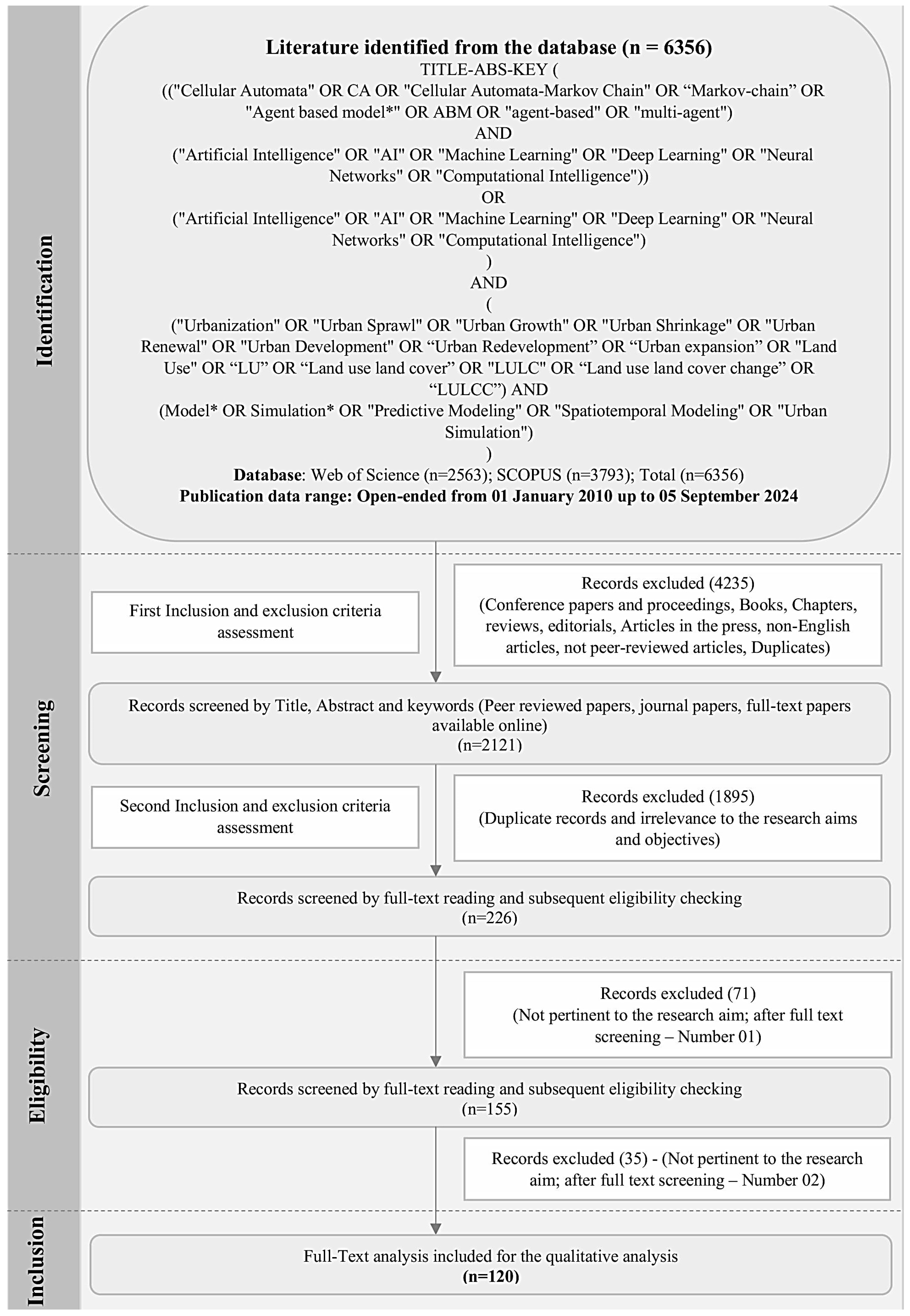
During the eligibility and inclusion phase, each article was reviewed in detail to assess its alignment with the research aims. This process reduced the set to 155 studies, after which a further 35 papers were excluded, resulting in 120 articles being retained for full-text analysis. The selected studies were then subjected to critical thematic analysis and synthesized under five focal areas: (a) AI techniques used in spatiotemporal modeling (addressing RQ1); (b) primary objectives for integrating AI into spatiotemporal modeling (addressing RQ2); (c) applications of AI across different phases of spatiotemporal urban modeling; (d) data types and categories employed; and (e) key methodological and performance advances of ML/DL approaches over conventional models. The findings for each of these themes are presented in the following sections.
3. Bibliographic Analysis Results
3.1. Descriptive Analysis
The 120 journal articles that were identified through bibliographic research were analyzed based on the annual publications (Figure 2), region of publication (Figure 3), and reviewed articles by journal names (Figure 4).
Figure 2.
Annual publications.
Figure 3.
Reviewed articles by region of publication.
Figure 4.
Reviewed articles by the journal names.
Descriptive analysis of annual publications reveals a marked increase in studies applying AI algorithms to spatiotemporal urbanization and LULCC, particularly from 2020 onwards. This growth reflects rising research interest in ML- and DL-based approaches and their potential for real-world urban applications. Almost 70% of the reviewed articles were published between 2020 and September 2024, with 2024 recording the highest number of publications, indicating a continuing upward trend in AI-driven spatiotemporal modeling research.
The geographical distribution of publications reveals a clear concentration of research activity in a limited number of countries. China dominates the field with the highest number of publications, followed by the United States, Iran, and India. This pattern likely reflects differences in research investment, availability of geospatial data, rapid urbanization pressures, and the strong development of AI and remote sensing research communities in these countries. In particular, countries experiencing accelerated urban expansion may have greater motivation to develop and apply AI-based modeling approaches for urban growth and LULCC analysis. Conversely, the relatively lower representation of many developing regions suggests potential disparities in data accessibility, technical capacity, and research funding, highlighting opportunities for broader geographic participation in future studies.
Based on journal distribution, approximately 14% of the reviewed articles were published in Remote Sensing and the International Journal of Geographical Information Science, while about 10% appeared in Transactions in GIS and Computers, Environment and Urban Systems. This distribution indicates that the research orientation in this domain is largely concentrated in remote sensing and geospatial science–related journals. The prominence of these outlets suggests that most studies rely heavily on satellite imagery, geospatial datasets, and spatial analytical techniques to investigate urban and environmental dynamics, highlighting the strong methodological influence of remote sensing and GIS-based approaches within the field.
3.2. Keyword Analysis
The keyword co-occurrence threshold was set to 15, resulting in 84 keywords after merging duplicates and similar terms in VOSviewer 1.6.18. The following diagram presents the top 50 keywords identified in the study (Figure 5).
Figure 5.
Top 50 keyword occurrences.
In VOSviewer, keyword frequency is represented by node size, with larger nodes indicating higher co-occurrence, while the distance between nodes reflects thematic similarity and relational strength. The keyword network is dominated by terms such as “Cellular Automata”, “Machine Learning”, “Urban Growth”, and “Deep Learning”, alongside closely connected concepts including “Neural Networks”, “Land Use Change”, “Markov Chain”, “Urban Expansion”, “Simulation”, “Remote Sensing”, “Logistic Regression”, “Support Vector Machine”, “Urban Growth Models”, and “Convolutional Neural Networks”. This distribution is not merely indicative of topic frequency; it reveals the coexistence of established spatial simulation paradigms with emerging AI-based approaches in the urban modeling literature.
More importantly, the co-occurrence structure points to a differentiated pattern of AI adoption. The strong linkage of AI-related keywords with “Remote Sensing”, “Simulation”, “Land Use Change”, and “Urban Expansion” suggests that ML and DL are being used primarily in data-intensive, prediction-oriented, and spatially explicit applications, where large geospatial datasets and nonlinear spatiotemporal relationships are central. At the same time, the continued visibility of traditional modeling terms indicates that these approaches still provide the conceptual and operational backbone for many studies.
As illustrated in Figure 6, the temporal overlay further clarifies how the field has evolved. Earlier terms such as “Cellular Automata”, “Markov Chain”, and “Urban Growth” are more strongly associated with foundational modeling studies, whereas newer terms such as “Deep Learning”, “Machine Learning”, “Data Fusion”, “Smart Cities”, and “Big Data” reflect a more recent expansion toward AI-enabled, multi-source, and application-driven research. This temporal pattern suggests that the field is evolving not only methodologically, but also in its broader orientation toward digitally enabled urban analysis and sustainability-related applications.
Figure 6.
Node size visualization based on links between keywords.
4. Findings
The shortlisted full-text articles were subjected to an in-depth qualitative review to address RQ1 and RQ2. Studies were classified into six application domains: LU modeling, LULCC modeling, urban expansion, urban growth, urban redevelopment, and urban sprawl modeling, distinguished by their principal research emphasis as defined by the authors. This distinction is analytically meaningful: LU modeling studies tend to prioritize static or snapshot-based representations of land allocation, whereas LULCC studies explicitly engage with temporal dynamics and transition processes between land states. The urban-focused categories, by contrast, reflect a narrower spatial scope and a stronger normative orientation toward policy-relevant outcomes such as containment, densification, or sprawl mitigation.
These application domains were further examined across six modeling orientations: ABM, CA, CA–MC, CA–ABM, MC, and non-hybrid AI approaches, allowing for a comparative assessment of how methodological choices align with, or diverge from, the demands of each domain. Notably, hybrid approaches such as CA–MC and CA–ABM tend to predominate in studies requiring both spatial contiguity constraints and stochastic or agent-driven transition rules, while standalone MC and non-hybrid AI methods appear more frequently in domains where predictive accuracy is prioritized over process representation. This cross-domain, cross-method framing structures the analysis that follows, enabling a more systematic evaluation of the trade-offs each approach entails rather than a sequential inventory of individual studies.
4.1. LU Modeling
Purely LU modeling integrated with ML/DL techniques remains notably scarce in the reviewed literature, with only a single study explicitly focusing on this approach. This study [48] employed ANN and RF models to simulate large-scale urban land development and predict parcel-level LU changes using historical patterns and neighborhood characteristics, thereby enabling a more fine-grained understanding of urban development dynamics. The implementation of GPU-based parallel processing significantly reduced the computational burden associated with neighborhood identification and model training, improving overall model efficiency. Notably, the study represents a non-CA-based framework for LU modeling, highlighting the potential of standalone ML approaches to capture complex spatial development processes without relying on traditional CA-based simulation structures [48].
4.2. LULCC Modeling
4.2.1. Purely AI-Based Approaches
Purely AI-based techniques have become increasingly important in LULCC modeling, with ANNs among the most widely adopted approaches because of their ability to improve predictive accuracy and capture nonlinear relationships between land-change drivers and outcomes [49,50,51]. Comparative analyses indicate that ANNs, CART, and MARS are all capable of simulating LU change across diverse regions, although each offers distinct advantages [52]. ANNs are generally more effective in representing complex nonlinear interactions, whereas CART provides greater interpretability through its transparent rule-based structure, and MARS offers a useful intermediate position by accommodating nonlinearities while remaining more interpretable than ANN [52]. Nevertheless, ANN performance appears to be stronger over shorter temporal intervals and weaker for fine-resolution data [52]. Incorporating spatial structure further strengthens ANN-based modeling, as the inclusion of spatial autocorrelation has been shown to substantially improve LULCC simulation accuracy [53].
DL-based models, particularly CNNs, extend this capability by learning hierarchical spatial features directly from gridded or image-based inputs, making them especially suitable for capturing spatial patterns and neighborhood dependencies in LULCC processes [40]. Relative to conventional ANNs, CNNs provide stronger spatial feature extraction, although this advantage is accompanied by higher computational demand and greater dependence on large training datasets. Their integration with CA has further improved the representation of neighborhood effects, resulting in more accurate and spatially detailed LULCC simulations [54]. More generally, CNN-based models have demonstrated consistently improved LULCC prediction performance in multiple applications [55,56,57].
At the broader ML level, comparative studies involving SVM, GAMLP, and Neural Networks suggest that no single model is universally superior across all contexts [58,59]. SVM often emerges as the best-performing method in some cases, likely because of its strong generalization ability in limited-sample or high-dimensional settings, whereas Neural Networks are better suited to modeling more complex nonlinear relationships inherent in LULCC dynamics [58,59]. GAMLP may be viewed as a comparatively flexible alternative, but its representational capacity remains more limited than that of more advanced Neural Network architectures in highly complex environments [58,59]. Even so, Neural Networks have consistently demonstrated their value in improving LULCC modeling and classification accuracy [60].
The range of AI methods applied to LULCC modeling has also expanded to include XGBoost [49,61], U-Net [41], Random Forest Regression (RFR) [62], Random Forest (RF) [49,63], MARS [52,63], and Multilayer Perceptron (MLP) [64]. Tree-based ensemble methods such as XGBoost and RF are particularly effective in handling nonlinear relationships and reducing overfitting, with XGBoost often offering stronger predictive performance and RF providing greater robustness and interpretability through variable importance assessment [49,61,63]. RFR is more appropriate where continuous land-change quantities are modeled rather than discrete transitions [62]. In contrast, U-Net is especially advantageous for spatially detailed mapping because of its encoder–decoder architecture, although it is more computationally intensive and data demanding than conventional ML approaches [41]. MLP remains a useful baseline Neural Network model for nonlinear prediction, but it lacks the explicit spatial feature learning capacity of CNN- and U-Net-based architectures [64]. Taken together, these findings indicate that the relative suitability of AI models for LULCC modeling depends not only on predictive accuracy, but also on interpretability, spatial representation capability, computational efficiency, and data availability. A summary of the AI techniques applied in LULCC modeling is presented below (Table 2).
Table 2.
Summary of AI-based approaches in LULCC modeling.
4.2.2. CA-Based Approaches in LULCC Modeling
CA-ANN hybrids are among the most widely used AI-integrated approaches for LULCC modeling. Multi-label CA-ANN frameworks have been proposed to better capture the complexity of LULCC and to overcome limitations of conventional single-label models, with integrated CA-ANN configurations shown to more accurately reproduce observed LU patterns [65]. Vector-based CA models that operate on land parcels and are coupled with ANN have demonstrated higher accuracy than traditional raster-based CA implementations [66]. Further extensions include tri-hybrid architectures that combine CA, ANN, and Decision Trees, where correlation coefficients, Mutual Information, and Decision Tree methods are jointly used to construct a hybrid predictor screener (CMD) for identifying critical drivers and predicting LULCC several years into the future [67]. In several applications, CA-ANN integration has consistently improved prediction accuracy relative to standalone models [68,69].
Recurrent and deep architectures have also been embedded within CA-based frameworks. LSTM has been combined with ANN to simulate LULCC and analyze LST dynamics, yielding higher predictive accuracy [68]. More complex hybrids integrate LSTM, CNN, and PLUS within a unified framework, outperforming traditional CA models in LU prediction accuracy [70]. Temporal vector CA formulations that incorporate both spatial and temporal granularity have been shown to enhance prediction precision and capture complex non-linear temporal patterns compared to conventional CA [71]. Other work strengthens spatial-temporal feature learning by combining LSTM, RF, and CNN with CA and introducing iterative high-quality seed selection algorithms, resulting in higher accuracy and Kappa coefficients for multi-LU dynamic change models. Beyond these, a wide range of ML and DL techniques, including SVM [72,73], LR [17,37,74], CNN [70,71,75,76,77], and 3D-CNN [78,79], have been systematically integrated with CA to improve LULCC simulation performance. A summary of the CA + AI techniques applied in LULCC modeling is presented below (Table 3).
Table 3.
Summary of CA-based approaches in LULCC modeling.
4.2.3. CA-MC-Based Approaches
ANN-CA-MC hybrids are also widely used in LULCC modeling. Integrating ANN into CA-MC frameworks to represent multiple driving forces of LU change has been shown to substantially improve simulation performance, with ANN-CA-MC models outperforming standalone CA-MC in terms of accuracy [80,81,82,83,84]. Other extensions combine CA-MC with alternative ML architectures: SVM and MLP have been integrated with CA-MC to analyze LULCC dynamics and project future scenarios, yielding enhanced classification and prediction accuracy [85], while CA-Markov, coupled with RF, has demonstrated superior performance relative to traditional models under multiple LULCC scenarios [86].
4.2.4. MC-Based Approaches
MLP-MC and NN-MC integrations have been increasingly adopted for LULCC simulation. Coupling MLP with Markov chains has been shown to improve model accuracy relative to conventional MC-based approaches in both simulation and prediction tasks [87,88]. Similarly, MC-based Neural Network frameworks have been used to analyze LU dynamics and forecast future LU changes, providing improved predictive performance and offering insights into the underlying drivers of change that are relevant for urban planning applications [89]. Although MC is primarily used for quantitative transition probability estimation, it can be extended to spatially explicit simulation when coupled with spatial allocation mechanisms (e.g., suitability maps or cellular-based approaches), enabling the translation of non-spatial transition probabilities into spatial LU patterns [87].
4.2.5. ABM-Based Approaches
AI integration into ABM remains relatively limited within urban studies [90], although several notable applications exist. Ant Colony Optimization (ACO) has been coupled with ABM to explore the relationships between human activities and LULCC, with the ACO-ABM framework improving the representation and simulation of land-change processes [91,92]. Similarly, ANN has been integrated with ABM for LULCC modeling, providing a more dynamic and interactive simulation environment and yielding enhanced predictive accuracy compared with conventional approaches [93].
4.3. Urban Expansion Modeling
4.3.1. AI-Based Approaches
A growing body of work has applied non-CA, non-Markov AI models to urban expansion modeling, exploiting time-series satellite data and advanced DL architectures to overcome the limitations of traditional approaches. CNN-LSTM models, for example, combine the spatial feature extraction of CNNs with the temporal sequence modeling of LSTMs, thereby improving the capture of historical land dynamics and yielding higher prediction accuracy than conventional methods [44]. Related architectures that integrate CNNs and RNNs similarly enhance the modeling of both spatial patterns and temporal trajectories of urban growth, achieving high predictive accuracy [94]. U-Net-based CNN models have also been shown to effectively simulate built-up expansion with high classification performance and precise delineation of urban boundaries, benefiting from the U-Net’s ability to preserve fine-scale spatial detail through its encoder–decoder and skip-connection design [95]. More broadly, these CNN-enhanced frameworks offer a more realistic representation of urban expansion drivers, a conclusion further supported by the Dynamic Neighborhood-Gravitational method, which demonstrates that explicitly incorporating gravity effects and expanded neighborhood interactions substantially improve prediction accuracy in urban expansion modeling [96].
Methodological advances have also addressed intrinsic limitations of multi-temporal LULCC data, particularly the short length and sparsity of available time series. A cycle-consistent learning scheme has been proposed to mitigate the challenges posed by short multi-temporal LULCC sequences, improving both the interpretability and performance of RNN-based models when processing limited temporal observations and stabilizing their temporal reasoning [45]. In parallel, a range of ML/DL techniques, including SVM [97], U-Net [95], and XGBoost combined with SHAP [98], have been employed for urban expansion modeling. Here, SVM provides a robust baseline for non-linear classification of urban versus non-urban transitions, U-Net enhances spatially explicit mapping of built-up areas, and XGBoost-SHAP frameworks improve interpretability by quantifying the contribution of driving factors such as accessibility, demographics, and policy constraints to urban expansion outcomes. At larger scales, DL has been integrated with cloud-based remote sensing platforms; the combination of Google Earth Engine (GEE), DL models, and high-resolution imagery delivers accurate urban expansion maps with high Kappa coefficients, while also improving computational scalability and operational applicability for regional and national monitoring [99].
Beyond purely non-CA models, several studies have fused CNNs with rule-based or neighborhood-focused paradigms to better capture urban growth mechanisms. Convolution Neural Networks for United Mining (UMCNN) integrate CNN architectures to extract transition rules while explicitly modeling neighborhood interactions in urban expansion processes [27]. By leveraging receptive fields to capture multi-scale neighborhood information, UMCNN improves the extraction of spatial transition rules, enhances robustness to noise and heterogeneity, and increases the overall accuracy and realism of urban expansion simulations, thereby overcoming key shortcomings of conventional CA approaches that struggle with fixed neighborhood definitions and limited feature representation. Comparative analyses further show that ConvLSTM-based models optimize the joint treatment of spatial and temporal resolutions, effectively predicting both the direction and magnitude of urban expansion [100]. ConvLSTM architectures can capture global spatiotemporal dependencies from time-series satellite imagery while preserving the resolution of spatial feature maps, resulting in richer spatiotemporal feature representations and improved modeling of complex urban growth dynamics [44]. At the same time, standalone LSTM networks have been shown to effectively extract temporal dynamics from historical satellite imagery, enabling the simulation of nuanced urban expansion patterns such as leapfrog development, which are often difficult to capture with simpler time-series or rule-based models [94].
Recent work has begun to integrate attention mechanisms and Transformer-based architectures into urban expansion models to further enhance the treatment of multivariate driving factors and long-range temporal dependencies. Attention-based decoders explicitly weigh the relative importance of drivers such as road networks, population density, and LU policies, thereby improving the model’s focus on the most influential factors and enhancing the interpretability of the decision process. Building on this, ensemble DL frameworks have incorporated Transformer models within encoder–decoder architectures to simulate urban expansion at fine spatial scales [101]. In such settings, Transformers are used to extract multi-temporal spatial features from historical urban development data, improving the modeling of long-range temporal correlations, capturing cross-period interactions more effectively than RNN-based approaches, and enabling more accurate and explainable predictions of future urban growth. A summary of the application of AI techniques in urban expansion modeling is presented in the table below (Table 4).
Table 4.
Summary of AI-based approaches in urban expansion modeling.
In summary, this section shows that non-CA, non-Markov AI models are shifting urban expansion modeling from rule-dependent simulation toward data-driven learning of spatiotemporal processes. Their main contribution lies not only in higher predictive accuracy, but also in better handling of heterogeneous drivers, sparse time series, and scale-related complexity. However, these gains are often accompanied by increased model complexity, higher data and computational requirements, and persistent challenges in interpretability and transferability across regions.
4.3.2. CA-Based Approaches in Urban Expansion Modeling
CA-based, AI-integrated approaches are widely employed for urban expansion modeling. Deep CNNs have been coupled with CA to automatically extract neighborhood information from spatial data, substantially improving urban expansion simulations and achieving the highest accuracy and landscape index similarity among tested approaches [27]. Computational performance has been further advanced through CNN-accelerated CA models, which reduce execution time and memory consumption, with reported runtime reductions of up to 98% compared with traditional CA implementations [102].
To address limitations of conventional CA in representing spatial anisotropy, interaction forces, and effective cell expansion, RF and CNN have been integrated within CA frameworks for dynamic urban modeling, leading to markedly improved simulation effectiveness [96]. Spatial non-stationarity has been explicitly handled by coupling RF and a spatial non-stationary CNN (SNSCNN) with CA and incorporating attention mechanisms, resulting in higher overall accuracy, Kappa, and Figure of Merit values [103]. RF has also been used to derive complex transition rules within demand-driven CA models, where enhanced information flow substantially improves CA performance and predictive accuracy [104]. Beyond these, a diverse set of ML/DL techniques, ANN and BRT [35], CART [105], DBN [106], and SNSCNN [103], has been integrated with CA, collectively demonstrating the breadth and effectiveness of AI-enhanced CA frameworks for urban expansion modeling.
4.3.3. CA-MC-Based and MC-Based Approaches in Urban Expansion Modeling
CA-MC and MC-based AI-integrated approaches remain relatively scarce in urban expansion modeling. ANN has been coupled with CA-MC to improve the simulation and prediction of urban growth, effectively addressing key limitations of traditional CA and yielding higher accuracy than conventional CA configurations [100]. In related work, K-nearest neighbor has been integrated with CA to estimate transition potentials and predict future urban expansion, achieving comparatively high predictive accuracy [107].
4.4. Urban Growth Modeling
4.4.1. AI-Based Approaches
Traditional ML approaches remain widely used in urban growth modeling, particularly for regional-scale applications where interpretability, lower computational cost, and operational efficiency are important. Within this group, LR, RF, ANN, and XGBoost have been applied to characterize urban growth dynamics and build predictive frameworks, with RF achieving the highest overall accuracy (≈80%) and LR proving effective in discriminating between high- and low-growth regions [31]. ANN and LR have also been extended beyond prediction by integrating ecological indicators, thereby linking urban growth analysis with environmental resource protection and sustainability planning [108]. Despite their practical value, these conventional ML models show different trade-offs: LR is comparatively transparent but limited in representing complex nonlinear dynamics, whereas ANN and RF offer stronger predictive flexibility at the expense of interpretability [31,108].
Comparative and ensemble ML approaches provide a more systematic assessment of these trade-offs and highlight the benefit of model combination. Early comparative work evaluating ANN, Weight of Evidence (WoE), and Fuzzy Analytic Hierarchy Process (FAHP) showed that urban growth modeling can be approached through data-driven learning, probabilistic reasoning, or expert-based multi-criteria analysis, with each paradigm offering different strengths in flexibility, transparency, and dependence on prior knowledge [35]. More recent studies have focused on class imbalance, a persistent challenge in urban growth datasets dominated by non-urban pixels. In this context, cost-sensitive SVM (CSVM), RF, and ANN have been used to improve prediction under skewed class distributions, with RF producing the highest accuracy, ANN remaining competitive, and cost-sensitive formulations substantially improving minority-class detection [109]. Similarly, comparative analyses of LR, SVM, RF (referred to as RDF), and ANN indicate that a fuzzy-overlay integration of ANN and LR yields the highest predictive accuracy, while the standalone models still provide useful and robust baselines [110]. Building on this logic, ensemble approaches combining ANN, RF, and LR have been shown to improve the spatial accuracy of urban growth simulations and reduce uncertainty associated with individual model structure and parameterization [111]. Collectively, these studies suggest that no single traditional ML model is consistently superior; rather, ensemble strategies often offer more stable performance by balancing the strengths and weaknesses of individual methods [35,109,110,111].
DL-based approaches, although less frequently applied in this non-hybrid context, expand modeling capacity by learning more complex spatial and temporal representations directly from data. Generative Adversarial Networks (GANs), for example, have been used to model urban growth dynamics by learning realistic spatial representations from limited geographical datasets, enabling the generation of plausible urban growth patterns across space and time with reduced dependence on extensive ground-truth annotation [112]. ConvLSTM has similarly demonstrated strong potential for capturing global spatiotemporal information from time-series satellite imagery while preserving the resolution of spatial feature maps, making it particularly suitable for modeling the evolution of urban growth patterns in both space and time [44]. However, while these DL models improve representational power relative to conventional ML approaches, they also introduce higher data demand, greater computational complexity, and lower interpretability, which may constrain their transferability and operational use in data-scarce or policy-oriented settings [44,112].
Taken together, the literature indicates a clear methodological structure: traditional ML models remain valuable for efficient and interpretable urban growth analysis, ensemble approaches improve robustness and predictive stability, and DL models offer stronger representation of complex spatiotemporal processes. The main challenge is therefore not selecting a universally superior method, but matching model complexity to the scale, data conditions, and decision-making objectives of the urban growth application. A summary of the application of AI techniques in urban growth modeling is presented in the table below (Table 5).
Table 5.
Summary of AI-based approaches in urban growth modeling.
4.4.2. CA-Based Approaches in Urban Growth Modeling
CA-based AI-integrated approaches are also applied in urban growth modeling. SVM has been coupled with CA to compare local, global, and integrated SVM configurations, with the integrated SVM-CA model achieving the highest simulation accuracy [113]. CA-SVM has further been used to enhance the SLEUTH urban growth model, significantly improving its predictive performance [114]. CA-ANN has been applied to five Greek cities to simulate urban growth and explore alternative development scenarios, with ANN outputs evaluated using goodness-of-fit metrics to support planning decisions [33].
Comparative studies integrating ANN, SVM, LR, and MaxEnt with CA have highlighted the strengths of different AI models in explaining the drivers of urban growth, with MaxEnt outperforming the others and proving particularly effective in revealing underlying driving mechanisms [115]. Beyond these, a broader suite of CA-based AI integrations, including LS-SVM [116], RF [117], Artificial Bee Colony (ABC) [118], Bat Algorithm (BA) [119], CNN [120], and DBN [119], have been employed to further improve the accuracy, robustness, and interpretability of urban growth simulations.
4.4.3. CA-MC-Based Approaches in Urban Growth Modeling
ANN-CA-MC and CA-based ML frameworks have also been employed to support scenario-driven urban growth analysis. An ANN-CA-MC geo-simulation model has been developed to simulate urban growth under multiple policy-relevant scenarios, thereby informing urban planning and decision-making [121]. Comparative work integrating LR, Regression Trees (RT), and ANN with CA has evaluated the suitability of CA-based approaches for urban modeling, showing that both LR- and ANN-based CA achieved lower accuracy than the SLEUTH model, which performed best in that setting [122]. In addition, ANN and MLP have been combined with CA to analyze urban growth dynamics and simulate LU changes up to 2035 and 2050, providing long-term projections of urban expansion [123].
4.4.4. CA-ABM and ABM-Based Approaches in Urban Growth Modeling
ABM-based approaches linked with AI remain relatively scarce in urban growth modeling. An AI-based cells-and-agents framework (AICA) has been used to jointly simulate urban growth and demographic decline, providing a spatially explicit identification of potential expansion areas alongside emerging depopulation trends [8]. In related work, CA, ABM, and SVM have been integrated to construct urban growth scenarios for 2025 under three contrasting pathways: business as usual, sustainable thinking, and the dream of owning a house, thereby underscoring the role of scenario-based, AI-enhanced modeling in support of decision-making [8].
4.5. Urban Redevelopment Modeling
AI-integrated techniques for urban redevelopment modeling are largely underexplored, with only a single study identified in this domain. Time-series remote sensing data have been combined with CNN- and DNN-based frameworks to enable timely and accurate detection of urban redevelopment activities, with the proposed approach outperforming traditional methods in both accuracy and responsiveness [124].
4.6. Urban Sprawl Modeling
AI-integrated approaches dedicated specifically to urban sprawl modeling remain relatively limited. A non-hybrid framework combining smart growth theory with a BPNN has been used to analyze urban sprawl, achieving high evaluation accuracy, low error rates, and providing a quantitative assessment of sprawl patterns [125]. An MC-based approach integrating geospatial data with an MLP neural network has been employed to simulate urban sprawl and quantify city-region dispersion using Shannon’s entropy [126]. In addition, CA has been coupled with unsupervised DL methods, DBN, and SDA, to define transition rules for urban sprawl simulation, with the CA-DL models yielding higher simulation accuracy than conventional ML-based approaches [127].
4.7. Summary of the Orientation of Research
The research orientation of the selected journal articles was further examined to identify prevailing thematic trends within the reviewed literature (Figure 7).
Figure 7.
Frequency of orientation used in identified journal papers.
The distribution of modeling techniques reveals a pronounced concentration toward two dominant paradigms: Non-CA purely AI-based approaches (49 papers, ~41%) and CA models (47 papers, ~40%), collectively accounting for approximately 81% of the reviewed literature. This near-equal dominance underscores a methodological bifurcation in the field, wherein purely data-driven AI frameworks and spatially explicit rule-based CA models have emerged as the two principal engines of urban and LULCC simulation research. The moderate adoption of hybrid CA-MC) models (13 papers, ~11%) reflects a growing recognition of the complementary strengths between spatial transition rules and stochastic probability estimation, particularly for multi-temporal LU projections. Conventional MC models (6 papers, ~5%) and ABM (4 papers, ~3%) occupy comparatively marginal positions, suggesting that purely probabilistic and behaviorally driven simulation paradigms have yet to achieve mainstream traction in this domain. Notably, the CA-ABM hybrid configuration (1 paper, ~1%) remains largely unexplored, indicating a significant methodological gap at the intersection of spatial automata and agent-level decision modeling. Collectively, this distribution highlights that while AI-driven techniques are gaining ground, CA continues to serve as an enduring and methodologically foundational framework for simulating spatiotemporal urban dynamics and land transition processes.
4.8. Summary of the Applications
The frequency of application areas addressed in the selected studies was further examined (Figure 8).
Figure 8.
Frequency of applications used in identified journal papers.
The application domain analysis reveals a striking concentration of research effort toward LULCC modeling (65 papers, ~55%), establishing it as the overwhelmingly dominant thematic focus within the reviewed corpus. This prevalence reflects the critical urgency of understanding land transformation dynamics driven by accelerating urbanization, agricultural conversion, and environmental degradation at regional and global scales, processes that carry profound implications for ecosystem services, carbon accounting, and sustainable land governance. Urban growth modeling (27 papers, ~23%) and urban expansion modeling (23 papers, ~20%) constitute the second and third most represented domains, respectively, together accounting for approximately 43% of reviewed studies. While conceptually related, these two categories are methodologically distinct: urban growth modeling typically emphasizes population-driven spatial dynamics and infrastructure development trajectories, whereas urban expansion modeling foregrounds the physical outward spread of built-up areas into peri-urban and rural fringes. The comparatively limited representation of Urban Sprawl modeling (3 papers, ~3%), Urban Redevelopment modeling (1 paper, ~1%), and LU modeling (1 paper, ~1%) points to a critical gap in the literature. Urban sprawl, characterized by unplanned and low-density peripheral expansion, and urban redevelopment, which involves the densification and repurposing of existing urban fabric, represent structurally complex processes that resist simplistic spatial modeling. Their underrepresentation suggests that current methodological frameworks may lack the resolution and behavioral granularity required to adequately capture intra-urban transformation dynamics. Overall, the dominance of LULCC and broad-scale urban modeling applications underscores a prevailing research orientation toward macro-level, land-cover transition analysis, while signaling an unmet demand for more nuanced, process-specific modeling of urban form and LU change.
5. Discussion
5.1. Objectives of AI Integration
A systematic examination of how AI-based techniques are deployed across the analytical pipeline of spatiotemporal urbanization and LULCC modeling reveals a markedly uneven distribution of methodological sophistication. Beyond the core tasks of modeling and predicting urbanization patterns and LULCC, relatively few studies exploit AI for broader analytical or decision-support functions. The classification of LU maps is by far the most intensively targeted phase, with a substantial majority of studies integrating AI at this stage, from early neural network implementations [36,60] to contemporary DL architectures such as CNN-LSTM hybrids [71,75], Res-UNet++ [99], Conv-LSTM [128], and diverse ensemble methods [63,117,129,130]. This concentration is technically logical, as classification accuracy underpins the reliability of all downstream modeling.
The data collection, analysis, and interpretation phase constitutes the second most frequent domain of AI use, with numerous studies [32,35,44,54,64,70,85,104,105,127,131,132] leveraging AI to enhance data-driven insight extraction. However, in most cases, such applications remain instrumentally subordinate to classification or simulation, acting primarily as preprocessing, feature engineering, or validation steps rather than as independent analytical lenses for uncovering the socioeconomic and biophysical determinants of urban change. AI-assisted evaluation of results forms the third major pillar, adopted across a wide range of studies (e.g., [37,50,56,68,73,124,133,134,135]). Yet evaluation practices remain highly heterogeneous, with disparate accuracy metrics and validation protocols limiting cross-study comparability and constraining cumulative learning.
5.2. Various Data Type Categories Used
An examination of data inputs across the reviewed literature reveals a pronounced and near-universal reliance on geographical and environmental data (including LULCC and climate variables), which underpin virtually all studies and provide the essential spatial boundary and land cover information required for urbanization and LULCC modeling. Historical data form, the third most frequently utilized category, is widely employed to derive temporal land cover trajectories for change detection and transition probability estimation (e.g., [1,8,35,44,68,74,86]).
By contrast, demographic, economic, infrastructure, and broader socioeconomic inputs are integrated far more selectively. Demographic variables are incorporated in only a limited subset of studies (e.g., [3,8,87,88,93,134]), while economic data appear even more sparsely [3,84,86,104,119,126]. Socioeconomic indicators, despite their centrality to theoretical accounts of urban growth, are similarly underrepresented [68,71,93,108]. Infrastructure data, critical for understanding accessibility, connectivity, and the spatial logic of expansion, is among the most neglected categories, featuring in only a small number of contributions [8,52,67,119].
5.3. Research Gaps for Future Studies
The substantial proliferation of AI-driven spatiotemporal urbanization and LULCC modeling over the past two decades notwithstanding, a rigorous synthesis of the existing literature exposes persistent and structurally significant gaps that collectively constrain the field’s theoretical maturity and applied utility. These gaps are systematically organized below across four interconnected dimensions: conceptual, methodological, thematic, and contextual.
5.3.1. Conceptual Gaps
A foundational deficiency lies in the absence of conceptual precision: the majority of reviewed studies conflate spatiotemporal urbanization modeling with LULCC modeling without establishing clear definitional boundaries between these distinct but interrelated phenomena [2,136], undermining the comparability of findings and the coherence of cumulative knowledge building.
5.3.2. Methodological Gaps
At the methodological frontier, several critical integration deficiencies are evident. First, the coupling of AI techniques with MC frameworks remains strikingly underdeveloped across all modeling domains, whether LULCC, urban expansion, or urban growth, with no comprehensive AI-MC coupled studies identified in this review, representing a critical oversight given MC’s well-established capacity for probabilistic transition modeling. Second, while CA enjoys broad adoption, its integration with ABM under AI-augmented frameworks is virtually absent from both LULCC and urban expansion modeling contexts, despite the considerable theoretical potential of CA-ABM architectures to simultaneously capture top-down spatial constraints and bottom-up behavioral decision-making. Third, the standalone application of ABM coupled with AI remains fragmentary and methodologically immature [8]. Most critically, tri-framework integrations, specifically CA-MC-AI and CA-ABM-AI configurations for urban expansion modeling, represent entirely uncharted territory in the current literature, signaling a profound methodological frontier yet to be explored.
5.3.3. Thematic Gaps
The thematic scope of modeling efforts reveals equally significant blind spots across several urban process categories. Urban shrinkage, a phenomenon of growing empirical relevance across post-industrial and demographically declining cities, has attracted no AI-integrated modeling attention whatsoever, representing perhaps the most glaring omission in a field ostensibly committed to comprehensive urban systems understanding. Urban redevelopment modeling similarly remains untouched by CA-, ABM-, or MC-based AI integration, despite its centrality to sustainable urban densification agendas. Urban sprawl, while nominally addressed in select studies, has rarely been modeled with definitional rigor or with AI frameworks specifically calibrated to its constituent spatial characteristics, leaving CA-ABM and CA-MC-AI approaches for sprawl modeling as fertile but uncultivated research territory.
5.3.4. Contextual and Governance Gaps
The persistent underrepresentation of socioeconomic, demographic, and political dimensions in model input structures further compounds these gaps [35,44,94,100,108,115], as does the limited cross-contextual validation of developed models across regions with divergent urbanization dynamics, a challenge explicitly acknowledged yet systematically unaddressed across multiple contributions [100,109]. Most consequentially, no reviewed study incorporates stakeholder knowledge, participatory inputs, or governance perspectives into AI-based modeling frameworks, revealing a profound disconnection between technical modeling capacity and the institutional realities of urban planning practice. Bridging this gap, through the co-design of AI models with planners, communities, and policymakers, represents not merely a methodological frontier but an ethical imperative for a field whose outputs are intended to inform decisions shaping the built environments of millions.
5.4. Limitations of This Review
This review is subject to several limitations. The search was restricted to Scopus and Web of Science using predefined Boolean queries, and relevant studies indexed under alternative terminology or published in non-English literature may have been inadvertently excluded. A persistent terminological ambiguity across the reviewed literature also complicated systematic classification, as terms such as urban growth, urban expansion, and urban sprawl are frequently used interchangeably despite denoting conceptually distinct phenomena. To mitigate potential misclassification arising from this inconsistency, the spatial variables, data types, and modeling objectives reported in each study were cross-verified before assigning them to application categories. Finally, given the rapid pace of methodological development in AI-driven urban modeling, studies published after the search cutoff of September 2024 are not captured, and the conclusions should therefore be interpreted within this temporal scope.
In addition, establishing a strict quantitative comparison across modeling approaches remains challenging because the reviewed studies are based on different datasets, study areas, spatial scales, and input variables. Moreover, individual studies typically compare their proposed models with different baseline methods, making reported accuracy improvements context-specific rather than universally comparable. As a result, this review does not directly compare quantitative performance metrics across studies but instead synthesizes comparative insights and methodological trends as reported within each study. A fully systematic quantitative comparison would require a standardized benchmarking dataset and a consistent evaluation framework, which is currently lacking in urban growth modeling research.
6. Conclusions
This review demonstrates that AI, particularly ML and DL, has substantively advanced spatiotemporal urbanization and LULCC modeling across 120 studies (2010–2024), yet its deployment remains uneven and selectively exploited. AI is most effectively leveraged for learning non-linear transition dynamics, enhancing LULCC classification, capturing spatiotemporal dependencies, improving remote sensing feature extraction, handling class imbalance, and scaling large heterogeneous datasets, consistently outperforming conventional statistical and rule-based approaches. However, current practice remains narrowly oriented toward biophysical inputs and output-driven tasks, while capabilities for socioeconomic and governance data integration, uncertainty quantification, transfer learning, and scenario-based decision support remain only partially realized. Full-pipeline integration spanning data curation, driver interpretation, scenario generation, and interpretable policy evaluation remains the exception rather than the norm.
These findings collectively argue for a deliberate transition from AI as a pattern-recognition tool toward AI as a comprehensive decision-support framework for urban sustainability. To realize this potential, future research should prioritize: (i) pluralistic data integration coupling biophysical, socioeconomic, institutional, and infrastructural drivers; (ii) methodologically transparent and interpretable AI architectures, including explainable AI (XAI) approaches that render model behavior legible to non-technical stakeholders; (iii) standardized evaluation protocols enabling robust cross-study comparison; (iv) explicit co-design with planners and policymakers to embed AI models within real-world planning workflows; (v) development of AI-MC and CA-ABM-AI hybrid frameworks to address underexplored modeling configurations; and (vi) application of AI-driven modeling to understudied urban processes, specifically urban shrinkage, redevelopment, and sprawl, where predictive frameworks remain critically absent. Addressing these priorities will enable AI-driven spatiotemporal urbanization and LULCC modeling to transcend accuracy optimization and deliver actionable, transferable, and policy-relevant insights for building more sustainable and resilient cities.
Author Contributions
Conceptualization, F.H.; methodology, F.H.; software, F.H.; validation, F.H., J.L. and X.L.; formal analysis, F.H.; investigation, F.H.; resources, F.H. and J.L.; data curation, F.H.; writing—original draft preparation, F.H.; writing—review and editing, J.L. and X.L.; visualization, F.H.; supervision, X.L.; project administration, X.L.; funding acquisition, X.L. All authors have read and agreed to the published version of the manuscript.
Funding
This research received no external funding.
Data Availability Statement
The original contributions presented in this study are included in the article. Further inquiries can be directed to the corresponding author.
Acknowledgments
During the preparation of this work, the authors used Grammarly/QuillBot to correct the grammar and improve the academic English rigor. After using these AI tools/services, the authors reviewed and edited the content as needed and took full responsibility for the content of the publication.
Conflicts of Interest
The authors declare no conflicts of interest.
References
- Gómez, J.A.; Patiño, J.E.; Duque, J.C.; Passos, S. Spatiotemporal modeling of urban growth using machine learning. Remote Sens. 2020, 12, 109. [Google Scholar] [CrossRef] [Scilit]
- Al Mazroa, A.; Maashi, M.; Kouki, F.; Othman, K.M.; Salih, N.; Elfaki, M.A.; Begum, S. An analysis of urban sprawl growth and prediction using remote sensing and machine learning techniques. J. South Am. Earth Sci. 2024, 142, 104988. [Google Scholar] [CrossRef] [Scilit]
- Grekousis, G.; Manetos, P.; Photis, Y.N. Modeling urban evolution using neural networks, fuzzy logic and GIS: The case of the Athens metropolitan area. Cities 2013, 30, 193–203. [Google Scholar] [CrossRef] [Scilit]
- Khan, A.; Sudheer, M. Machine learning-based monitoring and modeling for spatio-temporal urban growth of Islamabad. Egypt. J. Remote Sens. Space Sci. 2022, 25, 541–550. [Google Scholar] [CrossRef] [Scilit]
- Chettry, V. A Critical Review of Urban Sprawl Studies. J. Geovisualization Spat. Anal. 2023, 7, 28. [Google Scholar] [CrossRef] [Scilit]
- Singh, L.; Singh, H.; Singh, S. Managing Natural Resources and Environmental Challenges in the Face of Urban Sprawl in Indian Himalayan City of Jammu. J. Indian Soc. Remote Sens. 2020, 48, 1139–1147. [Google Scholar] [CrossRef] [Scilit]
- Yang, Y.; Zhang, L.; Ye, Y.; Wang, Z. Curbing Sprawl with Development-limiting Boundaries in Urban China: A Review of Literature. J. Plan. Lit. 2020, 35, 25–40. [Google Scholar] [CrossRef] [Scilit]
- Rienow, A.; Stenger, D. Geosimulation of urban growth and demographic decline in the Ruhr: A case study for 2025 using the artificial intelligence of cells and agents. J. Geogr. Syst. 2014, 16, 311–342. [Google Scholar] [CrossRef] [Scilit]
- Bhatta, B. Urban Growth and Sprawl. In Analysis of Urban Growth and Sprawl from Remote Sensing Data; Springer: Berlin/Heidelberg, Germany, 2010; pp. 1–16. [Google Scholar] [CrossRef] [Scilit]
- Ismael, H.M. Urban form study: The sprawling city—Review of methods of studying urban sprawl. GeoJournal 2021, 86, 1785–1796. [Google Scholar] [CrossRef] [Scilit]
- Kanungo, D.P.; Arora, M.K.; Sarkar, S.; Gupta, R.P. A comparative study of conventional, ANN black box, fuzzy and combined neural and fuzzy weighting procedures for landslide susceptibility zonation in Darjeeling Himalayas. Eng. Geol. 2006, 85, 347–366. [Google Scholar] [CrossRef] [Scilit]
- Serneels, S.; Said, M.Y.; Lambin, E.F. Land cover changes around a major east African wildlife reserve: The Mara Ecosystem (Kenya). Int. J. Remote Sens. 2001, 22, 3397–3420. [Google Scholar] [CrossRef] [Scilit]
- Gaur, S.; Singh, R. A Comprehensive Review on Land Use/Land Cover (LULC) Change Modeling for Urban Development: Current Status and Future Prospects. Sustainability 2023, 15, 903. [Google Scholar] [CrossRef] [Scilit]
- Evans, T.P.; Phanvilay, K.; Fox, J.; Vogler, J. An agent-based model of agricultural innovation, land-cover change and household inequality: The transition from Swidden cultivation to rubber plantations in Laos PDR. J. Land Use Sci. 2011, 6, 151–173. [Google Scholar] [CrossRef] [Scilit]
- Parker, D.C.; Manson, S.M.; Janssen, M.A.; Hoffmann, M.J.; Deadman, P. Multi-agent systems for the simulation of land-use and land-cover change: A review. Ann. Assoc. Am. Geogr. 2003, 93, 314–337. [Google Scholar] [CrossRef] [Scilit]
- Li, X.; Gong, P. Urban growth models: Progress and perspective. Sci. Bull. 2016, 61, 1637–1650. [Google Scholar] [CrossRef] [Scilit]
- Chen, C.F.; Son, N.T.; Chang, N.B.; Chen, C.R.; Chang, L.Y.; Valdez, M.; Centeno, G.; Thompson, C.A.; Aceituno, J.L. Multi-decadal mangrove forest change detection and prediction in honduras, central america, with landsat imagery and a markov chain model. Remote Sens. 2013, 5, 6408–6426. [Google Scholar] [CrossRef] [Scilit]
- Poelmans, L.; Van Rompaey, A. Detecting and modelling spatial patterns of urban sprawl in highly fragmented areas: A case study in the Flanders-Brussels region. Landsc. Urban Plan. 2009, 93, 10–19. [Google Scholar] [CrossRef] [Scilit]
- Arsanjani, J.J.; Helbich, M.; Kainz, W.; Boloorani, A.D. Integration of logistic regression, Markov chain and cellular automata models to simulate urban expansion. Int. J. Appl. Earth Obs. Geoinf. 2013, 21, 265–275. [Google Scholar] [CrossRef] [Scilit]
- Seevarethnam, M.; Rusli, N.; Ling, G.H.T. Prediction of Urban Sprawl by Integrating Socioeconomic Factors in the Batticaloa Municipal Council, Sri Lanka. ISPRS Int. J. Geoinf. 2022, 11, 442. [Google Scholar] [CrossRef] [Scilit]
- Weng, Q. Remote sensing of impervious surfaces in the urban areas: Requirements, methods, and trends. Remote Sens. Environ. 2012, 117, 34–49. [Google Scholar] [CrossRef] [Scilit]
- Barredo, J.I.; Demicheli, L. Urban sustainability in developing countries’ megacities: Modelling and predicting future urban growth in Lagos. Cities 2003, 20, 297–310. [Google Scholar] [CrossRef] [Scilit]
- Mohammad, P.; Goswami, A.; Chauhan, S.; Nayak, S. Machine learning algorithm based prediction of land use land cover and land surface temperature changes to characterize the surface urban heat island phenomena over Ahmedabad city, India. Urban Clim. 2022, 42, 101116. [Google Scholar] [CrossRef] [Scilit]
- Zhang, C.; Miao, C.; Zhang, W.; Chen, X. Spatiotemporal patterns of urban sprawl and its relationship with economic development in China during 1990–2010. Habitat Int. 2018, 79, 51–60. [Google Scholar] [CrossRef] [Scilit]
- Park, S.; Jeon, S.; Choi, C. Mapping urban growth probability in South Korea: Comparison of frequency ratio, analytic hierarchy process, and logistic regression models and use of the environmental conservation value assessment. Landsc. Ecol. Eng. 2012, 8, 17–31. [Google Scholar] [CrossRef] [Scilit]
- Khanal, N.; Uddin, K.; Matin, M.A.; Tenneson, K. Automatic detection of spatiotemporal urban expansion patterns by fusing OSM and Landsat data in Kathmandu. Remote Sens. 2019, 11, 2296. [Google Scholar] [CrossRef] [Scilit]
- He, J.; Li, X.; Yao, Y.; Hong, Y.; Jinbao, Z. Mining transition rules of cellular automata for simulating urban expansion by using the deep learning techniques. Int. J. Geogr. Inf. Sci. 2018, 32, 2076–2097. [Google Scholar] [CrossRef] [Scilit]
- Colsaet, A.; Laurans, Y.; Levrel, H. What drives land take and urban land expansion? A systematic review. Land Use Policy 2018, 79, 339–349. [Google Scholar] [CrossRef] [Scilit]
- Chen, S.; Chen, B.; Fath, B.D. Urban ecosystem modeling and global change: Potential for rational urban management and emissions mitigation. Environ. Pollut. 2014, 190, 139–149. [Google Scholar] [CrossRef] [Scilit]
- Mostafa, E.; Li, X.; Sadek, M.; Dossou, J.F. Monitoring and forecasting of urban expansion using machine learning-based techniques and remotely sensed data: A case study of gharbia governorate, Egypt. Remote Sens. 2021, 13, 4498. [Google Scholar] [CrossRef] [Scilit]
- Kim, Y.; Safikhani, A.; Tepe, E. Machine learning application to spatio-temporal modeling of urban growth. Comput. Environ. Urban Syst. 2022, 94, 101801. [Google Scholar] [CrossRef] [Scilit]
- Jaad, A.; Abdelghany, K. Modeling urban growth using video prediction technology: A time-dependent convolutional encoder–decoder architecture. Comput. Aided Civ. Infrastruct. Eng. 2020, 35, 430–447. [Google Scholar] [CrossRef] [Scilit]
- Tsagkis, P.; Bakogiannis, E.; Nikitas, A. Analysing urban growth using machine learning and open data: An artificial neural network modelled case study of five Greek cities. Sustain. Cities Soc. 2023, 89, 104337. [Google Scholar] [CrossRef] [Scilit]
- Kannapiran, U.M.; Bhaskar, A.S. Prediction of land use and land cover changes for upstream of the Adyar sub-basin, Tamil Nadu, South India, deep learning based on artificial neural networks. GeoJournal 2024, 89, 65. [Google Scholar] [CrossRef] [Scilit]
- Shafizadeh-Moghadam, H.; Asghari, A.; Tayyebi, A.; Taleai, M. Coupling machine learning, tree-based and statistical models with cellular automata to simulate urban growth. Comput. Environ. Urban Syst. 2017, 64, 297–308. [Google Scholar] [CrossRef] [Scilit]
- Wang, J.; Mountrakis, G. Developing a multi-network urbanization model: A case study of urban growth in Denver, Colorado. Int. J. Geogr. Inf. Sci. 2011, 25, 229–253. [Google Scholar] [CrossRef] [Scilit]
- Sankarrao, L.; Ghose, D.K.; Rathinsamy, M. Predicting land-use change: Intercomparison of different hybrid machine learning models. Environ. Model. Softw. 2021, 145, 105207. [Google Scholar] [CrossRef] [Scilit]
- Yamashita, R.; Hoshino, S. Development of an agent-based model for estimation of agricultural land preservation in rural Japan. Agric. Syst. 2018, 164, 264–276. [Google Scholar] [CrossRef] [Scilit]
- Talukdar, S.; Singha, P.; Mahato, S.; Pal, S.; Liou, Y.A.; Rahman, A. Land-use land-cover classification by machine learning classifiers for satellite observations-A review. Remote Sens. 2020, 12, 1135. [Google Scholar] [CrossRef] [Scilit]
- Tanoori, G.; Soltani, A.; Modiri, A. Predicting Urban Land Use and Mitigating Land Surface Temperature: Exploring the Role of Urban Configuration with Convolutional Neural Networks. J. Urban Plan. Dev. 2024, 150, 04024029. [Google Scholar] [CrossRef] [Scilit]
- Wang, J.; Bretz, M.; Dewan, M.A.A.; Delavar, M.A. Machine learning in modelling land-use and land cover-change (LULCC): Current status, challenges and prospects. Sci. Total Environ. 2022, 822, 153559. [Google Scholar] [CrossRef] [Scilit]
- Longley, P.A.; Mesev, V. On the measurement and generalisation of urban form. Environ. Plan. A 2000, 32, 473–488. [Google Scholar] [CrossRef] [Scilit]
- Ullah, S.; Tahir, A.A.; Akbar, T.A.; Hassan, Q.K.; Dewan, A.; Khan, A.J.; Khan, M. Remote sensing-based quantification of the relationships between land use land cover changes and surface temperature over the lower Himalayan region. Sustainability 2019, 11, 5492. [Google Scholar] [CrossRef] [Scilit]
- Boulila, W.; Ghandorh, H.; Khan, M.A.; Ahmed, F.; Ahmad, J. A novel CNN-LSTM-based approach to predict urban expansion. Ecol. Inform. 2021, 64, 101325. [Google Scholar] [CrossRef] [Scilit]
- Zhu, Y.; Geiß, C.; So, E. Simulating urban expansion with interpretable cycle recurrent neural networks. GIsci. Remote Sens. 2024, 61, 2363576. [Google Scholar] [CrossRef] [Scilit]
- Aburas, M.M.; Ahamad, M.S.S.; Omar, N.Q. Spatio-temporal simulation and prediction of land-use change using conventional and machine learning models: A review. Environ. Monit. Assess. 2019, 191, 205. [Google Scholar] [CrossRef] [Scilit]
- Tayyebi, A.; Pekin, B.K.; Pijanowski, B.C.; Plourde, J.D.; Doucette, J.S.; Braun, D. Hierarchical modeling of urban growth across the conterminous USA: Developing meso-scale quantity drivers for the Land Transformation Model. J. Land Use Sci. 2013, 8, 422–442. [Google Scholar] [CrossRef] [Scilit]
- Tepe, E.; Safikhani, A. Spatio-temporal modeling of parcel-level land-use changes using machine learning methods. Sustain. Cities Soc. 2023, 90, 104390. [Google Scholar] [CrossRef] [Scilit]
- Jun, M.J. Simulating Seoul’s greenbelt policy with a machine learning-based land-use change model. Cities 2023, 143, 104580. [Google Scholar] [CrossRef] [Scilit]
- de Souza, J.M.; Morgado, P.; da Costa, E.M.; de Novaes Vianna, L.F. Modeling of Land Use and Land Cover (LULC) Change Based on Artificial Neural Networks for the Chapecó River Ecological Corridor, Santa Catarina/Brazil. Sustainability 2022, 14, 4038. [Google Scholar] [CrossRef] [Scilit]
- Wang, L.; Pijanowski, B.; Yang, W.; Zhai, R.; Omrani, H.; Li, K. Predicting multiple land use transitions under rapid urbanization and implications for land management and urban planning: The case of Zhanggong District in central China. Habitat Int. 2018, 82, 48–61. [Google Scholar] [CrossRef] [Scilit]
- Tayyebi, A.; Pijanowski, B.C.; Linderman, M.; Gratton, C. Comparing three global parametric and local non-parametric models to simulate land use change in diverse areas of the world. Environ. Model. Softw. 2014, 59, 202–221. [Google Scholar] [CrossRef] [Scilit]
- Chu, H.J.; Wu, C.F.; Lin, Y.P. Incorporating spatial autocorrelation with neural networks in empirical land-use change models. Environ. Plan. B Plan. Des. 2013, 40, 384–404. [Google Scholar] [CrossRef] [Scilit]
- Xing, W.; Qian, Y.; Guan, X.; Yang, T.; Wu, H. A novel cellular automata model integrated with deep learning for dynamic spatio-temporal land use change simulation. Comput. Geosci. 2020, 137, 104430. [Google Scholar] [CrossRef] [Scilit]
- Xiao, B.; Liu, J.; Jiao, J.; Li, Y.; Liu, X.; Zhu, W. Modeling dynamic land use changes in the eastern portion of the hexi corridor, China by cnn-gru hybrid model. GIsci. Remote Sens. 2022, 59, 501–519. [Google Scholar] [CrossRef] [Scilit]
- Varma, B.; Naik, N.; Chandrasekaran, K.; Venkatesan, M.; Rajan, J. Forecasting Land-Use and Land-Cover Change Using Hybrid CNN-LSTM Model. IEEE Geosci. Remote Sens. Lett. 2024, 21, 8001805. [Google Scholar] [CrossRef] [Scilit]
- Zhang, Y.; Yang, J.; Wang, D.; Wang, J.; Yu, L.; Yan, F.; Chang, L.; Zhang, S. An integrated cnn model for reconstructing and predicting land use/cover change: A case study of the baicheng area, northeast china. Remote Sens. 2021, 13, 4846. [Google Scholar] [CrossRef] [Scilit]
- Jamali, A. Land use land cover modeling using optimized machine learning classifiers: A case study of Shiraz, Iran. Model. Earth Syst. Environ. 2021, 7, 1539–1550. [Google Scholar] [CrossRef] [Scilit]
- Samardžić-Petrović, M.; Kovačević, M.; Bajat, B.; Dragićević, S. Machine learning techniques for modelling short term land-use change. ISPRS Int. J. Geoinf. 2017, 6, 387. [Google Scholar] [CrossRef] [Scilit]
- Gong, Z.; Thill, J.C.; Liu, W. ART-P-MAP Neural Networks Modeling of Land-Use Change: Accounting for Spatial Heterogeneity and Uncertainty. Geogr. Anal. 2015, 47, 376–409. [Google Scholar] [CrossRef] [Scilit]
- Liu, Y.; An, Z.; Ming, Y. Simulating influences of land use/land cover composition and configuration on urban heat island using machine learning. Sustain. Cities Soc. 2024, 108, 105482. [Google Scholar] [CrossRef] [Scilit]
- Giang, N.H.; Wang, Y.R.; Hieu, T.D.; Ngu, N.H.; Dang, T.T. Estimating Land-Use Change Using Machine Learning: A Case Study on Five Central Coastal Provinces of Vietnam. Sustainability 2022, 14, 5194. [Google Scholar] [CrossRef] [Scilit]
- Ahmadlou, M.; Delavar, M.R.; Basiri, A.; Karimi, M. A Comparative Study of Machine Learning Techniques to Simulate Land Use Changes. J. Indian Soc. Remote Sens. 2019, 47, 53–62. [Google Scholar] [CrossRef] [Scilit]
- Alqadhi, S.; Mallick, J.; Balha, A.; Bindajam, A.; Singh, C.K.; Hoa, P.V. Spatial and decadal prediction of land use/land cover using multi-layer perceptron-neural network (MLP-NN) algorithm for a semi-arid region of Asir, Saudi Arabia. Earth Sci. Inform. 2021, 14, 1547–1562. [Google Scholar] [CrossRef] [Scilit]
- Omrani, H.; Tayyebi, A.; Pijanowski, B. Integrating the multi-label land-use concept and cellular automata with the artificial neural network-based Land Transformation Model: An integrated ML-CA-LTM modeling framework. GIsci. Remote Sens. 2017, 54, 283–304. [Google Scholar] [CrossRef] [Scilit]
- Lu, Y.; Laffan, S.; Pettit, C.; Cao, M. Land use change simulation and analysis using a vector cellular automata (CA) model: A case study of Ipswich City, Queensland, Australia. Environ. Plan. B Urban Anal. City Sci. 2020, 47, 1605–1621. [Google Scholar] [CrossRef] [Scilit]
- Panda, K.C.; Singh, R.M.; Singh, S.K. Advanced CMD predictor screening approach coupled with cellular automata-artificial neural network algorithm for efficient land use-land cover change prediction. J. Clean. Prod. 2024, 449, 141822. [Google Scholar] [CrossRef] [Scilit]
- Kafy, A.A.; Shuvo, R.M.; Naim, M.N.H.; Sikdar, M.S.; Chowdhury, R.R.; Islam, M.A.; Sarker, M.H.S.; Khan, M.H.H.; Kona, M.A. Remote sensing approach to simulate the land use/land cover and seasonal land surface temperature change using machine learning algorithms in a fastest-growing megacity of Bangladesh. Remote Sens. Appl. 2021, 21, 100463. [Google Scholar] [CrossRef] [Scilit]
- Basse, R.M.; Omrani, H.; Charif, O.; Gerber, P.; Bódis, K. Land use changes modelling using advanced methods: Cellular automata and artificial neural networks. The spatial and explicit representation of land cover dynamics at the cross-border region scale. Appl. Geogr. 2014, 53, 160–171. [Google Scholar] [CrossRef] [Scilit]
- Huang, C.; Zhou, Y.; Wu, T.; Zhang, M.; Qiu, Y. A cellular automata model coupled with partitioning CNN-LSTM and PLUS models for urban land change simulation. J. Environ. Manag. 2024, 351, 119828. [Google Scholar] [CrossRef] [Scilit]
- Yao, Y.; Zhou, K.; Liu, C.; Sun, Z.; Chen, D.; Li, L.; Cheng, T.; Guan, Q. Temporal-VCA: Simulating urban land use change using coupled temporal data and vector cellular automata. Cities 2024, 149, 104975. [Google Scholar] [CrossRef] [Scilit]
- Charif, O.; Omrani, H.; Abdallah, F.; Pijanowski, B. A multi-label cellular automata model for land change simulation. Trans. GIS 2017, 21, 1298–1320. [Google Scholar] [CrossRef] [Scilit]
- Nyamekye, C.; Kwofie, S.; Agyapong, E.; Ofosu, S.A.; Arthur, R.; Appiah, L.B. Integrating support vector machine and cellular automata for modelling land cover change in the tropical rainforest under equatorial climate in Ghana. Curr. Res. Environ. Sustain. 2021, 3, 100052. [Google Scholar] [CrossRef] [Scilit]
- Ahmad, H.; Abdallah, M.; Jose, F.; Elzain, H.E.; Bhuyan, M.S.; Shoemaker, D.J.; Selvam, S. Evaluation and mapping of predicted future land use changes using hybrid models in a coastal area. Ecol. Inform. 2023, 78, 102324. [Google Scholar] [CrossRef] [Scilit]
- Zhou, Y.; Huang, C.; Wu, T.; Zhang, M. A novel spatio-temporal cellular automata model coupling partitioning with CNN-LSTM to urban land change simulation. Ecol. Modell. 2023, 482, 110394. [Google Scholar] [CrossRef] [Scilit]
- Zhai, Y.; Yao, Y.; Guan, Q.; Liang, X.; Li, X.; Pan, Y.; Yue, H.; Yuan, Z.; Zhou, J. Simulating urban land use change by integrating a convolutional neural network with vector-based cellular automata. Int. J. Geogr. Inf. Sci. 2020, 34, 1475–1499. [Google Scholar] [CrossRef] [Scilit]
- Liu, M.; Chen, H.; Qi, L.; Chen, C. LUCC Simulation Based on RF-CNN-LSTM-CA Model with High-Quality Seed Selection Iterative Algorithm. Appl. Sci. 2023, 13, 3407. [Google Scholar] [CrossRef] [Scilit]
- Geng, J.; Shen, S.; Cheng, C.; Dai, K. A hybrid spatiotemporal convolution-based cellular automata model (ST-CA) for land-use/cover change simulation. Int. J. Appl. Earth Obs. Geoinf. 2022, 110, 102789. [Google Scholar] [CrossRef] [Scilit]
- Qian, Y.; Xing, W.; Guan, X.; Yang, T.; Wu, H. Coupling cellular automata with area partitioning and spatiotemporal convolution for dynamic land use change simulation. Sci. Total Environ. 2020, 722, 137738. [Google Scholar] [CrossRef] [Scilit]
- Gharaibeh, A.; Shaamala, A.; Obeidat, R.; Al-Kofahi, S. Improving land-use change modeling by integrating ANN with Cellular Automata-Markov Chain model. Heliyon 2020, 6, e05092. [Google Scholar] [CrossRef] [Scilit]
- MohanRajan, S.N.; Loganathan, A. Modelling Spatial Drivers for LU/LC Change Prediction Using Hybrid Machine Learning Methods in Javadi Hills, Tamil Nadu, India. J. Indian Soc. Remote Sens. 2021, 49, 913–934. [Google Scholar] [CrossRef] [Scilit]
- Tajbakhsh, A.; Karimi, A.; Zhang, A. Modeling land cover change dynamic using a hybrid model approach in Qeshm Island, Southern Iran. Environ. Monit. Assess. 2020, 192, 303. [Google Scholar] [CrossRef] [Scilit] [PubMed]
- Asori, M.; Adu, P. Modeling the impact of the future state of land use land cover change patterns on land surface temperatures beyond the frontiers of greater Kumasi: A coupled cellular automaton (CA) and Markov chains approaches. Remote Sens. Appl. 2023, 29, 100908. [Google Scholar] [CrossRef] [Scilit]
- Yue, W.; Qin, C.; Su, M.; Teng, Y.; Xu, C. Simulation and prediction of land use change in Dongguan of China based on ANN cellular automata—Markov chain model. Environ. Sustain. Indic. 2024, 22, 100355. [Google Scholar] [CrossRef] [Scilit]
- Mandal, S.; Bandyopadhyay, A.; Bhadra, A. Dynamics and future prediction of LULCC on Pare River basin of Arunachal Pradesh using machine learning techniques. Environ. Monit. Assess. 2023, 195, 709. [Google Scholar] [CrossRef] [Scilit]
- Zhang, Z.; Hörmann, G.; Huang, J.; Fohrer, N. A Random Forest-Based CA-Markov Model to Examine the Dynamics of Land Use/Cover Change Aided with Remote Sensing and GIS. Remote Sens. 2023, 15, 2128. [Google Scholar] [CrossRef] [Scilit]
- Rahnama, M.R. Simulation of land use land cover change in Melbourne metropolitan area from 2014 to 2030: Using multilayer perceptron neural networks and Markov chain model. Aust. Plan. 2021, 57, 36–49. [Google Scholar] [CrossRef] [Scilit]
- Yomo, M.; Yalo, E.N.; Gnazou, M.D.T.; Silliman, S.; Larbi, I.; Mourad, K.A. Forecasting land use and land cover dynamics using combined remote sensing, machine learning algorithm and local perception in the Agoènyivé Plateau, Togo. Remote Sens. Appl. 2023, 30, 100928. [Google Scholar] [CrossRef] [Scilit]
- Singh, V.; Sardar, P.; Samadder, S.R.; Kumar, D.; Villuri, V.G.K. Predicting the future landscape of Dhanbad District: An analysis of land-use change and urban sprawl through cloud computing and neural networks. Environ. Dev. Sustain. 2024, 26, 30749–30770. [Google Scholar] [CrossRef] [Scilit]
- Guo, Z.; Liu, X. How artificial intelligence cooperating with agent-based modeling for urban studies: A systematic review. Trans. GIS 2024, 28, 654–674. [Google Scholar] [CrossRef] [Scilit]
- QuanLi, X.; Kun, Y.; GuiLin, W.; YuLian, Y. Agent-based modeling and simulations of land-use and land-cover change according to ant colony optimization: A case study of the Erhai Lake Basin, China. Nat. Hazards 2015, 75, 95–118. [Google Scholar] [CrossRef] [Scilit]
- Xu, Q.L.; Yi, J.H.; Yang, K.; Wang, G.L. Simulation for land use dynamic change of Dian-Chi lake watershed using agent-based modeling. In Proceedings of the 2013 4th Global Congress on Intelligent Systems, Hong Kong SAR, China, 3–4 December 2013; pp. 40–44. [Google Scholar] [CrossRef] [Scilit]
- Zhao, L.; Peng, Z.-R. LandSys II: Agent-Based Land Use–Forecast Model with Artificial Neural Networks and Multiagent Model. J. Urban Plan. Dev. 2015, 141, 04014045. [Google Scholar] [CrossRef] [Scilit]
- Pan, X.; Liu, Z.; He, C.; Huang, Q. Modeling urban expansion by integrating a convolutional neural network and a recurrent neural network. Int. J. Appl. Earth Obs. Geoinf. 2022, 112, 102977. [Google Scholar] [CrossRef] [Scilit]
- Shojaei, H.; Nadi, S.; Shafizadeh-Moghadam, H.; Tayyebi, A.; Van Genderen, J. An efficient built-up land expansion model using a modified U-Net. Int. J. Digit. Earth 2022, 15, 148–163. [Google Scholar] [CrossRef] [Scilit]
- Liu, M.; Wang, J.; Luo, Q.; Sun, L.; Wang, E. Simulating Urban Expansion from the Perspective of Spatial Anisotropy and Expansion Neighborhood. ISPRS Int. J. Geoinf. 2024, 13, 91. [Google Scholar] [CrossRef] [Scilit]
- Das, T.; Shahfahad Naikoo, M.W.; Talukdar, S.; Parvez, A.; Rahman, A.; Pal, S.; Asgher, M.S.; Islam, A.R.M.T.; Mosavi, A. Analysing Process and Probability of Built-Up Expansion Using Machine Learning and Fuzzy Logic in English Bazar, West Bengal. Remote Sens. 2022, 14, 2349. [Google Scholar] [CrossRef] [Scilit]
- Kim, M.; Kim, G. Modeling and Predicting Urban Expansion in South Korea Using Explainable Artificial Intelligence (XAI) Model. Appl. Sci. 2022, 12, 9169. [Google Scholar] [CrossRef] [Scilit]
- Xu, H.; Xiao, X.; Qin, Y.; Qiao, Z.; Long, S.; Tang, X.; Liu, L. Annual Maps of Built-Up Land in Guangdong from 1991 to 2020 Based on Landsat Images, Phenology, Deep Learning Algorithms, and Google Earth Engine. Remote Sens. 2022, 14, 3562. [Google Scholar] [CrossRef] [Scilit]
- Xu, T.; Gao, J.; Coco, G. Simulation of urban expansion via integrating artificial neural network with Markov chain–cellular automata. Int. J. Geogr. Inf. Sci. 2019, 33, 1960–1983. [Google Scholar] [CrossRef] [Scilit]
- Zhu, Y.; Geiß, C.; So, E.; Bardhan, R.; Taubenböck, H.; Jin, Y. Urban expansion simulation with an explainable ensemble deep learning framework. Heliyon 2024, 10, e28318. [Google Scholar] [CrossRef] [Scilit]
- Zeng, H.; Wang, H.; Zhang, B. A high-performance cellular automata model for urban expansion simulation based on convolution and graphic processing unit. Trans. GIS 2024, 28, 947–968. [Google Scholar] [CrossRef] [Scilit]
- Liu, M.; Liao, X.; Chen, C. Urbanization Process: A Simulation Method of Urban Expansion Based on RF-SNSCNN-CA Model. Appl. Sci. 2023, 13, 6615. [Google Scholar] [CrossRef] [Scilit]
- Lv, J.; Wang, Y.; Liang, X.; Yao, Y.; Ma, T.; Guan, Q. Simulating urban expansion by incorporating an integrated gravitational field model into a demand-driven random forest-cellular automata model. Cities 2021, 109, 103044. [Google Scholar] [CrossRef] [Scilit]
- Yao, Y.; Li, J.; Zhang, X.; Duan, P.; Li, S.; Xu, Q. Investigation on the expansion of urban construction land use based on the CART-CA Model. ISPRS Int. J. Geoinf. 2017, 6, 149. [Google Scholar] [CrossRef] [Scilit]
- Zhou, Y.; Wu, T.; Wang, Y. Urban expansion simulation and development-oriented zoning of rapidly urbanising areas: A case study of Hangzhou. Sci. Total Environ. 2022, 807, 150813. [Google Scholar] [CrossRef] [Scilit]
- Bununu, Y.A. Integration of Markov chain analysis and similarity-weighted instance-based machine learning algorithm (SimWeight) to simulate urban expansion. Int. J. Urban Sci. 2017, 21, 217–237. [Google Scholar] [CrossRef] [Scilit]
- Mahmoudzadeh, H.; Abedini, A.; Aram, F. Urban Growth Modeling and Land-Use/Land-Cover Change Analysis in a Metropolitan Area (Case Study: Tabriz). Land 2022, 11, 2162. [Google Scholar] [CrossRef] [Scilit]
- Ahmadlou, M.; Karimi, M.; Sammen, S.S.; Alsafadi, K. Three novel cost-sensitive machine learning models for urban growth modelling. Geocarto Int. 2024, 39, 2353252. [Google Scholar] [CrossRef] [Scilit]
- Safabakhshpachehkenari, M.; Tonooka, H. Assessing and Enhancing Predictive Efficacy of Machine Learning Models in Urban Land Dynamics: A Comparative Study Using Multi-Resolution Satellite Data. Remote Sens. 2023, 15, 4495. [Google Scholar] [CrossRef] [Scilit]
- Shafizadeh-Moghadam, H. Improving spatial accuracy of urban growth simulation models using ensemble forecasting approaches. Comput. Environ. Urban Syst. 2019, 76, 91–100. [Google Scholar] [CrossRef] [Scilit]
- Ma, L.; Liu, Y.; Zhang, X.; Ye, Y.; Yin, G.; Johnson, B.A. Deep learning in remote sensing applications: A meta-analysis and review. ISPRS J. Photogramm. Remote Sens. 2019, 152, 166–177. [Google Scholar] [CrossRef] [Scilit]
- Mirbagheri, B.; Alimohammadi, A. Improving urban cellular automata performance by integrating global and geographically weighted logistic regression models. Trans. GIS 2017, 21, 1280–1297. [Google Scholar] [CrossRef] [Scilit]
- Rienow, A.; Goetzke, R. Supporting SLEUTH—Enhancing a cellular automaton with support vector machines for urban growth modeling. Comput. Environ. Urban Syst. 2015, 49, 66–81. [Google Scholar] [CrossRef] [Scilit]
- Zhang, B.; Wang, H. Exploring the advantages of the maximum entropy model in calibrating cellular automata for urban growth simulation: A comparative study of four methods. GIsci. Remote Sens. 2022, 59, 71–95. [Google Scholar] [CrossRef] [Scilit]
- Feng, Y.; Liu, Y.; Batty, M. Modeling urban growth with GIS based cellular automata and least squares SVM rules: A case study in Qingpu–Songjiang area of Shanghai, China. Stoch. Environ. Res. Risk Assess. 2016, 30, 1387–1400. [Google Scholar] [CrossRef] [Scilit]
- Rienow, A.; Mustafa, A.; Krelaus, L.; Lindner, C. Modeling urban regions: Comparing random forest and support vector machines for cellular automata. Trans. GIS 2021, 25, 1625–1645. [Google Scholar] [CrossRef] [Scilit]
- Naghibi, F.; Delavar, M.R. Discovery of Transition Rules for Cellular Automata Using Artificial Bee Colony and Particle Swarm Optimization Algorithms in Urban Growth Modeling. ISPRS Int. J. Geoinf. 2016, 5, 241. [Google Scholar] [CrossRef] [Scilit]
- Zhou, Y.; Zhang, F.; Du, Z.; Ye, X.; Liu, R. Integrating cellular automata with the deep belief network for simulating urban growth. Sustainability 2017, 9, 1786. [Google Scholar] [CrossRef] [Scilit]
- Yang, C.; Guan, X.; Xu, Q.; Xing, W.; Chen, X.; Chen, J.; Jia, P. How can SHAP (SHapley Additive exPlanations) interpretations improve deep learning based urban cellular automata model? Comput. Environ. Urban Syst. 2024, 111, 102133. [Google Scholar] [CrossRef] [Scilit]
- Mustak, S.; Baghmar, N.K.; Singh, S.K.; Srivastava, P.K. Multi-scenario based urban growth modeling and prediction using earth observation datasets towards urban policy improvement. Geocarto Int. 2022, 37, 18275–18303. [Google Scholar] [CrossRef] [Scilit]
- Berberoğlu, S.; Akin, A.; Clarke, K.C. Cellular automata modeling approaches to forecast urban growth for adana, Turkey: A comparative approach. Landsc. Urban Plan. 2016, 153, 11–27. [Google Scholar] [CrossRef] [Scilit]
- Prakash, K.; Jegankumar, R.; Libina, R.S. Modelling differential urban growth dynamics for growth decentralisation: A study on Tiruchirappalli metropolitan and sub-tier towns, India. Asia-Pac. J. Reg. Sci. 2023, 7, 1191–1221. [Google Scholar] [CrossRef] [Scilit]
- Lin, L.; Di, L.; Zhang, C.; Guo, L.; Zhao, H.; Islam, D.; Li, H.; Liu, Z.; Middleton, G. Modeling urban redevelopment: A novel approach using time-series remote sensing data and machine learning. Geogr. Sustain. 2024, 5, 211–219. [Google Scholar] [CrossRef] [Scilit]
- Huang, H.; Wu, X.; Cheng, X. The analysis of the urban sprawl measurement system of the yangtze river economic belt, based on deep learning and neural network algorithm. Int. J. Environ. Res. Public Health 2020, 17, 4194. [Google Scholar] [CrossRef] [Scilit] [PubMed]
- Rabiei-Dastjerdi, H.; Amini, S.; McArdle, G.; Homayouni, S. City-region or city? That is the question: Modelling sprawl in Isfahan using geospatial data and technology. GeoJournal 2023, 88, 135–155. [Google Scholar] [CrossRef] [Scilit]
- Ou, C.; Yang, J.; Du, Z.; Zhang, X.; Zhu, D. Integrating cellular automata with unsupervised deep-learning algorithms: A case study of urban-sprawl simulation in the Jingjintang urban agglomeration, China. Sustainability 2019, 11, 2464. [Google Scholar] [CrossRef] [Scilit]
- Zhou, Z.; Chen, Y.; Liu, X.; Zhang, X.; Zhang, H. A maps-to-maps approach for simulating urban land expansion based on convolutional long short-term memory neural networks. Int. J. Geogr. Inf. Sci. 2024, 38, 503–526. [Google Scholar] [CrossRef] [Scilit]
- Shrestha, M.; Mitra, C.; Rahman, M.; Marzen, L. Mapping and Predicting Land Cover Changes of Small and Medium Size Cities in Alabama Using Machine Learning Techniques. Remote Sens. 2023, 15, 106. [Google Scholar] [CrossRef] [Scilit]
- Pourmohammadi, P.; Adjeroh, D.A.; Strager, M.P.; Farid, Y.Z. Predicting developed land expansion using deep convolutional neural networks. Environ. Model. Softw. 2020, 134, 104751. [Google Scholar] [CrossRef] [Scilit]
- Jagannathan, J.; Divya, C. Deep learning for the prediction and classification of land use and land cover changes using deep convolutional neural network. Ecol. Inform. 2021, 65, 101412. [Google Scholar] [CrossRef] [Scilit]
- Rahnama, M.R.; Wyatt, R. Projecting Land use change with neural network and GIS in northern Melbourne for 2014–2050. Aust. Geogr. 2021, 52, 149–170. [Google Scholar] [CrossRef] [Scilit]
- Okwuashi, O.; Ndehedehe, C.E. Integrating machine learning with Markov chain and cellular automata models for modelling urban land use change. Remote Sens. Appl. 2021, 21, 100461. [Google Scholar] [CrossRef] [Scilit]
- Yang, Y.; Liu, Y.; Yue, H.; Dong, Z. Spatiotemporal Pattern of Urban Sprawl Based on the Weighted Urban Proliferation Model: A Case Study of the Bohai Rim Region in China. Land 2024, 13, 55. [Google Scholar] [CrossRef] [Scilit]
- Tan, X.; Deng, M.; Chen, K.; Shi, Y.; Zhao, B.; Liu, Q. A spatial hierarchical learning module based cellular automata model for simulating urban expansion: Case studies of three Chinese urban areas. GIsci. Remote Sens. 2024, 61, 2290352. [Google Scholar] [CrossRef] [Scilit]
- Kim, M.; Kim, D.; Jin, D.; Kim, G. Application of Explainable Artificial Intelligence (XAI) in Urban Growth Modeling: A Case Study of Seoul Metropolitan Area, Korea. Land 2023, 12, 420. [Google Scholar] [CrossRef] [Scilit]
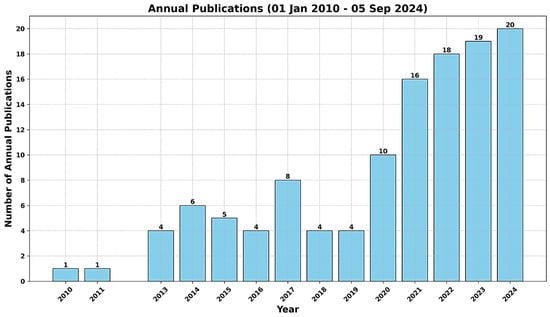
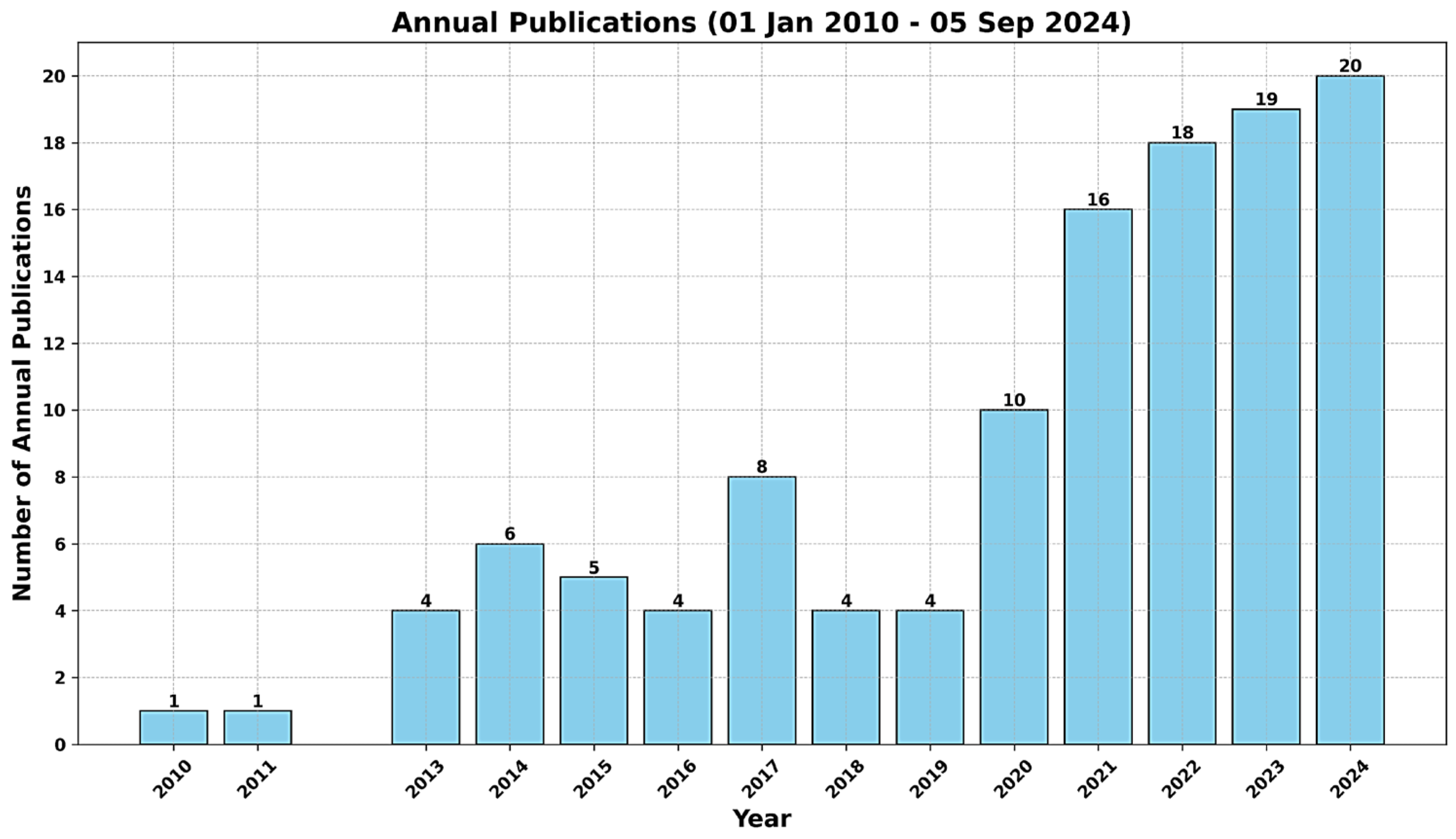
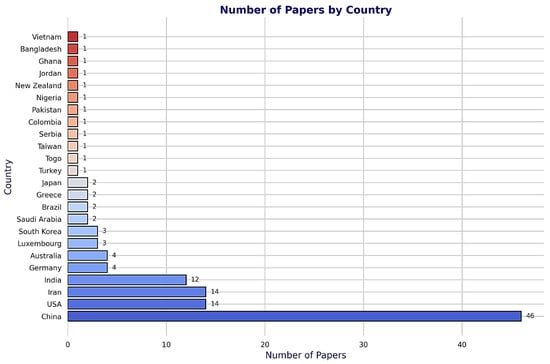
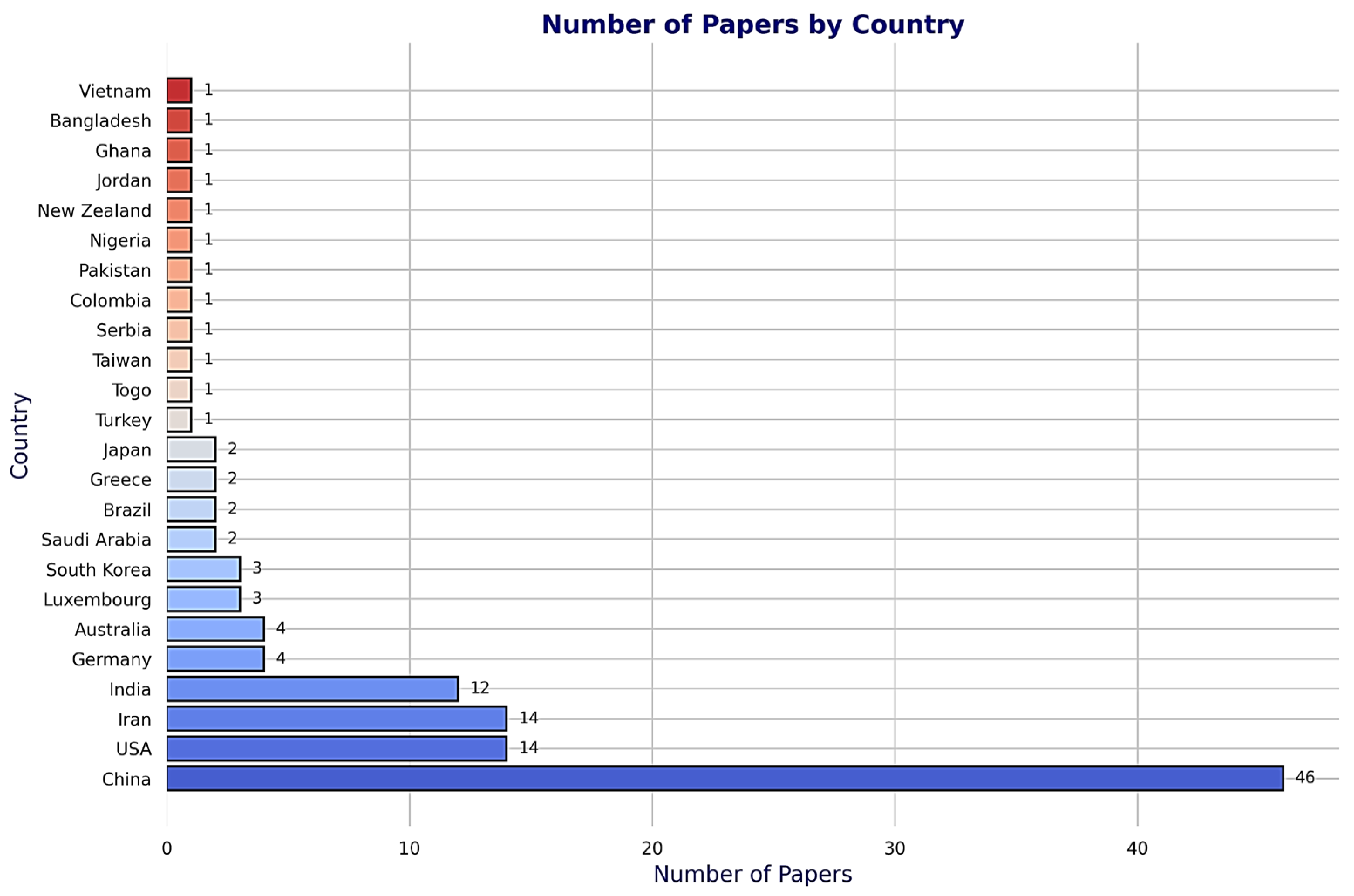
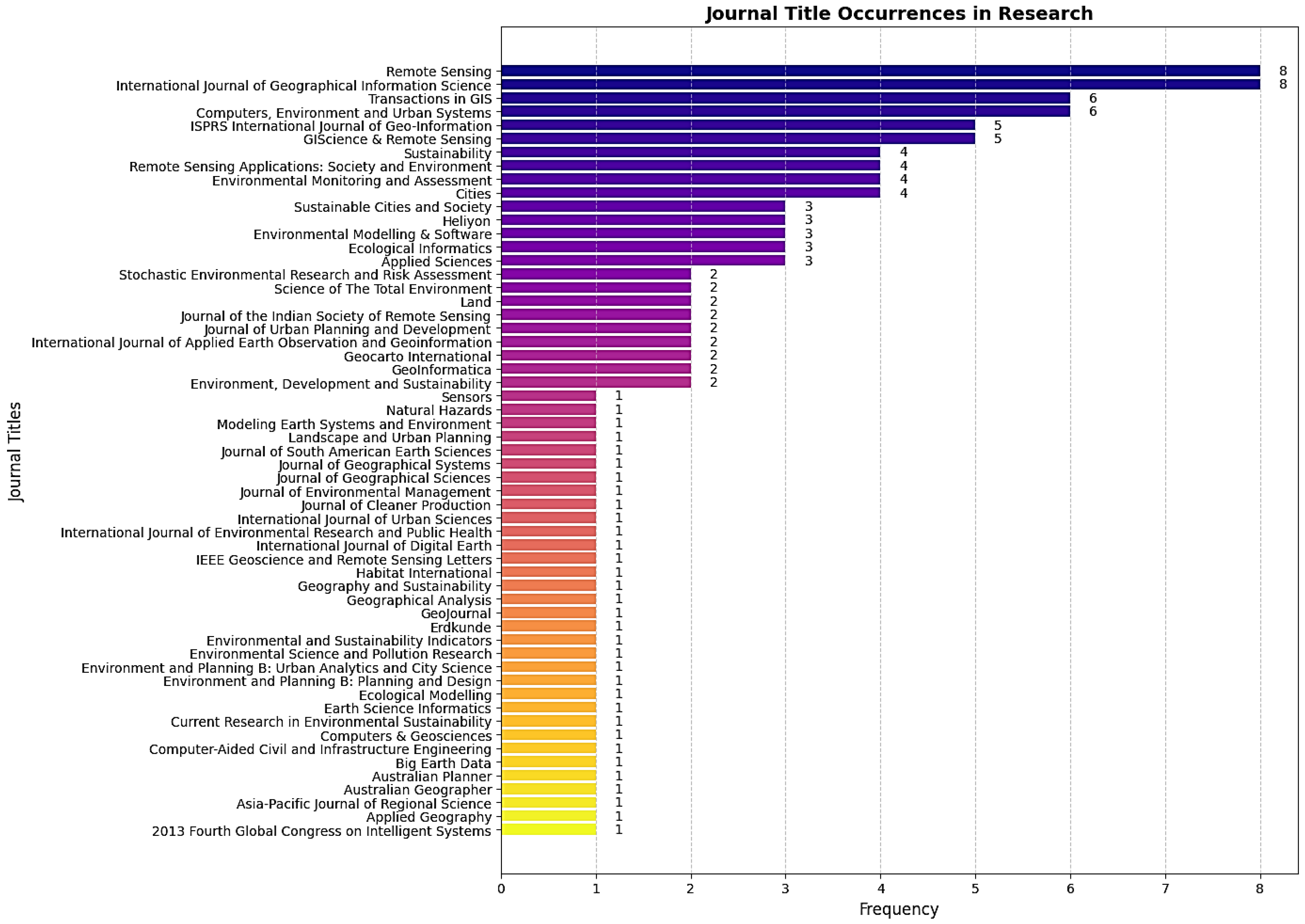
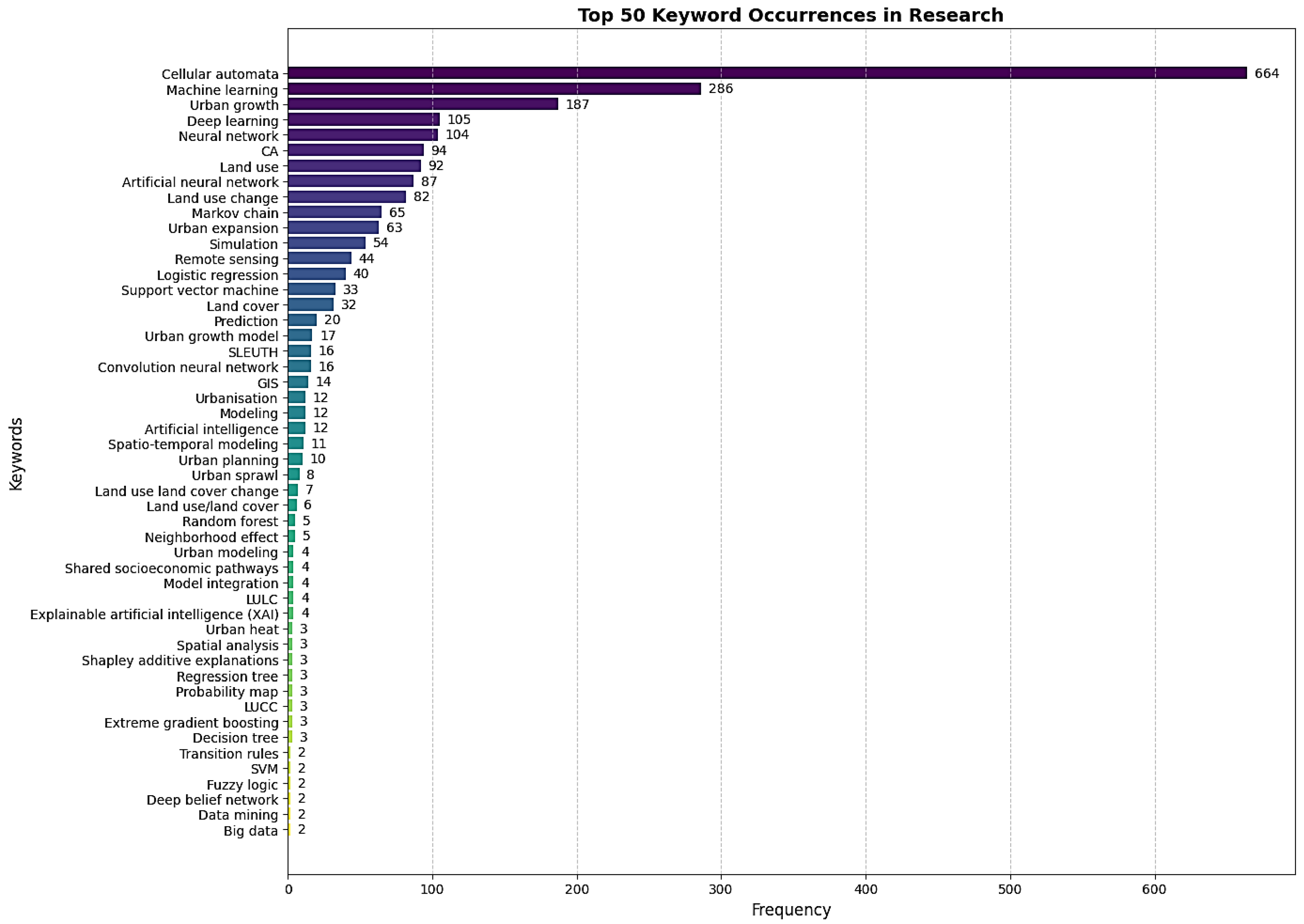
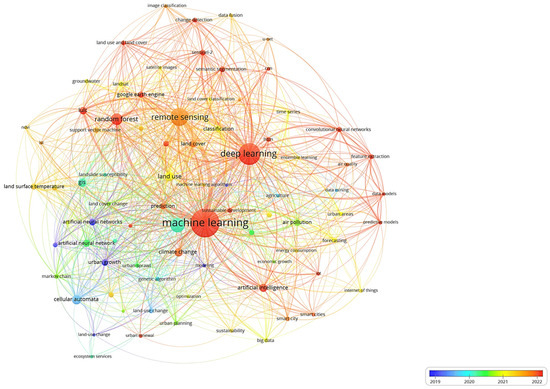
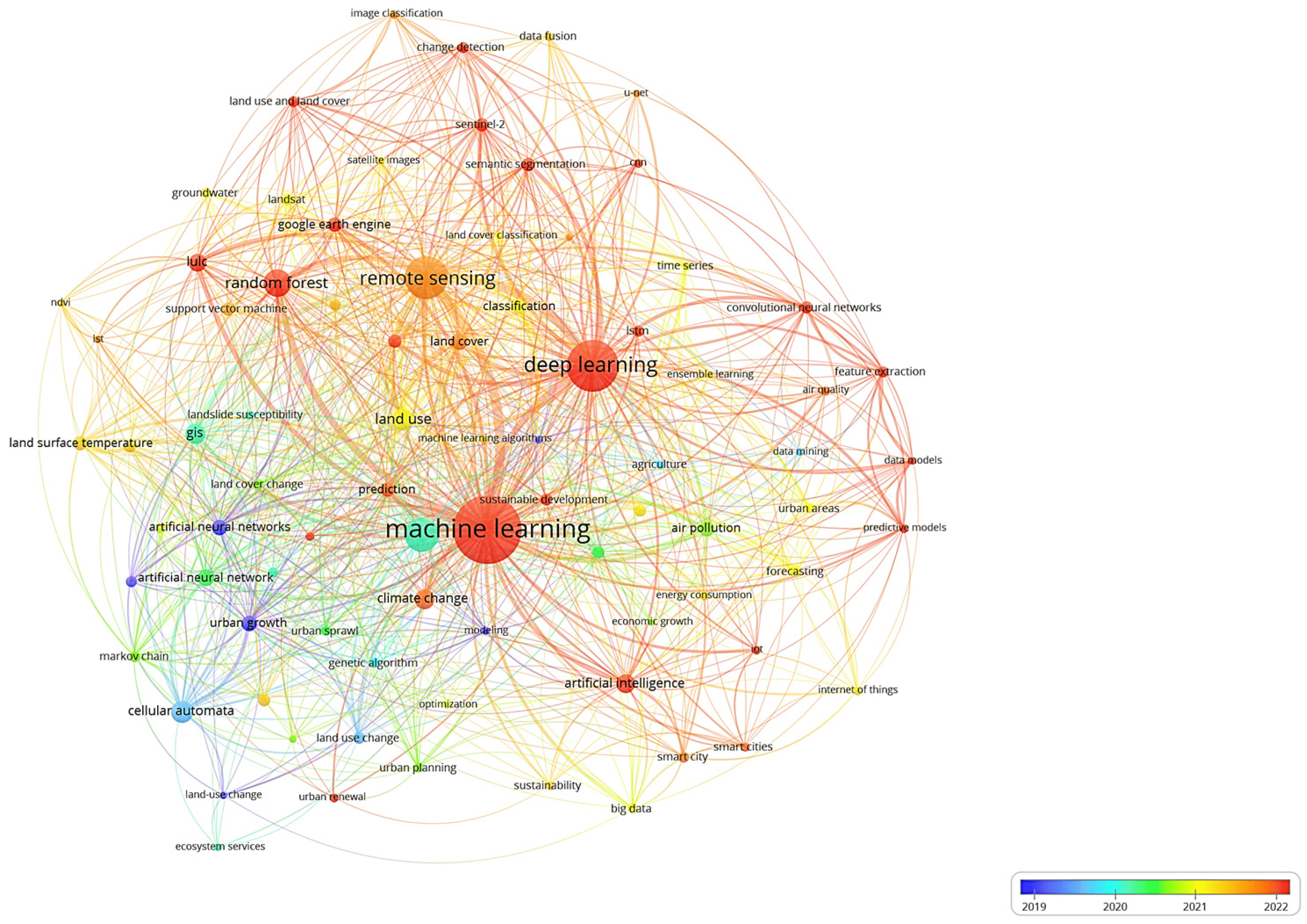
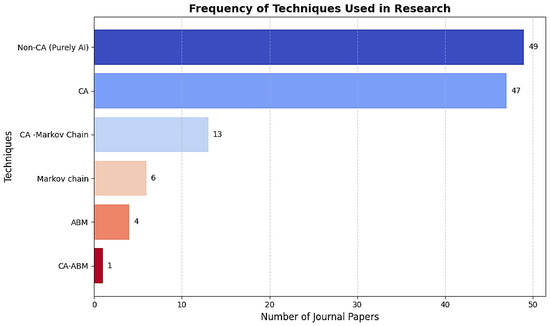
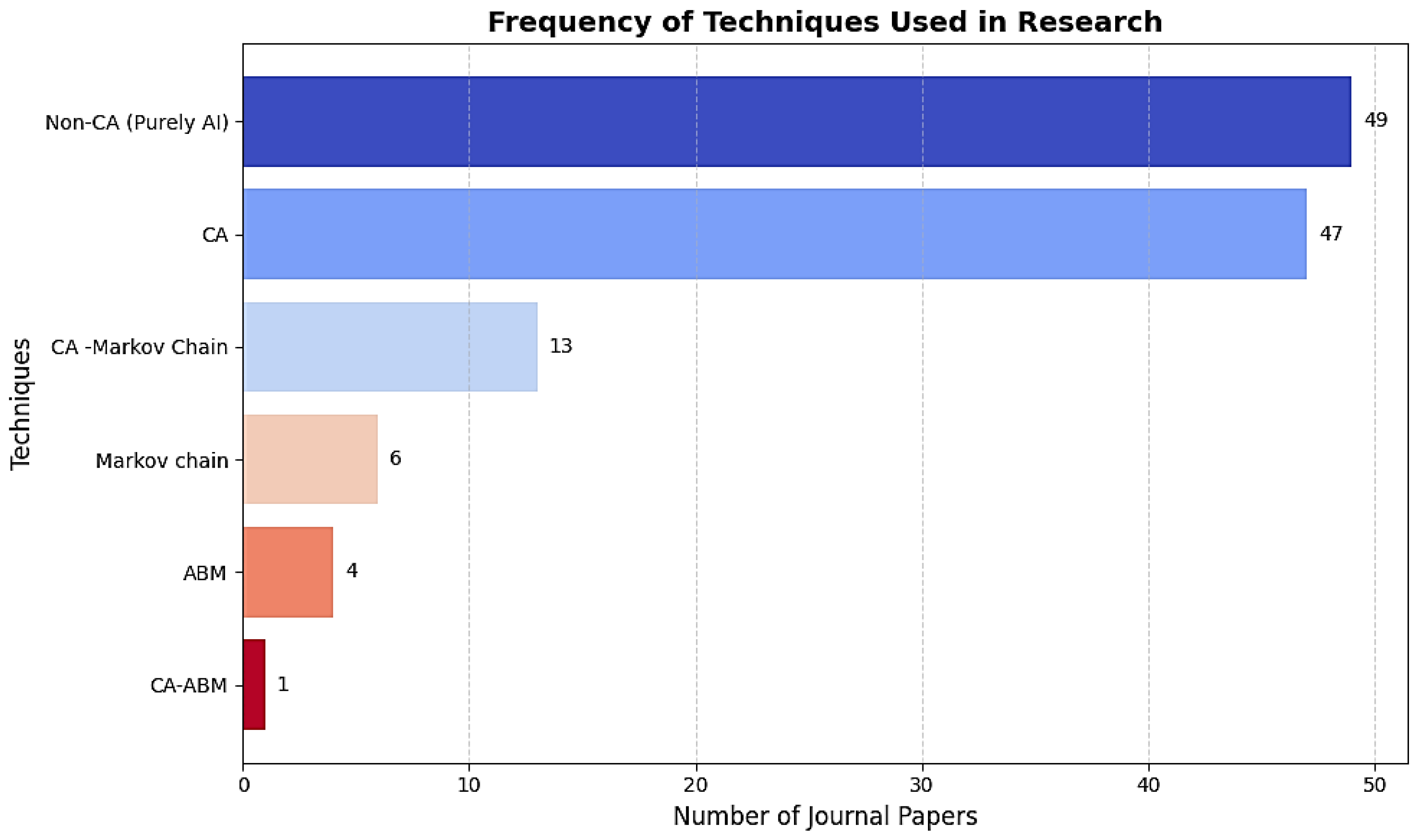
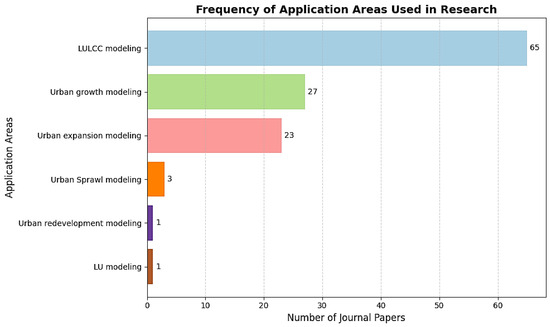
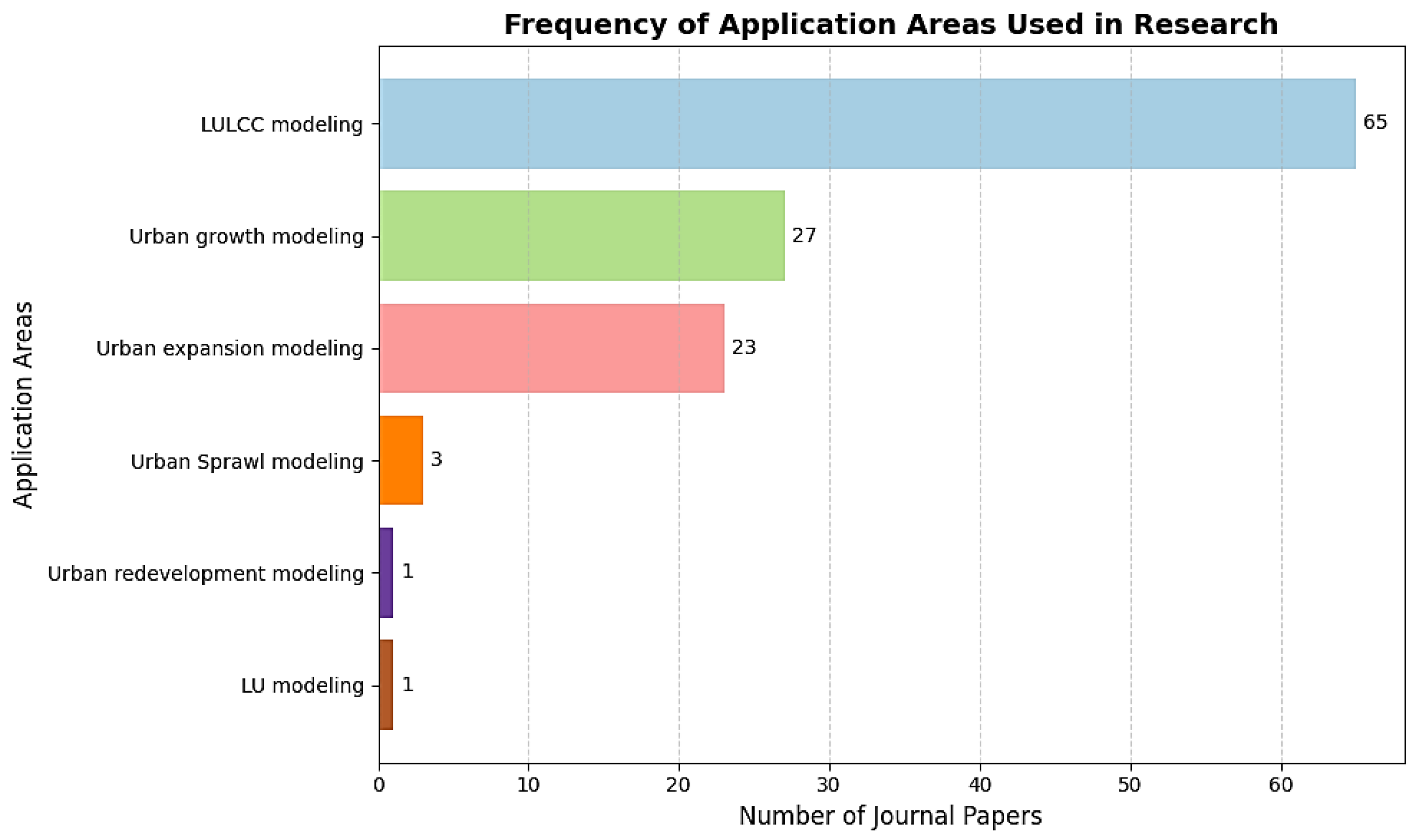

Disclaimer/Publisher’s Note: The statements, opinions and data contained in all publications are solely those of the individual author(s) and contributor(s) and not of MDPI and/or the editor(s). MDPI and/or the editor(s) disclaim responsibility for any injury to people or property resulting from any ideas, methods, instructions or products referred to in the content. |
© 2026 by the authors. Licensee MDPI, Basel, Switzerland. This article is an open access article distributed under the terms and conditions of the Creative Commons Attribution (CC BY) license.