

Cost-Effective Planning of Station-Based Car-Sharing Systems: Increasing Efficiency While Emphasizing User Comfort

Highlights
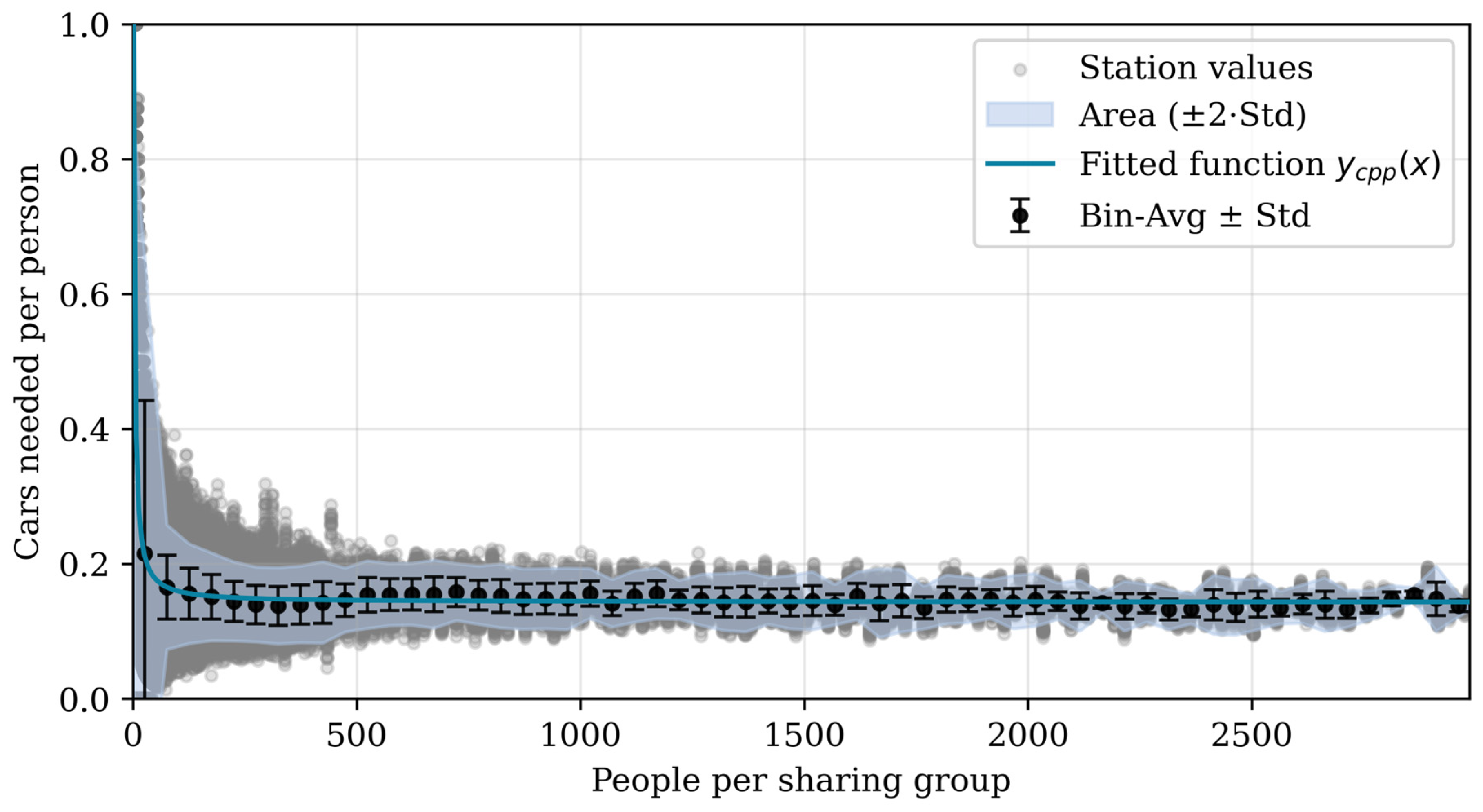
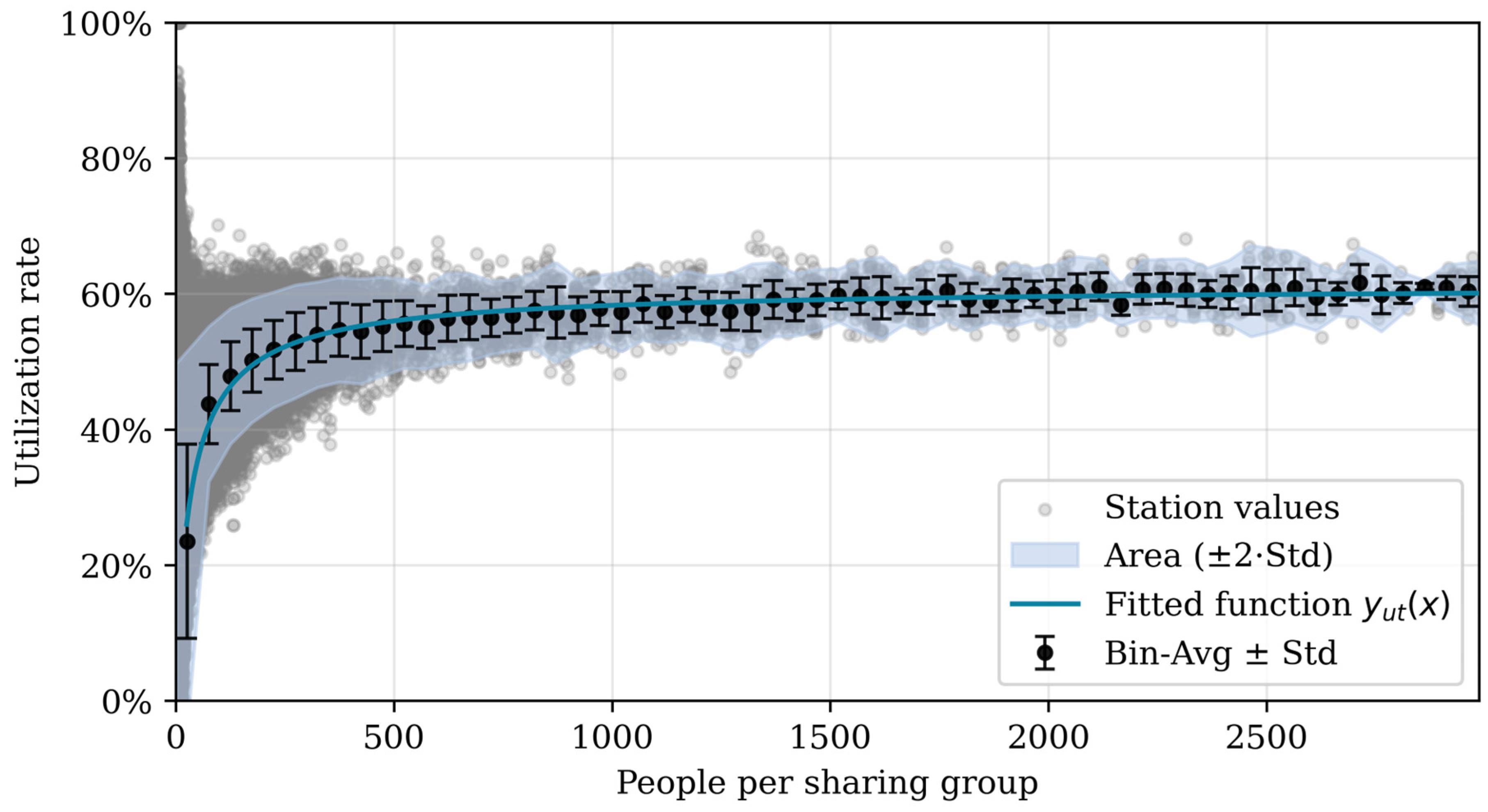
- 217 to 949 people is the ideal group size to share a car fleet.
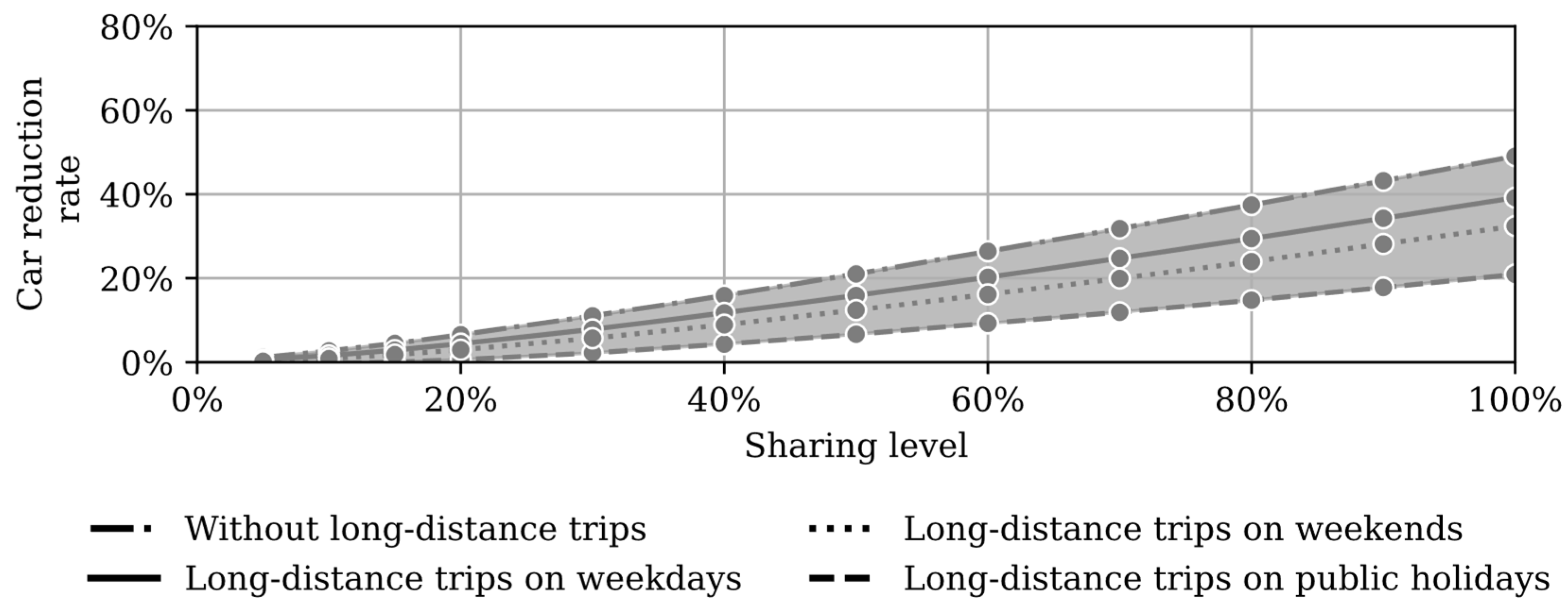
- The number of car-sharing cars needed is influenced the most by long-distance trips.
- To reduce further car-sharing costs, alternative mobility options are required for long-distance travel.
Abstract
1. Introduction
2. Literature Review
2.1. Sustainable Potential of Car-Sharing
2.2. Car-Sharing User
2.3. Residential Car-Sharing
3. Materials and Methods
3.1. Synthetic Population
3.2. Fusion with Mobility Plans
3.3. Placement of Car-Sharing Stations
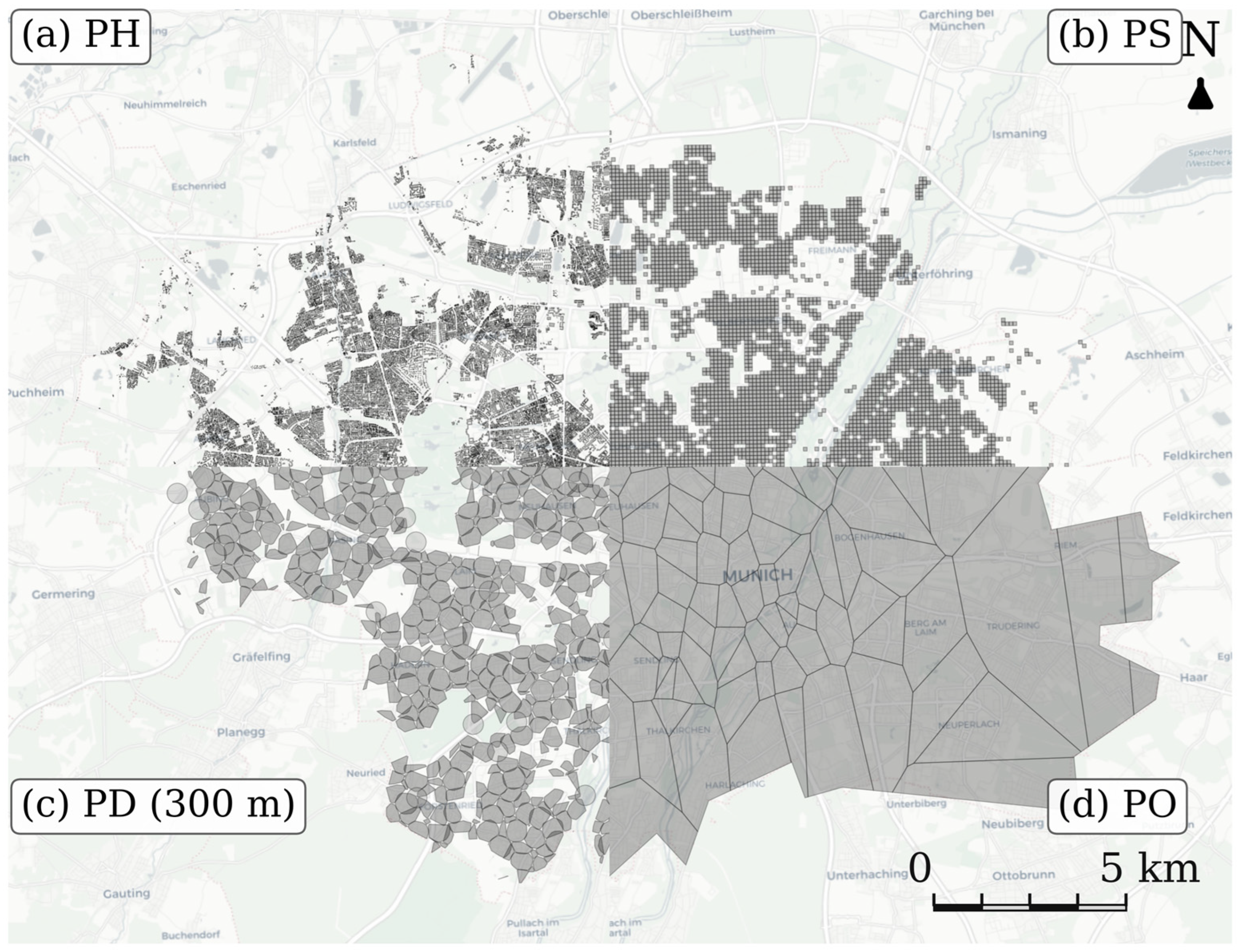
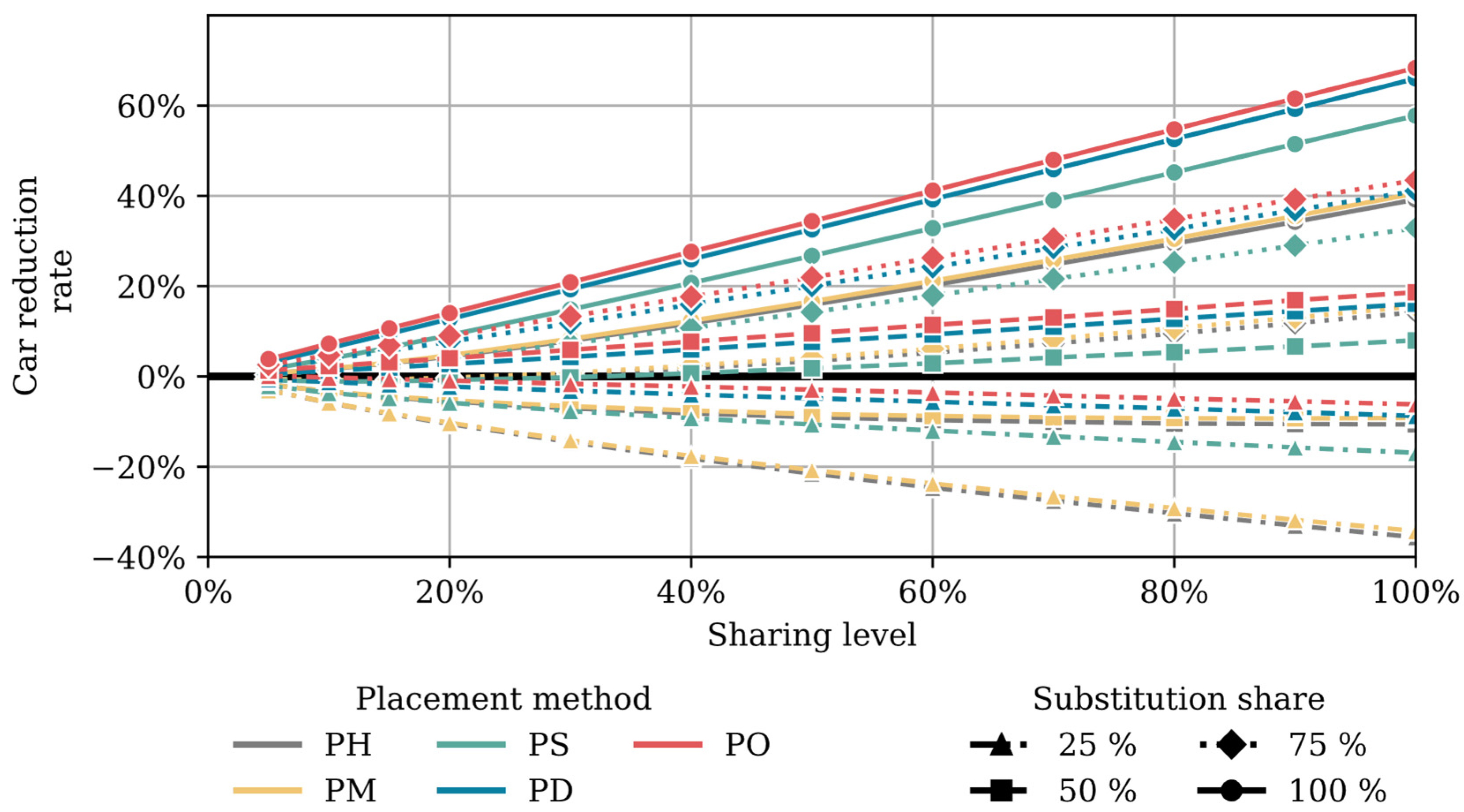
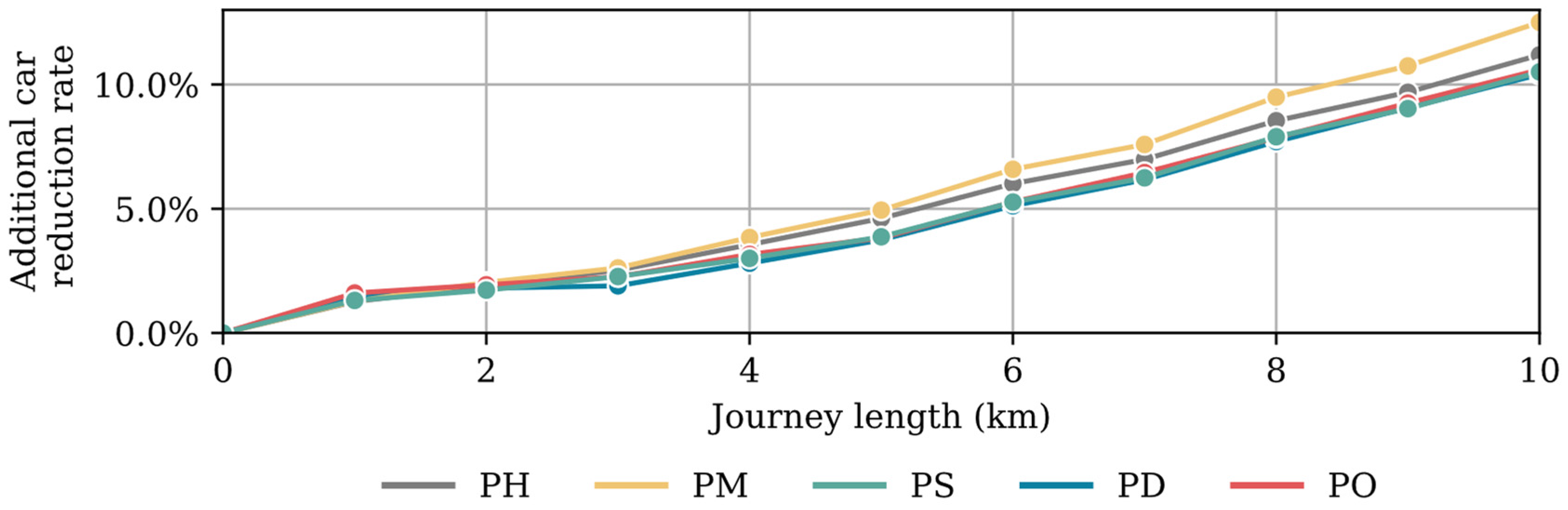
- House-based (PH): Each residential building has its own car-sharing station.
- Square-based (PS): Symmetrical placement of the stations in the center of each census square with an edge length of 100 m.
- Distance-based (PD): Placement based on maximum air distance from a residential building to the next car-sharing station. We used a classic greedy algorithm with distance clustering [37] and capacity, as well as distance limitations, to place the stations. We varied the maximum air distance within a cluster from 50 m to 425 m, which represents a maximum walking distance of 70.5 m to 600 m with a detour factor of 1.41 [38]. A distance of 600 m is the maximum distance people are willing to walk to a car-sharing station [39].
- Mixed method (PM): Does not place new stations but uses the stations of PH and PD simultaneously. This idea is based on findings from [5], which suggested designing different car-sharing fleets for different use cases. In this concept, a small car-sharing fleet, technically ideal for short-distance journeys—which are all journeys below 200 km [35], like commuting, grocery shopping, and other errands of daily life—was placed based on the PH method. A second fleet of larger cars, ideal for long-distance trips such as holidays, was placed using the PD method. The decision on which fleet to use is based on the journey length (<200 km PH, >200 km PD).
- Original placement (PO): This placement method took an existing station network [40] from the largest and only comprehensive station-based car-sharing provider in the study region as the status quo.
3.4. Usage of Cars
4. Results
4.1. Analysis on Station Level
4.2. Analysis on the City Level
5. Discussion
5.1. Discussion—Methodology
5.2. Discussion—Results
5.3. Recommendations
6. Conclusions
Author Contributions
Funding
Data Availability Statement
Acknowledgments
Conflicts of Interest
Abbreviations
| MiD | Mobilität in Deutschland |
| PD | Placement method distance-based |
| PH | Placement method house-based |
| PM | Placement mixed method |
| PO | Original placement |
| PS | Placement method square-based |
| PT | Public transport |
| SrV | Mobilität in Städten |
| Syn | Synthetic population |
References
- Kolleck, A. Does Car-Sharing Reduce Car Ownership? Empirical Evidence from Germany. Sustainability 2021, 13, 7384. [Google Scholar] [CrossRef]
- Bucsky, P.; Juhász, M. Is car ownership reduction impact of car sharing lower than expected? A Europe wide empirical evidence. Case Stud. Transp. Policy 2022, 10, 2208–2217. [Google Scholar] [CrossRef]
- Plepys, A.; Vélez, A.M.A. The environmental impacts of car sharing: Direct and indirect effects. In Understanding the Urban Sharing Economy; Edward Elgar Publishing: Cheltenham, UK, 2025; pp. 87–109. [Google Scholar] [CrossRef]
- Burlando, C.; Ivaldi, E.; Saiani, P.P.; Penco, L. To own or not to own? Car ownership and consumer awareness: Evidence from an Italian survey. Res. Transp. Bus. Manag. 2019, 33, 100435. [Google Scholar] [CrossRef]
- Nachtigall, N.; Dietermann, B.; Lienkamp, M. Design and evaluation of a closed-group, electric residential car-sharing system—Findings from a case study in Munich, Germany. Clean. Responsible Consum. 2025, 19, 100340. [Google Scholar] [CrossRef]
- Styre, E.; Johansson, F. From shared to residential mobility services? Carsharing and bike-sharing development under the influence of flexible parking requirements. Travel Behav. Soc. 2025, 39, 100968. [Google Scholar] [CrossRef]
- Katzev, R. Car Sharing: A New Approach to Urban Transportation Problems. Anal. Soc. Issues Public Policy 2003, 3, 65–86. [Google Scholar] [CrossRef]
- Shaheen, S.; Sperling, D.; Wagner, C. Carsharing in Europe and North America: Past, Present and Future. Transp. Quaterly 1998, 1998, 35–52. [Google Scholar]
- Statistisches Bundesamt (Destatis). Zensus 2022. Available online: https://www.destatis.de/DE/Themen/Gesellschaft-Umwelt/Bevoelkerung/Zensus2022/_inhalt.html (accessed on 16 December 2025).
- Schmöller, S.; Bogenberger, K. Carsharing. In Demand for Emerging Transportation Systems; Elsevier: Amsterdam, The Netherlands, 2020; pp. 211–226. [Google Scholar]
- Nijland, H.; van Meerkerk, J. Mobility and environmental impacts of car sharing in the Netherlands. Environ. Innov. Soc. Transit. 2017, 23, 84–91. [Google Scholar] [CrossRef]
- Amatuni, L.; Ottelin, J.; Steubing, B.; Mogollón, J.M. Does car sharing reduce greenhouse gas emissions? Assessing the modal shift and lifetime shift rebound effects from a life cycle perspective. J. Clean. Prod. 2020, 266, 121869. [Google Scholar] [CrossRef]
- Jung, J.; Koo, Y. Analyzing the Effects of Car Sharing Services on the Reduction of Greenhouse Gas (GHG) Emissions. Sustainability 2018, 10, 539. [Google Scholar] [CrossRef]
- Göddeke, D.; Krauss, K.; Gnann, T. What is the role of carsharing toward a more sustainable transport behavior? Analysis of data from 80 major German cities. Int. J. Sustain. Transp. 2022, 6, 861–873. [Google Scholar] [CrossRef]
- Cervero, R.; Golub, A.; Nee, B. City CarShare. Transp. Res. Rec. 2007, 1992, 70–80. [Google Scholar] [CrossRef]
- Martin, E.; Shaheen, S.A.; Lidicker, J. Impact of Carsharing on Household Vehicle Holdings. Transp. Res. Rec. 2010, 2143, 150–158. [Google Scholar] [CrossRef]
- Clewlow, R.R. Carsharing and sustainable travel behavior: Results from the San Francisco Bay Area. Transp. Policy 2016, 51, 158–164. [Google Scholar] [CrossRef]
- Lane, C. PhillyCarShare. Transp. Res. Rec. 2005, 1927, 158–166. [Google Scholar] [CrossRef]
- Strada, S.; Pagliaroli, A.; Scevaroli, S.; Savaresi, S. Addressing the Minimum Fleet Problem for a Traditional and an Autonomous Car Sharing Service Based on Real Data. In 2025 IEEE 3rd International Conference on Mobility, Operations, Services and Technologies (MOST), Newark, DE, USA, 4–7 May 2025; IEEE: New York, NY, USA, 2025; pp. 186–193. [Google Scholar]
- Namazu, M.; Dowlatabadi, H. Vehicle ownership reduction: A comparison of one-way and two-way carsharing systems. Transp. Policy 2018, 64, 38–50. [Google Scholar] [CrossRef]
- Mounce, R.; Nelson, J.D. On the potential for one-way electric vehicle car-sharing in future mobility systems. Transp. Res. Part A Policy Pract. 2019, 120, 17–30. [Google Scholar] [CrossRef]
- Kim, D.; Park, Y.; Ko, J. Factors underlying vehicle ownership reduction among carsharing users: A repeated cross-sectional analysis. Transp. Res. Part D Transp. Environ. 2019, 76, 123–137. [Google Scholar] [CrossRef]
- Mouratidis, K. Bike-sharing, car-sharing, e-scooters, and Uber: Who are the shared mobility users and where do they live? Sustain. Cities Soc. 2022, 86, 104161. [Google Scholar] [CrossRef]
- Witte, J.-J.; Kolkowski, L.; Stofberg, N.; van Wee, B.; Kroesen, M. Car sharing user groups and their changes in car ownership: A latent cluster analysis. J. Clean. Prod. 2024, 484, 144334. [Google Scholar] [CrossRef]
- Mühlematter, D.J.; Wiedemann, N.; Xin, Y.; Raubal, M. Spatially-aware station based car-sharing demand prediction. J. Transp. Geogr. 2024, 114, 103765. [Google Scholar] [CrossRef]
- Alencar, V.A.; Rooke, F.; Cocca, M.; Vassio, L.; Almeida, J.; Vieira, A.B. Characterizing client usage patterns and service demand for car-sharing systems. Inf. Syst. 2021, 98, 101448. [Google Scholar] [CrossRef]
- Hörl, S.; Balac, M. Synthetic population and travel demand for Paris and Île-de-France based on open and publicly available data. Transp. Res. Part C Emerg. Technol. 2021, 130, 103291. [Google Scholar] [CrossRef]
- OpenStreetMap. OpenStreetMap.org. Available online: https://www.openstreetmap.org/ (accessed on 18 December 2025).
- Bundesministerium für Digitales und Verkehr. Mobilität in Deutschland 2023—Ergebnisbericht; Federal Ministry of Transport: Berlin, Germany, 2025. [Google Scholar]
- Landeshaupstadt München. Mobilität in München—Ergebnisse der SrV; Professorship of Mobility Policy: Munich, Germany, 2023. [Google Scholar]
- Loder, A.; Dahmen, V.; Waldorf, I.; Martinez, S.Á.-O.; Cantner, F.; Bogenberger, K. The Mobilität. Leben Study: A 20-Month Mobility-Tracking Panel. Arbeitsberichte Mobil. Policy, 2024; preprint. [CrossRef]
- Ziegler, D.; Herbst, T.; Netzler, F.; Krapf, S.; Lienkamp, M. Enhancing Transportation Insights: A Scalable OpenStreetMap Harmonization and Synthesis Framework. In 2024 IEEE 27th International Conference on Intelligent Transportation Systems (ITSC), Edmonton, AB, Canada, 24–27 September 2024; IEEE: New York, NY, USA, 2024; pp. 3872–3879. [Google Scholar]
- GeoDatenService. Indikatorenatlas München: Verkehr. Available online: https://mstatistik.muenchen.de/indikatorenatlas/export/export.php (accessed on 18 December 2025).
- Aultman-Hall, L.; Harvey, C.; LaMondia, J.J.; Ritter, C. Design and Response Quality in a One-Year Longitudinal Survey of Overnight and Long-Distance Travel. Transp. Res. Procedia 2015, 11, 136–153. [Google Scholar] [CrossRef][Green Version]
- Nachtigall, N.; Magdolen, M.; Lienkamp, M. Seasonal Trends and Sociodemographic Influences on Long-Distance Trips—A Full Year of GPS Tracking Data from Munich. EJTIR 2025, 25, 122–146. [Google Scholar] [CrossRef]
- Axhausen, K.W.; Madre, J.-L.; Polak, J.W.; Toint, P.L. (Eds.) Capturing Long-Distance Travel; Research Studies Press: West Sussex, UK, 2003. [Google Scholar]
- Black, P.E. Greedy Algorithm. Available online: https://www.nist.gov/dads/HTML/greedyalgo.html (accessed on 11 March 2026).
- Ortega, D.; Korutcheva, E. Exploring the interplay between population profile and optimal routes in U.S. cities. Sci. Rep. 2025, 15, 16094. [Google Scholar] [CrossRef] [PubMed]
- Albrecht, T.; Keller, R.; Röglinger, M.; Röhrich, F. Are we there yet? Analyzing the role of access distance in carsharing in small urban areas. J. Clean. Prod. 2025, 489, 144660. [Google Scholar] [CrossRef]
- Stattauto München. Stationen. Available online: https://www.stattauto-muenchen.de/stationen-nach-namen/ (accessed on 10 November 2025).
- Wieler, J. Test E-Autos: So hoch sind die Reichweite und Verbrauch wirklich. Available online: https://www.adac.de/rund-ums-fahrzeug/elektromobilitaet/elektroauto/stromverbrauch-elektroautos-adac-test/ (accessed on 17 March 2026).
- Ho, C.; Mulley, C. Tour-based mode choice of joint household travel patterns on weekend and weekday. Transportation 2013, 40, 789–811. [Google Scholar] [CrossRef]
- Nachtigall, N.; Lienkamp, M. Designing Residential Car-Sharing Services: A Data-Driven Approach Based on Residents’ Mobility Behavior in Munich. In Proceedings of the Transportation Research Symposium 2025, Rotterdam, The Netherlands, 25–28 May 2025. [Google Scholar]
- Turoń, K. Multi-Criteria Decision Analysis during Selection of Vehicles for Car-Sharing Services—Regular Users’ Expectations. Energies 2022, 15, 7277. [Google Scholar] [CrossRef]
- Turoń, K. Selection of Car Models with a Classic and Alternative Drive to the Car-Sharing Services from the System’s Rare Users Perspective. Energies 2022, 15, 6876. [Google Scholar] [CrossRef]
- Dargay, J.M.; Clark, S. The determinants of long distance travel in Great Britain. Transp. Res. Part A Policy Pract. 2012, 46, 576–587. [Google Scholar] [CrossRef]




| Weekday | Weekend | Public Holiday | |
|---|---|---|---|
| People on long-distance travel | 13.7% | 20.6% | 37.7% |
| by car: | |||
| Non-car owners | 27.3% | 31.7% | 33.2% |
| Car owners | 54.7% | 62.6% | 65.3% |
| Method Description | Acronym | Resulting Station Amount | Resulting Average Walking Distance |
|---|---|---|---|
| House-based | PH | 139,069 | ~0 m |
| Square-based (100 m × 100 m) | PS | 15,699 | ~57 m |
| Distance-based (e.g., 300 m) | PD | 1596 | ~231 m |
| Mixed method | PM | 139,069 + 1596 | ~0 m–231 m |
| Original placement | PO | 106 | ~1161 m |
| Default Values | Unit | Set | |
|---|---|---|---|
| General parameter: | |||
| Mobility dataset | mixed | {SrV, MiD, mixed} | |
| Placement method | - | {PH, PS, PD, PM, PO} | |
| Sharing ratio | 100 | percent | [5, 100] |
| Substitution ratio | 100 | percent | [0, 100] |
| Electric cars | False | - | {True, False} |
| Switch time | 15 | minute | [5, 15] |
| Distance threshold for long-distance tour | 200 | kilometer | |
| Journey substitution | False | - | {True, False} |
| Tour distance until substitution with dif. mode | 0 | kilometer | [0, 10] |
| Long-distance share | weekdays | - | {Weekdays, weekends, public holidays, none} |
| Placement parameter: | |||
| Max. walking distance | 300 | meter | [50, 425] |
| People capacity per station | Inf | - | [20, inf) |
Disclaimer/Publisher’s Note: The statements, opinions and data contained in all publications are solely those of the individual author(s) and contributor(s) and not of MDPI and/or the editor(s). MDPI and/or the editor(s) disclaim responsibility for any injury to people or property resulting from any ideas, methods, instructions or products referred to in the content. |
© 2026 by the authors. Licensee MDPI, Basel, Switzerland. This article is an open access article distributed under the terms and conditions of the Creative Commons Attribution (CC BY) license.
Share and Cite
Nachtigall, N.; Lienkamp, M. Cost-Effective Planning of Station-Based Car-Sharing Systems: Increasing Efficiency While Emphasizing User Comfort. Smart Cities 2026, 9, 60. https://doi.org/10.3390/smartcities9040060
Nachtigall N, Lienkamp M. Cost-Effective Planning of Station-Based Car-Sharing Systems: Increasing Efficiency While Emphasizing User Comfort. Smart Cities. 2026; 9(4):60. https://doi.org/10.3390/smartcities9040060
Chicago/Turabian StyleNachtigall, Nico, and Markus Lienkamp. 2026. "Cost-Effective Planning of Station-Based Car-Sharing Systems: Increasing Efficiency While Emphasizing User Comfort" Smart Cities 9, no. 4: 60. https://doi.org/10.3390/smartcities9040060
APA StyleNachtigall, N., & Lienkamp, M. (2026). Cost-Effective Planning of Station-Based Car-Sharing Systems: Increasing Efficiency While Emphasizing User Comfort. Smart Cities, 9(4), 60. https://doi.org/10.3390/smartcities9040060