
Detection of P-Wave Arrival as a Structural Transition in Seismic Signals: An Approach Based on SVD Entropy
 , , , , , , , ,
  and
and
Highlights
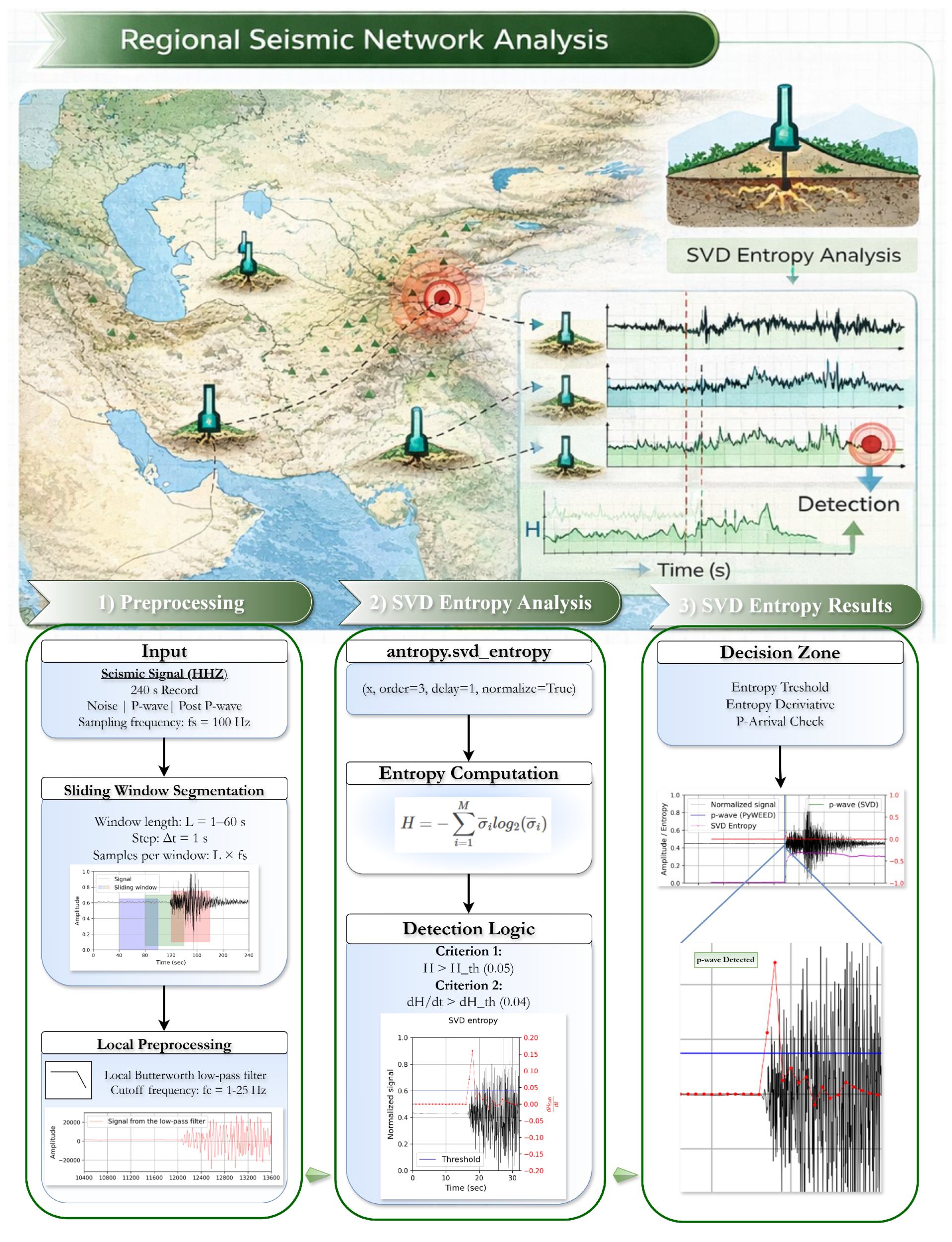
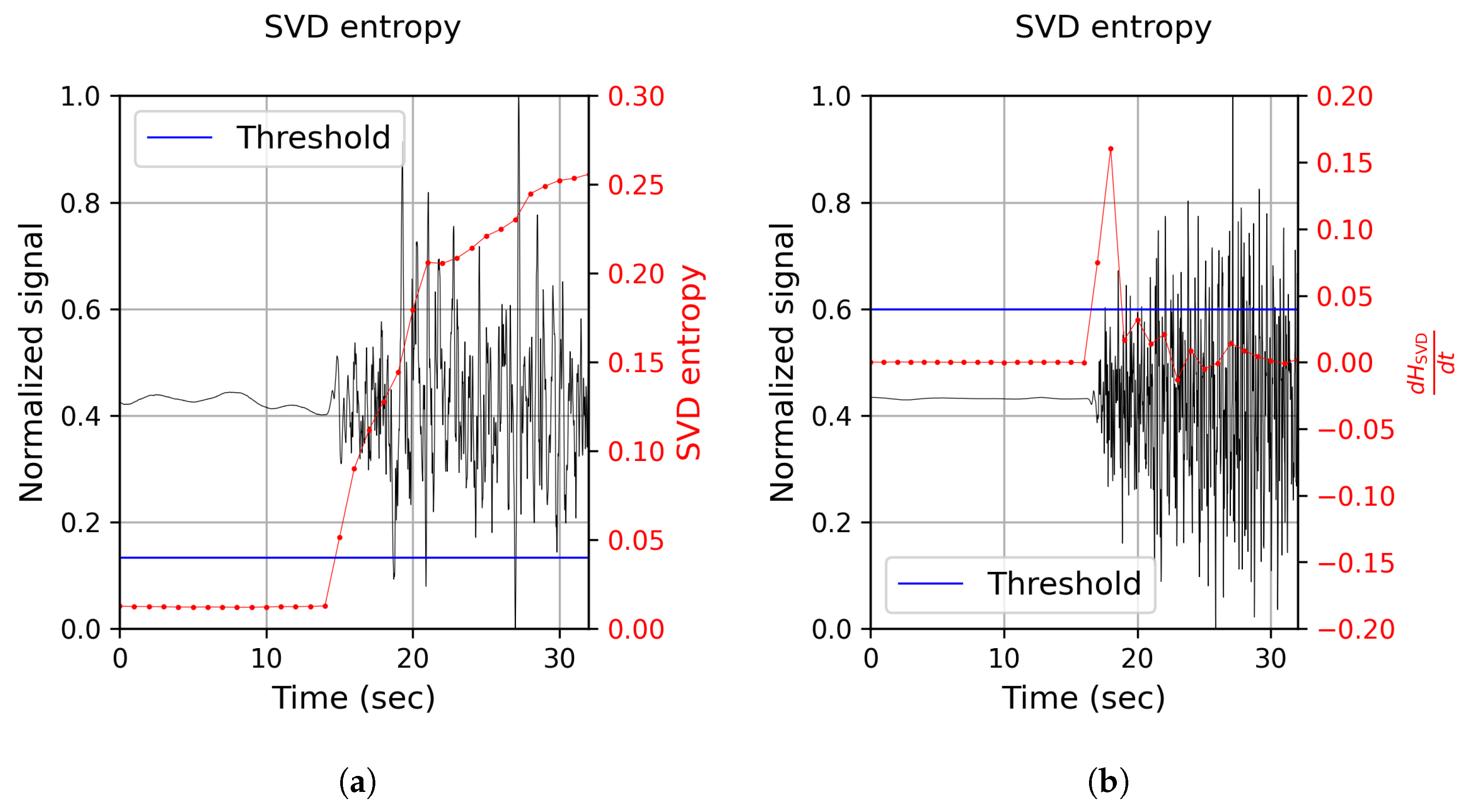
- P-wave arrival is identified as a structural transition in seismic signals using SVD entropy rather than energy growth.
- Reliable detection accuracy of 93–98% is achieved at low signal-to-noise ratios () without any model training or labeled data.
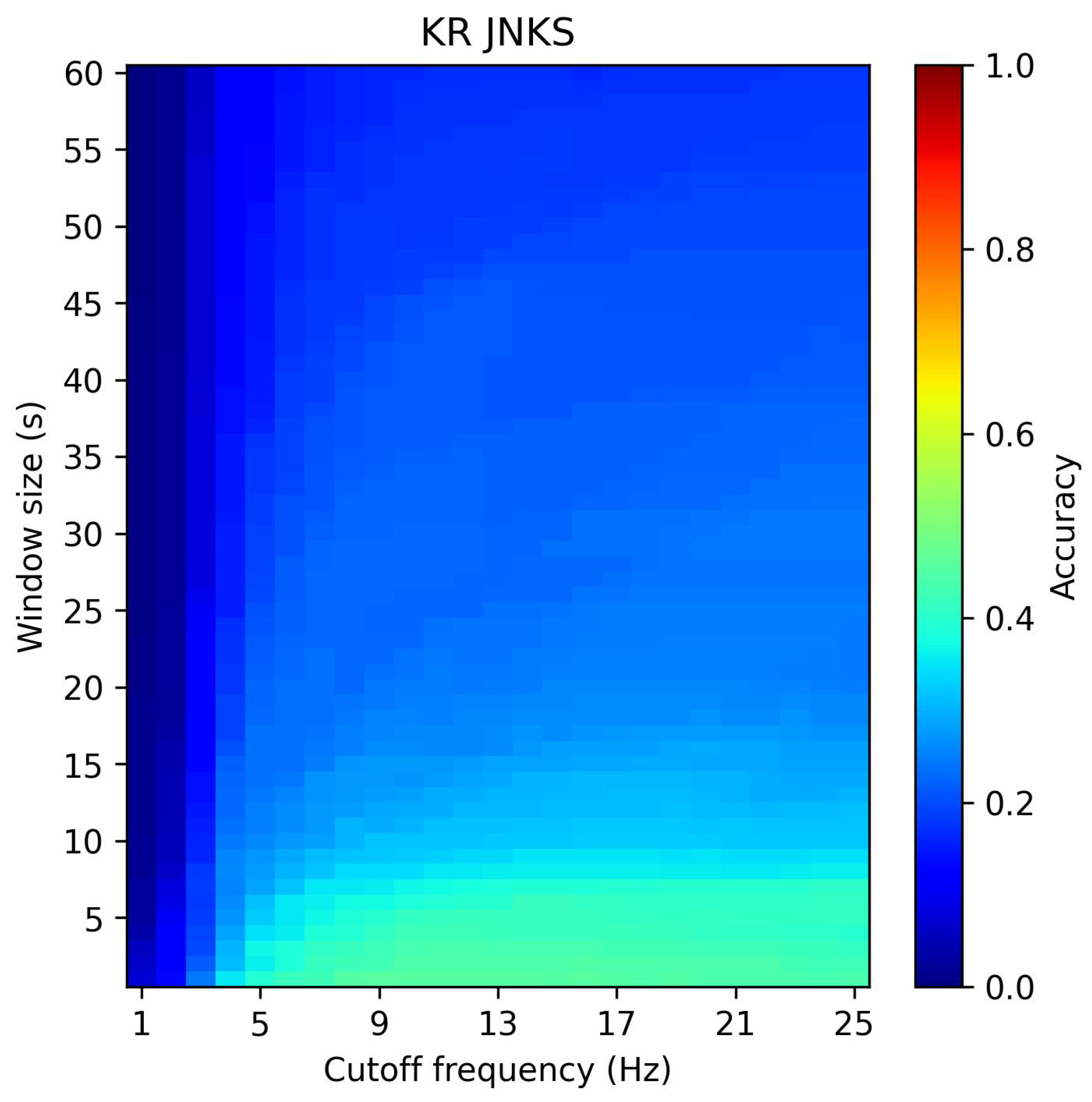
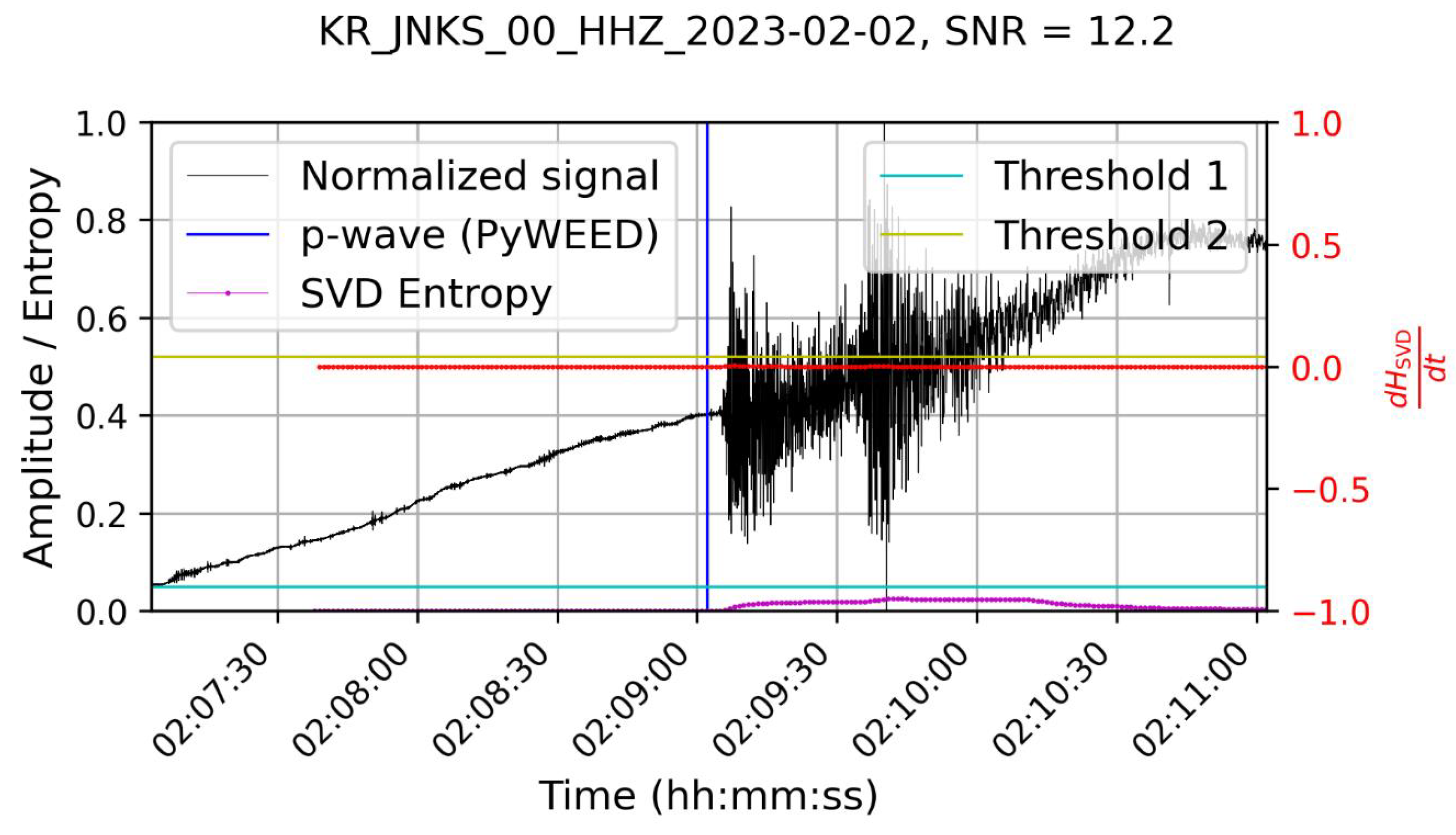
- Low-frequency signal drift can degrade entropy-based detection at the JNKS station, but polynomial detrending restores sensitivity, enabling accurate P-wave detection comparable to other stations. This underscores the importance of proper preprocessing in entropy-based seismic analysis.
- The method is suitable for deployment on distributed IoT/edge seismic sensors within smart city earthquake early warning networks.
- Station-dependent parameter tuning and simple preprocessing (e.g., polynomial detrending) enable robust operation in real urban noise conditions.
- Station-dependent parameter sensitivity highlights the need for adaptive detection strategies. While universal parameters can work, station-specific calibration ensures highest reliability, suggesting future early warning systems should include automatic tuning and preprocessing diagnostics.
Abstract
1. Introduction
2. Materials and Methods
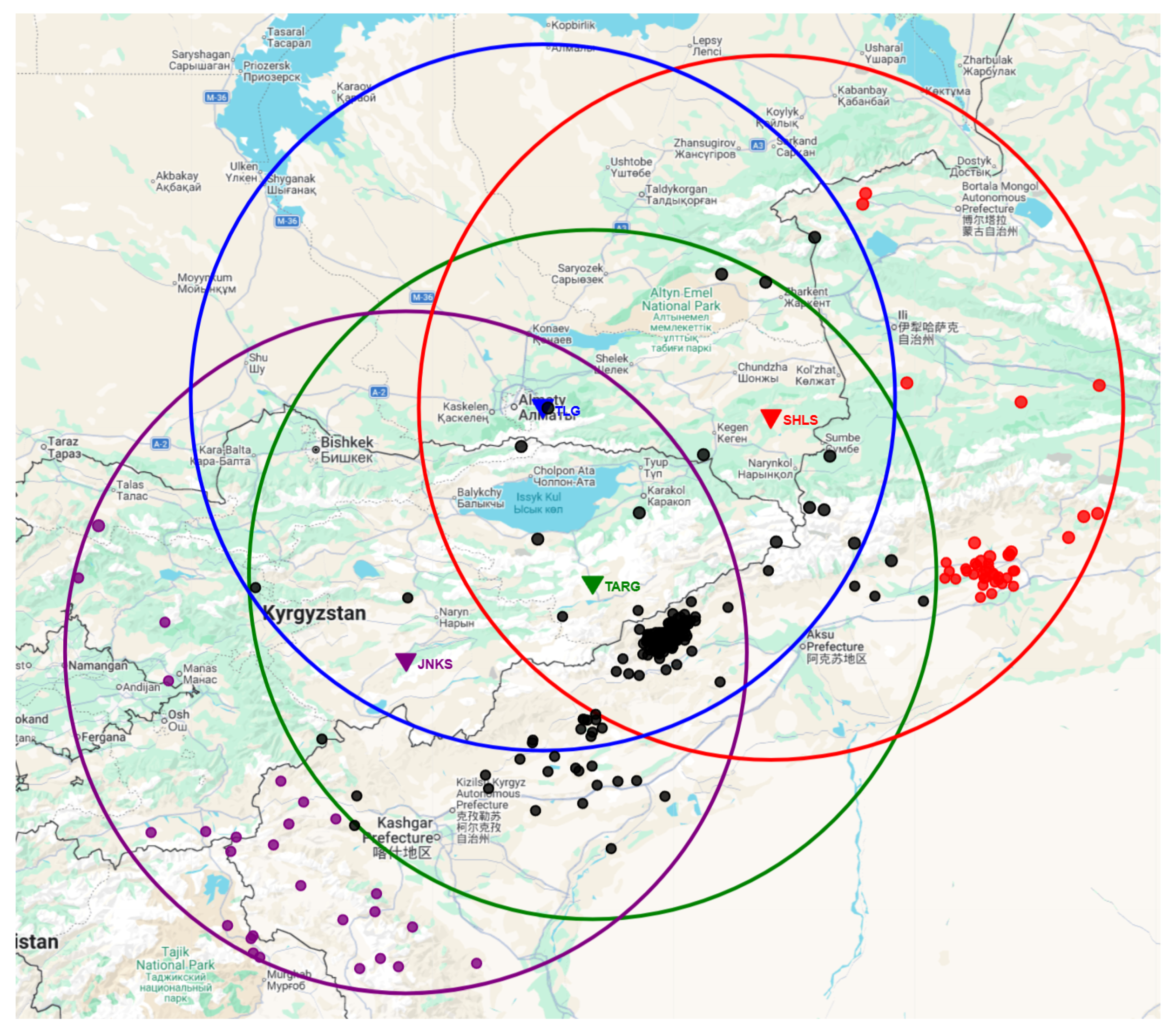
2.1. Dataset Description
- -
- Magnitude: min −2.0, max 10.0
- -
- Depth (km): min 0.0, max 6800.0
- -
- Distance to station: radius 333 km (3°)
- -
- Signal-to-noise requirements: no explicit SNR-based selection; all recorded events in different ranges were included
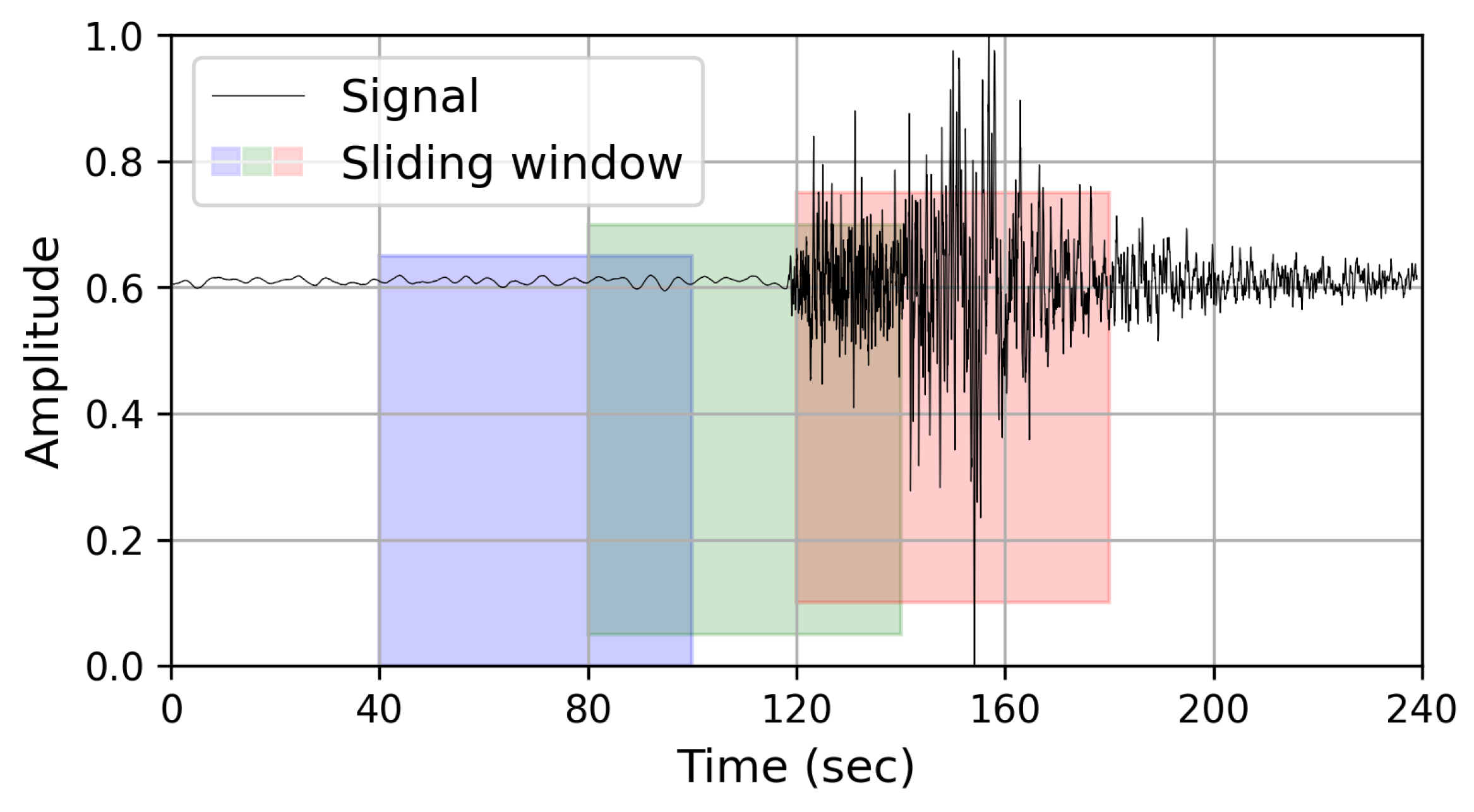
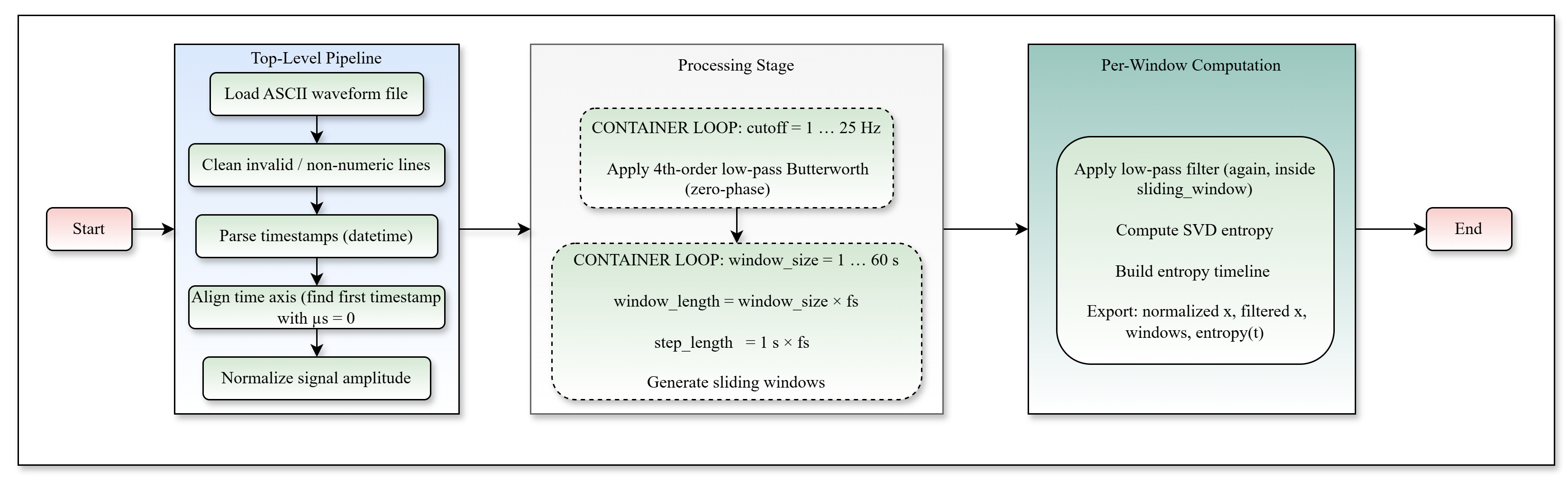
2.2. Sliding-Window Segmentation
2.3. Signal Preprocessing
2.4. SVD-Entropy Computation
2.5. Threshold and Derivative Based Detection Criteria
2.6. Parameter-Space Exploration
3. Results
3.1. Evaluation Framework
3.2. Sensitivity and Parameter-Space Analysis
3.3. Detection Scenarios Under Different SNR Conditions
4. Discussion
Polynomial Detrending. Pre-Processing Stage for JNKS Stations
5. Conclusions
Author Contributions
Funding
Data Availability Statement
Acknowledgments
Conflicts of Interest
Abbreviations
| SVD | Singular value decomposition |
| SNR | Signal-to-Noise Ratio |
References
- Xu, R.; Feng, B.; Wang, H.; Wu, C.; Nie, Z. Nonlinear Seismic Signal Denoising Using Template Matching with Time Difference Detection Method. Remote Sens. 2025, 17, 674. [Google Scholar] [CrossRef]
- Zhou, H.L.; Wang, C.C.; Marfurt, K.J.; Jiang, Y.W.; Bi, J.X. Enhancing the resolution of non-stationary seismic data using improved time–frequency spectral modelling. Geophys. Suppl. Mon. Not. R. Astron. Soc. 2016, 205, 203–219. [Google Scholar] [CrossRef]
- Aggarwal, K.; Mukhopadhyay, S.; Tangirala, A.K. Rigorous Predictive Noise Modeling Approach for Model-Based Onset Detection and Enhanced Picking of P-Waves in Seismic Signals. IEEE Access 2022, 10, 31084–31102. [Google Scholar] [CrossRef]
- Li, Z.; Gao, J.; Wang, Z.; Liu, N.; Sun, F. Time-frequency analysis of seismic data for the characterization of geologic structures via synchro-extracting transform. J. Seism. Explor. 2021, 30, 101–120. [Google Scholar]
- Mousavi, S.M.; Zhu, W.; Sheng, Y.; Beroza, G.C. CRED: A Deep Residual Network of Convolutional and Recurrent Units for Earthquake Signal Detection. Sci. Rep. 2019, 9, 10267. [Google Scholar] [CrossRef]
- Ghaderpour, E.; Liao, W.; Lamoureux, M.P. Antileakage least-squares spectral analysis for seismic data regularization and random noise attenuation. Geophysics 2018, 83, V157–V170. [Google Scholar] [CrossRef]
- Li, J.; He, M.; Cui, G.; Wang, X.; Wang, W.; Wang, J. A Novel Method of Seismic Signal Detection Using Waveform Features. Appl. Sci. 2020, 10, 2919. [Google Scholar] [CrossRef]
- Li, J.; He, M.; Cui, G.; Wang, X.; Wang, W.; Wang, J. P-detector: Real-time P-wave detection in a seismic waveform recorded on a low-cost MEMS accelerometer using deep learning. IEEE Geosci. Remote Sens. Lett. 2022, 19, 3006305. [Google Scholar]
- Wibowo, A.; Heliani, L.S.; Pratama, C.; Sahara, D.P.; Widiyantoro, S.; Ramdani, D.; Bisri, M.B.F.; Sudrajat, A.; Wibowo, S.T.; Purnama, S.R. Deep learning for real-time P-wave detection: A case study in Indonesia’s earthquake early warning system. Appl. Comput. Geosci. 2024, 24, 100194. [Google Scholar] [CrossRef]
- Cremen, G.; Galasso, C. Earthquake early warning: Recent advances and perspectives. Earth-Sci. Rev. 2020, 205, 103184. [Google Scholar] [CrossRef]
- Rudyanto, A.; Wijaya, A.; Widiyantoro, S.; Sahara, D.P.; Rosalia, S.; Wibowo, A.; Pramono, S.; Putra, A.S. Performance test of pilot Earthquake Early Warning system in western Java, Indonesia. Int. J. Disaster Risk Reduct. 2024, 115, 105010. [Google Scholar] [CrossRef]
- Cassidy, J.F.; Mulder, T.L. Seismicity and seismic monitoring of Canada’s volcanic zones. Can. J. Earth Sci. 2024, 61, 248–269. [Google Scholar] [CrossRef]
- Hou, B.; Zhou, Y.; Li, S.; Wei, Y.; Song, J. Real-time earthquake magnitude estimation via a deep learning network based on waveform and text mixed modal. Earth Planets Space 2024, 76, 58. [Google Scholar] [CrossRef]
- Rey-Devesa, P.; Benítez, C.; Prudencio, J.; Gutiérrez, L.; Cortés-Moreno, G.; Titos, M.; Koulakov, I.; Zuccarello, L.; Ibáñez, J.M. Volcanic early warning using Shannon entropy: Multiple cases of study. J. Geophys. Res. Solid Earth 2023, 128, e2023JB026684. [Google Scholar] [CrossRef]
- Wu, Y.-H.; Kanamori, H.; Allen, R.M.; Hauksson, E. Determination of earthquake early warning parameters, τc and Pd, for southern California. Geophys. J. Int. 2007, 170, 711–717. [Google Scholar] [CrossRef]
- Wu, Y.M.; Kanamori, H. Development of an Earthquake Early Warning System Using Real-Time Strong Motion Signals. Sensors 2008, 8, 1–9. [Google Scholar] [CrossRef] [PubMed]
- Kuyuk, H.S.; Susumu, O. Real-time classification of earthquake using deep learning. Procedia Comput. Sci. 2018, 140, 298–305. [Google Scholar] [CrossRef]
- Chandrakumar, C.; Tan, M.L.; Holden, C.; Stephens, M.; Punchihewa, A.; Prasanna, R. Estimating S-wave amplitude for earthquake early warning in New Zealand: Leveraging the first 3 seconds of P-Wave. Earth Sci. Inf. 2024, 17, 4527–4554. [Google Scholar] [CrossRef]
- Zali, Z.; Rein, T.; Krüger, F.; Ohrnberger, M.; Scherbaum, F. Ocean bottom seismometer (OBS) noise reduction from horizontal and vertical components using harmonic–percussive separation algorithms. Solid Earth 2023, 14, 181–195. [Google Scholar] [CrossRef]
- Lythgoe, K.; Loasby, A.; Hidayat, D.; Wei, S. Seismic event detection in urban Singapore using a nodal array and frequency domain array detector: Earthquakes, blasts and thunderquakes. Geophys. J. Int. 2021, 226, 1542–1557. [Google Scholar] [CrossRef]
- Zhu, W.; Beroza, G.C. PhaseNet: A deep-neural-network-based seismic arrival-time picking method. Geophys. J. Int. 2019, 216, 261–273. [Google Scholar] [CrossRef]
- Cao, H.; Xu, B.; Wang, C.; Hu, J.; Wang, Q.; Feng, J. Automatic seismic event detection in low signal-to-noise ratio seismic signal based on a deep residual shrinkage network. Comput. Geosci. 2025, 196, 105868. [Google Scholar] [CrossRef]
- Katoh, S.; Iio, Y.; Nagao, H.; Katao, H.; Sawada, M.; Tomisaka, K. SegPhase: Development of arrival time picking models for Japan’s seismic network using the hierarchical vision transformer. Earth Planets Space 2025, 77, 118. [Google Scholar] [CrossRef]
- Alsulami, A.; Al-Qadasi, B.; Usman, M.; Waheed, U.B. Generation and evaluation of synthetic low-magnitude Earthquake data using auxiliary classifier GAN. Earth Space Sci. 2025, 12, e2024EA004064. [Google Scholar] [CrossRef]
- Cai, J.; Duan, Z.; Yan, F.; Zhang, Y.; Mu, R.; Cai, H.; Ding, Z. Seismic events based on relative Automatic arrival-time picking of P- and S-waves of micro standard generative adversarial network and GHRA. J. Petrol. Explor. Prod. Technol. 2024, 14, 2199–2218. [Google Scholar] [CrossRef]
- Sleeman, R.; Van Eck, T. Robust automatic P-phase picking: An on-line implementation in the analysis of broadband seismogram recordings. Phys. Earth Planet. Inter. 1999, 113, 265–275. [Google Scholar] [CrossRef]
- Zhou, L.; Peng, P.; Wang, L.; Meng, H.; Wu, Z. Automated P-wave arrival picking in microseismic monitoring: Integrating multi-feature clustering and enhanced AIC-STA/LTA. Measurement 2025, 256, 118143. [Google Scholar] [CrossRef]
- Zhexebay, D.; Skabylov, A.; Ibraimov, M.; Khokhlov, S.; Agishev, A.; Kudaibergenova, G.; Orazakova, A.; Agishev, A. Deep Learning for Early Earthquake Detection: Application of Convolutional Neural Networks for P-Wave Detection. Appl. Sci. 2025, 15, 3864. [Google Scholar] [CrossRef]
- Skabylov, A.; Zhexebay, D.; Khokhlov, S.; Agishev, A.; Abdizhalilova, L.; Zhakipova, M.; Azamat, R.; Orazakova, A.; Yuxiao, Q.; Ibraimov, M. Seismic P-Wave Detection Using CWT and Deep Image Classification With YOLO. IEEE Access 2025, 13, 181267–181285. [Google Scholar] [CrossRef]
- Jiao, M.R.; Dong, F.J.; Luo, H.; Yu, J.K.; Ma, L. P-arrival picking method of mine microseisms by fusing of GRU and self-attention mechanism. Acta Seismol. Sin. 2023, 45, 234–245. [Google Scholar]
- Chen, B.R.; Wang, X.; Zhu, X.; Wang, Q.; Xie, H. Real-time arrival picking of rock microfracture signals based on convolutional-recurrent neural network and its engineering application. J. Rock Mech. Geotech. Eng. 2024, 16, 761–777. [Google Scholar] [CrossRef]
- Mousavi, S.M.; Ellsworth, W.L.; Zhu, W.; Chuang, L.Y.; Beroza, G.C. Earthquake transformer—an attentive deep-learning model for simultaneous earthquake detection and phase picking. Nat. Commun. 2020, 11, 3952. [Google Scholar] [CrossRef]
- Telesca, L.; Lovallo, M.; Mohamed, A.E.E.A.; ElGabry, M.; El-hady, S.; Abou Elenean, K.M.; ElBary, R.E.F. Informational analysis of seismic sequences by applying the Fisher Information Measure and the Shannon entropy: An application to the 2004–2010 seismicity of Aswan area (Egypt). Phys. A Stat. Mech. Its Appl. 2012, 391, 2889–2897. [Google Scholar] [CrossRef]
- Zhang, X.; Zhao, Z.; Jia, R.; Cao, L. Identification of Microseismic Signals Based on Multiscale Singular Spectrum Entropy. Shock Vib. 2020, 2020, 6717128. [Google Scholar] [CrossRef]
- Wang, C.M.; Wang, X.J.; Chen, Y.; Wen, X.M.; Zhang, Y.H.; Li, Q.W. Deep learning based on self-supervised pre-training: Application on sandstone content prediction. Front. Earth Sci. 2022, 10, 1081998. [Google Scholar] [CrossRef]
- Posadas, A.; Pasten, D.; Vogel, E.E.; Saravia, G. Earthquake hazard characterization by using entropy: Application to northern Chilean earthquakes. Nat. Hazards Earth Syst. Sci. 2023, 23, 1911–1920. [Google Scholar] [CrossRef]
- Da Silva, S.L.E.F.; Corso, G. Microseismic event detection in noisy environments with instantaneous spectral Shannon entropy. Phys. Rev. E 2022, 106, 014133. [Google Scholar] [CrossRef]
- Jia, R.S.; Sun, H.M.; Peng, Y.J.; Liang, Y.Q.; Lu, X.M. Automatic event detection in low SNR microseismic signals based on multi-scale permutation entropy and a support vector machine. J. Seismol. 2017, 21, 735–748. [Google Scholar] [CrossRef]
- Skabylov, A.; Agishev, A.; Zhexebay, D.; Ibraimov, M.; Khokhlov, S.; Maksutova, A. The Application of Spectral Entropy to P-Wave Detection in Continuous Seismogram Analysis. Appl. Sci. 2025, 15, 8718. [Google Scholar] [CrossRef]
- Ji, G.; Wang, C. A Denoising Method for Seismic Data Based on SVD and Deep Learning. Appl. Sci. 2022, 12, 12840. [Google Scholar] [CrossRef]
- Raubitzek, S.; Neubauer, T. Combining Measures of Signal Complexity and Machine Learning for Time Series Analyis: A Review. Entropy 2021, 23, 1672. [Google Scholar] [CrossRef] [PubMed]
- Strydom, T.; Dalla Riva, G.V.; Poisot, T. SVD Entropy Reveals the High Complexity of Ecological Networks. Front. Ecol. Evol. 2021, 9, 1672. [Google Scholar] [CrossRef]
- Marin-Lopez, A.; Martinez-Martinez, F.; Martínez-Cadena, J.A.; Alvarez-Ramirez, J. Multiscale SVD entropy for the analysis of gait dynamics. Biomed. Signal Process. Control 2024, 87, 105439. [Google Scholar] [CrossRef]
- Turlykozhayeva, D.; Akhtanov, S.; Zhanabaev, Z.Z.; Ussipov, N.; Akhmetali, A. A routing algorithm for wireless mesh network based on information entropy theory. IET Commun. 2025, 19, e70011. [Google Scholar] [CrossRef]
- Smailov, N.; Tsyporenko, V.; Ualiyev, Z.; Issova, A.; Dosbayev, Z.; Tashtay, Y.; Zhekambayeva, M.; Alimbekov, T.; Kadyrova, R.; Sabibolda, A. Improving accuracy of the spectral-correlation direction finding and delay estimation using machine learning. Int. J. Disaster Risk Reduct. 2025, 2, 15–24. [Google Scholar] [CrossRef]





| Network | Station | Instrument | Elevation (m) | Sensitivity | Number of Events | Events After Compilation |
|---|---|---|---|---|---|---|
| QZ | TLG | Trillium Horizon 120V2Slim, S/N 2222 (Nanometrics, Ottawa, ON, Canada) | 1214 | 218 | 208 | |
| QZ | SHLS | Trillium Compact Horizon, S/N 8449 (Nanometrics, Ottawa, ON, Canada) | 2061 | 253 | 242 | |
| KC | TARG | STS-2, 120 s, 1500 V/m/s, generation 3 electronics (Streckeisen, Pfungen, Switz erland) | 3530 | 0.05 Hz | 222 | 215 |
| KR | JNKS | Trillium Compact, 120 s, 754 V/m/s-Centaur, 40 vpp (Nanometrics, Ottawa, ON, Canada) | 2248 | 236 | 226 |
| Window (s) | Cutoff (Hz) | Correct Detections | False Detections | No Detection | Accuracy (%) |
|---|---|---|---|---|---|
| Station TLG (177 events) | |||||
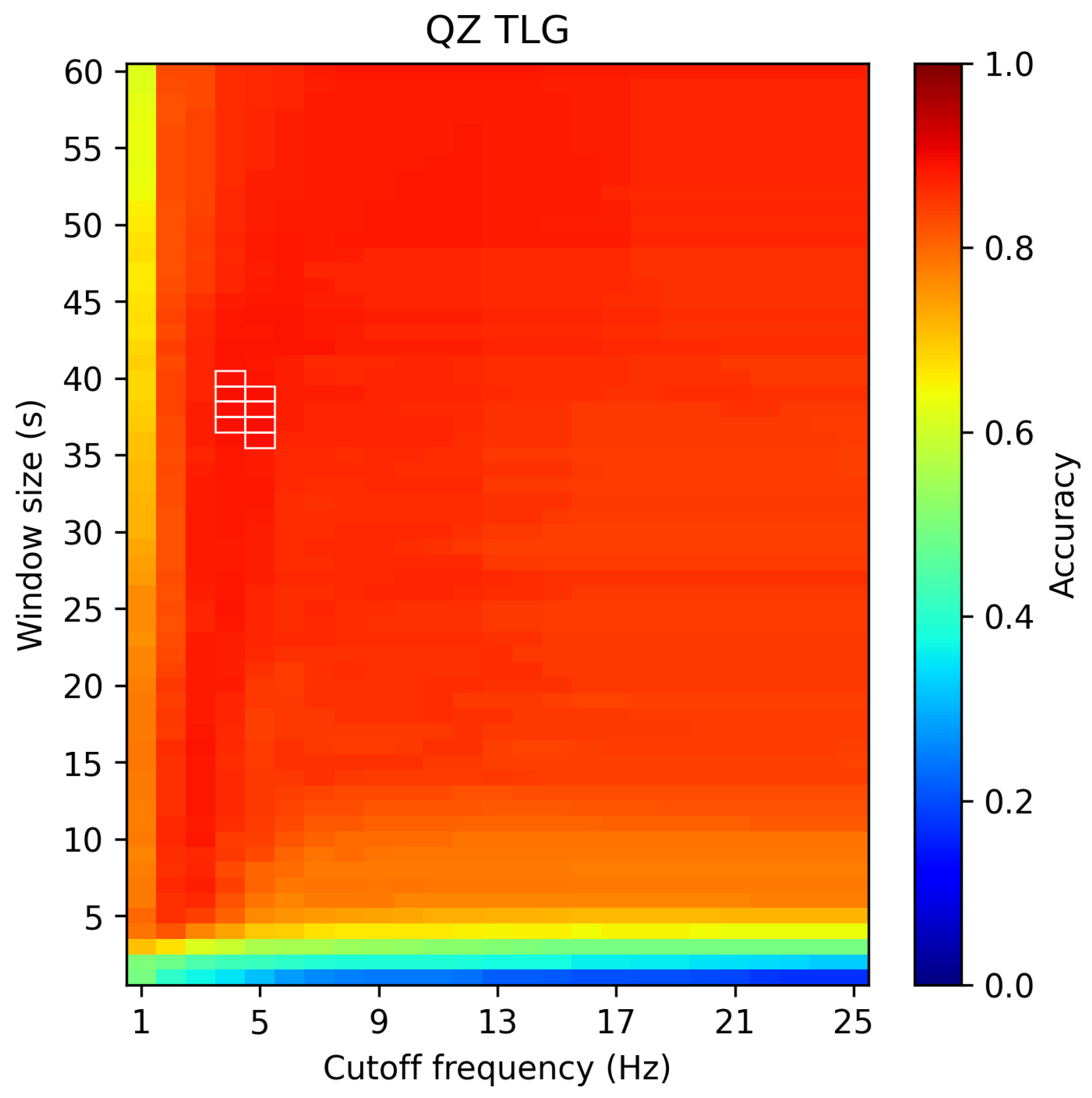
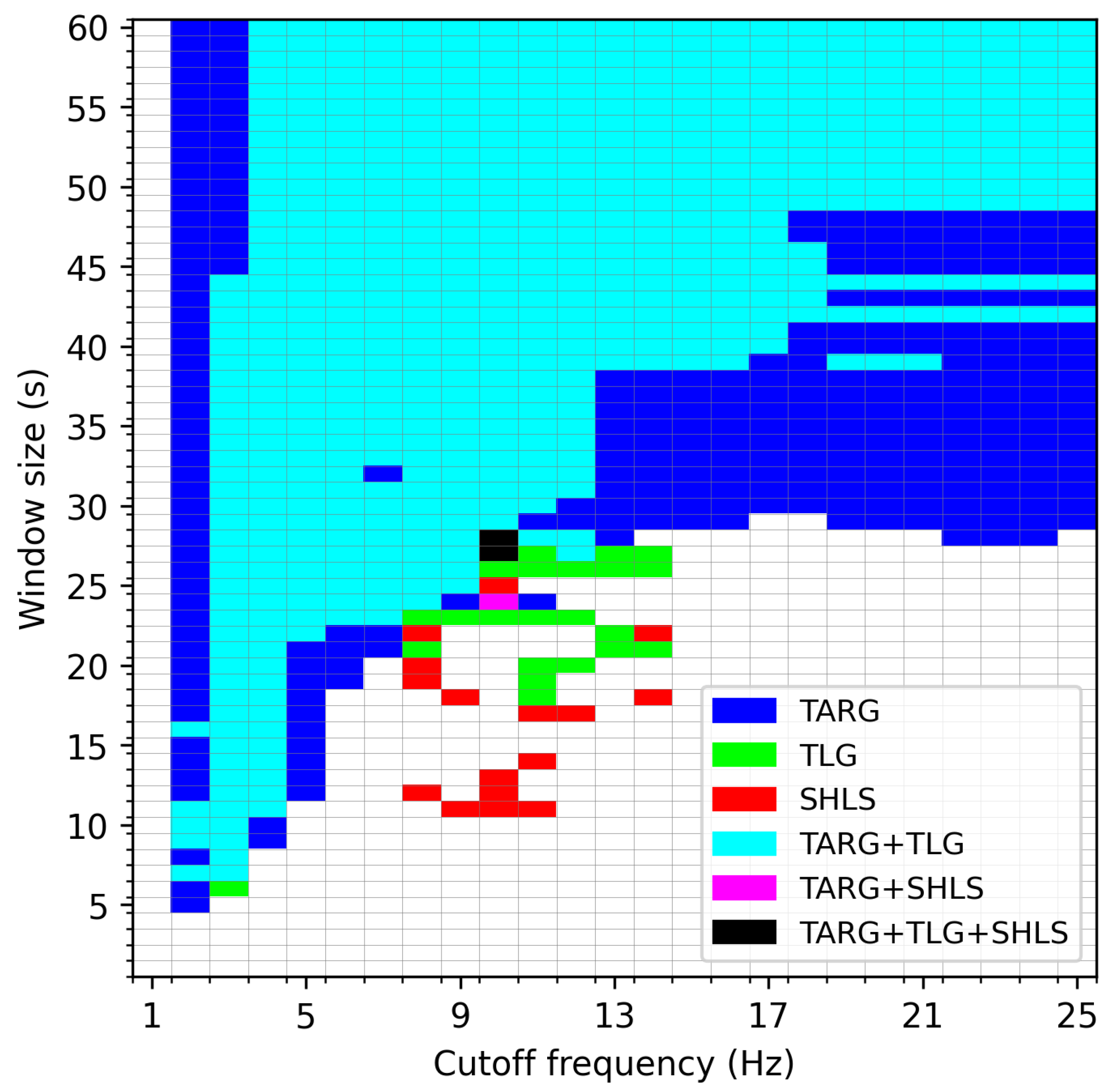
| 27 | 10 | 166 | 0 | 11 | 93.8 |
| 28 | 10 | 165 | 1 | 11 | 93.2 |
| Station SHLS (220 events) | |||||
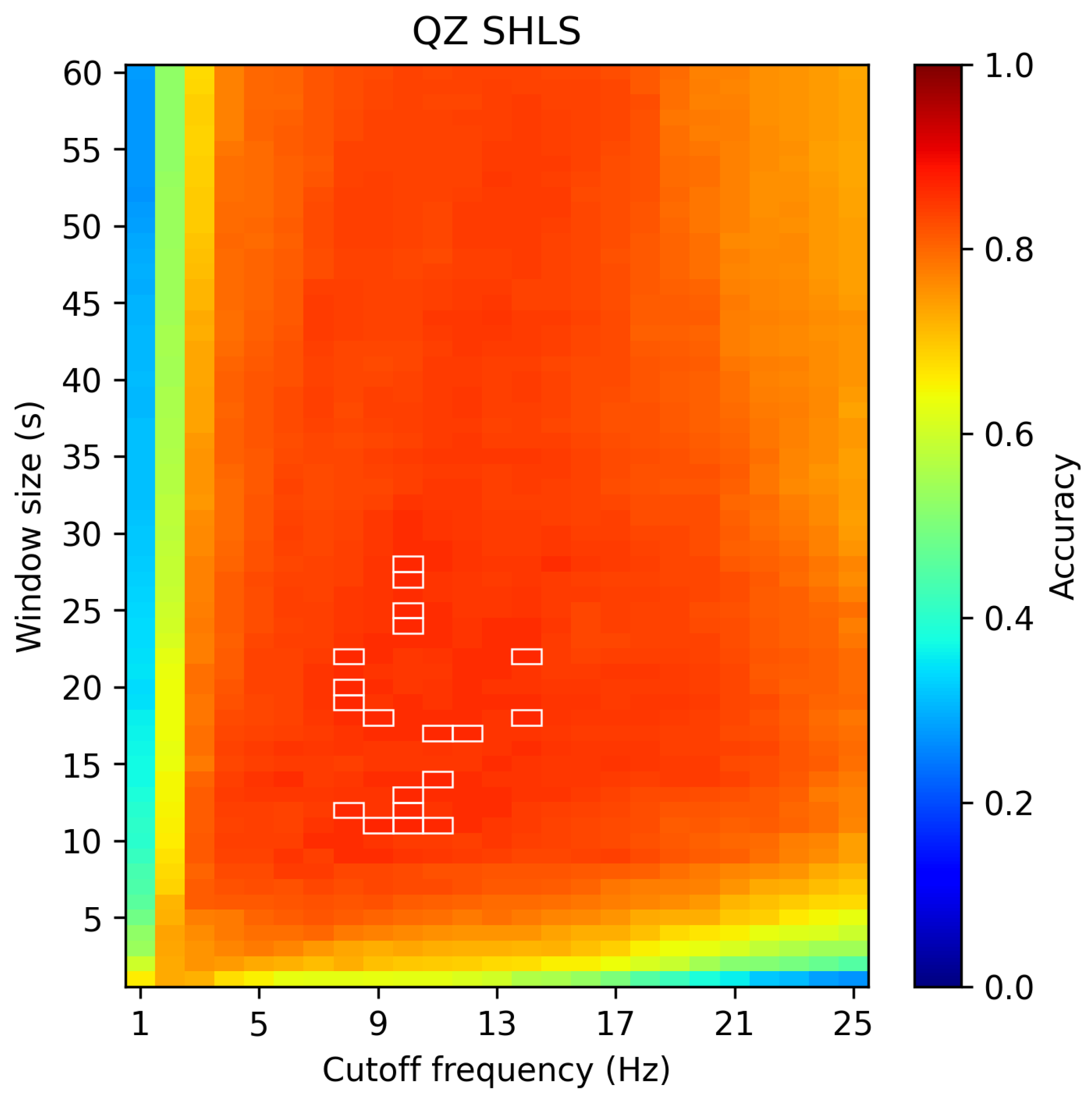
| 27 | 10 | 181 | 21 | 18 | 91.8 |
| 28 | 10 | 180 | 22 | 18 | 93.8 |
| Station TARG (213 events) | |||||
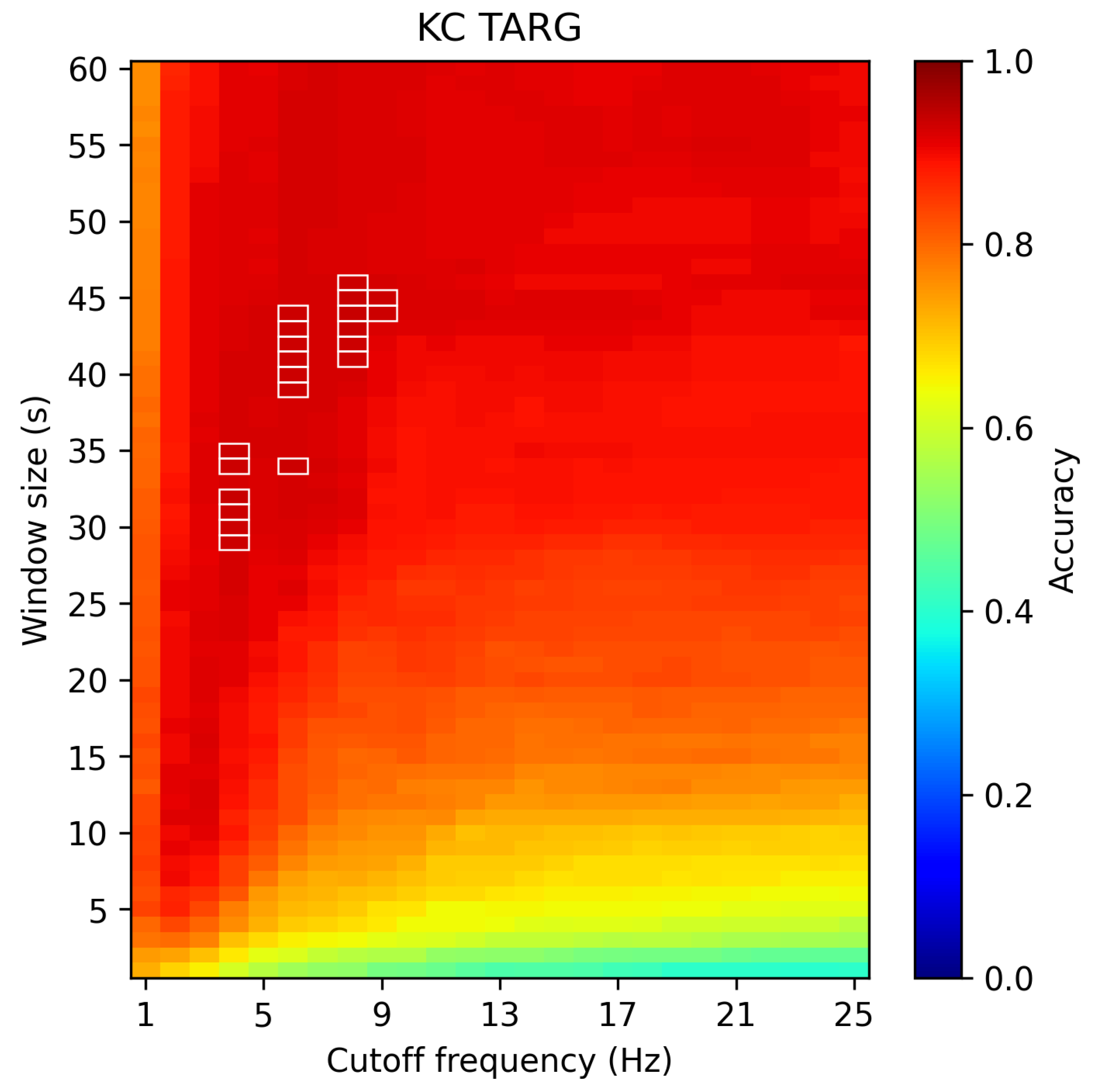
| 27 | 10 | 184 | 1 | 28 | 86.9 |
| 28 | 10 | 188 | 1 | 24 | 88.7 |
| Window Size (s) | Cutoff Frequency (Hz) | Accuracy (%) |
|---|---|---|
| TLG | ||
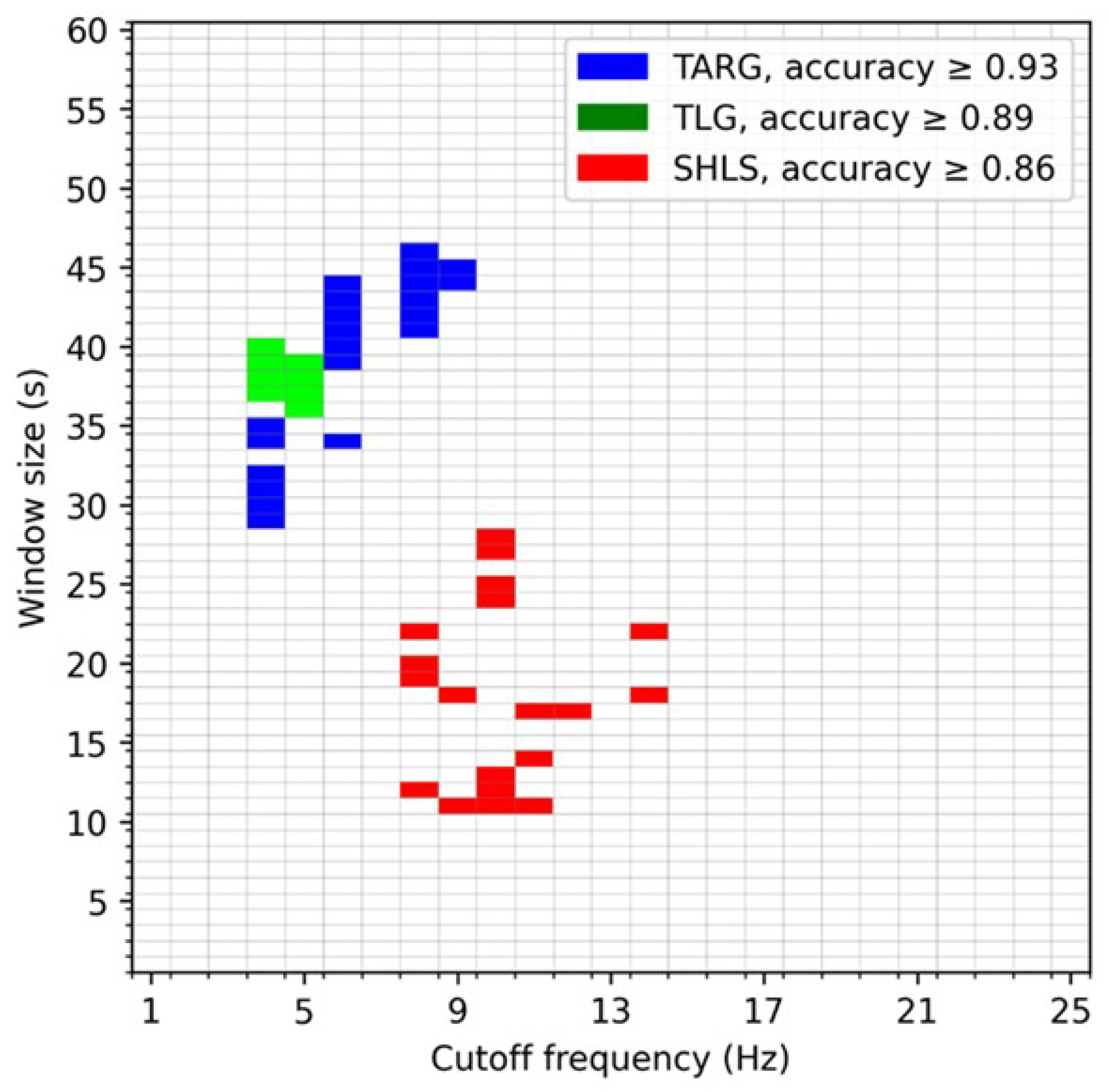
| 36 | 5 | 97.2 |
| 37 | 4 | 98.3 |
| 37 | 5 | 97.2 |
| 38 | 4 | 98.3 |
| 38 | 5 | 97.2 |
| 39 | 4 | 98.3 |
| 39 | 5 | 97.2 |
| 40 | 4 | 98.3 |
| SHLS | ||
| 11 | 9 | 90.5 |
| 11 | 10 | 90.5 |
| 11 | 11 | 90 |
| 12 | 8 | 90.5 |
| 12 | 10 | 90 |
| 13 | 10 | 90 |
| 14 | 11 | 90.5 |
| 17 | 11 | 90.9 |
| 17 | 12 | 90.9 |
| 18 | 9 | 90.9 |
| 18 | 14 | 90.9 |
| 19 | 8 | 91.4 |
| 20 | 8 | 91.4 |
| 22 | 8 | 91.4 |
| 22 | 14 | 90.9 |
| 24 | 10 | 91.4 |
| 25 | 10 | 91.4 |
| 27 | 10 | 91.8 |
| 28 | 10 | 91.8 |
| TARG | ||
| 29 | 4 | 93.9 |
| 30 | 4 | 93.9 |
| 31 | 4 | 93.9 |
| 32 | 4 | 94.4 |
| 34 | 4 | 93.9 |
| 34 | 6 | 93.4 |
| 35 | 4 | 93.9 |
| 39 | 6 | 93.9 |
| 40 | 6 | 93.9 |
| 41 | 6 | 93.9 |
| 41 | 8 | 93.9 |
| 42 | 6 | 93.9 |
| 42 | 8 | 93.9 |
| 43 | 6 | 93.9 |
| 43 | 8 | 94.4 |
| 44 | 6 | 93.9 |
| 44 | 8 | 94.4 |
| 44 | 9 | 93.9 |
| 45 | 8 | 94.4 |
| 45 | 9 | 93.9 |
| 46 | 8 | 93.9 |
| Method | Signal Duration | Processing Time | Note |
|---|---|---|---|
| STA/LTA | 240 s | 0.8 ms | accuracy = 75% |
| SVD-entropy | 240 s | 5 ms | comparable in accuracy to NN |
| Neural network [29] | 240 s | 2 s | high precision |
Disclaimer/Publisher’s Note: The statements, opinions and data contained in all publications are solely those of the individual author(s) and contributor(s) and not of MDPI and/or the editor(s). MDPI and/or the editor(s) disclaim responsibility for any injury to people or property resulting from any ideas, methods, instructions or products referred to in the content. |
© 2026 by the authors. Licensee MDPI, Basel, Switzerland. This article is an open access article distributed under the terms and conditions of the Creative Commons Attribution (CC BY) license.
Share and Cite
Ibraimov, M.; Tuimebayev, Z.; Maksutova, A.; Skabylov, A.; Zhexebay, D.; Khokhlov, A.; Abdizhalilova, L.; Aktymbayeva, A.; Qin, Y.; Khokhlov, S. Detection of P-Wave Arrival as a Structural Transition in Seismic Signals: An Approach Based on SVD Entropy. Smart Cities 2026, 9, 51. https://doi.org/10.3390/smartcities9030051
Ibraimov M, Tuimebayev Z, Maksutova A, Skabylov A, Zhexebay D, Khokhlov A, Abdizhalilova L, Aktymbayeva A, Qin Y, Khokhlov S. Detection of P-Wave Arrival as a Structural Transition in Seismic Signals: An Approach Based on SVD Entropy. Smart Cities. 2026; 9(3):51. https://doi.org/10.3390/smartcities9030051
Chicago/Turabian StyleIbraimov, Margulan, Zhanseit Tuimebayev, Alua Maksutova, Alisher Skabylov, Dauren Zhexebay, Azamat Khokhlov, Lazzat Abdizhalilova, Aliya Aktymbayeva, Yuxiao Qin, and Serik Khokhlov. 2026. "Detection of P-Wave Arrival as a Structural Transition in Seismic Signals: An Approach Based on SVD Entropy" Smart Cities 9, no. 3: 51. https://doi.org/10.3390/smartcities9030051
APA StyleIbraimov, M., Tuimebayev, Z., Maksutova, A., Skabylov, A., Zhexebay, D., Khokhlov, A., Abdizhalilova, L., Aktymbayeva, A., Qin, Y., & Khokhlov, S. (2026). Detection of P-Wave Arrival as a Structural Transition in Seismic Signals: An Approach Based on SVD Entropy. Smart Cities, 9(3), 51. https://doi.org/10.3390/smartcities9030051