1. Introduction
Cities worldwide, now home to over 4.3 billion people [
1], confront an increasingly complex web of interlinked challenges, ranging from socioeconomic inequalities and demographic transitions to political volatility and escalating environmental threats associated with climate change. Addressing these intertwined pressures requires developing resilient infrastructures and innovative planning frameworks capable of harnessing emerging digital technologies in a purposeful way [
2]. While earlier studies have examined specific intersections between smart cities and resilience, a significant gap remains in understanding how contemporary technologies, such as IoT, artificial intelligence (AI), and big data analytics, can proactively enhance urban resilience rather than merely respond to crises [
3,
4,
5]. Recent reviews have begun to link smart city planning and resilience, though mostly from partial or sector-specific viewpoints [
6,
7]. These studies, along with emerging reviews on disadvantaged neighbourhoods and digital technologies [
8,
9], emphasise the need for an integrated, empirically grounded synthesis.
1.1. Novelty and Research Gap
Although several studies have explored aspects of smart city development and resilience, including governance frameworks [
6,
10] and infrastructure planning [
11,
12], a cross-sectoral synthesis that systematically connects digital technologies, planning tools, and governance frameworks to tangible resilience capacities is still lacking. Existing reviews either concentrate on planning dimensions and governance components [
6], develop conceptual models such as the “smart resilient city” without detailed empirical mapping [
7], or focus on specific technologies such as IoT, AI and digital twins without explicitly tracing their contribution to resilience [
9]. Others emphasise how smart city initiatives often overlook disadvantaged communities and equity issues, especially in Global North contexts [
8].
Against this backdrop, the present study makes two primary advances. First, it adopts a hybrid methodological framework that combines a PRISMA-guided (Preferred Reporting Items for Systematic Reviews and Meta-Analyses) systematic review, NVivo-based qualitative meta-synthesis, and VOSviewer bibliometric co-occurrence mapping. This triangulated design offers both thematic depth and visualisation of research trends, providing a comprehensive synthesis of how digital technologies operationalise urban resilience in planning and design. Second, it clearly associates these empirical patterns with a conceptual model of “smart–resilience co-production”, which links technologies, governance mechanisms, and community participation.
1.2. Conceptual Foundations: Urban Resilience and Smart Cities
Urban resilience goes beyond just recovering from disasters. It includes a city’s ability to withstand, adapt to, and change in response to environmental, social, and technological disruptions [
13,
14]. Recent work on social–ecological–technological systems (SETS) approaches emphasise that urban resilience arises from interactions between infrastructures, ecosystems, and social institutions, rather than from any single subsystem in isolation [
15,
16].
In parallel, the concept of the smart city has evolved from an early emphasis on information and communication technology (ICT) efficiency to a broader focus on digital infrastructures, such as IoT devices, AI-driven analytics, and open data platforms, embedded across governance, mobility, energy, and environmental systems [
17]. Contemporary smart city debates emphasise issues of inclusion, justice, and socio-technical transition rather than purely technical optimisation [
18,
19].
These two frameworks, urban resilience and smart city development, focus on improving urban performance, sustainability, and adaptability. However, the ways in which smart city innovations influence resilience outcomes are only partly understood. Moving beyond incremental, technology-led pilots requires an integrated perspective that considers governance, institutional learning, and community participation as essential elements of digital transformation.
1.3. Toward an Integrated Framework
Recent research indicates that integrating resilience and smart city paradigms involves viewing cities as complex adaptive systems where governance, technology, and social behaviour co-evolve [
4,
20]. Socio-technical transition theory further emphasises that technological adoption is most effective when it is supported by institutional adaptation and policy innovation, and reflexive governance [
18,
21,
22]. Together, SETS-based resilience thinking and socio-technical transition perspectives provide a robust conceptual basis for examining how smart technologies can support resilience through multi-level coordination, iterative feedback, and citizen participation [
15,
16].
Despite this conceptual progress, practical understanding of how these factors interact remains limited [
23]. In particular, we still know relatively little about how specific digital tools (e.g., IoT sensor networks, AI-based analytics, urban digital twins) are integrated into planning instruments, governance processes, and social practices in ways that enhance absorptive, adaptive, or transformative resilience capacities.
Accordingly, this study asks:
How can smart city technologies and governance mechanisms interact to operationalise urban resilience across technological, institutional, and social dimensions?
This question guides the paper’s empirical focus, giving equal importance to technological innovation, governance frameworks, and socio-political dynamics.
1.4. Bridging the Gap: Technological and Governance Integration
To address this gap, the present study explores how IoT sensors, intelligent infrastructures, and big data analytics are integrated into resilience planning and design processes. These technologies are increasingly employed to enhance early-warning systems, ensure essential services, and support participatory, data-driven policymaking, yet their comprehensive roles in resilience planning and governance remain insufficiently examined [
24,
25,
26]. Tech-focused reviews record the swift spread of AI, IoT, and digital twins in urban management but only sometimes link them to resilience frameworks or governance reforms [
9,
27].
At the same time, reviews of smart city governance and planning emphasise the importance of inclusivity and cross-sector coordination, while highlighting persistent evidence gaps around equity, digital divides, and contexts in the Global South [
6,
8]. There is therefore a need for a synthesis that systematically maps how digital technologies, planning tools, and governance mechanisms come together to support resilience, and where the main blind spots still exist.
Building on these insights, this paper conducts a qualitative meta-synthesis using NVivo that systematically examines 115 peer-reviewed studies published between 2012 and 2024. The review investigates how planning frameworks, governance structures, and digital technologies collectively influence urban resilience, identifying areas of strongest and weakest empirical evidence.
1.5. Anticipated Contributions and Significance
This study advances ongoing academic and policy debates by empirically connecting smart city initiatives with resilience-building strategies. First, it illustrates how digital infrastructures can assist with climate adaptation, infrastructure reliability, and social equity when they are incorporated into multi-level governance systems rather than implemented as isolated technical solutions. Secondly, it emphasises practical strategies for policymakers and urban planners to enhance the resilience benefits of emerging technologies, including the design of planning instruments, data governance arrangements, and participatory processes.
Theoretically, the study integrates socio-technical transition theory and SETS-based resilience thinking to develop a “smart–resilience co-production” model. This model conceptualises cities as digitally enabled ecosystems where infrastructures, institutions, and communities collaboratively shape resilience trajectories [
15,
18]. In doing so, it addresses recent calls for empirically grounded models of digital resilience that explicitly connect technological innovation with governance and social adaptation [
4,
23,
28].
Ultimately, the study addresses a critical knowledge gap by offering a cohesive view of how smart city frameworks and resilience goals intersect in practice, and by proposing an analytical structure that can support comparative research on digital resilience across different urban settings.
1.6. Objectives and Paper Structure
The rest of this paper is structured as follows.
Section 2 discusses the theoretical and conceptual foundations of urban resilience and smart city development.
Section 3 outlines the PRISMA-based systematic review methodology covering 2012–2024.
Section 4 synthesises empirical findings through thematic coding, highlighting key challenges, opportunities, and ethical considerations.
Section 5 concludes with implications and future research directions for strengthening adaptive capacity and long-term sustainability in smart cities.
2. Materials and Methods
2.1. Study Rationale and Scope
This study investigates the conceptual and methodological overlaps between urban resilience and smart city technologies, emphasising their implications for contemporary urban planning and design. A systematic literature review (SLR) was conducted to explore how these two fields interact and to identify key themes, research gaps, and emerging patterns that guide resilient urban transformation. By synthesising peer-reviewed research from the past decade, the study aims to provide a structured understanding of how digital technologies can enhance urban adaptability and sustainability.
2.2. Systematic Literature Review Design
Following the PRISMA 2020 guidelines [
29,
30], this study used a qualitative meta-aggregation approach to ensure transparency in methodology from the identification to the inclusion of relevant articles. Distinct from previous reviews, this research combines PRISMA-based systematic screening with qualitative meta-aggregation (NVivo) and bibliometric co-occurrence mapping (VOSviewer), forming a hybrid analytical framework that integrates thematic depth with structural visualisation of research trends. This methodological convergence enhances both interpretive richness and analytical validity.
2.3. Search Strategy and Data Sources
A comprehensive search was performed using Web of Science and Scopus, complemented by manual searches on ResearchGate, Google Scholar, and the reference lists of relevant publications. The search string was carefully designed to capture studies connecting smart cities, technology, and urban resilience:
(“smart” OR “technology” OR “digital” OR “digitalization”)
AND (“resilience” OR “resilient” OR “sustainable” OR “sustainability” OR “sustainable development goals” OR “SDG”)
AND (“urban planning” OR “urban design” OR “urban studies” OR “urban future” OR “future planning” OR “urban” OR “city” OR “cities”)
The review covered literature from 2012 to 2024, a period marking the growth of academic engagement with digital technologies in urban systems. This range captures the evolution from early digital urbanism to the current era of AI- and IoT-enabled planning frameworks.
Although the formal PRISMA review period concludes in 2024, a small number of relevant publications from 2025 were qualitatively examined for contextual relevance; these later studies are incorporated into the discussion and conclusions but are not included in the 115-article PRISMA dataset.
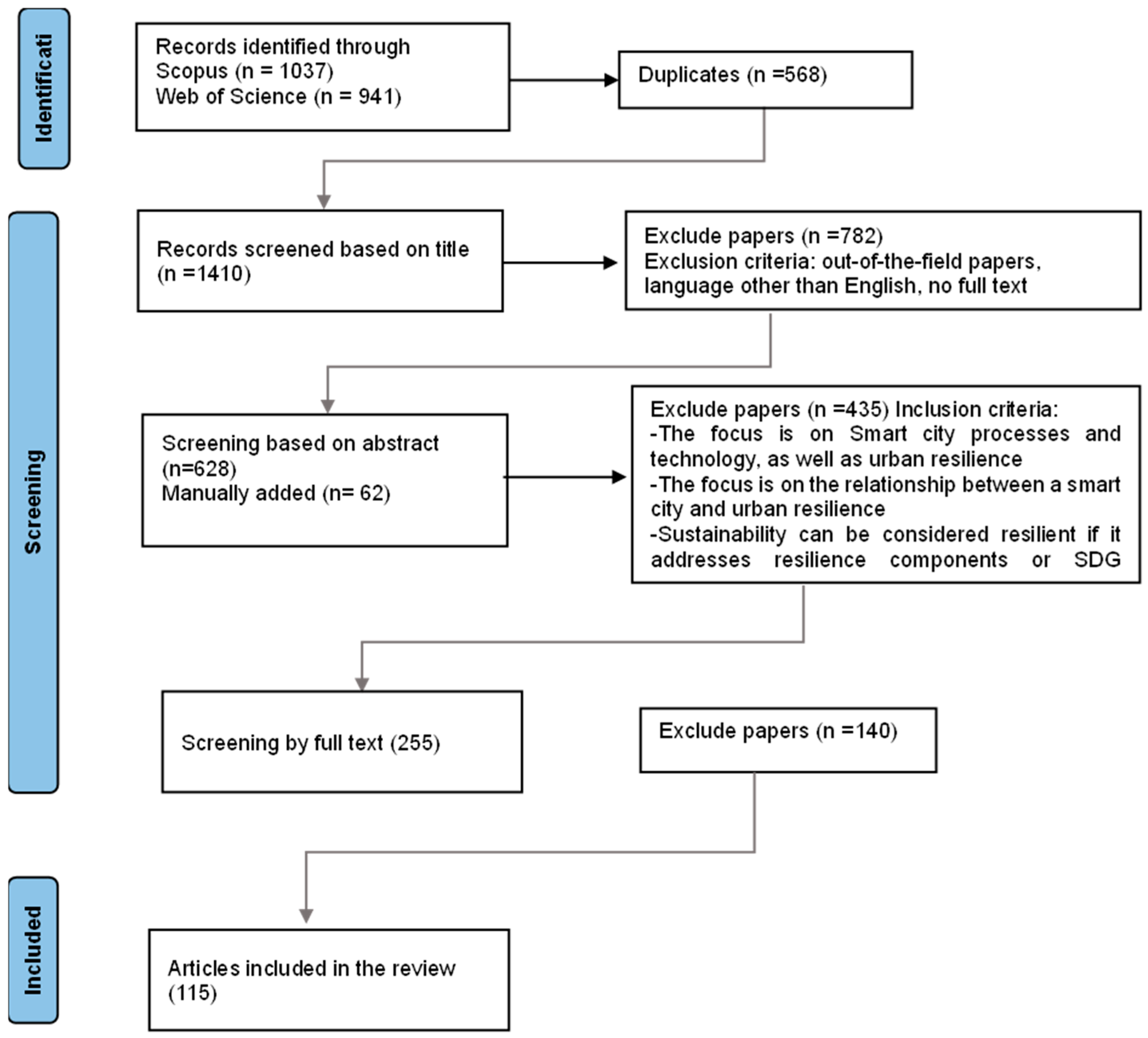
Initial database searches yielded 1410 papers after removing duplicates (
Figure 1).
2.4. Inclusion and Exclusion Criteria
The screening process concentrated on studies that investigated how digital technologies and smart-city governance frameworks connect to urban resilience.
Articles were included if they:
- 1.
Explicitly addressed smart city technologies or processes (e.g., IoT, AI, GIS, digital twins, city dashboards, open data platforms, or smart-city/resilience governance frameworks) within an urban or city-regional context.
- 2.
Analysed the relationship between these technologies/frameworks and urban resilience, or closely related capacities of absorption, adaptation, or transformation; and
- 3.
Engaged with sustainable urban development, including work aligned with Sustainable Development Goal 11 (Sustainable Cities and Communities), where resilience was a core component.
Articles were excluded if they:
Discussed digital technologies or AI/IoT without any explicit connection to cities, urban planning, or urban governance (e.g., generic national ICT/AI policies, rural infrastructure projects, or purely technical algorithm papers);
Addressed resilience only in non-urban settings (e.g., regional or national systems without city-scale analysis); or
Were not available in English or did not have full-text access.
Titles and abstracts were initially screened using these criteria, resulting in 628 records. Manual screening of reference lists added 62 further studies. Abstract-level screening narrowed the dataset to 255 papers, and full-text review identified 115 eligible articles, as illustrated in
Figure 1. All screening and selection steps were carried out manually by the first author; no machine-learning-based or semi-automated text-mining tools (e.g., citation-chasing or screening software) were employed.
2.5. Data Extraction and Meta-Aggregation
A meta-aggregation approach [
31] was used to classify, examine, and compile findings from the 115 selected studies. Each article’s key characteristics—including objectives, methods, main findings, and geographic focus—were systematically documented in an Excel database for further qualitative analysis.
2.6. Thematic Analysis with NVivo
2.6.1. Initial Coding
Articles were imported into NVivo 14 for thematic analysis. One researcher served as the principal coder, developing open codes that captured diverse themes such as “smart infrastructure”, “disaster preparedness”, “green technologies”, and “urban governance”. The initial codebook was based on six keyword clusters identified in the VOSviewer map (Smart City, Sustainability, Planning, Internet of Things, Resilience, and Urban Resilience), which informed full-text coding. Before full-scale coding, a pilot test on 15 randomly selected articles refined the codebook, reducing redundancy and clarifying code definitions.
2.6.2. Theme Refinement
After coding the entire dataset, similar codes were consolidated and overarching categories refined. Themes most closely related to the intersection of smart city practice and urban resilience were prioritised. Throughout the process, analytic memos were maintained to document decisions and ensure methodological transparency.
2.7. Co-Occurrence Analysis with VOSviewer
To complement the qualitative analysis, a keyword co-occurrence analysis was conducted using VOSviewer [
32]:
Data Preparation: Titles, abstracts, and author keywords from the 115 selected studies were exported into a unified dataset.
Co-occurrence Mapping: VOSviewer created visual networks illustrating the frequency and proximity of key terms such as “IoT”, “urban governance”, and “sustainability”, enabling the identification of major research clusters. We used VOSviewer exclusively for keyword co-occurrence analysis (titles, abstracts, and author keywords), rather than co-authorship, co-citation, or bibliographic coupling, since we aimed to uncover the conceptual structure of debates linking smart city technologies and resilience rather than collaboration networks.
Integration with Thematic Analysis: The co-occurrence clusters were cross-referenced with NVivo themes to identify points of convergence, e.g., “smart infrastructure” intersecting with “resilience” and “sustainability”, and to highlight areas that are underexplored and not well represented in keyword frequency.
This dual analytical approach—qualitative coding and bibliometric mapping—enabled a deeper triangulation of findings, strengthening both thematic coherence and empirical validity.
2.8. Methodological Limitations and Quality Assurance
Although this approach is rigorous, it involves several constraints. Using a single coder may introduce interpretive bias; however, reliability was improved through a double-coding pilot of 15 papers, iterative codebook refinement, and a transparent audit trail documenting coding decisions. The emphasis on English-language publications might overlook localised studies, especially from non-English-speaking regions, while dependence on secondary data could restrict access to unpublished or grey literature. Moreover, keyword-based mapping may underrepresent implicit conceptual relationships not captured by metadata.
Despite these limitations, triangulation with NVivo thematic analysis and VOSviewer co-occurrence mapping enhances methodological robustness and offers a comprehensive, multi-dimensional understanding of the literature landscape.
2.9. Summary of Methodological Steps
As outlined in
Figure 1, this study employed a structured multi-step process:
Identification of 1410 articles via systematic database searches;
Screening and eligibility assessment focused on relevance and accessibility.
Inclusion of 115 final studies that meet the defined criteria;
Thematic coding using NVivo; and
Co-occurrence mapping using VOSviewer for bibliometric analysis insights.
This hybrid approach offers a replicable framework for future research examining the integration of digital technologies and resilience planning in urban studies.
3. Results
This section presents the findings of the systematic literature review, combining bibliometric co-occurrence mapping with qualitative meta-aggregation to explore how smart city technologies contribute to urban resilience. The dual-method approach (NVivo + VOSviewer) allows for both structural visualisation of the research landscape and detailed thematic interpretation. Together, these complementary analyses demonstrate the evolution of scholarly discourse from technology-focused models towards governance- and policy-driven resilience frameworks.
3.1. Overview of Findings
The 115 articles included in the review span 2012–2024, with most publications appearing after the mid-2010s as smart city agendas became more deeply integrated into urban planning and resilience discussions. Empirical examples predominantly focus on high-income European and East Asian cities, while research from the Global South and lower-income regions appears only intermittently. This uneven coverage influences how “smart” urban resilience is presently understood, with most evidence taken from well-funded municipal systems.
The co-occurrence analysis highlights six core clusters—IoT, smart city, sustainability, planning, resilience, and urban resilience—which structure the research landscape. These clusters show that digital technologies are seldom discussed in isolation; instead, they are closely connected with debates on sustainable urban development, spatial planning tools, and multi-level governance. Building on this map, the qualitative synthesis organises the literature into three interrelated themes: (i) urban planning and design, (ii) smart city technologies in resilience, and (iii) strategic planning and policy integration.
Taken together, the findings indicate a gradual shift from early technology-focused accounts of smart cities towards more explicitly socio-technical perspectives that connect digital infrastructures with governance arrangements, institutional capacity, and citizen participation. Digital tools, particularly IoT, AI, GIS, and emerging digital-twin applications, are increasingly seen not only as enablers of more efficient urban services but also as catalysts for adaptive governance, evidence-based planning, and resilience co-production. At the same time, the limited attention to distributive impacts, long-term outcomes, and under-represented regions exposes ongoing gaps, which the following sections examine in greater detail.
3.2. Co-Occurrence Analysis
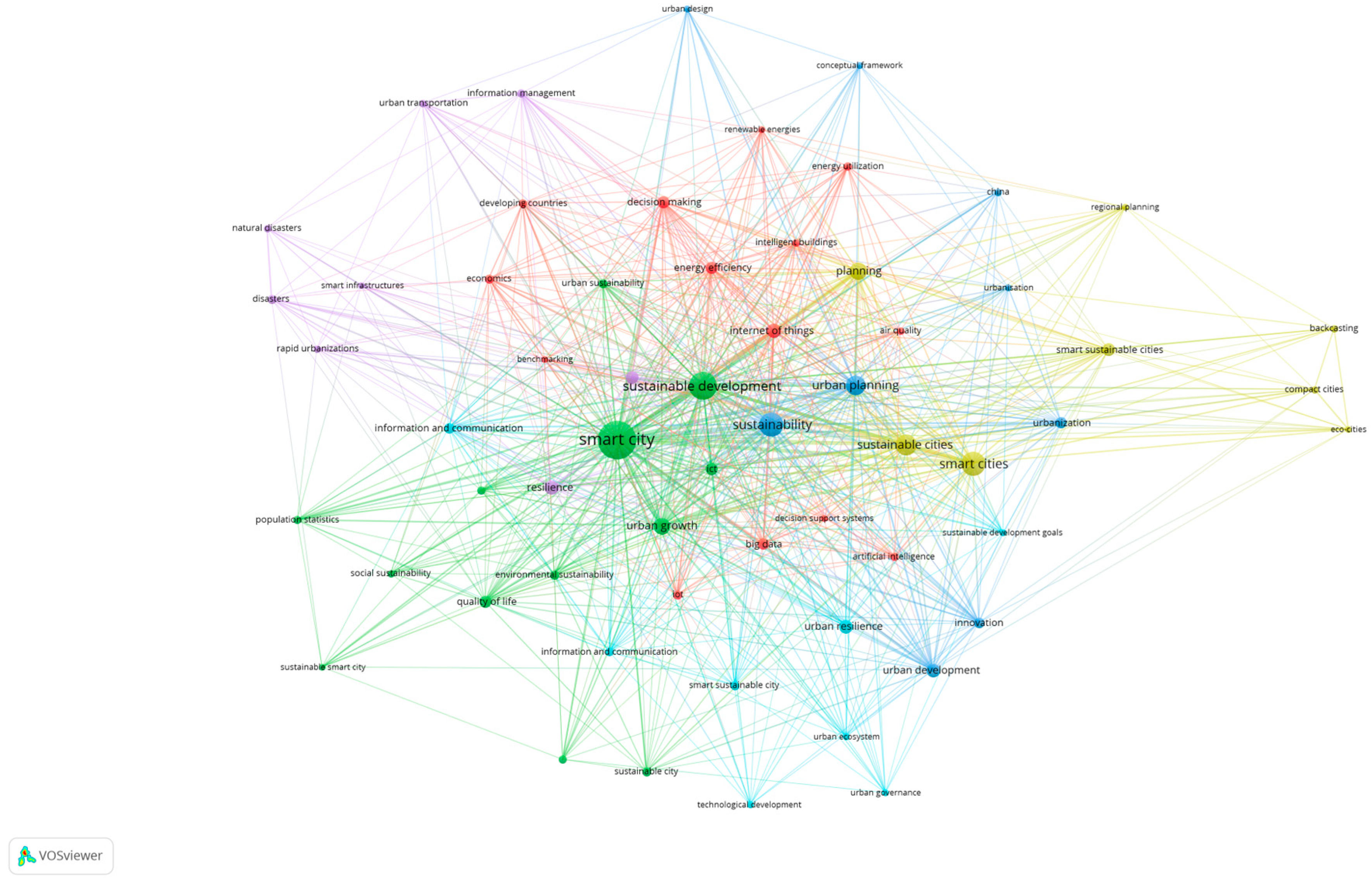
The bibliometric co-occurrence map, visualised in
Figure 2, identified six main thematic clusters connecting smart city technologies with urban resilience. Using titles, abstracts, and author keywords from the 115 included articles, VOSviewer created a network where node size reflects term frequency and spatial proximity shows how often concepts co-occur within the same studies. Following the VOSviewer co-occurrence method described by Van Eck and Waltman [
32], only keywords appearing at least five times were visualised in
Figure 2 to ensure clarity. The clustering algorithm groups highly related terms into six colour-coded clusters, which we designate in
Table 1 as Smart City, Sustainability, Planning, Internet of Things, Resilience, and Urban Resilience.
As summarised in
Table 1, the largest and most central cluster is labelled “Smart City”, gathering terms related to information and communication technologies (ICT), data analytics, and digital platforms. Closely connected clusters focus on “Sustainability” and “Planning”, emphasising green infrastructure, compact and transit-oriented urban forms, and spatial decision-support tools. Other technology-specific clusters revolve around the “Internet of Things (IoT)”, highlighting sensor-based monitoring and intelligent buildings, while the “Resilience” and “Urban Resilience” clusters highlight climate risks, hazard mitigation, and adaptive governance.
Together, these six clusters show that smart city research seldom considers digital technologies in isolation. Instead, IoT, AI, and related tools are integrated into wider discussions about sustainable urban development, spatial planning tools, and institutional arrangements. The intersection between the IoT and Urban Resilience clusters, for example, highlights a growing body of work that employs real-time analytics and sensor networks to support early warning systems, infrastructure management, and adaptive decision-making. Similarly, the strong links between the Sustainability and Planning clusters demonstrate that smart city initiatives are increasingly presented as spatially integrated systems rather than isolated technological projects. Terms such as “governance”, “participation”, and “data sharing” serve as connecting nodes linking the Smart City, Resilience, and Sustainability clusters, emphasising the vital role of institutional capacity and citizen engagement in digitally enabled resilience.
These co-occurrence patterns form the structural basis for the qualitative synthesis in
Section 3.3, where the clustered topics are grouped into three higher-level themes: (i) urban planning and design, (ii) smart city technologies in resilience, and (iii) strategic planning and policy integration.
3.3. Qualitative Data Synthesis
The qualitative meta-aggregation of the 115 studies using NVivo 14 enhances the depth of the bibliometric mapping. Building on the six co-occurrence clusters identified in
Section 3.2, full texts were coded against a set of nodes that represented technologies, governance instruments, spatial strategies, and resilience capacities. Through iterative refinement, these codes converged into three interconnected themes that illustrate how smart city initiatives support resilience: (i) urban planning and design, (ii) smart city technologies in resilience, and (iii) strategic planning and policy integration.
Table 2 summarises these themes, outlining their focus, indicative findings, implications for practice, and illustrative case studies.
Across the corpus, three main patterns emerge:
Smart technologies are most often discussed in relation to spatial strategies, particularly compact, transit-oriented, and green urban forms [
2,
49,
50,
51,
52,
53].
IoT, AI, and related tools are mainly seen as instruments for monitoring, early warning, and operational management, rather than as agents of structural change [
9,
42,
54,
55,
56,
57,
58,
59].
Strategic planning and governance reforms that integrate digital tools into policies, standards, and participatory processes are less common but are key to more transformative notions of resilience [
37,
60,
61,
62,
63,
64].
3.3.1. Theme 1: Urban Planning and Design
Urban design sits at the crossroads of resilience and digital innovation. Smart planning strategies, such as compact development, green architecture, and intelligent transit enhance sustainability while strengthening cities’ ability to absorb and adapt to shocks [
2,
49,
50]. Transit-oriented development (TOD) and green urbanism encourage efficient resource utilisation, shorter commutes, and less exposure to environmental hazards. Case studies from Amsterdam and Copenhagen show how integrating TOD with digital mobility systems supports both carbon neutrality and climate resilience in practice [
51,
52].
Within Theme 1, a consistent subset of studies connects smart tools to nature-based solutions, such as combining sensor-guided irrigation with urban forestry and green–blue infrastructure [
65,
66,
67]. These interventions are typically evaluated based on environmental performance (e.g., reduced heat, improved stormwater management), with only rare efforts to monitor longer-term social or institutional impacts.
In summary, the planning and design literature indicates that:
Compact and transit-oriented designs, often supported by digital mobility and mapping tools, are the most common spatial pathways through which smart initiatives address resilience [
49,
50,
51,
52,
54,
55,
56,
57].
Nature-based solutions improved by sensors and monitoring are gaining popularity, but their role in adaptive or transformative resilience is rarely measured [
65,
68].
Many studies focus on process indicators (accessibility, emissions, environmental performance), leaving a gap in evidence on how spatial interventions influence systemic resilience over time.
3.3.2. Smart Mobility and Compact Urban Forms
A key aspect of Theme 1 concentrates specifically on mobility. Smart mobility solutions, such as real-time public transport data, adaptive traffic management, and shared micromobility, are often combined with strategies for compact cities. Together, these interventions reduce emissions, diversify travel options, and improve redundancy in transport networks [
50,
54,
55,
56,
57]. In Amsterdam and Barcelona, the integration of mobility data platforms with network planning allows services and infrastructure to be adjusted in response to changing travel patterns and disruption risks [
54,
56,
57].
These studies suggest that smart mobility currently serves as a practical link between technological innovation and everyday resilience. Most evidence highlights improvements in absorptive and adaptive capacities, such as maintaining access during disruptions and reducing reliance on single modes, while implications for equity (who benefits) and for more profound shifts in land use and lifestyles are less thoroughly examined.
3.4. Thematic Perspectives on Smart Urban Resilience
To better contextualise these themes, case studies from the reviewed articles were analysed across three overarching dimensions: governance and policy, technological integration for hazard management, and socio-environmental contexts.
3.4.1. Governance and Policy
Participatory governance frequently features in successful resilience initiatives. Amsterdam’s bike-sharing system and Barcelona’s Sentilo platform demonstrate how open data and community involvement can generate feedback loops that foster shared responsibility for risk reduction and service efficiency [
61,
62]. Copenhagen’s policy-driven, transit-oriented framework connects emission reduction targets with real-time data analytics, illustrating how precise goals combined with digital information can speed up climate-focused transitions [
51,
52].
3.4.2. Technological Integration for Hazard Management
Several studies focus on incorporating digital tools into hazard management. Tokyo’s use of digital twin models allows for real-time earthquake simulations and scenario testing, informing building design and retrofitting decisions [
69]. Gkontzis et al. [
59] describe neighbourhood-scale digital twins that incorporate citizen feedback with predictive analytics, operationalising resilience at micro-urban levels. In Singapore, AI-driven building automation systems control ventilation, shading, and energy consumption, reducing urban heat island effects while ensuring comfort [
70].
3.4.3. Socio-Environmental Contexts
Local hazard profiles influence both the choice of technologies and how they are deployed. Bangkok’s IoT-based flood management system illustrates how sensor networks can enable proactive responses in flood-prone areas, while San Francisco’s AI-assisted ground-motion modelling and response planning showcase the advantages of predictive analytics in seismic situations [
58]. Melbourne’s Urban Forest Strategy, which combines smart irrigation with public participation, demonstrates how nature-based and data-driven measures can be used together to enhance community resilience [
65,
68].
Synthesis:
Across these examples, digitally enabled resilience initiatives are found in well-resourced, high-income cities, with few documented cases from informal or rapidly urbanising contexts [
8,
71]. Governance innovations often focus on transparency and participation, but robust evidence on distributional impacts and benefits for vulnerable groups remains limited [
25,
61,
62]. Hazard-focused applications predominantly concentrate on floods and earthquakes; slower-moving stresses such as heat, housing insecurity, or socio-economic inequality receive less systematic attention [
3,
45,
46,
65,
68].
3.5. Theme 2: Smart Technology in Urban Resilience
Throughout the review, smart technologies play a prominent role in monitoring, early warning, and operational decision-making. IoT-enabled infrastructure supports real-time environmental monitoring, as demonstrated by Gkontzis et al. [
72]. Smart irrigation and microclimate sensors assist in preserving ecological balance within urban forests [
65,
68], while predictive analytics assist in proactive resource allocation. In Bangkok, continuous sensor networks for flood management generate actionable alerts that can reduce response and recovery times. Meanwhile, in San Francisco, AI algorithms analyse seismic data to model scenarios and support emergency operations [
58].
These studies emphasise that resilience outcomes are co-produced by technology and policy. AI-supported planning is utilised to inform zoning changes, update building regulations, and guide the distribution of services and funding, aligning digital capabilities with governance reforms [
37,
63]. At the same time, systematic assessments of performance, failure modes, and unintended consequences are infrequent.
Taken together, Theme 2 suggests that:
IoT, AI, and related tools are used most consistently to enhance absorptive and adaptive capacities by improving detection, monitoring, and response [
54,
63,
72,
73,
74].
Claims about transformative potential, such as reshaping governance or enabling new forms of co-production, are often found in the discussion sections but are supported by relatively few longitudinal or comparative studies.
There is limited evidence on how technical robustness, data governance, and digital exclusion influence the reliability and fairness of smart resilience systems [
25,
37,
63].
3.6. Theme 3: Strategic Planning and Policy Integration
Resilience ultimately depends on how digital tools are integrated into planning and governance systems. In the reviewed literature, IoT, AI, GIS, and blockchain are regarded not only as technical solutions but also as elements of wider institutional strategies. IoT and AI applications support absorptive and adaptive phases by providing real-time data for predictive modelling, operations management, and scenario analysis [
54,
74]. GIS-based systems, such as those used in San Francisco, inform land-use zoning, hazard overlays, and emergency preparedness [
69].
Emerging tools such as blockchain are suggested to enhance transparency and accountability in data management and procurement, potentially reinforcing trust in urban governance [
75]. When combined with open data and participatory policies, these approaches can promote more inclusive adaptation strategies and help align technological innovation with public legitimacy and ethical standards [
25].
Operational Pathways Linking Technology, Planning, and Resilience
To consolidate the empirical patterns identified earlier, this subsection illustrates how particular smart city technologies translate into resilience-building capacities through planning and governance mechanisms.
Table 3 summarises the operational links between technological tools, planning levers, and resilience capacities (absorptive, adaptive, and transformative). It also presents examples of empirical applications and a qualitative assessment of the strength of evidence in different city contexts.
The mapping in
Table 3 indicates three overarching observations:
Established technologies such as GIS and IoT have the strongest and most consistent evidence supporting their role in enhancing absorptive and adaptive capacities, especially through risk mapping, early warning, and asset management [
45,
46,
54,
69].
Emerging tools such as digital twins and blockchain are increasingly linked with transformative capabilities that support co-design, interoperability, and new forms of accountability, but current evidence is limited to pilot projects and conceptual studies [
59,
69,
75].
Participatory platforms, open data dashboards, and cross-domain data governance frameworks act as intermediaries between technical systems and institutional change, yet their long-term effects on equity and vulnerability are not well documented [
25,
28,
37,
47,
48,
61,
62].
Overall,
Table 3 emphasises that resilience is not solely caused by technology, but by the interaction of technical systems with planning tools, governance structures, and social inclusion.
3.7. Emerging Trends and Research Priorities
Firstly, there is a noticeable gap between where smart resilience tools are being developed and where many urban risks are concentrated. Most of the studies in this review focus on well-resourced cities in Europe, North America, and parts of East Asia, with relatively few examples from the Global South or rapidly expanding secondary cities. Expanding empirical research in these under-represented contexts is essential if smart city resilience agendas are to address informal settlements, infrastructure gaps, and complex vulnerabilities effectively.
Second, the focus of current technological research is uneven. Established tools such as IoT and GIS are widely utilised for monitoring, early warning, and spatial risk assessment, and there is now substantial applied evidence supporting these functions. By contrast, emerging tools such as AI, digital twins, and blockchain are often described as enabling “anticipatory” or “transformative” governance, but the supporting evidence remains limited to short-term pilots and conceptual studies. Future research must progress from proof-of-concept demonstrations to long-term and comparative assessments that examine how these tools operate in real-world settings.
Third, the hazard perspective is narrow. Most digitally enabled resilience initiatives in the reviewed literature focus on floods, storms, or earthquakes, while slower-moving stresses, such as heat, housing precarity, and socio-economic inequality, receive much less systematic attention. There is potential for further work linking smart technologies to long-term adaptation strategies, social protection, and equity issues, rather than mainly focusing on immediate event response.
Finally, throughout these areas, a common theme is the importance of governance. As cities experiment with 5G, edge computing, and digital twin systems, real-time feedback loops might strengthen the link between operations, planning, and risk management. However, the review also indicates that without transparent data governance, meaningful participation, and attention to digital exclusion, these technologies risk reinforcing existing inequalities rather than addressing them [
21,
42].
3.8. Summary
The results demonstrate that the convergence of digital technologies and urban resilience is influenced by three primary dynamics. Conceptually, the literature has started to shift from technology-focused narratives to socio-technical perspectives that connect smart infrastructures with governance, institutional capacity, and citizen engagement. Empirically, however, the evidence base remains biased towards high-income cities, a limited range of hazards, and established tools such as IoT and GIS, with considerably less systematic assessment of emerging technologies and outcomes in more vulnerable settings.
Operationally, the dual-method synthesis shows that smart city technologies support resilience in various ways across absorptive, adaptive, and transformative capacities. Both bibliometric co-occurrence analysis and qualitative coding highlight that IoT, AI, GIS, and related tools are most strongly linked to monitoring, early warning, and incremental adaptation. Meanwhile, more transformative roles in co-design, institutional reform, and redistribution remain largely aspirational and weakly evidenced.
Table 3 illustrates these pathways by connecting specific technologies to planning levers and resilience capacities.
Together, these findings emphasise that effective smart urban resilience relies less on advanced technology and more on how digital systems are integrated into planning tools, governance structures, and participatory practices. The Discussion section builds on this analysis to explore the theoretical implications of the “smart–resilience co-production” lens, reflect on the methodological contributions of the dual NVivo–VOSviewer approach, and outline the most urgent gaps for future research and policy in smart and resilient urbanism.
4. Discussion
This review examined how smart city technologies and governance mechanisms collaborate to promote urban resilience across technological, institutional, and social dimensions. Based on 115 studies, the analysis shows that digital tools rarely function in isolation; they bolster resilience when integrated with planning strategies, governance reforms, and public engagement methods. In this section, we first situate the study’s contribution within existing scholarship, then interpret the three themes and the operational pathways listed in
Table 3, before addressing key gaps, implications, and future avenues.
4.1. Positioning This Study’s Contribution
Previous research on smart cities and resilience has mainly followed two approaches. Some studies have outlined concepts and frameworks at a broad level, highlighting governance principles, inclusivity, or sustainability but lacking a solid empirical foundation [
6,
10]. Others have studied specific technologies or sectors, such as infrastructure planning, risk mapping, or emergency management, without consistently connecting them to resilience theory. More recent reviews have started to integrate these areas, emphasising the importance of transdisciplinary planning and digital coordination for adaptive capacity [
11,
12,
25].
This study builds on that scholarship in three primary ways. First, it combines a PRISMA-guided systematic review with NVivo-based qualitative coding and VOSviewer co-occurrence mapping. This dual-method approach offers both thematic depth and structural insight, showing how debates around IoT, AI, GIS, sustainability, and planning cluster and intersect. Second, by synthesising findings into three overarching themes, urban planning and design, smart technologies in resilience, and strategic planning and policy integration, it elucidates the main pathways through which digital tools enhance absorptive, adaptive, and transformative capacities. Third, the integrative mapping in
Table 3 operationalises the concept of smart–resilience co-production: resilience develops when technologies, planning tools, and governance structures are aligned, rather than from technology deployment alone.
In doing so, the review moves beyond mere descriptive catalogues of “smart” initiatives. It provides an explanatory framework for understanding how digital infrastructures become integrated into everyday planning practices, and where current evidence still falls short.
4.2. Interpreting the Three Themes and Resilience Capacities
The first theme, urban planning and design, indicates that smart initiatives are most often implemented through spatial strategies. Compact development, transit-oriented design, and nature-based solutions are consistently supported by digital tools such as mobility platforms, GIS, and sensor networks [
2,
44,
49,
50,
51,
54,
66,
67]. These measures clearly enhance environmental performance and accessibility, while also boosting absorptive and adaptive capacities by diversifying mobility options, reducing exposure to hazards, and improving microclimate regulation. However, few studies examine how these changes lead to long-term, system-wide resilience.
The second theme, smart technologies in resilience, confirms that IoT, AI, and related tools are primarily used in monitoring, early warning, and operational decision-making [
57,
58,
59,
73,
76,
77]. Flood-management systems in Bangkok, seismic analytics in San Francisco, and sensor-guided urban forestry in Melbourne demonstrate how digital systems can reduce response times and enhance situational awareness [
45,
65,
69]. However, as noted in the Results, the evidence is mostly centred on pilot projects and early implementation stages, with limited long-term assessment of performance, failure modes, or unintended impacts.
The third theme, strategic planning and policy integration, is less frequently addressed but is particularly important for transformative resilience. Studies that place IoT, AI, GIS, or blockchain within statutory planning instruments, procurement rules, or cross-sector governance frameworks suggest that digital tools can reshape institutional routines and accountability relationships [
26,
37,
63,
74,
78].
Table 3 indicates that these applications tend to support adaptive and transformative capacities by enabling scenario testing, co-design, transparency, and multi-sector coordination. However, this branch of the literature remains relatively small and uneven across regions and hazards.
Taken together, the thematic synthesis and
Table 3 suggest that established technologies such as IoT and GIS have the strongest evidence base for improving absorptive and adaptive capacities [
23,
42,
57], while newer tools such as digital twins and blockchain remain at an experimental stage, with largely aspirational claims about their transformative potential [
27,
75]. Participatory platforms and cross-domain data frameworks act as intermediaries between these poles, connecting technical systems and institutional change, but their long-term impacts on equity and vulnerability remain poorly documented [
25,
28,
54].
These patterns go beyond generic claims that “technology enhances resilience” by specifying which tools, through which planning levers, support absorptive, adaptive or transformative capacities.
4.3. Smart–Resilience Co-Production and Governance
The findings support the idea of smart–resilience co-production introduced in the conceptual framework. Instead of viewing resilience as an automatic result of digital modernisation, the review demonstrates that resilience develops when technologies, planning tools, and governance practices are aligned.
For example, smart mobility initiatives only become resilience-enhancing when compact urban form, multimodal networks, and participatory planning are present alongside real-time data systems [
44,
50,
52,
63,
79]. Similarly, flood and seismic analytics have the greatest impact where early-warning protocols, land-use controls, and emergency-management institutions can act on digital information [
46,
58,
80].
The review also emphasises governance tensions. Highly centralised models can achieve impressive technical performance but may face challenges with trust, transparency, and inclusion. More participatory arrangements can promote legitimacy and utilise local knowledge but may lack stable funding or technical expertise [
25,
81,
82,
83]. The most promising examples in the corpus are those that intentionally combine strong institutional capacity with meaningful citizen engagement and transparent data-governance rules.
High-profile experiments such as Sidewalk Toronto illustrate this point. Despite its ambitious digital vision, the project encountered persistent criticism over data ownership, corporate influence, and opaque governance structures, and was ultimately cancelled. The case demonstrates that even highly advanced initiatives can fail if concerns about privacy, accountability, and public benefit are not tackled through trusted governance frameworks. It underlines the broader conclusion of this review that resilience is as much a social and political achievement as a technical one [
84].
4.4. Blind Spots: Geography, Hazards, Equity and the Digital Divide
The results also reveal significant blind spots with direct implications for interpreting smart–resilience co-production.
Geographical bias. The evidence base predominantly comes from high-income cities in Europe, North America, and parts of East Asia, with relatively few studies from the Global South or rapidly urbanising secondary cities [
71,
85]. This raises questions about transferability. Many of the technologies and governance models examined depend on high fiscal capacity, strong utilities, and established regulatory frameworks that might not be present in lower-income or informal settings.
Hazard bias. Most digitally enabled resilience applications concentrate on acute shocks, especially floods, storms, and earthquakes [
3,
41,
45]. Slower stresses such as heat, housing insecurity, and socio-economic inequality receive less systematic attention, despite being central to everyday vulnerability in many cities. Consequently, the current evidence may overstate the ability of smart tools to manage short-term events while underestimating their potential (or limitations) in long-term adaptation and social protection.
Equity and digital exclusion. Several studies emphasise worries about unequal access to connectivity, devices, and digital skills, which can reinforce existing inequalities when resilience services are delivered via data-driven systems [
8,
61,
86]. Early-warning platforms, for instance, may reach wealthier residents with reliable internet but not vulnerable groups in informal settlements. Governance innovations often emphasise transparency and participation, yet empirical assessments of distributional impacts and benefits for vulnerable populations are still uncommon [
25,
61,
62].
Institutional capacity and interoperability. Several contributions highlight the challenge of integrating multiple platforms and data sources across departments and agencies [
80,
87,
88]. Without common standards and shared governance, smart systems risk fragmenting response capabilities rather than strengthening them. These limitations highlight that resilience cannot be built by technology alone but relies on coherent institutions and inclusive social contracts, particularly in low-income and informal urban contexts where over-reliance on fragile digital systems may introduce new vulnerabilities.
4.5. Implications for Planning and Governance
The findings of this review have several implications for urban planning and governance practice.
First, digital tools are most effective when regarded as part of the infrastructure of planning and governance, rather than as standalone projects. Municipalities aiming to strengthen resilience might benefit more from improving the coverage, quality, and integration of existing GIS and IoT systems and by incorporating their outputs into zoning, infrastructure prioritisation, and emergency protocols rather than investing in isolated flagship pilots.
Second, smart initiatives should be conceived as governance experiments, not merely as technology demonstrations. When cities implement digital twins, predictive analytics, or blockchain-based registries, the emphasis should be on testing new decision-making structures, accountability mechanisms, and participation formats, with clear criteria for success and failure. This necessitates combining technical investment with strong institutional design and assessment.
Third, the co-production of resilience requires attention to who is included and who is excluded. The uneven distribution of connectivity, skills, and time means that digitally mediated participation can easily reinforce existing inequalities rather than reduce them. Planning agencies should supplement digital engagement platforms with offline outreach, targeted support for marginalised groups, and clear monitoring of distributional effects.
Fourth, regulatory and ethical frameworks are important. Debates on data protection, algorithmic transparency, and the responsible use of AI are not just theoretical concerns; they influence whether intelligent systems are trusted and applied in ways that enhance resilience rather than weaken it. Emerging guidelines and regulatory initiatives at international, national, and municipal levels can support local experimentation, but they must be interpreted within specific institutional and political contexts.
Overall, the review indicates a shift from technology-focused narratives to institutionally based, equity-driven approaches where digital systems assist rather than control urban resilience strategies.
4.6. Limitations
The study has several limitations that need to be acknowledged. The screening and coding processes were mainly carried out by a single researcher, with only limited double-coding. Although the coding framework was refined through an iterative process, interpretive bias cannot be entirely eliminated. The review was also limited to English-language, peer-reviewed literature in two major databases, which means that relevant work in other languages, grey literature, and practitioner documents might have been excluded. Additionally, most of the case studies analysed originate from high-income contexts; therefore, the patterns identified may not fully represent smart resilience practices in lower-income or rapidly urbanising cities. Finally, the bibliometric component concentrated on co-occurrence mapping rather than co-citation or bibliographic coupling, providing a view of thematic proximity but not the complete intellectual genealogy of the field.
These constraints influence the perspective presented by the review and highlight opportunities for more diverse, multilingual, and multi-method syntheses in future work.
4.7. Ethical AI and Resilience-by-Design
As cities experiment with advanced AI, digital twins, and predictive analytics, the concept of resilience-by-design becomes increasingly vital. The review demonstrates that technical ability alone does not ensure resilience; outcomes are influenced by how systems are designed, governed, and contested.
Embedding principles of transparency, accountability, and inclusivity into urban AI and data system design can help ensure that algorithmic tools support adaptive capacity rather than reproduce bias or exclusion [
88,
89]. International frameworks on ethical AI and people-centred smart cities provide practical guidance on issues such as explainability, stakeholder participation, and redress mechanisms [
90,
91,
92]. Translating these principles into local planning codes, procurement contracts, and operational protocols is an important area for both research and practice.
Overall, the findings indicate that resilient smart cities will not develop through technology alone, but through the intentional integration of digital innovation with strong institutions, social justice, and democratic accountability. The smart–resilience co-production perspective developed in this study offers a way to make those alignments visible and provides a foundation for future comparative and longitudinal research on digital urban resilience.
5. Conclusions and Future Research Directions
This review aims to understand how smart city technologies and governance mechanisms work together to implement urban resilience across technological, institutional, and social aspects. Drawing on 115 peer-reviewed studies and combining PRISMA-guided screening, VOSviewer co-occurrence mapping, and NVivo-based qualitative synthesis, the analysis shows that smart urban resilience is best understood as a socio-technical system rather than a purely technological project. Digital tools such as IoT, AI, GIS, and emerging digital twin applications most reliably enhance absorptive and adaptive capacities through monitoring, early warning, and operational management, while their more transformative claims remain weakly evidenced and highly context-dependent.
The review makes three main contributions. Conceptually, it advances a smart–resilience co-production perspective that links digital infrastructures with planning instruments, governance routines, and social inclusion, building on broader debates on urban resilience and socio-technical transitions. Instead of treating “smartness” and “resilience” as separate priorities, the framework demonstrates how resilience develops when technologies, statutory planning tools, procurement rules, and participatory practices are purposefully coordinated. Methodologically, the dual NVivo–VOSviewer approach shows how bibliometric clustering and qualitative meta-aggregation can be combined to go beyond descriptive mapping towards a practical understanding of how specific technologies are connected to particular planning levers and resilience capacities (as summarised in
Table 3). Empirically, the review reveals clear biases in the evidence base favouring high-income cities, a limited range of hazards (floods and earthquakes), and established tools such as IoT and GIS, highlighting where knowledge is solid and where it remains speculative.
In summary, the findings suggest that the key factors influencing smart urban resilience are governance quality, institutional coherence, and equity, rather than technological sophistication alone. The most promising examples in the corpus are not the cities with the most advanced platforms, but those that incorporate digital systems into clear planning mandates, transparent data-governance arrangements, and meaningful forms of citizen engagement. Conversely, cases such as Sidewalk Toronto show how ambitious projects can halt when concerns about privacy, accountability, and public benefit are not managed through legitimate institutions and social contracts. Digital divides in access, skills, and connectivity further complicate this issue, increasing the risk that data-driven resilience services mainly benefit already advantaged groups unless distributional effects are carefully monitored.
These insights highlight several priorities for future research and practice. Firstly, there is a need for comparative and longitudinal studies of smart resilience initiatives in the Global South, secondary cities, and informal or rapidly expanding urban areas, where vulnerabilities and institutional conditions differ significantly from the well-resourced contexts that currently dominate the evidence. Second, systematic evaluations of emerging tools such as digital twins, AI-based analytics, and blockchain are necessary to move beyond proof-of-concept pilots and assess their long-term performance, failure modes, and unintended consequences when integrated into actual planning and regulatory processes. Third, employing mixed-method and multi-coder syntheses, including multi-lingual reviews, could strengthen the conceptual framework of smart–resilience co-production and help determine whether different strands of scholarship are converging or simply talking past each other. Finally, more empirical research is necessary on the distributional effects of smart resilience interventions, who benefits, who bears risks, and how these patterns change over time, connected to broader debates on the digital divide and the right to the smart city.
Overall, the review emphasises that resilient smart cities will not arise from technology deployment alone, but from deliberate coordination of digital innovation with robust institutions, social justice, and democratic accountability. By explicitly linking technologies, planning levers, and resilience capacities, the smart–resilience co-production perspective developed here provides a scalable basis for comparative research and offers a practical guide for planners and policymakers aiming to create cities that are not only smart but also adaptable, fair, and resilient in the face of increasing uncertainty.