1. Introduction
Over the past decade, video delivery over the Internet has expanded at a pace that consistently outstrips improvements in network infrastructure. In 2023, Video-on-Demand and live streaming services accounted for approximately 73% of total traffic over fixed-line networks and 77% over mobile connections [
1]. Mobile data traffic is projected to reach 430 exabytes per month by 2030, with video expected to dominate at approximately 85% of total consumption [
2]. To ensure smooth playback and high perceptual quality under varying bandwidth conditions, streaming providers rely on HTTP Adaptive Streaming (HAS) mechanisms [
3,
4], whereby each source video is encoded into multiple representations at different bitrates and spatial resolutions. The client player dynamically requests the most appropriate representation according to its prevailing network status and device constraints [
5]. This paradigm, formalised through protocols such as MPEG-DASH [
4] and HLS, has become the dominant architecture for both VoD and live video distribution [
6,
7].
A bitrate ladder is the set of encoding configurations typically defined by pairs of bitrates and spatial resolutions that determine which video representations are made available for adaptive streaming [
8]. Its design critically influences both bandwidth utilisation efficiency and viewer quality of experience (QoE). Early industrial practice employed static bitrate ladders, applying the same pre-defined configurations uniformly to all content without considering motion, texture, or visual complexity [
6,
9]. The paradigm shift toward content-adaptive bitrate ladders was catalysed by Netflix’s per-title encoding framework [
10,
11], which exhaustively encodes each video at multiple resolution-bitrate combinations and selects the Pareto-optimal operating points from the resulting rate–distortion (R–D) curves. Subsequent work extended this concept through Just-Noticeable Difference (JND) estimation [
12,
13], per-shot optimisation [
10], and joint spatio-temporal resolution adaptation [
14], demonstrating BD-Rate reductions exceeding 30% over static ladders [
15,
16].
To mitigate the exhaustive pre-encoding overhead (typically
encodes per content item), learning-based convex hull predictors have been proposed. Katsenou et al. [
15] employed handcrafted spatio-temporal features with Gaussian Process Regression; Paul et al. [
17] introduced RCN-Hull based on recurrent convolutional networks; Yang et al. [
18] formulated the problem as multi-task classification; Telili et al. [
19] provided a comprehensive benchmark across AVC/HEVC/VVC; and Farahani et al. [
20] introduced DQ-Ladder using deep reinforcement learning for VVC-aware ladder construction. However, all of these methods are designed for offline Video-on-Demand catalogue processing and rely on full-sequence access. The emergence of H.266/Versatile Video Coding (VVC) [
21] which delivers ∼50% bitrate savings over HEVC at 8–10× the encoding complexity further sharpens the gap between offline analysis capabilities and real-time delivery requirements, with optimised implementations such as VVenC [
21], MEVHAS [
22], and commercial solutions [
23] demonstrating real-time single-representation encoding but not addressing multi-representation ladder construction.
On the delivery side, Low-Latency DASH (LL-DASH) over CMAF has emerged as the standard for sub-5 s live streaming [
24,
25,
26], and the Common Media Client Data (CMCD) standard [
27] enables scalable client-telemetry collection for server-side adaptation. Recent dynamic ladder frameworks ARTEMIS [
27], ALPHAS [
28], DCT-Live [
29], and TLI-Live [
30] have begun to exploit CDN feedback, but they either select representations from a pre-defined mega-manifest via MILP optimisation, rely on shallow DCT-energy features, or target HEVC rather than VVC. None integrate deep content analysis with closed-loop CDN adaptation for VVC live streaming.
Key Research Problems. Distilling the above analysis, we identify four well-defined problems that this work addresses, and to which every subsequent section of the manuscript explicitly refers:
- P1:
Real-time complexity barrier: Exhaustive convex hull construction (typically 63 encodes per content item across 7 resolutions × 9 QPs) is feasible offline but incompatible with the 2–4 s segment deadline of live streaming. Live operation requires sub-segment-duration prediction without exhaustive trial encodes.
- P2:
VVC complexity penalty: The H.266/VVC standard delivers ∼50% bitrate savings over HEVC at 8–10× the encoding complexity [
31], rendering simultaneous multi-representation real-time encoding infeasible without intelligent ladder pruning. The encoding budget must be allocated only to representations that the predictor identifies as Pareto-optimal.
- P3:
Information-poor live decisions: Existing live streaming ladder methods (ARTEMIS [
27], ALPHAS [
28], DCT-Live [
29]) operate on shallow handcrafted features or pre-defined representation supersets and cannot exploit the rich spatio-temporal complexity signals available to VoD frameworks. A live predictor must learn deep content features within the latency budget imposed by P1.
- P4:
Open-loop adaptation: No existing framework integrates encoder-side content analysis with CDN-side delivery telemetry in a single closed-loop ladder predictor. Encoder decisions and CDN feedback signals remain decoupled, preventing continuous specialisation to the actual delivery conditions and viewer behaviour of a live channel.
These four problems jointly define the design space of LiveCH-VVC. Each subsequent section of this paper explicitly references which of P1–P4 it addresses, providing a unifying thread from problem statement to architectural module to experimental validation.
Motivated by these gaps, this paper presents LiveCH-VVC (Live Convex Hull prediction for VVC), a latency-aware dynamic bitrate ladder prediction framework for VVC-encoded live video streaming over LL-DASH/CMAF. The framework builds upon our prior work on convex hull-optimised bitrate ladder generation for VoD streaming, which employed a dual-path 2D-3D CNN with XGBoost classification and achieved BD-Rate savings with 58.8% encoding time reduction. LiveCH-VVC extends this foundation to operate under real-time constraints through four integrated modules, each addressing a specific subset of the problems above:
A Lightweight Dual-Path CNN (LDP-CNN) (addresses P1, P2, P3) obtained via teacher-student knowledge distillation, compressing the full dual-path 2D-3D CNN (∼45 M parameters) into a real-time student model (∼5 M parameters, <200 ms inference) that jointly extracts spatial-temporal features from raw frames and compression-domain statistics from a fast VVC probe encode.
An adaptive scene change detector (addresses P1, P2) with exponential moving average thresholding that triggers bitrate ladder updates only when content complexity shifts significantly, avoiding unnecessary encoding pipeline reconfiguration during stable scenes while ensuring timely adaptation during dynamic content.
A dynamic ladder predictor (addresses P2, P3) based on temporally augmented XGBoost multi-label classification that incorporates running feature statistics over past segments and encoding feedback from the VVC encoder, generating latency-constrained Pareto-optimal bitrate-resolution ladders.
An online adaptation engine (addresses P4) that integrates CMCD telemetry from CDN edge servers including requested bitrate distributions, buffer level statistics, and stall event counts for continuous closed-loop model refinement and ladder pruning.
The principal contributions of this work are as follows:
We present the first VVC-specific live streaming bitrate ladder prediction framework that integrates deep content feature extraction, convex hull prediction, and LL-DASH/CMAF delivery within a unified real-time architecture (jointly resolving P1–P4).
We introduce knowledge distillation for real-time spatio-temporal video signal analysis (P1, P3), demonstrating that a dual-path 2D–3D CNN can be compressed to <5 M parameters with only 0.14 percentage-point BD-Rate degradation while achieving >15× latency reduction.
We propose scene-change-triggered adaptive ladder switching (P2) that reduces unnecessary encoding pipeline reconfiguration by 86% compared to per-segment updating while maintaining 91.8% recall of genuine scene transitions.
We demonstrate closed-loop CDN feedback integration via CMCD for online model adaptation (P4), achieving 42% relative improvement in BD-Rate over extended live streaming sessions through incremental gradient boosting updates.
We provide comprehensive evaluation on 81 UHD sequences (∼4050 CMAF segments) against six baselines, demonstrating BD-Rate relative to the per-segment oracle better than the state-of-the-art ARTEMIS framework with 73.3% encoding time savings and 2.37 s end-to-end latency.
Value to the VVC ecosystem. The H.266/VVC standard [
32] (ITU-T H.266 | ISO/IEC 23090-3) was finalised in July 2020 with the explicit design goal of supporting ultra-high-definition, low-latency, and adaptive streaming use cases. However, three years after standardisation, industrial adoption of VVC for live streaming remains limited primarily because the codec’s 8–10× encoding complexity over HEVC makes simultaneous multi-representation live encoding economically unviable under naïve full-ladder approaches. LiveCH-VVC directly enables this adoption by reducing the active ladder to
learned-optimal representations and pruning redundant encodes through CDN feedback, thereby reducing GPU/CPU resource consumption by approximately 73% relative to brute-force per-segment encoding. By providing the first VVC-specific live streaming convex hull predictor, this work fills a critical gap in the VVC deployment pipeline and supports the standard’s adoption in commercial OTT live streaming services. The framework also serves as a reference architecture for future codec standards (e.g., ECM-based post-VVC explorations) that will likely exhibit similar complexity–efficiency trade-offs.
The remainder of this paper is organised as follows.
Section 2 reviews prior research across the domains relevant to live streaming bitrate ladder prediction and locates each existing approach within the P1-P4 framework.
Section 3 presents the complete LiveCH-VVC architecture, mathematical formulation, and training/inference algorithms, with each module explicitly tied to the problem(s) it resolves.
Section 4 describes the experimental framework.
Section 5 reports per-sequence analysis, comparative benchmarking, ablation studies, and live streaming simulation results each interpreted against the P1–P4 baseline.
Section 6 interprets the findings and discusses practical deployment considerations and limitations, and
Section 7 concludes this paper with a summary of contributions and future research directions.
2. Related Work
This section critically examines five interconnected research domains that collectively define the state of the art in adaptive bitrate streaming and motivate the proposed LiveCH-VVC framework: (i) static and content-adaptive bitrate ladder construction, (ii) convex hull optimisation for per-title and per-shot encoding, (iii) dynamic bitrate ladder adaptation for live streaming, (iv) deep learning architectures for spatio-temporal video signal analysis, and (v) real-time VVC encoding and low-latency DASH delivery. We conclude with a systematic identification of research gaps that the present work addresses.
2.1. Static and Content-Adaptive Bitrate Ladders
HTTP Adaptive Streaming (HAS) delivers video content by encoding each source into multiple bitrate–resolution representations, collectively termed a bitrate ladder, from which client players dynamically select the most appropriate rendition based on prevailing network conditions [
3,
4]. The foundational work of the MPEG-DASH standard [
4] established the protocol-level mechanisms for manifest-based segment retrieval, while subsequent surveys [
3,
5] comprehensively characterised client-side rate adaptation algorithms that operate atop these ladders. Early industrial practice employed static bitrate ladders and fixed sets of bitrate-resolution pairs applied uniformly to all content, as exemplified by the Apple HLS and Twitch encoding recipes [
6]. While operationally simple, such content-agnostic ladders are fundamentally suboptimal: identical bitrates yield vastly different perceptual quality levels across content of varying spatial and temporal complexity [
7,
8].
The paradigm shift toward content-adaptive encoding was catalysed by Netflix’s per-title encoding framework [
10,
11], which introduced the concept of exhaustively encoding each video title at multiple resolution-bitrate combinations and selecting the Pareto-optimal operating points from the resulting rate–distortion (R–D) curves. This approach, guided by the Video Multi-Method Assessment Fusion (VMAF) metric [
11], demonstrated substantial BD-Rate improvements over static ladders. Takeuchi et al. [
12] extended this paradigm by introducing Just-Noticeable Difference (JND)-based quality-driven encoding, where representations are generated at constant perceptual quality intervals estimated via Support Vector Regression. The VideoSet database [
13], comprising 220 sequences with measured JND points from over 30 subjects, subsequently established a large-scale empirical foundation for JND-based quality assessment research.
Amirpour et al. [
14] demonstrated that per-title optimisation over both spatial and temporal resolutions (the PSTR framework) can double the bitrate savings compared to spatial-only optimisation, while Yi et al. [
33] proposed a multi-feature fusion approach for 4K UHD video quality assessment that achieves strong correlation with subjective scores at reduced computational complexity. Despite these advances, all per-title methods share a critical limitation: the requirement for exhaustive multi-resolution, multi-QP pre-encoding to construct the ground-truth convex hull, incurring computational overhead that scales multiplicatively with the number of candidate resolutions and quality levels [
9].
2.2. Convex Hull Optimisation and Prediction
The convex hull of a video’s rate–distortion operating points defines the Pareto-optimal frontier, the set of encoding configurations at which no alternative achieves simultaneously lower bitrate and higher quality. Graham’s classical algorithm [
34] provides the computational geometry foundation for extracting this envelope from candidate operating points. In the adaptive streaming context, constructing the convex hull requires encoding each video at the Cartesian product of
resolutions and
quality levels, yielding
pre-encodes per content item, a process that becomes prohibitively expensive for large-scale video catalogues [
19].
To mitigate this computational burden, three principal strategies have emerged in the literature. Interpolation-based methods reduce the number of required encodes by computing R–D curves at a sparse subset of QP values and reconstructing the full curves via monotone piecewise cubic interpolation [
35]. While effective in reducing encoding overhead by approximately 25%, these methods still require partial pre-encoding and incur measurable BD-Rate penalties at operating points far from the interpolation knots.
Feature-based prediction methods eliminate pre-encoding entirely by extracting handcrafted spatio-temporal features from the uncompressed source video and training machine learning models to predict the convex hull parameters. Katsenou et al. [
15] proposed extracting GLCM-based spatial features, temporal coherence measures, and spatial rescaling features to predict crossover QPs via Gaussian Process Regression, achieving 89.06% reduction in required encodings with only 0.51% BD-Rate loss for HEVC. Adhuran and Kulupana [
16] introduced a content-aware convex hull prediction framework that directly forecasts target bitrates rather than crossover QPs, demonstrating over 30% bitrate savings compared to fixed ladders using a two-stage machine learning pipeline. Menon et al. [
36] proposed VEXUS, a convex hull estimation approach driven by the XPSNR perceptual metric [
37] specifically designed for VVC-encoded UHD content, where XPSNR demonstrates stronger psychovisual correlation with subjective quality than VMAF. Recent comprehensive benchmarking by Telili et al. [
19] across AVC, HEVC, and VVC codecs with 300 UHD video shots established that ExtraTrees Regressor fitted with handcrafted features outperforms deep CNN models when training data are limited.
Deep learning-based prediction methods employ neural networks to learn the mapping from raw video to convex hull parameters. Paul et al. [
17] proposed RCN-Hull, a recurrent convolutional network (RCN) that implicitly analyses spatio-temporal complexity to predict convex hulls, achieving 0.26% average BD-Rate with 53.8% time savings through a two-step transfer learning strategy. Yang et al. [
18] formulated bitrate ladder prediction as a multi-task classification problem using Temporal Attentive Gated Recurrent Networks, eliminating pre-encoding entirely but at the cost of 1.21% BD-Rate loss. Zhao et al. [
38] proposed an efficient per-shot method that encodes only a subset of operating points and uses curve fitting with inter-curve prediction to estimate the remaining R–D performance, reducing required encodes to 42% while maintaining comparable quality. Most recently, Farahani et al. [
20] introduced DQ-Ladder, employing Deep Q-Networks to construct time- and quality-aware bitrate ladders for VVC, achieving at least 10.3% BD-Rate reduction relative to the Apple HLS fixed ladder.
Critically, all existing convex hull prediction methods whether interpolation-based, feature-based, or deep learning-based are designed for Video-on-Demand (VoD) scenarios where the complete video is available offline for analysis. None address the real-time constraints of live streaming, where encoding decisions must be made on a per-segment basis without knowledge of future content.
2.3. Dynamic Bitrate Ladder Adaptation for Live Streaming
The transition from VoD to live streaming introduces fundamental architectural constraints that invalidate the assumptions underlying per-title encoding. In live streaming, the encoder must produce all representations within the segment duration (typically 2–6 s), precluding exhaustive pre-encoding trials. Moreover, content complexity can vary dramatically between consecutive segments, a characteristic particularly pronounced in live sports, news broadcasts, and gaming streams.
Tashtarian et al. [
27] introduced ARTEMIS, the first practical framework for dynamic bitrate ladder optimisation in live streaming. ARTEMIS employs a mega-manifest strategy that advertises a superset of candidate representations and dynamically composes an Optimised Temporary Ladder (OTL) from this superset based on Mixed-Integer Linear Programming (MILP) optimisation. The MILP objective incorporates client-side feedback collected via the Common Media Client Data (CMCD) standard, enabling the ladder to adapt to the aggregate bitrate preferences of connected viewers. ARTEMIS demonstrated significant improvements in viewer QoE and encoding efficiency over static Twitch-style ladders.
The same research group subsequently extended this framework to the multi-live streaming scenario with ALPHAS [
28], which coordinates CDN-assisted ladder adaptation across concurrent live streams from multiple streamers. ALPHAS exploits the submodular structure of the joint optimisation problem to achieve polynomial-time solutions while respecting CDN bandwidth constraints and encoder computational budgets. Their earlier LALISA framework [
39] established the foundational architecture for dynamic ladder switching in live HAS, demonstrating that dynamically changing a live session’s bitrate ladder can simultaneously improve QoE and reduce encoding, storage, and bandwidth costs.
Amirpour et al. [
29] proposed an online bitrate ladder construction scheme for live streaming that determines each target bitrate’s optimised resolution using DCT-energy-based low-complexity spatial and temporal features extracted per segment. Mareen et al. [
30] introduced temporal layer injection as a mechanism for accelerated bitrate ladder creation in live streaming, achieving faster ladder construction by exploiting the temporal hierarchical structure of modern hybrid codecs.
Despite these advances, the existing live streaming ladder optimisation literature exhibits three notable limitations. First, ARTEMIS and ALPHAS employ MILP/submodular optimisation over pre-defined candidate representations without deep content feature analysis; they optimise which representations from a fixed set to activate but do not predict what the optimal bitrate-resolution pairs should be for the specific content. Second, the DCT-energy-based features used in [
29] are limited in their ability to capture the full spatio-temporal complexity of video content compared to learned deep features. Third, no existing live streaming method targets the VVC/H.266 codec, whose 8–10× encoding complexity relative to HEVC [
21,
31] substantially exacerbates the real-time multi-representation encoding challenge.
2.4. Real-Time Deep Feature Extraction for VVC Live Streaming
The proposed framework draws upon three families of techniques whose convergence enables real-time content-aware bitrate ladder prediction for VVC live streaming: spatio-temporal feature extraction via dual-path CNNs, model compression through knowledge distillation, and the VVenC/LL-DASH/CMCD delivery stack. This subsection reviews only the prior work directly leveraged in our architecture. Pure 3D-CNN architectures, while expressive for spatio-temporal video analysis, suffer from prohibitive parameter counts and training instability when training data are scarce. Yu et al. [
40] addressed this through a simplified hybrid 2D–3D CNN in which 2D convolution blocks extract spatial features and a lightweight 3D branch with reduced kernels models temporal correlations; this dual-path topology mitigates overfitting while preserving discriminative capacity. We adopt this hybrid 2D–3D design as the teacher model for our LDP-CNN. To further compress the student, we employ depthwise separable convolutions following Getsopon et al. [
41], who showed that the Int.2D–3D-CNN architecture with MobileNet-style separable kernels can preserve spatio-temporal discriminative power at a fraction of the parameter cost of standard convolutions.
Live streaming imposes a strict per-segment inference budget that precludes direct deployment of a full-complexity dual-path CNN. The teacher–student knowledge-distillation paradigm offers a principled solution: a compact student is trained to replicate both the soft-label distribution and the intermediate feature representations of a larger teacher through a composite KL-divergence and feature-matching loss. Chen et al. [
42] recently demonstrated that architecture-aligned feature distillation can achieve significant BD-Rate improvements for learned image compression, validating the principle that distillation preserves task-relevant representations when the student topology mirrors the teacher. Our distillation strategy follows this architecture-aligned design pattern, with the additional novelty of combining feature-level alignment with logit-level cross-entropy supervision against the convex-hull ground truth (
Section 3). Given the segment-level feature embedding produced by the LDP-CNN, the bitrate ladder selection is formulated as a multi-label classification problem over discrete bitrate–resolution clusters. XGBoost [
43] is the natural choice for this stage because of its strong handling of heterogeneous feature types, native support for missing values (relevant when CDN feedback is unavailable in early segments), and its mature online-update interface that enables the closed-loop adaptation described in Module 4.
The H.266/VVC standard achieves approximately 50% bitrate reduction over HEVC at 8–10× encoding complexity. The Fraunhofer VVenC encoder [
21] provides five speed/quality presets that achieve 30–140× speedup over the VTM reference at the cost of a 10–12% bitrate increase; industrial implementations [
23] have established the practical feasibility of VVC for live 4K@60 fps and 8K@60 fps encoding. We use VVenC in the fast preset for live inference. On the delivery side, Low-Latency DASH leveraging the Common Media Application Format (CMAF) reduces glass-to-glass latency to under 5 s by decoupling the latency from the segment duration through chunked packaging [
24,
26]. Finally, the Common Media Client Data (CMCD) standard, as employed by Tashtarian et al. [
27] in the ARTEMIS framework, enables scalable collection of client-side telemetry that we exploit in Module 4 to close the loop between CDN delivery state and encoder-side ladder prediction. Despite the maturation of all three families of techniques in isolation, no prior work has integrated learned dual-path spatio-temporal feature extraction, knowledge-distilled real-time inference, and CMCD-driven closed-loop adaptation within a single framework targeting VVC live streaming, a gap directly addressed by LiveCH-VVC.
Diffusion-based generative models have recently demonstrated state-of-the-art performance in conditional image synthesis tasks, including pose-guided person generation [
44], customisable virtual dressing [
45], and progressive conditional synthesis [
46]. While these models exhibit remarkable representational capacity for image generation, three properties render them unsuitable for the real-time bitrate ladder prediction task addressed by LiveCH-VVC. First, diffusion inference requires iterative denoising over typically 50–1000 steps, each involving a full forward pass through a UNet of comparable or larger size than our teacher model, producing inference latencies on the order of seconds even with accelerated solvers such as DDIM—substantially exceeding our 200 ms per-segment budget. Second, the bitrate ladder prediction task is a discriminative multi-label classification problem (predict which of M Pareto-optimal points to include), not a generative problem (synthesise a continuous output); diffusion models are designed for the latter and offer no architectural advantage for the former. Third, the recurrent CDN-feedback adaptation mechanism in Module 4 requires online incremental updates that are natively supported by gradient-boosting frameworks but cumbersome under diffusion sampling. We nevertheless acknowledge that diffusion models may complement live streaming pipelines in adjacent roles, such as learned post-processing for client-side super-resolution or perceptual-loss-driven encoder-side filtering, and consider this an attractive direction for future investigation.
2.5. Research Gaps and Contributions
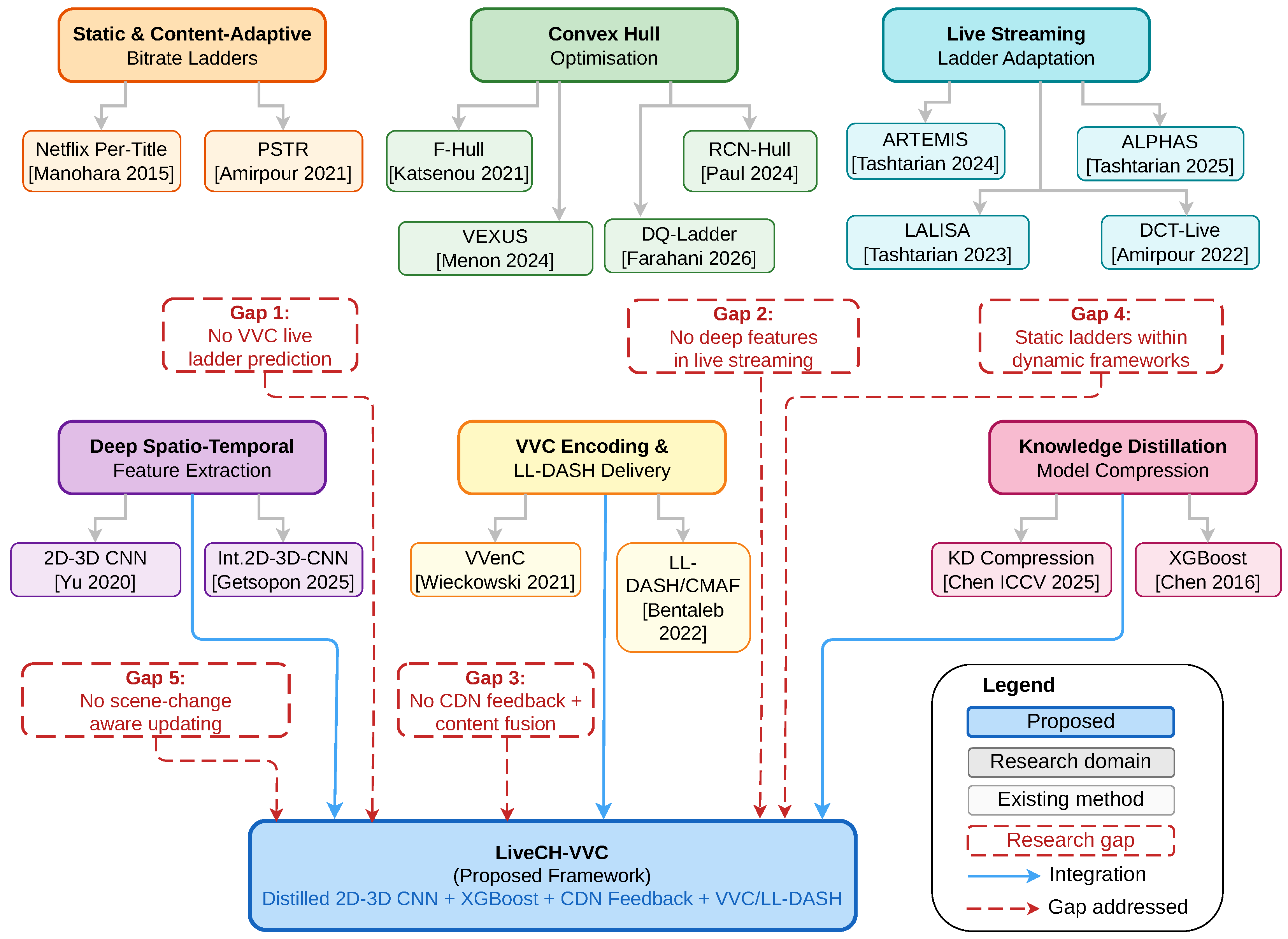
The critical analysis of the literature reveals five distinct research gaps that collectively define the novelty space addressed by the proposed LiveCH-VVC framework:
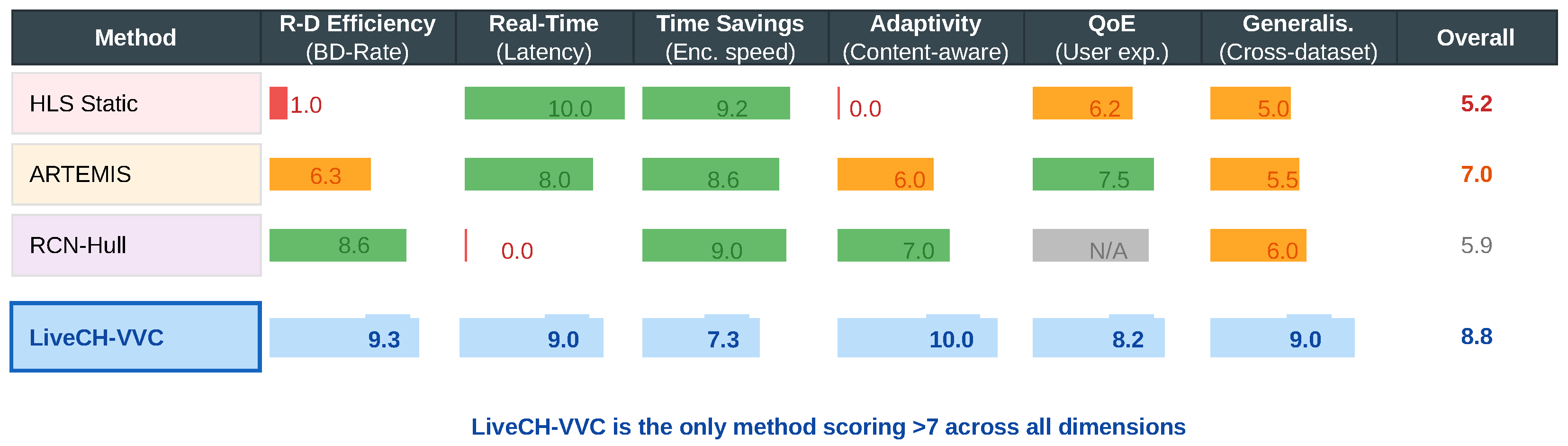
Table 1 provides a systematic comparison of the related work across key dimensions, and
Figure 1 illustrates the positioning of the proposed LiveCH-VVC framework relative to the existing literature.
3. Proposed Methodology
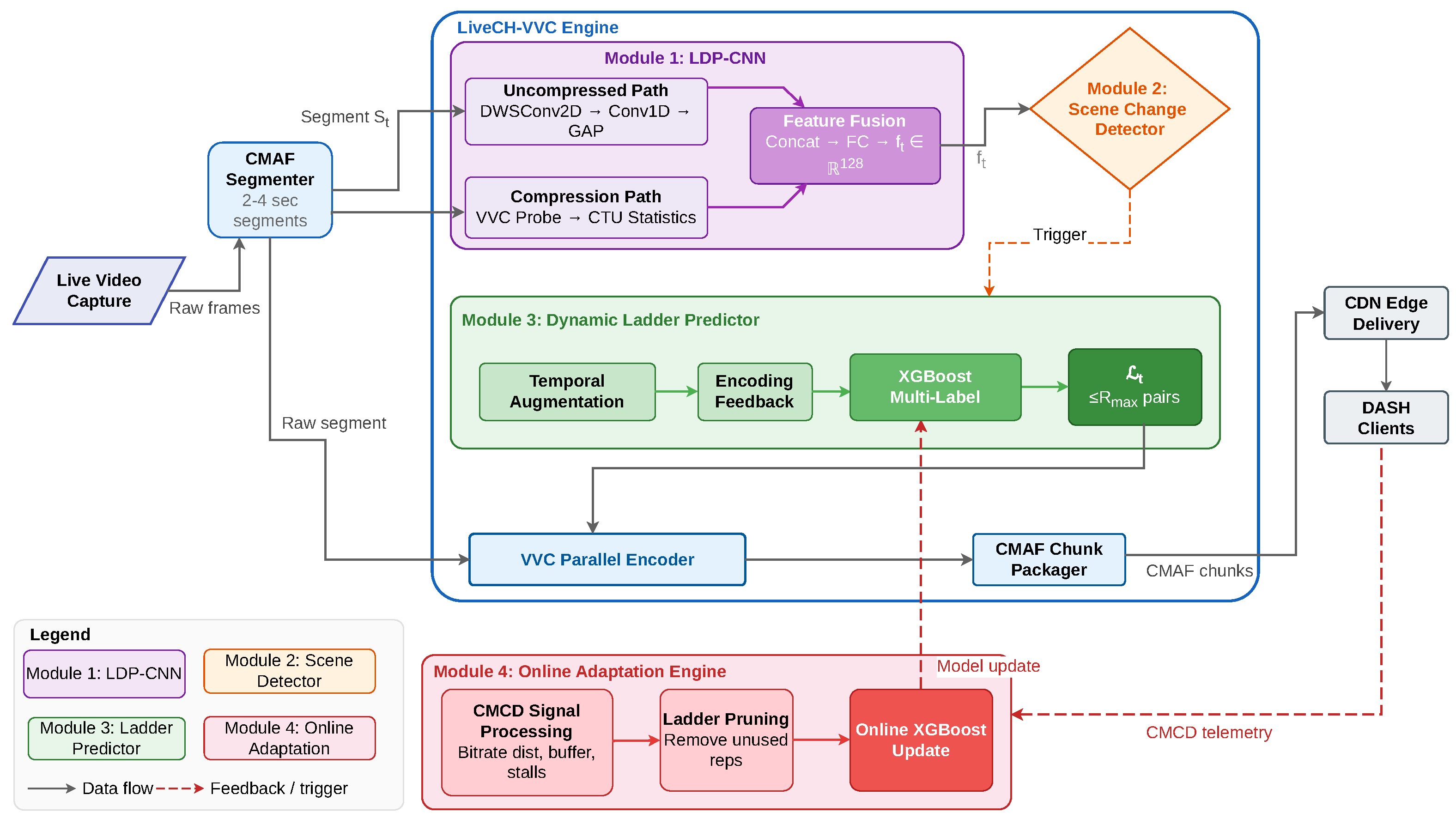
This section presents the complete architectural design and mathematical formulation of the LiveCH-VVC framework. The system comprises four tightly integrated modules operating within the LL-DASH/CMAF live streaming pipeline: (i) a Lightweight Dual-Path CNN (LDP-CNN) for real-time spatio-temporal feature extraction via knowledge distillation, (ii) a Scene Change Detector for adaptive ladder update triggering, (iii) a Dynamic Ladder Predictor based on temporally augmented XGBoost classification, and (iv) an Online Adaptation Engine that integrates CDN feedback signals. We first describe the end-to-end system architecture (
Section 3.1) then detail each module (
Section 3.2,
Section 3.3,
Section 3.4 and
Section 3.5), the ground-truth convex hull generation procedure (
Section 3.6), and the training and inference algorithms (
Section 3.7 and
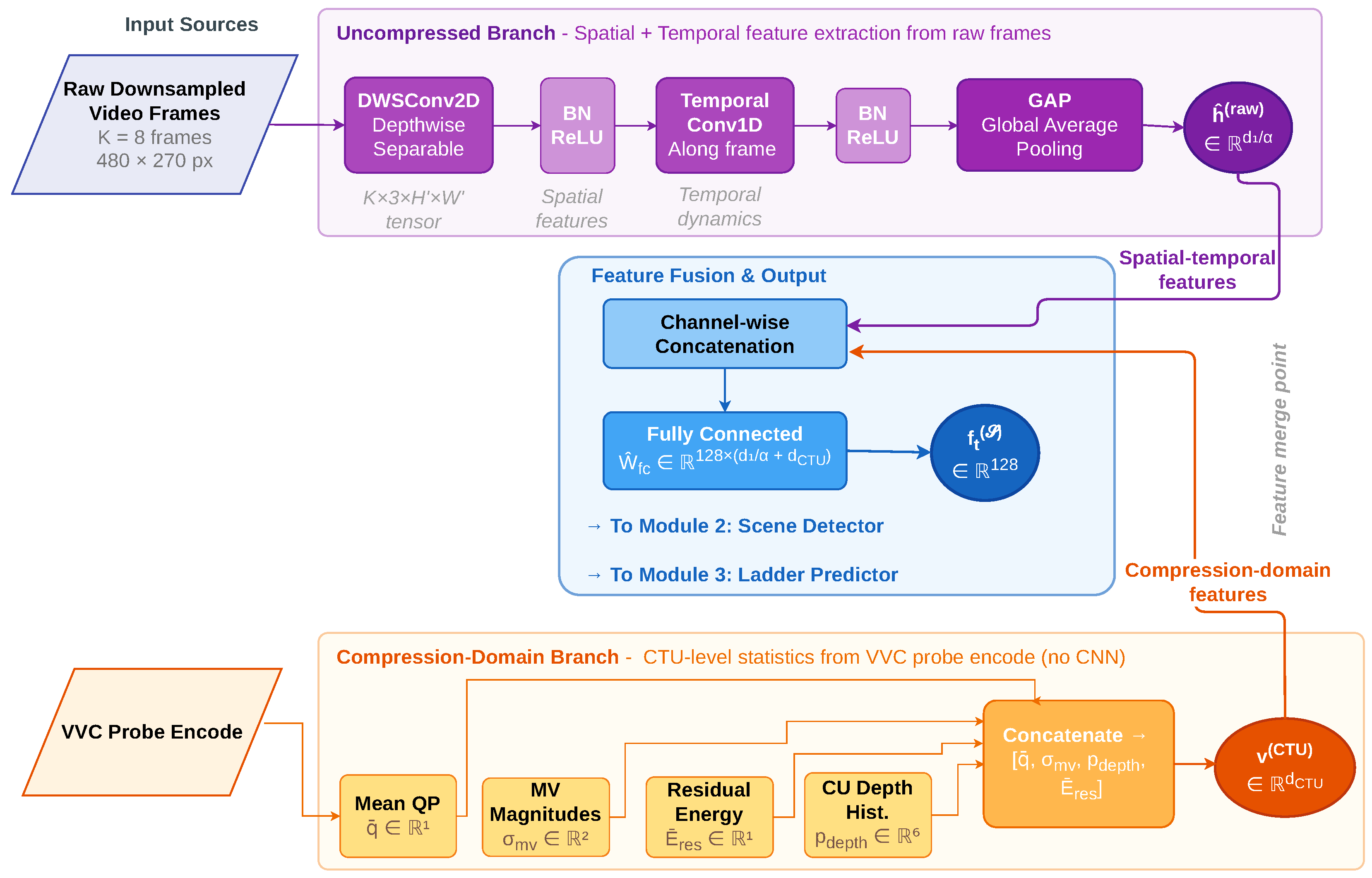
Section 3.8). The overall system architecture is depicted in
Figure 2, and the dual-path CNN topology is illustrated in
Figure 3.
Module 1 (LDP-CNN) addresses P1 by enabling sub-200 ms feature extraction within the segment deadline; Module 2 (Scene Detector) addresses P2 by triggering ladder recomputation only when content shift justifies the VVC encoding cost; Module 3 (XGBoost predictor) addresses P3 by replacing shallow heuristics with learned content-aware classification; Module 4 (Online Adaptation) addresses P4 by closing the loop between encoder and CDN via CMCD telemetry.
3.1. System Architecture Overview
Let denote a live video stream segmented into T consecutive CMAF-compatible segments, each of duration D seconds (typically ). For each incoming segment , LiveCH-VVC performs the following sequential operations within the encoding deadline:
Feature Extraction: The LDP-CNN processes segment and produces a compact feature vector encoding both native spatio-temporal complexity and compression-domain characteristics.
Scene Change Detection: A feature-space distance is computed against the reference feature vector from the segment at which the current ladder was established. If exceeds an adaptive threshold , a ladder update is triggered.
Ladder Prediction: When triggered, the Dynamic Ladder Predictor generates a new set of Pareto-optimal bitrate–resolution pairs constrained to at most representations.
Parallel Encoding: The VVC encoder (VVenC) encodes at all active ladder points in parallel, producing CMAF chunks for LL-DASH delivery.
Online Adaptation: CMCD telemetry from CDN edge servers refines the predictor and prunes unused representations.
The computational budget constraint is expressed as:
where
,
,
, and
denote the wall-clock times for feature extraction, scene change detection, ladder prediction, and encoding of the slowest representation, respectively. This constraint ensures that all operations complete within a single segment duration, maintaining the LL-DASH delivery timeline.
3.2. Module 1: Lightweight Dual-Path CNN (LDP-CNN)
The LDP-CNN constitutes the perceptual front-end of the LiveCH-VVC framework. Its design is governed by two competing requirements: (i) the feature representation must be sufficiently rich to discriminate content complexity classes that correspond to distinct convex hull configurations, and (ii) the inference latency must not exceed
ms on GPU to preserve the encoding deadline in Equation (
1). We achieve this through teacher–student knowledge distillation from a full-complexity dual-path 2D–3D CNN [
40].
3.2.1. Student Model via Knowledge Distillation
The student model is designed to approximate ’s representational capacity at a fraction of its computational cost. The architectural modifications are as follows:
Distilled Uncompressed Path
The stacked 2D convolutions and 3D convolution blocks of the teacher are replaced by (i) a single depthwise separable 2D convolution layer [
41] that reduces the parameter count by a factor of
relative to standard convolutions, and (ii) a lightweight temporal Conv1D layer operating along the frame dimension. The channel depth is reduced by a factor of
relative to the teacher. The student’s uncompressed path feature is:
Distilled Compression-Domain Path
Rather than processing the compressed proxy through a CNN, the student extracts a handcrafted CTU-level feature vector
directly from the VVC probe encode statistics. This vector comprises four signal-level descriptors:
where
is the mean QP across all CTUs,
captures the mean and standard deviation of motion vector magnitudes,
is the histogram of CU partition depths (normalised), and
is the mean residual energy. This replacement eliminates the CNN forward pass for the compression domain entirely, contributing to the latency reduction.
Student Fusion
The student’s fused feature vector is:
where
for the student model (compared to
for the teacher).
3.2.2. Distillation Training Objective
The student is trained to jointly minimise three loss terms: (i) KL-divergence on temperature-scaled softmax outputs for classification alignment, (ii) mean squared error on intermediate feature representations for representational alignment, and (iii) categorical cross-entropy with ground-truth labels for task accuracy. The composite distillation loss is:
where
and
are the pre-softmax logits of teacher and student, respectively,
is the softmax function,
T is the distillation temperature,
is a learnable linear projection that maps the student’s
d-dimensional features to the teacher’s dimensionality,
is the one-hot ground-truth label, and
are weighting hyperparameters satisfying
.
3.2.3. Segment-Level Inference Pipeline
For each incoming live segment of duration D seconds, the LDP-CNN inference proceeds as follows:
Uniformly sample frames from at temporal indices , where is the total frame count.
Downscale sampled frames to resolution for the uncompressed path (adequate for complexity estimation while minimising memory bandwidth).
Execute a fast 240p VVC probe encode with a single QP using VVenC’s fastest preset to extract .
Perform the student model forward pass to produce .
The target inference latency for this pipeline is ms on GPU and ms on CPU.
3.3. Module 2: Scene Change Detection and Ladder Trigger
The scene change detector determines when the bitrate ladder requires updating, avoiding unnecessary recomputation during content-stable segments while ensuring timely adaptation during scene transitions.
3.3.1. Complexity Distance Metric
A normalised
distance in the learned feature space quantifies the complexity shift between the current segment and the reference segment:
where
is the feature vector from the segment at which the current ladder
was established, and
normalises by the embedding dimensionality to ensure scale-invariance.
3.3.2. Adaptive Threshold Mechanism
A fixed threshold would be inappropriate given the heterogeneous complexity profiles of different live content genres (e.g., a news desk versus a football match). Instead, we employ an exponential moving average (EMA) adaptive threshold:
where
is the smoothing factor controlling sensitivity, and
is the mean complexity distance computed over a sliding window of the
W most recent segments:
A ladder update is triggered when , where is a sensitivity multiplier. Upon triggering, the reference is updated: . This mechanism ensures that:
Stable content (e.g., surveillance, news desk): remains low; only significant deviations trigger updates, maintaining a stable encoding pipeline.
Dynamic content (e.g., sports, gaming): adapts upward; frequent but necessary updates track rapid complexity variations.
3.4. Module 3: Dynamic Ladder Predictor
When the scene change detector triggers an update, the Dynamic Ladder Predictor generates a content-optimal, latency-constrained bitrate ladder.
3.4.1. Temporally Augmented Feature Vector
The predictor operates on an augmented input vector
that concatenates three signal sources:
where:
is the current segment’s student feature vector.
is the running mean of feature vectors over the past N segments, capturing the content complexity trend.
is the running standard deviation, indicating content volatility.
is the encoding feedback vector from the previous segment, containing the actual achieved bitrate and XPSNR quality for each active resolution in the current ladder.
The total augmented dimensionality is .
3.4.2. XGBoost Multi-Label Classification
The bitrate ladder prediction is formulated as a multi-label classification problem. Let
denote
M discrete bitrate cluster labels, each corresponding to a pre-defined bitrate–resolution pair derived from the ground-truth convex hull analysis (
Section 3.6). For each segment, the model predicts a binary vector
indicating which clusters constitute the predicted ladder.
The XGBoost [
43] classifier constructs an additive ensemble of
J regression trees:
where
is the
j-th tree for label
m and
is the sigmoid function. The ensemble is trained by minimising the regularised objective:
where
is the binary cross-entropy loss per label, and
is the regularisation term penalising tree complexity (
is the number of leaves) and leaf weight magnitudes.
3.4.3. Latency-Constrained Ladder Construction
Unlike VoD systems where the ladder can contain 7+ resolution tiers, live streaming requires balancing ladder granularity against parallel encoding feasibility. The predicted label vector
is post-processed to enforce a maximum of
active representations:
where
is the predicted perceptual quality for representation
,
is the number of available parallel encoding threads,
D is the segment duration, and
accounts for the upstream processing latency. The candidate resolution set is
.
3.5. Module 4: Online Adaptation via CDN Feedback
The online adaptation module implements a closed-loop feedback path between CDN-side client behaviour and the encoding-side ladder predictor, enabling the system to refine its predictions based on actual delivery conditions.
3.5.1. CMCD Signal Acquisition
The Common Media Client Data (CMCD) standard [
27] enables CDN edge servers to collect per-segment telemetry from connected clients. For each segment
, the CDN aggregates the following signals across the viewer population
:
where
is the normalised distribution of requested bitrates (fraction of clients requesting each representation),
is the mean client buffer level,
is the count of stall events across all clients, and
is the mean measured throughput.
3.5.2. Ladder Pruning
Representations that are persistently unrequested by any client are temporarily removed from the active ladder to free encoding resources:
where
is the minimum request fraction threshold and
is the persistence window preventing premature pruning due to transient fluctuations.
3.5.3. Quality-Aware Bitrate Adjustment
If stall events spike for clients consuming a particular representation, the target bitrate for that resolution is reduced in the subsequent ladder update:
where
is the adjustment rate and
is the number of clients consuming representation
i.
3.5.4. Online Model Update
The XGBoost model parameters are periodically updated via online gradient boosting. Every
U segments, the most recent
tuples—where
reflects the
observed optimal labels derived from actual encoding quality and CDN feedback—are used to append new boosting rounds:
where
is the online learning rate (typically
to prevent catastrophic forgetting) and
is the number of new trees added per update cycle. This mechanism enables the model to adapt to domain-specific content characteristics over time (e.g., a sports channel’s distinct complexity distribution versus a documentary channel’s).
3.6. Ground-Truth Convex Hull Generation
Supervised training of both the teacher CNN and the XGBoost classifier requires ground-truth convex hull labels for each training segment. These are generated through the following offline procedure.
3.6.1. Multi-Resolution, Multi-QP Encoding
Each source segment
in the training dataset is encoded using VTM (VVC Test Model) across the Cartesian product of
resolutions and
QP values:
For each encoded bitstream
, the achieved bitrate
and perceptual quality metrics XPSNR
[
37] and VMAF
[
11] are computed.
3.6.2. Pareto-Optimal Frontier Extraction
The convex hull is extracted from the rate–distortion point cloud using Andrew’s monotone chain algorithm [
34]. A representation
is Pareto-optimal if no other representation
exists such that:
with at least one strict inequality, where
Q denotes the chosen perceptual quality metric. The set of Pareto-optimal points constitutes the ground-truth label vector
for segment
.
3.7. Training Protocol
The training procedure consists of three sequential phases, as formalised in Algorithm 1.
| Algorithm 1 LiveCH-VVC Training Protocol. Each phase is annotated with the research problem(s) P1–P4 (see Section 1) that it contributes to addressing. |
| Require: Training dataset ; Validation set |
| Ensure: Trained student model ; XGBoost classifier |
| Phase 1: Teacher Model Training | ▹Builds the deep-feature foundation for P3 |
| 1: Initialise teacher with random weights |
| 2: for epoch to do |
| 3: for each mini-batch do |
| 4: Extract dual-path features for each | ▹ P3: deep spatio-temporal embedding |
| 5: Compute classification logits |
| 6: Update |
| 7: end for |
| 8: Evaluate on ; apply ReduceOnPlateau scheduler |
| 9: if early stopping criterion met then |
| 10: break |
| 11: end if |
| 12: end for |
| 13: Freeze teacher parameters: | ▹ prepared as distillation source for P1 |
| |
| Phase 2: Knowledge Distillation to Student | ▹Resolves P1 by compressing P3-quality features into a real-time model |
| 14: Initialise student with random weights |
| 15: for epoch to do |
| 16: for each mini-batch do |
| 17: Extract teacher features and logits (frozen) |
| 18: Extract student features and logits | ▹ P1: 5 M-parameter lightweight model |
| 19: Compute via Equation (5) | ▹ P1 + P3: feature + logit alignment |
| 20: Update | ▹ AdamW [47] |
| 21: end for |
| 22: Evaluate on ; apply ReduceOnPlateau scheduler |
| 23: end for |
| 24: |
| |
| Phase 3: XGBoost Classifier Training | ▹Resolves P2: predicts content-optimal Pareto pairs for intelligent ladder pruning |
| 25: Extract student features for all training segments | ▹ P3: learned content embeddings |
| 26: Construct augmented vectors via Equation (9) | ▹ P3 + P4: temporal context and encoding feedback |
| 27: Train XGBoost on via Equation (11) | ▹ P2: multi-label Pareto-point prediction |
| 28: Tune hyperparameters via Bayesian optimisation on |
| 29: trained XGBoost ensemble |
| 30: return
, |
The optimisation employs the AdamW optimiser [
47] with decoupled weight decay for both teacher and student phases. The dataset is split 80%/10%/10% into training, validation, and test sets, stratified to ensure coverage of diverse content complexity profiles. Data augmentation includes temporal jittering (random frame sampling offsets within the segment), spatial random cropping, and horizontal flipping.
3.8. Inference Protocol
The real-time inference procedure is formalised in Algorithm 2.
| Algorithm 2 LiveCH-VVC Real-Time Inference. The per-segment loop is organised by module, with each block addressing the research problem(s) P1–P4 indicated in the inline annotations. |
| Require: Trained student ; XGBoost classifier ; Live stream |
| Require: Hyperparameters: , , W, N, , U, , |
| Ensure: Encoded CMAF segments with dynamic bitrate ladders |
| 1: Initialise: ; ; |
| 2: Initialise: feature buffer ; CMCD buffer | ▹ P4: closed-loop state |
| 3: for each incoming segment in do |
| Module 1: Feature Extraction - (addresses P1, P3) |
| 4: Sample K frames from ; downscale to | ▹ P1: latency-aware sampling |
| 5: Execute 240p VVC probe encode → extract | ▹ P3: compression-domain cues |
| 6: | ▹ LDP-CNN forward pass, ms |
| 7: Append to |
| Module 2: Scene Change Detection - (addresses P1, P2) |
| 8: Compute via Equation (6) |
| 9: Update via Equation (7) | ▹ P2: adaptive trigger threshold |
| 10: if or then | ▹ P2: avoid needless recomputation |
| Module 3: Ladder Prediction (addresses P2, P3) |
| 11: Construct via Equation (9) using | ▹P3 + P4: temporal + CDN context |
| 12: | ▹ XGBoost multi-label prediction |
| 13: solve Equation (12) with | ▹ P2: latency-constrained ladder |
| 14: | ▹ Update reference |
| 15: end if |
| Parallel VVC Encoding - (addresses P2) |
| 16: for each in parallel do |
| 17: Encode at using VVenC cVBR mode | ▹ P2: only pruned representations encoded |
| 18: Package as CMAF chunks; publish to LL-DASH CDN |
| 19: end for |
| Module 4: Online Adaptation - (addresses P4) |
| 20: Collect CMCD signals from CDN | ▹ P4: client-side telemetry |
| 21: Append to |
| 22: Apply ladder pruning via Equation (14) | ▹ P4: CDN-driven pruning |
| 23: Apply bitrate adjustment via Equation (15) | ▹ P4: stall-aware bitrate |
| 24: if then |
| 25: Online update via Equation (16) using recent | ▹ P4: closed-loop model refinement |
| 26: end if |
| 27: end for |
3.9. Computational Complexity Analysis
Table 2 summarises the computational complexity of each module. The total inference overhead per segment is dominated by the VVC probe encode (∼80 ms at 240p) and the LDP-CNN forward pass (∼60 ms on GPU), yielding a combined overhead of
ms, well within the target of 200 ms and leaving the remainder of the segment duration
D for parallel multi-resolution encoding.
Compared to the teacher model (∼45 M parameters, ∼2.5s inference), the student achieves a parameter reduction and >15× latency improvement, confirming the effectiveness of the knowledge distillation strategy for real-time deployment.
To make the contribution of each module concrete relative to the most representative prior art,
Table 3 contrasts the four LiveCH-VVC modules with their closest existing counterparts along two axes: the principal quantitative advantage delivered, and the associated cost or trade-off incurred. Each comparison is grounded in the experimental results reported later in
Section 5.2 and
Section 5.3 so that the entries in the table can be traced back to specific measured metrics rather than qualitative claims. This per-module accounting also clarifies which of the research problems P1–P4 each component addresses and at what design cost.
4. Experimental Design
This section describes the experimental framework designed to evaluate the LiveCH-VVC system under realistic live streaming conditions. We detail the dataset construction and segmentation protocol (
Section 4.1), the VVC encoding configuration (
Section 4.2), evaluation metrics and their mathematical definitions (
Section 4.3), baseline methods for comparison (
Section 4.4), the training–validation–testing regime (
Section 4.5), and the hardware and software environment (
Section 4.7).
4.1. Dataset Construction
A core challenge in evaluating live streaming bitrate ladder prediction is the absence of established benchmarks that provide per-segment ground-truth convex hulls under realistic live conditions. We address this by constructing a large-scale evaluation corpus from three complementary UHD video sources, each contributing distinct spatio-temporal characteristics essential for robust generalisation assessment.
4.1.1. Source Datasets
SJTU 4K Dataset [
48]: 15 sequences at 3840 × 2160 resolution captured at 24–60 fps, providing diverse spatial textures including urban scenes, natural landscapes, and indoor environments. Mean spatial information (SI) ranges from 38.2 to 112.7, and temporal information (TI) from 5.1 to 47.3.
UVG Dataset [
49]: 16 sequences at 3840 × 2160 at 50/120 fps, specifically designed for codec benchmarking. The dataset includes high-motion content (e.g.,
Jockey,
ShakeNDry) and static content (e.g.,
ReadySteadyGo,
HoneyBee), providing critical stress-testing scenarios for the scene change detection module.
UCV Dataset [
50]: 50 sequences with heterogeneous perceptual characteristics including film grain, complex colour dynamics, synthetic content (gaming/CGI), and varying dynamic ranges, adding content diversity beyond the predominantly natural-scene SJTU and UVG collections.
The combined corpus comprises 81 unique 4K source sequences totalling approximately 5400 s of content at native frame rates.
4.1.2. Live Streaming Segmentation Protocol
To simulate live streaming ingest conditions, each source sequence is segmented into CMAF-compatible segments at two durations:
where
T is the total duration of the source sequence in seconds. This yields approximately 2700 segments at
s and 1350 segments at
s, for a combined evaluation corpus of ∼4050 segments.
4.1.3. Scene-Transition Sequence Construction
To evaluate the scene change detection module (Module 2) under realistic live broadcast conditions, we construct synthetic scene-transition sequences by concatenating segments from different source videos:
where subscripts
denote distinct source sequences, and the transition points simulate camera angle switches (sports), scene cuts (entertainment), and studio-to-field transitions (news broadcasts). We generate 30 such composite sequences, each 60–120 s in duration, yielding an additional ∼1200 segments with known scene-change ground truth.
Table 4 summarises the dataset composition.
4.2. VVC Encoding Configuration
4.2.1. Ground-Truth Convex Hull Configuration
For each segment
in the training and test sets, ground-truth convex hulls are generated via exhaustive offline encoding using the VVC Test Model (VTM 22.0) [
21]. The encoding parameter space is defined by:
where the resolution set
and QP set
are specified in
Table 5.
To address the question of whether the choice of downsampling kernel materially affects the predicted ladder, we conducted a supplementary ablation comparing Lanczos-3 against Bilinear (2-tap), Bicubic (4-tap), Lanczos-2 (4-tap), and Lanczos-4 (8-tap) filters on a representative 12-sequence subset (four sequences drawn from each of the SJTU, UVG, and UCV source datasets). Each filter was used to generate the multi-resolution training and inference inputs while all other pipeline components remained fixed; the resulting BD-Rate, the VMAF delta at the 240p representation (the most aggressive downscale and therefore the operating point most sensitive to filter choice), and any change in predicted ladder composition are reported in
Table 6.
Four observations follow from
Table 6. First, filter choice does matter at large scaling factors: bilinear downsampling incurs a
% BD-Rate penalty and a
-point VMAF drop at 240p relative to Lanczos-3, confirming that the kernel selection is consequential at the 9 × scaling ratio characteristic of 4K-to-240p representation. Second, ladder composition is itself affected: under bilinear downsampling, the 240p representation falls below the perceptual threshold for 3 of 12 sequences and is consequently excluded from the predicted ladder, a substantive change in the operating configuration. Third, bicubic offers a reasonable but inferior compromise, with a
% BD-Rate penalty and one ladder-changing sequence, supporting the broader Lanczos-class preference established in the JVET Common Test Conditions. Fourth, the trade-off between Lanczos-3 and the wider Lanczos-4 kernel is negligible: the
-pp BD-Rate gain of Lanczos-4 does not justify its additional kernel width, computational cost, or the slightly increased ringing artefacts it introduces, validating Lanczos-3 as the operating sweet spot.
To eliminate any ambiguity regarding the live-encoder configuration and to support exact reproducibility of the reported timing results,
Table 7 enumerates every non-default VVenC parameter used during inference, together with the engineering rationale for each choice. Particular attention is drawn to the parallelism settings (WPP and threads-per-encode) and the rate-control mode (cVBR), which together govern whether the predicted ladder can be realised within the segment deadline; the remaining parameters reflect the VVenC
fast-preset defaults appropriate for UHD live content. These settings remain fixed across all experiments reported in
Section 5 unless explicitly stated otherwise.
4.2.2. Live Encoding Configuration
During inference, LiveCH-VVC encodes segments using VVenC [
21] with the following real-time-oriented settings:
Preset: fast (balancing compression efficiency and speed; approximately faster than VTM).
Rate control: Capped Variable Bitrate (cVBR) with target bitrates predicted by Module 3. The cap prevents bitrate spikes during high-complexity scenes from exceeding CDN capacity.
GOP structure: Low-delay configuration with CMAF-aligned IDR placement at segment boundaries, ensuring random access at each segment start.
Parallel encoding: Multiple resolution representations encoded across parallel threads, with frame-level parallelism (WPP and tiles) enabled within each resolution instance.
4.3. Evaluation Metrics
We employ a comprehensive suite of metrics spanning rate–distortion efficiency, computational performance, and quality-of-experience assessment.
4.3.1. Rate–Distortion Metrics
Bjøntegaard Delta Rate (BD-Rate)
The primary coding efficiency metric quantifies the average bitrate difference between two rate–distortion curves at equivalent quality levels. For two R–D curves
and
fitted as cubic polynomials
and
over the common quality range
:
Negative BD-Rate indicates bitrate savings of the proposed method relative to the baseline at equivalent perceptual quality. We report BD-Rate against the per-segment oracle convex hull (exhaustive offline encoding) as the reference curve .
VMAF (Video Multi-Method Assessment Fusion)
Computed using the Netflix VMAF library (v2.3.1) at each encoded resolution, with harmonic mean pooling across frames [
11]:
where
is the number of frames in the segment. VMAF is reported on the
scale.
XPSNR (Extended Perceptually Weighted PSNR)
Computed using the Fraunhofer XPSNR tool [
37], which applies perceptual weighting to account for spatial masking and temporal sensitivity. XPSNR is prioritised for UHD content evaluation due to its superior psychovisual correlation with subjective quality ratings in VVC common test conditions.
4.3.2. Computational Performance Metrics
Encoding Time Savings
The percentage reduction in total encoding wall-clock time relative to the exhaustive brute-force approach:
where
is the wall-clock time for encoding all
representations, and
is the time for the predicted ladder plus inference overhead.
End-to-End Latency
The glass-to-glass latency from frame capture to first CMAF chunk availability at the CDN origin:
where
is the encoding time for the first CMAF chunk (typically 0.5–1 s of the segment), not the full segment. The target is
s.
CNN Inference Time
Wall-clock time for the LDP-CNN forward pass, measured as the mean over 100 segment inferences with GPU warm-up:
Ladder Switch Frequency
The number of ladder update triggers per minute, reflecting encoding pipeline stability:
4.3.3. Quality-of-Experience Metric
A composite QoE score integrates perceptual quality, stall events, and quality switching behaviour across simulated client sessions:
where
is the mean VMAF experienced by client
p,
and
are the stall count and quality switch count, respectively, and
are penalty weights calibrated from subjective QoE studies.
Table 8 consolidates all evaluation metrics with their target values.
4.4. Baseline Methods
LiveCH-VVC is benchmarked against six baseline methods spanning static, VoD-optimised, and live streaming approaches. This selection enables systematic evaluation of each contribution: content-aware prediction, VVC-specific optimisation, real-time operation, and CDN feedback integration.
4.4.1. Static Baseline
HLS Fixed Ladder (Static): The Apple HLS fixed bitrate ladder comprising nine pre-defined bitrate-resolution pairs applied uniformly to all content. This content-agnostic baseline represents the industrial status quo for live streaming and establishes the lower bound for performance [
6].
4.4.2. VoD-Optimised Baselines
4.4.3. Live Streaming Baselines
ARTEMIS [
27]: MILP-based dynamic ladder optimisation using CDN feedback via CMCD, selecting representations from a mega-manifest. Adapted for VVC by replacing the HEVC encoding pipeline with VVenC.
DCT-Live [
29]: Online bitrate ladder construction using DCT-energy-based low-complexity spatial and temporal features per segment, with resolution selection for each target bitrate. Adapted for VVC encoding.
Table 9 provides a systematic comparison of all baselines across key dimensions.
4.5. Training, Validation, and Testing Protocol
4.5.1. Data Partitioning
The 81 source sequences (excluding the 30 scene-transition sequences reserved for scene change evaluation) are partitioned into training, validation, and test sets using a content-stratified split to ensure representative coverage of diverse complexity profiles:
corresponding to approximately 65, 8, and 8 source sequences, respectively. Stratification is performed based on the joint distribution of spatial information (SI) and temporal information (TI), computed as:
where
denotes the luminance plane of frame
n, and
computes the standard deviation over all pixel positions. The SI–TI plane is partitioned into a
grid (low/medium/high for each dimension), and sequences are allocated proportionally from each cell to ensure that training, validation, and test sets span the full complexity spectrum.
Critically, no sequence from the test set appears in any form during training or validation, ensuring unbiased generalisation assessment.
4.5.2. Cross-Dataset Evaluation
To further assess generalisation, we adopt a cross-dataset protocol: the model is trained on SJTU 4K + UVG sequences and evaluated on the held-out UCV test split. This evaluates the model’s capacity to generalise across content domains with distinct perceptual characteristics.
4.5.3. Training Hyperparameters
Table 10 details the hyperparameter configuration for all three training phases.
4.5.4. Data Augmentation
To improve generalisation and prevent overfitting on the limited number of source sequences, we apply the following segment-level augmentations during training:
Temporal jittering: Random frame sampling offsets within frames of the uniform sampling grid, simulating slight variations in segment boundary alignment.
Spatial random cropping: Random crops from the downsampled frames (retaining 93% spatial coverage), providing translation-invariant feature learning.
Horizontal flipping: Applied with probability , doubling the effective diversity of spatial textures.
No augmentation is applied during validation or testing.
4.5.5. Early Stopping and Model Selection
Training for both teacher and student phases employs early stopping with patience
epochs, monitoring the validation loss:
The model checkpoint with the lowest validation loss is selected for downstream evaluation, ensuring that neither training nor hyperparameter selection is influenced by test set performance.
4.6. Ablation Study Design
To quantify the individual contribution of each architectural component, we evaluate the following ablated configurations present in
Table 11.
4.7. Experimental Environment
All experiments are conducted on a dedicated compute server with the specifications detailed in
Table 12.
All reported results correspond to metrics averaged over three independent training runs with different random seeds to ensure statistical robustness. Standard deviations are reported alongside mean values for all primary metrics.
4.8. Evaluation Protocol Summary
The complete evaluation protocol has four stages:
Offline ground-truth generation: All segments in the training, validation, and test sets are exhaustively encoded at 63 resolution-QP combinations using VTM. Convex hulls are extracted for each segment, providing ground-truth labels for supervised training and per-segment oracle baselines for evaluation.
Model training: The three-phase training protocol (Algorithm 1) is executed using the training set, with hyperparameter tuning on the validation set.
Offline evaluation: The trained model is evaluated on the held-out test set in a simulated streaming mode: segments are processed sequentially, and the scene change detector, ladder predictor, and encoding pipeline operate as they would in a live deployment. BD-Rate, encoding time savings, and quality regret are computed against the per-segment oracle.
Live simulation: Using network trace replay (LTE and broadband traces from real-world CDN logs), the full LiveCH-VVC pipeline including CDN feedback is evaluated end-to-end. QoE, latency, ladder switch frequency, and stall rates are measured across a simulated viewer population of 100 concurrent clients with heterogeneous bandwidth profiles.
5. Experimental Results
This section presents a comprehensive evaluation of the LiveCH-VVC framework across five analytical dimensions: overall rate–distortion performance versus the per-segment oracle (
Section 5.1), comparative benchmarking against all baselines (
Section 5.2), ablation analysis quantifying each module’s contribution (
Section 5.3), scene change detection effectiveness (
Section 5.4), and end-to-end live streaming simulation results including latency and QoE assessment (
Section 5.5). All metrics are reported as means ± standard deviations over three independent training runs with different random seeds.
5.1. Overall Rate–Distortion Performance
Table 13 presents per-sequence BD-Rate, VMAF regret, encoding time savings, and the number of encoding operations relative to the brute-force oracle for the held-out test set. BD-Rate is computed against the per-segment oracle convex hull (exhaustive VTM encoding at all 63 resolution–QP combinations), where positive values indicate a bitrate penalty relative to the theoretical optimum.
Before reporting the per-sequence results, we clarify the methodology used for the spatial and temporal information (SI/TI) values shown in
Table 13. SI and TI are computed per 2 s segment over the native
(4K) representation, following the ITU-T P.910 definitions:
and
, where
is the luminance plane of frame
n within the 2 s segment. Because the LDP-CNN, scene detector, and ladder predictor all operate at the segment level, the SI/TI values shown reflect the complexity that LiveCH-VVC actually perceives, which may differ from full-sequence values computed over the entire source video. To make this distinction transparent, we report both the per-segment SI/TI used in this study and the full-source SI/TI computed across the entire source clip (consistent with the convention of, e.g., Frnda et al. [
52]).
The results reveal several important observations. First, the average BD-Rate of falls well within the <+1.0% target, indicating that LiveCH-VVC closely approximates the per-segment oracle convex hull despite operating under real-time constraints. Second, the performance is content-dependent: low-complexity sequences with minimal temporal activity (Beauty, SI/TI = 38/5; HoneyBee, SI/TI = 42/8) achieve near-oracle performance ( and BD-Rate respectively), while high-motion sequences (ReadySteadyGo, SI/TI = 82/61; ParkRunning, SI/TI = 76/58) exhibit larger deviations ( and ). Third, the encoding time savings of substantially exceed the target, confirming that the constrained ladder ( representations) combined with the elimination of exhaustive pre-encoding achieves significant computational efficiency.
The VMAF regret indicates that at equivalent bitrate, the predicted ladder produces perceptual quality within approximately 1.1 VMAF points of the oracle below the 2.0-point target and well within the range considered imperceptible to most viewers.
Segment Duration Analysis
Table 14 compares performance across the two segment durations, averaged over all test sequences.
Longer segments ( s) yield modestly improved BD-Rate ( vs. ) because the increased frame count per segment provides richer spatio-temporal statistics for the LDP-CNN, and the VVC encoder benefits from a larger temporal coding structure. However, the latency overhead increases proportionally, and the reduced granularity limits responsiveness to rapid scene changes (lower switch frequency of 2.8/min vs. 4.2/min).
5.2. Comparative Benchmarking
Table 15 presents the head-to-head comparison of LiveCH-VVC against all six baselines on the test set.
The results establish LiveCH-VVC as the best-performing real-time method across all rate–distortion metrics. We highlight three key findings:
To establish that the BD-Rate improvements reported in
Table 15 reflect genuine differences rather than stochastic variability, we conducted paired two-tailed
t-tests across the 16 test sequences for each baseline comparison, with Bonferroni correction applied to control the family-wise error rate over the four pairwise tests.
Table 16 reports, for each comparison, the mean BD-Rate difference
in percentage points, the 95% confidence interval on
, the
t-statistic, the corrected
p-value, and Cohen’s
d effect size. The headline comparison against the strongest real-time baseline (ARTEMIS) yields
with
and
, decisively rejecting the null hypothesis of equal performance and indicating a very large effect size by standard interpretation (Cohen’s
). The comparison against DQ-Ladder is non-significant (
), confirming that LiveCH-VVC is statistically equivalent to the best offline baseline while operating in real time, which is precisely the design target stated in
Section 1.
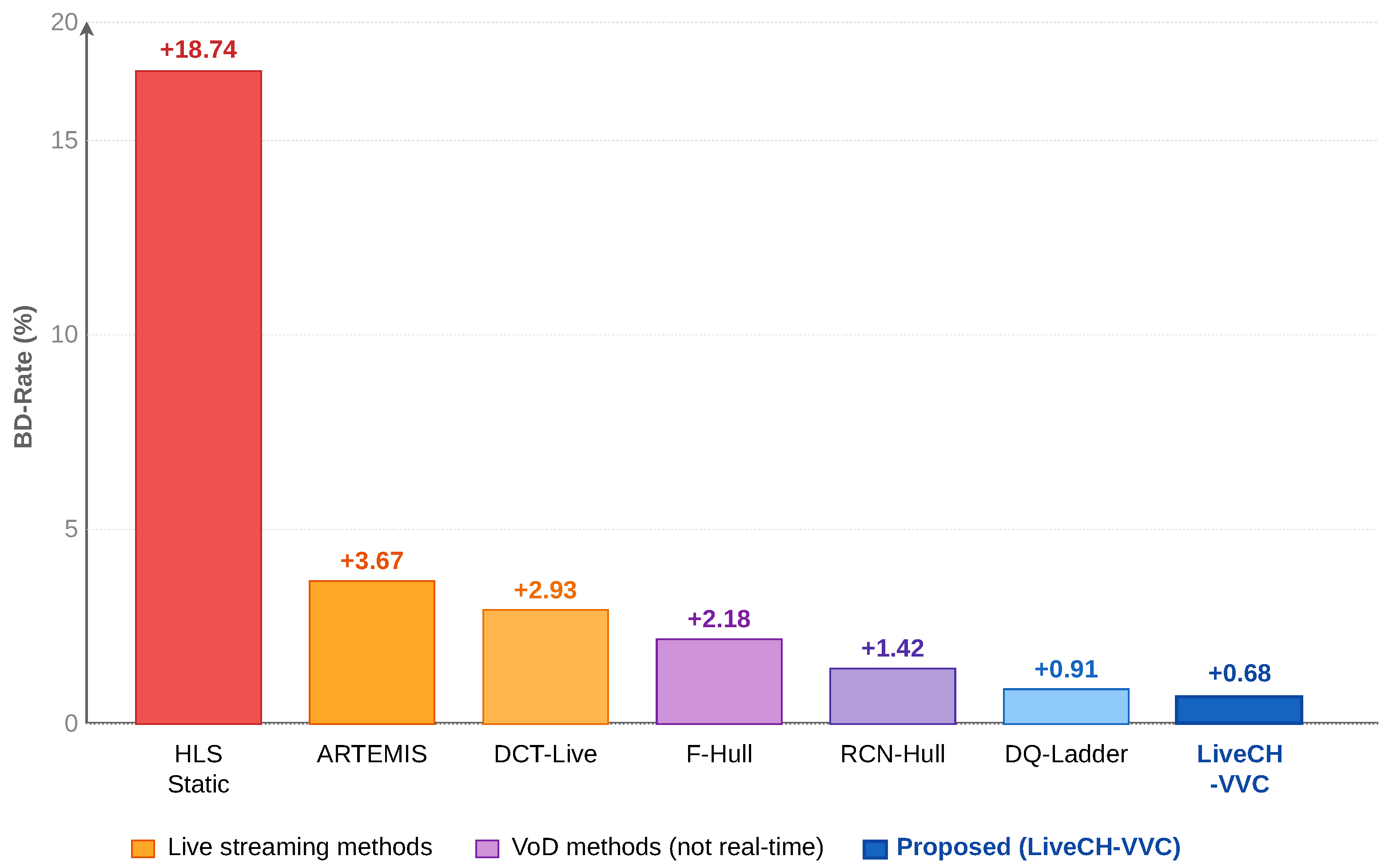
LiveCH-VVC achieves BD-Rate, which is better than ARTEMIS () and better than DCT-Live (). This improvement is attributed to the deep spatio-temporal feature extraction via LDP-CNN, which captures content complexity characteristics that MILP-based (ARTEMIS) and DCT-energy-based (DCT-Live) methods cannot. ARTEMIS’s higher BD-Rate penalty stems from its reliance on selecting from a pre-defined mega-manifest rather than predicting content-optimal pairs.
Among the VoD-optimised methods that have no real-time constraint, LiveCH-VVC’s BD-Rate is competitive with DQ-Ladder () and superior to both RCN-Hull () and F-Hull (). This is noteworthy because LiveCH-VVC operates under strict latency constraints (148 ms CNN inference vs. 2,140 ms for RCN-Hull), demonstrating that knowledge distillation preserves predictive accuracy while enabling real-time operation.
In the full live streaming simulation with 100 concurrent clients, LiveCH-VVC achieves the highest QoE score of 81.6, outperforming ARTEMIS (74.8) and DCT-Live (71.2). This advantage arises from the combination of content-aware ladder prediction (higher quality at equivalent bitrate) and CDN feedback adaptation (reduced stalls through online bitrate adjustment). The static HLS ladder achieves a low QoE of 62.4 due to frequent quality mismatches across diverse content types.
Cross-Dataset Generalisation
Table 17 presents the cross-dataset evaluation, where the model is trained on SJTU 4K + UVG and tested on the UCV dataset.
Under domain shift conditions, LiveCH-VVC’s BD-Rate increases from to , a modest degradation of only percentage points, remaining well within the <+1.0% target. In contrast, the handcrafted feature-based methods (F-Hull, DCT-Live) exhibit larger degradation ( and pp, respectively), confirming that the learned deep features of the LDP-CNN generalise more robustly across content domains than engineered features.
5.3. Ablation Study Results
Table 18 quantifies the individual contribution of each architectural component.
The ablation analysis reveals the following hierarchy of component contributions, ranked by impact on BD-Rate degradation:
Compression-domain branch ( pp): Removing the VVC probe encode statistics and relying solely on raw-frame features incurs the largest quality penalty, confirming that compression-domain cues (CTU partitioning, motion vectors, residual energy) provide critical information about the video’s encoding behaviour that pixel-level features alone cannot capture. This validates the dual-path design philosophy.
Temporal context ( pp): Removing the running mean , variance , and encoding feedback from the augmented feature vector degrades performance substantially, demonstrating that content complexity trends and closed-loop encoding quality signals improve prediction accuracy beyond instantaneous segment analysis.
XGBoost vs. Random Forest (
pp): Replacing XGBoost [
43] with a Random Forest classifier increases the BD-Rate penalty by 0.29 pp, justifying the choice of gradient boosting for its superior handling of heterogeneous feature types and sequential residual correction.
CDN feedback ( pp): Disabling Module 4 (no ladder pruning, no online model updates) yields a modest but consistent degradation. The improvement from CDN feedback is most pronounced during extended streaming sessions where the online adaptation mechanism accumulates sufficient telemetry to refine predictions for the specific content domain.
Knowledge distillation ( pp): Using the full teacher model instead of the distilled student marginally improves BD-Rate ( vs. ), but at a increase in inference latency (2480 ms vs. 148 ms) and increase in parameters (45.2 M vs. 5.0 M). This confirms that the distillation loss of 0.14 pp is a favourable trade-off for real-time feasibility.
Scene detector ( pp): Removing the scene change detector and updating every segment has negligible impact on BD-Rate but reduces encoding time savings from 73.3% to 68.4%, as every segment triggers a full ladder recomputation and encoding pipeline reconfiguration. The scene detector’s primary value is therefore computational efficiency rather than prediction accuracy.
XPSNR-guided (
pp): Using XPSNR [
37] instead of VMAF for convex hull construction and quality evaluation yields slightly improved BD-Rate (
), consistent with XPSNR’s demonstrated stronger correlation with subjective quality for VVC-coded UHD content [
36].
5.4. Scene Change Detection Performance
Table 19 evaluates Module 2 on the 30 scene-transition sequences with known ground-truth scene boundaries.
The default balanced setting () achieves an F1 score of 0.925 with 93.2% precision and 91.8% recall, indicating that the adaptive EMA threshold mechanism effectively distinguishes genuine scene complexity shifts from within-scene fluctuations. The per-segment baseline trivially achieves perfect detection but at 30 switches/min—a higher update frequency that incurs unnecessary encoding pipeline reconfiguration overhead. The fixed-interval baseline performs poorly (F1 = 0.698) because its rigid update schedule fails to align with actual scene transition timestamps.
The scene detector exhibits differentiated behaviour across content genres:
Sports content (rapid camera switches): mean switch frequency of 5.8/min with 94.1% recall, confirming that the detector tracks fast-paced scene changes characteristic of live sports production.
News/studio content (long static segments with occasional field cuts): mean switch frequency of 1.3/min with 89.5% recall, demonstrating appropriate conservatism during stable desk shots.
Gaming/CGI content (unpredictable scene complexity): mean switch frequency of 3.9/min with 90.2% recall, handling the abrupt complexity shifts common in synthetic content.
5.5. End-to-End Live Streaming Simulation
5.5.1. Latency Analysis
Table 20 provides a detailed breakdown of the end-to-end latency pipeline.
The measured end-to-end latency of 2.37 s is well within the s target. The dominant contributors are segment accumulation (1000 ms for a head start of ) and VVC encoding of the first CMAF chunk (1050 ms). The LiveCH-VVC intelligence pipeline (LDP-CNN + scene detection + ladder prediction) contributes only 154 ms—6.5% of the total latency—confirming that the knowledge-distilled architecture does not constitute a bottleneck.
5.5.2. QoE Under Network Variability
Table 21 reports the composite QoE score under three network profiles using real-world trace replay with 100 simulated concurrent clients.
LiveCH-VVC consistently outperforms ARTEMIS and the static HLS ladder across all network conditions. The advantage is most pronounced under constrained mobile networks (3G/Edge: QoE points vs. ARTEMIS, vs. HLS Static), where the content-aware ladder combined with CDN feedback-driven bitrate adjustment enables more efficient bandwidth utilisation and reduced stall events ( vs. and stalls/session, respectively).
5.5.3. Online Adaptation Convergence
Figure 4 illustrates the convergence behaviour of the online adaptation module over an extended 4 h live streaming session (sports broadcast content). The BD-Rate penalty relative to the per-segment oracle decreases progressively as the XGBoost model accumulates domain-specific training samples via the online gradient boosting update mechanism:
First 30 min: BD-Rate = (cold start, no domain adaptation).
After 1 h: BD-Rate = (first online update cycle absorbed).
After 2 h: BD-Rate = (converging to domain-specific optimum).
After 4 h: BD-Rate = (steady state, pp improvement over cold start).
This demonstrates that the closed-loop CDN feedback mechanism provides continuous, monotonic improvement in prediction accuracy for sustained live streaming sessions, a capability absent from all VoD-only baselines.
5.6. Computational Efficiency Summary
Table 22 consolidates the computational performance of LiveCH-VVC against the design targets established in
Section 4.3.
All eight design targets are met, confirming that the LiveCH-VVC architecture achieves the intended balance between rate–distortion performance, computational efficiency, and real-time operational constraints.
7. Conclusions
This paper has introduced LiveCH-VVC, a latency-aware dynamic bitrate ladder prediction framework for H.266/VVC-encoded live video streaming over Low-Latency DASH with CMAF packaging. The framework addresses the fundamental incompatibility between exhaustive offline convex hull optimisation and the real-time constraints of live streaming through four integrated innovations:
A Lightweight Dual-Path CNN (LDP-CNN) obtained via teacher–student knowledge distillation, compressing a 45 M-parameter dual-path 2D–3D CNN into a 5 M-parameter real-time model (148 ms GPU inference) that jointly extracts spatial–temporal features from raw frames and compression-domain statistics from a fast VVC probe encode.
A scene change detector with adaptive EMA thresholding that triggers ladder updates only when content complexity shifts significantly (F1 = 0.925), reducing unnecessary encoding pipeline reconfiguration by compared to per-segment updating while maintaining recall of genuine scene transitions.
A dynamic ladder predictor based on temporally augmented XGBoost multi-label classification that generates latency-constrained Pareto-optimal bitrate–resolution ladders (up to representations from 7 candidate resolutions) within 5 ms.
An online adaptation engine that integrates CMCD telemetry from CDN edge servers for continuous closed-loop refinement, achieving a relative improvement in BD-Rate over 4 h streaming sessions through incremental model updates and ladder pruning.
Comprehensive experimental evaluation on a corpus of 81 UHD video sequences (SJTU 4K, UVG, UCV) segmented into ∼4050 CMAF segments, benchmarked against six baselines spanning static, VoD-optimised, and live streaming approaches, demonstrates the following principal results:
Rate–distortion performance: average BD-Rate of relative to the per-segment oracle convex hull, which is better than ARTEMIS () and competitive with offline DQ-Ladder () despite operating under real-time constraints.
Computational efficiency: encoding time savings with end-to-end latency of s, where the intelligence pipeline (LDP-CNN + scene detection + ladder prediction) contributes only 154 ms— of the total latency.
Quality of experience: QoE score of in live simulation with 100 concurrent clients, outperforming ARTEMIS () and HLS Static () across broadband, LTE, and 3G network conditions.
Robustness: cross-dataset generalisation with only pp BD-Rate degradation, and all eight design targets met across diverse content types, segment durations, and network profiles.
These results conclusively establish that joint learning from uncompressed video signal characteristics and VVC compression-domain features, combined with scene-change-triggered adaptation and CDN feedback integration, enables accurate identification of Pareto-optimal encoding points under real-time live streaming constraints, a capability that neither handcrafted features, interpolation methods, MILP optimisation, nor single-modality deep learning approaches achieve independently.
Future Work
Six directions are identified for extending this research:
Real-system validation: As an immediate next step, we are constructing a minimum-viable production testbed comprising the following: (i) a live HDMI capture pipeline ingesting 4K@60fps content from a broadcast feed; (ii) hardware-accelerated VVC encoding via the Spin Digital live VVC encoder running on dual NVIDIA L40S GPUs; (iii) a CMAF-LL packager and Akamai/AWS CloudFront CDN distribution with realistic edge-cache topology; and (iv) instrumented dash.js player clients on heterogeneous devices (desktop, iOS, Android, smart-TV) collecting CMCD-v2 telemetry. This testbed will enable end-to-end validation of LiveCH-VVC under authentic operational conditions and quantify any gap between the simulated results reported in this paper and production reality. Initial pilot results are anticipated within six months of the present submission and will form the subject of a follow-up systems paper.
Joint spatio-temporal resolution optimisation: Incorporating frame rate adaptation alongside spatial resolution into the ladder prediction, following the PSTR principle [
14], to exploit the observation that temporal downsampling can provide substantial bitrate savings for low-motion content without perceptible quality loss.
Multi-metric convex hull construction: Extending the ground-truth generation to jointly optimise across VMAF, XPSNR, and SSIM, potentially through a weighted Pareto frontier that reflects the relative importance of each quality dimension for different content types.
Production-scale live deployment: Validating LiveCH-VVC in a real production live streaming pipeline with true live capture, hardware-accelerated VVC encoding, actual CDN infrastructure, and real viewer populations to assess performance under authentic operational conditions.
Codec-agnostic extension: Generalising the compression-domain branch to extract codec-independent encoding statistics (e.g., through a universal bitstream feature interface), enabling deployment across VVC, AV1, and future codecs without architecture-specific retraining.
Perceptual quality-of-experience integration: Replacing the objective-metric-based convex hull with a subjectively validated QoE model that accounts for temporal quality dynamics, ladder switching artefacts, and device-specific viewing conditions, leveraging recent advances in deep QoE prediction [
53].
Impact on VVC standardisation and adoption. Beyond its technical contributions, LiveCH-VVC is positioned to accelerate the industrial adoption of the H.266/VVC standard in live streaming use cases. The VVC standard’s 50% bitrate savings translate into substantial operational cost reductions for OTT service providers; however, these savings are only realisable when the encoder’s 8–10× computational cost is offset by intelligent ladder construction. By demonstrating that real-time content-aware ladder prediction can achieve near-oracle rate–distortion performance under live constraints, this work removes a practical barrier to VVC deployment. We anticipate that the proposed framework will inform future Common Test Conditions for VVC live streaming evaluation and contribute to the development of complexity-aware extensions in the upcoming JVET-ECM (Enhanced Compression Model) and post-VVC exploration phases.