
Robust SNR Estimation Based on Time–Frequency Analysis and Residual Blocks


Abstract
1. Introduction
- We selected signals of finite length and computed their time–frequency matrices as feature inputs for the deep network. A significant advantage of time–frequency features is that they do not depend on the specific modulation format of the signal. This is because most modulated signals, after undergoing short-time Fourier transform (STFT), appear as continuous segments on the time–frequency plot. Particularly, changes in signal bandwidth or significant frequency deviations are especially prominent in this representation.
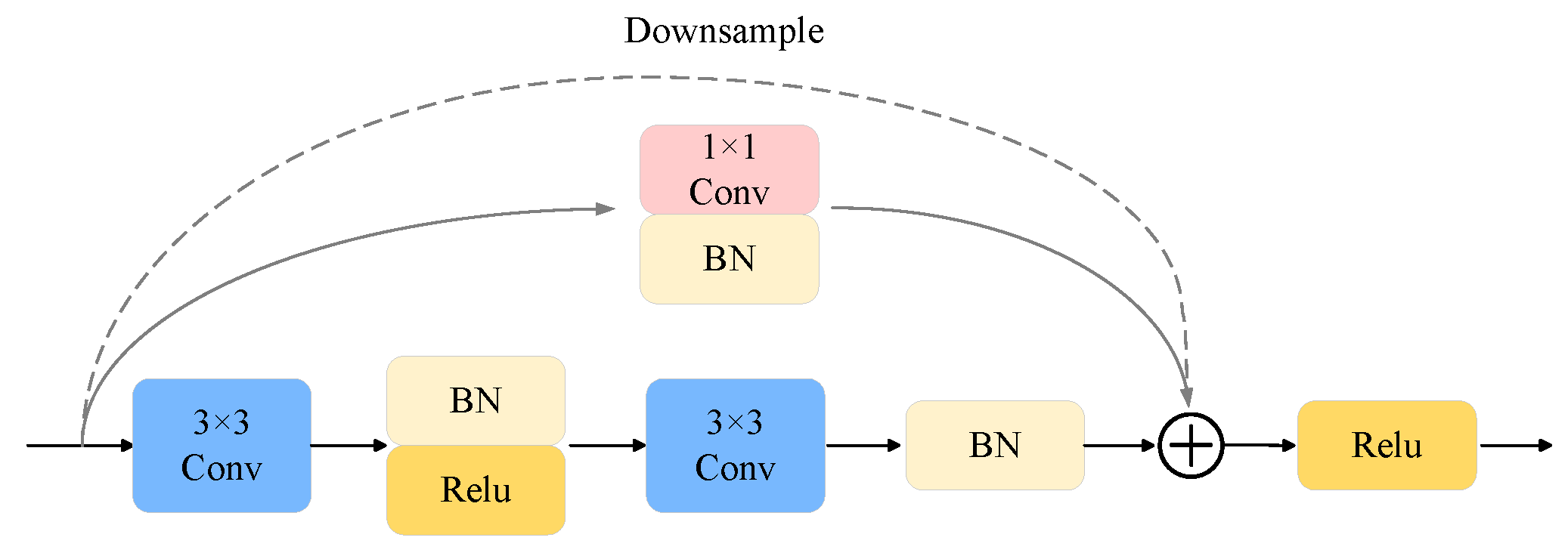
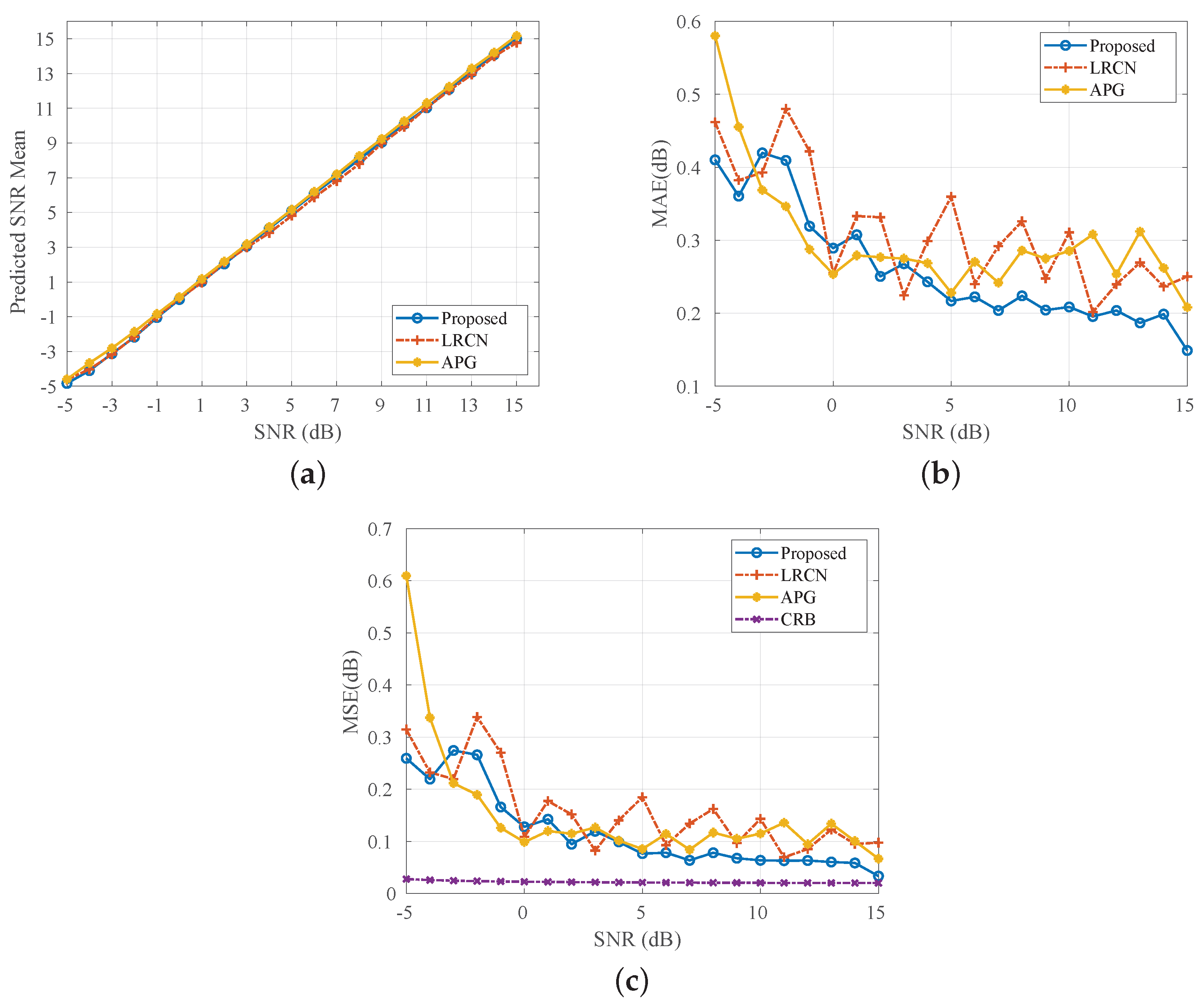
- We have developed a novel deep learning framework utilizing residual blocks, which demonstrates superior performance in SNR estimation by achieving lower mean absolute error (MAE) and mean squared error (MSE) compared to current state-of-the-art methods.
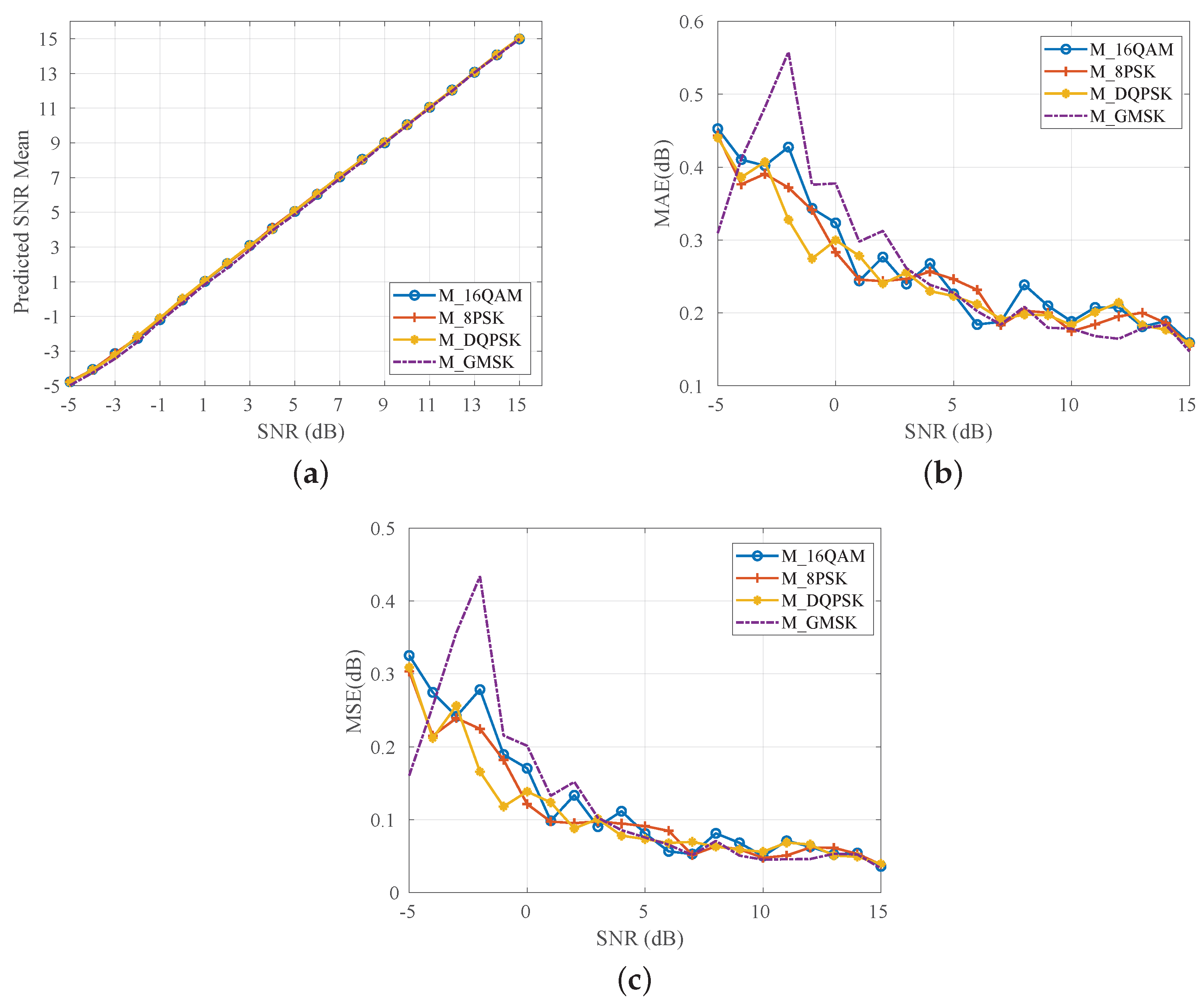
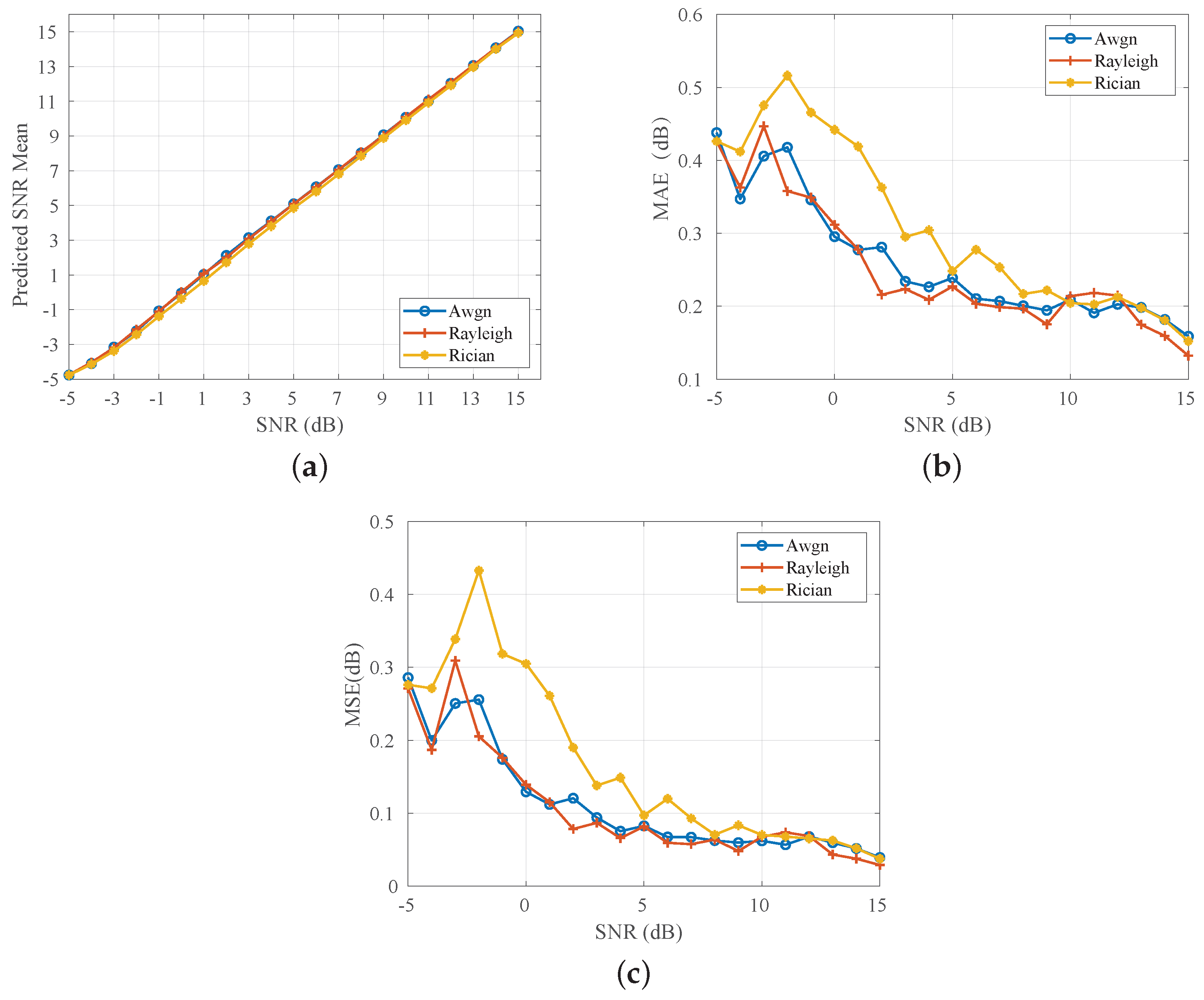
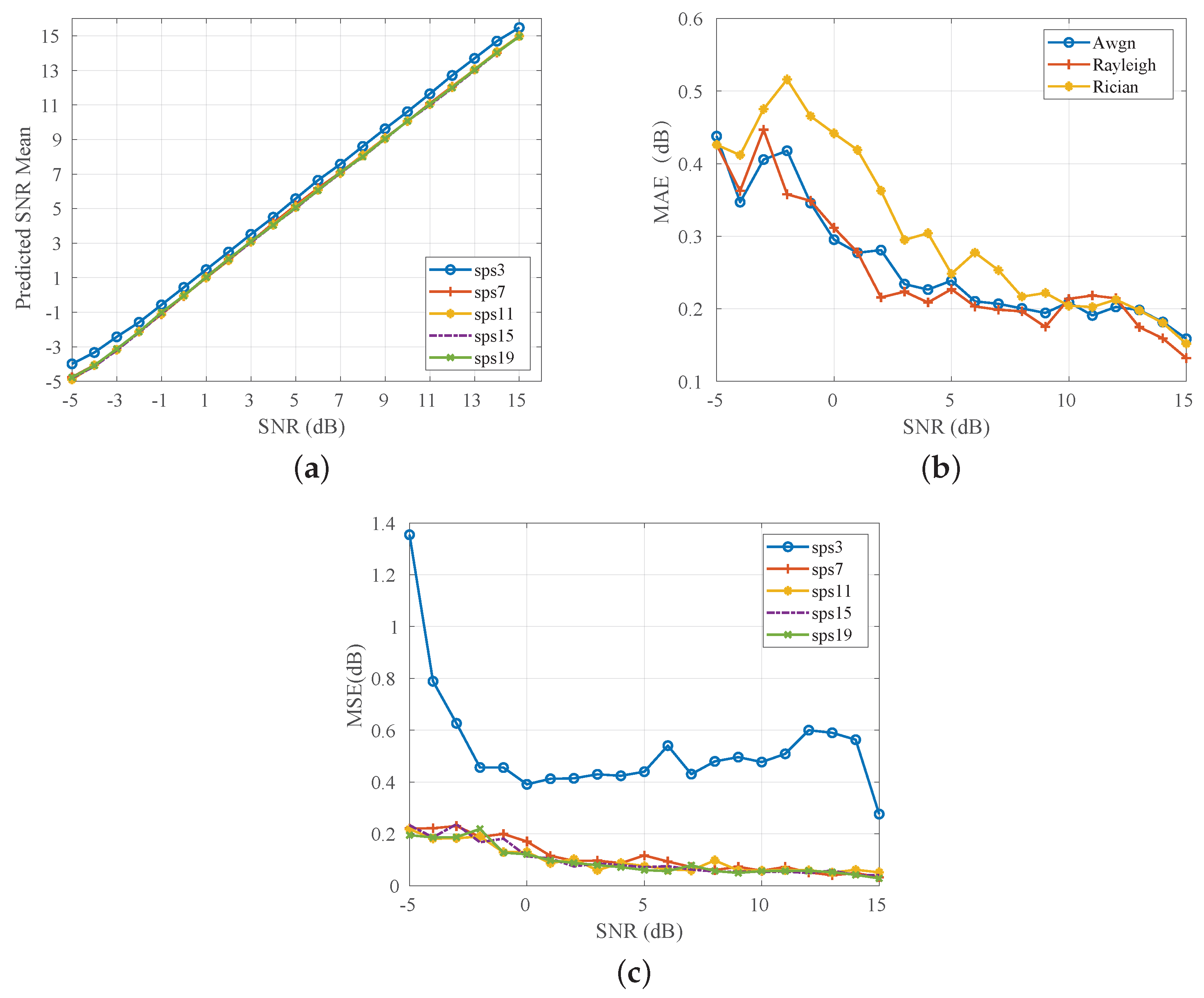
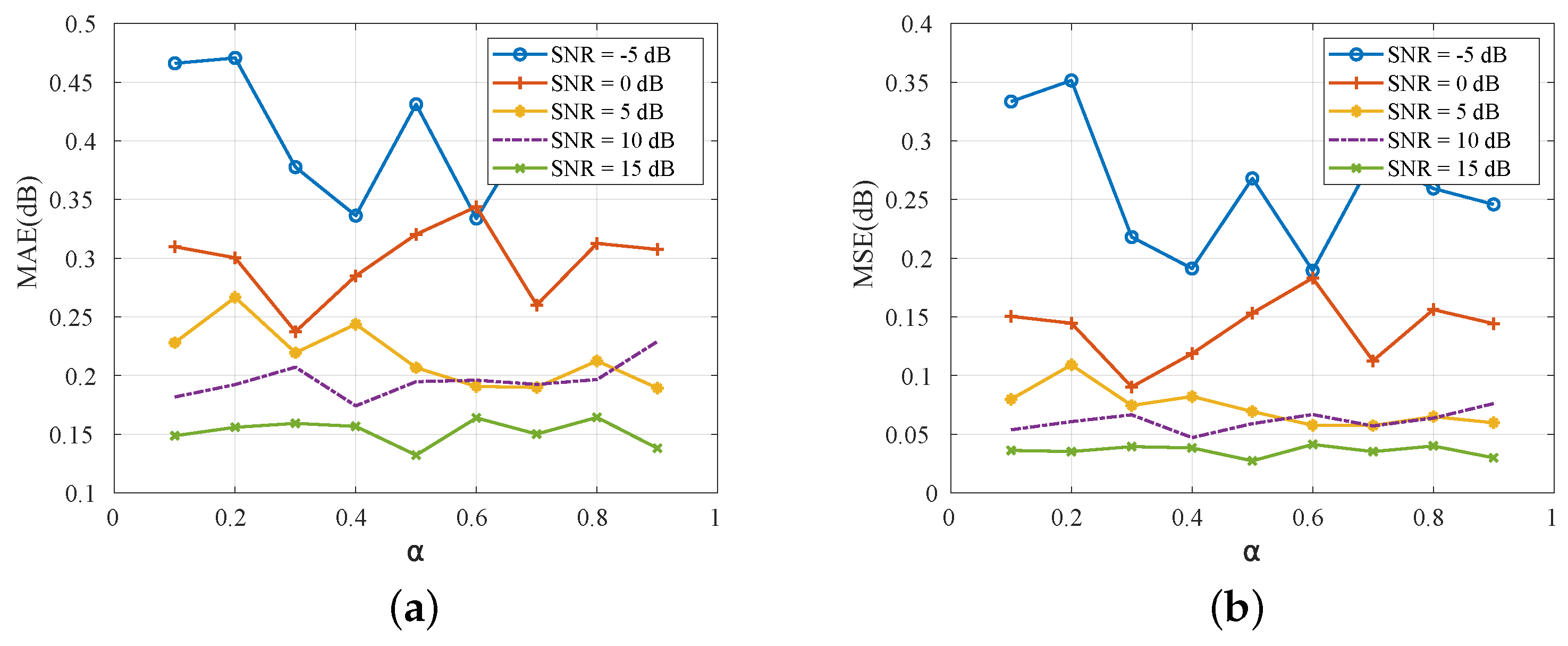
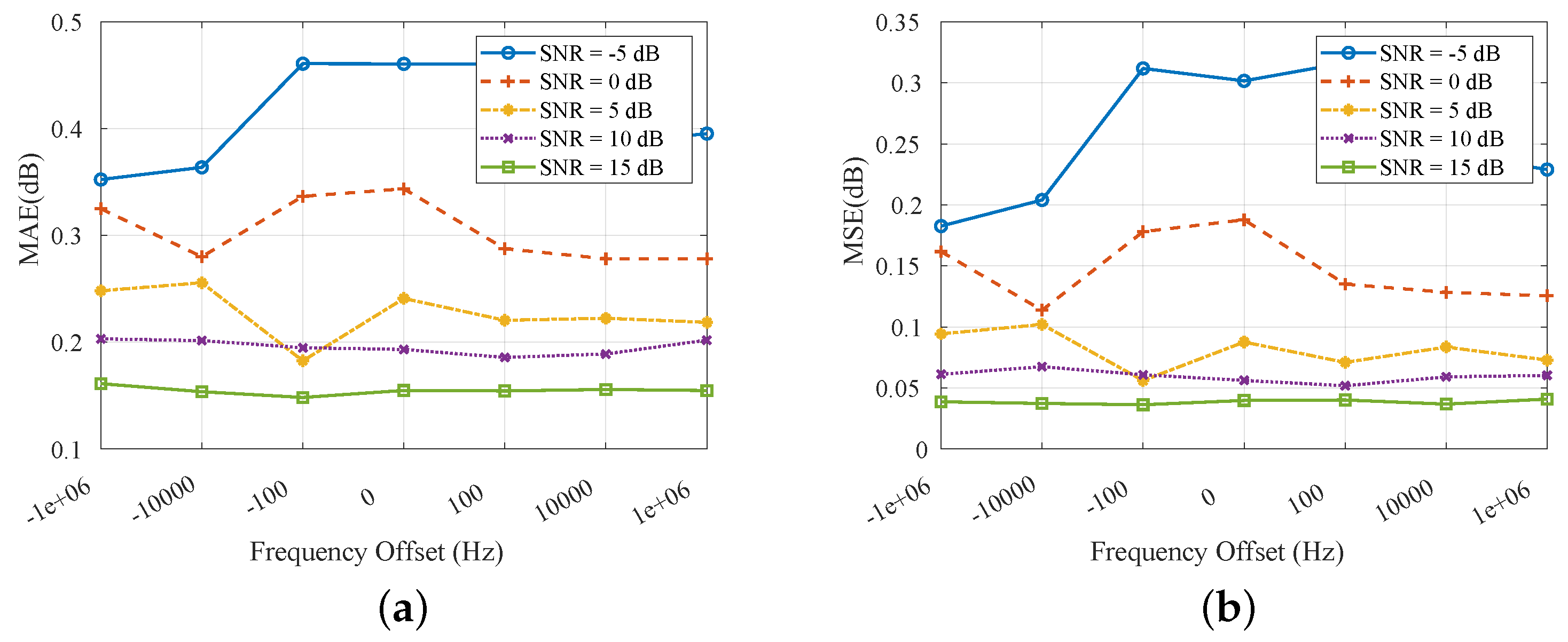
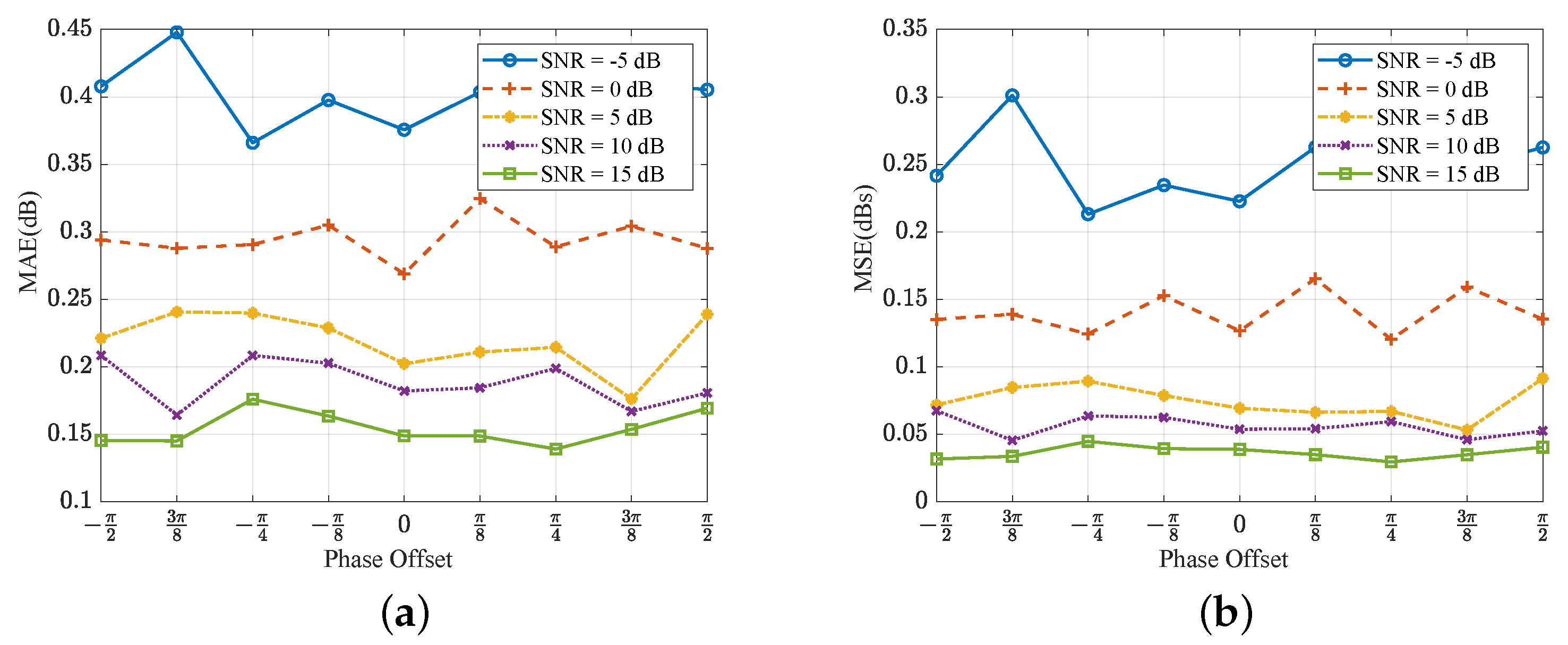
- Our training set exclusively comprises signals generated under Gaussian white noise conditions. To further evaluate the robustness of our model, we tested its estimation performance in multipath fading environments, specifically Rayleigh and Rician channels. Additionally, we analyzed the network’s generalization capability under varying bandwidth conditions, examining the impact of different oversampling factors and roll-off factors on signal bandwidth. Moreover, we investigated how frequency offsets, phase shifts, and timing errors affect the network’s generalization performance under these conditions.
2. Related Work
2.1. Traditional SNR Estimation Methods
2.2. Deep Learning-Based SNR Estimation Methods
3. Methodology
3.1. System Model
3.2. Data Format
3.3. Structure of the Network
3.3.1. Residual Block
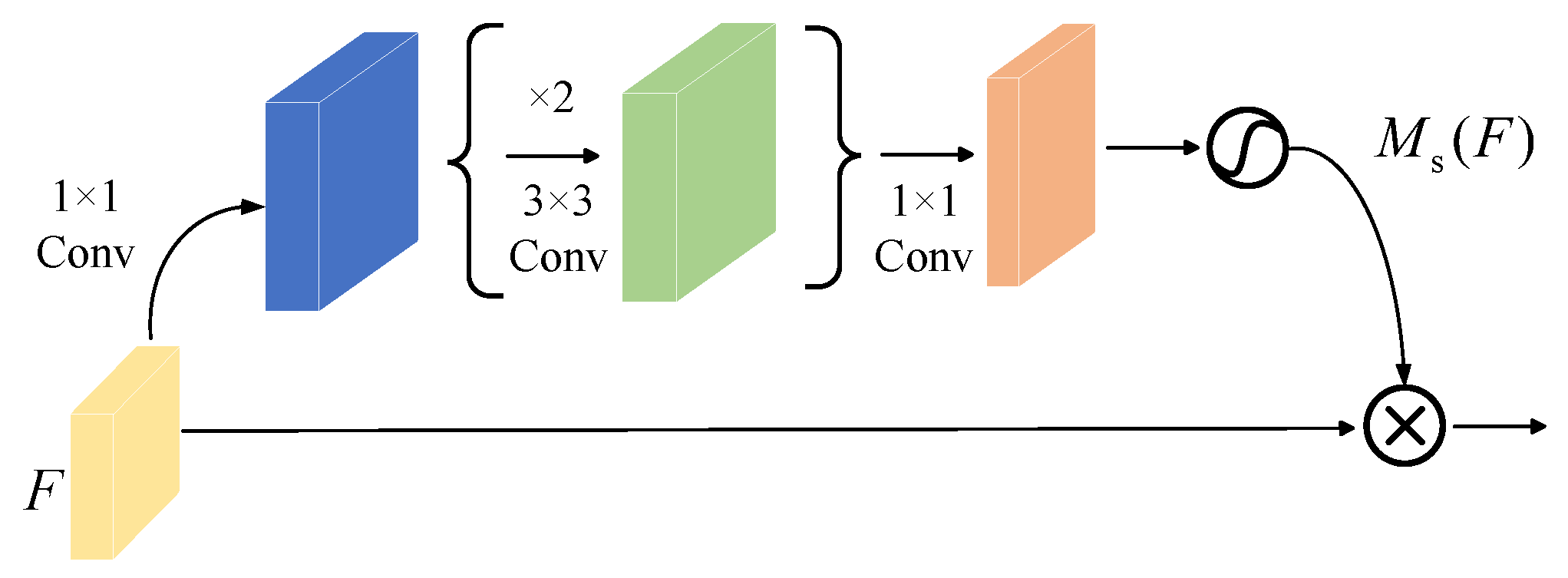
3.3.2. Spatial Attention
3.3.3. Network Output and Regression Prediction
4. Experiments
4.1. Training Parameter Settings
| Algorithm 1 SNR Estimation Based on STFT |
| Require: Training set , validation set , mini-batch size , learning rate , maximum number of iterations |
|
| Algorithm 2 Testing Procedure |
|
4.2. Generalization Testing Parameter Settings
| Algorithm 3 Generalized Performance Testing for Various Parameters |
| Require: Pre-trained network , test data directory, parameters to test (e.g., channel type and SPS) |
|
4.3. Evaluation Metrics
5. Simulation Results and Discussion
5.1. Comparison with Traditional Estimation
5.2. Comparison of Different Networks
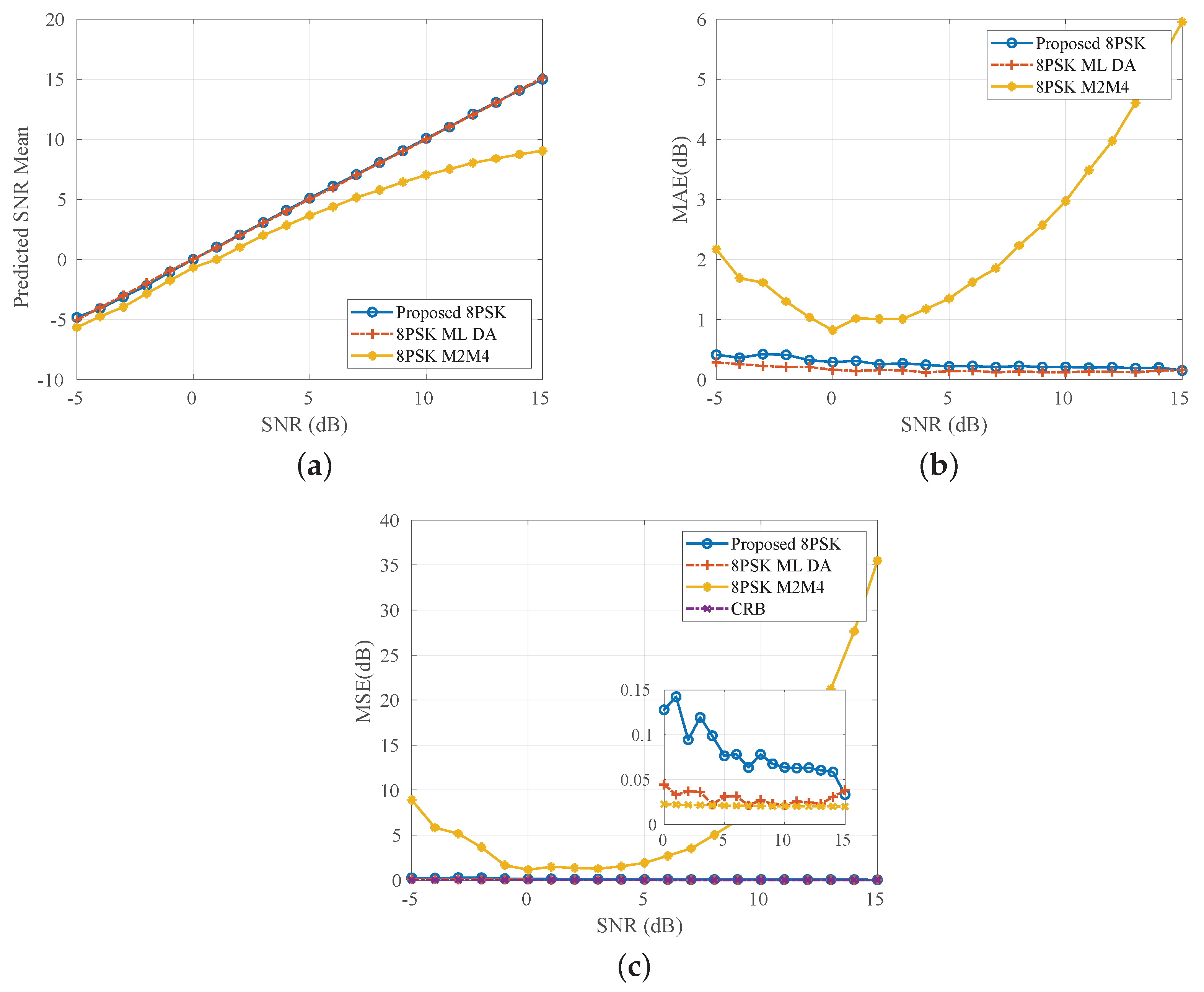
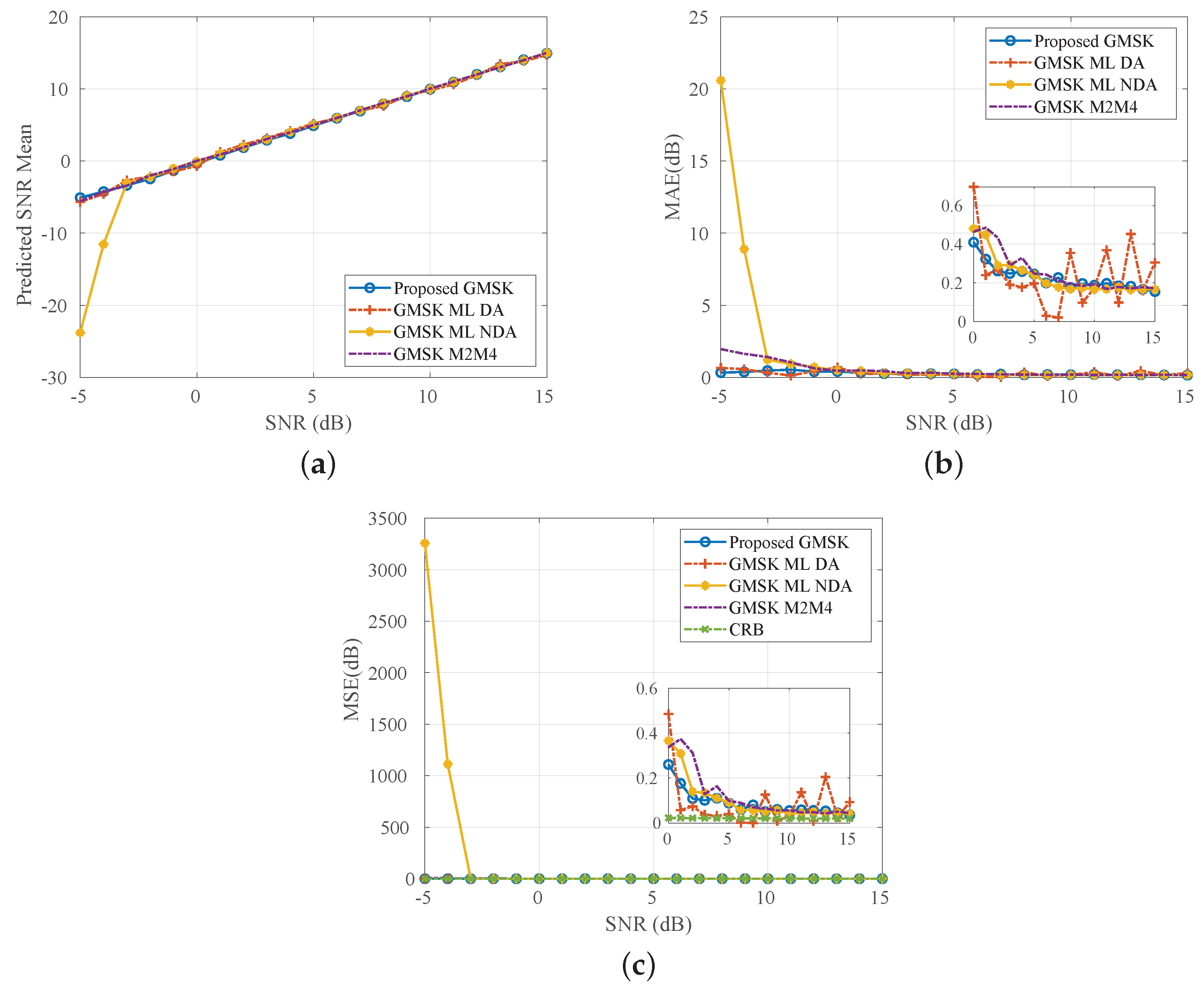
5.3. Performance Evaluation of Various Modulation Formats
5.4. Performance Evaluation in Various Channel Conditions
5.5. Performance Testing at Different SPS
5.6. Performance Evaluation Across Various Roll-Off Factors
5.7. Performance Testing Under Different Frequency Offsets
5.8. Performance Evaluation with Varying Phase Offsets
6. Conclusions
Author Contributions
Funding
Institutional Review Board Statement
Informed Consent Statement
Data Availability Statement
Conflicts of Interest
References
- Hu, D.; Zhao, Y.; Xie, W.; Xiao, Q.; Li, L. A squeeze-and-excitation network for SNR estimation of communication signals. IET Commun. 2025, 19, e70006. [Google Scholar] [CrossRef]
- Li, S.; Zhou, J.; Huang, Z. TS-WHT: A Two-Step Walsh–Hadamard Transform Approach for Blind Error Correcting Code Classification. IEEE Commun. Lett. 2023, 27, 1689–1693. [Google Scholar] [CrossRef]
- Qu, Y.; Lu, Z.; Hui, B.; Wang, J.; Wang, J. Contrastive Language-Signal Prediction for Automatic Modulation Recognition. IEEE Wirel. Commun. Lett. 2024, 13, 3242–3246. [Google Scholar] [CrossRef]
- Al Mahbub, A.; Ahmad, I.; Shin, S. Comprehensive Analysis of CNN-Based Models for SNR Estimation. IEEE Access 2025, 13, 213346–213361. [Google Scholar] [CrossRef]
- Chache, F.M.; Maxon, S.; Narayanan, R.M.; Bharadwaj, R. Effects on Age of Information From Forward Error Correction in LoRa Transmissions. IEEE Sens. J. 2024, 24, 30853–30862. [Google Scholar] [CrossRef]
- Wang, M.; Zhang, Z.; Zhang, H.; Ghassemlooy, Z.; Zhang, T. Symmetry of constellation diagram-based intelligent SNR estimation for visible light communications. Opt. Lett. 2024, 49, 3138–3141. [Google Scholar] [CrossRef]
- Gappmair, W. Data-Aided SNR Estimation for Bandlimited Optical Intensity Channels. Sensors 2022, 22, 8660. [Google Scholar] [CrossRef]
- Xue, R.; Cao, Y.; Wang, T. Data-Aided and Non-Data-Aided SNR Estimators for CPM Signals in Ka-Band Satellite Communications. Information 2017, 8, 75. [Google Scholar] [CrossRef]
- Li, C.; Zhang, T.; Liu, S. MVSC: Mamba Vision Based Semantic Communication for Image Transmission With SNR Estimation. IEEE Commun. Lett. 2025, 29, 1406–1410. [Google Scholar] [CrossRef]
- Zhao, Y.; Ju, C.; Wang, D.; Liu, N.; Guan, L.; Xie, P. SNR Estimation for 5G Satellite-to-Ground Communication in Ultra-Low SNR Environment Based on Channel Frequency Response Reconstruction. IEEE Commun. Lett. 2024, 28, 357–361. [Google Scholar] [CrossRef]
- Yadav, A.; Kumar, A.; Shitiri, E.; Kumar, S.; Cho, H.S. Non-Data-Aided SNR Estimation for Molecular Communication Systems in Internet of Bio-Nano Things. IEEE Internet Things J. 2025, 12, 595–604. [Google Scholar] [CrossRef]
- Wang, W.; Shen, Y.; Wang, Y. Low-Complexity Non-Data-Aided SNR Estimation for Multilevel Constellations. IEEE Commun. Lett. 2020, 24, 113–116. [Google Scholar] [CrossRef]
- Pauluzzi, D.; Beaulieu, N. A Comparison of SNR Estimation Techniques for the AWGN Channel. IEEE Trans. Commun. 2000, 48, 1681–1691. [Google Scholar] [CrossRef]
- Lee, J.; Lou, H.l.; Toumpakaris, D.; Cioffi, J.M. SNR Analysis of OFDM Systems in the Presence of Carrier Frequency Offset for Fading Channels. IEEE Trans. Wirel. Commun. 2006, 5, 3360–3364. [Google Scholar] [CrossRef]
- Li, G.; Liu, F.; Yang, H. A New Detection Model of Ship-Radiated Noise Signal. Ocean. Eng. 2024, 297, 117081. [Google Scholar] [CrossRef]
- Lv, M.; Yan, X.; Wang, K.; Hao, X.; Dai, J. Adaptive Measurement and Parameter Estimation for Low-SNR PRBC-PAM Signal Based on Adjusting Zero Value and Chaotic State Ratio. Mathematics 2024, 12, 3203. [Google Scholar] [CrossRef]
- Zheng, S.; Chen, S.; Chen, T.; Yang, Z.; Zhao, Z.; Yang, X. Deep Learning-Based SNR Estimation. IEEE Open J. Commun. Soc. 2024, 5, 4778–4796. [Google Scholar] [CrossRef]
- Simon, M.K.; Mileant, A. SNR Estimation for the Baseband Assembly. The Telecommunications and Data Acquisition Report 1986. Available online: https://ntrs.nasa.gov/citations/19860018814 (accessed on 1 January 2024).
- Kerr, R.B. On Signal and Noise Level Estimation in a Coherent PCM Channel. IEEE Trans. Aerosp. Electron. Syst. 1966, AES-2, 450–454. [Google Scholar] [CrossRef]
- Athanasios, D.; Kalivas, G. SNR Estimation for Low Bit Rate OFDM Systems in AWGN Channel. In International Conference on Systems & International Conference on International Conference on Networking; IEEE: Piscataway, NJ, USA, 2006. [Google Scholar]
- Matzner, R.; Englberger, F. An SNR estimation algorithm using fourth-order moments. In 1994 IEEE International Symposium on Information Theory; IEEE: Piscataway, NJ, USA, 1994; p. 119. [Google Scholar] [CrossRef]
- Ghose, A.; Yang, N. In-Service Monitoring of Multipath Delay and Cochannel Interference for Indoor Mobile Communication Systems. In Serving Humanity Through Communications, Vol.2: 1994 International Conference on Communications (ICC’94); IEEE (Institute of Electrical and Electronics Engineers): Piscataway, NJ, USA, 1994. [Google Scholar]
- Gappmair, W. Cramer-Rao Lower Bound for Non-Data-Aided SNR Estimation of Linear Modulation Schemes. IEEE Trans. Commun. 2008, 56, 689–693, Correction in IEEE Trans. Commun. 2010, 58, 318–318. https://doi.org/10.1109/TCOMM.2010.5397926. [Google Scholar] [CrossRef]
- López-Valcarce, R.; Villares, J.; Riba, J.; Gappmair, W.; Mosquera, C. Cramér-Rao Bounds for SNR Estimation of Oversampled Linearly Modulated Signals. IEEE Trans. Signal Process. 2015, 63, 1675–1683. [Google Scholar] [CrossRef]
- Sevillano, J.F.; Velez, I.; Leyh, M.; Lipp, S.; Irizar, A.; Fontan, F. In-Service SNR Estimation without Symbol Timing Recovery for QPSK Data Transmission Systems. IEEE Trans. Wirel. Commun. 2007, 6, 3202–3207. [Google Scholar] [CrossRef]
- Rice, M. Data-Aided and Non-Data-Aided Maximum Likelihood SNR Estimators for CPM. IEEE Trans. Commun. 2015, 63, 4244–4253. [Google Scholar] [CrossRef]
- Bellili, F.; Meftehi, R.; Affes, S.; Stéphenne, A. Maximum Likelihood SNR Estimation of Linearly-Modulated Signals Over Time-Varying Flat-Fading SIMO Channels. IEEE Trans. Signal Process. 2015, 63, 441–456. [Google Scholar] [CrossRef]
- Rugini, L.; Banelli, P. On the Equivalence of Maximum SNR and MMSE Estimation: Applications to Additive Non-Gaussian Channels and Quantized Observations. IEEE Trans. Signal Process. 2016, 64, 6190–6199. [Google Scholar] [CrossRef]
- Yang, K.; Huang, Z.; Wang, X.; Wang, F. An SNR Estimation Technique Based on Deep Learning. Electronics 2019, 8, 1139. [Google Scholar] [CrossRef]
- Xie, X.; Peng, S.; Yang, X. Deep Learning-Based Signal-To-Noise Ratio Estimation Using Constellation Diagrams. Mob. Inf. Syst. 2020, 2020, 8840340. [Google Scholar] [CrossRef]
- Xu, X.; Feng, C. A Long-Term Recurrent Convolutional Network for SNR Estimation of Cone-Shaped Target. IEEE Antennas Wirel. Propag. Lett. 2023, 22, 1863–1867. [Google Scholar] [CrossRef]
- He, K.; Zhang, X.; Ren, S.; Sun, J. Deep Residual Learning for Image Recognition. In 2016 IEEE Conference on Computer Vision and Pattern Recognition (CVPR); IEEE: Piscataway, NJ, USA, 2016; pp. 770–778. [Google Scholar] [CrossRef]



| Parameter | Value |
|---|---|
| SNR range | [−5 15] dB with interval 0.5 dB |
| fs | 61.44 M |
| Modulation | 8PSK |
| SPS | [2 20] with interval 2 |
| Frequency offset | 0 |
| Phase offset | 0 |
| 0.5 | |
| Channel | AWGN |
| Training set | 28,700 |
| Validation set | 6150 |
| Test set | 6150 |
| Parameter | Value |
|---|---|
| SNR range | [−5 15] dB with interval 1 dB |
| fs | 61.44 M |
| Modulation | 16QAM/DQPSK/GMSK/8PSK |
| SPS | [3 19] with interval 2 |
| Frequency offset | MHz, kHz, 0 Hz |
| Phase offset | , , 0 |
| [0.1 0.9] with interval 0.1 | |
| Channel | Rayleigh/Rician/AWGN |
| Method | Params (M) | FLOPs (G) |
|---|---|---|
| Proposed | 1.63 | 9.72 |
| LRCN | 85.80 | 2.48 |
| APG | 0.13 | 0.0194 |
| Item | Value |
|---|---|
| SampleRate | 61.44 × 10⁶ |
| PathDelays | [0 1 × 10⁻⁴] |
| AveragePathGains | [0 1] |
| MaximumDopplerShift | 30 |
| PathGainsOutputPort | false |
| NormalizePathGains | true |
| Item | Value |
|---|---|
| SampleRate | 61.44 × 10⁶ |
| PathDelays | [0 0.5 × 10⁻⁵ 1 × 10⁻⁵] |
| AveragePathGains | [0.1 0.5 0.2] |
| MaximumDopplerShift | 30 |
| KFactor | 3 |
| DirectPathDopplerShift | 5 |
| DirectPathInitialPhase | 0.5 |
| SPS | MAE Value | MSE Value |
|---|---|---|
| 3 | 1.025 | 1.354 |
| 5 | 0.531 | 0.398 |
| 7 | 0.381 | 0.221 |
| 9 | 0.384 | 0.241 |
| 11 | 0.365 | 0.218 |
| 13 | 0.398 | 0.248 |
| 15 | 0.381 | 0.233 |
| 17 | 0.384 | 0.230 |
| 19 | 0.352 | 0.195 |
| SPS | MAE Value | MSE Value |
|---|---|---|
| 3 | 0.486 | 0.276 |
| 5 | 0.143 | 0.033 |
| 7 | 0.145 | 0.032 |
| 9 | 0.169 | 0.046 |
| 11 | 0.186 | 0.052 |
| 13 | 0.146 | 0.035 |
| 15 | 0.167 | 0.041 |
| 17 | 0.150 | 0.034 |
| 19 | 0.141 | 0.028 |
Disclaimer/Publisher’s Note: The statements, opinions and data contained in all publications are solely those of the individual author(s) and contributor(s) and not of MDPI and/or the editor(s). MDPI and/or the editor(s) disclaim responsibility for any injury to people or property resulting from any ideas, methods, instructions or products referred to in the content. |
© 2026 by the authors. Licensee MDPI, Basel, Switzerland. This article is an open access article distributed under the terms and conditions of the Creative Commons Attribution (CC BY) license.
Share and Cite
Li, L.; Xie, W.; Hu, D.; Nie, J.; Xie, F.; Huang, Z.; Zhao, Y. Robust SNR Estimation Based on Time–Frequency Analysis and Residual Blocks. Signals 2026, 7, 23. https://doi.org/10.3390/signals7020023
Li L, Xie W, Hu D, Nie J, Xie F, Huang Z, Zhao Y. Robust SNR Estimation Based on Time–Frequency Analysis and Residual Blocks. Signals. 2026; 7(2):23. https://doi.org/10.3390/signals7020023
Chicago/Turabian StyleLi, Longqing, Wenjun Xie, Deming Hu, Jingke Nie, Fei Xie, Zhiping Huang, and Yongjie Zhao. 2026. "Robust SNR Estimation Based on Time–Frequency Analysis and Residual Blocks" Signals 7, no. 2: 23. https://doi.org/10.3390/signals7020023
APA StyleLi, L., Xie, W., Hu, D., Nie, J., Xie, F., Huang, Z., & Zhao, Y. (2026). Robust SNR Estimation Based on Time–Frequency Analysis and Residual Blocks. Signals, 7(2), 23. https://doi.org/10.3390/signals7020023