Article

Convolution and Sampling Theorems for Offset Fractional Fourier Transform

by
Mawardi Bahri
1,*,
Marni Rezki
1,
Samsul Ariffin Abdul Karim
2,3,4,
Nasrullah Bachtiar
5,
Muhammad Zakir
1 and
Bannu Addul Samad
6
1
Department of Mathematics, Hasanuddin University, Makassar 90245, Indonesia
2
Institute of Strategic Industrial Decision Modelling (ISIDM), School of Quantitative Sciences, UUM College of Arts & Sciences, Universiti Utara Malaysia, Sintok 06010, Malaysia
3
Computational Statistics and Applied Mathematics (CSAM) Research Group, School of Quantitative Sciences, UUM College of Arts and Sciences, Universiti Utara Malaysia, Sintok 06010, Malaysia
4
Quaternion Fourier Transform Research Group (Q-FourT), Hasanuddin University, Makassar 90245, Indonesia
5
Department of Actuarial Science, Sumatera Institute of Technology, South Lampung 35365, Indonesia
6
Department of Physics, Hasanuddin University, Makassar 90245, Indonesia
*
Author to whom correspondence should be addressed.
Signals 2026, 7(2), 22; https://doi.org/10.3390/signals7020022
Submission received: 16 January 2026 / Revised: 10 February 2026 / Accepted: 14 February 2026 / Published: 3 March 2026

Abstract

The offset fractional Fourier transform (OFrFT) has emerged as a mathematical tool for time-frequency analysis of non-stationary signals. However, there has been relatively little research on investigating properties including the convolution theorem and the sampling formulas. This paper investigates the new form of convolution theorem and its product theorem associated with the OFrFT. We also establish a sampling formula related to the transformation. Finally, a simple example is displayed to verify the results related to the sampling formula for the OFrFT.

1. Introduction

It is well known that convolution is a fundamental concept in the theory of linear time-invariant (LTI) systems [1]. The convolution of an input signal with the impulse response of an LTI system produces the system output. The impulse response characterizes the system’s behavior, and convolution incorporates this behavior into the input signal to generate the output. In addition to this, convolution is closely related to the classical Fourier transform (FT) through the convolution theorem, which states that the FT of a convolution of two signals equals the product of their FTs. Building on this relationship, many authors have developed the convolution theorem in different types of transformations. For instance, in [2,3], the authors explored the convolution theorem for the fractional Fourier transform (FrFT). As is known, the offset fractional Fourier transform (OFrFT) is a general version of the FrFT, so the properties of the OFrFT are an extension of the corresponding properties of the FrFT [4,5,6,7,8,9,10,11,12,13]. Especially, the authors of [14] presented a convolution theorem for the OFrFT, which involves the multiplication of their OFrFT and a phase factor. The form of this convolution theorem contains an additional extra chirp factor and is not exactly similar to the convolution theorem for the FT. Compared to the convolution theorem proposed in [14], our result discussed in this work is simpler and closer to the convolution theorem related to the FT in the existing literature [15]. Additionally, the product theorem related to the proposed convolution definition is also established in detail.
On the other hand, the theory of the sampling formula associated with the FT was studied by the author in [16] and its application to time-varying systems was also demonstrated in [17]. A variant of the sampling formula is a generalized exponential sampling operator, which was recently studied by the authors of [18,19,20]. Further, the sampling formula for the FT was expanded in the framework of the FrFT [21,22,23]. As a non-trivial generalization of the FrFT, there is an inevitable desire to expand the sampling formula to the OFrFT domains. Therefore, the present research also aims to investigate the sampling formula related to this transformation, which has not appeared in the literature so far.
The organization of the work is as follows. In Section 2, we recall some essential facts on the FrFT, the OFrFT, and their basic properties. Section 3 focuses on discussing the fundamental properties of OFrFT that have not been studied in the existing literature. These properties will be very useful in solving partial differential equations in the OFrFT setting. Section 4 is devoted to the derivation of convolution and its product theorems concerning the OFrFT. The derivation of the sampling formula associated with the OFrFT is discussed in Section 5. Additionally, we include a simple example illustration related to the sampling formula. The paper ends with the conclusion in Section 6.

2. Preliminaries

In this part, we provide a brief review on some results that will be useful in the next section. We begin by introducing the following notations:
Definition 1.
For 1 s < , the space of measurable functions f defined on R denoted by L s ( R ) , such that
f L s ( R ) = R | f ( t ) | s d t 1 s < .
Especially, for s , we get
f L ( R ) = ess sup t R | f ( t ) | .
The usual inner product of L 2 ( R ) is then defined as
f , g = R f ( t ) g ( t ) ¯ d t ,
where overline means the conjugation.
In the following, we recall the definition of the fractional Fourier transform (FrFT) and its inverse, see, e.g., [2,3,24].
Definition 2.
The FrFT of any function f belongs to L 2 ( R ) with the real parameter β defined by
F β { f } ( η ) = R f ( t ) K β ( t , η ) d t ,
where the kernel K β ( t , η ) is
K β ( t , η ) = A β e i ( t 2 + η 2 ) cot β 2 i t η csc β , β n π , n Z ,
and
A β = 1 i cot β 2 π = e i β / 2 2 i π sin β .
We describe the basic properties of the kernel K β ( t , η ) :
K β ( t , η ) = δ ( t η ) , for β = 2 n π ,
and
K β ( t , η ) = δ ( t + η ) , for β = ( 2 n + 1 ) π , n Z ,
where δ ( t η ) is Dirac’s delta.
Definition 3.
Assume that any function f and its FrFT F β { f } are in L 1 ( R ) . The inversion formula for the FrFT is calculated by
f ( t ) = F β 1 F β { f } ( t ) = R F β { f } ( η ) A β ¯ e i ( t 2 + η 2 ) cot β 2 + i t η   csc   β d η .
The direct interaction between the FrFT and the FT is
F β { f } ( η ) = A β e i η 2 cot β 2 F { f ˇ } ( η csc β ) ,
for which
f ˇ ( t ) = f ( t ) e i t 2 cot β 2 .
Here, the definition of the Fourier transform (FT) for signal f in L 2 ( R ) is described by (see [15,25,26,27])
F { f } ( η ) = f ^ ( η ) = R f ( t ) e i t η d t ,
and its inverse is
f ( t ) = 1 2 π R F { f } ( η ) e i t η d η .
The subsequent definition refers to the OFrFT [14] mentioned earlier, which may be interpreted as a natural expansion of the FrFT.
Definition 4.
The definition of the OFrFT for function f belonging to L 2 ( R ) is expressed as
F O ( β , m , n ) { f } ( η ) = f ^ O ( η ) = R f ( t ) K ( β , m , n ) ( t , η ) d t ,
where
K ( β , m , n ) ( t , η ) = A β e i 2 ( η 2 + t 2 + m 2 ) cot β + 2 t ( m η ) csc β + 2 η ( n m   cot   β ) .
Here, the parameters ( β , m , n ) are real numbers.
It is straightforward to verify that when m = n = 0 in Equation (14), we obtain the definition of the FrFT (4).
The next lemma describes the natural relation between the OFrFT and the FT, which is central in deriving the upcoming results related to the proposed OFrFT.
Lemma 1.
For every function f belonging to L 2 ( R ) , the following relation is satisfied:
F { f β } ( η csc β ) = 1 A β F O ( β , m , n ) { f } ( η ) e i 2 ( ( η 2 + m 2 ) cot β + 2 η ( n m   cot   β ) ) ,
where
f β ( t ) = f ( t ) e i 2 ( t 2 cot β + 2 t m   csc   β ) .
Next, one can easily generate the original function f in terms of its F O ( β , m , n ) { f } by utilizing the following definition.
Definition 5.
For any function f and its OFrFT F O ( β , m , n ) { f } belonging to L 1 ( R ) , the inverse of the OFrFT is expressed as
f ( t ) = R F O ( β , m , n ) { f } ( η ) K ( β , m , n ) ( t , η ) ¯ d η .
The Parseval’s identity related to the OFrFT defined by (14) is expressed in the following form:
Theorem 1.
Any two functions f , g L 1 ( R ) L 2 ( R ) are related to their OFrFT via Parseval’s identity as
f , g L 2 ( R ) = F O ( β , m , n ) { f } , F O ( β , m , n ) { g } L 2 ( R ) ,
In particular,
f L 2 ( R ) 2 = F O ( β , m , n ) { f } L 2 ( R ) 2 .
Some key properties of the OFrFT compared to the FrFT were studied by the authors in [28].

3. Fundamental Properties for the OFrFT

In [28], the authors derived some properties of the OFrFT, such as shifting, modulation, and uncertainty principles. Now, let us establish the OFrFT of the nth derivative, for which the result was not published in [28].
Theorem 2.
Suppose that f ( t ) is continuous n-times differentiable, f , f , , f ( r ) L 1 ( R ) and if we assume that
lim | t | f ( r ) ( t ) = 0 , r = 0 , 1 , 2 , , n 1 ,
then
F O ( β , m , n ) d r f d t r ( η ) = i ( η m n   cot   β ) sin β + cos β d d η r F O ( β , m , n ) { f } ( η ) .
Proof. 
For r = 1 , we have
F O ( β , m , n ) d f d t ( η ) = A β R d f d t e i 2 ( t 2 + η 2 + m 2 ) cot β + 2 t ( m η ) csc β + 2 η ( n m   cot   β ) d t = A β ( e i 2 ( t 2 + η 2 + m 2 ) cot β + 2 t ( m η ) csc β + 2 η ( n m   cot   β ) f ( t ) | R f ( t ) i t cot β + i ( m η ) csc β e i 2 ( t 2 + η 2 + m 2 ) cot β + 2 t ( m η ) csc β + 2 η ( n m   cot   β ) d t ) = A β R f ( t ) i t cot β + i ( m η ) csc β e i 2 ( t 2 + η 2 + m 2 ) cot β + 2 t ( m η )   csc   β + 2 η ( n m   cot   β ) d t .
This equation is equal to
F O ( β , m , n ) d f d t ( η ) = A β R f ( t ) i ( η m ) csc β i t cot β ×   e i 2 ( t 2 + η 2 + m 2 ) cot β + 2 t ( m η ) csc β + 2 η ( n m   cot   β ) d t = A β R f ( t ) i ( η m ) ( sin β + cos β cot β ) i t cot β ×   e i 2 ( t 2 + η 2 + m 2 ) cot β + 2 t ( m η ) csc β + 2 η ( n m   cot   β ) d t = A β R f ( t ) i ( η m ) sin β + i cos β ( ( η m ) cot β t csc β ) ×   e i 2 ( t 2 + η 2 + m 2 ) cot β + 2 t ( m η ) csc β + 2 η ( n m   cot   β ) d t = A β R f ( t ) i ( η m ) sin β + i cos β ( ( η m ) cot β t csc β + i n i n ) ×   e i 2 ( t 2 + η 2 + m 2 ) cot β + 2 t ( m η ) csc β + 2 η ( n m   cot   β ) d t .
After simplification, we get
F O ( β , m , n ) d f d t ( η ) = A β R f ( t ) i ( η m ) sin β e i 2 ( t 2 + η 2 + m 2 ) cot β + 2 t ( m η )   csc   β + 2 η ( n m   cot   β ) d t + A β R f ( t ) cos β ( i η cot β i t csc β i m cot β + i n i n ) ×   e i 2 ( t 2 + m 2 + η 2 ) cot β + 2 t ( m η )   csc   β + 2 η ( n m   cot   β ) d t = A β R f ( t ) ( i η i m ) sin β i n cos β e i 2 ( t 2 + m 2 + η 2 ) cot β + 2 t ( m η )   csc   β + 2 η ( n m   cot   β ) d t + A β R f ( t ) cos β ( i η cot β i t csc β i m cot β + i n ) ×   e i 2 ( t 2 + m 2 + η 2 ) cot β + 2 t ( m η )   csc   β + 2 η ( n m   cot   β ) d t .
Therefore,
F O ( β , m , n ) d f d t ( η ) = A β R f ( t ) i ( η m n cot β ) sin β e i 2 ( t 2 + m 2 + η 2 ) cot β + 2 t ( m η )   csc   β + 2 η ( n m   cot   β ) d t + A β R f ( t ) cos β ( i η cot β i t csc β i m cot β + i n ) ×   e i 2 ( t 2 + m 2 + η 2 ) cot β + 2 t ( m η )   csc   β + 2 η ( n m   cot   β ) d t = i ( η m n cot β ) sin β F O ( β , m , n ) { f } ( η ) + cos β d F O ( β , m , n ) d η { f } ( η ) = i ( η m n cot β ) sin β + cos β d d η F O ( β , m , n ) { f } ( η ) .
Assume that Equation (23) is true for r = k 1 , namely,
F O ( β , m , n ) d k 1 d t k 1 f ( η ) = i ( η m n cot β ) sin β + cos β d d η k 1 F O ( β , m , n ) { f } ( η ) .
It follows that
F O ( β , m , n ) d k d t k f ( η ) = F O ( β , m , n ) d d t d k 1 d t k 1 f ( η ) = i ( η m n cot β ) sin β + cos β d d η F O ( β , m , n ) d k 1 d t k 1 f ( t ) ( η ) = i ( η m n cot β ) sin β + cos β d d η i ( η m n cot β ) sin β + cos β d d η k 1 F O ( β , m , n ) { f } ( η ) = i ( η m n cot β ) sin β + cos β d d η k F O ( β , m , n ) { f } ( η ) ,
which finishes the proof. □
We collect the observations regarding Theorem 2 in the remark:
Remark 1.
  • For m = n = 0 and β = π 2 , we get
F O ( π 2 , 0 , 0 ) d r d t r f ( t ) ( η ) = i η r F O ( π 2 , 0 , 0 ) { f } ( η ) = i η r F { f } ( η ) .
Equation (25) coincides with the FT of the nth derivative.
  • Selecting m = n = 0 results in
F O ( β , 0 , 0 ) d r d t r f ( t ) ( η ) = i η sin β + cos β d d η r F O ( β , 0 , 0 ) { f } ( η ) = i η sin β + cos β d d η r F β { f } ( η ) ,
which is the FrFT of the nth derivative.
Next, we obtain the result.
Theorem 3.
Let K ( β , m , n ) be the kernel of the OFrFT. We denote D ¯ r by the following:
D ¯ r = t i ( t cot β + m csc β ) r ,
then for r N , we have
(i) 
D ¯ r K ( β , m , n ) = ( i η csc β ) r K ( β , m , n ) .
(ii) 
F O ( β , m , n ) { D ¯ r f ( t ) } ( η ) = ( i η csc β ) r F O ( β , m , n ) { f } ( η ) .
Here, D ¯ = ( t + i ( t cot β + m csc β ) ) .
Proof. 
(i) Direct computations yield that
t K ( β , m , n ) = t A β e i 2 ( ( η 2 + t 2 + m 2 ) cot β + 2 t ( m η )   csc   β + 2 η ( n m   cot   β ) ) = ( i t cot β + i m csc β i η csc β ) K ( β , m , n ) .
Consequently,
t i ( t cot β + m csc β ) K ( β , m , n ) ( t , η ) = ( i η csc β ) K ( β , m , n ) .
By continuing in this way, we arrive at
t i ( t cot β + m csc β ) r K ( β , m , n ) = ( i η csc β ) r K ( β , m , n ) .
(ii) Observe that
R D ¯ K ( β , m , n ) ( t , η ) f ( t ) d t = R d d t i ( t cot β + m csc β ) K ( β , m , n ) ( t , η ) f ( t ) d t = R t K ( β , m , n ) ( t , η ) f ( t ) d t R i ( t cot β + m csc β ) K ( β , m , n ) ( t , η ) f ( t ) d t = f ( t ) K ( β , m , n ) ( t , η ) | R K ( β , m , n ) ( t , η ) t f ( t ) d t R i ( t cot β + m csc β ) K ( β , m , n ) ( t , η ) f ( t ) d t = R K ( β , m , n ) ( t , η ) t + i ( t cot β + m csc β ) f ( t ) d t = R K ( β , m , n ) ( t , η ) D ¯ f ( t ) d t .
By continuing in this way, we infer that
R D ¯ r K ( β , m , n ) ( t , η ) f ( t ) d t = R K ( β , m , n ) ( t , η ) D ¯ r f ( t ) d t .
(iii) It follows from Equation (14) that
F O ( β , m , n ) { D ¯ r f ( t ) } ( η ) = R D ¯ r K ( β , m , n ) ( t , η ) f ( t ) d t .
Substituting (30) in Equation (33) results in
F O ( β , m , n ) { D ¯ r f ( t ) } ( η ) = ( i η csc β ) r R K ( β , m , n ) ( t , η ) f ( t ) d t = ( i η csc β ) r F O ( β , m , n ) { f } ( η ) .
Thus, the proof is completed. □

4. Convolution and Product Theorems for OFrFT

In [14], the authors proposed the convolution definition pertaining to the OFrFT of two signals f , g L 2 ( R ) of the form
( f M g ) ( t ) = R e i t 2 2 cot β ( f ˜ g ˜ ) ( y ) d y .
Here, ★ is the classical convolution and f ˜ ( t ) = g ( t ) e i t 2 2 cot β and g ˜ ( t ) = g ( t ) e i t 2 2 cot β , respectively. With this definition, they then established the convolution theorem in the form
F O ( β , m , n ) { f M g } ( η ) = 1 i cot β 2 π F O ( β , m , n ) { f } ( η ) F O ( β , m , n ) { g } ( η ) e i 2 ( η 2 cot β + 2 η ( n m   cot   β ) ) .
Due to Equation (36), it is straightforward to see that their convolution involves the multiplication of their OFrFT and a phase factor.
In this part, we establish two types of convolution theorems for the OFrFT, which are quite different from those proposed [14]. We will see that the convolution theorems are a simple multiplication of the OFrFT and the FT. For this aim, we first introduce the following definition:
Definition 6.
The convolution operation of two functions f , g L 2 ( R ) in the OFrFT domain is defined by
( f o g ) ( t ) = R f ( y ) g ( t y ) e i 2 ( t y ) 2 cot β e i 2 t 2 cot β e i y m   csc   β d y .
With Definition 6, this leads to the following theorem:
Theorem 4.
Suppose that f , g L 2 ( R ) , then the OFrFT of the convolution of f and g is given by
F O ( β , m , n ) { f o g } ( η ) = F O ( β , m , n ) { g } ( η ) F { f } ( η csc β ) .
Proof. 
From Equation (14), it follows that
F O ( β , m , n ) { f o g } ( η ) = A β R ( f o g ) ( t ) e i 2 ( ( η 2 + t 2 + m 2 ) cot β + 2 t ( m η )   csc   β + 2 η ( n m   cot   β ) ) d t = A β R R f ( y ) g ( t y ) e i 2 ( t y ) 2 cot β e i 2 t 2 cot β e i y m   csc   β ×   e i 2 ( ( η 2 + t 2 + m 2 ) cot β + 2 t ( m η )   csc   β + 2 η ( n m   cot   β ) ) d y d t .
Substituting z = t y into Equation (39) results in
F O ( β , m , n ) { f o g } ( η ) = A β R R f ( y ) g ( z ) e i 2 z 2 cot β e i y m   csc   β e i 2 ( ( η 2 + m 2 ) cot β + 2 ( z + y ) ( m η )   csc   β + 2 η ( n m   cot   β ) ) d y d z = A β R R f ( y ) g ( z ) e i 2 ( ( η 2 + z 2 + m 2 ) cot β + 2 z ( m η )   csc   β + 2 η ( n m   cot   β ) ) e i y η   csc   β d y d z = A β R g ( z ) e i 2 ( ( η 2 + z 2 + m 2 ) cot β + 2 z ( m η )   csc   β + 2 η ( n m   cot   β ) ) d z R f ( y ) e i y η   csc   β d y = F O ( β , m , n ) { g } ( η ) F { f } ( η csc β ) ,
and the proof is complete. □
Remark 2.
In Theorem 4, it can easily be seen that the proposed convolution theorem is the product of the OFrFT and the FT. This form is closer to the convolution theorem for the FT.
The alternative structure of the convolution operation and its theorem is demonstrated as below.
Definition 7.
Let two functions f , g L 2 ( R ) . The convolution of f and g in the OFrFT domain is defined by
( f o g ) ( t ) = e i 2 ( t 2 cot β + 2 t m   csc   β ) ( f ˜ g ) ( t ) .
Here, f ˜ ( t ) = f ( t ) e i 2 ( t 2 cot β + 2 t m   csc   β ) and * is the classical convolution operation.
This definition gives the next result.
Theorem 5.
For any functions f , g L 1 ( R ) , then
F O ( β , m , n ) { f o g } ( η ) = F O ( β , m , n ) { f } ( η ) F { g } ( η csc β ) .
Proof. 
From the definition of OFrFT described by Equation (14), we see that
F O ( β , m , n ) { f o g } ( η ) = R ( f o g ) ( t ) A β e i 2 ( ( η 2 + t 2 + m 2 ) cot β + 2 t ( m η )   csc   β + 2 η ( n m   cot   β ) ) d t = R ( f ˜ g ) ( t ) A β e i 2 ( ( η 2 + m 2 ) cot β 2 t η   csc   β + 2 η ( n m   cot   β ) ) d t = R A β e i 2 ( ( η 2 + m 2 ) cot β + 2 η ( n m   cot   β ) ) ( f ˜ g ) ( t ) e i t η   csc   β d t = A β e i 2 ( ( η 2 + m 2 ) cot β + 2 η ( n m   cot   β ) ) F f ˜ g ( η csc β ) = A β e i 2 ( ( η 2 + m 2 ) cot β + 2 η ( n m   cot   β ) ) F { f ( t ) e i 2 ( t 2 cot β + 2 t m   csc   β ) g } ( η csc β ) .
Applying the convolution theorem for the FT and Equation (16) results in
F O ( β , m , n ) { f o g } ( η ) = A β e i 2 ( ( η 2 + m 2 ) cot β + 2 η ( n m   cot   β ) ) F { f ( t ) e i 2 ( t 2 cot β + 2 t m   csc   β ) } ( η csc β ) F { g } ( η csc β ) = F O ( β , m , n ) { f } ( η ) F { g } ( η   csc   β ) .
The proof is complete. □
Remark 3.
It is easy to see that there is a slight difference between Theorems 4 and 5.
Based on Definition 7, we obtain the product theorem associated with the OFrFT, as expressed below.
Theorem 6.
Let f , g L 1 ( R ) , then one gets
e i 2 η 2 cot β F O ( β , m , n ) ˜ { f } F { g } ( η ) = F O ( β , m , n ) { f ( t ) g ( t csc β ( n m   cot   β ) ) } ( η ) ,
where
F O ( β , m , n ) ˜ { f } ( y ) = F O ( β , m , n ) { f ( t ) e i 2 y 2 cot β } ( y ) .
Proof. 
The left-hand side of Equation (44) will lead to
e i 2 η 2 cot β F O ( β , m , n ) ˜ { f } F { g } ( η ) = e i 2 η 2 cot β R F O ( β , m , n ) ˜ { f } ( y ) F { g } ( η y ) d y = e i 2 η 2 cot β A β R R f ( t ) e i 2 y 2 cot β e i 2 ( y 2 + m 2 + t 2 ) cot β + 2 t ( m y ) csc β + 2 y ( n m   cot   β ) F { g } ( η y ) d t d y = e i 2 η 2 cot β A β R f ( t ) e i 2 ( m 2 + t 2 ) cot β + 2 t ( m y ) csc β + 2 y ( n m   cot   β ) d t R F { g } ( η y ) d y .
Equation (45) may be rewritten as
e i 2 η 2 cot β F O ( β , m , n ) ˜ { f } F { g } ( η ) = A β R R f ( t ) e i 2 ( ( η 2 + t 2 + m 2 ) cot β + 2 t ( m y ) csc β + 2 y ( n m   cot   β ) ) F { g } ( η y ) d t d y .
Substituting v = η y into the above expression results in
e i 2 η 2 cot β F O ( β , m , n ) ˜ { f } F { g } ( η ) = A β R R f ( t ) e i 2 ( η 2 + t 2 + m 2 ) cot β + 2 t ( m ( η v ) ) csc β + 2 ( η v ) ( n m   cot   β ) F { g } ( v ) d v d t = A β R R f ( t ) e i 2 ( η 2 + t 2 + m 2 ) cot β + 2 t ( m η + v )   csc   β + 2 ( η v ) ( n m   cot   β ) F { g } ( v ) d v d t = A β R R f ( t ) e i 2 ( η 2 + t 2 + m 2 ) cot β + 2 t ( m η )   csc   β + 2 η ( n m   cot   β ) F { g } ( v ) e i t v   csc   β v ( n m   cot   β ) d v d t = A β R f ( t ) e i 2 ( η 2 + t 2 + m 2 ) cot β + 2 t ( m η )   csc   β + 2 η ( n m   cot   β ) R F { g } ( v ) e i ( t   csc   β ( n m   cot   β ) ) v d v d t .
Applying Equation (13) produces
e i 2 η 2 cot β F O ( β , m , n ) ˜ { f } F { g } ( η ) = A β R f ( t ) g t csc β ( n m cot β ) e i 2 ( η 2 + t 2 + m 2 ) cot β + 2 t ( m η )   csc   β + 2 η ( n m   cot   β ) d t = F O ( β , m , n ) f ( t ) g ( t csc β ( n m cot β ) ) ( η ) ,
which finishes the proof. □

5. Sampling Formula

The authors of [22,23] discussed the sampling formula for the FrFT and then our work [11] utilized this formula to solve the generalized heat equations. This part will construct a generalization of the sampling formula in the context of the OFrFT. To achieve this, we first recall a class of functions whose OFrFT is zero outside a finite interval [ σ , σ ] . These functions are often referred to as band-limited σ . In this case, a positive number σ is called a bandwidth of the function. Now, let us begin by introducing the following important definition:
Definition 8.
We call signal f ( t ) the band-limited σ for the OFrFT, if there is a positive number σ satisfying F O ( β , m , n ) { f } ( η ) = 0 for every | η | > σ .
As an immediate consequence of the above definition, we get the following important result:
Theorem 7.
Suppose that f ( t ) is band-limited by σ concerning the OFrFT such that
f ( t ) = σ σ F O ( β , m , n ) { f } ( η ) K ( β , m , n ) ( t , η ) ¯ d η ,
then f has the following expansion:
f ( t ) = csc β e i 2 ( t 2 cot β + 2 t m   csc   β ) l Z e i 2 ( ( l π σ ) 2 cot β + 2 ( l π σ ) m csc β ) f ( l π σ ) sin ( t σ l π ) csc β ( t σ l π ) csc β .
Proof. 
According to Equations (14) and (47), we obtain
f ( t ) = σ σ F O ( β , m , n ) { f } ( η ) K ( β , m , n ) ( t , η ) ¯ d η = σ σ F O ( β , m , n ) { f } ( η ) A β ¯ e i 2 ( η 2 + t 2 + m 2 ) cot β + 2 t ( m η )   csc   β + 2 η ( n m   cot   β ) d η = A β ¯ e i 2 ( t 2 + m 2 ) cot β + 2 t m   csc   β σ σ F O ( β , m , n ) { f } ( η ) e i 2 η 2 cot β 2 t η   csc   β + 2 η ( n m   cot   β ) d η .
On the other hand, we have
F { f } ( η ) = l Z 2 π 2 σ f l π σ e i l π η σ .
Setting η to η csc β in Equation (50), it is easily seen that
F { f } ( η csc β ) = l Z 2 π 2 σ f l π σ e i l π η csc β σ .
Relation (51) can be rewritten in the form
F { e i 2 ( t 2 cot β + 2 t m   csc   β ) f ( t ) } ( η csc β ) = l Z 2 π 2 σ e i 2 ( cot β ) l π σ ) 2 + 2 ( l π σ ) m   csc   β ) f ( l π σ ) e i l π η csc β σ .
Multiplying both sides of Equation (52) by A β e i 2 ( η 2 + m 2 ) cot β + 2 η ( n m   cot   β ) produces
A β e i 2 ( η 2 + m 2 ) cot β + 2 η ( n m   cot   β ) F { e i 2 ( t 2 cot β + 2 t m   csc   β ) f ( t ) } ( η csc β ) = A β e i 2 ( η 2 + m 2 ) cot β + 2 η ( n m   cot   β ) l Z 2 π 2 σ e i 2 ( ( l π σ ) 2 cot β + 2 ( l π σ ) m   csc   β ) f ( l π σ ) e i l π η csc β σ .
Inserting (16) into the left-hand side of Equation (53), we immediately obtain
F O ( β , m , n ) { f } ( η ) = A β e i 2 ( η 2 + m 2 ) cot β + 2 η ( n m   cot   β ) l Z 2 π 2 σ e i 2 ( ( l π σ ) 2 cot β + 2 ( l π σ ) m   csc   β ) f ( l π σ ) e i l π η csc β σ .
Further, substituting (54) into (49), we infer that
f ( t ) = A β ¯ e i 2 ( ( t 2 + m 2 )   cot   β + 2 t m   csc   β ) σ σ A β e i 2 ( ( η 2 + m 2 )   cot   β + 2 η ( n m   cot   β ) ) l Z 2 π 2 σ ×   e i 2 ( ( l π σ ) 2   cot   β + 2 ( l π σ ) m   csc   β ) f ( l π σ ) e i l π η   csc   β σ e i 2 ( η 2   cot   β 2 t η   csc   β + 2 η ( n m   cot   β ) ) d η = | A β | 2 e i 2 ( ( t 2 + m 2 )   cot   β + 2 t m   csc   β ) σ σ f ( l π σ ) l Z 2 π 2 σ e i 2 ( ( l π σ ) 2   cot   β + 2 ( l π σ ) m   csc   β ) ×   e i l π η   csc   β σ e i t η   csc   β d η = | A β | 2 2 π e i 2 ( t 2   cot   β + 2 t m   csc   β ) l Z 2 π 2 σ e i 2 ( ( l π σ ) 2   cot   β + 2 ( l π σ ) m   csc   β ) f ( l π σ ) × ( 1 2 σ σ σ e i ( t l π σ ) η   csc   β d η ) .
Relation (55) may be expressed as
f ( t ) = 2 π | A β | 2 e i 2 ( t 2   cot   β + 2 t m   csc   β ) l Z e i 2 ( ( l π σ ) 2   cot   β + 2 ( l π σ ) m   csc   β ) f ( l π σ ) sin ( t σ l π )   csc   β ( t σ l π )   csc   β ,
which finishes the proof. □
Remark 4.
  • By setting m = n = 0 in Equation (48), we obtain
f ( t ) = csc β e i 2 ( t 2 cot β ) l Z e i 2 ( ( l π σ ) 2 cot β ) f ( l π σ ) sin ( t σ l π ) csc β ( t σ l π ) csc β ,
which is known as the sampling formula for the FrFT.
  • For m = n = 0 and β = π 2 , we get
f ( t ) = l Z f l π σ sin ( t σ l π ) ( t σ l π ) .
which is known as the Shannon–Whittaker sampling theorem [27].
The next result is the following:
Theorem 8.
Under the assumption as in Theorem 7, we have
F O ( β , m , n ) { f } ( η ) = π σ A β e i 2 ( ( η 2 + m 2 ) cot β + 2 η ( n m   cot   β ) ) l Z e i 2 ( l π σ ) 2 cot β + 2 ( l π σ ) m   csc   β f l π σ ×   e i 2 ( m η ) 2 csc 2 β cot 2 β erf σ csc β 2 i cot β cos σ ( m η ) csc 2 β cot β l π csc β .
Proof. 
Including relation (48) into relation (14), it follows that
F O ( β , m , n ) { f } ( η ) = A β R f ( t ) e i 2 ( ( η 2 + t 2 + m 2 ) cot β + 2 t ( m η )   csc   β + 2 η ( n m   cot   β ) ) d t = A β R 2 π | A β | 2 e i 2 ( t 2   cot   β + 2 t m   csc   β ) l Z e i 2 ( l π σ ) 2   cot   β + 2 ( l π σ ) m   csc   β ×   f l π σ sin ( t σ l π ) csc β ( t σ l π ) csc β e i 2 ( ( η 2 + t 2 + m 2 ) cot β + 2 t ( m η )   csc   β + 2 η ( n m   cot   β ) ) d t = 2 π A β | A β | 2 e i 2 ( ( η 2 + m 2 ) cot β + 2 η ( n m   cot   β ) ) l Z e i 2 ( l π σ ) 2 cot β + 2 ( l π σ ) m   csc   β f l π σ × R sin ( t σ l π ) csc β ( t σ l π ) csc β e i 2 ( t 2 cot β + 2 t m   csc   β ) e i t η csc β d t .
On the other hand, we have
R sin ( t σ l π ) csc β ( t σ l π ) csc β e i 2 ( t 2 cot β + 2 t m   csc   β ) i t η   csc   β d t = R sin ( t σ l π ) csc β ( t σ l π ) csc β e i 2 cot β t 2 + i t m   csc   β i t η   csc   β d t = R sin ( t σ l π )   csc   β ( t σ l π )   csc   β e i 2   cot   β ( t 2 + 2 ( m η ) csc β t cot β ) d t = R sin ( t σ l π ) csc β ( t σ l π ) csc β e i 2 cot β ( ( t ( m η ) csc β cot β ) 2 ( m η ) 2 csc 2 β cot 2 β ) d t = e i 2 ( m η ) 2 csc 2 β cot 2 β R sin ( t σ l π ) csc β ( t σ l π ) csc β e i 2 cot β ( t ( m η ) csc β cot β ) 2 d t .
Let v = t ( m η ) csc β cot β , the above expression becomes
R sin ( t σ l π ) csc β ( t σ l π ) csc β e i 2 ( t 2 cot β + 2 t m   csc   β ) i t η   csc   β d t = e i 2 ( m η ) 2 csc 2 β cot 2 β R sin ( σ v + σ ( m η )   csc   β cot β l π ) csc β ( σ v + σ ( m η )   csc   β cot β l π ) csc β e i 2 cot β v 2 d v .
Further, we have
R sin ( t σ l π ) csc β ( t σ l π ) csc β e i 2 ( t 2 cot β + 2 t m   csc   β ) i t η csc β d t = e i 2 ( m η ) 2 csc 2 β cot 2 β R sin ( σ csc β v + σ ( m η ) csc 2 β cot β l π csc β ) ( σ csc β v + σ ( m η ) csc 2 β cot β l π csc β ) e i 2 cot β v 2 d v = e i 2 ( m η ) 2 csc 2 β cot 2 β π σ csc β erf σ csc β 2 i cot β cos σ ( m η )   csc   2 β cot β l π csc β .
Substituting relation (63) into relation (60) results in
F O ( β , m , n ) { f } ( η ) = 2 π A β | A β | 2 e i 2 ( ( η 2 + m 2 ) cot β + 2 η ( n m   cot   β ) ) l Z e i 2 ( l π σ ) 2 cot β + 2 ( l π σ ) m csc β f l π σ ×   e i 2 ( m η ) 2 csc 2 β cot 2 β π σ csc β erf σ csc β 2 i cot β cos σ ( m η ) csc 2 β cot β l π csc β .
Thus, the proof is complete. □
Let us now illustrate the utility of Theorem 7 above by providing the following example:
Example 1.
Consider a function defined by
F O ( β , m , n ) { f } ( η ) = 1 , if | η | 1 0 , if | η | > 1 .
In fact, we have
f ( t ) = A β ¯ 1 1 e i 2 ( ( η 2 + t 2 + m 2 ) cot β + 2 t ( m η ) csc β + 2 η ( n m   cot   β ) ) d η = A β ¯ e i 2 ( ( t 2 + m 2 ) cot β + 2 t m csc β ) 1 1 e i 2 cot β η 2 2 ( t csc β cot β ( n m cot β ) cot β ) η d η .
This equation may be expressed as
f ( t ) = A β ¯ e i 2 ( ( t 2 + m 2 ) cot β + 2 t m   csc   β ) 1 1 e i 2 cot β η ( t csc β cot β ( n m   cot   β ) cot β ) 2 t   csc   β cot β ( n m cot β ) cot β 2 ) d η = A β ¯ e i 2 ( ( t 2 + m 2 ) cot β + 2 t m   csc   β ( t   csc   β ( n m cot β ) ) 2 cot β ) 1 1 e i 2 cot β η ( t csc β cot β ( n m cot β ) cot β ) 2 d η = 2 A β ¯ e i 2 ( ( t 2 + m 2 ) cot β + 2 t m   csc   β ( t   csc   β ( n m cot β ) ) 2 cot β ) 0 1 e i 2 cot β η ( t csc β cot β ( n m cot β ) cot β ) 2 d η .
Let
u = η t csc β cot β ( n m   cot   β ) cot β ,
Thus, Equation (67) changes to
f ( t ) = 2 A β ¯ e i 2 ( ( t 2 + m 2 ) cot β + 2 t m   csc   β ( t csc β ( n m   cot   β ) ) 2 cot β ) ( t csc β cot β ( n m   cot   β ) cot β ) 1 ( t csc β cot β ( n m   cot   β ) cot β ) e i 2 cot β u 2 d u = 2 A β ¯ e i 2 ( ( t 2 + m 2 ) cot β + 2 t m   csc   β ( t csc β ( n m cot β ) ) 2 cot β ) × π i cot β 2 erf 1 t csc β cot β + ( n m   cot   β ) cot β + erf t csc β cot β ( n m   cot   β ) cot β = 2 1 + i tan β e i 2 ( ( t 2 + m 2 ) cot β + 2 t m csc β ( t csc β ( n m cot β ) ) 2 cot β ) × erf 1 t cos β + n tan β m + erf t cos β ( n tan β m ) .
Here, erf ( z ) = 0 z e t 2 d t .
Now, substituting Equation (69) into Equation (48), we infer that
f ( t ) = 1 + i tan β e i 2 ( t 2 cot β + 2 t m   csc   β ) l Z e i 2 ( l π σ ) 2 cot β + 2 ( l π σ ) m   csc   β sin ( t σ l π ) csc β ( t σ l π ) csc β ×   e i 2 ( ( l π σ ) 2 + m 2 ) cot β + 2 l π m σ csc β ( l π csc β σ ( n m cot β ) ) 2 cot β ) × erf 1 l π σ cos β + n tan β m + erf l π σ cos β ( n tan β m ) .
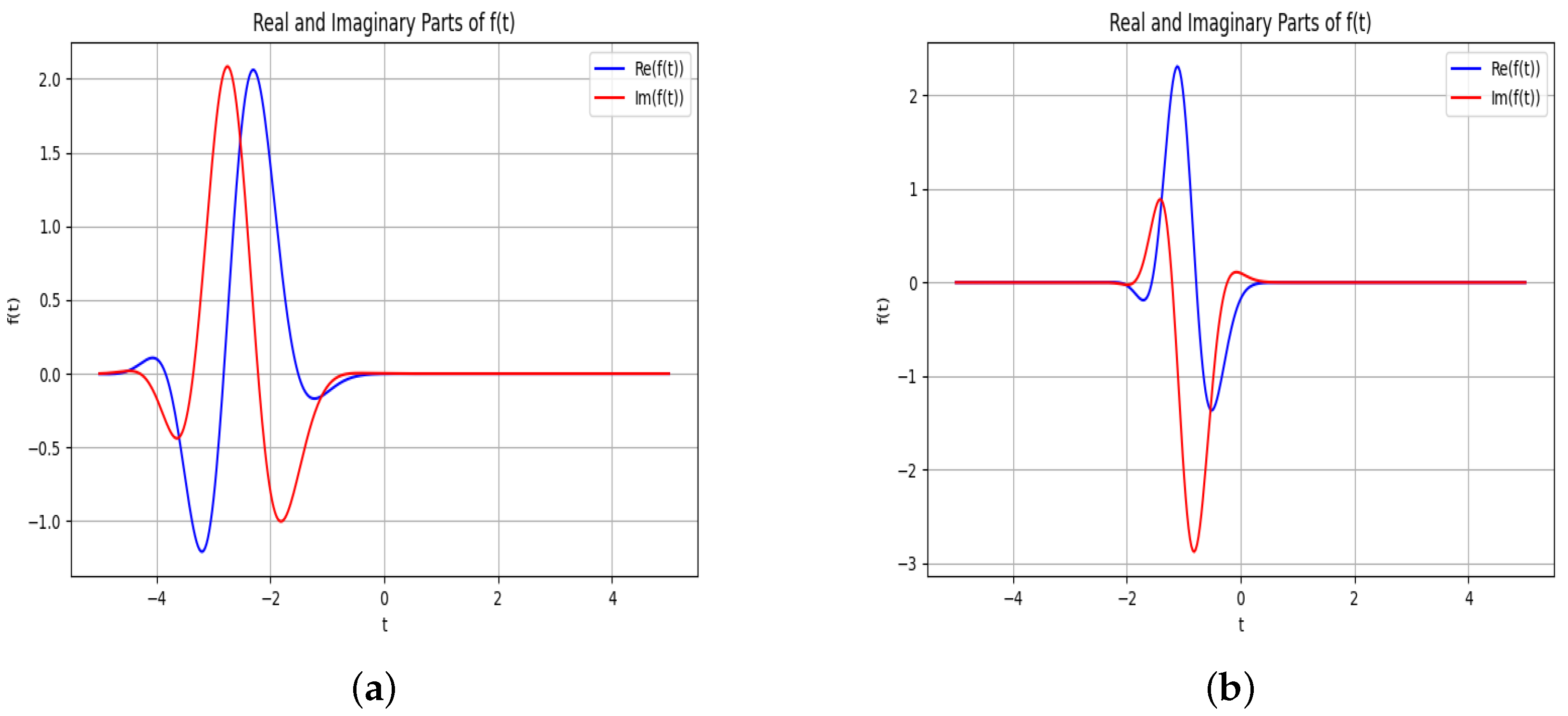
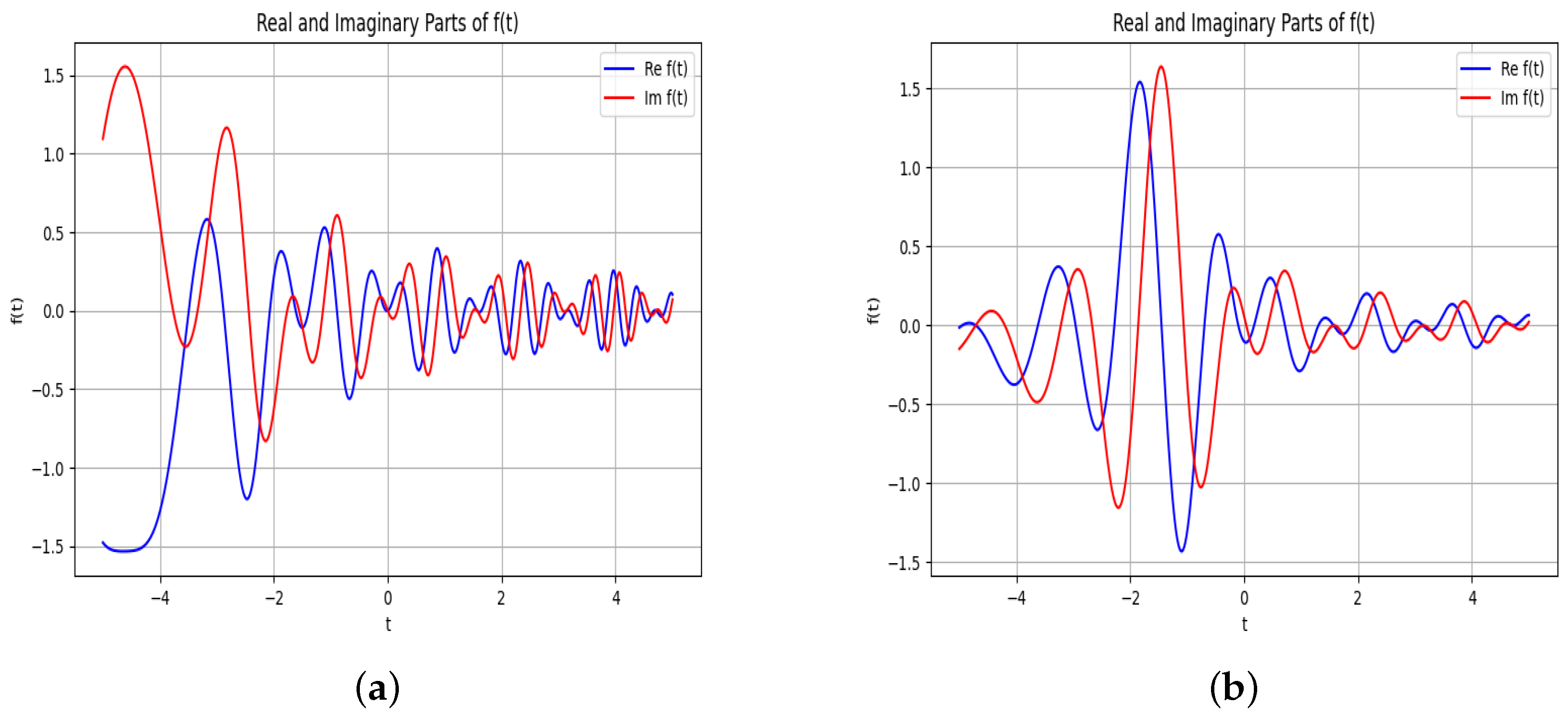
Figure 1 and Figure 2 demonstrate the comparison of f ( t ) in Equation (69) using the partial series with sampling Formula (70).

6. Conclusions

In this work, we introduced the OFrFT and investigated its fundamental properties, which have not appeared in the existing literature to date. The convolution and product theorems related to this transform were constructed. A sampling formula involving the OFrFT was established. Lastly, we verified the sampling formula for the OFrFT by providing a simple example.

Author Contributions

Conceptualization, M.B.; Formal analysis, M.B. and S.A.A.K.; Funding acquisition, M.R.; Investigation, M.R. and M.Z.; Methodology, S.A.A.K.; Resources, M.Z. and N.B.; Validation, writing—original draft, N.B., B.A.S. and M.Z.; Writing—review and editing, M.B. All authors have read and agreed to the published version of the manuscript.

Funding

This research received no external funding.

Institutional Review Board Statement

Not applicable.

Informed Consent Statement

Not applicable.

Data Availability Statement

Data are contained within the article.

Conflicts of Interest

The authors declare no conflicts of interest.

References

  1. Dalal, M.; Sandoval, S. Vector Signals and Invariant Systems: Re-Tooling Linear Systems Theory. Signals 2025, 6, 28. [Google Scholar] [CrossRef]
  2. Wei, D.Y. Novel Convolution and Correlation Theorems for the Fractional Fourier Transform. Optik 2016, 127, 3669–3675. [Google Scholar] [CrossRef]
  3. Shi, J.; Sha, X.; Song, X.; Zhang, N. Generalized Convolution Theorem Associated with Fractional Fourier Transform. Wirel. Commun. Mob. Comput. 2014, 14, 1340–1351. [Google Scholar]
  4. Tao, R.; Zhang, F.; Wang, Y. Sampling Random Signals in a Fractional Fourier Domain. Signal Process. 2011, 91, 1394–1400. [Google Scholar] [CrossRef]
  5. Ozaktas, H.M.; Zalevsky, Z.; Kutay, M.A. The Fractional Fourier Transform with Applications in Optics and Signal Processing; Wiley: New York, NY, USA, 2001. [Google Scholar]
  6. Bahri, M.; Karim, S.A.A. Fractional Fourier Transform: Main Properties and Inequalities. Mathematics 2023, 11, 1234. [Google Scholar] [CrossRef]
  7. Li, B.Z.; Xu, T.Z. Parseval Relationship of Samples in the Fractional Fourier Transform Domain. J. Appl. Math. 2012, 2012, 428142. [Google Scholar] [CrossRef]
  8. Shi, J.; Liu, X.; Zhang, N. On Uncertainty Principle for Signal Concentrations with Fractional Fourier Transform. Signal Process. 2012, 92, 2830–2836. [Google Scholar] [CrossRef]
  9. Almeida, L.B. The Fractional Fourier Transform and Time-Frequency Representations. IEEE Trans. Signal Process. 1994, 42, 3084–3091. [Google Scholar] [CrossRef]
  10. Zayed, Z.I. A Convolution and Product Theorem for the Fractional Fourier Transform. IEEE Signal Process. Lett. 1998, 5, 101–103. [Google Scholar] [CrossRef]
  11. Sulasteri, S.; Bahri, M.; Bachtiar, N.; Kusuma, J.; Ribal, A. Solving Generalized Heat and Generalized Laplace Equations Using Fractional Fourier transform. Fractal Fract. 2023, 7, 557. [Google Scholar] [CrossRef]
  12. Narayanana, V.A.; Prabhub, K.M.M. The Fractional Fourier Transform: Theory, Implementation and Error Analysis. Microprocess. Microsyst. 2003, 27, 511–521. [Google Scholar] [CrossRef]
  13. Namias, V. The Fractional Order Fourier Transform and its Application to Quantum Mechanics. IMA J. Appl. Math. 1980, 25, 241–265. [Google Scholar] [CrossRef]
  14. Goel, N.; Singh, K. Convolution and Correlation Theorems for the Offset Fractional Fourier Transform and its Application. AEU-Int. J. Electron. Commun. 2016, 70, 138–150. [Google Scholar] [CrossRef]
  15. Debnath, L.; Shah, F.A. Wavelet Transform and Their Basic Properties; Birkhauser: Boston, MA, USA, 2015. [Google Scholar]
  16. Campbell, L.L. Sampling Theorem for the Fourier transform of a Distribution with Bounded Support. SIAM J. Appl. Math. 1968, 16, 626–636. [Google Scholar] [CrossRef]
  17. Jerri, A.J. Application of the Sampling Theorem to Time-Varying Systems. J. Frank. Inst. 1972, 293, 53–58. [Google Scholar] [CrossRef]
  18. Acar, T.; Draganov, B.R.; Kursun, S. Saturation Class of Generalized Exponential Sampling Operators. Mediterr. J. Math. 2025, 22, 71. [Google Scholar] [CrossRef]
  19. Costarelli, D.; Piconi, M.; Vinti, G. On the Regularization by Durrmeyer-Sampling Type Operators in Lp-Spaces via a Distributional Approach. J. Fourier Anal. Appl. 2025, 31, 11. [Google Scholar] [CrossRef]
  20. Gupta, V.; Sharma, V. Kantorovich-Type Sampling Operators and Approximation. Math. Methods Appl. Sci. 2025, 48, 14488–14504. [Google Scholar] [CrossRef]
  21. Zhao, H.; Li, B.Z. Unlimited Sampling Theorem Based on Fractional Fourier Transform. Fractal Fract. 2023, 7, 338. [Google Scholar] [CrossRef]
  22. Zayed, A.I. Sampling Theorem for Two Dimensional Fractional Fourier Transform. Signal Process. 2021, 181, 107902. [Google Scholar] [CrossRef]
  23. Zayed, A.I.; García, A.G. New Sampling Formulae for the Fractional Fourier Transform. Signal Process. 1999, 77, 111–114. [Google Scholar] [CrossRef]
  24. Li, Z.; Zhou, X.; Wang, Y.; Huang, G.; Liu, S.; Gao, B.; Liu, Z. Flexible and Universal Autofocus Based on Amplitude Difference of Fractional Fourier Transform. Opt. Lasers Eng. 2024, 175, 107991. [Google Scholar] [CrossRef]
  25. Gröchenig, K. Foundation of Time-Frequency Analysis; Birkhäuser: Boston, MA, USA, 2001. [Google Scholar]
  26. Bracewell, R. The Fourier Transform and Its Applications; McGraw Hill: Boston, MA, USA, 2000. [Google Scholar]
  27. Bogges, A.; Narcowich, F.J. A First Course in Wavelets with Fourier Analysis, 2nd ed.; John Wiley & Sons: Hoboken, NJ, USA, 2011. [Google Scholar]
  28. Bahri, M.; Nabila, A.; Bachtiar, N.; Zakir, M. A Comparative Study on Properties and Uncertainty Principles of Fractional Fourier Transform and Offset Fractional Fourier Transform. Results Appl. Math. 2025, 27, 100616. [Google Scholar] [CrossRef]
Figure 1. Graph of f ( t ) in Equation (69) (a) for n = 1 , m = 4 , β = π 6 (b) for n = 1 , m = 4 , β = π 3 , ω = 5 5 .
Signals 07 00022 g001
Figure 2. Graph of f ( t ) in Equation (70) (a) for n = 1 , m = 4 , β = π 6 (b) for n = 1 , m = 4 , β = π 3 , ω = 5 5 .
Signals 07 00022 g002
Disclaimer/Publisher’s Note: The statements, opinions and data contained in all publications are solely those of the individual author(s) and contributor(s) and not of MDPI and/or the editor(s). MDPI and/or the editor(s) disclaim responsibility for any injury to people or property resulting from any ideas, methods, instructions or products referred to in the content.