Article

Inverse Synthetic Aperture Radar Imaging of Space Objects Using Probing Signal with a Zero Autocorrelation Zone


by
Roman N. Ipanov
* and
Aleksey A. Komarov
Department of Radio Devices and Antenna Systems, National Research University “Moscow Power Engineering Institute”, 111250 Moscow, Russia
*
Author to whom correspondence should be addressed.
Submission received: 19 November 2025 / Revised: 29 December 2025 / Accepted: 6 January 2026 / Published: 12 January 2026

Abstract

To obtain radar images of a group of small space objects or to resolve individual elements of complex space objects in near-Earth orbit, a radar system must have high spatial resolution. High range resolution is achieved by using complex probing signals with a wide spectrum bandwidth. Achieving high angular resolution for small or complex space objects is based on the inverse synthetic aperture antenna effect. Among the various classes of complex signals, only two have found practical application in Inverse Synthetic Aperture Radar (ISAR) systems so far: the Linear Frequency-Modulated signal (chirp) and the Stepped-Frequency signal. Over the coherent integration interval of the echo signals, which corresponds to the ISAR aperture synthesis time, the combined correlation characteristics of the signal ensemble are analyzed. A high level of integral correlation noise in the ensemble of probing signals degrades the quality of the radar image. Therefore, a probing signal with a Zero Autocorrelation Zone (ZACZ) is highly relevant for ISAR applications. In this work, through simulation, radar images of a complex space object were obtained using both chirp and ZACZ probing signals. A comparative analysis of the correlation characteristics of the echo signals and the resulting radar images of the complex space object was performed.

1. Introduction

To obtain radar images of space objects in near-Earth orbit, a radar system must possess high spatial resolution. High range resolution is achieved by using complex (modulated) probing signals with a wide spectrum bandwidth. Achieving high angular resolution for a small space object (SO) or elements of a complex SO is based on the inverse synthetic aperture effect [1,2,3,4,5,6].
Currently, two types of complex signals have found application in Inverse Synthetic Aperture Radar (ISAR) systems: Linear Frequency-Modulated (LFM, Chirp) signals and Stepped-Frequency Continuous Wave (SFCW) signals [4,5,6]. It is worth noting the growing interest among specialists in Phase-Shift Keying (PSK) signals. This is because the use of discrete coding for a coherent train of probing signals in ISAR offers the potential for significant improvement in the quality of Synthetic Aperture Radar (SAR) images, based on the metrics of their overall correlation properties [7,8,9].
To assess the quality of radar images (RIs) for point targets and extended reflecting surfaces, the peak sidelobe ratio (PSLR) and the integrated sidelobe ratio (ISLR) of the autocorrelation function (ACF) are used, respectively. For a PSK signal, these metrics are defined as follows:
ρ max = max 1 m L 1 ρ ˙ m T 0 ;    ρ int = m = 1 L 1 ρ ˙ 2 m T 0 ,
where ρ ˙ τ is the normalized ACF of the PSK signal’s complex envelope (CE); T 0 is the duration of an elementary sub-pulse; and L is the number of sub-pulses in the signal.
Over the coherent processing interval of the echo signals, which corresponds to the ISAR aperture synthesis time, the combined correlation characteristics of the signal ensemble are analyzed. The ACF of a train of M probing signals for τ < τ S , where τ S is the duration of a single signal, is the combined ACF of the signal ensemble, which equals the sum of the M individual ACFs of the signals constituting the train:
ρ ˙ Σ m T 0 = 1 M ξ = 1 M ρ ˙ ξ m T 0 ,
where ρ ˙ ξ τ ,   ξ = 1 , 2 , , M , is the ACF of the ξ-th PSK signal in the train.
Over the ISAR aperture synthesis interval, the quality of the RI for point targets and extended reflecting surfaces is characterized by the PSLR ρ Σ max and the ISLR ρ Σ int of the combined ACF of the signal ensemble, respectively. These metrics are calculated using Formula (1) applied to the combined ACF given by (2).
A chirp signal has an ACF PSLR of ρ Σ max 13.5 dB and an ACF ISLR of ρ Σ int 10 ÷ 11 dB, which are practically independent of the signal’s time–bandwidth product. The high level of one-sided integrated correlation noise in the ACF of a chirp signal distorts the RI of reflecting surfaces.
The only means of suppressing the sidelobe (SL) interference of a chirp signal’s ACF is windowing (i.e., weighting function application) of the received radar signals. For example, applying a Hamming window can reduce the level of the first ACF SL from −13.3 dB to −42.6 dB. However, this reduces the effective signal bandwidth by a factor of 1.4, which is equivalent to a degradation in range resolution by the same factor. Furthermore, this weighting processing leads to direct energy losses of approximately 1.3 dB [10].
In accordance with the above, PSK signals with a Zero Autocorrelation Zone (ZACZ), discussed in [11,12,13,14] and referred to as Coherent Complementary Signals (CCSs), are highly relevant for ISAR applications. Work [12] present CCSs without additional modulation of the elementary sub-pulses, which exhibit a sufficiently high level of ACF SL under Doppler frequency mismatch. In [13], CCSs that employ additional frequency shift keying to suppress SL within the ZACZ under Doppler mismatch are considered, while [11] utilizes linear frequency modulation (LFM) of the signal’s sub-pulses.
In this work, a CCS with additional linear frequency modulation of the sub-pulses (CCS-LFM) [11] is investigated as the probing signal for ISAR. Through simulation, an RI of a complex SO was obtained using both chirp and CCS-LFM probing signals. A comparative analysis of the correlation characteristics of the echo signals and the resulting RIs of the complex SO was conducted.

2. Synthesis and Analysis of CCS-LFM Correlation Characteristics

To form a ZACZ signal with a CE
u ˙ t = k = 1 K n = 1 N a i , n S ˙ n t n 1 T 0 k 1 T ,
where S ˙ n t ,   n 1 T 0 t n T 0 , is the CE of the n-th elementary sub-pulse with duration T 0 ; T = Q T p = Q N T 0 ( T p is the pulse duration, Q 2 is the off-duty factor of the pulse train, N is the number of sub-pulses in a pulse) is the pulse repetition interval, which has a Zero Autocorrelation Zone for T 0 τ < T p , the rows of the coding matrix
A K , N = a k , n k , n = 1 K , N , a k , n = exp j 2 π p a ˜ k , n ,
where A ˜ K , N = a ˜ k , n k , n = 1 K , N ,   a ˜ k , n = 0 , 1 , , p 1 , is a p-ary code matrix, must consist of complementary sequences, or the columns must consist of orthogonal sequences [14].
To reduce the level of SL outside the ZACZ, as well as to suppress SL within the ZACZ under Doppler frequency mismatch, the coding matrix (4) must be in the form of a block matrix consisting of a set of mutually orthogonal matrices [14]. A polyphase (p-phase, specifically binary when p = 2 ) PSK signal with a CE (3), encoded by the rows of the block matrix (4) for K = p , which consists of p submatrices with adjacent p-pairs of complementary sequences (CSs), is called a CCS.
The CCS has, for each of its p pulses, equal CE of the sub-pulses S ˙ n t for n = η 1 N / p + 1 , , η N / p ,   η = 1 , 2 , , p , which allows for reducing the ACF SL level for τ T p and τ < T 0 , as well as suppressing the SL within the ZACZ under Doppler frequency mismatch by employing additional orthogonal modulation of the pulse sub-pulses in phase or frequency [11,13].
Based on the foregoing, let us consider a CCS with a CE (3) K = p incorporating additional linear frequency modulation of the pulse sub-pulses [11]. Each of the p pulses in the CCS-LFM consists of N = p q + 1 ( q > 0 is an integer) sub-pulses and is divided into p parts, with each part containing p q sub-pulses. The sub-pulses in adjacent parts of the pulses possess opposite signs of the modulation frequency chirp rate.
In the general case, the CE of a coherent train of M probing signals with a duration of τ t = τ S Q t M 1 + 1 has the following form:
u ˙ t t = ξ = 1 M u ˙ ξ t ξ 1 Q t τ S ,
where u ˙ ξ t is the CE of the ξ-th probing signal with duration τ S ;   Q t is the off-duty factor of the probing signals train.
To improve the parameters of the combined correlation characteristics of a coherent CCS train over the ISAR aperture synthesis interval, adjacent p-pairs of CSs must be used for encoding adjacent CCSs within the train [12]. The matrix (4) with submatrices composed of adjacent p-pairs of CSs [14] forms only one (the first) CCS of the train. To form subsequent adjacent CCSs of the train, it is necessary to construct matrices that generate sets of p-paired CSs corresponding to matrix (4). In this case, the block matrix (4) encoding the ξ-th CCS of the coherent train takes the following form:
A p , N ξ = A p , N / p 1 W ξ 1 1 1 A p , N / p η W ξ 1 η 1 A p , N / p p W ξ 1 p 1 ; ξ = ξ 1 p + 1 ;     ξ = 1 , 2 , M ,            
where A p , N / p η ,   η = 1 , 2 , , p , are the submatrices of the block matrix (4) [14]; W = exp j 2 π / p ;   x Z denote x modulo Z.
From (4) and (6), it follows that A p , N ξ = a k , n ξ k , n = 1 p , N , where a k , n ξ = a k , n W ξ 1 η 1 ,   ξ = 1 , 2 , , p , and A p , N 1 = A p , N = a k , n 1 k , n = 1 p , N = a k , n k , n = 1 p , N .
The complex envelope (3) of the ξ-th CCS-LFM with duration τ S = T 0 N p 1 Q + 1 has the following form [11]:
u ˙ ξ t = k = 1 p n = 1 N S n 1 N / p t n 1 T 0 k 1 N Q T 0 exp j π 2 n 1 N / p 2 B t T 0 + + 1 n 1 N / p B t T 0 2 + 2 p a ˜ k , n ξ ,
where S n t = S η 1 t = 1 ,    n 1 T 0 t n T 0 ; 0 ,    t < n 1 T 0 , t > n T 0 ,   n = η 1 N / p + 1 , , η N / p ,   η = 1 , 2 , , p , is the rectangular envelope of the n-th sub-pulse of the CCS-LFM pulse; A ˜ p , N ξ = a ˜ k , n ξ k , n = 1 p , N , and a k , n ξ = exp j 2 π / p a ˜ k , n ξ is an element of matrix (6); B = T 0 Δ f = ± K f T 0 2 ( Δ f is the spectrum width, K f is the chirp rate) is the LFM sub-pulse time–bandwidth product; x Z is the integer part of x / Z .
The ACF of a train of M CCSs for τ < τ S , where τ S is the duration of a single CCS, is the combined ACF of the CCS ensemble (2), which equals the sum of the M individual ACFs of the CCSs constituting the train. Since for T 0 τ < T p the ACFs of the individual CCSs in the train are mutually orthogonal [14], the combined ACF (2) of the CCS ensemble for T 0 τ < T p has the form ρ ˙ Σ m T 0 = 0.
The normalized ACF of the ξ-th CCS-LFM signal for τ < T 0 has the following form [14]:
ρ ˙ ξ τ = 1 p η = 1 p ρ ˙ S η 1 ξ τ ,
where ρ ˙ S η 1 ξ τ = 1 τ / T 0 sin c B τ / T 0 1 τ / T 0 is the normalized ACF of the CE of the LFM sub-pulses in the η-th part η = 1 , 2 , , p of the pulses of the ξ-th CCS in the coherent train. Since the ACFs of the CE of the LFM sub-pulses ρ ˙ S η 1 ξ τ in different parts of the CCS pulses are equal to each other for B = ± K f T 0 2 , it follows from (2) and (8) that the combined ACF (2) of the CCS-LFM ensemble for τ < T 0 is ρ ˙ Σ τ = 1 τ / T 0 sin c B τ / T 0 1 τ / T 0 .

3. Modeling of Radar Imaging of a Complex SO

3.1. Radar Imaging Parameters

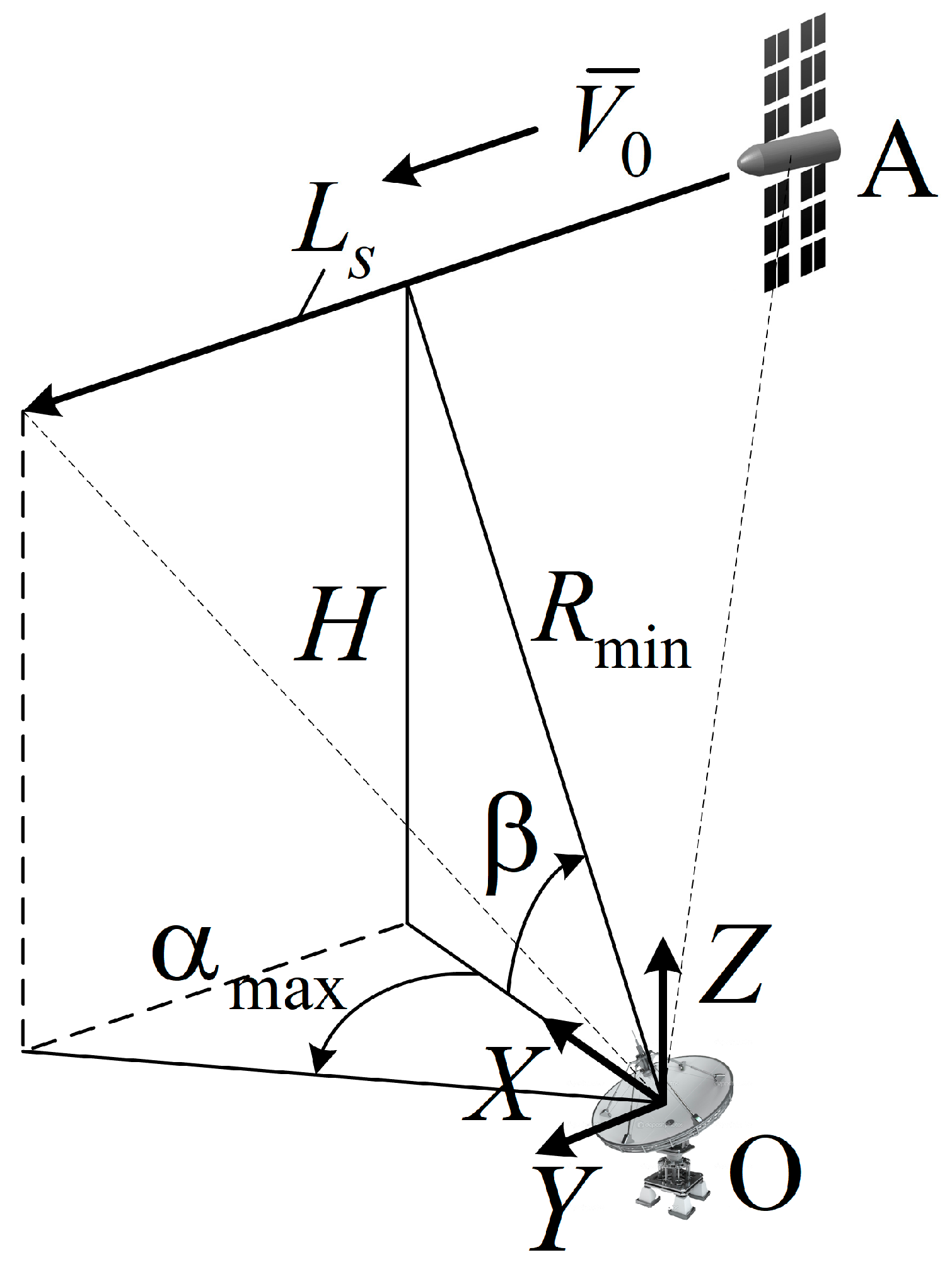
The space object moves along a circular Earth orbit with a ground speed of V 0 = 7.85 km/s and a center-of-mass altitude of H = 100 km relative to the ISAR system, as shown in Figure 1. The phase center of the ISAR antenna system is located at point O (0, 0, 0) of the rectangular XYZ coordinate system. At the initial time, the center of mass of the SO is located at point A X A , Y A , Z A , where X A = 40 km, Z A = H = 100 km, and Y A = L s / 2 , where L s is the synthetic aperture length. The ISAR carrier frequency is f c = 10 GHz, and the slant range and cross-range resolutions are δ R = δ Y = 20 cm, respectively. Consequently, the synthetic aperture length is
L s = c R min / 2 f c δ Y 8 km ,
where R min 107.7 km is the slant range to the SO’s center of mass in the traverse plane. Since L s R min , the segment of the circular orbit equal to the synthetic aperture length can be considered linear. The elevation angle of the SO’s center of mass is β 68.2 deg, and the maximum horizontal deviation angle of the SO’s center of mass relative to the traverse plane is α max 5.8 deg.
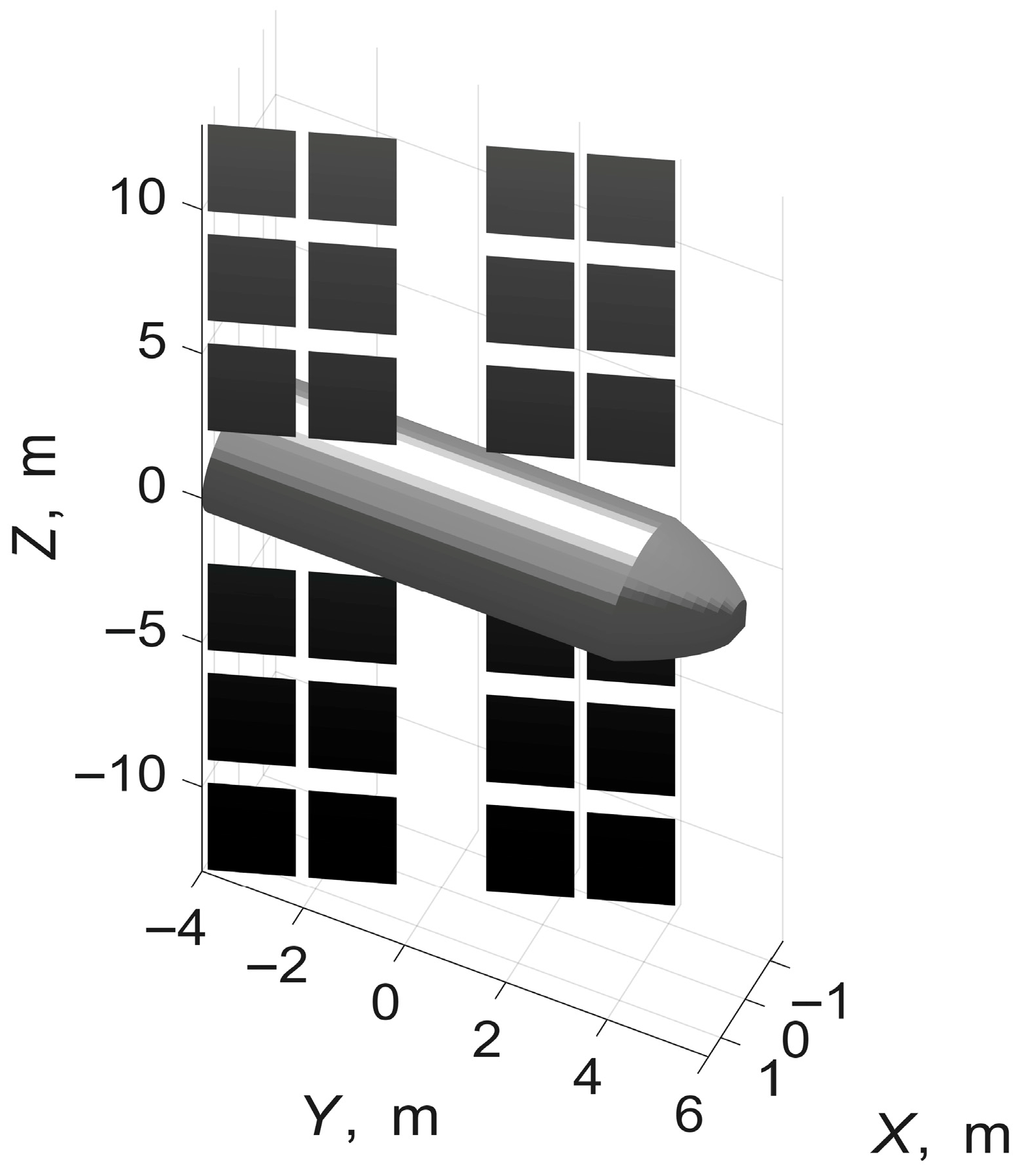
The radar target is represented by a model of a complex SO, shown in Figure 2. The model consists of a main body, mathematically described by a cylinder equation, a nose fairing described by a paraboloid equation, and solar panels described by plane equations.

3.2. Probing Signals Parameters

For a comparative analysis of the correlation characteristics of different types of probing signals, it is necessary to ensure the equality of their pulse energies (pulse durations) to achieve equal main lobes of their ACFs, as well as the equality of their spectrum bandwidths. For the CCS-LFM and chirp signals, we state the conditions for the equality of their pulse energies and spectrum bandwidths as follows:
p N T 0 = T p chirp B / T 0 = Δ f chirp B chirp = T p chirp Δ f chirp = p N B ,
where T p chirp ,   Δ f chirp ,   B chirp are the pulse duration, frequency deviation, and time–bandwidth product of a chirp signal, respectively.
In addition to satisfying condition (9), it is necessary to establish the relationship between the off-duty factor of the coherent trains for the CCS-LFM and chirp signals, since they have the same repetition periods (T и T chirp , respectively), but different durations:
T = Q t τ S = Q t T p p 1 Q + 1 = T chirp = Q t p T p Q t = Q t p 1 Q + 1 / p ,
where Q t ,   Q t are off-duty factors of a CCS-LFM and a chirp signals, respectively.
Since the main lobe level of the unnormalized ACF of a signal’s CE equals the signal’s energy, a frequency mismatch within the main lobe width of the ρ ˙ 0 , F cut of the ambiguity function ρ ˙ τ , F CCS-LFM for the quantity F < 1 / p T will cause energy loss at the matched filter output. Given an allowable energy loss of 0.5 dB due to Doppler frequency shift F D max , the maximum allowable pulse duration for the CCS is determined from the expression
20 lg ρ ˙ 0 / ρ ˙ F D max p Q T p = 20 lg ρ ˙ F D max p Q T p = 0.5 ,
From this, we derive the requirement for the maximum value of the CCS sub-pulse duration
T 0 max = 0.2 / p Q N F D max .
This energy criterion for limiting the CCS sub-pulse duration simultaneously ensures only a small increase in the ACF SL level within the ZACZ under Doppler frequency mismatch.
For modeling the radar imaging, we will use CCS-LFM and chirp signals with the following parameters: Δ f = Δ f chirp = 750 MHz; B = 3 ;   T 0 = B / Δ f = 4 ns; p = 2 ;   N = 256 ;   T p chirp = 2.048 μs; B chirp = 1536 ;   Q = Q t = 2 ;   Q t = 3.
The maximum Doppler frequency shift (Figure 1) can be determined from the expression
F D max = 2 f c V 0 c cos β sin α max ,
from which, for our parameter values, we obtain F D max = 19.5 kHz.
Substituting the value of F D max and the given parameters into expression (11), we obtain T 0 max 10 ns, which satisfies the given CCS-LFM sub-pulse duration of T 0 = 4 ns. The Zero Autocorrelation Zone for T 0 τ < N T 0 corresponds to a distance of c N T 0 / 2 153.5 m, where c is the speed of light in vacuum, which is quite sufficient for probing a complex SO with a maximum size in the elevation plane of less than 26 m (Figure 2). Thus, the given CCS-LFM parameters provide the necessary level of correlation noise at τ < T p and F p T 0.2 , as determined by criterion (11).
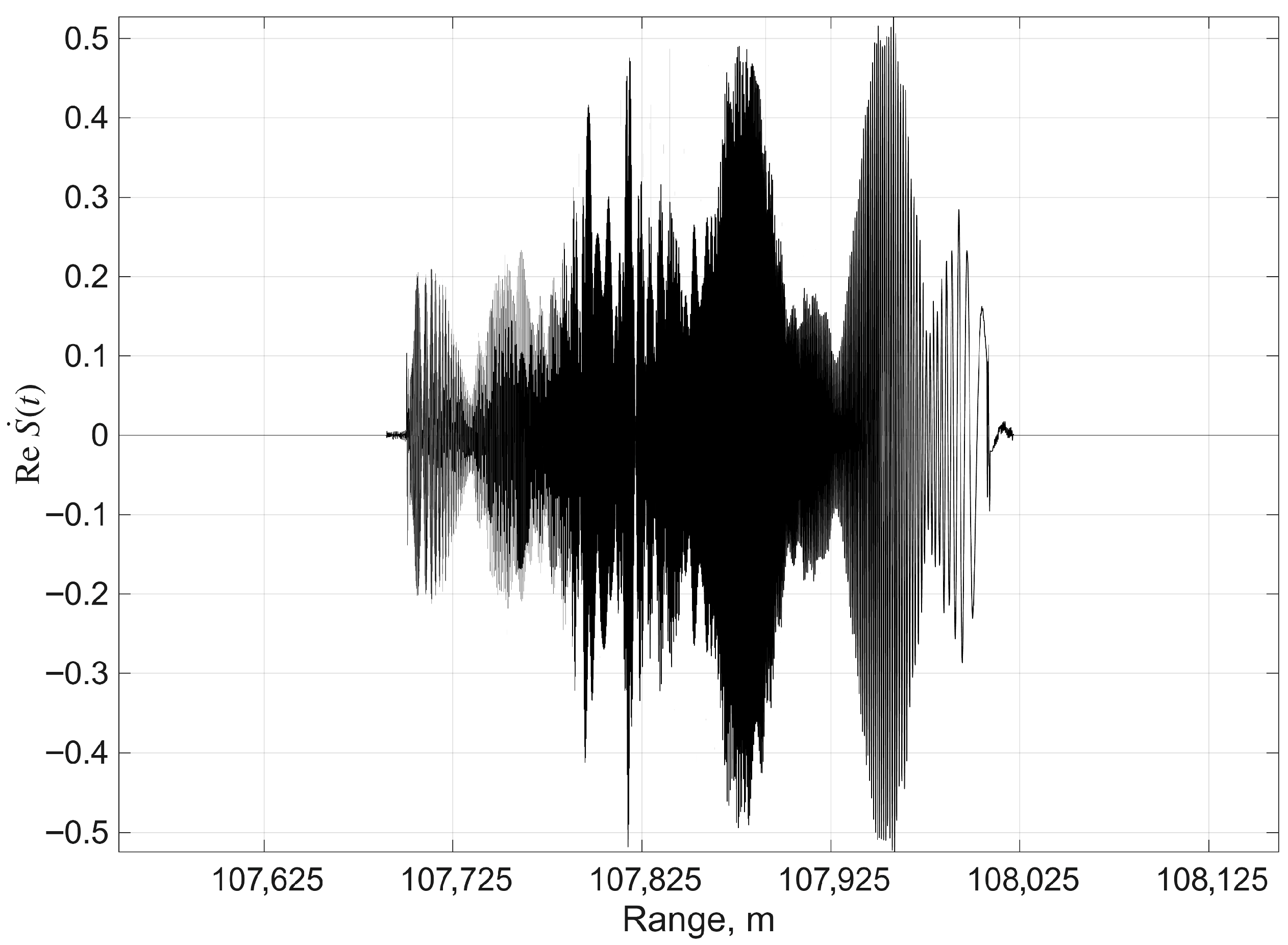
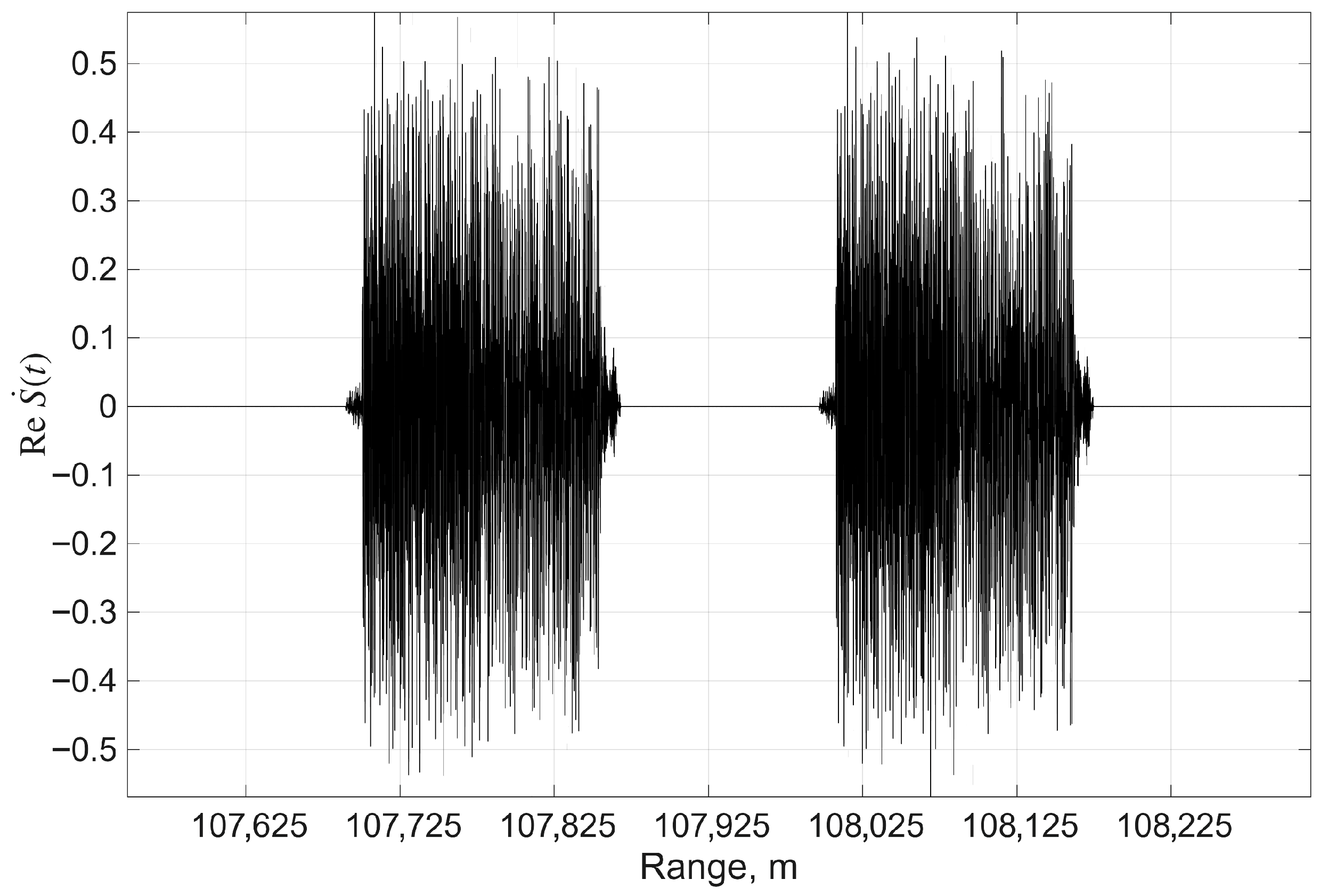
Figure 3 and Figure 4 show the reflected chirp and CCS-LFM signals from the SO with the given model parameters in the central cross-range channel. The entire radio hologram has L s V 0 T + 1 = 41,160 cross-range channels, corresponding to the number of probing signals in the coherent train.

3.3. Comparative Analysis of Correlation Characteristics and RI

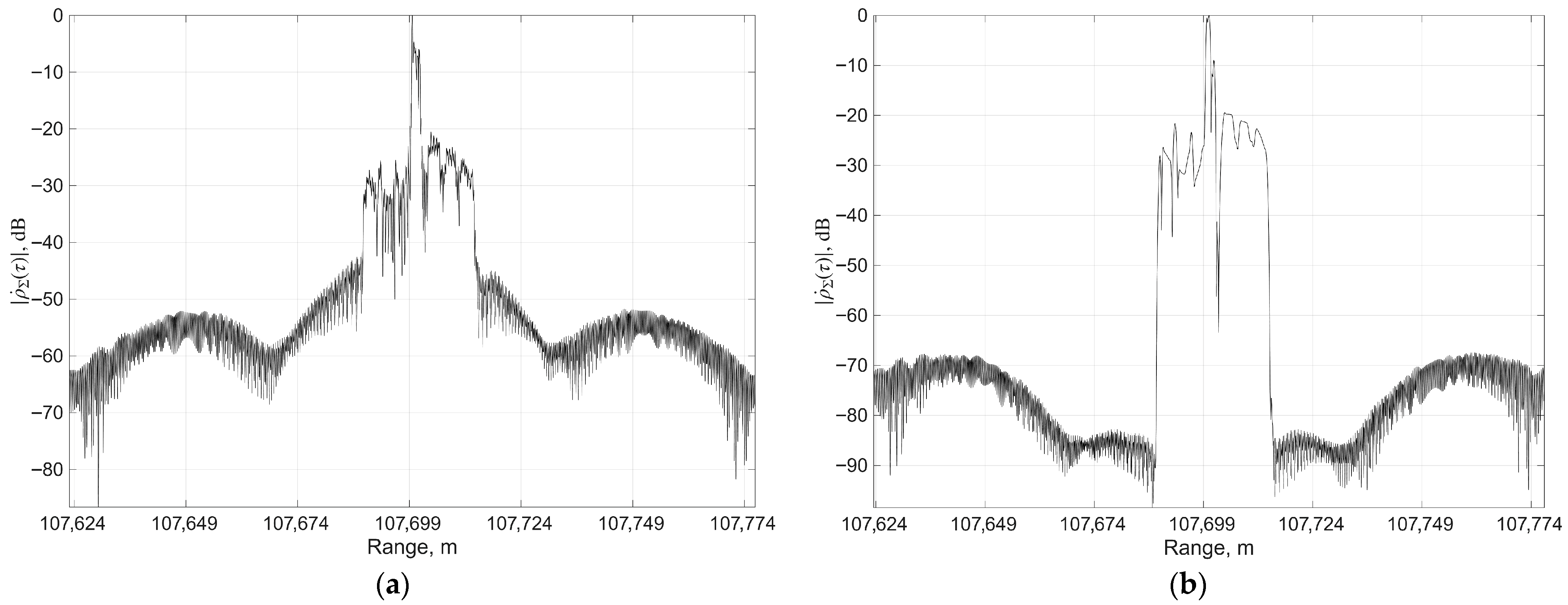
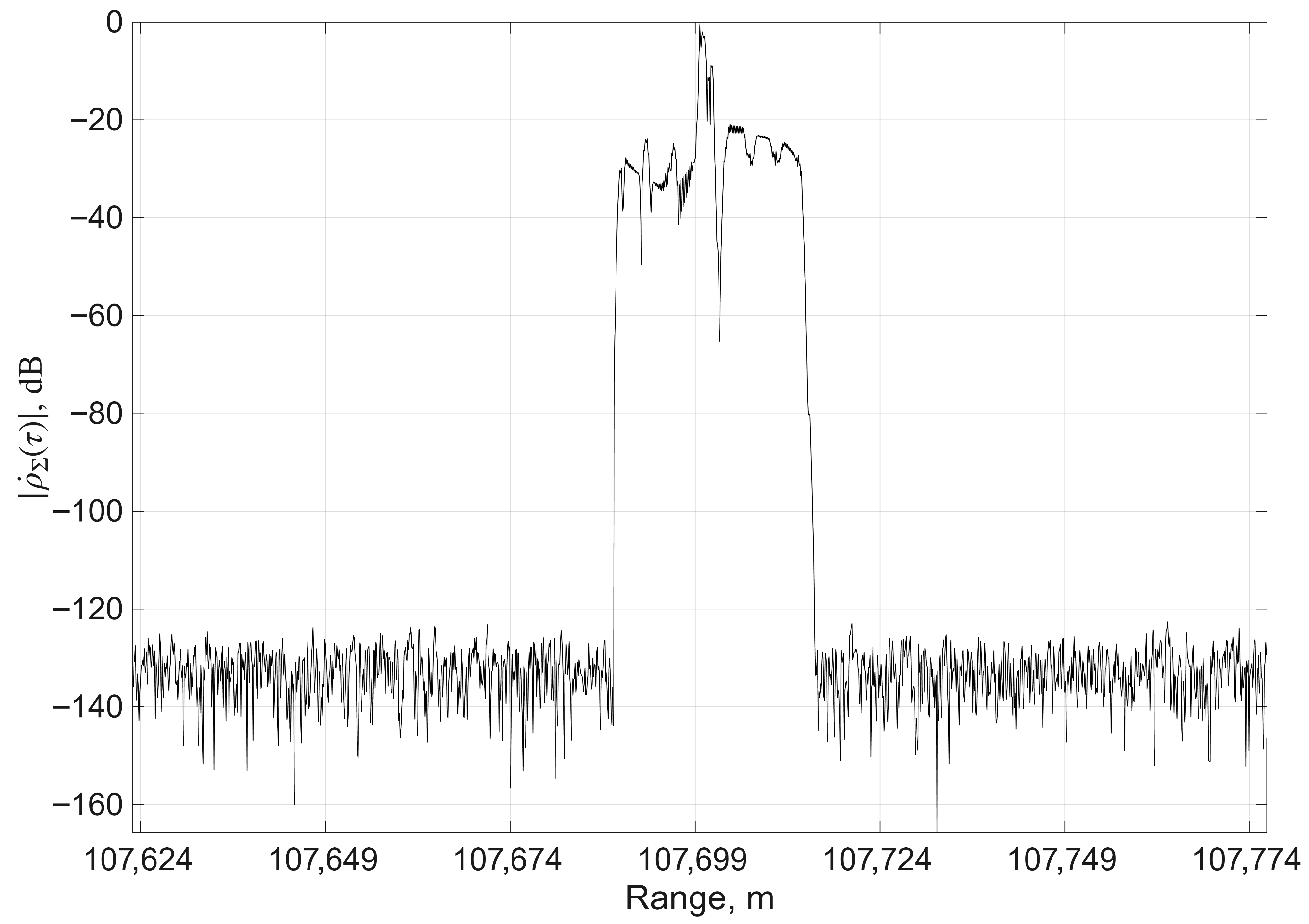
Figure 5 and Figure 6 show the combined ACFs ρ ˙ Σ τ of the ensembles of chirp and CCS-LFM signals, respectively, reflected from the complex SO. The combined ACFs were obtained by coherently summing the range-compressed echo signals across all 41,160 cross-range channels.
The combined ACFs of the signal ensembles have the following metrics:
for the chirp signal: PSLR ACF ρ Σ max 37 . 8 dB and ISLR ACF ρ Σ int 27.2 dB
for the Blackman windowed chirp signal: PSLR ACF ρ Σ max 67.5 dB and ISLR ACF ρ Σ int 48.8 dB [10,15];
for the CCS- LFM signal: PSLR ACF ρ Σ max 122.2 dB and ISLR ACF ρ Σ int 103.3 dB.
The CCS-LFM signal outperforms the chirp signal without windowing by more than 84 dB in the PSLR ACF level and by more than 76 dB in the ISLR ACF level. The Blackman windowed chirp signal is outperformed by CCS-LFM in the PSLR and ISLR ACF levels by more than 54 dB. Such a significant difference in correlation noise levels between the two signals will inevitably affect the quality of the RI of the SO when these types of probing signals are used in ISAR systems.
The application of a Blackman window reduces the level of the first sidelobe of the LFM signal’s ACF from −13.3 dB to −58.1 dB. However, this reduces the effective signal bandwidth by a factor of 1.7, which corresponds to a degradation in range resolution by the same factor of 1.7 (Figure 5b). Furthermore, the windowing results in direct energy losses of approximately 2.4 dB [10,15].
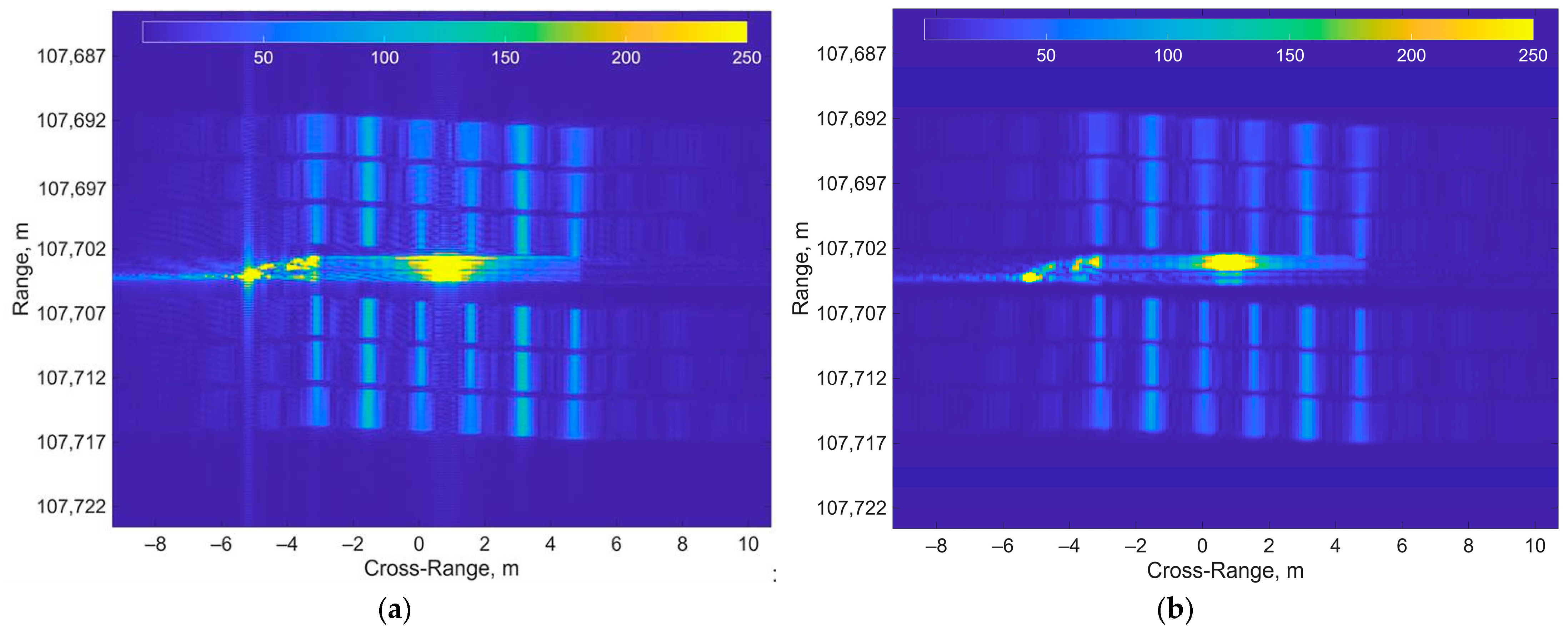
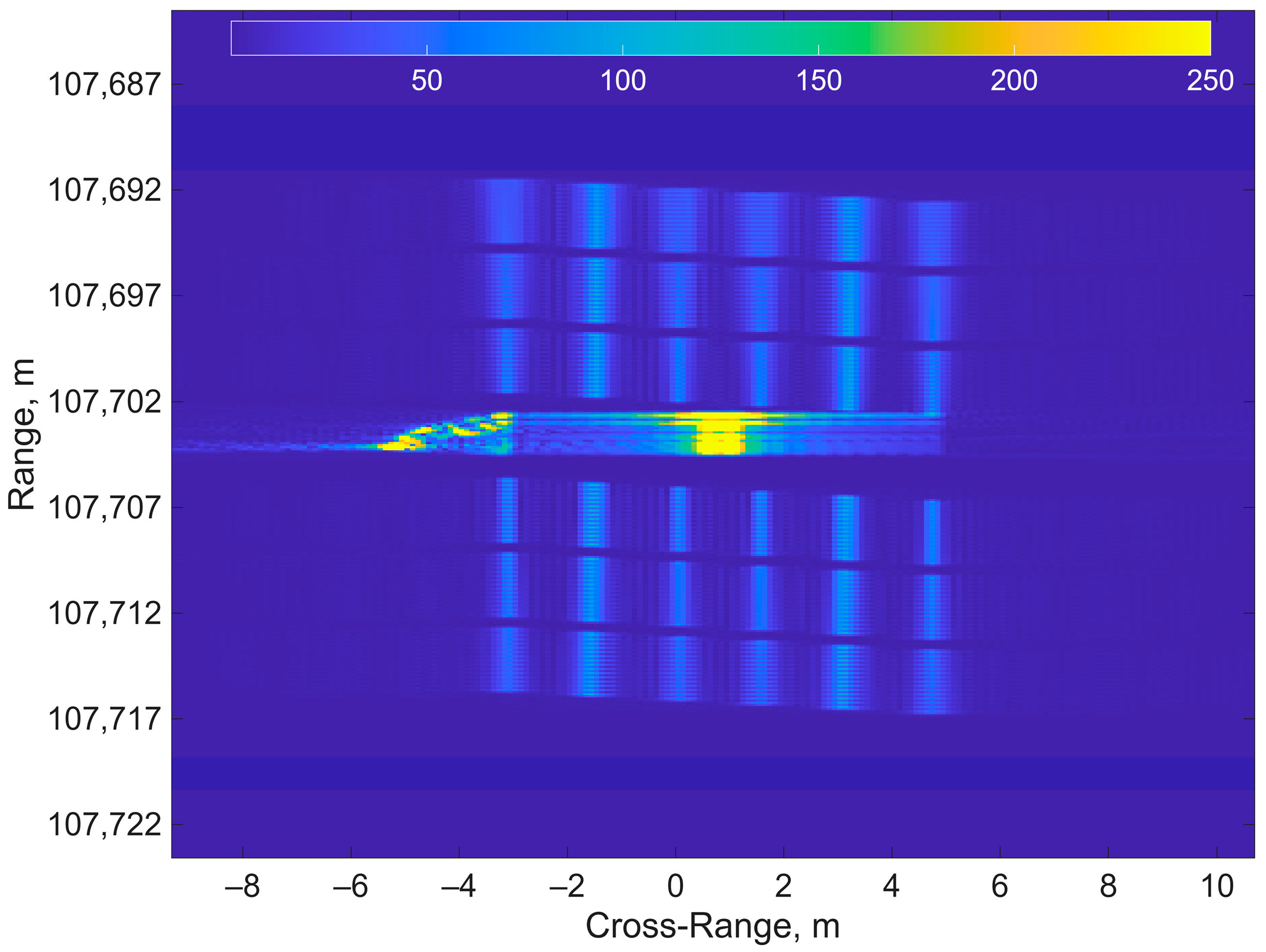
Figure 7 and Figure 8 show the RIs obtained through ISAR simulation using chirp and CCS-LFM probing signals, respectively. In Figure 7 and Figure 8, all pixel brightness values are displayed without individual scaling. This means the image pixels occupy the same limited dynamic range, i.e., their color scales have identical boundary values. This was chosen to make the correlation noise clearly visible in Figure 7 and Figure 8.
Analysis of Figure 7a reveals that, due to the high sidelobe level of the chirp signal on RIs of complex SOs, there is clutter (noisy pixels) in the vertical direction. These artifacts are particularly pronounced in areas containing bright scatterers (the paraboloid vertex, the central part of the cylinder). Furthermore, false images of the object’s solar panels appear to the left and right of the main object image. When using a Blackman window (Figure 7b), the cluttered pixels in the vertical direction vanish, but the false images of the solar panels persist. In Figure 8, both the cluttered pixels and the false images of the solar panels are absent, resulting in a higher-contrast image of the object.
An RI is a radio hologram compressed over range and cross-range, which can be written as follows:
Ξ ˙ n n 0 c Δ t / 2 , k V 0 T ,
where c is the speed of light in vacuum; Δ t = 1 / 2 Δ f is the sampling interval ( Δ f is the spectrum width of the probing signal); T is the repetition period of the probing signals; V 0 is the ground speed; n and n 0 are the numbers of samples of the RI along the range, and k is the number of samples along the cross-range.
n 0 = 2 R min / c Δ t ;     n = 2 R / c Δ t ;     n = n min , , n max ; n min = 2 R min Δ R / 2 / c Δ t ;    n max = 2 R min + Δ R / 2 / c Δ t ,
where R min is the range to the SO’s center of mass in the traverse plane; R is the range to the selected point on the RI; Δ R is the RI size along the range; and [x] is the rounds the number x to the nearest integer.
k = Y / V 0 T ;     k = k min , , k max ; k min = Δ Y / 2 V 0 T ;     k max = Δ Y / 2 V 0 T ,
where Y is the coordinate of the cross-range of the selected point on the RI; and Δ Y is the RI size along the cross-range.
Let us find the signal-to-noise ratio using the following expression:
q dB = 20 lg Ξ max / Ξ SL ,
where Ξ max = max n min n n max , k min k k max Ξ ˙ n n 0 c Δ t / 2 , k V 0 T is the maximum brightness value of pixels in the RI; and Ξ SL = Ξ ˙ n SL n 0 c Δ t / 2 , k SL V 0 T is the pixel brightness value of the RI with sample numbers n SL and k SL along the range and cross-range, respectively.
Let us select in the RIs (Figure 7 and Figure 8) pixels with the same sample numbers that most accurately characterize the suppression of correlation noise (the quality of the RI). In our case: Δ R = 40 m; Δ Y = 20 m; R min 107,704 m; R SL 107,701 m; Y SL 3.8 m; Ξ max = 250 .
Then, the signal-to-noise ratio will be equal to the following:
for the chirp signal without window processing q = 22.4 dB Ξ SL = 18.9 ;
for the Blackman windowed chirp signal q = 28.7 dB; Ξ SL = 9.2 ;
for the CCS-LFM signal q = 44.0 dB Ξ SL = 1.6 .
The results obtained confirm the quality of the radar images obtained, primarily their contrast.
In all the figures, noisy pixels are also observed in the horizontal direction. A particularly distinct noisy trail of pixels emanates from the tip of the paraboloid. These noisy pixels in the horizontal direction appear as a result of compressing the radio hologram in azimuth. The trajectory signal is essentially a chirp signal with the same level of correlation noise as the probing chirp signal. In this case, to suppress correlation noise in the horizontal direction, window processing of the trajectory signal must be applied. However, as mentioned earlier, this would lead to a degradation in the range resolution by a factor of 1.4, as well as direct energy losses of approximately 1.3 dB.

4. Conclusions

This work investigates the use of CCS-LFM as a probing signal for ISAR. A comparative analysis of the combined correlation characteristics of the ensembles of chirp and CCS-LFM signals reflected from the SO was conducted. The CCS-LFM outperforms the chirp signal without windowing by more than 84 dB in the PSLR ACF level and by more than 76 dB in the ISLR ACF level. Through simulation, RIs of the complex SO were obtained using both chirp and CCS-LFM probing signals. The RI obtained using a chirp probe signal exhibits pronounced areas of pixel clutter and false artifacts of structural elements due to the high level of correlation noise. In contrast, the RI using a CCS-LFM probe signal is free from such cluttered pixels and false solar panel images, resulting in a higher-contrast image of the object.

Author Contributions

Conceptualization, R.N.I.; methodology, R.N.I.; software, R.N.I.; validation, R.N.I.; formal analysis, A.A.K.; investigation, R.N.I.; resources, A.A.K.; data curation, R.N.I.; writing—original draft preparation, R.N.I.; writing—review and editing, A.A.K.; visualization, R.N.I.; supervision, A.A.K.; project administration, A.A.K.; funding acquisition, A.A.K. All authors have read and agreed to the published version of the manuscript.

Funding

The reported study was funded by the Russian Science Foundation according to the research project № 23-19-00485, https://rscf.ru/project/23-19-00485/ (accessed on 18 November 2025).

Data Availability Statement

The data are not publicly available due to privacy and development. The Matlab R2025b software was used for the simulation.

Conflicts of Interest

The authors declare no conflicts of interest.

References

  1. Bai, X.; Xing, M.; Zhou, F.; Bao, Z. High-Resolution Three-Dimensional Imaging of Spinning Space Debris. IEEE Trans. Geosci. Remote Sens. 2009, 47, 2352–2362. [Google Scholar] [CrossRef]
  2. Zhuo, Z.; Du, L.; Lu, X.; Chen, J.; Cao, Z. Smoothed Lv Distribution Based Three-Dimensional Imaging for Spinning Space Debris. IEEE Trans. Geosci. Remote Sens. 2022, 60, 5113813. [Google Scholar] [CrossRef]
  3. Kang, M.-S. Robust ISAR Autofocus via Newton-Based Tsallis Entropy Minimization. IEEE Trans. Geosci. Remote Sens. 2025, 22, 3505905. [Google Scholar] [CrossRef]
  4. Chen, V.C.; Martorella, M. Inverse Synthetic Aperture Radar Imaging: Principles, Algorithms and Applications; SciTech Publishing: Edison, NJ, USA, 2014. [Google Scholar]
  5. Özdemir, C. Inverse Synthetic Aperture Radar Imaging with MATLAB Algorithms, 2nd ed.; Wiley: Hoboken, NJ, USA, 2021. [Google Scholar]
  6. Anger, S.; Jirousek, M.; Dill, S.; Kempf, T.; Peichl, M. High-resolution inverse synthetic aperture radar imaging of satellites in space. Radar Sonar Navig. 2024, 18, 544–563. [Google Scholar] [CrossRef]
  7. Alfonzo, G.C.; Jirousek, C.; Peichl, M. Orthogonal Waveform Experiments with a Highly Digitized Radar. In Proceedings of the 9th European Conference on Synthetic Aperture Radar, Nuremberg, Germany, 23–26 April 2012. [Google Scholar]
  8. Galati, G.; Pavan, G.; Franco, A. Orthogonal Waveforms for Multistatic and Multifunction Radar. In Proceedings of the 9th European Radar Conference, Amsterdam, The Netherlands, 31 October–2 November 2012. [Google Scholar]
  9. Garren, D.A.; Pace, P.E.; Romero, R.A. Use of P3-coded transmission waveforms to generate synthetic aperture radar images. In Proceedings of the 2014 IEEE Radar Conference, Cincinnati, OH, USA, 19–23 May 2014. [Google Scholar]
  10. Prabhu, K.M.M. Window Functions and Their Applications in Signal Processing; CRC Press: Boca Raton, FL, USA, 2014. [Google Scholar]
  11. Ipanov, R.N. Phase-Code Shift Keyed Probing Signals with Discrete Linear Frequency Modulation and Zero Autocorrelation Zone. Infocommun. J. 2020, 12, 45–52. [Google Scholar] [CrossRef]
  12. Ipanov, R.N. Pulsed Polyphase Signals with a Zero Autocorrelation Zone and an Algorithm for Their Compression. J. Commun. Technol. Electron. 2020, 65, 618–625. [Google Scholar] [CrossRef]
  13. Ipanov, R.N.; Komarov, A.A. Polyphase signals with discrete frequency shift keying and zero autocorrelation zone for the remote sensing radar. J. Appl. Remote Sens. 2020, 14, 040501. [Google Scholar] [CrossRef]
  14. Ipanov, R.N. Requirements for the Coding Matrix of a Probing Signal with Zero Auto-correlation Zone for the Remote Sensing Radar. Sens. Imaging 2023, 24, 18. [Google Scholar] [CrossRef]
  15. Sulistyaningsih; Putranto, P.; Qurrachman, T.; Desvasari, W.; Daud, P.; Wijayanto, Y.N.; Mahmudin, D.; Kurniadi, D.P.; Rahman, A.N.; Hardiati, S.; et al. Performance Comparison of Blackman, Bartlett, Hanning, and Kaiser Window for Radar Digital Signal Processing. In Proceedings of the 2019 4th International Conference on Information Technology, Information Systems and Electrical Engineering (ICITISEE), Yogyakarta, Indonesia, 20–21 November 2019. [Google Scholar]
Figure 1. Radar imaging scenario.
Signals 07 00006 g001
Figure 2. Model of a complex SO.
Signals 07 00006 g002
Figure 3. Reflected chirp signal in the central cross-range channel.
Signals 07 00006 g003
Figure 4. Reflected CCS-LFM signal in the central cross-range channel.
Signals 07 00006 g004
Figure 5. Combined ACF of the ensemble of reflected chirp signals: (a) without windowing; (b) with a Blackman window.
Signals 07 00006 g005
Figure 6. Combined ACF of the ensemble of reflected CCS-LFM signals.
Signals 07 00006 g006
Figure 7. RI obtained using a chirp probing signal: (a) without windowing; (b) with a Blackman window.
Signals 07 00006 g007
Figure 8. RI obtained using a CCS-LFM probing signal.
Signals 07 00006 g008
Disclaimer/Publisher’s Note: The statements, opinions and data contained in all publications are solely those of the individual author(s) and contributor(s) and not of MDPI and/or the editor(s). MDPI and/or the editor(s) disclaim responsibility for any injury to people or property resulting from any ideas, methods, instructions or products referred to in the content.