Article

EMG-Based Muscle Synergy Analysis: Leg Dominance Effects During One-Leg Stance on Stable and Unstable Surfaces


1
Department of Physical Therapy, School of Allied Health Sciences, University of Phayao, Phayao 56000, Thailand
2
Department of Sport Science, University of Innsbruck, 6020 Innsbruck, Austria
Submission received: 5 November 2025 / Revised: 20 December 2025 / Accepted: 5 January 2026 / Published: 9 January 2026

Abstract

Leg dominance has been linked to an increased risk of lower-limb injuries in sports. This study examined bilateral asymmetry in muscle synergy patterns during one-leg stance on stable and multiaxial unstable surfaces. Twenty-five active young adults (25.6 ± 3.9 years) performed unipedal stance tasks on their dominant and non-dominant legs while surface electromyography (EMG) was recorded from seven lower-limb muscles per leg. Muscle synergies were extracted using non-negative matrix factorization (NMF), and structural similarity was assessed via cosine similarity with the Hungarian matching algorithm. Four consistent synergies were identified under both surface conditions, accounting for 88% of the total variance. On the stable surface, significant asymmetry in muscle weightings was observed in the rectus femoris (p = 0.030) for Synergy 1 and in the rectus femoris (p = 0.042), tibialis anterior (p = 0.024), peroneus longus (p = 0.023), and soleus (p = 0.006) for Synergy 2. On the unstable surface, asymmetry was evident in the biceps femoris (p = 0.048) for Synergy 2 and the rectus femoris (p = 0.045) for Synergy 3. Overall, dominance-related asymmetry was more pronounced under stable conditions and became more subtle as postural demand increased, revealing bilateral asymmetry in neuromuscular coordination during unipedal stance.

1. Introduction

Leg dominance refers to the habitual preference for one limb during motor tasks and reflects hemispheric asymmetries in motor control [1]. Such interlimb asymmetry is common in healthy individuals and represents normal motor behavior arising from neural specialization and habitual limb use rather than pathology [2,3,4]. However, asymmetry may increase the risk of lower-limb injury in sports, particularly during tasks requiring high bilateral symmetry or repetitive unilateral loading (e.g., soccer, skiing, and unilateral loading sports), which is why symmetry is emphasized in athletic training [2,4,5,6,7]. Kinematic studies using principal component analysis (PCA) demonstrate that leg dominance influences both coordination patterns and control strategies during balance-related tasks, with the non-dominant leg often exhibiting tighter or more frequent control adjustments [8,9,10,11,12]. Importantly, dominance does not necessarily imply mechanical superiority; several studies have shown that dominant and non-dominant legs may demonstrate comparable force-production capacity and knee muscle strength—particularly in physically active individuals—indicating that leg dominance is not primarily expressed through strength imbalance [10,13,14]. Instead, it is more likely to reflect differences in neuromuscular coordination and control strategies [8,9,10,11,12]. Taken together, these findings indicate that leg dominance reflects differences in neuromuscular coordination strategies rather than simple mechanical imbalances and should therefore be viewed as a continuum ranging from normal interlimb variability to performance- and injury-relevant asymmetry, depending on task demands constraints [4].
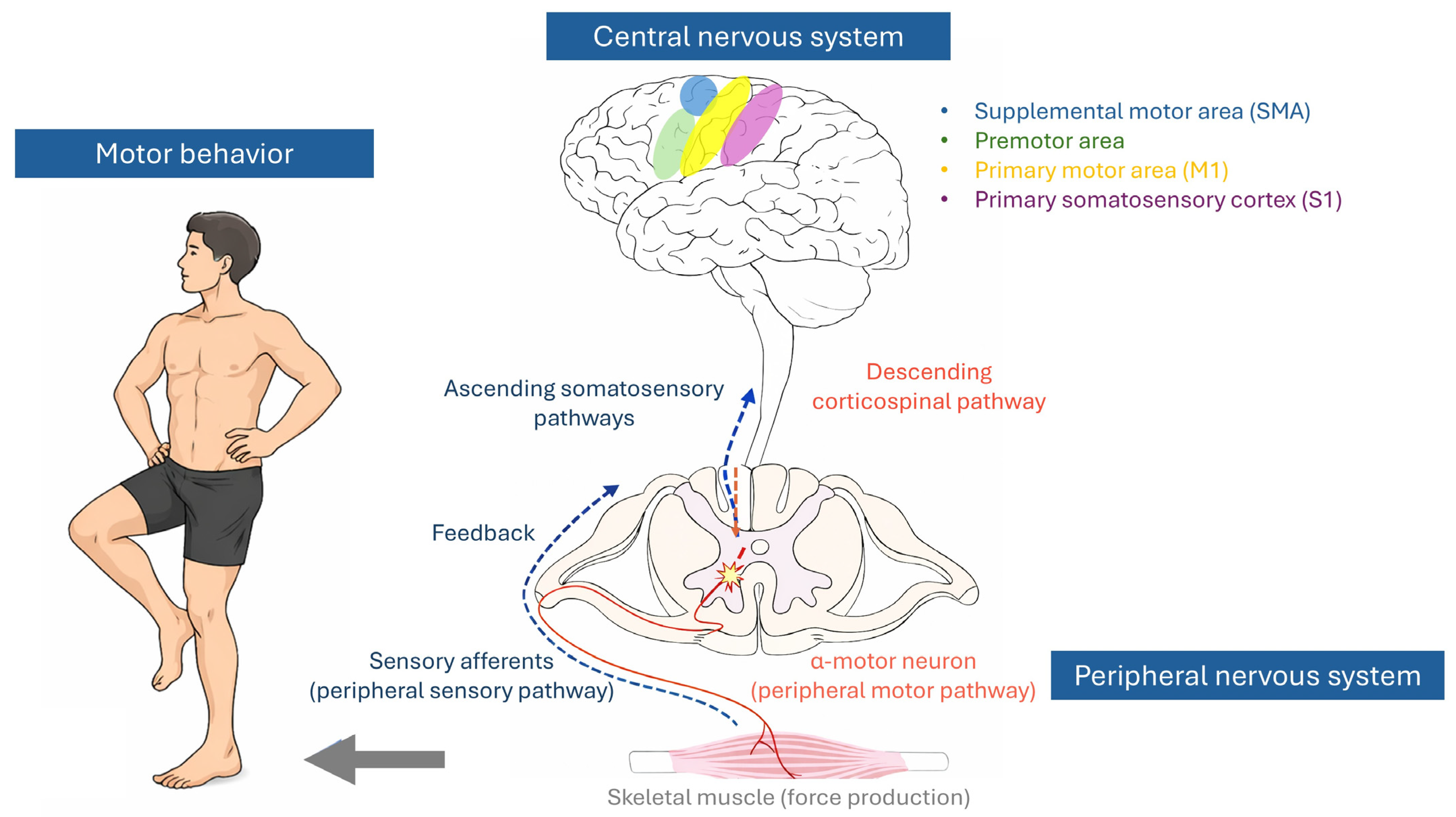
From a neurophysiological perspective, voluntary movement and postural control arise from hierarchical and distributed interactions across the central nervous system (CNS), peripheral nervous system (PNS), and musculoskeletal system (Figure 1). Motor commands originate in supraspinal centers, descend through spinal pathways, and are transmitted via peripheral motor neurons to activate muscles and generate joint-level forces, forming a neural-to-mechanical cascade linking neural control to whole-body mechanics [15]. Within this architecture, task-specific neural organization provides a framework through which hemispheric asymmetries and limb dominance may influence neuromuscular coordination during balance and voluntary motor tasks [16]. This organization underlies muscle synergies—recurring, low-dimensional patterns of muscle activation that reflect a neural strategy for simplifying motor control through functional muscle groupings [17,18]. Muscle synergies are shaped by structured cortical and spinal organization as well as biomechanical and task constraints [18,19], and neurophysiological modeling and brain–muscle decoding studies support their interpretation as reflecting central control strategies rather than purely mechanical coupling [20]. Clinically, altered synergy structure and reduced consistency are associated with neurological impairment, while synergy plasticity highlights their potential as biomarkers of motor adaptation and targets for rehabilitation and neuromodulation [17,21,22,23,24].
The muscle synergy framework provides a computational perspective on how the central nervous system (CNS) simplifies movement control by organizing muscles into functional modules rather than controlling each muscle independently [25,26]. This concept is consistent with Bernstein’s redundancy theory, which proposes that coordinated muscle groupings enable the CNS to manage the mechanical complexity of the musculoskeletal system [27]. Within this framework, synergies are defined by characteristic spatial structures, indicating groups of co-activated muscles, and temporal activation profiles that specify the timing and magnitude of recruitment [25,26]. Although muscle synergy analysis has been widely used to study neuromuscular coordination in healthy and clinical populations, the influence of leg dominance on synergy organization during balance tasks—particularly under increased postural demands such as unstable surfaces—remains unclear [28,29]. One-leg stance is a fundamental task in daily activities and sports and provides a sensitive probe of postural control [30]. Performing this task on unstable surfaces, such as wobble boards, further challenges balance by degrading sensory input and limiting ankle torque generation, thereby increasing reliance on anticipatory and adaptive postural adjustments requiring coordinated activation of lower-limb and trunk musculature [31,32,33,34]. Muscle synergies underlying these coordination strategies are commonly extracted from surface electromyography (EMG) using non-negative matrix factorization (NMF), which decomposes EMG signals into consistent spatial and temporal components reflecting underlying neural control strategies [25,26].
Accordingly, this study aimed to investigate bilateral asymmetries in muscle synergy organization and recruitment during one-leg stance on stable and multiaxial unstable surfaces using an EMG-based computational framework. Rather than examining strength or force characteristics, this study specifically focused on whether dominance-related asymmetry manifests at the level of neuromuscular coordination modules, and whether such asymmetry becomes more pronounced when postural demands increase, as previously suggested by movement synergy and balance-control analyses [8,9,10]. It was hypothesized that the dominant and non-dominant legs would exhibit distinct synergy organization, with greater asymmetry under unstable conditions. These findings may provide novel mechanistic insight into leg dominance–related neuromuscular coordination and inform targeted rehabilitation and injury-prevention strategies.

2. Materials and Methods

2.1. Participants

A total of 25 physically active young adults (14 males, 11 females; mean age: 25.6 ± 3.9 years) took part in this study. All participants reported no neurological or musculoskeletal disorders and had refrained from balance-focused training—defined as structured exercise specifically targeting postural stability (e.g., wobble-board training, slacklining, or proprioceptive balance programs)—for at least six months prior to participation. Leg dominance was determined using a ball-kicking task, which has been shown to more reliably reflect interlimb differences in single-leg postural control than the one-leg stance test [8]. All participants identified their right kicking leg as their dominant leg. Handedness was assessed based on the preferred writing hand, and all participants were right-handed, corresponding to the same side as leg dominance. Ethical approval was obtained from the Board for Ethical Questions in Science at the University of Innsbruck, Austria (Approval Code No.: 14/2016). The study was conducted in accordance with the Declaration of Helsinki for research involving human participants, and written informed consent was obtained from all participants prior to data collection. Participant characteristics are summarized in Table 1.

2.2. Equipment and Experimental Procedures

Surface EMG data were recorded using a Noraxon TeleMyo™ 2400T G2 Direct Transmission System (Noraxon Inc., Scottsdale, AZ, USA) at a sampling rate of 1500 Hz to assess the activity (μV) of seven muscles in each leg: rectus femoris (RF), semitendinosus (ST), biceps femoris long head (BF), tibialis anterior (TA), peroneus longus (PL), gastrocnemius medialis (GM), and soleus (SO). Prior to electrode placement, the skin over each muscle site was shaved, lightly abraded, and cleaned with alcohol to minimize impedance. Disposable pre-gelled bipolar Ag/AgCl surface electrodes (Ambu Neuroline 720 01-K/12; Ambu, Ballerup, Denmark; 22 mm diameter, 20 mm inter-electrode distance) were positioned in accordance with SENIAM guidelines [35]. Skin–electrode impedance was maintained below 6 kΩ. A reference electrode was placed over the tibial tuberosity of the dominant leg, and EMG cables were secured to the skin to reduce motion artifacts. EMG signals were recorded using Noraxon proprietary acquisition software, exported as comma-separated values (CSV) files, and subsequently imported into MATLAB 2024a (MathWorks, Natick, MA, USA) for signal preprocessing and non-negative matrix factorization (NMF) analysis.
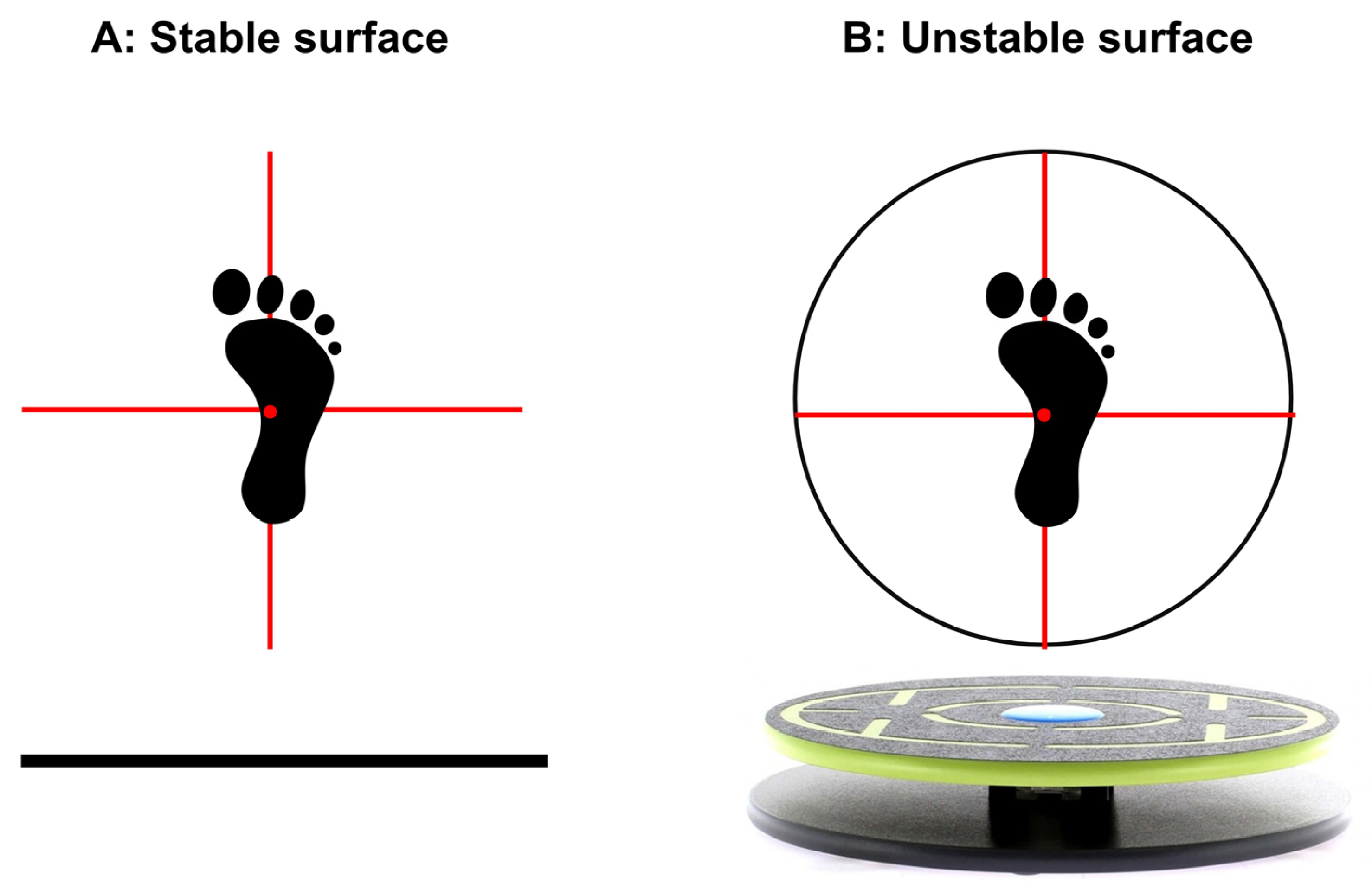
Each participant performed four randomized single-leg stance trials: dominant and non-dominant legs on stable and unstable surfaces. Each trial consisted of an 80 s continuous recording period, yielding four distinct sEMG datasets per participant for subsequent analysis. To standardize the initial posture, participants placed their hands on their hips, flexed the hip and knee of the non-support leg to approximately 20° and 45°, respectively, and positioned the base of the second metatarsal—marked on the stance foot—over the center of a reticle crossline on the force plate [8]. The second toe was aligned with the anteroposterior axis of the crossline for stable surface trials and with the corresponding reference line on the balance board during unstable surface trials. For unstable conditions, the center of the balance board was aligned with the center of the force plate reticle, and the board’s anteroposterior and mediolateral axes (marked with tape) were aligned with the reference lines to ensure a consistent fulcrum position across trials and participants [9].
Throughout each trial, participants were instructed to fixate on a visual target (red circle, 10 cm in diameter) positioned at eye level approximately 5 m away. They were asked to remain as still as possible during stable surface trials and to maintain the balance board in a horizontal position during unstable surface trials. Rest periods of 1–3 min were provided between trials, during which participants could sit or stand but were not allowed to stand on the balance board. Figure 2 illustrates the standardized stance-foot positioning during unipedal balance on stable and multiaxial-unstable surfaces, highlighting placement of the base of the second metatarsal at the center of the crossline and alignment of the second toe with the anteroposterior axis.

2.3. Computation of Muscle Synergies Using Non-Negative Matrix Factorization (NMF)

All signal processing and analyses were performed using MATLAB R2024a (The MathWorks, Inc., Natick, MA, USA). Raw EMG signals recorded during unipedal balance on the dominant and non-dominant legs were preprocessed following established procedures [36,37]. Signals were first band-pass filtered using a finite impulse response (FIR) filter (20–500 Hz; filter order = 200) to attenuate movement artifacts and high-frequency noise [38]. The filtered signals were then full-wave rectified and subsequently smoothed using a third-order low-pass Butterworth filter with a cutoff frequency of 10 Hz to obtain linear envelopes [38].
Each muscle’s EMG envelope was normalized to its peak value within the same trial (i.e., per-muscle, within-trial peak normalization) [39]. This approach, commonly referred to as peak task normalization, enables comparison of relative activation patterns across muscles and trials and is recommended for non-maximal postural tasks in which maximal voluntary contraction (MVC) measurements are not available [39]. Following rectification and low-pass filtering, the resulting EMG envelopes primarily contain low-frequency information that reflects neural activation patterns rather than high-frequency motor-unit activity. Accordingly, the normalized signals were downsampled from 1500 Hz to 250 Hz to reduce computational load while preserving temporal resolution well above the Nyquist requirement for envelope-based analysis [40]. This strategy is consistent with previous postural-control and neuromuscular coordination studies in which rectified and filtered EMG envelopes were similarly downsampled without compromising interpretation of muscle coordination patterns [40,41,42,43,44].
Following preprocessing, non-negative matrix factorization (NMF) was applied to decompose the EMG data into four muscle synergies per trial [35], in accordance with previous studies demonstrating that four synergies typically capture the majority of variance in lower-limb motor control during balance tasks [28,45,46,47]. NMF was implemented using the MATLAB nnmf function, employing multiplicative updates for initialization and alternating least squares (ALS) for final optimization. The algorithm decomposed the preprocessed EMG data matrix V (muscles × time) into two non-negative matrices:
V W × H
where W (muscles × synergies) represents the muscle weighting patterns (synergy structures), and H (synergies × time) represents the time-varying activation coefficients (synergy recruitment). For each synergy, a scalar index of synergy recruitment level was computed as the mean activation amplitude of the corresponding H time series across the analysis window, providing a quantitative estimate of overall synergy engagement during the task.
Decomposition quality was assessed using variance accounted for (VAF), calculated as the percentage of variance in the original EMG signals explained by the reconstructed data (W × H) [28,45,46,47,48]. The selection of four synergies was confirmed by VAF values exceeding 85% of total variance, consistent with prior findings for one-leg stance tasks [28,45,46,47]. To examine overall coordination patterns, normalized and downsampled EMG data were additionally concatenated across participants for pooled synergy analysis. This pooled analysis was used solely for descriptive visualization of representative synergy structures and was not included in inferential statistical testing. Separate NMF analyses were performed for stable and unstable surface conditions, as surface stability is known to influence neuromuscular coordination strategies [8,9,10].

2.4. Analysis of Muscle Synergy Structures and Bilateral Similarity

Muscle synergies extracted from EMG signals during unipedal balance on the dominant and non-dominant legs were analyzed using two complementary parameters: (1) muscle synergy structures, quantified by muscle weightings ( W ) [28,49] (2) synergy recruitment levels, quantified as the mean activation amplitude of H for each synergy [28,49]; and (3) bilateral structural similarity between corresponding synergies [19].
Synergy structures were examined by analyzing the muscle weightings (W) of each synergy, which represent the relative contribution of individual muscles to a given coordination module [28,49]. These weightings characterize how muscles are grouped and coordinated to maintain postural stability. Statistical comparisons of muscle weightings between the dominant and non-dominant legs were performed to identify potential asymmetries in neuromuscular control [28,49].
Bilateral structural similarity between synergies extracted from the dominant and non-dominant legs was quantified using cosine similarity. This metric evaluates the alignment between two vectors independent of magnitude, making it particularly suitable for per-trial peak-normalized EMG data, in which relative activation patterns are preserved despite amplitude differences [50,51]. Cosine similarity is widely used in muscle synergy research to compare intra- and inter-condition synergy structures and has demonstrated reliable cross-dataset performance [50,51].
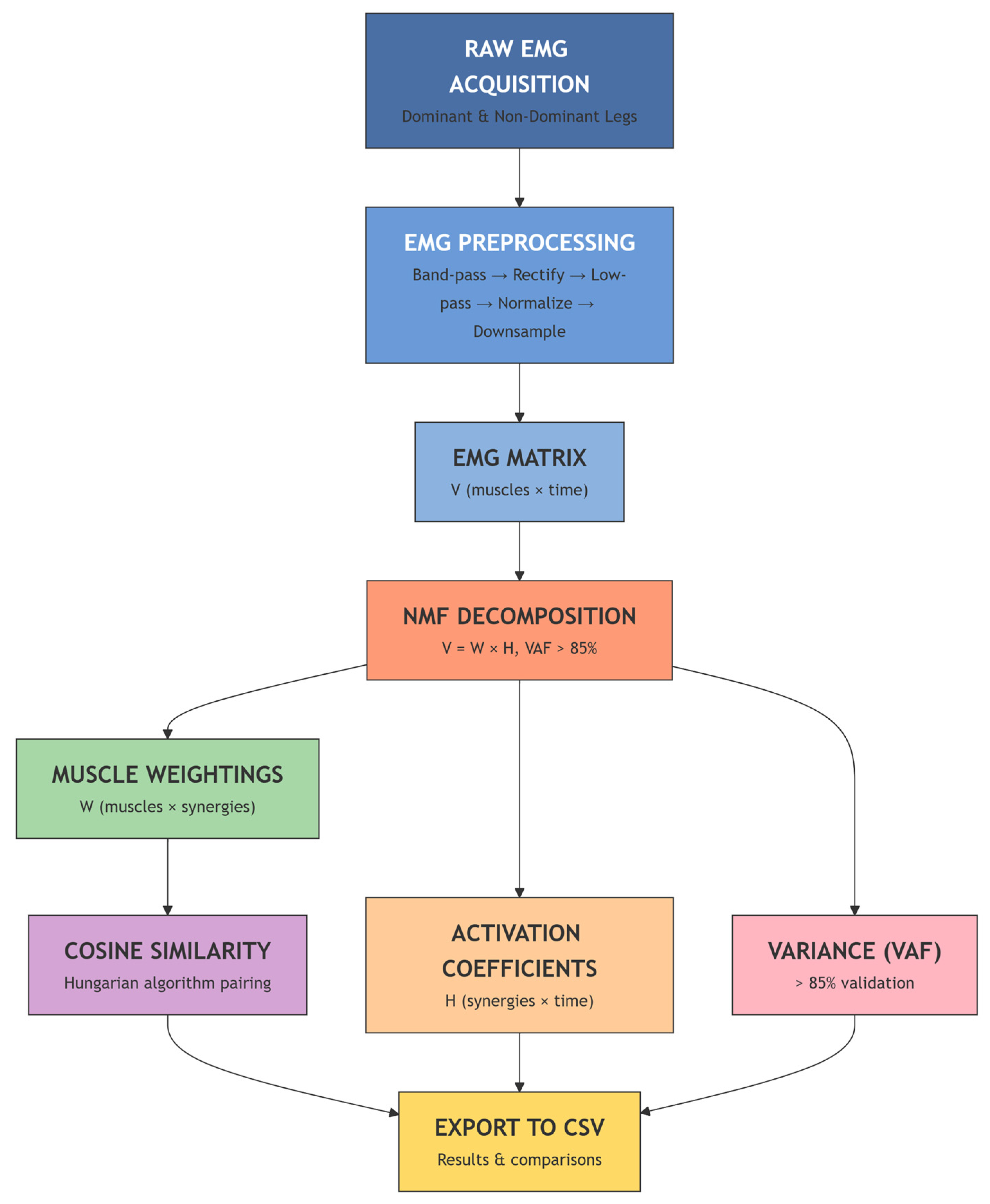
To ensure appropriate matching of corresponding synergies across limbs, synergies were optimally paired using the Hungarian assignment algorithm, maximizing cosine similarity between pairs [41,45]. Cosine similarity values ranged from 0 (no similarity) to 1 (perfect similarity) and were interpreted as follows: values ≥ 0.80 indicated high similarity, 0.60–0.79 moderate similarity, and <0.60 low similarity, consistent with established criteria [50,51]. This combined analysis of muscle weightings and bilateral structural similarity enabled a comprehensive evaluation of neuromuscular asymmetry in response to varying surface stability demands. Figure 3 provides an overview of the MATLAB-based EMG signal-processing pipeline and the computation of muscle synergies using non-negative matrix factorization (NMF).

2.5. Statistical Analysis

All statistical analyses were performed using IBM SPSS Statistics version 26 (IBM Corp., Armonk, NY, USA), with the significance level set at p < 0.05. Variables exported from MATLAB for statistical analysis included: (1) the muscle weighting matrices (W), (2) scalar synergy recruitment levels derived from the mean activation amplitude of each synergy (mean H), and (3) cosine similarity values quantifying bilateral similarity of synergy structures. Analyses were conducted separately for the stable and unstable surface conditions to evaluate bilateral asymmetries between the dominant and non-dominant legs.
For synergy recruitment levels (mean H), a paired-sample t-test was used only for the unstable surface condition, as normality was confirmed by the Shapiro–Wilk test (p > 0.05). When significant differences were found, Cohen’s d was computed to interpret effect size, classified as small (d = 0.2), medium (d = 0.5), and large (d = 0.8) [52].
For muscle weightings (W), the non-parametric Wilcoxon signed-rank test was used to compare the relative contributions of each muscle in each synergy between the dominant and non-dominant legs for both surface conditions. This test was selected based on the Shapiro–Wilk test, which indicated non-normal data distributions (p < 0.05). Effect sizes (r) were calculated as r = Z/√N, where Z is the test statistic, and N is the number of paired observations. Effect sizes were interpreted as small (r = 0.1), medium (r = 0.3), and large (r = 0.5) [53].
For bilateral structural similarity, cosine similarity values were summarized using descriptive statistics (mean, standard deviation, and range) for each synergy following optimal pairing using the Hungarian assignment algorithm. Similarity was categorized as high (≥0.80), moderate (0.60–0.79), or low (<0.60) in accordance with established criteria [50,51]. No inferential statistics were applied to cosine similarity values, as they represent pattern alignment rather than magnitude-based differences [50,51].

3. Results

Muscle Synergy, Recruitment Levels, and Muscle Weightings

All participants completed the one-leg stance task on both stable and unstable surfaces without stepping down or losing balance. Across both surface conditions, four consistent muscle synergy modules were identified. No significant differences were found in overall synergy recruitment levels between the dominant and non-dominant legs across all four synergies on either surface.
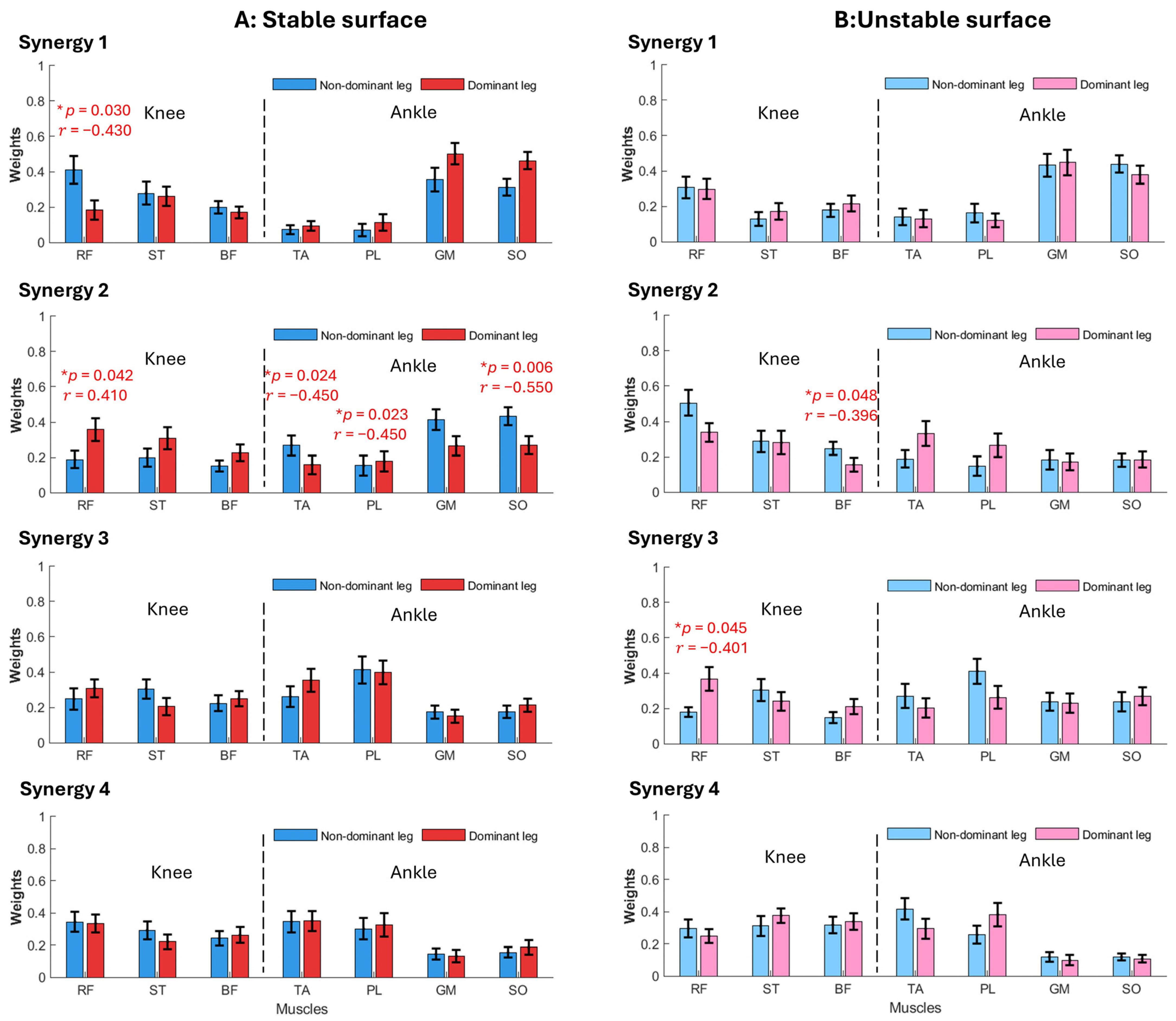
On the stable surface, four synergies accounted for 88.4% of the total variance (VAF). As shown in Figure 4A, Synergy 1 was dominated by the plantar flexors (GM and SO) and the knee extensor (RF), reflecting an ankle–knee extension strategy for postural support. Synergy 2 showed dominance of the knee musculature, particularly the RF. Synergy 3 was primarily characterized by the ankle evertor, PL. Synergy 4 involved coordinated activation of knee muscles (RF, ST, and BF) and ankle stabilizers (TA and PL) for supination and pronation control. Significant bilateral asymmetries in muscle weightings were identified in Synergies 1 and 2 on the stable surface. Specifically, in Synergy 1, the non-dominant leg showed higher weighting of the RF (p = 0.030, r = −0.430; moderate effect; achieved power ≈ 0.58). In Synergy 2, the non-dominant leg exhibited lower weightings for the RF (p = 0.042, r = 0.410; moderate effect; achieved power ≈ 0.54) and PL (p = 0.023, r = −0.450; moderate effect; achieved power ≈ 0.62), but higher weightings for the TA (p = 0.024, r = −0.450; moderate effect; achieved power ≈ 0.61) and SO (p = 0.006, r = −0.550; large effect; achieved power ≈ 0.80). No significant differences were observed in Synergies 3 and 4. Across these significant comparisons, achieved power ranged from approximately 0.54 to 0.80. Significant interlimb differences in muscle weightings demonstrated moderate-to-large effect sizes, indicating robust neuromuscular asymmetry. Although statistical power was sufficient to detect moderate-to-large effects, smaller effects may have gone undetected, which likely explains the non-significant findings for some muscles.
On the unstable surface, a similar four-synergy structure was observed, accounting for 88.1% of the total VAF. As shown in Figure 4B, While the overall synergy composition remained comparable to the stable condition, some shifts in muscle contributions were noted. Synergy 1 continued to emphasize the plantar flexors (GM and SO) and RF, consistent with an ankle-knee extension strategy. Synergy 2 showed broad muscle recruitment with increased engagement of the RF. Synergy 3 involved balanced contributions from all recorded muscles, and Synergy 4 engaged both knee and ankle stabilizers for supination (TA) and pronation (PL) control. Fewer significant asymmetries were detected on the unstable surface. Specifically, in Synergy 2, the non-dominant leg showed higher weighting of the BF (p = 0.048,   r = −0.396, moderate effect, achieved power ≈ 0.50). In Synergy 3, the dominant leg showed higher weighting of the RF (p = 0.045, r = −0.401, moderate effect, achieved power ≈ 0.52). Across these significant comparisons, achieved statistical power ranged from approximately 0.50 to 0.52. Significant interlimb differences in muscle weightings were characterized by moderate effect sizes, indicating meaningful but more subtle neuromuscular asymmetry compared with the stable surface. Although statistical power was sufficient to detect moderate effects, smaller effects may have gone undetected, which likely explains the limited number of significant findings on the unstable surface.
As summarized in Table 2, cosine similarity values ranged from 0.38 to 0.87 on the stable surface and from 0.19 to 0.88 on the unstable surface, indicating varying degrees of bilateral similarity in muscle coordination strategies across both conditions.
On the stable surface (Table 2(A)), the highest average similarity was found in Synergy 1 (0.77 ± 0.10), followed by Synergy 2 (0.71 ± 0.12) and Synergy 3 (0.71 ± 0.09). Synergy 4 exhibited the lowest similarity (0.62 ± 0.09).
On the unstable surface (Table 2(B)), a similar pattern emerged, with Synergy 1 showing the highest similarity (0.74 ± 0.09), followed by Synergy 2 (0.72 ± 0.09), Synergy 3 (0.69 ± 0.09), and Synergy 4 again showing the lowest similarity (0.62 ± 0.13).

4. Discussion

This study investigated bilateral asymmetry in muscle synergy patterns during one-leg stance on both stable and unstable surfaces. Four primary muscle synergies were identified under both conditions, consistent with previous reports using one-leg stance paradigms [30,54]. The synergy model explained approximately 88% of the total variance in EMG signals across surfaces, which lies well within the accepted range for synergy-based analyses of postural control variability [28,49].
Although overall synergy recruitment levels did not differ between the dominant and non-dominant legs, bilateral asymmetry was evident in individual muscle weightings under both surface conditions. On the stable surface, the non-dominant leg exhibited greater weighting of muscles associated with distal postural control, including the tibialis anterior, peroneus longus, and soleus, together with increased involvement of the rectus femoris, particularly in Synergy 2. This pattern reflects greater reliance on an ankle-dominant control strategy to maintain unipedal posture on firm ground, consistent with established postural control principles [9,42]. Previous findings have demonstrated small-to-moderate associations between ankle-muscle activity (TA, PL, GM, SO) and postural acceleration, supporting their critical role in stabilizing balance under stable conditions [40]. On the unstable surface, bilateral asymmetry emerged predominantly in more proximal muscles, with significant differences identified in the biceps femoris and rectus femoris in Synergies 2 and 3. This shift suggests a reorganization toward greater proximal-muscle coordination to maintain stability under increased postural demand, aligning with compensatory knee-control strategies commonly reported during multiaxial instability [9]. Although some of these p-values were close to the conventional significance threshold, they were accompanied by moderate to large effect sizes (r ≈ 0.41–0.55) and achieved statistical power of approximately 0.50–0.80, indicating that the detected asymmetries were meaningful in magnitude, whereas smaller effects may reasonably have gone undetected. Moreover, previous EMG synergy research has demonstrated that muscle synergy organization in balance control is robust and functionally meaningful even with moderate sample sizes, supporting the reliability of the present findings [45]. Importantly, despite these differences in individual muscle contributions, overall synergy recruitment remained symmetrical, suggesting that the central nervous system (CNS) preserves global synergy organization while adaptively reweighting individual muscle contributions within each module. Such flexibility may reflect habitual neuromechanical adaptation, proprioceptive sensitivity, and functional specialization between limbs [41,55,56]. Given its functional role in knee stabilization and biarticular control, the rectus femoris may contribute importantly to coordinated balance regulation [57]. These findings highlight that addressing side-to-side, muscle-specific asymmetries may be more effective for training than attempting to modify overall activation magnitude.
Cosine-similarity analysis further revealed moderate-to-high structural correspondence across most synergies, whereas Synergy 4 consistently exhibited lower similarity, particularly on the unstable surface. This suggests that while fundamental synergy structures are bilaterally preserved, task-sensitive stabilization modules become more variable when postural demands increase [50,51]. The observed structural consistency across conditions supports the concept of a generalizable modular-control framework, in which shared core motor synergies are flexibly adapted to contextual requirements [58]. Torres-Oviedo and Ting (2010) [45] similarly demonstrated that subject-specific synergies are consistently recruited across postural configurations, with activation patterns modulated according to biomechanical context. The increased contribution of the peroneus longus observed in Synergy 3 under the unstable condition further implies additional stabilization demands to manage multidirectional perturbations—consistent with evidence showing that synergies may be shared across diverse motor tasks while remaining adaptable to task-specific constraints [59].
From an applied perspective, these findings indicate that the CNS maintains stable core neuromuscular modules while flexibly adjusting individual muscle weighting according to task and environmental demands [60]. Rather than attempting to eliminate all interlimb asymmetry, training approaches may instead focus on optimizing how each limb contributes within these shared synergy structures. The surface-dependent weighting patterns observed here suggest that training on unstable or compliant surfaces may facilitate more efficient recruitment of proximal stabilizers and promote adaptive neuromuscular coordination in the non-dominant limb, potentially improving functional symmetry and reducing injury susceptibility. By demonstrating that dominance-related asymmetry emerges primarily at the level of muscle weighting within preserved synergy structures, the present findings provide mechanistic insight that extends beyond traditional strength- or proprioception-based interpretations and directly informs rehabilitation and performance strategies. This interpretation aligns with previous evidence indicating that leg dominance interacts with surface stability to influence postural performance and neuromuscular control strategies [11,61]. Taken together, these insights support the implementation of progressive, task-specific balance training—particularly on unstable surfaces—to enhance neuromuscular efficiency and address asymmetry-related deficits, particularly in athletes exposed to repetitive unilateral loading, older adults, and individuals with neuromuscular or balance impairments [61,62].
Despite these promising findings, several limitations should be acknowledged. The sample included only healthy, physically active young adults, which may limit generalizability. Future research should incorporate broader age ranges and clinical populations to better characterize neuromuscular variability. EMG analysis focused on selected lower-limb muscles due to instrumentation constraints, excluding additional lower-limb, hip, and trunk musculature that may contribute to balance control [28]. Moreover, per-trial peak normalization—although appropriate when maximal voluntary contraction (MVC) testing is impractical [39]—does not represent absolute activation magnitude; studies employing MVC-based normalization may complement these findings. The cross-sectional design precludes conclusions regarding long-term adaptations, and static single-leg stance may not fully represent dynamic or sport-specific balance demands. Future studies should therefore incorporate dynamic tasks and longitudinal designs to better elucidate adaptive neuromuscular mechanisms. Finally, although participants’ weekly physical activity levels were documented, individuals participating in sports requiring high proprioceptive demand may demonstrate distinct neuromuscular strategies. Future work should consider sport-specific classification to better account for such influences.

5. Conclusions

This study demonstrated that four consistent muscle synergies underpin one-leg stance on both stable and multiaxial unstable surfaces, reflecting a stable yet adaptable neuromuscular control strategy. Although overall synergy recruitment levels were generally symmetrical between the dominant and non-dominant legs, notable bilateral asymmetries in individual muscle weightings emerged depending on surface condition. On the stable surface, asymmetry predominantly involved muscles contributing to distal, ankle-centered control, whereas under unstable conditions asymmetry shifted toward more proximal muscles around the knee. These findings highlight the influence of leg dominance on neuromuscular coordination and emphasize that asymmetry primarily manifests through muscle reweighting within otherwise preserved synergy structures. From a practical perspective, the results underscore the importance of considering interlimb asymmetry in balance training and injury-prevention strategies, particularly for tasks requiring unilateral stability. Nonetheless, interpretation should consider the study’s limitations, including the young, healthy sample and variability in physical-activity background. Future work should include broader age ranges, clinical and sport-specific populations, and longitudinal designs to better clarify how neuromuscular adaptation, training history, and task demands shape muscle synergy organization.

Funding

This study was funded by the University of Phayao and the Thailand Science Research and Innovation Fund (Fundamental Fund 2569, Grant No. FF69-UoE2272/2568).

Institutional Review Board Statement

The study was conducted in accordance with the Declaration of Helsinki and approved by the Board for Ethical Questions in Science at the University of Innsbruck, Austria (Approval Code No.: 14/2016 and date of approval 15 April 2016).

Informed Consent Statement

Informed consent was obtained from all participants involved in the study.

Data Availability Statement

As the dataset forms part of an ongoing research project, the raw data cannot be shared publicly at this stage. However, relevant data may be provided by the corresponding author upon reasonable request.

Acknowledgments

The author gratefully acknowledges all participants for their valuable contributions to this study. During the preparation of this manuscript, the author used ChatGPT 5.2 (OpenAI) and Gemini 2.5 (Google Gemini) to refine the language and improve readability and DeepSeek 3.2 (DeepSeek AI) to draw the flow chart of the methods. The author has thoroughly reviewed and edited the AI-assisted content and takes full responsibility for the final version of this publication.

Conflicts of Interest

The author declares that there is no conflict of interest regarding the publication of this manuscript.

References

  1. Kraus, E. Neural Asymmetries. In Beyond Left and Right Handedness: A Practice-Based Approach to Assessing and Analysing Handedness Dimensions and Types; Springer International Publishing: Cham, Switzerland, 2023; pp. 19–39. [Google Scholar]
  2. Virgile, A.; Bishop, C. A Narrative Review of Limb Dominance: Task Specificity and the Importance of Fitness Testing. J. Strength Cond. Res. 2021, 35, 846–858. [Google Scholar] [CrossRef] [PubMed]
  3. Kadri, M.A.; Noé, F.; Maitre, J.; Maffulli, N.; Paillard, T. Effects of Limb Dominance on Postural Balance in Sportsmen Practicing Symmetric and Asymmetric Sports: A Pilot Study. Symmetry 2021, 13, 2199. [Google Scholar] [CrossRef]
  4. Afonso, J.; Peña, J.; Sá, M.; Virgile, A.; García-de-Alcaraz, A.; Bishop, C. Why Sports Should Embrace Bilateral Asymmetry: A Narrative Review. Symmetry 2022, 14, 1993. [Google Scholar] [CrossRef]
  5. Steidl-Müller, L.; Hildebrandt, C.; Müller, E.; Fink, C.; Raschner, C. Limb Symmetry Index in Competitive Alpine Ski Racers: Reference Values and Injury Risk Identification According to Age-Related Performance Levels. J. Sport Health Sci. 2018, 7, 405–415. [Google Scholar] [CrossRef]
  6. Thompson, R.; Watson, T. Is a Professional Soccer Player’s Dominant Lower Limb at Higher Risk of Injury than Their Non-Dominant Lower Limb? A Systematic Review. Phys. Ther. Rev. 2019, 24, 314–329. [Google Scholar] [CrossRef]
  7. Bettariga, F.; Turner, A.; Maloney, S.; Maestroni, L.; Jarvis, P.; Bishop, C. The Effects of Training Interventions on Interlimb Asymmetries: A Systematic Review With Meta-Analysis. Strength Cond. J. 2022, 44, 69–86. [Google Scholar] [CrossRef]
  8. Promsri, A.; Haid, T.; Federolf, P. How Does Lower Limb Dominance Influence Postural Control Movements during Single Leg Stance? Hum. Mov. Sci. 2018, 58, 165–174. [Google Scholar] [CrossRef] [PubMed]
  9. Promsri, A.; Haid, T.; Werner, I.; Federolf, P. Leg Dominance Effects on Postural Control When Performing Challenging Balance Exercises. Brain Sci. 2020, 10, 128. [Google Scholar] [CrossRef]
  10. Promsri, A.; Longo, A.; Haid, T.; Doix, A.-C.M.; Federolf, P. Leg Dominance as a Risk Factor for Lower-Limb Injuries in Downhill Skiers—A Pilot Study into Possible Mechanisms. Int. J. Environ. Res. Public Health 2019, 16, 3399. [Google Scholar] [CrossRef]
  11. Promsri, A. Modulation of Lower-Limb Muscle Activity in Maintaining Unipedal Balance According to Surface Stability, Sway Direction, and Leg Dominance. Sports 2022, 10, 155. [Google Scholar] [CrossRef]
  12. Promsri, A.; Haid, T.; Werner, I.; Federolf, P. Influence of Lower-Limb Dominance on Coordinative Movement Structures Observed during Single-Leg Balancing on a Multiaxial Unstable Surface. Gait Posture 2018, 65, 60–61. [Google Scholar] [CrossRef]
  13. Brown, S.R.; Brughelli, M.; Griffiths, P.C.; Cronin, J.B. Lower-Extremity Isokinetic Strength Profiling in Professional Rugby League and Rugby Union. Int. J. Sports Physiol. Perform. 2014, 9, 358–361. [Google Scholar] [CrossRef]
  14. Delextrat, A.; Baker, J.; Cohen, D.D.; Clarke, N.D. Effect of a Simulated Soccer Match on the Functional Hamstrings-to-Quadriceps Ratio in Amateur Female Players. Scand. J. Med. Sci. Sports 2013, 23, 478–486. [Google Scholar] [CrossRef]
  15. Shanbhag, J.; Fleischmann, S.; Wechsler, I.; Gassner, H.; Winkler, J.; Eskofier, B.M.; Koelewijn, A.D.; Wartzack, S.; Miehling, J. A Sensorimotor Enhanced Neuromusculoskeletal Model for Simulating Postural Control of Upright Standing. Front. Neurosci. 2024, 18, 1393749. [Google Scholar] [CrossRef]
  16. Strong, A.; Grip, H.; Arumugam, A.; Boraxbekk, C.J.; Selling, J.; Häger, C.K. Right Hemisphere Brain Lateralization for Knee Proprioception among Right-Limb Dominant Individuals. Front. Hum. Neurosci. 2023, 17, 969101. [Google Scholar] [CrossRef]
  17. Isezaki, T.; Suzuki, M.; Okitsu, K.; Koike, Y.; Nishimura, Y. Muscle Synergy Analysis under the Constraint of Connectivity between Brain and Muscle Activity. In Proceedings of the 2024 International Joint Conference on Neural Networks (IJCNN), Yokohama, Japan, 30 June 2024; pp. 1–8. [Google Scholar]
  18. Liu, Y.; Li, Y.; Zhang, Z.; Huo, B.; Cheng, L.; Dong, A.; Li, G. Muscle Synergy-Based Iterative Learning Control for Upper Limb Functional Electrical Stimulation in Stroke Rehabilitation. IEEE Trans. Neural Syst. Rehabil. Eng. 2025, 33, 3922–3936. [Google Scholar] [CrossRef] [PubMed]
  19. Wang, S.; Hase, K.; Funato, T. Computational Prediction of Muscle Synergy Using a Finite Element Framework for a Musculoskeletal Model on Lower Limb. Front. Bioeng. Biotechnol. 2023, 11, 1130219. [Google Scholar] [CrossRef]
  20. Ebied, A.; Kinney-Lang, E.; Escudero, J. Consistency of Muscle Synergies Extracted via Higher-Order Tensor Decomposition Towards Myoelectric Control. In Proceedings of the 2019 9th International IEEE/EMBS Conference on Neural Engineering (NER), San Francisco, CA, USA, 20–23 March 2019; pp. 315–318. [Google Scholar]
  21. Seo, G.; Park, J.-H.; Park, H.-S.; Roh, J. Developing New Intermuscular Coordination Patterns through an Electromyographic Signal-Guided Training in the Upper Extremity. J. Neuroeng. Rehabil. 2023, 20, 112. [Google Scholar] [CrossRef]
  22. Liu, J.; Bao, T.; Zou, B.; Cao, W.; Na, X.; Wu, L.; Zhou, P. Adaptation of Lower-Extremity Neuromuscular Control in Curved Walking After Stroke: A Study on Muscle Synergy Insights. In Proceedings of the 2025 IEEE International Conference on Real-time Computing and Robotics (RCAR), Toyama, Japan, 1 June 2025; pp. 940–945. [Google Scholar]
  23. Zhao, K.; Zhang, Z.; Wen, H.; Liu, B.; Li, J.; D’aVella, A.; Scano, A. Muscle Synergies for Evaluating Upper Limb in Clinical Applications: A Systematic Review. Heliyon 2023, 9, e16202. [Google Scholar] [CrossRef] [PubMed]
  24. Ma, Y.; Shi, C.; Xu, J.; Ye, S.; Zhou, H.; Zuo, G. A Novel Muscle Synergy Extraction Method Used for Motor Function Evaluation of Stroke Patients: A Pilot Study. Sensors 2021, 21, 3833. [Google Scholar] [CrossRef] [PubMed]
  25. Cheung, V.C.K.; Seki, K. Approaches to Revealing the Neural Basis of Muscle Synergies: A Review and a Critique. J. Neurophysiol. 2021, 125, 1580–1597. [Google Scholar] [CrossRef]
  26. Singh, R.E.; Iqbal, K.; White, G.; Hutchinson, T.E. A Systematic Review on Muscle Synergies: From Building Blocks of Motor Behavior to a Neurorehabilitation Tool. Appl. Bionics Biomech. 2018, 2018, 3615368. [Google Scholar] [CrossRef] [PubMed]
  27. Gray, R. Changes in Movement Coordination Associated with Skill Acquisition in Baseball Batting: Freezing/Freeing Degrees of Freedom and Functional Variability. Front. Psychol. 2020, 11, 553381. [Google Scholar] [CrossRef] [PubMed]
  28. Labanca, L.; Ghislieri, M.; Knaflitz, M.; Barone, G.; Bragonzoni, L.; Agostini, V.; Benedetti, M.G. Muscle Synergies for the Control of Single-Limb Stance with and without Visual Information in Young Individuals. BMC Sports Sci. Med. Rehabil. 2021, 13, 163. [Google Scholar] [CrossRef] [PubMed]
  29. Ghislieri, M.; Knaflitz, M.; Labanca, L.; Barone, G.; Bragonzoni, L.; Benedetti, M.G.; Agostini, V. Muscle Synergy Assessment during Single-Leg Stance. IEEE Trans. Neural Syst. Rehabil. Eng. 2020, 28, 2914–2922. [Google Scholar] [CrossRef]
  30. Paillard, T.; Noé, F. Does Monopedal Postural Balance Differ between the Dominant Leg and the Non-Dominant Leg? A Review. Hum. Mov. Sci. 2020, 74, 102686. [Google Scholar] [CrossRef]
  31. Croft, J.L.; Von Tscharner, V.; Zernicke, R.F. Movement Variability and Muscle Activity Relative to Center of Pressure during Unipedal Stance on Solid and Compliant Surfaces. Mot. Control 2008, 12, 283–295. [Google Scholar] [CrossRef]
  32. Cimadoro, G.; Paizis, C.; Alberti, G.; Babault, N. Effects of Different Unstable Supports on EMG Activity and Balance. Neurosci. Lett. 2013, 548, 228–232. [Google Scholar] [CrossRef]
  33. Gatev, P.; Thomas, S.; Kepple, T.; Hallett, M. Feedforward Ankle Strategy of Balance during Quiet Stance in Adults. J. Physiol. 1999, 514, 915–928. [Google Scholar] [CrossRef]
  34. Peterka, R.J. Sensorimotor Integration in Human Postural Control. J. Neurophysiol. 2002, 88, 1097–1118. [Google Scholar] [CrossRef]
  35. Hermens, H.J.; Freriks, B. SENIAM Project. Available online: http://www.seniam.org/ (accessed on 18 August 2023).
  36. De Luca, C.J. The Use of Surface Electromyography in Biomechanics. J. Appl. Biomech. 1997, 13, 135–163. [Google Scholar] [CrossRef]
  37. Winter, D.A. Biomechanics and Motor Control of Human Movement, 4th ed.; John Wiley and Sons: Hoboken, NJ, USA, 2009; ISBN 9780470398180. [Google Scholar]
  38. Burgess, R.C. Filtering of Neurophysiologic Signals. Handb. Clin. Neurol. 2019, 160, 51–65. [Google Scholar] [CrossRef] [PubMed]
  39. Burden, A. How Should We Normalize Electromyograms Obtained from Healthy Participants? What We Have Learned from over 25years of Research. J. Electromyogr. Kinesiol. 2010, 20, 1023–1035. [Google Scholar] [CrossRef] [PubMed]
  40. Promsri, A.; Mohr, M.; Federolf, P. Principal Postural Acceleration and Myoelectric Activity: Interrelationship and Relevance for Characterizing Neuromuscular Function in Postural Control. Hum. Mov. Sci. 2021, 77, 102792. [Google Scholar] [CrossRef]
  41. Cheung, V.C.K.; D’Avella, A.; Tresch, M.C.; Bizzi, E. Central and Sensory Contributions to the Activation and Organization of Muscle Synergies during Natural Motor Behaviors. J. Neurosci. 2005, 25, 6419–6434. [Google Scholar] [CrossRef]
  42. Promsri, A. Modulation of Bilateral Lower-Limb Muscle Coordination When Performing Increasingly Challenging Balance Exercises. Neurosci. Lett. 2022, 767, 136299. [Google Scholar] [CrossRef]
  43. Lemos, T.; Rodrigues, E.C.; Vargas, C.D. Motor Imagery Modulation of Postural Sway Is Accompanied by Changes in the EMG–COP Association. Neurosci. Lett. 2014, 577, 101–105. [Google Scholar] [CrossRef]
  44. Lemos, T.; Imbiriba, L.A.; Vargas, C.D.; Vieira, T.M. Modulation of Tibialis Anterior Muscle Activity Changes with Upright Stance Width. J. Electromyogr. Kinesiol. 2015, 25, 168–174. [Google Scholar] [CrossRef] [PubMed]
  45. Torres-Oviedo, G.; Ting, L.H. Subject-Specific Muscle Synergies in Human Balance Control Are Consistent across Different Biomechanical Contexts. J. Neurophysiol. 2010, 103, 3084–3098. [Google Scholar] [CrossRef]
  46. Clark, D.J.; Ting, L.H.; Zajac, F.E.; Neptune, R.R.; Kautz, S.A. Merging of Healthy Motor Modules Predicts Reduced Locomotor Performance and Muscle Coordination Complexity Post-Stroke. J. Neurophysiol. 2010, 103, 844–857. [Google Scholar] [CrossRef]
  47. Bizzi, E.; Cheung, V.C.K.K. The Neural Origin of Muscle Synergies. Front. Comput. Neurosci. 2013, 7, 1–6. [Google Scholar] [CrossRef]
  48. Lee, D.D.; Seung, H.S. Learning the Parts of Objects by Non-Negative Matrix Factorization. Nature 1999, 401, 788–791. [Google Scholar] [CrossRef]
  49. Yokoyama, H.; Kato, T.; Kaneko, N.; Kobayashi, H.; Hoshino, M.; Kokubun, T.; Nakazawa, K. Basic Locomotor Muscle Synergies Used in Land Walking Are Finely Tuned during Underwater Walking. Sci. Rep. 2021, 11, 1–11. [Google Scholar] [CrossRef]
  50. Pale, U.; Atzori, M.; Müller, H.; Scano, A. Variability of Muscle Synergies in Hand Grasps: Analysis of Intra- and Inter-Session Data. Sensors 2020, 20, 4297. [Google Scholar] [CrossRef] [PubMed]
  51. Brambilla, C.; Scano, A. The Number and Structure of Muscle Synergies Depend on the Number of Recorded Muscles: A Pilot Simulation Study with OpenSim. Sensors 2022, 22, 8584. [Google Scholar] [CrossRef]
  52. Cohen, J. Statistical Power Analysis for the Behavioral Sciences; Routledge: Oxfordshire, UK, 2013; ISBN 9781134742707. [Google Scholar]
  53. Rosenthal, R. Meta-Analytic Procedures for Social Research; SAGE Publications Inc.: Thousand Oaks, CA, USA, 1991. [Google Scholar]
  54. Tresch, M.C.; Cheung, V.C.K.; d’Avella, A. Matrix Factorization Algorithms for the Identification of Muscle Synergies: Evaluation on Simulated and Experimental Data Sets. J. Neurophysiol. 2006, 95, 2199–2212. [Google Scholar] [CrossRef] [PubMed]
  55. Sadeghi, H.; Allard, P.; Prince, F.; Labelle, H. Symmetry and Limb Dominance in Able-Bodied Gait: A Review. Gait Posture 2000, 12, 34–45. [Google Scholar] [CrossRef]
  56. Ting, L.H.; McKay, J.L. Neuromechanics of Muscle Synergies for Posture and Movement. Curr. Opin. Neurobiol. 2007, 17, 622–628. [Google Scholar] [CrossRef]
  57. Bouchnak, M.M.; Ostolin, T.L.V.D.P.; Sperandio, E.F.; Vieira, W.D.O.; Dourado, V.Z. Association between Electromyographic Localized Muscle Fatigue of the Rectus Femoris and Static Postural Balance in Physically Active Adult Men. Rev. Bras. Cineantropometria Desempenho Hum. 2020, 22, e66062. [Google Scholar] [CrossRef]
  58. Chvatal, S.A.; Ting, L.H. Common Muscle Synergies for Balance and Walking. Front. Comput. Neurosci. 2013, 7, 48. [Google Scholar] [CrossRef] [PubMed]
  59. Abd, A.T.; Singh, R.E.; Iqbal, K.; White, G. A Perspective on Muscle Synergies and Different Theories Related to Their Adaptation. Biomechanics 2021, 1, 253–263. [Google Scholar] [CrossRef]
  60. Lagos-Hausheer, L.; Vergara, S.; Munoz-Martel, V.; Pequera, G.; Bona, R.L.; Biancardi, C.M. Muscle Synergies during the Walk-Run and Run-Walk Transitions. PeerJ 2024, 12, e18162. [Google Scholar] [CrossRef]
  61. Promsri, A.; Bangkomdet, K.; Jindatham, I.; Jenchang, T. Leg Dominance—Surface Stability Interaction: Effects on Postural Control Assessed by Smartphone-Based Accelerometry. Sports 2023, 11, 75. [Google Scholar] [CrossRef]
  62. McCrum, C.; Bhatt, T.S.; Gerards, M.H.G.; Karamanidis, K.; Rogers, M.W.; Lord, S.R.; Okubo, Y. Perturbation-Based Balance Training: Principles, Mechanisms and Implementation in Clinical Practice. Front. Sports Act. Living 2022, 4, 1015394. [Google Scholar] [CrossRef] [PubMed]
Figure 1. Schematic representation of voluntary motor control and sensorimotor integration. Distinct cortical regions involved in movement intention, planning, motor command generation, and sensory integration are color-coded. Descending motor commands travel via the corticospinal pathway to spinal α-motor neurons, whose axons innervate skeletal muscle to produce force. Sensory feedback (blue dashed arrows) from peripheral receptors ascends via somatosensory pathways to the spinal cord and supraspinal centers, forming a closed-loop system that continuously modulates movement regulation and postural control. The star symbol within the spinal cord denotes spinal-level sensorimotor integration and modulation mediated by interneuronal circuits.
Signals 07 00005 g001
Figure 2. Standardized stance-foot position during unipedal balancing on (A) stable and (B) multiaxial-unstable surfaces. Note: the base of the second metatarsal bone (red dot) of the stance foot was placed over the center of the crossline drawn for both support surfaces, in which the second toe was aligned to the anteroposterior alignment.
Signals 07 00005 g002
Figure 3. Flowchart of the EMG signal-processing pipeline and muscle synergy analysis. Raw EMG signals were band-pass filtered, full-wave rectified, low-pass filtered to obtain linear envelopes, normalized, and downsampled prior to decomposition using non-negative matrix factorization (NMF). NMF decomposed the EMG data matrix into muscle weighting patterns (W) and time-varying activation coefficients (H), where H represents the recruitment of each synergy over time. Decomposition quality was evaluated using variance accounted for (VAF). Bilateral similarity of muscle synergy structures was quantified using cosine similarity following optimal pairing with the Hungarian assignment algorithm.
Signals 07 00005 g003
Figure 4. Muscle synergy structures (muscle weightings, W) derived from non-negative matrix factorization during one-leg stance on (A) stable and (B) multiaxial unstable surfaces. Each row represents Synergies 1–4. Bars indicate mean ± SE for the dominant and non-dominant legs. Asterisks (*) denote significant differences in muscle weightings between legs (p < 0.05). Abbreviations: RF, Rectus femoris; ST, Semitendinosus; BF, Biceps femoris; TA, Tibialis anterior; PL, Peroneus longus; GM, Gastrocnemius medialis; SO, Soleus.
Signals 07 00005 g004
Table 1. Characteristics of participants (mean ± SD; * p < 0.001).
Total (n = 25)Male (n = 14)Female (n = 11)p-Value
Age (years)25.6 ± 3.925.9 ± 2.925.3 ± 5.10.722
Weight (kg)71.0 ± 11.577.0 ± 10.862.6 ± 5.2<0.001 *
Height (cm)175.0 ± 8.3180.1 ± 7.2168.5 ± 3.9<0.001 *
Body mass index (kg/m2)23.1 ± 2.723.9 ± 2.822.1 ± 2.30.099
Physical activity participation (hours/week)8.4 ± 5.18.1 ± 5.58.8 ± 4.70.723
Table 2. Summary and interpretation of cosine similarity values between dominant and non-dominant legs.
SynergyMean ± SDRange
(Min–Max)
Interpretation
A: Stable surface
Synergy 10.77 ± 0.100.46–0.87Moderate to high similarity
Synergy 20.71 ± 0.120.42–0.87Moderate similarity with individual variability
Synergy 30.71 ± 0.090.49–0.85Moderate similarity
Synergy 40.62 ± 0.090.38–0.82Low to moderate similarity, more asymmetry
B: Unstable surface
Synergy 10.74 ± 0.090.59–0.88Moderate to high similarity
Synergy 20.72 ± 0.090.58–0.88Moderate similarity
Synergy 30.69 ± 0.090.38–0.87Moderate similarity
Synergy 40.62 ± 0.130.19–0.76Low to moderate similarity, increased asymmetry
Disclaimer/Publisher’s Note: The statements, opinions and data contained in all publications are solely those of the individual author(s) and contributor(s) and not of MDPI and/or the editor(s). MDPI and/or the editor(s) disclaim responsibility for any injury to people or property resulting from any ideas, methods, instructions or products referred to in the content.